There is lots to see and do in western South Dakota. I have written about it in ten posts over the past few months. We visited there last fall starting with Badlands National Park. I’m doing a wrap-up today with a few of the things we saw that didn’t fit in my other posts. Let’s start with Big Foot. All photos in this post were taken by either Peggy or me.
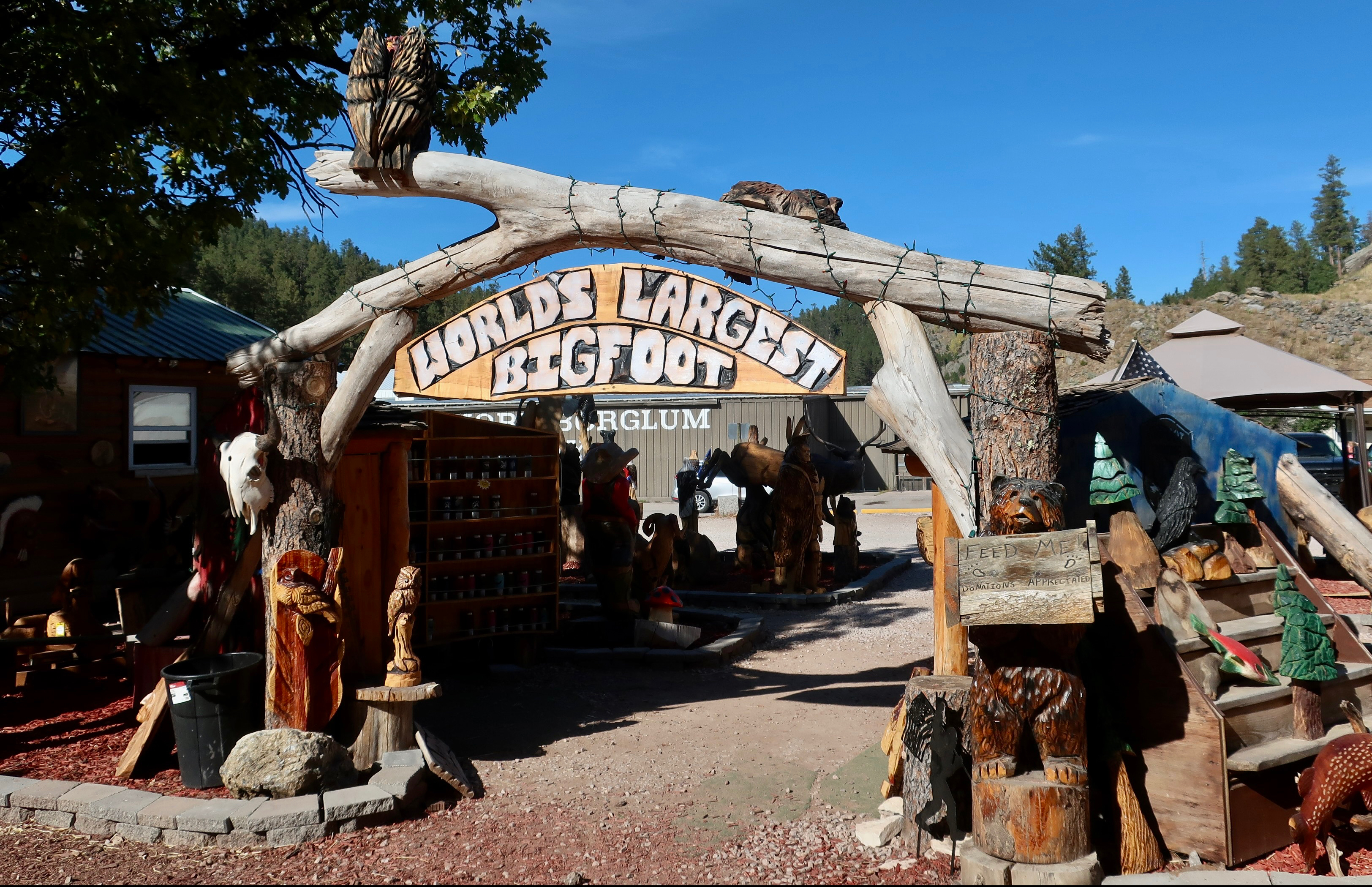
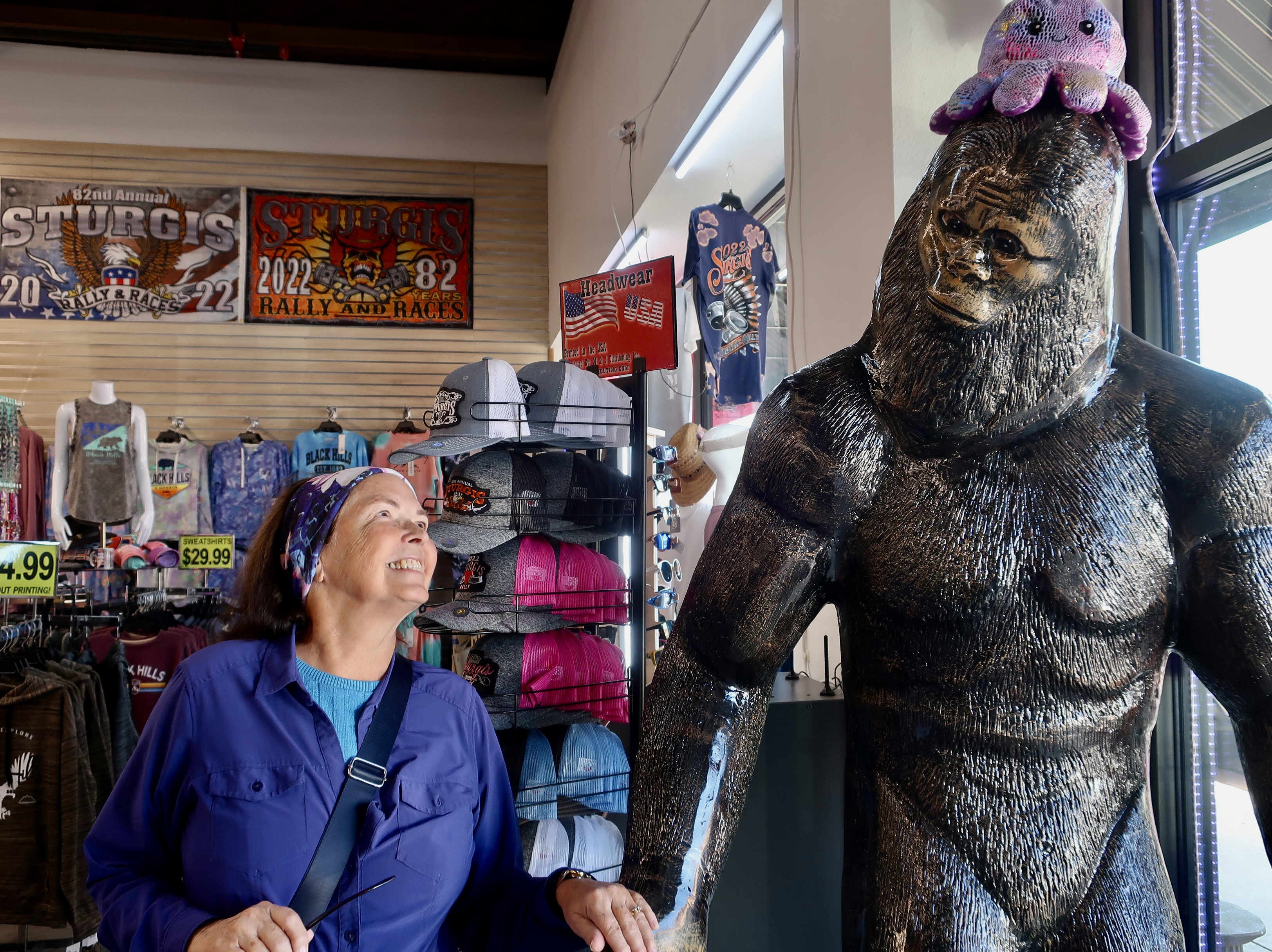
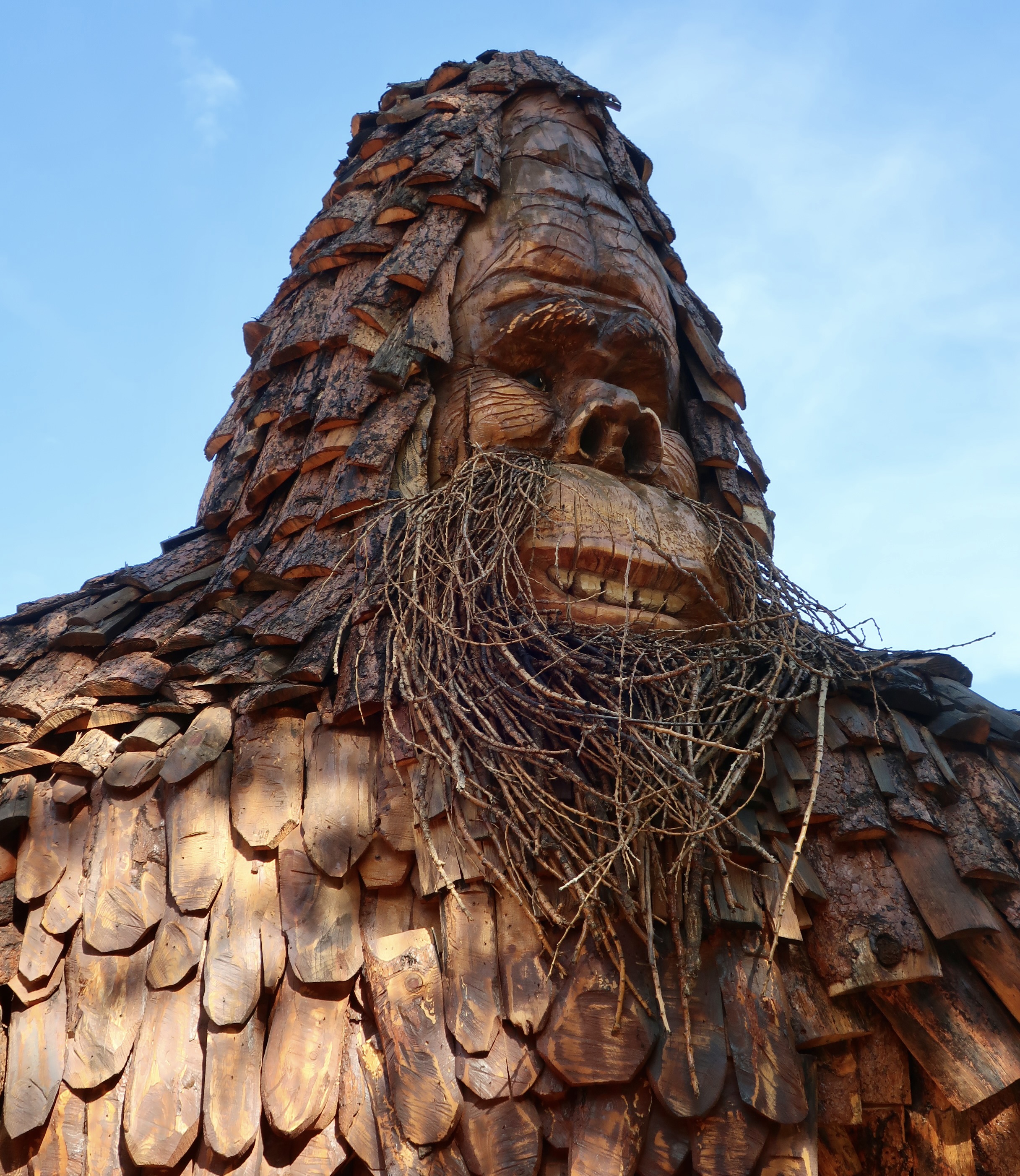
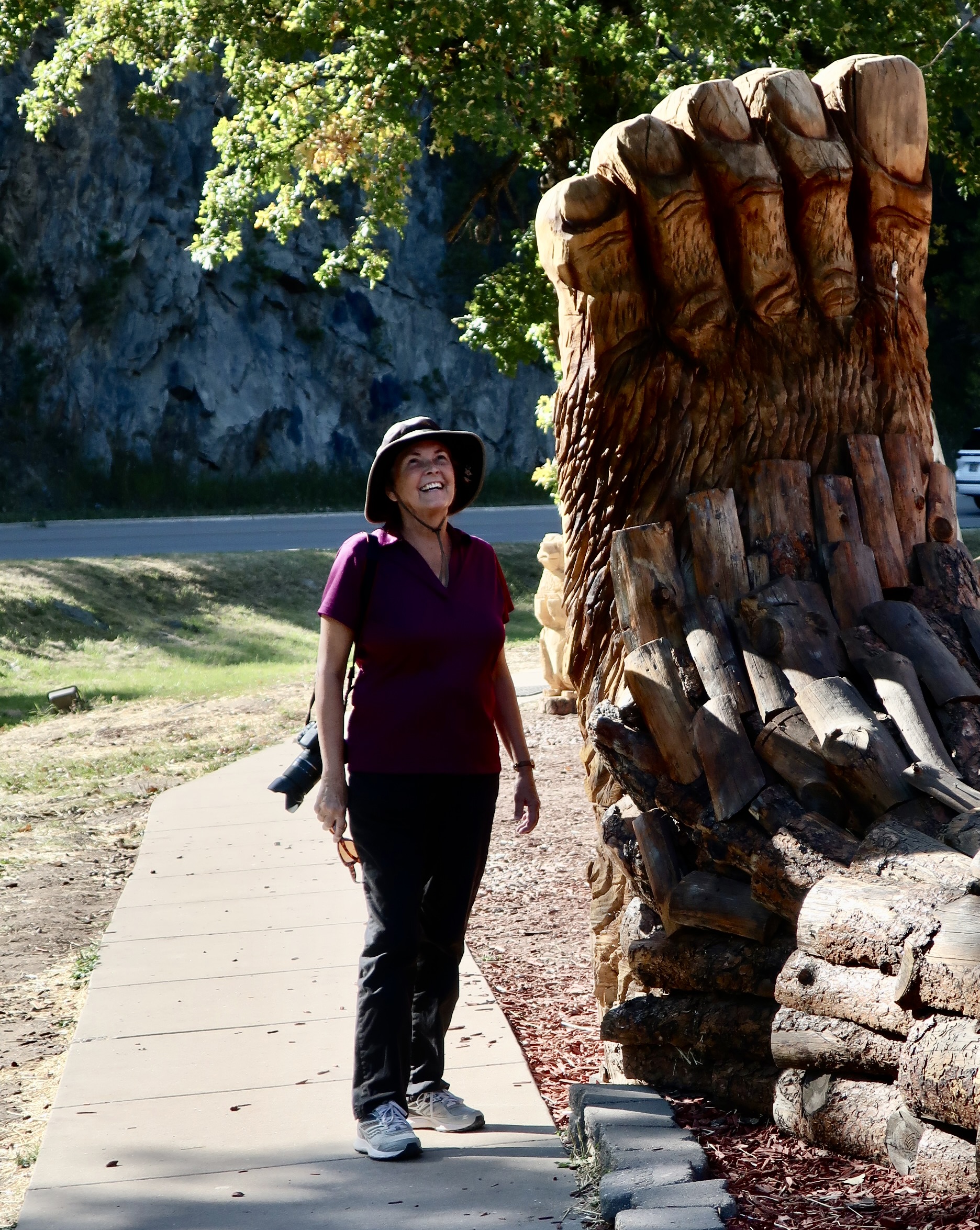
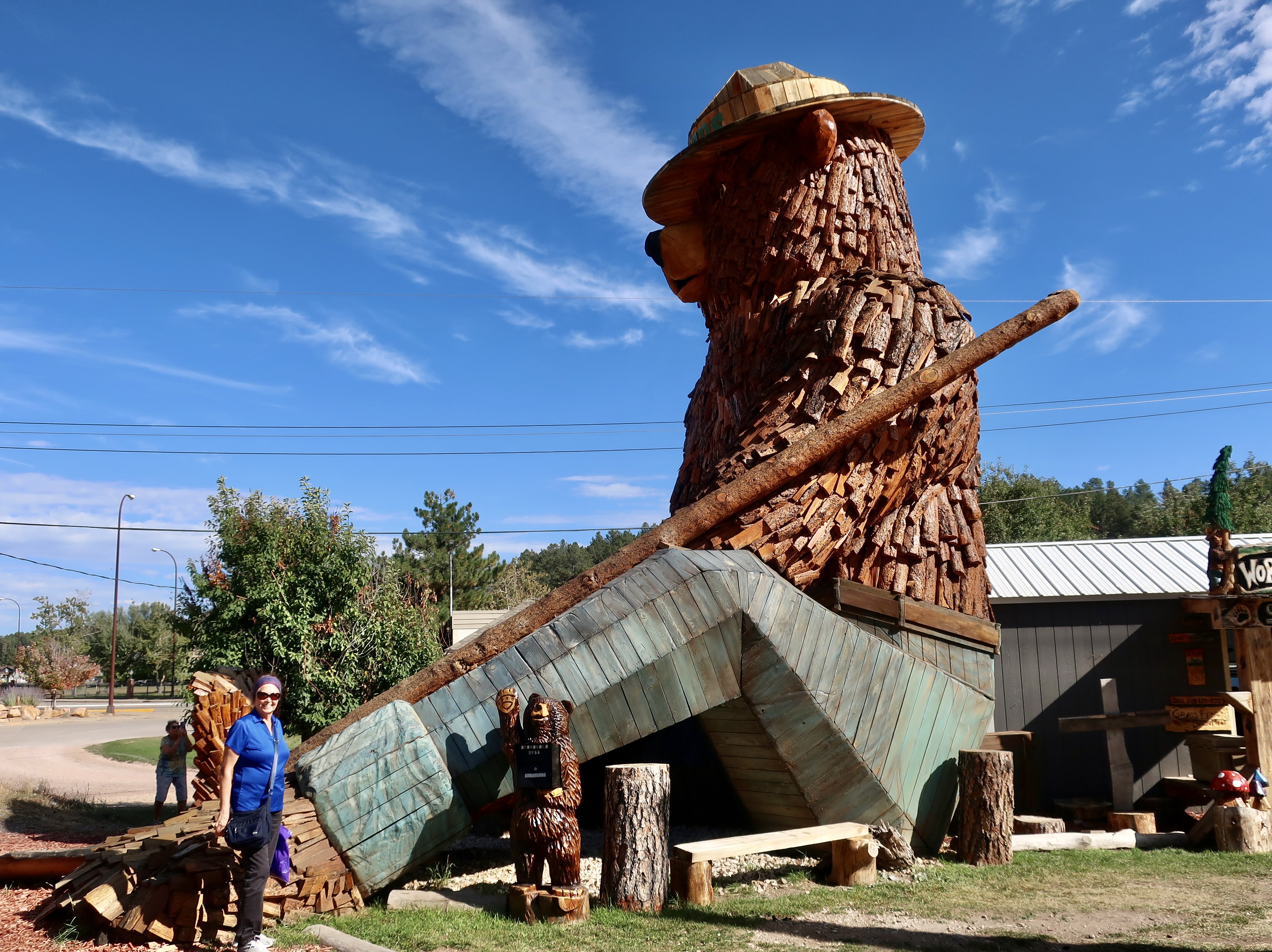
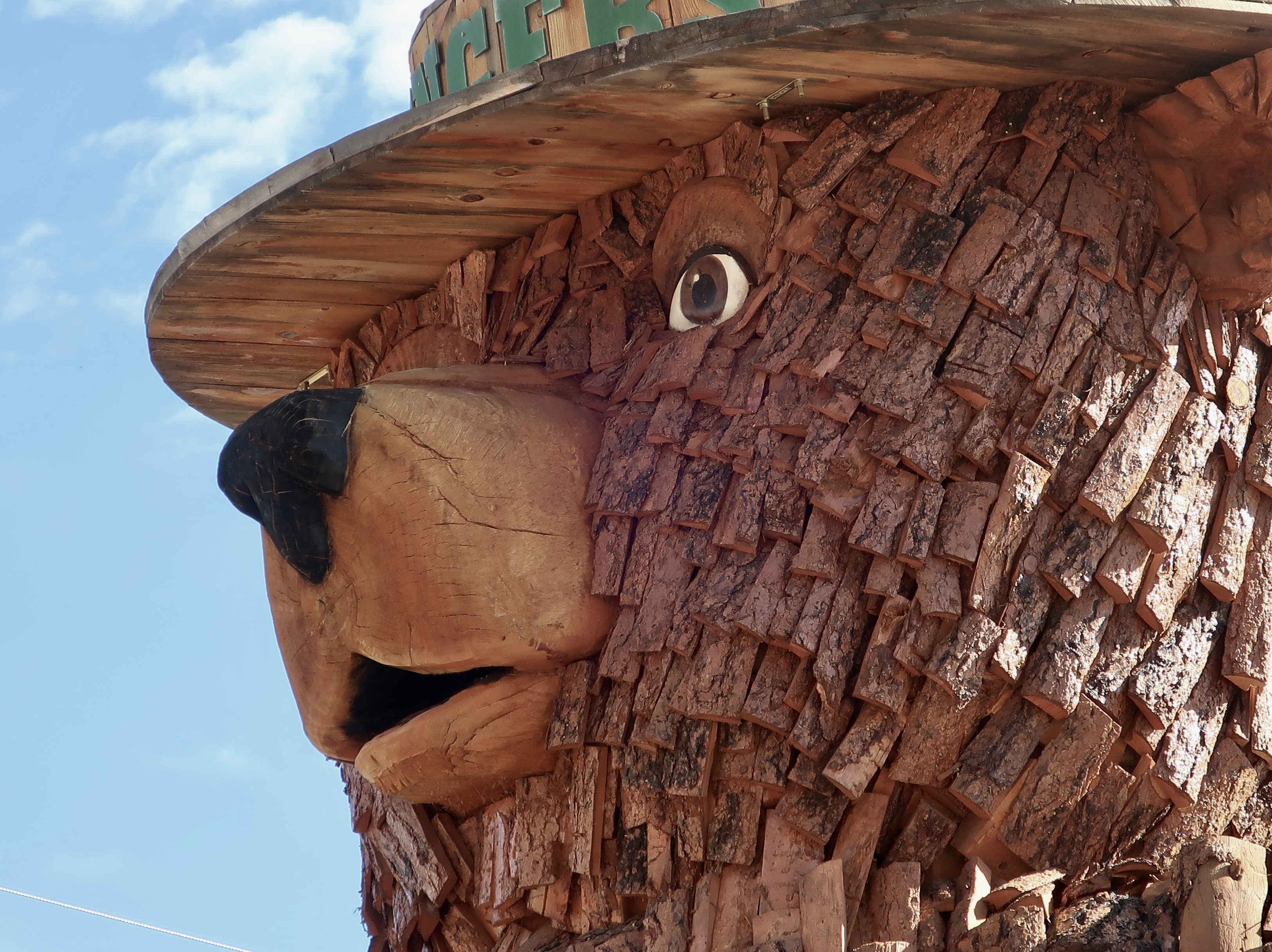
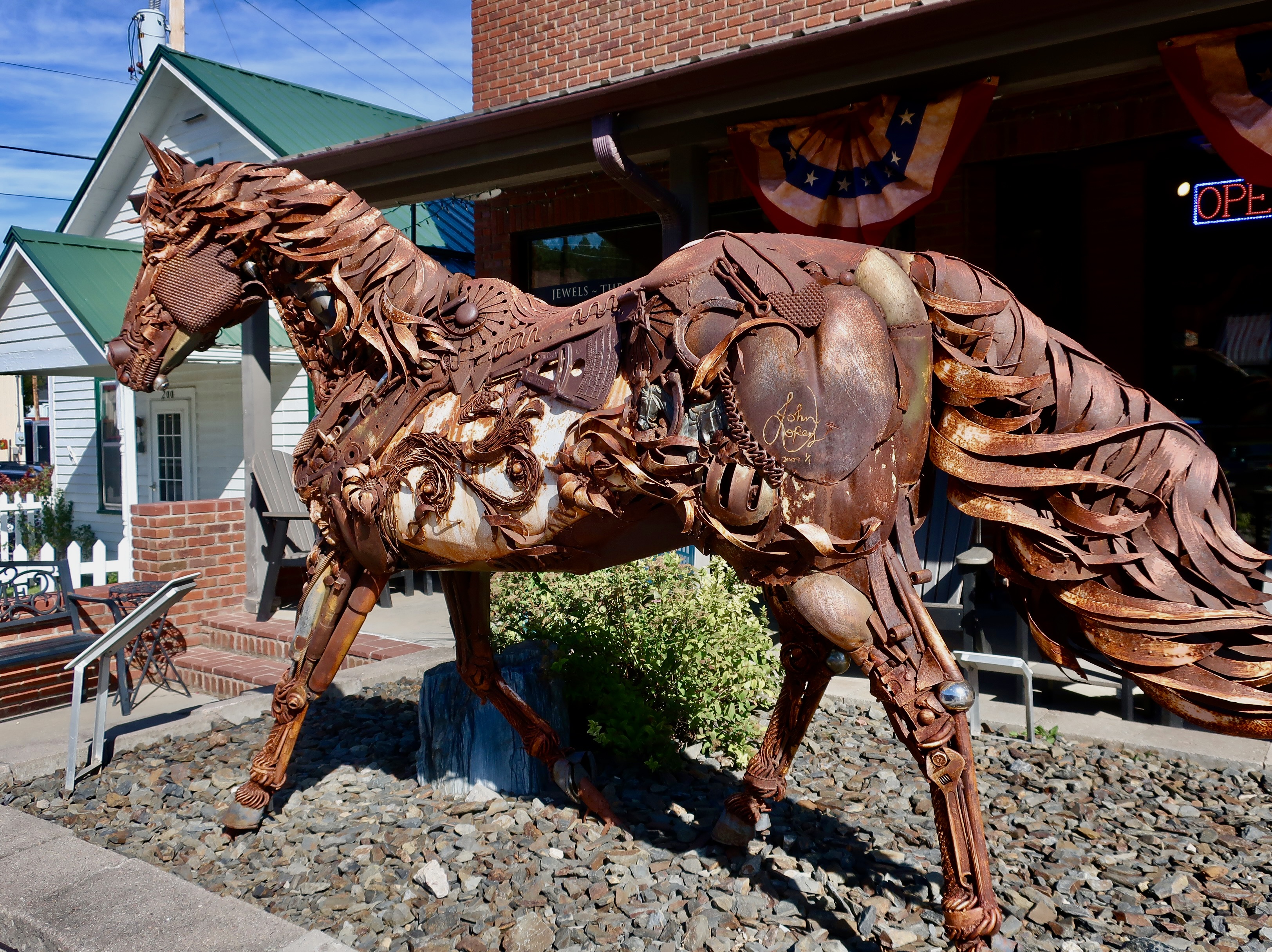
First up, is the World’s Largest Bigfoot, which is located in the small town of Keystone, South Dakota, located 4 miles away from Mt. Rushmore. It’s one of a number of interesting carvings at Dahl’s Chainsaw Art.As you probably know, Peggy and I have a thing for Bigfoot. The world’s only Bigfoot trap was located about 3 miles from where we lived in Oregon. We found this fellow in Custer, South Dakota. Judging from the look, it appears that Bigfoot has a thing for Peggy as well. Should I be jealous? But what about the creature on top of his head? Your guess is as good as mine, but I think I don’t have to be worried about a guy who walks around with an octopus as his hat. Here’s the big fellow in Dahl’s Chainsaw Art yard.He looks friendly. Big smile, crinkly eyes. And the beard would make a fabulous nest for a very large bird. But the question here is how big is Bigfoot’s foot? I came across a fresh print once about 18 inches long and three inches deep that had me thinking, “Bigfoot running.” It was blurry, however. Most things Bigfoot are. Nothing blurry about this…Bigfoot children were also found at Dahl’s playing on a carousel. There is a good chance that Bigfoot kids are born with beards, including girls.Not Bigfoot. But hey, it’s the 4th of July weekend and what’s more patriotic than a motorcycle carved as an eagle? Just ask a biker. A bald eagle and a flag are shown in the background just in case there’s any question. Happy Fourth! This bike is symbolic of an even more important event to Bikers: The Sturgis Rally, South Dakota’s top tourist event and one of the largest motorcycle rallies in the world. Sturgis is just 50 miles away from Keystone. I’ve never been to a rally, but it is just quirky enough, I would be tempted if I were around in August. While we are on “BIG,” this is reported to be the World’s largest Smokey the Bear. Also made by the Dahl brothers, it is located in Hill City, South Dakota. My favorite model demonstrates the size. Close up of Smokey Bear’s face.Hill City also housed the Museum of the Black hills Institute that Peggy and I did a post on. Not surprisingly, it had a pterodactyl on top.We also found this beautiful horse sculpture in Hill City. It reminded Peggy and me of similar sculptures at Burning Man, where we will be in two months.
And finally, to conclude:
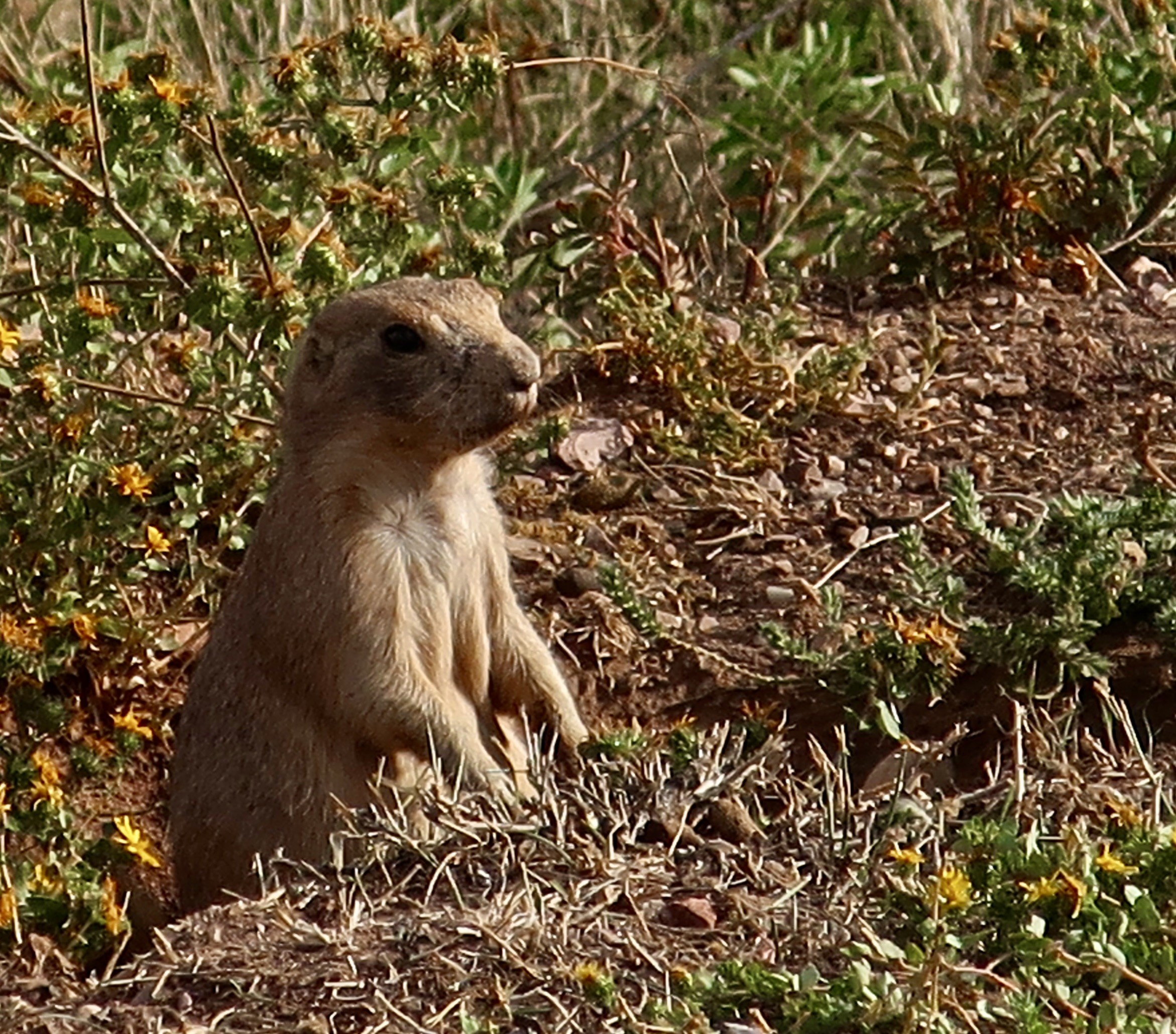
A girly girl squirrel/prairie dog…A buff, boy buffalo…And Peggy with her new alien friend that we found at Devil’s tower.
Next Monday’s post will take us back to Egypt and our journey up the Nile where we find ourselves in Luxor at the Temple of Karnak.
He caught me at a weak moment. Peggy and I had just re-entered the world of the living from our trip deep under the pyramid of Khafre at Giza and I was feeling a bit giddy. I’m not a fan of small, narrow, dark spaces. “You will look quite handsome in an Arab headdress,” the vendor told me. I looked at the white cloth and thought, to myself, “Ha, I can assessorize. It will match my beard.” He took our photo as Peggy and I did the tourist thing, using our hands to outline the Great Pyramid.
If you have ever been to Cairo, the odds are you have visited the pyramids and Great Sphinx at Giza. Over fourteen million people do every year. Located just outside the city, it’s an easy trip (depending on traffic) of just over 12 miles. Your journey back in time is a bit longer, some 4500 years. Of the three large pyramids, the Great Pyramid is the most famous. Considered one of the Seven Wonders of the Ancient World, it was built some 2000 years before any of the other six. And, it has outlasted all of its younger siblings. Its longevity alone should earn its claim to fame, but consider this: Standing at 481 ft, (146.5 m.), it was the tallest human-built structure in the world for 4,000 years! That’s mind boggling. Or was that aliens who built it? Grin.
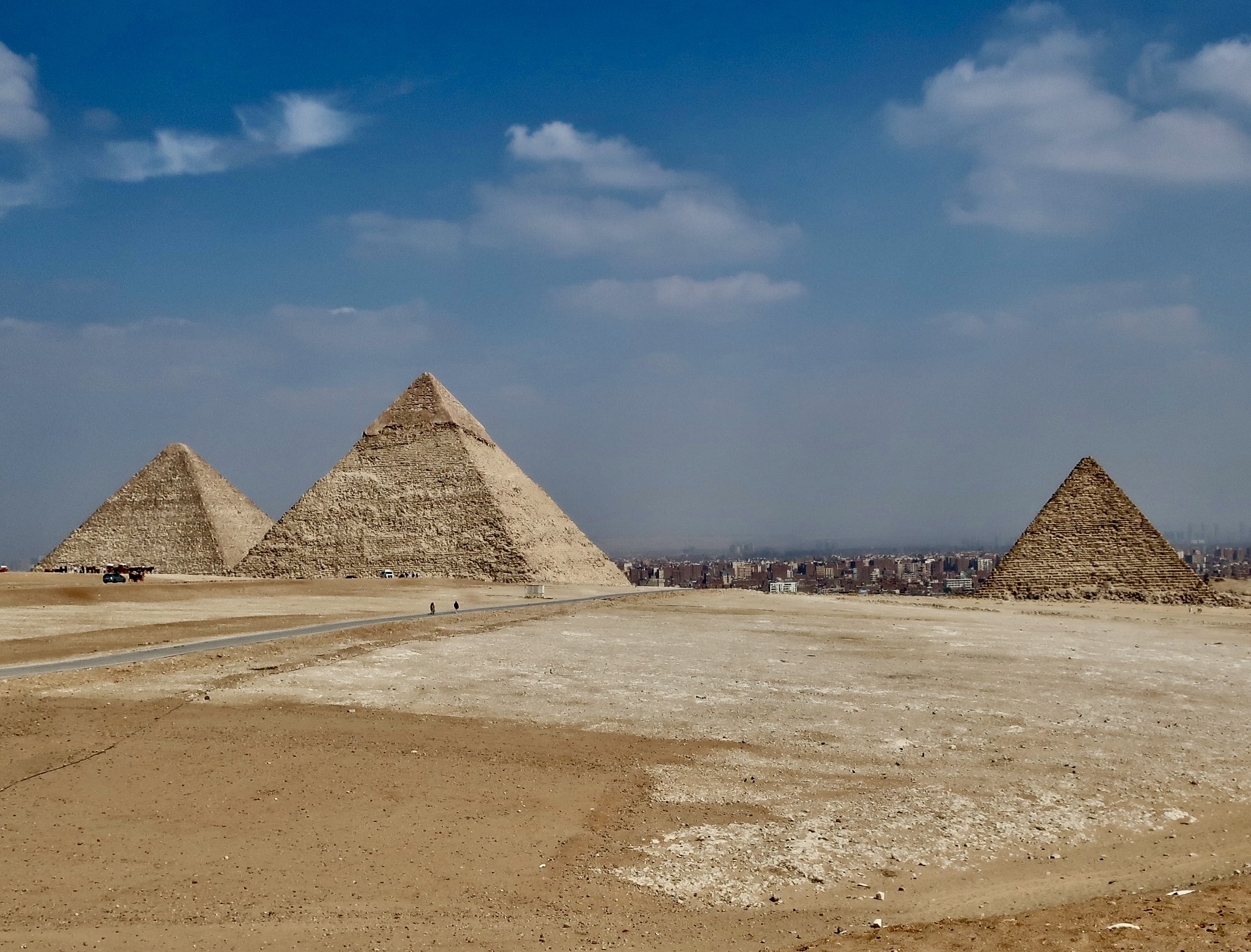
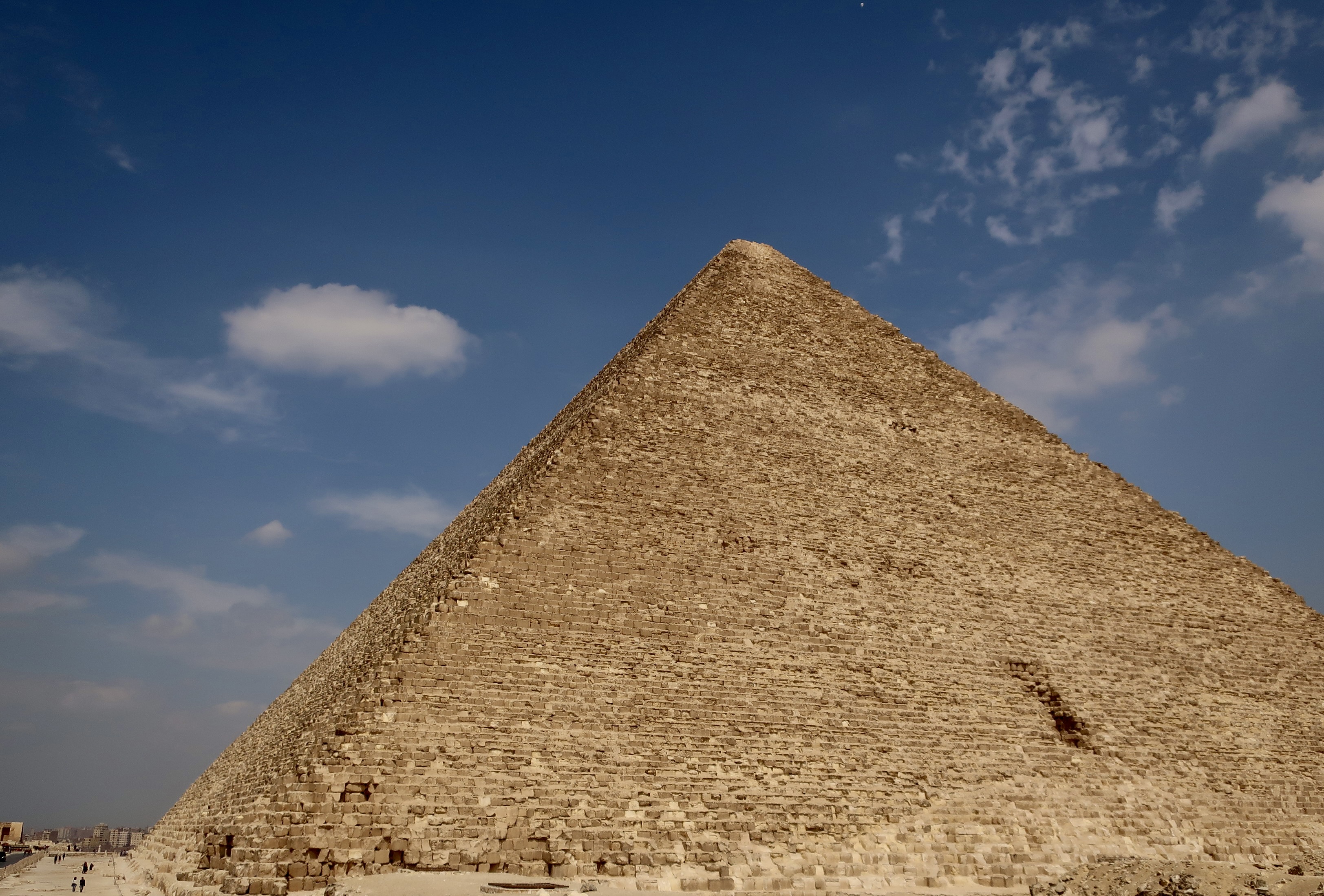
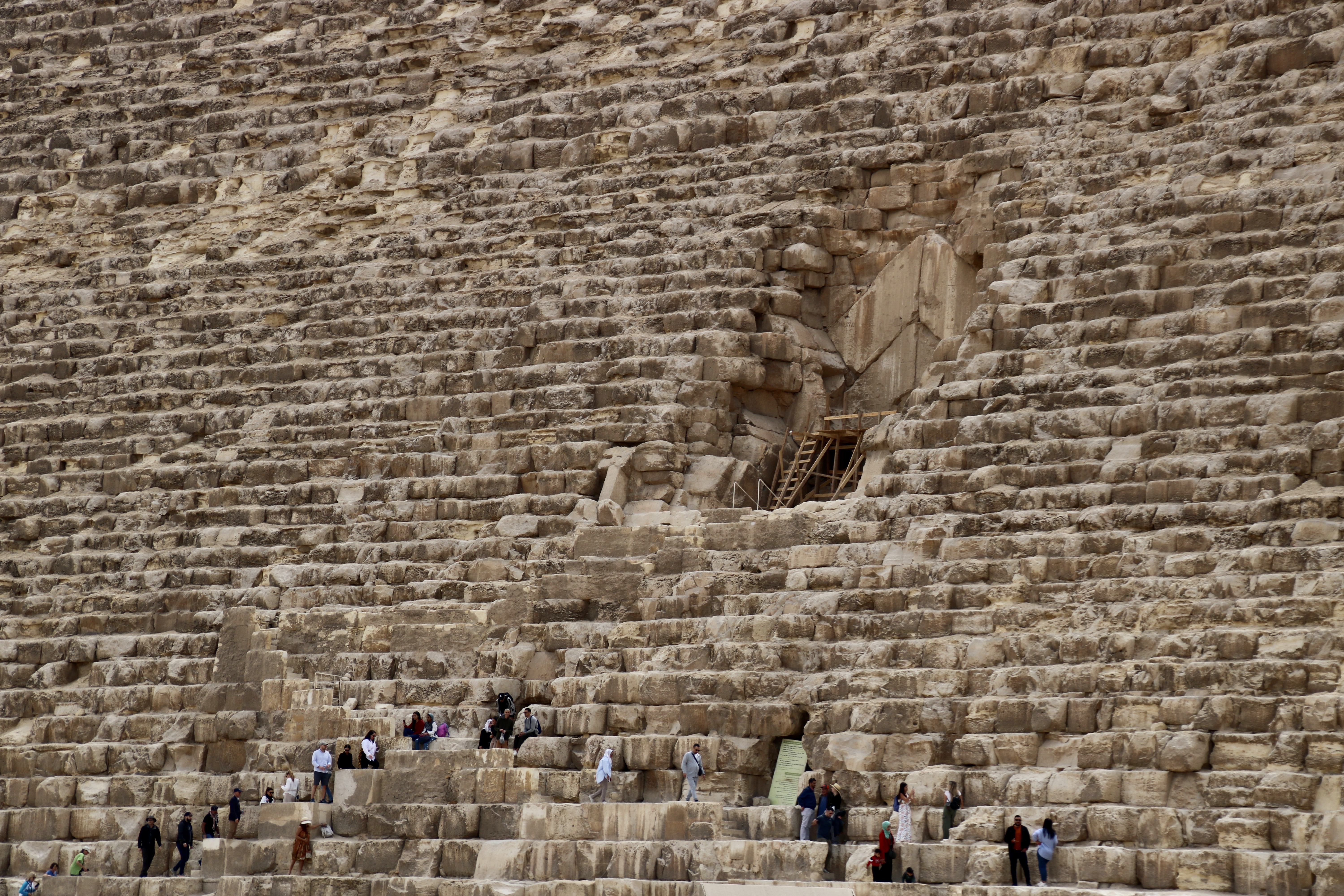
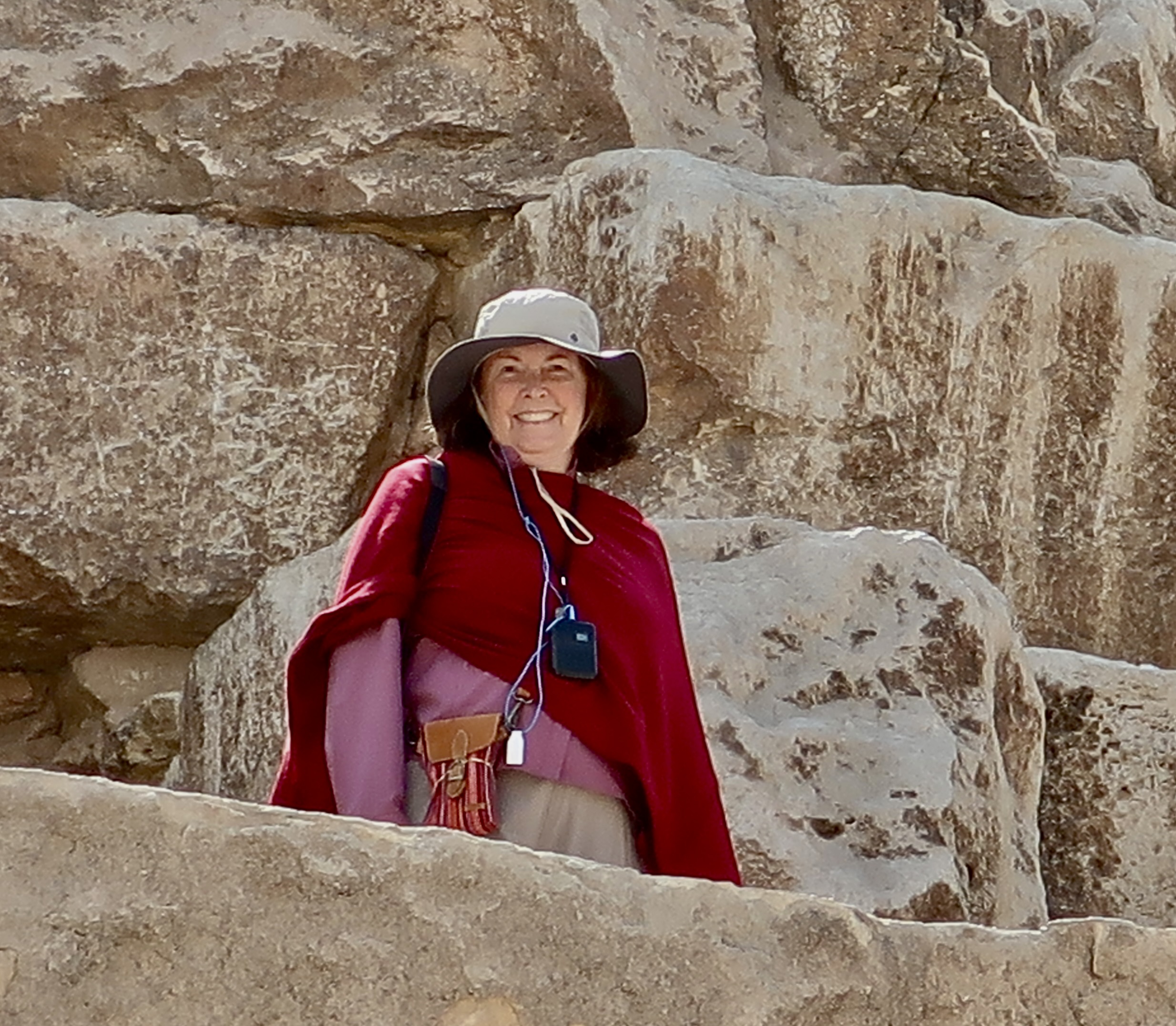
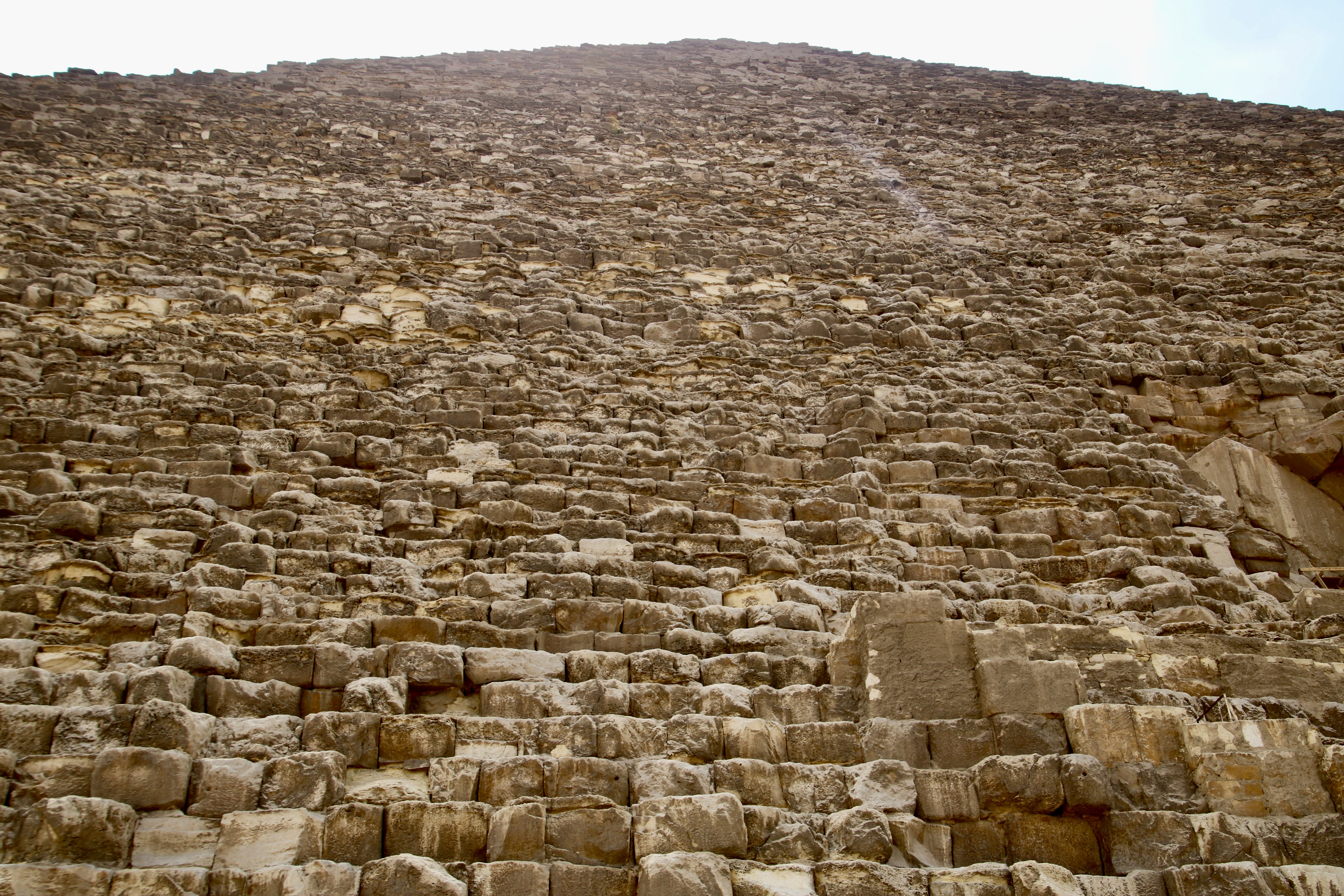
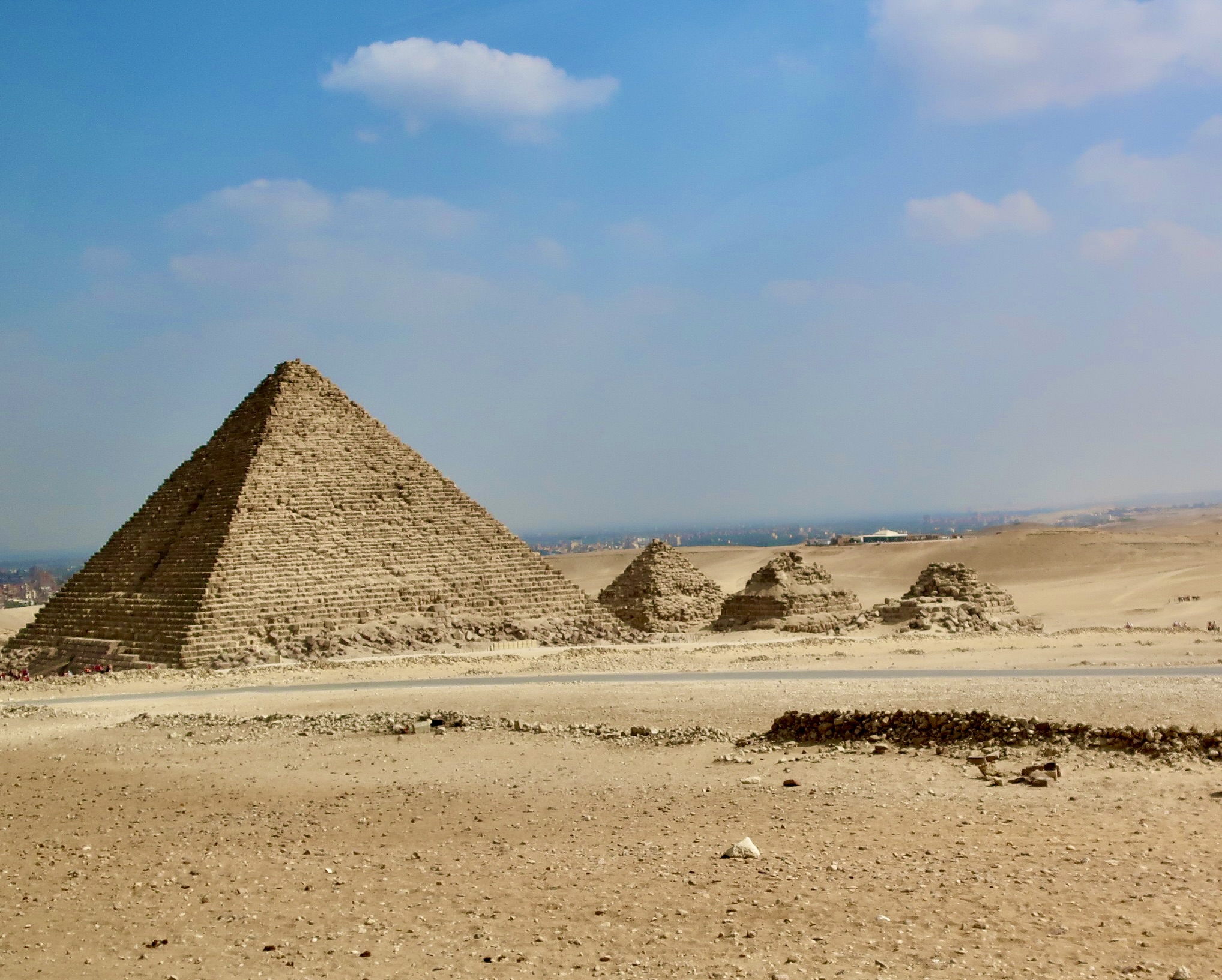
Seeing the pyramids is a must-do if you are visiting Cairo. They are located just a short distance from the city center. Cairo traffic may slow down your trip a bit, however…Here they are from left to right: The Great Pyramid, the pyramid of Khafre, and the pyramid of Menkaure. Perspective makes the pyramid of Khafre appear larger than the Great Pyramid in this photo. Cairo provides the backdrop. The tall buildings of downtown are barely visible through the smog.The Great Pyramid. One of the two entries can be seen on the right. People walking along the road on the left provide some perspective on size. This photo of the base of the Great Pyramid with the entry above, shows people walking along an established pathway. Peggy is one of them. People used to be able to climb the pyramids. Doing so now will get you a fine of somewhere between $639 and $6,390. I wonder if the amount is determined by how high you reach? Peggy, standing along the trail at the base of the Great Pyramid, provides a perspective on how massive the stone blocks used to build it are. It’s estimated that some 2,300,000 of these granite and limestone blocks were used in building the Great Pyramid with each block weighing an average 2.5 tons (2.3 metric tons). One of the all time great mysteries is how the ancient Egyptians moved the blocks into place. Answers have ranged from aliens (Twilight Zone music here), to greased ramps with hundreds of people pulling on ropes. More recent guesses have included ropes, pulleys and levers— simple machines to aid in the extensive human and possible animal power required. Another photo to capture the massive feel of the Great Pyramid. The pyramid was built in the early 26th Century BCE and took some 27 years to construct for the pharaoh Khufu. You might think that the Great Pyramid has given up most of its secrets by now, but on March 3rd of this year, scientists announced that they had discovered a new 30-foot hidden passage way using infrared thermography, 3D simulations and cosmic-ray imaging to peer inside the structure. The passage may very well be filled with ancient treasures. (Since I was celebrating my 80th birthday up the Nile near Aswan on the 3rd, I considered the discovery a birthday present.)The pyramid of the pharaoh Khafre is easily recognizable by the lime rock casing on top. All of the pyramids were once encased in lime polished to bright white. Seeing it at high noon must have been incredible. Blinding is another word. Over the millennia, the casing was repurposed/borrowed/stolen. Like the Great Pyramid and pyramid of Menkaure, Khafre’s pyramid was built during Egypt’s Fourth Dynasty (c. 2613 to 2494 BCE), which was considered the Golden Age of the Old Kingdom. We have several other photos of Khafre’s pyramid but the folding chair amused me. Not to mention the woman in black who seems to be hovering off the ground in a Flying Nun pose, and the herd of rent-a-camels waiting for customers. The blocks in the right foreground were once part of a temple associated with the pyramid. Peggy makes her way along the narrow passage under the pyramid of Khafre. Considering half of our journey into the depths was spent bent over avoiding rock/head collisions, this was actually roomy— until you met visitors coming from the other direction. Skinny was okay, but not so skinny could be similar to meeting an 18-wheeler going the wrong way on a one way street. The fuzzy state of the photo reflected my feelings about being under 4,880,000 tons of rock with the ghosts of a long dead pharaoh and possibly servants who had been killed to serve him in the afterlife. Can’t have the pharaoh fare for himself, right? If this practice was still in vogue at the time, it’s hard to imagine bumping into happy servant ghosts.And finally, we come to the Pyramid of Menkaure, the smallest of the three. It’s thought that the three smaller pyramids were for the pharaoh’s queens/wives/half sisters. If you look closely at the shadow side of the pyramid, you see a slice cutting down through it. There’s an interesting story. In 1196 CE, Saladin’s son, Al-Aziz Uthman, who was the Sultan of Egypt, recruited workmen to demolish the pyramids starting with Menkaure’s. Their challenge was they could only break up a couple of rocks per day. It was a slow process. After eight months, all they had accomplished was the slice featured above and they gave up. Apparently, the pyramids were as tough to tear down as they were to build, for which we can be thankful. Certainly one of the best known statues in the world, the Great Sphinx was built during the same time frame as the pyramids around 2500 BCE. Having the body of a lion and the head of a man, it was carved out of the bedrock where it now stands. Photos of it are often taken in conjunction with one or more of the pyramids. This one is the Great Pyramid. The missing nose was once attributed to Napoleon’s soldiers using it for target practice. Now it is felt that the nose was broken much earlier, possibly as early at the 3rd Century CE. Seen here in its entirety, the Sphinx was built in a direct line from west to east. It is 240 feet (73 m) long measured from its front paws to its tail and 66 feet tall (19 m) from the top of its head to its base. The Great Pyramid can be seen peeking out from behind the Sphinx’s head. And now for a Curt and Peggy special! Millions if not billions of photos have been taken of the Great Sphinx’s head, often with a pyramid thrown in for good measure. But how often do you find a picture of its tail with a pyramid. Classy, huh? 🤔
And now on to what 62.5 % of you have been waiting for: Camels.
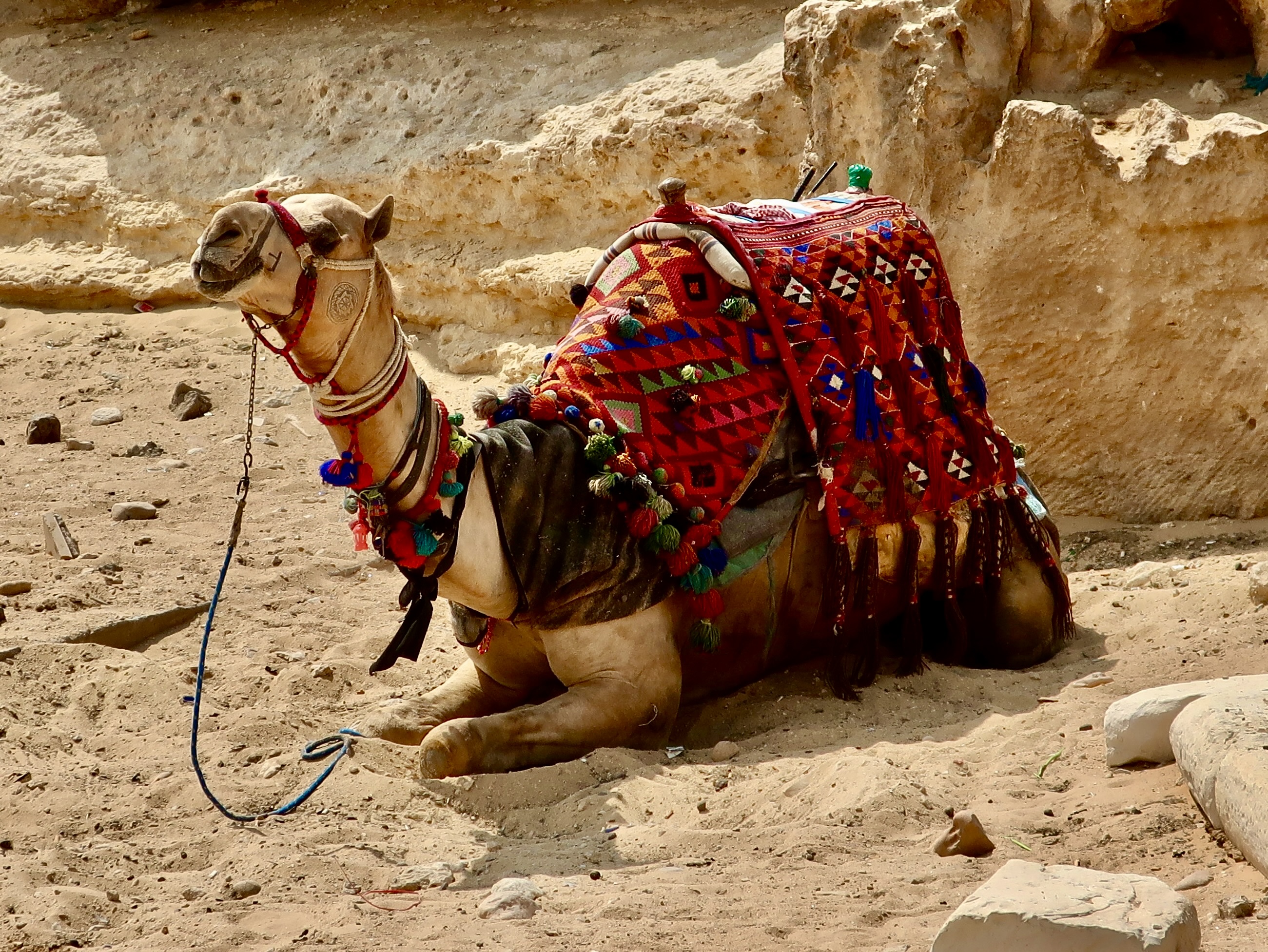
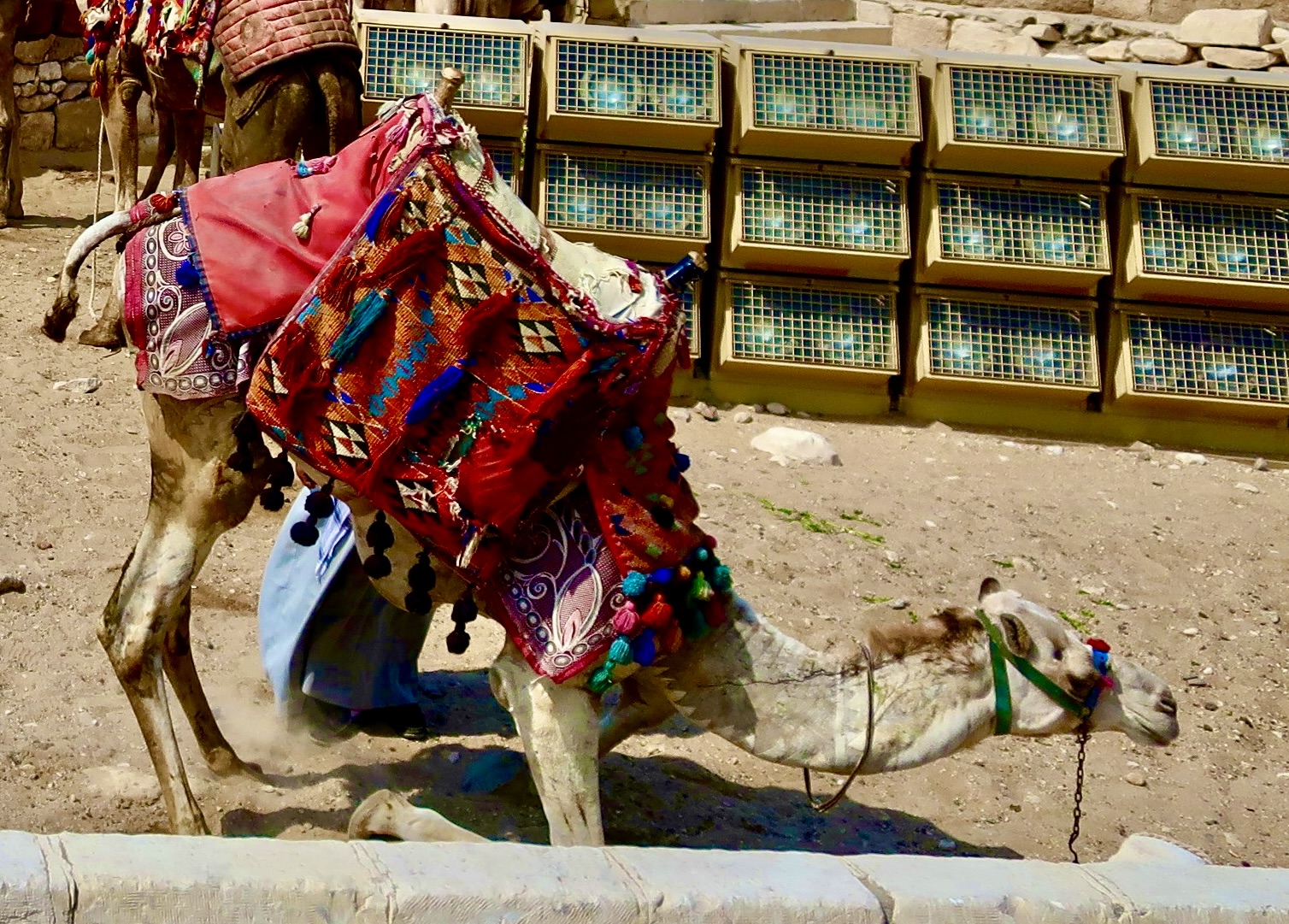
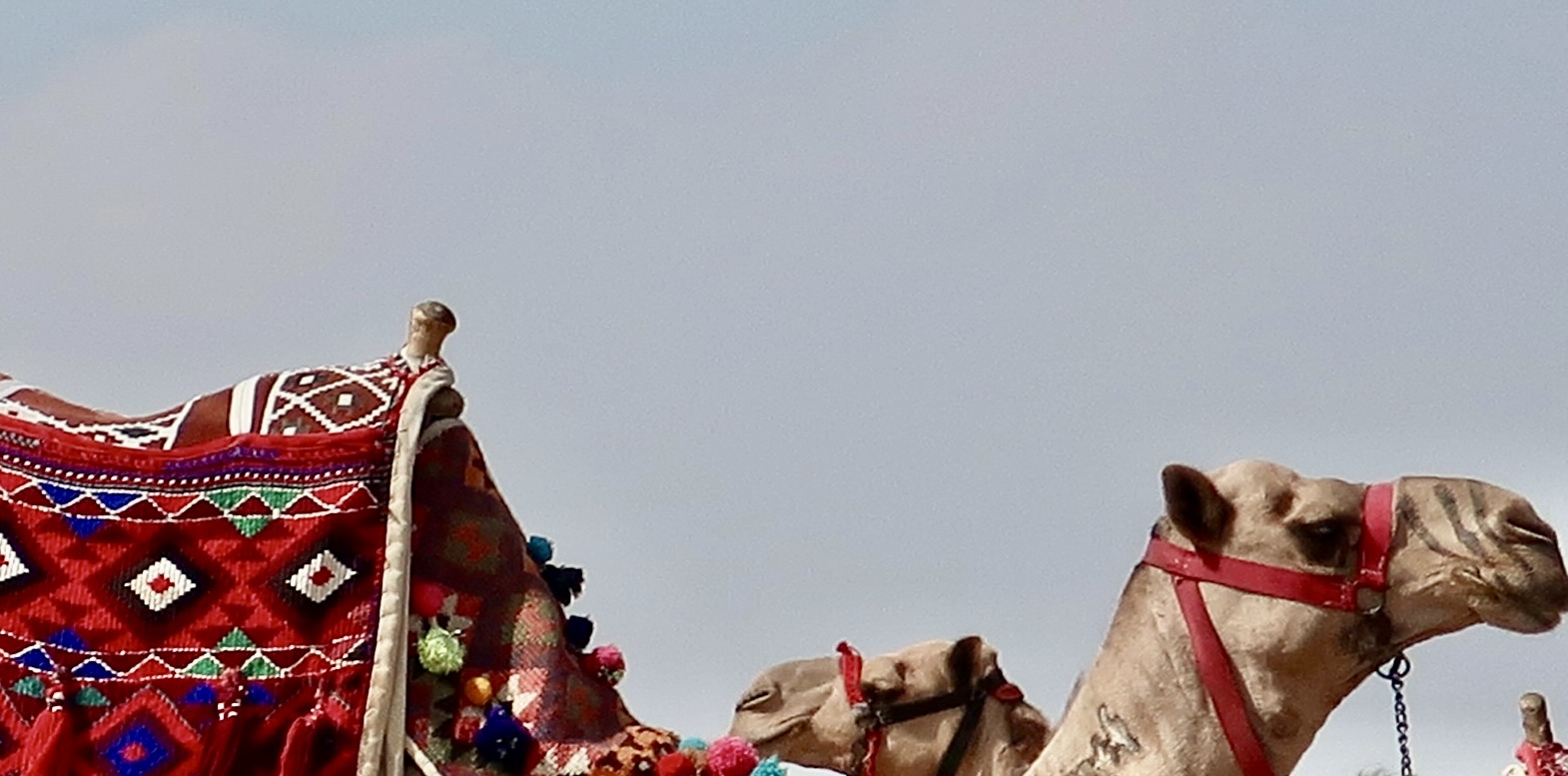
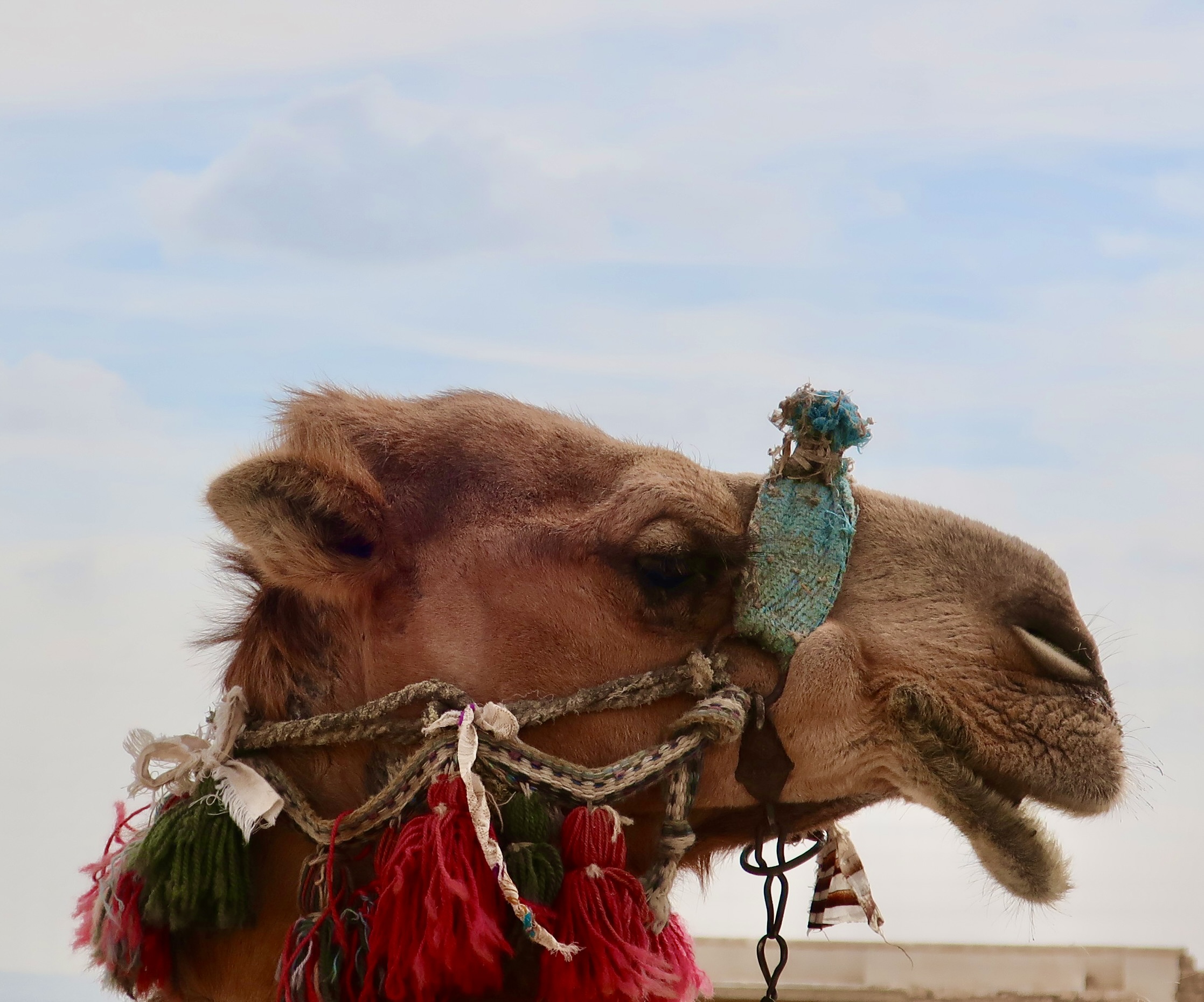
Giza Uber…Pink tongue. Check out the symbol on the camel’s neck. Each camel, as far as I could tell, had its own unique tattoo. This one also had face decorations.“Getting down,” camel style. Again, note the neck decorations.Horse or camel? The foot print might prove a clue. Don’t you just love it when I post scat photos? That’s the nature boy in me. I—did—not–do—that!How a camel driver rides camels. Note the legs.How tourists ride camels.Remember the old saying, “Two ships passing in the night?” These are two camels passing in the day. Did you know that camels are often called ships of the desert because they carry cargo across long distances in the desert just like ships carry cargo across the ocean. They are uniquely fit for their role. For one, they can carry up to 400 pounds for 25 miles a day. They can go for several days without water and up to two weeks without food. Their leathery lips and mouth allows them to chomp down on delicacies such cactus and other spiny desert plants. Eyes, ears and noses are designed to withstand sand storms. Large feet help keep them from sinking in the sand. Wearing a size 14 shoe, I know something about the latter.Remember back when I posted my introduction to our Egypt trip and had a camel photo bomb me. Here he is to conclude my blog on the pyramids, Great Sphinx and camels of Giza.
Next post: Big Foot’s Big Foot and my wrap up on South Dakota.As you read this post, Peggy and I are off on another adventure, starting today (Monday, June 25). Once again, we are on a three month trip exploring North America with Serafina the trailer, Iorek the truck, Bone and Eeyore. We’ll keep you posted.
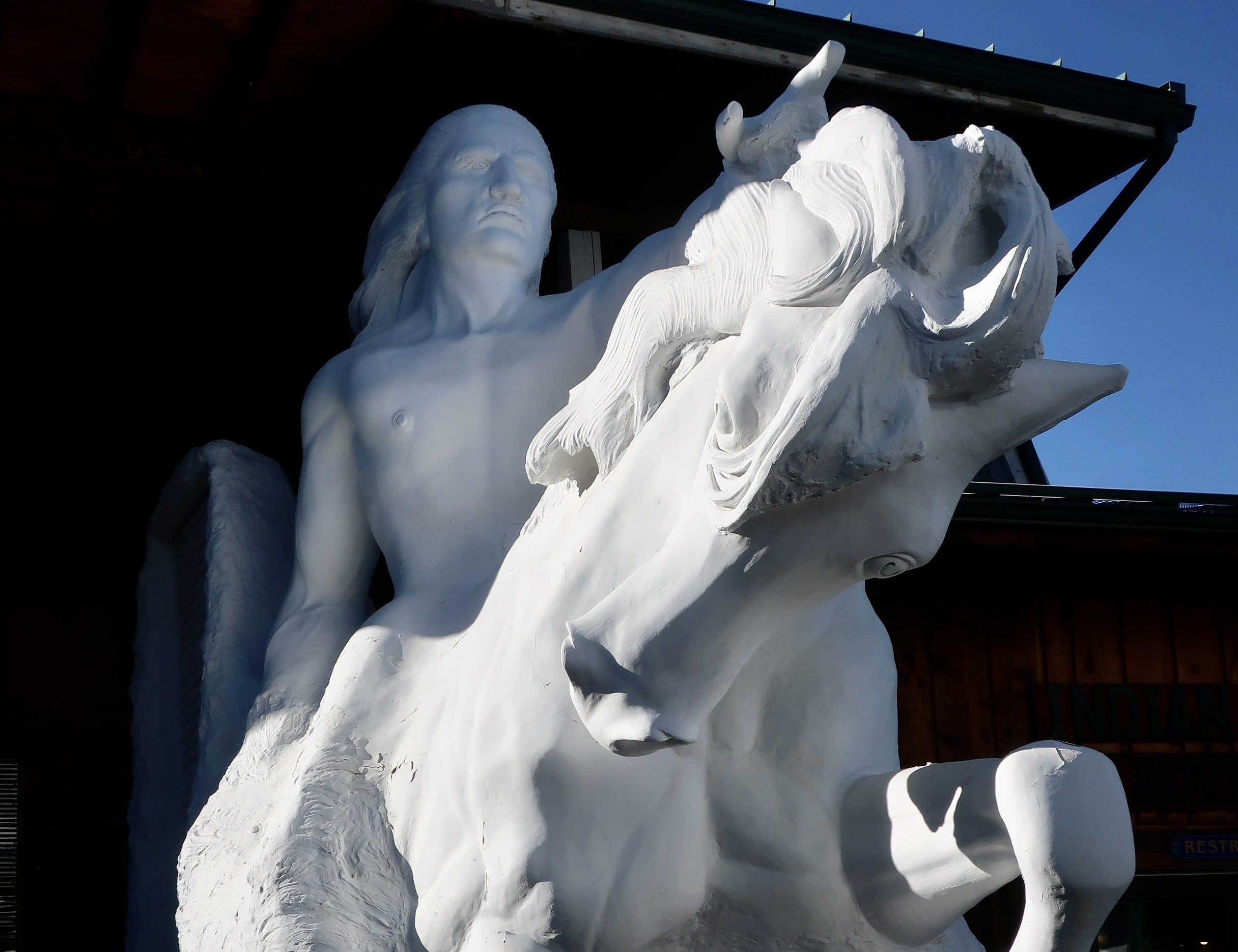
The Crazy Horse Memorial in South Dakota is a huge sculpture carved out of granite that is about 1/3 finished after 75 years of work. We visited it last fall on our three month trip around the US. All photos in this post are taken by either Peggy or me unless otherwise noted.
I was taking a reflection shot of the Crazy Horse Memorial in the window of the Laughing Water Restaurant when I got this interesting double reflection. I decided to call it Crazy Horse’s Ghost.
If you are visiting Mt. Rushmore, a trip over to the Crazy Horse Memorial is also worth doing. It’s not far— a distance of 17 miles that shouldn’t take more than 30 minutes to drive. In ways, the memorial was built as an answer to the presidential monuments. As the Lakota Chief Henry Standing Bear noted when he contacted the sculpture, Korczak Ziolkowski, “My fellow chiefs and I would like the white man to know that the red man has great heroes, too.”
Standing Bear also believed that the Black Hills were an appropriate place to build the memorial because they are a sacred area to American Indians. I first became aware of this perspective several years ago when I read the book, Black Elk Speaks. Written by the poet and writer John G. Neihardt, as told to him by the Ogalala Lakota medicine man Nicholas Black, the book captures Black Elk’s vision of the unity of humankind and the earth. The book takes the reader back in time to the vanishing culture of American Indians, but also contains a powerful message for people today. It has sold over one million copies. As Black Elk completed his story to Neihardt, he pointed to Harney Peak and identified it as where his vision took place. Harney Peak, located between Mt. Rushmore and the Crazy Horse Memorial, has now been renamed Black Elk Peak.
As for Crazy Horse, he definitely fits the definition of being one of the great heroes of American Indians and is recognized alongside other well-known leaders such as Geronimo, Red Cloud, Tecumseh, Sitting Bull and Cochise. Born in 1842 near present day Rapid City, his father was also an Oglala Lakota medicine man. His mother was a Brule Lakota and the sister of Spotted Tail, a noted war chief who later became a statesman traveling to Washington several times on behalf of the Lakota.
Crazy Horse was raised at a time when white treasure hunters had discovered gold in the Black Hills and were invading the area, breaking treaties that had ceded the land to the Lakota/Sioux. It was also a time when the once abundant buffalo herds were being methodically wiped out and the various tribes being forced on to reservations, threatening both their freedom and way of life. Not surprisingly, the Indians fought back, and Crazy Horse played a key role in this resistance, eventually leading up to and including the Battle of Little Bighorn.
As a young man, he went on a vision quest where he had a dream of a rider in a storm with long flowing hair who instructed him that he was not to wear a war bonnet or take scalps in battle. As the storm faded, a red backed hawk flew over the head of the rider. His father interpreted the dream to mean that Crazy Horse would be a great leader in battle, which turned out to be true. He died in a scuffle when he was being led to a stockade and a soldier bayoneted him on September 5th, 1877.
There are no known photos of Chief Crazy Horse who worried that a photograph might capture his spirit. This wood carving was done by Korczak Ziolkowski from descriptions given to him by people who had fought beside Crazy Horse.This photo at the Crazy Horse Memorial is from a 1948 reunion of the survivors of the 1876 Battle of Little Bighorn. They would have fought alongside Chief Crazy Horse. Seated from left to right in the photo, they are Little Warrior, Pemmican, Little Soldier, Dewey Beard, John Sitting Bull, High Eagle, Iron Hawk, and Comes Again. (Photograph by Bill Groethe.)
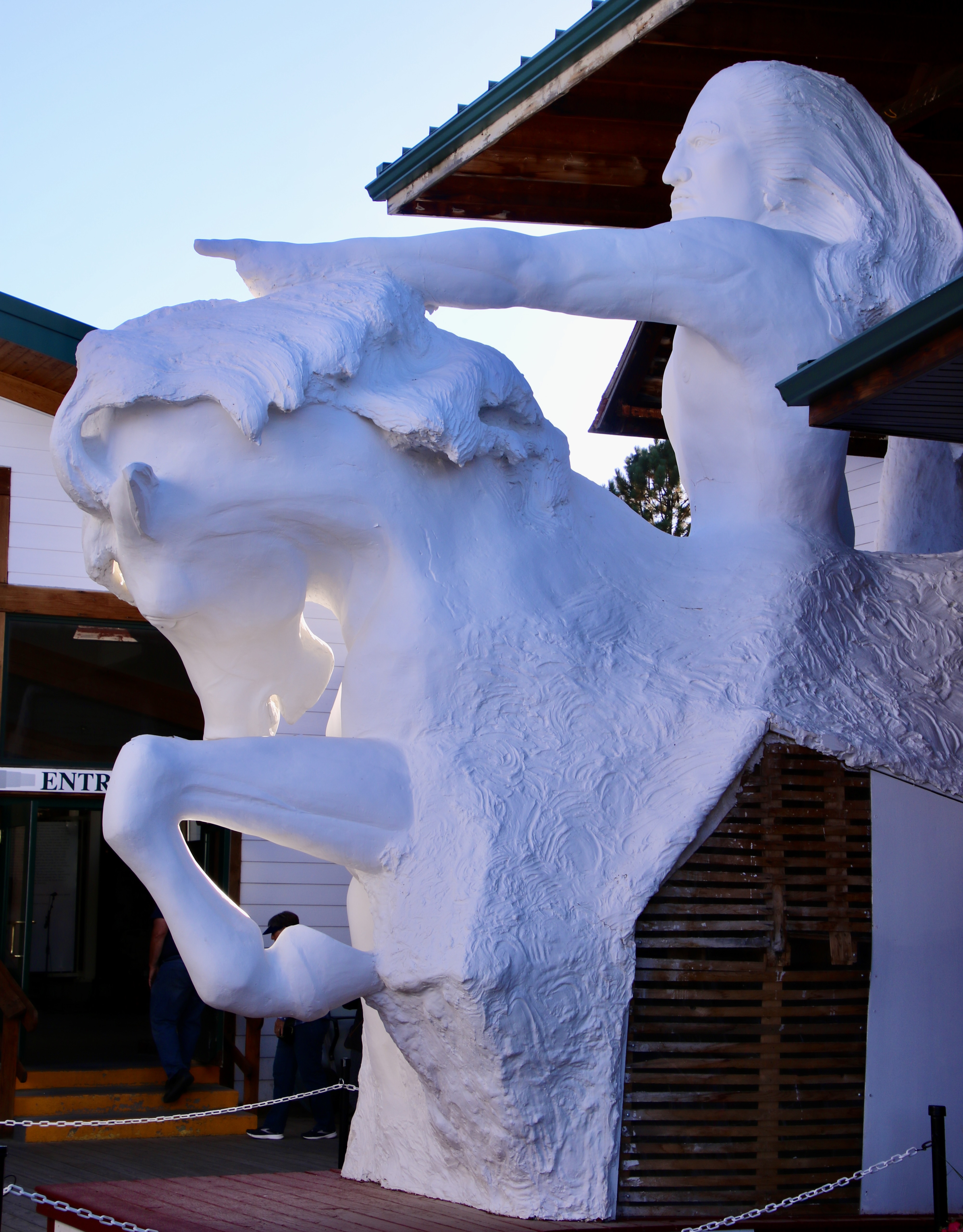
When Chief Standing Bear contacted the sculptor Korczak Ziolkowski in the early 1940s on behalf of the Lakota chiefs, Ziolkowski agreed to take on the project. He moved to the Black Hills in 1947 to locate an appropriate place for the monument and kicked off the carving in 1948. It is still on-going today, 75 years later. Ziolkowski continued the work until he died in 1982 when the project was taken over by his wife, Ruth. When she passed on, her children and grandchildren continued building the monument. Today the effort is overseen by the Crazy Horse Memorial Foundation. As of now, only the face has been completed and stands at 87 feet tall. His outstretched arm, which is presently being worked on, is 263 feet long. His finger will be 29 feet long. The horse will stand 219 feet high, the mane 62 feet high, and the ears 54 feet long.
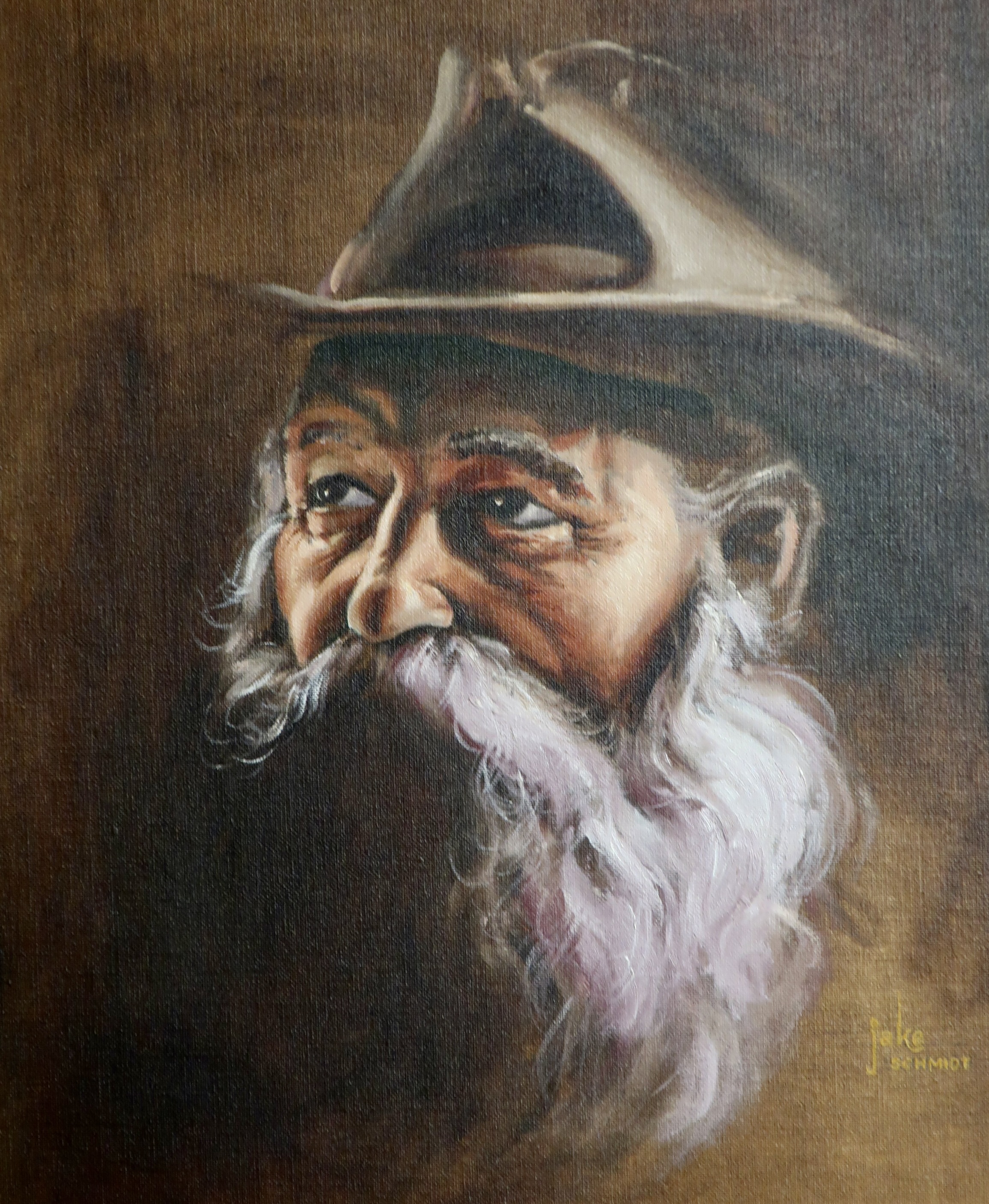
This painting of Korczak Ziolkowski is located at the Crazy Horse Memorial.
Feelings among the Lakota are mixed. Many see it as the memorial it was meant to be, celebrating Crazy Horse and American Indians. Some, however, believe it does not recognize Crazy Horse’s humility and is as much, or more, a memorial to Ziolkowski and his family. Whatever the conclusion, it has kept the Ziolkowski family gainfully employed down through the decades and generations.
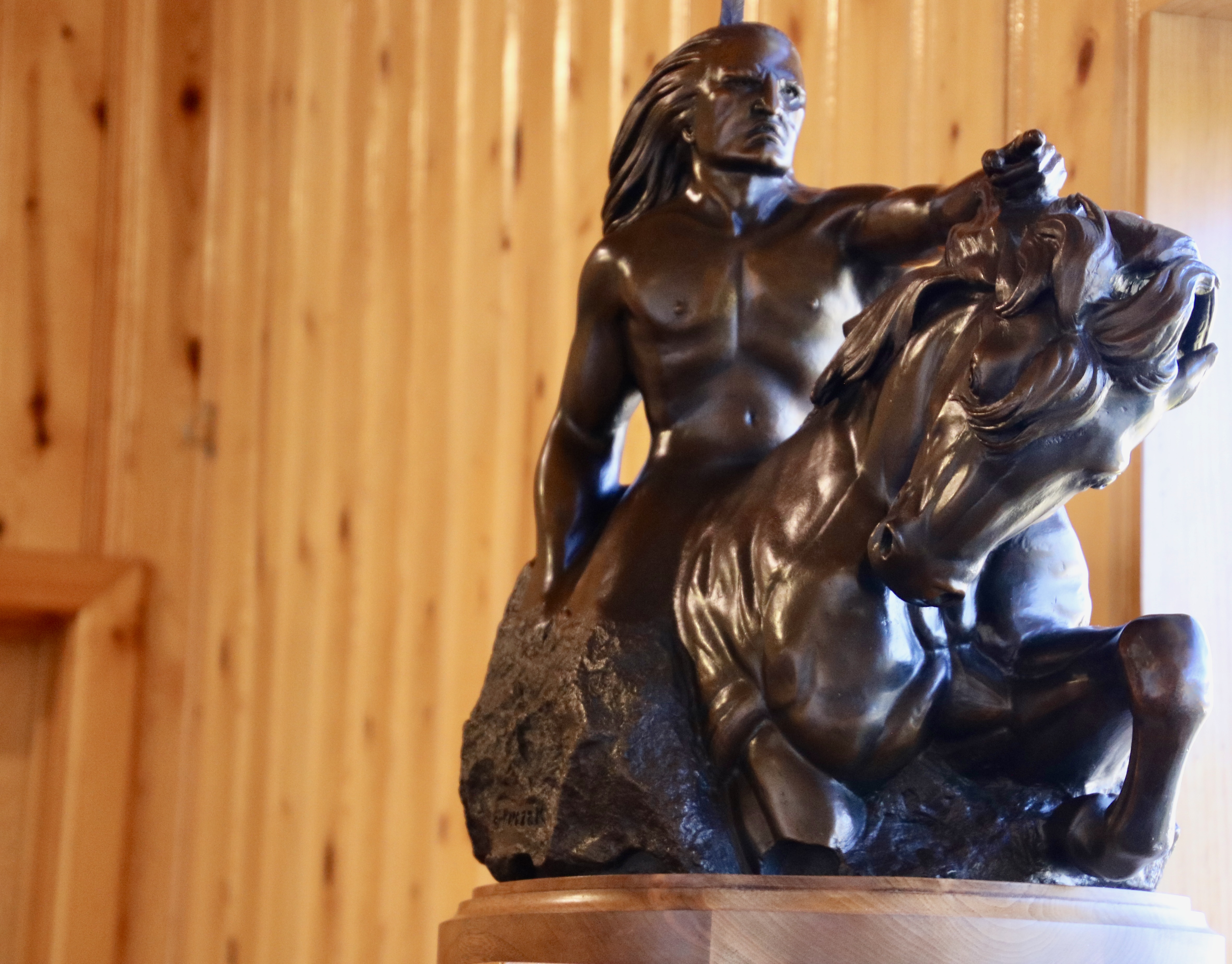
Peggy and I camped out at a small but gorgeous campground no more the a half mile away from the Crazy Horse Memorial. This shot provides a distant view from the campground road. The hole is located under what will be Crazy Horse’s arm. The horses head can be seen in a dim outline on the lower front.This close up which includes workers beneath Crazy Horse’s head provides a perspective on size.This working model of the memorial by Korczak Ziolkowski is located outside of the museum and gift store.A side view of the working model.And a bronze model, also by Korczak Ziolkowski.A museum included as part of the memorial includes numerous Indian works of art and artifacts. I was intrigued (and amused) by this piece from Alaska.I’ll conclude with this painting of Ziolkowski at work on the Memorial. The painting is located in the Memorial’s museum.
Next Monday it’s back to Egypt and the pyramids, sphinx and camels of Giza.
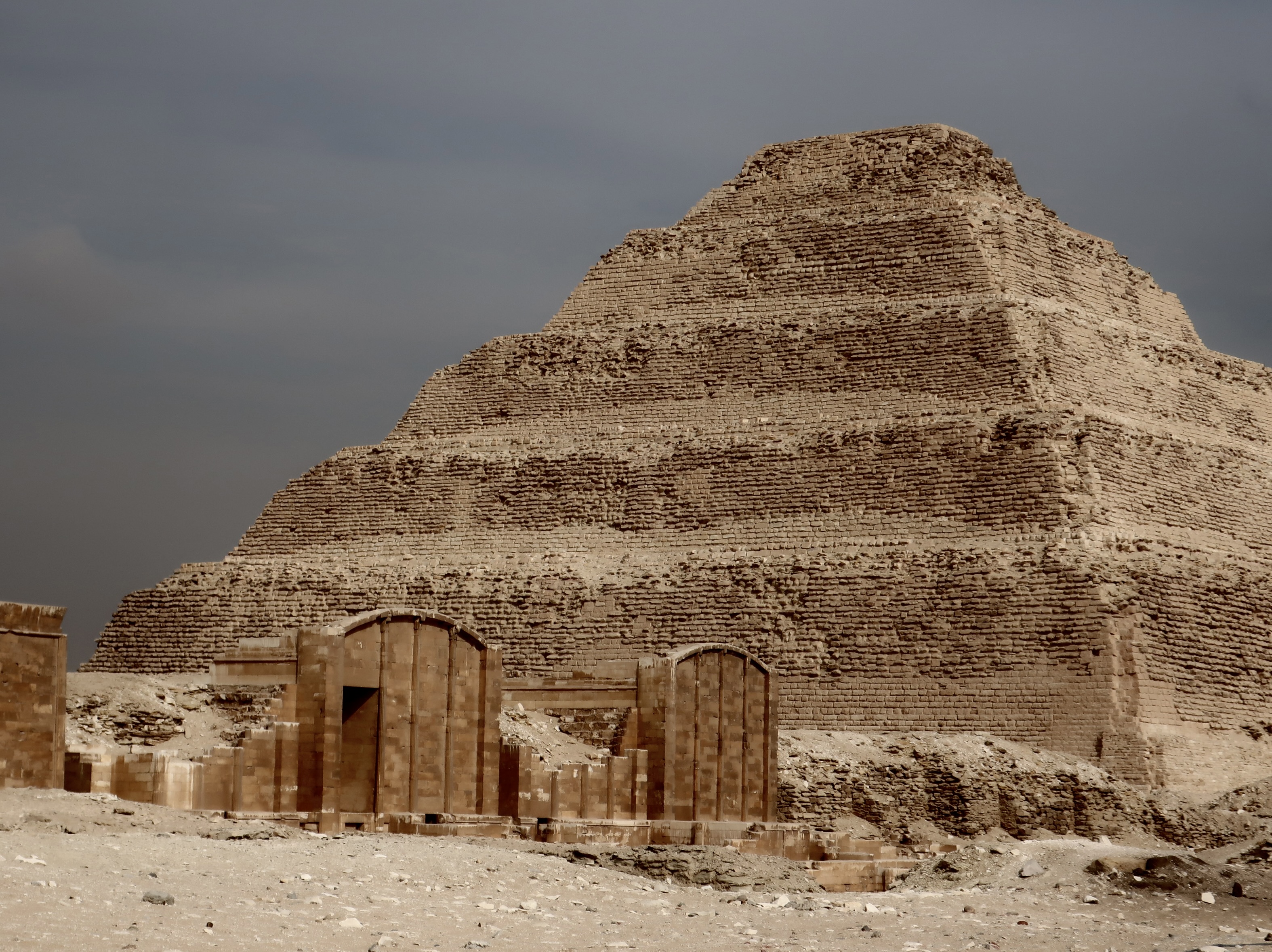
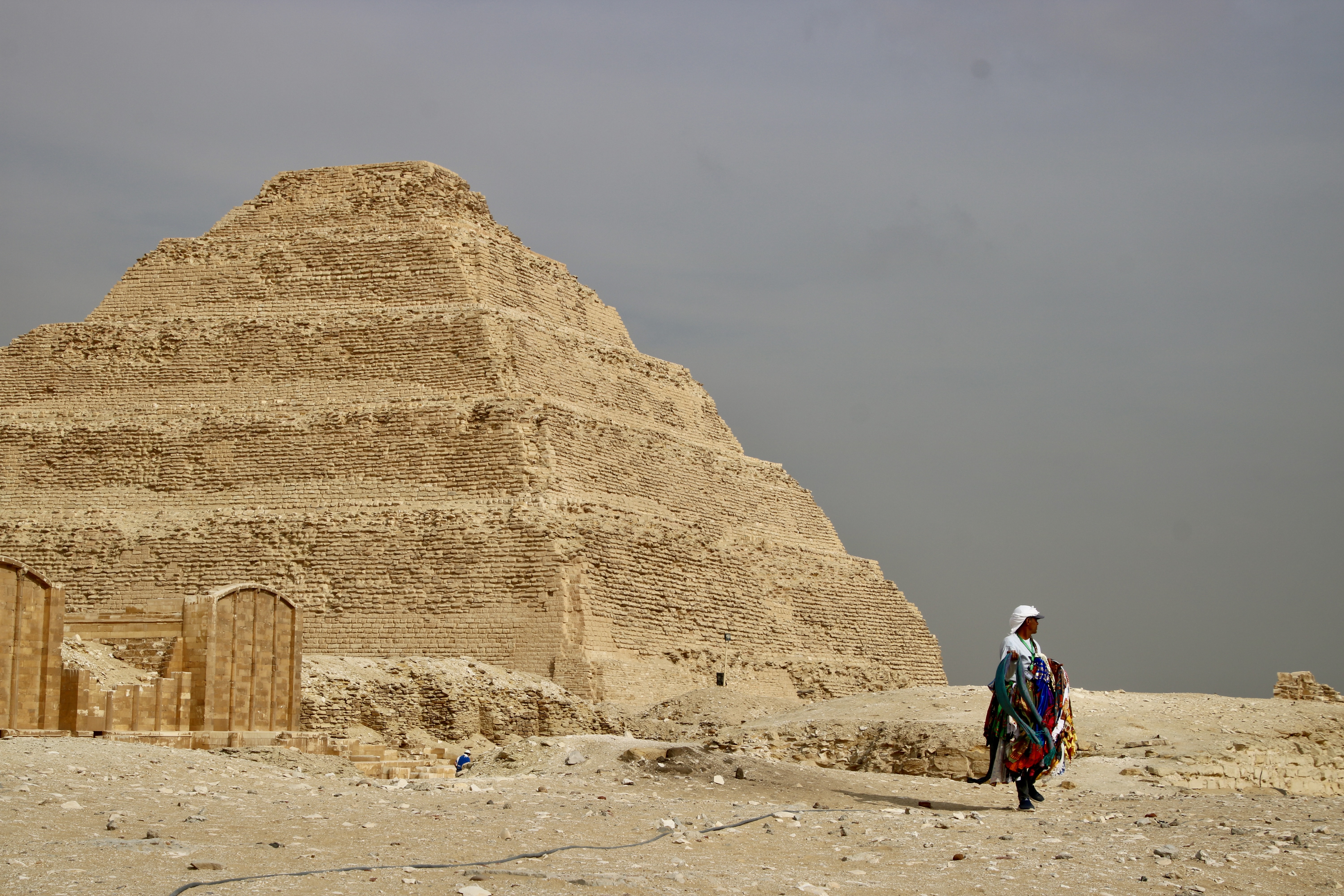
The ancient stone monument, the Pharaoh Djoser’s Step Pyramid, was built by the pharaoh’s vizier, Imhotep.
Whenever people think of ancient Egypt, one of the first thoughts that pops into to their minds is the three pyramids of Giza: The Great Pyramid, the Pyramid of Khafre, and the Pyramid of Menkaure, along with the Great Sphinx. They were in built Egypt’s early history during the Fourth Dynasty of the Old Kingdom between 2600 and 2500 BC and are the main focus of my next Egypt post— along with camels.
But today, I want to go back to their precursor, the Step Pyramid of the Pharoah Djoser, located in the Saqqara necropolis outside of Memphis. Built in the 27th Century BCE (2700-2600) during Egypt’s Third Dynasty, it is the oldest, complete stone building complex known in history. Its architect was Djoser’s brilliant vizier, Imhotep. If you ever watched the Mummy movie series, he was cast as the bad guy, intent on world domination and allergic to cats. But to ancient Egyptians he was a good guy, so good that he was eventually (with eventually being 2000 years Egypt time) given the status of a god complete with a portfolio that included major medical responsibilities.
Imhotep’s first layer of the pyramid was based on a mastaba, or eternal house, an ancient Egyptian tomb that was built as a one story, rectangular mud brick building with inward sloping sides where royalty from Egypt’s Early Dynastic and Old Kingdom period were buried. He then proceeded to build a series of five mastaba-like structures on top of the first one with each being smaller, thus creating the pyramid concept. The structure stands at 203 feet tall with a base of 410 by 357 feet. A maze like series of tunnels run under the pyramid that were used for the burial of Djoser, royal family members, and grave goods from royal ancestors. The latter included over 40,000 vessels.
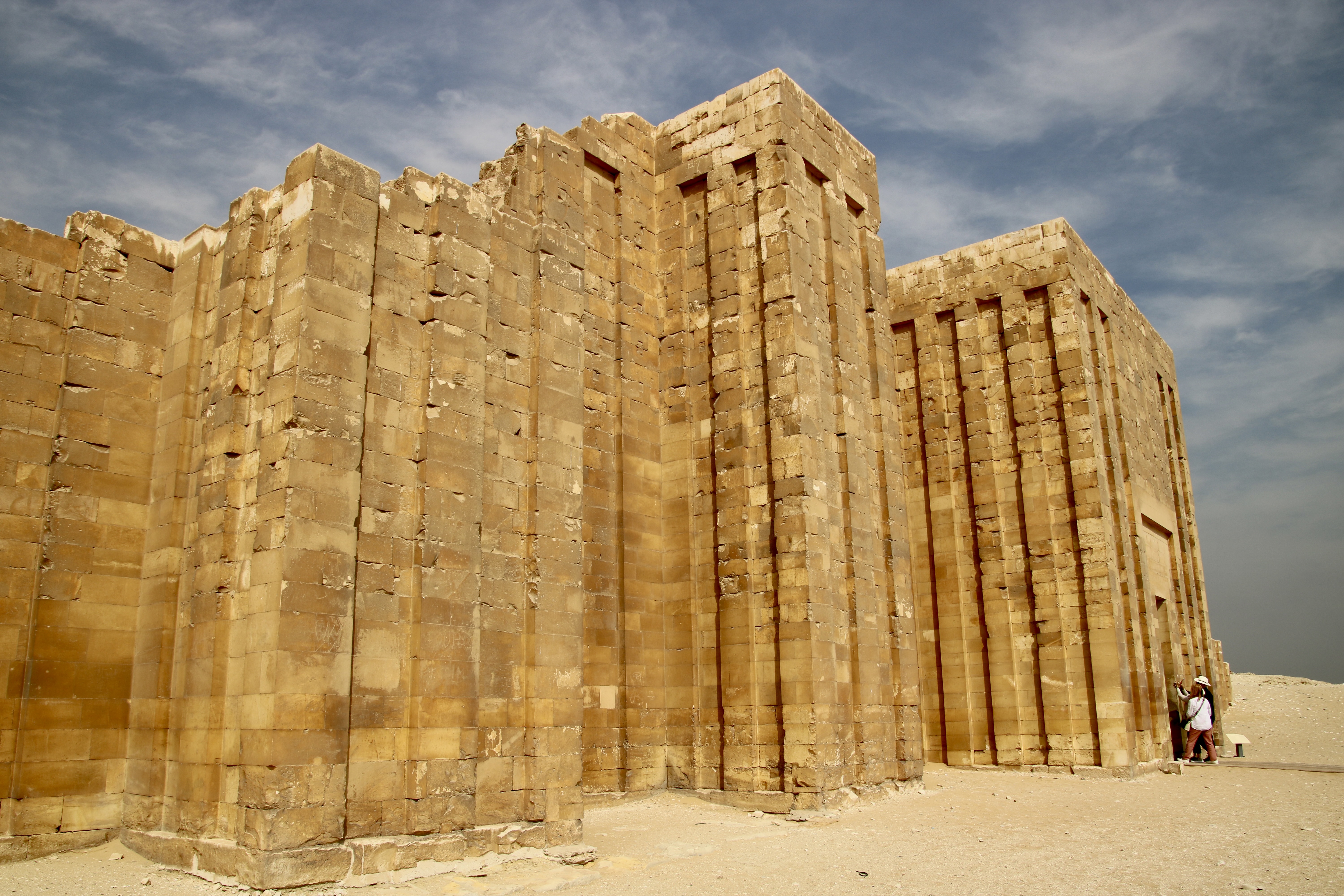
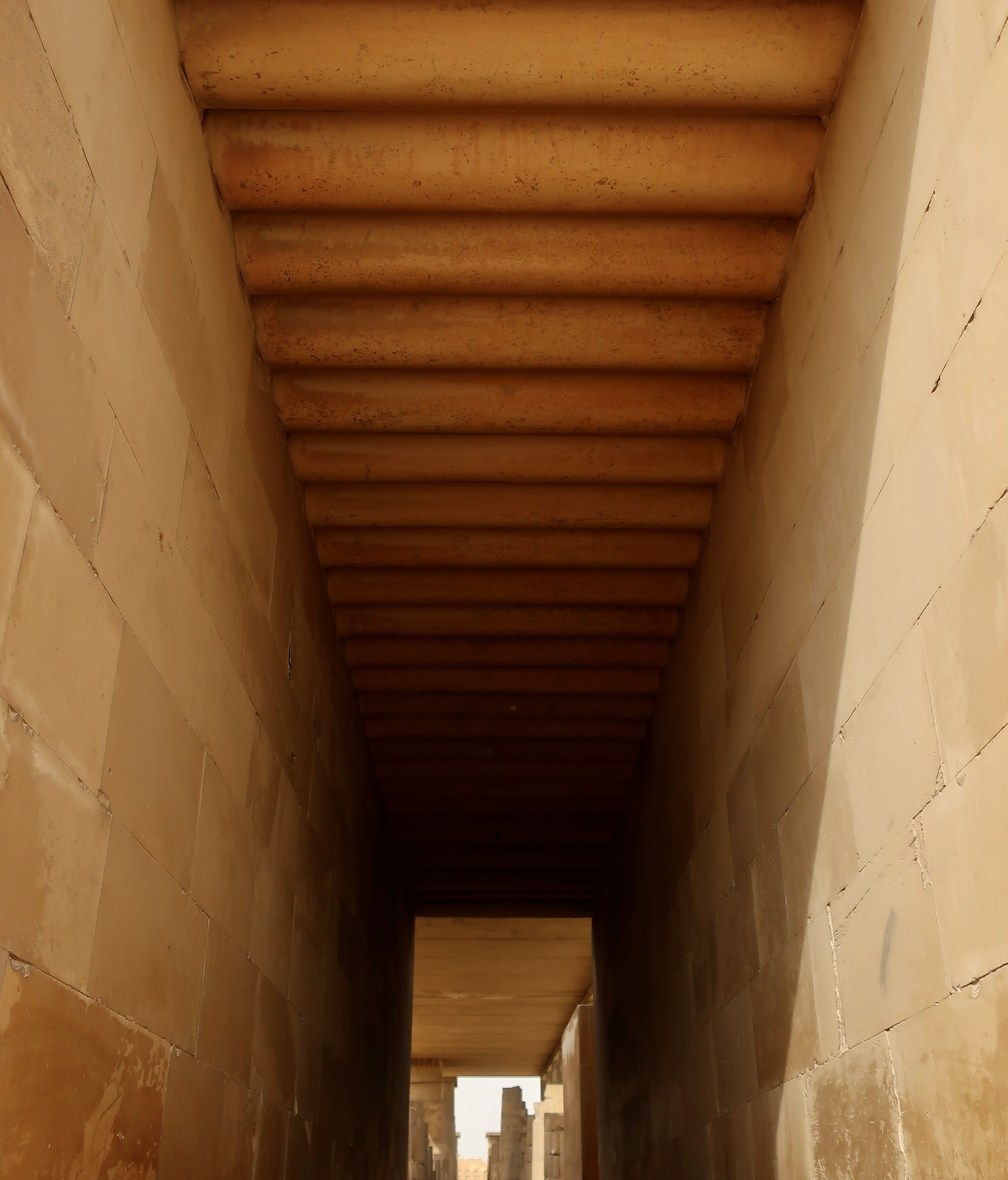
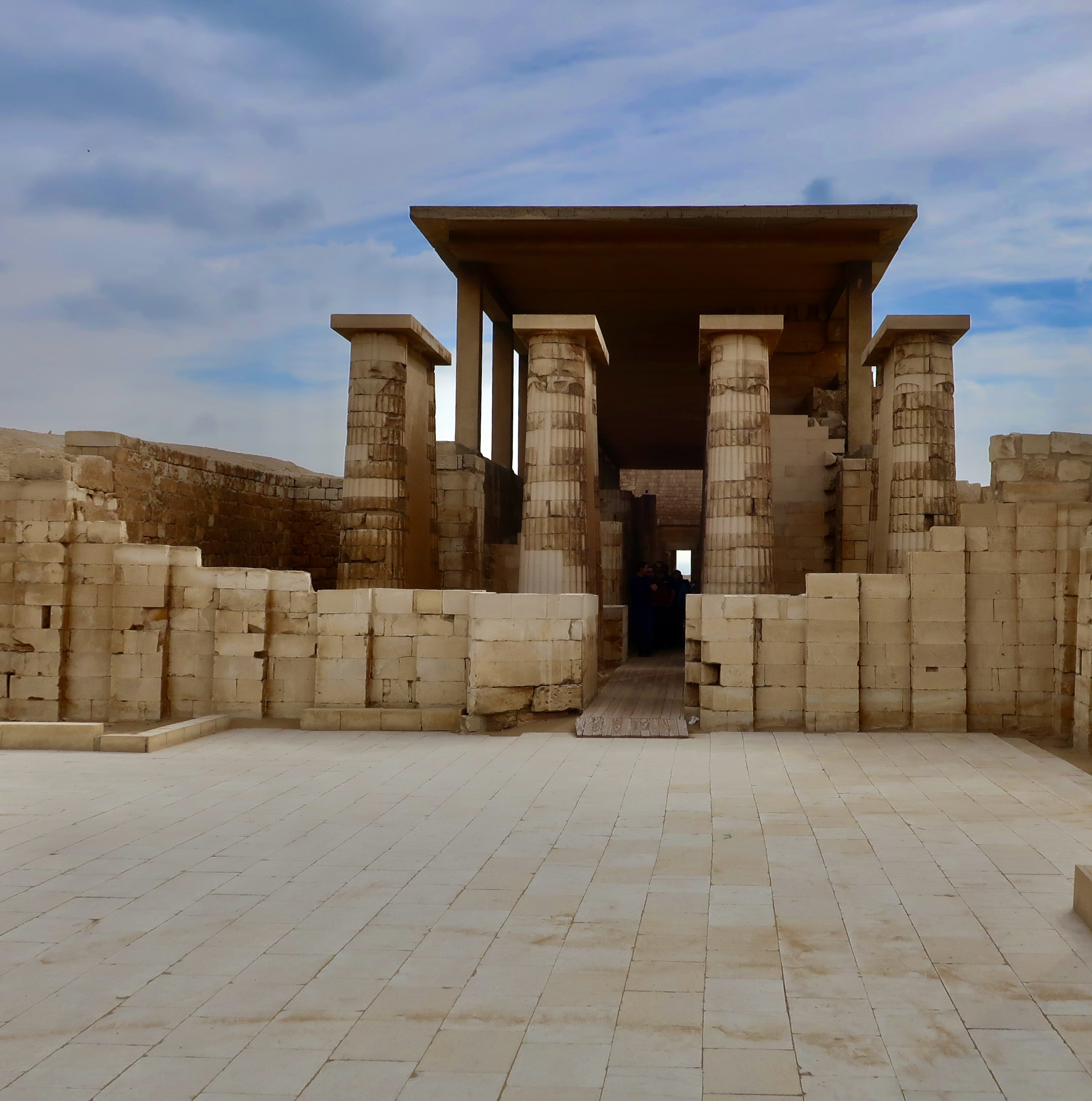
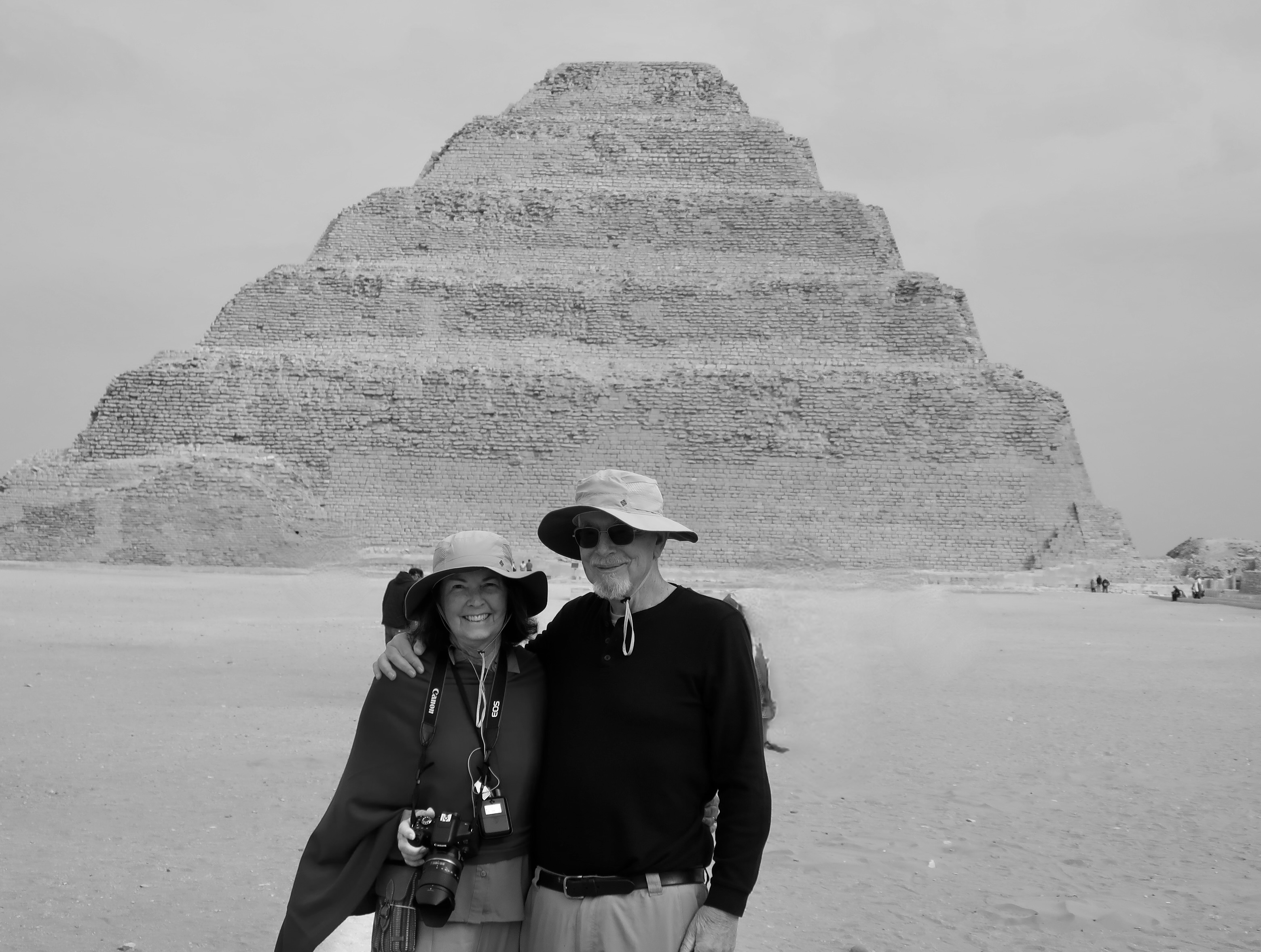
This statue of King Djoser, found in a sealed room in the Step Pyramid, is made of limestone. He looks like one serious dude— not someone to cross. It now resides in the Egyptian Museum in Cairo. It is known as the oldest life-size statue in Egyptian History. It would have been created to contain his ka, or life force after he died. The room contained small holes so the ka could wander over to the room where food offerings were kept and feast— if the priests hadn’t already eaten them. The Step Pyramid complex covers over one square mile and, in addition to the pyramid, incudes temples, colonnades, and a wall.And I should add pushy sales people who refuse to take “no” for an answer and often resort to trickery to bamboozle tourists. They come in droves around the pyramids and other major attractions. On the one hand, I recognize that these people are just trying to make a living off of people who can afford it. On the other, they can be obnoxious on a level of 10 out of 10. They are best ignored unless you really want to buy something. Given the slightest sign of interest, they’ll be on you like a tick on a dog.This beautiful temple was part of the Step Pyramid complex at Saqqara.It reached out toward Djoser’s Step Pyramid.The walkway through the temple was covered with stone columns that resembled log rafters.Looking back at the temple.I’ll conclude with this photo of Peggy and me in front of the Step Pyramid that was taken by our fellow traveler and friend, Steve Jones. I rendered it in black and white to give it an old-time feeling.
Next Post: We will travel back to South Dakota and the incredibly ambitious stone carving of Chief Crazy Horse. After 75 years, it may be a quarter finished.
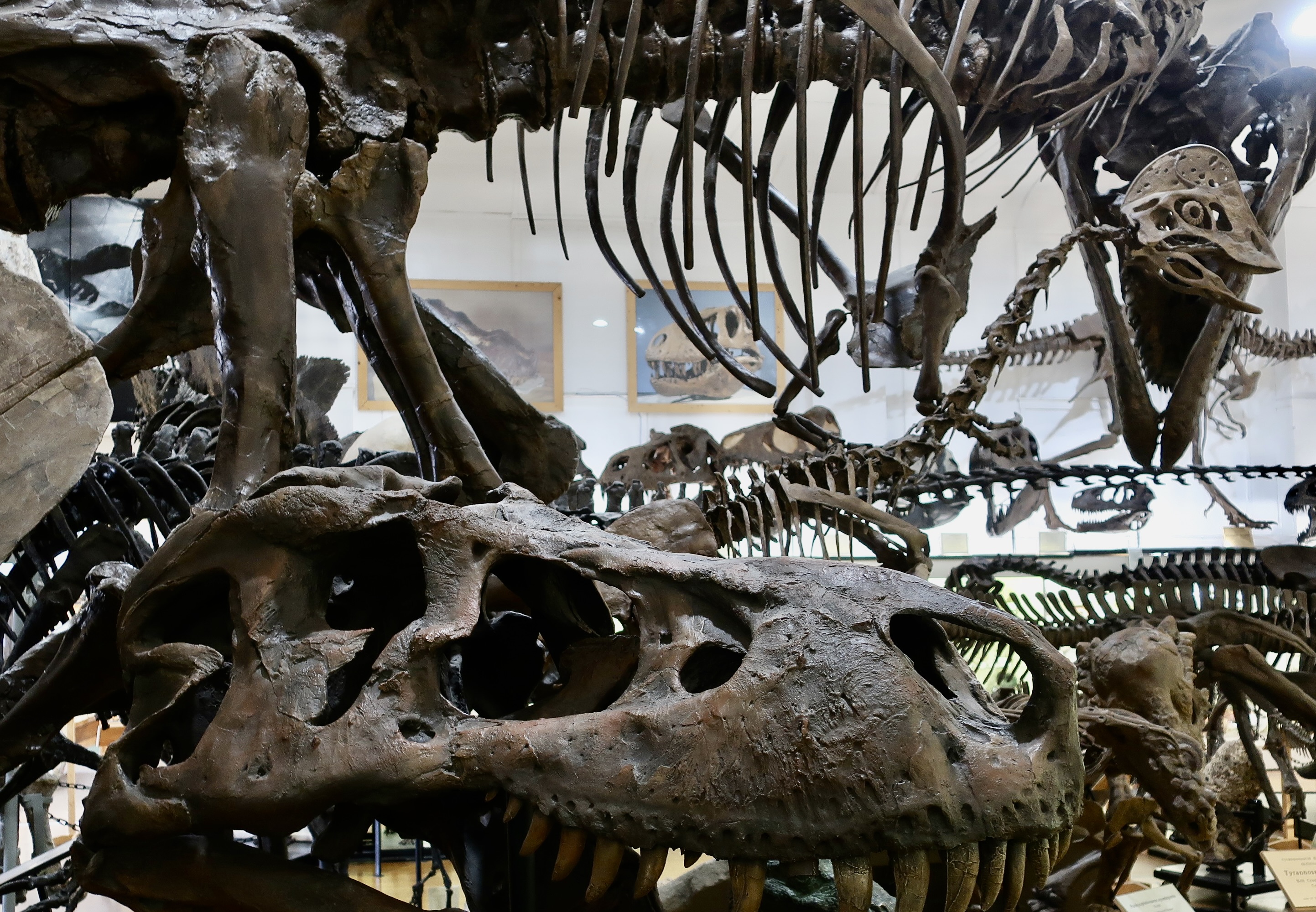
And no, I’m not talking about the two legged type so prominent in today’s world. They’re too scary for this blog. I’m talking about the behemoths that wandered the world between 65 and 245 million years ago. The small display area of Black Hills Institute in Hill City, South Dakota is packed full of them. If you have children, be sure to take them there. They will love it. Heck, if you don’t have kids, take yourself! Peggy and I visited as part of our three month road trip last fall.
Can you imagine any more dinosaurs or replicas being packed into a small display area?
Peggy and I didn’t know what to expect when we visited the small dinosaur museum in Hill City, South Dakota. It’s located maybe 30 minutes away from Mt. Rushmore and not much more from Custer State Park. We had some time to kill, so why not. What we found was an absolute delight. Normally I take museums seriously, carefully noting what I am seeing and photographing. Not this time. While the museum is worthy of such attention, it was so crammed full I wouldn’t have known where to start. So Peggy and I just wandered around admiring big teeth and taking photos. Following are the results. Enjoy.
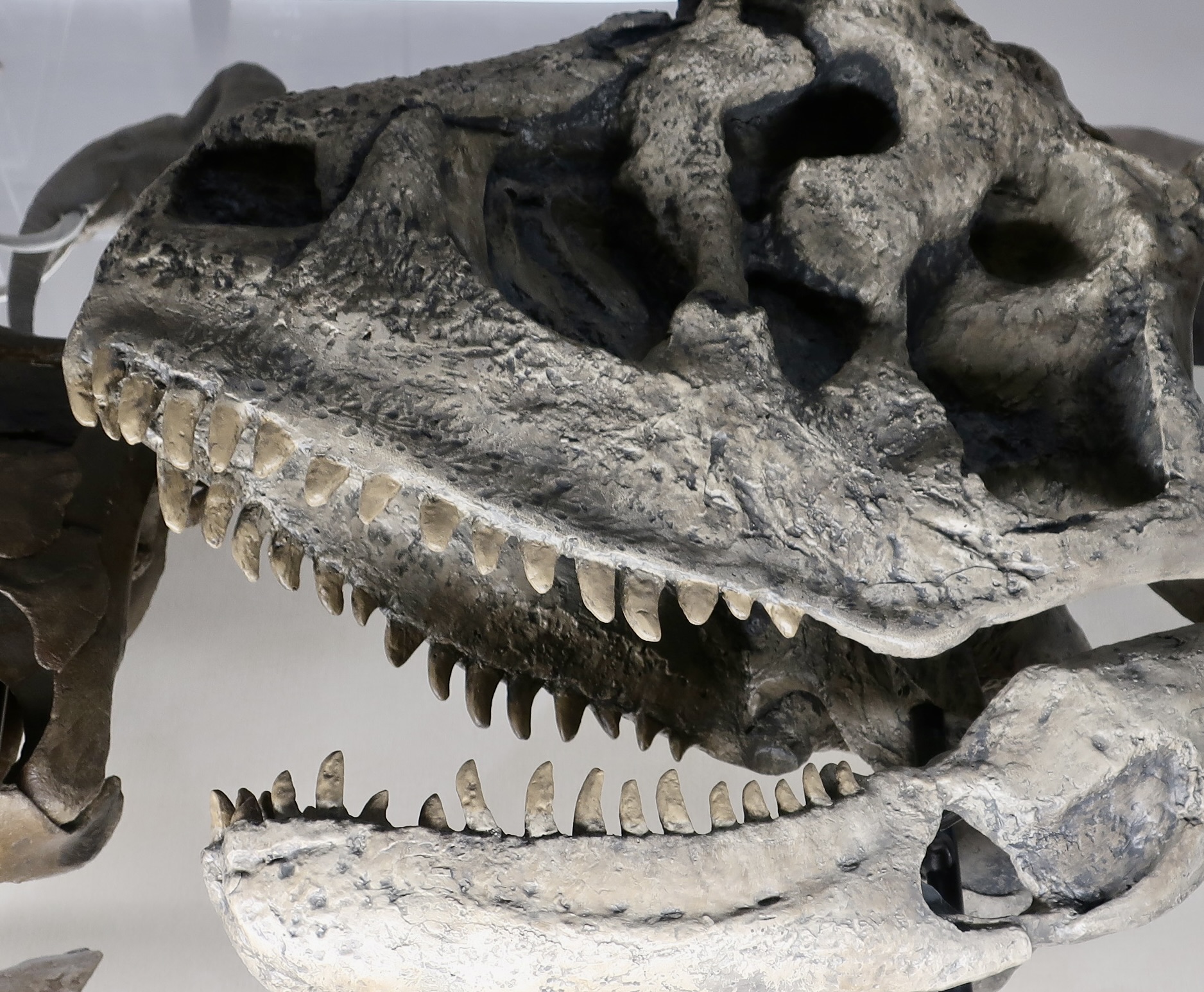
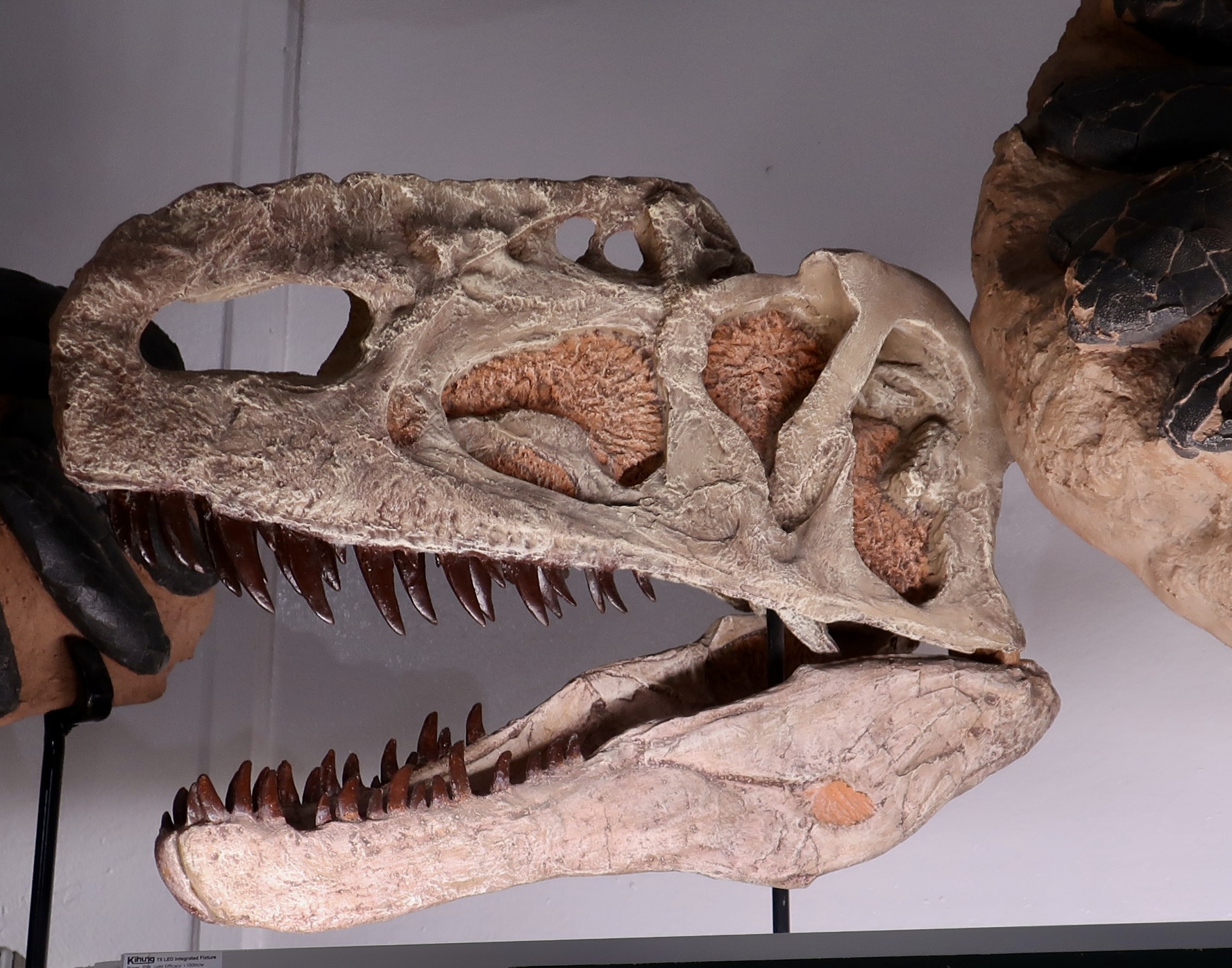
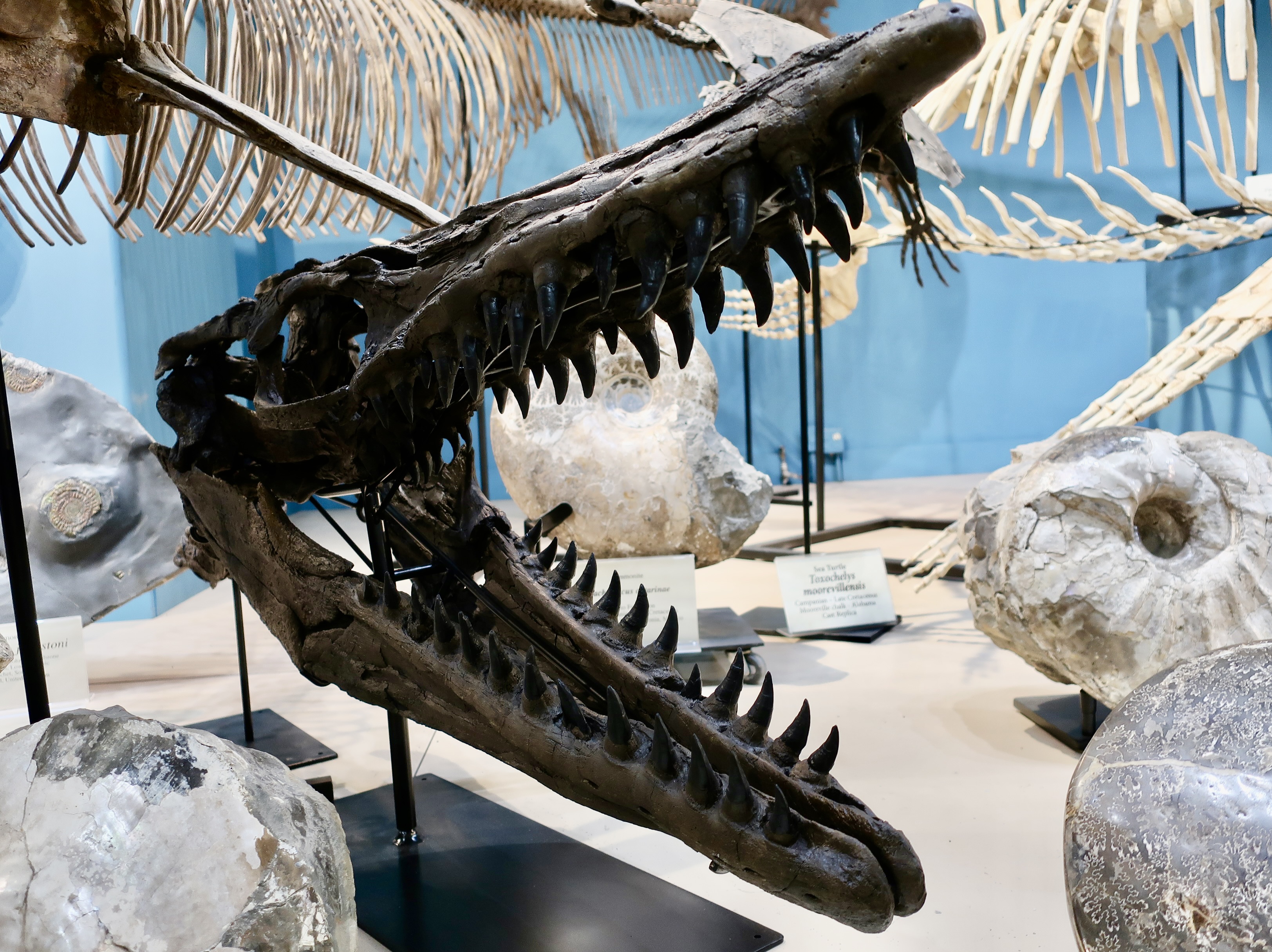
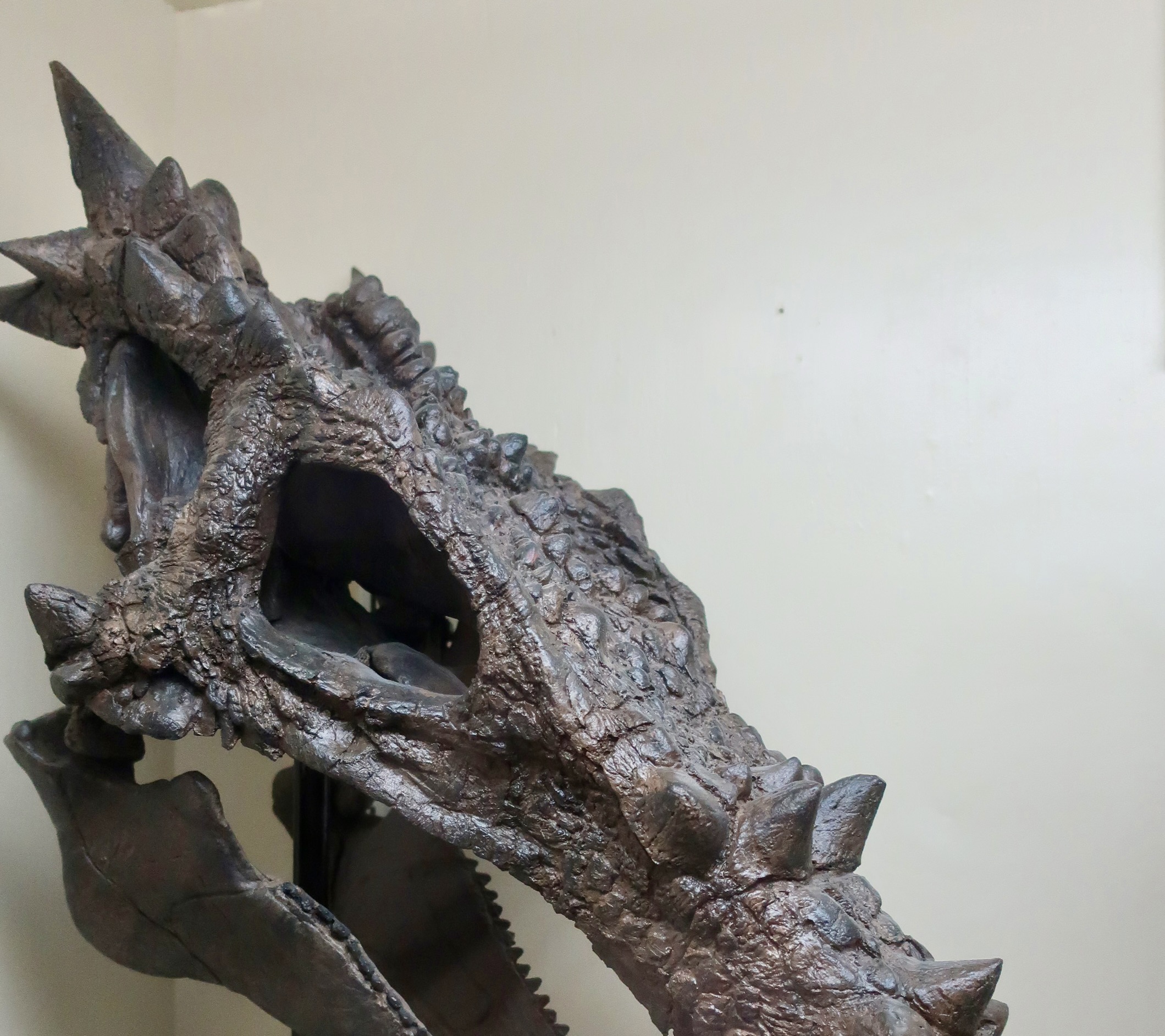
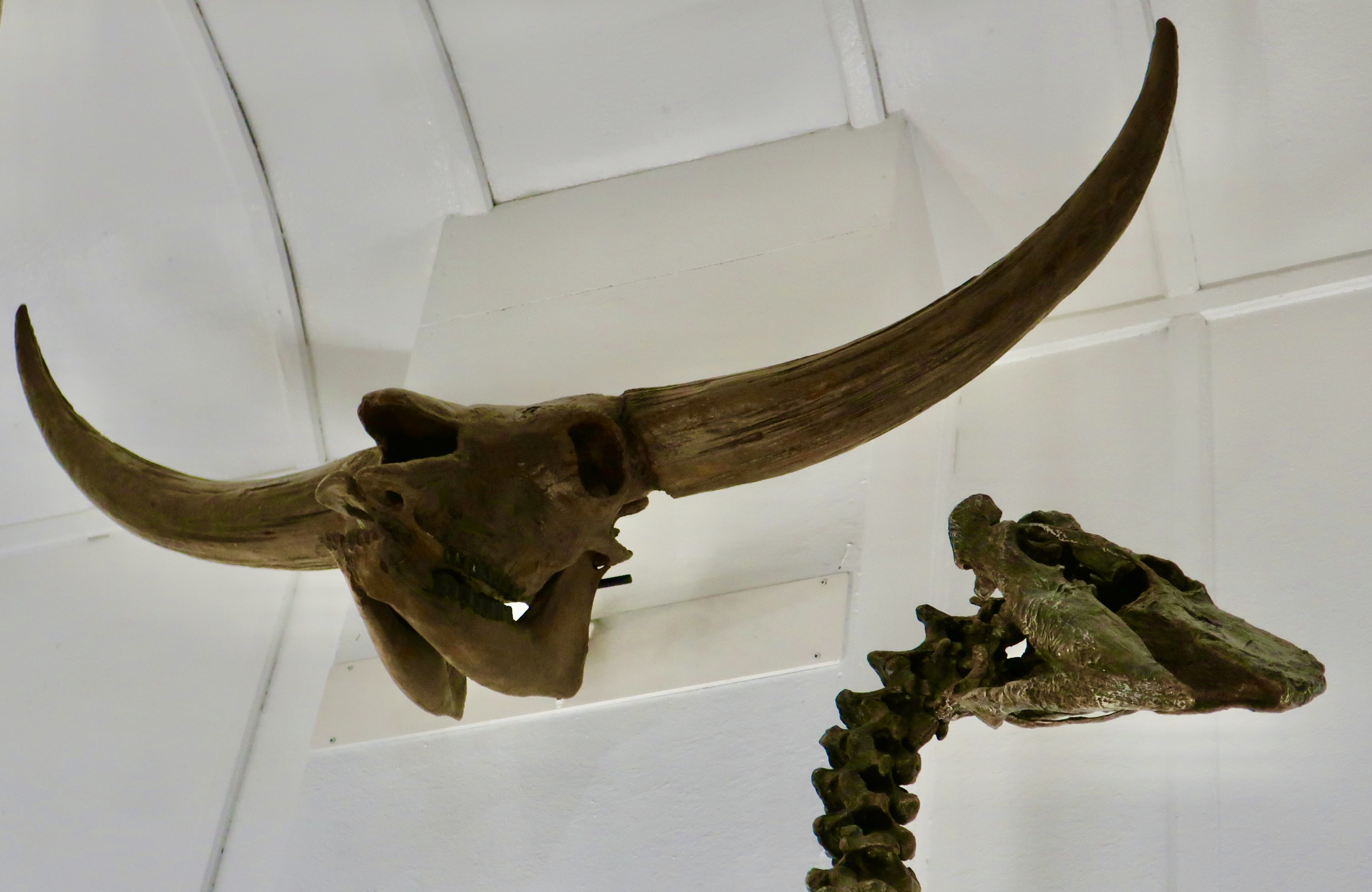
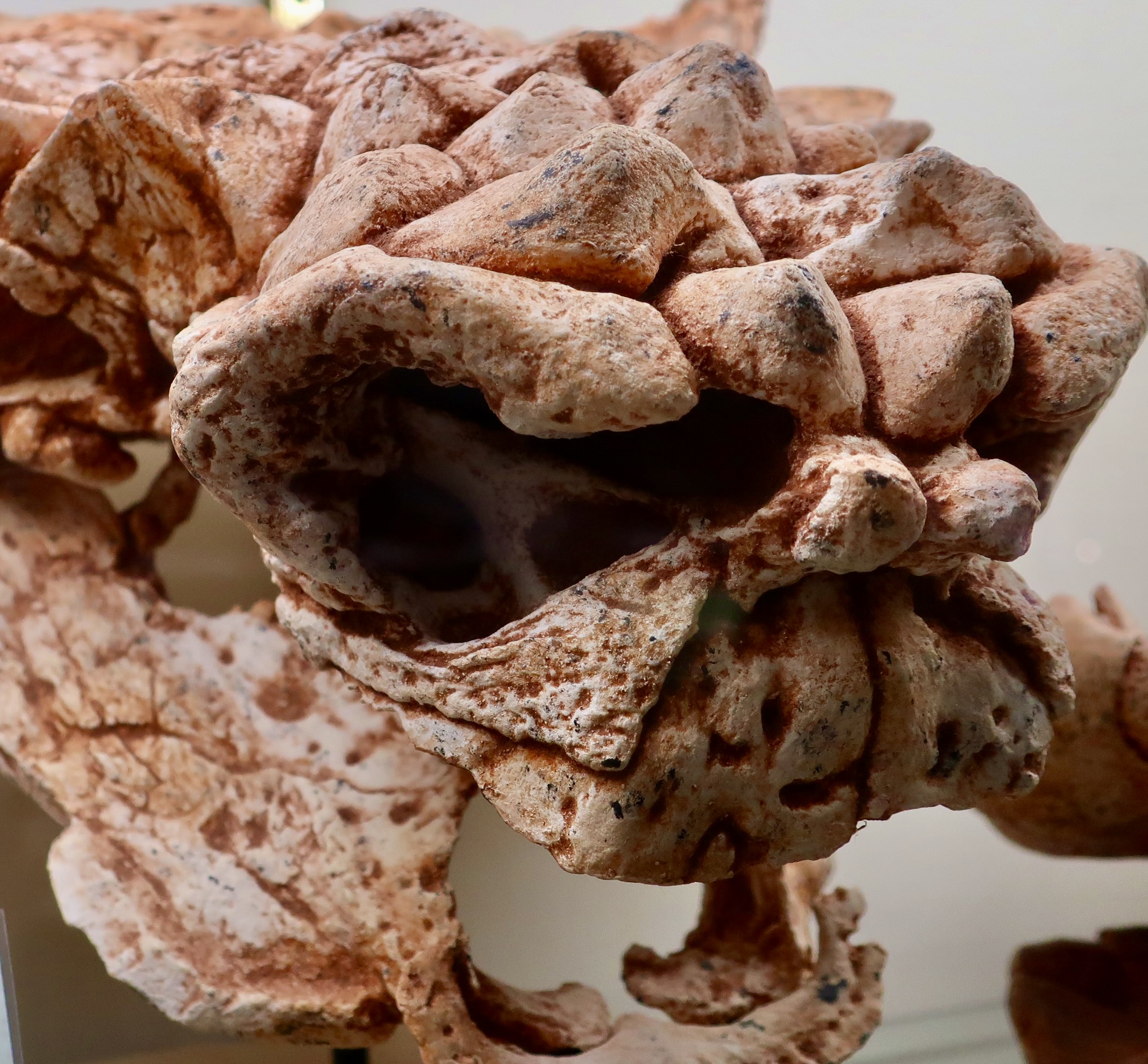
Definitely not taking dinosaurs as seriously as one should. I included this photo of Peggy shoving her head in a T-Rex’s mouth in an earlier post. We made sure no museum personnel were in the room or T-Rexes were hurt, but it’s probably on surveillance tape. This would have been a good scene for the “Night at the Museum” movies. Imagine them all coming alive. It would be great for a nightmare as well. My, what big fangs you have. Okay, I get how these chompers might frighten a potential dinner to death, but how good are they when it comes to eating the meal?These would be better for chewing. The head looks like you could hit it with a baseball bat and not do much damage. Run!And check out how these teeth lean backward. Once you were in this mouth, it was a one way street. There was no way out except through the stomach.And one certainly wouldn’t want to face these teeth! Has me thinking about Sobek, the crocodile god of Egypt.Maybe smaller teeth work if you have lots of them with a serrated edge— and cool armor. But enough on toothy set. Now on to some of the marvelous creations of nature that prefer eating green things.Even if you were a vegetarian, you would want protection from those who weren’t.A good old-fashioned goring might do the trick.Or possibly just looking weird and being hard to digest would suffice.A final shot of flying, leaping and running! It’s no wonder our small precursor mammals were good at hiding and waited for a ‘miracle’ meteor to wipe out the competition.
That does it for today. Next Monday we will be back in Egypt visiting one of Egypt’s first pyramids.
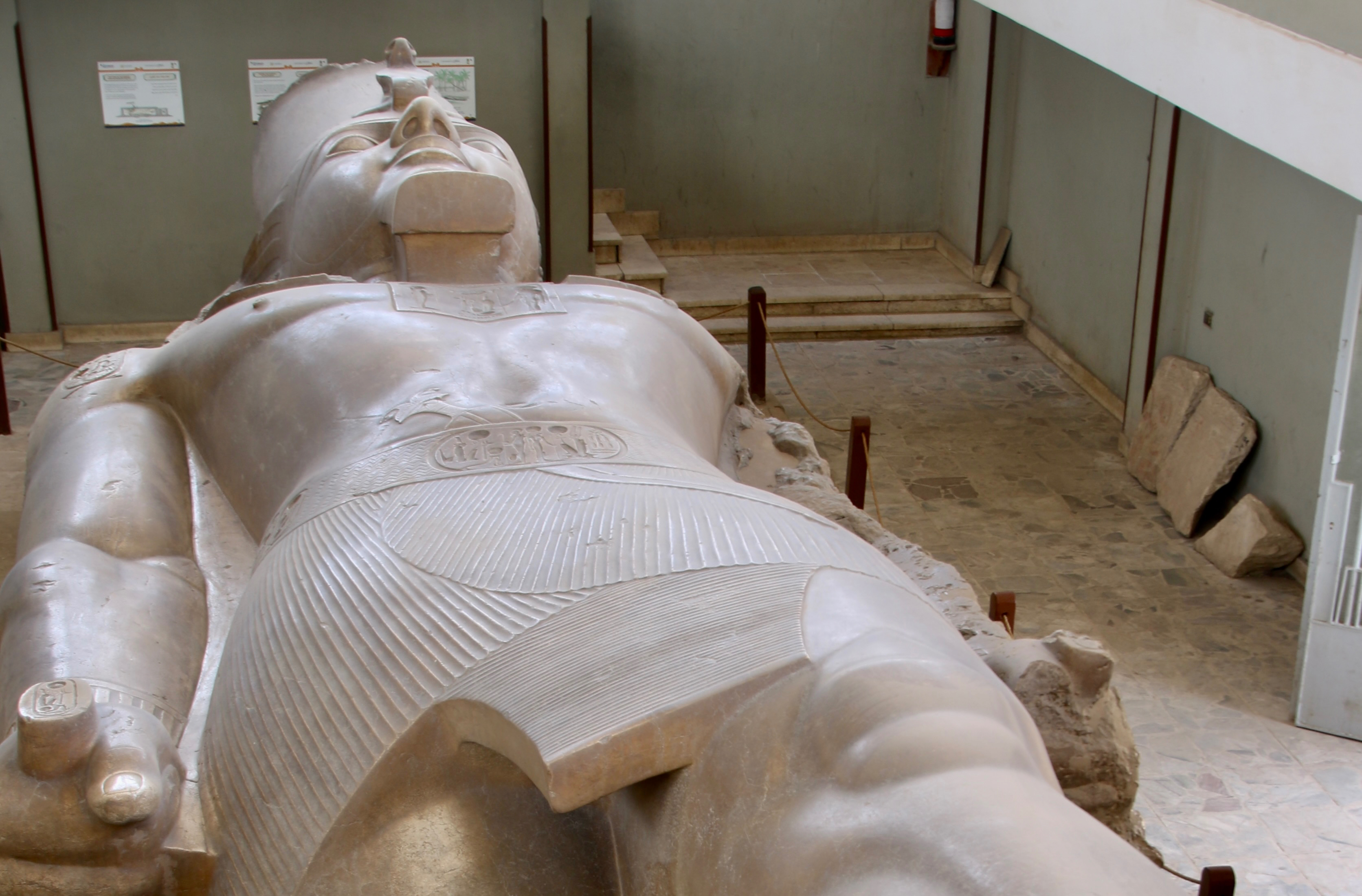
Ramses II is one of the world’s giants in terms of ancient Egyptian history, the monuments he left behind and ego. This elegant 42 foot statue (from the knees up) is located in the Open Air Museum of Memphis. It speaks to his power.
The Open Air Museum of Memphis, near the modern town of Mit Rahina south of Cairo, is relatively small considering Memphis was established as the first capital of Egypt 4000 years ago by the pharaoh Narmer when he united Upper and Lower Egypt. It continued to serve as the capitol for over a thousand years. As such, Memphis would have been a bustling city filled with temples, palaces and tombs. Now it is mainly scattered ruins with most of its remains buried beneath villages and farms. The museum is well worth a visit however. First and foremost because of its huge statue of Ramses II, which was found lying in a swamp in 1820 missing its lower legs.
Ruling between 1279 and 1213 BCE, Ramses II is recognized as Egypt’s greatest pharaoh. He’s best known for ruling 66 years, expanding Egypt’s territory by fighting in multiple wars, and for building monuments, cities and temples throughout his realm. More ancient statues of him have been found than any other pharaoh. Peggy and I saw several as we made our way up the Nile. Then there is also the matter of the 90 children he was said to have fathered! As I noted in my heading, he was big— and he was bad.
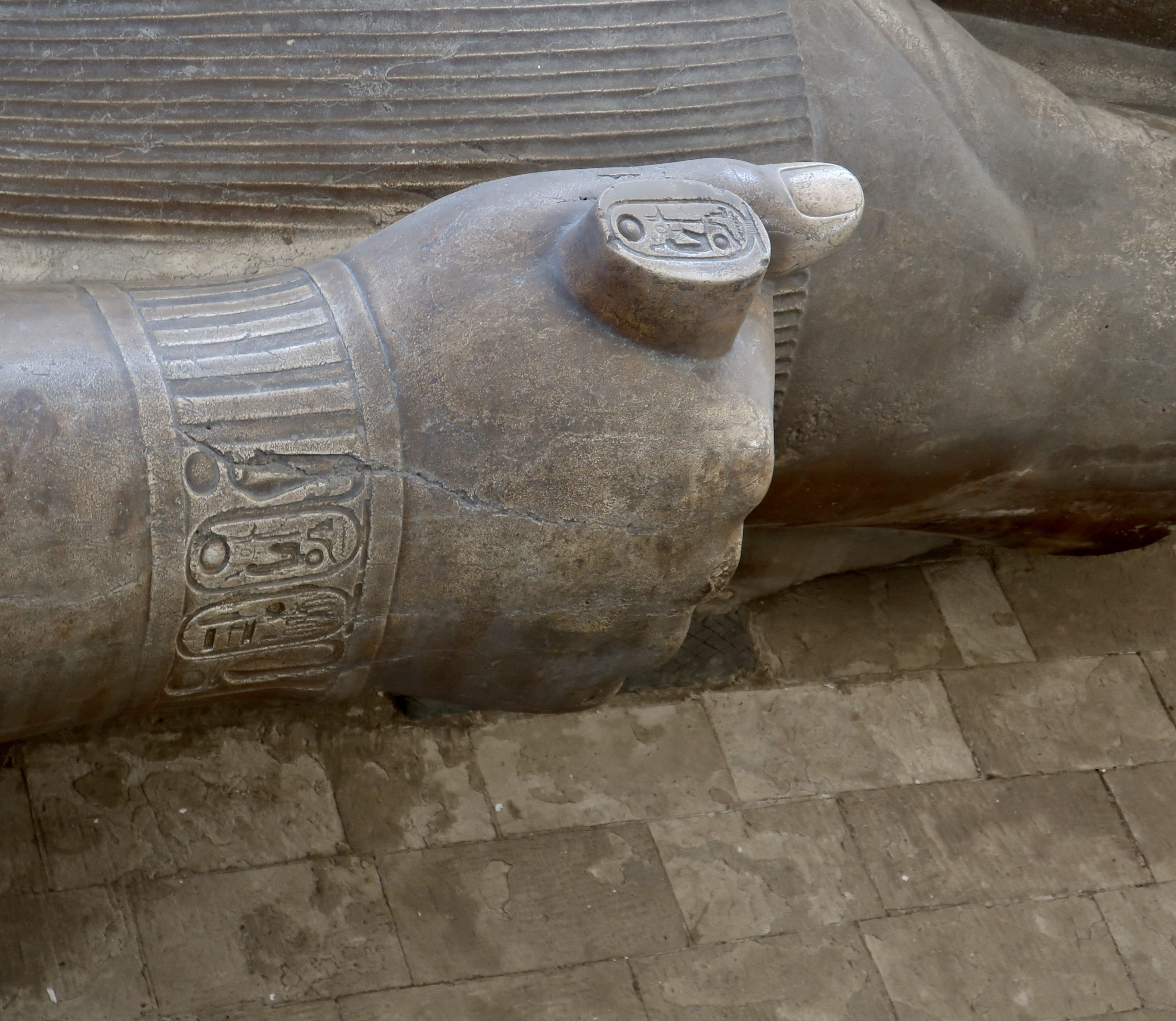
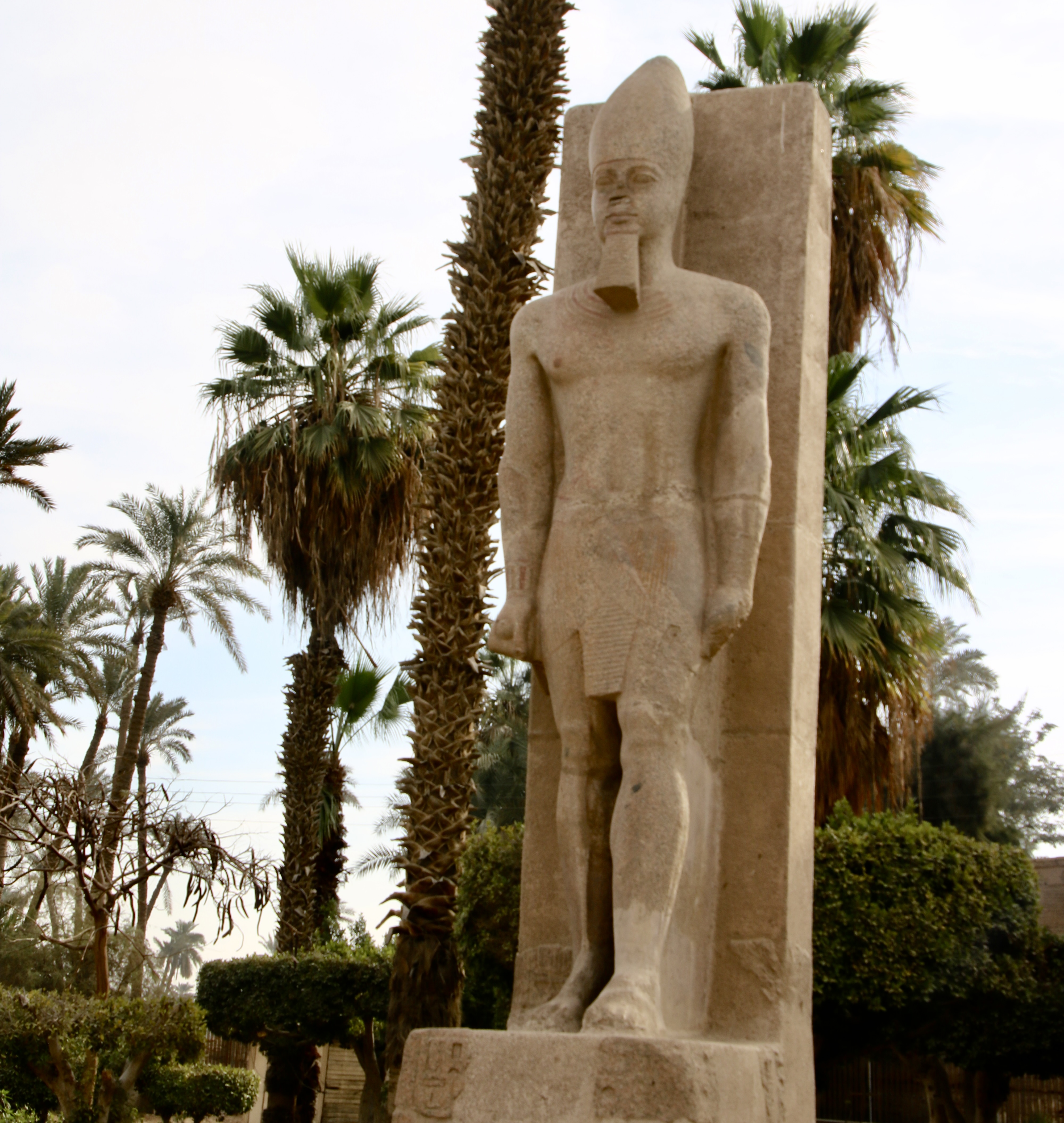
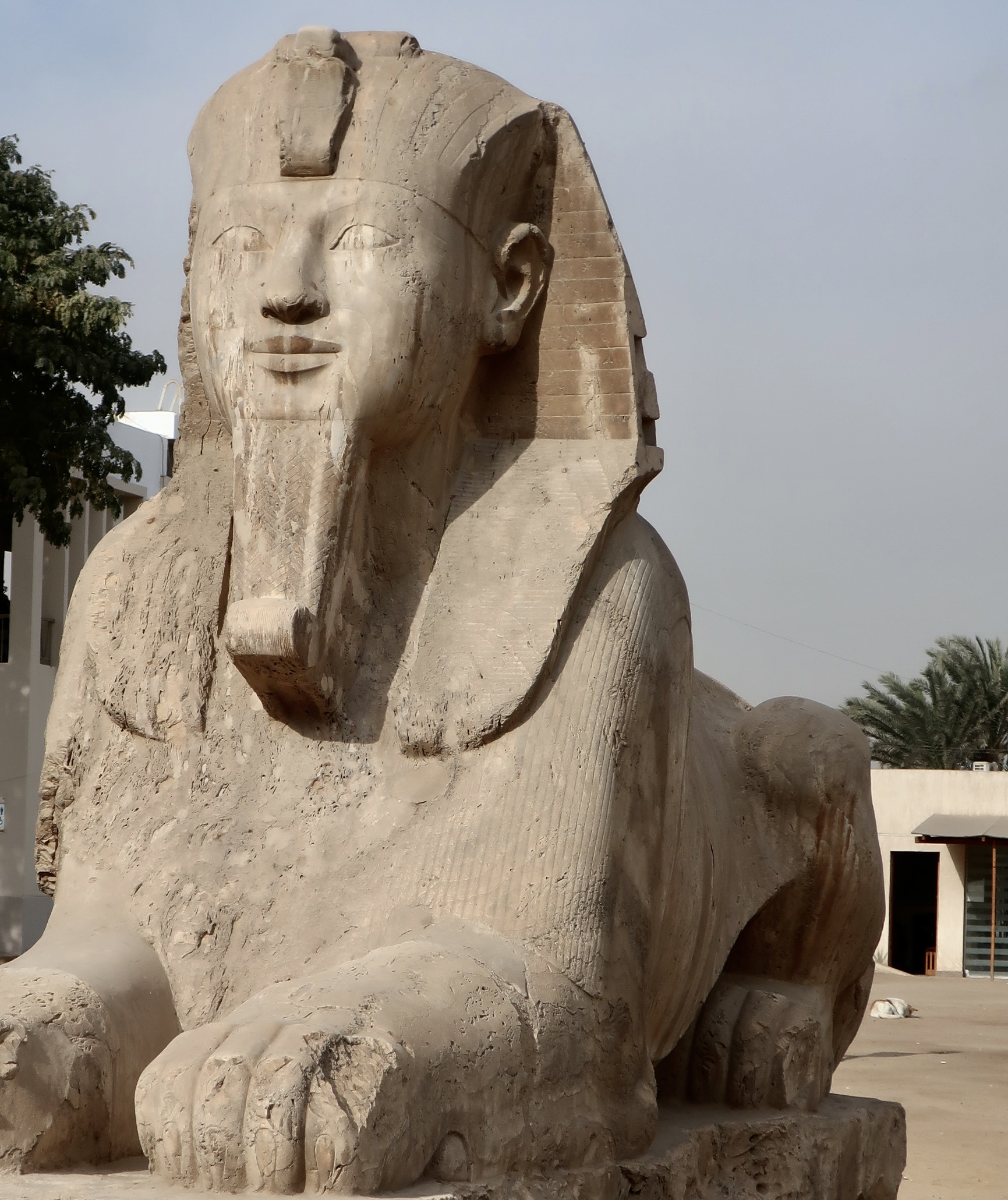
Here, Peggy provides perspective on the size of the Ramses II statue at the Open Air Museum in Memphis. Visitors can both walk around the statue on the ground floor and observe it from the balcony above.A view of Ramsey II as seen from head to toe. He’s wearing the crown of Upper Egypt.This view of his face provides an idea of how beautifully he was carved out of granite with close attention to detail. Note the ear. The figure on his forehead is Wadjet, the female cobra god of Lower Egypt who provided protection for pharaohs.Ramses II was also protected by the dagger he wore in his belt. Most pharaohs are shown wearing one as a symbol of power. A cartouche, spelling out one of his names in hieroglyphics, is on his belt over his dagger. Another, spelling out a different name is lower on his belt. Pharaohs had several names, one, to stress their various positions and accomplishments, but two, also important so they wouldn’t be forgotten, a critical factor in achieving immortality. A cylindrical object in his hand also has a cartouche with one of his names as do two more on his wrist band. I searched for what the object he is holding represented but couldn’t find an explanation. It is obviously another symbol of power that several other pharaohs carry as well. My assumption is that it represents the chisel of Narmer that he used to smash into enemies’ heads, as I showed in my last Egypt post.Narmer doing his thing. The chisel is shown in his name between the two images of Hathor, the cow goddess.Could it be if one chisel was good, two were better? This statue of Ramses II is at the entrance of the Egyptian museum. Note he also has cartouches on his belt, shoulders and chest. Some of them were not his…His son and successor had one of Ramses II’s cartouches removed and his own added— a quick, easy and cheap way to gain recognition and entrance to the afterlife. The practice was not unusual. “Oops, sorry Pop, my chisel slipped.”Speaking of which, another large statue of Ramses II stands outside at the Museum of Open Air. It may actually be of the pharaoh Senusret I, taken over by Ramses with his names removed and Ramses added. When most people think of Egypt and sphinxes, they think of the Great Sphinx of Giza. Actually, there are hundreds if not thousands of Sphinxes. Consisting of the body of a lion and the head of a pharaoh, this one is located at the Open Air Museum. It likely represents the head of Amenhotep II or III with the carving estimated to have taken place between 1700 and 1400 BCE.A back view of the sphinx. It is 26 feet long (8 M) and 13 feet (4M) high, weighs in at over 80 tons, and is carved out of alabaster.
Memphis was an important religious center for the triad of Ptah, the creator god who gave shape to all things, his consort Sekhmet, the lion goddess, and their son, Nefertem, the god of blossoms and perfume. It was common for the Egyptians to create triads for their gods, not unlike that of the Christian triad of the Father, the Son and the Holy Ghost.
I’ll conclude today with a statue of the triad that is located in the Open Air Museum. Ptah with his long, skinny beard is shown in the center. Sekhmet is on the right, and Nefertem on the left. (At least, I assume that is the arrangement.) Their arms around each other demonstrate their common bond.
Next Post: We will return to South Dakota where we will visit a museum that is crammed full of dinosaur bones in a chaotic but wonderful arrangement.
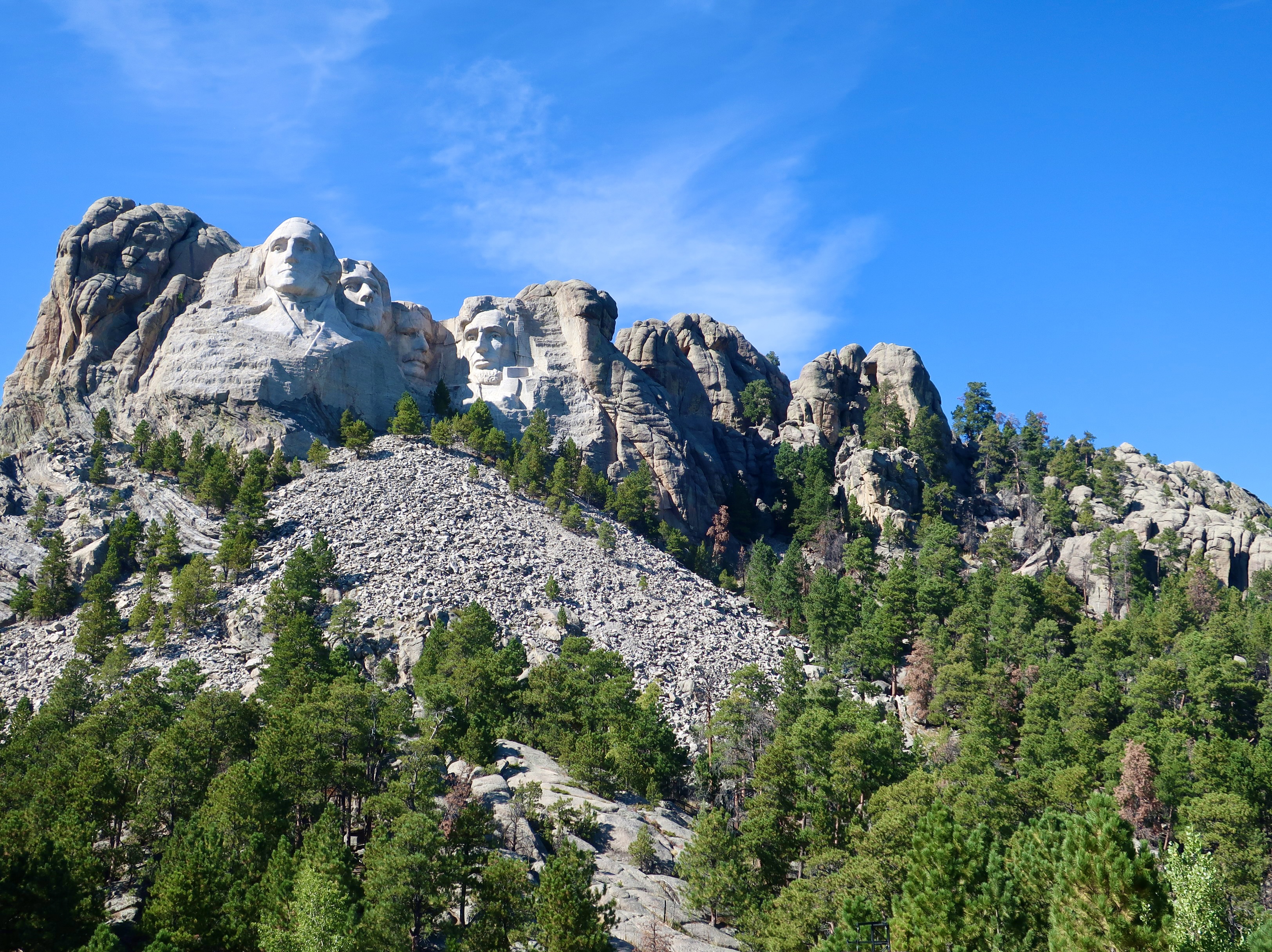
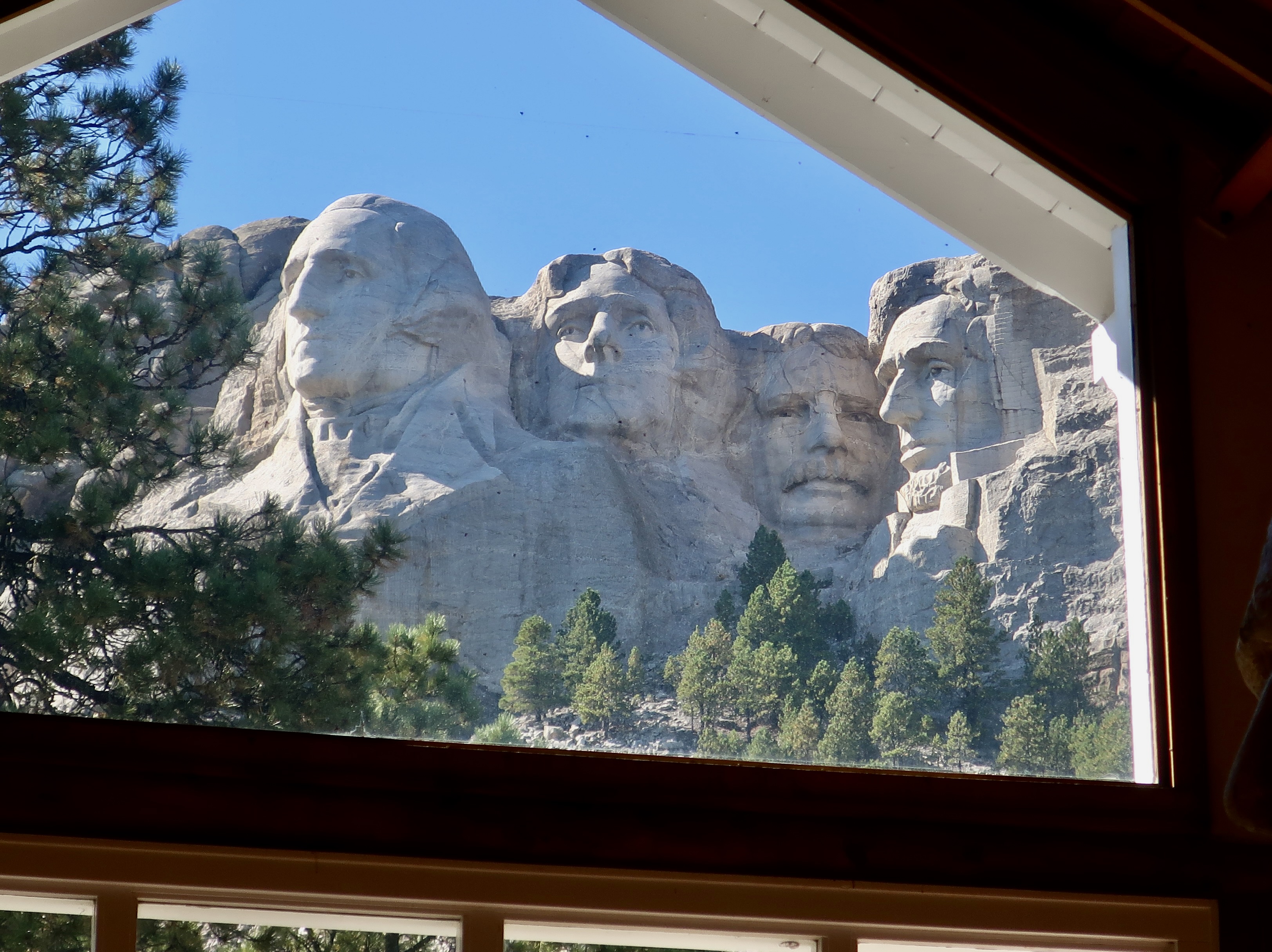
The massive carving of George Washington, Thomas Jefferson, Theodore Roosevelt, and Abraham Lincoln on Mt. Rushmore in South Dakota.
Like many public projects, Mt. Rushmore was conceived as a way to encourage tourism. The project was thought up by Doane Robinson of the South Dakota Historical Society in the early 1920s. Peter Norbeck, who was serving as South Dakota’s Senator at the time, gained Washington approval and funding for the concept. Robinson then proceeded to hire the sculpture Gutzon Borglum to implement the vision. It was Borglum who selected the specific location, chose the four presidents to be featured, designed the sculpture, and oversaw the work, i.e. just about everything.
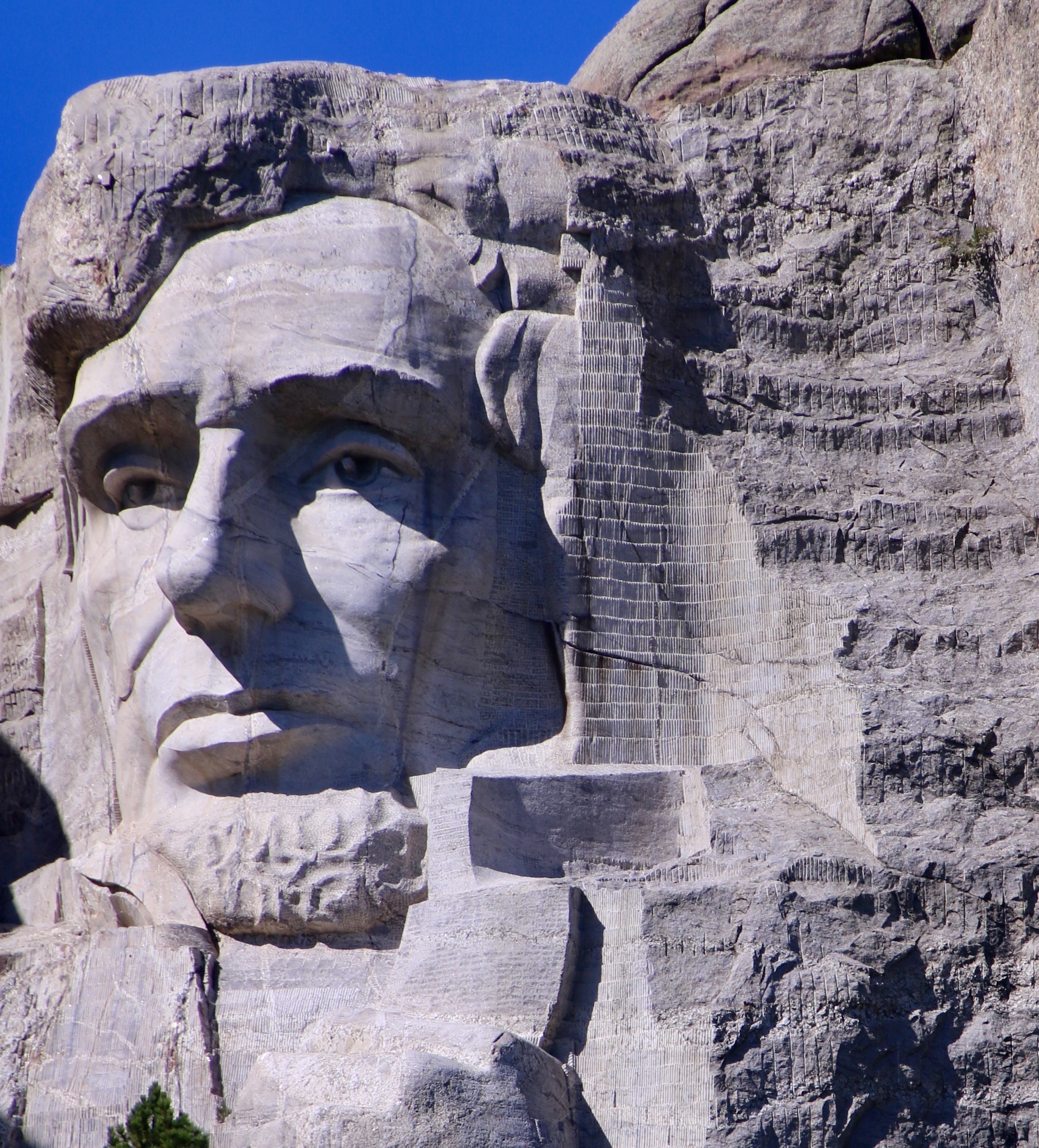
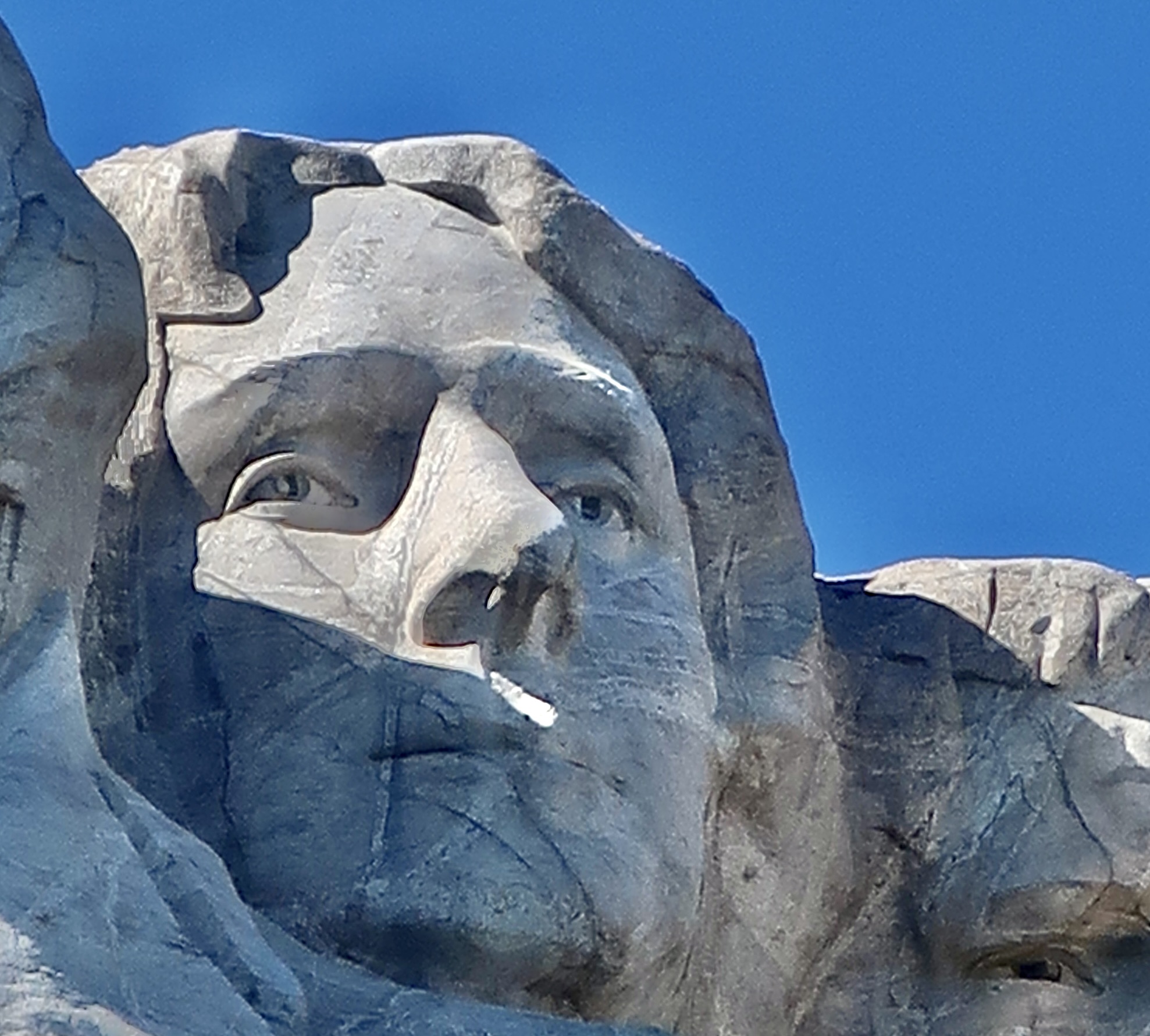
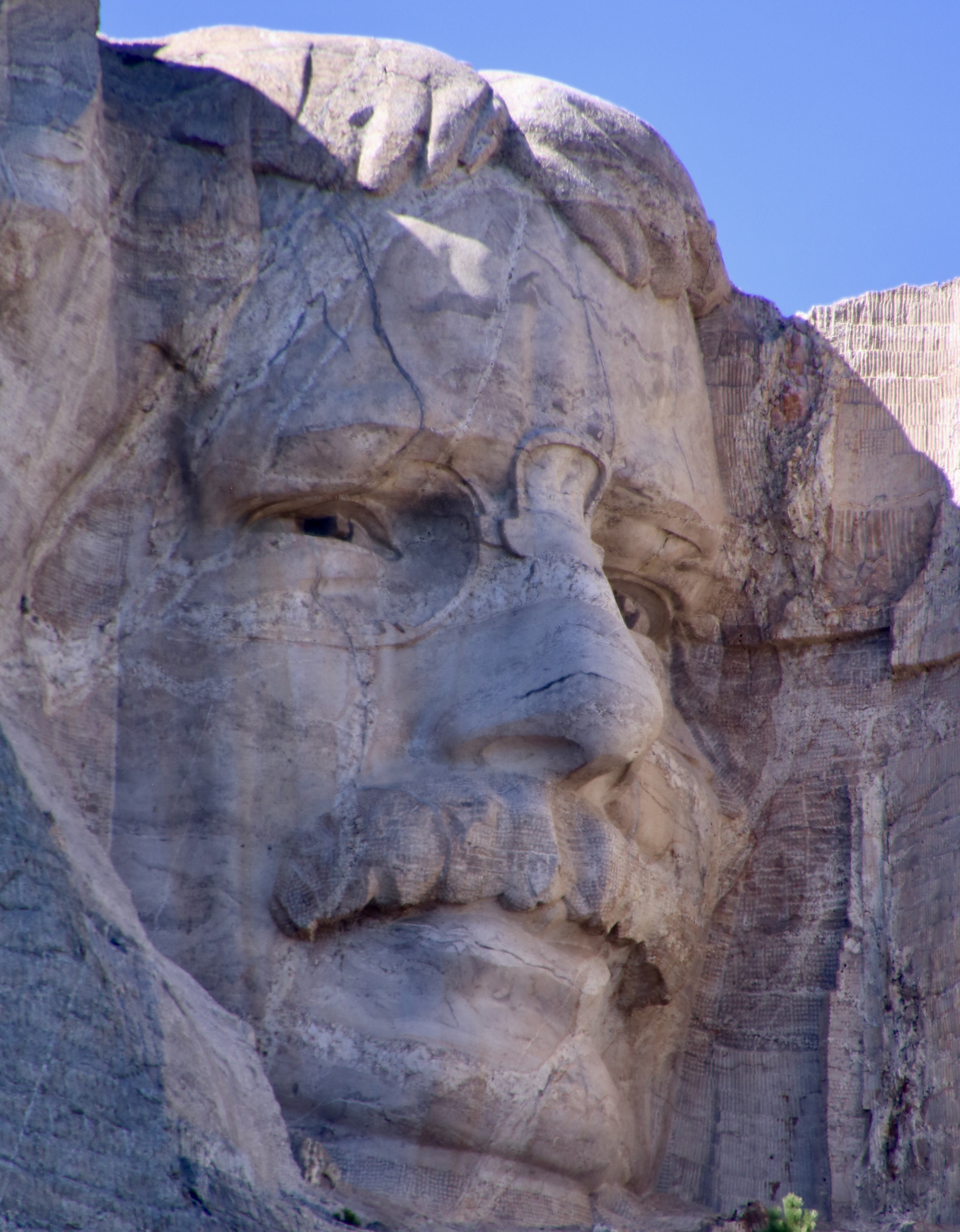
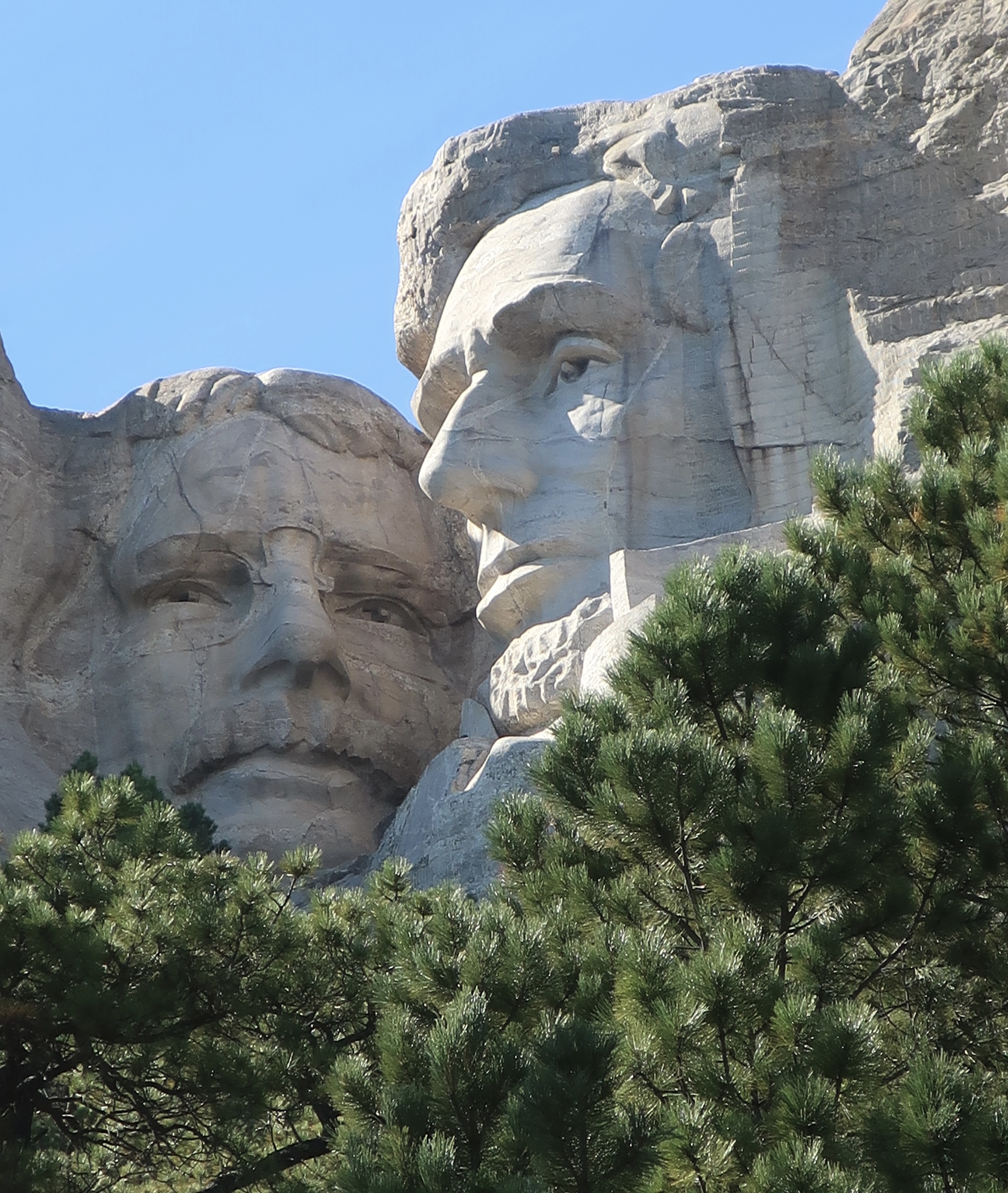
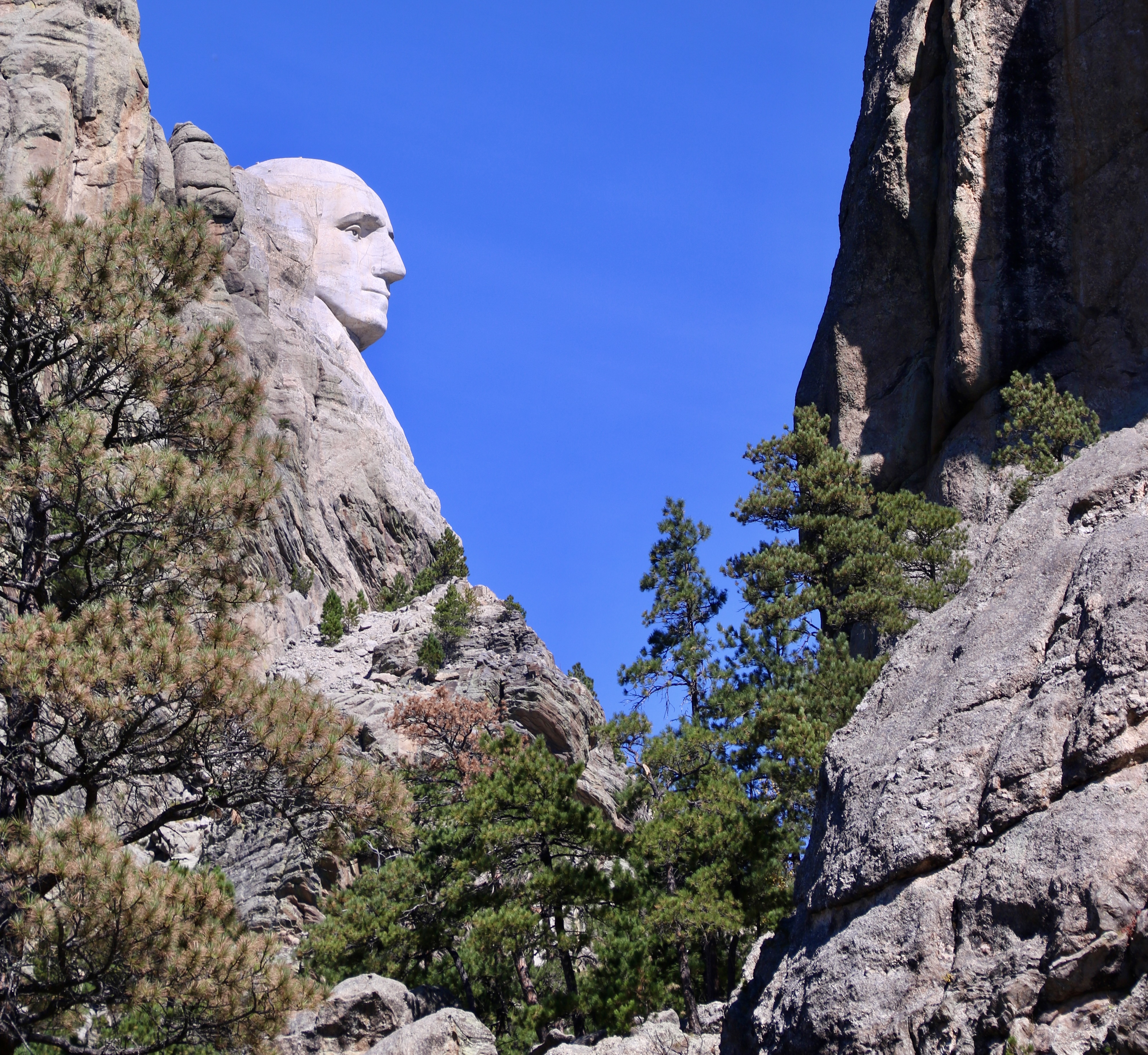
Given George Washington’s role in the Revolutionary War and as the first president of the nation, he was a natural for inclusion.As was Abraham Lincoln who freed the slaves and saved the union. Thomas Jefferson was the primary author of the Declaration of Independence, and the third president of the US, but Borglum chose him because he nearly doubled the size of the country with the Louisiana Purchase, which by the way, also included South Dakota. Theodore Roosevelt was a Republican known for his strong foreign policy overseas and his progressive reforms at home. The latter included the control of powerful corporations, protection of consumers, and pro-conservation efforts— all worthwhile efforts, even more important today than they were then.
As might be expected, an incredible amount of work was involved in creating the massive sculptures shown above. Started in 1927, the work took 14 years to complete. Over 400 tons of rock were removed— around 90% by carefully placed dynamite charges and the rest by jack hammers and facing bits. The latter designed to smooth the rock. Over 400 workers were recruited to do the work, among them local miners, lumbermen and ranchers. Going to work involved first climbing 700 steps to the top of the mountain. Workers weren’t paid for the climb. The carvers would then be lowered by rope to do the job.
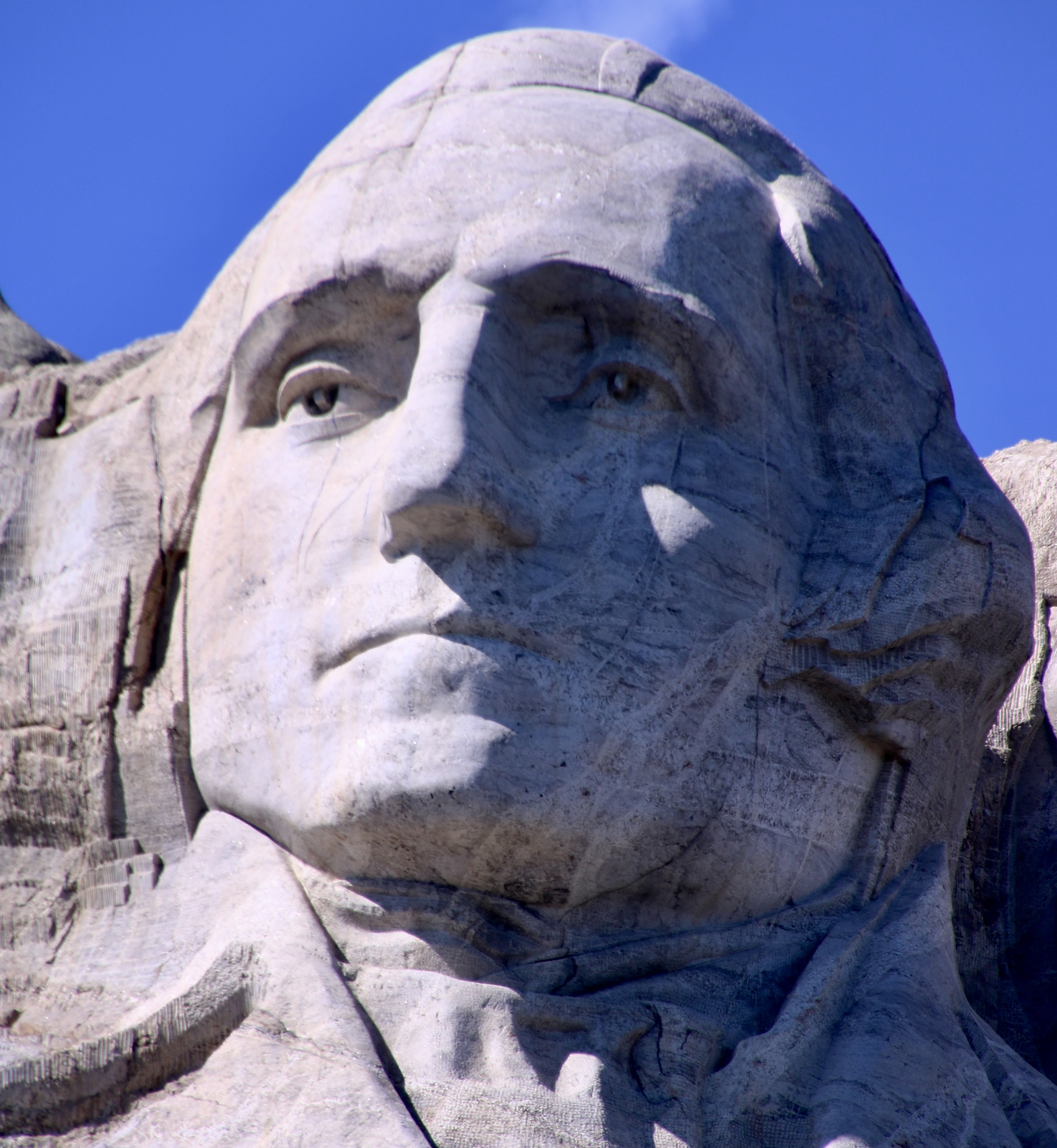
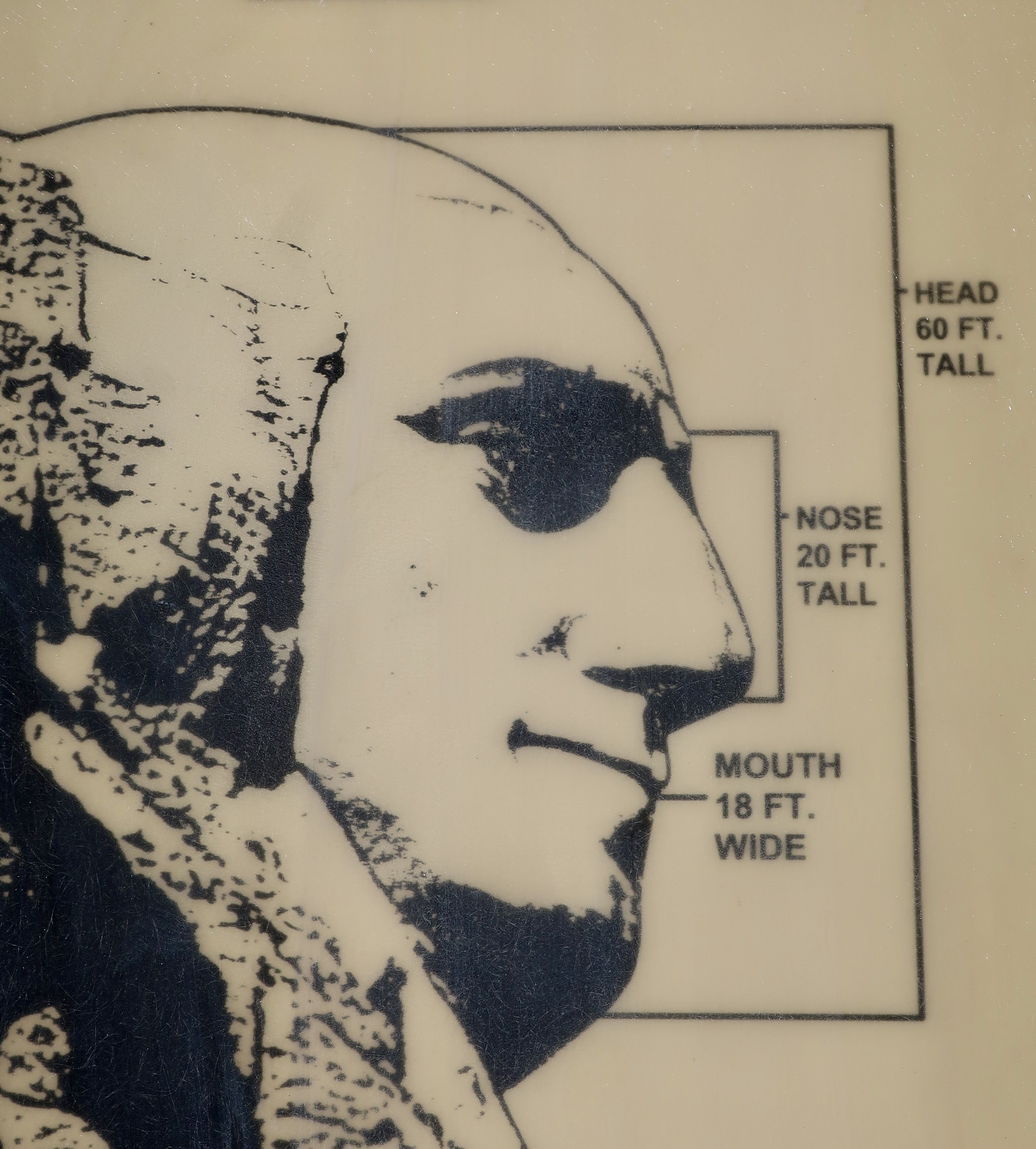
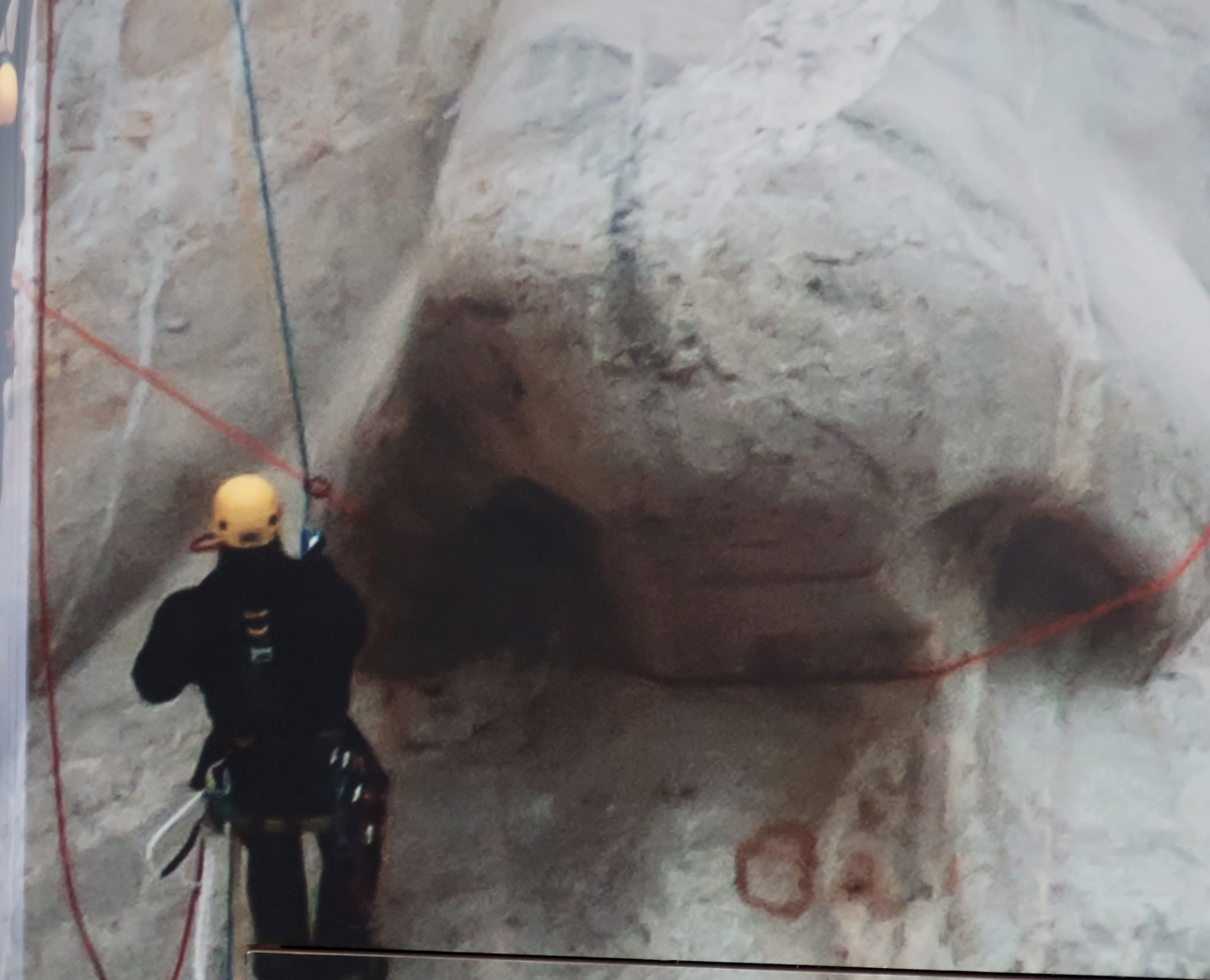
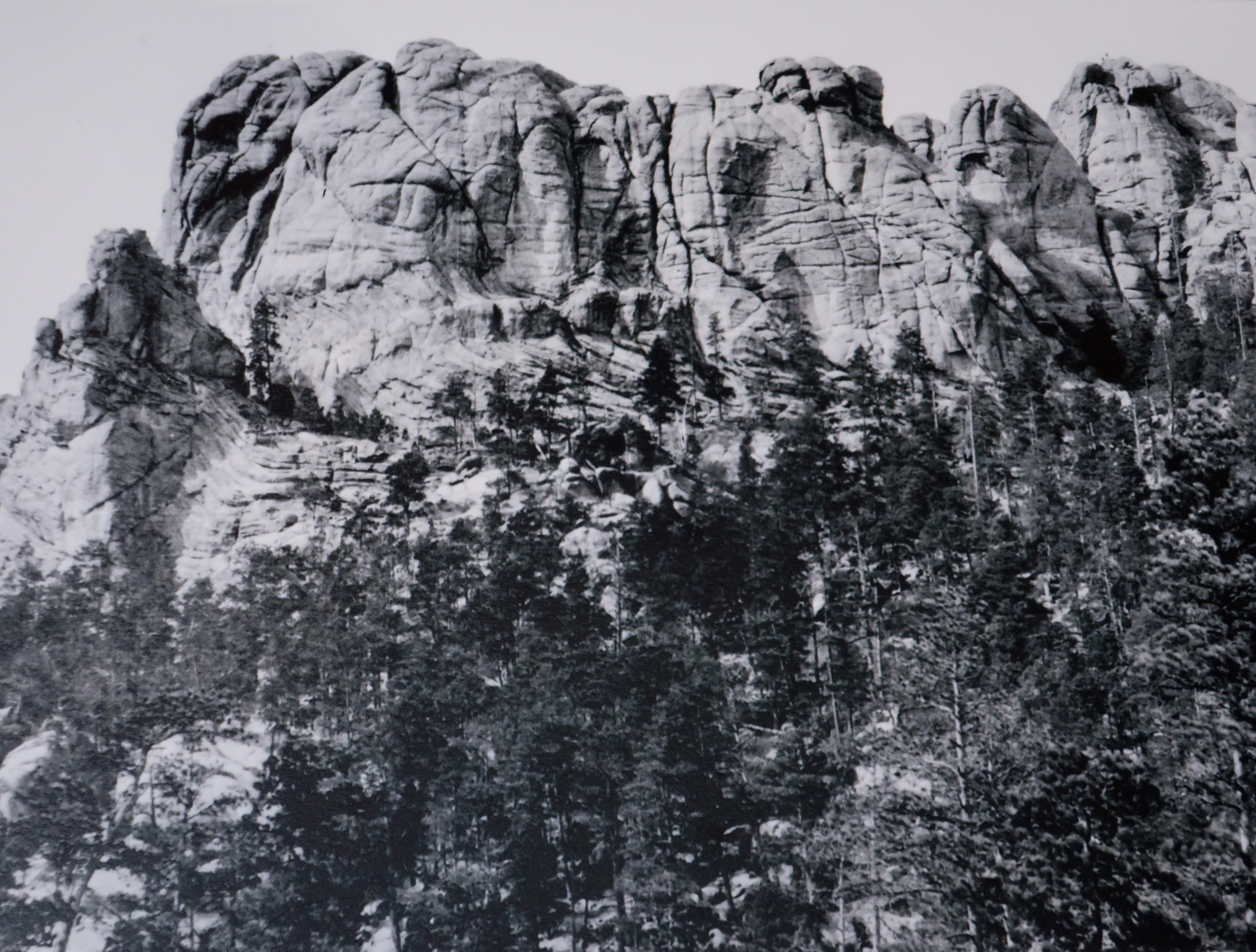
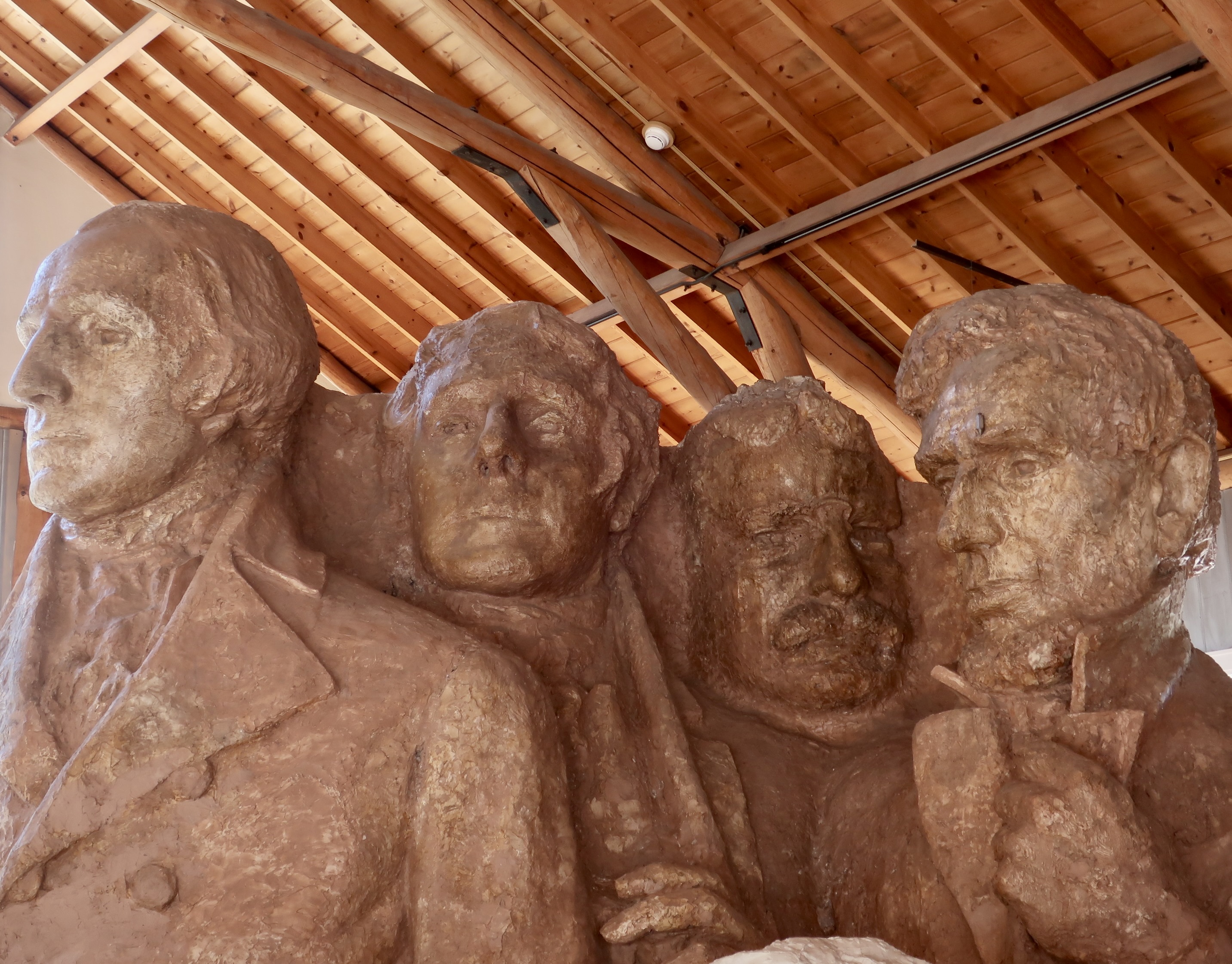
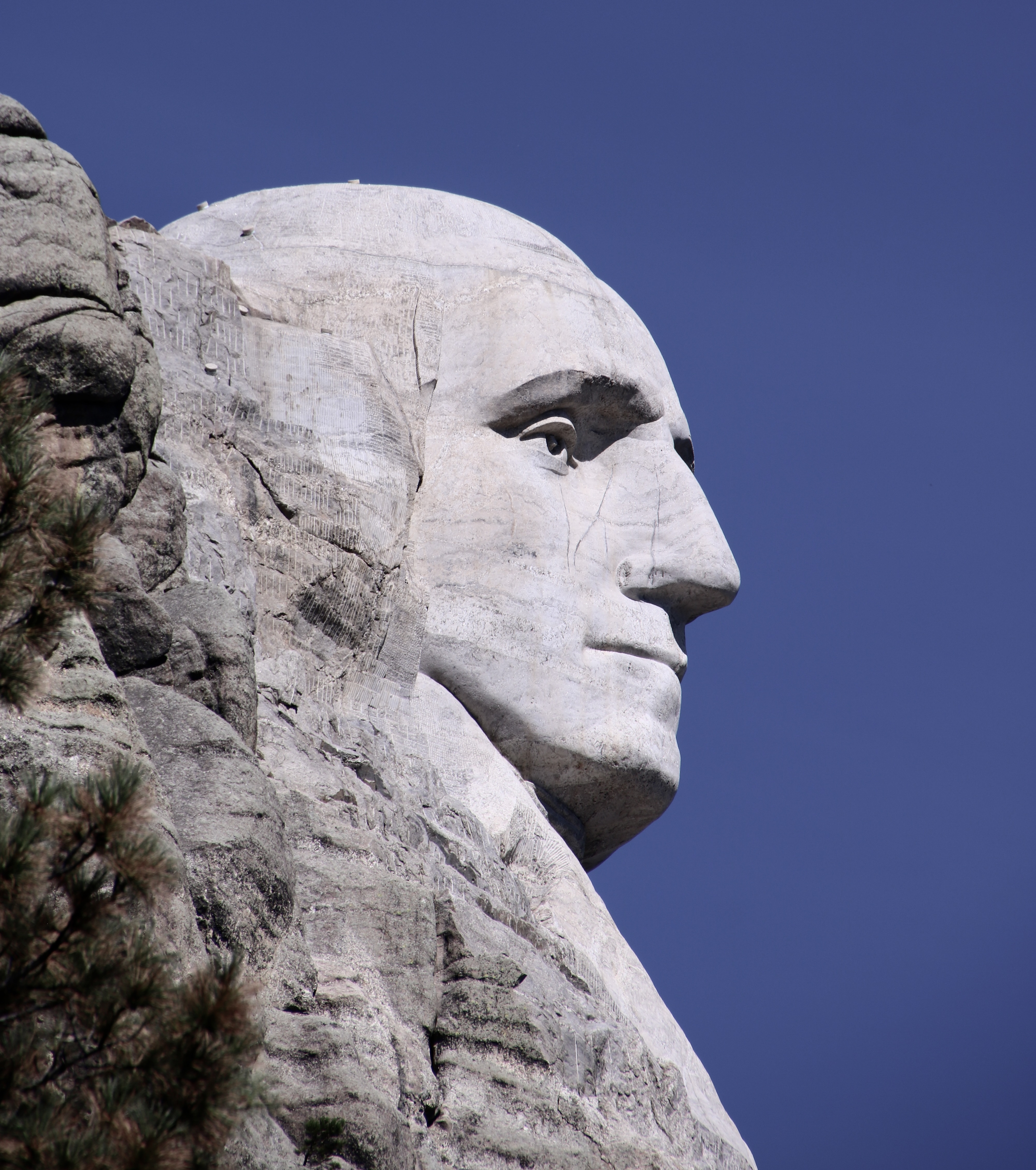
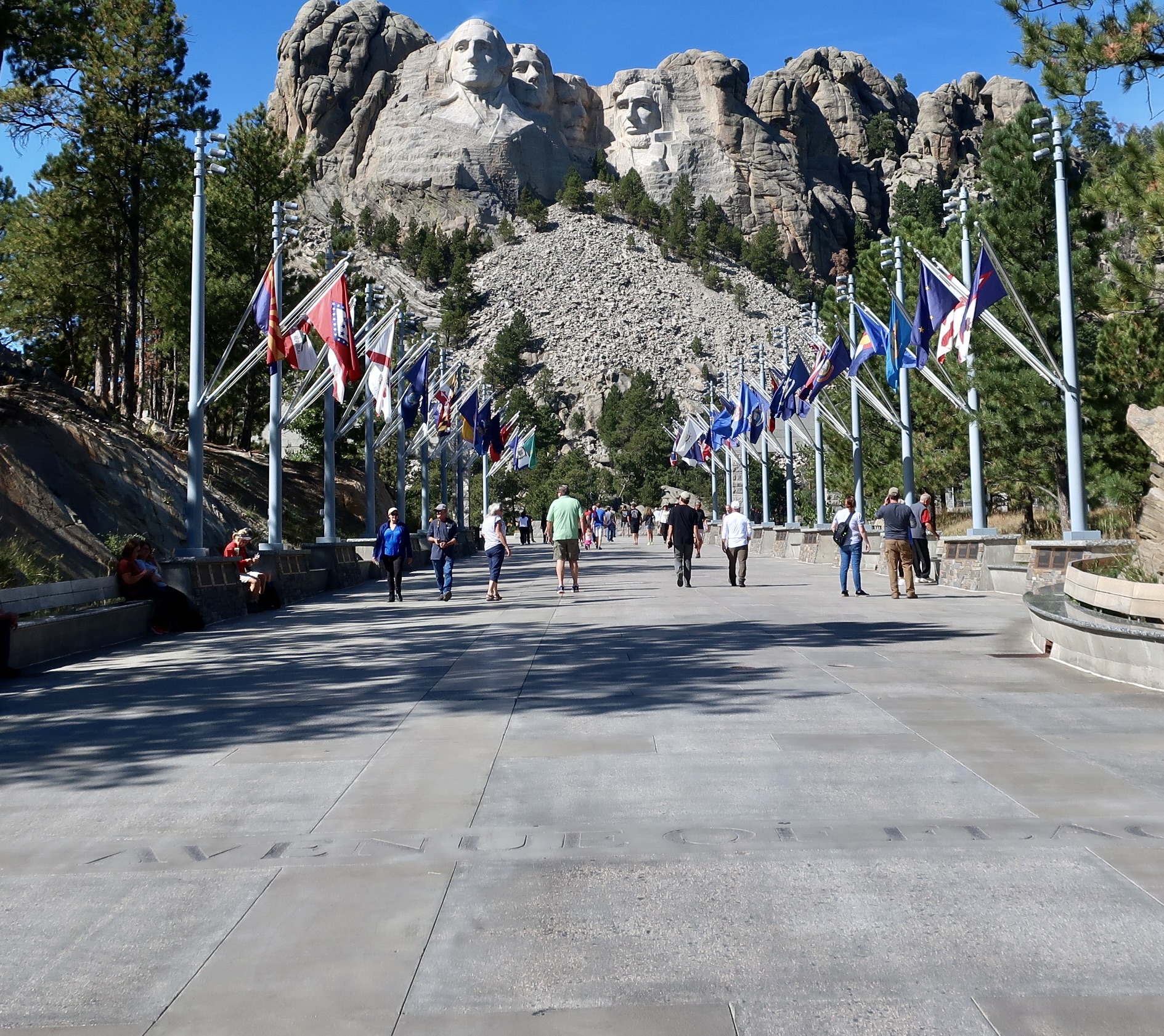
This illustration from the Visitors’ Center provides details on the size of the sculptures. It doesn’t capture the size nearly as well as another photo in the Visitors Center, however… A nostril-sized carver works on what I think is Roosevelt’s nose. (Photo from Visitor Center at Mt. Rushmore.)This early photo, also on display at the Visitors Center, shows Mt. Rushmore before carving commenced. The bottom to top crack on the left marks the beginning; the knobs on the right mark the ending.This photo will provide perspective by moving back and forth between the two photos. Originally, Borglum had plan to carve Jefferson on the right of Washington but poor quality rock led him to blast off the work that had been done and put Washington first. A trail leads down to Borglum’s studio from the main visitor area and displays the models of the sculpture he worked from. Note Lincoln’s hand. The original plan had been to represent the top half of the president’s bodies. Problems with the lower rock base and funding led to only the presidents’ heads being carved.The view from Borglum’s workshop provided him with a clear view of the work in progress. Another trail from the workshop brings you closer to the presidents and provides a different perspective.This was our first view of the monument when we drove in from state highway 385 on highway 144.A close up of George.In conclusion: With over two million visitors a year, Mt. Rushmore is one of America’s best loved national monuments. South Dakota has more than succeeded in creating the tourist attraction it first dreamed of.
Next post: It’s back to Egypt with a focus on Memphis, a giant statue of Ramses II, and a look at one of the first pyramids created.
What’s not to love about Hathor, the Egyptian cow goddess of beauty, sensuality, music, dancing, wine, maternity and much more. She could change from a cow, to a woman with a cow’s broad head and cow ears, to a beautiful woman with cow horns and a sun disk. She could also take the form of a lioness, goose, and a sycamore tree! She was popular with both pharaohs and common people alike. Her beginnings trace back to the dawn of Egyptian history. She is even found on the Narmer Palette, considered Egypt’s most important historical relic, that dates back to 3,100 BCE and reflects much of the next 3,000 years of Egyptian art and history.
Today, Peggy and I are continuing our series on our trip up the Nile in March with Uniword Cruises traveling with our excellent guide, Sabaa. Once again, we will be mixing the mythology, history, and architecture that make Egypt such a fascinating place. All of the photos in this post were taken by either Peggy or me.
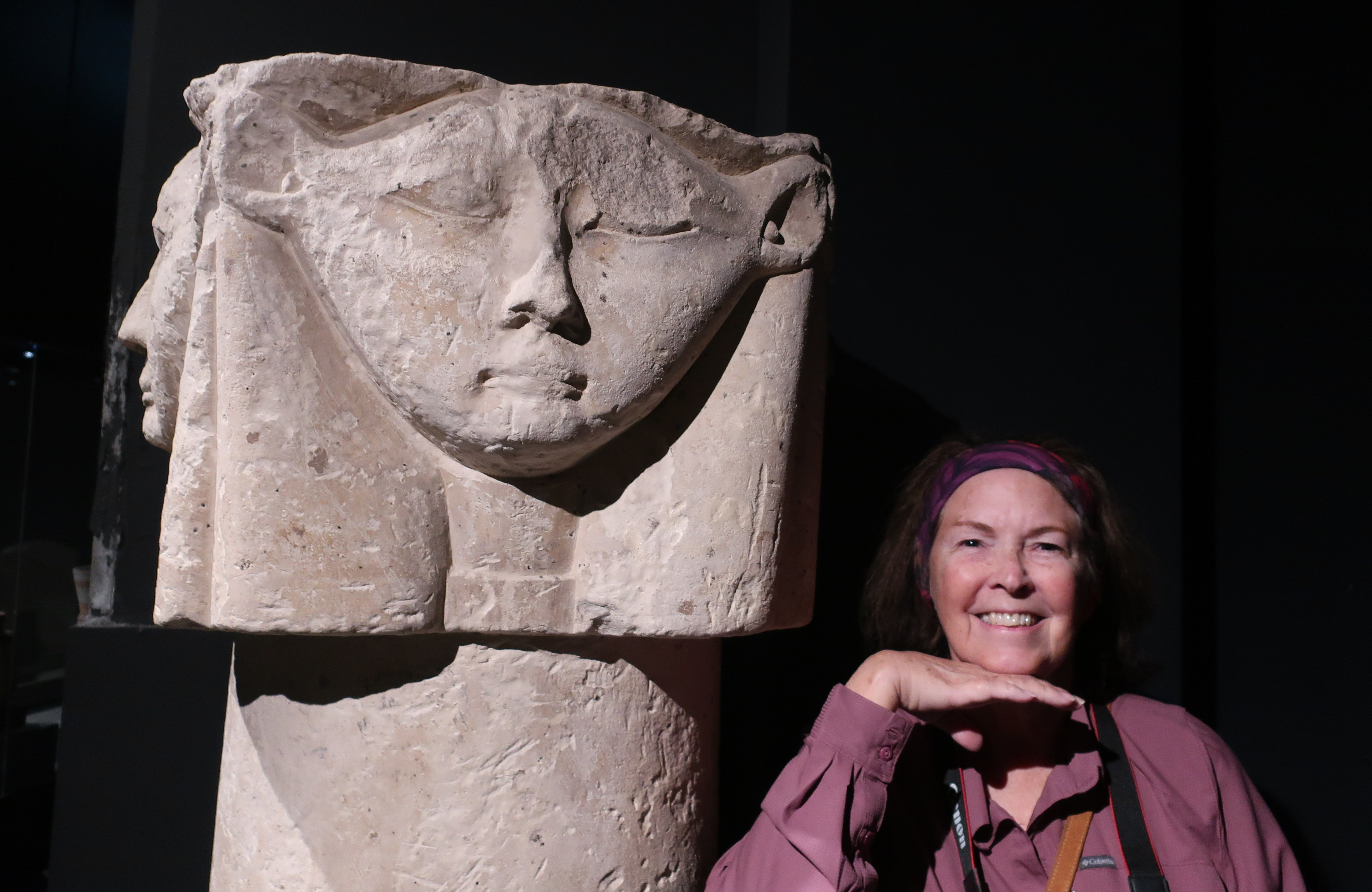
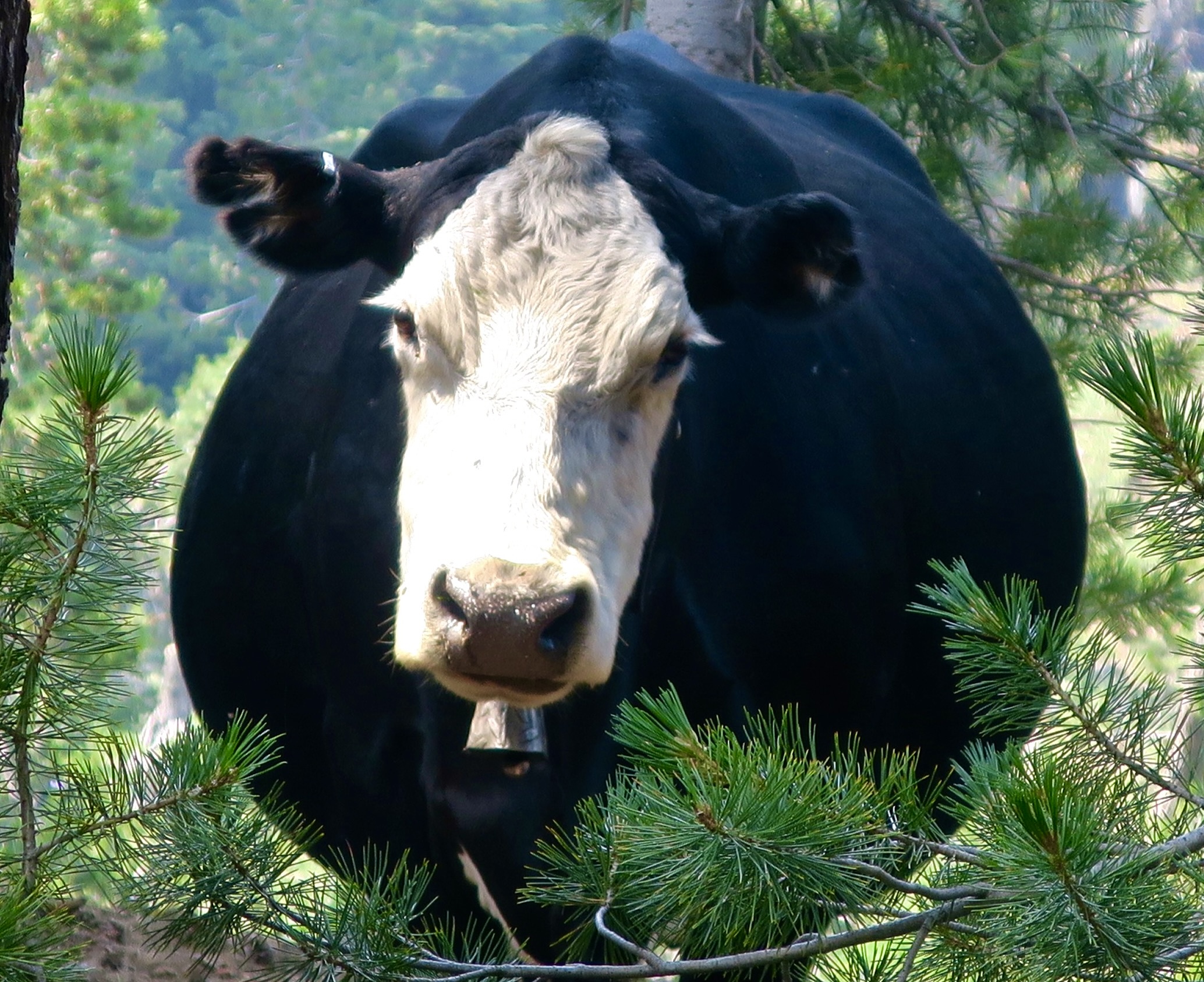
Of all the goddesses I have read about, Hathor is my all-time favorite. Peggy good naturedly agreed to pose with her. I think the side profile of Hathor looks a lot like George Washington. Another role, perhaps?Lacking a photo of Hathor as a cow, I decided to throw in a California cow I found while hiking down the Pacific Crest Trail and named Hathor. It’s only fitting that the goddess of motherhood be very pregnant like this big bovine is.
Gods evolve over time. Hathor is certainly an example of this. She probably started out as the local goddess to a pastoral tribe of nomads as they moved their cattle from place to place. Her responsibilities grew as the regions she was identified with expanded and she took on the role of other female deities. The most dramatic increase in her territory was when Narmer, the pharaoh of Upper Egypt conquered Lower Egypt around 3,100 BCE. (Lower Egypt included the Nile Delta where it flowed out into the Mediterranean. Upper Egypt followed the Nile south of Cairo as it climbed up to the cataracts at modern Aswan.) The unification of these two areas is central to much of the subsequent history of Egypt. Since the Narmer Palette showed the first phase of the unification, plus Hathor, it’s worth looking at closely. The palette is located in the Museum of Egyptian History, which was just outside the backdoor of our hotel in downtown Cairo.
This is the back of the Narmer Palette. Following is what I’ve been able to derive from the various interpretations.
Two images of Hathor are located at the top of the Palette look favorably down on the Narmer. You might say that she is offering her blessing, supporting his position as pharaoh. Such approval was critical in legitimizing the position and power of the pharaohs, who also claimed divinity and made sure gods were part of their family trees. The raised relief between the two images of Hathor spells out Narmer’s name in hieroglyphics, represented by a catfish and a chisel. The background, called a serekh, symbolizes the entrance to a castle and was used to show that this was a pharaoh’s name. Later pharaohs would use a cartouche to emphasize their names.
A number of other things are used to demonstrate Narmer’s power that would be common to future pharaohs. One, he is smiting his enemy. Pharaohs did lots of smiting. In this instance, Narmer is using his mace to pound what I believe is his chisel into the head of his unfortunate enemy from Lower Egypt. Two, he is much larger than anyone else. Three, the bowling pin shaped hat on his head is the white crown of Upper Egypt, the Hedjet. Below his belt, Narmer’s kilt features four more images of Hathor on top of columns, just in case there are any doubts about her support. His beard will be seen on all future pharaohs. And finally, he has one fine tail. It’s a bull’s tail that symbolizes pharaohs could take the shape of large bulls.
The small figure off to the left is his servant, who is tasked with carrying his sandals. On the right, Horus, the falcon god, is perched on a papyrus plant while he uses a rope to pull up another enemy out of the marsh by what appears to be a hook through his nose. That would hurt. Note how his claw and leg have become an arm and a hand. This likely symbolizes that Horus also supports Narmer’s military success over Lower Egypt. Two more dead enemies are shown on the bottom.
Here’s the front of the palette, which is packed with even more symbolism. Once again, Hathor and the pharaoh’s name are on top.
From left to right on the next level, we have the servant still faithfully carrying Narmer’s sandals. His flower may be the lotus, the plant symbol of Upper Egypt. It looks quite perky. Narmer is wearing the crown of lower Egypt here, showing the unification of Upper and Lower Egypt and the fact that he now rules over both. He is still carrying his mace. His right hand, however, holds a shepherd’s crook that will become another symbol of pharaohs— and, far into the future, popes. His catfish and chisel come next, announcing him. Below them is another servant carrying what appears to be wilted papyrus, the plant symbol of Lower Egypt. Compared to the perky lotus, are they mourning the defeat? Standard bearers come next followed by the defeated enemies. Their heads have all been cut off and are laid between their feet. This isn’t enough, however. They have also been de-manned and their parts draped over their heads. Not a pretty picture in anyone’s book— or blog. Above them, a barque, Ra the sun god’s boat, sails across the sky, which is a story for a future post.
The delightfully weird mythical beasts below with their long necks are called serpopards, a modern name concocted from serpent and leopard. Egypt adopted them from neighboring Mesopotamia. The round space in the middle is designed for grinding minerals used in makeup, possibly for ceremonial purposes in the worship of the gods. Could it be Hathor? The goddess of beauty was also the goddess of makeup. Below, Narmer has adopted his bull persona and is destroying the walls of a village or city where he is smiting another enemy.
Now back to Hathor.
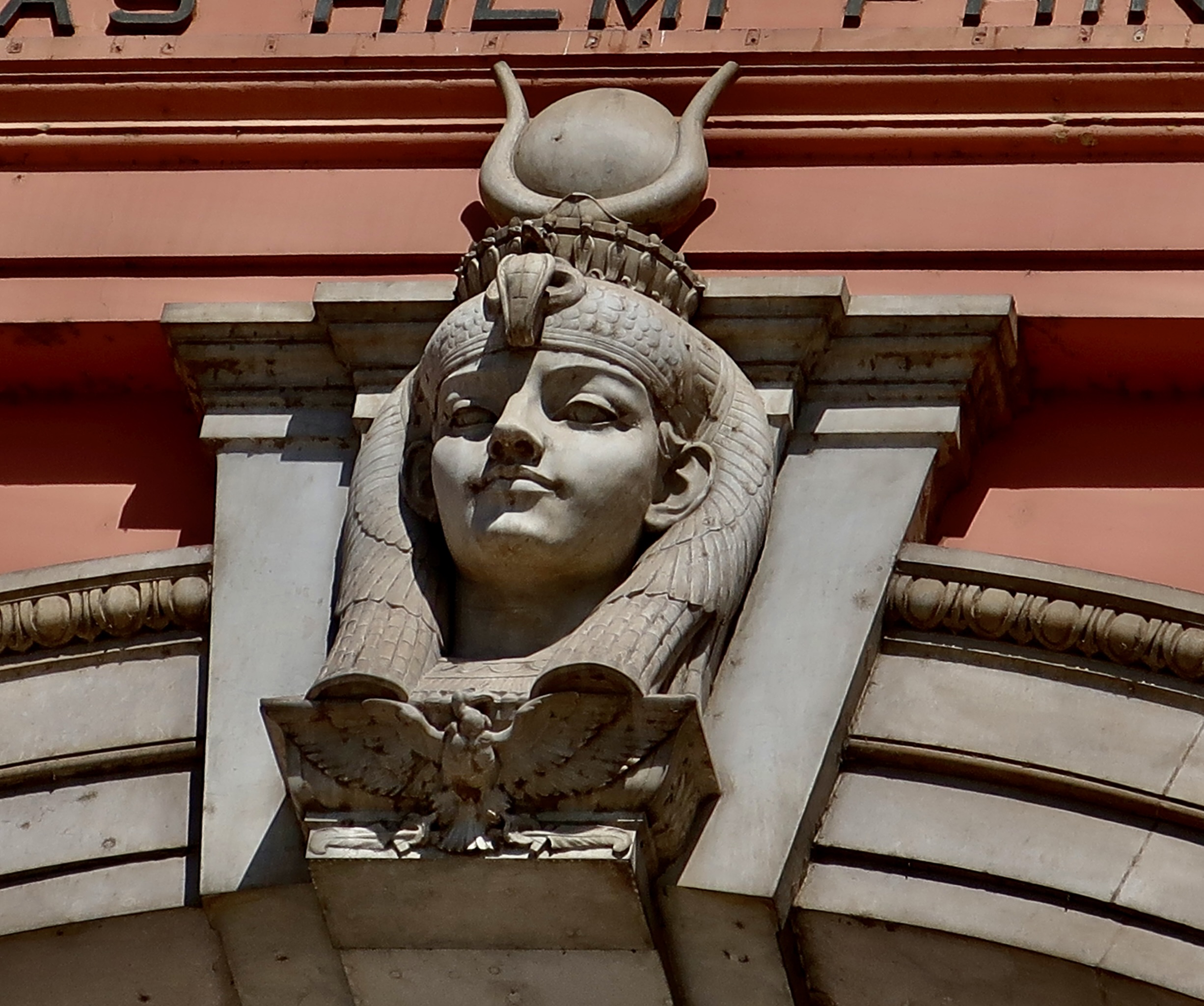
Here’s Hathor in her form as a beautiful woman, smiling down on people entering the Egyptian Museum of History. The horns on her head display the sun disk. Wadjit, the cobra goddess of Lower Egypt, adorns her head while Nekhbet, the vulture goddess of Upper Egypt, soars beneath her, both providing protection.
One of my favorite myths about Hathor is how she served time as the Eye of Ra, which like the Eye of Horus, could wander around on its own. Unlike the Eye of Horus that brought good things, however, the Eye of Ra was an object of power and could bring devastation.
In the Book of the Heavenly Cow from the Middle Kingdom, Ra becomes angered by humans’ lack of respect and bad behavior so he releases his eye Hathor in the form of Sekhmet, the lion goddess, upon humanity to destroy it. Note the parallel here with the God of the Old Testament, who decides to flood earth and destroy humanity for similar reasons. The goddess in a passion of blood thirsty destruction descends on mankind killing everyone she finds and destroys their farms, towns and cities. At first Ra is pleased that humanity is getting what it deserves, but eventually becomes concerned (with the help of the other gods) that maybe he has gone too far, and soon there will be no humans left on earth. Who’s going to worship him? He decides to show mercy.
He asks Tenenet, the goddess of beer, to brew a large, potent batch, dye it red, and deliver it to where Sekhmet will see it. (Brewing a large batch of beer in Ancient Egyptian terms was indeed large. Vats found in Hierakonpolis could brew up to 300 gallons of beer at a time.) Sekhmet finds it, and, thinking she has found a huge cache of blood, drinks it down to relieve her blood lust, the whole batch! Glug, glug, glug—becomes drunk beyond imagination, and falls into a deep sleep. She wakes up in the form of the beautiful Hathor who henceforth does only good for the people of Egypt and becomes their most beloved goddess.
Another set of myths I enjoyed about Hathor was her relationship with Horus, partially because it reflects how myths can change and don’t necessarily need to be consistent. In at least one version of the Isis-Osiris myth that I shared in my last Egypt post, Hathor nurses the young Horus with her bounteous udders while he is hidden in the papyrus marshes of the Nile Delta. She also helps hide him by shaking a sistrum, an ancient Egyptian music rattle that sounds like rustling papyrus, and muffles any noise Horus may make. Need it be said that Hathor was also the goddess of the sistrum?
Another myth suggests that Hathor was the mother of Horus. So much for Isis. But maybe that’s okay, since Isis eventually takes over the role and form of Hathor, looking exactly like her. And finally, this gets a little kinky: Hathor becomes the lover/consort/wife of Horus. BTW, Hathor translates into the House of Horus, giving a whole new meaning to “I’m home, Honey.”
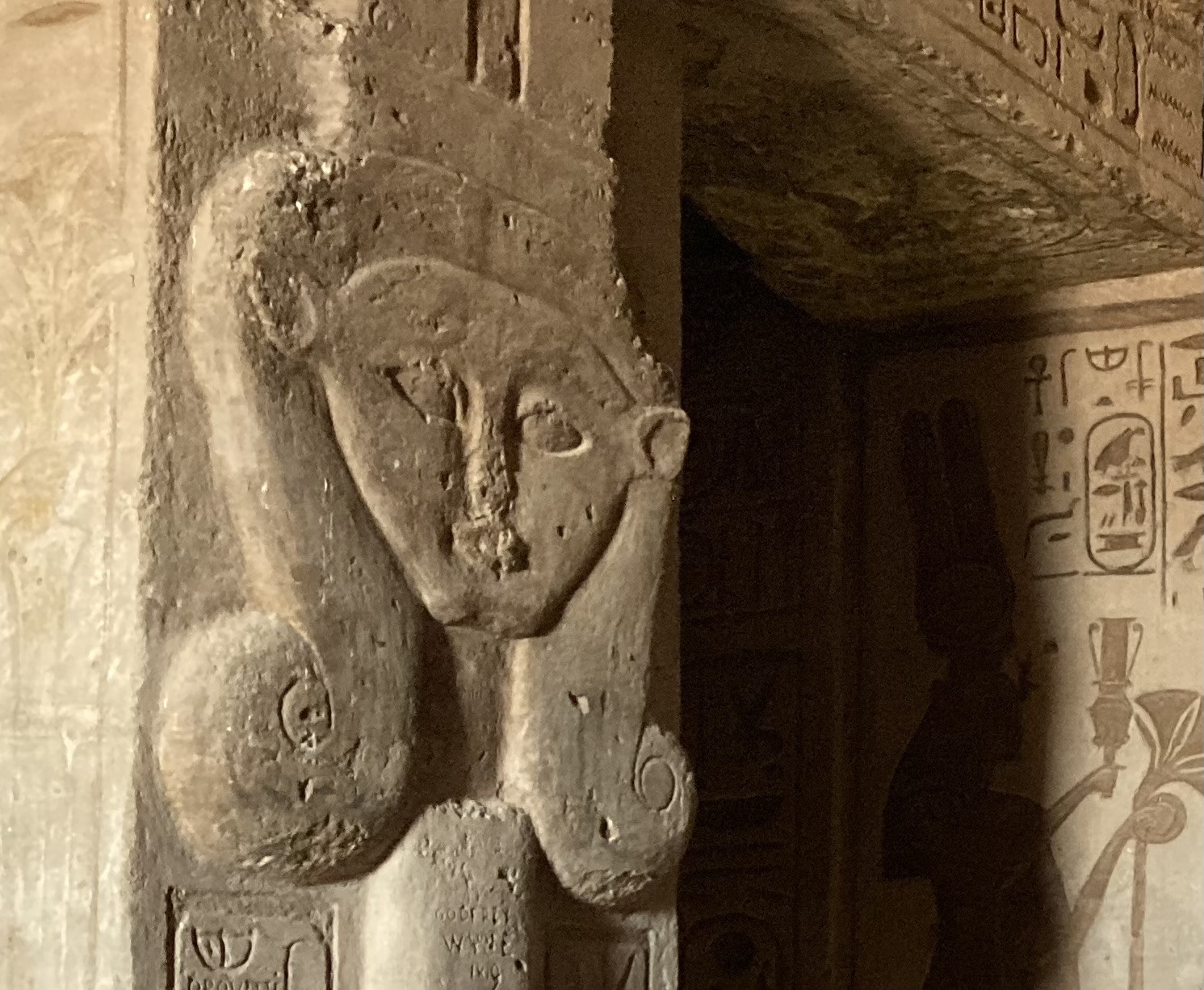
Now it’s time to wrap up this post with some photos of Hathor. Many of these images came from the Temple of Hathor at Dendera, which we will visit later.
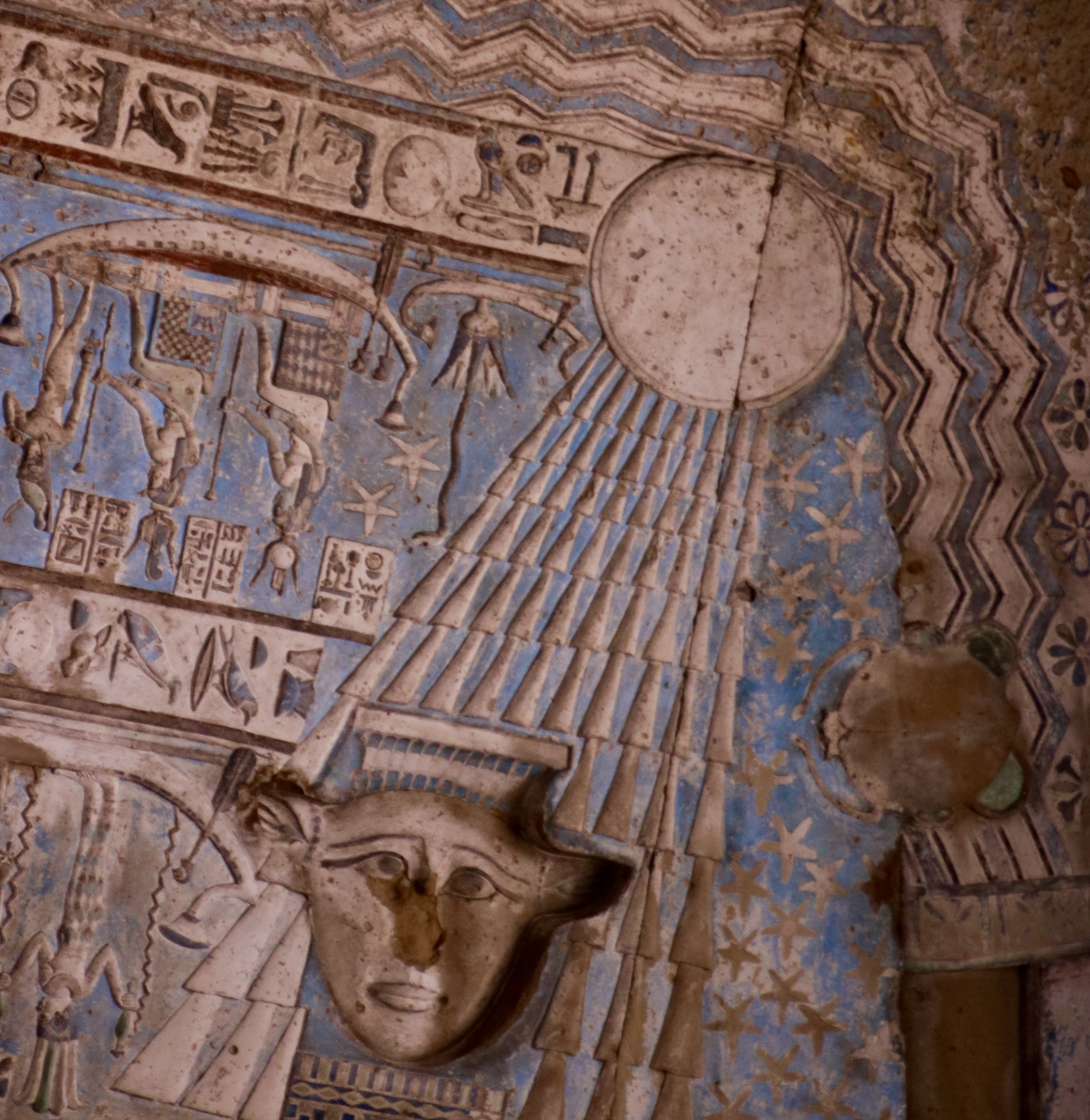
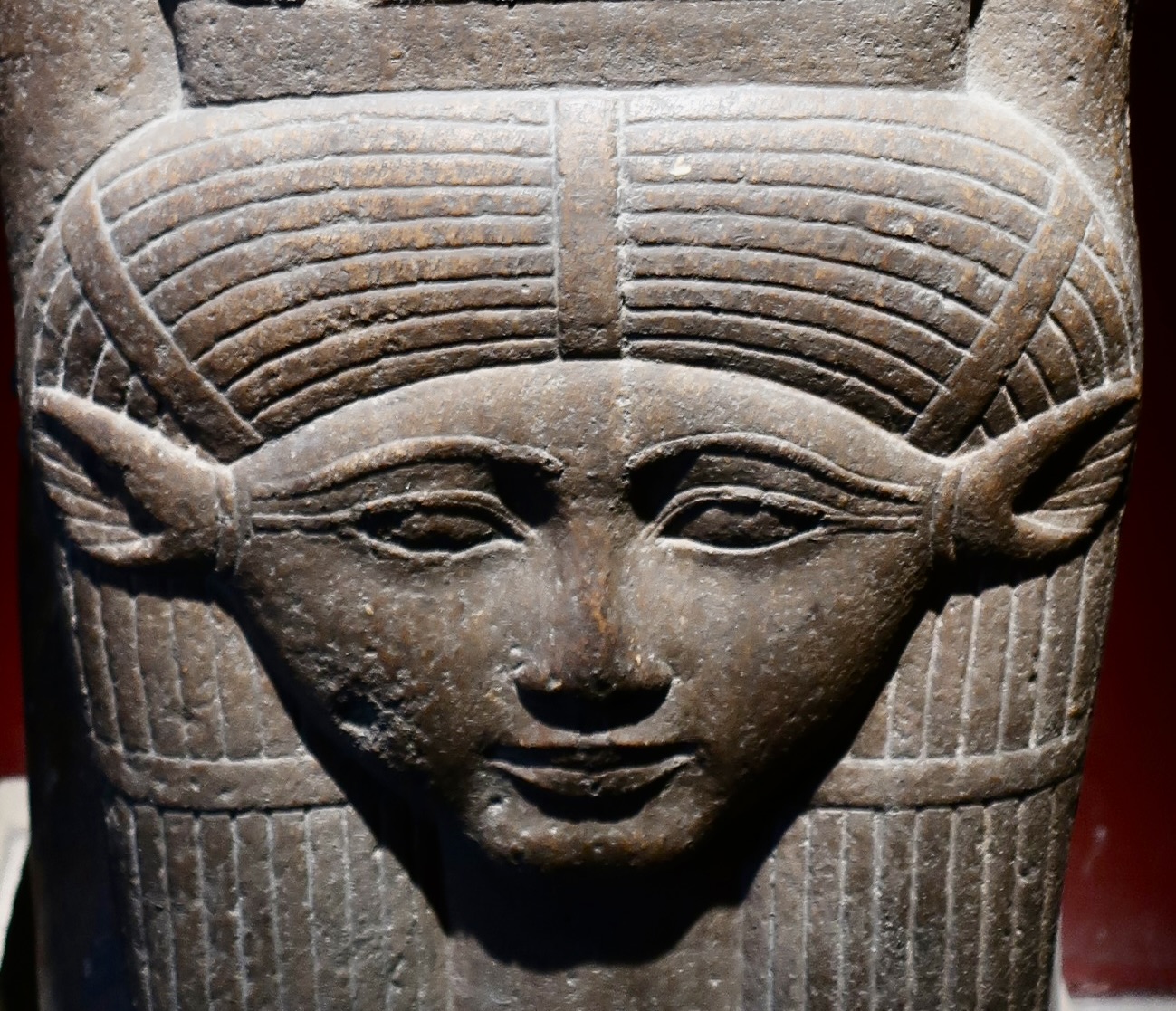
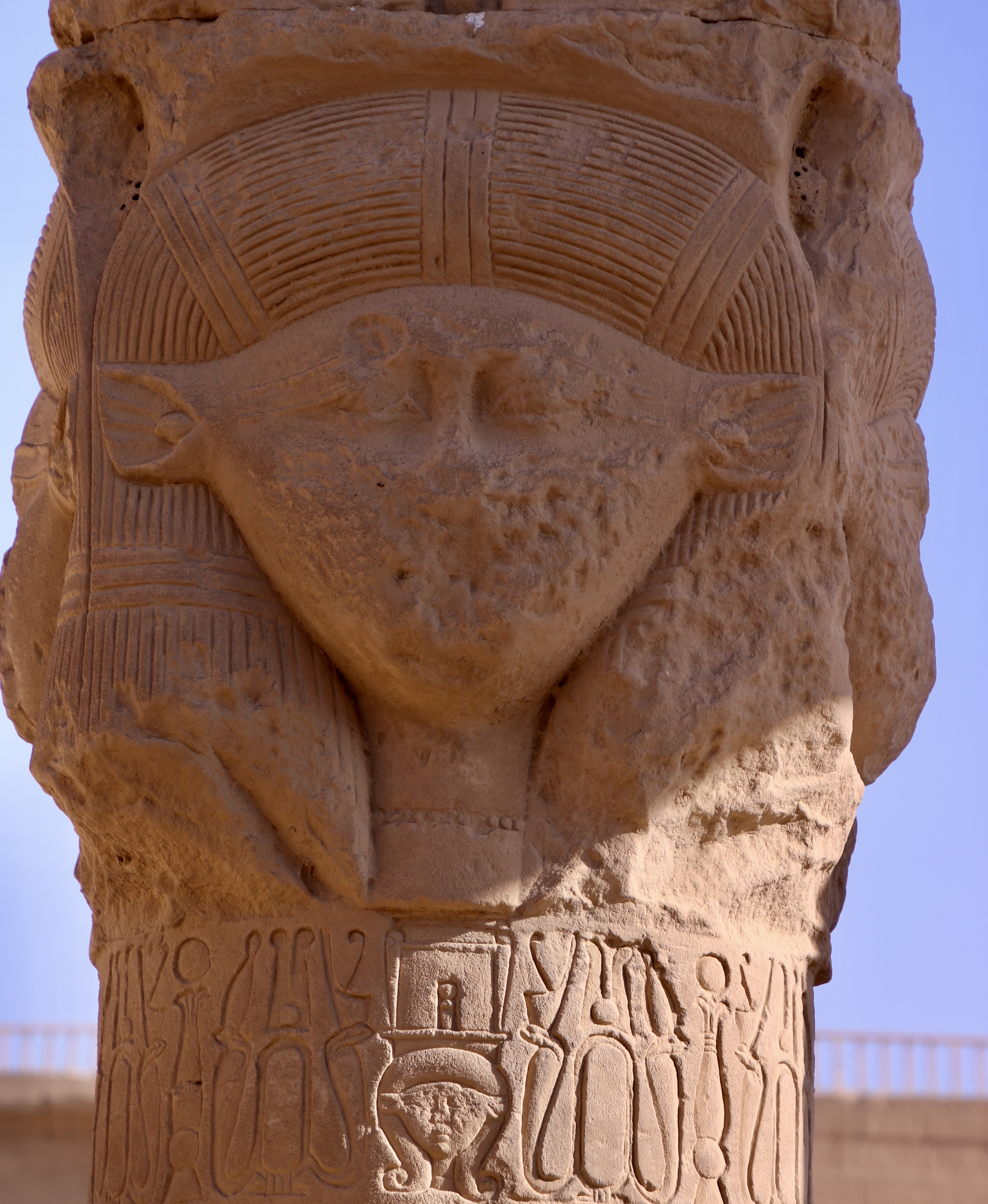
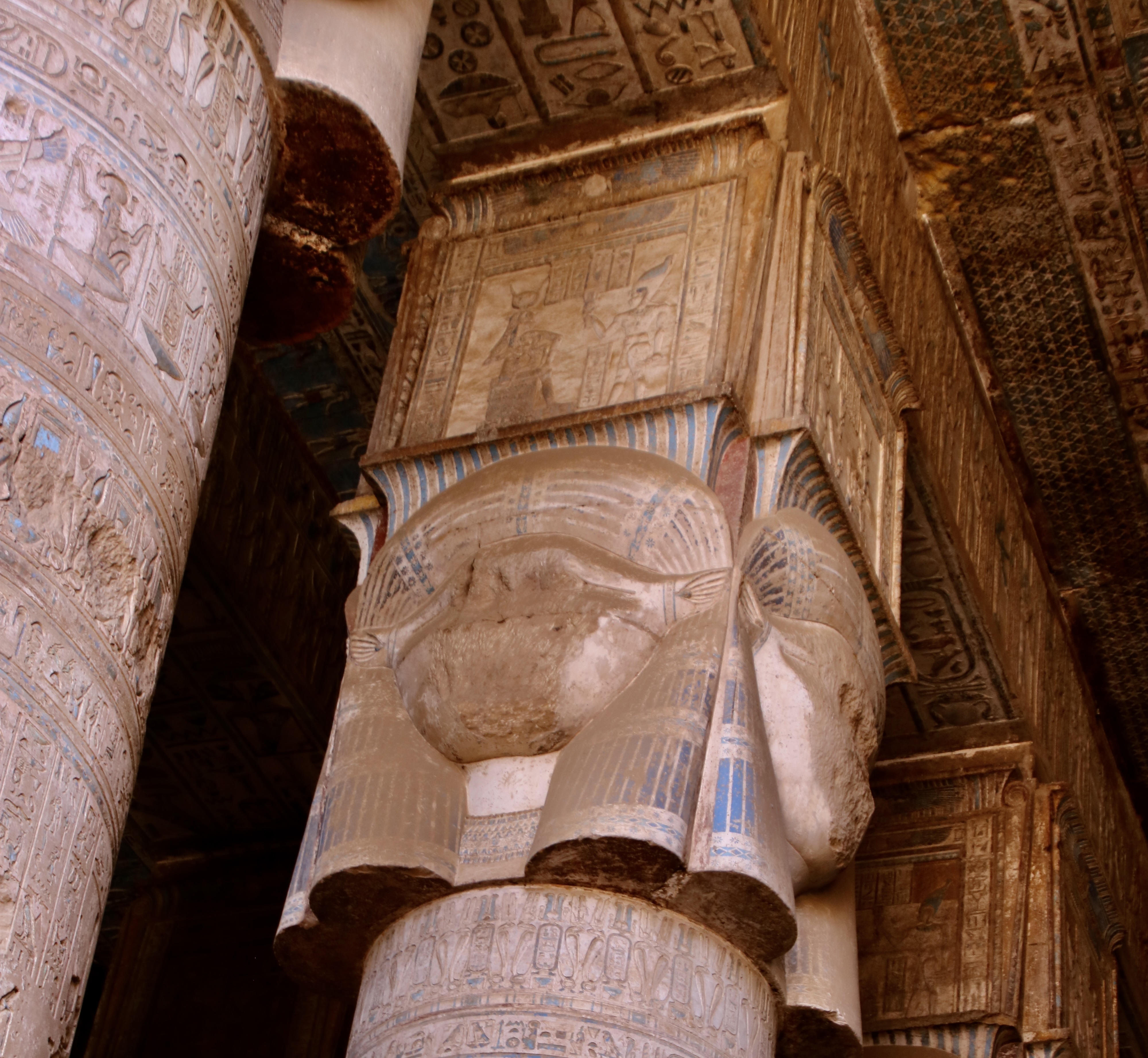
This is from Hathor’s temple at Dendera. Ra, the sun god, has just completed his nighttime journey through Nut and is born again. His rays shine down on Hathor. Take a moment to look at the other images, like the snake emerging from the lotus.New hair-do?Same hair-do, more basic version.On a column: Big Hathor above; little Hathor below.Hathor looking a bit more cow-ish at Dendera. Grin. Check out the nose and nostrils! Same hairdo.And finally—an interesting trio, to say the least. Hathor is on the left, in her human form. Horus comes next. He is wearing the combined crown of Upper and Lower Egypt. And no, he is not overly excited to be in the presence of two beautiful semi-clad women. That’s a dagger in his belt. Isis is last. Note how Isis now looks like Hathor. Both are wearing the vulture goddess, Nekhbet, as a hat, and both display horns holding the sun disk from which the cobra goddess, Wadjit, dangles. The only difference between the two is that the object protruding from the sun disk above Isis is her crown.
Our next post will feature Mt. Rushmore in South Dakota. We will be back in Egypt the following week.
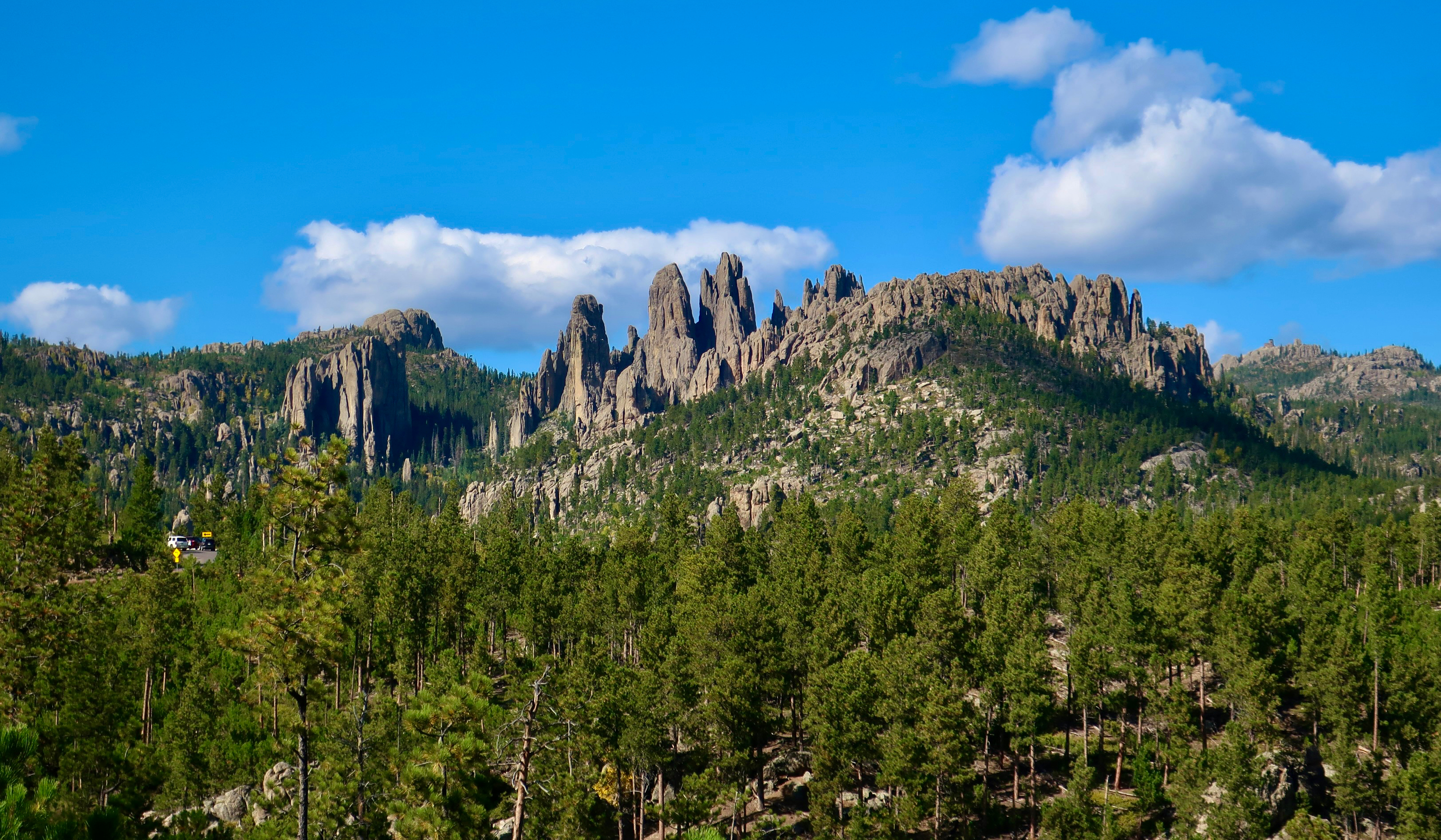
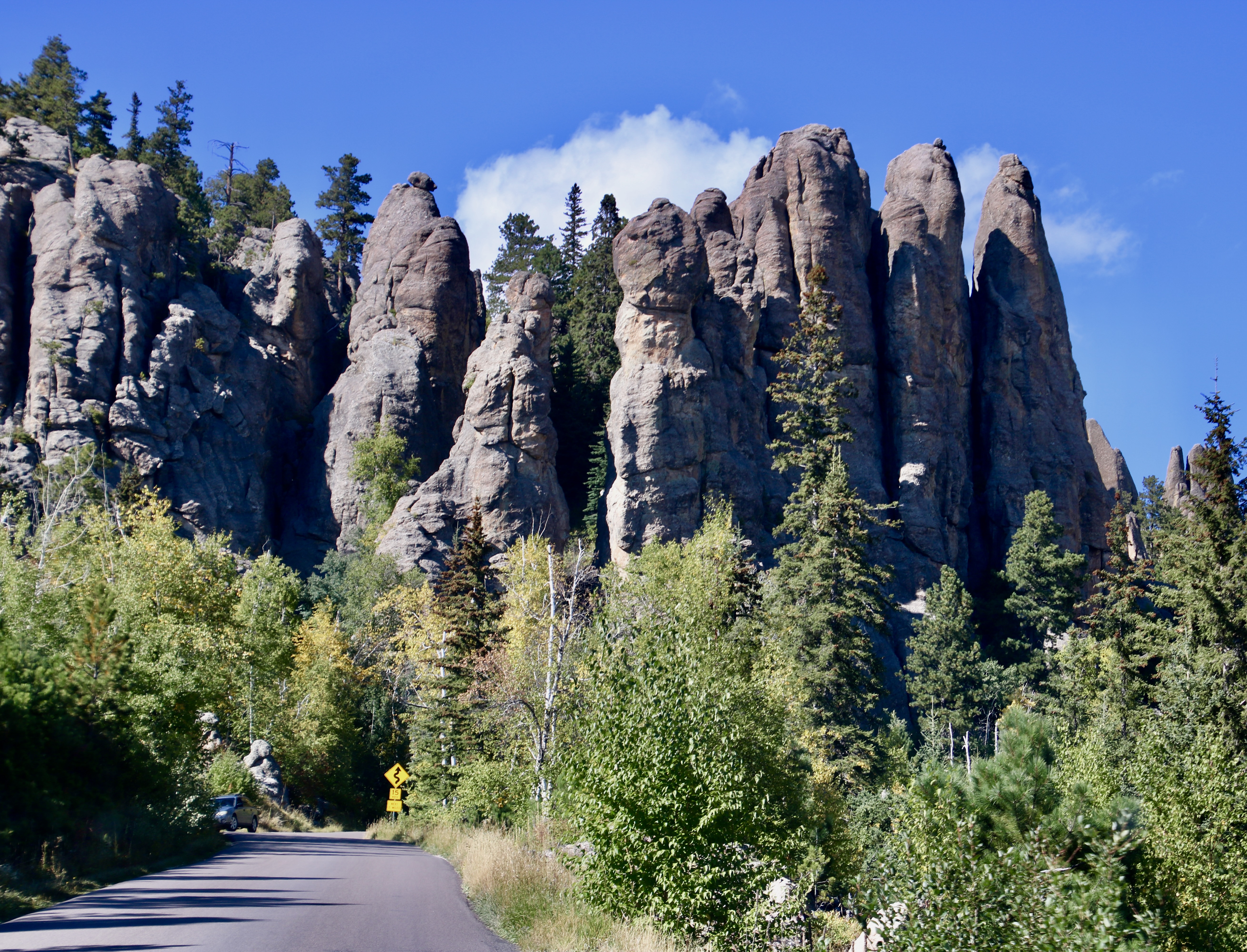
It’s impossible not to feel awe when traveling through the towering Cathedral Spires of South Dakota’s Custer State Park. They so impressed Peter Norbeck, the governor of the state from 1917-21, that he personally scoped out a route on foot and horseback that would feature the best views. Known as the Needles Highway, it’s also famous for its narrow tunnels hewn out from the granite rock. We visited Custer State Park on our RV trip around North America last fall. All photos in the blog are taken by either Peggy or me unless otherwise noted.
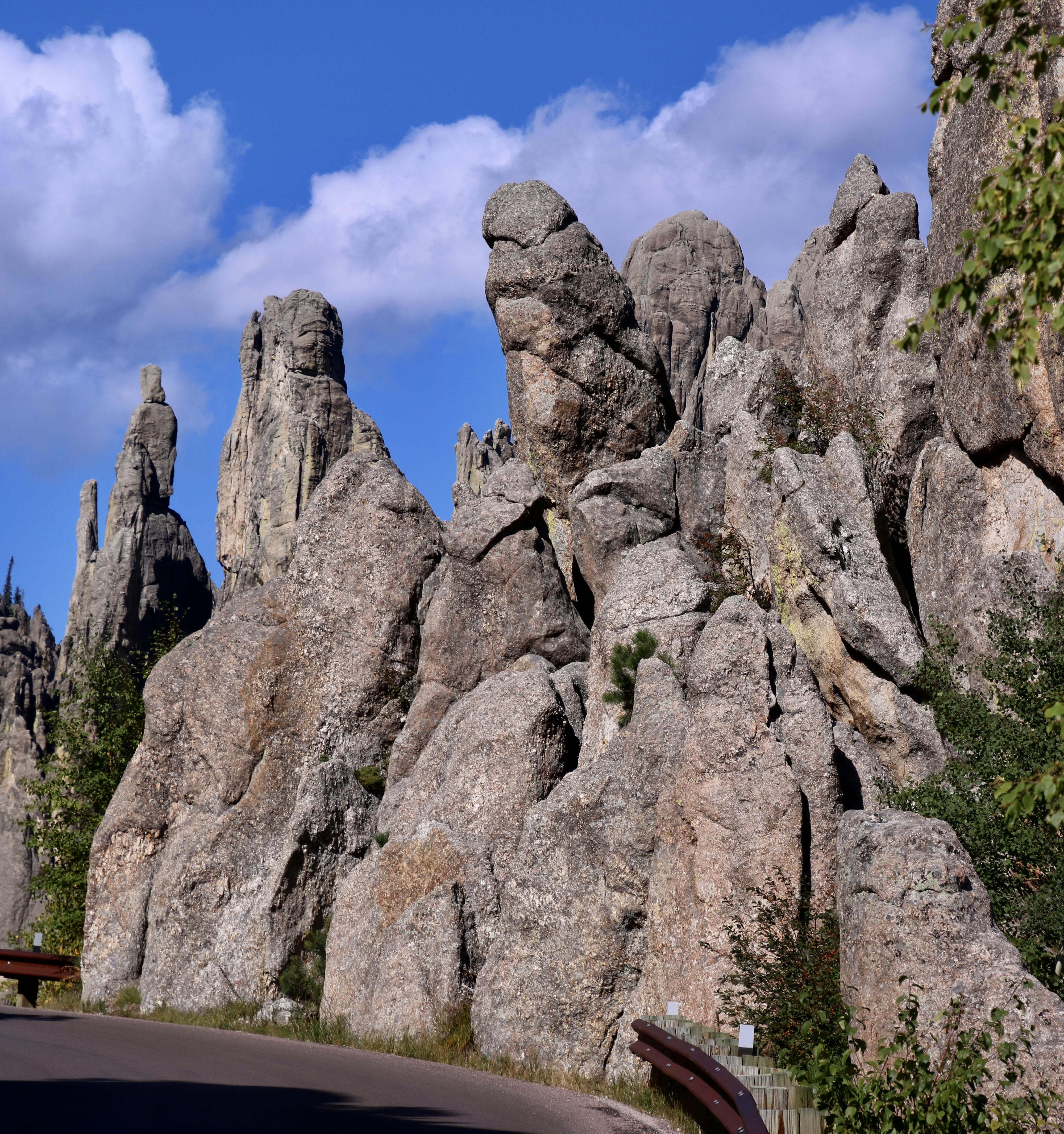
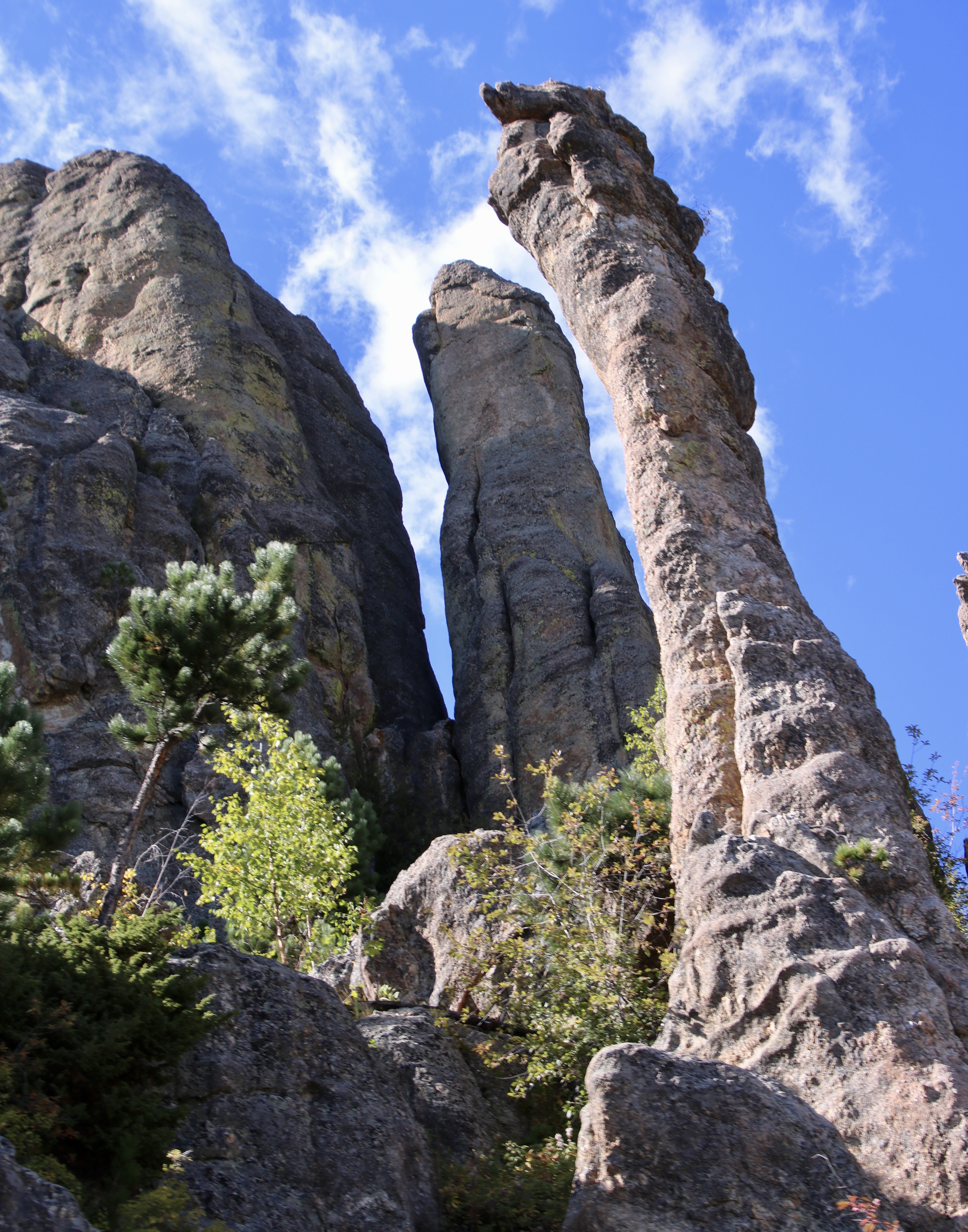
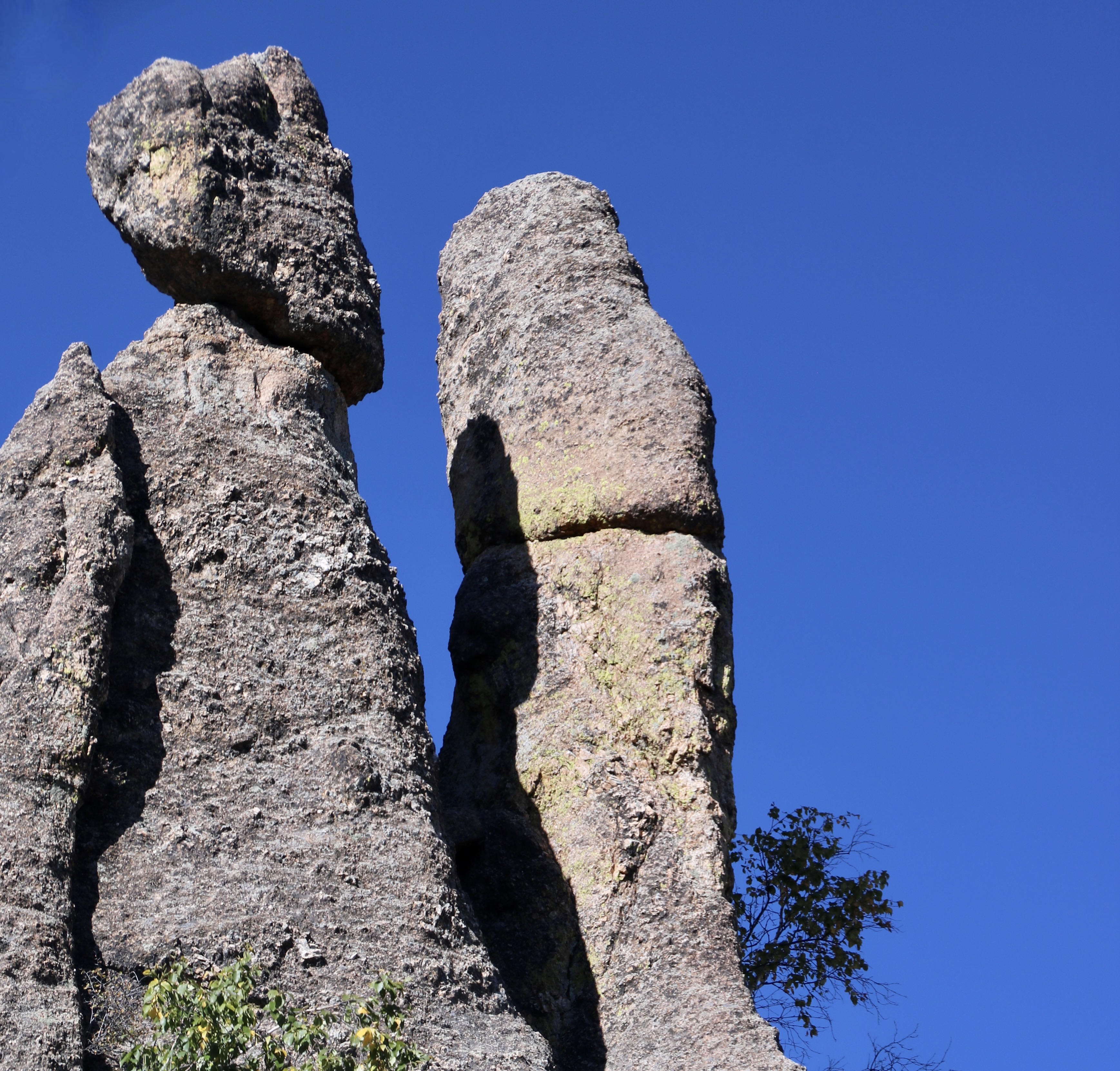
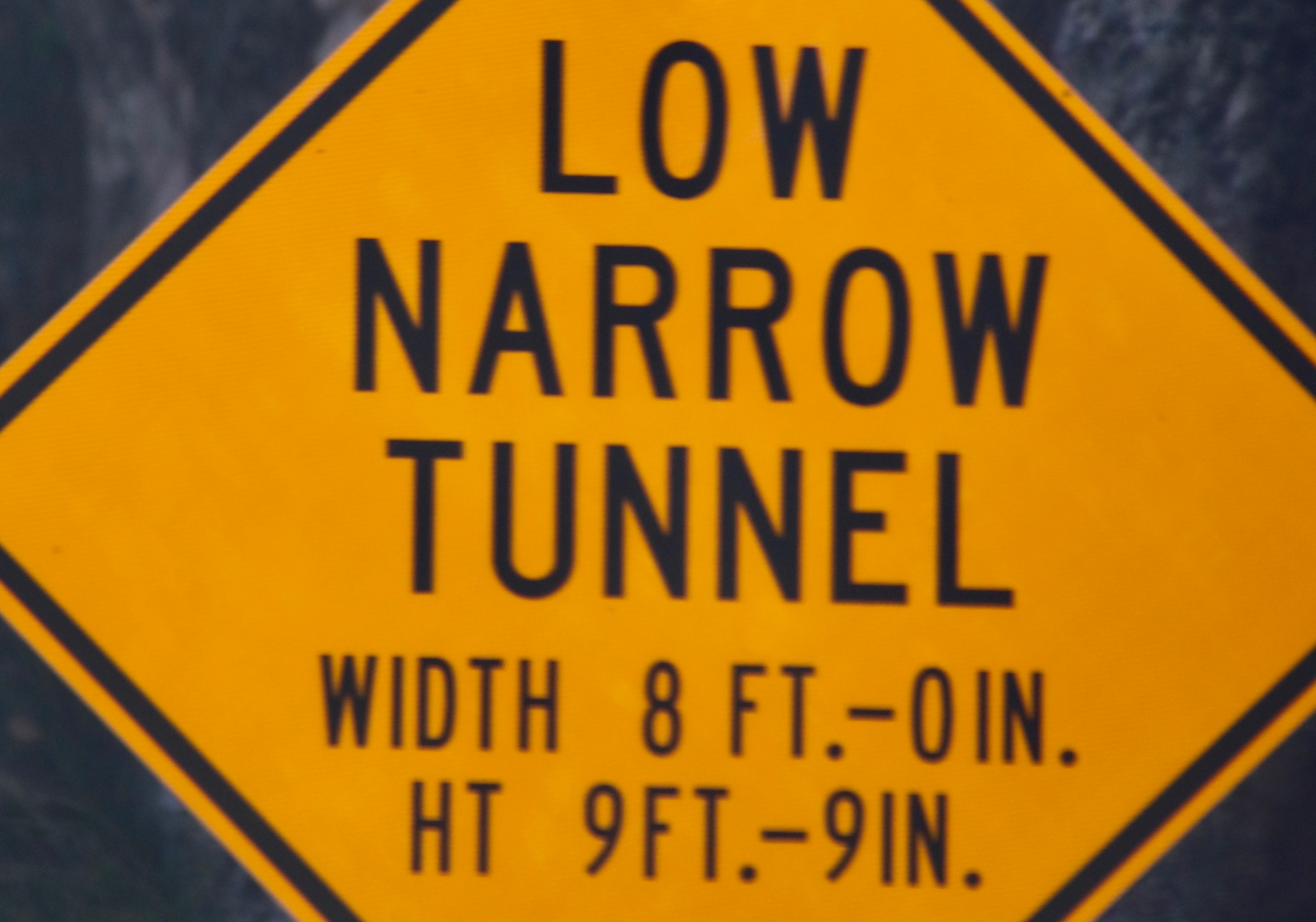
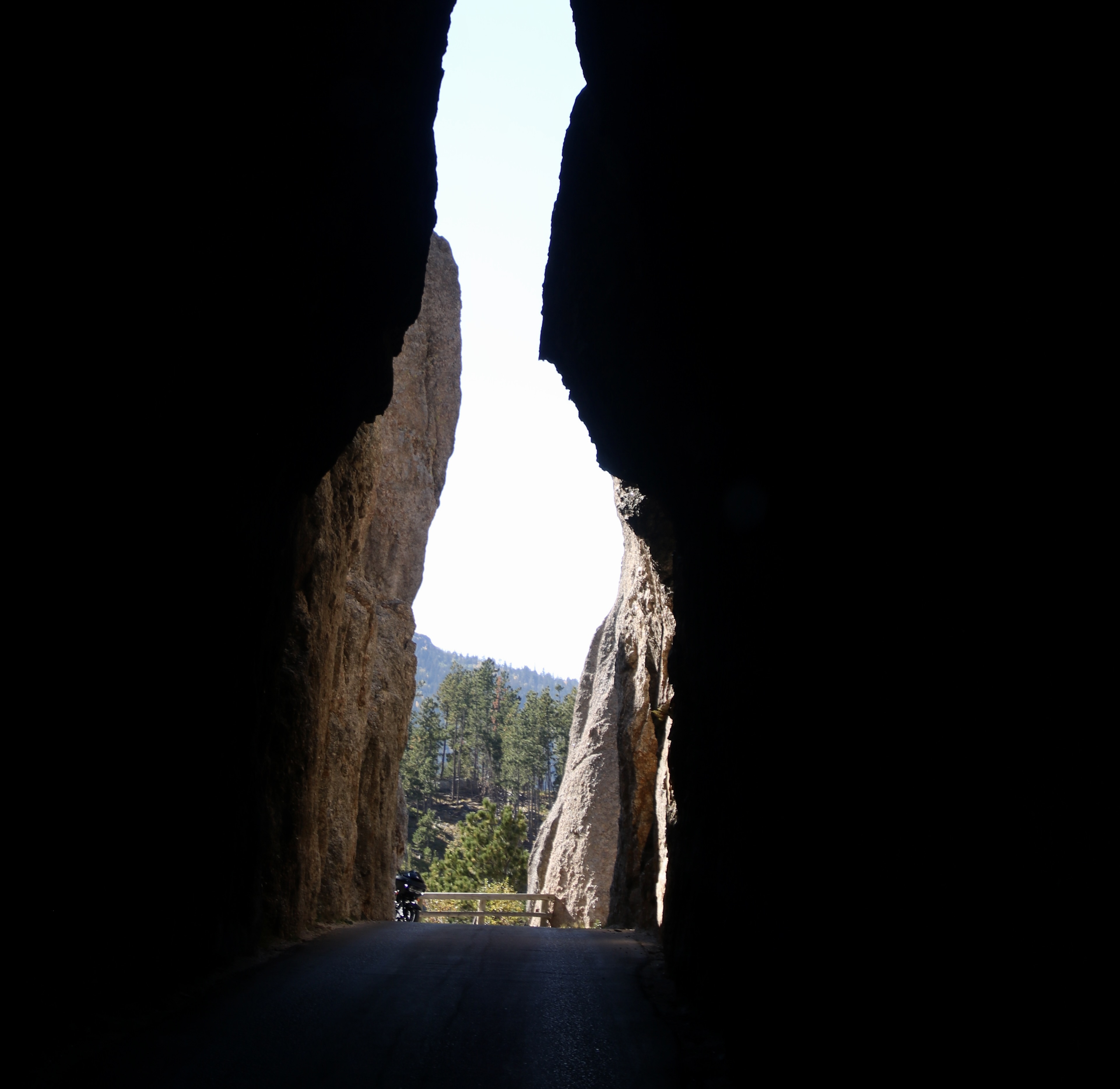
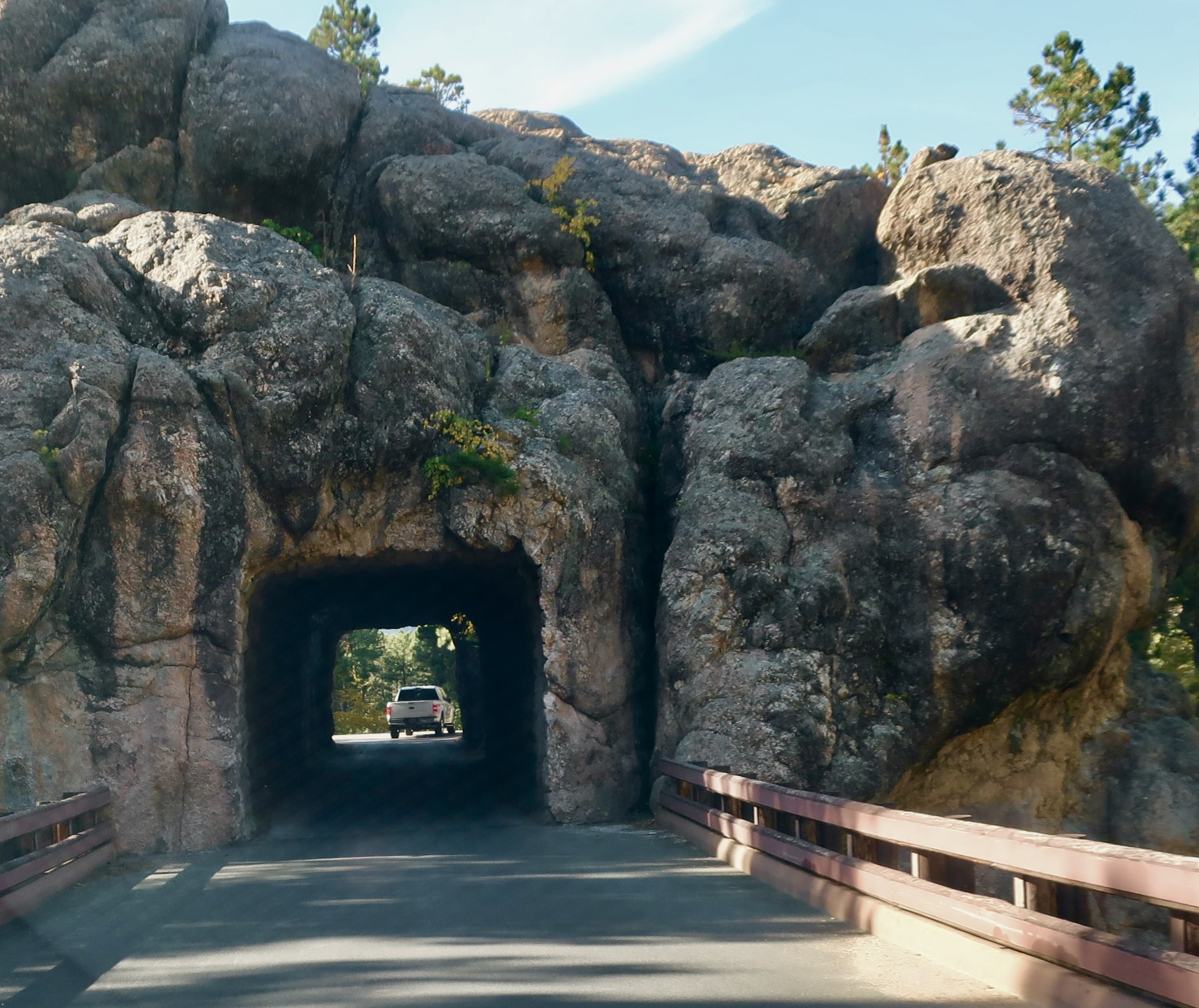
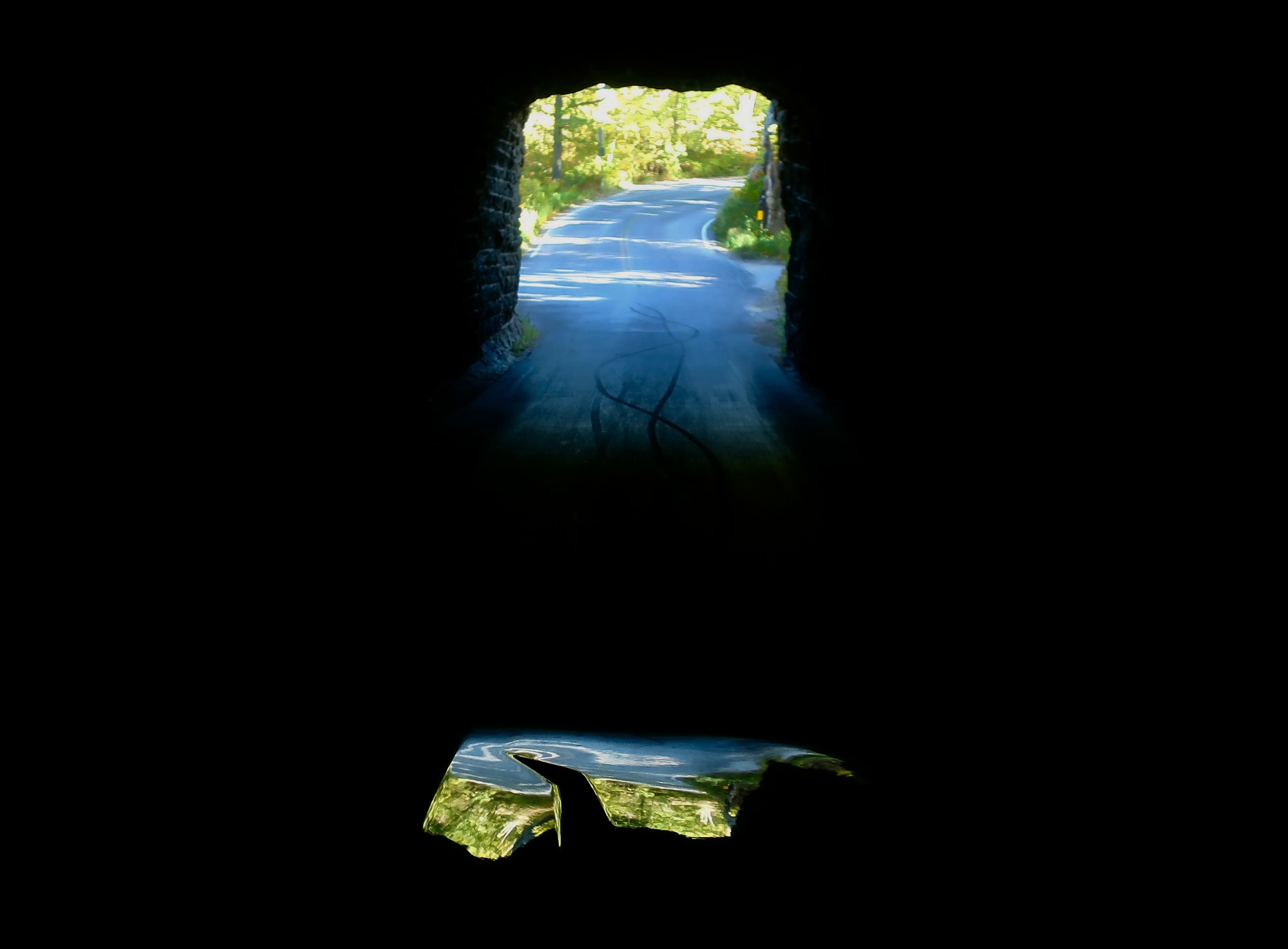
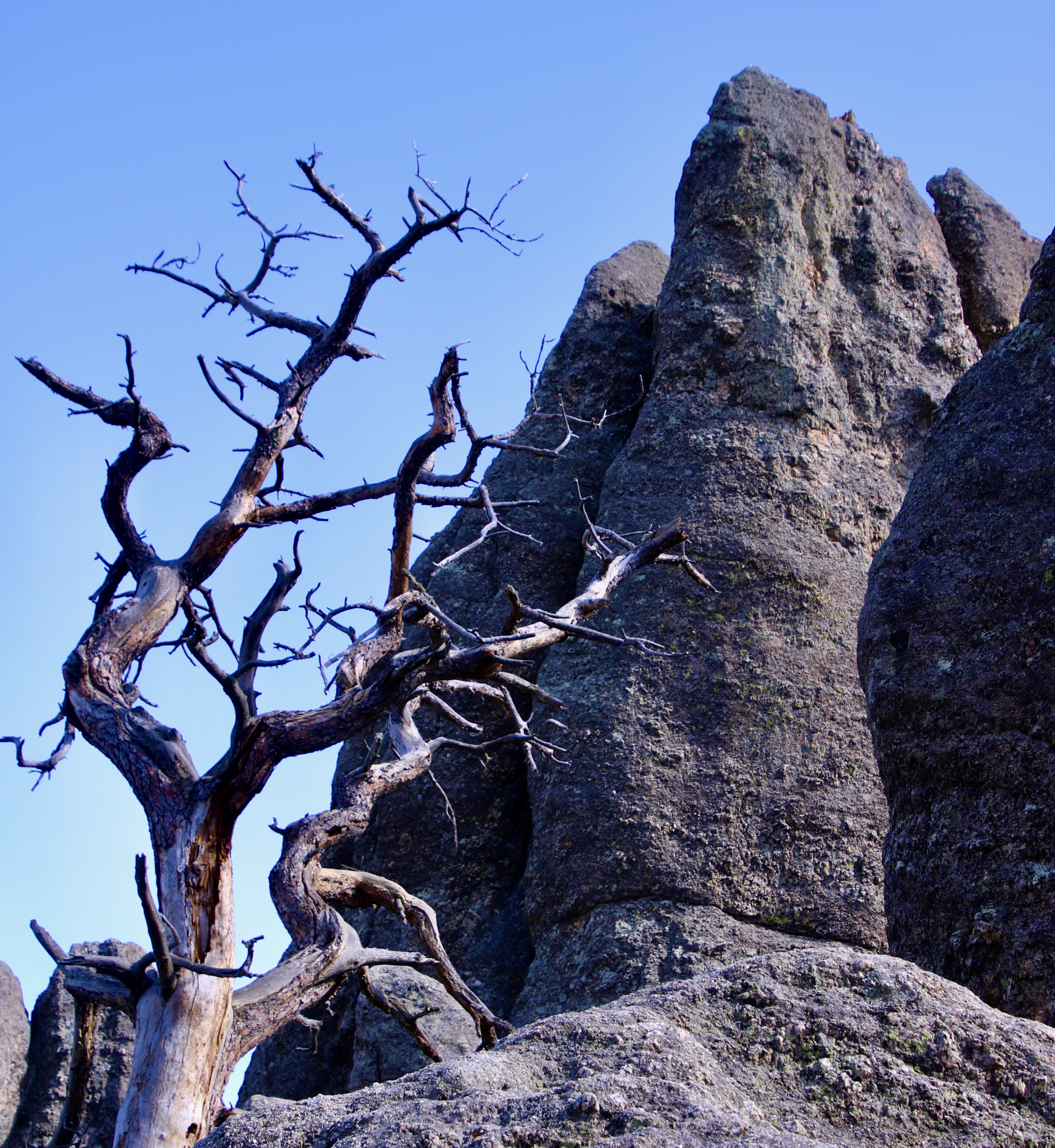
They tower above Custer State Park, silent sentinels made of granite. Once they were chosen as the site for the presidential carvings that dominate the nearby Mt. Rushmore, but the granite lacked the solid mass that was needed. It may have been a gift, given their outstanding beauty. While I like Mt. Rushmore, I prefer these rocks au naturel.Visitors to the Cathedral Spires of Custer State Park wind their way through the granite pillars on a narrow, curvy road that barely accommodates two larger vehicles on sections. The road provides up close and personal views of the granite monuments.Every spire has its own personality.Towering spires like this gave the Needles Highway its name.Rock garden with breaching whale?Rock climbers look for challenging rock faces to scramble up in the Cathedral Spires. Peggy and I just looked for faces.Our active imaginations have no problem finding them… The nose, small mouth below it, eyes above, and baseball cap gave away this fellow. (There’s a chance he had a duck billed platypus on his head instead of a cap.) Part of the fun of the Needles Highway is maneuvering along the narrow, curvy road. The tunnels bordered on scary. This sign announced that one tunnel was 8 feet, zero inches across. Our truck is 8 feet, zero inches across! Fortunately, our mirrors folded in by 7 inches on each side. I had 14 inches to squeeze our large F-150 through. Woohoo! I almost peed my pants. My normally talkative driving advisor was strangely silent. She may have been praying.Beware, all ye who enter here! Once you start, there is no backing out.The ‘light at the end of the tunnel.’ The road snaked off to the left.Even this larger square tunnel seemed skinny.I thought this photo was interesting. I didn’t spot the colorful abstract until I was processing our photos. It’s a reflection off the hood of our truck showing the exit and road of the square tunnel. At least that’s what I assumed it was. Maybe it was a gateway to another world with a monster bird hoping to dine on Curt and Peggy a la carte.I’ll conclude today with two more photos. This one with its gnarly old dead tree…And a closer view of the ‘Cathedral Spires.’
Next Monday, May 15, Peggy and I will be back in Egypt with a trip out to the ancient city of Memphis, near Cairo, where we will visit the colossal statue of Ramses II lying down, and then return to Cairo for a tour of the Museum of Egypt, which was out the back door from our hotel. There will be more of the history of Ancient Egypt, some treasures from the tomb of King Tutankhamen, a cow goddess, and much more. (So much that I may turn it into two posts.)
The Monday after that, May 22, we will take you on a tour of even more colossal monuments than Egypt has, the presidents on Mt. Rushmore in South Dakota. It’s located 10-15 miles north of today’s post on the Needles Highway.
Today, Peggy and I are beginning our series of blogs on our journey through Egypt up the Nile River on a riverboat with the UniWorld Cruise company. We hope you will join us. As always, all photos are taken by either Peggy or me unless otherwise noted.
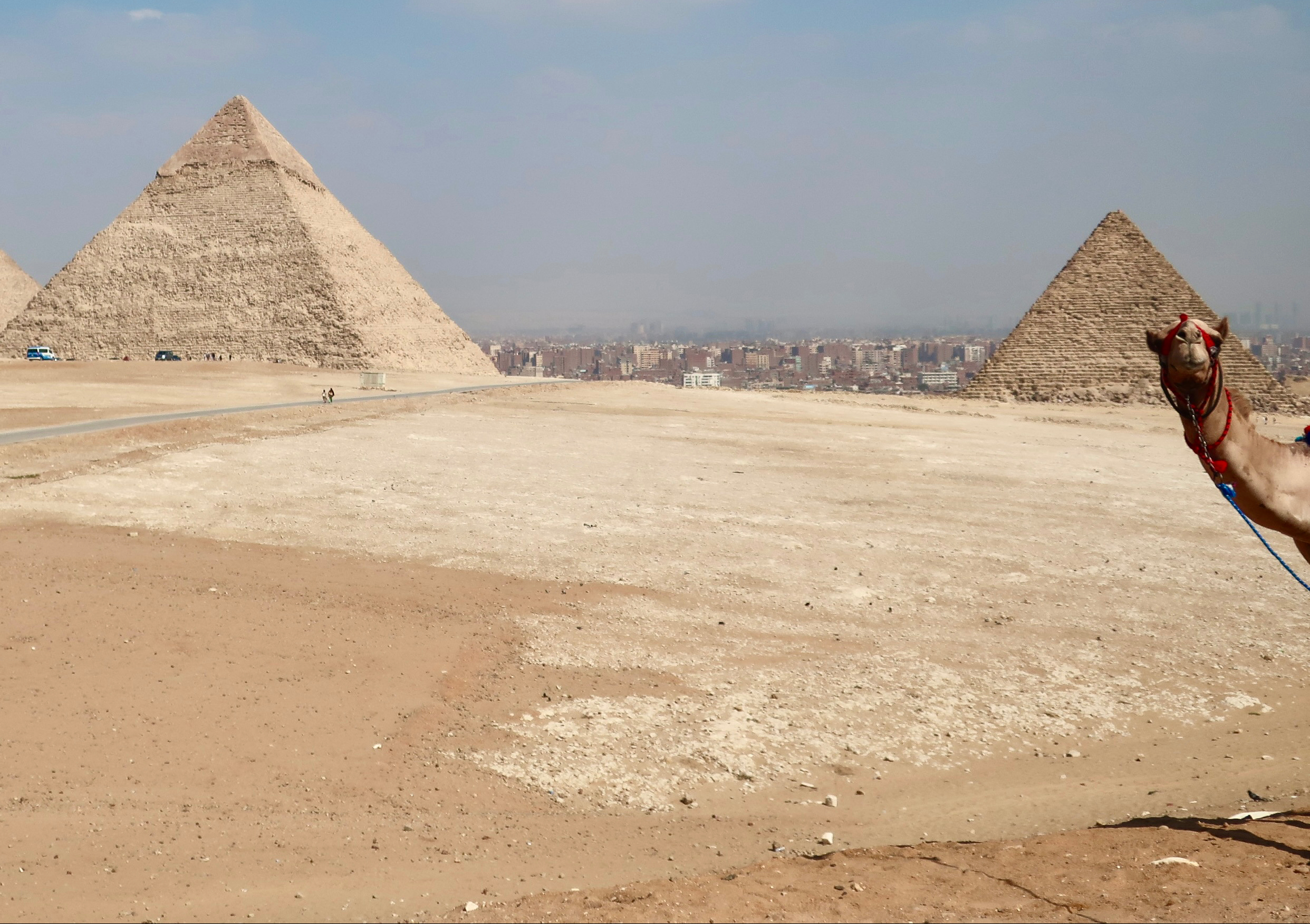
I was setting up a photo of the pyramids of Khafre and Menkaure when a camel head suddenly appeared in my viewfinder. Was I being photo-bombed? I quickly snapped the picture. A free photo of a camel at Giza is not to be passed up. Note the emphasis on free. Camel drivers and camels are everywhere. You are welcome to the take their photos, have your photo taken with them, or even go for a ride. All for a substantial fee, of course. Not paying is frowned upon.
Visiting the pyramids of Egypt at Giza is like climbing into a time machine. The Pyramid of Khafre on the left was built around 2,570 BCE and the Pyramid of Menkaure on the right around 2510 BCE, which makes them both over 4500 years old! The beginning of Egyptian history is traced back even further, to 3100 BCE, over 5000 years ago.
The Sahara Desert and the Nile River kick-started the process. 10,000 years ago the Sahara Desert wasn’t. It was a huge savanna where wandering herders grazed their goats and cattle. It is now thought that some combination of climate change and overgrazing changed the savanna into the vast desert it is today. The herders needed somewhere to go and the Nile River was their best option. The river provided a continuous source of water for thirsty stock. Its annual floods assured that there would be rich soil for farming. Increasing population along the river led to the creation of villages and towns, eventually leading to cities, kingdoms and even empires in a time period that extended over 3,000 years.
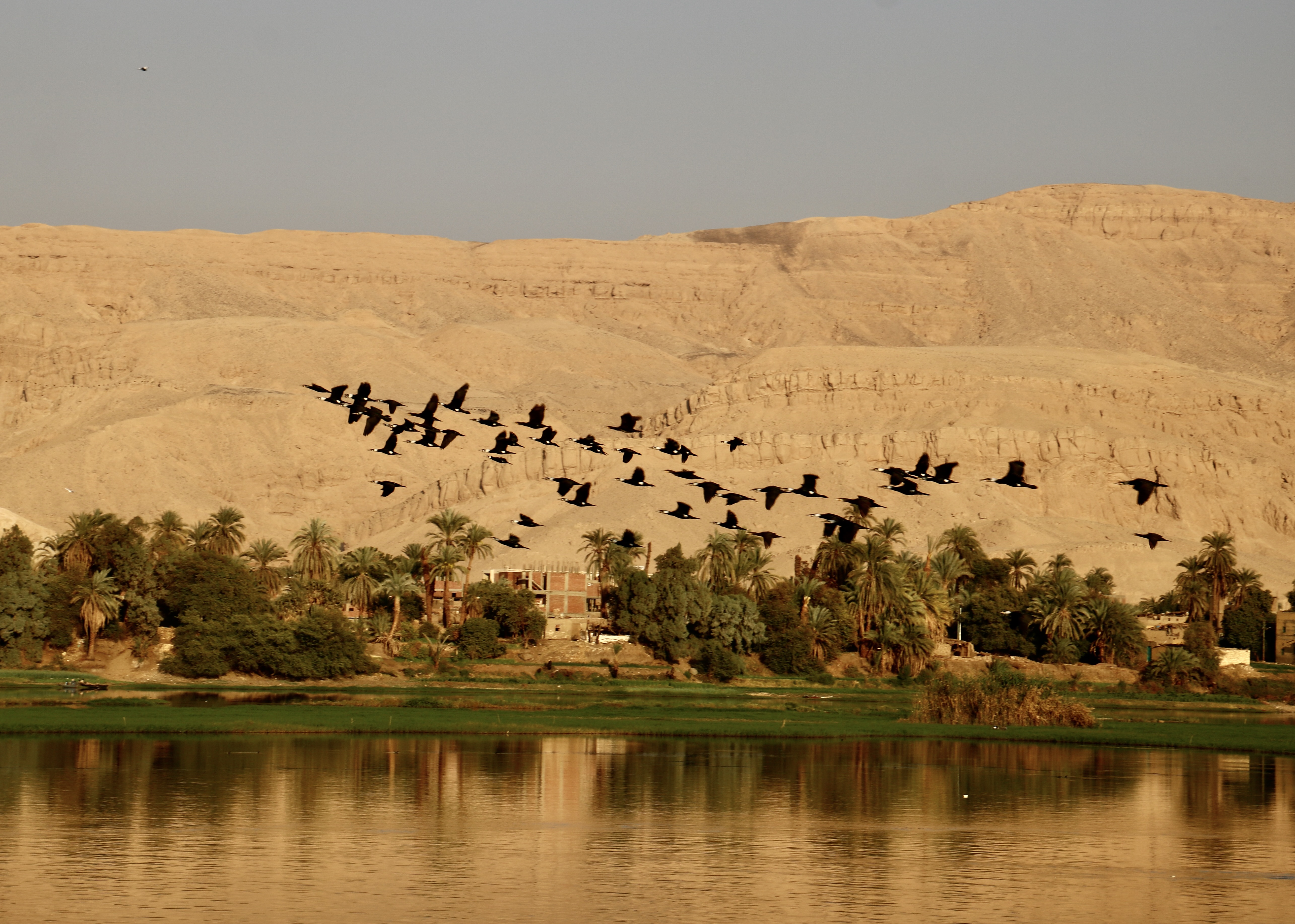
We took this photo from our boat to capture the ducks flying over the Nile River, but it also serves to illustrate the contrast between the green of the river and the reddish-brown Sahara Desert beyond that stretches all the way west to the Atlantic Ocean.
The pyramids speak to more than ancient history and the engineering marvels. They reflect the ancient Egyptians’ deep belief in the afterlife, magic, and the numerous gods who impacted their lives from birth to death— and beyond. This belief in the afterlife (plus the pharaohs’ exploits and claimed relationship to the gods) dominated the temples, tombs and monuments we visited as we explored the area around Cairo, made our way up the Nile, and visited the city of Alexandria.
There are numerous myths about the gods and I’ll be relating several as I go though my posts on Egypt. I find them both fascinating and fun. One thing to note here is that most of them have several versions. Five thousand years is a long time to keep a story straight. For example, today I am going to tell about one of the great founding myths, that of Osiris and Isis. Like most great tales, it is filled with murder, mayhem, adventure, sex, twists, magic and even a bit of humor. That Osiris was killed by his brother, chopped into pieces, put back together, and became God of the Underworld where he sat in judgement of the dead is generally agreed upon. The details on how he was killed, managed to get Isis pregnant with Horus afterwards, and was put back together vary with the teller.
The version that I am writing about was originally told by Plutarch in the second century AD. I first read it in a book by Joseph Campbell, Transformation of Myth through Time, over 30 years ago. I like this version because it has a Cinderella aspect to it, i.e. if the coffin fits, wear it.
This story starts with the goddess of heaven, Nut, and the god of earth, Geb. The god of air, Shu, separates Nut from Geb. Night and day are created by the sun god, Ra, who sails across the sky in his boat during the day, is swallowed by Nut in the evening, journeys through her at night, and is born again in the morning through a somewhat natural birth.
Nut the Goddess of the Sky is about to swallow Ra, the Sun God, in this photo we took in one of the tombs in the Valley of the Kings. Night is about to begin. The symbols on Nut’s body represent stars. Hieroglyphs fill the space on the right, providing advice and spells to aid the pharaoh in getting through the dangerous underworld on his way to eternal life.
Nut and Geb get together and give birth to four children. The older twins, Osiris and Isis, are born first, and, in the tradition of Egyptian gods and pharaohs, marry each other. Osiris, with the help of the clever Isis, replaces Ra as the king of Egypt and gets the throne. Seth and Nephthys are born next and and marry each other. Now the fun begins. Osiris is the typical good son and represents order. Seth is the typical bad son and represents chaos. It’s Osiris that creates the trouble, however. One night he sleeps with Nephthys, claiming he thought it was Isis. (Joe Campbell notes that this isn’t paying attention to detail.) Whatever the reason, Seth doesn’t buy it. Would you? He vows to get even.
He builds a beautiful (and undoubtably incredibly expensive) sarcophagus/coffin made out of gold that is exactly fit to Osiris’s size. He waits until a great party is going on and everyone has consumed large quantities of beer (the go-to drink of the time) before showing up with his golden sarcophagus. “Whoever fits can have it!” he declares. Naturally everyone is excited to try, but nobody fits. Except Osiris. He’s just beginning to enjoy his triumph when 42 of Set’s servants rush out, slam the lid closed, wrap iron bindings around it, and throw it in the Nile.
End of story, right. A solid gold coffin can hardly be expected to float. Except it does. Osiris is a god, after all. In fact, it floats all the way to Syria where it lands and a tree grows around it. And what a sweet smelling tree it is. So sweet that the local king decides he wants to use it for a pillar in a castle he is building. Meanwhile, Isis, in deep mourning, is searching the world over for Osiris. She ends up in Syria where she stops for a drink at the community well and hears the story of the sweet smelling pillar from maids who work at the castle. “Aha, Osiris!” she thinks. She also learns that the king has a new son who needs a nursemaid. She applies for and gets the job.
Isis really likes the baby, nurses it from her finger, and decides to make it immortal by throwing it in the fire each night to burn away its mortality. While this is going on, she assumes the form of a swallow and flies around the pillar, twittering mournfully. One night the queen comes in on this scene and discovers her baby has been thrown in the fire and the nursemaid has become a twittering bird. Needless to say, she gets a little excited and screams. Isis immediately morphs back into herself, saves the baby, explains what she was doing, and asks the king if she can have the pillar. “Of course,” he says. (My thought is that he wanted to get the baby-burning goddess out of his life as quickly as possible.)
Isis gets a barge, loads the sarcophagus and heads home. Feeling lonely on the way, she opens the coffin, finds a quite dead Osiris, and climbs on in what seems to be a bit of Necrofilia. I’m not sure how it works, but she becomes pregnant (god thing again). Another version, which I like better, has her turning back into a swallow, flying over the coffin and being impregnated by magic. Immaculate conception is a common theme of Egyptian mythology. One myth I came across has the sphinx being born as the son of the lion goddess Sekhmeth after she is impregnated by a moonbeam from the Moon God. Explain that one to your husband. The Ankh, Egypt’s well known symbol of life and immortality, is also problematic when it comes to immaculate conceptions as well.
Having an ankh blown or shoved up your nose by a god was a great gift of life and immortality, highly desired by the pharaohs. Down around a woman’s midsection, it might have something other than a nose on its mind and be on its way to making a baby. It was known for making some women ankh-ious. (Sorry, my bad.)
Back home in Egypt, Seth has assumed the throne and will not be glad to have Osiris back, dead or alive. So Isis heads into a papyrus swamp where she hides out and gives birth to Osiris’s second son, Horus. Nephthys has already give birth to his first son, Anubis.
All goes well until Seth follows a boar he is hunting into the papyrus swamp and finds the dead Osiris. Infuriated, he tears Osiris into 15 pieces and scatters them throughout Egypt. Once again, poor Isis sets out to get her dead husband back. Anubis, who is a Jackal in his animal form, and Nephthys help in the search. They can only find 14 pieces. Osiris is missing his genitals. A fish has eaten them.
They stitch Osiris back together with the parts they have and Anubis embalms Osiris, turning him into a mummy. Meanwhile, Horus grows up and goes to war with Seth to avenge his father. In a horrendous battle, Horus loses one of his eyes while Seth loses a testicle. Not quite reciprocal justice (an eye for an eye and a tooth for a tooth), but close. Seth also loses the battle, however. Horus takes the throne and order is restored to Egypt while Seth is banned to the desert. Horus’s eye is magically restored and comes to symbolize making things whole and healing. It even brings life back to Osiris, who becomes god of the underworld.
People admire a sculpture of Annubis at the Egyptian Museum in Cairo. The sculpture was found guarding the tomb of King Tut. Egyptians considered Annubis’s animal form to be that of a jackal because of his close association with the dead. Jackals were known to hang out around cemeteries, probably hoping to dig up a free handout. Heh. Peggy and I brought home this tapestry featuring the Eye of Horus from Egypt. Nekhbet, the goddess of vultures, is shown on the right. Wadjet, the coba goddess is shown on the left. All three were frequently depicted in ancient Egypt. Not a bad trio. Nekhbet and Wadjet protected pharaohs and the Eye of Horus could heal them.
My next post on Egypt, two weeks from now, will feature more history, mythology, and photos of ancient Egyptian sites from around Cairo. Next Monday Peggy and I will take you on a drive through Custer State Park, South Dakota that will focus on some rather unusual and magnificent stone sculptures.










































 Wandering through Time and Place