How a Guinea Fowl Led Soldiers to Pound on My Door at 4 AM, Plus a Red Billed Hornbill… On Safari— Part 8

This Guinea fowl was part of a flock that scurried across the road in front of us as we traveled by safari vehicle through Chobe National Park in Botswana. Three thoughts flashed through my mind. The first was weird. Check out the head. I like weird. The second was plump. Dinner, perhaps? The third was a memory: The time Liberian soldiers tried to arrest me because of a Guinea fowl, or make that two.

First the story about the soldiers. I’ve told it before in my book about my Peace Corps experience, The Bush Devil Ate Sam, and on my blog. Because it involved Guinea fowls, it deserves being told again. It was 1967 and I had just returned from my Peace Corps job of teaching history and geography at the nearby Gboveh High School in Gbarnga, Liberia. Much to my surprise—and dismay— I found soldiers standing in our yard pointing guns every which way. It was an ‘Ut-Oh’ moment. Liberian soldiers were scary.

“What’s up?” I asked, trying not to sound nervous. You learned early on not to mess with Liberian soldiers. There was a reason why the government refused to issue them bullets. 

“Your dog ate one of the Superintendent’s Guinea hens,” their sergeant mumbled ominously. The Superintendent of Bong County was the equivalent to a governor except that he had more power. He lived a quarter mile away and his Guinea fowls strutted around on the government compound squawking loudly.

“Which one?” I asked innocently.

“What does it matter which Guinea hen the dog ate?”  the Sargeant sneered.

“No, no,” I responded, “I meant which dog.” 

He glared at me for a moment and then pointed at Boy. I relaxed. It didn’t seem like the three Liberian dogs who had adopted Jo Ann (my first wife) and me would have done in the Supe’s Guinea fowl. They were three of the best-fed dogs in Gbarnga.

Boy was something else: A large, obnoxious, always hungry dog. He normally lived across town with Holly, another Peace Corps Volunteer. A second dog she owned, however, had puppies and drove Boy off. She was afraid he would eat her kids. Since Boy didn’t like Liberians, he had hightailed it across town to live with us. Normally I wouldn’t have cared. But given his attitude toward black people and the fact he thought of our cat Rasputin as dinner, I wasn’t fond of him.

“Why don’t you arrest him?” I offered hopefully.

“Not him,” the sargeant shouted. “You. You come with us!” Apparently, the interview wasn’t going the way Sarge wanted. A Liberian might have been beaten by then. I decided it was time to end the conversation.

“Look,” I said, “that dog does not belong to me. He belongs across town. I am not going anywhere with you.” With that I walked into our house and closed the door. It was risky but not as risky as going off with the soldiers. They grumbled around outside for a while and finally left. 

Jo and I relaxed “small,” as the Liberians would say, but really didn’t feel safe until that evening. It was a six-beer night. Finally, around ten, we went to bed, believing we had beaten the rap.

WHAM! WHAM! WHAM!

“What in the hell was that?” I yelled as I jumped out of bed. It was pitch black and four o’clock in the morning. 

WHAM! WHAM! WHAM!

“Someone is pounding on our back door,” Jo Ann whispered, sounding as frightened as I felt. 

I grabbed our baseball bat, headed for the door, and yanked it open. Soldiers were everywhere. The same friendly sergeant from the afternoon before was standing there with the butt of his rifle poised to strike our door again.

“Your dog ate another one of the Superintendent’s guinea hens,” he proclaimed to the world. I could tell he was ecstatic about the situation. He had probably tossed the bird over the fence to Boy.

“This time you are going with us!” he growled.

In addition to being frightened, I was growing tired of the routine. “I am sorry you are having such a hard time guarding Guinea hens,” I said, trying to sound reasonable, “but I explained to you yesterday that the dog does not belong to me and I am not going anywhere with you. Ask Mr. Bonal (the high school principal who lived next door) and he will tell you the dog is not ours.” 

Sometimes the ballsy approach is your best option.

I closed the door and held my breath. Sarge was not happy. He and his soldiers buzzed around outside like angry hornets. Still, yanking a Peace Corps Volunteer out of his house and dragging him off in the middle of the night over a guinea fowl could have serious consequences, much more serious than merely reporting back that I was uncooperative. I could see the headlines:

Soldiers Beats Peace Corps Volunteer Because Dog Eats Guinea Fowl. Liberian Ambassador Called to White House to Explain

I hoped the sergeant shared my perspective. At a minimum, I figured he would check with Bonal. John might not appreciate being awakened in the middle of the night, but it would serve him right for laughing when I had told him the guinea fowl story the night before. Anyway, I suspected he was up and watching the action.

We had a very nervous thirty minutes before the soldiers finally marched off. In the US, this is the point where we would have been calling an attorney, Jo’s mother, and the local TV station. Here, my only backups were the Peace Corps Representative and Doctor: one to represent me, the other to patch me back together.

Happily, our part of the ordeal was over. It turned out that Peter, a young Liberian who worked for Holly, actually owned Boy. The soldiers finally had someone they could bully. 

Peter was pulled into court and fined for Boy’s heinous crimes. Boy, in turn, was sold to some villagers to cover the cost of the fine. As for Boy’s fate, he was guest of honor at a village feast. Being a Bad Dog in Liberia had rather serious consequences.

Complete with wattles, a top knot, bright colors, and fluffy neck feathers, a guinea fowl checks us out.
Guinea fowl, like the ones the Superintendent of Bong County owned, have been semi-domesticated for several hundred years. They are said to make great ‘watch dogs,’ keep your property bug free (including ticks) and be quite tasty. (The French have a number of recipes for cooking them.) They are cousins of chickens, turkeys, pheasants, quail, and other edible members of the Gallinaceous species. We didn’t see any on menus on our trip.

And now for the southern red billed hornbill, another unique looking bird we first saw in Chobe National Park.

This one was roaming around on the ground searching for insects, its primary food. It’s also known to eat small lizards, eggs and baby birds, should the opportunity present itself.
We caught this hornbill up in a tree talking to us: “kokok-kokok. I liked the way its head was backlit with the sun shining through its bill.

As parents, the hornbills have a unique approach. The male finds a tree cavity where the female lays her eggs and then seals herself in, leaving a small hole for the male to provide her with food. While she is in her self-imposed exile, she molts, regrows her feathers and takes care of the young hatchlings. When the babies are around three weeks old, she breaks out to help in catering food for the hungry brood. The youngsters reseal the openings with their droppings and food remains. Hmm. Eventually, the chicks knock out the barrier when they are ready to fly.

Peggy and I will be on the road again for a month starting on Tuesday, this time traveling to Florida to spend time with our son and his family and once again visit Everglades National Park. I plan on maintaining my regular blog schedule. But, we’ll see. Grin. Friday’s post will be on one of Africa’s more amusing animals, the warthog.

Now Presenting: The Tallest Mammals in the World: Giraffes… On Safari— Part 8

Did you know that giraffes have bluish purple tongues? This female in Hwange National Park, Zimbabwe willingly showed us hers. If it appears to be a mouthful, it is…
A giraffe’s tongue is 17-19 inches long (45 and 50 cm). “The better to reach delectable acacia leaves,” it would tell you if it could talk. Giraffes and elephants favor acacia trees for their nutritious leaves.
Its tongue is not a giraffe’s most notable adaptation for harvesting leaves, however. That would be its height. Females can be up to 14 feet tall and weigh 1500 pounds. Males can reach a height of 18 feet and weigh up to 3000 pounds. Say you lived in a two story apartment. A giraffe walking by could look in the window at you! This is one of my favorite photos of giraffes. Graceful.
Another shot of the same giraffe— standing tall. Its neck and legs are close to six feet long each. Its feet are the size of a dinner plate.
The giraffe uses its prehensile lips (moveable) in coordination with its tongue in chowing down on acacia leaves while avoiding the trees sharp thorns. The eyes, ‘btw,’ are the size of golf balls. I’d say this fellow has seen more than a few years. I can identify.
You can see where the thorns might be a bit ouchy. Check out their length. The acacia tree has other defenses as well. One is that when the giraffes begin nibbling, the trees increase their tannin production, thus making the leaves less palatable. In one of the ‘miracles’ of nature, other acacias in the area also increase their tannin— even though the giraffes have yet to touch them. The trees have also formed an alliance with biting ants by providing shelter and a sugary nectar. When the giraffe, elephant or other animals go to eat the leaves, the ants swarm and bite them.
We were amused when the giraffe stopped browsing on the easily reachable leaves and stretched to reach some higher in the tree. Was this a case of the ‘grass is always greener on the other side of the fence?’ It may be true in this case, since the higher you go, the younger, more tender, and more nutritious the leaves are. The height of the giraffe is an obvious advantage when it comes to reaching them. Elephants with their massive appetites are forced to satisfy their hunger on lower leaves. (They aren’t above shoving the tree over to get at the higher leaves, however.)
A couple of headshots are in order here. Note the eyes and lashes. Pretty, huh. The upper lip? Not so much. I thought it looked like a whiskery peach. Pucker up.
Check out the ‘horns’ here. Both males and females are born with them. They aren’t attached at birth but lie flat against the head. Might lead to a tough birth, otherwise. They attach later. If one wants to be technical, they are known as ossicones and are composed of ossified cartilage covered with skin and hair.
Giraffes a deux. Giraffes are social animals and live in herds although their bonding is mainly between moms and kids. The gestation period is 14 months. The mom gives birth standing up, dropping the baby over five feet to the ground. Could this be the reason the baby is born feet first? Grin. One interesting fact I came across is that when the babies get older, moms leave them together in a ‘nursery’ and go off to eat, leaving one mom in charge of the kids.
This trio of giraffes was one of Peggy’s favorite photos. A herd of giraffes is appropriately named a tower!
While a giraffe’s neck is long, it isn’t long enough to compensate for its long legs when drinking water. A combination of bending its legs while maintaining balance is the solution. One giraffe has been left on guard duty while two drink here. The vulnerability is obvious, especially when dealing with lions. Crocodiles can also be a challenge.
Another problem the giraffe faces while drinking is blood rushing to its head. The expandable jugular veins have one-way valves that allow the veins to expand and prevent the blood from flowing back to the brain. Because giraffes get much of the liquid they need from the 75 pounds of leaves they eat daily, they only drink every few days.
A large male heads off into the bush.
Giraffes can run over 30 miles per hour enabling them to get away from predators— or Volkswagen beetles. (I once chased a herd across the Serengeti Plains for a short distance, during the 60’s in a ‘bug,’ clocking them at over 20 mph). It’s said that their long legs can also deliver one heck of a karate kick, which I possibly deserved for chasing them, but didn’t experience.
I’ll wrap up here with the giraffe heading off across the savanna. Monday is for the birds, or, more specifically, guinea fowls and southern red hornbills. I’ll also tell the story of how a guinea fowl led to a soldier pounding on my door at 4 a.m. with the butt of his rifle trying to arrest me when I was a Peace Corps Volunteer in West Africa.
Did I tell you the the giraffe is Peggy’s favorite African animal?

An Intro to Africa’s Amazing Bird Life: The African Darter and the Yellow Billed Stork… On Safari: 7

We were boating up the Chobe River in Botswana when the captain pulled over to the shore so we could watch this yellow billed stork on a fishing expedition.

Peggy and I joined her brother John and his wife Frances on an African safari to see elephants and lions, and giraffes, and hippos, and crocodiles, and zebras, and baboons, and… the list goes on. And we did, in glorious profusion. What we weren’t expecting was the bird life. A serious birder would be in heaven. In fact, there are specific African bird safaris one can sign up for. While our passion doesn’t run that deep, we do enjoy bird watching and always have. Time and again on our trip, we found ourselves stopping to admire their beauty, character and antics in Botswana, Zimbabwe, and South Africa. We have the photos to prove it.

Altogether, we photographed over 20 species. You will be meeting up with many of them in my bird posts, including ostriches and penguins, but today, we are going on a fishing expedition with a yellow billed stork and an African Darter we met along the Chobe River in Chobe National Park, Botswana.

The yellow billed stork stands around three feet tall. It prefers fishing in shallow water where it shoves its large bill into the water and then stirs the water plants and mud with one of its feet to herd dinner toward its waiting bill. Small fish, frogs, and water insects are all welcome. It’s an open bill policy. It fishes by feel. When a suitable meal hits its bill, the stork captures it with a lightning fast reflex snap. But I’ll let the stork tell you the story.

Hi, my name is Big Bill. Today I am taking you on a fishing expedition where I am going to catch a monster. This is one of my favorite fishing holes. All sorts of delectable treats like to hide out in the grass. I’m drooling in anticipation.
My fishing technique involves me dunking my bill into a likely spot. I’m using my left leg for balance while stirring the pot, so to speak, with my right foot to herd tasty morsels toward it. One never knows what might be hiding in the grass. I call it pot luck.
Here’s a head on view of me, up to my eyeballs in work. The waves you see are from my stirring efforts.
And here’s a rear view shot that I did not approve. Curt and Peggy will be held accountable.
What are you looking at…
Wait! Something just hit my bill! A monster!
I caught it! Woohoo! Woohoo!

And now on to the African Darter or anhinga, also known as a snake bird. These birds are closely related to cormorants. The 36 species of cormorants and four of anhingas make up the family Phalacrocoracidae. The African Darter swims through the water in search of its prey, often with only its head showing. When it finds a fish, it literally spears it. ‘Darter’ refers to how fast. The alternative name, snake bird, derives from its sinuous neck. Now, in its own words:

Hello, I’m Handsome, or, if you prefer, Pretty. Either way, I am much better looking than Big Bill. You might think I am posing for you. Well maybe, I am preening. But mainly I am drying off my wings. Unlike most water birds, we, and our cousin cormorants, don’t have oil in our feathers to repel the water.
This is me with a freshly speared fish. Catching it was easy…
It’s swallowing it that creates the challenge.
It has to go down head first. Check out the wicked fins on this catfish. If I swallow it tail first, they get caught in my throat. Then it’s not just bye-bye fish, it’s bye-bye Handsome as well. That’s not a good ending.
I have to position the fish just right. So I take it back to the water and spear it again. Some fun. I wonder how many holes I can poke in it?
This seems about right.
Upsy-Daisy. Whoops, I mean upsy-fishy. Now don’t blink…
Did you catch that? Did you catch my great flip? I’m very good at flipping.
Hmmm. I don’t think I’ll be swallowing this.
Maybe if I use the sand this time. More holes. Think of it as tenderizing. Note my big feet! I’m surprised they didn’t name me Big-foot as opposed to Snake-bird. Oh, you say Bigfoot is already taken.
Wow, I think I’ve got it! Thereby hangs a tail. Heh. heh.
Down the hatch!
Gulp.
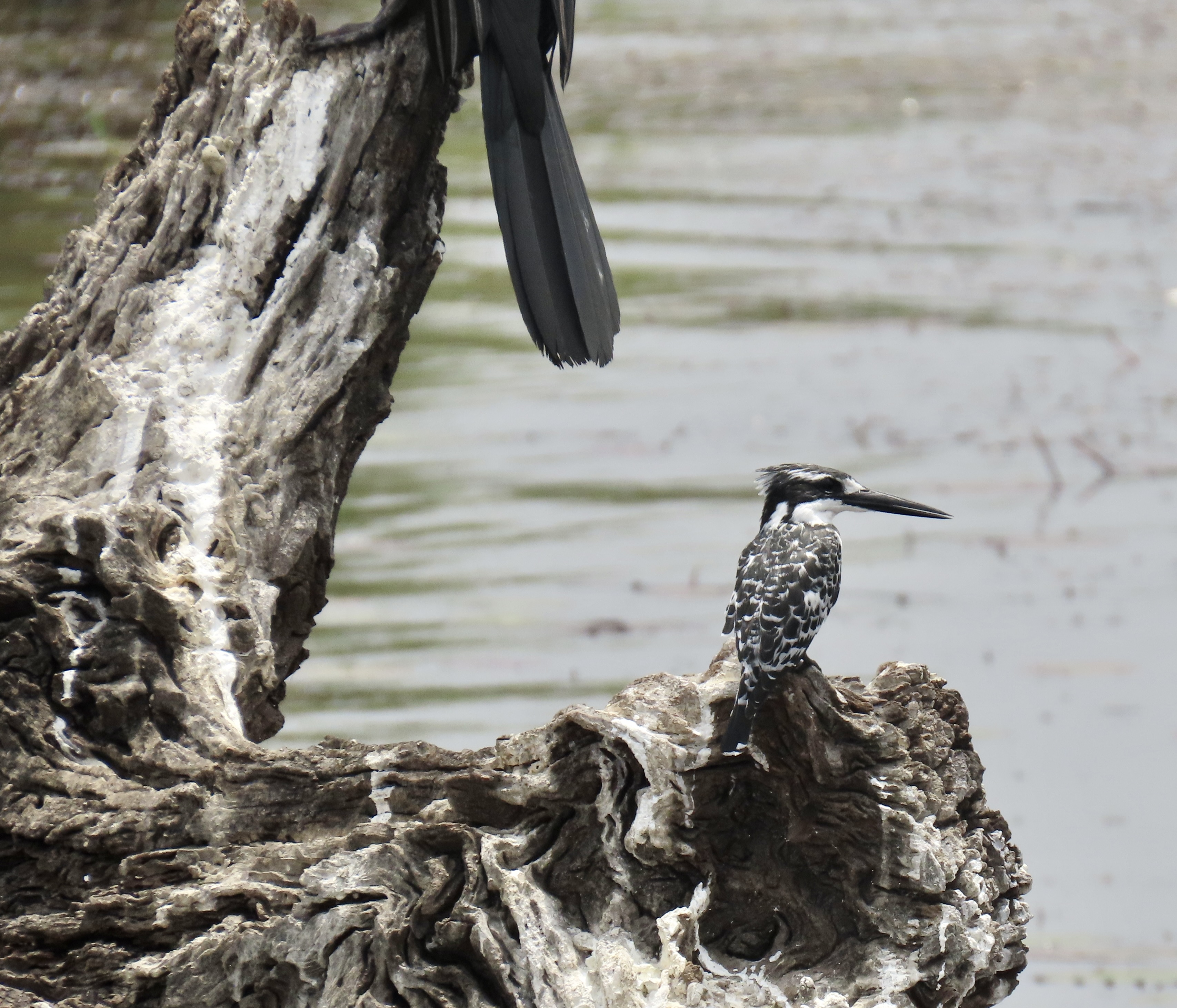
Ah, happy tummy, happy bird. Now I can go back to preening and being beautiful. (Don’t pay any attention to that skeptical pied kingfisher on the lower right. He’s just jealous.)

That’s it for today. Hope you enjoyed our talking birds. On Friday, we will be reaching for the sky and featuring giraffes.

Hip! Hip! Hippo! Let’s Hear It for these Humorous but Dangerous Behemoths… On Safari Part 6

I think this may be the definition of bliss, an emotion one wouldn’t normally associate with a hippo. We took this photo on Lake Kariba in Zimbabwe.

I didn’t expect hippos to be photogenic, but they kept Peggy and me busy with our cameras. Today’s post will mainly be made up of pictures. Folks who read my long elephant blogs deserve it. LOL. But still, a few facts are in order. I’ll work them into the photos.

My new camera with its super long lens provided plenty of opportunity to get up close and personal with hippos. You could count the whiskers on this guy’s snout. Hippos spend around 16 hours a day in water. Their nose, eyes and ears are all on top of their heads. This allows them to be able to see, hear and breath while being close to submerged— keeping cool and protecting their skin.
This is a common photo of hippos in water including males, females, and babies. They like to hang out together in groups of 10-30 known by such names as schools, pods, sieges or bloats. My favorites are the last two. If you were surround by these guys you would definitely feel like you were under siege. As our boat on Lake Kariba in Zambia approached this group of hippos, they were sinking under the water, a normal tactic.
These hippos at Lake Kariba provided a photo op. “Okay, everyone, line up. And stop mooning the camera!”
The sun was setting on this big fellow when we took our first boat trip on the Chobe River in Botswana. I’d say ‘bloat’ works here. An average female tips the scales at 3000 pounds while a big male can weigh up to 9000.
Groups are normally dominated by a large male who is in charge of protection— and mating, which is mainly carried out in the water due to the weight factor. The gestation period is eight months. Moms give birth to one baby weighing 30-50 pounds. The babies can actually nurse under water.
Hippopotamus is derived from ‘water horse’ in ancient Greek. Can you imagine trying to ride one? You would probably drown. They can’t swim. Their size and density makes them sink. But they are ideally suited for travel under water and can stay down for five minutes at a time. They actually walk or run along the bottom. Flaps over their noses and ears close automatically when they go under. A special lid covers their eyes. This fellow, BTW, is probably asleep. Hippos can sleep under the water for up to ten hours, automatically rising every five minutes or and so and sucking in air while continuing to snooze. Great whiskers.
This was my favorite shot of hippos in the water. Is it a two headed four eared hippo? Grin. Huge odds are not… But I sure couldn’t imagine how they managed to arrange themselves this way. Going for a ride? Breeding? Maybe.
The literature emphasizes that hippos stay in the water during the day and come out to graze at night. Fortunately, everywhere we went that included hippos, a few were out happily stuffing themselves on grass. They average around 80 pounds a night/day, traveling some 6 miles (10K) to get their fill. When out in the day, their skin exudes a protective layer that serves as sunblock.
A pair of hippos grazing along with oxpeckers. (The birds peck off insects but they also peck holes in the hippos and drink blood. Hmmm, friend or foe?) I’m assuming this is a pair. Males tend to mate for life but are polygamous.
Peggy and I took lots of close-ups of the hippos grazing along the river in Chobe National Park, Botswana. Check out the big tusks. They are used for fighting, not grazing.
Any large African animal, be it hippo, elephant, Cape buffalo or giraffe, has a coterie of birds that follow along and catch insects the animals stir up.
The little guys seem fearless. Is it grabbing an insect from under the hippo’s foot?
We liked this head shot.
Males are very territorial. It’s one of the things that make them so dangerous. And they have a unique way of marking their territory. They use their tails to fling poop. That’s what is happening here. The tail is moving so fast, it’s a blur. Remember the old statement, “When shit hits the fan.” You don’t want to be around. Hippos can actually fling their stuff for 10 meters, almost 33 feet. Be you man or beast, you might become toast (or possibly a pancake) if the hippo decides you are invading its territory. And they can run up to 30 miles per hour for a short distance, i.e. probably far enough.
Imagine being on top of this small hill at Lake Kariba photographing a few tons of hippos as they come charging over. Fortunately, my telephoto lens allowed me to be a long way off.
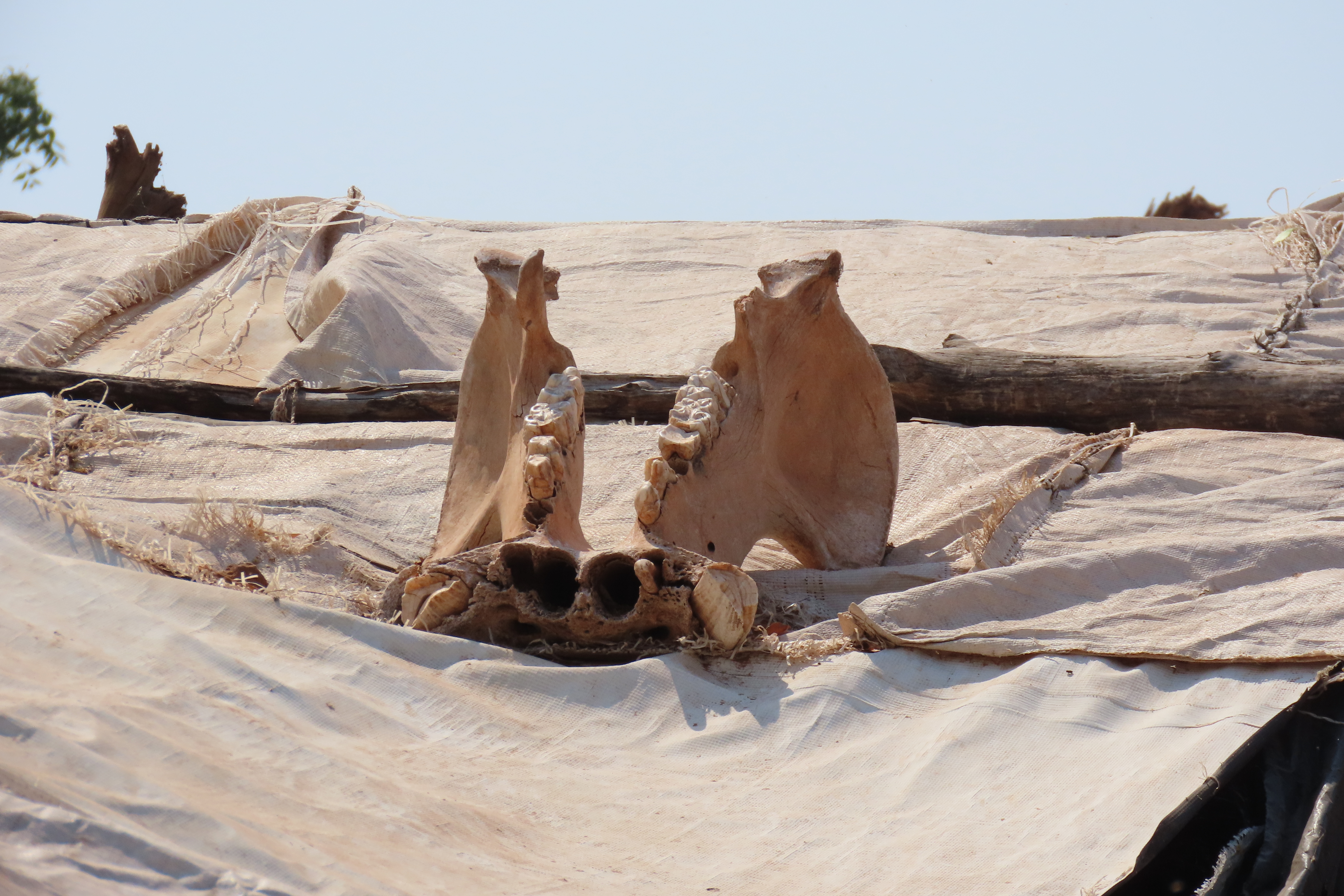
This hippo skull was beside a small road we were following into Matusadona National Park at Lake Kariba. Note the tusks.
The park ranger who was taking us on the tour into the park, got out of our safari vehicle to demonstrate how far a hippo can open its jaw.
Peggy captured the phenomena on the Chobe River. From a humorous perspective, it appears junior is getting a lecture on his behavior. “Next time you go near that crocodile, I’ll let him eat you!” And look how long the hippo is! A large male can grow up to 16 feet.
This is the ultimate picture of a hippo opening its jaws and declaring a territorial challenge, or yawning. Everyone who goes on safari wants to capture one. Believe me, we tried. Our last opportunity was when we were on the Zambezi River outside of Victoria Falls. Unfortunately, we were on the wrong side of the boat. One of our tour group was glad to share.

I’m going to try something now in concluding this post that I rarely do: Share a video. We normally take several for ourselves but not for the blog. Too many oops. Handheld videography has its challenges! But this two minute video shows an excellent example of an elephant-hippo confrontation. It’s worth checking out, even with its occasional shakes. It’s almost funny as the hippo maneuvers his way through the elephants trying to show itself as harmless and submissive as possible— and only raises its head when the elephants are left far behind. You can almost hear its sigh of relief. Enjoy. Click twice on the photo to start the video. On our next post, we will feature giraffes, Peggy’s favorite animal.

Big Brains, Long Eyelashes, Migrating Teeth and a Ton of Poop: Elephant Wrap Up… On Safari Part 5

Peggy and her brother John, gently touch an elephant on its head at the Wild Horizons Elephant Sanctuary and Orphanage near Victoria Falls, Zimbabwe. Note the size! And it’s only a youngster. Adult heads can weigh over 100 pounds, and that’s without their trunks, ears and tusks.
While we are looking at the head, here are a few things about the eyes. For one, an elephant has incredibly long eye lashes. They can grow to over five inches long, the longest in the animal kingdom. The eyes also have an extra eyelid that provides protection when bathing, swimming, and I assume, rolling in the mud. You can see it caked on the skin around the elephant’s eye. Vision-wise, an elephant has poor eyesight, depending heavily on its sense of smell and hearing.
Now let’s talk about teeth. This elephant has his incisor teeth, which have grown into tusks, on prime display here. Elephants use their tusks in a variety of ways including defense and offense, digging, gathering food, stripping the bark off trees and lifting. The record length of an elephant’s tusk in over 10 feet. The record for weight is 226 pounds. Given today’s value of $3300 for a pound of ivory, the record tusk would be valued at close to $745,000. That provides some perspective on why it is so hard to wipe out poaching. Tusks have been growing dramtically smaller because the elephants with larger tusks are being eliminated from the gene pool by poaching. But even a 10 pound tusk would bring in $33,000.
This calf’s tusks will grow as it ages, but the odds are they won’t be nearly as long as its ancestors. While you can’t see other teeth on this youngster, it has very prominent tongue. Elephants use their tongues to transfer food back to their large molars where it is ground up for consumption. This calf is saying, “Feed me Peggy!” She did.
The guide on our safari hike, Terry Anders, owner of the Iganyana Tent Camp on the edge of the Hwange National Park, points out the large molar teeth in an elephants jaw. Unlike our teeth that have specific sockets, an elephant’s new molars develop in the back of the jaw and push the older, worn ones out of the mouth, like a conveyer belt. An elephant changes out its teeth up to six times in its life. Who needs dentists?
The site of the elephant’s jaw also included numerous other bones of the dead elephant. This is an inside view of the back of the elephants skull. You can see the upper molars on the bottom. The dark hole in the middle is where the brain goes. It is encased in honey-comb like bones that provide light but strong protection. It’s a magnificent brain, 3-4 times the size of a human’s. It’s well used. Just moving and maintaining the massive body of the elephant takes significant brain power. And, as we have already seen, the elephant also uses it for a rich emotional life of empathy, care, and friendship for one another. What the elephant’s brain is really noted for is its memory, however. You’ve undoubtably heard the phrase ‘an elephant never forgets.’ It can meet up with an elephant it hasn’t seen in decades and have a joyful reunion, find a water hole it used once and hasn’t been at for years, or, what I find particularly touching, go by the bones of a family member who had died long before, pause, and appear to mourn.

It wasn’t just a pile of old bones we were looking at.
Here, Terry is reconstructing the elephant’s leg bones and hip. The leg bones come straight down and are designed to support the elephant’s massive body weight. I already noted in an earlier post that an elephant can use them to run very fast. What I didn’t note was that elephants can’t jump— they are the only mammal that can’t. Scroll back up to elephant that I used an an example when talking about tusks and note how straight his legs are. They were not made for jumping!
Elephants are constantly eating grass and leaves, as much as 16 hours a day. Their challenge is how to provide nourishment for their massive bodies. It doesn’t help that their digestive system is less than 50% efficient, or that leaves and grass aren’t high in nutritional value. That means an elephant has to eat a lot— normally between 250-300 pounds of grass and leaves a day. And that means, huge scat.

Terry picked up a large dropping and broke it in half to continue our education. The first thing that came to our minds was size. This puppy was big! The second was how much of the grass hadn’t been digested.

As Terry continued to break open the dropping, he found the third thing he wanted to show us: Termites chowing down on the undigested grass. Numerous insects view the poop as food and an equal number of birds and mammals view the insects as food. To make his point, Terry picked up a termite, popped it in his mouth, and asked if anyone else would like a sample. John volunteered. Admittedly he’s strange. I just didn’t realize how strange. (Sorry John. Grin.) Like, okay, I had occasion to eat termites myself in Liberia as a Peace Corp Volunteer back in the 60s. But I prefer mine dead, cooked, and not having a poop diet.
Termite queens fly in vast numbers after the first rains of the year. Here, a Liberian woman who lived next to me, dries out the termites she gathered, or as Liberians call them, bug-a-bug, for use in chop, a primary Liberian dish. At a school feast, my students took extra pleasure in making sure my chop was filled with far more than my share of bug-a-bugs and watched me eat it, every bite.
As a result of all the food they eat, elephants poop between 12 and 15 times a day, which adds up to between 200 and 250 pounds— close to a ton a week. (How would you like to have ‘counting the times elephants poop daily and then weighing it’ on your resume?) While I’m on the subject of scatology, I might as well take it a step further. Elephants also fart a lot. I read that a ‘properly equipped car could travel 20 miles on the amount of methane produced by one elephant in a single day.’ I speculated that the poor baby elephant walking along behind its mom holding her tail might have a different perspective: “Mother!”

I chose a section of ground where the elephants had been particularly active for the photo above, but their droppings were everywhere, particularly along the Chobe River where they were hanging out for the dry season. Given its quantity, elephant manure is an important soil fertilizer throughout subtropical Africa.

Sometimes we found the droppings torn apart and scattered. We wondered who the prime suspects were…
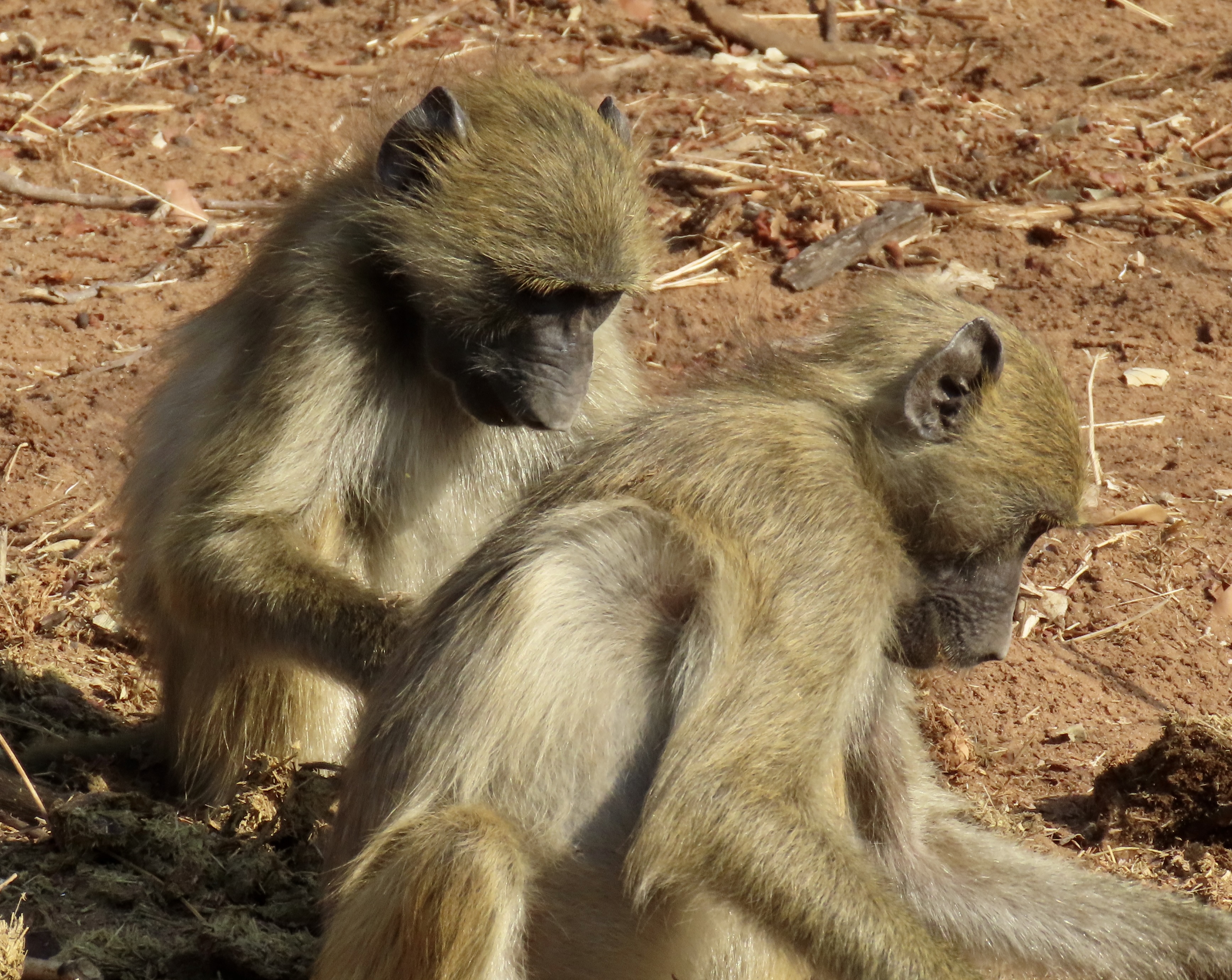
Turns out, they were baboons. Our guide told us they were looking for acacia seeds. I wonder if they’d pass on termites. I’m betting not. You can see the remains of the Baboon’s work scattered on the ground.
When I was looking over our photos of the baboon feast, I was struck by another idea: Have you ever wondered where the creators of elves and Spock got their ear ideas?
And, in conclusion: Bombs away!

That’s a wrap on elephants, folks. My congratulations and thanks to all of you who have hung in here with my multi-blog presentation on elephants. I found them so fascinating, I couldn’t help myself. Next up is hippopotamuses (or is that hippopotami). Tune in Friday for Hip, hip, hippo!

In the Elephant Matriarchal Society, It’s All About Family and Mom Is Boss… On Safari Part 4

A family of elephants, consisting of the matriarch, her sisters, kids and grandkids, head for a water hole in Hwange National Park, Zimbabwe.

Among elephants, family is everything— at least among the females. A herd normally consists of the matriarch, chosen for her leadership and knowledge, plus her sisters, kids, and grandkids. Females born into the herd almost always stay with it. The family can exist together for decades and beyond. The matriarch is expected to find water and food when they are scarce and provide protection when necessary. Her nurturing abilities are also quite important. The size of the group normally ranges between 6 and 20 elephants depending on available resources. New families are created when resources are limited, but they remain bonded to their original families. A celebration with much trumpeting of trunks, touching and general joy is shown whenever the groups meet up. The longer they have been apart, the bigger the party

Males leave when they are 12-15 years old to go off and live on their own, or to join a loose knit group of other males where an older bull provides leadership, protection, discipline and education. This dispersal guards against inner-breeding within the family and assures genetic diversity among herds.

The young male is normally around 30 before he is large enough and strong enough to get his first chance at breeding. His adventure is encouraged by what is known as musth, a period when his testosterone goes wild and he feels the drive to go in search of female companionship. Teenage boys will recognize this. (The hormonal imbalance of musth has an added characteristic of leading the males to be moody and dangerous. Guides recognize the condition and steer clear.) Off on his search for true love and romance, or at least sex, the young bull rumbles his rumble and— if he gets lucky— finds females with similar intentions who rumble back, often from several miles away. He makes a beeline for them, proving once again an elephant’s uncanny ability to communicate and find its way over substantial distances. Once he has done his job, he heads back to his group or solitary wandering, leaving the female to raise the kid. She’s not alone, however.

Gestation is a long, drawn out process. At 22 months, it is the longest among mammals. Baby is something of a relative term, given that the calf weighs in at somewhere between 200-300 pounds or more when born. The aunts and older female cousins stand in a circle around the newborn, trumpet in celebration, and kick dirt on it. At first I thought that maybe the dirt was an initiation ritual: “Welcome to the world, kid. It’s tough out there.” But actually the dirt helps protect the baby’s delicate skin from sunburn, a potentially serious problem. (As I write this, Peggy is sitting on a beach in the Caribbean soaking in the rays. She’s on a mother/daughter cruise with our daughter Tasha. I hope she remembered her sunblock. It beats the heck out of the dirt option.)

Raising a baby is a family effort with all of the females pitching in. Even the teenage females are given babysitting chores, a kind of on-the-job training. Education is big among elephants. It takes several years before a calf has reached the point where it can strike out on its own.

I’d say more than a baby bump. This female in Hwange National Park must be very close to giving birth. I expect it will be a stretch.
Another family makes its way along the Chobe River in Botswana.
Mom, a teenager and baby in Chobe National Park, Botswana. The baby is about to go for the gold: Mama’s milk.
This is a case where the ever useful trunk has to be shoved out of the way.
A close up. Momma is feeding herself at the same time. She is stuffing grass in her mouth with her trunk. Babies nurse exclusively for six months, and then off and on for a couple more years as they adjust to regular food. One way they learn what’s good to eat is to shove their trunk into their mother’s and aunt’s mouths to sample what’s on the menu. Some calves will continue to nurse on occasion right up to the time the mom delivers another baby! (When I was a young kid, we had a tomcat that continued to nurse long after he was bigger than his mom. I thought it was perverse and would throw cold water on him. Poor fellow.)
An elephants mammary glands are located between their front legs, or ‘arms,’ like they are on humans and other primates.
A final family portrait.
There is one other grouping of elephants known as a clan, where many families and bond groups join together during dry season in areas where water and food are more readily available. The clan can number up to a hundred or more elephants and even includes bulls. This is along the Chobe River in Botswana. We were lucky to be there at the end of the dry season when everyone was still hanging out. After the rainy season starts, the families disperse throughout the National Park.

This post was twice as long. I had every intention of wrapping up elephants today so I could head on to hippos. They are getting impatient— and no one wants an impatient hippopotamus on their hands. Believe me. A nagging voice in my head suggested this post was too long, however. So I’ve scheduled the last half to go up on Monday where I will talk about such things as big brains, migrating teeth, 5 inch eyebrows, the fact that elephants can’t jump, and why they poop so much. Hint: It’s not rocket science. If you eat 350 pounds of food a day and have a poor digestive system, guess what…

Welcome to 2024, We Think…

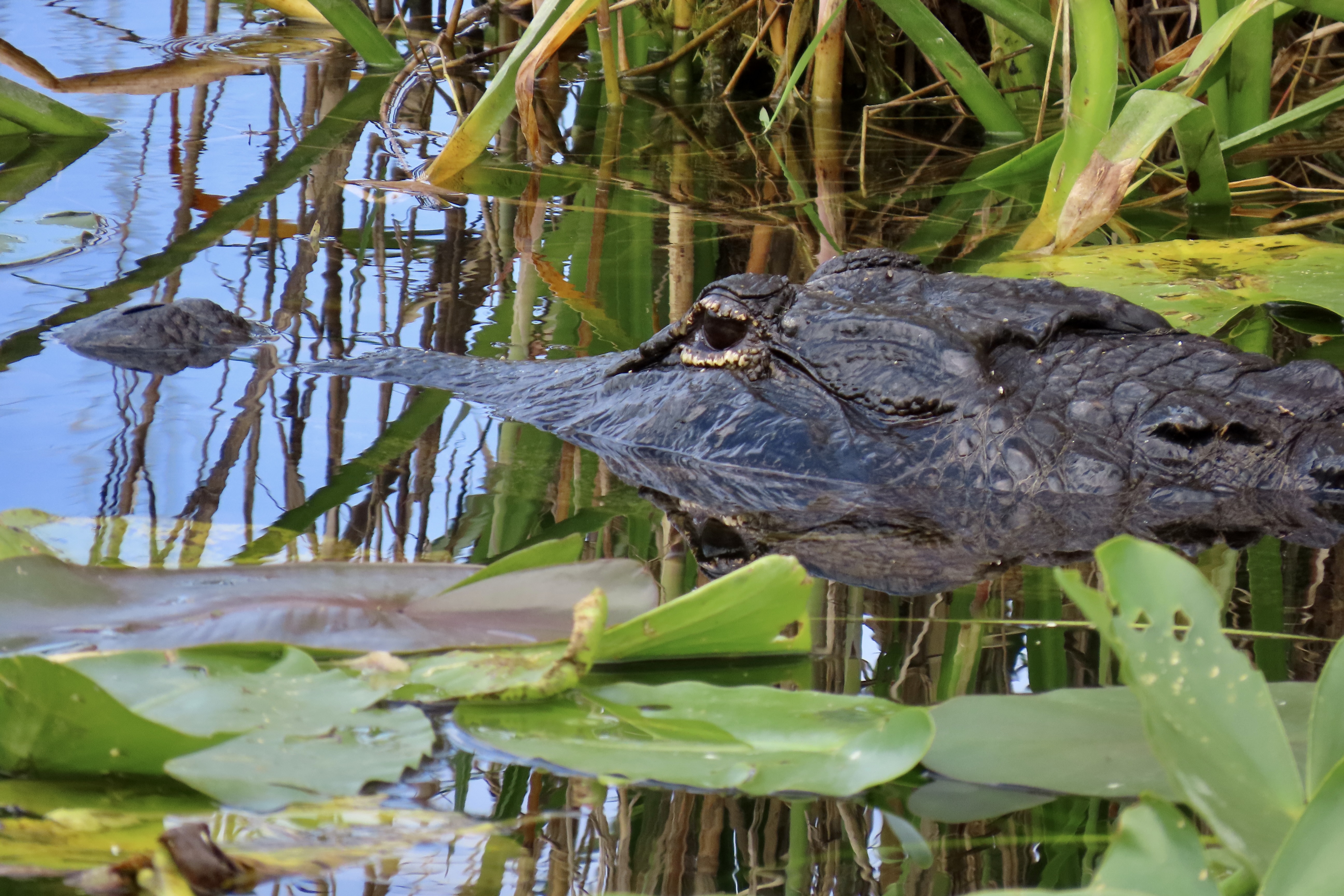
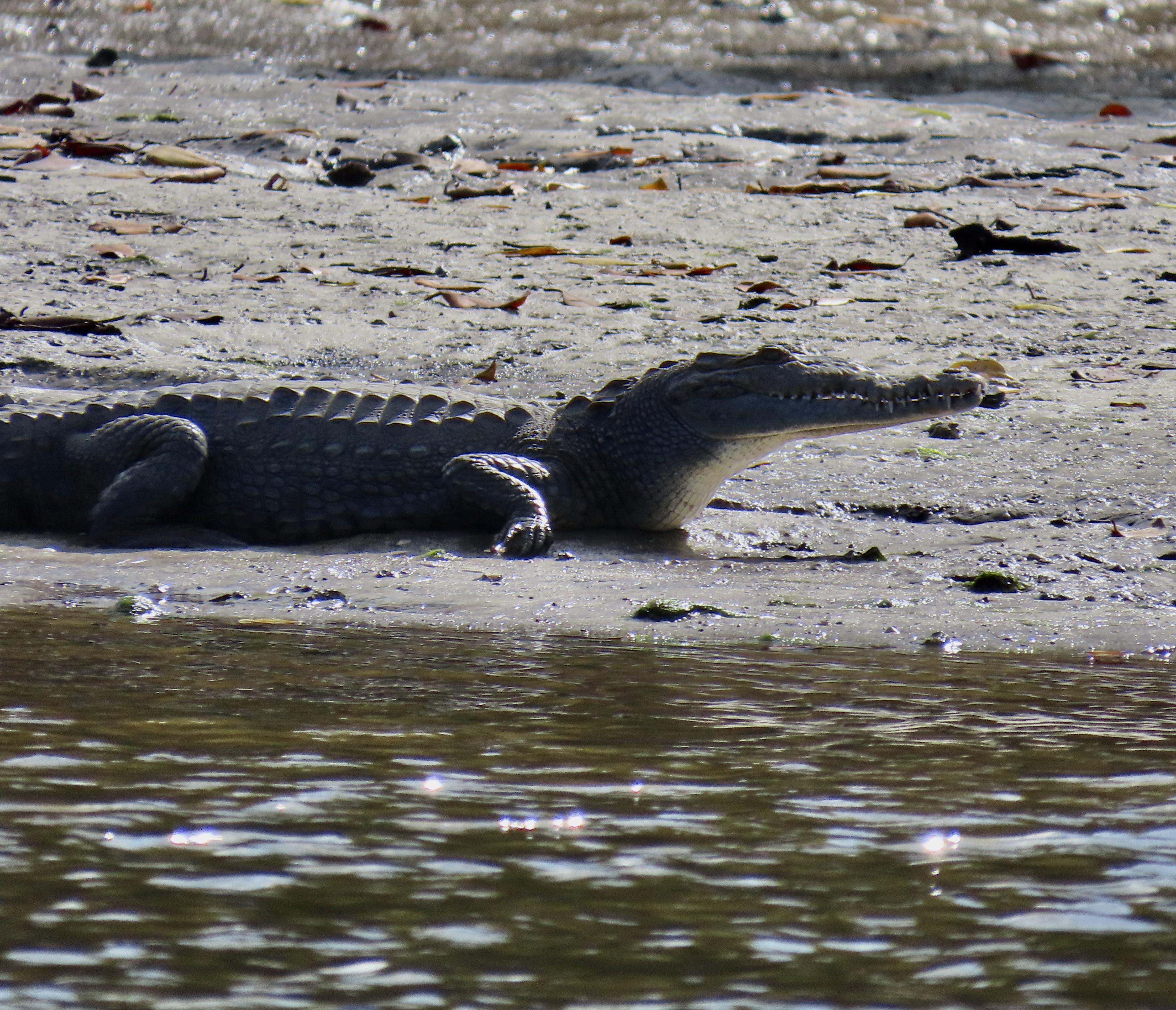
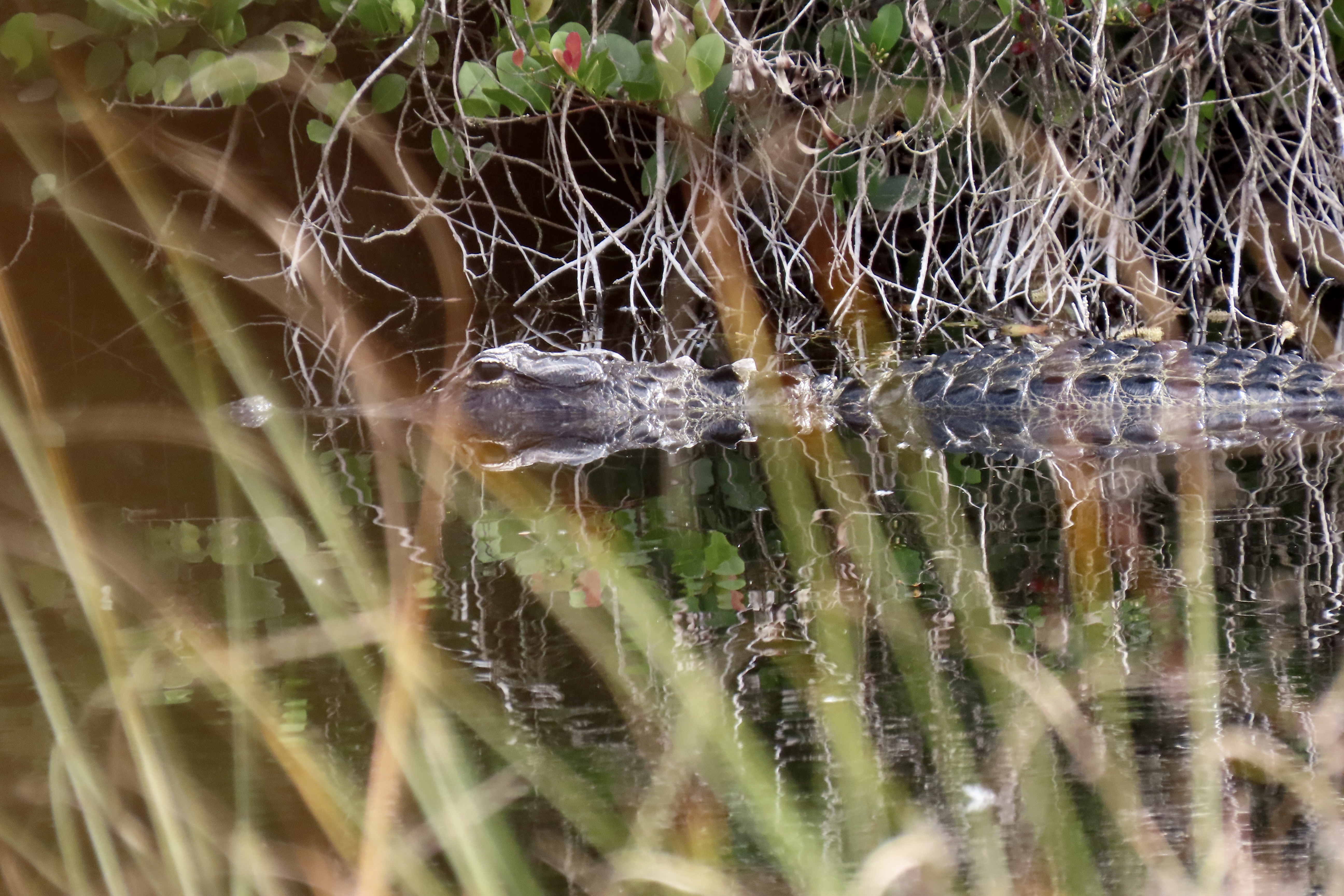
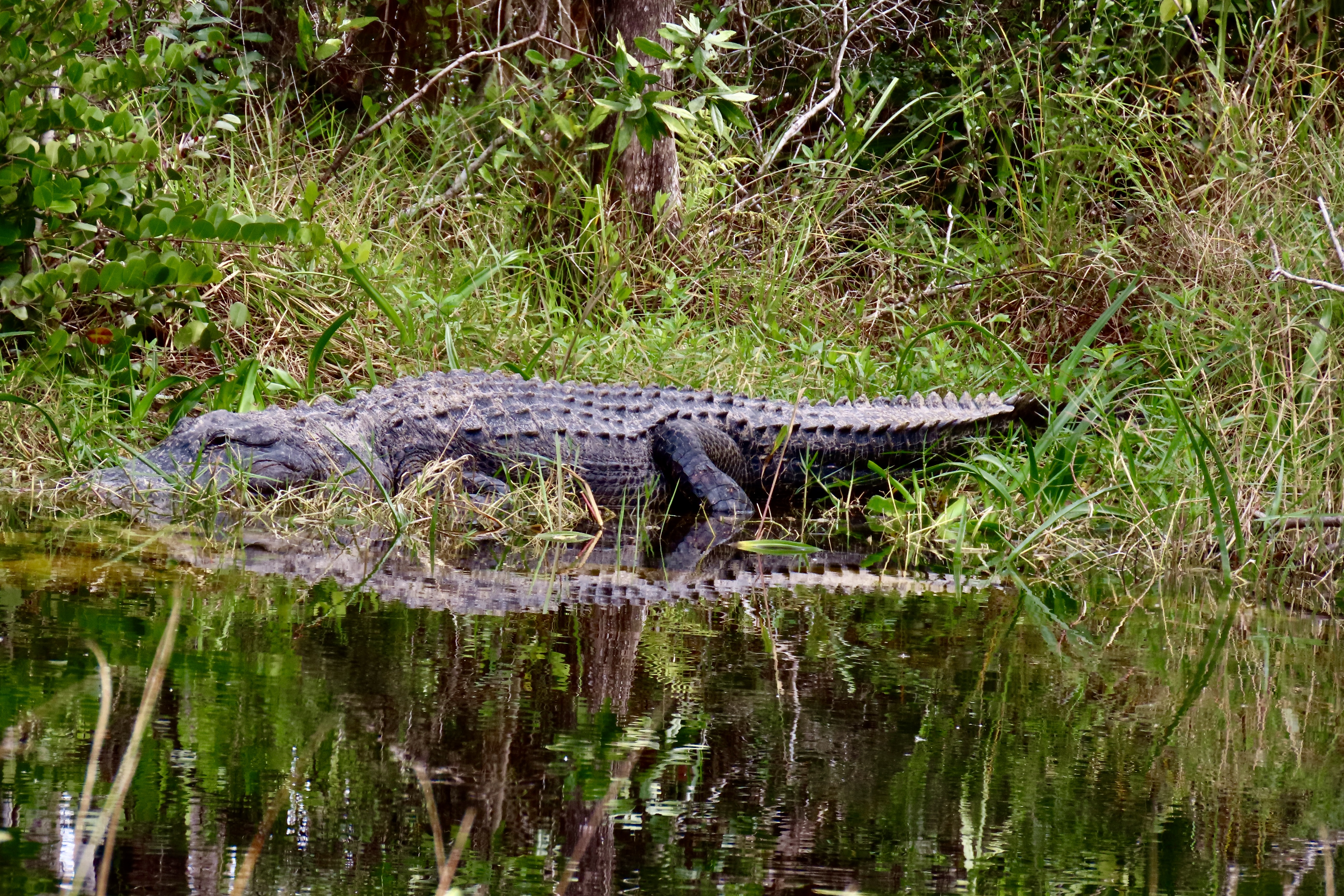
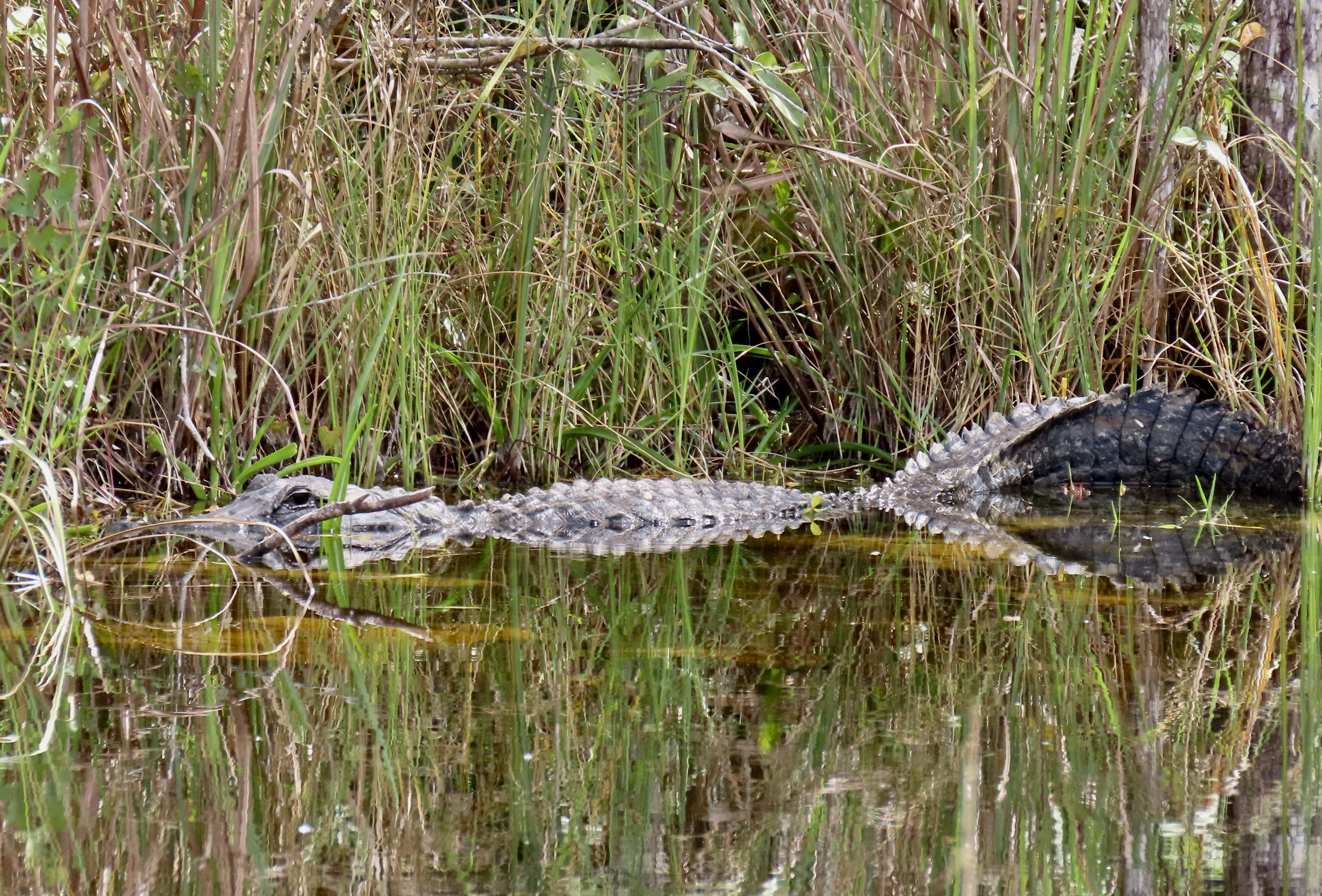
Do you feel a little bit nervous about what’s waiting for us in 2024 as we all travel around the world and the US— like maybe we will be up to our tail-bones in crocodiles? Peggy and I photographed this fine fellow on the shore of a small pond in Chobe National Park, Botswana.

2023 was a great travel year for Peggy and me with our trip up the Nile in the spring, 10,000 mile road trip around the US in the summer, and safari visit to southern Africa in the fall. I’ve been blogging about these experiences and will continue. I never get caught up, but, on the other hand, I never run out of material. Grin.

We also have fun travel plans for 2024. The highlight will be a three month road trip up the Pacific Coast from Big Sur to Olympic National Park. It will include some of the world’s greatest ocean scenery and is an area that I have returned to time and again during my life. A trip to the Everglades next month and a trip up into the New England states and possibly Canada’s Atlantic Provinces is scheduled for this fall. We plan on finishing off the year in Costa Rica for a month (or some other warm tropical place). Maybe we will be looking for a place to live…adding to our choices for “base camps.”

I’m a little nervous about 2024. Who knows what global warming will do to our travel adventures. We plan on being flexible. That’s one advantage of doing most of out wandering this year with our pickup and small travel trailer. At the first sign of a flood, forest fire, tornado, hurricane, or snow storm, we’re out of there! We will also memorize the earthquake/tsunami escape routes when we are driving/camping along the West Coast. One never knows when the next big one will strike.

Then there’s the election: No escaping that. We’ll do our bit to support rational, humane, environmental friendly decisions but keep it to a bare minimum on “Wandering through Time and Place.” Peggy’s and my focus will continue to be on the beautiful, the quirky, and the historical. We believe our followers deserve to have somewhere they can go that maintains a sense of perspective and humor. Speaking of humor, here are a few photos from this past year that possibly relate to 2024:

How’s this as an approach for 2024? Peggy and I photographed this ostrich in South Africa, a mile or so from the Cape of Good Hope. Was it burying its head in the sand or being hopeful? Actually, it was being practical, stuffing its mouth full of grass.
If times really get bad, a nice mud bath may be the solution. It worked for the elephants and it worked for this warthog in Hwange National Park.
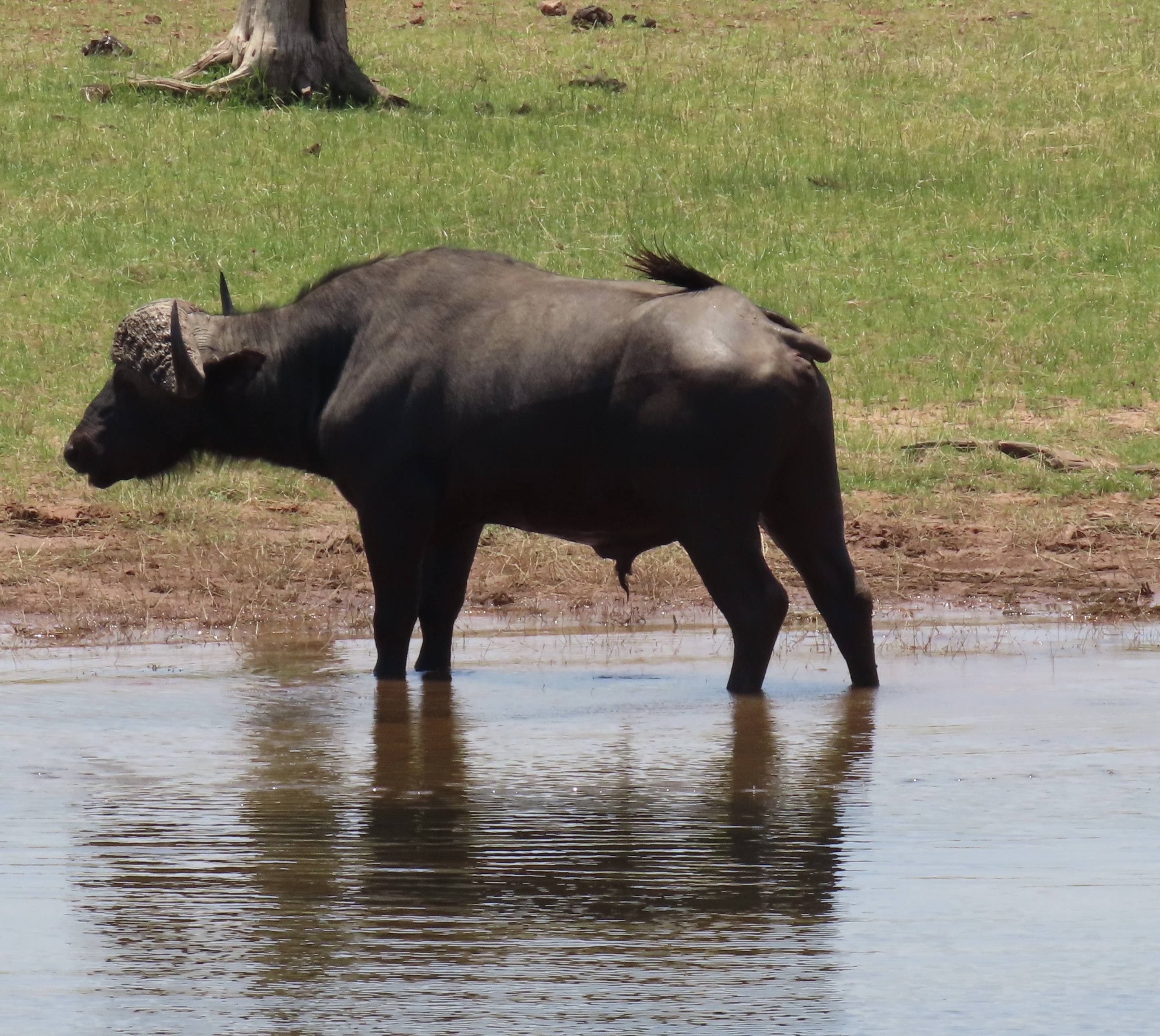
Lacking mud, this buffalo we photographed in Theodore Roosevelt National Park in North Dakota last summer, opted for a dust bath! Whatever works. Is that an ecstatic grin on his face?
This camel we photographed at the Pyramids seemed to have something to say about the situation…
As did this cat hanging out in the Alabaster Mosque in Cairo.
It’s more than likely that mud will be flung every which way as the campaigns get under way. This is from our trip to Burning Man last August.
It’s likely to get deep!
Maintaining balance may be challenging. We caught this giraffe drinking water in Hwange National Park, Zimbabwe.
Maybe we will get lucky, however, and Falcor, the Good Luck Dragon from “Never Ending Story” will come to our rescue. He was hanging out at Burning Man.
Possibly there will be a rainbow along with all of the rain and mud as there was at Burning Man.
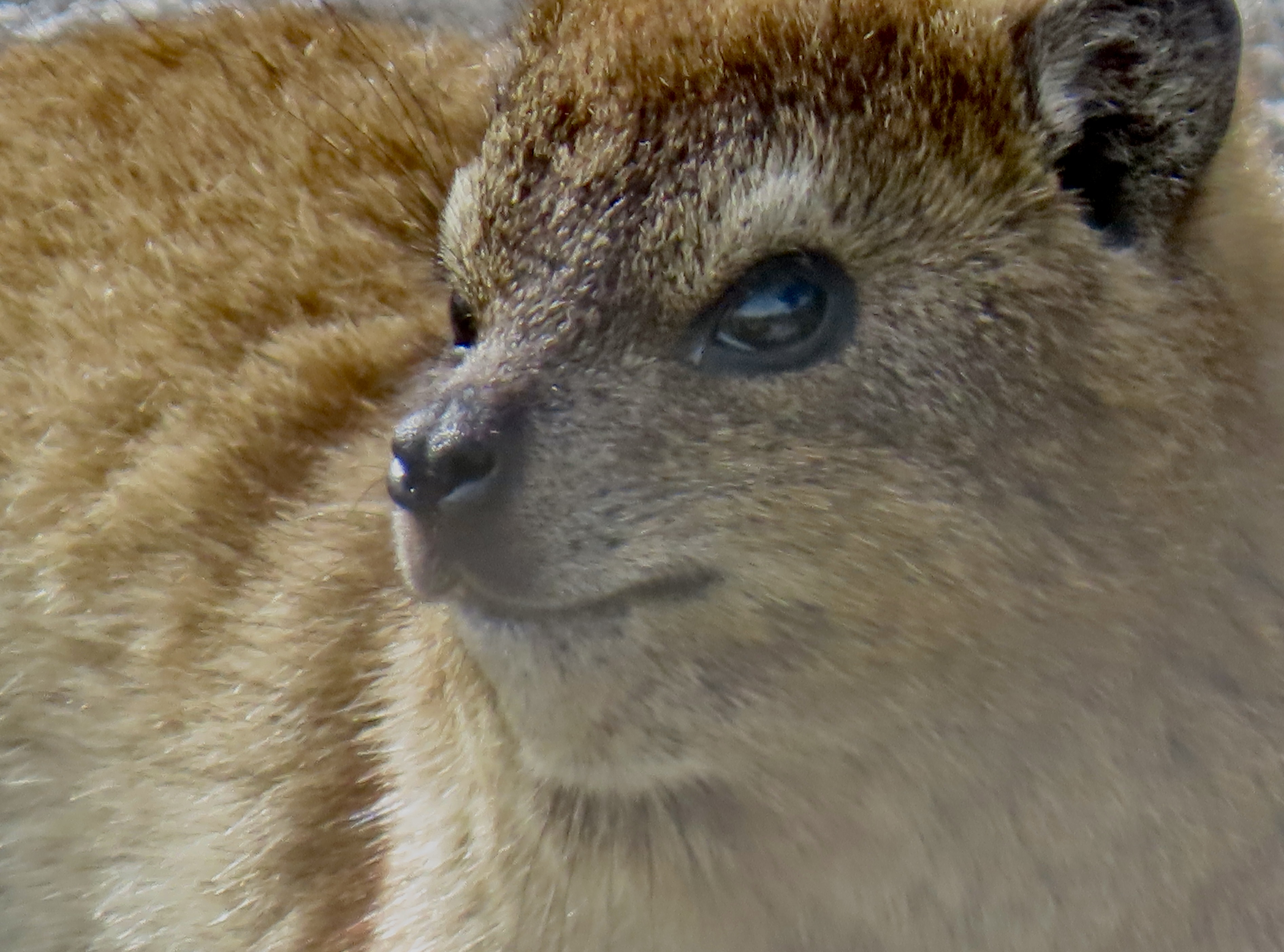
And we will end up the year with a smile on our face like this small hyrax we found perched on Table Mountain overlooking Cape Town, South Africa. The hyrax’s closest relatives, BTW, are the elephant and the manatee!

Whatever happens, Peggy and I want to wish you and your family a happy and healthy New Year in 2024. And safe travels! Next post: We will take a look at the closely knit elephant family and the matriarchal society that holds it all together.

I Can’t Believe It’s Already Christmas…

Now I will have to wash my face.

Peggy and I came on this overgrown kitty washing his face in Chobe National Park, Botswana on our African safari in October and couldn’t resist using him in our Christmas Card this year. He could have very well been saying “I can’t believe it’s already Christmas!” or “Yikes! Where did 2023 go?” Anyway, here’s Leo the Lion for your enjoyment. Peggy and I want to wish each of you and your families a great Holiday and a happy and healthy New Year. (Back to elephants next week.)

Elephants Cool Down with their Ears, Hear with their Feet, and Lead with their Tails… On Safari (Part 3)

The first elephant we saw was when we were traveling by bus from Victoria Falls to Chobe National Park. It was a magnificent animal with the largest ears we would see on our whole trip. I thought it might charge. The odds are it was simply cooling down its body, or curious. I learned it might have been warning us, however. When an elephant looks at you, raises its ears, and makes a short charge in your direction, the message is clear: Back off! The raised ears are to make the elephant look bigger than it is! An even worse scenario (other than the heart attack you could suffer in the first one), is when the elephant lays back its ears tight against its body, raises its trunk, and starts to charge. Good luck. Running isn’t much of an option unless can run faster than 25 miles per hour. The fastest human in the world might just stand a chance. Standing behind a very large tree could be more helpful. Peggy did that once when a giant bull elk charged her in Yellowstone where she was working as a college student. And she’s still here.

I have big ears. They are 3 1/2 inches long. African elephants have provided a new perspective. Theirs can be six feet long and five feet wide. “The better to hear with,” you might note. And elephants do have good hearing with a range from 14 to 16,000 hz. (Humans range from 20 to 20,000 hz in comparison.) The lower range is known as subsonic. Elephants can actually make subsonic sounds with their trunks that humans can’t hear but elephants can— up to miles away! The large flaps also serve to direct sound toward the inner ear. Think of cupping your hands behind your ears. It helps to say “eh.”

Of equal importance, an elephants ears play a big role in helping it to keep cool. The fancy name for this is thermoregulation, the process that allows your body to maintain its core temperature. For example, a message from your skin goes to your brain saying it’s hot. Your brain sends a message back to your skin: Sweat. Unlike us, elephants don’t have sweat glands except around their feet. They cope with Africa’s hot tropical sun using other methods. We’ve already discussed mud baths. Wrinkly skin is another.

One look at this elephant and you might think it’s older than Methuselah given its wrinkles. Actually, even the youngsters have wrinkles. The cracked skin enables elephants to hold up to 5-10 times more moisture on their skin when they take water or mud baths than they would with smooth skin. As this moisture evaporates, it helps to cool the elephant.
A close up of an elephant’s wrinkled skin. Note the hairs. There aren’t many, but scientists believe the thick, bristly hairs serve to transfer heat from the body into the atmosphere, especially if there is a breeze. The impact is apparently much greater than one might imagine.
Ears are different. There are no lack of hairs there. (This youngster might also win a wrinkle contest.) While hair growing out of an older man’s ears serves little purpose other than ugly, elephants find them quite beneficial. In addition to keeping bugs and mud out, they also transfer heat and add to the cooling process that takes place in an elephant’s ears.
Check out the blood vessels and veins in the elephant’s ear above. It’s packed with them. They are close to the surface and covered by a thin layer of skin. The system allows excess heat to escape from the blood vessels into the air and help to reduce the elephant’s core temperature. It is estimated that an elephant passes the blood in its body through its ears every 20 minutes.
This illustration from ScienceGate provides another perspective.

Elephants enhance this process in various ways. Providing air to move the heat away and cool the ear is the most important. Elephants are known to stand in the wind with their ears out. The most common approach, however, is to flap their ears. In addition to providing a breeze for the ears, the flapping also fans the body and blows insects away. (I wish I could flap mine.) Watching a group of elephants crossing the savanna while flapping their ears is so common it’s iconic. Other methods include getting out of the sun and taking mud/water baths.

Returning to our elephant that was bathing and cooling down at a water hole in Hwange National Park in my last post, he paid special attention to spraying down his ears. Given the exposed blood vessels in his ears, it’s easy to understand why this might be an important part of his cooling down effort.

This caused me to think about another aspect of elephant behavior related to their ears. When the elephants came out of the mud bath I featured in my December 4 blog, they gave a vigorous shake to their ears. I thought at the time it was like, “Woohoo!” Thinking back, I wonder if they weren’t shaking the mud off of their ears. Given that the mud in general helps to keep them cool, protect them from sunburn, and frustrate biting bugs, why? My conclusion (for which I couldn’t find back up data) was that the mud coats their ears and reduces the ability of their blood vessels to transfer the heat to the air.

These elephants gave their ears a vigorous shake when they came out of the mud bath. Were they having a Woohoo moment, shaking the mud off, or doing something else?
And now it’s time to turn to elephant’s feet. They’re big too, which shouldn’t come as any surprise considering they belong to animals weighing between 2 and 7 tons, the world’s largest land animals. This is an actual footprint of one that Peggy is holding up. It was made by Jumbo, the biggest elephant at the Wild Horizons Elephant Sanctuary, by pressing his inked foot down on paper. We bought the print and carried it home with us. The paper is rather unique in itself. It’s made out of recycled paper and elephant poop.
To provide another perspective, this is my size 15 shoe next to a fresh elephant print. We came across it when we were on a safari walk with Terry Anders, who, along with his wife, Sheona, is the owner of the Iganyana Tent Camp located on the edge of Hwange National Park. Terry explained to us that its size indicated it was a large bull elephant. He also told us that each elephants footprint is unique like a fingerprint. Eventually the ridges wear down through extensive walking over varied terrain, providing an indication of the elephant’s age.
Here’s what an elephant’s foot looks like close up. Like us, an elephant has five toes on each foot, but not all of the toes have toenails. It actually walks on its toes. A thick pad of gristle extends backward, working something like a shock absorber. The bottom line: This foot was made for walking, and walking it will do— up to 30 miles a day. And, if you irritate the elephant, it may walk all over you. (My apologies to Nancy Sinatra.)
This is an elephant’s toe bone that Terry showed us when we were out on our safari walk.
Tracking an elephant after a rainstorm would not be a problem!
Elephants tend to follow the same routes to reach food and water, creating well worn paths.

Given the years I have spent wandering in the wilderness, I’ve always been interested in animal tracks. And that certainly applies to elephants. But what interests me the most about elephant feet is how they ‘hear’ with them via seismic communication. Caitlin O’Connell-Rodwel, a Stanford researcher, has been returning to the same elephant watering hole in Namibia for over 25 years figuring out how they do it. Her work has demonstrated that African elephants exchange information by emitting low-frequency sounds through their trunks that travel dozens of miles through the ground. She believes this communication is the key in understanding the dynamics of elephant groups. “Announcements” can include warnings, mating calls and navigation instructions, e.g. “Don’t be alarmed sweetie, but I would really like to make it with you under the acacia tree next to the pond.” In a more passive sense, elephants can also keep track of each other through the sound of each other’s foot steps.

They “listen” with their feet in two ways. One is through touch. Just like us, elephants have receptors in their skin known as Pacinian corpuscles that are hardwired to the brain. On an elephant these are located around the edge of their feet. When an elephant is picking up sounds/vibrations, it presses its feet onto the ground, expanding their surface by as much as 20%. Signals are then sent to the brain for processing. While this isn’t hearing exactly, the message gets through. A second method called bone conduction is closer to real hearing. The elephant jabs its big toes into the ground and the vibrations are carried up through its body via bones to the inner ear where they are heard like sound vibrations coming through the air.

And finally, we reach the tail end of this post. Grin. Tails on elephants serve just like tails on cattle: They swish them around a lot and keep the bugs away. But there is more. Almost everyone has seen photos of a baby elephant holding on to its mom’s tail. It serves the same purpose as moms and dads holding their younger children’s hands. It guides them and helps keep them out of trouble. Unfortunately, we didn’t see it on our trip. The mom also uses her tail to keep track of her baby when it isn’t holding her tail by feeling it with her tail. It’s a lot easier than turning around to check on junior. Finally, holding its tail up can signal that the elephant is fearful, highly playful or intensely excited. “Over here, Big Boy.”

At first, I had planned to do one blog on elephants, then it was two. Now it is three. They are just too fascinating, at least for me. Next time I’ll get more into family life, eyes, teeth, bones, and even poop— a single elephant can produce up to one ton in a week!

Have You Ever Petted an Elephant’s Trunk? Peggy Has… On Safari (Part 2)

Elephants are fascinating creatures, no doubt about it, and one of the most fascinating things about an elephant is its trunk— which is the subject of today’s post. This one was waiting for Peggy to toss food into its mouth at the Wild Horizons Elephant Sanctuary and Orphanage just outside of Victoria Falls, Zambia. The elephants weren’t wild exactly, but definitely fun, interesting, and educational.

Peggy and I, along with our traveling companions, her brother John and his wife Frances, spent a lot of time watching and photographing elephants on our recent safari to Botswana, Zambia, and South Africa. Most of the time, they were doing something with their trunks. These marvelous appendages are used in breathing, smelling, eating, drinking, bathing and communication. Today’s post will focus on the trunk. My next post will consider other interesting facts about elephants, including their tails.

You know how hard it is to get a wild elephant to pose? Grin. We were more than satisfied to watch and photograph them wandering around doing elephant things. These two were focused on eating next to the Chobe River. But they also provided an excellent illustration for my next two posts that are going to be focused on looking at elephants from trunk to tail. It would have helped had they switched positions, but they didn’t listen to my suggestion. The elephant on the left is using her foot to kick the grass and free it from its roots. The one on the right is about to shake the dirt out of the grass she has gathered.

Our opportunity to watch and photograph elephants took place in four different locations. The first was Chobe National Park in Botswana. One of the Park’s claims to fame is that it supports the largest herd of free-ranging elephants in the Africa. Since we were at the end of the dry season, many of these elephants were located next to the Chobe River where they could get water and food. Viewing them was easy, particularly from boats. (Ours was docked at our safari lodge on the edge of the river.) Chobe is an excellent area to see wildlife. The only downside is that this means you will be sharing your experience with lots of other people.

There was no challenge finding elephants along the Chobe River in October at the end of dry season. With the coming rains, they will spread out across the park.

Hwange National Park and Matusadona National Park in Zimbabwe were the other two areas we watched wild elephants in their natural setting. Both parks had far fewer people on safari and were far less crowded. Slightly different, but excellent for meeting elephants up close, the Wild Horizons Sanctuary and Orphanage for Elephants just outside of Victoria Falls allowed us to interact with these giants of southern Africa’s velds. All of the elephant photos in this post and the next one were taken by Peggy and me in these four locations. I’ll start with the Sanctuary since we were able to get close ups of the trunks.

What’s impressive here is the large size of the trunk. The largest can reach up to seven feet. It’s easy to imagine why elephants need a large head and strong neck muscles to carry and use their trunks. While it may not be obvious, the trunk is an extension of the elephant’s upper lip and nose.
While the elephant’s trunk is attached to head bones, there are no bones in the trunk. Instead there are lots of muscles. This arrangement is called a muscular hydrostat. Another example is our tongue. The muscles are impressive. There are 17 major muscle groups, 8 on each side and 1 up the middle. But in turn, these muscles are made up of sheathed groups of fibers known as fascicles. The latest estimate is there are around 90,000. When you see claims of an elephants trunk having 50-100,000 muscles, fascicles are what they are referring to. The major muscles and fascicles are what allow for the great flexibility and strength of an elephant’s trunk. The elephant can move it up, down, left and right, and even twist it in every direction, but it does have a dominant side. (Think left handed/right handed.)They can also lengthen, shorten and stiffen their trunks.
Peggy is petting an elephant’s trunk near the tip at the Sanctuary. She described the skin as “hard and the hairs wire-like and sharp.” One would think that such an arrangement would lack in sensitivity. Quite the opposite. The trunk is packed with sensory cells and the wire-like hairs are particularly sensitive to touch and are known as sensory hairs.
I looked down at the Sanctuary to see this elephant had slipped its trunk through the small fence that separated us and was checking out my shoe. I hope it got a good sniff— in addition to demonstrating the flexibility of its trunk.
The tip of the trunk is particularly sensitive. The protrusions on the upper and lower lip work as fingers, enabling the elephant to pick things up. As one report noted, they can pick up a potato chip without crushing it. (Whether one should feed an elephant a potato chip is a different issue.) Now, it’s time to head back to the National Parks and watch the elephants at work using their trunks.
Elephants don’t drink with their trunks. That would be like us drinking with our noses! But they do suck water into their trunk and squirt it into their mouth, like this thirsty fellow is doing. BTW: the trunk of a large elephant can hold up to two gallons of water.
These guys were also drinking. This time out of a swimming pool at the Iganyana Tent Camp on the edge of Hwange National Park. They made their nocturnal visit while we were eating dinner next to the pool. (These ‘action’ photos were taken with our cell phone in the semi-dark, which accounts for the fuzzy look. I think it only enhances the drama of having 50 or so wild elephants provide dinner entertainment, however.)
I thought the swimming pool watering hole deserved another photo because of the baby elephant in the middle trying to get its trunk into the water. It looked like mom ended up spraying some water into the little guy’s mouth.
Speaking of shooting water into a mouth, this strange photo seems to show an elephant doing just that for itself. Or was it spitting the water out and sucking it in with its trunk? This is the same elephant I featured two photos above drinking in the normal way.
Having finished its drink, the elephant gave itself a shower.
Cooling down may have been the objective instead of bathing…
So, are we talking hygiene or air conditioning?
This is not an angry elephant about to charge. It’s rooting up grass with its foot to eat in Chobe National Park while flapping its ears to keep cool. Once the grass is loose, it will use its trunk to shake out the dirt and transfer the food to its mouth. Elephants eat a lot. Full grown elephants require up to 300 pounds of food a day.
Stripping leaves from trees is another way elephants use their trunks to gather their food as mom and baby are doing here from this shrub.
This elephant has learned it can pull up grass with its trunk on the edge of Lake Kariba In Matusadona National Park, Zimbabwe.
One thing that we noticed in Hwange National Park was that the elephants were also using their trunks to grab grass and eat while they were walking.

In addition to eating, drinking, bathing and smelling, elephants also use their trunks to communicate in a variety of ways. One is a gentle touch to provide comfort to a fellow elephant or baby. They will even put the tip of their trunk in another elephant’s mouth. They also force air through their trunks to produce a variety of sounds. One is as a loud trumpet to express displeasure. They did that a couple of times when they were crowded together drinking out of the swimming pool. It certainly caught our attention.

I’ll conclude this post with Peggy placing food in an an elephant’s trunk at Wild Horizons Elephant Sanctuary. Next up, a look at an elephant’s family life, head, ears, tusks, feet, skin and tail. Plus a visit to an elephant graveyard.