How Not to Castrate Your Cat…

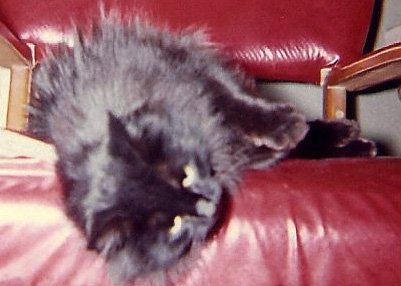
While MC would not submit to a photo due to the sensitive nature of his proposed operation, Demon was quite willing to have her photo taken. The poised claw suggests we don't mess were her, however.

If you turn white at the thought of castration via the “Old Country” method, do not read this article. It is not supported by the SPCA, nor does the author endorse it…

I grew up in a semi-Italian neighborhood, semi in the sense that half our neighbors were Italian. On the north were the Passerini’s who provided our family with spaghetti, apples and their son Johnny. (See “The Attack of the Graveyard Ghost” under MisAdventures.)

Papa Passerini had another offering, a cheap way to castrate cats.

Over the years we had several cats, two of which were memorable, Demon and MC. Demon was as dark as the night and an expert hunter. One of my jobs was to dispose of the treasures she brought home and left on our doorstep.

MC was pure white. He was a tomcat’s Tom Cat, somewhat diminutive in size, and totally dedicated to scattering his sperm.

Unfortunately, his small size meant that he often came out on the losing end in his battles with larger tomcats over a chosen lady’s favors. He would arrive home beat up and battered. One time a chunk of his ear was missing. Another time it was the tip of his tail.

Pop (my father) decided that drastic measures were called for. MC would have to have to lose his offending appendages. Papa Passerini suggested an Old Country solution.

“All you need is a pair of tin snips, a burlap bag, gloves, a pocket knife and rope,” he suggested.

While MC had never been a paragon of feline domesticity, he was at least partially tame.  He even managed a brief purr when I picked him up the morning of his ‘operation.’

Any previous pretensions of tolerating people ceased instantly when his legs were tied up and he was dumped into the dark gunnysack.

When Pop cut a slit in the burlap with his pocketknife and reached a gloved hand through, he was met by claws of fury. M.C. had shed his ropes faster than Houdini.

No one, but no one, was going to grab him by the testicles and snip them off with tin snips. He clawed his way out of the bag and became a white blur as he disappeared into the Graveyard.

After that we would only see MC at dinner time and then only after we had put his food down and walked several feet away. Can’t say I blame him…

A Dead Skunk Reeks Revenge

Dead skunks reek revenge; it’s a fact of life for roadkill aficionados, otherwise known as bicyclists.

In 1989 I did a 10,000 mile solo tour of the US and Canada on my bicycle and became a specialist in what North America offers in the way of dead animals. I quickly learned that different regions produce different roadkill. For example, if you are interested in smashed armadillos, go to Louisiana.

Dead skunks, on the other hand, can be found decorating pavement everywhere. Lately, Peggy and I have had to dodge several on our 13-mile drive home from the small town of Ruch, Oregon to our new home in upper Applegate Valley.

I use dodge somewhat loosely since there is no way to avoid the aroma. Dodging a dead skunk is infinitely better than hitting a live one, however. I did that once. It was on my first ‘driving’ date, ever. I was 15.

Paula called me. The date involved Mom, Boyfriend, Paula and I going out to dinner in the small town of Sutter Creek, about twenty miles away from Diamond Springs over California’s curvy Highway 49.

After we filled up on Italian food, Mom and Boyfriend promptly climbed in the back and suggested I drive home.

“Um,” I noted nervously, “I only have a learner’s permit.”

“That’s okay, it will be good practice,” Mom stated before I could add that I had just obtained the permit the week before.

Paula, meanwhile, was waiting for me to open the door for her on the passenger side of the car. She gave me an encouraging smile and my options dropped to zero. Any further hesitation would appear wimpy, which is a definite no-no on a first date.

After doing the gentlemanly thing for Paula, I dutifully climbed into the driver’s seat and miraculously found the keyhole and lights. Minimal gear grinding got us out of town and I breathed an audible sigh of relief.

We had made it just past Plymouth when I ran over the skunk. Its response was to become a virtuoso of glandular activity.

“Oh, don’t worry about it,” Boyfriend said as the first powerful whiffs of eau de skunk came blasting through the air vents, “it happens all of the time.”

“Yeah, sure,” I mumbled to myself through tongue-biting teeth, “young men always run down skunks on first dates, especially first dates with Mom and Boyfriend along.”

Fortunately I made it home without further incident.

There is another roadkill story here, though. This one involves a cat and took place in the same area 25 years later.

While working for the American Lung Association of Sacramento, I had created what is known as the Trek Program, a series of multi-day outdoor adventures that people go on as fundraisers.

At the time this particular event took place, I was living in Alaska. ALA Sacramento had hired George and Nancy Redpath to run its Treks. They had a popular three-day bicycling event that incorporated a portion of the same route that I had traveled the night of the fateful skunk incident.

The Redpaths had added a roadside scavenger hunt to the Trek for fun. A sail-cat was on the list of items to be collected.

For the uninitiated, a sail-cat is a cat that has had an encounter with a logging truck’s wheels, after which it resembles a furry pancake with legs. Given several days of curing in the Sierra foothill sun, the cat can be picked and sailed in much the same way you would a Frisbee, hence the name.

Although tossing sail-cats has provided dogs with a new way to chase cats and play Frisbee at the same time, it is a sport without many adherents. Even dogs have serious reservations.

Not surprisingly, one Trekker managed to find a sail cat, load it on his bike and dutifully turn it in at the end of the day. The person won the scavenger hunt, which he should have considering his extended association with the umpteen-day dead cat.

But wait… there’s more. Two other couples became involved in the dead cat saga. I’ll call them Bob and Carol and Ted and Alice to protect the innocent.

Bob and Carol finished the Trek, hopped in their car and naively drove home that evening unaware that they were carrying a fellow traveler. When they arrived back in Sacramento and opened their trunk, lo and behold, there was the dead cat.

Bob and Carol had a good idea it was Ted and Alice who had stowed the unwanted passenger in their car. They vowed to get even.

As it turned out, both couples had spouses who worked for the State of California. A devious plot was hatched. The next day Ted received one of those large inner-office envelopes in his in-basket. It was rather bulky so he opened it with interest. Out slid the sail-cat, your tax dollars at work.

Unlike Aunt Tilley’s fruitcake, the cat apparently ended his strange after-life journey at that point.

Crazy Flumo and Captain Die: Two African Characters

The Peace Corps provided us with a house but first we had to win it back from the occupying forces: cockroaches and bug-a-bugs (termites).

All Peace Corps Volunteers have stories to tell about their first days on assignment: some funny, some sad and some even scary.

In Armies of the Night under Bone Stories I described how my new wife of three months, Jo Ann, and I survived our first night in Gbarnga, Liberia without water, light or food while being besieged by cockroaches, termites, crab size spiders and pounding drums.
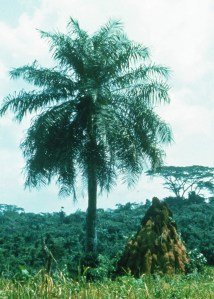
Bug-a-bug tunnels snaked their way up all of our walls when we opened the door to our new house. This photo of a nearby 12-foot high termite mound testifies to how serious these bugs were.

A new day did manage to happen, however. Jo and I promised we would make it a good one. Her job was to mount a ferocious counter offensive on the bug-a-bugs (termites) and cockroaches that had seized our house.  Sam, the young man who hoped to work for us, arrived early to help.

My job was to walk the quarter-mile to town, buy five gallons of kerosene, find the most toxic bug spray known to humankind, scavenge anything available that resembled food and stock up on booze in case my other efforts failed.

Since this was my first trip into Gbarnga, I was on display and more than a little nervous. It seemed like half of the town was out and their primary purpose was to stare at me. I smiled and waved a lot, like a princess on parade. They smiled and waved back.

Things were going well.

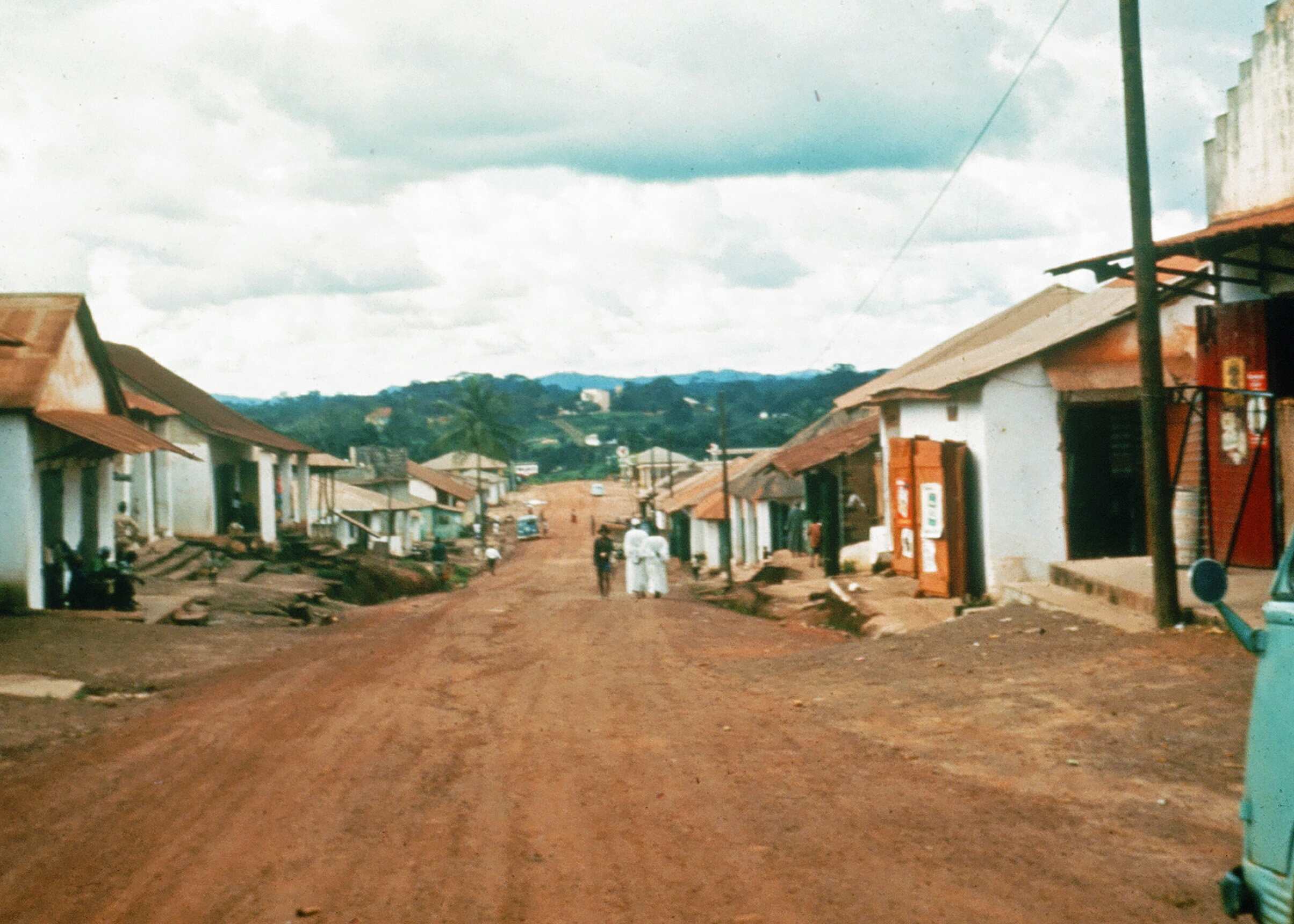
I quickly reached the main street. Open-air shops lined the dirt road on both sides. At first, they looked the same: white washed walls, red tin roofs, dark interiors, and faces staring out from inside.

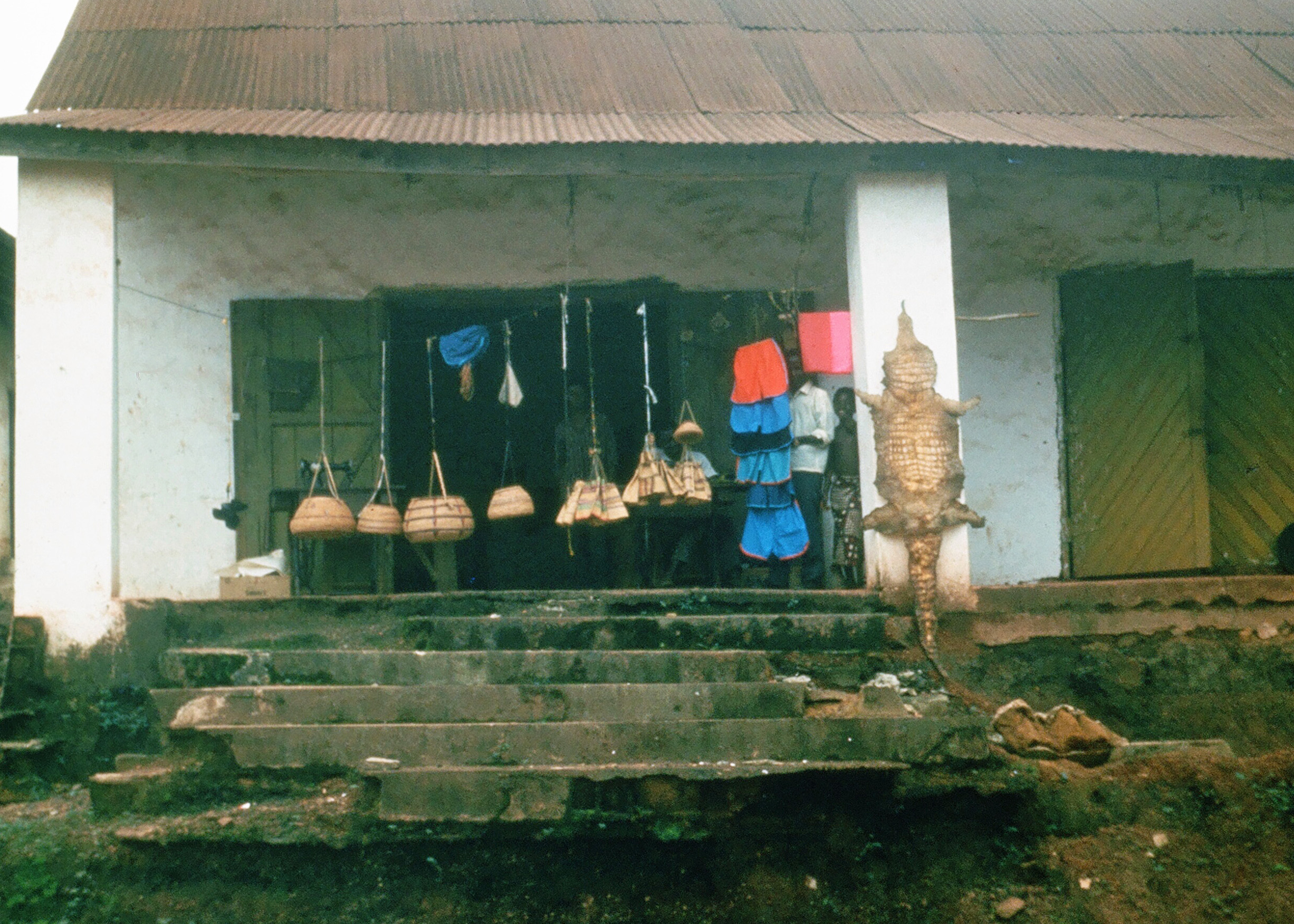
A typical Liberian shop on Gbarnga's main street. The croc's tail was dragging in the dirt.

Then I begin noticing differences. Several were fronted with crumbling cement steps that had long since given up any hope of connecting to the eroded street. One featured a crocodile skin nailed to the front post, its tail dragging in the dirt. Another had brightly colored shirts and shorts strung up like Christmas ornaments.

Two or three were obviously makeshift bars, no more than holes in the wall. An ancient Liberian ‘Ma’ came staggering out of one with a half-pint gin bottle clutched in her hand. She noticed me, hoisted her bottle in a toast and took a swig.

A few shops were larger and resembled country stores filled with the minutia of daily life. Most were owned by Lebanese. At the time, they made up a substantial part of Liberia’s middle class. I was headed for one that Sam told me sold kerosene.

A group of men stood idly in front of the store. Had folks known I was coming, I would have sworn it was a reception committee. It’s show time went reverberating around my skull. I smiled my best Peace Corps smile. One of the men stepped forward to greet me. He was barefoot and wore a tattered shirt, tattered shorts and a big grin. His hand shot out

This is it I thought, my first official Liberian handshake. We had started practicing at SF State. The shake begins as a normal handshake but ends with you snapping each other’s fingers. An audible snap signifies success. It isn’t easy at first. If the person is really happy to see you he may go through the process two or three times.

(About the time the snap becomes second nature, it’s time to go home. Then you have to unlearn the process. Your American friends look at you strangely when you snap their fingers. At least my conservative Republican father-in-law did. But back to Africa.)

We shook. Our hands parted. Snap! It worked. All of the men beamed and I beamed back. Their official greeter grabbed my hand again. Snap! Another success and more beaming. And again. And again

Nobody had mentioned four snaps to me and this time the guy wouldn’t let go. The men were laughing out loud now. My hundred-watt smile became a forty-watt grimace as I politely tried to retrieve my hand. No luck. I steeled myself, gave up any pretense of being polite and yanked. My hand pulled free and I breathed a huge sigh of relief.

The sigh lasted as long as it took the guy to drop to the ground and wrap his arms around my knees. By now the audience were all but rolling the street. I had become prime time entertainment and was beginning to understand what George Custer must have felt like.

I might still be there if the cavalry hadn’t arrived. It came in the form of a handsome Liberian man in a well-tailored suit who appeared on the scene and gave Flumo a healthy kick in the butt. Flumo let go.

“Hi, I am Daniel Goe, Vice Principal at Gboveh High School. Welcome to Gbarnga.” he introduced himself.

We shook hands in the old-fashioned way as Daniel explained that the man who had his arms wrapped around me was known throughout the Country as Crazy Flumo. I wasn’t the only person to receive his attention.

Once, Daniel told me, Flumo had thrown himself down in front of Vice President Tolbert’s car and wouldn’t move until the VP climbed out and gave him five dollars. New PCVs were a special target. I later learned that a tall Texan Volunteer had actually walked several yards down the main street of Gbarnga with Flumo tenaciously attached to one leg. I’d gotten off easy.

Fortunately, my adventures for the day were over. I bought my kerosene, found a bug poison so potent it was outlawed it in the US and discovered such fine culinary treats as canned beef from Argentina.

Jo Ann and Sam beat back the bug-a-bug and managed to arrive at an uneasy truce with the cockroaches. The nasty beasts would limit their forays until after we had gone to bed and stay out of our bedroom. In return we would only kill those we could reasonably stomp without tearing our house down.

Anyway there we were, one happy little family, cockroaches and all. That’s when Captain Die arrived on our doorstep.

Captain Die was a well digger rumored to have spent far too much time in dark holes. He had dug the well at our house for the original occupants, two female Volunteers. Afterwards, he began stopping by to visit the women and bum cigarettes. He had a rather unique way of introducing himself.

“Hello, my name is Captain Die. My name is Captain Die because I am going to die someday. This is my dog, Rover. Roll over Rover. Give me a cigarette.” Rover, who was a big ugly dog of indeterminate parenthood, dutifully rolled over

It made quite an impression. We explained to Captain Die that neither of us smoked but invited him in to share some ice tea we had just brewed. We gave the Captain a glass and he took a huge swallow.

I have no idea what he thought he was getting but it wasn’t Lipton’s. He must have thought we were trying to poison him. A look of terror crossed his face and he spit the ice tea out in a forceful spray that covered half the kitchen and us. Dripping wet, we found ourselves caught between concern, laughter and dismay. The Captain, in disgust, marched out of our house in military fashion with Rover close behind.

In addition to having found our predecessors an excellent supply of tobacco, Captain Die was quite taken with one of them.  The story was told to us how he appeared at the door when Maryanne’s parents were visiting from the States. Captain Die was a man on a mission.  He was going to request Maryanne’s hand in marriage.

I’ve always imagined the scene as follows.

Maryanne’s parents are sitting in the living room on the Salvation Army chairs and making a game attempt at hiding the culture shock they are undoubtedly feeling when this big black man and his ugly dog appear at the screen door.

Marianne jumps up and says, “Oh Mom and Dad, I would like you to meet my friend, Captain Die.” Mom and Dad, brainwashed by Emily Post and wishing to appear nonchalant, quickly stand up with strained smiles on their faces.

Captain Die grabs Dad’s hand and tries to snap his finger at the same time proclaiming, “Hello, my name is Captain Die. My name is Captain Die because I am going to die some day. This is my dog Rover. Roll over Rover. Give me your daughter.”

No one told me how Marianne’s parents responded to the good Captain’s offer so I will leave the ending up to the reader’s imagination. I can report that Maryanne was not whisked out of the country by her mom and dad.

(Today completes my daily tales of my life as a Peace Corps Volunteer in Gbarnga, Liberia. This week I have been utilizing my travel blog to honor the 50th Anniversary of the Peace Corps. There are more stories of Africa, however, and I will continue to work them in as the year goes by.)


Main street Gbarnga in 1965.
Treason

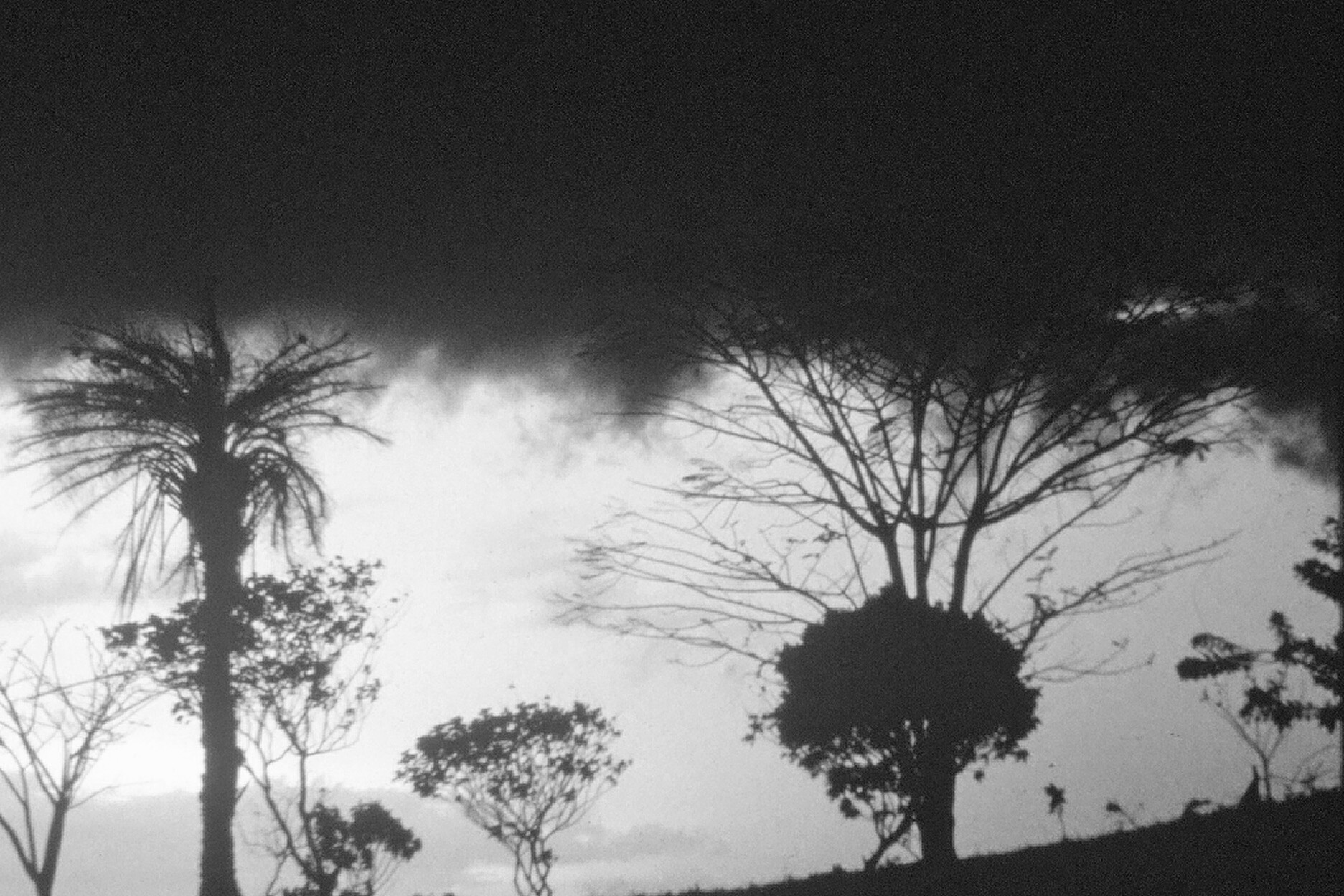
Gathering storm clouds over Liberia. I took this photo from my front porch in 1967. Looking back, it symbolizes for me the gathering political storm that would tear Liberia apart in the 70s, 80s and 90s.

Our job as teachers was to help bring Liberia’s tribal population into the twentieth century.

It was something of a first for the Country considering Americo-Liberians had worked hard for over a century to keep the tribal population in the darkest of the Dark Continent. Americo-Liberians were the descendents of freed slaves who had returned to Africa in the 1800s. They had promptly established themselves as the ruling elite.

It was a position they wished to maintain.

The times ‘they were a changing’ though. Independence was sweeping through Africa as one country after another threw off its colonial chains. Liberia’s tribal peoples were aware of what was happening in the world around them and the natives were getting restless.

The challenge to William Shadrach Tubman, who had been President since 1943, was to convince the tribal people they were getting a good deal, hold together a disparate people, make a show of it internationally, and still protect the privileges of the Americo-Liberians. Achieving the latter while moving forward on the first three was close to impossible.

It required an incredible balancing act at which Tubman was a master. The recipe for success involved one part substance, five parts fancy footwork and ten parts paranoia. The paranoia evolved from the fear that the tribal Liberians would take the process seriously and demand an equivalent portion or, God forbid, all of the goodies. Or possibly the nation would shatter apart.

As long as we behaved ourselves, we were part of the substance. The Liberian government made it quite clear that there would be grave consequences for anyone caught challenging the supremacy of the True Whig Party. For Liberians, the grave consequences could literally mean a hole in the ground. For us, it was a one-way ticket out of the country.

Don’t bother with stopping at Go or collecting $120 (our monthly salary).

Phil Weisberg in our back yard. Virgin tropical rainforest provides the backdrop.

One of our fellow Peace Corps Volunteers in Gbarnga, Phil Weisberg, actually tested the government’s resolve just prior to our arrival. Phil was a tall, gangly PCV who always looked like he had recently lost something of profound value.

He became upset whenever President Tubman or Vice President Tolbert came to Gbarnga and all of the school children in town were required to stand beside the road and cheer.

It didn’t matter if the luminary was one or two hours late, which he often was, or if it was pouring down rain, which it did half of the time, or if the sun was boiling hot, which it did the other half; the kids were expected to be there.

Teachers were required to go along. While most of the Volunteers managed to find something else to do, Phil’s personality was such that if his kids had to suffer he was going to be right out there suffering with them.

One day he found himself waiting an hour in the hot sun for the President’s wife and decided to protest. He did so by penning a sign that said in the best Liberian English, “MRS. TUBMAN, YOU ARE TOO LATE!”

Two hours later when her motorcade came tooling in to Gbarnga, Phil held up his sign and waved it about. Minutes later he found himself arrested and thrown into jail. This was not a piddling little kick your ass out of the country offense. One didn’t mess with the President’s wife.

Luckily Phil had the power of the American government behind him. Diplomatic maneuvering plus a personally written apology earned him a get out of jail free card. He was even allowed to stay in the country and finish up his term, provided of course he behaved.

I understood why Phil got in trouble. Waving a sign around criticizing the Presidents wife was not how to win friends and influence people among the Americo-Liberians. We all knew that the government was paranoid. Just how paranoid, I was to soon find out.

Peace Corps teachers were required to undertake a project during their first school vacation in Liberia. Given my experience at the elementary school, I decided do away with Dick, Jane and Spot and write a second grade reader. Why shouldn’t Liberian children have their own readers that reflected their own culture? Peace Corps agreed.

I jumped in. There were teaching guides to review, people to interview, folk tales to gather, and stories to write, rewrite and finish in one syllable English.

Eventually I finished the reader and shipped it off to Monrovia. Peace Corps was excited about the book and assigned an editor and illustrator to work with me. I would soon be a published author. Not. WAWA (a term coined by experienced African hands that stood for West Africa Wins Again) struck.

The book wouldn’t be published at all.

I had made the mistake of assuming the government would support a reader that featured Liberian children and African Folk Tales instead of Dick, Jane and Spot. What I had failed to understand was just how paranoid the Americo-Liberians were about maintaining power.

Apparently the book was a highly subversive tract and I was a dangerous radical. Liberian children would learn about their native heritage and rebel. Another misstep and I would be booted out of the country… or worse.

My next criminal activity was to organize a student government at Gboveh High School where I was taught African and World History. I decided the exercise would help our students prepare for the future and give them skills they would need in helping to govern their country.

Everyone, including students, teachers and Mr. Bonal, agreed. We pulled together interested students, worked through developing by-laws and set up elections.

Then the kids decided they would organize and run for office on party tickets. Why not? It sounded like fun. To provide identification for each ticket, they adopted names. It never entered my mind that this gesture would strike terror in the hearts of Americo-Liberians.

Within 24 hours we had been accused by the Superintendent (governor) of Bong County of setting up competing political parties to the Government’s True Whig Party. Student leaders were told to cease and desist or they would be arrested and thrown in jail.

I was told indirectly that I should start packing my bags.

So we eliminated the tickets and names. We were then allowed to proceed but I have no doubt we were closely monitored. I couldn’t help but wonder which of my students or fellow faculty members reported regularly to the Superintendent on my treasonable behavior.

The senior class. Yes, there were only five students in the class! Mamadee Wattee, standing on my right with a brown shirt and tie, was the student body president. He is also featured in my blog about the Lightning Man. Later he would move to the US and become an elementary school principal.

Reading and Writing and Arithmetic Taught to the Tune of an Ebony Stick

The elementary school was made from cement blocks. Windows without glass or screens provided air conditioning. Jo Ann and her first grade class provide perspective on the size of the school.

(Peace Corps turned 50 on Tuesday and I am not discussing what I turn on Thursday. But each day this week I am honoring Peace Corp’s birthday by sharing tales on my travel blog of my own experience as a PC Volunteer in Gbarnga, Liberia, West Africa from 1965 to 1967. Yesterday I wrote about my introduction to teaching second grade and about contacting a mysterious illness. Today I return to my unruly class of second graders and try to bring them under control.)

When I returned to school from being sick, my second graders had become rambunctious from their time off. After five days I had worked my way through every classroom management skill I had picked up during Peace Corps’ training and several I made up. Nothing worked.

“They need to be whipped,” my fellow Liberian teachers suggested. “That’s what we do.”

I patiently explained that Peace Corps teachers weren’t supposed to whip their students. Somewhere it was chiseled in stone. Eternal damnation and banishment to North Dakota would result.

“Then pretend you are going to whip them. Just don’t do it,” was the next helpful suggestion.

Being desperate and up for a little corruption, I thought about it. Where did it say in the Peace Corps rules that positive threatening was out of line? After all, hadn’t Teddy Roosevelt said, “Speak softly and carry a big stick?” Wasn’t the American government accumulating enough nuclear weapons to kill everyone in the world several times over using the same philosophy?

So I went out in the jungle and cut myself a big stick. Next I introduced it to my students.

“Oh, Mr. Mekemson, what a big stick you have,” they said. I could see the respect shining in their eyes. I explained its purpose. They could behave and earn positive points or they could misbehave and earn negative points. If they earned enough negative points, THE BIG STICK WOULD BE WAITING.

I didn’t tell my students I put the point total for the stick so high it would take a combination of Al Capone and Count Dracula to reach it.

The system worked. Whenever the class bordered on chaos, I would head for the blackboard, chalk in hand. Instant silence resulted. It was ‘Reading and writing and arithmetic taught to the tune of an ebony stick.’ We started making up for lost time.

A part of John Bonal's extended family. Mary is on the left.

Of course there was an exception. Isn’t there always? It came in the form of Mary, an 11-year old going on 13. Her uncle was principal of the high school and a Big Man in town so this meant she was important. Mere mortals such as Peace Corps Volunteers didn’t count. No Liberian teacher would dare touch a stick to her ornery hide, so certainly a Peace Corps teacher wouldn’t.

She called my bluff and pushed her points right up to the rim. I urgently sought reasons to give her positive points but the opportunities were few and far between. She went over the top and smugly whispered to her girlfriends to watch what would happen.

Now I had a real problem. Obviously I couldn’t beat her. I am really not the beating kind. But neither could I ignore her. The end of the day came and I dismissed the class but asked her to stay. The students walked out the door and stopped just on the other side. They weren’t leaving. Nobody at the school was, including all of the teachers. They were all waiting to see what Mr. Mekemson would do.

Mr. Mekemson was worrying. That’s what he was doing. I got out my big stick. Little Miss Mary was no longer so nonchalant.

“Don’t beat me Teacha, I beg you, don’t beat me,” she screamed and screamed and screamed. I gently touched her with my stick. You would have thought I was pulling all of her fingernails and half of her toenails out, slowly. I knew everyone in the school was listening in on this little drama and I imagined that half of Gbarnga was as well.


Oh boy, I thought, you have royally screwed up this time, Curtis.

I mumbled something about the importance of changing her ways and sent her off. And then I waited. How long would it be before the Peace Corps jeep came by to carry Jo Ann and me away? The next day at school was quiet.  Mary stayed home and I had a class of angels. Even other classes were quiet.

At noon, one of the Liberian teachers stopped by. She had a student she wanted me to beat. I declined… less than graciously.

Two days later I received the message; John Bonal, Mary’s Uncle, wanted to see me. This was it. I prepared my case carefully. I didn’t want to leave. A lovely war was waiting for me at home and I had developed a considerable fondness for Liberia and its people.

I went to see Mr. Bonal with all of the enthusiasm of an African hippopotamus crossing the Sahara. John was smiling when I greeted him. I even managed to get a decent snap out of the handshake.

“I’ve heard about your reputation,” he started and paused. Many words went roaring through my mind; words like child beater, monster, and hater of kids to name a few. “And I would like you and your wife to come and teach at the high school. We think you would make a great addition to our faculty. We would like you to teach history and geography and Jo Ann to teach French and science.”

Talk about surprise. Here I was prepared to be booted out of the country, ready to beg as the Liberians liked to say, ready to humble myself and crawl across the floor if need be, and I was being offered the opportunity to teach two of my all time favorite subjects.

“Sir, your niece…” I managed to stumble out.

Mr. Bonal’s smile widened, “Ah yes,” he said, “that was a good job. Now she will be a much better student.” Suddenly I had the suspicion that Mr. Bonal wanted me for a reason other than my ‘great’ teaching ability. I pictured myself practicing with a bullwhip out behind the high school as students lined up for their daily punishment. “Mr. Mekemson will see you now. Do you have any final words?”

(Tomorrow I write a second grade reader but the government labels me as a radical and refuses to publish the book because I focus on tribal children and African Tales. At high school I encourage the creation of a student government. The Liberian Government accuses me of creating political parties to oppose the True Whig Party and threatens to kick me out of the country.)

Good Mornin Teacha

Main street Gbarnga circa 1965. Our main shopping district.

“Good Morning Teacha” thirty bright and shiny faces shouted in unison as I walked into the classroom on my first day of teaching in Gbarnga.

“Good morning,” I responded in my best new Peace Corps Teacher voice. And then reality struck. I was expected to entertain and actually teach these kids something over the next several months.

Unless you are a teacher, you might be saying, “Hey, how hard can it be to teach a group of second graders?” My only response is “Try it some time.”

Plus there were handicaps.

My students ranged in age from seven to twenty-two and spoke several different tribal languages. While Kpelle was the predominant language used in our area, several others were represented. English was supposedly the common language but its reach into tribal areas was minimal.

Pidgin English Liberian style provided the bridge. For example, I might say to you, “I have to go down town for about twenty minutes. I promise I won’t be gone long. Please wait for me.” The Pidgin English equivalent would be, “Wait small, I go come.”

One idiom I learned quickly was, “Teacha, I have to serve nature.”  That meant, “May I have your permission to use the restroom?” Actually it was permission to use the outhouse or just as likely the ‘bush’ or even the side of the building. Some of my male students would listen to me through the open window as they did their thing on the wall. I admired their dedication but discouraged the practice.

Books created another problem; for the most part, there weren’t any. What we did have for reading were vintage 1950 California readers complete with Dick, Jane and Spot. I suspect we should have been grateful for anything but it was difficult for the Liberian kids to identify with big white houses, white picket fences and little white kids.

As for Spot, he bore a striking resemblance to food. Later, when I had a cat, my students would tease me by coming by, pinching him and saying, “Oh, Mr. Mekemson, what fine meat.”

Getting sick didn’t help the education process. I had been teaching for two months when I met an obnoxious tropical bug that knocked me out for several weeks. It announced its presence with a low temperature of 100 degrees that soon climbed to 103. Normally it hovered around 101.

As for its pedigree, who knows? Les Cohen, the Peace Corps doctor, would come by and shrug his shoulders a lot. He used the lottery approach to medicine. We must have explored his whole medicine chest.

The sad thing about being sick was that there were no substitute teachers. Whenever a teacher was absent, the class was left to fend for itself.  Often, my students would come by to check on how “Teacha” was doing.

“How are you feeling Mr. Mekemson? When are you coming back to teach? Can’t you teach us while you are sick?” There’s nothing like thirty kids standing around your house and looking mournful to create guilt.

At least I was able to plow through a number of the 100 books the Peace Corps generously provided for Volunteers. There was also entertainment of another sort. Each day around 10 AM a woman would stop in the dirt road opposite our house, squat down and pee.

I didn’t have a clue to her motivation but I found myself looking forward to her visits. Maybe she was practicing Ju Ju (African medicine). Or maybe she just had to go or was marking her territory. Who knows? I tried to pry out of Sam what she was up to but he would just shake his head and mutter in Kpelle.

Evening entertainment was supplied by Miranda Hall. This popular bar/dance hall added substantially to my already splitting headache. Loudspeakers perched on top of the establishment blasted African High Life music for miles around. Since it was located one hundred yards from our house, we received the full benefit of its marketing campaign.

One song I remember from hearing at least ten times a night had a country-western theme: “Woe is me, shame and scandal in the family.”

Later, I actually witnessed a little shame and scandal in the house next to the bar. I was walking by when the ‘man of the house’ came down the street, nodded to me and went inside. It seems he was early. I heard a loud shout at the same time a well-endowed naked man burst through the screen window and hit the ground running. Right behind was the jilted husband. The two streaked by me and disappeared downtown.

The naked guy was really fast.

Les was out of town when my illness finally decided to peak.  As my temperature passed the 103 mark and headed for 104 I began to worry about hallucinating and becoming irrational. I asked Jo to contact an Indian doctor who served the local community. Dr Swami (yes that was his name) came right over.

“Here, drink this,” he said.

Dr. Swami gave me a sweet, syrupy liquid that tasted great, knocked me out and cured me. The next morning I woke up feeling much better. I was even able to participate in helping consume a Thanksgiving turkey that Bob Cohen’s wife had prepared. The turkey tasted a little like sawdust due to the lingering remnants of my bug but hey, who was complaining. There was a bottle of scotch to wash it down.

(Tomorrow… Reading, writing and arithmetic taught to the tune of an ebony stick.)

How Do-Your-Part the Dog Evaded Half the Nation of Islam

(The Peace Corps turns 50 on Tuesday, March 1. In this series of travel blogs, I honor its Anniversary by relating my own experience a Peace Corps Volunteer in Gbarnga Liberia, West Africa starting in the summer of 1965.)

John Bonal, the High School Principal, lived in a cement-block house next to ours. He was a ‘Big Man’ in town by Gbarnga standards. Being successful in Liberia meant that your relatives came over and lived with you. It was the ultimate share-the-wealth-social-welfare program.

Part of John’s extended family included three dogs creatively named Puppy Doodle, Brownie Girl and Do Your Part. They came over to watch us white washing our new house and decided to stay. We fed them.

If I have my genealogy correct, Brownie Girl was Do your Part’s mom who in turn was Puppy Doodle’s mother. This three-generation family dug foxholes around the outside of our house and quickly established that they were our pets. Other dogs need not apply.

The Bonals were more than happy to have us take over feeding responsibilities and Rasputin was pleased to have someone new to terrorize. So everyone was happy.

Do Your Part took things a step further and adopted me. She was a charming little Basenji with impeccable manners. Everywhere I went, she went, including school.  Normally this amused my students. I would walk into the class with DYP a respectful three feet behind. She would immediately arrange herself under my desk and quietly remain there until I left the classroom.

This worked fine until she had puppies. They started following her as soon as they could walk the 100 yards to the school.

I would arrive in my classroom followed by DYP who in turn was followed by four puppies. It was quite the parade. Unfortunately, the puppies lacked Do Your Part’s decorum and considered the classroom a playpen. The students decided it was not an appropriate learning environment and I agreed.

DYP and company had to go. It was not a happy parting.

“Take your puppies and go,” I ordered firmly. Do Your Part looked at me in disbelief.

“Out!” I said.

Sad eyes stared back accusingly. But I held firm. She didn’t let it get her down, however. As soon as the puppies had departed she was back in class. One time her insistence on following me had more drastic consequences.

Gbarnga had a sizeable population of Mandingoes, most of whom were Muslims. They had been gradually sifting into Liberia from across the Guinea border. Originally the Americo-Liberians had blocked their entrance to the country, fearing they might pose a threat to their power.

President Tubman’s open door policy changed that and by the time we had arrived their numbers had reached the point where they decided to build a mosque in town. I’d wander over on occasion to check their progress. The mosque was an impressive edifice by Gbarnga standards, easily five times larger than any other structure on the main road.

At last the day came for the mosque’s grand opening. Having watched it being built, I decided to attend the festivities. I put on a tie, grabbed our two cameras and headed out the door.

Do Your Part was waiting, as she always was, ready to go along. This was not a Do Your Part type of celebration, however. Muslims aren’t particularly fond of dogs and consider them unclean.

I figured this meant they didn’t want any dogs, even polite dogs, attending their holy ceremony. I suggested to Do Your Part she stay home. Fat chance. I walked 100 yards and glanced back over my shoulder. There was DYP, slinking along behind. I knew there was no way I would make it to the ceremony without a little brown dog lurking in the background.

Do Your Part would have to be left in our house. The action was drastic; the only time we let her in was to eat dead insects in the evening. She would come in just before we went to bed and wander around crunching down sausage bugs. It eliminated sweeping. She had never been locked inside.

Since my ex-wife Jo Ann was reading to a blind friend and Sam was off for the day, I couldn’t even leave DYP with company. I reluctantly shoved her inside and marched off to the sounds of doggy protest

It seemed to work. I reached the mosque just as the outside ceremonies were concluding and people were preparing to move inside. Dignitaries were everywhere. It was my intention to hang out on the periphery and remain inconspicuous.

This is hard when you are the only white person in the crowd and you have two cameras hanging around your neck. It took about thirty seconds for a tall, official looking man in a white robe to arrive and express in broken English how pleased he was that the international press from Monrovia had decided to cover the event.

While I struggled to inform him that I was only a local Peace Corps Volunteer, he ushered me into the mosque to a seat of honor. I looked around nervously. The podium was about 10 feet away and I was in the front row.

A hush descended on the crowd as an obviously important dignitary approached the podium. Liberia’s top Muslim Cleric had come to town to officiate at the opening ceremony. He gave me his best media smile and I dutifully took his picture.

Unexpectedly, there was a disturbance at the back of the mosque. Several men were trying to capture a little brown dog that was deftly eluding them and was making a beeline for me.

Do Your Part had managed to escape from the house. Now she was escaping from half the Nation of Islam. In seconds that seemed like hours she was in front of me, wagging and prancing around like she hadn’t seen me in six months. Hot on her tail were three huge Mandingo men.

“Is this your dog?” their leader managed to stammer out in barely repressed fury as he gave DYP a tentative boot in the butt. Fortunately she figured out that the situation was a little tense and decided there were other parts of town she wanted to see.

I was amazed at her ability to avoid lunging people. I dearly wished I could have escaped with her. It wasn’t to be. It was my job to stay behind and be glared at. I was so embarrassed I don’t remember a single part of the ceremony.

Later when I arrived home, Do Your Part was outside the house, all wiggles and waggles, obviously no worse for her adventure. Jo Ann greeted me.

“It was the strangest thing when I got home,” she said. “Do Your Part was inside and frantic to get out. When I let her loose she took off like our house was on fire. I wonder if Sam let her in by mistake.” So much for my planning…

A Wilderness Home in Oregon

This view is looking south from our front patio. The mountains are part of the Red Buttes Wilderness area of Northern California. The whole area is being proposed for national monument status because of its beauty and biodiversity.

Our son Tony, his wife Cammie, the two-year old Connor and the nine-month-old Christopher just completed a visit to our new mountain home in Oregon. It was obvious they loved it.

They also liked the historic community of Jacksonville. In fact Cammie raved about the town. I was surprised, however, when she asked Peggy why we hadn’t chosen to live there instead of at our more rural retreat in Applegate Valley.

A view of Jacksonville's main street. My barber, Ed McBee, has his shop on the right.

On one level, I understand the question. It is great to have good restaurants, cultural opportunities such as the Britt Festival, a library, a variety of shops and a grocery store all within walking distance. Finding such a place is rare in our world of urban sprawl.

My ancestors apparently liked the community; I have Great Grandparents buried in the cemetery overlooking the town and a related family, the Colvigs, owned a home there that is now on the National Historic Registry.

But there are also inherent values connected to living in the woods. Peggy quickly related them to Cammie and assured her that I hadn’t forced my lovely wife into a world of isolation. (Jacksonville is only a short 30-minute commute away from our home plus it is a beautiful drive. There are no clogged freeways.)

The view looking westward from our front patio toward the Pacific Ocean.

I was thinking about Cammie’s comments last night as I stood outside our house and looked up at the Milky Way. It’s a view you rarely get in urban areas or even small communities. The bright lights and pollution hide the stars. I could hear the Applegate River rushing by the front of our home and some small animal rustling around in the bushes behind me.

One of the deer that Connor visited who is interested in any garden Peggy may plant.

Earlier in the day I had given Connor a wheelbarrow ride up to the back of our property so he could say ‘bye-bye’ to the deer that hang out there. He’d been up to visit them several times. The herd comes down from the Rogue National Forest that forms our back property line. They are eager for Peggy to put in a garden.

Connor also waved goodbye to the swing that Tony and I had put up for him in a White Oak.

We had carefully surveyed our property looking for the perfect swing tree and a future tree house site. With over a hundred White Oaks on our five acres plus Douglas Fir, Red Cedar, Ponderosa Pines and Madrones there are numerous options.

Don’t get me wrong about Jacksonville, we could live there quite easily and may someday.  But for now, our retreat in the woods with its beautiful views, abundant wildlife, national forest and rushing river is exactly where we want to be. It’s a place that we are eager to share with family, friends and children.

And it is a place where our grandchildren can come and wander through the woods to their heart’s content. It was this freedom and the introduction to wilderness that I loved most about growing up in the foothills of the Sierra Nevada Mountains. I can’t think of a better gift to give to our newest generation.

A view of the Applegate River just down from our property.

A side view of our house looking toward front patio.

While we haven't been snowed in, we have seen a fair amount of snow this past week as demonstrated by one of our Red Cedars.

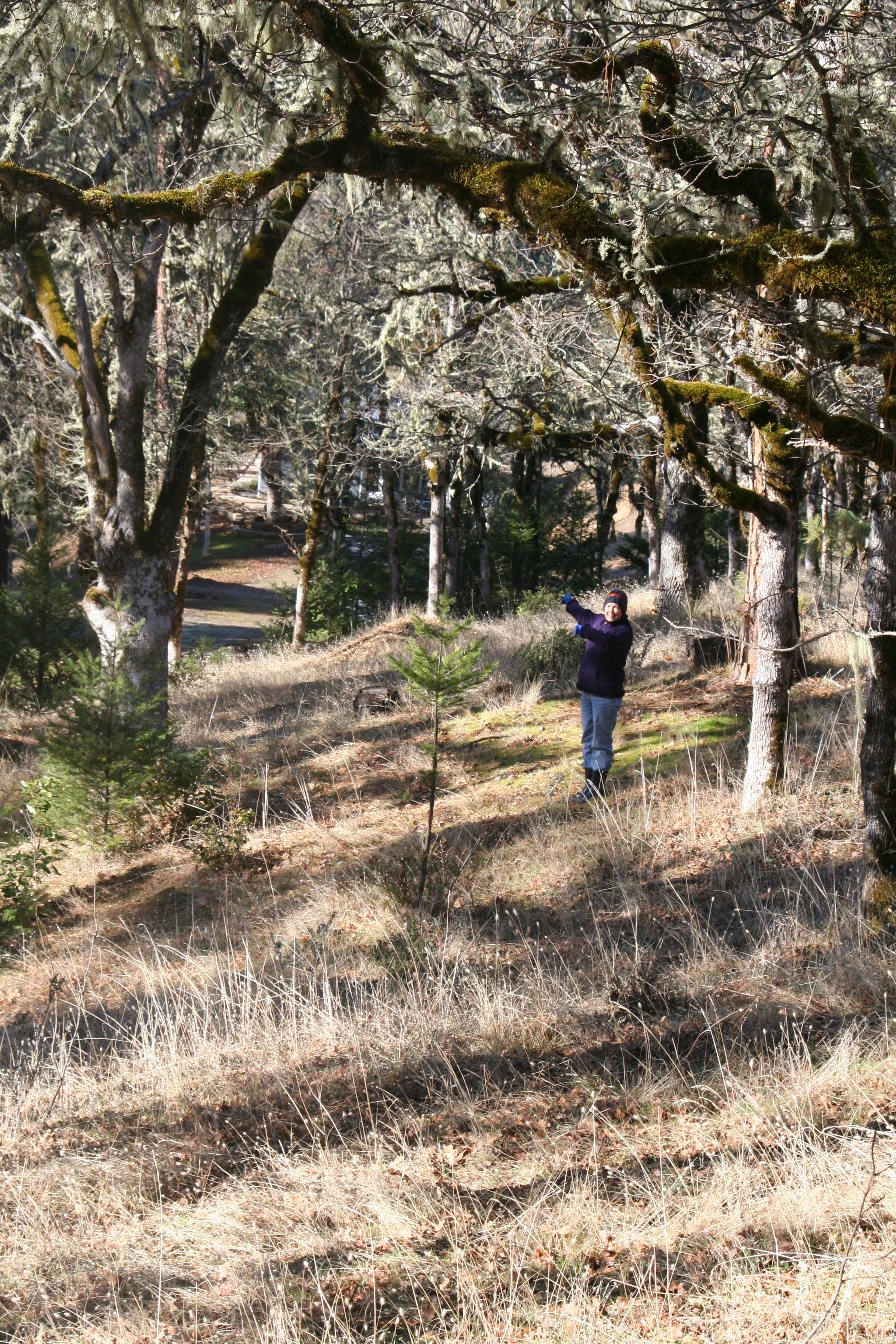
A distant Peggy stands in the middle of our White Oak forest, points to our distant house and says "mine."

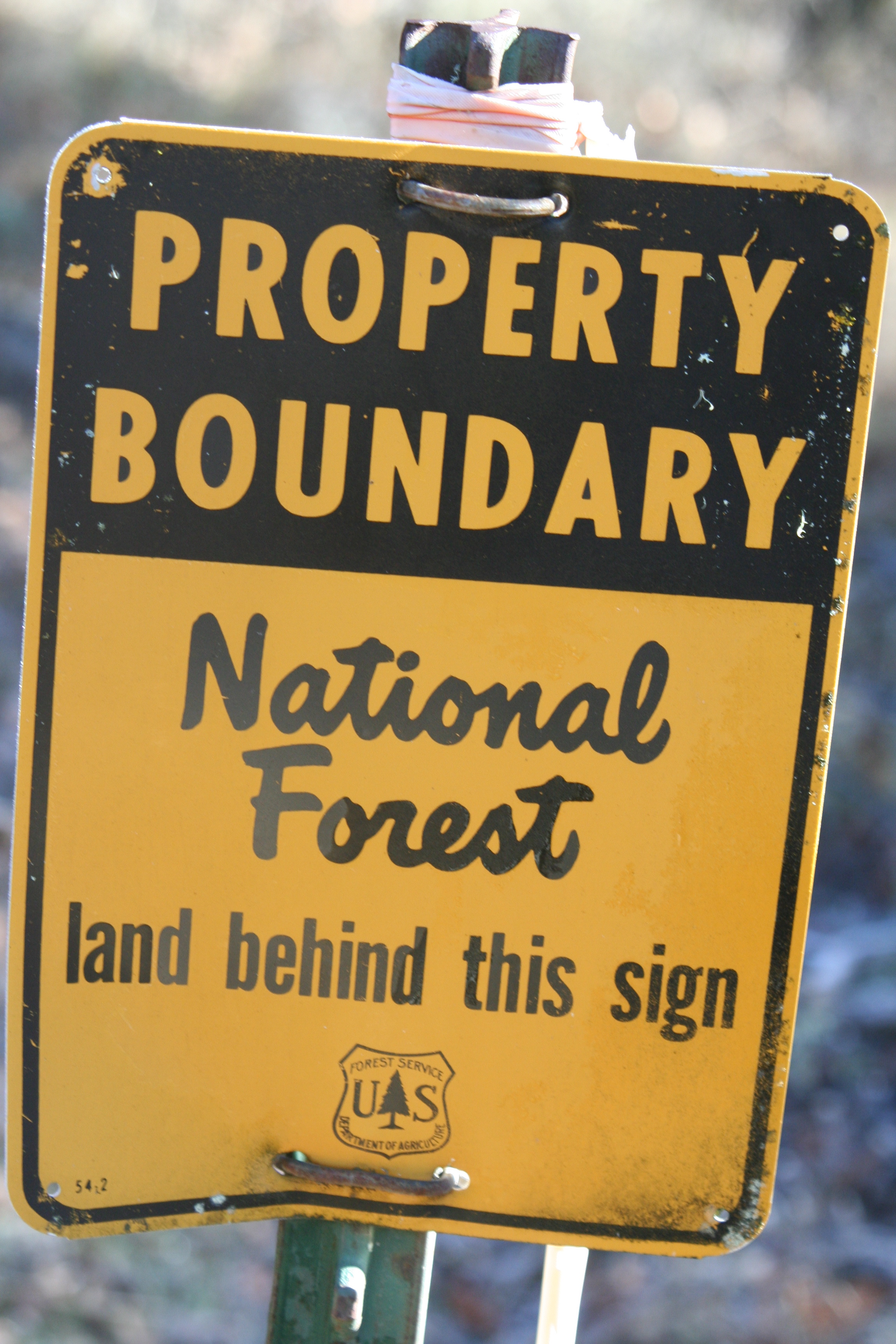
Behind this sign at the back of our property are 1.8 million acres of National Forest. I consider this photo one of the most scenic I have ever taken.

One of the reasons we bought our mountain retreat is so our grandchildren Christopher and Connor and their cousins Ethan and Cody can grow up playing in the woods and learning to appreciate the value of protecting America's great wilderness areas.

If Someone Steals your Dog, Spouse or Car, Who Do You Call: The Lightning Man

(This is one of a series of travel blogs I am doing on my experience as a Peace Corps Volunteer in Gbarnga, Liberia, West Africa to honor the 50th Anniversary of the Peace Corps.)

The dark side of tribal beliefs arrived at our house late one evening in the middle of a tropical downpour.

A very wet and frightened candidate for student body president, Mamadee Wattee, knocked on our door. The opposition had purchased ‘medicine’ from a Ju Ju Man (witch doctor in Tarzanese) to make him sick.

It was serious business; people were known to die in similar circumstances.

Had the opposition slandered Mamadee or stuffed the ballot box, I could have helped but countering black magic was way out of my league. I took the issue to the High School Principal and he dealt with it. Mamadee stayed well and won the election.

Later, he unintentionally introduced us to another tribal phenomenon, the Lightning Man.

I had left Mamadee with $50 to buy us a drum of kerosene while my wife and I were on vacation. When we returned home, Mamadee was sitting on our doorstep. Someone had stolen the money and he was obviously upset. Fifty dollars represented a small fortune to most tribal Liberians. (Given that we were paid $120 dollars a month for teaching, it was hardly spare change to us.)

Mamadee’s father, a chief of the Kpelle tribe, was even more upset and wanted to assure us that his son had nothing to do with the missing money. It was a matter of honor. He offered to hire a Lightning Man to prove Mamadee’s innocence.

The Lightning Man had a unique power; he could make lighting strike whoever was guilty of a crime. If someone stole your cow or your spouse, ZAP! Since we were in the tropics, there was lots of lightning. Whenever anyone was struck, people would shake their heads knowingly. One more bad guy had been cooked; justice had been served.

We didn’t believe Mamadee had taken the money and even if he had we certainly didn’t want him fried, or even singed. We passed on the offer.

Another Liberia Peace Corps Volunteer chose a different path. Here’s how the story was told to us. Tom had just purchased a $70 radio so he could listen to the BBC and keep up with the news. He enjoyed his new toy for a few days and it disappeared.

“I am going to get my radio back,” he announced and then hiked into the village where he quickly lined up some students to take him to the Lightning Man. Off they went, winding through the rainforest to the Lighting Man’s hut.

“I want you to make lighting strike whoever stole my radio,” Tom said, and then paid five dollars for the service. (Lightning Men have to eat too.)

Tom and his entourage then returned home. By this time, everyone in the village knew about the trip, including undoubtedly, the person who had stolen the radio.

That night, there was a tremendous thunder and lightning storm. Ignoring for the moment that it was in the middle of the rainy season and there were always tremendous thunder and lightning storms, put your self in the shoes of the thief who believed in the Lightning Man’s power. Each clap of thunder would have been shouting his name.

The next morning Tom got up, had breakfast and went out on his porch. There was the radio.

(In my next blog I will relate the story about how Do Your Part, my dog, invaded a mosque and barely escaped.)

The Bush Devil Ate Sam

(This travel blog is one of a continuing series where I relate my experience as a Peace Corps Volunteer in the mid 60s in Liberia, West Africa honoring the Peace Corps’ 50th Anniversary.)

Joining the Peace Corps should come with a label like they put on cigarette packs. It would read “Warning: This experience may change your concept of reality.

Our vision of the world is perceived through culturally tinted glasses. Not surprisingly, the reality of our parents and our society becomes our reality. It’s hard to imagine life from any other perspective. Close encounters with other cultures can shake this vision but not easily. We wear our culture like bulletproof vests, rarely allowing a stray thought to enter. Or we focus so hard on extolling our own culture that we fail to learn valuable lessons another culture may teach us.

One of the great values of the Peace Corps experience is the sensitivity and respect it teaches for the beliefs and values that other people hold. Often this leads to a greater appreciation of our own culture.

There are definite risks involved in running headlong into another society, however. Culture shock is one. The environment may be so different that it becomes disorienting and may lead to depression. My transition from California to Liberia was relatively smooth. At first, Gbarnga didn’t seem significantly different from my old hometown of Diamond Springs. I suffered much greater shock going from Diamond Springs to UC Berkeley.

Going native, or bush as it was called in Liberia, is another risk. A person becomes so enthralled with the new culture that he adopts it as his own. A joke circulated among West Africa Volunteers on how to determine if you were teetering on the edge.

Phase One: You arrive in country and a fly lands in your coffee. You throw the coffee away, wash your cup and pour yourself     a new cup.

Phase Two: You’ve been there a few months and a fly lands in your coffee. You carefully pick the fly out with your spoon and then drink the coffee.

Phase Three: It’s been over a year and you have become a grizzled veteran. A fly lands in your coffee. You yank it out with           your fingers, squeeze any coffee it swallowed back into the cup, and then drink the coffee.

Phase Four: You’ve been there too long. A fly lands in your coffee cup. You yank the fly out of the cup, pop it into your mouth     and throw the coffee away. It’s time to go home.

If Peace Corps Volunteers had a hard time with culture shock and going bush, the tribal Liberians had a tougher one. Traditional cultures normally find their confrontations with the western world a losing proposition. It isn’t that our culture is so great; it’s just that our technology is so glitzy. How do you keep Flumo down on the farm when he has heard the taxi horn calling or climbed on the Internet?

Gbarnga was on the frontier of cultural change in the 60s. On the surface, life appeared quite westernized. An occasional John Wayne movie even made it to town. My students would walk stiff-legged down the main street and do a great imitation of the Duke. They dreamed some day of traveling to America where they would swagger down dusty streets and knock off bad guys with their trusty six shooters.

In town, loud speakers blared out music at decibel levels the Grateful Dead would have killed for while Lebanese shops pushed everything from Argentinean canned beef to London Dry Gin. The epitome of Americana, a Coca Cola sign, dominated the road as you left town on the way to Ganta and Guinea.

We had enough US-based churches to satisfy Pat Robertson. Missionaries were everywhere. Baptists, Catholics, Episcopalians, Presbyterians and numerous other Christian groups worked the streets in unending competition to recruit African souls.

Sometimes, if I closed my eyes and pretended, I could almost believe I was home. Almost. Then Africa would whip around and bite me.

Sure, the local villagers would dutifully file in to church on Sunday morning and pray for blessings like their western counterparts did but Sunday afternoon would find them out sacrificing a chicken to make sure God got the message. And yes, the Coca Cola sign was there but next to it was a giant Cottonwood with offerings to the spirit that lived inside the tree.

Sam, the young Liberian who worked for us and spent hours listening to our record player getting Charley off the MTA, was another case in point. Scarification marks marched down his chest in two neat rows.

“How did you get those,” my ex-wife Jo Ann asked with 10 percent concern and 90 percent curiosity.

“I can’t tell you,” Sam replied with obvious nervousness as Jo’s eyebrows rose. “But I can tell Mr. Mekemson.”

“Aha,” I thought, “Sam and I belong to the same organization, the Men’s Club!” Actually Sam belonged to a very exclusive men’s organization, the Poro Society. Its function was to pass on tribal traditions and keep errant tribe members in line. The women had a similar organization called the Sande Society.

Sam had been to Bush School the previous summer and learned how to be a good Kpelle man. Graduation to adulthood consisted of an all-consuming encounter with the Poro Society’s Bush Devil.  It ate him. Sam went in as a child and was spit out as a man. The scarification marks had been left by the devil’s ‘teeth.’

It seemed like a tough way to achieve adulthood but at least it was fast and definitive. Maybe we should introduce the process to our kids and skip the teenage years. Think of all of the angst it would avoid.

Bush Devil was the missionary’s designation for a very important tribal figure who was part religious leader, part cultural cop and part political hack. Non-Kpelle types weren’t allowed to see him. When the Devil visited outlying villages, a front man came first and ran circles around the local Peace Corps Volunteer’s home while blowing a whistle. The Volunteer was expected to go inside, shut the door, close the shutters and stay there. No peeking.

We did get to see a Grebo Bush Devil once. The Grebo Tribe was a little less secretive or at least more mercenary than the Kpelle. Some Volunteers had hired the local Devil for an African style Haight-Ashbury Party. The Devil was all decked out in his regalia. Description-wise, I would say his persona was somewhere between a Voodoo nightmare and walking haystack. Grebo men scurried in front of him with brooms, clearing his path and grunting a lot.

We stayed out of the way and took pictures.

While the Bush Devil and the Sassywood Man I blogged about last week seem foreign and even threatening to the Western mind, the truth is that they played an important role in maintaining order within the tribal culture.

Next up: If somebody steals your dog, car or wife, who do you call: The Lightning Man!