A Genuine Fake Watch: Kusadasi, Turkey… Armchair Travel

Fake has taken on an interesting connotation today that has little to do with its original meaning. When Peggy and I visited Turkey in 2013 it was a different era, however. We were amused when a store was offering genuine fake watches at a price that matched. I almost bought one because of the honesty, which I’m sure was the idea. On Wednesday, we visited the impressive ruins of Ephesus. Today I will take you to Kusadasi, the land of expensive rugs and real fakes as I continue to dig into my archived blogs for armchair travel in the time of Covid-19.

Dozens of Turkish rugs were scattered on the floor in Kusadasi, Turkey, thrown out in a frenzy of encouraging us to buy.

The rugs were flying, quite literally, and landing on the floor in front of us. Twenty minutes earlier they had been neatly rolled up at the back of the room. Now five Turkish rug salesmen were expertly flipping them out onto the floor, a new one every ten seconds. We had been wined; we had been dined; we had been educated. Now the final push was on, the push to get us alone in a room where more multi-thousand dollar rugs would be thrown at us in hopes we would eagerly pull out our credit card with the highest limit.

Part of the show was an interesting demonstration on how carpets are made. Hundreds of hours are involved.
Part of the show was an interesting demonstration in the craft of carpet weaving. Fine rugs can take over a year to complete.

Peggy was ready. The falling rugs had hypnotized her. Her eyes were glazing over and she was levitating out of her seat as a handsome dark-eyed Turk wooed her with fine words. The last time I had seen that look we had ended up with a timeshare in Mexico. This time I was fortified, however. When the salesmen was passing out drinks to soften us up, I was one of two from our tour group of 30 who ordered arak or raki, the unsweetened Middle-Eastern anise drink with the smell of turpentine and the kick of a mule.

I admit the rugs were beautiful works of art, but I was arak strong. Our cabin in the woods of Southern Oregon did not need a Turkish carpet. “I’m sorry,” Peggy explained to her new best friend. “My husband doesn’t want a rug.” I was truly the bad guy in this scenario and the salesman gave me the look to prove it before he sidled off to corner another victim… oops, I mean client.

Buying a rug in Kusadasi is reputedly the quintessential Turkish experience and a whole industry is set up to make sure you do. The cruise industry is a major partner in this endeavor. Lectures on bargaining and quality are given on board the ship before arrival. Lists are provided of safe, preferred shops (i.e. those that share their profit with the ship). Our tour guide hurried us through ancient Ephesus sergeant-like to make sure we would make it to the shop on time. Tours are tightly scheduled. Each tourist needs the opportunity to buy a carpet.  Everyone profits. For the cruise ship this can mean a 50-60 percent kickback.

I hurried Peggy out with the promise of lunch and the opportunity to buy presents for the grandkids. Her brother John and his wife Frances stayed to buy a carpet, however, and ended up with two. Later we celebrated with them in their rambling Texas home as they rolled their children’s inheritance out on the floor.

Dozens of small shops were located in a modern Turkey bazaar near the port. It was touristy but fun. Since we were one of the last ships of the season, we found true bargains.
Dozens of small shops were located in a modern Turkish bazaar near the port. It was touristy but fun. Since we were one of the last ships of the season, Peggy found numerous bargains to make up for carpet we didn’t buy.
I was amused by this shop that offered genuinely fake watches... truth in advertising.
Truth in advertising. (grin)
As we wandered through the shops of Kusadasi I was attracted by the rich colors.
As we wandered through the shops of Kusadasi, I was attracted by the wealth of colors.
This plate was another example of the rich colors found in the shops of Kusadasi.
This plate closeup is another example of the rich colors, intricate patterns, and fine craftsmanship found in the shops of Kusadasi.
Francis unrolls John and her new silk carpet in their Texas home.
Frances eagerly unrolls John’s and her new silk carpet in their Texas home.
A closer look at the carpet. It really is beautiful and John assured me they bargained for a good price.
A closer look at the family heirloom. It really is beautiful and John assures me they bargained for a good price.

MONDAY’S POST: We are off to Venice where we walk on water.

An Incredible Library, a Regal Cat, and Powerful Women: Ephesus… Armchair Travel

I am adding to my armchair travel series today as Peggy and I continue to shelter at home hiding out from Covid-19. For today’s post I went traveling back in time through my blog archives and landed in the ancient Graeco-Roman of Ephesus, Turkey. It is located across the Aegean Sea from Athens. Peggy and I traveled there in 2013 along with her brother John Dallen, his wife Frances, and their/our friends Lee and Kathy Saage.

The Greek Goddess Nike, with wings all aflutter, hands over the wreath of Victory to Rome... which is appropriate since Rome took over the Greek city and turned it into the second largest city in the Roman Empire.
The Greek Goddess Nike, with wings all aflutter, hands over the wreath of Victory to Rome, which is appropriate since Rome took over Greek Ephesus and turned it into the second largest city in the Roman Empire. Note the muscular arms. Not even iron-pumping Arnold Schwarzenegger would mess with this woman.

Artemis, The Greek Goddess of the hunt, chastity, virginity and fertility was big in Ephesus. (Somehow, being the Goddess of chastity and virginity— while also being the Goddess of Fertility— doesn’t compute.) Her temple, built in the sixth century BC, was considered one of the Seven Wonders of the Ancient World. Each May, the local Greeks would honor her with a Festival of Roses, which brings Mother’s Day to mind. As part of the festival they would sacrifice a number of bulls to encourage fertility. Modern time Mother’s Day has dropped this part of the ceremony.

Artemis wearing her vest of Bull's testicles. Other statues suggest that the bulb-like objects are breasts.
Artemis is looking rather weird, to say the least. She looks like she is offering a hug. If so, I pass.

Artemis is only a part of the Ephesus’ family of powerful women. Before the Greek Goddess Artemis became top female in the area, the Hittite mother-goddess Kubaba and the Anatolian goddess Cybele had reigned supreme. Amazons, the large warrior women who thought of men mainly as a source for making baby girls, were also known to frequent the region.

Following Artemis, the Virgin Mary was reputed to have spent her last days in Ephesus. A German mystic dreamed it and there is some historical support. Various modern Catholic Popes have backed up the supposition and Pope John Paul II declared the site where she supposedly died to be a shrine for Christian pilgrimages. Muslims, who call her Mother Mary, also make pilgrimages to the area. It stands on a hill above Ephesus.

Ephesus is located on the western coast of modern-day Turkey. We took a tour bus out to the site with a very talkative tour guide who shared with us that Santa Claus originated in Turkey, as well as a number of facts about Ephesus. The city had been an important part of Ionian Greece and included such luminaries as the Greek philosopher Heraclitus.  In case you’ve forgotten your philosophers, Heraclitus, whose nickname was the Obscure, claimed that only change is permanent. “You never step in the same river twice,” he said.

This was certainly true of the Meander River. Ephesus was located on its banks and the curvy waterway kept moving to new locations, forcing Ephesus to move. And yes, the Meander River happens to be where our word meander comes from. I am rather fond of meandering.

It was the Romans who brought Ephesus to its height around 100 AD with a population of over 250,000, making Ephesus the second largest city in the Roman Empire. Most of the ruins featured below came from that period.

The iconic ionic Greek column with its simple scroll like top is said to have originated in Ephesus.
The iconic Ionic Greek column with its simple scroll like top is said to have originated in Ephesus.
This handsome Ephesus cat conveniently sat in front of another Ionic column.
This handsome, regal-looking Ephesus cat conveniently posed for me in front of another Ionic column.
Greek and Roman columns, BTW, did not come in one long section. They came in chunks like this column and were then put together.
The most impressive use of columns among the existing ruins of Ephesus is in the beautiful Library of Celsus, which happened to be the third largest library in the ancient world and contained over 12,000 books.
The most impressive use of columns among the existing ruins of Ephesus is in the beautiful Library of Celsus, which happened to be the third largest library in the ancient world and contained over 12,000 books. People provide perspective on size.
I took this photo while standing in front of the library and shooting upward. To provide a size perspective, the column on the left is 40 feet tall.
I took this photo while standing in front of the Library of Celsus and shooting upward. The column on the left is 40 feet tall.
The Library of Celsus used Corinthian Columns shown here as opposed to the Ionic columns shown above column show.
The Library of Celsus used ‘leafy’ Corinthian columns shown here as opposed to the Ionic columns shown above.
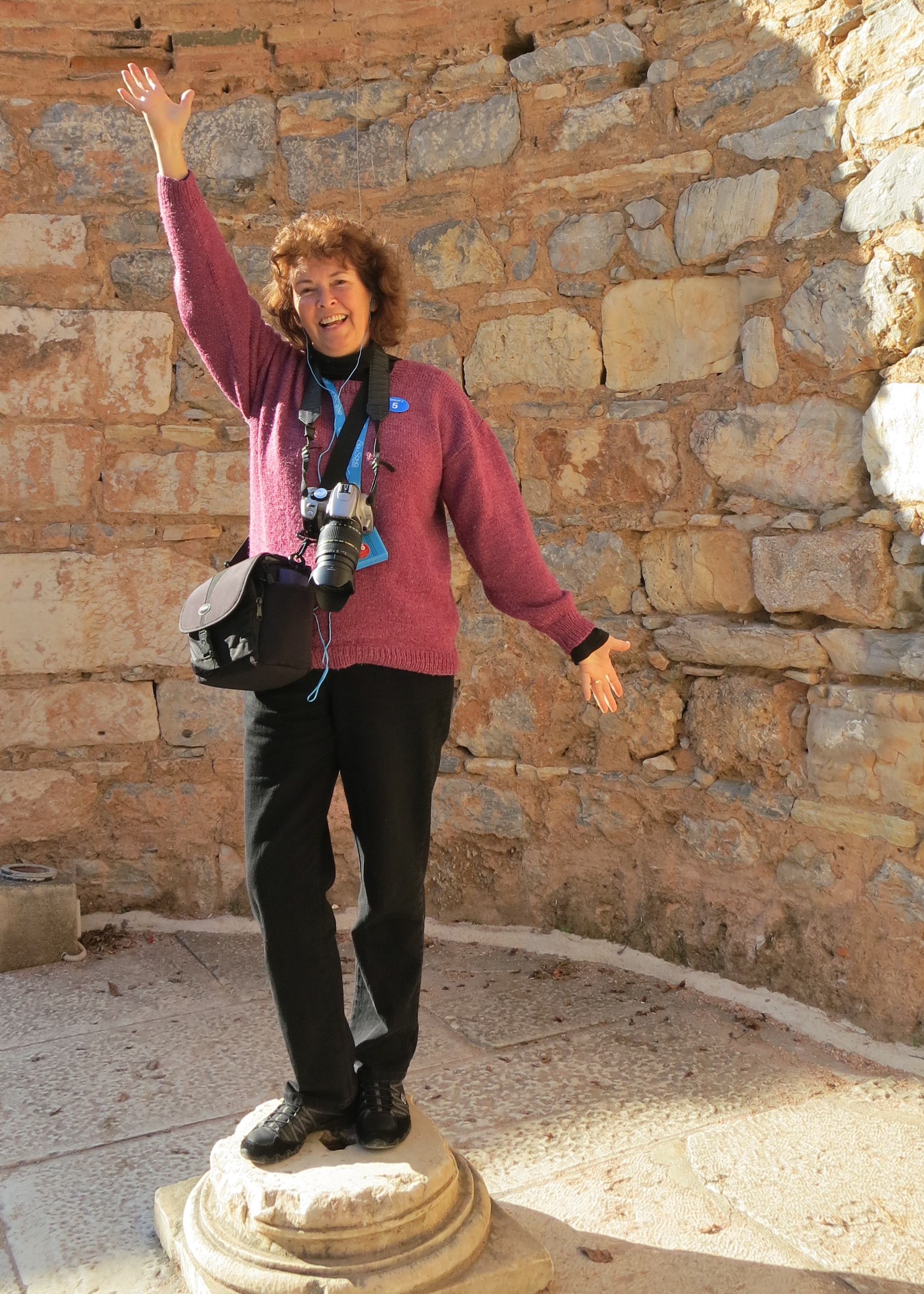
My wife Peggy, another powerful woman, poses on a pedestal inside the Library of Celsus that may have once accommodated the Greek goddess Athena. I didn't tell Peggy she was dancing on the grave of Celsus.
Peggy, another powerful woman, poses on a pedestal inside the Library of Celsus that may have once accommodated the Greek goddess Athena. I didn’t tell Peggy she was dancing on the grave of Celsus.
Unless you were wealthy in Ephesus, you used the common toilets shown here where you could line up with your friends and discuss the day's news while taking care of business. The men's toilet house could accommodate up to 40 people at once.
Unless you were wealthy in Ephesus, you used the common toilets shown here where you could line up with your buddies and discuss the day’s news while taking care of business. The men’s toilet house could accommodate up to 40 people at once. Water flowed constantly under the toilets to remove wastes and deposit them in the Meander River.
Speaking of plumbing, these clay pipes ran underneath the city of Ephesus and provided a sophisticated means of supplying water.
Speaking of plumbing, these clay pipes ran underneath the city of Ephesus and provided a sophisticated means of supplying water as well as removing wastes.
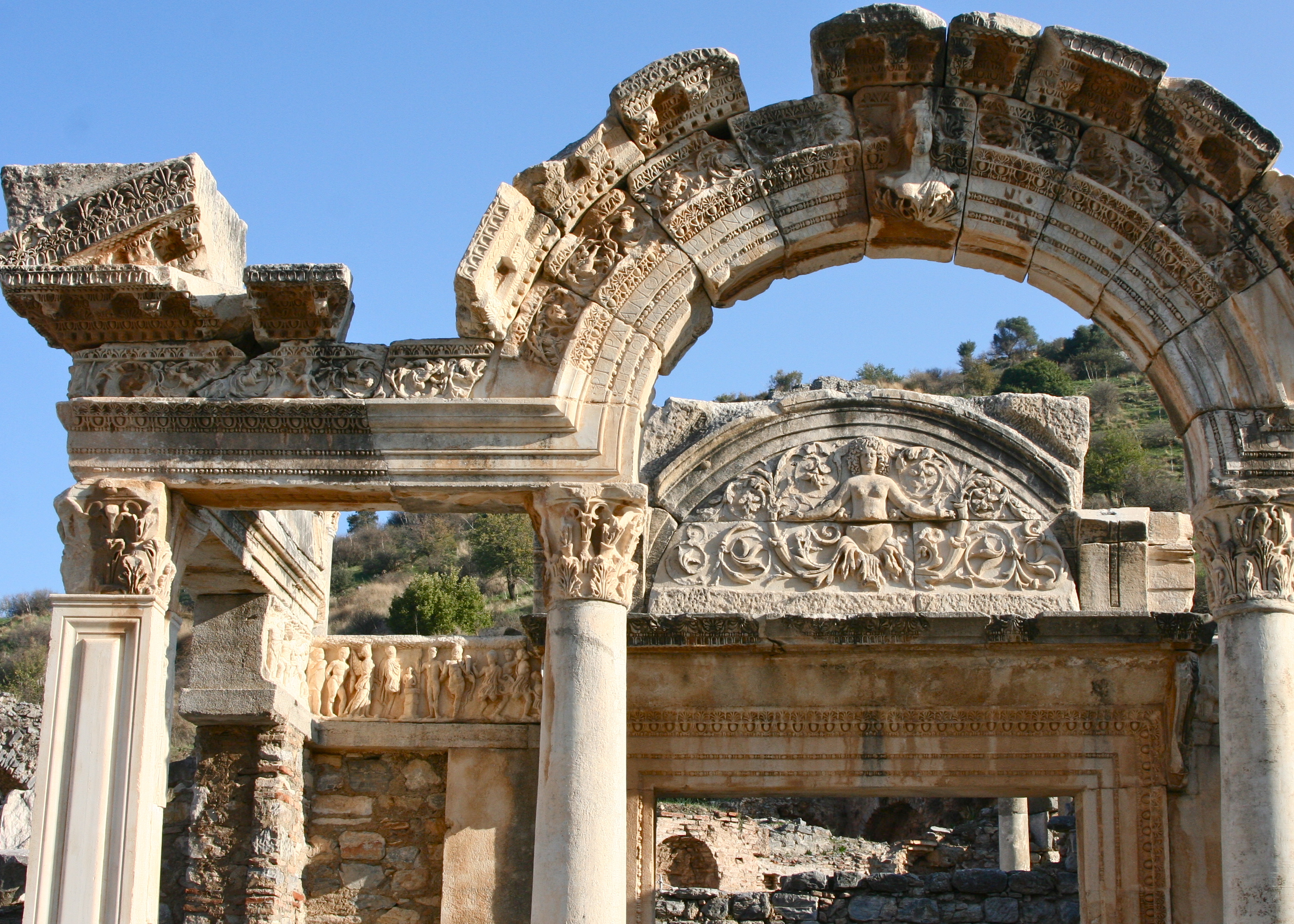
This is Hadrian's Temple. Hadrian () was one of the greatest of Roman emperors and was known for his building projects, the most famous being Hadrian's Wall in England. Hadrian loved everything Greek including the young man, Antinous, featured on the front arch. The woman featured on the second arch was likely Medusa, whose hair was made of writhing snakes and whose look could turn a man to stone. How much more powerful can you get?
This is Hadrian’s Temple. Hadrian (76-138 AD), one of the greatest of Roman emperors, was known for his building projects, the most famous being Hadrian’s Wall in England. Hadrian loved everything Greek— including the young man, Antinous. The woman shown on the second arch was likely Medusa, whose hair was made of writhing snakes and whose mere glance could turn a man to stone. How much more powerful can you get? (Photo by Peggy Mekemson)
Walk this way boys. Sailors arrived in Ephesus from all over the Mediterranean and not too many could read or write. Our guide told us this was and advertisement for the local brothel that provided a convenient map.
Sailors arrived in Ephesus from all over the Mediterranean and not many could read or write. Our guide told us this was a visual aid for finding the local brothel. Walk this way.
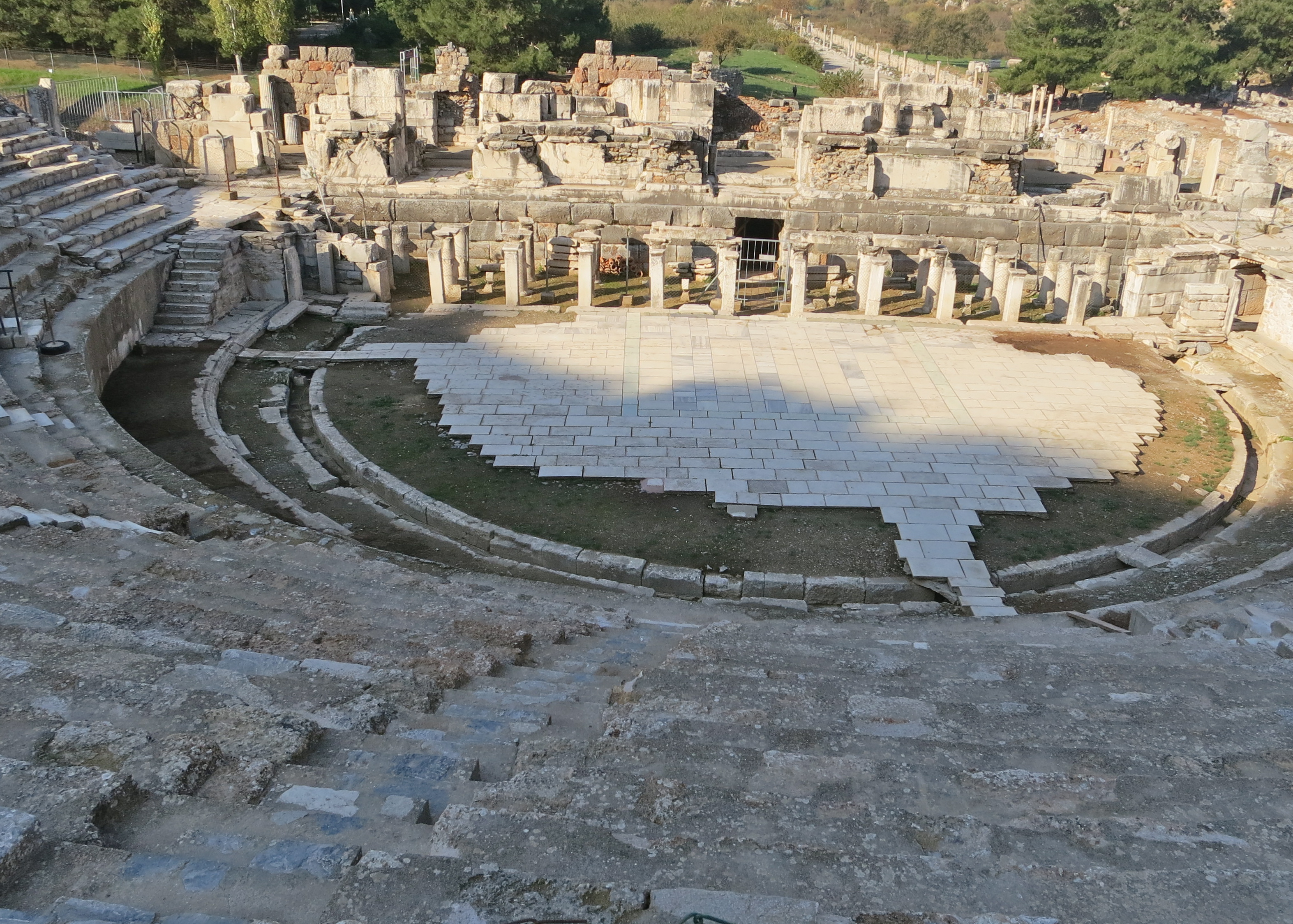
The Great Theater of Ephesus provided seating for 25,000 people. Acoustics are excellent. Modern performers have included Sting and Diana Ross.
The Great Theater of Ephesus provided seating for 25,000 people. Acoustics are excellent. Modern performers have included Sting and Diana Ross. Ancient performers included St. Paul, who apparently caused a riot.
It's showtime! Peggy and I, John and Francis Dallen and Lee Saage are ready for the gladiators.
It’s showtime! Peggy and I, John and Francis Dallen and Lee Saage are ready. Bring on the gladiators. (Photo by Kathy Saage.)

NEXT BLOG: Since we are in Turkey, my next post will explore the city of Kusadasi, where Peggy lusts after a Turkish rug and her brother buys two.

The Gargoyles of Dubrovnik— And a Saint’s Finger… Armchair Travel

Today, I am continuing to dig back into my Word Press archives by looking at gargoyles. I have a weakness for them. While they are said to scare away evil spirits, they attract me. What can I say? As for the various body parts of saints, you will find them scattered in Catholic churches throughout Europe. One can only wonder… Anyway, Gargoyles and a sacred finger are the subject of today’s armchair travel as I wrap up my posts on Dubrovnik.

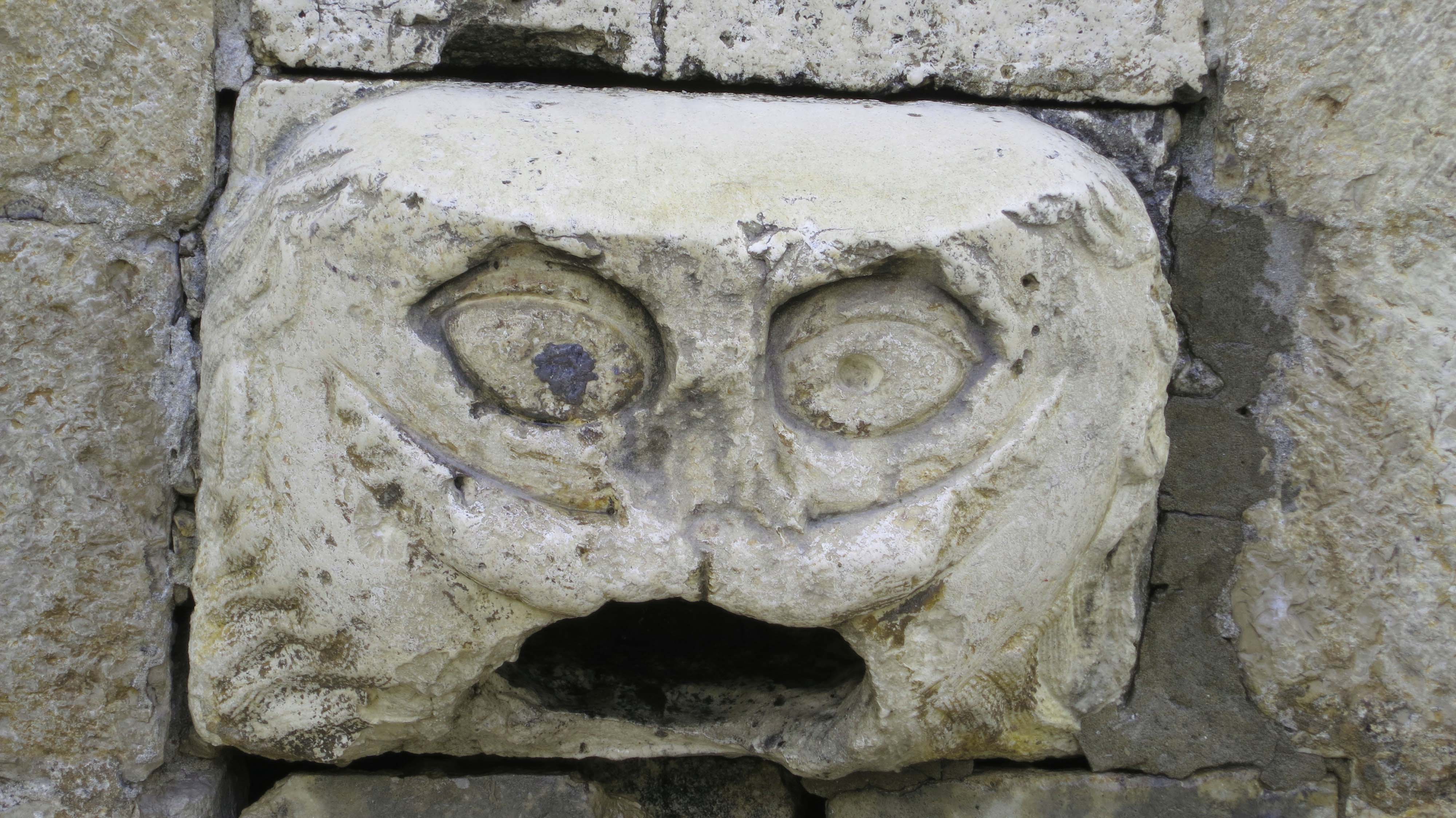
I found this marvelous gargoyle about a foot off the Stradun connected the the Franciscan Monastery.
I found this marvelous gargoyle about a foot off the Stradun connected to the Franciscan Monastery in Dubrovnik, Croatia. Check out the great mustache!

Weird amuses me— and few things are more weird than a gargoyle. During the middle ages, no decent cathedral would be caught without them. In addition to piping water away from the building, they served as reminders to the faithful that evil lurked in the world, an evil that could only be overcome by attending church and donating money. Their cousins, grotesques, were also found on churches. Equally ugly and portentous, they didn’t carry water.

Whenever I get near a gargoyle or grotesque, I can’t help myself; I have to take its photo. Fortunately, Peggy feels the same way.

Peggy caught this Dubrovnik gargoyle. Possibly it represents one of the winds.
I took this closeup of the Dubrovnik gargoyle Peggy photographed above. Note the water dribbling down its chin.
I took this closeup of the Dubrovnik gargoyle Peggy photographed above. Note the water dribbling down its chin. I don’t know about you, but I always find it interesting to try different perspectives when I am photographing something.
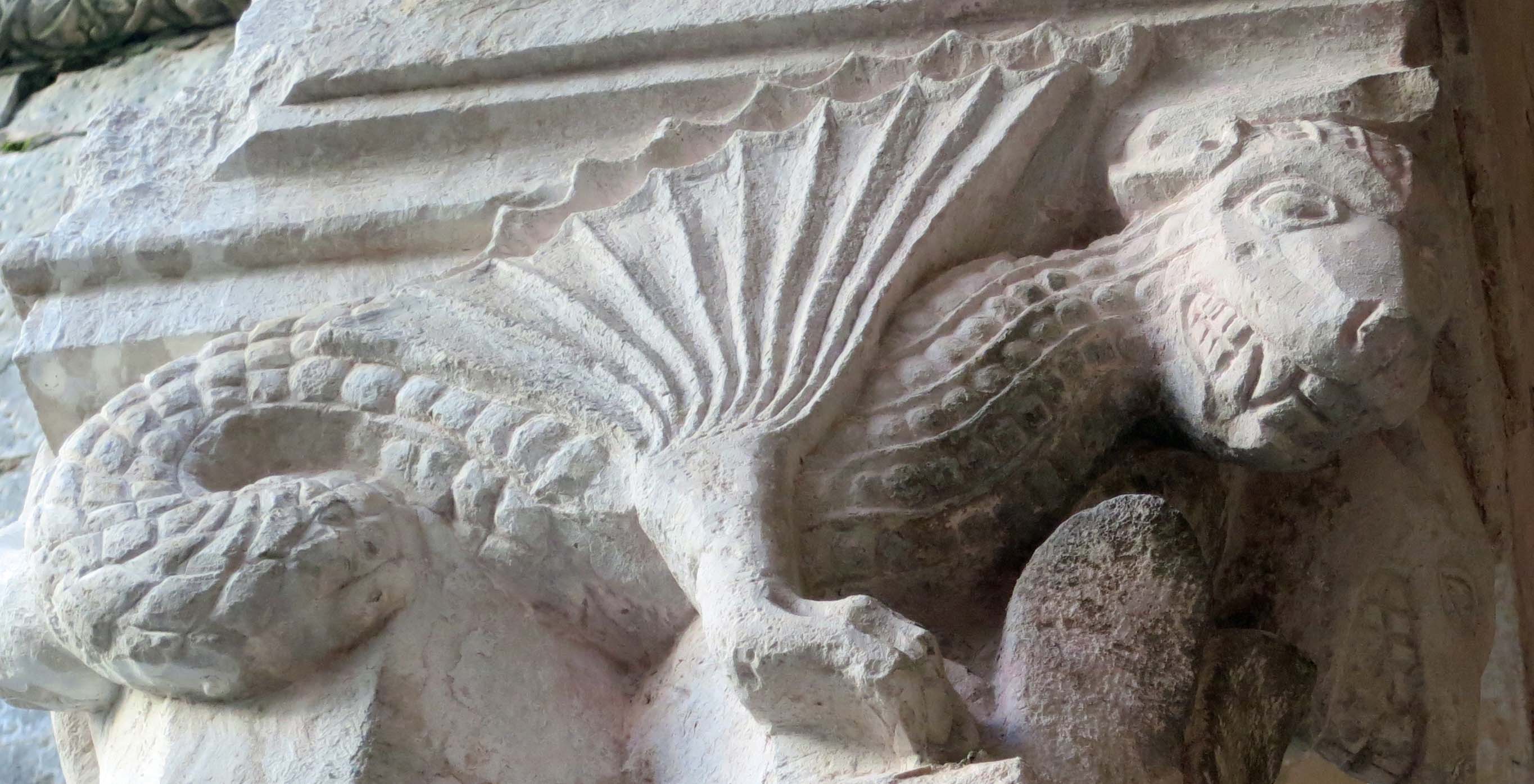
We found examples of grotesques in the cloister of the Franciscan Monastery of Dubrovnik on top of columns. (Photo by Peggy Mekemson)
Dragons were a popular subject for both gargoyles and grotesques. What could be more scary. We found this specimen with his fine set of choppers in the Franciscan Monastery.

I have also found that fountains in Europe often host strange-looking beings. While the wealthy in pre-modern times might have water piped into their homes, the common folks obtained their water from community fountains. Dubrovnik built an aqueduct system in the mid 1400s to bring water to the city and then located two public fountains on the Stradun: big Onofrio’s Fountain located near the Pile Gate and little Onofrio’s Fountain found next to the clock tower in Lutz Square.

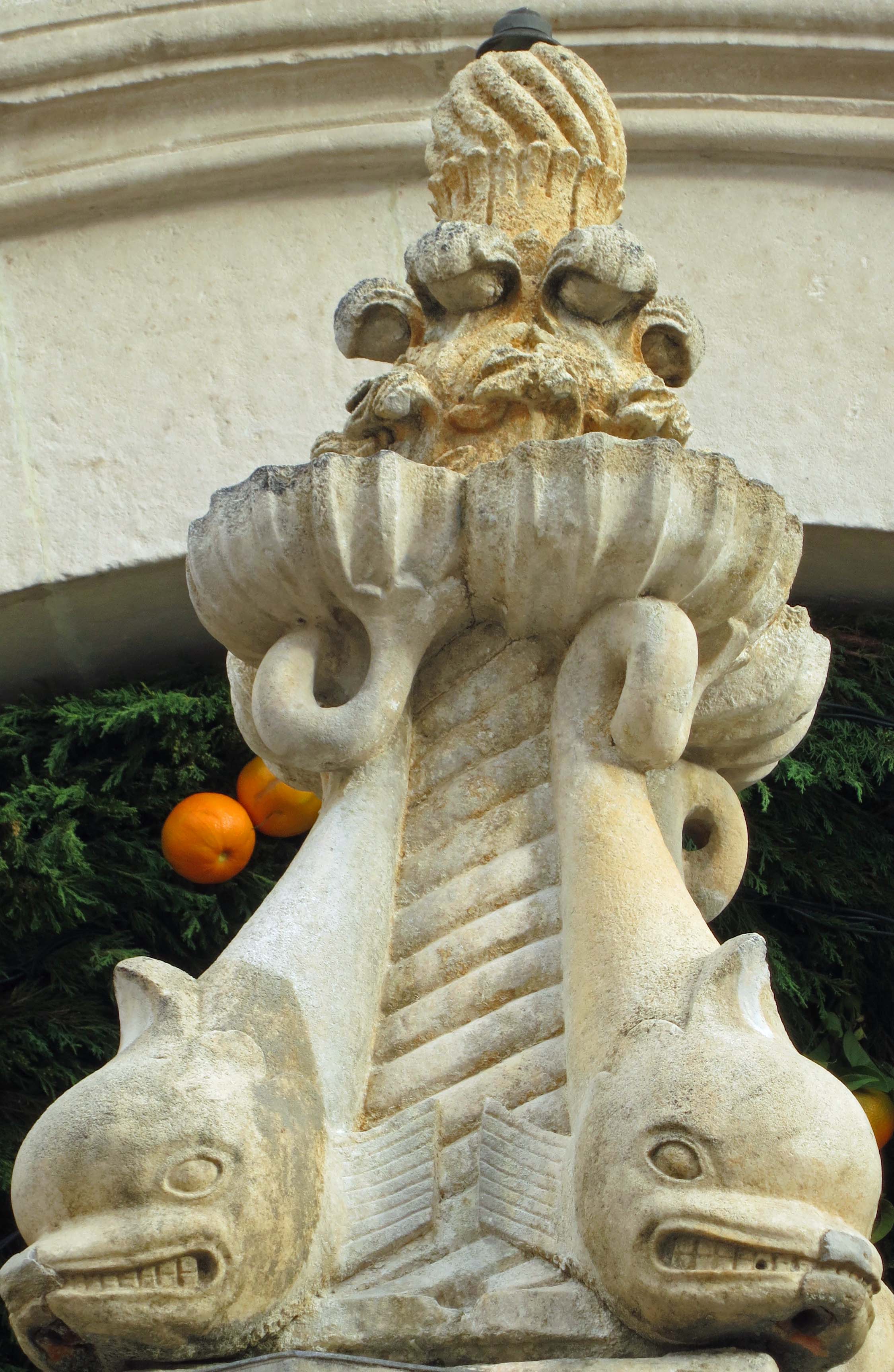
The top of Little Onofrio's Fountain with its ferocious looking fish. The fountain is located near the clock tower in Dubrovnik, Croatia.
The top of little Onofrio’s Fountain with its ferocious looking fish. The fountain is located near the clock tower in Dubrovnik, Croatia. If I caught something like this, I’d be cutting my line!
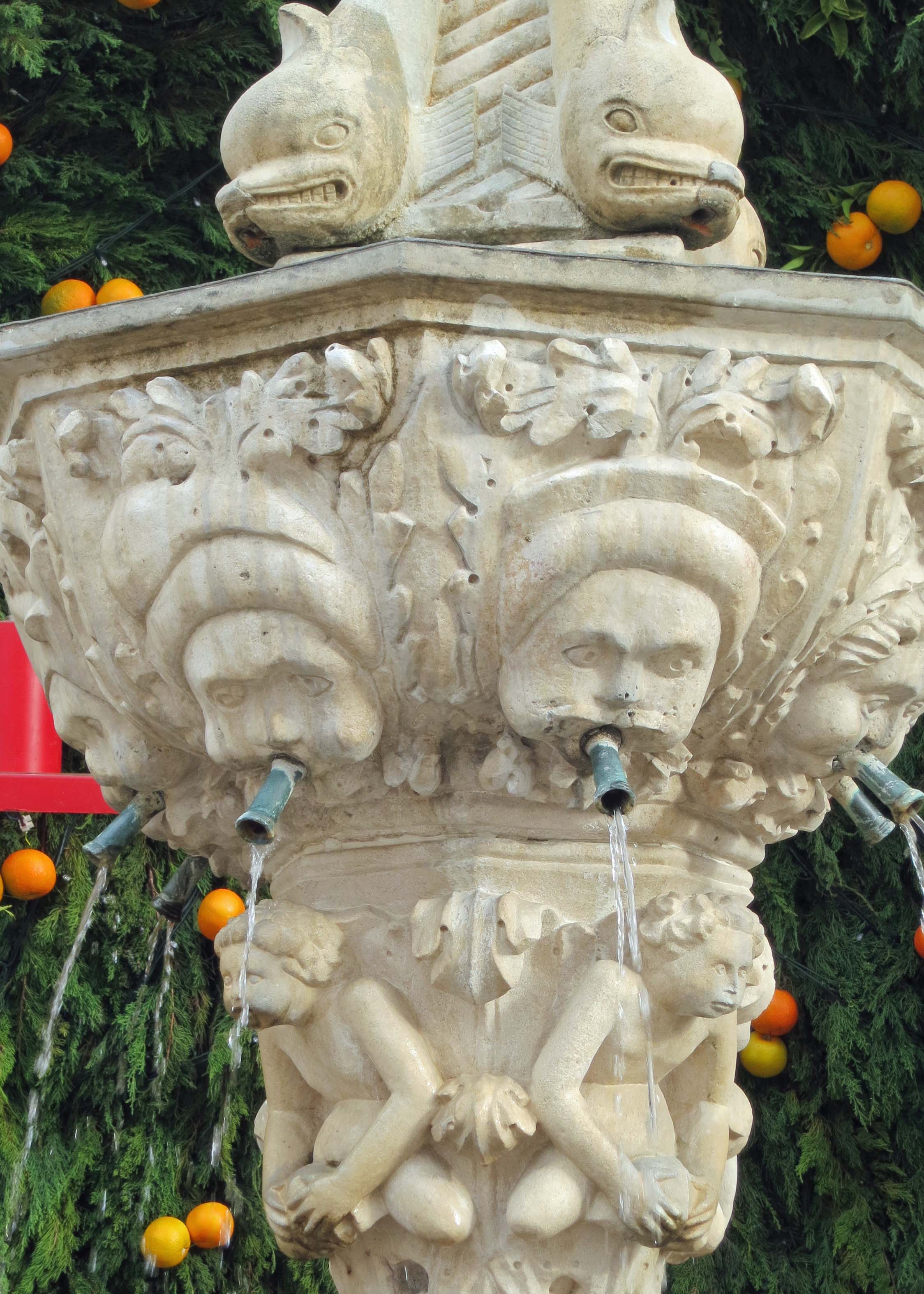
Another view of Little Onofrio's Fountain.
Another view of little Onofrio’s Fountain. The oranges, BTW, were part of Dubrovnik’s Christmas decorations.
Big Onofrio's Fountain located near the Pile Gate had 16 sides and each side featured a different mask with a spout coming out of its mouth. This was a cow mask.
Big Onofrio’s Fountain located near the Pile Gate had 16 sides and each side featured a different mask with a spout coming out of its mouth. This was a cow mask. Or maybe it was a bull.

Something I find even stranger than gargoyles, grotesques, or fountain inhabitants are relics— bits and pieces of saints or other holy items kept around in reliquaries as items of worship.  Pieces of the Cross are a common example. I once read that selling pieces of the cross was a thriving business during the Middle Ages. Scam comes to mind. The Dubrovnik Cathedral has a particularly impressive set of relics including a requisite piece of the Cross, Baby Jesus’ swaddling clothes, and various body parts of St. Blaise.

All of these items are reputedly capable of performing miracles and it is something of a miracle they exist. How they were obtained is usually rooted in the murky past. Pieces of the swaddling clothes were provided to women having difficult births. No matter how many pieces were cut out of the cloth, so it is said, the cloth returned to its original form.

I came across St. Luke’s finger in the small museum found in the Franciscan Monastery in Dubrovnik. The finger is encased in a gold reliquary. I know people take these items seriously and believe they have miraculous powers, but I find them on the far side of strange. I would almost bet that it cost the monastery an arm and a leg to get the finger.

NEXT POST: You want gargoyles? Wait until you see the white oak trees on our property and in the national forest behind us. These trees would fit right into “Lord of the Rings” or most other fantasies— or horror movies. My theory is that they will scare the heck out of the coronavirus if it comes around. Remember how the gargoyles were supposed to scare the evil spirits away from medieval cathedrals in Europe? I bet that they were recruited to frighten the plague as well! I know better, but it is fun to contemplate. And I find the trees interesting and amusing as opposed to scary. (At least during the day.)

Exploring the Streets of Dubrovnik… Armchair Travel

In this armchair travel post, Peggy and I walk the streets of Dubrovnik reliving our 2013 visit. We were there off-season a few weeks before Christmas, happily putting up with rainy weather to avoid the crowds of tourists!

The Stradun, Dubrovnik's main thoroughfare, lit up by sun after a rain storm.
The Stradun, Dubrovnik’s main thoroughfare, wet after a rain storm.

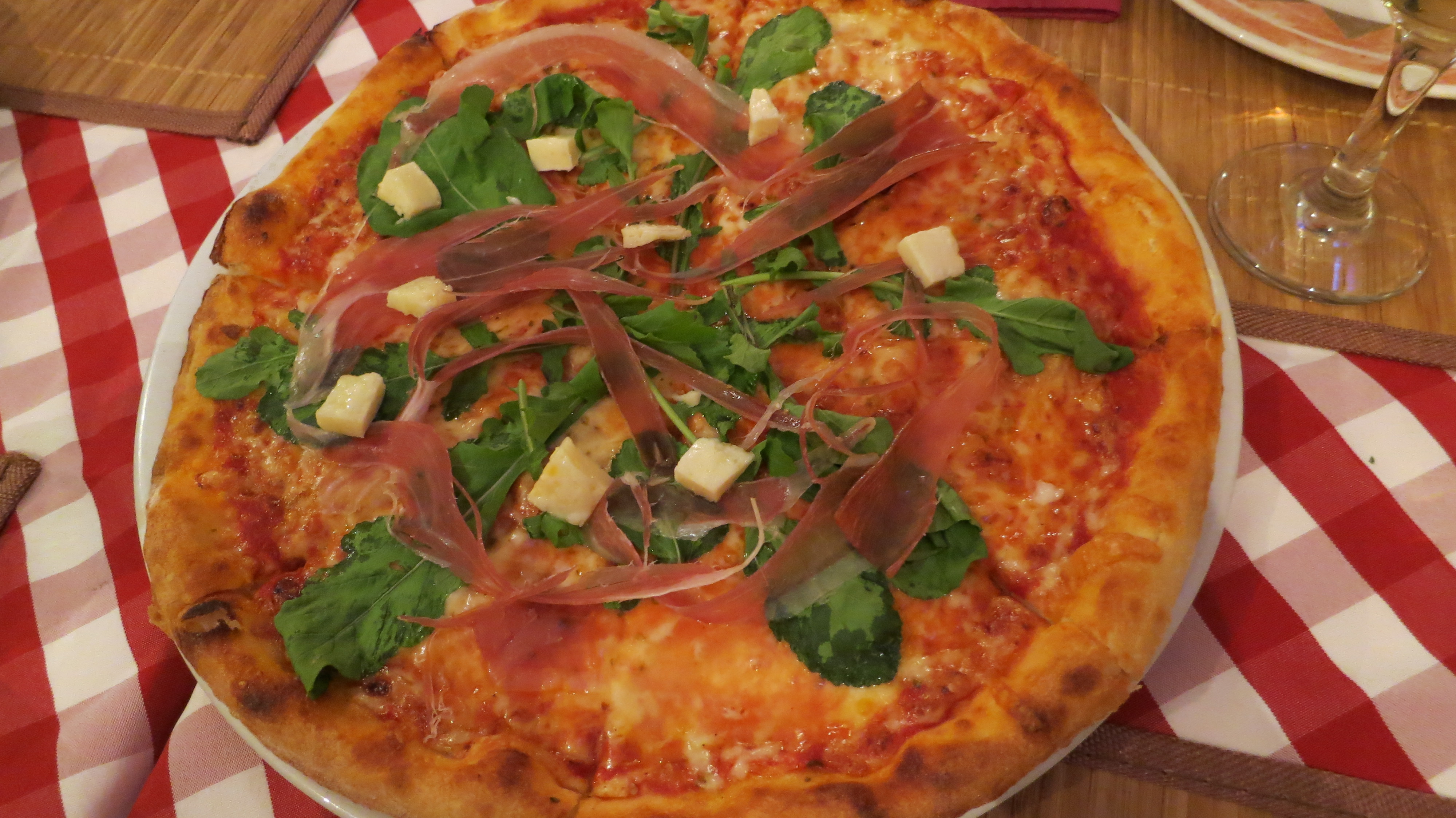
Luck was with us— the rain held off while we were on the walls of Dubrovnik and waited for us to descend to the Stradun, the city’s main thoroughfare. Lunch and pizza occupied most of the downpour. Afterwards we were treated to shiny, wet streets.

Our pizza, Croatian style.

In its first life the Stradun had been a winding canal separating Dubrovnik’s Roman and Slav populations. The canal was filled in during the Eleventh Century and brought the two populations together. A devastating earthquake took out most of the town in 1667 and Dubrovnik rebuilt the road to its present straight alignment.

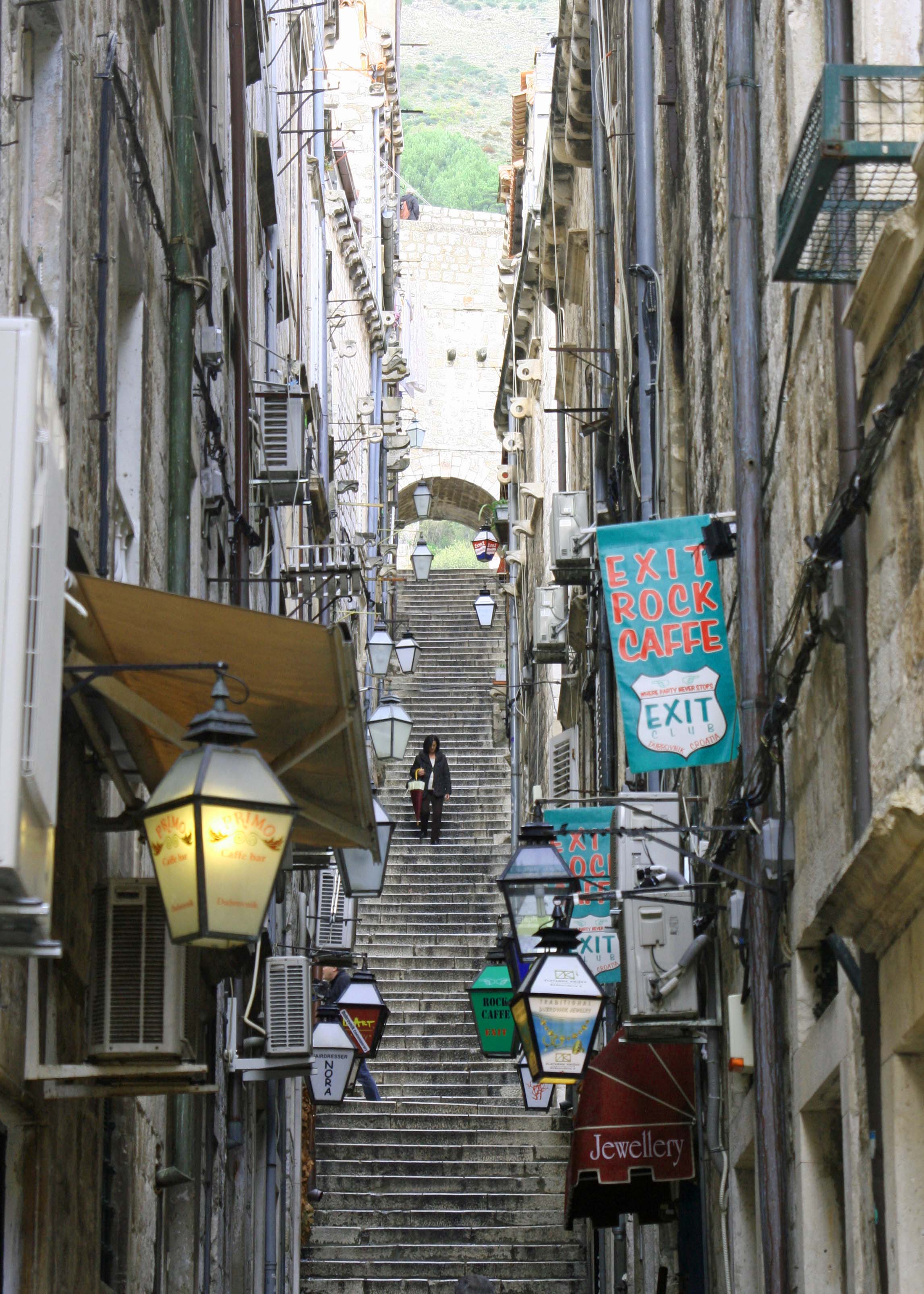
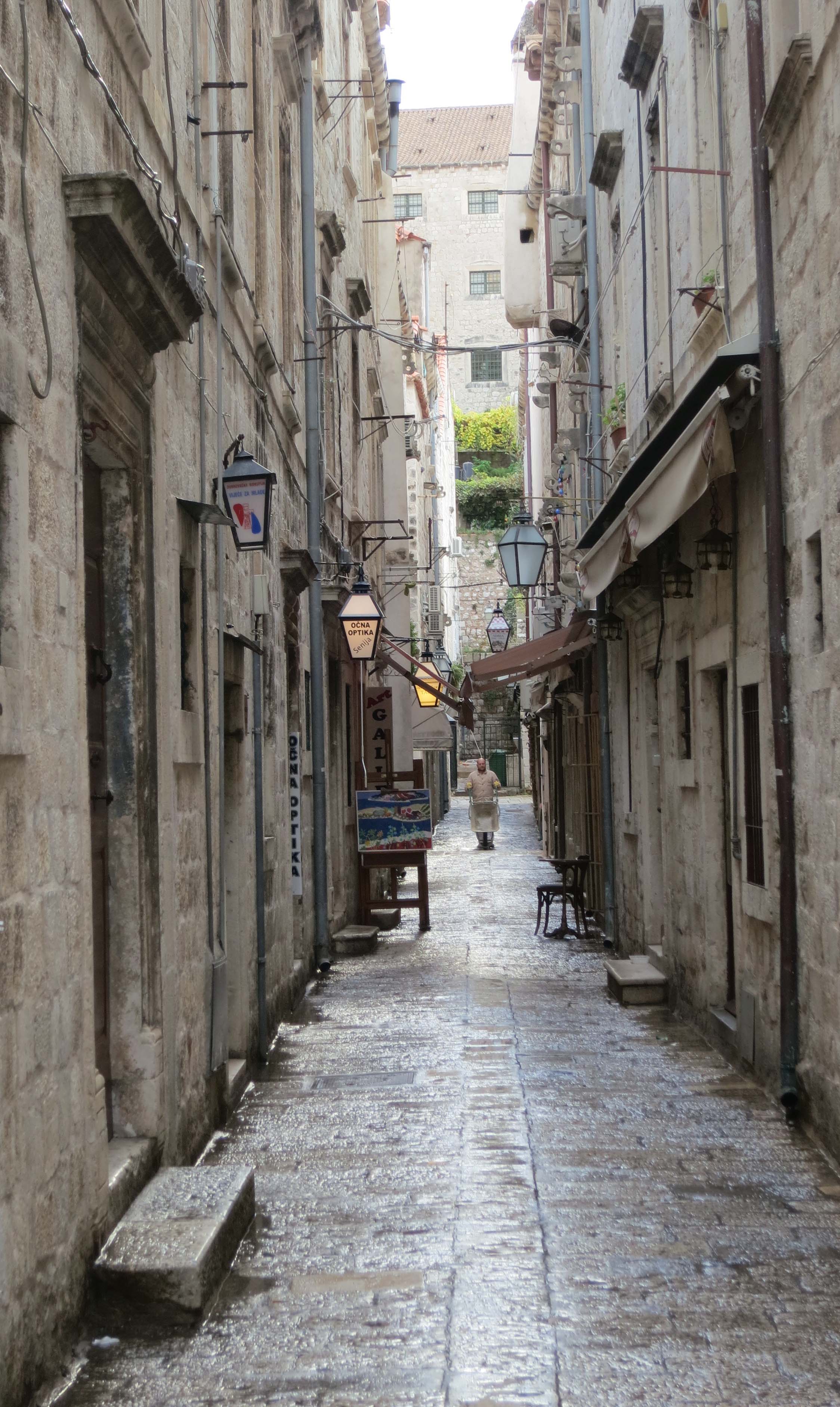
Narrow pedestrian ways shoot off in both directions from the Stradun and invite exploration. Plazas anchor both ends of the street. Since we arrived in December, Dubrovnik was preparing for the holidays. Two Christmas trees competed for our attention in Luza Square. I found one outlined by a window in the old Customs House to be particularly dramatic.

Walkways such as this and the one below branch off from the Stradun in Dubrovnik, Croatia and invite exploration.
Dubrovnik walkway.
Dubrovnik walkway. No crowd here.
We visited Dubrovnik in December and found the city preparing for the holidays. In this picture,a Christmas tree is gracefully outlined by a window in Sponza Palace, the old custom house.
With Christmas coming, the city was decorated to celebrate. Here, a Christmas tree is gracefully outlined by a window in Sponza Palace, the old custom-house.
Another photo of Sponza Palace, the Christmas Tree and Dubrovnik's clock tower.
Another photo of Sponza Palace, the Christmas Tree and Dubrovnik’s clock tower.

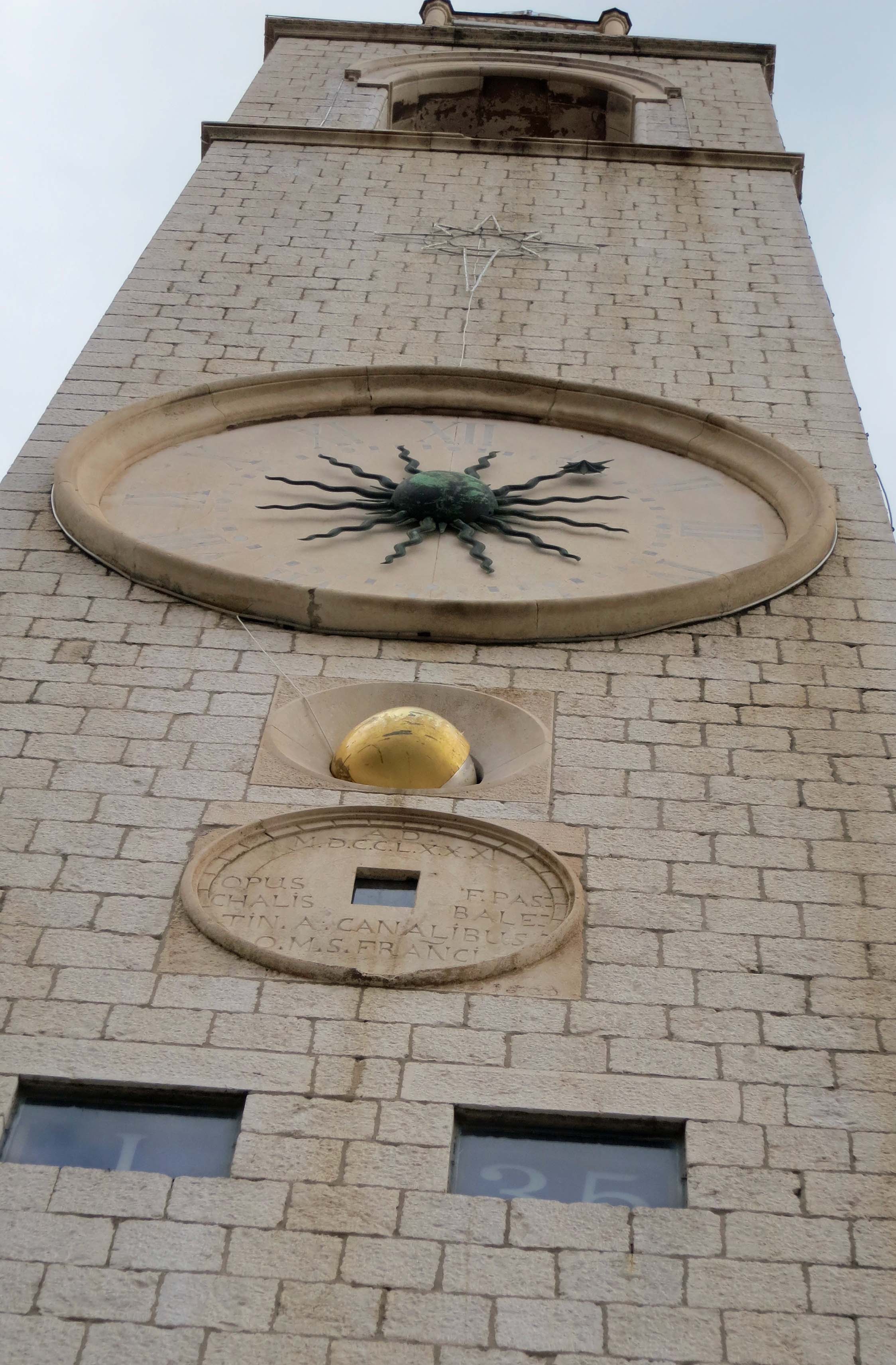
The town’s bell tower and clock, St. Blaise’s Church and Orlando’s Column and are also prominent features of Luza Square. Both St. Blaise and Orlando symbolize Dubrovnik’s fierce sense of independence.

A close up of the Dubrovnik clock tower.
A close up of the Dubrovnik clock tower. A digital clock at the bottom adds a touch of modernization.

St. Blaise was an early third century Christian Martyr from Armenia who was so holy that wild animals were said to drop by his cave for a blessing. The Romans used steel combs to flay off his skin and then beheaded him. Since the combs resembled those used for carding wool, Blaise became the Patron Saint of the wool trade. Go figure.

He earned the everlasting gratitude of Dubrovnik by appearing in a vision to a local priest to warn of an imminent invasion by the Venetians in 971. Ever since, the locals have loved St. Blaise and disliked Venice. They celebrate his birthday by parading various parts of his body through the city on February 3.

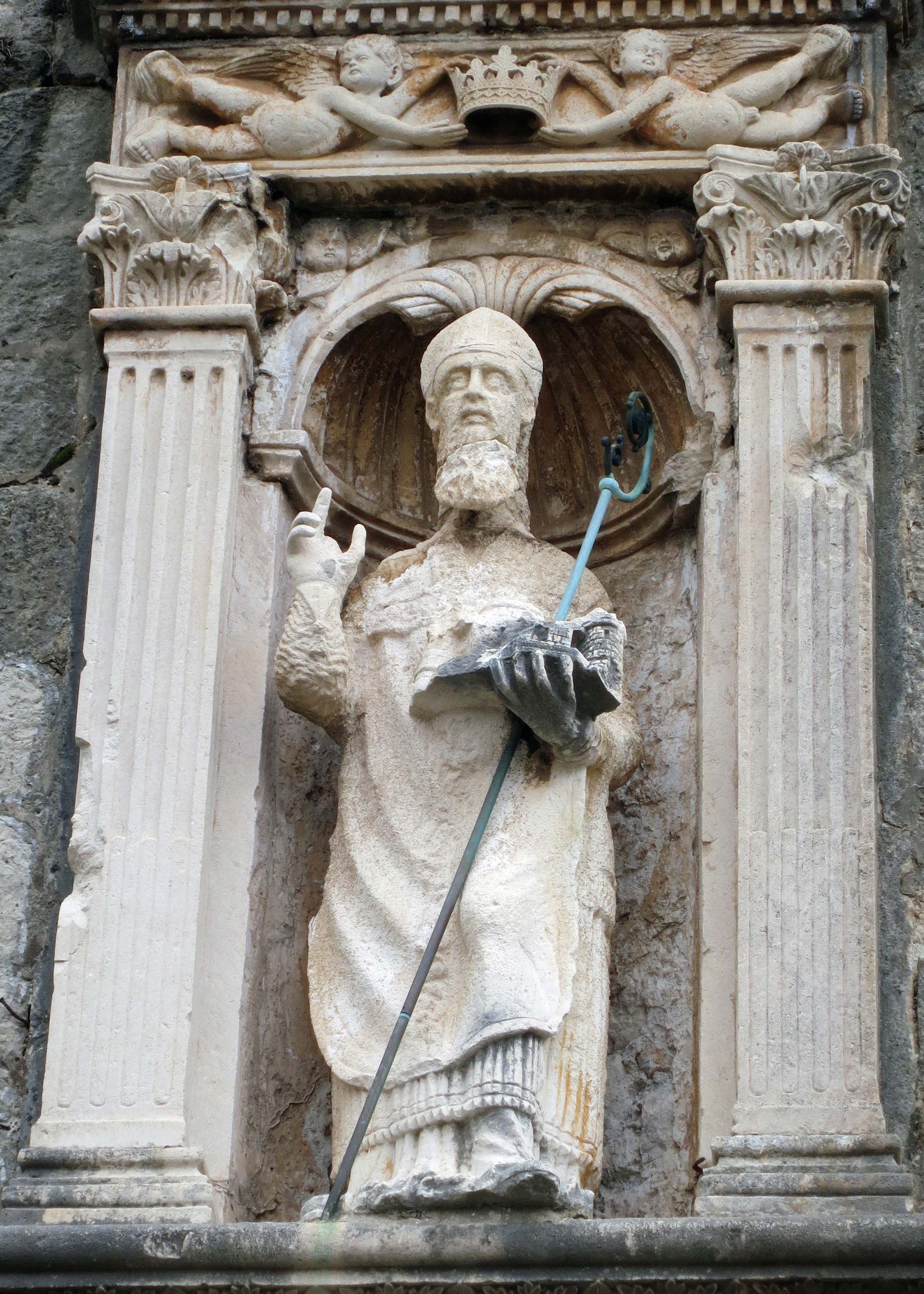
St. Blaise, the Patron Saint of Dubrovnik, holds a model of the city in his hand. This particular statue is found in the Pile Gate at one of the city's main entrances. (Photo by Peggy Mekemson)
St. Blaise, the Patron Saint of Dubrovnik, holds a model of the city in his hand. This particular statue is found in the Pile Gate at one of the city’s main entrances. (Photo by Peggy Mekemson)

Orlando is known as the legendary knight Roland in Northern Europe. The story is that he rescued Dubrovnik from a siege by the Saracens in the Eighth Century. The fact that the dates of Roland’s life don’t match those of Orlando doesn’t seem to matter. He wasn’t from Venice. Also of note— his arm was used as the standard measure of cloth in Dubrovnik.

The Orlando column in Luza Square. (Photo by Peggy Mekemson.)

The Pile Gate, Franciscan Monastery, and Onofrio’s Fountain are located at the other end of the Stradun. The fountain is a subject of my next blog. The Monastery houses a peaceful cloister and a small but interesting museum that features a pharmacy that opened in 1317— and St. Luke’s finger.

The Franciscan Monastery in Dubrovnik.
The Franciscan Monastery in Dubrovnik caught in the sunlight.
In 1337 the Franciscans opened one of the first phamacies in Europe as part of their commitment to provide medical care.
In 1317 the Franciscans opened one of the first pharmacies in Europe as part of their commitment to provide medical care.

NEXT POST: I’ll conclude our visit to Dubrovnik by looking at gargoyles, St. Luke’s finger, and other oddities that caught my attention.

A Bird’s Eye View of Dubrovnik… Armchair Travel in the Time of Covid-19

Continuing my armchair series on Dubrovnik, Peggy and I look down from the walls into the city providing a view of its colorful red roofs. Enjoy.

One of my favorite views into Dubrovnik, this one features the Church of St. Blaise on the left with it's mandatory statue of the saint holding a model of the city.
One of my favorite views into Dubrovnik, this one features the Church of St. Blaise on the right with its statue of the saint holding a model of the city. There was nothing blasé about Blaise, he was martyred for refusing to worship pagan gods and liked to preach to wolves and bears. Note the mechanical bell-ringer in the steeple on the left.

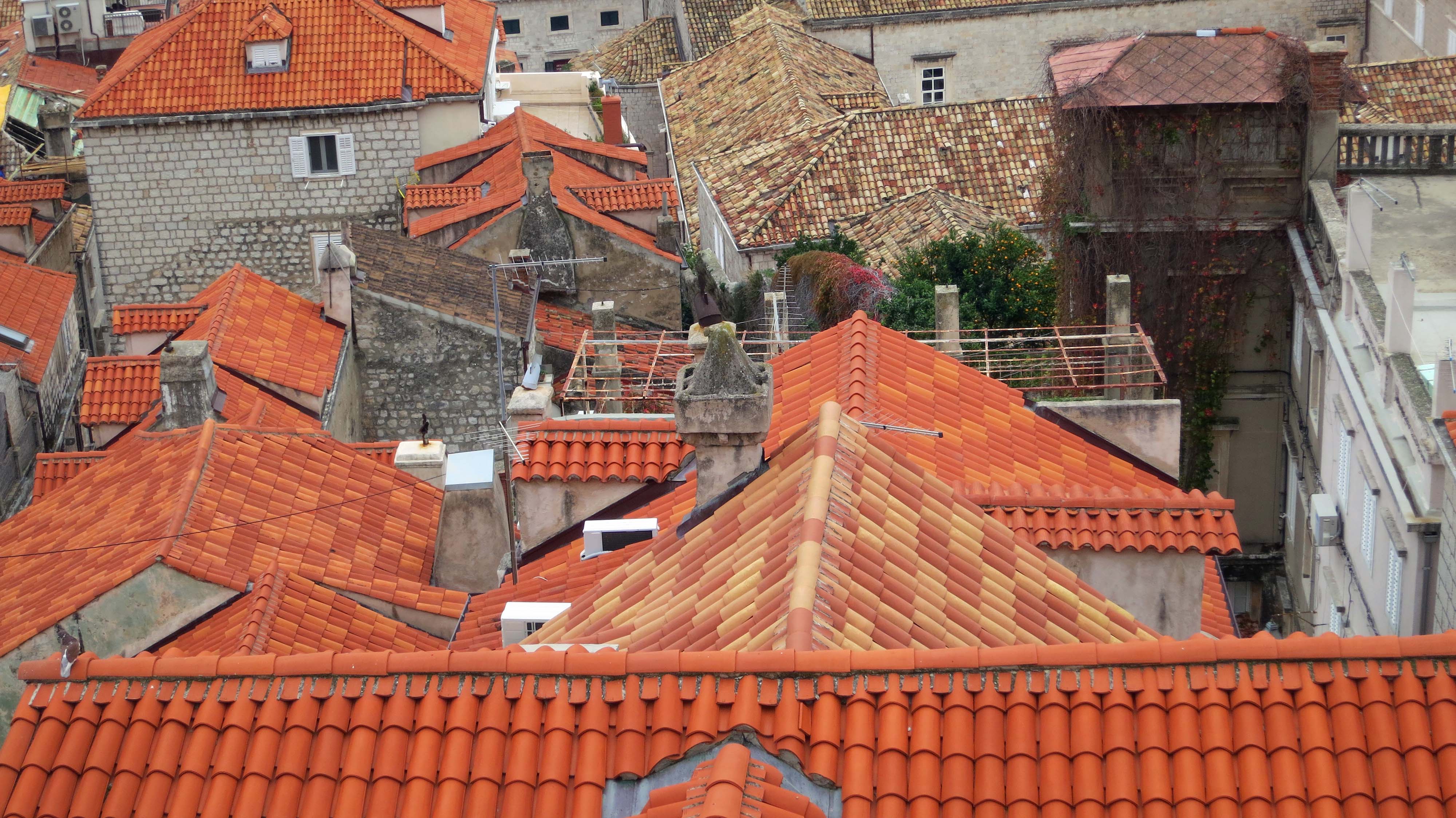
Walking the medieval walls that surround Dubrovnik provides a bird’s eye view across the roofs and down into the city. And what a view it is. Red tile roofs, narrow walkways, and imposing churches invite the visitor to pause and admire the unusual beauty of this town perched on cliffs above the Adriatic Sea.

Twenty years ago most of this beauty was destroyed as Yugoslavia lobbed shells into the city from surrounding hills. Dubrovnik held out, Croatian troops lifted the siege, and the residents proudly rebuilt their city. Today the only reminders of the siege are a few ruins that have yet to be rebuilt and bright red tiles that have yet to mellow with age.

Today’s blog is best reflected through photographs that Peggy and I took.

Looking down on Dubrovnik is like looking down on a sea of red. This photo is taken from Minceta Tower, the highest point on the wall. The Adriatic stretches across the top and the city's port is on the top left.
Looking down on Dubrovnik is like looking down on a sea of red. This photo is taken from Minceta Tower, the highest point on the wall. The Adriatic stretches across the top and the city’s port is on the top left.
This view of red tile roofs and cloudy skies features Dubrovnik's Cathedral on the left.
This view of red tile roofs and cloudy skies features Dubrovnik’s Cathedral on the left. (Photo by Peggy Mekemson)
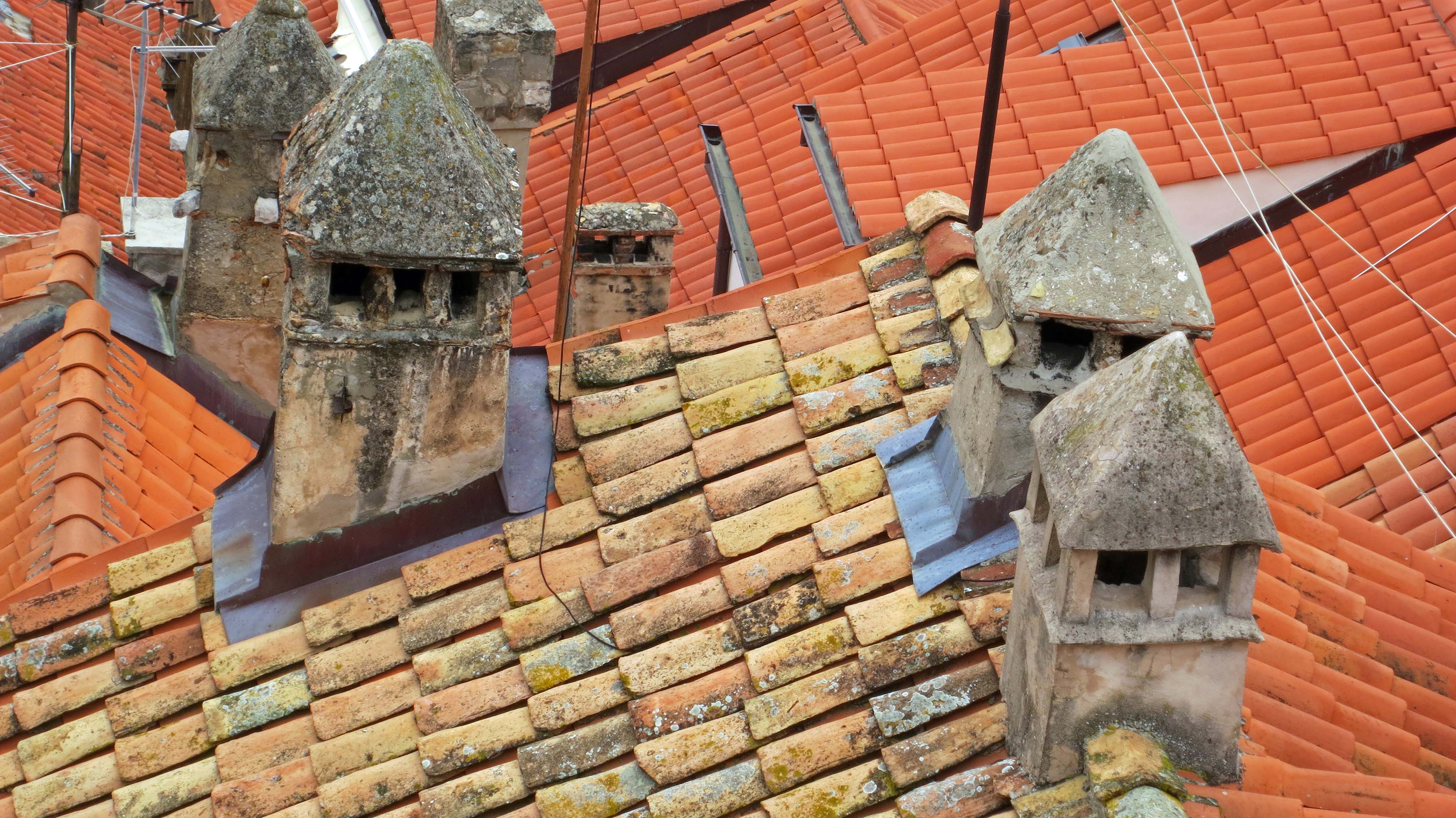
The contrast between new and older tiles is captured here. Many of the newer tiles represent repairs made after the Siege of Dubrovnik in 2000-2001. The trellis in the middle covers a garden, of which many are found through out the city nestled between buildings.
The contrast between new and older tiles is captured here. Many of the newer tiles represent repairs made after the siege of Dubrovnik in 2000-2001. The trellis in the middle covers a garden. Many are found throughout the city nestled between buildings.
Another view of old and newer tiles in Dubrovnik. This one features chimneys.
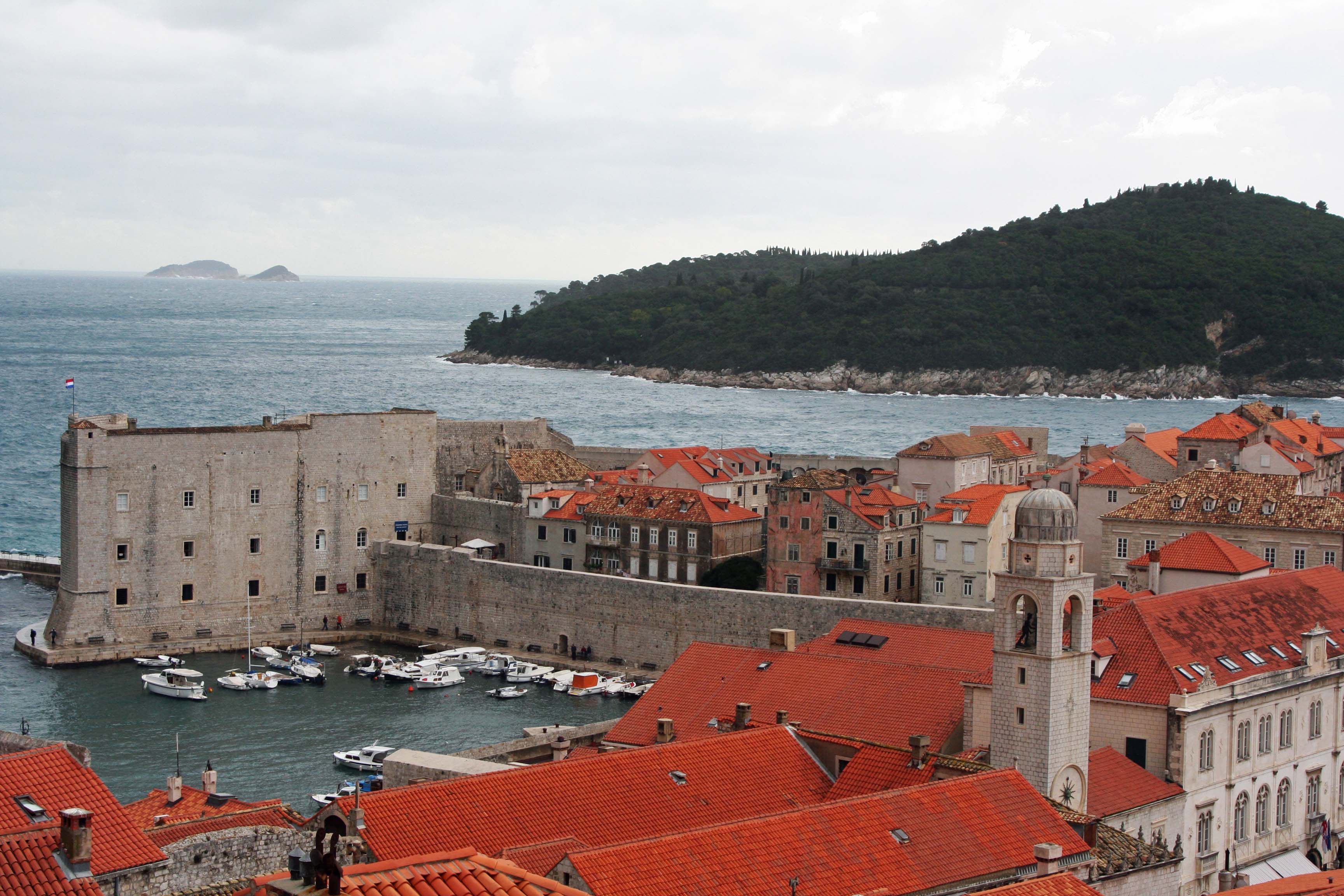
A view looking down on Dubrovnik's port and St. John's fortress that guarded the  harbor against Venetian invasion during the Middle Ages. The towns clock tower is on the right. (Photo by Peggy Mekemson)
A view looking down on Dubrovnik’s port and St. John’s fortress (now an aquarium and museum) that guarded the harbor against Venetian invasion during the Middle Ages. The town’s clock tower is on the right. Lokrum Island is at the top of the picture. (Photo by Peggy Mekemson)
Peggy's view of an abandoned building.
Peggy’s view of an abandoned building.
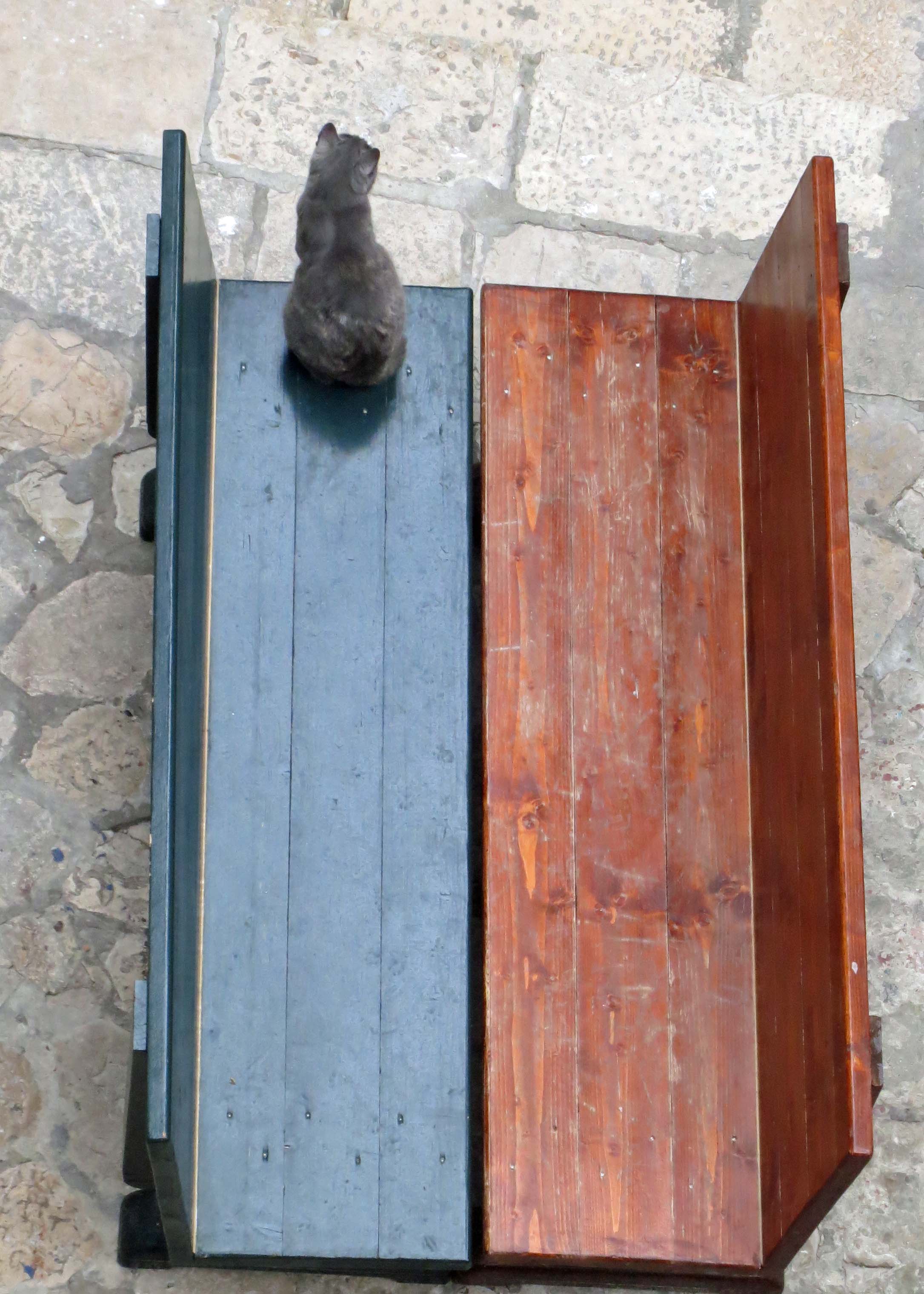
My obligatory cat photo from Dubrovnik. I loved the contrast of the two benches that had been shoved together.
My obligatory cat photo from Dubrovnik. I loved the contrast between the cat and the two benches that had been shoved together.
A view down the Stradun, Dubrovnik's main street. The Franciscan Monastery is on the left.
A long view down the Stradun (Dubrovnik’s main street) looking toward the clock tower. The Franciscan Monastery is on the left.
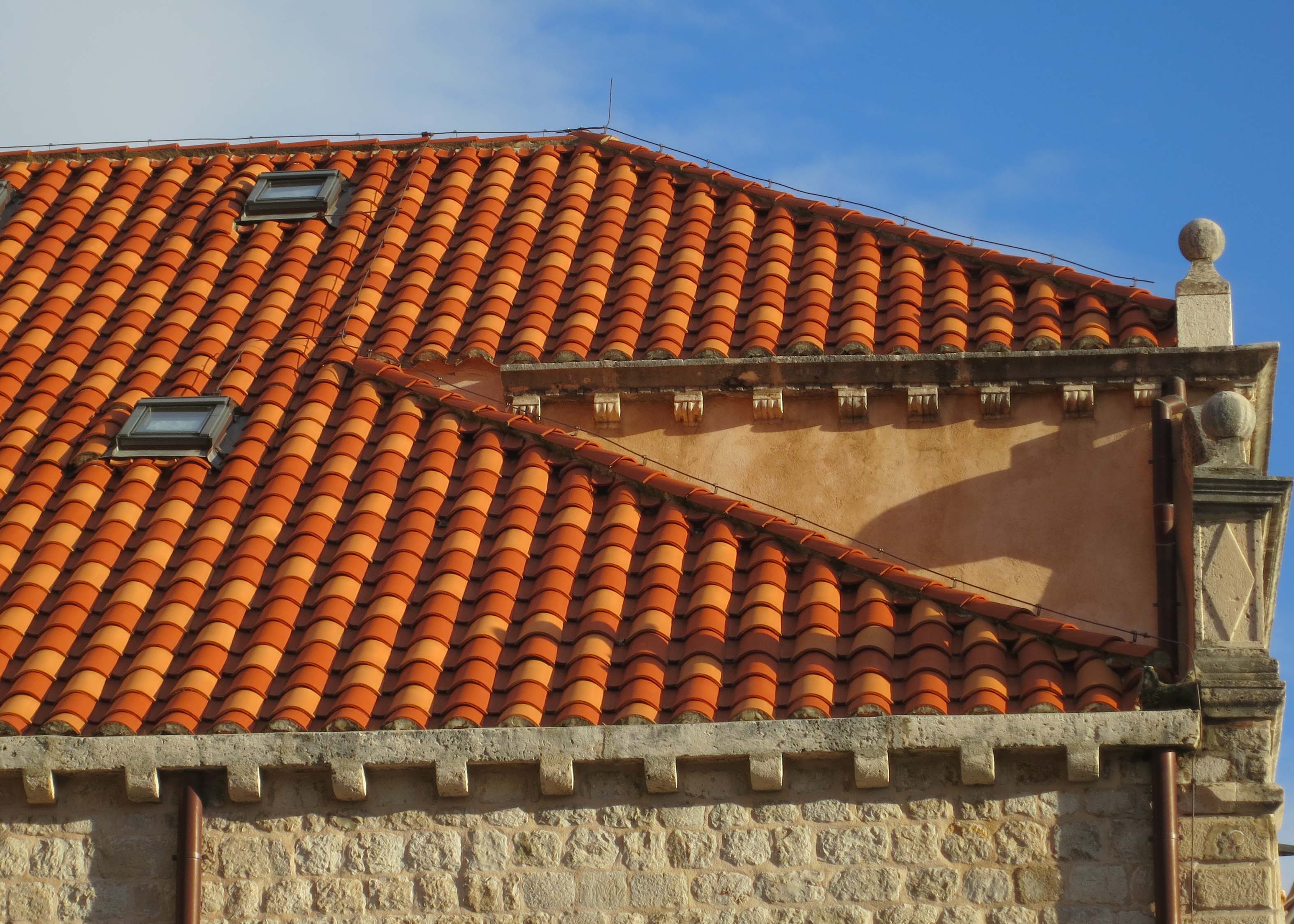
I like this view because it shows what Dubrovnik's red tile roofs look like in the sunlight!
I like this photo because it shows what Dubrovnik’s red tile roofs look like in the sunlight!
A final view of Dubrovnik taken from the walls. This photo was shot through a window of one of the city's many guard towers.
A final view of Dubrovnik taken from the walls. This photo was shot through a window of one of the city’s many guard towers. I thought it made a rather nice frame.

NEXT BLOG: We climb down from the walls surrounding Dubrovnik and walk through the city.

For Glorious Walls, Visit Dubrovnik… The Armchair Series for Dreams of Future Travel

I am continuing my armchair series today and for the next for the next three posts as I revisit the fabulous walled city of Dubrovnik on the Adriatic Coast. Many of my followers will have visited this city. For you, let the memories begin, as they are for Peggy and me. If you haven’t been there, I suggest it would be a great reward for the self-isolation you have practiced during the battle against Covid-19. Start dreaming. The pandemic will pass.

The walled city of Dubrovnik is known as the Pearl of the Adriatic. The walls around the city are listed as a World Heritage Site.
The walled city of Dubrovnik is known as the Pearl of the Adriatic. The walls around the city are listed as a World Heritage Site. The Adriatic Sea is at the top of the photo.

OK, I’m in love. This walled city of Croatia on the Adriatic Sea is gorgeous.  Once upon a time Dubrovnik was a major sea power in the Mediterranean Sea. At another time, it was the first nation in the world to provide official recognition for the fledgling United States of America fighting for independence.

As recently as 1991 it was under a devastating siege by Yugoslavian forces that laid waste to much of the city’s renowned beauty.  Today it has rebuilt most of what was destroyed.

This is one of four blogs I did on Dubrovnik in 2013 and am reposting on my Armchair Series. First up is a look at magnificent medieval wall that surrounds the city and provides visitors with outstanding views of the Adriatic Sea and surrounding country. Second I will turn inward and look down from the walls on the city and its colorful tiled roofs. Third we will visit the city from street level. Finally, I want to feature some intriguing gargoyles we found in Dubrovnik. (Have I used enough superlatives?)

Any visit to Dubrovnik should include a walk around the mile plus (6,360 feet) wall that surrounds and protects the city. Considered to be one of the great fortification systems of the Middle Ages, the walls were named a World Heritage site in 1979. Reaching a maximum height of 82 feet, the walls were never breached during the 12th through the 17th century— providing five hundred years of peace and prosperity for the residents.

A fast walker can easily do the walk in an hour or so but plan on a more leisurely 2-3 hour stroll. You’ll need the extra time for photography, or just staring in awe.

This photo of the walls was taken from Minceta Tower, the highest spot on the walls.
This photo of the walls was taken from Minceta Tower, the highest spot on the walls. (Photo by Peggy Mekemson)
This photo provides a great perspective on why enemies would have thought twice... or maybe a dozen times, before attacking Dubrovnik.
Here’s a perspective on why enemies would have thought twice— or maybe a dozen times— before attacking Dubrovnik.
If the walls weren't enough to discourage an invasion of Dubrovnik, the Fort of St. Lawrence stood on an opposite peninsula. (Photo by Peggy Mekemson)
If the walls weren’t enough to discourage an invasion of Dubrovnik, the Fort of St. Lawrence stood on the opposite peninsula. BTW, is it just my imagination (admittedly wild) or does the fort look like it is resting on the back of a turtle? (Photo by Peggy Mekemson)
Another view of the Fort of St. Lawrence in Dubrovnik. It was a stormy day as shown by the waves from the Adriatic Sea breaking on the rocks.
This photo looks up toward Minceta Tower, the highest point on the walls of Dubrovnik.
This photo looks up toward Minceta Tower, the highest point on the walls of Dubrovnik. The flag of Croatia is seen on the left.
Another perspective on the wall protecting Dubrovnik.
A cannon's perspective looking out from the walls of Dubrovnik.
A cannon’s-eye-view looking out from the walls of Dubrovnik.
I liked this photo by Peggy with its dark sky, grey wall and red roof.
A statue of St. Blaise, the Patron Saint of Dubrovnik, looks out on the Adriatic Sea under a watch tower protecting the city from harm. (Photo by Peggy Mekemson)
A statue of St. Blaise, the Patron Saint of Dubrovnik, looks out on the Adriatic Sea and protects the city from harm. (Photo by Peggy Mekemson)
A final view of Dubrovnik wall. (Photo by Peggy Mekemson)

NEXT BLOG: A journey around the walls of Dubrovnik looking down into the city.

Athens: Part 2… Armchair Travel in the Age of Coronavirus

I continue my exploration of Athens today as part of my armchair travel series, dipping back into my hundreds of archived posts. You will learn what gave Zeus a splitting headache. Hint: It wasn’t Covid-19.

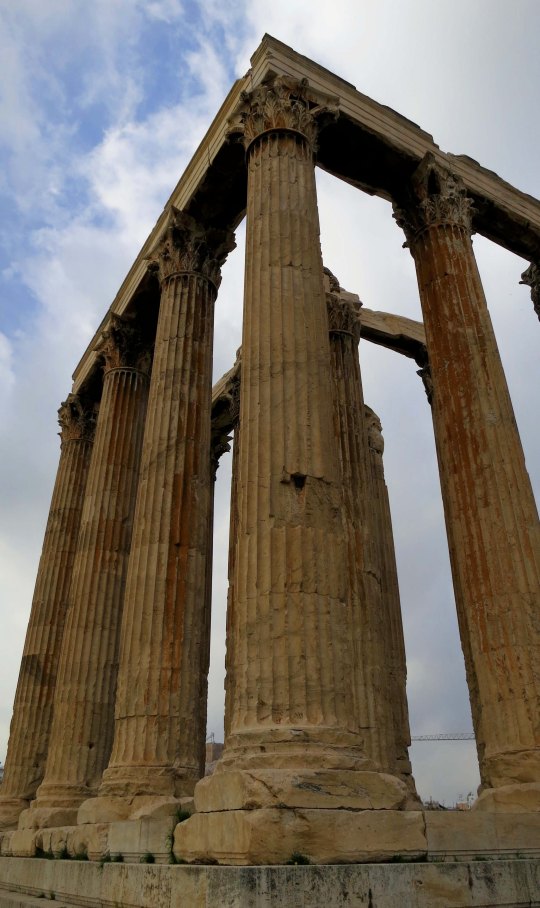
The massive Temple of Zeus located near the base of the Acropolis.

We like our gods to have a touch of humanity. The Greek gods had more than their share. They would party on Olympus, chase after the opposite sex, and constantly intervene in human affairs. They could be jealous, revengeful and petty but they could also be generous and protective. It was good to have one on your side.

The replica of the Parthenon in Nashville, Tennessee has a replica of what the statue of Athena located in the historic Parthenon may have looked like.
The replica of the Parthenon in Nashville, Tennessee has a fully sized model of what the statue of Athena located in the historic Parthenon may have looked like. I think the spear alone would have given Zeus a headache.

Each Greek city-state would choose a god to be its special protector. With Athens, it was Athena. Both the Parthenon and the Erechtheion on the Acropolis (featured on my last blog) were built in her honor. Athena, according to Greek mythology, sprang fully grown and armed from the head of Zeus. Not surprisingly, Zeus had a massive headache prior to her birth. You might call it a splitting headache. His son, Hephaestus, god of the forge and blacksmiths, took his mighty chisel and split opened Zeus’s head, thus releasing Athena and relieving Zeus.

Zeus was also honored in Athens with a massive temple located near the base of the Acropolis. In addition to being the king of the gods and father of Athena, he was a notorious womanizer. He married his sister Hera, who was constantly trying to thwart his womanizing ways. One of Zeus’s more famous trysts was with the renowned beauty Leda. Zeus seduced her in the guise of a swan, so the story goes. It was a favorite subject of Renaissance Painters. One result of the seduction was that Leda went home and laid an egg, from which the even more beautiful Helen of Troy was hatched.

Our guides took us to see the Zeus temple and then on to visit site of the 2004 Summer Olympics. We stopped off to watch the changing of the guards in front of the Prime Minister’s official seat of government and hurried on to a very expensive restaurant that our guides had selected.  I assume they received a handsome kickback. Sadly, our time was running out and we returned to the ship. Other sites would have to wait for another time.

A side view of the Temple of Zeus in Athens looking grey against grey skies.
Another photo of the Zeus Temple in Athens. This one features the upper part of the columns with their Corinthian tops.
Another photo of the Zeus Temple in Athens. This one features the upper part of the columns with their tops decorated in the Corinthian style.
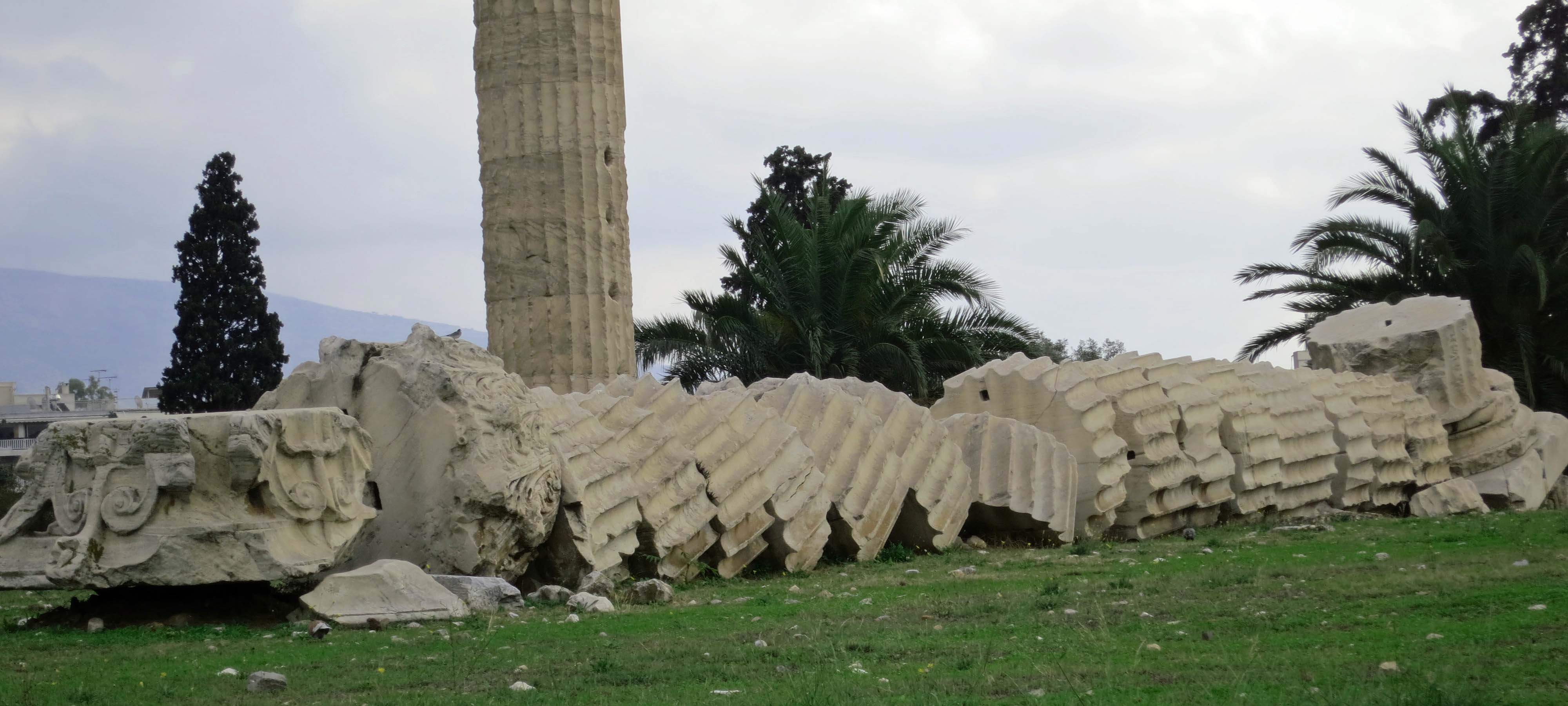
In 1852 a storm topped one of the massive columns from the Temple of Zeus and it has remained there ever since.
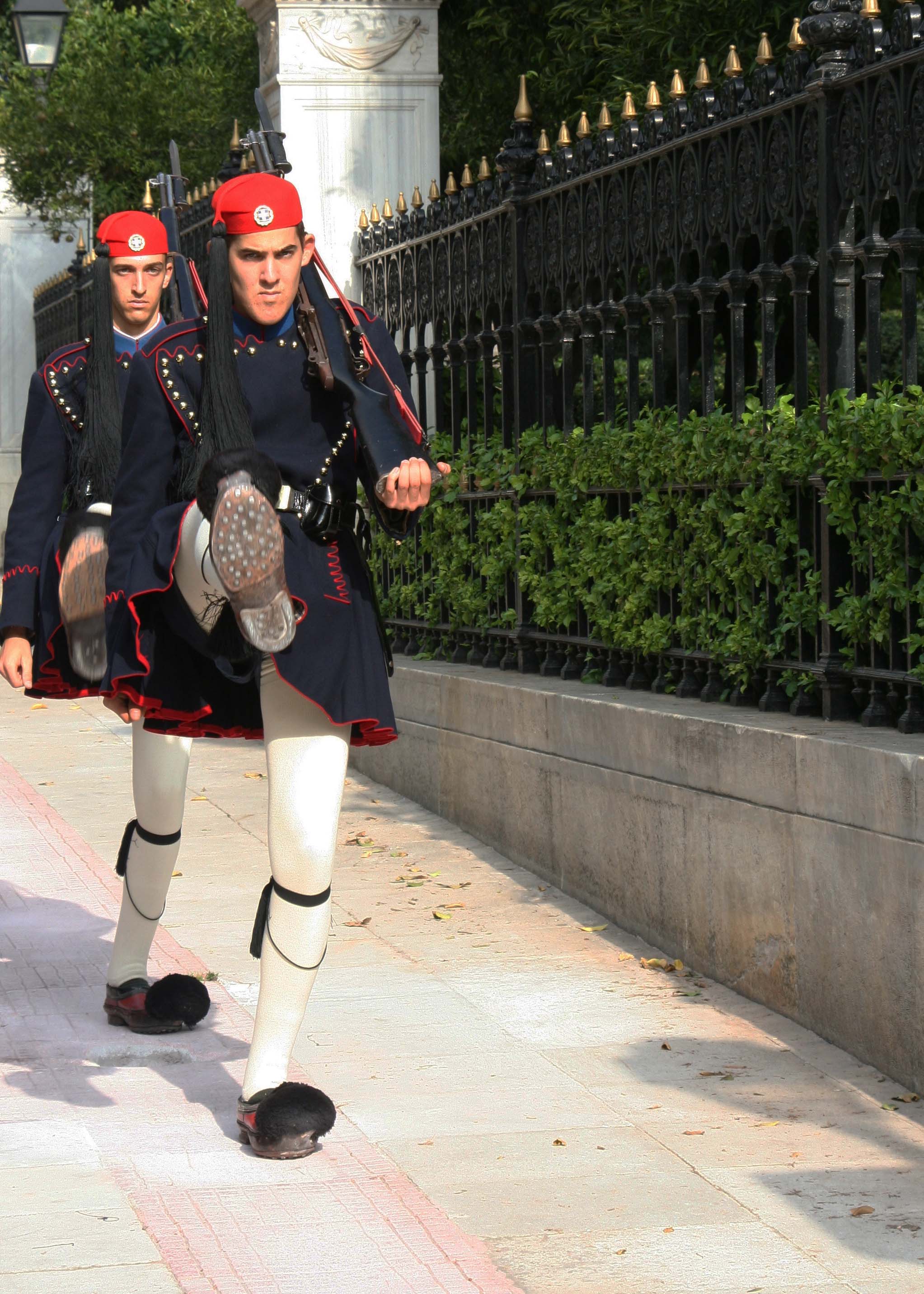
We watched as guards high stepped their way through the Changing of the Guards at the Prime Ministers seat of government.
We watched as guards high stepped their way through the Changing of the Guards at the Prime Minister’s seat of government. (Photo by Peggy Mekemson)
I found the choice of shoes, um, interesting.
I found the choice of shoes, um, interesting. At least the guards were guaranteed warm toes on a cold night.
The site of the 2004 Summer Olympics in Athens features a statue of a discus thrower winding up to throw.
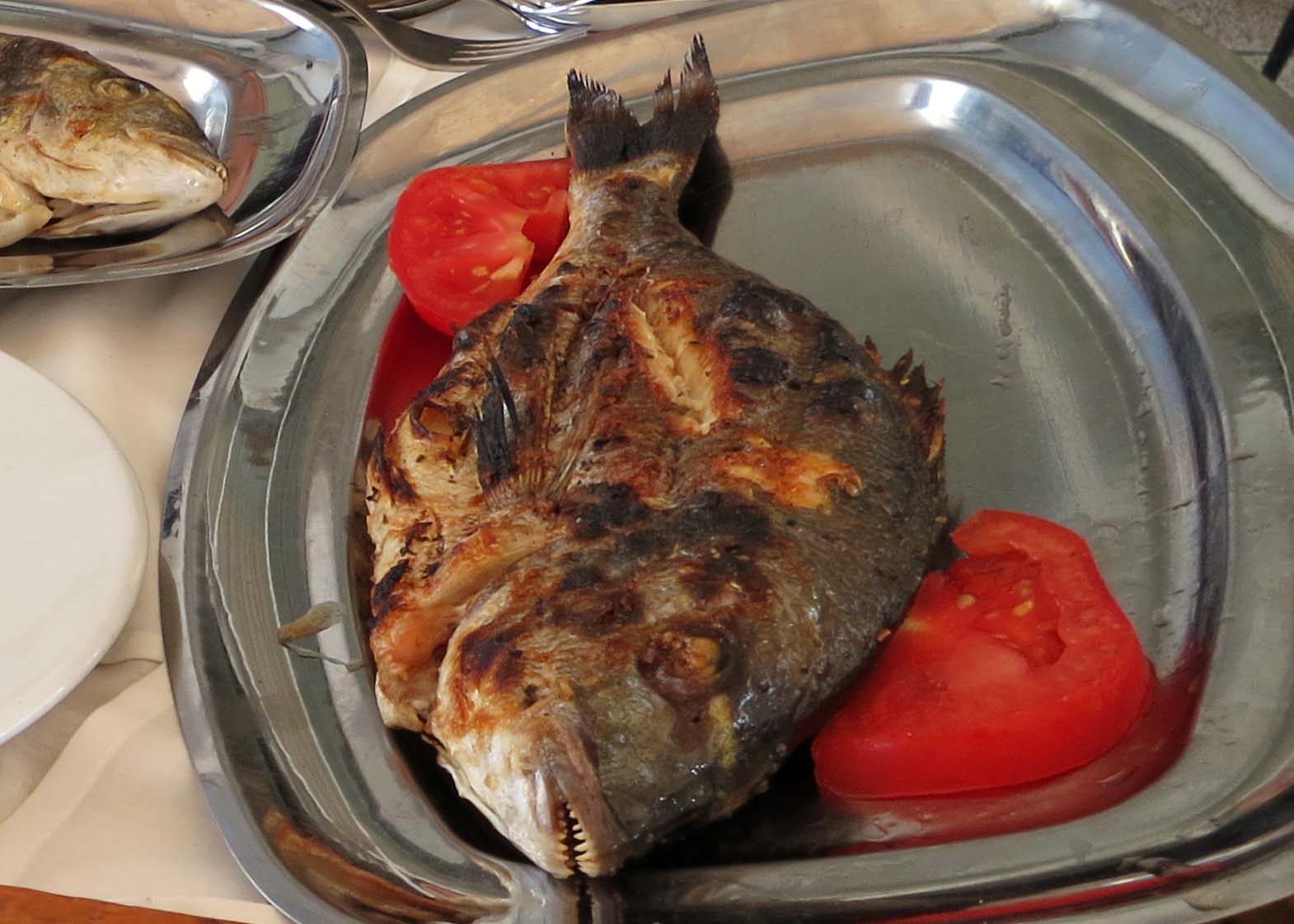
One of several courses from our expensive Greek lunch.
Peggy and I and pose with our two Greek guides.
Peggy and I and pose with our two Greek guides. As I recall, their cousins owned the restaurant.

On Monday I will feature ten activities to keep away the blues during home-sheltering. They may not all be for you— such as capturing ground squirrels or searching for trees that might fit into Lord of the Rings or some other fantasy. (We have a whole forest of them.) Other’s might strike a chord. For example, most parents are now learning a lot more about home-schooling than they ever wanted to learn. But how about home-schooling for adults?

Athens: Part 1… Armchair Travel in the Time of Coronavirus

The Acropolis with its graceful Parthenon shown above is probably the wold’s most famous historic site.

I continue to reach back into my archives today to provide more armchair adventures as the world reels under the coronavirus pandemic. Like you, Peggy and I are ‘sheltering at home’ while reliving past travel experiences and dreaming of future ones. They will come.

Athens was grumpy. Several years of extravagant spending by the Greek government and its citizens had come home to roost. The European Union had required steep austerity measures in Greece as the price of a pulling the nation back from the brink of fiscal chaos. Nothing was spared from spending cuts including social services, wages and pensions. A massive influx of impoverished immigrants and a nascent neo-Nazi movement added to the country’s woes. Everyone was expected to make sacrifices to help solve the crisis.

Since sacrifices are best made by someone else, there had been massive strikes and violence in the country.

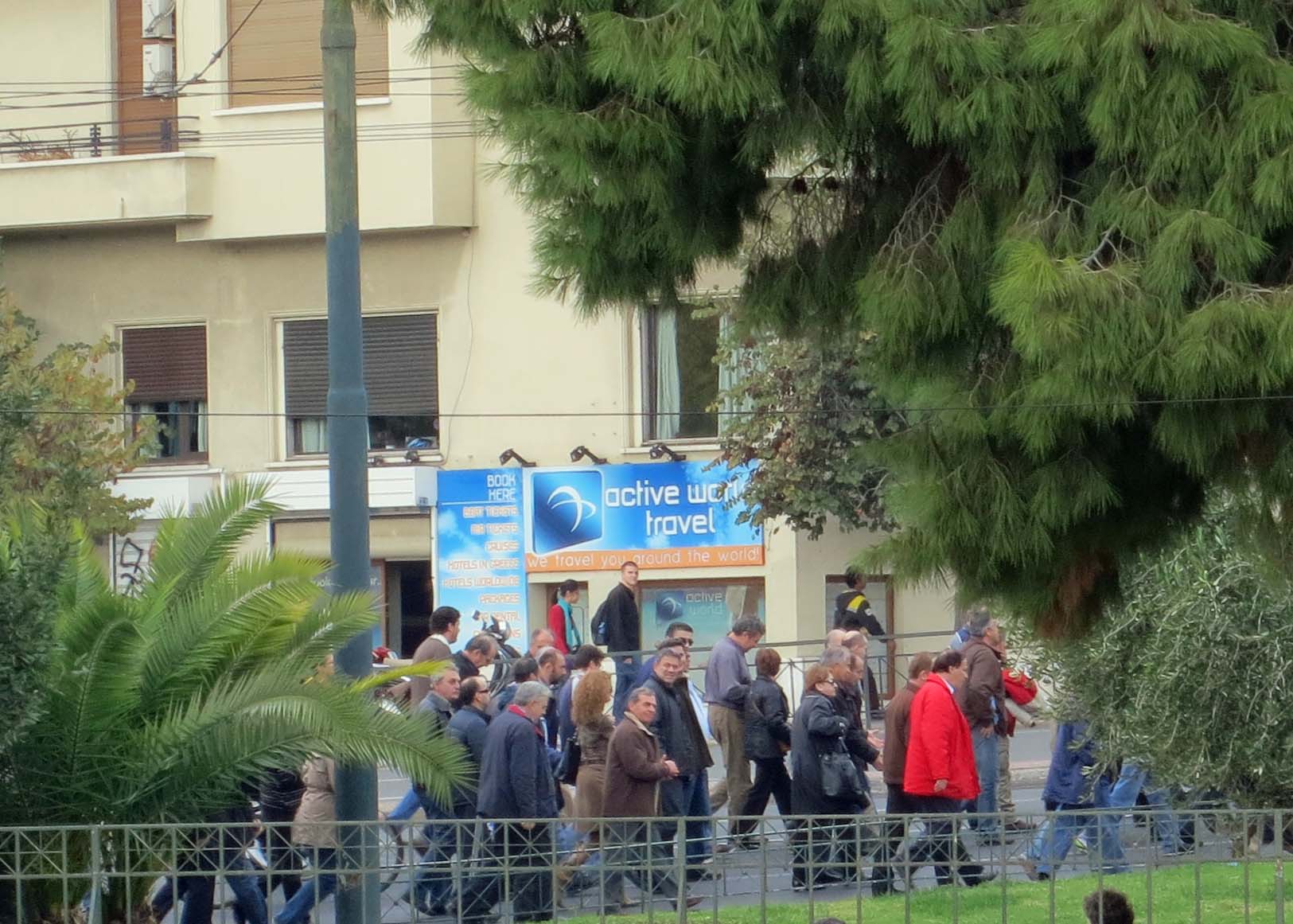
Standing near the Temple of Zeus, we watched as yet another group of protestors hit the streets of Athens.

We didn’t know what to expect but had decided to see Athens on our own. Tours offered by the cruise line are very expensive. They help assure a healthy profit margin. There is little encouragement for independent exploration. No handy-dandy sheets are handed out saying this is what you should do if you want to see such and such on your own.

Normally our self-guided tours worked great but Athens proved to be challenging.

From the moment we stepped off the ship, taxi drivers offering tours inundated us. Tourism had dropped with the fiscal crisis and was dropping even farther with the end of the tourist season. The air of desperation turned to rudeness when it was discovered we were planning to use public transit. Finding the right bus stop and the right bus turned out difficult, however. When we finally did find the bus, it was leaving. Out of frustration I turned to a taxi driver. We were able to hire two taxis for an all day tour for the six of us that was substantially less than the cruise tours.

Was it worth all the hassle? Absolutely.

Much of who we are in the West evolved from what happened in the City State of Athens between 500 and 350 BC. We visited the cradle of democracy and walked where Socrates and Plato had walked. We climbed up the Acropolis and admired the Parthenon and other buildings that have been a major inspiration for Western architecture for 2000 years. We watched the changing of the guard at the Prime Minister’s residence, visited the site of the Athens 2004 Summer Olympics, and concluded our tour with an expensive but excellent Greek meal.

If you are a history buff, as I am, having your photo taken with the Parthenon as a backdrop is a true privilege.
If you are a history buff, as I am, having your photo taken with the Parthenon as a backdrop is a true privilege. (Photo by Peggy Mekemson)
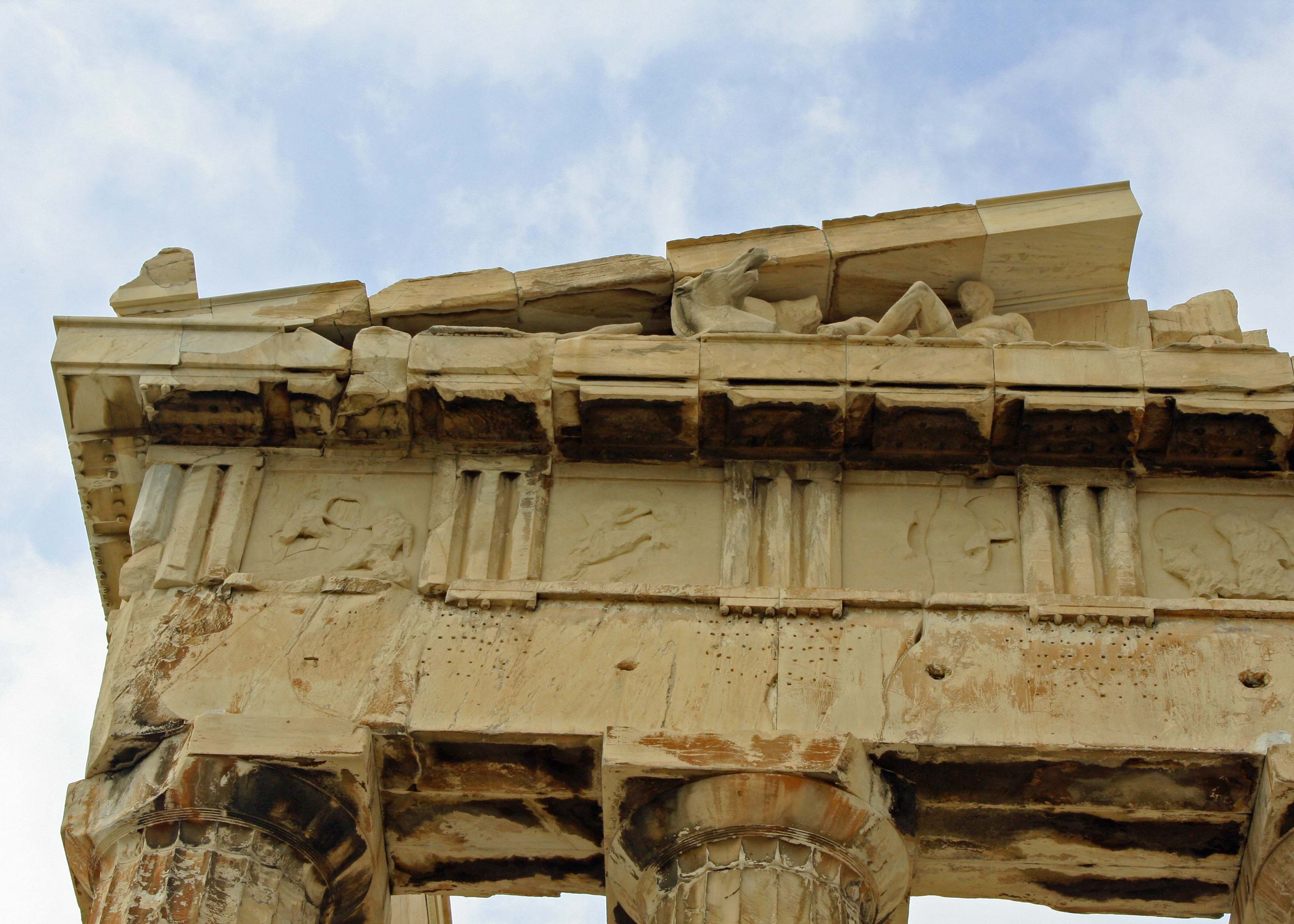
This corner shot shows one of the few statues that remain of many that once decorated the Parthenon. (Many can be found in the British Museum.)
A close up of the corner  shown behind me above features one of the few statues that remain of many that once decorated the Parthenon. (Many can be found in the British Museum.)
Extensive renovation work is being done on the Parthenon, as well as other buildings on the Acropolis. ( Photo by Peggy Mekemson)
Extensive renovation work was being done on the Parthenon, as well as other buildings on the Acropolis. ( Photo by Peggy Mekemson)
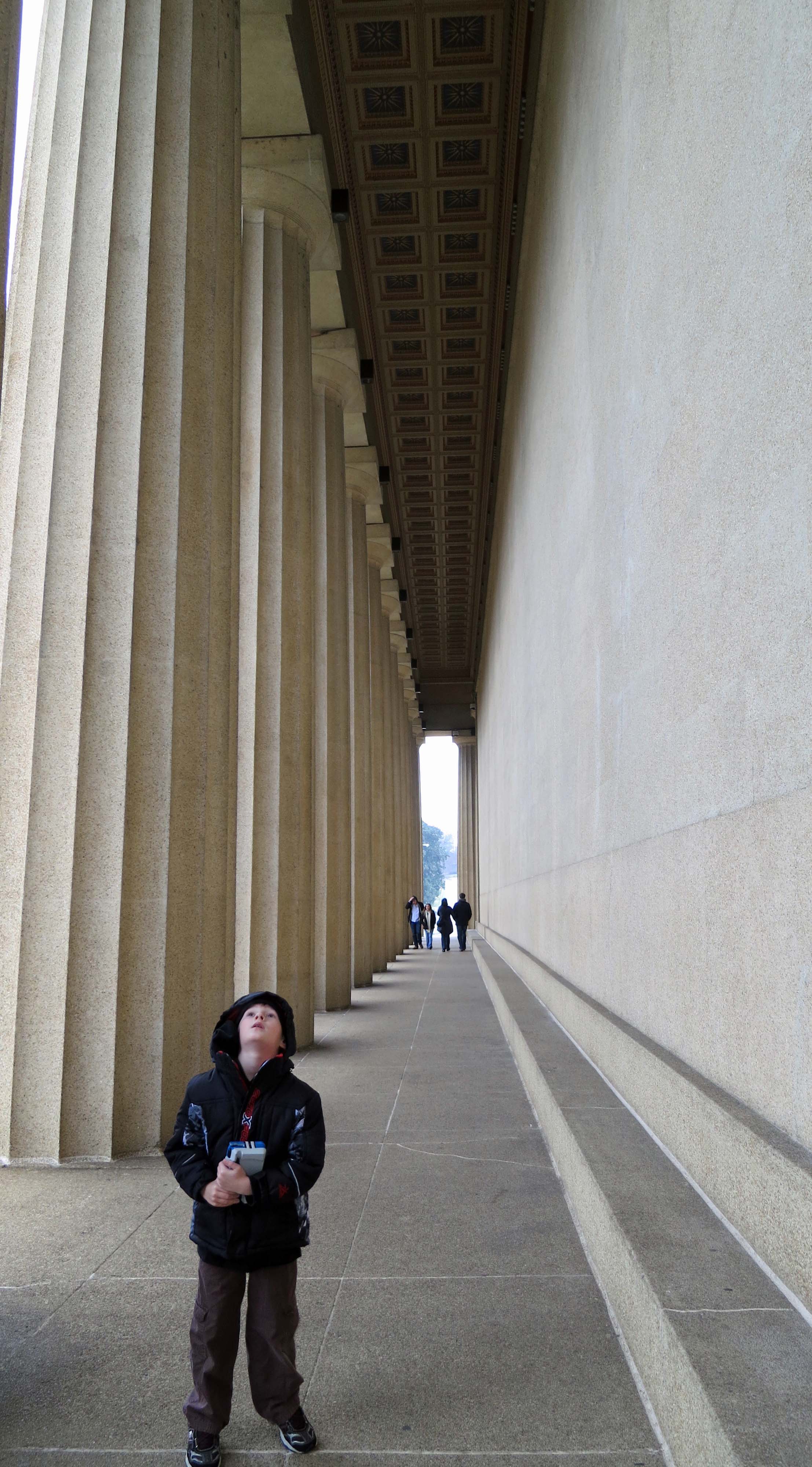
A full-scale replica of the Parthenon as it would have looked like originally can be found in Nashville, Tennessee. We stopped by to check it out after our Mediterranean tour while visiting with our daughter and her family.
A full-scale replica of the Parthenon as it would have looked like originally can be found in Nashville, Tennessee. We stopped by to check it out after our Mediterranean tour while visiting with our daughter Natasha and her family.
My grandson Ethan provides an interesting perspective in this Nashville photo on the original size of the Parthenon.
My grandson Ethan provided an interesting perspective in this Nashville photo on the original size of the Parthenon.
Another impressive building on the Acropolis is the Erechtheion. An olive tree decorates the front of the building.
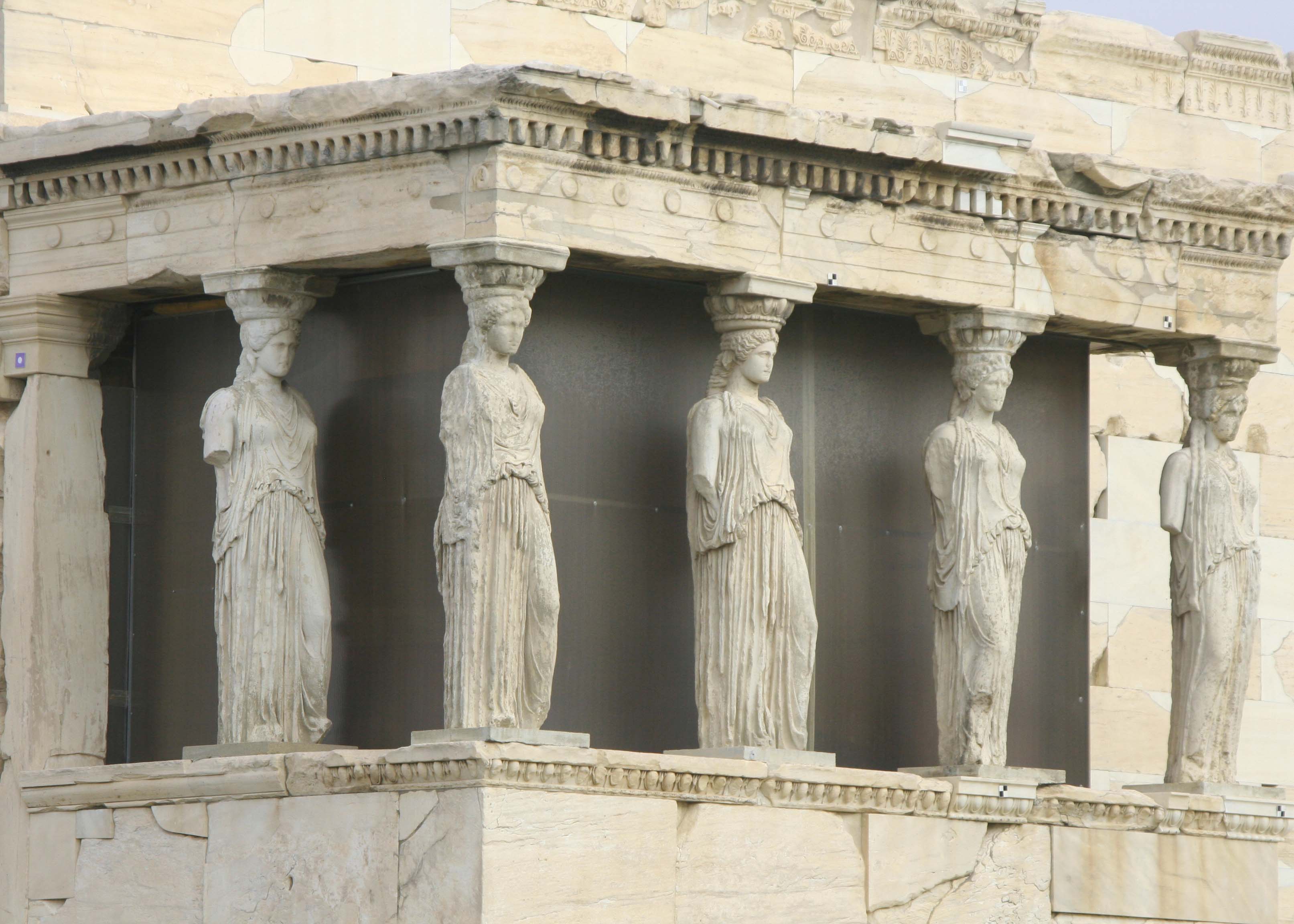
Another important building on the Acropolis is the Erechtheion, which includes the Porch of the Caryatids, lovely Greek maidens who have been turned into graceful columns.
The Erechtheion  includes the Porch of the Caryatids, lovely Greek maidens who served as graceful columns. (Photo by Peggy Mekemson)
A close up of the Elechtheion, windows, and an olive tree representing Athena's gift to Athens.
A close up of the Erechtheion, windows, and an olive tree representing Athena’s gift to Athens.
This is a shot looking upward at the end of the Erechtheon opposite the Porch of the Caryatids.
This is a shot looking upward at the end of the Erechtheion opposite the Porch of the Caryatids.
Looking upward at the Temple of Nike on the Acropolis.
A final view: The Temple of Nike on the Acropolis.

On Friday we will return to Athens and discover what gave Zeus his horrendous headache.

Santorini Churches… Armchair Travel

Darn, I thought to myself as I checked my blogs for Santorini. I’ve done a lot on the island. I can’t seem to help myself— it is so beautiful and unique. I really thought about doing something different today, but I had promised Santorini. Plus, as noted, I can’t resist. When I found a post on the churches I had done in 2013, I decided to put it up in hopes that there might be a few photos I haven’t shared on my blog four or five times. 🙂 Still, even if you have seen these, they are always worthy of seeing again!

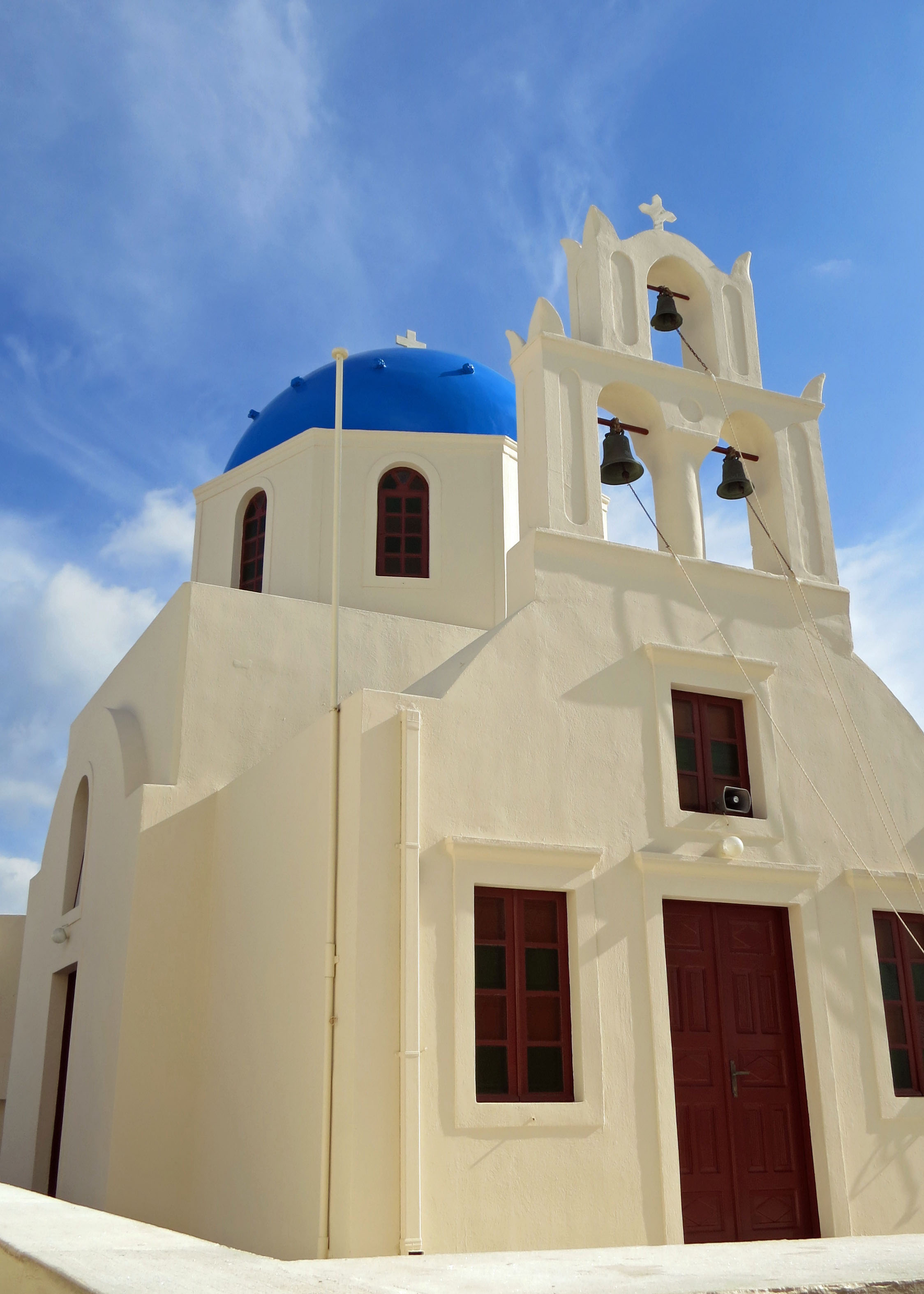
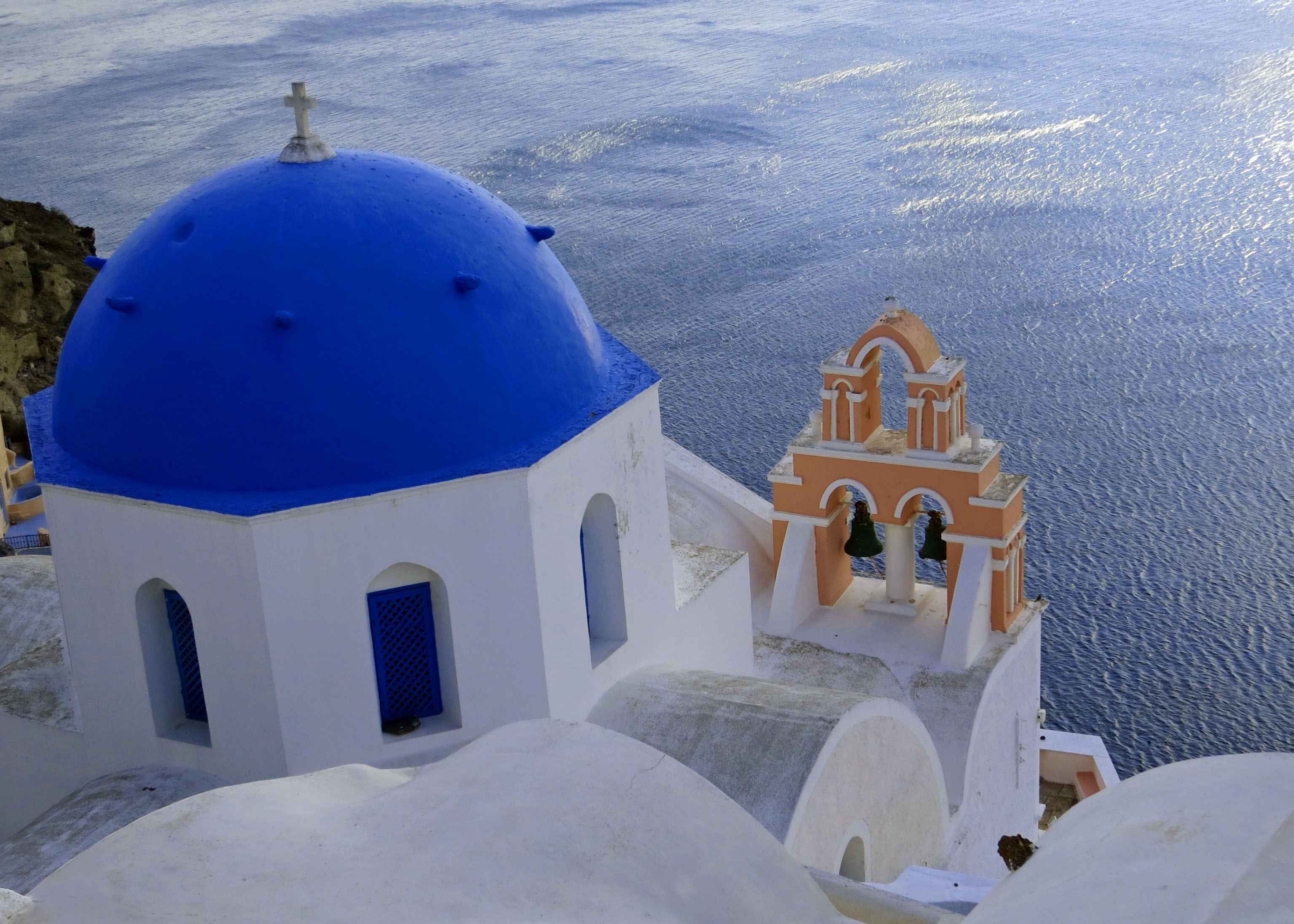
The Church of St. George in Oia, Santorini. Most, but not all of Santorini's churches featured a blue dome.
The Church of St. George in Oia, Santorini. Most, but not all of Santorini’s churches featured a blue dome.

Europe is filled with great churches that are known as much for their art and architecture as they are for religion. Our cruise through the Mediterranean would take us to some of the world’s most renowned cathedrals. While the churches on the Greek Island of Santorini are no match for the splendor of what you find in Venice, Rome or Florence, they have a subtle beauty and uniqueness of their own.  The following photos are meant to capture something of their beauty.

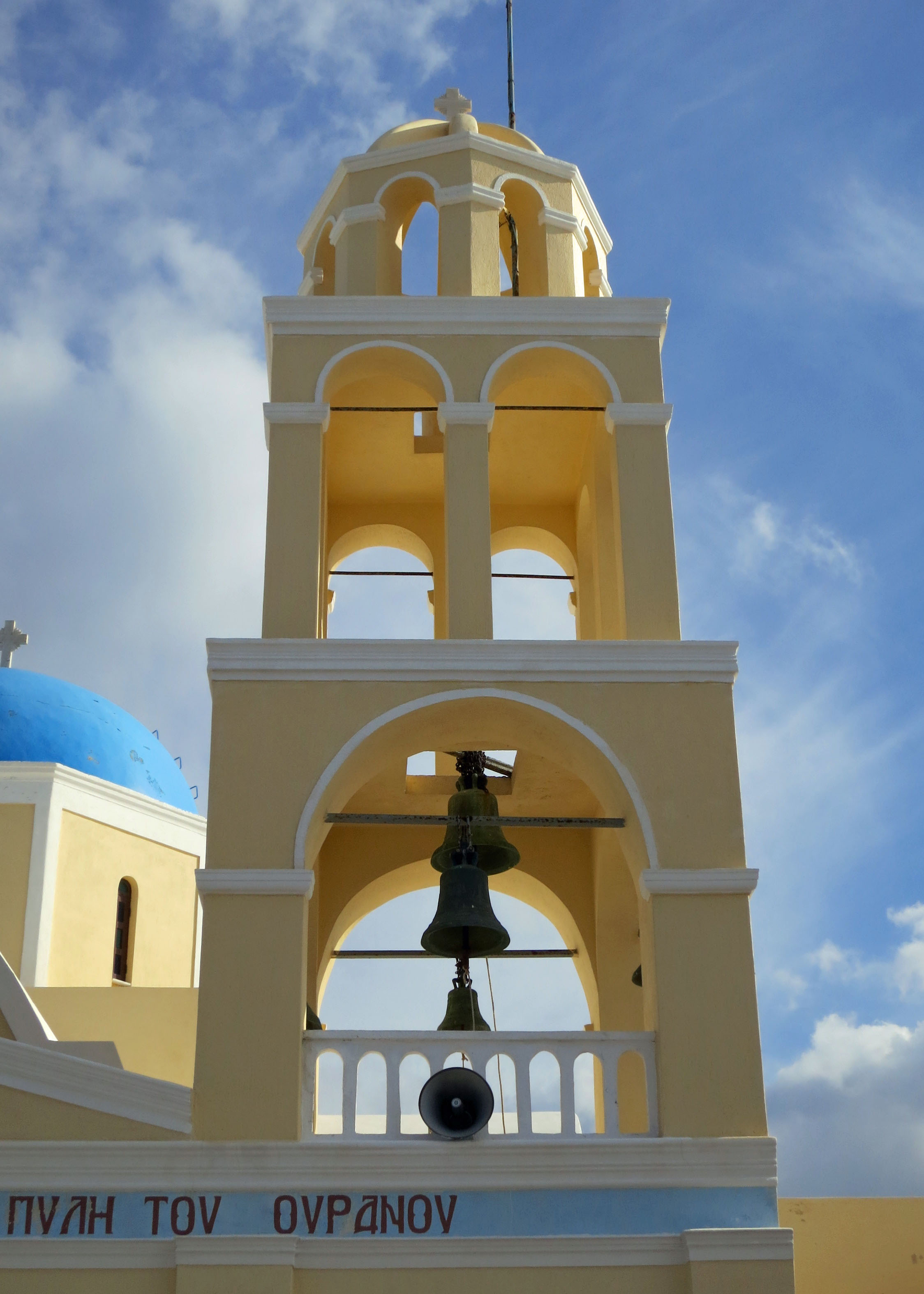
This is a close up of the bell tower on the Church of St. George in Oia, Santorini. The bell towers throught the town were as unique as the churches.
This is a close up of the bell tower on the Church of St. George in Oia, Santorini. The bell towers throughout the town were as unique as the churches.
I found this church with its white rocks surreal.
A view of the same church seen in the photo above from behind.
This church provided and interesting backdrop for the homes in front.
This church provided an interesting backdrop for the homes in front. I also liked the fun play of light and shadow.
The Church of Panagia provides a gateway into Oia on Santorini. Once again, dramatic clouds added interest to our day of photography.
The Church of Panagia provides a gateway into Oia on Santorini. Once again, dramatic clouds added interest to our day of photography. (Photograph by Peggy Mekemson)
The bell tower of the Church of Panagia in Oia, Santorini.
Another of Santorini's uniquely beautiful churches.
Another of Santorini’s uniquely beautiful churches.
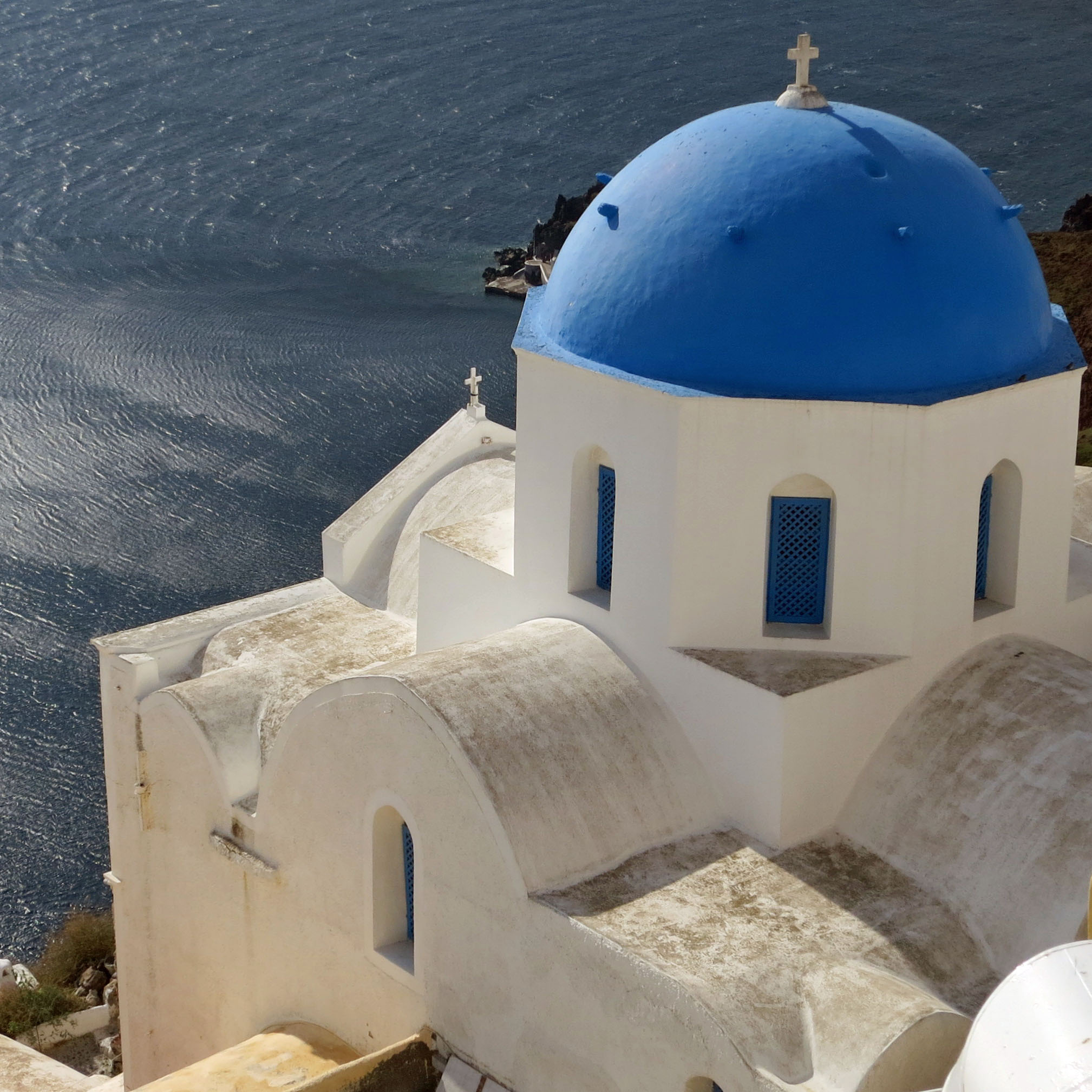
I like this church on Santorini because of its almost sensuous lines. Can a church be sensuous? Having the Mediterranean for a backdrop didn't hurt either.
I like this church on Santorini because of its almost sensuous lines. Can a church be sensuous? Having the Mediterranean for a backdrop didn’t hurt either.
This is another perspective on the Santorini church shown above featuring its salmon colored bell tower.
My concluding photo on the beautiful and unique churches found on the Greek island of Santorini.

FRIDAY’S BLOG: Assuming the weather cooperates, I thought it would be fun to share my seven different offices on the property. If I am feeling the least bit stir crazy during the lock down, I move! (Grin.)

Mykonos: Armchair Travel in the Time of Coronavirus

Peggy and I are continuing to self-isolate ourselves, as are so many of you. Medford, Oregon, the medium sized town where we do most of our shopping, is on the edge of becoming a coronavirus hotspot. (Nowhere is safe.) We have zero desire to go there and have enough food— and wine— that we don’t have to for a couple of weeks. I even have older blogs to repurpose. (Grin.) Something like 900. I’ve been blogging for 10 years. Last week I re-posted a blog on the Greek island of Corfu. Today is Mykonos. Stay safe.

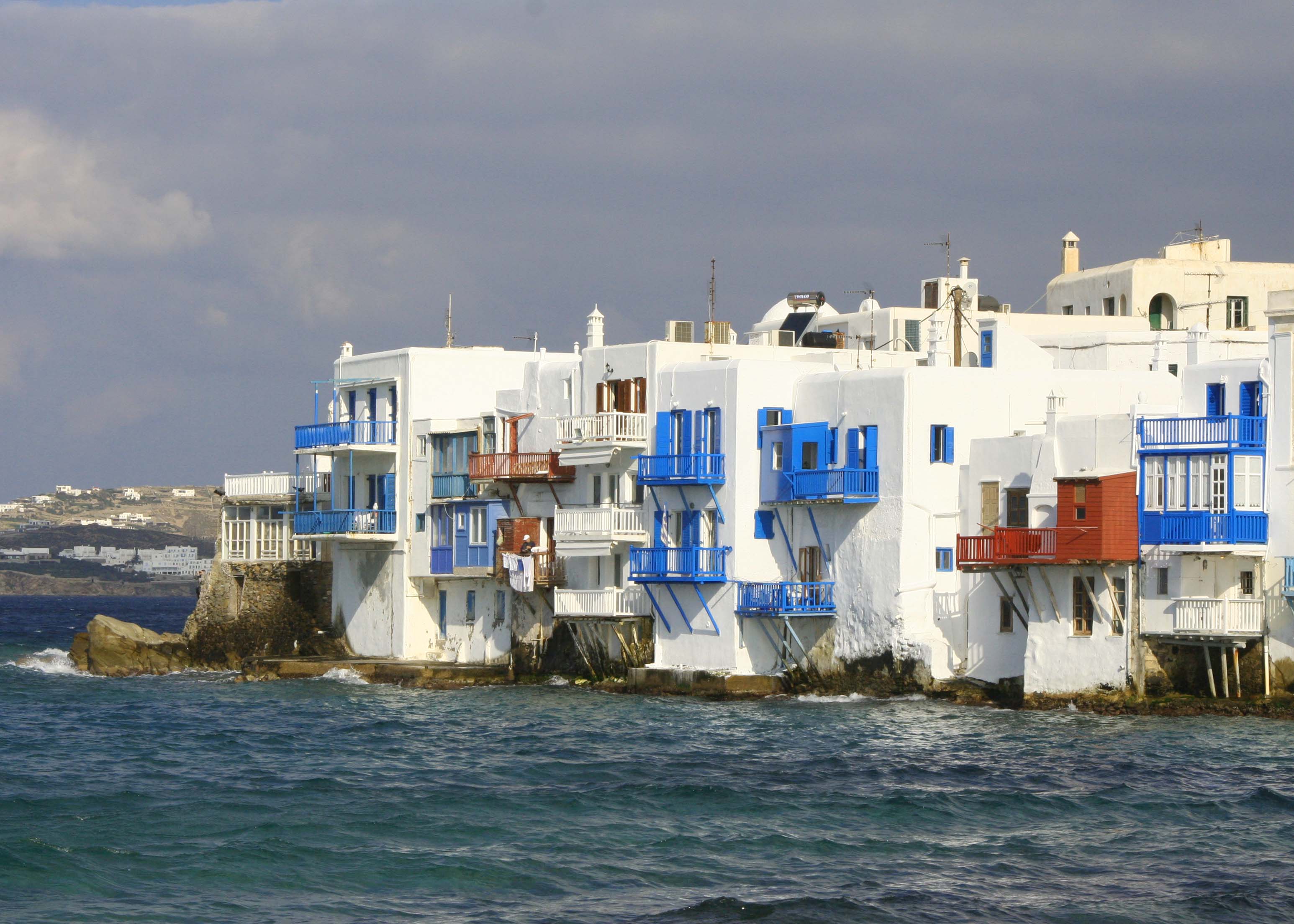
The area known as Little Venice is one of many charming sites on Mykonos.
The area known as Little Venice is one of many charming sites on Mykonos. (Photo by Peggy Mekemson)

The maze-like town of Mykonos (Chora) was designed to discourage invasion. It was easy for invaders to get lost in the narrow, winding streets that ran into other narrow, winding streets that ran into other narrow, winding streets.

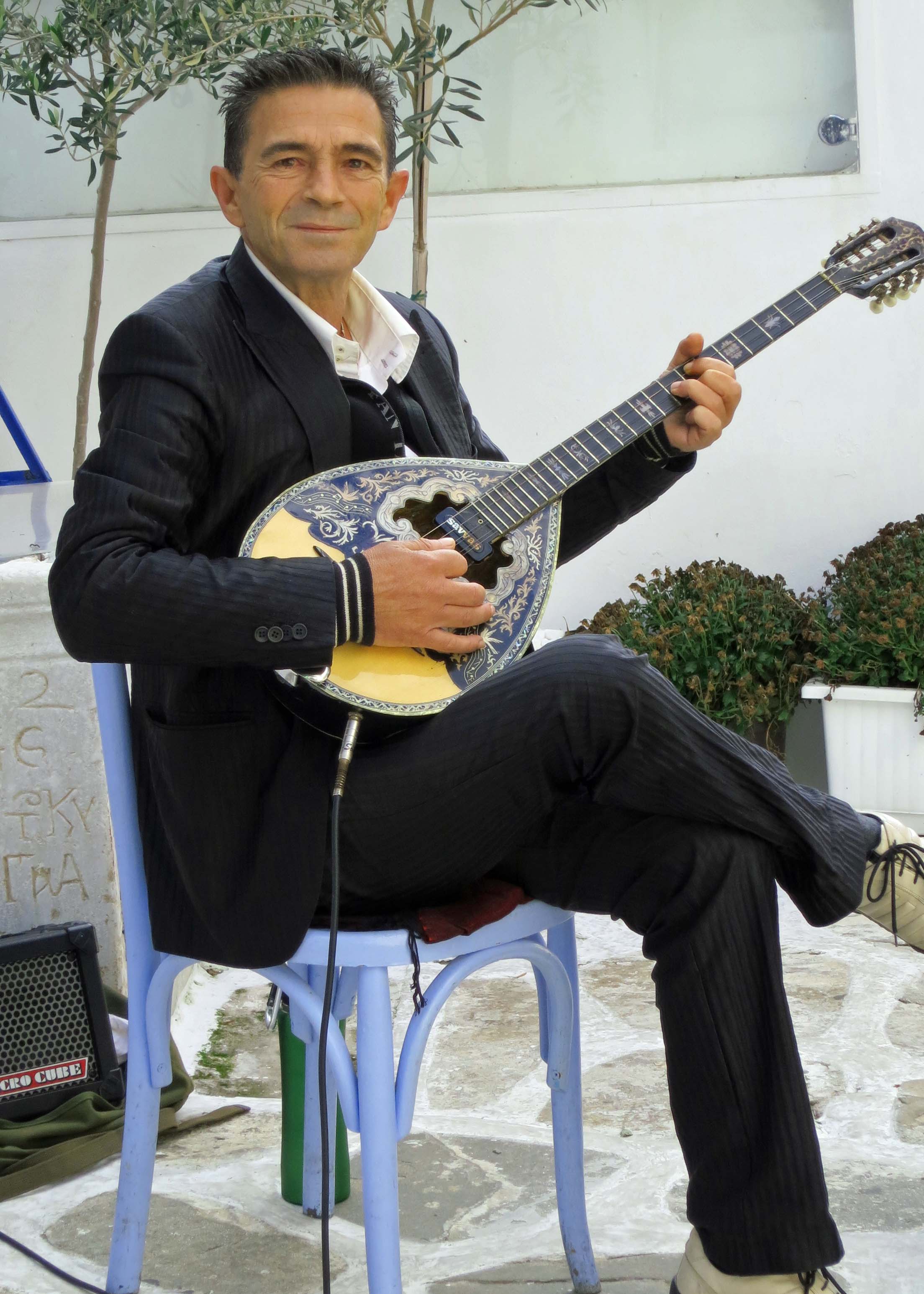
Modern day invaders, otherwise known as tourists, also find it easy to get lost. But that’s half the fun. Except for finding a restroom when you really, really need it, there is no danger. You can easily spend an hour or several wandering along the town’s crooked roads and paths. There are beautiful white buildings slathered in stucco to admire, shops to explore, and cats to photograph. You may even find a Greek musician playing the bouzouki, a mandolin-like instrument that produces what most people think of as Greek music.  Picture Zorba dancing.

White is the common color for buildings on Mykonos, Santorini and other islands of the Cyclades in the Aegean Sea.
One of the main streets in Myconos.
One of the main streets in Mykonos. This road is freeway size in comparison to most routes through the town.
Routes through Mykonos are much more likely to look like this.
Routes through Mykonos are much more likely to look like this. Note the blue trim used to add color to windows and doors.
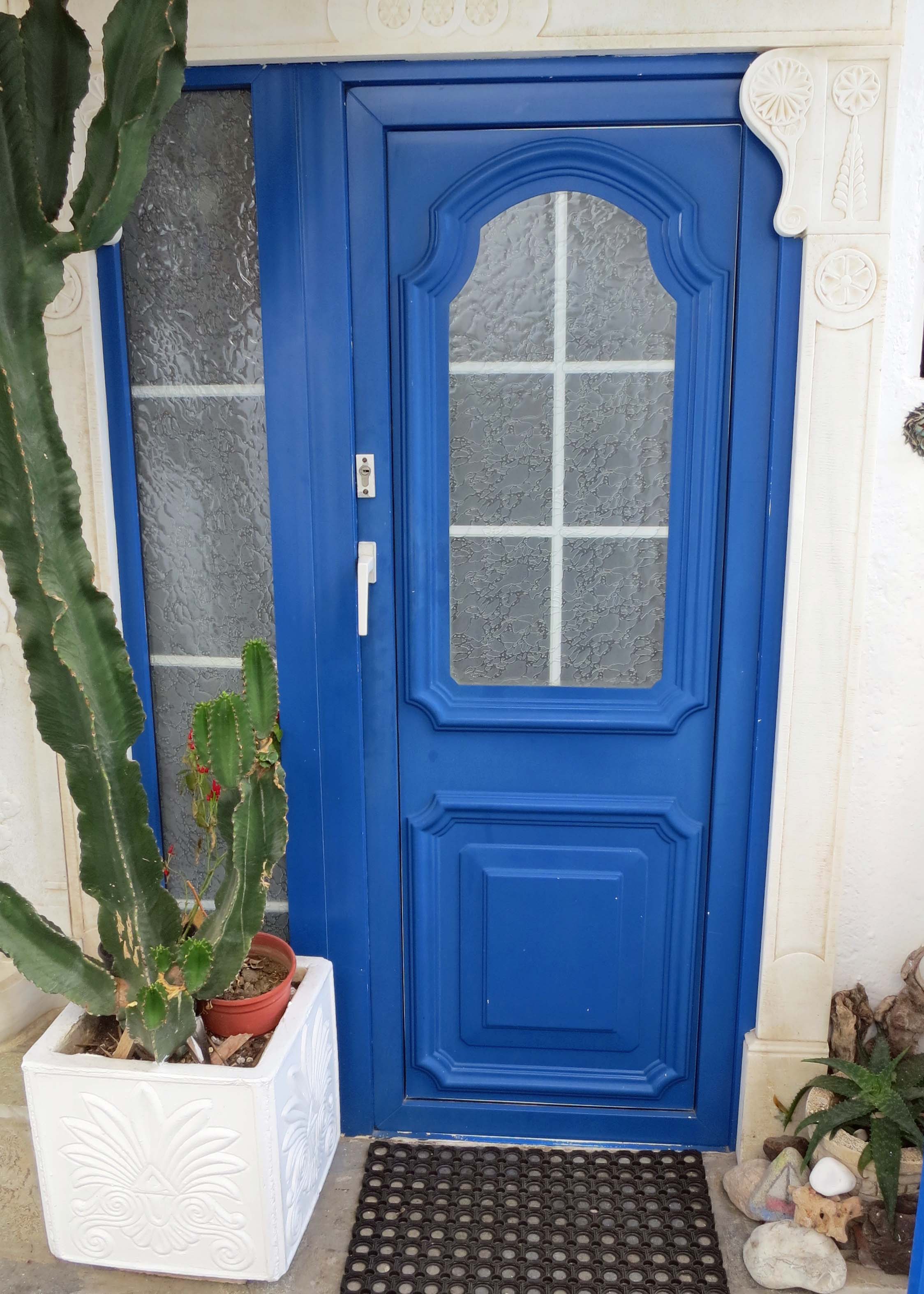
This blue Mykonos door is decorated by a cactus.
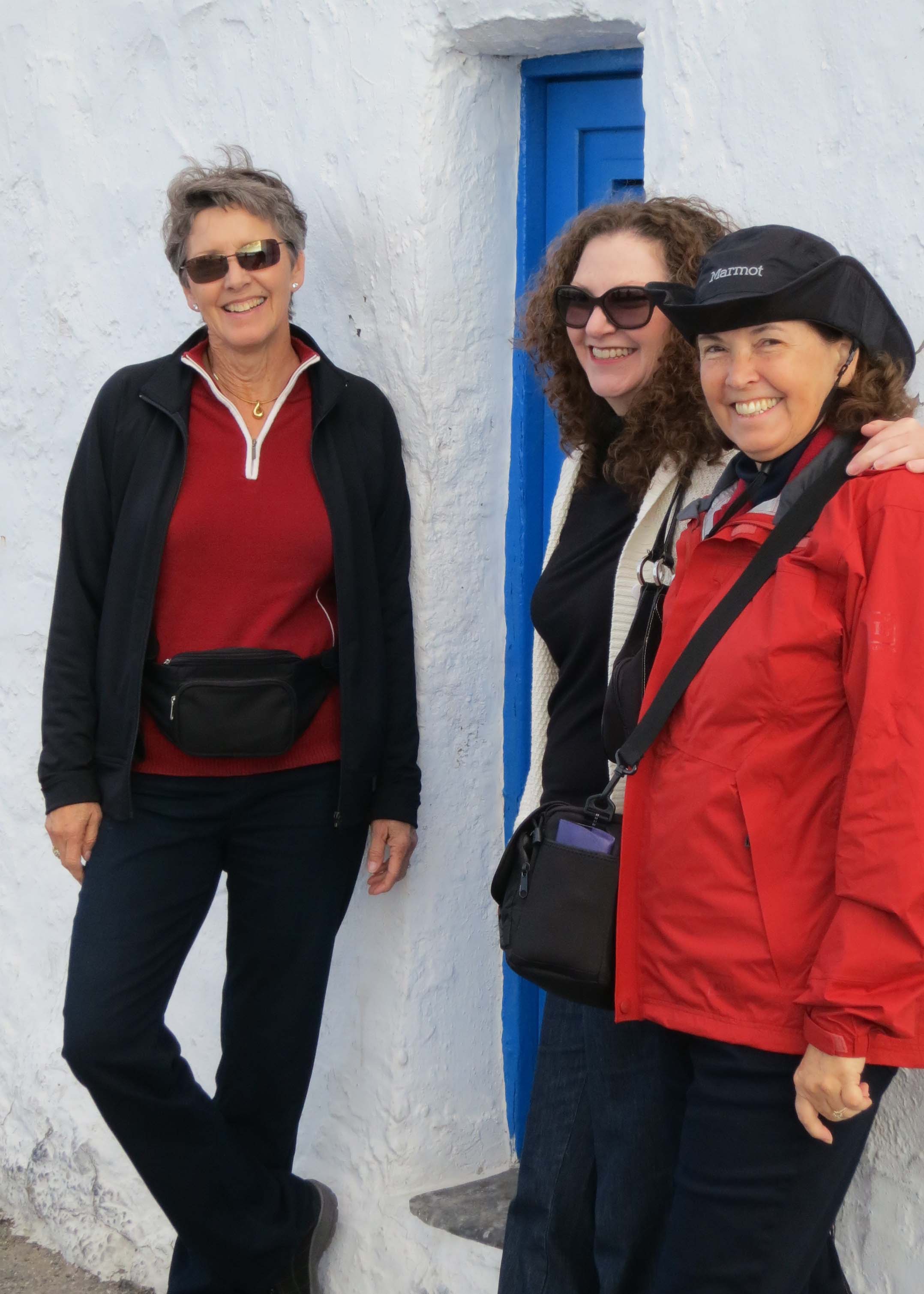
My wife Peggy on the right and two of our traveling companions, Kathi and Frances stand in front of another blue door.
Bougainvillea seems to be the flower of choice in Mykonos.
A street musician entertained us by playing his
A street musician entertained us by playing his bouzouki…
And a cat confiscated a cafe chair for its mid day snooze.
And a cat confiscated a cafe chair for its midday snooze.

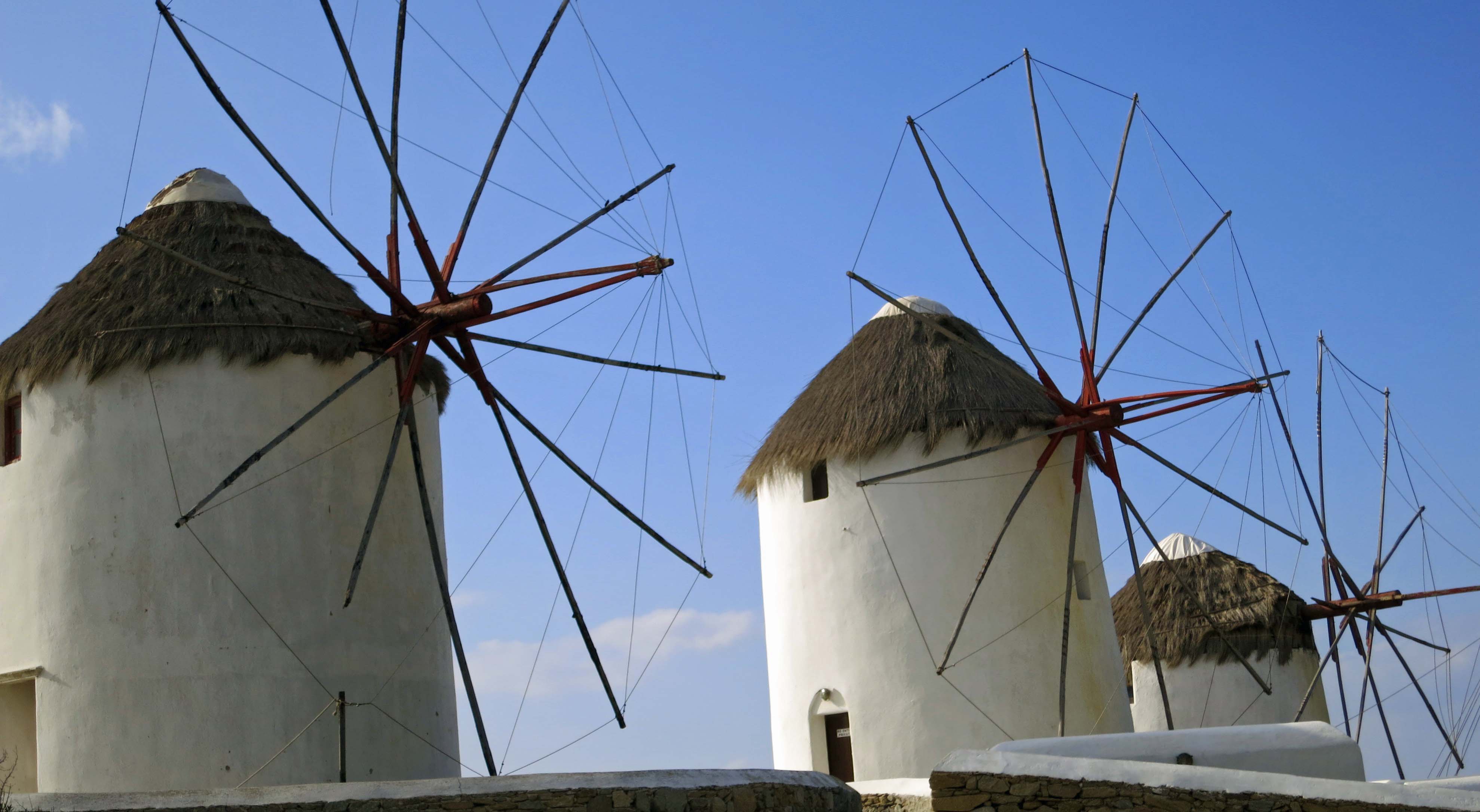
We managed to get both lost and separated. There was no hope of finding each other in the labyrinth, but fortunately we had a plan. We would meet at the island’s famous windmills. Long since retired, five of them remain hunkered down on a ridge south of town. Mykonos is noted for its winds. The locals even have names for them based on their intensity: bell-ringer, chair thrower, and knock you off your horse. We experienced a brief example of chair thrower but fortunately missed knock you off your horse.

The windmills used cloth sails to capture the winds and run mills for grinding grain. Local bakeries then turned the grain into sea biscuits, aka hardtack, which is flour and water baked several times into a consistency of hardness just this side of rock. The value of sea biscuits is they are basically indestructible. Before modern refrigeration, they were used on long sea voyages. Throw in a lime plus a generous dollop of rum and it was dinner. Producing these ‘delicacies’ was the island’s main industry.

One of the windmills of Mykonos. Dark clouds brought brief rain and a "throw a chair" wind.
One of the windmills of Mykonos. Dark clouds brought brief rain and a “chair thrower” wind. (Photo by Peggy Mekemson)
Three of the five windmills.

Following the coastline back into town we came upon Little Venice (pictured above), a community where sea captains of yore built mini-mansions perched on the ocean edge. Since it neither looks like Venice nor has canals, my thoughts are its name is derived from its proximity to water. Either that or a real estate agent was involved. The community is quite colorful, however. I’d be glad to call it home.

Mykonos has some 70 churches to meet the needs of its 7000 residents, which seems like a lot. I am reminded of the number of Baptist churches found in the rural South of the United States. When I was traveling through East Texas on my bicycle in 1989, I estimated there was one for each family. The Mykonosians had a unique use for their churches, however. They enshrined the bones of their dead relatives in the walls. I doubt the Baptists do this but it might give new meaning to the old saying, “the family that prays together, stays together.”
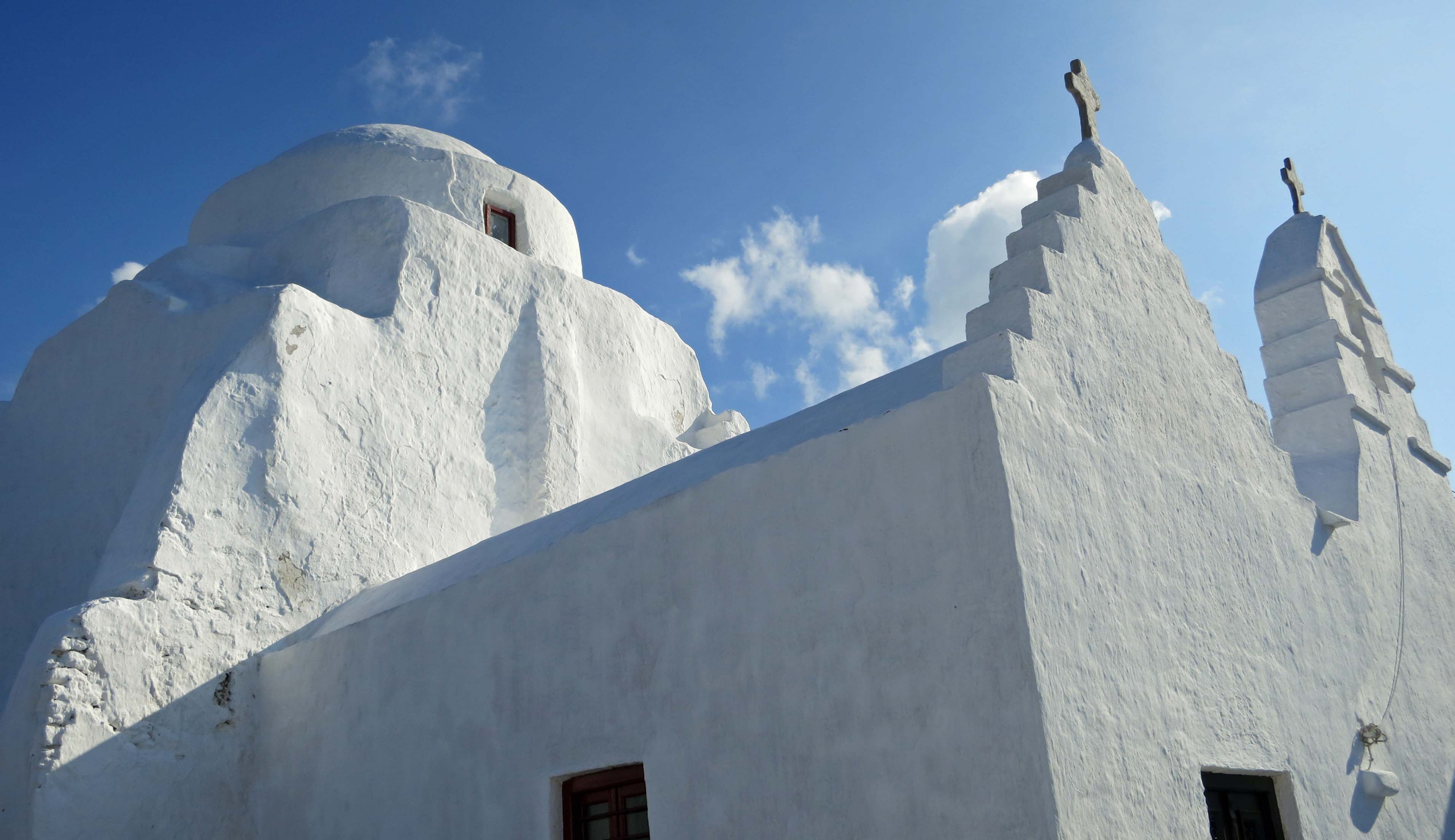
Scrunched between Little Venice and the harbor is the Church of Panagia Paraportiani, the most unusual church on the Mykonos. Once upon a time five different chapels existed side by side. Then they morphed together into what has become one of the most photographed sites on the island, with reason. We contributed our share of picture-taking.

The Church of
The Church of Paraportiani of Mykonos.
Another view of the church.

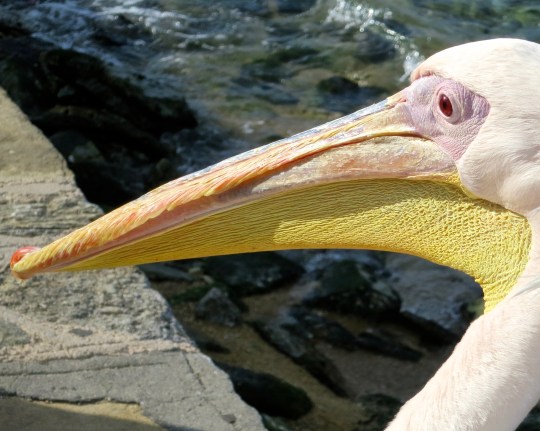
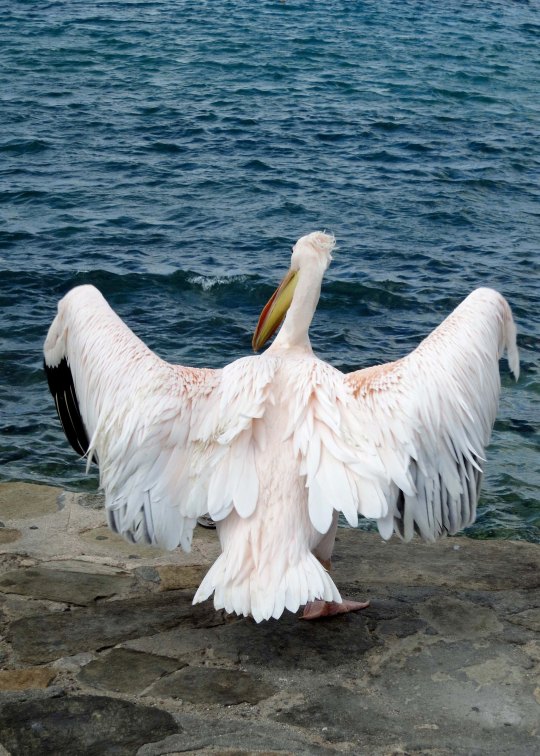
The small harbor area of Mykonos definitely fits the description of picturesque. It was our last stop (except for lunch) on our way back to the ship. That’s where we met Petros the Pelican.

We have this photo of Petros on our living room wall.
Petros playing ghost? Or possibly drying his wings cormorant style.

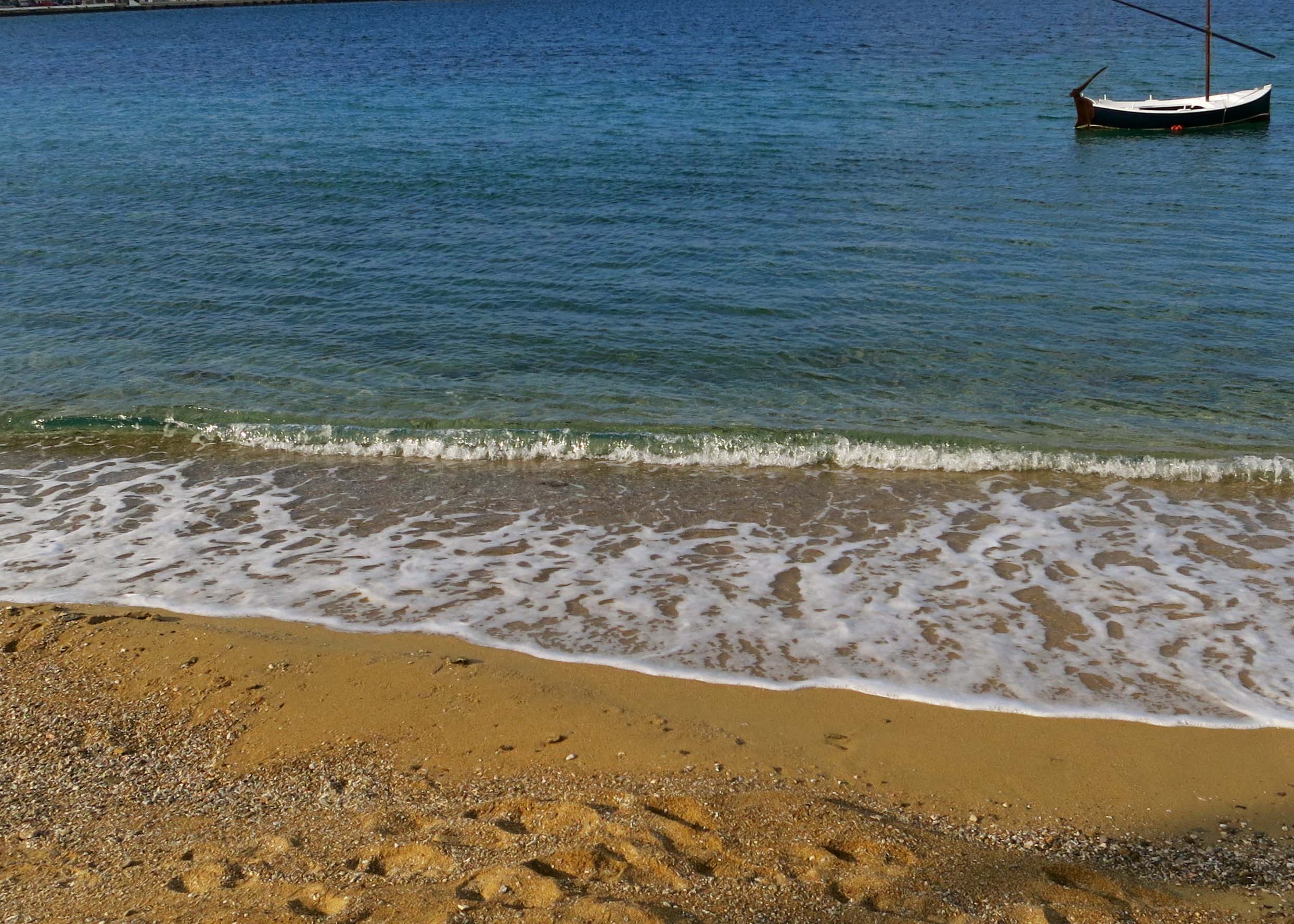
Unfortunately, it was Sunday and the local fishermen had taken the day off. We satisfied ourselves with admiring the boats. The area also features a small beach that would be crammed with sun worshippers in the summer. Now all it featured was golden sand and blue sea.

Idle fishing boats in the Mykonos harbor.
The golden sands and blue waters of the Aegean Sea of the small beach in Mykonos.
The golden sands and blue waters of the Aegean Sea of the small beach in Mykonos is a good place to end this post..

WEDNESDAY’S BLOG: Santorini. I’ve posted on this more recently but this beautiful island is always worth revisiting.