Chapter 5: Left Behind and Very Alone in NYC… Peace Corps Tales

Welcome to “The Dead Chicken Dance and Other Peace Corps Tales.” I am presently on a two month tour of the Mediterranean and other areas so I thought I would fill my blog space with one of the greatest adventures I have ever undertaken: a two-year tour as a Peace Corps Volunteer in Liberia, West Africa. Every two days I will post a new story in book format.

When I have finished, I will publish the book digitally and in print.

Jo Ann poses at the 1964/65 New York World’s Fair. Like the ancient dinosaurs, our Peace Corps group had disappeared.

Now we were disembarking at JFK in New York City, two country kids who had traveled a long way from Diamond Springs and Auburn California. All we had to do was check in at the Pan Am desk, grab a bite to eat, and catch our trans-Atlantic flight to Africa.

Ah that life should be so simple. Oh we managed to find the Pan Am desk all right, but no one was there.

“Excuse me, could you tell me where the Liberia Peace Corps group is?” I asked a harried attendant.

“I don’t have any idea,” was the brusque reply.

Have you ever had the sinking feeling that you have blown something critically important? It starts with the hair on your head and works its way downward to your toes. Every part of your body jumps in to let you know you aren’t nearly as smart as you imagine you are. It’s the stomach that serves as the real messenger, however, and mine was rolling like the Atlantic in a hurricane.

“Check the instructions again, Curt,” the voice of reason standing beside me directed. Good idea.

“Well, it says right here we are supposed to be at the Pan Am desk no later than 5 PM.” It was only 4. My stomach calmed down to a respectable jet engine rumble. “Let’s have a bite and check back.” I suggested, working hard to be the man.

Five PM came and no one, nothing, nada; it was serious panic time. “Wait here Jo in case anyone comes. I’ll go check the instructions one more time.”

We had stuffed our bags in a drop-a-quarter-in-the-slot storage locker while we ate. I freed my shoulder bag from captivity and reread the instructions. Yes, we were in the right place at the right time. Then there it was, the answer, staring at me in black and white. “You will fly to New York on August 7th.”

It was the 8th.

Damn! I slowly climbed back up the stairs.

“I’ve found them Jo Ann.” A look of relief and the beginning of a smile crossed her face.

“Where are they?”

“In Liberia.”

Let me say this about the two of us; we were both stubborn as mules when we thought we were right. This could create problems when we disagreed but the potential for disaster was miniscule in comparison to when we both agreed we were right and we weren’t. Reality didn’t matter and certainly a little date on a piece of paper we had each read a dozen times wasn’t going to deter us.

The 7th was our going away party in Auburn, period. While we were kicking up our heels and smelling the honeysuckle, our compatriots were crossing the Atlantic to Africa. Now we were left behind, very alone and stuck in New York City.

“What are we going to do?” Jo asked in a shaky voice. The only thing that came to my mind was a double vodka anything.

It was probably a good thing United Airlines let us on the airplane in San Francisco without noticing our tickets were one day out of date. Had we called Washington from home, the Peace Corps may have been tempted to say, “Why don’t you just stay there.”

The representative sounded amused when we called the emergency number in Washington after our visit to the bar. “Did we have enough money to get through until tomorrow?” Yes. Jo Ann’s mom had insisted we take an extra hundred dollars in cash from her. “OK, call this number in the morning.”

We decided to sleep in the airport to save our scant resources. It was a resolution with a short lifespan. I had one extremely unhappy young wife on my hands and my sleeping habits were unwilling to accommodate a deserted airport lounge.

Somewhere around midnight I said, “Look, Jo, I am going to see if a cab driver will help us find a hotel we can afford.”

The first guy in line was a grizzled old character in a taxi of similar vintage. I told him our story. He studied me for a moment and then said, “Go get your wife and I’ll find somewhere for you.

A more cynical observer might note we were lambs waiting to be fleeced but what followed was one of those minor events that speak so loudly for the positive side of human nature. The taxi driver took care of us. He reached across the cab, turned off his meter and then drove to three different hotels. At each one he got out, went inside and talked to the manager. At the third one he came out and announced he had found our lodging.

“This place isn’t fancy,” he reported, “but it is clean, safe and affordable.” Affordable turned out to be dirt-cheap. To this day I am sure the cab driver finessed a deal for us. Two very exhausted puppies fell into bed and deep sleep.

The Peace Corps representative we talked to the next morning wasn’t nearly as friendly as the one the night before but at least he didn’t tell us we had to go home. A commercial flight to Liberia would be leaving in three days.

“Could we hang out in New York? Did he need to send us some money? Could we follow directions?”

Yes we could hang out; no, they didn’t need to send money, and yes we could find our way to the proper airline at the correct time on the right day. Jo and I visited the New York World’s Fair, checked out the City and considered the three days as an extension of our all too short honeymoon.

As the old saying goes, all is well that ends well.

Chapter 4: The Dead Chicken Dance… Peace Corps Tales

Welcome to “The Dead Chicken Dance and Other Peace Corps Tales.” I am presently on a two month tour of the Mediterranean and other areas so I thought I would fill my blog space with one of the greatest adventures I have ever undertaken: a two-year tour as a Peace Corps Volunteer in Liberia, West Africa. Every two days I will post a new story in book format.

When I have finished, I will publish the book digitally and in print.

The Sierra Nevada Mountains about 20 miles south of where we did our training and at a slightly higher elevation.

Graduation from Berkeley, marriage in Auburn, a three-day honeymoon in Monterey, and reporting for Liberia VI Peace Corps training at San Francisco State College transpired in one whirlwind week.

My best man, Frank Martin, played his role superbly… from hosting the bachelor party at the Diamond Springs Hotel to making sure our escape car was appropriately decorated.

Frank grew up with me in Diamond Springs, California. We also attended Sierra College together. Somewhere along the line he discovered he was gay. Later on, he and his partner Hank would host several elegant but offbeat anniversary parties for us at their home on Clay Street in San Francisco.

Given our three-day honeymoon, Jo and I figured we would hold the record for newlyweds arriving at Peace Corps training. But we didn’t. One couple spent their honeymoon night flying out to the San Francisco State.

“Gee, Hon, let’s check out the airplane’s toilet again.”

Upon arrival, the married couples were crammed into one wing of Merced Hall, a student dormitory. Tiny rooms, paper-thin walls and a communal bathroom became our new home. We soon knew a lot about each other.

Peace Corps staff wanted to know even more; Beebo the psychologist was assigned to follow us around and take notes. First, however, they pumped us full of gamma globulin and explained deselection. Our job was to decide whether Peace Corps was something we really wanted to do. Their job was to provide stress to help make the decision. Initially this came in the form of a SF State football coach hired to shape us up.

“Okay you guys, let’s see how fast you can run up and down the stadium steps five times!” I hadn’t liked that particular sport during my brief football career in high school and still didn’t.

Beyond mini-boot camp, our time was filled with attending classes designed to teach us about Liberia and elementary school education. We were even given a stint at practice teaching in South San Francisco. There wasn’t much for Beebo to write about.

In case Peace Corps missed anything, we were given a battery of psychological tests to probe our miscellaneous neuroses. These were followed by in-depth interviews. “Answer honestly. Say the first thing that pops into your mind.” Yeah, sure I will.

A few people did wash out and were whisked away. Naturally it was a topic of conversation. What had they done wrong? Were we next?

The true stress test was supposed to be a camping trip up in the Sierras. This may have been true for the kids straight out of the Bronx who had rarely seen stars much less slept out in the woods but Jo and I considered it a vacation. We had been raised in the foothills of the Sierras and were going home.

The ante was upped when the camp leader arrived the first night.

“Here’s dinner,” he announced casually as he unloaded a crate of live chickens from the back of his pickup. They clucked a greeting.

Fortunately, I had chopped off a few chicken heads in my youth and knew about such things as chicken plucking and gutting. I couldn’t appear too eager in the chopping department, though. Beebo might write something like “displays obvious psychopathic tendencies.”

“Close the door, lock and latch it, here comes Curt with a brand new hatchet!”

My chicken spurted blood from its neck and performed a jerky little death dance, turning the city boys and girls a chalky white. Their appetites made a quick exit in pursuit of their color when I reached inside a still warm Henny Penny to yank out her slippery innards. It seemed that my fellow trainees were lacking in intestinal fortitude. If so, it was fine with me; I got more chicken.

Beebo’s biggest day came when we faced the wilderness obstacle course. Our first challenge was to cross a bouncy rope bridge over a deep gorge. Beebo stood nearby scratching away on his pad. We then rappelled down a cliff… scratch, scratch, scratch. Our every move was to be scrutinized and subjected to psychological analysis. We rebelled.

“Beebo, you’ve been following us around and taking notes for two months. Now it’s your turn. See that cliff. Climb down it.”

“Uh, no.”

“Beebo, you don’t understand,” we were laughing, “you have to take your turn.”

Reluctantly, very reluctantly, Beebo agreed. About half way down he froze and became glued to rock with all of the tenacity of a tick on a hound. We tried to talk him down and we tried to talk him up. We even tried talking him sideways. Nothing worked. Finally we climbed up and hauled him down. Note taking was finished. We wrapped up our wilderness week and our training was complete. Jo Ann and I took the oath and became official Peace Corps Volunteers.

We were allowed one week at home to complete any unfinished business before flying to New York City and reporting to the Pan Am desk at JFK. Since there wasn’t much to do, Jo and I relaxed and recovered from our tumultuous year that had begun ever so long ago with the Free Speech Movement at Berkeley.

We wrapped up our brief visit with a going away party in Jo Ann’s back yard in Auburn. Surrounded by friends and family, we talked into the night. It was one of those perfect summer evenings that California is famous for, complete with a warm breeze tainted with a hint of honeysuckle flowers.

Chapter 3: Sargent Shriver Comes to Berkeley Looking for Unreasonable People… Peace Corps Tales


Welcome to “The Dead Chicken Dance and Other Peace Corps Tales.” I am presently on a two month tour of the Mediterranean and other areas so I thought I would fill my blog space with one of the greatest adventures I have ever undertaken: a two-year tour as a Peace Corps Volunteer in Liberia, West Africa. Every two days I will post a new story in book format.

When I have finished, I will publish the book digitally and in print.

 The day before Cliff sent me scurrying after the errant urinalysis, Sargent Shriver arrived on campus.  I, along with several thousand other students, flocked to hear him speak.

Three months before I was to enter Peace Corps training for Liberia, Sargent Shriver came to the Berkeley Campus and gave an insightful speech into what it meant to be a Peace Corps Volunteer. (Google photo)

John Kennedy recruited his brother-in-law in 1961 to set up and then head the Peace Corps. “If it flops,” Kennedy had said, “it will be easier to fire a relative than a political friend.” He gave Shriver one month to create the organization.

By 1965 when I joined the Peace Corps, Kennedy had been assassinated and the Peace Corps had become one of the more successful foreign relation programs in US history.

Shriver’s appearance on campus was an important event at Berkeley. In addition to heading up the Peace Corps, he still carried the aura of the Kennedy years. The University was also important to Shriver. We had provided more Volunteers than any other college in the nation

“First of all, I am in favor of free speech,” he began. “Even the initials FSM don’t scare me. Back in Washington my enemies say they stand for “Fire Shriver Monday.” But LBJ says they stand for “Find Shriver Money.”

He captured us. Berkeley’s Free Speech Movement (FSM) had dominated our lives. Times had been serious, even dangerous. We were ready to laugh.

“But here on campus,” he went on, “I want to talk about today’s challenge to the young, to the American university student of the 60s… of what I think might be called a “free service movement.”

Shriver then used a quote from Bob Rupley, a 1962 Berkeley graduate and Peace Corps Volunteer, to describe what he felt the essence of the Peace Corps was:

“Apathy, ignorance and disorganization are the things we want to eliminate… in all areas in which we work. Clearly no Volunteer can hope for absolute success, nor can he even expect limited success to come easily. Clearly, the Peace Corps is not the responsibility of every American. And it shouldn’t be! In many ways, the life of a Volunteer who sincerely seeks to effect progress is miserable.”

Three weeks after making this statement Rupley was shot to death in Caracas, Venezuela while he was working as Peace Corps staff.

Shriver told us the Peace Corps was looking for unreasonable men and women. Reasonable people accept the status quo. Unreasonable people seek to change it.

We were noted for being unreasonable at Berkeley.

Six months earlier the UC Berkeley Administration had declared that the Bancroft-Telegraph Free Speech area was closed and that there would be no more on-campus organization of Civil Rights demonstrations in the Bay Area.

The success of these demonstrations had upset powerful right-wing forces in California.  Telephone lines burned between the UC Administration, Sacramento and Washington DC. Free speech and the right to support off campus political efforts were sacrificed.

Student organizers reacted immediately. They said no.

Some, like Mario Savio, had walked the streets of the South registering black voters and risking their lives to do so. In the summer of 1964 three of their colleagues had been killed and buried under an earthen dam near Philadelphia, Mississippi.

Many had been introduced to political activism four years earlier in the anti-HUAC demonstrations in San Francisco where the police had used fire hoses to wash protestors down the steps of City Hall. Most had participated in numerous protests against racial discrimination in the Bay Area since. (HUAC was the House Un-American Activities Committee, a hold over from the McCarthy era.)

Free Speech Movement organizers understood the value of demonstrations and media coverage. They had become masters at community organization and were focused in their vision to the degree they were willing to face police and be arrested for their beliefs.

The result was a series of confrontations that ended with the massive sit-in at Sproul Hall and the arrest of 800 students in early December. While I hadn’t served as a leader of FSM or been arrested, I empathized strongly with its objectives and had participated in many of the demonstrations. I even spent several hours in the Sproul Hall sit-in.

Heart pounding, I had waited in line and then stood up on the Dean’s desk in my socks and talked of rights and responsibilities. It was our right to oppose racism; it was our responsibility to do so.

Out in the hall, a group of students sat on the floor… surrounding Joan Baez and singing protest songs. I sat down and joined in. “We shall overcome some day…” I was part of something, something much larger than myself.

In the end, we won. Our freedom of speech, our freedom to organize, and our freedom to participate in the critical issue of the day were returned. While we were still a part of the future so popular with commencement speakers, we were also a part of the now, helping to shape that future.

“You have demonstrated your leadership in the generation of the ‘6os,’ the generation that will not take ‘yes’ for an answer, which has shown an unwillingness to accept the pat answers of society… either in Berkeley, in Selma or in Caracas, Venezuela,” Shriver noted.

“Once in every generation fundamentals are challenged and the entire fabric of our life is taken apart seam by seam and reconstructed…. Such a time is now again at hand and it is clear that many of you are unreasonable men (and women), restless, questioning, challenging, taking nothing for granted.”

We had not forfeited our rights at Berkeley, nor had we, according to Shriver, forfeited our claim to a fellowship with the Peace Corps. And this, at least in part, was why I had been accepted as a Volunteer. Participation in the Free Speech Movement was regarded as a plus, not a minus.

But the time had come to move beyond protest. Shriver concluded his talk with a ringing call for service.

“We ask all of you who have taken what you have learned about our society and tried to make it live, to join us in the politics of service, to demonstrate by doing, to the poor and the forgotten of villages and slums in America and the world, what you have learned of Democracy and freedom and equality. The times demand no less.”

“It is time not just to speak, but to serve.”

Chapter 2: The FBI is Told I Run Communist Cell Meetings… Peace Corps Tales

Welcome to “The Dead Chicken Dance and Other Peace Corps Tales.” I am presently on a two month tour of the Mediterranean and other areas so I thought I would fill my blog space with one of the greatest adventures I have ever undertaken: a two-year tour as a Peace Corps Volunteer in Liberia, West Africa. Every two days I will post a new story in book format.

When I have finished, I will publish the book digitally and in print.

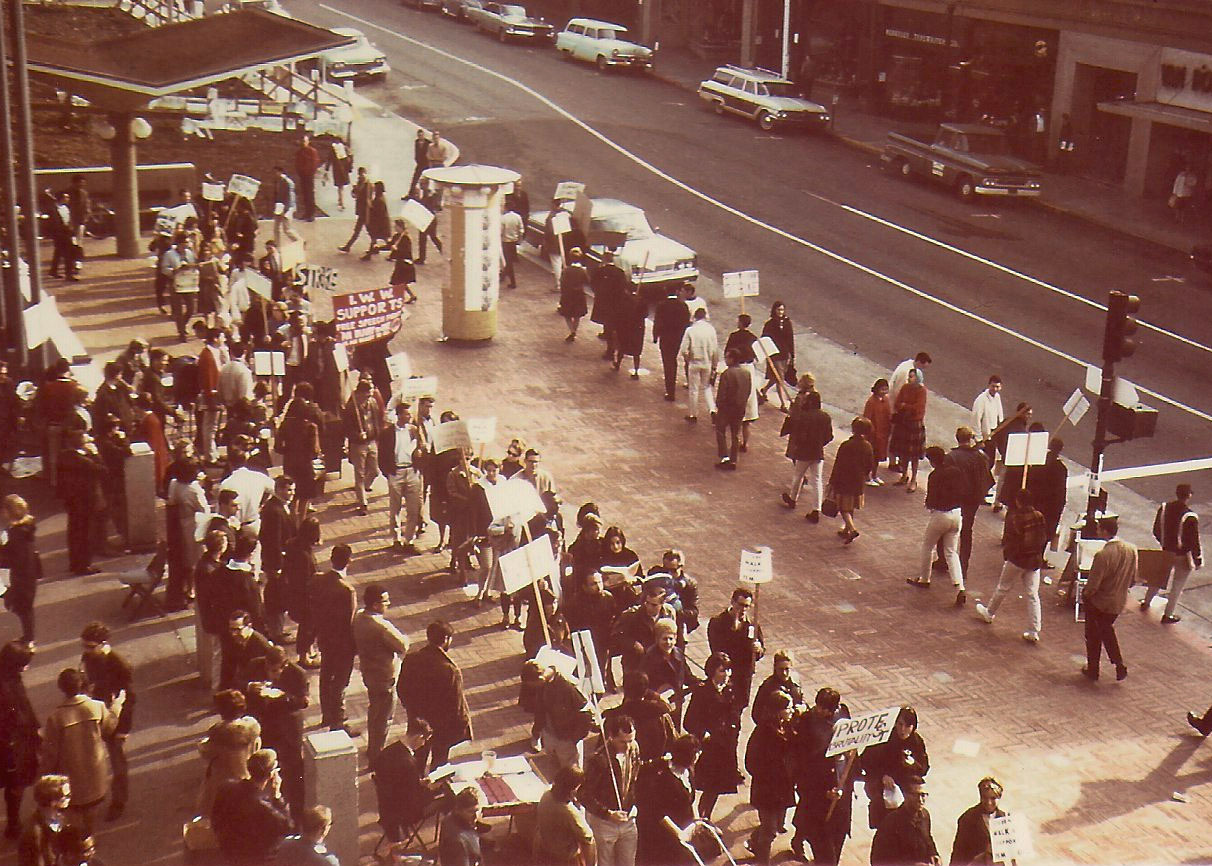
The mid-60s were a time of turmoil at UC Berkeley when the University blocked on-campus support for the Civil Right’s Movement. Here, I am one of many protesters opposing Administration policy by picketing at Bancroft Way and Telegraph Avenue.

In the last post, my first wife, Jo Ann, and I applied for the Peace Corps when we were students at UC Berkeley in 1965. We were tentatively accepted as teachers in Liberia, West Africa.

There were still hurdles. They were tied to the illusive if. We could go if we could get through the background security check, if we weren’t deselected during training, and if we could pass the physical. Training wasn’t a worry. We had enough confidence in ourselves to assume we would float through. How hard could it be after Berkeley?

The Security Check was something else. Jo Ann was squeaky clean but I had been up to mischief at Berkeley, hung out with the wrong people, been seen in a few places where law-abiding people weren’t supposed to be, and had my name on a number of petitions.

“And where were you Mr. Mekemson the night the students took over the Administration Building?”

Maybe there was even a file somewhere; maybe it was labeled Radical. J. Edgar Hoover saw Red when he looked at Berkeley.

Soon I started hearing from friends. The man with the badge had been by to see them. The background security check was underway. One day I came home to the apartment and found my roommate Jerry there. He was pale and agitated. His eyes bounced around the room.

“I have to talk to you Curtis,” he blurted out. “The FBI was by today doing your Peace Corps background check and I told them you had been holding communist cell meetings in our apartment.”

Jerry was deadly serious; Jerry was dead.

“What in the hell are you talking about?” I yelled, seeing all of our hopes dashed and me rotting in jail. I knew that Jerry disagreed with me over my involvement in Berkeley’s Free Speech Movement (FSM) and probably disagreed with me over the Vietnam War, but I hadn’t a clue on how deep that disagreement went. Or what he based his information on.

My degree in International Relations had included a close look at Communism. I found nothing attractive about repressive totalitarian states.

The closest I came to joining a leftist group had been the Free Student Union. Yes I had held committee meetings at our apartment but I had also severed my relationship with the organization. The folks behind the Union apparently believed that confrontation with authority was a good thing in and of itself. Getting bashed on the head with a nightstick made students angry. FSU wanted to radicalize the student body, not serve it.

I was not happy with Jerry that night or for some time after. I assumed the Peace Corps option was out and begin thinking of alternatives. They were bleak.

As it turned out, we received final notification from the Peace Corps a few weeks later. We were accepted. Jerry could live. The people who said good things about me must have outweighed the people who said bad things. Either that or Jo looked so good they didn’t want to throw the babe out with the bath water.

Or possibly the majority of other students who signed up for the Peace Corps from Berkeley in 1965 had rap sheets similar to mine.

There was one final hitch. I was to report to the Army Induction Center in Oakland for my physical. It was an experience not worth repeating. I lined up with a bunch of naked men to be poked and prodded.

“Turn your head and cough. Now, bend over.”

I took it like a man and escaped as soon as the opportunity presented itself. A couple of days later I came back from class and there was a scribbled note from my other roommate, Cliff, who was also going into the Peace Corps.

“The Induction Center called,” he wrote, “and there is a problem with your urinalysis.” I was to call them.

“Damn,” I thought. “Why is this so difficult?” So I called the Center and resigned myself to peeing in another jar. With really good luck, I might avoid the naked-man line.

I got a very cooperative secretary who quickly bounced me to a very cooperative nurse who quickly bounced me to a very cooperative technician who quickly bounced me to a very cooperative doctor… and none of them could find any record of my errant urinalysis.

They didn’t see any problems and they didn’t know who had called. They suggested I call back later and be bounced around again. More than a little worried, I rushed off to my next class.

That evening I reported my lack of success to Cliff. He got this strange little smile on his face and asked me what day it was.

“April 1st,” I replied as recognition of having been seriously screwed dawned in my mind. “You little ass!” I screamed, as Cliff shot for the door with me in fast pursuit. He made it to Telegraph Avenue before I caught him. The damage wasn’t all that bad, considering.

Chapter 1: An Ugly War Encourages Me to Join the Peace Corps

Welcome to “The Dead Chicken Dance and Other Peace Corps Tales.” I am presently on a two month tour of the Mediterranean and other areas so I thought I would fill my blog space with one of the greatest adventures I have ever undertaken: a two-year tour as a Peace Corps Volunteer in Liberia, West Africa. Every two days I will post a new story in book format.

When I have finished, I will publish the book digitally and in print.

The main street of Gbarnga Liberia in 1965 where I was serving as a Peace Corps Volunteer.

Tears tracked across Jo Ann’s cheeks and I struggled to be sympathetic. It wasn’t easy.

We had just left her parents in San Francisco and boarded a United Airlines jet bound for New York City. Except for the time I surrendered five hard-earned dollars for a helicopter ride at the El Dorado County Fair, it was my first flight ever.

The jet taxied out on to the runway, climbed above the bay, and banked toward the east. We were leaving family, friends and life in the US behind. While Jo wrestled with the past, my thoughts were on the future.

Africa, teaching and adventure beckoned.

For seven hours we would be winging across America and gazing down on cotton clouds, mountain ranges, deserts, plains, cities, towns, farms and forests.

We waved goodbye to California as the plane flew over the Sierra-Nevada Mountains. The towering granite of the Crystal Range gave way to the deep blue of Lake Tahoe. My mind turned to our new status as Peace Corps Volunteers. Six months earlier we had serious doubts this day would arrive.

It was the spring of 1965 and Uncle Sam was looking for recruits. He’d bought a used colonial war from the French and needed soldiers to fight. Being a 22-year-old male about to graduate from college, I was a prime but reluctant candidate.

The conflict in Vietnam dated back to 1946. It was born ugly. France had lost her colonial empire in Indochina to the Japanese during World War II and Charles de Gaulle wanted it back. The Vietnamese Marxist Ho Chi Minh wanted independence. War was the result. Russia sided with the North Vietnamese in hopes of expanding her influence. NATO and the US jumped in to thwart Russia and support France in her colonial ambitions.

By 1955 France had abandoned the fight as a costly, no-win disaster that had sucked up more and more of the nation’s human and financial resources. Now, it was our turn. We would provide ‘military advisors’ and financial aid to the politically corrupt but anti-communist regime of Ngo Dinh Diem in South Vietnam. Over the next ten years our support continued to grow.

By the time I was ready to graduate, the US was ready to send in the troops.

The Cold War was raging. America’s leaders saw Vietnam as a critical step in stopping the spread of communism and communism was seen as an anti-capitalist, anti-Christian, and anti-democratic evil extending its cancerous tentacles throughout the world. Lose Vietnam, the Domino Theory argued, and all of Southeast Asia would follow.

My political science professors in International Relations at UC Berkeley had a different perspective. Communism was changing. It was no longer monolithic in nature but had taken on a nationalist flavor. Communism in Russia was different from communism in China. The Russians were as fearful of Chinese massing on their border as they were of the US’s nuclear weapons.

One day I arrived at my class on Comparative Communism and learned my professor had been invited to Washington to provide advice on Vietnam. The message he carried was that Ho Chi Minh was a nationalist first and a Marxist second. He was seeking independence for his nation. He was no more interested in being dominated by Russia than he had been in being dominated by France.

Becoming involved in a full-scale war was not in the best interest of the United States and might prove to be a costly mistake.

Washington refused to listen. America’s leaders had grown up on a steady diet of Cold War rhetoric. Not even the insanity of McCarthyism had shaken their faith. Being ‘soft on communism’ was political suicide. When Khrushchev banged his shoe on his desk at the United Nations and said he would bury us, we banged back.

But I was convinced there was more to the fight in Vietnam than a communist grab for power. My International Relations major was focused on Africa and the news out of Africa in 1965 was on the struggle for independence from colonial powers.  I felt Ho Chi Minh was involved in a similar fight.

I decided Vietnam was not for me. Fighting in a war I didn’t believe in and killing people I didn’t want to kill was at the very bottom of my bucket list. And there was more. I am allergic to taking orders and can’t stand being yelled at. I’d make a lousy soldier.

I saw a court-martial in my future.

If drafted, I would go, however. I couldn’t imagine burning my draft card, running off to Canada or hiding out in the National Guard. I actually believe we owe our country service. Luckily, a temporary solution popped up. Peace Corps Recruiters were coming to Berkeley.

John Kennedy proposed this idealistic organization to a crowd of 5,000 students during a campaign speech at he University of Michigan on October 14, 1960. He was running four hours late and it was two in the morning. The response was overwhelming. One of his first acts as President was to create the agency.

Peace Corps service would not eliminate my military obligation but it might buy time for the Vietnam War to end. Of more importance, I felt the Peace Corps provided a unique opportunity to travel, represent the US in a positive way, and hopefully, do some good.

I talked the idea over with my fiancé. “Let’s do it!” Jo Ann responded. She and I would go together as a husband and wife team. When the Peace Corps recruiters opened their booth in front of the Berkeley Student Union, we were there to greet them.

“Sign us up,” we urged.

“Fill these out,” the recruiter responded, handing us two umpteen page blue applications. “You will also have to pass a language aptitude test in Kurdish and provide letters of recommendation.” I had my doubts about the Kurdish.

Apparently we looked good on paper. In a few weeks the Peace Corps informed us that we had been tentatively selected to serve as teachers in Liberia, West Africa. My brain did a jig. The age-old question of what you do when you graduate from school and enter the real world had been answered, or at least postponed.

Uncle Sam with his growing hunger for bodies to fight the Vietnam War would have to wait.

Next blog: My roommate at Cal tells the FBI and Peace Corps I am running Communist Cell Block meetings in our apartment.

A Letter from Africa

The hospital ward at Phebe Hospital in Liberia, Africa. Netting provides protection against malaria bearing mosquitos. Air conditioning from the tropical heat is provided by fans during the six or so hours the hospital has electricity each day.

I received a letter last week from Dr. Kylkon Makwi of Suakolo, Liberia. It was an old fashion type of letter. It came in the mail and was handwritten.

When I first met Dr. Makwi, he was a 13 year old boy who went by the name of Sam Kollie. It was the summer of 1965. My former wife Jo Ann and I had just arrived in the upcountry town of Gbarnga, Liberia where we were to serve as Peace Corps teachers.

We were tired, hungry and nervous. It was the end of a long day that had started in Monrovia, Liberia’s Capitol. A week earlier we had been partying in Jo’s back yard in Auburn, California. Now we were in the heart of West Africa. The Peace Corps driver, Wellington Sirleaf, made a quick stop to introduce us to Bob Cohen, the Upcountry PC Director, and was taking us to our new house.

There was one more stop before we got there. This time it was to see Shirley Penchef, another Peace Corps Volunteer. She was waiting at her house with a young Liberian of the Kpelle tribe and a surprise.

“This is Sam,” she bubbled (Shirley always bubbled). “Sam is so excited you are here! He has been waiting weeks for you! He is going to be your houseboy!”

Jo and I were speechless. We had talked about the possibility; it was common practice among Volunteers. A young Liberian would help with chores, earn spending money and often eat with the Volunteer. Both the Liberian and the PCV gained from the experience.

We recognized the value of the arrangement but had decided that having a houseboy didn’t quite fit the Peace Corps image. Like how do you tell the folks back home you are roughing it out here in the jungle and doing good while someone cooks your dinner, washes your clothes and cuts your grass?

On the other hand, how do you tell a woman who talks in exclamation points and a 13 year old boy who is grinning from ear to ear that you don’t want what they are selling?

“Uh, gee, uh, well, why doesn’t Sam help us get settled in and then we’ll see,” we managed to stutter. It was one of the better decisions we were to make in Liberia.

You’ll find the complete story of our first day in Gbarnga under “Armies of the Night” on the sidebar. It includes drums in the night, ghosts, screaming and monster spiders… but no beer.

Sam was a bright young man. Eventually he would get a full paid scholarship to Brandeis University in Boston, pick up his MD in Monrovia and earn a Masters in Public Health at Loma Linda University in Southern California. Life would not be easy for him, however.

The story of modern Liberia is one of the great tragedies of our time. A revolution that begin with the elimination of the ruling elite quickly degraded into tribal warfare that featured modern weaponry in the hands of children and dark juju, the voodoo of West Africa. Brutality, death, disease and starvation were the results. A full generation of Liberians was either lost or forever scarred by the nightmare.

Today, Liberia is struggling to recover and Sam/Kylkon is part of the effort. He and a handful of other medical professionals are working at Phebe Hospital in Upcountry Liberia. The odds against success are staggering.

As Kylkon notes, “there is a gross shortage of health manpower and hospital supplies.” (2009 statistics from Liberia report there was one doctor per 100,000 people in Upcountry.) Even basics, such as bed linens are missing. “We are in need of patient gowns, surgeon gowns and gloves, instruments, anesthetics and therapeutic drugs.” He sometimes performs surgery wearing an apron.

Hospital facilities in Liberia were damaged during the war and are “badly in need of renovation and repair.” Electricity and water at Phebe are limited to six or so hours per day.

Phebe serves the surrounding communities such as Gbarnga, which now has a population exceeding 50,000, and border populations from neighboring countries. Few people have the money to pay for their care.

“People come by my house at all hours begging for drugs,” Kylkon reports. But there are few drugs to be had.

It is hard, almost impossible, to imagine the challenge of providing medical care under such circumstances. The tragedy of Liberia continues.

Hang in there Sam. Our thoughts and wishes are with you.