A Reluctant Sponsor, A Bear, and Much Wagging of Tail… Blog-a-Book Tuesday

It’s Blog-a-Book Tuesday, again, and I am continuing to blog “It’s 4 AM and a Bear Is Standing on Top of Me”— one story at a time. In my last post Steve and I began our recruitment efforts for the Sierra Trek, our hundred mile backpack trip across the Sierra Nevada Mountains. Sixty one people signed up, a true cast of characters. In this post, we recruit sponsors, figure out what we will feed our army, and preview 80 miles of the trail.

We would start our journey hiking up and over granite mountains.

As the Trekkers rolled in, Steve and I focused our energies on the next task. What were we going to feed the army that we would be leading through the mountains? Breakfast and lunch could be pulled off the shelves in local grocery stores. Dinner was the problem. Freeze dried food was in its early stages of development and somewhat expensive for my budget. 

There was another possibility. Lipton had a lightweight, off-the-shelf dinner, which was inexpensive and sold through grocery stores. The meals came in four flavors and featured tiny amounts of turkey, chicken, beef and ham with gourmet names attached. I bought all four and Jo Ann (my first wife) and I did a taste test. Except for the Ham Cheddarton, they were actually decent. The Cheddarton, while edible, was in serious need of improvement. What the heck, I thought, three out of four isn’t bad.

Steve suggested that he call Lipton’s headquarters back east and see if we could get the food donated. We would offer to ‘test market’ and publicize their food for the growing backpacking market. Lipton bought it. We had our dinners, and Steve had earned his minimum wage for the day.

We also wanted a backpacking store as a sponsor. An outdoor store would provide some much-needed credibility and be a valuable source of advice and recruits. I did a scientific search by looking in the Yellow Pages and picking out the first store I came to, Alpine West. It was only a few blocks away at 10th and R Street so I walked over. A bushy bearded, hippie-like character in his mid-twenties was behind the cash register.

“Excuse me,” I asked, “is the owner or manager in?”

“I am the owner,” was the somewhat terse reply. “What can I do for you?”

I did a quick regrouping, “Hi, my name is Curt Mekemson and I am the Executive Director of the local Lung Association,” I said as I offered my hand. He gave me a ‘what donation are you about to ask for look’ but took my hand and introduced himself as Tom Lovering. I explained what we were going to do.

“That’s insane,” Tom had replied with an assuredness that would have intimidated Attila the Hun. It certainly intimidated me. What do you say when the expert you are seeking advice from tells you flat-out that the idea you are already implementing is crazy?

“Um, it’s been nice chatting with you.” Or, “I’d really appreciate it if you don’t tell anyone.”

I opted for the “Why do you say that?” wanting to know how far out on the limb I had crawled. I quickly learned that the event we were planning was the equivalent of the Bataan Death March. People might do it but they were going to be miserable and say nasty things about the Lung Association and me for the rest of their lives.

After having said all of that, Tom agreed to sponsor and promote the Trek through his store. I left feeling a little confused. Did he want people to say nasty things about Alpine West and him?

Back at Lungland, the clock continued to tick and tock. The Trek was three weeks away and then two. It was time to go out and preview the route. Given Tom’s pessimistic assessment of our adventure, Steve and I felt the preview was all the more critical. We agreed to a long weekend where each of us would hike three days of the route. The final three days were saved for the following weekend just before the Trek. Could we plan things any tighter? There was no room for error.

Steve had never backpacked alone and I had only been out by myself three times. It promised to be an adventure. In addition to reducing the odds that we would lose 61 people in the woods, we also needed to check out potential camps, water availability, and the difficulty of the trail. I wanted to develop a feel for what we would be putting our participants through.

Nervous is the best word to describe my mood as I packed up. Jo Ann was heading off for a clothes-buying spree in San Francisco. I told her to enjoy herself, threw my backpack in the back of my Datsun truck, picked up Steve, and drove to Squaw Valley. We made a brief stop in Auburn to recruit my father-in-law’s Springer Spaniel, Sparky. I felt the trip might be a little rough on my basset hound, Socrates, but wanted some doggy companionship. I left Steve weaseling a free ride up the Squaw Valley tram and headed for Robinson Flat, a camping area on the western side of the Sierras. I left the pickup there for him.

Some experiences burn themselves into your soul. This was one. The beauty and the variety of the wilderness captured me. I was starting at around 7000 feet in the heart of red fir and Jeffrey pine country and dropping 6000 feet into the Sierra Foothills where incense cedars, ponderosa pines and white oaks provided shade.
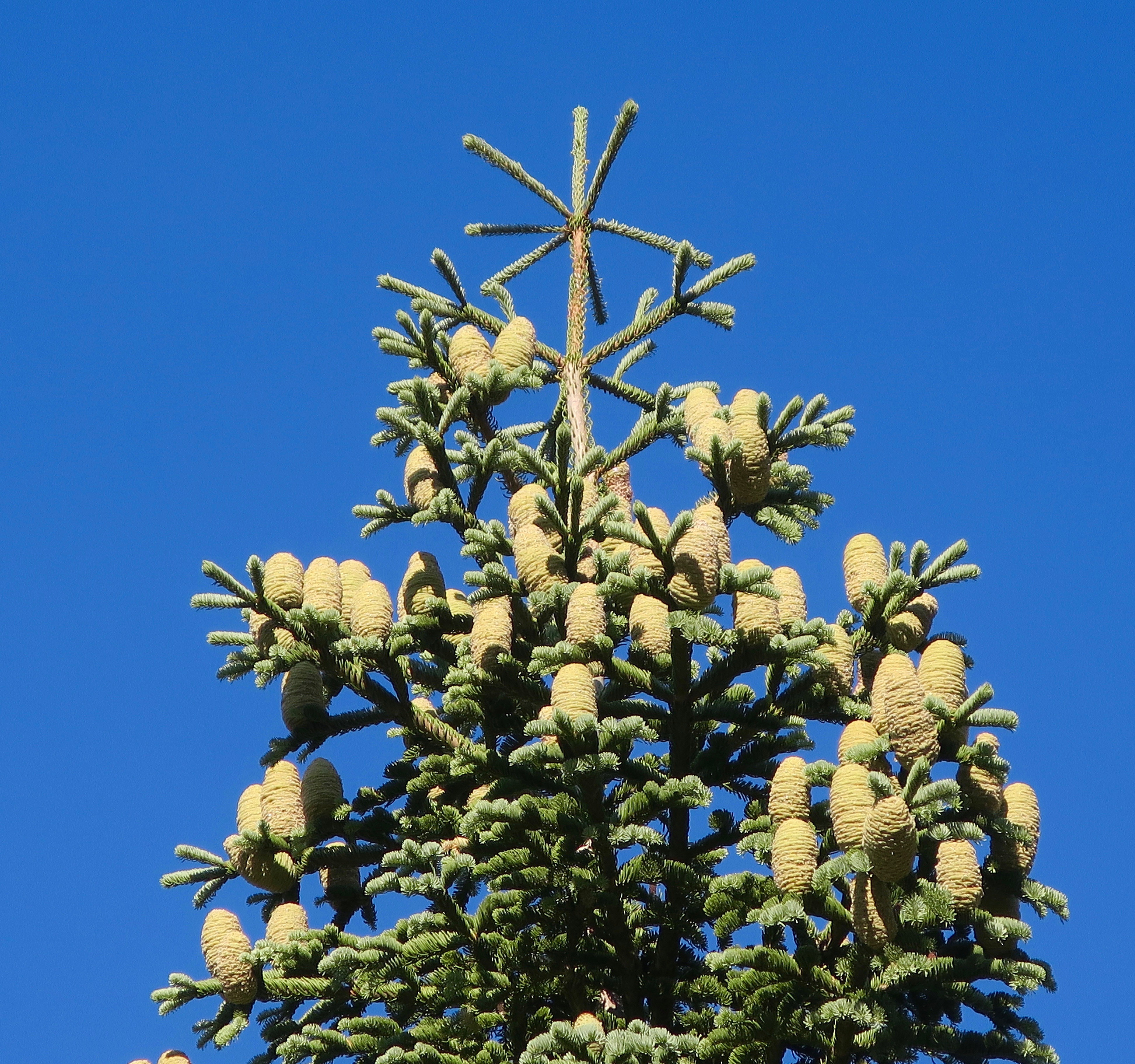
Red fir trees grow on the upper slopes of the Sierra Nevada Mountains beneath the alpine zone.

Along the way I would descend into river canyons filled with inviting pools and scramble out to follow hot, dry ridges. Besides Sparky, a coyote, two skunks, several deer, a porcupine, and numerous birds provided entertainment. I also met my first ever bear, a big brown fellow that came ambling out of the brush and increased my heart rate twofold. Even the ever-curious Sparky took one sniff and made a quick retreat behind me, looked out from between my legs, and started barking. Great. The bear growled his displeasure and ambled back into the brush. Slowly.

Being alone enhanced and intensified the experience. The days were exciting but the nights bordered on scary. After the bear, I imagined all types of creatures sneaking up on us as we slept. Sparky was even more nervous. I loaned her my new Pendleton shirt to sleep on. She had chewed it to rags when I woke up in the morning. I didn’t have the heart to scold her. Had I known what she was up to, I might have joined her.

It was the physical challenge that made the deepest impression. I was strong but out of shape. Even had I been better prepared, I wasn’t psychologically ready for the experience of hiking 10-15 mile days with a 55-pound pack on my back. Nor was the territory gentle. I was hiking in and out of 1000 foot plus deep canyons following steep, winding trails that had challenged the 49ers in their endless search for gold. Once I found myself lost on a brush choked mountain and had to fight my way free.

As I approached Forest Hill, temperatures climbed to a scorching 105 degrees. To top it off, I was breaking in a new pair of German-made Lowa boots. All of the backpacking literature of the day emphasized sturdy foot-ware and it didn’t get much sturdier than Lowas. Given that my feet blister at the mere sight of a boot, they were not happy campers. By the third day I had blisters on top of blisters and my feet resembled a hyperactive moleskin factory.

But I made it. I proved to myself I could do it and that the Trek was possible. With the proof came an incredible high. I hiked into Forest Hill singing.

Steve showed up about an hour later in the Datsun. He was beaming and grabbed me in a breath-robbing bear hug while Sparky did much wagging of tail. The three of us did a little dance and Steve and I both tried to talk at once as we told our stories. Steve had seen ‘migrating’ rattlesnakes and lots of bear scat. He peed around his camping area to mark his territory and warn the bears to stay out. They did. The second day a hawk had ‘chased’ him down the trail for miles. I wondered what Steve he been smoking. But now, Steve was on the same natural high I was. We were ready to Trek.
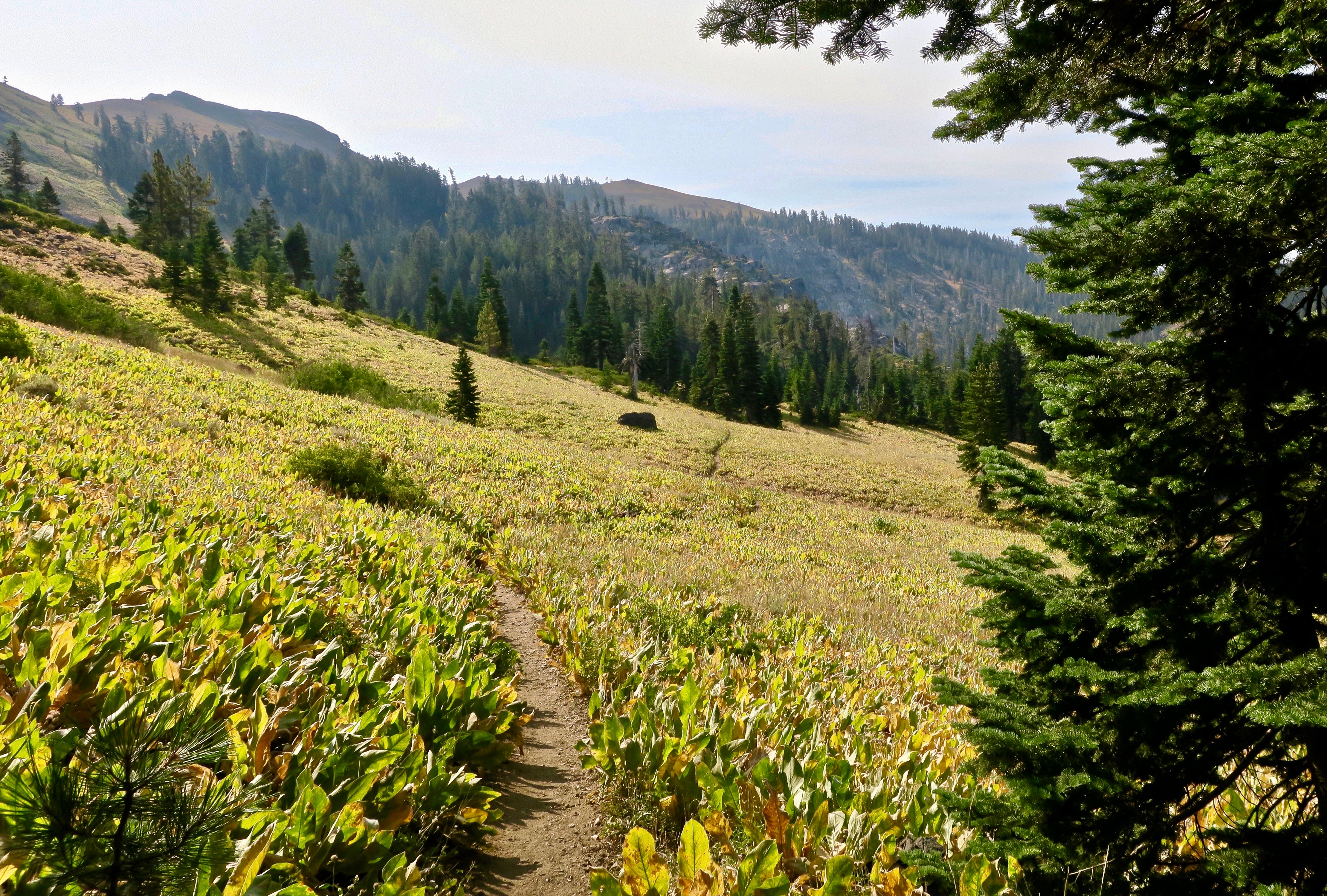
In hiking a hundred miles, we quickly discovered that the trails have a way of going on and on— as this one does across a field of mule ear flowers.

NEXT POSTS:

I’ll be featuring photos from our various adventures this year between now and the New Year on my Travel Blog but I will keep Tuesdays for blogging my book. Next Tuesday we discover that Lipton has only sent us Ham Cheddarton, Jo Ann takes a detour to LA, and I take a detour to Canada. All in the week before the Trek.
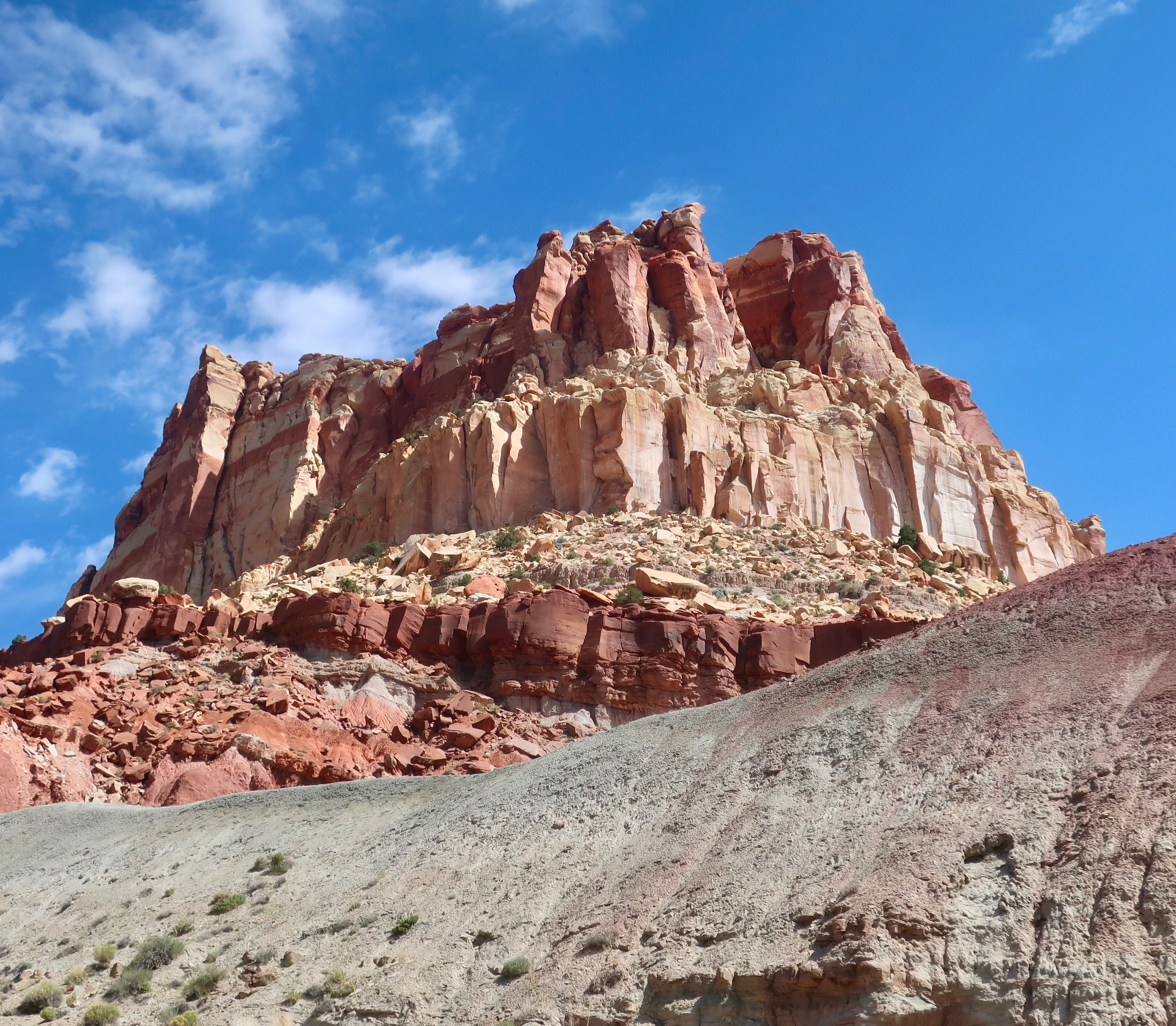
Utah’s Scenic Highway 24 Features the Stunning Capitol Reef NP… The Backroads Series

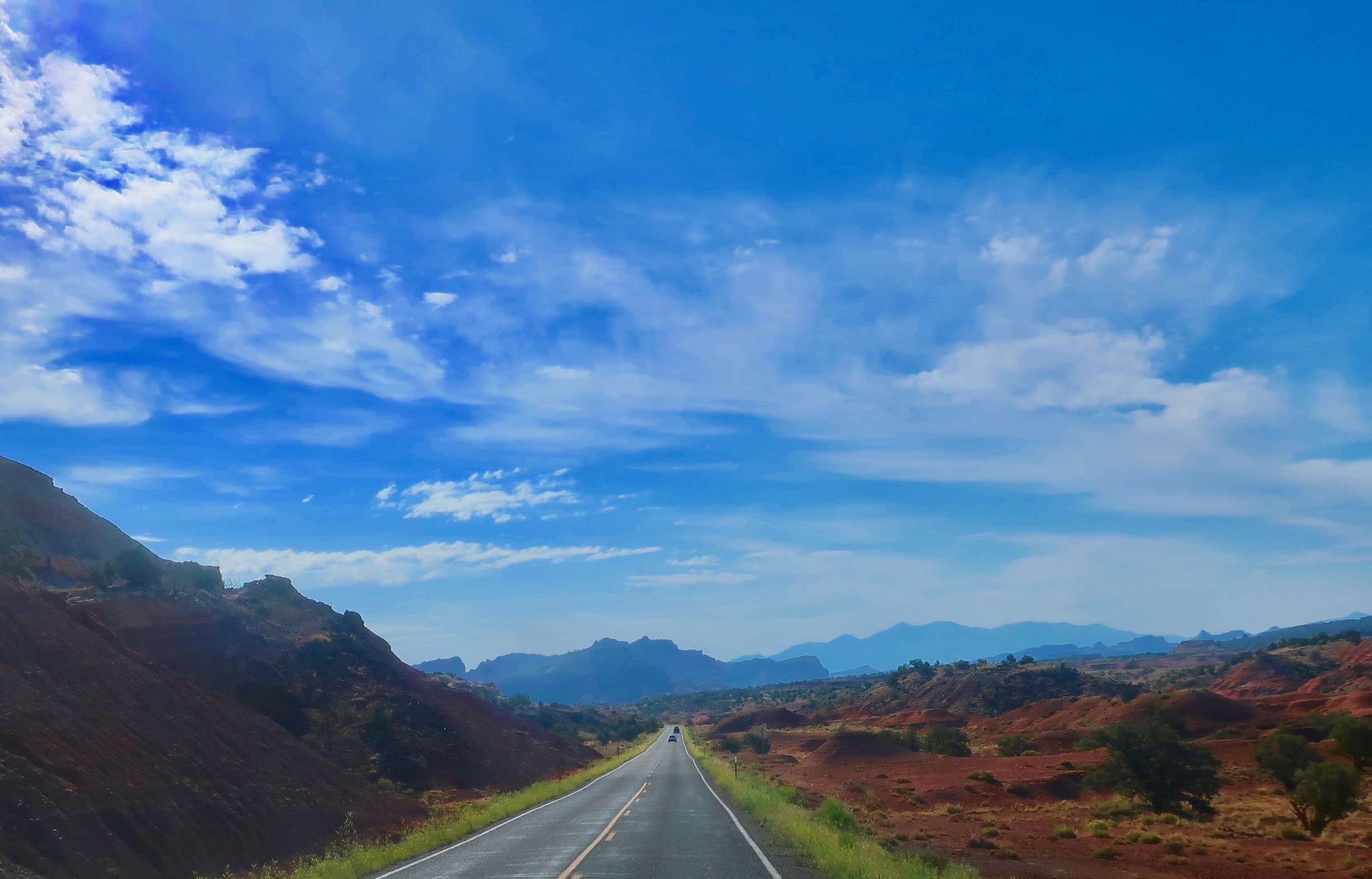
Utah’s scenic Highway 24 is worth traveling over on its own, but Capitol Reef National Park makes it special.

Peggy and I said goodbye to Highway 50 in the small Utah town of Sigurd with Capitol Reef National Park as our destination. We had been to the Park before and were eager to return. Our previous trip covered only a small section of Highway 24, however. This time we were determined to drive the whole road as part of our backroads adventure and were pleased to discover it, too, was quite scenic. I’ll start with photos we took before and after Capitol Reef NP and then focus in on the Park. These photos were taken by both Peggy and me.

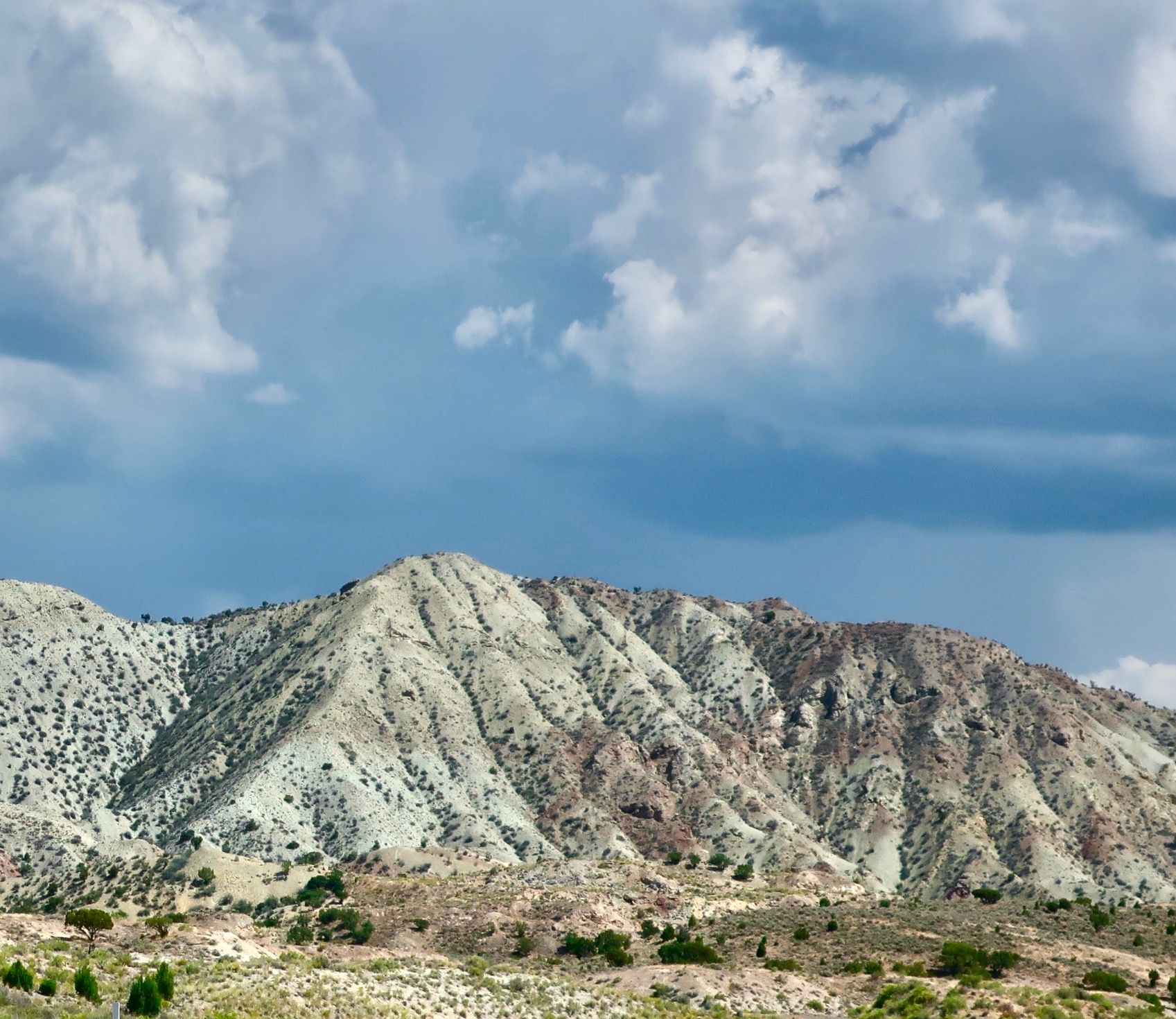
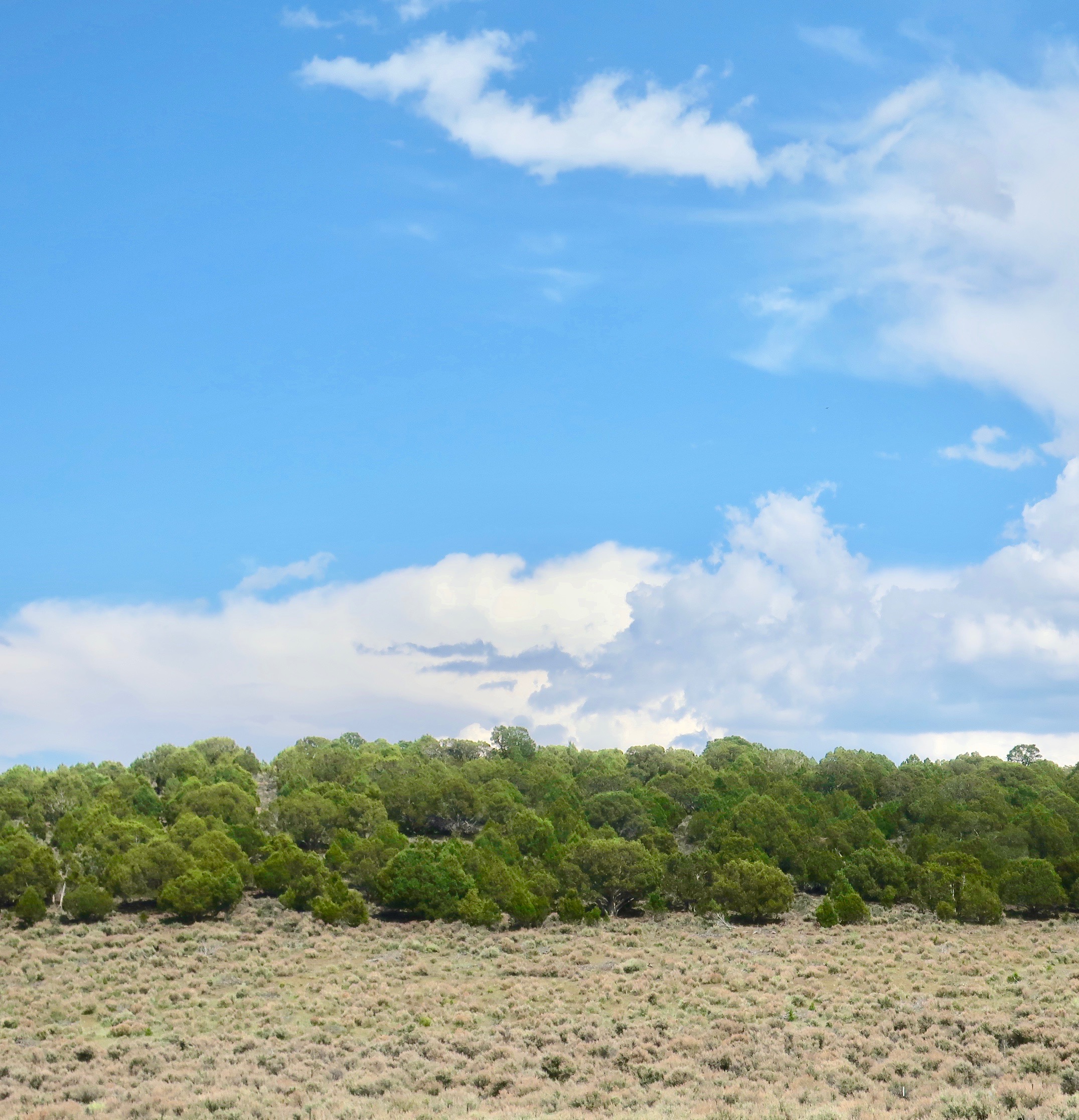
Three photos from along Highway 24 west of Capitol Reef National Park:

Three photos from along Highway 24 east of Capitol Reef National Park:

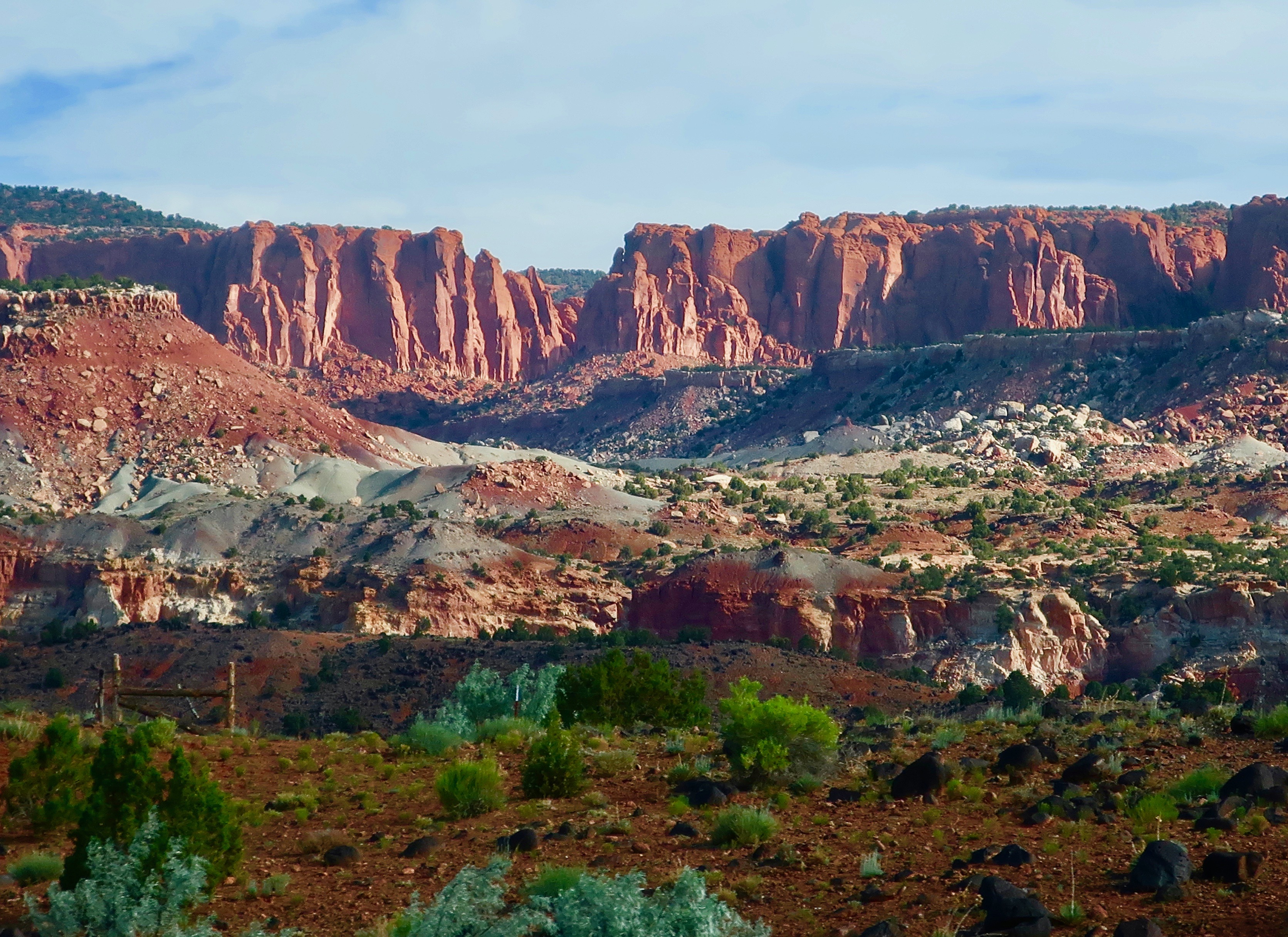
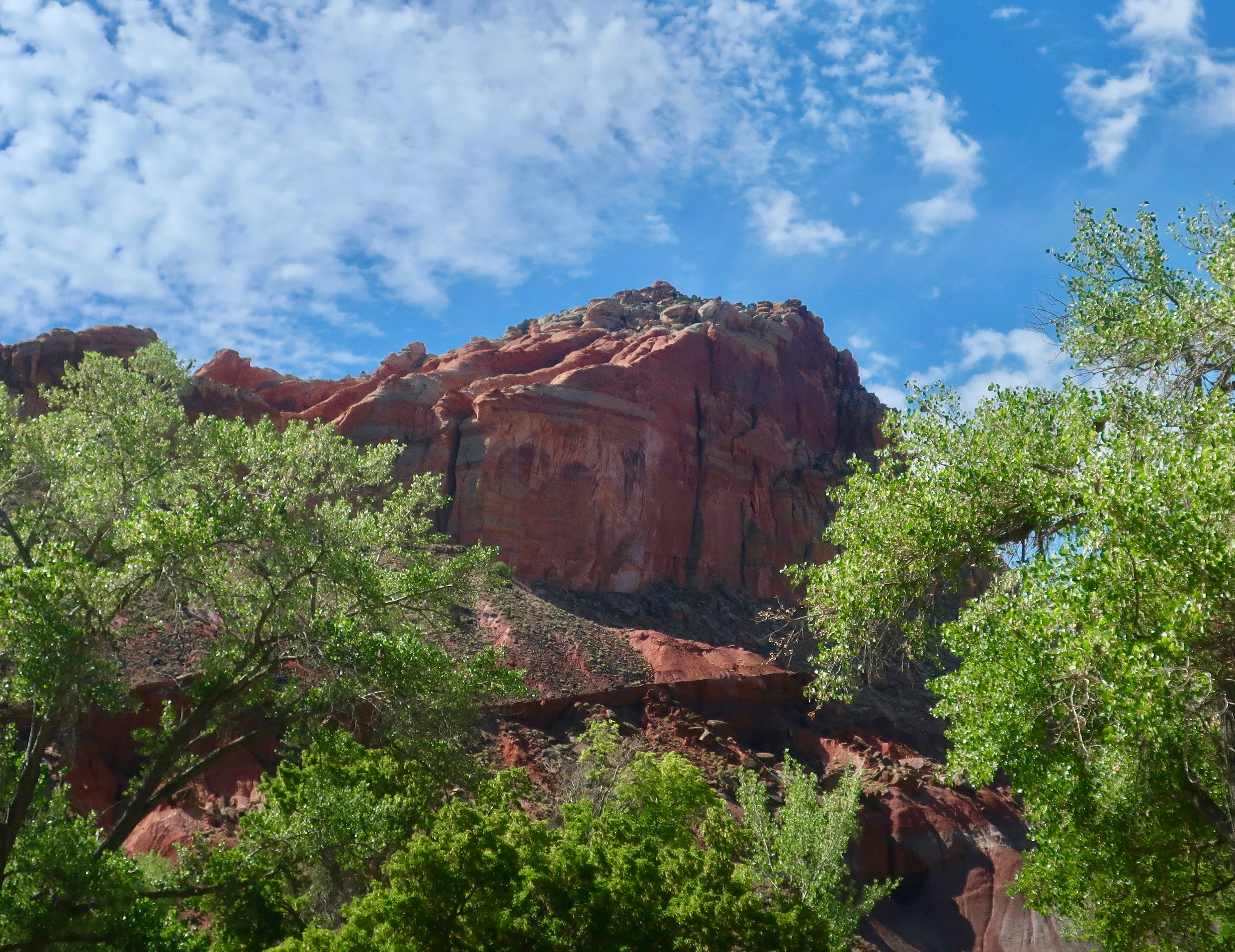
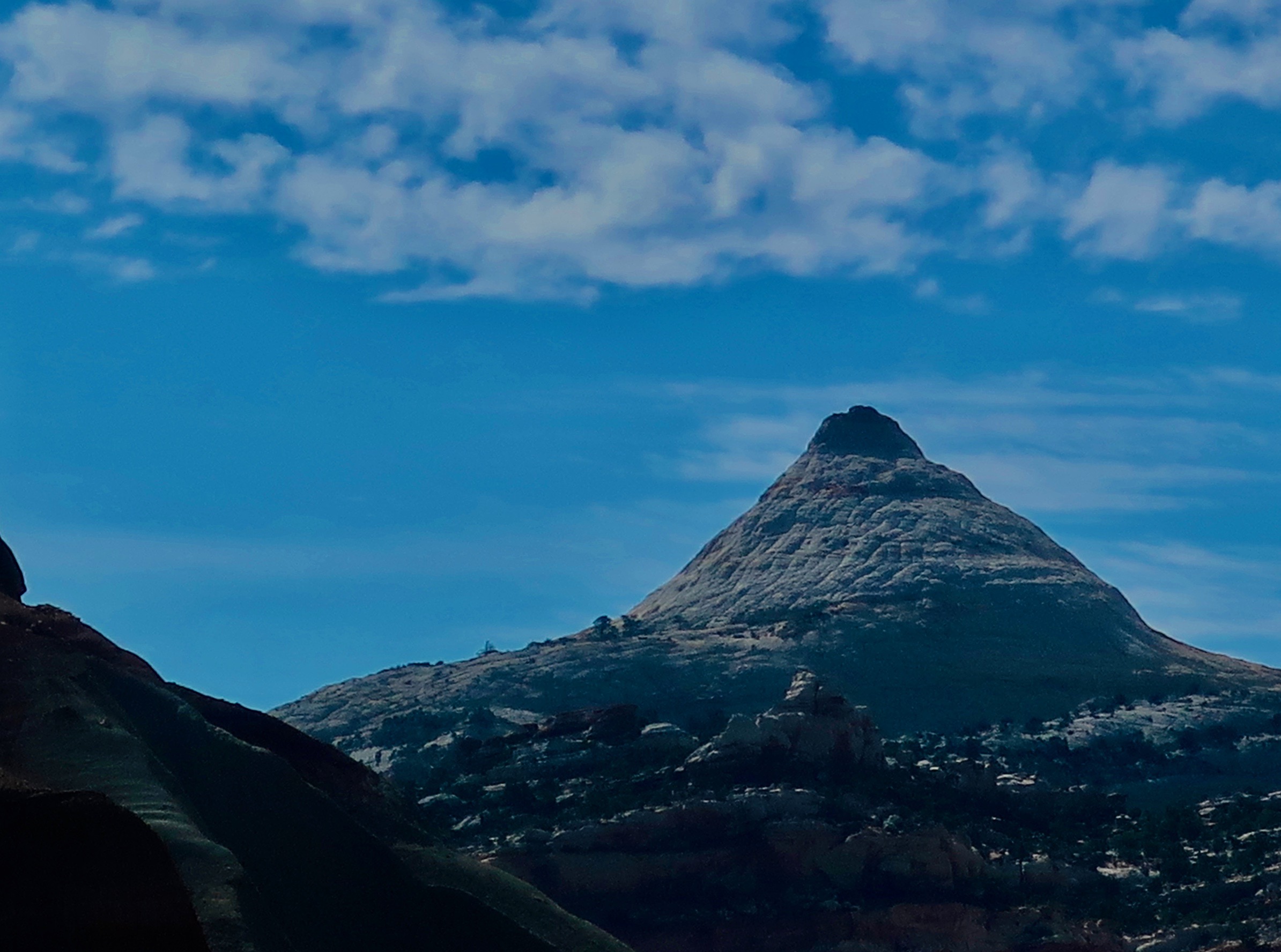
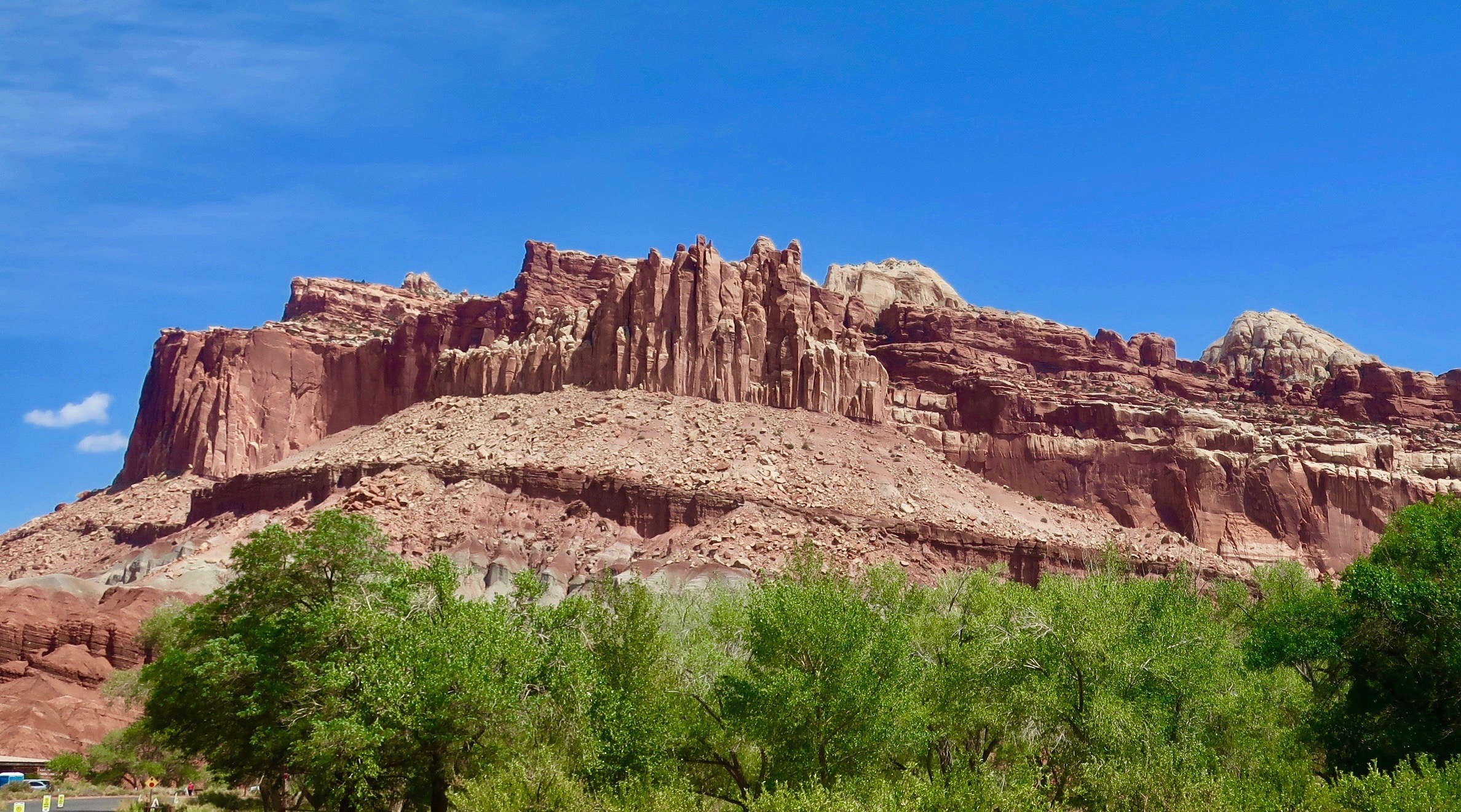
Most people familiar with the national parks of the Southwest will quickly recognize the Grand Canyon, Arches and Bryce. Maybe not so much Capitol Reef. That’s too bad; it’s quite stunning. Like the other parks of the Southwest, it is made up primarily of sedimentary rocks that were laid down over a period of 200 million years in ancient rivers, swamps, Sahara-size deserts and shallow oceans. Unlike the rocks in the other parks, which have a layered cake look— like the rocks east of the park shone above— Capitol Reef resembles a 100-mile warp in the earth. It’s a monocline known as the Waterpocket Fold. Sixty to seventy million years ago, an ancient fault in the area was re-activated and the layers of rock on the west side of the fold were lifted some 7000 feet higher than the layers on the east side. Erosion has since created the fantastic rock forms found in the Park today. Following are a few of the photos that Peggy and I took in the park:

And a final view. If you find yourself in Utah, Peggy and I highly recommend a visit to Capitol Reef National Park.

NEXT POSTS

Blog a Book Tuesday: Steve and I split up the Sierra Trek route for a review, each covering 40 miles in 3 days. Steve claims he is chased by a hawk, comes across migrating rattlesnakes, and has to pee around his camp to scare off the bears. I wonder what he has been smoking. As for me, I begin to comprehend how crazy the idea is but come off the trip on an absolute high. My plan is to finish the final 20 miles the following weekend…

A Ballerina, a Witch, an Ex-Ice Hockey Player, and a Wood Elf… The Sierra Trek

It’s blog-a-book, Tuesday. On my last post I hired wild Steve to work with me. In this post we pick a name, discover a route, and recruit our participants.

A view of the Northern Sierras near where we would start our Trek.
We were now six weeks out from our 100-mile backpacking event. The clock wasn’t ticking; it was running. We didn’t have a name, we didn’t have a route, and we didn’t have any participants. 

The name part was easy. While thinking of backpacking 100 miles in nine days the word trek popped in to my mind. So, I looked it up in the dictionary. “A long, arduous journey” was the definition. That seemed appropriate, and since we were doing our long, arduous journey through the Sierra Nevada Mountain Range, I decided to call it the Sierra Trek.

Where to go posed a more serious challenge. There were three criteria: one, it had to be 100 miles long; two, it needed be in our territory; and three, the trail should be easy to follow. The hundred miles was a given. ‘Being in our territory’ seemed feasible since several of ALASET’s (the American Lung Association of Sacramento-Emigrant Trails) nine counties encompassed a significant portion of the Northern Sierras.

The clinker was ‘easy to follow.’ I had nightmares of participants lost all over the mountains while Steve and I scrambled to find them. We’d be lucky if we avoided becoming lost ourselves. Serendipity came to the rescue. I was reading the Sacramento Bee when I found a possible solution. The horse people were planning their annual 100-mile horse marathon across the Sierra Nevada, the Tevis Cup Race. The event kicked off in Squaw Valley and ended in Auburn. Horses had to follow substantial trails, I reasoned. Squaw Valley had been the sight of the 1960 Winter Olympics and would provide an internationally renowned resort to kick off our event. Auburn was one of the main foothill communities in the Association’s territory and would make an excellent ending place. The trail had the added advantage of being an early trail used by pioneers. We could use the historical angle and tie it in with our name. It seemed ideal.

The only fly in the soup from my perspective was that the trail might be filled with horse poop. I’m not a fan. 

Steve made contact with the woman in Auburn who was organizing the Tevis Cup Race. “Yes, the trail is easy to follow,” she told him. They marked it with yellow ribbons and the ribbons would still be up for our Trek. As for my concern about horse manure, “There should be plenty of time between the race and your trek for the manure to dry out.”
“Fine,” I said to Steve when he reported back, “our Trekkers will be shuffling down trails in dry horse shit.” On the other hand, I thought, look for the silver lining. We could tell them to follow the horse droppings if the ribbons ran out. The important thing was we had a route and could begin publicizing the event. Steve and I agreed to preview the route in advance of the Trek to pin down campsites and reduce the possibility of nasty surprises. Nor would it hurt for the two of us to get some backpacking in before we played Moses in the wilderness.

So now we had a route and a name, it was time to recruit participants, obtain food, and preview the route. Our first challenge was whether we could recruit participants. Were there people in the Sacramento area crazy enough to go on a nine-day, 100-mile backpack trip up and over mountains? 

The answer was a resounding yes. Steve got an article published in the Bee. All participants had to do was raise funds for the Lung Association. Naively, we failed to suggest experience would be valuable, set an age limit, or ask for a minimum number of pledges. People came out of the proverbial woodwork! We held an orientation session at the Sacramento Municipal Utility District auditorium with close to 100 people in attendance. Sixty-one signed up.

Among them were a 16-year-old ballerina with legs of steel and a 250-pound, fifty-four-year-old ex-ice hockey player who had also had a career defusing bombs in South America. At the time, he was dodging the IRS.

“Send any mail to my hardware store,” Charlie told me. “I don’t want the Feds to know where I live.” Or us either, apparently.

Four small 11-year-old boys came as inseparable buddies and I wondered what kind of baby-sitting service their parents assumed we were providing. There was busty Sunshine who had a skinny partner named Bilbo. (Decades before the movies, people were already entranced with Lord of the Rings and The Hobbit. I was.) Lovely L could be defined as a perfect 10 in the language of the time. Even the 11-year olds noticed.

Another woman, who claimed to be a witch, informed me, “I’ll be over to bite you around midnight on the Trek.” And no, she never came over to bite me; but had I encouraged it, I am sure it could have been arranged. We had a 40-year-old teacher from Auburn who would never sit down during the day because she claimed she would never get up, and a 45-year-old teacher from Davis who claimed he could carry his weight in booze, and probably did. There was also a young man named Dan with flaming red hair who wore moccasins, juggled and played a harmonica as he walked down the trail.

And then there was Orvis.

Three weeks before the Trek, an elderly, white-haired gent with a long flowing beard and twinkling eyes walked into my office and announced he wanted to go. My first thought was that he was a wood elf. His name was Orvis Agee. He was 70 years old and a carpenter. He couldn’t have weighed over 100 pounds fully dressed and soaking wet. I made a snap decision.

“Uh,” I said searching for a gentle way of telling him I thought he might be too old for the Trek, “this is going to be a very difficult trip. Do you have any backpacking experience?”

“Well,” he announced proudly, “I went on a 50-mile trip with the Boy Scouts last year.” That was 20 miles farther than I had ever backpacked. “And,” he added as he warmed to the subject, “I’ve climbed Mt. Shasta several times since I turned 60.” I had never climbed Mt. Shasta or any other mountain of note. Mainly, over the past five years, I had been sitting around becoming chubby.

Mt. Shasta

“Welcome to the Sierra Trek,” I eked out. What else could I say? (Seventeen years later at age 87, Orvis would do his last Trek with me. He had personally raised the Lung Association over $140,000.)

NEXT POSTS

Thursday’s Travel Blog: We continue our exploration of America’s backroads on Utah’s Highway 24 with a stop off at the stunning Capitol Reef National Park.

Next Tuesday’s Blog-a-Book: We find an unusual food source, recruit a reluctant sponsor, and preview the route— where I get blisters on blisters and my dog companion, worried about a bear encounter we had, chews up my new Pendleton shirt.

I Hire Wild Steve to Help Run the Backpack Trek… Blog-a-Book Tuesday

Today I am continuing to blog my book: “It’s 4 AM and a Bear Is Standing on Top of Me.” I concluded my last post by proposing to the American Lung Association of Sacramento-Emigrant trails’ (ALASET) Board of Directors that I run a hundred-mile backpack trek across the Sierra Nevada Mountains to raise funds to support the Association’s programs. My friend Steve Crowle and I had come up with the idea while out backpacking. The Board’s first reaction had been, “You want to do what?”

Steve and I had no idea of how difficult leading a group on a 100-mile backpacking trek through the Sierra Nevada Mountain Range might be. We were about to find out…

Actually, I had a great Board. Once the members were convinced that this was something I really, really wanted to do, their final response was “OK, go for it!” I called Steve immediately. My job as executive director included a wide range of responsibilities ranging from administration to programs to fundraising. I would have a limited amount of time to devote to the project and I didn’t know anyone else who was crazy enough to take on the challenge. We had two months to pull it off. The clock was ticking.

I had originally talked Steve into replacing me as Executive Director of Sacramento’s Ecology Information Center with a sales pitch that included, “Look, I have this great job where you work 60-hour weeks, have a Board that likes to scream at each other, and has a starting salary of $200 per month. Are you interested?” Minus a screaming Board of Directors, organizing the Trek wouldn’t be all that different.

Steve had a bright, curious mind and was knowledgeable on environmental issues. He also seemed to have unlimited energy and was built like a bear. It had served him well as Executive Director of EIC. In addition to overseeing the Center’s ongoing projects, he had immediately set out to develop a community garden in downtown Sacramento. Initially known as the Terra Firma Garden and later as the Ron Mandela Garden, it would provide inner city residents with a touch of nature for over 30 years— all the way up until the State of California decided to grow buildings on the site.

The downside about Steve was that he existed on the edge. I later learned that one of his friends who he had recruited to volunteer on the Trek frequently flew to Columbia and returned with his cargo hold filled with pot. 

A year after the Trek, Steve called me and told me that the FBI had showed up on his doorstep. My immediate thought was that they had tied Steve to the Colombia drug operation or that some of the Terra Firma gardeners were growing marijuana. Steve’s concern was that his radical youth was catching up with him. He had been a little too close to the fire when the Bank of America had been burned down in Santa Barbara in 1970 as a protest against the Vietnam War. “And what were you doing with those matches, Mr. Crowle?” (Steve told me the Santa Barbara story a few years ago before he passed away.)

Actually, the FBI had bigger fish to fry. Apparently one of his gardeners had gone from farming her plot to plotting an assassination. Young Lynette Fromme grew up in Southern California where she was a star performer in a children’s dance group, performing at such venues as the Lawrence Welk Show and the Whitehouse.

At 19, a strong disagreement with her dad sent her scurrying off to Venice Beach where she found comfort from an older man, Charles Manson. She soon found herself one of Manson’s clan, taking care of an aging George Spahn at his ranch where the ‘family’ hung out. It was Spahn who gave Lynette her nickname “Squeaky,” because, as legend has it, she squeaked each time he pinched her butt.

Squeaky missed out on the murderous rampage the family undertook in 1969 killing Sharon Tate among others, but she remained intensely loyal to Charles, defending him to the press and anyone else who would listen. After Manson’s conviction and sentence to a lifetime in prison, she moved to Stockton where two of the people she was living with ended up dead.

Abandoning Stockton, Squeaky moved to Sacramento and rented an apartment with another Manson groupie, Sandra Good. The two of them adopted a new life style and persona as ‘nuns’ in Manson’s latest crusade, saving the earth. Manson even gave them new names with Squeaky becoming ‘Red’ and Sandra becoming ‘Blue.’ It was with her new name, persona, and purpose that Squeaky took up gardening at the Terra Firma Garden. Steve knew her, of course, but knew nothing about her background. He told me that she found him “attractive” because of his intense eyes. If you’ve seen pictures of Manson, you’ll get this.

It was with her new goal of ‘saving the earth’ that she left her apartment on the fateful morning of September 5, 1975 and strolled over to Capitol Park where she got within a few steps of the visiting President Gerald Ford before pointing her Colt 45 at him, creating immediate pandemonium. She later claimed she was “just trying to get the President’s attention.” She did. Three months later she found herself convicted of an attempted assassination and in prison. As for Steve, he informed the FBI that he didn’t have a clue as to who Fromme was or what she was up to other than being a gardener. Like Pangloss, he went back to cultivating his garden. But all of this was in the future. My phone call to Steve went something like the following:

“How would you like to go backpacking and get paid for it?” I asked.

“Give me a hard question,” Steve responded.

“Are you willing to work for minimum wage?” I casually threw in as fine print.

“That,” he replied, “is the question.”

I went on to explain that while the Board members had approved of the concept, they weren’t particularly enthusiastic about spending large sums of money to see if it worked. I could just barely squeeze out the minimum wage of the day for two months to see if we could pull it off. Steve, after ample groaning, allowed that it would supplement what he was earning at the Center and took the job.

NEXT POSTS:

Thursday’s Travel Blog: Peggy and I continue our exploration of America’s back roads by leaving Hickison Petroglyph Recreation Area behind and following America’s Loneliest Road across the rest of Nevada and into Utah where we discover Highway 50 is still lonely. And beautiful.

Tuesday’s Blog-a-Book: The clock is ticking as we find a name, route and reluctant sponsor for our backpacking fund raiser. Then it was time to recruit participants. They came out of the woodwork! Among them: A ballerina, a bomb defuser, a witch, and a 70-year-old wood elf.

A Grand but Insane Idea… The First Sierra Trek: Part 1

It’s Blog-a-Book Tuesday. Now that I have provided an introduction to my book, it’s time to start rolling out stories. I’ve chosen my first ever 100-mile backpack trek across the Sierra Nevada Mountain Range for my kick-off. Given that I didn’t have a clue about what I was doing was crazy enough, that I chose to take 61 people aged 11-71 with me as a fund-raiser for the American Lung Association was pure insanity. I was lucky to survive with my career and life intact.

As promised, I am going to blog the book in bite sized pieces with each post ranging between 500 and 1000 words. Some of these stories may be familiar to you since I have written about them before in my ten years of blogging.

The Black Buttes of the Sierra Nevada Mountains are lit up by the evening sun.
Inspired by the beauty of the Five Lakes Basin found north of Interstate 80 in the Sierra Nevada Mountains of California in 1969, I started a lifetime of backpacking. Here, the setting sun lights up the Black Buttes.
I was camping on this little lake when I was inspired by the idea of raising money for the American Lung Association of Sacramento by running a hundred mile backpack trip.

During the early summer of 1974, my life took a dramatic shift. My friend Steve Crowle and I had used a long summer weekend to go backpacking into one of my all-time favorite destinations, the Five Lakes Basin, north of Interstate 80 in the Sierra Nevada Mountains. It’s a beautiful area with towering cliffs and jewel-like lakes that were carved out by glaciers some 20,000 years ago.

We were lazing around our campfire on the last night and bemoaning the fact that we had to return to civilization and jobs the next day. Glowing embers provided warmth and pulled us closer to the fire while a full moon bathed the Black Buttes in silver light and focused our attention outward.

“God, wouldn’t it be great if we could make money doing this,” Steve sighed. He had replaced me as Executive Director of Sacramento’s Ecology Information Center when I had become Executive Director of the American Lung Association of Sacramento. In addition to his boundless energy and intelligence, he was a bit on the wild side. He had hobbies like jumping off high bridges into shallow water and experimenting with various mind-altering drugs. But mainly he loved life and had a vast appetite for new experiences. One such experience was backpacking. 

Suddenly my mind took an intuitive leap. The lights came on, the bells went off, and four and twenty blackbirds sang the Hallelujah Chorus.

“We can, Steve!” I managed to get out as my thoughts played hopscotch. “Look, as Executive Director of Lungland, one of my main responsibilities is fund-raising.” It was a fact I was painfully aware of.

The once Tuberculosis Association and now Lung Association had spent 70 years happily sending out Christmas Seals and waiting for the donations to roll in. While the Golden Goose wasn’t dead, it was ailing. We had conquered the dreaded TB and selling lungs wasn’t nearly as easy. Easter Seals had kids, the Heart Association the most appealing organ in the body, and the Cancer Society the scariest word in the dictionary. We had emphysema, bronchitis, asthma, the remnants of TB, and diseases with unpronounceable names such as coccidioidomycosis. Adding insult to injury, several non-profit organizations had added seals to their fund-raising arsenals. Competition for bucks to do-good was tough and the well was running dry.

“What if,” I pondered out loud, “we ran a backpack trip through the mountains as a type of multi-day walk-a-thon with people raising money for each mile they hiked?” I liked walk-a-thons. They involved people in healthy activities as well as raising money. They gave something back to the participants.

Steve’s attention jumped from low watt to high intensity. “When? Where? For how many miles and days? How can I be involved?” The questions tumbled out.

“I don’t know, I don’t know and I don’t know,” I responded, laughing at his enthusiasm although mine was hardly less. “But,” I added, throwing out some crazy figures, “what if we made it for nine days and 100 miles?”

That quieted us down. Neither of us had ever backpacked for nine days straight, much less 100 miles. A long trip for me had been six days and 30 miles. I threw out the nine days because it included a full week with both weekends and the 100 miles because it sounded impressive and might fire people’s imaginations. It did mine.

“Why not,” Steve had finally said with more than a little awe in his voice as a new fund-raising program was born. It was an event that would keep me happily running around in the woods over the next 30 years and raise substantial funds and friends for the American Lung Association. But all of that was in the future; Steve and I just wanted an excuse to go backpacking. How to get from point a to point b was the question. As folks like to say, the devil is in the details.

My first challenge was selling the event to a reluctant Board of Directors. Running a 100-mile backpack trip as a fundraiser was a huge leap from sending out Christmas seals. At 29, I was the youngest Lung Association Executive Director in the nation and I had already ruffled enough feathers to dress a turkey. For example, a research doctor on my Board was foaming at the mouth because I wanted our organization to focus on reducing the primary causes of lung disease: air pollution and tobacco use. What would he think of me running off to the woods on a backpack trip? Another Board member loved his pipe and was irritated at me because I had persuaded the Board that our meetings should be smoke-free. His irritation was nothing, however, in comparison to a number of California Lung Execs who were livid because I was proposing that Lung Association offices should be smoke-free as well. What a radical idea that was. I heard an older woman exec proclaim at a conference, “I am going to kick that young man in the balls!” She made sure I was within hearing distance. 

“You want to do what?” with a decided emphasis on the first and fifth words is the best way I can describe the Board’s reaction. It was easy to translate: “Why would a 29-year-old executive director with less than a year of experience under his belt want to risk his career on such a harebrained idea?”

I echoed wild Steve, “Why not?”

NEXT POSTS: On Thursday’s travel blog we continue our back roads’ journey along Highway 50 across the Nevada Desert and camp out at the Hickison Petroglyph area with its strange petroglyphs and unique rock structures. Next Tuesday it’s back to blogging a book. The Lung Association Board approves the Trek, I hire Steve, and we begin a recruitment effort. People come out of the woodwork wanting to go…

NOTE: Peggy and I are heading over to the Oregon Coast to celebrate Thanksgiving and our Anniversary, camping out in Quivera the Van at a site that may not have cellphone or Internet connection. If so, I will get back to responding to comments and reading posts next week.

The 1908 Great Automobile Race from New York to Paris: Part II… Through Nebraska

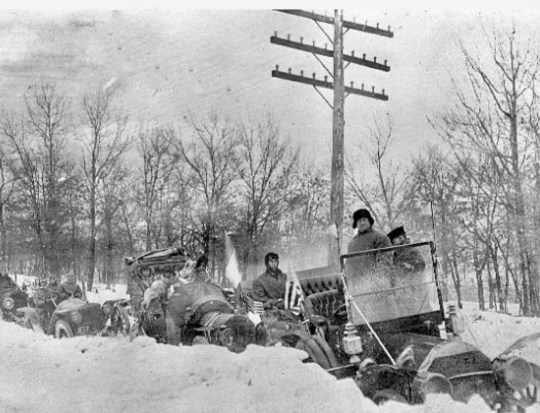
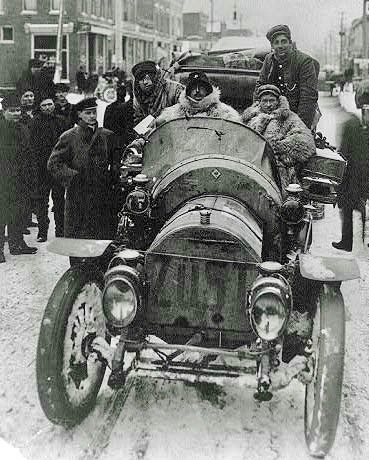
The race had barely started when the automobiles were caught in a blizzard that dumped 2-3 feet of snow on the roadway. In this photo, the Thomas Flyer breaks trail for the other racers. In the beginning, the various racers took turns leading.

I ended my first post on the 1908 Great Race from New York City to Paris with the six competitors zooming down Broadway on their way out of New York City as a crowd of 250,000 roared them on. Their original route had already been changed by the organizers. Instead of driving half way across the US and then up though Canada to the Bering Strait, they would work their way across the nation and then take a boat up to Valdez where they would continue the Alaska portion of the race over dog sled trails and ice-covered rivers.

But first they had to get across the US starting in winter, no small task considering no one had ever accomplished it. Roads would be rough to non-existent. There were no maps or gas stations, or asphalt— it had yet to be invented. In some areas the drivers would be forced to drive over railroad tracks, a guaranteed bumpy ride! Remember the ads when automobile manufacturers would show how good the shocks on their cars were by driving down railroad tracks with an egg balanced on a spoon? You would have to fast forward to the 60s and 70s for that level of suspension.

Problems began immediately. The one-cylinder, small French Sizaire-Naudin dropped out of the race on the first day at mile 96 with a broken differential. The remaining five vehicles soon found themselves plowing through two feet or more of snow in a blizzard. Except in cities, no handy-dandy horse drawn snow plows were around to clear roads. George Schuster, the mechanic for the Thomas Flyer, walked ahead of his vehicle poking a stick into the snow to measure its depth. Or maybe he was looking for the road!

The Thomas Flyer fights to get out of a snow drift.

The slow progress came to a dead halt in Dismal Hollow outside of Auburn, New York. The name alone suggests a horror-story-level disaster. The cars became hopelessly bogged down as night approached. Fortunately, horses hired by the Italian Zust team came to the rescue of the automobilists, as they were known then, and pulled them out.
The Italian Zust. Clothing suggests just how cold it was.

At first, the teams worked together, taking turns at leading. That didn’t last long. It was a race, after all. You can imagine how the Americans, or the Germans or the Italians reacted when the driver of the French de Dion, St. Chaffray, ordered them, “When you wish to go ahead to a city, you ask me.” Right.  

The Europeans were soon complaining that the Americans had unfair advantages. When the Thomas Flyer had a problem, dozen of patriotic volunteers jumped in to eagerly help out for free. When the European cars hit a glitch, they had to pay. “They even charge us to sleep on the ground,” one of the drivers whined. A more legitimate complaint in terms of the race outcome was that the railroad and trolley companies favored the Flyer in allowing track usage. Out West, the Union Pacific even scheduled the Flyer to use its tracks like it would a train.

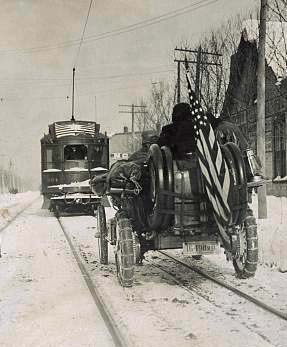
When roads were impassable or non-existent, the racers often resorted to using train tracks. The rules were that the riders couldn’t actually ride on the rails. They had to bump their way over the railroad ties.
Trolley lines sometimes substituted for railroads in the cities.

My sense is that the great advantage the Flyer had was George Schuster, however. For one, he had the ability to fix any problem the car had. Each night he would tune the engine and work on whatever else was needed to get the car ready for the next day. The competition complained to the race committee that Schuster had rebuilt the whole car. Possibly. But the complaint was rejected. One of the nightly chores that all of the car mechanics performed was draining the radiator so it wouldn’t freeze. Anti-freeze had been developed but it was used in making bombs, not protecting cars on cold nights

Schuster’s support in keeping the vehicle operating went far beyond his mechanical abilities, however. If someone had to walk 10 miles in a freezing weather to get gas or a part, he did it. If the car needed rescuing from a snow drift or was stuck in a gully, he figured out how to free it. He was dedicated to doing whatever it took to keep the Flyer running.

I suspect a fair amount of money exchanged hands when the racers reached Chicago. Many felt that the cars would be lucky to get out of New York and even E.R. Thomas, the manufacturer of the Flyer, never expected his vehicle would get beyond the Windy City. T. Walter Williams, the New York Times reporter assigned to the Thomas Flyer, bailed out when the cars arrived in Chicago. “It’s insanity” he proclaimed. And it was. But all five cars made it to Chicago and continued on. Snow continued to plague the drivers as they made their way across the Midwest. And when they finally got through the snow, they were faced with hub-deep mud. Lots of it. Tensions soared.

When the De Dion got stuck in a snowbank and Hans Hendricks Hansen, who claimed he had piloted a Viking Ship to the North Pole solo, couldn’t get it out, St. Chaffray exploded. The men decided a duel was in order and went scrambling to find their pistols. Fortunately, they were buried deep in the gear and St. Chaffray had time to decide that it would be better to fire Hansen than to kill him— or be killed by him. Hansen joined the Thomas Flyer, pledged allegiance to the American flag it flew, and swore that he could walk to Paris faster than St. Chaffray could drive there.

Our recent 8,000-mile journey around the US was bound to cross the route of the Great Race. It happened in Nebraska as we followed US 30 along the South Platte River. The racers had been following what would become Highway 30 through Illinois, Iowa and Nebraska. We joined the highway in Kearny and followed it on to North Platte where we stayed at Buffalo Bill’s ranch. Signs along the road proudly proclaimed it had been part of the Oregon Trail and the Lincoln Highway, America’s first transcontinental highway. Before that, it had served as a major path for Native Americans and mountain men. When the route had passed through Omaha on entering Nebraska, the Flyer team met Buffalo Bill who had invited them to stay at his ranch on the North Platte.

I took this photo of US 30 on Peggy’s and my recent trip around the country. Take away the pavement and add a foot of mud, it might look similar to what the 1908 racers found in making their way across Nebraska.
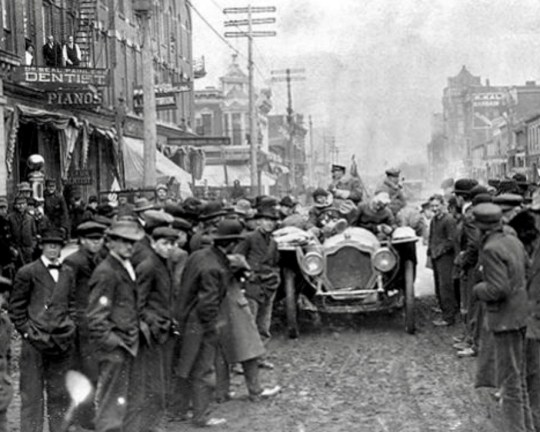
Whenever the racers came to a major town, the citizens would be out to greet them in force. This is Grand Island Nebraska. Only four of the cars made it this far.
A high school student eager to shoot an action shot caught this photo of the race in the small town of Gibson, Nebraska. He even got a wave!
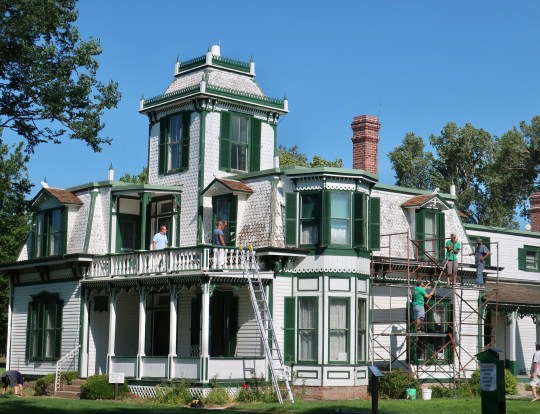
Buffalo Bill invited the racers to stay at his home in North Platte. Pretty fancy digs for a buffalo hunter! The house was being repainted when Peggy and I visited it.
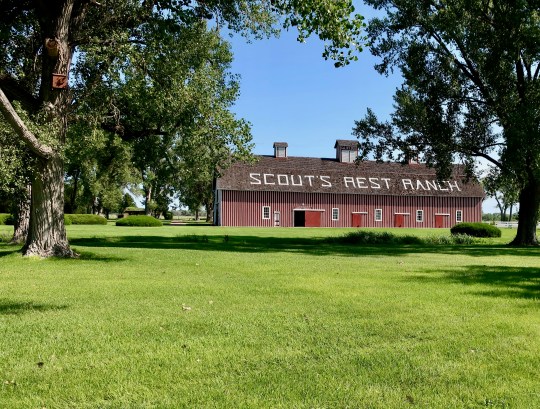
Buffalo Bill’s barn, Scout’s Rest, would have been standing as well when the racers came through in 1908. (Photo by Peggy Mekemson.)
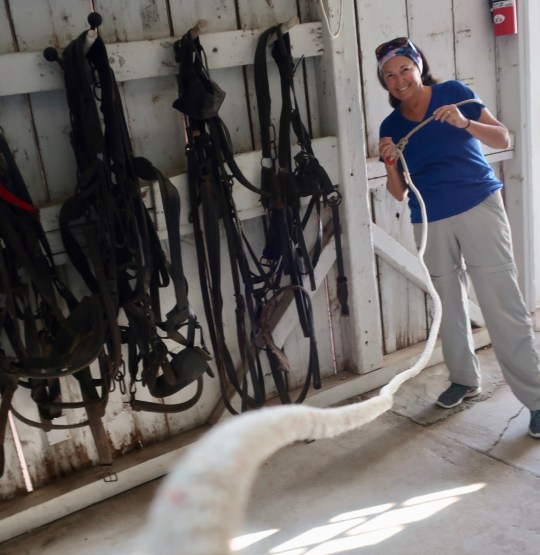
The barn is packed full of memorabilia from Buffalo Bill’s road show which traveled the world featuring cowboys and Indians and personalities like Annie Oakley. This poster promoted his show in Australia. Note the fancy rope work! I got so excited…
… That I lassoed myself a filly! Boy did she put up a fight!
I’ll conclude today’s post with a photo of the Flyer making its way through hub-deep mud. Some fun!

NEXT POST: On to the West Coast and up to Alaska…

Off to a Rocky Start: Arches NP… The Backroads Series

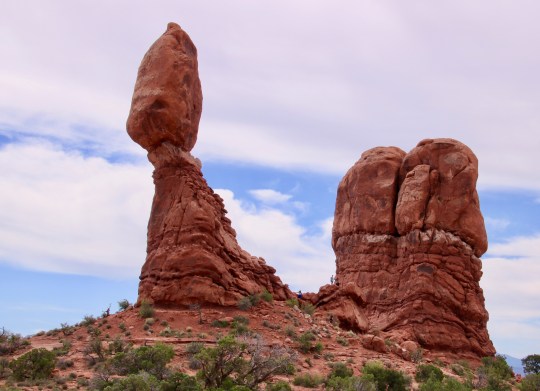
It looked a bit like Snoopy at first glance, making a sarcastic comment to Woodstock. But it wasn’t Snoopy. It was the famous Balanced Rock of Arches National Park. Someday it will come tumbling down. (Photo by Peggy Mekemson.)

We’ve started our journey around America traveling over the country’s backroads while wearing masks like bandits. The beginning of the trip was in Fallon, Nevada, which might seem strange given that we live in Oregon. Getting to Fallon, however, involved traveling over I-5 and I-80, two of Americas busiest freeways. Freeways are to be avoided and ignored in this series— even though Peggy and I have to use them on occasion.

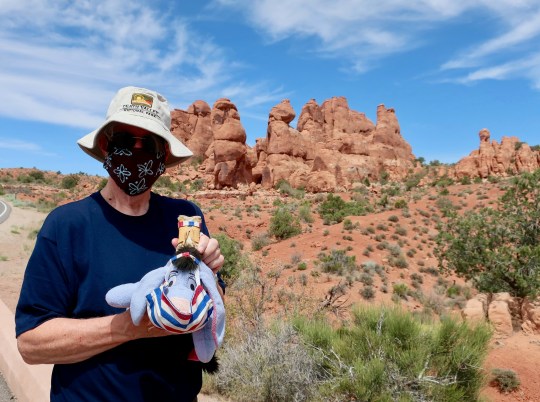
It’s scary out here in America’s hinterland as Covid-19 makes its way from state to state. The lack of a clear national policy is apparent. Peggy and I, as well as our traveling companions, Bone and Eeyore, are all wearing our masks. So far, we seem to be the exception. (Photo by Peggy Mekemson.)

In Fallon, we climbed on Highway 50. Its claim to being the ‘loneliest road in America,’ gives it genuine backroad credentials. I’ll get back to it. There is much to tell about the legendary highway I grew up near. But given Covid-19, our two to three month backroads exploration is off to a rocky start— and there are few places in America rockier than Arches National Park. Peggy and I know. We took 572 photos of rocks there. Peggy promises you won’t have to look at all of them. But there will be quite a few. Grin. I love red rock country.

Today, I am going to start with just one, the famous Balanced Rock. Its total height is 128 feet. The boulder on top makes up 55 feet of its height and weighs in at 3500 tons. If you have been to Arches, the odds are you have a photo. Millions of tourists have stood and stared up at it in awe.

It stands as a testament to the fact that there is much more to see in Arches than just arches. A lot more. Geology is the reason for the park’s unique look. The rocks that make up Arches have been layed down over hundreds of millions of years under a wide range of circumstances ranging from deserts to seas. Their different makeup impacts how fast they erode and that leads to the fantastic rock sculptures and monuments seen through the park. There will be more on the geology in coming posts.

In addition to its unique look and geology, the thing that fascinates me about Balanced Rock is how its look changes drastically from different angles as you walk around it. And that is the subject of today’s photos.

The mushroom look.
A more traditional look of Balanced Rock with a companion. (Photo by Peggy Mekemson.)
A modified ‘Snoopy’ look.
Side view.
A long view including Peggy. She’s safe, but is she balanced. (Grin) Another rock stands behind.
A more human look. Possibly a thumbs up with a thumb ring? (Photo by Peggy Mekemson.)
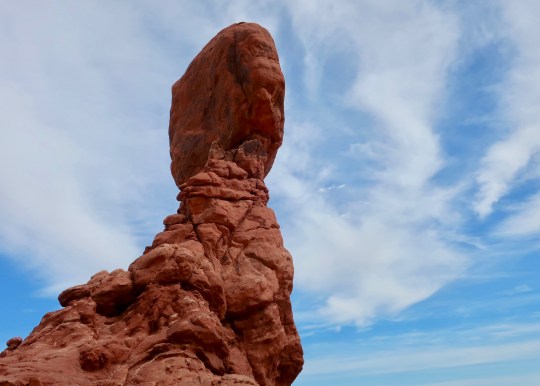
I’ll conclude with this view of looking up at Balanced Rock from its base. It gives a perspective on how massive the sculpture is.

NEXT POST: We’ll start at the beginning of the park with Wall Street, the Organ, and the Sheep.

Stop and Smell the Flowers: Part 1… Along the PCT

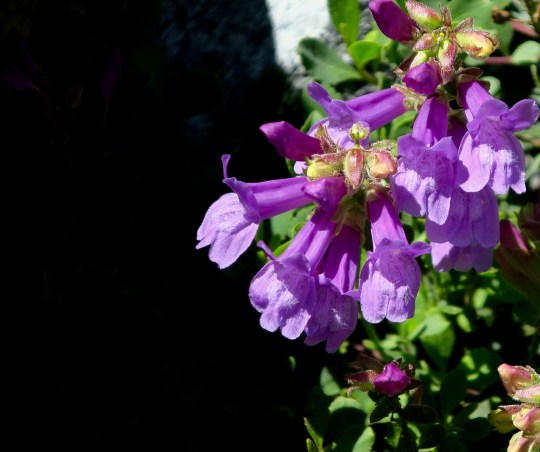
Penstemon. One of at least a hundred beautiful flowers I photographed on my 750- mile hike down the PCT two summers ago.

Hiking the Pacific Crest Trail is serious business for those who decide to backpack the 2650 miles from Mexico to Canada in one season. Think of it as hiking a 26-mile-marathon each day while carrying your food, water and camping gear on your back over mountains, across deserts, through snow, and every imaginable kind of weather. As such, it is not an exercise in wilderness appreciation; it’s an exercise in human endurance. It is one of the toughest, most grueling physical challenges in the world. People involved in can be forgiven if they don’t have time to stop and smell the flowers.

This isn’t to say they don’t have an appreciation for the incredibly beautiful country they are hiking through. It’s impossible not to. But this appreciation is limited. When Peggy and I were backpacking through the Three Sisters Wilderness of Oregon as part of my 750 mile trip, we met Big Red, a giant of a man who summarized it well. “I’ll camp on a beautiful lake,” he said, “and I’ll think, ‘Wow! I would love to spend a few days here.’ But I can’t. I have to get up the next morning in the dark and be on the trail by dawn. Otherwise I’ll never finish.”

I felt the pressure myself, even though I was moving along at around 15 miles a day. At 75, my shorter days were the equivalent of the longer days being hiked by the 20-40 year olds. I was glad I had my camera along and was committed to recording my journey with digital photos. It forced me to stop and smell the flowers— and to admire the beauty of my surroundings. Plus it was one hell of an excuse for a break even though I rarely allowed myself more than a minute or so to capture a subject and had mastered taking my camera out and putting it away while walking. (Okay, some subjects required 15-30 minutes!)

The flowers along the trail were gorgeous. I shared some of these when I blogged about the journey. I’ll be sharing more over the next few weeks as I use my photo-essay Wednesdays to feature pictures from the PCT. Enjoy.

Yellow leafed iris
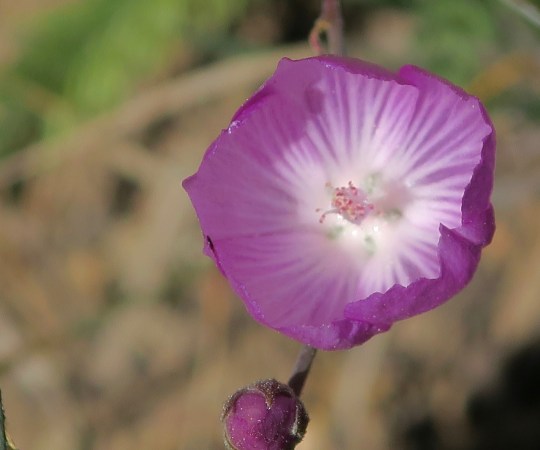
Wild hollyhock
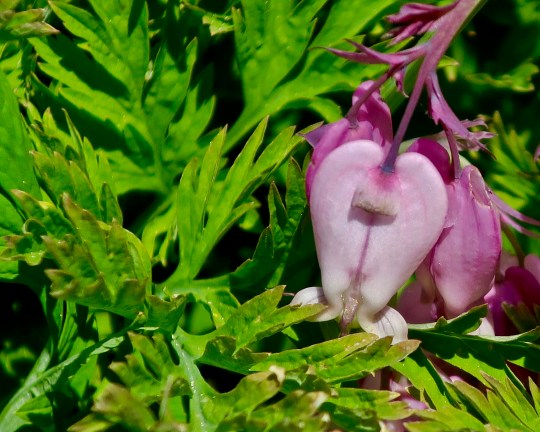
Western bleeding heart
Close up of Western bleeding heart flower.
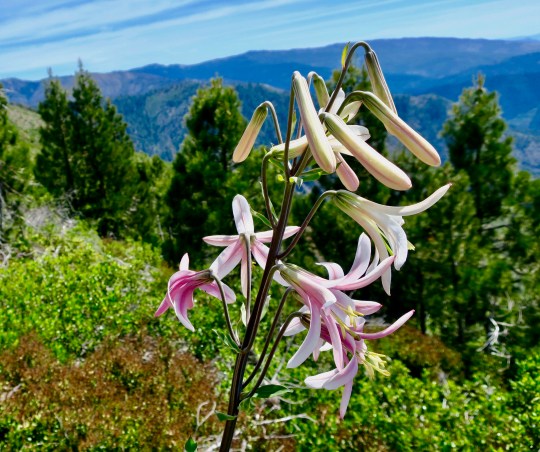
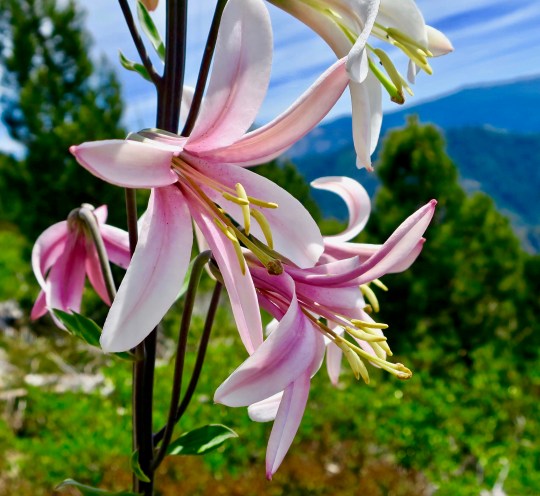
Washington lily
Close up of Washington lily.
Wallflower
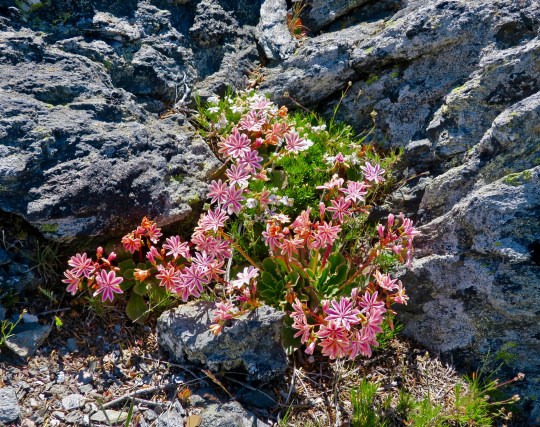
Siskiyou lewisia
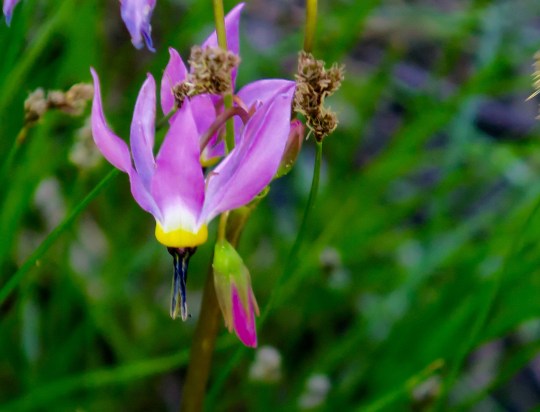
Shooting star flower
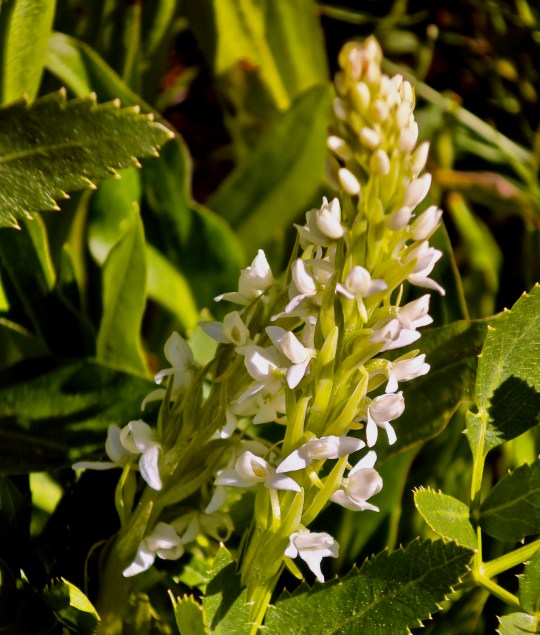
Rein orchid
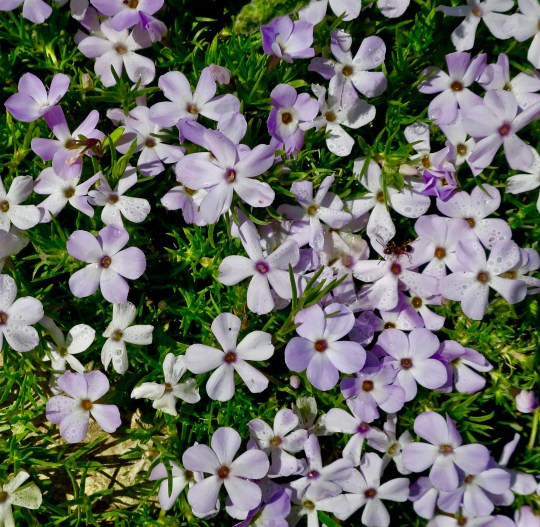
Phlox
Paintbrush
Monkshood
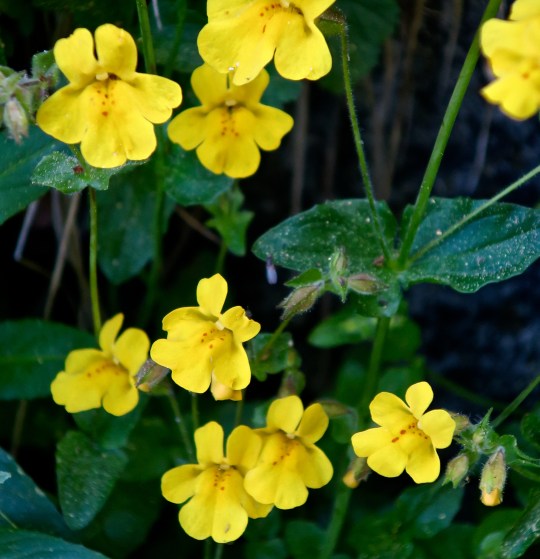
Monkey flowers
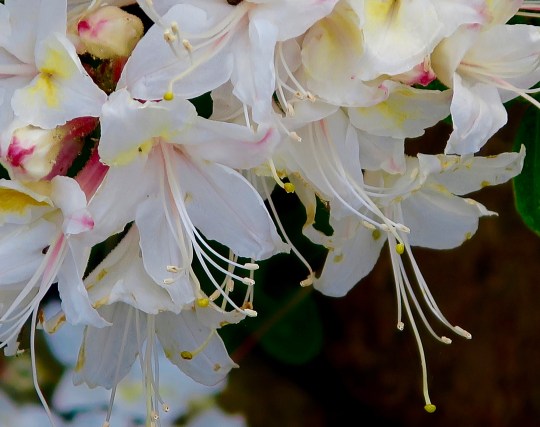
Azaleas

FRIDAY’S POST: My final rock art post for now featuring petroglyphs from Monument Valley, Canyon de Chelly, Petrified Forest National Park and northern Nevada.

While Dead Men Tell No Tales, Dead Trees Do… The Wednesday Photo Essay

Dead men tell no tales, or so they say. But dead trees talk back to you. At least it seems that way to me. I was backpacking into the Marble Mountains when I came upon this face on a burned tree. Was it saying, “Go back!”? Or maybe it was standing in for Smokey the Bear.

I’ve been hard at work on my next book: It’s 4 AM and a Bear Is Standing on Top of Me. In it I tell stories from 50 years of wilderness adventures ending with my 750 mile backpack trip down the Pacific Crest Trail to celebrate my 75th birthday. I’ve reached the point now where I am about to embark on the last section, my hike down the PCT. In preparation I’ve been going through my photos of the trip for inspiration as well as to jog my memory.

As I reviewed photos, I was struck by the idea that they would make appropriate content for my Wednesday Photo Essays. Rather than follow my days, which I more or less did in the blogs I wrote about the adventure, I’ve decided it would be fun to do a categorical approach and look at flowers, trees (mainly dead trees that have unique personalities), rock formations including mountains, and streams and lakes. There may be other categories as well. Today, I am going to include trees and brush I found particularly interesting. (I have a lot more but will alternate with flowers, etc. to keep things interesting.)

There is something almost heroic about this dead tree my nephew Jay Dallen and I found in the Trinity Alps. We both took numerous photos. I could imagine Michelangelo capturing this tree in marble.
I captured this photo by using rocks as a frame. The rocks shared a similar tortured look.
The tree encouraged close-ups and photos from several different angles. Jay and I must have been there for 30 minutes.
Dead manzanita lends itself to dramatic photos. The rock that the manzanita had grown over creates a close to perfect backdrop.
As you know, I have an active imagination when it comes to seeing faces in rocks and wood.
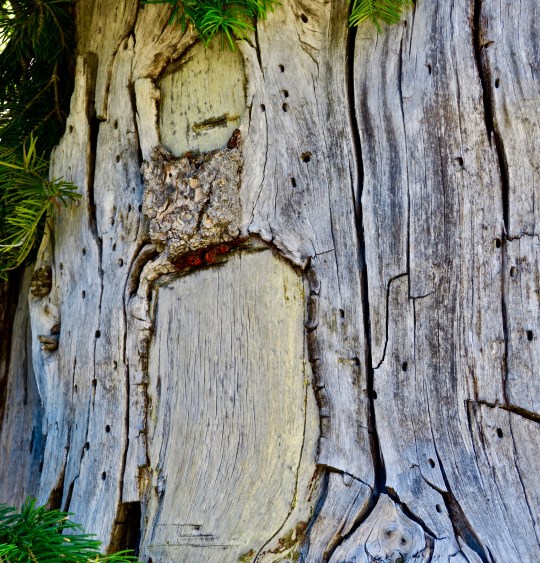
This was one of the most interesting I have ever seen. I looked through a knot hole and this peered back at me.
Just ducky.
I’ve always liked this statement by Joseph Campbell. If you find yourself falling off a cliff, “Dive!” Why not.
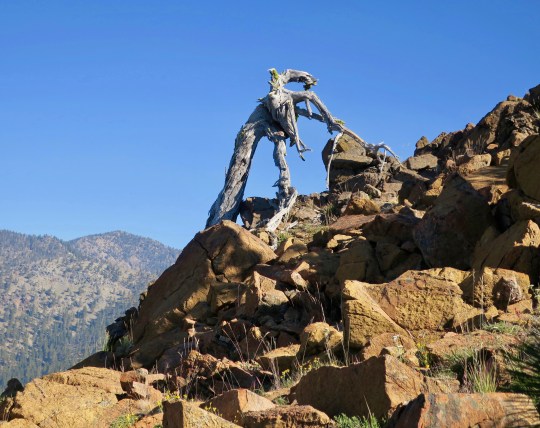
Are you a fan of “Lord of the Rings”? This sculpture that also led my nephew Jay and I to take numerous photos struck me as an Ent in search of Ent wives. Or maybe he was tearing out rocks to bring throw down at Sauron.
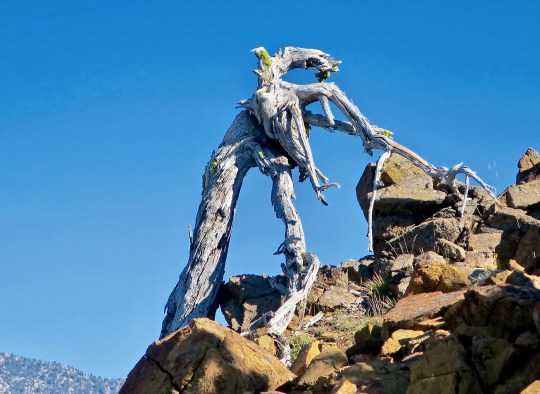
A closer look at the sculpture in its dramatic setting.
A black and white of the top of the ‘Ent’ sculpture.
Of course most of the trees along the PCT are happily living. I always like crown shots like this.
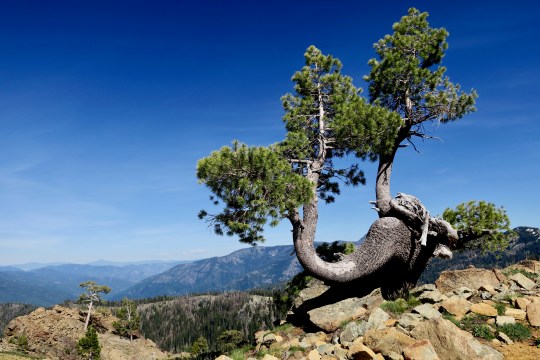
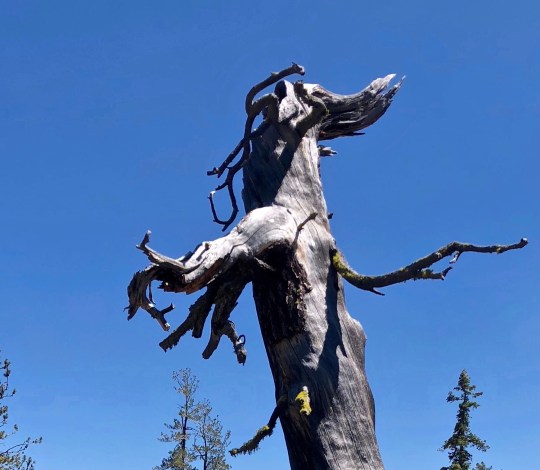
High altitudes with cold temperatures and high winds do their own unique job of sculpting trees. My father loved to paint trees like this.
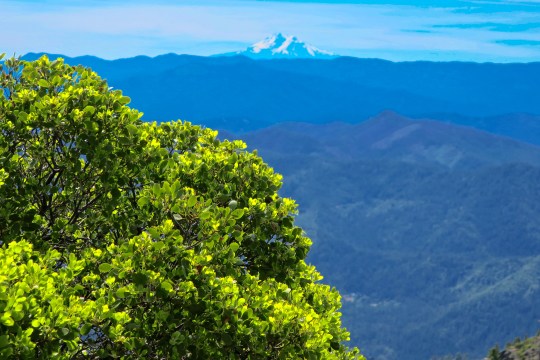
This manzanita bush had plenty of beauty on its own but it didn’t hurt to have distant mountains including Mt. Shasta as a backdrop.
One should never discount the possibility of using a convenient tree as a chair! Peggy said it was quite comfortable.
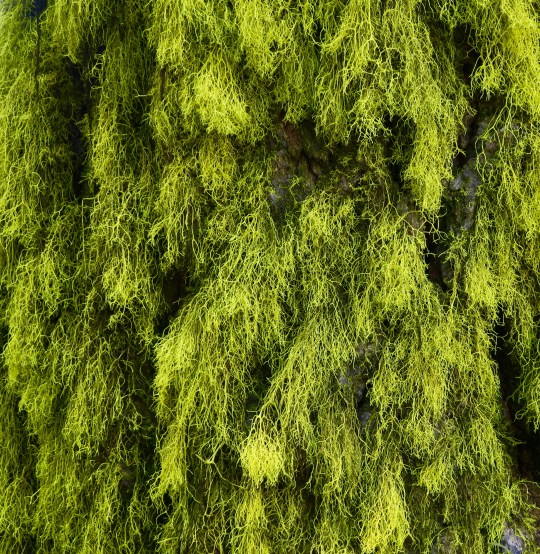
Moss often adds a bit of color to dead trees.
Moss helped create this peep hole.
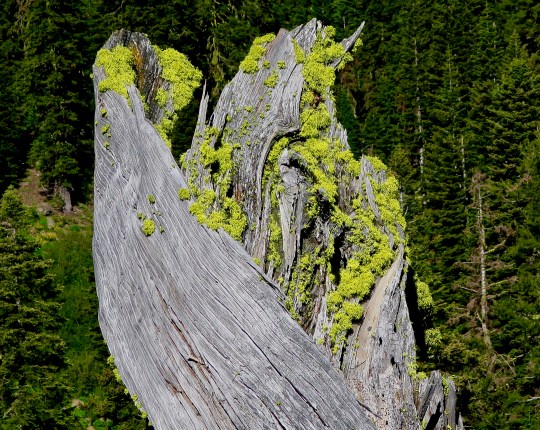
And decorated this dead stump.
Dance with me , honey!
Show me what you’ve got!
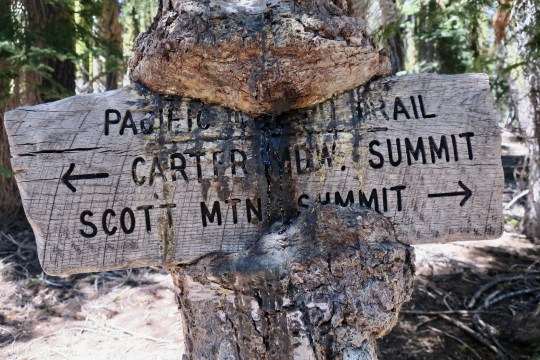
A tree eats a trail sign.
Nothing tells a story like old trail blazes left behind by explorers and pioneers to mark their trails. It’s a good place to end this post. If you have ever heard the expression, “Where in the blazes are we?,” this is where it came from.

FRIDAY’S POST: I am going to do a wrap on the petroglyphs from the Three Rivers National Petroglyph Recreation Area. (I still have two more petroglyph posts covering other areas we visited on our fall Southwestern tour.)

When Large Furry Animals with Long Claws and Sharp Teeth Come to Visit

Bear track and Peggy track. One of the animals here is a heck of a lot bigger and much more furry than the other!

I know, I know… I promised to cover our train trip on this post but I got side-tracked (in more ways than one). On Saturday, I was diligently working away in our library writing about the cast of characters who ride the rails when I looked out the window and noticed three deer madly dashing around our yard with their tails straight up signaling “Danger! Danger! Danger!” They charged up the hill, jumped the five-foot fence into the neighbor’s yard, did a 180, flew over the fence again and disappeared into our canyon going all-out. If you’ve ever watched frightened deer running, you know how fast this is. Seconds afterwards they burst out of the canyon and repeated the process. I called Peggy in to watch.

“Something big that likes venison must be visiting and the deer smell it,” I speculated and suggested that the local cougar might be back.

A few minutes later the deer had hightailed it up the mountain. Our property, which is normally busy with deer, squirrels, numerous birds, and other wildlife, had become eerily silent. Even the ever-squawky jays that I depend on to tell me when dangerous predators— like the local cat— are about, were uttering nary a peep. 

Since we needed to do our daily mailbox walk and a fair amount of snow from the storm that I featured in my last post hadn’t melted, I proposed we keep an eye out for cougar tracks. The walk is close to a mile with the mailbox being at the halfway point. We do a round trip, leaving by our back road and returning by our front road. There would ample opportunity to look for tracks. 

We found them near the mailbox! I confess I felt a bit like the deer, ready to raise my tail and dash off. 

We were on the homestretch, heading up the hill to our home when we saw the next set of tracks. They came out of the canyon and headed straight for our house. That added a bit of excitement (he noted in understatement). Peggy and I quickly checked around the house. Sure enough, the big cougar had wandered around in our backyard the night before and possibly onto the snowless section of our deck. If so, it would have been about six feet away from where we were sleeping. That’s Peggy’s side of the bed. (Grin)

Things were more or less back to normal on Sunday. The deer were back, a bit jumpy, but none-the-less munching away. The bird feeder was a circus with six species contending over who got the sunflower seeds. And three squirrels were busy chasing each other in a row with love on their minds. They shot up, down, and around trees nose to tail, nose to tail.  

Monday, Martin Luther King’s Birthday, had a slight twist.  There was no mail, so we decided to hike up into the forest where we had taken our snow hike. This time, however we would veer off to visit what we call the bear cave. Not that we’ve ever seen a bear; it’s an old gold mining operation. We named it the bear cave to give our grandkids more of a sense of adventure when they visited. I once took our grandson Cody up there when he was five on a bear hunt with our sling shots. He’d been excited to go on an adventure with Grandpa. The closer we had got to the cave the more reluctant he had become. We’d stood back from the cave and lobbed pellets in to scare the bear out. 

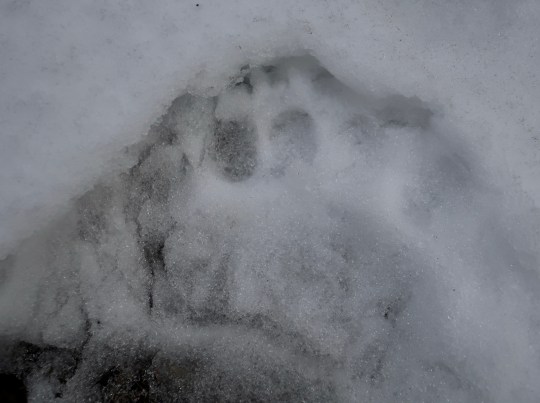
This time, my lovely wife was the reluctant one.  She suggested we go for a walk on the road instead. Could it be that the cougar had her spooked?  I laughed and away we went up the mountain. We had made the cutoff when we saw a set of huge tracks heading in the general direction of the cave. Bear tracks. Peggy let me take a couple of photos before she insisted that we beat a hasty retreat.

Following are some photos of the various tracks we came across.

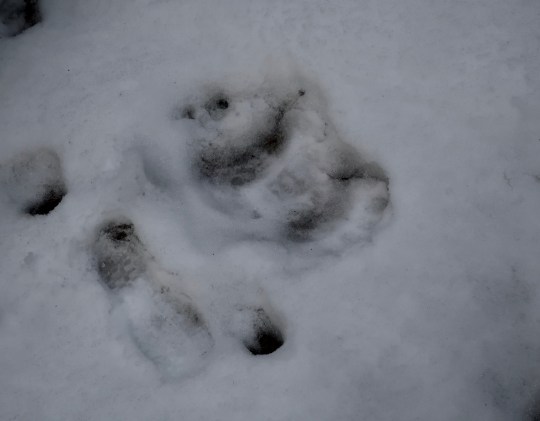
Cougar track in melting snow. Note four paws and a lack of claws. Cats keep there claws retracted.
Dog track for comparison. Note the distinct claw marks.
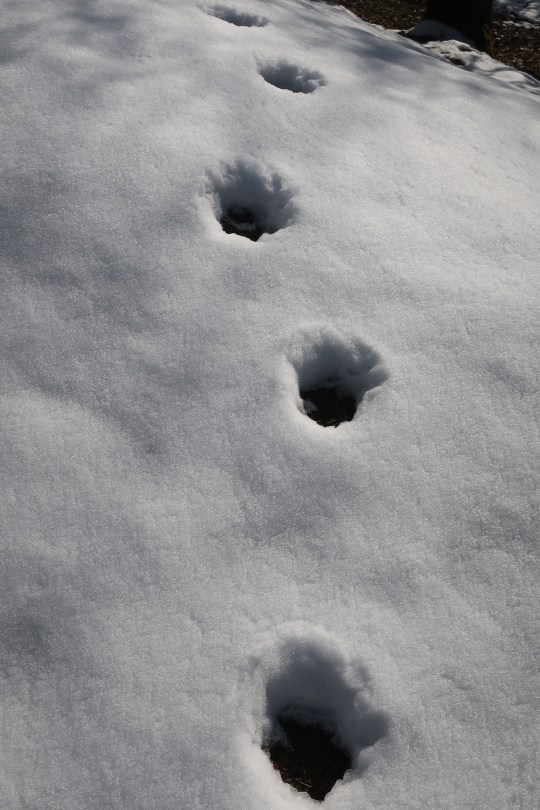
Tracks across our back yard.
Final shot of the bear print.

NEXT POST: The train trip! Unless, of course, someone else comes to visit. 🙂