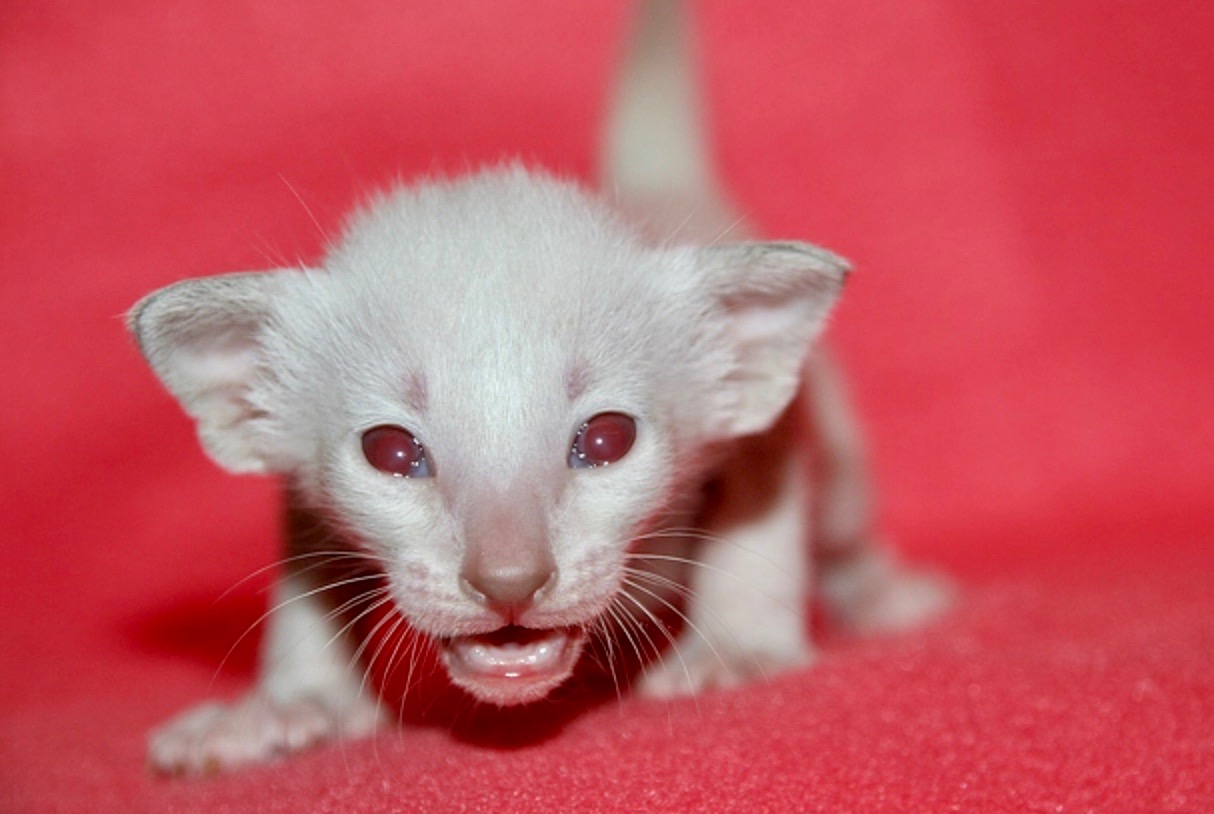
MC the cat always refused to have his photo taken. I think that he was afraid of a paternity suit. So, I went to Creative Commons and found this picture that looks very much like MC as a kitten. The don’t-mess-with-me look fits perfectly.
Today’s blog-a-book tale is about our ‘other’ cat, MC. No story about the Graveyard is complete without him. He was the exact opposite of Demon. She was as dark as the Graveyard on a moonless night; he was as white as the ghosts that lived there. She was loving and tame while he was as wild as a domestic cat can be— a throwback to his ancient ancestors. His one passion in life was spreading his seeds as far and wide as he could travel and still make it home for dinner. He was a tomcat’s Tomcat, a legend in his own mind.
His one challenge was his small size, which meant that he often came out on the losing end in his battles with larger toms. He would arrive home beat up and battered. One time a chunk of his ear was missing. Another time it was the tip of his tail. I encouraged my Cocker Spaniel, Tickle, to break up the fights to minimize the damage. He loved his job. He would dash to the door at the first yowling and fly off our porch in full bark when I turned his loose. Other than giving Tickle a purpose in life, his efforts had little impact, however.
Pop decided that drastic measures were called for. MC would have to have to lose his offending appendages. Unfortunately, there wasn’t a lot of money in our household for veterinary bills. But there was a solution. We were a do-it-yourself kind of family. For example, cocker puppies are supposed to have their tails cut off fairly soon after birth. My dad would take the litter, tie thread tightly around their tails, and then break out the tool he used for cutting tin. Snip, YIP! And it was over.
Obviously, neutering a full-grown tom cat was a bit more difficult. Our Italian neighbor, Papa Passerini, offered an Old Country solution.
“All you need is a pair of tin snips, a burlap bag, gloves, a pocket knife and a rope,” he suggested. Alarm bells should have gone off— massive alarm bells heard all the way to Italy. But they didn’t. We moved ahead with the medical procedure.
While MC had never been a paragon of feline domesticity, he’d at least let me pat him on the head if food was involved— as long as I was quick and limited myself to one pat. He even managed a brief purr when I picked him up the morning of his ‘operation’ and carried him up to Passerini’s. Any previous pretensions of tolerating people ceased instantly, though, when his legs were tied up and he was dumped into the dark gunny sack.
When Pop cut a slit in the burlap with his pocket knife and reached a gloved hand through, he was met by claws of fury. MC had shed his ropes faster than Houdini. No one, but no one, was going to grab him by the testicles and cut them off with a pair of tin snips. He clawed his way out of the bag and became a white blur as he disappeared into the Graveyard. And there he would stay. After that, I would only see him at dinner time and then only after I had put his food down and walked several feet away.
The good news, from MC’s perspective, was that he was able to continue his tomcatting ways with all parts of his anatomy intact right up until he reached old age and quietly wandered off to tomcat heaven, where, rumor has it, he was twice as big, had eternal youth, and a long line of lovely female cats stretched off to infinity eagerly awaiting him. It’s probably fake news.
Next Monday’s blog-a-book post from It’s 4 AM and a Bear Is Standing on Me features my sister Nancy Jo and the attack of the graveyard ghost. Did you hear her scream? It’s very scary and you won’t want to miss it.
NEXT POSTS:
Wednesday’s Blog-a-Book Post…from The Bush Devil Ate Sam: I challenge the Berkeley establishment to no avail. John Kennedy’s death has a deep impact on my fellow students and me.
Friday’s Travel BogI It’s a wrap on my Harris Beach series with gorgeous sunsets and the ever-interesting Key Hole Rock.
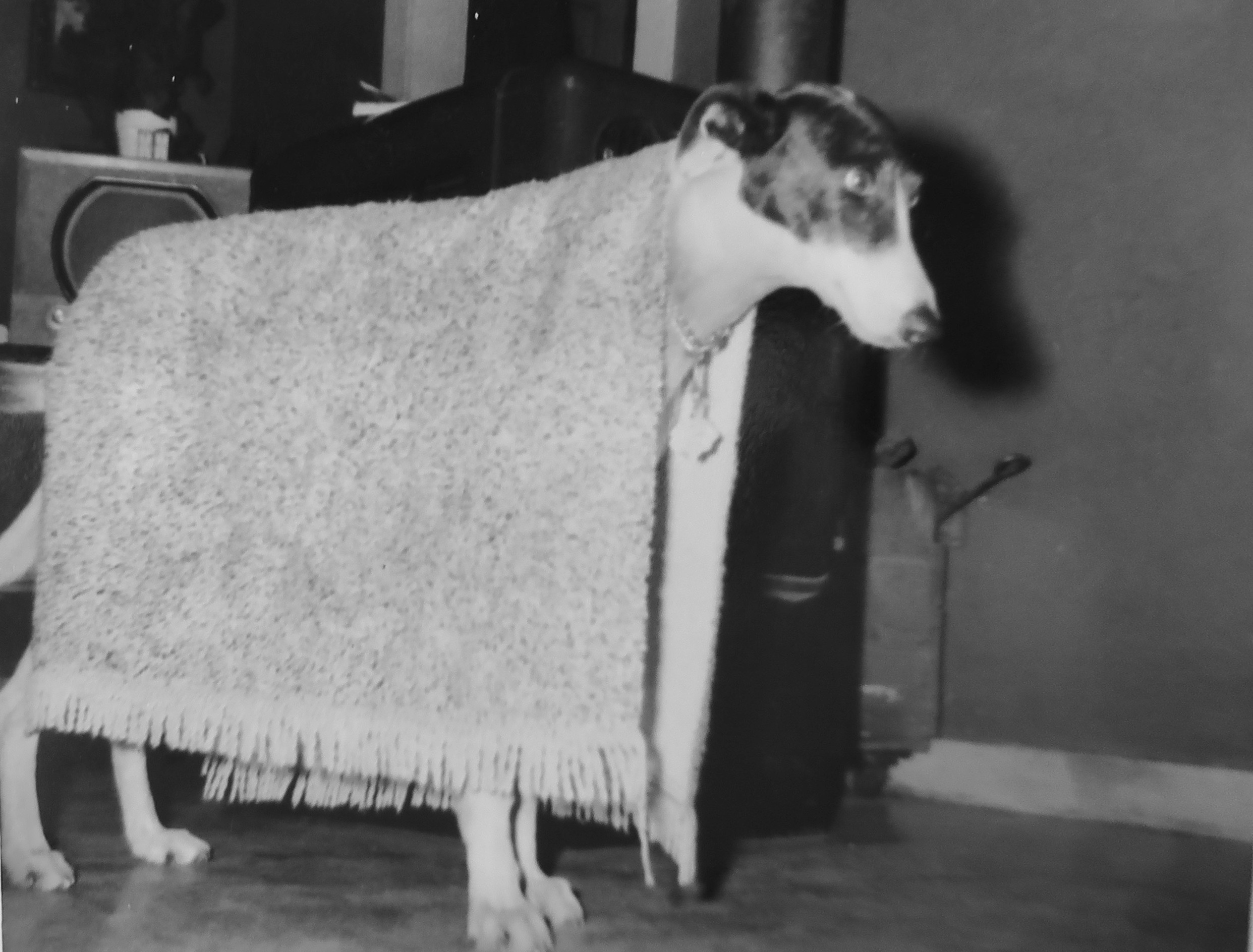
Poor Pat. Living with me did have its drawbacks, especially when I had a camera in hand. Being a rescue dog, however, she was eternally grateful and willing to pose for me. Reluctantly. Behind her is the wood stove we used for heat and, above Pat’s tail, our first TV. It was a while ago. Grin.
Pat the Greyhound set the stage for the banning of the Ghost Guard from my bed.
The night of the skunk was an exception to Pat’s normal stay-at-home routine. As usual, I had crawled into bed with an assortment of animals. That evening, it was minus Pat. Good, she took up a lot of room. Somewhere around midnight, I half way awoke as she hopped up on the bed, completed three dog turns, and snuggled down. Consciousness made a quantum leap as my nose was assailed by an unmistakable perfume.
“Seems we have a skunk visiting,” I told Pat and reached down to scratch her head. The fur was moist. As I pulled my hand back, the skunk suddenly got much closer. Now, I was totally awake. Ms. Greyhound had been bullying the wrong pussycat. It was a night to sleep inside. In fact, Marshall had a roommate for several days. I don’t know how many times I washed that hand but I do know that the bedding was tossed and Pat learned what a tomato juice bath was. When I finally made it back outside, the animals were put on notice: One more problem and off they went.
Then Demon the Black Cat made her contribution.
She was well into middle age by this time and there had been no pause in kitten production. This was a time before spaying became common. Every few months, Demon shelled out another litter. She had long since finished overpopulating Diamond and was working on surrounding communities. We were teetering on becoming known as the Cat Family of Diamond Springs. My father reverted to drastic measures. Demon was not pleased. She started hiding her kittens and became a master at subterfuge. If someone tried to follow her, she would stop and nonchalantly give herself a bath, her whole body, one lick at a time. Then she would wander off in the opposite direction.
Mother paid me in cookies to track Demon down. When the Graveyard was her destination, I had a flat tombstone I would stand on as a lookout. There was an added advantage; Demon didn’t check for people perched on tombstones. Who would? Eventually, the missing litter would be discovered. I felt like Daniel Boone.
Demon’s special home delivery took place the same summer Pat had her close encounter with the skunk. As noted earlier, my attitude about bed companions had become testy. I wasn’t above rolling over quickly to see how many I could dislodge. A really good roll would net three or four. Sleeping with me was like living on the San Andreas Fault.
I did feel guilt over routing Demon. Once again, she was pregnant. I watched her balloon out. By this time, I was a veteran of the birthing process and found it interesting rather than troublesome. One night I had awakened to Pat howling, found that she was delivering puppies, and sat up with her through the process. Another time I had gone out with Tom Murphy, our grocer, and assisted in the delivery of a calf that wanted to come out the wrong way. It was messy, up to the elbow work. Remember the coke I stole from his store on my 5 AM walk home from Rudy and Robert’s? Tom was repaid many tines over.
I really didn’t expect to be around for the arrival of Demon’s kittens. That would take place in some hidden nook. One should never make assumptions.
It started as a normal night. Roll over, kick the animals off, and go to sleep. Wake up and repeat the process. It was not a normal morning. I woke up with wet feet.
“What the heck!” I exclaimed as I sat up quickly, dislodging Pat in the process. Demon looked innocently back at me from the foot of the bed. Okay, nothing suggested why my feet were wet. Then I noticed movement. Demon was not alone. Several little black clones were lined up for breakfast. Demon had delivered her litter on the bed and my feet were awash in afterbirth.
That did it. My bed was not a home for wayward dogs who encountered the business end of skunks and it certainly wasn’t designed as a maternity ward for unwed cats. I bought a water pistol and initiated a campaign of terror. Any four-legged critter on the bed became fair game. The cats learned quickly; getting shot with a water pistol was not their idea of a proper bath. The dogs were more resistant. Usually it took several squirts and then I would get the look: big brown eyes accusing me of dark deeds. But I was tough and my canine companions eventually vacated the premises as well.
As soon as I fell asleep, however, the whole menagerie, fleas and all, would quietly slip back up on the bed.
NEXT POST:
Blog a Book Wednesday… From “The Bush Devil Ate Sam” : A student revolution with world-wide implications was about to begin at Berkeley. As a student on campus it would have a dramatic impact on my world view and be an important factor in my joining the Peace Corps. I discuss how I gradually became involved and provide background information.
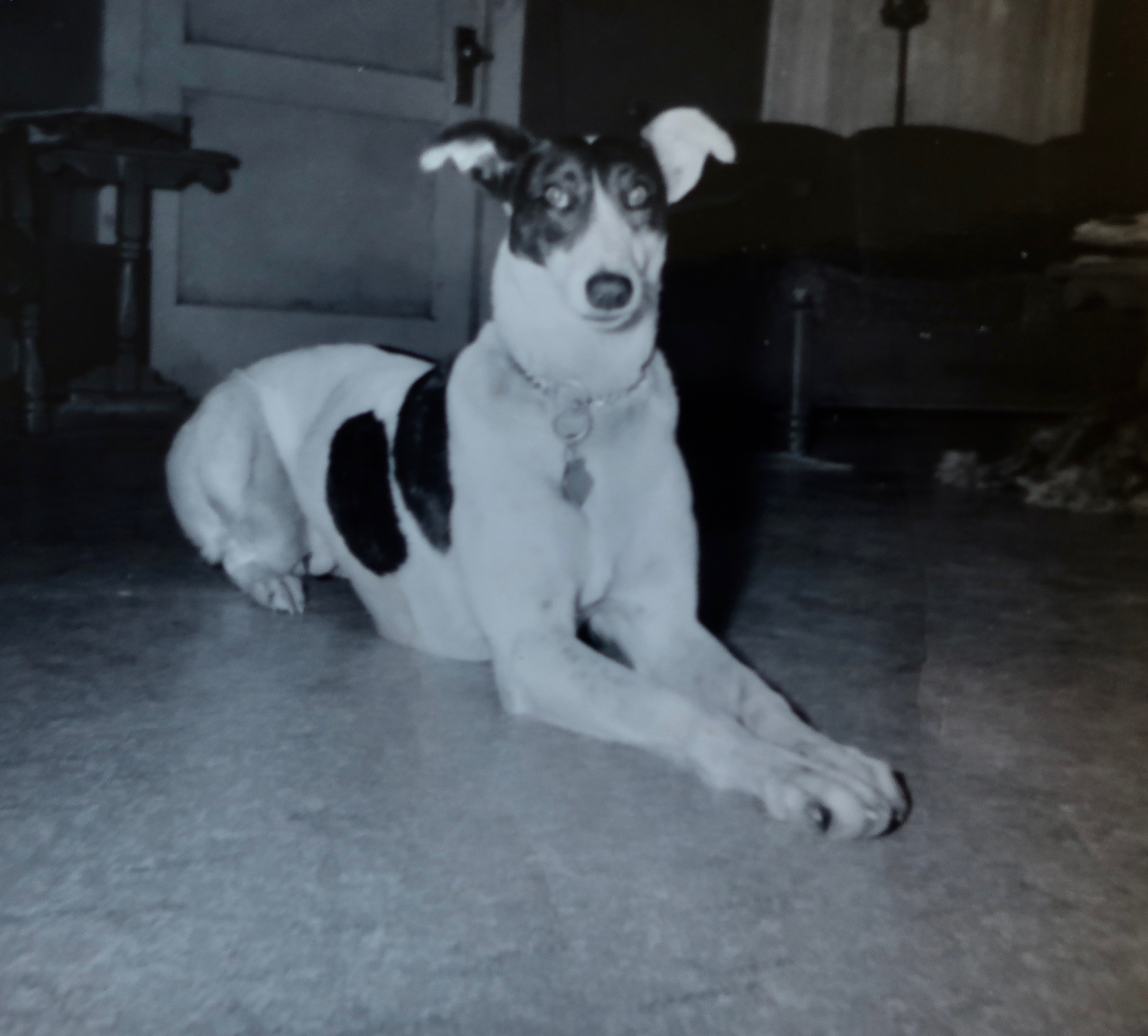
Pat the Greyhound looking quite elegant. You can see why she would take up a lot of space on a one person army cot. I named her after the driver of the local Greyhound Bus.
In my last blog-a-book post from “It’s 4 AM and a Bear Is Standing on Top of Me,” I related how I moved outside during the summer and hired the family pets to protect me from the ghosts that lived across the alley from us in the jungle-like graveyard. While several animals participated in this critically important duty, two stood out for their steadfast commitment: Demon the Black Cat and Pat the Stray Greyhound.
Demon, the alpha family cat, was as black as the darkest night. As such, she was appropriately named and attired for graveyard duty. In fact, she spent a good deal of her life there, stalking mice, lizards, birds and anything else she could get her claws into with impunity. Captured prey would then be brought home for approval. My job was to dispose of the half-eaten carcasses. I would sometimes tie a string around the dead animals and drag them around the yard, giving Demon more play time. (Okay, I was a bit weird, but I received high marks from the cat.) Depopulating the Graveyard was not Demon’s claim to fame, however; motherhood was. She had kittens often and everywhere. I suspect that half of the cats living in El Dorado County today can trace their lineage back to her.
Demon was well colored and named for graveyard duty. I think her claws were about to reach out and scratch the photographer, me.
Two instances of kitten production bring back vivid memories. The first took place on the living room floor. Demon was a young cat at that time and a neophyte at motherhood. Her impending delivery was quite apparent from her large belly and ceaseless exploration of clothes hampers, cupboards and other dark places.
With high hopes of avoiding a misplaced litter, Mother arranged her bedroom closet as a maternity ward. Several times each day it was my duty to show Demon her new home. I would carefully pick up the very pregnant cat, carry her to the closet, and deposit her in a box filled with well-used clothes. Demon didn’t buy the program. It seems my bedside manner was faulty. She would climb out of the box, glare at me, and stalk out of the bedroom.
When the joyous day finally arrived, I was home alone. Demon was practicing her would-be-mother waddle-walk across the living room when she suddenly stopped, squawked and squatted. Neither she nor I was ready for what followed. After all, how prepared can a young kid and a first-time mother be for birth? In a massive surprise to both of us, a tiny black bundle of fur emerged from Demon’s undercarriage. Surging emotions paralyzed my seven-year-old mind. One thought stood out, the closet! If Demon hadn’t memorized her delivery lessons, I had.
I jumped across the room, grabbed Demon by the nape of the neck, and raced for Mother’s bedroom. As fast as I ran, it wasn’t fast enough. In the middle of the kitchen, the new arrival completed its journey and was heading for a crash landing. Somewhere, somehow between Demon and the floor, I caught a warm, wet ball of fur in my free hand. After that, the memory fades. I know the three of us made it to the closet.
Demon accepted her new home and four more kittens followed the first, although in a less dramatic way. The population explosion was underway. I’ll cover Demon’s other memorable kitten delivery in my post next Monday. It, too, was forever etched in to my mind.
Pat the Greyhound joined our family as a stray. For weeks, Mother had watched this large, starving dog wander the countryside catching jack rabbits and ground squirrels for food. One day she stopped the car, opened the door and invited Pat home for a meal.
“Oh, it is just until she gains a little weight,” Mother explained to one very disgruntled Pop. He already believed the size of our pet menagerie was far too large. People were known to drop off unwanted cats in front of our house knowing that they would find a home. As Pat put on the pounds, Mother modified her strategy. “Oh, but it would break Curt’s heart if we had to give her away.” She was a master at manipulation. Pat, who I named after the local Greyhound bus driver, had become my dog.
Like all of our pets, she lived outside. It was Pop’s rule; pets were limited to daytime visitation rights only. Demon had been an exception imposed by Mother. Since there were no leash laws, Pat was free to come and go as she pleased. Mainly she chose to hang around with her food dish in sight.
In next Monday’s post, I tell the story of how the shenanigans of Pat and Demon led to the Ghost Guard being kicked off my bed.
NEXT POSTS
Wednesday’s Blog-a-Book Post from “The Bush Devil Ate Sam”: Life at Berkeley gets complicated…
Friday’s Travel Blog: The dramatic sea stacks at Harris Beach State Park including the largest island off the Oregon coast and an intriguing hole in a rock.
It’s more tide pool fun at Oregon’s Harris Beach State Park in my travel blog today. Both Peggy and I took the photos.
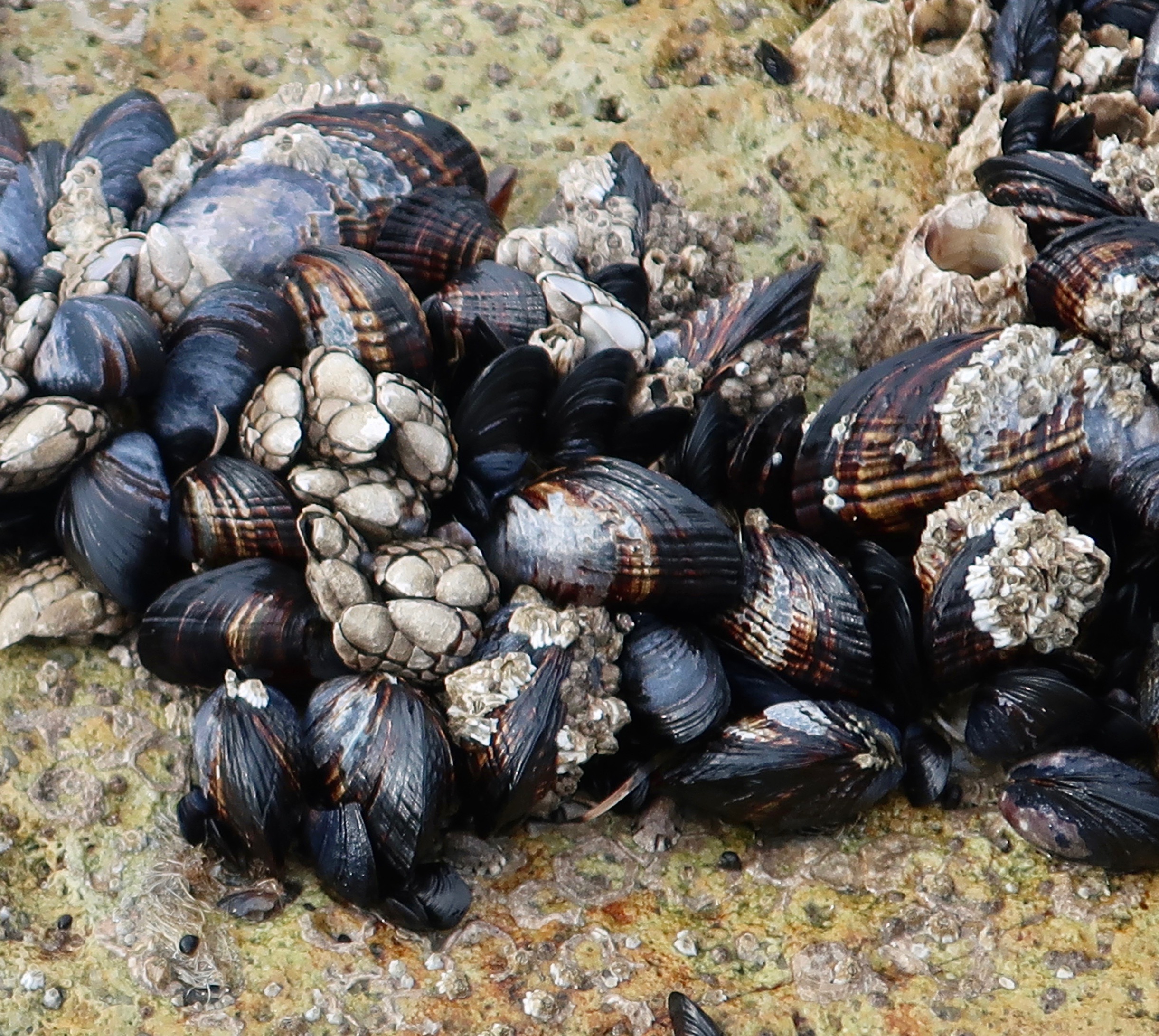
Four volcano-like barnacles plus mussels at Harris Beach State Park.
Barnacles are a bane to sailors, limpets and anyone else they can hitch a ride with. Latching onto hulls, they seriously interfere with a boat’s efficiency at moving through water and have to be scraped off. Limpets just have to live with their passengers.
Limpets move so slowly that their progress is not impacted by barnacles, but still, I can’t imagine that they are happy to have hitchhikers.
The limpet was one of several that Peggy and I found on a rock. Hermit crabs and other denizens of tide pools love to eat limpets but getting them off rocks can be a considerable challenge. They shoot out the water from under their shells and create a tight, almost unbreakable vacuum. I know. I’ve tried.
Lots of barnacles here. Now, imagine them on the bottom of a boat. There used to be a rather nasty punishment ship captains would use on miscreant sailors called keel-hauling. A rope would be attached to the sailor and he would be dragged under the boat. If barnacles were present, I doubt that much skin would be left. I think I would prefer walking the plank.
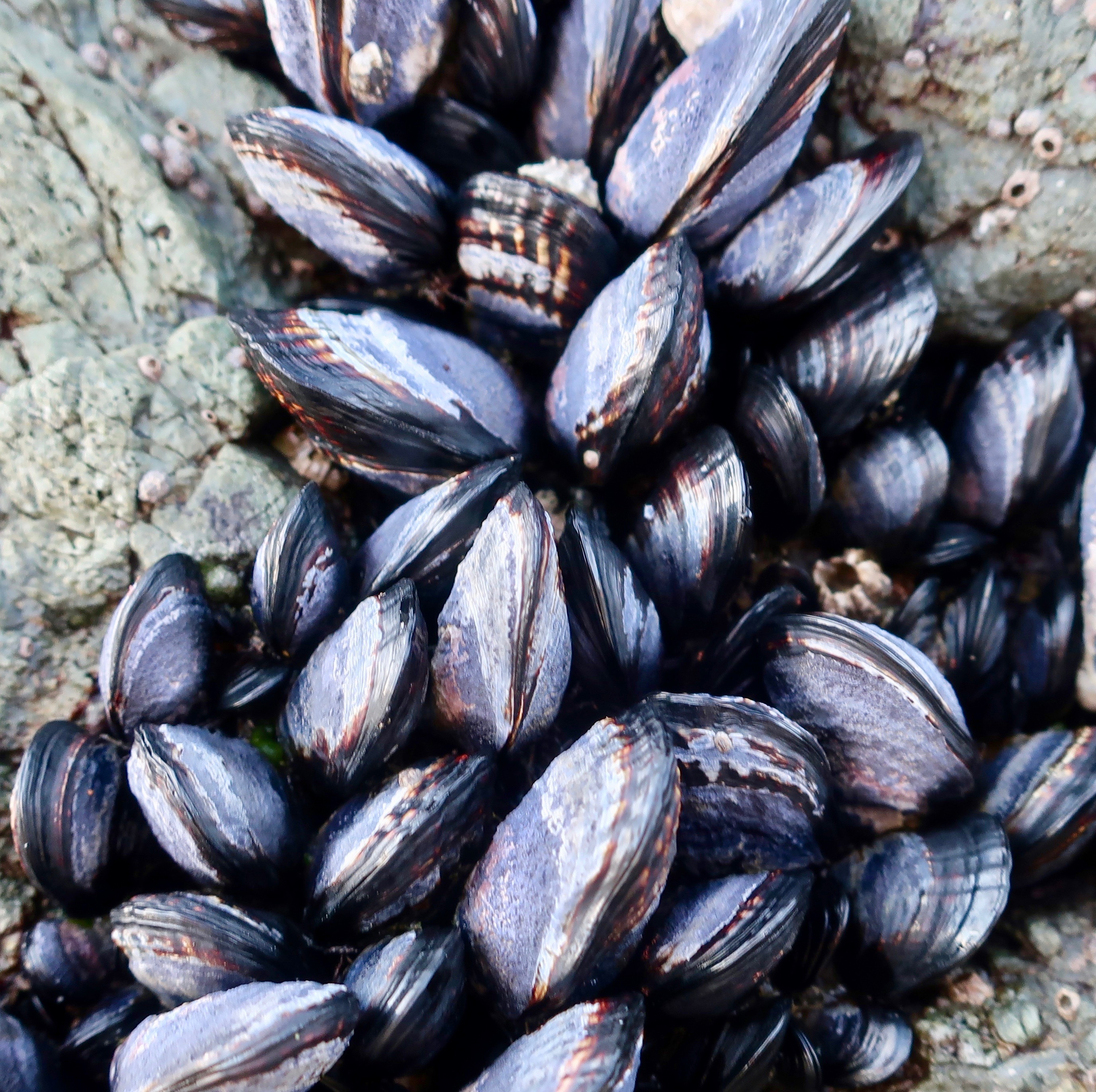
Barnacles are joined by mussels and goose neck barnacles in this photo. Goose neck barnacles, the guys with the fingernail looking shells, are considered a delicacy in Portugal and Spain. They were also eaten by the indigenous peoples of California and probably Oregon. Also, note the barnacles attached to the mussel shells.
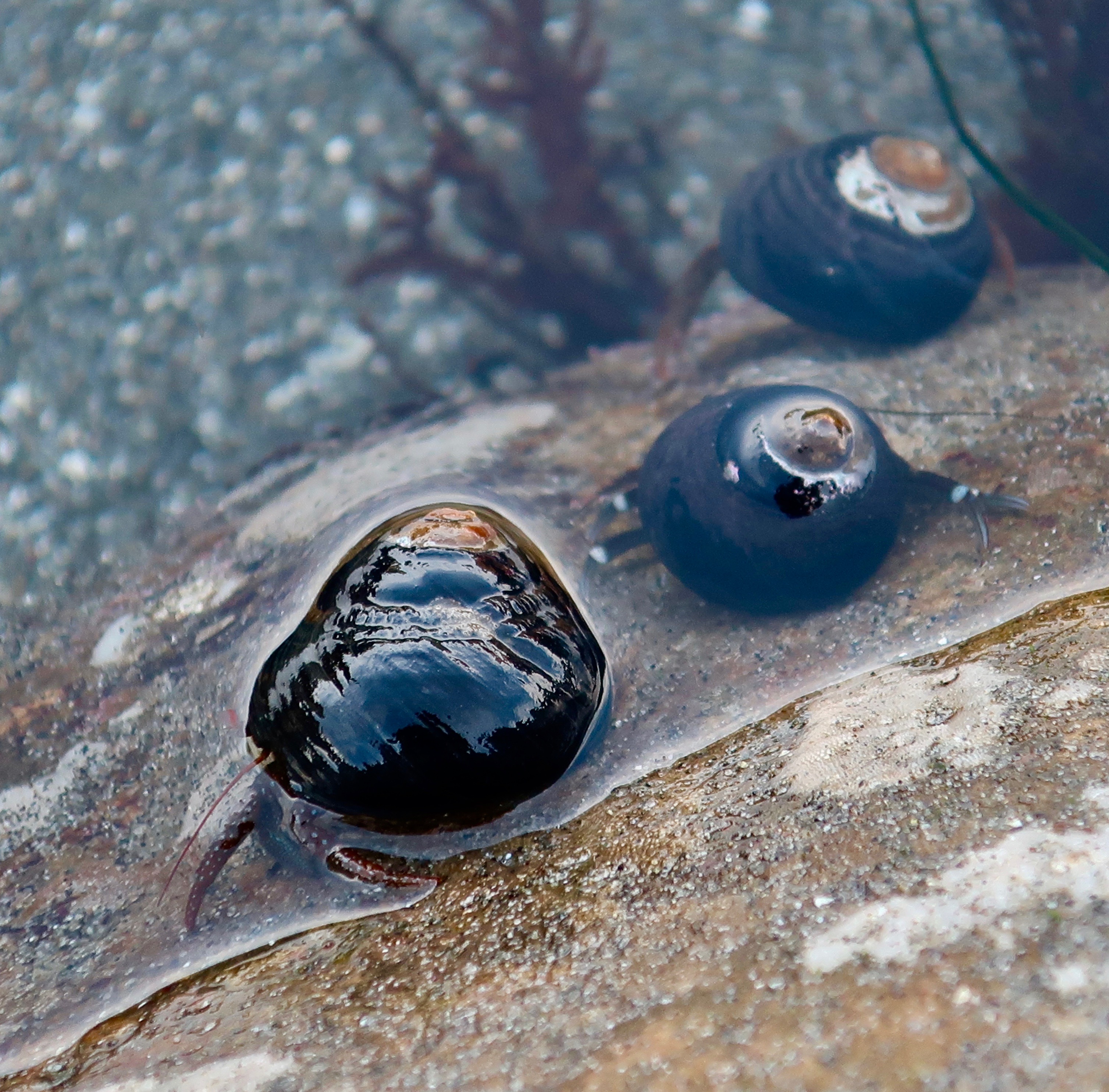
Turban snails are common along the Pacific Coast. Their empty shells are a favorite home of hermit crabs, which are what you see here, hiking along on their crab legs. As a kid, I used to pry an occasional limpet off of a rock and toss it into a tide pool. The limpets had little appreciation for my boy-enhanced curiosity, but the hermit crabs would come rushing in from far and near for the feast.
Peggy loves a batch of mussels cooked up in salt and garlic water. My dad did as well. He used to gather them fresh off the rocks near where he lived on the Oregon Coast and cook them. He tried to feed them to me. No thanks. I am not a fan of most shellfish. I think the snail seen here shares my wife’s and his taste. It has a specially adapted organ that can drill through the snail’s shell for a tasty meal. Buzz, buzz, slurp, slurp.
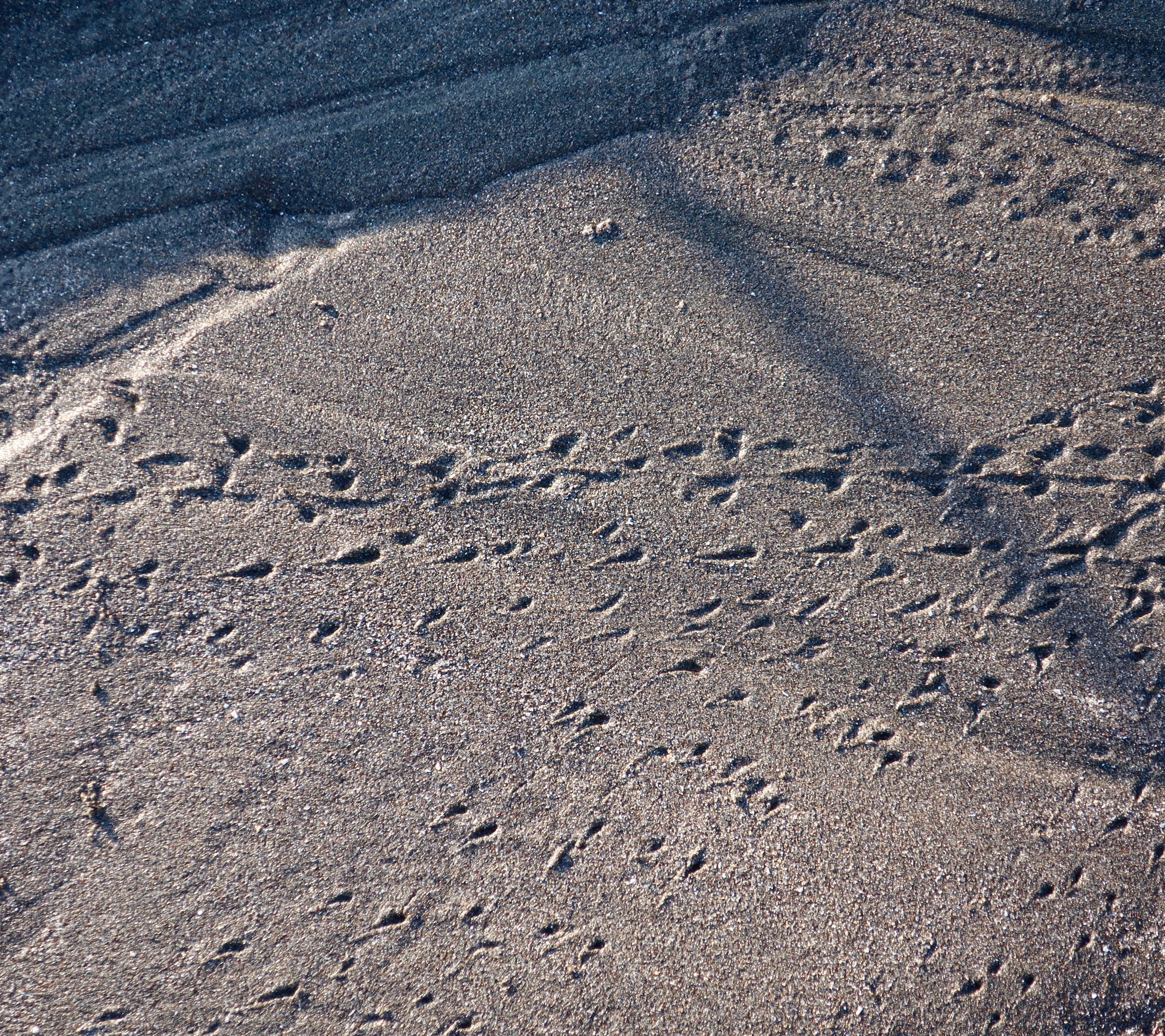
Just for fun, who do you think made these tracks across the sand? I’m going for crabs with their small claw feet.
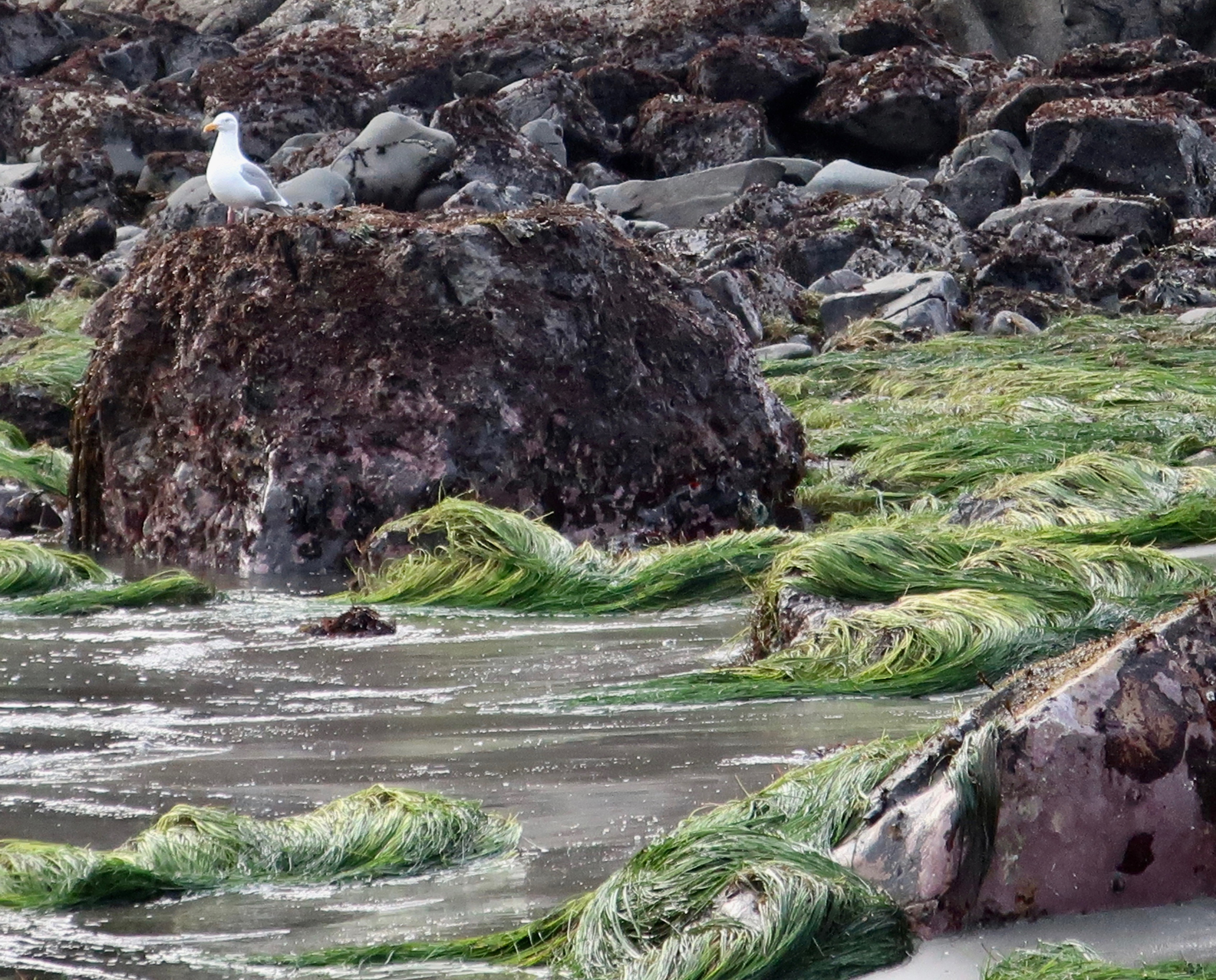
I’ll close today with the sea grass that Peggy and I found growing in abundance between the tide pools. We had expected to find seaweed, not grass. This grass has returned to the ocean from land and adapted to living in saltwater. We found it quite attractive.
Another example. Next Friday I will return to Harris Beach and feature it’s dramatic sea stacks.
NEXT POST:
Blog a Book Monday… “It’s 4 AM and a Bear Is Standing on Top of Me” : In my last post from the book, I wrote about how I had moved outside in the summer to experience nature up close and personal, a successful venture that was tainted somewhat by the ghosts that lived in the graveyard next door. I ended up hiring the family pets for protection. On Monday I will introduce my top protectors, Pat the Stray Greyhound and Demon the Black Cat.
We tend to think of ‘wilderness’ as wild, remote lands. In truth, you can find a bit of wilderness in your back yard or a community park if you are willing to sit quietly and let nature come to life. This is another tale from the book I am blogging: “It’s 4 AM and a Bear Is Standing on Top of me.”
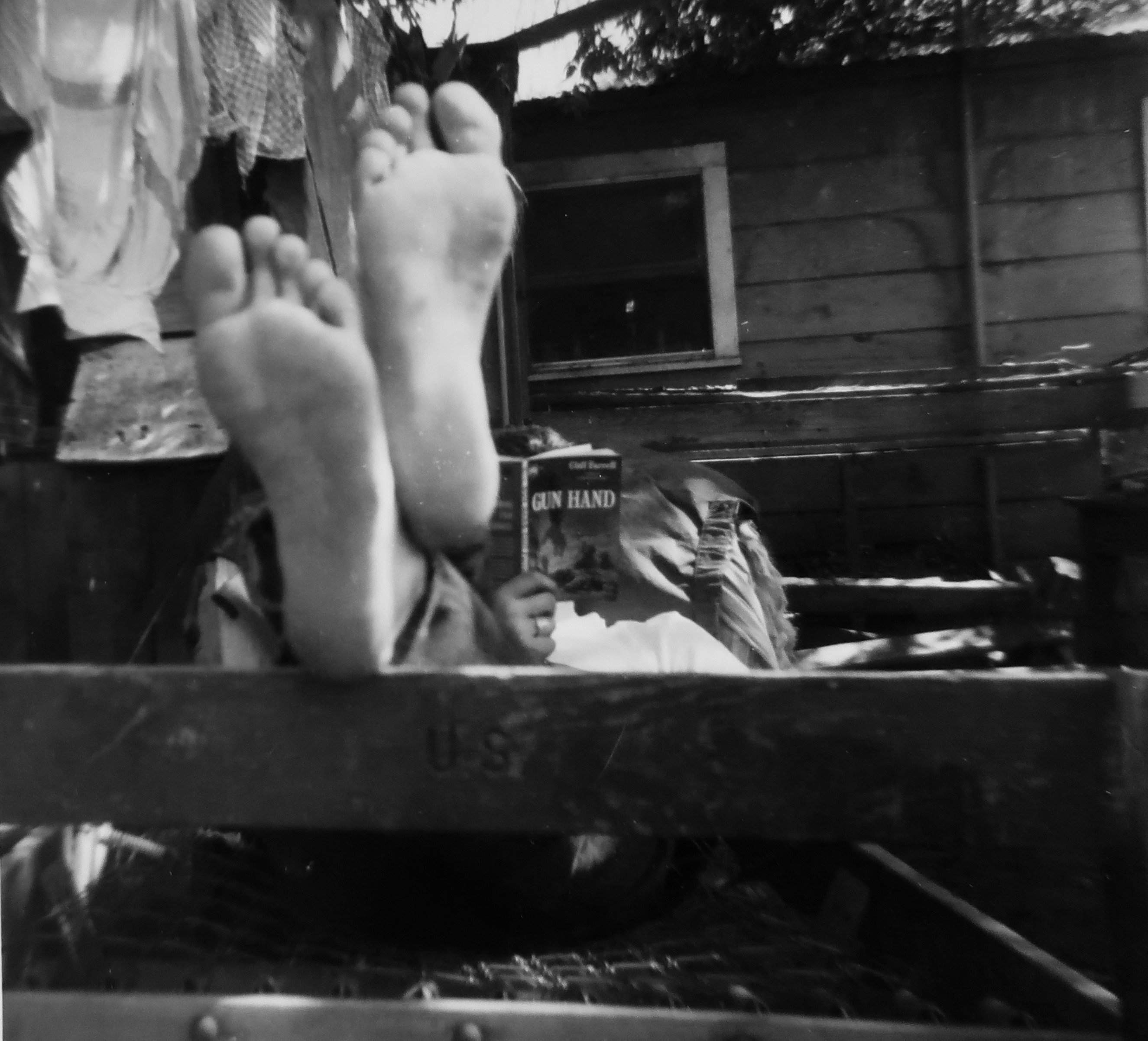
I started sleeping outside in elementary school and would continue to for years. Here I am on a summer afternoon reading a Western. If you look closely, you can see US Army stamped on the back of the cot. It was of World War II vintage. My mother thought it was humorous to emphasize my big feet in her photo.
Between the third and fourth grade, I discovered a new way to enjoy nature. I moved my bedroom outdoors. It was partially to avoid sharing a room with Marshall and partially to escape my father’s house-shaking snores. But the real reason was that I loved being outdoors. I would move out as soon as school was over and stay until school started, or longer, if weather permitted.
At first, I slept on the ground in a cheap cotton sleeping bag. The ground was hard, the nights cool and the mosquitoes persistent, but these were minor drawbacks. I was free. If I had to pee, I’d climb out of the sleeping bag and find the nearest bush. If I woke up thirsty, a convenient garden hose was nearby. I would go to sleep watching the stars and listening to a giant bullfrog that lived in the ditch in front of our house. I would wake to cool morning air and chirping robins. Life was good. And then it got better. My grandparents bought me a real bed— a wood framed, steel spring army cot complete with mattress. I think that they may have been disturbed that their grandson lived outside and slept on the ground.
My paradise was marred by one thing, the Graveyard. It was always there on the edge of my sight. White tombstones glared at me. As hard as I would pretend, the cemetery and its frightful inhabitants would not go away. So, I developed an elaborate set of defenses. The simplest was to sleep facing the opposite direction or to hide under the covers, ostrich like. A more sophisticated approach was to locate the bed where I couldn’t see the Graveyard. Our well-seasoned cars worked in a pinch, but they weren’t quite large enough. Bits and pieces of the Graveyard would creep around their sides, peek over their tops and slink under their bottoms. A trellis built by my father, Pop, was much better. Its luxurious growth of honeysuckle created the perfect Graveyard screen. I set up a permanent residence behind it.
But even the trellis wasn’t enough to calm my imagination. I decided to hire protection. It came in the form of various family pets. Their job was to chase the ghosts away. Payment was made by allowing them to sleep on my bed. Apparently, the scheme worked. At least no ghosts attacked me during the years I slept outside.
One of the family pets I hired for protection from ghosts. It’s hard to imagine that a ghost would find a fat cocker spaniel named Happy that liked to roll over on her back and get her tummy rubbed much of a threat.
The downside was I didn’t have much room. Two dogs, three cats, and me on a one-person army cot constituted a menagerie, or a zoo, if you counted the fleas. It was difficult to move. At first, I was very careful not to disturb my sleeping companions. I became a circus contortionist, frozen in place with body parts pointed in every direction. If this meant a restless night, so be it. It was a small price to pay for keeping the ghosts at bay.
Gradually, my attitude changed. I grew larger, the bed space shrank, and animals started sleeping on top of me. Meanwhile, the ghosts, who tend to hassle little people more than they do big people, became less of a threat. Therefore, I needed less protection. Neither of these factors led to the final banning of the animal kingdom, however. It was the shameless shenanigans of Demon the Cat and Pat the Greyhound that I will write about next Monday.
NEXT POSTS:
Blog-a-Book Wednesday… “The Bush Devil Ate Sam”: I’m off to UC Berkeley where a world-wide student revolution is about to take place. I find myself a lone voice in student government advocating for the right of students to participate in Civil Right’s demonstrations.
Travel Blog Friday… I’ve introduced you to the star fish and sea anemones that reside in the tide pools at Harris Beach State Park. Next I will feature the other denizens that Peggy and I found.
A bit older than five, I find that the Graveyard next to where I was raised no longer holds the terror it did for me as a child. Plus they have cut down all of the heavenly trees and ripped out the myrtle. It is no longer a jungle playground for local kids. What’s the fun in that?
My first ‘wilderness’ was the Graveyard. It was out the backdoor and across the alley. We lived with its ghostly white reminders of our mortality day and night. Ancient tombstones with fading epitaphs whispered of those who had come to seek their fortune in California’s Gold Rush and stayed for eternity. Time had given their resting place a sense of permanence and even peace. But not all of the graves were old. Occasionally a fresh body was planted on the opposite side of the cemetery. I stayed far away; the newly dead are restless.
At some time in the past, heavenly trees, an import from China, had been planted to shade aging bones. They behaved like weeds. Chop them down and they sprang back up, twice as thick. Since clearing the trees provided Diamond Springs Boy Scout Troop 95 with a community project every few years, the trees retaliated by forming a visually impenetrable mass of green in summer and an army of sticks in winter. Trailing Myrtle, a cover plant with Jurassic aspirations, hid the ground in deep, leafy foliage.
The thick growing heavenly trees and trailing myrtle gave the Graveyard the appearance of a jungle when I was growing up. Compare this with the photo above!
During the day, it took little imagination to change this lush growth into a jungle playground populated with ferocious tigers, bone crushing boas, and half-starved cannibals. My brother Marshall and I considered the Graveyard an extension of our backyard. Since it was within easy calling distance of the house, our parents had a similar perspective. Either that or they were glad to get rid of us. The skinny heavenly trees made great spears for fending off the beasts, or throwing at each other. At least they did until we put one through a playmate’s hand. Neither he nor his parents were happy. Spear throwing was crossed off our play schedule. We turned to hurling black walnuts at each other instead. They grew in abundance on the trees in our front yard. Plus, we could toss them at passing cars on Highway 49. Screeching brakes and one really pissed-off guy brought that activity to a halt.
Night was different in the Graveyard— it became a place of mystery and danger. Dead people abandoned their underground chambers and slithered up through the ground. A local test of boyhood bravery was to go into the Graveyard after dark and walk over myrtle-hidden graves, taunting the inhabitants. Slight depressions announced where they lived. Marshall persuaded me to accompany him there on a moonless night. I entered with foreboding: fearing the dark, fearing the tombstones and fearing the ghosts. Halfway through I heard a muzzled sound. Someone, or thing, was stalking us.
“Hey Marsh, what was that?” I whispered urgently.
“Your imagination, Curt,” was the disdainful reply.
Crunch! Something was behind a tombstone and it was not my imagination. Marshall heard it too. We went crashing out of the Graveyard with the creature of the night in swift pursuit, wagging her tail.
“I knew it was the dog all of the time,” Marsh claimed. Yeah, sure you did.
By the time I was five, I had made my first tentative trips into the Graveyard. One of my early memories was spying on Mr. Fitzgerald, a neighbor who lived across the alley. He’s dead now— and has been for decades— but at the time he was a bent old man who liked to putter around outside. A black locust tree perched on the edge of the Graveyard provided an excellent lookout to watch him while he worked. One particular incident stands out in my mind. I had climbed into the tree and was staring down into his yard. It was a fall day. Dark clouds heavy with rain were marching in from the Pacific while distant thunder announced their approach. A stiff, cool breeze had sent yellow leaves dancing across the ground.
Mr. Fitzgerald wore a heavy coat to fight off the chill. I watched him shuffle around in his backyard as he sharpened his axe on a foot operated grinding wheel and then chopped kindling on an oak stump. When he had painfully bent down to pick up the pieces and carry them into his woodshed, I had scrambled down from the tree so I could continue to spy on him though a knothole. I must have made some noise, or maybe I blocked the sunlight from streaming into the shed. He stopped stacking wood and stared intently at where I was, as though he could see through the weathered boards. It frightened me.
I took off like a spooked rabbit and disappeared into the safety of our house. Mr. Fitzgerald was intriguing, but his age and frailty spoke of death— and the dead people who lived in the Graveyard.
I will continue my tales of the Graveyard next Monday and relate how I moved outside to sleep under the stars in the summer. Unfortunately, the ghost continued to hassle me and I was forced to hire the family pets for protection.
NEXT POSTS
Blog-a-Book Wednesday…”The Bush Devil Ate Sam”: I complete my story on the laundry takeover at South Lake Tahoe where I was held at gunpoint. I drive my 54 Chevy toward the man holding a rifle who is standing in front of the car. Will he shoot me or get out of the way? That’s the question.
Travel Blog Friday... I return to my series on Oregon’s Harris Beach State Park where Peggy and I continue our exploration of tide pools.
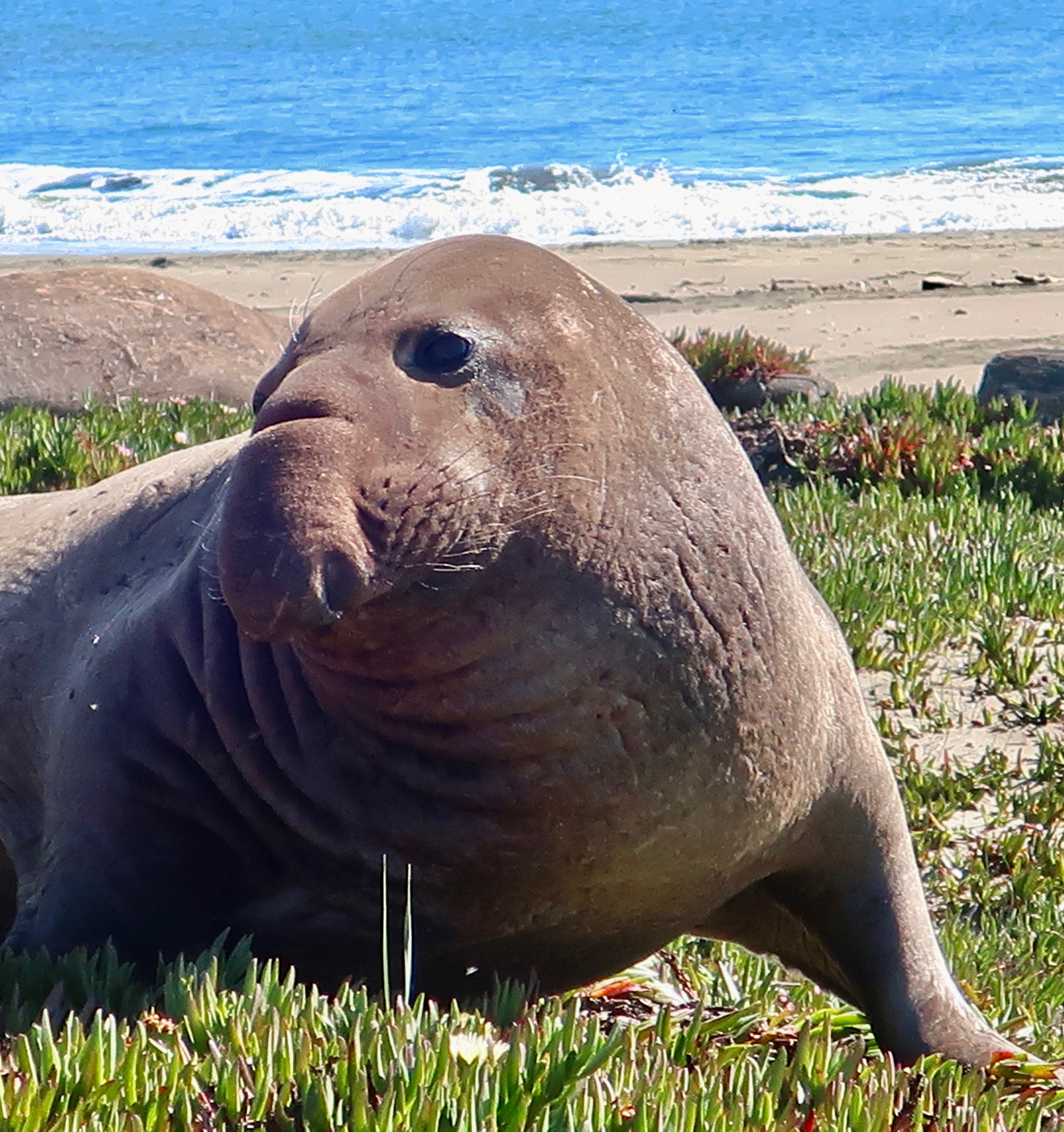
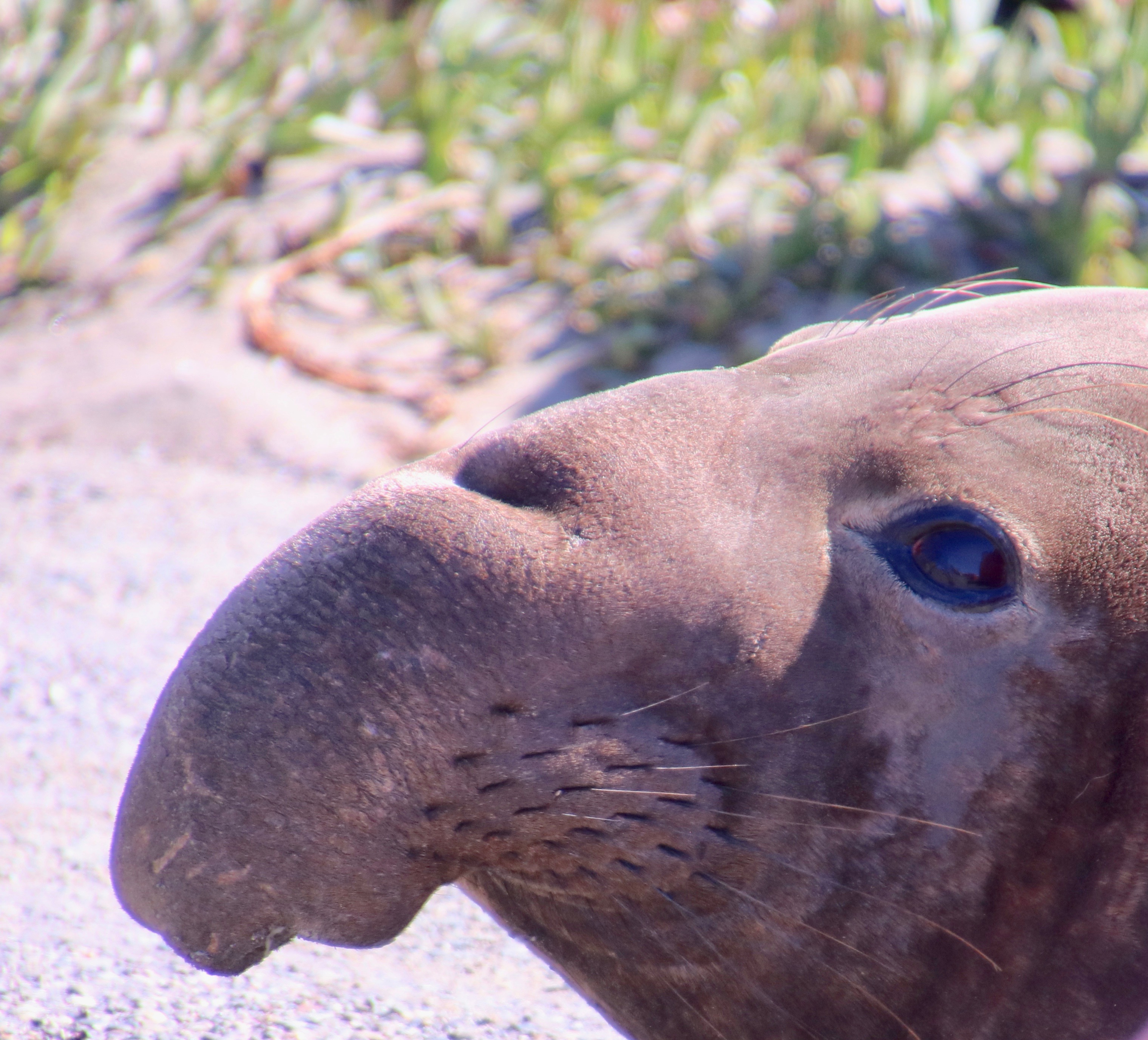
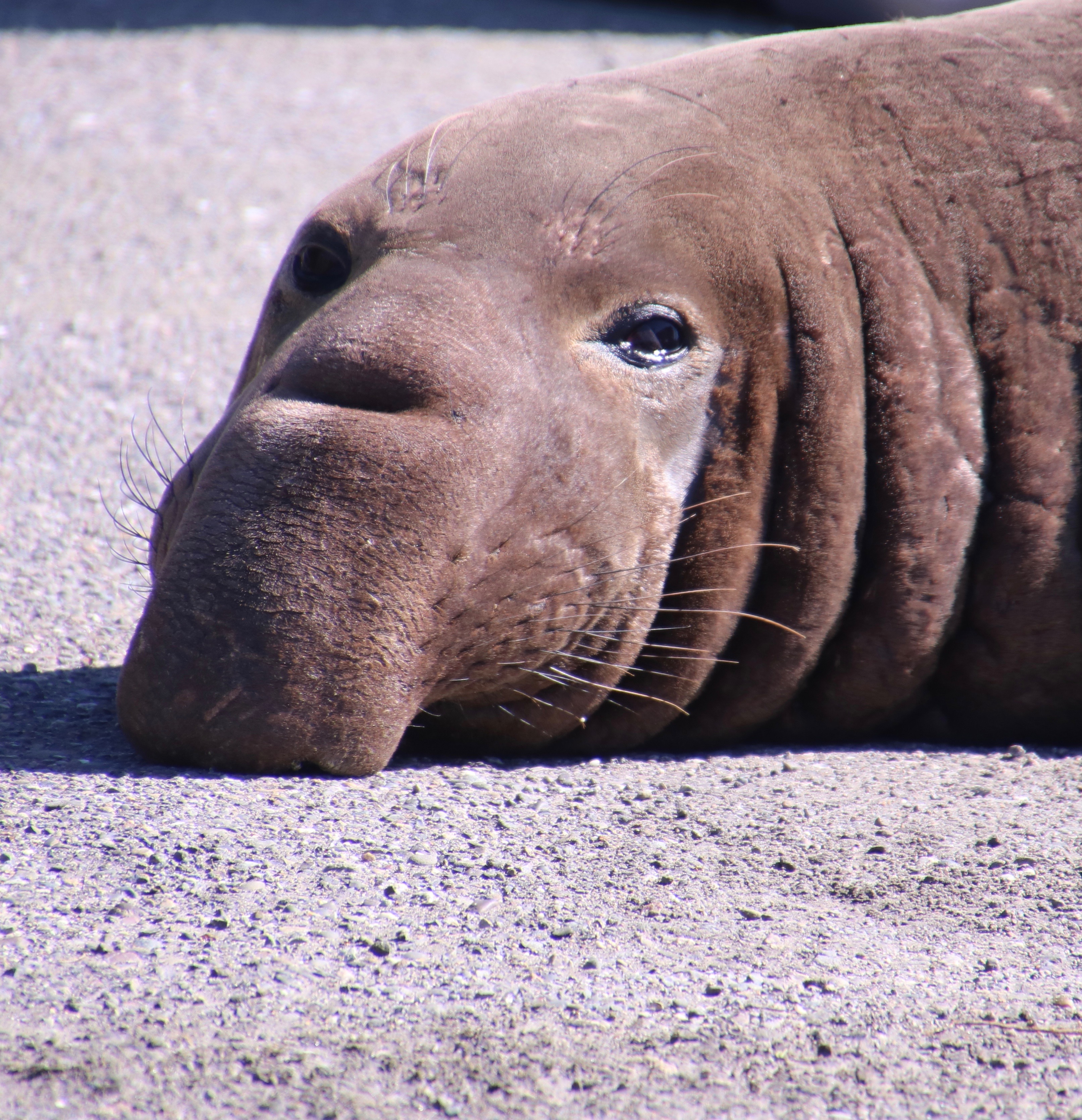
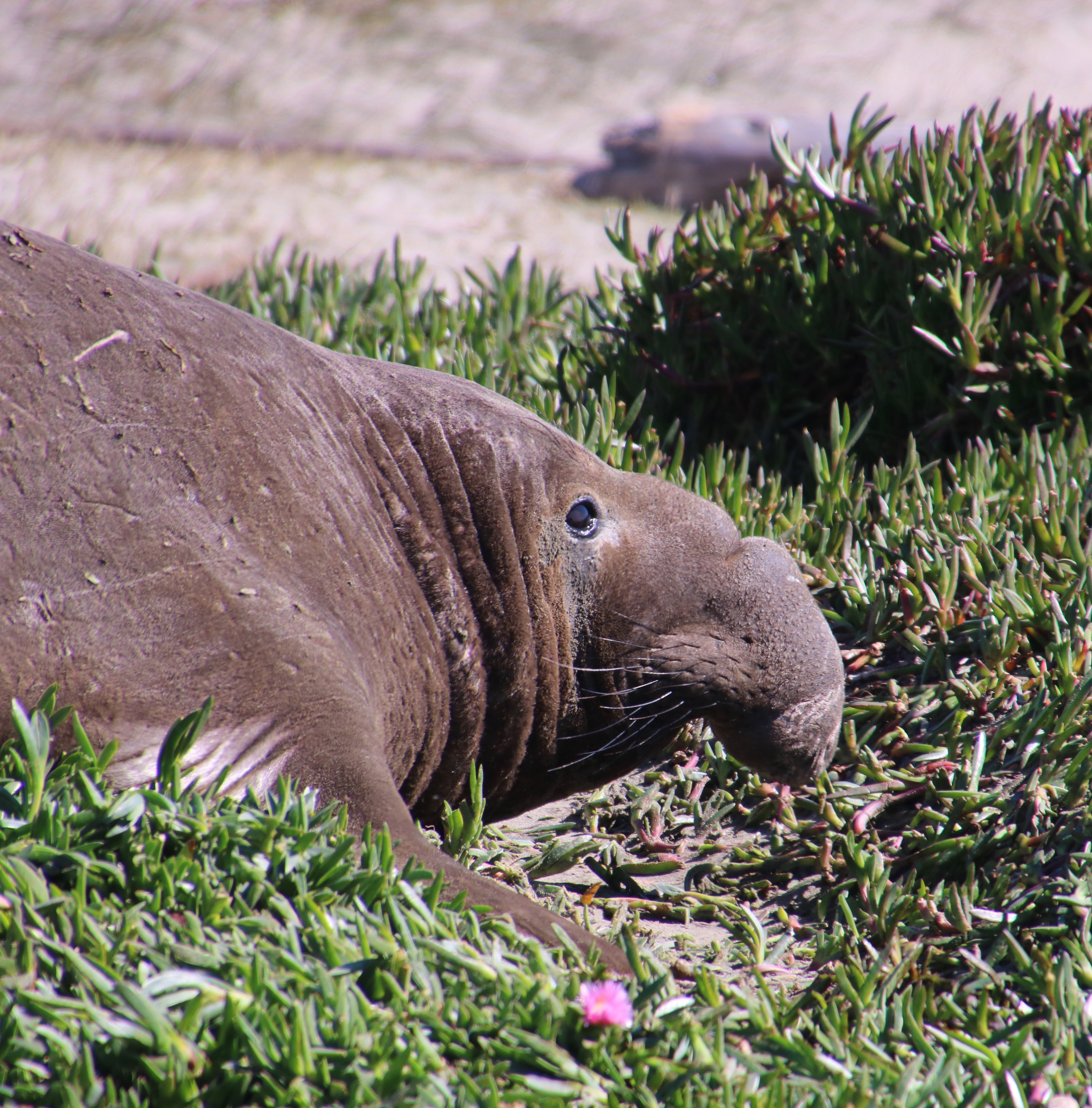
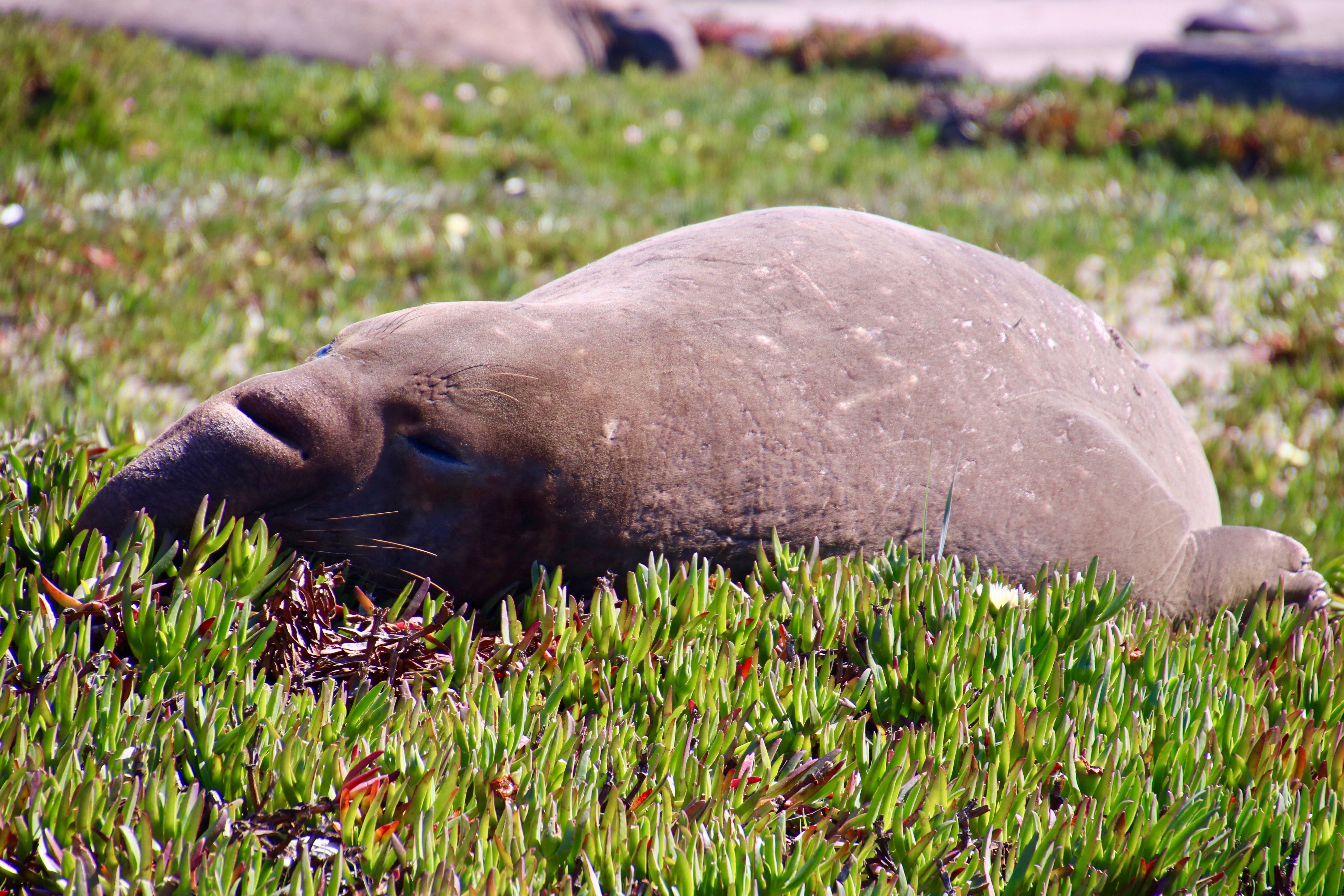
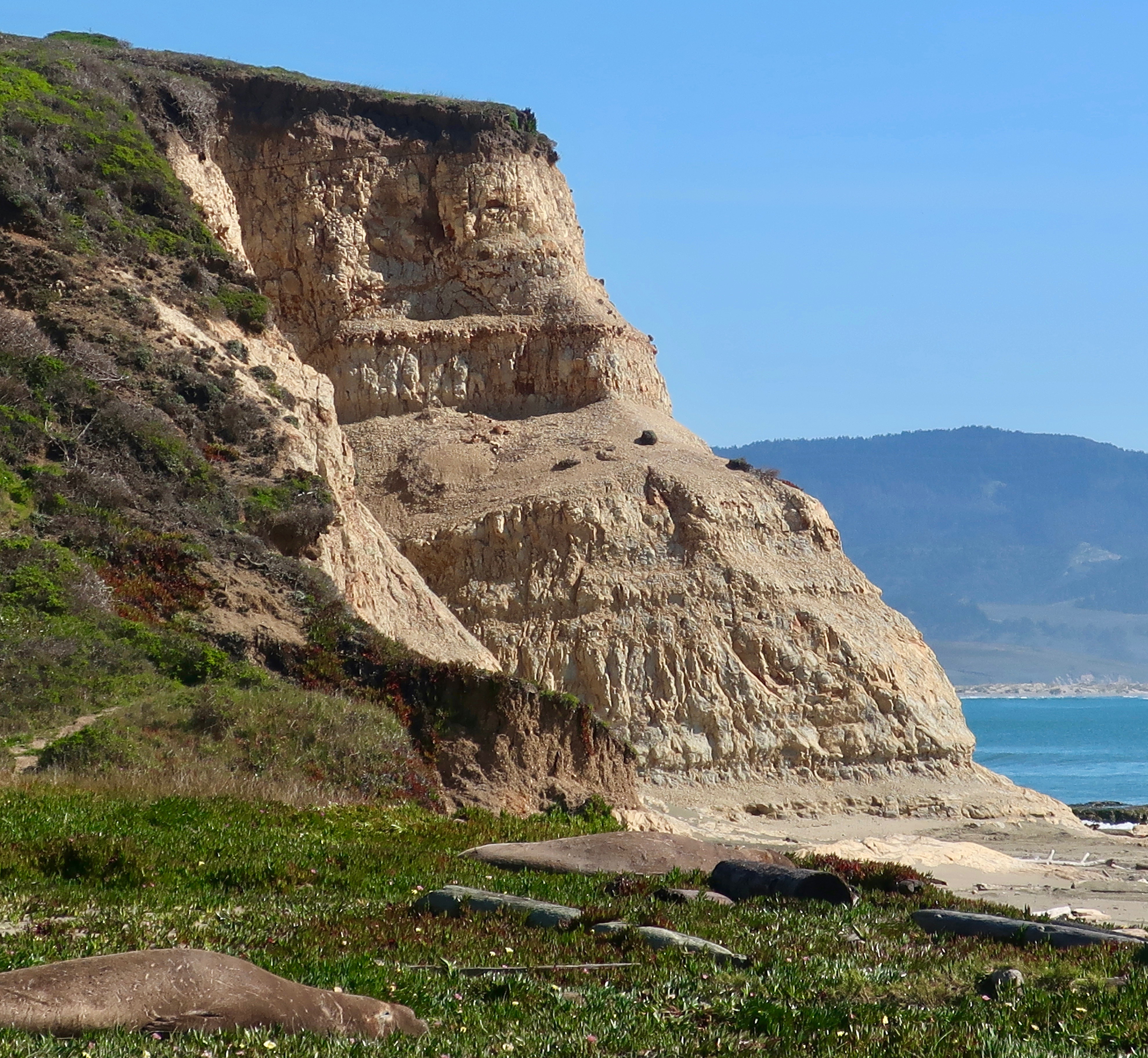
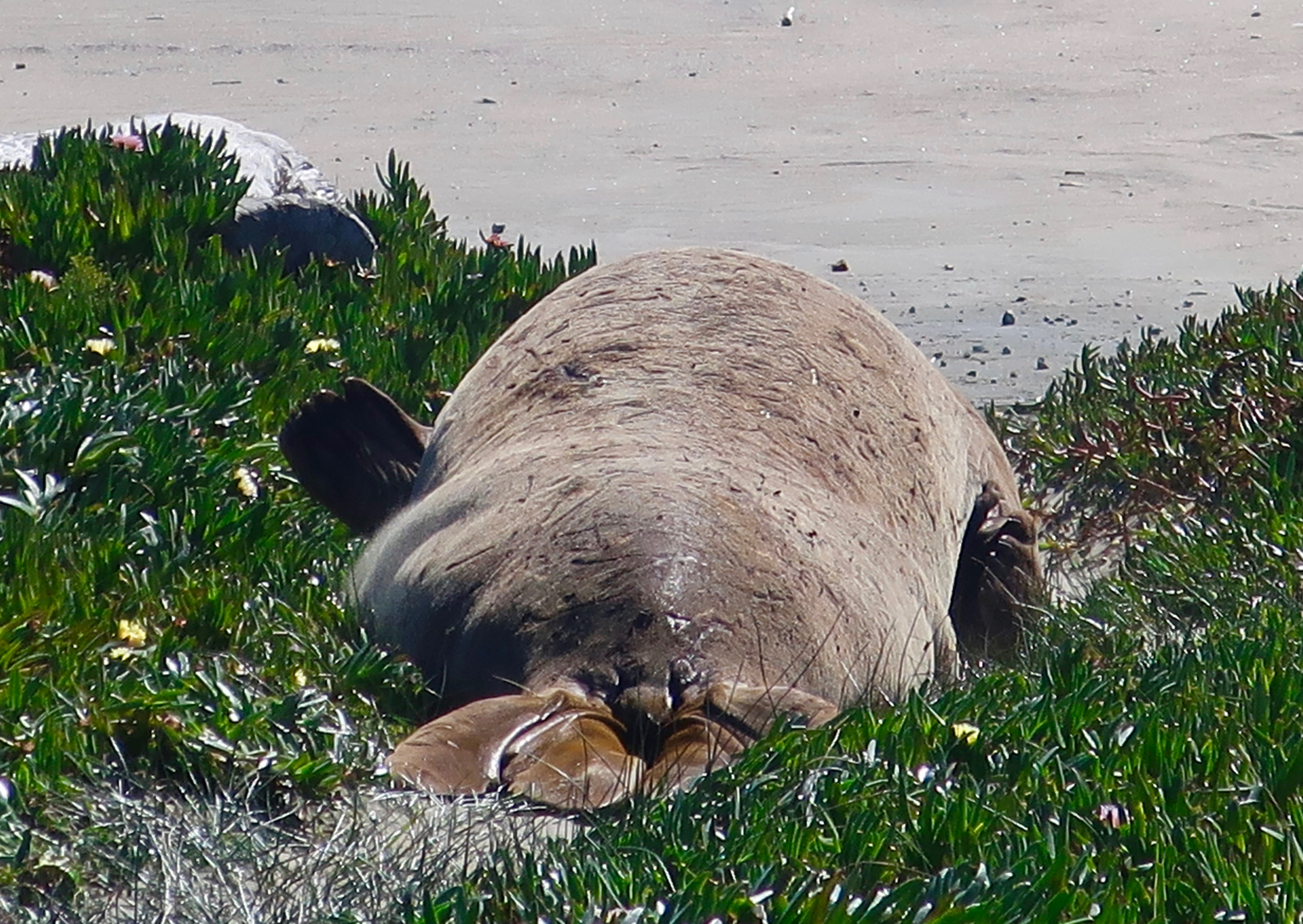
Elephant seals have the look of an animal put together by a committee. It gives them a certain charm. We found this large fellow with his pronounced proboscis at Drake’s Beach. He’d come ashore at Pt. Reyes National Seashore looking for love.
Pt. Reyes National Seashore is located some 30 miles north of San Francisco. Peggy and I went there last week to celebrate my birthday. It’s been a go-to place for me since the 60s. In addition to spectacular scenery, great hikes, yummy food, and one of the best small bookstores I’ve ever been in, we were entertained by the wildlife: tule elk, a pair of sushi eating coyotes, and elephant seals (plus some cows). Today, I want to do a teaser on our trip by featuring the elephant seals. I’ll get back to the rest after I finish my Harris Beach series.
Elephant seals are amazing creatures that spend up to 80% of their lives at sea— 90 % of it underwater! If that doesn’t seem remarkable enough, consider this: their normal dives for food range between 1000 and 2000 feet deep (305 to 610 meters). They can dive for up to an hour and a half before returning to the surface for three to five minutes of breathing. Semi-annual feeding binges take the males on a 13,000-mile roundtrip journey to the Aleutian Islands and females on a 11,000-mile roundtrip into the North Pacific.
They were absent from Pt. Reyes for 150 years. In fact, they were close to absent forever. Like whales, they came close to being hunted to extinction for their oil. Processing the blubber from one bull can produce up to 25 gallons. They were saved because the Mexico and the US banned hunting them in the 1920s. Gradually, they have returned to their old breeding grounds. When I first started visiting Pt. Reyes in the 60s, they were unheard of in the area. Today there are over 3000 that return annually to breed.
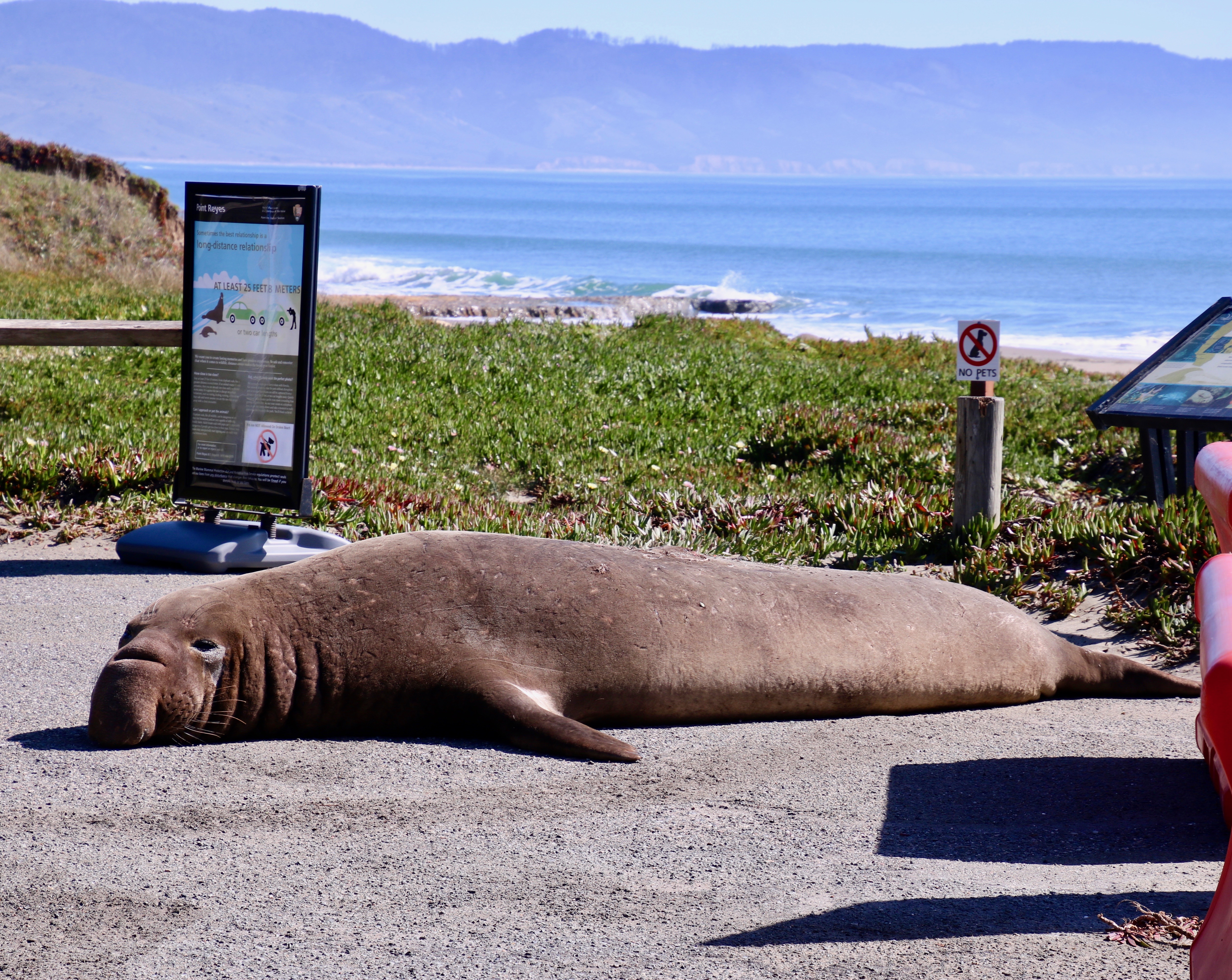
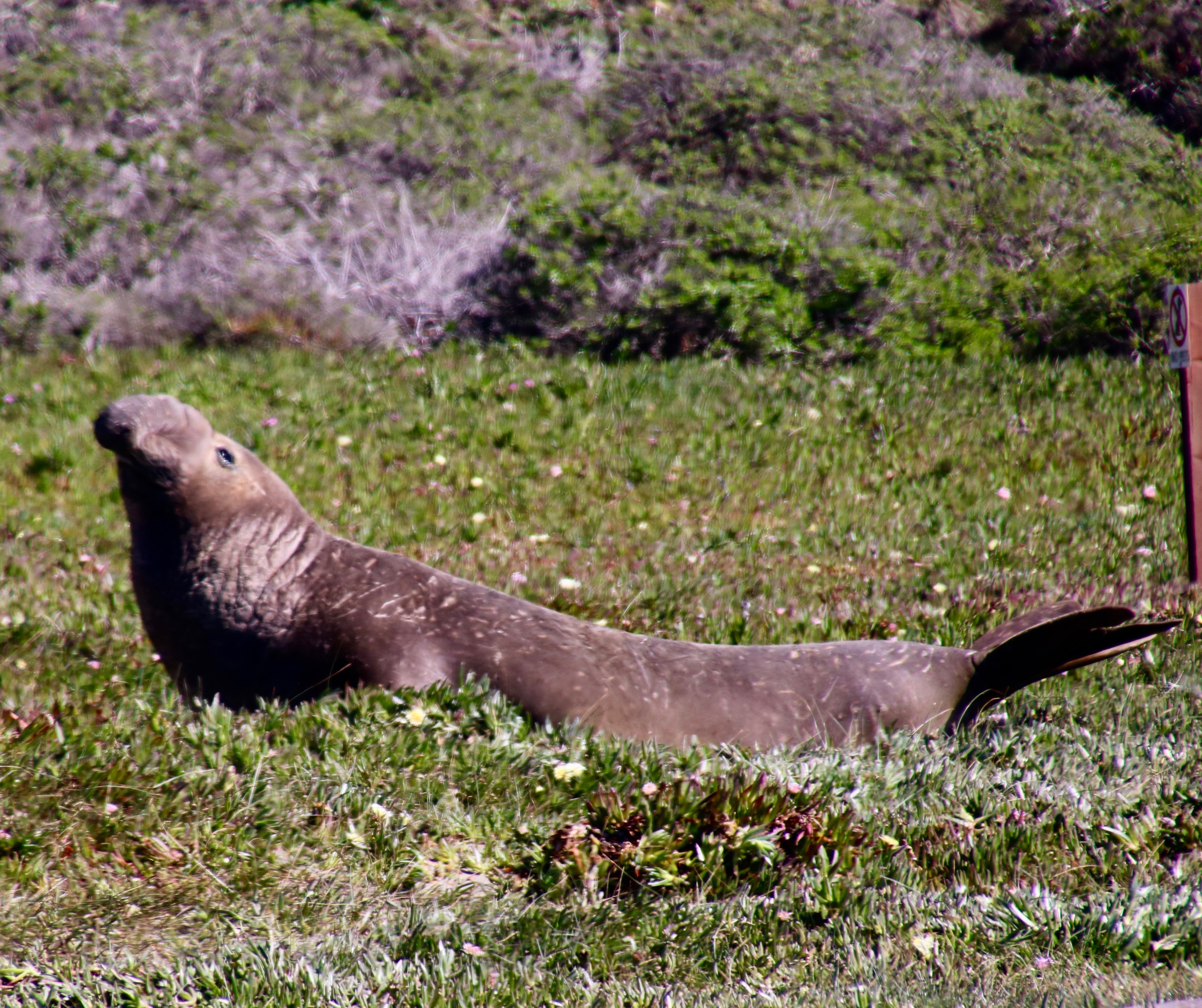
The Park Service had set up a barrier to separate the seals from the people who had come to admire them at Drake’s Beach. Those closest to the barrier were bulls. You can tell by their size and uniquely shaped noses. One had crossed the barrier and was worrying the rangers. “He’s escaping from the other bulls,” a ranger explained. Maybe.
This large bull had crossed through the barriers at Drakes Beach and was pointed toward the snack bar. (Photo by Peggy Mekemson.)
A little girl next to me exclaimed, “I think he is heading to the snack bar to get fish sticks!”
“I’d bet on ice cream,” I responded. “Look at how big he is.” The girl looked at me dubiously. “Fish sticks” she insisted.
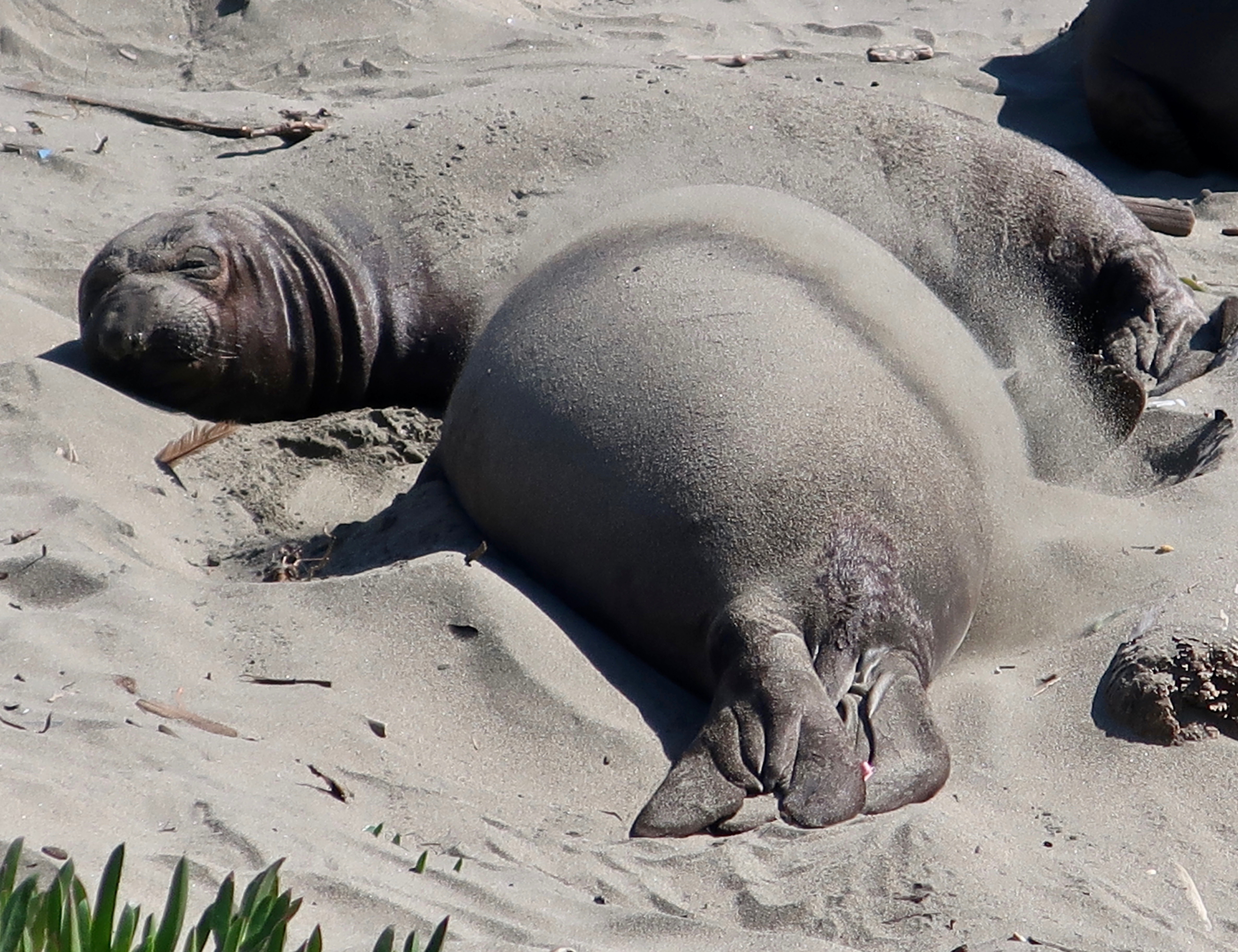
Peggy and I spent an hour watching these wonderful creations of nature who are so competent at sea and ungainly on land. They move like an inchworm, using their dorsal flippers to pull their front half forward and then using their rear flippers to push the rest of their body along like a rolling wave. Imagine moving several tons of fat. The ones we watched would make two or three of these moves and then collapse to rest.
Given their trunk-like noses and appealing eyes, Peggy and I were particularly attracted to the looks on their faces.
Is this fellow being coy?
Check out the big brown eyes! The size of the eyes helps the elephant seal see in the dark depths of the ocean. The whiskers apparently help as well in the search for food. He had lifted his head to check us out. (Photo by Peggy Mekemson.)
And then returned to his resting position. (Photo by Peggy Mekemson.)
A side glance. (Photo by Peggy Mekemson.)
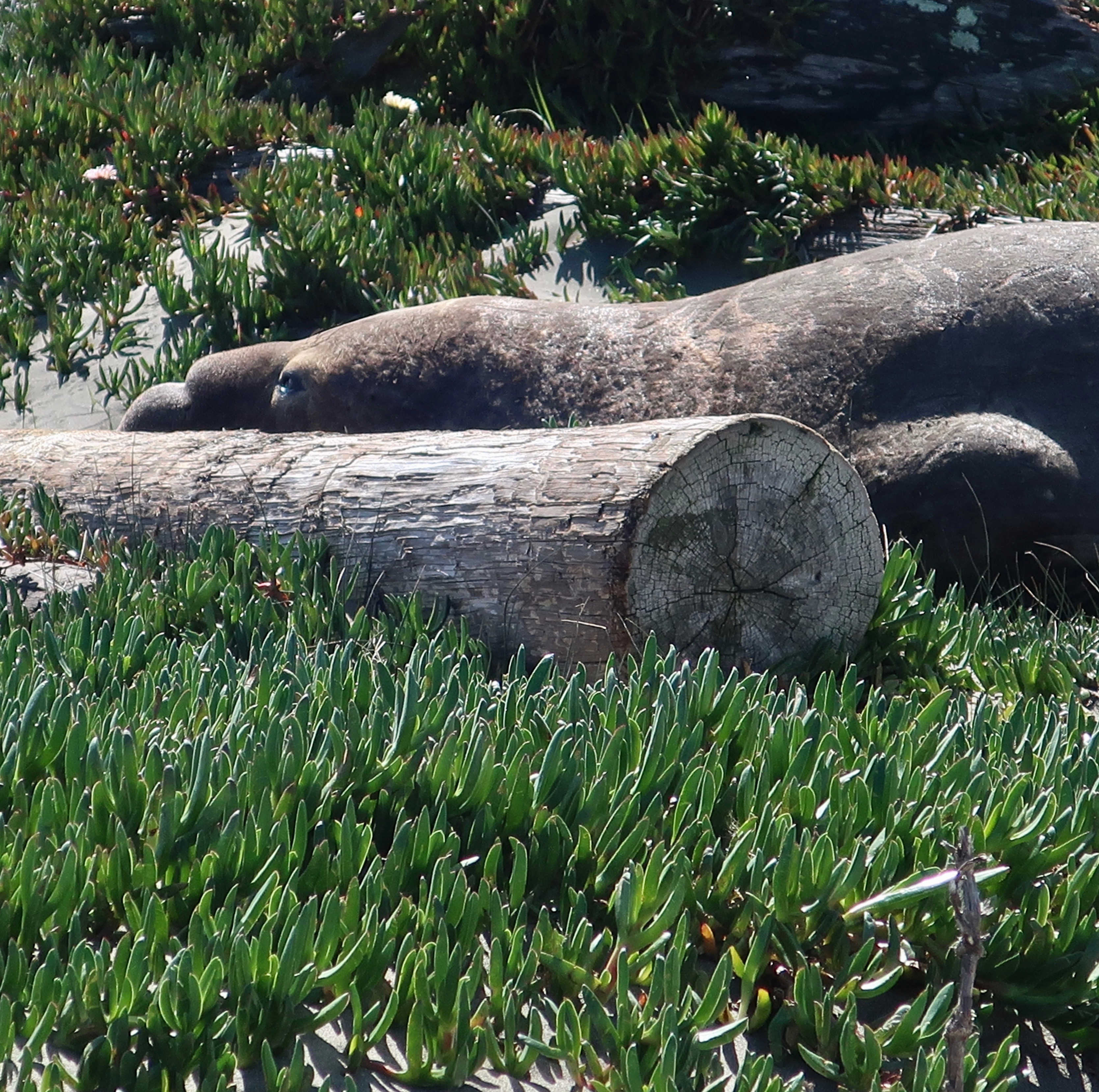
A bit shy, perhaps. Maybe he thought that the log was hiding him.
Size matters. (Photo by Peggy Mekemson.)
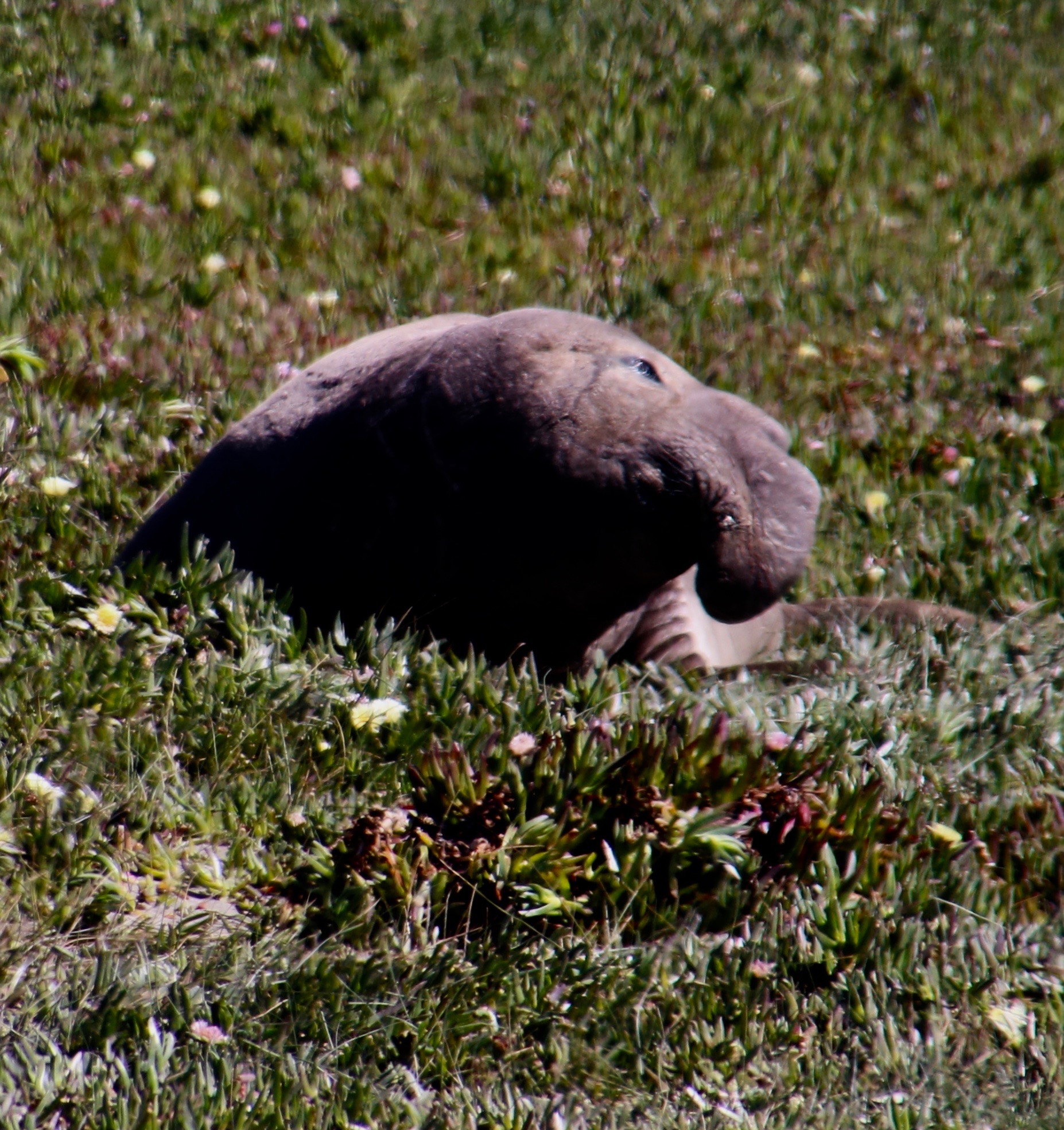
This was interesting. The skin of the elephant seals is sensitive to the sun. They cope by throwing sand over their bodies with their flippers, as seen in this photo.
Sometimes a little stretch really feels good! (Photo by Peggy Mekemson.)
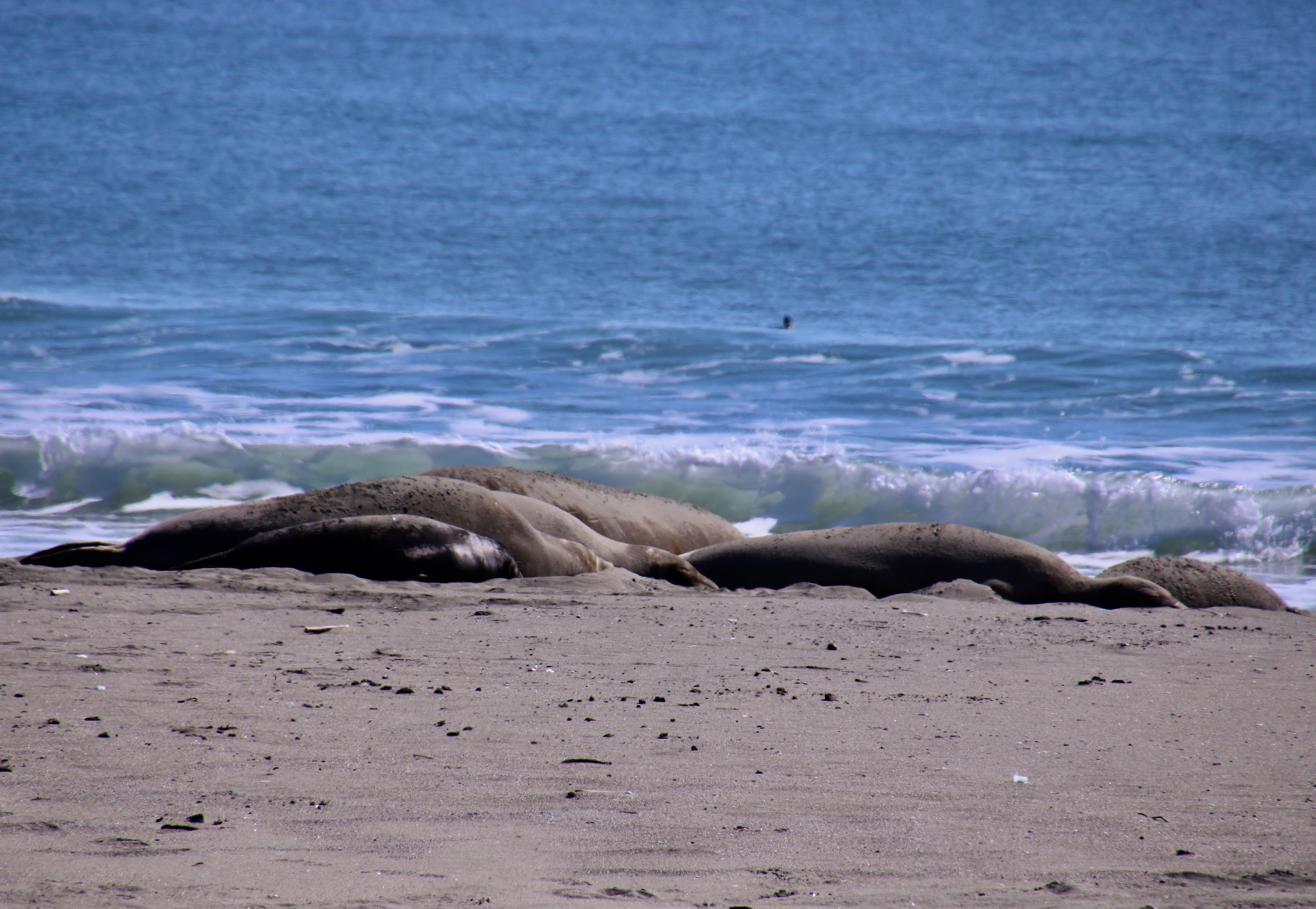
Peggy caught some of the girls sunbathing out near the ocean…
Drake’s Bay was named for Sir Francis Drake who reputedly visited the area in 1759. There’s another bull on the left— looking sluggish.
I’ll conclude today with this elephant seal that was making its way back toward the ocean. I decided he was waving goodbye with his flipper. I’ll return to the tide pools of Harris Beach in Oregon next week. Are you aware that groups of sea anemones go to war with each other?
NEXT POSTS:
Monday’s Blog-a-Book… “It’s 4 AM and a Bear Is Standing on Top of Me”: I move outside in the summer to enjoy nature but hire the family’s dogs and cats to protect me from the ghosts.
Wednesday’s Blog-a-Book… “The Bush Devil Ate Sam”: Held at gunpoint, I consider the odds of running over the gunman versus getting shot.
In my last blog-a-book post from “It’s 4 AM and a Bear Is Standing on Top of Me,” I returned to the first grade, got spanked, and went on a play date/sleep over with my young Hispanic friends Rudy and Robert. A train locomotive engineer tossed us candy from his cab. The adventure continues today and includes tree riding and my first ever solo hike…
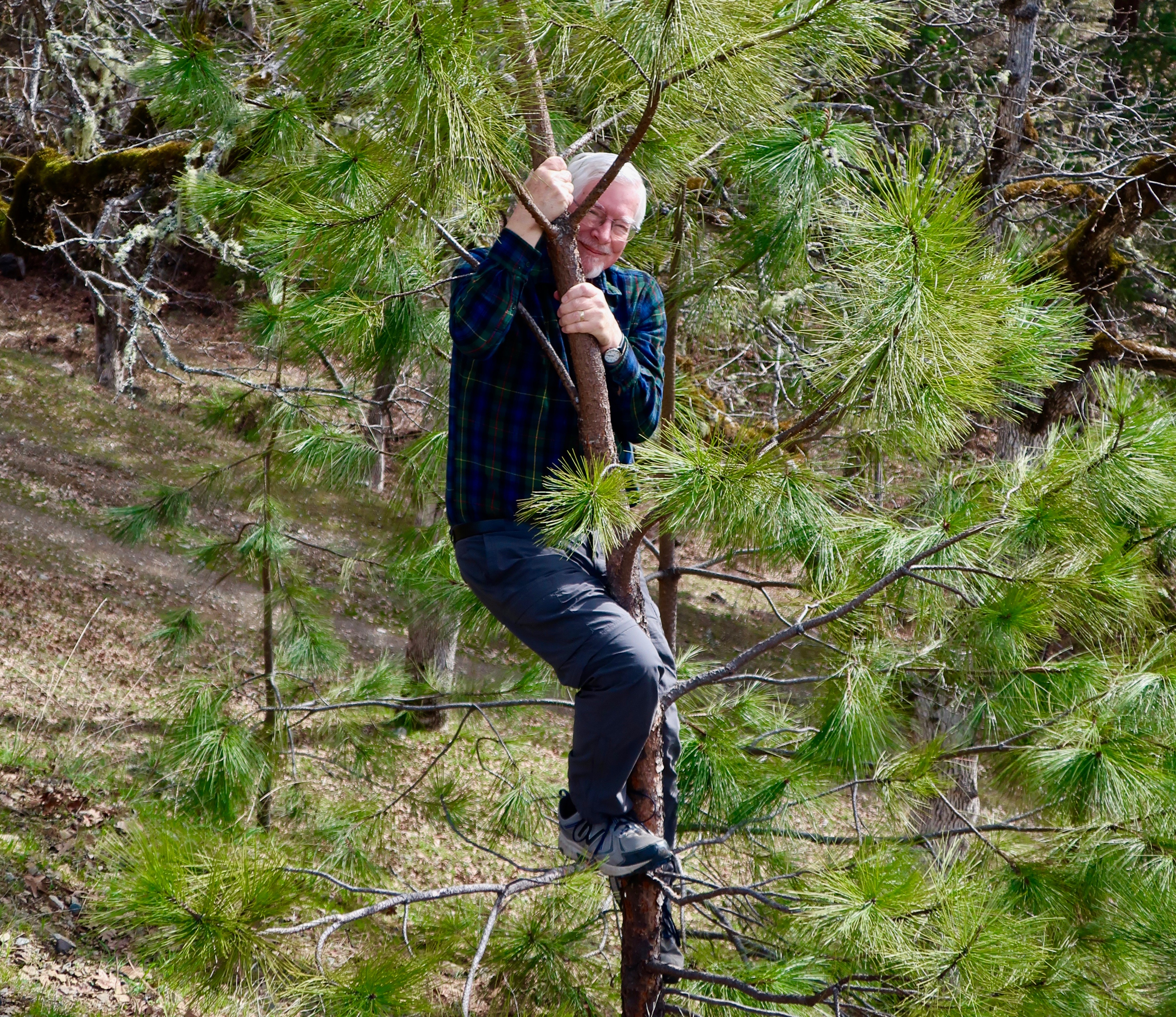
The perfect size pine tree for a first-grader to climb and ride. Peggy suggested I might be a little big— and, at 78, possibly a tad old… Nah.
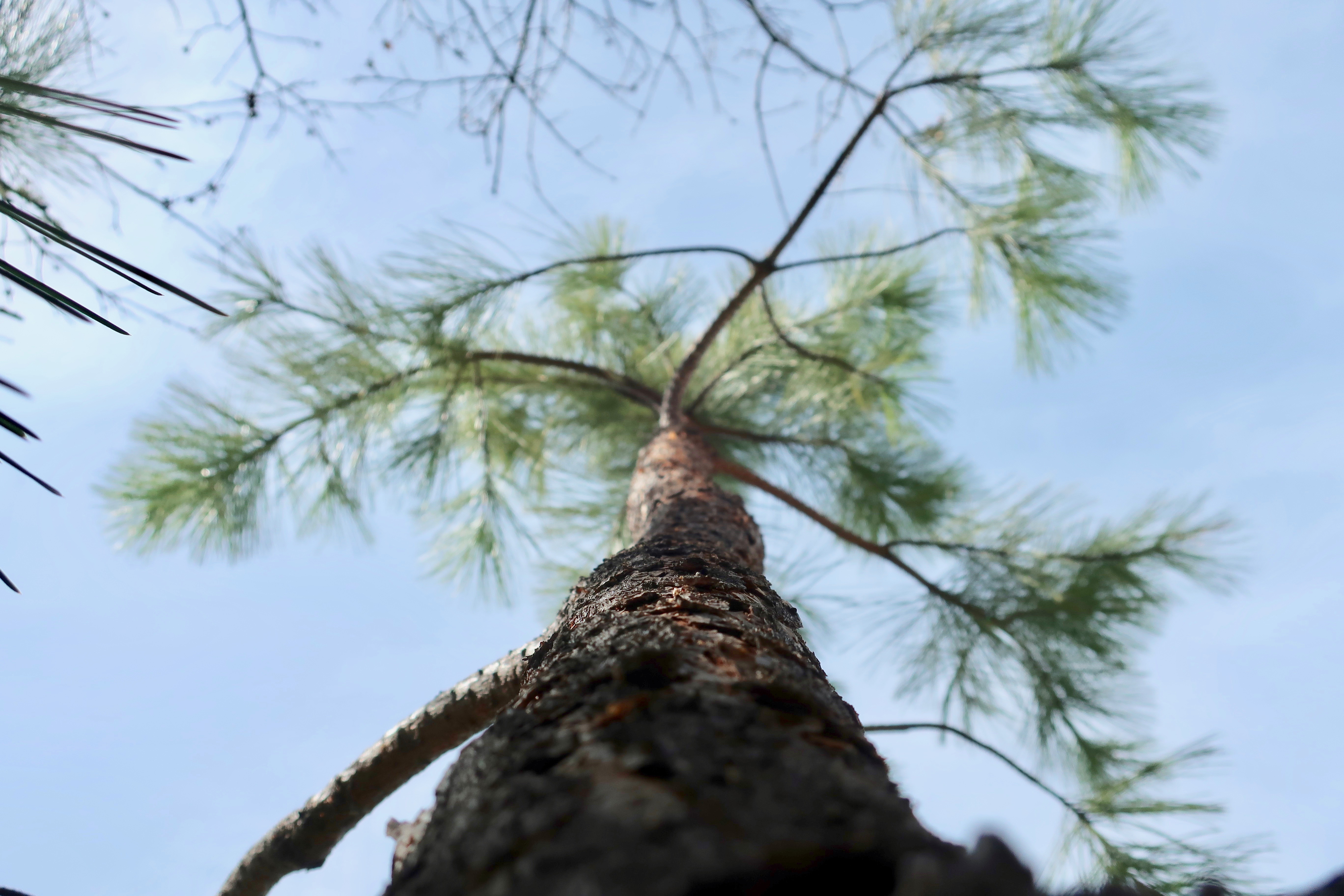
If one is fortunate enough to live next to the woods as a child, it’s easy to find ways to amuse yourself. After we had collected our candy from the train, dinner was a long hour off. I suggested to Robert and Rudy that we head out to the woods behind their house and ride trees. Who needs horses? My brother and I had learned that we could climb up to the top of young, skinny pines and make them sway back and forth by leaning out. The farther we leaned, the more they swayed. It offered a free carnival-like experience 10-15 feet up in the air. Even more could be accomplished by throwing our feet out in the direction the tree was swaying and hanging on for dear life. If the tree was skinny enough, we could make it bend all of the way down to the ground, where we would drop off and allow it to snap back up. It took a while for me to persuade Rudy and Robert that the sport wasn’t going to kill them.
The same tree seen above as a first grader might see it.
I suspect the trees didn’t enjoy the experience nearly as much as we did. When I later read Robert Frost’s poemabout children bending birches, I fondly recalled our pine tree horses— or bucking broncs if you prefer.
“It’s dinner time!” came the call so we rushed back to the house and made use of an outside water faucet to wash the pine pitch off our hands. Sort of. Pitch has a way of sticking like super glue. It’s the pine tree’s revenge. Mother had a box of Boraxo at home for the the task. Hand inspections were held afterward.
“You have to try this,” Rudy enthused, dashing into the house and coming out with a red pepper. I should have been suspicious when the rest of the family followed him outside. But what does a first grader know? I gamely bit into the pepper and was introduced to habanero-hot. The whole family roared as I made a mad sprint for the faucet and drank a gallon of water, becoming a major part of the evening’s entertainment. It would had served them right later had I peed in their bed. I forgave them when I had my first Mexican dinner, however. I still love Mexican food. And I’ve come to enjoy habanero-hot on foods ranging from burritos to spaghetti.
One of many choices I have on hand for habanero-hot food.
As the night progressed, it soon became time for bed. I was about to flunk sleep-over etiquette.
The boys slept on the same bed. Admittedly it was bigger than my small single at home, but I had never slept in a bed with another person, much less 2 or 3, or maybe it was 10. That’s what it felt like. They put me in the middle. I was mortified, but I tried. I really did. Ten o’clock came and there I was, eyes wide open, staring at the ceiling, body frozen in place— and midnight, and two, and four. At five, I gently nudged Robert.
“I can’t sleep. I haven’t slept all night,” I confessed. “I have to go home.”
“Ummm,” the half-awake Robert had moaned.
I got up, dressed, and slipped out of the house, careful not to wake anyone else. It was close to dark, with only a dim light announcing the morning. Home wasn’t that far away, maybe a mile. But I still remember the journey from a first-grader’s perspective: long and spooky. It was my first great adventure. I followed the dirt road over the railroad tracks out to the Pleasant Valley highway. Not one car zipped by. Fortunately. They probably would have stopped and driven me home. Everyone knew everybody else in Diamond. “Sorry to wake you up Marge, but I found Curt out wandering in East Diamond.” By noon, everyone in town would have heard the story.
I walked past the hill with the cross on it and picked up Highway 49. Halfway home, I came to Tom Murphy’s grocery store. Sodas were stacked in wood boxes in front, waiting to be moved inside. I looked around furtively; I was totally alone. So, I helped myself to a coke; I deserved it. I continued on my journey, walking by the post office, Dub Walker’s store, the barber shop, hardware store, the historic Pony Express stop, firehouse and Gust Brother’s Garage, eventually reaching the dreaded Graveyard. I clutched my coke and crossed the road, preferring Pagoni’s mean dogs to the ghosts. Arriving home, I carefully hid the soda outside. It wouldn’t do to have overly inquisitive parents discover the purloined drink and ask questions. I happily enjoyed it later in the day, feeling much less guilty about stealing than I did about abandoning my friends. I suspect there was a bit of consternation when Rudy and Robert’s parents woke to find me missing. Imagine what would happen today.
Next Monday, it’s back to the Graveyard as I move outside for the summer to commune with nature. And, escape from my brother. It was the best decision of my young life except for one thing: The ghosts. I had to hire protection.
NEXT POSTS:
Wednesday’s Blog-a-Book… “The Bush Devil Ate Sam”: Driving a laundry truck pays for my college education, but it was being held at gunpoint that prepared me for Berkeley and the Peace Corps.
Friday’s Travel Blog: Once again, it’s back to the ocean. Before moving on with my series on Oregon’s Harris Beach, however, I am going to take a brief detour to Pt. Reyes National Seashore, from which Peggy and I just returned. There are some elephant seals we want to introduce you to…
Today, I am starting Section 2 of my book, “It’s 4 AM and a Bear Is Standing on Top of Me.” This section is titled, “Growing Up in a Graveyard,” which reflects that my first wilderness came with tombstones and ghosts. In Section 1, I took you along on the first backpacking trek I ever led. I quickly learned that leading 61 people aged 11-70 on a 100-mile trip across the Sierra Nevada Range came with challenges, to say the least. I spent a lot of time asking myself what in the world led me to do it. I begin to answer those questions in this section by taking you back further in time to the events in my childhood that led me to my love of the outdoors. Admittedly, the 1940s and 50s were a while ago. I’ve picked out the stories that are clearest in my mind and most relevant. Some, I’ve thrown in just for fun.
The question here is why should such an innocent looking child be kicked out of the first grade for a year…
I can still hear the clanking treads and feel the bite of the blade as my D-8 dug into the side of the steep hill. Dirt and rocks tumbled into the canyon below. I was working alone, cutting a logging road across mountainous terrain. The hot September summer sun was beating down; my body was drenched in sweat and covered in dirt. And then it happened. A portion of the cliff gave away— and the bulldozer went tumbling off the edge.
“Oh, fuck!” I had yelled.
It was a wonderful word, one that I had learned from my seven-year old brother. I didn’t have a clue what it meant, but it was deliciously bad. At five years of age, I was too young to be operating a bulldozer by myself in our backyard, even if it was only four-inches long, and the road I was cutting was along the edge of our compost pit. But my mother wasn’t the hovering type; she drank a lot. Empty wine bottles had a way of mysteriously appearing under her bed and in the clothes’ hamper that hid out in the closet. Being outside was better than being inside. My mother’s alcoholism was my introduction to being alone with nature.
I wasn’t totally alone. Coaly, our black Cocker Spaniel, was assigned babysitting duty. At “fuck!” she wagged her tail and barked into our compost pit where the toy had fallen.
“Go get the bulldozer, girl,” I urged. She gave me a ‘go get it yourself’ look. She wasn’t the ideal faithful-dog. The gray hair around her nose and aching joints spoke to her advanced years. She had little tolerance for my youthful pranks. Healing scars on my foot reflected how little. My first-ever job was to feed the pets. I’d open a can of Bonnie dog food on both ends, push it out with one of the lids, and then use the lid to divide it up. The earthy horse-meat smell still lingers in my brain. Coaly got half, and each of our cats— the black Demon and the white MC— got a quarter. She’d wolf down her food down and then go after the cats’ portion.
That summer I had discovered that Coaly growled ferociously if I messed with her share. I fed the animals outside on paper towel plates, the finest of china. I always went barefoot in the summer and it was easy to reach over with my big toe and slide their food away. I quickly learned to leave the cats with their lightning fast claws alone. But Coaly was all growls and no bite. At least she was until she sunk her teeth into my foot. I ended up in the ER with a tetanus shot, stitches and zero sympathy. Coaly ended up gobbling her dinners and hassling the cats in peace.
At the time of the bulldozer incident, I had been granted a reprieve from school, or, to put it bluntly, I had been kicked out of the first grade— for a year. My mother was not happy. She had good reason to drink.
As her last child to enter school, she had been eager to get me out of the house. Make that desperate. The evidence is irrefutable. California had a rule then that five-year olds could go to the first grade if they turned six on or before March 1 of the following year. There was no such thing as kindergarten, at least in Diamond Springs in 1948. Since my birthday was on March 3, I missed the deadline by two days. Darn. Mother’s reaction was more colorful. She made a command decision. Forty-eight hours were not going to stand in the way of her little boy’s education, or her freedom. So, she changed my birth certificate. March 3 was carefully erased and March 1 entered. I was bathed, dressed and shipped out, not the least bit aware that I had matured by two days. I think I recall hearing music and dancing as my sister took me off to school, a block away.
Things weren’t so rosy at school. The other kids were all older, bigger, and more coordinated. For example, Alan Green could draw a great horse. It came with four legs, a tail, a head and a flowing mane. Mine came with unrecognizable squiggles. It was hard to tell whether my objective was to draw a tarantula or a snake with legs, but the world’s wildest imagination on the world’s most potent drug wouldn’t have classified the picture as a horse. It was not refrigerator art. The whole exercise created big-time trauma.
This negative experience was compounded by the exercise of learning to print within lines. Forget that. If my letter came anywhere close to resembling a letter, any letter, I was happy. The teacher was more critical.
“Curtis, I asked you to make Bs, and here you are printing Zs.”
“So what’s your point?” was not an acceptable response. Mrs. Young was suspicious and that suspicion increased each day I was in school. She was a tough old gal who had been teaching first grade for decades. She knew first graders and I wasn’t one. As for the birth certificate, Mother’s forgery was in no danger of winning a blue ribbon at the county fair. I still have the original for proof. After a few weeks, Mrs. Young sent off to Oregon for a copy. I remember her calling me up to her desk on the day it arrived.
“Curtis” she explained, “you have a choice. You can either go home now or you can go home after school. But either way, you are going home and can’t come back until next year.”
Mrs. Young was a tough old gal who had been teaching the first grade for decades. The kids, BTW, are Clifford Drake and Bob Bray. Bob is still a close friend today. You will hear more about him in these tales.
Just like that, I was a reject, a first grade flunkee.
Mrs. Young couldn’t have made it any clearer; Mother was going to get her little boomerang back. This was okay by me, if not by her. Playing out in the backyard was infinitely more fun than competing in ‘Scribble the Horse.’ I did decide to stay for the day. Mrs. Young was reading about Goldilocks to us after lunch and I wanted to learn if the bears ate her.
It would have been interesting to listen in on the conversation that took place between Mother and Mrs. Young, or even more so between my mother and father, or Pop, as he was known to us. I’ve often wondered if he participated in the forgery or even knew about the March 1 rule. I doubt it. He was not the parent frantic to get me out of the house during the day. (Had it been in the evening, the jury might still be out, as my father reported to me later.) But I wasn’t privy to those high-level discussions. My job, which I took quite seriously, was to enjoy the reprieve. I was about to begin my wandering ways. The Graveyard was waiting.
NEXT POSTS:
Blog-A-Book Wednesday… “The Bush Devil Ate Sam”: I move from being hit by a baseball bat and put in the hospital because of my Republican leanings as a fourth grader to developing a more liberal perspective in community college that would lay the groundwork for my joining the Peace Corps.
Travel Blog Friday… It’s off to the coast again with a Covid-19 escape to Harris Beach State Park just outside of Brookings, Oregon.
Edison Marshall, my great uncle, grew up in the town of Medford, living for a while with his extended family that included my mother as a child. His writing brought him fame and fortune, including this mansion near Augusta, Georgia.
I was born to wander; I’m convinced of this. Whatever lies over the next horizon calls to me and pulls me onward. Eventually this need to roam would be a factor in my decision to join the Peace Corps. It may be genetic. I come from a long line of pioneers and adventurers. Before Mother went trolling and landed Pop, he had lived in Nebraska, Washington, Iowa, Oklahoma, Colorado and Oregon. I’ve no doubt that lacking an anchor of three kids and a wife, he would have kept on going and going, just like the Energizer Bunny. Happily so. And so it has been with most of my ancestors.
Restless urges sent members of both my mother and father’s families on their way to the New World in the 17th and 18th centuries, and kept them moving west in the 19th and 20th. Puritan Marshalls packed their bags and sailed off for the New World from England in the 1630s. The Scotch-Irish Mekemsons arrived in Pennsylvania from Ireland in the 1750s, spent the Revolutionary War years in upper Maryland, and had moved on to Kentucky by the 1790s. My dad’s family tree shows that my Great, Great, Great uncle was a companion to Daniel Boone.
The cry of gold sent both Marshalls and Mekemsons scurrying to California in the 1840s and 50s.
George Marshall left his wife Margaret pregnant with my Great Grandfather on his trip to the goldfields. It was a good thing; no pregnant wife would have meant no me. George struck it rich, but his new found wealth didn’t make it back to Illinois. He was killed, stripped of his gold, and thrown into the Pacific Ocean on his way home, or so the legend goes. It was tough and often deadly on the frontier. Not that this cured any of my family from their wandering ways. The drive to roam far outweighed whatever the risks might be. One of my favorite family stories illustrates just how deadly frontier life could be.
William Brown Mekemson, my great, great uncle, ended up on the wrong end of a tomahawk (or several) during the Black Hawk Indian War of 1832. A 1903 book by Frank Stevens describes the event. The Indians had attacked the night before, stealing a horse. Captain Snyder decided to pursue the Indians the next morning and caught up with them “firmly entrenched in a deep gulch, where, in a sharp hand to hand encounter, all four were killed with the loss of only one man, Private William B. Mekemson, who received two balls in the abdomen, inflicting a mortal wound.”
Except it wasn’t immediately mortal. Mekemson was placed on a litter and transported back toward camp. Along the way he pleaded for a drink. A squad was assigned to climb down to the creek and fetch water. At that point the Indians struck again. Some 50 or so “hideously yelling, rushed poor Mekemson and chopped off his head with tomahawks…” and then rolled it down the hill. That was mortal.
The greatest wanderer among my modern-day relatives was my Grandfather’s brother, Edison Marshall, or Uncle Eddie as my mother called him. He was an accomplished writer quite popular in the 20s, 30s, 40s and 50s. His short stories even made it into the high school literature books of the day and nine of his books were converted into movies. The first to obtain silver screen status was “Strength of the Pines” in 1922 and the last was “The Vikings” starring Kirk Douglas, Tony Curtis, Ernest Borgnine and Janet Leigh in 1958. He had a long and profitable career.
I never met the man; his Augusta, Georgia mansion was a long way from our converted World War II army barracks house in Diamond Springs. But we did have a collection of his autographed books. They were swashbuckling historical novels that had his heroes such as Marco Polo wandering the world. Edison wandered along with them, doing research for the books and pursuing his passion for big game hunting.
We had a hand-me-down 1920’s Encyclopedia Britannica atlas of his where he had outlined his personal journeys in the map section. I spent hours staring at ink-drawn lines snaking off into East Africa and other exotic locales trying to imagine his adventures. (Years later I would learn that a brand new Encyclopedia Brittanica that I got as a Christmas present when I was 10, had anonymously been given to me by Edison and his wife.)
By then, I had the reading skills to handle his books but not the maturity, at least according to my parents. His books were restricted for sexual content and I was supposedly banned from reading them until I was thirteen, when I really didn’t need anything else to stir up my sexual fantasies.
Uncle Eddie was not noted for humility. “I went after fame and fortune, and I got them both,” he reported. That made his lifestyle all the more attractive to me. If he could gain fame and fortune through travel and writing, possibly I could as well. The combination of Edison’s books and his atlas gave me an early lust for travel, an appreciation of history, and a desire to someday write. So what if they didn’t come with fame and fortune.
In 1963 I had my first opportunity to wander away from home. I was accepted as a junior at the University of California in Berkeley, which, at the time, was about to become the center of a worldwide student revolution. My experience at the University, in turn, would lead to an even greater chance to travel, the Peace Corps.
So it’s off to Berkley I go next where I leave my conservative heritage behind, sit on the floor singing “We Shall Overcome” with Joan Baez, and stand on the Dean’s desk in my socks to give a speech on why students should have the right to participate in local Civil Rights demonstrations.
NEXT POSTS:
Friday’s Travel Blog: Since I am still taking photos of the ocean, I will share some photos on why I love the desert taken along Nevada’s Highway 95 between Reno and Las Vegas.
Monday’s Blog-a-Book from “It’s 4 AMand a Bear Is Standing on Top of Me”: I am kicked out of the First Grade for a year because of forgery and begin my wandering ways by heading across the alley to the jungle-like graveyard where I can let my imagination run wild.