Olompali: Miwoks, the Grateful Dead, and a Hippie Commune… The North Coast Tour

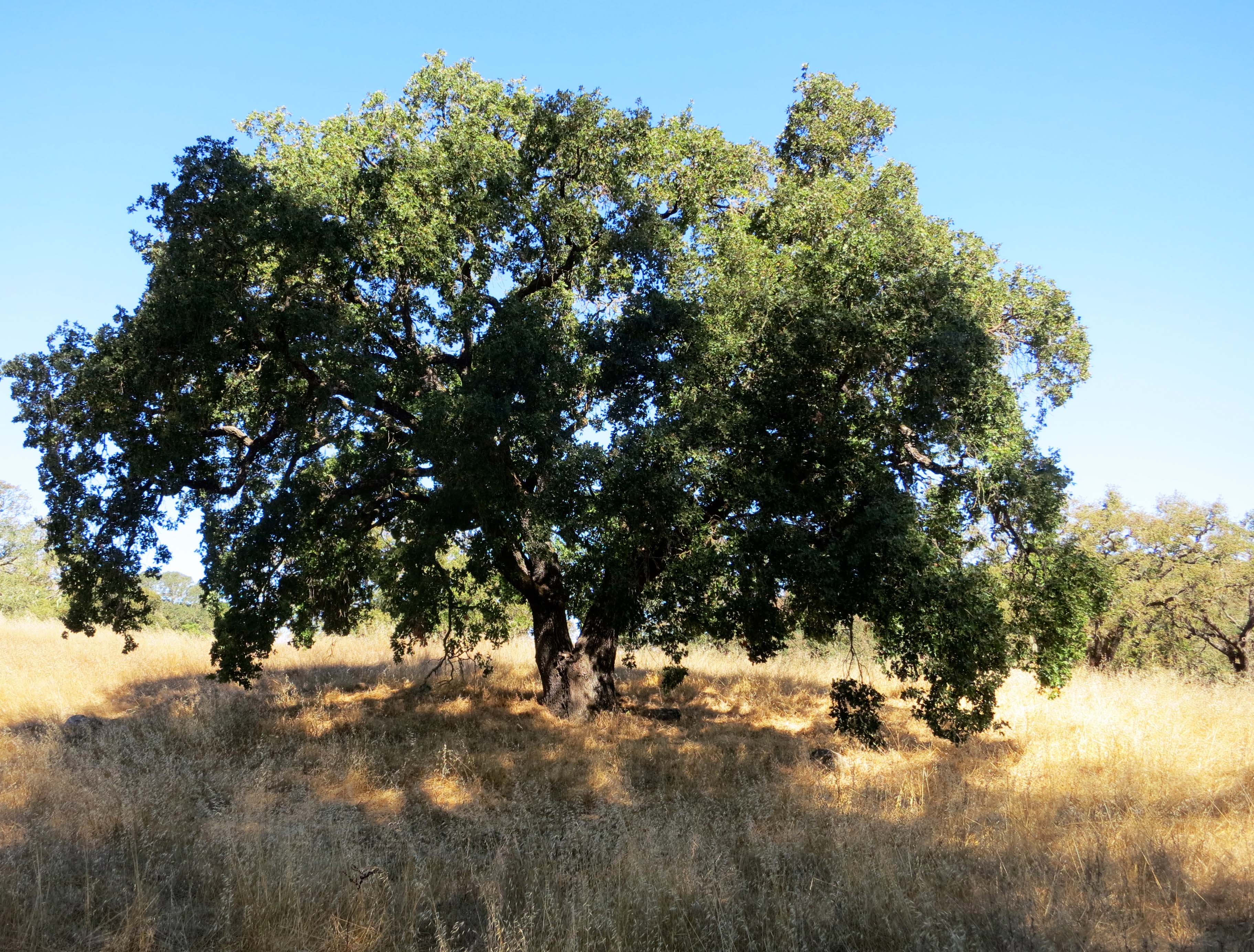
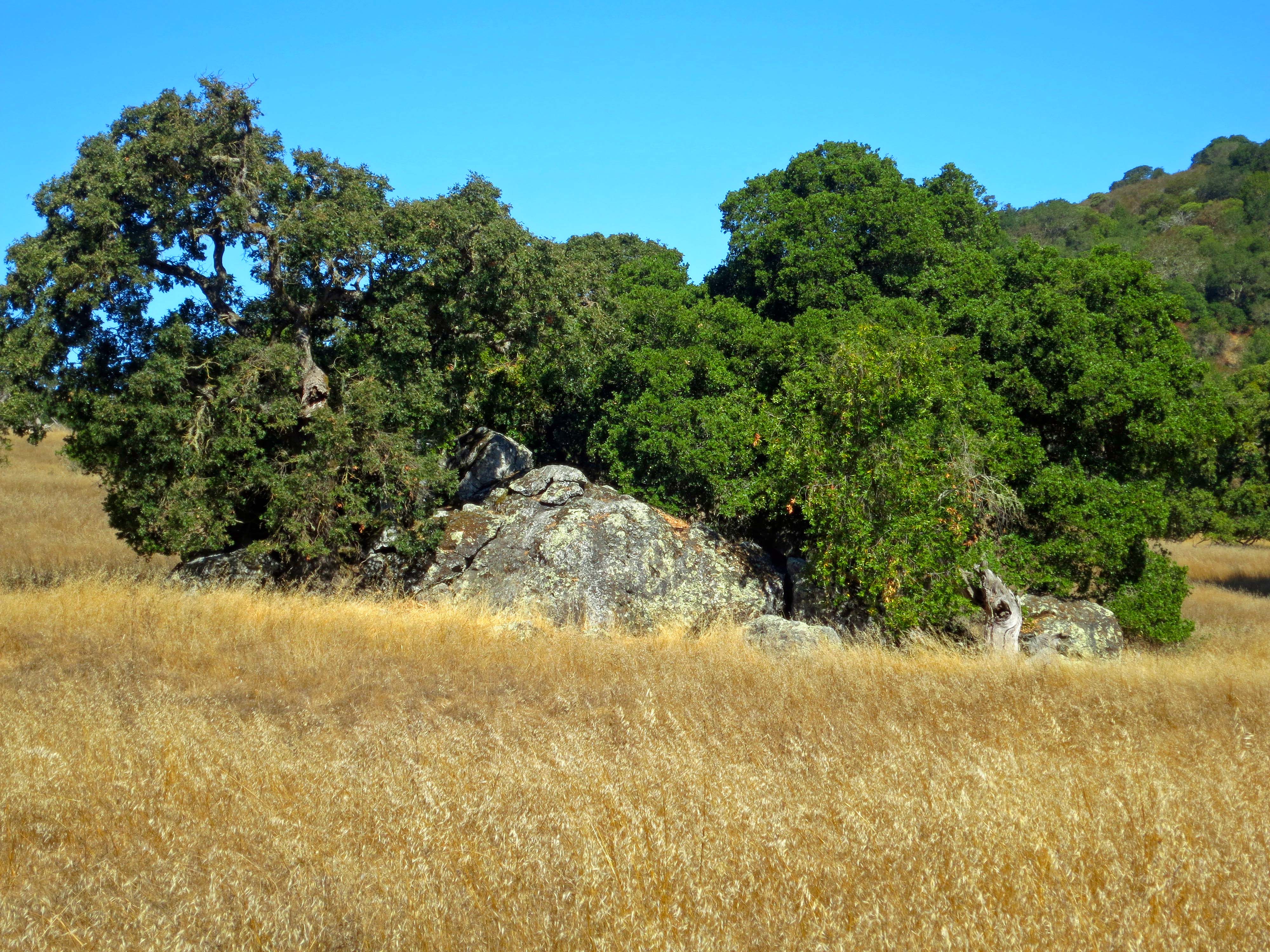
I photographed this picturesque oak tree at Olompali State Park. Later I discovered the same tree was featured on the cover of the Park's brochure. Acorns from oaks were a major source of food for the Miwok Indians.

I photographed this picturesque oak tree at Olompali State Park. Later I discovered the same tree was featured on the cover of the Park’s brochure. Acorns from oaks were a major source of food for the Miwok Indians.


When Peggy headed off to England with her sister in August to visit English gardens, I headed off to the north coast of California for a couple of weeks to see what mischief I could get into. Peggy has promised some guest blogs on her experiences. Here is the first of several blogs on mine. 

The small community of Novato lies 20 miles north of San Francisco along Highway 101. The little known California State Park of Olompali is just north of Novato. The staff at the Days Inn where I stayed didn’t even mention the park when I asked about interesting places to explore. “Go to the Marin Museum of the American Indian; explore historic Novato; check out the Marin French Cheese Company,” they told me. And I dutifully complied. My adventure started just outside my door.

To me, the coastal ranges of California provide some of the most scenic views in the world. This was behind the Days Inn where I stayed in Novato. I love the contrast between the gold of the grass and the green of the oaks.

To me, the coastal ranges of California provide some of the most scenic views in the world. This view was behind the Days Inn where I stayed in Novato. I love the contrast between the golden brown of the grass and the dark green of the oaks.

One evening I went out and captured the same shot as the sun went down.

One evening I went out and captured the same shot as the sun went down.

It is a good thing that the Marin Cheese Factory isn't located near my home. I'd end up weighing 300 pounds. Its brie cheese is to die for.

It is a good thing that the Marin French Cheese Factory isn’t located near my home. I’d end up weighing 300 pounds. Its brie cheese is to die for.

As for Olompali, I had to find it on my own. It was a mile up the road from the motel, just past the US headquarters of Birkenstocks. It proved to be a very interesting place, indeed.

Once, the area had been home to the Miwok Indians. They had been living in the region for over 3000 years when Sir Francis Drake landed at nearby Point Reyes. Although he was something of a pirate, and would have been an illegal alien by today’s definition, Drake claimed the land for Queen Elizabeth. The Spanish arrived a few years later and claimed the land for Spain. The Miwoks weren’t invited to participate in either decision.

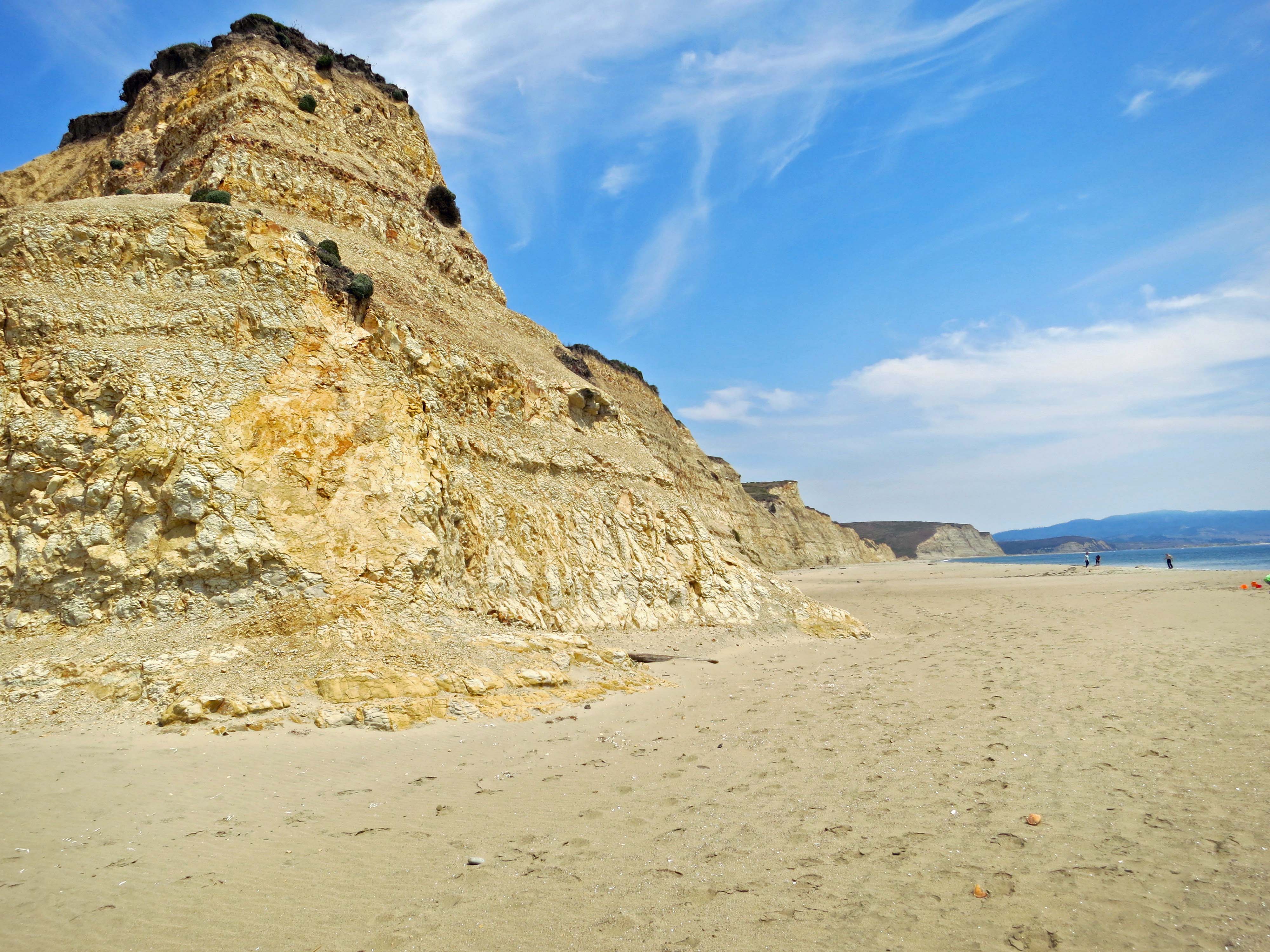
These distinctive cliffs at Drakes Bay in Point Reyes National Seashore were used to help identify where Sir Francis Drake landed in

These distinctive cliffs at Drakes Bay in Point Reyes National Seashore were used to help identify where Sir Francis Drake landed in the late 1500s. The tracks in the foreground speak to how popular this beach is in the summer. I had a difficult time capturing a photo that wasn’t packed with people.

By 1776, when Americans were fighting for independence from Great Britain, the Spaniards were busy establishing their first missions north of San Francisco, an effort that was a continuation of the work of Junipero Serra. In return for supplying ‘civilization and salvation’ to the Miwoks, the Catholic priests expected the natives to work for nothing in what can best be described as a system of slavery. Going home to visit family without permission, or even going fishing, could earn a whipping and a jail sentence. And, if ‘civilization and salvation’ weren’t enough, the Spaniards brought the European diseases with them that more or less wiped out the native population and opened the area for white settlement. It’s small wonder that California’s remaining Native American population didn’t celebrate the recent canonization of Junipero Serra with enthusiasm.

The Miwok, for the most part, were a gentle people who lived in close harmony with the land. An area of Olompali State Park has been put aside to display the native plants and housing the Miwoks used. The natives practiced house cleaning in the extreme: They burned down their houses once a year to get rid of bugs and vermin that had taken up residence.

The Miwoks built some of their homes with redwood siding, or at least redwood bark. This example of a Miwok shelter is located at Olompali.

The Miwoks built some of their homes with redwood siding, or at least redwood bark. This example of a Miwok shelter is located at Olompali.

While most of the plants on display were suffering from the drought, an attractive Bay Laurel caught my attention. A signpost reported that the Miwok had eaten the fruit raw. Nuts were dried and then pounded into flour that was used for bread. The leaves were used for spice. A tea made from the leaves was used for stomach-aches, colds and sore throats. Fresh leaves were put on the head for headaches and an infusion of the leaves was used for washing sores. Shoots growing from the tree were used as arrow shafts. Visiting the Bay Laurel, it seemed to me, would have been like making a trip to the grocery store. I found several of the plants the Miwoks made use of, such as the California Buckeye and Harvest Brodiaea, were also common to the Central Valley of California and the Sierra Nevada Mountain foothills where I lived for many years.

The drought that has California in such a tight grip, didn't seem to impact this Bay Laurel that was growing in the garden of native plants important to the Miwok.

The drought that has California in such a tight grip, didn’t seem to impact this Bay Laurel that was growing in the garden of native plants important to the Miwok.

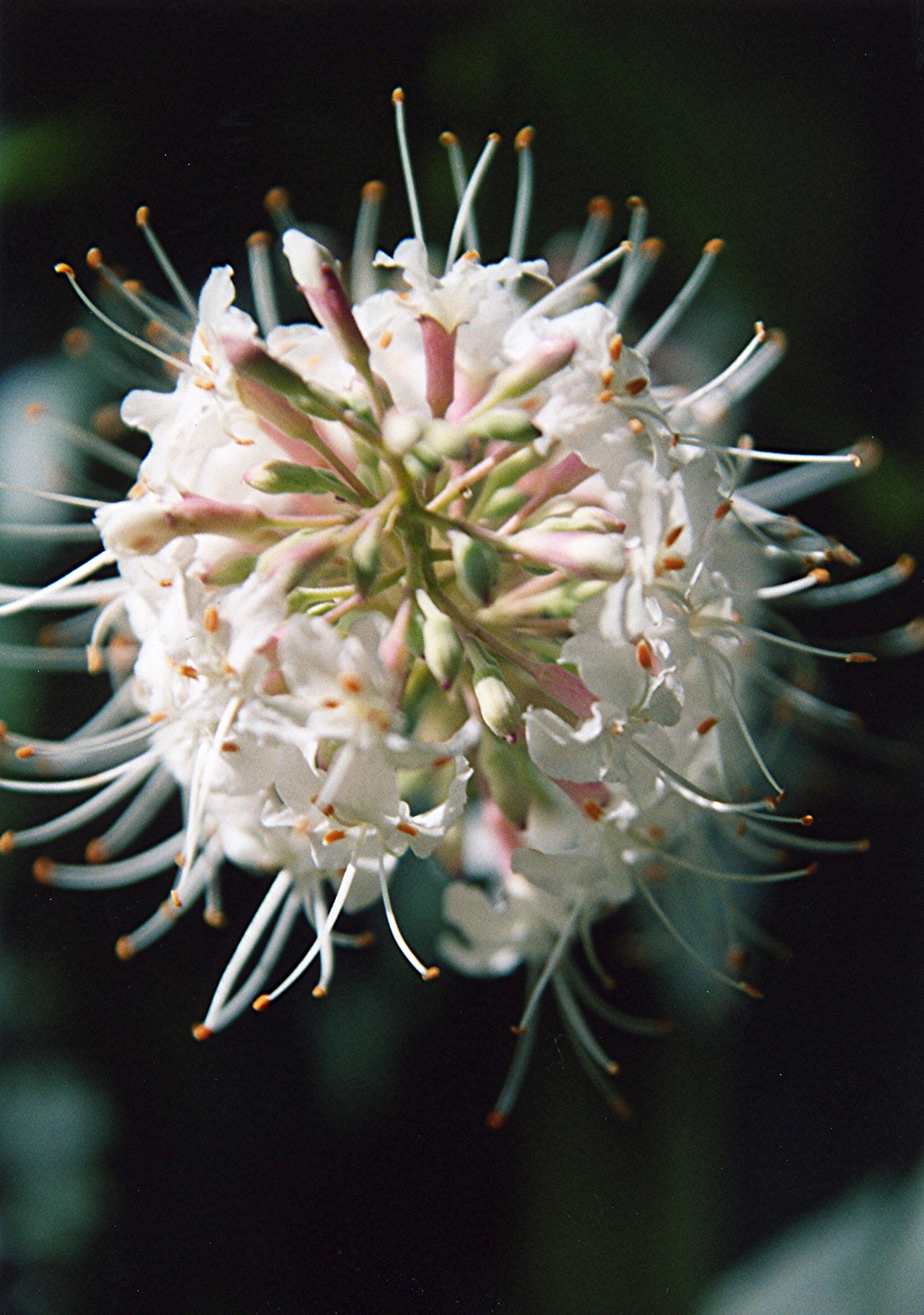
Buckeye trees in bloom along the American River Parkway in Sacramento. Buckeyes, well leeched to remove poison, served as back up food when acorns were scare.

Buckeye trees in bloom along the American River Parkway in Sacramento. Buckeyes, well leached to remove poison, served as back up food for the Miwoks when acorns were scarce.

A close up I took of buckeye flowers while hiking along the American River Parkway. The fruit of the buckeye was also crushed by the Miwok and thrown into streams to knockout fish that were then gathered for food.

A close up I took of buckeye flowers while hiking along the American River Parkway. The unleached fruit of the buckeye was crushed by the Miwok and thrown into streams to poison fish that were then gathered for food.

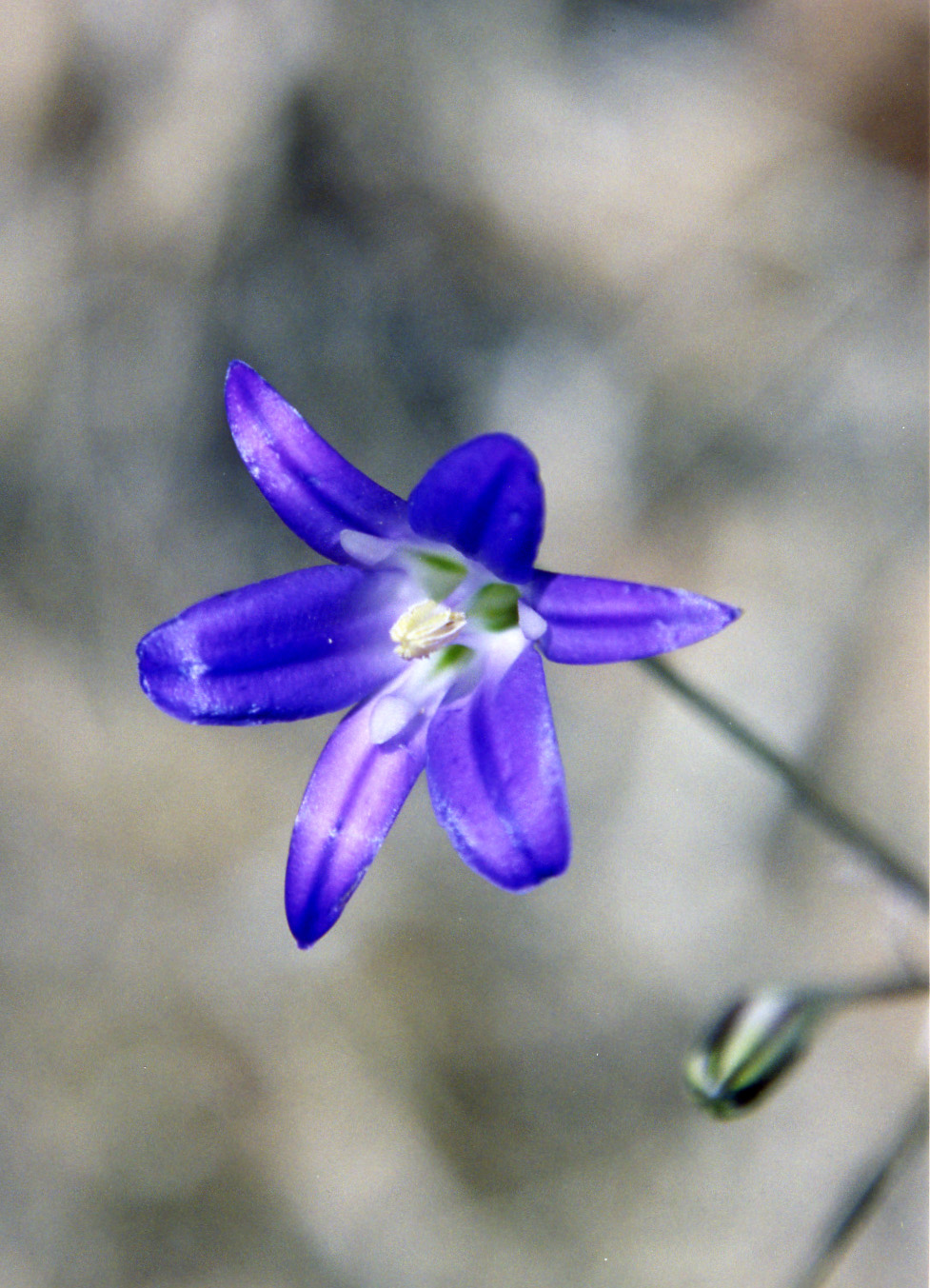
Bulbs of Harvest Brodiaea were baked, boiled or eaten raw by the Miwok. This is another photo I took along the American River Parkway.

Bulbs of Harvest Brodiaea were baked, boiled or eaten raw by the Miwok.

Wild animals, like native plants, were central to the existence of the Miwok. An informative book by Betty Goerke, Discovering Native People at Point Reyes, notes that the Miwok considered Coyote the creator of their world. As in much Native American lore, Coyote was also a trickster god, often getting into mischief. His god-like status kept him from getting eaten, however. Other animals didn’t fare as well, but even they deserved respect. “It was necessary and a common courtesy to honor an animal when it was killed,” Goerke notes. Beads were thrown into a fire to honor a dead bear. Even a small bird would receive a dance— “so it wouldn’t feel bad.” I’m not sure the dead bird appreciated the dance, given an option, but I like the sentiment behind it.

NEXT BLOG: How Olompali moved from being home territory for the Miwoks to a temporary home for the Grateful Dead and then the site of one of California’s most famous hippie communes.


Backpacking into the Grand Canyon: Part III… My Muscles Go on Strike!

I am sitting on the edge of the Colorado, red with mud. (Peggy took this and the following photos when I returned down the Tanner Trail into the Grand Canyon several years later. I didn't have a camera on my first trip.)

I am sitting on the edge of the Colorado River, red with mud. (Peggy took this photo when I returned with her down the Tanner Trail into the Grand Canyon several years after my first trip. I didn’t have a camera the first time.)


At the end of my last blog on my backpacking trip into the Grand Canyon, I was getting ready to hike up the Canyon to the Little Colorado River. The day before I had made a strenuous descent from the rim to the Colorado River that had left my downhill muscles screaming for mercy.

I hoisted my backpack and mentally prepared for the day’s journey. On the edge of my campsite was a 20-foot section of small boulders I needed to negotiate to rejoin the trail. Normally I would sail through such an obstacle course, stepping on or between rocks as the situation called for. Not this time. I wobbled uncontrollably when I stepped on top of my first rock; I had absolutely zero balance. My muscles were refusing to function. They had gone on strike! While I didn’t reach the insane-cackle level brought on by exhaustion the night before, I did find myself giggling. Dorothy’s Scarecrow was a paragon of grace in comparison to me. I actually made it a whole hundred yards before declaring that my backpacking day was over.

An overhanging rock provided shade and a scenic view of the Tanner Canyon Rapids. I spent the day napping, reading a book on the Grand Canyon by Joseph Wood Krutch, snacking, and watching rafters maneuver through the rapids. The most energy I expended was to go to the river and retrieve a bucket of water. There was plenty of time to let the mud settle.

I made it as far as an overhanging rock a hundred yards from my campsite. Thirteen years later I pointed out my hideaway to Peggy. It may hold the record for the shortest backpacking trip in history.

I made it as far as an overhanging rock a hundred yards from my campsite. Thirteen years later I pointed out my hideaway to Peggy. It may hold the record for the shortest backpacking trip in history. (Photo by Peggy Mekemson.)

Peggy tried out my seat where I sat and read all day and watched bats come though in the evening.

Peggy tried out my seat where I sat and read all day and watched bats come through in the evening.

The view I had of the Tanner Rapids from my 'cave.'

The view I had of the Tanner Rapids from my ‘cave.’ Eventually I rafted down the Colorado River and would pass through these rapids.

That evening I sipped a cup of tea laced with 151-proof rum and watched bats flit around my ‘cave’ as they gobbled down mosquitoes. They were close enough I could have touched them. It was like I was invisible, as I had apparently been to the Mousy and his stalker the night before. Strange, unsettling thoughts of nonexistence went zipping through my mind. Being alone in the wilderness is conducive to such thinking. The Canyon adds another layer.

Day three arrived and it was time to explore my surroundings and whip my protesting muscles into shape. I still wasn’t ready for primetime backpacking, so I took a day hike up Tanner Creek Canyon. Whatever creek had existed was waiting for future rain, but the erosive power of water was plainly evident. This was flash flood country where a dry wash can turn into a raging torrent in minutes. Dark clouds demand a hasty retreat to higher ground. I had nothing but blue skies, however, so I hiked up as far as I could go. The canyon narrowed down to a few feet and traveling any further called for rock climbing skills I didn’t possess. I sat for a while enjoying the silence— and the thousands of feet of soaring walls. The isolation seemed so complete it was palpable. I was alone but not lonely. Nature was my companion. Reluctantly, I turned back toward my camp.

I spent the next two days hiking along the River. I backpacked up the Colorado following the Beamer Trail to Lava Canyon Rapids the first day and then worked my way back down past Tanner Creek to Unkar Creek the second. My general rule was that if the trail appeared ready to make a major climb up the canyon, it was going without me.

At one point where Peggy and I were backpacking up the Beamer Trail we came to a fork in the trail and went left. (Yes, we did find the fork in the trail.)

At one point when Peggy and I were backpacking up the Beamer Trail we came to a fork in the trail and went left. (Yes, we did find the fork that someone had humorously placed in the trail. I was reminded of the Muppet Movie where Kermit came on a similar fork.)

I am not sure the fork provided good advise. (grin) We had to scramble.

I am not sure the fork provided good advice. (grin) We had to scramble.

The only real excitement came toward the end of the second day when I discovered my left foot poised a few inches above a pinkish Grand Canyon Rattlesnake that lay stretched across the trail, hidden in the shadows. He was a granddaddy of a fellow, both long and thick. My right leg performed an unbidden, prodigious hop that placed me several feet down the trail. There is a very primitive part of the brain that screams snake. No thinking is required. As soon as I could get my heart under control, I picked up a long stick and gently urged the miscreant reptile to get off the trail. He wasn’t into urging. Instead, he coiled up, rattled his multitude of rattles and stuck out his long, forked tongue at me. He was lucky I didn’t pummel him. I did prod more enthusiastically, however, and he got the point, crawling off the trail rather quickly. I memorized the location so he wouldn’t surprise me on the return journey.

My leg’s miraculous leap suggested that my body was beginning to tune up. There would be no more malingering and feeling sorry for itself. The next day I camped at Tanner Creek again and the following day out I hiked out. The trip up took me three hours less than it had taken to hike in. I was tempted to go find the Sierra Club fellow who had demanded that I use a more civilized trail, but opted out for a well-earned hamburger and cold beer instead. My body was demanding compensation for its forced march.

I’ll return to my Grand Canyon adventure next week when a friend joins me to hike back into the Canyon a few days after I returned to the rim. Hostile spirits from another realm join us. Or at least she believes they do.

NEXT BLOG: I start my series on my recent trip up the North Coast of California. First up— Olompali State Park. Located just north of San Francisco, it has a fascinating history stretching from the Miwok Indians to the Grateful Dead to a hippie commune.

Burning Man: A Media Circus— Or, Possibly, the Greatest Show on Earth

Media representatives are required to check in at Burning Man each year.In line with the 2015 theme, this was the media tent.

Media representatives are required to check in at Burning Man each year. In line with the 2015 theme, this was the media tent. The clown opened its mouth when ready for business.

Burning Man has been in the news a lot, lately. The event has a way of drawing media coverage like, uh, The Donald (that’s in Trump, not Duck). Among the stories: “One-percenters have taken over; The Bureau of Land Management wants Burning Man to pay for million dollar accommodations— plus ice cream, and; (my favorite) Gazillions of bugs are crawling out of the ground. ” The list goes on. Naked people, hippies, and drugs are almost always worked into the story. It improves ratings and readership. If accuracy suffers, oh well.

I thought the 2015 theme, Carnival of Mirrors, was one of the best ever, not to mention an excellent reflection of most media coverage for Burning Man (and presidential politics).

I didn’t think I would be at the event this year, having failed to score in the annual grab bag ticket sale, which rarely works as promoted. But three days before Burning Man, my friends Don Green and Tom Lovering managed to find tickets on Craig’s List in South San Francisco. Don drove down from his home in Lafayette with a thousand dollars cash in his pocket and met a person he didn’t know around midnight on Thursday at a coffee-house he had never been to. The money was for two tickets and a vehicle pass, a real bargain in this age of massive scalping.

I spent all day Friday racing around taking care of the myriad details that involve surviving in the desert for eight days. (Peggy sat this year out since she had just returned from a two-week trip to England with her sister.) The van had to be made ready, my bike checked over, food and water purchased, and a minimal costume assembled. Plus there were the inevitable questions. Where had I put my goggles and bandana for dust storms? Which box hid my bike lock? Did I have enough glow sticks to avoid being run over by mutant vehicles at night? Etc. Eventually, I had everything together and by 10 a.m. on Saturday I was on my way to the small town of Cedarville on the northeastern border between California and Nevada.

Cedarville is our jump off place for Burning Man. We normally stay at the fairgrounds. Not this time. The Modoc County Fair was taking place. You know the old saying, “When you are given lemons, make lemonade?” So I camped at the City Park and walked to the fair. It was perfect. The pigs hammed it up, a goat nibbled on my shirt, and country-western singer sang “Pistol Packing Mama.”

The pigs were 'hamming it up' at the Modoc County Fair in Cedarville, California.

The pigs were ‘hamming it up’ at the Modoc County Fair in Cedarville, California. Check out their cute curlicue tails.

I’ll be writing about Burning Man off and on over the next few months, adding stories in between the other things I blog about. Those of you who have followed my blog for a while, know that Burning Man is one of my favorite things to do— that I love the art, the creativity, and the magic. Regardless of what the media may report, it is one of the greatest shows on earth. What’s not to love about an event where a huge catapult is built to toss a flaming piano for 100 yards? Or where Susan Sarandon shows up with a portion of Timothy Leary’s ashes to re-cremate. (Leary was the guru of LSD in the 60’s and coined the phrase, “turn on, tune in, drop out.” His ashes were distributed among friends after his death. Some were rocketed into space, along with those of Gene Roddenberry, the creator of Star Trek. Susan decided that Burning Man was the perfect place to distribute her share.)

Today, my objective is to introduce Burning Man 2015 with a series of photos. Enjoy. NEXT BLOG: I’ll return to my backpack trip into the Grand Canyon.

A carnival of sorts, complete with sideshows surrounded the Man this year. This was one of four main entrances.

A carnival of sorts, complete with sideshows surrounded the Man this year. This was one of four main entrances. I arrived on Sunday and wandered around before the crowds arrived.

A close up looking up at the Man.

A close up looking at the Man.

Side show posters were located through out the Carnival. I'll show many more in another blog, but this was one of my favorites.

Side show posters were located throughout the Carnival. This was one of my favorites.

Another 'view' of the Man.

Another ‘view’ of the Man and surrounding carnival through a glasses sculpture.

Burning Man is known for its unique sculptures, such as this dragon protecting its egg created by the Flaming Lotus Girls out of the Bay Area.

Burning Man is known for its unique sculptures, such as this dragon created by the Flaming Lotus Girls out of the Bay Area.

Burning Man dragon created by Flaming Lotus Girls for Burning Man.

The same dragon at night.

The Temple of Confession where Timothy Leary's ashes were re-cremated.

The Temple of Confession where Timothy Leary’s ashes were re-cremated.

Susan Sarandon donned a wedding dress and led a parade out to the Temple of Confession to deposite Leary's ashes. El Pulpo Mechanico, a 30 foot high octopus was part of the parade.

Susan Sarandon donned a wedding dress and led a parade out to the Temple of Confession to deposit Leary’s ashes. El Pulpo Mechanico, a 30 foot high octopus, was part of the parade.

Medusa with her snake hair was one on my favorite sculptures.

Medusa with her snake hair was one on my favorite sculptures. Note the tennis shoe mutant vehicle to the right.

The dragon mutant vehicle on the left brought its baby this year.

The dragon mutant vehicle on the left brought its baby this year.

Costumes are big at Burning Man, as are the dust storms seen in the background.

Costumes are big at Burning Man, as are the dust storms seen in the background.

Sculptures come in all sizes at Burning Man. From this giant woman...

Sculptures come in all sizes at Burning Man. From this giant woman…

To this 'Old Woman Who Lived in a Shoe' sculpture...

To this ‘Old Woman Who Lived in a Shoe’ sculpture…

To this unique sculpture that I found very attractive.

To this unique sculpture that reminded me of flower pollen.

This robot with his dog and a flower was in front of the Center Camp Cafe. He would raise the flower up to his nose and sniff it.

This robot with his dog and a flower was in front of the Center Camp Cafe. He would raise the flower up to his nose and sniff it.

Performance art is found everywhere in Black Rock City.

Performance art is found everywhere in Black Rock City.

The Burning Man Temple at sunrise is guaranteed to draw a crowd. Burners had spontaneously joined hands as the sun little up the Temple.

The Burning Man Temple at sunrise is guaranteed to draw a crowd. Burners spontaneously joined hands as the first rays of the sun bathed the Temple in a gentle light.

I'll conclude with this shot of the Man taking on a ghostly appearance as he burns on Saturday night.

I’ll conclude with this shot of the Man taking on a ghostly appearance as he burns on Saturday night. Hopefully you have found these photos fun and interesting. Many more will follow over the next few months.


Backpacking into the Grand Canyon… Part II

Looking down from Lipan Point at the start of the Tanner Trail. Then sharp bend in the Colorado River... far away, is where I am heading. (The photos of the trail down I actually took several years later when I backpacked down with Peggy.)
Looking down into the Grand Canyon at the start of the Tanner Trail.  By the end of the day I would be near the sharp bend in the river. At the beginning, my body was having serious doubts about whether it wanted to go there. It wasn’t the distance. It was the drop of several thousand feet which can be tough on both knees and downhill brakes.

You may (or may not) recall that I left you hanging on the edge of the Grand Canyon when I took my summer break from blogging starting in July. I had hoisted my 60-pound pack and was preparing to drop off the edge of the world following one of the Canyon’s toughest and least traveled trails several thousand feet down to the Colorado River. My body was having a serious discussion with my mind over the wisdom of the decision. You may want to go back and read Part I of the Grand Canyon Odyssey to refresh your memory.

Tanner trail dropped away under my feet as I began my journey and descended through millions of years of earth history. About a half of mile down it disappeared, having been washed away by winter rains. “I told you so,” my body whispered loudly as I mentally and physically hugged the side of the Canyon and tentatively made my way around the washout.

Although this photo is a little blurry and from another Grand Canyon trail, I included it because it provides a perspective on the trails into the Canyon that receive minimal attention from the Park service. Main tourist trails are like freeways in comparison.
Although this photo is a little blurry and from another non-maintained Grand Canyon trail, I included it because it provides a perspective on the trails into the Canyon that receive minimal attention from the Park Service. Main tourist trails are like freeways in comparison.
Steep drop offs are a common factor in all trails leading into the Grand Canyon. The first trails were created by Native Americans. Later miners, rustlers, and companies interested in promoting tourism would enhance the original trails and create new ones.
Steep drop offs are a common factor in all trails leading into the Grand Canyon. The first trails were created by Native Americans. Later miners, rustlers, and companies interested in promoting tourism would enhance the original trails and create new ones. The top of the photo reflects the different rates of erosion that create bluffs.

I am not sure when my legs started shaking. Given the stair-step nature of the trail and the weight on my back, not to mention an extra 20 pounds of winter fat, my downhill muscles were not having a lot of fun. Fortunately, Mother Nature provided a reprieve. The erosive forces of wind and water that have sculpted the mesas and canyon lands of the Southwest are less challenged by some types of rocks than others.

Somewhere between two and three miles down I came upon the gentle lower slopes of the Escalante and Cardenas Buttes, which allowed me to lollygag along and enjoy the scenery. I escaped from the sun beneath the shadow of a large rock, drank some of my precious water, nibbled on trail food, and took a brief nap. It would have made a good place to camp. Others had obviously taken advantage of the shade and flat surface, but the Colorado River was calling.

Ignoring the screams of my disgruntled body parts, I headed on. At mile five or so my idyllic stroll came to a dramatic halt as the trail dropped out of sight down what is known as the Red Wall. (It received this imaginative name because it is red and looks like a wall.) Some fifty million years, or 625,000 Curtis life spans, of shallow seas had patiently worked to deposit the lime that makes up its 500-foot sheer cliff. It is one of the most distinctive features of the Grand Canyon.

My trail guide recommended I store water before heading down so I could retrieve it when I was dying of thirst on the way out. I could see where people had scratched out exposed campsites here as an excuse to stop for the night. The accommodations weren’t much but the view was spectacular.

The rest of the five-mile/five month journey was something of a blur. (It was closer to five hours but time was moving very slowly.) I do remember a blooming prickly pear cactus. I grumbled at it for looking so cheerful. I also remember a long, gravelly slope toward the bottom. My downhill muscles had totally given out and the only way I could get down was to sidestep. I cackled insanely when I finally reached the bottom. I was ever so glad the Sierra Club guy (see Part I) wasn’t around to see me.

As tired as I was, I enjoyed the beauty of the inner Canyon.
I was so tired, I could hardly enjoy the beauty of the inner Canyon. (These photos are from a later trip I took down with Peggy. I waited until after she said “I do” before introducing her to the Tanner Trail. Otherwise she might have said “I don’t.”)
I smiled at the Prickly Pear Flowers on my way out of the Canyon that I had growled at coming in.
I growled at a prickly pear for looking so cheerful.
Looking back up the trail provided a perspective on how far I had come. The small, needle-like structure is Desert View Tower.
Looking back up the trail provided a perspective on how far I had come. The small, needle-like structure is Desert View Tower, about a mile away from the Tanner trailhead.

Setting up camp that night was simple. I threw out my ground cloth, Thermarest mattress, and sleeping bag on a sandy beach. Then I stumbled down to the river’s edge and retrieved a bucket of brown Colorado River water that appeared to be two parts liquid and one part mud. I could have waited for the mud to settle but used up a year of my water filter’s life to provide an instant two quarts of potable water.

My old yellow bucket, a veteran of dozens of backpacking adventures, holding Colorado River water. It retired after my second trip
My old yellow bucket, a veteran of dozens of backpacking adventures, holding Colorado River water. It retired after my second trip down the Tanner Trail.

All I had left to do was take care of my food. Since people camped here frequently, four-legged critters looked on backpackers as a major source of food. I could almost here them yelling, “Dinnertime!” when I stumbled into sight. Not seeing a convenient limb to hang my food from, i.e. something I wouldn’t have to move more than 10 feet to find, I buried my food bag in the sand next to me. Theoretically, anything digging it up would wake me. Just the top was peeking out so I could find it in the morning.

As the sun went down, so did I. Faster than I could fall asleep, I heard myself snoring. I was brought back to full consciousness by the pitter-patter of tiny feet crossing over the top of me. A mouse was worrying the top of my food bag and going for the peanuts I had placed there to cover my more serious food.

“Hey Mousy,” I yelled, “Get away from my food!” My small companion of the night dashed back over me as if I were no more than a noisy obstacle between dinner and home. I was drifting off again when I once more felt the little feet. “The hell with it,” I thought in my semi-comatose state. How many peanuts could the mouse eat anyway?

The river water I had consumed the night before pulled me from my sleep. Predawn light bathed the Canyon in a gentle glow. I lay in my sleeping bag for several minutes and admired the vastness and beauty of my temporary home. The Canyon rim, my truck and the hoards of tourists were far away, existing in another world. My thoughts turned to my visitor of the previous evening.

I finished my last blog with a picture of the view across the Colorado River from my camp near Tanner Rapids. This and the photo below demonstrate how much colors change depending on the time of day.
The early morning view from my camp site near Tanner Rapids on the Colorado River.

Out of curiosity, I reached over for my food and extracted the bag of peanuts. A neat little hole had been chewed through the plastic but it appeared that most of my peanuts were present and accounted for. My small contribution had been well worth my solid sleep. I then looked over to the right to see if I could spot where the mouse had carried its treasure. Something on the edge of my ground cloth caught my eye. It was three inches long, grey, round and fuzzy.

It was Mousy’s tail!

Something had sat on the edge of my sleeping bag during the night and dined on peanut stuffed mouse. Thoughts of a coyote, or worse, using my ground cloth as a dinner table sent a shiver down my spine. I ate a peanut in honor of Mousy’s memory and threw a few over near his house in case he had left behind a family to feed. I also figured that the peanuts would serve as an offering to whatever Canyon spirits had sent the night predator on its way.

I visited a bush to meet the demands of my bladder, fired up my MSR white gas stove, and soon had a cup of coffee in my hand and hot morning gruel (oatmeal) in my tummy. I dutifully downed my daily ration of five dried apricots. (This may be more than you need to know, but they help keep you regular, an important consideration in wilderness travel.)

With breakfast out of the way and a second cup of coffee to enjoy, it was time to get out my topographic map and contemplate the adventure of the day. My intention was to work my way up the Colorado River following the Beamer Trail to where it was joined by the Little Colorado. The odds were I would have it to myself. The trail was named after a prospector who had searched the area for gold in the 1800s but it also incorporated ancient sections of trail the Hopi Indians had used to reach their sacred salt mines.

Hopi legend claims that their ancestors emerged into this world from a cave in the bottom of the Little Colorado River Canyon. I found the combination of history, mythology, isolation and scenery quite attractive and was eager to get underway. Unfortunately, my body had other plans. It was going on strike.

NEXT BLOG: I declare a layover day where I hardly move and then begin to explore the beauty of the inner Canyon.

Home Invasion Part II— When a Rattlesnake Comes to Visit

Each boy has his own trail on our five acres. And each trail is substantially different. Ethan's trail incorporates a spring. Ethan is standing next to the sign with his brother Cody.

Each boy has his own trail on our five acres. And each trail is substantially different. Ethan’s trail incorporates a spring. Ethan is standing next to the sign with his brother Cody.

This is a continuation of my previous blog.

I had a major task before the boys showed up: finish the hiking trails that cut back and forth across our five acres of forested property. It seriously resembled work. I ended up using my weed whacker, leaf blower, tree pruning shears, rake and a mattock. For those of you who don’t know what a mattock is, think really heavy hoe combined with a pick. The last time I had used one I was 18, fighting a forest fire in Northern California over terrain that was so steep that I had to hold on to brush with one hand while I chopped a fire trail with the other. Although I didn’t have a fiery inferno rushing down on me for inspiration, the hill I cut a trail across for the boys was equally steep. And, news flash, I am no longer 18. Peggy came out of the house frequently to look down the slope and make sure I was still alive.

Each boy ended up with his own unique trail with a special sign made by Peggy. There were Chris’s Mountain Trail, Ethan’s Hidden Springs Trail, Cody’s Bear Trail (it is the actual trail the bear uses when he comes in to check out our garbage can), and Connor’s Jungle Trail (chopped out through vines and blackberries). The two-year-old Cooper was too young for a trail, so I made him a secluded nook under some tall brush that could also accommodate his brothers and cousins: Cooper’s Hide-a-Way. When we took the boys down to check it out, a momma deer and her two fawns had adopted the hideout and were happily ensconced on the outdoor carpet I had put down.

I warned the boys to watch out for rattlesnakes since our neighborhood seemed to have an infestation of them over the summer.

I warned the boys to watch out for rattlesnakes since our neighborhood seemed to have an infestation of them over the summer. Peggy took this photo of a rattler in the spring when we were traveling through Death Valley.

The boys got a lecture before venturing out on their own. “This is what poison oak looks like. Watch out for rattlesnakes. If you go off the trails, your socks will be filled with burrs and the burrs will get in your underwear.” I added the latter for emphasis. And it is true; somehow doing the laundry automatically transfers burrs to places you definitely don’t want them— believe me. (Of course the boys went off of the trails.) As for rattlesnakes, I had to dispatch one with my mattock next to the water gun filling station at the side of our house the day before the boys showed up. It was a Diamond Back about three-feet long with ten rattles. Normally I would have just shooed it off, but I worried it might come back. “Look, Grandpa, a snake! Can we catch it?” (Our grandson Ethan is an expert at rounding up lizards. Why not snakes?)

There wasn’t a second of down time for the whole three weeks. There were games to play, swimming holes to explore, and must-see places to visit, such as the Railroad Park in Medford. In the middle of all of this, Peggy went paragliding and jumped off of a local mountain to celebrate her 65th birthday. Talk about a role model. Our daughter and son joined her. It was my responsibility to take photographs and survive. Can you imagine how warped the boys would be if I were put in charge of raising them?

Everyone climbed on the train at the Medford Railroad Park.

Everyone climbed on the train at the Medford Railroad Park. Our daughter-in-law Cammie is number five in the row. Tony is behind her holding Cooper.

Cooper proudly displays his Spider face paint he picked up when we visited the Civil War reenactment camp. The boys were quite excited to see cannons fired.

Cooper proudly displays his Spider face paint he picked up when we visited the Civil War reenactment camp. The boys were quite excited to see cannons fired.

As you might imagine, the boys found burying dad in rocks, as Connor is doing here, to be quite amusing.

As you might imagine, the boys found burying dad in rocks, as Connor is doing here, to be quite amusing.

Chris found hanging out in a hammock with Grandpa and sharing secrets to be quite entertaining until the wasp stung Grandpa. Some new word were learned.

Chris found hanging out in a hammock with Grandpa and sharing secrets to be quite entertaining until the wasp stung Grandpa. Some new words were learned.

Missy the Deer made out like a bandit as soon as the boys— and Dad, Clay— discovered that she like to eat apples. Several times each day we would hear, "Missy is outside wanting an apple." Of course she was. Missy recognizes a soft touch when she sees one.

Missy the Deer made out like a bandit as soon as the boys— and Dad, Clay— discovered that she like to eat apples. Several times each day we would hear, “Missy is outside wanting an apple.” Of course she was. Missy recognizes a soft touch when she sees one.

One evening we enjoyed an incredible sunset (this is not photoshopped) followed by a thunderstorm, which is never welcome in the summer due to the danger from fires.

One evening we enjoyed an incredible sunset (this is not photoshopped) followed by a thunderstorm, which is never welcome in the summer due to the danger from lightning fires.

Tony, Peggy and Tasha stand on the pilots block and prepare for their assisted paragliding adventure.

Tony, Peggy and Tasha stand on the pilots’ block and prepare for their assisted paragliding adventure. Peggy was quite proud of the fact that she flew higher and longer than either of her two children.

Peggy paragliding over the Applegate Valley.

Peggy paragliding over the Applegate Valley.

And climbing high into the sky.

And climbing high into the sky.

Our house was even more crowded than our time. Each room had a designated use. The Library, for example, became Lego Central. Even the outdoor patio and porch were drafted to house carefully gathered sticks and rocks, not to mention water guns. Our bedrooms and bathrooms were crammed with kids, grandkids, clothes, first aid supplies for stubbed toes (they hurt), and all of the other paraphernalia of daily life. Peggy and I retreated to our small RV each night to sleep.

Our library became Lego Central.

Our library became Lego Central. Tony grew up with Legos and many that the boys are using came from his original collection.

Among other things, our living room was give over to reading. Peggy has the boys full attention on this one.

Among other things, our living room was given over to reading. Peggy has the boys full attention on this one.

Eventually the last family was packed up and sent on its way. It was time to reclaim our house. While Peggy worked inside, I tackled the outside. Robota, our robot vacuum cleaner, joyfully scooted around on the floor and searched under couches, beds, chairs and tables for lost Legos, absent autos, and misplaced marbles.

Peggy and I had all of 12 days to reestablish our lives before heading off on our next adventures. Peggy went to England for a couple of weeks with her sister, Jane, on a garden tour that included, among other things, Downton Abby (Highclere Castle). She has offered to guest-write a few blogs on her experience and has been wrestling with how to pare down her thousand plus photos. (Welcome to my world, Sweetie.)

I packed up our pickup and drove over to the northern coast of California above San Francisco. It is one of my all-time favorite areas. I had enough adventures to fill a book, or at least several blogs. For example, I was taking photos of an old Nike Missile site by myself when I heard creaking doors and a Nike Missile came out of the ground. It was pointed directly at me. I raised my arms and surrendered.

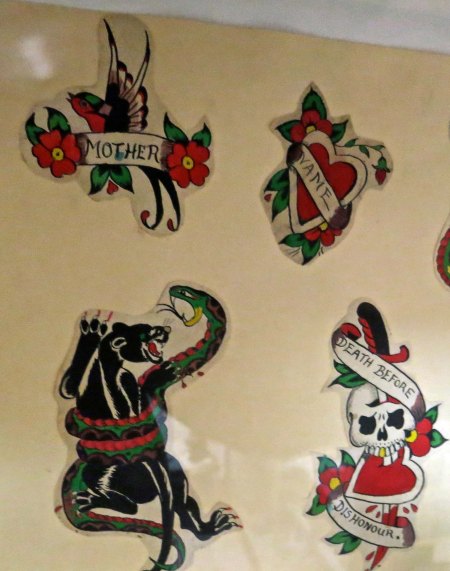
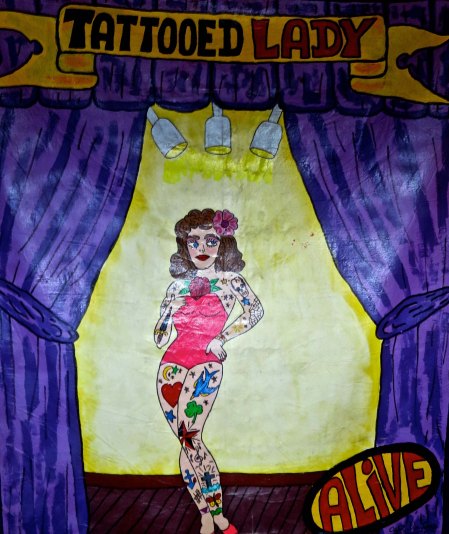
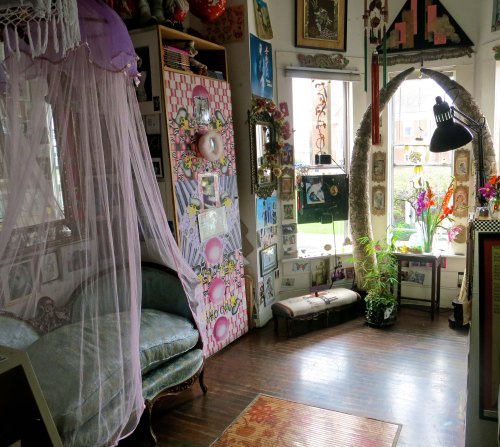
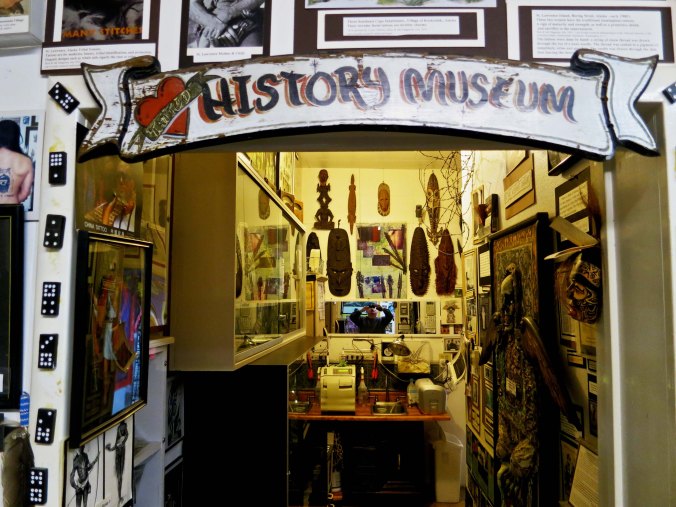
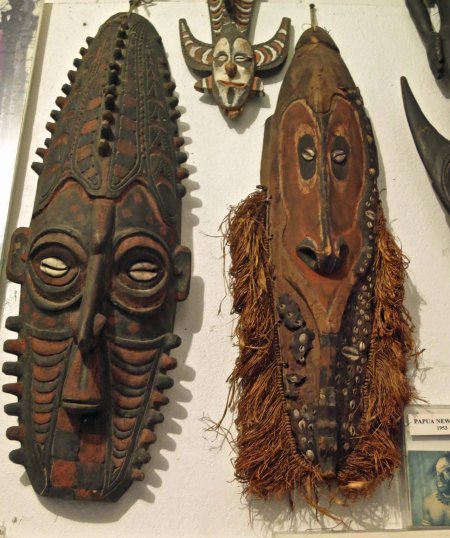
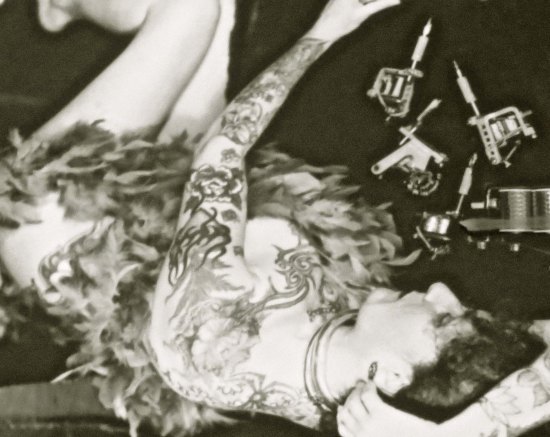
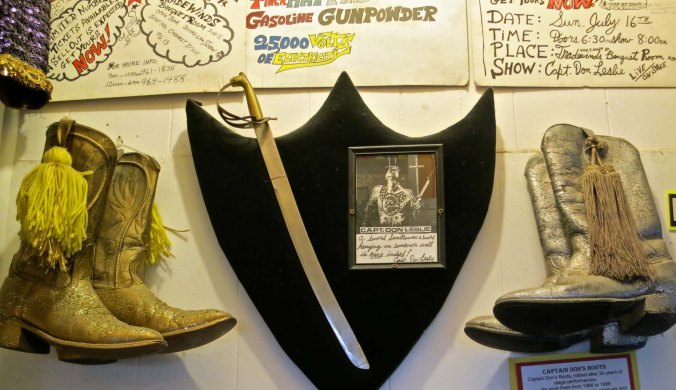
In Fort Bragg I discovered the very interesting Triangle Tattoo Museum and Parlor. None other than the divine Madame Chinchilla, a 69-year-old tattooed woman who looks like a grandmother, gave me a two-hour personal tour. It was fascinating. Her husband/partner, Mr. G, was busy tattooing his pharmacist. They were discussing side effects. “Are you talking about prescription drugs or tattoos,” I asked. “Both” was their mutual response. I bought a book Chinchilla had written about their best friend, now diseased, a world-renowned sword swallower: Captain Don Leslie.

Entrance to the tattoo museum in Fort Brag.

Entrance to the Triangle Tattoo Museum in Fort Brag.

And, there was more, of course.

  • I visited an old Grateful Dead hangout that morphed into a 60’s hippie commune
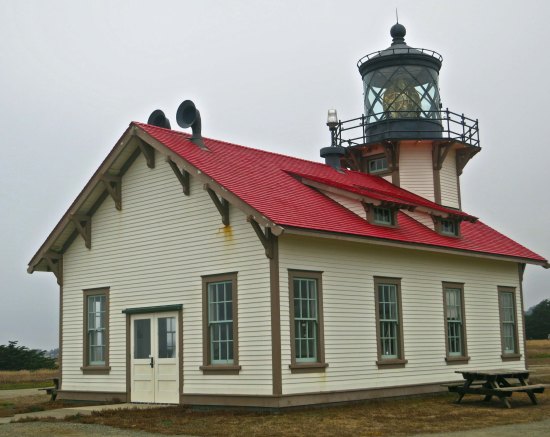
  • Stopped off at the Marconi telegraph site at Point Reyes where Morse code signals are still sent out to the Titanic (no answers yet)
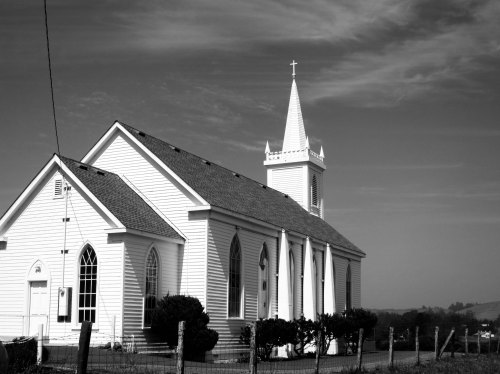
  • Took photos of a church that Ansel Adams made famous
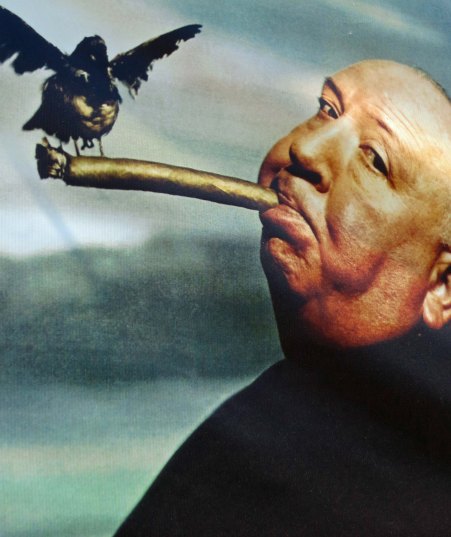
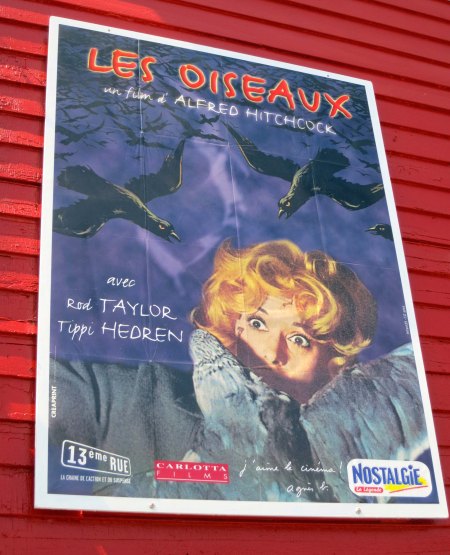
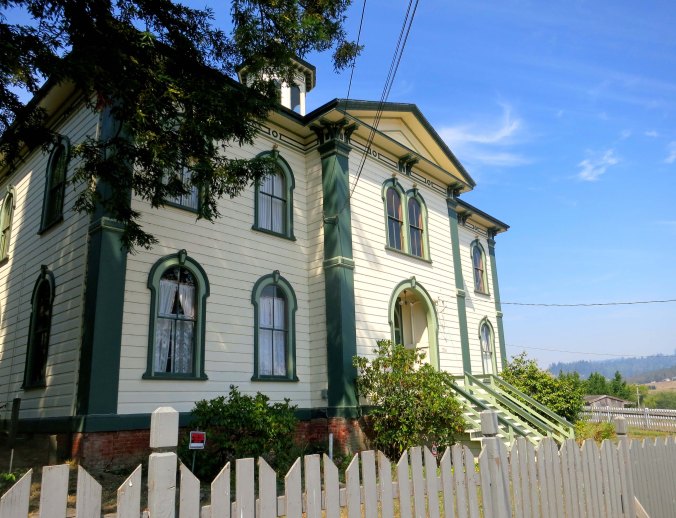
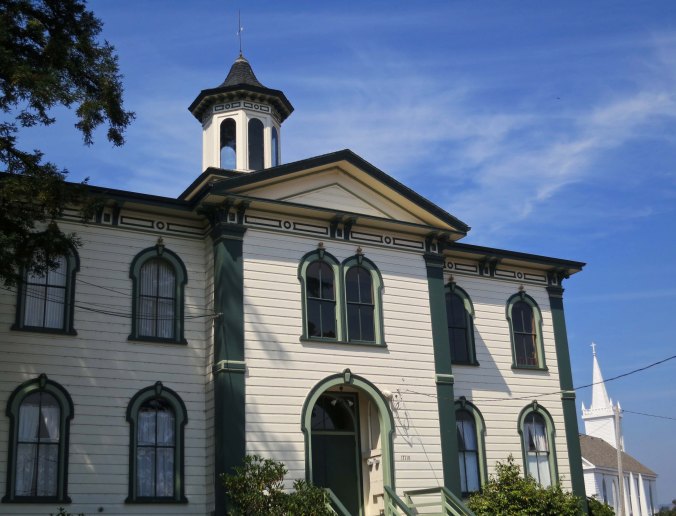
  • Rubbed shoulders with an Alfred Hitchcock mannequin in the small town of Bodega, which was made famous by the Hitchcock film The Birds
  • Wandered among the fascinating houseboats of Sausalito
  • Roamed the streets of the quaint seaside town of Mendocino

Some of the fun houseboats in Sausalito just north of San Francisco.

Some of the fun houseboats in Sausalito just north of San Francisco.

Returning home, I managed to score a ticket to Burning Man with the help of friends two days before the event was to start. So I made my annual journey out to the remote desert in northern Nevada. This past weekend I attended a conference on writing for change in San Francisco. Today I did an interview for a book about the international effort to get tobacco out of the movies, an effort I helped initiate 20 years ago.

As I have each year, I will be doing a series of blogs on Burning Man. This is the 2015 Temple.

This is the 2015 Burning Man Temple at sunrise.

I’ll be blogging about all of these over the next few months. Stay tuned. 🙂

Grand Canyon Odyssey, Part I… The Wilderness Cure

The Grand Canyon is a world treasure. I've backpacked into it several times and rafted the Colorado River through it. Once I even rode a mule into the Canyon.

The Grand Canyon is a world treasure. I’ve backpacked into it several times and rafted the Colorado River through it. Once, I even rode a mule into the Canyon. The mule carried me over the trail you can see right front center.

I followed Highway 50 east out of Sacramento, cut off at Pollock Pines and picked up the Mormon-Emigrant Trail. Soon I was on Highway 88 climbing up and over Carson Pass. Newly dressed aspens, snow-covered mountains and frothy creeks reminded me that summer was still two months away.

Kit Carson came through here in February of 1844 along with John C. Fremont. The snow was deep and food was limited. They ended up dining off of their horses, mules and the camp dog. The dog apparently went quite well with pea soup. Later, the trail they discovered would become a major entry point for the 49ers and run through the foothill town of Diamond Springs where I was raised.

By evening I had driven down the east side of the Sierras and made my way into Death Valley. I was setting up my tent under a convenient Mesquite tree when the sun sank behind the Panamint Range. Coyotes howling in the distance lulled me to sleep.

I walked out from my campsite in Death Valley as the sun set and listened to coyotes howl in the distance.

I walked out from my campsite in Death Valley as the sun set and listened to coyotes howl in the distance.

By ten thirty the next morning I was in another world, investing quarters in a video poker machine at Circus Circus on the Las Vegas Strip. Luck was with me. Two hours later found me crossing over Hoover Dam with an extra hundred dollars in my wallet. It represented two weeks of backpacking food. I zipped across the desert, picked up Interstate 40 at Kingman and cut off toward the Grand Canyon at Williams.

Circus Circus Clown.

A little treat for those of you with Coulrophobia, the Circus Circus Clown. No wonder people fear clowns.

I wasted little time checking in at Mather Campground. The Canyon was waiting. An unoccupied rock off the trail near Yavapai Point provided a convenient spot for dangling my legs over the edge. Nothing but several hundred feet of vacant space existed beneath my hiking shoes. A slight breeze on my back reminded me of my mortality.

Sitting on the edge of the Canyon isn't for the faint-hearted. One can fall hundreds of feet.

Sitting on the edge of the Canyon isn’t for the faint-hearted. One can fall hundreds of feet.

My musings were interrupted when a fat Golden-Mantled Ground Squirrel poked his furry head up next to me and demanded payment for my front row seat. I recited the Park’s rule on feeding animals and told him to go eat grass. He flipped his tail at me and squeaked an obscenity as he scrambled off in search of more gullible victims.

Twilight was painting the Canyon with a purplish tinge but I could still make out the distinctive colors and shapes of the rocks. While my right-brain admired the beauty, my left-brain was busy considering eons upon eons of earth history. The dark, tortured walls of the inner canyon, now obscured by evening shadows, reached back over a billion years to the very beginnings of life on earth when our ancient ancestors had frolicked in even more ancient seas.

While the sun still touched the rim of the Canyon, the inner walls turned a dark purple. (Photo by Peggy Mekemson.)

While the sun still touched the rim of the Canyon, the inner walls turned a dark purple. (Photo by Peggy Mekemson.)

Erosion had given these Precambrian rocks a flat top, shaving off some 500 million years of earth’s history and creating what is known as the Great Unconformity.  Since then vast seas, Saharan size deserts, lakes and rivers had patiently supplanted one another as they marched through Paleozoic time depositing layer upon layer of the canyons walls.

My present perch was made of Kaibab limestone created by an inland sea some 250 million years ago. Dusk slipped into dark and my thoughts turned to my impending backpack trip.

I had backpacked into the Canyon several times. My objective this time was to explore the Tanner Trail on the eastern end of the South Rim road.

The next day was devoted to careful preparation. Seventeen years of backpacking in all kinds of terrain and climate had taught me that there was no such thing as being too careful. I approach compulsive when it comes to backpacking alone. Had I resupplied my first aid kit? Was my stove still working? Did I have adequate fuel? Did I have my flashlight, signaling mirror, whistle, compass and maps? Did I have enough but not too much food, water, reading material, etc. etc. etc.?

Safety, comfort and even entertainment are important but weight is always an issue.

Having satisfied myself that I could survive seven to nine days in the Canyon, I headed off to the backcountry permit office. The more environmentally inclined within the Park Service are seriously into minimizing impact and promoting safety. Requiring wilderness use permits is their primary tool in achieving these goals.

I patiently waited behind six other would-be canyon explorers and had memorized the minimum impact lecture by the time my turn was up. The ranger frowned when I mentioned the Tanner Trail.

“The trail is poorly maintained, rarely used, 10-12 miles long and arduous,” she cautioned strongly.

“And that,” I replied, “is exactly what I want.”  I was especially enamored with the ‘rarely used’ part.  I had no desire to share my experience with dozens of other people, much less armies of cantankerous mules that leave lakes of fowl smelling pee on the trail. If I had to face a particularly tough physical challenge and be extra careful to avoid a tumble into the Canyon, it was a price I was happily willing to pay.

I was leaving the office when a skinny guy wearing a short-sleeved khaki shirt, blue shorts and hiking boots stopped me.

“Excuse me,” he announced, “I am with the Sierra Club and I couldn’t help but hear you are headed down the Tanner Trail. Given your condition, I would strongly advise against it. You should hike down the Bright Angel Trail. It’s a lot easier and there are lots of other people hiking it in case you get in trouble.”

Now I confess that having just emerged from nine months of hibernating in Alaska I was pasty white and pudgy. I will also allow that the guy was operating under good intentions.

But his arrogance, especially in announcing his Sierra Club membership as somehow making him a wilderness expert, irritated me. Over the years I had known and worked with lots of Sierra Club folks. I am a strong supporter of their efforts to protect the wilderness. I have even run into some who have had more wilderness experience than I. John Muir, the Sierra Club founder, is one of my all time heroes.

Had my unofficial advisor started off with something like, “I have been up and down the Tanner Trail several times, would you like some suggestions?” I would have been quite willing, even eager, to hear what he had to say. But his uneducated assumptions about my lack of knowledge absolutely turned me off. It was everything I could do to maintain a civil tone of voice as I thanked him for his advice and politely told him to screw off.

At 8:30 the next morning my pasty white pudgy body was having an animated discussion with my mind over why I hadn’t listened more carefully to the Sierra Club ‘expert’ the day before. I had started my day by splurging for breakfast at the elegant El Tovar Hotel and then driven out to Lipan Point.

I was now poised to begin my descent into the Canyon. It looked like a long way down. I gritted my teeth and banned any insidious second thoughts.

They came rushing back as I struggled to hoist my 60 plus pound pack. It was filled with seven days of food, extra water and all of my equipment. I had cursed the day before as I struggled to find room for everything. Now I was cursing I hadn’t left half of it behind. I had the irrelevant thought that my journey down would either kill me or cure me.


Sorry to leave you hanging here as I begin my descent down into the Canyon, but I am going to take a break from blogging for a couple of months. It’s going to be tough. I love blogging and I enjoy keeping up with all of my Internet friends. It’s a special group. But five grandsons are descending on our house and I think Peggy and I will be a little busy (understatement). After that I am going to do some traveling— who knows where? (Peggy will be off in London with her sister Jane.) I also need to spend some time marketing my book. Time simply hasn’t allowed me to put in the effort I should.

And finally, I received two notices from Word Press this past week. One congratulated me on my fifth anniversary with Word Press. The second congratulated me on posting my 500th blog. I realized I hadn’t taken a break from blogging since the beginning. So it’s time I did. I will be off Word Press until the second week in September when I will once again be posting blogs, catching up with the folks I follow, and making comments. Have a great summer and thanks ever so much for following me. —Curt

A final view of the Canyon with its multiple layers that represent deposited from oceans, deserts, rivers and lakes.

A final view of the Canyon with its multiple layers that represent deposits from oceans, deserts, rivers and lakes over hundreds of millions of years..

Where Glass Borders on Fantasy… The Work of Dale Chihuly

I had the feeling that this sculpture by Dale Chihuly, set off by a reflecting pool should be waving its tentacles.

I had the feeling that this sculpture by Dale Chihuly, set off by a reflecting pool, should be waving its tentacles. (This and the following photos are taken by Peggy Mekemson.)

When I closed my eyes and scrolled through my iPhoto collection to come up with today’s photo essay, I landed on a series of photos featuring Dale Chihuly’s imaginative glass sculptures.

It seems like Chihuly, the world’s most prolific creator of glass blown sculpture, is everywhere these days. His works are found worldwide. Peggy was in Tennessee with our daughter Natasha five years ago when a Chihuly exhibition was held at the Cheekwood Botanical Garden in Nashville. Fortunately, Peggy took lots of photos so I could enjoy the show as well. I found a flock of flamingos that Peggy captured on her camera at the botanical garden to be equally fascinating.

I thought of this creation as a fruit basket.

I thought of this creation as a fruit basket.

Chihuly is an expert at placing his work in natural settings.

Chihuly is an expert at designing his pieces to complement natural settings.

Another example how his work complements a natural setting.

Another example how his work complements a natural setting.

And how about this towering glass sculpture next to the tree?

And how about this towering glass sculpture next to a tall tree?

My grandson, who was two at the time, checks out one of Chihuly's sculptures. I wonder what was going through his mind?

My grandson, who was two at the time, checks out one of Chihuly’s sculptures. I wonder what was going through his mind?

A new take on a Zen garden?

A new take on a Zen garden?

I thought colorful garlic here.

These reminded me of colorful cloves of garlic.

These gracefull birdlike sculptures reminded me of Peggy's Flamingos.

These graceful birdlike sculptures with their interesting poses reminded me of Peggy’s Flamingos.

Flamingos can assume some interesting one legged positions but this one went above and beyond

Flamingos can assume some interesting one-legged positions but this one went above and beyond. Check out the shadow.

Another interesting pose.

Another interesting pose for both kids and adults.

A final contortion of Flamingos.

A final contortion of Flamingo parts.

I'll use this blue and green contrast by Chihuly to end this post. NEXT POST: On the way to He Grand Canyon and a two month break from blogging.

I’ll use this blue and green contrast by Chihuly to end this post. NEXT POST: A continuation of my Friday Essays. The Grand Canyon trip. Also, Friday marks the beginning of a two month break from blogging.


Escape from Alaska… Part I

I was drawn to Alaska by its incredible wilderness. Lisa Murkowski, one of Alaska's Senators, recently introduced legislation to sell off all of America's public lands including national forests, wilderness areas, national historic sites and national seashores (everything except National Parks) to private developer so they can make money off of the lands.

The Wrangell-St. Elias Mountains. I was drawn to Alaska by its incredible wilderness. It may not be there for our children. Lisa Murkowski (R-Alaska) recently introduced a non-binding budget amendment to the US Senate that would allow states to sell off all of America’s public lands including national forests, wilderness areas, national historic sites, etc. (everything except National Parks) to private interests so they could turn our national heritage into profit.

The story of my involvement with California’s Proposition 99 tobacco tax campaign began on my 43rd birthday when I escaped from Alaska— and escape is the appropriate term.

My three years in Alaska had been a great adventure. I had explored the state’s magnificent wilderness areas and accomplished a fair amount in my role as Executive Director of the Alaska Lung Association. The organization had a great board and staff. We had taken a sleepy organization and turned it into a powerhouse on air quality and tobacco issues. I had led backpack, bike, and cross-country ski trek fundraisers, substantially increasing the organization’s income, not to mention giving myself an excuse to play in the woods. (As if I needed an excuse.)

But I am not cut out for the Executive Director business— or any other long-term, high stress job, for that matter. I only know one speed: fast forward. In time, the job starts to feel like I am locked in a steel cage, which just happens to be dangling from a frayed rope, hanging over a dark abyss. If that sounds to you like an imaginative description of depression, you are right. It is something of a curse on my mother’s side of the family, or to be more scientific, call it a genetic disposition.

Unfortunately, I am a slow learner. I had been executive director of several environmental and health nonprofits, done my job, and moved on. It seemed like a natural fit; so I persisted. But each time, it was like I was flirting with the dark side of my mind. I had learned I made a better ‘consultant,’ where I created the jobs I would work on. For example, I developed the wilderness trek program as a fundraiser and then became the American Lung Association’s national trek consultant. The consulting work was intense, but it had a definite beginning and a definite end. Afterwards, I would go play.

Alaska had sounded really good, however. And it was. There was all of that great outdoors (over 50% of America’s wilderness area), important issues to address on the environmental and tobacco front, and a relationship in Sacramento that needed a serious time-out. So I had taken the bait when Alaska had called— hook, line and sinker.

"It's time to pack your bags, Curt." (Peggy and I took the photos of Alaska and the Alaska Highway two years ago when we visited the state.)

“It’s time to pack your bags, Curt.” Alaskan Brown Bear. (Peggy and I took the photos of Alaska and the Alaska Highway found on today and next week’s post two years ago when we visited the state.)

By the end of the first year, I was climbing the walls. It was time to leave. Except I had made a commitment to myself, and to the organization that I would stay for three years. I struggled my way through the second year, barely keeping my head above the water. But we accomplished some good things— like forcing Tesoro to clean up the air pollution from its oil refinery, creating one of the first state-wide non-smoking laws in the nation, leading an effort to double the state tobacco tax with money going toward prevention, and bringing automobile inspection and maintenance to Alaska. But I was coming to the end of my tether. It was a short rope.

The stress at the back of my head was palpable. Even now, as I write about the experience, I can feel it gathering. It influenced my decision-making. Instead of coasting and turning more work over to my staff, I jumped feet first into the fire. It wasn’t necessary; my board and staff were good folks. They would have been eager to help. But asking for help assumes a rational mind. Mine wasn’t. I started making mistakes— and I started increasing my nightly consumption of alcohol, from two, to four, to six cans of beer. Alcohol was singing its seductive song.

Had I learned to be laid back like this moose, there never would have been a problem.

Had I learned to be laid back like this moose, there never would have been a problem.

Over Christmas, I took a break by myself and drove down to Homer on the Kenai Peninsula. There’s a motel that sits out at the end of the Homer Spit providing panoramic views of Kachemak Bay. I got a room and spent hours staring out at the water and distant mountains. And I made a decision. I would return to Anchorage and give a three-month notice that I was leaving. When the time was up, I would disappear into the woods for several months of backpacking. I would take the wilderness cure.

I spent my last day packing the things I wanted to take: a few books and camping gear. I would leave Alaska like I had arrived, with what I could fit in the back of my pickup. I spent the night at a friend’s home, but she wasn’t there. She had disappeared into the lower 48 states so she wouldn’t see me drive away. I had passed on her offer to get married, stay home, write, and raise kids. Her two dogs and cat kept me company.

The views along the highway between anchorage and the lower 48 states are incredible— not that I paid much attention is my mad dash for the border.

The views along the highway between Anchorage and the lower 48 states are incredible— not that I paid much attention in my mad dash for the border. This is the Matanuska Glacier.

These mountains were near the Matanuska Glacier, easy driving distance from Anchorage.

These mountains were near the Matanuska Glacier, easy driving distance from Anchorage. 30 minutes from my house, I could be hiking in similar terrain.

Another view of the Wrangell-St.Elias Mountains that I would have passed.

Another view of the Wrangell-St.Elias Mountains shown in the top photo.

I flew down the Alaska Highway the next morning, exhausting myself, searching for green grass and flowers. I almost made the Canadian border the first night. Too tired to move on, I pulled into a closed truck inspection point and crawled into the back of my pickup.

Once I had arranged my sleeping bag on top of my few possessions, I broke out some liquid refreshment to scare off the banshees that were nipping at my heels. My truck was packed with more guilt than goods, a lot more. Some old friends from California— Tom Lovering, Jean Snuggs and a new friend of Tom’s, an irrepressible minister by the name of Jeanie Shaw, had put together a South of the Border Care Package to ease my way toward California. It consisted of several ripe avocados, salsa, chips and a gallon of pre-made margaritas, heavy on the tequila. I held a little party with my staff before leaving. We did serious damage to the guacamole but hardly touched the margaritas.

I knocked off a water-sized glass of the latter. It put me well on the way to oblivion but it wasn’t enough to let me sleep through the horrendous racket of someone trying to break into my camper shell. I sat up with a start and yelled, banging my head against the top. A flashlight with enough candlepower to light up Las Vegas was shining directly into my eyes.

The Troopers flash light had about the same intensity as the sun on this lake that is located close to the Alaska-Canada Border.

The flashlight had about the same intensity as the sun on this lake that is located close to the Alaska-Canada Border.

“You in the truck, what are you doing here?” It was the voice of Authority. An Alaskan State Trooper had been banging on my camper shell with his baton. I thought it was quite obvious what I was doing but wisely decided to refrain from the obscene comment that was perched on the tip of my tongue. I chose a mildly sarcastic response.

“Uh, sleeping?” I hazarded a guess.

“You are not supposed to sleep here,” the disembodied voice behind the flashlight responded. “Why didn’t you go to a motel?” I was obviously a suspicious character, having chosen not to support the Alaskan economy. I was also being interrogated with the bright light of the law shining in my eyes. It was time to think fast.

“I fell asleep behind the wheel,” I exaggerated slightly. “I was afraid I might do serious damage to myself or someone else on the highway.”

That put a serious crimp in his nightstick. I could tell he was pondering my answer by the slowness of his response. He was torn between his job to roust out suspected vagrants and his responsibility to save lives. His good sense won.

“Go back to sleep,” the voice said. It was a lot easier for him to say than it was for me to do.

NEXT FRIDAY’s ESSAY: I reject an offer to run off to Mexico and open an orphanage for homeless children, decide what I should do with a gallon bag of pot I was given as a going away present, and finish my journey to Sacramento— where I am immediately asked to put together a statewide campaign to increase California’s tobacco tax. Instead, I go backpacking.

Quirky Berkeley— I Return to My Roots


Sproul Hall

Sproul Hall, the administrative center of UC Berkeley, looks imposing. It comes with a welcome sign now but it wasn’t so welcoming when I gave a speech while standing on the Dean’s desk at the height of the Free Speech Movement in 1964.

Last week went on forever. By Sunday, the events at the beginning of the week seemed like ancient history. Maybe that’s not a bad thing; time slowed down. Lately it’s been zipping by like a hummingbird on sugar-water. Zoooooooom!

I began my week by being a guest lecturer in a writing class at Southern Oregon University where I talked about changes in the publishing industry. Mainly I discussed how authors are now responsible for marketing their own books. Grump. It is not my favorite activity. “Go start a blog,” I urged, “at least you can have fun. And it is great writing practice.”

Thursday found me keynoting an author’s day at a local community school. I had jumped from talking with seniors in college to kids. And how in the heck do you tailor a talk for a group with an age range from 7-14? Tell stories, I decided— and started with the tale from The Bush Devil Ate Sam about Rasputin the Cat and the Cockle Doodle Rooster. Afterwards I taught classes of fifth, sixth, seventh and eighth graders. My message was that we are all storytellers.

It was fun. The eight-hour drive to Berkeley immediately afterward wasn’t.

I drove down to attend a national conference of Returned Peace Corps Volunteers. I was one pooped pup when I arrived. It was lights out for Curt. I hardly even needed my noisemaker to drown out the clamor on University Avenue.

Berkeley is many things, among them a world renown center of education.

Speaking of tired puppies, I found these hemp collars and leashes on Telegraph Avenue. In addition to being home to one of the world’s greatest educational institutions, Berkeley can be a bit quirky.

I went to the conference to participate in some workshops relating to Peace Corps writers, of which there are legions. I also wanted to hear presentations by Congressman Sam Farr and Peace Corps Director Carrie Hessler-Radelet. Sam had been a Peace Corps Volunteer in South America in the 60s and, like me, worked in Peace Corps recruiting afterwards. He is known as “Mr. Peace Corps” in Congress for the strong advocacy role he plays for the organization.

He argued that Returned Peace Corps Volunteers also needed to become advocates. It’s budget time in Washington, and there are a lot more countries requesting Peace Corps Volunteers, and people who want to be Volunteers, than Peace Corps has money to fund. As usual, the money goes elsewhere. For example, we are spending a billion and a half dollars this year to keep Egypt happy— four times the total budget of Peace Corps.

On the good news side of the equation, Carrie announced that Peace Corps Volunteers would be back in Liberia this week. As you may recall, they were pulled out in the fall because of Ebola. Carrie also mentioned a major new initiative that Peace Corps is working on with Michelle Obama, Let Girls Learn. It is a worldwide effort to provide girls with the same education opportunities boys now have.

Michelle

We listened to a pre-recorded message on Let Girls Learn from Michelle Obama in Wheeler Auditorium, which was the site of my first class at Berkeley. I had walked right by the classroom, incapable of imagining that there would be over a thousand students in the class. Berkeley gave me a new understanding of mass education.

I must confess— I also had an ulterior motive for the trip. Any journey to Berkeley is a trip into the past for me. I think of it as a pilgrimage, a return to my roots. I still hear echoes from the 60s when I was caught up in Berkley’s Free Speech Movement. This time the echoes were real. A resounding expletive caught my attention. I turned around to see Cliff Marks descending on me. Cliff and I had shared an apartment during out senior year and Cliff had also served in the Peace Corps. The last time I had seen or talked with him was at his wedding in 1969. We had a grand time catching up. Now it is time to catch up on the blogs I have missed this past week and a half.

But first, let’s go on a tour of Berkeley.

Sather Gate

Every student who has ever been to Berkeley passes through Sather Gate…

Campanile

And at some point, stops to admire the Campanile, which is Berkeley’s best known landmark.

Bay Bridge

The campus looks out over San Francisco Bay. The Golden Gate Bridge can be seen in the distance.

Steps of library

I had spent the day buried in the Bancroft Library and surfaced for a break when I found a young woman crying on these steps. The campus was deathly quiet. “What’s the problem?” I had asked. “They’ve shot the President,” she told me in a broken voice. It was November 23, 1963 and President Kennedy had been killed, shot down in the streets of Dallas.

Sproul Plaza

Sproul Plaza was a major location for student protests in the 60s. This entrance to the campus, at the intersection of Telegraph Avenue and Bancroft Avenue, was the location of Berkeley’s Free Speech Area that the University arbitrarily closed down in the fall of 1964, thus leading to the beginning of the Free Speech Movement.

Ludwig's fountain

The Student Union and Ludwig’s Fountain are under renovation. Ludwig was a 60’s type dog who wandered wherever he chose. He came down from his house on the hill daily and frolicked in the fountain that would eventually bear his name. I petted Ludwig and watched as a police car was taken hostage and then used as a speaker’s podium. Jack Weinberg, a Civil Rights organizer, was being held in the car. It was Jack, now 75, who coined the phrase, “never trust anyone over 30.”

Cafe Mediterraneum

I learned as much outside of the classrooms as I did inside at Berkeley. The Cafe Mediterraneum on Telegraph Avenue was my main hangout. It was one of America’s first European style Coffee Houses in the 1950s and proudly claims to be the creator of the caffe latte.

Moe's

One of my primary forms of entertainment in the 60s at Berkeley was perusing bookstores. It still is today when I visit the city. Moe’s was and is one of the greats. Sadly, my favorite, Cody’s, is now closed.

Amoeba Records

Amoeba Records is next to the Cafe Meditteraneum. Street booths, like those in front on the left, have become a permanent  fixture along Telegraph Avenue.

Crystals on Telegraph

As one might expect, many of the items for sale have a New Age connection, such as these ‘healing’ quartz crystals.

Dream Catchers

And these dream catchers.

People's Park

“If it takes a bloodbath, let’s get it over with.” –Ronald Reagan’s response as Governor of California to students who were protesting his closing down Berkeley’s People’s Park as a community garden in the late 60s. National Guard troops were sent in and local police were armed with shotguns loaded with buckshot. One student, apparently a bystander, was killed and another was blinded. The whole city was tear gassed from the air.

Tree sign

A sign thanking trees that live in the park today.

Mural

A mural on the side of the Amoeba record store depicts events surrounding People’s Park as well as other Telegraph Avenue happenings.

Mural

The mural.

Pan Handler

Berkeley has always been a mecca for young people,  both those seeking an alternative lifestyle as well as those seeking a first class education. Many who came looking for alternatives arrived without money, as this young man shown in the mural.

Homeless

Today, Berkeley is the ‘home’ for numerous homeless people. I took this photo on Dwinelle Plaza on campus.

Street Spirit

This homeless man was selling the newspaper “Streetsmart” in front of Moe’s Bookstore. Headlines announced a recent protest that the community’s religious leaders including Christian, Muslim, Jewish and Buddhist representatives had made against the city’s efforts to criminalize homelessness as a means of driving homeless people out of town.

Berkeley sign board

A sign of the times? Not really. Berkeley’s sign boards have always been plastered with notices on top of notices. I was amused to find help wanted notices for Berkeley’s Call Center. I hear from these young people several times a year as they solicit money for Berkeley. I found it interesting that the University, who charges them $14,000 a year in tuition ($38,000 if out-of-state), only pays these kids $11 per hour.

South Hall

South Hall, built in 1873, is the oldest building on the UC Berkeley Campus. It’s an appropriate photo to end this post, and also to raise a question about the future of public education in America. Tuition was free when I went to Berkeley and I was able to pay for my living costs by driving a laundry truck in the summer. I graduated debt-free. Today’s young people graduate with hundreds of thousands of dollars in debt. It’s close to tragic. All I can think of is how incredibly stupid our state and national leaders are when the future of our nation, and indeed the world, depends upon an educated and knowledgeable population. Germany can somehow find the money to provide a free college education. Why not America?


The Natchez Trace National Parkway, AKA— the Devil’s Backbone

Peggy and I were driving down the Natchez Trace when we came on this beautiful Luna Moth with a wingspan of about four inches. It was one of many treasure we found along the way.

Peggy and I were driving down the Natchez Trace when we came on this beautiful Luna Moth with a wingspan of about four inches. It was one of many treasures we found along the way. (Photo by Peggy Mekemson.)

It’s Wednesday, time to scroll down through my iPhoto and find photos to feature. This time, my finger landed on the Natchez Trace, one of America’s premier drives— or bicycle trips. If you are ever wandering through Mississippi, Alabama or Tennessee, be sure to include it as part of your itinerary.

Large game animals, including buffalo, first used sections of what would become known as the Natchez Trace. Later it served as a major trade route for Native Americans. By the early 1800s, the Trace had been modified by a young United States into a 450-mile transportation corridor between Nashville, Tennessee and Natchez, Mississippi. Soldiers, highwaymen and missionaries travelled the route, but Kaintucks were its primary users.

Kaintucks were rough frontiersmen from Kentucky who operated flatboats on the Ohio and Mississippi Rivers. They would load their boats with merchandise in Nashville and then oar down the Mississippi to Natchez where they would sell their goods for a handsome profit. Getting the money home was the challenge. Rowing up the Mississippi was not an option. Kaintucks were faced with the 450-mile hike back up the Trace— and they were faced with a multitude of folks who wanted to separate them from their newfound wealth.

First came the gauntlet of booze, prostitutes, gamblers, and gangsters in ‘Natchez Under the Hill.’ Assuming the Kaintucks got out of town with fortune intact, they became fair game for highwaymen. It was open season on the rivermen and their cash. For this reason, the Natchez Trace became known as the Devil’s Backbone. Today the Trace is a beautiful National Parkway with no commercial traffic. I’ve driven it several times, and once, I bicycled 370 miles of it from Natchez into southern Tennessee.

A number of lakes and waterways are found along the Trace. We took this photo from our campsite. We also watched a beaver working.

A number of lakes and waterways are found along the Trace. We took this photo from our campsite. We also watched a beaver working while relaxing in our camp chairs.

I found this grass growing in the lake the next morning and enjoyed its reflection.

I found this grass growing in the lake the next morning and enjoyed its reflection.

Numerous trails lead off of the Trace, often leading to babbling brooks.

Numerous trails lead off of the Trace, often leading to babbling brooks.

And lots of fungi, including this shelf fungus, which decorated a rotting log.

And lots of fungi, including this shelf fungus, which decorated a rotting log.

Miles and miles of dogwood bloom along the natchez Trace in Spring.

Miles and miles of dogwood bloom along the Natchez Trace in Spring.

Peggy and I also found these colorful violets.

Peggy and I also found these colorful violets.

Meriwether Lewis of Lewis and Clark was found dead in a hotel on the Trace. To this day it is debated as to whether he was killed or committed suicide while under the influence of opium.

Meriwether Lewis of Lewis and Clark was found dead in a house on the Trace. To this day it is debated as to whether he was killed or committed suicide while under the influence of opium. This monument stands over his grave.

I wondered if Peggy had some type of message in mind when she asked me to pose for this photo. The sign is pointing toward portions of the historical Trace that are still found along the Parkway.

I wondered if Peggy had some type of message in mind when she asked me to pose for this photo. The sign is pointing toward portions of the historical Trace that are still found along the Parkway. (Photo by Peggy Mekemson.)

The Phar Mounds located north of Tupelo, Mississippi were left behind by nomadic Native Americans some where between 1-200 AD as burial mounds.

The Phar Mounds located north of Tupelo, Mississippi were left behind by nomadic Native Americans somewhere between 1-200 AD as burial mounds.

These are the brick restrooms at Phar Mounds. I am sure you are wondering why i've included them. They are my favorite restrooms in the whole world, bar none. I hid out in them when I was on my bike trip around North America as a tornado ripped apart the woods a quarter of a mile away.

These are the brick restrooms at Phar Mounds. I’ve included them because they are my favorite restrooms in the whole world, bar none. I hid out in them when I was on my bike trip around North America and a tornado ripped apart the woods a quarter of a mile away. My bike hid with me.
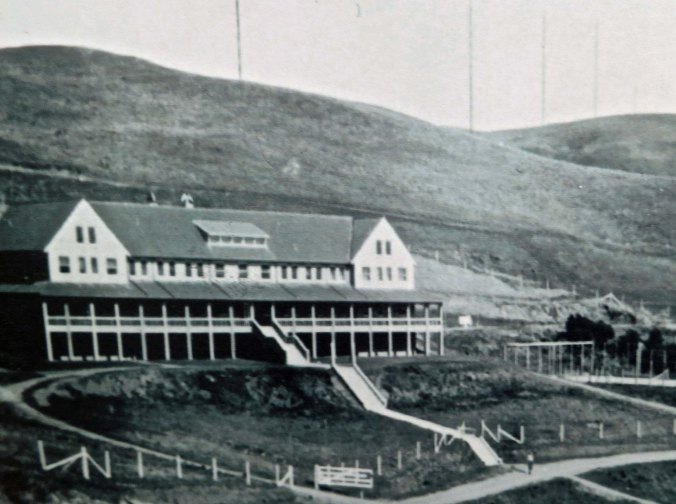
I'll conclude with a final photo of dogwood. NEXT BLOG: The Friday Essay: Just possibly a ghost is involved.
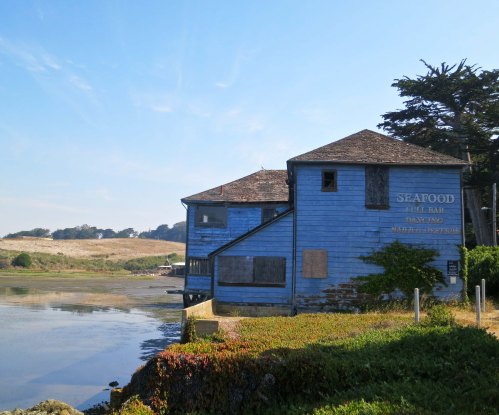
I’ll conclude with a final photo of dogwood. NEXT BLOG: The Friday Essay: Just possibly a ghost is involved.