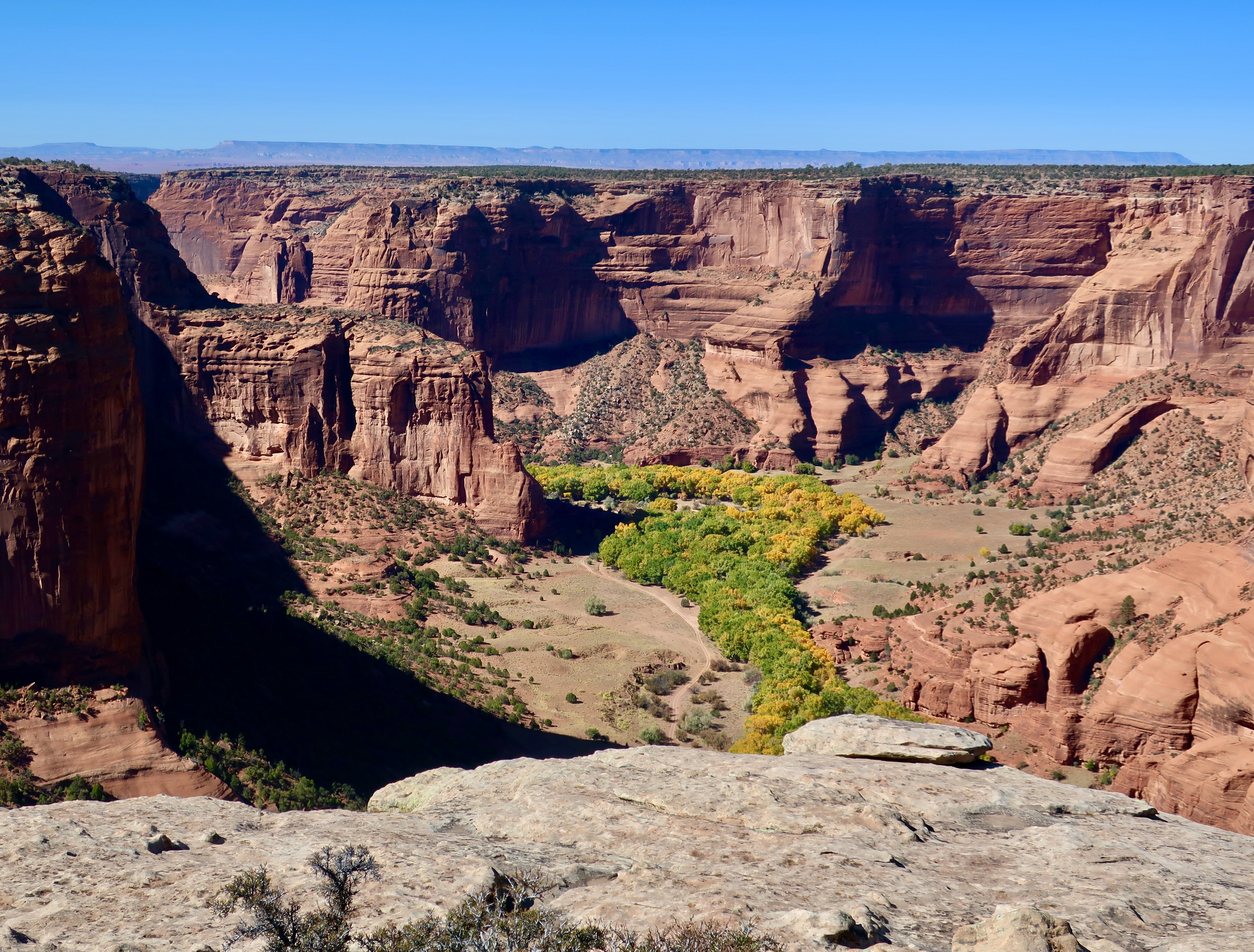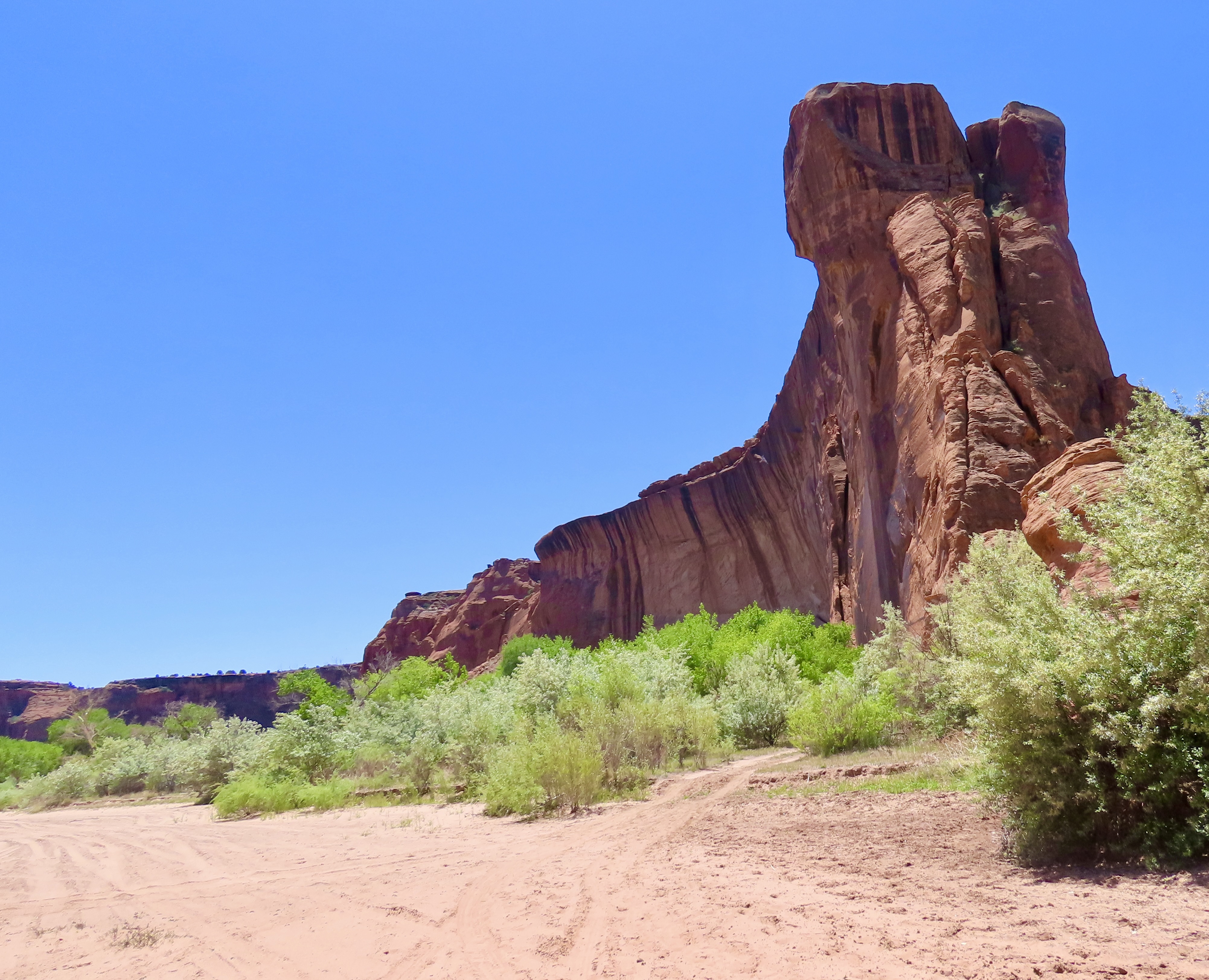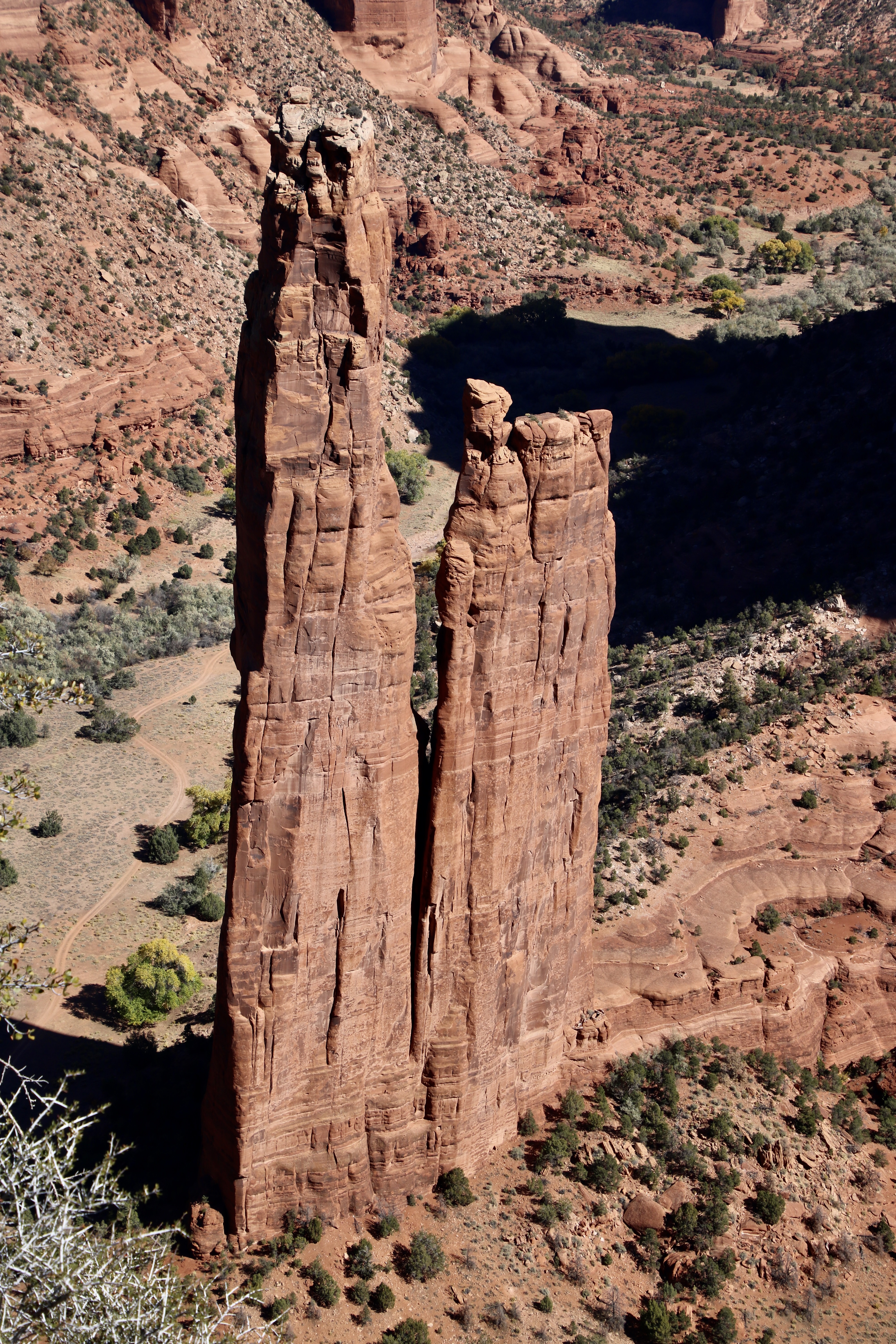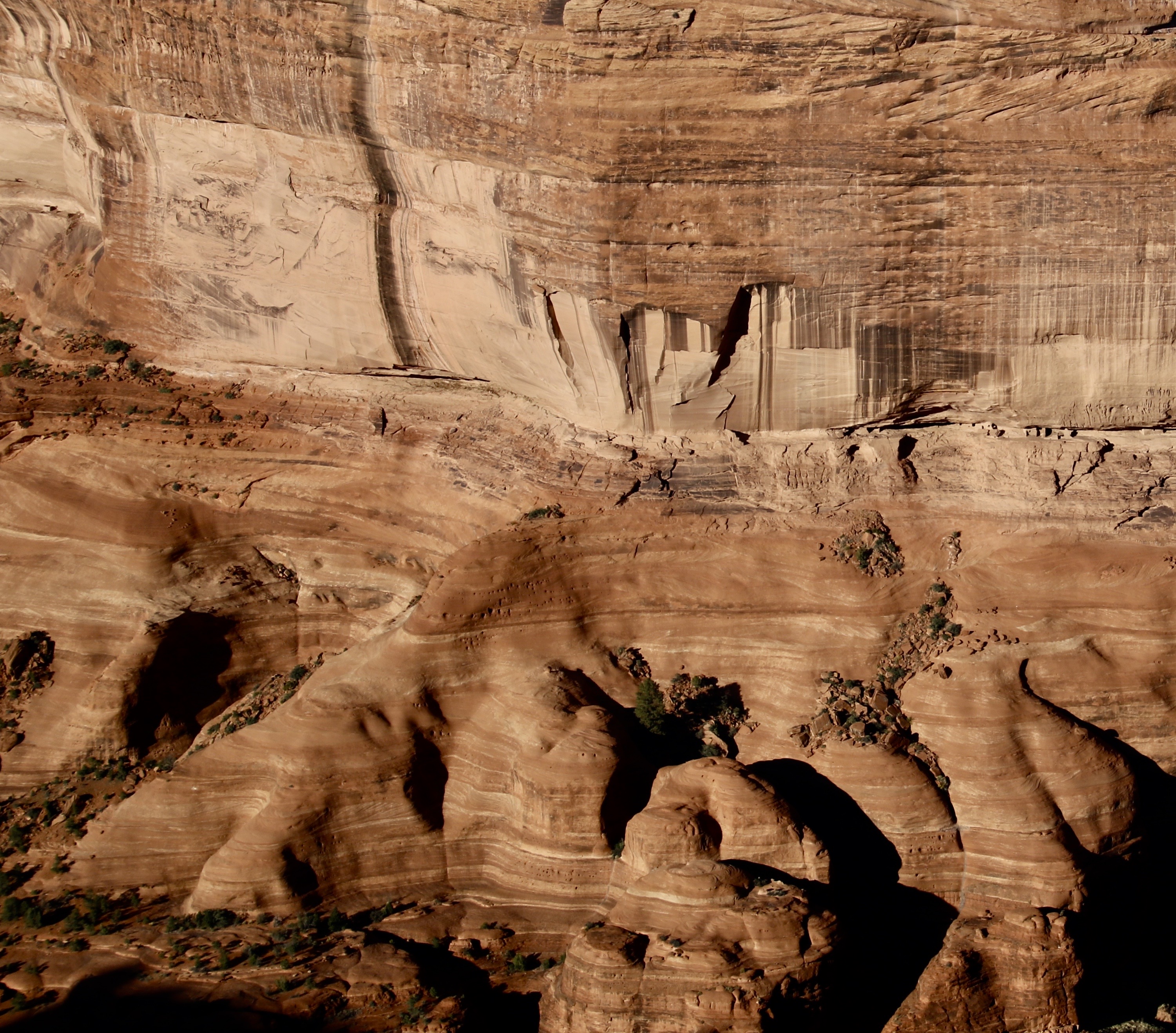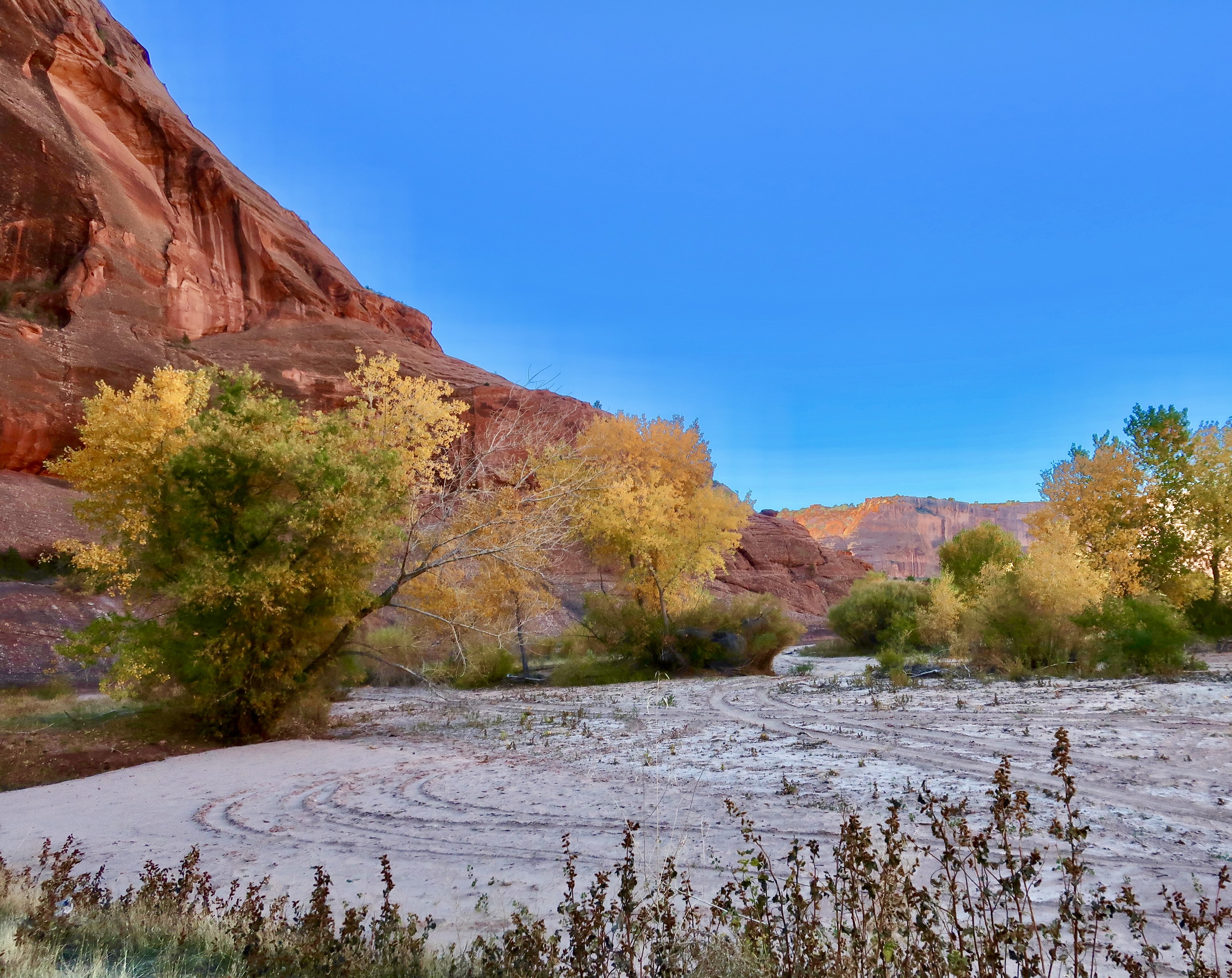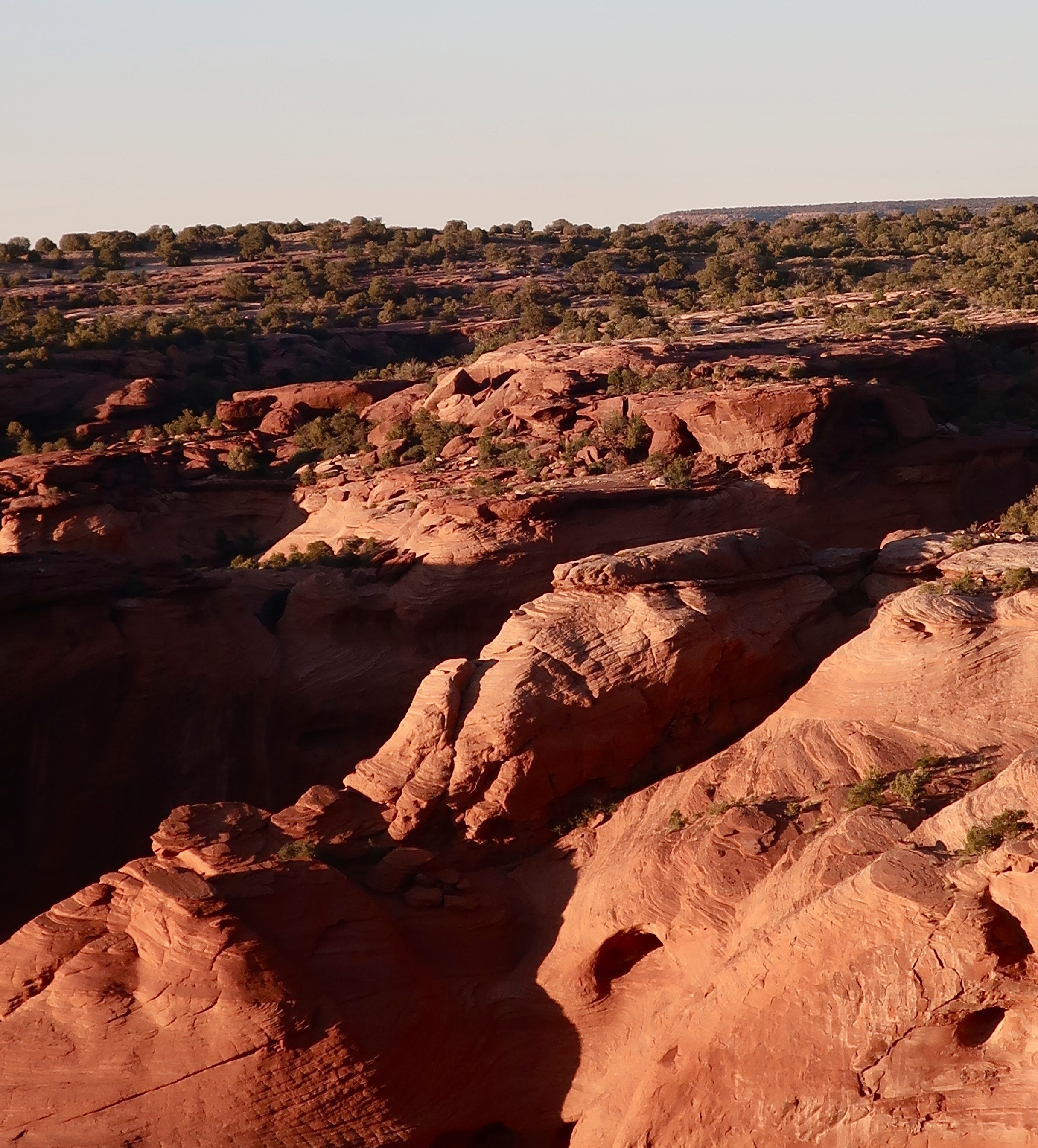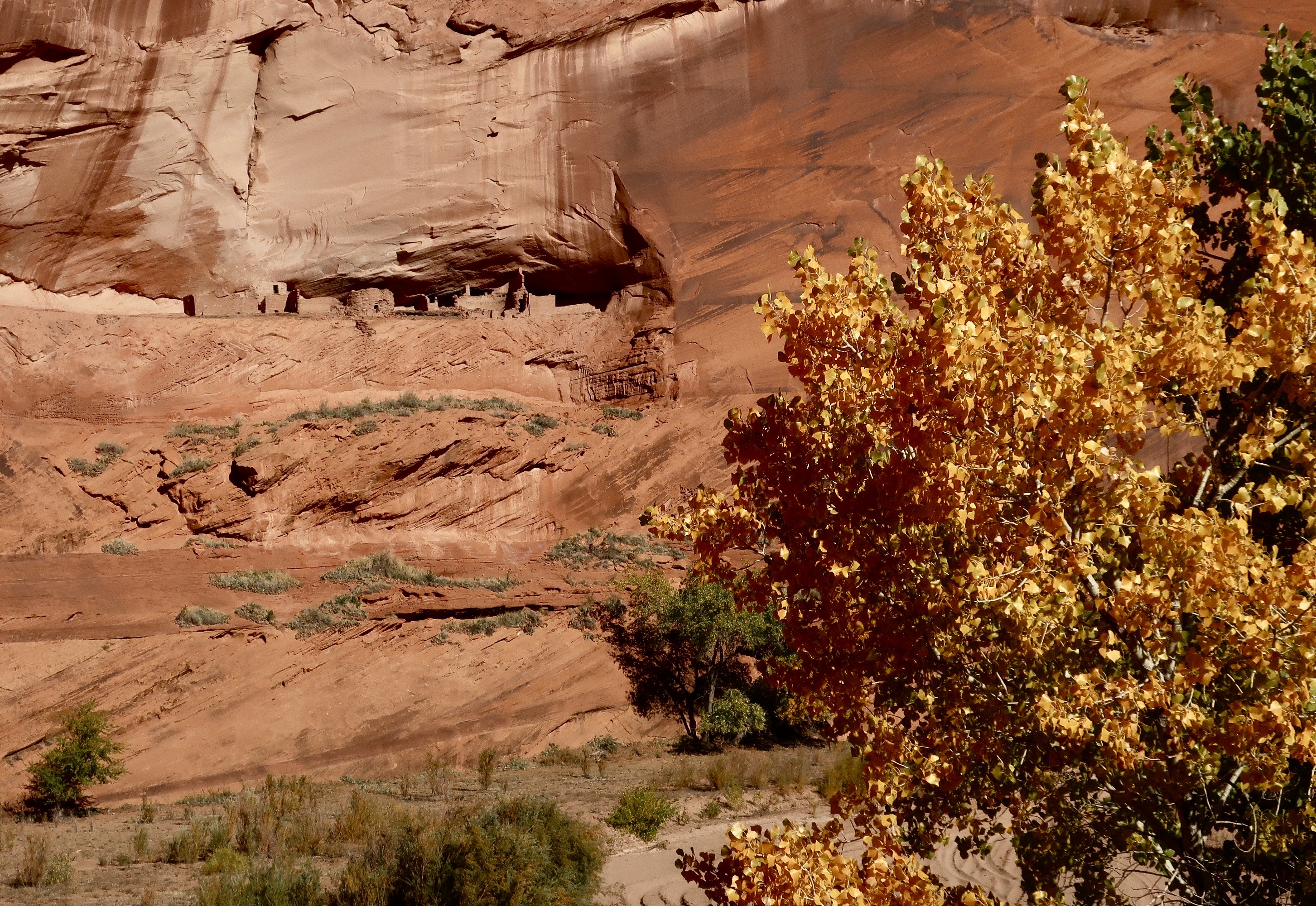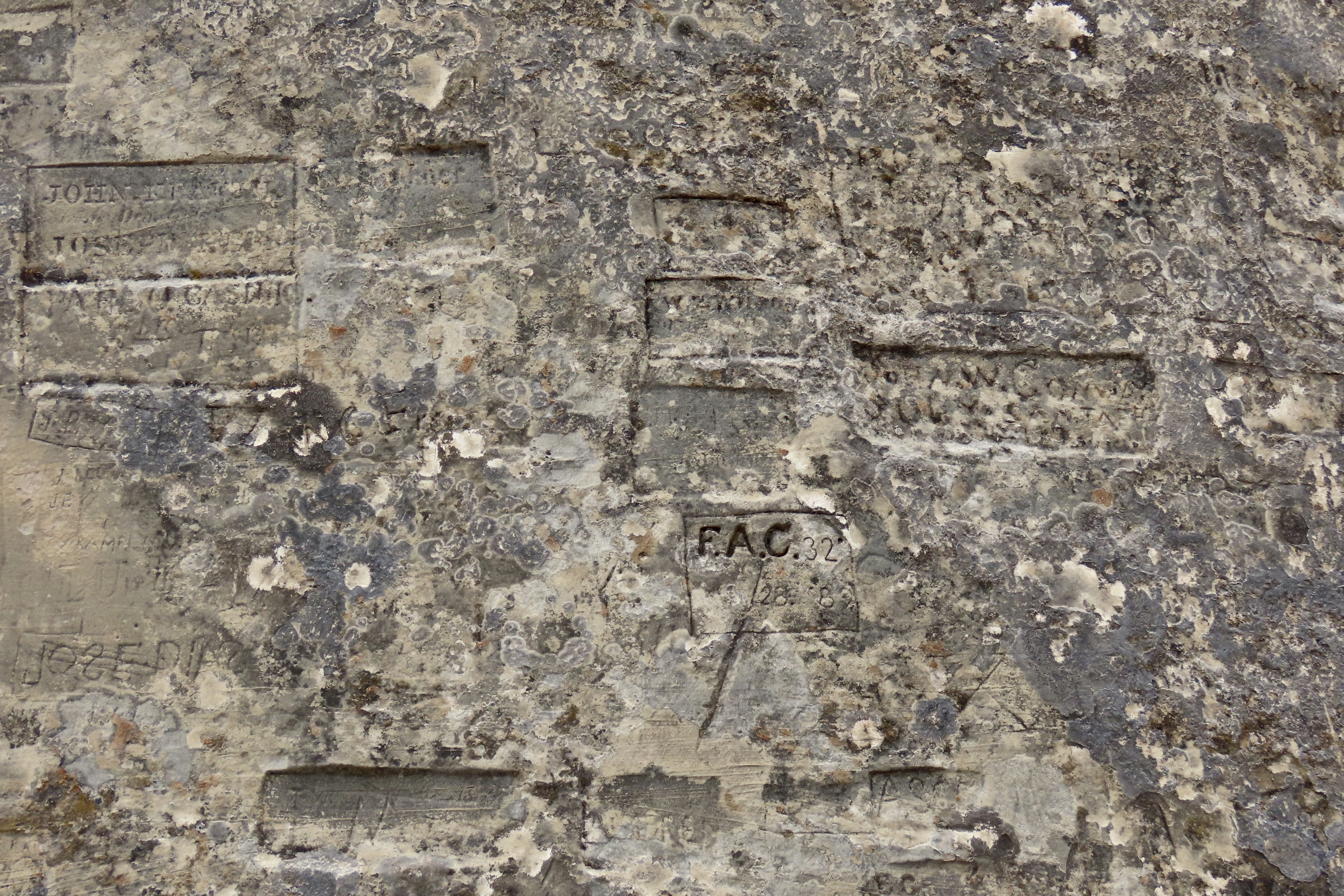
El Morro National Monument: Part 2… The Ancestral Puebloans Who Lived on Top

In our last post we emphasized the beauty of El Morro and checked out the waterhole that has drawn people to El Morro for the past thousand years. Our focus was on the Spaniards and the pioneers who left their signatures behind. Today we are going to spotlight the Ancestral Puebloans who lived on top of the monument in the 1200s and left petroglyphs on the cliff near the waterhole.

Peggy and I were admiring the petroglyphs and signatures on the walls of El Morro when a woman walked by and gushed, “Aren’t the signatures wonderful.” And then, dismissively, “You can find petroglyphs anywhere.” We didn’t disagree on the signatures. The first one had been carved into the rock by the Spaniard Don Juan de Oñate, 15 years before the Pilgrims landed at Plymouth Rock. But the petroglyphs reflect the life of a people who were living here hundreds of years before Oñate was born.

While our understanding of the petroglyphs is limited, we can appreciate the creativity and at least guess at their meanings. The four big horned sheep walking in a row on the Inscription Loop Trail are still four big horned sheep walking in a row, regardless of what else the petroglyph might mean. With insights from the beliefs, legends, and interpretations of modern pueblo people and other indigenous groups, our guessing can improve, opening a whole new world of wonder for us. They certainly have for Peggy and me.

The pueblo, signatures, and petroglyphs are part of the rich history that our public lands preserve and protect. It’s an important aspect of what our national parks and monuments do. Without this protection in El Morro, graffiti would likely cover the inscriptions and petroglyphs on the Inscription Loop Trail, while much of the Atsinna Pueblo would be dug up with zero concern for history— left in shambles as treasure hunters search for ancient artifacts to sell. Before the creation of our park system, such pillage was common. It still can be in unprotected areas.

Today we are facing an even more insidious threat: erasing our history. Apparently, the Trump Administration has decided that including what we have done wrong in history detracts from America’s greatness rather than serving to remind us that we can do better. For example, my Great Grandfather in Illinois utilized his house as a part of the Underground Railroad. It was dangerous. He was helping free slaves. In early April, a page on a national park website described the effort this way: “The Underground Railroad — the resistance to enslavement through escape and flight through the end of the Civil War — refers to the efforts of enslaved African Americans to gain their freedom by escaping bondage,” the page began. The statement was removed as well as a photo of Harriet Tubman, who was central to the effort. The Underground Railroad became part of the Civil Rights movement. There was to be no mention of slavery. After a sustained outcry and substantial media attention, slavery and Harriet Tubman were returned to being part of our history.

It continues. Two weeks ago, Interior Secretary Doug Burgum issued Secretarial Order 3431 that instructs all land management agencies, including the National Park Service, to post signs asking visitors to report any negative stories about past or living Americans by rangers or in signage— even if it is historically accurate.

Rewriting history to match the President’s concept of it and asking Americans to spy on Americans is a whole new type of scary.

And now, it’s time to return to our post on El Morro National Monument, which is part of our series emphasizing the beauty and value of our national parks, monuments, historical sites and other public lands.

We found these holes in the rock near the waterhole. We’ve seen similar holes at a number of other pueblos. They are foot and hand holds that the Ancestral Puebloans used to reach their cliff dwellings, and, in this instance, Atsinna, the pueblo up on top of El Morro.
The water hole is off to the right. The foot holes are behind the pinyon trees center left. It’s thought that the Ancestral Puebloans worked their way up the draw to the head of the canyon where they would have used a ladder or rope to climb up to the top. Note the door like structure on the left. Peggy was fascinated with it. The rangers told us it was caused by how the minerals in the sandstone split. The major splits, like those to the right and left of the ‘door,’ cut through the whole bluff and help determine where major erosion takes place.
A close up of the canyon gives a better perspective on the nature of the climb. Imagine carrying water up! Not easy. My imagination (plus experience from 50 years of backpacking) would have them work across the canyon to the dark split, follow it up, work around the boulder and then use a ladder or rope on the last section. I was amused to learn that one type of ladder that Ancestral Puebloans reportedly used was cutting foot notches in a slender log…
Like this one I used as a Peace Corps Volunteer in Africa (1966). Grin.
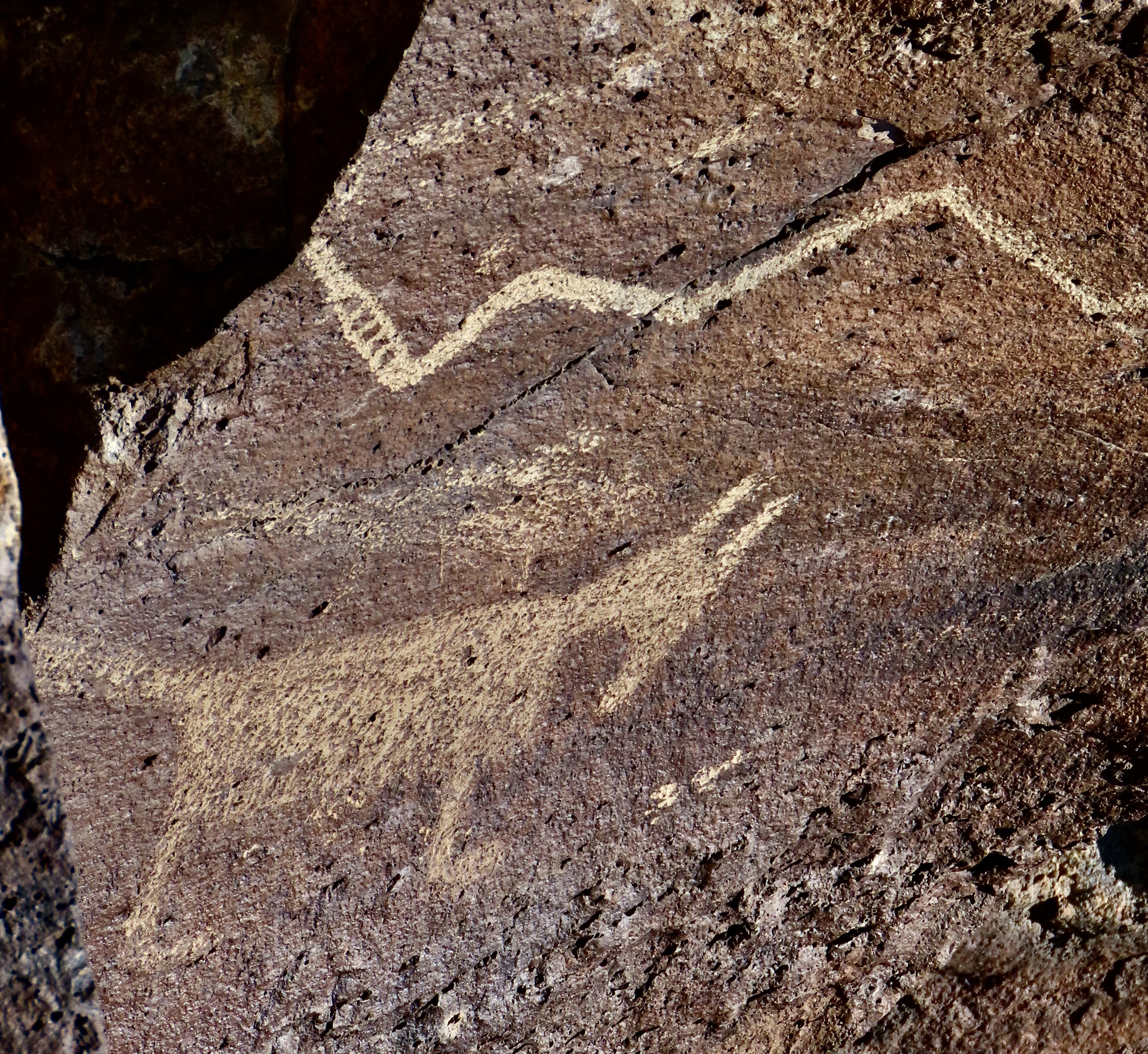
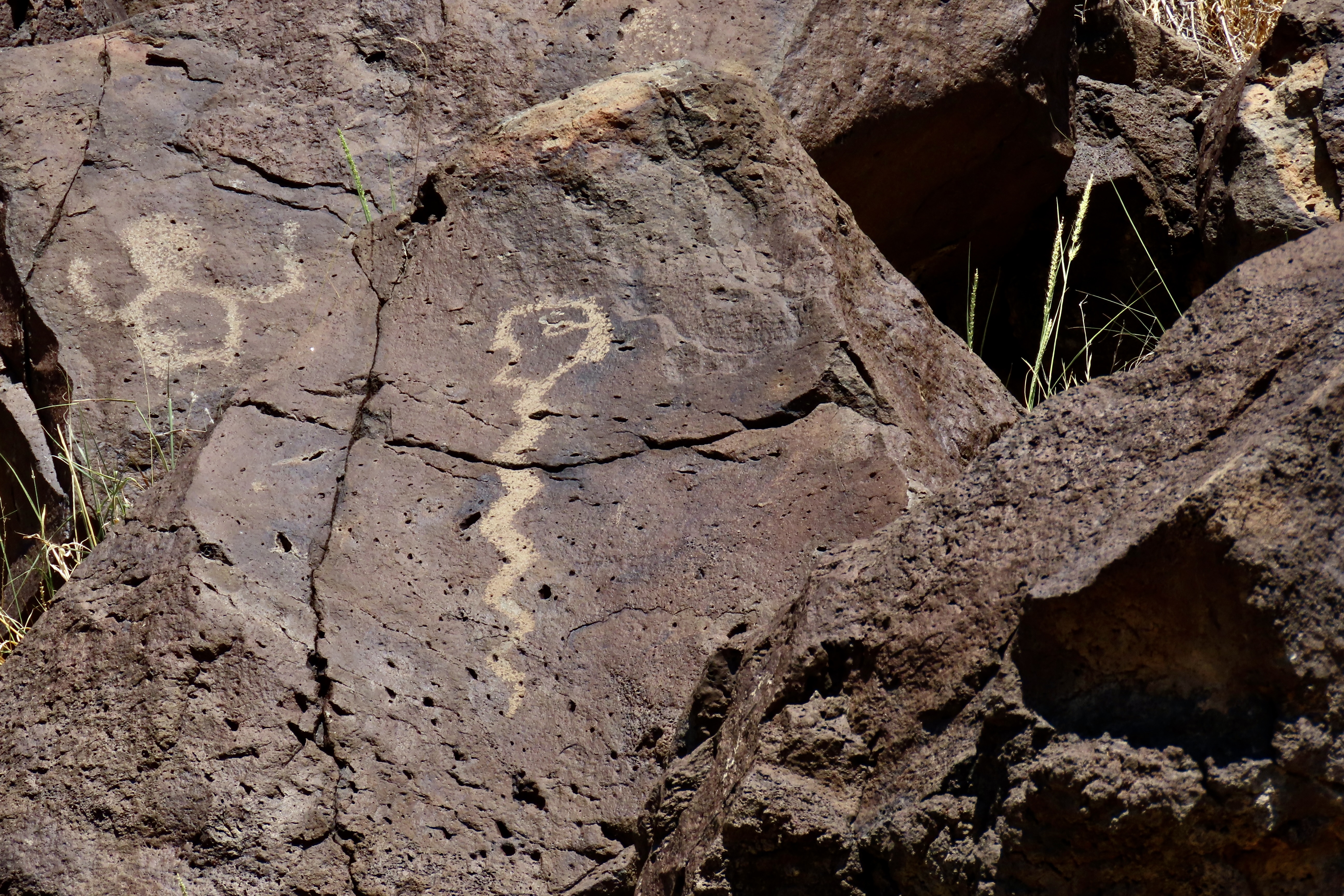
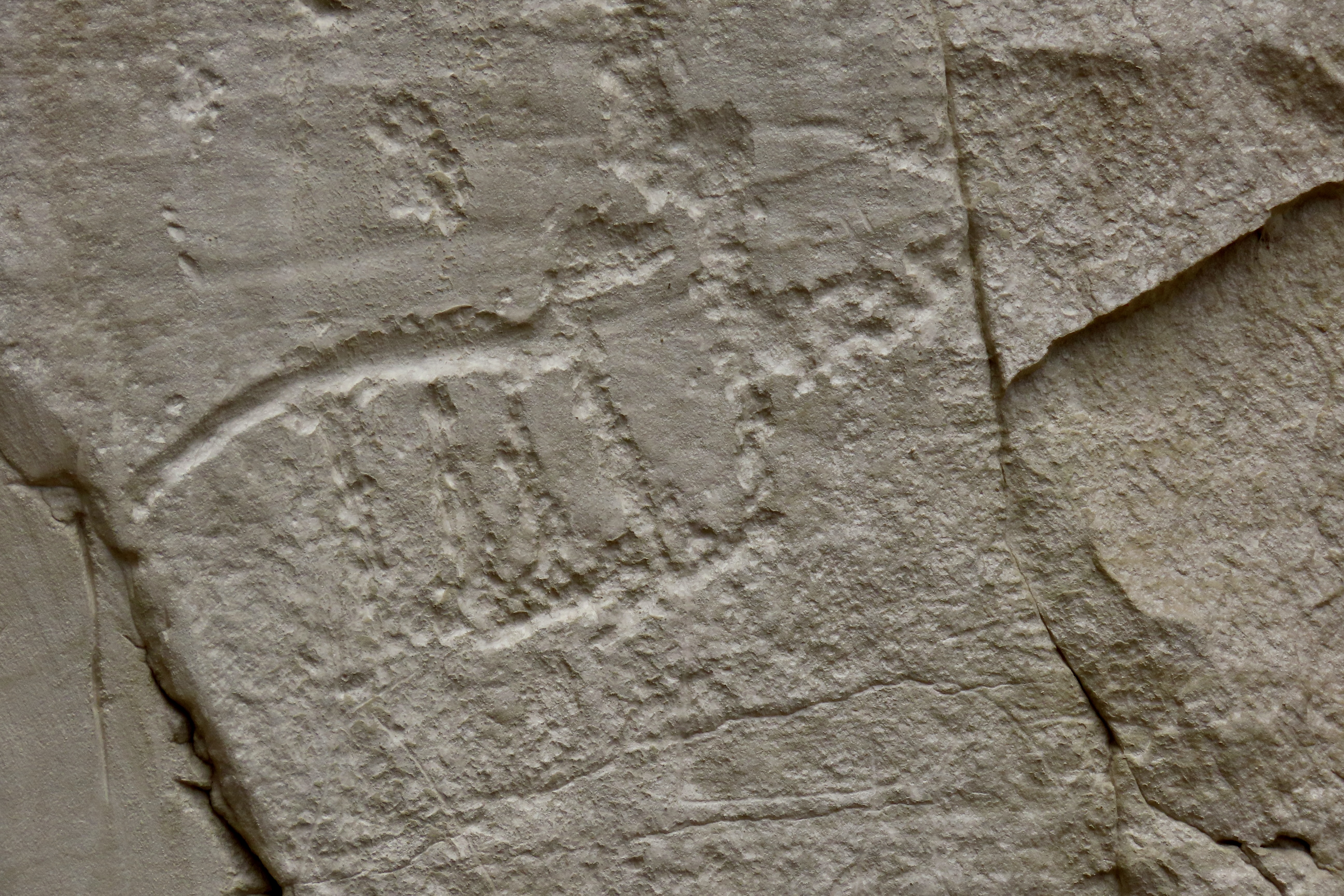
El Morro National Monument protects the petroglyphs found in the park. Some of these would have been carved by the residents of the Atsinna, while others would have been left by Ancestral Puebloans living in different locations in El Morro Valley. Add to this, petroglyphs left behind by indigenous peoples living in the area before the Ancestral Puebloans, and it’s likely that the petroglyphs represent several cultures. We found 25 on this panel alone including several hands, a likely bear print, lizards, a snake, a deer and possible sandal prints. Some of the petroglyphs may represent various clan symbols. I would guess the holes were made by people using the petroglyphs for target practice.
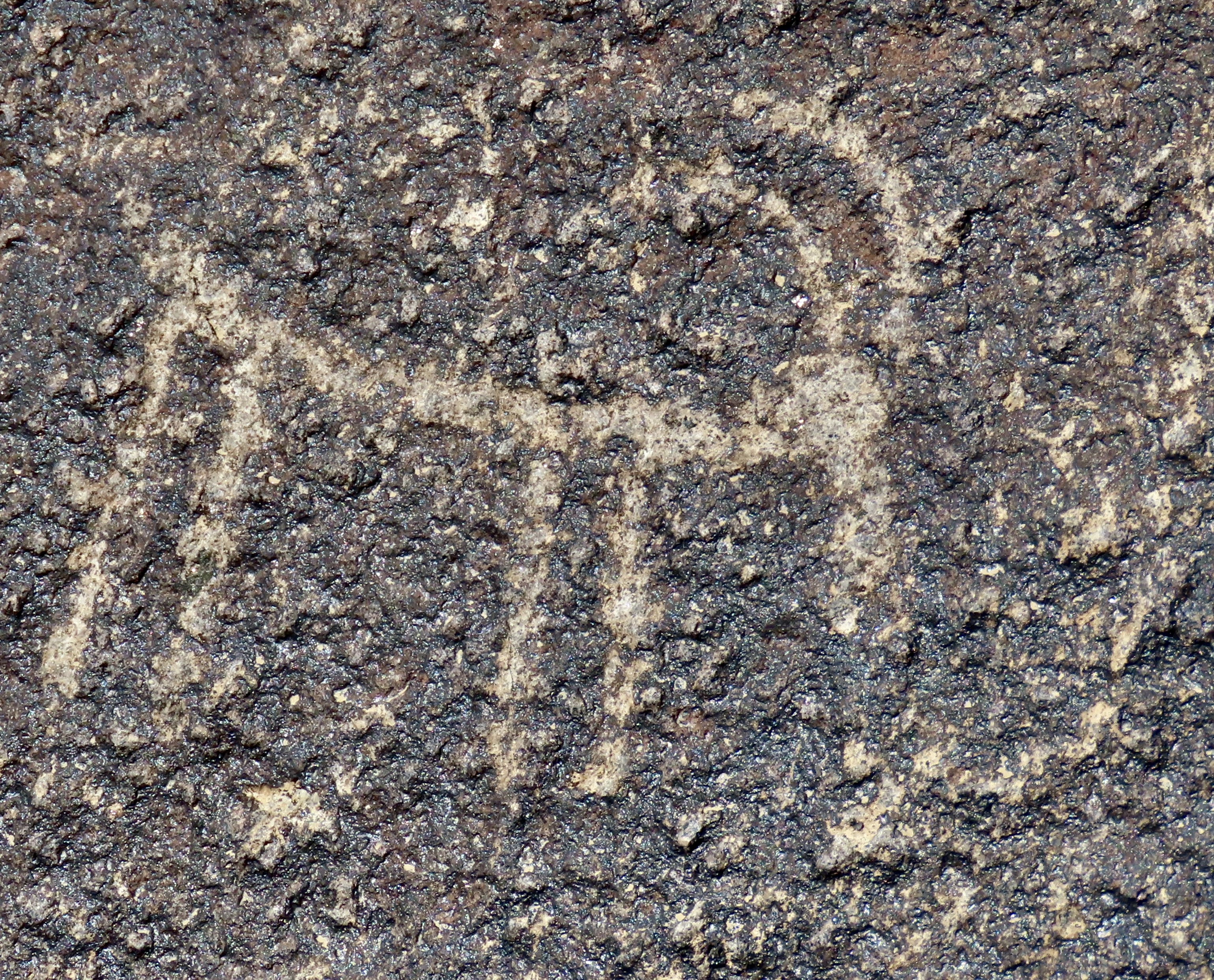
There are times when Peggy and I just have to smile at a petroglyph whether the original artist meant us to or not. This long legged coyote or dog is a case in point. Road Runner, of cartoon fame, might have been in serious trouble had Coyote had legs like this.
While this may not be the case here, this petroglyph is often used to represent a woman having a baby. It isn’t surprising that such an important event is commonly found among petroglyphs.
We rarely find petroglyphs in the Southwest that don’t include lizards (and snakes). No surprise.
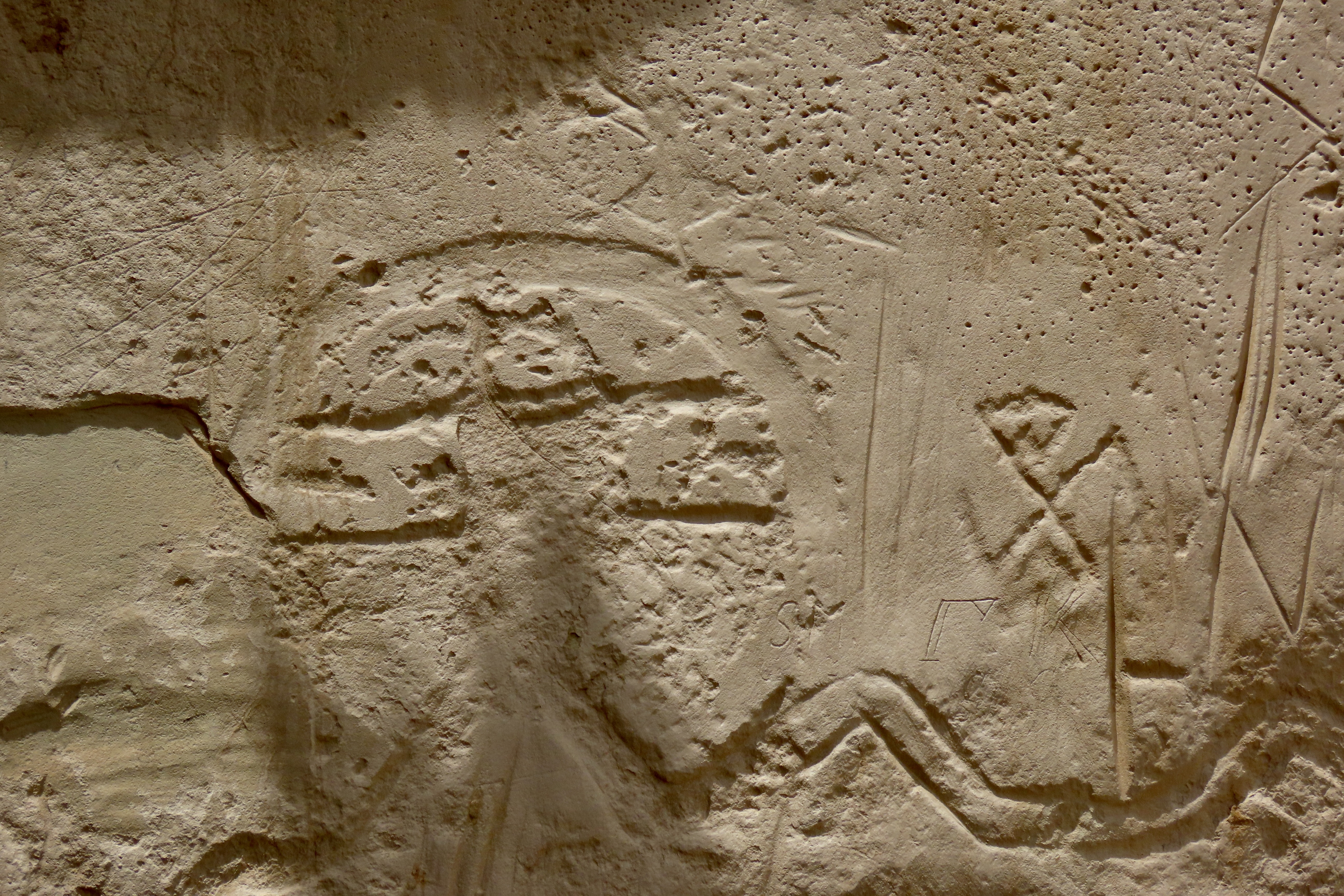
This particular series of petroglyphs contained three important symbols of Ancestral Puebloan culture. The large round petroglyph with its two lines represents the Sun Father, one of the most important deities of Zuni Culture. The squiggly line is the water serpent that helped Ancestral Puebloans find water, a critical contribution to their survival in Southwest deserts. The swastika-like symbol on the right was used in Europe, Asia and America long before it was adopted by Hitler. In the Southwest, it was used by both the Navajos and the Ancestral Puebloans with a positive message. The Zuni saw it as a whirling log that represented the six cardinal directions: North, South, East, West, Up and Down— and the guardians associated with each direction.

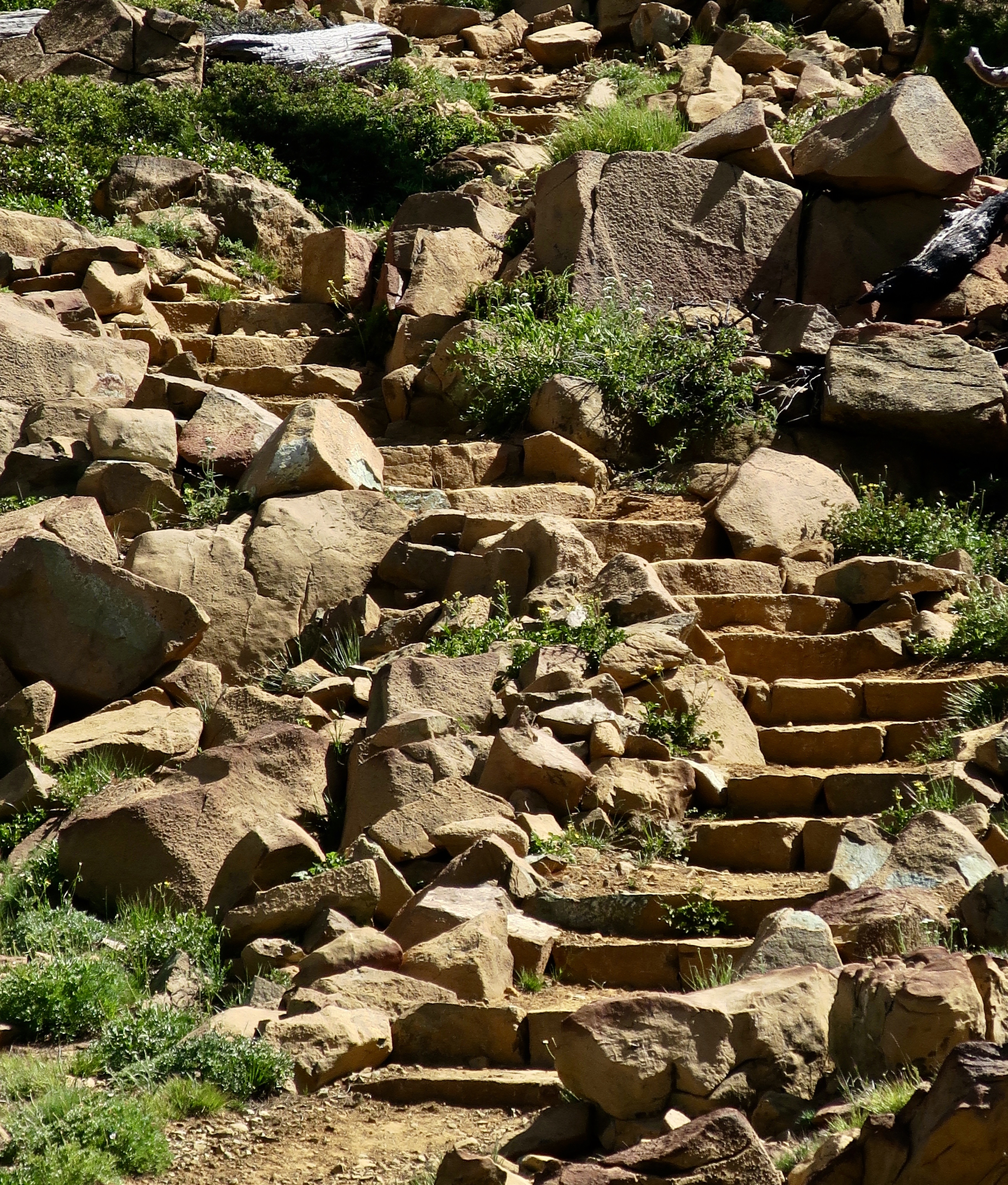
I joked with the park rangers when we came back to see Atsinna about using the Ancestral Puebloan route up. He laughed, “I’d recommend the stairs. There are 130 of them.” “Piece of cake,” had been my response. “Actually,” he amended, “there are 132.” “Oh no!” I whined.

Some of the steps leading up to Atsinna. I suspect that the Ancestral Puebloans would have loved them.
We stopped frequently on our way up to Atsinna to admire the view over El Morro Valley.
And admire the wildlife. Not our best lizard picture, but she’s special. The desert whiptail lizard reproduces by parthenogenesis, which is a rather long word that means she doesn’t need a male in her life to make babies. (Although she can do it the old fashioned way.)
Eventually, we reached our goal. The climb up had been easy, given our stops to admire the scenery. The name Atsinna, which means ‘place of writing on the rock,’ was given to the pueblo by the Zuni whose home pueblo is a short 34 miles away.

One of the real treats on our visit to El Morro was to meet two Monument Rangers who are Zuni and live at the Zuni Pueblo: Calvin and Valentino. We first met them when we were hiking up to Atsinna and they were doing trail work, and again when we came back down, this time just outside of the Visitor Center, where we talked for a half hour or so. Before we could ask, Valentino explained to us he was named Valentino because he was born on Valentine’s Day. I’m sure he gets asked that question a lot. I had been picturing the dashing “Latin Lover” of the silent film days, Rudolph Valentino.

In addition to working at the Monument, both held important roles of educating children at the Zuni Pueblo on tribal history, culture and language. At 70, Valentino was a tribal elder. Our discussion ranged from the preservation and restoration of Atsinna Pueblo to the Zuni Belief system.
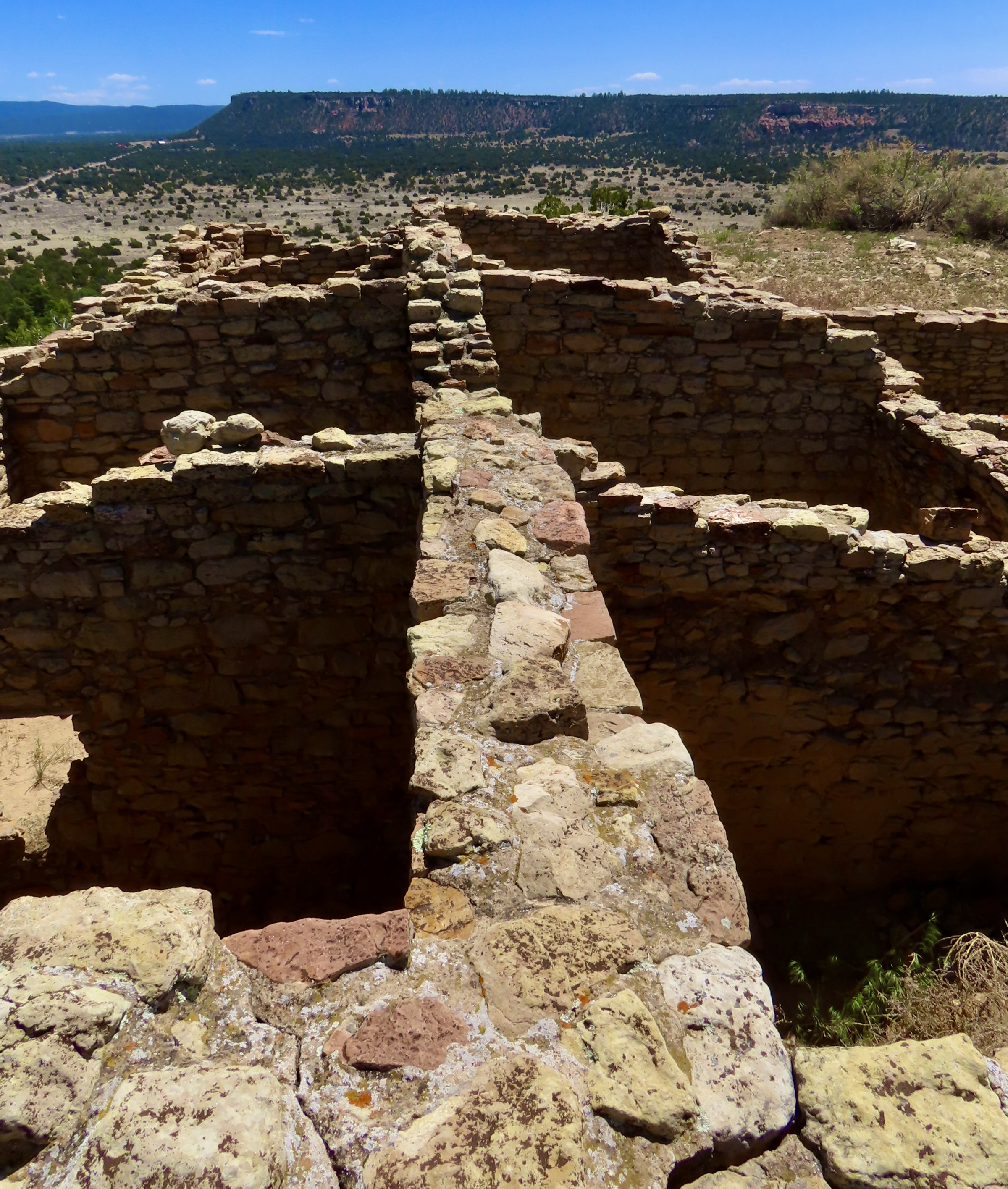
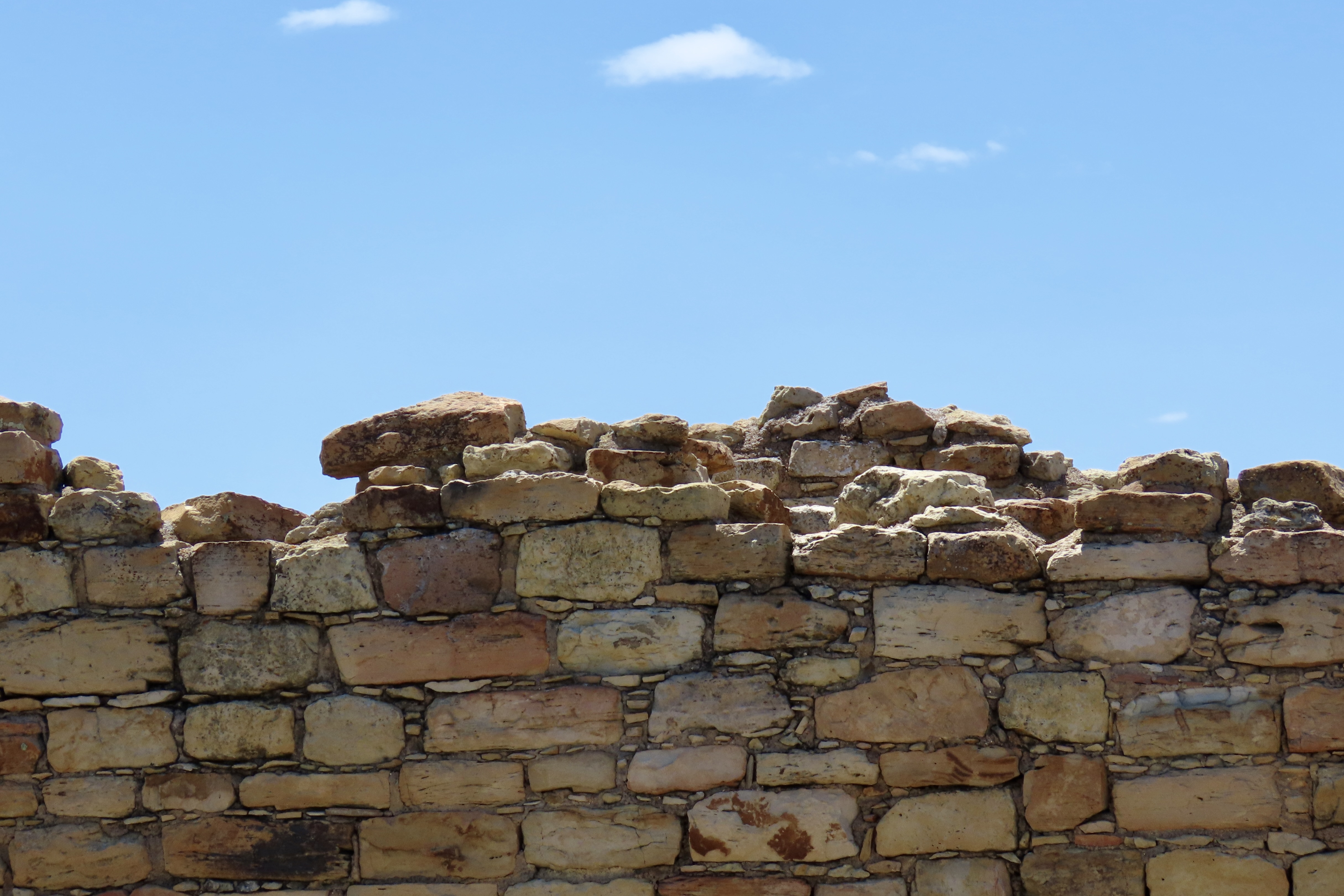
Atsina was built around 1275 CE and occupied for a hundred years or so. It covers an area of 200’ by 300’ and accommodated between 500-600 people. There were 355 interconnected rooms that surrounded an open courtyard.
This old aerial shot by the National Park Service shows the original size of the Pueblo outlined by the difference in vegetation as well as the rooms that were excavated in the 50s.
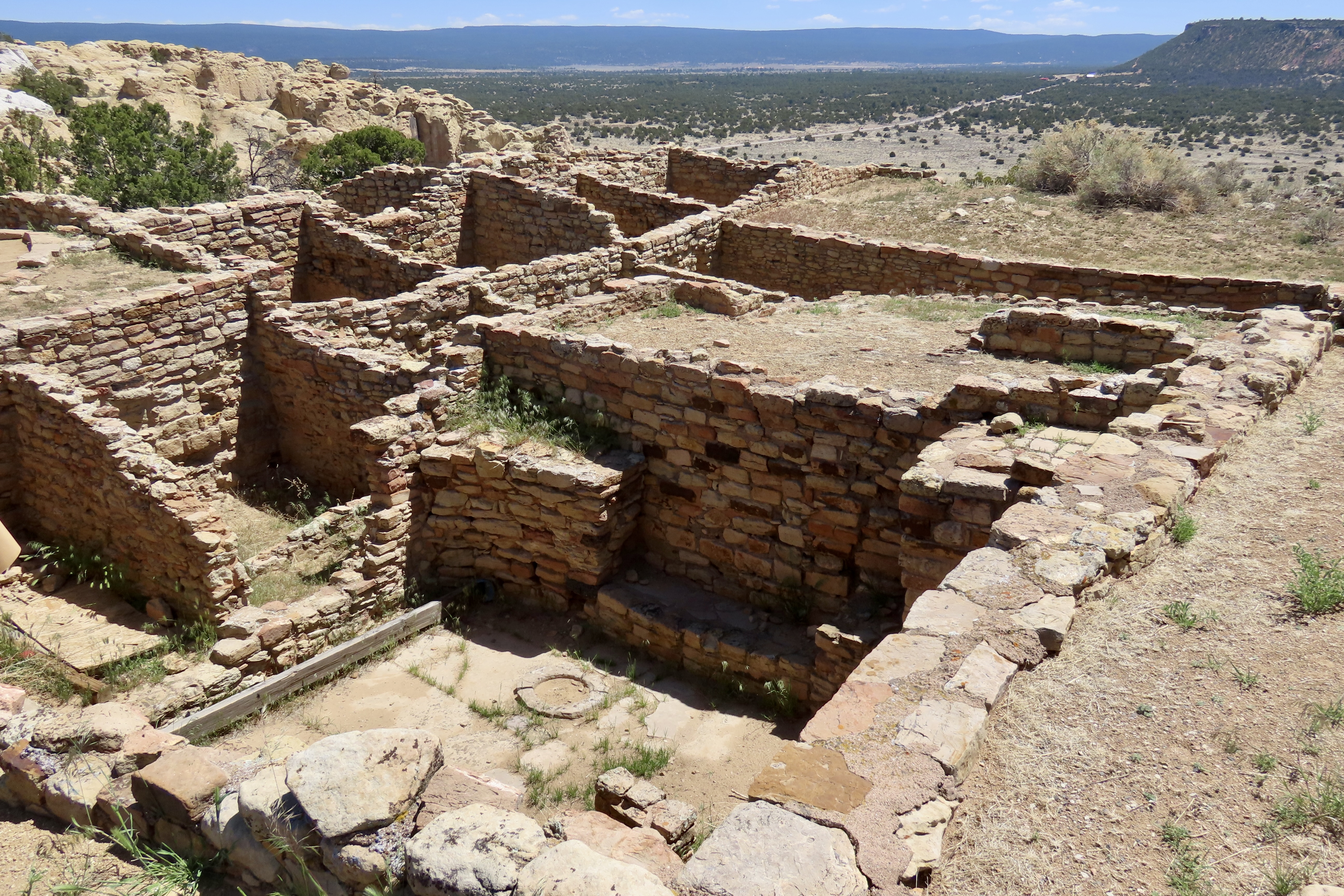
Another view of the excavation. The room in the front is one of two kivas excavated at Atsinna, this square one and a larger round one.
Kivas were central to Puebloan life for important religious rituals and ceremonies. They also played a role in maintaining social cohesion and supporting cultural traditions. Most were laid out in a similar fashion. Pueblo people today continue to build kivas and use them much in the same way.
Preservation and restoration has become an important part of maintaining Atsinna and other Pueblos. Valentino and Calvin told us that the excavation of the 1950s had used concrete to reinforce the upper walls. The added weight had caused the walls to collapse. Walls are held together today using materials that mimic the original in texture and hardness.
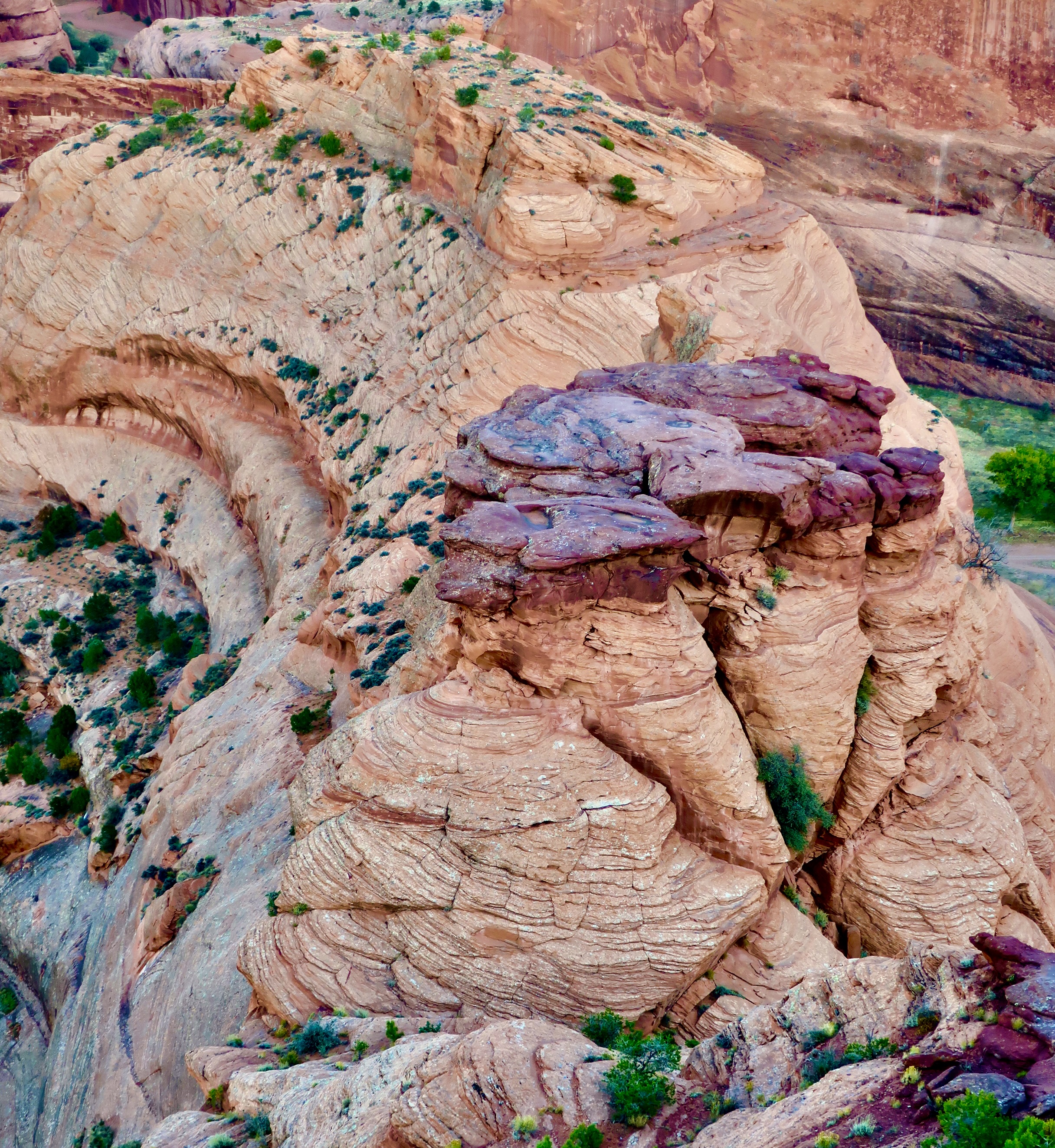
A view of the top as seen from the pueblo. I found the contrasting colors of the red and white sandstone both interesting and photogenic. Atsinna rests on the red Dakota sandstone deposited in a Mid-Cretaceous Sea. In turn, the Dakota sandstone rests on bleached Zuni sandstone that was laid down around 150 million years ago when a vast Saharan type desert of sand covered the area. What’s known as an unconformity of 80 million years exists between the Zuni and Dakota sandstone, i.e. 80 million years of geological history was eroded between the two! That’s enough for today! More than enough?

Next up I am going to explore three wilderness areas in California as part of my series: The Mokelumne, Granite Chief/Desolation, and Marble Mountains Wilderness areas. While these wilderness areas are not presently threatened by Trump Administration policies, there is no guarantee that they won’t be.

First up, the Mokelumne Wilderness.

El Morro National Monument… Towering Cliffs, Pueblo People, Spaniards, and Camels: Part 1

El Morro National Monument is located in western New Mexico about 40 miles south of the Route-66 town of Grants (just off I-40) in a water starved region. It’s hardly surprising that a year round waterhole located at the base of the promontory has been a welcome stop for people passing through and/or living in the area for over a thousand years. Many left their mark.

Ancestral Puebloans— whose descendants include modern day Zuni— came first. They lived on the top of El Morro in a pueblo that the Zuni have named Atsinna, and climbed down to the waterhole where they gathered water and used rocks to pound and carve petroglyphs into the relatively soft Zuni sandstone.

The Puebloans were followed by Spanish treasure hunters driven by an insatiable hunger for fabulous wealth and everlasting glory. They believed they would find it in the legendary, gold-filled Seven Cities of Cibola. (El Morro is in modern day Cibola County.)The treasure hunters were accompanied by Spanish missionaries with a different goal: Winning souls for God and King. Turns out the the cities of gold were a myth and the indigenous population didn’t understand why they couldn’t keep their own deities while accepting God’s help as well. They were even more dubious about a distant king whose motives were questionable at best.

Finally, American pioneers and soldiers passed through in the mid-1800s. The pioneers were seeking a new life from the one they had left behind in the East. They, too, were searching for treasure but theirs was to be found as farmers, ranchers, miners, loggers and merchants. The fact that indigenous populations already lived in the areas they wanted to settle was of little concern, unless, of course, the natives objected. That’s what soldiers were for.

The Spaniards and Americans, like the Puebloans, left their marks on the cliff, but this time they signed with their signatures using chisels and knives. One of the primary reasons people visit El Morro is because of the various signatures and petroglyphs. There are over two thousand. Some, like Peggy and me, also come because of the beauty and culture.

Because of the length of this post, I’ve decided to break it into Part 1 and Part 2. The first part will emphasize the area’s beauty and the early visits by Spaniard treasure hunters and American pioneers between the 15th and 18th centuries. In the second part, Peggy and I will focus on the Ancestral Puebloans from the 11th century.

Today, Peggy and I are continuing our series on national parks, monuments, and wilderness areas with an emphasis on their unique beauty, geology, flora, fauna and history that makes them so important to us today— and to our children, grandchildren and future generations. I can only repeat how vital it is at this point in history to let decision makers know how we feel about protecting and maintaining public lands. It makes a difference.

For example, the Trump Administration’s provisions for selling off public lands and building a mining road through the Gates of Arctic National Park in Alaska were both removed by Republicans from his “Big, Beautiful, Bill” last week for FY 25/26. Once gone, the public lands (that belong to all of us) would be gone forever. As for Gates of the Arctic, it is one of the world’s largest remaining roadless and trail-less wilderness areas. A road through the heart of it would change its pristine nature significantly and open up other National Parks for similar treatment.

As with each of our previous posts in this series, we will present photos that focus on the beauty and unique characteristics of the park, monument, or wilderness we are blogging about. All photos have been taken by either Peggy or me unless otherwise noted.

Now, please join us as we explore El Morro.

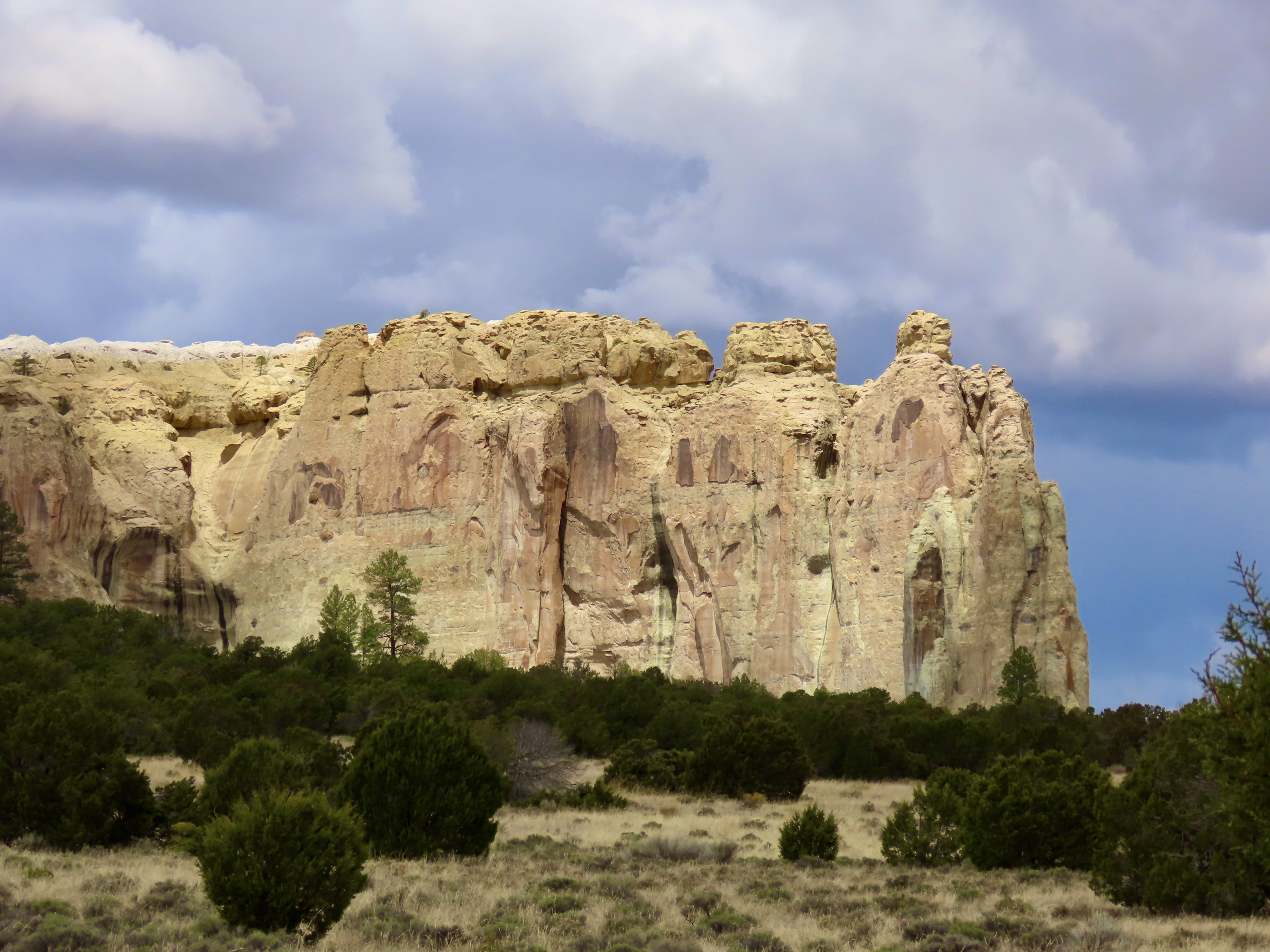
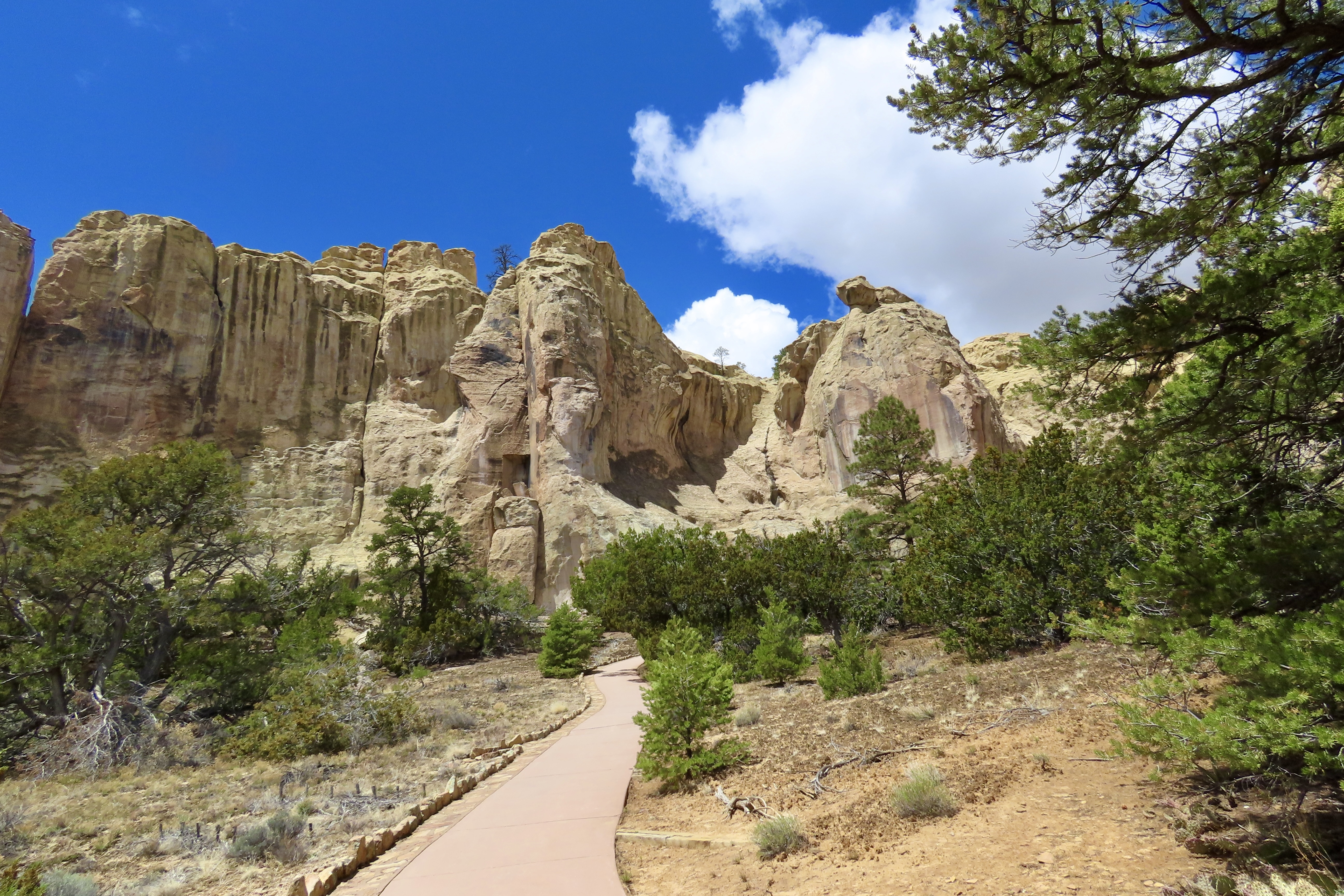
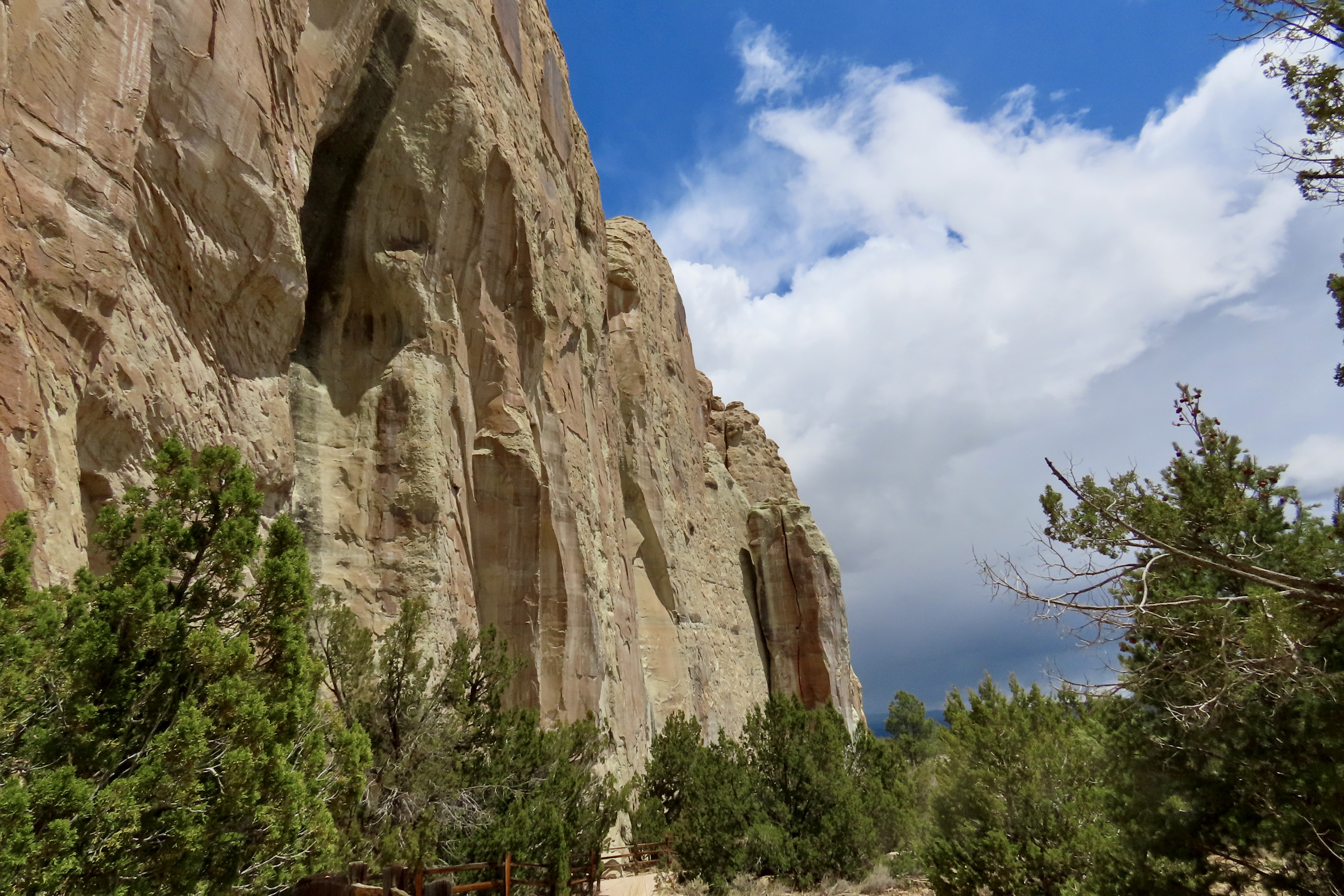
This was our view of El Morro as we approached the National Monument on Highway 53 ( the Trail of the Ancients) from Grants,New Mexico. The Spaniards gave El Morro its name, which translates as a promontory or headland. Geologically speaking, El Morro is a cuesta with a sharp, steep face on one side and a gentler slope on the other. I was interested in the white top you can see on the left (more on that later). The signatures and petroglyphs started to the left of the two Ponderosa pines where the waterhole is and extended along the base of the cliff to around the corner.
Like most national park and monument visitor centers, El Morro’ was beautifully designed to fit into its environment. (Note: Peggy and I made two visits to the Monument: One to check out the petroglyphs and signatures, and two, to hike up to the top and explore the Atsinna Pueblo. That’s why our photos include cloudy and relatively clear skies.)
The low profile of the building provided excellent views of the main attraction. We were eager to explore, but first we stopped at the Visitor Center…
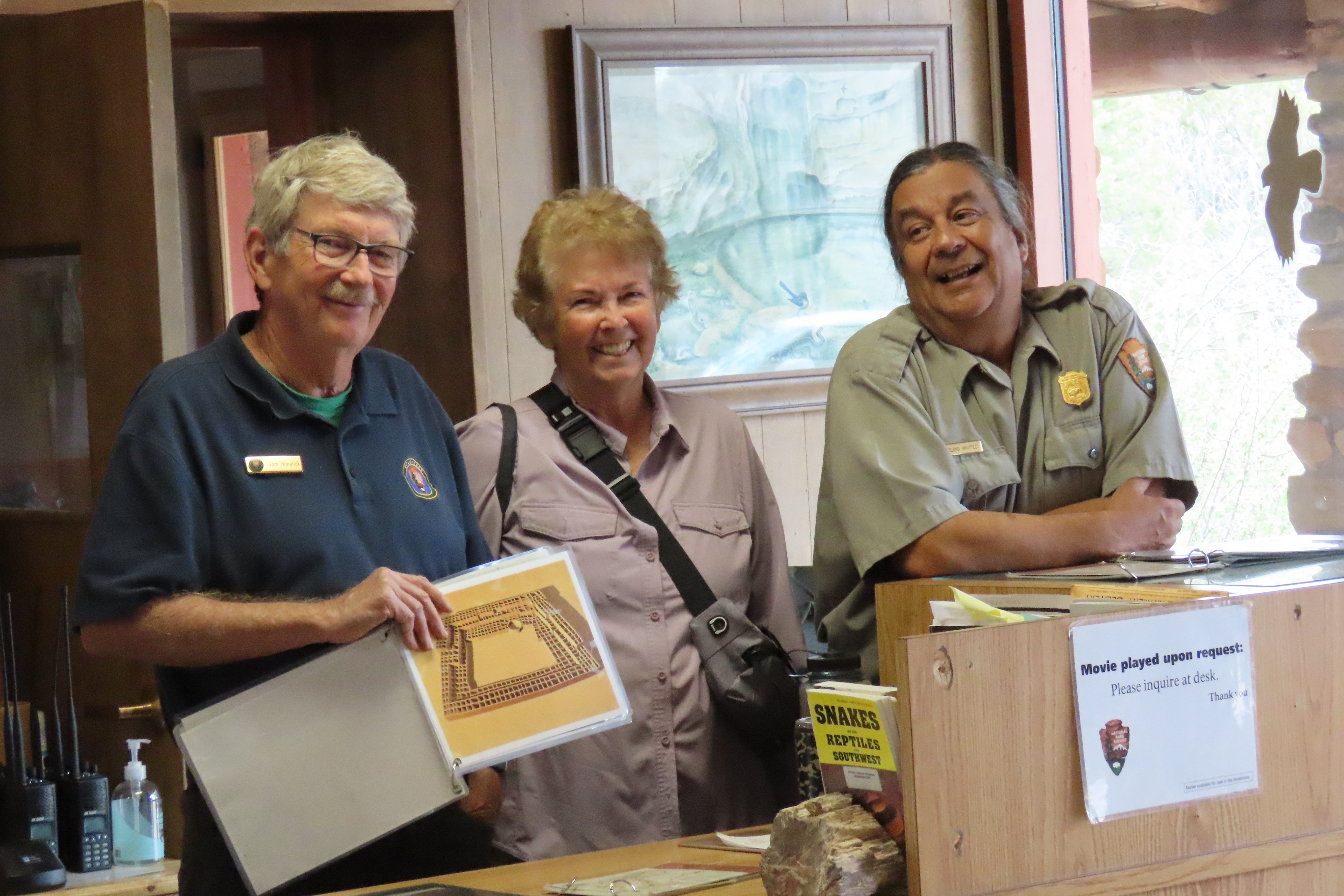
Where we were greeted by staff with welcoming smiles and a ton of information they were eager to share about the monument. Both staff and displays are vital to enhancing the national park/monument experience. The illustration is what Atsinna Pueblo on top of El Morro would like if fully excavated. Note Peggy’s new haircut. El Morro is only open five days a week. That may be because of the Trump Administration’s cuts in staff.
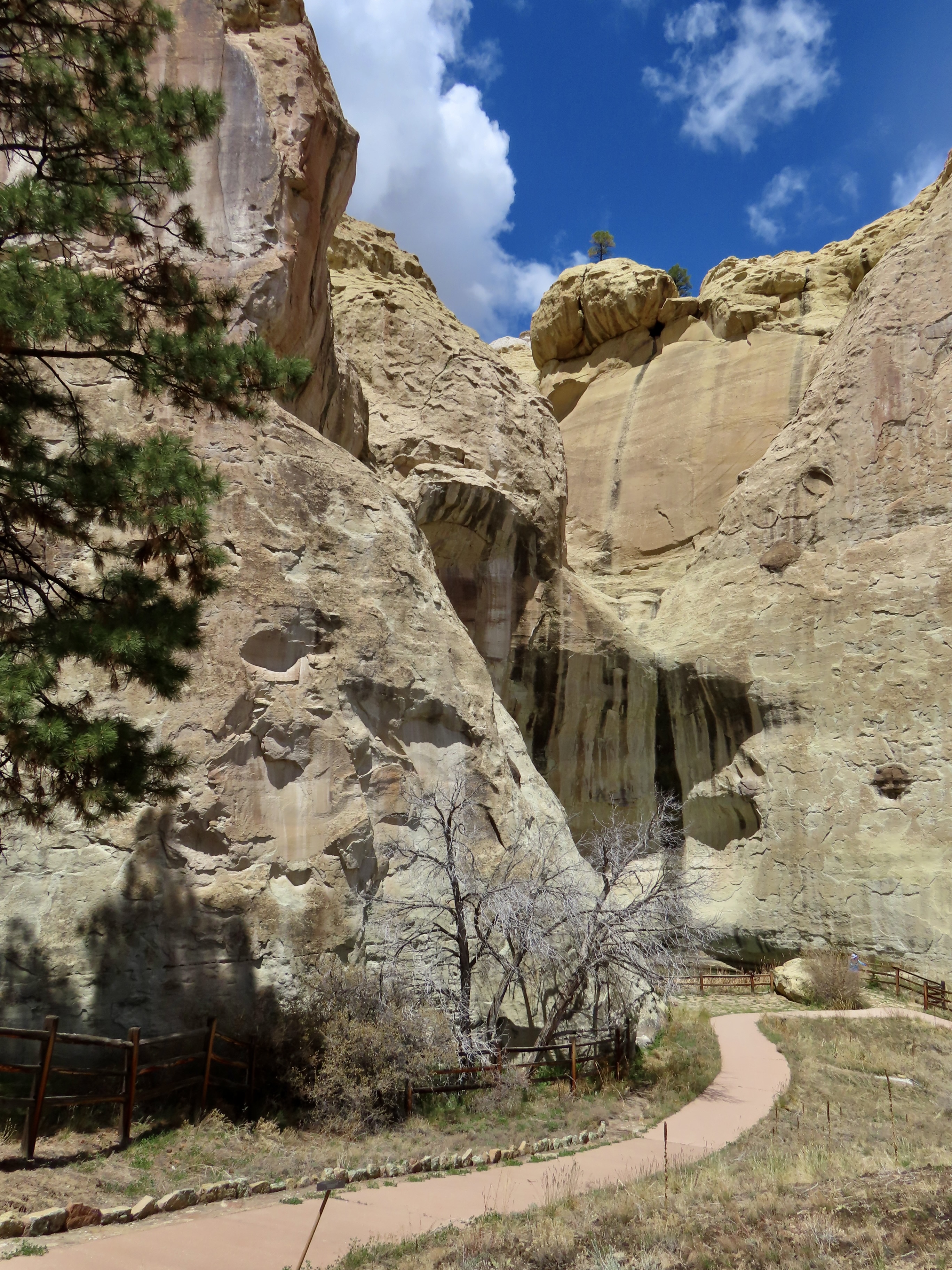
An easy, paved trail leads from the Visitor Center over to the water hole, petroglyphs and signatures.
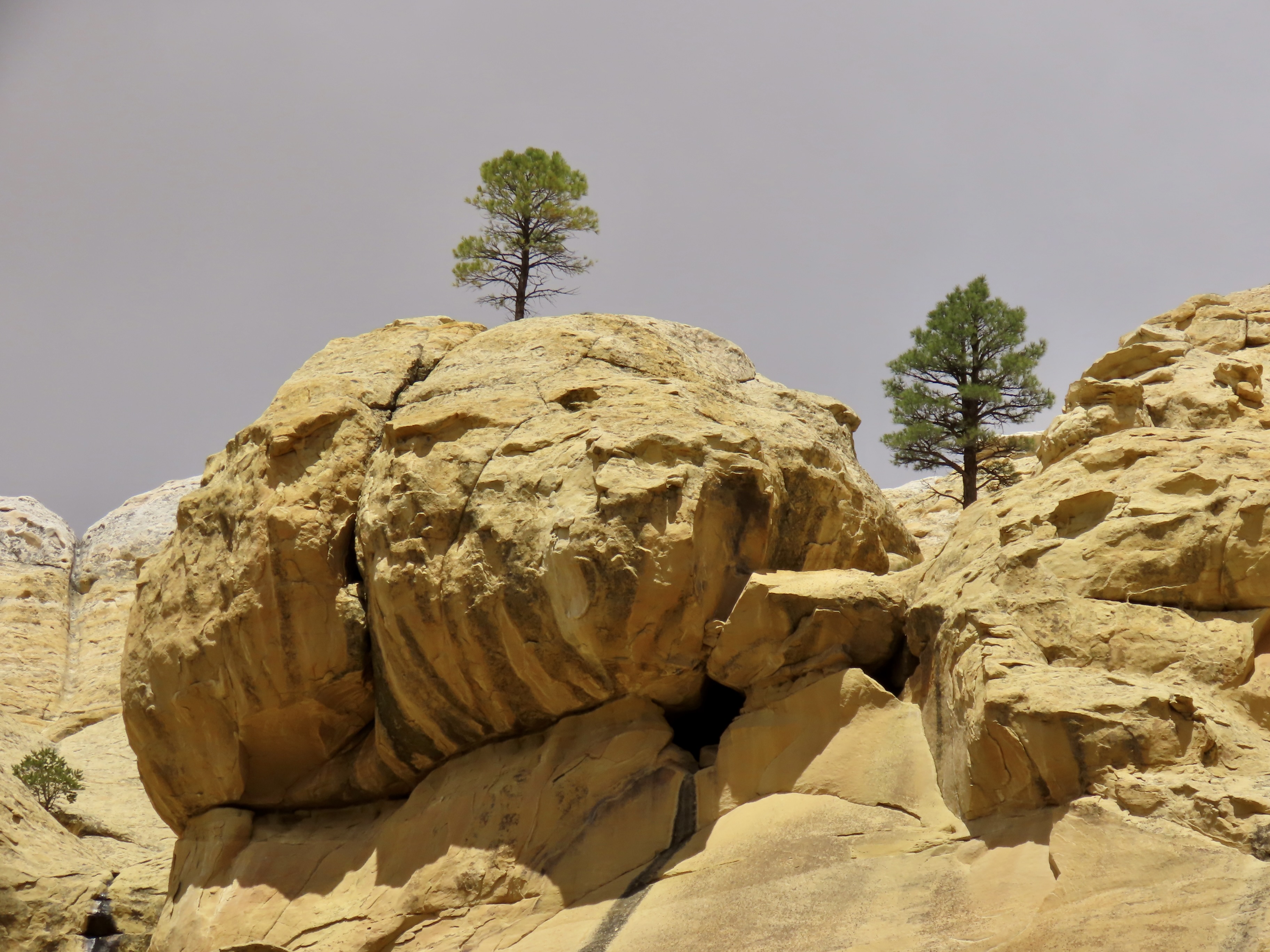
The waterhole is at the bottom the bottom of the hill behind the fence. The cliff above the pool is about 200 feet high. A large rock with a ponderosa pine stands on top.
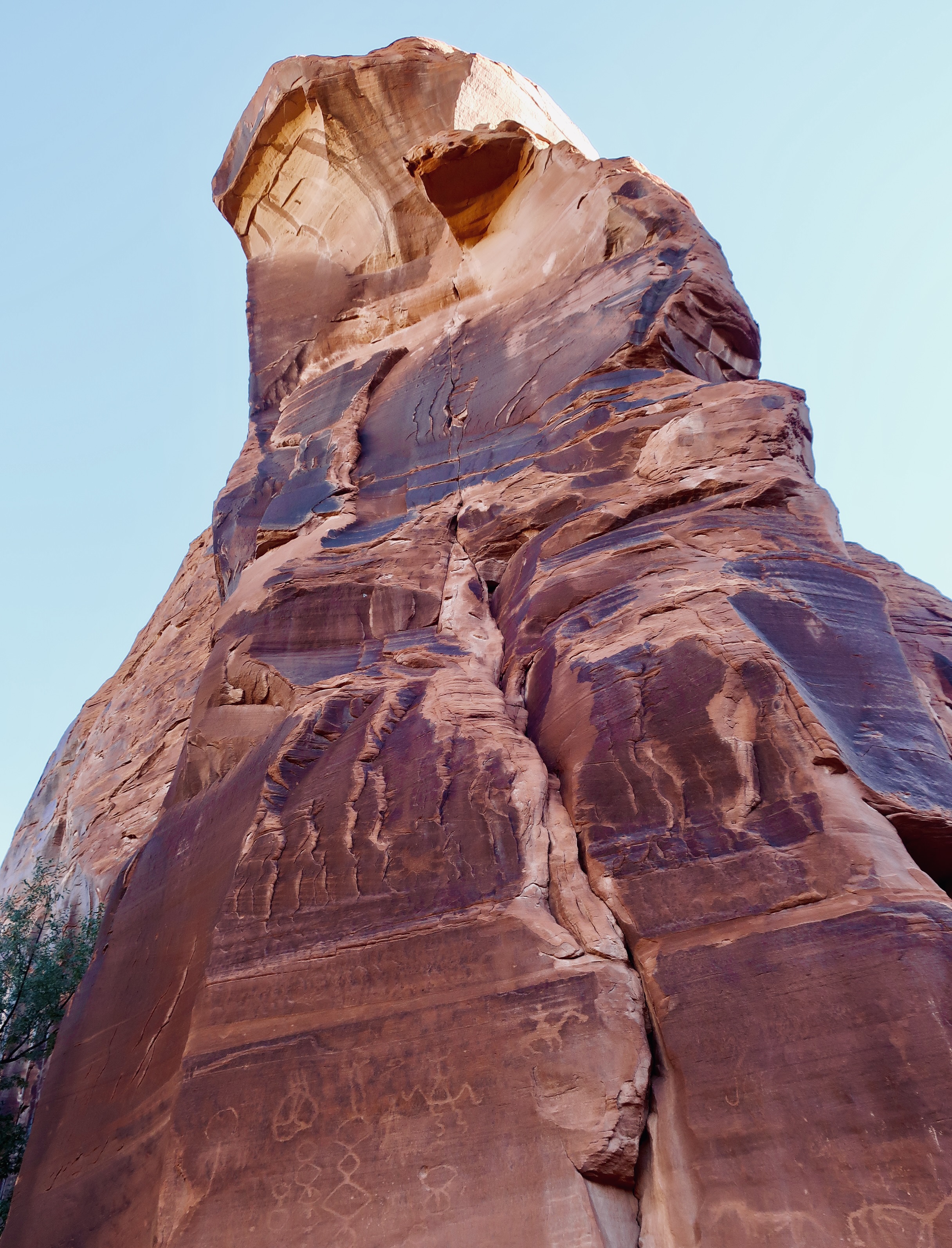
This impressive rock monument stood to the left of the pool. We imagined an Ancestral Puebloan looking down at us.
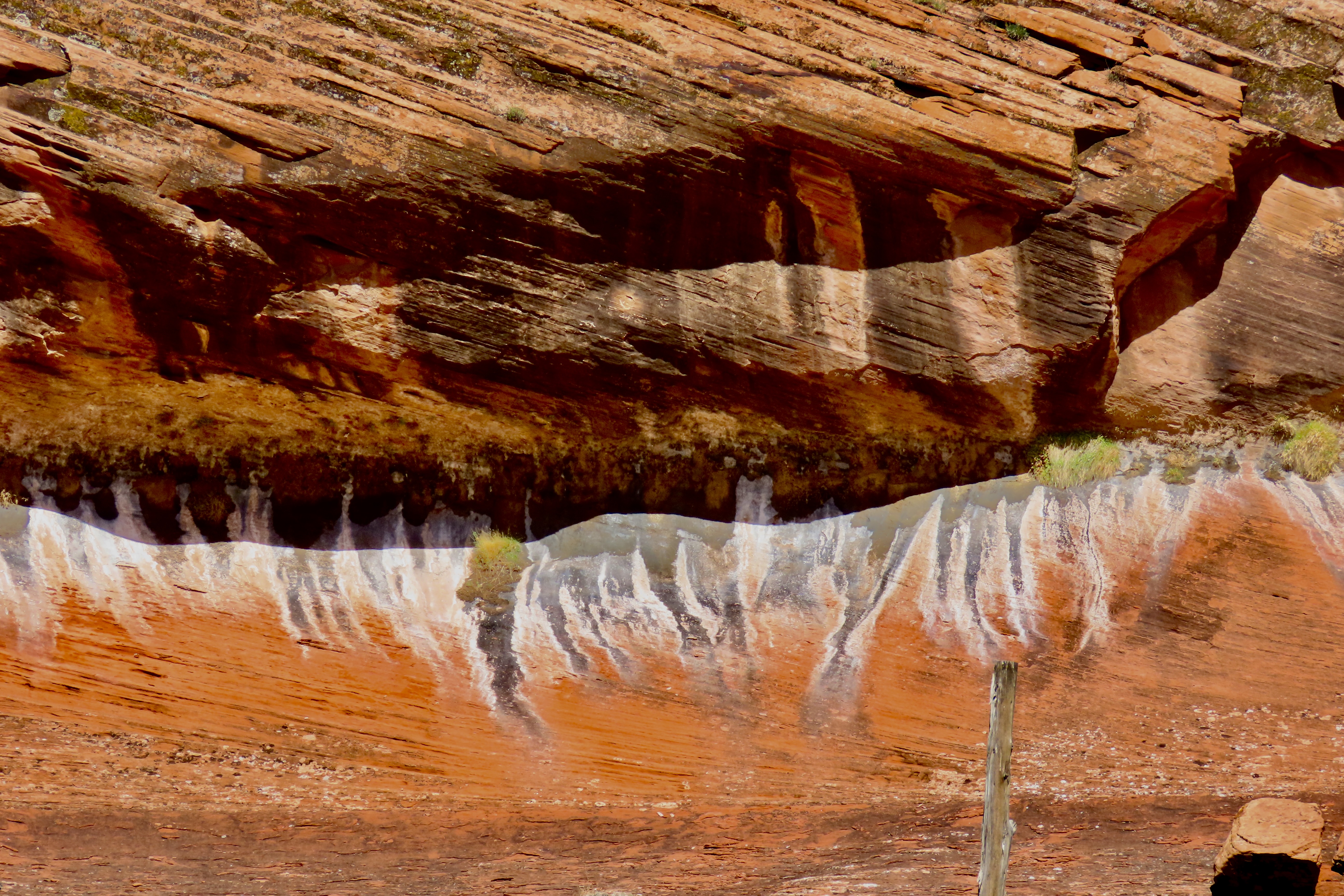
It’s hard to believe that this pool of water surrounded by cattails could play the significant role it has. But the fact that it holds up to 200,000 gallons of water and doesn’t run dry made it a treasure for everyone from the Ancestral Puebloans in the 1200s to cattlemen in the 1900s. Up until 1961, it even provided water for the monument headquarters and visitor center. At first it was thought that the water was provided by a spring. Actually it is fed by runoff from the top. The dark stains on the side (desert varnish) are left behind by minerals in the water such as manganese.
I’ve always liked cattails. One of my favorite hangouts in my unsupervised youth was a small pond about 1/3 filled with cattails. When the heads reached this stage, I would break them off with a portion of their stem, shake them vigorously, and send their aerial seeds flying off in all directions!
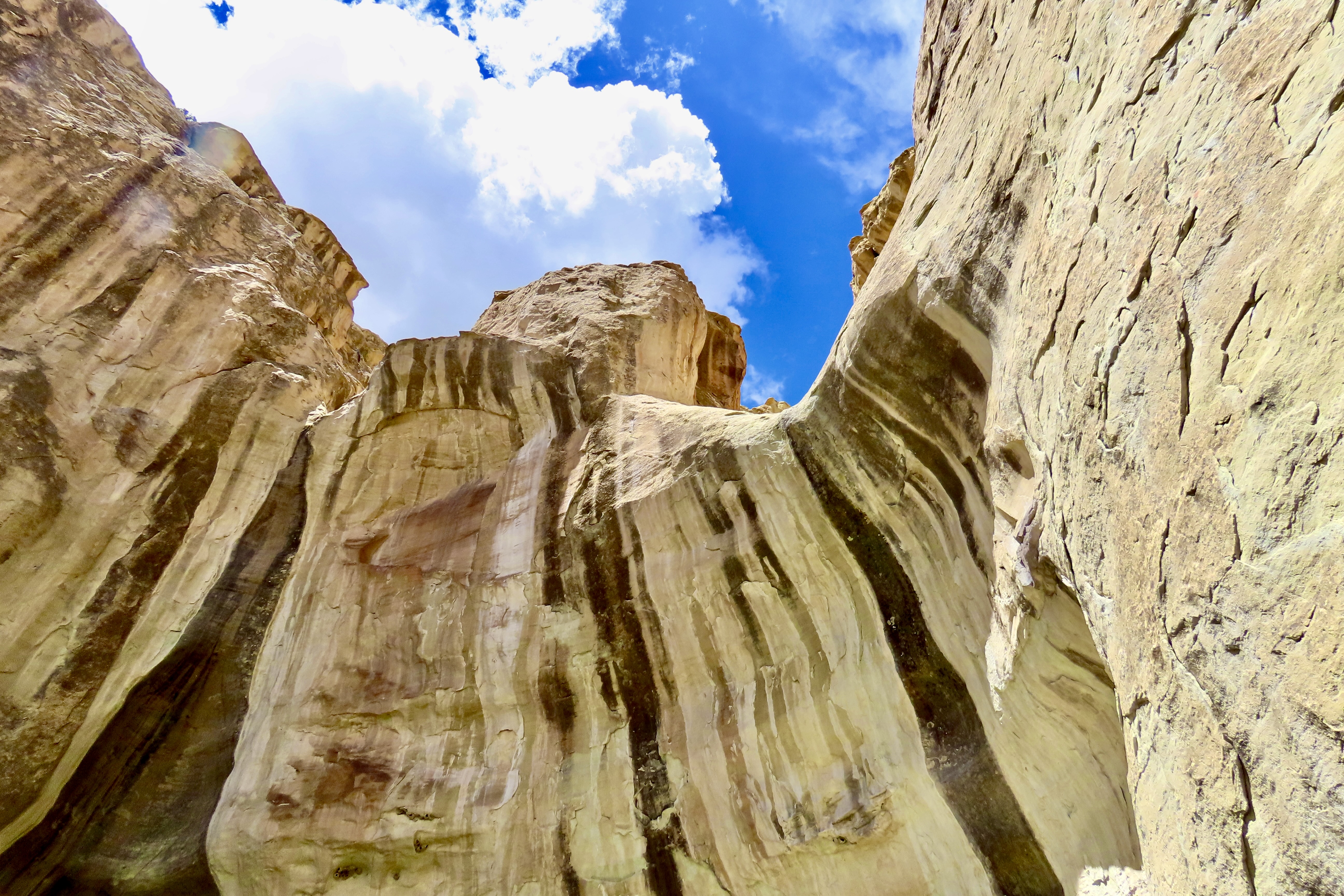
We thought looking up at the desert varnish provided an interesting perspective. I believe the section that is missing was a rockfall in 1942 that filled the waterhole and had to be cleaned out.
We were quite curious about this boulder embedded in the sandstone above the spring. While the timing was off in terms of when the sandstone was created, it looked like a petrified tree stump.
We were at Petrified Forest National Park last week. This was one of many petrified logs we saw.
A cliff swallow’s concept of a pueblo! They make their nests above the waterhole. In addition to being a safe location, the insects that live around the waterhole provide a convenient supply of food for feeding squawking, hungry chicks.
Leaving the waterhole, we hiked along the path at the base of the cliff checking out signatures along the way. (I’m saving the petroglyphs for my next post.)
A close up.
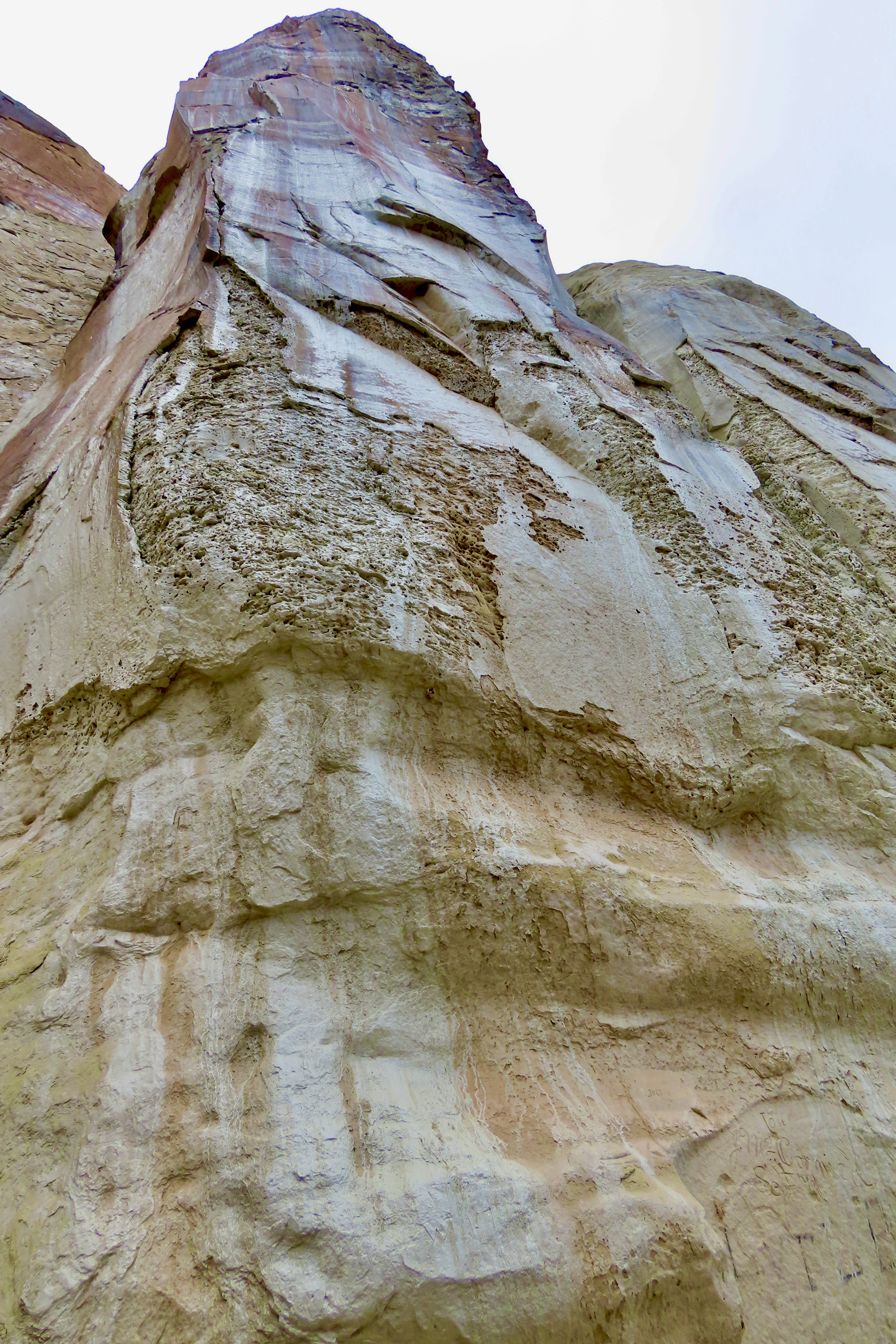
Looking up…
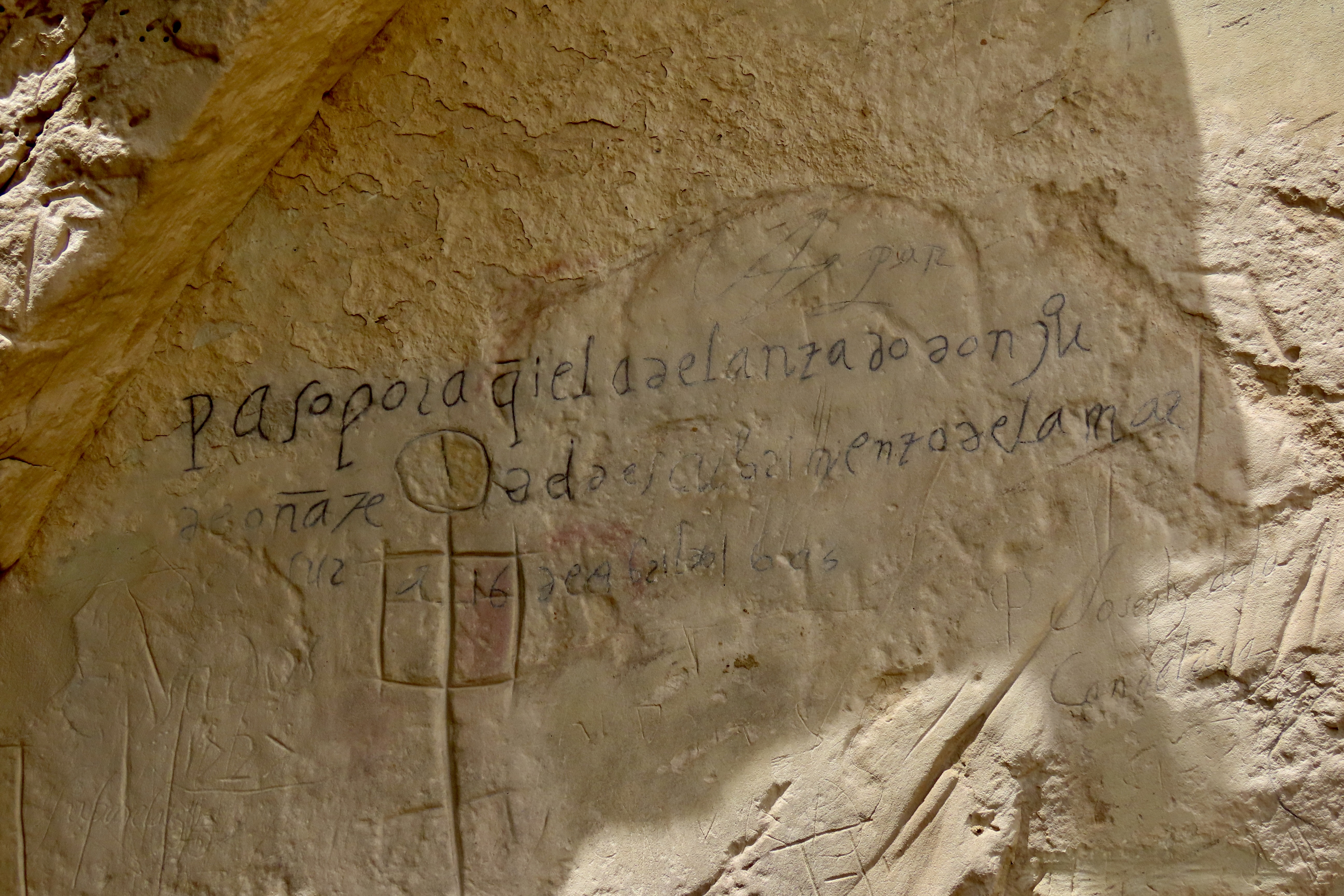
I’ve selected Don Juan de Oñate to represent the many Spaniards that signed their names on the rock. He was the first. It was in 1605, 15 years before the Pilgrims landed at Plymouth Rock. Oñate was a Spanish conquistador, explorer and first Spanish governor (viceroy) of New Mexico.  At some time, the signature had been written over with a black pen to make it more visible. The inscription translates “Passed by here, the adelantado Don Juan de Oñate from the discovery of the sea of the south the 16th of April of 1605.” The sea he discovered was the Gulf of California.
I chose Breckinridge’s signature because he represents a fascinating footnote of American history: The US Camel Corps. In the mid 1850s a unique experiment was undertaken by the US Army to tackle problems created by the severe water shortage in crossing the Southwestern deserts. Some men were sent off to Africa to explore the possibility of using camels for transport. They came back with 33 and and 3 Arab handlers. After a period of training in Texas, a test expedition set off across the desert for LA. They passed by El Morro with Breckenridge in charge of the camels. The camels did well— much better than horses or mules. They could carry more weight, travel farther during a day, and get along without water for a significantly longer period of time. Unfortunately, the Civil War came along and the experiment was abandoned.
People choose a variety of ways to display their names.
Some signatures were scribbled, some quite beautiful, and some encased. Each represented a different life, a different story.
The Monument has a brochure that provides information on some of the people who signed their names. RH Orton is one. He was a captain in the Federal forces during the Civil War. He may have been on his way home when he signed this. Later he would become an adjutant-general in the California National Guard. One could easily spend weeks researching the various names. I’m sure people have.

That’s it for today. Next, we will post about our trip up to the the Atsinna Pueblo and also explore the petroglyphs we found scattered among the signatures, predating them by 400 years. We will also include an interesting discussion we had with two Zuni Rangers working on the trail up to the Pueblo, Calvin and Valentino. (“I was born on Valentines Day,” Valentino told us.)
Atsinna Pueblo.

Standing 30-50 Feet Tall, Weighing 3-6 Tons, and a Being a Bit Weird… The Saguaros of Saguaro NP, Plus

Plans to protect air and water, wilderness and wildlife are in fact plans to protect man. -Stewart Udall

Most folks know what a Saguaro looks like. With its giant arms reaching up to the sky, it’s an icon of the Southwest. And this isn’t one, right? Except it is. It’s called a crested saguaro. It develops when a cactus’s growing point elongates into a line instead of a point. They can grow six feet across and look something like a brain. On this one, the first thing I saw was what appeared to be a clawed hand reaching out from the center. Weird. I like weird. But in moderation…

The Washington Post reported on Monday that it had obtained an internal email from the Trump Administration stating that it was suspending air-quality monitoring programs at all national parks across the country. I could only wonder, why? It was weird in a big way.

A record breaking 331.9 million people visited our national parks, monuments and recreation areas last year. Among them were children, elderly people and numerous others with underlying heath issues, all of whom are affected by air pollution. Air quality information is valuable to them. As a former Executive Director of American Lung Associations in California and Alaska, I can attest to how important it is. On days our air is polluted to a dangerous level, sensitive populations should limit their outdoor activities. Period. But first, they have to know there’s a problem. I couldn’t help but think ‘Let’s Make America Humane Again.’

After the Post broke the story, the Administration apparently backed down. I suspect health groups joined with organizations focused on national parks and educated the administration on the negative consequences of its action. This speaks to how important it is for the public to be informed of edicts that impact their lives and unite in letting political leaders and other decision makers know of their concerns. It makes a significant difference— and it gives us a role in determining our future.

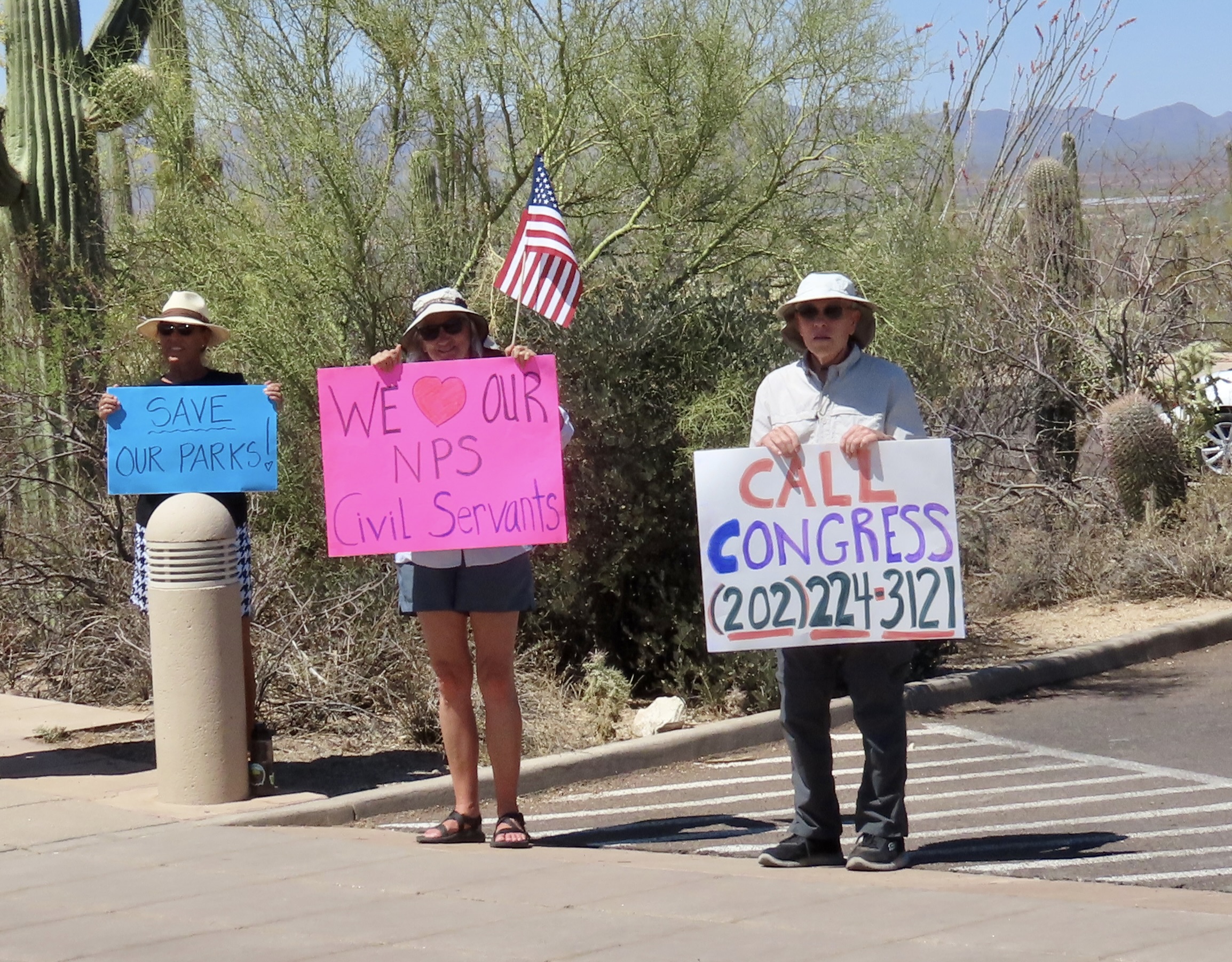
People protesting Administration decisions related to National Parks stood outside the Saguaro NP Visitor Center.

Today, Peggy and I are continuing our series on national parks, monuments, and wilderness areas with an emphasis on their unique beauty, geology, flora, fauna and history that make them so important to us and future generations. As with each of our previous posts in this series, we will present 25 photos that focus on the particular area we are blogging about. Today it is Saguaro National Park just outside of Tucson, Arizona where we were two weeks ago. All photos have been taken by either Peggy or me unless otherwise noted.

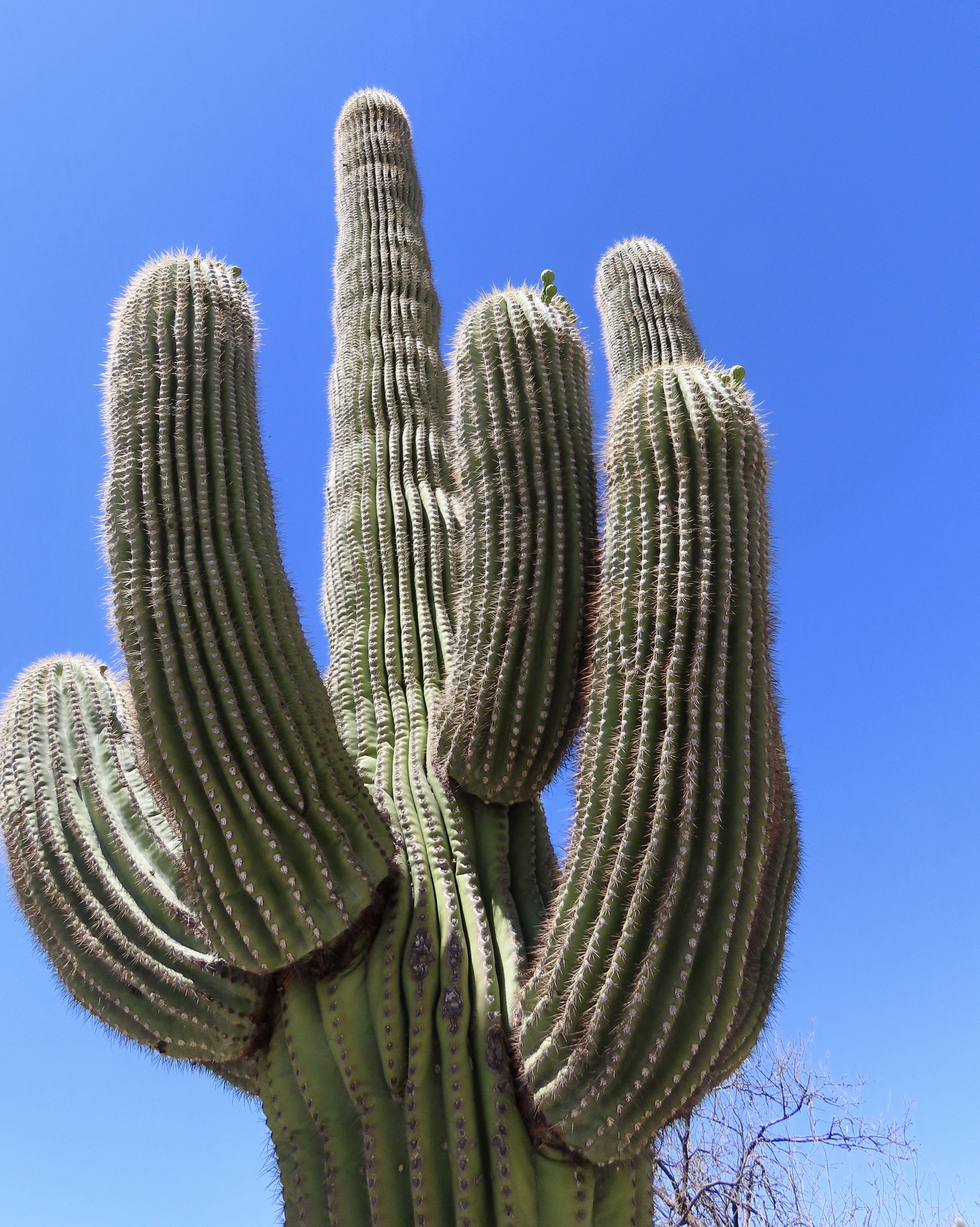
As the headline suggests, Saguaros are big. The giants can grow up to 50 feet tall with a circumference of 8 feet and a root system reaching out 100 feet from the base. This makes them the largest cactus in the US.
Peggy provides perspective on the size of a large ( not giant) saguaro. Here’s your math problem for the day. Peggy is 5’7”. Approximately, how tall is the cactus?
Saguaros can have up to 24 arms. A lot. I counted 18 on this one, carefully avoiding the small cactus behind that photobombed our picture.
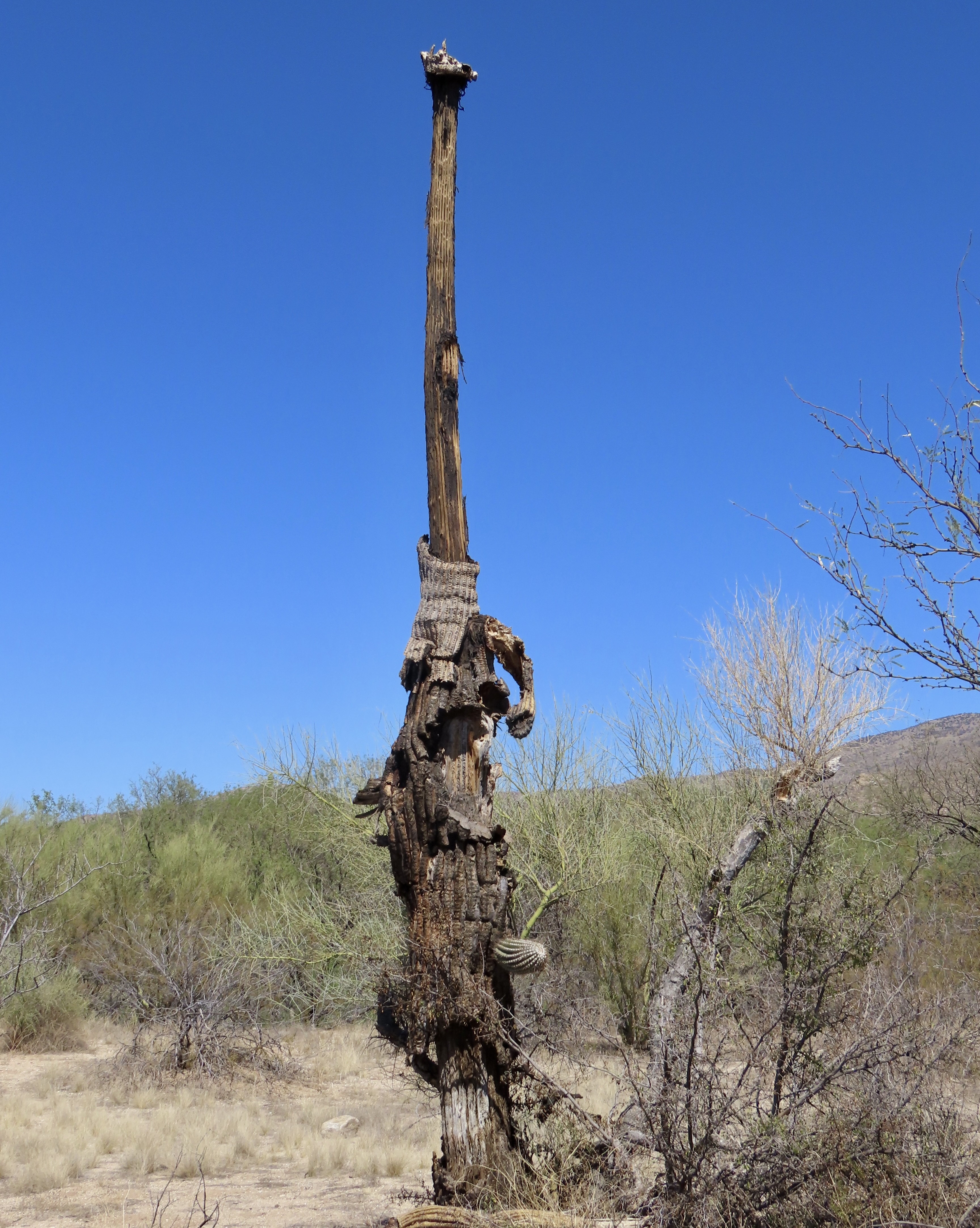
This old fellow provides a look at the structure of a saguaro, plus an element of humor. Not sure of the message. “Don’t count me out?” “You are only as old as you think you are?”
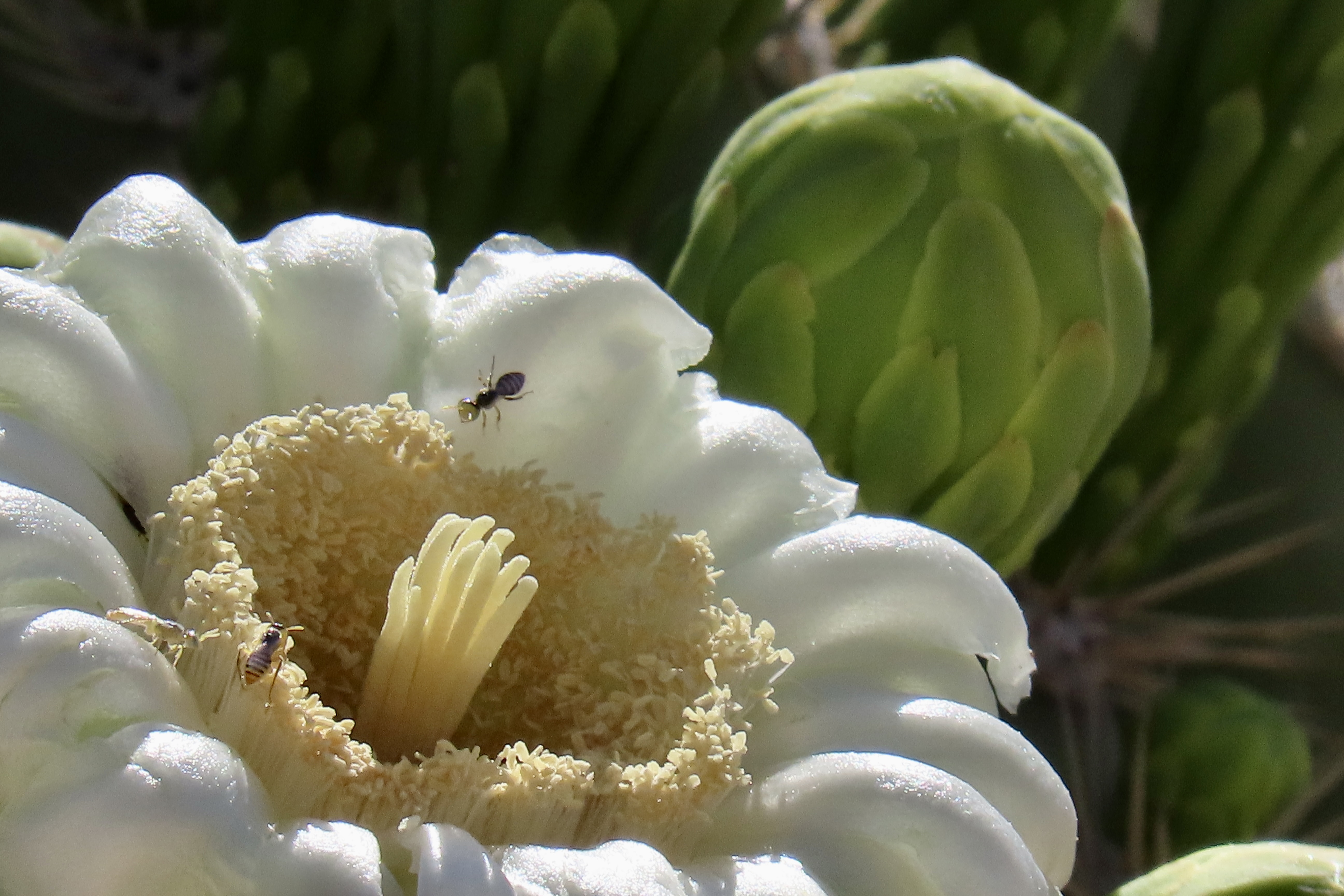
We were lucky that the saguaros were just beginning to bloom. The buds looked like alien pods and the flowers were gorgeous.
A wide range of insects during the day and bats at night are eager to feast on the flowers. The bats and flying insects aid in the fertilization process by carrying pollen to other saguaros.
A cactus wren took advantage of the insects visiting the Saguaro for its own feast. The cactus wrens sometimes makes their homes in Saguaros, as do other birds including Gila Woodpeckers and Gilded Flickers.
Home sweet home. The holes you see in these cacti are nesting sites.
The cactus wren also nests in cholla cactus and may even prefer it. Can you imagine flying in and out of this mass of spines and raising your babies here? Other birds see the cholla as a good place to raise a family as well. Besides the obvious challenge, it’s a great way to discourage predators.
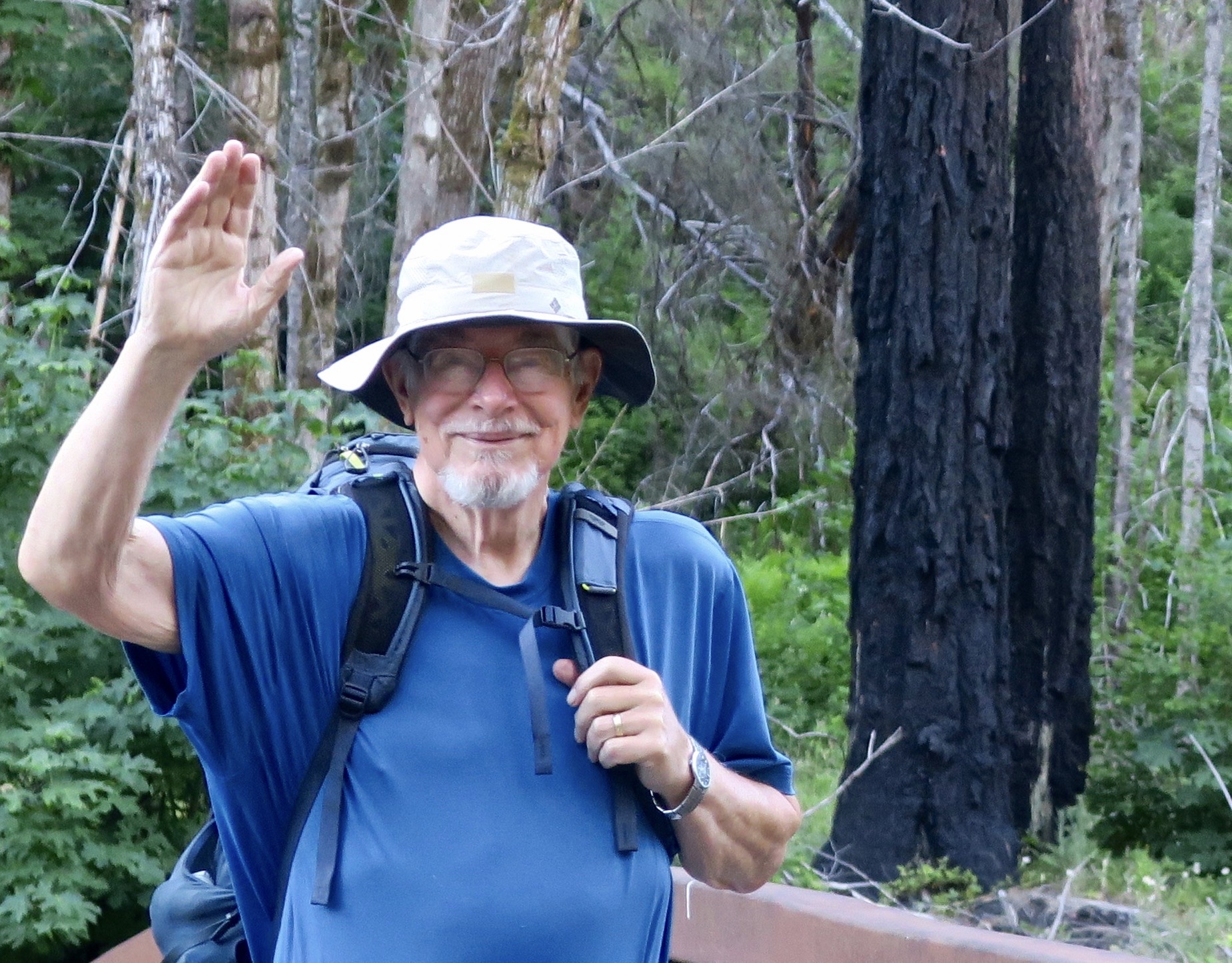
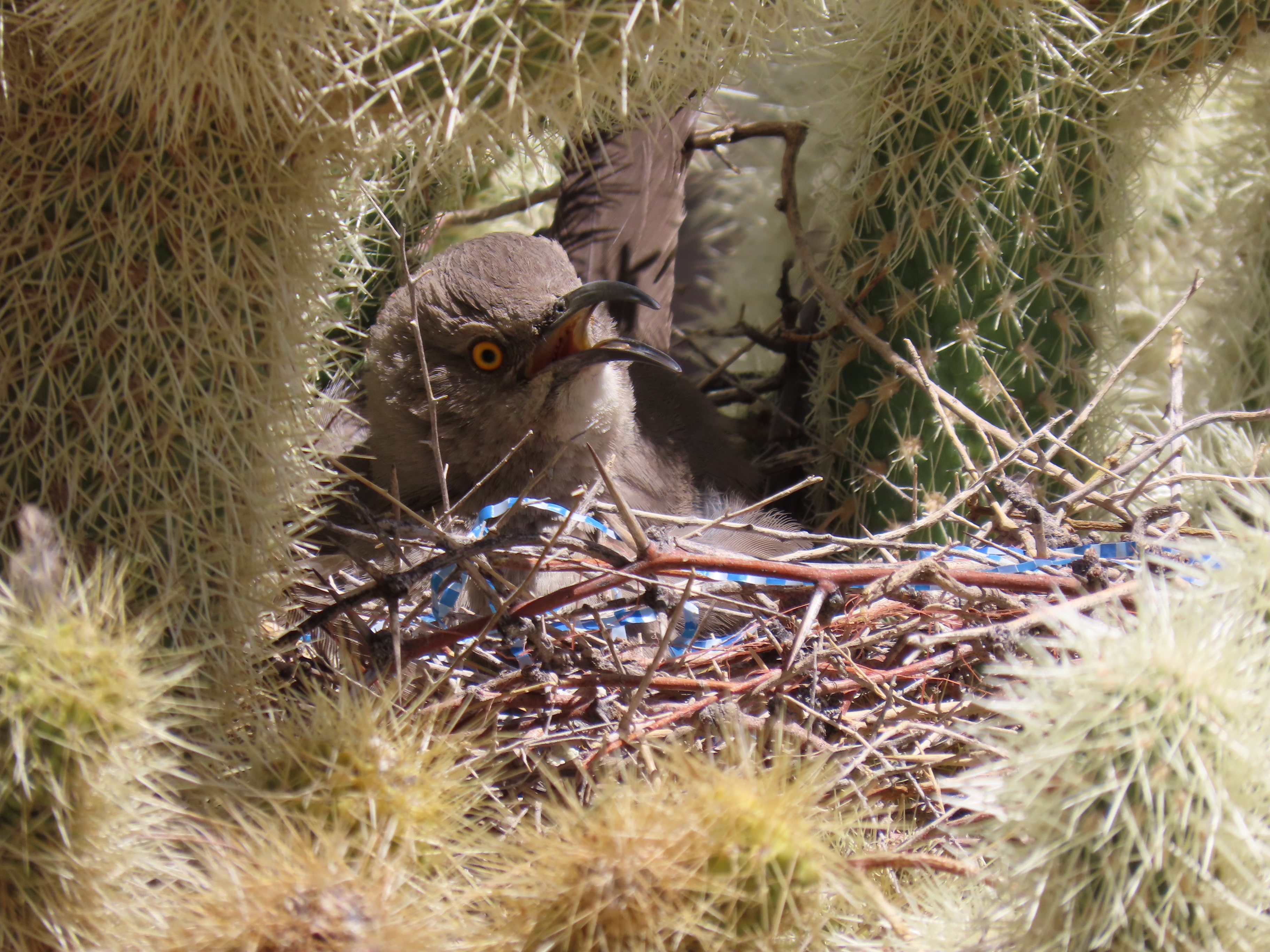
Peggy was taking a photo of what appeared to be a nest in a cholla cactus at Roper State Park in southeastern Arizona a few weeks ago when suddenly a curved bill thrasher popped her head up and begin scolding. We speculated that what she was saying to Peggy was R-Rated.
There are 35 species of Cholla. This is another one we found at the park.
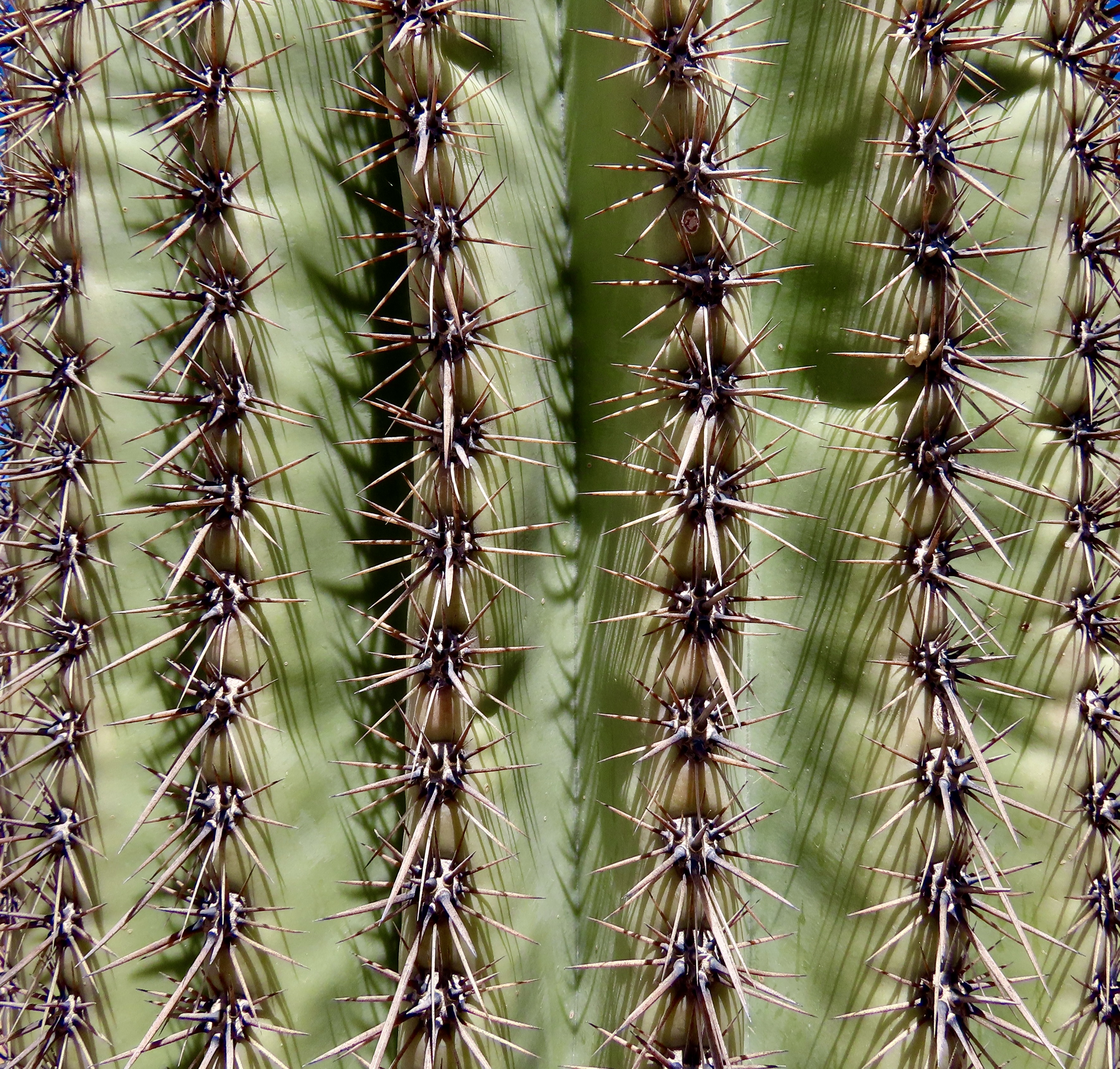
While I am on the thorny subject of spines, I wanted to make one last observation on the saguaro before moving on to other cacti. Each of these clusters, spaced about an inch apart, contains up to 30 spines. They can grow as long as two inches. I estimated that there would be roughly 1,700,000 thousands spines on a giant saguaro. There’s a message here: No matter how much you love saguaros, save your plant hugs for trees.
Barrel cactus is another favorite of ours. We called these the “Three Amigos.”
Like the saguaros, barrel cactus can be a bit weird. Peggy and I were surprised by this one with waves.
We missed the blooms on the barrel cactus. What you are looking at here is the fruit. It’s edible when ripe. It is described as slightly tart. BTW: Another name for barrel cactus is fishhook cactus because of how their spines are curved.
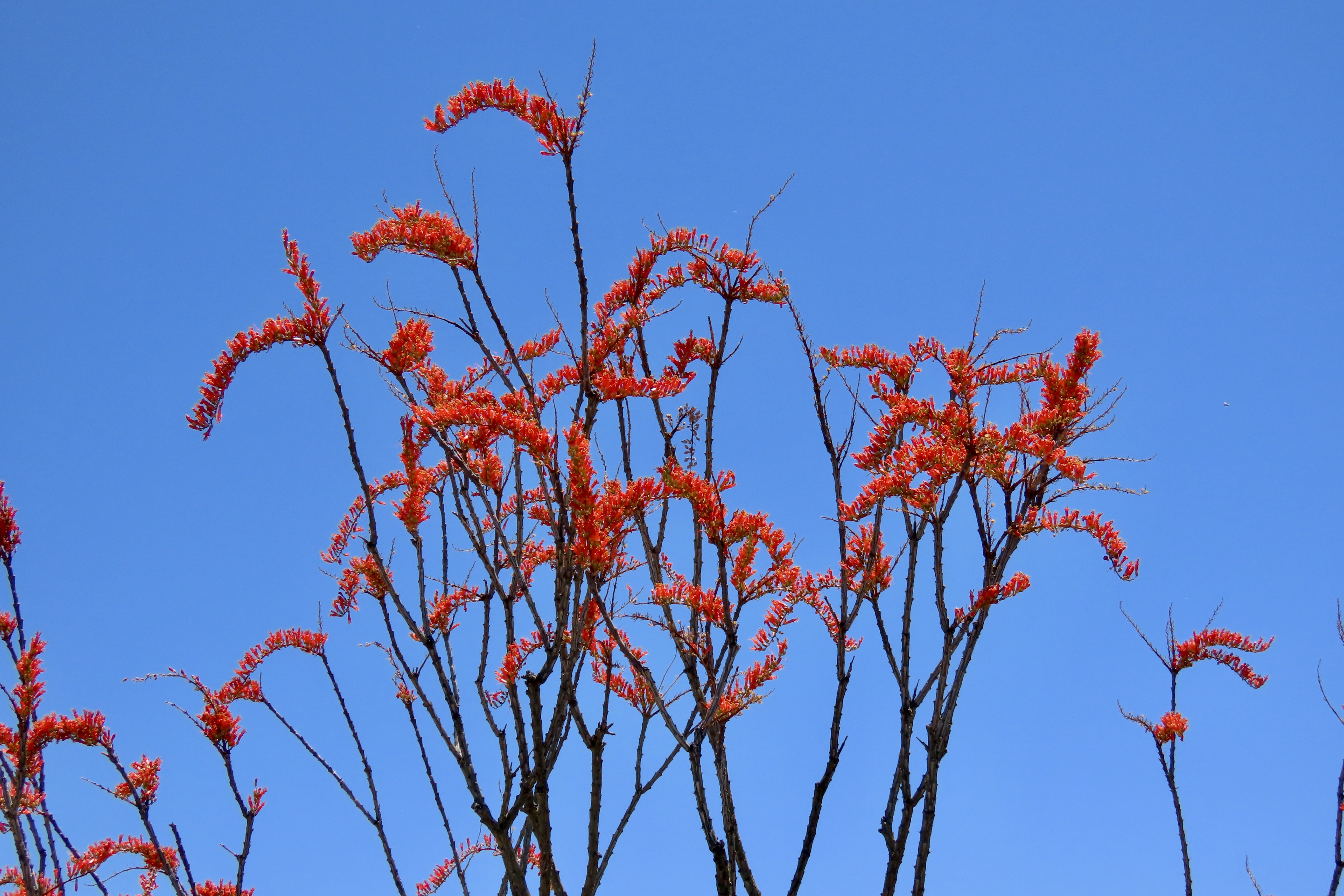
While the barrel cactus may have finished blooming, there were plenty of blooms for us to admire at Saguaro. This is an Ocotillo.
A close up of the ocotillo flowers. And check out the spines here!
Prickly pears were both prickly and blooming.
Can you spot the honey bee in this photo with its head popping up? It’s totally covered in pollen that it will carry on its rounds to other prickly pear flowers, aiding in the pollination process.
The primary small trees/shrubs of Saguaro NP were also in bloom. This is a mesquite.
And here we have palo verde trees. Both the mesquite and palo verde are important to Saguaro, providing shade for their first few years of growth.
As we wander through the Southwest, we are always on the look out for ancient petroglyphs. Saguaro had over 200 next to the Signal Hill Picnic site. This small stick-figure big horned sheep was among my favorites. Peggy is now in the process of seeking new ones for a second word search book on petroglyphs. Her first book— Artistic Word Searches, Unique and Magical, Discovering Petroglyphs from the Southwest— is available on Amazon.
Peggy was impressed with this spiral petroglyph which is thought to represent a journey or migration.
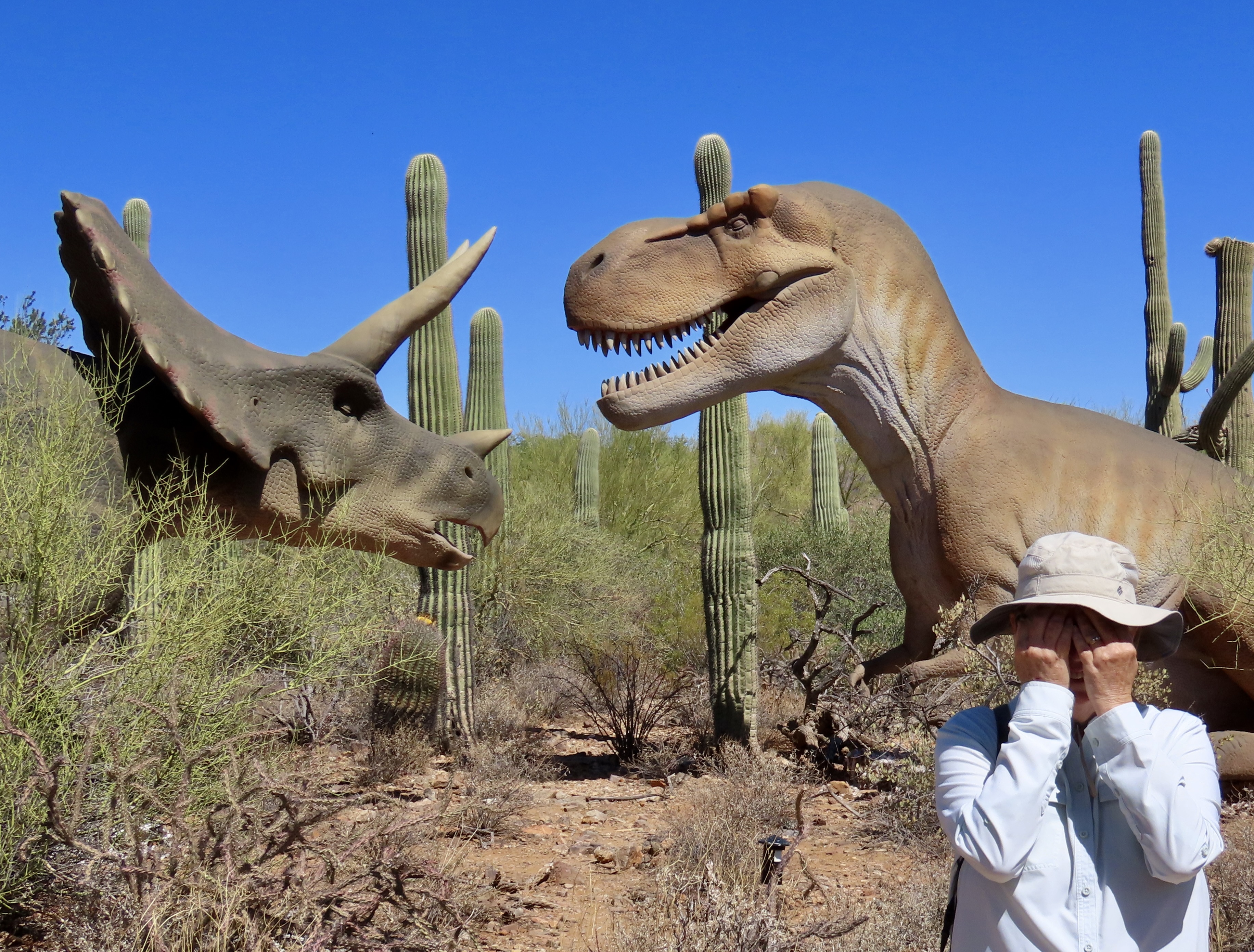
We wrapped up our visit to Saguaro National Park next door at the Arizona-Sonora Desert Museum. The museum was featuring an exhibit titled Dinos in the Desert and we found a number of these grunting and growling beasts as we wandered through the outdoor museum. Peggy couldn’t bare to watch this battle that was taking place between two jurassic giants. Or maybe they were discussing eating us. Grin. While the ‘Dino’ exhibit was very well done, it was only the beginning of what the museum has to offer. Go there if you get a chance.

Our next post will be on the El Morro National Monument, which we just visited and are going back to.
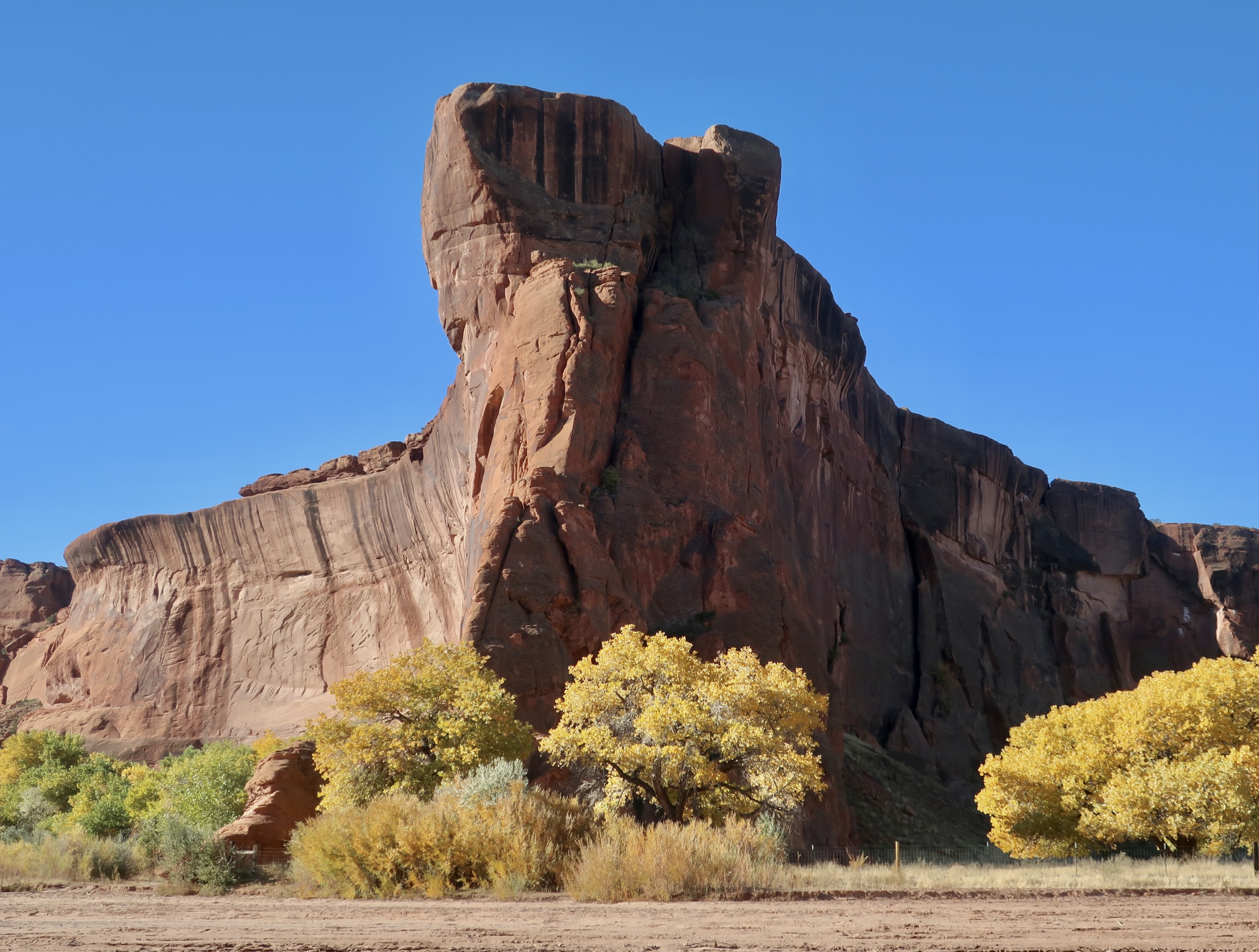
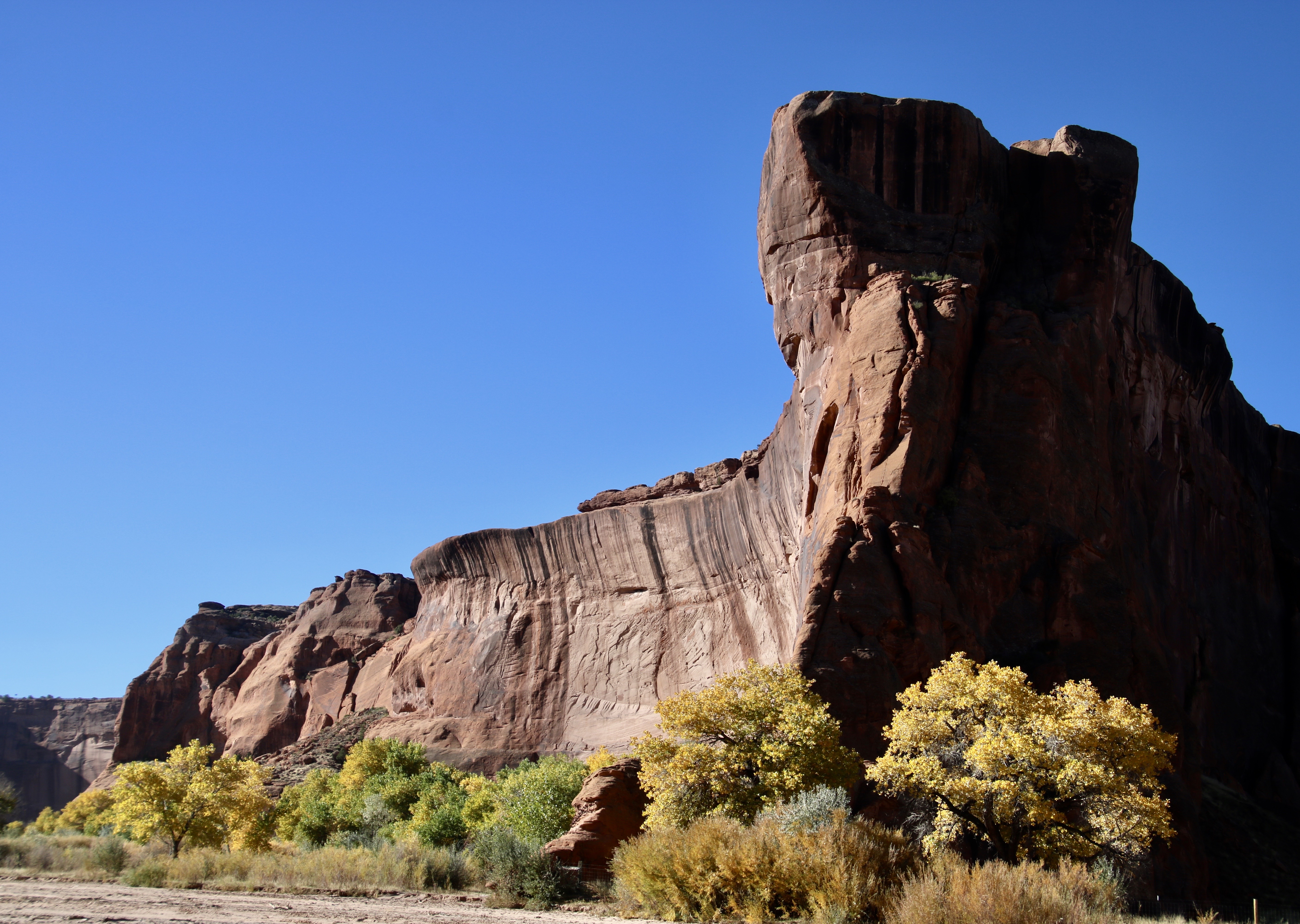
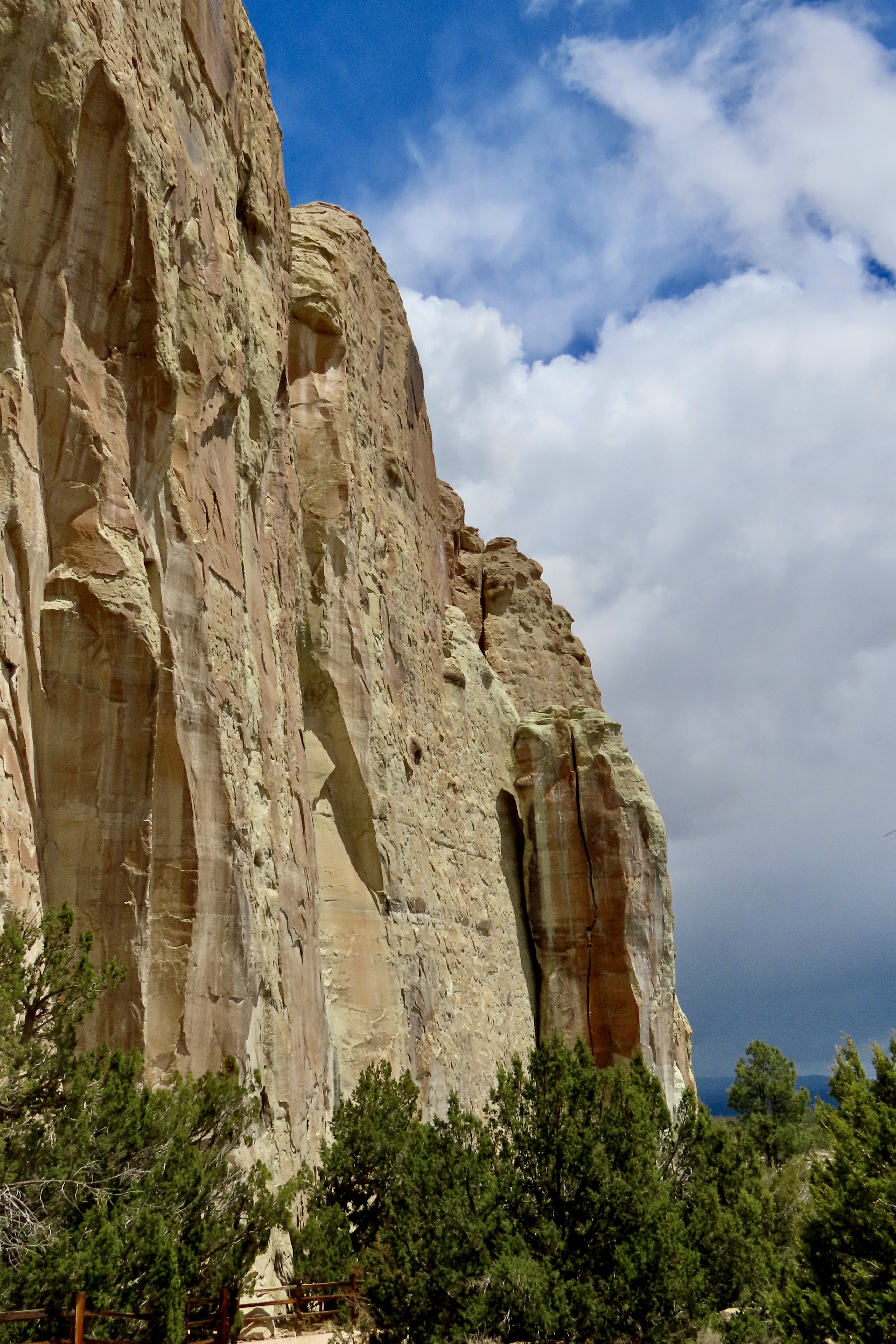
This impressive promontory is reason enough to visit El Morro National Monument, but over 2000 inscriptions on the rock make it even more special. A water hole at the base made it a stopping point for a continuing parade of people ranging from ancient peoples, to early Spanish explorers, to pioneers. The earliest Spanish signature is dated 1605, 15 years before the Pilgrims arrived at Plymouth Rock!

The Breath-Taking Beauty of Death Valley NP… And the Need to Preserve It

The iconic Mesquite Flat Sand Dunes of Death Valley provide a unique hiking opportunity for the adventuresome as well as a world class photo op. They also provide a great backdrop for movies. C-3PO and R2-D2 were lost here on ‘Tatooine’ in Star Wars Episode IV.

Death Valley is known as a land of extremes. At its lowest point, it drops to 282 feet below sea level. Summer temperatures can soar up to 120° F and have been recorded as high as 134° F. Rainfall averages are around 2 inches per year but can drop to zero. It’s hard to get more extreme. You don’t want to visit in the summer.

I would add, however, that Death Valley is also a land of superlatives. My title above about ‘breath-taking beauty’ is no exaggeration. We have 25 photos below to make the point. As I have stated before, all photos are taken by either Peggy or me unless otherwise noted.

Peggy and I have visited Death Valley several times over the years. It’s one of our all-time favorite go-to places. One of our visits was during the government shutdown in 2019 that President Trump had instigated during his first term. Death Valley was without staff. We had entered the Park from the south and stopped at a rest stop along the way. The restroom was closed and people were using the desert as a bathroom. Instead of carrying their trash out, many were simply dumping it next to the already overflowing trash cans. What was worse, a few miles up the road someone had decided that no supervision meant he could take his ATV for a spin on the desert floor and drive brodies (sharp circles). Large gashes in the floor had been created— gashes that would take at least 20 years, if not longer, to heal given the desert’s environment.

I’m relating this incident here because I want to make a point that National Parks need staff to function effectively. While the impacts of reduced staff aren’t as dramatic as no staff, the recent efforts by the Trump Administration to cut employees along with a number of other Trump/Musk driven initiatives related to the parks pose a serious threat. Here’s a quote that the National Parks Conservation Association —a bipartisan organization that has been promoting and protecting our parks since 1919— made after the first six weeks of the Trump Administration:

National parks as we know and love them are changing — dismantled before our very eyes under the new Trump administration in just six weeks. Fired staff, cancelled building leases, erased history. We see the writing on the wall, and it’s dark.

Dark indeed. Among the latest pronouncements from the Administration is one that suggests there is no reason to protect endangered species. Let them die. Another opens 59% of all national forests to be logged with minimal, if any, environmental protection. Old growth trees that have taken hundreds of years to develop will be cut down in minutes.

Today, Peggy and I are continuing our series showing the beauty, geology, flora and fauna of these areas to emphasize the value of protecting them. The parks belong to all of us, and, I might add, the plants and animals that call them home. We cannot afford to let them be lost to the whims of one man and his cohorts who apparently see their value primarily in terms of the money that can be made from their exploitation. Our children, grandchildren and future generations are depending on us.

And now: Death Valley.

Beauty is everywhere in Death Valley.
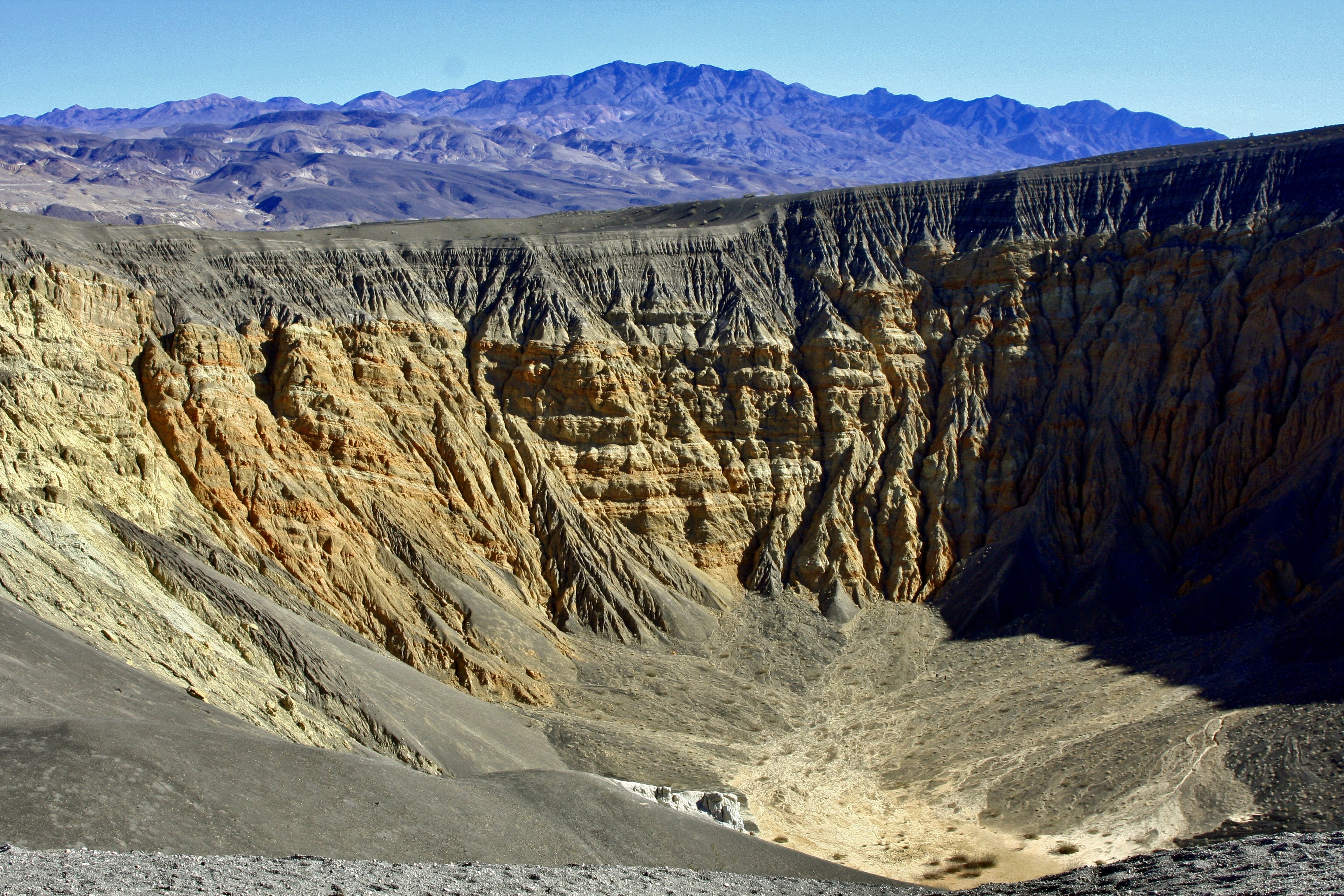
The extreme dryness of Death Valley allows visitors a rare opportunity to see geological forces at work. This is the Ubehebe volcanic crater in the northern part of the park. The crater, 600 feet deep and half a mile across, was created by a powerful eruption of volcanic steam. Trails lead down into the crater that visitors can hike.
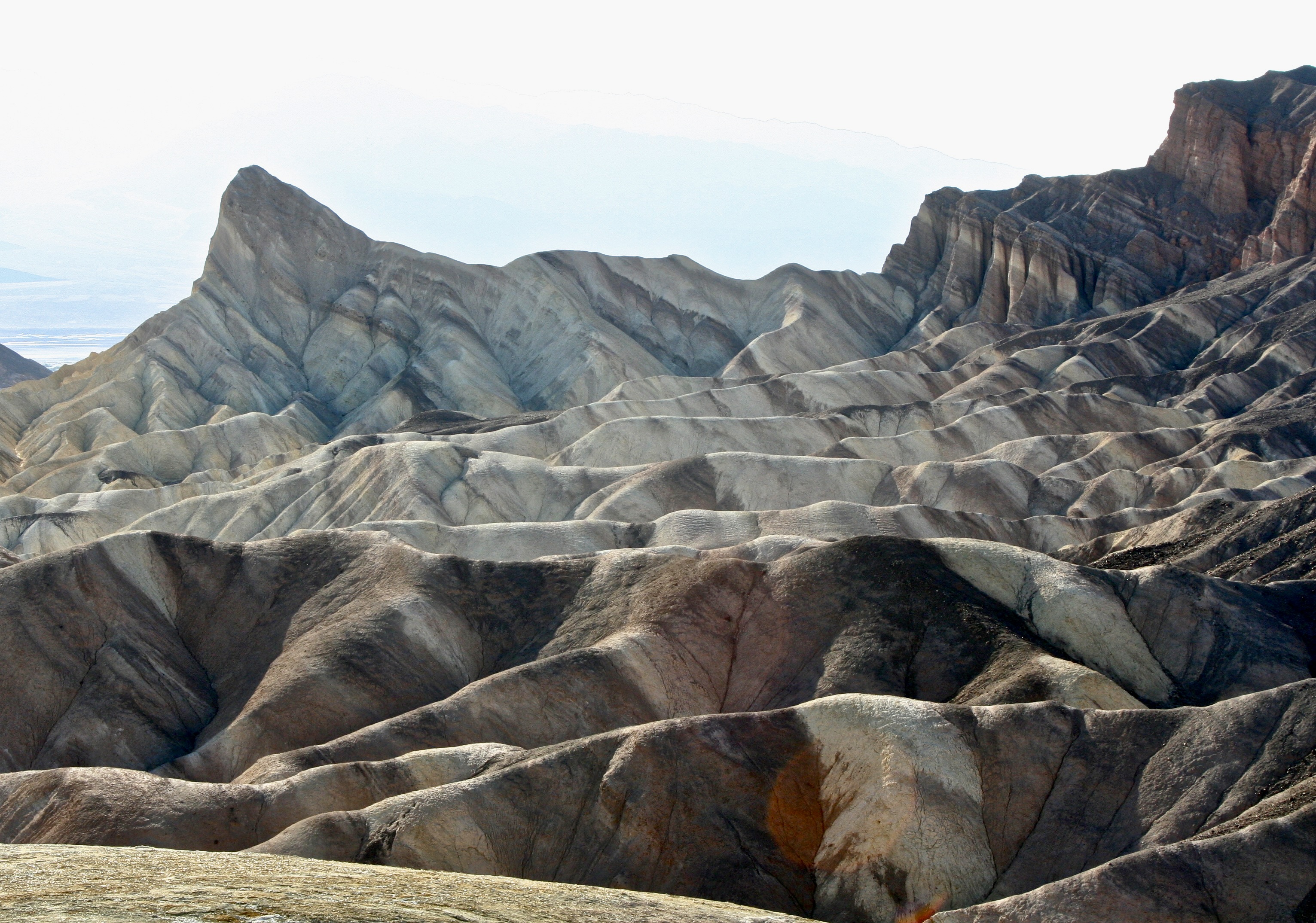
We took this photo near Ubehebe Crater. It shows the work of erosion over time creating an almost surrealistic scene.
A coyote stood near the road into Ubehebe. Camping in the Valley, you can go to sleep listening to their wild calls in the distance. A moonlit night often produces a chorus.
The majority of the sites visited in Death Valley are located within a short drive of the Visitors Center at Furnace Creek. Nearby, Zabriskie Point provides a number of different views that vary over the day as the sun shifts.
In the sunlight.
Another view we found interesting at Zabriskie Point. The dark ridge at the top represents a different geological era. Over 1.7 billion years of earth’s history can be seen in the Valley according to the National Park.
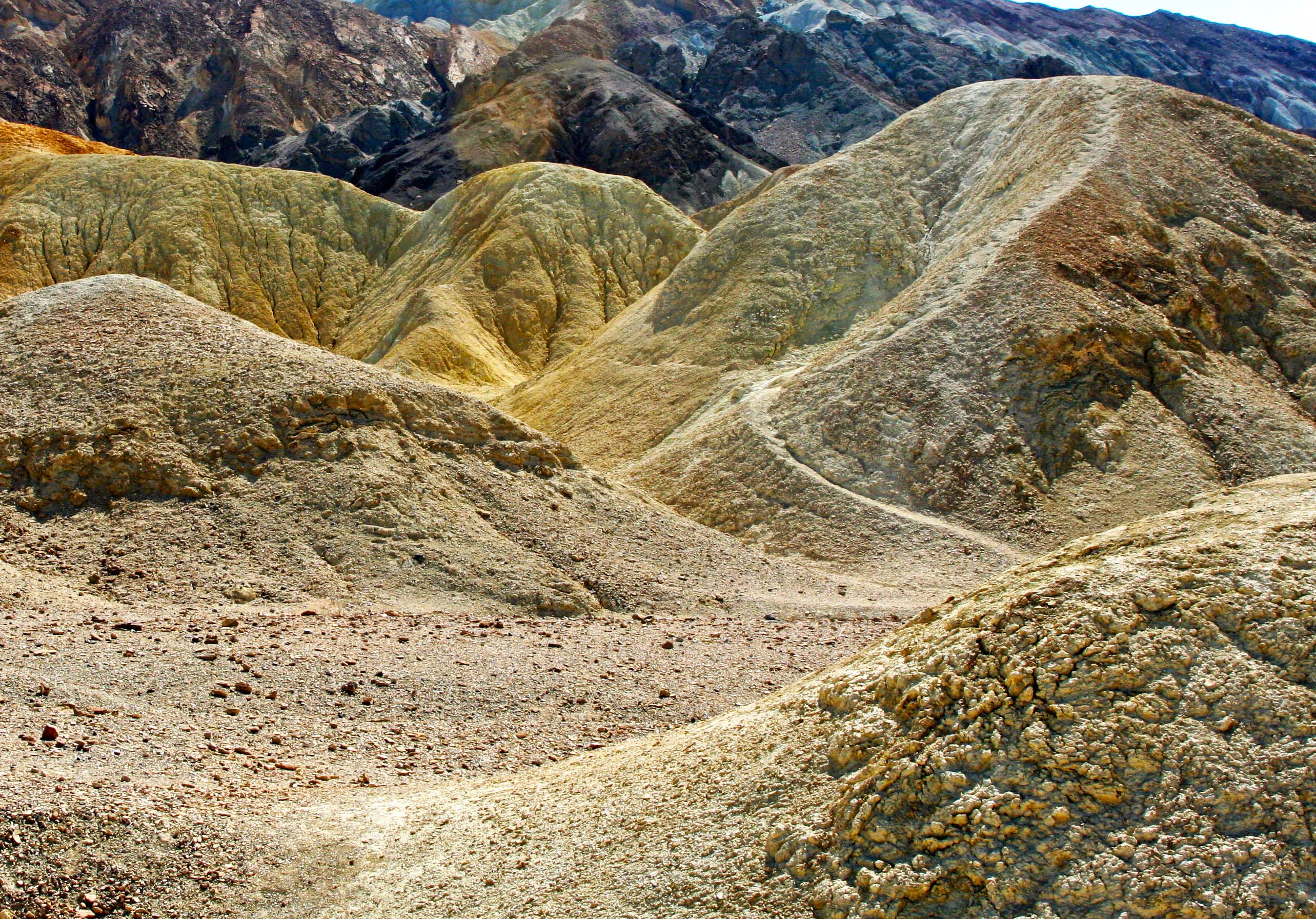
20 Mule Canyon, a short drive up the road from Zabriskie Point, provides a moderately challenging but gorgeous adventure over a 2.7 mile unpaved road. It’s a section of the route that was used by the 18 mules plus two horse teams that carried borax out of Death Valley. Pull offs along the way provide for further adventures, such as following paths that lead into a world that borders on fantasy.
Another example.
The road also followed this off-white, high ridge. We saw a couple of people hiking along the top.
A final photo along the 20 Mule Canyon Road.
Another favorite of ours for its sheer beauty and impressive land forms is Golden Canyon.
A quick drive down highway 178 from Furnace Creek will take you to the parking area. From there, visitors can choose a relative easy walk that takes them into the heart of the canyon or select much more challenging hikes with lots of ups and downs! One route takes hikers up to Zabriskie Point.
Looking out from Golden Canyon toward the Valley.
Want even more color? Continue down Highway 128 to a one-way side road that takes you in to the well-named Artist’s Palate. Different minerals in the rock are responsible for the colors you see here, at Zabriskie Point and along the Twenty Mule Canyon Road.
A closer look at the palate.
Continuing on down Highway 128 will bring you to the Devil’s Golf Course, which is definitely worth the side trip to see it. If the park is ever privatized, I wonder (he said tongue in cheek) whether the president would add this to the 15 plus golf courses he owns around the world. First, however, he would have to bulldoze the salt flats that formed over thousands of years as ancient lakes evaporated. Given the million dollar membership fee he charges at Mar-A-Largo, I suspect he would charge even more here.
Two side roads, one on the east and one on the west of the Park, take visitors up into the mountains above the Valley. Dante’s Peak, on the east side, provides a dramatic view into the valley.
And flowers. We took lots of photos.
The road on the west side of the valley taking visitors up to historic charcoal kilns had even more flowers.
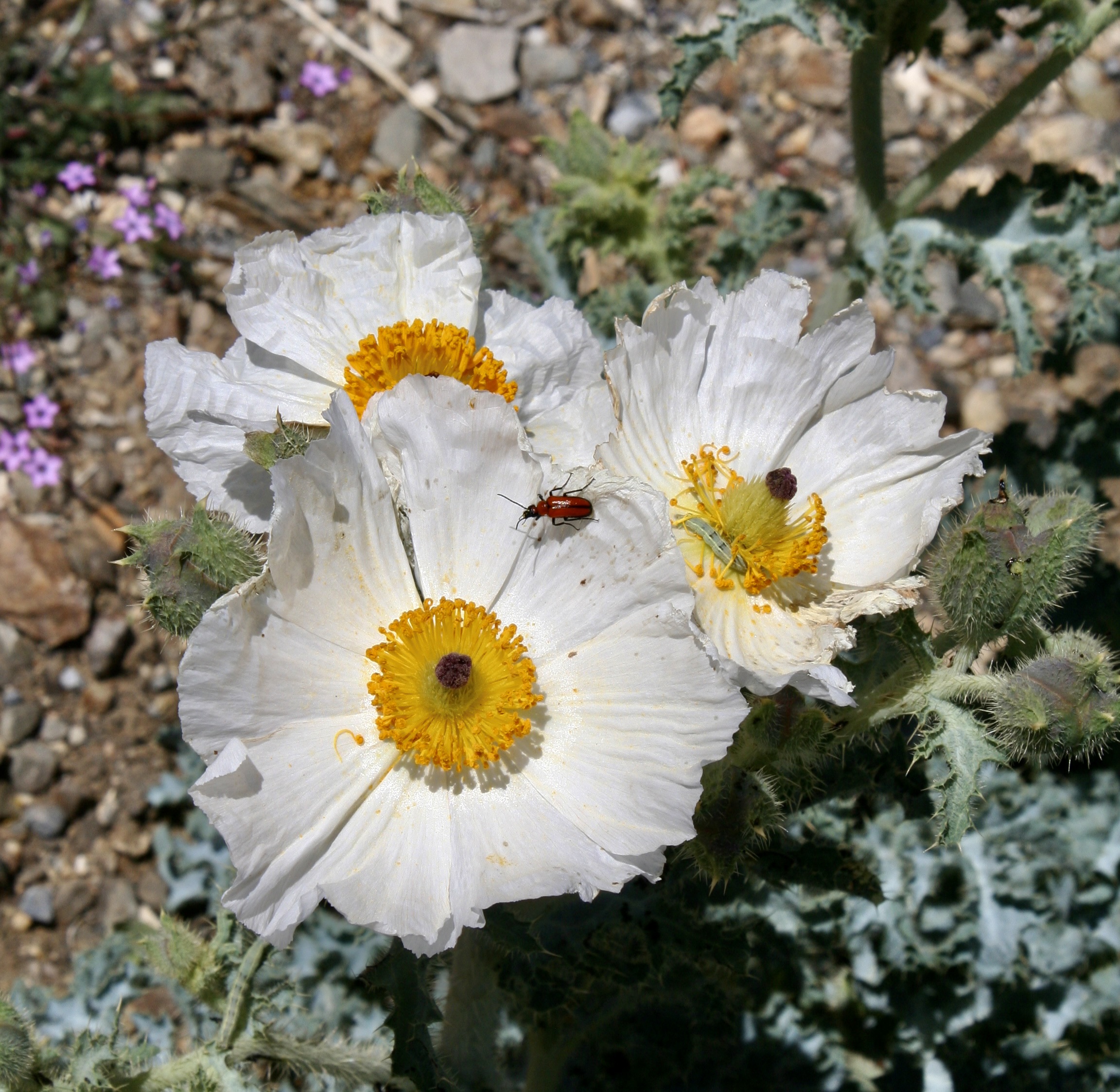
Including these white prickly poppies. A red beetle and a green caterpillar were visiting. The caterpillar was busy chomping down on the poppy’s stamens.
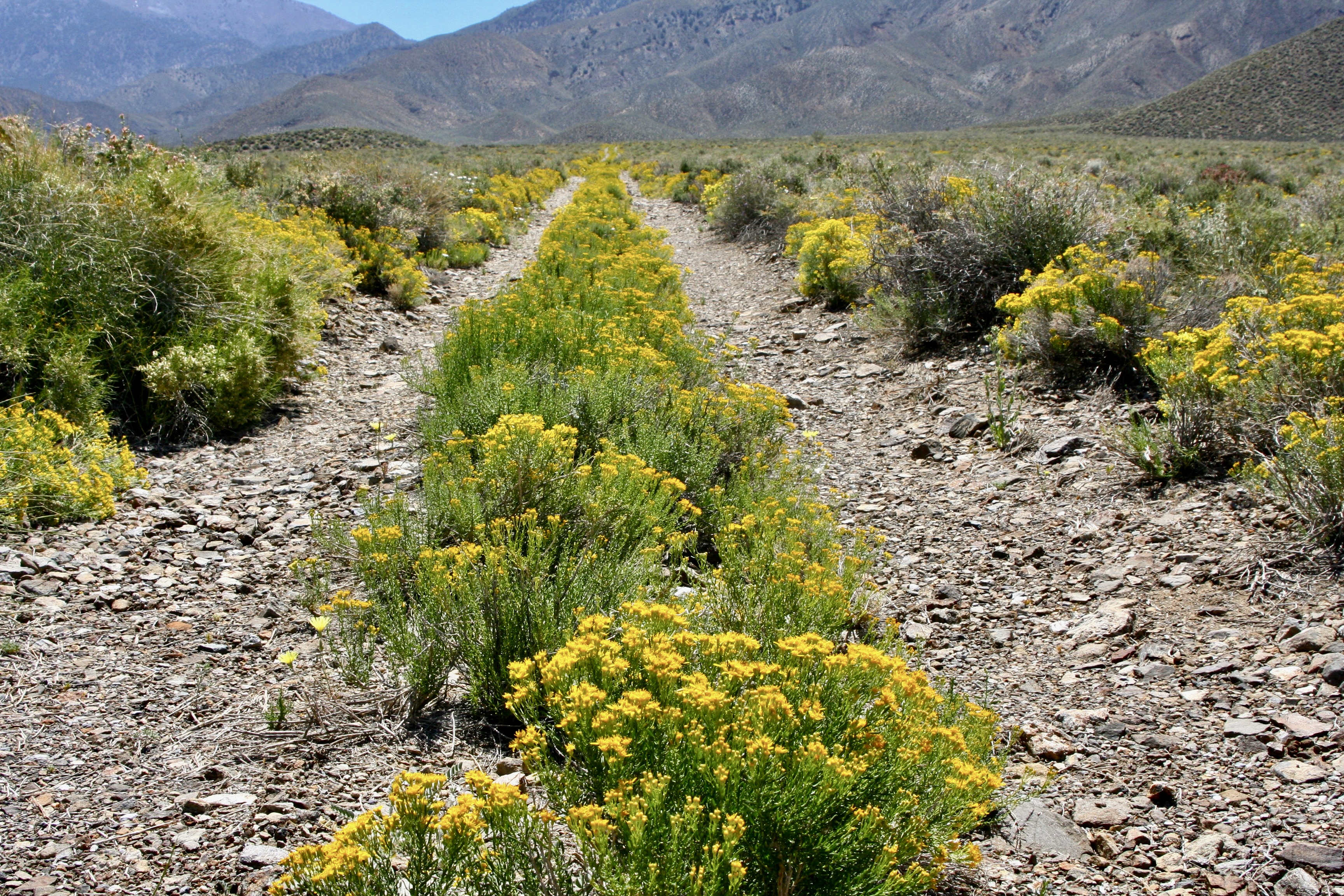
An old road leading off the main road to the kilns featured yellow rabbitbush flowers. It demanded exploration. Maybe this year…
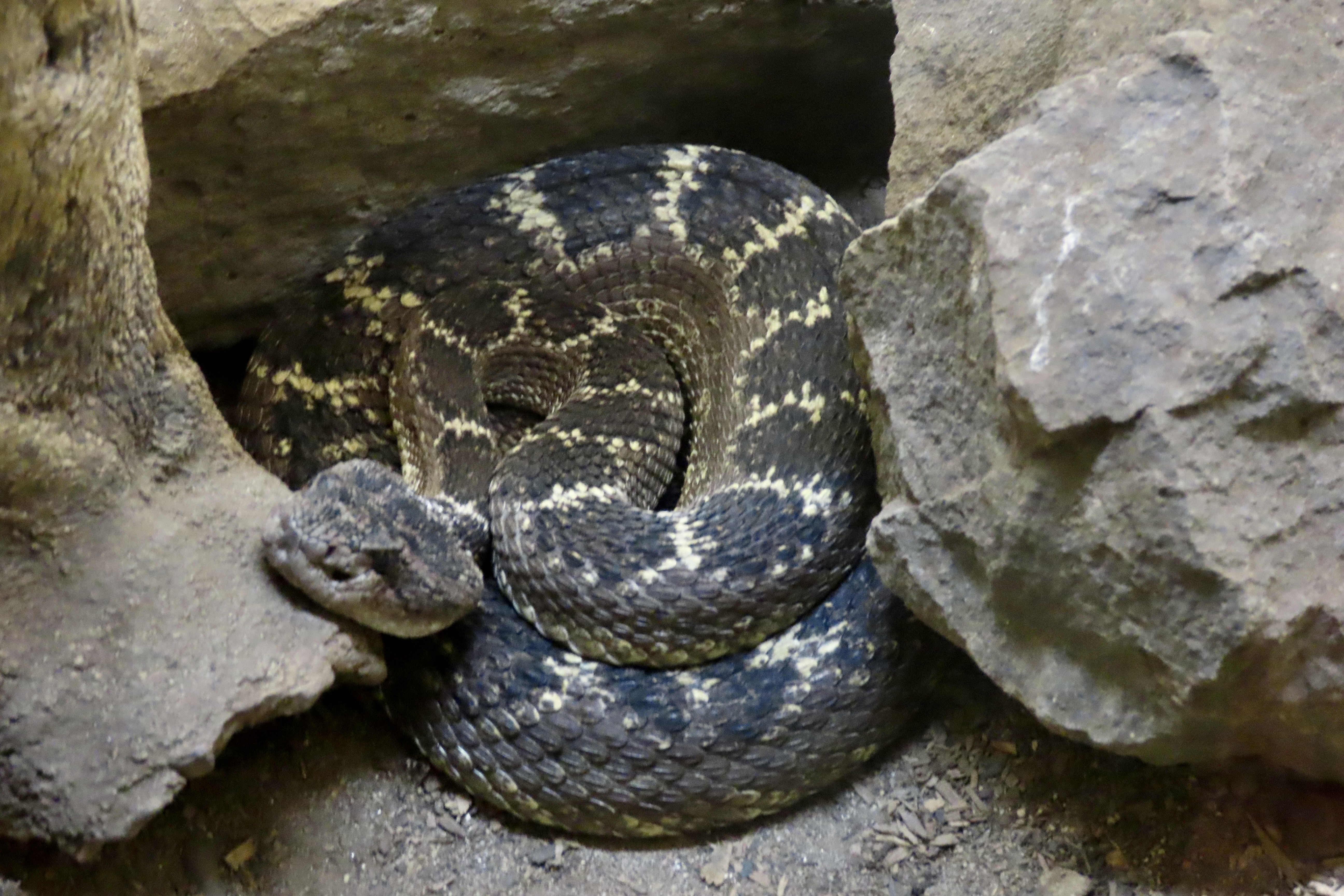
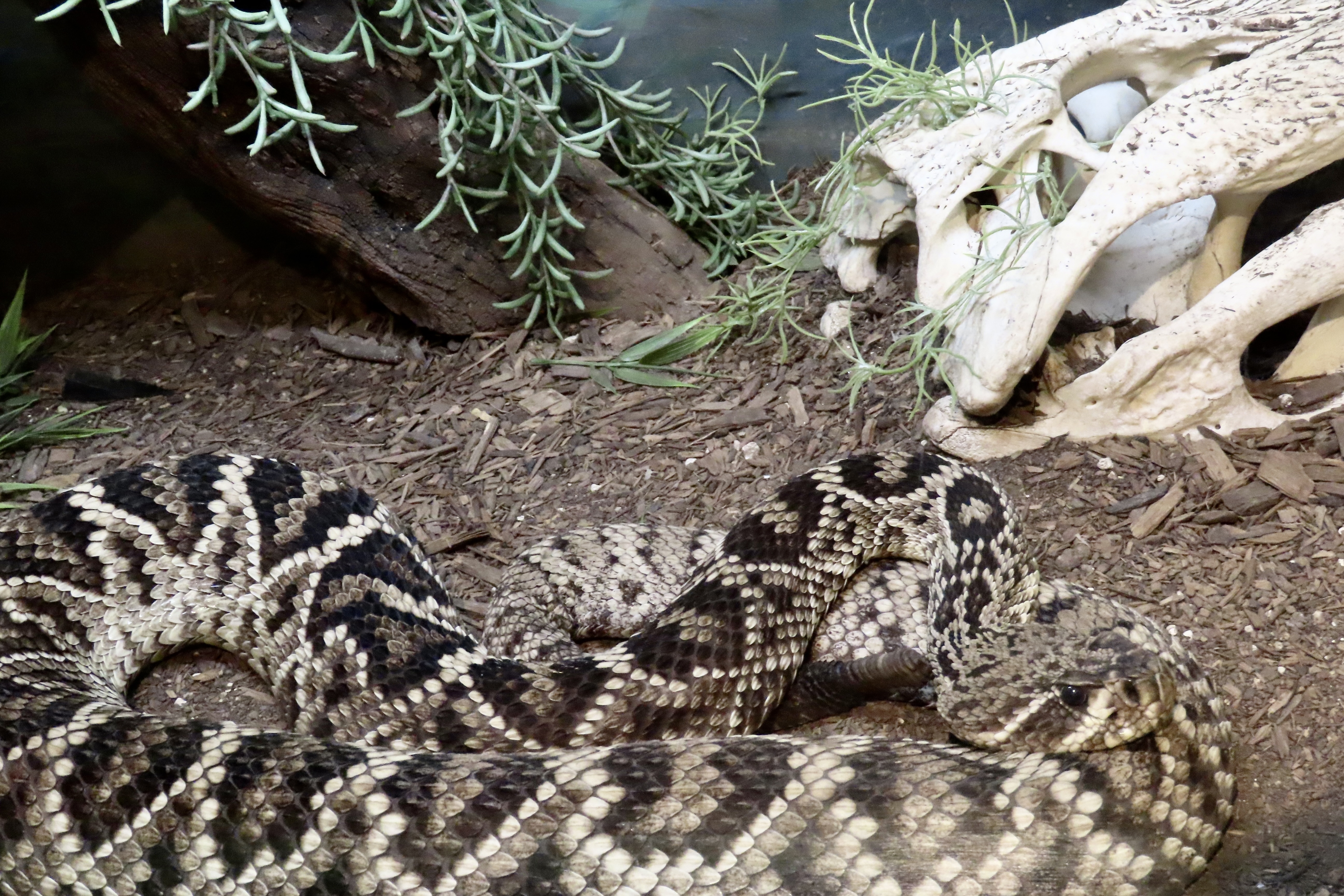
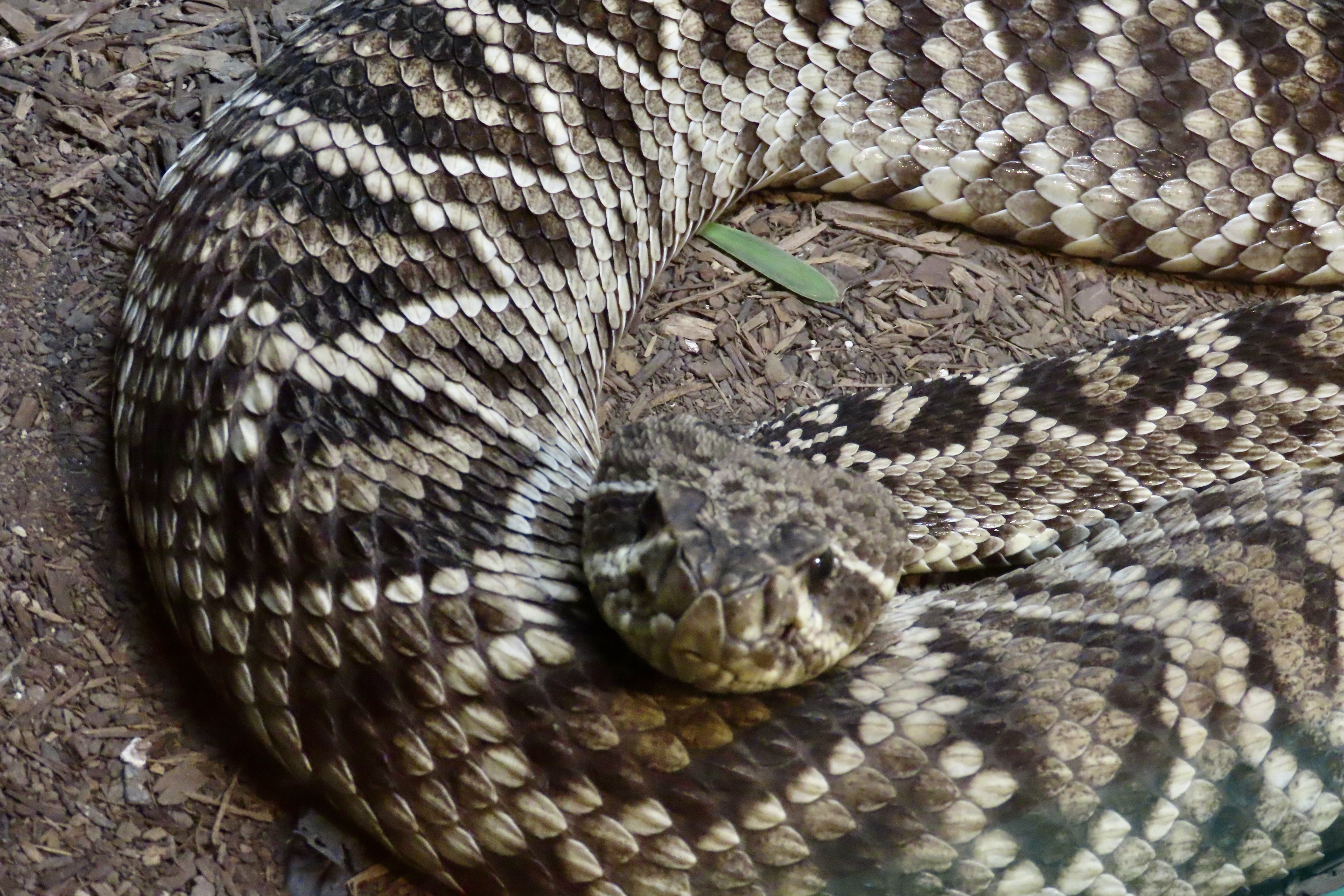
We also found this rattlesnake along the road. Long time followers of my blog will recognize it. He was about 6 feet long and about as round as my arm. Peggy refused to let me out of our truck to take more photos, zooming off just as I was about to open the door!
The historic charcoal kilns of Death Valley were at the end of the road. They were built in 1877 to supply charcoal for the Modock Mines, located 25 miles away, and likely closed after two years of use.
We’ll conclude this post with a photo of the sun setting over the sand dunes of Death Valley. Next up we will feature the Chiricahua National Monument in Southeastern Arizona. We were there last week.
A photo from next week’s post.

Hawaii, the Flu, and Lac-a-wanna. Peggy Says, “Just Post Some Photos, Curt.”

We’re back. Sort of. Shortly after returning we came down with the flu. Nasty stuff. It wiped us out and we are still suffering the after-effects: Brain fog. But there’s more, a type of lethargy. I gave it a Hawaiian name, lac-a-wanna. Each morning I sit down to whip out a blog, it strikes. I snuggle down into my comfy chair for a nap. Peggy has a solution. “Just post some photos, Curt.” Okay. Waterfalls always work. We visited two: Rainbow Falls in Hilo and Akaka Falls just north of Hilo. But first, this…

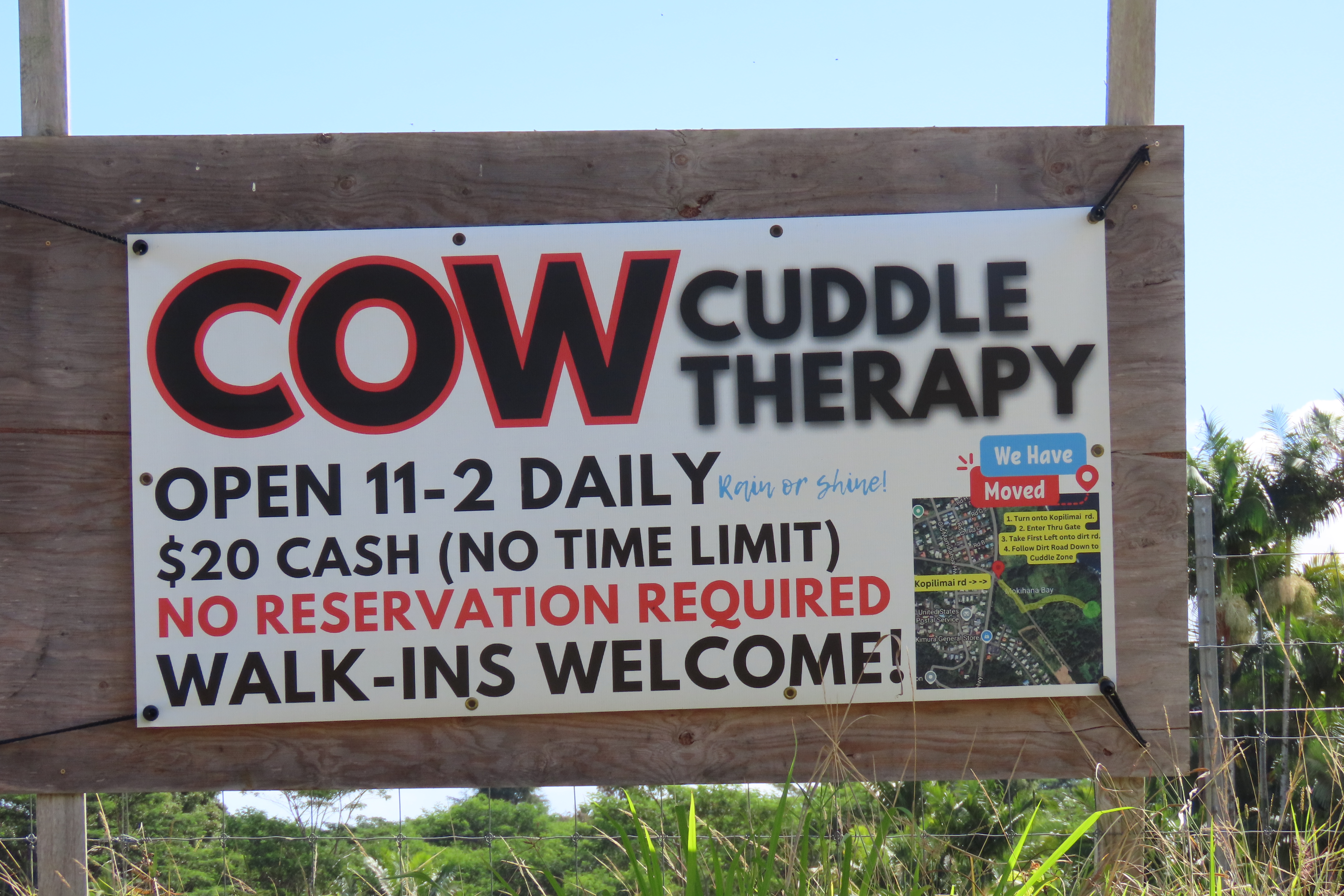
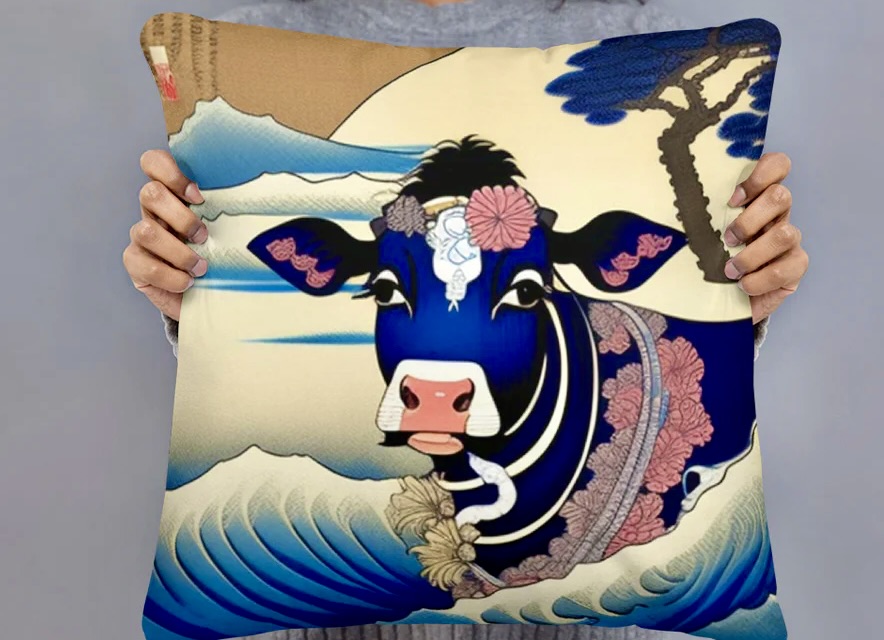
We came across this sign just outside of Akaka Falls State Park. For a mere $20, we could cuddle a cow. Woohoo! Who could resist cuddling Elsie? Step aside kittens and puppies.
Turns out, the farm is run by the Hare Krishna Cult. Remember when the members used to march through airports in their Indian clothes, chanting and soliciting funds? At least here, they were giving you something in return, assuming cow cuddling is your thing. The Krishna folks even have a sense of humor about it. You can buy a t-shirt. Or…
A comfy cow cuddle pillow. In case your are wondering, Peggy and I passed on the opportunity to shell out $40 between us for the privilege. But back to the falls starting with Rainbow Falls in Hilo.
We’ll start with a photo of the falls photographed through a spider web since it seems to reflect the state of our mind right now, fuzzy.
The twin falls of the Wailuku River plunge about 80 feet. The large cave behind it, hidden in the shadows, is said to be the home of the Hawaiian Goddess, Hina, mother of the God Maui.
An upper view of the falls. The falls were given their nickname because you can often see rainbows in the falls on sunny days. We didn’t, and believe me, Peggy was looking. She loves rainbows.
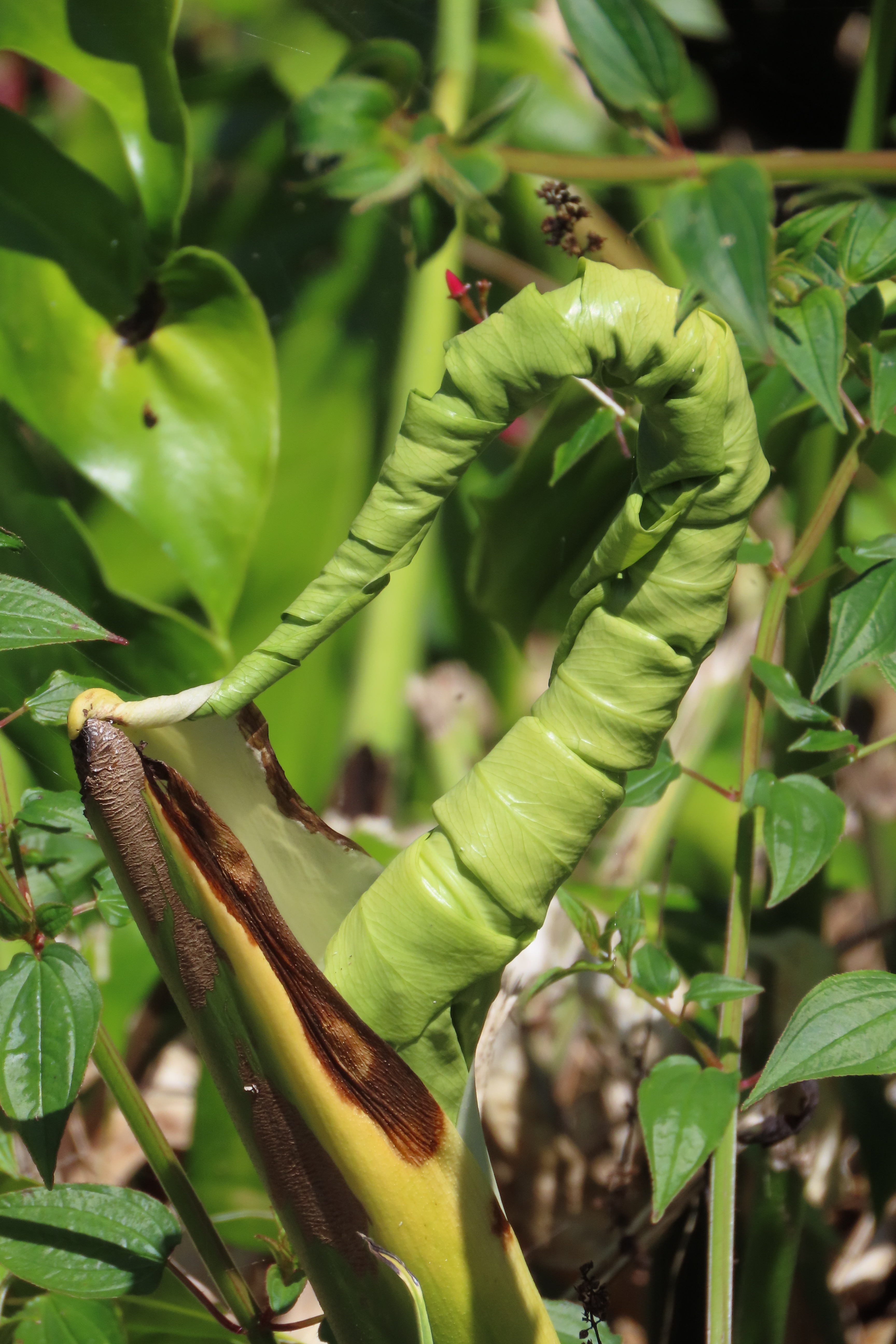
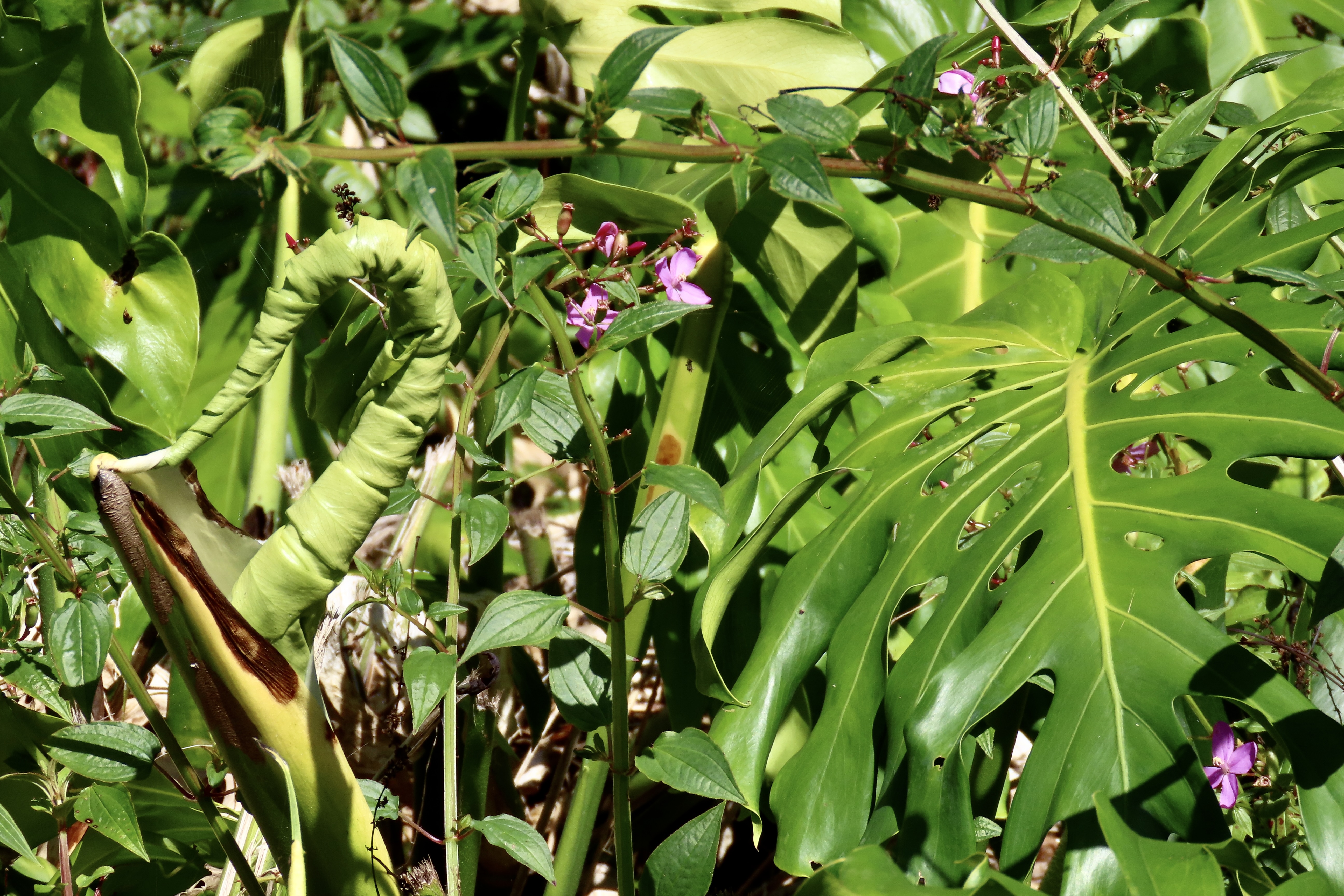
There was also unique flora such as this leaf that was about to open.
We thought it might resemble the leaf to the right of it.
The size of the leaves in Hawaii always blows my mind. As do the number of vines that find their way up almost every tree.
In addition to flora, there is interesting fauna. The Rainbow Falls cave was the perfect sanctuary for Hina in ancient times, except for a giant lizard or mo’o named Kuna, who would hassle Hina by throwing boulders and logs over the falls when the river flooded. Hina was safe in her cave, however, until one day Kuna blocked the river with thoughts of drowning her. Hina called desperately for her son Maui, who heard her plea and rushed over to save her. First, he knocked the huge boulder aside that was blocking the river and then he went in hot pursuit after Kuna, eventually catching the giant lizard and pounding him with his mighty club. Thus ended Kuna and the story, except…
When we got back to our car to drive back to our home from Rainbow falls, Kuna’s small cousin, Little Mo’o had taken over the hood of our car and refused to budge. “Aha, Little Mo’o, I told him, let’s see how well you hold on when Peggy is driving 60 MPH down the highway!”
Little Mo’o was still perched on the hood when we arrived home! He had hardly moved. How it had managed to hold on was totally beyond us.
Akaka Falls, north of Hilo, is 442 feet tall.
Unfortunately, heavy vegetation didn’t let us see the bottom of the falls. There was a fence on the edge that I could have perched precariously on and possibly got a shot, but I had visions of making it to my 82nd birthday, which was three weeks away.
We satisfied ourselves with taking pictures of the top of the falls.
Close-ups.
And the attractive Hawaiian vegetation.
Including bananas. That’s it for the day. I’ve earned my nap. Next up will either be more of Hawaii or we will be back on the Danube River.

Through the Heart of the Grand Canyon by Raft: Miles 181-280… The Great River Series #5

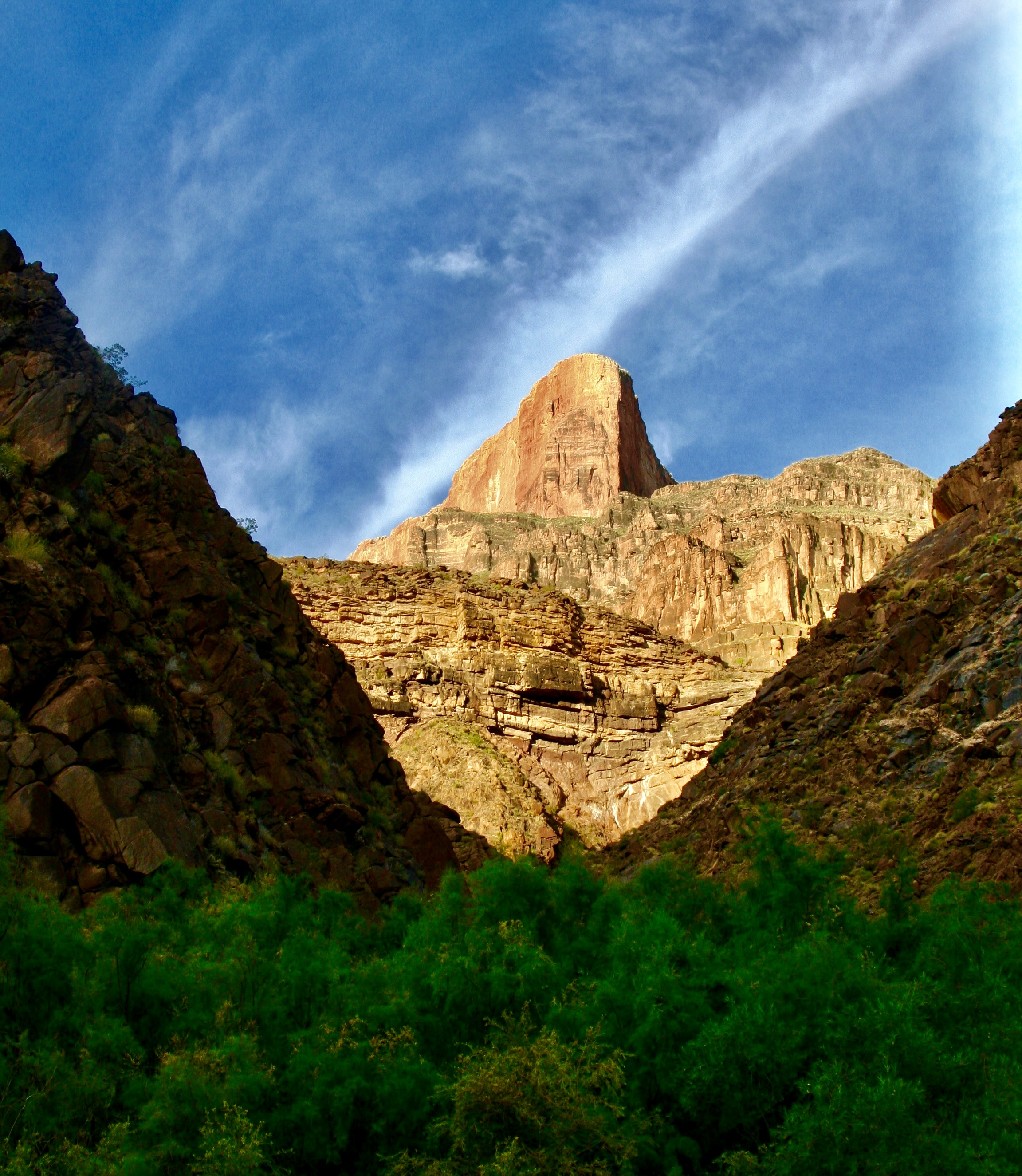
I’m going to wrap up our Colorado River posts on the Great River Series today. We will start just below Lava Falls Rapid where we ended our last post and journey to the beginning of Lake Mead where we finish our trip. I chose this photo from near the end to make a point: There never was anywhere in our trip down the Colorado that lacked in beauty.
Much of this post will focus on the scenic views as we made our way from the Grand Canyon to Lake Mead. (Photo by Don Green.)
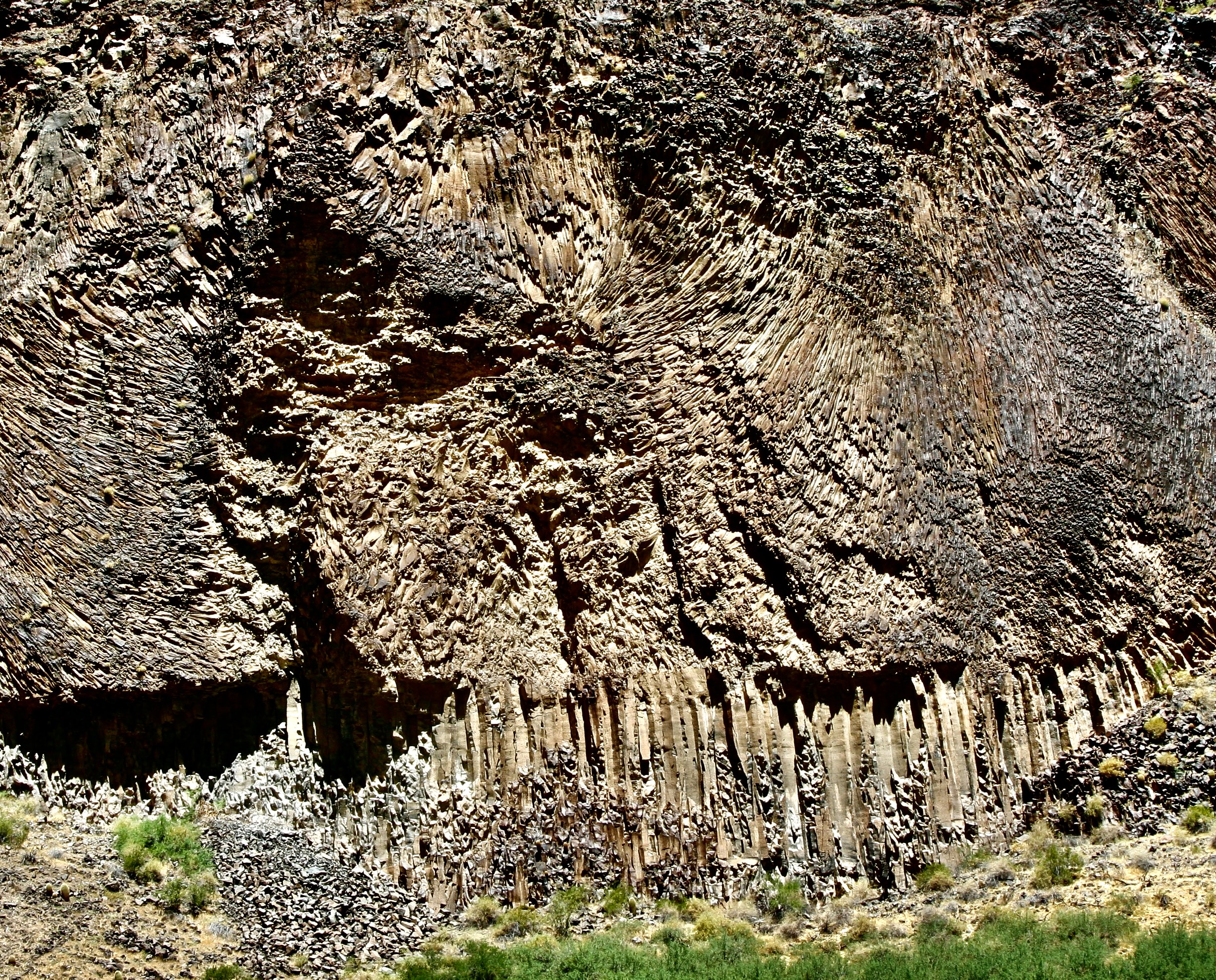
I’ll also feature interesting rock formations such as this lava flow. This one was appropriately near Lava Falls Rapids. The columns are formed when a lava flow has turned solid but is still hot.
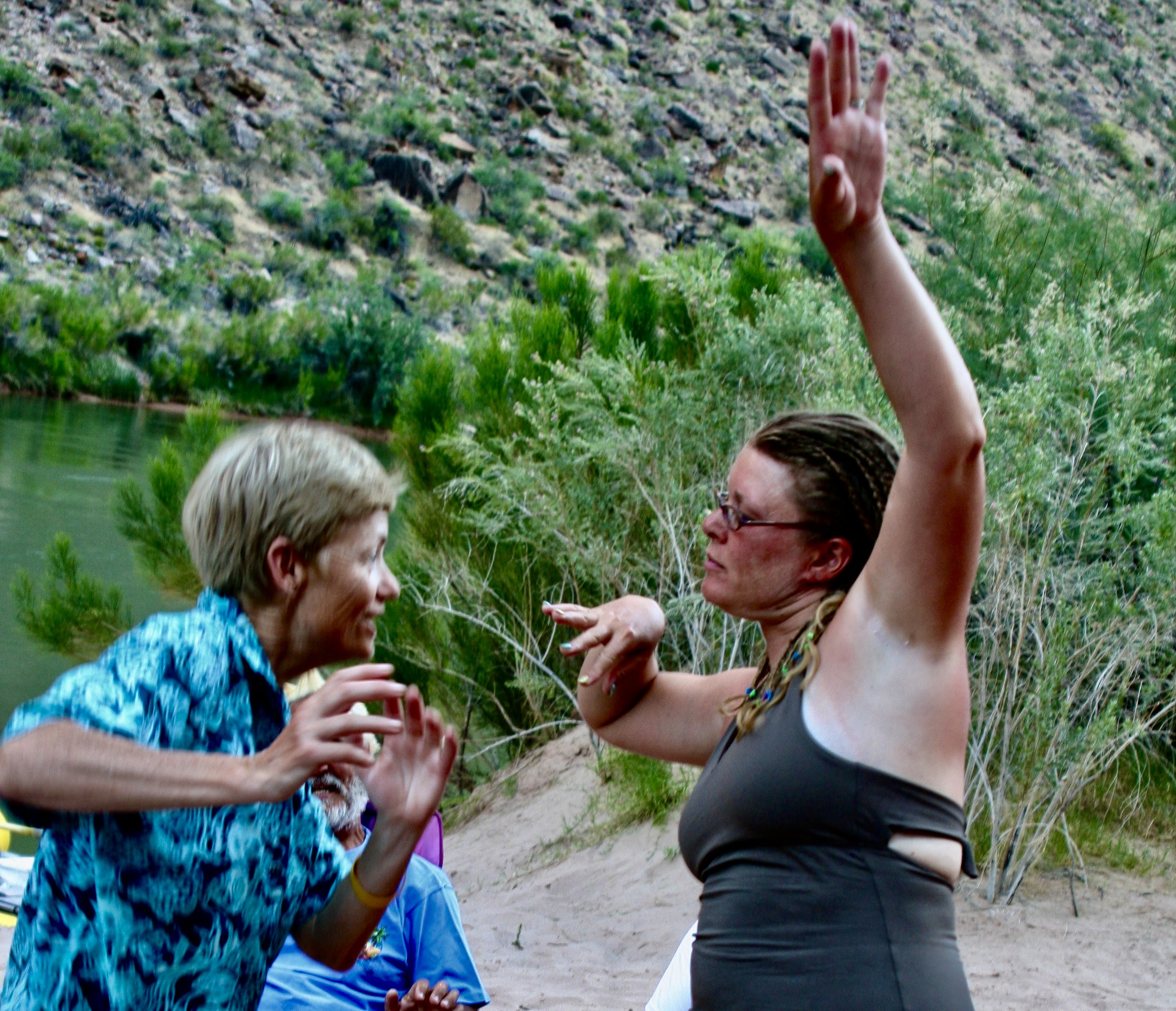
And of course we will continue to feature the fun folks we had along on our trip and their interesting antics. Spontaneous dancing took place at camp after we had successfully made it through Lava Falls. Tom is in the background…
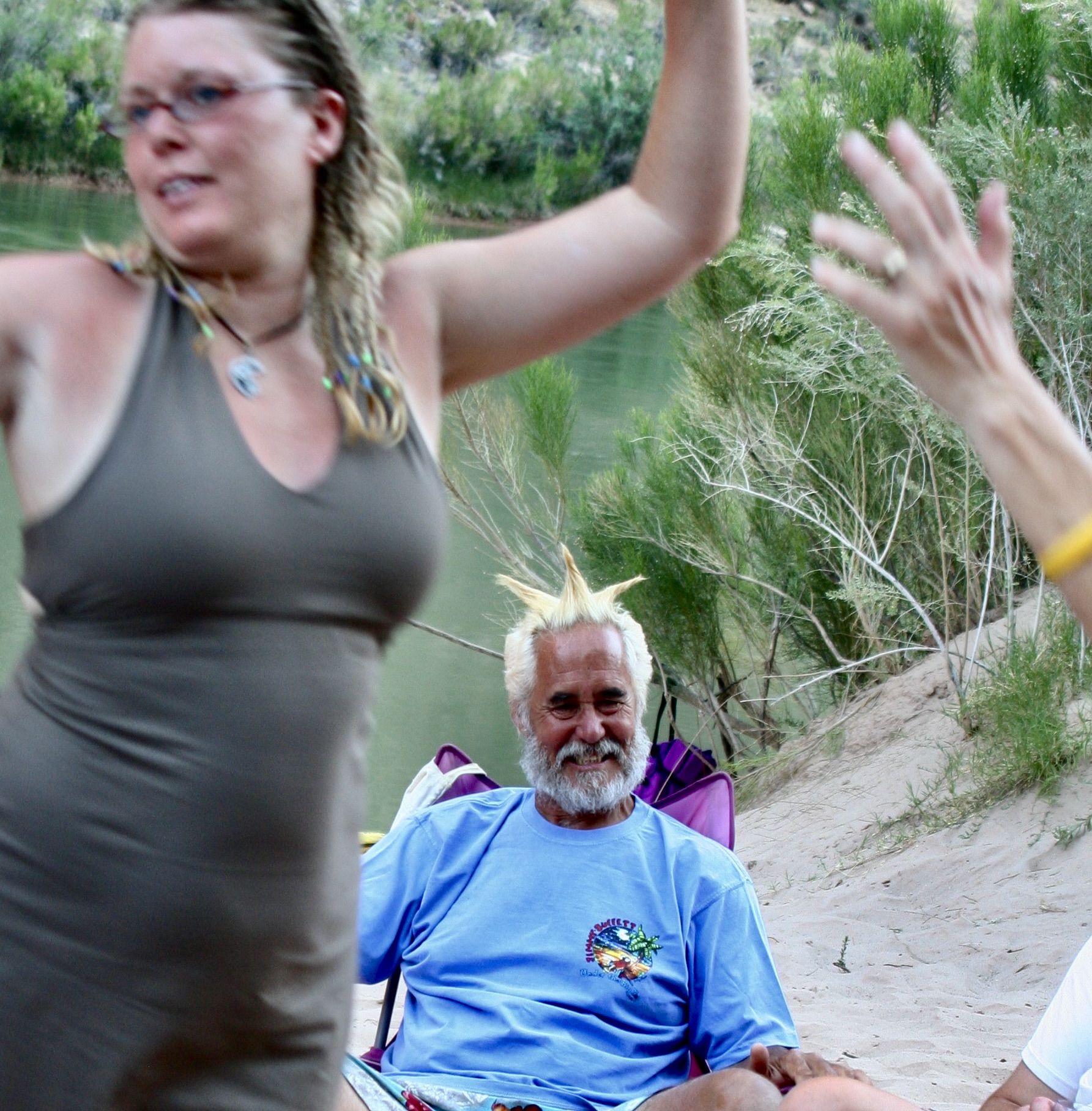
Admiring the performance and supporting a new ‘do.’
Further adventures awaited us as well…
As expected, Bone would continue to find ways to get into mischief and amuse us.
Now this would be a great place to row a boat!
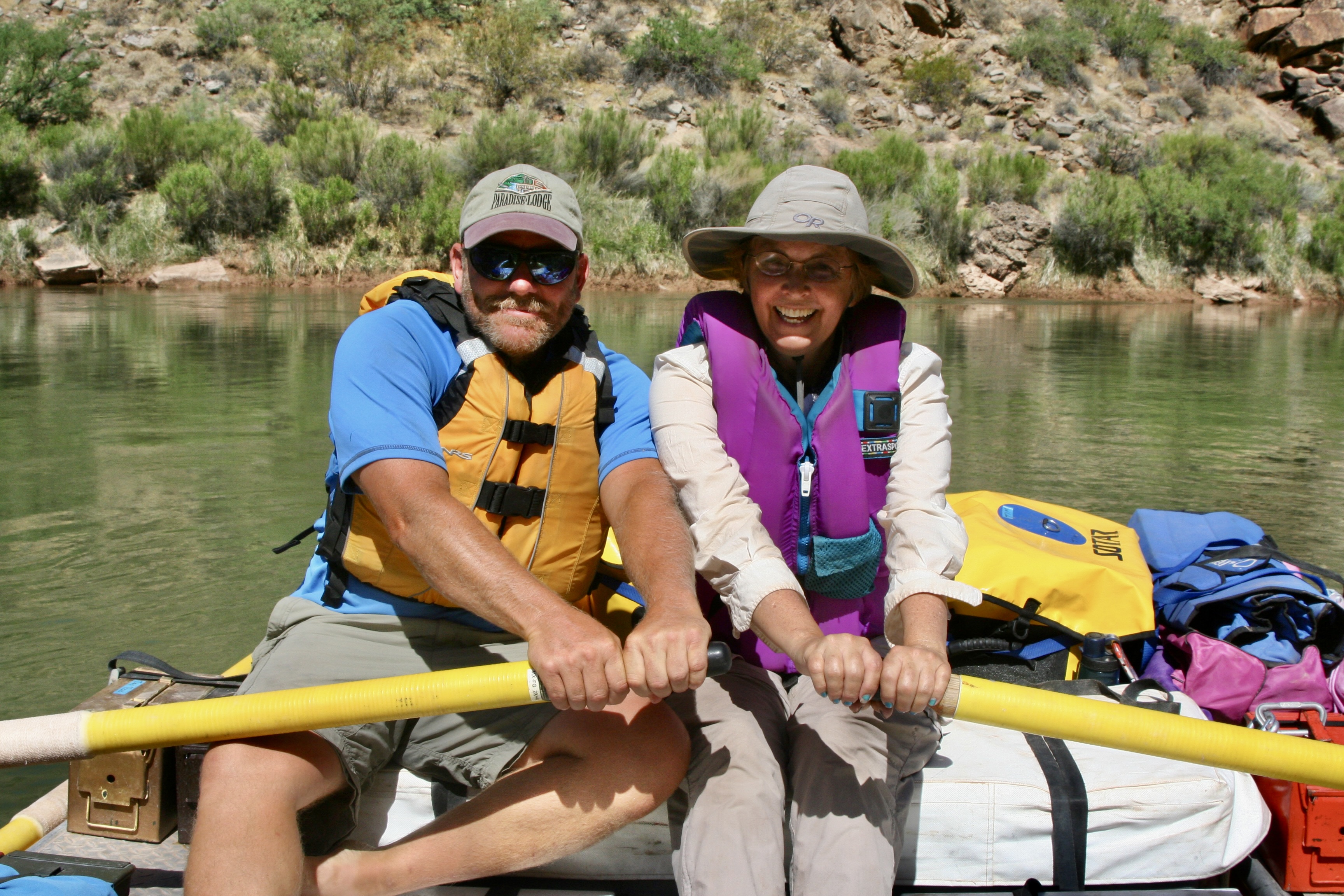
With most of the rapids behind us, I finally took a turn.
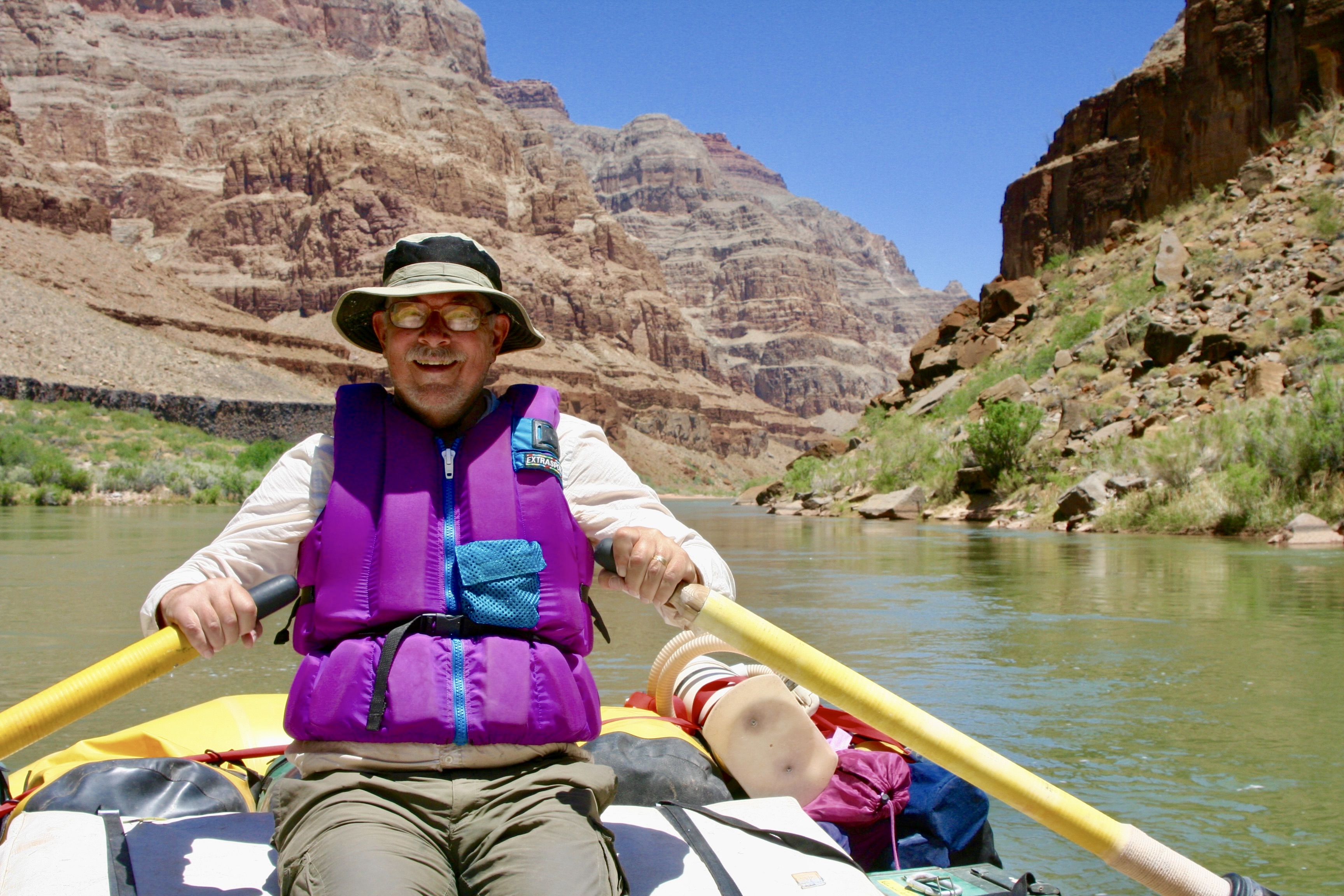
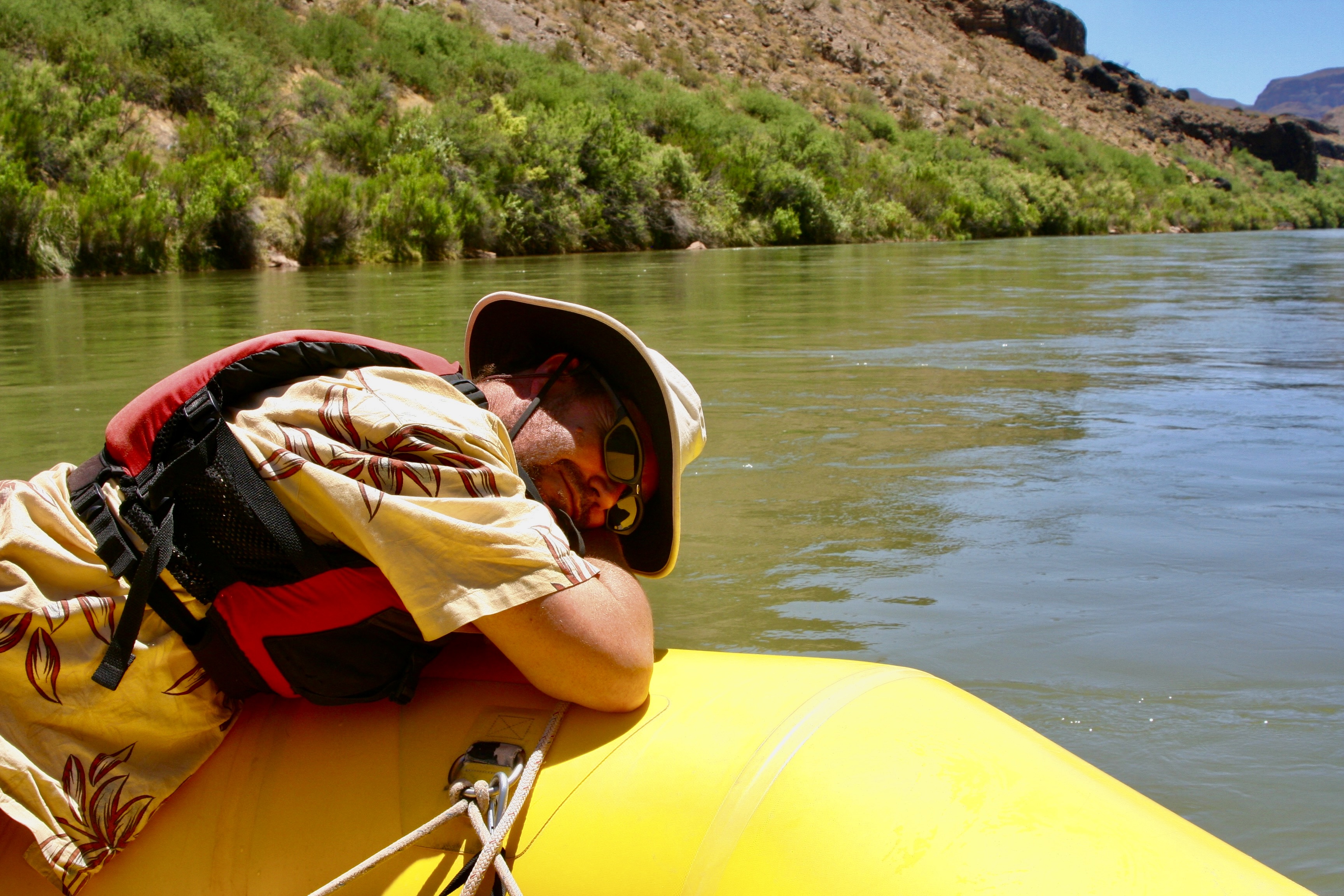
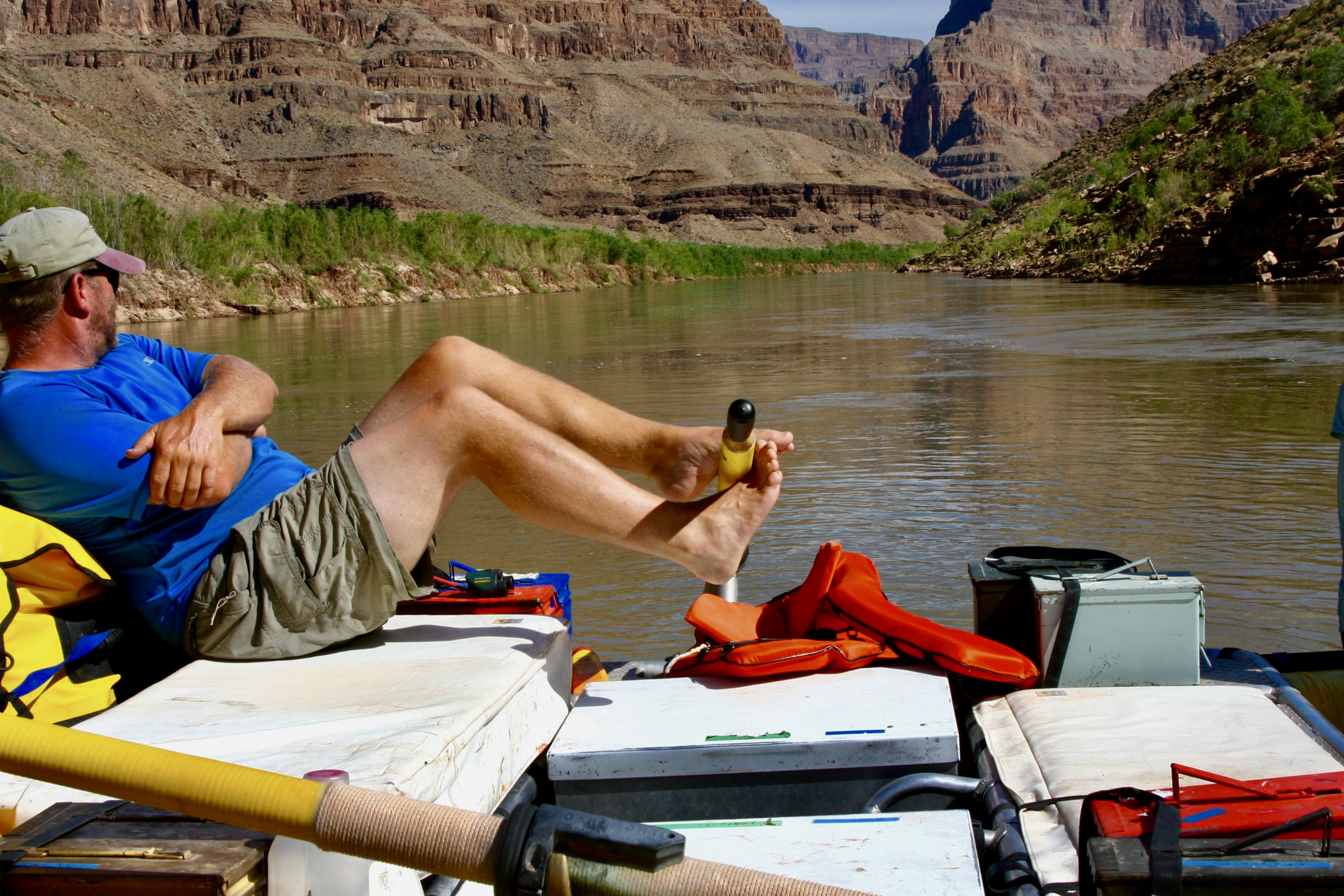
Dave saw it as an opportunity to nap until we reached a minor rapid and I insisted he wake up to guide me through it.
Peggy also was willing to take an oar. With Jame’s help…
You can probably guess the name of this rock. It’s called Pumpkin Springs. The color is caused by minerals flowing out of the hot springs above it that include high levels of arsenic , as well as zinc, lead, and copper. Bathing in the hot springs is discouraged. Drinking the water is not an option!
The cooking crew was getting a little rowdy in Camp.
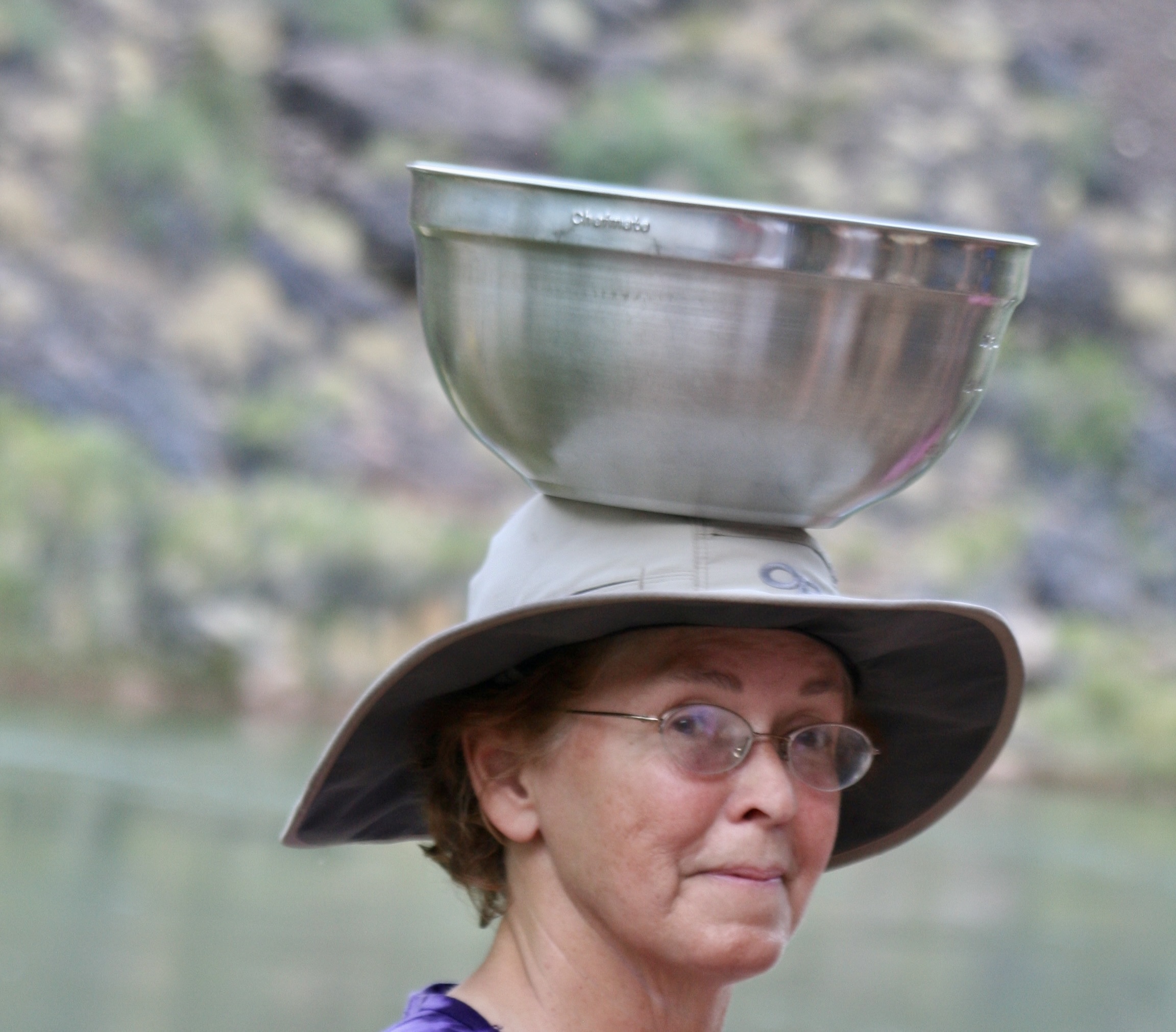
But Peggy was seeking balance.
A convenient ledge gave those not working at the moment front row seats.
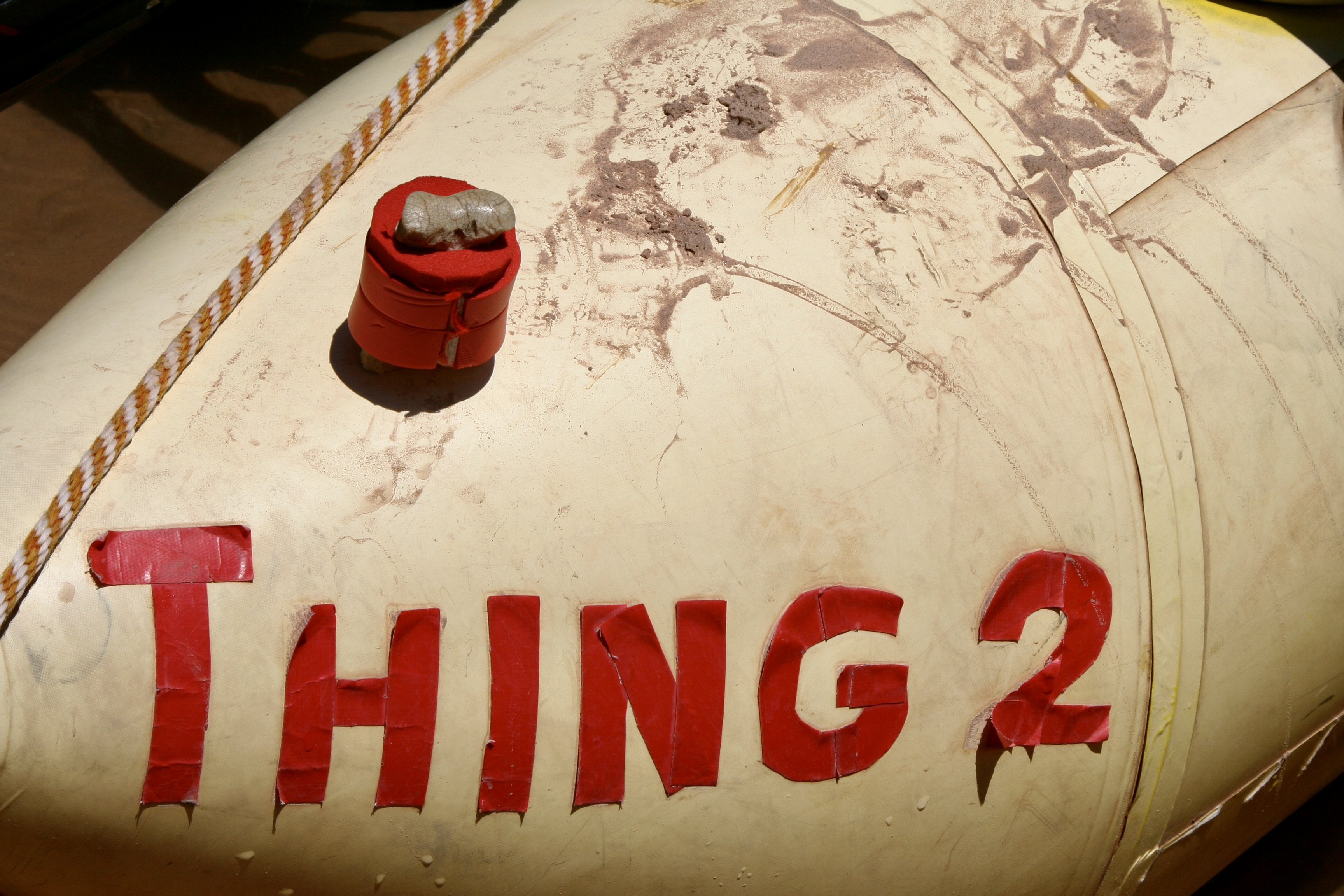
Bone decided he had something in common with Steve Van Dore’s boat, Thing 2.
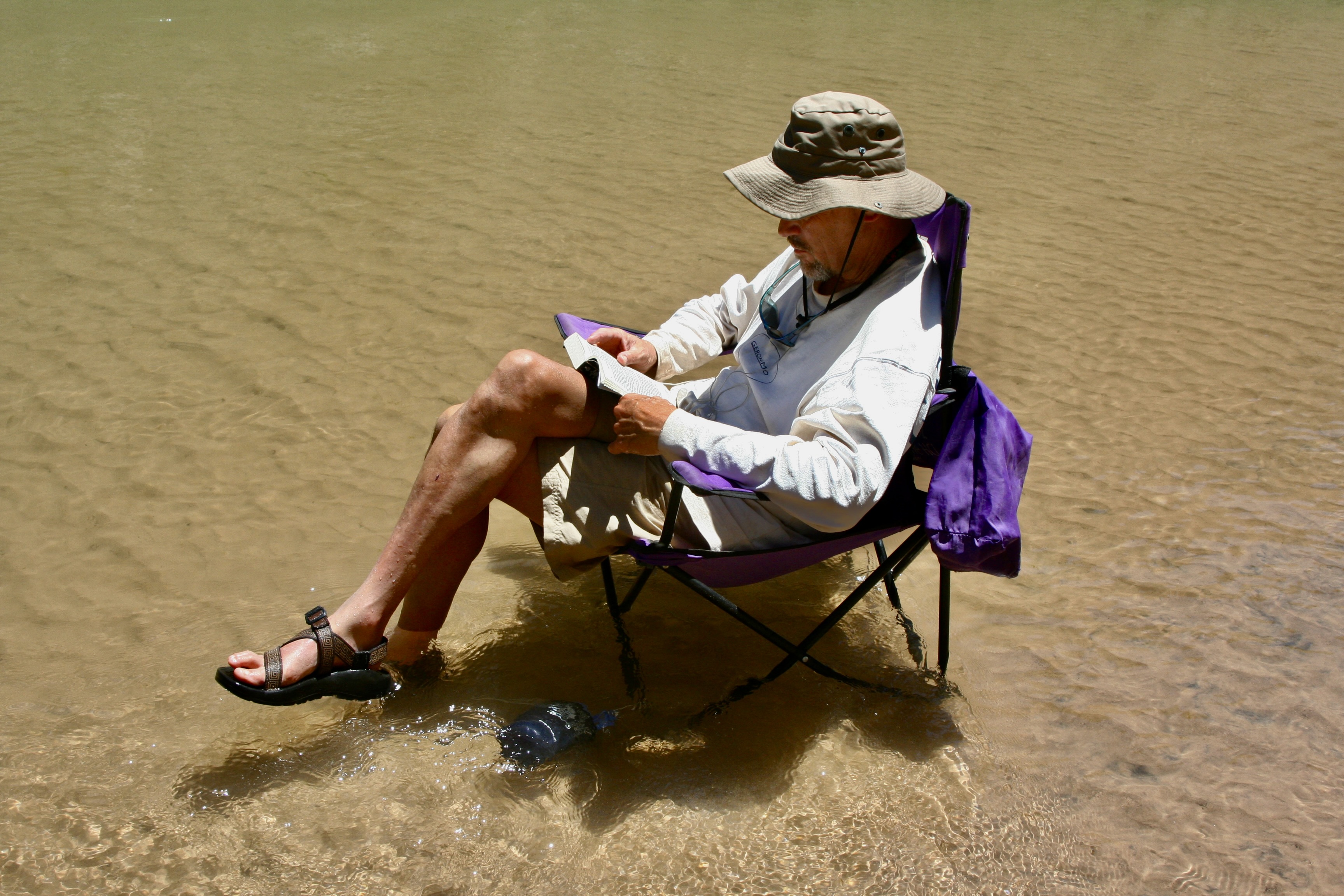
A ‘cool’ way to read a good book?
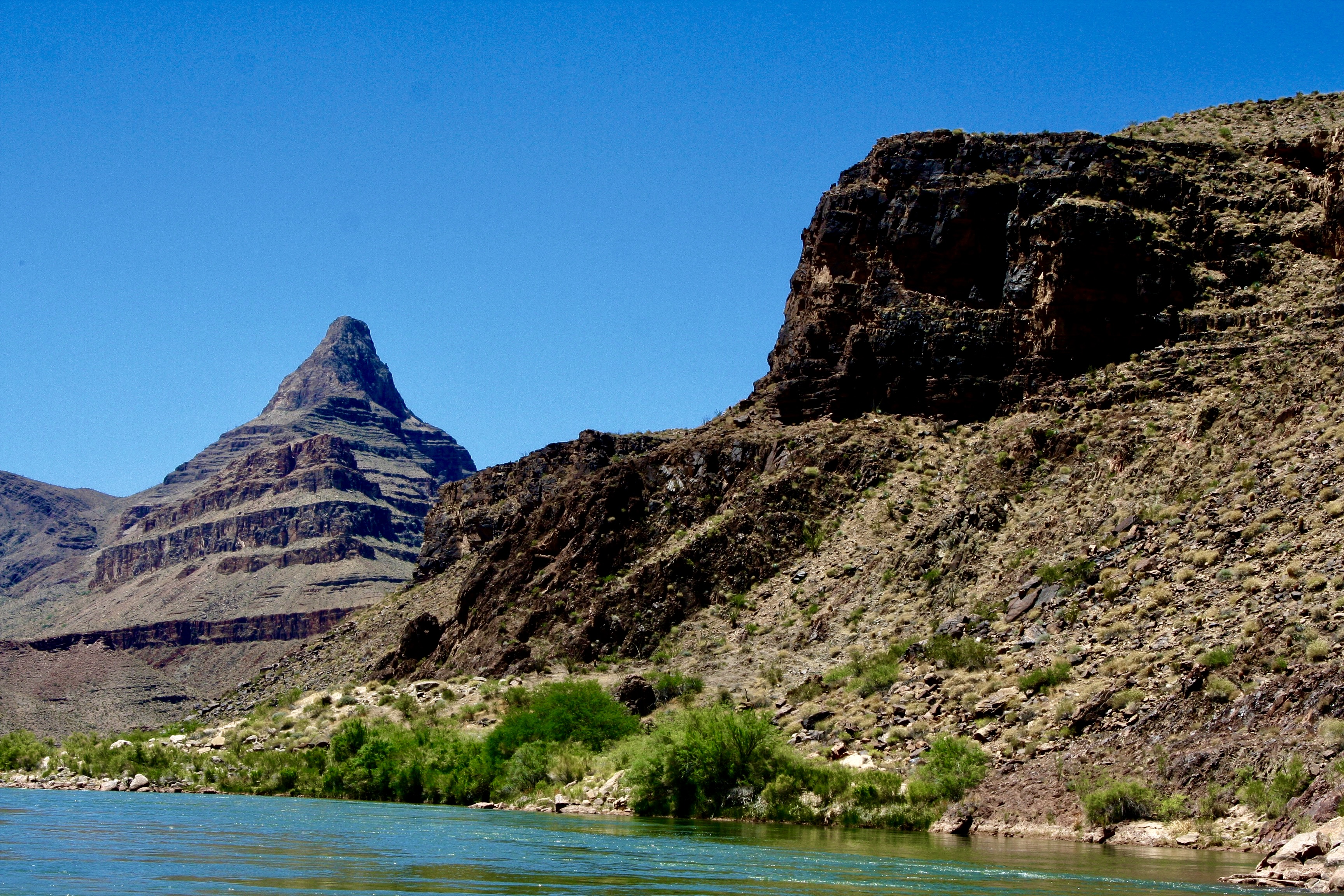
This pyramid-like structure in the background, Diamond Peak, reminded me of our trip up the Nile River. We will be returning there as part of our Great River Series. The dark rocks are volcanic.
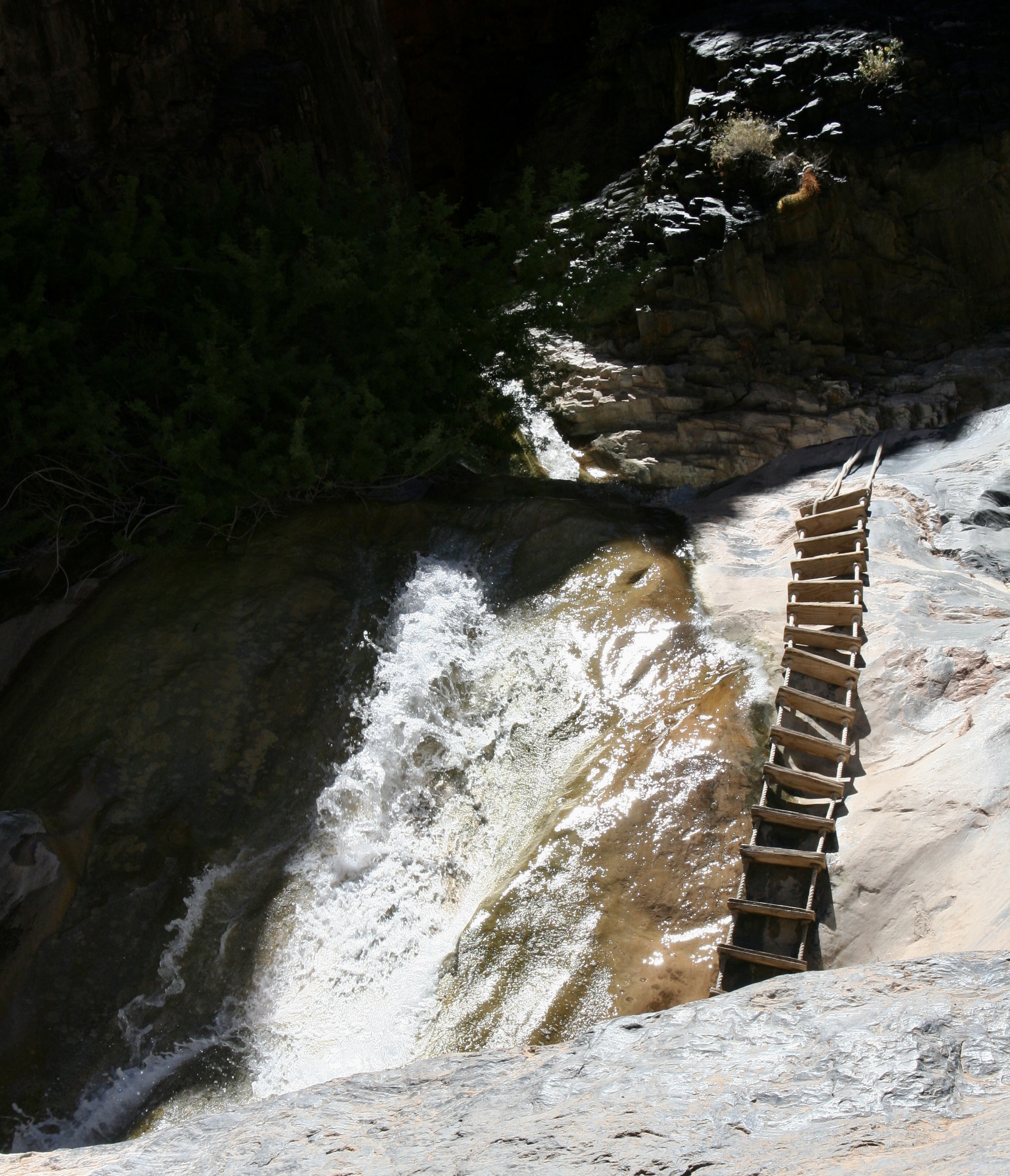
Tom had a final adventure planned for us that I mentioned above. it involved climbing this step/rope ladder near Diamond Creek. The Hualapai Tribe built series of ladders to help people access a ‘bathhouse’ on the creek.
Beth climbing the ladder. (Photo by Don Green.)
A cold shower was one of the options of the bathhouse. I decided Bone, me and my clothes would all benefit.
A more civilized approach was a few feet away.
I was attracted to a colorful set of rocks found in the area.
Our ‘bathhouse’ provided creative frames.
Another example.
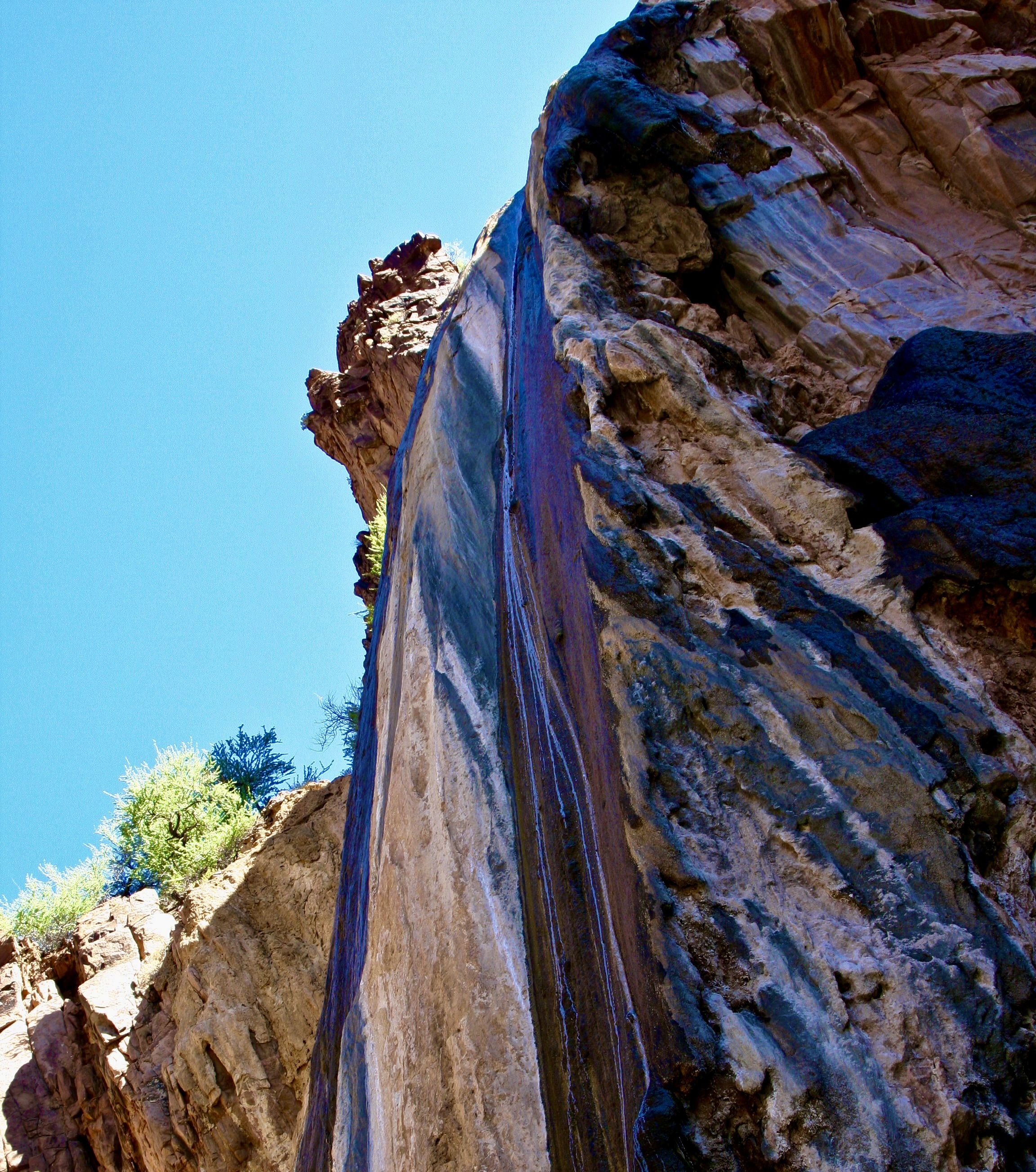
One of the most unusual sites we saw along the Colorado was this hundred foot waterfall made out of Travertine Rock.
Another perspective.
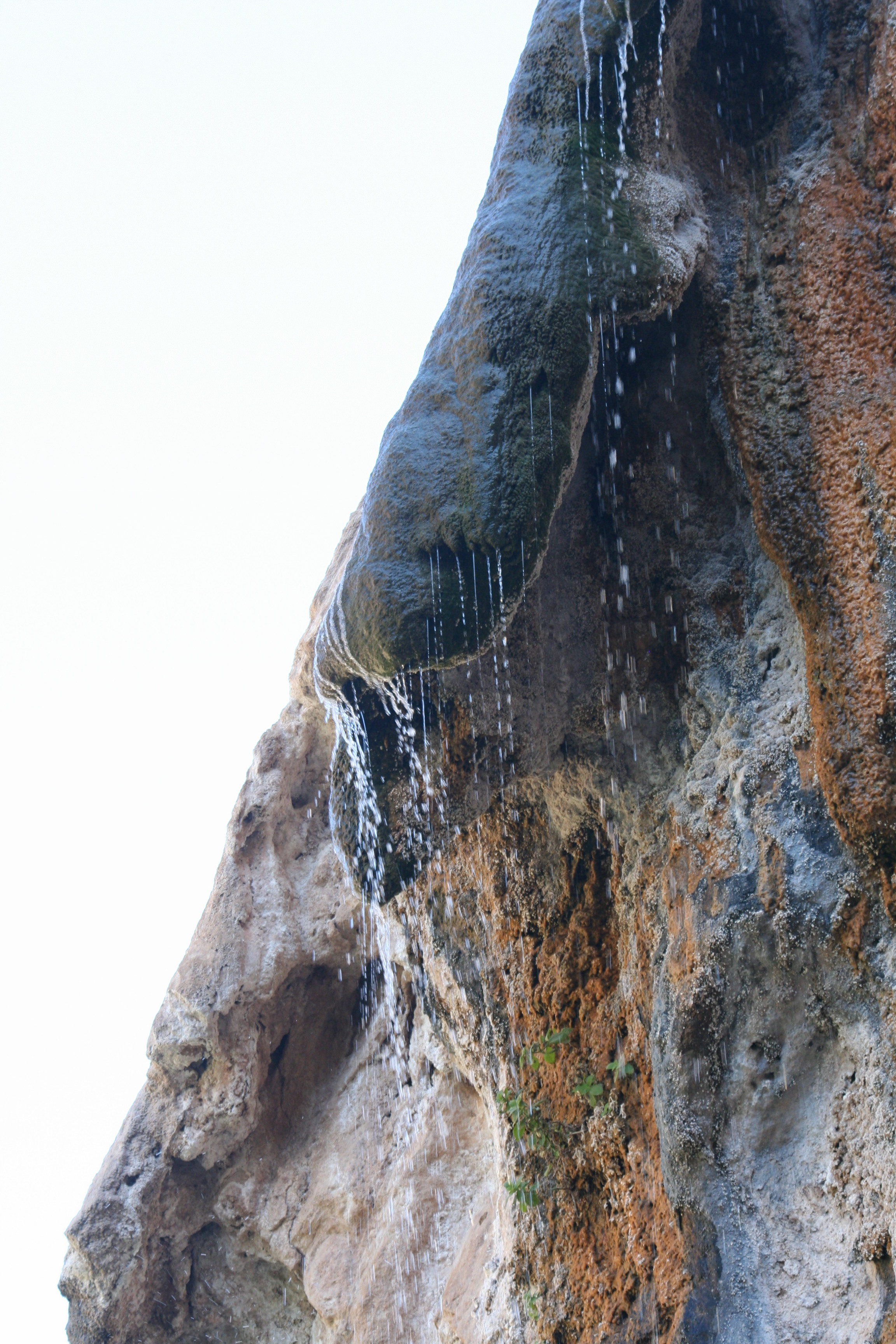
I caught this close-up of travertine framed by the sky at a stop nearby.
And Don caught these maidenhair ferns.
While Bone found a barrel cactus to perch on. Tough butt.
And the scenery kept being spectacular as the miles rolled (rowed) by.
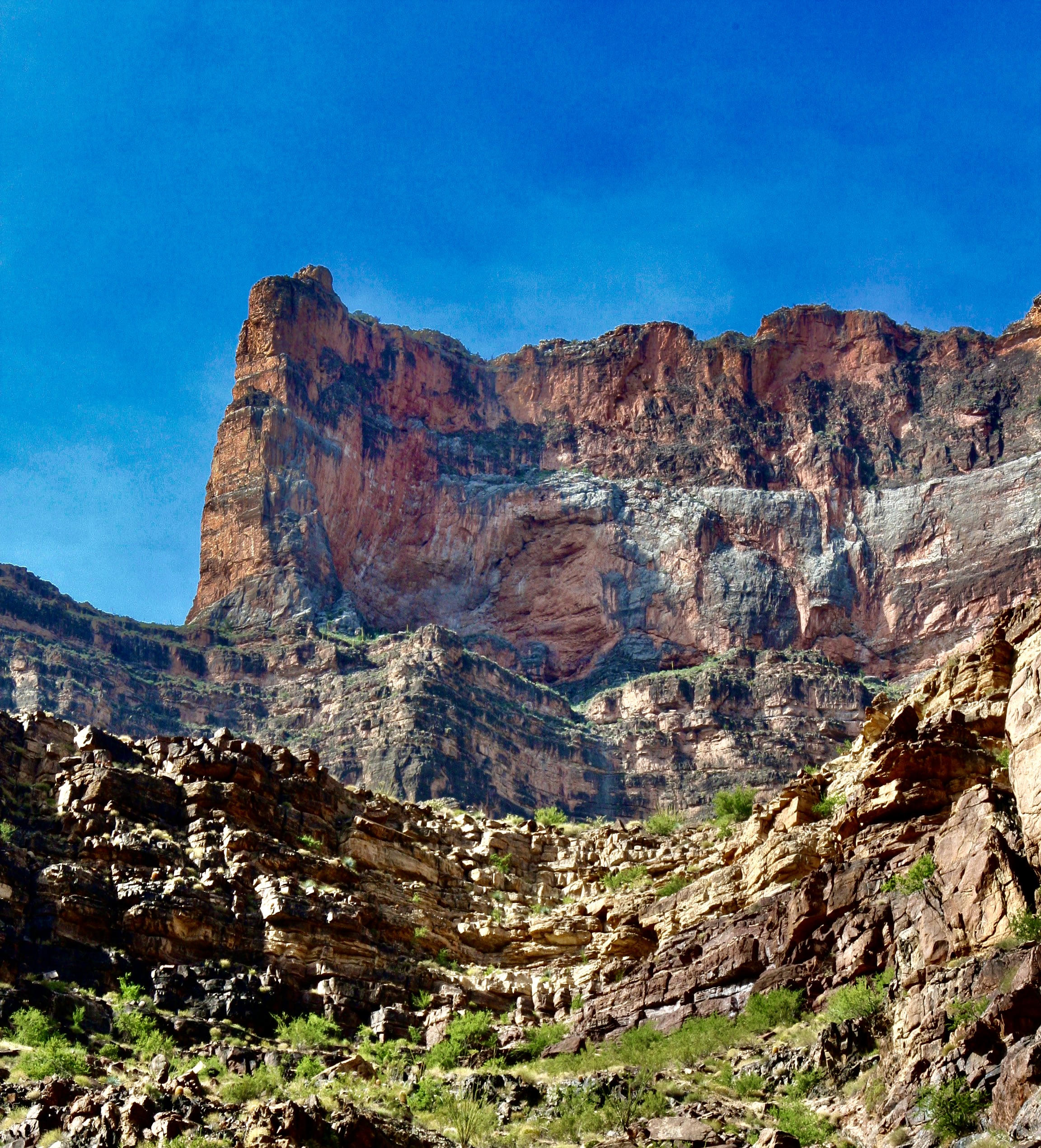
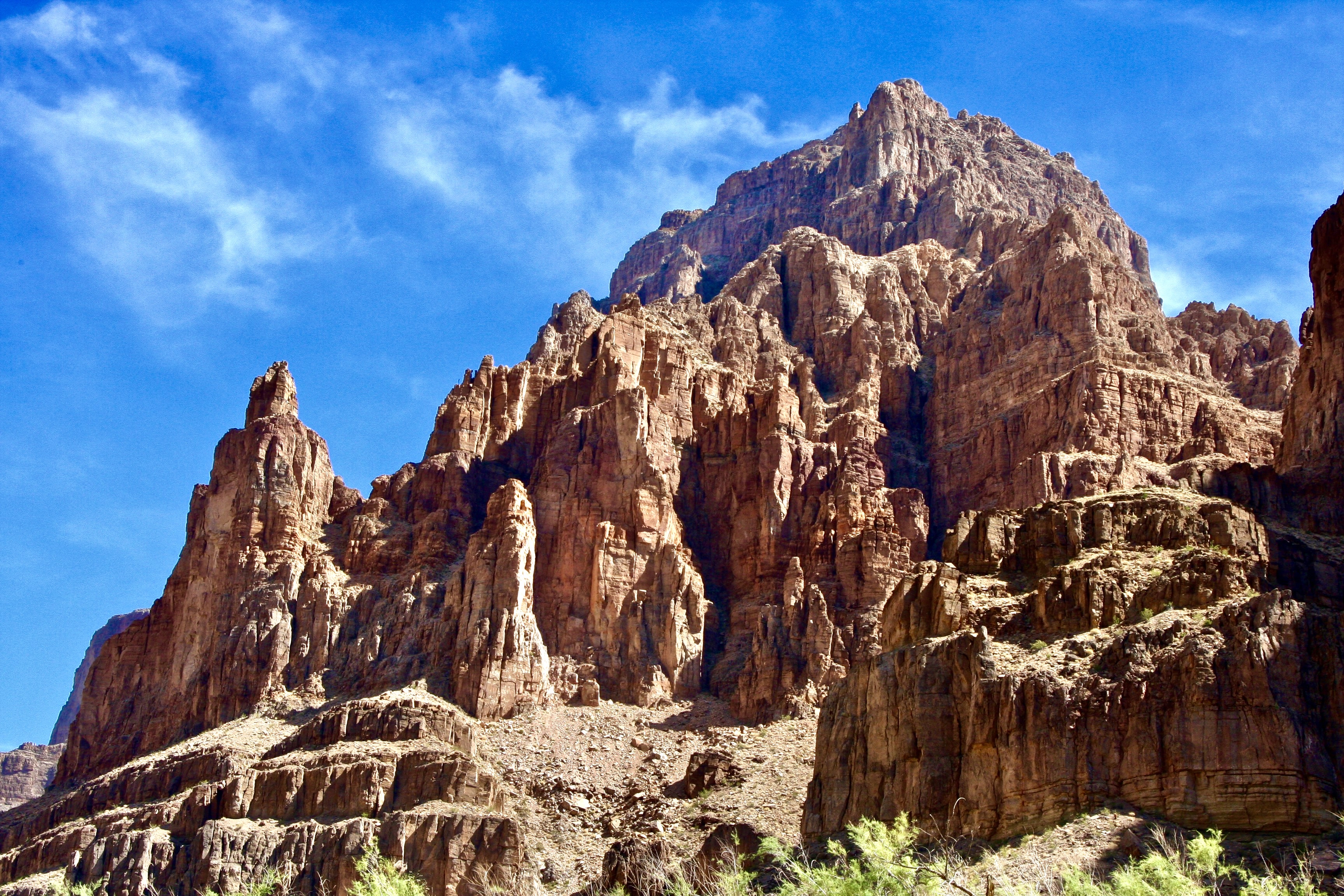
Cliffs.
Distant vistas.
A combination of the river’s edge and far away.
And a final view of the beauty that had awed us on our 280 mile journey through the Grand Canyon to Lake Mead.
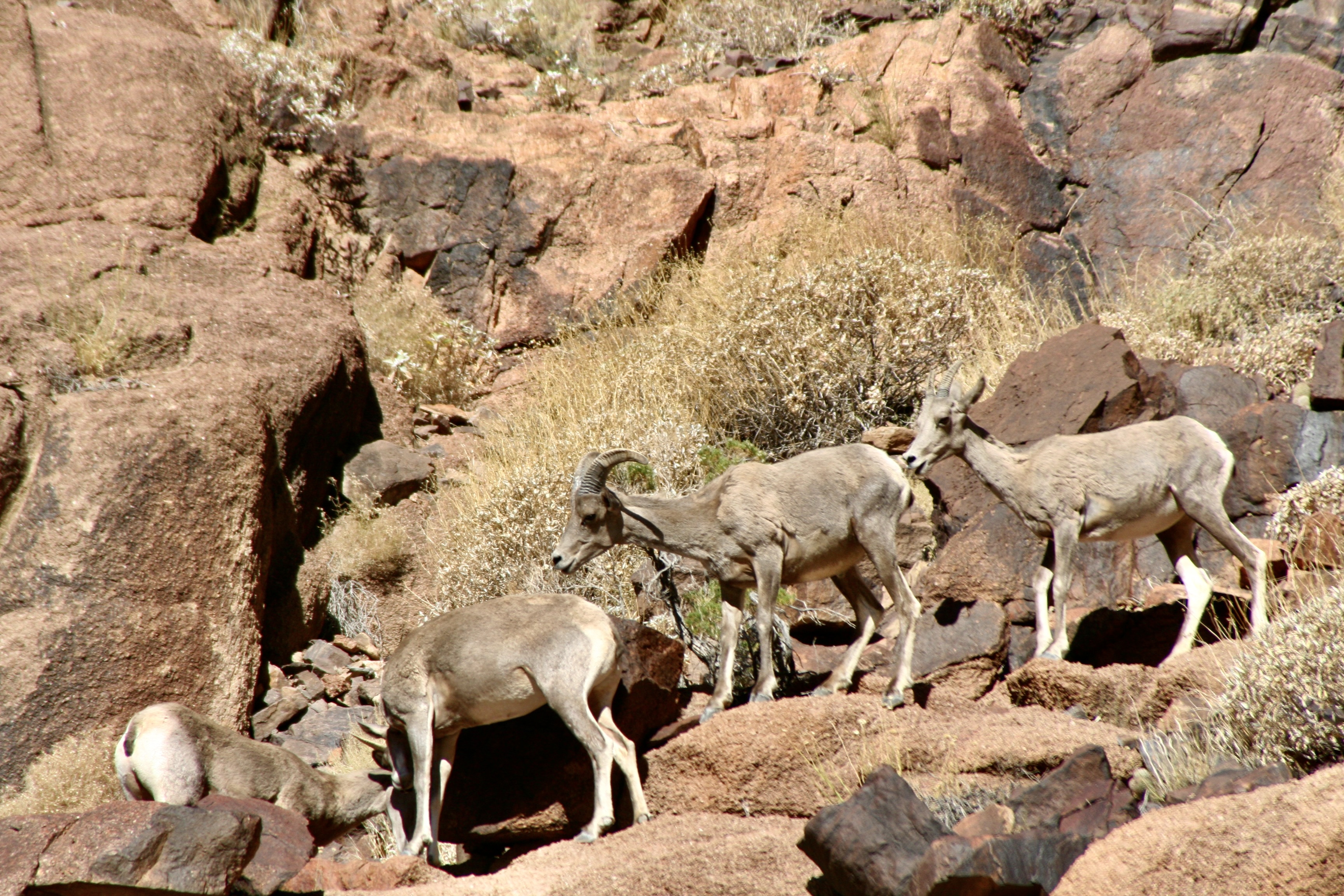
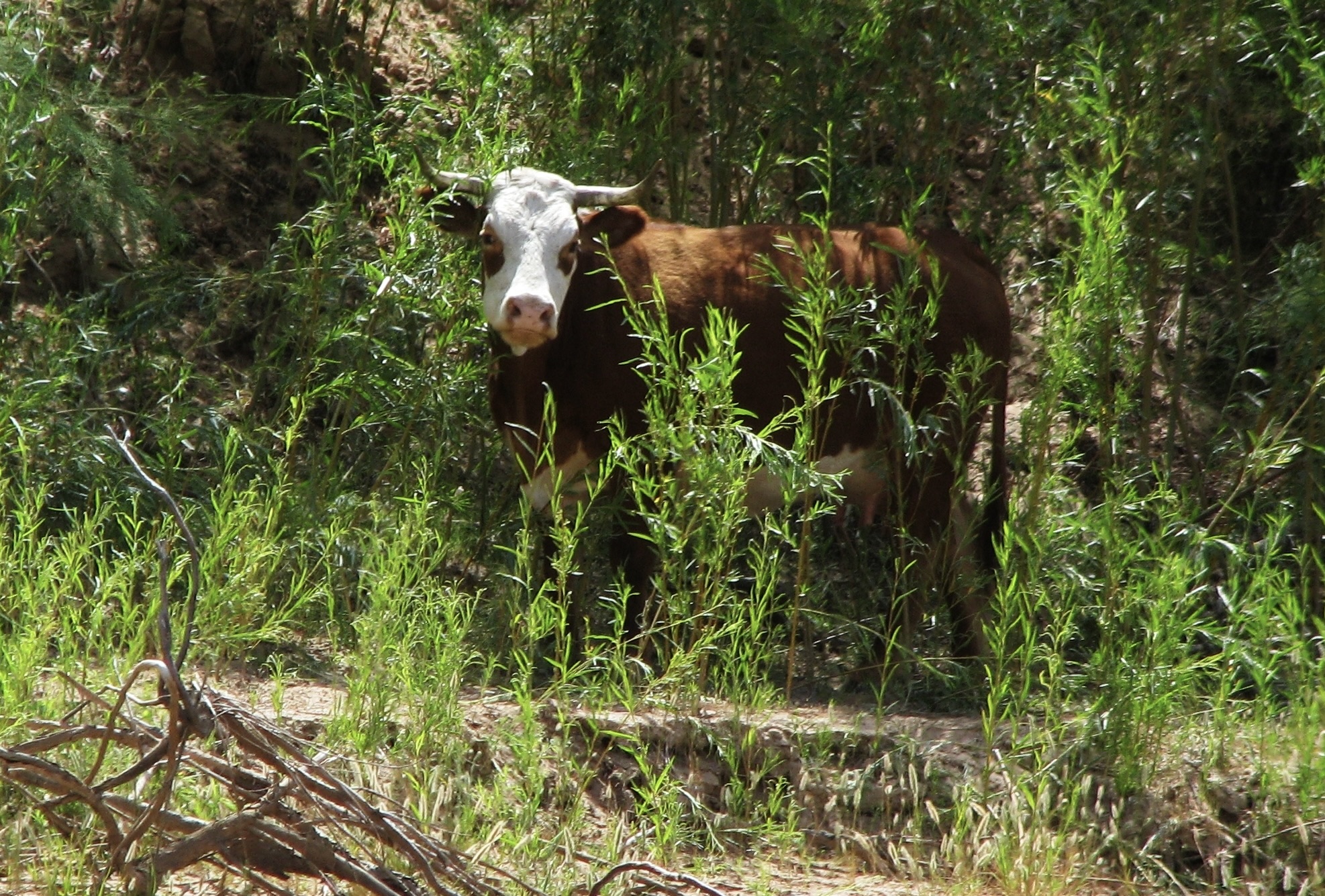
We were privileged to see several big horn sheep in our last hundred miles. I think these may have been lined up for their turn at a natural salt lick. It came as a big surprise when we spotted a different type of animal with horns…
That convinced us that our journey was nearing its end! (Photo by Don Green.)
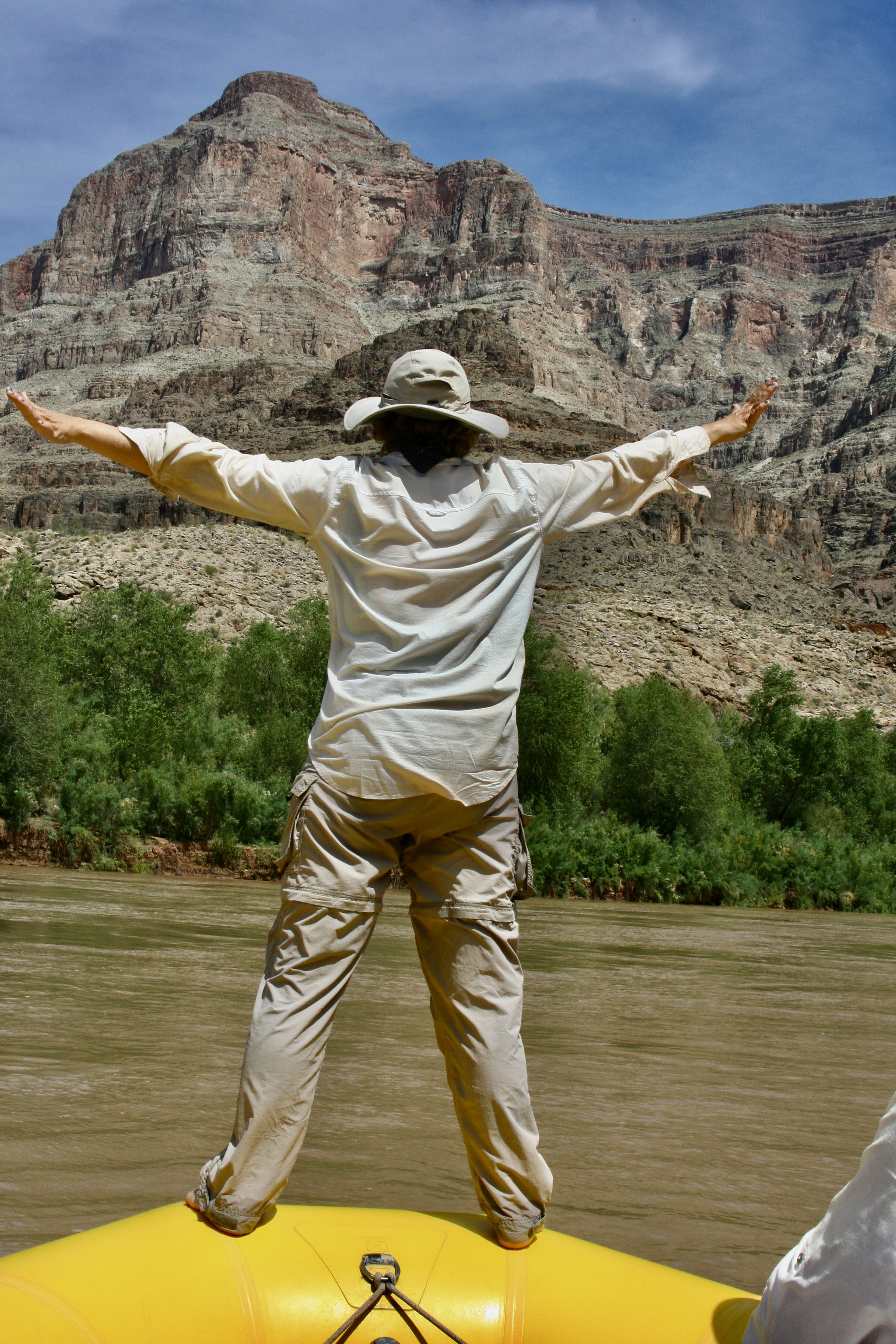
Peggy struck her Titanic pose. I saw her do the same thing once over the piranha infested water of the Amazon River. At least, if she fell off here, the only thing that would happen to her is she’d get wet.
Jame introduced us to a new way of rowing…
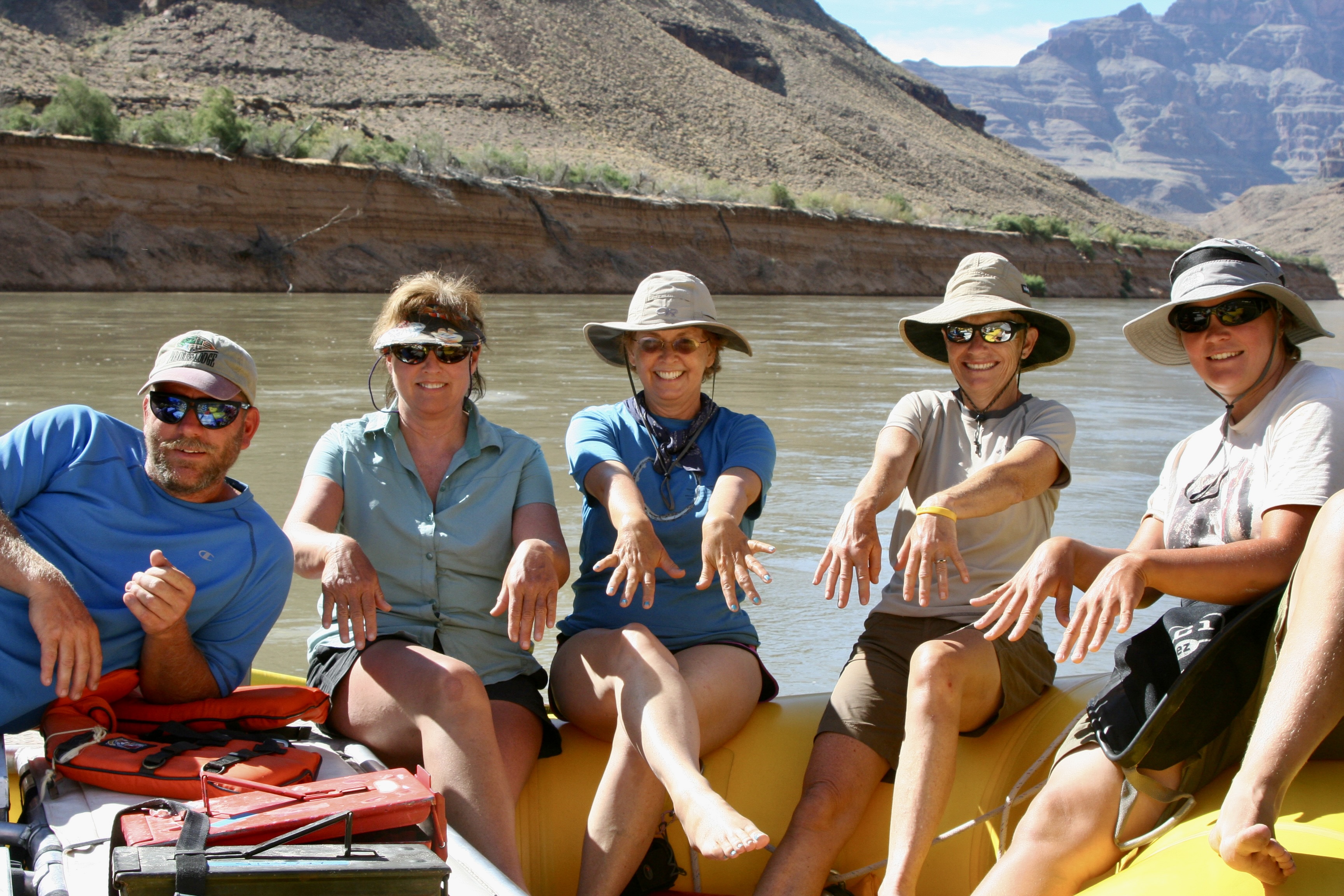
And the women, for a reason I couldn’t quite fathom, decided to do a fingernail check. It’s possible that Jame felt as perplexed as I did. Or is that a semi-thumbs up?
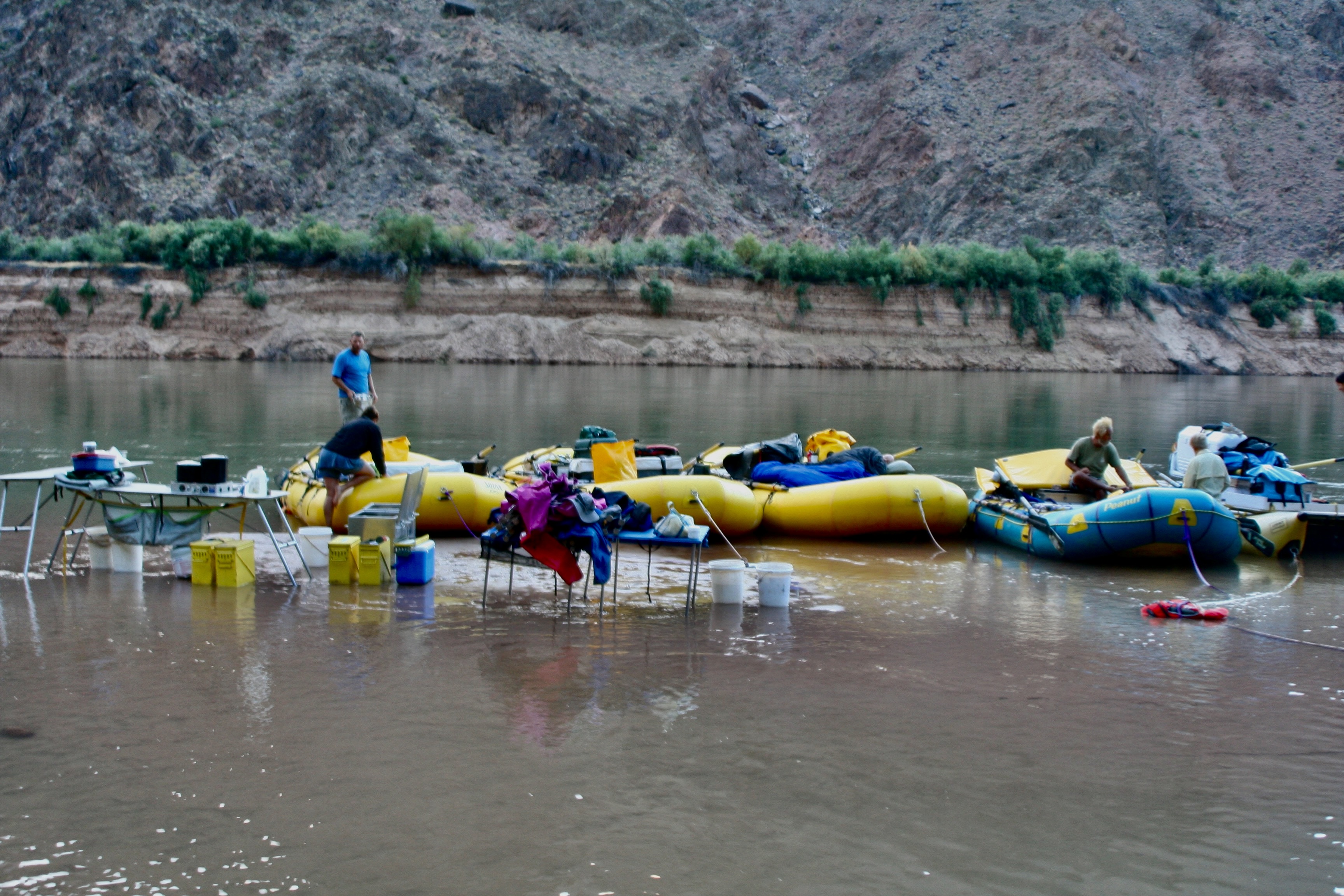
We woke up on our last morning with our campsite flooded. Go figure. Everyone good-naturedly went about his or her business of doing morning chores.
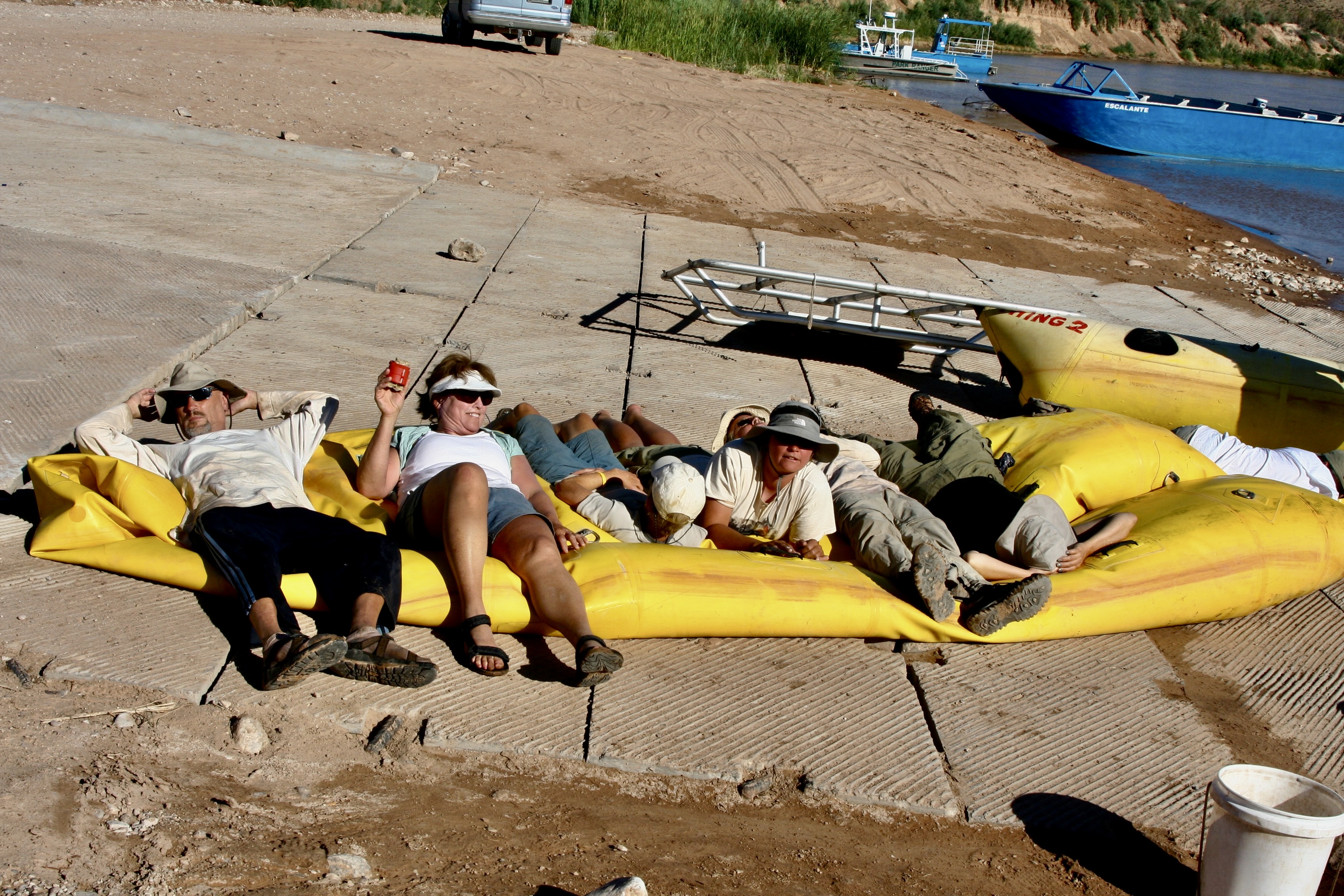
A few miles down river we reached the take-out point. Our journey was over. It was time to pack up one last time. It may look like everyone was ‘laying down on the job’ here. Actually we were squishing the air out of one of the rafts.
A final photo of Tom. He looked tired— but it was well earned tired. We all owed him a great debt of gratitude for the incredible adventure he had taken us on: For all of the planning and organizing, and for doing everything in his power to assure that we experienced everything the Colorado River and the Grand Canyon had to offer, and doing so in a safe manner— while having loads of fun along the way. While thanking Tom, I also want to thank the boatmen (plus Megan) whose hard work and skills meant so much to our successful journey.
Don, I think, represented us all, while looking a bit scruffy, looked off into the distance one last time, contemplating the wonder of what we had just been through.
Looking equally scruffy, I had added another whole layer of appreciation for the Canyon I had loved and explored over the years on foot, by mule, by car and by helicopter. And now by raft.
And Peggy, who had loved every minute of the adventure, looked just about like she always does. How in the heck does she do it? (Photo by Don Green.)
And finally: Bone. No-one had more fun than he did. Virtually everyone spent time with him. As a final gesture, he made sure that everybody initialed his PFD.

Next post: It’s on to the Danube River and Vienna!

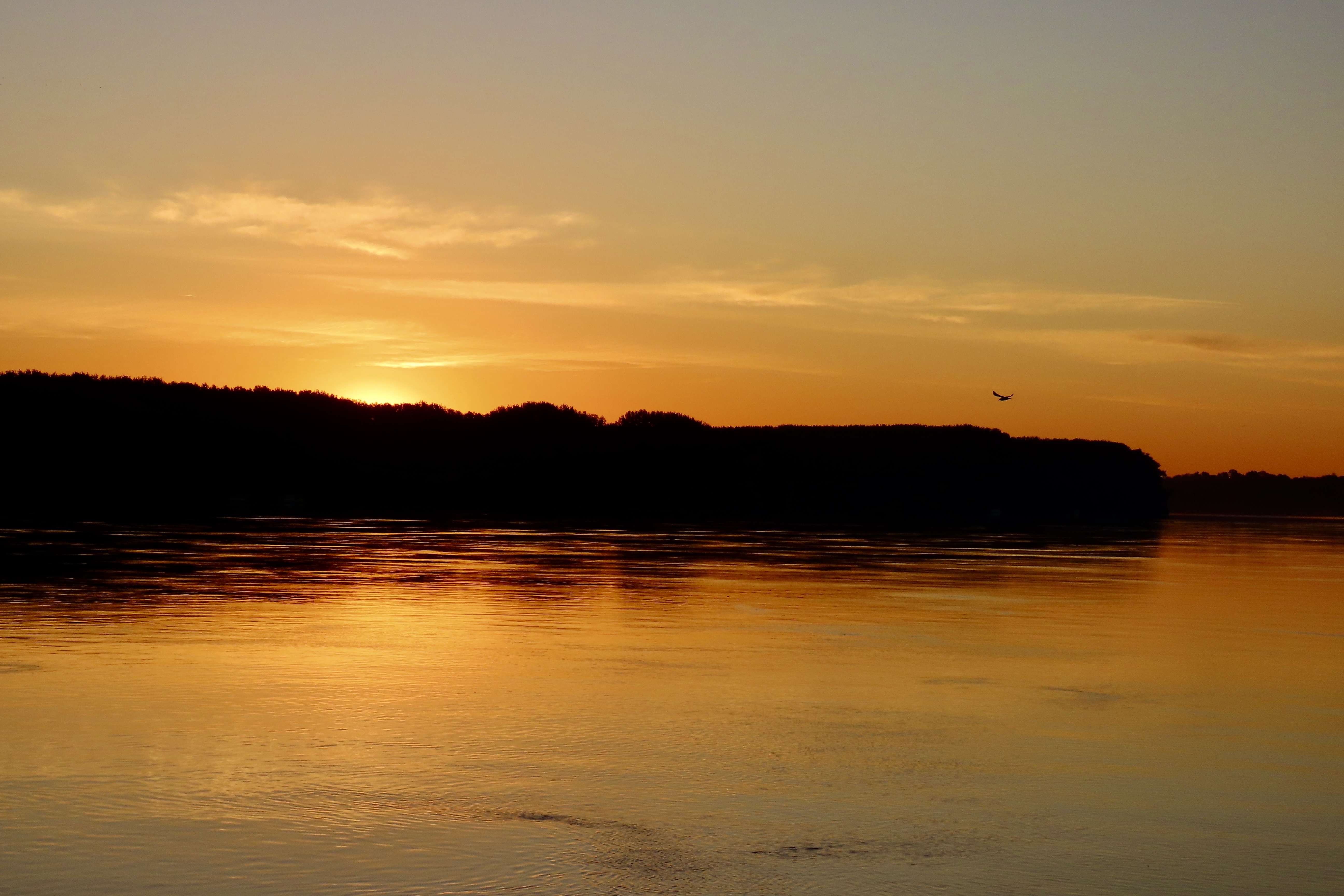
Sunset on the Danube River.

Through the Heart of the Grand Canyon by Raft: Miles 136-180… The Great River Series # 4

Deer Creek Falls was at mile 136, less than a mile below Christmas Tree Cave where I finished our last post. Here, Peggy enjoys the roar and the mist.

Today will take us another 44 miles down the river, which is short on miles but filled with both beauty and adventure. The beauty will be provided by Deer Creek Falls combined with a hike that takes us high above the river, and Havasu Creek that feature sparkling aqua blue water. Lava Falls Rapid will provide much of the adventure. Its #10 rating in difficulty recognizes it as one of the most challenging rapids in the world. We looked forward to it with excitement, and I might add, more than a little trepidation.

Deer Creek Falls and its 180 foot drop.
Getting up to Deer Creek above the falls involved a substantial climb. You can see the trail as it makes its steep, windy way up.
Don caught a photo of us high above the Colorado. (Photo by Don Green.)
This Shangri-La with its welcome shade, magnificently carved rocks and cool water, made the trip up more than worthwhile.
Or maybe I should say cold water. Susan obviously thought so.
Beth Annon found another way to enjoy the coolness of Deer Creek. (Photo by Don Green)
Bone wants to jump into the waterfall. Peggy is providing him with advice, “If you do that, it will be bye-bye Bone.”
She also warned him to watch out for Tom and Don, the very definition of trouble.
With good reason.
After people got though playing in the waterfall, we all had time for R and R. Dave took it seriously. I’m convinced he can nap anywhere. The rope provided a rather unique pillow. Nice rubber band bracelet, too.
Peggy and I took advantage of the time to capture some of the areas unique beauty.
Deer Creek had cut an impressive canyon of its own.
The colorful carved rocks and crystal clear creek made for fun photos.
Another example.
Our trip back down provided more views of the Colorado River…
And our boats.
Our continuing trip down the Colorado provided more views of the magnificent Grand Canyon.
And another.
When we reached Havasu Creek at mile 156.8, we weren’t alone. It’s a popular area and a commercial group was exploring the creek. They were wrapping up their visit, however, and we soon had the creek to ourselves. (Photo by Don Green.)
The creek is known for its vibrant blue color and unique travertine formations, both of which are caused by large amounts of calcium carbonate in the water.
The beauty of the area is jaw dropping. (Photo by Don Green.)
Water flowing over a travertine formation.
Whether flowing in a flat stream…
Down a gentle rapid…
Or through a carved canyon, it captured us.
Even Bone found himself on edge over its beauty.
We hiked up the creek along a narrow path. (Photo by Don Green.)
While some continued to hike up the creek toward the Havasupai Village… (Havasu Creek is on the Havasupai land.)
Others chose to luxuriate…..with a mud bath for example.
Or quiet swim…
Or seeking bliss. Peggy and I stayed behind because we had been to the Havasupai Village a few years earlier when our son Tony had flown us in by helicopter.
While this looks weird, it’s a rafter tradition. The crew here is forming a butt dam. (Note Tom. I sometimes wondered if he had a hidden stash of magic mushrooms along.) When the ‘dam’ had created a lake…
The crew dashed off to the side, creating a mini flood.
Once again, we are floating down a beautiful calm river. That’s about to end. Lava Falls Rapid is waiting for us.
First we camp, however. Don demonstrates how to be a pack animal. Was he planning to give up his day job as a probate judge and apply for a position as a Grand Canyon mule?
You can hear the roar of Lava Falls Rapids long before you get there. Here we were floating down a calm river, came around a bend and there it was— churning! Waiting to eat our boats. We had been living in anticipation of this moment the whole 180 miles of our journey.
Extremely careful scouting is called for.
We look on in awe as our boatmen plotted out the best route. There was huge hole waiting to suck our boats in and a narrow pathway around it.
Dave stood there for a long time, staring at the river, planning his route. He had been waiting for years for this opportunity, applying again and again for a permit. Don took this photo. I wish to thank him again for his superb job of capturing Peggy and me as we went through the rapids with Steve. Otherwise we wouldn’t have the record we do.
This is Megan kayaking through the rapids. Can you imagine yourself being there? Shortly afterwards, she rolled. (Photo by Don Green.)
And we begin one of the most intense experiences we have ever had. It’s the journey of a lifetime that lasts forever and takes approximately 20 seconds.
I still get the jitters when I see this photo. Peggy and I were hanging on to special ties with all of the strength we had. Steve was rowing like a madman, using all of his considerable skills, trying to keep control of his boat. (Photo by Don Green.)
Five seconds later we had disappeared under a wall of water on the edge of the massive hole. (Photo by Don Green.)
And then emerged out the other side! Check out Peggy. I think she was hanging on with her teeth as well as her hands. (Photo By Don Green.)
Even then our ride wasn’t over. Wait! Where’s Peggy? UH-OH. (Just kidding, she’s hidden on the other side of me.) Photo by Don Green.
We made it to Tequila Point just below the rapids. The tequila was waiting!
Folks helped Megan gather her equipment. She was fine, but definitely ready for a shot.
Everyone was happy.
Next post: The final hundred miles of our trip down the Colorado River.

Through the Heart of the Grand Canyon by Raft: Miles 60-135… The Great River Series #3

This photo at mile 68.5 has a special meaning to me.

When I left Alaska in 1986 after three years of working as an executive director of a non-profit focused on health and environmental issues, I took six months off to solo backpack various locations in the West. My first stop was the Grand Canyon, perhaps not the best location to kick off a season of backpacking. Day one was spent hiking down the Tanner Trail from the high peaks on the rim to the scrawny tree on the right. I started with a 70 pound pack, including a generous amount of water. It was a steep, unmaintained, rocky and somewhat dangerous trail of 8-9 miles that dropped 4700 feet with the first source of water being the Colorado River.

Not surprising, I didn’t see another soul along the way and was exhausted when I arrived. I had just enough energy to pump some water, eat a handful of gorp, and throw out my tarp and sleeping bag. I buried my food bag in the sand next to me and crawled into my sleeping bag. That’s when the mouse chose to go dashing across my chest from its home at the base of the tree to my food sack. “Go away Mousey!” I yelled as I dropped into oblivion.

When I woke up in the morning, the first thing I checked was my food bag. Other than helping itself to some peanuts, Mousey hadn’t done much damage. I looked over at the tree to see if I could spot its home. Nope, but I did see something round, grey and skinny on the side of my tarp. “What the” I thought, and then it dawned on me. It was Mousey’s tail! Something had sat on the edge of my tarp and eaten the mouse during the night!

Heading on down the river, we continued our drop through time until we left the layered look of the canyon behind and and entered the dark metamorphic and granitic Vishnu Basement rocks of the inner canyon. That told us that we had passed the billion year mark in the Earth’s history.
Just past mile 84, after a long day, we stopped for the night at the Zoroaster camp site. An intense game of bocce ball entertained the troops. There seems to be some question over whose ball was the closest. I think Peggy’s stare was meant to persuade her ball to move closer via telekinesis. Steve seemed to be involved in a similar activity. Either that or he was wringing someone’s neck.
Sunset that night provided a dramatic contrast to the dark canyon walls and river. (Photo by Don Green.)
Three miles down the river the next morning brought us to the Kaibab Trail bridge that hikers and mules use traveling from the South Rim to Phantom Ranch. Tom had camped us near since one of our rafters, Nancy Pape, would be leaving us to hike up to the South Rim, and another, Jonas Minton, would be hiking down to join us.
Phantom Ranch welcomed Bone…
And Don.
Hamburgers and TV news occupied us while we waited for Jonas to arrive from his hike down the South Rim. I slipped outside…
To talk to a mule…
Admire the scenery above Phantom Ranch…
And ponder a bee as it worked a flower on a prickly pear.
Eventually Jonas, who was older than I, arrived exhausted from his hike down. I’d known Jonas since the 70s when he and Tom and I had been environmentalists in Sacramento fighting for clean water and air in California. He was known for his quirky sense of humor. Like Tom, Jonas was a longtime boatman. He would take over for Megan who was shifting to her kayak. We rode with Jonas to our next campground. Given how tired he was, the ride was a bit on the wild side with us bouncing off rocks twice. His experience and adrenaline kept us right side up, however, or as boatmen like to say, the messy side up. The smooth side is the bottom of the boat.
Things got strange in camp that night as Tom struggled for a new look… (Photo by Don Green.)
And decided to wear Bone. Bone told me afterwards: “You know Curt, I have had some strange experiences in my life. Like the time 50 Japanese tourists got off a bus and insisted on having selfies with me! But nothing has been weirder than this.” (Photo by Don Green.)
Or maybe not. Don’t ask.
We learned it’s always valuable to have a dentist along when someone’s foot needs attention. This is Bradley Yee, Tom’s dentist.
And Megan demonstrated how to get the best out of a yummy dessert by licking her plate clean.
All of which led Peggy to assume a bandida look and go incognito.
There was another magnificent sunset that night.
Crystal Rapids at mile 89, the next morning, presented a challenge. The water flow was high and dangerous. There was a long discussion between Steve and Tom whether to chance it or wait for the river to drop in a couple of hours. That’s possible because flows each day are determined by the amount of water released from Lake Powell, and the timing of the release. It was decided to wait, which meant more time to goof off.
The Dread Pirate Steve assumed his pirate persona…
And threatened to cut off Bone’s head if he didn’t tell Steve where he hid his gold.
A commercial boat went flying past us, providing a contrast with our private trip.
Working our way down the river, we passed a bighorn sheep.
And came upon the attractive Shinumo Creek at mile 108.5…
And hiked up it to see its 12 foot waterfall. The current was swift and the rocks were slippery. Thus the help. (Photo by Don Green.)
A few miles farther along, Tom had us stop at this charming grotto: Elves Chasm at mile 116.5.
And Tom, being Tom, had us leap 15 feet into an icy pool. Looks like Jamie was trying to fly. (Photo by Don Green.)
Damn, that water was cold!
Here I am looking much warmer and relaxed.
River view.
A camp group photo.
A view from our campsite in the evening. Gorgeous, isn’t it!
Moving on (because this post is already too long), another river view.
And another campsite. It was getting hot and we were hanging out under a tarp and flying a Jimmy Buffet flag. Tom’s a fan. I went searching on Google for the date when Tom and I had attended a Buffet concert at Lake Tahoe in the early 80s. AI responded that Buffet had never had a concert at the Lake. Scrolling down to his tours, I learned Buffet had been there in 1981 and 82. I think we attended the Coconut Telegraph Tour in 1981. The moral of the story here is… don’t trust AI, at least not yet. If it can screw up Jimmy Buffet, imagine what it can do with medical information.
Our final stop for this post was at Christmas Tree Cave ay Mile 135.5.
It was big…
And inhabited by strange creatures. Run! Next post: Two incredibly beautiful streams that flow into the Colorado River: Deer Creek and Havasu Creek. Plus the world famous Lava Falls Rapids.

Through the Heart of the Grand Canyon by Raft: Mile 0-80… The Great River Series #2

Megan rows toward Navajo Bridge at mile 4. It was our first notable landmark. Actually there are two bridges: an old one competed in 1929 to replace Lee’s Ferry and a new one finished in 1995 to accommodate modern traffic. The old one now serves as a a foot bridge. Crossing the bridge is how you get to the North Rim of the Grand Canyon from the South Rim. Or vice-versa. (Photo by Don Green.)

For those of you who like facts, here are a few about the river: The Colorado is 1,440 miles long from its headwaters in the Rocky Mountains to its mouth in the Gulf of California. I’ve backpacked through the area where it originates and kayaked in the Gulf of California. It ranks 6th in length among U.S. rivers. At its widest point it reaches 750 feet. At its deepest, 90. It flows along at 3-4 miles per hour but may reach 15 miles per hour in rapids. Given that the water comes out of the base of Glen Canyon Dam, it’s cold— an icy 46 degrees Fahrenheit during the upper part of our trip. Washing off in it usually elicited screams. Over the course of our adventure, it dropped 1700 feet in altitude, an average 8 feet per mile. That’s 25 times the average of the Mississippi River! Thus, the 250 rapids in the Grand Canyon.

As we floated down the river, we were awed over and over by the surrounding beauty! The pontoon boat, BTW, is rowed by Steve Vandoor. Steve’s boat is rigged to carry groovers (honey buckets), which is something of a specialty of Steve’s. While it might seem strange, it guarantees that he is invited to join river trips on a regular basis. Does this mean Steve is groovy? More on groovers later.
This huge slab of Coconino sandstone at mile 10 once stood hundreds of feet above the river before it came tumbling down and stuck— standing up. It’s a reminder of the constant geological forces involved in creating the canyon. As the river digs deeper, erosion brings rocks crashing down, widening the canyon. It’s also a reminder that one wouldn’t want to be anywhere near when it fell!
This was one of our first rapids. It’s where Tom lost an oar and ended up rowing heroically to get us out. Afterwards was one of the first times I ever heard him be totally silent. (Photo by Don Green.)
Major rapids like House Rock were always scouted by the most experienced boatmen. Peggy is obviously quite excited. “Listen to the roar, Curt!” I was thinking more about the ‘hole’ that we might be sucked into. The boatmen plot out the best way to avoid such obstacles. They were amazingly good.
In addition to our raft trip down the river and camping, Tom had planned several excursions. This is in Silver Grotto, which was quite beautiful. I’d chosen to stay in camp for photography and a little ‘Curt Time.’ See the slot canyon. Tom had them hike to the upper rim and then slide down some 20 feet to a small pond in what was close to a straight drop. The rocks were wetted to assure a smoother slide. Everyone survived and had fun, but it did make me wonder about the ‘safety’ part of my responsibilities.
I discussed the ‘thrill ride’ with a raven that came to visit me and perched on a boatman’s seat. It told me she would share her opinion for food. I declined. I’m pretty sure she would have said, “It’s easy. Just fly.”
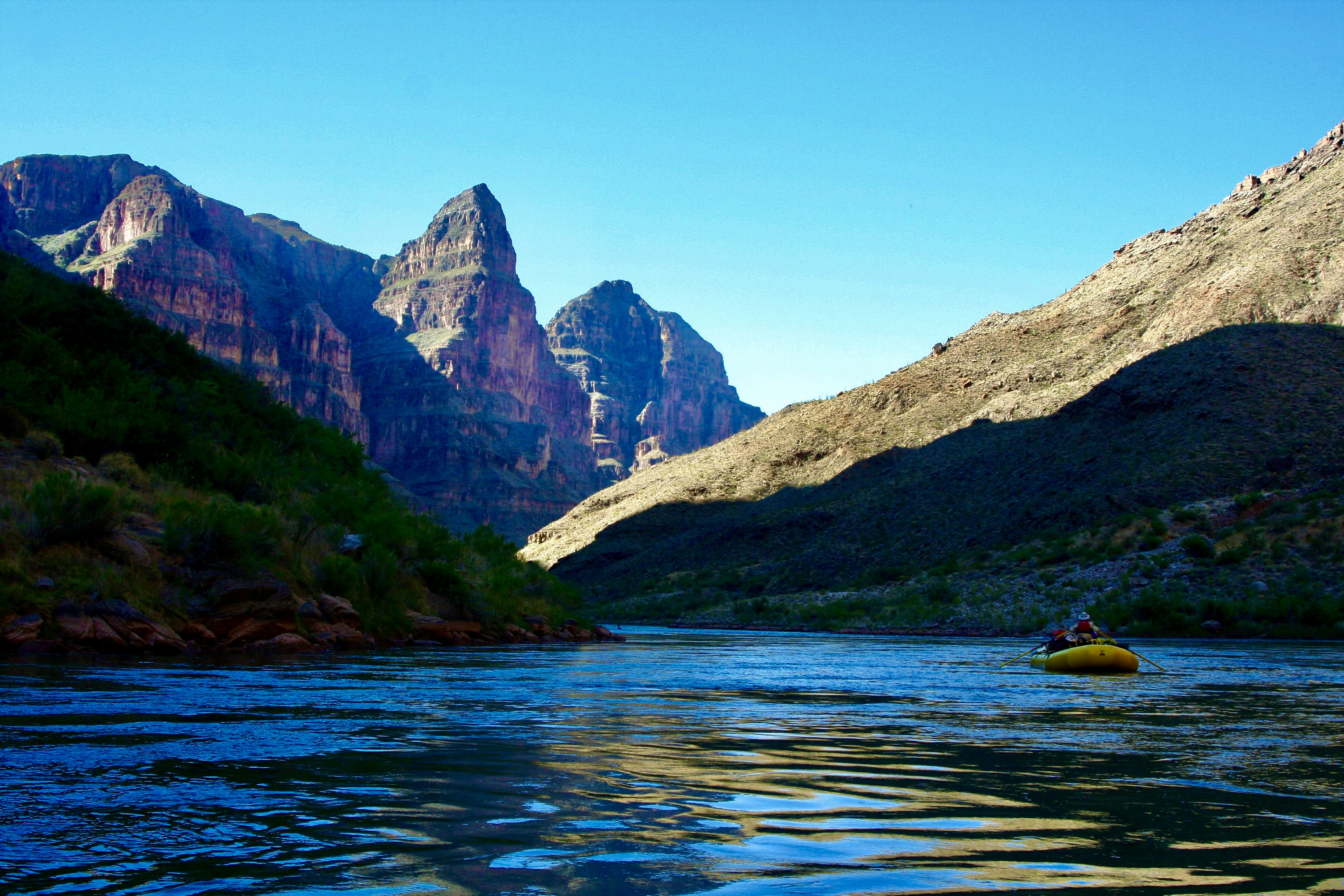
While the major rapids provided for a minute or two of pure adrenaline rush for both boatmen and passengers, floating on calm waters was a much more common experience for us.
Every corner brought a new marvel such as this towering cliff. Check out our boats at the bottom for perspective.
Vasey’s Paradise at mile 32 is one of the most beautiful waterfalls we saw on our journey. It flows out of what is known as the Redwall, one of the Grand Canyon’s most prominent features.
As you might imagine, we all took photos. This is Leland Lee, who, in addition to being a talented photographer, is a periodontist.
While we relaxed and enjoyed the falls, Jamie gathered the cold fresh water for our drinking and cooking needs. Gathering and pumping water through filters to purify it was one of our daily chores.
Redwall Cavern, a mile or so beyond Vasey’s Paradise, is one impressive cave! We headed in for lunch.
Some of our rafters and the lunch kitchen provide perspective on the cavern’s size. When John Wesley Powell, the one armed veteran of the Civil War and first dedicated explorer of the river, came on the cavern in 1869, he estimated it could hold 50,000 people. Modern estimates are closer to 5,000, but that is still a bunch!
This is a view looking out from the Redwall Cavern at the surrounding canyon walls.
I thought this was a great people shot by Don…
And scenery shot. (Photo by Don Green.)
Colorado means red, which is the color of the river after rainstorms (reddish brown). Obviously it hadn’t rained recently, and, as I recall, it didn’t rain at all during our trip.
Quite the monument.
Theresa provides perspective on the ancient Anasazi Granary we hiked up to visit high above the Colorado River near mile 53. (Photo by Don Green.)
Looking down the Colorado River from the Anasazi Granary. One of us is making our way back toward the river in the shadows on the right. (Photo by Don Green.)
A view looking up, downriver from the granary.
And another.
Food is quite important to river runners as I mentioned in my first post on the river. And why not, since the boats can carry massive amounts. It’s not like backpacking where every ounce matters. Here, Peggy is working on a carrot salad. Each of us was expected to do kitchen duty. Tom, who owned a popular Mexican restaurant in Davis at the time, the Cantina, was proud of what he had brought along to eat— and quite particular on how it was prepared. He hovered providing directions. Like a chef.
For example, the correct way to cut romaine lettuce. Susan Gishi holds up the lettuce like rabbit ears on an old fashioned TV set. She is about to demonstrate how to cut it and looking much more serious than the rabbit ears would suggest.
Like this.
Tom discovered me tearing it up instead of cutting it and got quite excited.
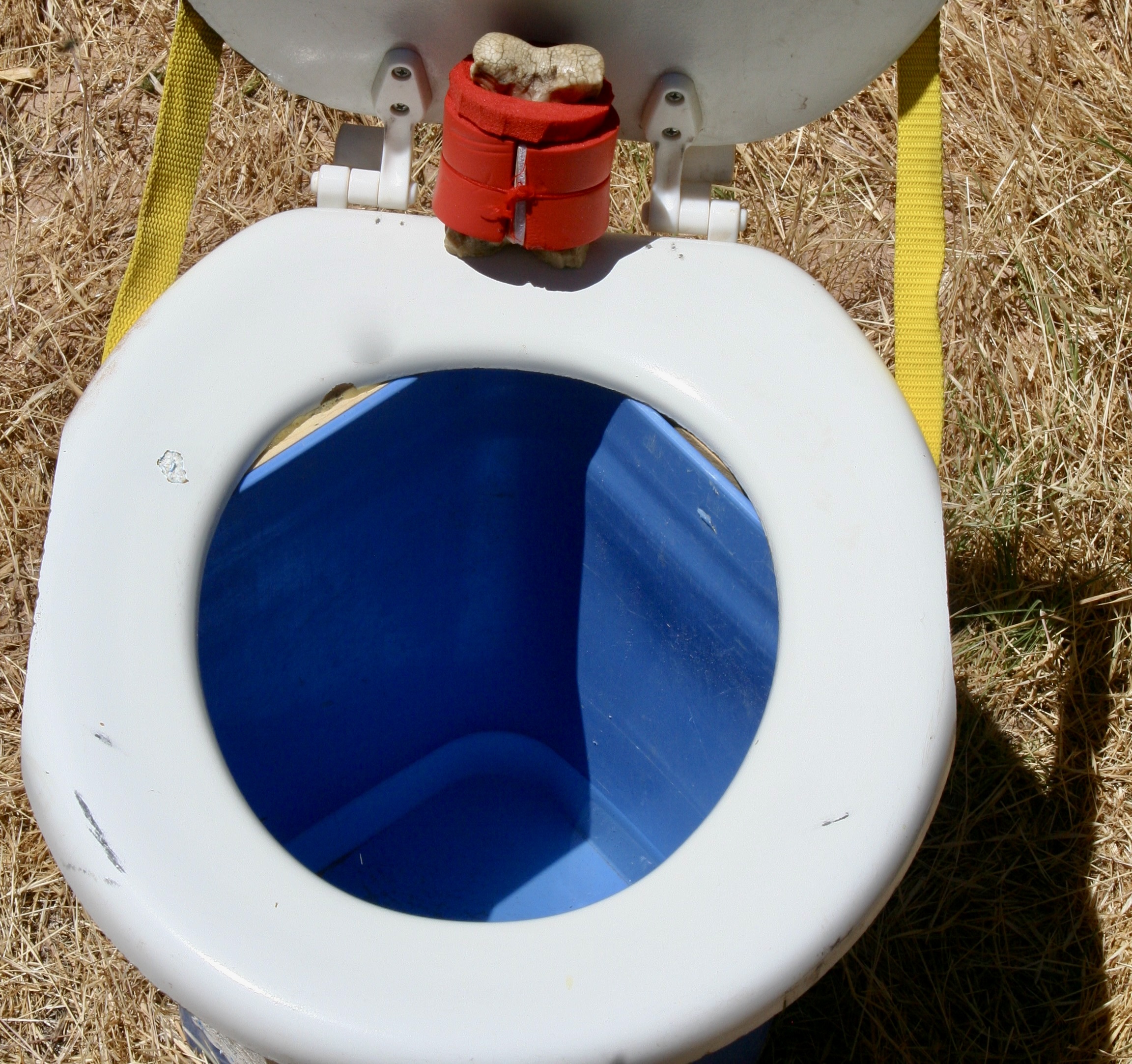
Being allergic to taking directions from Tom about cutting lettuce, I made a trade with Peggy. I would handle her groover duty if she would take my kitchen duty. Here’s the thing about groovers, you are required to carry your poop out. Peeing is done in the river. My duty was to work with Steve in finding a suitable private place for the men’s and women’s groovers when we landed in the evening and then loading them back on his boat in the morning. BTW, the reasons these large ammo cans are called groovers is because people sat on them directly until someone figured out how to attach toilet seats. Duh. They left grooves on your butt! (Photo by Don Green.)
Our next great stop was at the Little Colorado River where it flows into the Colorado at mile 61. Its beautiful color is due to mineral content. The minerals settle out to form the rocks you are seeing. There is a cave a few miles up the river where Hopi mythology claims they made their entrance into this world.
As always, my camera was kept busy.
I suspect the Hopi would have seen these reeds as weaving material.
Not a thong bikini. Bobbi Allen was busy taking photos as well, but more to the point, she is wearing her PFD upside down per Tom’s direction. The purpose was to enhance our floating down the Little Colorado. They seemed strange and looked like bloated diapers. I’m not sure Bobbi meant to serve as a model but I wasn’t up for a selfie. That would have been scary.
People floated down as individuals or in groups. I couldn’t tell which one this was for sure, but If she looks a little out of control, you should have seen me. My PFD slipped down around my feet and I bounced down the river with my head removing rocks along the way. I think it was Jamie who waded in and pulled me out. My guess is that others thought of it as a Kodak moment, and Tom thought it might pound some sense into my head.
Here’s a Conga Line with Tim Spann, Bobbi, and Don plus others.
Even Bone gave it a try, but he preferred the calmer part of the river.
A sucker found him amusing…
Nancy Pape praised him for being so brave. Nancy and I go way back to the early 1980s when she joined me on one of the hundred mile backpack treks I led. And many more after that. She has also gone to Burning Man with Peggy and me, as have Tom, Don and Bone.
And Jamie decided to teach Bone how to row.
In fact Bone became so confidant in his rafting skills, he decided he could serve as a scout checking out rapids.
Fortunately, no one drowned. That does it for today. Next Friday we will continue our trip down the river with its great beauty and wild adventures. (Photo by Don Green.)

Through the Grand Canyon by Raft: Preparation… The Great River Series #1

Over one billion years of the earth’s history, great beauty, and adventure await those who are lucky enough to raft through the Grand Canyon on the Colorado River.

Most of our adventures start with a fair amount of forethought. Our 18-day raft trip through the Grand Canyon was an exception. It started with a phone call from our friend Tom Lovering.

“Curt, you need to jump online right now and sign up for a chance to win a lottery permit to raft the Grand Canyon.” It was more in the nature of a command than a request. Tom was plotting. There are relatively few private permits granted every year in comparison to the ton of rafters who want them. Floating down the Colorado through the Canyon is one of the world’s premier raft trips, providing a combination of beauty and adventure that are rarely matched. Tom figured that the more people he persuaded to sign up for the lottery, the better the chances of getting a permit. He’d made the request to several friends.

I would have probably skipped the opportunity. We were in the midst of wrapping up a three year exploration of North America and were seriously looking for a place to light— a semi-wilderness home. We were closed to settling on Southern Oregon. We had an hour to meet the filing deadline and the chances of winning, as I mentioned, were close to zilch. Plus I was woefully out of shape and 67 years old. I wasn’t sure that my body would have a sense of humor about the journey. Floating down the river on a private trip actually involves a substantial amount of work and everyone is expected to do their share. Rightfully so.

My child bride Peggy, however, who is seven years younger than I am and loves everything related to water, went straight to the site, filled out the required information in my name, filled out another in hers, and hit send. Fine, I thought to myself. That’s that. We can go merrily on our way and report back to Tom that we tried.

What I wasn’t expecting, as those of you have read my blogs about the trip know, was waking up the next morning and finding an email from the National Park Service announcing that I had won a permit. “Woohoo!” Peggy yelled. “Oh crap,” my fat cells responded. Tom didn’t believe me when I called him from somewhere in Nebraska. It took several minutes to convince him. And then he got excited. Here’s the actual permit:

My first task was to make sure that Tom would do the majority of the work in setting up the adventure. We didn’t have the time and I didn’t have the expertise for a white water raft trip. My experience was in organizing and leading long distance backpack and bicycle adventures. Tom, on the other hand, was an experienced white water enthusiast who had run the river several times and had boundless energy. Plus, he had volunteered. “There is a fair amount of paper work for you and certain responsibilities,” he mentioned in passing. Paper work, as I recall was a 40 page document, maybe it was 400. The responsibility, I learned was daunting. If we screwed up in some way by breaking the Park’s environmental or safety rules, I was accountable and subject to a large fine.

The raft trip in 2010 was the first blog series I ever did. I reposted it in 2018. Since I have already blogged extensively about the journey, I am going to use this and my next two posts as a summary of the trip and include many photos I didn’t use before.

I will note here that while the trip was even more physically challenging than I expected— and there were times I could have strangled Tom (and vice-versa, I’m sure)— I owe him a debt of gratitude for the opportunity. I love the Canyon and have explored it in many ways over the years including five backpacking trips into it. The river trip provided a whole new way to experience the beauty. Traveling with a great group was icing on the cake.

Tom had plenty to keep him busy in preparation for the trip. Finding qualified raftsmen and women was first up. The Park insists. Running the river is no joke. There are world-class rapids to negotiate. Food was another major item. River runners have a tradition of eating well, if not gourmet. He had a total of 54 meals to plan. Tom and his partner bought the nonperishables before coming. We bought the rest when we joined him in Flagstaff, Arizona, our base for the trip. Between Costco and Safeway, we packed our 22 foot Pleasure Way Van, twice.
Tom and I in Flagstaff getting ready to go on the trip in 2010. Do I appear a little dubious?
Large, specialized containers were required for the food. Each was labeled for what it would contain.
Huge ice chests were necessary to keep perishable food cold for the 18 day journey. Our room had been the central storage point for food. Minus the Kettle Corn, the bed was covered with our camping gear for the trip. It would soon find its way into a large, waterproof dry sack. Things we would need during the day went into ammo cans like the yellow one on the right.
Tom had other responsibilities as well. He’s getting his new “do” here, coloring his hair for the trip. Roald Dahl is one of his favorite authors. Tom likes weird, a trait I share. But coloring my hair isn’t one of them. Neither is painting my toenails.
The results.
One thing we were required to do was paint our toenails. River lore is it protects you from flipping your raft in rapids. “I won’t let you on my boat unless they are painted,” Tom warned ominously. I painted two of mine on each foot. We didn’t roll over in Tom’s boat when we went through a major rapid. But he did lose an oar. I might have felt guilty but it’s rumored that Tom travels through life without an oar.
We had one more major responsibility: Get Bone ready for the trip. Tom and I had discovered him hanging out in the Sierra Nevada Mountain Range in 1977 and he has been wandering around with us and others ever since. He had to have a life vest.
Finally everything was packed and the participants had arrived. We loaded the truck to the brim with what seemed like a ton of equipment, drove over to our starting point at Lee’s Ferry and unloaded the truck, all in 100° (38°C) plus weather. My body had some unpleasant, unprintable things to say to me about being out of shape. (Photo by Don Green, one of the participants and a long time friend of ours.)
Next we had a quick lesson in rigging boats and went to work. (Photo by Don Green.)
Dave Stalheim and Peggy pose on Dave’s boat. Dave was to be the first boatman that we traveled with. Dave came from the state of Washington where he worked as a county planner. The plan was to ride with different boatmen each day. Protocol involved that we ask for a ride and help in loading and unloading the boat.
A bottle of tequila was slipped in among the oranges. It would be saved for drinking at Tequila Point, just below Lava Falls, where it would be needed! (Photo by Don Green.)
That night we moved a couple of hundred yards down from where we had rigged and loaded the boats to a campground I had found. We went out for dinner and came back to a major wind and dust storm that was whipping our tents around and making them difficult to find. With the heat, wind, and dust, I was reminded of our trips to Burning Man. Here we are, ready to begin our adventure. Ranger Annie is down on the end. She’d been by the day before to check our gear. When Tom introduced me as the ticket holder, I commented, “We have an excellent leader in Tom.” She had looked at me steely eyed and said, “You are responsible.” My muttered response was, “I’ll try to keep Tom in line.” Yeah, like that’s possible. She came back that morning to remind us of all the safety and environmental rules.

That’s it for the preparations. Now the ‘fun’ begins. The wind was back! We spent our first day fighting headwinds with gusts up to 60 miles per hour. If my dreams of a leisurely float down the river hadn’t already been demolished, they were now. We actually took turns with our boatmen rowing double. All of the photos were taken by either Don, Peggy, or me. I’ll note which ones are Don’s.

This map, which I took from the book The Colorado River in the Grand Canyon, an excellent guide by Larry Stevens, isn’t as clear in reproduction as I would like but still serves as a good reference for this and my next two posts. Our journey over 18 days would take us 280 miles down the Colorado River from mile 0 at Lee’s Ferry to mile 280 at Pierce Ferry, just this side of mile 300 at the beginning of Lake Mead. We finished putting the trip together in Flagstaff (lower right) and then followed Highway 89 up to Lee’s Ferry (upper right).
Don Green and boatwoman Megan Stalheim double rowing to counter the strong head wind. Megan is David’s niece and, like me, was a former Peace Corps Volunteer in Africa. While rowing a raft was a new sport for Megan, her experience as an Olympic level white water kayaker gave her excellent knowledge of how to read and run a river.
This photo of boatman Jame Wilson is a good example of what our fully loaded rafts looked like.

My post next Monday will take us from Lees Ferry to just below Phantom Ranch. Thursday is Halloween, however, and Peggy and I have a special treat for you, a tour of Dracula’s castle in Transylvania that we visited 2 1/2 weeks ago on our Danube River trip.