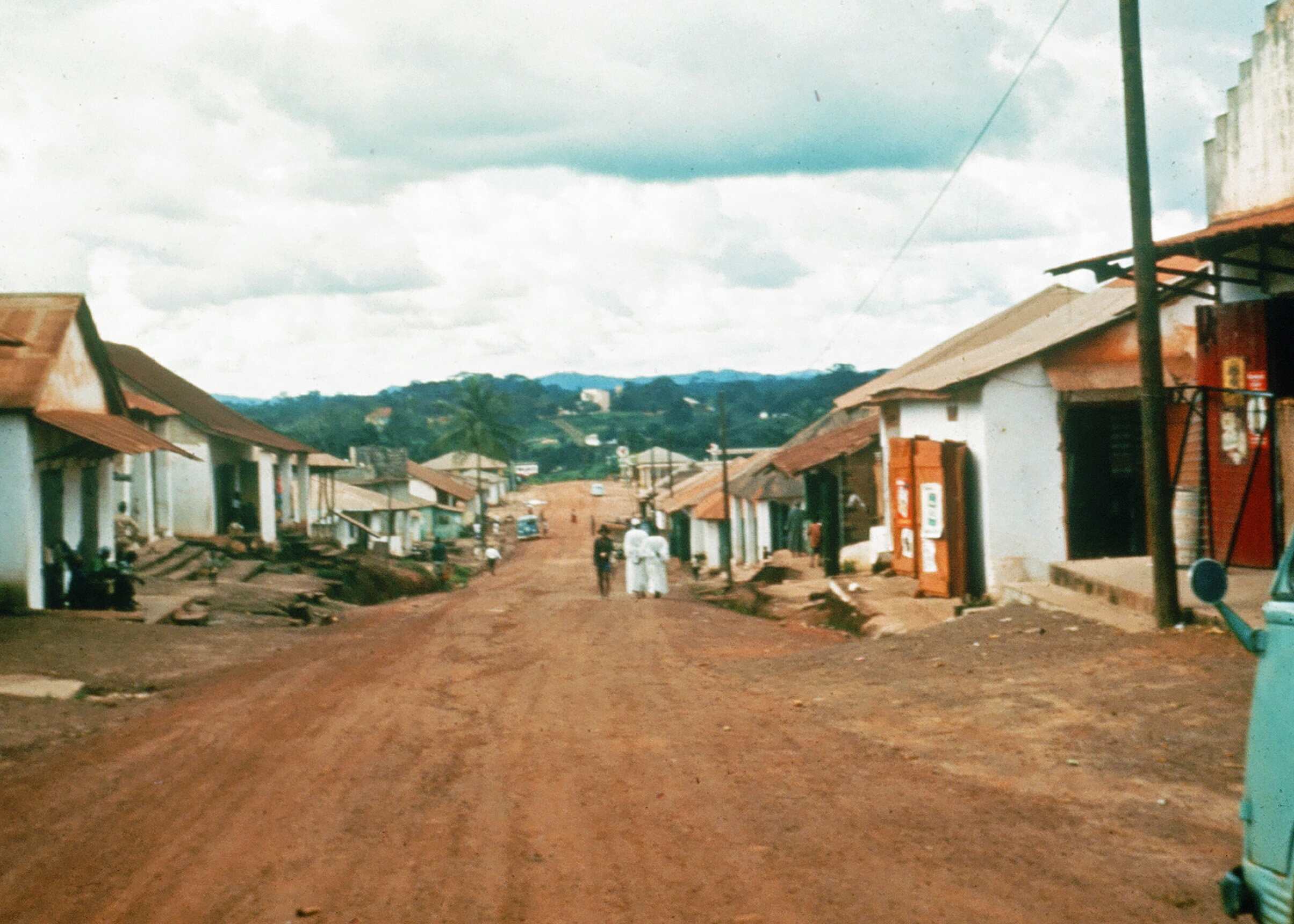
Good Mornin Teacha

Main street Gbarnga circa 1965. Our main shopping district.

“Good Morning Teacha” thirty bright and shiny faces shouted in unison as I walked into the classroom on my first day of teaching in Gbarnga.

“Good morning,” I responded in my best new Peace Corps Teacher voice. And then reality struck. I was expected to entertain and actually teach these kids something over the next several months.

Unless you are a teacher, you might be saying, “Hey, how hard can it be to teach a group of second graders?” My only response is “Try it some time.”

Plus there were handicaps.

My students ranged in age from seven to twenty-two and spoke several different tribal languages. While Kpelle was the predominant language used in our area, several others were represented. English was supposedly the common language but its reach into tribal areas was minimal.

Pidgin English Liberian style provided the bridge. For example, I might say to you, “I have to go down town for about twenty minutes. I promise I won’t be gone long. Please wait for me.” The Pidgin English equivalent would be, “Wait small, I go come.”

One idiom I learned quickly was, “Teacha, I have to serve nature.”  That meant, “May I have your permission to use the restroom?” Actually it was permission to use the outhouse or just as likely the ‘bush’ or even the side of the building. Some of my male students would listen to me through the open window as they did their thing on the wall. I admired their dedication but discouraged the practice.

Books created another problem; for the most part, there weren’t any. What we did have for reading were vintage 1950 California readers complete with Dick, Jane and Spot. I suspect we should have been grateful for anything but it was difficult for the Liberian kids to identify with big white houses, white picket fences and little white kids.

As for Spot, he bore a striking resemblance to food. Later, when I had a cat, my students would tease me by coming by, pinching him and saying, “Oh, Mr. Mekemson, what fine meat.”

Getting sick didn’t help the education process. I had been teaching for two months when I met an obnoxious tropical bug that knocked me out for several weeks. It announced its presence with a low temperature of 100 degrees that soon climbed to 103. Normally it hovered around 101.

As for its pedigree, who knows? Les Cohen, the Peace Corps doctor, would come by and shrug his shoulders a lot. He used the lottery approach to medicine. We must have explored his whole medicine chest.

The sad thing about being sick was that there were no substitute teachers. Whenever a teacher was absent, the class was left to fend for itself.  Often, my students would come by to check on how “Teacha” was doing.

“How are you feeling Mr. Mekemson? When are you coming back to teach? Can’t you teach us while you are sick?” There’s nothing like thirty kids standing around your house and looking mournful to create guilt.

At least I was able to plow through a number of the 100 books the Peace Corps generously provided for Volunteers. There was also entertainment of another sort. Each day around 10 AM a woman would stop in the dirt road opposite our house, squat down and pee.

I didn’t have a clue to her motivation but I found myself looking forward to her visits. Maybe she was practicing Ju Ju (African medicine). Or maybe she just had to go or was marking her territory. Who knows? I tried to pry out of Sam what she was up to but he would just shake his head and mutter in Kpelle.

Evening entertainment was supplied by Miranda Hall. This popular bar/dance hall added substantially to my already splitting headache. Loudspeakers perched on top of the establishment blasted African High Life music for miles around. Since it was located one hundred yards from our house, we received the full benefit of its marketing campaign.

One song I remember from hearing at least ten times a night had a country-western theme: “Woe is me, shame and scandal in the family.”

Later, I actually witnessed a little shame and scandal in the house next to the bar. I was walking by when the ‘man of the house’ came down the street, nodded to me and went inside. It seems he was early. I heard a loud shout at the same time a well-endowed naked man burst through the screen window and hit the ground running. Right behind was the jilted husband. The two streaked by me and disappeared downtown.

The naked guy was really fast.

Les was out of town when my illness finally decided to peak.  As my temperature passed the 103 mark and headed for 104 I began to worry about hallucinating and becoming irrational. I asked Jo to contact an Indian doctor who served the local community. Dr Swami (yes that was his name) came right over.

“Here, drink this,” he said.

Dr. Swami gave me a sweet, syrupy liquid that tasted great, knocked me out and cured me. The next morning I woke up feeling much better. I was even able to participate in helping consume a Thanksgiving turkey that Bob Cohen’s wife had prepared. The turkey tasted a little like sawdust due to the lingering remnants of my bug but hey, who was complaining. There was a bottle of scotch to wash it down.

(Tomorrow… Reading, writing and arithmetic taught to the tune of an ebony stick.)

How Do-Your-Part the Dog Evaded Half the Nation of Islam

(The Peace Corps turns 50 on Tuesday, March 1. In this series of travel blogs, I honor its Anniversary by relating my own experience a Peace Corps Volunteer in Gbarnga Liberia, West Africa starting in the summer of 1965.)

John Bonal, the High School Principal, lived in a cement-block house next to ours. He was a ‘Big Man’ in town by Gbarnga standards. Being successful in Liberia meant that your relatives came over and lived with you. It was the ultimate share-the-wealth-social-welfare program.

Part of John’s extended family included three dogs creatively named Puppy Doodle, Brownie Girl and Do Your Part. They came over to watch us white washing our new house and decided to stay. We fed them.

If I have my genealogy correct, Brownie Girl was Do your Part’s mom who in turn was Puppy Doodle’s mother. This three-generation family dug foxholes around the outside of our house and quickly established that they were our pets. Other dogs need not apply.

The Bonals were more than happy to have us take over feeding responsibilities and Rasputin was pleased to have someone new to terrorize. So everyone was happy.

Do Your Part took things a step further and adopted me. She was a charming little Basenji with impeccable manners. Everywhere I went, she went, including school.  Normally this amused my students. I would walk into the class with DYP a respectful three feet behind. She would immediately arrange herself under my desk and quietly remain there until I left the classroom.

This worked fine until she had puppies. They started following her as soon as they could walk the 100 yards to the school.

I would arrive in my classroom followed by DYP who in turn was followed by four puppies. It was quite the parade. Unfortunately, the puppies lacked Do Your Part’s decorum and considered the classroom a playpen. The students decided it was not an appropriate learning environment and I agreed.

DYP and company had to go. It was not a happy parting.

“Take your puppies and go,” I ordered firmly. Do Your Part looked at me in disbelief.

“Out!” I said.

Sad eyes stared back accusingly. But I held firm. She didn’t let it get her down, however. As soon as the puppies had departed she was back in class. One time her insistence on following me had more drastic consequences.

Gbarnga had a sizeable population of Mandingoes, most of whom were Muslims. They had been gradually sifting into Liberia from across the Guinea border. Originally the Americo-Liberians had blocked their entrance to the country, fearing they might pose a threat to their power.

President Tubman’s open door policy changed that and by the time we had arrived their numbers had reached the point where they decided to build a mosque in town. I’d wander over on occasion to check their progress. The mosque was an impressive edifice by Gbarnga standards, easily five times larger than any other structure on the main road.

At last the day came for the mosque’s grand opening. Having watched it being built, I decided to attend the festivities. I put on a tie, grabbed our two cameras and headed out the door.

Do Your Part was waiting, as she always was, ready to go along. This was not a Do Your Part type of celebration, however. Muslims aren’t particularly fond of dogs and consider them unclean.

I figured this meant they didn’t want any dogs, even polite dogs, attending their holy ceremony. I suggested to Do Your Part she stay home. Fat chance. I walked 100 yards and glanced back over my shoulder. There was DYP, slinking along behind. I knew there was no way I would make it to the ceremony without a little brown dog lurking in the background.

Do Your Part would have to be left in our house. The action was drastic; the only time we let her in was to eat dead insects in the evening. She would come in just before we went to bed and wander around crunching down sausage bugs. It eliminated sweeping. She had never been locked inside.

Since my ex-wife Jo Ann was reading to a blind friend and Sam was off for the day, I couldn’t even leave DYP with company. I reluctantly shoved her inside and marched off to the sounds of doggy protest

It seemed to work. I reached the mosque just as the outside ceremonies were concluding and people were preparing to move inside. Dignitaries were everywhere. It was my intention to hang out on the periphery and remain inconspicuous.

This is hard when you are the only white person in the crowd and you have two cameras hanging around your neck. It took about thirty seconds for a tall, official looking man in a white robe to arrive and express in broken English how pleased he was that the international press from Monrovia had decided to cover the event.

While I struggled to inform him that I was only a local Peace Corps Volunteer, he ushered me into the mosque to a seat of honor. I looked around nervously. The podium was about 10 feet away and I was in the front row.

A hush descended on the crowd as an obviously important dignitary approached the podium. Liberia’s top Muslim Cleric had come to town to officiate at the opening ceremony. He gave me his best media smile and I dutifully took his picture.

Unexpectedly, there was a disturbance at the back of the mosque. Several men were trying to capture a little brown dog that was deftly eluding them and was making a beeline for me.

Do Your Part had managed to escape from the house. Now she was escaping from half the Nation of Islam. In seconds that seemed like hours she was in front of me, wagging and prancing around like she hadn’t seen me in six months. Hot on her tail were three huge Mandingo men.

“Is this your dog?” their leader managed to stammer out in barely repressed fury as he gave DYP a tentative boot in the butt. Fortunately she figured out that the situation was a little tense and decided there were other parts of town she wanted to see.

I was amazed at her ability to avoid lunging people. I dearly wished I could have escaped with her. It wasn’t to be. It was my job to stay behind and be glared at. I was so embarrassed I don’t remember a single part of the ceremony.

Later when I arrived home, Do Your Part was outside the house, all wiggles and waggles, obviously no worse for her adventure. Jo Ann greeted me.

“It was the strangest thing when I got home,” she said. “Do Your Part was inside and frantic to get out. When I let her loose she took off like our house was on fire. I wonder if Sam let her in by mistake.” So much for my planning…

If Someone Steals your Dog, Spouse or Car, Who Do You Call: The Lightning Man

(This is one of a series of travel blogs I am doing on my experience as a Peace Corps Volunteer in Gbarnga, Liberia, West Africa to honor the 50th Anniversary of the Peace Corps.)

The dark side of tribal beliefs arrived at our house late one evening in the middle of a tropical downpour.

A very wet and frightened candidate for student body president, Mamadee Wattee, knocked on our door. The opposition had purchased ‘medicine’ from a Ju Ju Man (witch doctor in Tarzanese) to make him sick.

It was serious business; people were known to die in similar circumstances.

Had the opposition slandered Mamadee or stuffed the ballot box, I could have helped but countering black magic was way out of my league. I took the issue to the High School Principal and he dealt with it. Mamadee stayed well and won the election.

Later, he unintentionally introduced us to another tribal phenomenon, the Lightning Man.

I had left Mamadee with $50 to buy us a drum of kerosene while my wife and I were on vacation. When we returned home, Mamadee was sitting on our doorstep. Someone had stolen the money and he was obviously upset. Fifty dollars represented a small fortune to most tribal Liberians. (Given that we were paid $120 dollars a month for teaching, it was hardly spare change to us.)

Mamadee’s father, a chief of the Kpelle tribe, was even more upset and wanted to assure us that his son had nothing to do with the missing money. It was a matter of honor. He offered to hire a Lightning Man to prove Mamadee’s innocence.

The Lightning Man had a unique power; he could make lighting strike whoever was guilty of a crime. If someone stole your cow or your spouse, ZAP! Since we were in the tropics, there was lots of lightning. Whenever anyone was struck, people would shake their heads knowingly. One more bad guy had been cooked; justice had been served.

We didn’t believe Mamadee had taken the money and even if he had we certainly didn’t want him fried, or even singed. We passed on the offer.

Another Liberia Peace Corps Volunteer chose a different path. Here’s how the story was told to us. Tom had just purchased a $70 radio so he could listen to the BBC and keep up with the news. He enjoyed his new toy for a few days and it disappeared.

“I am going to get my radio back,” he announced and then hiked into the village where he quickly lined up some students to take him to the Lightning Man. Off they went, winding through the rainforest to the Lighting Man’s hut.

“I want you to make lighting strike whoever stole my radio,” Tom said, and then paid five dollars for the service. (Lightning Men have to eat too.)

Tom and his entourage then returned home. By this time, everyone in the village knew about the trip, including undoubtedly, the person who had stolen the radio.

That night, there was a tremendous thunder and lightning storm. Ignoring for the moment that it was in the middle of the rainy season and there were always tremendous thunder and lightning storms, put your self in the shoes of the thief who believed in the Lightning Man’s power. Each clap of thunder would have been shouting his name.

The next morning Tom got up, had breakfast and went out on his porch. There was the radio.

(In my next blog I will relate the story about how Do Your Part, my dog, invaded a mosque and barely escaped.)

The Bush Devil Ate Sam

(This travel blog is one of a continuing series where I relate my experience as a Peace Corps Volunteer in the mid 60s in Liberia, West Africa honoring the Peace Corps’ 50th Anniversary.)

Joining the Peace Corps should come with a label like they put on cigarette packs. It would read “Warning: This experience may change your concept of reality.

Our vision of the world is perceived through culturally tinted glasses. Not surprisingly, the reality of our parents and our society becomes our reality. It’s hard to imagine life from any other perspective. Close encounters with other cultures can shake this vision but not easily. We wear our culture like bulletproof vests, rarely allowing a stray thought to enter. Or we focus so hard on extolling our own culture that we fail to learn valuable lessons another culture may teach us.

One of the great values of the Peace Corps experience is the sensitivity and respect it teaches for the beliefs and values that other people hold. Often this leads to a greater appreciation of our own culture.

There are definite risks involved in running headlong into another society, however. Culture shock is one. The environment may be so different that it becomes disorienting and may lead to depression. My transition from California to Liberia was relatively smooth. At first, Gbarnga didn’t seem significantly different from my old hometown of Diamond Springs. I suffered much greater shock going from Diamond Springs to UC Berkeley.

Going native, or bush as it was called in Liberia, is another risk. A person becomes so enthralled with the new culture that he adopts it as his own. A joke circulated among West Africa Volunteers on how to determine if you were teetering on the edge.

Phase One: You arrive in country and a fly lands in your coffee. You throw the coffee away, wash your cup and pour yourself     a new cup.

Phase Two: You’ve been there a few months and a fly lands in your coffee. You carefully pick the fly out with your spoon and then drink the coffee.

Phase Three: It’s been over a year and you have become a grizzled veteran. A fly lands in your coffee. You yank it out with           your fingers, squeeze any coffee it swallowed back into the cup, and then drink the coffee.

Phase Four: You’ve been there too long. A fly lands in your coffee cup. You yank the fly out of the cup, pop it into your mouth     and throw the coffee away. It’s time to go home.

If Peace Corps Volunteers had a hard time with culture shock and going bush, the tribal Liberians had a tougher one. Traditional cultures normally find their confrontations with the western world a losing proposition. It isn’t that our culture is so great; it’s just that our technology is so glitzy. How do you keep Flumo down on the farm when he has heard the taxi horn calling or climbed on the Internet?

Gbarnga was on the frontier of cultural change in the 60s. On the surface, life appeared quite westernized. An occasional John Wayne movie even made it to town. My students would walk stiff-legged down the main street and do a great imitation of the Duke. They dreamed some day of traveling to America where they would swagger down dusty streets and knock off bad guys with their trusty six shooters.

In town, loud speakers blared out music at decibel levels the Grateful Dead would have killed for while Lebanese shops pushed everything from Argentinean canned beef to London Dry Gin. The epitome of Americana, a Coca Cola sign, dominated the road as you left town on the way to Ganta and Guinea.

We had enough US-based churches to satisfy Pat Robertson. Missionaries were everywhere. Baptists, Catholics, Episcopalians, Presbyterians and numerous other Christian groups worked the streets in unending competition to recruit African souls.

Sometimes, if I closed my eyes and pretended, I could almost believe I was home. Almost. Then Africa would whip around and bite me.

Sure, the local villagers would dutifully file in to church on Sunday morning and pray for blessings like their western counterparts did but Sunday afternoon would find them out sacrificing a chicken to make sure God got the message. And yes, the Coca Cola sign was there but next to it was a giant Cottonwood with offerings to the spirit that lived inside the tree.

Sam, the young Liberian who worked for us and spent hours listening to our record player getting Charley off the MTA, was another case in point. Scarification marks marched down his chest in two neat rows.

“How did you get those,” my ex-wife Jo Ann asked with 10 percent concern and 90 percent curiosity.

“I can’t tell you,” Sam replied with obvious nervousness as Jo’s eyebrows rose. “But I can tell Mr. Mekemson.”

“Aha,” I thought, “Sam and I belong to the same organization, the Men’s Club!” Actually Sam belonged to a very exclusive men’s organization, the Poro Society. Its function was to pass on tribal traditions and keep errant tribe members in line. The women had a similar organization called the Sande Society.

Sam had been to Bush School the previous summer and learned how to be a good Kpelle man. Graduation to adulthood consisted of an all-consuming encounter with the Poro Society’s Bush Devil.  It ate him. Sam went in as a child and was spit out as a man. The scarification marks had been left by the devil’s ‘teeth.’

It seemed like a tough way to achieve adulthood but at least it was fast and definitive. Maybe we should introduce the process to our kids and skip the teenage years. Think of all of the angst it would avoid.

Bush Devil was the missionary’s designation for a very important tribal figure who was part religious leader, part cultural cop and part political hack. Non-Kpelle types weren’t allowed to see him. When the Devil visited outlying villages, a front man came first and ran circles around the local Peace Corps Volunteer’s home while blowing a whistle. The Volunteer was expected to go inside, shut the door, close the shutters and stay there. No peeking.

We did get to see a Grebo Bush Devil once. The Grebo Tribe was a little less secretive or at least more mercenary than the Kpelle. Some Volunteers had hired the local Devil for an African style Haight-Ashbury Party. The Devil was all decked out in his regalia. Description-wise, I would say his persona was somewhere between a Voodoo nightmare and walking haystack. Grebo men scurried in front of him with brooms, clearing his path and grunting a lot.

We stayed out of the way and took pictures.

While the Bush Devil and the Sassywood Man I blogged about last week seem foreign and even threatening to the Western mind, the truth is that they played an important role in maintaining order within the tribal culture.

Next up: If somebody steals your dog, car or wife, who do you call: The Lightning Man!

Rasputin the Cat and the Cockle Doodle Rooster

(This is the fourth in a series of travel blogs I am writing about my experience as a Peace Corps Volunteer in Liberia West Africa in honor of the Peace Corps’ 50th Anniversary. In this article Rasputin the Cat and the Cockle Doodle Rooster team up to drive me crazy. In my last blog I described how Rasputin ended up being our cat. I first introduced Rasputin in the story about how Boy the Bad Dog became the entrée at an African feast.)

Rasputin did not grieve over Boy’s untimely demise, quite the opposite. Now he could resume his rightful role as Dominant Animal. Dog stalker was his primary responsibility under this job title. We knew when he was at work because the neighborhood dogs carefully avoided the tall clumps of grass where he liked to hide. He was particularly obnoxious when it was windy; the dogs couldn’t sniff him out.

A streak of yellow and a yip of surprise proclaimed Rasputin’s attack. He came at the dogs on his two hind legs, walking upright. This allowed both front legs to be used as slashing weapons. It was the wise dog that steered clear.

This wasn’t Rasputin’s only trick. He could also do flips. I had taught him how and was quite proud of my accomplishment. Each night Rasputin and I would head for the bedroom where I would flip him several times in a row on the bed. He was usually good for about ten before he would attack me, thus signaling that the game was over.

My wife thought it was cruel but I told her it was bonding time. It also turned out to be a valuable skill. One evening when the rice birds were returning to their nests, we saw a yellow flash out the window. Rasputin leapt into the air, did a flip and came down with bird a la carte. After that I figured Rasputin had graduated from flip school so we didn’t practice anymore.

Leap snake was another game we played. It was quite similar to leap-frog except the objective was to see how high Rasputin could jump. On a good night he would clear five feet. The rules of the game were simple. I would detach the spring from our screen door and roll it across the floor. Rasputin, who had a Liberian’s instincts, assumed that anything long and twisty was a snake and that all snakes were deadly poisonous.

His response was to shoot straight into the air and land several feet away. It was a situation where you leap first and ask questions afterward. In this case, Rasputin was guilty of jumping to the wrong conclusions.

One way he returned the favor of my hassling him was to wake me up at 5:30 every morning, demanding to be let in. He did this by practicing his operatic meows under our bedroom window. Since no amount of suggesting that he should learn from Boy’s experience discouraged him, I jumped out of bed one morning and chased him across the yard.

This got Jo Ann excited. Our cat was going to run away and never come back. Jo may have also been concerned about the neighbor’s reaction to my charging out of the house naked. That type of thing bothered her. I promised to repent and assured her that the cat would be back in time for dinner. He was.

Rasputin subcontracted with the rooster next door when he was out tomcatting. I didn’t make this correlation until the rooster crowed directly under our window one morning at 5:30. Even then I thought it was just a coincidence until he repeated himself the next morning.

It wasn’t just the crowing that irritated me; it was the nature of the crow. American and European roosters go cock-a-doodle-do. Even kids from New York City and London know this because that’s how it is spelled out in books. Liberian roosters go cock-a-doodle… and stop. You are constantly waiting for the other ‘do’ to drop.

“This crowing under our window,” I thought to myself, “has to be nipped in the bud.” That evening I filled a bucket with water and put it next to my bed. Sure enough at 5:30 the next morning there he was: “COCK-A-DOODLE!”  I jumped up, grabbed my bucket, and threw the water out the window on the unsuspecting fowl. “Squawk!” I heard as one very wet and irritated rooster headed home as fast as his little rooster legs could carry him.

“Chicken,” I yelled out after his departing body. “And that,” I said to Jo Ann, “should be the end of that particular problem.” I was inspired though. Cats don’t think much of getting wet either. What if I kept a bucket of water next to the bed and dumped it on Rasputin the next time he woke us up. Jo couldn’t even blame me for running outside naked. With warm thoughts of having solved two problems with one bucket, I went to bed that night loaded for cat, so to speak.

“COCK-A-DOODLE!” roared the rooster outside our window precisely at 5:30.

“Dang,” I thought, “that boy is one slow learner.”  I fell out of bed, grabbed the bucket and dashed for the window. There was no rooster there. I looked up and spotted him. He was running at full tilt across the yard away from our window. He had slipped up on us, crowed and taken off!

My opinion of the rooster took a paradigm leap. Here was one worthy opponent. The question was how to respond. It took me a couple of days of devious thinking to arrive at a solution. What would happen if I recorded the rooster on a tape recorder and then played it back?

I had a small hand tape recorder that I used for exchanging letters with my dad so I set myself the task of capturing the rooster’s fowl language. Since he had an extensive harem he liked to crow about, it wasn’t long before I had a dozen or so cock-a-doodles on tape. I rewound it, cranked up the volume and set the recorder up next to our front screen door.

The results were hilarious. Within seconds the rooster was on our porch, jumping up and down and screaming cock-a-doodle. There was a rooster inside of our house that had invaded his territory and he was going to tear him apart, feather-by-feather.

Laughing, I picked up the recorder, rewound it, carried to the back screen door, and hit the play button again.

“Cock-a-doodle, cock-a-doodle, cock-a-doodle,” I could hear the rooster as he roared around to the back of house to get at his implacable foe. Back and forth I went, front to back, back to front. And around and around the house the rooster went, flinging out his challenges.

Finally, having laughed myself to exhaustion, I took pity on my feathered friend and shut the recorder off.  This just about concludes the rooster story, but not quite. One Friday evening, Jo and I had been celebrating the end of another week into the wee hours when we decided to see how the rooster would respond to his nemesis at one o’clock in the morning.

Considering our 5:30 am wakeup calls, we felt there was a certain amount of justice in the experiment. I set it up the recorder and played a “Cock-a-doodle.”

“COCK-A-DOODLE!” was the immediate response. No challenge was to go unanswered. “Cock-a-doodle” we heard as roosters from the Superintendent’s compound checked in. “Cock-a-doodle, cock-a-doodle” we heard in the distance as town roosters rose to the challenge. Soon every rooster in Gbarnga was awake and crowing and probably every resident was awake and cursing.

Jo and I decided to keep our early morning rooster-rousing experiment to ourselves.

(In my next travel blog on Peace Corps I will discuss the special power of the Lightning Man who could make lighting strike anyone who wronged you.)

Special note from BONE:

I just learned about the Bunnock Competition in Macklin, Saskatchewan Canada from Bruce and Nancy Campbell, friends of Curt’s brother Marshall. The symbol for the competition is a 33 foot high bone sculpture that is an exact replica of me. What smart people the folks of Macklin must be! Check the sculpture out at the Macklin site http://www.macklin.ca/bunnoc.htm.

Bone


Picking Your Kitty African Style or How Brunhilde the Cat Became Rasputin

(This is my third travel blog writing about the time I was a Peace Corps Volunteer in Liberia, West Africa and celebrating the 50th Anniversary of the Peace Corps.)

Second year Volunteers in Liberia ran off and played during the January break. Being new kids on the block, my ex-wife and I were expected to stay home and work. One of the escaping couples, Dick and Sandy Robb, left four female kittens in our care.

Our pay was to have the pick of the litter. Whoopee.

I built our temporary cat family a three-story cardboard mansion. It was a maze of rooms, hanging toys, hallways and ramps. The kittens would disappear inside and play for hours. We could hear them banging around as they stalked each other and attacked the hanging toys.

In a creative moment inspired by the evening cocktail hour, we decided to use the house as an intelligence test to determine which kitty we would keep. First we waited until the kittens were appropriately hungry and then brewed up their favorite meal, fish head stew. Here’s the recipe. Take several ripe fish heads and throw them in a pan of boiling water. When their eyes pop out, they’re done.

Next, we encouraged the kittens to sniff their gourmet feast and showed them that the meal would be located just outside the ground-floor door. Now we were ready for the test.

Each kitten would be placed inside the third-story door and given a nudge. I would then close the door and time how long it took the kitten to reach her dinner. Our theory was that the kitten with the quickest time through the maze was the brightest.

Grey Kitten #1 was a pudgy little character that never missed a meal. My money was riding on her. She breezed through the maze in three minutes sharp and set the time to beat. There was a chance that the sound of her munching on fish heads might inspire the other kittens to greater glory, however.

Grey Kitten #2 was one of those ‘whatever it is you want me to do I am going to do the opposite’ type cats. Not surprisingly, she strolled out of the door seven minutes later and ignored the food altogether. (Afterwards, we were to speculate that she was the most intelligent cat and blew the race because she had no intention of living with someone who made her go through a maze for dinner.)

Grey Kitten #3 was the lean and mean version. Scrawny might be a better description. She obviously needed dinner the most and proved her mettle by blazing through the house in two minutes. The contest was all but over.

Kitten # 4 was what pollsters normally classify as ‘other.’ To start with, she was yellow instead of grey. She was also loud. In honor of her operatic qualities, Jo nicknamed her Brunhilde. By the time her turn arrived, she was impatiently scratching the hand that was about to feed her and growling in a demonic way.

I gladly shoved the little monster in the third story door and closed it. We heard a scrabbling on the other side as tiny claws dug into the cardboard floor. Her race down the hall was punctuated by a crash on the other end. Brake problems. Then she was up and running again, but it sounded like toward us. Had the crash disoriented her?

Suddenly the third story door burst open and one highly focused yellow kitty went flying through the air. She made a perfect four-point landing and dashed to the dinner dish. Her time? Ten seconds.

And that is how Brunhilde became our cat. Our decision to keep her led us to turn her over and check out her brunhildehood a little more closely. Turns out she had a couple of furry little protuberances where there shouldn’t have been any. She was a he. In honor of his demonic growl and generally obnoxious behavior, we renamed him Rasputin, after the nefarious Russian monk.

This brings up a related story, think of it as a blog bonus.

James Gibbs, an anthropologist from Stanford, was living in Gbarnga and studying the Kpelle people when we first arrived. One evening he and his wife invited Jo Ann and me over for dinner. We appreciated the invitation. I should also note we were recent college graduates and over awed by academicians. We dressed up in our best clothes and walked the mile to their home.

The Gibbs had an impressive house for upcountry Liberia. They were sophisticated, nice folks who quickly put us at ease. Among the hors d’oeuvres they served was a delightful concoction of mashed avocado, tomatoes and peppers that Jo and I found quite tasteful. We made the mistake of asking what it was.

“Why it’s guacamole of course,” Dr. Gibbs declared. We must have looked blank because he went on, “Surely anyone from California knows what guacamole is.”

Surely we didn’t. I felt like Barbara Streisand in Funny Girl when she learned that pate was mashed chicken liver. After all, what do a couple of country kids from Diamond Springs and Auburn know? (It was 1965 and Mexican food had yet to storm the area.) Yes, we’d graduated from UC Berkeley but dining out to us meant beer and pizza at La Val’s.

To change the subject I called attention to their cat.

“Nice cat,” I noted.

“Oh that’s Suzy,”[1] Mrs. Gibbs gushed. “She’s in love.”

Dr. Gibbs jumped in, obviously glad to leave the subject of guacamole. “The boys are coming by every night to visit. We hear them yowl their affection up on the roof.”

Suzy looked proud of her accomplishments. She strolled over and rubbed up against my legs. I reached down and scratched her head, which served as an invitation to climb into my lap. While arranging herself, she provided me with a tails-eye view. Staring back at me was the anatomy of the most impressive tomcat I’ve ever seen. In comparison to Rasputin, Suzy had the balls of a goat!

I could hardly contain myself. “Um, Suzy isn’t Suzy,” I managed to get out while struggling to maintain a straight face.

“What do you mean Suzy isn’t Suzy?” Dr. Gibbs asked in his best professorial voice. Rather than respond verbally, I turned Suzy around and aimed her tail at Dr. Gibbs. Understanding flitted across his face.

“We never thought to look,” he mumbled lamely. We were even. While the kids from the hills might not know their guacamole from mashed avocados, they did know basic anatomy.


[1] Since we are talking academics here, I will insert a footnote. My memory of the event may be faulty and the cat was named something other than Suzy. It was definitely a female name, however.

The Woman Wore No Underpants; A Tale of African Justice

(This is the second in a series of blogs where I recognize the 50th Anniversary of the Peace Corps by writing about my own experiences as a Volunteer in Gbarnga, Liberia, West Africa, 1965-1967. Here I tell about a trial by ordeal that could have happened in a medieval court.)

The Sassywood Man, a tribal judge in rural Liberia, obtained his name through use of a poisonous drink infused from the bark the Sassywood tree. The accused person was invited to take a sip. If he died, he was guilty. No DAs, lawyers, judges or juries were required.

Since modern society frowned upon trial by survival, the Sassywood Man had come up with new ways of determining guilt.  As it turned out, the father of one of my students was the local tribal judge and my ex-wife and I were privileged to witness an actual trial.

It started with Amani coming to our house at two in the afternoon on a blistering hot Saturday in the middle of the dry season. His father was about to start a trial. Would we like to see it? Absolutely, there was no way we would miss the chance. As we trudged east across town through the dust and stifling heat, Amani provided background information.

The plaintiff’s wife had come home in the evening after a hard day of selling oranges at the market and told her husband that three men had accused her of not wearing underpants. This was serious slander. The husband had filed charges against the men through Liberia’s western-type court system.

But there was a potential glitch: what if the men knew something about his wife’s behavior he didn’t? Perhaps his wife was lying to him. If he lost the suit, he would have to pay all of the court costs plus he would be subject to countersuit.

He decided to hedge his bet by taking his wife to the Sassywood Man first. If he found she was lying, the husband would drop the charges.

We arrived at court (a round hut) and were rewarded with front row dirt seats. Jo and I asked Amani how to address his father and he told us to call him Old Man, a term of respect. So we did.

Old Man didn’t speak English and we didn’t speak Kpelle but there was much smiling and finger snapping. We were delighted to meet him and he was equally delighted to meet his son’s teachers.

After the greetings were complete, Old Man began preparing for the trial. The first thing he did was to ignite a roaring bonfire, just the thing for a hot afternoon. About this time the husband arrived sans wife.

“Where’s your wife,” Old Man asked as Amani translated.

“She is being brought by her family,” the husband replied.

‘Being brought,’ it turned out, was a conservative description of the process. She was being dragged and appeared ready to bolt at the first opportunity, which she did. The woman was half gazelle; my greyhound of childhood days couldn’t have caught her as she leapt off down the trail.

For everyone involved, it looked like a clear case of guilt. But the trial was still going to be held. I asked Amani if it was being carried on for our benefit but he explained it was legitimate for the husband to sit in for the wife.

Old Man disappeared into his hut and came out with a wicked looking machete, a can of ‘medicine’ or magical objects, a pot of mystery liquid and a pot of water. He promptly shoved the machete’s blade into the fire. Next, he dumped his can of magic objects on the ground. Included were two rolls of Sassywood leaves and several small stones of various colors and shapes.

“Uh-oh,” I whispered to Jo Ann. “Are we about to witness something here with the Sassywood leaves that we would just as soon miss?”

But Old Man had a use for them other than ingestion. He asked the husband to sit down on the ground opposite him and place one roll of the leaves under his right foot. He placed the other roll under his. Both men wore shorts and had bare feet. It appeared we were to witness a trial by osmosis.

Next Old Man arranged his magic objects and proceeded to mumble over them like a priest preparing for Communion. Once the appropriate spirits had been called, it was time for mystery liquid. A generous amount was rubbed on each Sassywood leg. We were ready for the truth.

“If the knife is cold, the woman is lying,” Old Man declared dramatically as he pulled the glowing machete from the fire.

He took the “knife” and rubbed it down his leg. It sounded like a T-bone steak cozying up to a hot grill. But Old Man grinned. The knife was cold.

The husband was next. His leg appeared much less optimistic. It was, in fact, preparing to follow his wife’s legs lickety-split down the hill. Only a firm glare from Old Man made it behave. The machete sizzled its way down the shinbone and a look of surprise filled the husband’s eyes. The knife was cold; the woman was lying.

We had to be absolutely sure, however, so Old Man shoved the machete back in the fire. This time he rubbed water up and down his and the husband’s legs instead of mystery fluid. He then rearranged his magic rocks and commenced mumbling over them again. After about fifteen minutes he was ready for the final phase of the trial. He yanked the machete from the fire a second time.

“If the knife is hot, the woman is lying,” he instructed as he reversed the directions.

“Ow!” he yelled and jumped back as the machete appeared to graze his leg! The knife was definitely, absolutely, beyond the shadow of a doubt, hot.

This time Old Man couldn’t even get near the husband’s leg since the husband had cleared about ten feet from a sitting position and was strategically located behind a tree. The jury had returned its verdict; his wife was lying and he would drop the charges. He didn’t need his leg torched to prove the point.

NOTE: Before writing this blog, I looked up Sassywood on the Internet. Only recently has Liberia ceased issuing licenses for Sassywood Men and apparently several people were killed in 2007 while undergoing trials by drinking Sassywood tea.

How Boy the Bad Dog Ended Up in African Soup

(Peace Corps is celebrating its 50th Anniversary this year. In honor of this significant achievement, I will devote several of my travel blogs over the next few months to my own experiences as a Peace Corps Volunteer in West Africa when Peace Corps was still in its infancy, 1965-1967.)

Boy was a very bad dog; he didn’t like black people.

In fact, he didn’t like anybody very much. Boy lived with a Peace Corps Volunteer named Holly in the upcountry town of Gbarnga, Liberia where my wife and I were also Volunteers.

Holly had another dog named Lolita. When Lolita had puppies, she decided that Boy wanted to eat her children and drove him off. He decided to take up residence at our house.

Normally I wouldn’t have cared. We already had three dogs that didn’t belong to us. One more wouldn’t hurt. It was Boy’s attitude that bothered me. Having a large dog with a nasty attitude attack African friends and students was socially inappropriate not to mention un-Peace Corps like.

And there was more. Boy had an issue with my cat, Rasputin; he regarded him as prey. I initiated several discussions with the dog about his bad habits but all he did was growl.

Consequently, I lacked sympathy when the soldiers came. They were standing outside my house waving their guns when I arrived home from teaching.

“What’s up?” I asked in my most official Peace Corps voice. Messing with Liberian soldiers was not smart. Even the government refused to issue them bullets.

“Your dog ate one of the Superintendent’s Guinea Fowls,” their sergeant mumbled ominously. The Superintendent of Bong County was the equivalent to a governor except he had more power. He lived about a quarter of a mile away and his Guinea Fowls roamed around the government compound. It appears he was quite attached to them.

“Which one?” I asked innocently.

“What does it matter which Guinea Fowl the dog ate?”  Sarge sneered.

“No, no,” I responded, “I meant which dog.”

He glared at me for a moment and then pointed at Boy. I relaxed. It didn’t seem like Do Your Part, Brownie Girl or Puppy Doodle would have done in one of the Supe’s Fowls. They preferred their food cooked.

“Why don’t you arrest him?” I offered helpfully.

“Not him,” he shouted. “You. You come with us!” Apparently the interview wasn’t going the way Sarge wanted. I decided it was time to end the conversation.

“Look,” I said, “that dog does not belong to me. I am not going anywhere with you.” With that I walked inside and closed the door. It was risky but not as risky as going off with the soldiers.

My wife and I didn’t rest easy until that evening. It was a six-beer night. Finally, around ten, we went to bed believing we had beaten the rap.

WHAM! WHAM! WHAM!

“What in the hell was that?” I yelled as I jumped out of bed. It was pitch black and five o’clock in the morning.

WHAM! WHAM! WHAM! It happened again.

“Someone is pounding on our back door,” Jo Ann said, sounding as frightened as I felt.

I grabbed our baseball bat, ran for the door and yanked it open. Soldiers were everywhere. The same friendly sergeant from the night before was standing there with the butt of his rifle poised to strike our door again.

“Your dog ate another one of the Superintendents Guinea Fowls,” he proclaimed to the world. I could tell he was ecstatic about the situation. He had probably tossed the bird over the fence.

“This time you are going with us!” he growled with emphasis on are.

In addition to being frightened, I was angry. “I am sorry you are having such a hard time guarding Guinea Fowls,” I said, trying to sound reasonable, “but I explained to you yesterday that the dog does not belong to me and I am not going anywhere with you. Ask Mr. Bonal and he will tell you the dog is not ours.” John lived next door and was the high school principal.

Sometimes the bold approach is the only way to go. Sometimes it isn’t.

I closed the door and held my breath. Sarge was not happy. We could hear him and his soldiers buzzing around outside. It sounded like a hornets’ nest. Still, yanking a Peace Corps Volunteer out of his house and dragging him off in to the middle of the night could have serious consequences. I imagined the headlines:


Soldiers Beats Peace Corps Volunteer Because of Dog’s Fowl Deed Liberian Ambassador Called to White House to Explain

I hoped the sergeant shared my perspective. At a minimum, I figured he would check with Bonal. John might not appreciate being awakened in the middle of the night but it served him right for laughing when I had told him the story the night before. I also suspected he was awake and watching the action.

We had a very nervous 30 minutes with soldiers rumbling around outside but they finally marched off. Round two for us! I could hardly wait for round three. This is the point in the US where you would be calling your attorney, mother and the local TV station. My only backups were the Upcountry Peace Corps Representative and Doctor; one to get me out of jail and the other to stitch me back together.

Happily, our part of the ordeal was over. It turns out that Peter, a young man who worked for Holly, owned Boy. The soldiers finally had someone they could bully. Peter was hauled in to court and fined for Boy’s heinous crimes. Boy, in turn, was sold to some villagers to cover the cost of the fine. As for Boy, he was guest of honor at a village feast. Being a Bad Dog in Liberia had serious consequences.

Welcome to Bone’s World

Travelling through Arizona without official papers, 'Senor' Bone sunbathes on a Saguaro while watching out for state and federal agents.

This is it, Bone’s blog. And no, I am not Bone. My name is Curtis Mekemson. My wife Peggy and I participate in, or one might say facilitate, Bone’s wandering ways. Like the ubiquitous gnome, Bone shows up in some rather unique places. Burning Man is an example.

Peripatetic means to wander about. It’s a good description for Bone. The word has a long and honorable past reaching all the way back to ancient Greece and Aristotle.

You can learn about Bone’s 34 years of roaming the world by clicking on the various items included in the sidebar. I’d suggest you start with About where I introduce what we hope to accomplish with this blog. Journeys provides an overview of Bones adventures and the places he has been.  In Questions he personally responds to the ten things people commonly ask him. In the interest of transparency, the first question is whether he talks, or not.

Stories is designed to present more extensive tales from Bone’s past. The initial anecdote describes how he is found. Raging rivers, naked leaping ladies, treacherous snow, dog stew, hypothermia, Kamikaze mosquitoes and a butt biting rattle snake are all included. What’s more, it is all true with the possible exception of a horse eating bear. Don’t miss it.

Since Peggy and I are integral members of this voyage de trois, there is also bio information on us. The real question here is how a nice, conservative Midwestern girl and elementary school principal ends up marrying a man with a checkered past who talks to a bone.

I enjoy writing and photography as well as adventures. In addition to wandering the world and disappearing into the woods on a regular basis, I have spent much of my life as a health and environmental activist. I believe we need to give back to our community as well as take from it, that we need to participate in shaping our future. This blog reflects these passions and encompasses stories from my past and present.

The blog is evolving. For example, I had no idea in 2010 when I started this blog that genealogy, the search for dead people, would hold such fascination for me. Now it has become one of my primary excuses for wandering. Peggy, Bone and I have spent a great deal of time in graveyards.

Neither did I know we would end up buying five acres of land in rural Oregon which backs up to over one million acres of national forest. Now I can write about visiting bears and invading Star Thistle.

I don’t have a clue what tomorrow may bring for Bone, Peggy and I but you are invited to come along on the journey. I hope you will join us.

Bone barely escapes falling into Piranha infested waters during an Amazon River photo shoot.

Bone visits the graveyard of retired ice cream flavors at the Ben and Jerry's plant in Vermont.