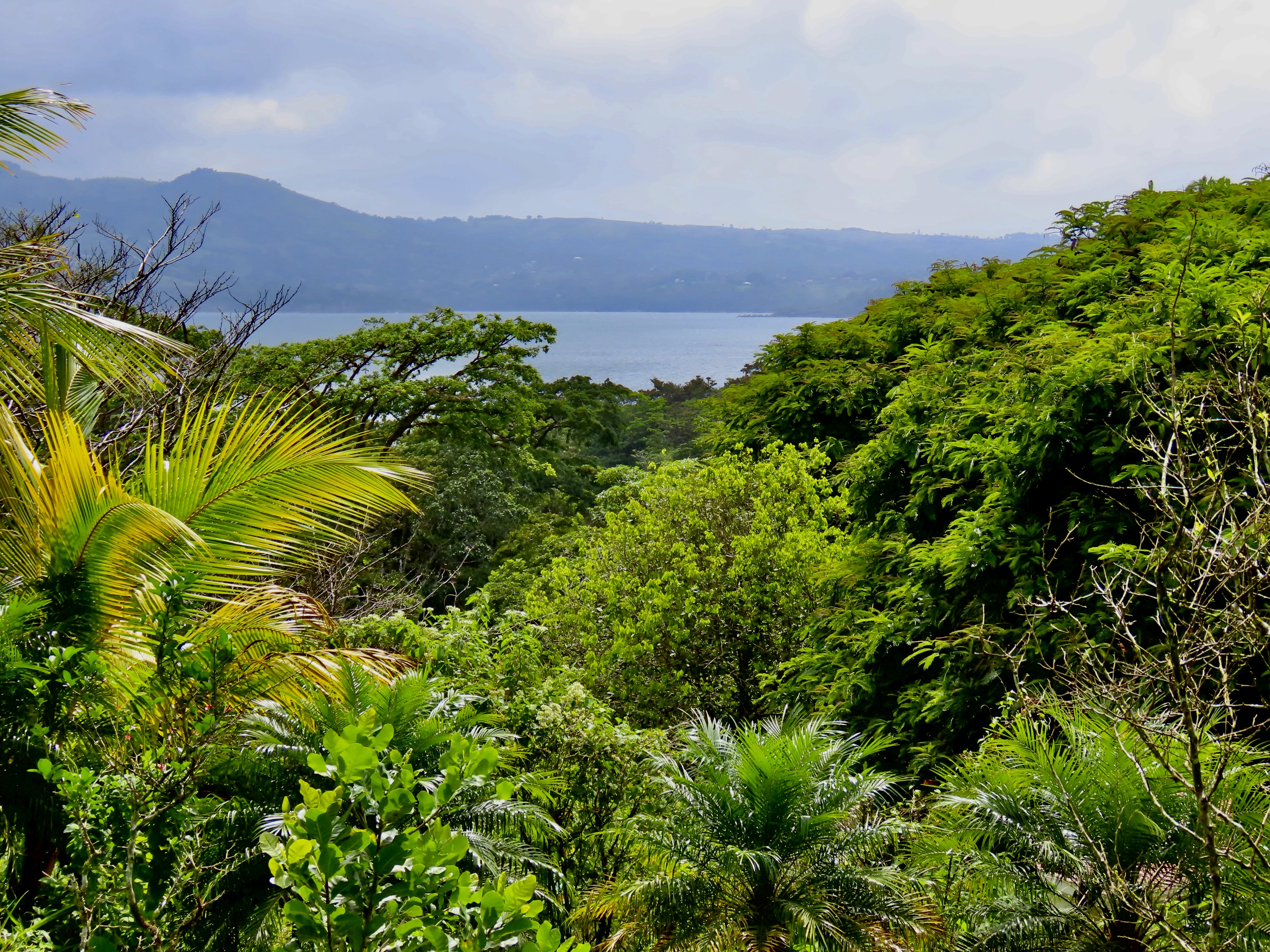
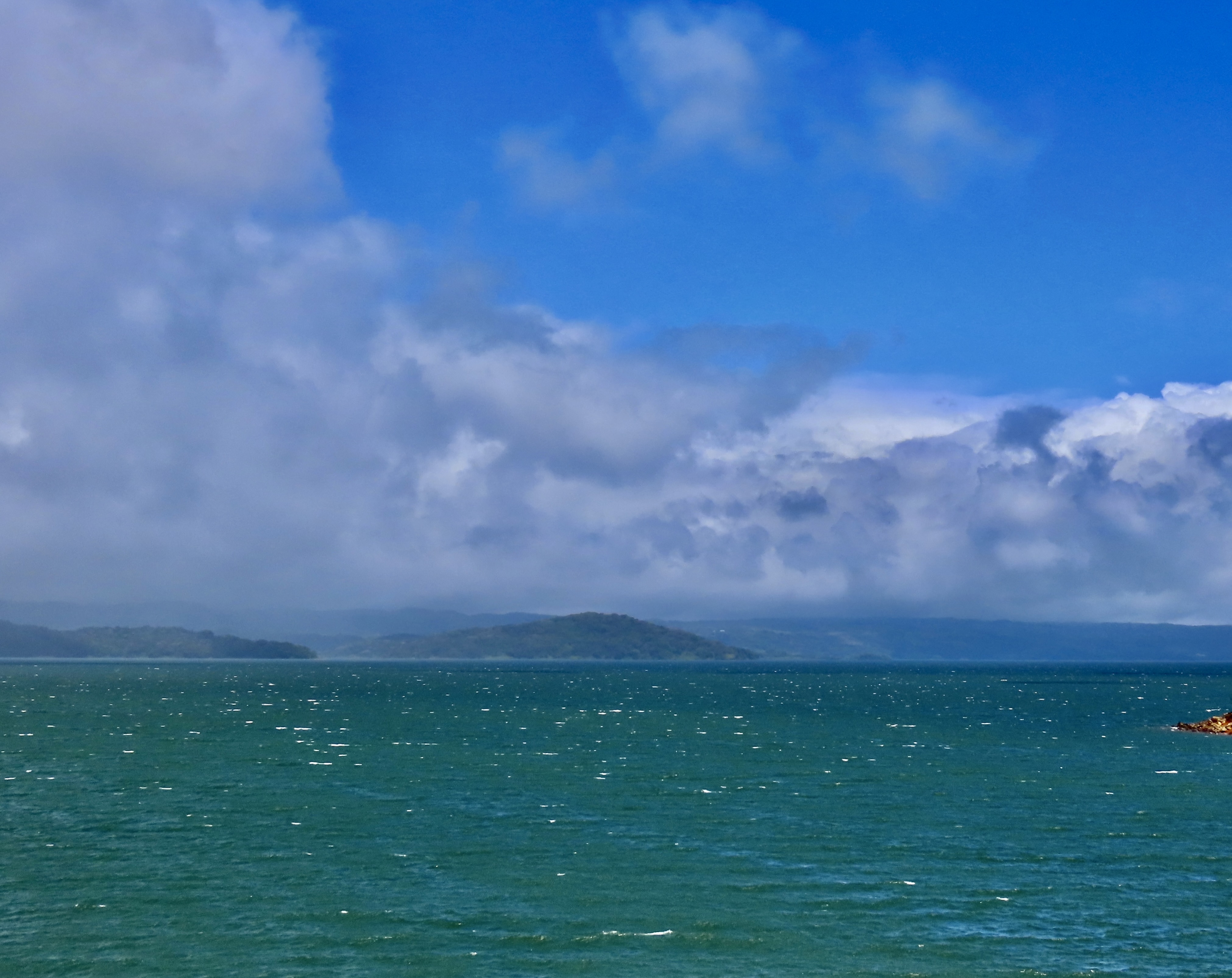
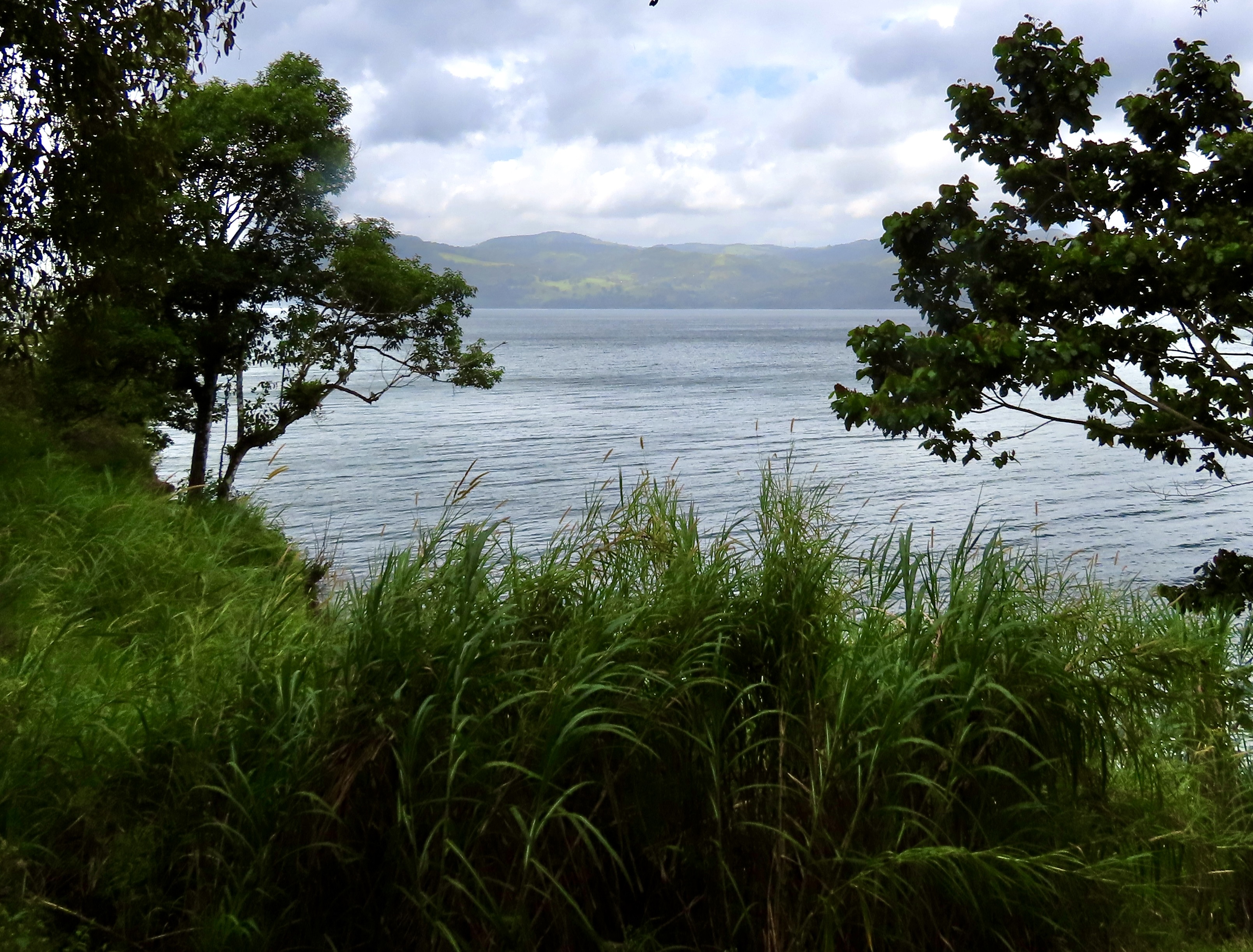
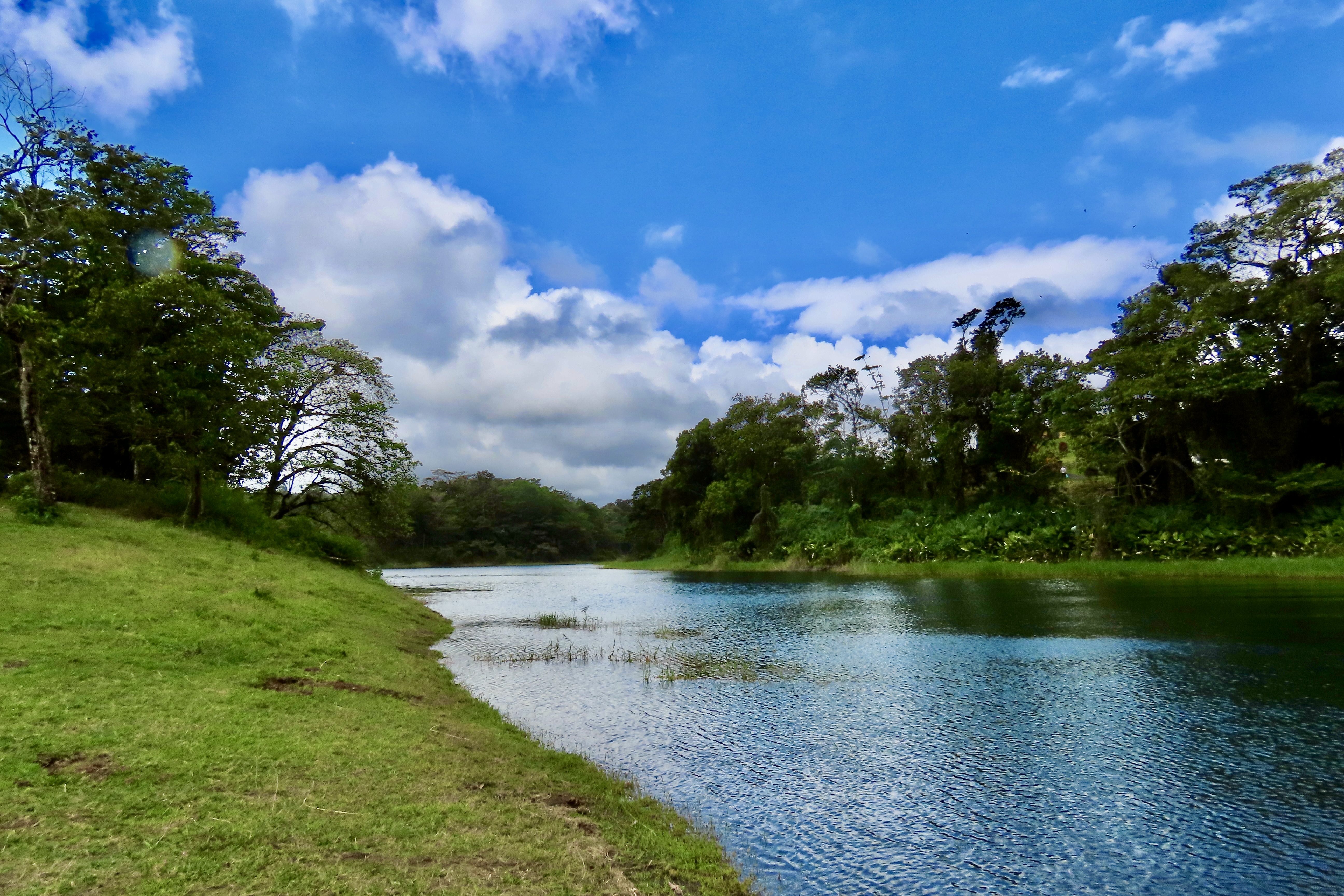
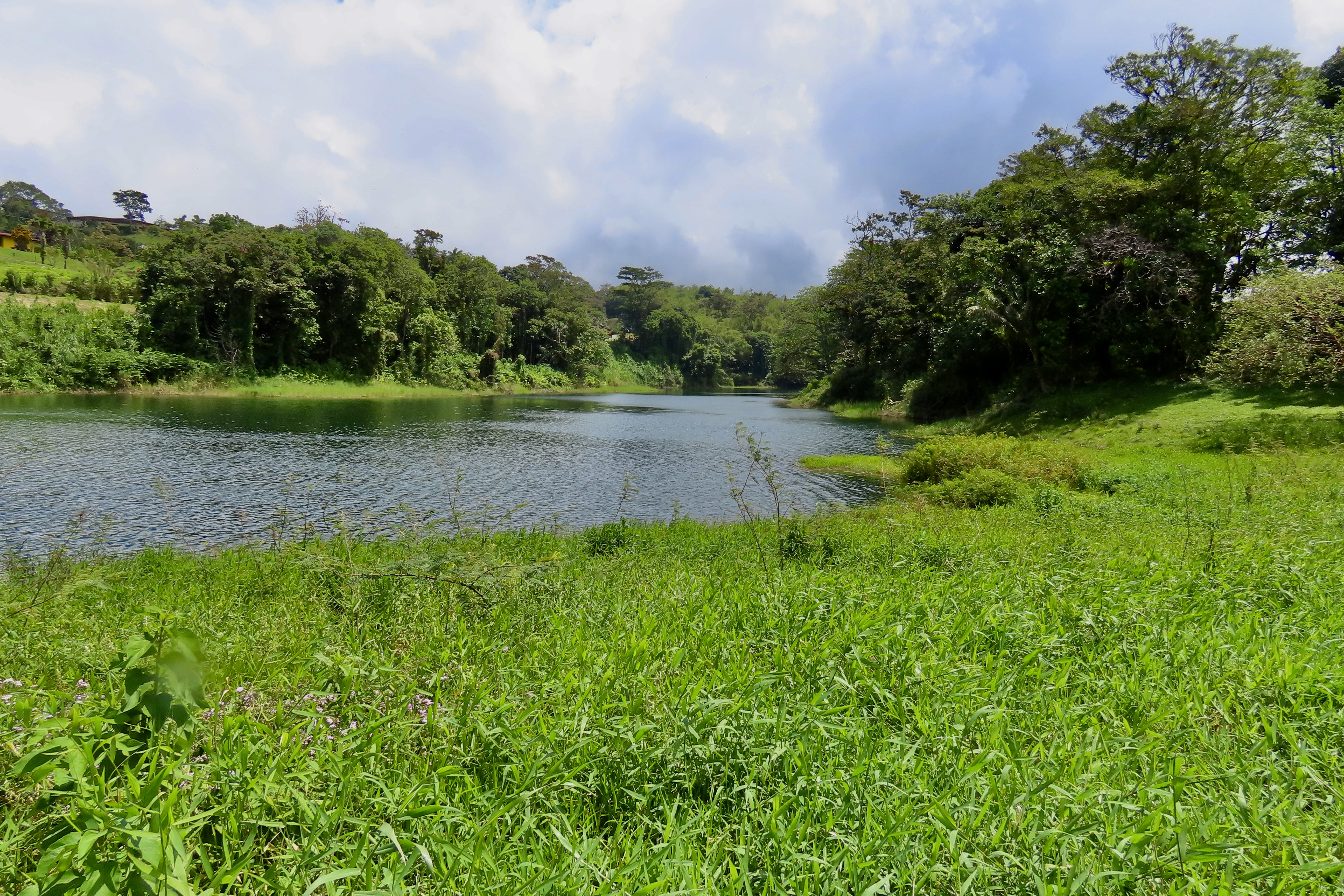
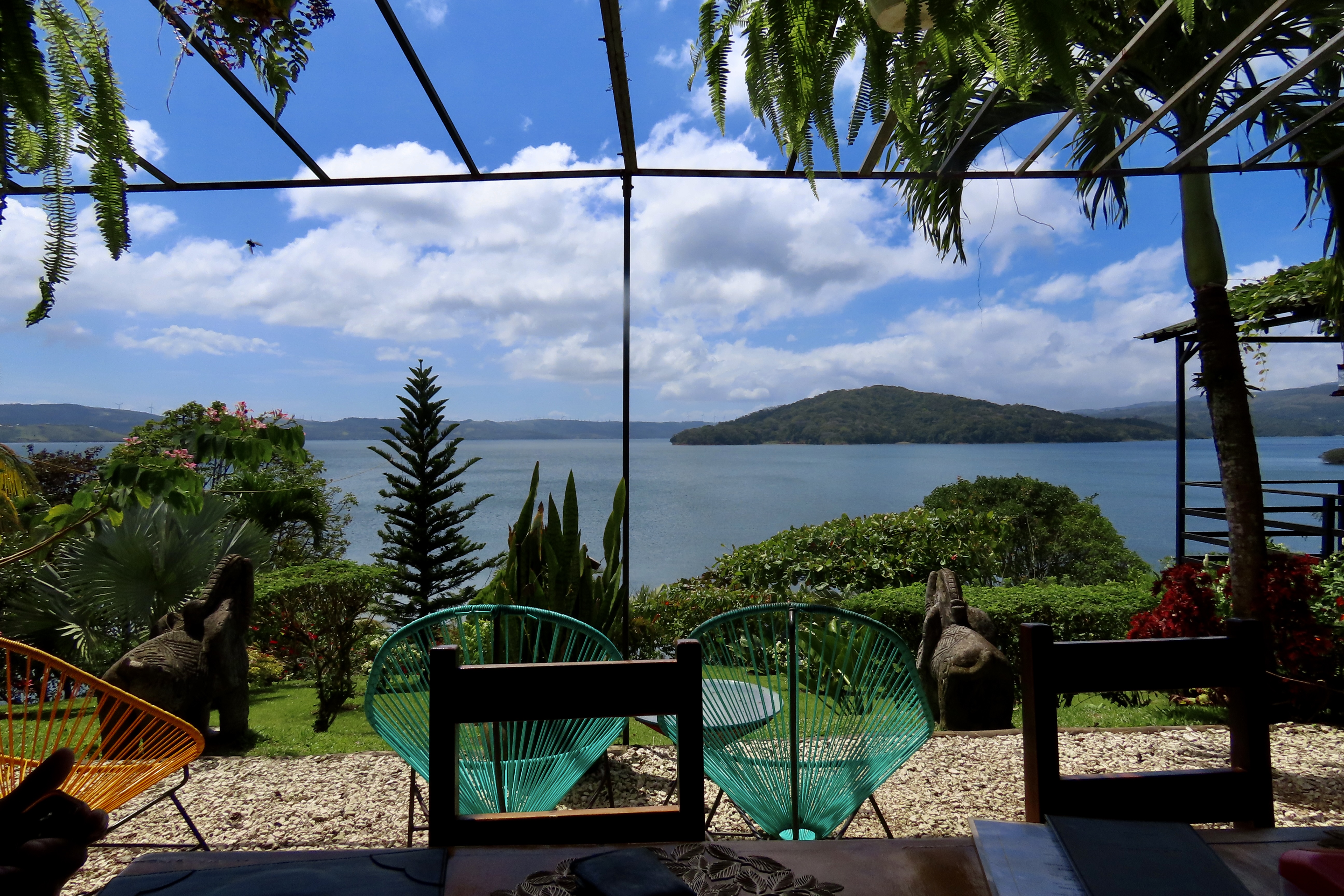
Lakeview Gardens, the VRBO we stayed at for our first two weeks in Nuevo Arenal, provided this view of Lake Arenal. The photo also provides a look at the jungle-like growth surrounding our villa.
The first place we stayed on our monthlong trip to Costa Rica was in the small town of Nuevo Arenal on the shore of Lake Arenal. It’s called Nuevo (new) because old Arenal, the town of Tronadora, and a huge cattle ranch are now buried deep under water.
In 1979, Costa Rica decided to create a major hydroelectricity project by damming the lake as part of its modernization efforts. Arrangements were made to move the inhabitants of Arenal and Tronadora to new communities. They had new homes, but their farms, ranches, and jobs were left behind. Hacienda la Rosita, the cattle ranch that covered much of the land now occupied by Lake Arenal, was expropriated by the Costa Rican Government, i.e. taken without compensation. I assume that the owner of the property, P. Eckrich & Sons, a subsidiary of the U.S. based Beatrice Foods, at least got a lot of steaks. Or maybe the cattle learned how to swim.
The new dam tripled the size of the lake to 33 square miles (85 square kilometers), making it the largest lake in Costa Rica. Its depth ranges between 98 feet in the dry season to 198 feet in the rainy season (30 and 60 meters). Initially, it was responsible for creating 50%-70% of the country’s electricity. Now it’s closer to 12%-17%, but still significant. 95-98 % of Costa Rica’s electricity comes from renewable sources, making it one of the top countries in the world for clean power. The US is around 24%.
Today, recreational activities ranging from fishing to windsurfing to kayaking and paddle boarding draw tourists from around the world, providing an important source of revenue for the local economy and country. The pages and pages of VRBOs, Air B&Bs, and tour companies listed on Google is an indication of this!
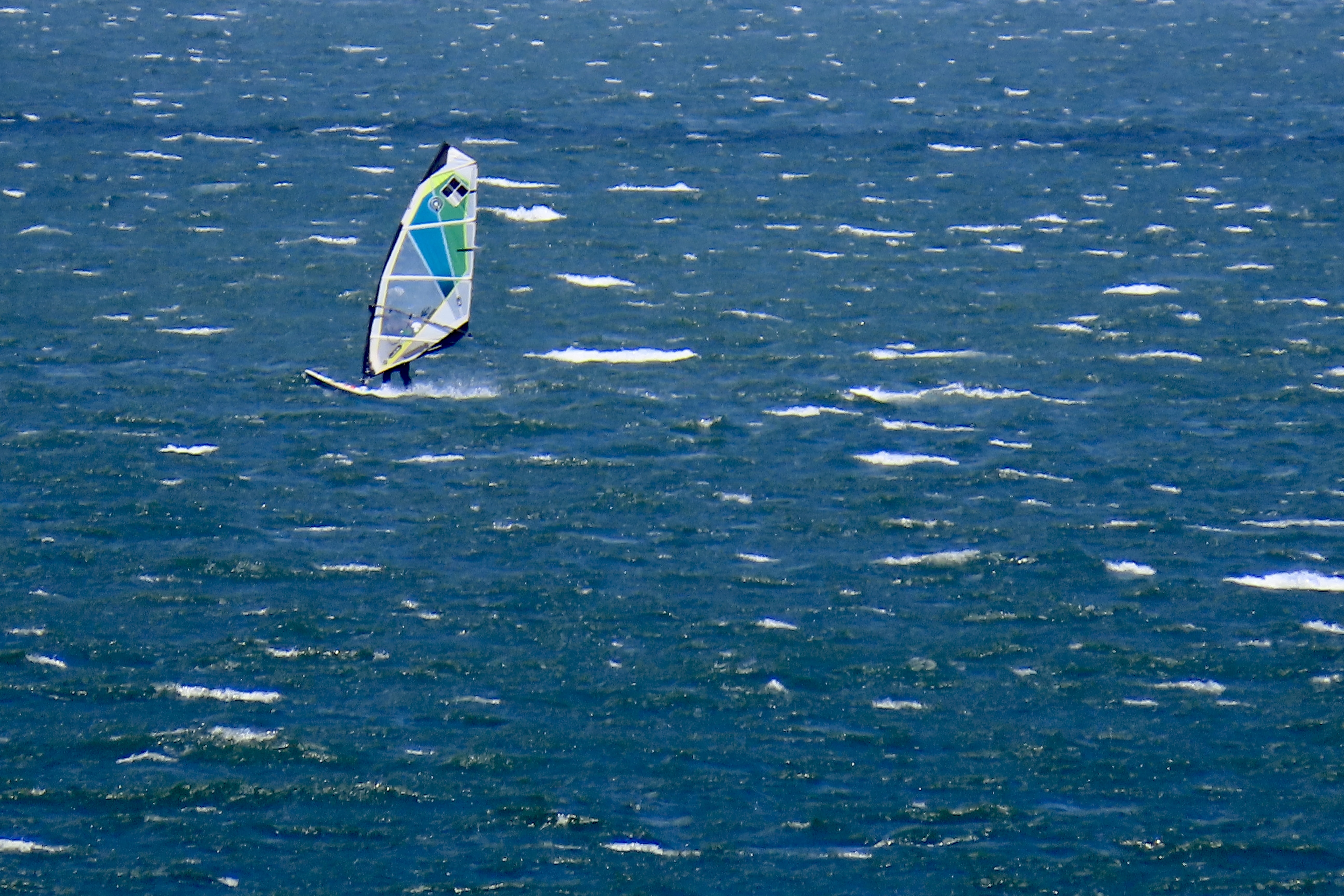
Lake Arenal is known for its windsurfing. A strong wind has this person flying across the lake!
The area is part of the Central America Volcanic Arc created by plate tectonics as portions of the ocean plate dive under Central America. There are several active volcanos in Costa Rica. Mt. Arenal, located a few miles away from the lake, erupted on July 29, 1968 with a major explosion that destroyed the town of Tabacón and killed 87 people. It can seen from Lake Arenal and is still smoking. Hot springs, geothermal power, and a tourist attraction are positive aspects of the volcanic action. Earthquakes and the possibility of Mt. Arenal erupting, again, are on the negative side of the ledger. I wondered how the dam would behave in a major earthquake. The mountain has been quiet since 2010.
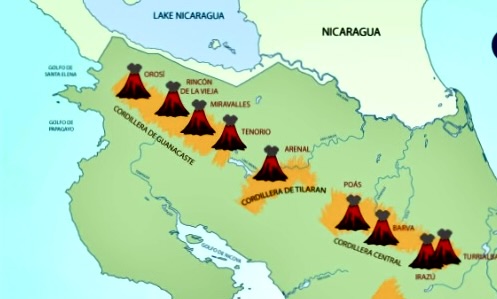
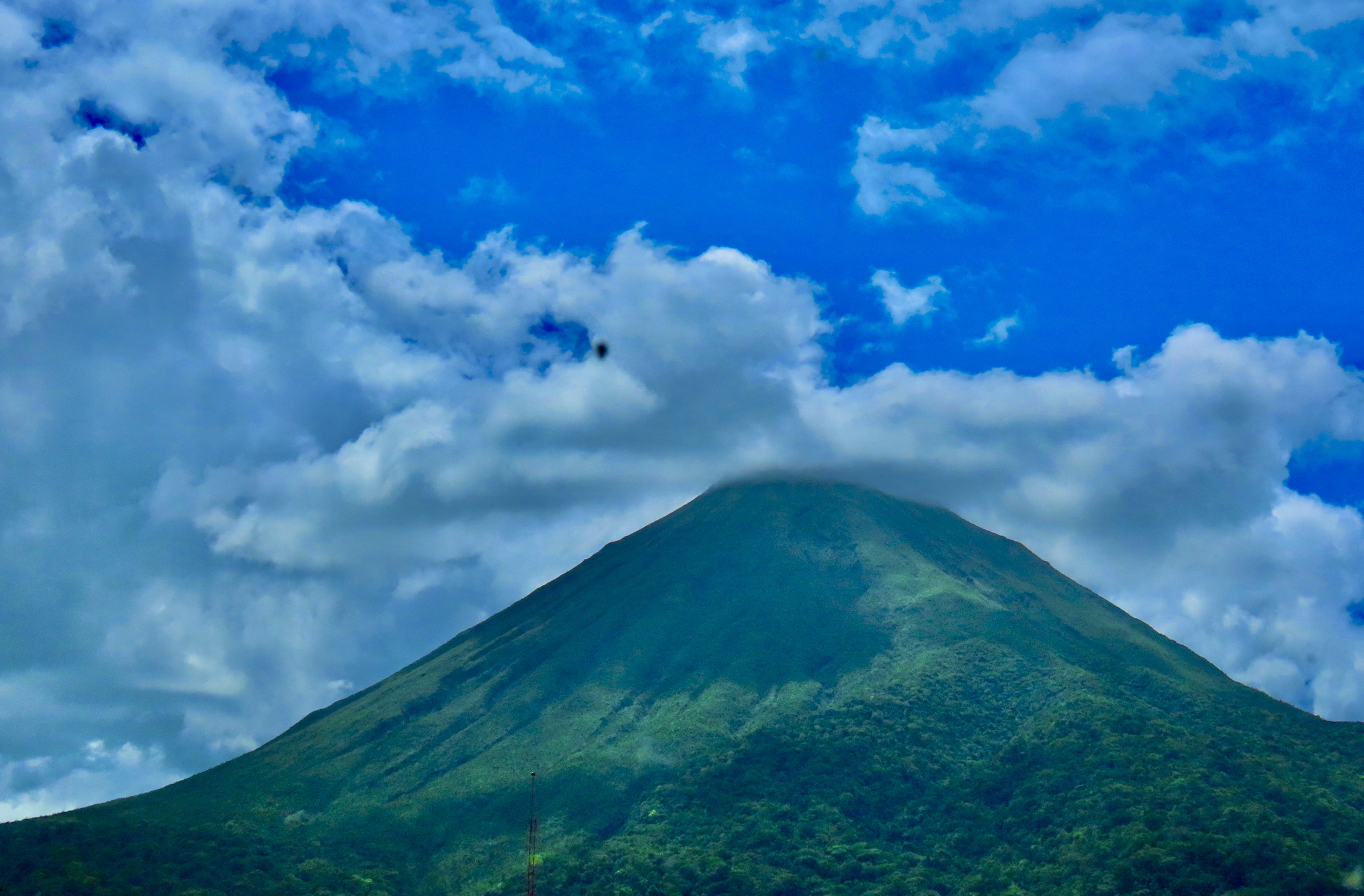
A map of active volcanos in Northern Costa Rica from costarica.org. Arenal is the middle volcano. Lake Arenal is just to the north. This is a great example of the lava created when an oceanic plate scrapes off against a continental plate. The result is the volcanoes seen here.A view of Mt. Arenal. It was cloudy the day we drove to the town of Fortuna at its base, so we couldn’t see the smoke coming out of the top.
Next… photos of Lake Arenal that Peggy and I took.
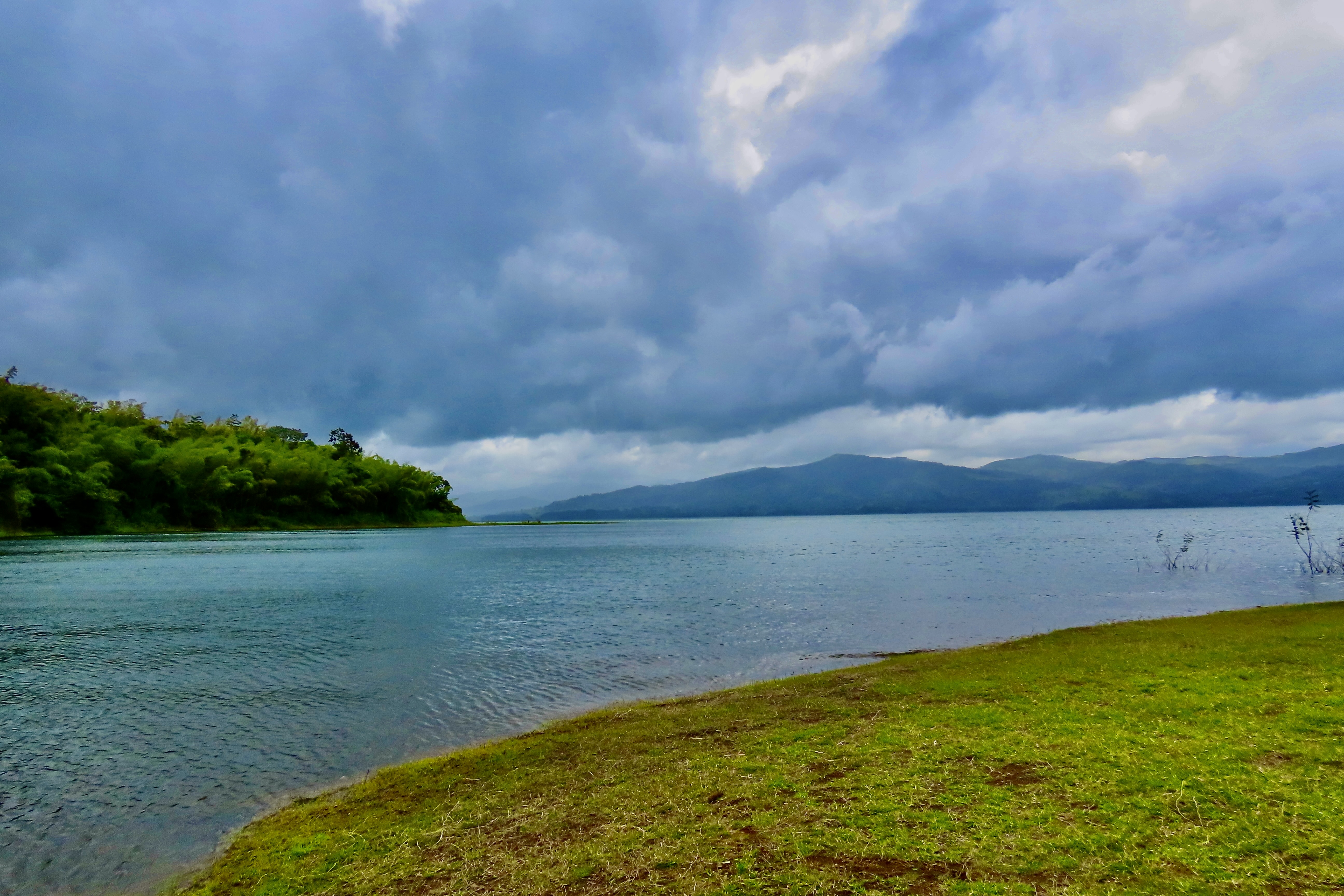
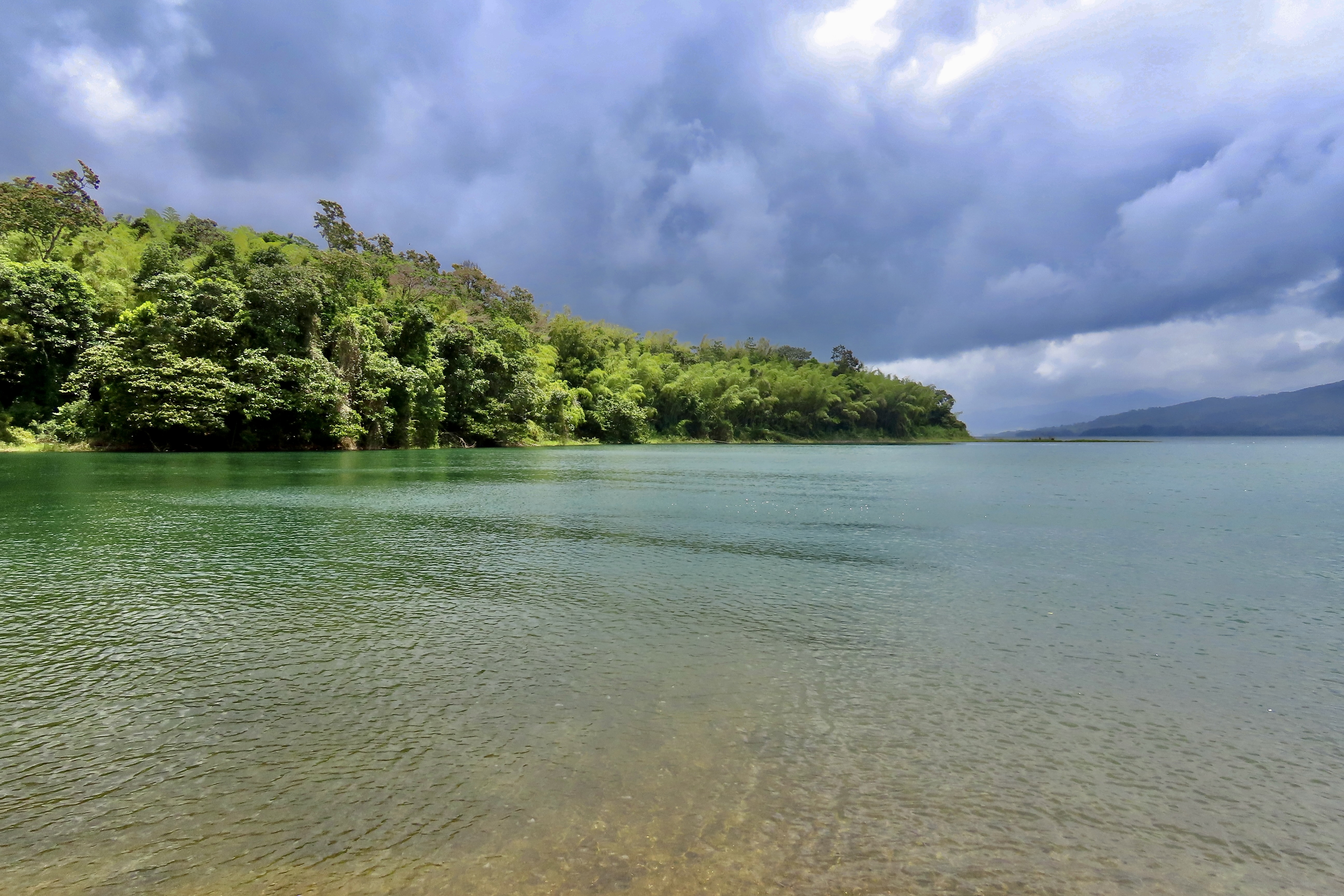
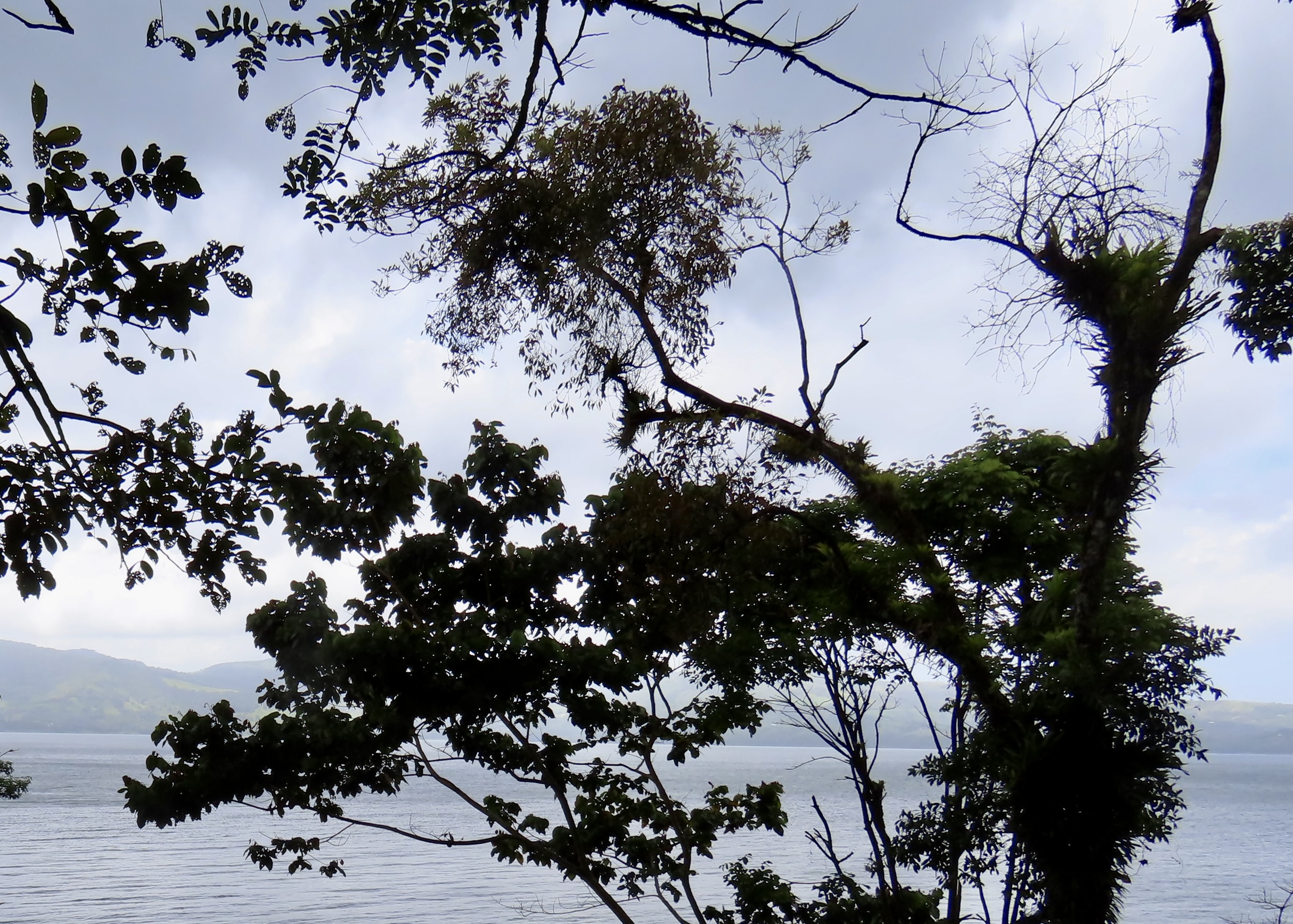
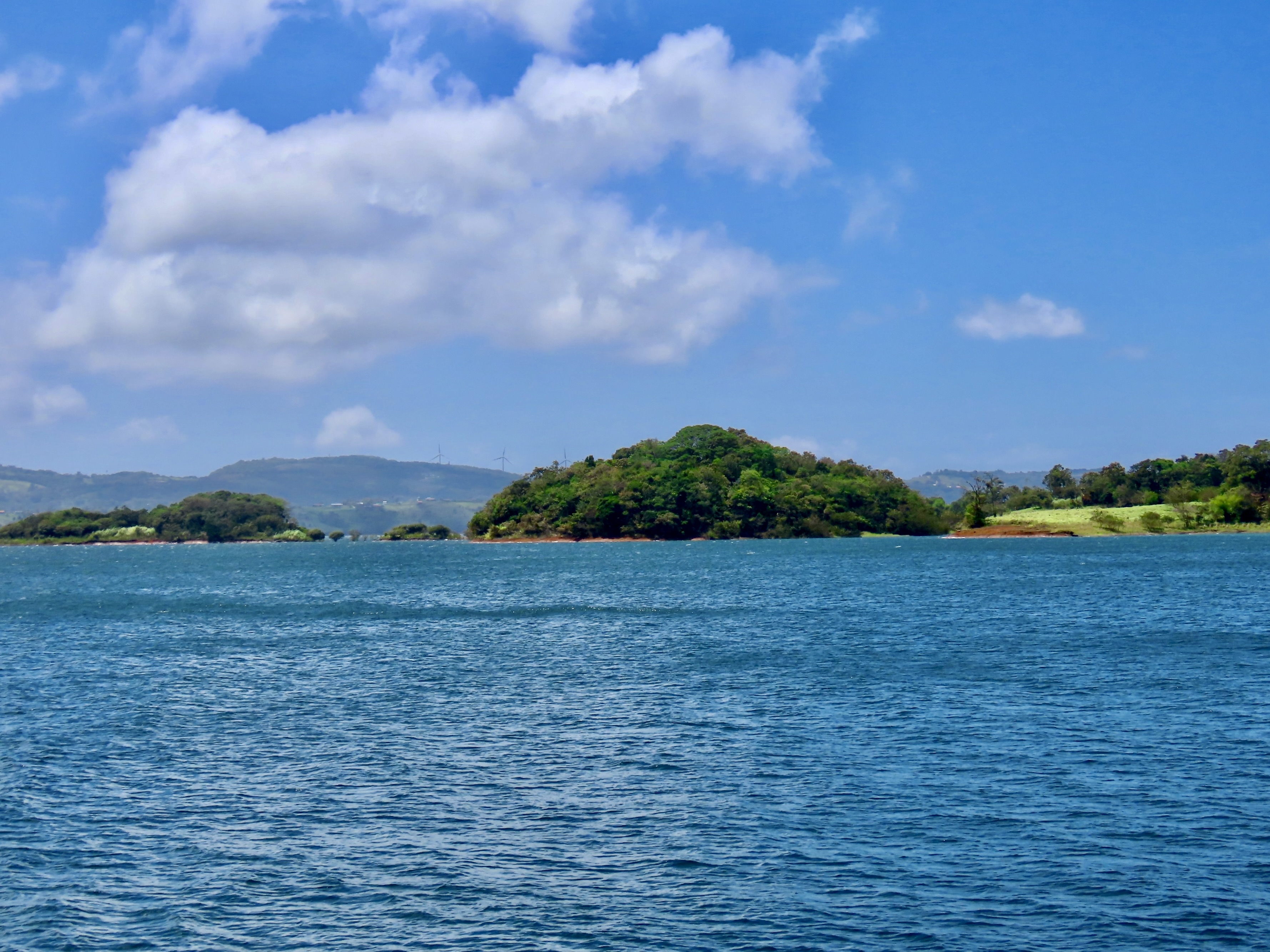
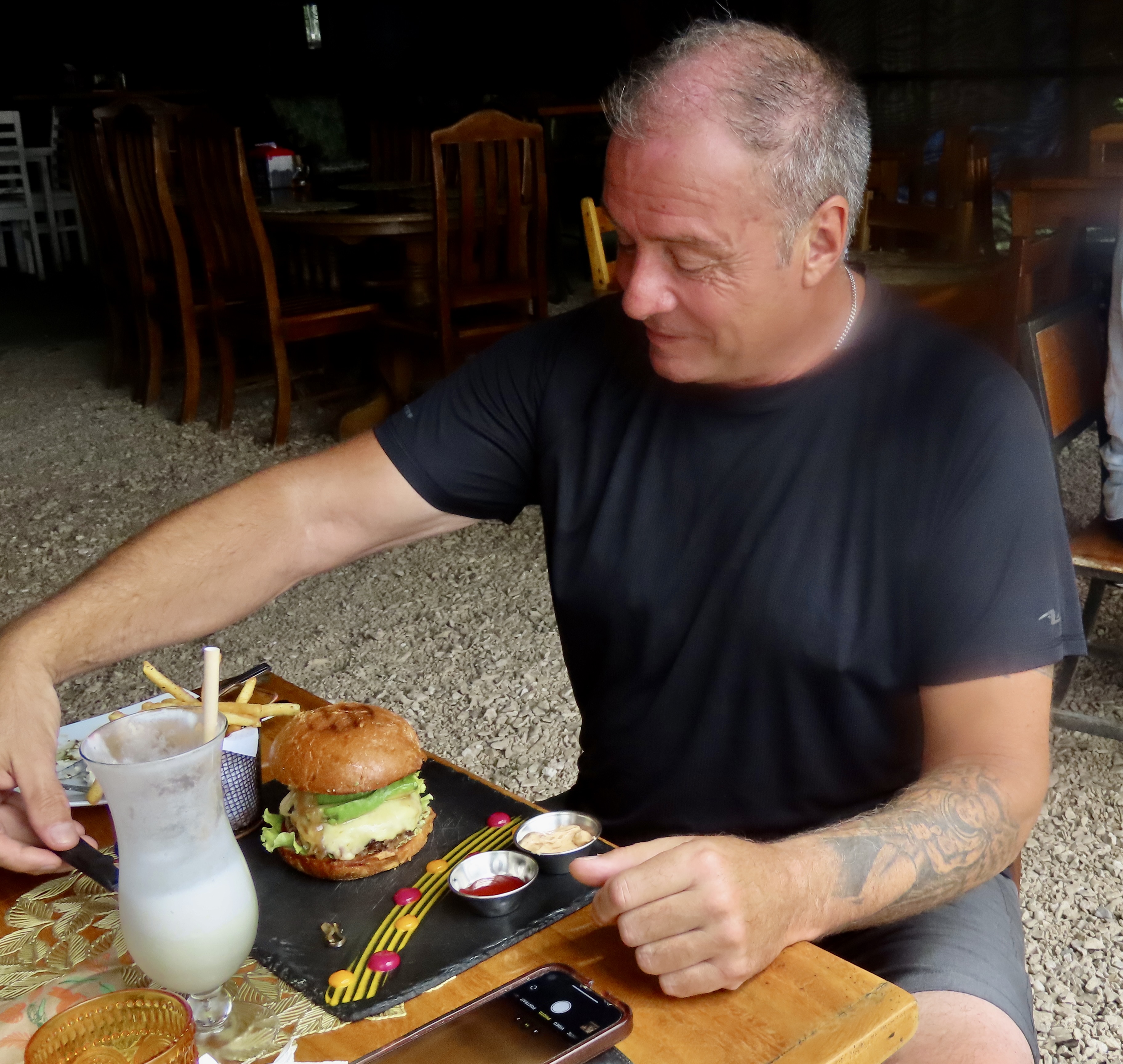
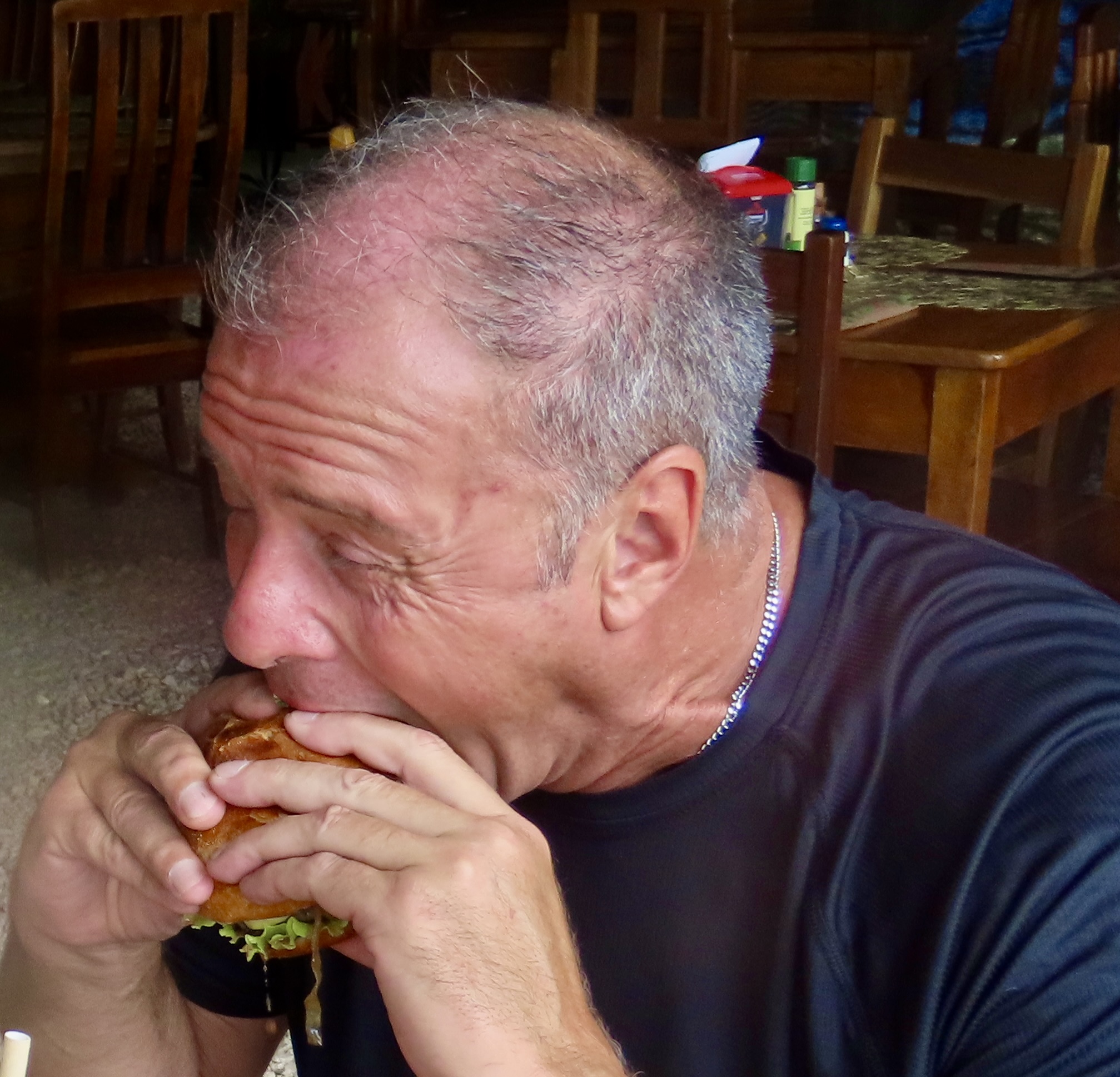
It was cloudy on the day we went for a hike along the lake’s shore at a park on the edge of Nuevo Arenal. We thought the clouds added to the beauty of the lake.A peninsula jutted out into the lake.The sun breaking through provided an interesting contrast to the dark skies. The trail led us out onto the peninsula. An inlet leading back toward our VRBO was on the opposite side of the peninsula.Another perspective. The attractive inlet with its calm water had us wishing we had our kayaks along. The white caps and the wind out on the open lake: Not so much.Shooting toward the sun gave trees a shadowy look.Another peninsula and several small islands were visible looking down the lake. Tinajas Restaurant is located just over the hill on the right and provides a great view of the lake.This is the view out from the Tinajas Restaurant. We went there with our next door VRBO neighbors, Paul and Gabe, who were from Canada. Paul had managed a steel mill before his retirement. Gabe still ran an online school teaching Spanish speakers English. They were a delight. See the speck on the upper left. It wasn’t a bird. It was a spider building a web.Paul ordered a hamburger. It was humongous. I wondered if it had been donated by one of the ancestors of the cattle that once roamed through the valley below. Even more, I wondered how Paul could possible get it in his mouth. He demonstrated! And looked quite happy doing so. That’s it for today. Join us on Wednesday as I continue with my blog-a-book tales and…Win a large stuffed dog to impress a date at the California State Fair. By cheating. 😳 (Thanks AI for the photo.)
UT-OH! Thanks AI. Unfortunately, mammoths disappeared before I could photograph them.
I’ve never required much help in eliminating options from my life. Chemistry was like that. Lab work and I don’t get along as a general rule. I quickly learned in high school that I am not particularly fond of cutting up long dead frogs pickled in formaldehyde or mixing chemicals that smell worse than an old dog’s fart. But there is more to it than that: I am convinced that good lab technicians enjoy putting things together, taking them apart, tinkering, and fixing things. As a general rule, I don’t.
For example, I knew kids in high school who loved working on automobiles. Ask them anything about carburetors, water pumps, generators, horsepower or timing and they had a ready answer. They couldn’t wait to get their hands covered in grease. I admired them for it, but my interest in carburetors was zilch. My primary interest in automobiles was that they get me from point A to point B without breaking down. Still is
My hobbies as a kid reflected this. Building model ships, airplanes, cars, trains, etc. had no interest for me. It wasn’t that I didn’t appreciate the results, some were mind-blowing in their detail and realistic look, but my concept of a great hobby was rock collecting. I would pick up interesting rocks on my excursions into the surrounding country until all four pockets were bulging and my pants about to fall off. I would then go home and smash them apart with a hammer to figure out what I had found. Geology became a life-long interest.
I do understand the arguments for being able to fix things: saving money, being self-sufficient, and obtaining satisfaction from a job well done, not to mention being manly. These same arguments, however, apply to going out in the pasture, shooting Elsie the Cow, skinning and gutting her, bringing home the meat, grinding it up, and throwing it on the grill. Just think of the satisfaction involved and dollars saved! Or you can go to the local fast-food joint and help employ a kid who might otherwise turn to a life of crime.
Now, back to chemistry and lab work. One day we had to shove little glass tubes through rubber stoppers. Apparently, this is an important skill for budding chemists. It’s not a difficult task if you ignore the fact that the holes in the stoppers are significantly smaller than the diameter of the glass tubes and, more importantly, have a gallon of Vaseline. I was half way through my first masterpiece when the damn tube broke and ended up jabbed into my hand. Bleeding like a speared mammoth, I was carted off to the emergency room of the local hospital and sewn up.
My attitude toward chemistry was already iffy. With the accident, it dropped faster than it took me to hit the ground in my fall from the pear tree. Higher math created another challenge.
There’s an old adage that we are supposed to work hard at those things we find difficult, that it gives us character. My belief is that I already have plenty of character. If I had any more, little men in white coats would be chasing me with nets. I prefer to spend my energy on things I enjoy, like reading a good book or hiking in the wilderness. Or writing. I have little tolerance for doing things that I don’t do well or fail to interest me. In other words, the Protestant Ethic and I have serious compatibility problems.
But I can be stubborn. Math is a good example. In the fourth grade I discovered that long division was nasty. I got beyond that, but word problems gave me a complex. Two trains are hurtling at each other on the same track with Train A going 90 miles per hour and Train B going 70. They are 252.5296 miles apart. How long will it be before the Train A engineer says, “Ooooh shit!”
“At the same time as the Train B engineer does,” was my answer.
But not nearly as soon as I did. My own expletive arrived on my lips .0000001 seconds after seeing the problem on the blackboard. I concentrated on sending the teacher vibes. “Curt is not here today. You do not see Curt. You will not call on Curt.” But I continued plugging away at math and did fine in grade school. I even managed to ace Algebra I and Geometry. Algebra II was different. That’s when I ran head on into Miss Kaste. It was not a pleasant experience.
Miss Kaste, according to those who were seriously into math, was very good at what she did. Students leaving her class were reputed to have a solid foundation in the basics and be well prepared to move on to the ethereal worlds of calculus and trigonometry.
Basics, I quickly learned, meant that there was one way of coming up with answers and that way was chiseled in stone. One did not diverge from accepted formulas or leave out steps. Right answers obtained the wrong way were wrong answers. Wrong, wrong, wrong!
This created a problem. I had a true talent for coming up with right answers in my own way and this brought me unwanted attention. I could have lived with that except for another problem, Miss Kaste’s teaching technique. She oozed sarcasm. She made people cry. My response was to freeze up or act like a clown. I couldn’t tolerate it— or her. Math was eliminated from my future.
Once again, it speaks to the power of teachers to turn students on, or off, to various subjects. I wasn’t a total dunce at math. Ironically, I scored in the 95th percentile on the Iowa Test in math the same year. Theoretically, that placed me in the top five percent of math students. I wasn’t a genius, but I could have/should have done better.
There was plenty of time while sitting in ER bleeding to contemplate my future as a scientist. My conclusion: there wasn’t one. Even though I enjoyed botany and geology, I decided that the best way to avoid long-dead animals, smelly chemicals, labs and math would be to choose a career that depended on subjects I enjoyed, and made use of my verbal ability and organizational skills.
Looking back, (hindsight, mind you), I am not too surprised about the paths I chose to follow in my life. They were right for me. No regrets. But given I’ve always found science enjoyable from a lay perspective as an adult, I sometimes regret I didn’t obtain a better background in high school and college. My bad.
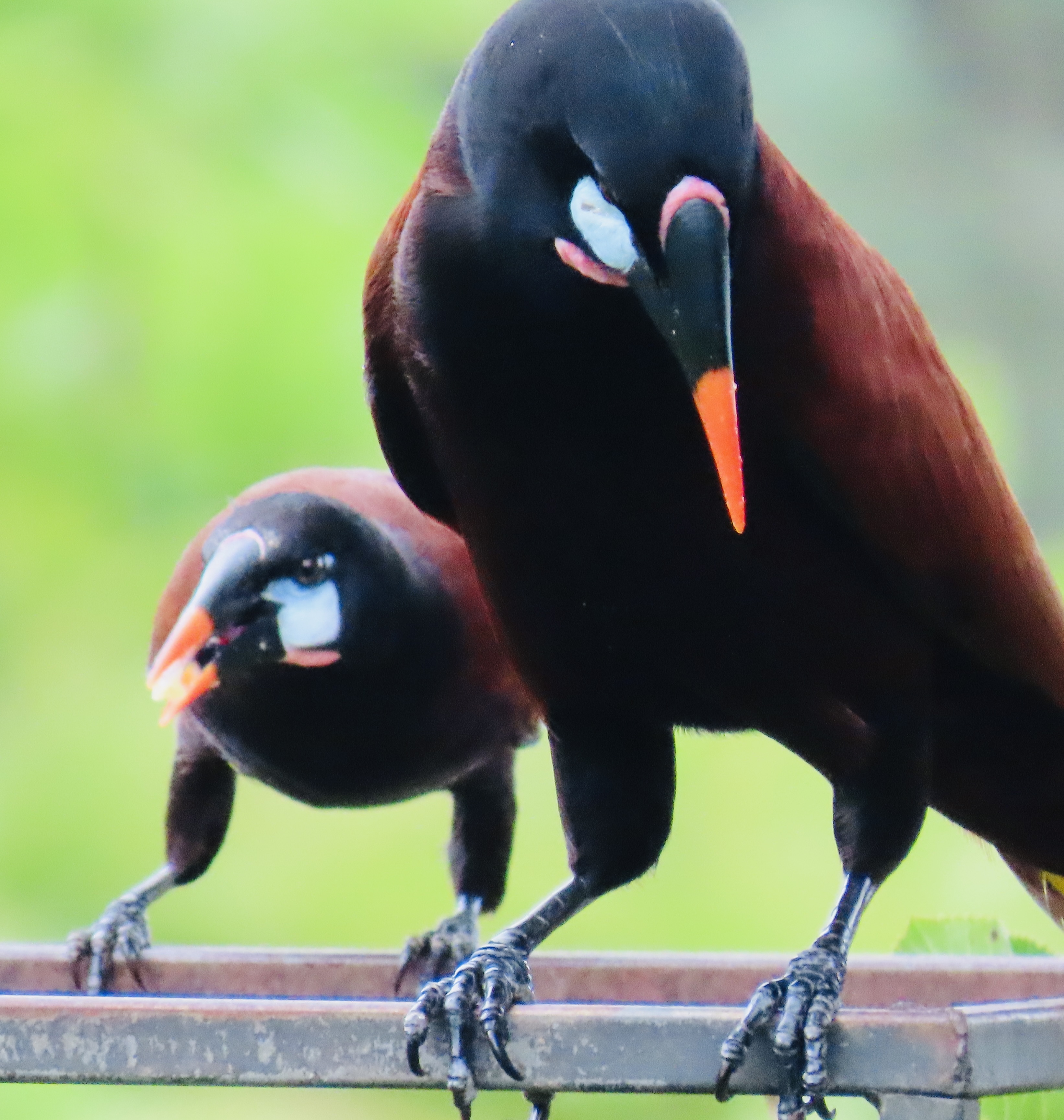
Next Post: Join us on Monday as we return to visiting with the Montezuma Oropendola and other birds of Costa Rica.
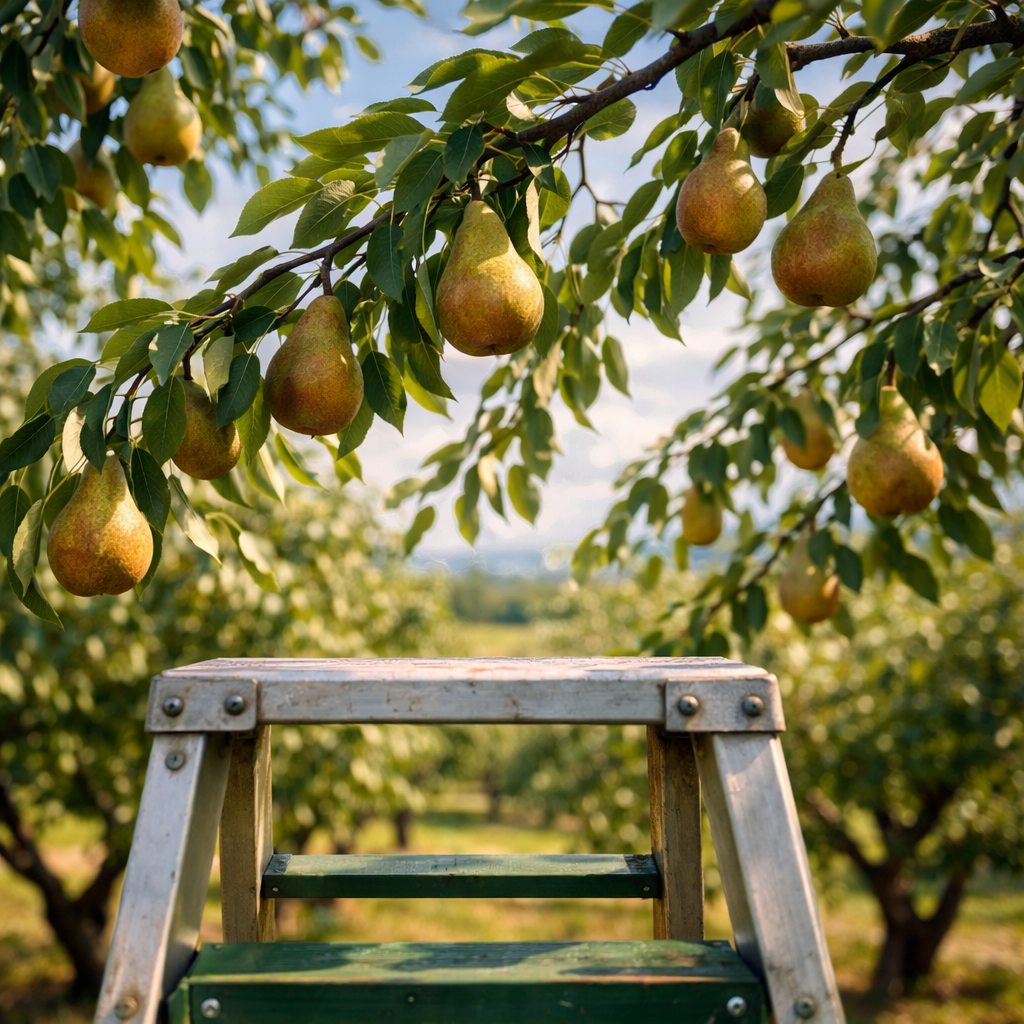
This is what you see when you are 5-6 steps down on a 12 or 14 foot pear ladder. Now, imagine climbing up and balancing one step from the top to reach pears in the top of the tree. UT-OH! (I’ve gone over to the dark side here. This is an AI generated picture. My challenge, as always when writing about my youth, is that the photos were few and far between. That’s hard to fathom in the digital age, when I can easily take more photos in one day that I have from the first 20 years of my life. When I pushed the key that asked WP to produce an AI photo for this post, it read my blog and came up with three good suggestions. That may be scarier than standing on the second step! It didn’t catch, however, that the ladder only had three legs. Maybe there is hope.
A number of things combined to pull me out of the puberty blues. For one, I ceased being a freshman. Hormones slowed down, my voice abandoned octave leaps, and I bought a pair of contact lenses. Academics were a plus, even during my freshman year. Lacking a social life, I studied full-time and managed to pull straight A’s. If I couldn’t be ‘ruler of everything,’ ‘sex symbol’ or ‘sports hero,’ maybe I could at least be ‘the brain.’ Was I driven or what?
I also believe that having a job helped. I began working in the pear orchards around Placerville starting the summer of my eighth-grade graduation and continuing through high school. It was a nine hour a day job of hard physical work, one more fit for an adult than a 14-year-old. Dealing with the 90-105° F summer heat of the Sierra foothills didn’t help. But I actually enjoyed the work. And the money. The general rule in our cash poor family was that the basics were covered. We were responsible for the extras, such as dates.
In addition to being hard, there was also an element of danger. Pear picking consisted of hazardous duty without hazardous pay. We were each given a 12-foot ladder, a sizing ring, and as many boxes as we could fill. The pears we plucked from the trees were placed in a canvas bag that fit around our front like a pregnant belly and carried up to 50 pounds. We had the option of working by the hour at $.90 per hour or by the box at $.20 per box. I opted for the per box under the assumption I could earn more.
The ladder was a suicidal three-legged device with two legs playing standard ladder while the third served as the balancing arm we threw out to provide ‘stability.’ I use the quote marks here because the stability was questionable. There was always a chance that you, your bag of pears, and the ladder would come crashing down. The first few rungs were solid; it was on the top four that life became interesting. Even here it was tolerably safe, assuming you focused on easily reachable pears.
The problem was that the best pears had a way of hiding away in the highest, most unreachable part of the tree. Such premium fruit couldn’t be left hanging, even if it meant taking risks. At least that’s how my ut-oh mind functioned. It was nothing that the boss required. Success meant performing a one-legged-ballet-balancing act. I became quite proficient at the move. Only once did I reach beyond the imagination of my ladder and follow a rapid descent path straight to the ground. Fortunately, the only limbs broken belonged to the tree. I wrote the experience off as a lesson in Newtonian physics.
A greater challenge was entertaining myself for nine hours a day. Reaching out and picking a pear requires a minimum number of brain cells and very few of those are located in the frontal lobes. My favorite ploy was singing at the top of my voice. Harry Bellefonte’s tune about picking bananas was a natural. I adapted it to picking pears. But I also belted out many other popular tunes of the day. “Does Your Chewing Gum Lose Its Flavor on the Bedpost Overnight” was a mistake. I couldn’t get it out of my mind; I would wake up in the middle of the night humming it. To this day I have to be careful in bringing it up or it is right back there on the tip of my tongue, waiting to escape. Like now:
“Does your chewing gum lose its flavor On the bedpost overnight? If your mother says don’t chew it, Do you swallow it in spite? Can you catch it on your tonsils, Can you heave it left & right? Does your chewing gum lose its flavor On the bedpost overnight?”
A more productive form of amusement was challenging myself to pear picking contests. The more I picked the more money I made. When the fruit was plentiful and well sized, I could pick 60-80 boxes a day and earn big money, $12-$16. By the way, that seemingly measly sum is the equivalent of $130 to $180 today. Once I even reached a magical 100 boxes. My goal was to try to match the professional pickers, the folks who made a living helping harvest crops. On really good days, I could.
Over my five-year career in the pear orchards I worked with Filipino crews, Braceros, and the usual contingent of semi-nomadic types who followed the various crops as they ripened from state to state. Most were good, even excellent workers. Of course, there was also the occasional guy who worked just long enough to buy a gallon of Red Mountain Wine and then disappear.
After my first year of working in the fruit orchards, I graduated to swamper status, which meant I delivered empty boxes to the pear pickers and took out their full boxes. I also learned such fine skills as tractor driving, tree trimming, sprinkler changing, post hole digging and crew bossing. And, I might add, enjoyed most of it. There is a certain satisfaction that comes from doing hard work, challenging your body, and being dead-tired at night.
I also gained a farmer’s satisfaction that comes from seeing a crop evolve from spring bloom to fall harvest. And finally, as my pear orchard responsibilities increased, the work helped me overcome the puberty blues and regain my confidence. Becoming buff and tanned didn’t hurt either. Working in the orchard with my shirt off, picking pears and stacking 50-pound boxes above my head on a truck guaranteed a tan to die for and muscles from my big toes to my hair follicles.
Almost on cue, girls reappeared in my life, with Paula being an example. Admittedly it was a slow process, in fact far too slow for my hormone driven fantasies. But there the girls were, tentatively giving me the eye and practicing a wiggle or two to see if anyone was home. There was. Down boy.
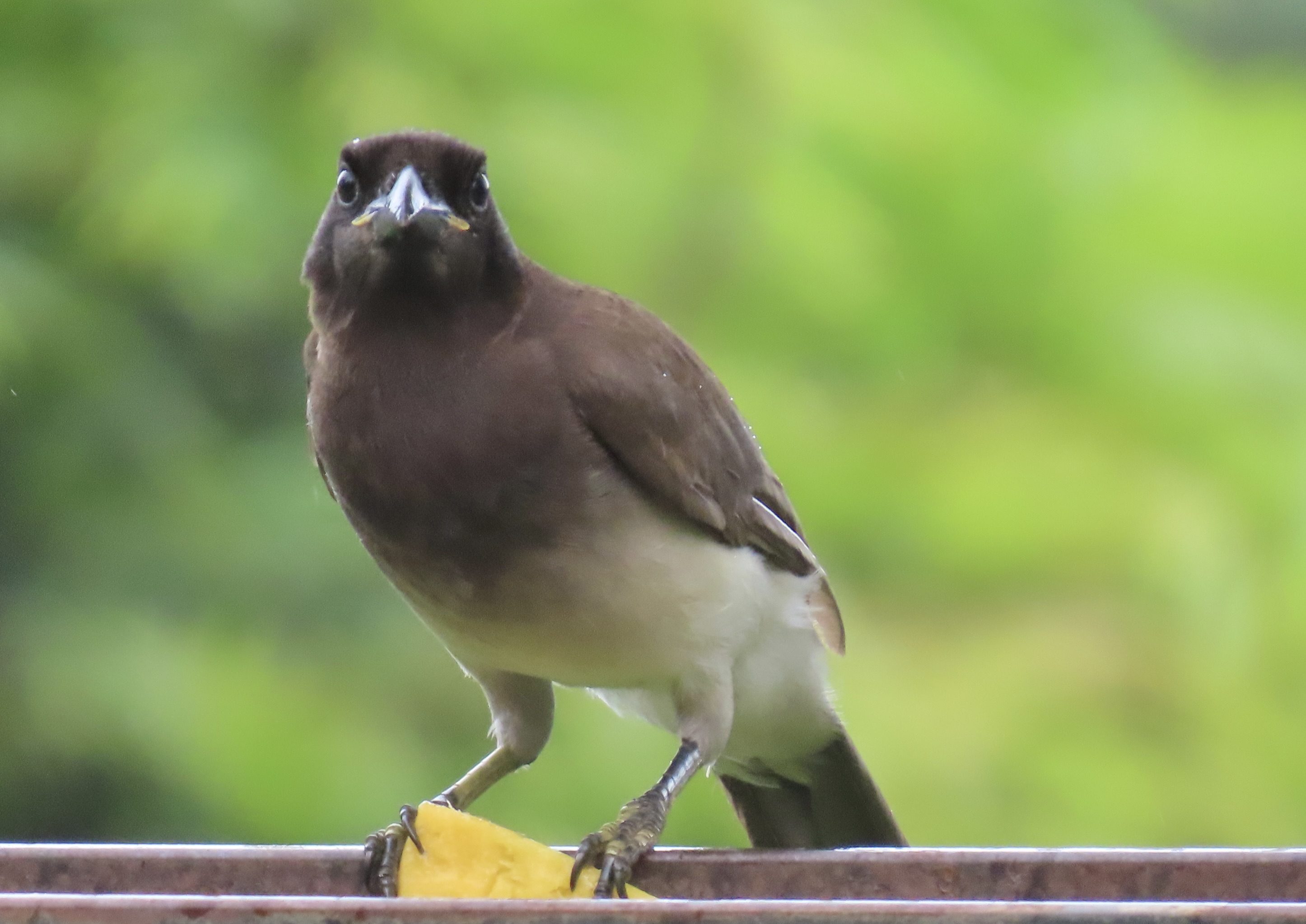
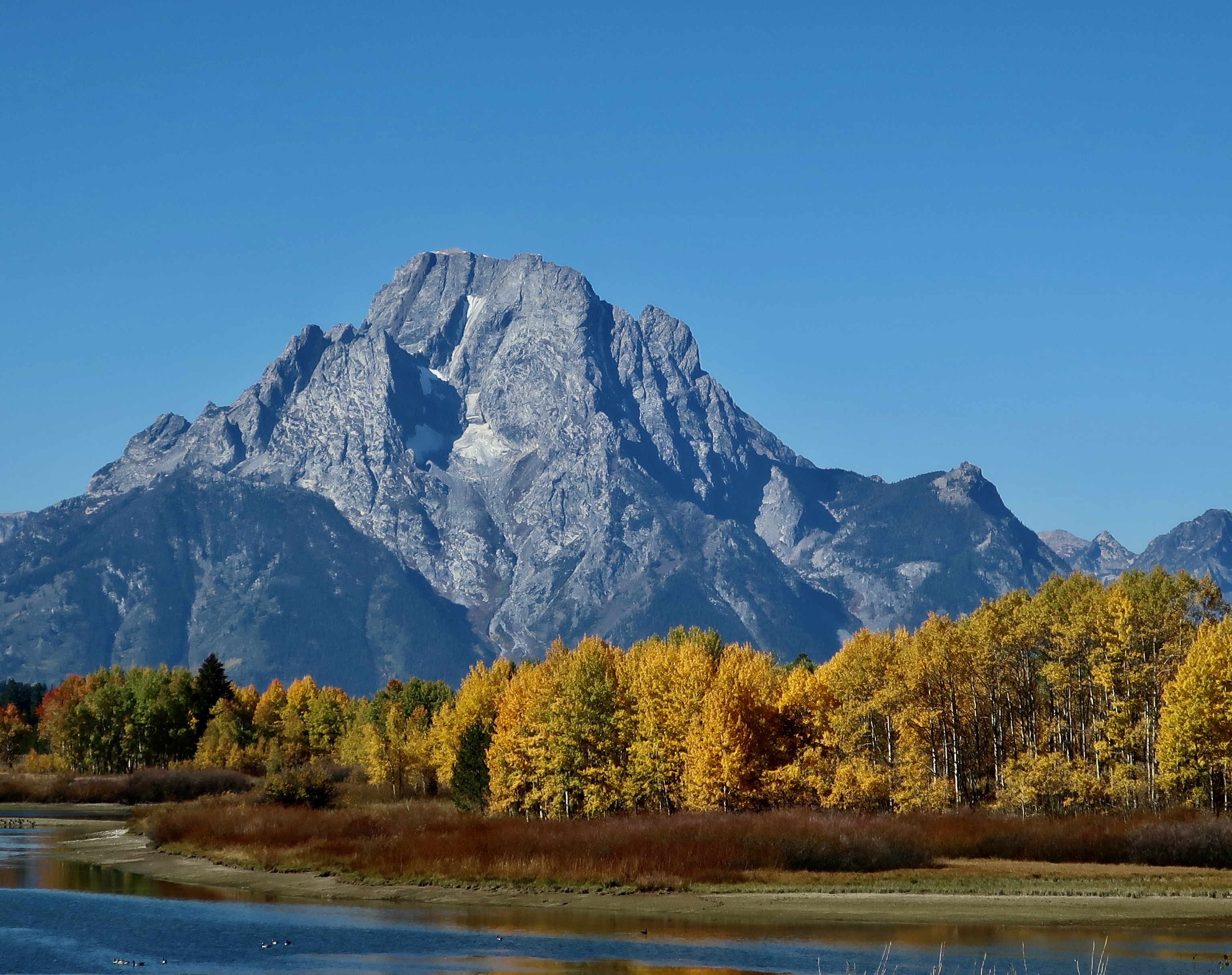
Next Monday’s Post: A jay by any other name is still a jay, plus 7 other interesting and fun birds of Costa Rica. This is Costa Rica’s Grey Headed Jay suggesting I don’t interfere with its breakfast.Grand Tetons National Park: Next Wednesday, April 22 is special. It’s Earth Day 56. Please join me as I take you back to April 22, 1970 where I participated in Earth Day 1 on the Davis Campus of the University of California. Earth Day 1 changed my life and helped to change the world. Its message today is as relevant as ever, and possibly even more so, as so many of the gains we have made are now under threat.
At this point, just beyond the speed limit sign, I ran over a skunk in the summer of 1958, undoubtably impressing the young woman I was on a date with.
As I suggested in Chapter 14, my freshman year of high school was something of a disaster. My social life tanked, dance class sucked, my political aspirations were reduced to running a friend’s campaign for class president, and my success in sports was mediocre, at best. My short legs and I suffered through a season of cross country running where I was lucky to finish in the middle of the pack.
Things had to improve.
Do you remember your first date in highschool? Was it a roaring success, so-so, or an unmitigated disaster? How about off-the-scale weird? That describes mine. I had a double date with Paula, Mom and Boyfriend. And I ran over a skunk. It happened during the summer between my freshman and sophomore year.
It started with Paula calling me. There was no way I would have called her. Girls still left me quaking in my tennis shoes. ‘Curt, would you like to go to dinner with me in Sutter Creek?’ Sutter creek was a town in Amador County, about 20 miles away from Diamond Springs over curvy Highway 49. It would be a double date with her mother and her boyfriend. That seemed strange, but somebody had to drive. How could I say no…
I remember very little about the drive or dinner— other than it was at an Italian restaurant. After we had our fill of spaghetti and conversation, we returned to the car. I had visions of sitting in the back and snuggling up with Paula on the way back to Diamond.
Mom and Boyfriend had another idea. They hopped into the back seat and promptly told me, “You can drive home, Curt!” Like they were offering me the opportunity of a life time. It did away with my bold plans. But there was more…
“Um,” I noted nervously, “I only have a learner’s permit.”
“That’s okay, it will be good practice,” Mom jumped in before I could add that I had only obtained it four days before.
Paula, meanwhile, was waiting for me to open the door for her on the passenger side of the car. It was a plot. She gave me a dazzling smile— and my options dropped to zero. Any further hesitation would be ‘unmanly.’ After doing the gentlemanly thing for Paula, I dutifully climbed into the driver’s seat and miraculously found the keyhole and lights. Gear grinding got us out of town and onto the open road. I breathed an audible sigh of relief. It was short lived. We had just made it past the small town of Plymouth and were on our way down to the Consumnes River when I ran over the skunk.
If you drive a lot on country roads in skunk country, you’ve probably noticed that dead skunks are a significant part of road kill. It goes beyond the fact that they are easily recognized by their smell. There really are lots of them. The primary reason for this is that they believe they are omnipotent. Who in his right mind will hassle a skunk? It’s like petting a porcupine or teasing a rhino.
Unfortunately, skunks fail to recognize the damage a 3000-pound vehicle can do, and how difficult it is to stop, or even swerve when traveling 60 miles per hour or more. Last, but far from least, they don’t realize how easily drivers become distracted. A teenage boy just learning how to drive with an attractive girl sitting next to him is an excellent example.
While my encounter with the skunk was in the summer, the most likely time to find them crossing the road is in late winter or early spring. This is when the males come out of hibernation and go in search of true love, or, at least, sex. The Loony Tunes cartoon character of yore, Pepé Le Pew comes to mind. Skunks are willing to travel 4-6 miles to find a hot date. This often means crossing a road with a focus that has nothing to do with fast moving vehicles. Not being able to see clearly beyond 10 feet doesn’t help either. It’s a disaster waiting to happen. And it may all be for naught. Females often reject would-be suitors as poor material for contributing sperm for future generations, or for some other skunk-ish reason. The rejection is brutal. They have a particularly potent form of spray they reserve for the purpose. “Try to climb on me. Ha. Take that you skunk!”
The skunk I ran over had a similar reaction. He reeked revenge in his final seconds by becoming a virtuoso of glandular activity.
“Oh, don’t worry about it,” Boyfriend said as the first powerful whiffs of eau de skunk came blasting through the air vents. “It happens all of the time.”
“Yeah, sure,” I mumbled to myself through tongue-biting teeth, “young men always run down skunks on first dates, especially first dates with Mom and Boyfriend along.”
Fortunately, I made it home without further incident.
One might assume that running over the skunk would have ended my relationship with Paula. But there was one more date. It was a testimony to how much Paula’s mother was committed to the relationship that she loaned us her car. I drove it illegally on my learner’s permit. Paula and I went on an old-fashioned picnic to Buck’s Bar, a 49er-mining site on the Consumnes River. I actually had a young woman, out in the woods, alone. Talk about fantasy. As far as I can recall though, and I would recall otherwise, I behaved myself disgustingly well. So did Paula.
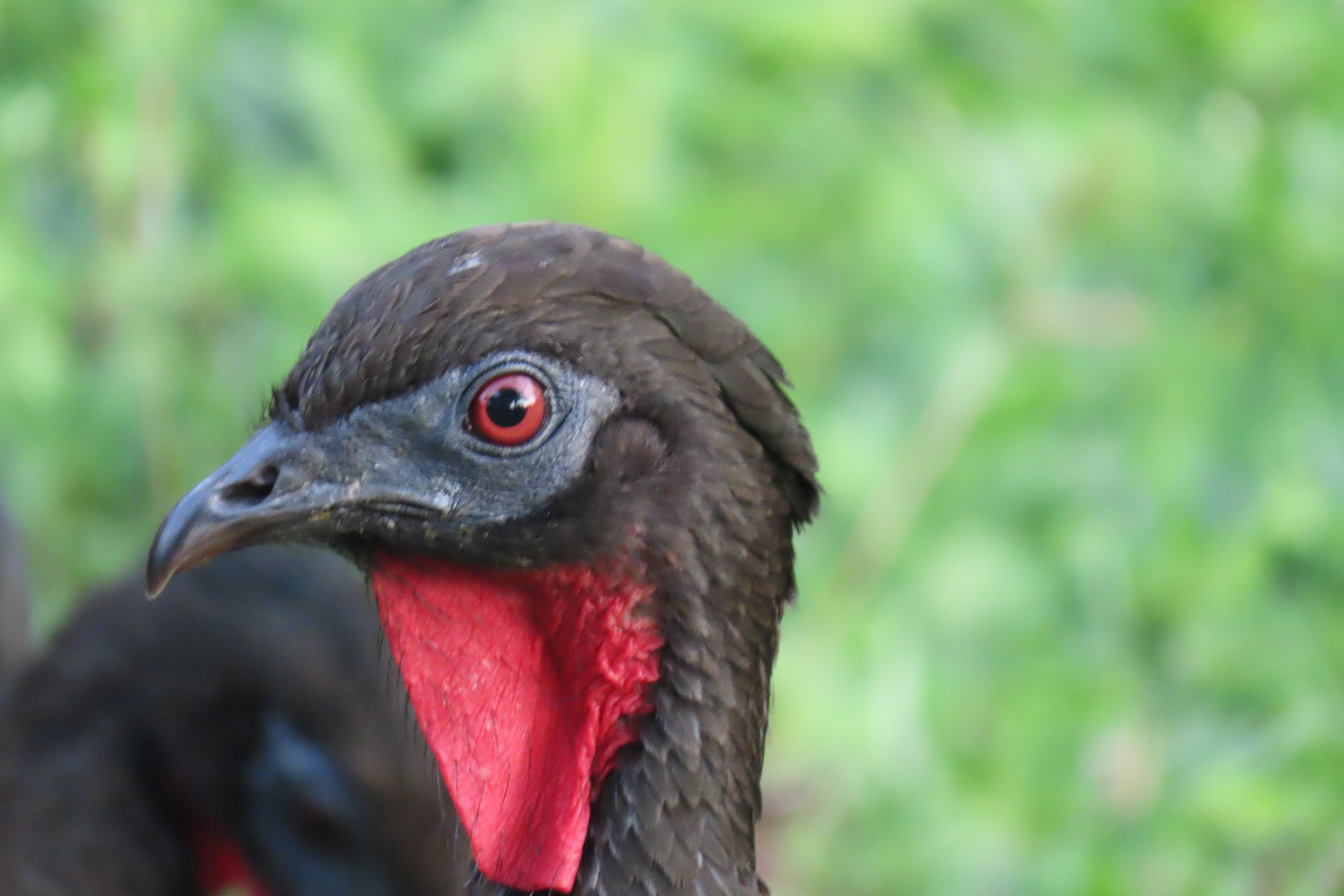
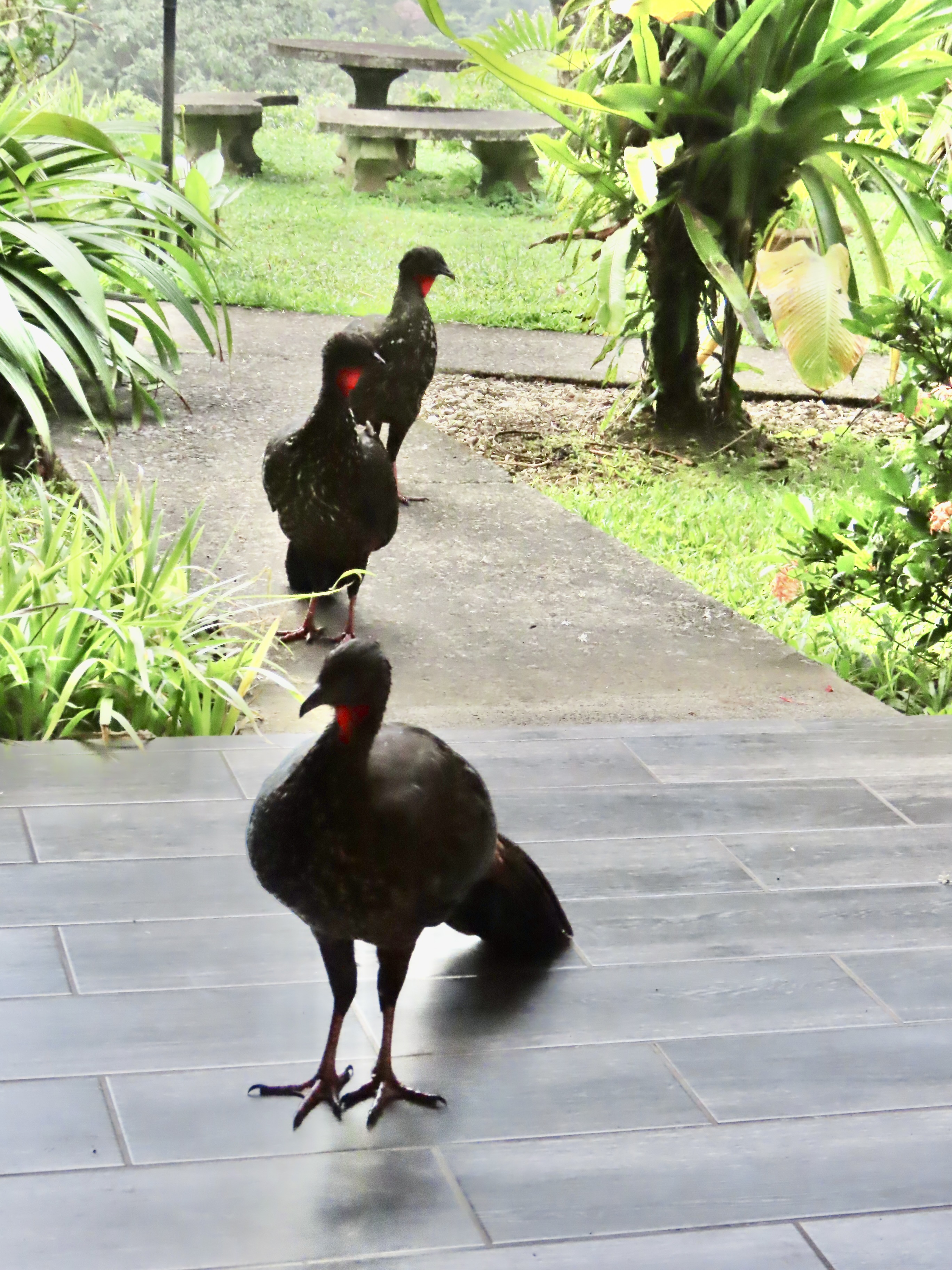
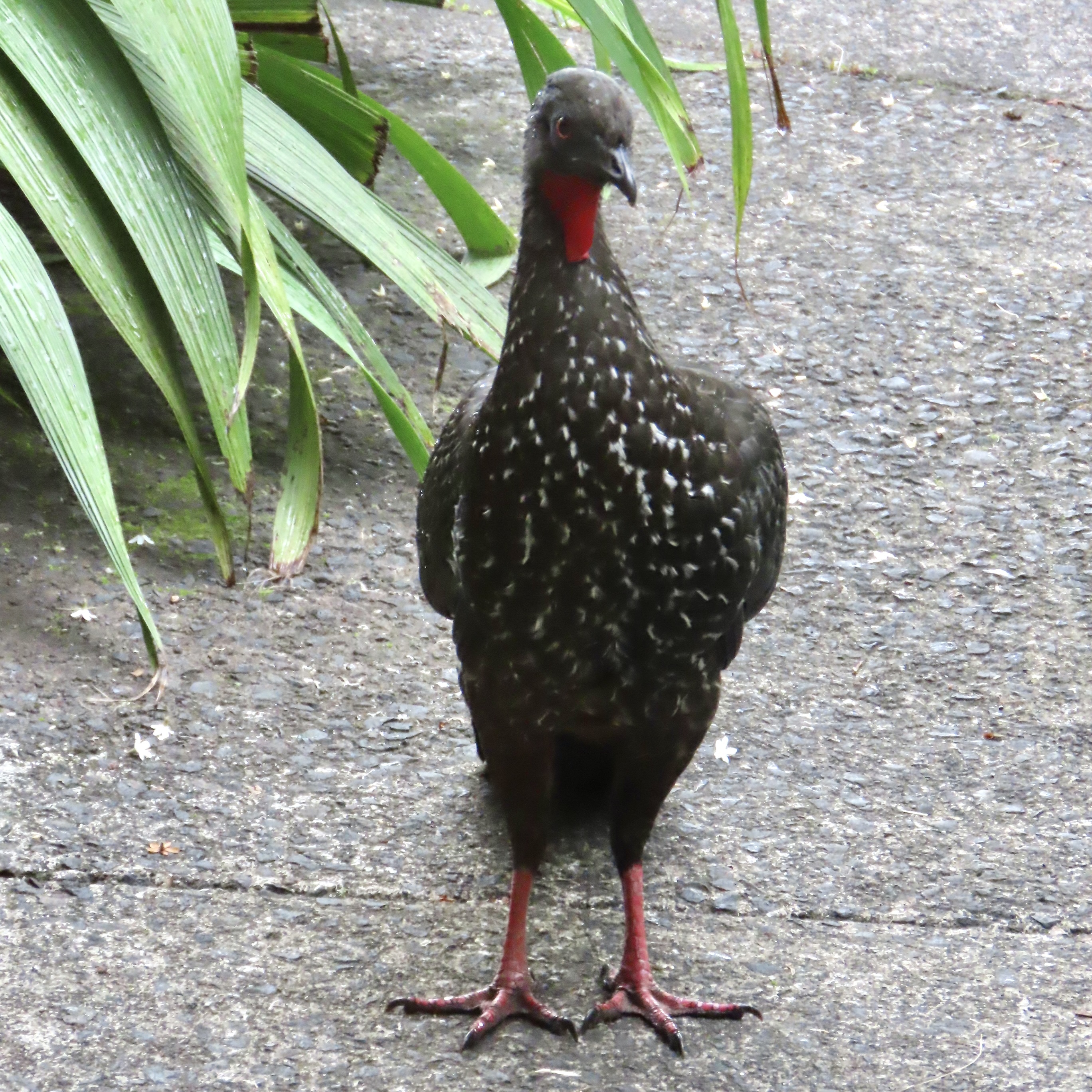
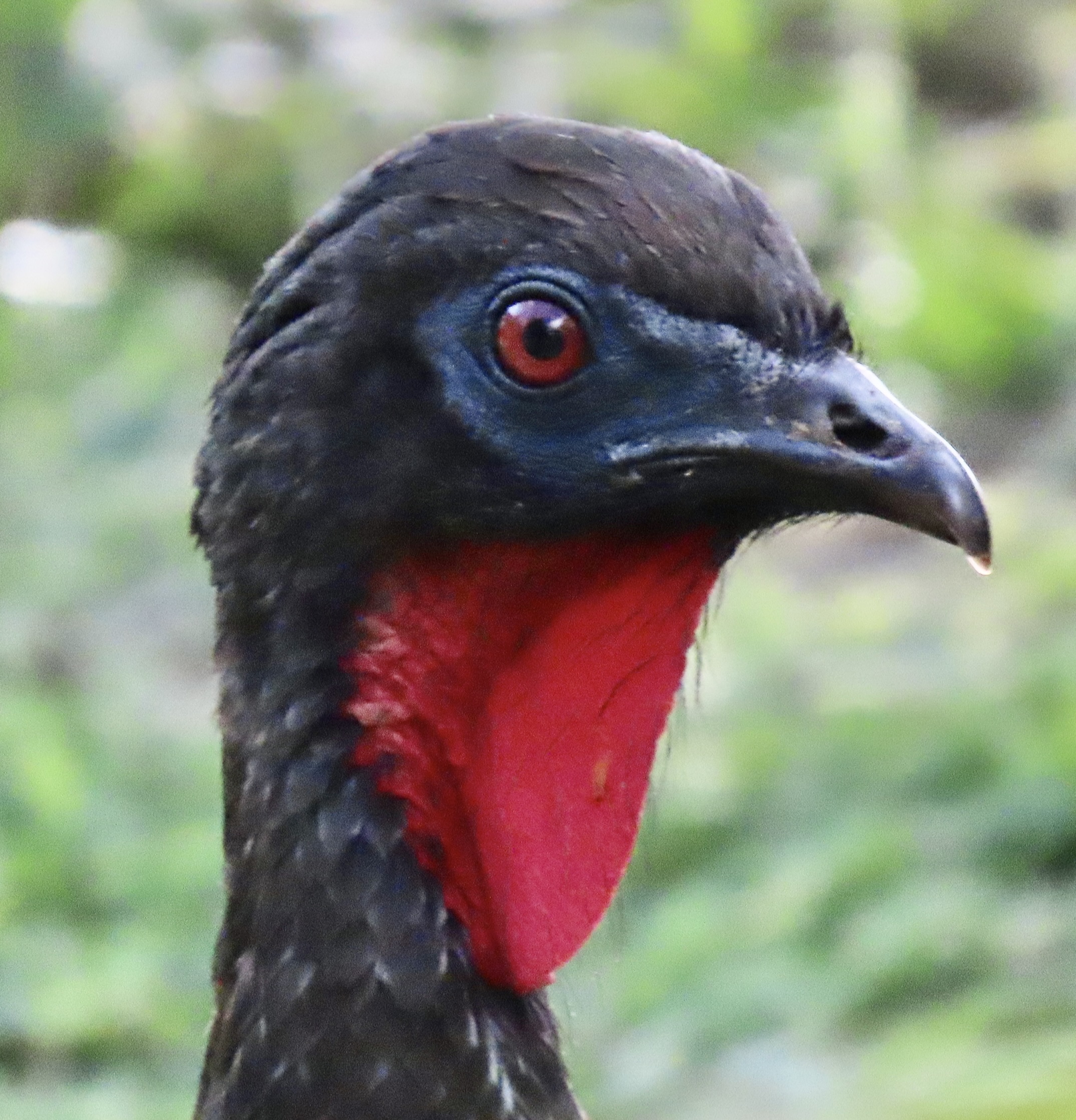
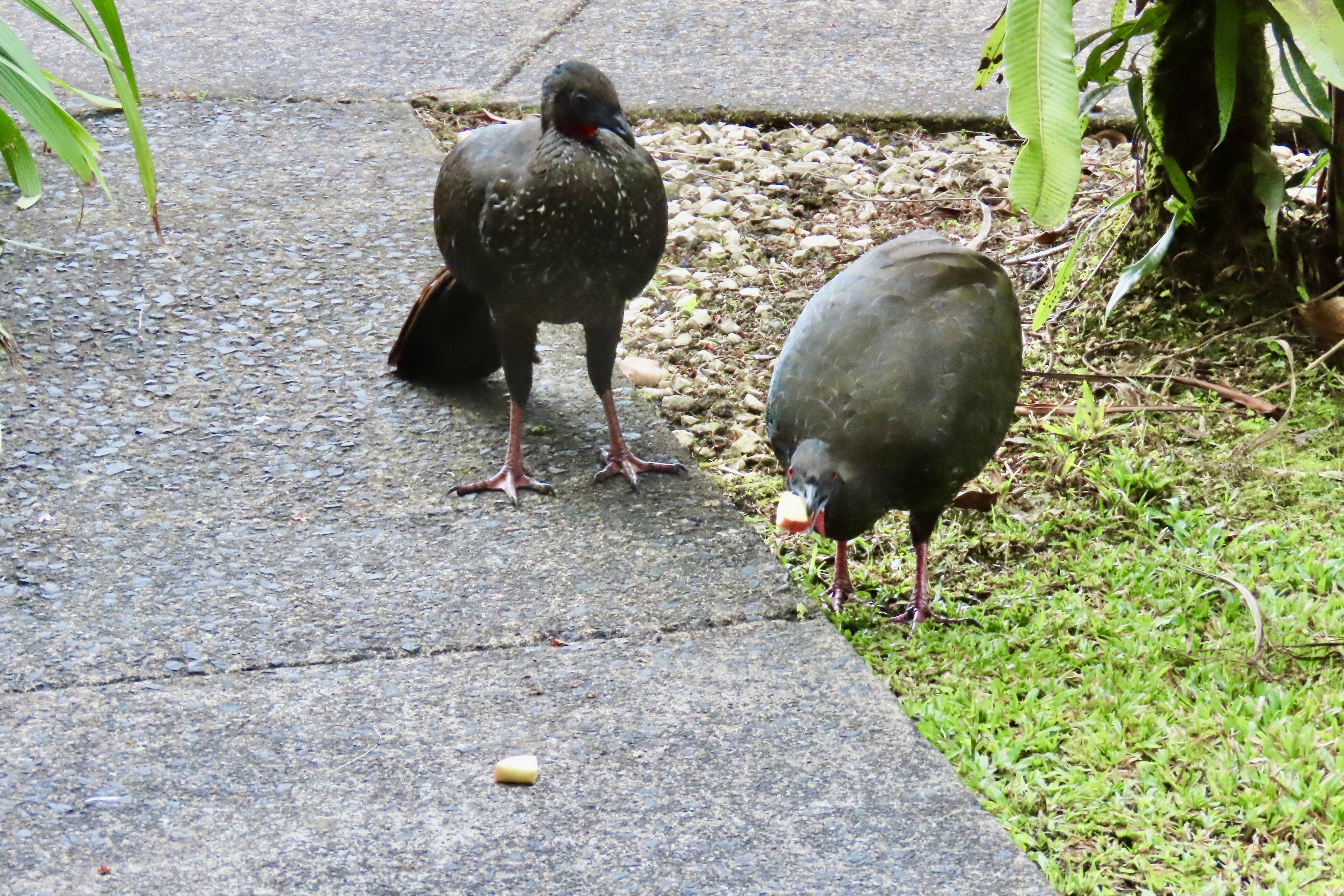
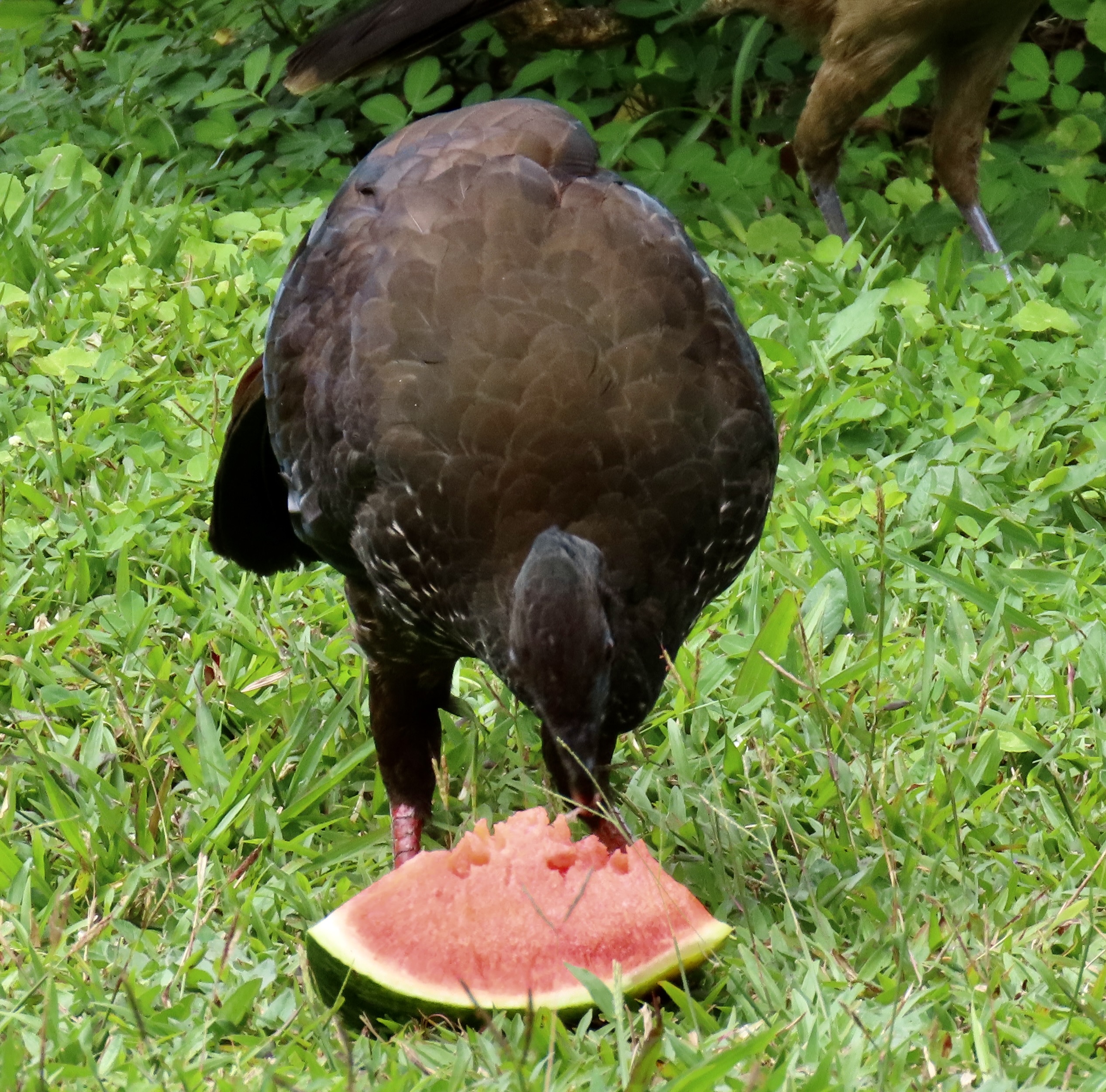
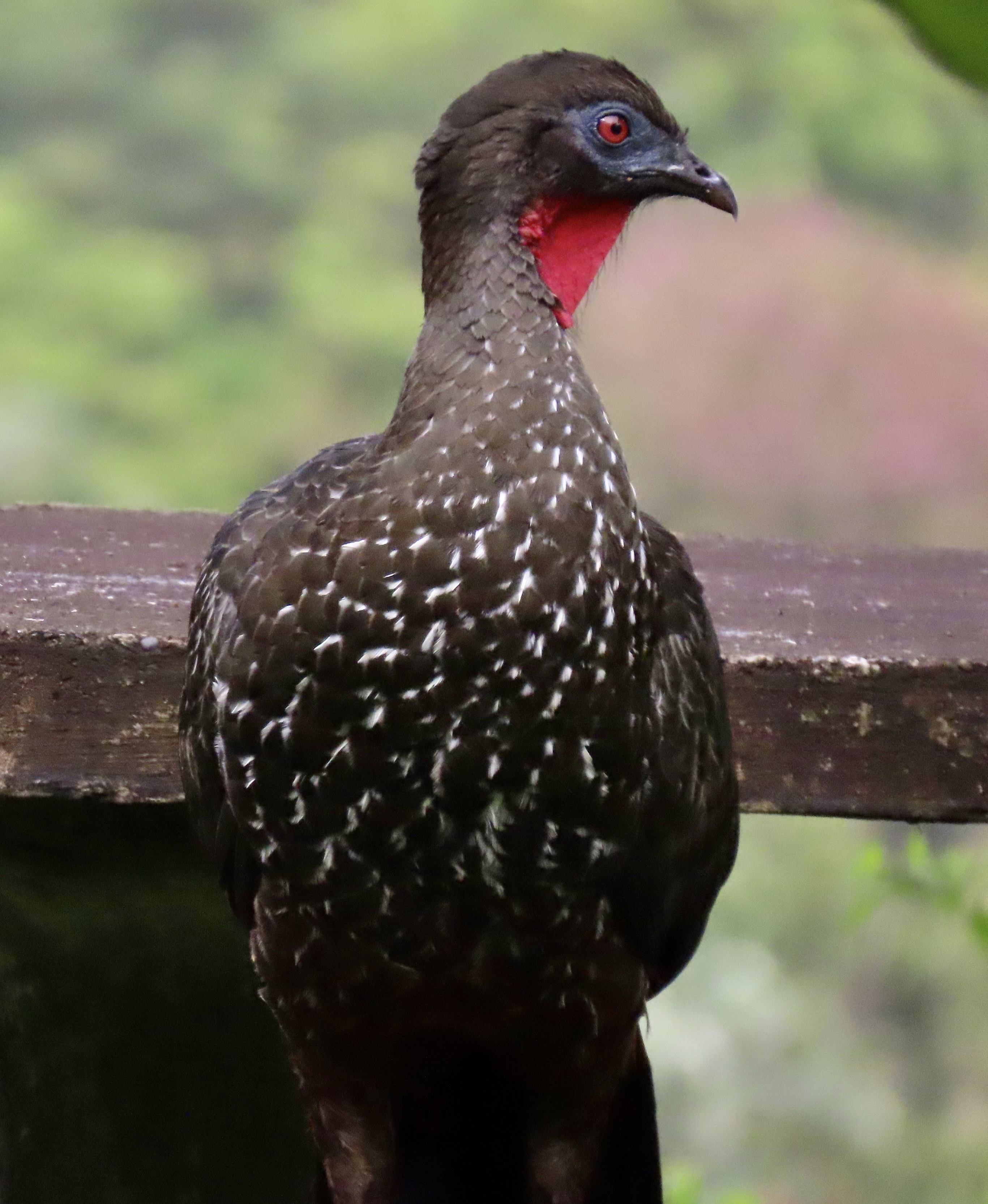
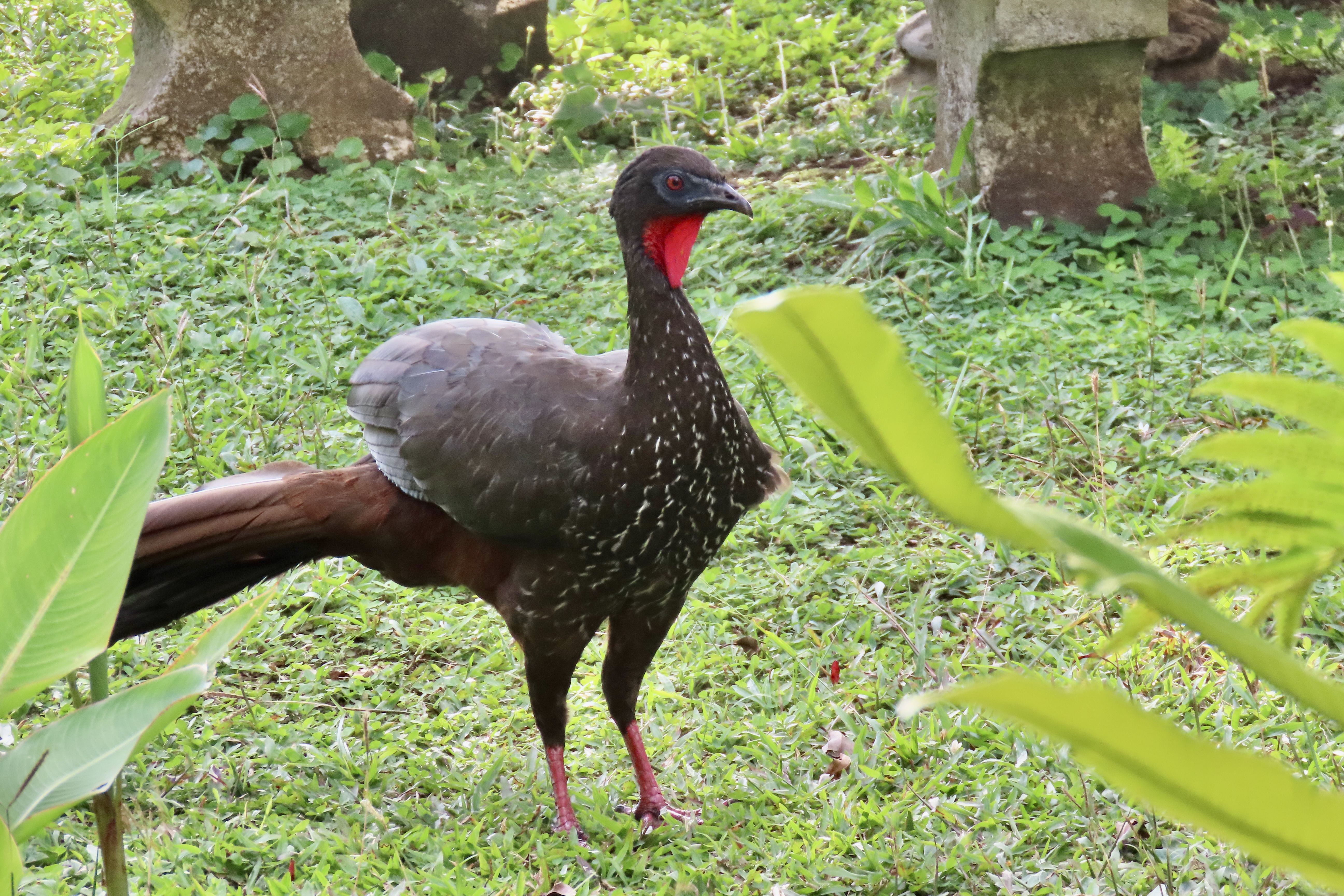
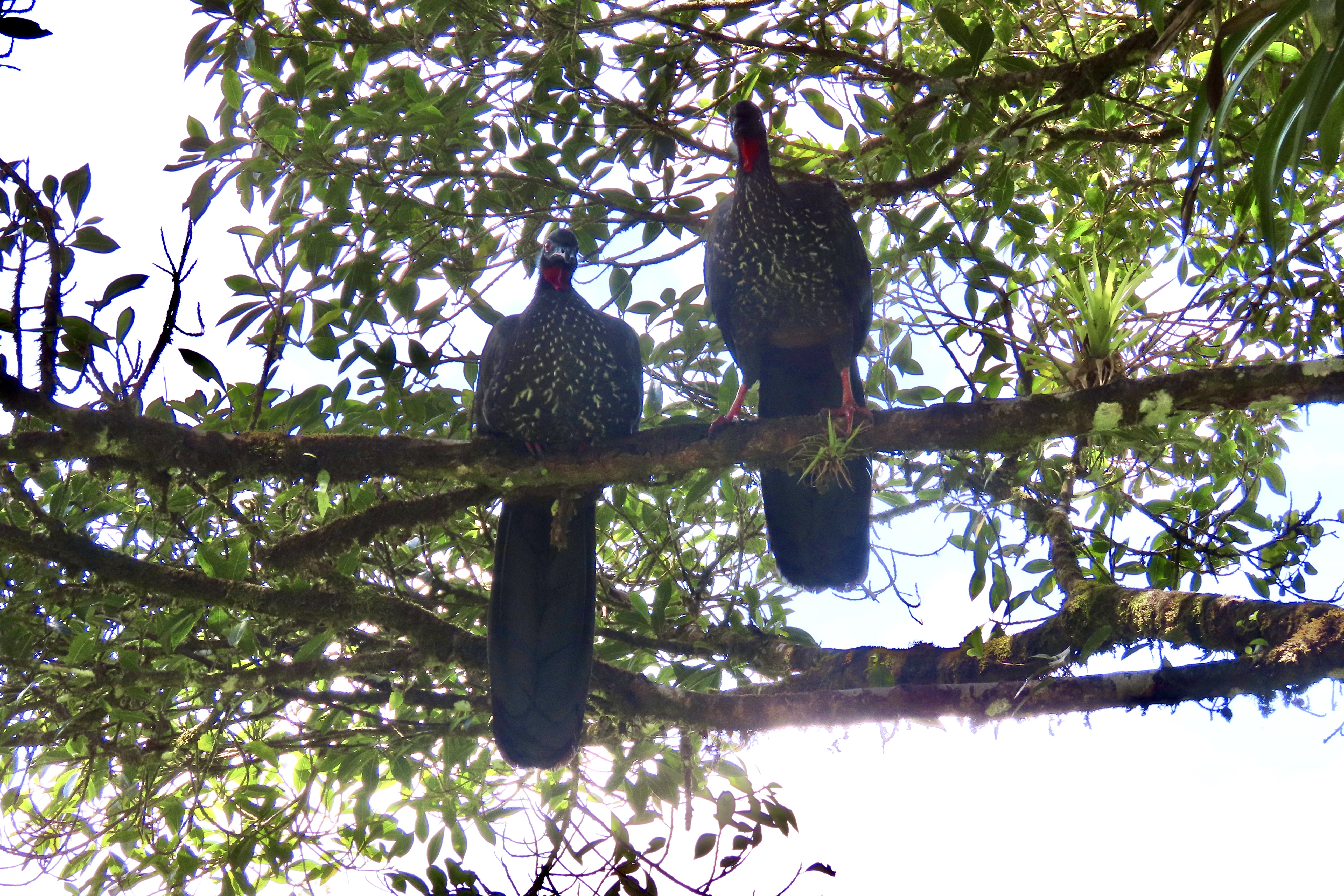
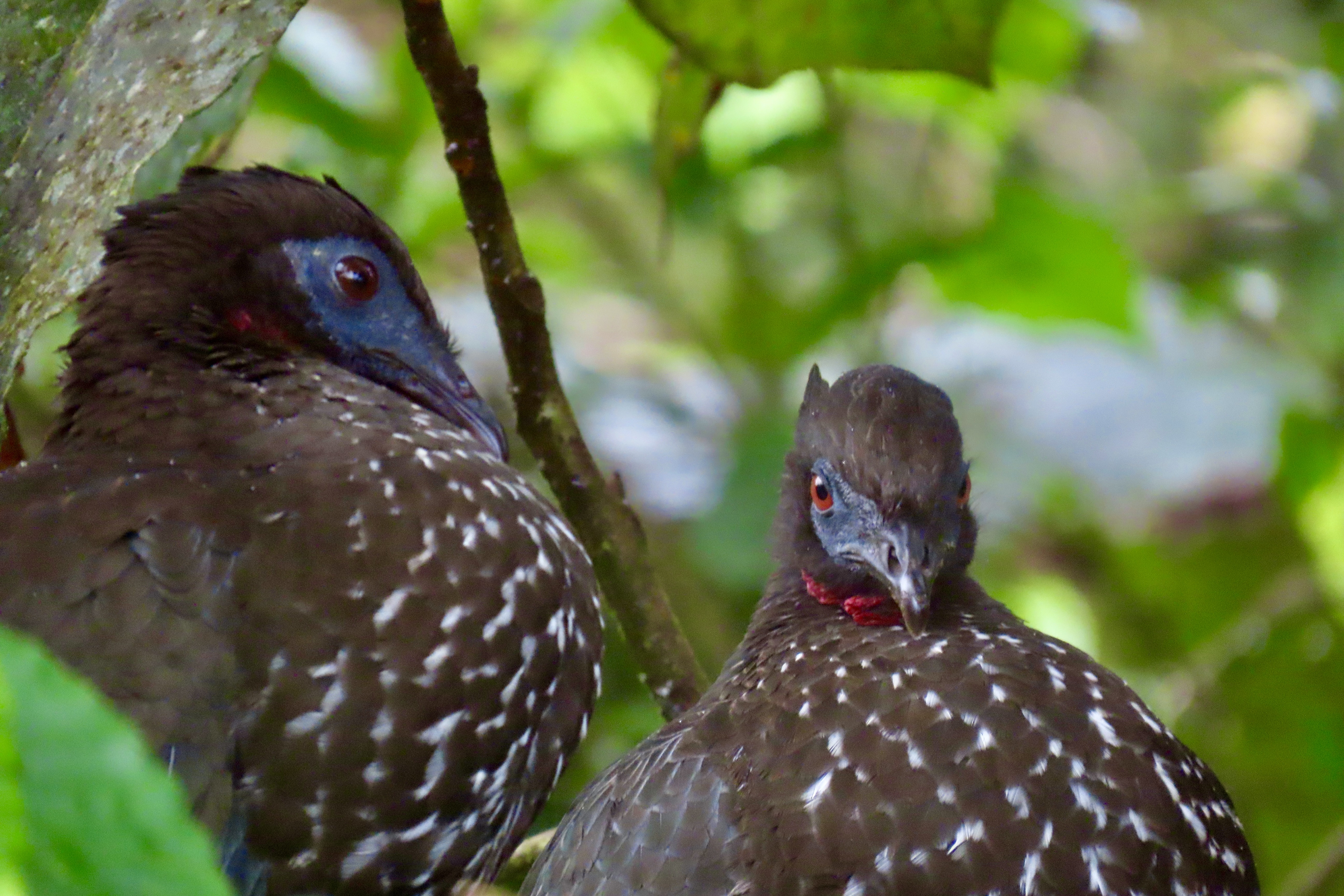
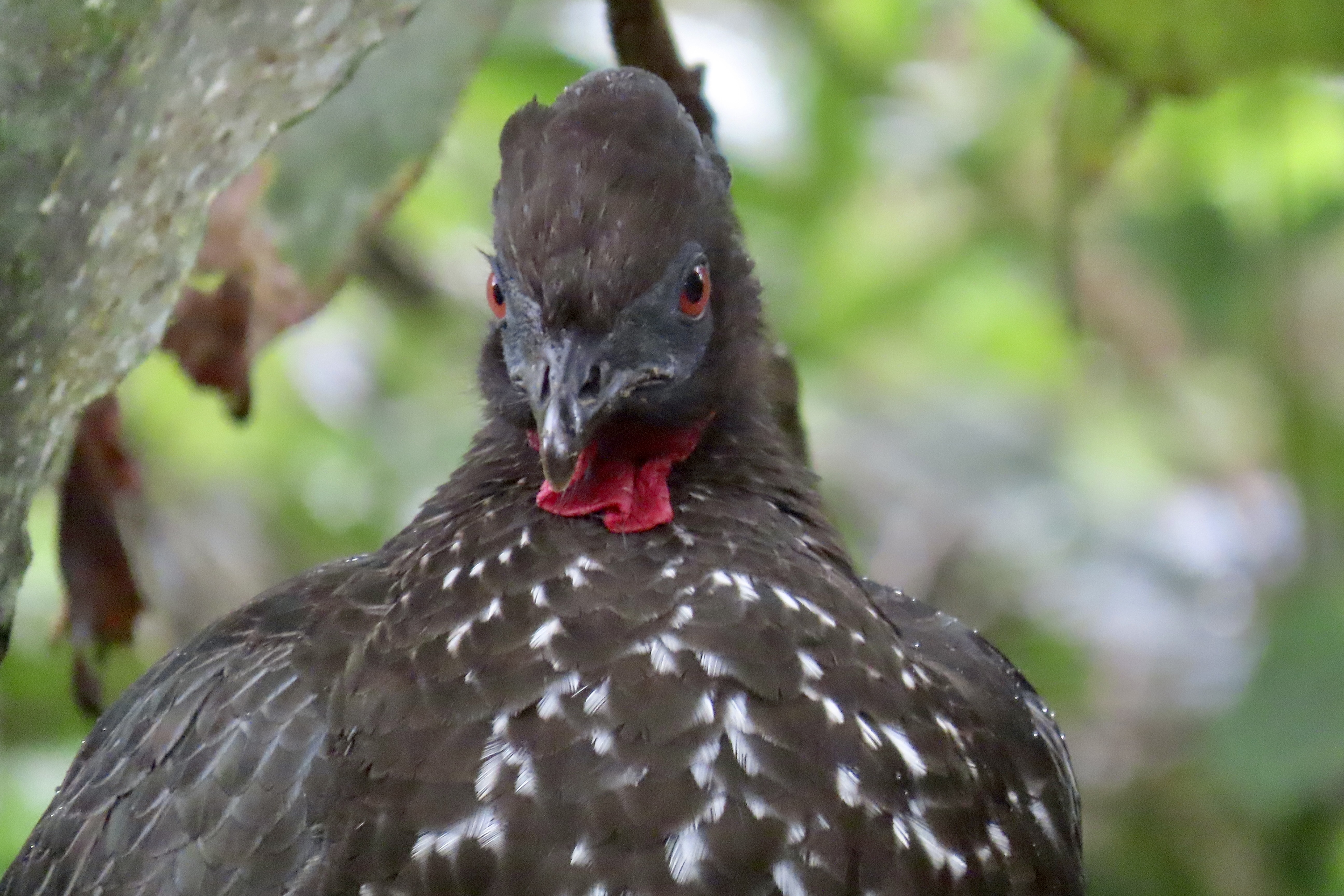
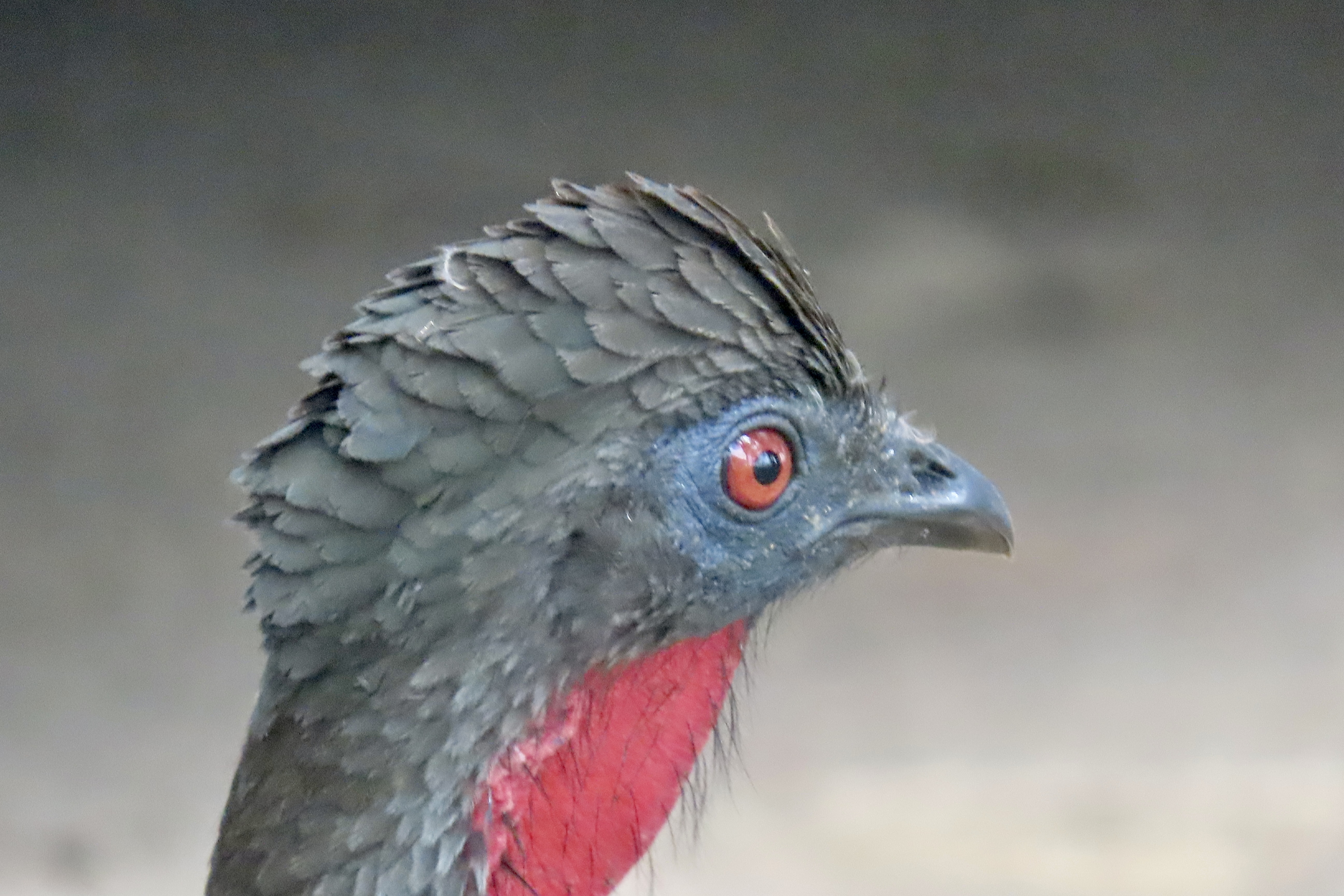
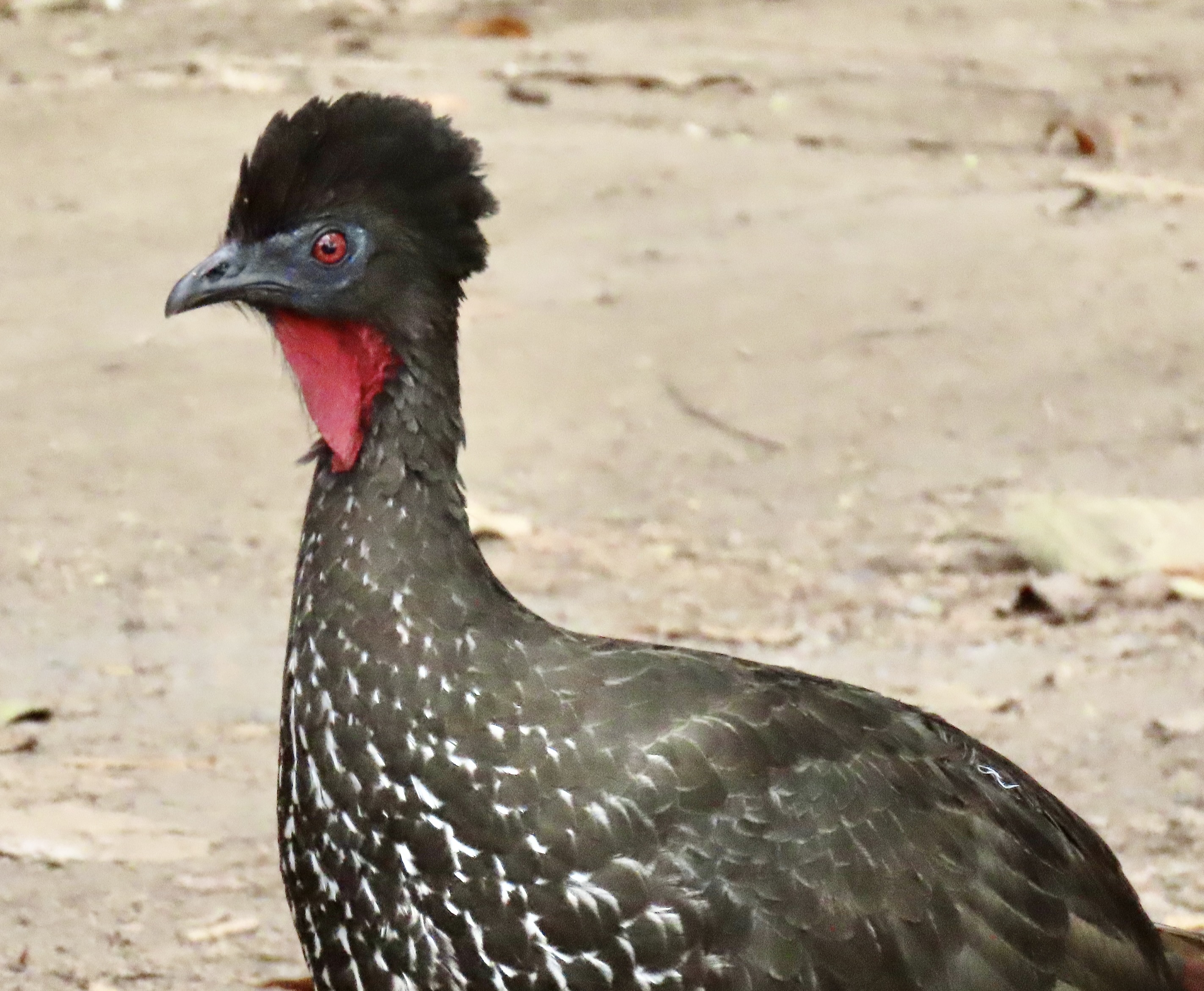
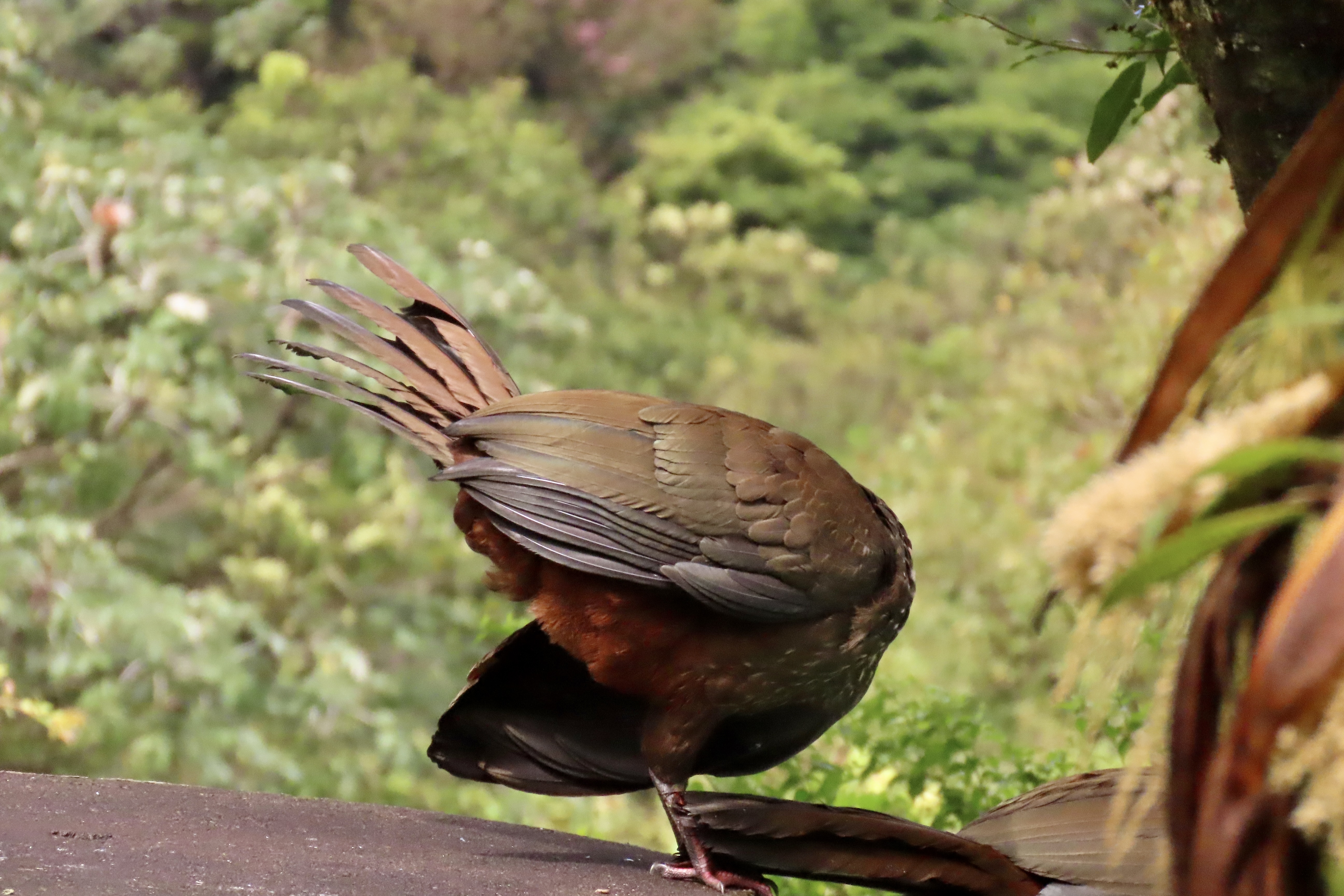
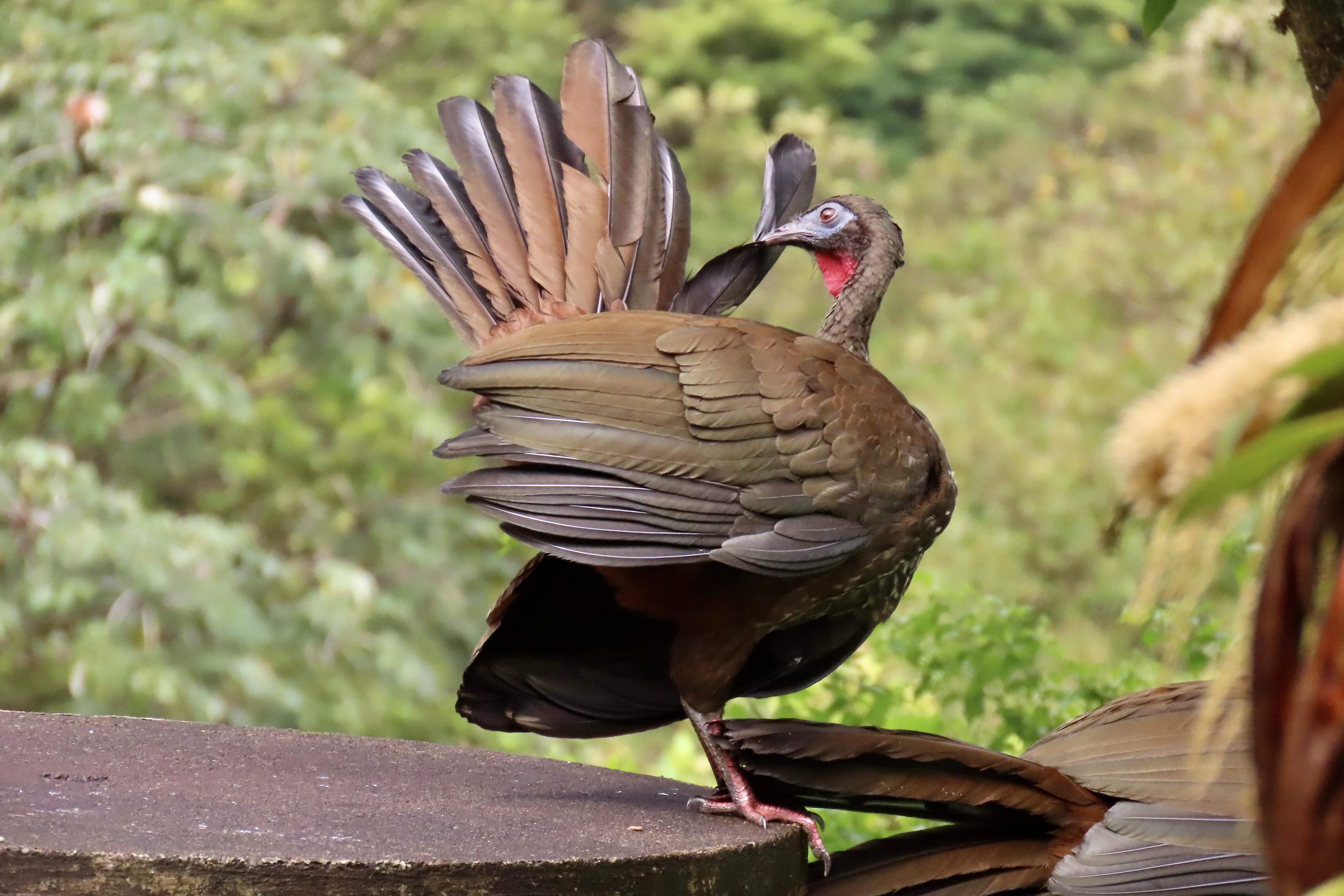
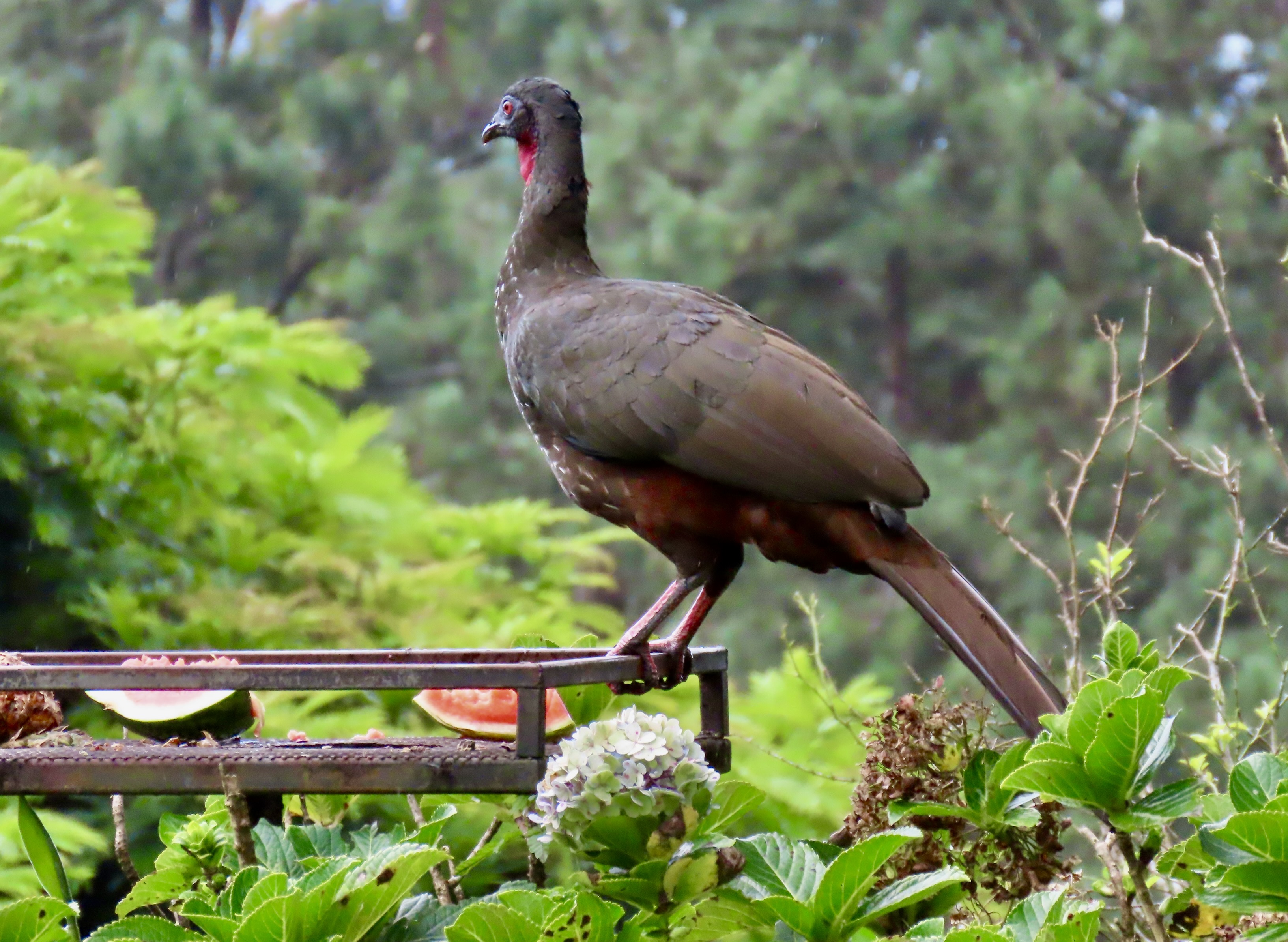
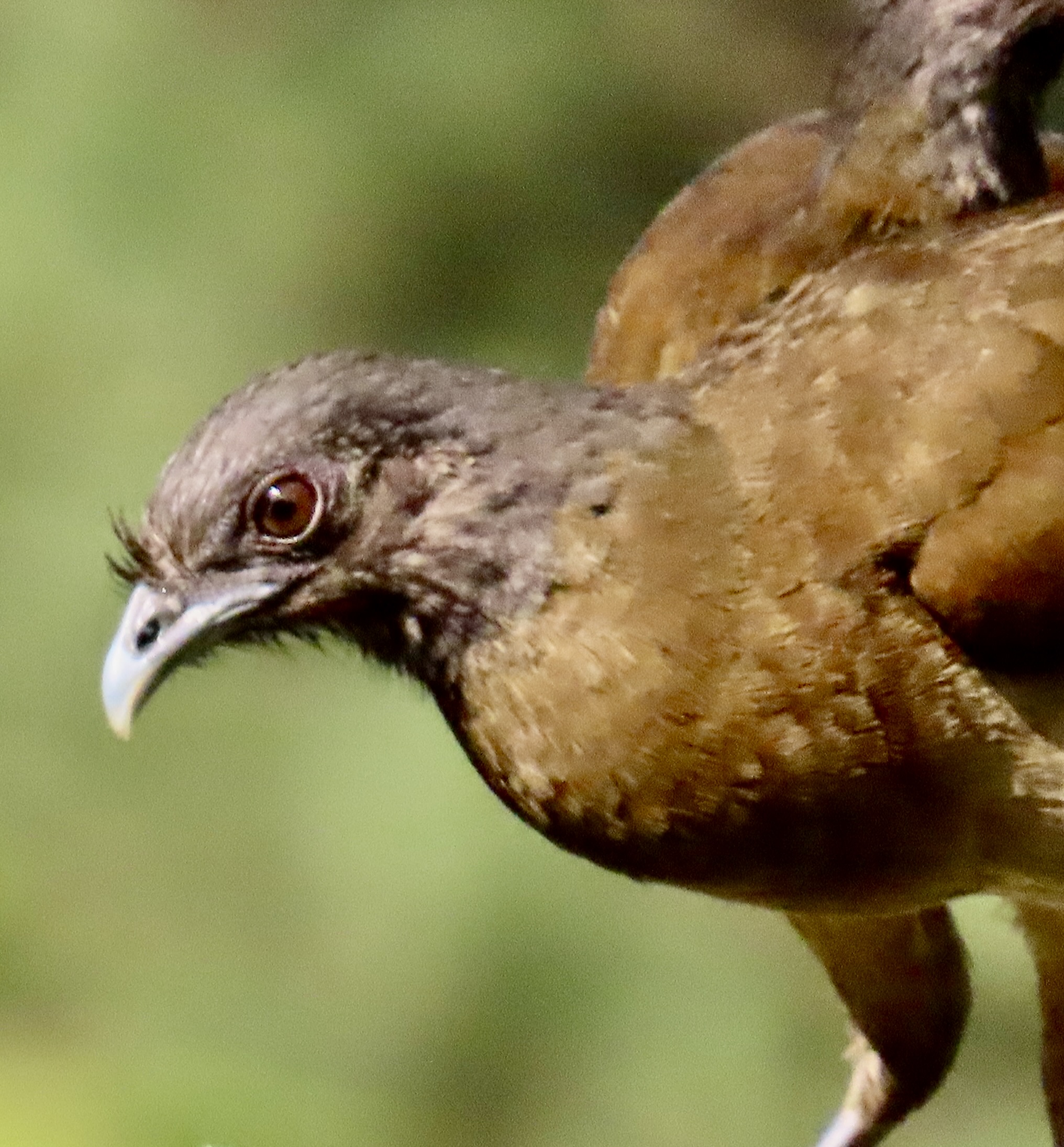
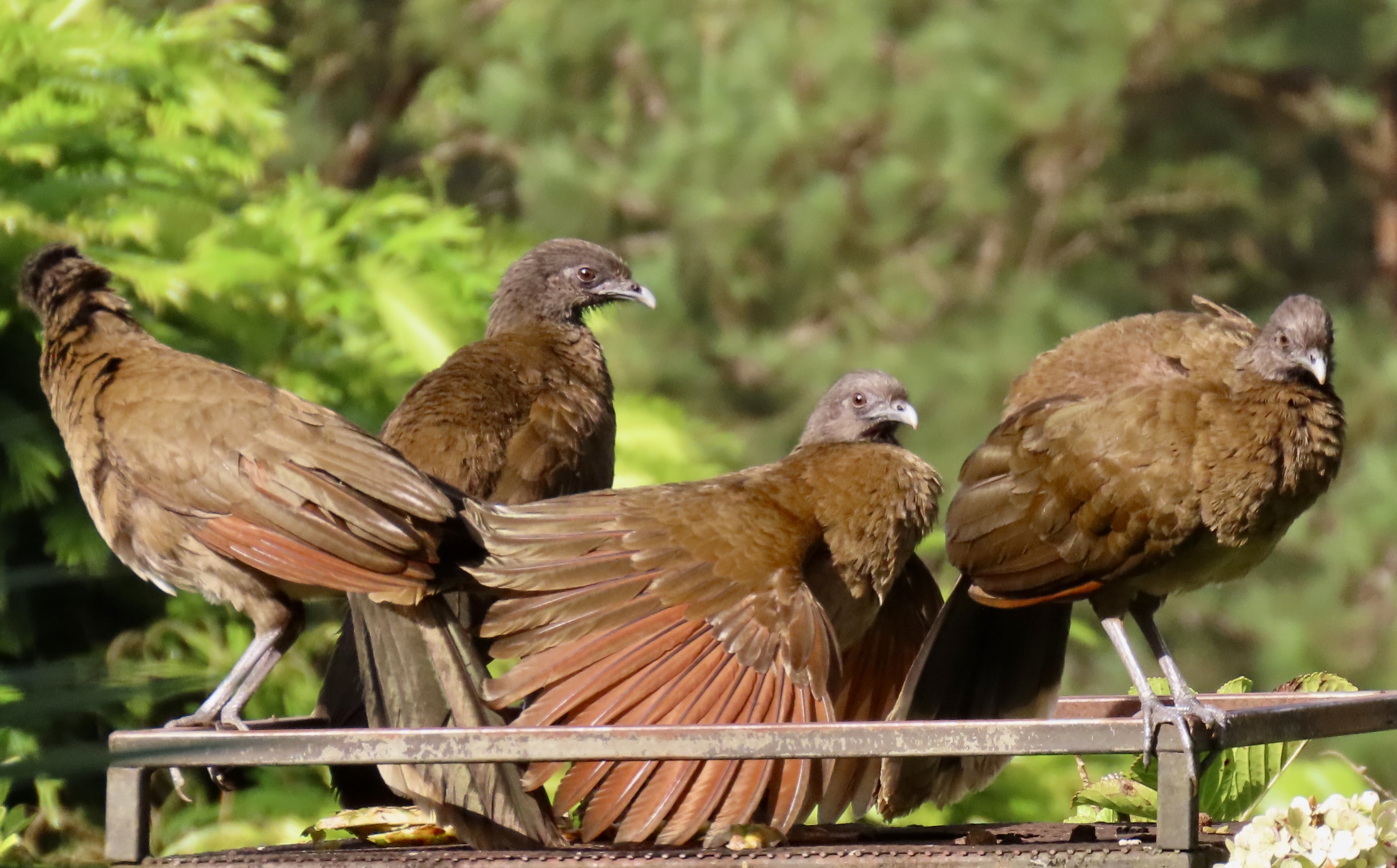
When Peggy opened the drapes on our first morning in Nuevo Arenal, Costa Rica a few weeks ago, this is what greeted her: A hungry Crested Guam demanding an apple, an orange, or a pineapple. We immediately noticed the Guam’s bright red wattle, eyes and long tails. The ‘laidback’ feathers on its head can stand straight up when the Guam is excited. Thus the description ‘crested.’Actually, there were three of them. (They hung out together the whole time we were in Nuevo Arena.) Peggy immediately grabbed her camera and caught this photo of them backlit by the sun. I must say, they were quite polite, just standing there, staring at us.But we couldn’t escape the hungry look. It’s sort of like ‘Feed me or else…’We were soon sharing apples, pineapple, oranges…And even watermelon with our new ‘companions.’Even when they weren’t on our walkway, the Guams monitored our behavior from the lawn and picnic table in front of our Villa.From the lawn. Note its raised wings. I think it was about to chase a Grey-headed Chachalaca that was chowing down on a bite of pineapple the Guam considered its lunch. (See the two videos at the end of today’s post.)They also watched us from the trees behind the villa. Note the long tails.They could see in our back window…A close up.We met this Guam on a hike by Lake Arenal. It was preparing to show off its crest.In full display! “Aren’t I beautiful/handsome.”Some grooming is required. For birds, it’s called primping and is used for feather maintenance.Even down to keeping them oiled! Is the other Guam massaging its legs with its tail feathers? It’s obvious that these big birds like each other, in fact they are monogamous. But I doubt that includes tail-feather leg massages. (Any Guam experts out there that would know?)The primary dining room for the Guams and all of the other fruit eating birds in our neighborhood was a bird feeding table that we and our neighbors kept supplied. Fortunately, it was right in front of our villa. We could sit inside or on our porch and take bird photos all day if we wanted to. You’ll be seeing a few…
Normally, the crested Guams (Penelope purpurascens) are not as tame as the ones that have found an endless supply of food at the Lakeview Villas where we were staying. Nor are they ground dwellers, preferring to live high up in the forest canopy and feed off of fruit they find up there, like the figs from the ficus trees we featured in our post last Monday. Similar to the Gray-headed Chachalacas (Ortalis cinereiceps) that you will meet next, they are members of the long-tailed family, Cracidae. Above them on the animal classification system they are also related to chickens, turkeys and other Galliformes, which is hardly surprising, given their body shape. They range from Mexico in the north to Ecuador and Venezuela in the south.
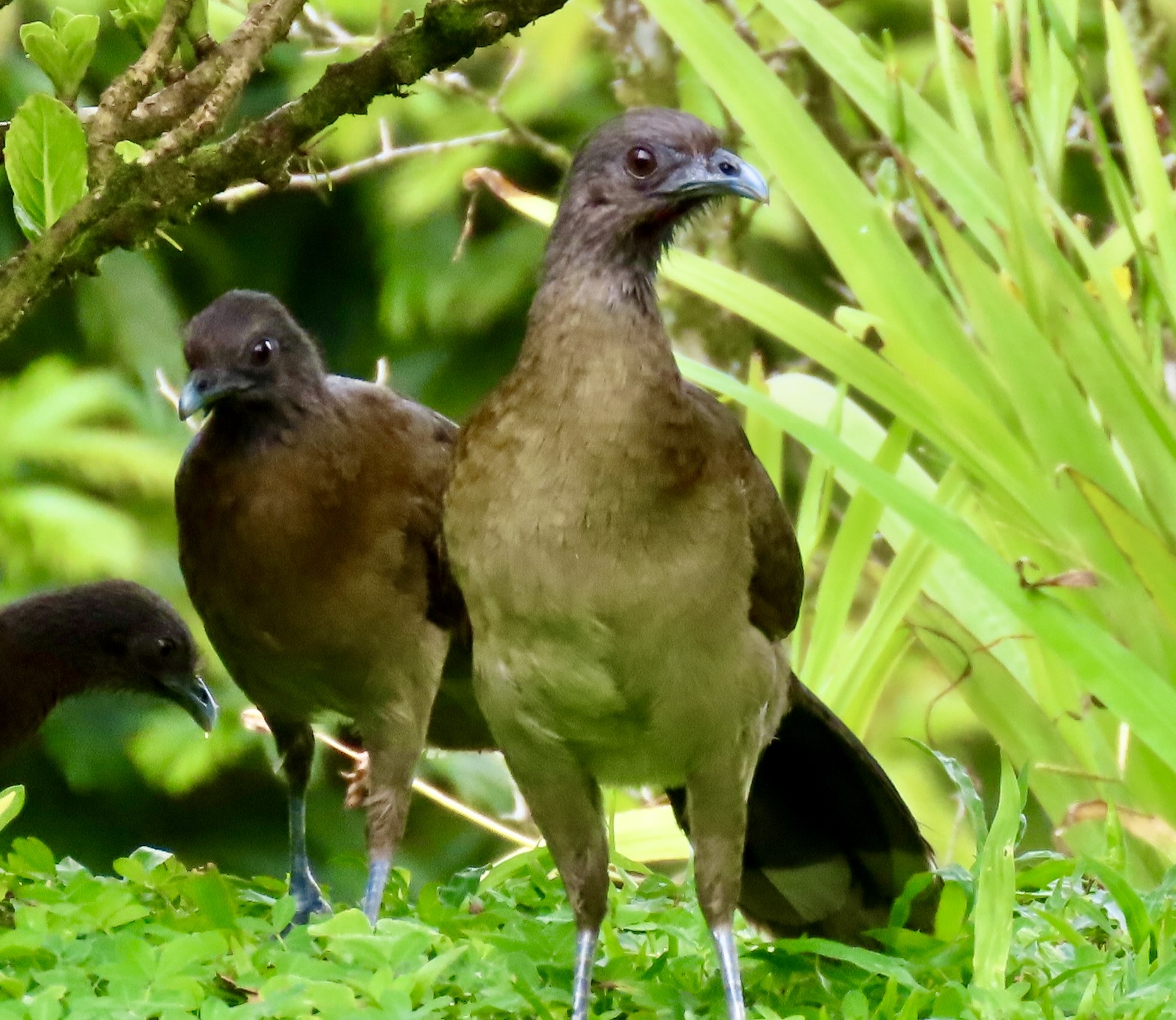
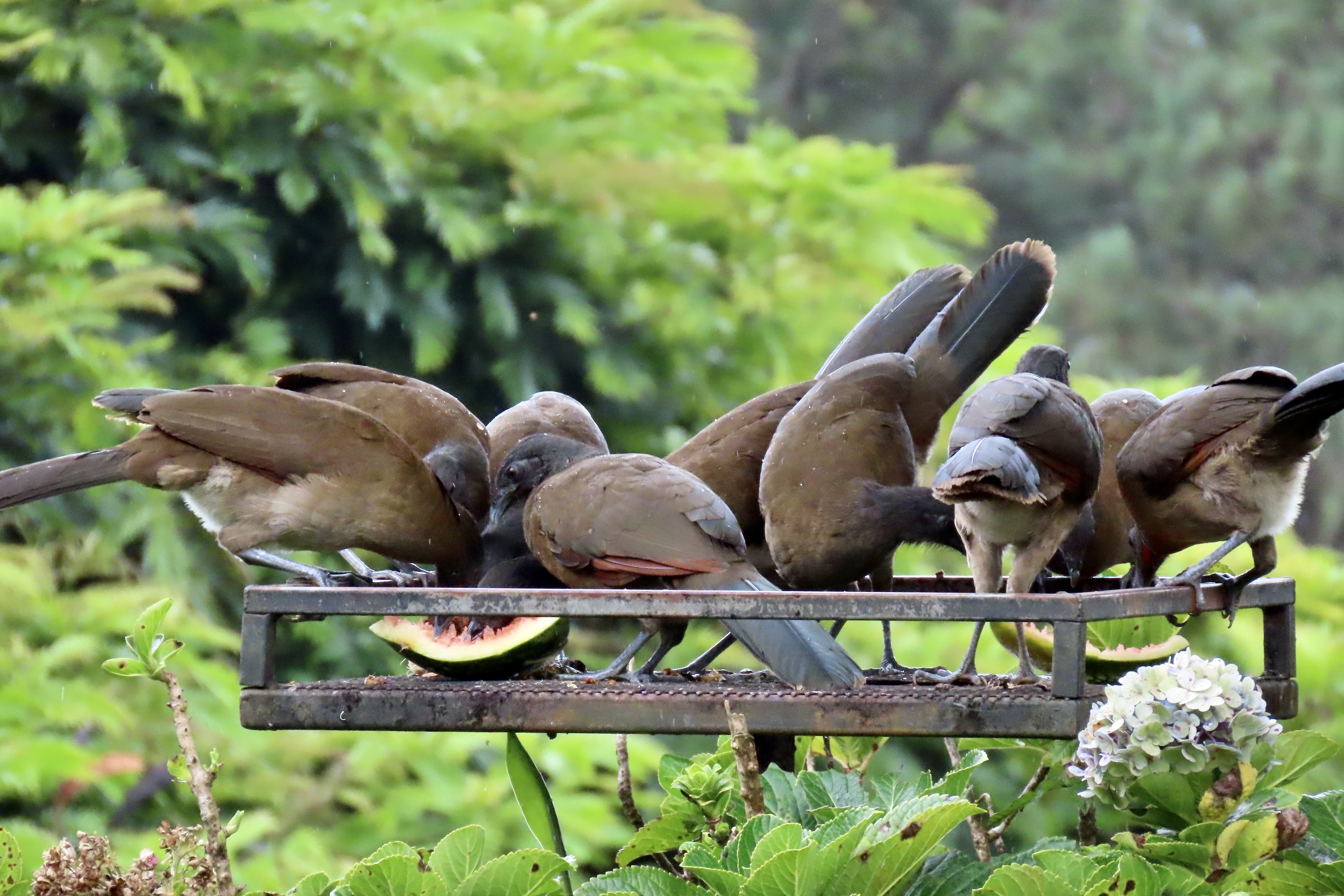
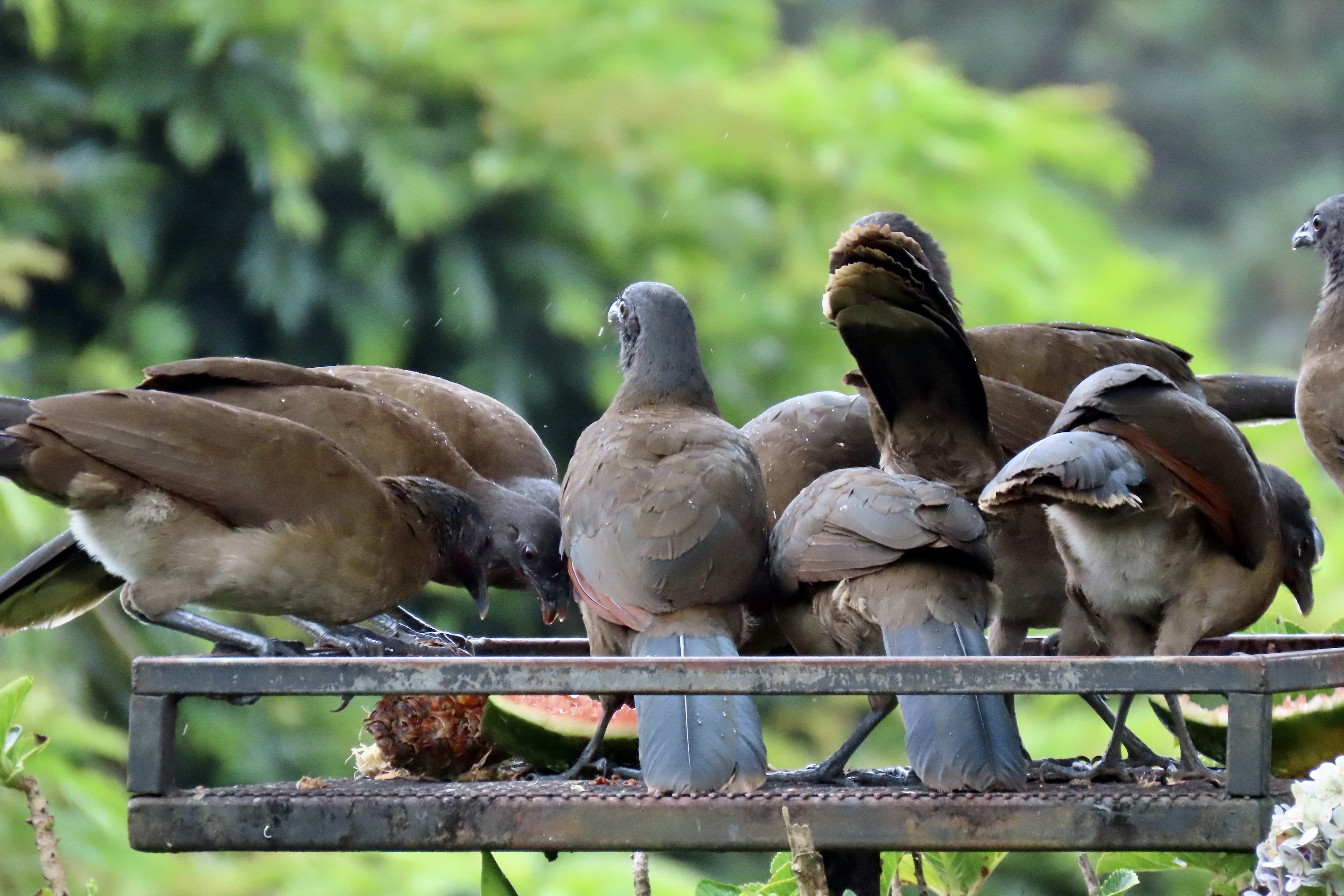
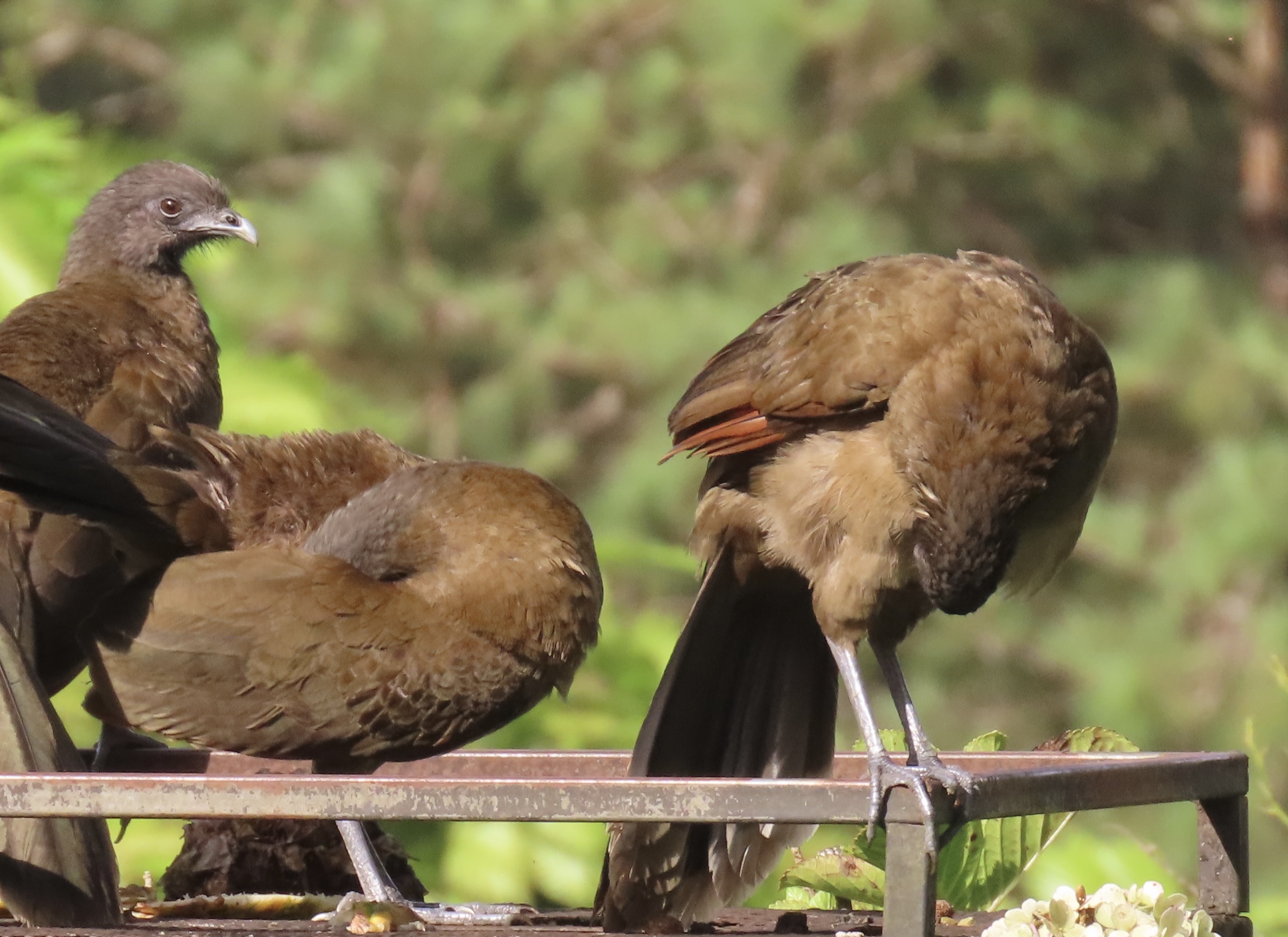
The smaller Chachalacas look a lot like the Guams minus the wattles and crests. At first we thought they might be their kids, especially given their obvious love of fruit. Closer inspection and a little research quickly defined them as a different species. Beyond looks, another defining characteristic is that they travel in groups ranging in size from 6 all the way up to 20. Ours was around 12. When these large birds make their way through trees, they sound like a herd of marauding elephants (slight exaggeration, but they are noisy.) It’s said that their name, Chachalacas, is derived from a sound they make early in the morning and late in the evening. We didn’t hear it in Nuevo Arenal, but I did one evening in Monteverde. I love the name.
The ‘here’s looking at you’ pose of a Chachalaca. Impressive nose hairs.Another perspective.They would arrive at the food station en masse. Any fruit was quickly disposed of…Tails down and looking around, at half mast and breaking fast, fully up and having sup. (A little humor for my poet friends who follow this blog.)Grooming/primping Chachalaca style. Were they getting ready for a group photo?Maybe. Grin. You may wonder what the Crested Guams felt about the Chachalacas showing up and gulping down all of the fruit. The following videos will give you an idea. The first demonstrates the greed of the Chachalacas at the food table and the Guams’ response. The second shows what Peggy and I found to be a rather hilarious chase scene where the Guam kept losing track of the Chachalaca it was supposed to be chasing! (Click on the photos.)
BTW: Wednesday’s UT-OH! Post is on “first dates and squashed skunks!”
As you might have expected the Guams had little tolerance for the Chachalacas scarfing down the fruit!
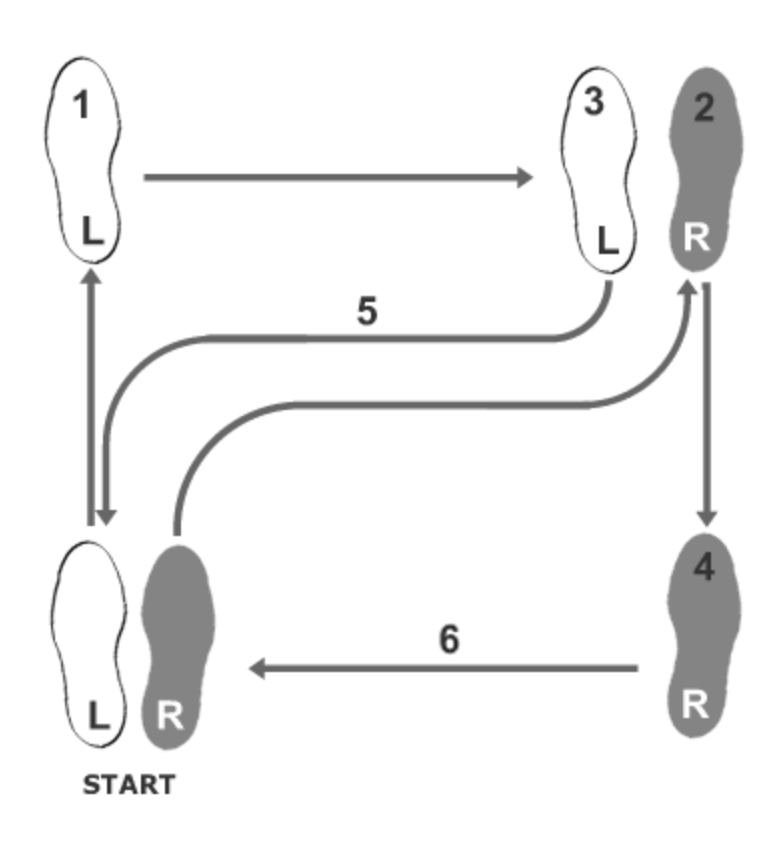
The teacher had a large diagram with a pattern that looked something like this.
Something happened between the eighth grade and high school. Here I was a happy, well-adjusted and relatively successful young man one day and a serious candidate for a strait jacket the next. Pimples popped out on my face overnight and my voice became dedicated to practicing random octave jumps. Teenage-hood, which had promised to be a mild adventure, arrived with a vengeance. I was being hormonally challenged; I had a terminal case of puberty blues.
Things started out fine. I left the eighth grade behind with great expectations. After all, I’d become a jock, had top grades, was student body president, and had a girlfriend. Damn, I was even president of the Mother Lode Twirlers, the square dance club. What could possibly go wrong? Everything…?
Take girlfriends, for instance. I expected to lose a little ground in the field of romance when I became a freshman in high school. Sophomore, junior, and even senior boys cruised the hallways in a mad scramble to check out the new crop of freshmen girls. And the older girls weren’t about to date a freshman boy, that lowest of lowly creatures.
But I didn’t expect to bomb the way I did. I became intensely, almost painfully shy. I would walk down the hallways staring at my feet in fear that some young woman would look me in the eye. If a girl tried to talk to me, any girl, I would mutter inanities and make a run for it. The strangest statements came out of my mouth. As for asking a girl out, the odds were a little less than being struck by lightning, and the latter seemed like a less painful alternative.
It wasn’t that I didn’t notice girls. My body was one huge hormone. I just couldn’t bring myself to do anything about it. I pined for a young woman who sat in front of me in Mr. Crump’s Geography class. She was gorgeous. I was in deep lust. My knee and her butt were mere inches apart and her butt was like a magnet. I had the most intense fantasies of moving my knee forward until it made contact. In my fantasy she would, of course, turn around, smile at me and suggest we get together after school. In reality, she would have turned around and bashed me with her geography book (rightfully so), or worse, told Mr. Crump. I would have died. I kept my knee where it belonged. It is a strong testament to my love for geography that I didn’t flunk the class under the circumstances.
Desperate times call for desperate measures, however, and I was a desperate man. I signed up to master dancing in PE. I would become a combination of Arthur Murray and Elvis Presley. Step, step, slide and swivel your hips. Girls would flock to me. It wasn’t until the day of the class that I learned the magnitude of my mistake. I would have to dance with girls to learn how to dance and there they were, lined up on the opposite side of the gymnasium floor, staring at me.
“God, why did I do this to myself,” I thought as I stared across the distance at twenty females who I knew were thinking, “anybody but Curtis.”
“Okay, boys,” the female P.E. teacher announced in a stern voice, “I want you to walk across the room now and politely ask a girl to dance with you.” Wow, that sounded like fun.
Reluctantly, I began that long walk across the gymnasium floor. I was a condemned man and the gallows were looming. I walked slower. Maybe an earthquake would strike. Maybe the Russians would shoot off an IBM missile. Maybe one of the surly seniors would throw a match in a wastebasket and the fire alarm would go off.
Maybe nothing.
I approached the line and looked for a sign. One of the girls would smile at me and crook her finger. But the girls looked exceedingly grim. A few looked desperate, like deer caught in the headlights of the proverbial 18-wheeler rushing toward them at 90 miles per hour. I picked out the one who looked most frightened on the theory that she would be the least likely to reject me.
“Uh, would you care to dance,” I managed to blurt out.
“Uh, okay,” she responded with about the same level of enthusiasm she would have if I had offered her a large plate of raw liver. It was P.E. Dance Ground Zero after all, and she wasn’t allowed to say no. We were destined to be a great couple.
“You will put your left hand in the middle of the back five inches above the waist line.” The teacher, who was now sounding more and more like a drill sergeant, carefully described what we would do with our hands. It was quite clear that there would be minimal contact and no contact with behinds. “With your right hand and arm, you will hold the girl away from you.” There would be no accidental brushing of breasts either. What fun was that? I assumed the correct position with marine-like precision. I was going to get this right. I studied the chart the teacher had put up to show us what we were supposed to do with our feet. I listened carefully to the lecture on rhythm and down beats. I watched with intensity as she demonstrated.
All too soon it was our turn. A scratchy record blasted out a long-since-dead composer’s waltz. I didn’t know who it was, but it wasn’t Elvis. With one sweaty palm in the middle of the girl’s back and the other sweaty hand holding her a proper distance away, I moved out on the floor. Step, step, slide, step, step, slide. One, two, and slide the coach barked out. My feet more or less followed the prescribed pattern. More importantly, I avoided stepping on the girl’s toes. I tried a turn and managed to avoid running into another couple. Ever so slightly I relaxed. Maybe things would be okay. Maybe I would have fun. Maybe Hell would freeze over.
“Stop, class!” the teacher yelled as she blew her whistle and yanked the needle across the record, adding another scratch. We dutifully came to a halt. What now?
“I want everyone to watch Curtis and his partner,” she announced.
“Hey, this is more like it,” I thought to myself. Not only was I surviving my first day of dance class, I was also being singled out to demonstrate. I smiled, waited for the music to start, and boldly moved out on the floor where many had trod before. Step, step, slide, step, step slide. We made it through all of three progressions when the teacher abruptly blew her whistle again.
“And that, Class,” she proclaimed triumphantly, “is not how you do it. Curtis is moving like he is late for an important date with the bathroom.”
The class roared— and I shrank. I don’t know how my partner felt, but I wanted a hole to climb in, preferably a deep hole with a steel door that I could slam shut. And I was more than embarrassed, I was mad. My normal sense of humor had galloped off into the sunset faster than a Triple Crown racehorse.
“You don’t teach someone to dance by embarrassing him,” I mumbled. An angry look crossed the teacher’s face and she started to reply. I turned my back and walked for the door.
“Where do you think you are going, Curtis? Get back here!” she demanded in a raised voice.
“I am leaving,” I replied without turning, calm now with the decision made. The class was deadly quiet. This was much more interesting than P.E. Other kids might challenge teachers, might walk out of a class, and might not even care. But not Curt. This was a guy who always did his homework, participated in class discussions, was respectful toward teachers, and aced tests.
I reached the door and put my hand on the handle.
“If you walk out that door, you may as well walk home,” the teacher barked. “I will personally see to it that you are suspended from school.”
I opened the door, walked out– and went straight to the office of the head of the P.E. Department, Steve O’Meara. Steve worked with my dad in the summer as an assistant electrician, but I knew him primarily as my science teacher. He was a big man, gruff, and strong as a bull elephant, a jock’s jock. He demonstrated his strength by participating in the annual wheelbarrow race at the El Dorado County Fair. The race commemorated the fact that John Studebaker of automobile fame had obtained his start in Placerville manufacturing wheelbarrows for 49ers.
The County’s strongest men would line up with their wheelbarrows at the starting line and then rush to fill a gunny sack with sand at the starter’s gun. They would then push their wheelbarrows and loads at breakneck speed around an obstacle course that included mud holes, a rock-strewn path, fence barriers and other such challenges. In addition to making it across the finish line first, the winner had to have fifty plus pounds of sand in his gunny sack. Underweight and he was disqualified. Steve was always our favorite to win and rarely disappointed us. He also had a very loud voice.
“What’s up, Curt,” he roared when I entered his office. I knew Steve didn’t eat kids for lunch but you always wondered a little.
“I think you are supposed to expel me,” I replied. He started to laugh until he saw my expression. Mortification and anger on the face of a 14-year-old are never a pretty sight.
He became serious. “Sit down and tell me what’s happening,” he suggested in an almost gentle voice.
Ten minutes later I walked out of his office with a reprieve. I didn’t have to go back to the dance class and could finish out the quarter playing volleyball. Steve would have a discussion with the dance instructor. I imagine she ended up about as unhappy as I was. At least I hoped so. I entertained a small thought that she would hesitate the next time before traumatizing some gawky kid whose only goal in attending her class was to become a little less gawky. It would be a long time before I would step onto a dance floor again.
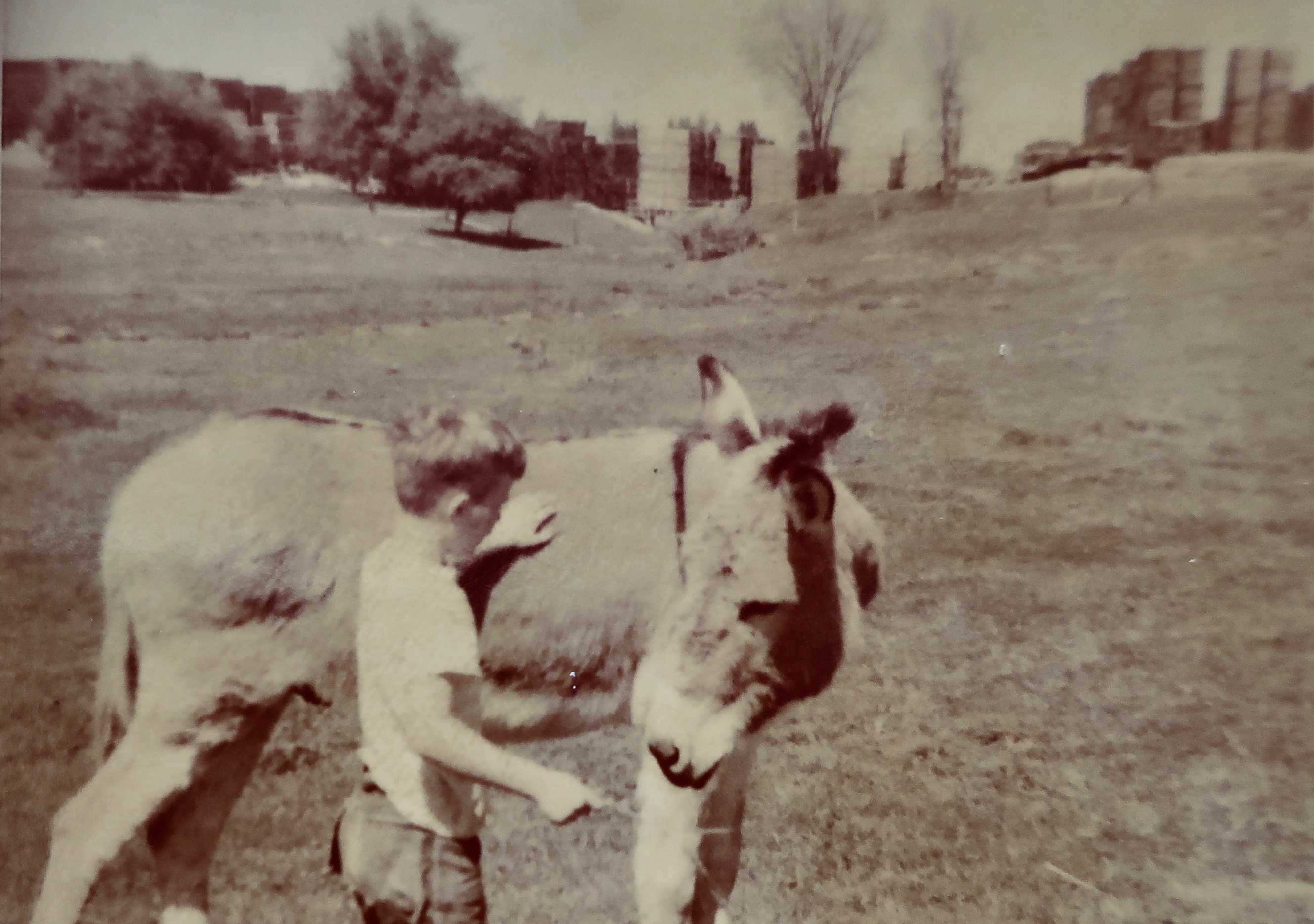
This donkey was hardly dangerous. I was offering it a carrot. The stacks of lumber in the background, at Caldor Lumber Company’s drying yard, had potential, however. One of our sports was climbing to the top of the stacks and leaping between them.
That we survived childhood wasn’t necessarily a given. Racing up and down a 75-foot-tall tree, leaping between 20 foot high lumber stacks, joyriding on railroad push carts, avoiding being shot, playing on a 50 foot high trestle and other similar activities aren’t particularly conducive to a healthy childhood. On a scale of 1-10, I would have placed Marshall’s chances of harm at 9.9 while mine were more like 4.4. I took my share of risks, but rarely without considering consequences. Marshall rarely did. Pop provided some perspective years later.
“If Marshall screamed, I ran. When you screamed, I walked.”
Except for the dog bite and stepping on a rusty nail once, my serious injuries were more in the nature of stubbed toes. Not that I am minimizing the pain of a stubbed toe, mind you. They hurt like hell. There is a reason why flaying skin was a form of torture in ancient times. I’d have certainly been willing to confess things I had done, and lots of things I hadn’t.
I did have a baseball bat used on me once, however. My parents were semi-serious Republicans, semi in the sense that they didn’t devote their lives to the cause but they did vote the party line. The family tradition went back to Abe Lincoln and the founding of the Party. A quote in a book written by my Great Grandfather stated, “We have always been Republicans, and we always will be.”
My indoctrination started young with the 1952 campaign of Dwight Eisenhower against Adlai Stevenson. According to Mother, Franklin Roosevelt and Harry Truman were responsible for most of the bad things that existed in the Country, and Ike was going to right the wrongs of the previous two decades. I, of course, accepted this view whole-heartedly, and had all the makings of a fine Young Republican. Naturally I was eager to share my correct or ‘right’ perspective with fellow students and proudly wore an I Like Ike button to school.
They weren’t particularly interested.
After all, what do nine year olds know or care about politics? One student, whose parents were avid Democrats, was ready to take me on, however. He wore a button that declared Adlai was Our Next President. Our debate started in the boys’ bathroom when we were lined up at the urinals, and continued on to the playground. Things began well. Even then I was a high verbal, and the points I didn’t win on logic, I was taking with volume. But the situation deteriorated rapidly. My fellow debater did what most politicians do when they appear to be losing ground— he started slinging mud.
“Eisenhower is a blankety, blank,” he declared with a smirk to underline his cleverness. It was his mistake; now we were talking my language.
“In that case,” I argued with glee, “Stevenson is a blankety-blank, blank, blank.” I had more blanks. Marshall, and Allen had taught me every swear word in the English language and a few in Spanish. I could go on for minutes without repeating myself. In fact Allen and I had challenged each other to a contest once to see who could swear the longest and the loudest.
There was a vacant lot filled with tall grass down on the corner where Missouri Flat Road ran into Highway 49. We got down on our hands and knees and chased each other through the grass while shouting obscenities at the top of our lungs. We were so engrossed in our efforts that we didn’t note that Marsh had time to run the block home and retrieve Pop to listen in on the exchange. He was not impressed with our command of the language or our volume. My thought about Marshall for telling was that he was a blankety-blank, blank, blank, blank, blank. A real asshole.
Anyway, I was not to be outdone in the mudslinging department; I had a bright future as a campaign manager. I demolished my opponent. Regrettably, I was about to learn an important Hobbesian lesson in power politics: Never start political arguments with a person carrying a baseball bat, which he was. When I continued to hassle him out on the playground, he wound up and swung the bat like he was going for a home run, whacking me across my right leg. Down I went onto the playground and off I went to the hospital as my leg muscle knotted up to the size of a softball. Fortunately, he didn’t break a bone— and my man Ike won the election.
Marshall’s scariest accident happened at Caldor’s logging camp. One summer, Pop arranged for the family to use a house at the camp for a week’s vacation. It was a great opportunity. We were surrounded by El Dorado National Forest, and we could wander to our heart’s content.
The first day out, we discovered an old miner’s shack that had long since given up any pretense of being useful. It was leaning precariously. Naturally, we had to explore it. There might be a treasure. Dark and musty comes to mind as my first impression. Floors creaked in objection on our entrance. A pack rat had set up home in one corner. A treasure for Tickle the dog, perhaps, but not for us.
A table in the opposite corner held more promise. We found an old Phillies Cigar box on top, which was a treasure in itself. Inside there was more: Dynamite caps! Think Big Bang. Caps contain a small amount of an explosive material that when lit by a connected electric current, cause a blast that sets off the dynamite. BOOM. My immediate reaction was to get out of the shack. Marshall’s was to take the box with us. I assumed he was going to give it to Pop so he could dispose of the caps. It was never wise to make assumptions about what my brother might do.
Mother was putting dinner on the table and Marshall was still outside when we heard a loud bang followed by a louder scream. Pop ran. Marshall had held a match down to the dynamite cap to see what would happen. He found out. The whole front of his body from his groin to his head was covered in blood. The only thing that saved his eye sight was that he was wearing shatter-proof glasses. A neighbor, who had come out at the sound of the blast and scream, immediately volunteered to take Nancy and me for the night. My parents jumped in our car and rushed off to the hospital in Placerville, 20 miles away.
Marshall spent a couple of days in the hospital as the doctor removed brass splinters from his body. We returned home. So much for our idyllic vacation. The important thing was that Marshall survived the experience— possibly a bit wiser. Occasional splinters of brass were still making their way out of his skin when he was in his 20s.
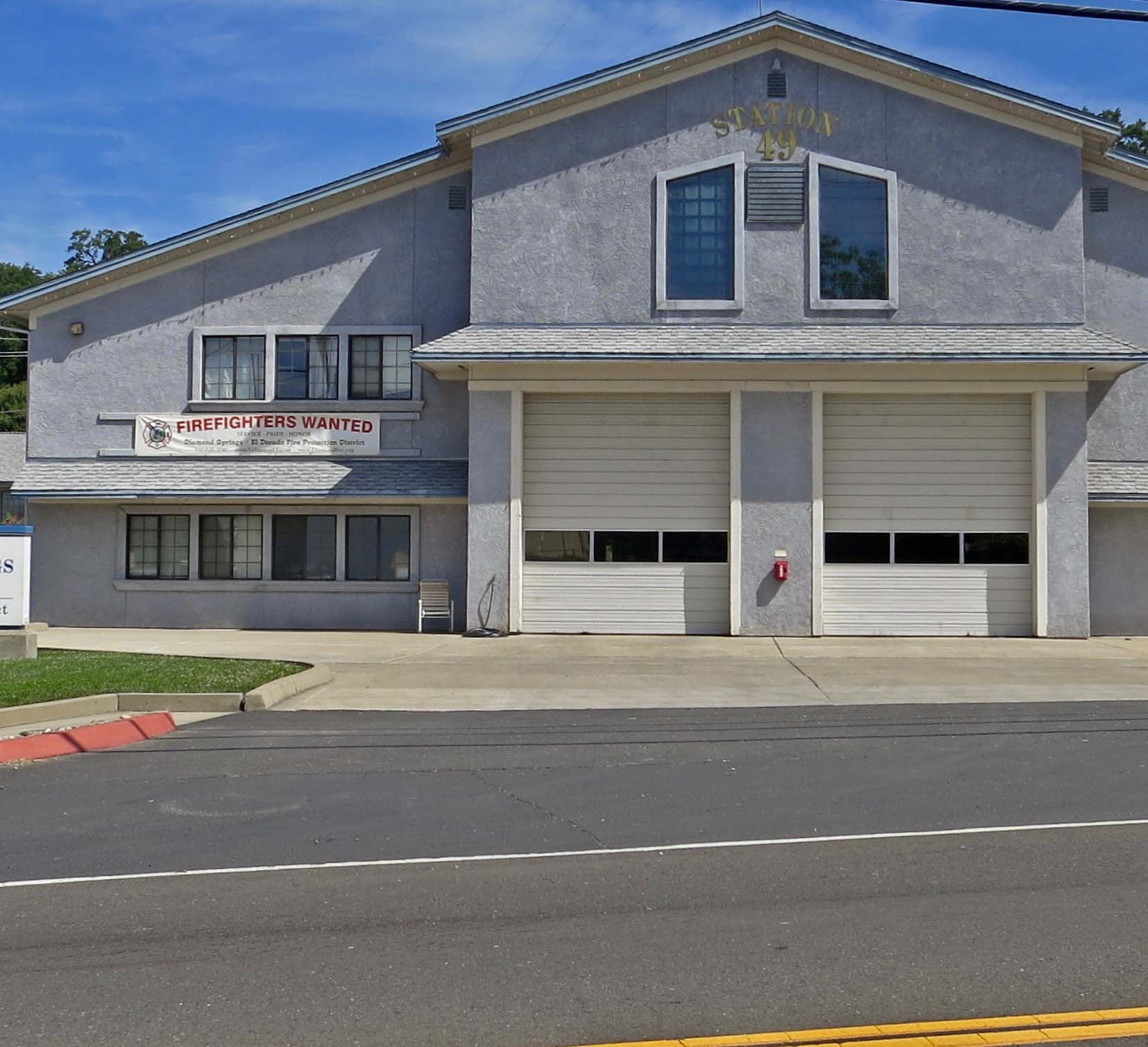
While the Diamond Spring’s Firehouse has been rebuilt from when we were children, it still stands in the same location. It was about a block away from where we lived. The siren was loud. The sign at the top says Station 49. It’s appropriate. Diamond’s first firehouse was built in 1849 along what is now Highway 49. In comparison, this is the firehouse not all that different from what it looked like when I was a child, which I featured in my last post. As I recall, they did rebuild it once when I was a child. Pop wired it.
If it sounds like parental supervision of our bad behavior was somewhat lax in my growing up years, that’s because it was. There were times when our parents, or at least Mother, provided tacit approval of our misdeeds. Returning the cherries we confiscated from Pagonni’s orchard or the frogs from Pavy’s Pond was never an issue. They were quietly added to the pantry and happily consumed by all, including Pop. No questions asked.
Once we were even encouraged to break the law.
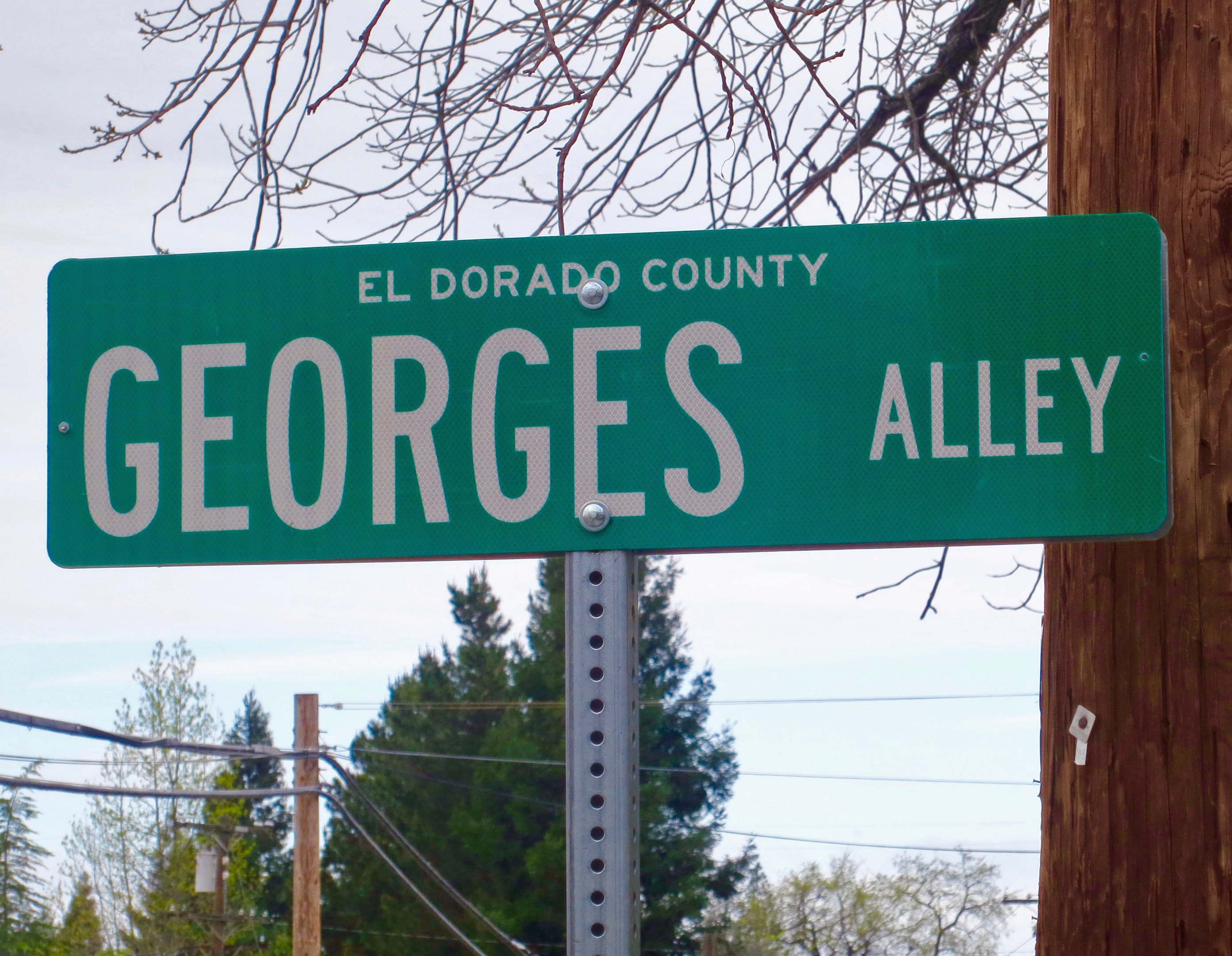
Because the dirt road we lived on circled the graveyard, the County decided it should be named Graveyard Alley. No one living on the road was asked for an opinion or informed of the decision. The signs simply appeared one day. Mother was infuriated and fired off a letter to the County Board of Supervisors. She was not going to live on Graveyard Alley! Nothing happened, there wasn’t even a response.
Marsh and I were given marching orders: Sometime around midnight go out and remove the signs. We carried out the charge with enthusiasm. No neighbors complained about this obvious act of vandalism since they weren’t particularly happy about living on Graveyard Alley either.
The County replaced the signs. We made another raid and this time the County got the point. They changed the name in honor of an old fellow, George Croft, who was an original resident. We all liked George. It became George’s Alley, which it still is today.
I’m convinced we inherited our trouble making potential from our mother. Pop was a good man who had avoided marriage until he was 38. He was the type of guy who served on the Vestry of the Church, was a Boy Scout leader, and was always available to help out a neighbor. I am sure there were times he wished he had avoided marriage for another 38 years. A lesser man might have said bye-bye and been on his way. But he took his role seriously and pushed on, through thick and thin.
Mother could be something of a ‘wild child,’ wilder than her wild children. Going to fires in Diamond Springs was an excellent example.
Pop was a volunteer fireman for Diamond. As an electrician, it was his job was to show up at burning houses and shut off electricity. When the siren wailed, he was off and running, as were all the other volunteer firemen in town. It was serious business.
For Mother and for us, it was high entertainment. We also took off at the sound of the siren, jumped in whatever old car we had, and sped along behind the fire truck. The time of day and activity of the moment didn’t matter. If it were three in the morning, we would jump out of bed and throw on our clothes; if we were eating, the meal would be abandoned; if we were playing, the toys would be dropped. Nothing could compete with a good fire. Our devotion to disaster was right up there in the same league as it is with today’s news media.
The star performer was someone’s house. There was excitement, danger and pathos. Firemen blasted away with their hoses in a desperate attempt to save the home while the unfortunate family looked on in dismay. But the climax, the Fourth of July finale, was when the roof and walls would crash down and shoot sparks and fire high into the sky. I did keep my oohs and ahhs to myself. Somewhere in the back of my mind a small voice whispered that our family outing was not totally appropriate.
“Your mother chases fire trucks,” one of my little buddies jeered at me in an argument.
My response at the time had been, “So…,” but later in life I would ponder what the towns-people must have thought about Mother, two or three kids, and a dog always showing up. Pop must have been terribly embarrassed. I remember him telling Mother once to stay far behind the fire engine and far away from the fire. He did it under the guise of being concerned for our safety. I now suspect he hoped we wouldn’t be recognized. But he never did have much success in telling Mother what to do. The siren’s call was not to be denied— for either one of them.
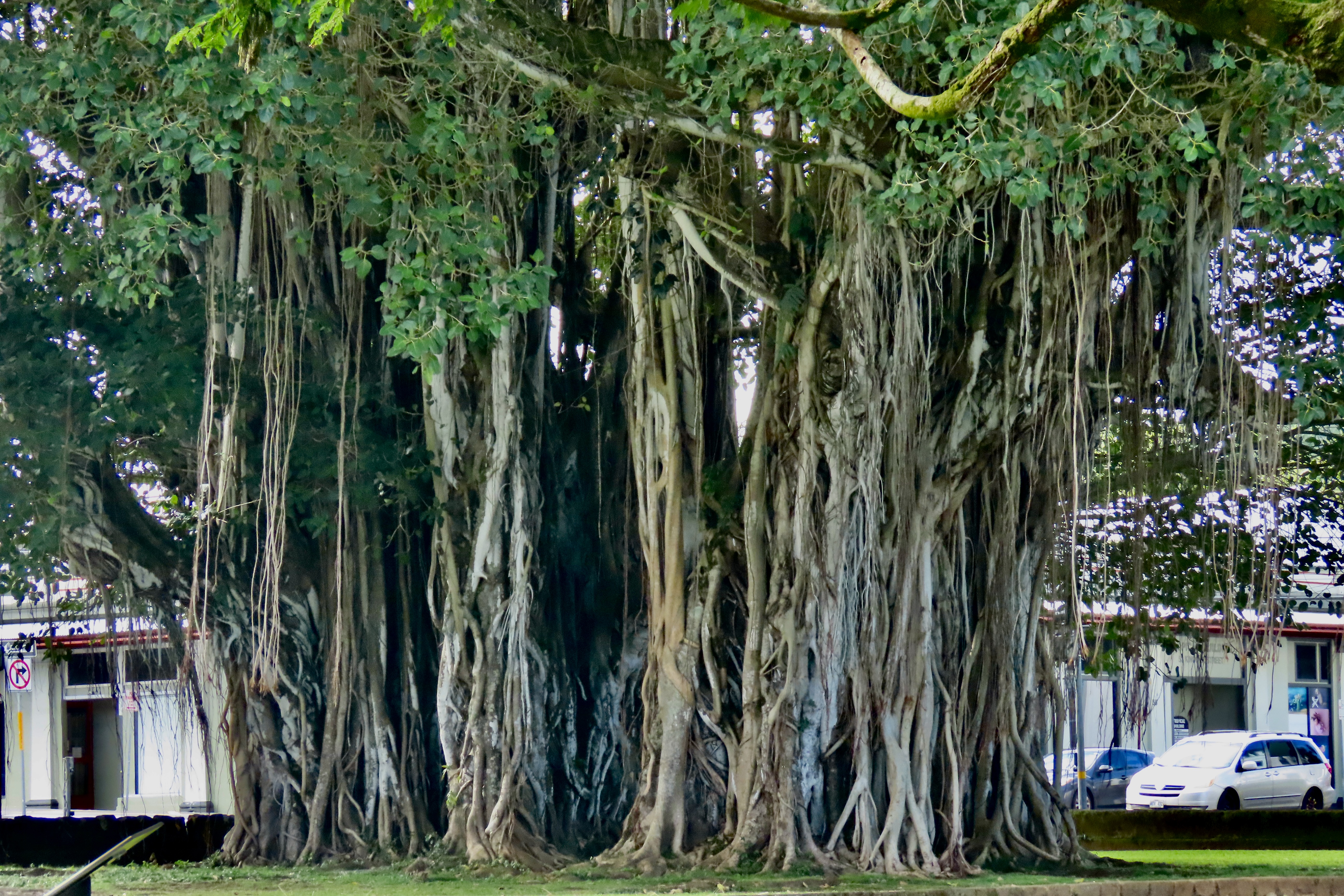
Monday’s Post: It’s back to Costa Rica where Peggy and I will show you a ficus, which I would bet is unlike any ficus/banyan/fig tree you have ever seen before unless you have been in Monteverde. No photos this time, I’m keeping it as a surprise. Here is a banyan tree we visited on the Big Island of Hawaii last year, however…
Bob Bray with his wife Linda and the world traveling Bone. Bob and I have been friends since the first grade. Here, he and his wife, joined in supporting me on my trek down the PCT to celebrate my 75th Birthday. (The trek ended up being 750 miles instead of 1000 because of several forest fires in 2018.) We would have been 12 at the time of the Wham-O-Caper.
While I had graduated from my would-be juvenile delinquent days, I was able to pull off a couple of capers without my brother’s influence. The first involved living up to Bertha Bray’s expectations.
For some unfathomable reason, Bob’s parents bought him a Wham-O Slingshot. I mean, how in the world can you expect a kid to be good when he starts playing with his Wham-O? The fact that I owned a Wham-O as well almost guaranteed trouble.
Bob and I agreed to meet for a clandestine hunting expedition. It had to be clandestine because I was still on Bertha Bray’s ‘do not invite’ list. Things were going great until we came upon the old abandoned hobo’s shack that was next to the Southern Pacific railroad track about a quarter of a mile from Bob’s home. Typical of such structures, it had been created out of anything that was available for free: old metal roofing, miscellaneous boards, an occasional nail, a thrown away mattress, etc.
Bob and I looked at each other and had a simultaneous thought. Out came the ammo for the Wham-Os: A shiny new marble for Bob and several BBs for me. We took careful aim, counted down, and let fly, using the derelict old building for target practice.
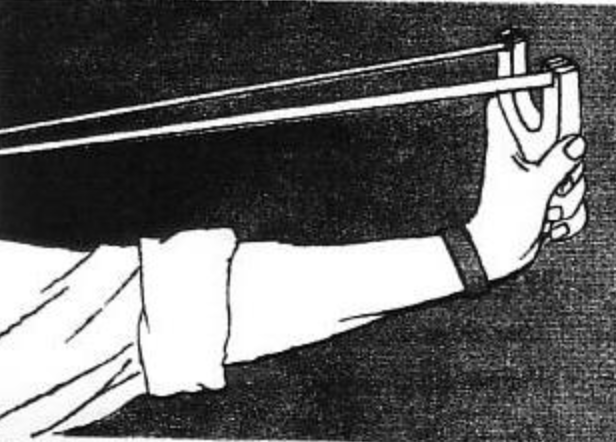
The Wham-O actually comes with a manual that tells you how to use it. It’s a serious slingshot!
To this day, Bob claims he saw his marble harmlessly strike the building while my BBs were smashing a window to smithereens. I of course saw Bob’s marble hit the window dead on while my BBs weren’t even close. The current occupant of the not abandoned home, who was washing dishes behind a willow bush in a small stream, saw something entirely different: two little boys smashing his pride and joy.
He let out a bellow and came charging up the trail. As he should have. Once again, the Mekemson Gang, along with its newest recruit, was on the run. The good news is that we escaped. The bad news was that the hobo recognized Bob. He went straight to his house. Mrs. Bray’s worst fears had been realized. (For the 50thAnniversary of our Wham-O Adventure, Bob sent me a slingshot. Bertha probably rolled over in her grave. Or maybe she chuckled.)
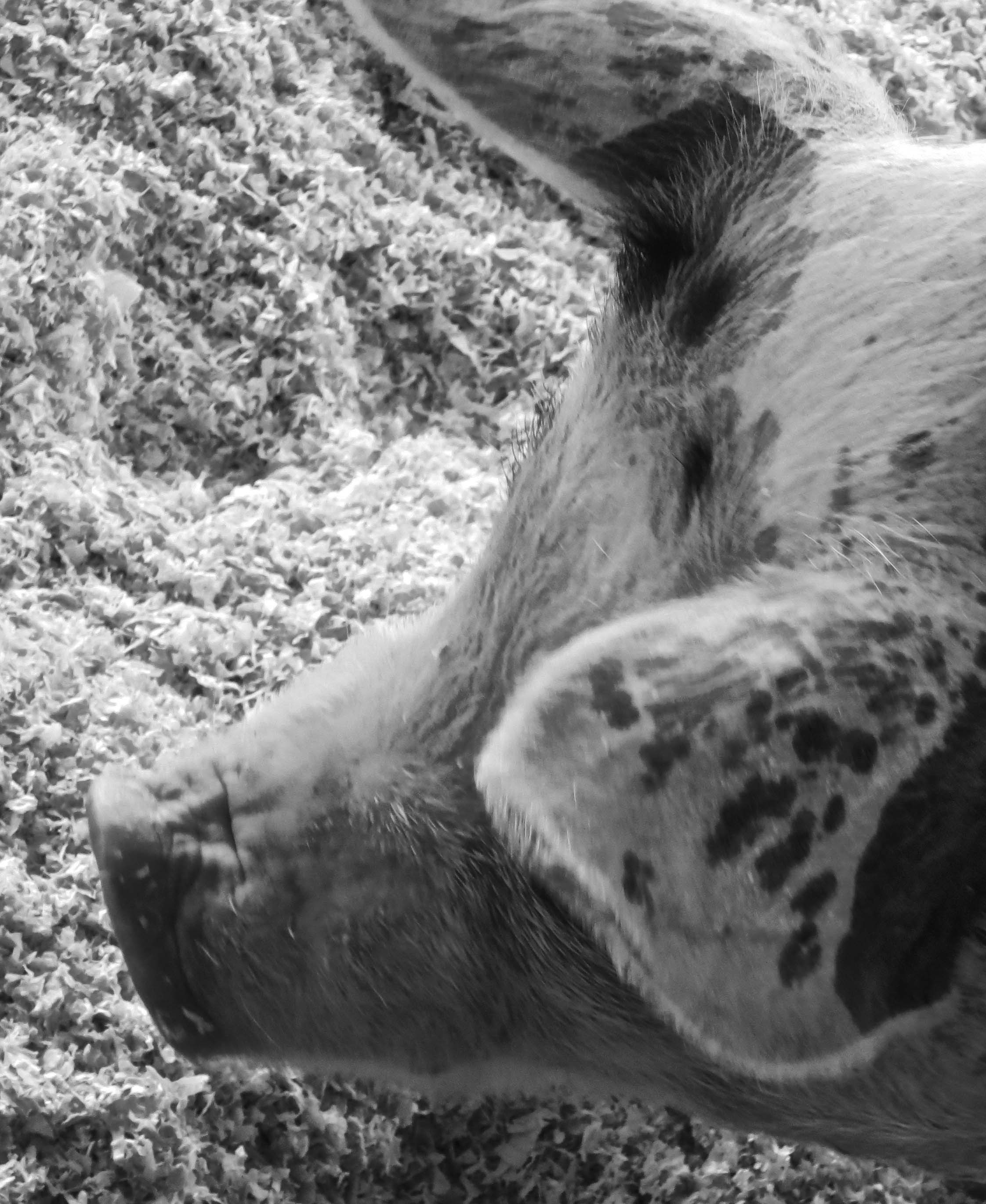
A prize 4-H pig at the Modoc County Fair in Northern California.
Tony Pavy’s prize pig was another case where Marshall was totally innocent. Tony had a large pond with bullfrogs, a hundred or so acres of scrubland, and a wooded hillside that housed a number of gray squirrels and blackberry vines loaded with the sweet, juicy fruit. His attitude was similar to that of Jimmy Pagonni: Children were not to be heard or seen on his property.
As with Pagonni, we didn’t allow Pavy to keep us from our appointed rounds. We would slip in at night to harvest his bullfrogs and during the day to harvest blackberries or bring down a squirrel. Tony had a very effective way of getting rid of us. In a very loud voice he would yell, “Mama, get my gun!” and we would streak out of there.
A couple of friends and I were hunting for the squirrels on his hillside when the unfortunate incident with the pig took place. But before I tell the story, I need to digress and provide some background information.
Growing up in Diamond Springs in the 50s meant having a gun and shooting things. At least it did if you were a boy. We graduated from BB guns and 22s to deer rifles and shotguns. Obtaining your first rifle was an experience similar in importance to obtaining your driver’s license, except you could get one a lot earlier. Before we were allowed to hunt, however, certain rules were pounded into our heads. We had to take a course sponsored by the National Rifle Association. These were the years when the NRA’s primary concern was about hunting and hunter safety, not promoting the use of automatic weapons.
I learned from the NRA instructor that it is important to know what you were shooting. This might seem obvious, but flat-landers out of Sacramento often had trouble making the distinction between a cow and a deer. Of a much more serious nature, every so often one would mistake another hunter for a deer. Wear red hats and bright clothes, we were taught. There were other things we weren’t supposed to shoot as well. People’s houses for example. Robins were also high on the list. They ate their weight daily in bugs. It was okay to shoot ‘vermin’ such as ground squirrels, jackrabbits, coyotes and the scrub jays that pecked away at pears. In fact there was a bounty on jays, $.25 per head. Marshall used it as a money-maker.
My usual preference was for watching wildlife, not killing it. I made an exception for gray squirrels. The thrill of the hunt combined with my appetite for a delicious squirrel and dumpling stew my mother whipped up overcame any reservations I had. All of which brings me back to the pig.
Gray squirrels have about the same appreciation for being shot that you or I might. To avoid this unhappy circumstance, they take off leaping through the trees. The one we had marked for dinner was jumping from limb to limb in a live oak tree on the hill above Pavy’s with all three of us shooting at it when we heard a bellow from the barnyard.
“Mama, get my gun! They shot my pig! They shot my pig! Hurry, Mama!”
I don’t know how fast Mama moved but we flew. By the time Ernie Carlson, the County Sheriff, and a Diamond Springs resident, caught up with us we were far away from Pavy’s and about as innocent as newborn piglets.
“Excuse me, boys,” the Sheriff remarked when he pulled over in his car and rolled down his window, “I don’t suppose you know anything about Tony Pavy’s pig being shot.”
“No, sir,” we replied respectfully in unison. We had rehearsed. Besides, we were technically correct. We hadn’t shot Pavy’s pig; we hadn’t even shot the squirrel. It was a ricocheting bullet that did in the pig.
Ernie looked at us dubiously.
“Pavy told me there were three kids about your age,” the Sheriff said as he continued to build pressure, hoping that one of us would break.
“We’ve been out in back of Ot Jone’s Pond,” I argued indignantly. And we had been. So what if we had arrived there out of breath.
“Well, you kids behave yourselves,” the Sheriff said with an ominous I know you’re lying tone.
We breathed a joint sigh of relief as he rolled up his window and drove off. Once more we had avoided a fate we probably deserved. I suspect now that Ernie was not one hundred percent dedicated to finding the alleged pig murderers. Tony was not universally loved in the community for several reasons, of which threatening to shoot kids was one.
For example: My father did some electrical work for him for free. As he was leaving, Tony asked, “Would you like one of my geese for dinner?”
“Sure,” Pop had replied, assuming Pavy was offering it as thanks for his four hours of work.
“Good,” Tony had replied, “that will be five dollars.” Pop was more than a little irritated. He had a hearty laugh years later when I told him about our adventure with the pig. I wisely avoided telling him at the time, however. His perspective on our miscreant behavior softened substantially with distance and age.
Friday’s Post: One of my classmates in grade school insults me by saying “Your Mother Chases Fire Trucks.” So what if it was true.
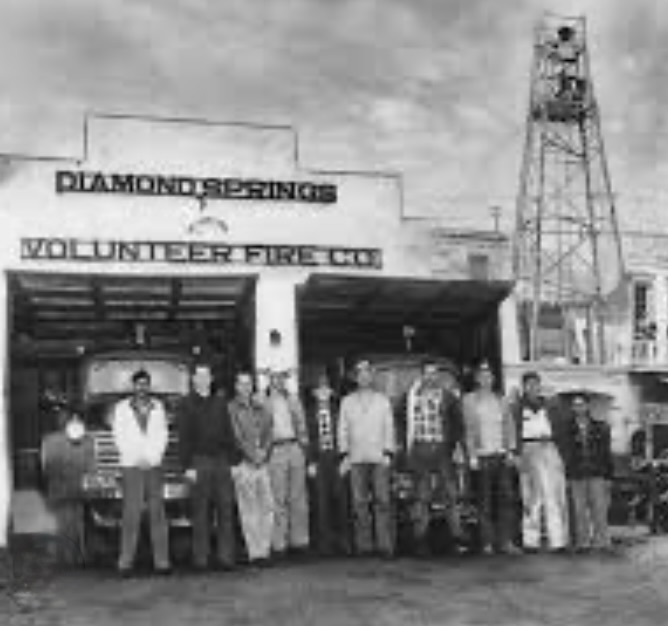
An early photo of the Diamond Springs Firehouse with Volunteer Firemen. The siren that called the Volunteers, including Pop, is on the right.
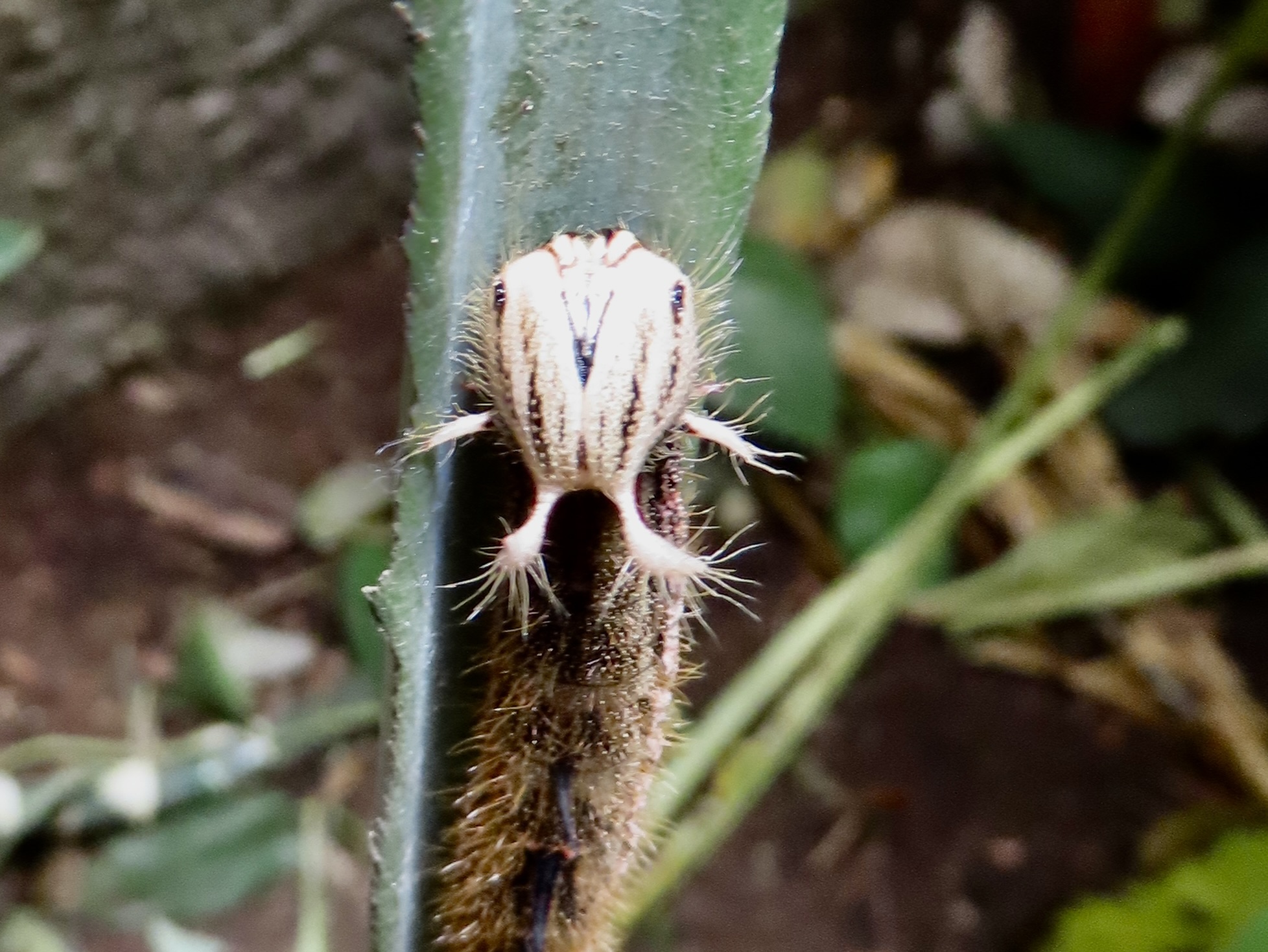
This is how I felt after being bonked on the head by a baseball! Just kidding. It’s actually here because I didn’t have a photo for Chapter 11. This one is an introduction to Friday’s post on Costa Rica Butterflies.
There came a time when I grew out of my mischief making phase. Other things took precedence: school, wandering in the woods, church, girls, and even sports. Few of these earned an Ut-Oh. There were a couple of incidents that earned inclusion in this book, however. The first had to do with a girl.
Starting as far back as the third grade, I had a girlfriend, or at least believed I did. The girls didn’t have to agree. My first heart throb was Carol. She was a younger woman: cute and smart. While I appreciated those qualities, what fascinated me about Carol was that she could run like the wind. I was in love with her legs. We both lived within a couple of blocks of school and would walk home for lunch.
The advantage of going home was we would arrive back at school before the other kids were let out for noon recess. This meant we could grab the best positions for whatever game was being played. My problem was that Carol could outrun me and this meant I was usually second in line. It seemed like a small price to pay for seeing those legs kicking up the dirt in front of me.
Next, I fell for an older woman, the fifth grade sister of one of my classmates in the fourth grade. She had quite a mouth on her and called her little brother pet names like shit-head and fuck-face. I was fascinated to hear a girl talk like that. One weekend, I found myself walking 2 ½ miles following the Southern Pacific railroad tracks to ‘visit her brother’ with my primary objective hearing her speak those ‘guy’ words. She didn’t disappoint…
The Ut-Oh, however, took place when I was in the fifth grade. Judy was a fourth grader with flaming red hair who had several boys in the fourth and fifth grade passionately pursuing her. The competition was fierce. Judy loved it. To encourage us, she cut off small locks of her hair and gave one to each of her admirers. I was surprised she had any hair left but I cherished my locket.
My main competitor for Judy was Eric. He was an up and coming fourth grader, small, but extremely athletic and an all-around nice kid. Judy let it be known that we were the chosen two.
We had our showdown at a school movie that provided instructions on what to do when the Russians bombed us. We spent a lot of time in the 50s worrying about that. People began building bomb shelters in their backyards. The teachers would make us crawl under our desks to prepare for the explosion. We were taught to cover our faces with our arms so glass shattering in from the windows wouldn’t blind us. It is not surprising that the traumatized children of the 50’s grew up to be the anti-war advocates of the 60s and 70s. I stayed up one night to watch atomic bomb testing in the Nevada desert over 200 miles away. It lit up the whole Eastern sky and added a touch of reality to our hide-under-the-desk practice.
In the lineup for the movie, Eric aced me out and managed to get next to Judy. A half dozen other fourth graders played honor guard and I couldn’t even get close, but my luck didn’t abandon me altogether. I grabbed the seat immediately in back of her where I could at least monitor Eric’s behavior. The lights went down and the movie started. I strained to keep an eye on Eric. He reached over and grabbed Judy’s hand and she let him hold it. Damn! I could have killed him.
But then, unbelievably, Judy slipped her other hand between the chairs and grabbed my knee. My knee! It was raw sex. The ut-oh bulge in my pants proved it.
Sports presented a totally different type of challenge. I am not a natural jock. It isn’t so much physical as mental. You have to care to be good at sports and I find other things more interesting. Part of this evolved from a lack of enthusiasm on the home front. There was little vicarious parental drive to see us excel on the playing field.
Being as blind as a bat didn’t help much either. Like most young people in the 50s, I was not excited about wearing glasses. When Mrs. Wells, the school nurse, came to class with her eye charts, I would memorize the lines while she was setting up and then breeze through the test. As for class work, I would sit close to the black board and squint a lot. While I got away with this more or less in the classroom, it became a serious hazard on the Little League field.
I remember going out for the team. All of my friends played and social pressure suggested it was the thing to do. Nervously, I showed up on opening day and faced the usual chaos of parents signing up their stars, balls flying everywhere, coaches yelling, and kids running in a dozen different directions at once.
“Okay, Curtis,” the Coach instructed, “let’s see how you handle this fly.”
Crack! I heard him hit the ball. Fine, except where was it? The ball had disappeared. Conk. It magically reappeared out of nowhere, bounced off my glove and hit me on the head.
“What’s the matter? Can’t you see?” the Coach yelled helpfully. “Let’s try it again.” My Little League Career was short lived. I went back to carrying out my inventory of the number of skunks that lived in the Woods. This didn’t mean I was hopeless at sports. In the seventh grade I finally obtained glasses and discovered the miracle of vision: Trees had leaves, billboards were pushing drugs, and the kid waving at me from across the street was flipping me off. I could even see baseballs. It was time to become a sports hero.
It says something about your future in sports when your career peaks in the eighth grade.
Thanks to Mrs. Young, I was slightly older than my classmate and, thanks to genetics plus an early growth spurt, slightly bigger. More importantly, I had mastered the art of leadership: Make noise, appear confident and charge the enemy. As a result I became quarterback and captain of the football team, center and captain of the basketball team and pitcher and captain of the softball team. I even went out for track and ran the 440, but they didn’t select me as captain. That honor went to a seventh grader. I was bummed.