A Phone Call Forces Me to GASP: California’s Prop 99

The roots of California's Proposition 99, the Anti-Tobacco Initiative, reached back into the 1970s when the American Lung Association of Sacramento teamed up with GASP, the Group Against Smokers' Pollution, to pass one of the nation's first non-smoking ordinances. (GASP would eventually become Americans for Nonsmokers' Rights.)

The path that led me into the tobacco wars had enough twists and turns to scare a contortionist snake out of his skin. There are lots of stories. Two are particularly relevant to the creation of California’s Proposition 99, the Anti-Tobacco Initiative.

I was recruited to become Assistant Director of the American Lung Association of Sacramento in 1971. The organization wanted my environmental expertise, not my anti-tobacco fervor. In fact I smoked a pipe. I loved my pipe. “No problem,” the Executive Director told me. He, his secretary and almost everyone else in the organization smoked. It was almost required.

One day in 1972 I was sitting in my office counting Christmas Seal Dollars and happily puffing away when I got the call that would lead me to sacrifice my pipe and eventually advocate that Prop 99 include nonsmokers’ rights.

“Mr. Mekemson” the caller began, setting off a red flag. I always get nervous when someone calls me Mr. Mekemson.

“Yes, this is Curtis,” I replied. “What can I do for you?”

“My name is Alice Fox, Mr. Mekemson. Some friends and I would like to meet you.”

Alice Fox, Alice Fox, Alice Fox… the name raced through my mind. I had heard about her recently. Then it came to me. I had read about Alice in the Sacramento Bee. She was leading a charge to shut down a nude beach on the American River. But why would Alice call me. I was a Seventies type of guy.

“Exactly what would you like to meet about,” I asked. Now was the time to be very careful.

“Some friends and I would like to talk with you about how tobacco smoke impacts our health,” she replied.

I relaxed. I was on safe ground. “There is a great deal of information that smoking causes lung disease,” I responded in a positive tone. “I would be glad to send you some pamphlets on the medical evidence. I also have a brochure that provides tips on quitting.”

“No,” a somewhat exasperated Alice Fox shouted in my ear, “we don’t smoke. It is other people’s smoke that makes us sick.”

There was a pregnant pause on my end of the phone. If Alice heard me coughing, it may have been because I had swallowed my pipe. Not knowing what to say, I stumbled into agreeing to have lunch with her the following week.

The die was cast. But first I tried to persuade my boss, Larry Kirk, that he should go. He was, after all, the Executive Director.

“No way,” Larry said with a nervous laugh as he took a deep drag. They had specifically asked for me and I was stuck with it. There was nothing to do but square my shoulders, put my pipe aside, and dutifully go forth for Mother Lung.

I expect the nonsmokers smelled the pipe smoke on me 20 feet away. We met at a small restaurant in the old Public Market at 13 and J Street. The Market would eventually morph into a Sheraton Hotel.

“We are so glad you were willing to meet with us,” Ed Randal, their leader greeted me. “We are having a difficult time persuading people that second-hand smoke makes us sick.”

He handed me his card. It read, “I don’t smoke but I chew. If you don’t blow your smoke on me, I won’t spit on you.”  I immediately understood why Ed might have difficulty selling his cause.

“Not too subtle,” I noted.

“We can’t afford to be,” was the response. Over the next hour I was educated as to why. Gradually, I became convinced that second-hand smoke did indeed make them sick. They all had compelling stories.

I also came to understand something of the frustration they felt in convincing society in general and smokers in particular that second-hand smoke was an issue. In 1972 it was a message far ahead of its time. Most smokers assumed they could smoke whenever and wherever they pleased. I know I did. The vast majority of nonsmokers went along with the idea. It took guts to challenge the norm.

I also had an ‘aha’ experience. I started out being resentful about leaving my pipe behind but over the hour my attitude began to change. These folks shouldn’t have to breathe my pipe smoke.

How many other people had my thoughtlessness harmed?

The question had a strong impact on me. Eventually it would lead me to give up smoking. This was something that neither my knowledge of health effects nor my responsibility as a health professional had been able to accomplish.

As a result, I became convinced that we had a powerful new weapon in our fight against lung disease. If I used myself as an example, “Please don’t smoke around me” was as effective in discouraging tobacco use as it was in protecting the nonsmoker.

Somewhat to my surprise, I volunteered to help Ed, Alice and Company in their effort. An organization called GASP, the Group Against Smoking Pollution, had been set up in Berkeley and the local folks wanted to establish a chapter in Sacramento. I offered the Lung Association for meetings and myself as staff backup. Before we broke up for the day, we had agreed on holding a general membership meeting the next month.

I can’t say that Larry was enthusiastic about my offer or conclusions. A surprising number of Lung Execs smoked and were no more prepared to accept nonsmokers’ rights than smokers in the general public. Mainly they saw their role with tobacco as discouraging young people from starting to smoke.

But Larry had hired me as his assistant because he respected my instincts and judgment. Reluctantly, he agreed to have Lung support GASP. But it would be my baby, not his.

So we set about organizing a meeting. Alice and Ed corralled their friends and I had a small article placed in the Bee. We came up with an agenda and refreshments. I warned our organizing committee not to expect much the first time out. Ten people and a few ideas for expanding membership would be a roaring success.

Fifteen minutes before the meeting was to start the room was packed. Apparently, I was the only one surprised. As we went around the room for introductions two things became apparent. First, this was a broad-based group of people. We had health professionals, a couple of lawyers, several business people, housewives, a househusband, an electrician, and others.

Second, everyone had stories to tell and they were ecstatic they had empathetic listeners. I felt like I was in the middle of a revival, which is often the atmosphere created by grassroots organizations.

Once we worked through the preliminaries and had a semblance of order, I facilitated a brainstorming session on what we might do to create awareness of non-smokers’ rights in Sacramento. If my pipe smoking was to be limited, I might as well have company.

The ideas came fast and furious. We should arm nonsmokers with fans to blow smoke back at smokers. We should print up and distribute thousands of the “I don’t smoke but I chew,” cards. We should picket grocery stores, clothing stores and restaurants. We should create an ordinance.

“Whoa,” I interjected, abandoning my facilitator’s role. “Let’s talk about the ordinance.”

Sacramento would be one of the first cities in the nation (or world) advocating such a law.

“Our chances of winning are slim,” I began, thinking out loud, “but that may not matter. The effort will generate great media coverage, probably more than all the other activities combined. Think of the awareness we will create.”

The idea was greeted with enthusiastic support. The newly formed Sacramento Chapter of GASP had a mission.

“I can take a stab at drafting the ordinance,” one of the attorneys volunteered.

“I know a reporter who will support us,” another offered.

“Anything you need,” another called out. We would not lack volunteers. As for myself, I agreed to set up meetings with members of the City Council. I knew most of them from my work in the environmental movement and had worked on several of their campaigns. We were off and running.

The ordinance seems rather tame now, but it was radical for its time. We targeted grocery stores, retail stores, restaurants and movie theaters. It was still the era when a newly purchased suit might smell like cigarette smoke and a harried shopper might inadvertently lose her ashes in the vegetable bin at the grocery store.

It didn’t take long for things to heat up. As we suspected, the press had a field day. Reporters didn’t necessarily agree with us, one of the smokiest atmospheres in town was the local newsroom, but controversy is the bread and butter of the media business. Imagine a smoker having to wait until he got outside of a grocery store to light up.

Each time the media ran a story, awareness increased. We were achieving our objective. Non smokers were learning it was okay to say “Yes, I do mind if you smoke,” and people who suffered adverse reactions from second-hand smoke were learning they weren’t crazy. We took every opportunity to educate the public and pound home our message to decision-makers.

And then a funny thing happened on the way to the forum. We won. A majority of City Council became convinced, as I had, that a significant number of nonsmokers were adversely affected by second-hand smoke.

Of equal importance, the local grocery store chains and clothing merchants let the decision-makers know they would prefer smoke free environments.

And finally, we had minimal opposition from the tobacco industry. It was several years before the industry fully realized the threat posed by the non-smokers right’s movement, or how dedicated the non-smokers’ rights advocates were, or how effective a small group of people can be in making change.

Sacramento had become a leader in the anti-tobacco movement and would continue to be over the next quarter of a century. While I moved on to other issues, the local Lung Association under the leadership of Jane Hagedorn and her Board of Directors became one of the strongest advocates for a smoke-free society in the United States.

Ten years later I would rejoin the Tobacco Wars, this time in Alaska.

One Million Lives and 86 Billion Dollars Saved… California’s Proposition 99

In the late 80s the tobacco industry mounted an "unprecedented campaign," to defeat California's Proposition 99, an initiative designed to increase the California tax on cigarettes by $.25 and devote a substantial portion of the funds to discouraging tobacco use. The Tobacco Institute recognized that the initiative posed one of the greatest threats to tobacco consumption it had ever encountered.

My friend Ken Lake sent me an article from the Sacramento Bee a few weeks ago. It reported on the latest results from California’s Proposition 99, a massive tobacco use prevention effort kicked off by a tobacco tax initiative passed by California voters in the late 80s.

According to the California Department of Health Services, an estimated one million lives and 86 billion dollars in health care costs have been saved because of prevention programs funded by the tax. California now has the second lowest incidence of tobacco use in the nation and the state is virtually smoke-free. It has the lowest incidence of cancer for 6 of the 9 cancers caused by tobacco use. Fewer teens smoke in California than any other state.

These figures are remarkable. How many times in history has a single act saved one million lives? How often do health care costs go down instead of up? And there is more, much more.

Tobacco use is the single most preventable cause of death and disease in America and a major factor in preventable death and disease worldwide. The revolution in disease prevention that took place in California is a revolution that has reverberated throughout the United States and around the world, a fact recognized by both the National Centers for Disease Control and Prevention and the World Health Organization.

As a result, the million lives and billions of dollars saved in California can be multiplied several times over on a national and global basis. Prevention works.

Credit for the success of Proposition 99 in the quarter of century since its inception goes to a cast of hundreds, if not thousands. Certainly the Tobacco Control Section of the California Department of Health Services and its dedicated staff have been critical but dozens of organizations, hundreds of staff people and thousands of volunteers have also played key roles.

In the beginning, however, in the very, very beginning, it was a handful of people in Sacramento who put the effort together and made the critical decisions that would allow Proposition 99 to become the revolution in prevention it has become.

I was privileged to be one of those people.

Over the next two months I will do a series of blogs that provide an inside look at what happened during Prop 99’s first critical months starting in September of 1986. It’s a story of how and why a small group of friends decided to take on one of the worlds most powerful, amoral industries in the cause of preventing the death and crippling disease caused by tobacco use.

It’s a good story, worth telling on its own merits. Greed, power politics, human emotion and sacrifice are all included. There’s even some humor. But I also want to make the point that a few dedicated and knowledgeable individuals can make a significant difference. It’s an important message for today’s world where ideology, ambition and greed triumph over working together in the common interest.

In my next blog I will tell the story  of Prop 99’s beginning and how I became involved. Believe me, I did not start out to become an anti-tobacco warrior.

The Great Tree Race

My grandson demonstrates his tree climbing skills on a large madrone.

“I can climb that tree, Grandpa,” my six-year old grandson announced proudly to me yesterday. It’s a refrain I’ve heard frequently over the past week from the visiting six-year old. His three-year old brother has similar ambitions, if not abilities. Their father is building them a tree house in Tennessee. It’s the ultimate dream of all impassioned tree climbers.

I remember when my dad (Pop) built a tree house for my older brother Marshall and me in the graveyard next to our house.

I’ve posted earlier blogs about the graveyard’s jungle-like nature. It’s potential as a playground was impossible to ignore. Young Heavenly Trees made great spears for throwing at each other.

That game ended when we impaled Lee Kinser’s hand. Neither Lee nor his parents were happy about this development and our efforts to master spear throwing were brought to an immediate halt. But a greater challenge remained.

Two incense cedars dominated the Graveyard. From an under five-foot perspective, they were gigantic, stretching some 75 feet skyward. The limbs of the largest tree started 20 feet up and provided scant hope for climbing. As usual, Marshall found a risky way around the problem.

Several of the huge limbs came tantalizingly close to the ground at their tips and one could be reached by standing on a convenient tombstone. Only Marshall could reach it; I was frustratingly short by several inches.

Marsh would make a leap, grab the limb and shimmy up it hanging butt-down until the limb became large enough for him to work his way around to the top. Then he would shimmy up to the tree trunk, four to five Curtis lengths off the ground. After that he would climb to wonderfully mysterious heights I could only dream about.

Eventually I grew tall enough to make my first triumphant journey up the limb. Then, very carefully, I climbed to the heart-stopping top, limb by limb. All of Diamond Springs spread out before me. I could see the school, and the mill, and the woods, and the hill with a Cross where I had shivered my way through an Easter Sunrise Service. I could see the whole world.

Except for a slight wind that made the tree sway and stirred my imagination about the far away ground, I figured I was as close to Heaven as I would ever get

By the time I finally made it to the top, Marshall had more grandiose plans for the tree. We would build a tree house in the upper branches. Off we went to the Mill to liberate some two by fours. Then we raided Pop’s tool shed for a hammer, nails, and rope.

My job was to be the ground man while Marshall climbed up to the top. He would then lower the rope and I would tie on a board that he would hoist up and nail in. It was a good plan, or so we thought.

Along about the third board, Pop showed up. It wasn’t so much that we wanted to build a tree house in the Graveyard that bothered him, or even that we had borrowed his tools without asking. He even seemed to ignore the liberated lumber.

His concern was that we were building our house too close to the top of the tree on thin limbs that would easily break with nails that barely reached through the boards. After he graphically described the potential results, even Marshall had second thoughts.

Pop had a solution though. He would build us a proper tree house on the massive limbs that were only 20 feet off the ground. He would also add a ladder so we could avoid our tombstone-shimmy-up-the-limb route.

And he did. It was a magnificent open tree house of Swiss Family Robinson proportions that easily accommodated our buddies and us with room to spare. Hidden in the tree and hidden in the middle of the Graveyard, it became our special hangout where we could escape everything except the call to dinner. It became my center for daydreaming and Marshall’s center for mischief planning. He, along with our friends Allen and Lee, would plan our forays into Diamond designed to terrorize the local populace.

It also became the starting point for the Great Tree Race. We would scramble to the top and back down in one on one competition as quickly as we could. Slips were a common hazard. Unfortunately, the other boys always beat me; they were two to three years older and I was the one most susceptible to slipping. My steady diet of Tarzan comic books sustained me though and I refused to give up.  Eventually, several years later, I would triumph.

Marshall was taking a teenage time-out with our grandparents who had moved to Watsonville down on the Central Coast of California. Each day I went to the Graveyard and took several practice runs up the tree. I became half ape. Each limb was memorized and an optimum route chosen. Tree climbing muscles bulged; my grip became iron and my nerves steel.

Finally, Marshall came home. He was every bit the big brother who had been away at high school while little brother stayed at home and finished grade school. He talked of cars and girls and wild parties and of his friend Dwight who could knock people out with one punch.

I casually mentioned the possibility of a race to the top of the Tree. What a set up. Two pack-a-day sixteen-year old cigarette smokers aren’t into tree climbing but how can you resist a challenge from your little brother.

Off we went. Marsh didn’t stand a chance. It was payback time for a million big brother abuses. I flew up and down the tree. I hardly touched the limbs. Slip? So what, I would catch the next limb. Marsh was about half way up the tree when I passed him on my way down. I showed no mercy and greeted him with a grin when he arrived, huffing and puffing, back at the tree house.

His sense of humor was minimal but I considered the results a fitting end to The Great Tree Race and my years of close association with the Grave Yard.

A Rabid Wolf Wandered through Camp: The Wind River Mountains of Wyoming

The Wind River Mountains of Wyoming are a premier destination site for backpackers. A number of years ago I took six months off to backpack various locations in the western United States and added the area to my itinerary.

Mountain men were there first.

Place names such as Sublette County, Fremont Lake and the Bridger Wilderness recall these larger than life characters who were kept busy between the 1820s and 60s pursuing beavers, exploring the west, keeping their scalps, serving as guides, working as frontier entrepreneurs, and, in the case of John C. Fremont, running for President.

Many were also great storytellers and participated enthusiastically in the creation of their own legends.

One of the most popular locations for weaving tall tales was the Annual Fur Rendezvous that brought the various trappers together with suppliers out of St. Louis.

Six of the Rendezvous were held near the small town of Daniel, which is located on the Upper Green River 11 miles from Pineville. I stopped by and tried to imagine what the river valley would be like filled with over 1000 trappers, Indians, suppliers, missionaries, and wayward journalists.

The Mountain Men pursued their dangerous and often lonely profession during the winter when the fur pelts were at their best. The two to three-week Rendezvous in the summer was an opportunity to sell their furs, catch up with friends, gossip and resupply for another winter. It was also an excuse to party.

‘Whiskey,’ pure alcohol watered down and then flavored with tobacco, was passed around in a cooking kettle. Horse racing and shooting contests soon deteriorated to drunken debauchery. Old journals report the results.

One new guy was baptized by having a kettle of the alcohol poured over his head and lit on fire. A rabid wolf wandered through the camp and bit people at will. Several trappers were witnessed playing poker on a dead man’s body

A contract between William Ashley, the creator of the Rocky Mountain Rendezvous, and the trading firm of Jedediah Smith, David Jackson and William Sublette listed some 50 different items to be delivered to the Mountain Men.

Many of these items such as gunpowder, lead, beaver traps, and butcher knives related to their work. There were also cooking kettles, flour, sugar, allspice, dried fruit, coffee, grey cloth, and washing soap for every day living. Some items such as beads, ribbons, rings, bracelets and calico were probably trade goods for the Indians

As one might expect, ‘fourth proof rum’ (80 % pure), regular tobacco and the more high quality Smith River Tobacco were included for long, lonely nights. Slaves were producing the Smith River Tobacco in Virginia at the time.

Reviewing what the Mountain Men carried with them into the mountains led me to look at my own backpacking list. It appears life is more complicated today. My list contains over 60 items and I rarely travel for more than seven to ten days without checking back into civilization!

But then again, the Mountain Men apparently didn’t worry about such niceties as toilet paper and toothpaste, not to mention maps and reading material. They also shot much of what they ate.

Wednesday’s Blog: “There’s a Beaver Standing on My Tent.” I have my own mountain man experience.

A Cow Elk Woos Me

Where I was going backpacking in Cliff Dwellings National Monument was something of a mystery to me. I didn’t have a clue.

My pack was loaded with a week’s worth of food and six topographic maps, more than enough to let me wander wherever I wanted and hopefully avoid getting lost. I started off up the West Fork of the Gila River but soon came across a trail jogging out of the canyon to the right.

“Looks good to me,” I thought to myself and started climbing. I was determined that wherever I went for the week would be based on random decisions. So much of my wilderness experience had involved leading groups or scouting out potential routes for organized trips that the sense of abandon felt delicious.

Consequently, years later, it isn’t exactly clear to me where I went. I was more than happy to hike 4 to 5 miles in one direction and then 6 or 7 in another. The only thing I tried to avoid was backtracking. I do remember wandering through Woodland Park and Lilly Park as well as climbing in and out of several canyons.

I had brought along two science fiction books for evening and early morning entertainment. Southern New Mexico is UFO Country. I was also carrying my usual field ID book and one serious read, Aldo Leopold’s “Sand Country Almanac.”

Leopold had been responsible for the creation of the Gila Wilderness in 1924, making it the first specifically designated wilderness area in the United States, and, I might add, the world. People who love wild country and understand its intrinsic value owe a great debt to the man for his vision. I had read the book before but reading it again in the Gila Wilderness added a special significance.

I declared a layover day so I could savor it all at once. I was camped on a small stream located in a minor canyon and hadn’t seen a soul for four days. It was the perfect setting for getting lost in a book.

Some time in the early afternoon, a loud “Woooeee” shattered the silence.

“Big Bird,” I thought to myself. “Big Bird on steroids.” Aldo Leopold would have been up in a flash to discover the source. Of course he would have had his rifle with him. He was quite the hunter.

As usual, my only weapon was a dull three-inch pocketknife. Still, the mountain man in me demanded I get off my lazy tail and go exploring. I grabbed my binoculars and climbed out of the canyon. I was greeted by a broad, flat expanse of Ponderosa Pines but no Big Bird. “Woooeee,” I heard receding into the distance.  I put on my stalking cap and begin to sneak through the forest.

“Woooeee!” Big Bird shouted behind me. I whirled around only to catch a glimpse of something disappearing behind a bush. Big Bird it wasn’t. Nor was it the ghost of Geronimo. It looked suspiciously like a cow elk that had morphed from stalkee to stalker. I wasn’t sure that I liked my new role but decided to play along.

“Woooeee,” I called out and jumped behind a Ponderosa.

“Woooeee,” I heard a delayed three minutes later. I stepped into the open to discover that my female companion had come out from behind her bush and was staring intently at my tree.

“Woooeee,” I shouted at her as she once again disappeared. We had a game. A cow elk was wooing me.

Years earlier I had discovered that much of the higher animal kingdom is quite curious about humans that don’t act like humans. I once had a similar experience to my elk chat with a coyote on the American River Parkway in Sacramento.

First I would hide and then he would hide. Finally, out of frustration, the coyote plopped down in the middle of the trail, raised its head, and began howling. I plopped down in the trail as well, raised my head and joined him. We had quite the discussion.

The elk and I continued our game for about 15 minutes when I changed the rules. I sat down in plain sight with my back against the tree. Instead of hiding she stood watching me for several minutes. I could tell the wheels were grinding away in her mind.

Suddenly she charged. I didn’t move from my seat but my adrenalin cranked up several notches. She was all of 10 feet away when she slammed on her brakes, lowered her head, stared me in the eye, and woooeeed again.

Half fascinated and half frightened, I didn’t budge. Several hundred pounds of frustrated female were looming over me. I had zero doubt that she could kick the stuffing out of me. She held my gaze, snorted in disgust, shook her head and trotted off.

Whatever conversation we had been having was over. I breathed a sigh of relief and returned to camp. My first chore was to get out my guidebook. Female elks, it noted, can become rather aggressive and dangerous in the spring when they have calves. I’d been both ignorant and lucky.

After dinner I went for my evening walk following an animal path that ambled along beside the creek. I heard a snort and looked up. Five elk were standing on the canyon rim staring down at me.

The old girl had recruited some buddies to check out the weird human.  Unfortunately, this time I knew enough to be worried. I was an intruder in their territory, a possible threat to their precious babies.

My worry level turned to panic when all five came charging down the canyon wall. One moose had been scary; now I had a whole damn thundering herd. Running was out of the question. “Think, Curtis,” went dashing through my brain.

The only thing I could dredge up was something I had fantasized I might do if charged by a grizzly bear in the wilds of Alaska. I started jumping up and down, scratching my armpits and screaming ooh, ooh, ooh! It worked for great apes, why not me.

For the second time that day, I heard the screeching of elk brakes. This time there was no standing and staring, however. The herd turned as one and charged back over the canyon rim, disappearing into the night. Somewhat satisfied with myself, I returned to camp and the security of my tent.

I wandered around for another two days, keeping an eye out for UFO’s, steering clear of cow elks and visiting sites where this or that pioneer had been killed by Apaches. The pioneers also did a pretty good job of killing off each other, not to mention the Indians. With my food running low, I finally ceased my wandering ways and hiked back to the National Monument.

I was ready for my next adventure, this time in the Wind River Mountains of Wyoming.

(Next blog: There’s a beaver standing on my tent!)

Billy the Kid and Geronimo

Do kids still play cowboys and Indians?

Not likely… they have other interests like mutant super heroes, androids, and vampires. Plus there is the issue of being politically correct. Native Americans are no longer the enemy. Rightfully so.

But I grew up listening to the Lone Ranger on the radio. As soon as I learned to read I turned to Western writers like Luke Short, Max Brand and Zane Grey. By the time I hit high school, Bonanza was the rage on TV and my Sunday evenings were devoted to watching cowboy justice dispensed from the Ponderosa Ranch.

Years later I had an extra six months of play time so I decided to explore the Wild West of my youthful imagination in greater detail. After wandering through Zane Grey country for a couple of weeks, I found myself in the Gila Wilderness near Silver City, New Mexico. Legend lives in this area.

Henry McCarty, aka Kid Antrim, aka William Henry Bonney, aka Billy the Kid initiated his life of crime here in the 1870s stealing butter from the local ranchers. And then he got serious; he was caught with a bag of stolen Chinese laundry. His buddy Sombrero Jack had given it to him to hide.  The local sheriff decided to lock Billy up for a couple of days as a lesson that crime doesn’t pay but the Kid escaped through the chimney.

Two years later, at 16, he would kill his first man. Five years and some 11-21 murders after that (depending on press reports), he would be shot down by Sheriff Pat Garret. Billy liked to twirl his guns and enjoyed the polka… a real fun guy.

Of even more interest to me, the Chiricahua Apache, Goyathlay (one who yawns), better know as Geronimo, had roamed the region killing pioneers and hiding out from American troops for 25 years.

It was said that he could disappear behind a few blades of grass and walk without leaving footprints. In the 1880s, it took one-quarter of America’s military might, some 5000 men, to track him down. Geronimo was shipped off to a reservation but ended up finding God and riding in Teddy Roosevelt’s inaugural parade. Years later, Prescott Bush, the father of George H. and grandfather of George W., would allegedly steal his skull for Yale’s secret Skull and Bone Society.

I remember as a young kid jumping off a roof and yelling Geronimo. My friends and I patterned our behavior after World War II paratroopers who would leap out of airplanes shouting his name.

My primary purpose for being in Silver City was to use it as base for backpacking. I chose Cliff Dwellings National Monument as my jumping off point. People of the Mogollon Culture had called the area home between 1280 – 1300 CE and their cliff houses still stand some 700 years later, silent testimony to the value of building with stone. As to where the Mogollon went after their brief stay, it’s a mystery.

Like Geronimo and the Mogollon Indians I planned to disappear into the wilderness.

(Next blog: A Cow Elk Woos Me.)

The Skull with a Vacant Stare

In my last blog I explored how the Pond of Diamond Springs, California in the 1950s earned its Capital P. The Woods also earned a capital letter.

To get there I walked out the back door, down the alley, and through a pasture Jimmy Pagonni rented for his cattle. Tackling the pasture involved crawling through a rusty barbed wire fence, avoiding cow pies, climbing a hill, and jumping an irrigation ditch.

The journey was fraught with danger. Hungry barbed wire consumed several of my shirts and occasionally went for my back. Torn clothing and bleeding scratches were a minor irritation in comparison to fresh cow manure, however. A thousand pound grass-eating machine produces acres of the stuff. A well-placed hidden patty can send you sliding faster than black ice.

For all of its hazards, the total hike to the Woods took about 10 minutes. Gray Pines with drunken windmill limbs guarded the borders while gnarly Manzanita and spiked Chaparral encouraged the casual visitor to stay on the trail. Poison oak proved more subtle but effective in discouraging exploration.

I could count on raucous California Jays to announce my presence, especially if I was stalking a band of notorious outlaws. Ground squirrels were also quick to whistle their displeasure. Less talkative jackrabbits merely ambled off upon spotting me, put on a little speed for the hyper Cocker Spaniel, Tickle and became bounding blurs at the urging of the hungry Greyhound, Pat.

Flickers, California Quail and Redheaded Woodpeckers held discussions in distinctive voices I soon learned to recognize.

From the beginning I felt at home in the Woods, like I belonged. I quickly learned that its hidden recesses contained a multitude of secrets begging discovery. I was eager to learn these secrets but the process seemed glacial. It required patience and I hardly knew how to spell the word.

I did know how to sit quietly, however. This was a skill I had picked up from the hours I spent with my nose buried in books. The woodland creatures prefer their people noisy. A Curtis stomping down the trail, snapping dead twigs and talking to himself was easy to avoid while a Curtis being quiet might surprise them.

One gray squirrel was particularly loud in his objections. He lived in the top branches of a pine beside the trail and maintained an observation post on an overhanging limb. When he heard me coming he would adopt his ‘you can’t see me’ pose. But I knew where to look. I would find a comfortable seat and stare at him.

It drove him crazy.

Soon he would start to thump the limb madly with his foot and chirr loudly. He had pine nuts to gather, a stick home to remodel and a bright-eyed, bushy-tailed lady to woo. I was blocking progress. Eventually, if I didn’t move, his irritation would bring him scrambling down the trunk for a more personal scolding.

After about 10 minutes of continuous haranguing, he’d decide I was a harmless, if obnoxious aberration and go about his business. That’s when I begin to learn valuable secrets, like where he hid his booty.

It was also a sign for the rest of the wildlife to come out of hiding. A Western Fence Lizard might work its way to the top of the dead log next to me and do push-ups. Why, I couldn’t imagine. Or perhaps a Thrush would scratch up the leaves under the Manzanita in search of creepy tidbits.

The first time I heard one, it sounded like a very large animal interested in little boy for lunch.

Occasionally there were special treats: a band of teenage Gray Squirrels playing tag and demonstrating their incredible acrobatics; a doe leading its shy, speckled fawn out to drink in the small stream that graced the Wood’s meadow; a coyote sneaking up on a ground squirrel hole with an intensity I could almost feel.

I also started stalking animals.

Sometime during the time period between childhood and teenage-hood, I read James Fennimore Cooper and began to think I was a reincarnation of Natty Bumppo. Looking back I can’t say I was particularly skilled at stalking but at least I learned to avoid dry twigs, walk slowly and stop frequently. Occasionally I even managed to sneak up on some unsuspecting animal.

If the birds and the animals weren’t present, they left signs for me. There was always the helter-skelter pack rat nest to explore. Tickle made it a specialty, quickly sending twigs flying in all directions.

There were also numerous tracks to figure out. Was it a dog or coyote that had stopped for a drink out of the stream the night before? My greyhound knew instantly but I had to piece it together. A sinuous trail left by a slithery serpent was guaranteed to catch my attention. This was rattlesnake country.

Who’d been eating whom or what was another question? The dismantled pine cone was easy to figure out but who considered the bark on a young white fir a delicacy? And what about the quail feathers scattered haphazardly beside the trail.

Scat, I learned, was the tracker’s word for poop. It offered a multitude of clues for who had been ambling down the trail and what they had been eating. There were deer droppings and rabbit droppings and mouse droppings descending in size. Coyotes left their distinctive dog-sized scat but the presence of fur suggested that something other than dog food had been on the menu.

Some scat was particularly fascinating, at least to me. Burped up owl pellets provided a treasure chest of bones… little feet, little legs and little skulls that grinned back with the vacant stare of slow mice

While Tarzan hung out in the Graveyard and pirates infested the Pond, mountain men, cowboys, indians, Robinhood and various bad guys roamed the Woods. Each bush hid a potential enemy that I would indubitably vanquish. I had the fastest two fingers in the West and I could split a pine nut with an arrow at 500 yards.  I never lost. How could I?  It was my fantasy.

But daydreams were only a part of the picture.

I fell in love with wandering in the Woods and playing on the Pond. There was an encyclopedia of knowledge available and a multitude of lessons about life. Learning wasn’t a conscious effort, though; it was more like absorption. The world shifted for me when I entered the Woods and time slowed down. A spider with an egg sack was worth ten minutes, a gopher pushing dirt out of its hole an hour, and a deer with a fawn a lifetime.

Next blog: Back to Burning Man… A Cast of Characters

Capital P is for Pond; A Place of Magic and Adventure

In my last blog I discussed how a long line of Mekemson and Marshall wanderers contributed to my DNA. I am not sure where this would have taken me had I been raised in an urban area. But in Diamond Springs, it turned me into a lover of wild places.

It was a Capital World.

For example, there were a number of ponds in the area. Ot Jones had one on his ranch for cattle; Caldor had one where logs waited for their appointment with the buzz saw; Forny had one over the hill from his slaughterhouse, and Tony Pavy had one that was supposedly off-limits. He grabbed his shotgun whenever we came near. Wise man.

But there was only one Capital P Pond, the one next to the Community Hall. If I told Marshall, my parents or my friends I was going to the Pond, they knew immediately where I would be.

It was a magical place filled with catfish, mud turtles, bullfrogs and pirates. Although the Pond was small, it had a peninsula, island, deep channel, cattails and shallows.

In spring, Redwing Blackbirds nested in the cattails and filled the air with melodic sound. Mallards with a moat mentality took advantage of the island’s safety to set up housekeeping. Catfish used holes in the bank of the peninsula to deposit hundreds of eggs that eventually turned into large schools of small black torpedoes dashing about in frenetic unison.

Momma bullfrogs laid eggs in strings that grew into chubby pollywogs. When they reached walnut size, tiny legs sprouted in one of nature’s miracles of transformation. Water snakes slithered though the water with the sole purpose of thinning out the growing frog population and I quickly learned to recognize the piteous cry of a frog being consumed whole.

Turtles liked to hang out in the shallows where any log or board provided a convenient sunning spot. They always slid off at our appearance but a few quiet minutes would find them surfacing to reclaim lost territory.

By mid-summer the Pond would start to evaporate. The shallow areas surrendered first, sopped up by the burning sun. Life became concentrated in a few square yards of thick, tepid water, only inches deep and supported by a foot of squishy mud. All too soon the Pond was bone-dry with mud cracked and curled. Turtles, snakes and frogs crawled, slithered and hopped away to other nearby water. Catfish dug their way into the mud and entered a deep sleep, waiting for the princely kiss of winter rains. Ducks flew away quacking loudly, leaving only silence behind.

Fall and winter rains found the pond refilling and then brimming. Cloudy, gray, wind-swept days rippled the water and created a sense of melancholy even an eight-year old could feel.

But melancholy was a rare emotion for the Pond.  To us, it was an amusement center with more options than a modern-day video arcade. A few railroad ties borrowed from Caldor and nailed together with varying size boards made great rafts for exploring the furthest, most secret corners of the Pond. Imagination turned the rafts into ferocious pirate ships that ravaged and pillaged the far shores or primitive bumper cars guaranteed to dunk someone, usually me.

In late spring the Pond became a swimming hole, inviting us to test still cold waters. One spring, thin ice required a double and then triple-dare before we plunged in. It was a short swim. Swimsuits were always optional and rarely worn; real men jumped in naked. I took my first swimming lessons there and mastered dog paddling. Tickle, the Family Cocker Spaniel, provided instructions. More sophisticated strokes would wait for more sophisticated lakes.

Frogs and catfish were for catching and adding to the family larder. During the day a long pole with fishing line attached to a three-pronged hook decorated with red cloth became irresistible bait for bullfrogs. At night a flashlight and a spear-like gig provided an even more primitive means of earning dinner.

The deep chug-a-rums so prominent from a distance became silent as we approached. Both patience and stealth were required. Ker plunk signified failure as our quarry decided that sitting on the bottom of the Pond was preferable to joining us for dinner. Victory meant a gourmet treat, frog legs.

Preparation involved amputating the frog’s legs at the hips and then pealing the skin off like tights. It was a skill I learned early; you catch it, you clean it. We were required to chop off the big feet as well. Mother didn’t like being reminded that a happy frog had been attached hours earlier. She also insisted on delayed gratification. Cooking the frog legs on the same day they were caught encouraged them to jump around in the frying pan. “Too creepy!” she declared.

Catching catfish required nerves of steel.

We caught them by hand as they lurked with heads protruding from their holes in the banks. Nerves were required because the catfish had serious weapons, needle sharp fins tipped with stingers that packed a wallop. They had to be caught exactly right and held firmly. It wasn’t easy. We were dealing with slimy fish trying to avoid the frying pan.

But their taste was out of this world . It had the slightly exotic quality of something that ate anything that couldn’t eat them.

Next blog: Capital W is for Woods.

How Not to Castrate Your Cat…

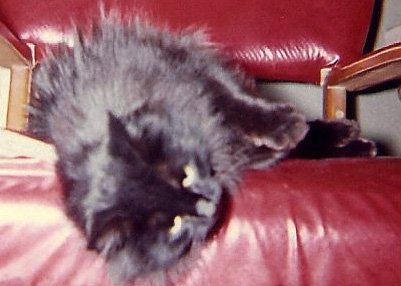
While MC would not submit to a photo due to the sensitive nature of his proposed operation, Demon was quite willing to have her photo taken. The poised claw suggests we don't mess were her, however.

If you turn white at the thought of castration via the “Old Country” method, do not read this article. It is not supported by the SPCA, nor does the author endorse it…

I grew up in a semi-Italian neighborhood, semi in the sense that half our neighbors were Italian. On the north were the Passerini’s who provided our family with spaghetti, apples and their son Johnny. (See “The Attack of the Graveyard Ghost” under MisAdventures.)

Papa Passerini had another offering, a cheap way to castrate cats.

Over the years we had several cats, two of which were memorable, Demon and MC. Demon was as dark as the night and an expert hunter. One of my jobs was to dispose of the treasures she brought home and left on our doorstep.

MC was pure white. He was a tomcat’s Tom Cat, somewhat diminutive in size, and totally dedicated to scattering his sperm.

Unfortunately, his small size meant that he often came out on the losing end in his battles with larger tomcats over a chosen lady’s favors. He would arrive home beat up and battered. One time a chunk of his ear was missing. Another time it was the tip of his tail.

Pop (my father) decided that drastic measures were called for. MC would have to have to lose his offending appendages. Papa Passerini suggested an Old Country solution.

“All you need is a pair of tin snips, a burlap bag, gloves, a pocket knife and rope,” he suggested.

While MC had never been a paragon of feline domesticity, he was at least partially tame.  He even managed a brief purr when I picked him up the morning of his ‘operation.’

Any previous pretensions of tolerating people ceased instantly when his legs were tied up and he was dumped into the dark gunnysack.

When Pop cut a slit in the burlap with his pocketknife and reached a gloved hand through, he was met by claws of fury. M.C. had shed his ropes faster than Houdini.

No one, but no one, was going to grab him by the testicles and snip them off with tin snips. He clawed his way out of the bag and became a white blur as he disappeared into the Graveyard.

After that we would only see MC at dinner time and then only after we had put his food down and walked several feet away. Can’t say I blame him…

A Dead Skunk Reeks Revenge

Dead skunks reek revenge; it’s a fact of life for roadkill aficionados, otherwise known as bicyclists.

In 1989 I did a 10,000 mile solo tour of the US and Canada on my bicycle and became a specialist in what North America offers in the way of dead animals. I quickly learned that different regions produce different roadkill. For example, if you are interested in smashed armadillos, go to Louisiana.

Dead skunks, on the other hand, can be found decorating pavement everywhere. Lately, Peggy and I have had to dodge several on our 13-mile drive home from the small town of Ruch, Oregon to our new home in upper Applegate Valley.

I use dodge somewhat loosely since there is no way to avoid the aroma. Dodging a dead skunk is infinitely better than hitting a live one, however. I did that once. It was on my first ‘driving’ date, ever. I was 15.

Paula called me. The date involved Mom, Boyfriend, Paula and I going out to dinner in the small town of Sutter Creek, about twenty miles away from Diamond Springs over California’s curvy Highway 49.

After we filled up on Italian food, Mom and Boyfriend promptly climbed in the back and suggested I drive home.

“Um,” I noted nervously, “I only have a learner’s permit.”

“That’s okay, it will be good practice,” Mom stated before I could add that I had just obtained the permit the week before.

Paula, meanwhile, was waiting for me to open the door for her on the passenger side of the car. She gave me an encouraging smile and my options dropped to zero. Any further hesitation would appear wimpy, which is a definite no-no on a first date.

After doing the gentlemanly thing for Paula, I dutifully climbed into the driver’s seat and miraculously found the keyhole and lights. Minimal gear grinding got us out of town and I breathed an audible sigh of relief.

We had made it just past Plymouth when I ran over the skunk. Its response was to become a virtuoso of glandular activity.

“Oh, don’t worry about it,” Boyfriend said as the first powerful whiffs of eau de skunk came blasting through the air vents, “it happens all of the time.”

“Yeah, sure,” I mumbled to myself through tongue-biting teeth, “young men always run down skunks on first dates, especially first dates with Mom and Boyfriend along.”

Fortunately I made it home without further incident.

There is another roadkill story here, though. This one involves a cat and took place in the same area 25 years later.

While working for the American Lung Association of Sacramento, I had created what is known as the Trek Program, a series of multi-day outdoor adventures that people go on as fundraisers.

At the time this particular event took place, I was living in Alaska. ALA Sacramento had hired George and Nancy Redpath to run its Treks. They had a popular three-day bicycling event that incorporated a portion of the same route that I had traveled the night of the fateful skunk incident.

The Redpaths had added a roadside scavenger hunt to the Trek for fun. A sail-cat was on the list of items to be collected.

For the uninitiated, a sail-cat is a cat that has had an encounter with a logging truck’s wheels, after which it resembles a furry pancake with legs. Given several days of curing in the Sierra foothill sun, the cat can be picked and sailed in much the same way you would a Frisbee, hence the name.

Although tossing sail-cats has provided dogs with a new way to chase cats and play Frisbee at the same time, it is a sport without many adherents. Even dogs have serious reservations.

Not surprisingly, one Trekker managed to find a sail cat, load it on his bike and dutifully turn it in at the end of the day. The person won the scavenger hunt, which he should have considering his extended association with the umpteen-day dead cat.

But wait… there’s more. Two other couples became involved in the dead cat saga. I’ll call them Bob and Carol and Ted and Alice to protect the innocent.

Bob and Carol finished the Trek, hopped in their car and naively drove home that evening unaware that they were carrying a fellow traveler. When they arrived back in Sacramento and opened their trunk, lo and behold, there was the dead cat.

Bob and Carol had a good idea it was Ted and Alice who had stowed the unwanted passenger in their car. They vowed to get even.

As it turned out, both couples had spouses who worked for the State of California. A devious plot was hatched. The next day Ted received one of those large inner-office envelopes in his in-basket. It was rather bulky so he opened it with interest. Out slid the sail-cat, your tax dollars at work.

Unlike Aunt Tilley’s fruitcake, the cat apparently ended his strange after-life journey at that point.