Vietnam: A War Born in Controversy… A Peace Corps Memoir from the 60s

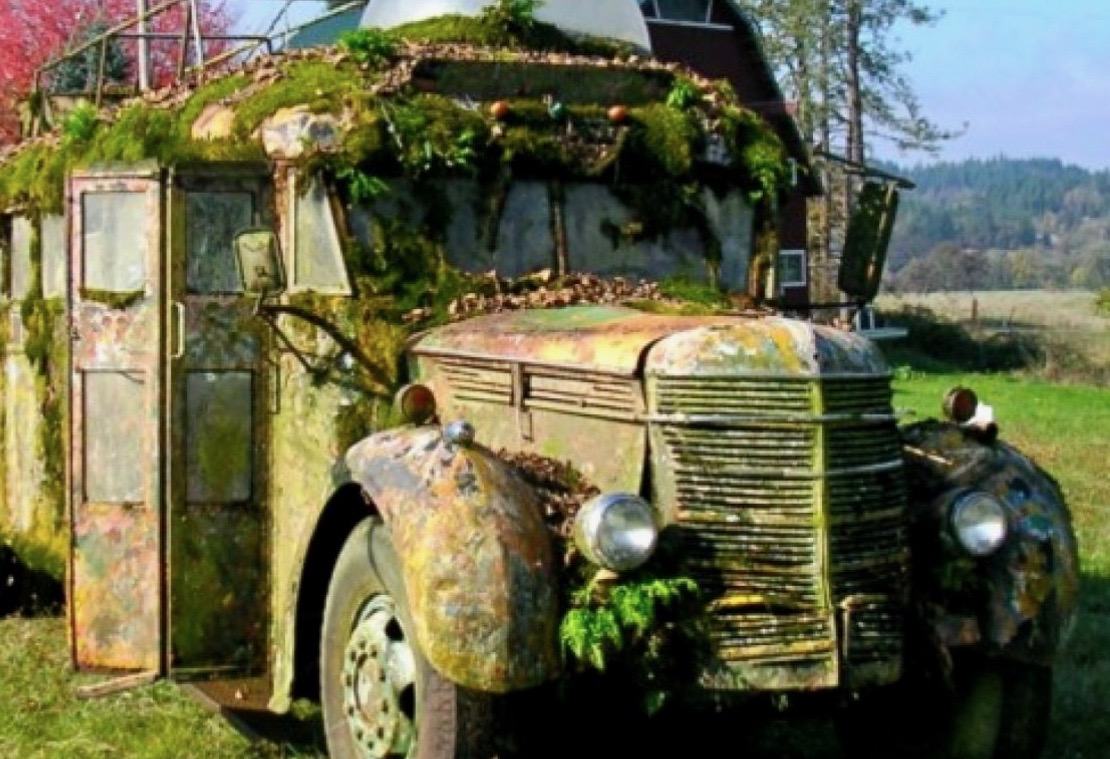
I was walking toward the first big Anti-Vietnam War protest on the Berkeley Campus in 1965 when a crazily painted bus drove up and stopped. Out piled a group of people who were dressed in outrageous outfits and had their faces painted. The bus was Further of hippie fame and the people were Ken Kesey’s Merry Pranksters. Like me, the ‘slightly’ aging bus now lives in Oregon. I’m in better shape.

The conflict in Vietnam dated back to 1946. It was born in controversy. France had lost her colonial empire in Indochina to Japan during World War II and Charles de Gaulle wanted it back. The Vietnamese Marxist Ho Chi Minh wanted independence. The Indo-China War was the result. In hope of expanding their influence, Russia and China sided with Ho Chi Minh. NATO and the US jumped in to thwart the Communist powers and support France.

In 1954 the Geneva Accords divided Indochina into four countries: North Vietnam, South Vietnam, Laos and Cambodia. Under President Eisenhower, the US replaced France in the fight against North Vietnam by providing ‘military advisors’ and financial aid to the politically corrupt regime of Ngo Dinh Diem in South Vietnam. Over the next ten years our support continued to grow. John Kennedy dramatically expanded the effort by increasing the number of military advisers from 700 to 15,000. 

By the time I was ready to graduate from Berkeley, Lyndon Johnson was ready to send in the troops. The Cold War was raging. America’s leaders saw Vietnam as a critical step in stopping the spread of communism. Lose Vietnam, the Domino Theory argued, and all of Southeast Asia would follow.

My political science professors in International Relations at UC Berkeley had a different perspective. Communism was changing. It was no longer monolithic in nature but had taken on nationalistic flavors. Communism in Russia was different from communism in China. The Russians were as fearful of Chinese massing on their border as they were of the US’s nuclear weapons.

One day I arrived at my class on Comparative Communism and learned my professor had been invited to Washington to provide advice on Vietnam. The message he carried was that Ho Chi Minh was a nationalist first and a Marxist second. He wanted to reunite North and South Vietnam. He was no more interested in being dominated by Russia or China than he had been in being dominated by France. Becoming involved in a full-scale war was not in the best interest of the United States and might prove to be a costly mistake.

Washington was not ready to listen. America’s leaders had grown up on a steady diet of Cold War rhetoric. Not even the insanity of McCarthyism had shaken their faith. Being ‘soft on communism’ was political suicide. When Khrushchev banged his shoe on his desk at the United Nations and said he would bury us, we banged back.

Lyndon Johnson and his closest advisers believed in the anti-communist threat but there was more. America was the leader of the Free World. Our image was involved. Lose Vietnam and we would lose prestige. Johnson took the matter personally. We would not lose Vietnam on his watch.

But I was convinced there was more to the fight in Vietnam than a communist grab for power. The focus of my studies on Africa in 1965 was about the struggle for independence from colonial powers.  I felt Ho Chi Minh was involved in a similar fight.

A huge rally was held on campus in May. It was one of the first major Anti-Vietnam protests in the nation. I went to listen. Dozens of speakers including Irving Stone, Dr. Spock of baby fame, Senator Gruening from Alaska and Norman Mailer spoke out against the war. Later the House Un-American Activities Committee targeted the event’s organizers. If Vietnam was part of a communist plot to take over the world, then dissent in the U.S. against the war was part of that plot. The same FBI agents who had prowled on the fringes of the earlier Free Speech Movement were undoubtedly prowling the edges of the protest, taking pictures and taking names. 

In some ways, the rally was like a circus. Over 30,000 students and anti-war activists participated. Folks from the throughout the Bay Area poured on to Union Field and there were lots of interesting people in the Bay Area. Haight Asbury and the hippie era was still a year off, but the elements were all in place. I was standing on Bancroft Avenue when a crazily painted bus drove up and stopped. Out piled a group of people who were dressed in outrageous outfits and had their faces painted. They danced by me, apparently high on something. 

“It’s Ken Kesey and his Merry Pranksters, a more ‘with-it’ girl standing next to me explained. “Neal Cassidy drives the bus.” 

Cassidy had been part of the Beat Generation and a friend of Jack Kerouac. He had been immortalized as Dean Moriarty in “On the Road.” His connection with Ken Kesey and the Merry Pranksters would introduce another type of trip to him: LSD. Tom Wolfe’s book, “The Electric Kool-Aid Acid Test,” chronicled the experience of the Merry Pranksters on their gaily-painted bus named Further as it made its psychedelic journey across the US.

What I had learned about Vietnam in my classes and at events like the protest created a dilemma for me, as it did for most young men of my generation. If drafted, I would go. I couldn’t imagine burning my draft card or moving to Canada. I actually believe we owe our country service. But fighting in a war I didn’t believe in was at the very bottom of the list of what I wanted to do when I graduated. And there was more. I am allergic to taking orders and can’t stand being yelled at. I’d make a lousy soldier. I saw a court-martial in my future.

Luckily, Peace Corps Recruiters were coming to Berkeley and Peace Corps was something I truly wanted to do. I could serve America in my own way. Peace Corps service would not eliminate my military obligation but it might buy time for the Vietnam conflict to end.

In my next post on the Peace Corps, I visit with the recruiters and fill out a long application. I even take a language test, in Kurdish. Go figure. But that is a story for this fall. Next Monday will be my last regular post for the summer. Peggy and I are going on vacation. 🙂 I’ll write about it on Monday.

FRIDAY’S TRAVEL BLOG: We are going on a walk up a trail I created in the forest behind our home. Am I a trail blazer, or what? A buck plays contortionist, poison oak lurks, and an old cave speaks to the area’s gold mining history.
The Mekemson Kids Did It: Part I… Sweet, Stolen Cherries and a Gallon of Italian Red

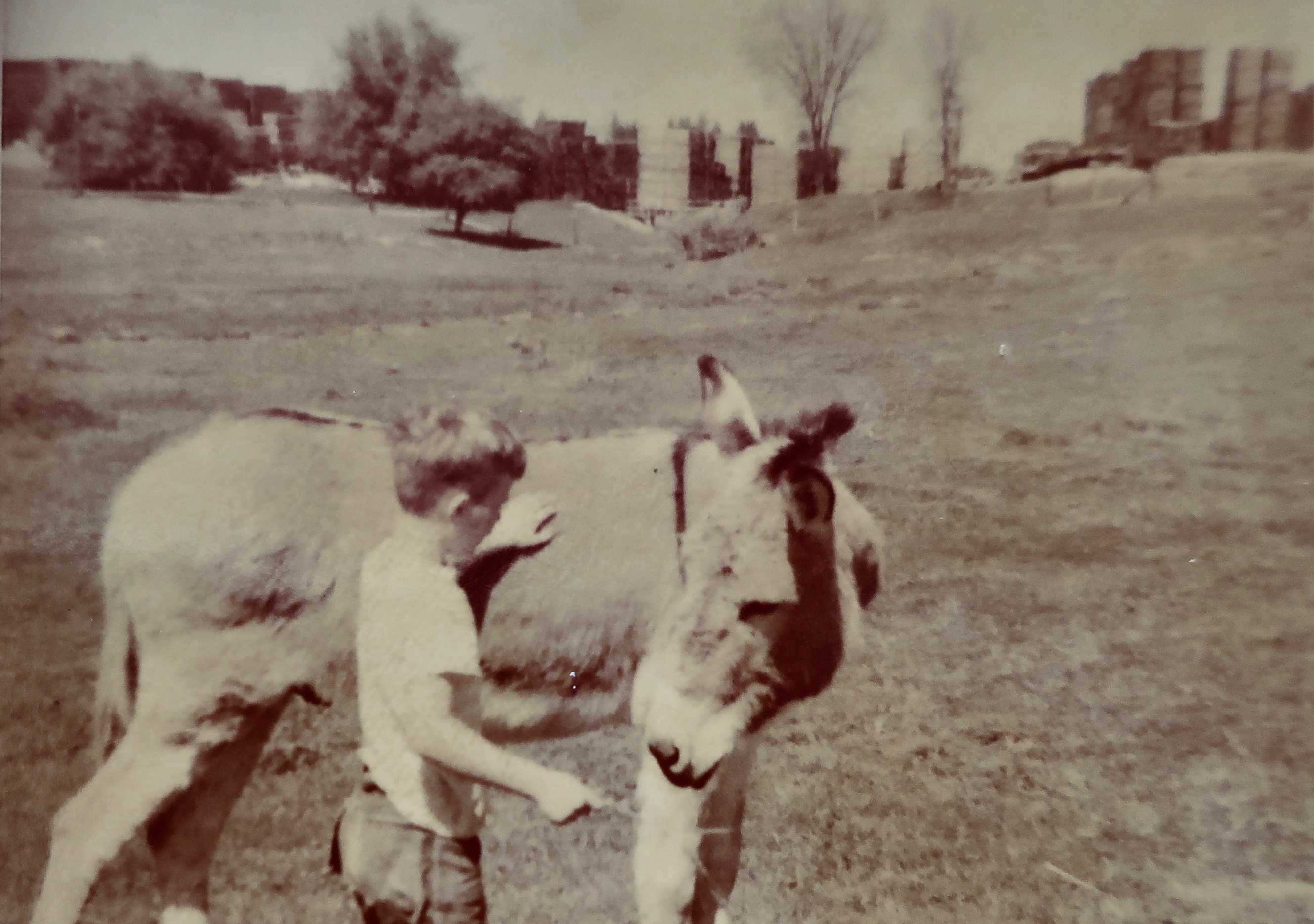
It’s hard to imagine that this innocent looking young fellow petting a donkey could be part of the infamous Mekemson Gang. BTW, note the stacks of lumber drying at Caldor Lumber Company. One of our sports was climbing to the top of the stacks and leaping between them. Woohoo!

While the Pond and the Woods provided an innocent and often educational escape for me, much of my outdoor time was spent getting into mischief, especially in my younger years when I roamed around Diamond and the surrounding countryside with my brother and our friends. What I remember most about these great adventures was that we were skating on the thin edge of trouble. 

Gradually, we developed a reputation. I am convinced that a whole generation of little kids in Diamond blamed their misbehavior on us. “I didn’t do it Mama, the Mekemson kids did.” And Mama probably believed them. The mother of my life-long friend, Bob Bray, did. She refused to let him play with me. I was a bad influence, guaranteed to lead her son straight into the arms of the law.

Most of our mischief was relatively harmless. For example, Jimmy Pagonni lived across the street and had a zero-tolerance policy for us.  We lusted after his cherries. He transformed them into wine and every drop was precious. He turned his dogs loose on us if we came anywhere near his orchard. Naturally his insistence on keeping us out only guaranteed our presence.  Raids were carefully planned.

We would invite two or three friends over and make a party out of it. The cover was sleeping out in the backyard, but sleep was secondary. Somewhere around one o’clock in the morning we would slip out of our yard, cross a very lonely Highway 49, climb over Jimmy’s rickety gate, and disappear up into the trees. It was all very hush-hush and cherries have never tasted more delicious. We would stuff our stomachs and then fill up bags for take-out. It was pure greed.

Jimmy’s dogs never caught us before we were able to scramble over the gate but they did catch my cocker spaniel, Tickle, once, and almost killed him. Tickle had been out on the town visiting a lady friend and took a shortcut across Pagonni’s property. We were infuriated. Marshall retaliated by shooting Jimmy’s bull in the balls with a BB gun. (If not fair to the bull, it was at least alliteration.) Jimmy never knew Marshall committed the heinous act but I am sure he had his suspicions.

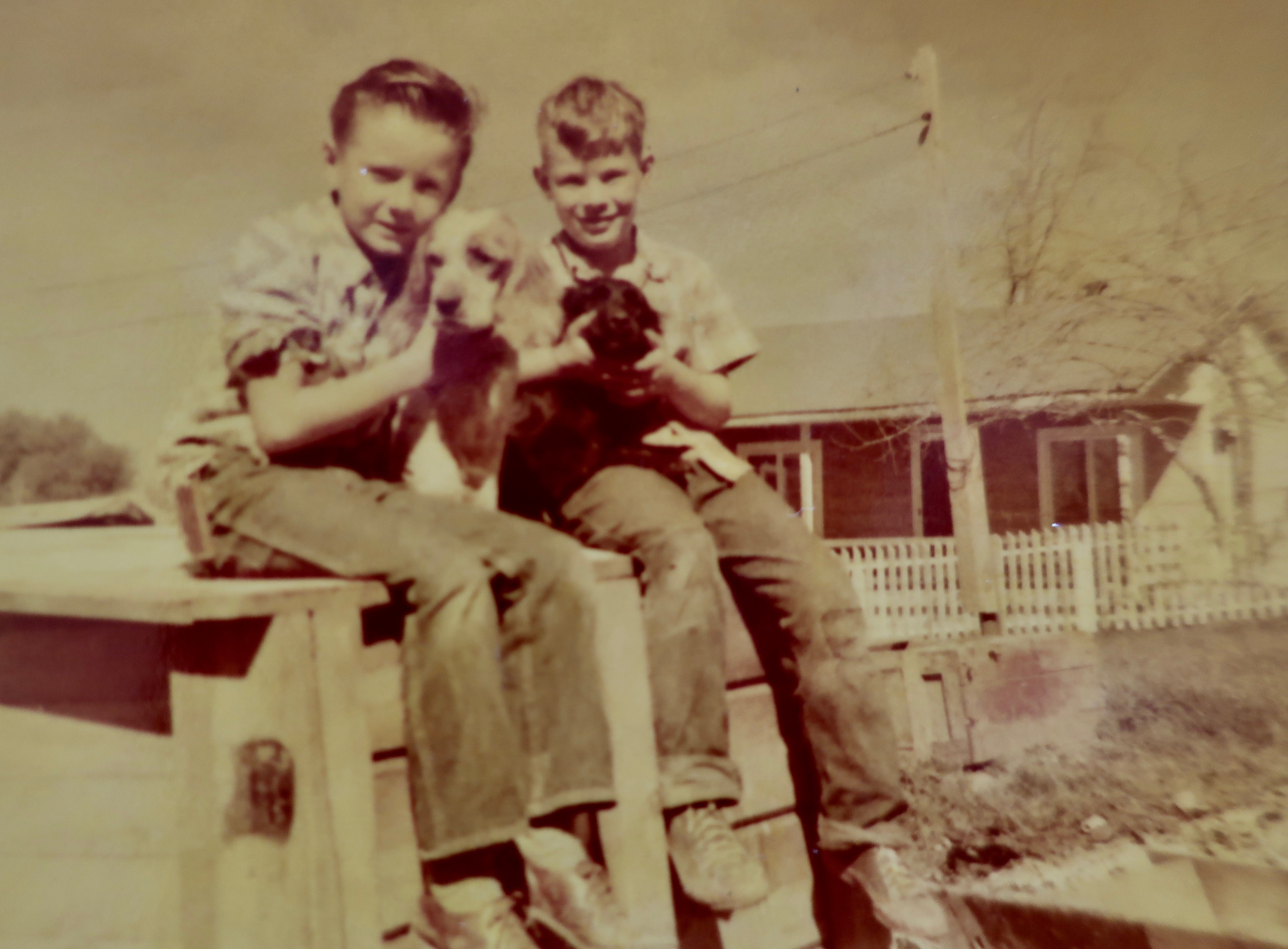
Marshall, Tickle, another family pet and I sitting on our goat shed. I was in charge of the goats.

Even more serious, an older Marshall (eighth grade I think) stole a jug of Jimmy’s wine. He stored the fermented cherry juice in an old Gold Rush era building that may have served as a jail in its youth. It was located right in the middle of his well-guarded cherry orchard and featured a stout locked door and one barred window. I am sure Jimmy considered it impregnable but he failed to consider just how skinny my brother was. With help from his friend Art, Marshall managed to slip through the bars one night and pinch a gallon of Italian Red. 

He and Art then headed for our treehouse in the Graveyard to do some serious imbibing. Considering that a gallon of Jimmy’s Italian Red would have knocked out two grown men, it almost killed Marshall, not to mention encouraging strange behavior. He described how Mrs. Ross, my 4th and 5th grade teacher, came upon Art and him madly peddling their bikes. This wouldn’t have been strange except they were lying on their backs holding the bikes above them in the air!

I remember him slipping in the back door and trying to get to our bedroom before Mother and Pop noticed. It didn’t work. In addition to stumbling and mumbling and heaving, he smelled like a three-week gutter drunk. He was one sick kid. Both parents hurried to the bedroom out of concern and I moved back outside to sleep in the cool, but fresh fall air. It was one of those crimes that incorporates its own punishment.

The question in next Monday’s post from my blogged book It’s 4 AM and a Bear Is Standing on Top of Me, is who shot Pavy’s pig? The sheriff wanted to know.

WEDNESDAY’S POST from my Peace Corps Memoirs: As I came close to graduating from Berkeley, I had a choice of how to serve my country: Either join the Peace Corps or be shipped out to fight in a Southeast Asian War.

FRIDAY’S TRAVEL BLOG: We are going for a walk in the woods— on a trail I built. There are wild flowers to admire, a gold mining operation from the 20s and 30s that suggests that there may be gold under our house, poison oak, and a buck doing strange things.

A Cougar, Leapus Buckus, and Lots of Gorgeous Flowers… At Home in Oregon

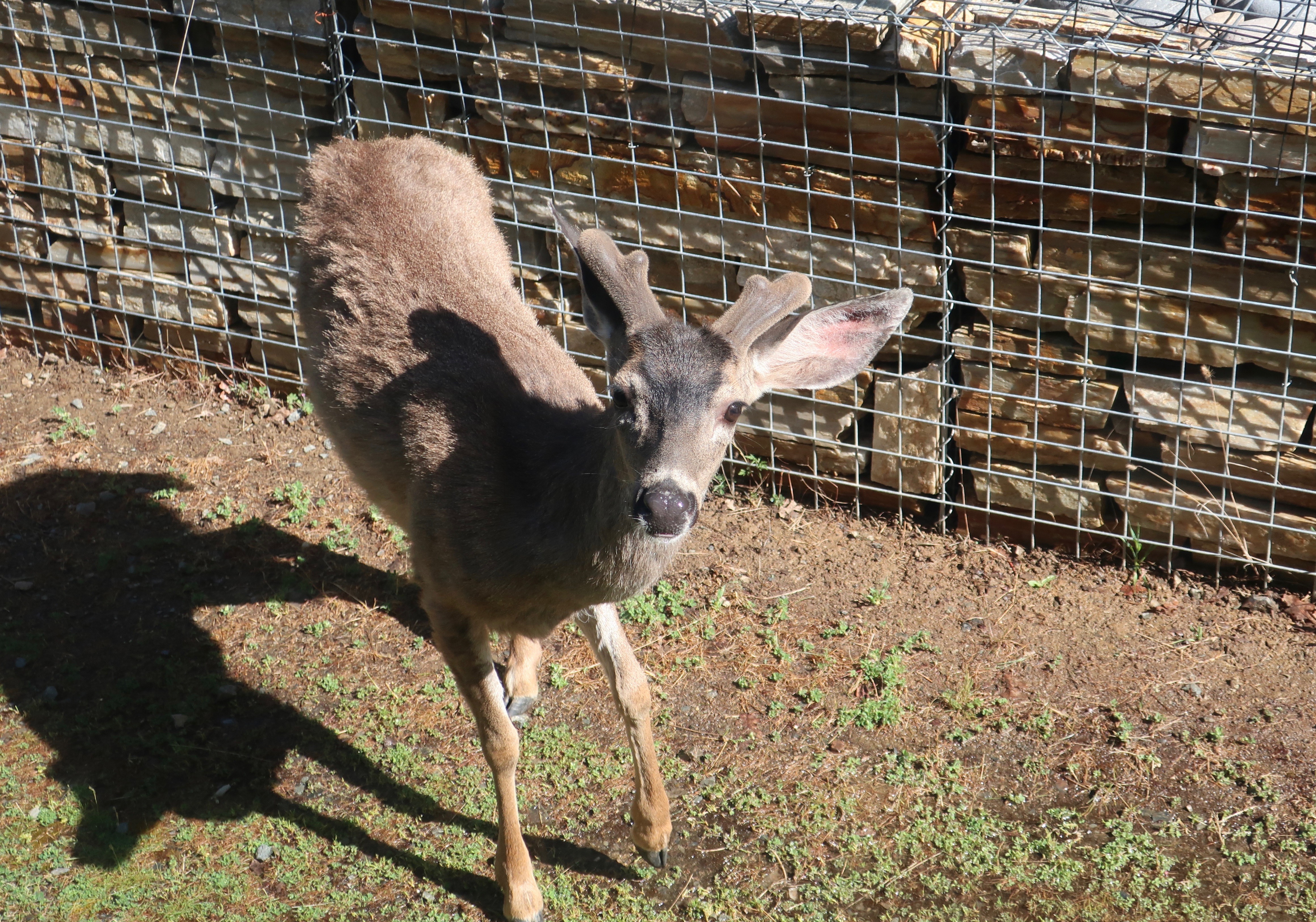
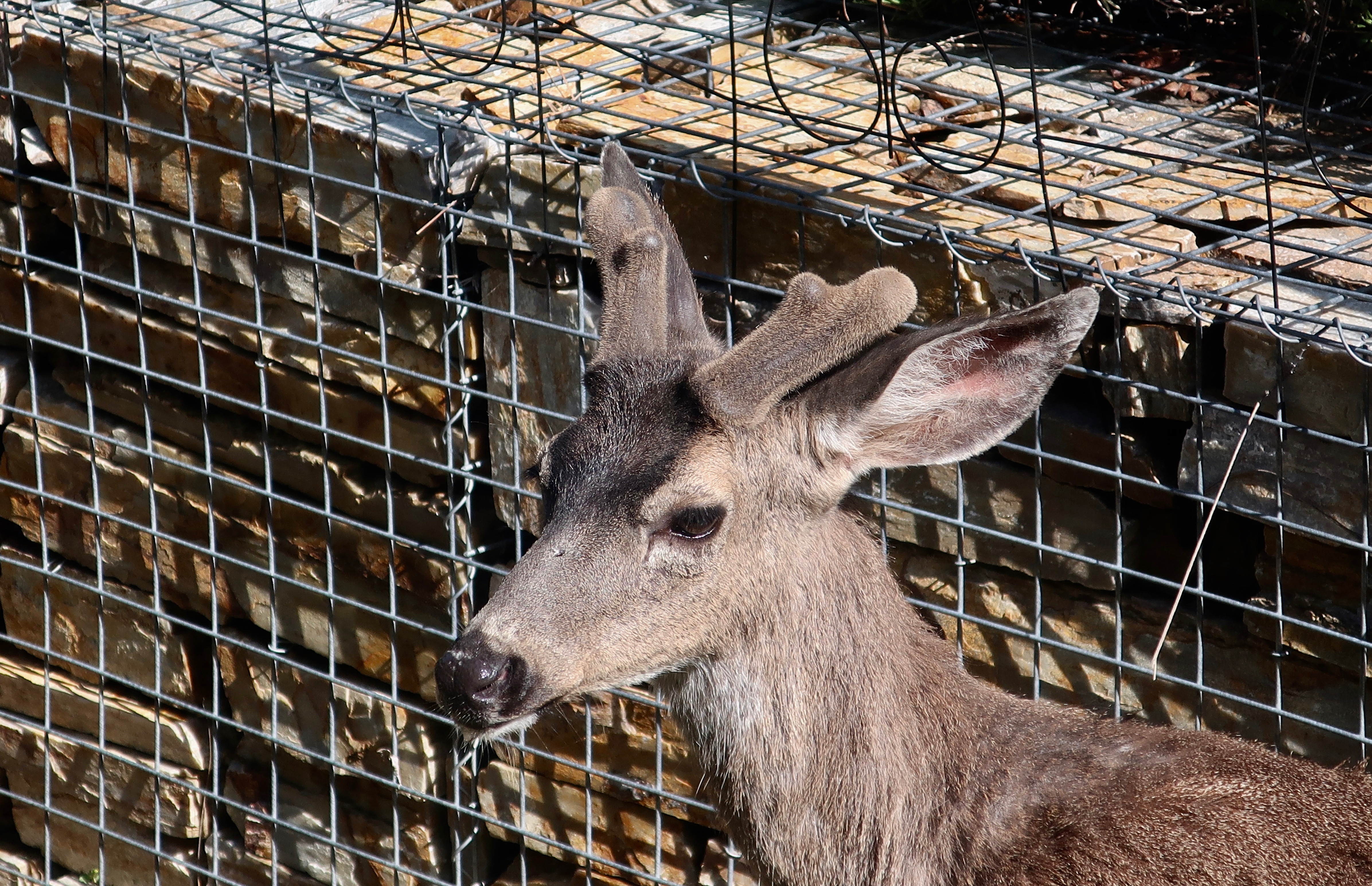
Leapus Buckus, so named because he jumped over the Maginot Line of our Deer Defense last year, stares up at me in defiance. If I didn’t know better, I would say he is pawing the ground like a bull ready to attack. And check out his antlers! They are in velvet now and growing, but they look like they will be humongous, dwarfing his head.

I awoke with a start as a deer leapt onto the deck next to our bedroom in the middle of the night a few weeks ago. They frequently cross the deck but rarely at night and never at full speed. It got my attention— but nothing like the loud thump that followed. I imagined something big and thought of getting up to look. But it was a moonless, pitch black night. I wouldn’t be able to see anything and the intruders would be long gone anyway, I told myself. I decided to go back to sleep. It wasn’t easy.

Our neighbor Bryan called the next night. “I’m shaking, Curt,” he told me. A hawk had taken out a chicken of his during the day and he had gone out after dark to check on the welfare of the flock. What he found was a pair of eyes staring out at him from one side of a large tree. A long tail stretched out from the other side. It was a cougar. Bryan kept his bright flashlight focused on the cougars eyes and slowly backed away. And then called me.

Suddenly, the loud thump made sense. The cougar had been in hot pursuit of a deer and jumped onto our deck in hot pursuit. Welcome to our neighborhood.

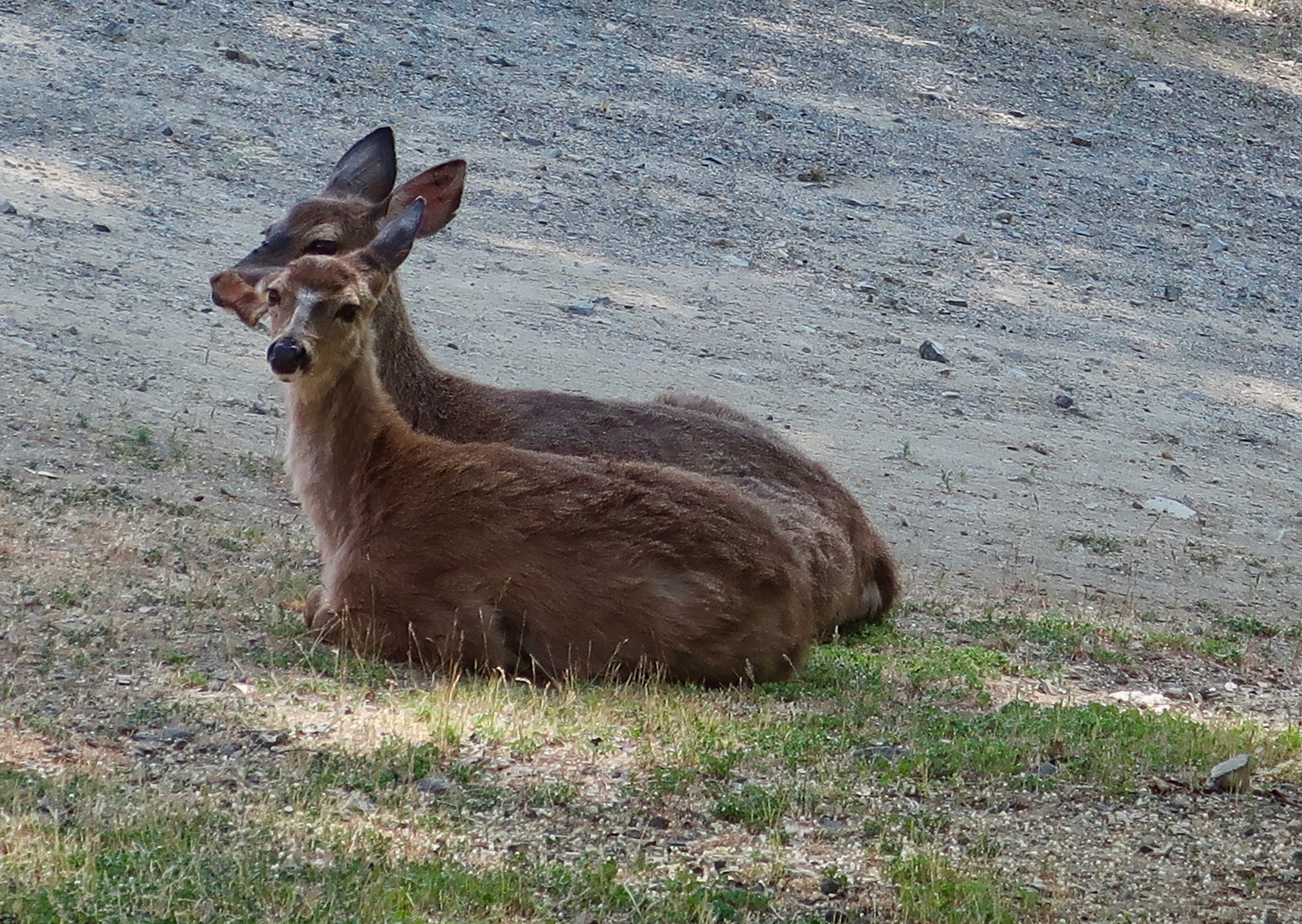
Deer are a common fact of life here. This photo features a pregnant mom and her pregnant ‘teenage’ daughter. I wouldn’t be the least bit surprised if Leapus Buckus wasn’t responsible for both.
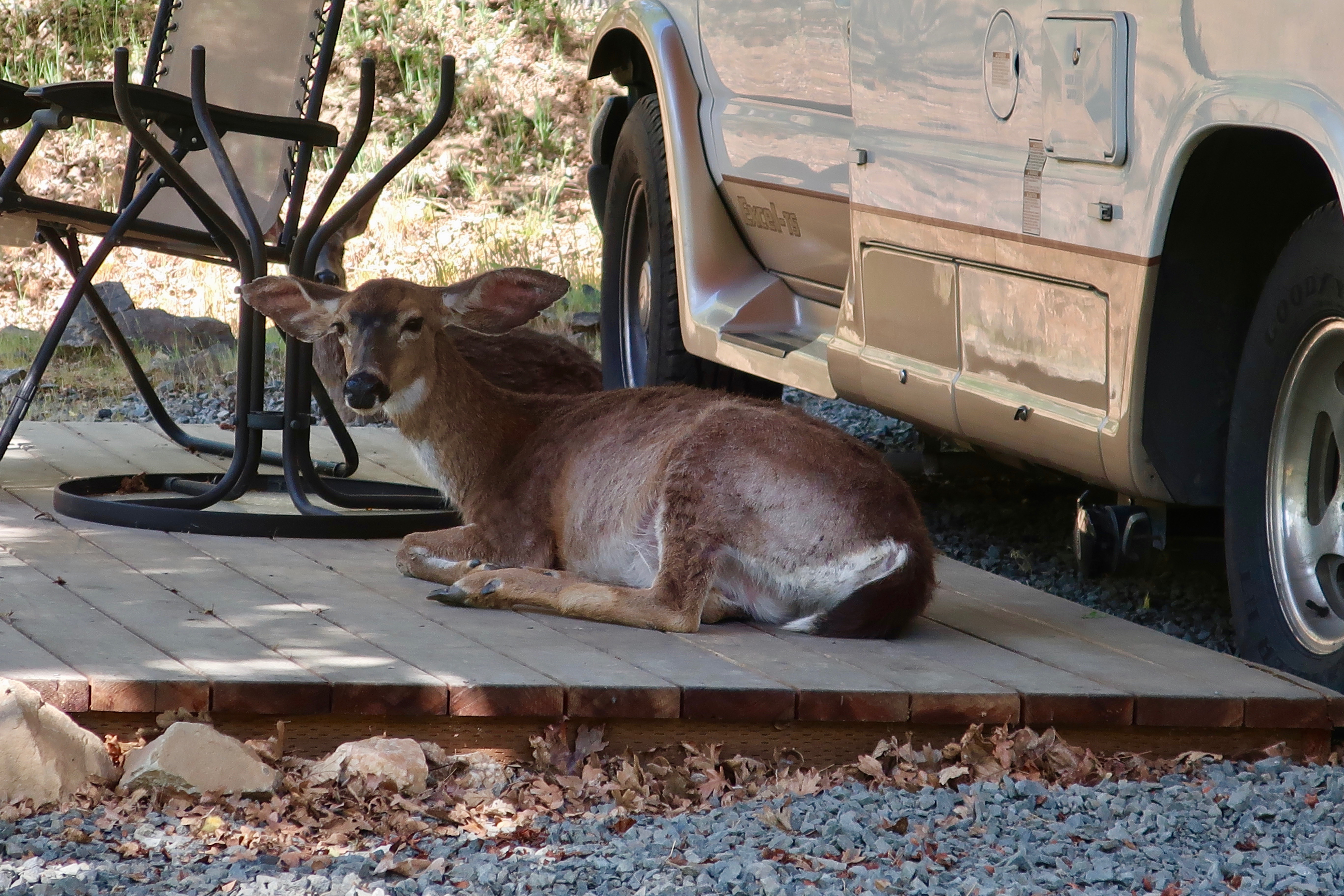
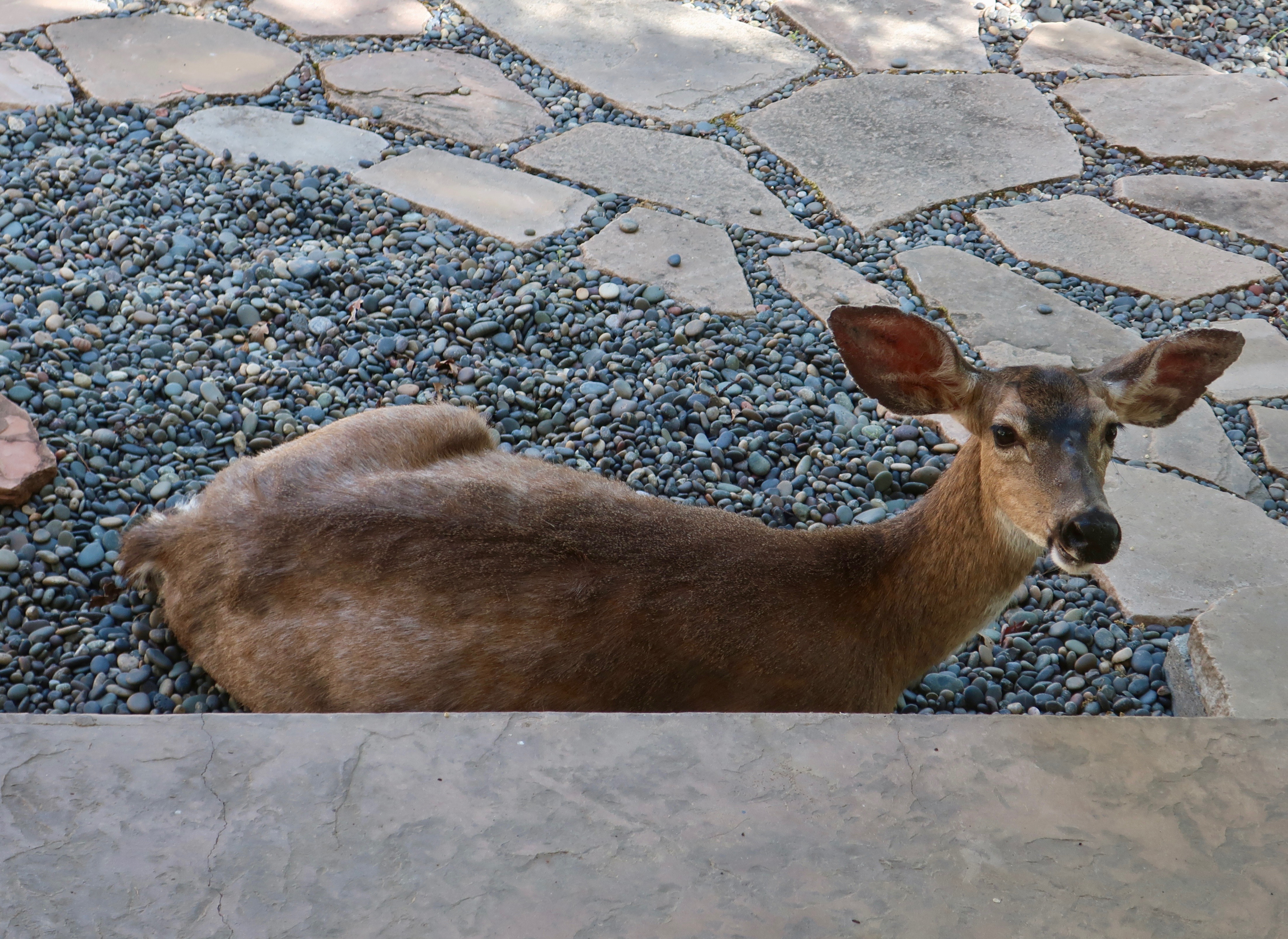
It seems that pregnant moms are everywhere. I’ve counted eight. It’s like we are running a maternity ward. This doe has adopted the deck next to Quivera the RV. Another deer is behind her. It isn’t unusual to find four or five deer sleeping around the van.
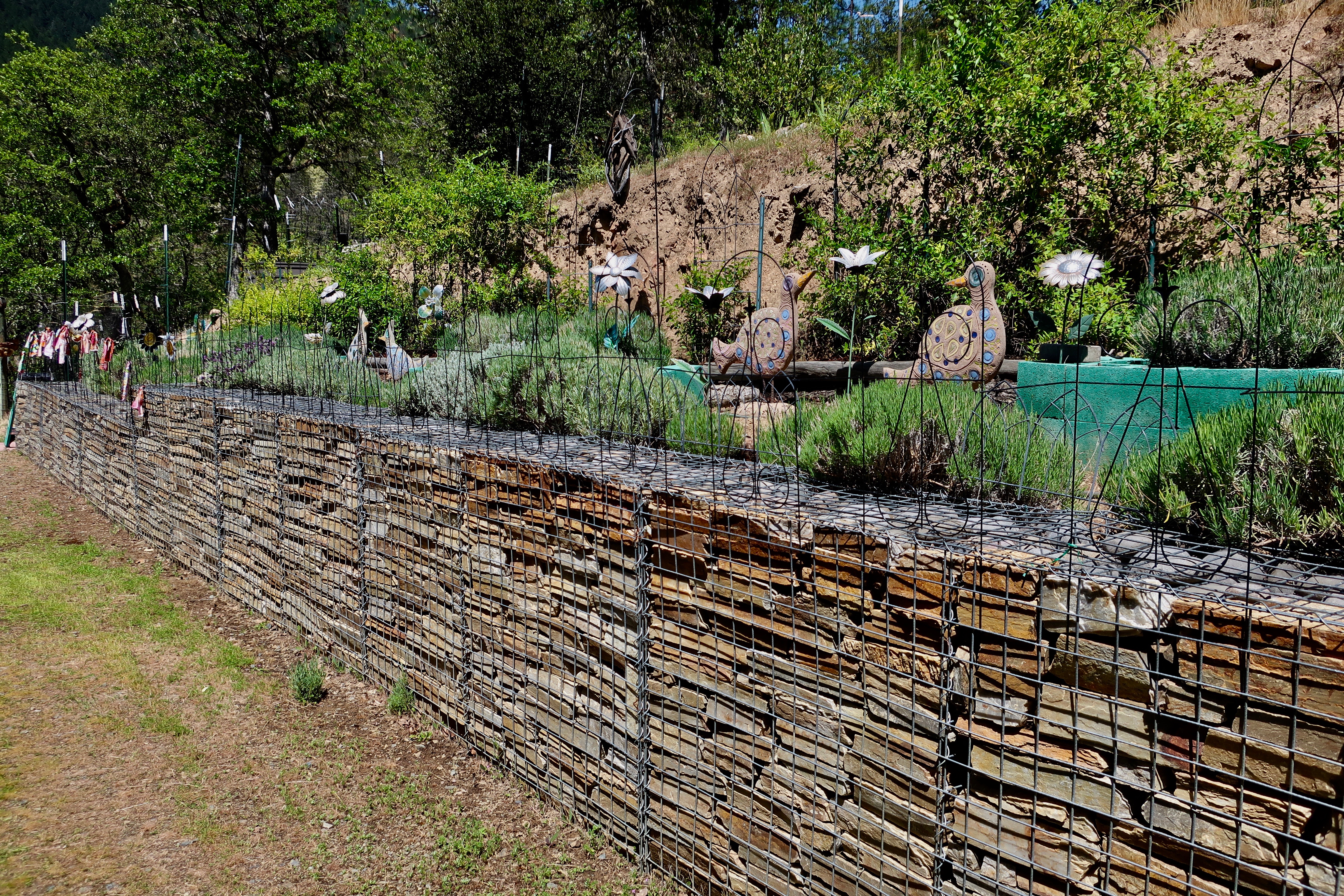
Given the voracious appetite of deer, drastic steps need to be taken to keep the deer out of our flower, shrub and vegetable gardens. This is our Gabion Cage Maginot Line designed to keep them away from our shrubs. There is a small fence on top of the Gabion cages and an eight foot fence on the sides and back of the garden.
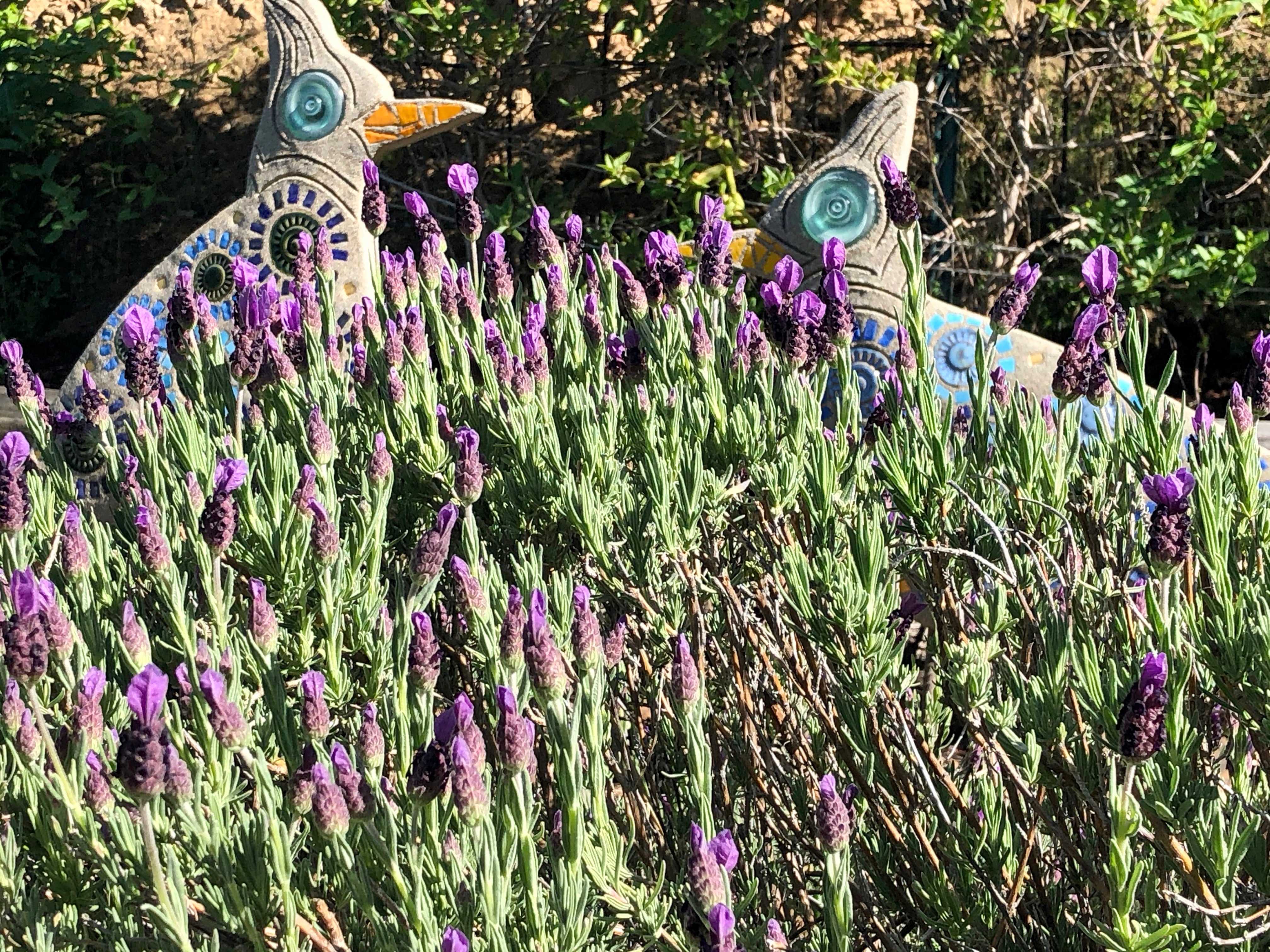
Bird sculptures and lavender serve as part of the defense system. The deer don’t like lavender and the birds plus metallic flowers provide obstacles. They lust after the honeysuckle behind the birds, however, and we found them crawling under the 8-foot side fence a couple of weeks ago. The problem has been corrected. We hope. (Photo by Peggy Mekemson.)
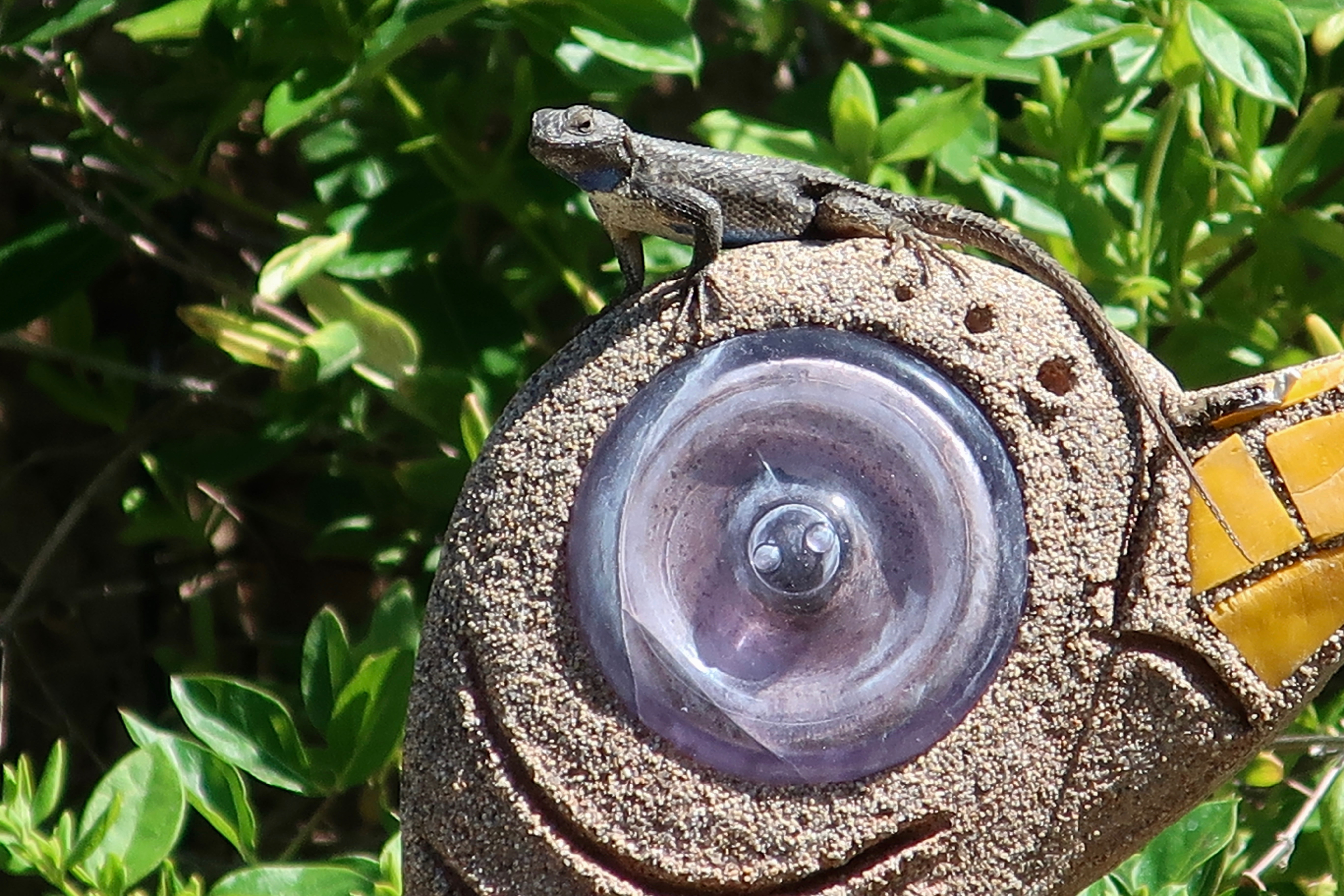
The bird sculptures have become favorite perches for fence lizards, who use them to survey their domain.
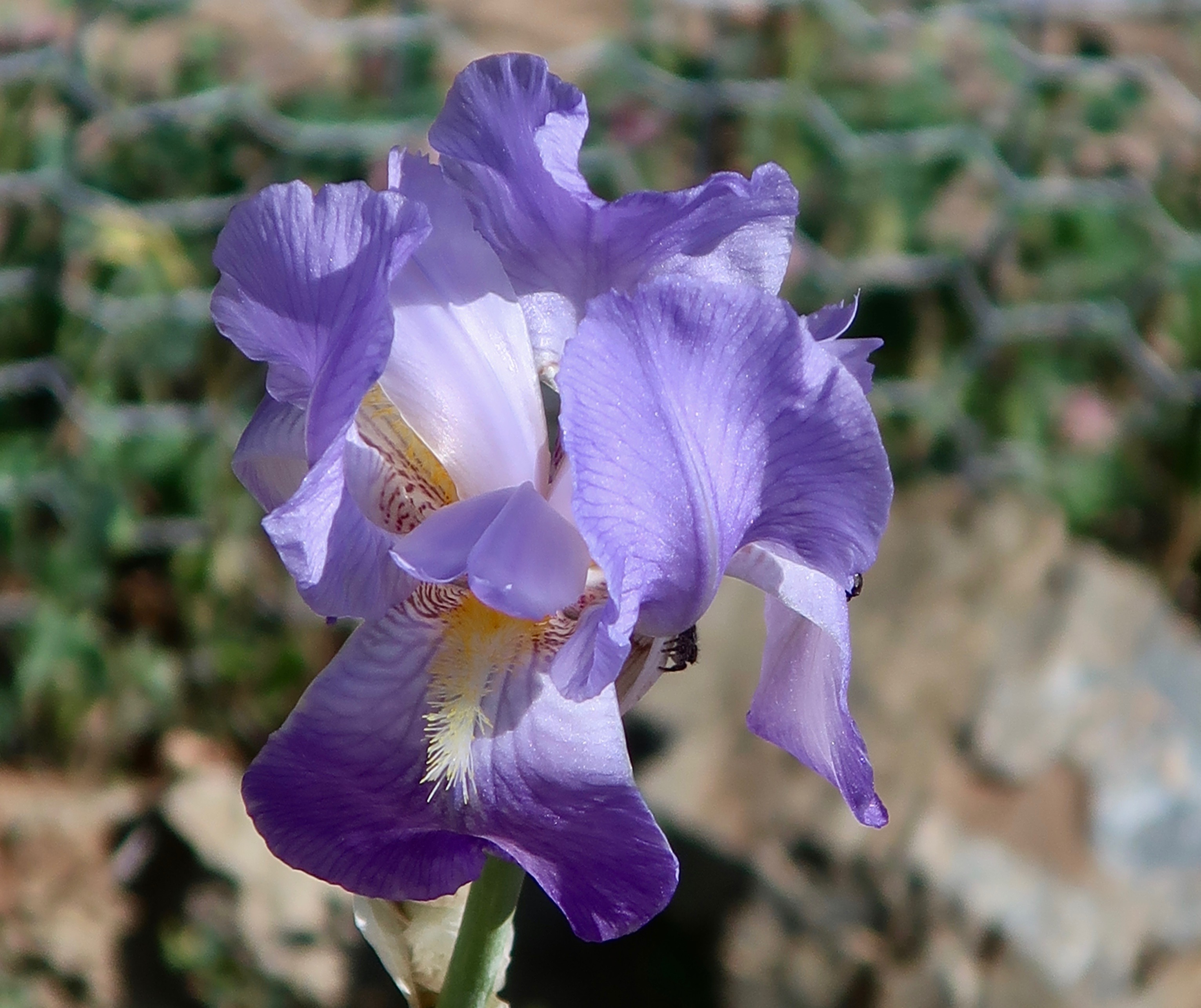
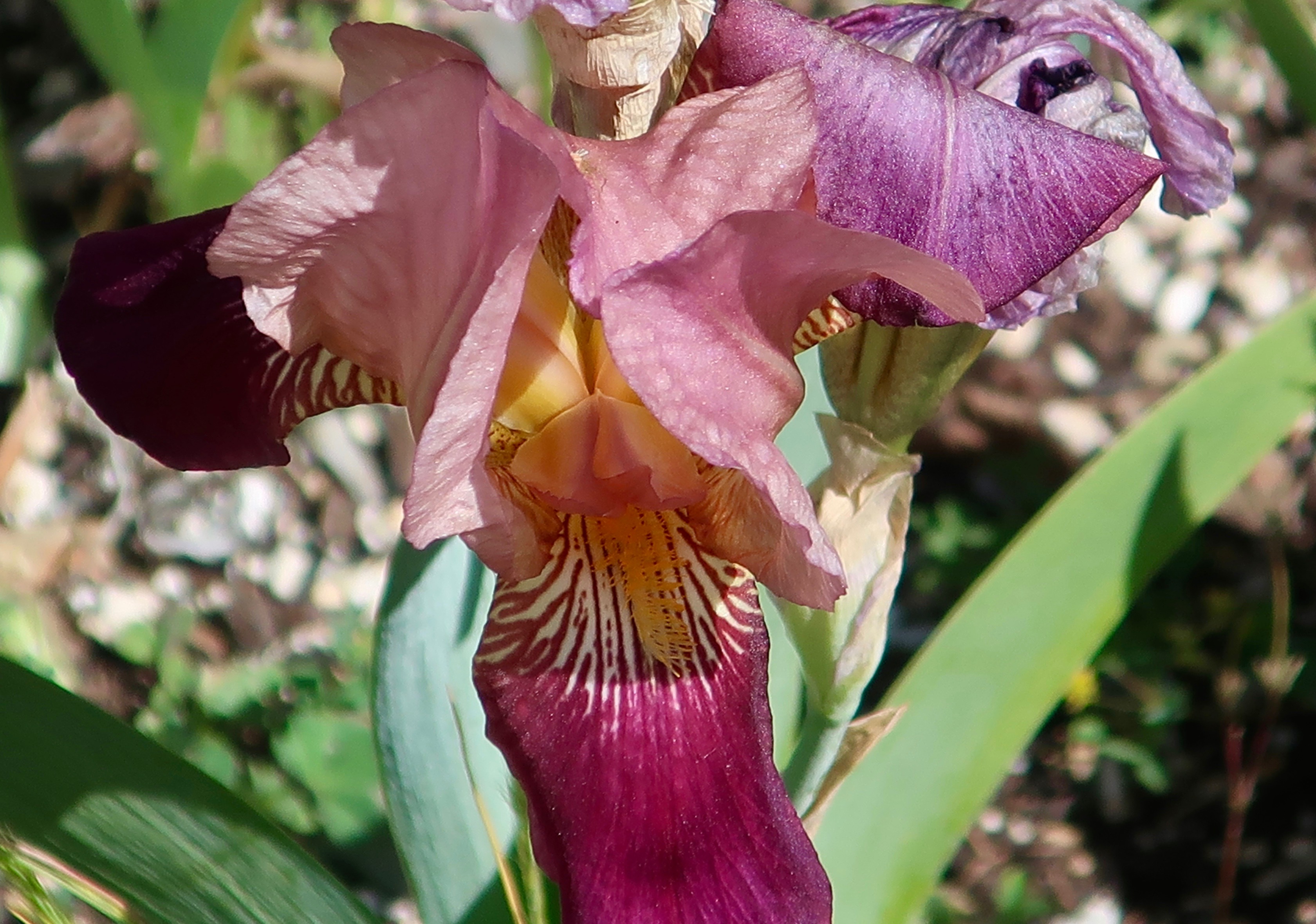
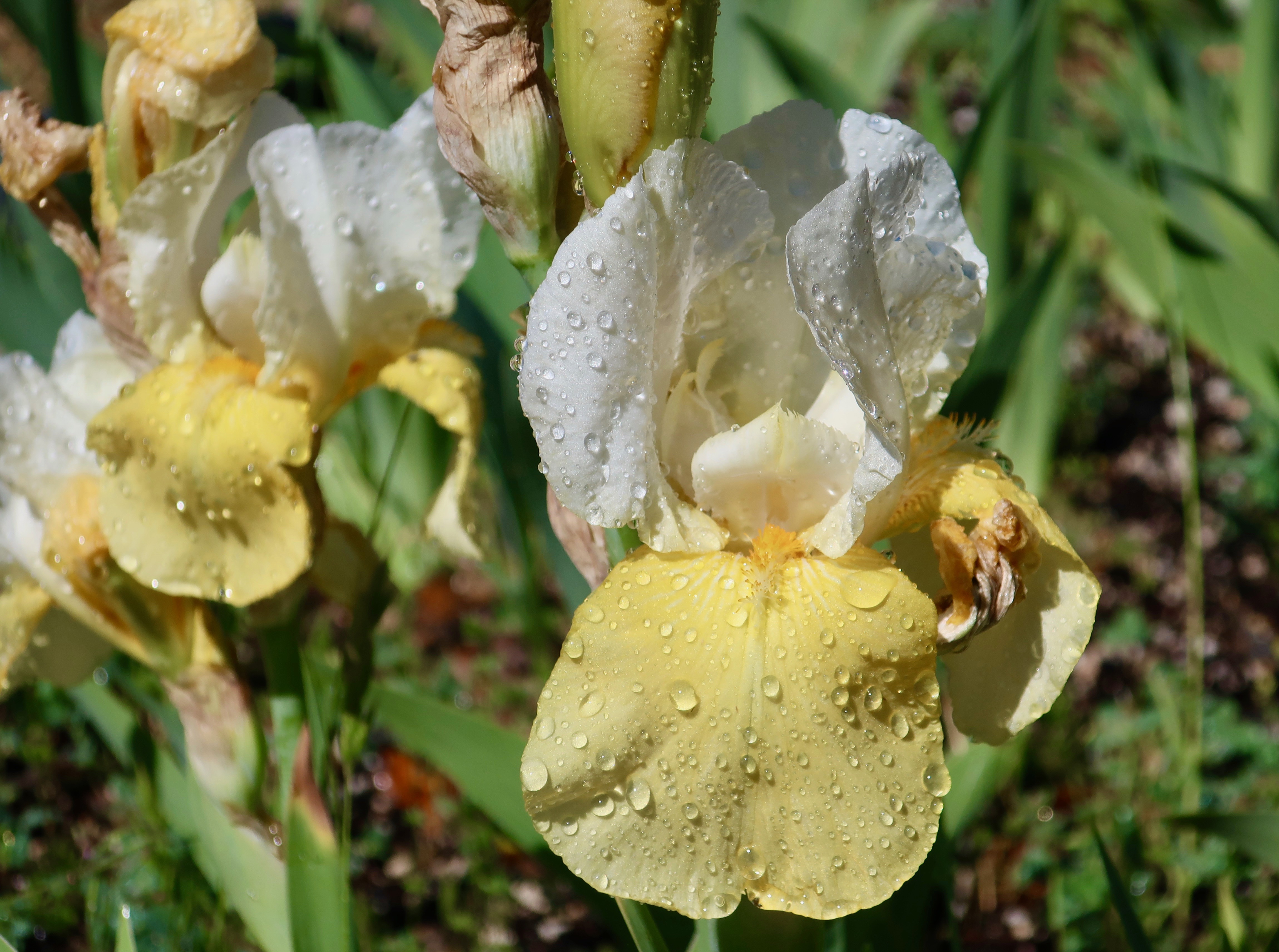
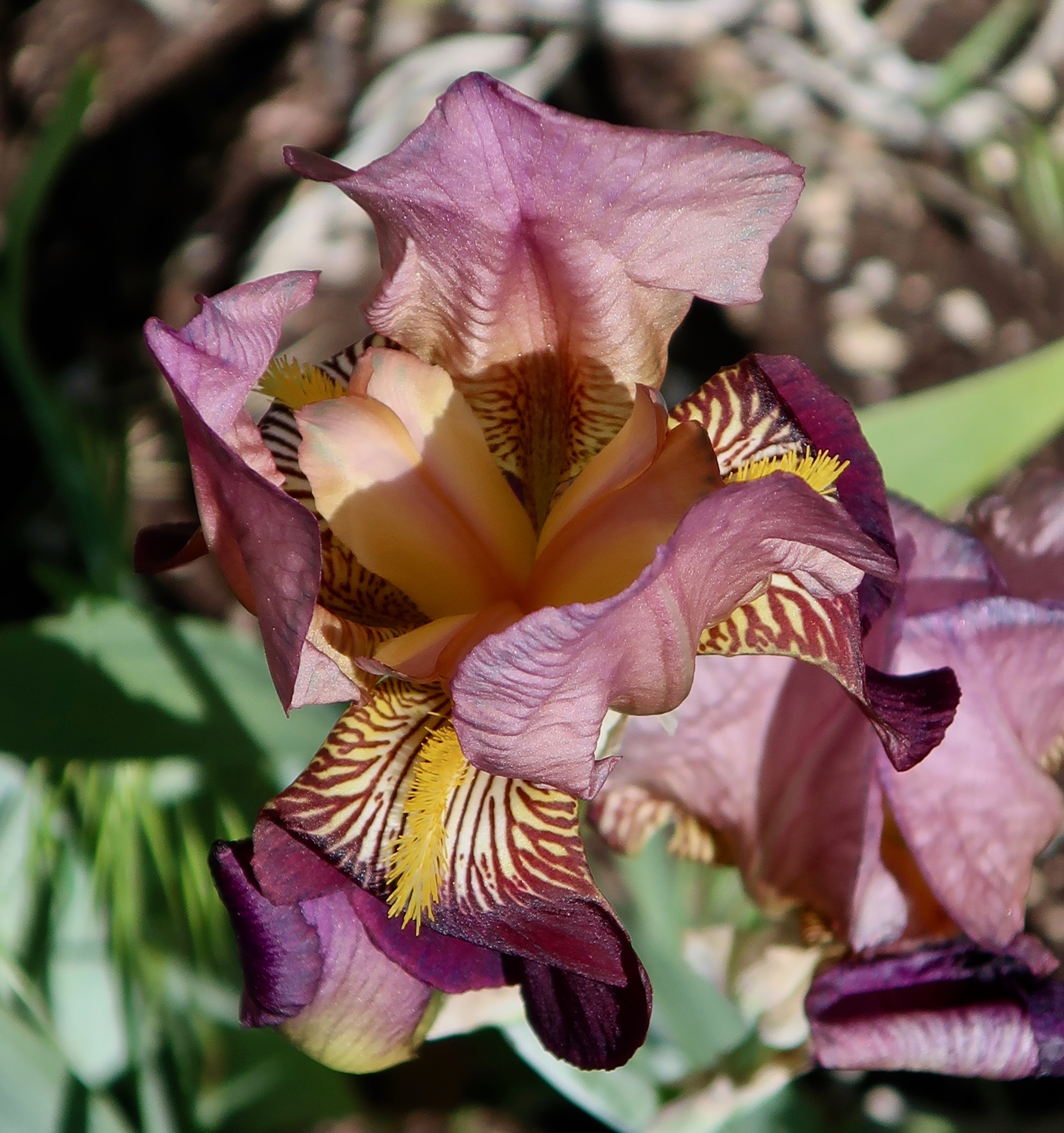
We grow other flowers the deer don’t like outside of the protected area, such as this Iris growing in Peggy’s iris garden. I’ve included other iris below this.
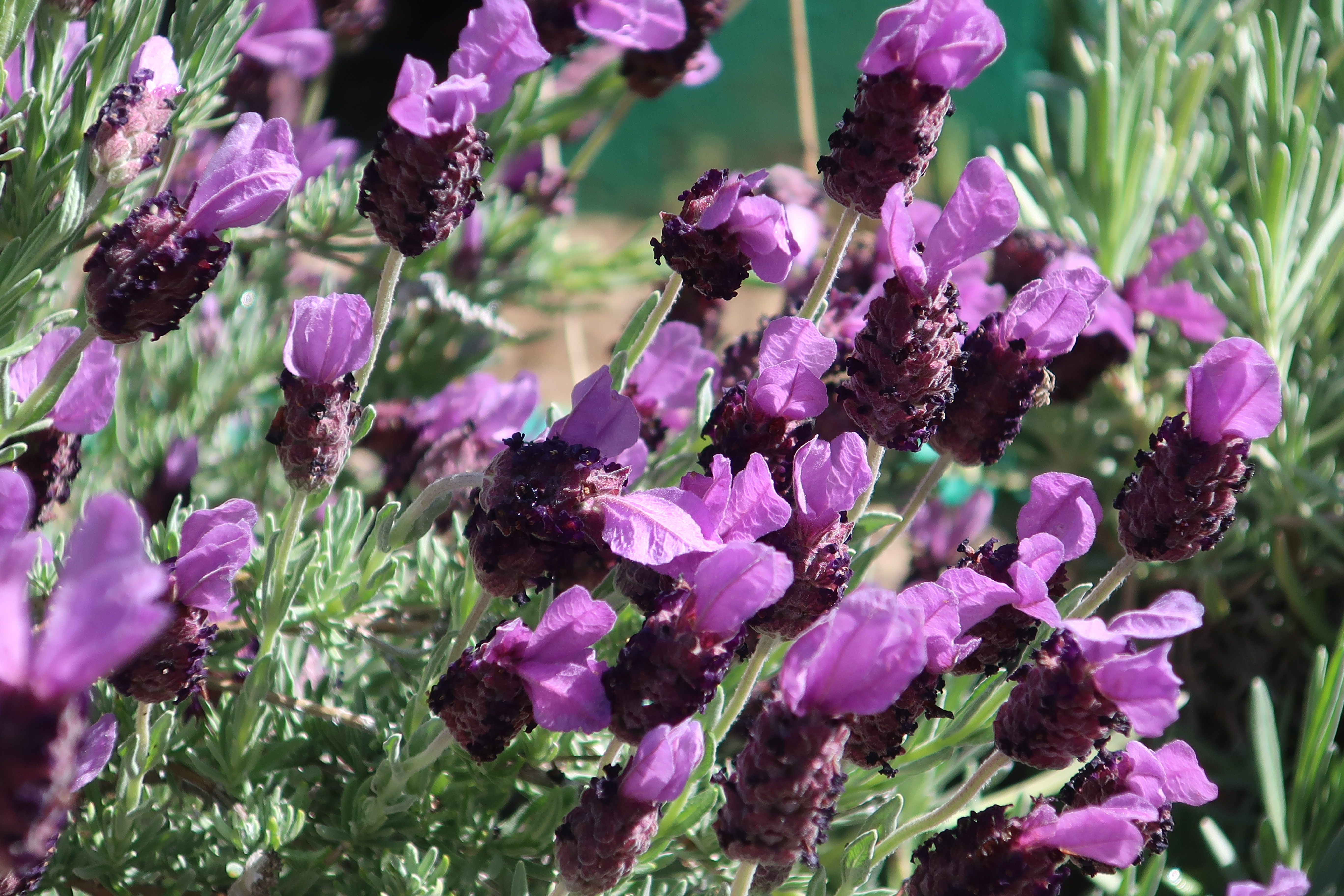
We have several types of lavender planted around our house. This one is the first to bloom.
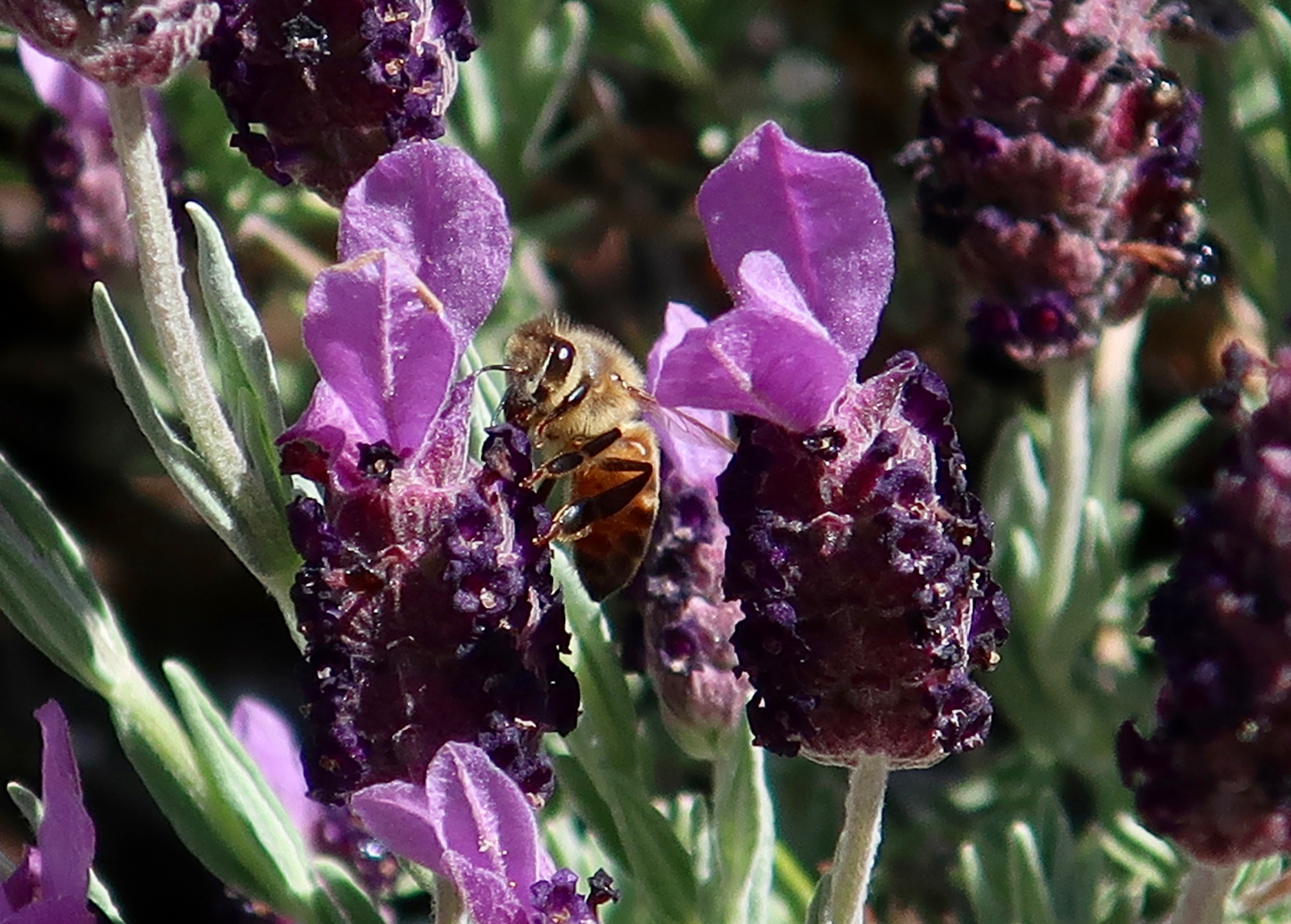
A honey bee stops by to check it out. Soon, there will be hundreds buzzing around.
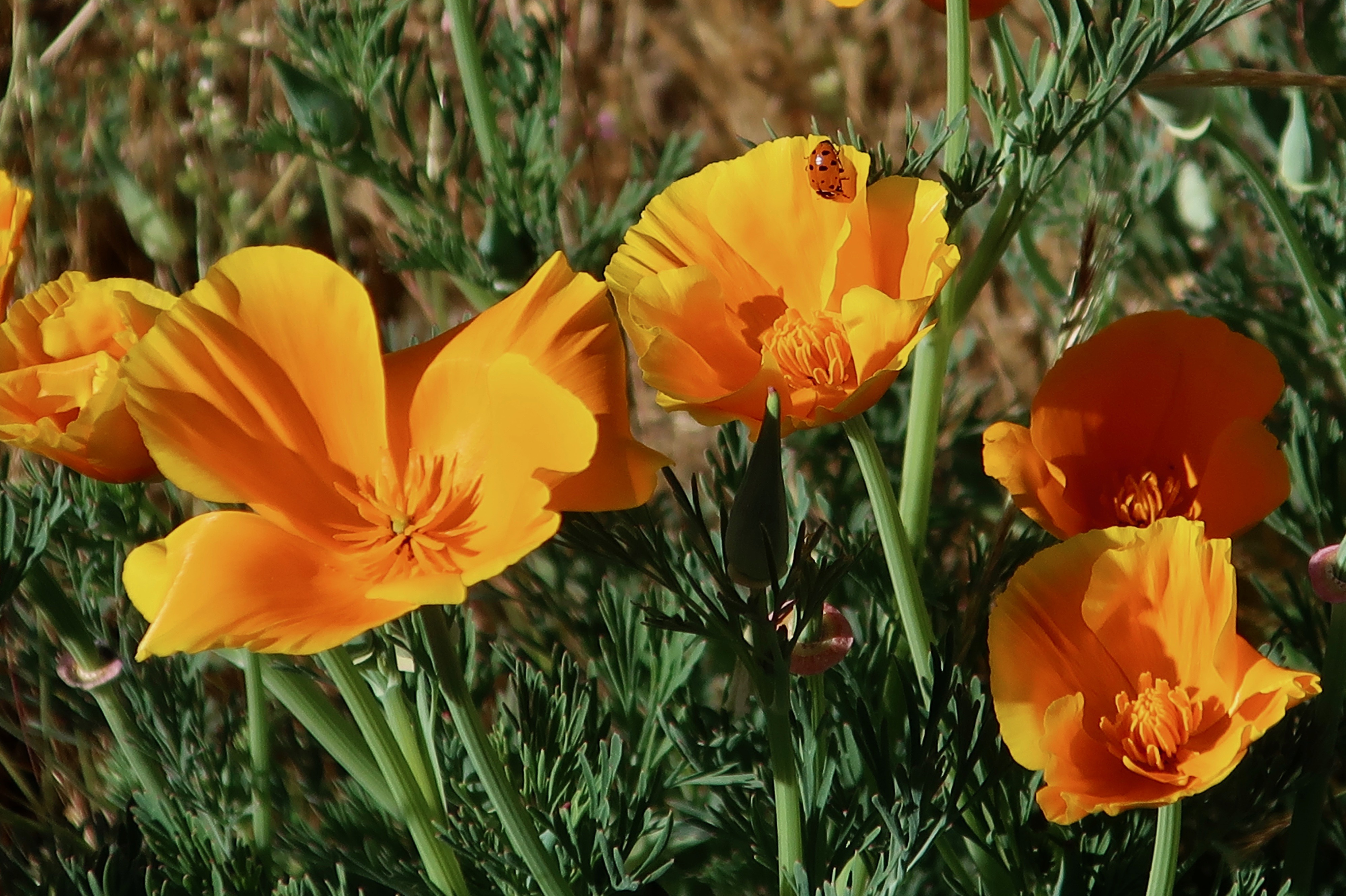
Poppies are another flower that deer won’t eat. I liked the ladybug here.
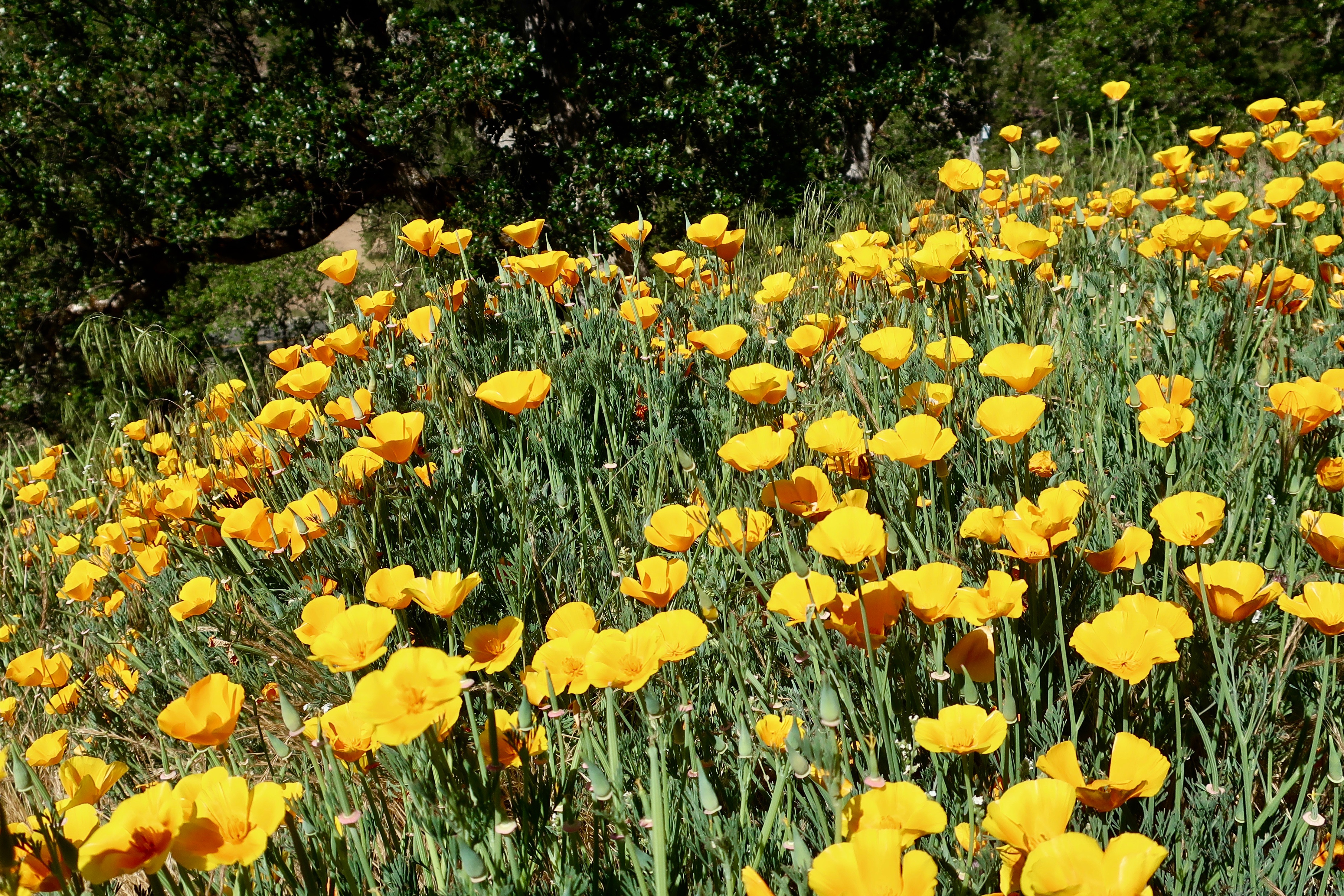
Peggy planted poppies the second year we were here. It was the 7th year before they decided to grow. Now they are taking over a hill that was covered in star thistle when we arrived.
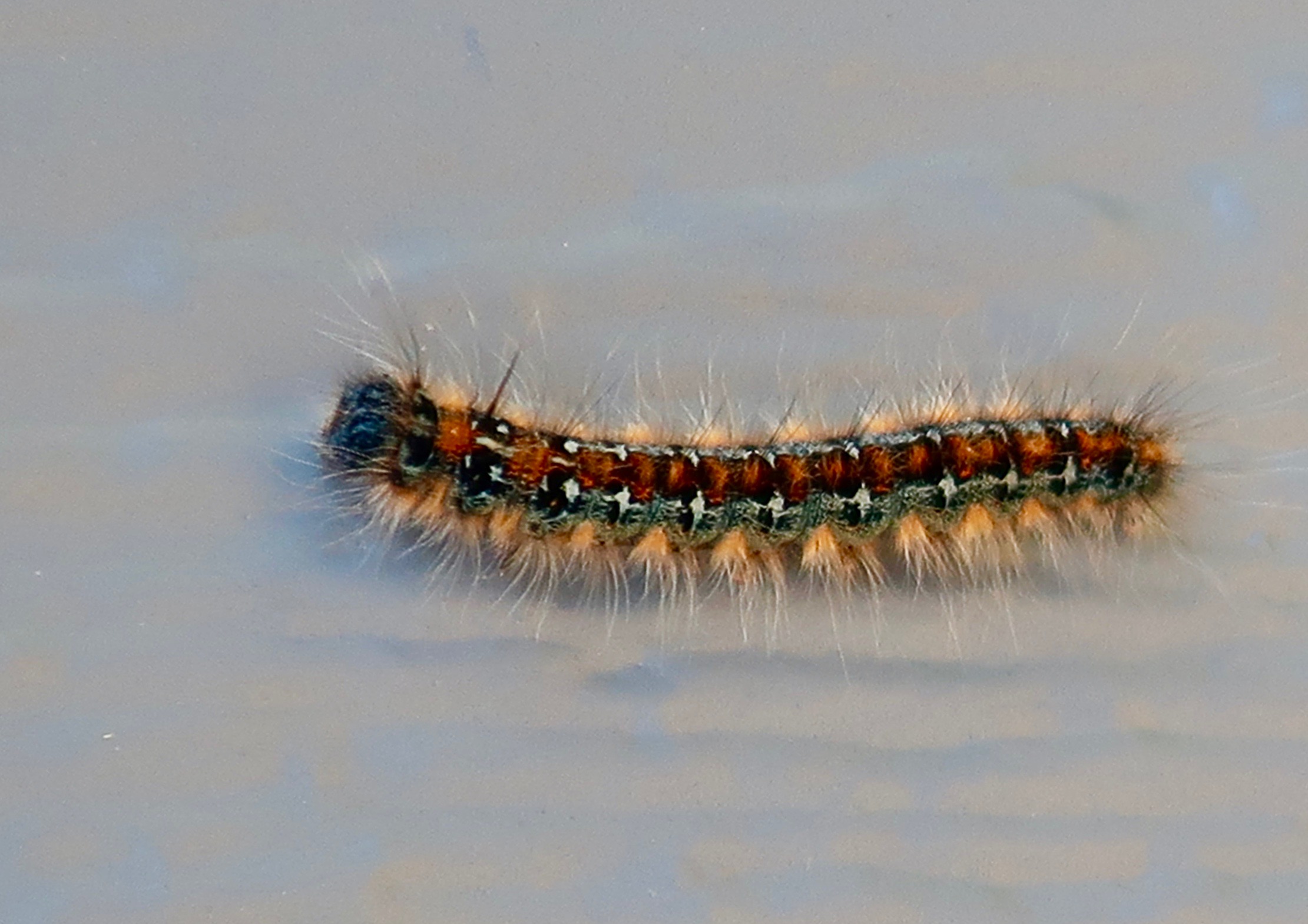
This colorful fellow was climbing up the wall of our sunroom right next to the poppies.
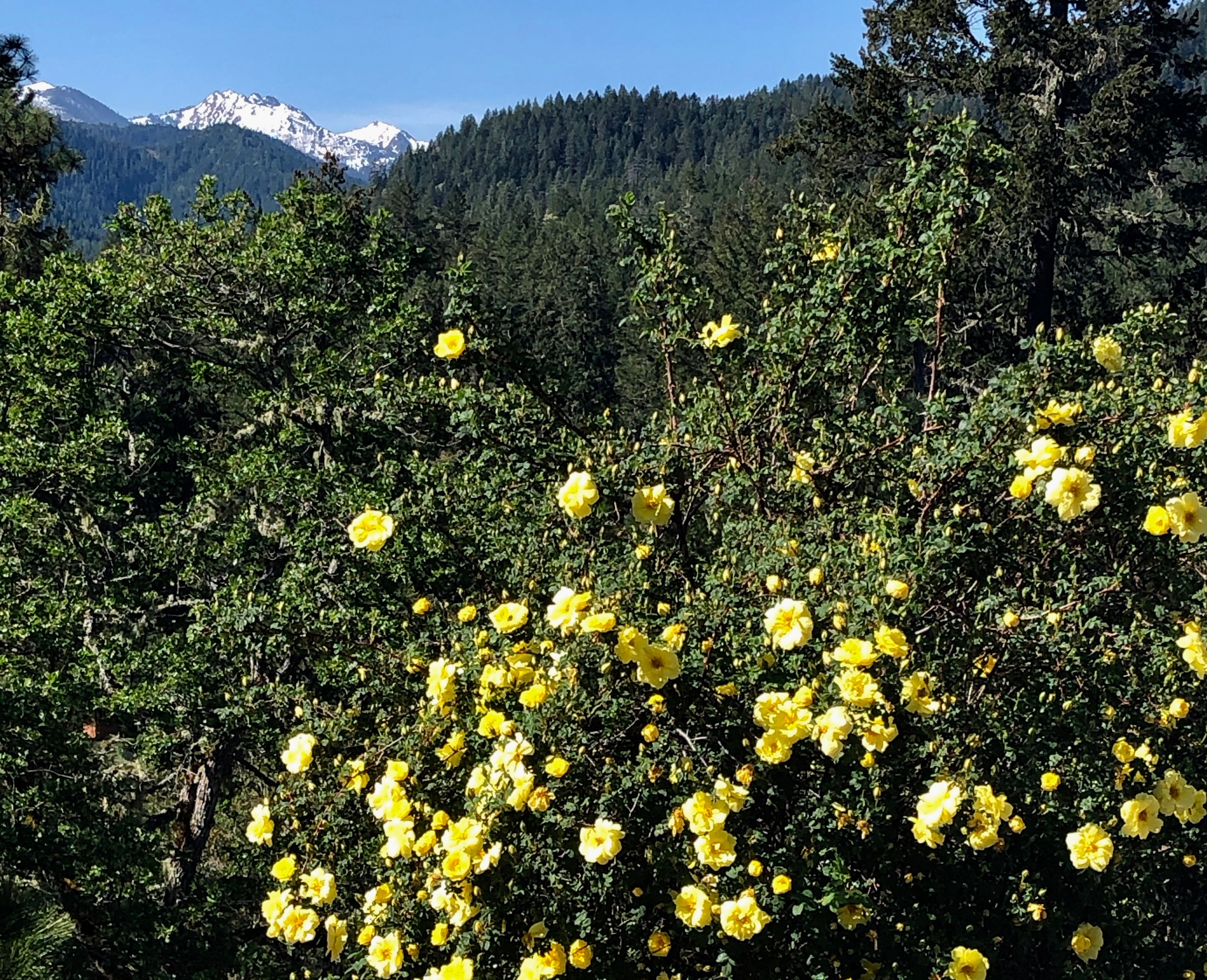
The deer like our pioneer rose, which surprises us given its sharp thorns. Peggy lectures them on a regular basis. The Red Buttes are in the background. (Photo by Peggy Mekemson.)
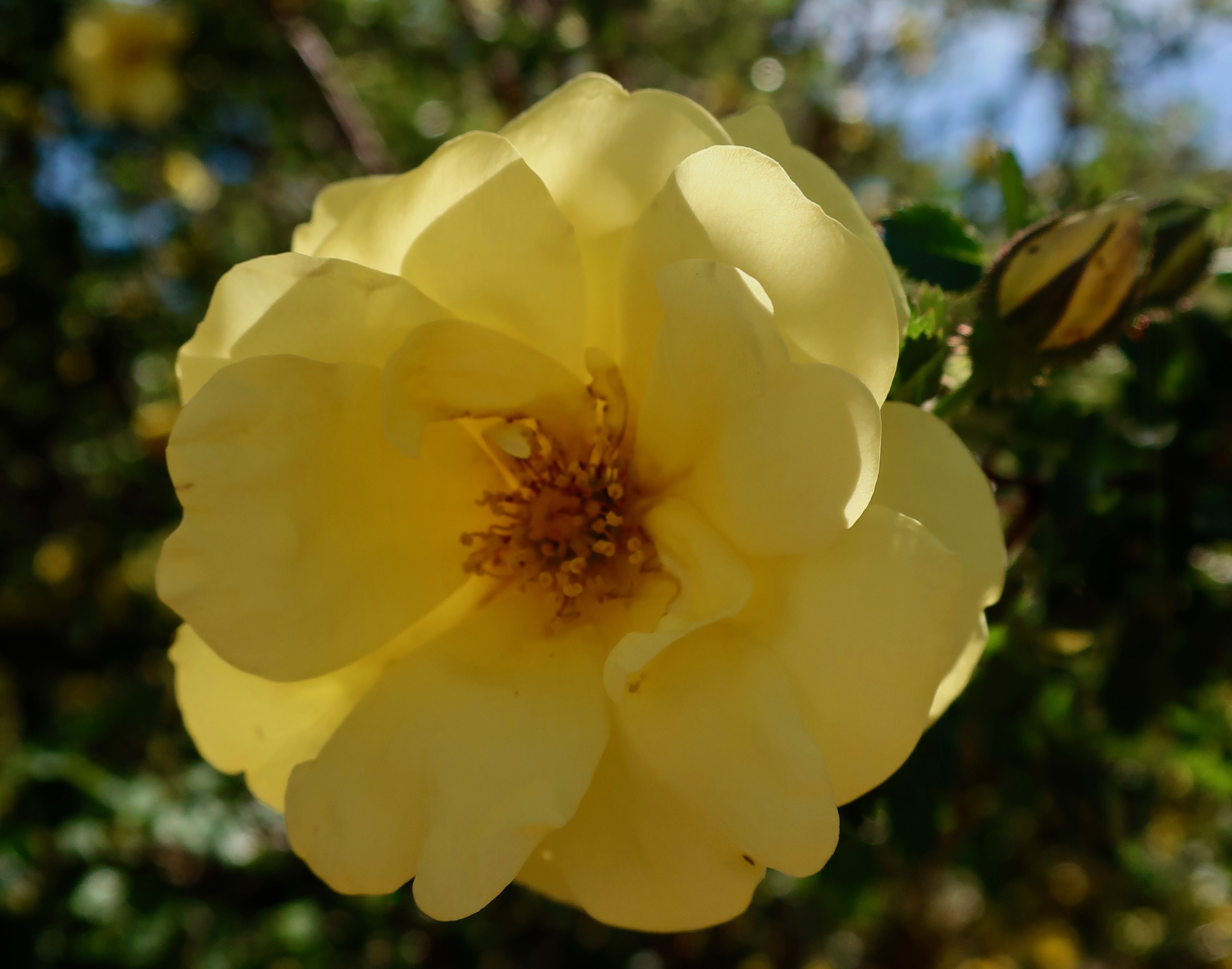
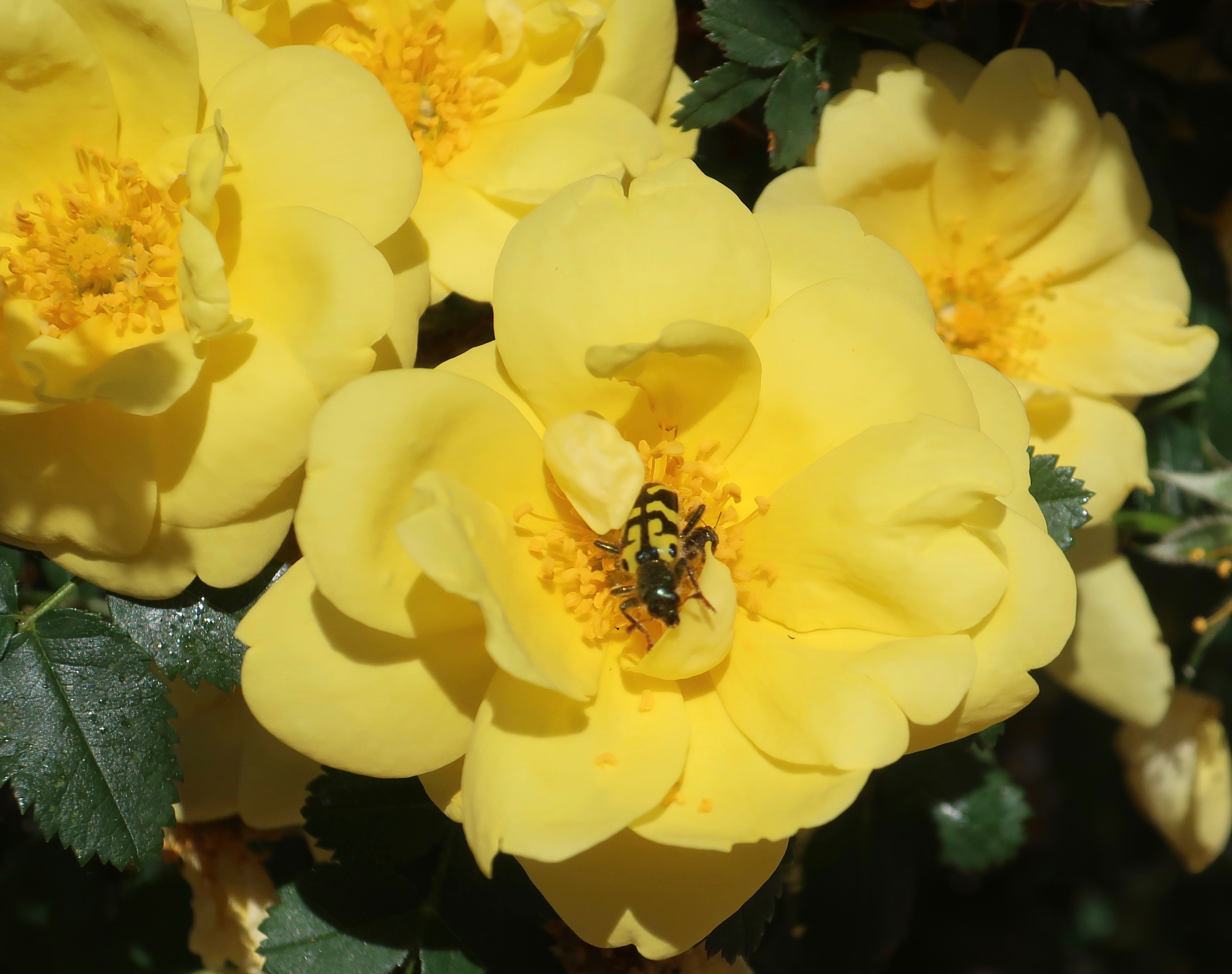
The pioneer rose is an heirloom rose originally brought across the country in wagon trains. It is also known as the Oregon Trail Rose and is found along the Oregon Trail. It’s also found in Texas. Texans are adamant that it is not the “Yellow Rose of Texas” of song fame, and they are right. But I wonder if the “Yellow Rose of Texas” wasn’t named after the yellow rose of Texas? (I expect Linda to comment on this.)
Insects such as this colorful beetle avoid the debate but they love the plant. Hundreds of various insects fly around it feasting— and mating. I kept noticing that when one bug landed, another would land on top of it. They didn’t seem to be fighting.
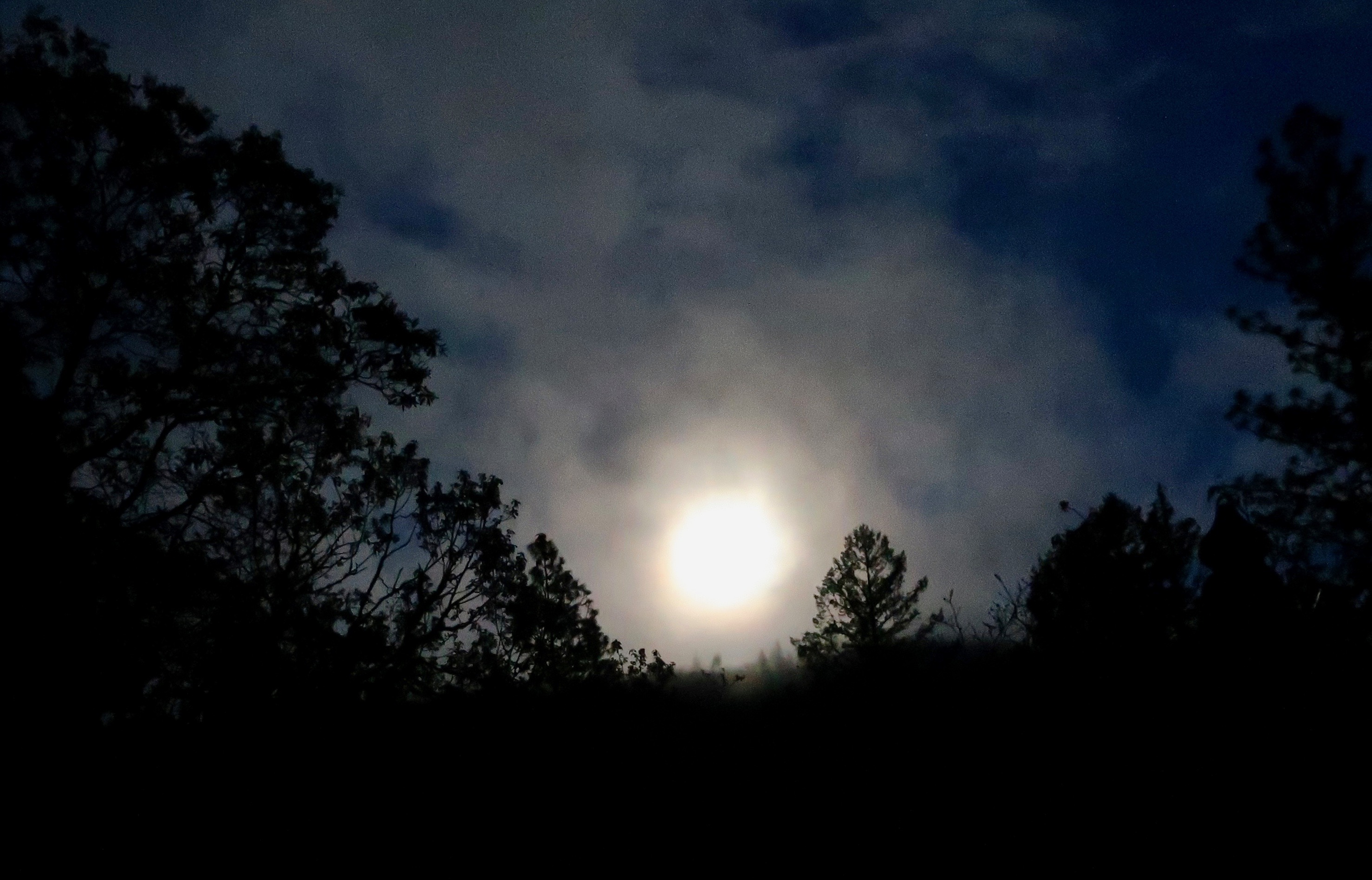
Just for fun. Peggy and I went out to take photos of the ‘Pink’ moon on April 26th. It wasn’t pink but we did think it was dramatic.
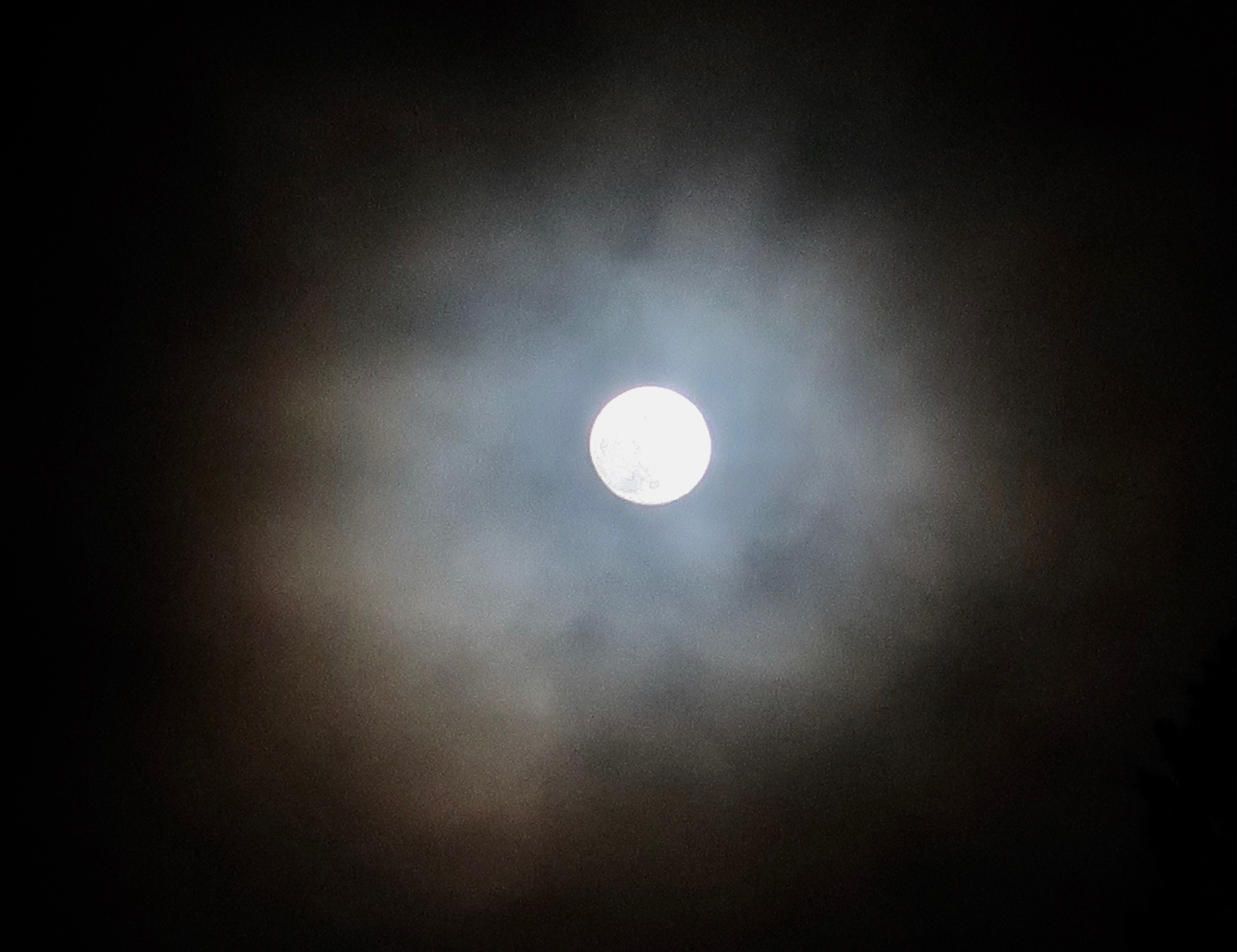
Another photo of the moon.
And in conclusion, Leapus Buckus says, “Y’all come by to see me. Bring apples. Lots of them.” Next Friday I will take you on a hike up the hill in the forest behind our property. I’m eager to show you a trail I just built, wildflowers, an old gold mining operation that extends onto our property, and a deer whose actions are stranger than fiction.

NEXT MONDAY’S POST: It’s back to tales of my early years in Diamond Springs, California and why the town mantra was ‘The Mekemson kids did it.’

Victory— for Students and Civil Rights… Berkeley in the 60s

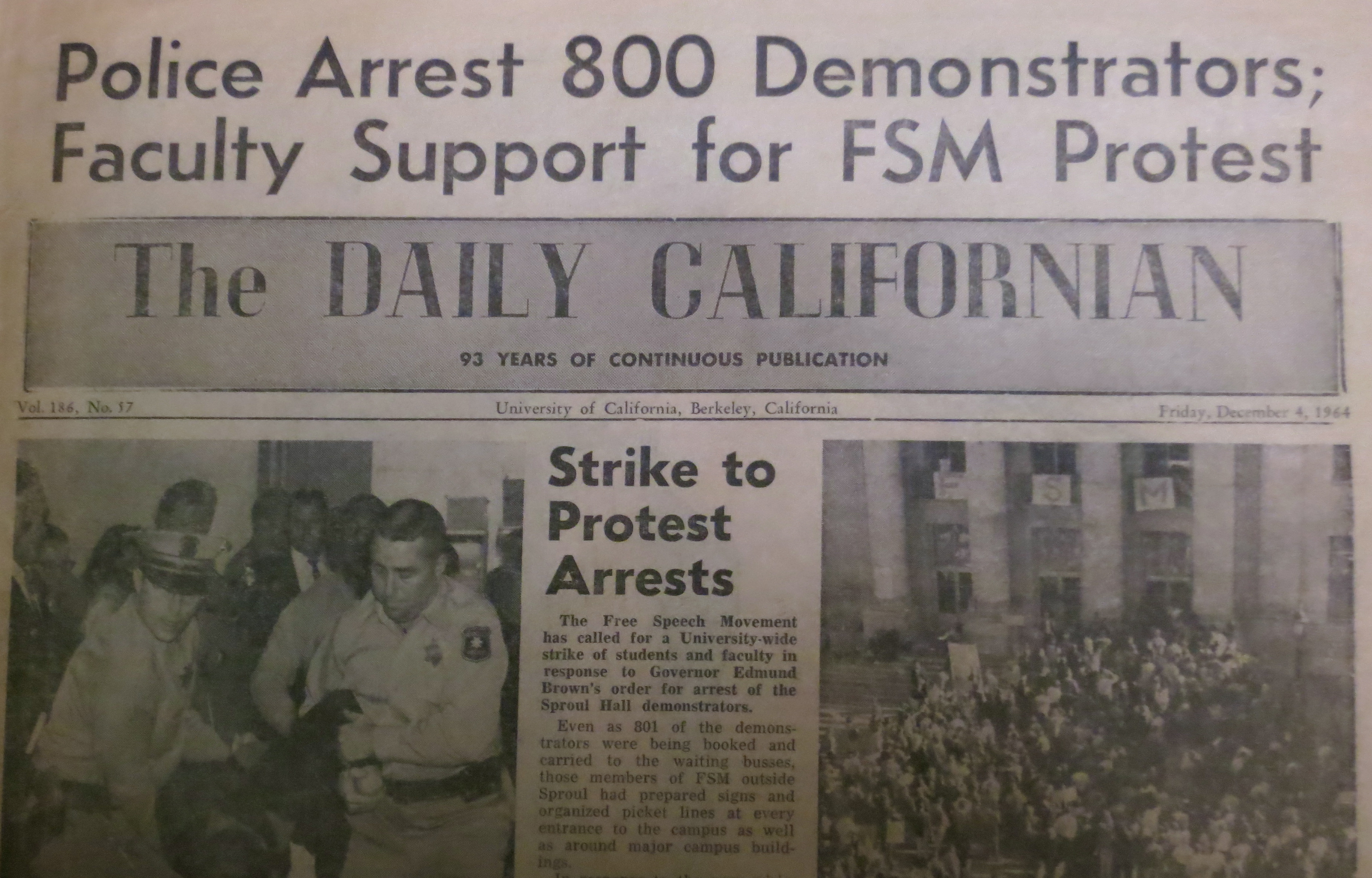
An aging copy of the Daily Cal, Berkeley’s student newspaper, announces the arrests at Sproul Hall on December 4, 1964. (From my FSM files)

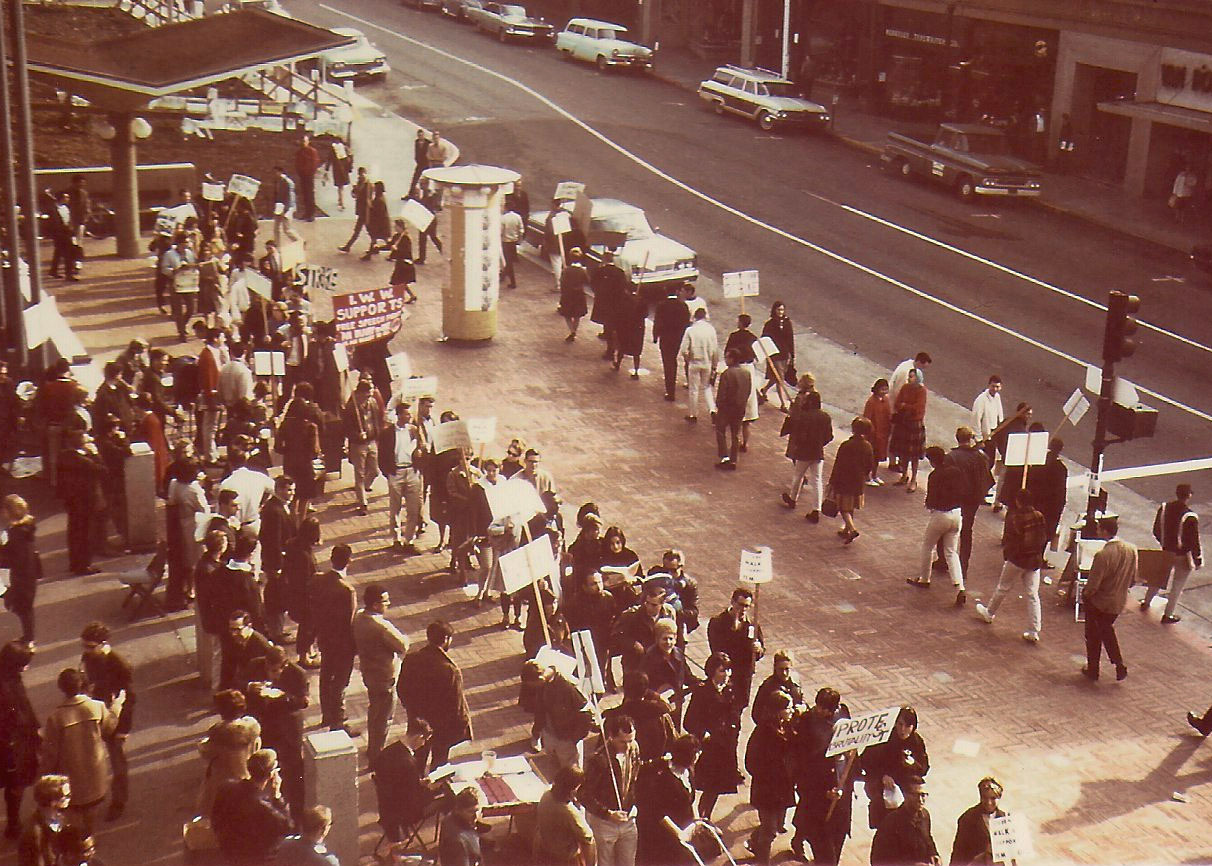
The whole campus was holding its breath in the immediate aftermath of the arrests at Sproul Hall, waiting to see what would happen next. Thousands gathered in Sproul Hall Plaza while an army of law enforcement officers were held ready to return to campus. Most of my classes were cancelled and I didn’t attend those that weren’t. Instead, I joined a picket line.

I’m in this line, one of many protesters opposing Administration policy by picketing at Bancroft Way and Telegraph Avenue. (Photo by my friend, Frank Martin.)

UC President Clark Kerr held a series of around the clock meetings with a select committee of Department Chairs and arrived at a compromise he felt would provide for the extended freedom being demanded on campus while also diffusing the outside pressure to crack open student heads. Sit-in participants arrested in the Sproul Hall would be left to the ‘tender mercies’ of the outside legal system and not disciplined by the University. Rights to free speech and organization on campus would be restored as long as civil disobedience was not advocated. 

Kerr and Robert Scalapino, Chair of the Political Science Department, presented the compromise to a hastily called all-campus meeting of 15,000 students and faculty at the open-air Greek Theater. There was to be no discussion and no other speakers. When Mario Savio approached the podium following the presentation, he was grabbed by police, thrown down, and dragged off the stage. Apparently, he had wanted to announce a meeting in Sproul Plaza to discuss Kerr’s proposal. Once again, Berkeley teetered on the edge of a riot. We moved from silent, shocked disbelief to shouting our objections. Mario, released from the room where he was held captive, urged us to stay calm and leave the area. We did, but Kerr’s compromise was compromised.

The UC Faculty Senate met on December 8 in Wheeler Hall to render its opinion on what should be done. Ironically the meeting was held in the same auditorium where Peter Odegard had lectured on the meaning of democracy to my Poly Sci 1 class during my first day at Berkeley. Some 5000 of us gathered outside to wait for the results and listen to the proceedings over a loud speaker. 

Some departments such as math, philosophy, anthropology and English were clearly on the side of FSM while others including business and engineering were in opposition. My own department of political science was divided. Some professors believed that nonviolent civil disobedience threatened the stability of government. Others recognized how critical it was for helping the powerless gain power. To them, having large blocks of disenfranchised, alienated people in America seemed to be a greater threat to democracy than civil disobedience.

To the students who had fought so hard and risked so much, and to those of us who had joined their cause, the results were close to euphoric. On a vote of 824-115 the faculty resolved that all disciplinary actions prior to December 8 should be dropped, that students should have the right to organize on campus for off-campus political activity, and that the University should not regulate the content of speech or advocacy. Two weeks later, the Regents confirmed the faculty position.

We had won. Our freedom of speech, our freedom to organize, and our freedom to participate in the critical issue of the day were returned. While we were still a part of the future so popular with commencement speakers, we were also a part of the now, helping to shape that future. 

In next Wednesday’s post I explore the background of the students arrested and begin to consider the options for my future: one is a war in South East Asia, the other is the Peace Corps.

FRIDAY’S TRAVEL BLOG: I’ll take you on a visit to our home in Oregon where spring is in full force, a cougar comes by in the night, and eight pregnant does hang out on our property.

Nature Boy… Counting Skunks Is More Fun than Being Conked by a Baseball

Another fuzzy photo from the 1950s. My brother Marshall poses proudly in his Little League uniform. Even Tickle had to get into the act.

It isn’t surprising that I became known as Nature Boy by my classmates, given all the time I spent in the woods. I considered it a compliment. I did, however, realize that there was more to life. For example, I took an early interest in girls. And then there were sports.

I am not a jock when it comes to traditional sports. It isn’t so much physical as mental. You have to care to be good at sports and I find other things more interesting. Part of this evolved from a lack of enthusiasm on the home front. There was little vicarious parental pressure to see us excel on the playing field. Being as blind as a bat didn’t help, either. Like many young people, I was not excited about wearing glasses. When Mrs. Wells, the school nurse, came to class with her eye charts, I would memorize the lines and then breeze through the test. As for class work, I would sit close to the black board and squint a lot. While I got away with this in the classroom, it became a serious hazard on the Little League field.

I remember going out for the team. All of my friends played and social pressure suggested it was the thing to do. I showed up on opening day and faced the usual chaos of parents signing up their stars, balls flying everywhere, coaches yelling, and kids running in a dozen different directions.

“Okay, Curtis,” the Coach instructed, “let’s see how you handle this fly.”

Crack! I heard him hit the ball. Fine— but where was it? The ball had disappeared. Conk. It magically reappeared out of nowhere, bounced off my glove, and hit me on the head.

“What’s the matter? Can’t you see?” the Coach yelled helpfully. “Let’s try it again.” My Little League career was short lived. I went back to carrying out my inventory of the skunks that lived in the Woods. This came with its own hazards, however. Have you ever had a skunk stand up on its front legs, wave its tail at you, and prepare to let you have it with both barrels. If you are lucky, don’t move, and are very quiet, the skunk will return to all fours and waddle off. I’ve been in the situation twice and lucked out both times.

In the seventh grade, I finally obtained glasses and discovered the miracle of vision: trees had leaves, billboards were pushing drugs, and the kid waving at me across the street was flipping me off. I could even see baseballs. It was time to become a sports hero. That’s a story for another time but I’ll leave it with saying my sports career peaked in the eighth grade where I pitched for the softball team, was quarterback of the football team, and center for the basketball team. It was all downhill after that.

As I’ve mentioned earlier, I spent a substantial amount of time getting into mischief as a kid. Admittedly, I had a lot of help from my brother, but I was hardly innocent. The primary difference between Marshal and me was that l lacked his creativity. For example, it never would have crossed my mind to put a bullet down on a rock and then smash it with another rock to see what would happen. In my post next Monday, I’ll explore a Diamond Springs mantra of the time— The Mekemson kids did it.

WEDNESDAY’S BLOG-A-BOOK POST from my Peace Corps Memoir: UC Berkeley came to a grinding halt in the wake of the arrests at Sproul Hall and I joined a picket line. Thousands of students gathered in Sproul Plaza while an army of police hovered nearby…

Abbots Lagoon and Pt. Reyes Station… A Trail Hike Plus a Favorite Small Town

Abbot’s Lagoon is a great place for bird watchers. Or people watchers. This great blue heron with its neck stretched out like a rubber band had a wary eye on Peggy. Wisely so. She was stalking it with her camera. (Photo by Peggy Mekemson.)

It’s a wrap on my Pt. Reyes series today. Peggy and I will take you for a hike out to Abbot’s Lagoon and a visit to Pt. Reyes Station, a favorite town of mine.

The hike is suitable for almost anyone. We even watched a mom and dad pushing their baby along in a stroller. How much easier can it get? The baby seemed quite happy as did the parents. Visitors can turn around whenever they want, hike out to the Lagoon, or go on a leisurely stroll all the way to the ocean. We chose the latter.

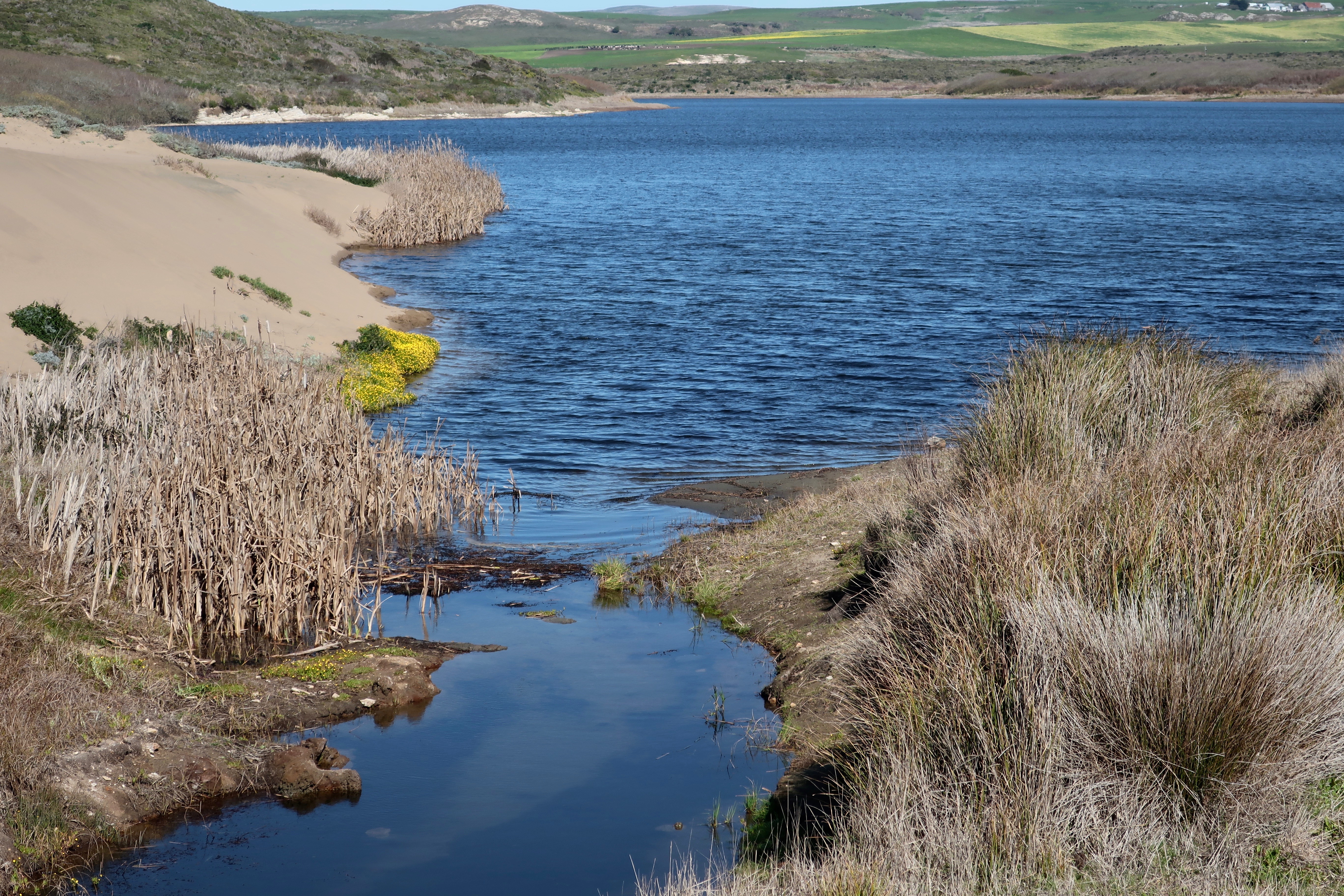
The Abbot’s Lagoon trailhead leading out from the parking lot. The Lagoon can be seen in the distance. The Pacific Ocean is out beyond the Lagoon. The narrow strip you can see on the left is the continuation of the trail.
The red marker shows the location of Abbot’s Lagoon on the Google map. Down to the right you can see Pt. Reyes Station next to the Highway 1 marker. Highway 1, BTW, follows the San Andreas fault through this area. The 1906 San Francisco Earthquake shot what is now the National Seashore over 20 feet northward. San Francisco is 30 miles to the south.
Another photo of Peggy’s great blue heron. This time he was back at work catching fish. I liked the slight hint of a reflection. (Photo by Peggy Mekemson.)
I was impressed with the red eye on this coot. (Photo by Peggy Mekemson.)
We crossed a small bridge and looked back up the Lagoon toward the parking lot.
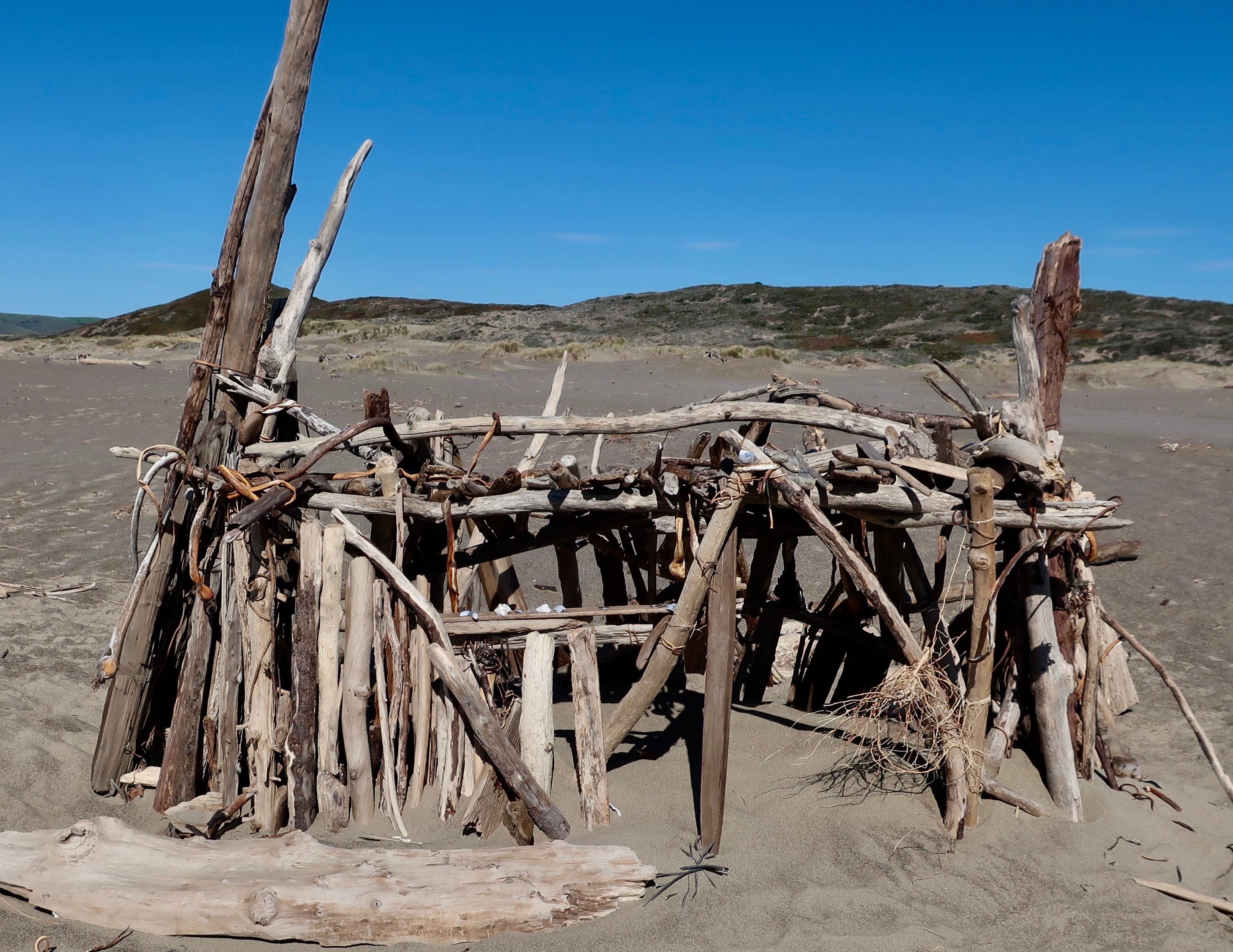
There was a drift wood structure along the trail on the beach out near the ocean. It had been cleverly woven together with kelp.
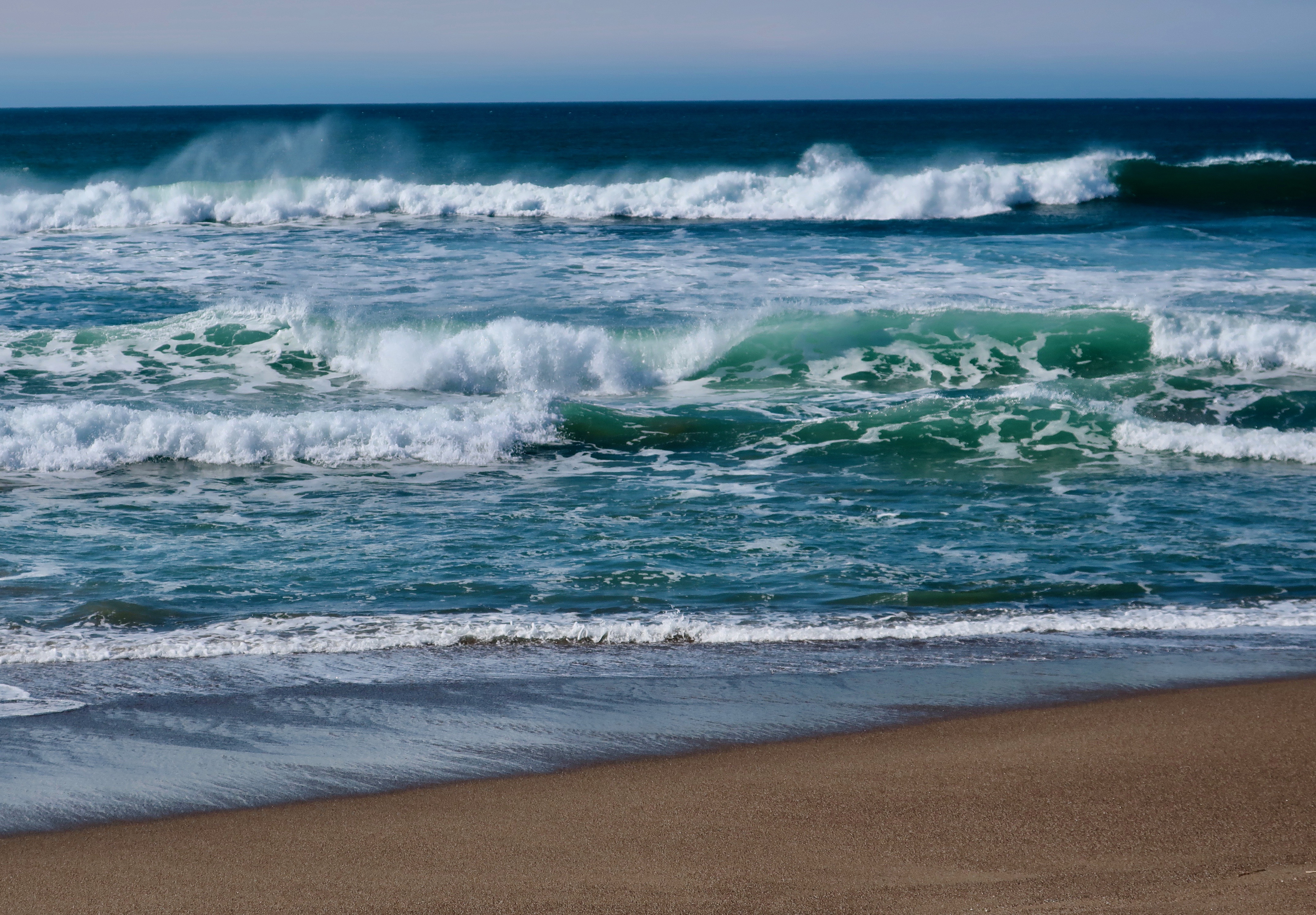
Finally we arrived at the Pacific Ocean.

The North Pacific Coast Railroad had arrived in the area 146 years earlier in 1875 and let passengers off in a cow pasture to make their way to nearby Olema and dairy ranches out on the peninsula. The cow pasture soon added a hotel and the town of Pt. Reyes station was born. It’s a story told over and over in the West. The railroad arrives and a community springs up, making land barons/developers happy and rich. This time it was a dentist in San Francisco. The railroad was making its way north to retrieve redwoods that were being cut down to build the city. Many a giant redwood gave its life to the cause.

I first arrived at Pt. Reyes Station in the late 1960s and I’ve returned again and again. The town has become somewhat yuppified and more expensive since then due to its close vicinity to San Francisco, but it still retains much of its charm. The following photos reflect some of what makes it charming.

The Pt. Reyes Book Store is one of the best small, independent bookstores we have ever been in, and we’ve been in a lot. Peggy told me to go in and spend $200 for my birthday. Boy, does she know me…
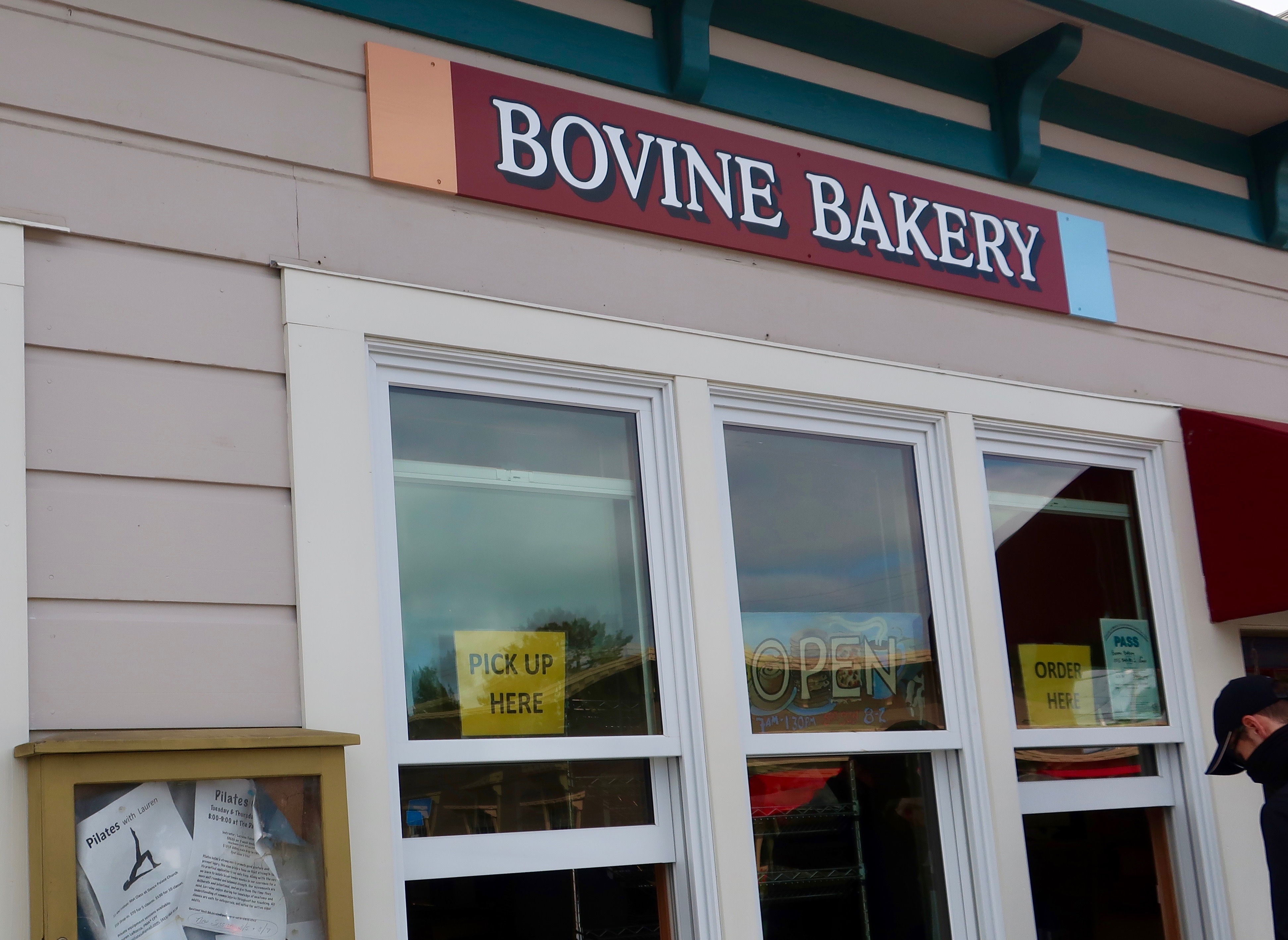
The Bovine Bakery is on one side of the book store. The buttermilk scones are to die for! I never leave town without one, or two, or three, or four.
Feeling Horsey? A saddlery is on the other side of the bookstore.
If your horse is hungry, Toby’s Feed Barn is across the street.
But what feed barn do you know that also serves gourmet coffee and freshly baked, large chocolate chip cookies. Now, that’s what I call charm!
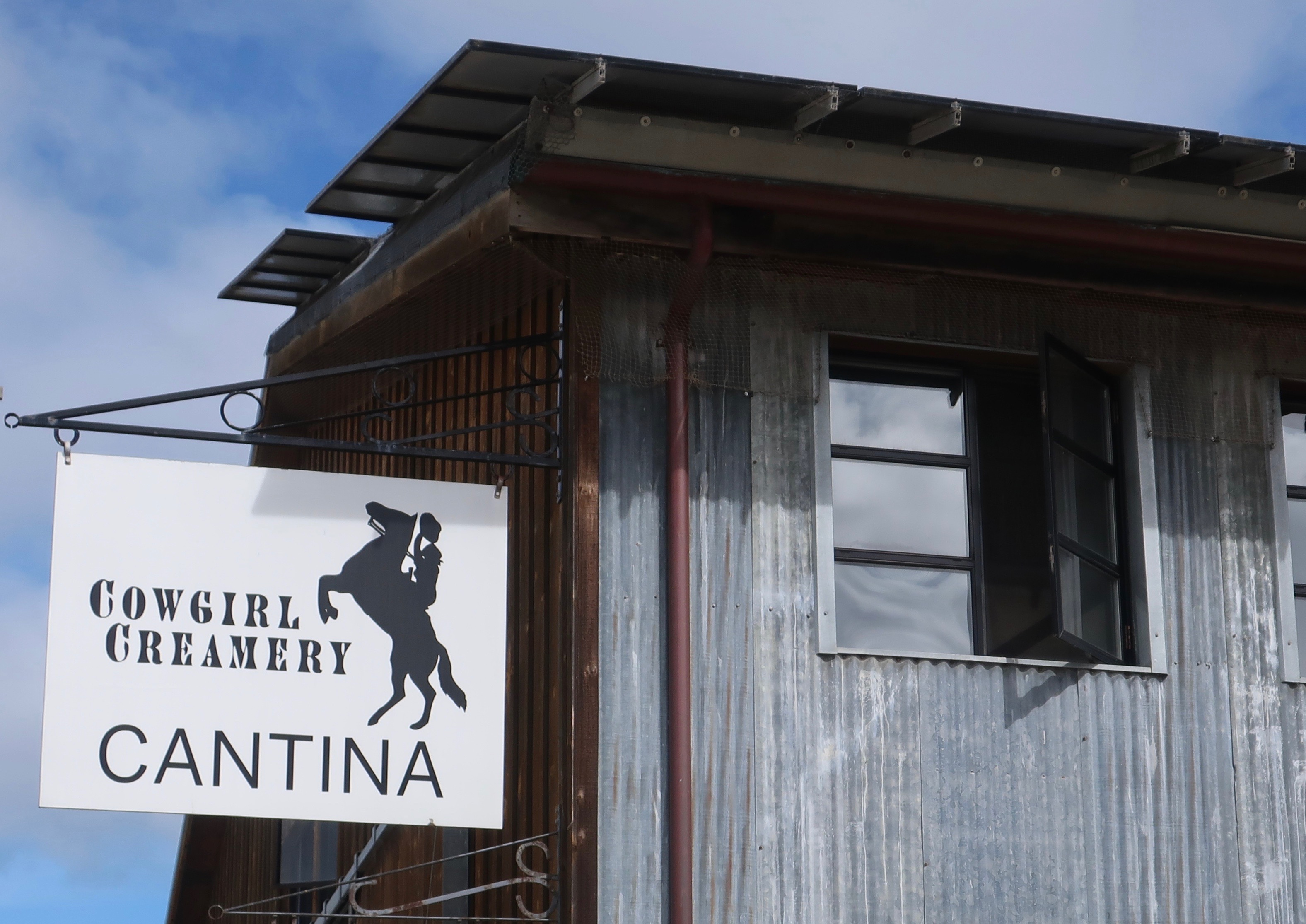
A walk behind the the bookstore building brought us to the Cowgirl Creamery, famous for its cheeses, and I might add, its grilled cheese sandwiches. I’ve never been a fan of grilled cheese, but one bite of its aged white cheddar on sourdough bread and I was hooked. Peggy and I were back for another one the next day, which we took out and ate at the Abbot’s Lagoon parking lot.
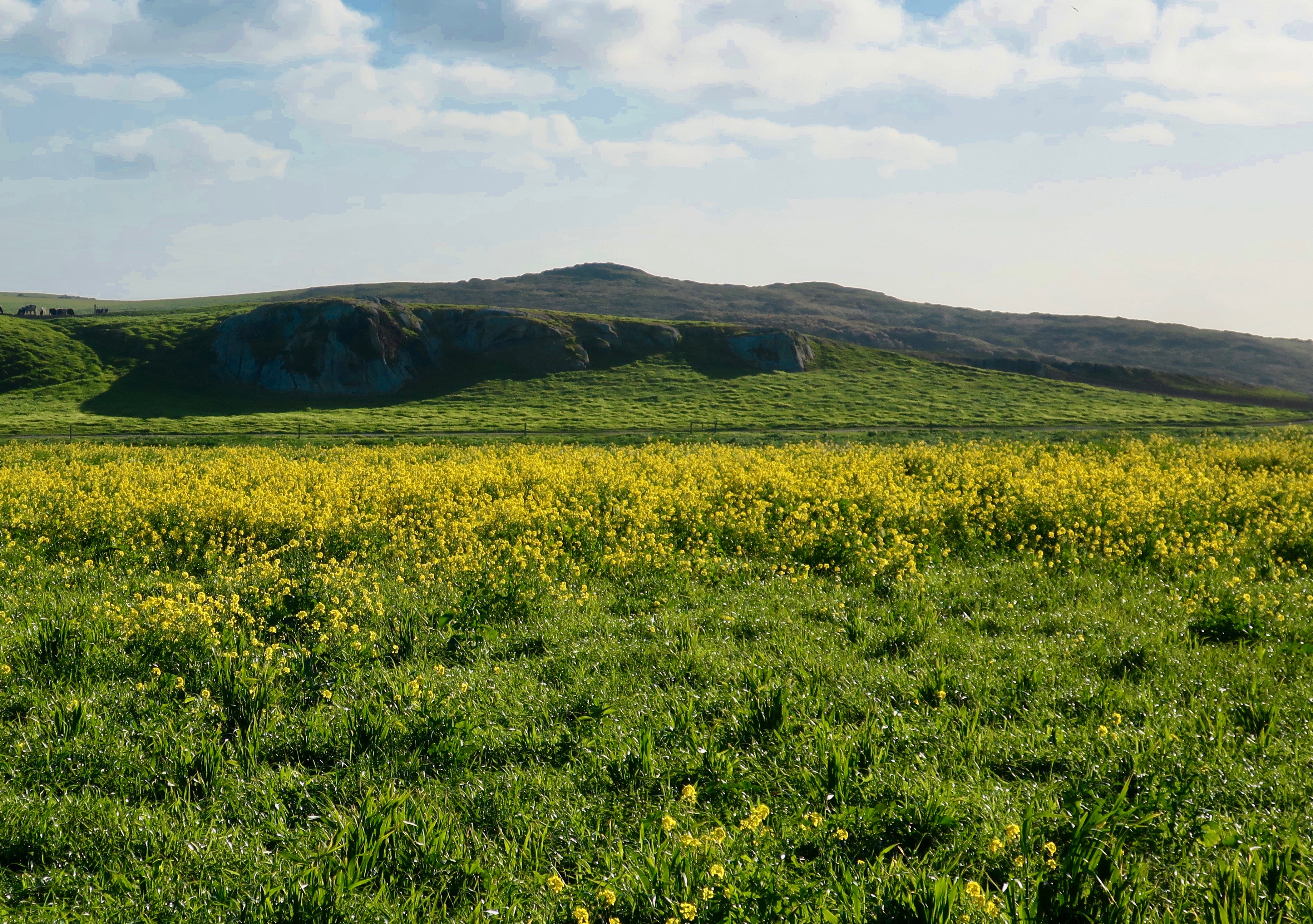
Our view from where we chowed down on our grilled cheese sandwiches in the Abbot’s Lagoon parking lot.
A bit of living history. Cheda’s Garage is the oldest contract Triple A garage in the nation.
This was the view inside Cheda’s Garage. Putting two and two together and thinking roadside pickup of wrecked cars, I couldn’t help but irreverently think “Roadkill.” Just kidding. Old Cheda must have been one heck of a hunter.
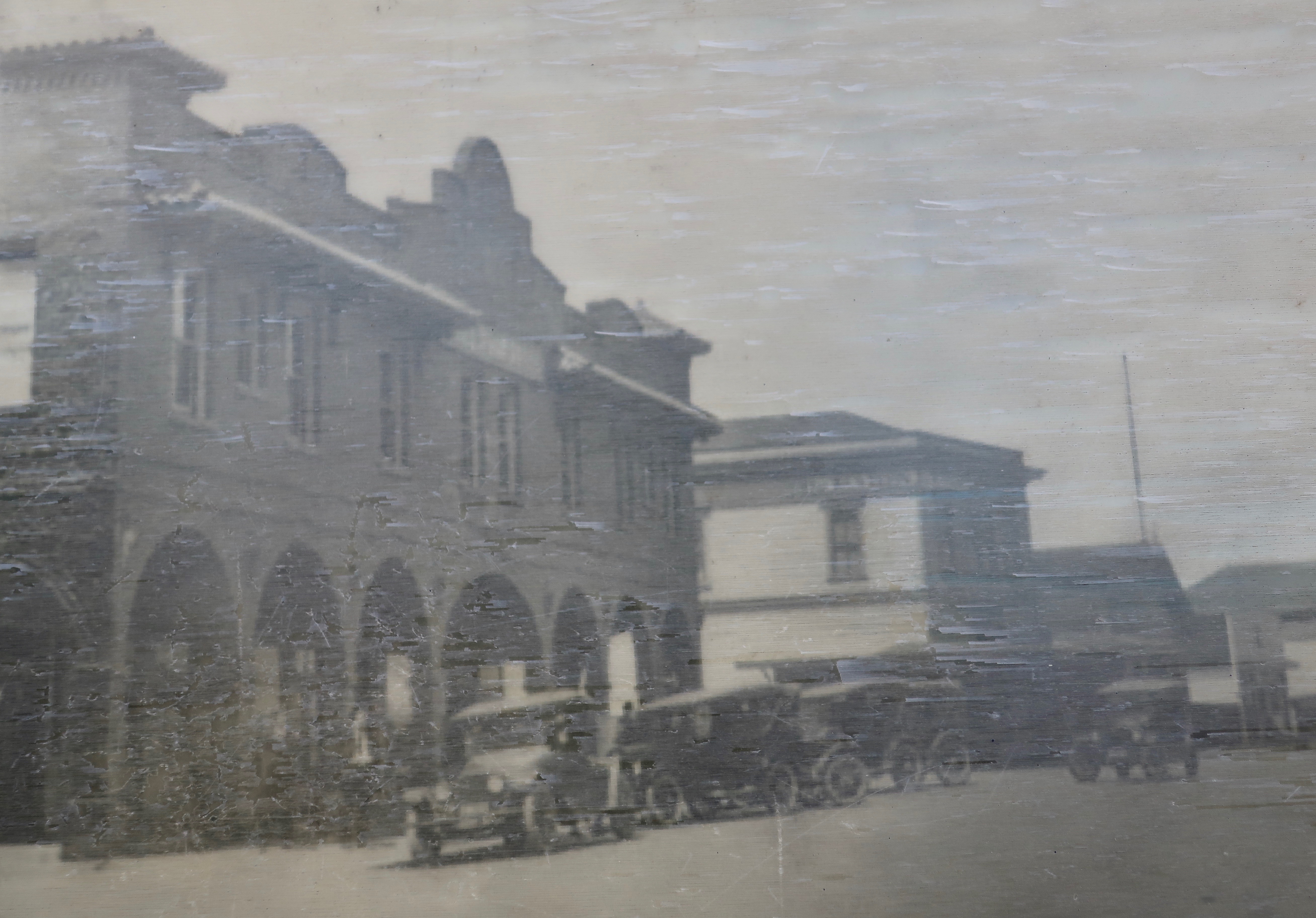
A photo of early Pt. Reyes Station…
The building today.
The mural on the front of the building capturing some of the activities and wildlife of the area.
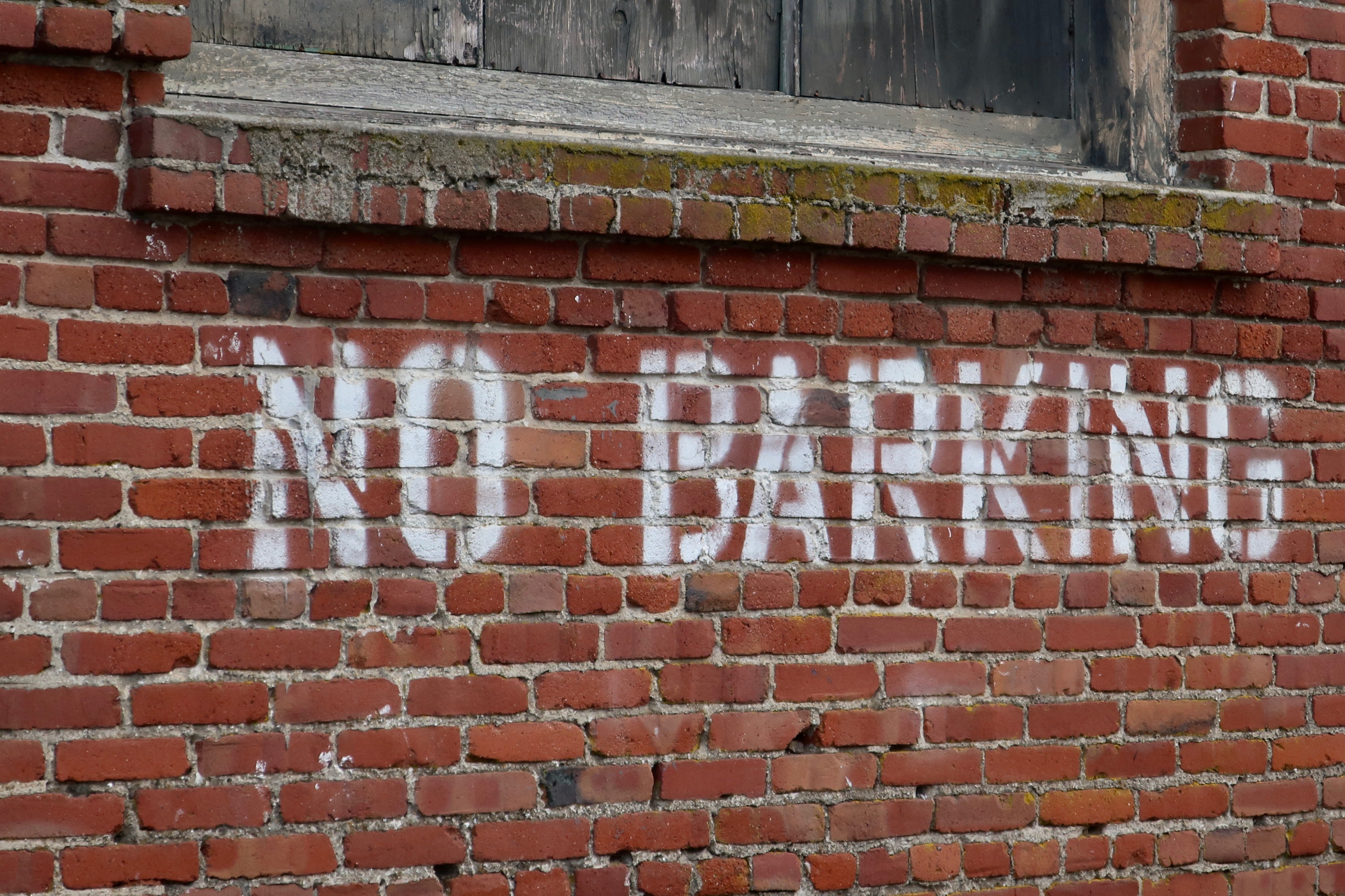
Just around the corner we found a sign that made us smile. A No Parking Sign had been cleverly modified to become a No Barking sign. Several cars were lined up in the no parking zone. Not one had a barking dog. A law-abiding town, for sure.
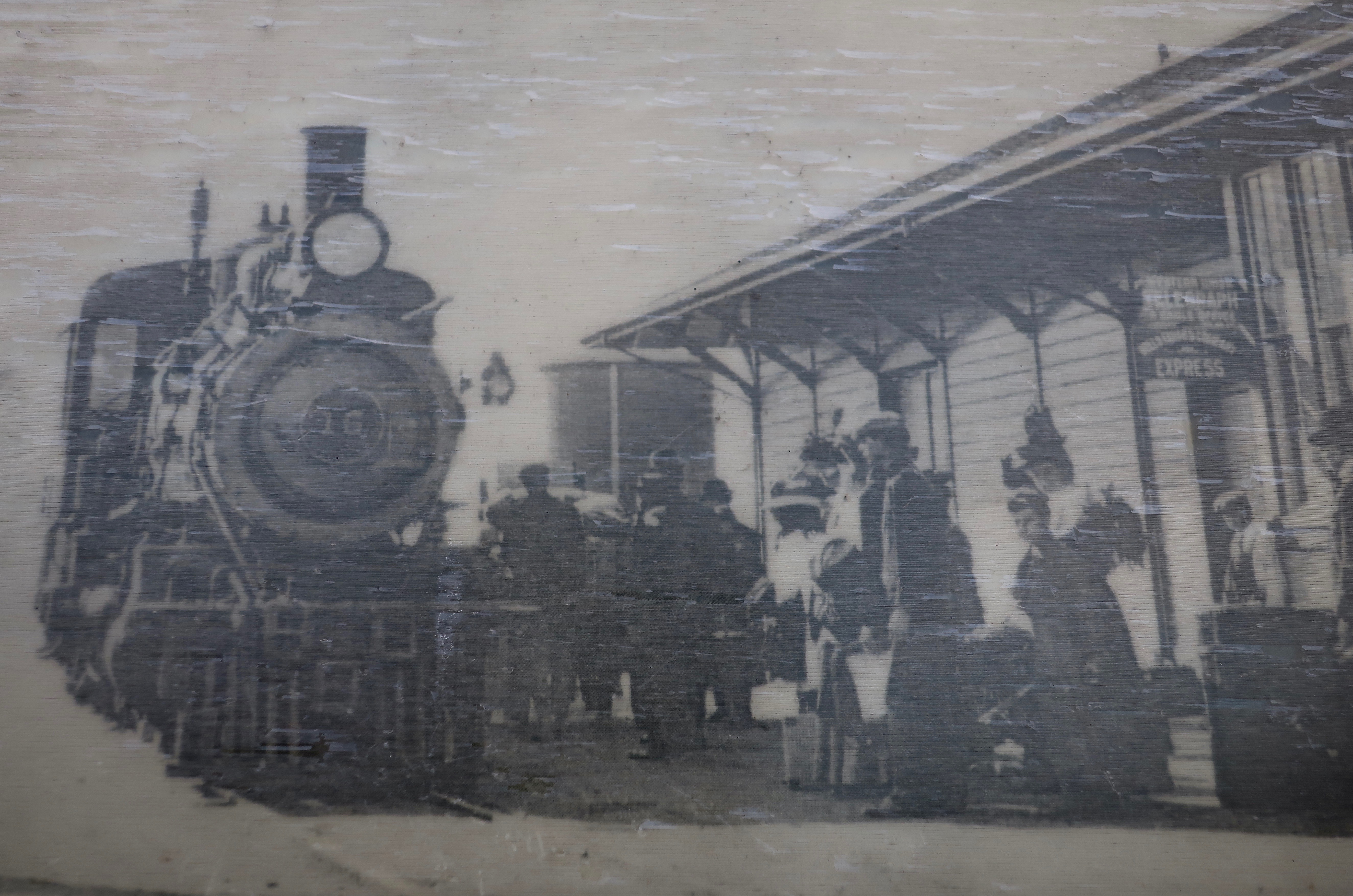
I’ll conclude my Pt. Reyes series with a historic photo of the train that gave the town its name. Join me next Friday on my travel blog as I take you on a spring walk around our property.

MONDAY’s BLOG-A-BOOK POST from Its 4 AM and a Bear Is Standing on Top of Me: I decide that doing an inventory of the local skunk population is ever so much better than being conked on the head by a Little League hardball. But have you ever faced a skunk standing on its front legs with its tail pointed toward you— ready to spray?

I Join a Massive Sit-In and Sing Protest Songs with Joan Baez… Berkeley in the 60s

Joan Baez singing in front of Sproul Hall during an FSM rally. Later she would join the participants in the defining sit-in of the Free Speech Movement and I would sit down with her and sing protest songs.

One day I was faced with a test more serious than any I had ever faced in the classroom. On Friday, December 3, 1964, FSM leaders called for a massive sit in at Sproul Hall. Once again communication had broken down and the Administration was back peddling, caught between students and faculty on the one side and increasing pressure from the outside on the other.

I thought about the implications of the sit-it and decided to join. It was partly on whim, and partly because I felt compelled to act. For three months I had listened to pros and cons and watched the press misrepresent what was happening on campus as a violent resurrection egged on by Communists rather than peaceful protests with a legitimate cause. The public had little option but to believe we were being manipulated by a small group of radicals. 

It was not wrong to utilize an edge of campus for discussing the central issues of the day, or for organizations to raise funds for various causes, or even to recruit students to participate in efforts that ranged from supporting Civil Rights to electing Barry Goldwater. It didn’t disrupt my education. I was free to stop and listen, to join in, or pass on. What it did do was irritate powerful, established members of the community. And for that reason, our freedoms had been curtailed. 

Maybe if enough students joined together and the stakes were raised high enough, the Administration would listen, and the press would dig a little deeper. I told Jo Ann I was going inside and then joined the thousand or so students who had made a similar decisions. It was early in the afternoon and we were in high spirits. I believed it would be hard for the Administration to claim 1000 students were a small group of rabble-rousers bent on destroying the system. And I was right. They claimed we were a large group of rabble-rousers bent on destroying the system.

Inside I was treated to one of the more unique experiences of my life. The sit-in was well organized. Mario and other FSM leaders stood at the entrance and gave us directions on what to do if the police arrived. There were also clear instructions that we were not to block doorways. The normal business of the University was not to be impeded, and we were not to be destructive in any way. Floors were organized for different purposes. One was set aside as the Free University where graduate students were teaching a variety of classes. These included normal topics such as physics and biology and more exotic subjects such as the nature of God. Another was set aside as a study hall and was kept quiet. One featured entertainment— including old Laurel and Hardy films. 

After the administrators left, the Dean’s desk became a platform for expressing our viewpoints, much like the police car holding Jack Weinberg had been. I decided to participate. There was a long line of speakers. We were required to take off our shoes so the desk wouldn’t be damaged. The real treat though was an impromptu concert by Joan Baez. I joined a small group sitting around her in the hallway and sang protest songs. The hit of the night was “We Shall Overcome.” It provided us with a sense of identification with struggles taking place in the South. I felt like I belonged and was part of something much larger than myself. Mainly I walked around and listened, taking extensive notes on what I saw and felt. Later I would sit in the Café Med and write them up. They would become the basis of talks I would give back home over the Christmas break.  

Along about midnight I started thinking about my comfortable bed back in the apartment. The marble floors of Sproul Hall did not make for a good night’s sleep and it appeared the police weren’t coming, at least in the immediate future. Yawning, I left the building and headed home. I would come back in the morning.

I did, but I came back to an occupied campus. Armed men in uniforms formed a cordon around the Administration Building where students were being dragged down the stairs and loaded into police vans. Windows had been taped over so people or media could not see what was transpiring inside. The Governor of California, Pat Brown, had acted to “end the anarchy and maintain law and order in California.” 

I am sure Laurel and Hardy would have seen something to laugh about. Dragging kids down stairs on their butts while their heads bounced along behind could easily have been a scene in one of the old Keystone Cop films. The Oakland police weren’t nearly as funny as the Keystone Cops, however. As for Clark Kerr, President of the University, he felt the participants were getting what they deserved and argued that the FSM leaders and their followers “are now finding in their effort to escape the gentle discipline of the University, they have thrown themselves into the arms of the less understanding discipline of the community at large.”

Later, Kerr claimed he had an understanding with Governor Brown to let the students remain in Sproul Hall overnight. He would talk with the protesters in the morning in an effort to end the sit-in peacefully. But Brown reneged on the agreement. One report was that Edwin Meese, Ronald Reagan’s future Attorney General and, at the time, Oakland’s Deputy DA and FBI liaison, had called Brown in the middle of the night with the claim that students were destroying the Dean’s office. 

I had participated in the “destruction,” i.e. stood on the desk in my socks. Either the DA had received an erroneous report or he had deliberately lied to the Governor. My sense was the latter. The people who saw their interests threatened by the student protests had more to gain from arrests and violent confrontations than they did from negotiated settlements. 

A pair of speakers were set up in front of Sproul Hall for reporting on the arrests happening inside. When the police moved to grab the speakers, we formed a tight ring around them. (Photo from Archives.)

The campus came to a grinding halt and a great deal of fence sitting ended. Whole departments shut down in strike. Sproul Hall plaza filled with several thousand students in protest of the police presence. When the police made a flying wedge to grab a speaker system FSM was using, we were electrified and protected the system with our bodies. It was the closest I have ever come to being in a riot; thousands of thinking, caring students teetered on the edge of becoming an infuriated, unthinking mob. Violence and bloodshed would have been the result. Kerr, Brown, Knowland and company would have had the anarchy they were claiming, after the fact. A few days later we were to come close again. And that is the subject of next Wednesday’s post.

FRIDAY’S TRAVEL BLOG: I wrap up my Pt. Reyes series with a pleasant hike out to Abbot’s Lagoon and an exploration of the small but interesting town of Pt. Reyes Station where Peggy directs me to buy $200 worth of books at the bookstore for my birthday present. She knows me well…

The Skull with the Vacant Stare… The Woods

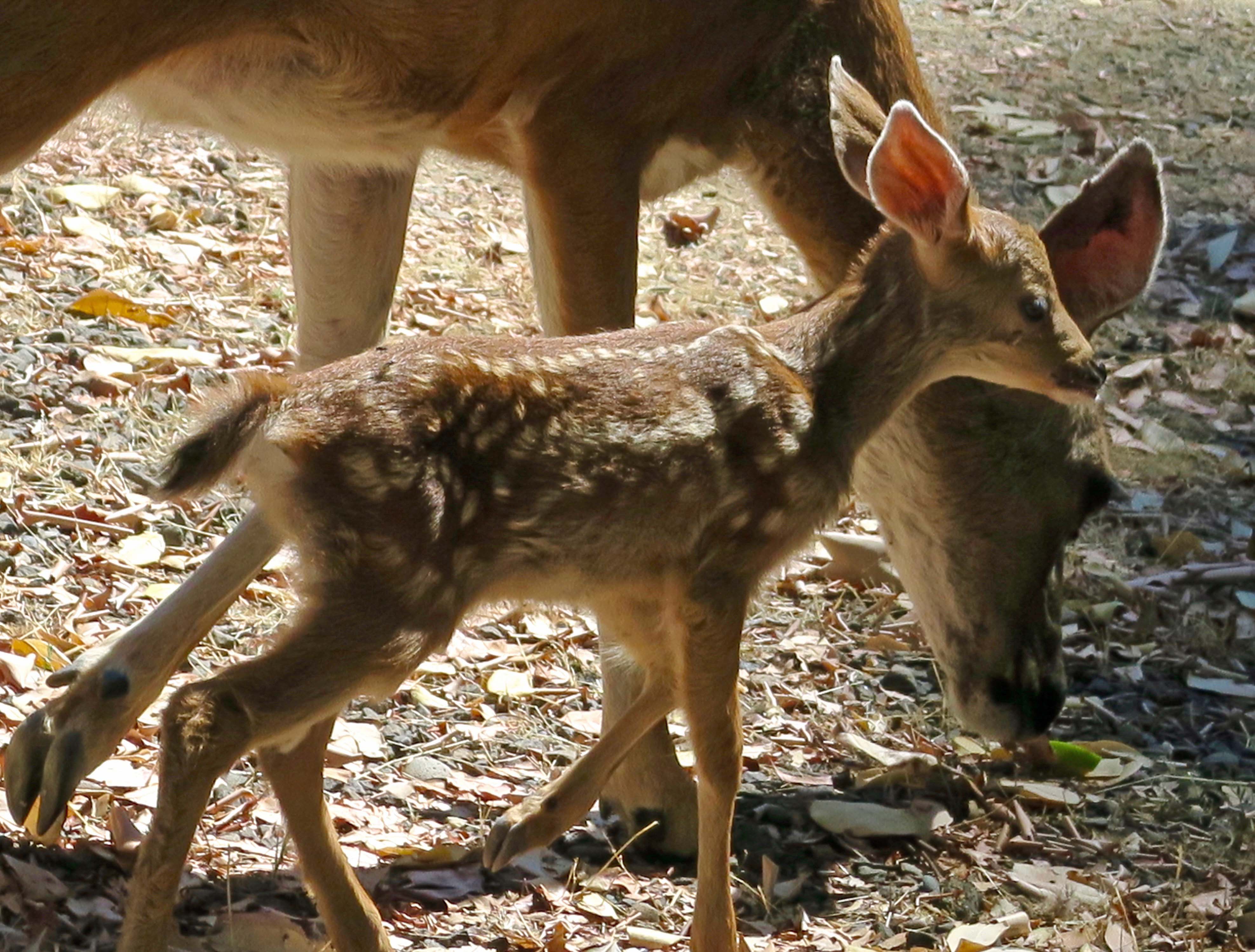
One of my greatest thrills as a boy exploring the woods near our home was watching a doe with her recently born fawn. I am still thrilled when does bring their babies by our home. This photo was from last year. We are expecting new fawns soon. There is a pregnant doe a few feet away from where I am writing right now. At least three others are scattered around our property.
I just fed mom an apple for Mother’s Day.

In my last blog-a-book post from my outdoor adventure book, It’s 4 AM and a Bear Is Standing on Top of Me, I wrote about the Pond, which was a major influence in my childhood leading me to a lifelong love of the outdoors and wilderness. Today, I will introduce another one, the Woods.

The Woods also earned a capital letter. To get there you walked out the back door, down the alley past the Graveyard and through a pasture Jimmy Pagonni rented for his cattle. Tackling the pasture involved crawling through a rusty barbed wire fence, avoiding fresh cow pies, climbing a hill and jumping an irrigation ditch. The journey was fraught with danger. Hungry barbed wire consumed several of my shirts and occasionally went for my back. 

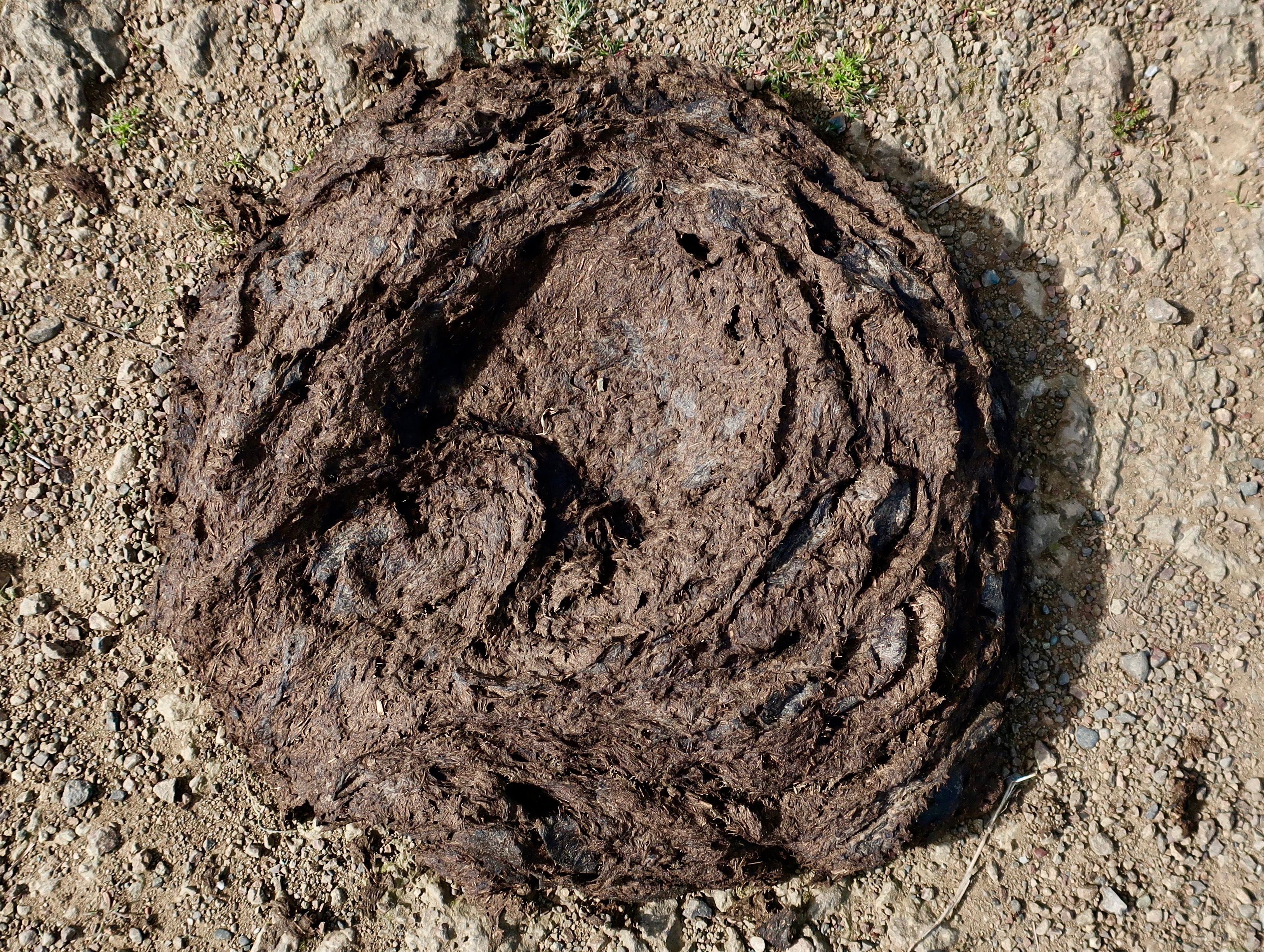
Torn clothing and bleeding scratches were a minor irritation in comparison to stepping in fresh cow poop though. A thousand-pound, grass-eating machine produces acres of the stuff. Deep piles sneak up your foot and slosh over into your shoes. Toes hate this. Even more treacherous are the little piles that hide out in the grass. A well-placed patty can send you sliding faster than black ice. The real danger here is ending up with your butt in the pile. I did that, once. Happily, no one was around to witness my misfortune, or hear my language, except Tickle the dog. I swore him to secrecy.

You do not want to step in this. No, no, no. I took this photo on our recent Cow Walk at Pt. Reyes and got ‘the look’ from Peggy. Think of it as cow art, a Jackson Pollock type of painting, abstract expressionism at its best. Grin.

For all of its hazards, the total hike to the Woods took about 15 minutes. Digger pines with drunken windmill limbs guarded the borders while gnarly manzanita and spiked chaparral dared the casual visitor to venture off the trail. Poison oak proved more subtle but effective in discouraging exploration. 

I could count on raucous California jays to announce my presence, especially if I was stalking a band of notorious outlaws. Ground squirrels were also quick to whistle their displeasure. Less talkative jackrabbits merely ambled off upon spotting me, put on a little speed for a hyper Cocker, and became bounding blurs in the presence of a hungry greyhound. Flickers, California quail and acorn woodpeckers held discussions in distinctive voices I soon learned to recognize.

From the beginning, I felt at home in the Woods, like I belonged. I quickly learned that its hidden recesses contained a multitude of secrets. I was eager to learn what they had to teach me, but the process seemed glacial. It required patience and I hardly knew how to spell the word. I did know how to sit quietly, however. This was a skill I had picked up from the hours I spent with my nose buried in books. The woodland creatures prefer their people noisy. A Curt stomping down the trail, snapping dead twigs, and talking to himself was easy to avoid while a Curt being quiet might surprise them. 

One gray squirrel was particularly loud in his objections. He lived in the top branches of a digger pine beside the trail and maintained an observation post on an overhanging limb. When he heard me coming, he would adopt his ‘you can’t see me gray squirrel playing statue pose.’ But I knew where to look. I would find a comfortable seat and stare at him. It drove him crazy. Soon he would start to thump the limb madly with his foot and chirr loudly. He had pine nuts to gather, a stick home to remodel, and a bright-eyed, bushy-tailed lady to woo. I was blocking progress. Eventually, if I didn’t move, his irritation would bring him scrambling down the trunk for a much more up-close and personal scolding.

After about 15 minutes of continuous haranguing, he’d decide I was a harmless, if obnoxious aberration and go about his business. That’s when I begin to learn valuable secrets, like where he hid his pine nuts. It was also a sign for the rest of the wildlife to come out of hiding. A western fence lizard might work its way to the top of the dead log next to me and start doing push-ups. Why, I couldn’t imagine. Or perhaps a thrush would begin to scratch up the leaves under the manzanita in search of creepy tidbits. The first time I heard one, it sounded like a very large animal interested in little boy flesh. Occasionally there were special treats: A band of teenage gray squirrels playing tag and demonstrating their incredible acrobatics; a doe leading its shy, speckled fawn out to drink in the small stream that graced the Wood’s meadow; and a coyote sneaking up on a ground squirrel hole with an intensity I could almost feel.

I also began to play at stalking animals. Sometime during the time period between childhood and becoming a teenager, I read James Fennimore Cooper and began to think I was a reincarnation of Natty Bumppo. Looking back, I can’t say I was particularly skilled, but no one could have told me so at the time. At least I learned to avoid dry twigs, walk slowly, and stop frequently. Occasionally, I even managed to sneak up on some unsuspecting woodland creature. 

If the birds and the animals weren’t present, they left signs for me. There was always the helter-skelter pack rat nest to explore. Tickle liked to tear them apart, quickly sending twigs flying in all directions. There were also numerous tracks to figure out. Was it a dog or coyote that had stopped for a drink out of the stream the night before? Tickle knew instantly, but I had to piece it together. A sinuous trail left by a slithery serpent was guaranteed to catch my attention. This was rattlesnake country. Who’d been eating whom or what was another question? The dismantled pinecone was easy to figure out but who considered the bark on a young white fir a delicacy? And what about the quail feathers scattered haphazardly beside the trail?

Scat, I learned, was the tracker’s word for shit. It offered a multitude of clues for what animals had been ambling down the trail and what they had been eating. There were deer droppings and rabbit droppings and mouse droppings descending in size. Coyotes and foxes left their distinctive dog-like scat but the presence of fur and berries suggested that something other than dog food had been on the menu. Some scat was particularly fascinating, at least to me. Burped up owl pellets provided a treasure chest of bones— little feet, little legs and little skulls that grinned back with the vacant stare of slow mice.

While Tarzan hung out in the Graveyard and pirates infested the Pond, mountain men, cowboys, Indians, Robin Hood and various bad guys roamed the Woods. Each bush hid a potential enemy that I would indubitably vanquish. I had the fastest two fingers in the West and I could split a pine nut with an imaginary arrow at 50 yards.  I never lost. How could I? It was my fantasy. But daydreams were only a part of the picture. I fell in love with wandering in the Woods and playing on the Pond. There was an encyclopedia of knowledge available and a multitude of lessons about life. Learning wasn’t a conscious effort, though; it was more like absorption. The world shifted for me when I entered the Woods and time slowed down. A spider with an egg sack was worth ten minutes, a gopher pushing dirt out of its hole an hour, and a deer with a fawn a lifetime.
NEXT MONDAY’S POST: Not surprisingly, my classmates start calling me Nature Boy. It was a title I wore proudly.

Raging Winds, Fog, and Treacherous Rocks… 3 Reasons for the Pt. Reyes Lighthouse

“Point Reyes is the windiest place on the Pacific Coast and the second foggiest place on the North American continent. Weeks of fog, especially during the summer months, frequently reduce visibility to hundreds of feet. The Point Reyes Headlands, which jut 10 miles out to sea, pose a threat to each ship entering or leaving San Francisco Bay. The historic Point Reyes Lighthouse warned mariners of danger for more than a hundred years.” From the Pt. Reyes National Seashore website.

It was hard to imagine frequent winds of 60 MPH that have been clocked as high as 133 MPH and weeks on end of pea-soup fog the day we visited the Pt. Reyes Lighthouse in March.

For as much as I enjoy Pt. Reyes National Seashore, I studiously avoid it in the summer. One reason is the fog. That’s true for much of the Pacific Coast. The other is tourists, gazillions of them. Traffic slows to a turtle’s pace along Highway 1, campgrounds are full, and popular sites such as the lighthouse are packed. I have a limited sense of humor about any of the above, especially given that I can visit during the late fall, winter, and early spring when few tourists are out and about and days are often crystal clear. Or, if I am particularly lucky, a raging storm will send huge waves crashing ashore producing spectacular views. I love both.

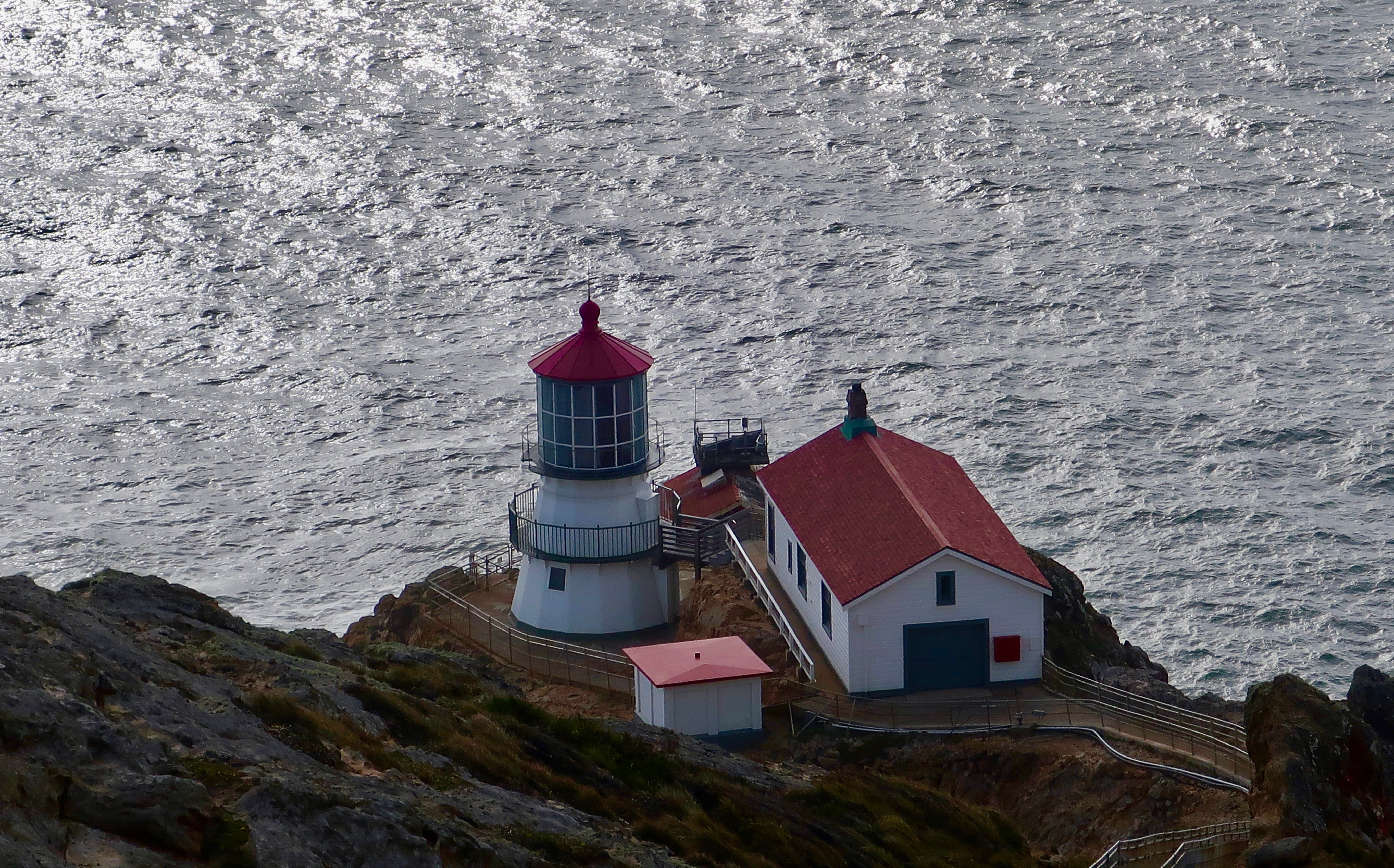
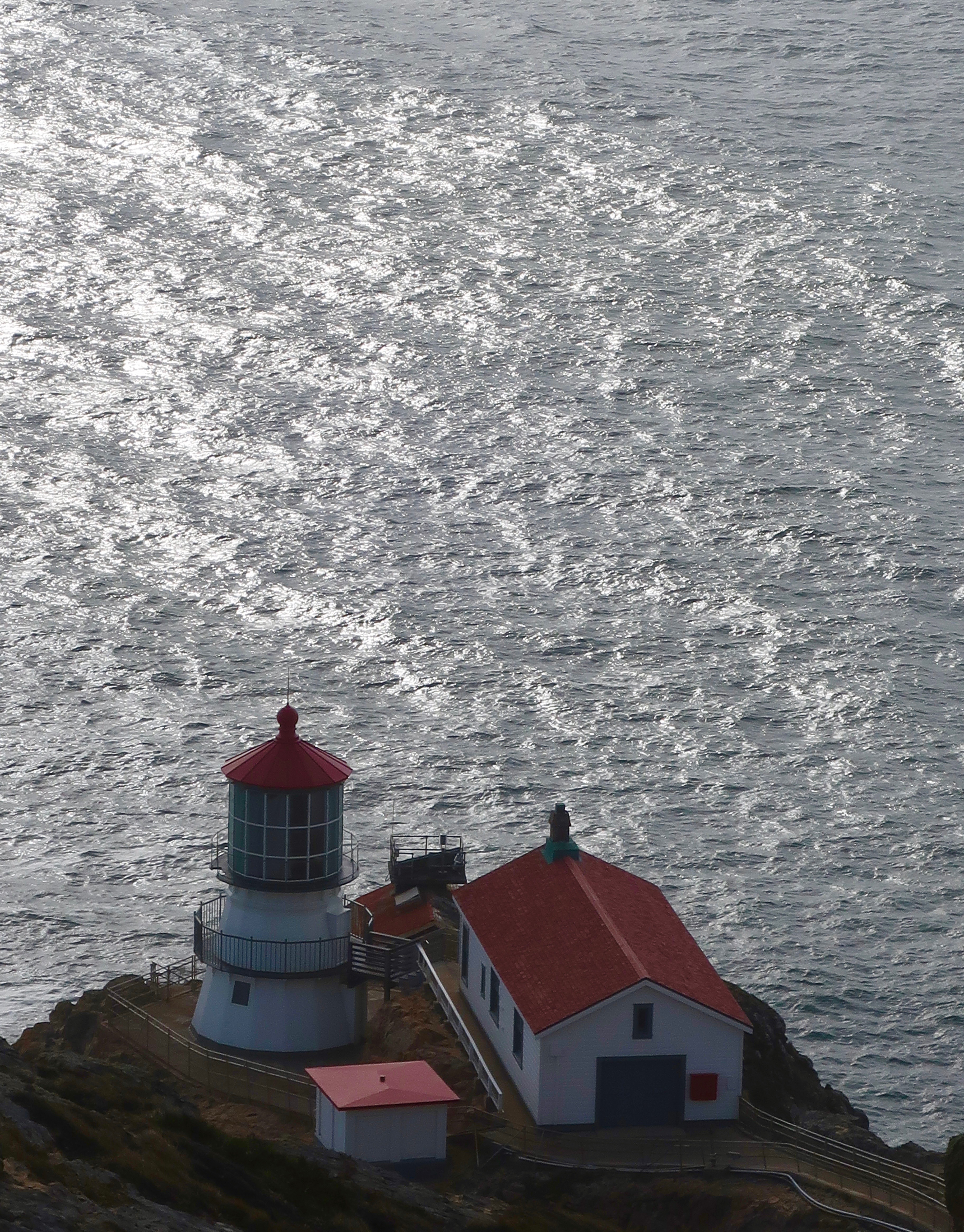
It was mainly sunshine when Peggy and I visited the National Seashore in early March to celebrate my birthday. The lighthouse was closed due to Covid, but I have visited it before. This time, we admired it from above.

The Lighthouse was built in 1870 to help counter the frequent shipwrecks that took place in the area. A steam driven fog horn was used when the fog was too thick to see the light.

The lighthouse served its purpose for over 100 years, finally shutting down in 1975 when the US Coast Guard replaced it with an automated light found just below the historic lighthouse. Up until then it was tended by a lighthouse keeper whose responsibility was to keep the light burning. In addition to warning mariners off of the treacherous rocks, the lighthouse served as a navigational aid. Each lighthouse along the coast has a different frequency of light that ship pilots recognize. At Pt. Reyes, the light flashed once every five seconds.

Looking out to sea.
A historic view of the Pt. Reyes Lighthouse from the National Archives.

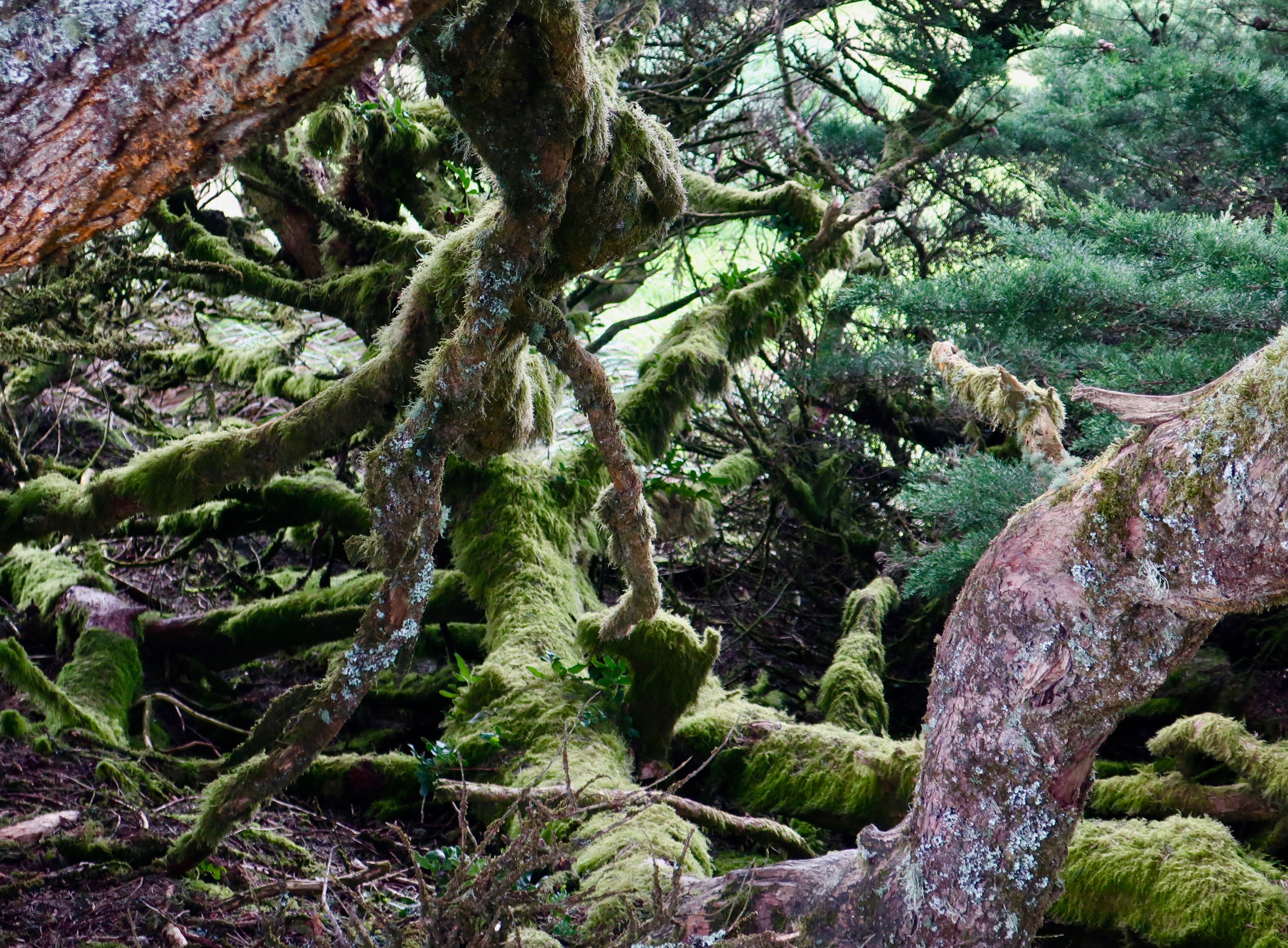
Peggy and I parked Quivera and followed the trail that led out to the lighthouse. Along the way, we found trees that showed the effects of the high winds that frequent the headlands.

Wind sculptured trees
I pictured children having a blast climbing over the gnarled limbs on the trees.
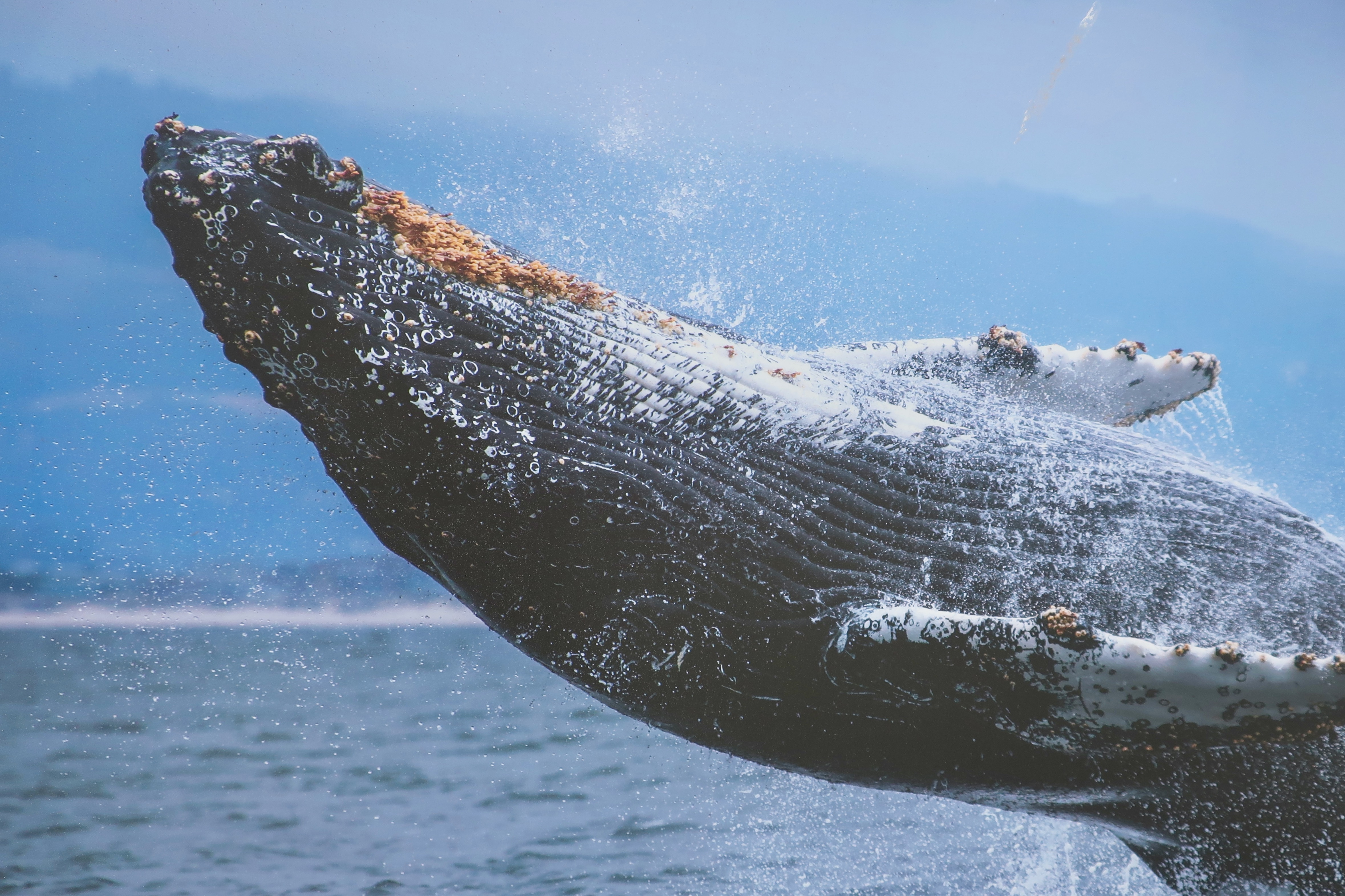
The Pt. Reyes headlands are a great place for whale watching when they are migrating south toward Mexico and then north toward the Arctic. We didn’t see any, but we were greeted by this large mural as we neared the lighthouse.
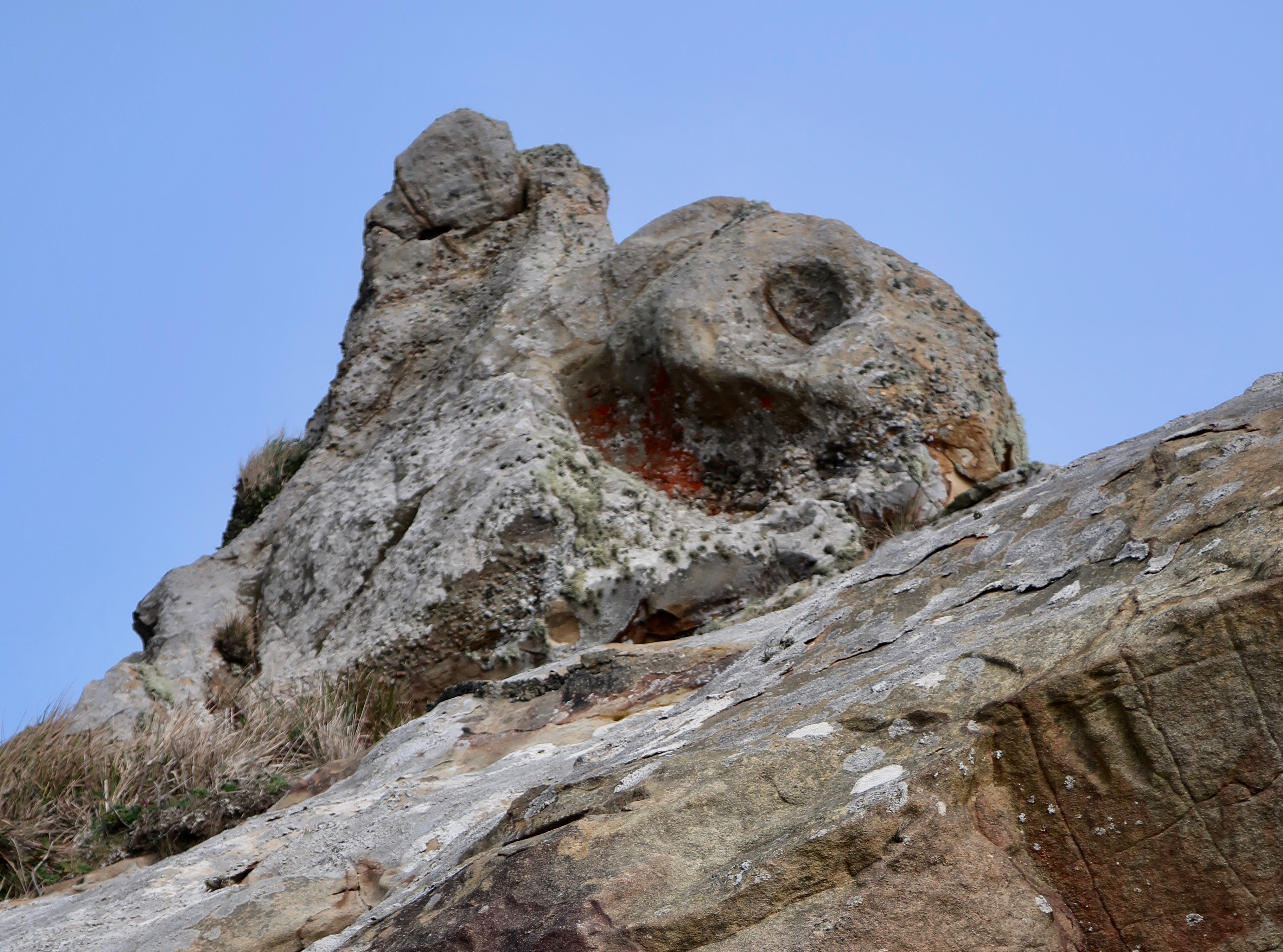
We found this interesting rock perched above the lighthouse.
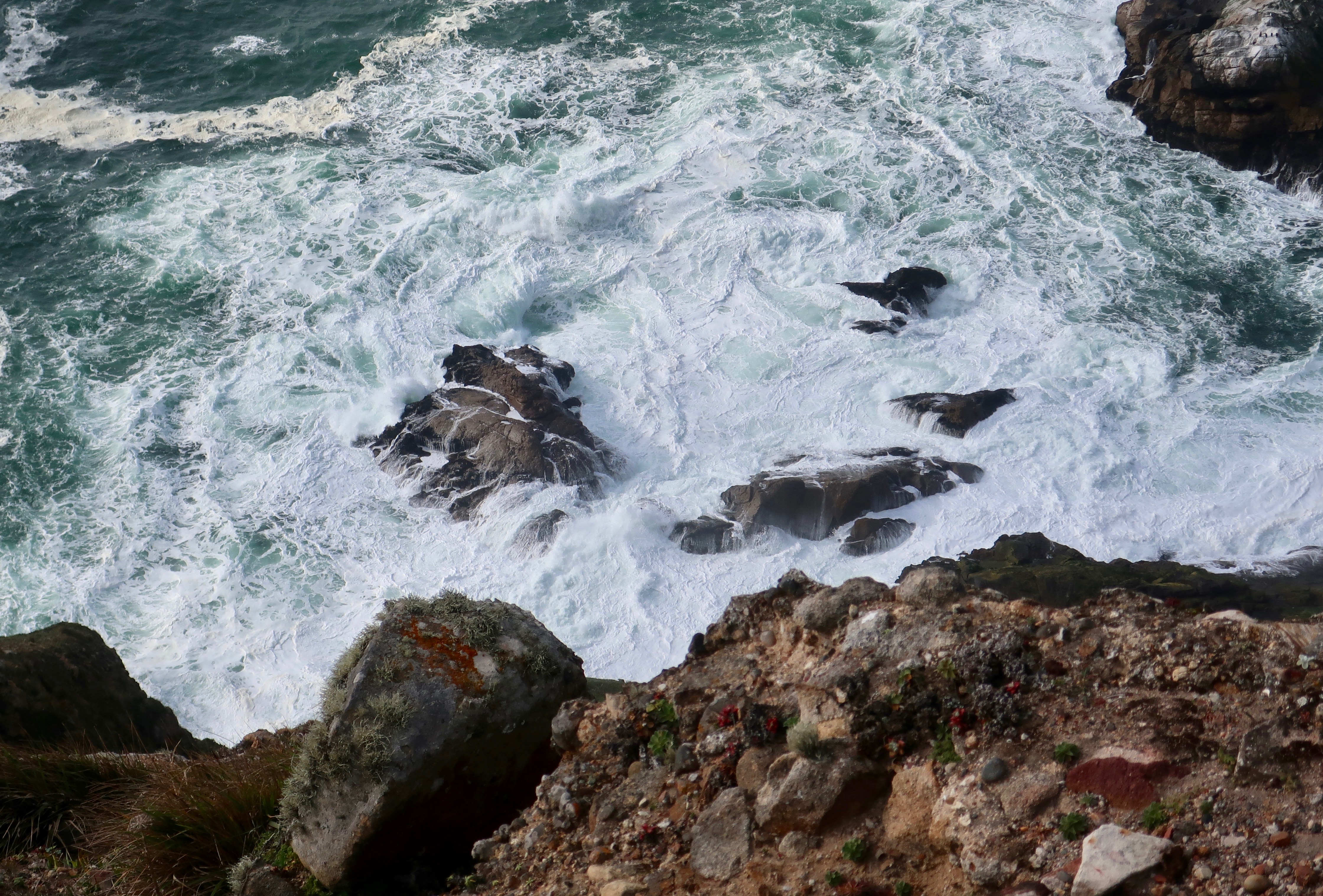
And looking down below the lighthouse, we watched these waves crashing ashore among the rocks— which is where I will conclude my post for today.

NEXT FRIDAY’S TRAVEL BLOG: I’ll wrap up my Pt. Reyes series with a pleasant walk out to Abbot’s Lagoon and a visit to the colorful town of Pt. Reyes Station.

A Police Car Is Held Hostage and Becomes a Speaker’s Podium… Berkeley in the 60s

Mimeographed sheet on Free Speech Movement from the files of Curtis Mekemson.
Hastily run off mimeograph sheets such as this one kept students up-to-date on what was happening with the Free Speech Movement. It seems terribly quaint in the age of the Internet and cellphones. (From my FSM files.)

Within hours of the time that Dean Katherine Towle sent out her ultimatum about the closure of the Free Speech area and the ban on organizing off-campus activities or raising funds for such activities, the brother and sister team of Art and Jackie Goldberg had pulled together activist organizations ranging in orientation from the radical to conservative, and a nascent FSM was born. Shortly thereafter, the mimeographs were humming and students were buried in an avalanche of leaflets as they walked on to campus. I read mine is disbelief. The clash I had warned the Administration of a year earlier had arrived. There was no joy in being right.

As soon as it became apparent that the Administration had no intention of backing off from its new rules, the FSM leadership determined to challenge the University. Organizations were encouraged to set up card tables in the Sather Gate area to solicit support for off campus causes. I had stopped by a table to pick up some literature when a pair of deans approached and started writing down names of the folks manning the tables. Our immediate reaction was to form a line so we could have our names taken as well. The deans refused to accommodate us. The Administration’s objective was to pick off and separate the leadership of the FSM from the general student body.

A few days later, I came out of class to find a police car parked in Sproul Plaza surrounded by students. The police, with encouragement from the Administration, had arrested Jack Weinberg, an organizer for CORE, the Congress of Racial Equality, who had been soliciting support for his organization. Someone had found a bullhorn and people were making speeches from the top of the police car while Jack sat inside. I situated myself on the edge of the fountain next to the Student Union and idly scratched the head of a German Short Haired Pointer named Ludwig while I listened. Ludwig visited campus daily and played in the water. He’d become a Berkeley regular.

Jack Weinberg, who would coin the 60s rallying cry of “Never trust anyone over 30,” being held in the police car on the Berkeley campus. (From my FSM files.)

Eventually I stood up and joined those on the edge of the crowd thereby becoming a part of the blockade. It was my first ever participation in civil disobedience. It was a small step. There would be plenty of time for more critical thinking if the police showed up in force. Being only semi-radical, I did duty between classes and took breaks for eating and sleeping. Eventually, after a couple of days, the FSM negotiated a deal with the Administration. Jack was booked on campus and turned loose, as was the police car. A collection was taken up to pay for minor damages the police car had sustained in the line of duty while serving as a podium. I threw in a dollar. Weinberg, by the way, was the one who coined the rallying cry of youth in the 60s: “Never trust anyone over 30.”

The situation did not improve. Each time a solution seemed imminent, the Administration would renege or the FSM would increase its demands. In addition to the right to organize on campus, the disciplining of FSM leaders became a central issue. Demonstrations took place almost daily and were blasted in the press, which wasn’t surprising considering the local press was the Oakland Tribune. I learned a great deal about media sensationalism and biased reporting. One day I would sit in on a very democratic and spirited discussion of the pros and cons of a specific action and the next day I would read in the Tribune or San Francisco Examiner that I had participated in a major insurrection of left leaning radicals who were challenging the very basis of law and order and civilized society. 

Older adults, looking suspiciously like plain-clothes policemen or FBI agents, became a common occurrence on Campus. It was easy to become paranoid. If we signed a petition, demonstrated, made a speech or just stood by listening, would our pictures and names end up in some mysterious Washington file that proclaimed our disloyalty to the nation? These weren’t idle thoughts. A few years earlier people’s careers had been ended and lives ruined because someone had implied they were soft on communism. J. Edgar Hoover was known for tracking Civil Rights’ leaders and maintaining extensive files on every aspect of their lives. While we weren’t up against the KGB, caution was advisable. We looked warily at those who didn’t look like us. One day a small dog was making his way around the edge of the daily demonstration, sniffing people.

“See that Chihuahua?” Jo whispered in my ear. I nodded yes. “It’s a police dog in disguise. Any moment it is going to unzip its front and a German Shepherd will pop out.” 

The wolf in sheep’s clothing was amongst us. It was a light moment to counter a serious time. And we were very serious. I sometimes wondered when the celebrated fun of being a college student would kick in. 

NEXT WEDNESDAY’S POST: I join an occupation of the Administration Building, give a speech from the Dean’s desk, and sit down with a small group of people to sing Civil Right’s protest songs with Joan Baez.