The Mutant Vehicles of Burning Man

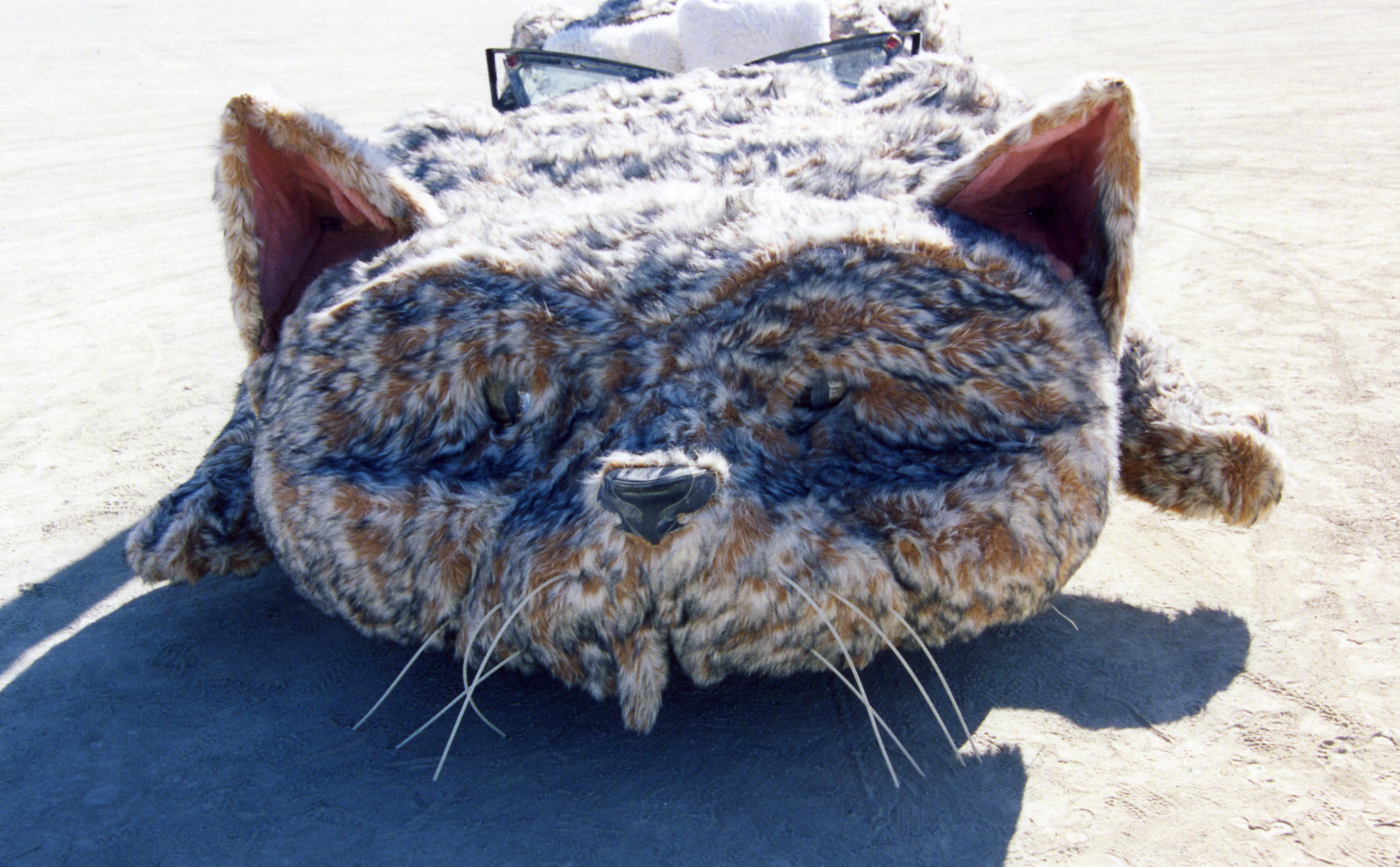
The Cat Car is a wonderful example of how creative people are at Burning Man in designing mutant vehicles and how much time, money and effort goes into the project.

Driving your car around Burning Man is a definite no-no, unless of course you check in at DMV and obtain a permit. That’s the Department of Mutant Vehicles not the Department of Motor Vehicles.

My first acquaintance with mutants was Godzilla. Today we have the Xmen but I am still partial to the early Japanese horror flicks. There was something totally campy about them that is rarely matched in today’s standard fare of special effects.

I wouldn’t describe Burning Man’s mutant vehicles as campy but they are wonderfully creative. The rule is that if you are going to drive a vehicle at Burning Man it has to be decorated, i.e. transformed into something that has minimal resemblance to its original look. Check out the Cat Car above.

And here again there is a movie reference since we have Transformers, the vehicles that morph before our very eyes.

I’ve learned about Transformers from my grandson Ethan who has dozens of the toys and is an expert at changing innocent looking cars into a raging monsters, some of whom are forces for good while others are forces for evil. It is hard for me to tell the difference but Ethan is patient with me…

The mutant vehicles at Burning Man don’t actually morph but their persona does change between day and night when the already interesting dragons, bugs, elephants and ships are lit up like Christmas Trees and begin to breathe fire. It’s a transformation that is rarely if ever matched in our everyday world and I am still not sure whether it resembles a Fairy Land Fantasy or something out of Dante.

Mutant vehicles of the day take on a different persona at night. Photo by Tom Lovering.

Like my blog on the characters and costumes of Burning Man, this blog is better told with photos than words, however.

The "Never Was Haul" is another great example of the creativity, work, and expense that goes into creating mutant vehicles. This one is delivered by flat bed to Burning Man. Photo by Tom Lovering.
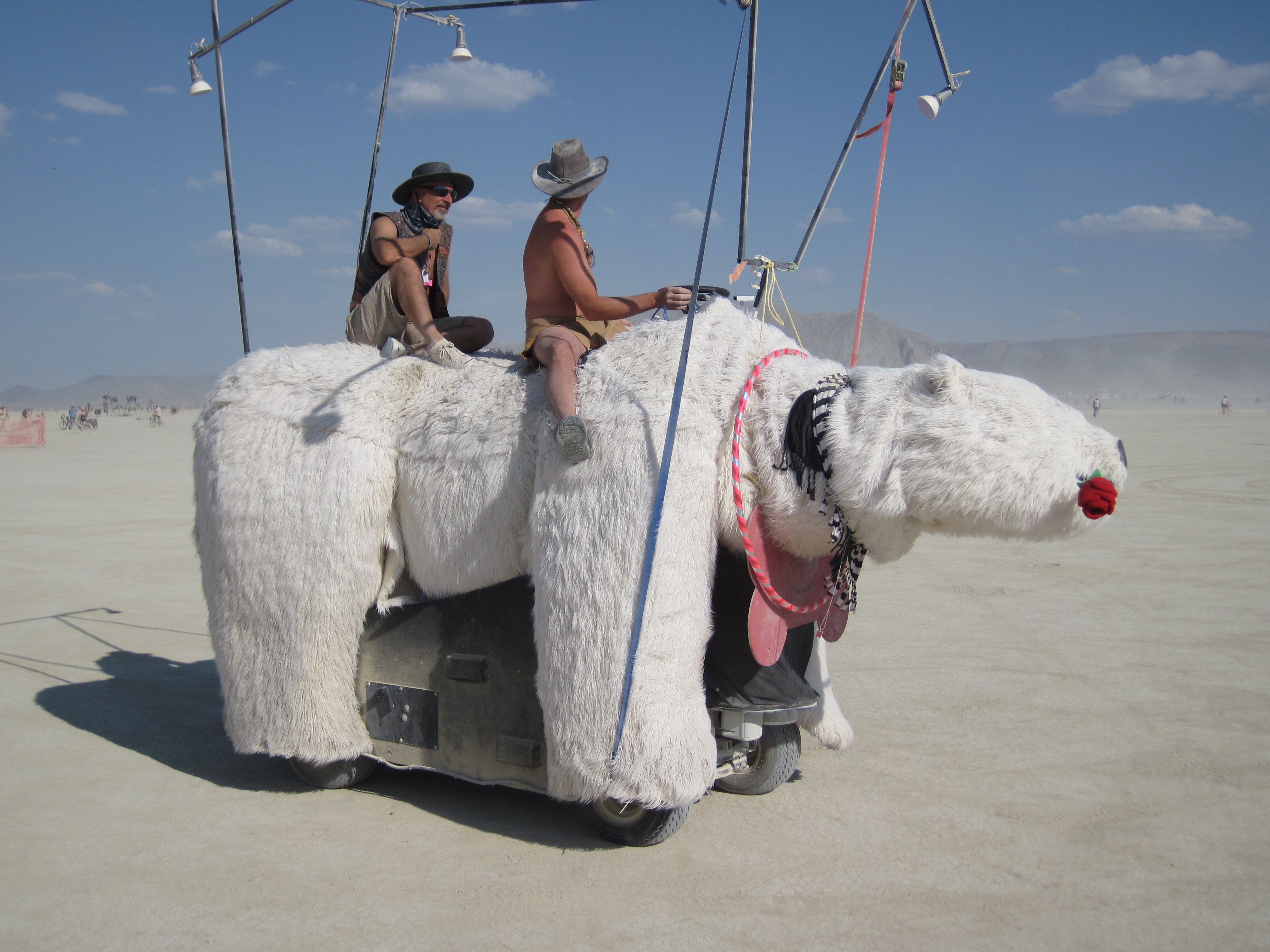
How often do you meet up with a polar bear in the desert? Photo by Tom Lovering.

And here we have a golden dragon. (Dragons are common at BM.) Many of the vehicles are designed to carry a number of people. The woman dancing at the left is probably responding to music coming from the vehicle, another common occurrence.

Mutant vehicles are also designed for individual use.

While not defined as mutant vehicles and not requiring permits, many thousand bicycles are also decorated.

This ship of the desert captured by Don Green reflects both the heat and dust of BM. Note the giant slide in the background.
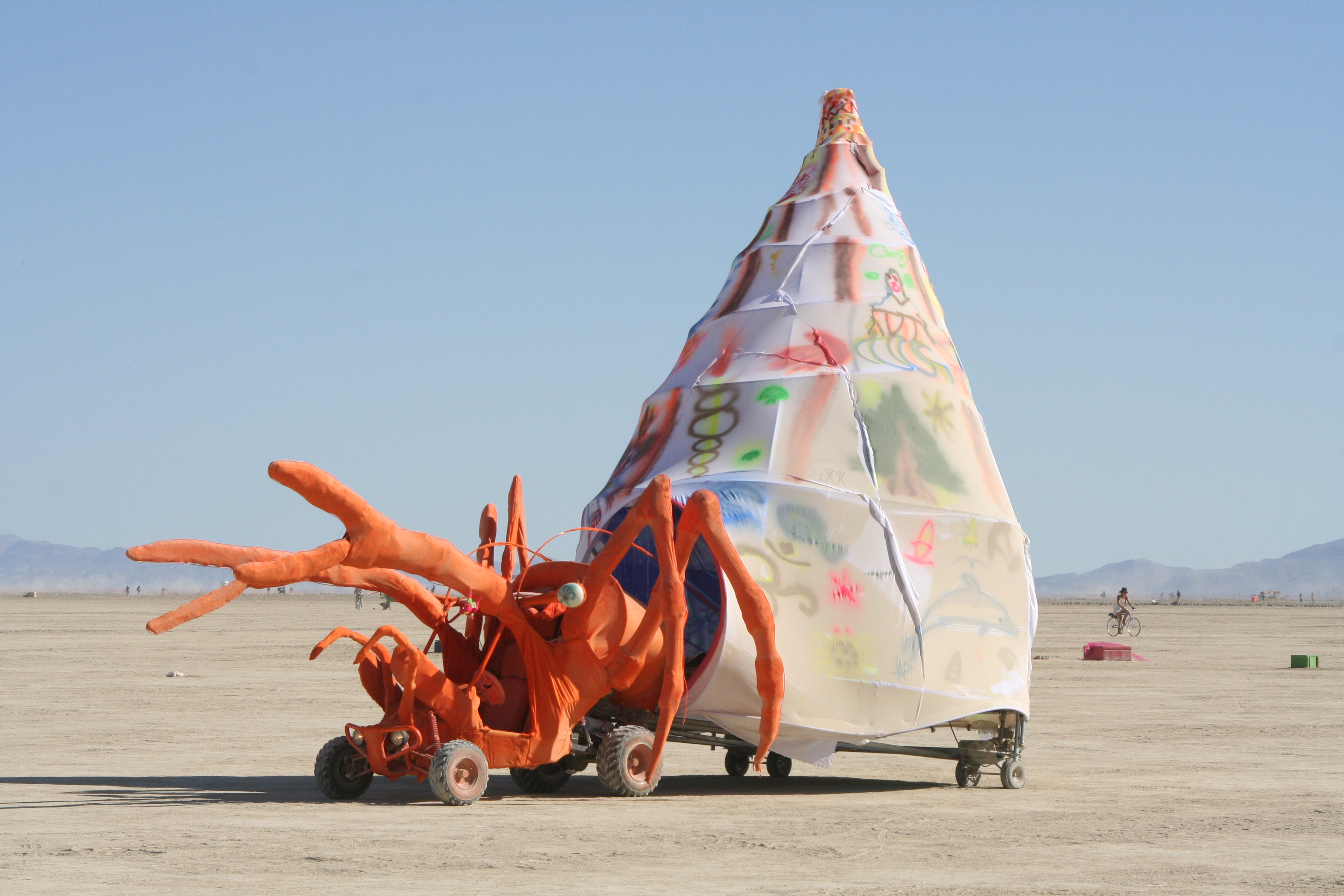
Often mutant vehicles reflect a sense of humor.

Or, like this dragon headed vehicle, may appear a little scary. The gun-like device on top shoots out flames at night.
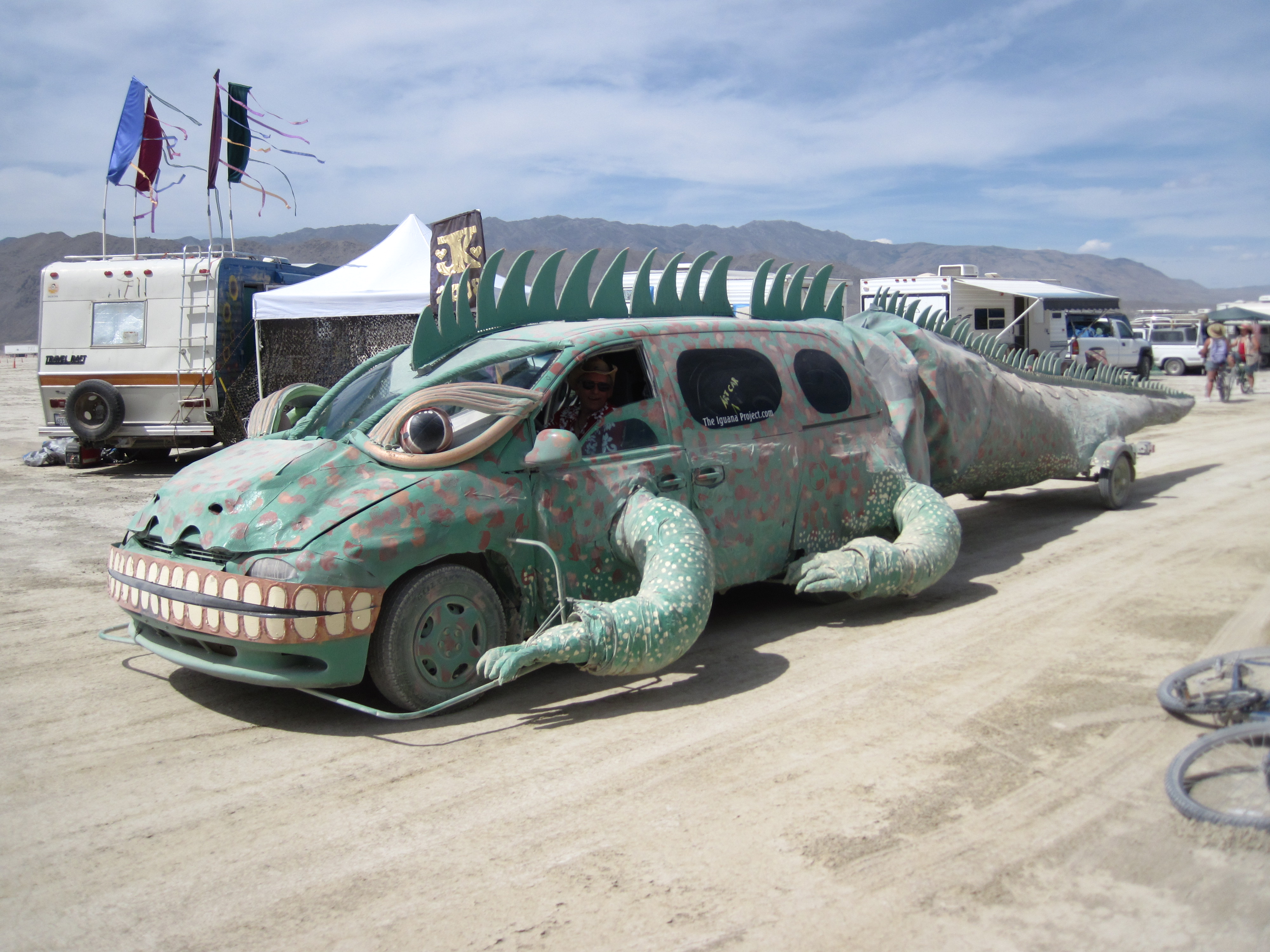
Tom Lovering caught this interesting vehicle as it drove by the Horse-Bone Camp.
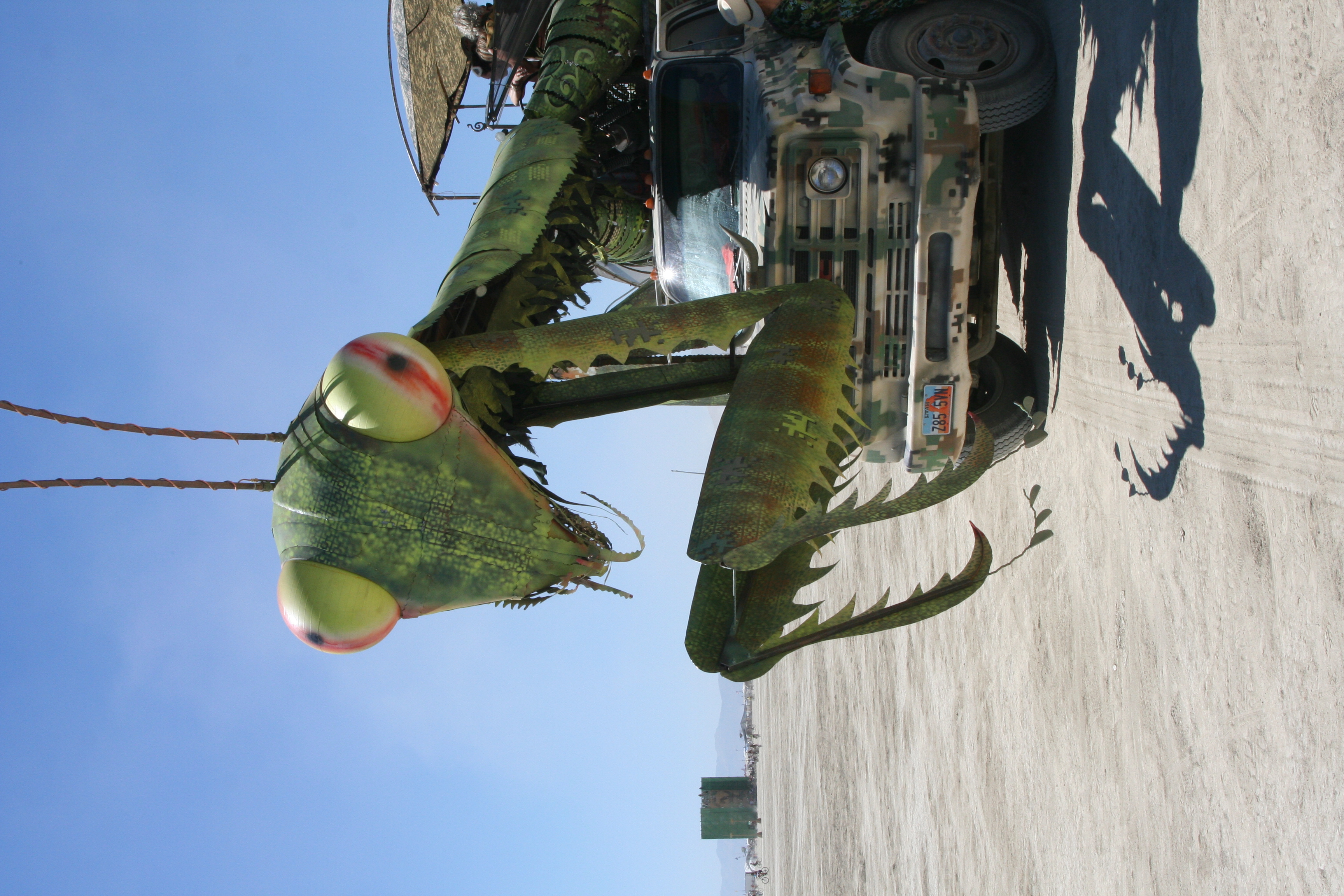
And here we have a praying mantis...

And that’s it for the mutant vehicles. I don’t have a clue as to how many are registered in any year, but they have to be in the hundreds. In the last photo, Luna, AKA Peggy, tries to hitch a ride.

Sailor Boy and Luna of Horse-Bone Camp stop to check out a mutant vehicle masquerading as a Playa Taxi.
The Characters of Burning Man

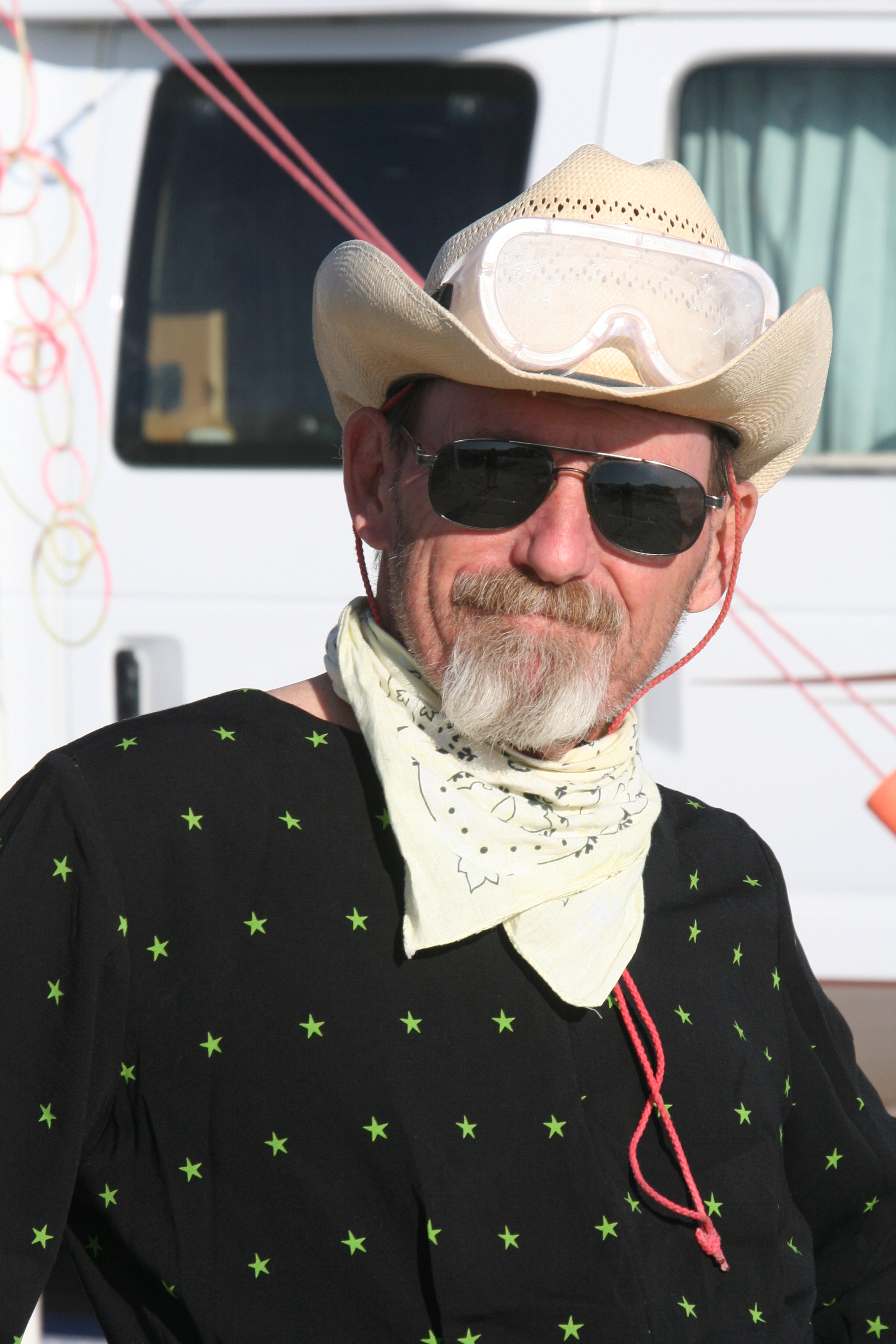
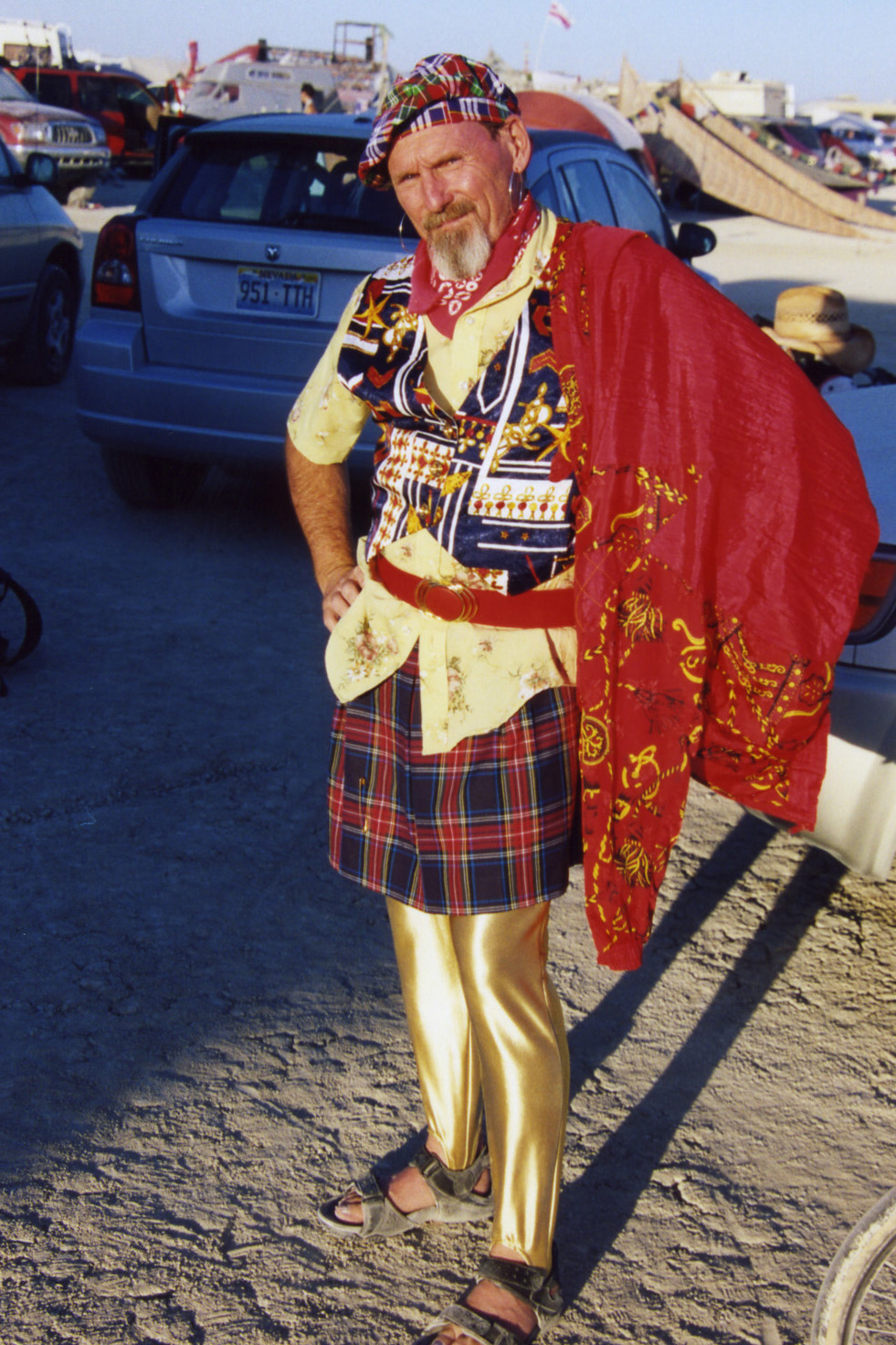
Scotty wins the prize for being best dressed of the Horse-Bone Tribe. From painted toe nails to early morning dress, to elaborate kilts, he can always be expected to shine... or is that shock?
If people watching were a sport, Burning Man would be Big League.

Whether you are bicycling the Playa, hanging out at Center Camp, strolling down the Esplanade or sitting in camp, you are almost guaranteed a show. Even a trip to the port-a-pot can be a walk on the wild side.

Burners take their fantasies seriously and dress appropriately. Everyone is expected to wear a costume and most people do. Some go all out. There are no rules: exotic beauty and downright ugly walk hand in hand.

There is even a costume contest. I was lucky to be considered a paparazzi after one event and had a prime location for photographing some of the more elaborately decked out characters.

This particular blog is one that is better expressed in pictures than words. Scroll down and enjoy.

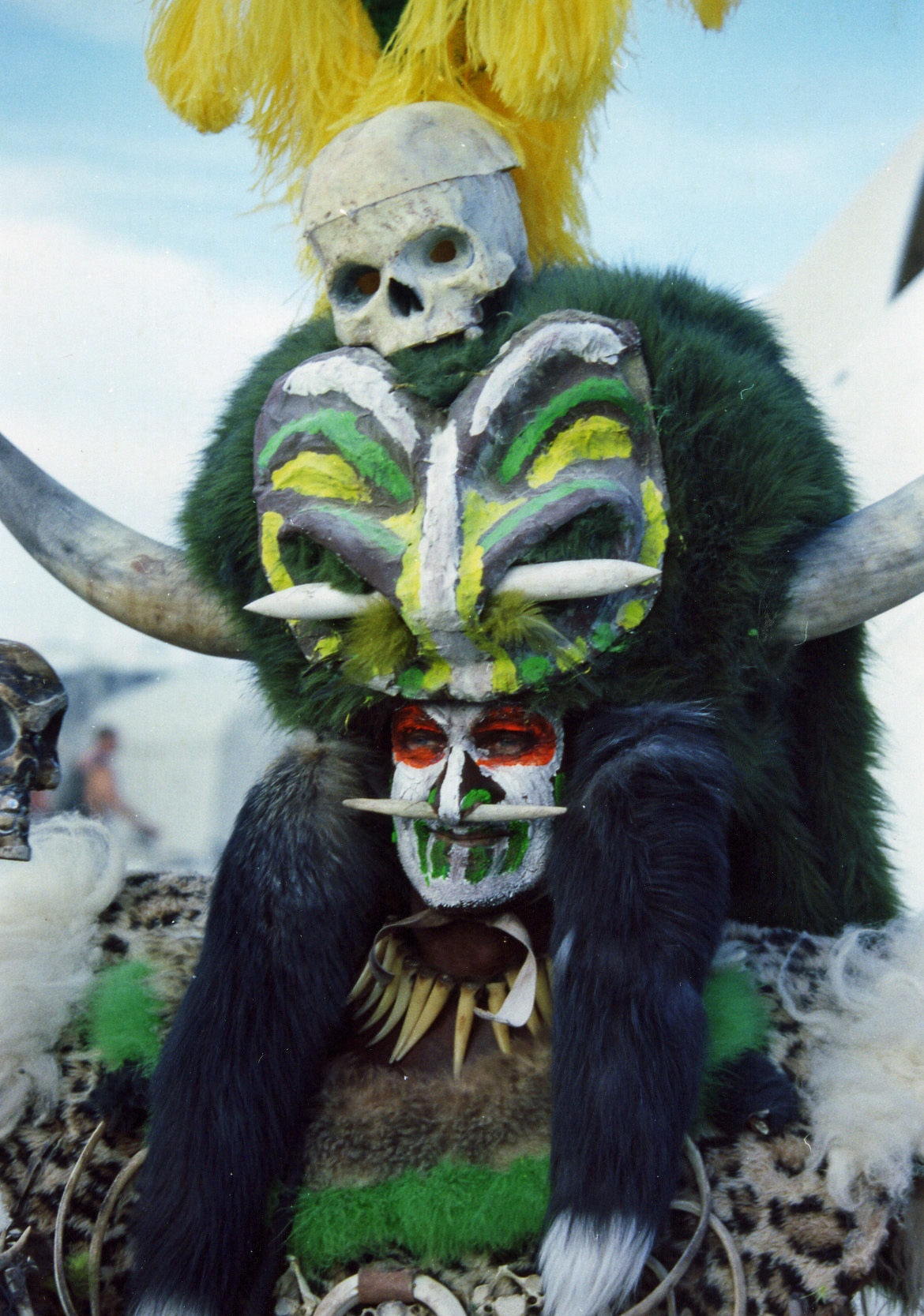
This shaman here wears one of the most elaborate costumes I have seen. It is Burning Man, however. Maybe it isn't a costume.

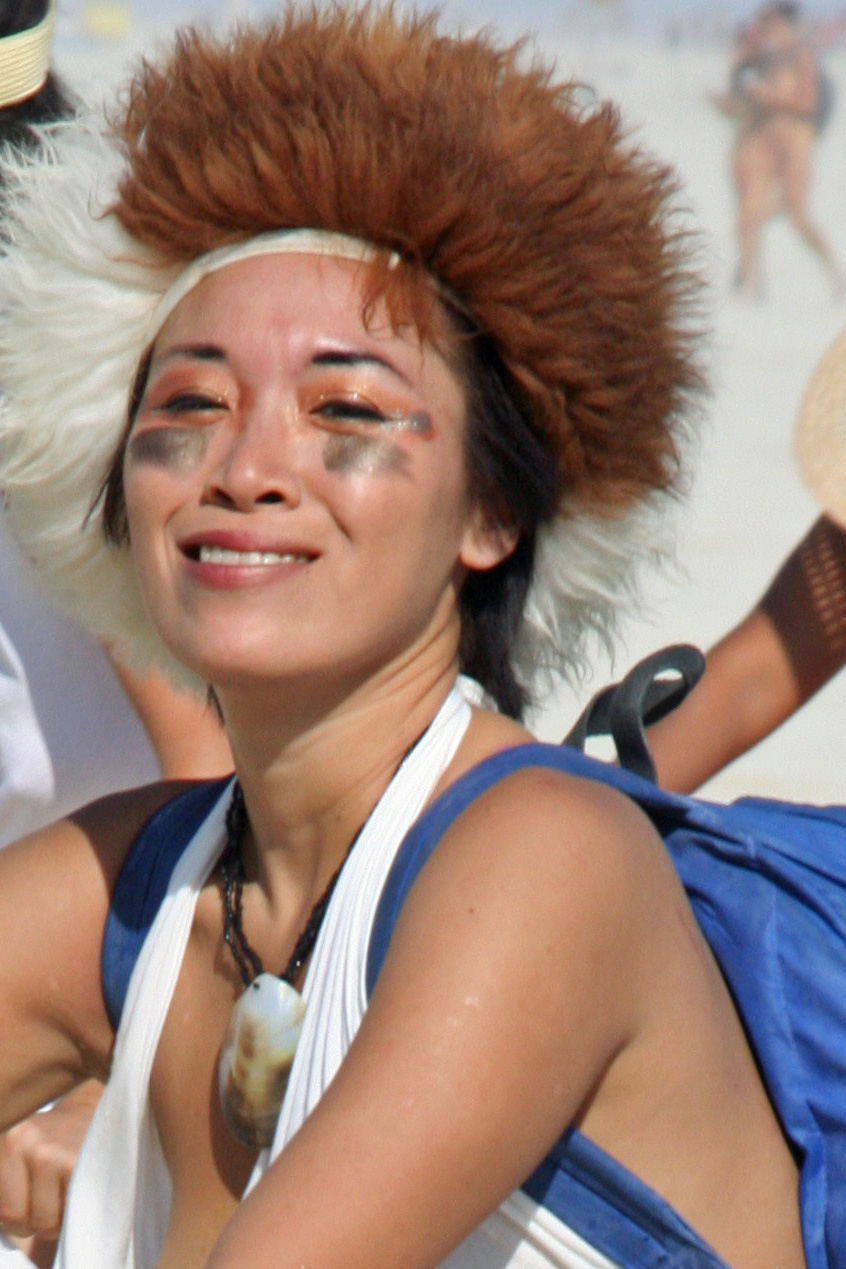
The Mona Lisa smile of this exotic beauty captures the imagination. Photo by Don Green

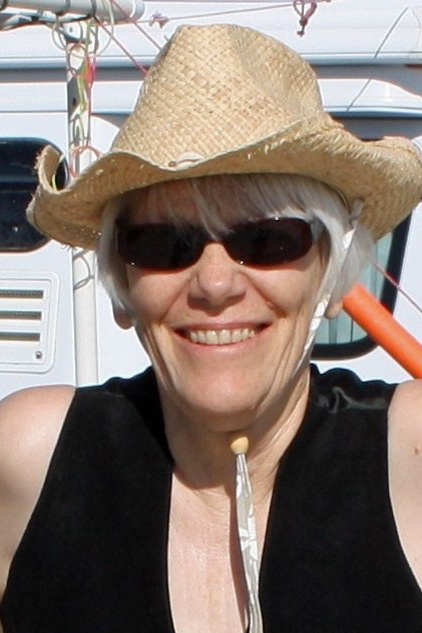
Here's another smile that's hard to resist. I also enjoyed the way her hat set off her face.

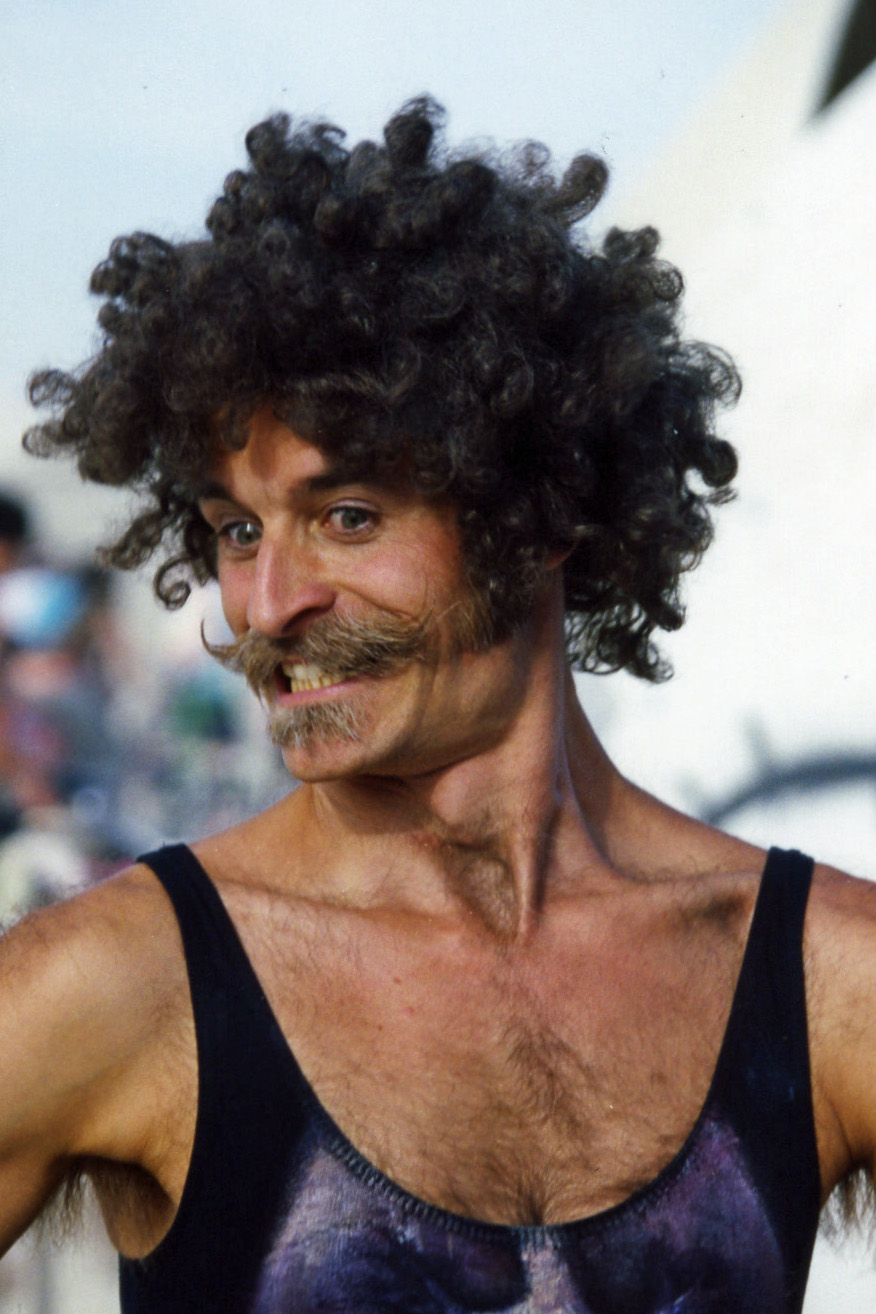
In the category of hairdos, it is hard to beat Mustache Man.Do you have a feeling you have arrived at a circus?

Snake Woman also reminds me of the circus, or possibly Las Vegas.

Sometimes, less is more, assuming you've got the body to pull it off. Or is that take it off?

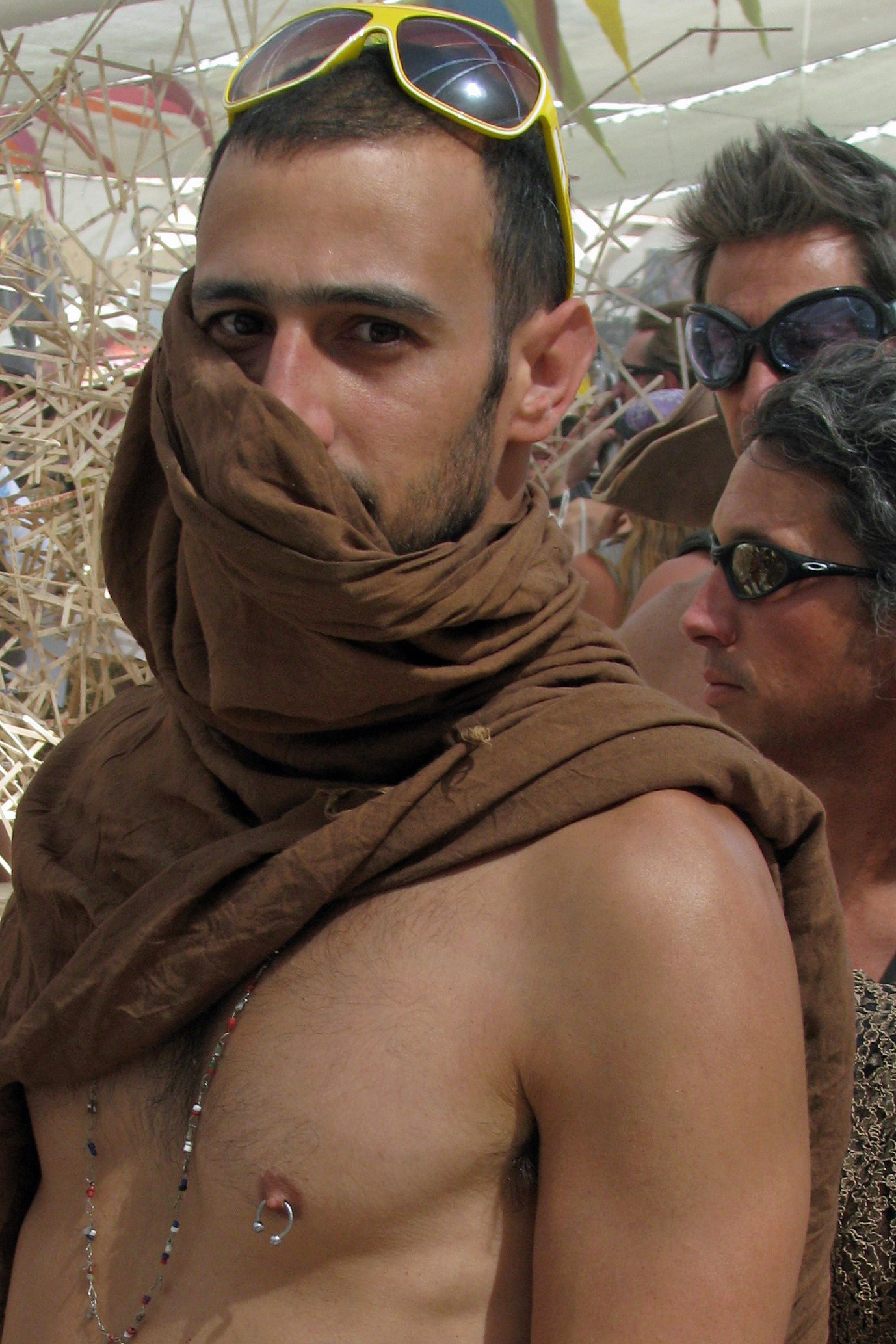
The women of Horse-Bone Tribe often complain there is more eye candy for the men than there is for the women. Maybe this exotic guy fits the bill. Photo by Don Green.

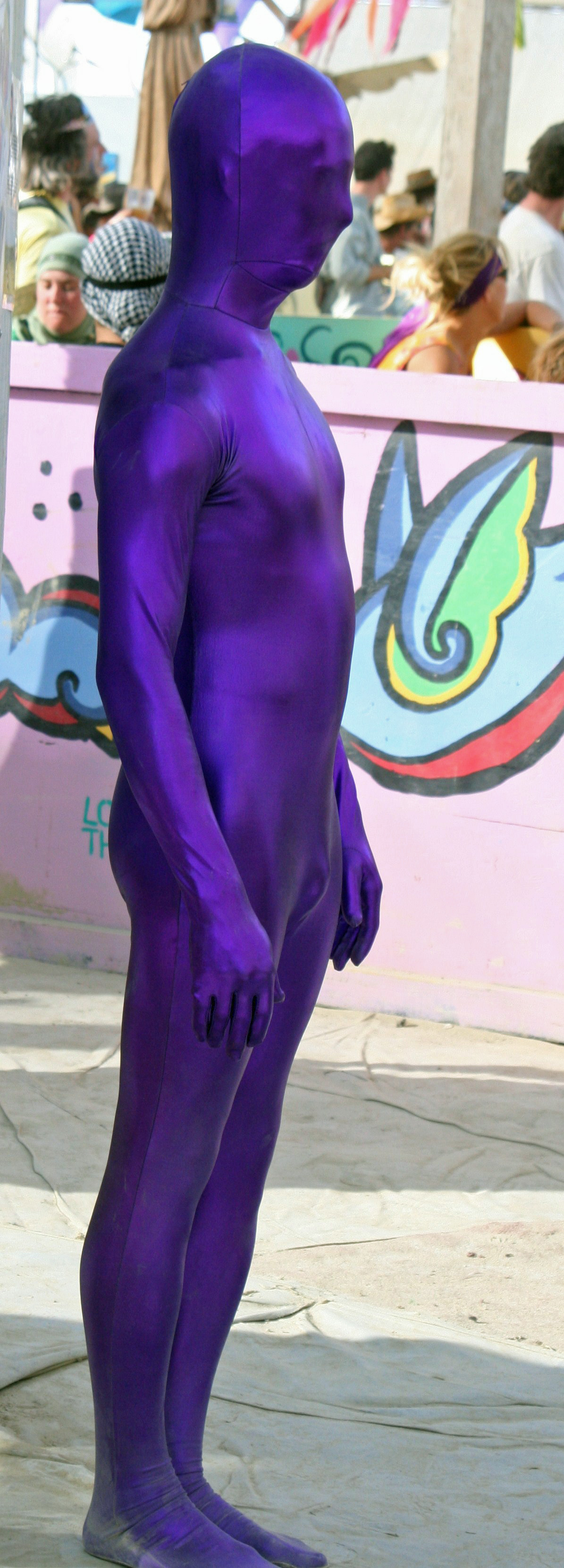
Then there's the Purple Man...

Or what about the purple haired lady?

Rocket Man came by to visit us in camp and played us a tune. We rewarded him with a beer.

I call this war bonnet with matching sunglasses and lip stick. Talk about a fashion statement. Photo by Don Green.

I have to throw in at least one man in a dress. This guy was also an accomplished trumpet player.

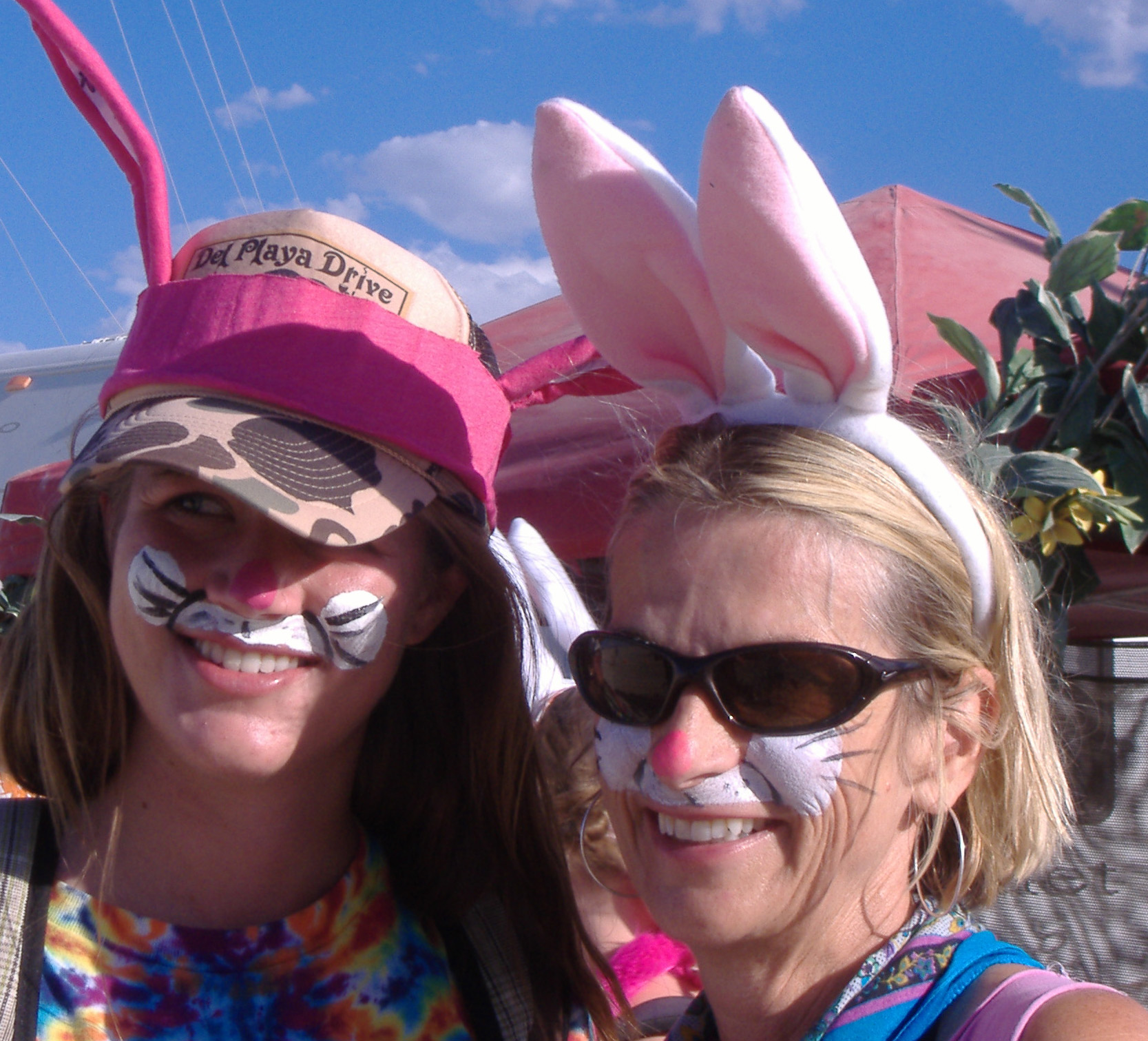
We have hundreds of photos like these. But hopefully I have at least provided a flavor of the folks we see and enjoy at Burning Man. I will conclude with a pair of bunnies from the Horse Bone Tribe.

A pair of bunnies from the Horse-Bone Tribe: Ringer and Pape. Photo by Ken Lake.

The Skull with a Vacant Stare

In my last blog I explored how the Pond of Diamond Springs, California in the 1950s earned its Capital P. The Woods also earned a capital letter.

To get there I walked out the back door, down the alley, and through a pasture Jimmy Pagonni rented for his cattle. Tackling the pasture involved crawling through a rusty barbed wire fence, avoiding cow pies, climbing a hill, and jumping an irrigation ditch.

The journey was fraught with danger. Hungry barbed wire consumed several of my shirts and occasionally went for my back. Torn clothing and bleeding scratches were a minor irritation in comparison to fresh cow manure, however. A thousand pound grass-eating machine produces acres of the stuff. A well-placed hidden patty can send you sliding faster than black ice.

For all of its hazards, the total hike to the Woods took about 10 minutes. Gray Pines with drunken windmill limbs guarded the borders while gnarly Manzanita and spiked Chaparral encouraged the casual visitor to stay on the trail. Poison oak proved more subtle but effective in discouraging exploration.

I could count on raucous California Jays to announce my presence, especially if I was stalking a band of notorious outlaws. Ground squirrels were also quick to whistle their displeasure. Less talkative jackrabbits merely ambled off upon spotting me, put on a little speed for the hyper Cocker Spaniel, Tickle and became bounding blurs at the urging of the hungry Greyhound, Pat.

Flickers, California Quail and Redheaded Woodpeckers held discussions in distinctive voices I soon learned to recognize.

From the beginning I felt at home in the Woods, like I belonged. I quickly learned that its hidden recesses contained a multitude of secrets begging discovery. I was eager to learn these secrets but the process seemed glacial. It required patience and I hardly knew how to spell the word.

I did know how to sit quietly, however. This was a skill I had picked up from the hours I spent with my nose buried in books. The woodland creatures prefer their people noisy. A Curtis stomping down the trail, snapping dead twigs and talking to himself was easy to avoid while a Curtis being quiet might surprise them.

One gray squirrel was particularly loud in his objections. He lived in the top branches of a pine beside the trail and maintained an observation post on an overhanging limb. When he heard me coming he would adopt his ‘you can’t see me’ pose. But I knew where to look. I would find a comfortable seat and stare at him.

It drove him crazy.

Soon he would start to thump the limb madly with his foot and chirr loudly. He had pine nuts to gather, a stick home to remodel and a bright-eyed, bushy-tailed lady to woo. I was blocking progress. Eventually, if I didn’t move, his irritation would bring him scrambling down the trunk for a more personal scolding.

After about 10 minutes of continuous haranguing, he’d decide I was a harmless, if obnoxious aberration and go about his business. That’s when I begin to learn valuable secrets, like where he hid his booty.

It was also a sign for the rest of the wildlife to come out of hiding. A Western Fence Lizard might work its way to the top of the dead log next to me and do push-ups. Why, I couldn’t imagine. Or perhaps a Thrush would scratch up the leaves under the Manzanita in search of creepy tidbits.

The first time I heard one, it sounded like a very large animal interested in little boy for lunch.

Occasionally there were special treats: a band of teenage Gray Squirrels playing tag and demonstrating their incredible acrobatics; a doe leading its shy, speckled fawn out to drink in the small stream that graced the Wood’s meadow; a coyote sneaking up on a ground squirrel hole with an intensity I could almost feel.

I also started stalking animals.

Sometime during the time period between childhood and teenage-hood, I read James Fennimore Cooper and began to think I was a reincarnation of Natty Bumppo. Looking back I can’t say I was particularly skilled at stalking but at least I learned to avoid dry twigs, walk slowly and stop frequently. Occasionally I even managed to sneak up on some unsuspecting animal.

If the birds and the animals weren’t present, they left signs for me. There was always the helter-skelter pack rat nest to explore. Tickle made it a specialty, quickly sending twigs flying in all directions.

There were also numerous tracks to figure out. Was it a dog or coyote that had stopped for a drink out of the stream the night before? My greyhound knew instantly but I had to piece it together. A sinuous trail left by a slithery serpent was guaranteed to catch my attention. This was rattlesnake country.

Who’d been eating whom or what was another question? The dismantled pine cone was easy to figure out but who considered the bark on a young white fir a delicacy? And what about the quail feathers scattered haphazardly beside the trail.

Scat, I learned, was the tracker’s word for poop. It offered a multitude of clues for who had been ambling down the trail and what they had been eating. There were deer droppings and rabbit droppings and mouse droppings descending in size. Coyotes left their distinctive dog-sized scat but the presence of fur suggested that something other than dog food had been on the menu.

Some scat was particularly fascinating, at least to me. Burped up owl pellets provided a treasure chest of bones… little feet, little legs and little skulls that grinned back with the vacant stare of slow mice

While Tarzan hung out in the Graveyard and pirates infested the Pond, mountain men, cowboys, indians, Robinhood and various bad guys roamed the Woods. Each bush hid a potential enemy that I would indubitably vanquish. I had the fastest two fingers in the West and I could split a pine nut with an arrow at 500 yards.  I never lost. How could I?  It was my fantasy.

But daydreams were only a part of the picture.

I fell in love with wandering in the Woods and playing on the Pond. There was an encyclopedia of knowledge available and a multitude of lessons about life. Learning wasn’t a conscious effort, though; it was more like absorption. The world shifted for me when I entered the Woods and time slowed down. A spider with an egg sack was worth ten minutes, a gopher pushing dirt out of its hole an hour, and a deer with a fawn a lifetime.

Next blog: Back to Burning Man… A Cast of Characters

Capital P is for Pond; A Place of Magic and Adventure

In my last blog I discussed how a long line of Mekemson and Marshall wanderers contributed to my DNA. I am not sure where this would have taken me had I been raised in an urban area. But in Diamond Springs, it turned me into a lover of wild places.

It was a Capital World.

For example, there were a number of ponds in the area. Ot Jones had one on his ranch for cattle; Caldor had one where logs waited for their appointment with the buzz saw; Forny had one over the hill from his slaughterhouse, and Tony Pavy had one that was supposedly off-limits. He grabbed his shotgun whenever we came near. Wise man.

But there was only one Capital P Pond, the one next to the Community Hall. If I told Marshall, my parents or my friends I was going to the Pond, they knew immediately where I would be.

It was a magical place filled with catfish, mud turtles, bullfrogs and pirates. Although the Pond was small, it had a peninsula, island, deep channel, cattails and shallows.

In spring, Redwing Blackbirds nested in the cattails and filled the air with melodic sound. Mallards with a moat mentality took advantage of the island’s safety to set up housekeeping. Catfish used holes in the bank of the peninsula to deposit hundreds of eggs that eventually turned into large schools of small black torpedoes dashing about in frenetic unison.

Momma bullfrogs laid eggs in strings that grew into chubby pollywogs. When they reached walnut size, tiny legs sprouted in one of nature’s miracles of transformation. Water snakes slithered though the water with the sole purpose of thinning out the growing frog population and I quickly learned to recognize the piteous cry of a frog being consumed whole.

Turtles liked to hang out in the shallows where any log or board provided a convenient sunning spot. They always slid off at our appearance but a few quiet minutes would find them surfacing to reclaim lost territory.

By mid-summer the Pond would start to evaporate. The shallow areas surrendered first, sopped up by the burning sun. Life became concentrated in a few square yards of thick, tepid water, only inches deep and supported by a foot of squishy mud. All too soon the Pond was bone-dry with mud cracked and curled. Turtles, snakes and frogs crawled, slithered and hopped away to other nearby water. Catfish dug their way into the mud and entered a deep sleep, waiting for the princely kiss of winter rains. Ducks flew away quacking loudly, leaving only silence behind.

Fall and winter rains found the pond refilling and then brimming. Cloudy, gray, wind-swept days rippled the water and created a sense of melancholy even an eight-year old could feel.

But melancholy was a rare emotion for the Pond.  To us, it was an amusement center with more options than a modern-day video arcade. A few railroad ties borrowed from Caldor and nailed together with varying size boards made great rafts for exploring the furthest, most secret corners of the Pond. Imagination turned the rafts into ferocious pirate ships that ravaged and pillaged the far shores or primitive bumper cars guaranteed to dunk someone, usually me.

In late spring the Pond became a swimming hole, inviting us to test still cold waters. One spring, thin ice required a double and then triple-dare before we plunged in. It was a short swim. Swimsuits were always optional and rarely worn; real men jumped in naked. I took my first swimming lessons there and mastered dog paddling. Tickle, the Family Cocker Spaniel, provided instructions. More sophisticated strokes would wait for more sophisticated lakes.

Frogs and catfish were for catching and adding to the family larder. During the day a long pole with fishing line attached to a three-pronged hook decorated with red cloth became irresistible bait for bullfrogs. At night a flashlight and a spear-like gig provided an even more primitive means of earning dinner.

The deep chug-a-rums so prominent from a distance became silent as we approached. Both patience and stealth were required. Ker plunk signified failure as our quarry decided that sitting on the bottom of the Pond was preferable to joining us for dinner. Victory meant a gourmet treat, frog legs.

Preparation involved amputating the frog’s legs at the hips and then pealing the skin off like tights. It was a skill I learned early; you catch it, you clean it. We were required to chop off the big feet as well. Mother didn’t like being reminded that a happy frog had been attached hours earlier. She also insisted on delayed gratification. Cooking the frog legs on the same day they were caught encouraged them to jump around in the frying pan. “Too creepy!” she declared.

Catching catfish required nerves of steel.

We caught them by hand as they lurked with heads protruding from their holes in the banks. Nerves were required because the catfish had serious weapons, needle sharp fins tipped with stingers that packed a wallop. They had to be caught exactly right and held firmly. It wasn’t easy. We were dealing with slimy fish trying to avoid the frying pan.

But their taste was out of this world . It had the slightly exotic quality of something that ate anything that couldn’t eat them.

Next blog: Capital W is for Woods.

William Brown Mekemson Has His Head Chopped Off

I was born to wander; I’m convinced of this. Whatever lies over the next horizon calls to me and pulls me onward. But I am also an escapist, driven as much as drawn. Stability in time resembles a jail I become desperate to escape.

There are consequences to being a wanderer; some are good and some bad. Both have led me to think about what turned me into the person I am. Was nature or nurture the driving force?

Originally I came down on the side of nurture but a close look at my ancestors over the past three years has changed my perspective.

A long line of pioneers and adventurers populate the Mekemson and Marshall family trees. Restless urges sent members of both clans on their way to the New World in the 17th and 18th centuries and kept them moving west in the 19th and 20th.

Puritan Marshalls packed their bags and sailed off for the New World in the 1630s. The Scotch-Irish Mekemsons arrived in Pennsylvania from Ireland the 1750s. They spent the Revolutionary War years in upper Maryland and had moved on to be Kentucky by the 1790s.

The cry of gold sent both Marshalls and Mekemsons scurrying to California in the 1840s and 50s. Great, Great Grandfather George Marshall even left a pregnant wife behind in his hurry to get rich.

It’s a good thing from my perspective; otherwise, I wouldn’t be here. Margaret Marshall was pregnant with my Great Grandfather. On the way home, her husband George was killed, stripped of his gold and thrown into the Pacific.

It was tough and often deadly on the frontier.

Indians, in particular, took their toll on my wandering kin. Samuel Marshall was among the first to pay the price. He was killed in 1675 during the Great Swamp Fight of King Phillip’s War.

His demise was relatively tame in comparison to that of William Brown Mekemson. He ended up on the wrong end of a tomahawk (or several) during the Black Hawk Indian War of 1832. A 1903 book by Frank Stevens describes the event.

The Indians had attacked the night before, stealing a horse. Captain Snyder decided to pursue the Indians the next morning and caught up with them “firmly entrenched in a deep gulch, where, in a sharp hand to hand encounter, all four were killed with the loss of only one man, Private William B. Mekemson, who received two balls (bullets) in the abdomen, inflicting a mortal wound.”

Except it wasn’t immediately mortal. Mekemson was placed on a litter and transported back toward camp. Along the way he pleaded for a drink. A squad was assigned to climb down to the creek and fetch water. At that point the Indians struck again. Some 50 or so “hideously yelling, rushed poor Mekemson and chopped off his head with tomahawks…” and then rolled it down the hill. That was mortal.

Later, ancestors on the Marshall side would barely escape a similar fate in the White River Indian Massacre near early Seattle. None of these encounters were enough to discourage the family from its wandering ways, though.

Before Mother went trolling and landed Pop, he had lived in Nebraska, Washington, Iowa, Oklahoma, Colorado, Oregon and California. I’ve no doubt that lacking an anchor of three kids and a wife he would have kept on going and going, just like the Energizer Bunny. And so it has been.

Even as a little kid I felt the call. At first I explored the jungle-like graveyard next to our house but by seven I had thoroughly investigated everything it had to offer

The problem was there were definite limits on how far I could wander. Fortunately I had lax parents and lived in the pre-gang, pre-drug, pre-kidnapping, pre-almost-anything 50s of rural America. Or, at least that was our assumption.

The house was never locked unless we were going away for a week and I can’t remember my parents ever locking the car doors.

Given this sense of security, Mother could get us out of her hair and feel relatively certain that nothing terrible would happen. We were free to explore the boundaries of our world. At first this meant the Pond and the Woods… (Next blog)

(This blog is an elaboration of an earlier blog I wrote on Searching for Long Dead Mekemsons, Makemsons and Marshalls.)

Earth Day 2011… a Home in the Woods

A view from our patio. Tomorrow is Earth Day 2011, a time to stop and appreciate the diversity and beauty found in nature, a time to remind ourselves of the critical role we have in protecting this beauty and diversity for future generations.

My earliest memories of childhood are of exploring the rural countryside around my home in Diamond Springs, California. As a result, I have always loved wandering in the woods. When other boys my age took up baseball bats, I disappeared into the forest and tracked Jack Rabbits.

This splendid fellow considers our property part of his range... Here he reminds me.

Later my enjoyment of nature turned into a passion for protecting the environment.

I was recruiting for Peace Corps Volunteers at the UC Davis when Earth Day I took place. It started me on the road to becoming an environmentalist. I quit my job with Peace Corps and became Executive Director of Sacramento’s Ecology Information Center.

The beauty of nature is found in many forms, from the small flower to the grand vista. The hills behind our home are now filled with spring wildflowers, such as this Shooting Star I photographed last week.

Forty years later the message of Earth Day remains the same.

Diversity in nature helps assure our continued survival. Within that diversity there is also unity. All of life is tied together in a complex whole. When we destroy one part of life it has a rippling effect, reaching out and disrupting other aspects of our existence.

Predators, such as this small fox who has a den on the back of our property, have historically been considered an enemy to be wiped out. Ecology has taught us of the vital role these predators have in maintaining the balance of nature.

It’s not nice to mess with Mother Nature.

Protecting the diversity of life through maintaining natural areas does more than help assure our survival, however; it provides a sanctuary where we can escape the busyness and worries of our everyday urban life and return to roots that reach back to the very beginnings of human consciousness.

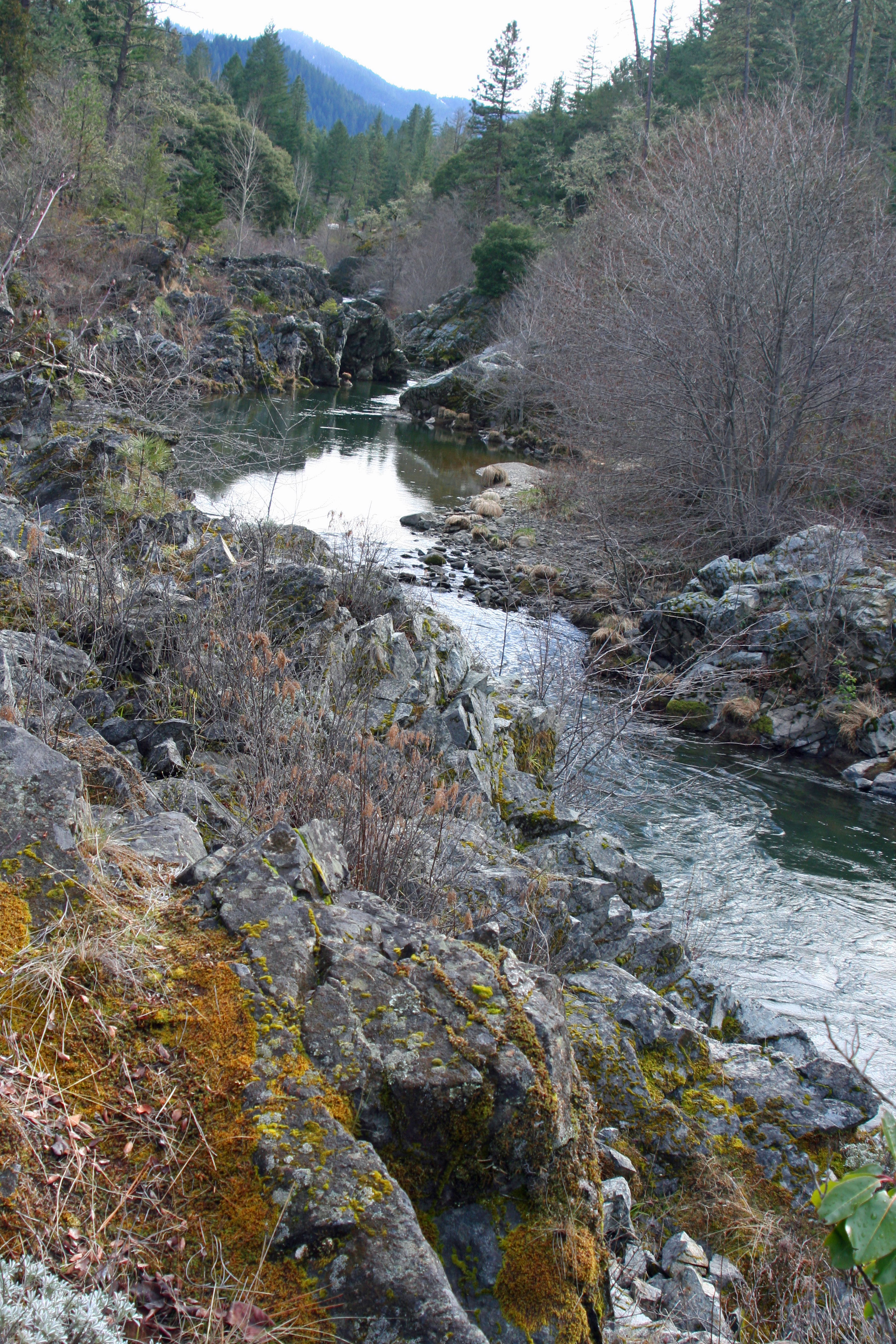
The beautiful Applegate River flows by our home and provides a rich riparian habitat for birds, mammals, plants and fish. My wife Peggy has already claimed a rock where she can sit quietly and meditate on the beauty.

I am convinced we lose something of our humanity when we isolate ourselves from nature.

When I hike down a woodland trail, a sense of peace settles over my mind even as my fat cells scream for mercy. Both body and soul gain. The benefits are so persuasive I have been drawn to the wilderness again and again during my life.

At an elevation of 2000 feet we have a mixed woodland forest of Ponderosa Pines, Douglas Fir, White Oaks and Red Cedar. A March snowstorm decorated this Douglas Fir.

Our recent move to the Upper Applegate Valley of Southern Oregon is but one more example. The Applegate River flows past out front door and 1.8 million acres of national forest and wilderness form the boundary of our back property.

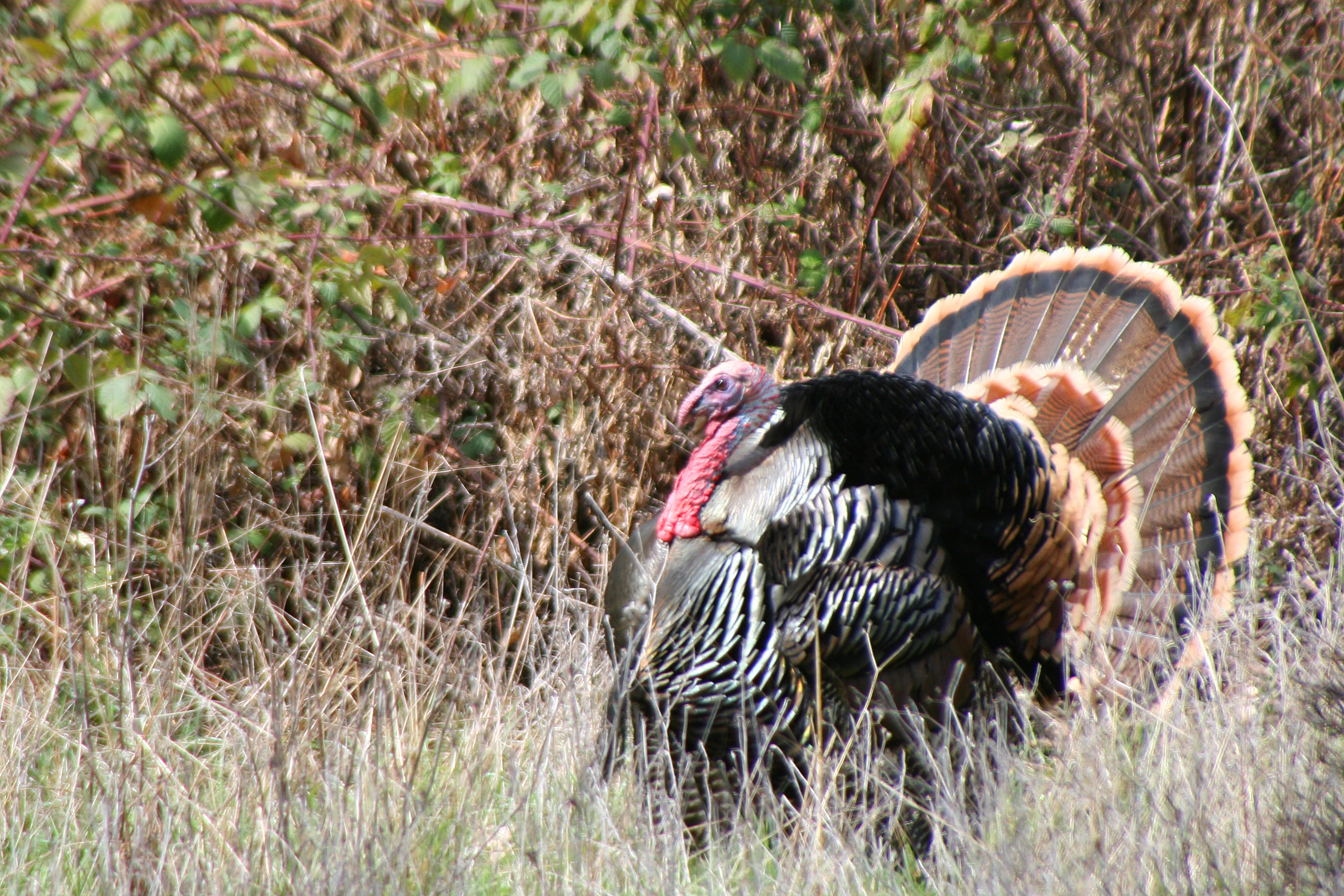
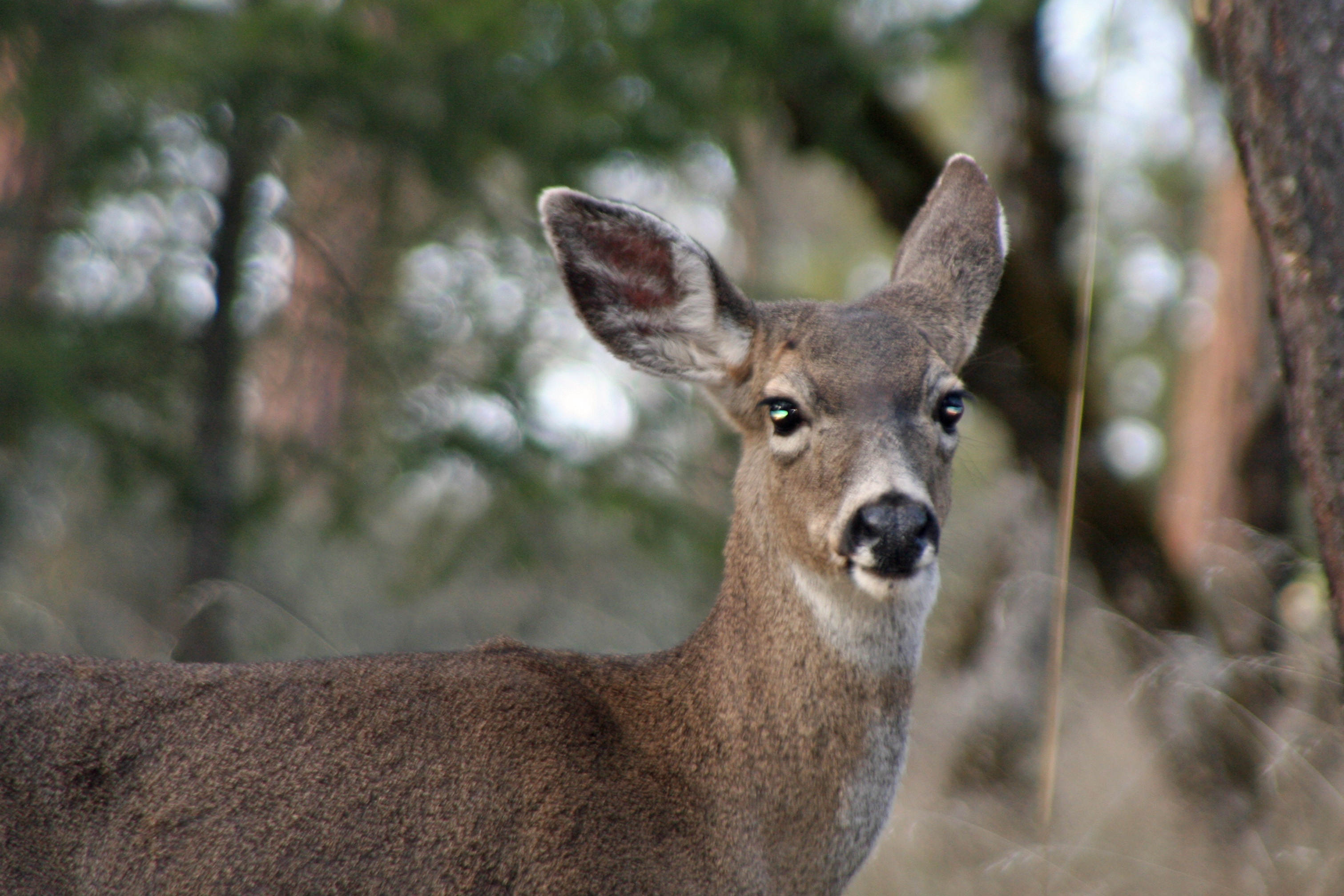
A herd of deer and a flock of wild turkeys consider our five acres as part of their range. Fat Gray Squirrels chase each other through the mixed oak, pine, fir and madrone forest. A small fox has chosen to make its den in our blackberries.

A herd of seven black tail deer often bed down on our property. They drop by our house frequently to see if Peggy has her garden in yet.

As I look out our window, Mountain Jays, Gold Finch, Grosbeaks and tiny hooded Oregon Juncos are gathered around our bird feeder, more or less taking turns.

Larkspur, shooting stars, buttercups and numerous other wildflowers provide spring decorations on the slope below.

I realize how very, very lucky Peggy and I are to have this home in the woods. With the approach of Earth Day 2011, it is my hope that future generations will still have such wilderness areas to enjoy and cherish.

Sunset from our patio... and a final reminder of the beauty and peace to be found in the natural world. May our children and grandchildren continue to enjoy it. Earth Day 2001.

(Next Blog: How the Pond and the Woods introduced a seven-year-old child to the wonders of nature.)

When Being Goofy Isn’t Enough

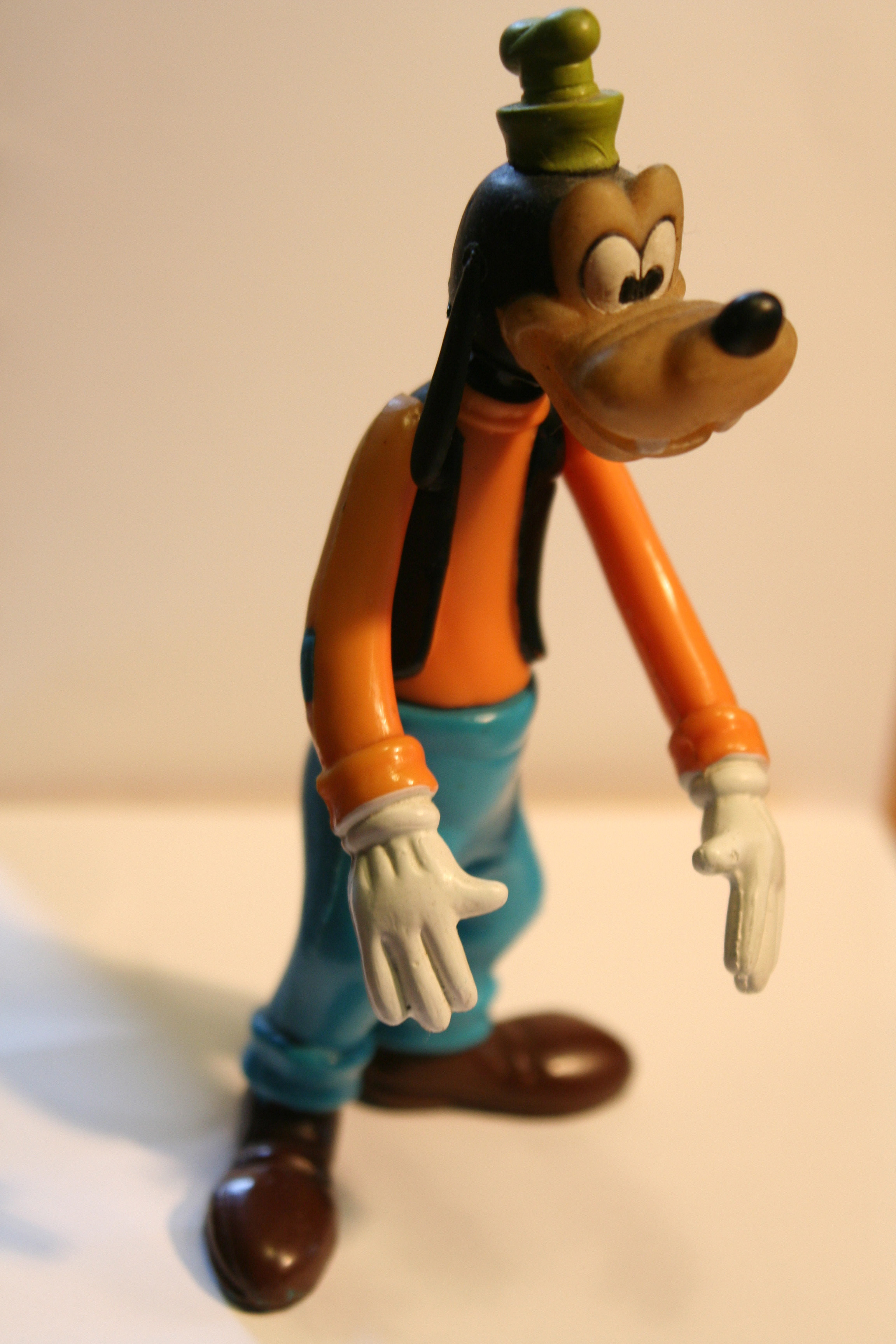
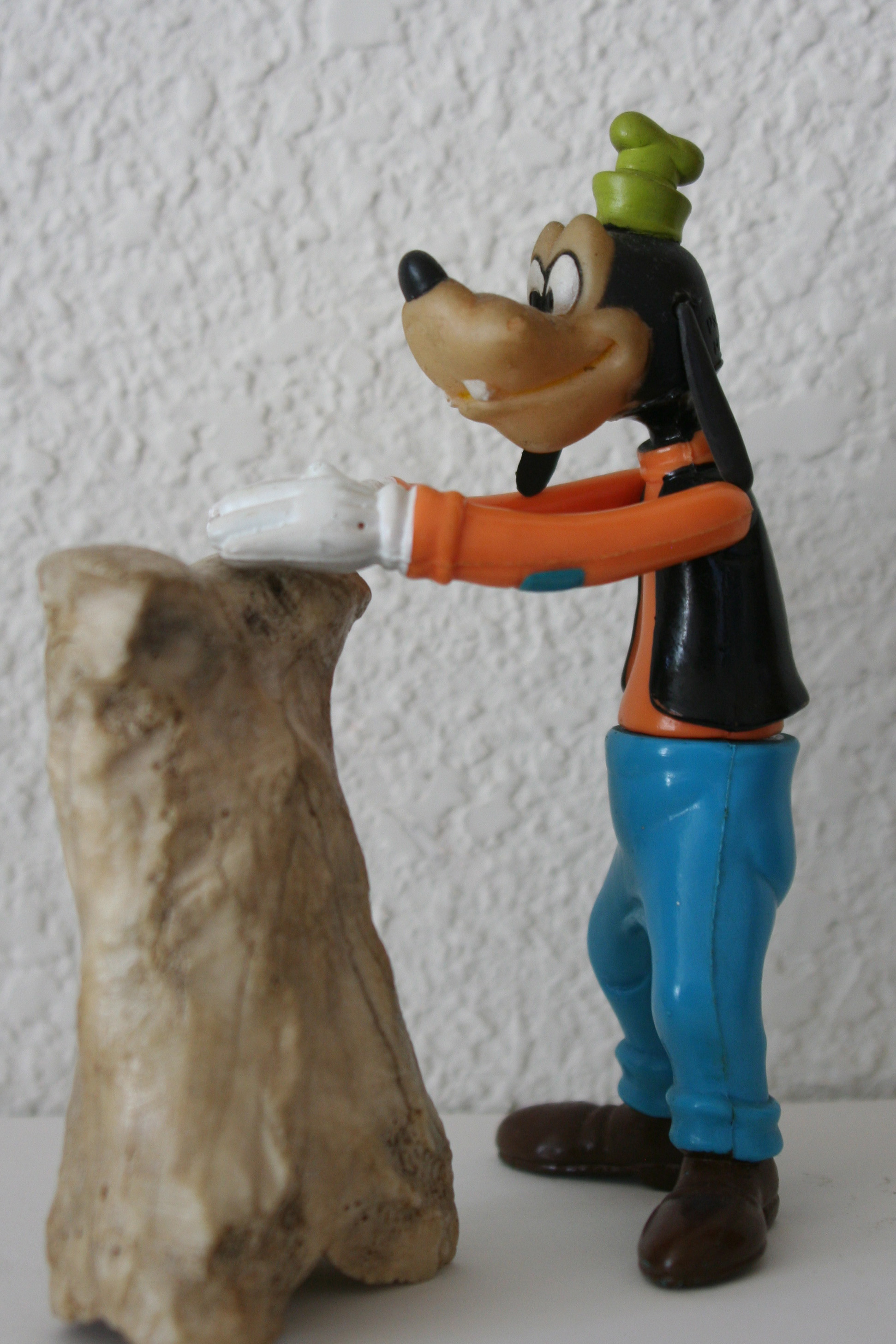
Goofy

OK, I am a little strange. I admit it. But Goofy… no way. I confess, however, I’ve had a long affinity for the floppy eared, big-footed fellow. Yuk Yuk.

It all started when my mother told me that a cousin of hers, Vance ‘Pinto’ Colvig, was the original voice of Goofy.

I had never heard of Pinto so I looked him up. Sure enough, he was the voice of Goofy. In fact Walt Disney was so taken with the voice that he gave Goofy a starring role as one of Mickey’s best buddies.

I was willing to let the connection slide after that. I did trot Goofy out on an occasion, however. In the competitive world of dating, it’s valuable to have a famous relative, even if he’s a cartoon. More than one woman was impressed with my shirttail link, including my wife Peggy.

I never used “I am related to Goofy,” as a conversation starter, though. It was more like a third or fourth date thing.

When Peggy and I recently moved to the Applegate Valley in Southern Oregon, I decided to do more research on Pinto. He’s a native son of the area and grew up in the historic town of Jacksonville, which is where Peggy and I go to play.

Turns out Pinto’s big brother, Donald Colvig, married my mother’s aunt, Star Marshall. I guess that made my mother a second cousin, once removed and makes me… nothing. But I am still going to claim Goofy. And there’s more:

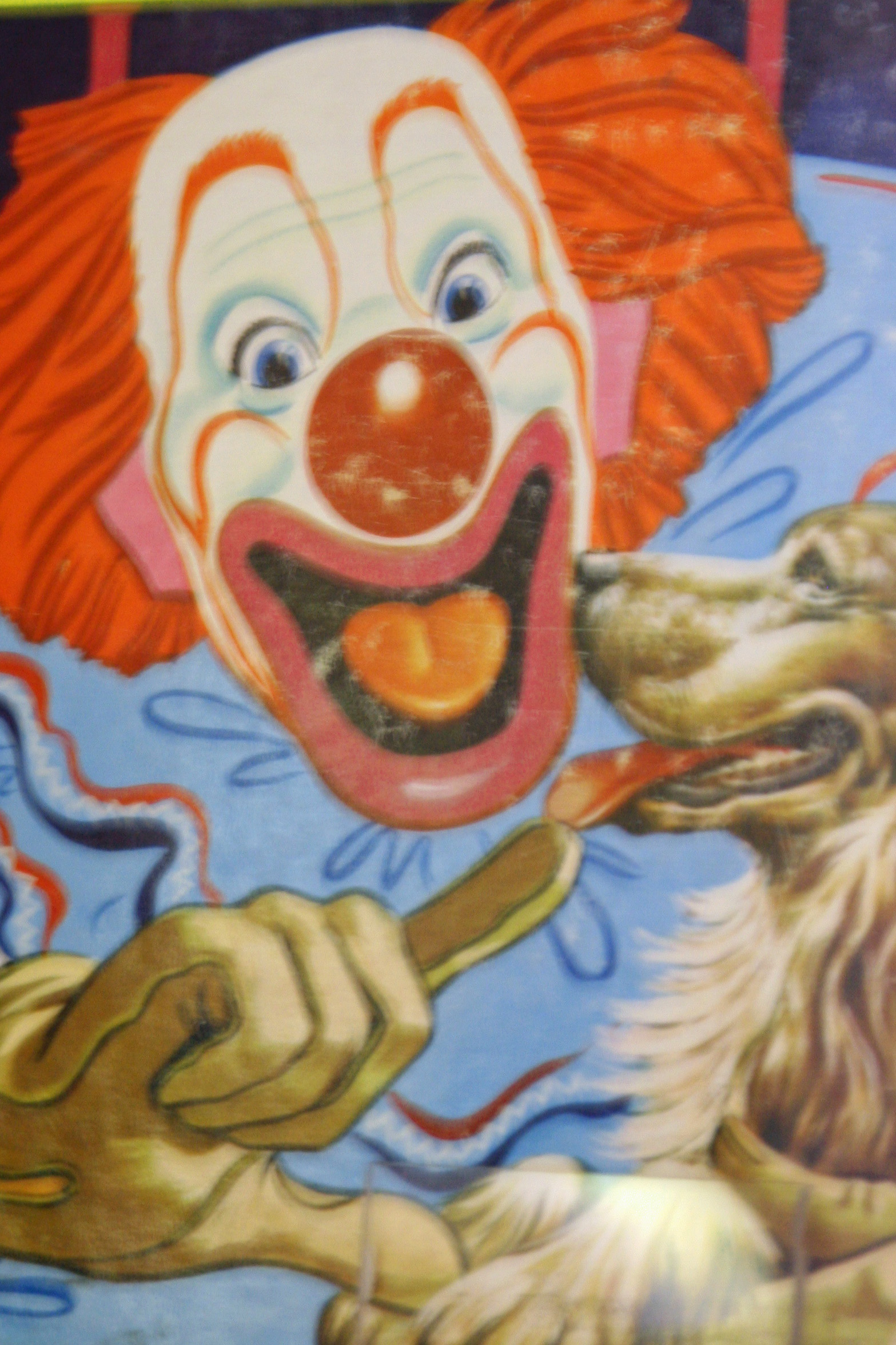
I learned that Pinto was also the creator of Bozo the Clown! Now I have a choice. I can either claim I’m related to Goofy or claim I’m related to Bozo. I am not sure what that buys me but it might make an interesting epitaph.

A painting of Bozo

Pinto was a very talented man who spent his life making people laugh. Here are some of his other accomplishments. He was:

  •      The voice of Pluto, Mickey’s dog.
  •      The voice of the anal pig who built the brick house in the Three Little Pigs.
  •      The voice of Grumpy and Sleepy in the original version of Snow White.
  •      The co-composer of ‘Who’s Afraid of the Big Bad Wolf.’
  •      The voice of one of the three Munchkins who sang the Lollipop song in Dorothy and the Wizard of Oz.
  •      The voice for Popeye’s nemesis Bluto who was always hustling Olive Oyl.

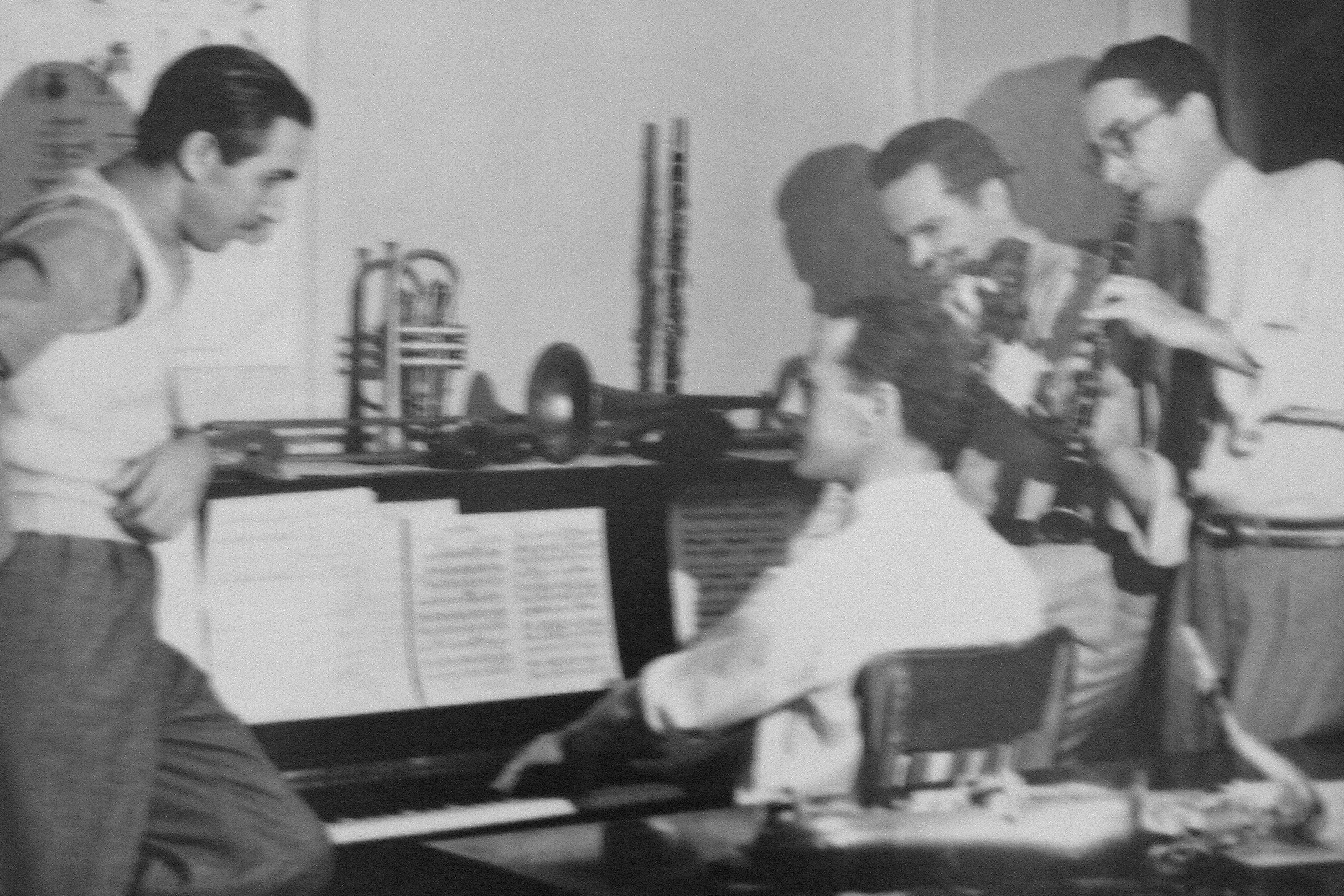
In this early photo, Walt Disney listens in on a song. Pinto is on the right, playing the Clarinet.

It’s quite a legacy. Pinto also had a nationally syndicated comic strip and was co-owner of an animation studio. Interestingly to me, Pinto was also one of the first people to urge that warning labels be put on cigarettes. ( I spent three decades doing battle with Big Tobacco.)

Goofy and Bone share a moment.

The Horse-Bone Tribe of Burning Man

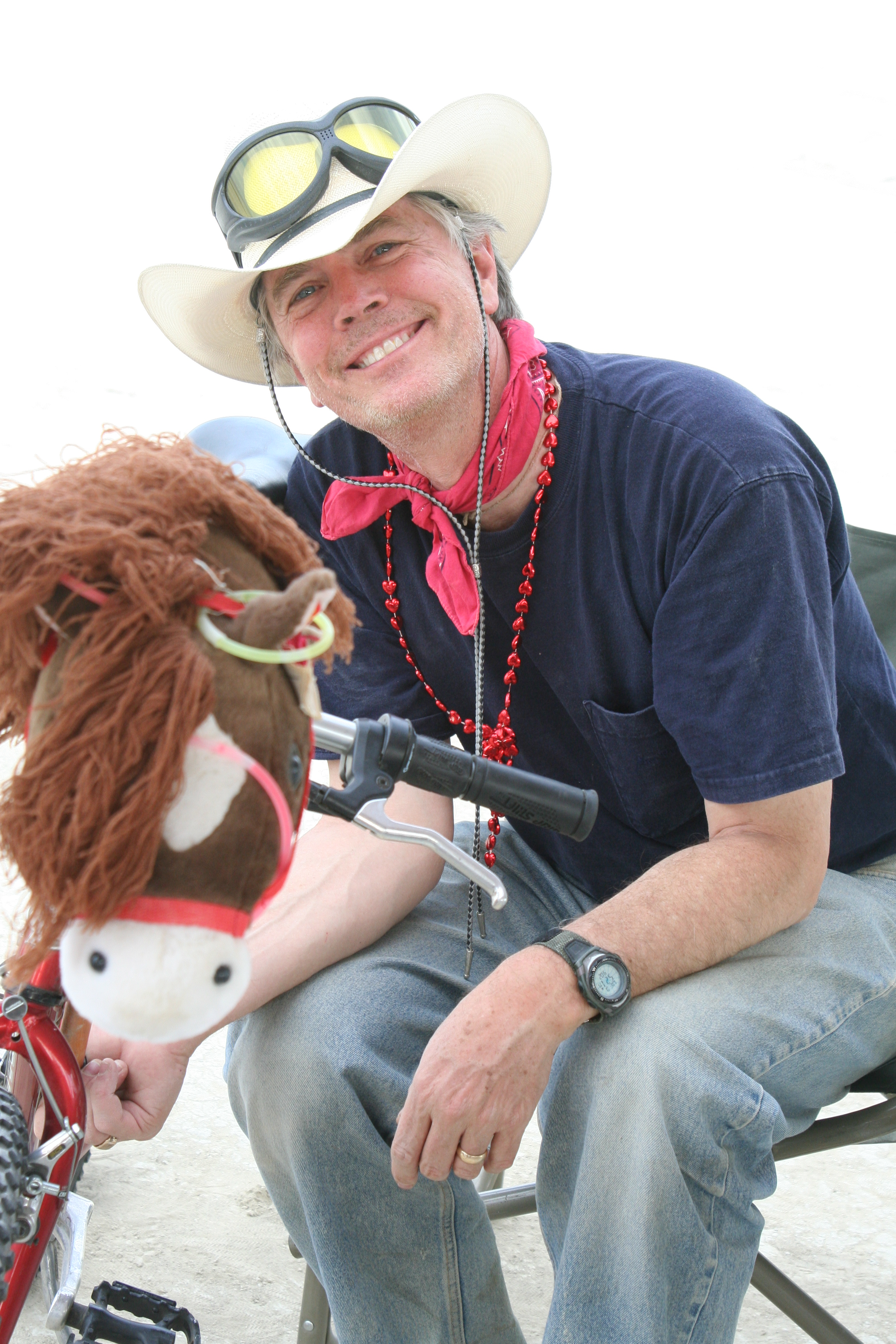
Bone and Horse share a moment at Burning Man.

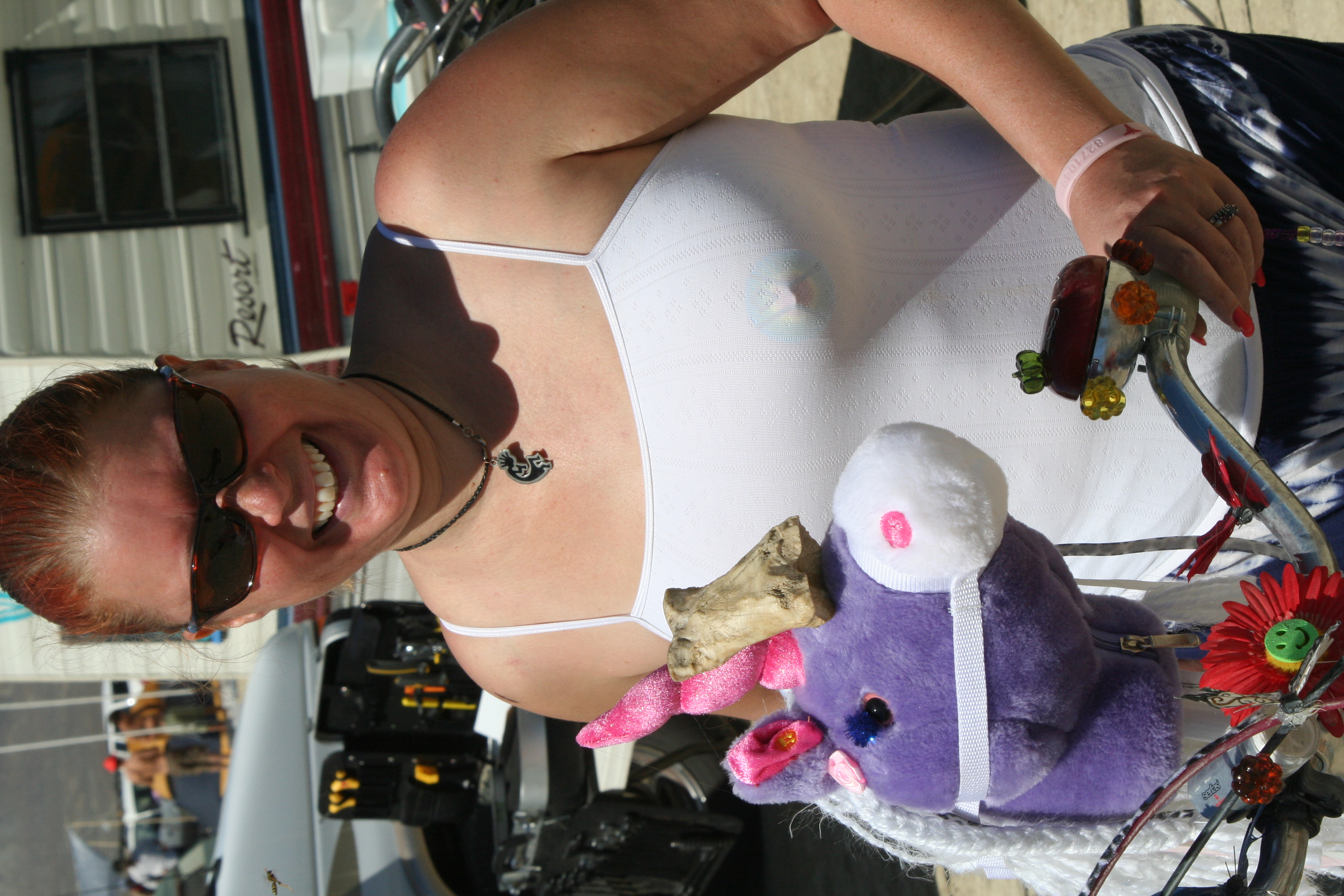
Bone is jealous. We started out as the Horse Tribe of Burning Man. Bone reminded me that he was at Burning Man before the stick horsies were attached to our bikes and begin neighing around.  And he is, after all, a horse bone

So in my mind and Bone’s mind, we are now the Horse-Bone tribe. Whether other members of the tribe agree, who knows…?

Tribes are a big thing at Burning Man. Last year’s program listed over 500… and those are only the ones that bothered to register. (We never have, for example.)

They come in all sizes. The Horse-Bone Tribe ranges from 8-12 people depending on the vagaries of any given year. Other tribes have several hundred members.

The always dapper Scotty, a founding member of the Horse-Bone Tribe of Burning Man.

The tribes live in camps and come in a variety of flavors. Most are unique.

Their names provide a clue to just how unique. Here are a few: Academy of Fools, Arachnophobia, Barbie Death Village, Back to Heaven, Buddha Bunny Camp, Camp Making Bacon, Funky Town, Hippocampus, Jub Jub’s Plastic Circus, Picasso Camp, Reno Housewives, Space Cowboys, Twilight Over Atlantis, Vamp Camp, You Are Here… the list goes on and on.

Two Vamps at Vamp Camp Burning Man

Tribes tend to attract people of similar interests. The Horse-Bone Tribe is made of friends who have spent years working and playing together. Our group includes a bike shop owner, a restaurateur, a judge, a lawyer, an interior decorator, a writer, an elementary school principal, a psychologist, a hospital administrator, a teacher, a trainer/school consultant and other professionals.

HP, Ringer, Sailor Boy and Luna share a laugh at Burning Man.

In other words, we hardly resemble a group of New Age hippies seeking Nirvana in the Black Rock Desert. But we do adopt new personas; there is Scout, Luna, Outlaw, Sparkle, Sailor Boy, Boots, Horny Princess, Sparkle, Scottie and Ringer, plus other disparate characters.

Scout and Trigger pose for a photo at Burning Man.

The first thing we do upon arrival is stake out our territory, literally. We pound stakes into the ground and connect them with ropes. Burning Man has set aside vast area of the desert for tribes and individuals. We can grab as much as we need wherever we want to.

Sparkle sparkling.

Many tribes take on projects that benefit the larger community. These range from teaching Yoga to cooking pancakes, to taking on major art projects. For example, the artist Jim Bowers along with several laser technology scientists and craftsmen have joined together with the TriBe Camp to create the World’s Largest Working Clock this year. (Lasers will project a 5000-foot wide clock in the sky that will accurately reflect hours and minutes.)

Boots and Bone

As for the Horse-Bone Camp, we aren’t nearly that ambitious. So far we have been happy to provide a home base for our tribe to share camping space, dinners, laughs, and companionship on the Playa

Beth, Bone and Unicorn. (Unicorns sometimes join our herd of horses.)

Beth, our bike shop owner, did set up a bike repair shop and repair bikes for neighbors this past year, however. Bone was proud of her.

Self Portrait of Outlaw (thats me), Picasso style.

Last, but far from least, Bones horse, Eeyore, insisted on being included as a member of the Horse Bone Tribe.

The Tragedy of Liberia

Bob and Gerry Branch invited us to stay at their apartment in Monrovia while JoAnn and I were ‘trained.’ In this photo, Bob watches a funeral parade outside his window while Jo looks at the camera.

(At the end of the last blog, my ex-wife and I found ourselves stranded in New York City because we had mistakenly flown to JFK one day late and missed our flight to Africa. In this blog, we reach our destination.)

We made it to the right terminal on the right day and at the right time. In fact, absolute paranoia insisted we be three hours early. We watched lots of planes take off and land.

Finally, we found ourselves flying across a rough Atlantic. To quote Snoopy, “it was a dark and stormy night.” Lighting danced between the clouds as we struggled to deplete the airplane’s complimentary booze supply. We toasted the fact we had made it, we toasted Liberia, we toasted Jo’s mom for her hundred dollars and we toasted toasting.

I finally managed to fall asleep and only awakened when the pilot announced good morning. Jo and I scrambled to look down and were met by a vast sea of green broken occasionally by small clearings filled with round huts. Tropical Africa!

There was brief stopover in Dakar where French-speaking Senegalese served warm coke and ginger snaps for breakfast. It’s the type of meal you really should forget but never do.

An hour later we were dropping in to Robert’s Field, Liberia’s International Airport. A stewardess wrenched open the door admitting a sudden blast of heat and humidity. Luckily, roaming the streets of New York City in August had prepared us. What we weren’t prepared for was the view.

Striding across the tarmac to greet us was my old friend Morris Carpenter from community college days in California. He had joined the Peace Corps the year before and been assigned to Liberia. By some quirk of fate we had been assigned to the same country and would end up living closer together than we had in California.

All grins, we tumbled into each other. I couldn’t resist saying, “Dr. Livingston, I presume.”

Morris, as he put it, had been camped out on the Peace Corp’s Director’s desk in Monrovia for a month seeking a change in assignment when our arrival was announced. He quickly volunteered to pick us up. The Director, recognizing the opportunity for Morris-free time, had agreed even faster.

On our way into Monrovia, Morris filled us in on life in the Peace Corps as ‘it really was.’ One year of living in Liberia had coated his youthful idealism with a thin veneer of cynicism. There were good reasons.

Liberia was a country that had been born and nurtured in paranoia. Its origins dated back to the early 1800’s when slaves were being freed in the New England and there was a growing concern about the expanding population of free black people. While most Northerners accepted that slavery was wrong, few were willing to accept their freed slaves as equals.

In the South, where slaves outnumbered their owners, fear replaced concern. Insurrection was a real possibility. Henry Clay, Andrew Jackson, Daniel Webster and a number of other prominent Americans proposed a solution: ship freed African-Americans back to Africa. The American Colonization Society was founded and a portion of the west coast of Africa purchased. Approximately 11,000 freed slaves eventually shipped out.

Life was bleak and dangerous at first. The natives weren’t overly happy at seeing their long-lost cousins appropriate tribal lands and the Americo-Liberians (ALs) constituted a very small percentage of the total population.

The ALs had learned their US lessons well though and soon established themselves as the ruling elite. They took control of the government, education, and military. The natives were regarded as second-class citizens.

Power and privilege were the results but it was power and privilege accompanied by an underlying fear that the majority native population would rise up in revolt. This in turn led to a siege mentality and paranoia somewhat similar in nature to that felt by the white minorities in the Southern United States prior to the Civil War. I would see and experience several examples of this paranoia during my stay.

Close economic and political ties were maintained with the US over the years. Starting in 1926 Firestone entered the country and eventually cut down vast swathes of rainforest to plant rubber trees. As we drove by a rubber tree plantation on our way to Monrovia, Morris explained that the industry was now suffering from labor problems that the military had been called in to quash. Apparently workers were striking to earn twenty-five cents an hour.

On an outward level, there were a number of similarities between the United States and Liberia. English was the national language, the currency of the country was well-used American Dollars, and the flag was red white and blue complete with eleven stripes and one star. Upon arrival we even learned that the commanding general of the Liberian army was named George Washington. Not surprisingly, the government and the judiciary system were patterned after the American system.

In reality the government was a one party state controlled by the Americo-Liberians and whatever justice existed was heavily weighted toward keeping them in power. While change was underway when we arrived, it was too little and too late.

The failure to educate and bring large numbers of tribal Liberians into the economic and political system from the beginning was one of the major factors leading to the tragedy that Liberia would suffer over the next three decades. Americo-Liberians, tribal Liberians and the country would suffer terribly due to this negligence.

Morris dutifully dropped us of at Peace Corps headquarters to begin our orientation and take care of miscellaneous bureaucratic chores. While we had been playing at the World’s Fair, our fellow volunteers had been sweltering through hours of meetings. Now it was our turn.

Another married couple from Group VI, Bob and Gerry Branch, generously agreed to host our stay. They lived in a second floor apartment that overlooked one of Monrovia’s main streets. It provided a birds-eye view of life in the city.

Monrovia was overflowing with impoverished young people living in crowded tin shacks.

Monrovia was bursting at the seams with impoverished young people escaping from rural areas. Tin shacks fought for space as extended families struggled to find shelter from tropical downpours. Taxi and money-bus drivers, using their horns for brakes, filled the air with unceasing noise while the barking and growling of mangy dogs filled in around the edges. Evening air was tainted with the unique smell of cooked palm oil, smoke and moldering garbage.

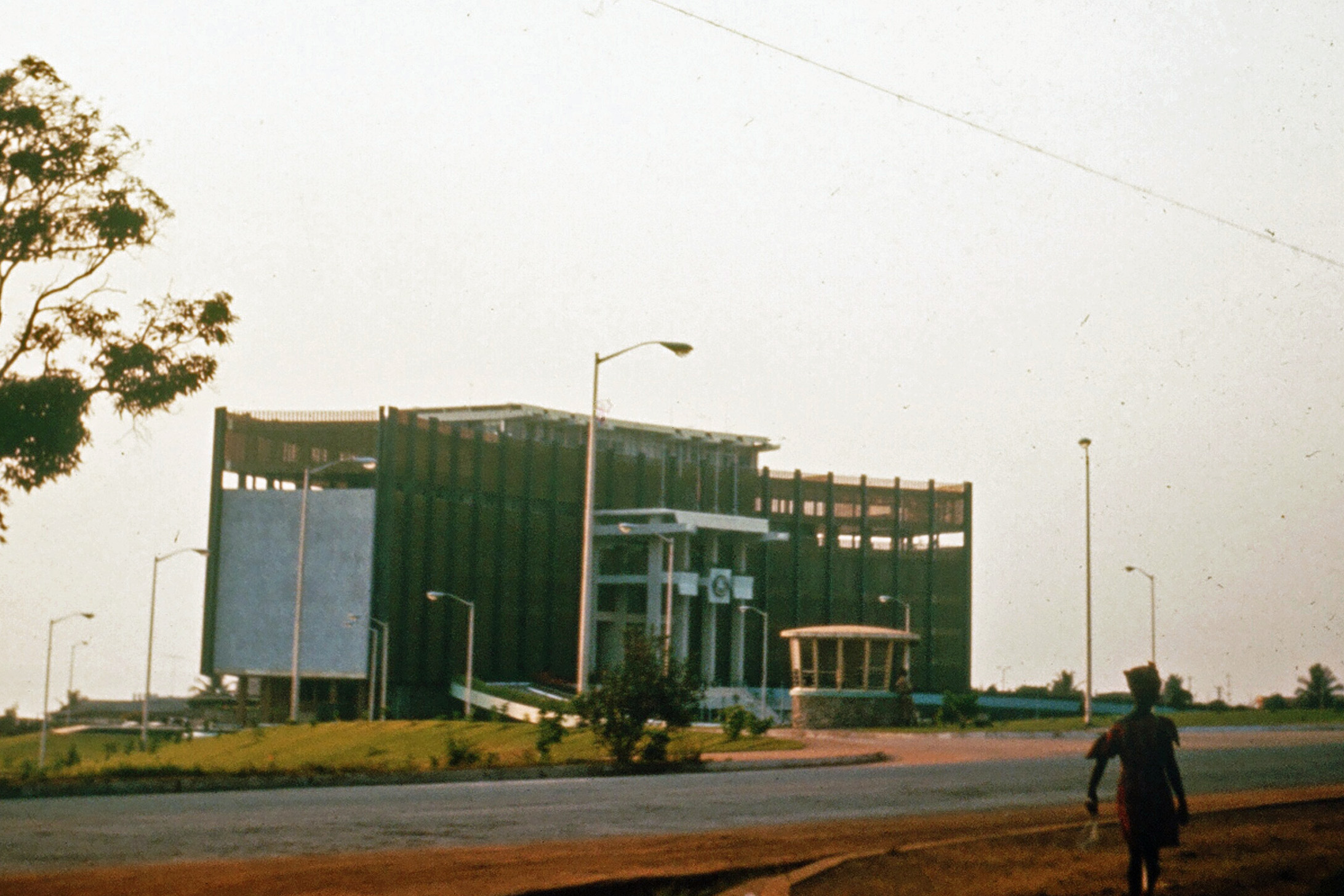
Of course it wasn’t all bleak, assuming one had money. Monrovia had several good restaurants, a modern movie theater, an air-conditioned supermarket and a large paperback bookstore, all of which we came to appreciate over the next two years. Most Americo-Liberians did quite well. President Tubman lived in an impressive mansion on the outskirts of the city.

President Tubmans Mansion in 1966.

For our part, we were quite relieved to learn that our assignment wasn’t in Monrovia. Originally, we had been assigned to an elementary school down the coast in Buchanan. It was supposed to be a plum assignment so naturally another couple grabbed it when we failed to turn up.

We were left with their jobs; Jo would teach first grade and I would teach second in the upcountry town of Gbarnga. (Upcountry was anywhere inland.) Apparently this was our punishment for partying too long in Auburn. So be it…

(Note… in my March 3 blog I reported on how Phil Weisberg was arrested for holding up a sign criticizing Mrs. Tubman. Phil has since responded that he wasn’t arrested but was seized by security agents and later released.)

The Peace Corps Leaves us Behind in New York City…

There's an old saying: "When treed by a lion, you might as well enjoy the scenery." My trip to the 1965 World's Fair in New York City resembled that. In this photo, Jo Ann poses with Rex.

Having successfully completed Peace Corps Training, our next task was to fly to Liberia, Africa. The thought was both exciting and scary. We didn’t need was another major adventure on the way…

Our reward for completing Peace Corps training was one week at home.

We were supposed to complete whatever business we had before disappearing into the jungles of West Africa for two years. Since there wasn’t much to do, Jo and I relaxed and recovered from our tumultuous year that had begun with the Free Speech Movement at Berkeley.

We wrapped up our brief visit with a going away party in Jo Ann’s back yard.

Surrounded by friends and family we talked into the night. It was one of those perfect summer evenings that California is famous for, complete with a cool breeze tainted with a hint of honeysuckle flowers.

Jo Ann’s parents drove us down to the San Francisco Airport the next morning for our flight to JFK where we would meet up with our group. Her mom slipped us a hundred-dollar bill just before we climbed on the plane. “Just in case.”


Now we were disembarking at JFK, two country kids who had traveled a long way from Diamond Springs and Auburn, California. All we had to do was check in at the Pan Am desk, grab a bite to eat, and catch our trans-Atlantic flight to Africa.

Ah that life should be so simple. Oh we managed to find the Pan Am desk all right, but no one was there.

“Excuse me, could you tell me where the Peace Corps group is?” I asked a harried attendant.

“I don’t have any idea,” was the brusque reply.

Have you ever had the sinking feeling that you have blown something critically important in a very big way? It starts with the hair follicles on your head and works its way downward to your toes. Every part of your body jumps in to let you know you aren’t nearly as smart as you imagined you were.

It’s the stomach that serves as the real messenger, however, and mine was rolling like the Atlantic in a hurricane.

“Check the instructions again, Curt,” the voice of reason standing beside me directed. Good idea.

“Well, it says right here we are supposed to be at the Pan Am desk no later than 5 PM.” It was only 4. My stomach calmed down to a respectable jet engine rumble. “Let’s have a bite and check back.” I suggested, working hard to be the man

Five PM came and no one, nothing, nada. It was serious panic time. “Wait here Jo in case anyone comes. I’ll go check the instructions one more time.”

We had stuffed our bags in one of those drop-a-quarter-in-the-slot storage lockers while we ate. I freed my shoulder bag from captivity and reread the instructions. Yes, we were in the right place at the right time. Then there it was, the answer, staring at me in black and white. “You will fly to JFK on August 7th.”

It was the 8th.

Uttering swear words on each step, I slowly climbed back up the stairs.

“I’ve found them Jo Ann.” A look of relief and the beginning of a smile crossed her face.

“Where are they?”

“They’re in Liberia.” Waaaaaaaaaa!

Let me say this about the two of us; we were both stubborn as mules when we thought we were right. This could create problems when we disagreed but the potential for disaster was miniscule in comparison to when we both agreed we were right and we weren’t. Reality didn’t matter and certainly a little date on a piece of paper we had each read a dozen times wasn’t going to deter us.

The 7th was our going away party and that was that, period. While we were kicking up our heels in Auburn, our compatriots were crossing the Atlantic. Now we were stuck in New York City.

“What are we going to do?” Jo asked in a shaky voice. The only thing that came to my mind was a double vodka gimlet

It was probably a good thing United Airlines let us on the airplane in San Francisco without noticing our tickets were one day out of date. Had we called Washington from home, the Peace Corps may have been tempted to say, “Why don’t you just stay there.”

As it turned out, the Peace Corps representative sounded amused when we called the emergency number after our visit to the bar. “Did we have enough money to get through until tomorrow?” Yes, thanks to Jo Ann’s mom.

“OK, call this number in the morning.” We decided to sleep in the airport to save our scant resources. It was a resolution with a short lifespan. I had one extremely unhappy young wife on my hands and my sleeping habits were unwilling to accommodate a deserted airport lounge.

Somewhere around midnight I said, “Look, Jo, I am going to see if a cab driver will help us find a hotel we can afford.”

The first guy in line was a grizzled old character in a taxi of similar vintage. I told him our story. He studied me for a moment and then said, “Go get your wife and I’ll find somewhere for you.

A more cynical observer might note we were lambs waiting to be fleeced but what followed was one of those minor events that speak so loudly for the positive side of human nature. The taxi driver took care of us. He reached across the cab, turned off his meter and then drove to three different hotels. At each one he would get out, go inside and talk to the manager. At the third one he came out and announced he had found our lodging.

“This place isn’t fancy,” he reported, “but it is clean, safe and affordable.” Affordable turned out to be dirt-cheap. To this day I am sure the cab driver finessed a deal for us. Two very exhausted puppies fell into bed and deep sleep.

The Peace Corps representative we talked to the next morning wasn’t nearly as friendly as the one the night before but at least he didn’t tell us we had to go home. A commercial flight to Liberia would be leaving in three days. “Could we hang out in New York? Did they need to send us some money? Could we follow directions?”

A very skinny Curt and the US Pavilion at the World's Fair

Yes we could hang out; no, they didn’t need to send money, and yes we could probably find our way to the proper airline at the correct time on the right day.

Jo and I visited the World’s Fair, checked out the City and considered the three days as an extension of our all too short honeymoon. As the old saying goes, all’s well that ends well.

Next up: Warm coke and cookies for breakfast in Dakar, Senegal