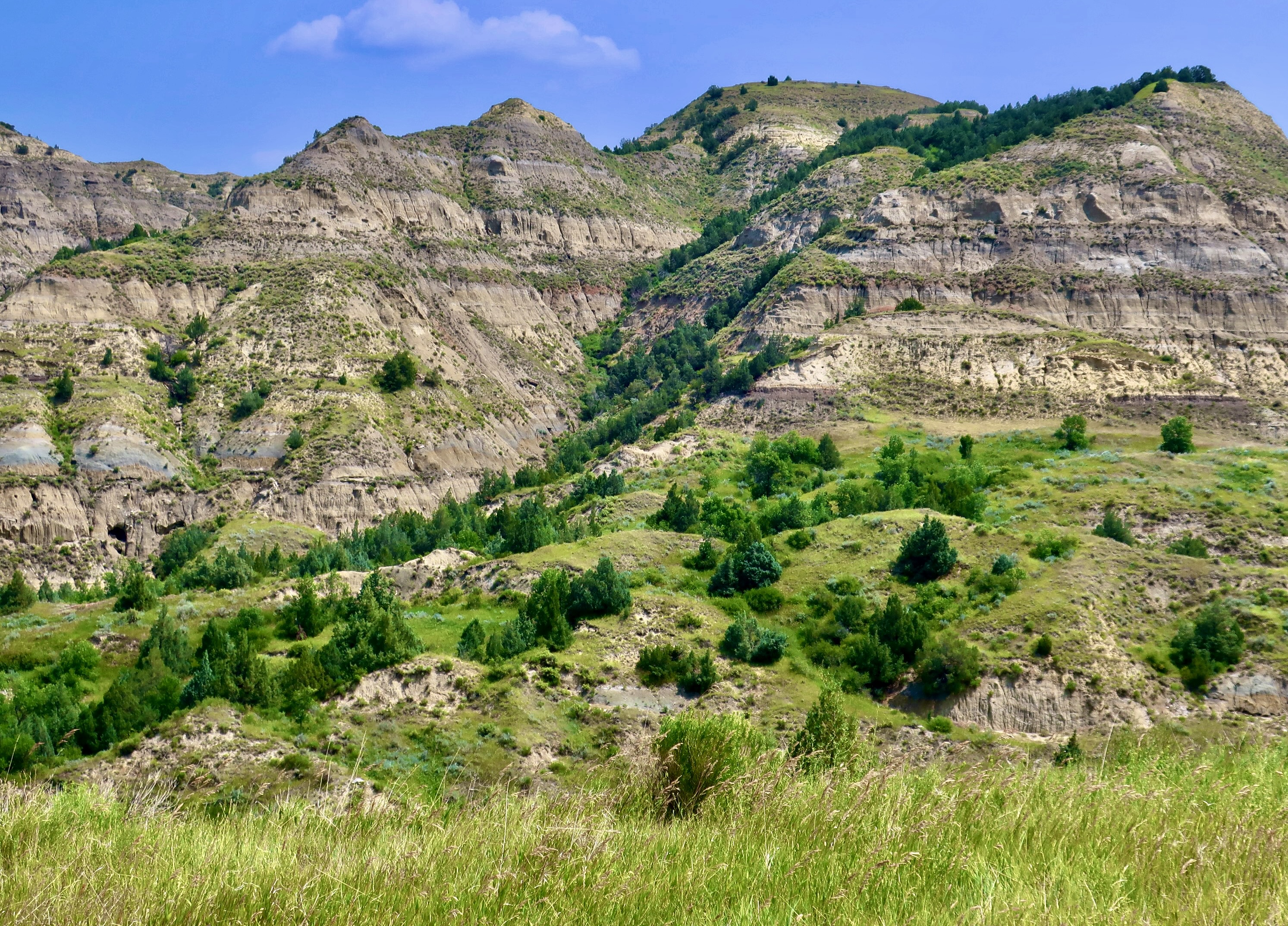
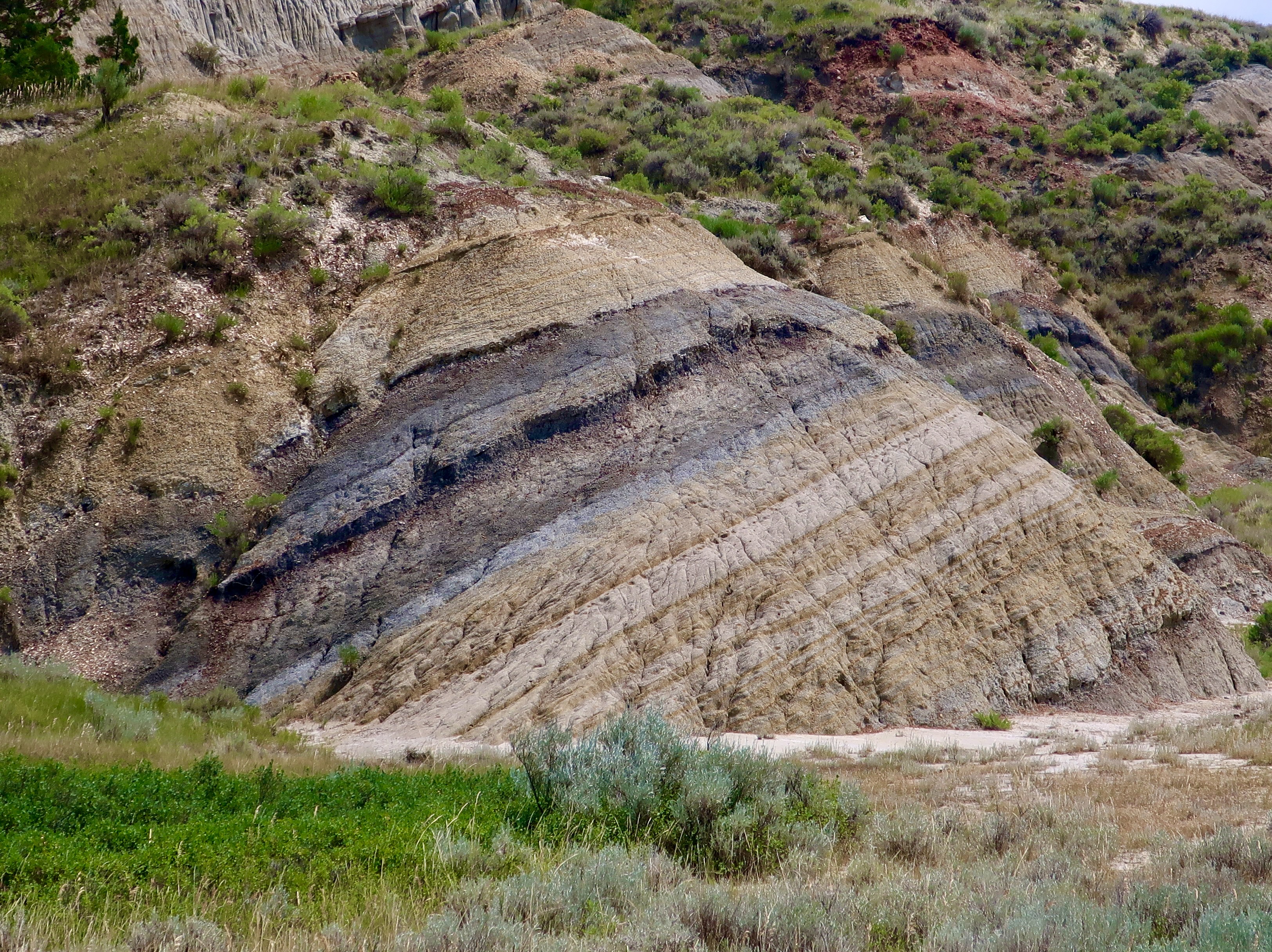
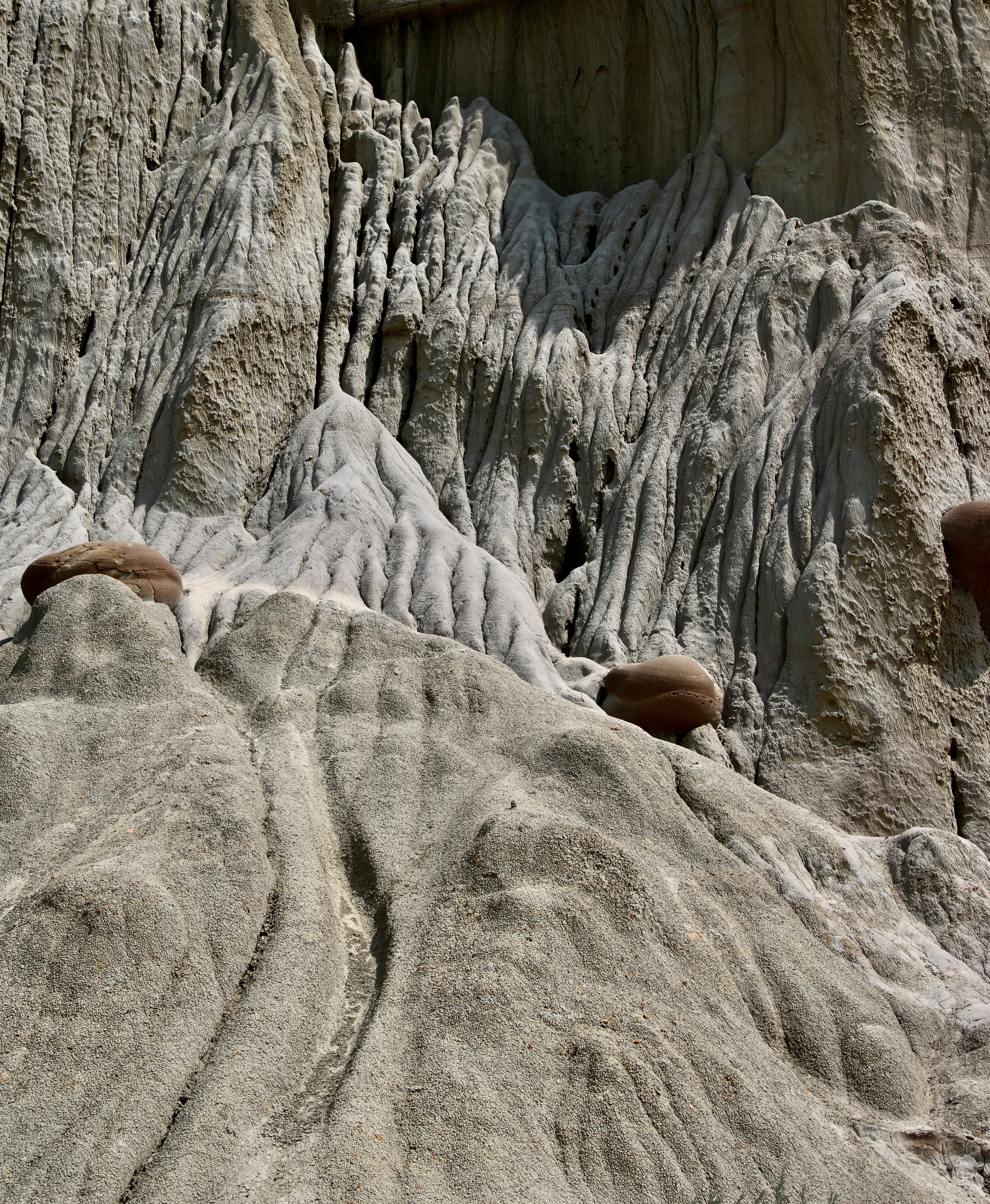
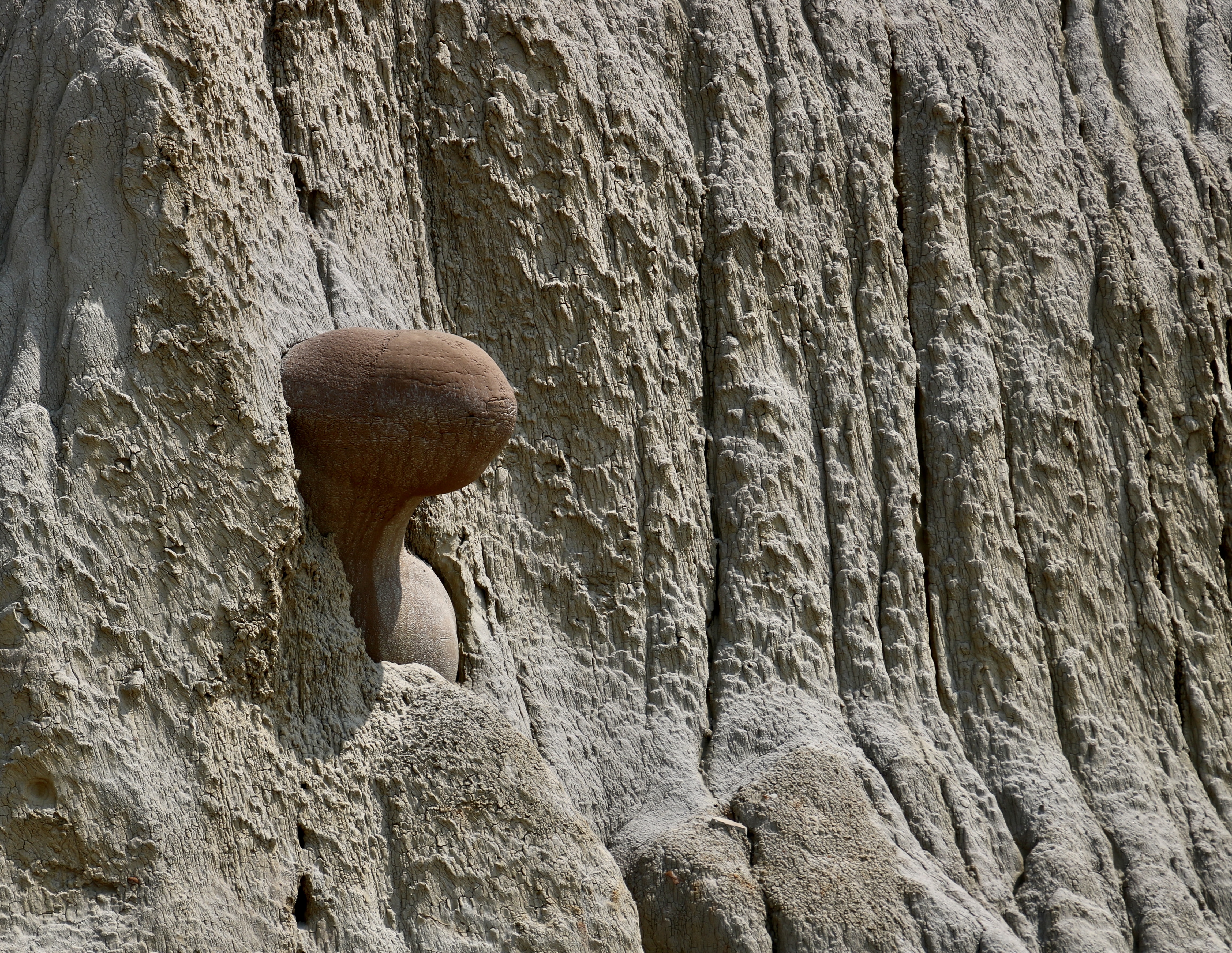
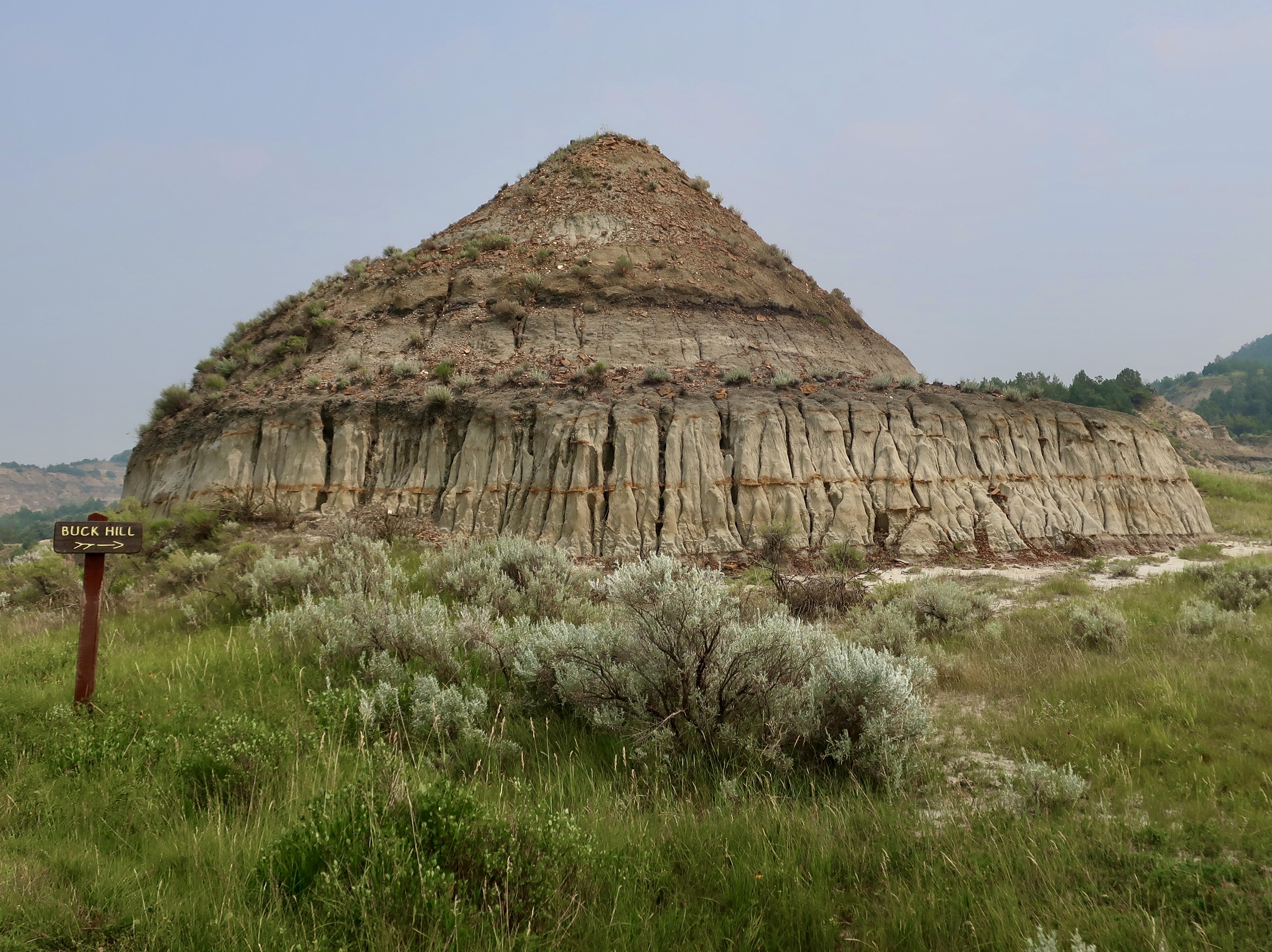
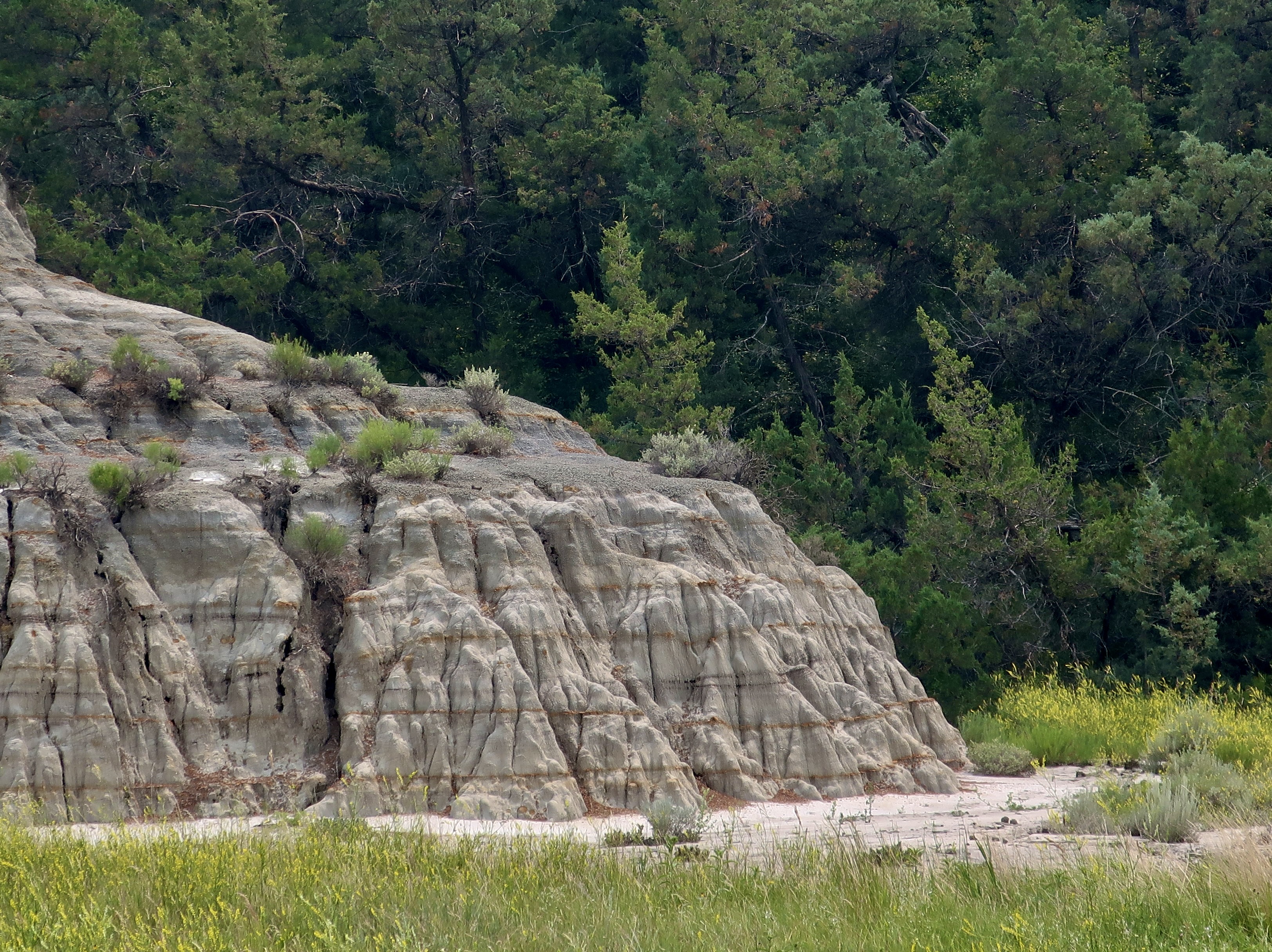
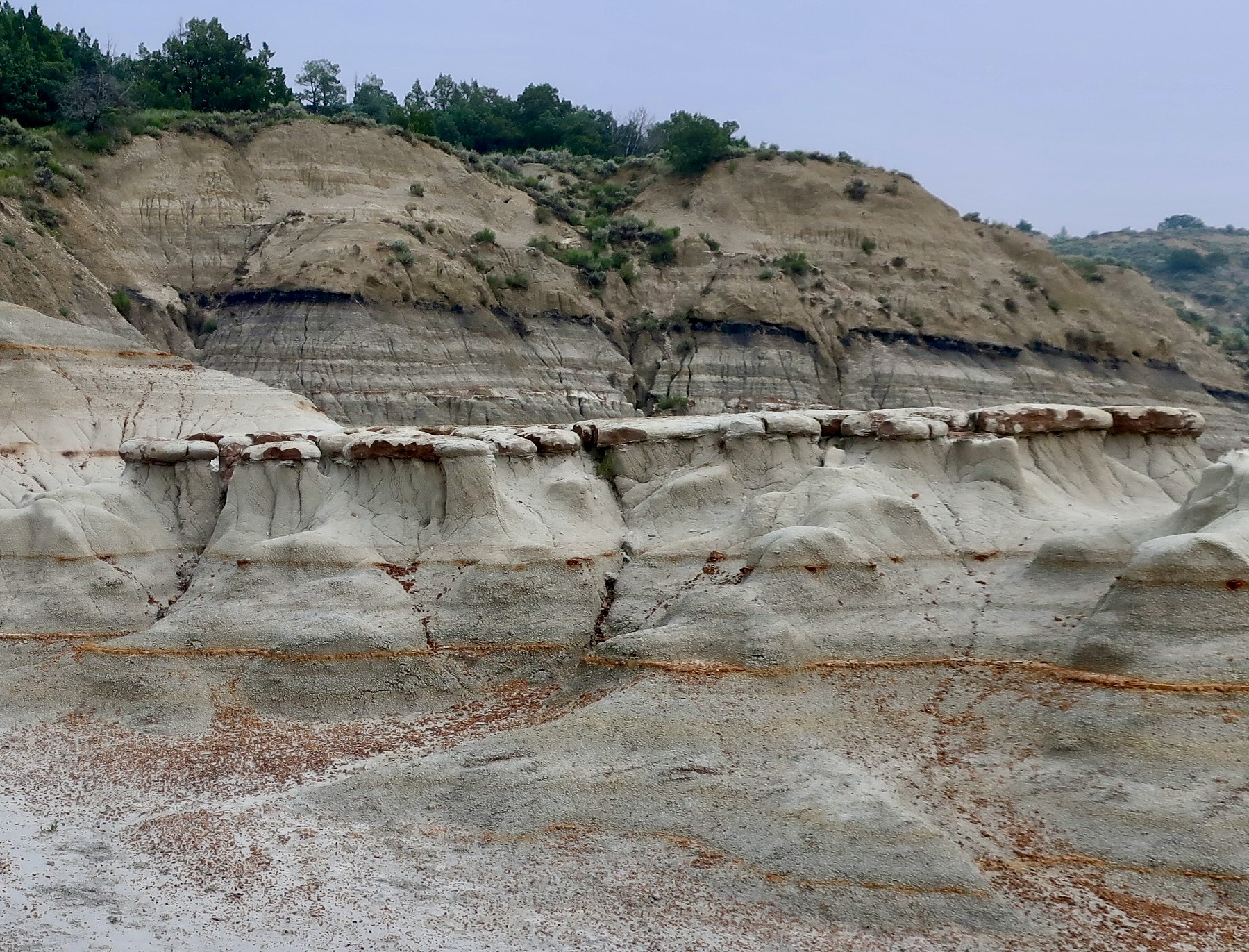
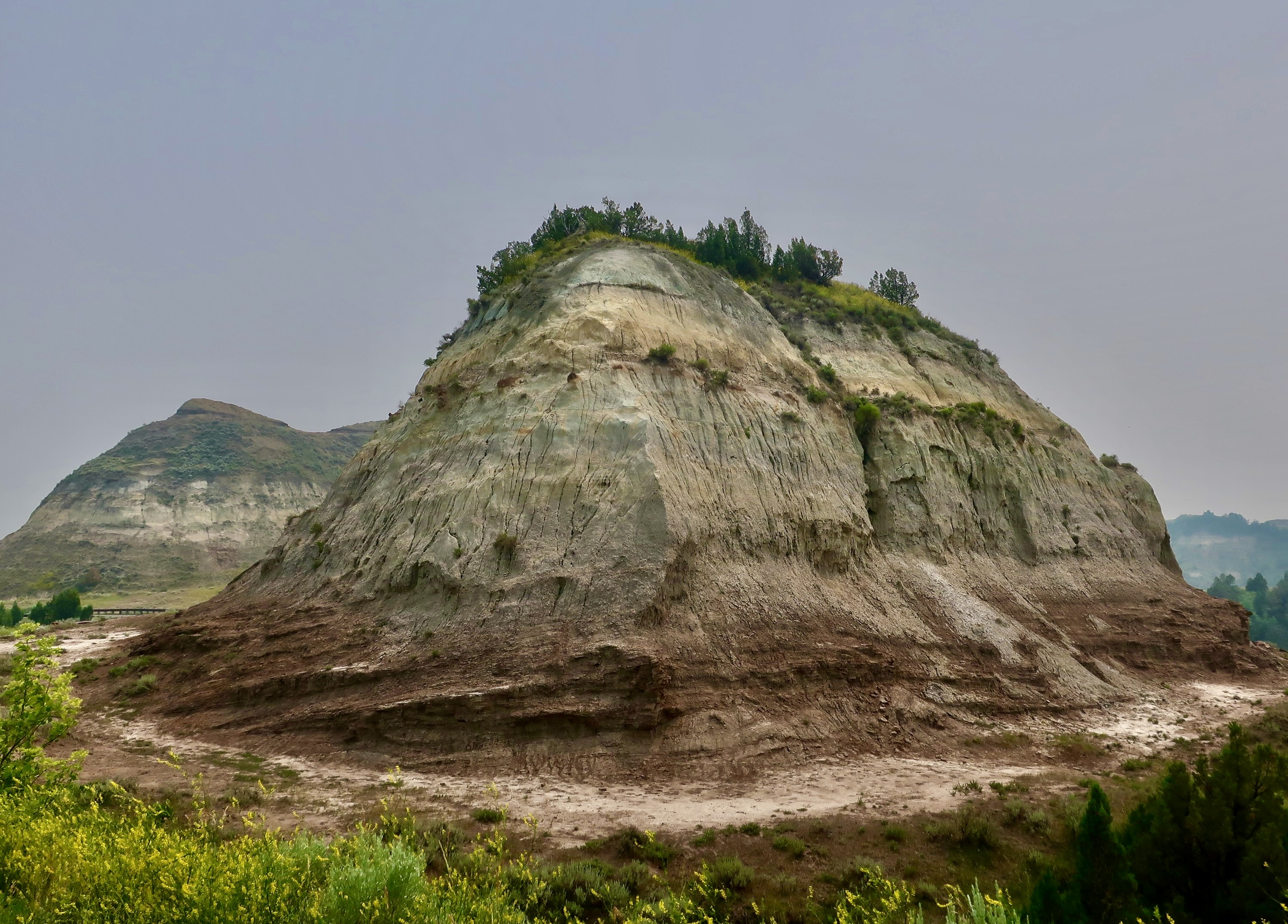
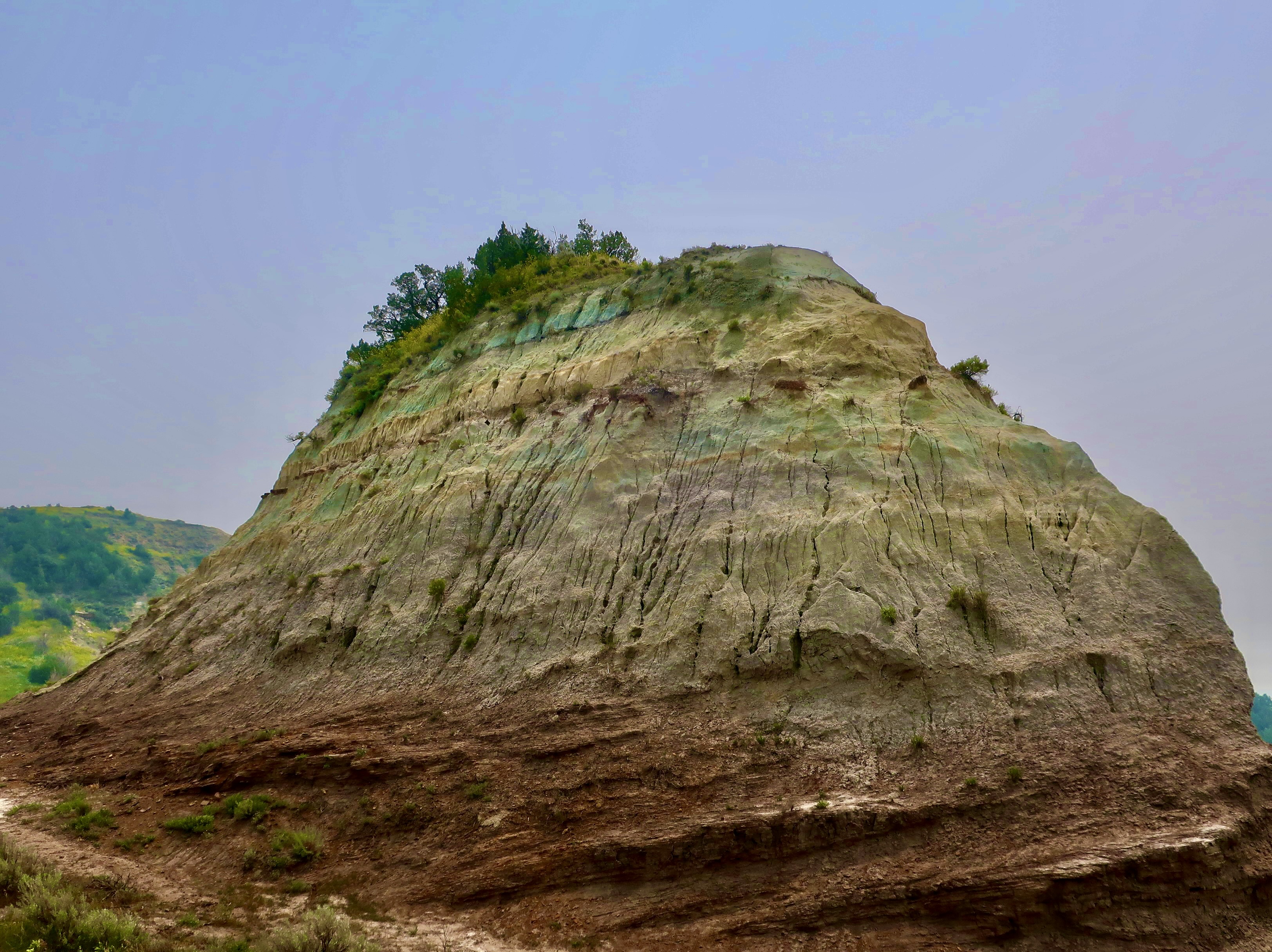
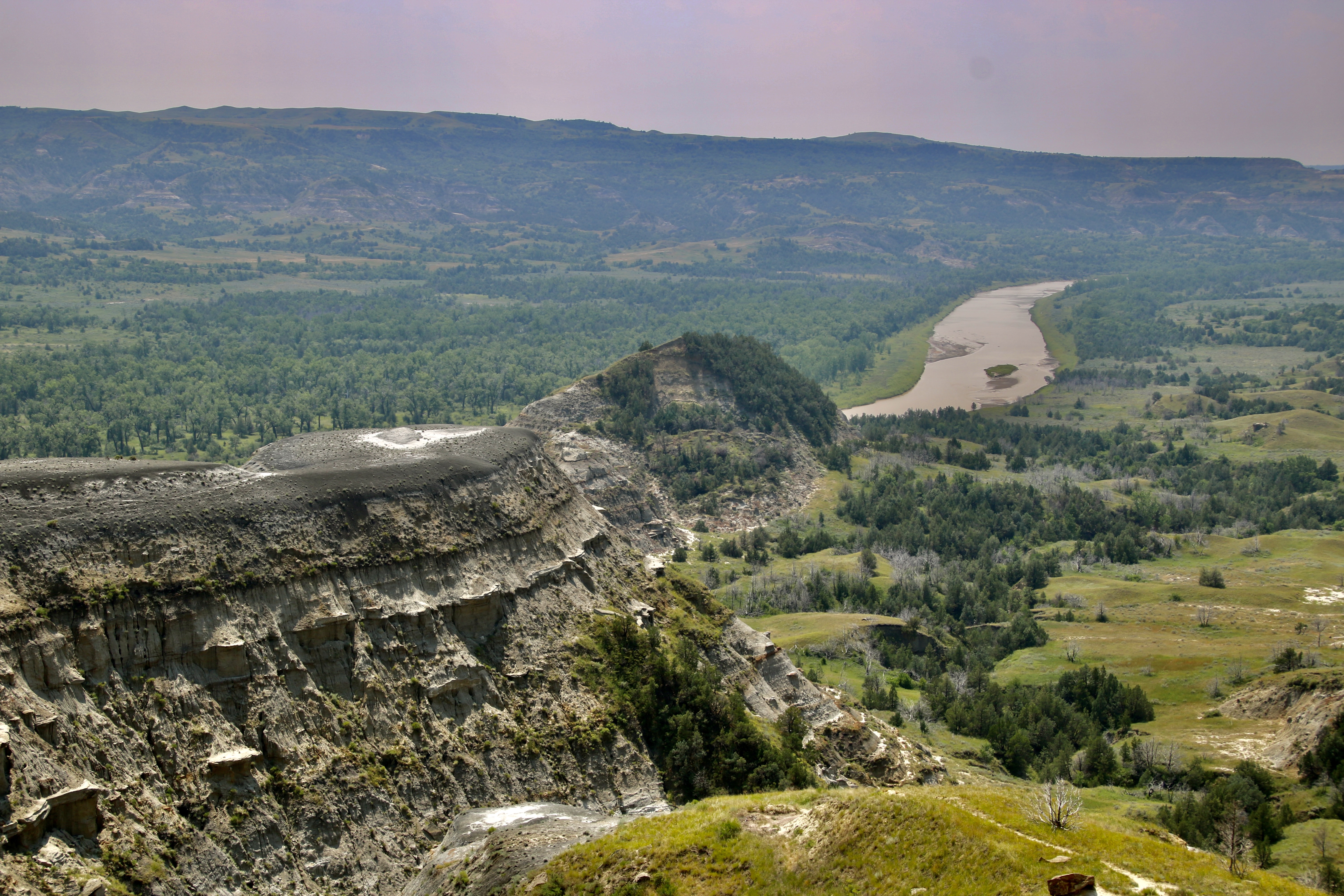
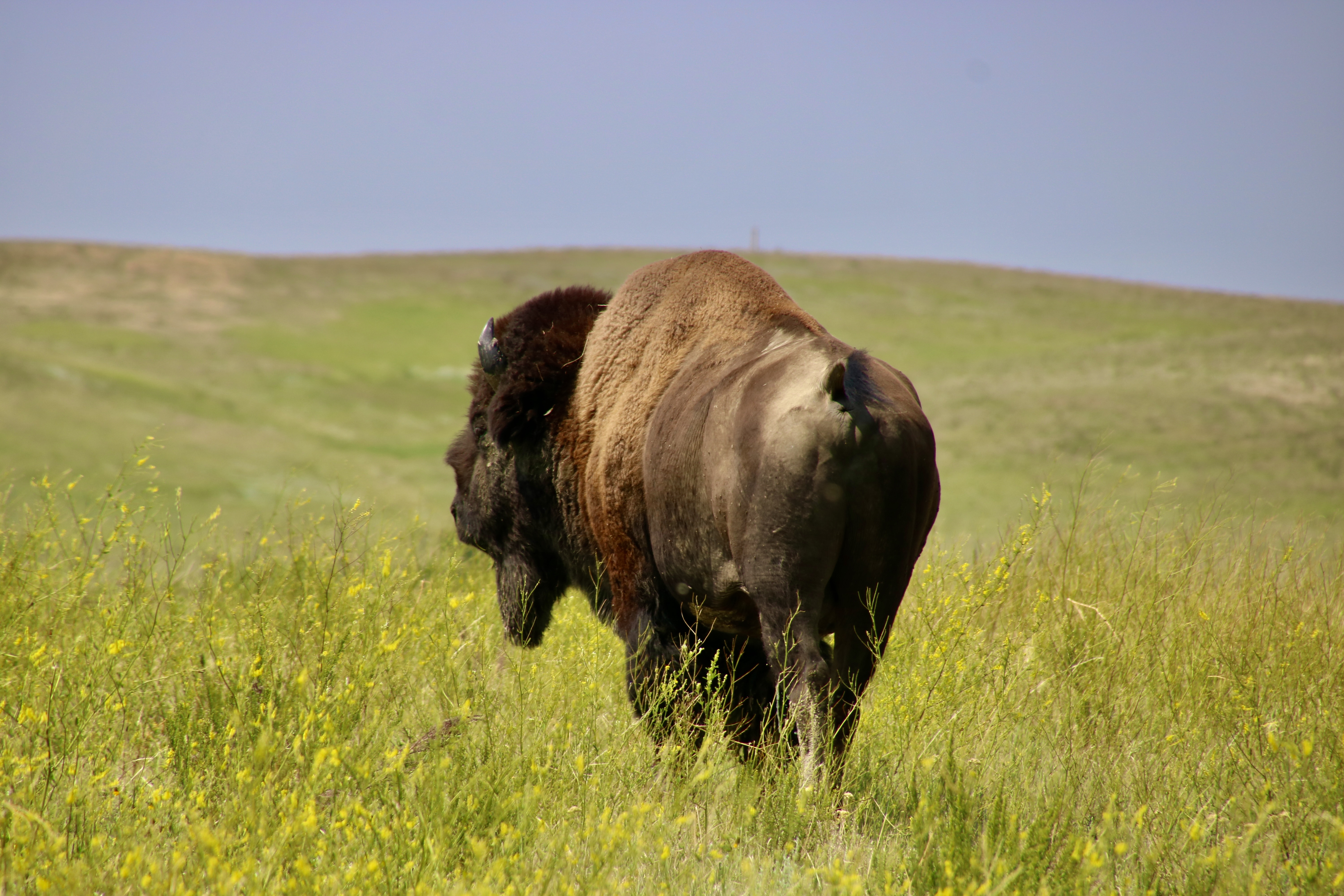
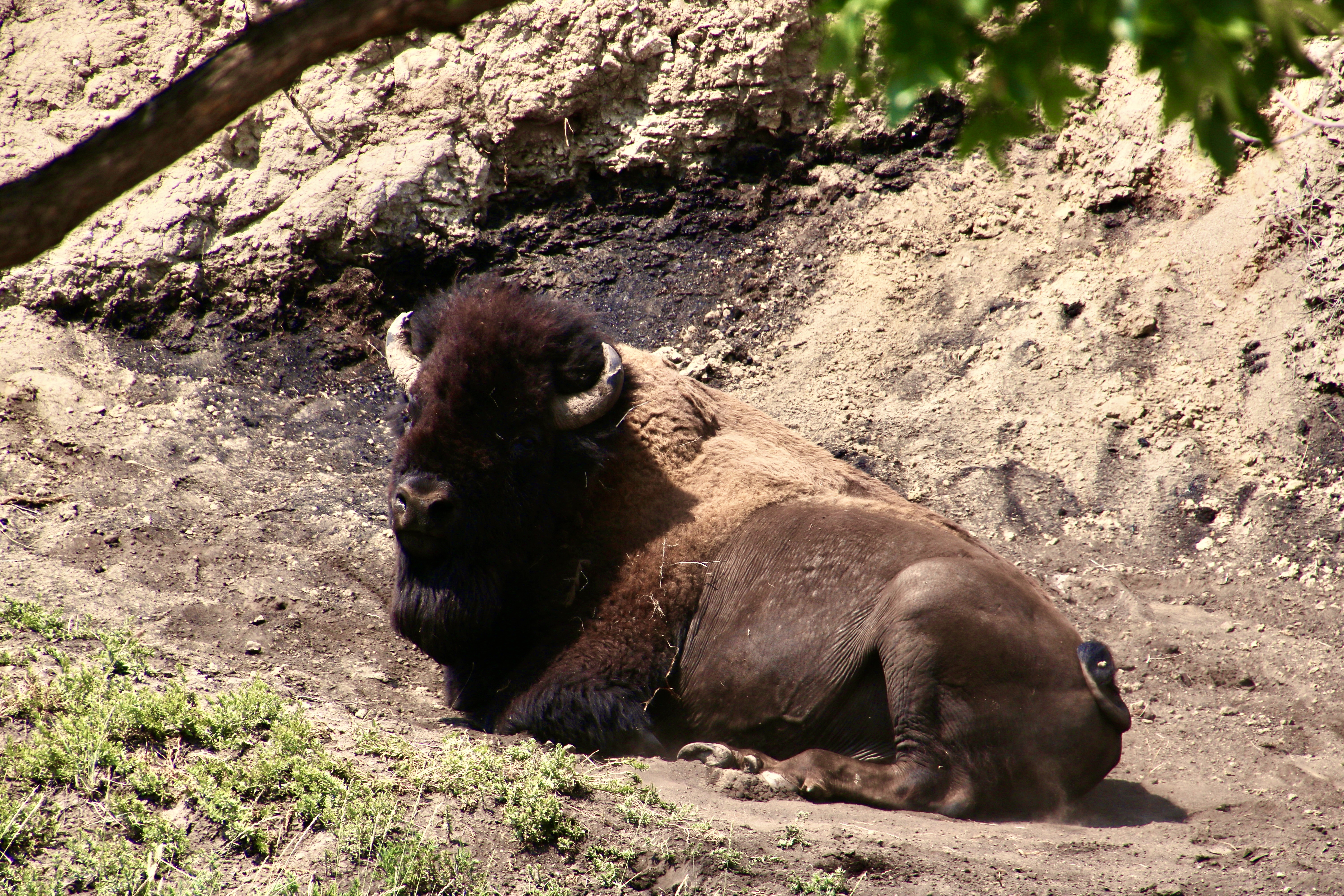
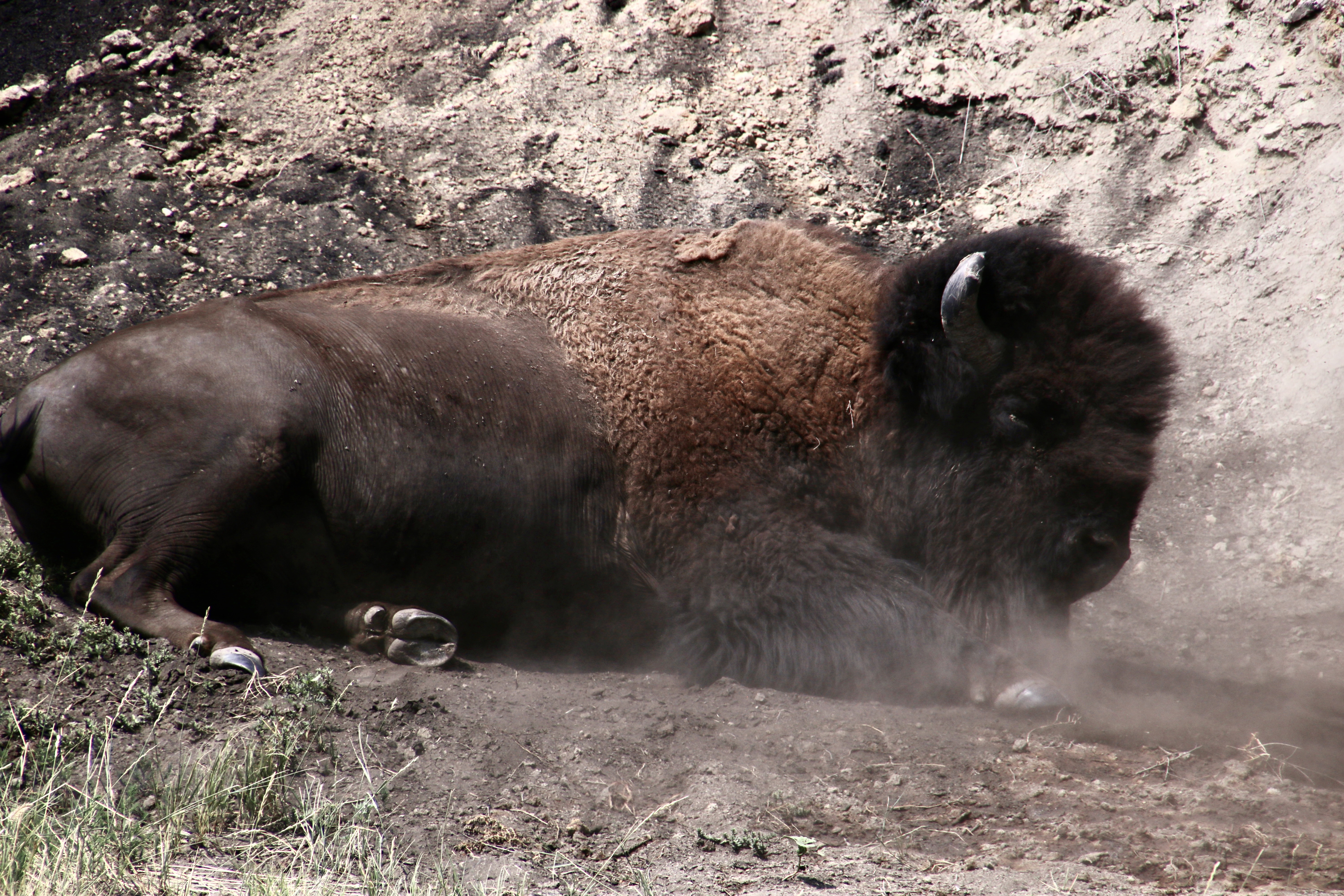
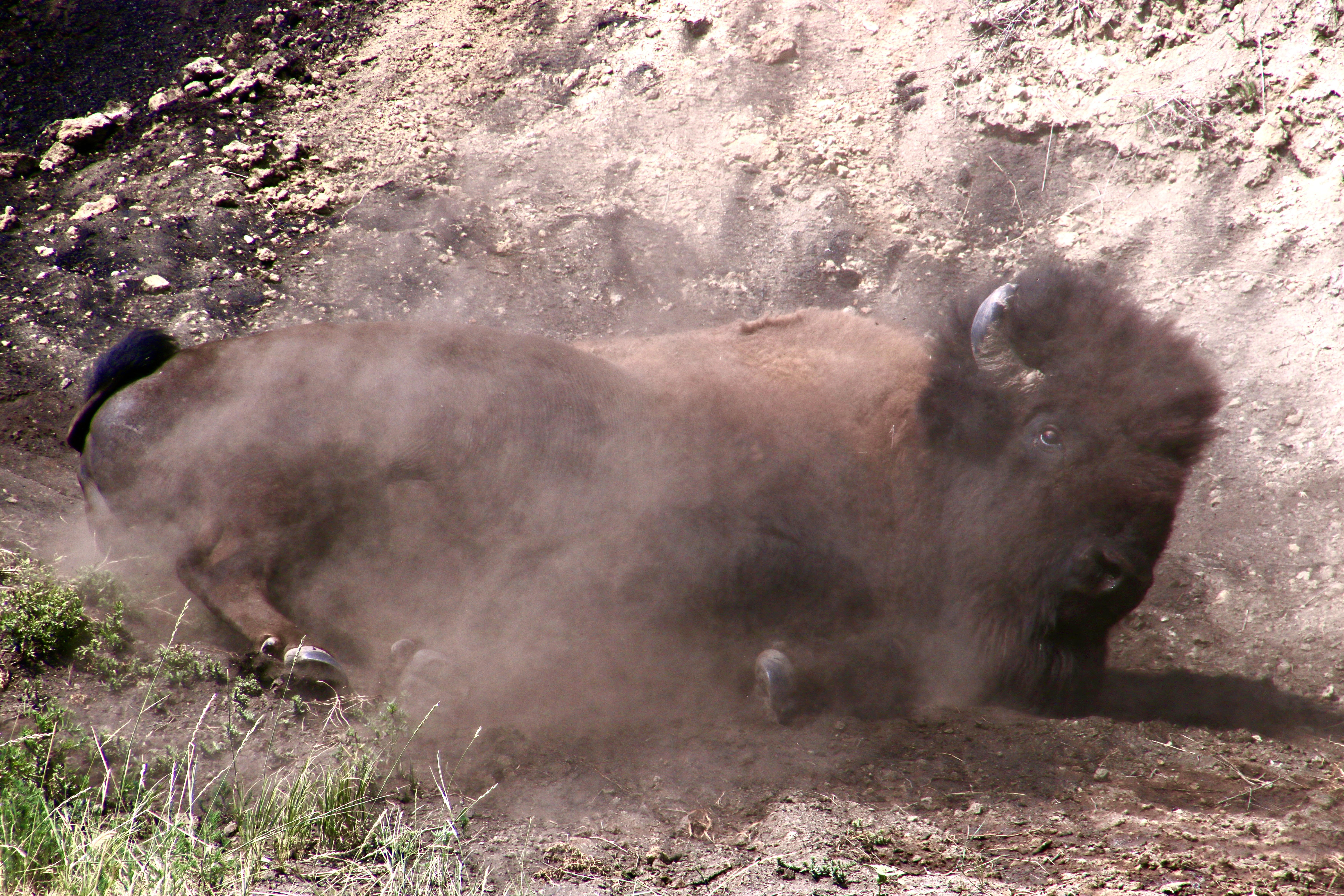
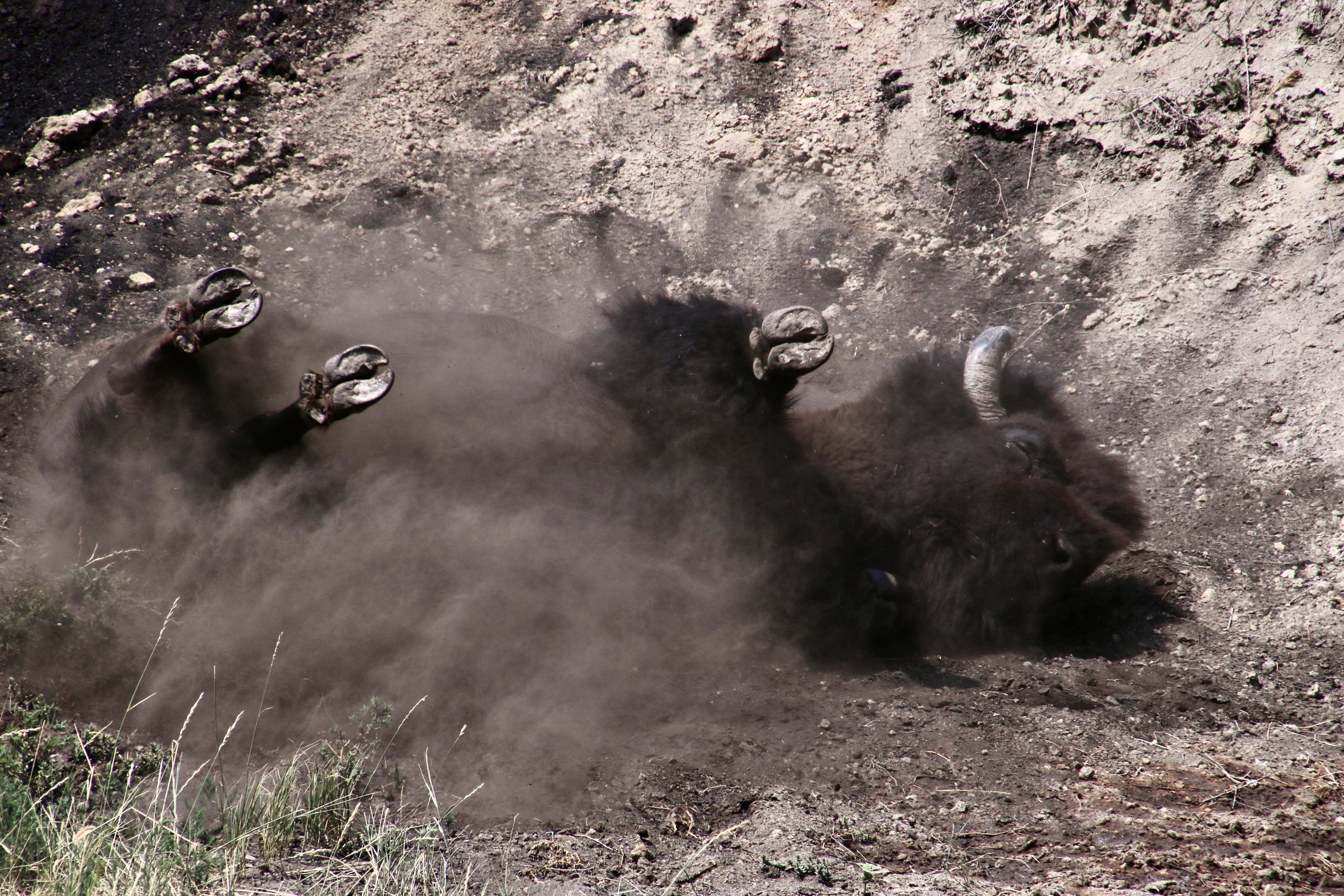
Multi-colored layers of sandstone, clay and shale infused with seams of black coal— all easily eroded rocks— are what give Theodore Roosevelt National Park its unique, otherworldly look. They put the Bad in badlands in the sense of teen slang, like really great, like wow!TRNP is located in North Dakota close to the border of Montana. Canada is to the north.The park is divided into a north and south section. Peggy and I spend the majority of our time in the north section, which has far fewer visitors and, in my opinion, is more scenic. Visitors will find numerous multi-colored hills, like this…And this— an example of earth slump where a whole portion of one of the cliffs came sliding down intact. Note the coal seam. Lightning can actually set these seams on fire. They can burn for years.A close up. Coal was formed some 300 million years in large swamps where dead plant materials settled to the bottom and were eventually compressed into rock. Petrified wood from redwoods, cypress and cedar can also be found in the park.The strangest rocks, however, are these cannon ball shaped concretions that are formed when minerals settle out of water in sandstone and shale, around a pebble or fossil in layers.How much more unworldly can you get than this scene where the mud-like rock seemingly melts.And appears to have flowed out of holes and cracks.In addition to its cannonball look, the concretions also took other forms.Another example of a concretion.There seems to be no end to erosion carved features at TRNP. BTW, I think this is the way to Rock Hill, not the hill. A park information sign informed us that the grass on Rock Hill has never been plowed, making it one of the rare examples of pure native grass found in North America. The eroded hill here had a beautiful setting.Capstones, made up of harder rocks, help create the layered look.I felt that this example had a jumbled mass of erosion that had a dark, post-apocalyptic feel to it…So I added a noir filter.On a brighter note, we loved this massive hill with its trees on top.A side view. Like a massive vessel rising out of the earth.A distant view of the Little Missouri River that flows through TRNP. Note the small blip on top of the ridge.It’s the hill on top. I promised buffalo, right? There are lots of them in TRNP. But I promised more: Buffalo wallowing.That’s what this big fellow is about to do.Wallowing is all about stirring up dust. Buffalo do it to to discourage biting flies and shed fur. The males also do it during mating season to leave behind a scent and demonstrate what big, strong fellas they are. It’s important to get dust all over their bodies.And this involves…Getting down and dirty!
That’s a wrap on Theodore Roosevelt National Park, but even more it’s a wrap on our national park series. Peggy and I hope you’ve enjoyed it. In addition to the six I have featured here, there were the four others I included in our trip up the coast this spring and Everglades National Park we visited in February for a total of 11 in 2022.
But (isn’t there always a but), Peggy and I are going to bring you one more national park as part of our next series: Great Rivers. We will return to the Grand Canyon with a twist: Instead of looking down, we will be looking up— floating down the Colorado River on a 20 day private trip by raft through the park. I’ve blogged about the trip before, so I know several of you are familiar with it. This will be different, however, a photo essay stretched out over 6 posts with lots of new photos that Peggy and I haven’t included before.
First, however, Peggy and I are taking a vacation. (Do I hear a snort in the background. Isn’t that what you always do?) Actually, it will be a vacation from blogging as we float down the Danube River. Think of it as a vacation from a vocation, to the degree blogging is a vocation/work. I’m sure fellow bloggers will agree, it certainly feels like it at times. 😳We will be missing from the blogosphere for five weeks: This week in preparation for the trip, three weeks in Europe, and one week in recovery. I’ll check in from time to time to respond to comments. Beyond that, we will see you in mid-October!
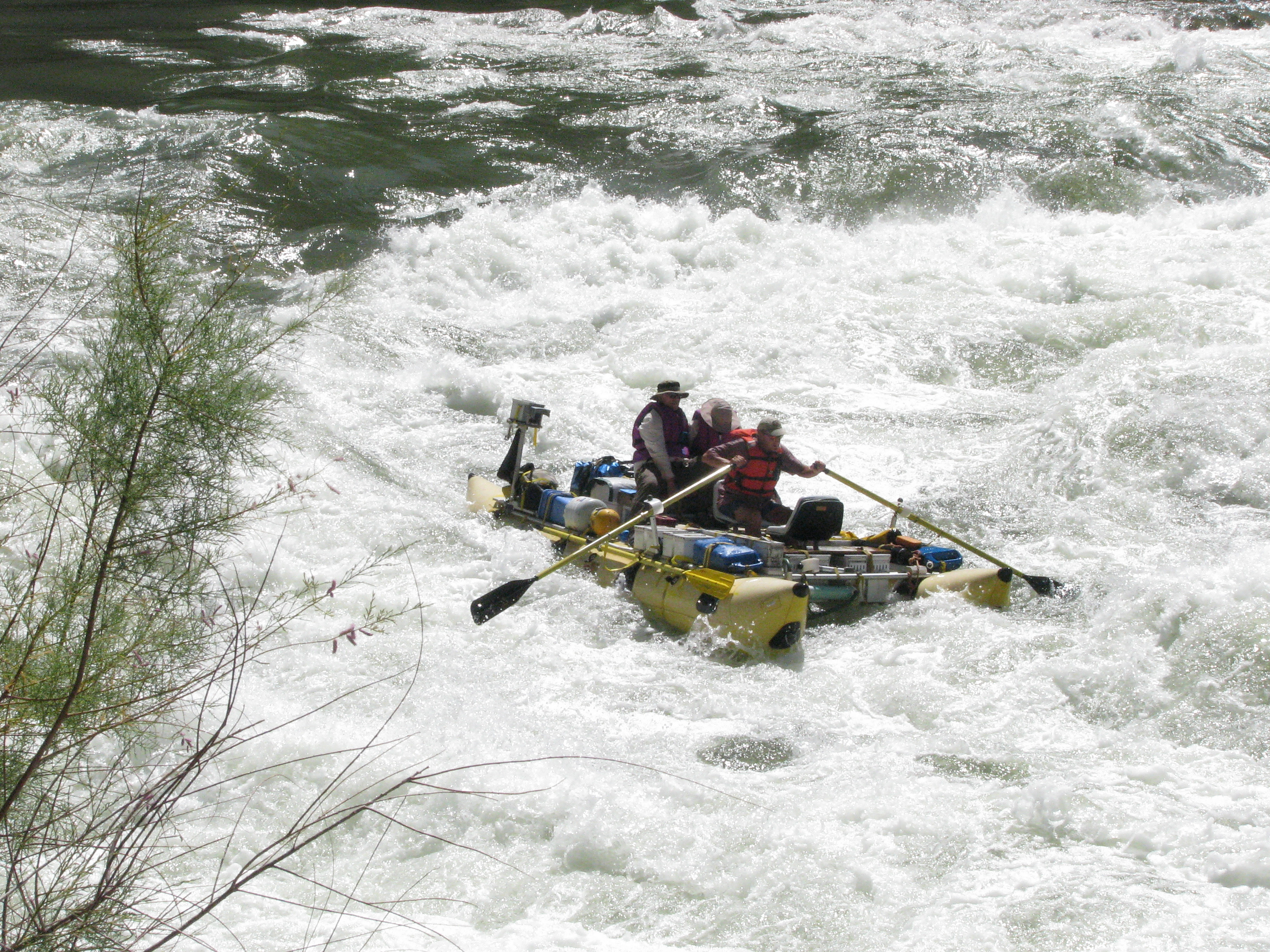
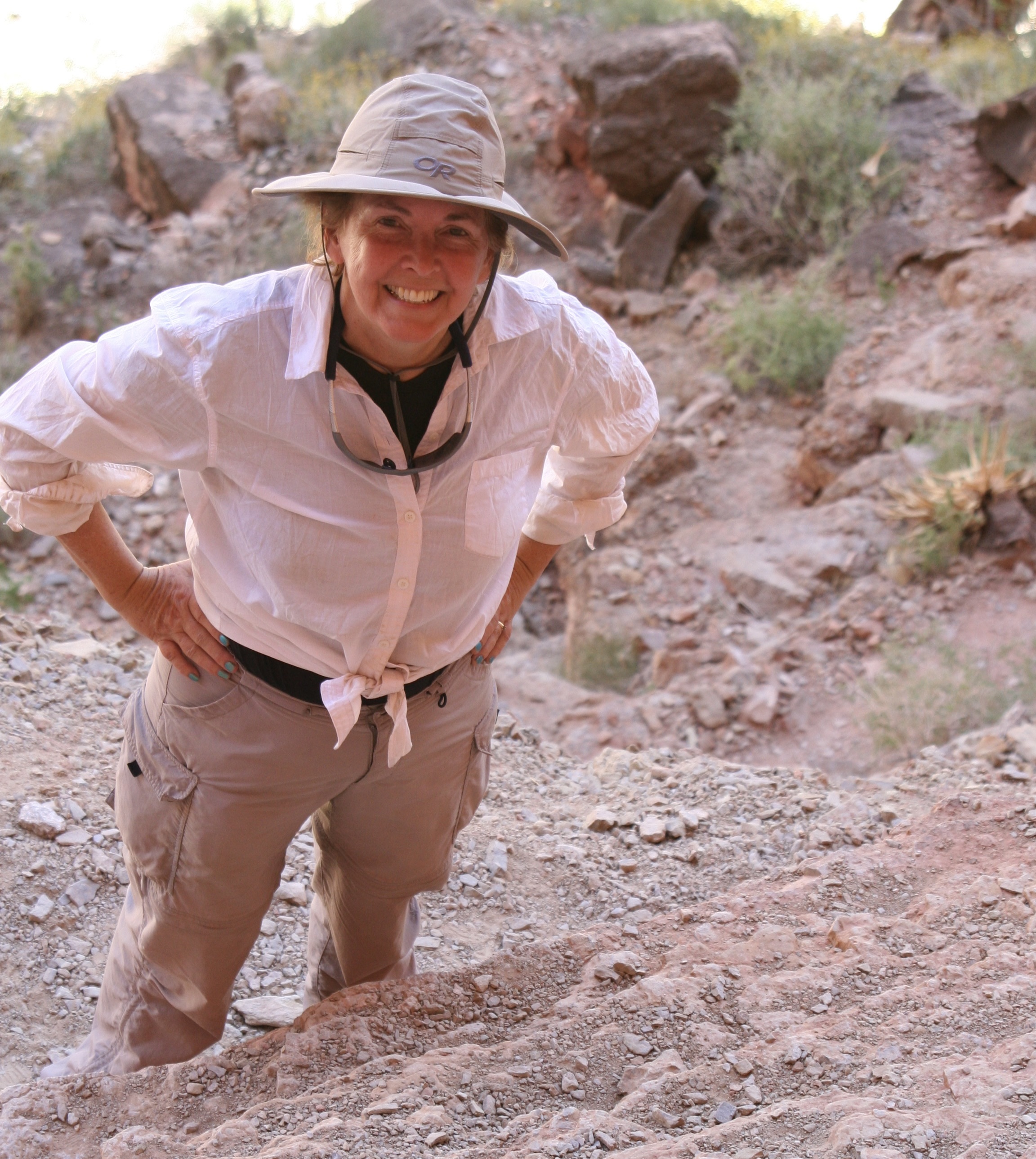
Peggy and I hold on tight while Steve Van Dore rows us through rapids on the Colorado River. Is Peggy praying? Grin. (Photo by our friend Don Green)
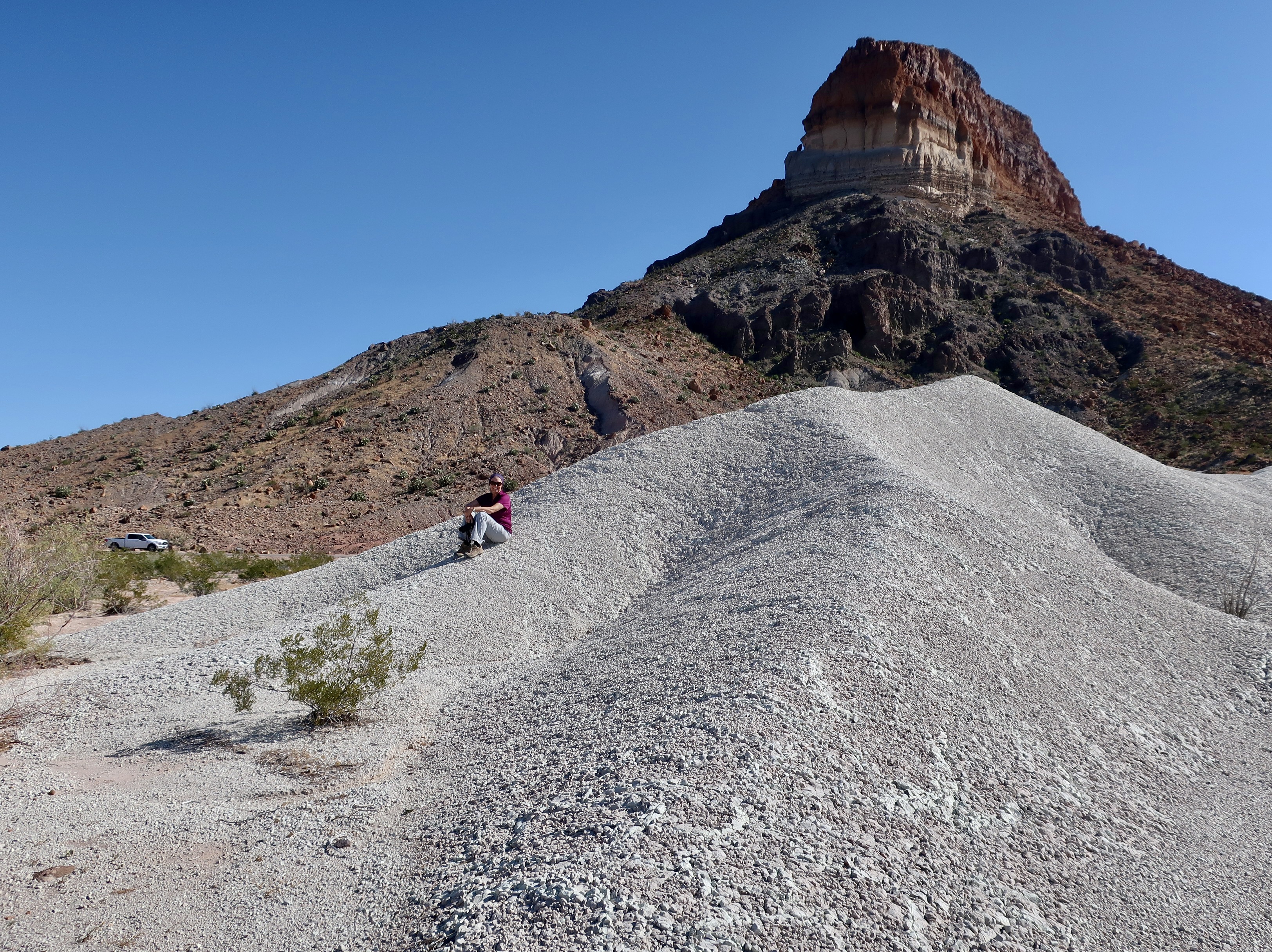
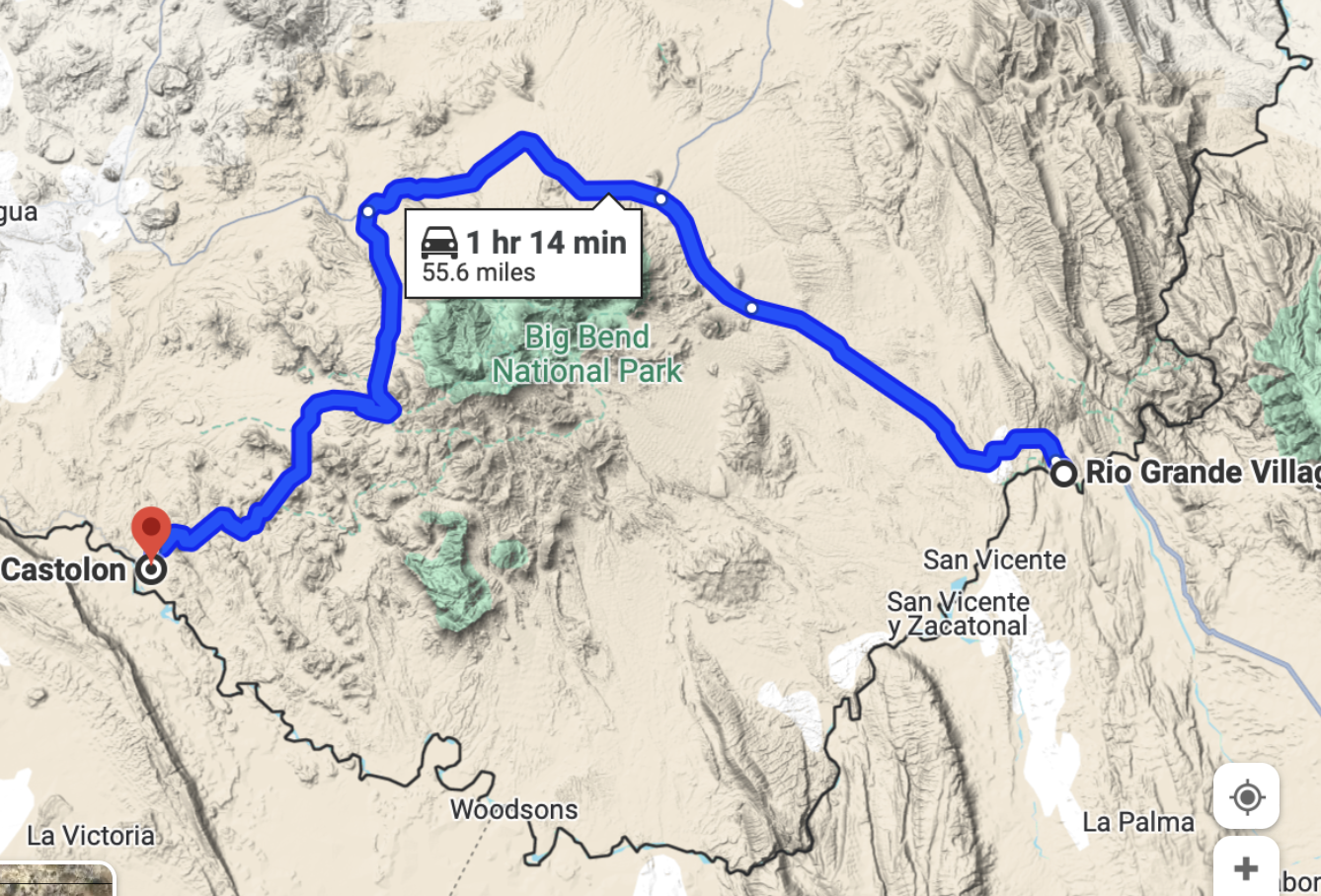
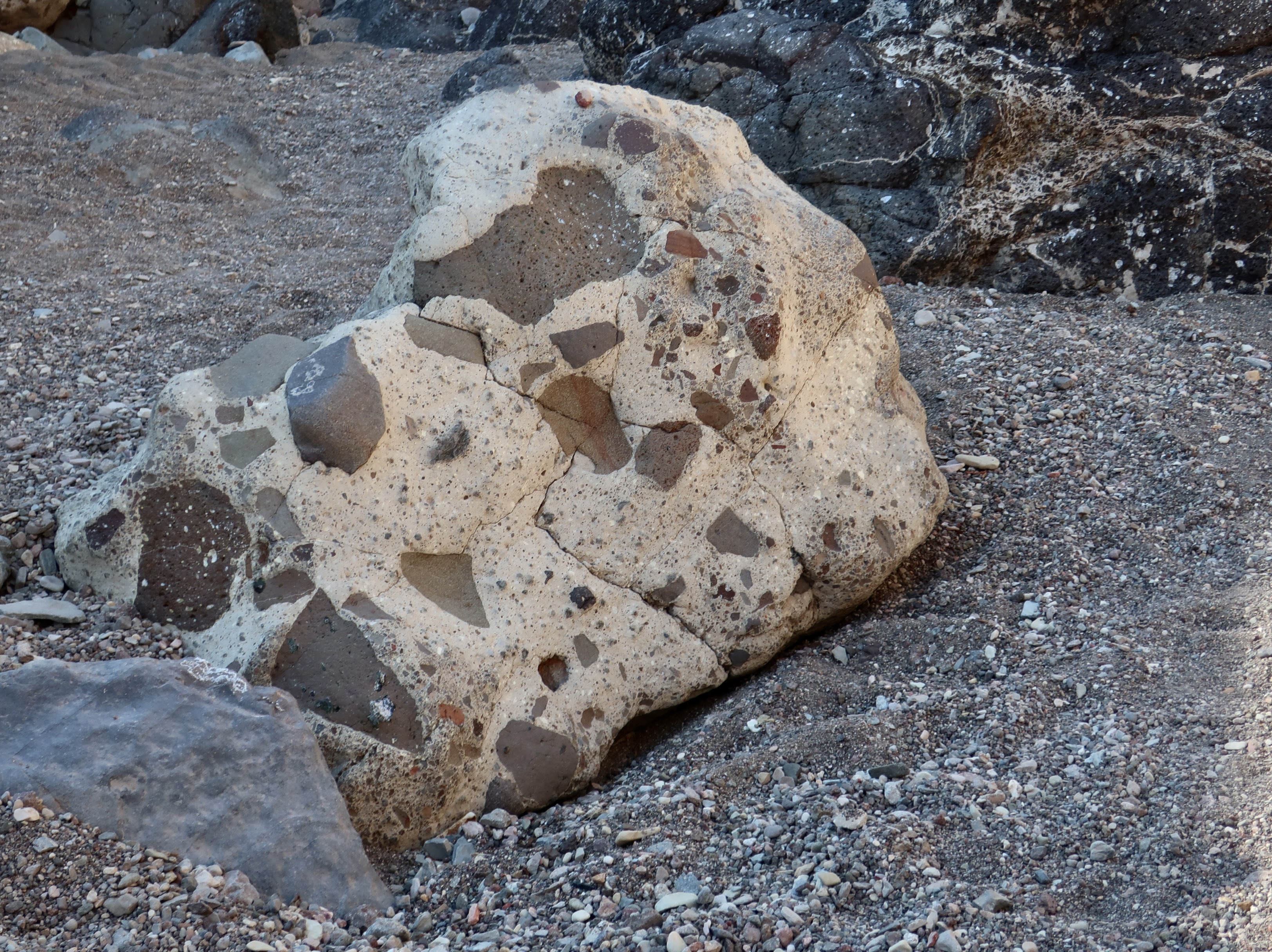
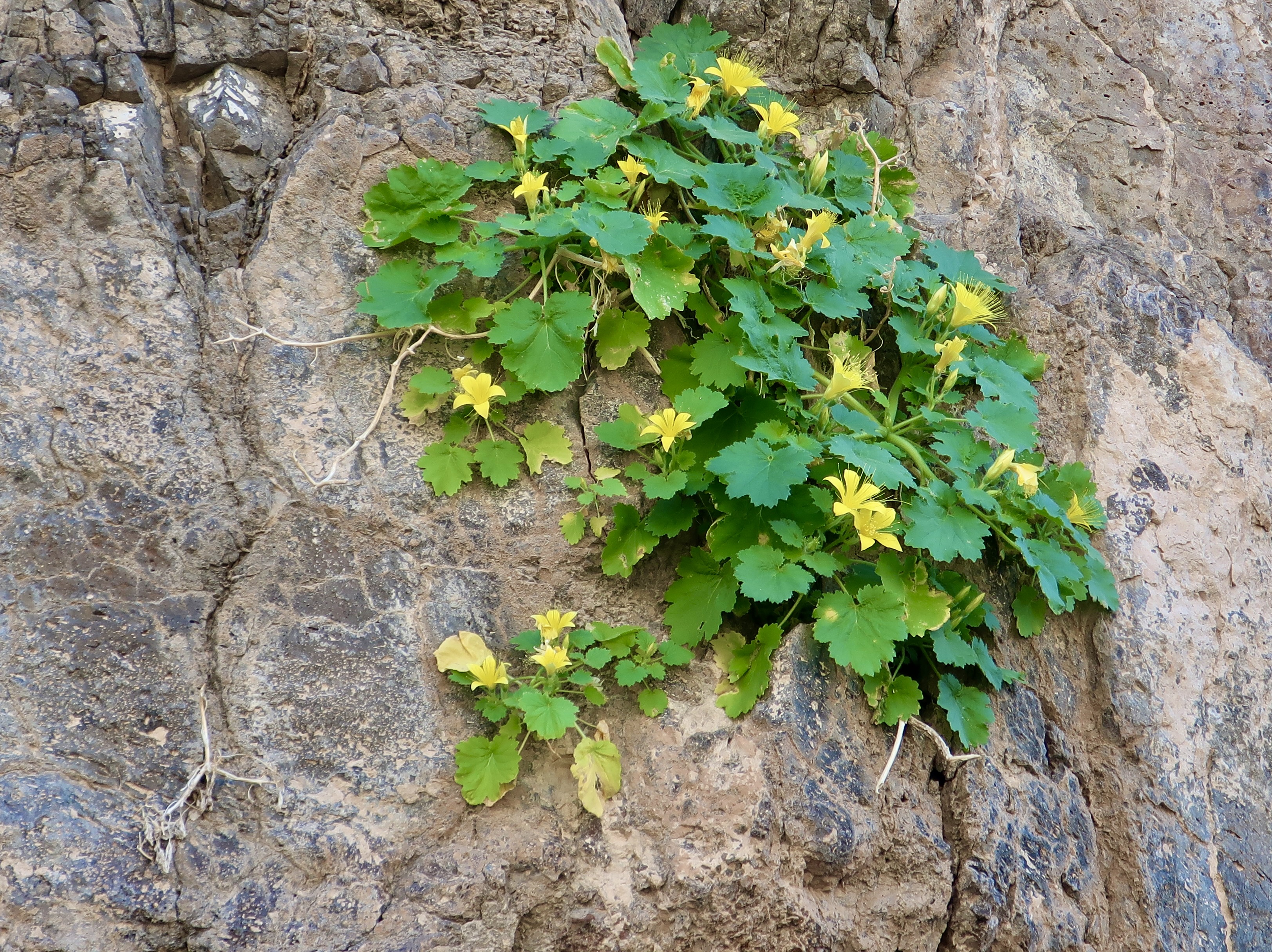
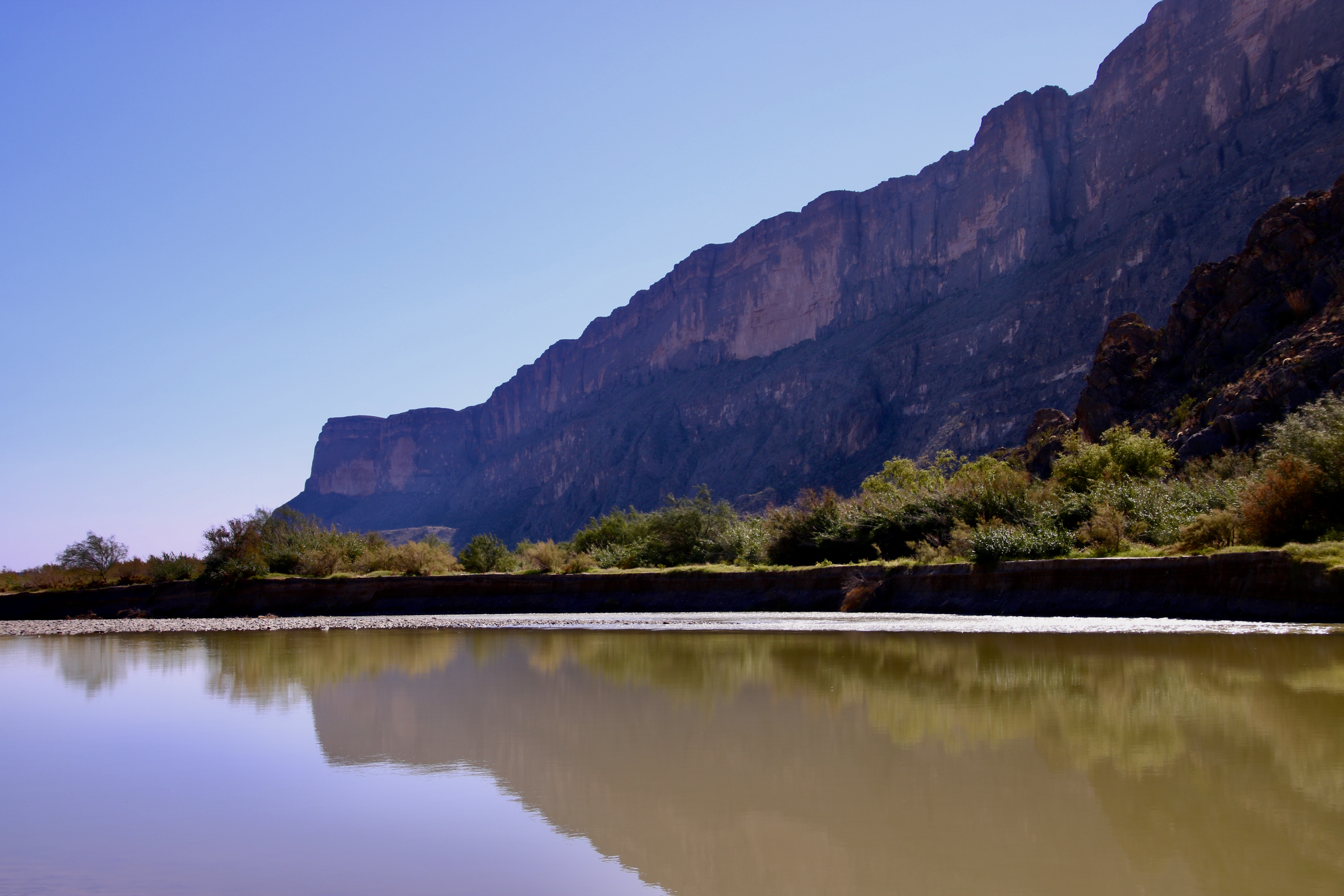
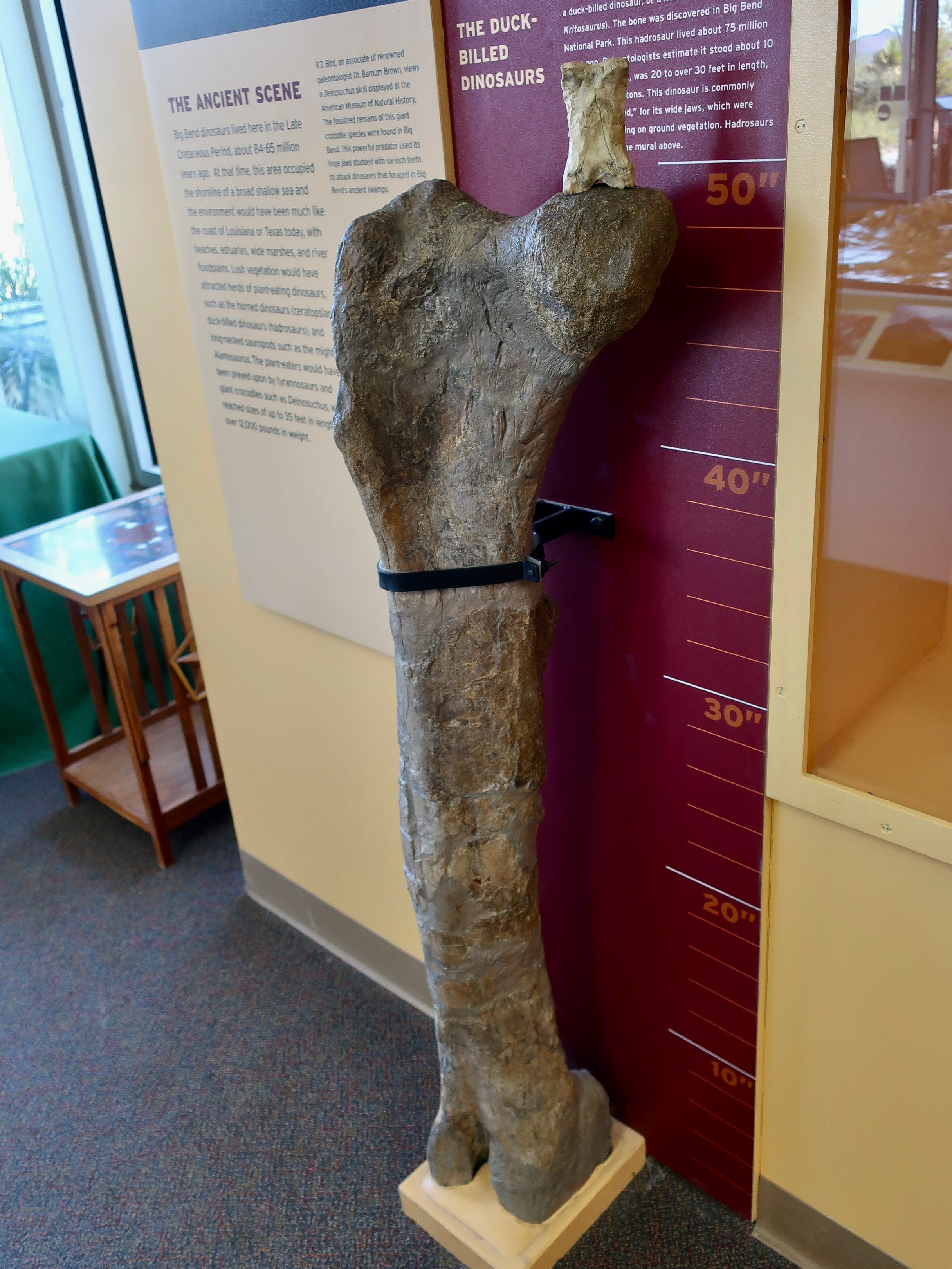
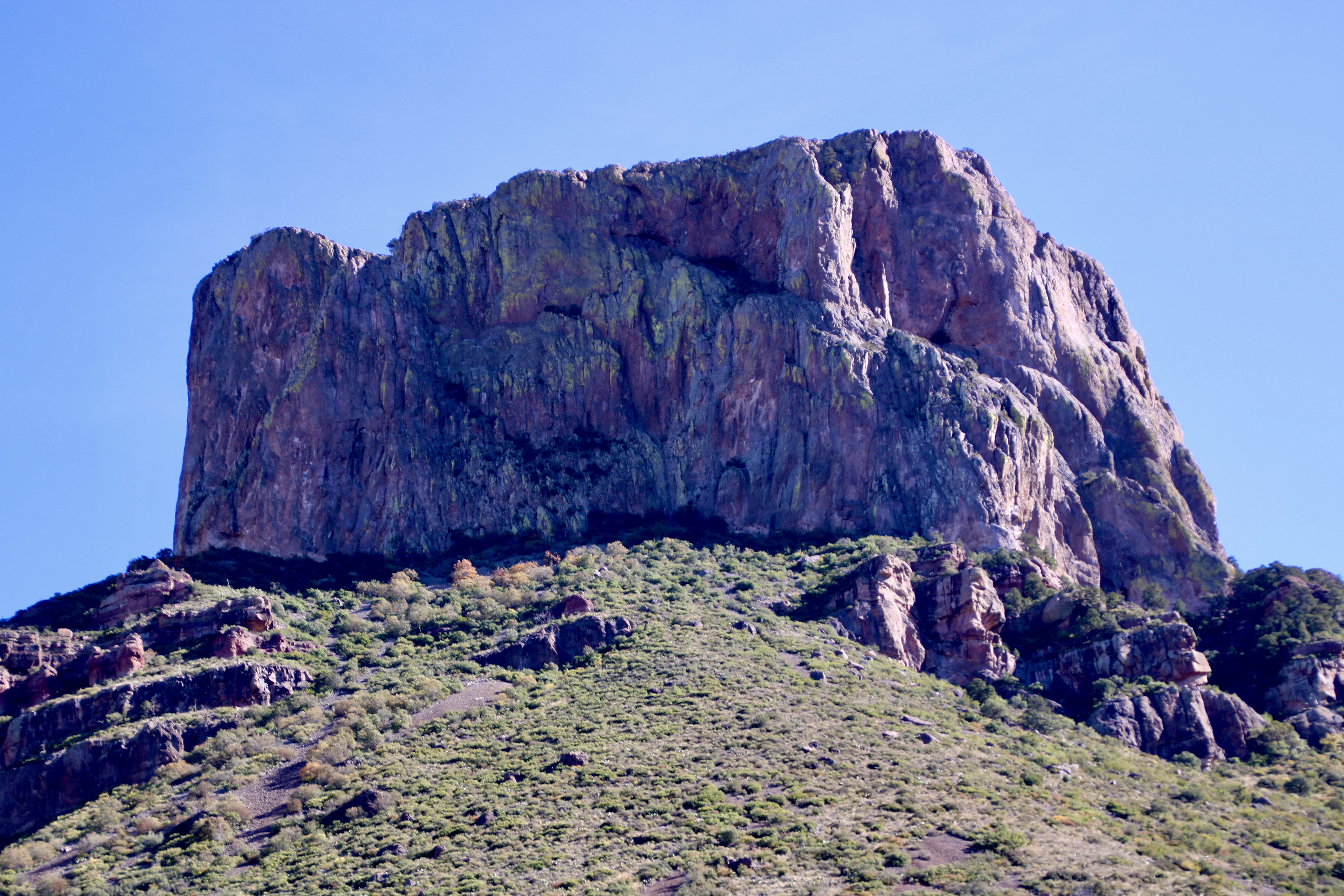
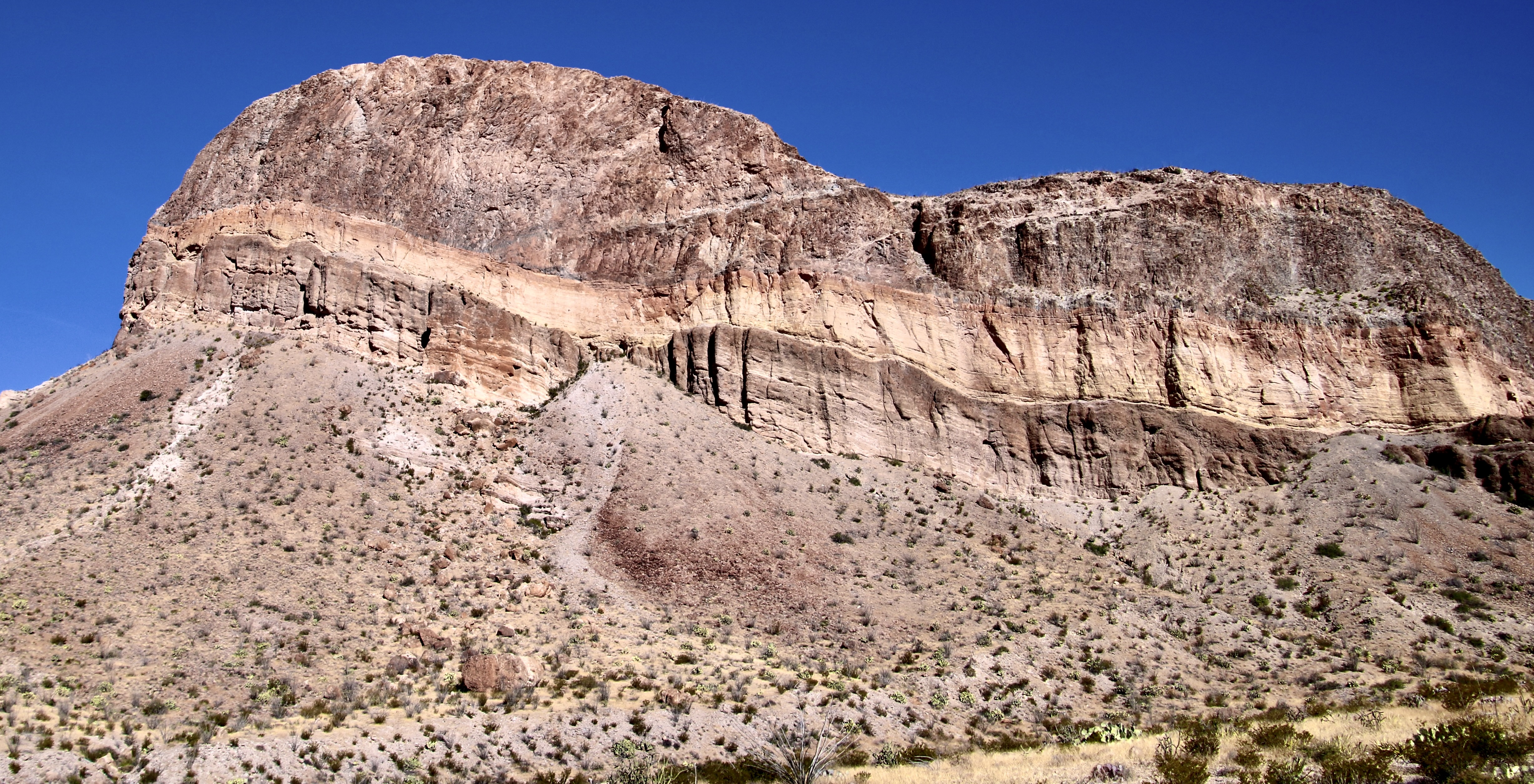
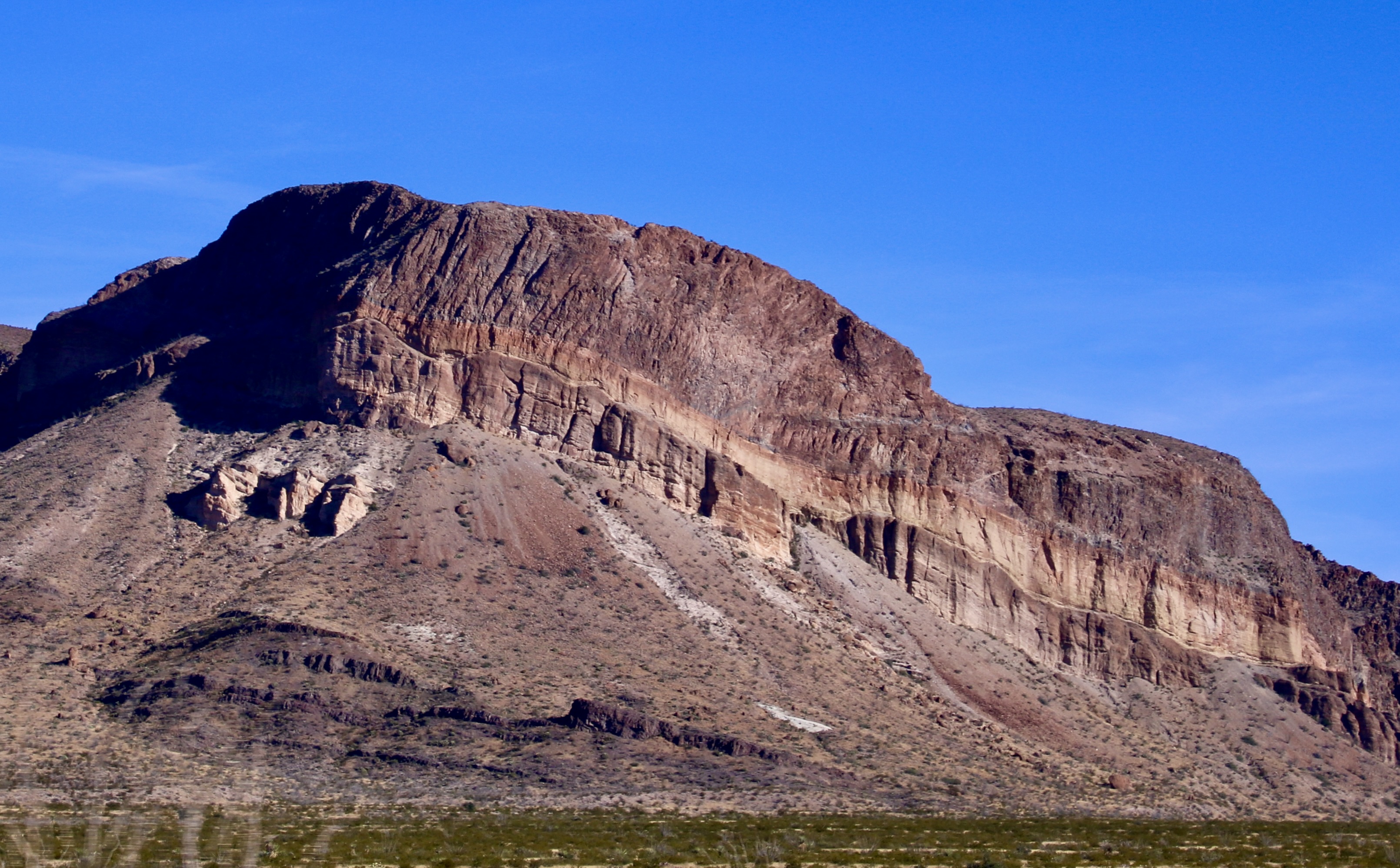
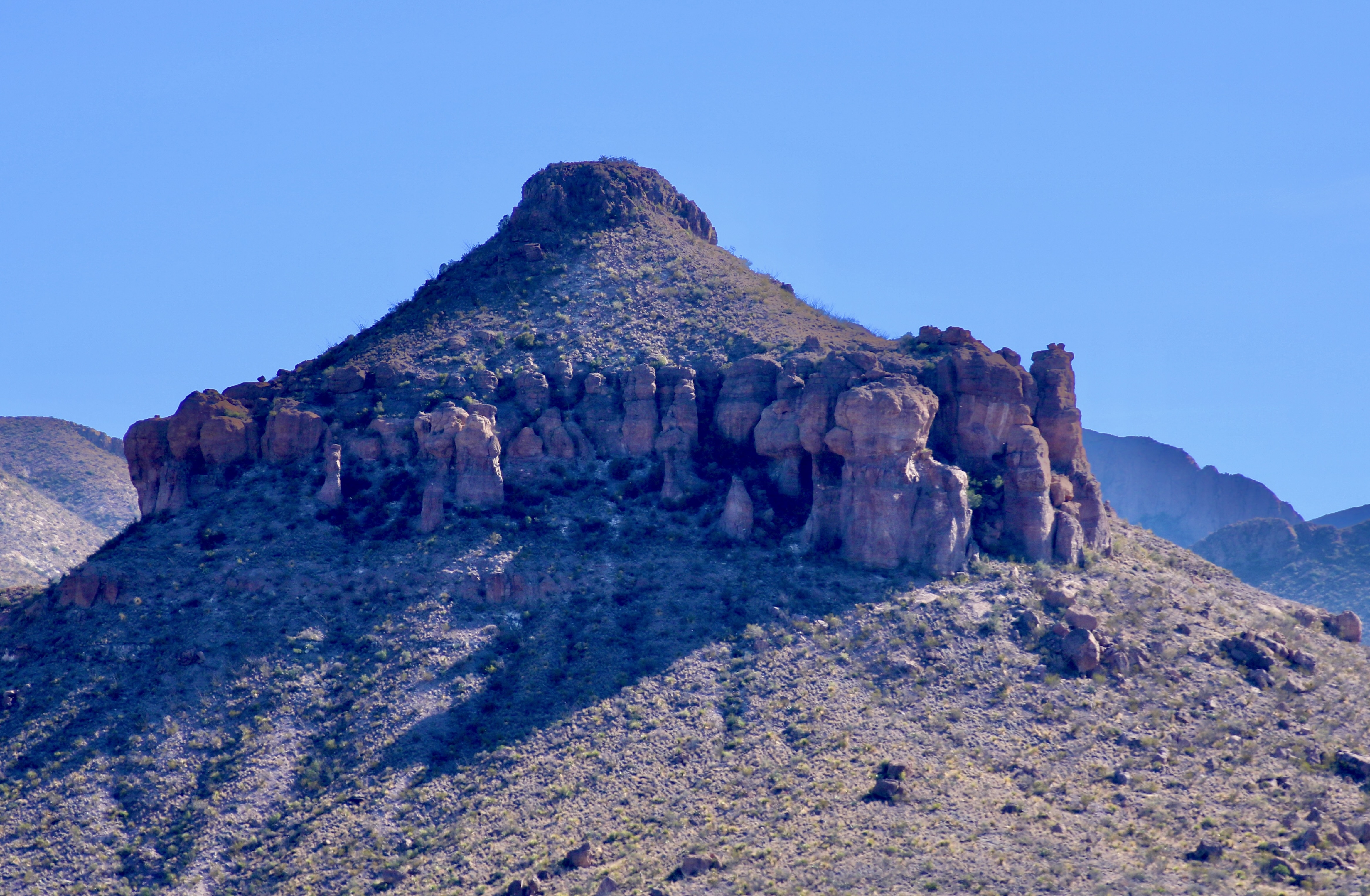
Our 55 mile drive from Rio Grande Village to our campground in Castolon through the Chihuahuan Desert and around the Chisos Mountains of Big Bend took us from the east side of the park to the west side. One of our first views on nearing Castalon was the Cerro Castellan peak. It’s impossible to miss. Peggy and our F-150 white pickup, Iorek, provide perspective. Peggy is sitting on tuff, which is consolidated volcanic ash. It isn’t as soft as it looks. Peggy told me that she had a tuff butt.We like Google maps when we are looking for an overview of our day’s drive. This shows our route from the Rio Grande Village to Castolon and provides an estimated drive time— assuming one isn’t pulling off every few minutes to admire the views. There is another reason why I like this map: It provides a clear view of why Big Bend is called Big Bend. The black line traces the flow of the Rio Grande as it makes its big bend.This National Park map shows the area around Castolon and shows the sites we will be including in today’s post: Cerro Castellan, Tuff Canyon, the Dorgan House and Santa Elena Canyon. The Visitor Center, closed in summer instead of winter, provides a clear hint about the region’s weather. You don’t want to face the heat of summer at Big Bend. Fall, winter and spring are normally mild. The story of Cerro Castellan is like so many other peaks found in Texas and throughout the Southwest. A rock highly resistant to erosion overlays other rocks that erode more easily. In this case, the top rock is from a dense lava flow that covered the area. Most of the rocks under it are also volcanic, just less resistant such as volcanic tuff, the buff colored rock. The dark rock at the base is basalt from earlier lava flows.We were treated to numerous views of Cerro Castellan. This one was from our camp. Not bad, eh.The opposite side provided a totally different perspective.More of a side view here. I believe the greenery is mainly creosote bush .A final side view of Cerro Castellan.There are overlooks where visitors can look down into Tuff Canyon, or with a short hike, you can climb down into the canyon and walk along it, which is what Peggy and I did. 30 million years ago, a nearby violent volcanic eruption sent ash and rocks shooting into the air. Heat and pressure when they landed turned the ash into the tuff seen along the canyon walls. We were curious about how these river bed rocks got into the erosion created holes. The only thing we could think of was a flooding stream working its way down the canyon.These were rocks that would have been thrown out by the eruption and embedded in the tuff.I liked this photo I caught of Peggy from what I recall was a shallow ‘cave’ in the tuff.Flowers growing out of crevices in the tuff wall. Life will find a way!Tuff cliffs towering over dark volcanic basalt. The end of the trail leading up the canyon.An ocotillo plant looked down on us from the rim.The Ocotillo, with a mouthful scientific name of Fouquieria splendens, is an interesting desert plant that usually looks like a dead, naked bush with wicked thorns, i.e. not something that you would want to mess with. The stems actually have chlorophyll and are capable of photosynthesis and sustaining the plant thorough dry times. Come rain, however, the plant becomes covered in leaves and really goes to work in food production. It also develops brilliant red flowers. Thus the ‘splendens’ in the scientific name.And finally we stopped to admire this mesquite tree on the way out.On our way to Santa Elena, we stopped for a walk up to the Dorgan House. There are several sites around Castolon that feature historical sites from the last 100 years or so. Dorgan was an architect involved in the local farming community. The remains of his house included this unique fireplace made from petrified wood. It was fun checking out the various rocks.I was particularly impressed with this rock. I saw an eye, a pig-like nose and a great set of choppers. I have the perfect location for it at home. But I didn’t take it. That’s a no-no in a National Park. If you should show up and find it missing, however, remember…I was framed. The Rio Grande River flows out of these limestone cliffs where it has cut the Santa Elena Canyon some 1,500 feet (450 m) deep at Santa Elena.The canyon travels back some 8 miles from its mouth (shown here). Visitors can sign up for a raft trip down the river, or even run it on their own assuming they have a degree of white water expertise. Or, when river is low and slow, like it is here, you can paddle up it for 3-4 miles and then paddle back out. Or, visitors can wade across the creek on the right and hike a brief distance into the canyon.A view of the Rio Grande as it flows on its way after leaving the canyon. We were visited by a herd of peccaries (known locally as javelinas) one evening when we were at the Castolon Campground. These mammals are found as far south as Argentina. He did not like the fact I was following him around snapping photos…You might say it was a hair raising experience.On our way out we stopped by the Panther Junction Visitor Center to check out its display on duck billed dinosaurs that roamed the area. Bone provided perspective on a leg bone. Coming from the leg of a horse just above the hoof, he could relate. Plus he is a great fan of old bones. That’s it for today and for Big Bend National Park. Next up is Theodore Roosevelt National Park in North Dakota where the buffalo still wallow…
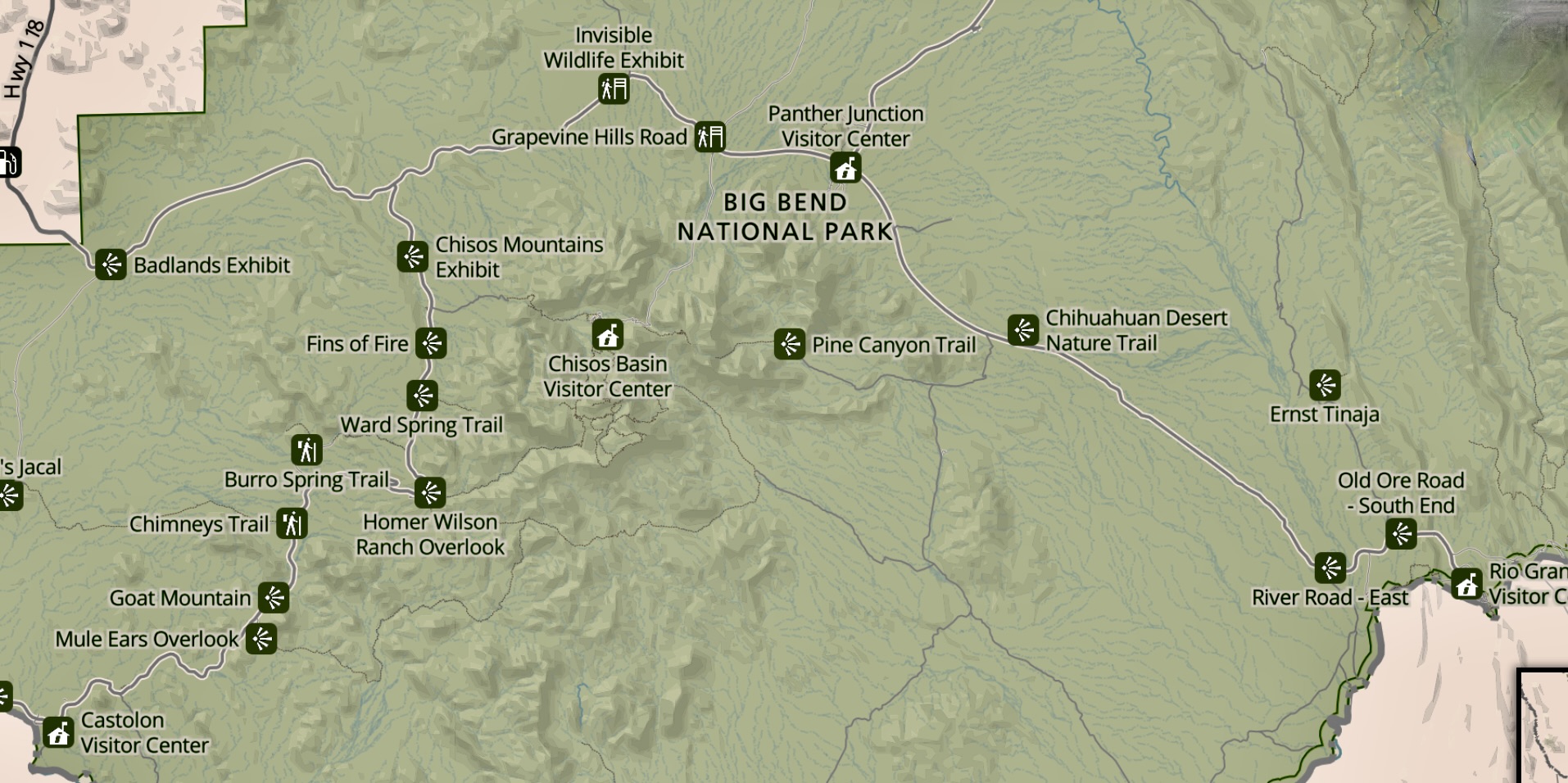
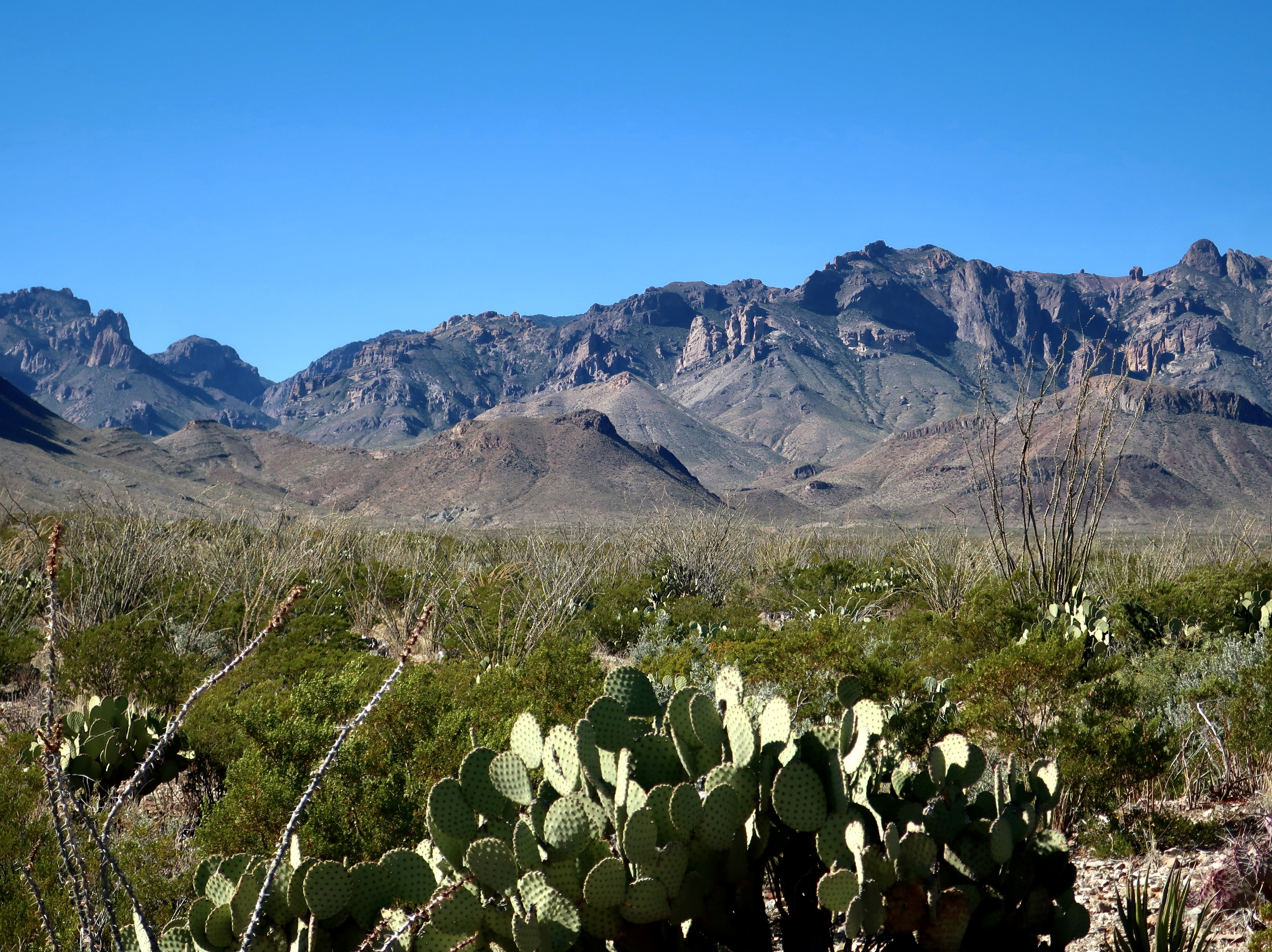
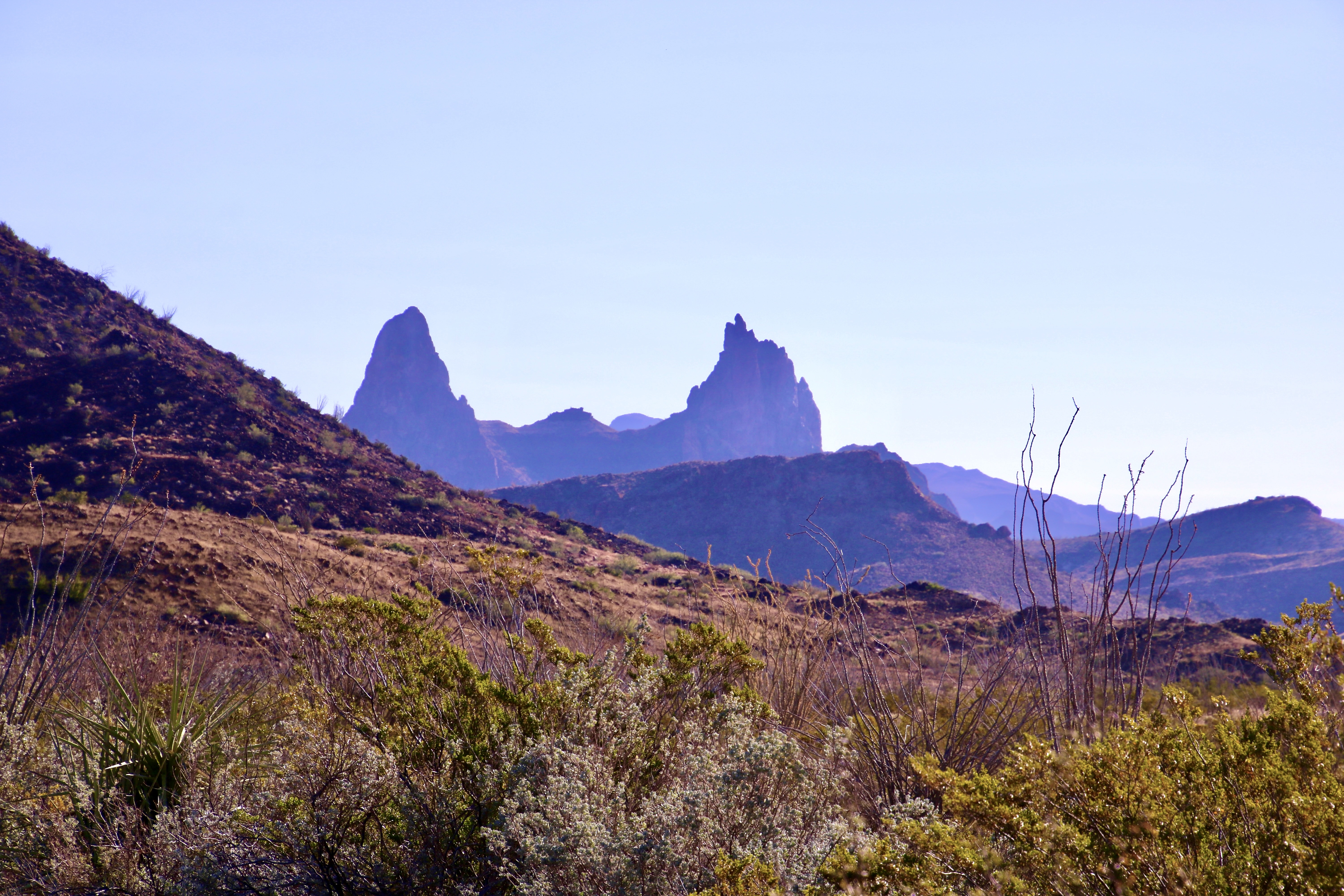
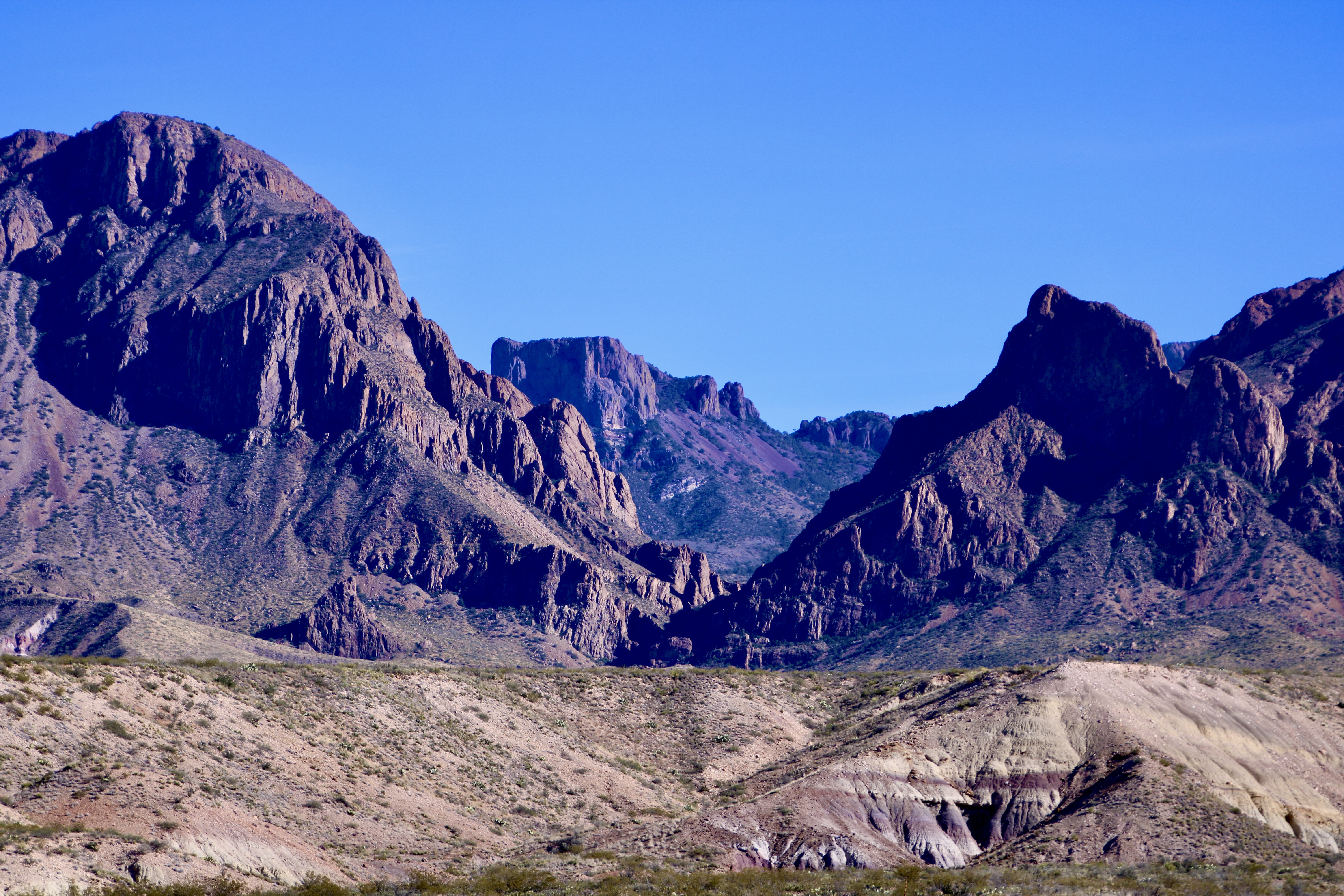
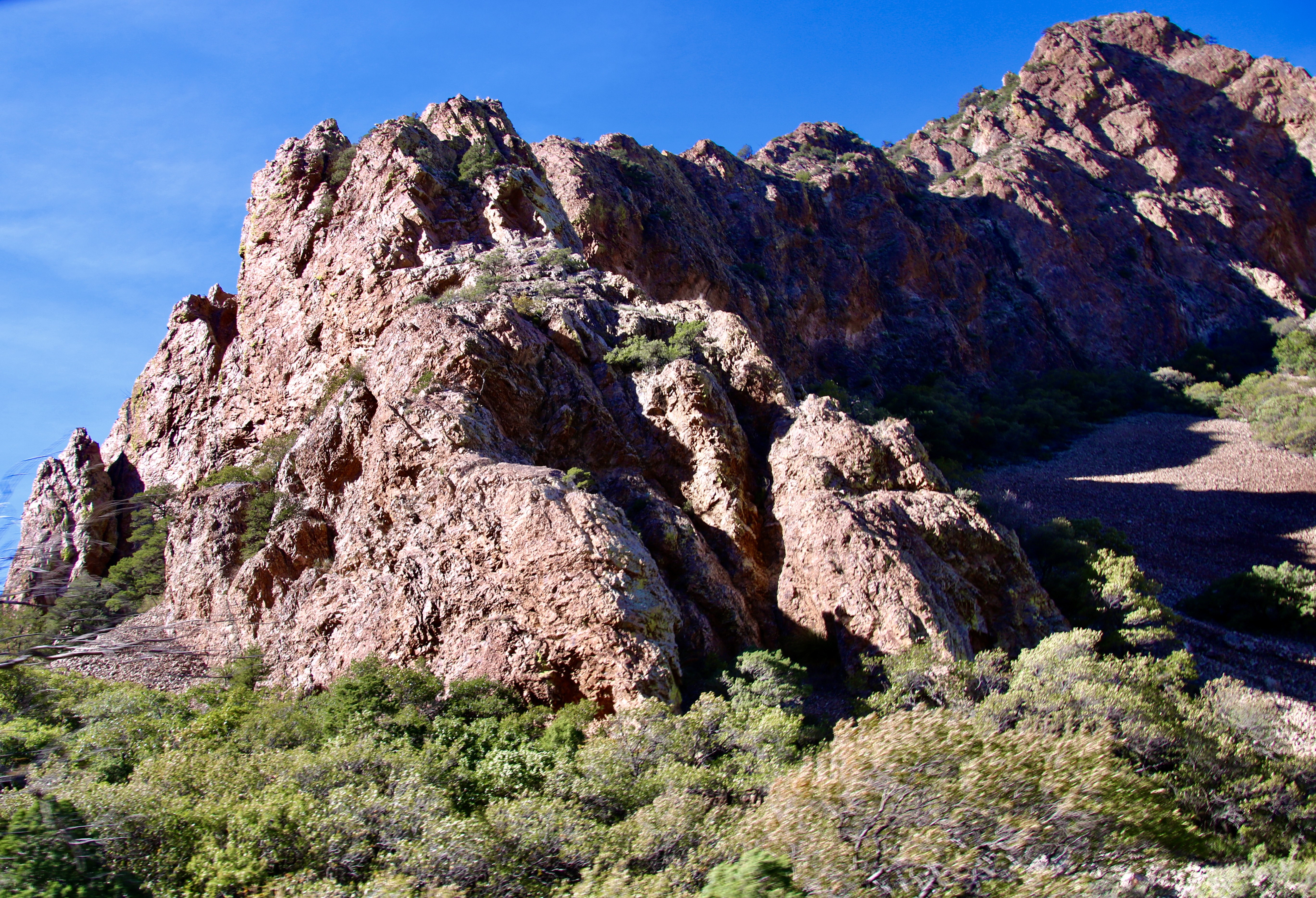
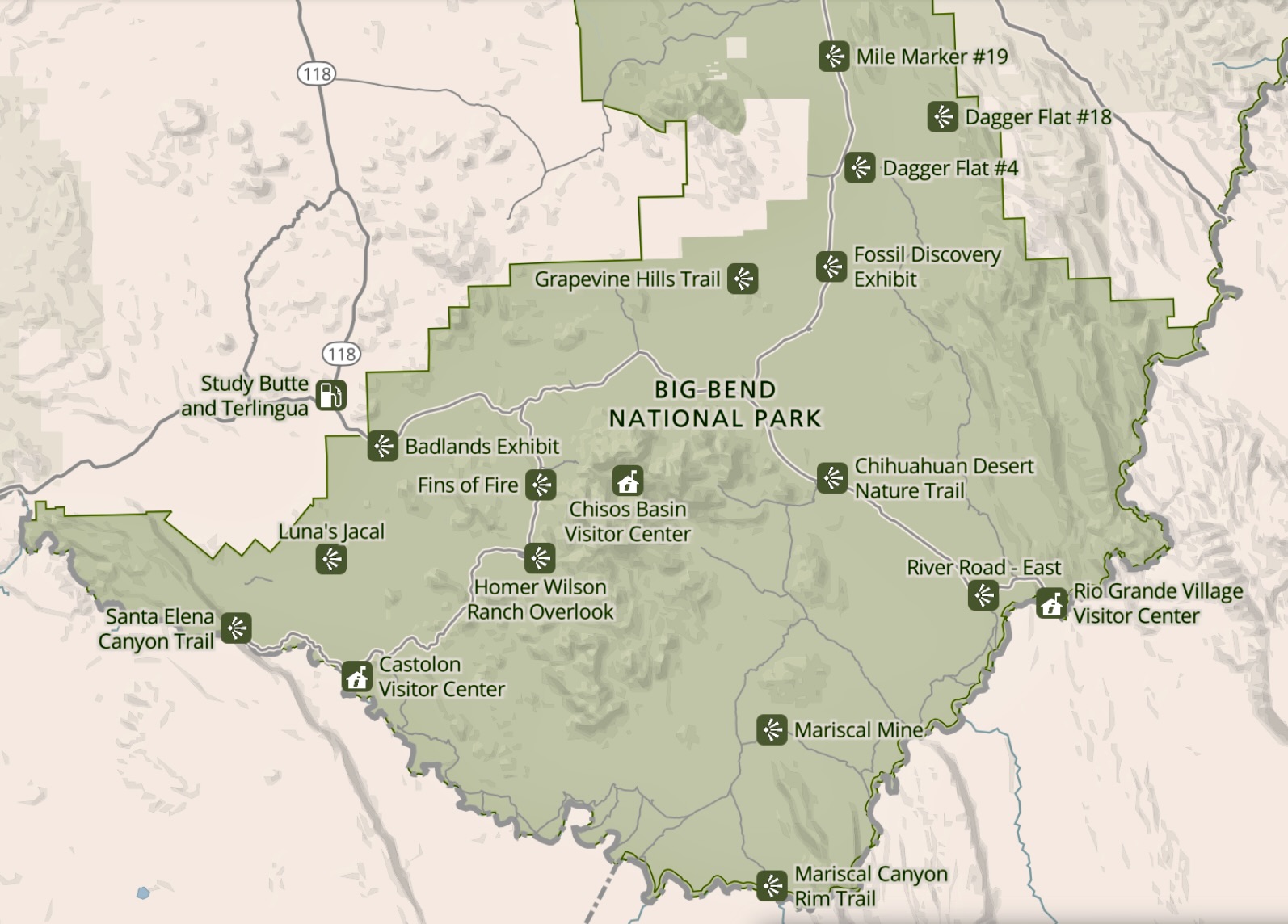
The Chisos Mountains of Big Bend were born 45 to 30 million years ago when the region experienced several episodes of volcanism followed by periods of quiet. We found the mountainous region to be quite beautiful. Our drive from our campsite at Rio Grande Village to our campsite at Castolon took us around much of the mountain range as shown in the National Park map below.Our drive from our campground at Rio Grand Village on the right to our campground in Castolon on the left took us around a significant portion of the Chisos Mountains. Most of our photos of the mountain were taken when we retraced our drive up from Castolon to visit the Chisos Basin. We did, however take photos from the Chihuahuan Desert Nature Trail on our way to Castolon. This is a Big Bend National Park map.The Chihuahuan Desert Nature Trail provided several views of the eastern side of the Chisos Mountains. I believe this is a view into Pine Canyon.Any view of the ‘Old West’ is enhanced by an old-fashioned windmill (not the gigantic modern types). We found this along the nature trail looking out at the mountains.Farther up the road, after we had cut off onto the Ross Maxwell Scenic Drive, the Chisos Mountains Exhibit gave us a northwestern view of the mountains. Emory Peak, the slight knob on the left, is the highest point in the park at 7,825′ (2385 m).Once situated in Castolon, Peggy and I decided to make a more leisurely trip up the Scenic Highway along the Chisos Mountain to the Chisos Basin. Our first view along the way was one of Big Bend’s most photographed sites: The Mule Ears. They look a bit devilish to me.Another perspective. Do they actually look like mule ears? Close…I took this photo at Phantom Ranch in the Grand Canyon.Next up on our list of things to see was Goat Mountain. It’s the peak on the left.Closer…Closest! Actually, Goat Mountain was misnamed. What the early pioneers were actually looking at were big horned sheep.But, hey, an ungulate is an ungulate, right? Can you spot the sheep? Just kidding.Remember the old ditty, ‘the bear went over the mountain to see what he could see,’? I’m like the old bear. Always curious. Goat Mountain is the peak on the end. Getting close to the turn off to the Chisos Basin, this was our view. Note the red ridges in the foreground.The red ridges are the Fins of Fire shown on the map. They are volcanic dikes formed when lava forces its way into crevices in rocks as it works its way to the surface and solidifies. Erosion has exposed the red dikes here.Close up of the dikes.Now it’s time to work our way into the Chisos Basin. A window view of where we are going. The large flat rock is Casa Grande.A grand house indeed! But it’s only one of the many views we found in the basin.They range from rocks with character like these…To rocks I found particularly beautiful. Like this.And this. Note the trees and bushes. We are no longer in the desert!Variety in the basin…Is truly…The spice of life.This is Emory Peak, the highest point in the Chisos Mountains.And this is a view back out into the Chihuahuan Desert, where we will return in our next post. See the slight notch on the horizon…It’s this: The Santa Elena Canyon. Located in the Castolon area, it is one of the places we will be exploring.
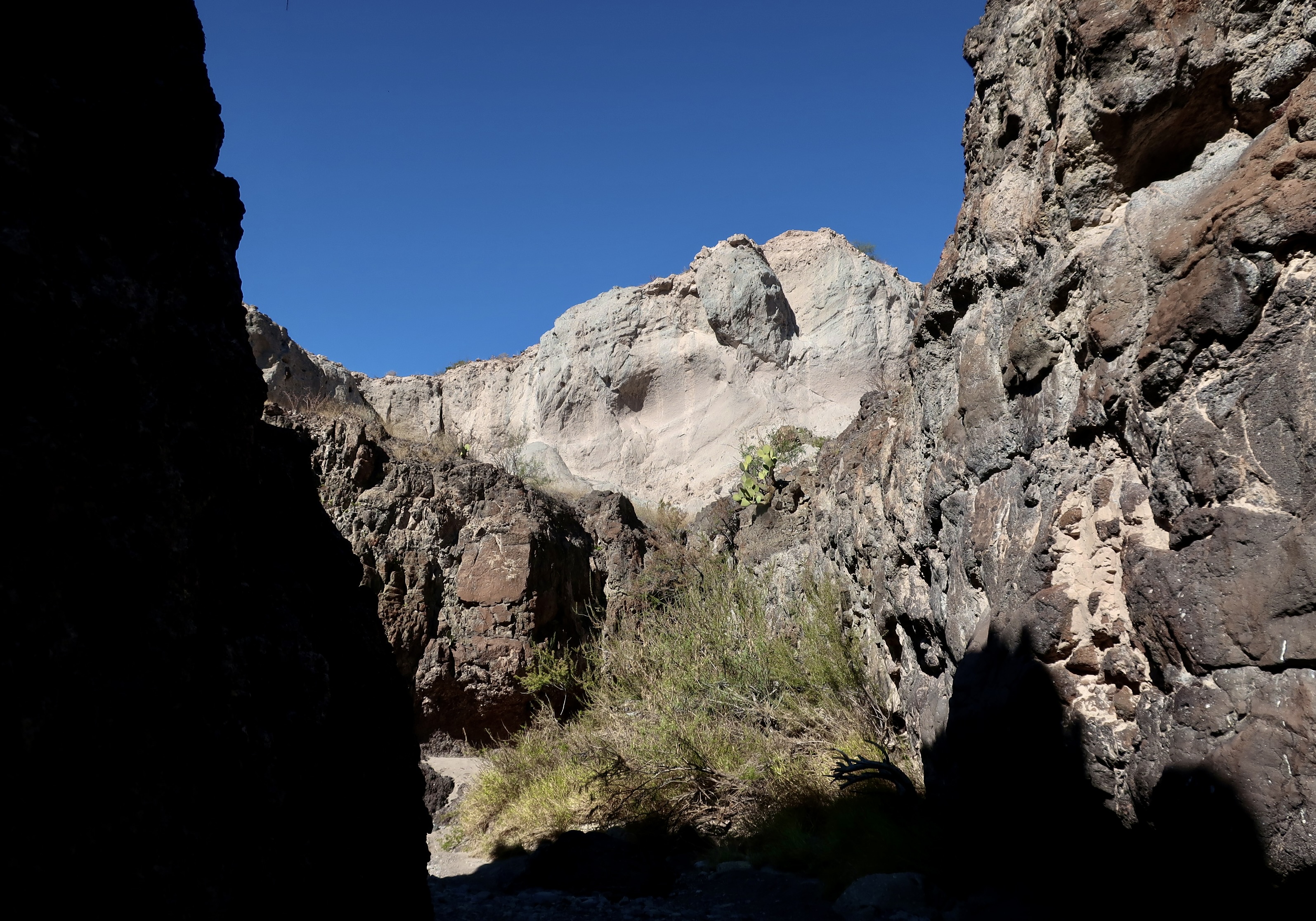
At first, we thought it said Burro Mesa Pulloff. That seemed to make sense. Maybe this was an historic location where burros pulled off to rest, drink water, and chew on a desert bush or two. Then we saw it was Pouroff. So what’s a pouroff? A contest between bartenders? We read the National Park info board. Apparently water poured off of Burro Mesa and down into this gravel canyon during thunderstorms, flooding it. Given that the canyon was quite beautiful and that there were no thunderheads looming overhead, Peggy and I decided to go for a walk.
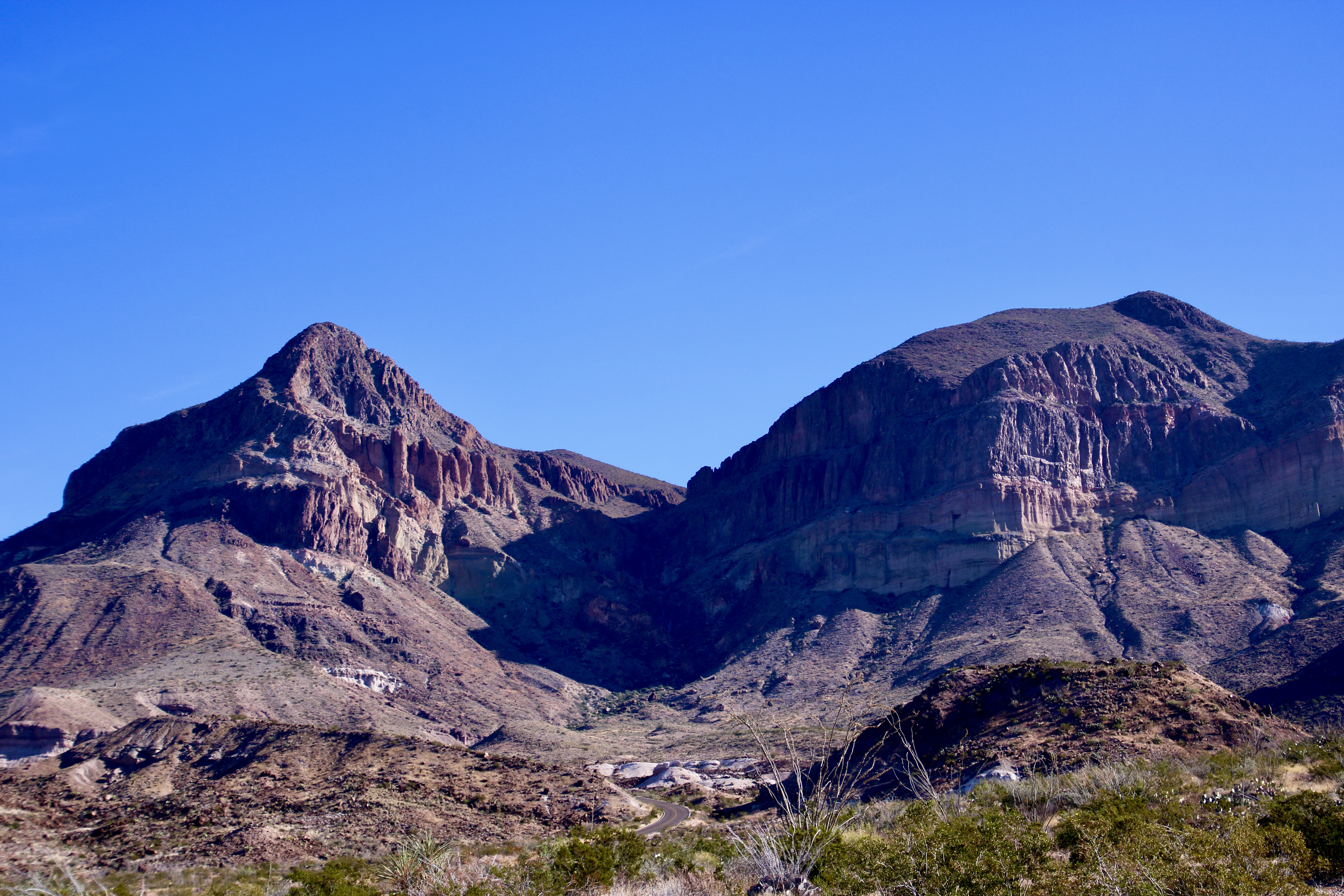
Today’s post was supposed to be about Big Bends Chisos Mountains. I even included a ‘teaser’ photo in my last blog. When I reviewed our photos, however, I quickly decided that a fourth blog was needed. This is it. There may even be a fifth. Most of today’s photos were taken along the Ross Maxwell Scenic Drive shown below.
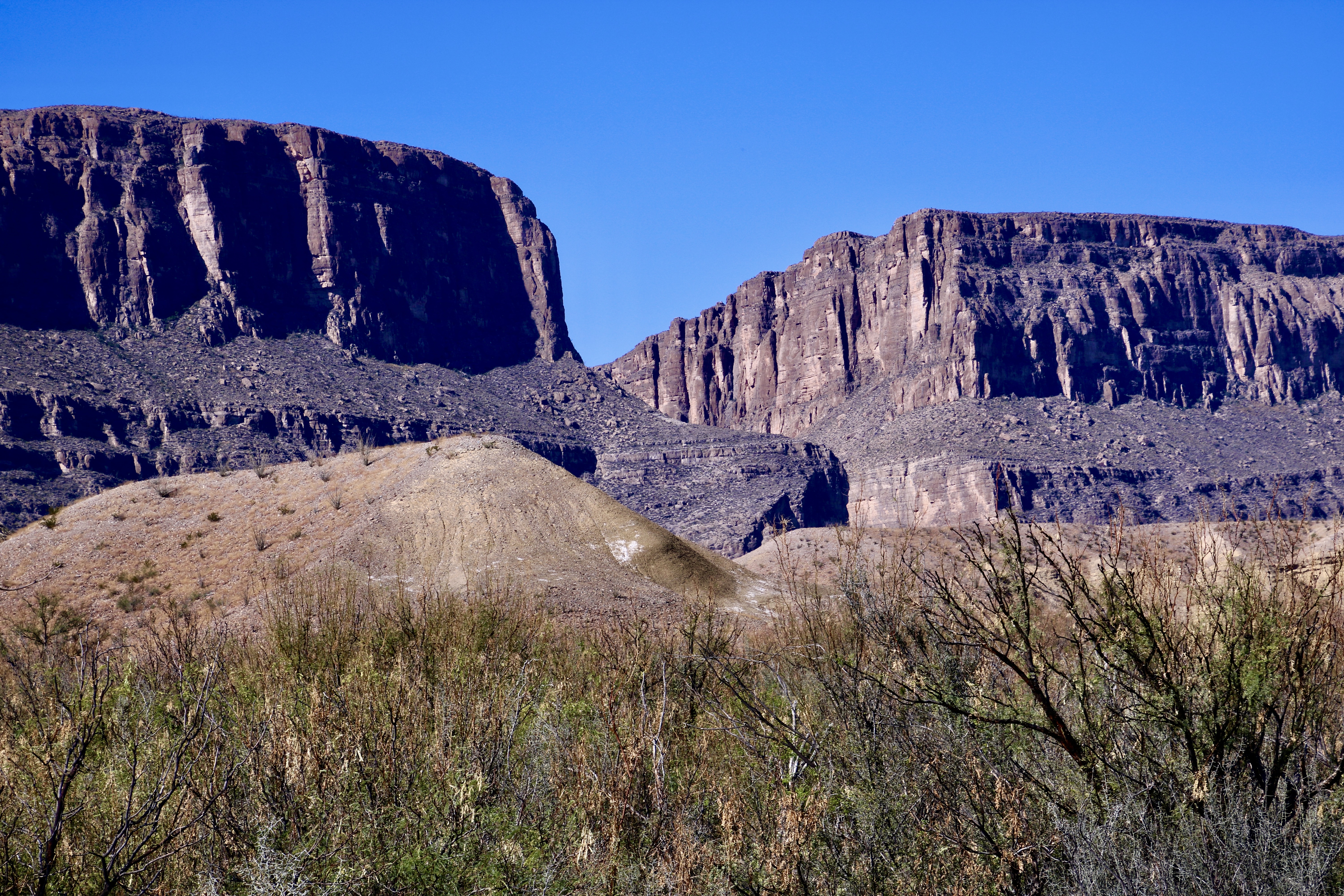
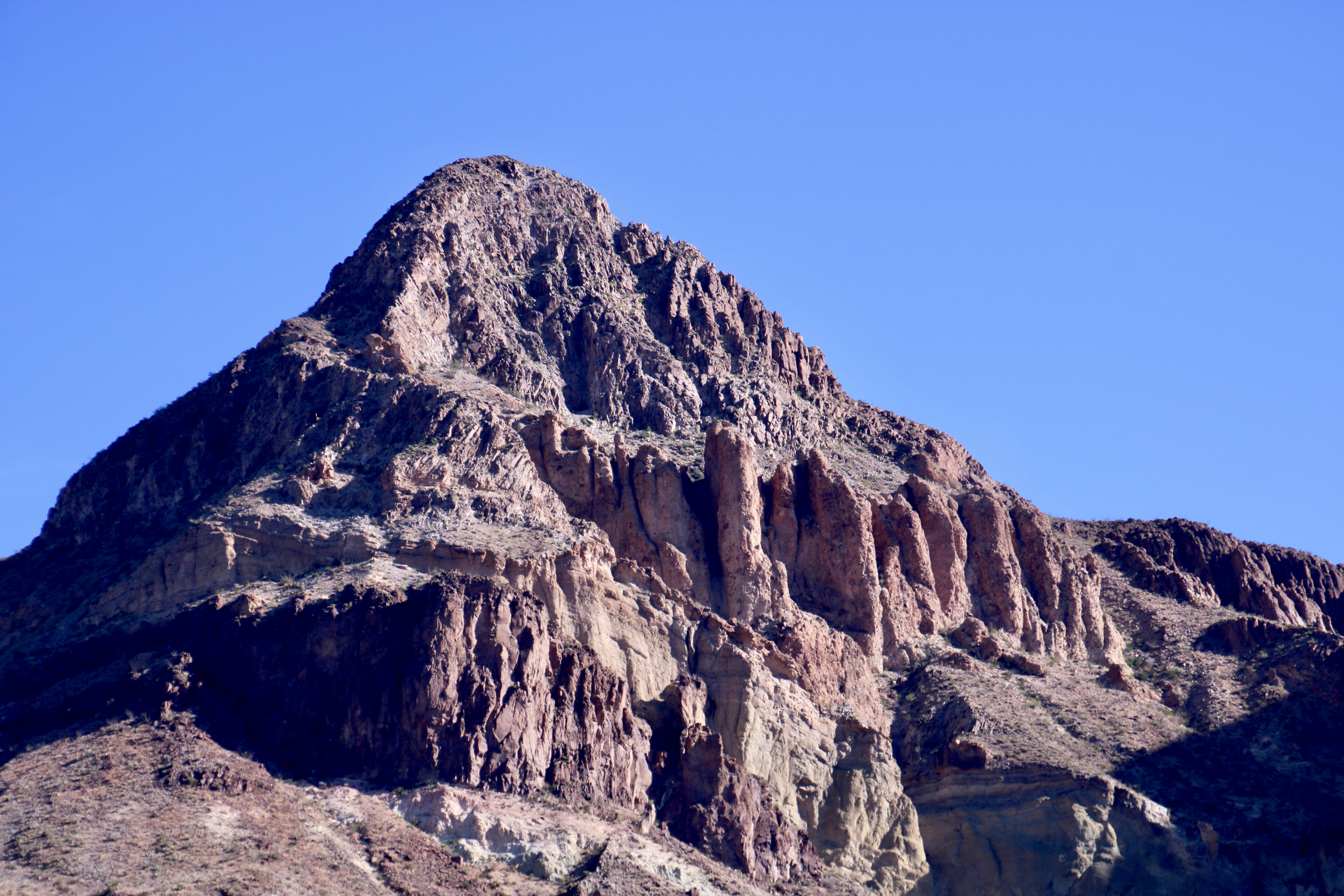
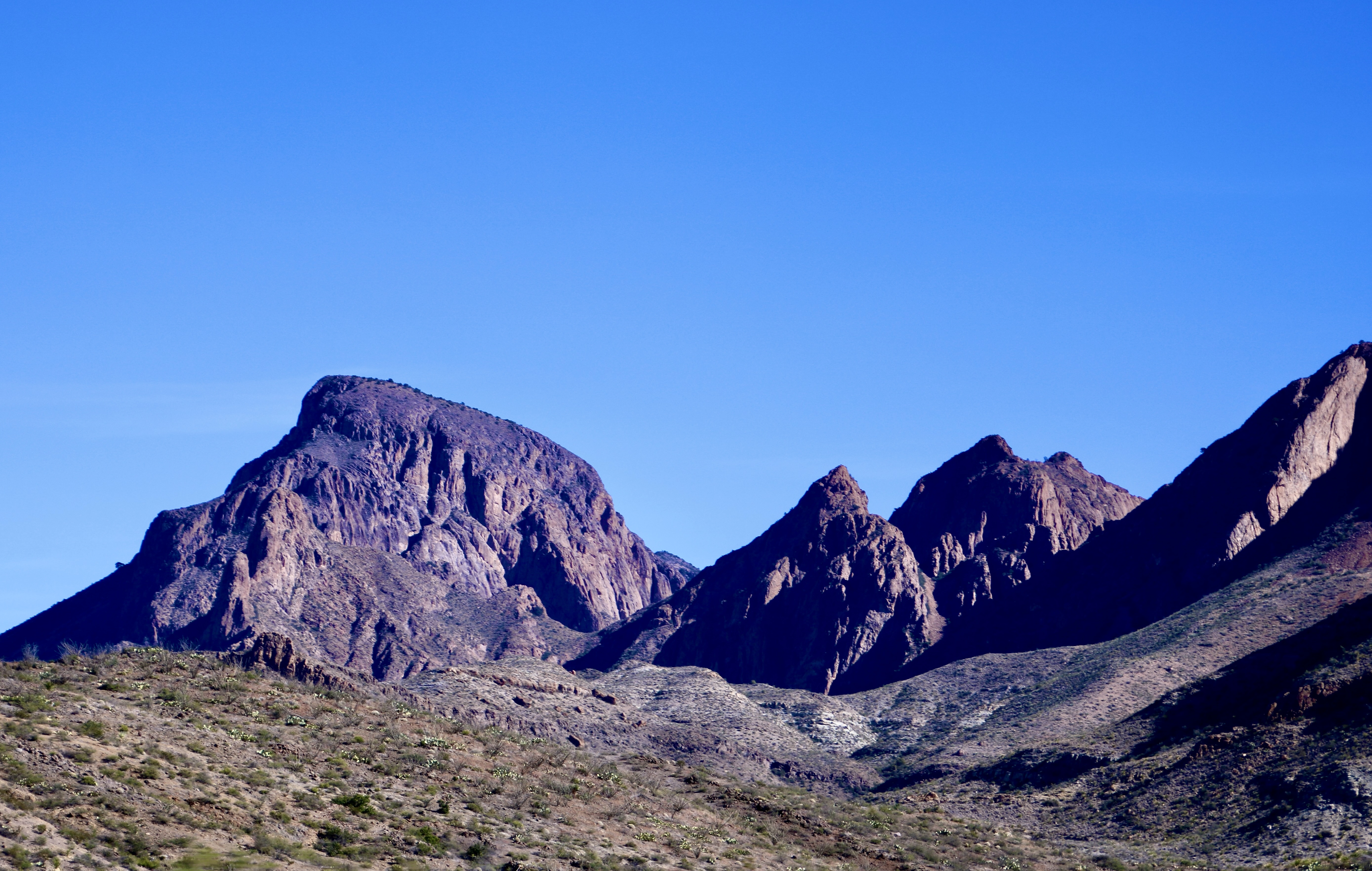
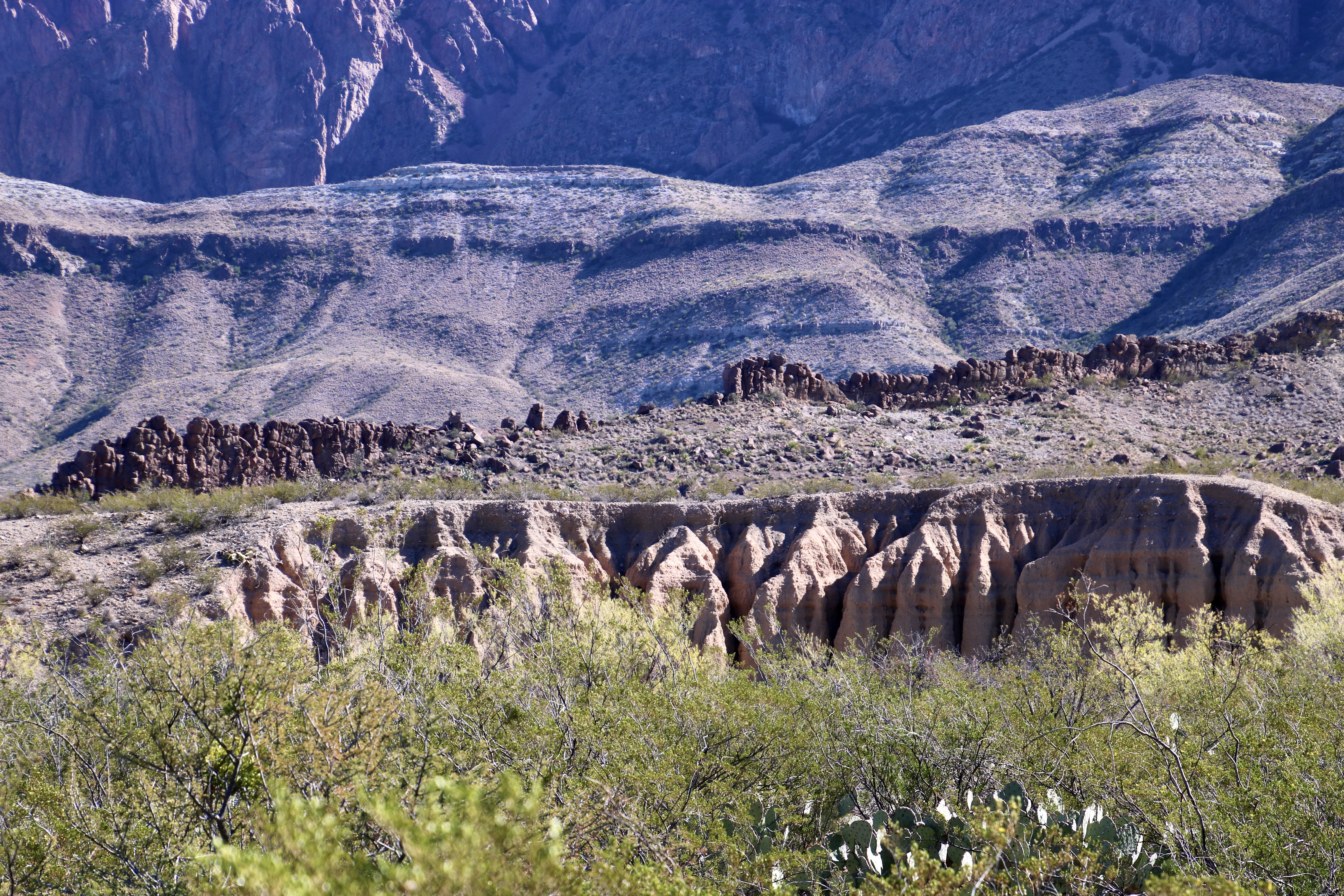
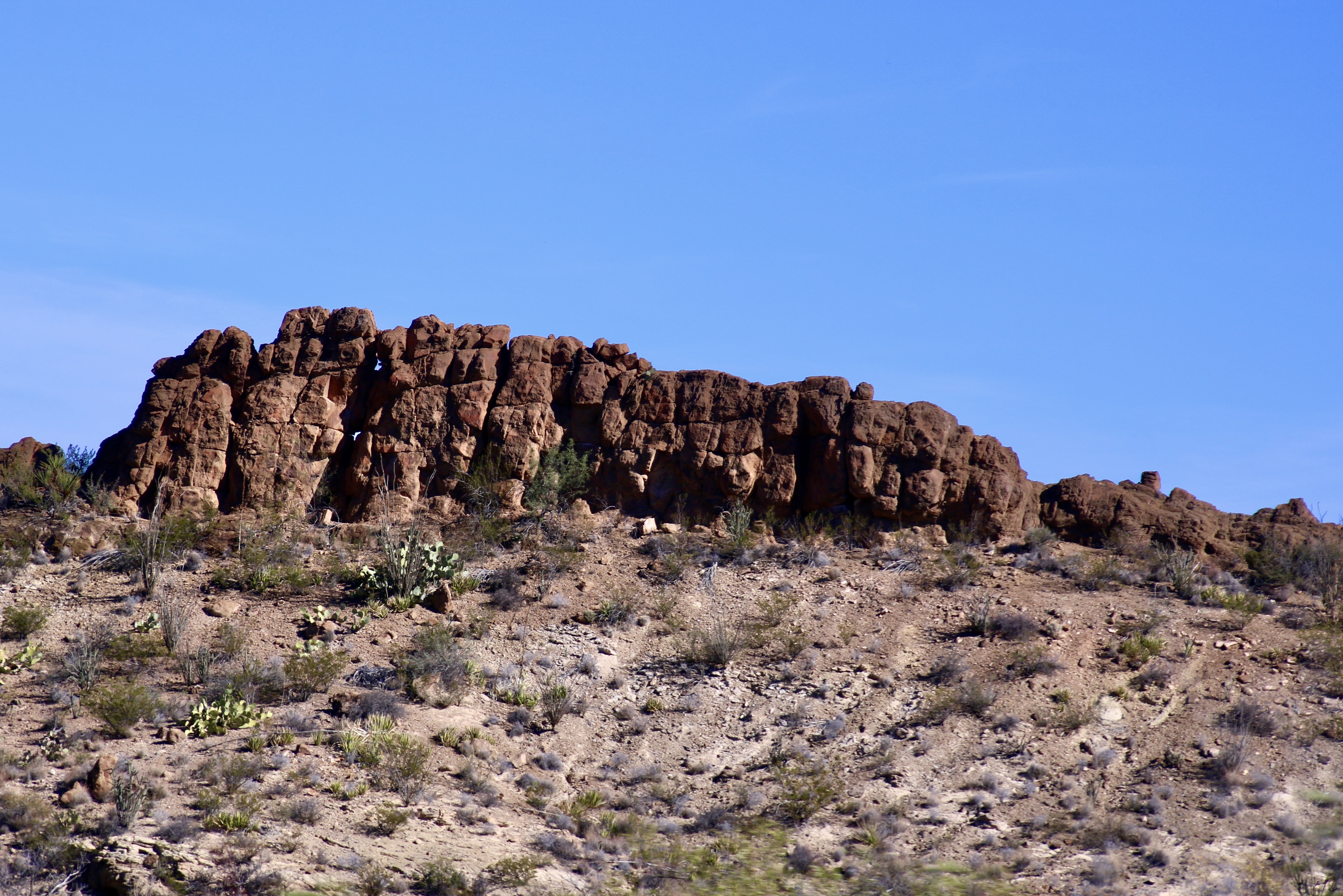
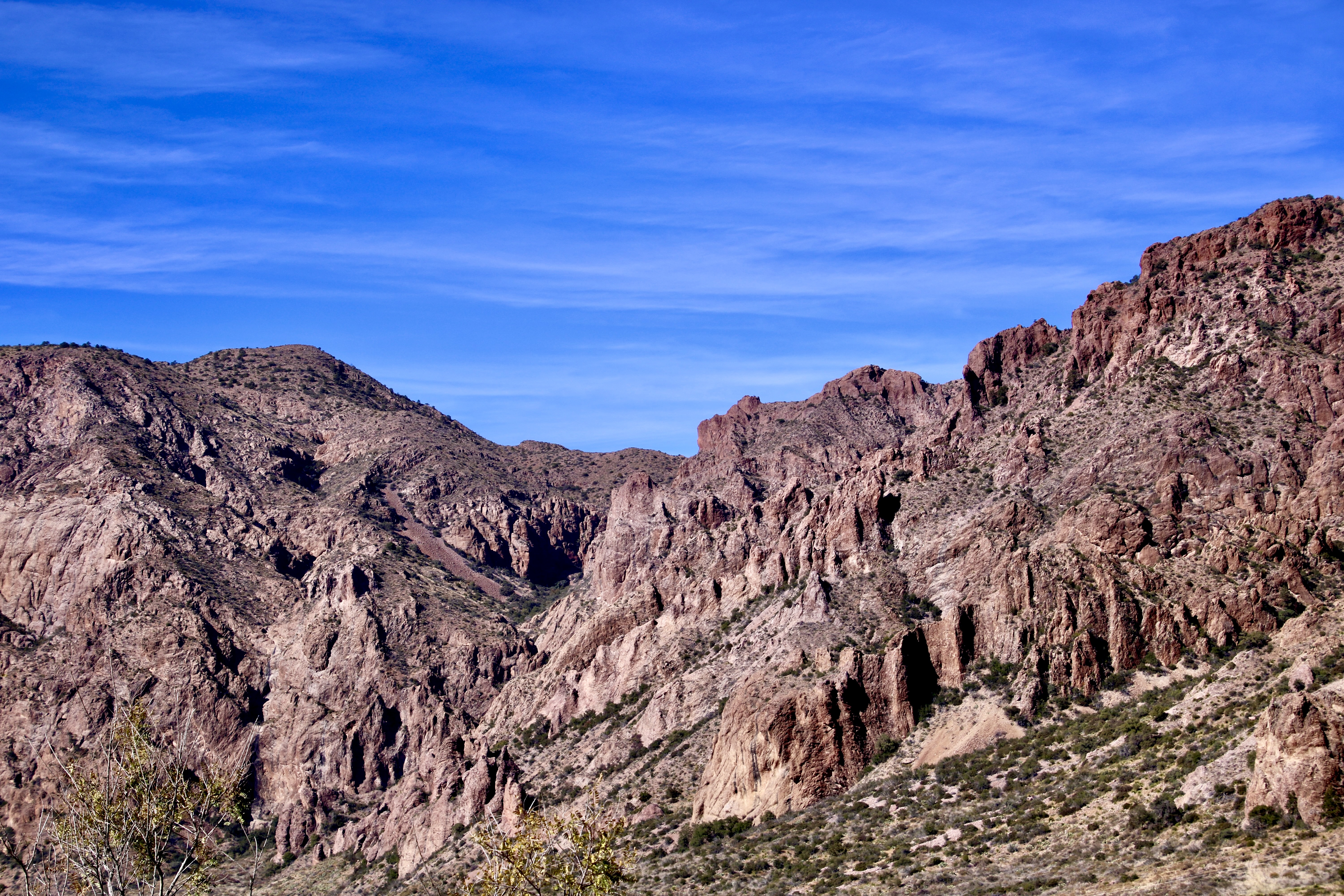
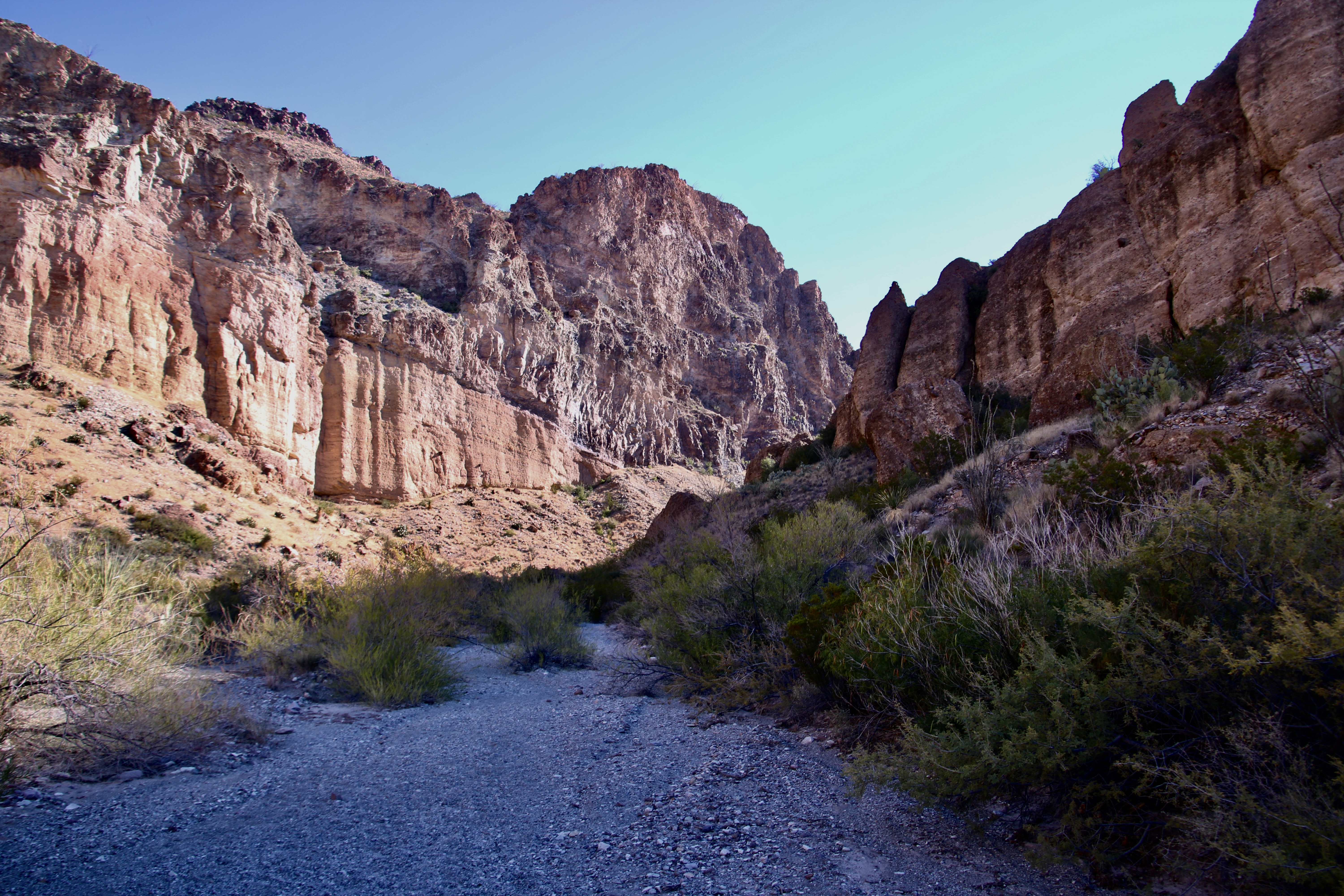
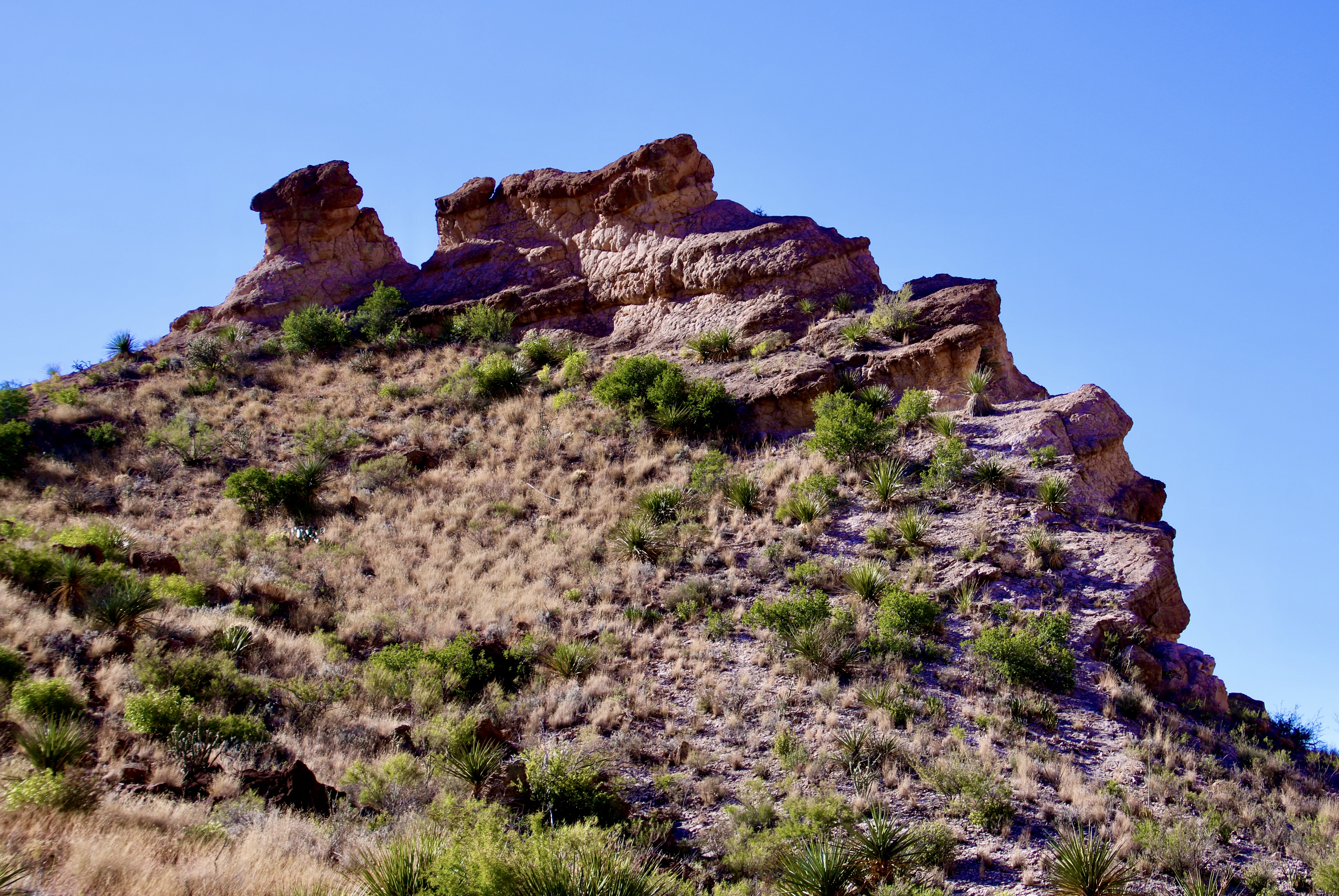
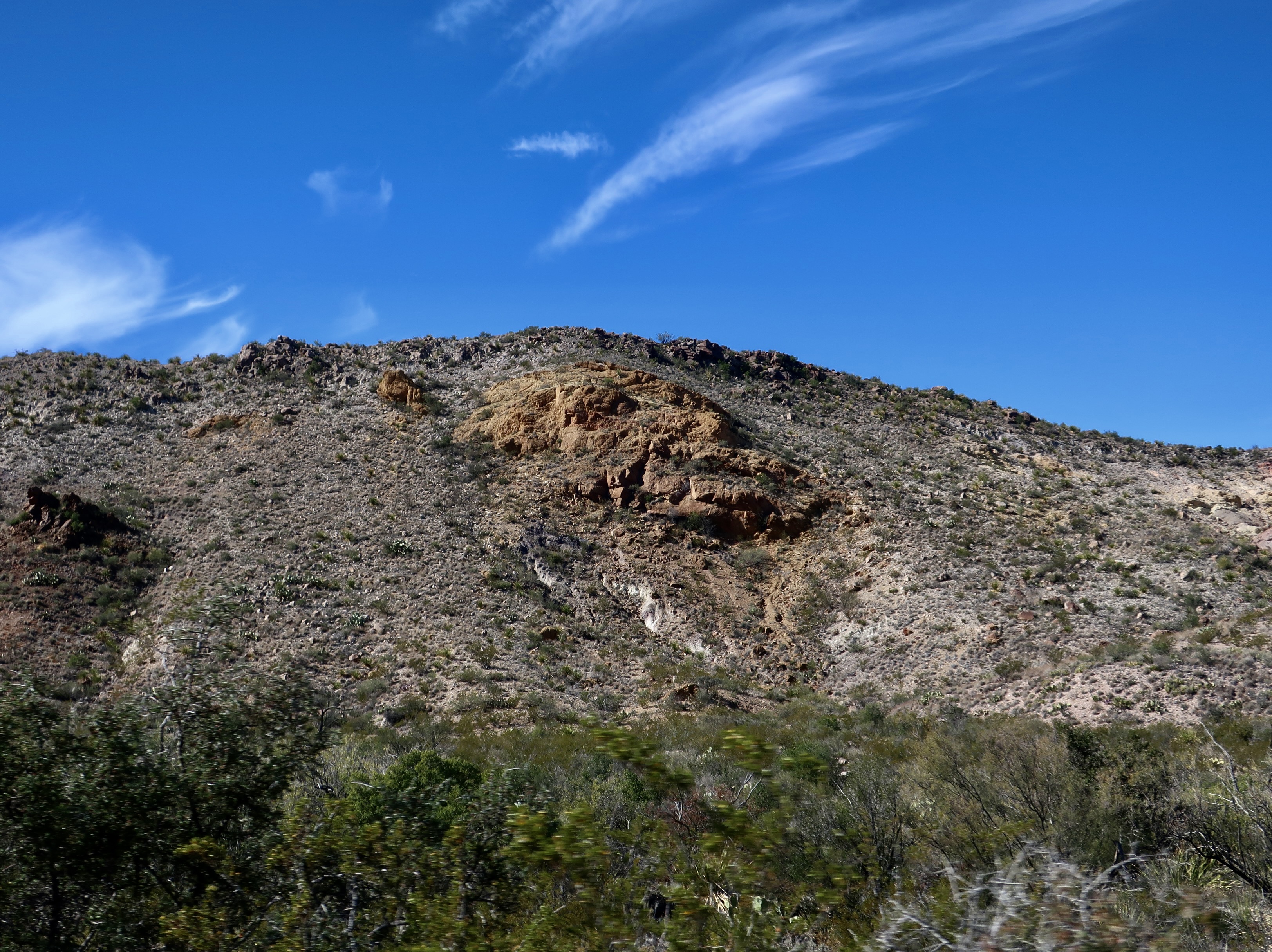
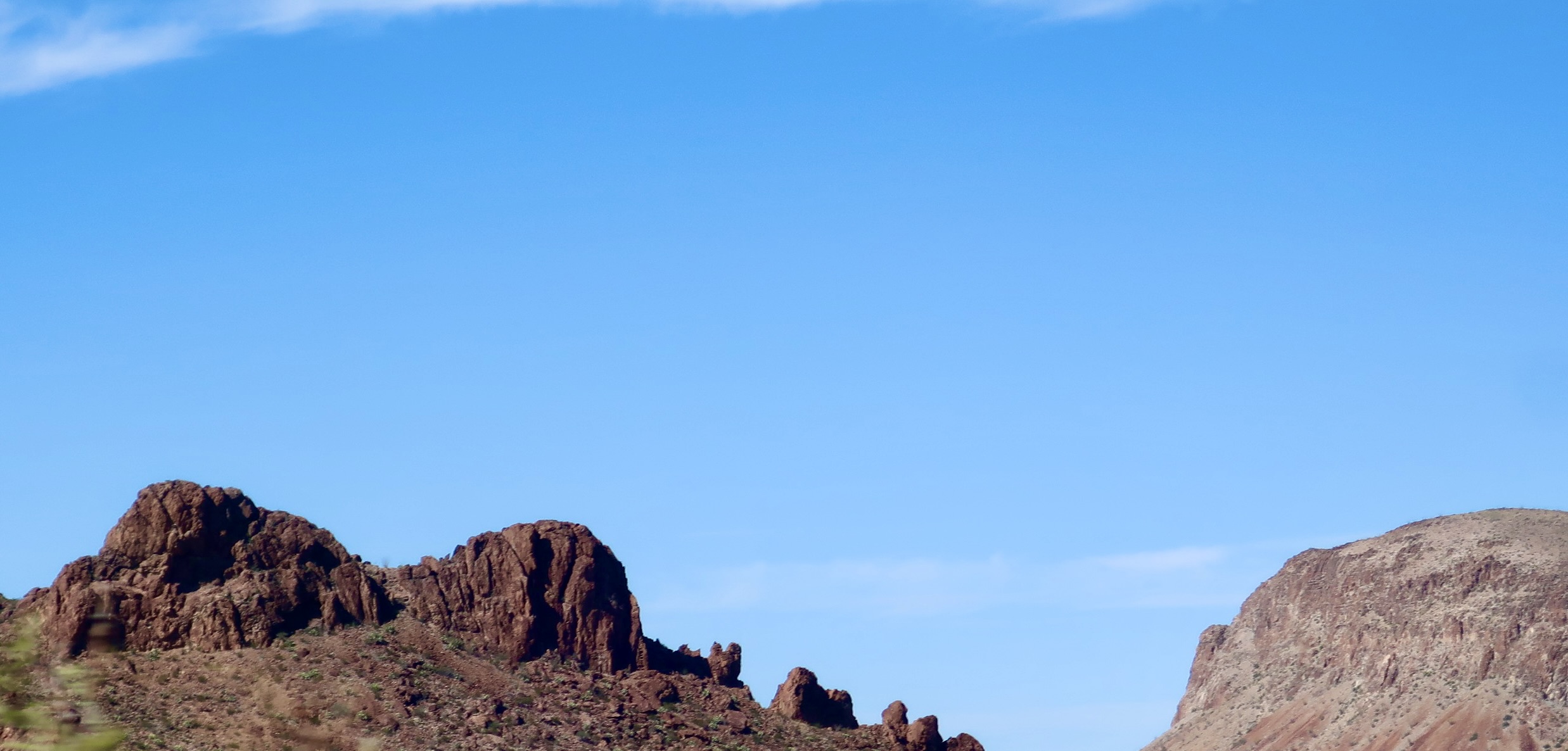
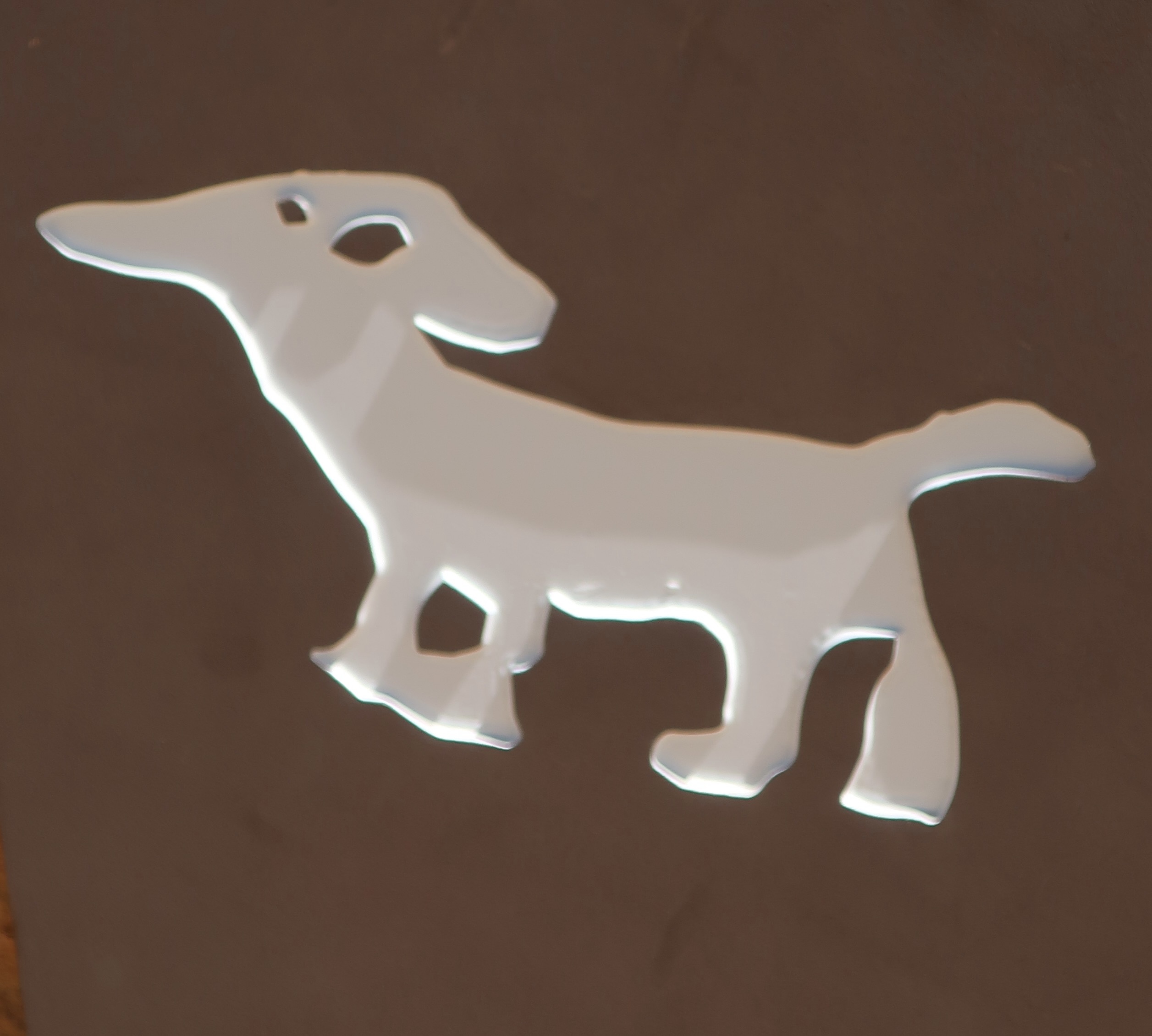
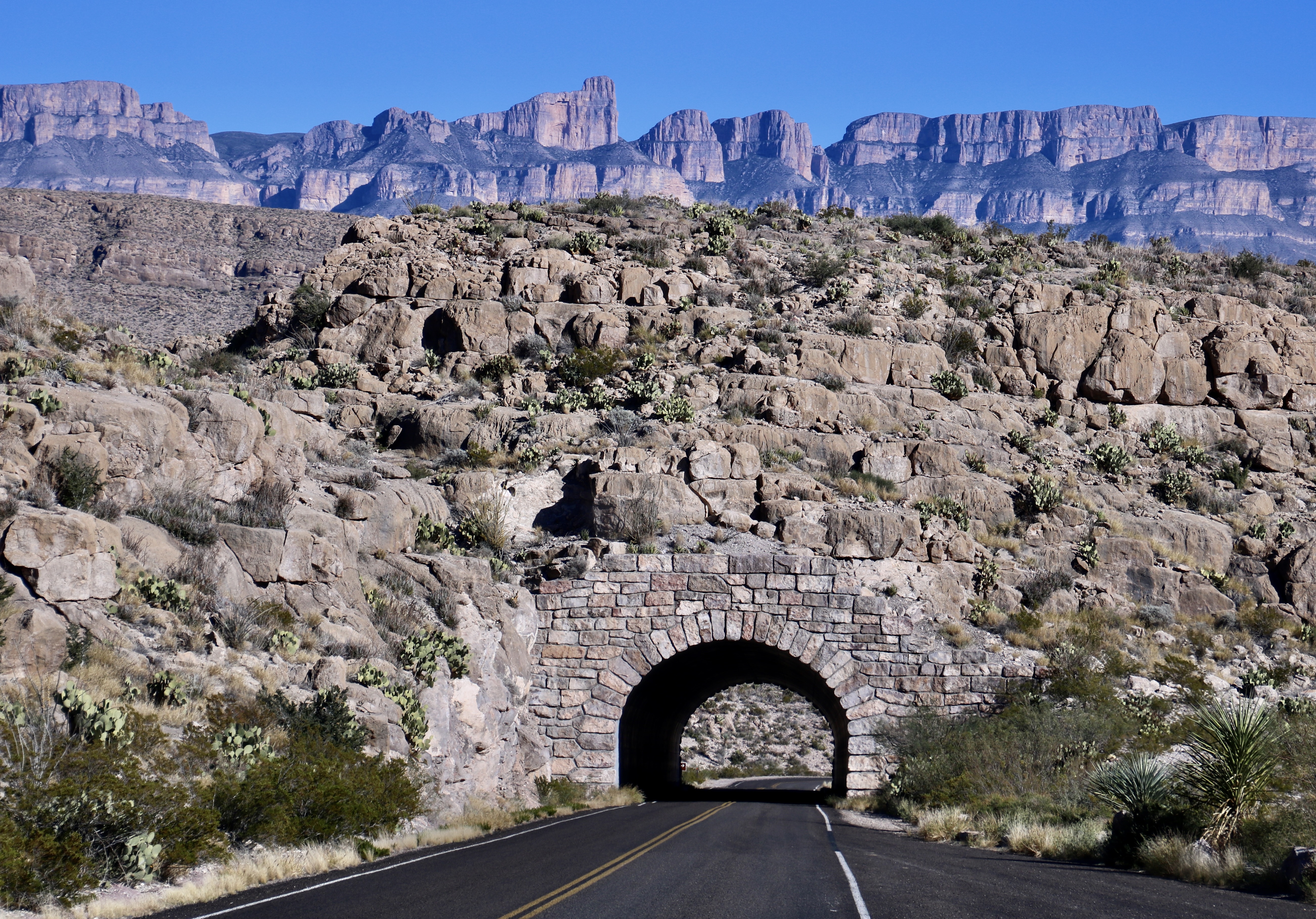
Ross Maxwell Scenic DriveThe little green hiker might be in a heap of trouble if water came pouring down the two steep canyons off of Burro Mesa.Peggy at the beginning of the trail. The buff colored rock is volcanic tuft.A close up.We were particularly impressed with the colorful tuft formation above the trail.And took several photos of it. And now for a potpourri of other photos we mainly took along the Ross Maxwell Scenic Road and a few thoughts on why we took them.Layer upon layer seeming to tumble down the cliff.Erosion can create wildly wonderful rock sculptures and this is one. We thought it looked like a dog. Too bad it didn’t look a bit more like a chihuahua given its location in the Chihuahuan Desert. Chihuahuas, BTW, got their name from the town of Chihuahua located in the Mexico portion of the Chihuahuan Desert. Geologists love deserts. There is little to hide the rocks. Peggy and I love deserts for the same reason. We are particularly fond of the formations like shown in the previous photos and the color shown in this one.It was worthy of a closer look. Peggy sees a face!Reds also capture our attention. Note the two red outcrops on top of the hill…I had a fleeting thought: Garfield.I liked the balance here, but even more the wisps of cirrus clouds that seemed to be rushing toward the divide.These layers of rock speak of millions of years and conditions from ancient oceans to deserts.Layers of rock resistant to erosion form cliffs that go on and on…Stretching off to the left…And to the right.This peak’s erosion had created a unique look.A different perspective.We’ll conclude today’s post from a distant look back at the Chisos Mountains, where we will go in our next post. Maybe.
The Rio Grande River forms the southern border of Big Bend National Park and also forms the park’s border with Mexico.
Big Bend is a three-for-the-price-of-one National Park. There is desert, lots of it: Big Bend serves as northern end of the Chihuahuan Desert, most of which is in Mexico. The craggy, volcanic formed, Chisos Mountains reach for the sky in the heart of the park. And the Rio Grande runs along its southern border, creating a ribbon of green and carving deep river canyons.
Our journey through Big Bend National Park will start with an exploration of the area around the Rio Grande Village on the right, take you around and up into the Chisos Mountains, and end in the area around the Castolon Visitor Center on the left with its towering Santa Elena Canyon.
We first visited in 1999 when we had taken a year off from work to visit and explore all of America’s national parks. We camped at the Rio Grande Village campground and celebrated Christmas there. A macramé hanging served as our Christmas Tree. Our main present was a long walk along the Rio Grande. We vowed we would come back.
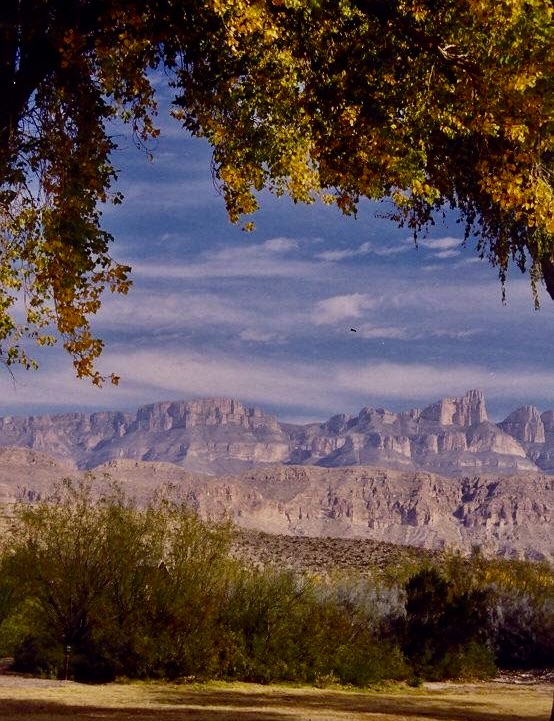
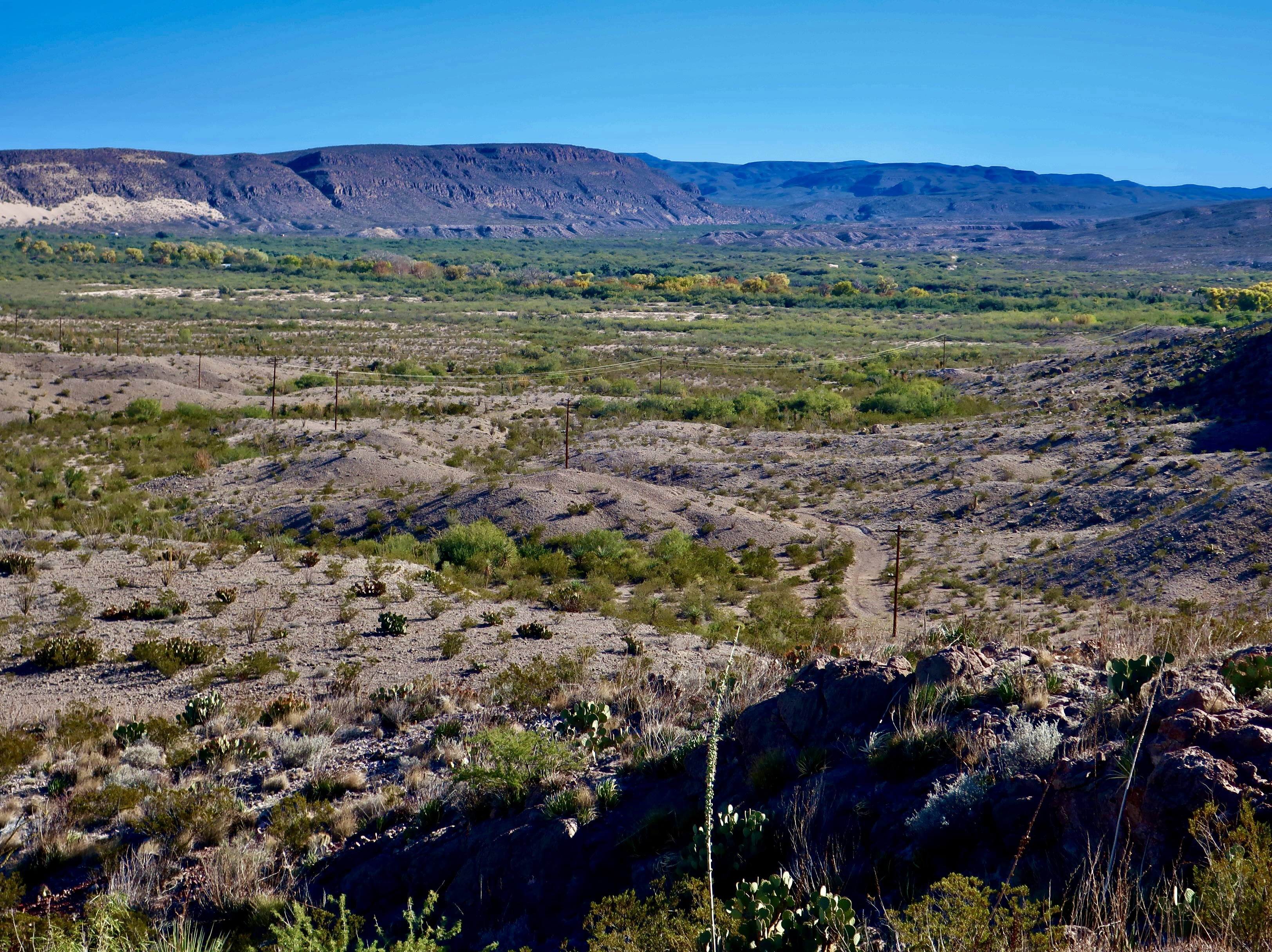
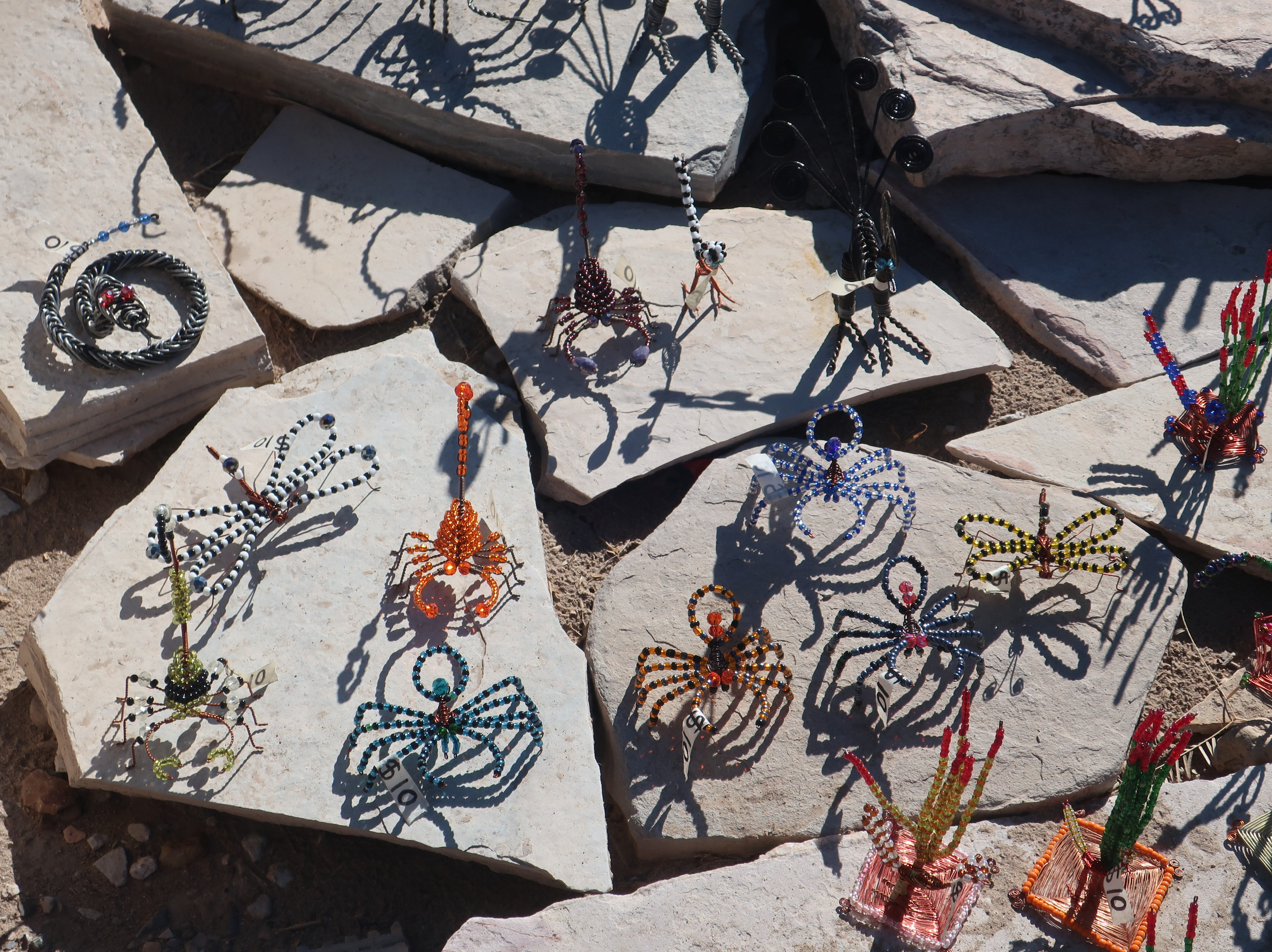
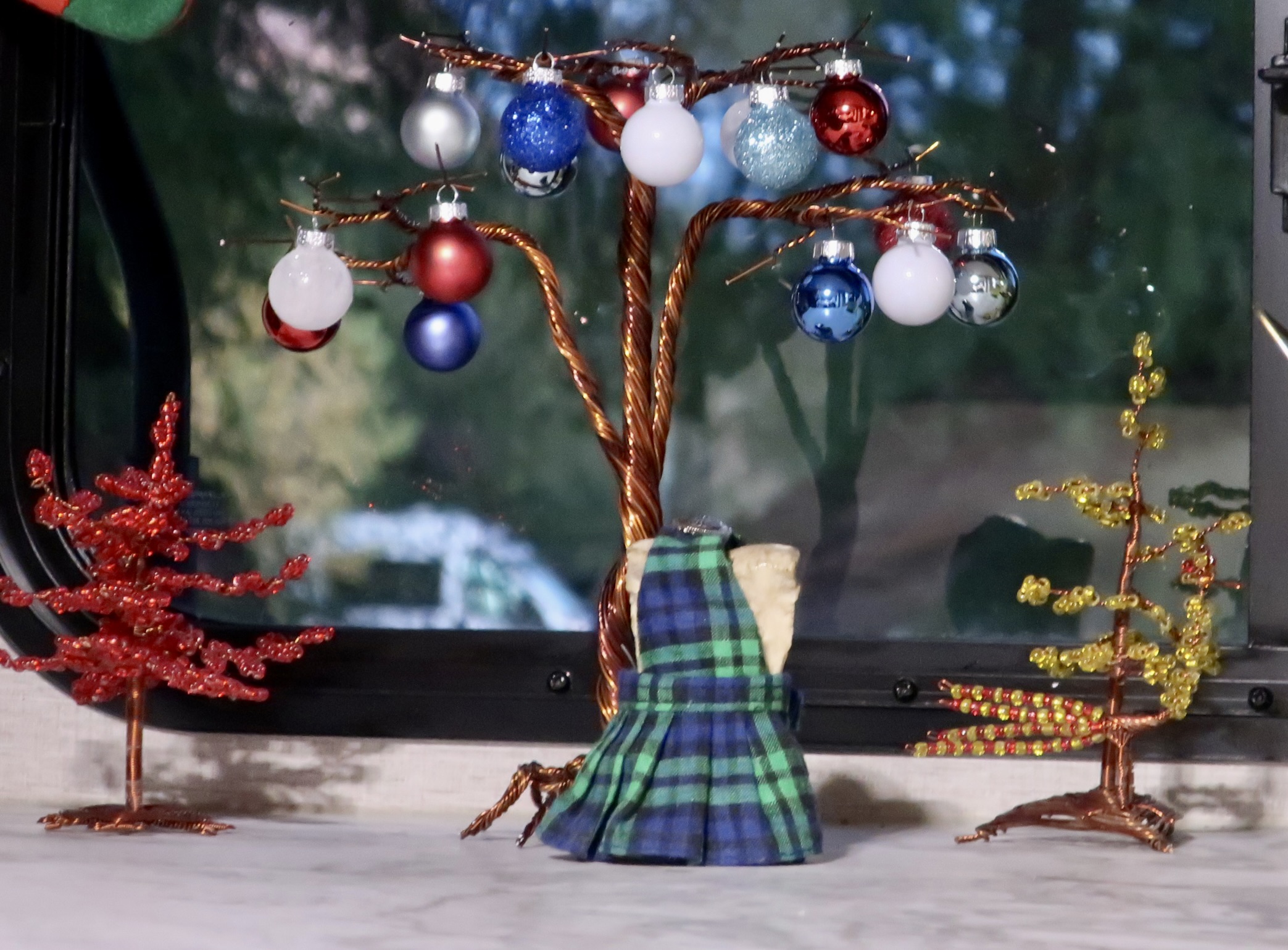
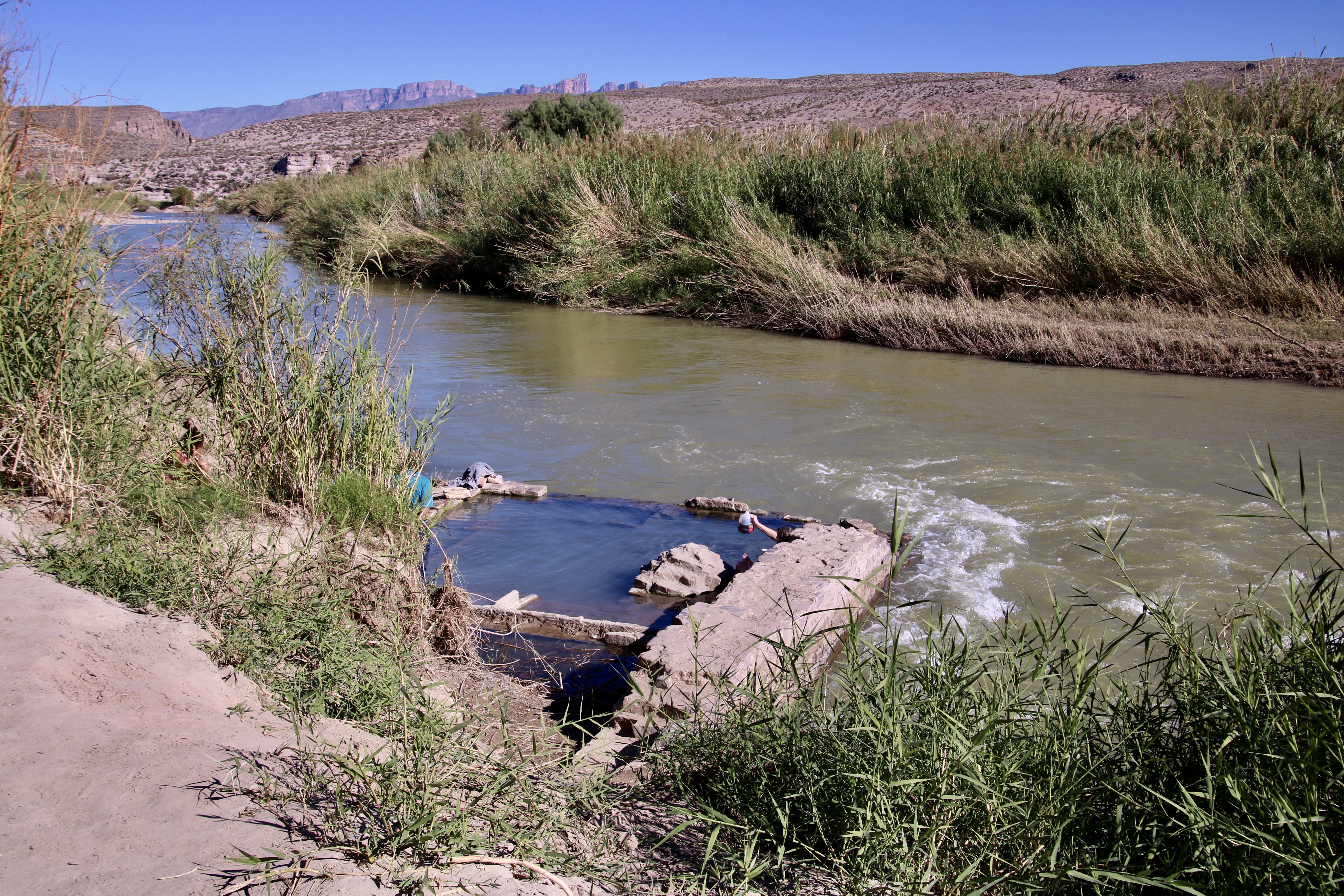
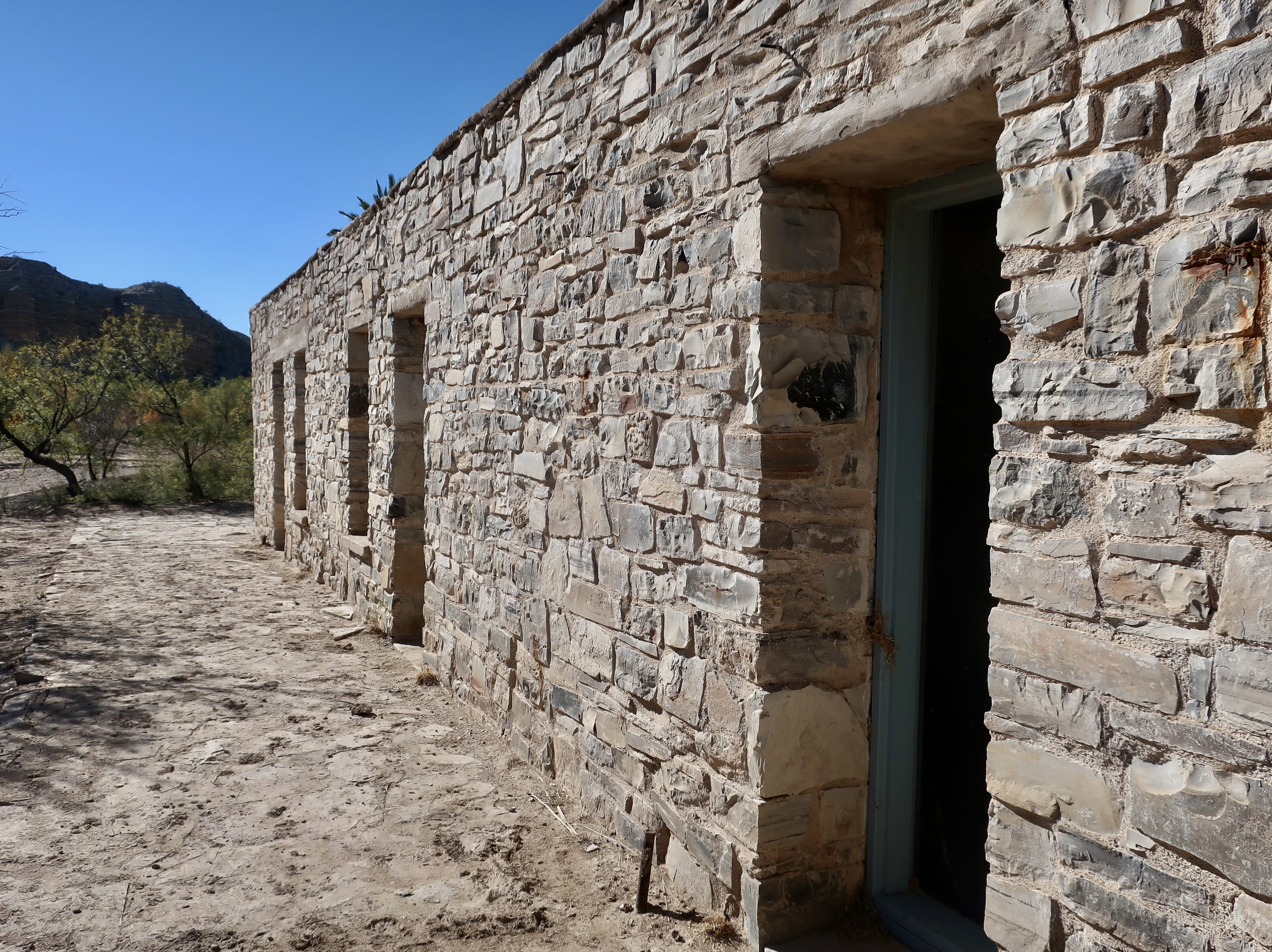
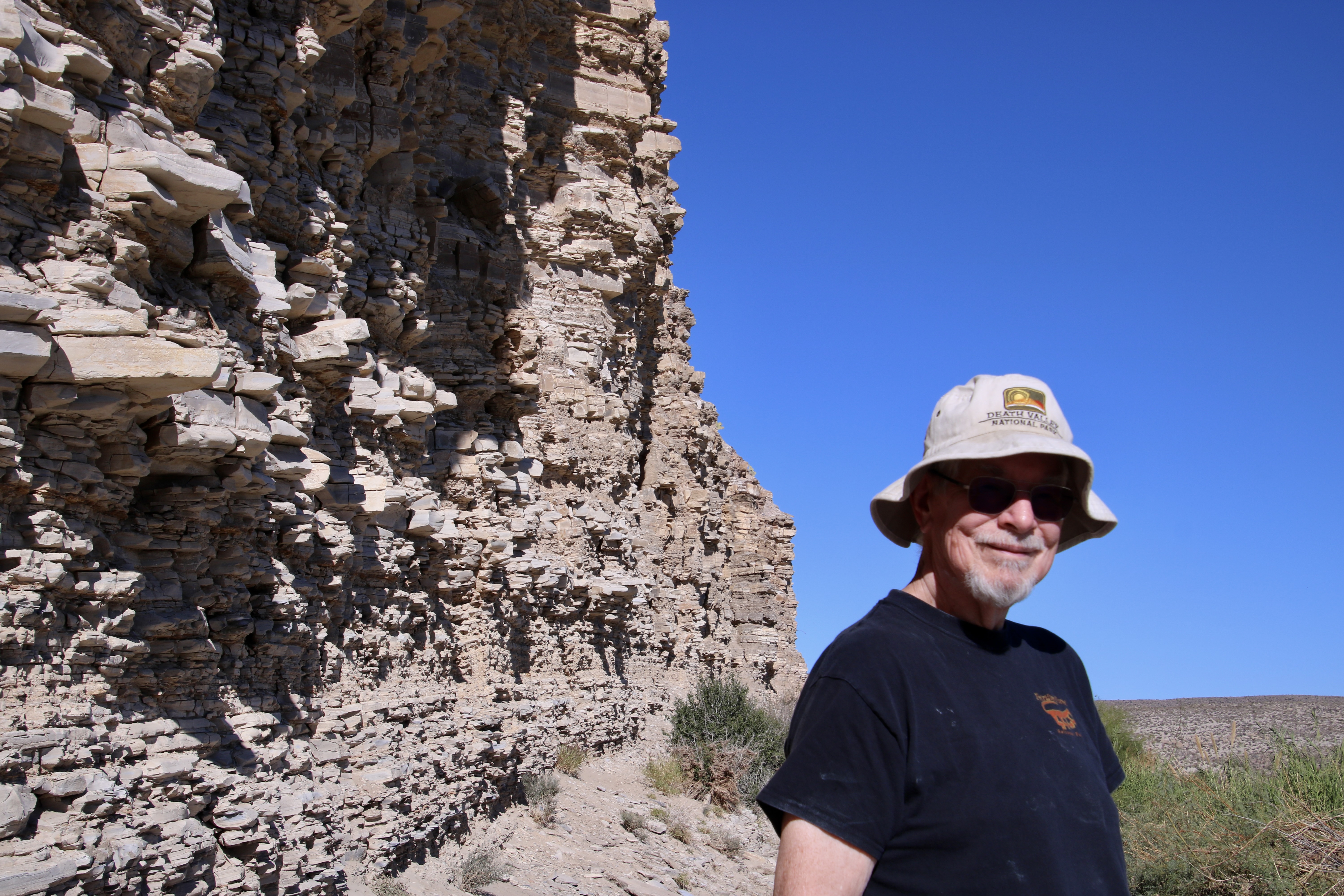
A photo from the Rio Grande Village campground we took on our first visit to the park in 1999.Today’s journey will take us from the area above Boquillas on the right to the Hot Springs on the left.A lookout from above Boquillas, Mexico on the park side provided this view of the Rio Grande Valley. The distant tree line follows the river.It’s a wash! If you have ever spent time in the deserts you will be familiar with dry riverbeds like this one on the right. A thunderstorm can quickly turn it into a raging torrent. You don’t want to get caught in one when hiking, camping or driving! I did once when I was driving across Texas and was very lucky to get out of it. The same series of storms produced softball sized hailstones that night, which I was also lucky to avoid.Great views of the Sierra del Carmen were provided from the Boquillas overlook. Believe it or not, the limestone cliffs you are looking at were formed at the bottom of a vast inland sea between 130 – 83 million years ago. The cliffs were created 20 million years ago when tectonic forces were stretching the continental plate of western North America creating massive, down dropped basins and high, uplifted ranges along fault zones. The highest point you see is appropriately named, El Pico, the peak.A national park sign board provided this view of what the sea would have covered. The small star in the center at the bottom is Big Bend National Park. The sea stretches all the way up to Canada’s Yukon Territory. Another view of the Sierra del Carmen.A fun part of the Boquillas overlook was the Mexican arts and crafts on display there. A wide range of inexpensive, tourist oriented items such as these Mexican bobbleheads were for sale.No one was present. A handmade sign announced that the arts and crafts were from Boquillas. Prices were marked on each item and a container was conveniently located for visitors to put money in. It was totally an honor system.This provides a perspective on the variety of items that were available for sale.Dragonflies, scorpions, and snakes, oh my! I liked the shadows.Since Christmas was only a few weeks away, Peggy bought three Christmasy trees and decorated the biggest one with ornaments she keeps on hand. “Just in case.” Bone, who never misses an opportunity to party, put on a kilt and joined them. Bone, BTW, is wearing the Mekemson family tartan colors according to my 5th cousin who made it for him. Now, if you will look back at the map of the Rio Grande Village area, I’m going to take you over to the left where the Hot Springs are located. (A woman toasted us with her jug.) Originally, these springs were covered and, for a mere quarter, you could take advantage of their healing powers. And what did they heal? There was a flyer advertising them…Rejoice! Apparently, just about anything. Plus you could catch big catfish. (National Park photo)Like this beauty caught out of the Rio Grande on the opposite side of what is now the park near Castolon. (National Park photo)J.O. Langford, who had come to the hot springs from Mississippi in the early 1900s for his own health, built a small resort area including a motel, store and post office in the late 20s to share the health benefits of the springs plus make a profit. Visitors could get a room for a dollar a night or at the bargain price of $6 per week. He operated the resort into the 40s. Some of the old buildings still remain. (National Park photo)The old motel still looks well preserved. Rooms came without water, and, I’m assuming electricity.Since we just posted on Mesa Verde, we couldn’t help but note that the resort also came with cliff dwellings. Grin. They also came without running water or electricity plus required the ability to fly and catch bugs for dinner.A close up.Palm trees provided shade and a resort-like environment. This was the old store at Langford’s resort.A half mile round trip trail along the Rio Grande takes visitors out to the hot springs.Peggy caught a photo of me wearing my Death Valley NP hat along the trail.Mesquite provided us with minimal but welcome shade.Pictographs left behind by Native Americans can be found along the trail. Paleo people were inhabiting the area some 10,000 years before Langford arrived! The original hot springs had flowed into a tub that the Native American’s had carved out of the rock.Another photo of the hot springs.A herd of wild horses was grazing along the trail just above the hot springs…With much swishing of tails.That night we watched the sun set on the Sierra del Carmen Mountains from our campsite at Rio Grande Village. It provides a fitting end for this post. Next up we will explore the picturesque Chisos Mountains in the heart of Big Bend NP.
“Roads go ever ever on, Over rock and under tree, By caves where never sun has shone, By streams that never find the sea; Over snow by winter sown, And through the merry flowers of June, Over grass and over stone, And under mountains in the moon. Roads go ever ever on, Under cloud and under star.” From the Hobbit and Lord of the Rings.
I just rewatched Peter Jackson’s trilogies on the Hobbit and Lord of the Rings, some 17 hours worth. Talk about going ever on. I’ve watched the movies four times. Peggy is a great fan. Me? Not so much. Long before the movies were produced, I read the Hobbit and then went on to read the Lord of the Rings. Also four times. I prefer Tolkien’s version over Jackson’s reinterpretation. The latter is less whimsical, more dark, and more tragic. Part of it is the medium. It’s one thing to read about the tribulations of Frodo. It’s something else to see them rendered graphically on the screen. But there is more. Dark parts are added to the movie, while lighter part are left out. For example, I’ve never forgiven Jackson for leaving out Tom Bombadil and Goldberry, two fun, fascinating characters, at the beginning of the Tolkien’s Fellowship of the Ring.
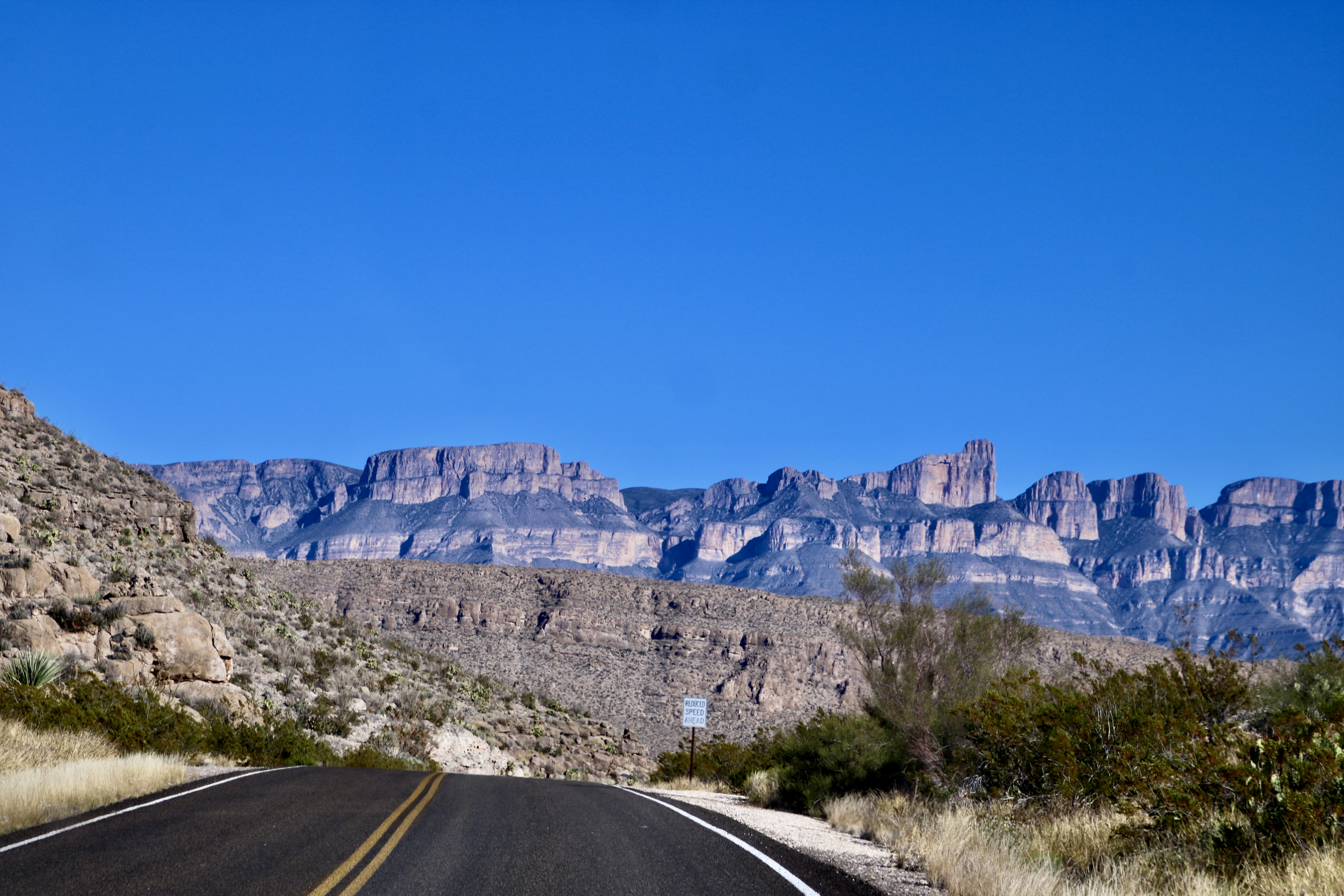
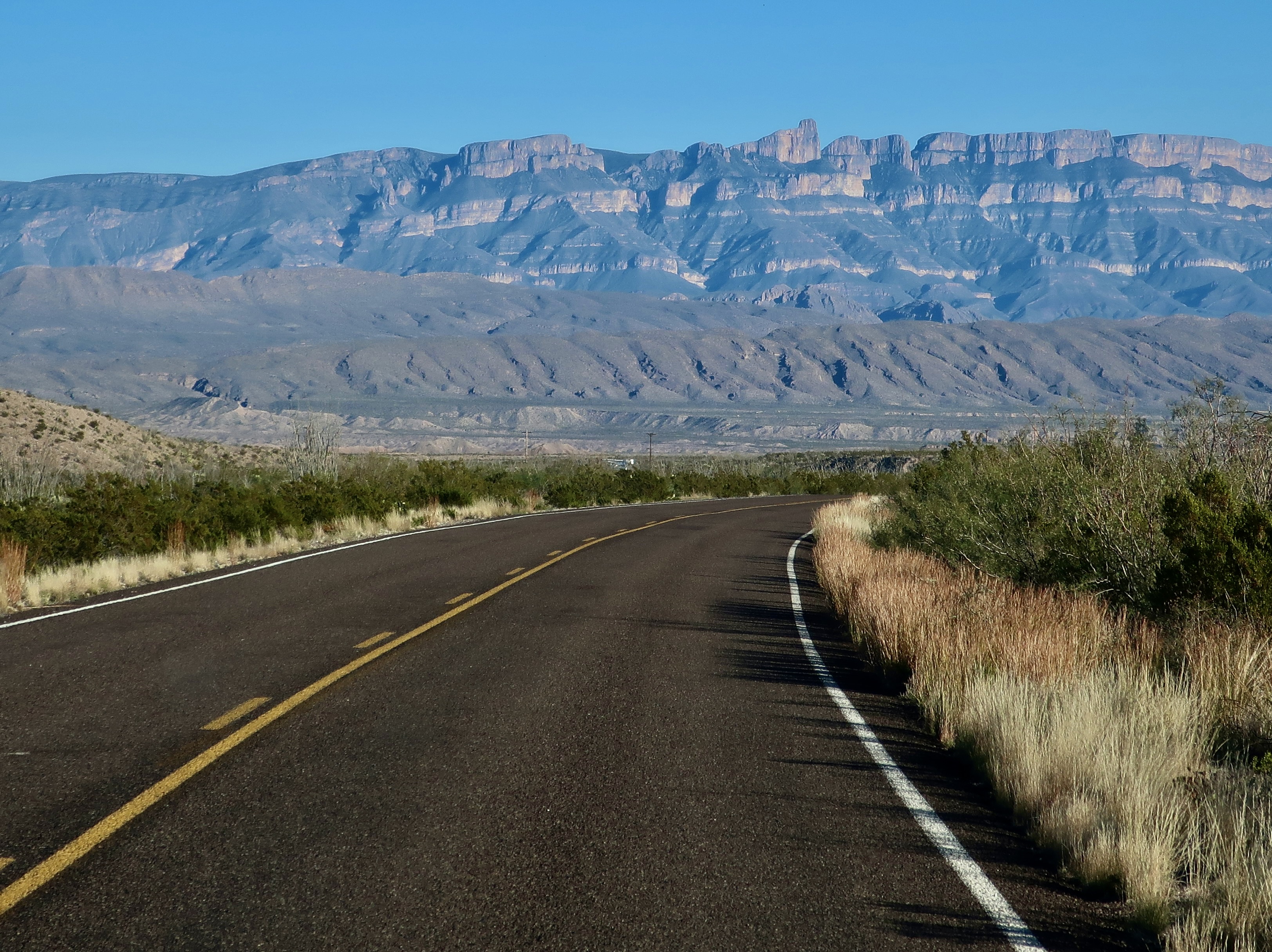
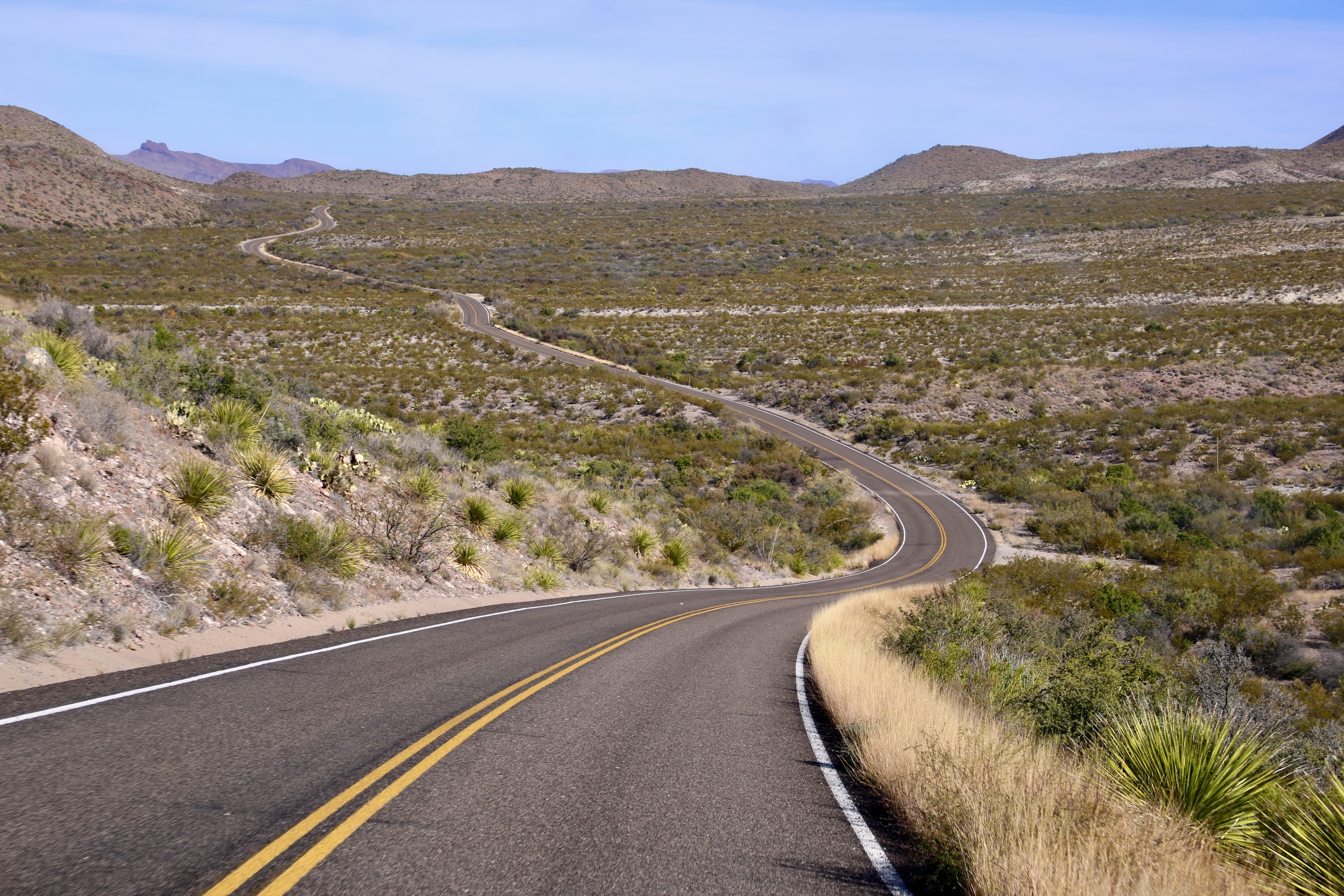
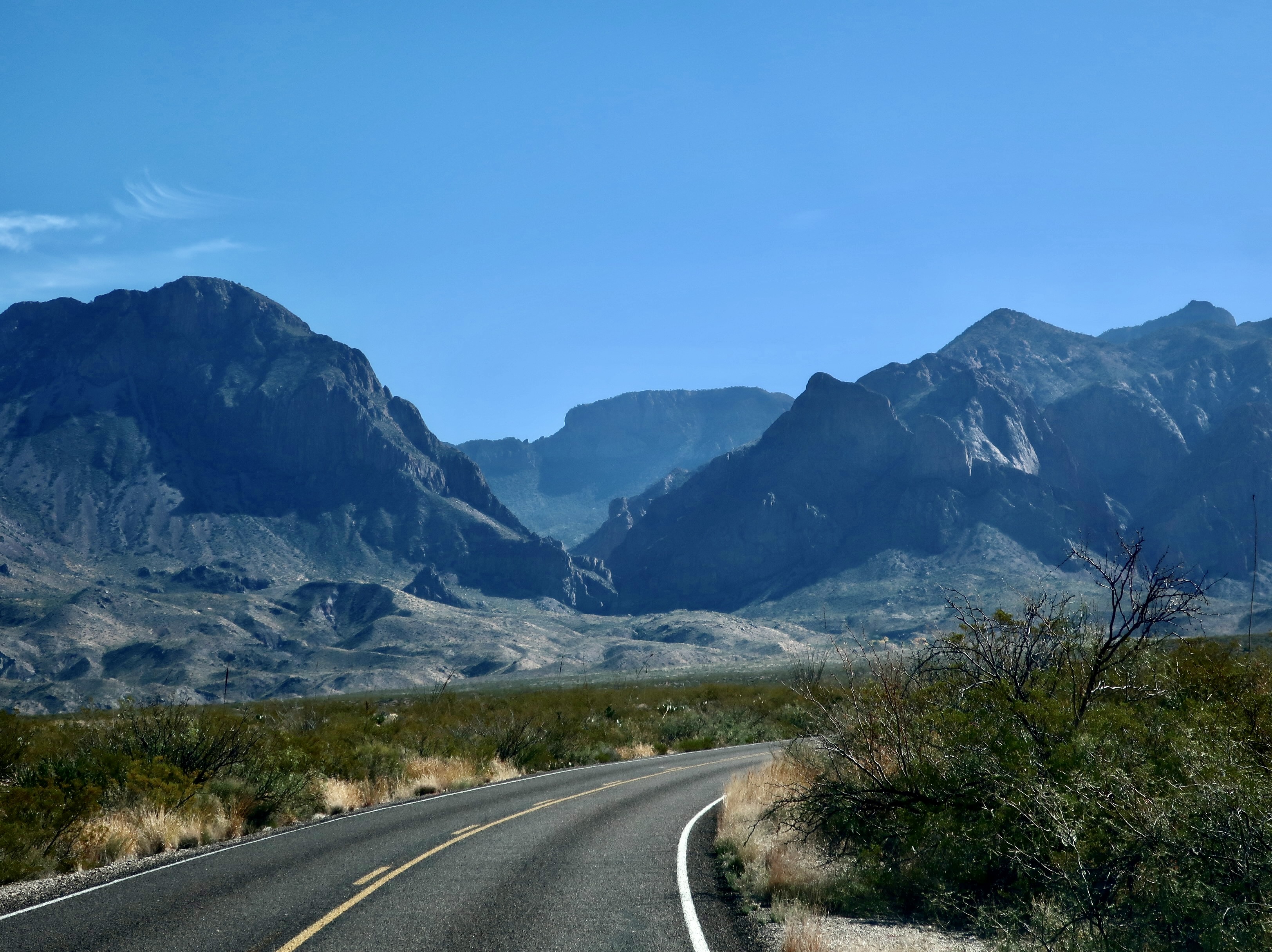
This post isn’t about the books or the movies, although it is about roads. I am going to kick off my first post on Big Bend NP with road shots. Also, I will note in passing, that I used the time we were watching the movies to pick out and process some 725 photos that Peggy and I took of the Park— and that I decided are blog worthy. You will see around a tenth of them is these posts!
I’m going to skip commentary on the road photos. The next two posts after this will feature many of the same areas, plus more. There will be plenty to comment on.
Shooting photos while driving down the road requires a different approach than shooting while still. The photographer is taking ‘snap shots’ in the truest sense of the word. There isn’t time to look for the best photo or consider factors like angles, shadows, sun, and content. Using a telephoto is much more difficult. The camera has to be ready, maybe even turned on. You spot something of interest, raise your camera, and shoot. Bang, bang, bang. Or the photo op has passed by. Note: When Peggy drives, I’m the photographer and vice-versa. Driving and taking photos at the same time fits the category of ‘very bad idea!’ Also, make sure your windshield is clean. Bug guts can ruin the best of pictures! Grin.
So, without further ado, these are some of the photos Peggy and I caught. While there is no requirement to include the road in a road shot, I have done so for the purpose of this post. You might note the lack of traffic. Big Bend is a long ways from major roads and cities! Enjoy.
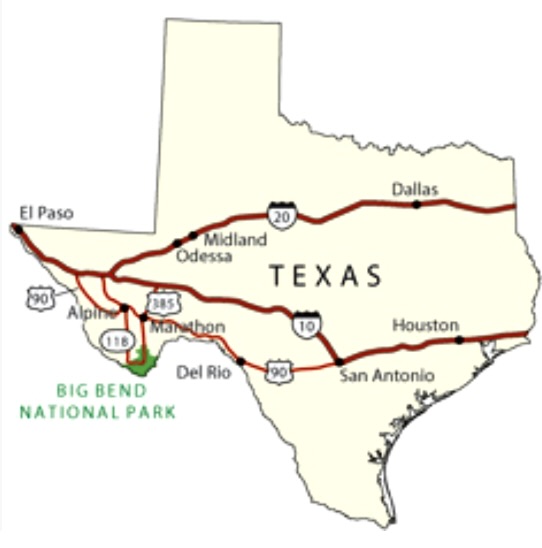
This national park map shows the location of Big Bend Park in Texas. it’s located in the far southwestern corner of Texas on the border of Mexico with the Rio Grande River serving as the borderline. In our next post, we will start on the eastern end of the park and begin to work our way westward.
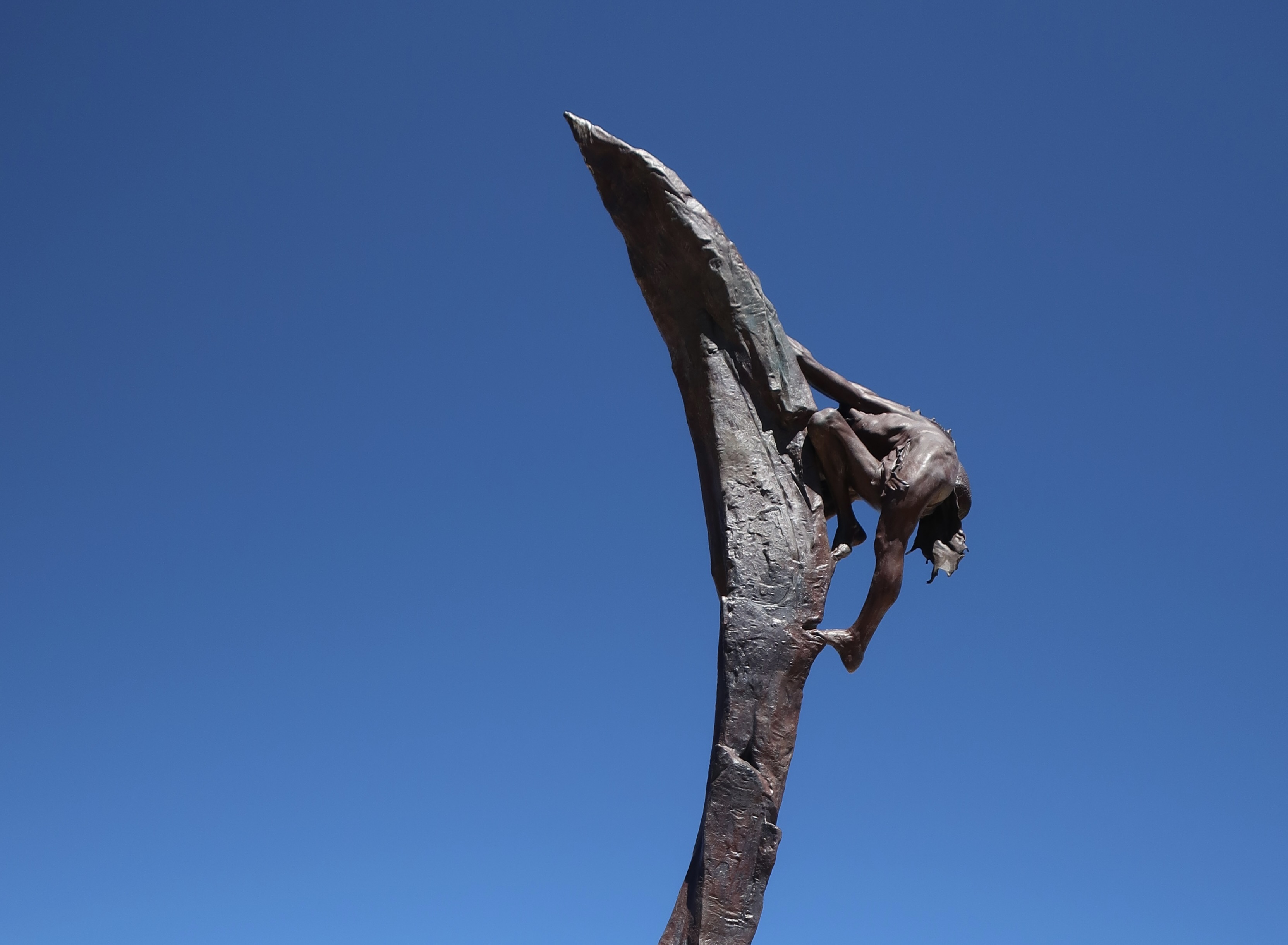
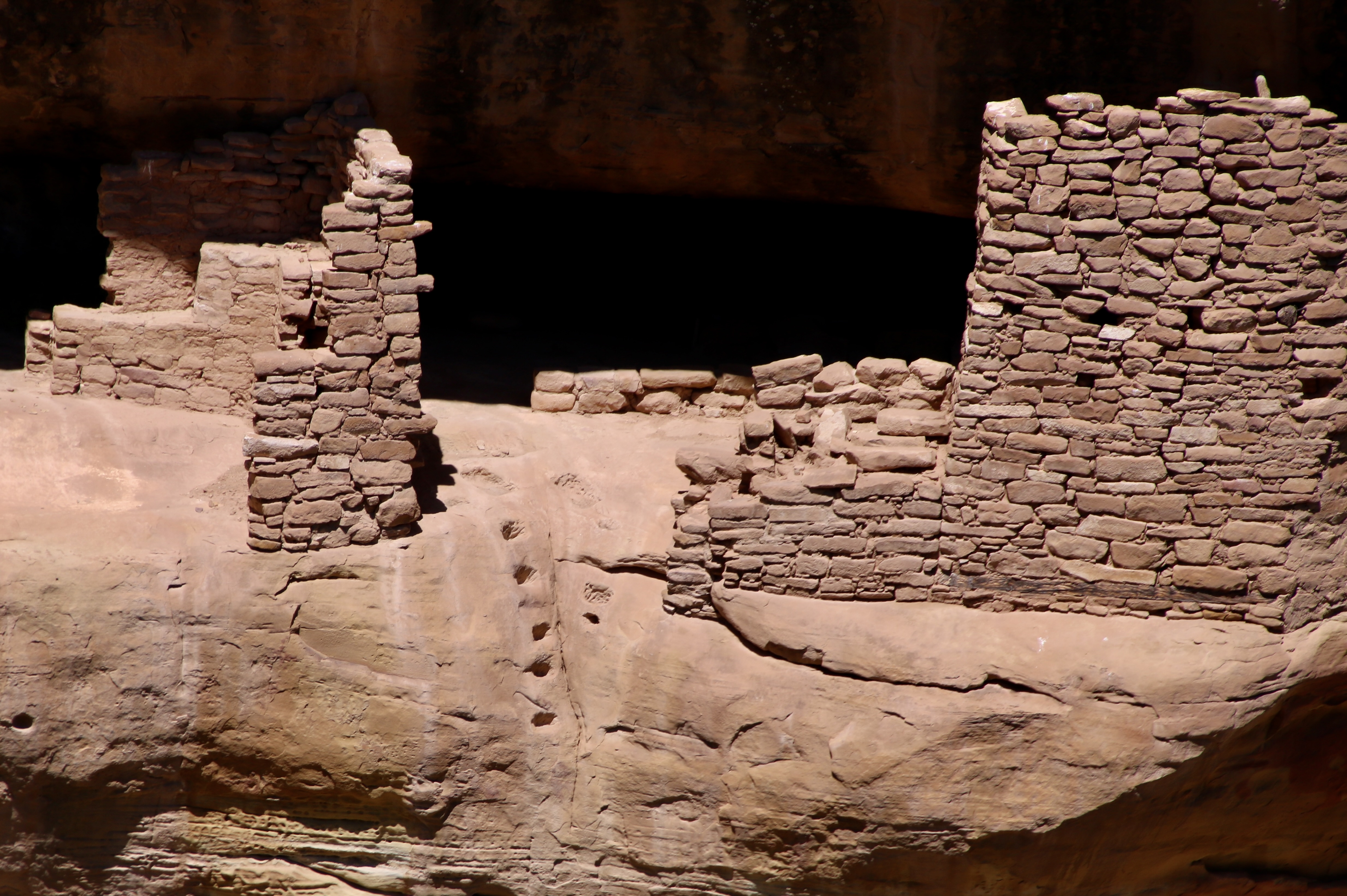
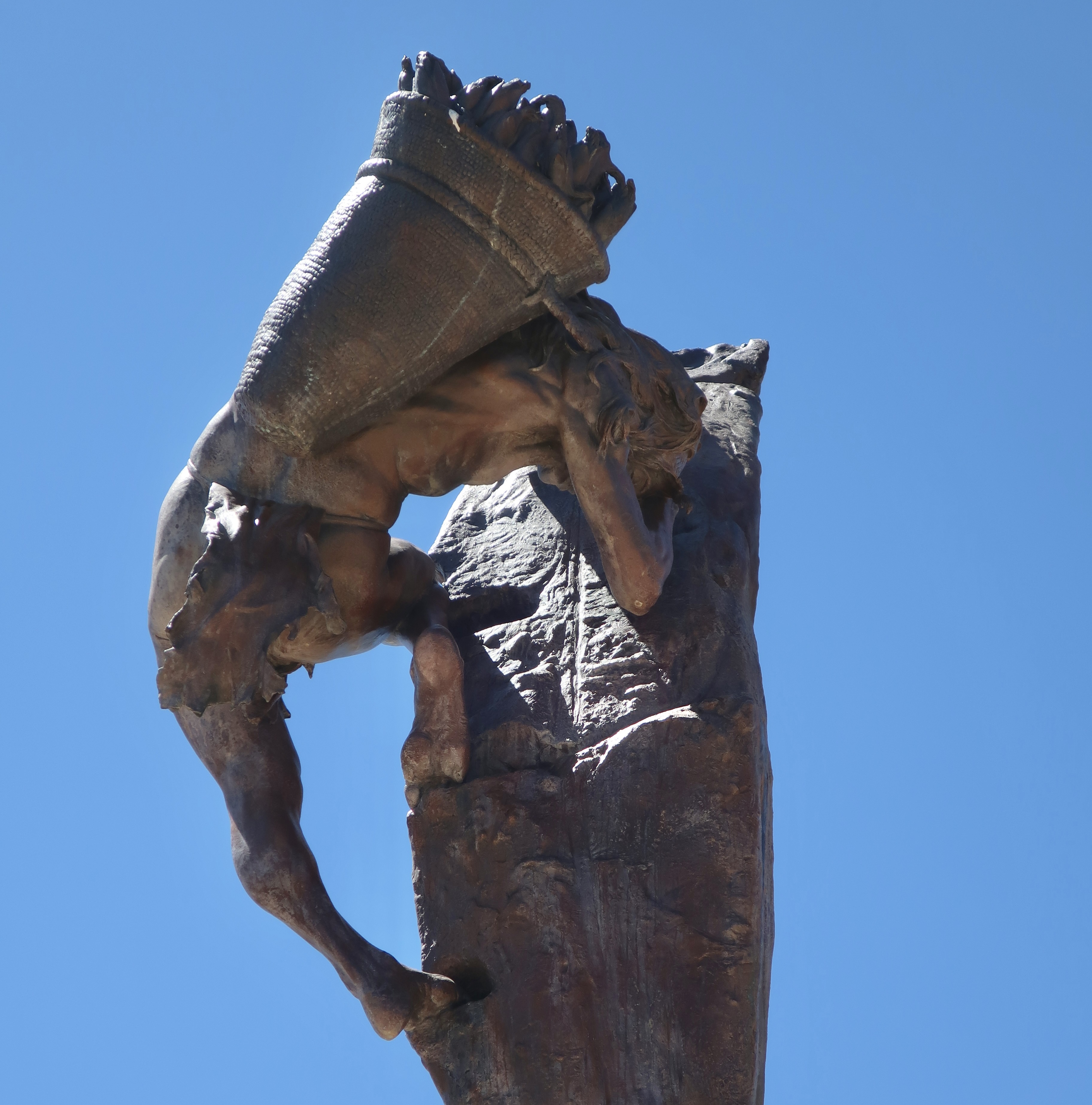
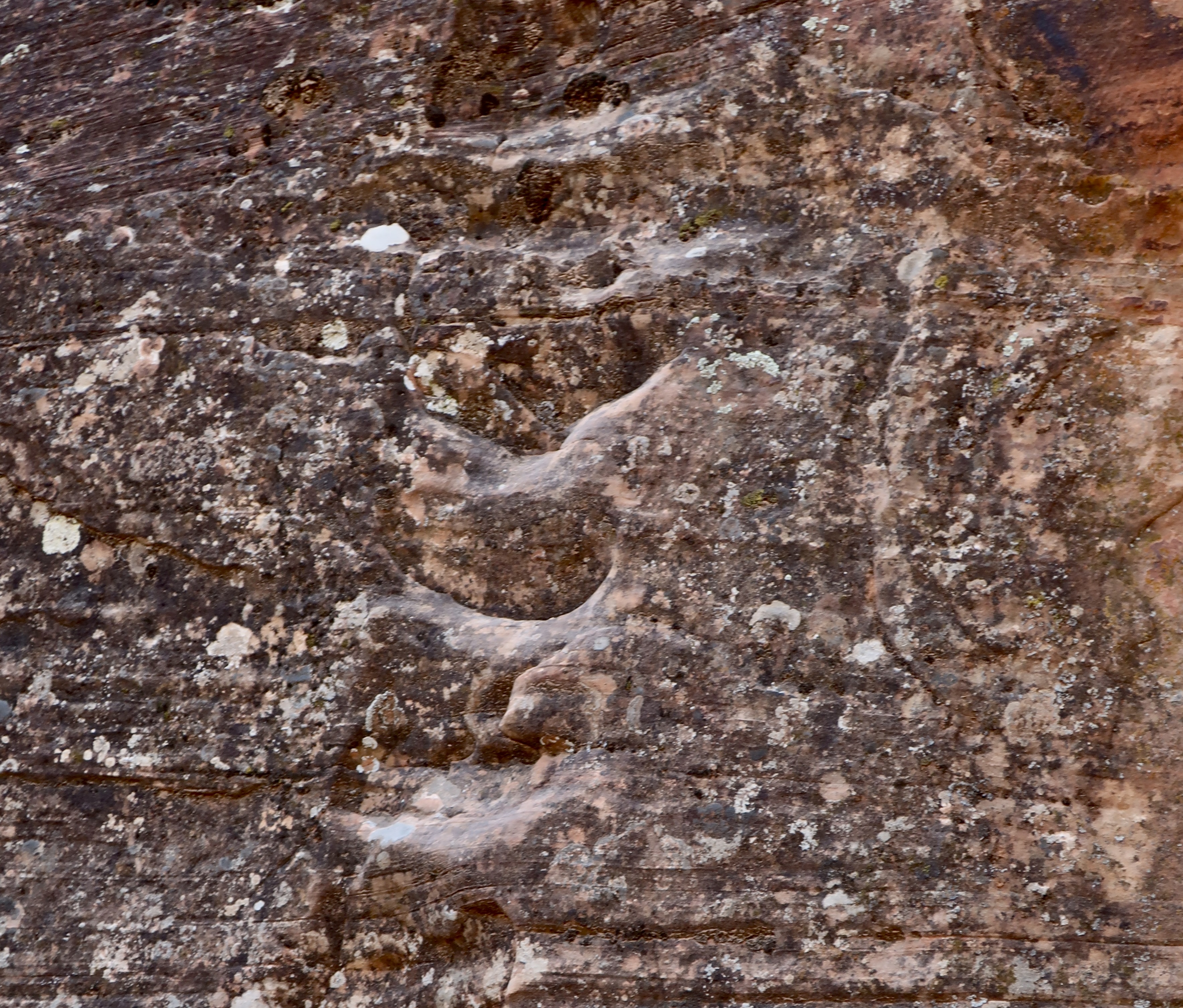
Normally, one would start a post on Mesa Verde featuring cliff dwellings. One of my earliest thoughts as a child about these magnificent structures, however, was how the inhabitants managed to get up to their homes perched high up on cliffs. This 22 foot bronze cast statue by Edward J. Fraughton at Mesa Verde dramatically illustrates the challenge. I couldn’t resist featuring it. Note the footholds, or maybe I should say, toeholds.Split level living at its best? It is thought that the Fire Temple complex at Mesa Verde was used for ceremonial purposes and possibly as living quarters for those who oversaw the ceremonies. It features these structures located on two different levels plus a large open area for ceremonies and meetings off to the left. The toe holds for climbing are clearly visible. Ladders that could have been raised or lowered would have extended below the toeholds: Lowered to get up to the second level under normal circumstances— or raised to frustrate an enemy if under attack.A close up of the toeholds. We wondered if the indentations on the right were used for handholds. Getting up or down would have been complicated by having to carry a load such as shown below when looking at the Ancient One’s statue from a different perspective.“Could you hold that pose while I finish the statue?” It looks like maize/corn in the basket, which was the primary crop of the Ancestral Puebloans. Other things that would have to be carried in addition to food would include water, babies, building materials and items for day to day living. I suspect that children learned to scramble up and down at a relatively young age.Peggy and I found these footholds climbing up a cliff in Zion National Park when we were searching for petroglyphs in a remote area. I thought I’d try climbing them. “Um, maybe not,” my companion suggested rather forcefully. I don’t think my offering to carry her would have made a difference.This is the meeting/ritualistic section of the Fire Temple. A large, raised fire pit is located in the center of the plaza. There is some speculation that the square vaults beside the fire pit may have been covered and used for drumming. I can imagine the people gathered here asking for rain, good crops, health, or protection from a marauding enemy. Or maybe they danced.
Ancestral Puebloans reached the Mesa Verde (“green table”) area sometime around 600 CE (A.D.). They would remain in the area for 700 years reaching the peak of their civilization between 1100-1300 CE. At first, they focused on building pithouses, pueblos, masonry towers, and farming structures on top of the mesa. The National Park Service features a number of the buildings. While we visited several of them, our focus today will be on the cliff houses for which Mesa Verde is famous. But first, a quick look at the countryside where the Puebloans chose to make their homes.
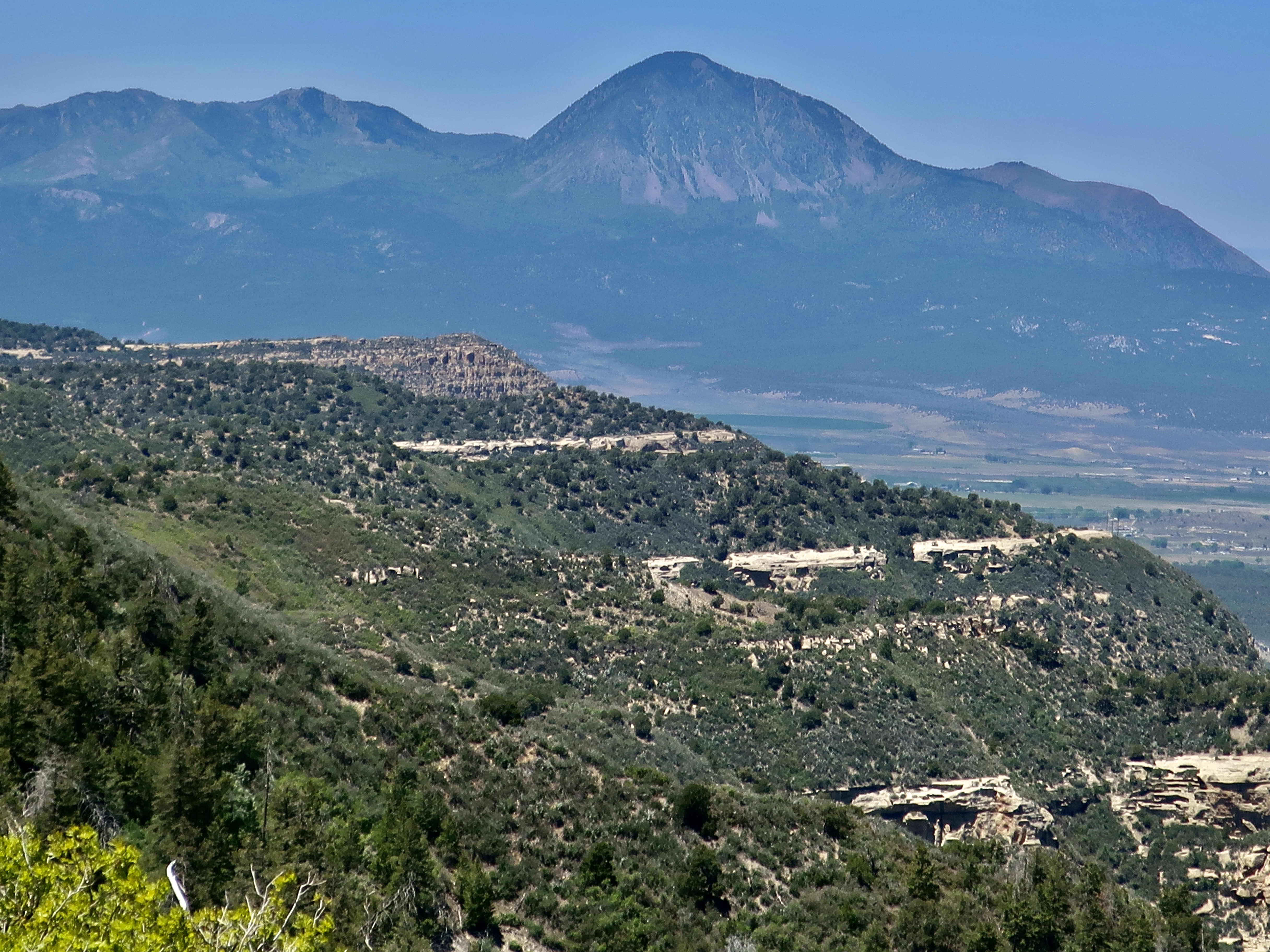
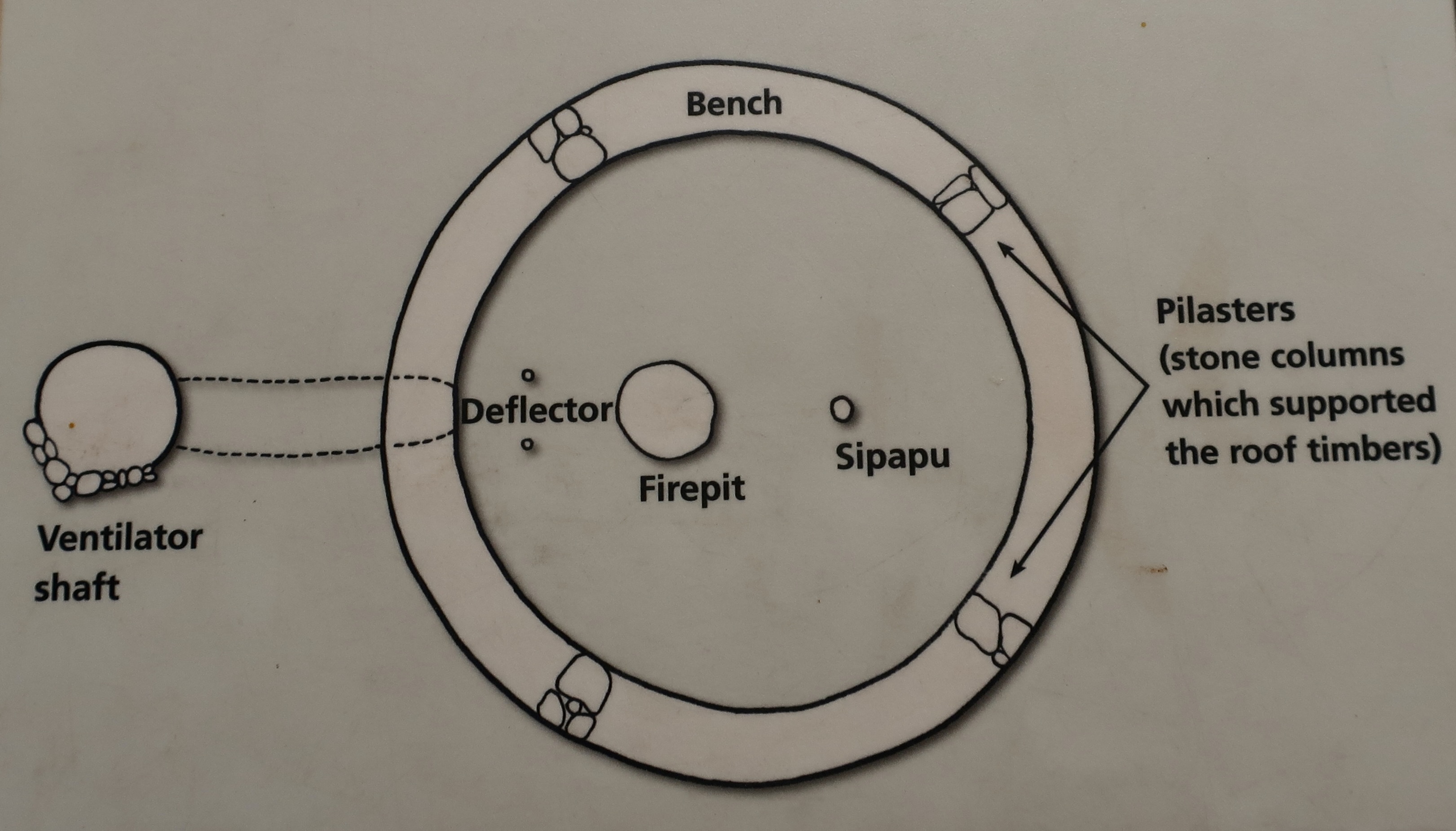
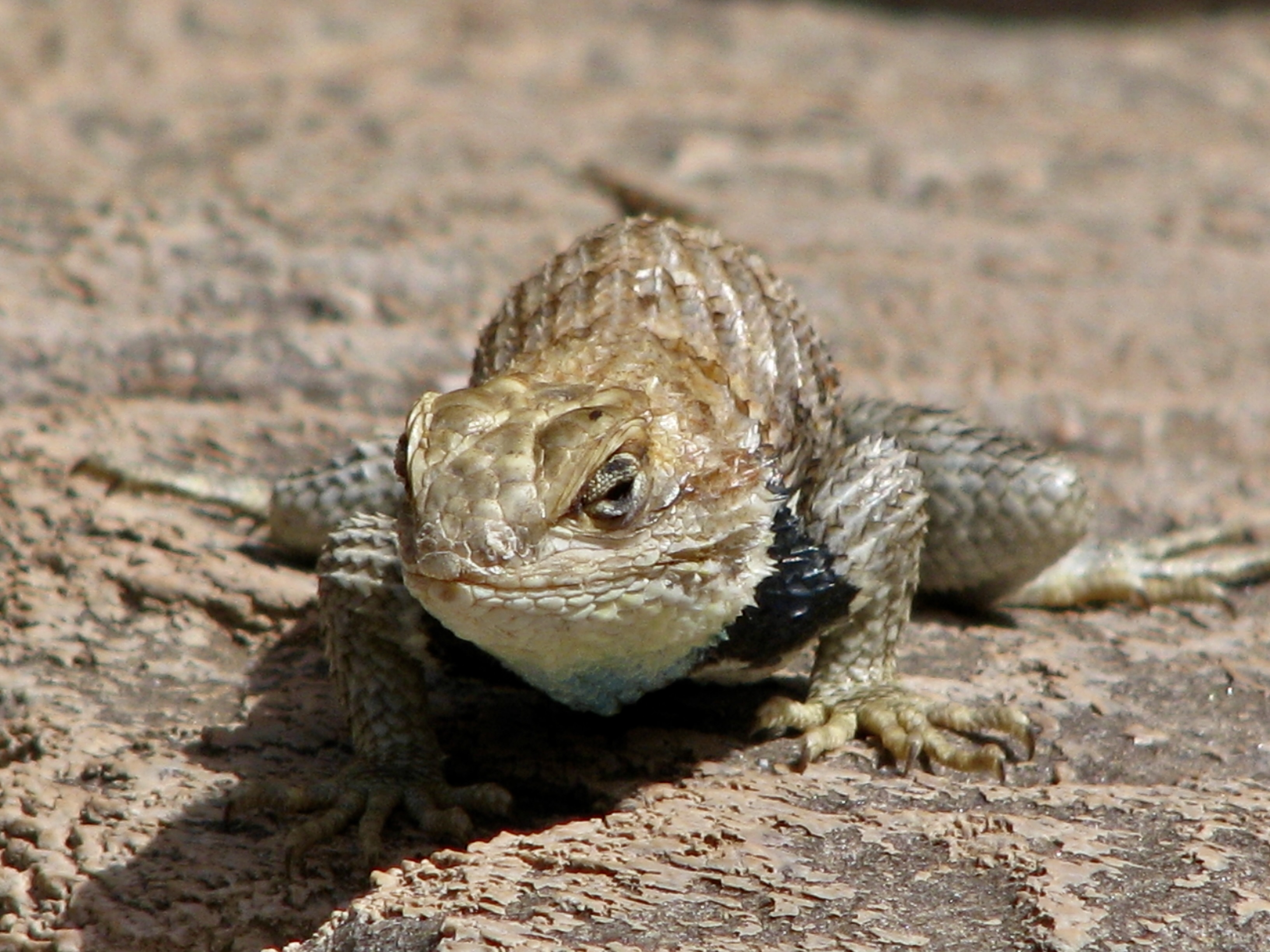
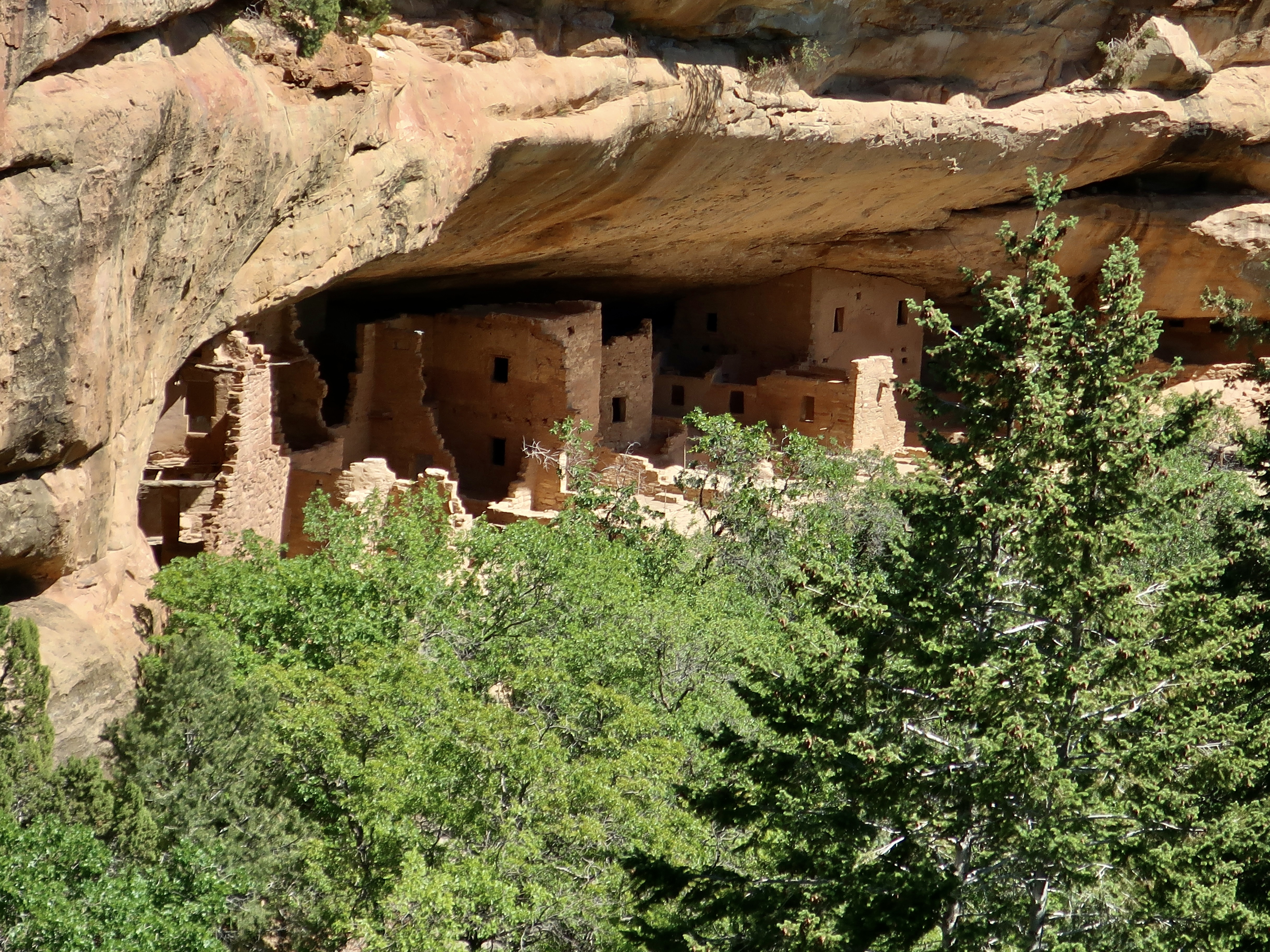
This prominent landmark overlooks visitors as they enter the park. The road works its way up from the lower left. It’s likely that the Ancestral Puebloans would have considered the mesa sacred.Mesa Verde translates as “green table.”A drive up to Park Point, the highest point in Mesa Verde at 8572 feet (2612 m), provides great views of surrounding valleys and distant mountains.Layered sandstone rocks like these provided sites for cliff houses. The distant mountain is known as Sleeping Ute Mountain.And now for three of the major cliff dwellings at Mesa Verde. This one, called Cliff Palace, is the largest cliff dwelling in North America. It has 150 individual rooms and 20 kivas. Kivas are round structures used for ceremonial purposes.This illustration of a kiva was on an information board at Mesa Verde. Most of it is self-explanatory, but you might find yourself asking, “What the heck is a Sipapu?” To the Ancestral Puebloans and their modern day descendants, the sipapu represents the opening through which their ancient ancestors emerged to enter this world as lizards and then changed into their human form.The Hopi believe that the entrance to this world was found on the Little Colorado River a few miles above where this photo was taken. We had stopped here when we were on our 18 day raft trip down the Colorado River through the Grand Canyon. I’ll be reposting blogs from that trip in a few weeks as Peggy and I are boating down the Danube River from Vienna to Budapest.Our friend Don Green, who was with us on the Colorado River adventure, found this fellow watching us from a ledge when we stopped off at the Little Colorado. Hmm.A closer look at the Cliff Palace. The Square Tower House, built in the mid 1200s CE, is the tallest structure in Mesa Verde. Standing at 27 feet (8 m), it is four stories high. Painted murals and petroglyphs are said to be located throughout the structure. Peggy and I have spent many happy hours searching for petroglyphs throughout the West and would have loved to have seen what was in the Square Tower. This might provide a clue. It is a replica of a big horn sheep petroglyph found at Mesa Verde’s Petroglyph Point. Unfortunately, we didn’t have the time for the 2 1/2 mile hike out to the point. This is a National Park Service photo of the petroglyphs found on Petroglyph Point. The sheep is upper center. To the right of it is a turkey and to the right of that, hands. Beneath it are women giving birth. All of these are common themes of petroglyphs throughout the West. I think the cat-looking creature on the far left is a mountain lion. I found it rather humorous. Are its front legs on backwards or is it eating a person? It may be that the animals in the panel represent various clans.Several other structures were located at the Square House cliff dwelling. Was the rock here originally and the Puebloans built around it? Or did Nature add it later?Another large rock was located at the Square House cliff dwelling in the kiva on the right. The same question about how it got there applies.This photo of the Square House cliff dwelling shows how shallow the dwelling was, and how it might be vulnerable to rock fall. Only the Square House seems totally protected.And finally, we come to the Spruce House Dwelling, which is located a short walk away from the Visitors’ Center. It is the third largest cliff dwelling found at Mesa Verde. Built between 1211 and 1278 CE, the dwelling holds 130 rooms and 8 kivas.Another perspective. It was first discovered by pioneers in 1888 when a pair of cowboys found it while they were searching for lost cattle. They climbed down what they thought was a large spruce tree to get in. Thus the name. (It was actually a Douglas fir that is now cut down.) I wonder if they took off their spurs? Below are three photos of the buildings at Spruce House.
Theodore Roosevelt established Mesa Verde National Park in 1906 to “preserve the works of man.” It was the first park of its kind designed to protect and maintain an important historical and cultural treasure. Located in Southwestern Colorado, the park covers an area of 52,485 acres.
Our next post will take you to visit another national park of great natural beauty and relatively few visitors, Big Bend. It is located in southwestern Texas far from any major metropolitan areas.
Join us as we explore its desert beauty, starting Friday.
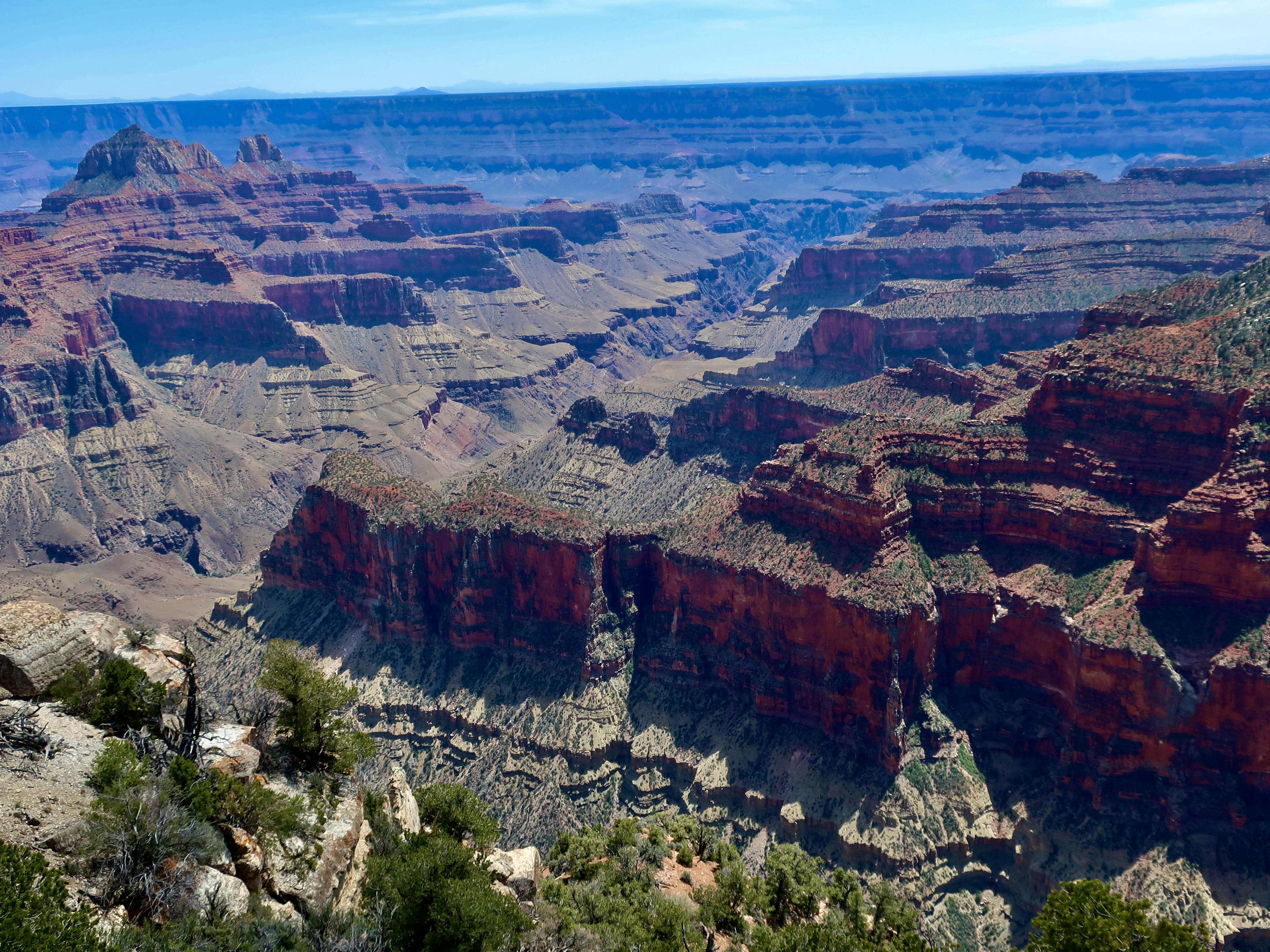
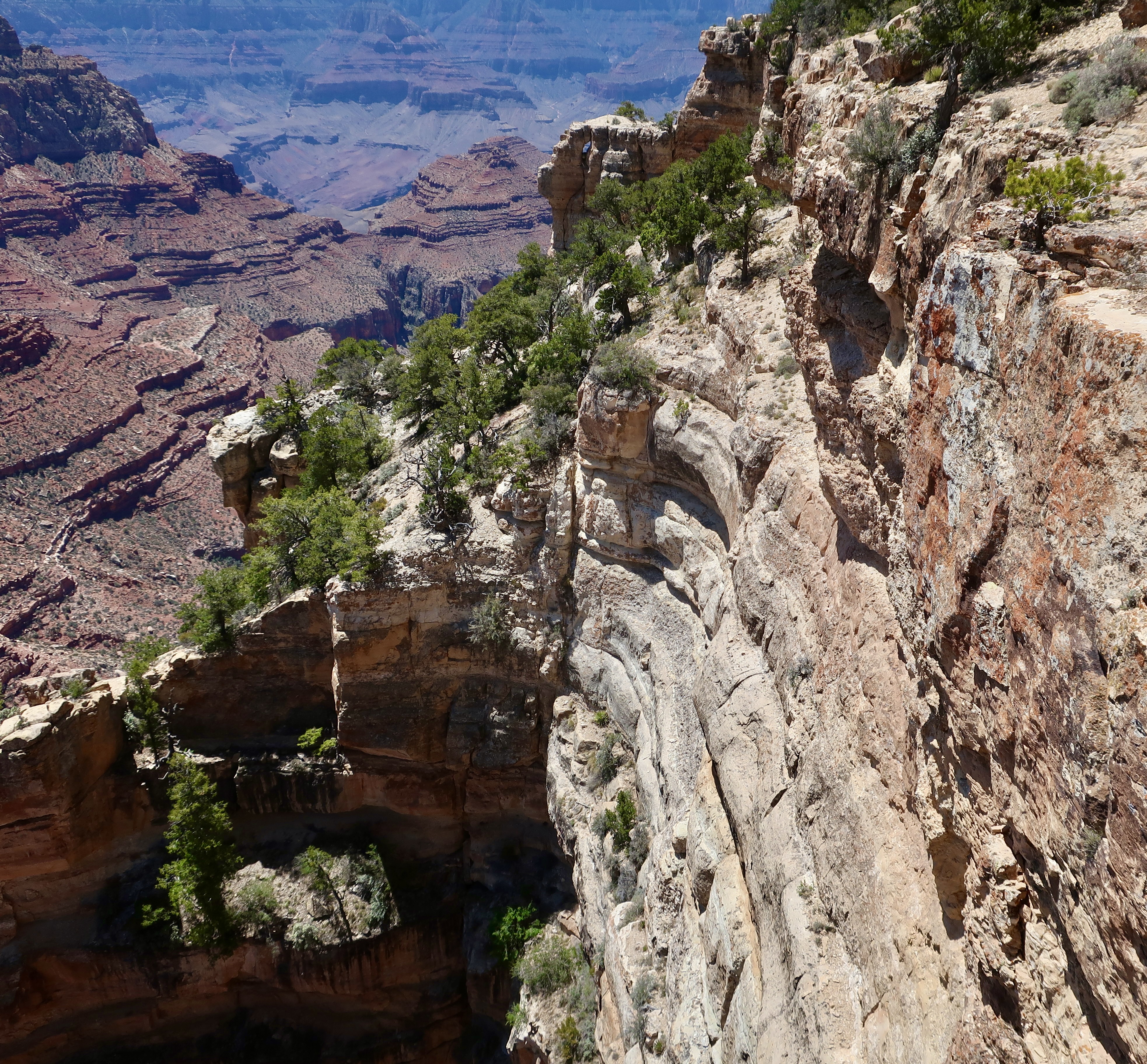
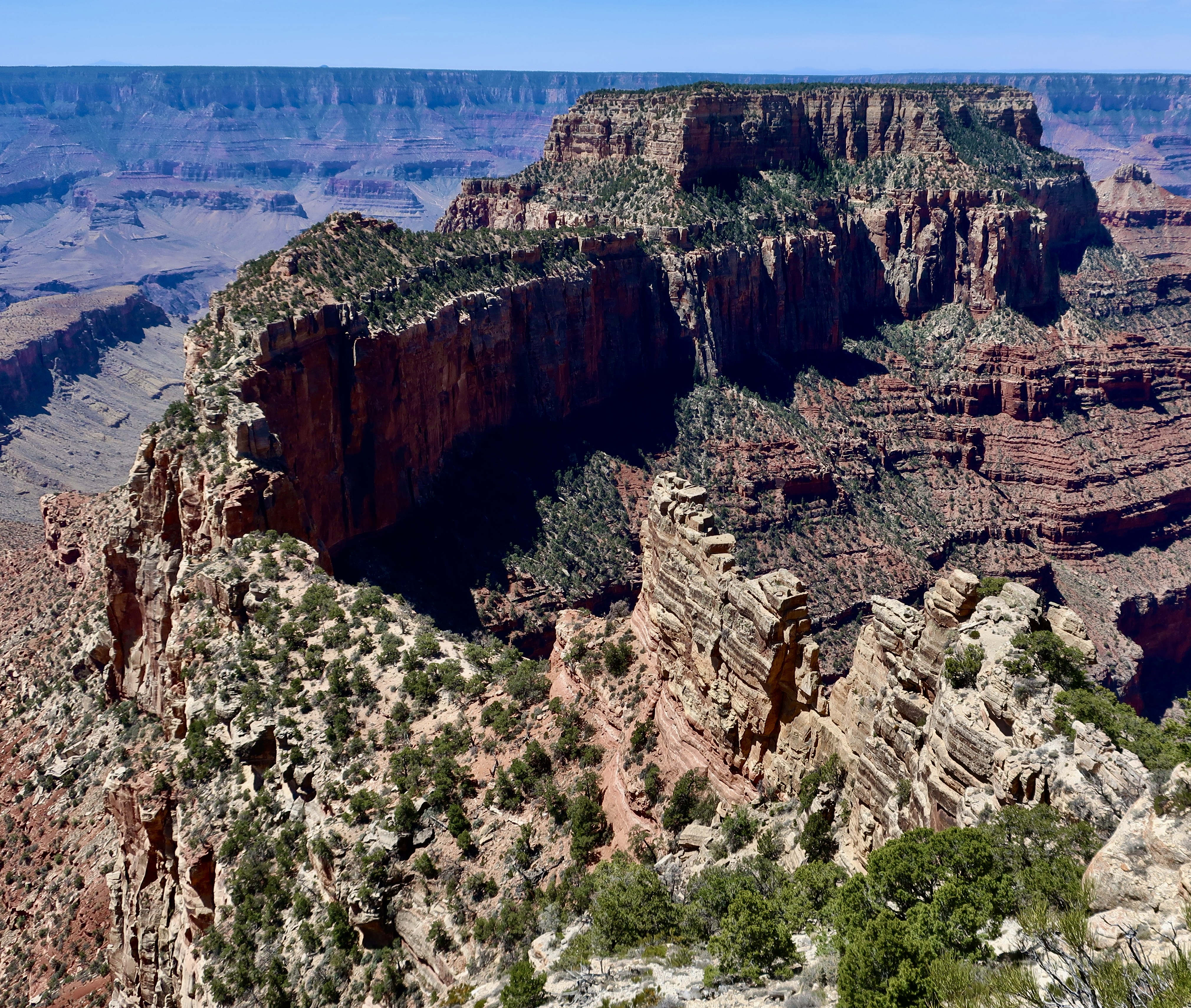
Hundreds of millions of years of the earth’s history is recorded in the walls of the Grand Canyon, much of it in convenient layers. Each layer has a story to tell ranging from sand storms to ancient seas, from raging rivers to quiet mudflats— stories that are told in rocks progressing in age as one goes deeper into the canyon. This photo was taken from Bright Angel Point.
For example, the light rock in the foreground is made up of Coconino sandstone, which was laid down some 275 million years ago when a vast, sand-filled desert covered the area. It’s a hard rock that resists erosion and creates a distinctive layer around the canyon, as seen on the opposite wall.
The two formations below it, Hermit Shale and Supai, represent some 60 million years of geological history and are made up of softer rocks such as mudstone and siltstone formed by clay filtered out of calm water typically found in lakes, lagoons, river deltas and harbors. These rocks erode more easily and create slopes. The Supai formation is interspersed with layers of sandstone that slow the erosion and create small cliffs. It also includes generous amount of hematite, which is rich in iron. Iron oxide (rust) gives the formation its distinctive red color.
The Red Wall, located just beneath the Supai formation, is one of the most prominent features of the Grand Canyon. Created some 340 million plus years ago in a sea that covered the region, it ranges in height from 500-800 feet and is made up of limestone. Its predominant red color doesn’t come from the limestone, however. It comes from the iron oxide that is formed from the hematite in the Supai formation and leached out by water flowing down the wall, painting it red! Like the sandstone, limestone is a hard rock that doesn’t easily erode. Thus, the towering cliffs.
The oldest rocks in the canyon are appropriately found at the bottom, Vishnu Schist, a metamorphic rock of quartz and hornblende that was born in a deep ocean trench some 1.8 billion years ago. Does this mean the Grand Canyon shows 1.8 billion years of earth’s geologic history? Not quite, every so often nature wipes out a few million years through erosion. The most renown is the Great Unconformity where some 1.2 billion years of the the 1.8 billion were razed!
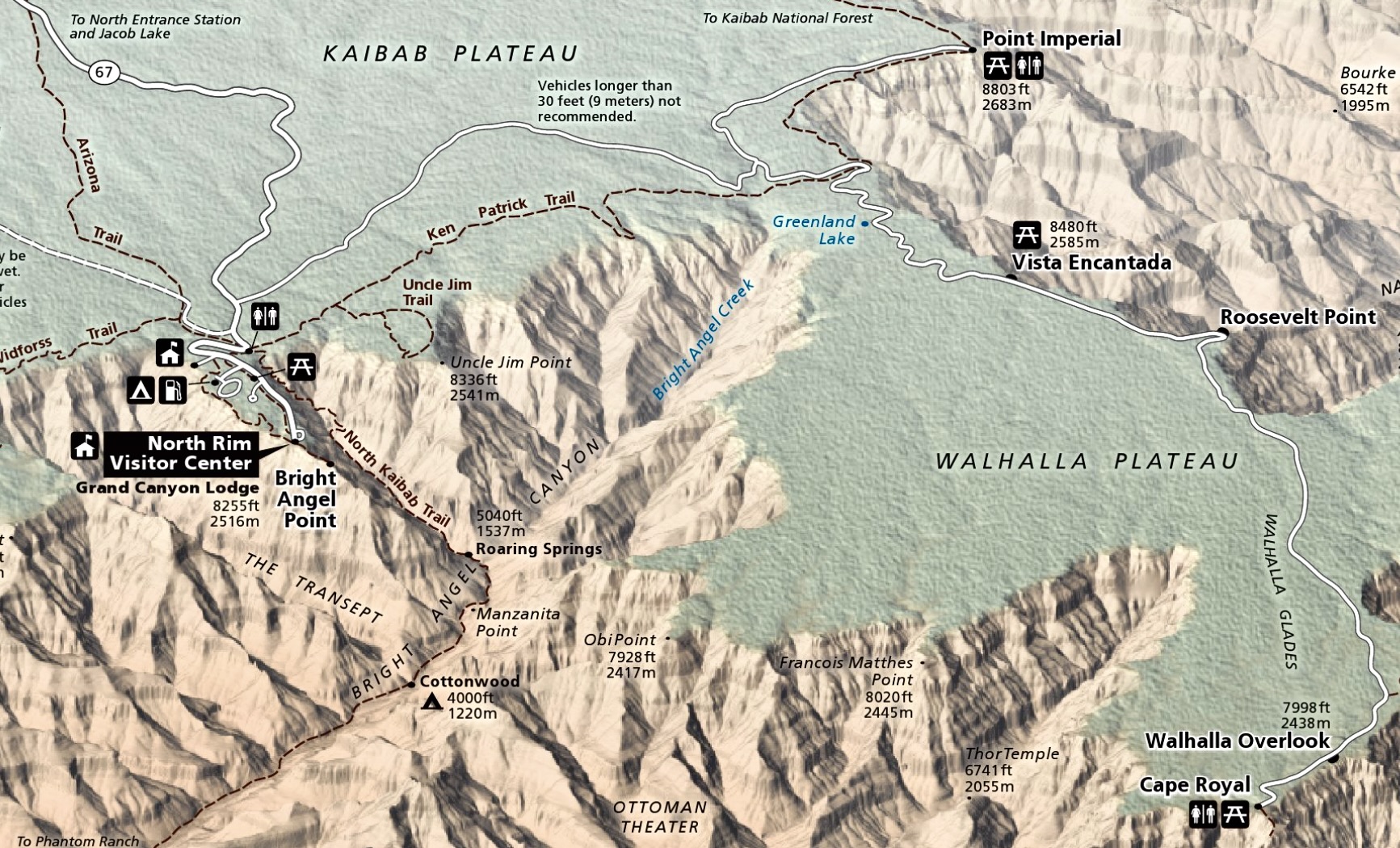
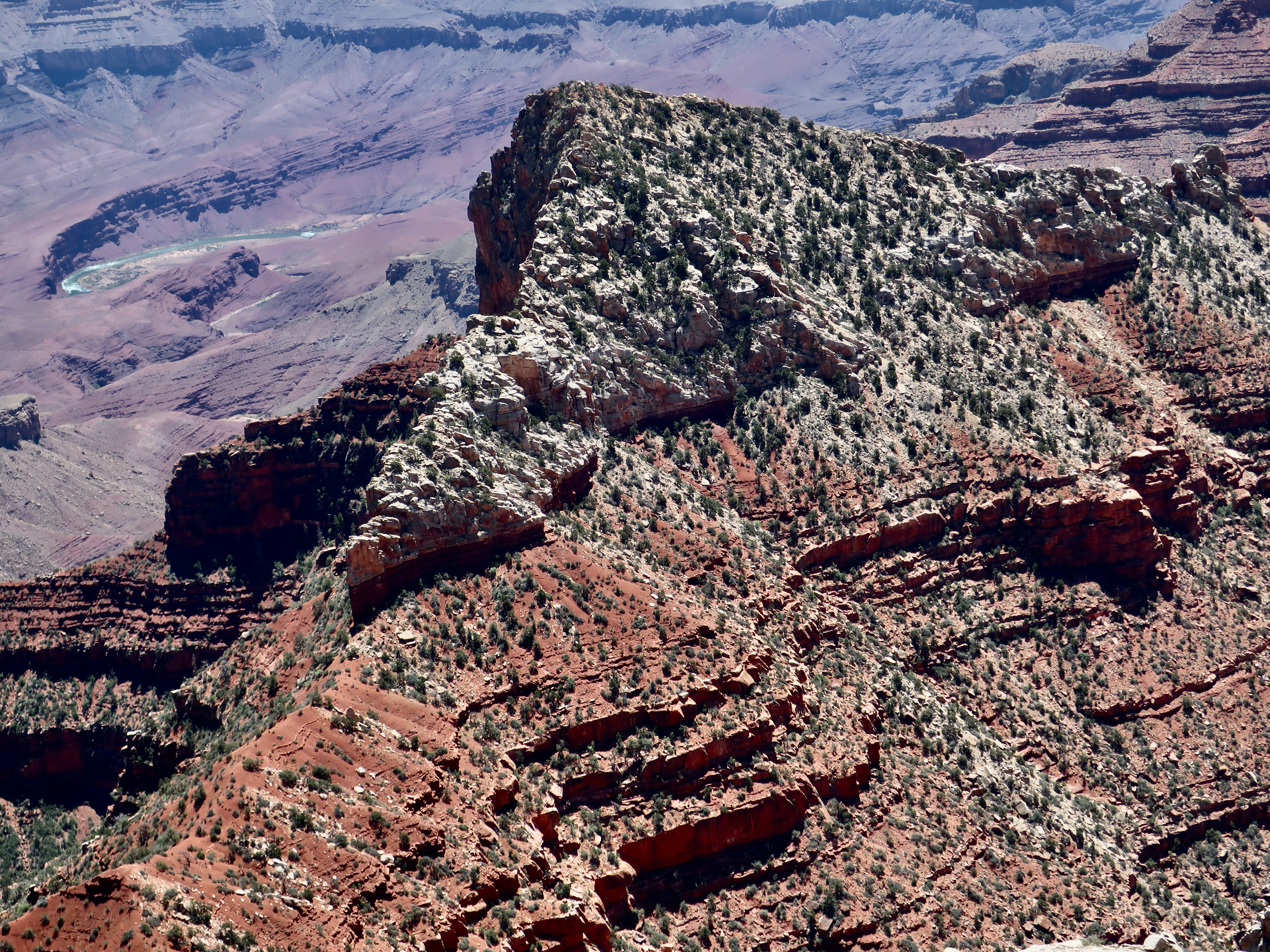
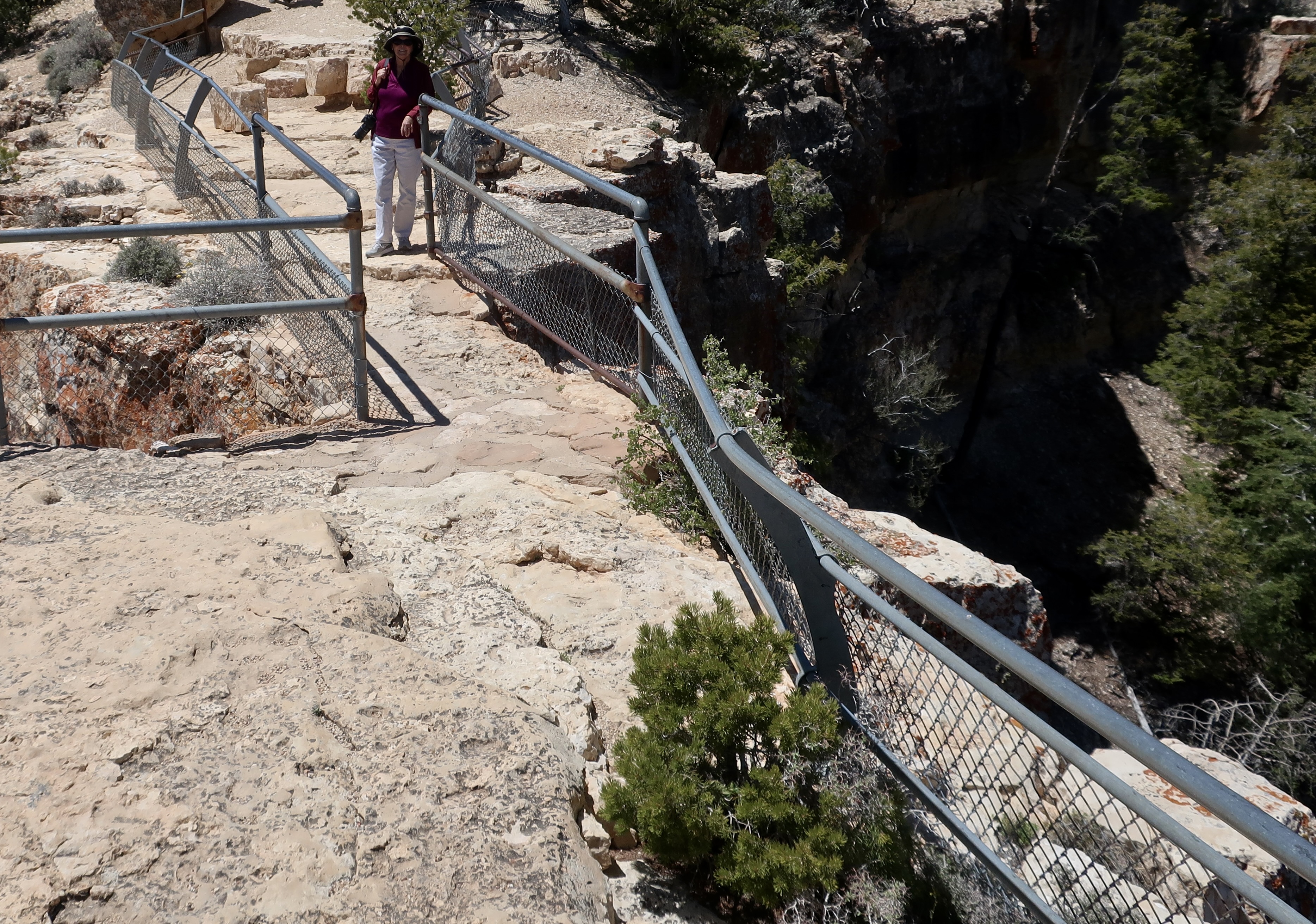
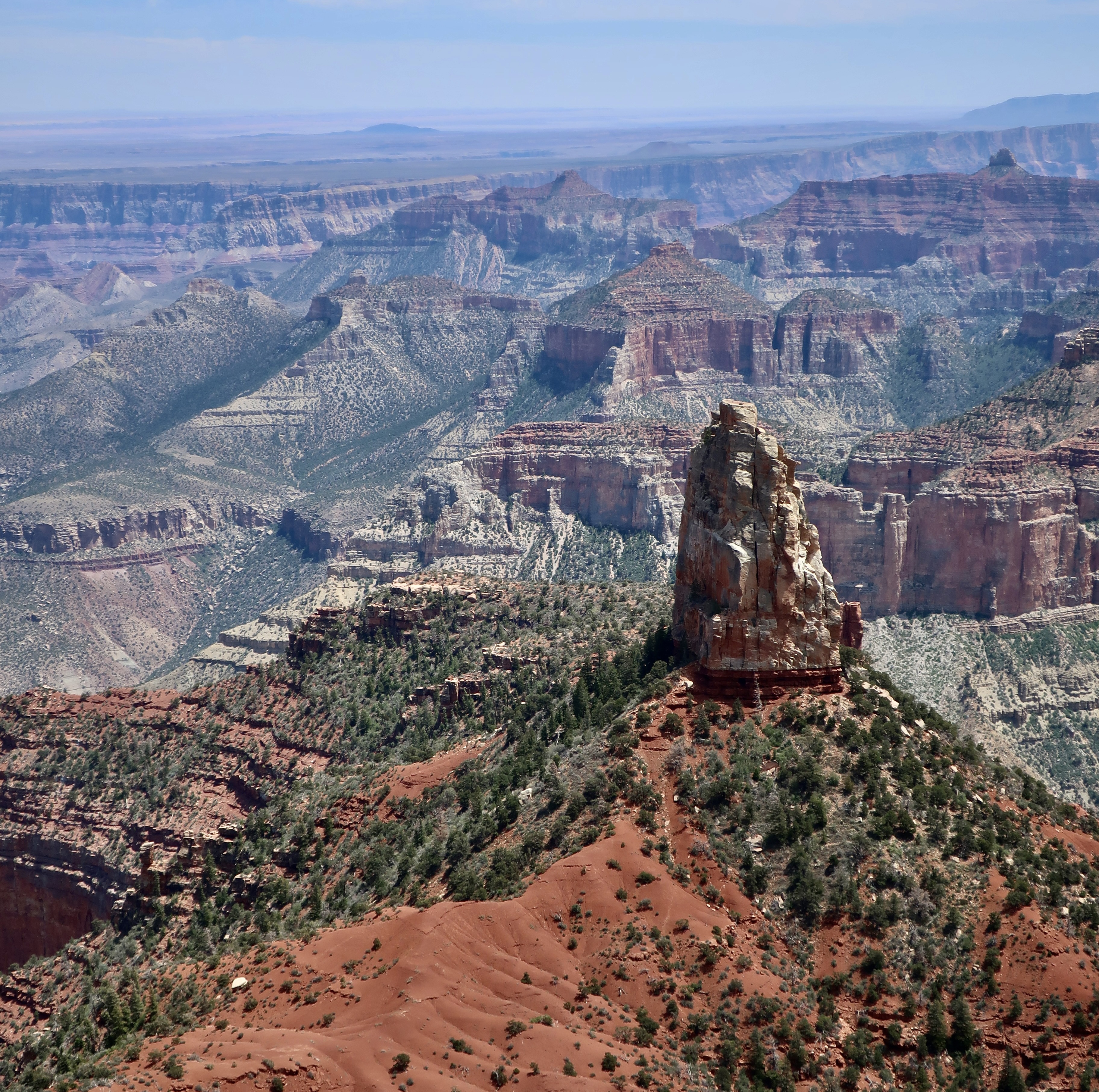
This map from the National Park Service shows the prominent overlooks of the North Rim. In the last post, we featured photos from Cape Royal and the Walhalla Overlook located in the lower right hand corner. This time, I will start with Bright Angel Point located just below the Visitor’s Center and then move on to Roosevelt Point, Vista Encantata, and Point Imperial.National Park map showing location of Grand Canyon in Arizona. A view from Bright Angel Point shows Bright Angel Canyon on the left. Bright Angel Creek makes its way down the canyon to the Colorado River. The popular North Kaibab Trail follows the creek and takes hikers down to Phantom Ranch on the river where they can stay, assuming they’ve landed a tough-to-get reservation. Or, they can continue on the South Kaibab or Bright Angel Trail up to the South Rim— if they don’t mind a 21 mile hike with an elevation change of 11,000 feet. I’ve backpacked it on two different occasions: One from the South Rim to Phantom Ranch and one from the North Rim to the Ranch. Ultra-marathon runners like to run the total path— and return— in one day.This provides a distant view of the South Rim from Bright Angel Point. You can see the village on the rim left center. Bright Angel Trail winds its way down into the canyon starting just to the right of the buildings. Both the Bright Angel Trail and Bright Angel Creek follow an active fault zone. An occasional jolt reminds hikers that even the Grand Canyon is earthquake country.A short trail starts beneath the Visitor’s Center and follows Bright Angel Point out to its end providing dramatic views of the canyon from both sidesPeggy and I also admired the trees that scratched out a living out on the Bright Angel Point.A final tree photo on Bright Angel Point. Now, on to Roosevelt Point.On his first visit to the Grand Canyon in 1903, Theodore Roosevelt exclaimed, “Leave it as it is. You cannot improve upon it. The ages have been at work on it, and man can only mar it.” More than anyone else, he was responsible for protecting the Canyon to be enjoyed by future generations. It’s only appropriate that he would have a point named in his honor. More views from the overlook:Vista Encantata translates as “enchanted view.” It’s easy to see why early visitors gave this overlook the name.When visitors arrive at Point Imperial on the North Rim, they arrive at 8,803 feet, the highest point on the North Rim. You might say it’s breath-taking. The view isn’t half-bad either. The spire, Mt. Hayden, is one of the most photographed views on the North Rim. We will close out this post with three different perspectives of it.And finally, a close up. In addition to being a favorite among photographers, Mt. Hayden is a favorite among rock climbers. This wraps up our brief tour of the North Rim of the Grand Canyon. Next, we will visit Mesa Verde National Park, famous for its ancient cliff dwellings.
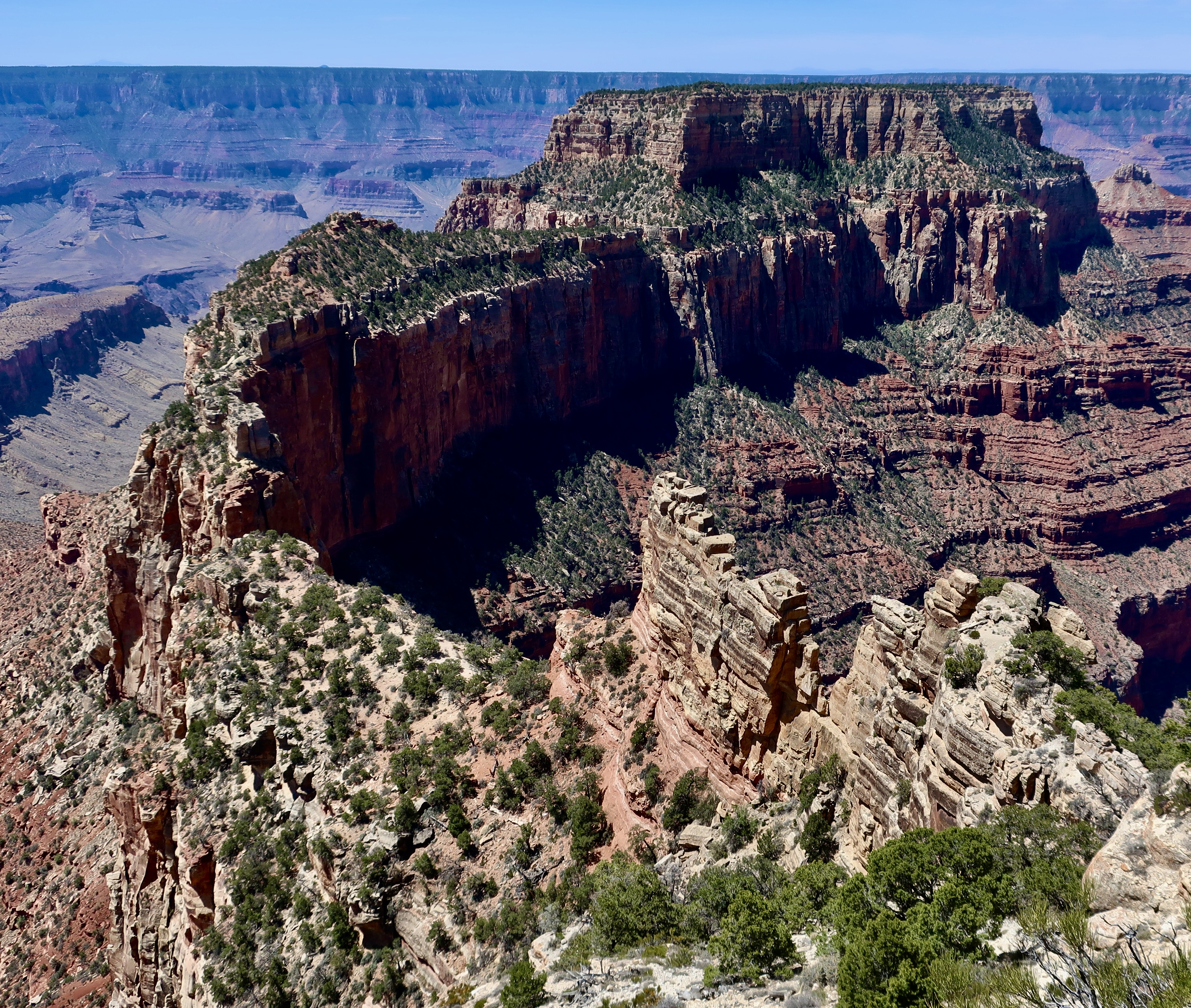
Wotan’s (Odin’s) Throne is one of five prominent landmarks visitors can see from Cape Royal on the North Rim of the Grand Canyon. If you start on the front left and follow the ridge around to the high plateaus, you will arrive at the throne.
Today, Peggy and I are going to take you on a visit to the North Rim of the Grand Canyon as part of our National Park Series. We were there in 2022 but didn’t have time to do a post on it because we were headed off for a trip up the Rhine River.
I’m no stranger to the Grand Canyon. Even before I met Peggy, I had been to the South Rim several times, backpacked into the canyon four times, and even took a mule in on my first visit ever, an experience I didn’t need to repeat. The mule recognized that I was two pounds over the weight limit and kept trying to bite me and throw me off the trail with a several hundred foot drop. The worst insult, however, was to my butt. I couldn’t sit down for two days.
Peggy and I have also been there a number of times with experiences ranging from backpacking into the Canyon to being flown into a section outside the park in a helicopter by our son. We also did an 18 day private raft trip down the Colorado River through the Canyon. Once we took our kids, Tasha and Tony, as teenagers and camped out in the snow. Not surprisingly, I have done a number of posts on the Canyon, but never on the North Rim.
Some 5 million people visit the South Rim of the Grand Canyon. Maybe 10% make it to the North Rim. There are reasons for this, primarily accessibility. The South Rim is easier to get to, has extensive guest facilities, and is open year around. The North Rim, which sits at 8000 feet (2438 M), is closed from October 15 to May 15 because of snow. Plus it is a 212 mile, four hour plus drive from the South Rim— even though the North Rim is only 10 miles from the South Rim as the crow flies! That’s the challenge when you are faced with a ditch that averages 4000 feet deep stretching out for 277 miles.
An argument can be made that the South Rim provides better views of the Canyon, overall. So if you’ve never been, you might want to start there. On the other had, who could argue that the view of Wotan’s Throne featured at the top is lacking in grandeur?
The five prominent landmarks we will visit in this post at Cape Royal will include Wotan’s Throne, Vishnu Temple, Freya Castle, Wahalla Overlook, and Angel’s Window. As you have probably noticed, all of these names are based on mythological themes. We can thank Clarence Dutton for that, an early geologist who felt Vishnu Temple resembled an Eastern pagoda and began the tradition of providing such names to the other rock monuments throughout the Canyon. Vishnu is a major Hindu deity; Wotan is the supreme Germanic deity; Freya was a renowned Norse goddess; Walhalla (Valhalla) was the hall in Norse mythology where the souls of heroes slain in battle were received. And angels are, um, angels?
Let’s get started. All of the photos were taken by either Peggy or me.
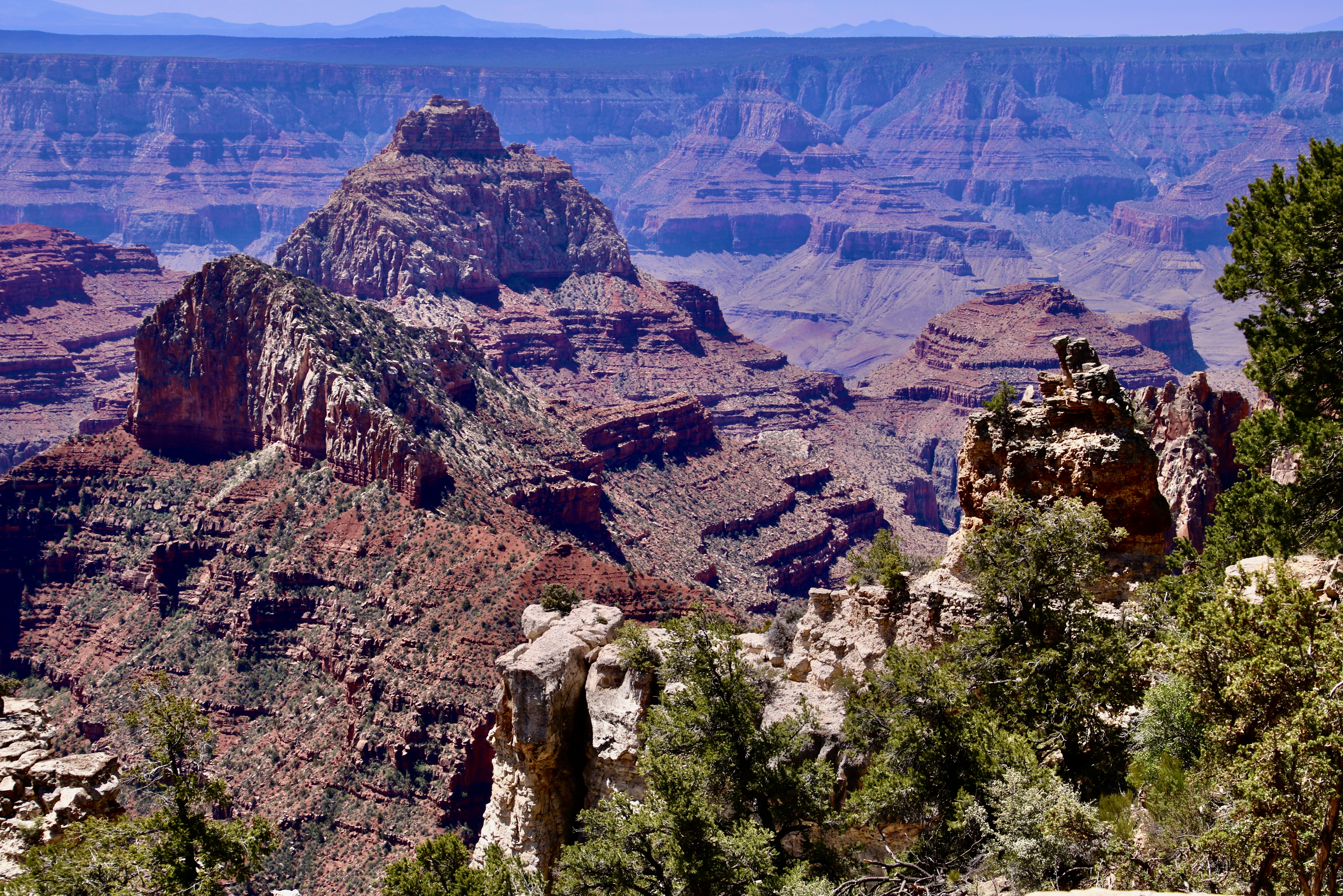
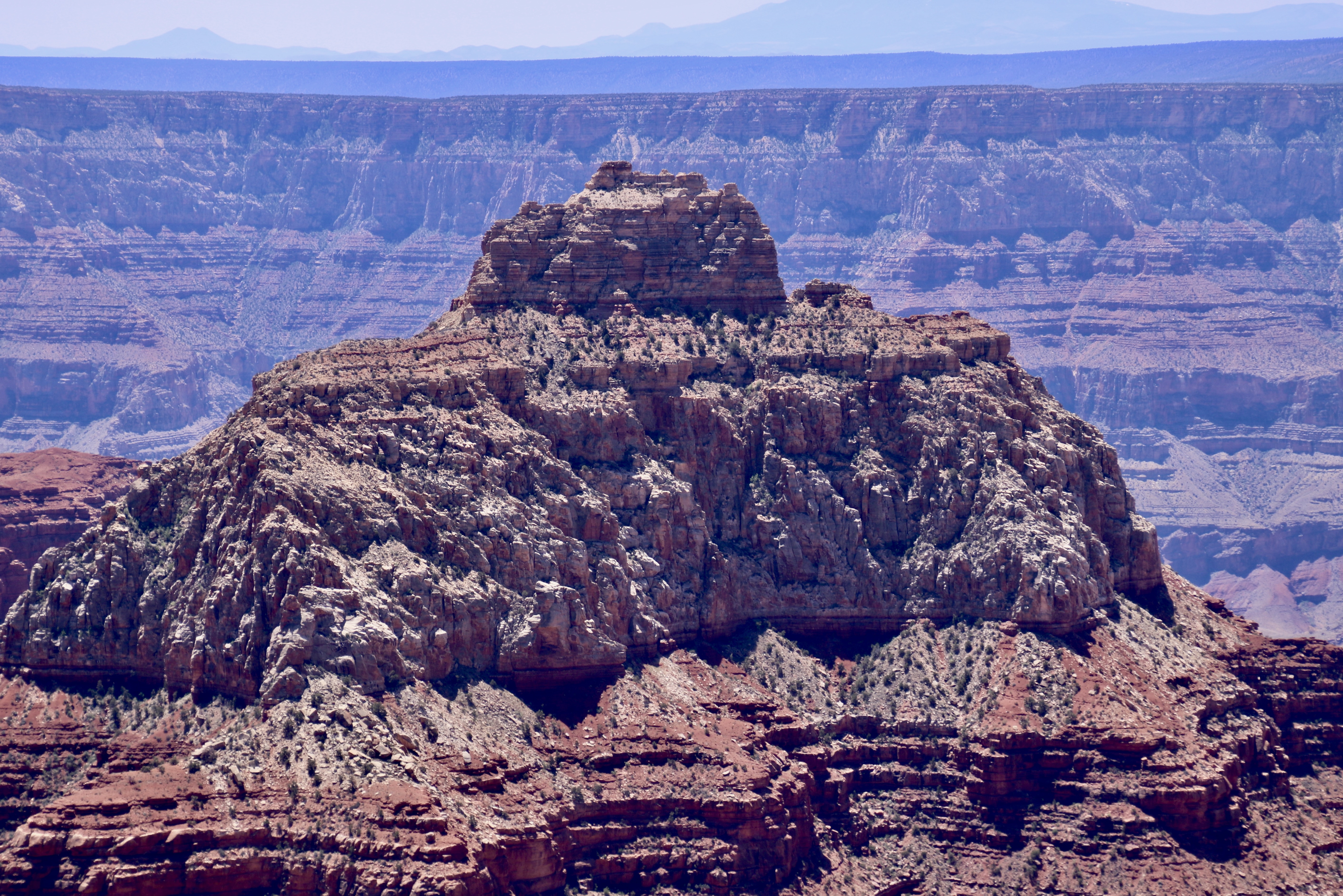
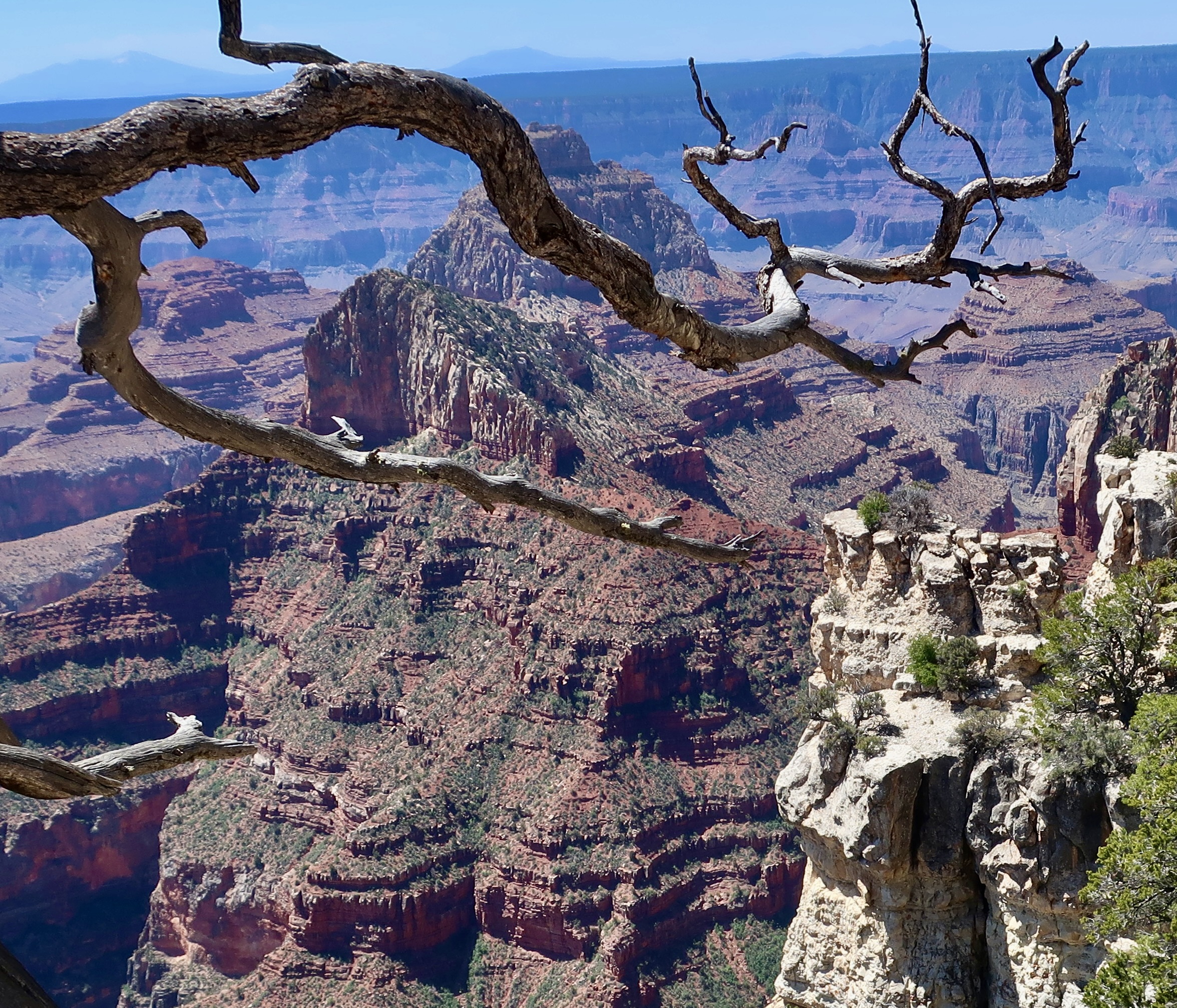
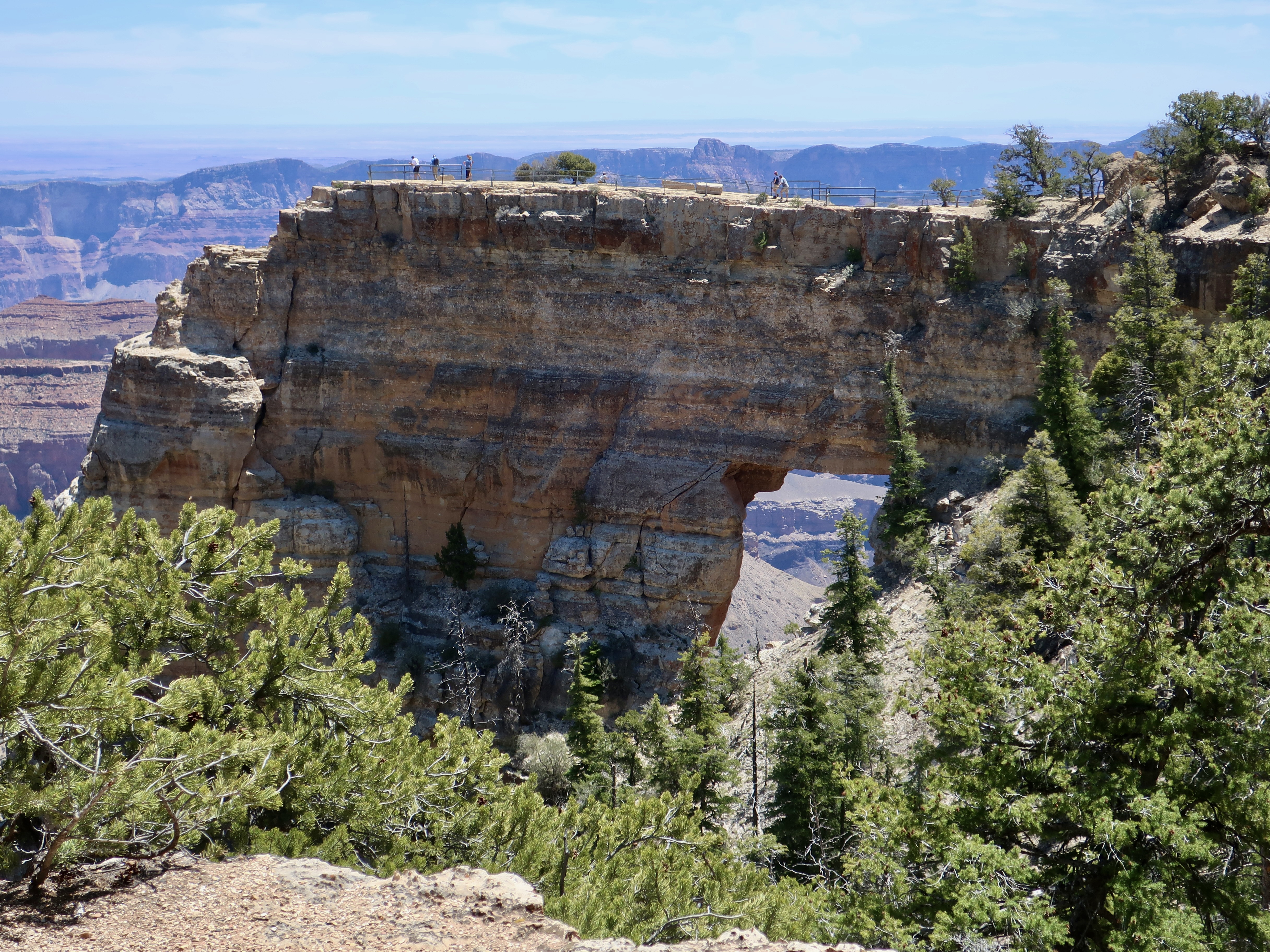
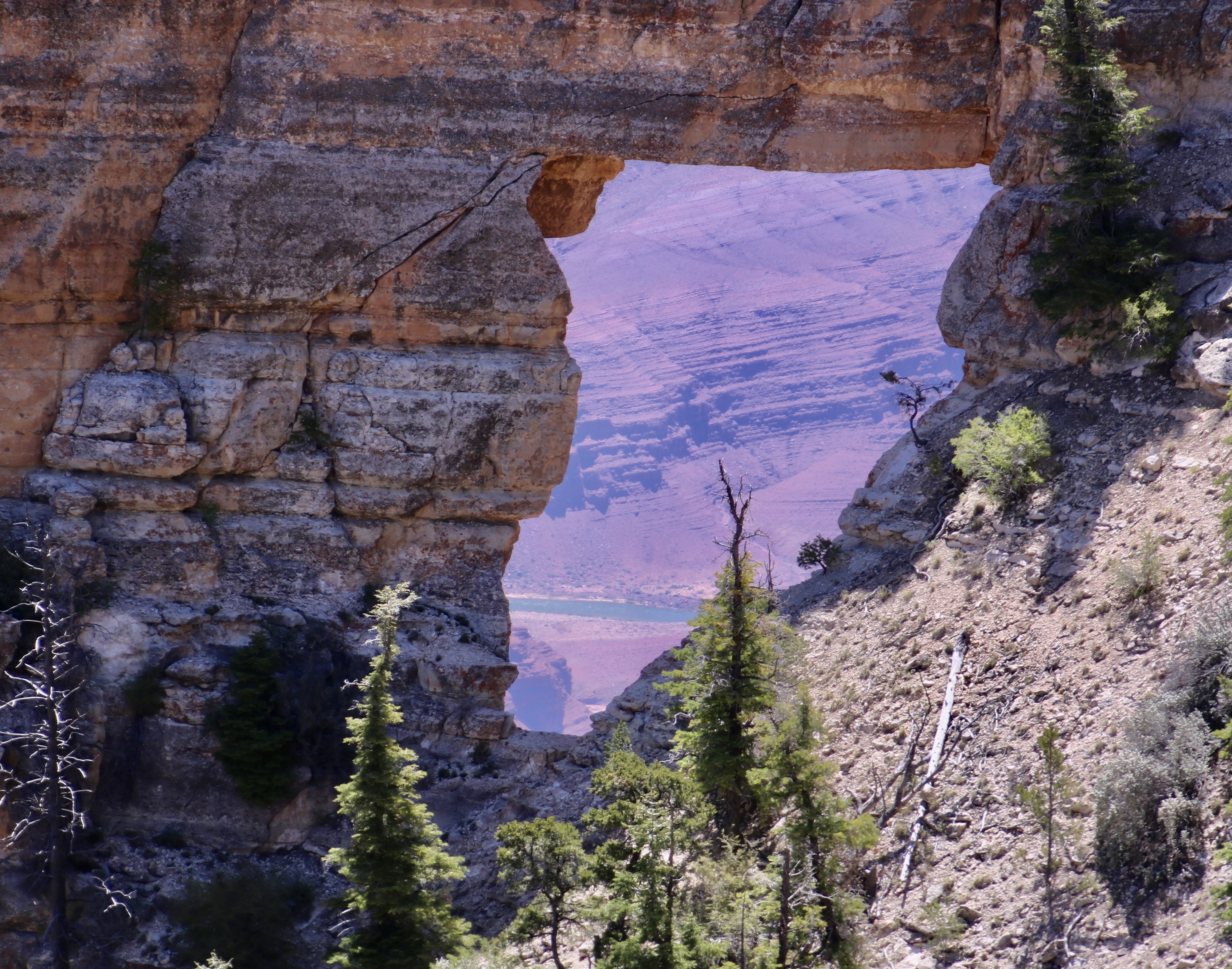
Another perspective on Wotan’s Throne.View of Vishnu’s Temple. Freya’s Castle is in front of the Temple.A close up of Vishnu’s Temple. Freya’s Castle and Vishnu’s Temple from the perspective of a tree.Close up of Freya’s Castle.Angel’s Window with people standing on top. You can actually see the Colorado River through the window.Peggy standing on top of Angel’s Window. Peggy’s view down.This is the view from the Walhalla Overlook. The Unkar Delta on the Colorado River can be seen in the far distance. An information sign at the overlook noted that “ancestral Puebloan farmers 1100 to 800 years ago made the journey from rim to river and back on a routine basis, spending summers farming on the rim and most of the rest of the year farming in the Canyon.”A closer look. Note the rapids. We worked our way through them on our trip down the Colorado River in 2010. We also stopped to check out a storage granary the Puebloans had located high up on the cliffs. Tom Lovering and I at the Puebloan granary. I had the permit for the 18 day trip, and Tom, an accomplished river runner, had led it. Tom, as you may recall, along with his friend Lita, joined us at Point Reyes National Seashore a few weeks ago. Tom colored his hair green for the trip. (Photo by Don Green.)Peggy, climbing up to join us at the granary, looking quite adventuresome. That’s it for the day. Our next post will continue our visit to the North Rim.
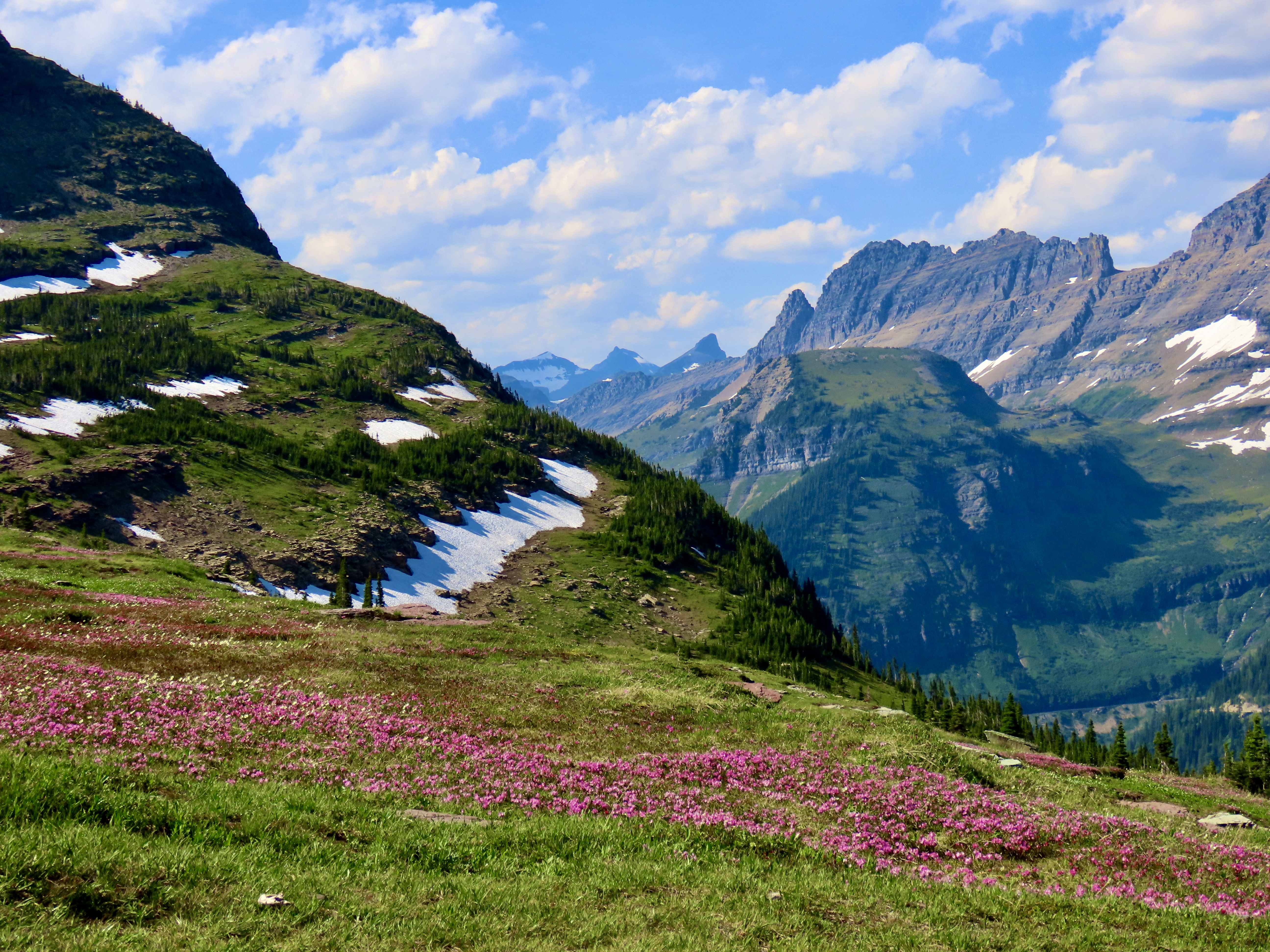
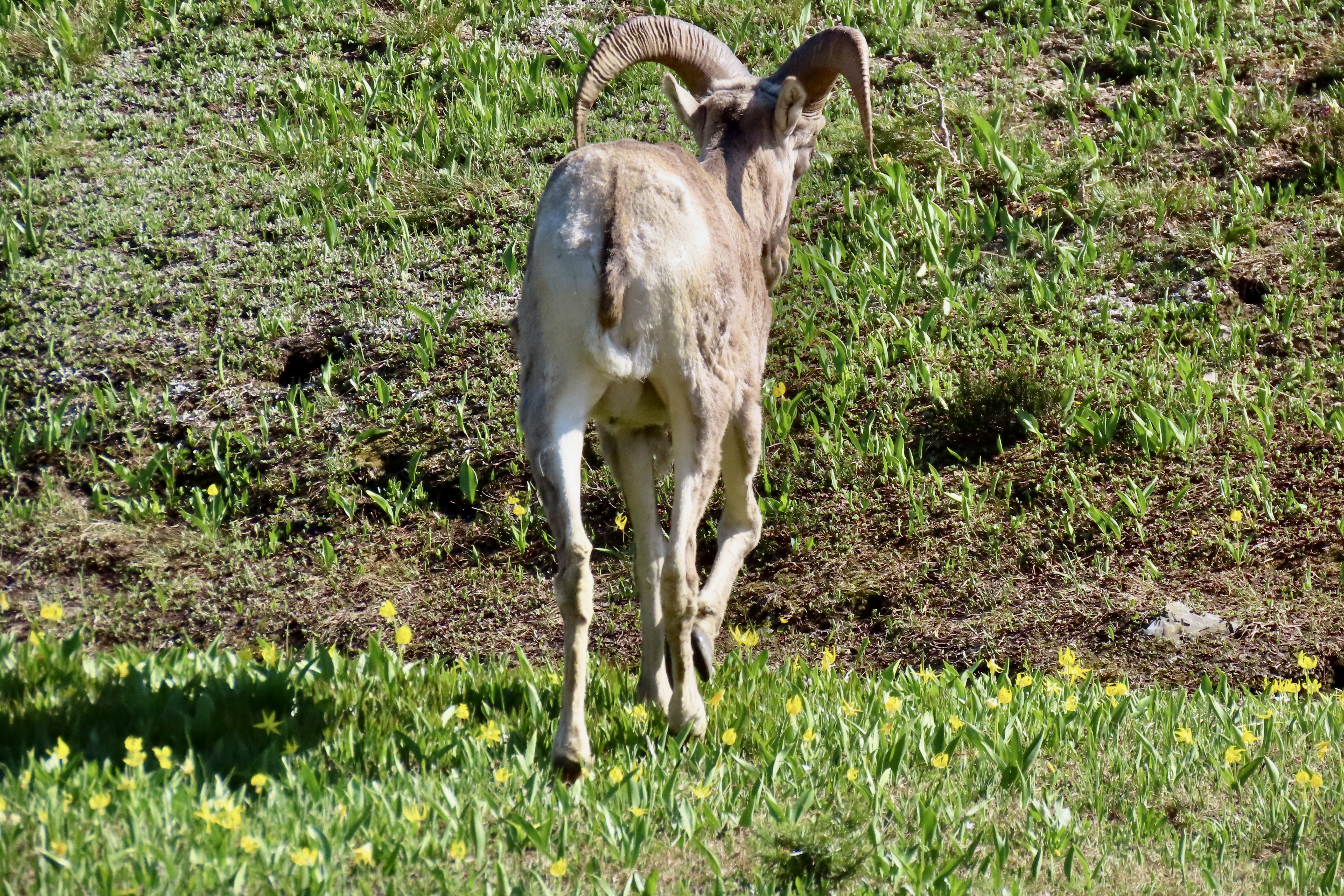
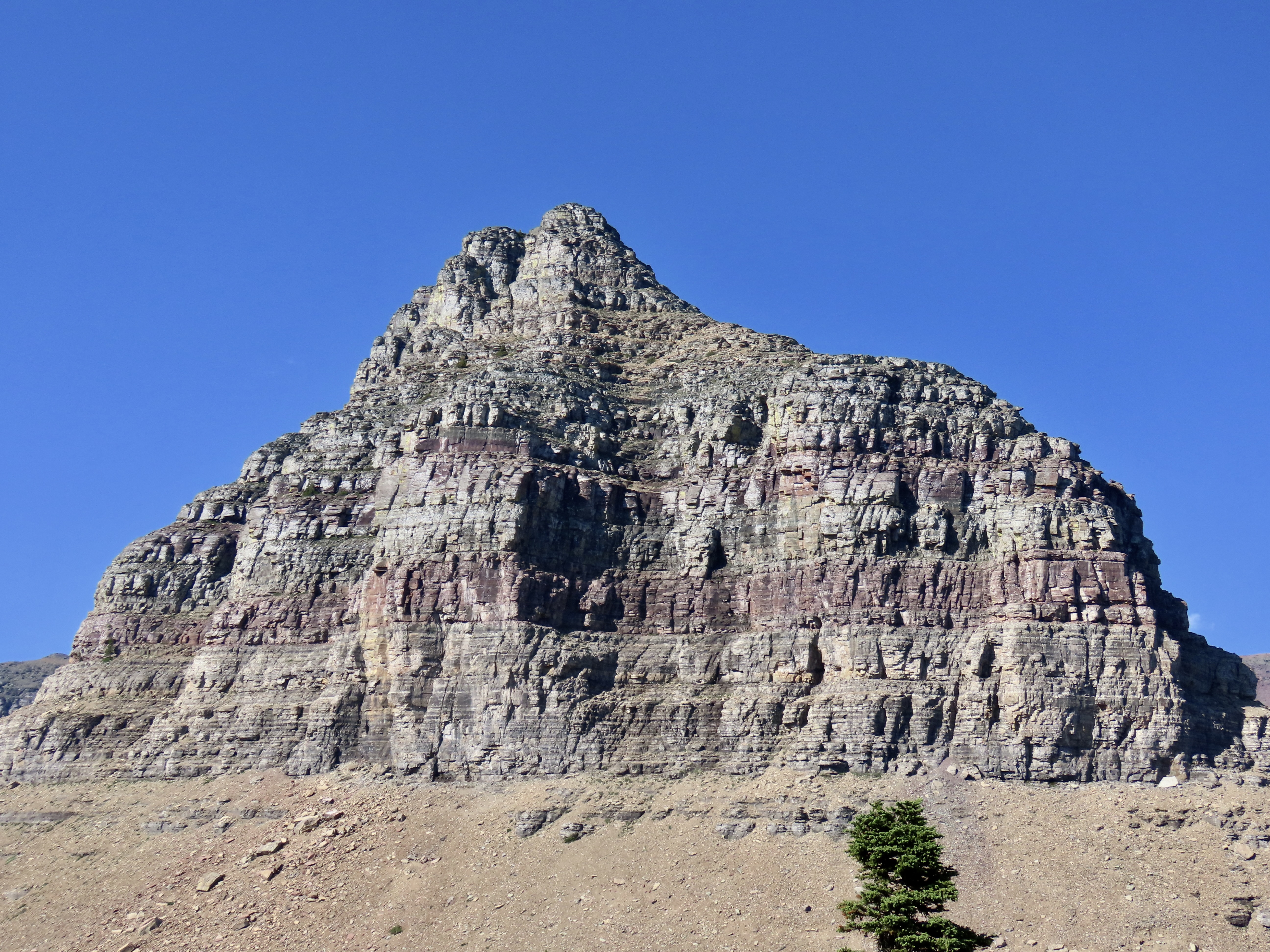
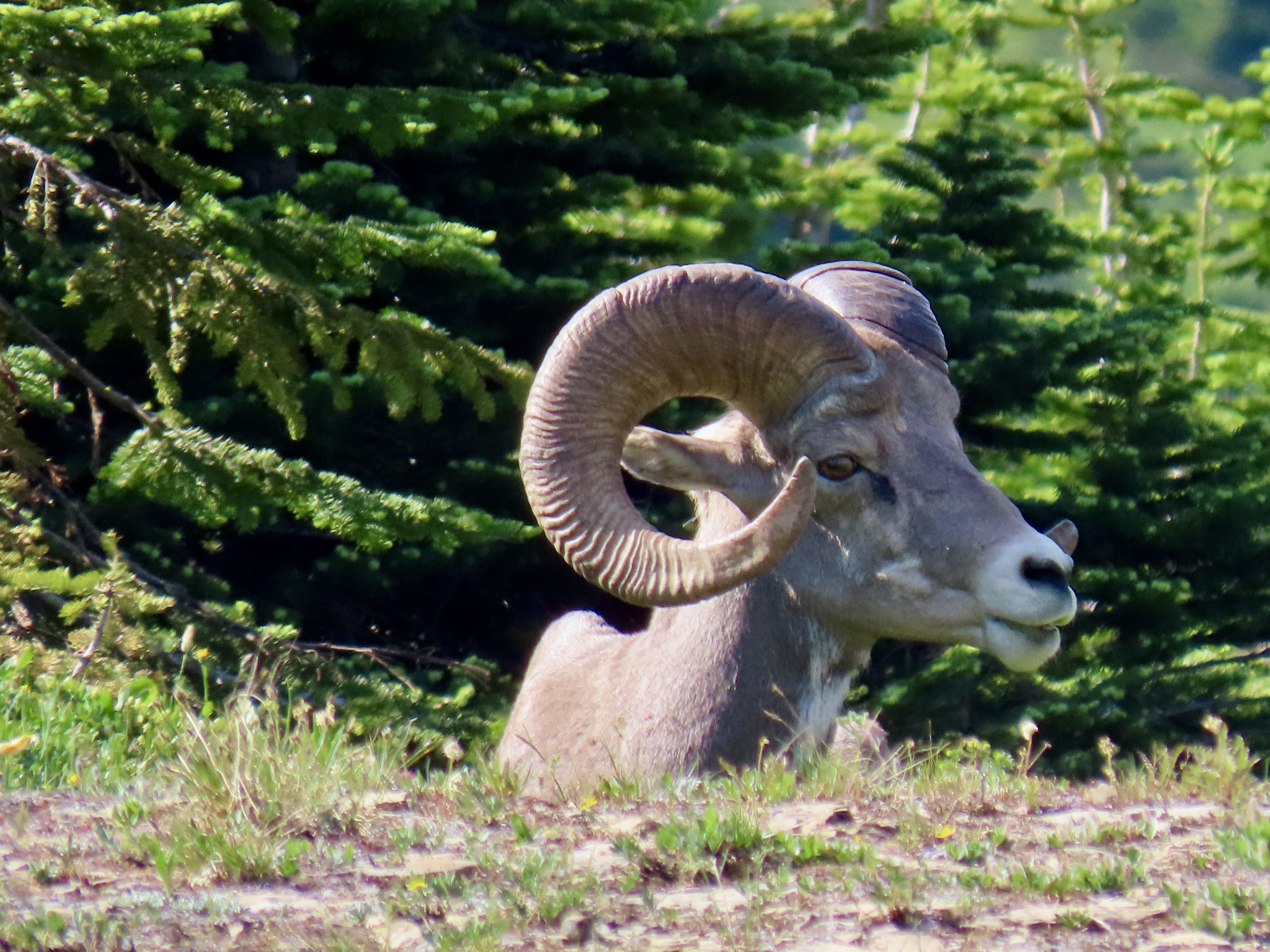
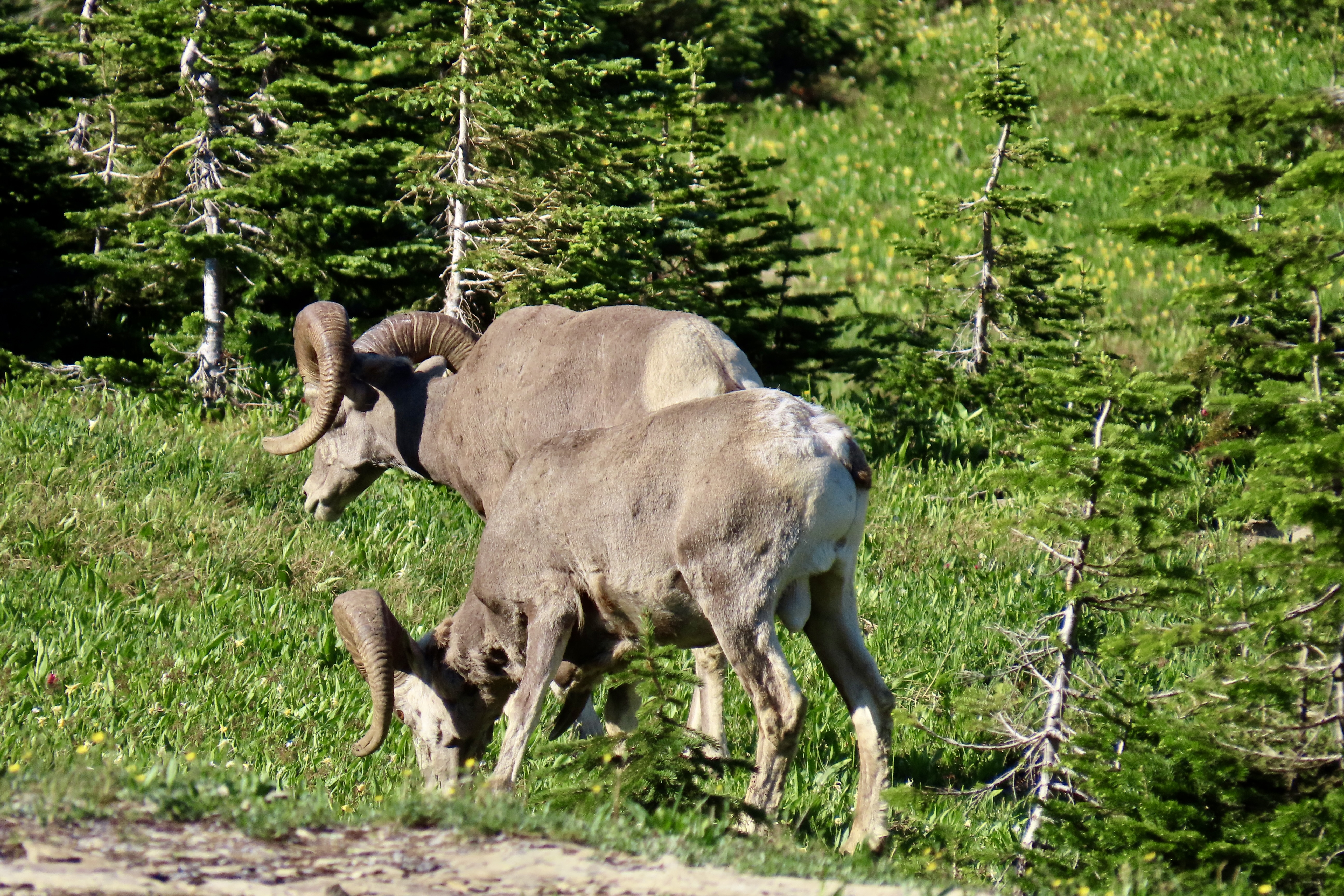
High Mountain meadows often come filled with flowers, streams, snow, distant views, and occasionally a surprise, like these two big horned sheep.
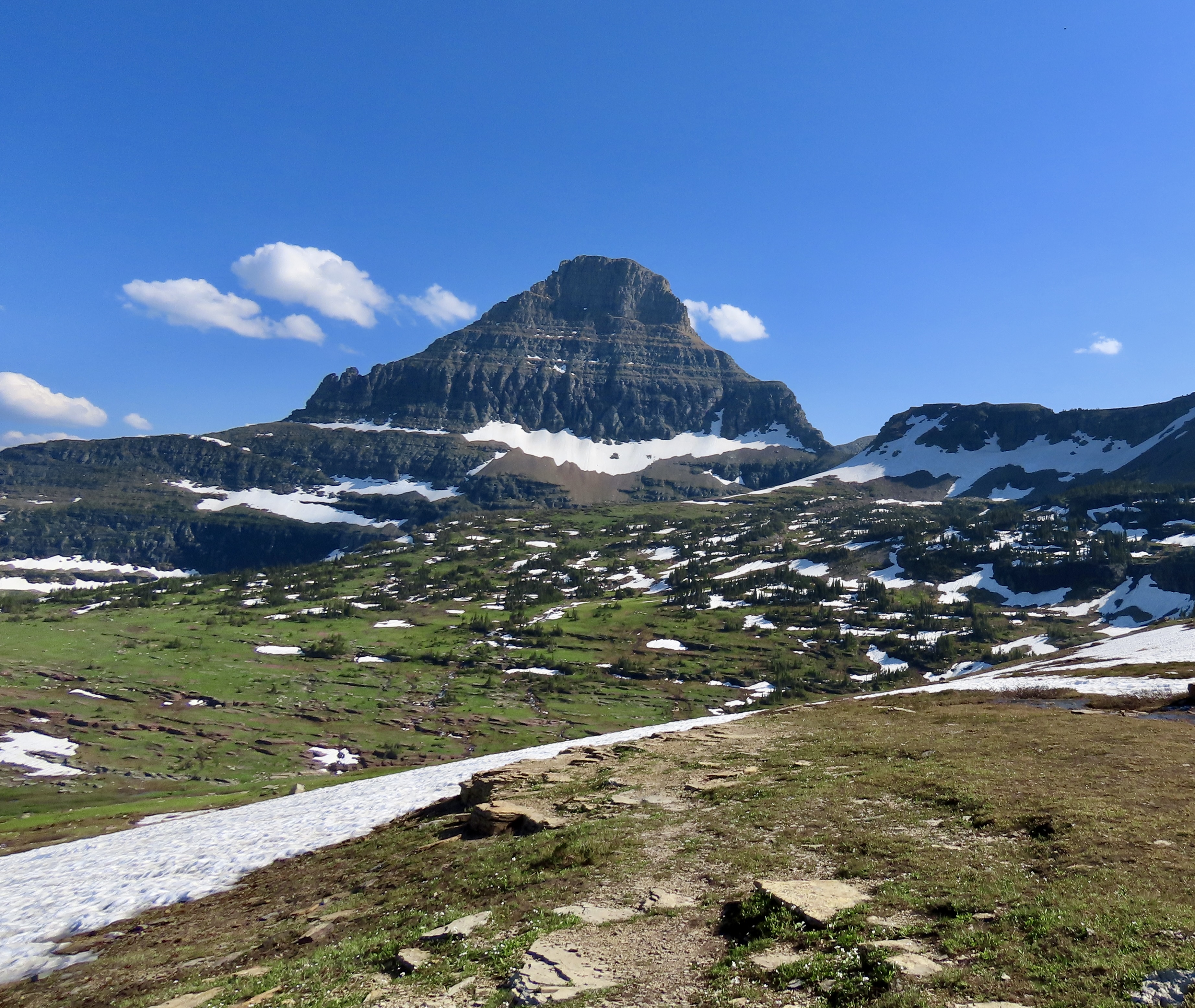
Logan Pass, at 6,646 feet (2,026 m), is the highest point on Glacier National Park’s Going to the Sun Road. It’s located on the Continental Divide. From the pass, water either flows eastward to the Atlantic or westward to the Pacific. On the park’s Triple Divide Peak, water has a third option: The Atlantic, Pacific, or Arctic Ocean! Imagine the adventure you could have following any one of these rivers to its destination.
The real charm of Logan Pass for us is its meadow, however. The visitor’s center on the pass has a trail that leads out from the back of the center and makes its way to Hidden Lake for a three mile roundtrip, much of which is on a boardwalk. The views along the way of both the meadow and the surrounding mountains are spectacular. There is a chance you will see big horn sheep, Rocky Mountain goats, and even grizzly bears. The last time Peggy and I visited the park we were entertained by a grizzly… at a distance, thank you very much.
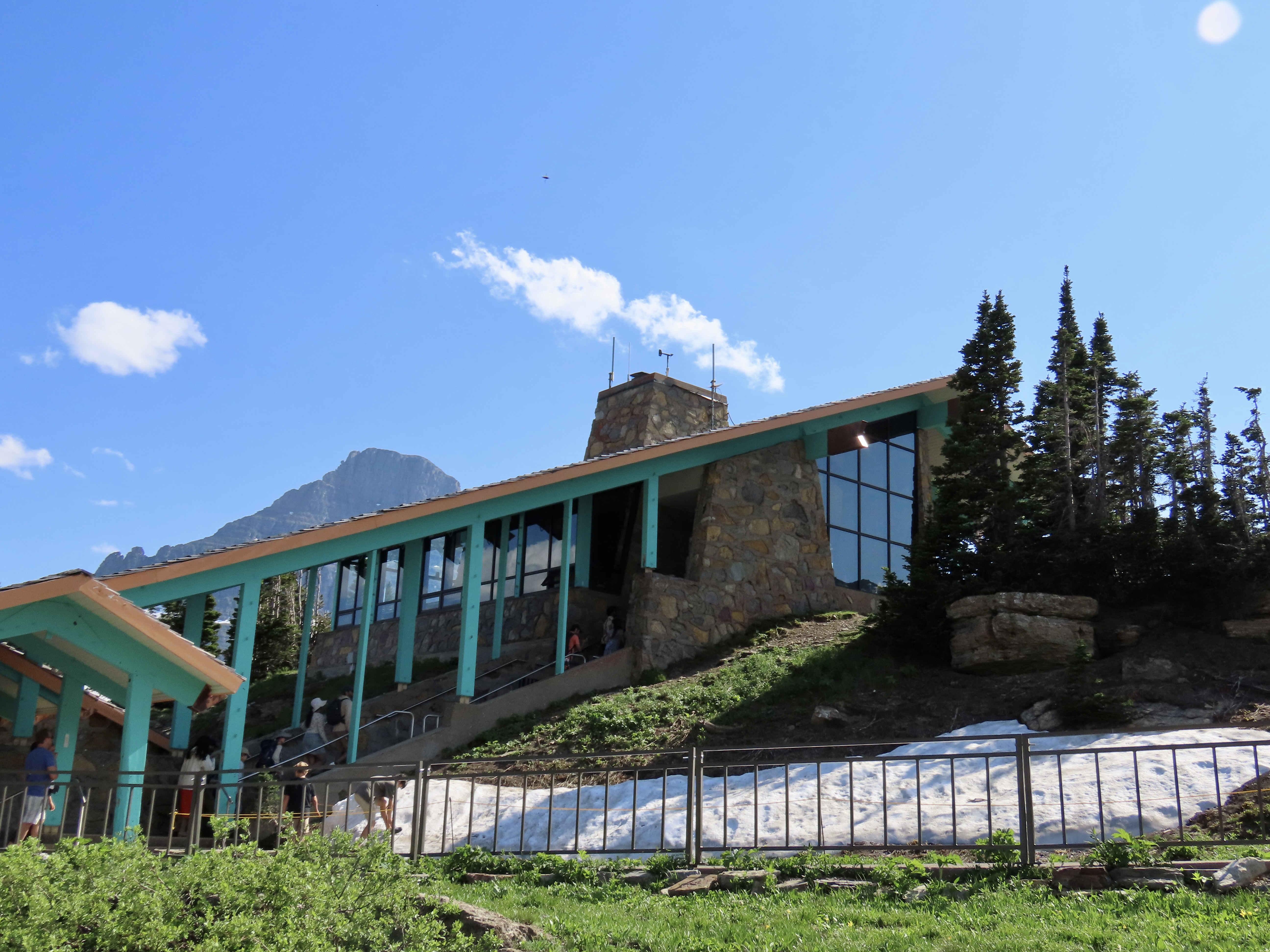
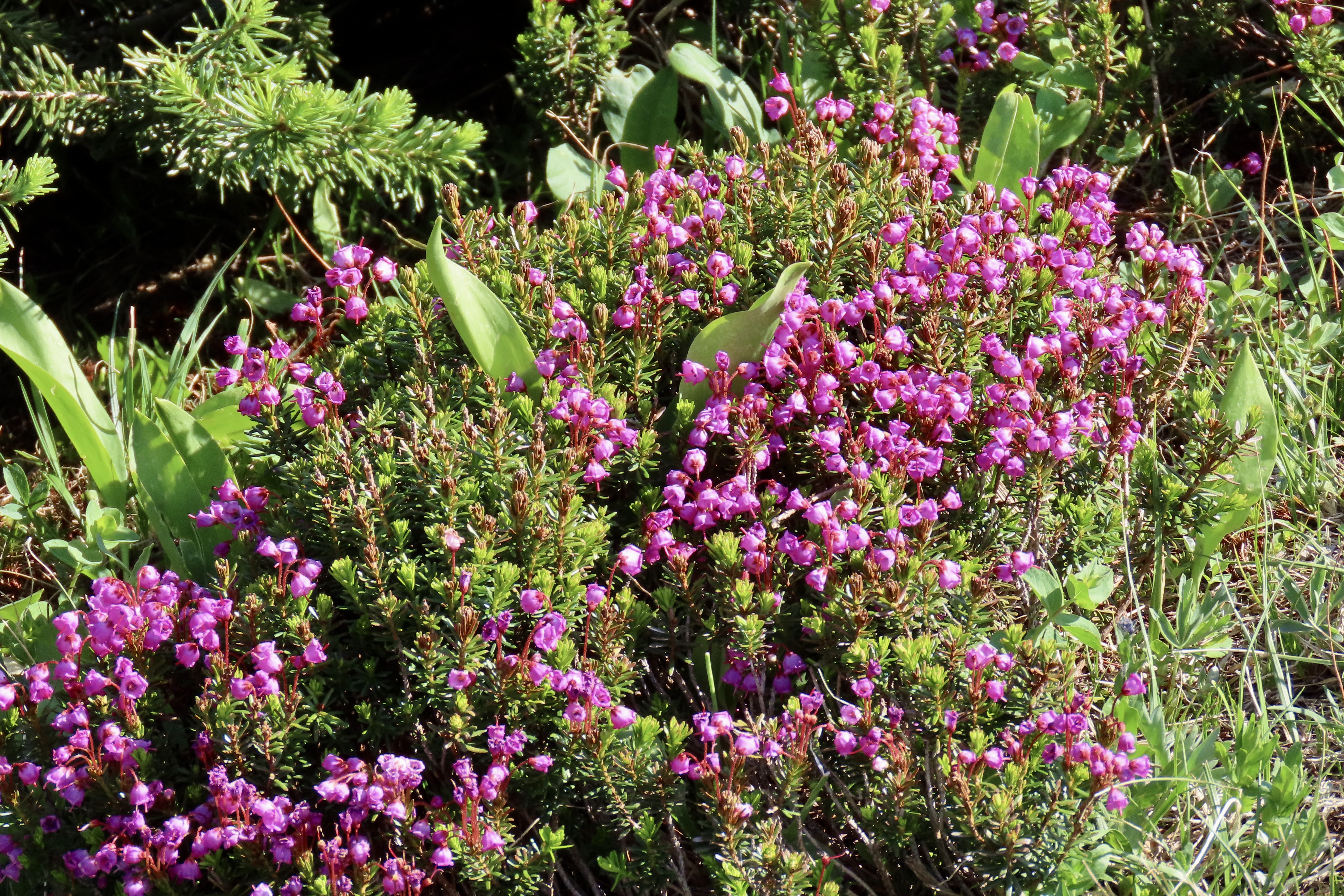
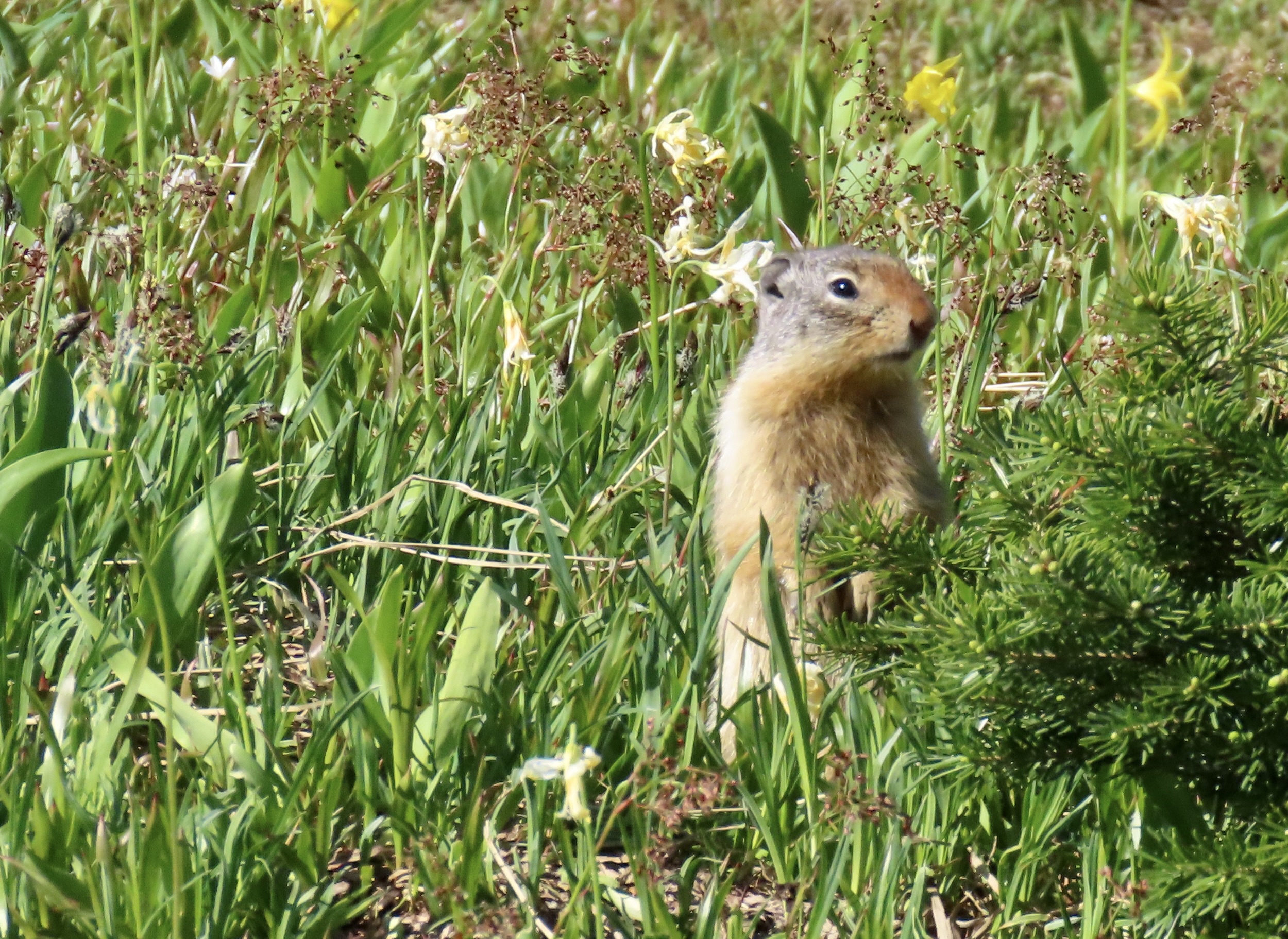
The Logan Pass Visitor Center is designed to fit into the landscape. Windows provide enticing views of the surrounding scenery. While we visited Glacier in Mid-July, the elevation of the park combined with its distance north meant it was more like late spring at the pass than mid summer. Thus the snow.The boardwalk leading out to Hidden Lake behind the Logan Pass Visitor’s Center. It’s a relatively gentle trail taken by a wide variety of people. Squishy snow along the way, this time, made the hike more difficult. It was the kind that encourages one to end up on his or her butt if not careful. At least it made for a soft landing plus served as natural air-conditioning on a warm day. Peggy decided to test the theory by sliding down one of the steeper embankments on her tail rather than walk down it. She laughed the whole way.Pink mountain heather adds a splash of color to a mountain view at Logan Pass.A close up of the mountains…A close up of the heather.Bear Hat Mountain overlooks Hidden Lake.We were hiking along the boardwalk when a young big horn sheep decided to join us, or at least cross our path. He was still shedding his winter coat.And go on his way. The yellow flowers, BTW, are glacial lilies. A ground squirrel decided to check us out.We continued to admire the mountains that surrounded us.The melting snow guaranteed that there were small streams with different personalities everywhere.While we missed seeing a grizzly or Rocky Mountain goats on the pass, big horn sheep made up for it.This pair of big males kept their distance.Fortunately, our telephotos allowed us a closer look.Since we had a late start, we didn’t hike all the way up to Hidden lake, which we had visited before. We stopped on our way back down to take another photo of the big horn sheep. They were moving on as well. A surprise awaited us at the parking lot…Bigfoot! Darn, that guy gets around. I think he squished our truck.On another day, Peggy and I did make it over to the eastern side of Glacier National Park where we kayaked on Upper Two Medicine Lake. It was a windy day. Peggy caught a photo of me admiring Sinopah Mountain.
That’s it for glacier. Our trips up the Rhine and Nile Rivers interfered with posts on our visits to the North Rim of the Grand Canyon, Mesa Verde NP, Big Bend NP, and Theodore Roosevelt NP, so we are adding them to this National Park series starting with the North Rim of the Grand Canyon next week.































































































 Wandering through Time and Place