Chapter 24: Eat More Bugs… Cultural Challenges

Welcome to “The Dead Chicken Dance and Other Peace Corps Tales.” I am presently on a two month tour of the Mediterranean and other areas so I thought I would fill my blog space with one of the greatest adventures I have ever undertaken: a two-year tour as a Peace Corps Volunteer in Liberia, West Africa. Every two days I will post a new story.

When I have finished, I will publish the stories in digital and print book formats.


Local tribal people believed this tree hosted a spirit. Often I would find offerings left at its base.

Local tribal people believed this tree outside Gbarnga, Liberia hosted a spirit. Often I would find offerings left at its base.

Joining the Peace Corps should come with a label like they put on cigarette packs. It would read “Warning: This experience may change your concept of reality.

Our vision of the world is perceived through culturally tinted glasses. Not surprisingly, the reality of our parents and our society becomes our reality. It’s very hard to imagine life from any other perspective. Close encounters with other cultures can shake this vision but not easily. We wear our culture like bulletproof vests, rarely allowing a stray thought to penetrate. Or we focus so hard on extolling our own culture that we fail to learn valuable lessons another culture may teach us.

A key element of our Peace Corps training had been to instill cultural sensitivity. Eugene Burdick and William Lederer’s book, “The Ugly American,” came out in 1958 and was turned into a movie starring Marlon Brando in 1963. Both made a significant impression on me. US citizens were known for being pushy and acting superior in dealing with foreign cultures. It created enemies. Peace Corps’ job was to make friends and provide aid, not alienate people.

There was another important reason for the training. Risks are involved when you run headlong into another culture. Depression is one. The environment may be so totally different that it becomes disorienting. The common name for this is culture shock. Learning about Liberia and its tribes was a form of inoculation.

My transition from California to Liberia was relatively smooth. At first, Gbarnga didn’t seem all that different from my old hometown of Diamond Springs. A small rural town is a small rural town. I suffered more shock going from Sierra College to UC Berkeley than I did going from Berkeley to Liberia. My disorientation (and depression) would wait until I returned to the US.

A less common phenomenon is going native or bush as it was called in Liberia. In this instance, you become so enthralled with the new culture that you adopt it as your own. There was a joke that circulated among Peace Corps Volunteers on how to determine when you were teetering on the edge.

Phase One: You arrive in country and a fly lands in your coffee. You throw the coffee away, wash your cup and pour yourself a new cup.

Phase Two: You’ve been there a few months and a fly lands in your coffee. You carefully pick the fly out with your spoon and then drink the coffee.

Phase Three: It’s been over a year and you have become a grizzled veteran. A fly lands in your coffee. You yank it out with your fingers, squeeze any coffee it may have consumed back into the cup, add the fly to your fly collection, and then drink the coffee.

Phase Four: You’ve been there too long. A fly lands in your coffee cup. You yank the fly out of the cup, pop it into your mouth and throw the coffee away. It’s time to go home.

I never met a Liberian who ate flies but bug-a-bugs, aka termites, were considered a real delicacy.

If Peace Corps Volunteers had a tough time with culture shock and going bush, the tribal Liberians had a tougher one. Traditional cultures have normally found their confrontations with the western world a losing proposition. It isn’t that our culture is so great; it’s just that our technology is so glitzy. How do you keep Flumo down on the farm when he hears the taxi horn blowing? And there were lots of taxis and money busses in Gbarnga offering one-way trips to Monrovia.

Gbarnga was on the frontier of cultural change. On the surface, life could appear quite westernized. An occasional John Wayne movie even made it to town. My students would walk stiff-legged down Gbarnga’s main street and do a great imitation of the Duke. They dreamed some day of traveling to America where they would swagger down dusty streets and knock off bad guys with their trusty six shooters.

In town, loud speakers blared out music at decibel levels the Grateful Dead would have killed for while Lebanese shops pushed everything from Argentinean canned beef to London Dry Gin. The epitome of Americana, a Coca Cola sign, dominated the road as you left town on your way to Ganta.

William Tubman had been the first Americo-Liberian President to actively encourage tribal Liberians to shed their traditional cultures and become more Westernized, or at least more Liberian. His first push had been to encourage an increase in the number of missionaries working upcountry. They were welcome to proselytize whatever brand of Christianity they wished as long as they remembered, “to render unto Caesar that which was Caesar’s.”

We had enough US-based churches in Gbarnga to satisfy Pat Robertson. Missionaries were everywhere. Baptists and Catholics and Episcopalians and Presbyterians and God only knew how many other Christian groups worked the streets in unending competition to recruit African souls.

I was out on a bush walk several miles from town once when I spotted this man coming toward me dressed up in a coat and tie, wearing shiny black shoes, and carrying a brief case. My first reaction was to get off the trail. I was too slow.

“Wait, I have something to give you,” he called.

You can bet that reassured me. But I waited. Standing there in the middle of a muddy trail in the middle of the African jungle, the man very carefully opened his brief case and pulled out a magazine. The headline screamed, ‘The World Is Coming to an End’ and apparently I was too. The magazine was “Awake” and a Jehovah Witness had me in his clutches.

Sometimes, if I closed my eyes and pretended, I could almost believe I was home. Almost. Then Africa would whip around and bite me. Sure, the local villagers would dutifully file in to church on Sunday morning and pray for blessings like their western counterparts did. But Sunday afternoon might find them out sacrificing a chicken to make sure God got the message. And yes, there was a Coca Cola sign on the way to Ganta but next to it was a tall tree where you could usually find offerings to the spirit that lived in the tree.

During my stay in Liberia I was to encounter a number of situations where African reality differed substantially from American reality. In my next blog I will introduce one of the most powerful figures in Liberia’s tribal culture, The Bush Devil.
Treason

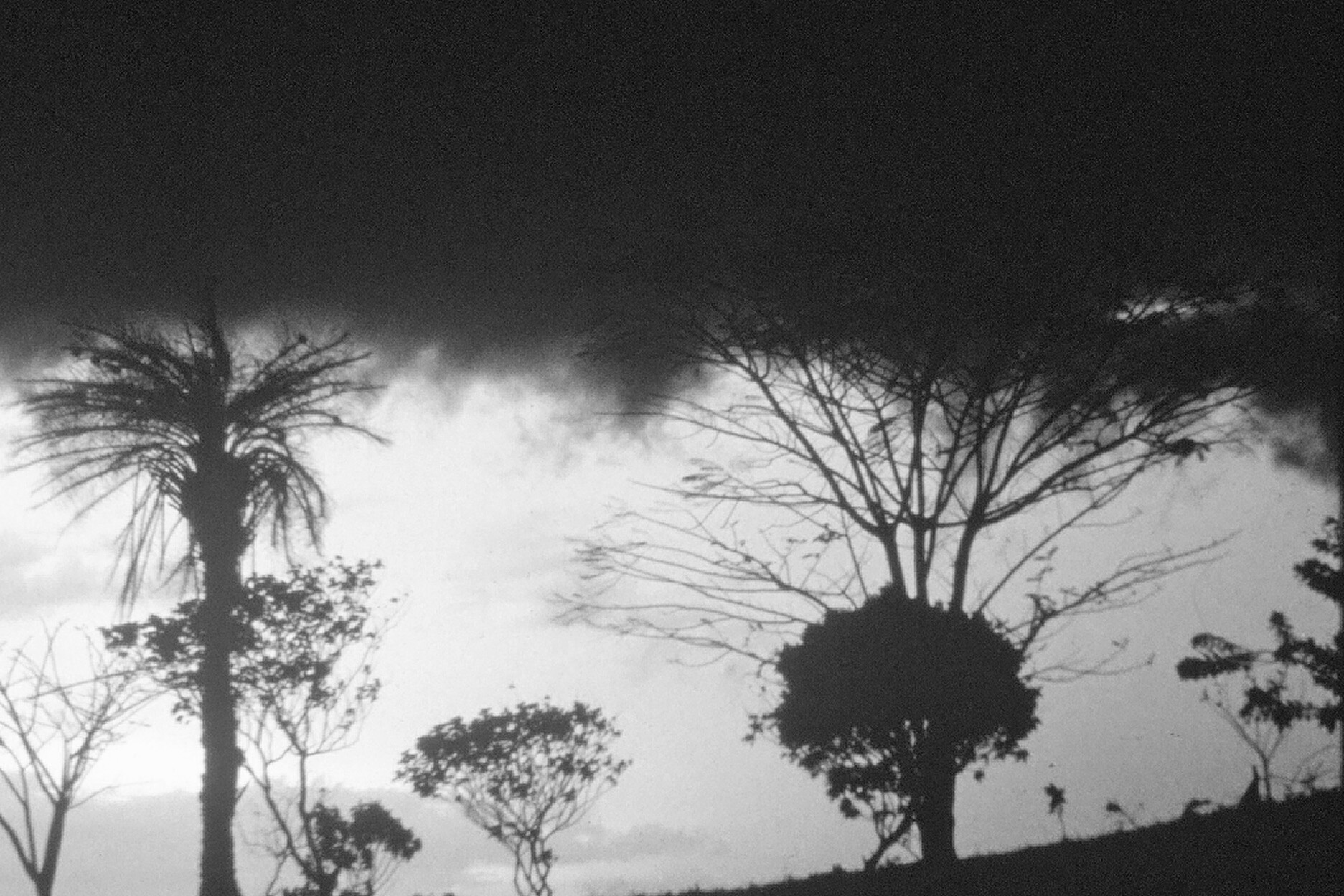
Gathering storm clouds over Liberia. I took this photo from my front porch in 1967. Looking back, it symbolizes for me the gathering political storm that would tear Liberia apart in the 70s, 80s and 90s.

Our job as teachers was to help bring Liberia’s tribal population into the twentieth century.

It was something of a first for the Country considering Americo-Liberians had worked hard for over a century to keep the tribal population in the darkest of the Dark Continent. Americo-Liberians were the descendents of freed slaves who had returned to Africa in the 1800s. They had promptly established themselves as the ruling elite.

It was a position they wished to maintain.

The times ‘they were a changing’ though. Independence was sweeping through Africa as one country after another threw off its colonial chains. Liberia’s tribal peoples were aware of what was happening in the world around them and the natives were getting restless.

The challenge to William Shadrach Tubman, who had been President since 1943, was to convince the tribal people they were getting a good deal, hold together a disparate people, make a show of it internationally, and still protect the privileges of the Americo-Liberians. Achieving the latter while moving forward on the first three was close to impossible.

It required an incredible balancing act at which Tubman was a master. The recipe for success involved one part substance, five parts fancy footwork and ten parts paranoia. The paranoia evolved from the fear that the tribal Liberians would take the process seriously and demand an equivalent portion or, God forbid, all of the goodies. Or possibly the nation would shatter apart.

As long as we behaved ourselves, we were part of the substance. The Liberian government made it quite clear that there would be grave consequences for anyone caught challenging the supremacy of the True Whig Party. For Liberians, the grave consequences could literally mean a hole in the ground. For us, it was a one-way ticket out of the country.

Don’t bother with stopping at Go or collecting $120 (our monthly salary).

Phil Weisberg in our back yard. Virgin tropical rainforest provides the backdrop.

One of our fellow Peace Corps Volunteers in Gbarnga, Phil Weisberg, actually tested the government’s resolve just prior to our arrival. Phil was a tall, gangly PCV who always looked like he had recently lost something of profound value.

He became upset whenever President Tubman or Vice President Tolbert came to Gbarnga and all of the school children in town were required to stand beside the road and cheer.

It didn’t matter if the luminary was one or two hours late, which he often was, or if it was pouring down rain, which it did half of the time, or if the sun was boiling hot, which it did the other half; the kids were expected to be there.

Teachers were required to go along. While most of the Volunteers managed to find something else to do, Phil’s personality was such that if his kids had to suffer he was going to be right out there suffering with them.

One day he found himself waiting an hour in the hot sun for the President’s wife and decided to protest. He did so by penning a sign that said in the best Liberian English, “MRS. TUBMAN, YOU ARE TOO LATE!”

Two hours later when her motorcade came tooling in to Gbarnga, Phil held up his sign and waved it about. Minutes later he found himself arrested and thrown into jail. This was not a piddling little kick your ass out of the country offense. One didn’t mess with the President’s wife.

Luckily Phil had the power of the American government behind him. Diplomatic maneuvering plus a personally written apology earned him a get out of jail free card. He was even allowed to stay in the country and finish up his term, provided of course he behaved.

I understood why Phil got in trouble. Waving a sign around criticizing the Presidents wife was not how to win friends and influence people among the Americo-Liberians. We all knew that the government was paranoid. Just how paranoid, I was to soon find out.

Peace Corps teachers were required to undertake a project during their first school vacation in Liberia. Given my experience at the elementary school, I decided do away with Dick, Jane and Spot and write a second grade reader. Why shouldn’t Liberian children have their own readers that reflected their own culture? Peace Corps agreed.

I jumped in. There were teaching guides to review, people to interview, folk tales to gather, and stories to write, rewrite and finish in one syllable English.

Eventually I finished the reader and shipped it off to Monrovia. Peace Corps was excited about the book and assigned an editor and illustrator to work with me. I would soon be a published author. Not. WAWA (a term coined by experienced African hands that stood for West Africa Wins Again) struck.

The book wouldn’t be published at all.

I had made the mistake of assuming the government would support a reader that featured Liberian children and African Folk Tales instead of Dick, Jane and Spot. What I had failed to understand was just how paranoid the Americo-Liberians were about maintaining power.

Apparently the book was a highly subversive tract and I was a dangerous radical. Liberian children would learn about their native heritage and rebel. Another misstep and I would be booted out of the country… or worse.

My next criminal activity was to organize a student government at Gboveh High School where I was taught African and World History. I decided the exercise would help our students prepare for the future and give them skills they would need in helping to govern their country.

Everyone, including students, teachers and Mr. Bonal, agreed. We pulled together interested students, worked through developing by-laws and set up elections.

Then the kids decided they would organize and run for office on party tickets. Why not? It sounded like fun. To provide identification for each ticket, they adopted names. It never entered my mind that this gesture would strike terror in the hearts of Americo-Liberians.

Within 24 hours we had been accused by the Superintendent (governor) of Bong County of setting up competing political parties to the Government’s True Whig Party. Student leaders were told to cease and desist or they would be arrested and thrown in jail.

I was told indirectly that I should start packing my bags.

So we eliminated the tickets and names. We were then allowed to proceed but I have no doubt we were closely monitored. I couldn’t help but wonder which of my students or fellow faculty members reported regularly to the Superintendent on my treasonable behavior.

The senior class. Yes, there were only five students in the class! Mamadee Wattee, standing on my right with a brown shirt and tie, was the student body president. He is also featured in my blog about the Lightning Man. Later he would move to the US and become an elementary school principal.