The Striking Mucho Lake, Big Bison, and a Sign Forest… The Alaska Highway Series

Muncho Lake 6

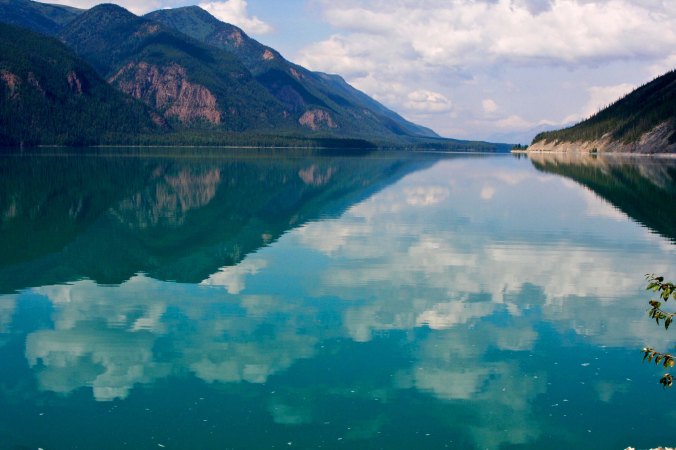
Striking hardly describes Muncho Lake in British Columbia with its striking topaz waters and reflections of the surrounding mountains. The lake reaches a depth of  732 feet (223 m).


My Wednesday photographic essay will continue to take us up the fabled Alaska Highway. Last Wednesday we travelled from Dawson Creek to Toad River. I featured views along the way, the building of the highway during World War II, Stone Mountain Sheep, and some very busy beavers. Today we will travel from Toad River to Watson Lake in the Yukon Territory, a distance of 201 miles (324 K). Along the way we will visit the striking Mucho Lake, check out the large woodland bison that hang out beside the road, and view a few of the 70,000 town and city signs that have made their way to Watson Lake’s huge sign forest.

Toad River

After leaving Toad River Lodge and our visit with the busy beavers, we were treated to a view of the Toad River that parallels the road.

View along Alaska Highway in BC

And this view.

Muncho Lake north

We would stop to admire Muncho Lake both on our journey north to Alaska and on our trip back south. We were heading north when we caught this photo. (Note: all photographs in this series are taken by Peggy and me.)

Muncho Lake in British Columbia

We captured this view on our return trip down the Alaska Highway.

Muncho Lake on the Alaska Highway

As well as this photo.

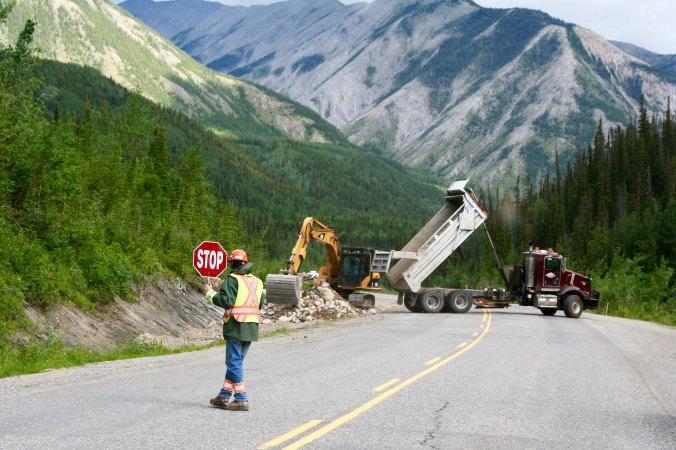
Road construction, Alaska Highway, BC

Here’s a common sight along the highway: road construction. Tough winters and permafrost pretty much guarantee employment for road workers.
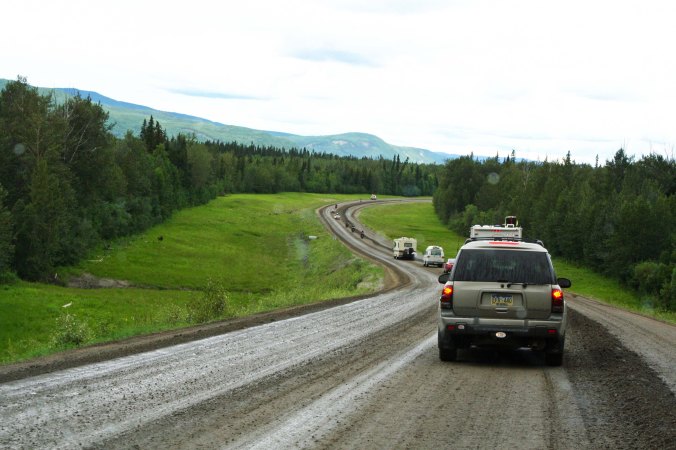
Road Construction along Alaska Highway

And here we go again, making our way through yet another construction project. Chipped windshields and damaged tires are common. We experienced both. We saw a bear somewhere in here. It may be the black spot on the left (or not).
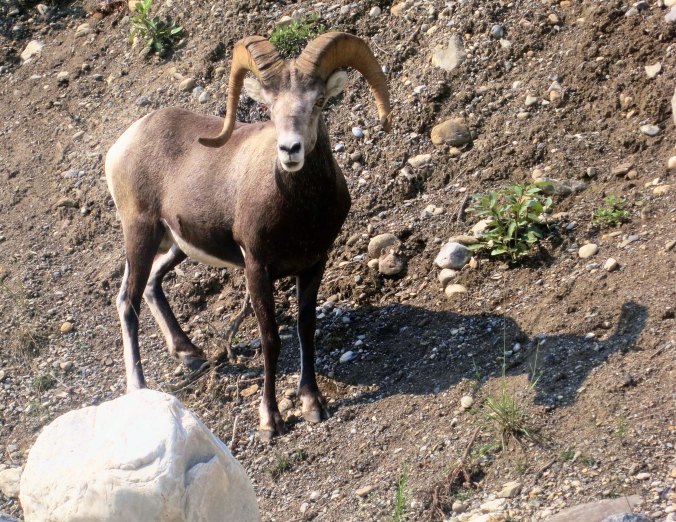
Dall sheep ram on Alaska Highway

We also found this handsome fellow, another Stone Mountain sheep. What really got us excited, however…
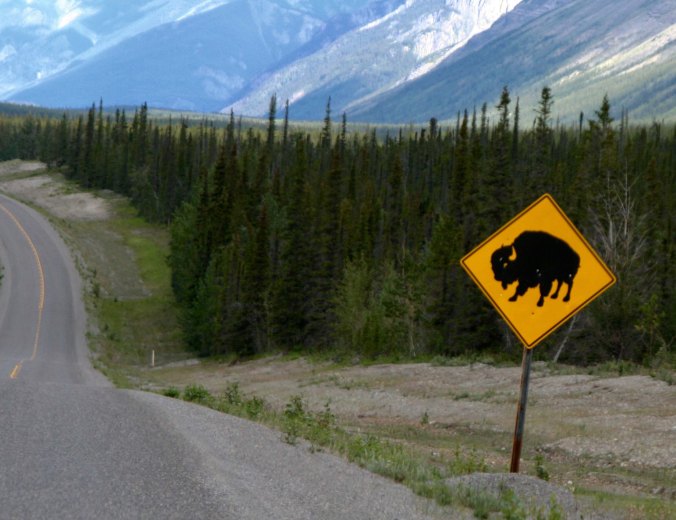
Bison warning sign on Alaska Highway

Was this sign. We had entered the territory of the wood bison, also know as wood or mountain buffalo— as opposed to their cousins, the plains buffalo.

Woodland Bison and wallow in BC

And they begin to appear shortly afterwards. This one has made himself a convenient wallow, that he will wallow around in to get rid of bugs.

Woodland bison bull

These guys are big, with massive shoulders. They can weigh up to 2000 pounds (900 kilos), which make them the biggest land mammals in North America.
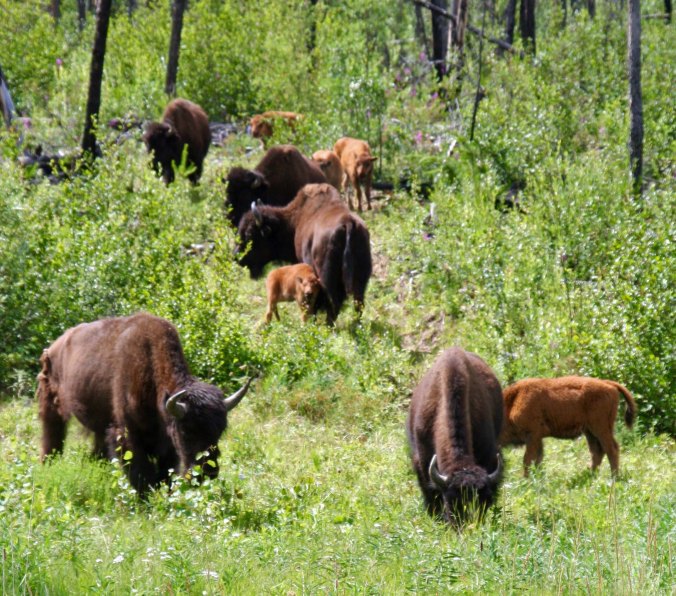
Herd of wood bison along Alaska Highway

We saw them both alone and in herds. They seem to like the edge of the highway for both its grazing opportunity and ease of travel.
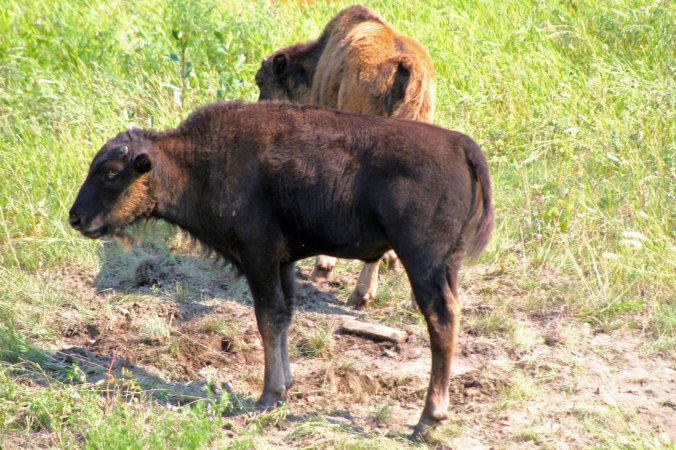
Woodland bison calves

A pair of youngsters…

Welcome to the Yukon sign

Here’s a sign to thrill the heart of the most jaded of travelers. Canada’s Yukon Territory is almost synonymous with remote and wild. I grew up listening to daring tales of Sargent Preston of the Yukon and his faithful dog King. “On King! On you huskies, on!”

Watson Lake sign forest 5

Not far up the road from the Yukon border we came to Watson Lake with its Sign Forest of 77,000 signs from all over the world. If you wander around long enough, you might very well find a sign that was liberated from your hometown and placed here by someone traveling up the Alaska Highway.

Watson Lake sign forest

The tradition was started during the building of the Alaska Highway in 1942 when a soldier, Carl K. Lindley was asked by his commanding officer to erect directional signposts. While at the job, he added a sign for his own town of Danville, Illinois. The rest is history!

Watson Lake sign forest 4

The signs go on and on…

Peggy Mekemson at Watson Lake Sign Forest

I’ll close today’s post with a photo of Peggy to provide perspective on the height of the Sign Forest.

FRIDAY’S POST: A chapter from The Bush Devil Ate Sam, my book about my Peace Corps experience in the jungles of West Africa.

MONDAY’S POST: We continue our journey down the Colorado River through the Grand Canyon.

SaveSave

Watson Lake: A Forest of 70,000 Signs… North to Alaska

If you look closely, you just might find your hometown among the 70,000 signs of Watson Lake.

If you look closely, you just might find your hometown among the 70,000 signs of Watson Lake.

When you are driving north to Alaska and enter the Yukon Territory, the first major town you come across is Watson Lake. The community has a strange claim to fame: a forest of signs from 70,000 communities around the world. People travelling the road have been leaving them behind for 70 years; they represent towns, cities, businesses, individuals and organizations.

According to legend, it all started in 1942 when a homesick GI who was helping build the Alaska Highway put up a sign that pointed toward his home and listed the miles. Ever since people have continued the tradition of saying “I was here.”

Peggy and I, along with our friends Bob and Linda Bray, wandered through the sign forest looking for our hometowns (no luck). It was like entering a maze. The following photos provide some perspective on what it is like, but you truly have to be there to get the whole effect.

Watson Lake sign forest

This close up provides an idea of how closely the signs are packed together and how far people have come to place them here. (Photo by Peggy Mekemson)

My friend Bob Bray, provides a perspective on how high the "trees" in the forest are.

My friend Bob Bray, provides a perspective on how high the “trees” in the forest are. (Photo by Peggy Mekemson)

Watson Lake sign forest in Yukon Territory.

Just about anything can be turned into a sign, as this toilet seat demonstrates. Also note the skull. How about “Parking for Estonians Only.”

I wonder how many street signs from around the world have been ripped off to make their way to the Yukon Territory?

I wonder how many of these street and town signs from around the world were stolen before making their way to the Yukon Territory?

The Watson Lake Sign Forest also features equipment used in making the Alaska Highway. In this case, Peggy serves as my model. Later I will do a blog on the building of the Alaska Highway in 1942.

The Watson Lake Sign Forest also features equipment used in making the Alaska Highway. In this case, Peggy serves as my model. Later I will do a blog on the building of the Alaska Highway, which took place in 1942 under the threat of Japanese invasion.

Speaking of the Alaska Highway, it was also featured in the forest.

Speaking of the Alaska Highway, it was also featured in the forest. (Photo by Peggy Mekemson)

Just outside of the sign forest, we stopped at the corner of 9th Street and the Alaska Highway. It was time to continue our journey.

The Watson Lake Sign Forest provided an interesting stop on our way north to Alaska.  But it was time to hit the road. (Photo by Peggy Mekemson)

NEXT BLOG: In 1980 Mt. St. Helen, located in the state of Washington, blew its top and became one of the world’s most famous volcanoes. Peggy and I stopped by for a visit on our way home from Alaska. (I am presently at Burning Man and will return next week to begin the Burning Man 2013 series.)