He caught me at a weak moment. Peggy and I had just re-entered the world of the living from our trip deep under the pyramid of Khafre at Giza and I was feeling a bit giddy. I’m not a fan of small, narrow, dark spaces. “You will look quite handsome in an Arab headdress,” the vendor told me. I looked at the white cloth and thought, to myself, “Ha, I can assessorize. It will match my beard.” He took our photo as Peggy and I did the tourist thing, using our hands to outline the Great Pyramid.
If you have ever been to Cairo, the odds are you have visited the pyramids and Great Sphinx at Giza. Over fourteen million people do every year. Located just outside the city, it’s an easy trip (depending on traffic) of just over 12 miles. Your journey back in time is a bit longer, some 4500 years. Of the three large pyramids, the Great Pyramid is the most famous. Considered one of the Seven Wonders of the Ancient World, it was built some 2000 years before any of the other six. And, it has outlasted all of its younger siblings. Its longevity alone should earn its claim to fame, but consider this: Standing at 481 ft, (146.5 m.), it was the tallest human-built structure in the world for 4,000 years! That’s mind boggling. Or was that aliens who built it? Grin.
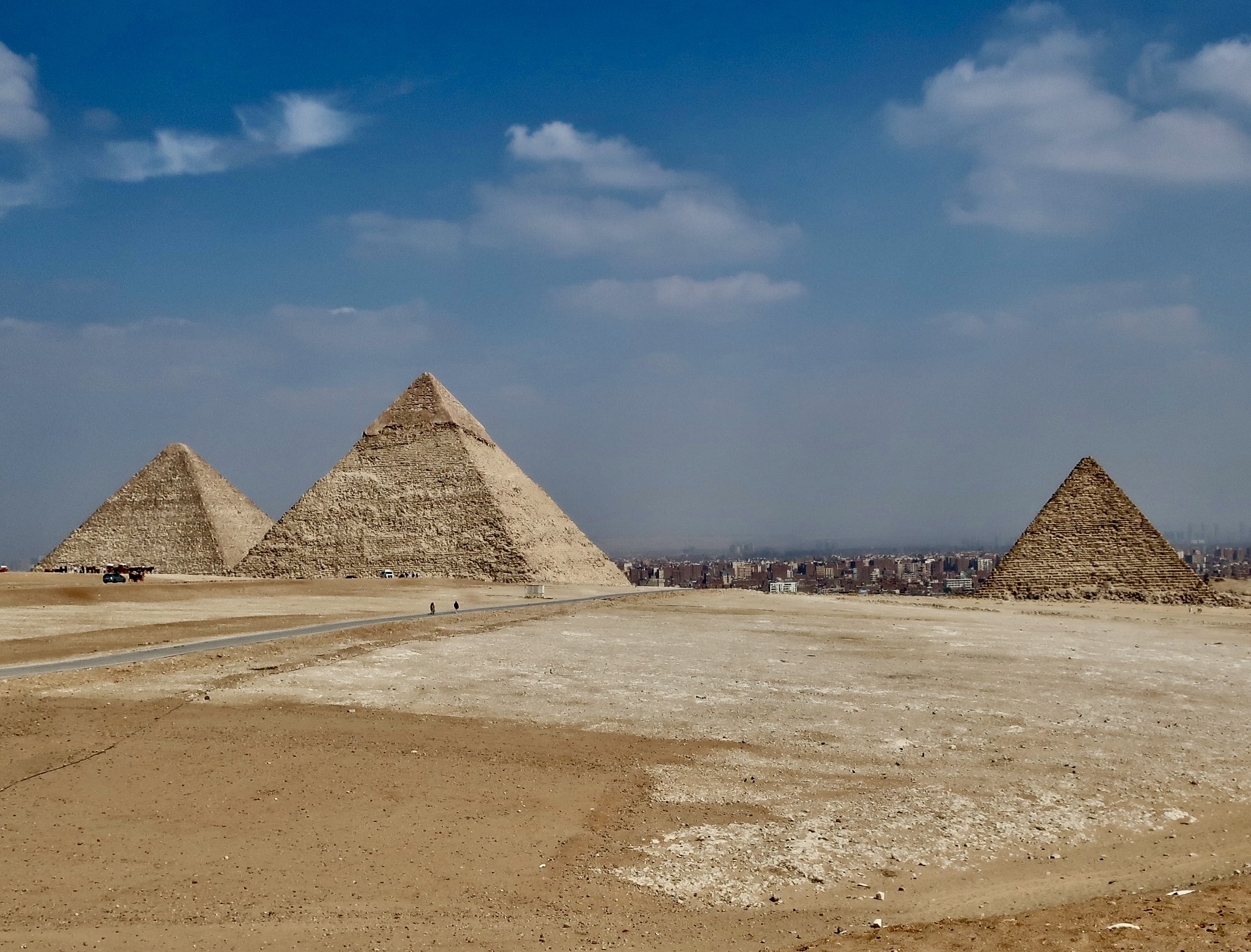
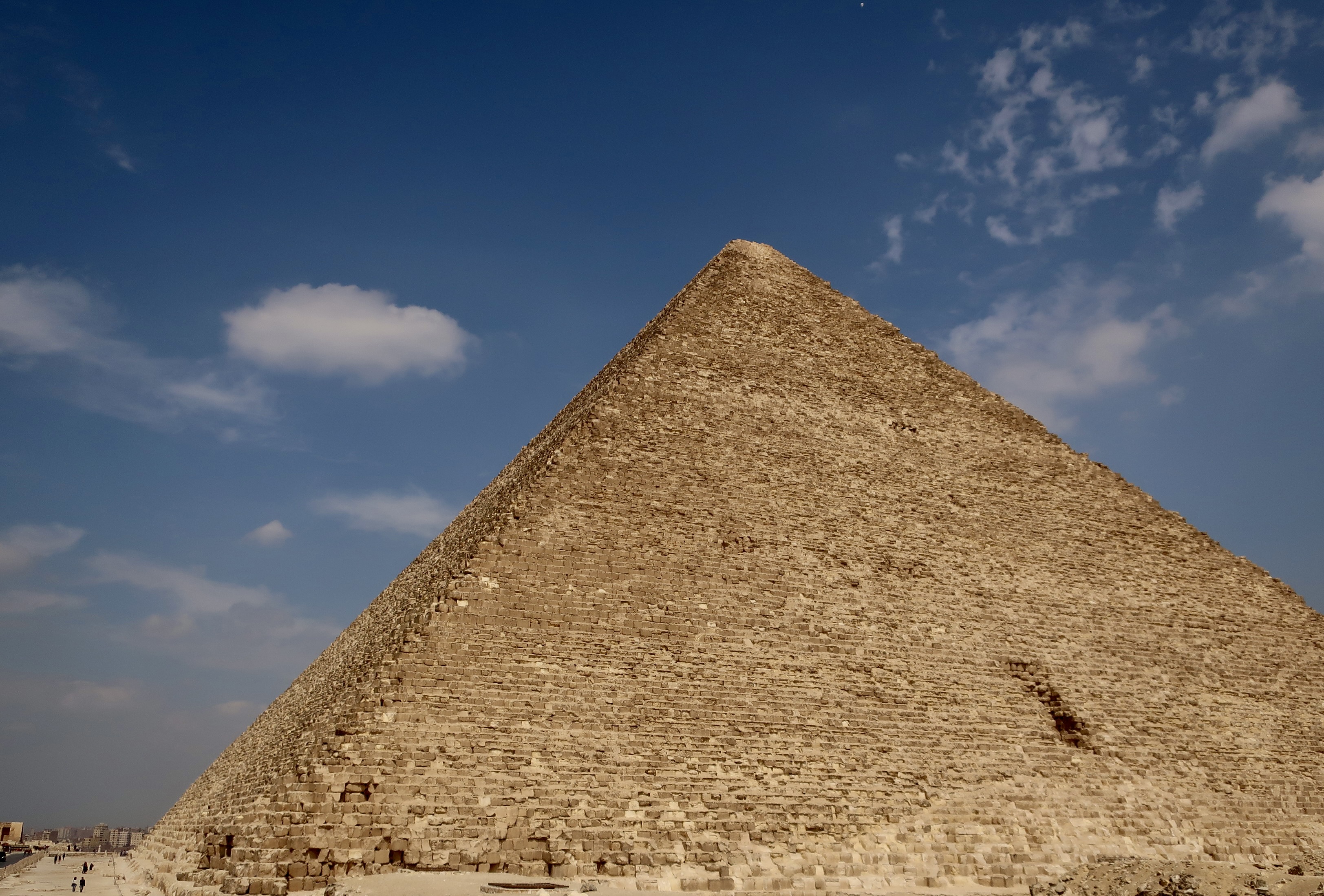
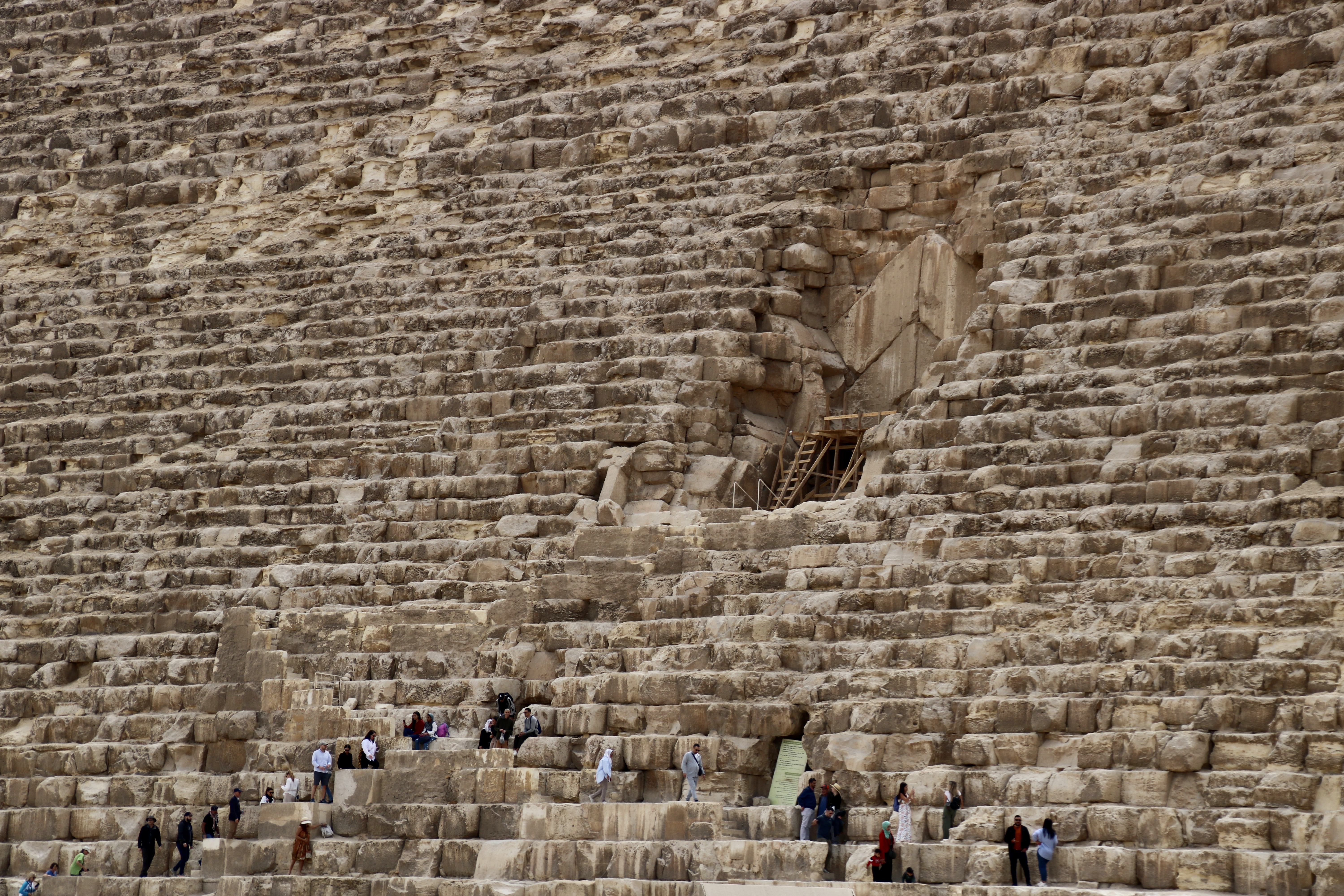
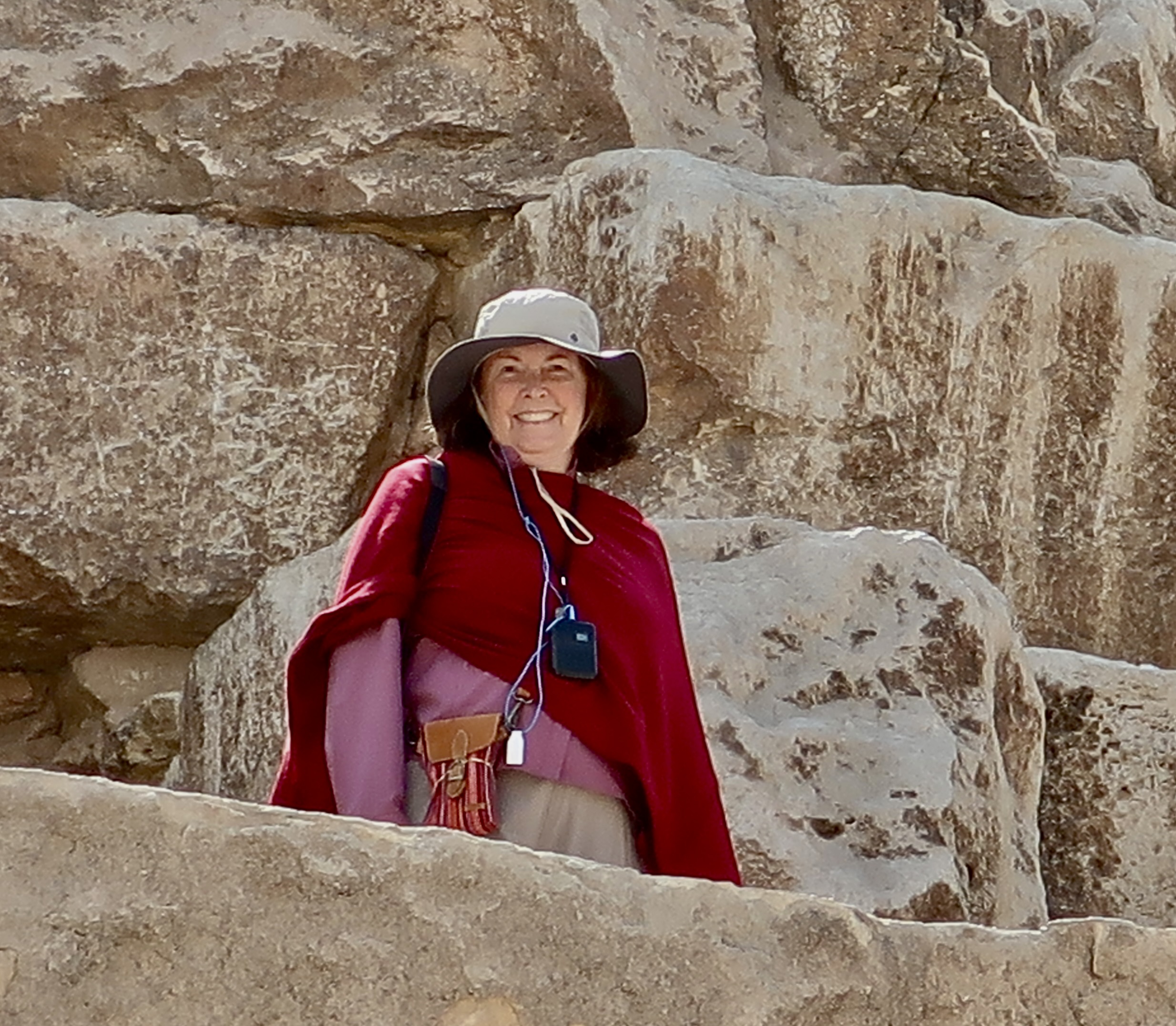
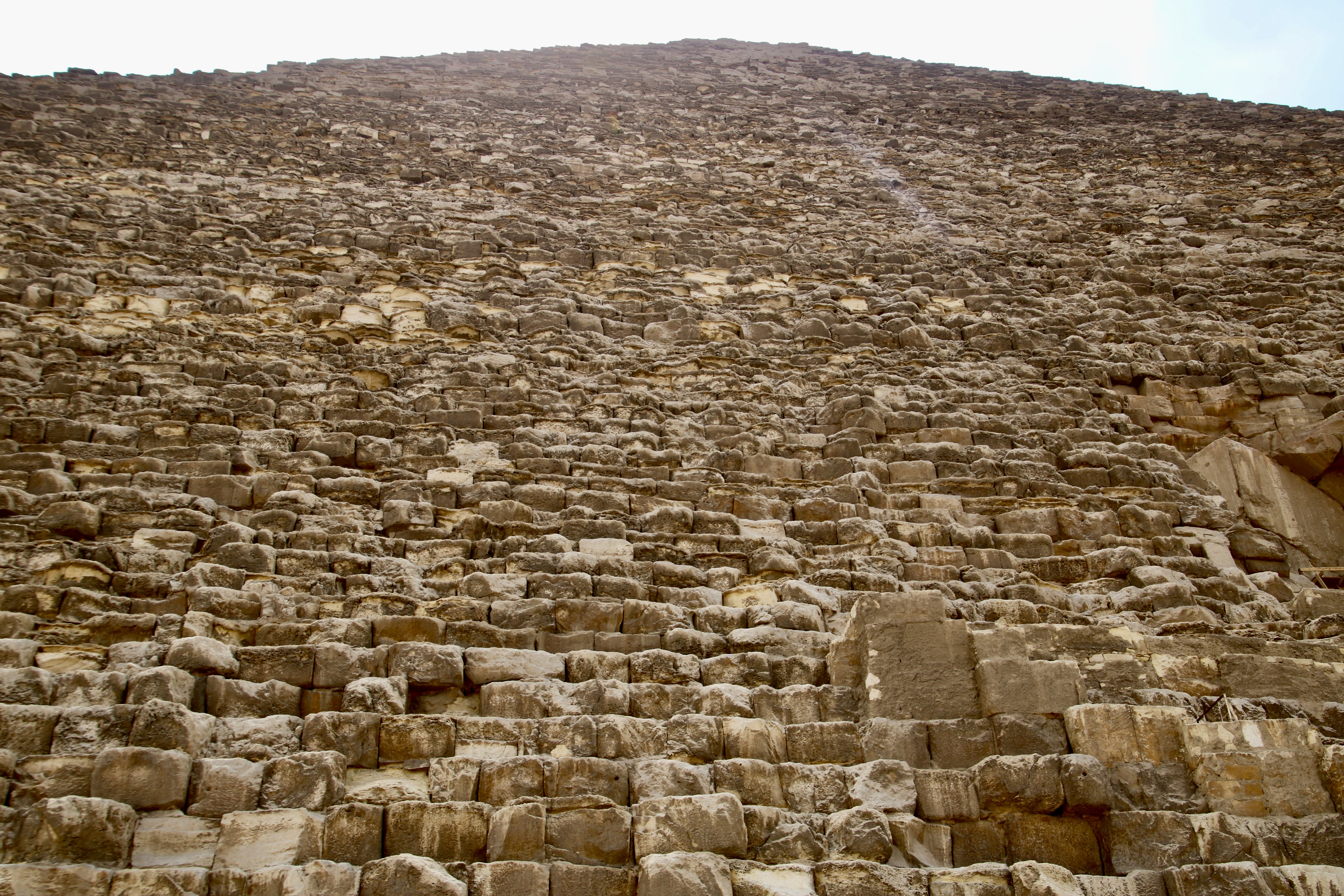
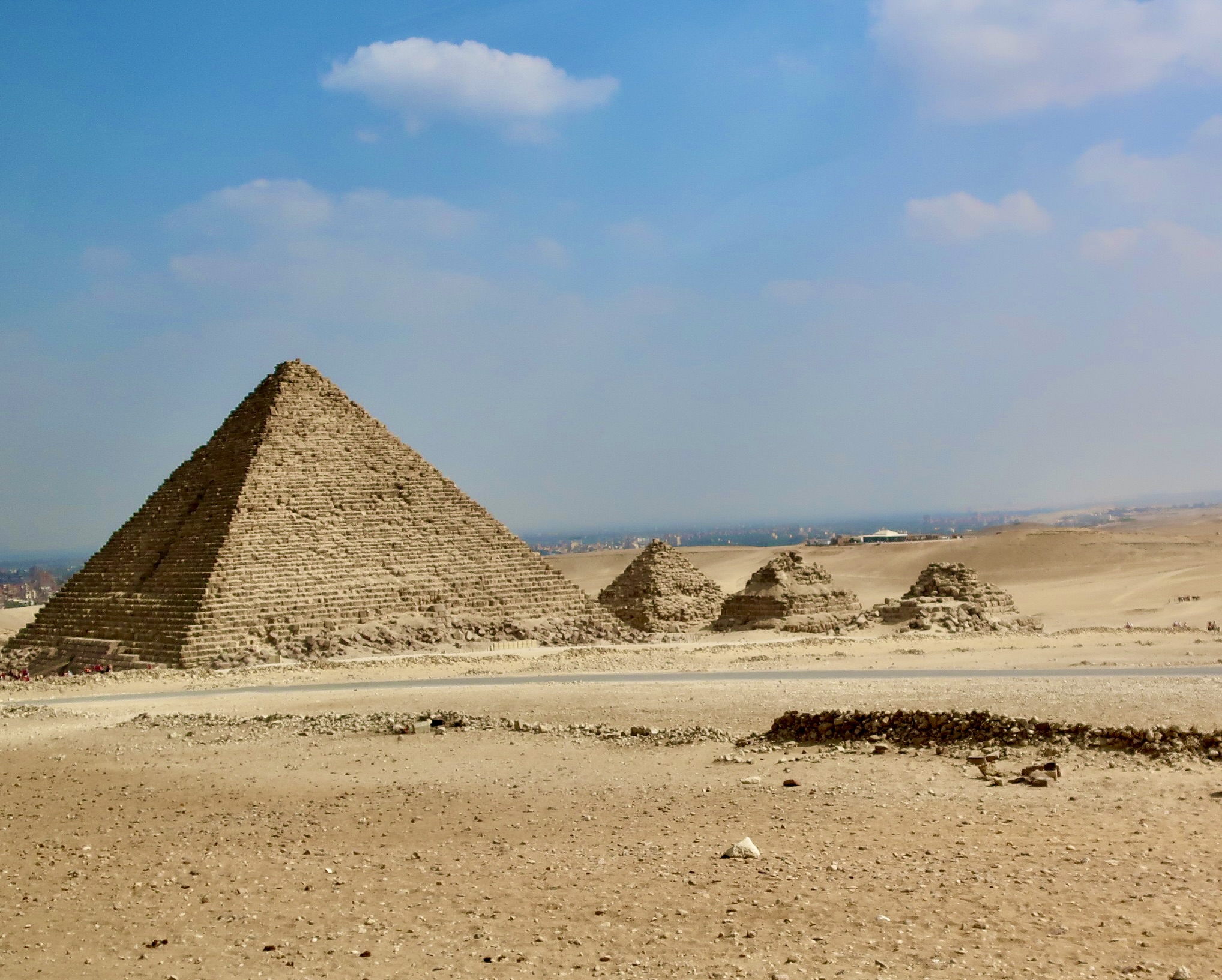
Seeing the pyramids is a must-do if you are visiting Cairo. They are located just a short distance from the city center. Cairo traffic may slow down your trip a bit, however…Here they are from left to right: The Great Pyramid, the pyramid of Khafre, and the pyramid of Menkaure. Perspective makes the pyramid of Khafre appear larger than the Great Pyramid in this photo. Cairo provides the backdrop. The tall buildings of downtown are barely visible through the smog.The Great Pyramid. One of the two entries can be seen on the right. People walking along the road on the left provide some perspective on size. This photo of the base of the Great Pyramid with the entry above, shows people walking along an established pathway. Peggy is one of them. People used to be able to climb the pyramids. Doing so now will get you a fine of somewhere between $639 and $6,390. I wonder if the amount is determined by how high you reach? Peggy, standing along the trail at the base of the Great Pyramid, provides a perspective on how massive the stone blocks used to build it are. It’s estimated that some 2,300,000 of these granite and limestone blocks were used in building the Great Pyramid with each block weighing an average 2.5 tons (2.3 metric tons). One of the all time great mysteries is how the ancient Egyptians moved the blocks into place. Answers have ranged from aliens (Twilight Zone music here), to greased ramps with hundreds of people pulling on ropes. More recent guesses have included ropes, pulleys and levers— simple machines to aid in the extensive human and possible animal power required. Another photo to capture the massive feel of the Great Pyramid. The pyramid was built in the early 26th Century BCE and took some 27 years to construct for the pharaoh Khufu. You might think that the Great Pyramid has given up most of its secrets by now, but on March 3rd of this year, scientists announced that they had discovered a new 30-foot hidden passage way using infrared thermography, 3D simulations and cosmic-ray imaging to peer inside the structure. The passage may very well be filled with ancient treasures. (Since I was celebrating my 80th birthday up the Nile near Aswan on the 3rd, I considered the discovery a birthday present.)The pyramid of the pharaoh Khafre is easily recognizable by the lime rock casing on top. All of the pyramids were once encased in lime polished to bright white. Seeing it at high noon must have been incredible. Blinding is another word. Over the millennia, the casing was repurposed/borrowed/stolen. Like the Great Pyramid and pyramid of Menkaure, Khafre’s pyramid was built during Egypt’s Fourth Dynasty (c. 2613 to 2494 BCE), which was considered the Golden Age of the Old Kingdom. We have several other photos of Khafre’s pyramid but the folding chair amused me. Not to mention the woman in black who seems to be hovering off the ground in a Flying Nun pose, and the herd of rent-a-camels waiting for customers. The blocks in the right foreground were once part of a temple associated with the pyramid. Peggy makes her way along the narrow passage under the pyramid of Khafre. Considering half of our journey into the depths was spent bent over avoiding rock/head collisions, this was actually roomy— until you met visitors coming from the other direction. Skinny was okay, but not so skinny could be similar to meeting an 18-wheeler going the wrong way on a one way street. The fuzzy state of the photo reflected my feelings about being under 4,880,000 tons of rock with the ghosts of a long dead pharaoh and possibly servants who had been killed to serve him in the afterlife. Can’t have the pharaoh fare for himself, right? If this practice was still in vogue at the time, it’s hard to imagine bumping into happy servant ghosts.And finally, we come to the Pyramid of Menkaure, the smallest of the three. It’s thought that the three smaller pyramids were for the pharaoh’s queens/wives/half sisters. If you look closely at the shadow side of the pyramid, you see a slice cutting down through it. There’s an interesting story. In 1196 CE, Saladin’s son, Al-Aziz Uthman, who was the Sultan of Egypt, recruited workmen to demolish the pyramids starting with Menkaure’s. Their challenge was they could only break up a couple of rocks per day. It was a slow process. After eight months, all they had accomplished was the slice featured above and they gave up. Apparently, the pyramids were as tough to tear down as they were to build, for which we can be thankful. Certainly one of the best known statues in the world, the Great Sphinx was built during the same time frame as the pyramids around 2500 BCE. Having the body of a lion and the head of a man, it was carved out of the bedrock where it now stands. Photos of it are often taken in conjunction with one or more of the pyramids. This one is the Great Pyramid. The missing nose was once attributed to Napoleon’s soldiers using it for target practice. Now it is felt that the nose was broken much earlier, possibly as early at the 3rd Century CE. Seen here in its entirety, the Sphinx was built in a direct line from west to east. It is 240 feet (73 m) long measured from its front paws to its tail and 66 feet tall (19 m) from the top of its head to its base. The Great Pyramid can be seen peeking out from behind the Sphinx’s head. And now for a Curt and Peggy special! Millions if not billions of photos have been taken of the Great Sphinx’s head, often with a pyramid thrown in for good measure. But how often do you find a picture of its tail with a pyramid. Classy, huh? 🤔
And now on to what 62.5 % of you have been waiting for: Camels.
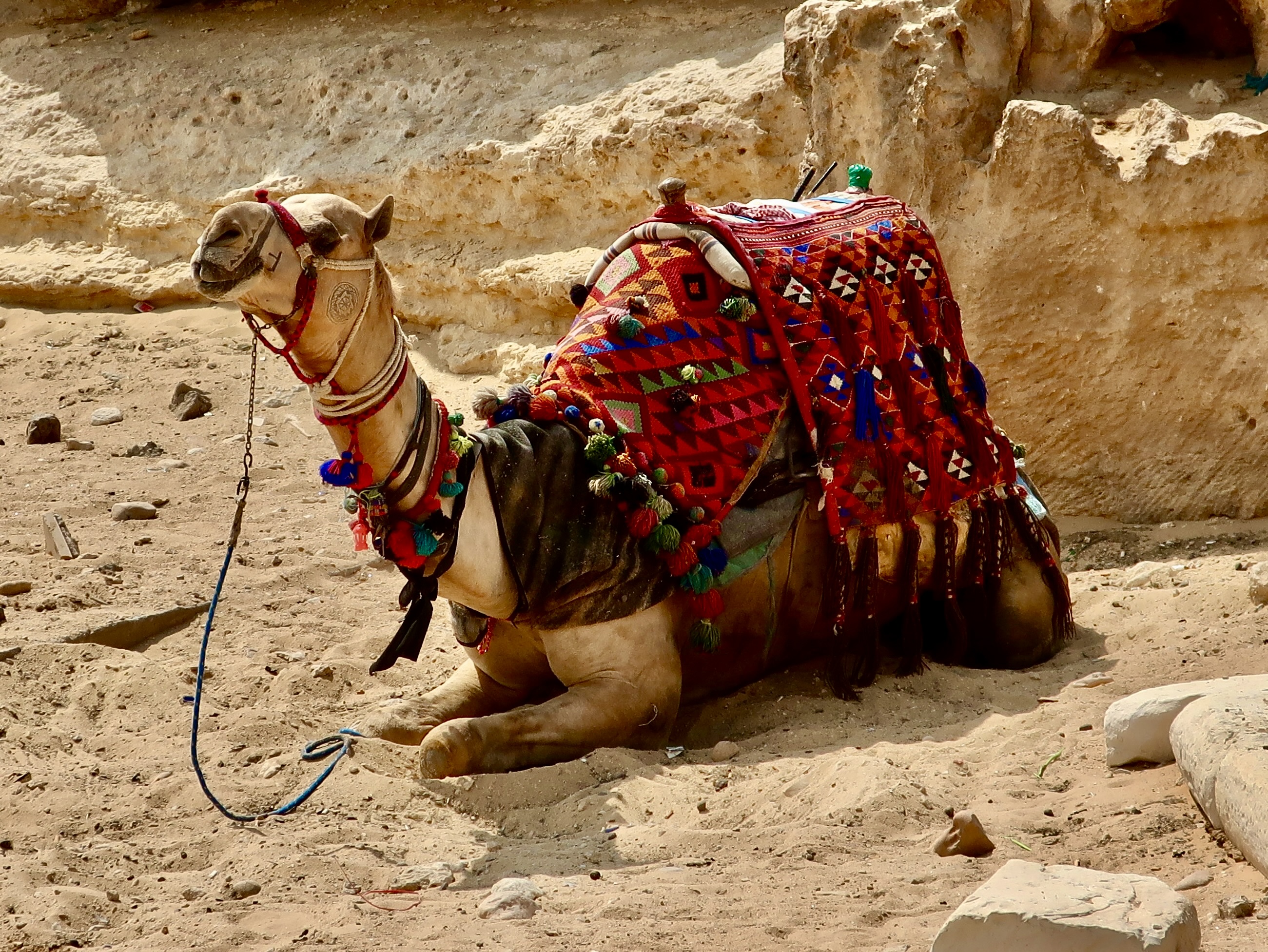
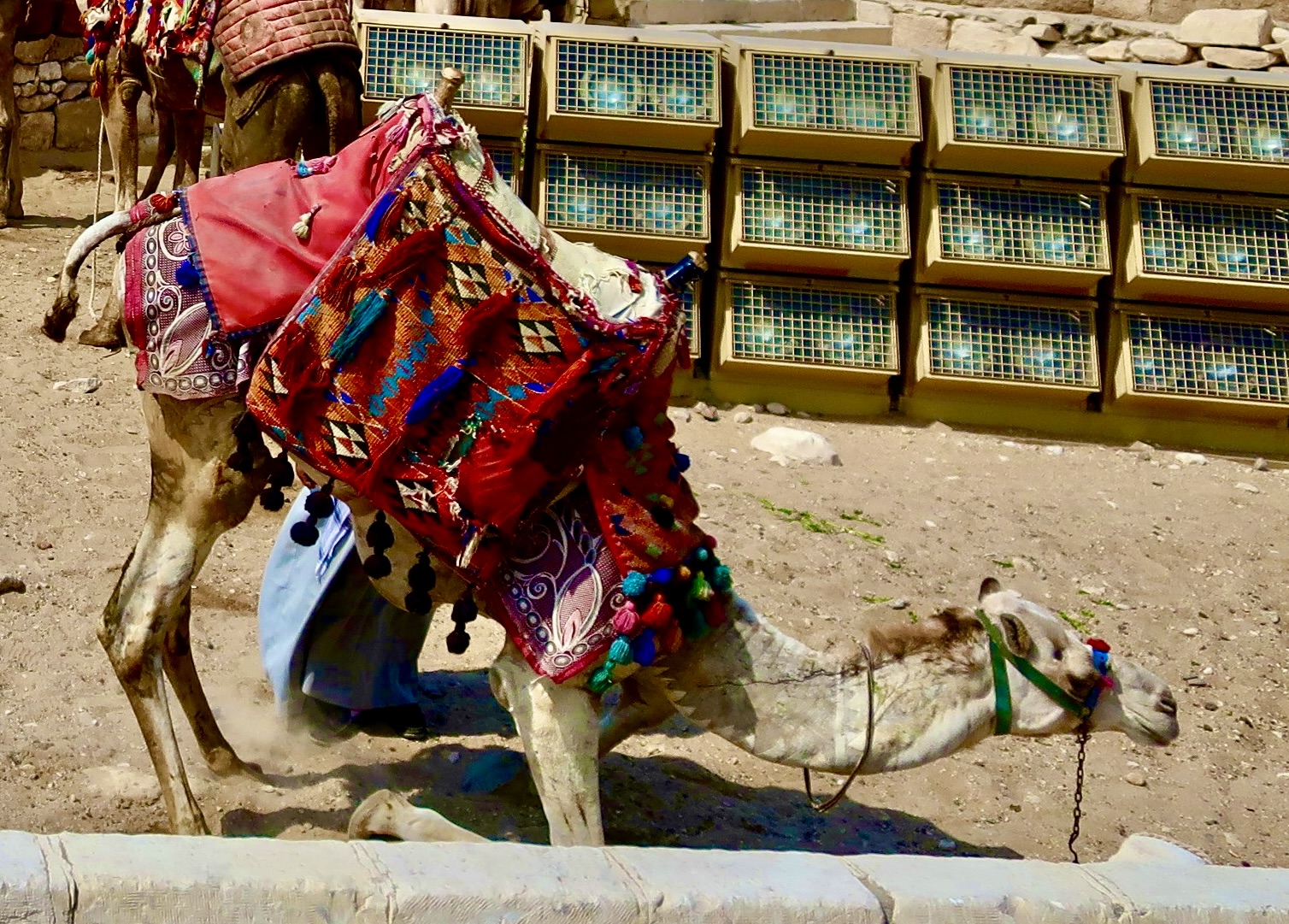
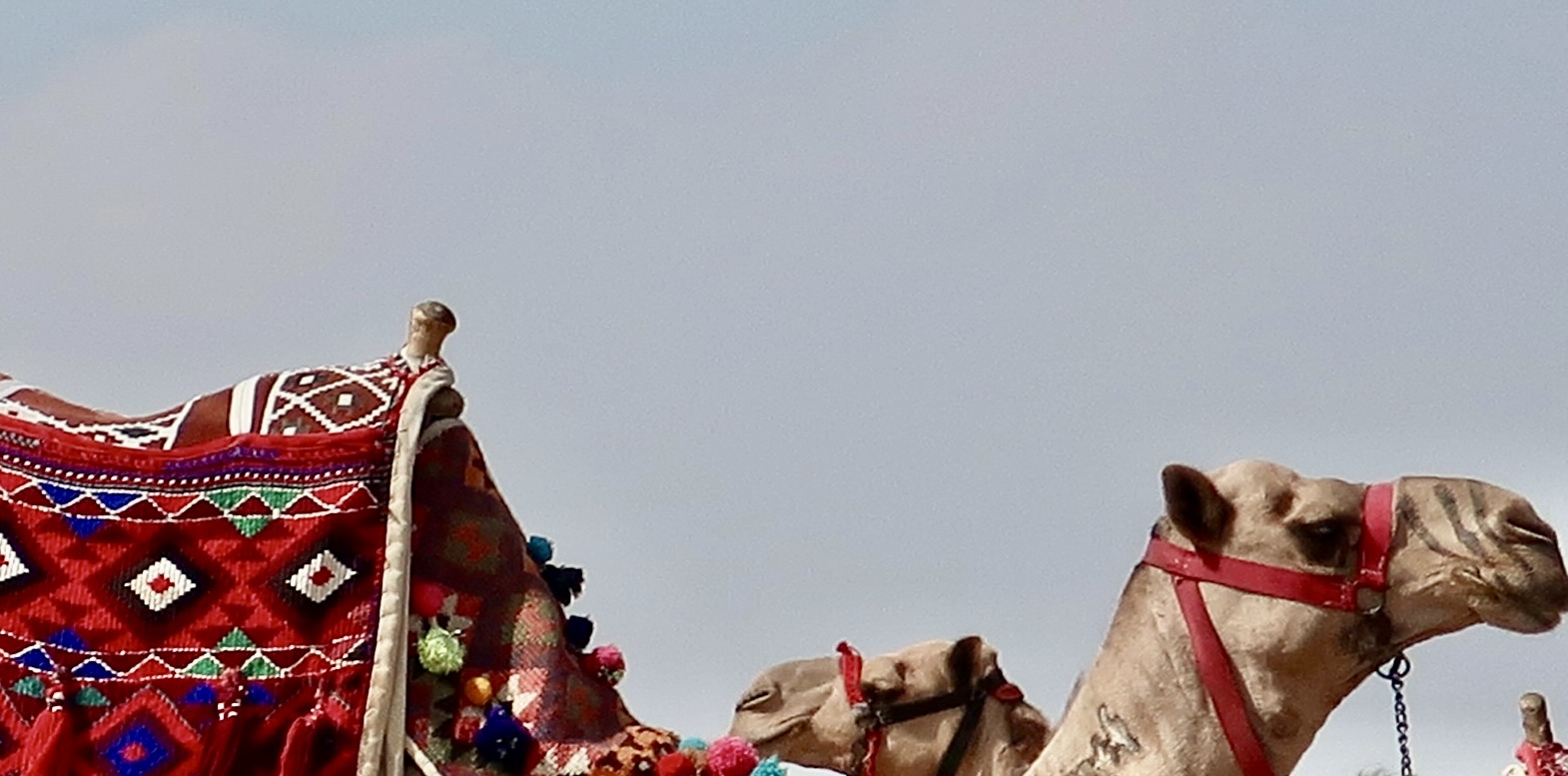
Giza Uber…Pink tongue. Check out the symbol on the camel’s neck. Each camel, as far as I could tell, had its own unique tattoo. This one also had face decorations.“Getting down,” camel style. Again, note the neck decorations.Horse or camel? The foot print might prove a clue. Don’t you just love it when I post scat photos? That’s the nature boy in me. I—did—not–do—that!How a camel driver rides camels. Note the legs.How tourists ride camels.Remember the old saying, “Two ships passing in the night?” These are two camels passing in the day. Did you know that camels are often called ships of the desert because they carry cargo across long distances in the desert just like ships carry cargo across the ocean. They are uniquely fit for their role. For one, they can carry up to 400 pounds for 25 miles a day. They can go for several days without water and up to two weeks without food. Their leathery lips and mouth allows them to chomp down on delicacies such cactus and other spiny desert plants. Eyes, ears and noses are designed to withstand sand storms. Large feet help keep them from sinking in the sand. Wearing a size 14 shoe, I know something about the latter.Remember back when I posted my introduction to our Egypt trip and had a camel photo bomb me. Here he is to conclude my blog on the pyramids, Great Sphinx and camels of Giza.
Next post: Big Foot’s Big Foot and my wrap up on South Dakota.As you read this post, Peggy and I are off on another adventure, starting today (Monday, June 25). Once again, we are on a three month trip exploring North America with Serafina the trailer, Iorek the truck, Bone and Eeyore. We’ll keep you posted.
Today, Peggy and I are beginning our series of blogs on our journey through Egypt up the Nile River on a riverboat with the UniWorld Cruise company. We hope you will join us. As always, all photos are taken by either Peggy or me unless otherwise noted.
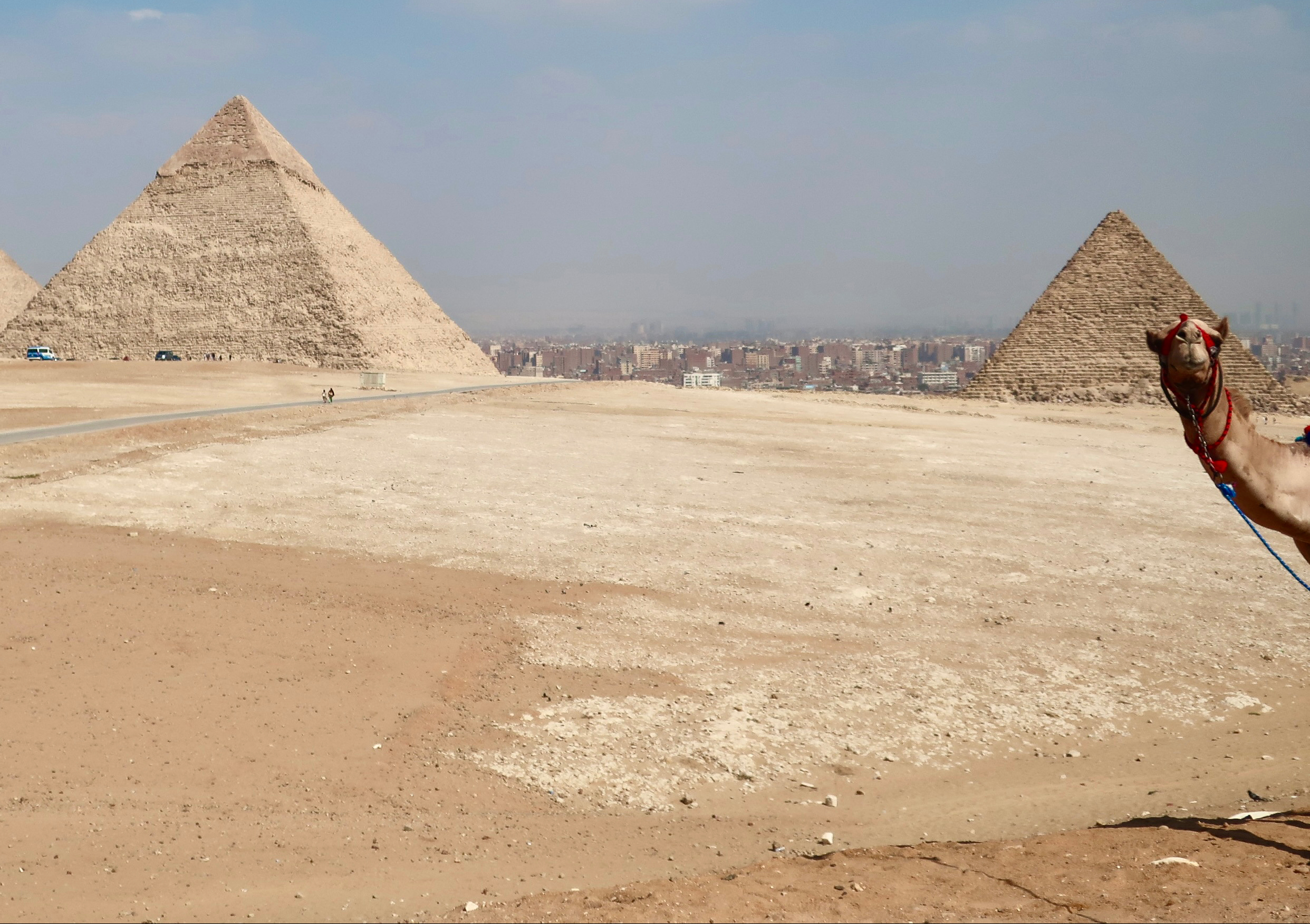
I was setting up a photo of the pyramids of Khafre and Menkaure when a camel head suddenly appeared in my viewfinder. Was I being photo-bombed? I quickly snapped the picture. A free photo of a camel at Giza is not to be passed up. Note the emphasis on free. Camel drivers and camels are everywhere. You are welcome to the take their photos, have your photo taken with them, or even go for a ride. All for a substantial fee, of course. Not paying is frowned upon.
Visiting the pyramids of Egypt at Giza is like climbing into a time machine. The Pyramid of Khafre on the left was built around 2,570 BCE and the Pyramid of Menkaure on the right around 2510 BCE, which makes them both over 4500 years old! The beginning of Egyptian history is traced back even further, to 3100 BCE, over 5000 years ago.
The Sahara Desert and the Nile River kick-started the process. 10,000 years ago the Sahara Desert wasn’t. It was a huge savanna where wandering herders grazed their goats and cattle. It is now thought that some combination of climate change and overgrazing changed the savanna into the vast desert it is today. The herders needed somewhere to go and the Nile River was their best option. The river provided a continuous source of water for thirsty stock. Its annual floods assured that there would be rich soil for farming. Increasing population along the river led to the creation of villages and towns, eventually leading to cities, kingdoms and even empires in a time period that extended over 3,000 years.
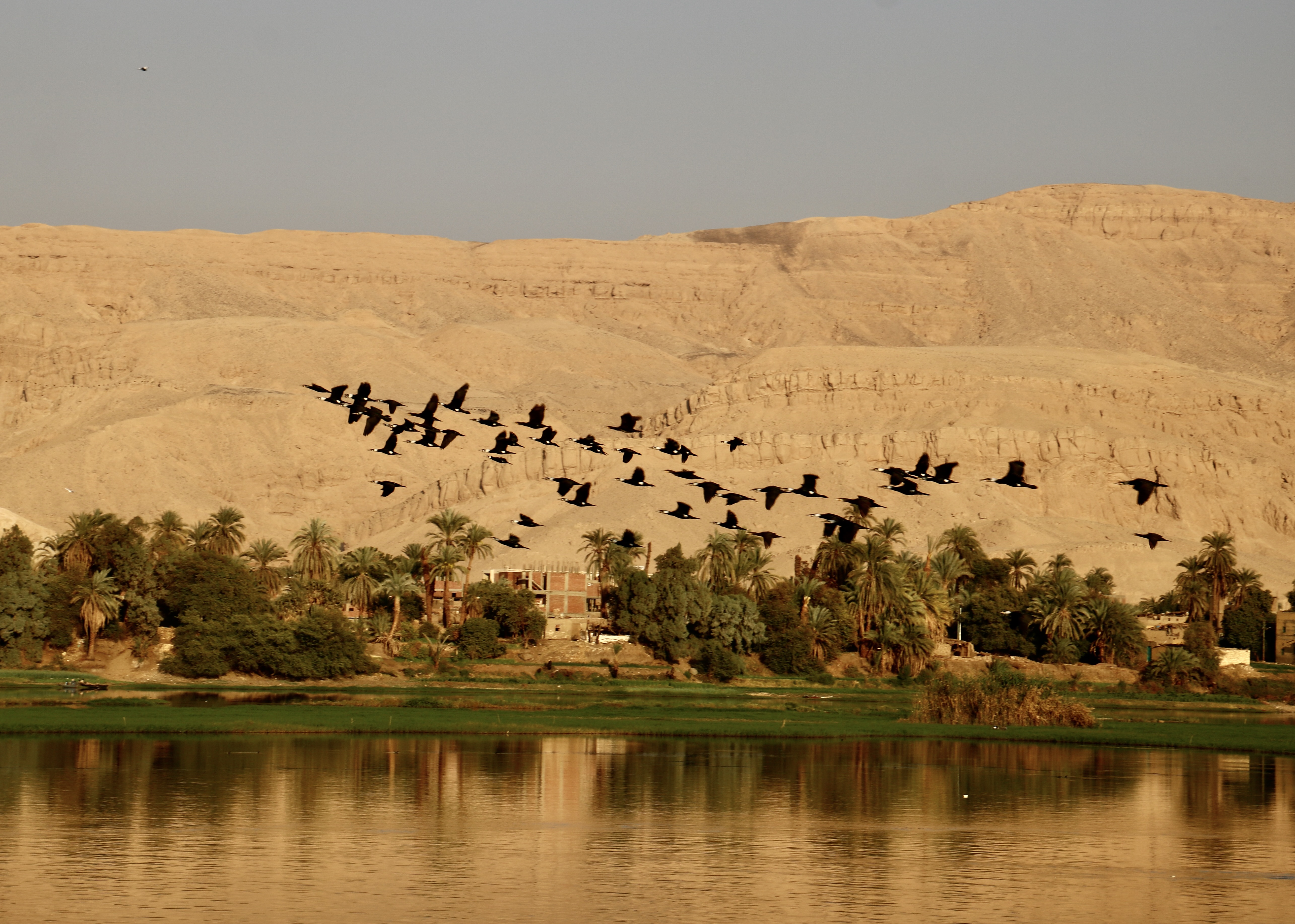
We took this photo from our boat to capture the ducks flying over the Nile River, but it also serves to illustrate the contrast between the green of the river and the reddish-brown Sahara Desert beyond that stretches all the way west to the Atlantic Ocean.
The pyramids speak to more than ancient history and the engineering marvels. They reflect the ancient Egyptians’ deep belief in the afterlife, magic, and the numerous gods who impacted their lives from birth to death— and beyond. This belief in the afterlife (plus the pharaohs’ exploits and claimed relationship to the gods) dominated the temples, tombs and monuments we visited as we explored the area around Cairo, made our way up the Nile, and visited the city of Alexandria.
There are numerous myths about the gods and I’ll be relating several as I go though my posts on Egypt. I find them both fascinating and fun. One thing to note here is that most of them have several versions. Five thousand years is a long time to keep a story straight. For example, today I am going to tell about one of the great founding myths, that of Osiris and Isis. Like most great tales, it is filled with murder, mayhem, adventure, sex, twists, magic and even a bit of humor. That Osiris was killed by his brother, chopped into pieces, put back together, and became God of the Underworld where he sat in judgement of the dead is generally agreed upon. The details on how he was killed, managed to get Isis pregnant with Horus afterwards, and was put back together vary with the teller.
The version that I am writing about was originally told by Plutarch in the second century AD. I first read it in a book by Joseph Campbell, Transformation of Myth through Time, over 30 years ago. I like this version because it has a Cinderella aspect to it, i.e. if the coffin fits, wear it.
This story starts with the goddess of heaven, Nut, and the god of earth, Geb. The god of air, Shu, separates Nut from Geb. Night and day are created by the sun god, Ra, who sails across the sky in his boat during the day, is swallowed by Nut in the evening, journeys through her at night, and is born again in the morning through a somewhat natural birth.
Nut the Goddess of the Sky is about to swallow Ra, the Sun God, in this photo we took in one of the tombs in the Valley of the Kings. Night is about to begin. The symbols on Nut’s body represent stars. Hieroglyphs fill the space on the right, providing advice and spells to aid the pharaoh in getting through the dangerous underworld on his way to eternal life.
Nut and Geb get together and give birth to four children. The older twins, Osiris and Isis, are born first, and, in the tradition of Egyptian gods and pharaohs, marry each other. Osiris, with the help of the clever Isis, replaces Ra as the king of Egypt and gets the throne. Seth and Nephthys are born next and and marry each other. Now the fun begins. Osiris is the typical good son and represents order. Seth is the typical bad son and represents chaos. It’s Osiris that creates the trouble, however. One night he sleeps with Nephthys, claiming he thought it was Isis. (Joe Campbell notes that this isn’t paying attention to detail.) Whatever the reason, Seth doesn’t buy it. Would you? He vows to get even.
He builds a beautiful (and undoubtably incredibly expensive) sarcophagus/coffin made out of gold that is exactly fit to Osiris’s size. He waits until a great party is going on and everyone has consumed large quantities of beer (the go-to drink of the time) before showing up with his golden sarcophagus. “Whoever fits can have it!” he declares. Naturally everyone is excited to try, but nobody fits. Except Osiris. He’s just beginning to enjoy his triumph when 42 of Set’s servants rush out, slam the lid closed, wrap iron bindings around it, and throw it in the Nile.
End of story, right. A solid gold coffin can hardly be expected to float. Except it does. Osiris is a god, after all. In fact, it floats all the way to Syria where it lands and a tree grows around it. And what a sweet smelling tree it is. So sweet that the local king decides he wants to use it for a pillar in a castle he is building. Meanwhile, Isis, in deep mourning, is searching the world over for Osiris. She ends up in Syria where she stops for a drink at the community well and hears the story of the sweet smelling pillar from maids who work at the castle. “Aha, Osiris!” she thinks. She also learns that the king has a new son who needs a nursemaid. She applies for and gets the job.
Isis really likes the baby, nurses it from her finger, and decides to make it immortal by throwing it in the fire each night to burn away its mortality. While this is going on, she assumes the form of a swallow and flies around the pillar, twittering mournfully. One night the queen comes in on this scene and discovers her baby has been thrown in the fire and the nursemaid has become a twittering bird. Needless to say, she gets a little excited and screams. Isis immediately morphs back into herself, saves the baby, explains what she was doing, and asks the king if she can have the pillar. “Of course,” he says. (My thought is that he wanted to get the baby-burning goddess out of his life as quickly as possible.)
Isis gets a barge, loads the sarcophagus and heads home. Feeling lonely on the way, she opens the coffin, finds a quite dead Osiris, and climbs on in what seems to be a bit of Necrofilia. I’m not sure how it works, but she becomes pregnant (god thing again). Another version, which I like better, has her turning back into a swallow, flying over the coffin and being impregnated by magic. Immaculate conception is a common theme of Egyptian mythology. One myth I came across has the sphinx being born as the son of the lion goddess Sekhmeth after she is impregnated by a moonbeam from the Moon God. Explain that one to your husband. The Ankh, Egypt’s well known symbol of life and immortality, is also problematic when it comes to immaculate conceptions as well.
Having an ankh blown or shoved up your nose by a god was a great gift of life and immortality, highly desired by the pharaohs. Down around a woman’s midsection, it might have something other than a nose on its mind and be on its way to making a baby. It was known for making some women ankh-ious. (Sorry, my bad.)
Back home in Egypt, Seth has assumed the throne and will not be glad to have Osiris back, dead or alive. So Isis heads into a papyrus swamp where she hides out and gives birth to Osiris’s second son, Horus. Nephthys has already give birth to his first son, Anubis.
All goes well until Seth follows a boar he is hunting into the papyrus swamp and finds the dead Osiris. Infuriated, he tears Osiris into 15 pieces and scatters them throughout Egypt. Once again, poor Isis sets out to get her dead husband back. Anubis, who is a Jackal in his animal form, and Nephthys help in the search. They can only find 14 pieces. Osiris is missing his genitals. A fish has eaten them.
They stitch Osiris back together with the parts they have and Anubis embalms Osiris, turning him into a mummy. Meanwhile, Horus grows up and goes to war with Seth to avenge his father. In a horrendous battle, Horus loses one of his eyes while Seth loses a testicle. Not quite reciprocal justice (an eye for an eye and a tooth for a tooth), but close. Seth also loses the battle, however. Horus takes the throne and order is restored to Egypt while Seth is banned to the desert. Horus’s eye is magically restored and comes to symbolize making things whole and healing. It even brings life back to Osiris, who becomes god of the underworld.
People admire a sculpture of Annubis at the Egyptian Museum in Cairo. The sculpture was found guarding the tomb of King Tut. Egyptians considered Annubis’s animal form to be that of a jackal because of his close association with the dead. Jackals were known to hang out around cemeteries, probably hoping to dig up a free handout. Heh. Peggy and I brought home this tapestry featuring the Eye of Horus from Egypt. Nekhbet, the goddess of vultures, is shown on the right. Wadjet, the coba goddess is shown on the left. All three were frequently depicted in ancient Egypt. Not a bad trio. Nekhbet and Wadjet protected pharaohs and the Eye of Horus could heal them.
My next post on Egypt, two weeks from now, will feature more history, mythology, and photos of ancient Egyptian sites from around Cairo. Next Monday Peggy and I will take you on a drive through Custer State Park, South Dakota that will focus on some rather unusual and magnificent stone sculptures.












 Wandering through Time and Place