The Peace Corps Leaves us Behind in New York City…

There's an old saying: "When treed by a lion, you might as well enjoy the scenery." My trip to the 1965 World's Fair in New York City resembled that. In this photo, Jo Ann poses with Rex.

Having successfully completed Peace Corps Training, our next task was to fly to Liberia, Africa. The thought was both exciting and scary. We didn’t need was another major adventure on the way…

Our reward for completing Peace Corps training was one week at home.

We were supposed to complete whatever business we had before disappearing into the jungles of West Africa for two years. Since there wasn’t much to do, Jo and I relaxed and recovered from our tumultuous year that had begun with the Free Speech Movement at Berkeley.

We wrapped up our brief visit with a going away party in Jo Ann’s back yard.

Surrounded by friends and family we talked into the night. It was one of those perfect summer evenings that California is famous for, complete with a cool breeze tainted with a hint of honeysuckle flowers.

Jo Ann’s parents drove us down to the San Francisco Airport the next morning for our flight to JFK where we would meet up with our group. Her mom slipped us a hundred-dollar bill just before we climbed on the plane. “Just in case.”


Now we were disembarking at JFK, two country kids who had traveled a long way from Diamond Springs and Auburn, California. All we had to do was check in at the Pan Am desk, grab a bite to eat, and catch our trans-Atlantic flight to Africa.

Ah that life should be so simple. Oh we managed to find the Pan Am desk all right, but no one was there.

“Excuse me, could you tell me where the Peace Corps group is?” I asked a harried attendant.

“I don’t have any idea,” was the brusque reply.

Have you ever had the sinking feeling that you have blown something critically important in a very big way? It starts with the hair follicles on your head and works its way downward to your toes. Every part of your body jumps in to let you know you aren’t nearly as smart as you imagined you were.

It’s the stomach that serves as the real messenger, however, and mine was rolling like the Atlantic in a hurricane.

“Check the instructions again, Curt,” the voice of reason standing beside me directed. Good idea.

“Well, it says right here we are supposed to be at the Pan Am desk no later than 5 PM.” It was only 4. My stomach calmed down to a respectable jet engine rumble. “Let’s have a bite and check back.” I suggested, working hard to be the man

Five PM came and no one, nothing, nada. It was serious panic time. “Wait here Jo in case anyone comes. I’ll go check the instructions one more time.”

We had stuffed our bags in one of those drop-a-quarter-in-the-slot storage lockers while we ate. I freed my shoulder bag from captivity and reread the instructions. Yes, we were in the right place at the right time. Then there it was, the answer, staring at me in black and white. “You will fly to JFK on August 7th.”

It was the 8th.

Uttering swear words on each step, I slowly climbed back up the stairs.

“I’ve found them Jo Ann.” A look of relief and the beginning of a smile crossed her face.

“Where are they?”

“They’re in Liberia.” Waaaaaaaaaa!

Let me say this about the two of us; we were both stubborn as mules when we thought we were right. This could create problems when we disagreed but the potential for disaster was miniscule in comparison to when we both agreed we were right and we weren’t. Reality didn’t matter and certainly a little date on a piece of paper we had each read a dozen times wasn’t going to deter us.

The 7th was our going away party and that was that, period. While we were kicking up our heels in Auburn, our compatriots were crossing the Atlantic. Now we were stuck in New York City.

“What are we going to do?” Jo asked in a shaky voice. The only thing that came to my mind was a double vodka gimlet

It was probably a good thing United Airlines let us on the airplane in San Francisco without noticing our tickets were one day out of date. Had we called Washington from home, the Peace Corps may have been tempted to say, “Why don’t you just stay there.”

As it turned out, the Peace Corps representative sounded amused when we called the emergency number after our visit to the bar. “Did we have enough money to get through until tomorrow?” Yes, thanks to Jo Ann’s mom.

“OK, call this number in the morning.” We decided to sleep in the airport to save our scant resources. It was a resolution with a short lifespan. I had one extremely unhappy young wife on my hands and my sleeping habits were unwilling to accommodate a deserted airport lounge.

Somewhere around midnight I said, “Look, Jo, I am going to see if a cab driver will help us find a hotel we can afford.”

The first guy in line was a grizzled old character in a taxi of similar vintage. I told him our story. He studied me for a moment and then said, “Go get your wife and I’ll find somewhere for you.

A more cynical observer might note we were lambs waiting to be fleeced but what followed was one of those minor events that speak so loudly for the positive side of human nature. The taxi driver took care of us. He reached across the cab, turned off his meter and then drove to three different hotels. At each one he would get out, go inside and talk to the manager. At the third one he came out and announced he had found our lodging.

“This place isn’t fancy,” he reported, “but it is clean, safe and affordable.” Affordable turned out to be dirt-cheap. To this day I am sure the cab driver finessed a deal for us. Two very exhausted puppies fell into bed and deep sleep.

The Peace Corps representative we talked to the next morning wasn’t nearly as friendly as the one the night before but at least he didn’t tell us we had to go home. A commercial flight to Liberia would be leaving in three days. “Could we hang out in New York? Did they need to send us some money? Could we follow directions?”

A very skinny Curt and the US Pavilion at the World's Fair

Yes we could hang out; no, they didn’t need to send money, and yes we could probably find our way to the proper airline at the correct time on the right day.

Jo and I visited the World’s Fair, checked out the City and considered the three days as an extension of our all too short honeymoon. As the old saying goes, all’s well that ends well.

Next up: Warm coke and cookies for breakfast in Dakar, Senegal
I sign up for the Peace Corps, but there’s this problem…

It was 1965 and I was faced with a dilemma. Uncle Sam was looking for warm bodies to ship off to the jungles of Southeast Asia to fight in a colonial war the French couldn’t win. Being a 22-year-old male about to graduate from college, I was a prime candidate.

If drafted, I would go. But fighting in a war I didn’t believe in, killing people I didn’t want to kill, and possibly being killed or crippled myself was at the very bottom of my list of things I was excited about doing.

A temporary solution presented itself. Peace Corps Recruiters were coming to campus.

Ever since Kennedy had created this idealistic organization three years earlier, I had been fascinated with the idea of joining. Two years of Peace Corps would not eliminate my military obligations but it might buy time for the war in Vietnam to work itself out.

Of more importance to me, it sounded like an incredible experience. My fiancé and I sat down and talked it out. She was willing to sign up with me and we would go together as a husband and wife team.

When the Peace Corps recruiters opened their booth in front of the UC Berkeley Student Union, we were there to greet them, all dewy eyed and innocent.

“Sign us up,” we urged.

Of course there were a few formalities; small things like filling out the umpteen page blue application and taking a language aptitude test, which featured Kurdish. We also needed letters of recommendation.

Apparently we looked good on paper. In a few weeks, Peace Corps informed us that we had been tentatively selected to serve as teachers in Liberia, West Africa. We were thrilled. That age old question of what do you do when you graduate from college and have to enter the real world had been answered for us, at least temporarily.

Uncle Sam with his growing hunger for bodies to ship to Vietnam would have wait.

There were still two hurdles, though, and both were tied to the illusive if. We could go if we could pass the background security check and if we could get through training. Training wasn’t a worry. We had enough confidence in ourselves to assume we would float through. How hard could it be after Berkeley?

The Security Check was something else. Jo Ann, of course, was squeaky clean. But Curt had been up to a little mischief at Berkeley, hung out with the wrong people, been seen in a few places where law abiding people weren’t supposed to be and had his name on a number of petitions.

“And where were you Mr. Mekemson the night the students took over the Administration Building?”

Maybe there was even a file somewhere…

Soon I started hearing from friends at home. The man with the badge had been by to see them. The background security check was underway. One day I came home to the apartment and my roommate Jerry was there, looking very nervous.

“I have to talk to you Curtis,” he blurted out. “The FBI was by today doing your Peace Corps background check and I told them you had been holding communist cell block meetings in our apartment.

Jerry was not kidding; Jerry was deadly serious; Jerry was dead.

“What in the hell are you talking about?” I had yelled, seeing all of my hopes dashed. I knew that Jerry disagreed with me over my involvement in Berkeley’s Free Speech Movement and probably disagreed with me over the Vietnam War, but I hadn’t a clue on how deep that disagreement had gone. Or what he based his information on.

My degree in International Relations had included a close look at Communism. I found nothing attractive about the system.

The closest I had personally come to any truly radical students had been the Free Student Union. Yes I had held a committee meeting at our apartment but I had also severed my relationship with the organization as soon as I figured out the folks behind the Union were primarily interested in fomenting conflict.

It was not a happy time at the apartment that night or for many weeks. I assumed the Peace Corps option was out and begin thinking of alternatives. They were bleak.

As it turned out, a few weeks later we received final notification from the Peace Corps. We were accepted. The people who said good things about me must have outweighed the people who said bad things. Either that or Jo looked so good they didn’t want to throw the babe out with the bath water.

Or maybe most of the other students signing up for the Peace Corps from Berkeley in 1965 had rap sheets similar to mine. I suspect they did.

There was one final hitch. We had our Peace Corps physicals at the Army Induction Center in Oakland. That was an experience. I quickly recognized that the physical was designed as the first step in making soldiers, a part of the de-individualization process. Lining up with a bunch of other naked men to be poked and prodded isn’t my definition of fun.

“Turn your head and cough.”

I took it like a man and escaped as soon as the opportunity presented itself. A couple of days later I came back from class and there was a note from my other roommate, Cliff.

“The Induction Center called,” he wrote, “and there was a problem with the urinalysis.” I was to call them.

“Damn,” I thought. “Why is this so difficult?” So I called the Induction Center and resigned myself to having to pee in another jar. With really good luck I might avoid the naked-man-line but I wasn’t counting on it.

I got a very cooperative secretary who quickly bounced me to a very cooperative nurse who quickly bounced me to a very cooperative technician who quickly bounced me to a very cooperative doctor… none of whom could find any record of my errant urinalysis.

They didn’t see any problems and they didn’t know who had called. They suggested I call back later and be bounced around again. More than a little worried, I rushed off to my next class.

That evening I reported my lack of success to Cliff. He got this strange little smile on his face and asked me what day it was.

“April 1st,” I replied as recognition of having been seriously screwed dawned in my mind. “You little twerp!” I screamed, as Cliff shot for the door with me in fast pursuit. It took me four blocks to catch him. The damage wasn’t all that bad, considering.

Next up: What do Peace Corps training and a dead chicken’s dance have in common?

Good Mornin Teacha

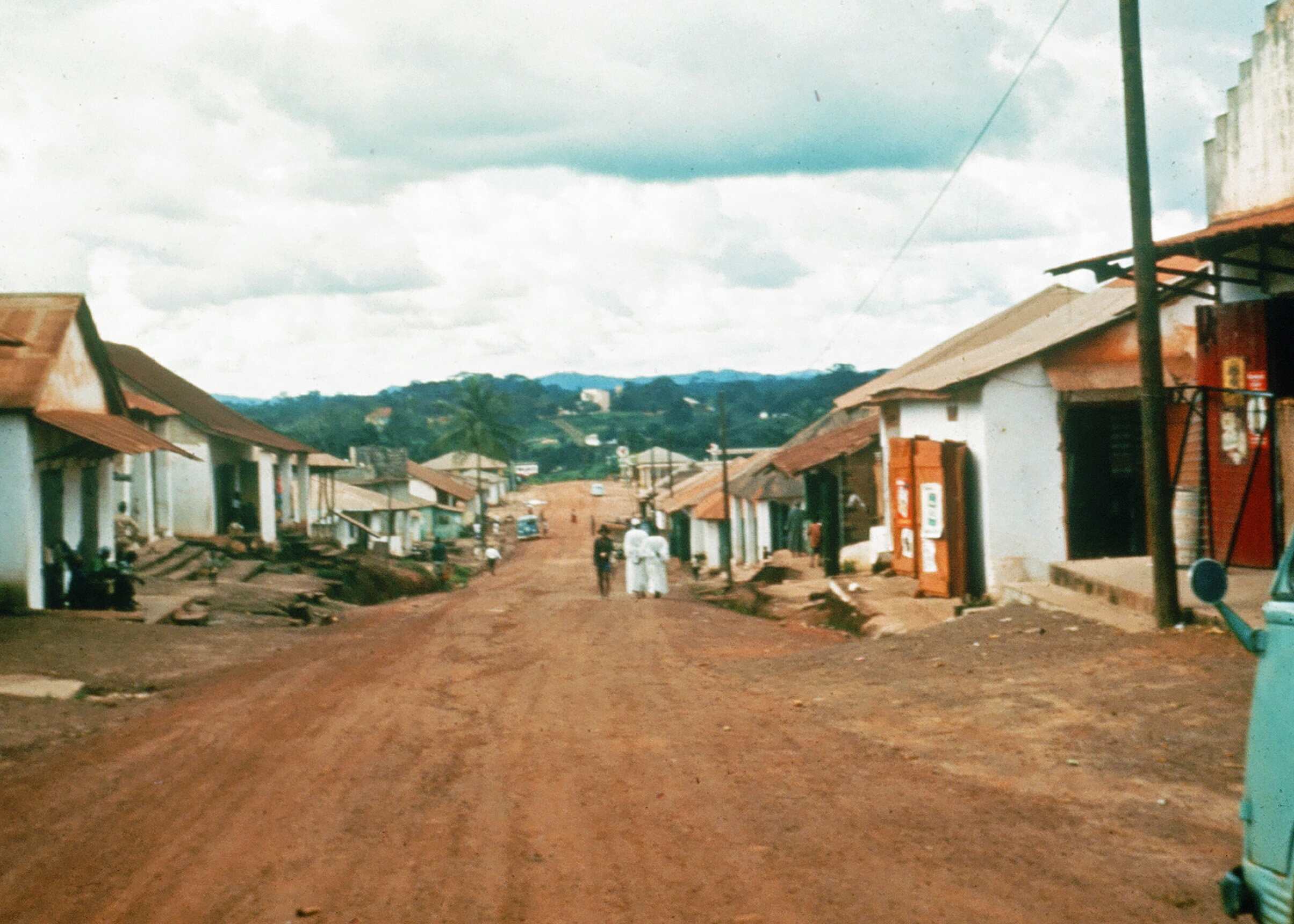
Main street Gbarnga circa 1965. Our main shopping district.

“Good Morning Teacha” thirty bright and shiny faces shouted in unison as I walked into the classroom on my first day of teaching in Gbarnga.

“Good morning,” I responded in my best new Peace Corps Teacher voice. And then reality struck. I was expected to entertain and actually teach these kids something over the next several months.

Unless you are a teacher, you might be saying, “Hey, how hard can it be to teach a group of second graders?” My only response is “Try it some time.”

Plus there were handicaps.

My students ranged in age from seven to twenty-two and spoke several different tribal languages. While Kpelle was the predominant language used in our area, several others were represented. English was supposedly the common language but its reach into tribal areas was minimal.

Pidgin English Liberian style provided the bridge. For example, I might say to you, “I have to go down town for about twenty minutes. I promise I won’t be gone long. Please wait for me.” The Pidgin English equivalent would be, “Wait small, I go come.”

One idiom I learned quickly was, “Teacha, I have to serve nature.”  That meant, “May I have your permission to use the restroom?” Actually it was permission to use the outhouse or just as likely the ‘bush’ or even the side of the building. Some of my male students would listen to me through the open window as they did their thing on the wall. I admired their dedication but discouraged the practice.

Books created another problem; for the most part, there weren’t any. What we did have for reading were vintage 1950 California readers complete with Dick, Jane and Spot. I suspect we should have been grateful for anything but it was difficult for the Liberian kids to identify with big white houses, white picket fences and little white kids.

As for Spot, he bore a striking resemblance to food. Later, when I had a cat, my students would tease me by coming by, pinching him and saying, “Oh, Mr. Mekemson, what fine meat.”

Getting sick didn’t help the education process. I had been teaching for two months when I met an obnoxious tropical bug that knocked me out for several weeks. It announced its presence with a low temperature of 100 degrees that soon climbed to 103. Normally it hovered around 101.

As for its pedigree, who knows? Les Cohen, the Peace Corps doctor, would come by and shrug his shoulders a lot. He used the lottery approach to medicine. We must have explored his whole medicine chest.

The sad thing about being sick was that there were no substitute teachers. Whenever a teacher was absent, the class was left to fend for itself.  Often, my students would come by to check on how “Teacha” was doing.

“How are you feeling Mr. Mekemson? When are you coming back to teach? Can’t you teach us while you are sick?” There’s nothing like thirty kids standing around your house and looking mournful to create guilt.

At least I was able to plow through a number of the 100 books the Peace Corps generously provided for Volunteers. There was also entertainment of another sort. Each day around 10 AM a woman would stop in the dirt road opposite our house, squat down and pee.

I didn’t have a clue to her motivation but I found myself looking forward to her visits. Maybe she was practicing Ju Ju (African medicine). Or maybe she just had to go or was marking her territory. Who knows? I tried to pry out of Sam what she was up to but he would just shake his head and mutter in Kpelle.

Evening entertainment was supplied by Miranda Hall. This popular bar/dance hall added substantially to my already splitting headache. Loudspeakers perched on top of the establishment blasted African High Life music for miles around. Since it was located one hundred yards from our house, we received the full benefit of its marketing campaign.

One song I remember from hearing at least ten times a night had a country-western theme: “Woe is me, shame and scandal in the family.”

Later, I actually witnessed a little shame and scandal in the house next to the bar. I was walking by when the ‘man of the house’ came down the street, nodded to me and went inside. It seems he was early. I heard a loud shout at the same time a well-endowed naked man burst through the screen window and hit the ground running. Right behind was the jilted husband. The two streaked by me and disappeared downtown.

The naked guy was really fast.

Les was out of town when my illness finally decided to peak.  As my temperature passed the 103 mark and headed for 104 I began to worry about hallucinating and becoming irrational. I asked Jo to contact an Indian doctor who served the local community. Dr Swami (yes that was his name) came right over.

“Here, drink this,” he said.

Dr. Swami gave me a sweet, syrupy liquid that tasted great, knocked me out and cured me. The next morning I woke up feeling much better. I was even able to participate in helping consume a Thanksgiving turkey that Bob Cohen’s wife had prepared. The turkey tasted a little like sawdust due to the lingering remnants of my bug but hey, who was complaining. There was a bottle of scotch to wash it down.

(Tomorrow… Reading, writing and arithmetic taught to the tune of an ebony stick.)

How Boy the Bad Dog Ended Up in African Soup

(Peace Corps is celebrating its 50th Anniversary this year. In honor of this significant achievement, I will devote several of my travel blogs over the next few months to my own experiences as a Peace Corps Volunteer in West Africa when Peace Corps was still in its infancy, 1965-1967.)

Boy was a very bad dog; he didn’t like black people.

In fact, he didn’t like anybody very much. Boy lived with a Peace Corps Volunteer named Holly in the upcountry town of Gbarnga, Liberia where my wife and I were also Volunteers.

Holly had another dog named Lolita. When Lolita had puppies, she decided that Boy wanted to eat her children and drove him off. He decided to take up residence at our house.

Normally I wouldn’t have cared. We already had three dogs that didn’t belong to us. One more wouldn’t hurt. It was Boy’s attitude that bothered me. Having a large dog with a nasty attitude attack African friends and students was socially inappropriate not to mention un-Peace Corps like.

And there was more. Boy had an issue with my cat, Rasputin; he regarded him as prey. I initiated several discussions with the dog about his bad habits but all he did was growl.

Consequently, I lacked sympathy when the soldiers came. They were standing outside my house waving their guns when I arrived home from teaching.

“What’s up?” I asked in my most official Peace Corps voice. Messing with Liberian soldiers was not smart. Even the government refused to issue them bullets.

“Your dog ate one of the Superintendent’s Guinea Fowls,” their sergeant mumbled ominously. The Superintendent of Bong County was the equivalent to a governor except he had more power. He lived about a quarter of a mile away and his Guinea Fowls roamed around the government compound. It appears he was quite attached to them.

“Which one?” I asked innocently.

“What does it matter which Guinea Fowl the dog ate?”  Sarge sneered.

“No, no,” I responded, “I meant which dog.”

He glared at me for a moment and then pointed at Boy. I relaxed. It didn’t seem like Do Your Part, Brownie Girl or Puppy Doodle would have done in one of the Supe’s Fowls. They preferred their food cooked.

“Why don’t you arrest him?” I offered helpfully.

“Not him,” he shouted. “You. You come with us!” Apparently the interview wasn’t going the way Sarge wanted. I decided it was time to end the conversation.

“Look,” I said, “that dog does not belong to me. I am not going anywhere with you.” With that I walked inside and closed the door. It was risky but not as risky as going off with the soldiers.

My wife and I didn’t rest easy until that evening. It was a six-beer night. Finally, around ten, we went to bed believing we had beaten the rap.

WHAM! WHAM! WHAM!

“What in the hell was that?” I yelled as I jumped out of bed. It was pitch black and five o’clock in the morning.

WHAM! WHAM! WHAM! It happened again.

“Someone is pounding on our back door,” Jo Ann said, sounding as frightened as I felt.

I grabbed our baseball bat, ran for the door and yanked it open. Soldiers were everywhere. The same friendly sergeant from the night before was standing there with the butt of his rifle poised to strike our door again.

“Your dog ate another one of the Superintendents Guinea Fowls,” he proclaimed to the world. I could tell he was ecstatic about the situation. He had probably tossed the bird over the fence.

“This time you are going with us!” he growled with emphasis on are.

In addition to being frightened, I was angry. “I am sorry you are having such a hard time guarding Guinea Fowls,” I said, trying to sound reasonable, “but I explained to you yesterday that the dog does not belong to me and I am not going anywhere with you. Ask Mr. Bonal and he will tell you the dog is not ours.” John lived next door and was the high school principal.

Sometimes the bold approach is the only way to go. Sometimes it isn’t.

I closed the door and held my breath. Sarge was not happy. We could hear him and his soldiers buzzing around outside. It sounded like a hornets’ nest. Still, yanking a Peace Corps Volunteer out of his house and dragging him off in to the middle of the night could have serious consequences. I imagined the headlines:


Soldiers Beats Peace Corps Volunteer Because of Dog’s Fowl Deed Liberian Ambassador Called to White House to Explain

I hoped the sergeant shared my perspective. At a minimum, I figured he would check with Bonal. John might not appreciate being awakened in the middle of the night but it served him right for laughing when I had told him the story the night before. I also suspected he was awake and watching the action.

We had a very nervous 30 minutes with soldiers rumbling around outside but they finally marched off. Round two for us! I could hardly wait for round three. This is the point in the US where you would be calling your attorney, mother and the local TV station. My only backups were the Upcountry Peace Corps Representative and Doctor; one to get me out of jail and the other to stitch me back together.

Happily, our part of the ordeal was over. It turns out that Peter, a young man who worked for Holly, owned Boy. The soldiers finally had someone they could bully. Peter was hauled in to court and fined for Boy’s heinous crimes. Boy, in turn, was sold to some villagers to cover the cost of the fine. As for Boy, he was guest of honor at a village feast. Being a Bad Dog in Liberia had serious consequences.

A Letter from Africa

The hospital ward at Phebe Hospital in Liberia, Africa. Netting provides protection against malaria bearing mosquitos. Air conditioning from the tropical heat is provided by fans during the six or so hours the hospital has electricity each day.

I received a letter last week from Dr. Kylkon Makwi of Suakolo, Liberia. It was an old fashion type of letter. It came in the mail and was handwritten.

When I first met Dr. Makwi, he was a 13 year old boy who went by the name of Sam Kollie. It was the summer of 1965. My former wife Jo Ann and I had just arrived in the upcountry town of Gbarnga, Liberia where we were to serve as Peace Corps teachers.

We were tired, hungry and nervous. It was the end of a long day that had started in Monrovia, Liberia’s Capitol. A week earlier we had been partying in Jo’s back yard in Auburn, California. Now we were in the heart of West Africa. The Peace Corps driver, Wellington Sirleaf, made a quick stop to introduce us to Bob Cohen, the Upcountry PC Director, and was taking us to our new house.

There was one more stop before we got there. This time it was to see Shirley Penchef, another Peace Corps Volunteer. She was waiting at her house with a young Liberian of the Kpelle tribe and a surprise.

“This is Sam,” she bubbled (Shirley always bubbled). “Sam is so excited you are here! He has been waiting weeks for you! He is going to be your houseboy!”

Jo and I were speechless. We had talked about the possibility; it was common practice among Volunteers. A young Liberian would help with chores, earn spending money and often eat with the Volunteer. Both the Liberian and the PCV gained from the experience.

We recognized the value of the arrangement but had decided that having a houseboy didn’t quite fit the Peace Corps image. Like how do you tell the folks back home you are roughing it out here in the jungle and doing good while someone cooks your dinner, washes your clothes and cuts your grass?

On the other hand, how do you tell a woman who talks in exclamation points and a 13 year old boy who is grinning from ear to ear that you don’t want what they are selling?

“Uh, gee, uh, well, why doesn’t Sam help us get settled in and then we’ll see,” we managed to stutter. It was one of the better decisions we were to make in Liberia.

You’ll find the complete story of our first day in Gbarnga under “Armies of the Night” on the sidebar. It includes drums in the night, ghosts, screaming and monster spiders… but no beer.

Sam was a bright young man. Eventually he would get a full paid scholarship to Brandeis University in Boston, pick up his MD in Monrovia and earn a Masters in Public Health at Loma Linda University in Southern California. Life would not be easy for him, however.

The story of modern Liberia is one of the great tragedies of our time. A revolution that begin with the elimination of the ruling elite quickly degraded into tribal warfare that featured modern weaponry in the hands of children and dark juju, the voodoo of West Africa. Brutality, death, disease and starvation were the results. A full generation of Liberians was either lost or forever scarred by the nightmare.

Today, Liberia is struggling to recover and Sam/Kylkon is part of the effort. He and a handful of other medical professionals are working at Phebe Hospital in Upcountry Liberia. The odds against success are staggering.

As Kylkon notes, “there is a gross shortage of health manpower and hospital supplies.” (2009 statistics from Liberia report there was one doctor per 100,000 people in Upcountry.) Even basics, such as bed linens are missing. “We are in need of patient gowns, surgeon gowns and gloves, instruments, anesthetics and therapeutic drugs.” He sometimes performs surgery wearing an apron.

Hospital facilities in Liberia were damaged during the war and are “badly in need of renovation and repair.” Electricity and water at Phebe are limited to six or so hours per day.

Phebe serves the surrounding communities such as Gbarnga, which now has a population exceeding 50,000, and border populations from neighboring countries. Few people have the money to pay for their care.

“People come by my house at all hours begging for drugs,” Kylkon reports. But there are few drugs to be had.

It is hard, almost impossible, to imagine the challenge of providing medical care under such circumstances. The tragedy of Liberia continues.

Hang in there Sam. Our thoughts and wishes are with you.

Un-cool in Paducah Kentucky

I once spent time here in the late 60s when I was working out of Atlanta as a college Peace Corps Recruiter. It was a slow week. None of the young people, it seemed, wanted to leave the area.  And they certainly didn’t want to traipse off to West Africa where I had served as a Volunteer. We were on the edge of the Old South.

It felt like the edge of nowhere. I hung out at the motel and read Faulkner.

One of the Paducah murals on its Ohio River frontage. Flatboats like these are how my ancestors arrived in Kentucky during the 1790s.

Times change. The historic waterfront on the Ohio River has been filled with murals depicting the town’s colorful history and many of the old buildings have been reclaimed to their former glory.  A previous slum in Lower Town has morphed into a thriving arts community. There is an excellent museum on quilting.

As for the isolation, the good folks of Paducah are now only a mouse-click away from anywhere in the world.  Cell phones are ubiquitous and young people in town can whip out a text message faster than a male dog can mark his territory.

Peggy was complaining the other day about how technology dominates our lives. I think she meant my need to be on the Internet since I have never heard a squeak from her about our Verizon connection to mom, kids, grandkids and various other family members.

Actually, Peggy is as addicted to the Internet as I am. It’s just that her computer didn’t crash like mine did in Kona, Hawaii three weeks ago. I was not happy. My plan of blogging regularly disappeared like the Gecko climbing up our screen door.

I felt a tang of guilt about the blog but watching sunsets, drinking beer, swimming with sea turtles, avoiding fiery lava, and pursuing ancient Hawaiians took precedence over replacing the computer. As did being lost in dust storms at Burning Man in the remote Nevada desert the following week.

“You need to buy an Apple,” Tom Lovering admonished me at Burning Man. He took me over to Center Camp to demonstrate how wonderful his computer was while scantily clad women strolled by. “You need to buy an Apple,” my son Tony had admonished me weeks earlier in San Diego as the two-year-old Connor pounded on my leg with a truck that sang Old McDonald.

How could I resist?

I made the leap as Peggy and I dashed through Salt Lake City on our way east to celebrate Peggy’s Mom’s 90th birthday. I had been a PC man since I had purchased one 30 years earlier in Anchorage, Alaska.

“You are finally cool,” Tom Emailed me. If only I had known what it takes.

I decided to do a blog from Estes Park, Colorado because, well, a cool person would probably blog from there.

I fired up my shiny new Apple MacBook Pro. And got a zero with a line through it. Apparently I was not meant to be cool. The technician at the Apple Store in Boulder hooked up a diagnostic tool to my computer and then disappeared into his back room. He came out 30 minutes later with a new laptop.

“You’ve broken a record for our store,” he told me. “We have never seen an Apple crash its hard drive in three days.”

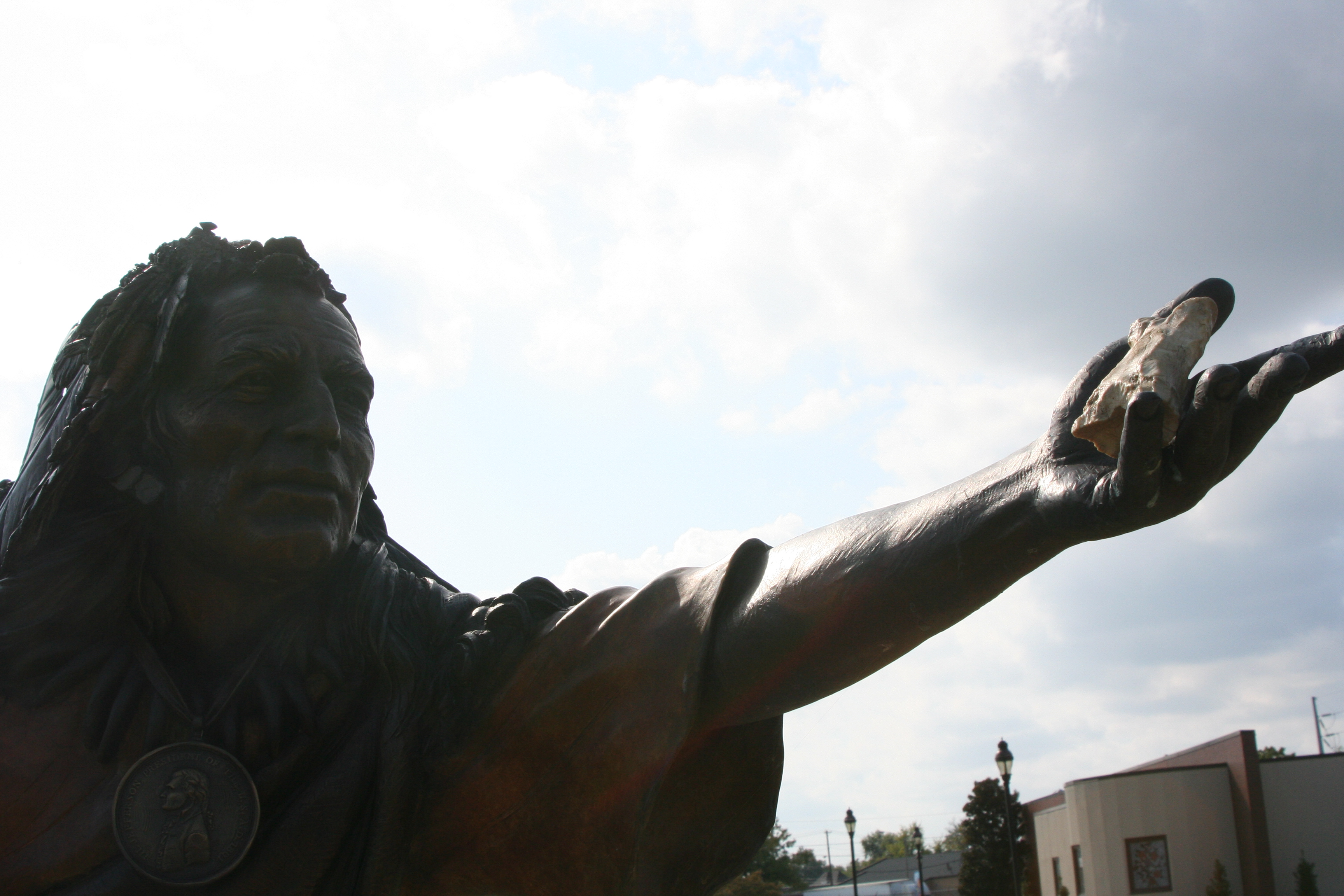
Native American sculpture on the lawn of the quilt museum... checking out Bone.

Thus you are hearing from the slightly un-cool Curt in Paducah, Kentucky. While I have temporarily left our trip down the Colorado River, I shall return to the subject. There are raft-eating rapids to face, oh my. But next I will blog about looking for dead people.