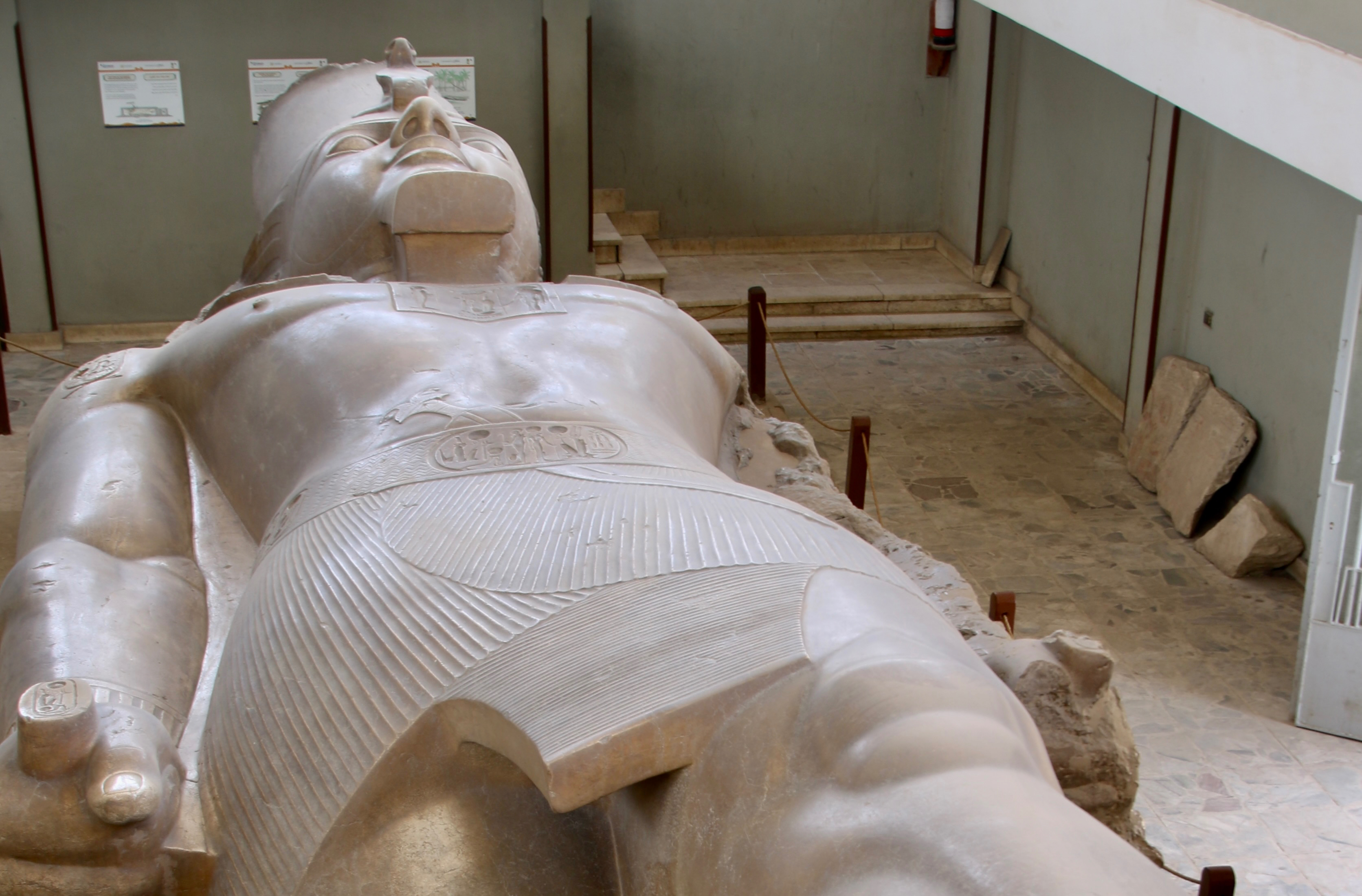
Ramses II is one of the world’s giants in terms of ancient Egyptian history, the monuments he left behind and ego. This elegant 42 foot statue (from the knees up) is located in the Open Air Museum of Memphis. It speaks to his power.
The Open Air Museum of Memphis, near the modern town of Mit Rahina south of Cairo, is relatively small considering Memphis was established as the first capital of Egypt 4000 years ago by the pharaoh Narmer when he united Upper and Lower Egypt. It continued to serve as the capitol for over a thousand years. As such, Memphis would have been a bustling city filled with temples, palaces and tombs. Now it is mainly scattered ruins with most of its remains buried beneath villages and farms. The museum is well worth a visit however. First and foremost because of its huge statue of Ramses II, which was found lying in a swamp in 1820 missing its lower legs.
Ruling between 1279 and 1213 BCE, Ramses II is recognized as Egypt’s greatest pharaoh. He’s best known for ruling 66 years, expanding Egypt’s territory by fighting in multiple wars, and for building monuments, cities and temples throughout his realm. More ancient statues of him have been found than any other pharaoh. Peggy and I saw several as we made our way up the Nile. Then there is also the matter of the 90 children he was said to have fathered! As I noted in my heading, he was big— and he was bad.
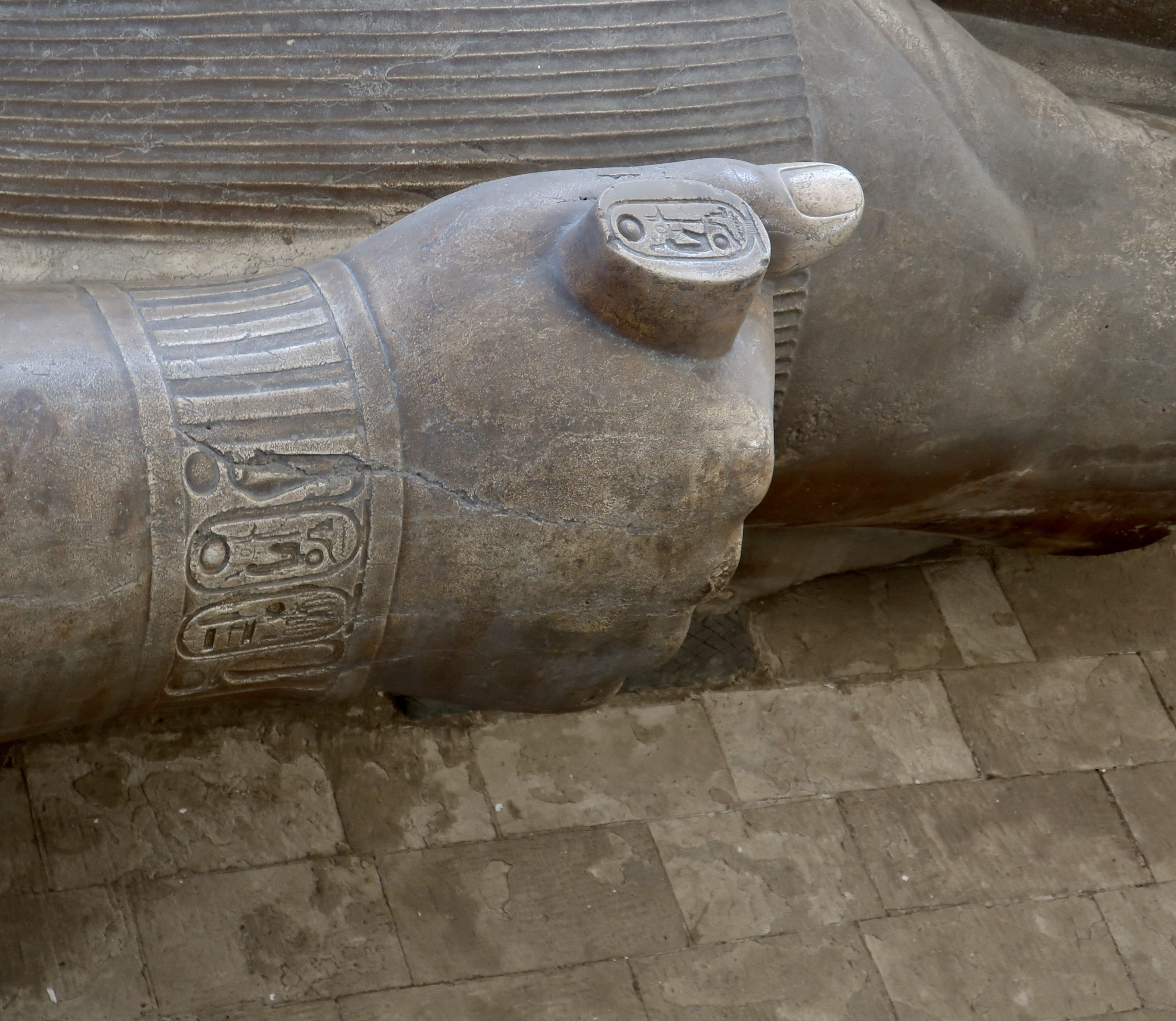
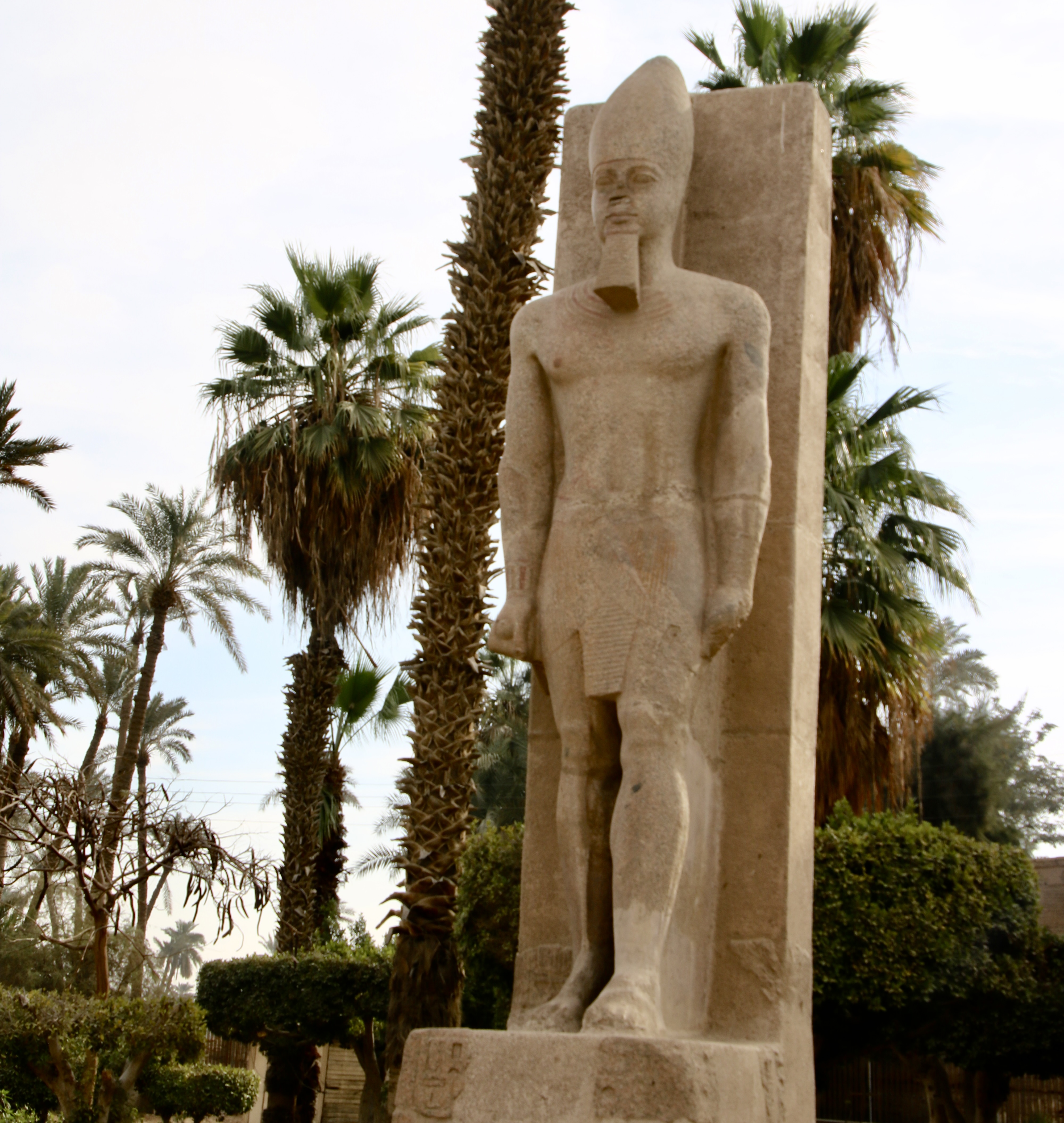
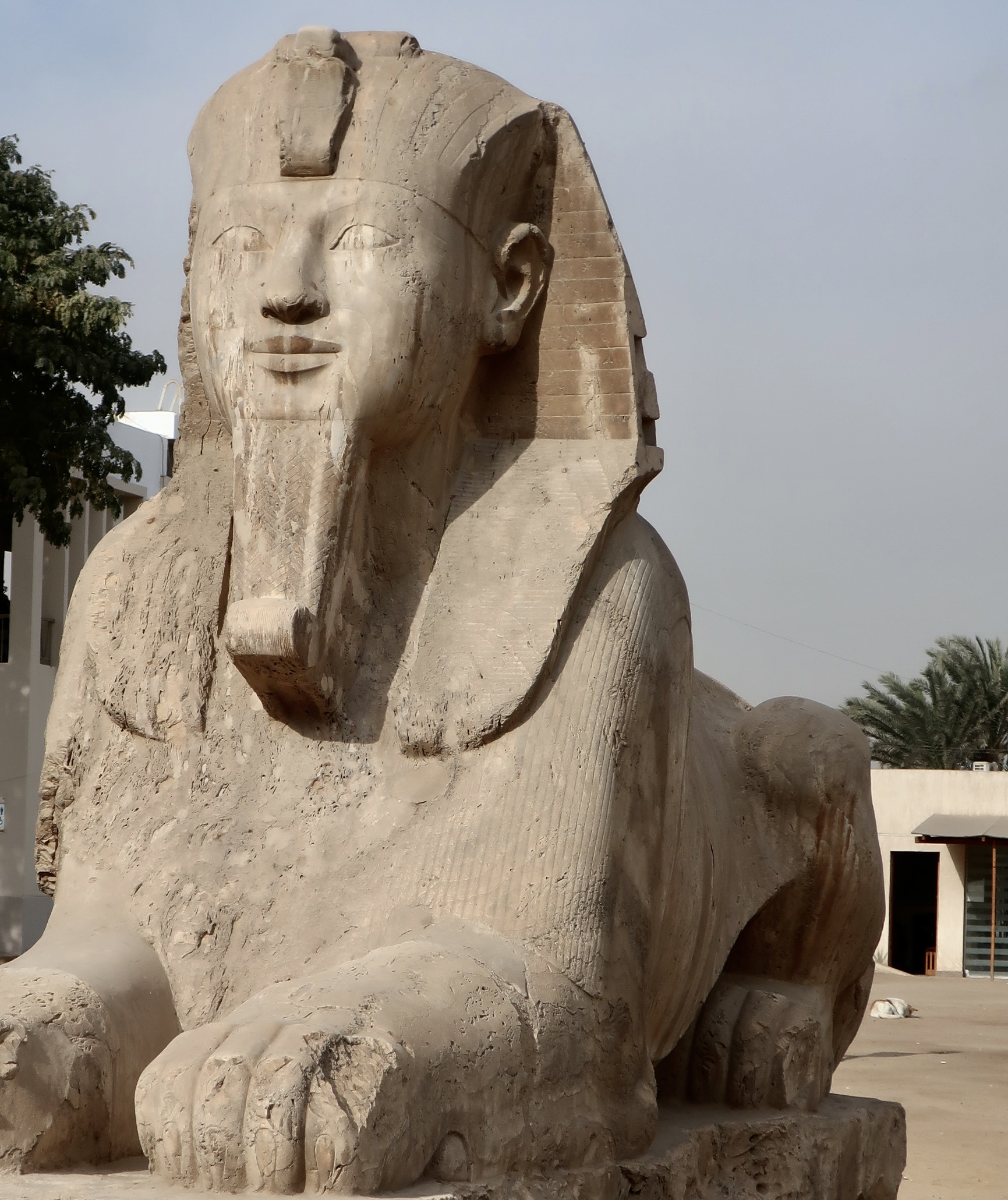
Here, Peggy provides perspective on the size of the Ramses II statue at the Open Air Museum in Memphis. Visitors can both walk around the statue on the ground floor and observe it from the balcony above.A view of Ramsey II as seen from head to toe. He’s wearing the crown of Upper Egypt.This view of his face provides an idea of how beautifully he was carved out of granite with close attention to detail. Note the ear. The figure on his forehead is Wadjet, the female cobra god of Lower Egypt who provided protection for pharaohs.Ramses II was also protected by the dagger he wore in his belt. Most pharaohs are shown wearing one as a symbol of power. A cartouche, spelling out one of his names in hieroglyphics, is on his belt over his dagger. Another, spelling out a different name is lower on his belt. Pharaohs had several names, one, to stress their various positions and accomplishments, but two, also important so they wouldn’t be forgotten, a critical factor in achieving immortality. A cylindrical object in his hand also has a cartouche with one of his names as do two more on his wrist band. I searched for what the object he is holding represented but couldn’t find an explanation. It is obviously another symbol of power that several other pharaohs carry as well. My assumption is that it represents the chisel of Narmer that he used to smash into enemies’ heads, as I showed in my last Egypt post.Narmer doing his thing. The chisel is shown in his name between the two images of Hathor, the cow goddess.Could it be if one chisel was good, two were better? This statue of Ramses II is at the entrance of the Egyptian museum. Note he also has cartouches on his belt, shoulders and chest. Some of them were not his…His son and successor had one of Ramses II’s cartouches removed and his own added— a quick, easy and cheap way to gain recognition and entrance to the afterlife. The practice was not unusual. “Oops, sorry Pop, my chisel slipped.”Speaking of which, another large statue of Ramses II stands outside at the Museum of Open Air. It may actually be of the pharaoh Senusret I, taken over by Ramses with his names removed and Ramses added. When most people think of Egypt and sphinxes, they think of the Great Sphinx of Giza. Actually, there are hundreds if not thousands of Sphinxes. Consisting of the body of a lion and the head of a pharaoh, this one is located at the Open Air Museum. It likely represents the head of Amenhotep II or III with the carving estimated to have taken place between 1700 and 1400 BCE.A back view of the sphinx. It is 26 feet long (8 M) and 13 feet (4M) high, weighs in at over 80 tons, and is carved out of alabaster.
Memphis was an important religious center for the triad of Ptah, the creator god who gave shape to all things, his consort Sekhmet, the lion goddess, and their son, Nefertem, the god of blossoms and perfume. It was common for the Egyptians to create triads for their gods, not unlike that of the Christian triad of the Father, the Son and the Holy Ghost.
I’ll conclude today with a statue of the triad that is located in the Open Air Museum. Ptah with his long, skinny beard is shown in the center. Sekhmet is on the right, and Nefertem on the left. (At least, I assume that is the arrangement.) Their arms around each other demonstrate their common bond.
Next Post: We will return to South Dakota where we will visit a museum that is crammed full of dinosaur bones in a chaotic but wonderful arrangement.






 Wandering through Time and Place