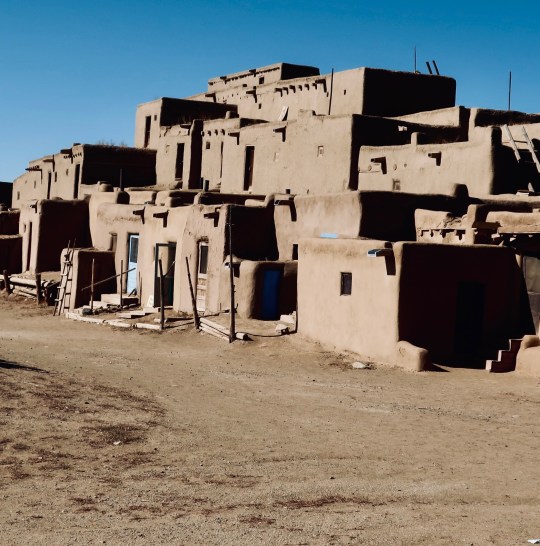
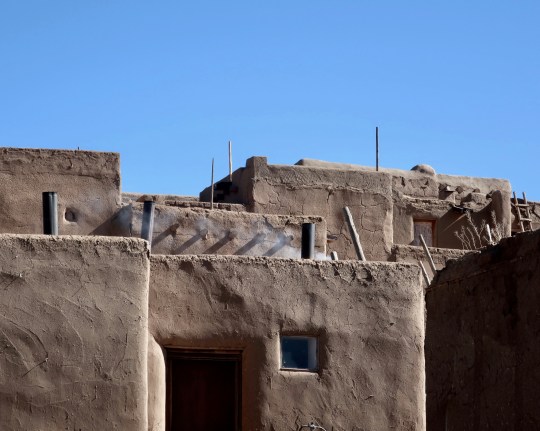
With over 1,000 years behind it, the Taos Pueblo is the oldest continuously inhabited community in America. The Pueblo had already existed for 500 years when Columbus sailed for the New World in 1492. When Spanish explorers arrived in 1540, they thought they had found one of the seven golden cities of Cibola. (Photo by Peggy Mekemson.)
Mable Evans Dodge Sterne Luhan, whose long name represented her husbands, lived a soap opera kind of life. A wealthy socialite born in Buffalo, New York, she devoted her time to supporting art and bringing together the artists and intellectuals of her time: Gertrude Stein, Alice B. Toklas, Andre Gide, Lincoln Steffens, Walter Lippmann, Pablo Picasso, Arthur Rubenstein, D.H. Lawrence, Ansel Adams, Willa Cather, Aldous Huxley, Greta Garbo and Georgia O’Keeffe to name a few.
Her efforts at creating artistic gatherings began in Florence, Italy where she and husband number two, Edwin Dodge, lived in a villa that had been built for the Medici. In 1912 she moved on to New York City and established a salon hosting both artists and leading radicals who espoused causes ranging from free love, to Freud, to anarchism. When she heard about the beauty of New Mexico, she sent husband number three, Maurice Sterne, west in 1917 to explore the possibilities of moving there. He wrote back, “Dearest Girl–Do you want an objective in life? Save the Indians, their art and culture. Reveal it to the world!” That was enough for Mable. She was on her way.
One of the first Indians she met in Taos was Tony Lujan, a member of Taos Pueblo. Tony persuaded Mable to buy several acres of meadow land and then helped her plan and build a four-room adobe house that continued to expand until it reached 21 rooms. The story is told, and it may be apocryphal, that Tony set up a tent in her front yard and drummed away in the night to win her love. Maurice bought a shotgun. Whether it was to eliminate the competition or do away with the infernal nighttime drumming and get a decent night’s sleep, I can only speculate.
Anyway, Mable sent Sterne packing and married Tony, her fourth and final husband. With a large house and a Native American husband, she could now focus on her plan to bring artists, writers and movie stars to promote Taos and help save the Indians and their culture. One of her major successes at recruitment was D.H. Lawrence of Lady Chatterley’s Lover fame. Another was Georgia O’Keeffe.
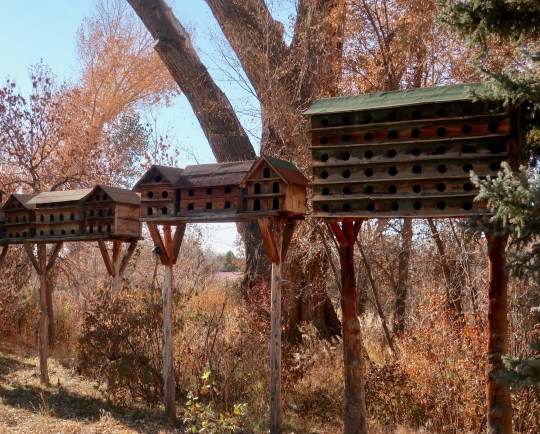
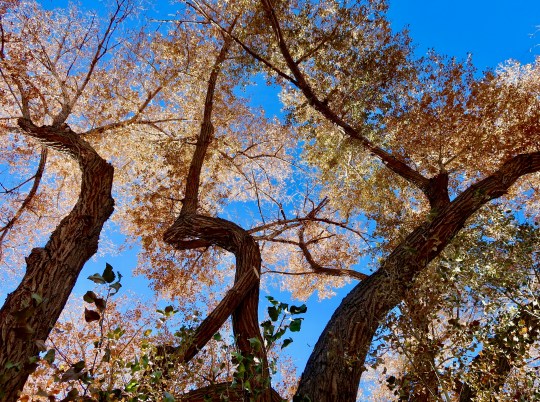
A young Mable Dodge Luhan looking like the weathy socialite she was.The Luhan House/Hotel in Taos as it looks now. Dennis Hopper stayed here when he was filming “Easy Rider” and proceeded to buy it in 1970. For seven years it was more or less a “hippie hangout.” It is now operated by a non-profit as an historic hotel and conference center. Visitors can rent the room that Georgia O’Keeffe stayed in if they wish.A large rooster with his chest puffed out perches on top of the house and serves as a weather vane. Apparently, there was a south wind blowing when we visited.This fellow ruled a lower perch and was one of several brightly colored ceramic roosters that decorate the house.Smaller members of the bird kingdom live here as well. Lots of them. They had all flown south for the winter, however.They likely perch in the magnificent cottonwoods that tower over their homes when they are in town. I can easily imagine O’Keeffe painting the trees.Peggy and I found this interesting stairway at the back of the house…And a sculpture by Ted Egri out front.
Luhan met O’Keeffe in New York City through Georgia’s husband, Alfred Stieglitz, and immediately initiated a campaign to persuade her to visit Taos. Stieglitz, a leading photographer of the time, was instrumental in persuading the art world that photography could be art. Among his projects was photographing Georgia nude and hanging the photos in his famous modern art gallery at 291 5th Avenue. The exhibit was quite controversial. He also hung original art from Matisse, Picasso, Rousseau, Rodin, and Cezanne— introducing Americans to avant-garde European artists. He produced show after show of O’Keeffe’s paintings, adding to her credence as a world-class artist, not to mention selling her paintings for hefty sums.
In the summer of 1929, O’Keeffe finally took Luhan up on her offer and journeyed to New Mexico, partially because Stieglitz was having an affair with the young wife of an heir to the Sears and Roebuck fortune some 40 years his junior. But the bottom line was that O’Keeffe was introduced to Taos and fell in love with New Mexico. She brought her friend Rebecca ‘Beck’ Strand with her. Beck’s husband was Paul Strand another top photographer and, like Georgia, a protégé of Steiglitz. During a visit at Luhan’s in 1930, he met Ansel Adams and persuaded him to pursue a career in photography. Adams had been trained as a concert pianist.
Today, I will focus our remaining photos on the Pueblo, Taos and the surrounding country.
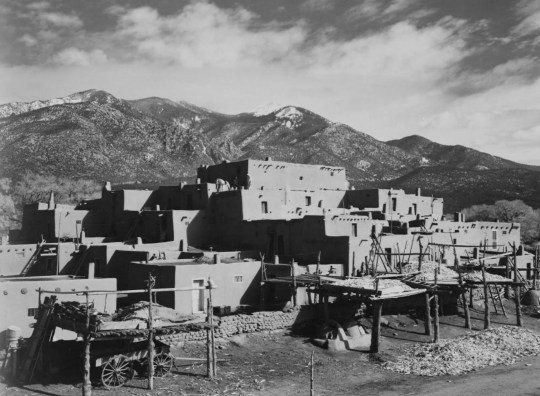
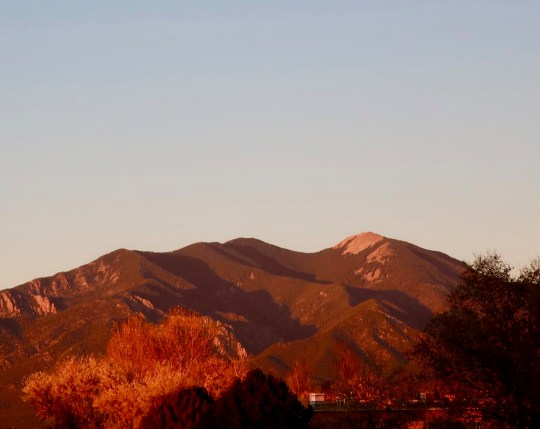
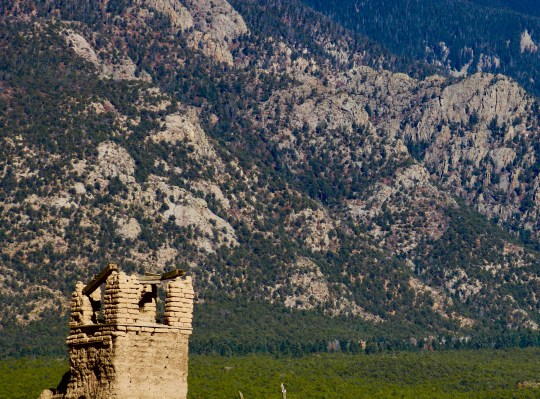
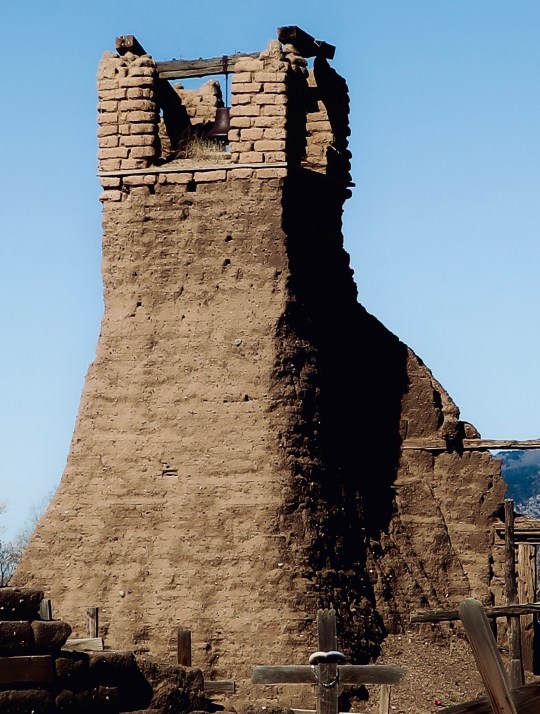
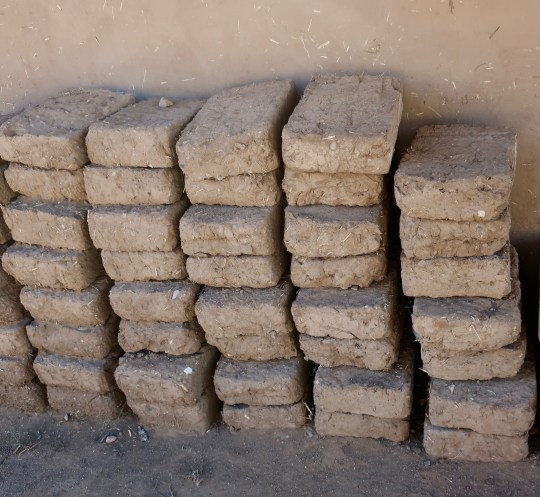
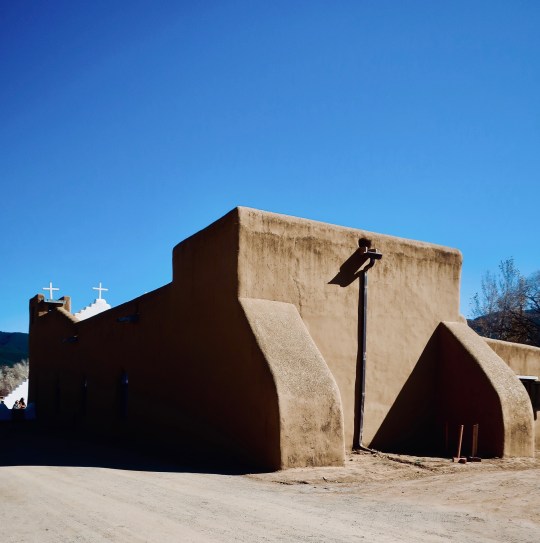
Georgia O’Keeffe’s painting of the Taos PuebloA photo I took of the Pueblo shows how little it has changed in the 90 years since O’Keeffe painted it. The round structures in front are ovens. Peggy and I ate some pie cooked in one. Quite tasty.Here’s a close up of one of the ovens. (Photo by Peggy Mekemson.)A photo by Ansel Adams of the Pueblo. Note the Taos Mountains towering in the background. They are part of the Sangro de Christo Range, or as translated, the Blood of Christ Range. It seems like a strange name for mountains.Possibly the early Spaniards noticed the mountains in a fall sunset like I did from our campsite.Georgia O’Keeffe’s painting of Taos Mountain. Our guide told us that the early Indians would post a lookout on the granite outcrop to the right overlooking the Pueblo and could see enemies approaching from miles away. The ruins of the San Geronimo Church, destroyed in 1846 by American forces can be seen on the left. (Photo by Peggy Mekemson.)The ruins of the church overlook the Pueblo’s graveyard. (Photo by Peggy Mekemson.)A close up of the ruins.The Rio de Taos Pueblo flows through the center of the Pueblo, separating the North House we have been looking at from the South House. The creek was looking a bit cold when I photographed it. Our guide told us we were not to swim in it. No problem.Peggy took this photo of the South House with its colorful doors and still melting snow.I don’t know if the inhabitants regard the numerous ladders used to negotiate between floors as photo-worthy, but we did. (Photo by Peggy Mekemson.)Peggy and I learned about adobe maintenance and repair when we visited the Pueblo. The adobe structures need to be recoated annually with a mud and straw mixture. More serious repair work requires these mud and straw bricks. I lifted one. It must have weighed close to 50 pounds.As I thought of all the work involved in maintaining these structures, I came to appreciate that we only have to paint our house every ten years or so and replace the roof once every 20 years. (Not that I ever lived anywhere long enough to replace a roof.)The Catholic Church at the Pueblo reminded me of the San Francisco de Assi Church.Here is a front view of the church that I rendered in black and white.Heading downtown for lunch after visiting the Pueblo, we were treated to a colorful Native American dance…And lots of interesting art such as this sculpture. Taos is still a haven for artists and writers.I conclude today’s post with another perspective on the Pueblo. This is close to the angle that Ansel Adams photographed it.
NEXT POST: We will explore Abiquiu and Ghost Ranch, New Mexico where Georgia O’Keeffe lived and painted.










 Wandering through Time and Place