A Sizzling Sun, A Reclining Rattler, and A Hellaceous Headwind… The 10,000 Mile Bike Trek

The sun in Texas can beat down unmercifully.

The sun in Texas can beat down unmercifully. For a bicyclist on the open road in West Texas, the only escape is to cycle on to the next town.


“Only mad dogs and Englishmen (plus Curt) go out in the noonday sun.” Indian Proverb


Life becomes incredibly simple out on the road. The normal aspects of our lives— jobs, family, friends, deadlines, houses, yards, bills, etc., drop behind us. There is a freedom here: the freedom to unwind, the freedom to think about our lives, and the freedom to live in the moment.

This freedom is strengthened by the physical challenge of long distance backpacking or bicycling. The difficulty of getting through the event pulls us even farther out of our normal life while our success changes our perspective on who we are and what we can accomplish. When I led nine-day, 100-mile backpack treks and 500-mile bike treks, I could see people’s lives changing, literally before my eyes. Some profoundly.

There was ample challenge built into my day of cycling between Post and Aspermont. To start with, the temperature was pushing 80°F when I left Post around 7:00 AM. The day promised to be a scorcher. By 1:00 PM, the thermometer had climbed beyond 100 (38°C). I was down to minimum clothing and maximum sunblock, sucking on my water bottle, and worrying about sunstroke, always a danger in the hot sun. Tar began to seep up through the pavement. I climbed off my bike to take a look at the phenomena and my shoes stuck like I was walking on well-chewed gum. I noted in my journal, “I wonder if this is what the saber tooth tigers felt like when they encountered the La Brea Tar Pits in Southern California.”  I imagined my foot sinking into the pavement and me becoming a fossil for future generations to ponder over.

There were also ups and downs, a welcome change from the flat, flat of West Texas I had been cycling across. Several tributaries to the Brazos River flow through the area, cutting down through the plains. I even caught view of what Texans consider a mountain, or two to be more specific. The Double Mountains are a pair of flat-topped buttes that rise 500-800 feet above the surrounding plains and can be seen for hundreds of square miles. Pioneers traveling by horse and covered wagons used them for land marks. Native Americans probably used them to spot the pioneers.
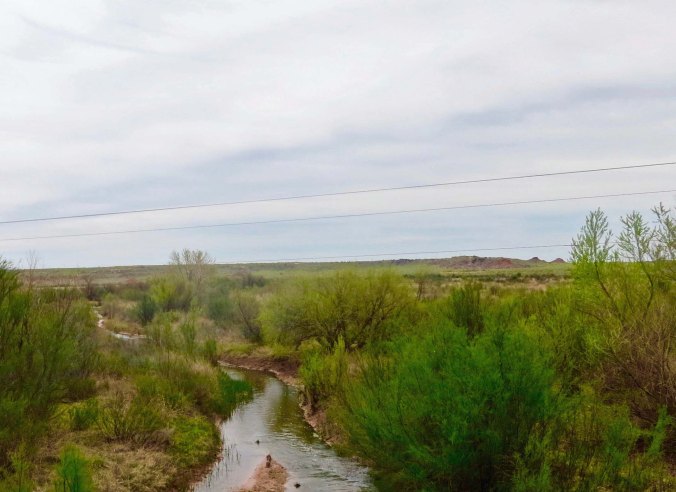
A number of tributaries feed into the Brazos River in West Texas. Eventually the river flows into the Gulf of Mexico south of Huston.

A number of tributaries feed into the Brazos River in West Texas. Eventually the river flows into the Gulf of Mexico south of Houston.

The Brazos River near Aspermont Texas.

The river cuts through the Llano Estacado providing travelers with a break from the flat terrain of West Texas.

A distant view of the Double Mountains of West Texas near Aspermont.

A distant view of the Double Mountains of West Texas near Aspermont.

The break in terrain was welcome. My over-heated body appreciated the 20-30 mile per hour breeze generated by my downhill dashes— although it whined about the climb afterward.  There was even an occasional shade tree! The challenge here is that it becomes difficult to see in the shade when you are quickly moving between shadows and sunlight. Loose gravel, broken glass, and other road hazards lurk in the dark, waiting to provide nasty surprises.

That’s the way it was with the rattlesnake. I was racing down a hill and he/she was relaxing in the shade, enjoying the warm pavement.  I was a few feet away from a fanged encounter when I spotted him, all coiled up. I prefer my rattlesnakes rattling a warning when I approach. But there wasn’t time for him to rattle or me to think, “Oh, there’s a rattlesnake.” Instincts honed by a million years of my ancestors fearing snakes and two thousand miles of me bicycling took over. I zigged, damn lucky I didn’t land on top of four feet of extremely irritated serpent.

Heart beating like a jack hammer, I executed a U-turn at the bottom of the hill and pedaled back up to the rattlesnake. It hadn’t budged. That changed when I lobbed a couple of rocks his way (from a distance). As he grouchily slithered off the road wanting to bite someone— me, I told him how lucky he was to have encountered a bicyclist and not an 18-wheeler.

Adding insult to almost injury, a strong headwind caught me about ten miles outside of Aspermont. The wind had to be blowing at least 40 miles per hour. Tired, hot, and cranky, I dropped into my lowest gear and climbed out of the saddle. Two hours later I reached the town. My journal tells me I drank a gallon of ice tea.

Aspermont was like most of the west Texas towns I rode through: small, isolated, and slightly depressed. Employment opportunities were few. Population was going down, not up. The town’s population had been 1,357 in 1980. By 1989 it had dropped by a hundred or so.  The young people were leaving, heading off to the brighter lights of Dallas, Houston and other urban areas.

High school sports were a bright spot, however. Most towns had signs announcing when their kids had won state or regional championships, even if it was 10-20 years ago. I spent a pleasant evening in Aspermont recovering from my long day and chatting with the friendly locals who laughed at my adventures and regaled me with tales of their own. Texas is a place for story telling. That night there was another impressive thunder and lightning show, reflecting the heat and wind I had experienced during the day.
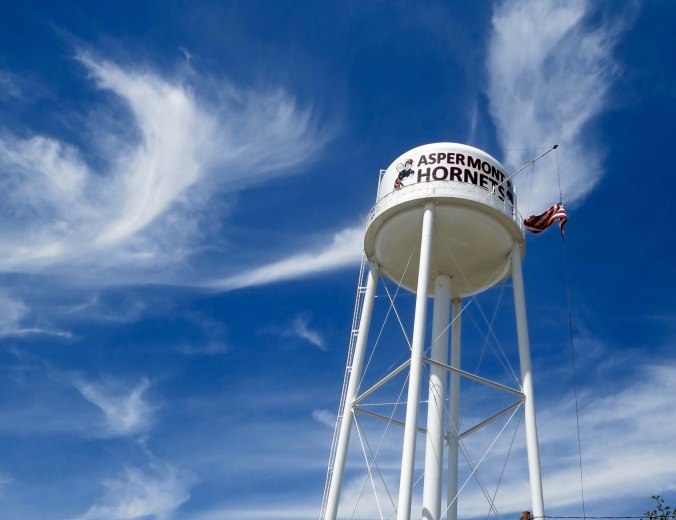
High school sports are very important in the small towns of West Texas. The local team, the Aspermont Hornets, is featured on the town's water tower.

High school sports are very important in the small towns of West Texas. The local team, the Aspermont Hornets, is featured today on the town’s water tower.

Abandoned homes reflect the dropping population of many West Texas towns. This was once somebody's dream.

Abandoned homes reflect the dropping population of many West Texas towns. This was once somebody’s dream.

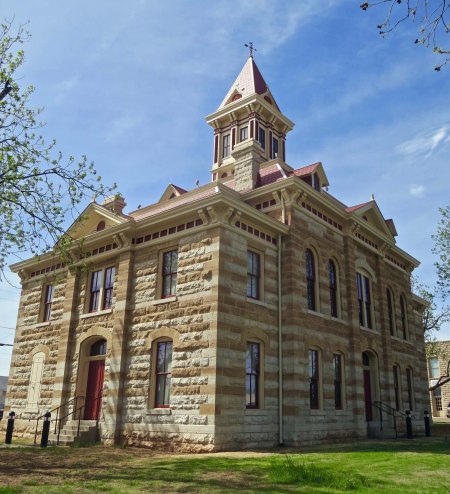
The next day, I bicycled on to Throckmorton, a short 60 miles without excessive heat, wind or rattlesnakes. I was really impressed with the town’s beautiful city hall. Not so much with the local grocery store where I went to buy some fresh fruit. The oranges looked like rejects of rejects. (I admit to being spoiled by the fruits and vegetables of California.) Throckmorton is cow country so I booked myself into the Cow Country Motel and ate dinner at the Rancher’s Restaurant.
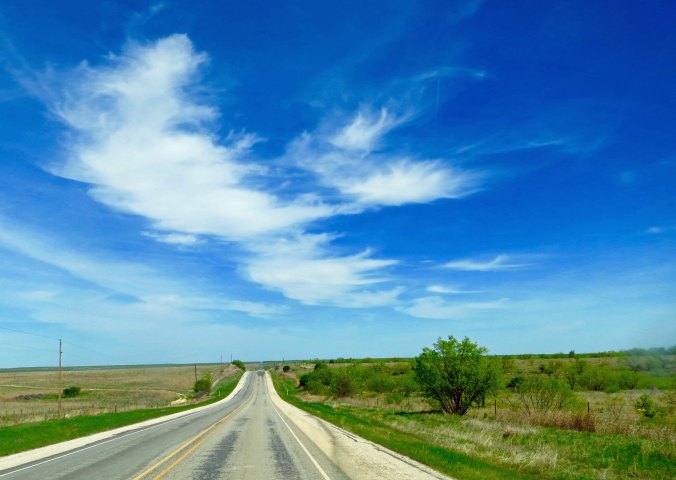
Highway 380 between Aspermont and Throckmorton.

Highway 380 between Aspermont and Throckmorton.

Some appropriate cattle on the way to Throckmorton.
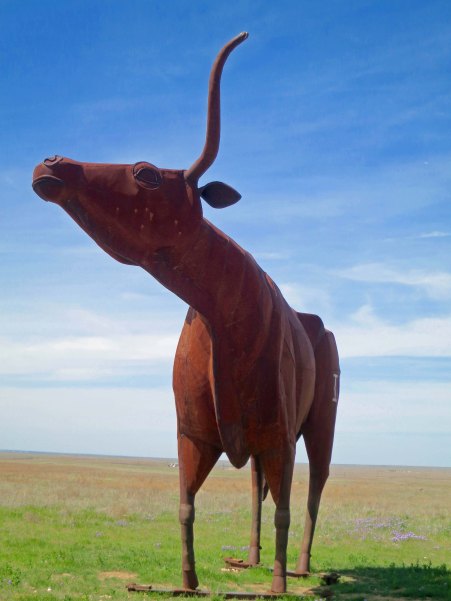
Some appropriate cattle on the way to Throckmorton.

Peggy and I found this 22 foot high sculpture of a Texas Longhorn bull just a few miles west of Throckmorton.

Peggy and I found this 22 foot high sculpture of a Texas Longhorn bull a few miles west of Throckmorton. It wasn’t there when I bicycled through the area in 1989. The artist, Joe Barrington, is noted for creating  anatomically correct animals.

A side view of the sculpture, which is known as the Bridle Bit Bull. The local rancher who owns the property commissioned the art.
A side view of the sculpture, which is known as the Bridle Bit Bull. The local rancher who owns the property commissioned the art.

A side view of the City Hall in Throckmorton.

A side view of the City Hall in Throckmorton.

And a front view to conclude this post.

And a front view to conclude this post.

NEXT BLOG: A side trip to Archer, Texas, the home of Larry McMurtry and his fabulous bookstore. I also continue my bike trip on to Jacksboro and Fort Richardson, one of my favorite campgrounds on the bike trip.


Adios UFOs; Hello Pecos Bill… The 10,000 Mile Bike Trek

The Western United States still rings with the legends of cowboys such as the mythical Pecos Bill and the very real Judge Roy Beam. Cowboy lore lives on today in modern rodeos.

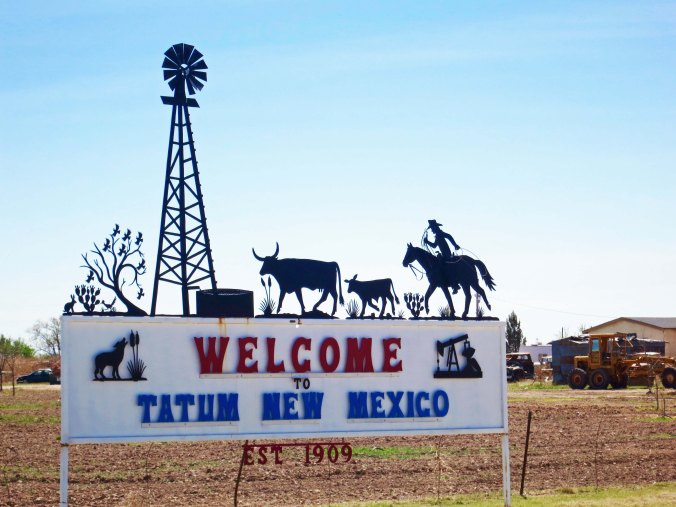
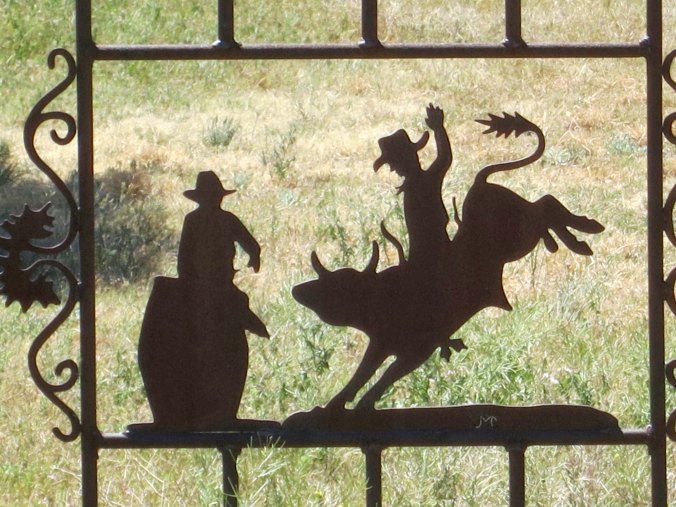
The Western United States still celebrates the legends of cowboys such as the mythical Pecos Bill and the very real Judge Roy Bean. Cowboy lore lives on today in modern rodeos. Metal art in Tatum New Mexico has captured many of the themes of the West.


“Hang ’em first, try ’em later.” Judge Roy Bean


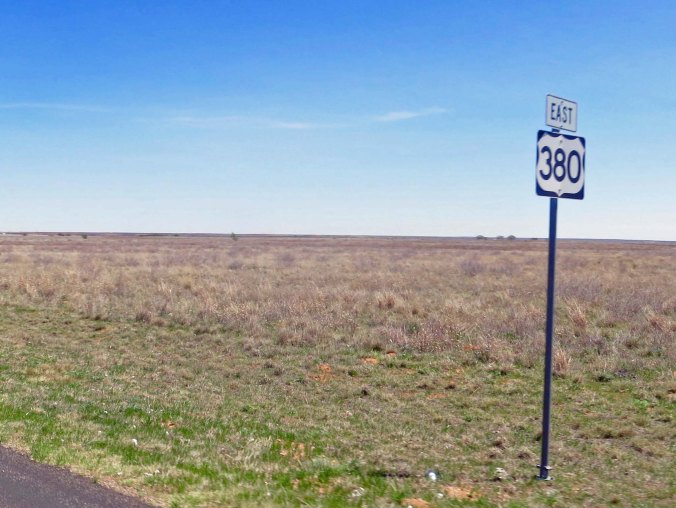
As I said goodbye to aliens and UFOs and pedaled out of Roswell on Highway 380, my thoughts turned to the Pecos River, about ten miles away. Like the Rio Grande, it was another river of cowboy fame. This was the land of the mythical Pecos Bill, who could accomplish such prodigious feats as lassoing a whole herd of cattle at one time. He carried a rattle snake for a whip and was said to ride cyclones and mountain lions as well as his horse, Widow Maker, who feasted on dynamite with the same relish that Peggy eats dark chocolate.

Judge Roy Bean, a Justice of the Peace and saloon keeper, was another legend of the Pecos. He was the real thing, however, a ‘hanging judge’ who billed himself as the ‘last law west of the Pecos.’ Cowboys could stop off at his place for whiskey or justice, depending on their needs.  His courtroom/saloon was down on the Texas border with Mexico, far south of where I would be crossing the Pecos, however.

Most of my knowledge of the Pecos came from Westerns. Between ages 11 and 13, I read every Zane Grey, Luke Short and Max Brand book I could lay my hands on. When I was off riding the range, punching cattle, and chasing outlaws, not even the call to dinner could pull me off the great stallion I rode. I carried my own brand of justice, blazing six-guns. And I was lightning fast. Step aside Billy the Kid. (No wonder Americans are so gun-crazy, given the legacy of the West.)

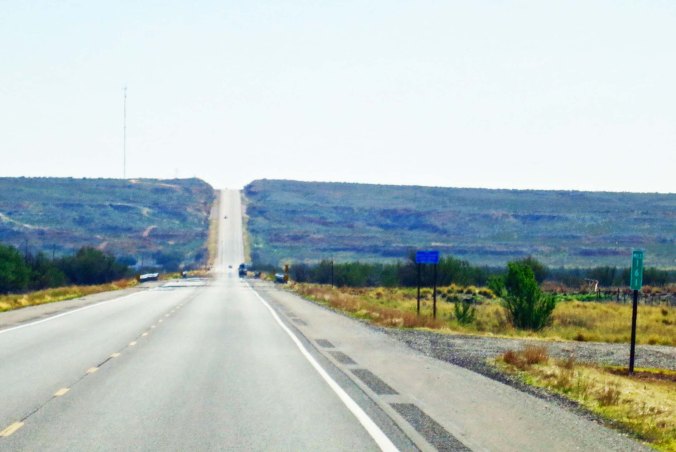
My roads in the west were always disappearing over the horizon. This is New Mexico 380 dropping down into the Pecos river and climbing out the other side.

My roads out-west were always disappearing over the horizon. This is New Mexico 380 dropping down into the Pecos River (lined with trees) and climbing out the other side.

I paused at the Pecos and threw a rock into the water as a symbolic gesture to my youth. Then I returned to the present and checked out a hill I had to climb on the other side. It wasn’t much. I had passed the 1500-mile mark on my journey and was on my way to 2000. My legs and lungs now laughed at such obstacles.

What did bother me was that I was saying goodbye to the West I loved, the west of towering mountains. I would soon be biking across land that was flatter than the proverbial pancake. Yes, rivers and streams cut through these lands, there would be canyons and steep ups and downs, there would even be impressive hills as I made my way east. This land had a beauty and personality of its own. But I wouldn’t see another mountain until I reached Gatlinburg, Tennessee and started over the Smoky Mountains. And they don’t tower.

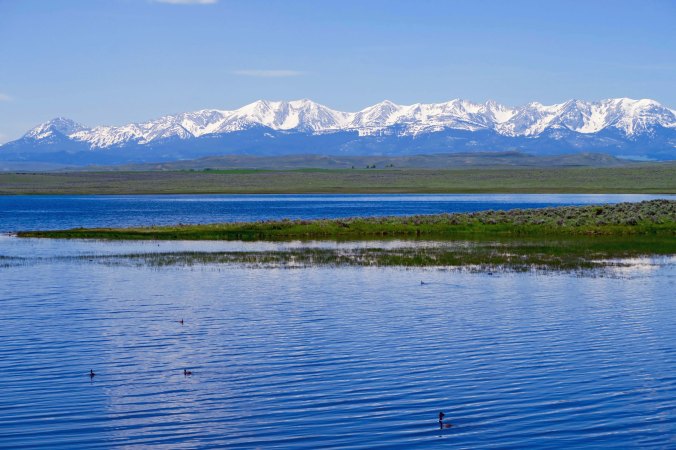
I would have to return to the west to get views like this. The Rocky Mountains would be waiting for me in Montana.

I would have to return to the west to get views like this. The Rocky Mountains would be waiting for me in Montana.

Does land really get any later and featureless than this?

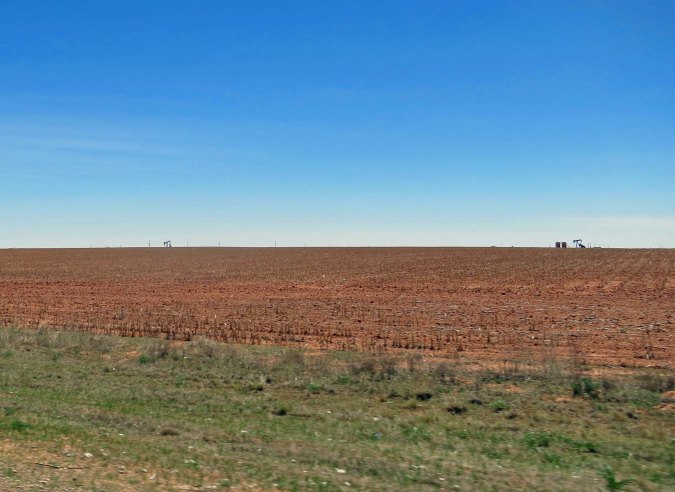
Here’s what I would find in eastern New Mexico and western Texas. Does land really get any flatter?

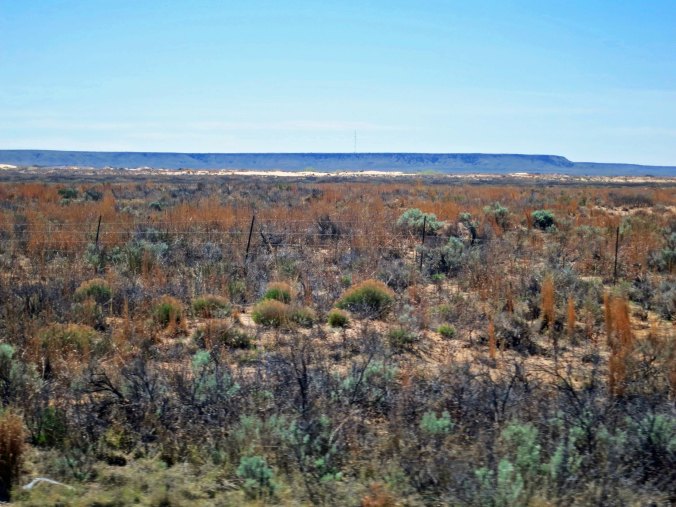
I was soon cycling across the flat plains and the mountains were receding into the west. This was sagebrush and cattle country. What trees existed were small, little more than tall bushes in comparison to their far western counterparts. In the distance I could see a long escarpment that signified the beginning of the Llano Estacado, one of the largest tablelands in North America. Between the road and the escarpment, I was surprised to see sand dunes. Later I learned that they were the Mescalero Sand Dunes, apparently an ATV paradise. (The dunes took their name from the Mescalero Apaches. Maybe their ghosts hassle the four-wheelers for disturbing the peace.)

The looms in the distance. The tan line that seems to be at the base is the Mescalero Dunes.

The Llano Estacado looms in the distance. The tan line at their base is the Mescalero Dunes.

I climbed up onto the Llano, passed through the non-town of Caprock, and eventually reached Tatum, New Mexico. As I approached the community, I started noticing metal art, everywhere, scads of it. It seems that everyone in town and for miles around supported the local artist. There were cowboys, buffalo, coyotes and other western themes, each simply and clearly outlined, dark shadows against the sky and countryside. Figuring I had found a town that supported art, I just had to spend the night.

It wasn't surprising that the Welcome to Tatum sig would feature a cowboy, windmill and cattle, representative symbols of the Old West. But note the oil well on the lower right, a symbol of the new/old west that has been given a whole new life with fracking.

It wasn’t surprising that the Welcome to Tatum sign would feature a coyote, cowboy, windmill and cattle— representative symbols of the Old West. But note the oil well on the lower right, a symbol of the West that has been given a whole new life with fracking. Welcome to earthquake country!

Check out the horizon here. Those are oil wells pumping away.

Check out the horizon here. Those are oil wells pumping away.

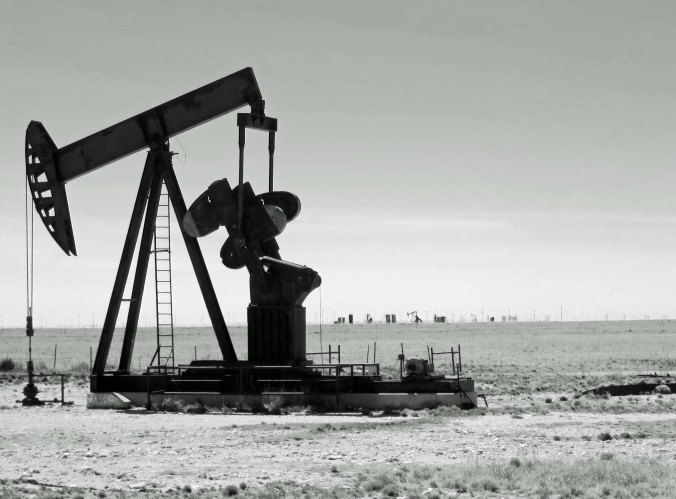
A close up rendered in black and white. To me, these pumps appear as some type of primitive bird, forever pecking away.

A close up rendered in black and white. To me, these pumps appear as some type of primitive bird, forever pecking away.

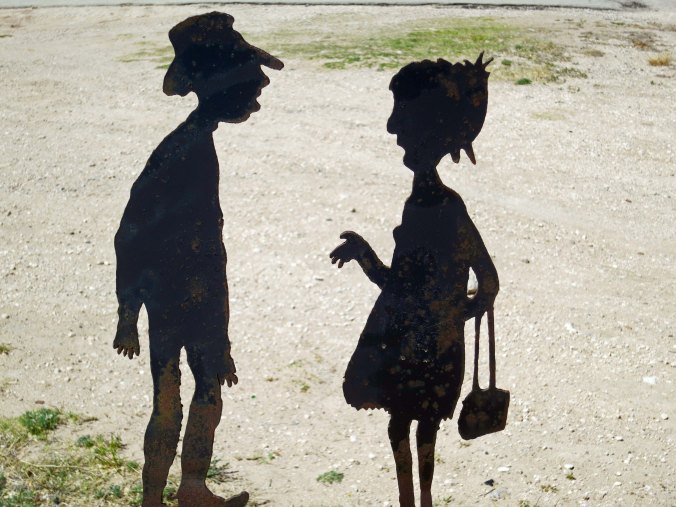
More of Tatum's metal art. I am thinking gossip.

More of Tatum’s metal art. I am thinking gossip. “Did you hear that they found more oil south of 380? We are all going to be rich, oil rich!”

Who better to represent the vanished Old West than the buffalo. Fortunately, they are making something of a comeback, but never again will millions wander across the unfenced plains.

Who better to represent the vanished Old West than the buffalo. Fortunately, they are making something of a comeback, but never again will millions wander across the unfenced plains.

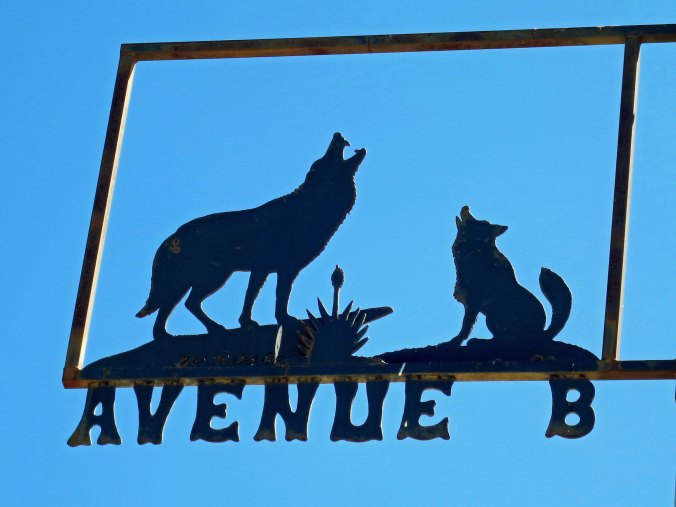
Coyotes are survivors, ultimately adaptable to their environment. Have the rabbits been wiped out? "Here kitty, kitty, kitty."

Coyotes are survivors, ultimately adaptable to their environment. Have the rabbits been wiped out? “Here kitty, kitty, kitty.”

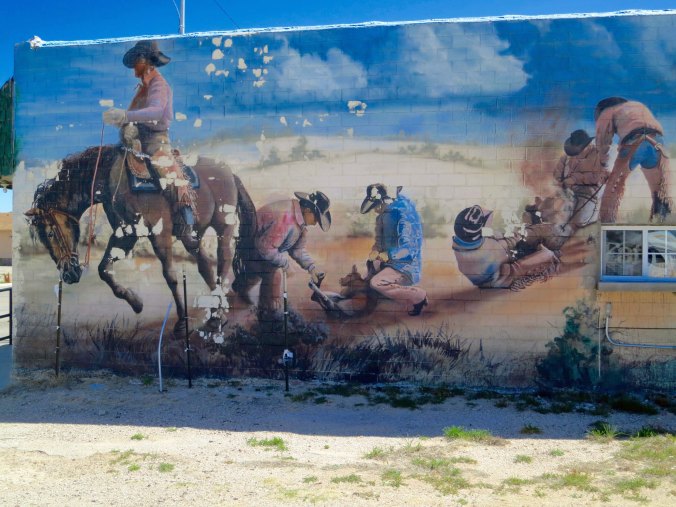
For my final photo of the day, this mural adorned the side of a business in Tatum. The spirit of the Old West lives on.

This mural adorned the side of a business in Tatum. The spirit of the Old West lives on as cowboys rope and brand cattle. We had our own touch of the Old West a few miles away from where Peggy and I live in Oregon a couple of weeks ago. A thief stole a bicycle. A local cowboy jumped on his horse, rode after him and lassoed him. Imagine what might have happened if he’d had a branding iron…

NEXT BLOG: I enter the forever state of Texas and prepare for my first tornado watch— with a six-pack of beer.