
Freddie the carver, a leper who lived in the up-country Liberian town of Ganta, carved this replica of the Bush Devil for me in 1965. In the 70s similar carvings would become known as Jimmy Carter dolls.
What leads people to choose a particular book is a question every author, agent and publisher asks. If my name were Stephen King or J.K. Rowling and I was writing my umpteenth best seller, I wouldn’t have to worry about anything except writing the book and raking in the dough. But being Curt Mekemson… let’s just say I have a few more challenges (grin).
I am now in the final stages of self-publishing a book on my Peace Corps experience in Africa. Making money isn’t the objective; I’m happily retired. But I do hope people will read the book. I realize that success will ultimately depend upon whether people like what I have written and tell their friends. But first I have to capture their attention.
The Writer’s Guide to Self-Publishing (and every other book that purports to tell us go-it-alone writers how to) suggests that an enticing name, great cover, compelling back copy, and dynamite first few pages are what count. Of course, an endorsement by J.K. Rowling would help, but, as they say in the vernacular, that ain’t going to happen.
I’ve decided to ask for your advice. Several of the people who read this blog are authors and all of you are avid readers. So here’s the question. Which of the following titles would capture your eye and lead you to pick up the book? Why? (You can pick more than one.)
FYI, I’ve included the back-story behind each title. Depending on the title I choose, I will use a short, spiffed up version of the story in the introduction of the book.
Thanks for your participation!
Curt
1. The Dead Chicken Dance
And Other Peace Corps Africa Tales
Peace Corps training lacked its modern sophistication in the 1960s. Our group did its initial training at Cal State SF. We were then dropped off in the Sierra Nevada Mountains with paper sleeping bags for a wilderness camping experience. During the week, we faced a number of challenges such as rock climbing, bridge building, etc. A psychologist followed us around and took notes. It was serious business. Based on our responses, we could be sent home. One of the most memorable challenges was when our leader showed up the first night with a hatchet and a crate of live chickens. “Here’s dinner,” he announced with a laugh. You can imagine how the kids from the big cities reacted. I was a country boy, however. I had killed, plucked, and gutted chickens. So I volunteered for the messy part. My chicken did a nice little dance when I cut off her head off. The city kids turned pale. They lost their appetites when I reached into Henny Penny and yanked out her still warm innards. It was a good thing; I got more to eat.
2. The Bush Devil Ate Sam
And Other Peace Africa Corps Tales
When my first wife, Jo Ann, and I arrived in Liberia we recruited a young man to help with our chores. In return, we provided meals and funds to cover school costs and other necessities. One day, Sam was working with me outside and took off his shirt. Jo noticed that he had a series of parallel scars marching down his chest. “How did you get those?” Jo had asked, partially out of concern but mainly out of curiosity. “I can’t tell you,” Sam had blurted out. “But,” he quickly added, “I can tell Mr. Mekemson.” Aha, I thought to myself, Sam and I belong to the same organization, the men’s club. Actually Sam belonged to a very exclusive men’s club, the highly secretive Poro Society that existed to keep tribal people in line and pass on tribal culture. The year before Sam had been to bush school where he had learned the Society’s secrets. At the end of the session, he had had a close encounter with the Bush Devil. It ate him. He was swallowed as a child and spit out as a man. The scarification marks represented the Devil’s teeth. The Bush Devil (so-named by Christian missionaries) is part politician, part cultural cop, part spiritual leader, and all secret. Outsiders don’t get to see the Kpelle version. I was able to see one from another tribe, however. He looked like someone had crossed a walking haystack with a voodoo nightmare.
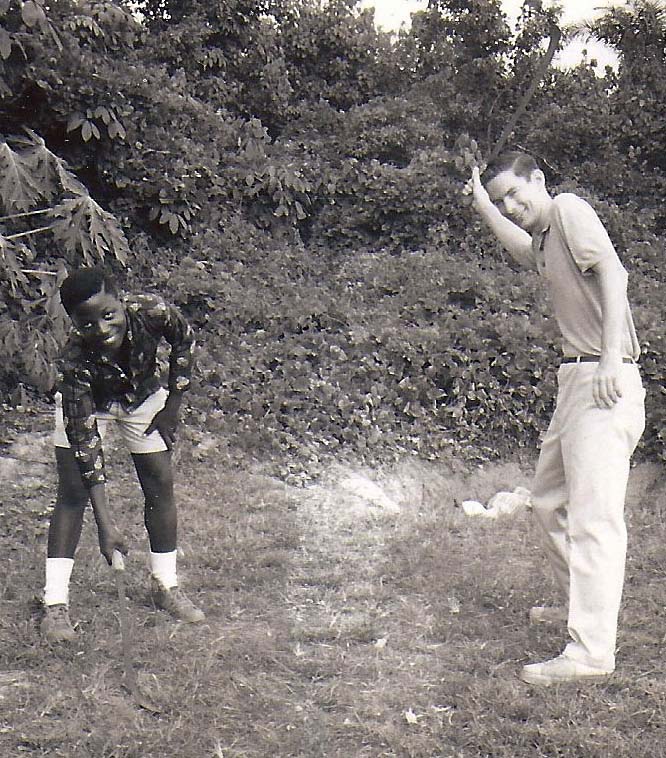
A photo of Sam and me cutting grass with machetes right around the time we noticed his scarification marks. Sam would later become a physician.

The Bush Devil I was allowed to see.
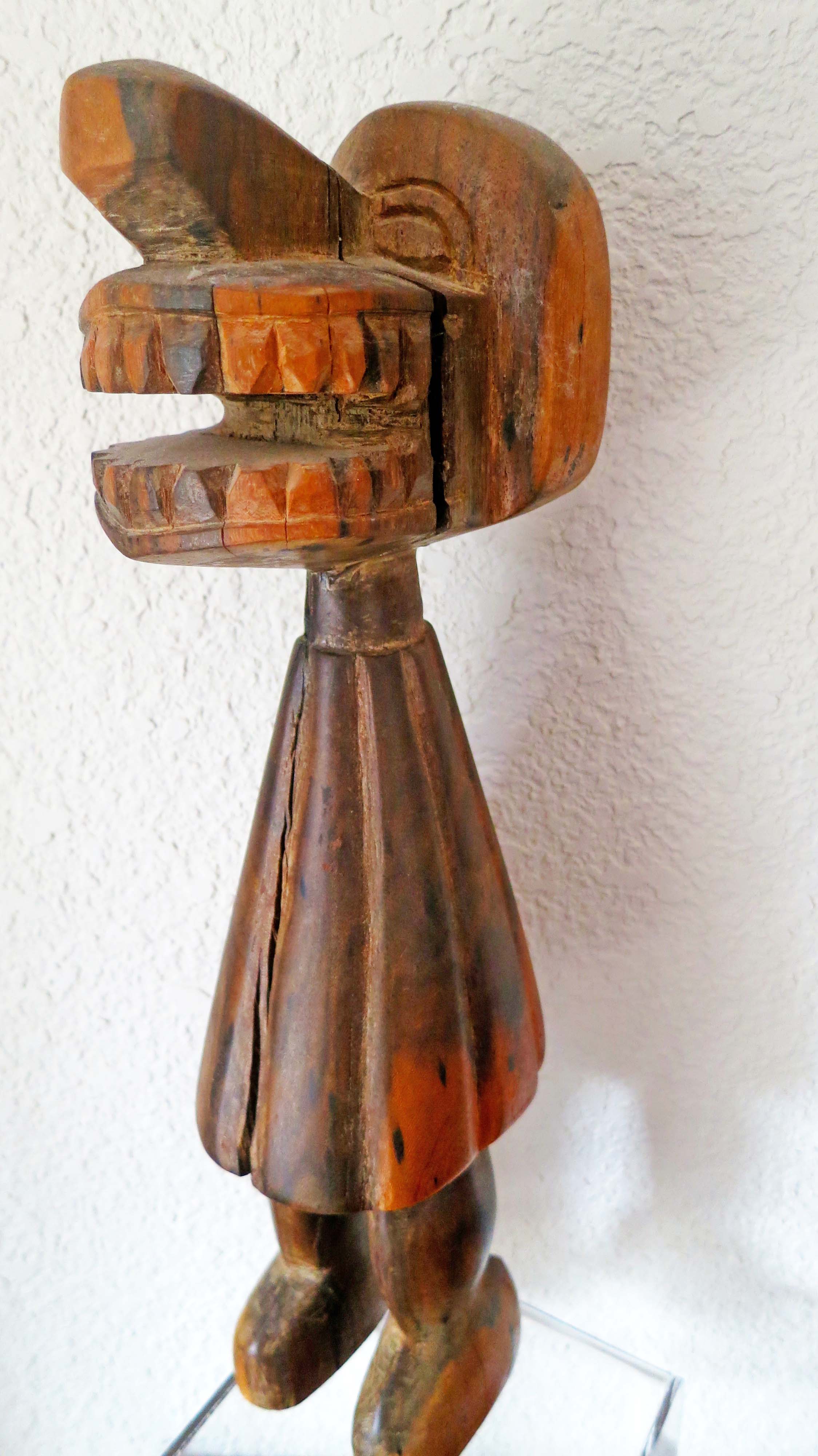
Another photo of the Liberian Bush Devil carved by Freddie.
3. The Lightning Man Strikes Again
And Other Peace Corps Africa Tales
We left Mamadee with 50 dollars to buy a 50-gallon drum of kerosene while we went off to explore East Africa in a Volkswagen beetle. Mamadee was sitting on our doorstep when we returned but there was no kerosene and no 50 dollars. Someone had stolen the money. Mamadee’s father, who was a chief of the Kpelle tribe, wanted to assure us (and himself?) that Mamadee was innocent so he offered to subject Mamadee to a trial by lightning. The Lightning Man had a special power; he could make lighting strike people who had committed crimes. Somebody steals your cow or your spouse, ZAP! Even if Mamadee were guilty, we didn’t want him struck by lightning, or even singed for that matter. We passed on the offer. Another Volunteer took a different approach. He had spent half of his monthly income ($70) on buying a new radio. Somebody stole it the first day. He vowed that he would get his new toy back. So he had his students take him out in the jungle to hire the Lightning Man. That night there was a horrendous lightning storm. Ignoring for the moment that it was in the middle of the rainy season and there were always horrendous lightning storms, put yourself in the shoes of the person who had taken the radio and believed in the Lightning Man. Every lightning strike and every peal of thunder would have had his name on it. The next morning, the Volunteer went outside and there was his radio, sitting on the porch.

Dark clouds, roaring winds, crashing thunder and multiple lightning strikes are common during Liberia’s rainy season. When ever someone was struck by lightning, the assumption was is that the Lightning Man had caused the strike and the person was obviously guilty of some wrong doing.

Mamadee standing in front of his house. Later Mamadee would become an elementary school principal in New Jersey.
4. How Boy the Bad Dog Ended Up in Soup
And Other Peace Corps Africa Tales
Boy, the Bad Dog, lived at a Peace Corps Volunteer’s house across town with a female dog named Lolita. When Lolita had pups, she drove Boy off. He went looking for other Peace Corps Volunteers to live with and ended up at our house. Normally, this wouldn’t have bothered me. But Boy had a problem: he didn’t like black people. He also regarded our cat as dinner. I encouraged him to live elsewhere. One day I came home from teaching and found a number of soldiers occupying our yard. I approached nervously; Liberian soldiers were scary. “What’s the problem?” I asked the sergeant. “Your dog ate one of the Superintendent’s guinea fowl,” he growled at me. The Superintendent was the boss of Bong County, the most powerful person in our neck of the jungle. “Which one?” I asked. “What does it matter which fowl the dog ate?” he snarled. “No, no,” I responded, “I meant which dog.” He pointed at Boy and I relaxed. “Why don’t you arrest him?” I suggested helpfully. “Not him!” the sergeant screamed. “You, you are coming with us.” The interview was not going the way he had expected. “The dog doesn’t belong to me and I am not going anywhere with you.” I replied and went into our house. The soldiers were not happy. They milled around in our yard for a half hour before marching off. It was a six-pack night for Jo and I.
At 4 AM the next morning we heard a loud bang, bang, bang. “What’s that,” Jo asked, frightened. “It sounds like someone pounding to get in,” I responded, grabbing our baseball bat and heading for the back door. I opened it just as the sergeant from the day before was preparing to strike it again with the butt of his weapon. “Your dog ate another one of the Superintendent’s guinea fowls,” he stated triumphantly. “This time you are coming with us.” The soldiers must have waited up all night for Boy. Maybe they threw the fowl over the fence. Here doggy. In addition to being scared, I was angry. “I told you yesterday that the dog belongs across town. Ask Mr. Bonal.” Mr. Bonal was the principal of the high school and lived next door. I slammed the door shut. It was like I had thrown a rock at a hornet’s nest. But Bonal was an important man in town and yanking a Peace Corps Volunteer out of his home was not something you did lightly. Eventually, the soldiers left. Jo and I waited nervously for strike three. Fortunately, the soldiers finally figured out that Boy belonged to a person who worked for the other Peace Corps Volunteer. The young man was hauled into court and fined. To pay the fine, he sold Boy to a village where the large dog became guest of honor at a tribal feast. Being a bad dog in Liberia can have serious consequences.
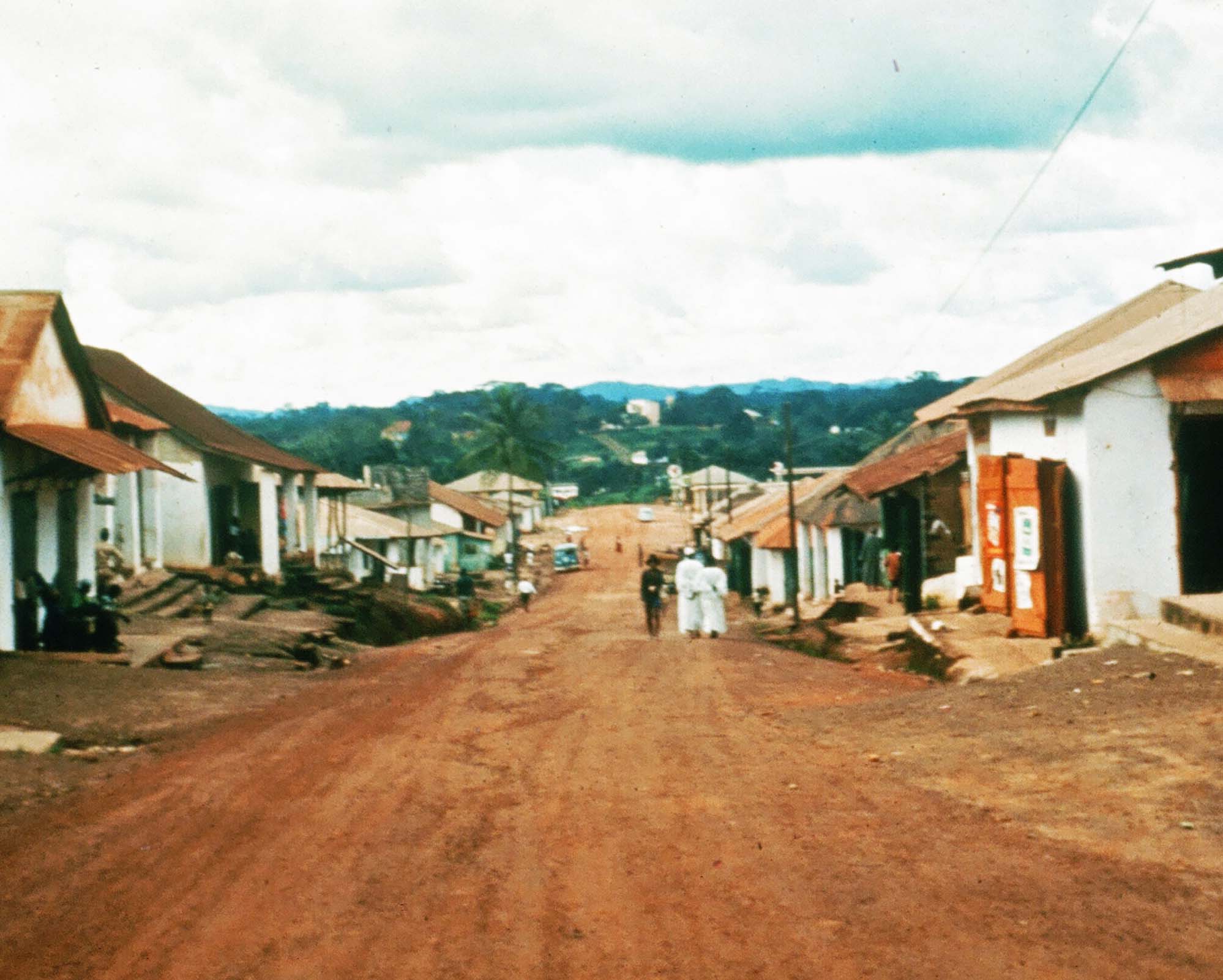
The main street of Gbarnga, Liberia where I served as a Volunteer in 1965-67. The large building you see in the distance was the Superintendent’s headquarters. The high school and the house where I lived were off to the right of his compound.
 Wandering through Time and Place