My Name Is Captain Die and This Is My Dog Rover… The Peace Corps Series

This week marks the beginning of a new blog about my experiences as a Peace Corps Volunteer in Liberia West Africa from 1965-67. I am using a WordPress theme designed to look and read like a book. Each week I will post a new chapter. When I have completed the book, I will publish it both digitally and in print. Visit me at http://liberiapeacecorps.com/ to read the first and subsequent chapters.

This week I will post three different short stories about Liberia on this blog, “Wandering in Time and Place,” to give my readers a sample of what to expect on the new blog and in the book. Today’s story: My Name Is Captain Die and This is My Dog Rover.

In our two years of living in Liberia as Peace Corps Volunteers, Peace Corps we would have many unusual experiences. One of our more unusual took place within our first week of living in Gbarnga, the town where we were assigned. It involved meeting Captain Die and his dog Rover.

Captain Die was a well digger who was reported to have spent too much time in dark holes. Our well was one of his jobs. He had dug it for our predecessors, two female Volunteers. Afterwards, he began stopping by to visit the women and bum cigarettes.

Therefore, it wasn’t surprising when he appeared on our doorstep shortly after we moved in. His introduction was unique.

“Hello, my name is Captain Die. My name is Captain Die because I am going to die someday. This is my dog, Rover. Roll over Rover. Give me a cigarette.” Rover, who was a big ugly dog of indeterminate parenthood, dutifully rolled over.

It made quite an impression.

We explained to Captain Die that neither of us smoked but invited him in to share some ice tea we had just brewed. We gave the Captain a glass and he took a huge swallow. I have no idea what he thought he was getting but it wasn’t Lipton’s. He thought we were trying to poison him.

A look of terror crossed his face and he spit the ice tea out in a forceful spray that covered half the kitchen and us. Dripping wet, we found ourselves caught between concern, laughter and dismay. The Captain marched out of our house in disgust with Rover close behind.

In addition to having found our predecessors an excellent supply of tobacco, Captain Die had been quite taken with one of them.  The story was told to us how he appeared at the door when Maryanne’s parents were visiting from the States. Captain Die was a man on a mission.  He was going to request Maryanne’s hand in marriage.

I’ve always imagined the scene as follows.

Maryanne’s parents are sitting in the living room on folding chairs making a game attempt at hiding their culture shock when this big black man and his ugly dog appear at the screen door.

Maryanne jumps up and says, “Oh Mom and Dad, I would like you to meet my friend, Captain Die.” Mom and Dad, brainwashed by Emily Post and wishing to appear nonchalant, quickly stand up with strained smiles on their faces.

Captain Die grabs Dad’s hand and tries to snap his finger at the same time proclaiming, “Hello, my name is Captain Die. My name is Captain Die because I am going to die some day. This is my dog Rover. Roll over Rover. Give me your daughter.”

No one told me how Maryanne’s parents responded to the good Captain’s offer so I will leave the ending up to the reader’s imagination. I can report that Maryanne was not whisked out of the country by her mom and dad.

While Captain Die’s visit had a purpose, there were a lot of folks who were just plain curious about how we lived. One little girl would have put a cat to shame. I never could figure out where she came from.

She would stand on our porch with her nose pressed against the screen door and stare at us for what seemed like hours. After a while it would become disconcerting and I’d suggest she go home. She would disappear but then I’d look up and there she’d be again, little nose pressed flat.

Finally, deciding more drastic measures were called for, I picked up my favorite folding chair and plopped it down a foot from the door. Then I sat down and initiated a stare back campaign. I lowered my head and moved forward until I was even with her head and about five inches away. The little nose slowly moved backward, suddenly turned around and took off at a fast gallop.

After that she watched the weird people from across the street.

A Short Lesson on Cats and Guacamole… The Peace Corps Series

This week marks the beginning of a new blog about my experiences as a Peace Corps Volunteer in Liberia West Africa from 1965-67. I am using a WordPress theme designed to look and read like a book. Each week I will post a new chapter. When I have completed the book, I will publish it both digitally and in print. Visit me at http://liberiapeacecorps.com/ to read the first and subsequent chapters.

This week I will post three different short stories about Liberia on this blog, “Wandering in Time and Place,” to give my readers a sample of what to expect on the new blog and in the book. Today’s story: A Short Lesson on Cats and Guacamole.

The cultural anthropologist James Gibbs was living in Gbarnga while he was studying the Kpelle people. Sam, our houseboy, worked for him as an informant on tribal customs.

One evening James and his wife Jewelle invited my wife Jo Ann and me over for dinner. It was our first invitation out as Peace Corps Volunteers.  I should also note we were still at the point of being recent college graduates and somewhat awed by academicians.

We dressed up in our best clothes and walked a mile down the dirt road past Massaquoi Elementary School to where they lived.

The Gibbs had an impressive house for upcountry Liberia. They were sophisticated, nice folks who quickly put us at ease. Among the hors d’oeuvres they were serving was a concoction of mashed avocado, tomatoes and hot peppers that Jo and I found quite tasteful. We made the mistake of asking what it was.

“Why it’s guacamole of course,” Dr. Gibbs declared. We must have looked blank because he went on, “Surely anyone from California knows what guacamole is.”

Surely we didn’t. I felt like Barbara Streisand in Funny Girl when she learned that pate was mashed chicken liver. It was 1965 and Mexican food had yet to storm Northern California. Yes, we’d graduated from UC Berkeley but dining out on our survival budget meant beer and pizza at La Val’s or a greasy hamburger at Kip’s.

To change the subject I called attention to their cat.

“Nice cat,” I noted.

Mrs. Gibbs gushed. “Oh, that’s Suzy. She’s in love.”

Dr. Gibbs jumped in, obviously glad to leave the subject of guacamole. “The boys are coming by every night to visit. We hear them yowl their affection up on the roof.”

Suzie looked quite proud of her accomplishments. Having been properly introduced, she strolled over and rubbed up against my legs. I reached down and scratched her head, which served as an invitation to climb into my lap. While arranging herself, Suzie provided me with a tails-eye view. Staring back at me was the anatomy of the most impressive tomcat I’ve ever seen. Suzie had the balls of a goat!

I could hardly contain myself. “Um, Suzie isn’t Suzie,” I managed to get out while struggling to maintain a straight face.

“What do you mean Suzie isn’t Suzie?” Dr. Gibbs asked in a voice meant to put impertinent grad students in their place. Rather than respond verbally, I turned the cat around and aimed his tail at Dr. Gibbs. Understanding flitted across his face.

“We never thought to look,” he mumbled lamely. We were even. While the kids from the hills might not know their guacamole from mashed avocados, they did know basic anatomy.

(Note… I may have Suzie’s name wrong after all of these years but the cat definitely had a female name.)

An Offer to Teach in Africa: From Free Speech to Peace Corps

In the spring of 1965 Uncle Sam pointed his finger at me. He wanted warm bodies to fight a colonial war in Southeast Asia the French had already lost. Being a 22-year-old male about to graduate from college, I was a prime candidate.

If drafted, I would go.

I couldn’t imagine burning my draft card, running off to Canada or joining the Texas Air National Guard. I actually believe some type of mandatory two-year national service ranging from the military to the Peace Corps would be good for young men and women and good for America.

But fighting in a war I didn’t believe in and killing people I didn’t want to kill was at the very bottom of my bucket list. And there’s more. I am allergic to taking orders and can’t stand being yelled at. I’d make a lousy soldier. I saw a court martial in my future.

Luckily, a temporary solution popped up. Peace Corps Recruiters were coming to UC Berkeley.

John Kennedy had first proposed this idealistic organization to a crowd of 5,000 students during a campaign speech at he University of Michigan on October 14, 1960. He was running four hours late and it was two in the morning but the response was overwhelming. One of his first acts as President was to create the agency.

Peace Corps service would not eliminate my military obligation but it might buy time for the Vietnam War to sort itself out. Of more importance, I felt the Peace Corps provided a unique opportunity to travel and possibly do some good. I also believed I would be serving my country.

My fiancé and I sat down and talked it out. Jo Ann was excited. We would go together as a husband and wife team. When the Peace Corps recruiters opened their booth in front of the Student Union at Berkeley, we were there to greet them, all dewy-eyed and innocent.

“Sign us up,” we urged.

Of course there were a few formalities: small things like filling out the umpteen page blue application and taking a language aptitude test, in Kurdish. We also needed letters of recommendation.

Apparently we looked good on paper. In a few weeks, the Peace Corps informed us that we had been tentatively selected to serve as teachers in Liberia, West Africa. We were thrilled. The age-old question of what you do when you graduate from school and enter the real world had been answered, or at least postponed.

Uncle Sam with his growing hunger for bodies to fight the Vietnam War would have wait.

Next Blog: My roommate tells the FBI I am running a Communist Cell Block.

The Tragedy of Liberia

Bob and Gerry Branch invited us to stay at their apartment in Monrovia while JoAnn and I were ‘trained.’ In this photo, Bob watches a funeral parade outside his window while Jo looks at the camera.

(At the end of the last blog, my ex-wife and I found ourselves stranded in New York City because we had mistakenly flown to JFK one day late and missed our flight to Africa. In this blog, we reach our destination.)

We made it to the right terminal on the right day and at the right time. In fact, absolute paranoia insisted we be three hours early. We watched lots of planes take off and land.

Finally, we found ourselves flying across a rough Atlantic. To quote Snoopy, “it was a dark and stormy night.” Lighting danced between the clouds as we struggled to deplete the airplane’s complimentary booze supply. We toasted the fact we had made it, we toasted Liberia, we toasted Jo’s mom for her hundred dollars and we toasted toasting.

I finally managed to fall asleep and only awakened when the pilot announced good morning. Jo and I scrambled to look down and were met by a vast sea of green broken occasionally by small clearings filled with round huts. Tropical Africa!

There was brief stopover in Dakar where French-speaking Senegalese served warm coke and ginger snaps for breakfast. It’s the type of meal you really should forget but never do.

An hour later we were dropping in to Robert’s Field, Liberia’s International Airport. A stewardess wrenched open the door admitting a sudden blast of heat and humidity. Luckily, roaming the streets of New York City in August had prepared us. What we weren’t prepared for was the view.

Striding across the tarmac to greet us was my old friend Morris Carpenter from community college days in California. He had joined the Peace Corps the year before and been assigned to Liberia. By some quirk of fate we had been assigned to the same country and would end up living closer together than we had in California.

All grins, we tumbled into each other. I couldn’t resist saying, “Dr. Livingston, I presume.”

Morris, as he put it, had been camped out on the Peace Corp’s Director’s desk in Monrovia for a month seeking a change in assignment when our arrival was announced. He quickly volunteered to pick us up. The Director, recognizing the opportunity for Morris-free time, had agreed even faster.

On our way into Monrovia, Morris filled us in on life in the Peace Corps as ‘it really was.’ One year of living in Liberia had coated his youthful idealism with a thin veneer of cynicism. There were good reasons.

Liberia was a country that had been born and nurtured in paranoia. Its origins dated back to the early 1800’s when slaves were being freed in the New England and there was a growing concern about the expanding population of free black people. While most Northerners accepted that slavery was wrong, few were willing to accept their freed slaves as equals.

In the South, where slaves outnumbered their owners, fear replaced concern. Insurrection was a real possibility. Henry Clay, Andrew Jackson, Daniel Webster and a number of other prominent Americans proposed a solution: ship freed African-Americans back to Africa. The American Colonization Society was founded and a portion of the west coast of Africa purchased. Approximately 11,000 freed slaves eventually shipped out.

Life was bleak and dangerous at first. The natives weren’t overly happy at seeing their long-lost cousins appropriate tribal lands and the Americo-Liberians (ALs) constituted a very small percentage of the total population.

The ALs had learned their US lessons well though and soon established themselves as the ruling elite. They took control of the government, education, and military. The natives were regarded as second-class citizens.

Power and privilege were the results but it was power and privilege accompanied by an underlying fear that the majority native population would rise up in revolt. This in turn led to a siege mentality and paranoia somewhat similar in nature to that felt by the white minorities in the Southern United States prior to the Civil War. I would see and experience several examples of this paranoia during my stay.

Close economic and political ties were maintained with the US over the years. Starting in 1926 Firestone entered the country and eventually cut down vast swathes of rainforest to plant rubber trees. As we drove by a rubber tree plantation on our way to Monrovia, Morris explained that the industry was now suffering from labor problems that the military had been called in to quash. Apparently workers were striking to earn twenty-five cents an hour.

On an outward level, there were a number of similarities between the United States and Liberia. English was the national language, the currency of the country was well-used American Dollars, and the flag was red white and blue complete with eleven stripes and one star. Upon arrival we even learned that the commanding general of the Liberian army was named George Washington. Not surprisingly, the government and the judiciary system were patterned after the American system.

In reality the government was a one party state controlled by the Americo-Liberians and whatever justice existed was heavily weighted toward keeping them in power. While change was underway when we arrived, it was too little and too late.

The failure to educate and bring large numbers of tribal Liberians into the economic and political system from the beginning was one of the major factors leading to the tragedy that Liberia would suffer over the next three decades. Americo-Liberians, tribal Liberians and the country would suffer terribly due to this negligence.

Morris dutifully dropped us of at Peace Corps headquarters to begin our orientation and take care of miscellaneous bureaucratic chores. While we had been playing at the World’s Fair, our fellow volunteers had been sweltering through hours of meetings. Now it was our turn.

Another married couple from Group VI, Bob and Gerry Branch, generously agreed to host our stay. They lived in a second floor apartment that overlooked one of Monrovia’s main streets. It provided a birds-eye view of life in the city.

Monrovia was overflowing with impoverished young people living in crowded tin shacks.

Monrovia was bursting at the seams with impoverished young people escaping from rural areas. Tin shacks fought for space as extended families struggled to find shelter from tropical downpours. Taxi and money-bus drivers, using their horns for brakes, filled the air with unceasing noise while the barking and growling of mangy dogs filled in around the edges. Evening air was tainted with the unique smell of cooked palm oil, smoke and moldering garbage.

Of course it wasn’t all bleak, assuming one had money. Monrovia had several good restaurants, a modern movie theater, an air-conditioned supermarket and a large paperback bookstore, all of which we came to appreciate over the next two years. Most Americo-Liberians did quite well. President Tubman lived in an impressive mansion on the outskirts of the city.

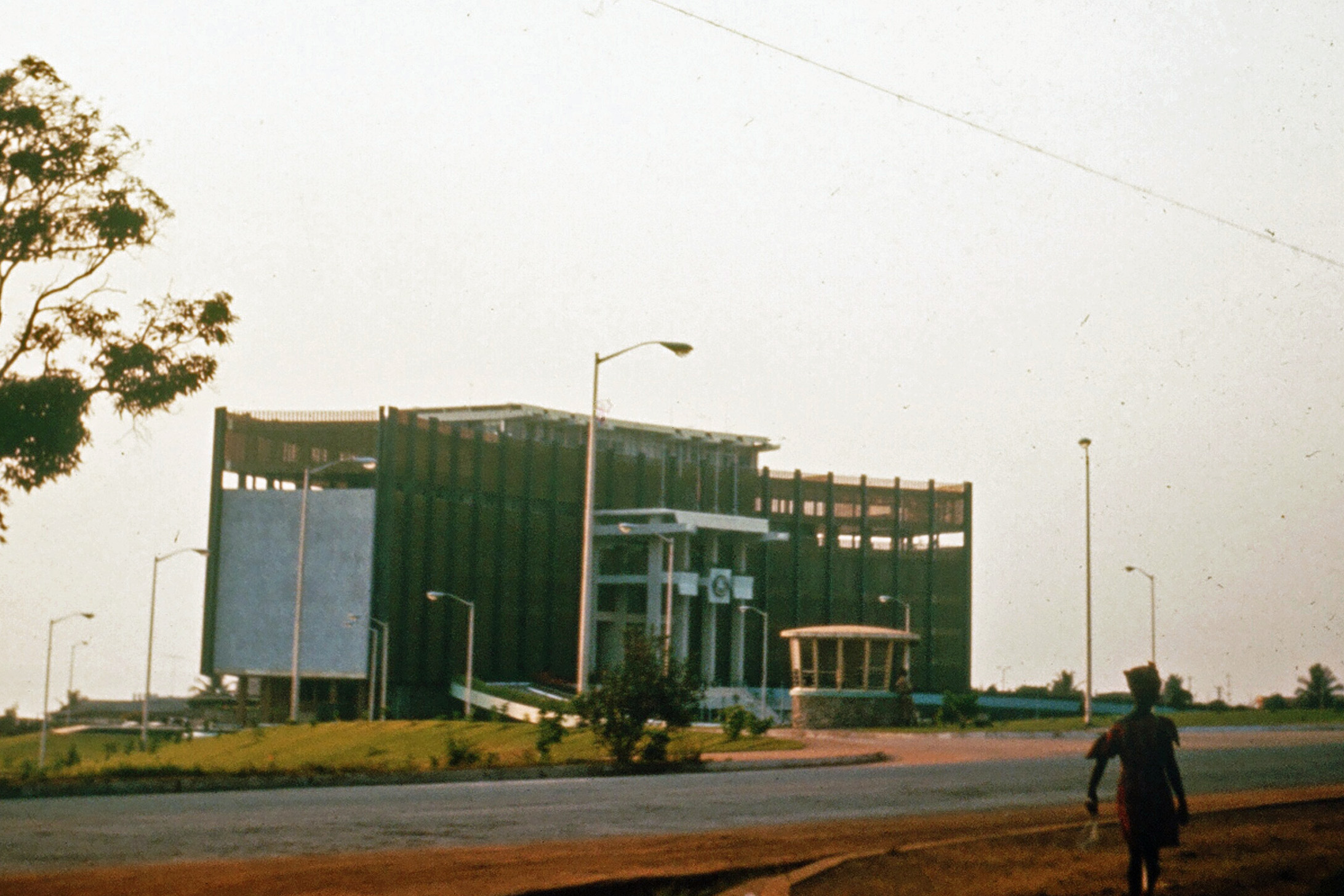
President Tubmans Mansion in 1966.

For our part, we were quite relieved to learn that our assignment wasn’t in Monrovia. Originally, we had been assigned to an elementary school down the coast in Buchanan. It was supposed to be a plum assignment so naturally another couple grabbed it when we failed to turn up.

We were left with their jobs; Jo would teach first grade and I would teach second in the upcountry town of Gbarnga. (Upcountry was anywhere inland.) Apparently this was our punishment for partying too long in Auburn. So be it…

(Note… in my March 3 blog I reported on how Phil Weisberg was arrested for holding up a sign criticizing Mrs. Tubman. Phil has since responded that he wasn’t arrested but was seized by security agents and later released.)

Peace Corps Training and the Dead Chicken Dance

In my last blog I relayed how I was accepted into the Peace Corps even though my roommate at UC Berkeley told a FBI Agent I was running a communist cell block out of our apartment. In this blog, I report on how chopping the head off a chicken was central to Peace Corps training.

Jo Ann was crying and I was struggling to be sympathetic.

It wasn’t easy. We had just left her parents in San Francisco and boarded a United Airlines jet bound for New York City. Other than the time I had surrendered five hard-earned dollars for a helicopter ride at the El Dorado County Fair, it was my first flight ever.

The jet taxied out on to the runway, climbed above the bay and banked toward the east. We were leaving family, friends and life in the US behind. While Jo struggled with the past, my thoughts were on the future. Africa, teaching and adventure beckoned. It was August 1965.

As the plane flew over the Sierra Nevada Mountains and we waved goodbye to California, my mind turned to our new role as Peace Corps Volunteers. Two months earlier we were wondering whether this day would ever arrive. Graduation, marriage, honeymoon and reporting for Liberia VI Peace Corps at San Francisco State College training had all transpired in one whirlwind week.

Upon arrival at SF State, the married couples were crammed into one wing of Merced Hall, a student dormitory. Tiny rooms, paper-thin walls and a communal bathroom became our new home. We soon knew a lot about each other.

Peace Corps staff wanted to know even more; Beebo the psychologist was assigned to follow us around and take notes. First, however, they pumped us full of gamma globulin and explained deselection. Our job was to decide whether Peace Corps was something we really wanted to do. Staff’s job was to provide stress to help make the decision

Initially this came in the form of SF State football coaches hired to shape us up.

“Okay you guys, let’s see how fast you can run up and down the stadium steps five times!”

I hadn’t liked that particular sport during my brief football career in high school and still didn’t. Beyond mini-boot camp, our time was filled with attending classes designed to teach us about Liberia and elementary school education. We were even given a stint at practice teaching in South San Francisco. There wasn’t much for Beebo to write about.

The true stress test was supposed to be a camping trip up in the Sierra Nevada Mountains. This may have been true for the kids straight out of the Bronx who had rarely seen stars much less slept out in the woods but Jo and I considered it a vacation. We had been raised in the foothills of the Sierras and were going home.

The ante on our stress level was upped considerably when the camp leader arrived the first night.

“Here’s dinner,” he casually announced as he unloaded a crate of live chickens from the back of his pickup.

Fortunately, I had chopped off a few chicken heads in my youth and knew about such things as chicken plucking and gutting. I couldn’t appear too eager in the chopping department, though. Beebo might write something like “displays obvious psychopathic tendencies.”

“Close the door, lock and latch it, here comes Curt with a brand new hatchet!”

My chicken spurted blood from its neck and performed a jerky little death dance, turning the city boys and girls a chalky white. Their appetites made a quick exit in pursuit of their color when I reached inside Henny Penny to yank out her innards. It seemed that my fellow trainees were lacking in intestinal fortitude. If so, it was fine with me; I got more chicken.

Beebo’s biggest day came when we faced the wilderness obstacle course. Our first challenge was to cross a bouncy rope bridge over a twenty-foot gorge. Beebo stood nearby scratching away on his pad. We then rappelled down a rock… scratch, scratch, scratch. Our every move was to be scrutinized and subjected to psychological analysis.

We rebelled.

“Beebo, you’ve been following us around and taking notes for two months. Now it’s your turn. See that rock. Climb down it.”

“Uh, no.”

“Beebo, you don’t understand,” we were laughing, “you have to take your turn.

Reluctantly, very reluctantly, Beebo agreed. About half way down he froze and became glued to rock with all of the tenacity of a tick on a hound. We tried to talk him down and we tried to talk him up. We even tried talking him sideways. Nothing worked. Finally we climbed up and hauled him down. Note taking was finished.

We wrapped up our wilderness week and our training was complete. Jo Ann and I took the oath and became official Peace Corps Volunteers.

In my next blog, I describe how we are left stranded in New York City while all of the other Peace Corps Volunteers fly on to Liberia.

I sign up for the Peace Corps, but there’s this problem…

It was 1965 and I was faced with a dilemma. Uncle Sam was looking for warm bodies to ship off to the jungles of Southeast Asia to fight in a colonial war the French couldn’t win. Being a 22-year-old male about to graduate from college, I was a prime candidate.

If drafted, I would go. But fighting in a war I didn’t believe in, killing people I didn’t want to kill, and possibly being killed or crippled myself was at the very bottom of my list of things I was excited about doing.

A temporary solution presented itself. Peace Corps Recruiters were coming to campus.

Ever since Kennedy had created this idealistic organization three years earlier, I had been fascinated with the idea of joining. Two years of Peace Corps would not eliminate my military obligations but it might buy time for the war in Vietnam to work itself out.

Of more importance to me, it sounded like an incredible experience. My fiancé and I sat down and talked it out. She was willing to sign up with me and we would go together as a husband and wife team.

When the Peace Corps recruiters opened their booth in front of the UC Berkeley Student Union, we were there to greet them, all dewy eyed and innocent.

“Sign us up,” we urged.

Of course there were a few formalities; small things like filling out the umpteen page blue application and taking a language aptitude test, which featured Kurdish. We also needed letters of recommendation.

Apparently we looked good on paper. In a few weeks, Peace Corps informed us that we had been tentatively selected to serve as teachers in Liberia, West Africa. We were thrilled. That age old question of what do you do when you graduate from college and have to enter the real world had been answered for us, at least temporarily.

Uncle Sam with his growing hunger for bodies to ship to Vietnam would have wait.

There were still two hurdles, though, and both were tied to the illusive if. We could go if we could pass the background security check and if we could get through training. Training wasn’t a worry. We had enough confidence in ourselves to assume we would float through. How hard could it be after Berkeley?

The Security Check was something else. Jo Ann, of course, was squeaky clean. But Curt had been up to a little mischief at Berkeley, hung out with the wrong people, been seen in a few places where law abiding people weren’t supposed to be and had his name on a number of petitions.

“And where were you Mr. Mekemson the night the students took over the Administration Building?”

Maybe there was even a file somewhere…

Soon I started hearing from friends at home. The man with the badge had been by to see them. The background security check was underway. One day I came home to the apartment and my roommate Jerry was there, looking very nervous.

“I have to talk to you Curtis,” he blurted out. “The FBI was by today doing your Peace Corps background check and I told them you had been holding communist cell block meetings in our apartment.

Jerry was not kidding; Jerry was deadly serious; Jerry was dead.

“What in the hell are you talking about?” I had yelled, seeing all of my hopes dashed. I knew that Jerry disagreed with me over my involvement in Berkeley’s Free Speech Movement and probably disagreed with me over the Vietnam War, but I hadn’t a clue on how deep that disagreement had gone. Or what he based his information on.

My degree in International Relations had included a close look at Communism. I found nothing attractive about the system.

The closest I had personally come to any truly radical students had been the Free Student Union. Yes I had held a committee meeting at our apartment but I had also severed my relationship with the organization as soon as I figured out the folks behind the Union were primarily interested in fomenting conflict.

It was not a happy time at the apartment that night or for many weeks. I assumed the Peace Corps option was out and begin thinking of alternatives. They were bleak.

As it turned out, a few weeks later we received final notification from the Peace Corps. We were accepted. The people who said good things about me must have outweighed the people who said bad things. Either that or Jo looked so good they didn’t want to throw the babe out with the bath water.

Or maybe most of the other students signing up for the Peace Corps from Berkeley in 1965 had rap sheets similar to mine. I suspect they did.

There was one final hitch. We had our Peace Corps physicals at the Army Induction Center in Oakland. That was an experience. I quickly recognized that the physical was designed as the first step in making soldiers, a part of the de-individualization process. Lining up with a bunch of other naked men to be poked and prodded isn’t my definition of fun.

“Turn your head and cough.”

I took it like a man and escaped as soon as the opportunity presented itself. A couple of days later I came back from class and there was a note from my other roommate, Cliff.

“The Induction Center called,” he wrote, “and there was a problem with the urinalysis.” I was to call them.

“Damn,” I thought. “Why is this so difficult?” So I called the Induction Center and resigned myself to having to pee in another jar. With really good luck I might avoid the naked-man-line but I wasn’t counting on it.

I got a very cooperative secretary who quickly bounced me to a very cooperative nurse who quickly bounced me to a very cooperative technician who quickly bounced me to a very cooperative doctor… none of whom could find any record of my errant urinalysis.

They didn’t see any problems and they didn’t know who had called. They suggested I call back later and be bounced around again. More than a little worried, I rushed off to my next class.

That evening I reported my lack of success to Cliff. He got this strange little smile on his face and asked me what day it was.

“April 1st,” I replied as recognition of having been seriously screwed dawned in my mind. “You little twerp!” I screamed, as Cliff shot for the door with me in fast pursuit. It took me four blocks to catch him. The damage wasn’t all that bad, considering.

Next up: What do Peace Corps training and a dead chicken’s dance have in common?

The Woman Wore No Underpants; A Tale of African Justice

(This is the second in a series of blogs where I recognize the 50th Anniversary of the Peace Corps by writing about my own experiences as a Volunteer in Gbarnga, Liberia, West Africa, 1965-1967. Here I tell about a trial by ordeal that could have happened in a medieval court.)

The Sassywood Man, a tribal judge in rural Liberia, obtained his name through use of a poisonous drink infused from the bark the Sassywood tree. The accused person was invited to take a sip. If he died, he was guilty. No DAs, lawyers, judges or juries were required.

Since modern society frowned upon trial by survival, the Sassywood Man had come up with new ways of determining guilt.  As it turned out, the father of one of my students was the local tribal judge and my ex-wife and I were privileged to witness an actual trial.

It started with Amani coming to our house at two in the afternoon on a blistering hot Saturday in the middle of the dry season. His father was about to start a trial. Would we like to see it? Absolutely, there was no way we would miss the chance. As we trudged east across town through the dust and stifling heat, Amani provided background information.

The plaintiff’s wife had come home in the evening after a hard day of selling oranges at the market and told her husband that three men had accused her of not wearing underpants. This was serious slander. The husband had filed charges against the men through Liberia’s western-type court system.

But there was a potential glitch: what if the men knew something about his wife’s behavior he didn’t? Perhaps his wife was lying to him. If he lost the suit, he would have to pay all of the court costs plus he would be subject to countersuit.

He decided to hedge his bet by taking his wife to the Sassywood Man first. If he found she was lying, the husband would drop the charges.

We arrived at court (a round hut) and were rewarded with front row dirt seats. Jo and I asked Amani how to address his father and he told us to call him Old Man, a term of respect. So we did.

Old Man didn’t speak English and we didn’t speak Kpelle but there was much smiling and finger snapping. We were delighted to meet him and he was equally delighted to meet his son’s teachers.

After the greetings were complete, Old Man began preparing for the trial. The first thing he did was to ignite a roaring bonfire, just the thing for a hot afternoon. About this time the husband arrived sans wife.

“Where’s your wife,” Old Man asked as Amani translated.

“She is being brought by her family,” the husband replied.

‘Being brought,’ it turned out, was a conservative description of the process. She was being dragged and appeared ready to bolt at the first opportunity, which she did. The woman was half gazelle; my greyhound of childhood days couldn’t have caught her as she leapt off down the trail.

For everyone involved, it looked like a clear case of guilt. But the trial was still going to be held. I asked Amani if it was being carried on for our benefit but he explained it was legitimate for the husband to sit in for the wife.

Old Man disappeared into his hut and came out with a wicked looking machete, a can of ‘medicine’ or magical objects, a pot of mystery liquid and a pot of water. He promptly shoved the machete’s blade into the fire. Next, he dumped his can of magic objects on the ground. Included were two rolls of Sassywood leaves and several small stones of various colors and shapes.

“Uh-oh,” I whispered to Jo Ann. “Are we about to witness something here with the Sassywood leaves that we would just as soon miss?”

But Old Man had a use for them other than ingestion. He asked the husband to sit down on the ground opposite him and place one roll of the leaves under his right foot. He placed the other roll under his. Both men wore shorts and had bare feet. It appeared we were to witness a trial by osmosis.

Next Old Man arranged his magic objects and proceeded to mumble over them like a priest preparing for Communion. Once the appropriate spirits had been called, it was time for mystery liquid. A generous amount was rubbed on each Sassywood leg. We were ready for the truth.

“If the knife is cold, the woman is lying,” Old Man declared dramatically as he pulled the glowing machete from the fire.

He took the “knife” and rubbed it down his leg. It sounded like a T-bone steak cozying up to a hot grill. But Old Man grinned. The knife was cold.

The husband was next. His leg appeared much less optimistic. It was, in fact, preparing to follow his wife’s legs lickety-split down the hill. Only a firm glare from Old Man made it behave. The machete sizzled its way down the shinbone and a look of surprise filled the husband’s eyes. The knife was cold; the woman was lying.

We had to be absolutely sure, however, so Old Man shoved the machete back in the fire. This time he rubbed water up and down his and the husband’s legs instead of mystery fluid. He then rearranged his magic rocks and commenced mumbling over them again. After about fifteen minutes he was ready for the final phase of the trial. He yanked the machete from the fire a second time.

“If the knife is hot, the woman is lying,” he instructed as he reversed the directions.

“Ow!” he yelled and jumped back as the machete appeared to graze his leg! The knife was definitely, absolutely, beyond the shadow of a doubt, hot.

This time Old Man couldn’t even get near the husband’s leg since the husband had cleared about ten feet from a sitting position and was strategically located behind a tree. The jury had returned its verdict; his wife was lying and he would drop the charges. He didn’t need his leg torched to prove the point.

NOTE: Before writing this blog, I looked up Sassywood on the Internet. Only recently has Liberia ceased issuing licenses for Sassywood Men and apparently several people were killed in 2007 while undergoing trials by drinking Sassywood tea.

A Letter from Africa

The hospital ward at Phebe Hospital in Liberia, Africa. Netting provides protection against malaria bearing mosquitos. Air conditioning from the tropical heat is provided by fans during the six or so hours the hospital has electricity each day.

I received a letter last week from Dr. Kylkon Makwi of Suakolo, Liberia. It was an old fashion type of letter. It came in the mail and was handwritten.

When I first met Dr. Makwi, he was a 13 year old boy who went by the name of Sam Kollie. It was the summer of 1965. My former wife Jo Ann and I had just arrived in the upcountry town of Gbarnga, Liberia where we were to serve as Peace Corps teachers.

We were tired, hungry and nervous. It was the end of a long day that had started in Monrovia, Liberia’s Capitol. A week earlier we had been partying in Jo’s back yard in Auburn, California. Now we were in the heart of West Africa. The Peace Corps driver, Wellington Sirleaf, made a quick stop to introduce us to Bob Cohen, the Upcountry PC Director, and was taking us to our new house.

There was one more stop before we got there. This time it was to see Shirley Penchef, another Peace Corps Volunteer. She was waiting at her house with a young Liberian of the Kpelle tribe and a surprise.

“This is Sam,” she bubbled (Shirley always bubbled). “Sam is so excited you are here! He has been waiting weeks for you! He is going to be your houseboy!”

Jo and I were speechless. We had talked about the possibility; it was common practice among Volunteers. A young Liberian would help with chores, earn spending money and often eat with the Volunteer. Both the Liberian and the PCV gained from the experience.

We recognized the value of the arrangement but had decided that having a houseboy didn’t quite fit the Peace Corps image. Like how do you tell the folks back home you are roughing it out here in the jungle and doing good while someone cooks your dinner, washes your clothes and cuts your grass?

On the other hand, how do you tell a woman who talks in exclamation points and a 13 year old boy who is grinning from ear to ear that you don’t want what they are selling?

“Uh, gee, uh, well, why doesn’t Sam help us get settled in and then we’ll see,” we managed to stutter. It was one of the better decisions we were to make in Liberia.

You’ll find the complete story of our first day in Gbarnga under “Armies of the Night” on the sidebar. It includes drums in the night, ghosts, screaming and monster spiders… but no beer.

Sam was a bright young man. Eventually he would get a full paid scholarship to Brandeis University in Boston, pick up his MD in Monrovia and earn a Masters in Public Health at Loma Linda University in Southern California. Life would not be easy for him, however.

The story of modern Liberia is one of the great tragedies of our time. A revolution that begin with the elimination of the ruling elite quickly degraded into tribal warfare that featured modern weaponry in the hands of children and dark juju, the voodoo of West Africa. Brutality, death, disease and starvation were the results. A full generation of Liberians was either lost or forever scarred by the nightmare.

Today, Liberia is struggling to recover and Sam/Kylkon is part of the effort. He and a handful of other medical professionals are working at Phebe Hospital in Upcountry Liberia. The odds against success are staggering.

As Kylkon notes, “there is a gross shortage of health manpower and hospital supplies.” (2009 statistics from Liberia report there was one doctor per 100,000 people in Upcountry.) Even basics, such as bed linens are missing. “We are in need of patient gowns, surgeon gowns and gloves, instruments, anesthetics and therapeutic drugs.” He sometimes performs surgery wearing an apron.

Hospital facilities in Liberia were damaged during the war and are “badly in need of renovation and repair.” Electricity and water at Phebe are limited to six or so hours per day.

Phebe serves the surrounding communities such as Gbarnga, which now has a population exceeding 50,000, and border populations from neighboring countries. Few people have the money to pay for their care.

“People come by my house at all hours begging for drugs,” Kylkon reports. But there are few drugs to be had.

It is hard, almost impossible, to imagine the challenge of providing medical care under such circumstances. The tragedy of Liberia continues.

Hang in there Sam. Our thoughts and wishes are with you.