Chapter 22: Boy, the Bad Dog

Welcome to “The Dead Chicken Dance and Other Peace Corps Tales.” I am presently on a two month tour of the Mediterranean and other areas so I thought I would fill my blog space with one of the greatest adventures I have ever undertaken: a two-year tour as a Peace Corps Volunteer in Liberia, West Africa. Every two days I will post a new story.

When I have finished, I will publish the stories in digital and print book formats.

Boy was a large, brindle dog with questionable parentage and a serious problem. He didn’t like black people. He lived with a Peace Corps Volunteer named Holly, who also had a dog named Lolita. Boy came into our life when Lolita had puppies and drove him off. She believed he would eat her children.

Boy went out looking for other white people to live with and found Jo Ann and me.

Normally, I wouldn’t have cared. One more dog wasn’t going to make much difference given our menagerie of three dogs and Rasputin the Cat. It was Boy’s attitude that bothered me. It wasn’t very Peace Corp-like to have your dog attack Liberians when they came to visit.

Boy also had an issue with Rasputin; he regarded him as prey. I initiated several civil discussions with the dog about his bad habits and suggested he might end up in Liberian soup, but all he did was growl. Once, when he had Rasputin cornered, I slapped him on the butt. He almost took my hand off. Consequently, I wasn’t sympathetic when the soldiers arrived.

They were standing outside our house, waving their guns around, when Jo and I came home from teaching.

“What’s up?” I asked in my most official Peace Corps voice. You learned early on not to mess with Liberian soldiers. Even the government refused to issue them bullets.

“Your dog ate one of the Superintendent’s Guinea Fowl,” their sergeant mumbled ominously. The Superintendent of Bong County was the equivalent to a governor except that he had more power. He lived a quarter-mile away and his Guinea Fowl strutted around freely in the government compound.

“Which one?” I asked innocently.

“What does it matter which Guinea Fowl the dog ate?”  Sarge sneered.

“No, no,” I responded, “I meant which dog.”

He glared at me for a moment and then pointed at Boy. I relaxed. It didn’t seem like Do Your Part, Brownie Girl or Puppy Doodle would have done in the Supe’s Guinea Fowl. They were three of the best-fed dogs in Gbarnga.

“Why don’t you arrest him?” I offered hopefully.

“Not him,” he shouted. “You. You come with us!” Apparently the interview wasn’t going the way the soldier wanted. A Liberian might have been beaten by then. I decided it was time to end the conversation.

“Look,” I said, “that dog does not belong to me. He belongs across town. I am not going anywhere with you.” With that I walked into our house and closed the door. It was risky but not as risky as going off with the soldiers. They grumbled around outside for a while and finally left.

Jo and I relaxed “small,” as the Liberians would say, but really didn’t feel safe until that evening. It was a six-beer night. Finally, around ten, we went to bed believing we had beaten the rap.

WHAM! WHAM! WHAM!

“What in the hell was that?” I yelled as I jumped out of bed. It was pitch black and four o’clock in the morning.

WHAM! WHAM! WHAM!

“Someone is pounding on our back door,” Jo Ann whispered, sounding as frightened as I felt.

I grabbed our baseball bat, headed for the door, and yanked it open. Soldiers were everywhere. The same friendly sergeant from the night before was standing there with the butt of his rifle poised to strike our door again.

“Your dog ate another one of the Superintendents guinea fowls,” he proclaimed to the world. I could tell he was ecstatic about the situation. He had probably tossed the bird over the fence to Boy.

“This time you are going with us!” he growled.

In addition to being frightened, I was growing tired of the routine. “I am sorry you are having such a hard time guarding guinea fowls,” I said, trying to sound reasonable, “but I explained to you yesterday that the dog does not belong to me and I am not going anywhere with you. Ask Mr. Bonal and he will tell you the dog is not ours.”

Usually the ballsy approach gets you in more trouble. This time it worked.

I closed the door and held my breath. Sarge was not happy. He and his soldiers buzzed around outside like angry hornets. Still, yanking a Peace Corps Volunteer out of his house and dragging him off in the middle of the night over a guinea fowl could have serious consequences, much more serious than merely reporting back that I was uncooperative. I could see the headlines:

Soldiers Beats Peace Corps Volunteer Because Dog Eats Guinea Fowl                                                                         Liberian Ambassador Called to White House to Explain

That would have been right up there with “Peace Corps Volunteer Beaten because Dog Invades Mosque!” How did I get myself into these things? I hoped the sergeant shared my perspective. At a minimum, I figured he would check with Bonal. John might not appreciate being awakened in the middle of the night but it would serve him right for laughing when I had told him the guinea fowl story the night before. Anyway, I suspected he was up and watching the action.

We had a very nervous thirty minutes before the soldiers finally marched off. In the US, this is the point where you would be calling your attorney, your mother, and the local TV station. Here, my only backups were the Peace Corps Representative and Doctor: one to represent me, the other to patch me back together.

Happily, our part of the ordeal was over. It turned out that Peter, a young Liberian who worked for Holly, actually owned Boy. The soldiers finally had someone they could bully.

Peter was pulled into court and fined for Boy’s heinous crimes. Boy, in turn, was sold to some villagers to cover the cost of the fine. As for Boy’s fate, he was guest of honor at a village feast. Being a Bad Dog in Liberia had rather serious consequences.
Chapter 20: I Do Away with Spot…

Welcome to “The Dead Chicken Dance and Other Peace Corps Tales.” I am presently on a two month tour of the Mediterranean and other areas so I thought I would fill my blog space with one of the greatest adventures I have ever undertaken: a two-year tour as a Peace Corps Volunteer in Liberia, West Africa. Every two days I will post a new story.

When I have finished, I will publish the stories in digital and print book formats.

 Henrietta George

With Rasputin chosen as our cat, it was time to choose our Peace Corps summer projects.

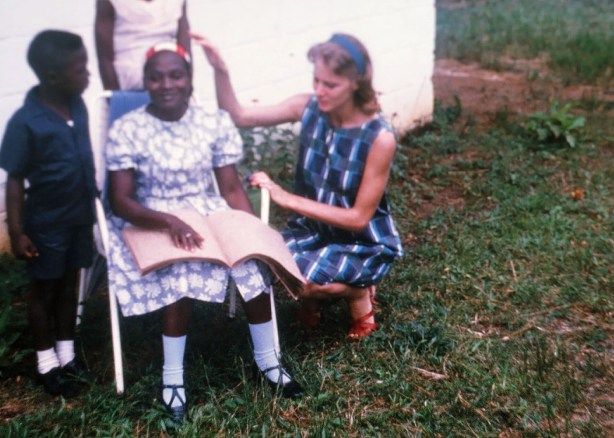
Jo Ann decided to read to a blind student. Henrietta George lived on the Methodist compound.  Reading a variety of books and magazines to her was a simple but worthwhile project that would brighten and broaden the young woman’s world.

My decision was slightly more complicated. I decided to do away with Spot. Why shouldn’t Liberian children have books that reflected their own culture as opposed to books that were based on Dick, Jane and their bouncy, four-legged companion? So I chose to write an elementary school Liberian reader. Peace Corps staff in Monrovia quickly approved the idea.

Immediately afterwards I woke up at 3 AM wondering what the heck I had gotten myself into. My lack of knowledge about Liberian culture was only exceeded by my limited expertise in developmental reading skills. But second thoughts rarely stop me from plunging forward and this time was no exception. There were teaching guides to review, people to interview, folk tales to gather, and stories to write, rewrite and finish in simple English.

It turned into a massive project that occupied my full summer and beyond. Sam gathered several of his friends together to tell me African Folktales they had learned around village cooking fires as young children. Most of the stories involved animals and included lessons on behavior.

Several were about the trickster Spider. Here’s one I included in my reader.

How Spider Got His Small Waist

Spider was very greedy. He didn’t share food and he didn’t share money. He didn’t share anything. He kept it all for himself. One day a group of villagers came to visit Spider.

“We are having a feast. Would you like to come?” they asked.

“Oh yes,” Spider answered with joy as he rubbed his eight legs together. “I will be glad to eat your food.”

Shortly after, people from another village knocked on his door. They, too, were having a feast on the same day and Spider was invited. Of course he would come. He never missed a free meal. But how could he make sure he stuffed himself with food at both feasts? He thought and he thought.

Suddenly he jumped up and did a dance. “I know what I can do!” he sang.

Spider found two very long ropes. He tied one to his door and then walked to the first village and gave the people the other end. “When the feast is ready, tug on the rope,” he told them. Spider then did the same thing with the second village.

When Spider got back to his hut he tied both ropes around his waist. “Now I am ready,” he thought.  “When the first feast starts I will run to the village and eat as much of their food as I can gulp down.” (Spider could gulp very fast.) “When the second village tugs on my rope, I will run there and eat all of their bananas.”

Spider was quite pleased with his plan but all of his work had made him very tired. He fell into his bed and snored loudly. He was dreaming about a large dish of palm butter and rice when a tug on his waist woke him up. “Dinner!” he shouted.

He was just outside of his hut when the second village tugged on its rope. Oh no, both feasts were happening at once! But that wasn’t the bad part. With both villages tugging on him, Spider could not move. He was going to miss both feasts.

“Where’s Spider?” the villagers at the first feast worried. Everyone in the village grabbed the rope and tugged has hard as they could.

“Spider is going in the wrong direction!” the people in the second village yelled. Everyone grabbed the rope begin pulling. Even the children helped. It was a tug of war between the two villages and Spider was caught in the middle! The ropes pulled tighter and tighter around him.

And that, my friends, is how Spider got his small waist.

I liked the story. Students could relate and have fun with it. If the teacher had a rope, she could even divide her class and play tug of war.

In addition to folktales, I wrote several stories about the everyday life of the children. One series had them finding a large snake, another playing football (soccer). I even sent them off to Monrovia to visit a favorite uncle.

Finally I wrapped up the book. I did a final rewrite on the stories and shipped them off to Peace Corps headquarters in Monrovia. And then I waited. I was nervous. I felt like a new author who had sent his work off to a publisher or an agent for the first time. I had devoted hundreds of hours to a project that might come to nothing.

Two weeks later I heard back from Monrovia. Peace Corps staff liked the book… apparently a lot. A Peace Corps Volunteer with editing experience would be partnered with a curriculum expert to prepare the book for publishing. A Volunteer who was an artist would add illustrations.

The book was to become a Department of Education project. None of our names would be included. I was fine with that. Or let me put it another way. My ego wasn’t too bruised. The satisfaction was in knowing that the book was being used in classrooms. Dick, Jane and Spot could retire to California.

Then WAWA (a term coined by experienced African hands that stood for West Africa Wins Again) struck. The book wouldn’t be published at all.

I had made the mistake of assuming the government would support a reader that featured Liberian children instead of Dick, Jane and Spot. I understood I might be criticized for inaccurately portraying Liberians or missing the target on developmental reading skills. But these were things that could be fixed.

What I had failed to understand was just how paranoid the Americo-Liberians were about maintaining power. The reader was apparently a dangerous revolutionary tract that would help tribal Liberian children develop a sense of identity and pride. They might grow up and challenge the government. I was told not to fight for the project and to pretend it had never happened. To do otherwise was my one-way ticket home.

Naturally I was angry. I went back and reread what I had written. Yes it featured tribal children and tribal folktales but there was nothing revolutionary about the book. Not one word criticized President Tubman, the True Whig Party or the Liberian government.

On the other hand the book didn’t praise President Tubman, the True Whig Party or the Liberian Government. To be published the reader apparently needed to be a propaganda piece… and that I was unwilling to write.

Chapter 19: How Brunhilda Became Rasputin the Cat… Peace Corps Tales

Welcome to “The Dead Chicken Dance and Other Peace Corps Tales.” I am presently on a two month tour of the Mediterranean and other areas so I thought I would fill my blog space with one of the greatest adventures I have ever undertaken: a two-year tour as a Peace Corps Volunteer in Liberia, West Africa. Every two days I will post a new story.

When I have finished, I will publish the stories in digital and print book formats.

With my career as a high school teacher looming, I found it hard to concentrate on the second grade. I did manage to wrap up my final few weeks without whipping anyone else.

A new house came with the new teaching position. It was located on the United States Agency for International Development (USAID) compound two hundred yards away from the high school and about the same distance from where the Peace Corps’ staff lived. Mr. Bonal was our neighbor.

Our new home was quite luxurious; it had electricity, running water and a real toilet. The days of cockroaches playing tag on our butts were past. I flushed the toilet over and over again just to watch the water go down.

The one thing the house needed desperately was a paint job; the previous occupants had felt that purple, green and yellow were quite attractive. Fortunately, we had time to paint. January was the Liberian School system’s summer vacation. This didn’t mean we were free to play like real teachers; Peace Corps expected first year Volunteers to take on a summer project.

Second year Volunteers, on the other hand, were allowed to treat their vacation as a vacation. Most of them flew off to East Africa and the big game parks. One couple, Dick and Sandy Robb, left their four little female kittens to live with us. We became substitute parents. Our pay was to have the pick of the litter. Whoopee.

I built our temporarily adopted cat family a three-story mansion out of cardboard. It was a maze of rooms, hanging toys, hallways and ramps. The kittens would disappear inside and play for long periods. We could hear them banging around as they stalked each other and attacked the hanging toys.

In a creative moment inspired by the evening cocktail hour, we decided to use the house as an intelligence test to determine which kitten we would keep. First we waited until the kittens were appropriately hungry and then brewed up their favorite meal, fish head stew. Here’s the recipe. Take several ripe fish heads and throw them in a pan of boiling water. When their eyes pop out, they’re done.

Next, we encouraged the kittens to sniff their gourmet dinner and showed them that the meal would be located just outside the ground floor door of their mansion. Now we were ready for the test. Each kitten would be placed inside the third story door and given a nudge. We would then close the door and time how long it took the kitten to reach the banquet.

Our theory was that the kitten with the quickest time through the maze of hallways and ramps would be the brightest.

Grey Kitten # 1 was a pudgy little character that never missed a meal. My money was riding on her. She breezed through the maze in three minutes sharp and set the time to beat. There was a chance that the sound of her munching away on fish heads might inspire the other kittens on to even greater glory, however.

Grey Kitten #2 was one of those ‘whatever it is you want me to do I am going to do the opposite’ type cats. Not surprisingly, she strolled out of the door seven minutes later and ignored the food altogether. (Afterwards, we were to speculate that she was the most intelligent cat and blew the race because she had no intention of living with someone who made her go through a maze for dinner.)

Grey Kitten #3 was the lean and mean version. Scrawny might be a better description. She obviously needed dinner the most and proved her mettle by blazing through the house in two minutes. The contest was all but over.

Kitten # 4 was what pollsters normally classify as ‘other.’ To start with, she was yellow instead of grey. She was also loud. In honor of her operatic qualities, Jo had nicknamed her Brunhilda. By the time her turn came up, she was impatiently scratching the hand that was about to feed her and growling in a demonic way. I gladly shoved the little monster in the third story door and closed it. We heard a scrabbling on the other side as tiny claws dug into the cardboard floor. Her race down the first hall was punctuated by a crash on the other end. Brake problems.

Then she was up and running again, but it sounded like toward us. Had her crash disoriented her? Suddenly the third story door burst open and one highly focused yellow kitty went flying through the air. She made a perfect four point landing and dashed to the dinner dish. Her time? Ten seconds.

And that is how Brunhilda came to be our cat. Our decision to keep her led us to turn her over and check out her brunhildahood a little more closely. Turns out she had a couple of furry little protuberances where there shouldn’t have been any. Like Dr. Gibbs’ cat, she was a he. In honor of Brunhilda’s demonic growl and generally obnoxious behavior, we renamed the kitten Rasputin after the nefarious Russian monk.

Chapter 18: Reading and Writing and Arithmetic Taught to the Tune of an Ebony Stick… Peace Corps Tales

Welcome to “The Dead Chicken Dance and Other Peace Corps Tales.” I am presently on a two month tour of the Mediterranean and other areas so I thought I would fill my blog space with one of the greatest adventures I have ever undertaken: a two-year tour as a Peace Corps Volunteer in Liberia, West Africa. Every two days I will post a new story.

When I have finished, I will publish the stories in digital and print book formats.

I went out in the jungle searching for a big stick. Note the work that went into building this bridge.

The first 15 minutes in class answered the question about how the students were going to react to my long absence. The class of moderately behaved students had morphed into a 30-headed monster. I was to be punished for being gone..

Considering the 15-year age difference between the youngest and oldest student, the kids were capable of several levels of mischief. After five days I had worked my way through every classroom management skill Peace Corps taught and several I made up. Nothing worked.

“They need to be whipped,” my fellow Liberian teachers suggested. “That’s what we do.”

I patiently explained that Peace Corps teachers didn’t whip their students. It was chiseled in stone. Eternal damnation would result.

“Then pretend you are going to whip them. Just don’t do it,” was the next helpful suggestion.

Being desperate and up for a little corruption, I thought about it. Where in the Peace Corps bible did it say that threats were out of line? After all, hadn’t Teddy Roosevelt said, “Speak softly and carry a big stick?” So I went out in the jungle and cut one. Next I introduced it to my students.

“Oh, Mr. Mekemson, what a big stick you have,” they said. I could see the respect shining in their eyes. I explained its purpose. They could behave and earn positive points or they could misbehave and earn negative points. If they earned enough negative points, the stick would be waiting. I didn’t tell them it would take a combination of Al Capone and Count Dracula to reach the point total for punishment.

The system worked. Whenever the class bordered on chaos, I would head for the blackboard, chalk in hand. Instant silence resulted. It was “Reading and writing and arithmetic taught to the tune of an ebony stick.” We started making up for lost time.

Of course there was an exception. Isn’t there always? It came in the form of Mary, an 11-year old going on 13. Her uncle was principal of the high school and a Big Man in town so this meant she was important. No Liberian teacher would dare touch a stick to her ornery hide, so certainly a Peace Corps teacher wouldn’t. She called my bluff and pushed her points right up to the rim. I urgently sought reasons to give her positive points but the opportunities were few and far between. She went over the top and smugly whispered to her girlfriends to watch what would happen.

Now I had a real problem. Obviously I couldn’t beat her. I am really not the beating kind. But neither could I ignore her. The end of the day came and I dismissed the class but asked her to stay. The students walked out the door and stopped on the other side. They weren’t leaving. Nobody at the school was… including the teachers. They were all waiting to see what Mr. Mekemson would do.

Mr. Mekemson was worrying. That’s what he was doing. I got out my big stick. Mary was no longer so nonchalant.

“Don’t beat me Teacha, I beg you, don’t beat me,” she screamed and screamed and screamed. I gently touched her with my stick. You would have thought I was pulling all of her fingernails and half of her toenails out, slowly. I knew everyone in the school was listening in on this little drama and I imagined that half of Gbarnga was as well. Oh boy, I thought, you have royally screwed up this time, Curtis.

I mumbled something about the importance of changing her ways and sent her off. And then I waited. How long would it be before the Peace Corps jeep came by to carry Jo Ann and me away? The next day at school was quiet.  Mary stayed home and I had a class of angels. Even other classes were quiet.

At noon, one of the Liberian teachers stopped by. She had a student she wanted me to beat. My response was not polite.

Two days later I received the message: John Bonal, Principal of Gboveh High School and Mary’s Uncle, wanted to see me. This was it. I prepared my case carefully. I didn’t want to leave. A lovely war was waiting for me at home and I had developed a considerable fondness for Liberia and its people.

I went to see Mr. Bonal with all of the enthusiasm of a hippopotamus crossing the Sahara. He was smiling when I greeted him. I even managed to get a decent snap out of the handshake.

“I’ve heard about your reputation,” he started and paused. Words like child beater, monster, and hater of kids roared through my mind. “And I would like you and your wife to come and teach at the high school. We think you would make a great addition to our faculty. We would like you to teach history and geography and Jo Ann to teach French and science.”

Talk about surprise. Here I was prepared to be booted out of the country, ready to beg as the Liberians liked to say, ready to humble myself and crawl across the floor if need be, and I was being offered the opportunity to teach two of my favorite subjects.

“Sir, your niece…” I managed to stumble out.

Mr. Bonal’s smile widened, “Ah yes,” he said, “that was a good job. Now she will be a much better student.”

Suddenly I had this suspicion that Mr. Bonal wanted me for a reason other than my ‘great’ teaching ability. I pictured myself practicing with a bullwhip out behind the high school as students lined up for their daily punishment. “Mr. Mekemson will see you now. Do you have any final words?”

But the offer was legitimate. After appearing to give it consideration for two seconds, I said yes. Jo Ann would have to speak for herself but I couldn’t imagine her saying no. Actually, she took about five seconds to think through all of the ramifications. Her only complaint was that the history classes were assigned to me. She was the history major.

Chapter 17: Abijoudi Supermarket: Almost Heaven… Peace Corps Tales

Welcome to “The Dead Chicken Dance and Other Peace Corps Tales.” I am presently on a two month tour of the Mediterranean and other areas so I thought I would fill my blog space with one of the greatest adventures I have ever undertaken: a two-year tour as a Peace Corps Volunteer in Liberia, West Africa. Every two days I will post a new story.

When I have finished, I will publish the stories in digital and print book formats.

Our decision to visit Monrovia led us past the huge Firestone Rubber Tree Plantation. I am standing next to a rubber tree that has been slashed to release the white sappy substance that will be turned into tires.

Dinner popped into my mind on the taxi trip home from Ganta. After two months of eating Argentina’s finest canned beef, I found myself lusting after the neighbor’s chickens. My last instructions to Sam before leaving to visit Morris had been to buy us one for the stew pot. I had visions of arriving back home with the hen waiting for us in the refrigerator.

It was a pleasant, if short-lived, dream.

The chicken was roosting on our stove and appeared to like her new home. Generous piles of chicken poop decorated the kitchen. Sam and I had discussed my preferences before we left. Apparently the instructions had not been clear. I corrected the error.

“Here’s another dollar. Take this chicken out and have her killed, gutted and plucked.”

My chicken whacking days were over. Sam returned a couple of hours later with dinner and Jo Ann did her culinary thing. The final product met all of my mouth-watering expectations. When the bones had been picked clean I worked my way through the pile again. Chicken had never tasted better… before or since. But there was a close match.

The lyrics to a popular West African tune proclaimed, “Chicken and rice with palm butter is nice.” I agreed; it was my favorite chop. Palm butter has a unique sweet flavor and rich texture. Unfortunately, pounding palm nuts was clearly defined as women’s work, which Sam avoided at all costs. A stone wall divided male and female roles within the Kpelle culture. I threatened to trade Sam in on a house girl and he miraculously found a way to obtain the illusive product.

It was possible to eat well in Gbarnga, even on our $160 per month salaries. But there were times we longed for a convenient grocery store packed with rib eye steaks, fresh milk and ice cream. Or, even better, a restaurant where we could order such food.

The visit with Morris provided a break in our routine but Morris lived the same way we did. His chop was quite tasty, but it was still chop. Jo and I decided it was time for our first trip back to Monrovia. Once again we packed our bags and headed over to Gbarnga’s taxi stand.

This time the price was $15 for the two of us. The taxi was packed and I rode shotgun. My job was to put my thumb on the windshield whenever we met another vehicle. The theory was that this would keep the windshield from imploding if struck by a rock. Shatterproof glass hadn’t made it to Liberia.

Rainforest, villages and small towns whizzed by slowly. I felt like we were caught in a time warp. An occasional burned out hulk of a money bus or taxi decorated the roadside and reminded us of our mortality. We passed Phebe Hospital built and operated by Lutheran missionaries and then Cuttington College built and operated by Episcopal missionaries.

In the town of Suakoko, we dropped one passenger and picked up another. He was chewing on a dark, smoky leg of either dog or monkey meat. My stomach growled in appreciation. I was adjusting to Africa.

Tribal Liberians waited with Zen-like patience beside the road for their unscheduled money bus rides. Usually a faint trail led off into the bush to their villages. I wondered what they thought about while waiting. Did they ponder their reception in Monrovia as they descended on relatives who lived in tin shacks already overflowing with people?

At some point, the jungle gave way to rubber trees with bark slashed to drain the white sticky substance. We had entered the world’s largest rubber tree plantation. Owned by Firestone, it was known for the low wages it paid Liberian workers and the generous payoffs it made to government officials.

With Kakata came relief, a paved road. Several Americo-Liberians had large farms in the area. Their names were a who’s who of Liberia’s elite.

Morris had reveled in telling us a story about a scandalous murder that had happened in the town. The guy’s body had been dismembered. His head ended up in a toilet. The local Peace Corps Volunteer told anyone who would listen, “If you want to get a-head in life, come to Kakata.”

Eventually we made it to Monrovia and our taxi let us off at the Peace Corps hostel. I’d be bunking with the guys and Jo Ann would be bunking with the girls. I didn’t think much of sleeping with a group of snoring men but the price was right. Plus Abijoudi’s was waiting.

Abijoudi’s was a genuine supermarket; it was close to heaven. I am not sure what was more impressive: the air conditioning or the aisles crammed with goods.  We wandered awestruck up and down the rows staring at the canned and frozen foods from around the world. And then we splurged. Jo Ann bought a frozen duck from Holland. Morris was coming to Gbarnga for a return visit. It would be the first meal she ever cooked for a guest.

Abijoudi’s was only one of Monrovia’s many temptations. Going to a movie was next on our list. The first James Bond thriller, “Dr. No,” had finally made it to Liberia. Our friends were raving about the film. An effort had been made in the fifties to turn Fleming’s novels into a TV series. The producers recruited an American actor for the Bond role and named him Jimmie. Can you imagine the line, “My name’s Bond, Jimmy Bond?” The series flopped.

We also discovered Oscar’s, an excellent French restaurant that perched on the edge of the Atlantic in a beautiful setting. Oscar stood by our table and personally cooked flaming steak Diane with cognac. Later, a volunteer would catch amoebic dysentery at the restaurant and Oscar’s was put on Peace Corps’ ban list. Jo and I never ate the salad, never got dysentery and never obeyed the ban.  Oscar’s became a must do on our Monrovia trips.

Oscar’s was perched on the edge of the Atlantic. Beaches in Monrovia can be quite beautiful.

After dinner we found a cozy bar tended by a big-busted German woman and Jo ordered a grasshopper: a frothy drink made with Crème de Menthe, Crème de Cacao and cream.

“A grasshopper,” the woman shouted across the crowded room. “What’s a hopper?” Everyone turned and stared at us as Jo Ann and I struggled to remember the ingredients. After that, Jo ordered more simple drinks.

Satiated and exhausted, we returned to the PC hostel. The next morning we caught a taxi back to Gbarnga and the quiet life.

Chapter 16: Dirt Roads Don’t Have White Lines… Peace Corps Tales

Welcome to “The Dead Chicken Dance and Other Peace Corps Tales.” I am presently on a two month tour of the Mediterranean and other areas so I thought I would fill my blog space with one of the greatest adventures I have ever undertaken: a two-year tour as a Peace Corps Volunteer in Liberia, West Africa. Every two days I will post a new story.

When I have finished, I will publish the stories in digital and print book formats.

A ‘mini-mart’ was waiting for us when we arrived in Ganta. Included were these containers of monkey meat. Note the skulls in the blue basin and the tails behind the basins.

When we boarded the Pan Am jet at JFK, we abandoned the life we had known.  Three-inch cockroaches, a rickety outhouse, and a hole-in-the-ground well came with the territory, as did boiling our water, reading by lantern, and eating chop.

And so what? We had kids to teach, collard greens to eat, and a zinc roof to keep out the rain. Serving as a married couple, we also had each other… our own little society. Plus we had Sam. He was bright, funny, and provided an introduction to the Kpelle culture. He also did many of the chores.

Life was almost too easy, too routine. We were good at self-entertainment; it is a primary survival skill for Peace Corps Volunteers, but we had jumped from racing down a multi-lane freeway to walking on a dirt path. The tumultuous year at Berkeley, marriage, Peace Corps training and Africa had happened bang, bang, bang. Now life was more like drip, drip, drip.

After two months we were climbing the walls like bug-a-bug. We needed a break. Relief came in the form of an invitation from our friend Morris Carpenter. He had escaped from Yopea and landed a job teaching sixth-graders in Ganta, 30 miles upcountry from us. Wellington Sirleaf, the Peace Corps driver, dropped off the note. Since there was neither phone nor mail service, Wellington was our once a week contact with the outside world.

I found it ironic that Morris and I lived closer together in Liberia than we had in California. Getting from Gbarnga to Ganta, however, was more challenging than getting from Diamond Springs to Auburn. We had two options: money bus or taxi.

The money bus was the more colorful choice. Think of taking a giant cargo van, cutting out windows, attaching a roof rack, and cramming it full of people, pigs, chickens, goats, bags of rice, fresh produce, luggage boxes and anything else a Liberian might need to survive on or sell.

These workhorses of the Liberian transportation system disdained schedules and stopped frequently. Minimal shocks, uncovered wood benches and bumpy dirt roads guaranteed butts were begging for mercy inside of 30 minutes. Packed conditions denied wiggle room to relieve an aching tailbone but might provide a kid or rooster for your lap. And there was always a chance of a breakdown accompanied by the fervent hope your driver would fix the problem in less than three hours.

We decided our daily life provided enough cross-cultural adventure and opted for the taxi. We packed a bag, left Sam in charge of buying a chicken, and walked into town to where the taxis gathered.

A dirty, grey, battered Peugeot was leaving for Ganta “small,” in a short time. “Ten dolla,” the driver informed us. “Five dolla,” we countered. Seven was the agreed price for the two of us. Then it was time to “wait small.” The driver wanted more passengers. After about an hour he gave up.

Any thoughts of a civilized trip in to Ganta were dispelled in the first five minutes. The driver drove like he saw a green mamba in his rearview mirror and the snake was gaining. While the law required us to be on the right side, dirt roads don’t have white lines. I doubt it mattered. When a car-eating pothole was located on our side of the road, we were on the other, even on a blind curve. It wasn’t a game of chicken; it was Russian roulette. Occasionally the driver would honk his horn.

Fortunately, the ride was relatively short. Our introduction to Ganta was a barrier backed up by an armed soldier.

“You pay,” the driver informed us. He had neglected to tell us there was a fee for entering the town. Turns out it was a bribe, or a dash as they call it in Africa. “Five dolla,” the soldier demanded as he looked at us menacingly. It made me angry but I took out two dollars and handed them to the driver. “Five dolla,” the soldier repeated. I shook my head no. The soldier glared at me again and then took the proffered money. Ever so slowly he opened the gate.

Dashes were a way of life in Liberia as they are in much of the world. It was a game we had to play, but we didn’t have to like it. “Asshole,” I mumbled as we drove off.

Ganta’s taxi stand included a mini-mart. Tribal women were sitting on the ground and selling a variety of items. One woman wearing a black and white wrap around lappa featured five metal basins filled with what appeared to be smoked animal parts. I looked more closely. A small, shrunken-head sized skull glared up at me with vacant eyes. A dozen or so other skulls looked elsewhere. Another basin contained legs; another split rib cages, and another long, curved tails. It was monkey meat. I looked more closely at the skulls.

“You buy?” the woman asked. “No thank you,” I replied a bit to hastily. Monkey brains were not on my list of preferred foods. She laughed.

A small boy appeared in front of me and shoved a boiled egg in my face. “Ten Cents.”

“I will give you ten cents to take us to Teacha Carpenter’s house,” I countered.

“Twenty.” “Fifteen.” “Okay.” We had struck a bargain.

Teacha Carpenter was waiting for us with a cold beer and laughed at our stories. He was a veteran PCV at the end of his term. We were green Volunteers at the beginning. Our traumas were everyday life to him. He had his own tales. An army of mice lived in his attic.

“I hear them doing parade drills every night. Back and forth, back and forth with the sergeant barking orders.” He hired Metternich the Cat to solve the problem. Each morning Metternich deposited two or three dead rodents for inspection. He was making a significant reduction in the mouse population. Besides all the mice he could eat, Metternich took his pay in chop.

Morris had planned a tour of the local leper colony for us. In particular, he wanted us to meet Freddie, a wood-carver he had befriended. Leprosy, Morris explained as we walked over to the colony, is hard to catch.

We were glad to hear there was little danger but still wary. Most of what we knew about the disease related to the old horror stories, the ones that led communities to ban lepers to remote locations. Losing body parts is scary. While leprosy might not be highly contagious, it was still contagious.

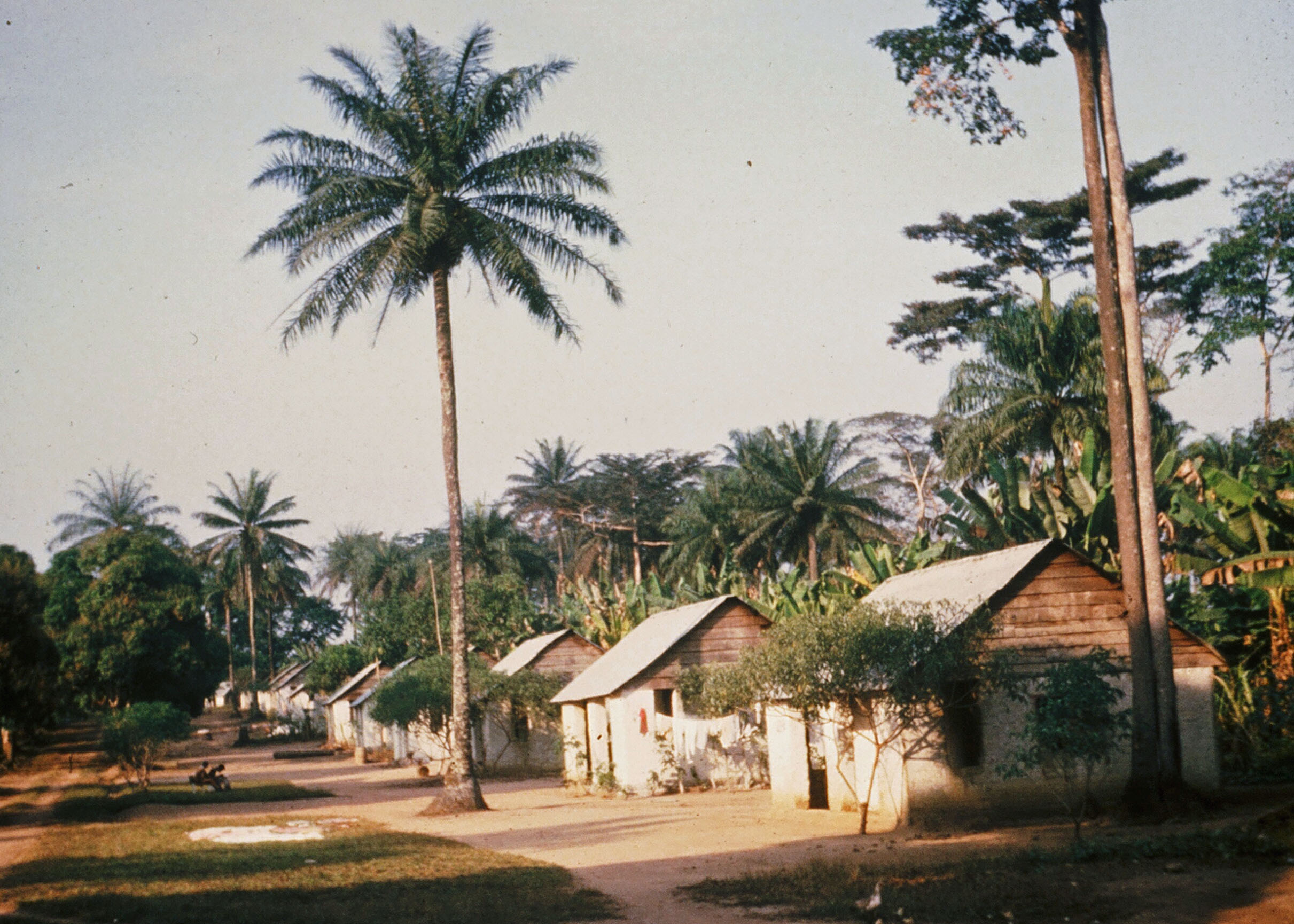
A neat row of cabins surrounded by banana, avocado and palm trees announced our arrival. It seemed that the lepers were well cared for and well fed.

The leper village in Ganta, Liberia as it looked in 1965.

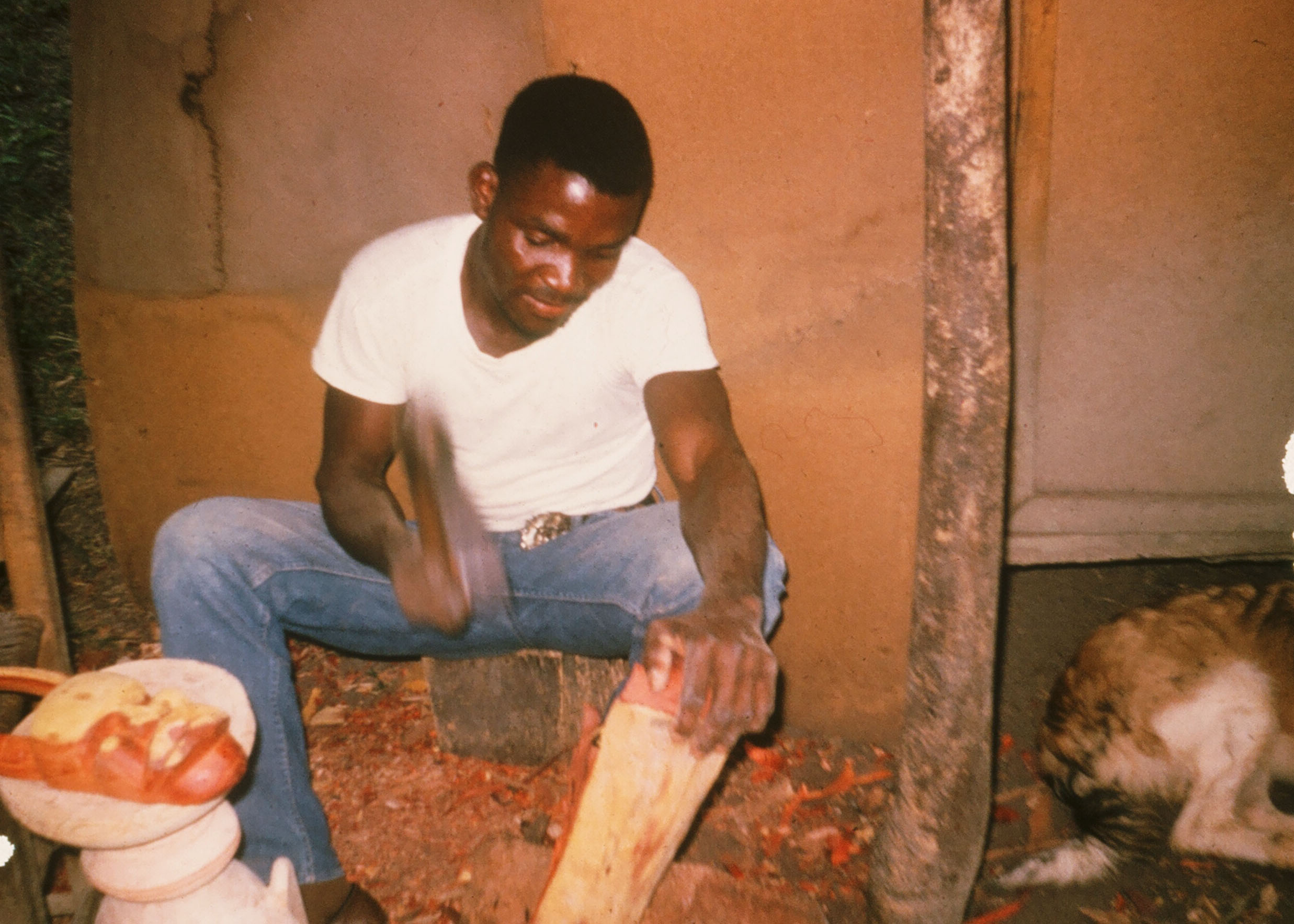
Freddie reinforced my opinion. He had a lean-to studio and was dressed in a clean white T-shirt, jeans, and polished brown shoes. Chips were flying as he chopped away on a block with a curved head adze. The smell of freshly cut wood permeated the air. A scroungy brown and white dog was lying off to the side. It opened an eye, gave a partial wag, and went back to sleep.

I couldn’t stop myself from checking to see if Freddie had lost any limbs. Except for grey blotches on his hands, he appeared intact. A devil mask was displayed beside him. Other carvings were stacked against the wall.

Freddie the Carver at work in his studio. A medicine mask with horns is on the left.

Freddie grinned as we admired his carvings. It was obvious that he took pride in his work, that he had found a way to soften the fright his disease must cause.

I was developing a taste for African art. Its primitive subject matter jumped past my rational mind and captured my subconscious. I found one piece particularly appealing. Two large feet were connected to stumpy legs that disappeared into a shapeless robe that flared downward from the neck. There were no arms. A gigantic head with a mouthful of 28 teeth and a large nose topped off the neck. It was like a circus clown, both scary and humorous.

“It’s a Bush Devil,” Morris explained. The Bush Devil, so named by disapproving missionaries, was a powerful force within the tribal society. I happily broke out five dollars and bought the piece.

Back at Morris’s we ate four-pepper chop, drank more beer, told more tales and went to sleep with mice marching back and forth in the attic.

Chapter 15: A Short Lesson on Cats and Guacamole… Peace Corps Tales

Welcome to “The Dead Chicken Dance and Other Peace Corps Tales.” I am presently on a two month tour of the Mediterranean and other areas so I thought I would fill my blog space with one of the greatest adventures I have ever undertaken: a two-year tour as a Peace Corps Volunteer in Liberia, West Africa. Every two days I will post a new story.

When I have finished, I will publish the stories in digital and print book formats.

James Gibbs is one of the world’s leading experts on the Kpelle people. In this photo, a Kpelle woman and her daughter take turns mashing palm nuts into palm butter… one of my all-time favorite foods.

Now is the time for a good guacamole story.

The anthropologist James Gibbs was living in Gbarnga while he was studying the Kpelle people. Sam worked for him as an informant about Kpelle customs. It was where he had learned the ‘taboo’ word he applied to the snails he didn’t want to eat.

One evening James and his wife Jewelle invited Jo Ann and me over for dinner. It was our first invitation out as Peace Corps Volunteers.  I should also note we were still at the point of being recent college graduates and somewhat awed by academicians. We dressed up in our best clothes and headed off down the road past Massaquoi School to where they lived.

The Gibbs had an impressive house for upcountry Liberia. They were sophisticated, nice folks who quickly put us at ease. Among the hors d’oeuvres they were serving was a concoction of mashed avocado, tomatoes and peppers that Jo and I found quite tasteful. We made the mistake of asking what it was.

“Why it’s guacamole of course,” Dr. Gibbs declared in an “I can’t believe you asked that question” tone of voice. We must have looked blank because he went on, “Surely anyone from California knows what guacamole is.”

Surely we didn’t. I felt like Barbara Streisand in Funny Girl when she learned that pate was mashed chicken liver. It was 1965 and Mexican food had yet to storm Northern California. Yes, we’d been to the UC Berkeley but dining out there on a survival budget meant beer and pizza at La Val’s or a greasy hamburger at Kip’s. To change the subject I called attention to their cat.

“Nice cat,” I noted.

Mrs. Gibbs gushed. “She’s in love.”

Dr. Gibbs jumped in, obviously glad to leave the subject of guacamole. “The boys are coming by every night to visit. We hear them yowl their affection up on the roof.”

The cat looked quite proud of her accomplishments. Having been properly introduced, she strolled over and rubbed up against my legs. I reached down and scratched her head, which served as an invitation to climb into my lap. While arranging herself she provided me with a tails-eye view. Staring back at me was the anatomy of the most impressive tomcat I’ve ever seen. She had the balls of a goat!

I could hardly contain myself. “Um, she isn’t a she,” I managed to get out while struggling to maintain a straight face.

“What do you mean?” Dr. Gibbs asked in his best professorial voice. Rather than respond verbally, I turned the cat around and aimed his tail at Dr. Gibbs. Understanding flitted across his face.

“We never thought to look,” he mumbled lamely. We were even. While the kids from the hills might not know their guacamole from mashed avocados, they did know basic anatomy.

Chapter 14: A Quivering Carcass… Peace Corps Tales

Welcome to “The Dead Chicken Dance and Other Peace Corps Tales.” I am presently on a two month tour of the Mediterranean and other areas so I thought I would fill my blog space with one of the greatest adventures I have ever undertaken: a two-year tour as a Peace Corps Volunteer in Liberia, West Africa. Every two days I will post a new story.

When I have finished, I will publish the stories in digital and print book formats.

Women in Gbarnga carried produce to and from the market on their heads. It was very graceful. Banana trees are growing on the left.

Gradually, we settled into a routine. By one in the afternoon, we had finished with another day of teaching and assigned it to the done pile. PB&J washed down by orange Kool-aid rewarded our success. Sam joined us. We bought the jelly and peanut butter from the Lebanese market. The bread came from the local baker. Occasionally it included bug parts. We looked before we bit.

Nap time was next; I fell in love with siestas. Rainy season helped. Torrential afternoon showers pounded down on our zinc roof, cooled the air, and lulled us to sleep. An hour later we rolled off the bed and jumped into lesson planning.

Monday through Friday Sam cooked Liberian chop for the three of us and on Saturdays Jo cooked Kwi food (western food) for him, usually pasta of some type. He had a teenager appetite and our budget was tight. Sam was off on Sundays.

Chop consisted of a thick soup made up of meat, greens, hot peppers, bouillon, tomato paste and palm oil. It was served on top of country rice, the staple crop and food of the Kpelle. The rice was raised on the hillsides as opposed to in swamps and arrived with small stones that Sam carefully picked out. The nearest dentist was in Monrovia. If you let him near your mouth he would find 15 cavities you didn’t have. Peace Corps paid well.

The meat might be beef, chicken, fish, goat or even pork, but we usually opted for Argentine canned beef.

Fresh beef required a six am trip to the market on Saturday. We knew it was fresh because the butcher carved it off a still quivering carcass that had been a live steer an hour earlier. You pointed at the cut you wanted. Anything without bone was steak. It was not marbled in fat. Liberian cattle were rib-showing skinny and fed off of any grass they could hustle. We sacrificed the meat to an old-fashioned meat grinder and cooked it to death.

Our experience with Gbarnga’s butcher convinced us that canned beef tasted really good.

The greens for our chop came from Gbarnga’s thriving open-air market. Collards, potato greens, eggplants, pumpkins and bitter balls were our options. Bitter balls tasted exactly like their name: eating them one time was once too many. The number of peppers thrown in depended on tolerance for hot. We progressed from being one-pepper-people to three-pepper-people during our stay. Palm oil added a unique, almost nutty taste.

The market was filled with tribal women selling everything from palm oil to large snails that constantly escaped from their tubs and crawled off. ‘Small boys’ were sent to retrieve them. Sam refused to cook the fist-size Gastropods. “They are taboo for my family.” Taboo was a word he had learned from an anthropologist. I wasn’t sure about the taboo part but hung in with him. I had no more desire for dining on the slimy creatures than he did.

Produce was carried to market in large metal bowls that the women balanced on their heads with ramrod backs and ballerina grace. Given enough beer, I wandered around our house trying to master the procedure. Five seconds were my record before everything came crashing down.

The women wore brightly colored lappas with blouses and headscarves. They would squat next to their produce and call out prices. Large, juicy oranges were “one cent, one cent” in season. Grapefruits were “five cent, five cent” and giant pineapples a quarter. Avocados or butter pears as the Liberians called them could also be purchased for a few cents.

The oranges sported green skins and the pineapples ant nests but both were “sweeto,” as my students liked to say. We added orange juice to our orange Kool-aid. Plopping the pineapples into a bucket of water over night did in the ants. By morning they were little black floaters, forming a scum on top of the water.

Our appearance at the market caused inflation but bargaining was expected. We took along Sam whose rapid Kpelle assured everyone got a fair deal. Eventually Sam took over the shopping chores. We’d send him off with five dollars and he would bring home a week’s worth of food.

When dark arrived in it’s efficient tropical fashion, we would light our kerosene lantern and get cozy. Peace Corps supplied each Volunteer with a book locker filled with one hundred books. We considered it our responsibility to read them all. TV was not an option. I was curious about who made the book selections. My money was on a Harvard professor of literature. The book lockers were heavy on classics and short on mysteries and Sci-fi.

Occasionally we would add a game of scrabble or cards to our evening routine. Around 10 PM it was time for us to eliminate any cockroaches that had strayed into our bedroom and drift off to dreamland.

Chapter 13: You Are Late, Mrs. Tubman… Peace Corps Tales

Welcome to “The Dead Chicken Dance and Other Peace Corps Tales.” I am presently on a two month tour of the Mediterranean and other areas so I thought I would fill my blog space with one of the greatest adventures I have ever undertaken: a two-year tour as a Peace Corps Volunteer in Liberia, West Africa. Every two days I will post a new story in book format.

When I have finished, I will publish the book digitally and in print.


Peace Corps Volunteer Phil Weisberg looking serious in Gbarnga, Liberia where he served as a Volunteer 1964-65.

Our life became routine, if you consider living without electricity or running water and parking your butt in a cockroach occupied outhouse as routine.

Morning started with a quick bowl of cereal topped off by a mixture of water and Milkman powder. Drinking the stuff involved an acquired taste I never acquired but fresh milk came with a question mark. Louis Pasteur had not made it to Gbarnga.

Water was equally scary. Amoebic dysentery is a common third world ailment that attacks your intestines with shock and awe. Think of it as Montezuma’s Revenge times ten. Peace Corps provided a ceramic filter and the Peace Corps doctor provided endless warnings. Paranoia ran rampant in our household. We boiled our water for ten minutes and then filtered it, even when it came straight from the rain barrel.

By 8:00 our screen door slammed behind us as we made our daily trek to Massaquoi and teaching. At least I hoped that was what I was doing. Nobody nominated me for teacher of the year but I was feeling less nervous about the job. In Peace Corps, you take your victories where you find them. I liked my students, followed the curriculum and tolerated the subject matter.

“Here comes Jane. She looks mad. Run Dick run.” did not get me excited. Neither did two plus three equals five or “Let’s see if you can print an A.”

On the other hand, the Liberian teachers at our school were getting by with a high school education. Between taking care of their families, illness and ‘don’t want to’ they were often absent. Pay was $40 per month without benefits. Like all government workers, they were required to ‘contribute’ one month of their annual salary to the True Whig Party. In fact, loyalty to the Party was more important than loyalty to the job.

Sadly, no Teacher meant no teaching. Substitutes were nonexistent. The kids were left to get by on their own, which they did like kids anywhere: laughing, yelling, fighting, playing games, and disrupting other classrooms. Sometimes, out of frustration, I would walk into an unsupervised classroom and be rewarded with instant silence. It lasted until I walked out the door.

Occasionally we escaped from our jobs. The students would be called out to join a work party, there would be a national holiday or an important politician would come to town.

Work parties involved beating the jungle back from the school. It lurked around the edges, eager to regain lost territory. All of the students were required to participate in chopping and hauling. We were expected to supervise.

The older boys wielded machetes. My 22-year old second grader, John, challenged me to a tree-cutting contest. It was a small tree, limb size. Naturally the whole class and half the school gathered around. I good-naturedly took the machete, sent a prayer to the forest spirits that I wouldn’t chop off my leg, and whacked downward with all my strength. Maybe, just maybe, I cut a third of a way into the sapling. The machete became stuck, like it was super glued to the tree. The kids broke out in laughter.

“Your turn,” I said to John, leaving the offending tool buried. He grabbed the handle, yanked the blade out, and swung the machete in one easy motion. The tree came crashing down. I told John he was now in charge of class discipline. The kids laughed again, but not so hard. Maybe I was serious.

Holidays normally celebrated some important event in Americo-Liberian history, like Matilda Newport mowing down Tribal Liberians with a canon. We shared the tribal perspective on the event but appreciated the day off.

When President Tubman or Vice President Tolbert came to town, school children were expected to line the streets and cheer. It was part of the National Unification Program. Tubman was the charismatic “father” of his nation, the big daddy. Teachers were expected to be there as well. And they were. It’s not smart to irritate your meal ticket.

Our presence was urged but not required. Most Volunteers opted out of the important politician parade. Part of it was because of irritation with the government but the main reason was that the politicians were never on time. Often the luminary was two or three hours late and it was pouring down rain, which it did half of the time, or the sun was boiling hot, which it did the other half.

One of our fellow Peace Corps teachers in Gbarnga, Phil Weisberg, took a different approach. He was a tall, gangly Volunteer who looked like he had recently lost something of profound value. He was a serious man who rarely laughed.

I remember three other things about him. One, he was in love with Barbara Streisand. He had all of her albums and would listen to her for hours on his battery driven record player.

Two, he instituted his own welfare system for needy Liberian kids. He would hire one kid to dig a hole in his backyard and a second to fill it in. Sam thought it was quite funny and laughed when he told us the story.

Three, if his students had to wait in the sun or rain for politicians, he was going to be there, suffering along with them.

Once, when he was waiting in the hot sun for the President’s wife, Phil decided to demonstrate his displeasure. He penned a sign that informed Mrs. Tubman, “You are Late.” Two hours later her motorcade tooled in to Gbarnga. Phil hoisted his sign and waved it at the First Lady’s limousine.

The protest lived as long as it took the security police to grab him. One didn’t mess with the President’s wife. One did not protest against the government.

After he had sufficient time to consider his crime, Mrs. Tubman directed the police to release him. For punishment Phil was transferred to Monrovia to teach Americo-Liberian children at a Methodist school. Several Peace Corps staff wanted to send him home… Phil’s antics made their jobs more difficult, but Liberia’s Peace Corps Director, William Wilson, supported him. Eventually, he returned to his teaching job in Gbarnga.

When Phil’s term expired he left his record player and collection with us, minus Barbara. It did include a great selection of the Kingston Trio, however. Sam spent his spare time getting Charlie off the MTA and Tom Dooley hung.

Chapter 12: Good Morning Teacha… Peace Corps Tales

Welcome to “The Dead Chicken Dance and Other Peace Corps Tales.” I am presently on a two month tour of the Mediterranean and other areas so I thought I would fill my blog space with one of the greatest adventures I have ever undertaken: a two-year tour as a Peace Corps Volunteer in Liberia, West Africa. Every two days I will post a new story in book format.

When I have finished, I will publish the book digitally and in print.

Palm trees peek over the roof of NV Massaquoi Elementary School in Gbarnga, Liberia while storm clouds gather. Jo and students stand out front in this 1965 photo.

I put on my coat and tie and shined my shoes. Jo donned her best dress. Kids were streaming by our house and staring through the screens, hoping for a glance at the new teachers.

Jo and I smiled at each other, took a deep breath, and walked out the door.

The air was warm and thick with humidity. Towering cumulus clouds filled the sky. Distant thunder rumbled. Rain was coming. We turned left on the red dirt road and joined the parade of students who glanced shyly at us. NV Massaquoi Elementary School waited.

It wasn’t far, maybe a half of mile, just far enough to get sweaty. Lush growth lined the road… green, dense, impenetrable, alive with buzzing, biting insects. The school sat off to the right in a clearing that been hacked out of the jungle.

Four classrooms faced the road while two more faced inward forming an elongated U. Cement blocks painted blue sat on top of cement blocks painted brown. Palm trees peeked over the zinc roof. Shuttered windows and closed doors completed the simple structure. A flagpole with Liberia’s red, white and blue flag was planted exactly in the center of the yard.

Students and teachers milled about as we approached. All eyes were on us, two white people in a sea of black. A man broke free from the crowd and approached. It was the Principal. We smiled and shook hands and he pointed out our classrooms. The orientation was over. And so was the gathering.

Students and teachers moved toward their rooms. Jo Ann wished me good luck and stalked off to her first grade with a look of determination. I walked toward my second grade with a look of bemusement.

“Good Morning Teacha” thirty bright and shiny faces shouted in unison as I entered.

It was scary, scarier than the big burly policeman who had guarded the door to the Administration building at Berkeley. I was expected to entertain and actually teach these kids something over the next couple of years.

“How?” bounced around in my skull and jumped down to my stomach.

I had a total of two months training at San Francisco State on educational theory. I didn’t have a clue about managing a classroom of second graders or teaching reading and writing and arithmetic. The last time I had been in a second grade, I was seven years old. My brief stint at student teaching a third grade in was helpful. But ‘brief’ is the critical word here.

And how did a classroom full of middle class kids in South San Francisco relate to a classroom of tribal Africans in Gbarnga, Liberia?

My students came from another world: one where spirits lived in trees, ghosts were dangerous, lightning strikes could be controlled, birds were meat-flying, homes were made of mud, live termites were considered a delicacy, and tribal justice was determined with a red-hot machete.

“Good morning students” I replied and smiled. Look confidant, I urged myself. Take control. It became my mantra.

I walked up to the blackboard and wrote Mr. Mekemson. The silence of the room was broken by the squeakiness of the chalk. I introduced myself, pronounced my name and had them pronounce it… several times. They laughed.

“I am from California,” I explained and noticed a slight recognition. Hollywood was there. “It’s a long way off.” I sketched a map of North America, Africa and the Atlantic Ocean with X’s for California and Liberia. Then I drew a great circle route with Diamond Springs on one end and Gbarnga on the other. I added a large jet plane with me looking out the window.

It was my first geography lesson. Of course it was incomprehensible. The kids had never seen a map. The only distance they understood was one they could walk. Jet airplanes were rare tiny specks in the sky.

But they liked the picture of me looking out the airplane’s window.

“OK, it’s your turn. I want you to tell me your name, your age and what tribe you belong to.” I could sense Americo-Liberians in Monrovia frowning. We were supposed to be moving away from tribalism and toward national unity. My students weren’t there yet.  They were Kpelle or Mano or Bassa or one of several other ethnic groups first and Liberian second, a distant second.

The majority of my students were Kpelle. It was the largest tribe in Liberia and Gbarnga was in the heart of Kpelle country. But there were also several other ethnic groups. English was the common language that was supposed to bind them together. Tribal dialects were not allowed in the classroom.

I quickly learned English meant Pidgin English spoken with a deep Liberian accent. At first, it seemed like a foreign language.

For example, you might say to me, “I have to go down town for about twenty minutes. I promise I won’t be gone long. Please wait for me.” My students would say, “Wait small, I go come.” “Small,” I, might add, in Liberian time could mean a few hours.

One idiom I learned quickly was, “Teacha, I have to serve nature.”  That meant, “May I have your permission to use the restroom?” Actually it was permission to use the outhouse or just as likely the ‘bush’ or even the side of the building. One day I looked up and saw one of my male students standing outside and listening to me through the window. I saw a slight shake of his shoulder and realized he was peeing on the wall. I admired his dedication but discouraged the practice.

Another challenge I faced was age difference. My youngest student was a decent second grade age of seven. The oldest was 22, my age, and a heck of a lot tougher. Several were middle school age and had middle school attitudes.

Books created a different problem; for the most part, there weren’t any. What we did have for reading were vintage 1950 California readers complete with Dick, Jane and Spot. I suspect I should have been grateful for anything but it was difficult for tribal kids to identify with big white houses, white picket fences and little white kids.

As for Spot, he bore a striking resemblance to food. Later, when I had a cat, my students would tease me by pinching him and saying, “Oh, Mr. Mekemson, what fine meat.”

The room reflected the simplicity of the building. Shutters covered windows without glass and without screens. Open shutters provided air conditioning. Bugs were free to come and go. Closed shutters kept heat in and tropical deluges out. The only audio-visual aid available was my writing on the blackboard.

Eventually we got through introductions, seat assignments and the other chores inherent in the first day of class. It was time to teach. I broke out Spot.

Somehow I managed to struggle through that first day. There was a curriculum to follow. More importantly, Jo Ann I had taken over from the two Volunteers who had lived in our house. Unlike us, they were experienced teachers. The kids had benefitted from their expertise.

Back at home after school, Jo had a story to tell.

“I was reading the Owl and the Pussy Cat out loud when one of my first graders broke in and said, ‘Oh, Mrs. Mekemson, you shouldn’t say that!’ The whole class broke out in laughter.”

“I asked them what they were talking about. They clammed up. All I could get was nervous giggles.”

“After school I related the story to one of the Liberian teachers and asked if she had any idea what the kids were talking about. She clammed up as well but I pushed her.”

“You were reading about a pussy, Mrs. Mekemson.” The woman managed to stutter. “You know a woman’s down under.”

How in the world her first graders who could barely speak English had picked up this particular meaning of pussy, we didn’t have a clue.