Chapter 33: African Safari by VW Bug… Part 1

I climbed out of our VW bug to photograph this elephant family in Manyara National Park with my Kodak Instamatic. Ah that I would have had a better camera.

I climbed out of our VW bug to photograph this elephant family in Manyara National Park with my Kodak Instamatic. Ah that I would have had a better camera.

African Water Buffalo are known for their nasty attitudes and we were facing a whole herd of nastiness. Thirty minutes before the gas pedal linkage on our Volkswagen Beetle had broken on our trip through Manyara National Park in Tanzania. We had jury-rigged a temporary fix by tying the pedal down. Stopping involved pushing the clutch in while the engine revved at full throttle. It was loud.

The herd of water buffalo crossing the road in front of us apparently didn’t like loud. Or maybe it was just my imagination. I get nervous when 2000-pound beasts with large, formidable horns are contemplating a charge. The fact that our VW Bug tipped the scales at just over 1700-pounds and all its horn could accomplish was a puny beep did not reduce my anxiety.

My travel companions were already nervous. Earlier in our exploration of the park, I had received a solid lecture for stopping and getting out to snap pictures of an elephant family. The week before a bull elephant in Manyara had caught a whiff of tourists in a VW Van and chased them down the road in an earth-pounding run. Having caught up, he rammed his tusks through the rear widow.

Fortunately, neither the elephants nor the water buffalo considered our tiny car and its inhabitants worthy opponents. Just after dark we drove the limping VW back into our lodge overlooking the Rift Valley and Manyara National Park. We had successfully accomplished another adventure in our 2500-mile safari through East Africa.

Peace Corps Volunteers in Liberia were encouraged to go on vacation during the second “summer” of their two-year tour. The majority of Group VI had chosen to charter a jet to East Africa for our month of escape. Our share of chartering the jet had seriously depleted Jo Ann and my savings, thus the self-guided VW safari. We hooked up with another married couple, John and Chris Ogden from New York, to share the adventure and expenses. Like Jo and I, John and Chris had graduated from college in 1965, married and joined the Peace Corps.

John and Chris Ogden join me in front of the Plum Hotel in Nairobi, Kenya during out 1967 adventure.

John and Chris Ogden join me in front of the Plum Hotel in Nairobi, Kenya during out 1967 adventure.

Our first stop was Nairobi, Kenya, an attractive, modern city where we could actually drink the milk. It is amazing how much meaning such a small thing can assume. I would have been happy to just hang out and enjoy the amenities except adventure called; there were lions and gazelles and rhinos, “oh my!” We rented our VW bug, crammed the four of us plus luggage in, and rolled off across Tsavo National Park on a narrow dirt road. Our eyes were glued to the windows searching for wildlife.

“There’s an elephant!” Chris shouted and we screeched to a halt. It looked impressively big from the perspective of our VW Beetle. So were its droppings. We drove around rather than through them. High-centering on elephant dung was not part of the adventure. We spotted an ostrich and then a giant porcupine. John and I jumped out of the car to check out the porcupine. He stood at least three feet tall, had six-inch quills and exuded a ‘don’t mess with me’ attitude. We called him sir. Just as dusk arrived we spotted our first zebras. John raced down the road to keep pace with them while Jo Ann and Chris squealed about juvenile behavior.

Mysterious Malindi on the Indian Ocean came next. Visiting there was like dropping into the middle of an Arabian Night’s Tale. Vasco da Gama had come through here at the close of the Fifteenth Century, picked up a local pilot to guide him onward, and left behind a stone cross. Long before Europe came crawling out of the Dark Ages and Vasco da Gama began his perilous journey, Malindi had been an important port on the busy Indian Ocean trade routes. Goods from as far away as China had made their way through its bustling markets while the words of the Prophet Muhammad echoed through its streets.

Visiting Malindi, Kenya in 1967 was like dropping into a Tale from the Arabian Nights.

Visiting Malindi, Kenya in 1967 was like dropping into a Tale from the Arabian Nights.

We camped out on the beach in huts and were introduced to sailing by John and Chris. We also tried snorkeling. A native outrigger canoe, complete with three natives, carried us out to a beautiful coral garden. A jellyfish seriously stung me for my efforts while Chris and Jo Ann received exotic shells from the natives. Unfortunately, the shells were still occupied by their rightful owners. After several days of hot tropical sun, opening our trunk became an exercise in courage. We ended up paying five dollars to have the shells cleaned. It was a small fortune for the guy that did it, but we thought it was a great bargain.

Mombasa was next on our agenda. We drove into town under giant, sculpted elephant trunks, a reminder of the role that the ivory trade had played in East Africa’s history. There was also a reminder of when tiny Portugal had been a major world power; a dark, foreboding Fort Jesus looked out to sea with the objective of protecting precious spice routes to the Indies. What impressed us the most, though, were the intricate, highly crafted wood carvings the city was famous for. Out came our wallets as we shipped off piece after piece to the U.S.

Giant elephant tusk sculptures greeted our entrance to Mombassa.

Giant elephant tusk sculptures greeted our entrance to Mombassa.

We crossed from Kenya into Tanzania and Mt. Kilimanjaro slipped by, hidden in the clouds. Several volunteers from our group had chosen to climb the mountain. (The Kilimanjaro link is for a tour group that follows my blog.) We opted for a more sedate experience and drove up its side to check out the coffee plantations. Heading on to Arusha, we dined at a hotel that Hemingway had frequented during his East Africa sojourns.

Much to the amusement of my companions, a large swarm of flies chose to buzz around my head during dinner. Even more annoying was the Tanzanian waiter who chose to point out with a very British accent that I used the wrong knife on my fish.

“That, sir, is your butter knife!” he announced in a booming voice. Hemingway probably would have challenged him to a duel.

I did have one important responsibility in Arusha, buying meerschaum pipes for Morris Carpenter, who had already returned to America. Unfortunately, I kept one when we returned to Gbarnga and made the mistake of trying it out while enjoying my porch. It would be years before I could break the addiction. Tobacco was much more dangerous than the elephants and water buffalo we encountered at Manyara National Park where we went after Arusha.

In my next blog we encounter George the Rhino on the floor on Ngorongoro Crater, chase giraffes across the Serengeti Plains, and dodge crocodiles on the Victoria Nile.

Chapter 31: Minced Green Mamba

Welcome to “The Dead Chicken Dance and Other Peace Corps Tales.” I am presently on a two month tour of the Mediterranean and other areas so I thought I would fill my blog space with one of the greatest adventures I have ever undertaken: a two-year tour as a Peace Corps Volunteer in Liberia, West Africa. Every two days I will post a new story.

When I have finished, I will publish the stories in digital and print book formats.


Tropical rainforests are home to numerous species of snakes. A large boa lived in this lake, which was just down from our house.

Tropical rain forests are home to numerous species of snakes. A large boa lived in this lake, which was just down from our house in Gbarnga, Liberia.

Another denizen of the rain forest that receives considerable press is the snake. As a youth I had become aware of their treacherous ways by reading Tarzan comic books.

We encountered a number of the wily serpents in our two years. They came in a myriad of sizes, shapes and colors. I already mentioned the tiny orange snake in the driver ants’ nest. “Very poisonous,” Sam had said.

I also found a black one coiled up in our flower garden and another poised in a tree above my classroom door. One dark, rainy night Jo and I were walking home from chaperoning a high school dance. Our flashlight was on the verge of dying. I looked down and found my foot three inches away from landing on top of a snake that stretched all the way across the road… which was just about the distance I managed to hop on one leg.

The Liberians assumed that all snakes were poisonous. We decided while in Liberia to do as the Liberians did. The only good snake was one with its head chopped off.

The most poisonous was reportedly the cassava snake. This ugly pit viper was about as long as your arm and twice as thick. It was supposedly sluggish; you had to step on it to get a reaction. When you did, it was all over though. Sluggishness disappeared. It whipped around and struck causing instant death. On my jungle hikes I always encouraged the dogs to go first and watched them closely. Like Rasputin, they were snake-wise. They detoured; I detoured.

Of all of Liberia's snakes, the Cassava Snake was the most deadly.(Google image)

Of all of Liberia’s snakes, the Cassava Snake was the most deadly.(Google image)

We even had a giant boa constrictor hanging out in the neighborhood. It lived in the reservoir just down the hill from our house. Town folks would spot it occasionally slithering through lake like the Loch Ness monster. I started calling it Nessie. Whenever a local dog or cat disappeared, it was assumed the snake had eaten it. My thoughts tended more toward a hungry Liberian, but this didn’t discourage me from suggesting to Boy the Bad Dog that he go play in the lake. He refused.

Soldiers eventually drained the lake in an unsuccessful attempt at finding the boa. Maybe it had developed a taste for Guinea Fowl and moved up the Superintendent’s compound.

The green mamba was an even more feared snake. It was said to climb trees, leap from limb to limb, and chase people. Jo Ann and I assumed that the Liberian who told us this story had been sipping too much fermented cane juice.

At least we did until we looked out the window one day and saw a green mamba climbing our tree. Faster than I could say, “Let’s sit this dance out,” Jo had grabbed our machete and was through the door. The mamba saw her coming and wisely made a prodigious leap for a higher limb. It missed.

Down it came amidst a mad flurry of machete strokes. Not even the three musketeers could have withstood that attack. It was instant minced snake. After that I learned to have more respect for Jo Ann when she was irritated.

In a slight reversal of roles, a snake did manage to ‘tree’ Jo once. I was happily ensconced in my favorite chair when I heard a scream from our outdoor bathroom. Talk about primitive male instincts. Hair on end, adrenaline pumping and blood rushing, I grabbed the machete and charged outside.

I threw open the bathroom door and there was Jo Ann, standing on the toilet with her pants down. Meanwhile a small black snake was merrily slithering around on the floor in hot pursuit of the little toads who considered our bathroom home. It had crawled under the door and across Jo’s foot while she was sitting on the pot. Had it happened to me, I might have been on the toilet, too.

Needless to say, I quickly dispatched the snake and saved the day. What a man!

Chapter 30: How to Fly Rhinoceros Beetles

Welcome to “The Dead Chicken Dance and Other Peace Corps Tales.” I am presently on a two month tour of the Mediterranean and other areas so I thought I would fill my blog space with one of the greatest adventures I have ever undertaken: a two-year tour as a Peace Corps Volunteer in Liberia, West Africa. Every two days I will post a new story.

When I have finished, I will publish the stories in digital and print book formats.

images

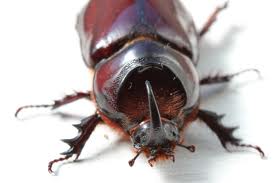
An African Rhinoceros Beetle. (Google image.)

Most of our bug encounters were less traumatic. Indeed, some, such as our interaction with rhinoceros beetles, we classified as entertainment.

These large bugs were a throwback to ancient times. In addition to being a good three inches long, they were coated with armor. The males had a huge horn projecting up from their noses; thus the name. They are reputedly the world’s strongest animal and can carry up to 850 times their own weight. Liberian children would tie a thread around the horns and fly the beetles in circles.

When we went outside after dark with a flashlight, they would sometimes dive bomb the light and crash into us Kamikaze like. It hurt. The buzzing noise made by their wings meant that we could hear them coming in time to flinch.

One of my more unique discoveries was if you put several of the big males down next to a female, they would become quite excited. Before long one would sidle up to the female in what was obviously an attempt at beetle foreplay. Permission granted, the male would them mount the female. It had all of the grace of two Sherman tanks going at it.

I know, get a life Curt.

Another insect of note was the sausage bug mentioned earlier as doggy treats. These guys were large flying abdomens. They would buzz in lazy circles through our house at night flying so slowly that Jo and I used them for badminton practice, knocking them out of the air with our rackets. Afterwards, Do Your Part would be invited in to clean up the carnage.

The best action by far was on the big screen, our screen door that is. Here we witnessed the law of the jungle in action.

The bright lights of our house guaranteed a hoard of small juicy insects would be attracted and clamor for admission. The opportunity for a free lunch quickly attracted a crowd of gourmet bug eaters. It was the bug-a-bug feast all over except the players were different and less greedy. There was a lot more stalking and a lot less gobbling.

Knobby-toed iridescent tree frogs would suction cup their way across the screen at a glacial pace and then unleash a lighting fast tongue on some unsuspecting morsel.

An eight-inch long praying mantis was a regular visitor until Jo Ann did it in, wrapped it up and shipped it off to her old zoology instructor back at Sierra College. He reported to Jo that the monster never made it. I suspect someone in the Monrovia Post Office opened the box looking for treasure. Surprise!

My favorite predators were the bats. They would fly circles around the house and pick a bug off the screen with each circuit. I could have my face inches from the screen and not disturb the hunt. Whoosh, a bat grabbed a bug for dinner. Zap, the pinkish white frog tongue unfurled and reeled in dessert. A night at the movies was never better.

Chapter 29: The Invasion of the Army Ants

Welcome to “The Dead Chicken Dance and Other Peace Corps Tales.” I am presently on a two month tour of the Mediterranean and other areas so I thought I would fill my blog space with one of the greatest adventures I have ever undertaken: a two-year tour as a Peace Corps Volunteer in Liberia, West Africa. Every two days I will post a new story.

When I have finished, I will publish the stories in digital and print book formats.

Army ants cross road

A trail of army ants snakes across a road outside of Gbarnga, Liberia. Large soldier ants provided guard duty… 

Even more than termites, driver or army ants are appropriate subjects for jungle bug horror stories. There’s a reason. These guys are ferocious.

My first experience with driver ants was when I came upon a line of them crossing a trail. At first glance they looked like any other group of respectable ants negotiating a path and minding their own business. On closer inspection, however, I found myself facing a tunnel of knife-sharp mandibles, each one wide open and wanting to crunch down on something. The big soldiers had linked their hind legs and were facing out, creating a tunnel for the other ants to crawl through.

Always up for a challenge, I took a stick and applied it to the middle of the line. Chomp! I pulled the stick back. The whole line of linked ants came along and a high-speed foot race commenced. I was both the finish line and first prize.

Or at least I was supposed to be. I gave the ants a free flying lesson. It’s possible they are still searching for their lost comrades.

Army ants are noted for their bite. In some parts of West Africa they are reputedly used as sutures. Once their jaws clamp shut, they are locked. I can attest to this since one managed to get at me through a hole in my tennis shoe. They are also noted for eating anything that can’t move fast enough to get out of their way. I watched as they gobbled down an unfortunate mouse. Their squeaking dinner simply disappeared under a sea of black.

Villagers clear out of their huts when the ants come to town. The ants go through, eat all of the bugs, mice, occasional snake and anything else alive, and then move on. It’s a good deal for the villagers and the ants. My attitude about our house being invaded wasn’t nearly as positive.

It all started on a quiet tropical evening. I was working my way through a James Bond novel, Jo was being good and preparing lesson plans, and Sam was glued to our phonograph, still trying to get Charlie off the MTA. Since bugs were such a central part of our lives, we normally ignored them. It was the hoard of tiny insects hopping and crawling under the screen door that caught our attention.

“Ants,” Sam said.

“No, Sam,” I said, assuming my teacher role, “these are not ants.” I was rewarded with an exasperated ‘I know that’ look from Sam.

“They are running away from ants that want to eat them,” he jumped in to interrupt any further explanations on my part. He was right, as usual. I turned on the porch light. Anything that could hop, crawl, walk or run was seeking sanctuary in our house. Behind them came the ants. They weren’t organized in a neat little line this time. They were spread out across our yard and coming on like a tsunami.

Jo and I held a hurried council of war. It was time to bring out the big gun, SHELLTOX.  Shelltox was one of those marvelous nerve gasses created by the pesticide industry that was so potent it was banned in the US even though this was still a time in America when DDT was considered as important to controlling six-legged life as butter was to making food taste good. The tiniest spurt of Shelltox and a cockroach rolled over and begin kicking its little legs in the air. We used it liberally.

Each of us armed with a can stomped off to war. The stomping was serious; it kept the ants off. Back and forth along the enemy line we marched, cans firing, filling the air with whatever odor Shell incorporated into its brew to let us know we were poisoning ourselves. The ants died by the hundreds and soon by the thousands. But still they came on. Our cans begin to sputter. Exiting stage left was rapidly becoming an option.

I pictured us packing up the cat and descending on the Peace Corps Rep like the ants had descended on us. First we would eat all of his food and then we would tackle his liquor closet. Unfortunately, the ants blinked first. Their buglers blew retreat. We had won the battle but the war was far from over.

That night, visions of monstrous ants visited me whenever I closed my eyes. Every hour we arose from bed to check if the attack had been renewed. Happily it hadn’t. By morning we were allowing ourselves to hope that the ants had figured out we were dangerous adversaries and moved on to easier targets. The ants had another plan. Mr. Bonal was wandering around outside so I went over to tell him our invasion story.

“Ah, let me show you something, Curtis,” he said. He walked me over to an old pile of mud bricks buried in the grass twenty feet away from our front porch. I looked down and all I could see was a moving black mass. The area was carpeted with a layer of driver ants several inches thick. There were zillions of them.

“Welcome to the ants’ home,” John explained. “They have moved in for the rainy season.”

The Bonals, it turned out, had been invaded the week before when Jo and I were in Monrovia. Again it had been a night attack but this time the ants made it into their house without discovery and found the baby. The baby, objecting strenuously to being a one-course meal, had started screaming. That brought the Bonals on the run. The baby was saved and the ants repulsed.

John assured me that the ants would be back to visit us again and again until they moved on.

I decided to remove the welcome mat. But first Jo and I had to restock our ordinance supplies. Off we went to town for umpteen cans of Shelltox, five gallons of kerosene, and a box of DDT. (Years later after I became a certified greenie and read Silent Spring, I would occasionally have twinges of guilt about the DDT.)

Our plan was to attack the home base with the kerosene, disorient the troops, destroy the barracks, and send the army packing. Of course there was a chance that the ‘packing’ would be toward our house rather than away from it. In that case, our first line of defense would be to mount an all out attack with Shelltox like we had before. As a fallback position, I scratched a narrow ditch around our house, translate that moat if you are romantically inclined, and filled it with DDT. The ants would have to crawl through the stuff to get at us.

Then I went to work. Reaching the nest without becoming ant food was the first challenge. Having grown up in red ant country, I remembered how sensitive ants are about their home territory. The slightest disturbance brings them boiling out of the ground in a blind rage. As a kid I used to pour water down their hole to watch the action.

The Apaches were reputed to have used the red ants’ proverbial ferocity as a means of torturing favored enemies.

I rightfully determined the driver ants were meaner, bigger and faster than their distant cousins. They would be on me and up the inside of my pants leg in a flash, a fate to be avoided at all costs.

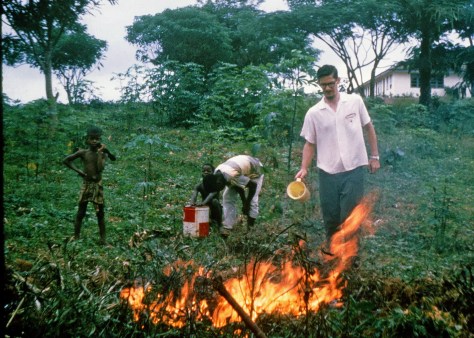
The initial strategy of removing vegetation was relatively safe. Sam and I stood several feet away and tossed two gallons of kerosene on the nest. A carefully cast match created a raging inferno which proved quite effective in defoliating the area.

Burning out army ants

The first part of the campaign was to burn the vegetation away from where the ants lived. Two gallons of kerosene did the trick. Sam helped me while two neighborhood boys looked on. Gboveh High School is up the hill.

Digging into the nest was much more dangerous; I would be operating behind enemy lines facing thousands of steel jawed troops on a hunt and destroy mission. My solution was to draft a galvanized steel tub Jo and I had used for bathing at our first house. It provided ample standing room and the ants couldn’t crawl up the side. I tossed the tub next to the nest and leapt in.

Sam tossed me our shovel. Several minutes of dedicated digging brought me to the mother of all nurseries. Eggs covered an area at least three feet across and several inches deep. Right in the middle was a finger sized, bright orange snake.

“Very poisonous,” Sam said. I figured it had to be pure poison for the ants to leave it alone. We decided to take a break and let the ants and the snake work out their relationship.

After our standard lunch of a peanut butter and jelly sandwich washed down by orange Kool Aid, we went out to check the results of our handiwork. Success! Long lines of ants, many dragging eggs, stretched off into the distance away from our house. The siege was over. There was no sign of the snake, by the way. Maybe the ants had stopped for lunch as well.

Chapter 28: A Night Time Invasion Equals A Day Time Feast

Welcome to “The Dead Chicken Dance and Other Peace Corps Tales.” I am presently on a two month tour of the Mediterranean and other areas so I thought I would fill my blog space with one of the greatest adventures I have ever undertaken: a two-year tour as a Peace Corps Volunteer in Liberia, West Africa. Every two days I will post a new story.

When I have finished, I will publish the stories in digital and print book formats.


The day after the invasion of the bug-a-bugs (termites), our next door neighbor spread the bug-a-bugs out to dry so they could be preserved fro future meals.

The day after the invasion of the bug-a-bugs, our next door neighbor spread the termites she and her family had harvested out to dry so they could be preserved for future meals.

It’s almost impossible to contemplate life in the jungle without thinking bugs. Think of every jungle movie you have ever seen, documentary you have watched, or National Geographic article you have read; tropical rainforests are creepy, crawly places.

Leeches that suck your blood, ants that march in armies, and mosquitoes that ooze with malaria are all legendary representatives of jungle lore. Anyone who writes about the jungle is expected to include bug stories. Editors and their lawyers write it into the contract. So here are some bug tales.

I’ve already introduced you to bug-a-bugs or termites as we more prosaically call them. If we listened very quietly in our first house, we could almost hear them dismantling the place around us, bite by bite. They were everywhere. The rainforest was full of their skyscrapers, huge mounds that have been known to reach forty feet into the air. An equivalent human building would be over nine miles high.

Americans are of course familiar with the voracious appetite of termites but they may not be aware that termites in turn are considered to be tasty treats by a substantial portion of the animal kingdom.

Jo Ann and I learned this at the beginning of rainy season. This is when the little buggers sprout wings and fly in the millions to set up new colonies. We had a vague concept of what insect migration meant. We had seen ladybugs and other insects swarm when we were growing up. What we weren’t prepared for was the sheer massiveness of the invasion.

Somewhere in the middle of night, we woke up with rain pounding against our shutters. At least we thought it was rain until we realized that it was only pounding on one shutter, the one protected by our porch roof. Curiosity led me to go exploring.

When I opened the door, the first thing I noticed was that we had left the porch light on. The second was that the sky was alive with flying termites, all of which seemed determined to land on the wall and shutters next to the light. Once landed, they immediately begin to move downward, making room for more bugs. I’m sure their greedy little minds were contemplating the wood beams that held up the porch.

Whether they could get to the beams was something else. Every animal in the neighborhood including Do Your Part, Brownie Girl, Puppy Doodle, Rasputin and Les Cohen’s dog, Thorazine, were scarfing up bug-a-bugs as fast as their tongues and mouths could work. What they missed was being taken care of by a huge army of toads that ranged in size from teeny-tiny to humongous. There were so many termites that no one was going away hungry.

I called for Jo to come out and watch the carnage for a few minutes and then we retired back to bed, leaving the light on. We didn’t have the heart to deprive the animals of their feast.

The next morning I headed out to survey the damage. Not a termite was to be seen. It appeared that the animals and toads had hung around until the last bug-a-bug had disappeared off the platter. I was eager to get to school that morning so I could learn more about the termites swarming habits from my students.

What I learned was that my students enjoyed eating the bug-a-bugs as much as the animals. Many of the students, in fact, showed up in class carrying cans loaded with the still alive and squirming termites, which they proceeded to pop into their mouths for breakfast as we went through the day’s first lesson.

“Sweet meat, Mr. Mekemson,” they reported while making a smacking sound with their lips. “Would you like to try some?”

I primly informed them I preferred my food a little less rambunctious and without quite so many legs.

“The queens are best,” one of the students stated authoritatively and was immediately backed up by a chorus of agreement.

Queen termites are huge egg laying machines with fist-sized abdomens capable of popping out 30,000 kiddos a day. The Liberians caught them by tearing apart the termite mounds.  Appropriate eating etiquette involved biting off their tails and sucking out their innards. Sweet meat indeed!

Later that day I watched as Mr. Bonal’s sister-in-law spread out mats for drying dead termites. The termites were then stored away for later feasting. Nothing edible was ever wasted in Liberia, whether it was meat flying, meat running, meat swimming or meat crawling.

And yes we did get to try dried bug-a-bugs in Liberian chop. They were crunchy.

Chapter 27: Trial by Poisonous Leaves and a Red Hot Machete

Welcome to “The Dead Chicken Dance and Other Peace Corps Tales.” I am presently on a two month tour of the Mediterranean and other areas so I thought I would fill my blog space with one of the greatest adventures I have ever undertaken: a two-year tour as a Peace Corps Volunteer in Liberia, West Africa. Every two days I will post a new story.

When I have finished, I will publish the stories in digital and print book formats.


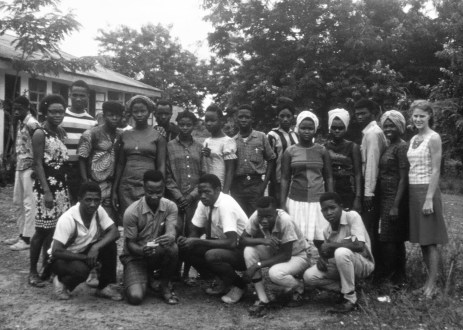
This was the Eleventh Grade class at Gboveh High School in Gbarnga in 1967. Amani Page is second from left on the bottom row.

This was the Eleventh Grade class at Gboveh High School in Gbarnga in 1967. Amani Page is second from left on the bottom row. Jo Ann is on the right.

While the Lighting Man provided a hit or miss opportunity for taking out bad guys, a more formal means of determining guilt and innocence was achieved by asking the tribal judge or Sassywood Man to resolve the issue. This tribal official obtained his name through use of poisonous leaves from the Sassywood tree. The accused person was invited to chew a few. If he died, he was guilty. No DAs, lawyers or juries were needed.

Since modern society frowned upon trial by survival, the Sassywood Man had been forced to come up with a new way of determining guilt. As it turned out, the father of one of my students, Amani Page, was the local tribal judge and Jo and I were privileged to witness an actual trial.

It all started with Amani showing up at our house at two in the afternoon on a Saturday in the middle of the dry season. His father was about to start a trial. Would we like to see it? There was no hesitation on our part even though it meant like ‘mad dogs and Englishmen’ we had to forgo our afternoon siesta and go out in the tropical sun.

As we headed west across town through the stifling heat, Amani provided background on the case. The plaintiff’s wife had come home in the evening after a hard day of selling oranges at the market and told her husband that three men had accused her of not wearing underpants. This was serious slander suggestive of loose behavior and the husband had filed charges through Liberia’s western-type court system.

But there was a potential problem: what if the men knew something about his wife’s behavior he didn’t? Perhaps his wife was lying to him. If he lost the suit, he would have to pay all of the court costs plus he would be subject to countersuit. He decided to hedge his bet by taking his wife to the Sassywood Man first. If he found his wife was lying, the husband would drop the charges and probably divorce her.

We arrived at court before the husband and wife and were rewarded with front row dirt seats. Jo and I had already asked Amani what the appropriate title for his father was and Amani had told us to call him Old Man, a term of respect. So we did. Old Man didn’t speak English and we didn’t speak Kpelle but there was much smiling and finger snapping. We were delighted to meet him and he was equally delighted to meet his son’s teachers.

After the greetings were complete, we got down to the important business of preparing for the trial. The first thing Old Man did was to ignite a roaring bonfire, just the thing for a hot afternoon. About this time the husband arrived sans wife.

“Where’s your wife,” Old Man asked as Amani translated.

“She is being brought by her family,” the husband replied.

‘Being brought,’ it turned out, was a conservative description of the process. She was being dragged and appeared ready to bolt at the first opportunity, which she did. The woman was half gazelle; my greyhound of childhood days couldn’t have caught her as she leapt off down the trail. For everyone involved, it looked like a clear case of guilt. But the trial was still going to be held. I asked Amani if it was being carried on for our benefit but he explained it was legitimate for the husband to sit in for the wife.

Old Man disappeared into his hut and came out with a wicked looking machete, a can of ‘medicine’ or magical objects, a pot of mystery liquid and a pot of water. He promptly shoved the machete’s blade into the fire. Next, he dumped his can of magic objects on the ground. Included were two rolls of Sassywood leaves and several small stones of various colors and shapes.

“Uh-oh,” I thought to myself. “Are we about to witness something here with the Sassywood leaves that we would just as soon not see?”

But Old Man had a use for them other than ingestion. He asked the husband to sit down on the ground opposite him and place one roll of the leaves under his right foot. He placed the other roll under his. Both men wore shorts and had bare feet. It appeared we were to witness a trial by osmosis.

Next he arranged his magic objects and proceeded to mumble over them like a priest preparing for Communion. Once the appropriate spirits had been called, it was time for mystery liquid. A generous amount was rubbed on each Sassywood leg. We were ready for the truth.

“If the knife is cold, the woman is lying,” Old Man declared dramatically as he pulled the glowing machete from the fire.

Old Man took the “knife” and rubbed it down his leg. It sounded like a hot grill cozying up to a T-bone steak. But Old Man grinned. The knife was cold.

The husband was next. His leg appeared much less optimistic about the process. It was, in fact, preparing to follow his wife’s legs lickety-split down the hill. A firm glare from Old Man made the leg behave. The machete sizzled its way down the shinbone and a look of surprise filled the husband’s eyes. The knife was cold; the woman was lying.

We had to be absolutely sure, however, so Old Man shoved the machete back in the fire. This time he rubbed water up and down his and the husband’s legs instead of mystery fluid. He then rearranged his magic rocks and commenced mumbling over them again. After about fifteen minutes he was ready for the final phase of the trial. He yanked the machete from the fire a second time.

“If the knife is hot, the woman is lying,” he instructed as he reversed the directions.

“Ow!” he yelled and jumped back as the machete barely touched his leg! The knife was definitely, absolutely, beyond the shadow of a doubt, hot.

This time Old Man couldn’t even get near the husband’s leg since the husband had jumped up from his sitting position and was strategically located ten feet away. The jury had returned its verdict; his wife was lying and he would drop the charges. He didn’t need his leg torched to prove the point.

All of these elements of tribal culture were fascinating to me. There were aspects of what the Kpelle believed such as the spirit in the cottonwood tree that I could almost believe myself. I like the pantheistic concept of spirits existing in plants, animals and places as well as people. It implies an element of sacredness, interconnectivity and respect for the world around us that was lost ever so long ago when we decided that humankind was the hottest stuff in creation.

There also was a lot I didn’t believe in but could recognize had value. The Lightning Man, Sassywood Man and the Bush Devil played important roles in maintaining order within the tribal society. They served as policeman, judge and priest.

Think of the power of the Lighting Man as a deterrent to crime. It’s almost biblical. Given our scientific knowledge of how lightning works, it’s easy to be amused by the concept of lightning striking bad guys. But is our system all that different? After all, we believe lawyers stand for justice. I know, I know… cheap shot, but if you stop and think about it, our society requires almost as much faith to operate as the Kpelle’s.

The use of Juju to make people become sick or die was something else, both dark and dangerous. Left unchecked these practices can and did lead to dire consequences. Some of the more macabre aspects of the violence that has haunted Liberia may be traced to similar abuse of the ‘dark arts.’

Chapter 26: The Lightning Man

Happy New Year!

Welcome to “The Dead Chicken Dance and Other Peace Corps Tales.” I am presently on a two month tour of the Mediterranean and other areas so I thought I would fill my blog space with one of the greatest adventures I have ever undertaken: a two-year tour as a Peace Corps Volunteer in Liberia, West Africa. Every two days I will post a new story.

When I have finished, I will publish the stories in digital and print book formats.


Mamadee Wattee stands in front of his home in Gbarnga Liberia in 1967. Later Mamadee would become an elementary school principal in New Jersey.

Mamadee Wattee stands in front of his home in Gbarnga Liberia in 1967. Later Mamadee would become an elementary school principal in New Jersey.

Late one evening in the middle of a tropical downpour, one of my high school students appeared on our doorstep very wet and very frightened. Mamadee Wattee was running for student body president and his opponent had purchased ‘medicine’ from a Juju man (witch doctor) to make him sick.

It was serious business; people were known to die in similar circumstances. Had the opposition slandered Mamadee or stuffed the ballot box I could have helped, but countering magic potions wasn’t taught at Berkeley. I took the issue to Mr. Bonal and he dealt with it. Mamadee stayed well and won the election.

The use of Juju medicine represents the darker side of tribal culture. Human body parts derived from ritual human sacrifice are reputed to be particularly effective in creating potions. On the lighter side, my students once obtained a less potent “medicine” and buried it under the goal post on the football (soccer) field with the belief that it would cause the other team to miss goals. Apparently it lacked power; the other team won.

Mamadee was also the reason behind our introduction to the Lightning Man. When Jo and I went on vacation to East Africa, we left Mamadee with $50 to buy us a drum of kerosene. When we returned there was neither kerosene nor $50 but Mamadee was waiting.

Someone had stolen the money and Mamadee was extremely upset. Fifty dollars represented several months’ income for a Kpelle farmer. Mamadee’s father, a chief of the tribe, was even more upset and wanted to assure us that his son had nothing to do with the missing fortune. It was a matter of honor. He offered to have Mamadee submit to the Lightning Man to prove his innocence.

The Lightning Man had a unique power; he could make lighting strike whoever was guilty of a crime. If someone stole your cow or your spouse, zap! Since we were in the tropics, there was lots of lightning. Whenever anyone was struck, people would shake their heads knowingly. Another bad guy had been cooked; justice had been served.

We didn’t believe Mamadee had taken the money and even if he had we certainly didn’t want him fried, or even singed. We passed on the offer. The Chief insisted on giving us $50 to replace the stolen money.

Another Liberian Peace Corps Volunteer in a similar situation chose a different path. Here’s how the story was told to us. The Volunteer had just purchased a brand new $70 radio so he could listen to the BBC and keep track of what was happening in the world. The money represented half of the Volunteer’s monthly income. He had his bright, shiny, new toy for two days when it disappeared.

“I am going to get my radio back,” he announced to anyone who would listen and walked into the village where he quickly gathered some of his students to take him to the Lightning Man. Off he and half the town went, winding through the rainforest to the Lighting Man’s hut. The Volunteer took out five dollars and gave it to the Lighting Man. (Lighting Men have to eat too.)

“I want you to make lighting strike whoever stole my radio,” he said.

The Volunteer and his substantial entourage then returned home. By this time, everyone in the village knew about the trip, including undoubtedly, the person who had stolen the radio.

That night, there was a tremendous thunder and lightning storm. Ignoring for the moment that it was in the middle of the rainy season and there were always tremendous thunder and lightning storms, place yourself in the shoes of the thief who believed in the Lightning Man’s power. Each clap of thunder would have been shouting his name.

In the morning the Volunteer got up, had breakfast and went out on his porch. There was his radio.

In my next blog I will report on a Sassywood trial of The Woman Who Wore No Underpants where poisonous leaves and a red-hot machete tip the scales of justice.

Chapter 25: The Bush Devil Ate Sam

Welcome to “The Dead Chicken Dance and Other Peace Corps Tales.” I am presently on a two month tour of the Mediterranean and other areas so I thought I would fill my blog space with one of the greatest adventures I have ever undertaken: a two-year tour as a Peace Corps Volunteer in Liberia, West Africa. Every two days I will post a new story.

When I have finished, I will publish the stories in digital and print book formats.

The Bush Devil is a powerful figure within traditional Liberian Culture. This is a Bush Devil of the Grebo Tribe that visited a Peace Corps Haight-Ashbury Party Liberia circa 1967.

The Bush Devil is a powerful figure within traditional Liberian Culture. This is a Bush Devil of the Grebo Tribe that visited a Peace Corps Haight-Ashbury Party Liberia circa 1967.

Sam spent hours listening to our record player getting Charlie off the MTA and Tom Dooley hung. He lived between two cultures. Scars marched down his chest in two neat rows.

“How did you get those,” Jo asked with 10 percent concern and 90 percent curiosity.

“I can’t tell you,” Sam replied with obvious nervousness as Jo’s eyebrows rose. “But I can tell Mr. Mekemson.”

“Aha,” I thought, “Sam and I belong to the same organization, the Men’s Club!” Actually Sam belonged to a very exclusive men’s organization, the Poro Society, which I wasn’t allowed to belong to either. Its functions were to pass on tribal traditions, teach useful skills, and keep errant tribe members in line. Everything about the organization was hush-hush. Tribal members who revealed secrets could be banned and even executed.

Political power on the local level was closely tied to membership in the Poro Society. On the national level, President Tubman assumed leadership of all Poro Societies in Liberia.

Tribal women had a similar secret organization to the Poro Society called the Sande Society, which prepared young women for adulthood and marriage. A rather controversial aspect of the Sande initiation ceremony was female genital mutilation, i.e. cutting off the clitoris.

Sam got off easy.

He had been to Bush School the previous summer and learned how to be a good Kpelle man. Graduation to adulthood consisted of an all-consuming encounter with the Poro Society’s Bush Devil.  It ate him. Sam went in as a child and was spit out as a man. The scarification marks had been left by the devil’s ‘teeth.’

It seemed like a tough way to achieve adulthood but at least it was fast and definitive. Maybe we should introduce the process to our kids and skip the teenage years. Think of all of the angst it would avoid.

Bush Devil was the missionary’s designation for a very important tribal figure who was part religious leader, part cultural cop and part political hack. Non-Kpelle types weren’t allowed to see him. When the Devil came to visit outlying villages he was preceded by a front man who ran circles around the local PCV’s house while blowing a whistle. The Volunteer was expected to go inside, shut the door, close the shutters and stay there. No peeking.

We did get to see a Grebo Devil once. The Grebo Tribe was a little less secretive or at least more mercenary. Some Volunteers had hired the local Devil for an African style Haight-Ashbury Party. It was, after all, 1967, the “summer of love” in San Francisco and the “Dawning of the Age of Aquarius.”

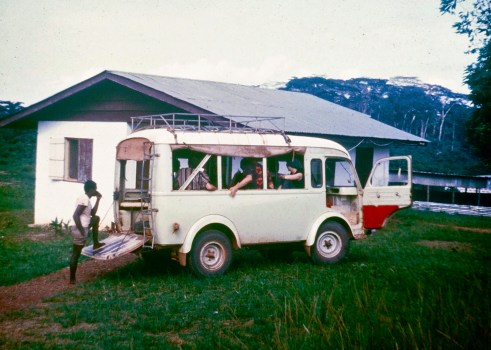
Local Peace Corps Volunteers hired a money-bus to take us to the Haight-Ashbury party. The bus sits in front of our house in this photo.

Local Peace Corps Volunteers used a money-bus to take us to the Liberia Haight-Ashbury party in 1967. Here, the bus picks Jo Ann and I up at our house in Gbarnga. The rain forest lurks in the background.

The Devil was all decked out in his regalia. Description-wise, I would say his persona was somewhere between a Voodoo nightmare and walking haystack. Grebo men scurried in front of him with brooms, clearing his path and grunting a lot.

We stayed out of the way and took pictures.

Another area where Sam showed his tribal side was in his fear of the newly dead. As I mentioned earlier, a person’s spirit was considered particularly powerful and dangerous right after he or she died. Later it would move away into the bush and fade. But first the spirit had to be tamed with appropriate mourning, an all night bash.

One didn’t take chances. When Sam worked late for us after someone had died, he would borrow a knife and a flashlight in case he had to fight off the malevolent ghost on his way home. I grew up next to a graveyard and was sympathetic with his concern.

In my next blog I will introduce the Lightning Man, a figure so powerful he could make lightning strike people.

Chapter 24: Eat More Bugs… Cultural Challenges

Welcome to “The Dead Chicken Dance and Other Peace Corps Tales.” I am presently on a two month tour of the Mediterranean and other areas so I thought I would fill my blog space with one of the greatest adventures I have ever undertaken: a two-year tour as a Peace Corps Volunteer in Liberia, West Africa. Every two days I will post a new story.

When I have finished, I will publish the stories in digital and print book formats.


Local tribal people believed this tree hosted a spirit. Often I would find offerings left at its base.

Local tribal people believed this tree outside Gbarnga, Liberia hosted a spirit. Often I would find offerings left at its base.

Joining the Peace Corps should come with a label like they put on cigarette packs. It would read “Warning: This experience may change your concept of reality.

Our vision of the world is perceived through culturally tinted glasses. Not surprisingly, the reality of our parents and our society becomes our reality. It’s very hard to imagine life from any other perspective. Close encounters with other cultures can shake this vision but not easily. We wear our culture like bulletproof vests, rarely allowing a stray thought to penetrate. Or we focus so hard on extolling our own culture that we fail to learn valuable lessons another culture may teach us.

A key element of our Peace Corps training had been to instill cultural sensitivity. Eugene Burdick and William Lederer’s book, “The Ugly American,” came out in 1958 and was turned into a movie starring Marlon Brando in 1963. Both made a significant impression on me. US citizens were known for being pushy and acting superior in dealing with foreign cultures. It created enemies. Peace Corps’ job was to make friends and provide aid, not alienate people.

There was another important reason for the training. Risks are involved when you run headlong into another culture. Depression is one. The environment may be so totally different that it becomes disorienting. The common name for this is culture shock. Learning about Liberia and its tribes was a form of inoculation.

My transition from California to Liberia was relatively smooth. At first, Gbarnga didn’t seem all that different from my old hometown of Diamond Springs. A small rural town is a small rural town. I suffered more shock going from Sierra College to UC Berkeley than I did going from Berkeley to Liberia. My disorientation (and depression) would wait until I returned to the US.

A less common phenomenon is going native or bush as it was called in Liberia. In this instance, you become so enthralled with the new culture that you adopt it as your own. There was a joke that circulated among Peace Corps Volunteers on how to determine when you were teetering on the edge.

Phase One: You arrive in country and a fly lands in your coffee. You throw the coffee away, wash your cup and pour yourself a new cup.

Phase Two: You’ve been there a few months and a fly lands in your coffee. You carefully pick the fly out with your spoon and then drink the coffee.

Phase Three: It’s been over a year and you have become a grizzled veteran. A fly lands in your coffee. You yank it out with your fingers, squeeze any coffee it may have consumed back into the cup, add the fly to your fly collection, and then drink the coffee.

Phase Four: You’ve been there too long. A fly lands in your coffee cup. You yank the fly out of the cup, pop it into your mouth and throw the coffee away. It’s time to go home.

I never met a Liberian who ate flies but bug-a-bugs, aka termites, were considered a real delicacy.

If Peace Corps Volunteers had a tough time with culture shock and going bush, the tribal Liberians had a tougher one. Traditional cultures have normally found their confrontations with the western world a losing proposition. It isn’t that our culture is so great; it’s just that our technology is so glitzy. How do you keep Flumo down on the farm when he hears the taxi horn blowing? And there were lots of taxis and money busses in Gbarnga offering one-way trips to Monrovia.

Gbarnga was on the frontier of cultural change. On the surface, life could appear quite westernized. An occasional John Wayne movie even made it to town. My students would walk stiff-legged down Gbarnga’s main street and do a great imitation of the Duke. They dreamed some day of traveling to America where they would swagger down dusty streets and knock off bad guys with their trusty six shooters.

In town, loud speakers blared out music at decibel levels the Grateful Dead would have killed for while Lebanese shops pushed everything from Argentinean canned beef to London Dry Gin. The epitome of Americana, a Coca Cola sign, dominated the road as you left town on your way to Ganta.

William Tubman had been the first Americo-Liberian President to actively encourage tribal Liberians to shed their traditional cultures and become more Westernized, or at least more Liberian. His first push had been to encourage an increase in the number of missionaries working upcountry. They were welcome to proselytize whatever brand of Christianity they wished as long as they remembered, “to render unto Caesar that which was Caesar’s.”

We had enough US-based churches in Gbarnga to satisfy Pat Robertson. Missionaries were everywhere. Baptists and Catholics and Episcopalians and Presbyterians and God only knew how many other Christian groups worked the streets in unending competition to recruit African souls.

I was out on a bush walk several miles from town once when I spotted this man coming toward me dressed up in a coat and tie, wearing shiny black shoes, and carrying a brief case. My first reaction was to get off the trail. I was too slow.

“Wait, I have something to give you,” he called.

You can bet that reassured me. But I waited. Standing there in the middle of a muddy trail in the middle of the African jungle, the man very carefully opened his brief case and pulled out a magazine. The headline screamed, ‘The World Is Coming to an End’ and apparently I was too. The magazine was “Awake” and a Jehovah Witness had me in his clutches.

Sometimes, if I closed my eyes and pretended, I could almost believe I was home. Almost. Then Africa would whip around and bite me. Sure, the local villagers would dutifully file in to church on Sunday morning and pray for blessings like their western counterparts did. But Sunday afternoon might find them out sacrificing a chicken to make sure God got the message. And yes, there was a Coca Cola sign on the way to Ganta but next to it was a tall tree where you could usually find offerings to the spirit that lived in the tree.

During my stay in Liberia I was to encounter a number of situations where African reality differed substantially from American reality. In my next blog I will introduce one of the most powerful figures in Liberia’s tribal culture, The Bush Devil.

Chapter 23: Rasputin and the Cockle Doodle Rooster

HAPPY HOLIDAYS

Welcome to “The Dead Chicken Dance and Other Peace Corps Tales.” I am presently on a two month tour of the Mediterranean and other areas so I thought I would fill my blog space with one of the greatest adventures I have ever undertaken: a two-year tour as a Peace Corps Volunteer in Liberia, West Africa. Every two days I will post a new story.

When I have finished, I will publish the stories in digital and print book formats.

rasputin B&W copy

My only picture of Rasputin has suffered with age but here he is communing with Rhinoceros Beetles. I will discuss the beetles in a later chapter.

Rasputin had grown into one fine tomcat, sweet meat as my kids said. He did not grieve over Boy’s untimely demise, quite the opposite. Now he could resume his rightful role as Dominant Animal.

His primary responsibility under this job title was dog stalker. You knew when he was at work because the neighborhood dogs carefully avoided the tall clumps of grass where he liked to hide. He was particularly obnoxious when it was windy. He could hide down wind and make it more difficult for the dogs to sniff him out. I felt for the poor dog that came too close.

A streak of yellow and a yip of surprise proclaimed his attack. What made his behavior particularly strange was that he came at the dogs on his two hind legs, walking upright. This allowed both front legs to be used as slashing weapons. It was the wise dog that steered clear.

This wasn’t Rasputin’s only trick. He could also do flips. I had taught him how and was quite proud of my accomplishment. Each night Rasputin and I would head for the bedroom where I would flip him several times in a row on the bed. He was usually good for about ten before he would attack me, thus signaling that the game was over.

Jo thought it was cruel but I told her it was quality bonding time. It also turned out to be a valuable skill. One evening when the ricebirds were returning to their nests we saw a yellow flash out the window. Rasputin leapt into the air, did a flip and came down with bird a la carte. After that I figured Rasputin had graduated so we didn’t practice anymore.

Another game we played was leap snake. It was quite similar to leap-frog except the objective was to see how high Rasputin could jump in the air. On a good night he would clear five feet.

The rules of the game were that I would detach the spring from our screen door and roll it across the floor. Rasputin, who had a Liberian’s instincts, assumed that anything long and twisty was a snake and that all snakes were deadly poisonous. His response was to shoot straight into the air and land several feet away. It was one of those situations where you leap first and ask questions afterward. In this case, Rasputin was guilty of jumping to the wrong conclusions.

One way he returned the favor of my hassling him was to wake me up at 5:30 in the morning, demanding to be let in. He did this by practicing his operatic meows under our bedroom window.

Since no amount of suggesting that he should learn from Boy’s experience discouraged him, I jumped out of bed one morning and chased him across the yard. This got Jo Ann excited. Our cat was going to run away and never come back. Jo may have also been concerned about the neighbor’s reaction to me charging out of the house naked. That type of thing bothered her. I promised to repent and assured her that the cat would be back in time for dinner. He was.

I think Rasputin subcontracted with the rooster next door to wake us when he was out tomcatting. I didn’t make this correlation until the rooster crowed directly under our window one morning at 5:30. Even then I thought it was just a coincidence until the rooster repeated himself the next morning.

It wasn’t just the crowing that irritated me; it was the nature of the crow. American and European roosters go cock-a-doodle-do. Even urban children know this because that’s how it is spelled out in books. Liberian roosters go cock-a-doodle… and stop. You are constantly waiting for the other ‘do’ to drop.

“This crowing under our window,” I thought to myself, “has to be nipped in the bud.”

That evening I filled a bucket with water and put it next to my bed. Sure enough at 5:30 the next morning there he was: “COCK-A-DOODLE!”  I jumped up, grabbed my bucket, and threw the water out the window on the unsuspecting fowl. “Squawk!” I heard as one very wet and irritated rooster headed home as fast as his little rooster legs could carry him.

“Chicken,” I yelled out after his departing body. “And that,” I said to Jo Ann, “should be the end of that particular problem.”

I was inspired though. Cats don’t think much of getting wet either. What if I kept a bucket of water next to the bed and dumped it on Rasputin the next time he woke us up. Jo couldn’t even blame me for running outside naked. With warm thoughts of having solved two problems with one bucket, I went to bed that night loaded for cat, so to speak.

“COCK-A-DOODLE” roared the rooster outside our window precisely at 5:30.

“Damn,” I thought, “that boy is one slow learner.”

I fell out of bed, grabbed the bucket and dashed for the window. There was no rooster there. I looked up and spotted him about half the way to Bonal’s house. He was running at full tilt across the yard away from our window. He had slipped up on us, crowed and taken off! My opinion of the rooster took a paradigm leap. Here was one worthy opponent. The question was how to respond.

It took me a couple of days of devious thinking to arrive at a solution. What would happen if I recorded the rooster on a tape recorder and then played it back? I had a small hand tape recorder that I used for exchanging letters with my dad so I set myself the task of capturing the rooster’s fowl language. Since he had an extensive harem he liked to crow about, it wasn’t long before I had a dozen or so cock-a-doodles on tape. I rewound it, cranked up the volume and set the recorder up next to our front screen door.

The results were hilarious. Within seconds the rooster was on our porch, jumping up and down and screaming ‘cock-a-doodle.’ There was a rooster inside of our house that had invaded his territory and he was going to tear him apart, feather-by-feather. Laughing I picked up the recorder, rewound it, carried to the back screen door, and hit the play button.

“Cock-a-doodle, cock-a-doodle, cock-a-doodle,” I could hear the rooster as he roared around to the back of house to get at his implacable foe. Back and forth I went, front to back, back to front. And around and around the house the rooster went, flinging out his challenges.

Finally, having laughed myself to exhaustion, I took pity on my feathered friend and shut the recorder off.  This just about concludes the rooster story, but not quite.

One Friday evening, Jo and I had been celebrating the end of another week with gin and tonics until the wee hours when we decided to see how the rooster would respond to his nemesis at one o’clock in the morning. Considering our 5:30 am wakeup calls, we felt there was a certain amount of justice in the experiment. I set it up the recorder and played a “Cock-a-doodle.”

“COCK-A-DOODLE?!” was the immediate response. No challenge was to go unanswered. “Cock-a-doodle” we heard as roosters from the Superintendent’s compound checked in. “Cock-a-doodle, cock-a-doodle” we heard in the distance as town roosters rose to the challenge. Soon every rooster in Gbarnga was awake, and probably every resident.

Jo and I decided to keep our early morning rooster-arousing episode to ourselves.