Welcome to “The Dead Chicken Dance and Other Peace Corps Tales.” I am presently on a two month tour of the Mediterranean and other areas so I thought I would fill my blog space with one of the greatest adventures I have ever undertaken: a two-year tour as a Peace Corps Volunteer in Liberia, West Africa. Every two days I will post a new story in book format.
When I have finished, I will publish the book digitally and in print.

A view of Monrovia from Bob and Gerry Branch’s apartment.
Bob and Gerry Branch, friends from training in San Francisco, generously agreed to host our stay in Monrovia. They lived in a second floor apartment that overlooked a busy Monrovia street. It provided a birds-eye view of life in the city.
Monrovia was bursting at the seams with young people escaping from rural areas. The poverty was intense. Tin shacks fought for space as extended families struggled to find shelter from tropical downpours. Taxi and money-bus drivers used their horns for brakes and competed with barking mongrels in creating unceasing noise. Evening air was tainted with the unique smell of cooked palm oil, smoke and moldering garbage.
On the plus side, Monrovia had several good restaurants, a modern movie theater, an air-conditioned supermarket and a large paperback bookstore, all of which we came to appreciate over the next two years.
Most Americo-Liberians did quite well and the top families lived in luxury. They owned mansions in Monrovia and large farms Upcountry. Many had second homes overseas. Their children went to college in Europe and America and dressed in the latest fashions. President Tubman’s official residence, located on the edge of town, cost the Liberian people $15 million. This was approximately half of Liberia’s total government budget the year it was built.
We were quite relieved to learn that our teaching jobs weren’t in Monrovia. Originally, we had been assigned to an elementary school down the coast in Buchanan. It was supposed to be a plum location complete with golden beaches and palm trees swaying in the breeze. The Director told us our top rating in training had earned us the assignment. The rating was news to us.
Naturally another couple grabbed it when we failed to turn up on time. We were left with their jobs; Jo would teach first grade and I would teach second in the upcountry town of Gbarnga. Apparently this was our punishment for partying too long in Auburn.
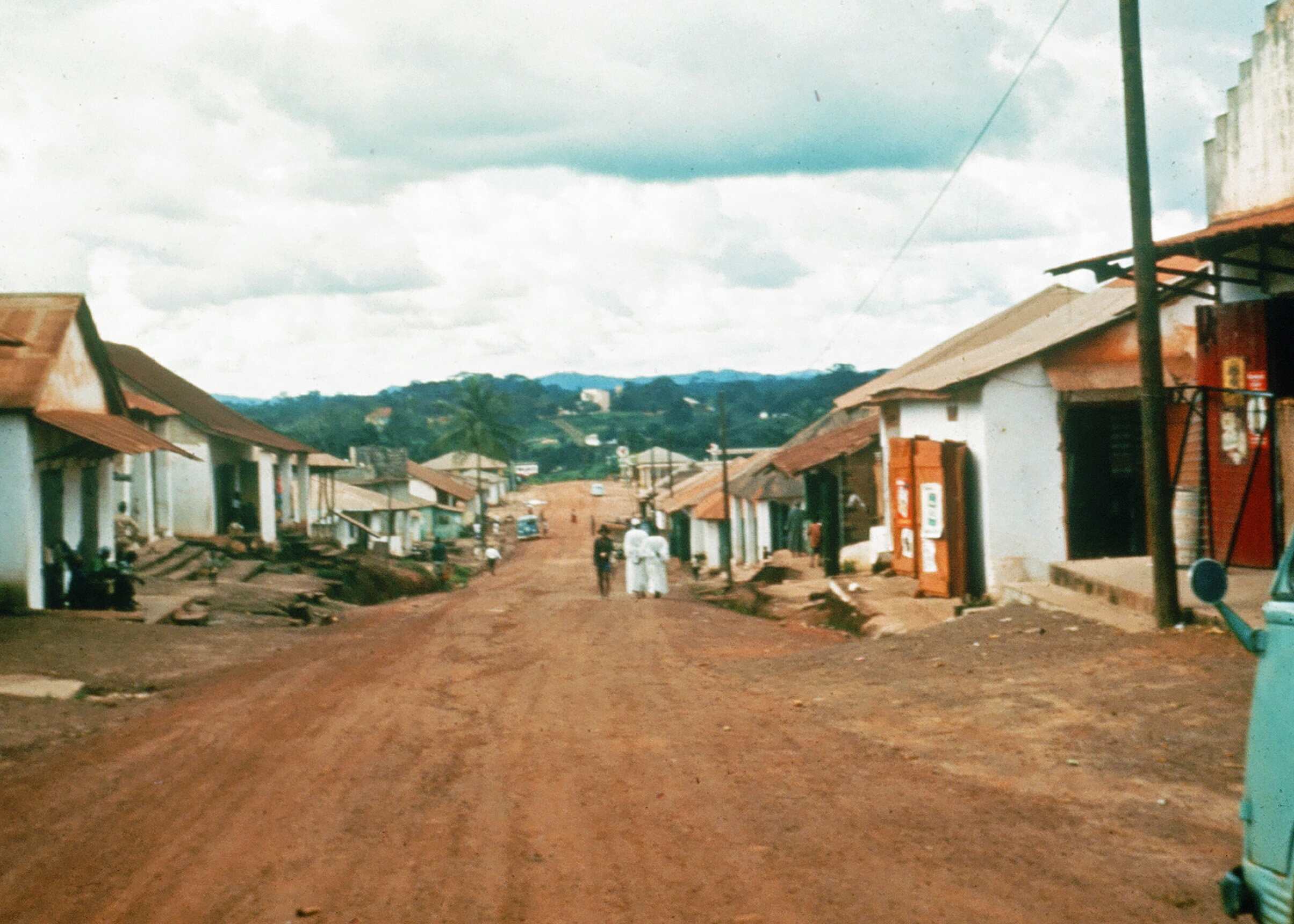
Gbarnga was a long 120 miles out of Monrovia on the nation’s primary dirt road. With a population approaching 5000, it was Liberia’s largest upcountry town and the center of government for Bong County.
We were eager to get there and escaped from Monrovia as soon as the Director said go. Wellington Sirleaf, the Peace Corps’ driver, carted our minimal belongings and us up to our new home. We arrived in Gbarnga just before dark… tired, hungry, and nervous.
Our feelings ran the gamut from “wow, we are finally here” to “what in the heck we have gotten ourselves into?”
What Gbarnga had that other upcountry sights lacked, however, was an official Peace Corps staff person, Bob Cohen, and an official Peace Corps doctor, Less Cohen (not related). I assumed this would make our life officially easier. Sirleaf took us straight to Bob’s trailer. It was located on a well-maintained USAID (United States for International Development) compound. Bob came out to greet us.

Bob Cohen and Les Cohen (not related). Bob was our upcountry Peace Corps Representative and Les was the Peace Corps Doctor.
“Welcome to Gbarnga,” he said. “Your house is located across town.”
Using mental telepathy, I beamed at him, “Invite us in for dinner. It’s the proper thing to do.”
“The Volunteers had a work party and cleaned your house last week,” he went on, oblivious to my sendings. I urged Jo Ann to look hungry. “And, they even drew you a bucket of water.”
This seemed to impress Bob, so I mumbled something like, “They shouldn’t have.”
“Wellington will drive you over so you can get settled in. Enjoy your evening.” And with that, Bob returned to his trailer. I pictured his filet mignon getting cold.
There was one more stop before we got there. This time it was to see Shirley Penchef, another Peace Corps Volunteer. She was waiting at her house with a young Liberian of the Kpelle tribe and a surprise. It wasn’t food.
“This is Sam,” she bubbled (Shirley always bubbled). “Sam is so excited you are here! He has been waiting weeks for you! He is going to be your houseboy!”
Jo and I were speechless. We had talked about the possibility; it was common practice among PCVs. A young Liberian would help with chores, earn spending money, and often eat with the volunteer. Both the Liberian and the PCV gained from the experience. We recognized the value of the arrangement but had decided that having a houseboy didn’t fit the Peace Corps image.
I mean how do you tell the folks back home you are roughing it out here in the jungle and doing ‘good’ while someone cooks your dinner, washes your clothes, and cuts your grass?
On the other hand, how do you tell a woman who talks in exclamation points and a 13-year old boy who is grinning from ear to ear that you don’t want what they are selling?
“Uh, gee, uh, well, why doesn’t Sam help us get settled in and then we’ll see,” we managed to stutter. It was one of the better decisions we were to make in Liberia.
“It’s time to go,” Wellington announced impatiently. I surmised that a delicious plate of hot Liberian food was waiting for him somewhere in Gbarnga as soon as he could lose us. Sam, Jo Ann and I climbed in the jeep, waved goodbye to Shirley, and went bouncing off down the road.
I don’t want to be melodramatic about the introduction to our new home but a little horror movie music might be appropriate. The sun had just set when we arrived. In the tropics, that’s like someone turned off the lights on a dark night. Twilight doesn’t exist. Fortunately we had a flashlight.
Outward appearances weren’t bad. Our new home was a typical Liberian town house. Two sets of closed shutters and a door stared out at us. A zinc roof capped the whitewashed walls. Off to the left was a hole in the ground that Sam informed us was our well. Peeking out from behind on the right was the outhouse. All in all, it was pretty much what we expected.

A day time view of the house with me standing on the left.
Then we opened the door.
It was a full-scale Armies of the Night scene straight out of Hollywood: the type of scene Bella Lugosi drooled over. Our noses were assailed with the scent of something that had been entombed for a thousand years. The floor writhed with life. Hundreds of small tunnels etched their way up the walls. I jumped back a foot. Jo Ann qualified for the Olympics.
Sam laughed…
Next post: We learn about what lives in our house; Jo Ann masters the levitating squat routine; and drums and screams make for a restless night.
 Wandering through Time and Place