
Peggy captures Dave Stalheim and me before we hit the river. Note my clean and shaved look. It’s the last time you will see it.
With thoughts of facing wind gusts up to 60 MPH, we begin our journey down the Colorado River through Grand Canyon National Park.
Peggy and I perform the ritual of asking a boatman if we can ride with him. It seems like a strange practice to me, designed to remind us who’s in charge. But we have entered the world where each boatman/woman is the captain of his or her ship, even if the ship is a 16-foot raft with two or three passengers.
“May I have permission to come aboard, sir?” Although it’s more like “Can we ride with you today?” It is courteous but I would prefer to be assigned and have the assignment changed each day.
The tradition is so old that it fades into history. Democracy is not an option on a raging sea or, for that matter, in the middle of a roaring rapid. When the captain yells jump, you jump.
Our boatmen are mellow people, however; good folks. There are no Captain Blighs. If they are slightly more than equal, it goes with the territory. We are committed to riding with each boatman. First up is David Stalheim. He makes his living as a city and county planner in Washington.
“I’ve been applying for a permit to go on the Colorado River for 15 years,” he tells us. Our ten-minute effort of obtaining a permit seems grossly unfair.
We push off from shore, excited and nervous. The wind strikes immediately, like it was waiting in ambush. “Are we moving at all?” Dave asks plaintively.
An old rock road makes its way tortuously down from the canyon rim on river left. (Left and right are determined by direction of travel.) They are important for giving directions as in “There is a raft ripping rock on river right!” Since boatmen often row with their backs facing downriver, they appreciate such information.

Up until 1929, this is how travelers made their way to Lees Ferry. It would have been a bumpy ride.
The old road is how people once made their way to Lee’s Ferry, which was one of the few ways to cross the Colorado River between 1858 and 1929. The infamous Mormon, John Doyle Lee, established the Ferry. Brigham Young assigned him the job. Later, Lee was executed by firing squad for his role in the Mountain Meadow Massacre where Mormons and Paiute Indians murdered a wagon train of immigrants near St. George, Utah.
After fighting the wind for what seems like hours, we finally come to the Navajo Bridge, which replaced Lee’s Ferry in 1929. It towers some 467 feet above the river and reminds us that we are already miles behind our planned itinerary.
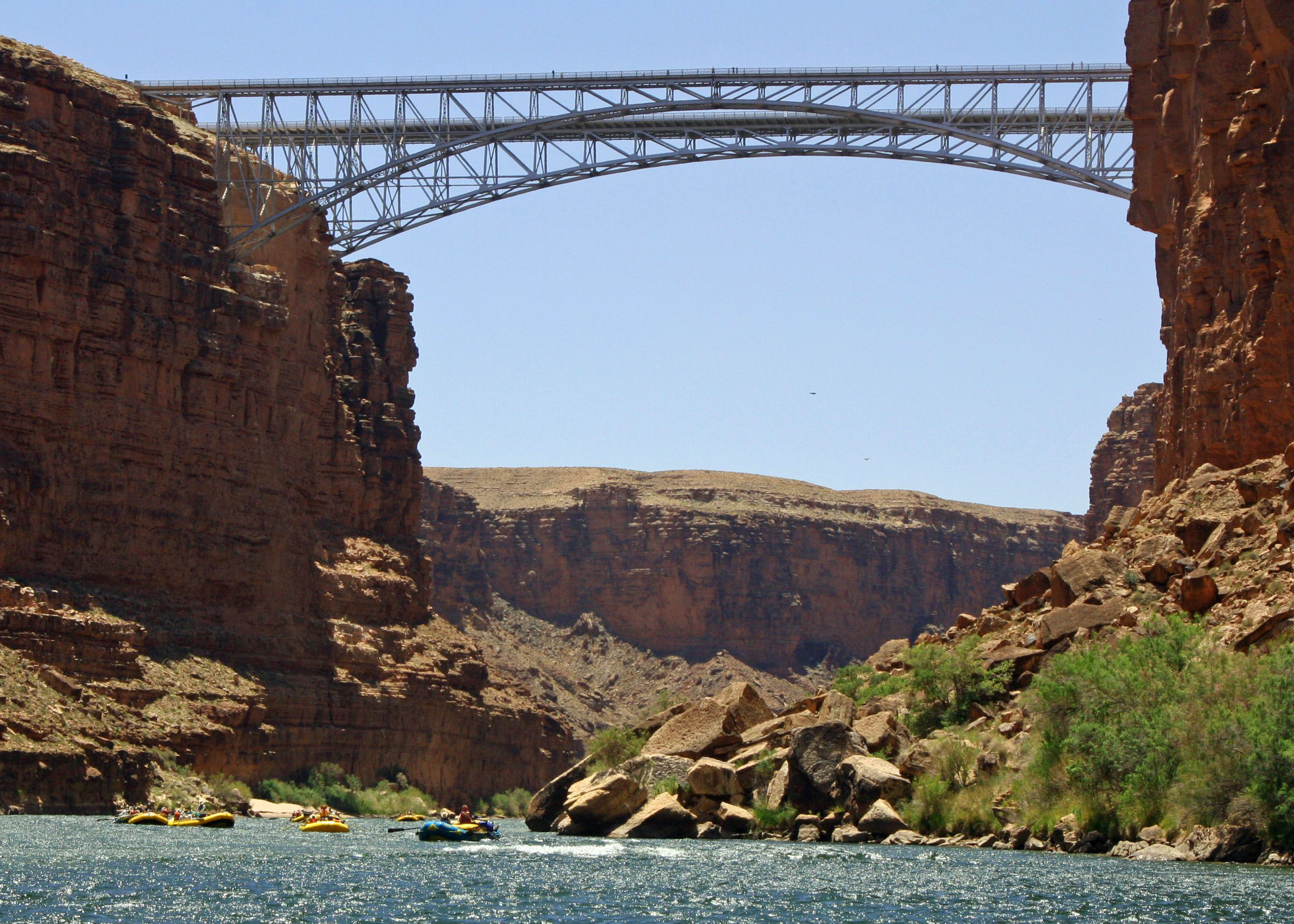
A view of Navajo Bridge and its newer sister looking downstream. The first bridge was built in 1929 and is now used as a walking bridge. The second bridge was built in 1995 to handle modern road traffic.

A second view of the bridges; this time looking upstream. The newer bridge is in the foreground.
Just beyond the bridge we catch our first glimpse of Coconino Sandstone. It’s geologic history dates back some 250 million years when a huge desert covered the area and the world’s landmasses were all part of the large continent named Pangaea.
During our journey down the river we will travel through over a billion years of the earth’s history.
The wind continues to beat against us as we make our way down the Colorado River. Only Dave’s strenuous effort at the oars keeps us from being blown up-stream. “Go that way,” I suggest and point down the river.
The group pulls in at a tiny beach in hopes our mini-hurricane will die down. It doesn’t. Dave develops blisters and I develop guilt. A manly man would offer to take over at the oars.
An option floats by. Dave’s niece, Megan Stalheim, is also one of our boatmen. Don Green, a retired Probate Judge out of Martinez, California, is sitting opposite her and pushing on the oars while she pulls. It inspires me. I join the push-pull brigade. Peggy also takes a turn.

The push-pull approach to rowing where Don Green was helping Megan. Peggy and I have been friends with Don for over two decades. He belongs to the same book club we do and joins us on our annual journey to Burning Man (as do Tom and Beth). Don is also quite generous in sharing his excellent photos.
Word passes back to us that Tom wants to scout Badger Rapids. In Boatman terminology this means figuring out the best way to get through without flipping. Badger isn’t a particularly big rapid for the Colorado, but it is our first. We are allowed to be nervous.
There is good news included in the message. We will stop for the night at Jackass Camp just below the rapids on the left. We’ve only gone 8 miles but are eager to escape the wind.
Dave is a cautious boatman. He takes his time to study Badger Rapids from shore and then stands up in his raft for a second opinion as the river sucks us in. Time runs out. Icy waves splash over the boat and soak us. Our hands grasp the safety lines with a death grip as we are tossed about like leaves in the wind. Mere seconds become an eternity. And then it is over.
“Quick, Curt, I need your help,” Dave shouts. We have come out of the rapids on the opposite side of the river from the camp. The powerful current is pushing us down stream. If we don’t get across we will be camping by ourselves. Adrenaline pumping, I jump up and push the oars with all my strength while Dave pulls. Ever so slowly the boat makes its way to camp.

Our horrendous day of rowing complete, we have time to enjoy beautiful evening views of the Colorado River and Grand Canyon from camp. (Photo by Don Green)



 Wandering through Time and Place