Chapter 2: The FBI is Told I Run Communist Cell Meetings… Peace Corps Tales

Welcome to “The Dead Chicken Dance and Other Peace Corps Tales.” I am presently on a two month tour of the Mediterranean and other areas so I thought I would fill my blog space with one of the greatest adventures I have ever undertaken: a two-year tour as a Peace Corps Volunteer in Liberia, West Africa. Every two days I will post a new story in book format.

When I have finished, I will publish the book digitally and in print.
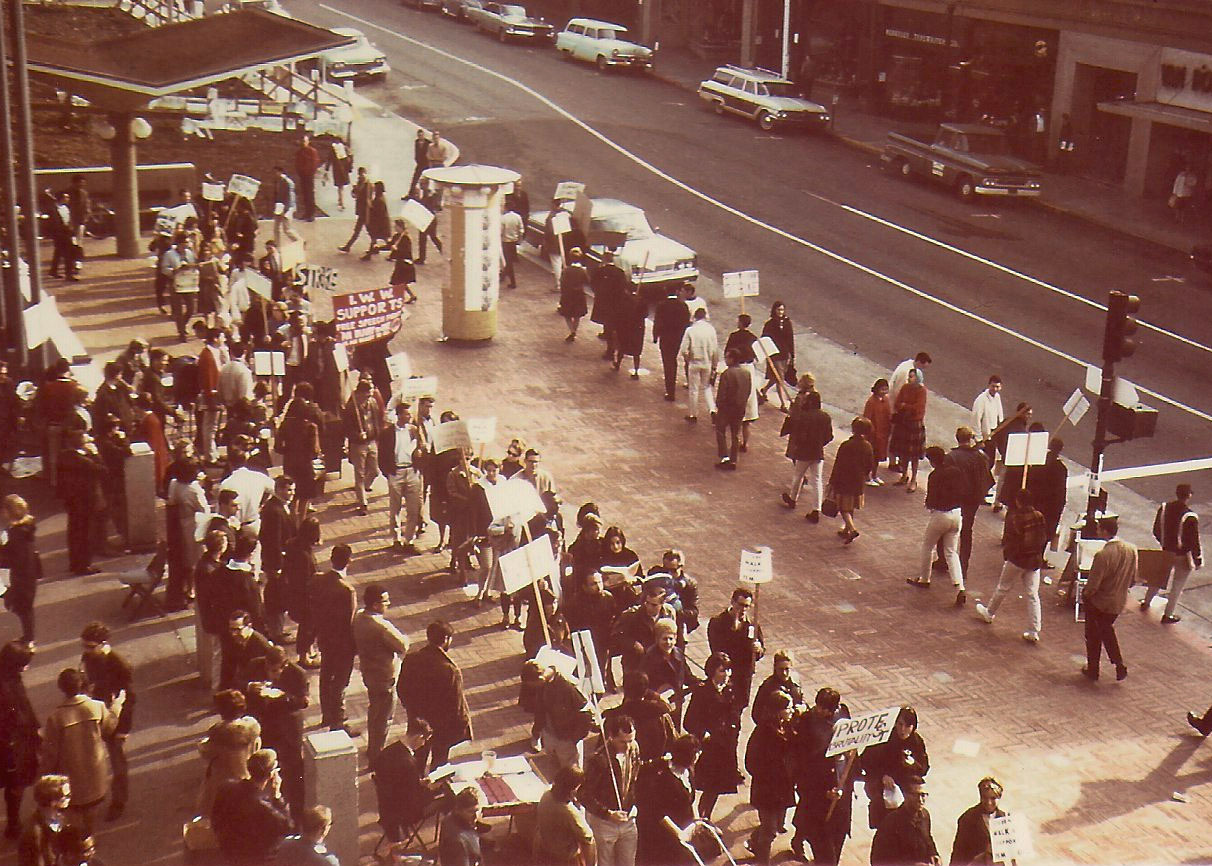
The mid-60s were a time of turmoil at UC Berkeley when the University blocked on-campus support for the Civil Right’s Movement. Here, I am one of many protesters opposing Administration policy by picketing at Bancroft Way and Telegraph Avenue.

In the last post, my first wife, Jo Ann, and I applied for the Peace Corps when we were students at UC Berkeley in 1965. We were tentatively accepted as teachers in Liberia, West Africa.

There were still hurdles. They were tied to the illusive if. We could go if we could get through the background security check, if we weren’t deselected during training, and if we could pass the physical. Training wasn’t a worry. We had enough confidence in ourselves to assume we would float through. How hard could it be after Berkeley?

The Security Check was something else. Jo Ann was squeaky clean but I had been up to mischief at Berkeley, hung out with the wrong people, been seen in a few places where law-abiding people weren’t supposed to be, and had my name on a number of petitions.

“And where were you Mr. Mekemson the night the students took over the Administration Building?”

Maybe there was even a file somewhere; maybe it was labeled Radical. J. Edgar Hoover saw Red when he looked at Berkeley.

Soon I started hearing from friends. The man with the badge had been by to see them. The background security check was underway. One day I came home to the apartment and found my roommate Jerry there. He was pale and agitated. His eyes bounced around the room.

“I have to talk to you Curtis,” he blurted out. “The FBI was by today doing your Peace Corps background check and I told them you had been holding communist cell meetings in our apartment.”

Jerry was deadly serious; Jerry was dead.

“What in the hell are you talking about?” I yelled, seeing all of our hopes dashed and me rotting in jail. I knew that Jerry disagreed with me over my involvement in Berkeley’s Free Speech Movement (FSM) and probably disagreed with me over the Vietnam War, but I hadn’t a clue on how deep that disagreement went. Or what he based his information on.

My degree in International Relations had included a close look at Communism. I found nothing attractive about repressive totalitarian states.

The closest I came to joining a leftist group had been the Free Student Union. Yes I had held committee meetings at our apartment but I had also severed my relationship with the organization. The folks behind the Union apparently believed that confrontation with authority was a good thing in and of itself. Getting bashed on the head with a nightstick made students angry. FSU wanted to radicalize the student body, not serve it.

I was not happy with Jerry that night or for some time after. I assumed the Peace Corps option was out and begin thinking of alternatives. They were bleak.

As it turned out, we received final notification from the Peace Corps a few weeks later. We were accepted. Jerry could live. The people who said good things about me must have outweighed the people who said bad things. Either that or Jo looked so good they didn’t want to throw the babe out with the bath water.

Or possibly the majority of other students who signed up for the Peace Corps from Berkeley in 1965 had rap sheets similar to mine.

There was one final hitch. I was to report to the Army Induction Center in Oakland for my physical. It was an experience not worth repeating. I lined up with a bunch of naked men to be poked and prodded.

“Turn your head and cough. Now, bend over.”

I took it like a man and escaped as soon as the opportunity presented itself. A couple of days later I came back from class and there was a scribbled note from my other roommate, Cliff, who was also going into the Peace Corps.

“The Induction Center called,” he wrote, “and there is a problem with your urinalysis.” I was to call them.

“Damn,” I thought. “Why is this so difficult?” So I called the Center and resigned myself to peeing in another jar. With really good luck, I might avoid the naked-man line.

I got a very cooperative secretary who quickly bounced me to a very cooperative nurse who quickly bounced me to a very cooperative technician who quickly bounced me to a very cooperative doctor… and none of them could find any record of my errant urinalysis.

They didn’t see any problems and they didn’t know who had called. They suggested I call back later and be bounced around again. More than a little worried, I rushed off to my next class.

That evening I reported my lack of success to Cliff. He got this strange little smile on his face and asked me what day it was.

“April 1st,” I replied as recognition of having been seriously screwed dawned in my mind. “You little ass!” I screamed, as Cliff shot for the door with me in fast pursuit. He made it to Telegraph Avenue before I caught him. The damage wasn’t all that bad, considering.

The FBI Hears I Run a Communist Cell Block…

Next on my to-do list for joining the Peace Corps was the dreaded FBI security check.

I had been up to mischief at Berkeley, hung out with the wrong people, been seen in a few places where law-abiding people weren’t supposed to be, and had my name on a number of petitions.

“And where were you Mr. Mekemson the night the students took over the Administration Building?”

Maybe there was even a file somewhere; maybe it was labeled ‘Radical!’ J. Edgar Hoover saw Red whenever he looked at Berkeley.

Soon I started hearing from friends. The man with the badge had been by to see them. The background security check was underway. One day I came home to the apartment and found my roommate Jerry there, looking very nervous.

“I have to talk to you Curtis,” he blurted out. “The FBI was by today doing your Peace Corps background check and I told them you had been holding communist cell block meetings in our apartment.”

Jerry wasn’t joking; Jerry was deadly serious; Jerry was dead.

“What in the hell are you talking about?” I had yelled, seeing all of my hopes dashed. I knew that Jerry disagreed with me over my involvement in Berkeley’s Free Speech Movement and probably disagreed with me over the Vietnam War, but I didn’t have a clue on how deep the disagreement went. Or what he based his information on.

My degree in International Relations had included a close look at Communism. I found nothing attractive about the system.

The closest I had come to joining a leftist group had been the Free Student Union. Yes I had held a committee meeting at our apartment but I had also severed my relationship with the organization. The folks behind the Union were more interested in radicalizing the student body than serving it. That was not my interest.

I was not happy with Jerry that night or for some time after. I assumed the Peace Corps option was out and begin thinking of alternatives. They were bleak.

As it turned out, a few weeks later we received final notification from the Peace Corps. We were accepted. The people who said good things about me must have outweighed the people who said bad things. Either that or Jo Ann looked so good they didn’t want to throw the babe out with the bath water.

Or possibly the majority of other students signing up for the Peace Corps from Berkeley in 1965 had rap sheets similar to mine. I suspect that was the case.

Next Blog: If this is the Peace Corps, what am I doing in the naked man line at the Army Induction Center?

Occupy Sproul Hall… The 1964 Free Speech Movement at Berkeley


The release of the hostage Police Car did not bring peace to the UC Berkeley Campus. Each time a solution seemed imminent, the Administration would renege or the FSM would increase its demands.

In addition to the right to organize on campus, the disciplining leaders of the Free Speech Movement became a central issue.

Demonstrations took place almost daily and were blasted in the press. I learned a great deal about media sensationalism and biased reporting.

One day I would sit in on a democratic and spirited discussion of the pros and cons of a specific action and the next day I would read in the Oakland Tribune or San Francisco Examiner that I had participated in a major insurrection of left leaning radicals who were challenging the very basis of law and order. (It was documented later that the FBI was paying a reporter to write the Examiner stories.)

Older adults in suits taking photos looked suspiciously like plain-clothes policemen or FBI agents. It was easy to become paranoid.

If we signed a petition, demonstrated, made a speech or just stood by listening, would our pictures and names end up in some mysterious Washington file that proclaimed our disloyalty to the nation? These weren’t idle thoughts. A few years earlier people’s careers had been ended and live ruined because someone had implied they were soft on communism.

J. Edgar Hoover was known for tracking Civil Rights’ leaders and maintaining extensive files on every aspect of their lives. While we weren’t up against the KGB, caution was advisable. Hoover considered Berkeley a hotbed of Communism.

We looked warily at those who didn’t look like us. One day a small dog was making his way around the edge of the daily demonstration, sniffing people.

“See that Chihuahua,” a friend whispered in my ear. I nodded yes. “It’s a police dog in disguise. Any moment it is going to unzip its front and a German Shepherd will pop out.”

The wolf in sheep’s clothing was among us. It was a light moment to counter a serious time. And we were very serious. I sometimes wondered when the celebrated fun of being a college student would kick in.

One day I was faced with a test more serious than any I had ever faced in the classroom. On December 2, 1964, FSM leaders called for a massive sit in at Sproul Hall, Berkeley’s administration building. Once again communication had broken down and the Administration was back peddling, caught between students and faculty on one side and increasing pressure from the outside on the other.

I thought about the implications of the sit-it and decided to join. I needed to act. For three months I had listened to pros and cons and watched the press blatantly misrepresent what was happening on campus. I was angry, knowing that the public had little option but to believe that a small group of radicals was preaching anarchy.

It was not wrong to utilize an edge of campus for discussing the issues of the day, or for organizations to raise funds for supporting various causes, or even to recruit students for participating in efforts to change the community.

It didn’t disrupt my education. I was free to stop and listen, to join in, or pass on. What it did do was irritate powerful, established members of the community. And for that reason, our freedoms had been curtailed.

Maybe if enough students joined together, the Administration would listen and the press would dig deeper. I told my fiancé I was going inside and then joined the thousand or so students who had made similar decisions.

It was early in the afternoon and we were in high spirits. I believed it would be hard for the Administration to claim 1000 students were a small group of rabble-rousers bent on destroying the system. And I was right. It claimed we were a large group of rabble-rousers bent on destroying the system.

Inside I was treated to a unique experience. The sit-in was well organized. Mario Savio and other FSM leaders gave us directions on what to do if the police arrived. There were clear instructions that we were not to block doorways. The normal business of the University was not to be impeded and we were not to be destructive in any way.

Floors were organized for different purposes. The basement was set aside as the Free University where graduate students were teaching a variety of classes. These included normal topics such as physics and biology and more exotic subjects such as the nature of God. One floor was set aside as a study hall and was kept quiet. Another featured entertainment – including old Laurel and Hardy films, which seemed particularly appropriate.

After administrators left, a desk in the dean’s office became a podium for speech making. I felt compelled to add my dimes worth. Each speaker took off his or her shoes so the top of the desk would not be damaged.

The real treat though was an impromptu concert by Joan Baez. I joined a small group sitting around her in the hallway and sang protest songs. The hit of the night was “We Shall Overcome.” It provided us with a sense of identification with struggles taking place in the South. I felt like I belonged and was part of something much larger than myself.

Mainly I walked around and listened, taking extensive notes on what I saw and felt. Later I would sit in the Café Med on Telegraph Avenue and write them up. They would become the basis of talks I would give back home over the Christmas break. I also turned them over to Father Baskin, an Episcopal minister who wanted to use them for a sermon at his church in Placerville.

Along about midnight the un-radical part of my nature took over. I started thinking about my comfortable bed back in the apartment. The marble floors of Sproul Hall did not suggest a good night’s sleep and it appeared the police weren’t coming, at least in the immediate future. Yawning, I left the building and headed home.

I would come back in the morning to chaos and an occupied campus.

Next Blog: Berkeley on Strike. (See below for the story about Jack Weinberg and the police car.)