I Hire Wild Steve to Help Run the Backpack Trek… Blog-a-Book Tuesday

Today I am continuing to blog my book: “It’s 4 AM and a Bear Is Standing on Top of Me.” I concluded my last post by proposing to the American Lung Association of Sacramento-Emigrant trails’ (ALASET) Board of Directors that I run a hundred-mile backpack trek across the Sierra Nevada Mountains to raise funds to support the Association’s programs. My friend Steve Crowle and I had come up with the idea while out backpacking. The Board’s first reaction had been, “You want to do what?”

Steve and I had no idea of how difficult leading a group on a 100-mile backpacking trek through the Sierra Nevada Mountain Range might be. We were about to find out…

Actually, I had a great Board. Once the members were convinced that this was something I really, really wanted to do, their final response was “OK, go for it!” I called Steve immediately. My job as executive director included a wide range of responsibilities ranging from administration to programs to fundraising. I would have a limited amount of time to devote to the project and I didn’t know anyone else who was crazy enough to take on the challenge. We had two months to pull it off. The clock was ticking.

I had originally talked Steve into replacing me as Executive Director of Sacramento’s Ecology Information Center with a sales pitch that included, “Look, I have this great job where you work 60-hour weeks, have a Board that likes to scream at each other, and has a starting salary of $200 per month. Are you interested?” Minus a screaming Board of Directors, organizing the Trek wouldn’t be all that different.

Steve had a bright, curious mind and was knowledgeable on environmental issues. He also seemed to have unlimited energy and was built like a bear. It had served him well as Executive Director of EIC. In addition to overseeing the Center’s ongoing projects, he had immediately set out to develop a community garden in downtown Sacramento. Initially known as the Terra Firma Garden and later as the Ron Mandela Garden, it would provide inner city residents with a touch of nature for over 30 years— all the way up until the State of California decided to grow buildings on the site.

The downside about Steve was that he existed on the edge. I later learned that one of his friends who he had recruited to volunteer on the Trek frequently flew to Columbia and returned with his cargo hold filled with pot. 

A year after the Trek, Steve called me and told me that the FBI had showed up on his doorstep. My immediate thought was that they had tied Steve to the Colombia drug operation or that some of the Terra Firma gardeners were growing marijuana. Steve’s concern was that his radical youth was catching up with him. He had been a little too close to the fire when the Bank of America had been burned down in Santa Barbara in 1970 as a protest against the Vietnam War. “And what were you doing with those matches, Mr. Crowle?” (Steve told me the Santa Barbara story a few years ago before he passed away.)

Actually, the FBI had bigger fish to fry. Apparently one of his gardeners had gone from farming her plot to plotting an assassination. Young Lynette Fromme grew up in Southern California where she was a star performer in a children’s dance group, performing at such venues as the Lawrence Welk Show and the Whitehouse.

At 19, a strong disagreement with her dad sent her scurrying off to Venice Beach where she found comfort from an older man, Charles Manson. She soon found herself one of Manson’s clan, taking care of an aging George Spahn at his ranch where the ‘family’ hung out. It was Spahn who gave Lynette her nickname “Squeaky,” because, as legend has it, she squeaked each time he pinched her butt.

Squeaky missed out on the murderous rampage the family undertook in 1969 killing Sharon Tate among others, but she remained intensely loyal to Charles, defending him to the press and anyone else who would listen. After Manson’s conviction and sentence to a lifetime in prison, she moved to Stockton where two of the people she was living with ended up dead.

Abandoning Stockton, Squeaky moved to Sacramento and rented an apartment with another Manson groupie, Sandra Good. The two of them adopted a new life style and persona as ‘nuns’ in Manson’s latest crusade, saving the earth. Manson even gave them new names with Squeaky becoming ‘Red’ and Sandra becoming ‘Blue.’ It was with her new name, persona, and purpose that Squeaky took up gardening at the Terra Firma Garden. Steve knew her, of course, but knew nothing about her background. He told me that she found him “attractive” because of his intense eyes. If you’ve seen pictures of Manson, you’ll get this.

It was with her new goal of ‘saving the earth’ that she left her apartment on the fateful morning of September 5, 1975 and strolled over to Capitol Park where she got within a few steps of the visiting President Gerald Ford before pointing her Colt 45 at him, creating immediate pandemonium. She later claimed she was “just trying to get the President’s attention.” She did. Three months later she found herself convicted of an attempted assassination and in prison. As for Steve, he informed the FBI that he didn’t have a clue as to who Fromme was or what she was up to other than being a gardener. Like Pangloss, he went back to cultivating his garden. But all of this was in the future. My phone call to Steve went something like the following:

“How would you like to go backpacking and get paid for it?” I asked.

“Give me a hard question,” Steve responded.

“Are you willing to work for minimum wage?” I casually threw in as fine print.

“That,” he replied, “is the question.”

I went on to explain that while the Board members had approved of the concept, they weren’t particularly enthusiastic about spending large sums of money to see if it worked. I could just barely squeeze out the minimum wage of the day for two months to see if we could pull it off. Steve, after ample groaning, allowed that it would supplement what he was earning at the Center and took the job.

NEXT POSTS:

Thursday’s Travel Blog: Peggy and I continue our exploration of America’s back roads by leaving Hickison Petroglyph Recreation Area behind and following America’s Loneliest Road across the rest of Nevada and into Utah where we discover Highway 50 is still lonely. And beautiful.

Tuesday’s Blog-a-Book: The clock is ticking as we find a name, route and reluctant sponsor for our backpacking fund raiser. Then it was time to recruit participants. They came out of the woodwork! Among them: A ballerina, a bomb defuser, a witch, and a 70-year-old wood elf.

A Grand but Insane Idea… The First Sierra Trek: Part 1

It’s Blog-a-Book Tuesday. Now that I have provided an introduction to my book, it’s time to start rolling out stories. I’ve chosen my first ever 100-mile backpack trek across the Sierra Nevada Mountain Range for my kick-off. Given that I didn’t have a clue about what I was doing was crazy enough, that I chose to take 61 people aged 11-71 with me as a fund-raiser for the American Lung Association was pure insanity. I was lucky to survive with my career and life intact.

As promised, I am going to blog the book in bite sized pieces with each post ranging between 500 and 1000 words. Some of these stories may be familiar to you since I have written about them before in my ten years of blogging.

The Black Buttes of the Sierra Nevada Mountains are lit up by the evening sun.
Inspired by the beauty of the Five Lakes Basin found north of Interstate 80 in the Sierra Nevada Mountains of California in 1969, I started a lifetime of backpacking. Here, the setting sun lights up the Black Buttes.
I was camping on this little lake when I was inspired by the idea of raising money for the American Lung Association of Sacramento by running a hundred mile backpack trip.

During the early summer of 1974, my life took a dramatic shift. My friend Steve Crowle and I had used a long summer weekend to go backpacking into one of my all-time favorite destinations, the Five Lakes Basin, north of Interstate 80 in the Sierra Nevada Mountains. It’s a beautiful area with towering cliffs and jewel-like lakes that were carved out by glaciers some 20,000 years ago.

We were lazing around our campfire on the last night and bemoaning the fact that we had to return to civilization and jobs the next day. Glowing embers provided warmth and pulled us closer to the fire while a full moon bathed the Black Buttes in silver light and focused our attention outward.

“God, wouldn’t it be great if we could make money doing this,” Steve sighed. He had replaced me as Executive Director of Sacramento’s Ecology Information Center when I had become Executive Director of the American Lung Association of Sacramento. In addition to his boundless energy and intelligence, he was a bit on the wild side. He had hobbies like jumping off high bridges into shallow water and experimenting with various mind-altering drugs. But mainly he loved life and had a vast appetite for new experiences. One such experience was backpacking. 

Suddenly my mind took an intuitive leap. The lights came on, the bells went off, and four and twenty blackbirds sang the Hallelujah Chorus.

“We can, Steve!” I managed to get out as my thoughts played hopscotch. “Look, as Executive Director of Lungland, one of my main responsibilities is fund-raising.” It was a fact I was painfully aware of.

The once Tuberculosis Association and now Lung Association had spent 70 years happily sending out Christmas Seals and waiting for the donations to roll in. While the Golden Goose wasn’t dead, it was ailing. We had conquered the dreaded TB and selling lungs wasn’t nearly as easy. Easter Seals had kids, the Heart Association the most appealing organ in the body, and the Cancer Society the scariest word in the dictionary. We had emphysema, bronchitis, asthma, the remnants of TB, and diseases with unpronounceable names such as coccidioidomycosis. Adding insult to injury, several non-profit organizations had added seals to their fund-raising arsenals. Competition for bucks to do-good was tough and the well was running dry.

“What if,” I pondered out loud, “we ran a backpack trip through the mountains as a type of multi-day walk-a-thon with people raising money for each mile they hiked?” I liked walk-a-thons. They involved people in healthy activities as well as raising money. They gave something back to the participants.

Steve’s attention jumped from low watt to high intensity. “When? Where? For how many miles and days? How can I be involved?” The questions tumbled out.

“I don’t know, I don’t know and I don’t know,” I responded, laughing at his enthusiasm although mine was hardly less. “But,” I added, throwing out some crazy figures, “what if we made it for nine days and 100 miles?”

That quieted us down. Neither of us had ever backpacked for nine days straight, much less 100 miles. A long trip for me had been six days and 30 miles. I threw out the nine days because it included a full week with both weekends and the 100 miles because it sounded impressive and might fire people’s imaginations. It did mine.

“Why not,” Steve had finally said with more than a little awe in his voice as a new fund-raising program was born. It was an event that would keep me happily running around in the woods over the next 30 years and raise substantial funds and friends for the American Lung Association. But all of that was in the future; Steve and I just wanted an excuse to go backpacking. How to get from point a to point b was the question. As folks like to say, the devil is in the details.

My first challenge was selling the event to a reluctant Board of Directors. Running a 100-mile backpack trip as a fundraiser was a huge leap from sending out Christmas seals. At 29, I was the youngest Lung Association Executive Director in the nation and I had already ruffled enough feathers to dress a turkey. For example, a research doctor on my Board was foaming at the mouth because I wanted our organization to focus on reducing the primary causes of lung disease: air pollution and tobacco use. What would he think of me running off to the woods on a backpack trip? Another Board member loved his pipe and was irritated at me because I had persuaded the Board that our meetings should be smoke-free. His irritation was nothing, however, in comparison to a number of California Lung Execs who were livid because I was proposing that Lung Association offices should be smoke-free as well. What a radical idea that was. I heard an older woman exec proclaim at a conference, “I am going to kick that young man in the balls!” She made sure I was within hearing distance. 

“You want to do what?” with a decided emphasis on the first and fifth words is the best way I can describe the Board’s reaction. It was easy to translate: “Why would a 29-year-old executive director with less than a year of experience under his belt want to risk his career on such a harebrained idea?”

I echoed wild Steve, “Why not?”

NEXT POSTS: On Thursday’s travel blog we continue our back roads’ journey along Highway 50 across the Nevada Desert and camp out at the Hickison Petroglyph area with its strange petroglyphs and unique rock structures. Next Tuesday it’s back to blogging a book. The Lung Association Board approves the Trek, I hire Steve, and we begin a recruitment effort. People come out of the woodwork wanting to go…

NOTE: Peggy and I are heading over to the Oregon Coast to celebrate Thanksgiving and our Anniversary, camping out in Quivera the Van at a site that may not have cellphone or Internet connection. If so, I will get back to responding to comments and reading posts next week.

The 2019 San Francisco Writers Conference… And an Argument for Self-Publishing

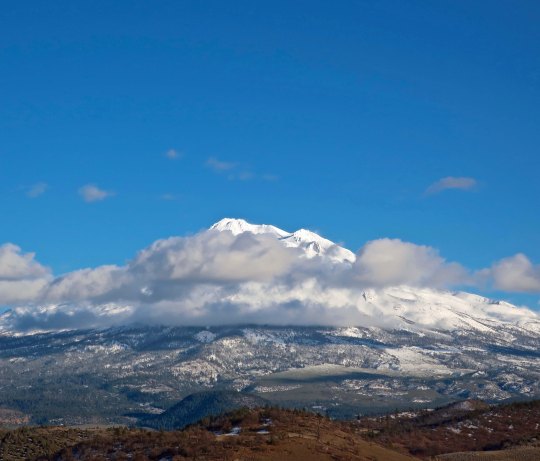
It used to be that obtaining an agent and a publisher was a lot like climbing this mountain: hard work but worth it when you reached the top. Maybe not so much anymore. (I took this photo of Mt. Shasta on my way home from the 2019 San Francisco Writers Conference.)

I’ve been AWOL from my blog, playing hooky at the San Francisco Writers Conference (SFWC). I’d been before, way back when obtaining an agent and a publisher were the primary options for being an author— the gold standard. This time, I packed my bags and headed off to the conference with that objective in mind, but I was also open to self-publishing, which is what I did with The Bush Devil Ate Sam. I bought a book by Andy Ross on how to write a book proposal and went to work. I like Andy, he fights hard for the people he represents. I also like him because he managed Cody Books in Berkeley for several years. 

Cody’s was one of the nation’s great bookstores. I can’t count the number of times I walked through its doors, the hours I spent wandering the aisles, and the great books I bought— even when I could barely afford them as a student at Cal in the mid-60s. The bookstore was always on my to-do list every time I returned to Berkeley, until one day I hiked down Telegraph Avenue eager for a bookstore fix and discovered it was no more. It was like learning that a good friend had died.

Andy’s book, The Literary Agent’s Guide to Writing a Non-Fiction Book Proposal, is packed full of good advice, but it comes with a surprise ending: He self-published it. In fact, I quickly learned that a major thrust of the conference was on self-publishing. It has come of age since I had attended the SFWC in 2010. Still, there was plenty at the SFWC for those following the traditional path.

A number of agents were present and they ran workshops on how to pitch books to them during the agent speed-dating part of the conference. Think query letter with a lot less time. “You should be able to sell your book with one sentence.” Good luck with that. It’s the old Hollywood elevator pitch idea. When you catch a producer in an elevator, you have one floor to sell your movie script. Something like, “My movie is about Godzilla and Lassie teaming up to save Timmy.” 

I sat down with Andy for 15 minutes to talk about my book, It’s 4 AM and a Bear Is Standing on Top of Me.I had a one page, carefully-thought-out summary that introduced the book, my writing style, and relevant background. Andy liked my writing and even more my sense of humor, but, he noted, travel memoirs are hard to sell and Bill Bryson and Cheryl Strayed had already written the books on the PCT and Appalachian Trail. (I don’t agree with that, obviously.) He did suggest that I seek out agents who focus on adventure travel, and made several other good recommendations.

I listened carefully to presentations by the other non-fiction agents who were attending the conference and none seemed particularly interested in adventure travel books. I wasn’t particularly disappointed. Finding an agent and a publisher are incredibly difficult, even more so when your book is a memoir. Rejection is the name of the game—unless you are incredibly famous, or have a ton of good luck. Being a decent writer with a good story is rarely enough. There are millions of us. Too bad my name isn’t Curt Kardashian. Wait, I’ll pass on that. I’d much prefer to self-publish. 

The battle between print books and eBooks is a lively one. Pundits were ready to pronounce the print book industry dead for a while. But it has come roaring back. People still like the feel of a book. The 3000 or so in our library and scattered throughout our house certainly endorse the hands-on approach. But we also use our Kindles extensively. Travel, poor light, tired eyes, easy access to millions of titles, and cost are all factors. Both industries are here to stay, at least for now.

Writers have a different perspective on the issue. Having a publishing house print your book still has a certain prestige to it. And the advantage of getting your book into book stores. An agent and publisher also help assure that your book is well-edited and has a good title and cover. But the odds of getting a publisher, especially one of the big five in New York, are extremely low. They are now owned by large corporations who have one criteria: profit. Their only concern is will your book make money, lots of it. And that’s the tail that wags the dog.  

There is more. 

Publishing house contracts are notoriously one sided. A small advance with minimal royalties and maximum control are what first time authors can expect from a publisher. Time is also a factor. The project can easily take two years, and that’s after you have landed an agent and a publisher, which might take another year or so, if at all. Shelf-life is another concern. Yes, your books may get into bookstores, but if they don’t sell quickly, off they come. Bookstore owners have an agreement with publishers to take back unsold books and space is limited. Three months seem to be the outer limits. Your book is then destined for the burn pile— ashes to ashes, dust to dust.

Marketing is part of the answer. Publishers used to take this on as part of their responsibility. No more. Unless your name is J.K. Rowling, or David Baldacci, or Catherine Coulter (she spoke at the conference), etc., you are expected to do your own outreach. In fact, most agents and publishers won’t even consider your book unless you have a ready-made platform. Jane Friedman, who is a guru on authors’ platforms (and was also at the conference), defines platform as “an ability to sell books because of who you are or who you can reach.” A blog, for example, is a platform. Having one was highly recommended by just about everyone. There was a slight catch in the fine print: It helps to have 100,000 followers. My 5,600 followers, 530,000 views and 20,000 comments count as something, but not much. Get to work, Curt!

It is easy to see the appeal of going the Indie route and self-publishing. Your digital book has a virtual shelf-life of forever. From start to finish, you can have it up and out in months instead of years. Your profit per book sold comes in at between 50 and 100% as opposed to 15 and 20%. Modern print on demand capabilities mean your readers can still get the book in print as well as digitally. And, finally, you are in total control. Whether your book is published or not doesn’t depend on a 15 second decision by an agent or editor, who may be having a bad day.

None of this might matter if the publisher handled all of the marketing and used their considerable expertise to push our books. The effort and rejection that goes into obtaining a publisher would be worth it. But they don’t. If our success is going to depend on the energy and skill we bring to marketing as well as writing, then self-publishing becomes a viable option, and may indeed, be the preferable option.

It was a great conference. I felt I learned a lot. Now it’s time to get back to blogging and writing the book. The decision to self-publish or not can wait until the book is finished.

NEXT POST: I came home to snow. Not much but it was pretty. It’s time for my annual snow post!