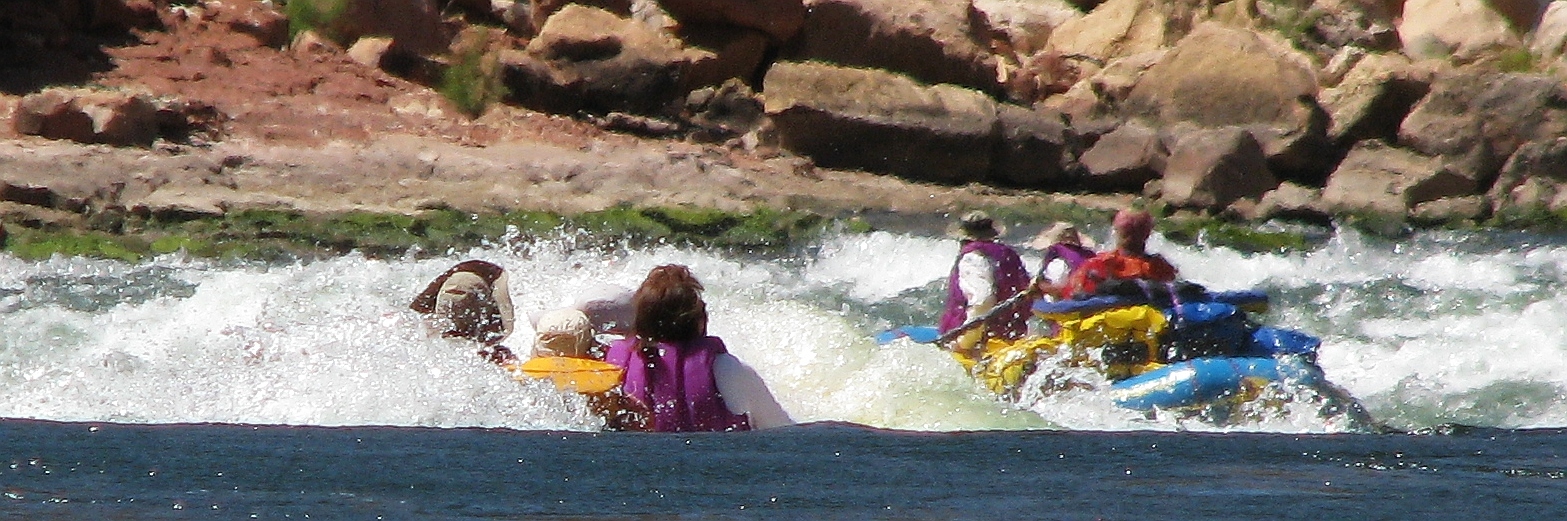
We started with an icy cold rapid. Peggy and I are in the first boat with Tom Lovering rowing. (Photo by Don Green)
Day two starts as day one did: early.
Even the birds are sound asleep. Tom argues it’s six AM, not the five my watch is showing. “Arizona does not honor Daylight Savings Time,” he primly informs us. He’s right. Adjusting my watch adjusts my attitude… a little.
Adding injury to insult, something akin to Folgers has been sewn up in burlap, thrown in boiling water, and called coffee. Oh well, it’s a hot, it’s brown, and we have a beautiful day of floating down the Colorado through the Grand Canyon ahead.
For those of you who like facts, here are a few about the river. At its widest point it reaches 750 feet from one bank to the other; at its deepest, it plunges down 90 feet. It flows along at a decent 3-4 mile clip but can speed up to 15 miles per hour in rapids. Since the water comes out of the base of Glen Canyon Dam, it is cold: somewhere around a frigid 46 degrees Fahrenheit during the upper part of our trip. Over the course of our adventure the river will drop 1700 feet in altitude, which is an average 8 feet per mile… 25 times that of the Mississippi River.

Our boatman for the day, Tom Lovering, with his wild, Canyon hairdo.
Tom is our boatman of the day. He checks to make sure our toenails are painted and then lets us board. The wind is still blowing but it has lost its ferocious bite. A mile down the river we pass Ten Mile Rock, a prominent landmark that has fallen from the cliffs above and now juts up out of the river. Made of Toroweap Sandstone, it was laid down in shallow seas that covered the area some 250 million years ago.
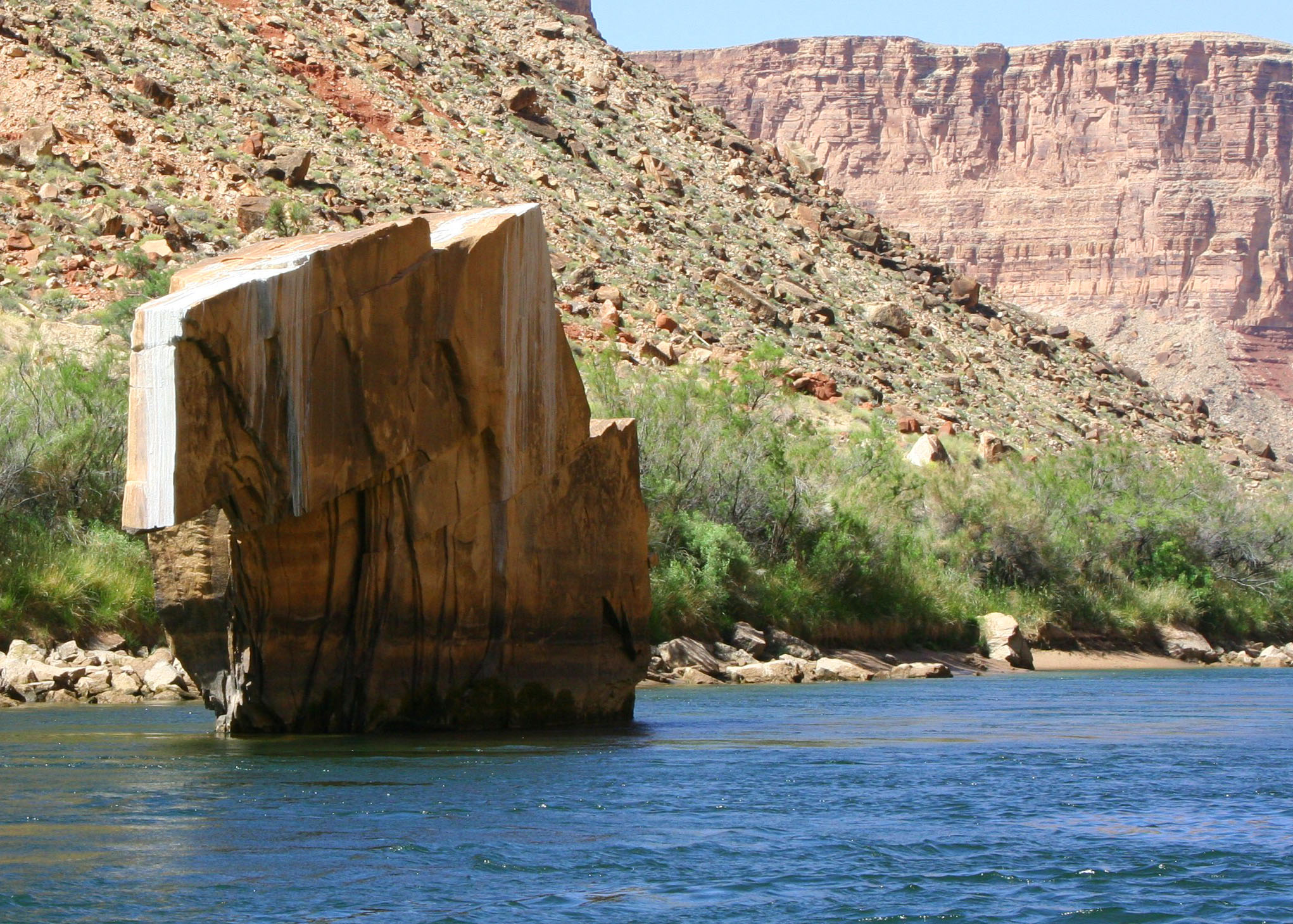
Ten Mile Rock on the Colorado River. I thought it should have a more impressive name.
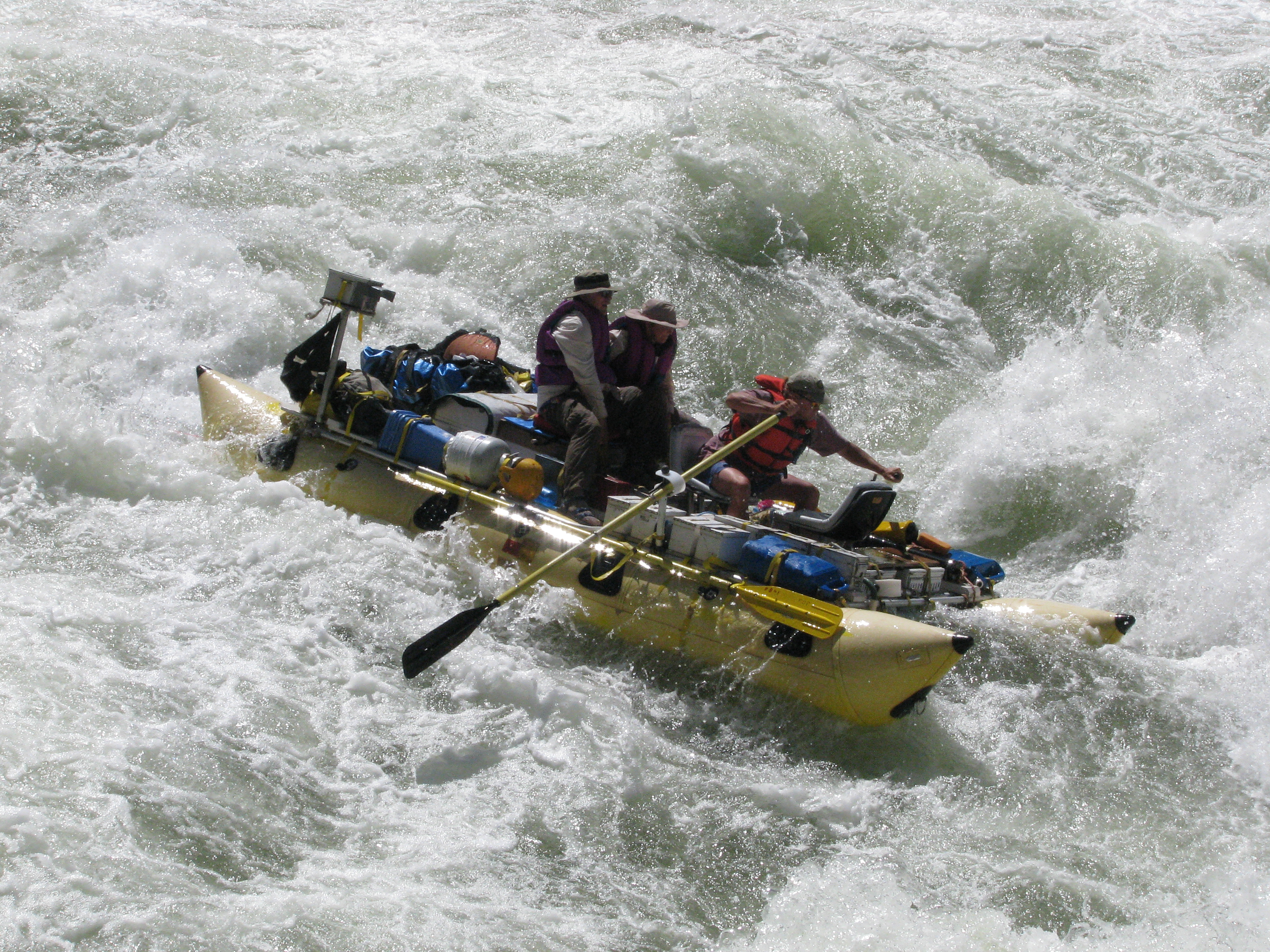
Shortly afterwards we hear our first rapid of the day, Soap Creek. You always hear rapids before you see them; it builds anticipation. Soap Creek roars like a teenage lion. Tom maneuvers through it like the excellent boatman he is but makes sure we get suitably wet. It’s like taking a cold shower outside on a frosty morning with a 15 mile per hour wind blowing.
“I love rowing,” Tom tells us– and it is obvious he does. It is more than the heart-stopping, adrenaline-pumping moments of major rapids where the boatman’s knowledge and skill is matched against the tremendous power of the river with its dangerous rocks and grasping holes. And it is more than the opportunity to enjoy incredible beauty of the Grand Canyon that rowing provides. Tom enjoys the rhythm and the hard work. He even liked the backbreaking challenge of rowing against the wind.
At mile 17 we come on our first, and only, major challenge of the day, House Rock Rapid, where we learn another fact about rafting through the Canyon: water levels depend on electricity needs in the West. Peak demands require large releases of water from Glen Canyon Dam to run its huge generators. Eventually, these releases catch up with rafters. The fluctuations in water levels have significant impacts.
House Rock Rapid demonstrates one of the more serious. The river is at its low point. More rocks are exposed and a massive hole lurks downstream from the largest rock. Even the most skilled boatman will be challenged to avoid it. We all land and climb off our boats to scout the rapid. Tom is eager to move on. Steve is adamant about waiting for more water. After a long discussion between the boatmen, a decision is made to take the more cautious approach.

Our group worriedly scouts House Rock Rapid. Peggy shows more enthusiasm than may be called for.
We have lunch, take naps, go for walks and watch as three large boats of commercial rafters chug through the rapids with their large engines. It is mid afternoon when the boatmen finally decide that enough water is flowing to reduce the hazard to a barely acceptable risk.
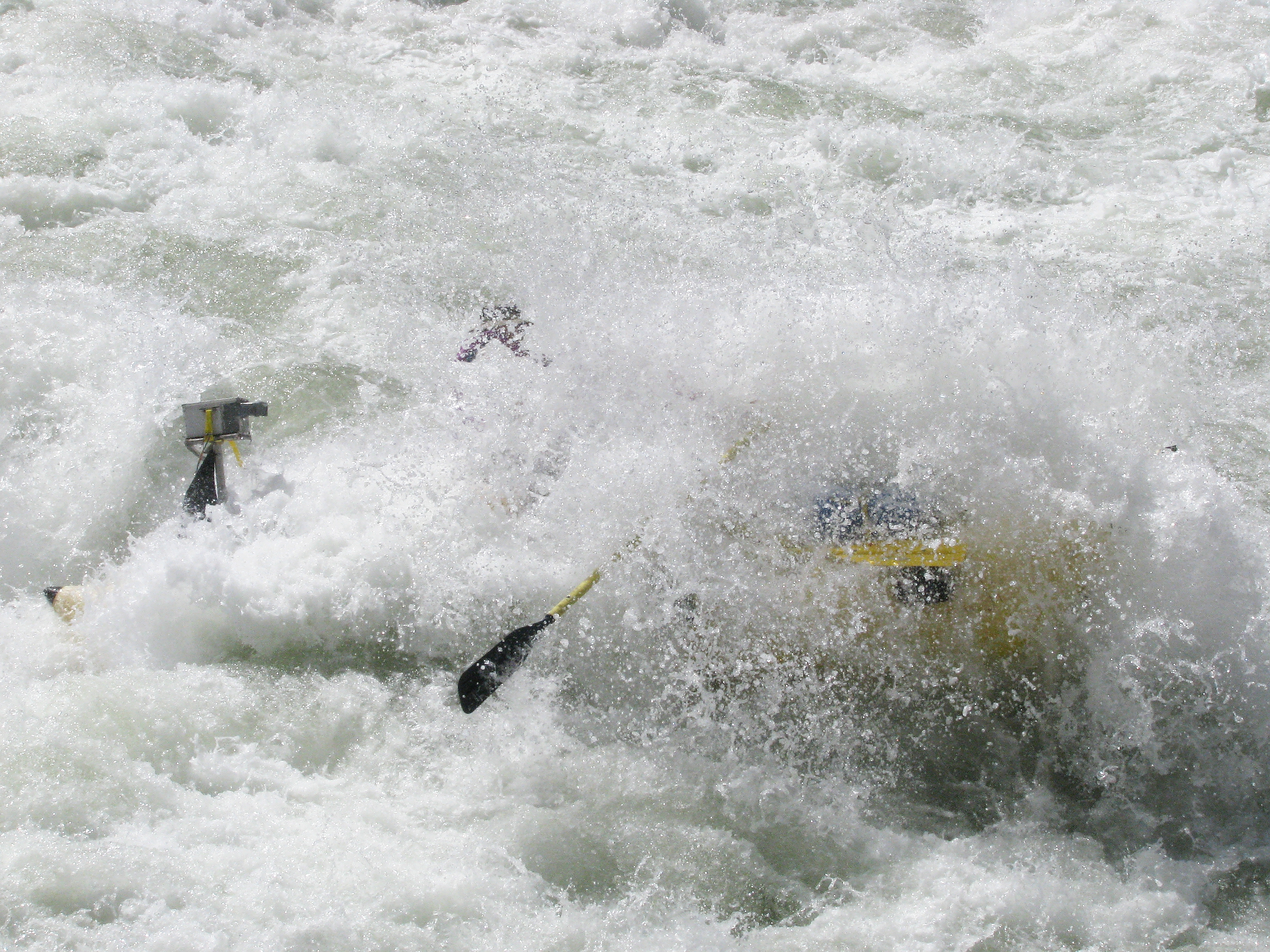
Tom’s fist bonks me on the head when we are halfway through. One of his oars has popped out. I look left and all I can see is churning, raft-eating water. We are poised on the edge of the hole… about to be sucked in. Tom becomes a virtuoso of one-armed madness. Ever so slowly, like about a thousand years, the boat decides to go where he wants. We land, and for one of the few times in his life, my ever-talkative friend is silent.

We looked to the left and saw we were poised on the edge of a massive hole.
The next day, Megan Stalheim, Dave’s niece, is our boat woman. This is Megan’s first time rowing a raft and her first time rowing through the Grand Canyon. It would seem insane except Megan is a world-class kayaker. She is an expert at reading water. The problem is that our large, fully loaded rafts do not move like feather light kayaks… picture driving an 18-wheel Mack Truck with a Ferrari 458 attitude. We have some adventures.
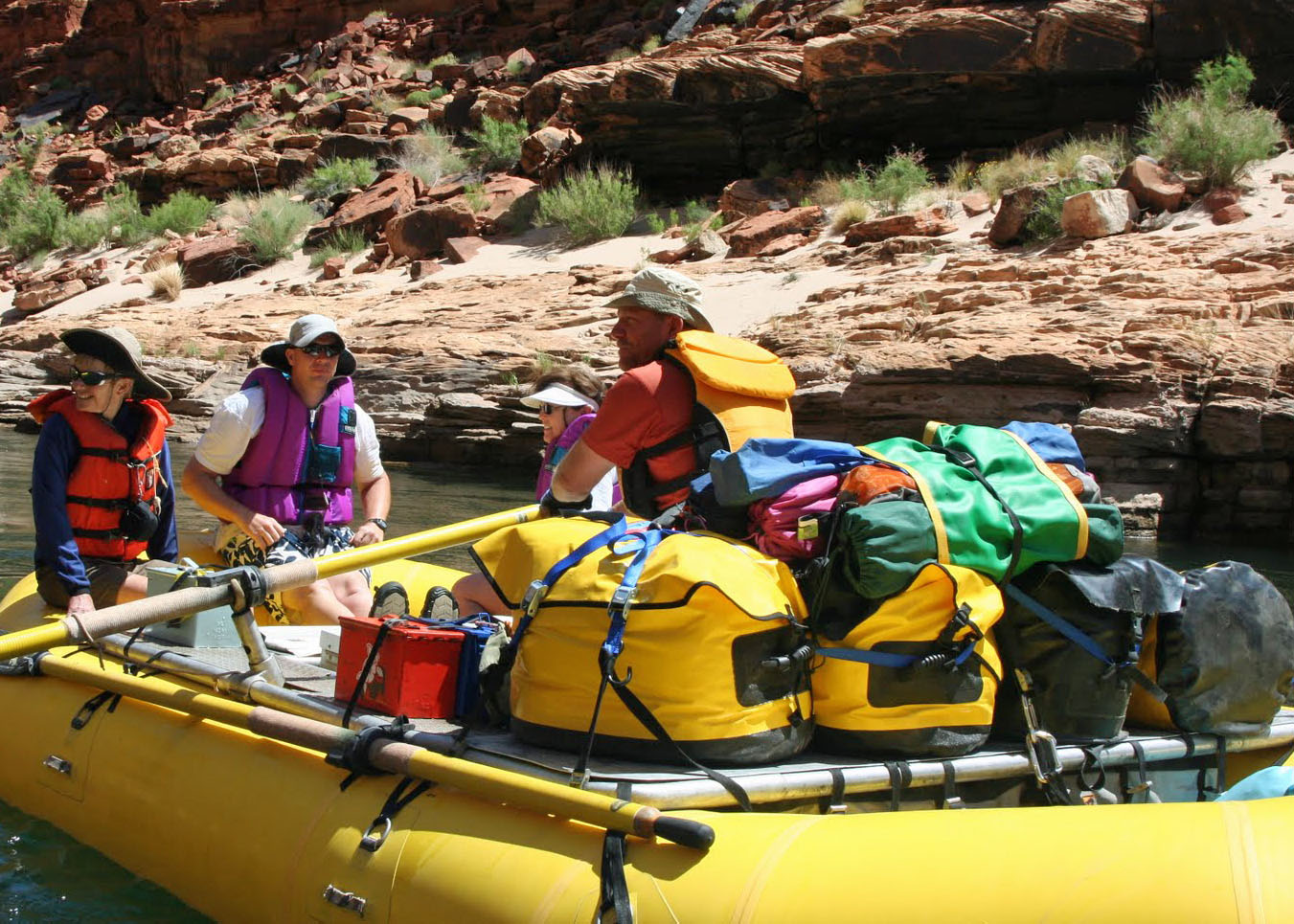
This shot of Jamie’s raft provides a perspective on what our fully loaded rafts looked like.
Megan keeps the messy side up, however, as rafters say. (The non-messy side is the smooth bottom of the raft.) So it’s all good. Megan, like me, has served as a Peace Corps Volunteer in West Africa. When she gets off the river she is heading for Tanzania where she will work with a women’s craft co-op.
Beyond our “kayaking” experience with Megan, the big news on day three is that we began our side-trips. Almost all journeys down the Canyon include stopping off to see the sights. Some are quite beautiful and others provide unique challenges, as if our daily challenges of negotiating rapids aren’t enough.
Our first stop at mile 29 is the Silver Grotto, which includes both beauty and challenge. Wanting a little downtime and solitude, I opt out and take photos. Peggy tells me, “We climbed an 8 foot wall, repelled down a rock face, slogged through a murky, cold pool and slid down a 20 foot rock slide.” The rock slide was more like free-fall.
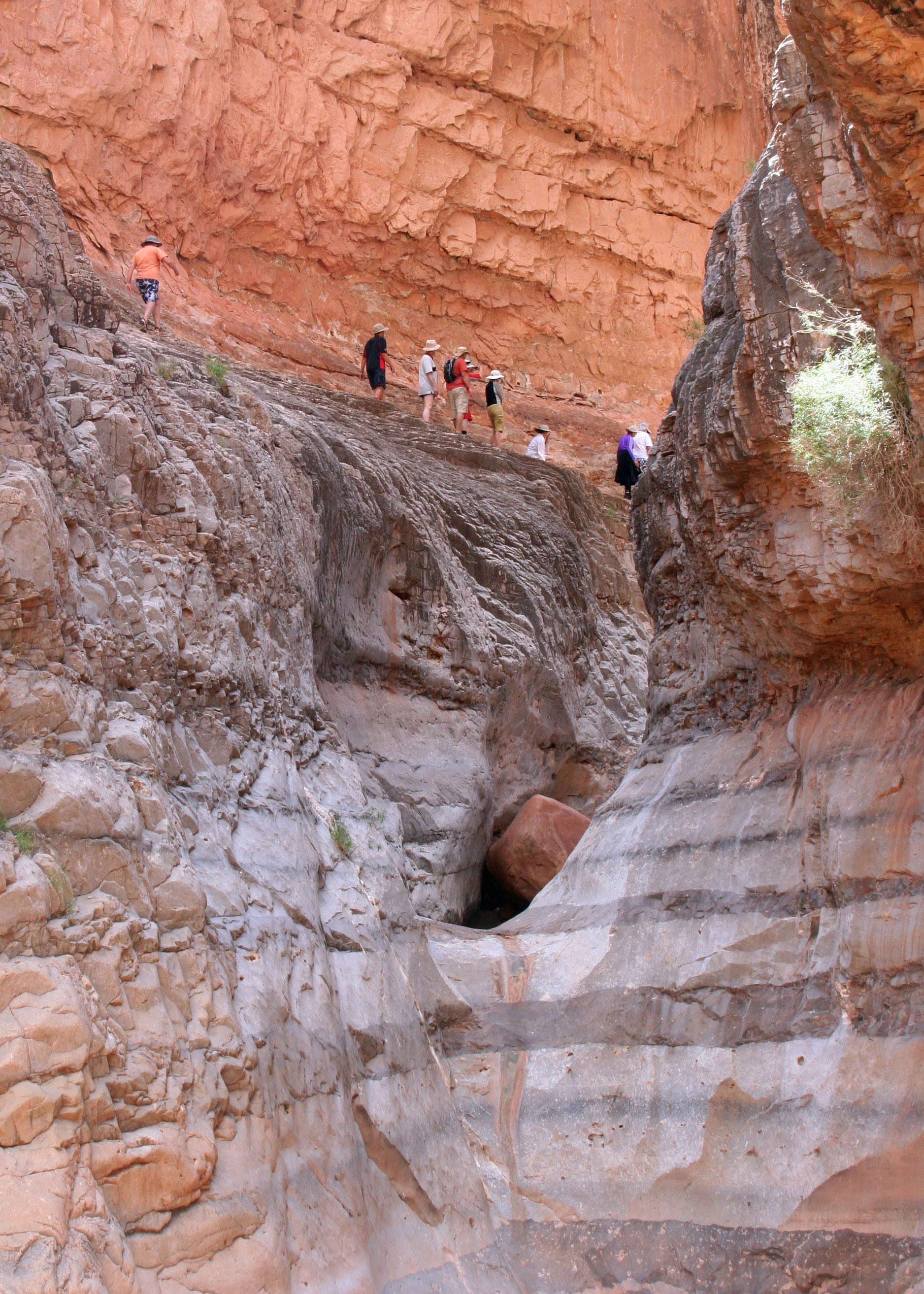
As the group disappeared into the Silver grotto, I took some much needed Curt-time.

A raven stopped by to visit and checked out the “Captain’s Chair” on Steve Van Dore’s boat. These large birds are one of the primary reasons food needs to be carefully stowed.

I didn’t get a photo of our group members leaping but this is what they leapt off of into the muddy water below. Water was splashed on the rock slide from a pool behind the lip to make the slide more smooth. Or so they said.
Next we stopped off at Paradise, as in Vasey’s Paradise. A beautiful waterfall shoots out of a Redwall cliff and creates a Garden of Eden at it base. It is worthy of the name.

The waterfall shooting out of the Red Wall at Vasey’s Paradise, Mile 32.

Dave Stalheim and his niece Megan perched on a rock at Vasey’s Paradise in the Grand Canyon.
Our final stop of the day is at Red Wall Cavern. Major John Wesley Powell was the first non Native American to admire the Cavern’s unique beauty. Powell was a Civil War Veteran who had lost his right arm at Shiloh. His exploratory expedition through the Grand Canyon took place in 1869. Powell thought Redwall Cavern could accommodate up to 50,000 people. Modern estimates are closer to 5000, but it is still big…

Coming around a bend in the Colorado River, we saw our first view of Redwall Cavern.

This photo provides a perspective on the sheer size and beauty of Redwall Cavern.

A view of the Grand Canyon looking upriver from the Redwall Cavern.
In my next post we visit an ancient Anasazi storage facility high on the cliffs above the river and play in the beautiful Little Colorado River.
 Wandering through Time and Place