
In addition to its tree covered mountains, the Great Smoky Mountains National Park is noted for its beautiful waterfalls. Peggy and I found this little beauty next to the road on the east side of the Park.
HAPPY 100th BIRTHDAY TO AMERICA’S NATIONAL PARKS
I can’t imagine a future without wild places for our children, grandchildren and future generations to love and explore. Preserving our wilderness areas and the diversity of life on earth are two of the most important responsibilities we have as humans.
A few years ago, Peggy and I took time off to visit America’s National Parks from Alaska to Florida. It was an incredible trip. The beauty and variety of landscapes, plants and animals found in these parks are a gift of incalculable value. As are all the wild places set aside by other countries.
Given that this week is America’s 100th Anniversary of its National Park system, it seems appropriate that I am writing today about my bike ride through (make that up and over) Great Smoky National Park. (And yes, smoky is how it is spelled.) With over nine million visitors this past year, it is America’s most visited park.
First, of course, I had to get there. In the last post about my bike tour of North America, I was in Dayton, Tennessee checking out the courthouse where the Scopes’ trial took place. I left there continuing to follow Route 30 east as it made its steep, winding way up and over ridges of the Cumberland Plateau. In Athens, Tennessee, I picked up an even smaller road, Route 39, that carried me over another ridge into the small community of Englewood.
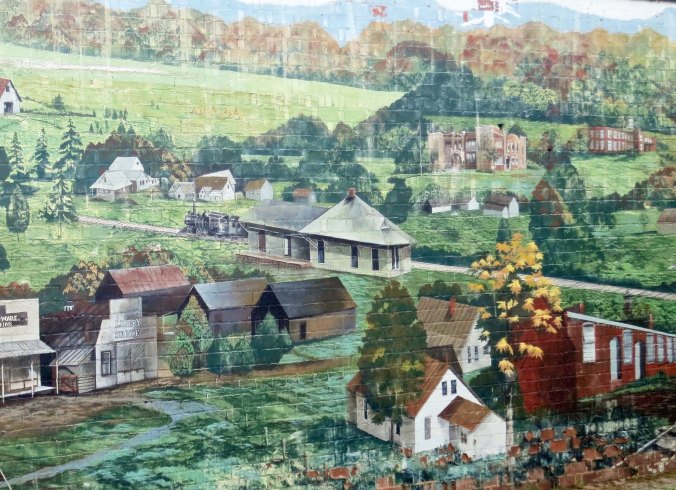
This mural of historic Englewood is prominently featured on the side of a building entering town.
From here, it was time to make my way north over the relatively flat Highway 411 to Maryville. Bucolic countryside, Mennonite farms, a humorous Spit and Whittle Club, and the Little Tennessee River provided pleasant distractions from the work of bicycling. As I left Maryville on Highway 321 going toward Pigeon Ford, the countryside shifted dramatically, providing scenic views of the Smokies. The road from Pigeon Ford to Gatlinburg, Highway 441, was all about separating tourists from their dollars. I’ve rarely seen such a concentration of “tourist attractions.” Today, there are eight different Ripley’s venues alone— “believe it or not!”

This Mennonite farmer was apparently out enjoying his/her farm since I didn’t see any work going on.

Spit and Whittle Clubs, sometimes know as Liar’s Clubs, can be found throughout the US. In general, their members are story tellers who focus on ‘tall tales.’ I expect that this is one of their most unusual club houses!
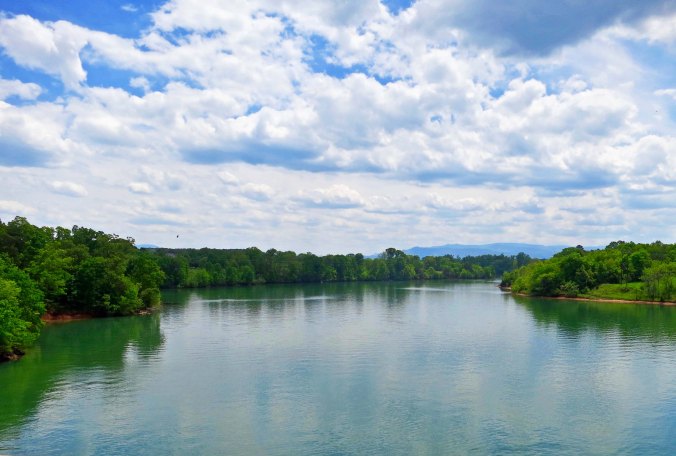
Highway 411 took me across the Little Tennessee River, which didn’t seem so little to me.

The Great Smoky Mountains can be seen in the distance as you leave Maryville, Tennessee on Highway 321.
I spent the night in Gatlinburg, not because I wanted to sample the attractions, but because I wanted to develop the proper mental attitude I would need for climbing 4000 feet in the morning to Newfound Gap at 5046 feet (1538 meters). Two beers and a steak just about did it.
The Smokies, as they are often called, received their name from a blue haze early pioneers found hovering over the mountains. It wasn’t actually caused by smoke, however, it was caused by plant respiration (breathing, so to speak). The park is part of the Appalachian Mountains, an ancient range going back some 250-300 million years. (Some rocks in the area date back over a billion years.) Compare that with the Rocky Mountains at 80-85 million years and the Sierra Nevada Mountains, a mere baby at 40 million. Once, the Smokies reached for the sky like their younger western cousins; now they are old and worn down. This doesn’t make them less steep; ask any hiker or biker who wanders through them. Nor does it make them any less beautiful.
The 17-mile trip up to the Gap was, as I expected, a workout. People shouted encouragement from their cars on some of the steeper parts. I grunted in return. At one stop a little kid looked at me wide-eyed. “Are you really bicycling to the top?” “Sure,” I replied. “It’s fun. Maybe you will do it some day.” “Maybe not,” he responded. I passed the Appalachian Trail and thought of the hikers making their way north on a journey far different from mine but similar in its challenge. And I entered North Carolina, leaving Tennessee behind. After a leisurely lunch on top, it was time to zoom down the mountain, a thrill I had earned. Following are some photos that I took when Peggy and I redrove the route though the Great Smoky Mountain National Park this spring.

Peggy and I drove across the Smokies a month earlier than when I biked across them in 1989. A number of trees had yet to leaf out.
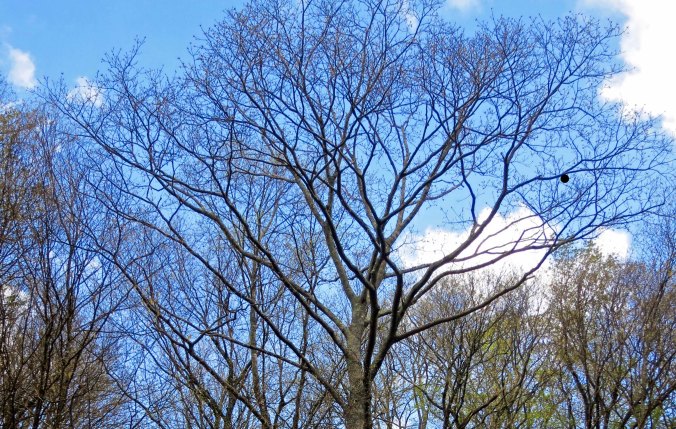
By June this tree would be dressed in green. I am not sure who the round nest on the right belongs to. Or if it is even a nest.

I liked this canyon view.
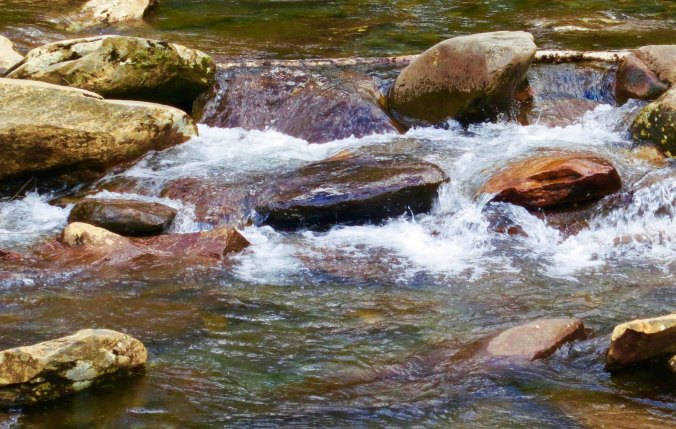
This stream kept me company as I biked up the mountain. At one point I had stopped and dangled my toes in its refreshing water.

Because the road over the mountain is so steep and filled with traffic, the park recommends that people not bicycle on it. Naturally, I caught a section of the road that was car free and had a decent shoulder.

This small waterfall was part of the same stream I placed at the top of the post.
I flew past the turn off that marks the southern beginning of the Blue Ridge Highway and into Cherokee, headquarters for the Eastern Band of the Cherokee Nation. I remember two things about my 1989 stop in Cherokee. One was that the town seemed economically depressed. The second was a bear in a cage. I felt sorry for it. The Smokies are known for having the largest concentration of black bears in the East. The caged bear would have been much happier running around in the woods with them.
The town seems much healthier now, largely thanks to the Harrah’s-Cherokee Hotel and Casino. It draws several million visitors (and their money) into Cherokee annually. As for the bear, I didn’t see it. Instead, brightly painted bear sculptures were found throughout the community representing, for the most part, Cherokee themes. A large, carved wooden sculpture of a Cherokee stands in front of the community’s administrative center. Three tears are streaming down his face— a memorial to the Trail of Tears where the Cherokee were forced off their homeland and marched to Oklahoma so white settlers could take their property.
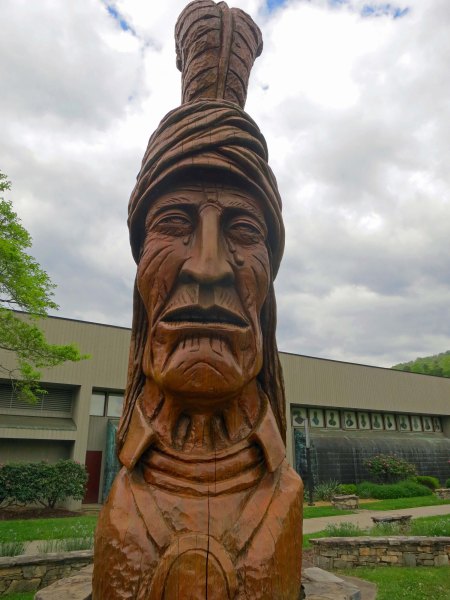
The wood sculpture of a crying Cherokee.

This bear featured a scenic painting with an elk and an eagle or hawk.

I found this scene on another bear, representing the region in earlier times.

Another rendition of a bald eagle. I liked how the artist turned the nose of the bear into the beak of the eagle. An eagle shaman dances on the rear hindquarters.

This bear was decorated with symbols you might expect to find on Native American rock art.

And, for my final photo today, a little humor.
NEXT BLOG: I ride back up the road from Cherokee to the Blue Ridge Highway entrance and begin my journey north toward Maine and Nova Scotia.
 Wandering through Time and Place