Chapter 35: Teacher

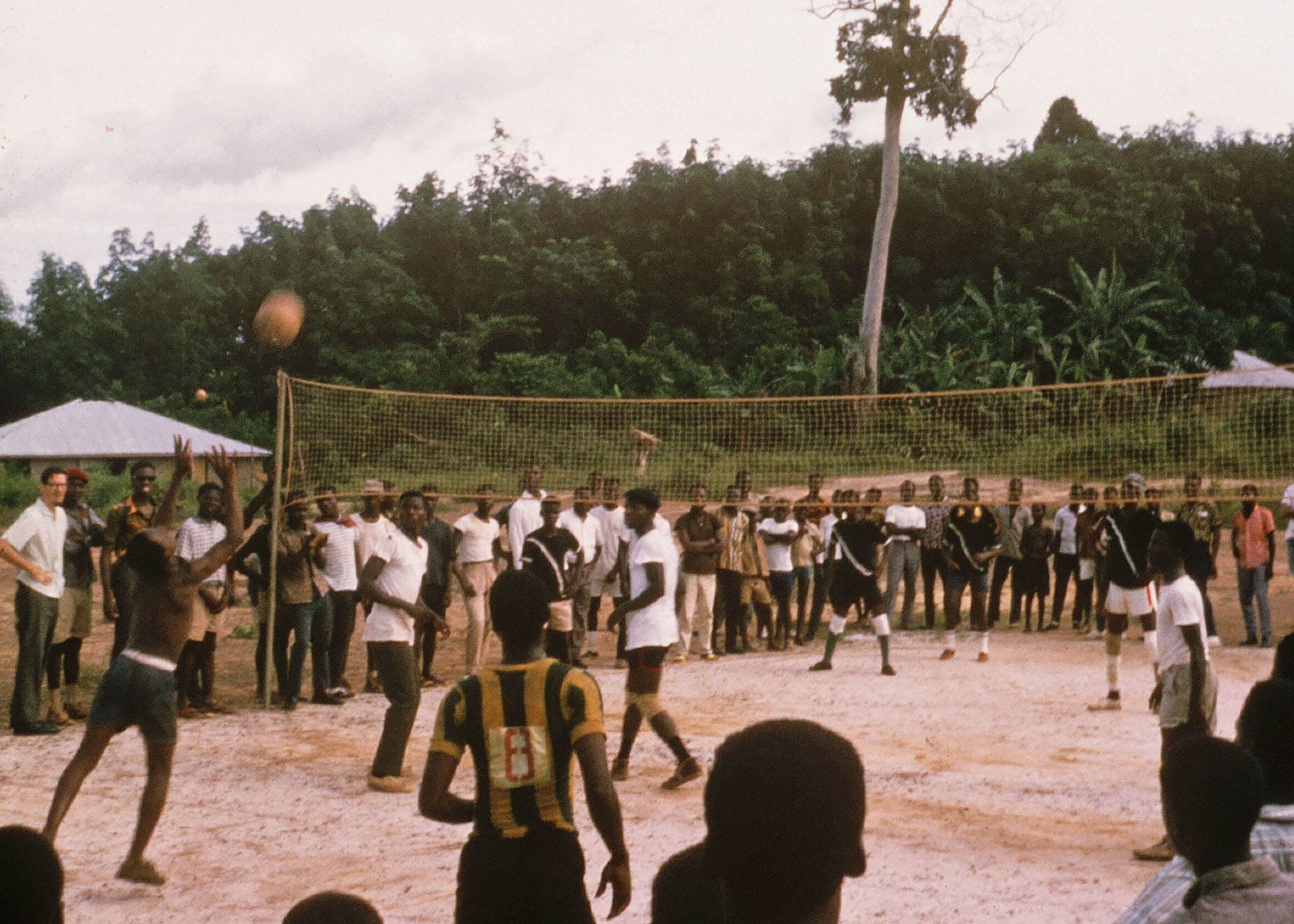
Good teaching involves capturing the imagination of students and encouraging them to become active participants in the classroom. Often it also involves participating in extracurricular activities. In this 1966 photo I am coaching Gboveh's High Scool volleyball team in Gbarnga, Liberia.

Good teaching involves capturing the imagination of students and encouraging them to become active participants in the classroom. Often it also involves participating in extracurricular activities. In this 1966 photo I am coaching Gboveh’s High School volleyball team in Gbarnga, Liberia.

I am not sure I earned the title of teacher at the elementary school, even though I put in the time and occupied the chair. I did learn that teaching was hard work and developed a life-long respect for elementary school teachers. I like to believe, had to believe, that I had some impact on the life of my students.

High school was different. From the beginning I was teaching subjects I truly enjoyed: World History, World Geography, African History and African Geography. I had never understood how history and geography could be boring. The best of my teachers had brought the subjects to life and made them exciting and relevant. I was determined to do the same for my students. We debated, did projects and made maps.

As strange as it may seem, my high school African History course was a first for Liberia. We travelled back in time starting with the exciting discoveries being made at Olduvai Gorge in East Africa about the early beginnings of humanity. We looked at the major West African kingdoms such as the Songhai and Mali. We explored the impacts of slavery, Colonialism, Islam and Christianity on Africa.

In geography we started locally and moved outward, from Gbarnga to Liberia to Africa and the world. Like their elementary school counterparts, the high school students found it almost impossible to accept that Liberia occupied such a small part of the African Continent. They became incensed, like it was my fault.

I wisely opted out of teaching Liberian History. It’s likely that I would have deviated from the Americo-Liberian version and been run out of the country. How could I teach the kids that Matilda Newport was someone they should idolize when her claim to fame was blasting their great-great-grandfathers with a cannon? I even had to be careful what I taught my World and African History classes. The students were bright and would draw their own conclusions.

“Gee Mr. Mekemson, the way the white minority in South Africa controls things is a lot like Americo Liberians control things here.”

“Oh really?’’ was about as far as I dared go in response. Things had a way of getting back to the authorities. Favors could be earned by reporting supposedly seditious comments to paranoid government officials and I had already earned enough black marks from the second grade reader and Boy’s appetite for Guinea Fowl.

But I didn’t stay out of trouble. During our second semester at Gboveh, I decided that creating a student government would help our students prepare for the future. I argued that the best way to prepare for democracy was to practice it. Everyone, including students, teachers and Mr. Bonal, agreed. We pulled together interested students, worked through developing by-laws, and set up elections. The students even decided they would organize and run for office on party tickets. Why not? It sounded like fun.

It never entered my mind that this relatively innocent gesture would strike terror in the hearts of Americo-Liberians. Once again, I had failed to comprehend just how paranoid the Liberian government was. Within 24 hours we had been accused by the Superintendent of Bong County of setting up competing political parties to the Government’s True Whig Party.

Student leaders were told to cease and desist or they would be arrested and thrown in jail. Mr. Bonal called me in and suggested I should start packing my bags. There was no way that he was prepared to take responsibility. I didn’t blame him. At a minimum he could lose his job… and that would be a stroll through the rainforest in comparison to rotting in a Liberian jail.

On one level, the government’s paranoid behavior made sense. The True Whig Party was how the Americo Liberians maintained control of the government and, more importantly, their privileged positions. The Kpelle Tribe was the largest tribe in Liberia and my students were becoming the elite of the tribe through education. A political party set up at high school might indeed morph into a political party of the Kpelle, given time.

So we eliminated the tickets and names. We were then allowed to proceed but I have no doubt we were closely monitored. I couldn’t help but wonder which of my students or fellow faculty members reported regularly to the Superintendent on my treasonable behavior.

Somewhat on the lighter side was the business of keeping the names of my students straight. It wasn’t that I had a lot to remember; there were five students in the 12th grade, ten in the 11th and sixteen in the 10th. Most teachers would kill for that student-teacher ratio. The problem was that the students changed their names frequently.

John Kennedy was big in Liberia at the time so there were several John Kennedys. Moses was also popular. Five trillion missionaries made sure of it. Kids would also take the name of whomever they were living with. Most of them had left villages and were trying to survive life in the big town. By adopting the name of the family taking care of them, they encouraged better care. Sam even told me he considered becoming Sam Mekemson, our African son. Finally, as students became more aware of their heritage, some switched back to their tribal names. What a unique thought that was.

Roll call was often a challenge. Students wouldn’t answer if I didn’t use their name of the moment. I finally adopted a rule that students could change their names but only at the beginning of a semester. It worked, sort of.

My school activities increased as time went on. I chaired the social studies department from the beginning. This wasn’t too significant since I was the social studies department and my primary responsibility involved keeping me in line. (Some misguided people claim that is not an easy task.) I also took on more work for Mr. Bonal and eventually came close to functioning in the role of vice principal. Daniel Goe had returned to the U.S. for further education.

Jo created a high school chorus that became so good the County Superintendent wanted her to create a Bong County Chorus. She gracefully declined. This was, after all, the same man who wanted to throw us in jail when Boy ate his Guinea Fowl and was ready to kick us out of the country because we dared to develop a student government.

Jo Ann directing her Gboveh High School chorus. At Berkeley, she had belonged to the University's elite Glee Club.

Jo Ann directing her Gboveh High School chorus. At Berkeley, she had belonged to the University’s elite Glee Club.

There were a multitude of other activities. I developed a library for the school by raiding departing PCVs book collections. For some reason I was roped into coaching the school’s football/soccer team, a task I quickly traded for volleyball.  (There were four-year olds in town who knew more about soccer than I did.)

I also created a local Boy Scout troop. I taught them how to tie knots and they took me for great jungle walks. Jo Ann contributed by sewing Patrol flags. All in all, we kept busy carrying out the same type of work being done by thousands of Peace Corps Volunteers around the world.

One of my many activities as a Peace Corps Volunteer was serving as a scout master. My scouts took me on outdoor adventures.
One of my many activities as a Peace Corps Volunteer was serving as a scout master. My scouts took me on outdoor adventures.
Chapter 32: Goat Soup, Greed and Everyday Life

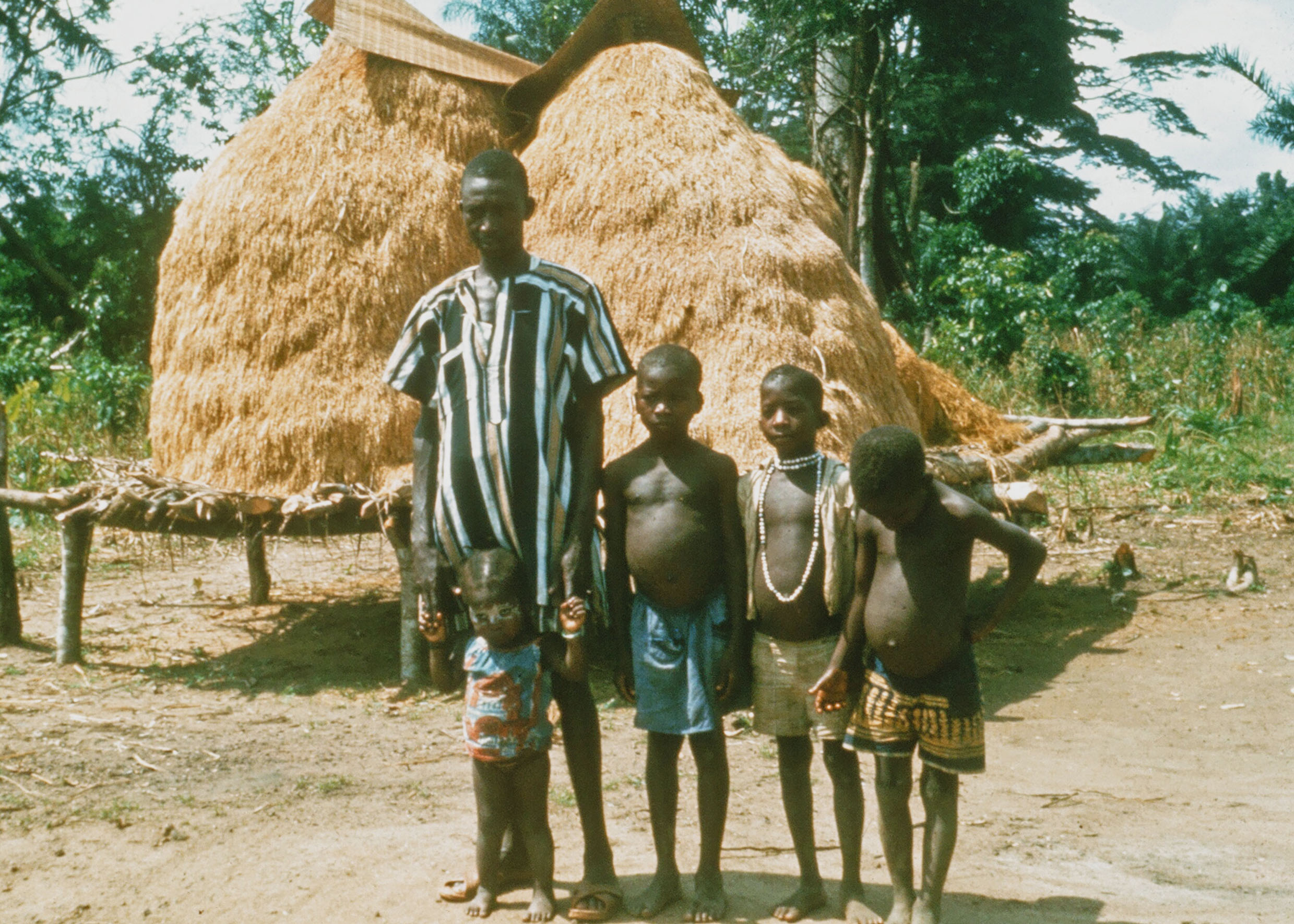
After a day of teaching at Gboveh High School, I would follow jungle trails to surrounding villages and farms. This picture features a Kpelle farmer with his three boys and young daughter. Harvested rice is piled behind the family.

After a day of teaching at Gboveh High School, I would follow jungle trails to surrounding villages and farms. This picture features a Kpelle farmer I met along with his three boys and young daughter. Harvested rice is piled behind the family.

In some ways our everyday life as high school teachers resembled our everyday life as elementary school teachers. We would crawl out of bed at 6:30, eat a quick meal and walk to school. Shortly after 1:00 we would be home downing peanut butter and jelly sandwiches with the school day finished. Our nap was next.

The new location encouraged wandering. After siesta, the dogs and I would disappear into the jungle. This continued a tradition of hiking in the woods from my earliest childhood years. I explored the surrounding village trails going farther and farther afield. Sometimes I would take my compass so I could draw primitive maps and figure out where I had been. Tribal folks were surprised to find me out in the bush but were always friendly.

I discovered where the cane fields and whiskey stills were, found a primitive but well-built wooden bridge across the river, made my first acquaintance with Driver Ants, and avoided the numerous poison snakes.

Sometimes Jo Ann would join me and on occasion I would take Sam, other Volunteers and Peace Corps staff along. The hikes provided an opportunity to explore aspects of tribal life not normally found in Gbarnga. They also served as a major part of my exercise program. I became svelte, or maybe just skinny.

A Kpelle woman and her daughter take turns pounding palm nuts in this 1966 photo taken near Gbarnga, Liberia.

A Kpelle woman and her daughter take turns pounding palm nuts in this 1966 photo taken near Gbarnga, Liberia.

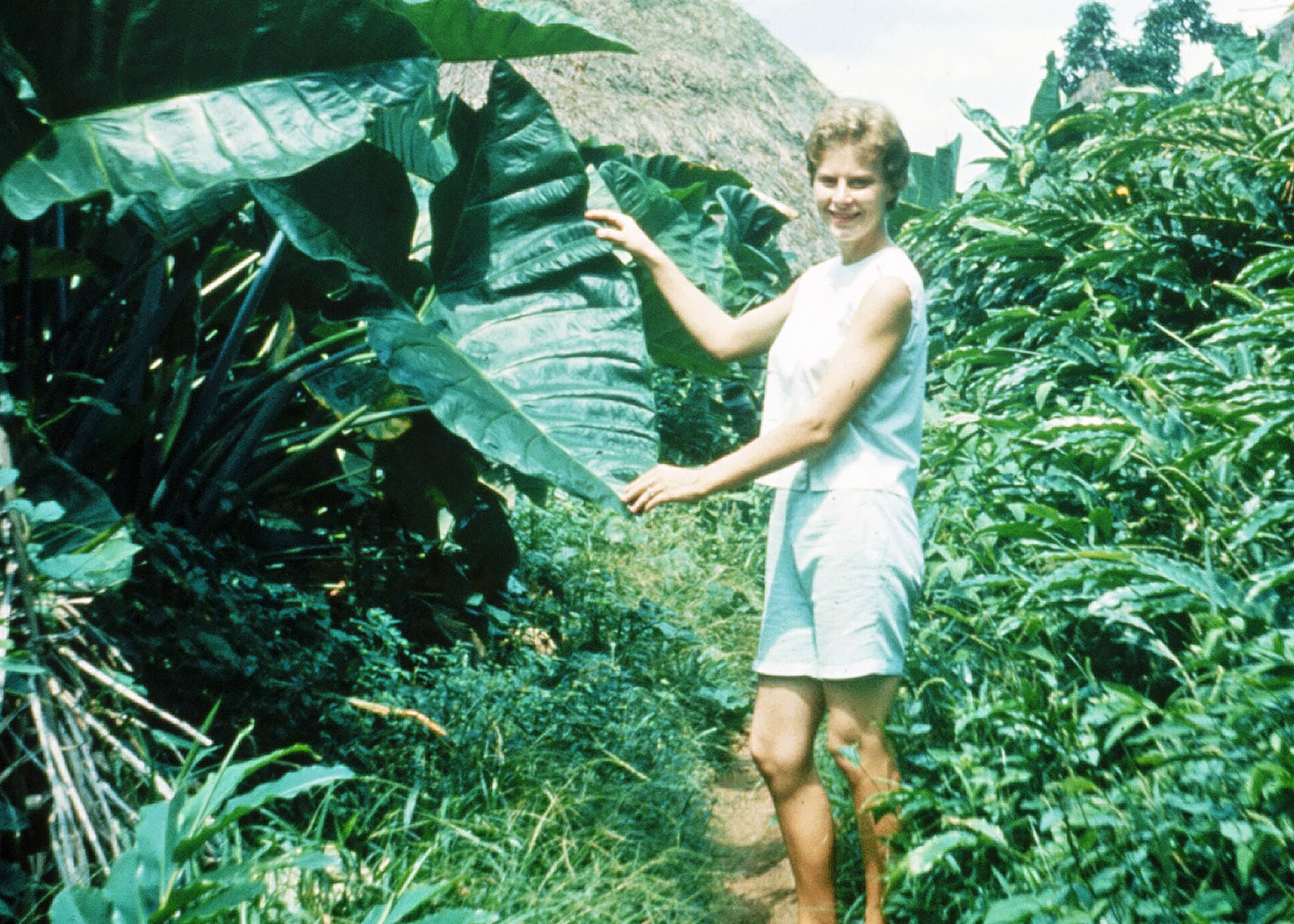
Jo Ann holds an Eddo or Taro leaf. The tubers of this plant are used as food throughout the tropics.

Jo Ann holds an Eddo or Taro leaf. The tubers of this plant are used as food throughout the tropics.

Hidden by palm fronds, I climb up a Kpelle ladder I discovered on one of my jungle hikes. Notches in a trunk serve as rungs.

Hidden by palm fronds, I climb up a Kpelle ladder I discovered on one of my jungle hikes. Notches in the trunk served as rungs for the primitive but effective climbing device.

Peace Corps staff member Dick Hyler and his wife Maureen join me on a hike through the jungle.

Peace Corps staff member Dick Hyler and his wife Maureen join me on a hike through the jungle.

Our social life was nothing to write home about. Unlike single Peace Corps Volunteers, we had each other for amusement. We did maintain our friendship with other married couples. Occasionally students or teachers would drop by. Sam was always hanging around, even when not working. I maintained an ongoing chess game with the minister of the Presbyterian mission. We would send our house boys back and forth with moves.

The largest social event we hosted was a goat feast for our fellow teachers from the high school and elementary school. Between finding a goat, having it slaughtered and making soup, it turned into a major project. Three women teachers from the elementary school came over to help with the cooking chores. They wanted to make sure the goat was properly cooked. The soup along with rice was delicious, and plenteous. No one went home hungry, or sober for that matter. I’d bought two cases of club beer and one case of Guinness Stout to accompany dinner. Drunk driving was not an issue. No one owned a car.

Even with everyone stuffed, there was ample goat chop left over to feed the dogs for a week. It lasted a night. Liberian dogs always ate like they were on the edge of starvation, even fat Liberian dogs. Somewhere in the midst of the four-legged feeding frenzy, I heard a yip and went outside to find that Brownie Girl had shoved a goat bone through her cheek. The medical emergency was minor; her real concern was being knocked out of the action. The other dogs and Rasputin were gobbling down her share. I pulled the bone out and Brownie Girl jumped back into the fray. It was pure greed. Not a scrap was left in the morning.

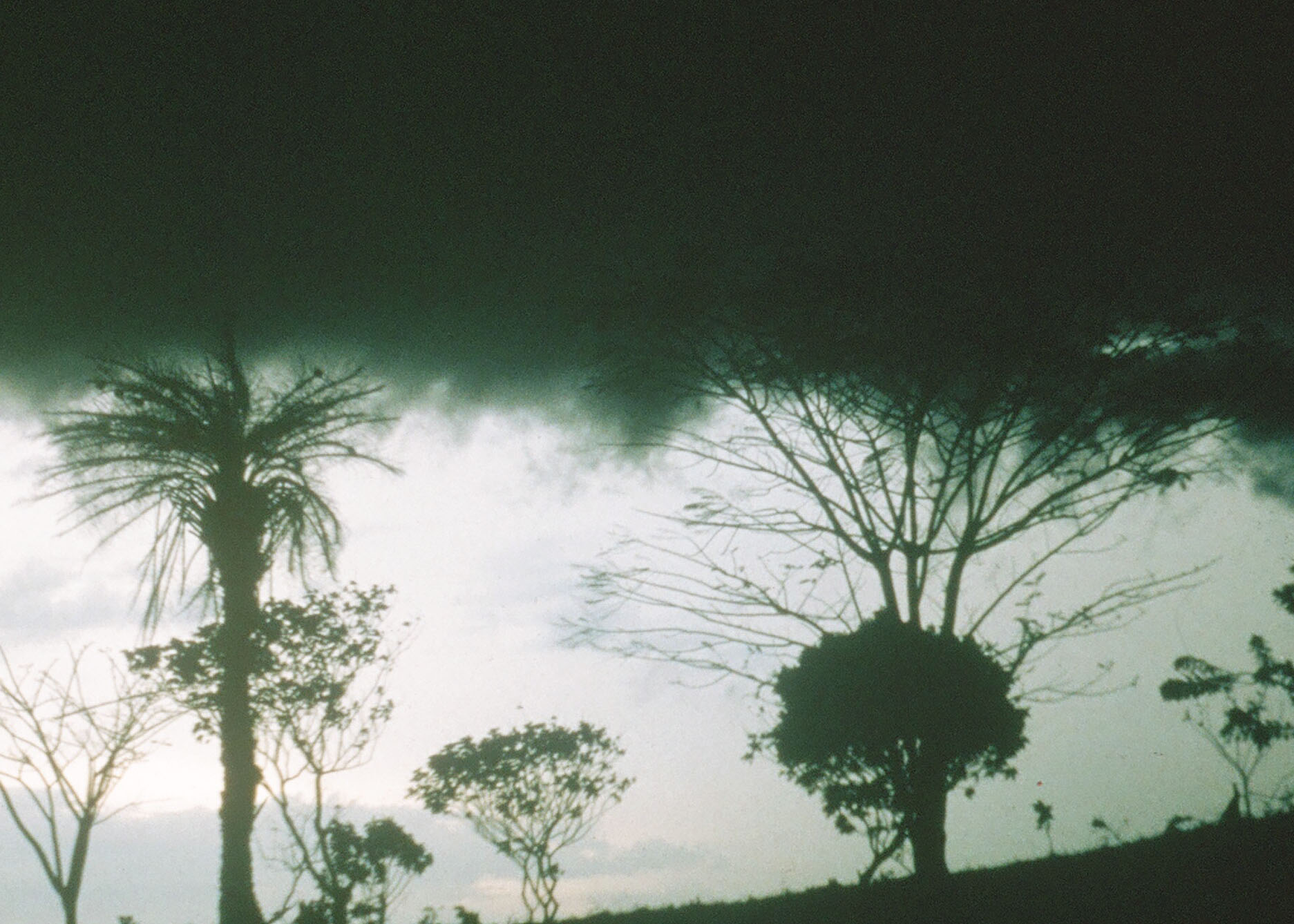
One of my favorite pastimes was to sit outside in the late afternoon, drink a gin and tonic, and watch the incredible tropical lightning storms. We found a jeep seat somewhere that made a comfortable couch for our porch. On occasion the sky would turn an ominous black and we could hear the storm as it ripped through the rainforest. The impending mini-hurricane would send Jo and I scurrying to yank clothes off the clothesline and batten down the hatches, i.e. make sure doors and shutters were firmly closed.

Dark storm clouds like these over Gbarnga suggested it was time for Jo Ann and I to quickly take in the laundry and shut up our house.

Dark storm clouds like these over Gbarnga suggested it was time for Jo Ann and I to quickly take in the laundry and shut up our house.

Every month or so, we would visit Monrovia for a touch of city life. Eating at the French restaurant by candlelight, spending an hour in the air-conditioned super market, hanging out in a book store or seeing the latest movie did wonders for morale. It almost made up for the three to four-hour harrowing taxi ride. We even took Sam with us once for his ‘birthday.’ He really didn’t know when it was so we declared it was during the trip. He still uses the same birth date.

Our really big break from teaching was a one-month trip to the big game parks of East Africa. In my next blog I will feature facing elephants and lions and water buffalo in a Volkswagen beetle, Oh My.

Chapter 29: The Invasion of the Army Ants

Welcome to “The Dead Chicken Dance and Other Peace Corps Tales.” I am presently on a two month tour of the Mediterranean and other areas so I thought I would fill my blog space with one of the greatest adventures I have ever undertaken: a two-year tour as a Peace Corps Volunteer in Liberia, West Africa. Every two days I will post a new story.

When I have finished, I will publish the stories in digital and print book formats.

Army ants cross road

A trail of army ants snakes across a road outside of Gbarnga, Liberia. Large soldier ants provided guard duty… 

Even more than termites, driver or army ants are appropriate subjects for jungle bug horror stories. There’s a reason. These guys are ferocious.

My first experience with driver ants was when I came upon a line of them crossing a trail. At first glance they looked like any other group of respectable ants negotiating a path and minding their own business. On closer inspection, however, I found myself facing a tunnel of knife-sharp mandibles, each one wide open and wanting to crunch down on something. The big soldiers had linked their hind legs and were facing out, creating a tunnel for the other ants to crawl through.

Always up for a challenge, I took a stick and applied it to the middle of the line. Chomp! I pulled the stick back. The whole line of linked ants came along and a high-speed foot race commenced. I was both the finish line and first prize.

Or at least I was supposed to be. I gave the ants a free flying lesson. It’s possible they are still searching for their lost comrades.

Army ants are noted for their bite. In some parts of West Africa they are reputedly used as sutures. Once their jaws clamp shut, they are locked. I can attest to this since one managed to get at me through a hole in my tennis shoe. They are also noted for eating anything that can’t move fast enough to get out of their way. I watched as they gobbled down an unfortunate mouse. Their squeaking dinner simply disappeared under a sea of black.

Villagers clear out of their huts when the ants come to town. The ants go through, eat all of the bugs, mice, occasional snake and anything else alive, and then move on. It’s a good deal for the villagers and the ants. My attitude about our house being invaded wasn’t nearly as positive.

It all started on a quiet tropical evening. I was working my way through a James Bond novel, Jo was being good and preparing lesson plans, and Sam was glued to our phonograph, still trying to get Charlie off the MTA. Since bugs were such a central part of our lives, we normally ignored them. It was the hoard of tiny insects hopping and crawling under the screen door that caught our attention.

“Ants,” Sam said.

“No, Sam,” I said, assuming my teacher role, “these are not ants.” I was rewarded with an exasperated ‘I know that’ look from Sam.

“They are running away from ants that want to eat them,” he jumped in to interrupt any further explanations on my part. He was right, as usual. I turned on the porch light. Anything that could hop, crawl, walk or run was seeking sanctuary in our house. Behind them came the ants. They weren’t organized in a neat little line this time. They were spread out across our yard and coming on like a tsunami.

Jo and I held a hurried council of war. It was time to bring out the big gun, SHELLTOX.  Shelltox was one of those marvelous nerve gasses created by the pesticide industry that was so potent it was banned in the US even though this was still a time in America when DDT was considered as important to controlling six-legged life as butter was to making food taste good. The tiniest spurt of Shelltox and a cockroach rolled over and begin kicking its little legs in the air. We used it liberally.

Each of us armed with a can stomped off to war. The stomping was serious; it kept the ants off. Back and forth along the enemy line we marched, cans firing, filling the air with whatever odor Shell incorporated into its brew to let us know we were poisoning ourselves. The ants died by the hundreds and soon by the thousands. But still they came on. Our cans begin to sputter. Exiting stage left was rapidly becoming an option.

I pictured us packing up the cat and descending on the Peace Corps Rep like the ants had descended on us. First we would eat all of his food and then we would tackle his liquor closet. Unfortunately, the ants blinked first. Their buglers blew retreat. We had won the battle but the war was far from over.

That night, visions of monstrous ants visited me whenever I closed my eyes. Every hour we arose from bed to check if the attack had been renewed. Happily it hadn’t. By morning we were allowing ourselves to hope that the ants had figured out we were dangerous adversaries and moved on to easier targets. The ants had another plan. Mr. Bonal was wandering around outside so I went over to tell him our invasion story.

“Ah, let me show you something, Curtis,” he said. He walked me over to an old pile of mud bricks buried in the grass twenty feet away from our front porch. I looked down and all I could see was a moving black mass. The area was carpeted with a layer of driver ants several inches thick. There were zillions of them.

“Welcome to the ants’ home,” John explained. “They have moved in for the rainy season.”

The Bonals, it turned out, had been invaded the week before when Jo and I were in Monrovia. Again it had been a night attack but this time the ants made it into their house without discovery and found the baby. The baby, objecting strenuously to being a one-course meal, had started screaming. That brought the Bonals on the run. The baby was saved and the ants repulsed.

John assured me that the ants would be back to visit us again and again until they moved on.

I decided to remove the welcome mat. But first Jo and I had to restock our ordinance supplies. Off we went to town for umpteen cans of Shelltox, five gallons of kerosene, and a box of DDT. (Years later after I became a certified greenie and read Silent Spring, I would occasionally have twinges of guilt about the DDT.)

Our plan was to attack the home base with the kerosene, disorient the troops, destroy the barracks, and send the army packing. Of course there was a chance that the ‘packing’ would be toward our house rather than away from it. In that case, our first line of defense would be to mount an all out attack with Shelltox like we had before. As a fallback position, I scratched a narrow ditch around our house, translate that moat if you are romantically inclined, and filled it with DDT. The ants would have to crawl through the stuff to get at us.

Then I went to work. Reaching the nest without becoming ant food was the first challenge. Having grown up in red ant country, I remembered how sensitive ants are about their home territory. The slightest disturbance brings them boiling out of the ground in a blind rage. As a kid I used to pour water down their hole to watch the action.

The Apaches were reputed to have used the red ants’ proverbial ferocity as a means of torturing favored enemies.

I rightfully determined the driver ants were meaner, bigger and faster than their distant cousins. They would be on me and up the inside of my pants leg in a flash, a fate to be avoided at all costs.

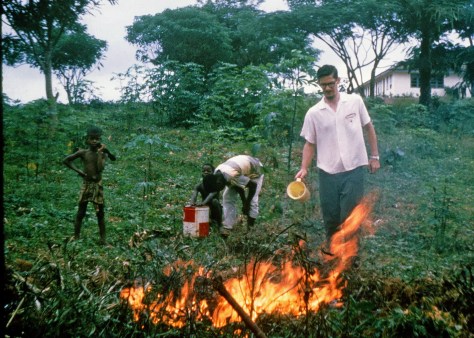
The initial strategy of removing vegetation was relatively safe. Sam and I stood several feet away and tossed two gallons of kerosene on the nest. A carefully cast match created a raging inferno which proved quite effective in defoliating the area.

Burning out army ants

The first part of the campaign was to burn the vegetation away from where the ants lived. Two gallons of kerosene did the trick. Sam helped me while two neighborhood boys looked on. Gboveh High School is up the hill.

Digging into the nest was much more dangerous; I would be operating behind enemy lines facing thousands of steel jawed troops on a hunt and destroy mission. My solution was to draft a galvanized steel tub Jo and I had used for bathing at our first house. It provided ample standing room and the ants couldn’t crawl up the side. I tossed the tub next to the nest and leapt in.

Sam tossed me our shovel. Several minutes of dedicated digging brought me to the mother of all nurseries. Eggs covered an area at least three feet across and several inches deep. Right in the middle was a finger sized, bright orange snake.

“Very poisonous,” Sam said. I figured it had to be pure poison for the ants to leave it alone. We decided to take a break and let the ants and the snake work out their relationship.

After our standard lunch of a peanut butter and jelly sandwich washed down by orange Kool Aid, we went out to check the results of our handiwork. Success! Long lines of ants, many dragging eggs, stretched off into the distance away from our house. The siege was over. There was no sign of the snake, by the way. Maybe the ants had stopped for lunch as well.

Chapter 10: Crazy Flumo Shakes My Hand and Ankles… Peace Corps Tales

Welcome to “The Dead Chicken Dance and Other Peace Corps Tales.” I am presently on a two month tour of the Mediterranean and other areas so I thought I would fill my blog space with one of the greatest adventures I have ever undertaken: a two-year tour as a Peace Corps Volunteer in Liberia, West Africa. Every two days I will post a new story in book format.

When I have finished, I will publish the stories digitally and in print.

A typical Liberian shop on Gbarnga, Liberia’s main street circa 1965-66. Note the crocodile’s skin with its tail dragging in the dirt..

In my last post, we went to bed without food, water or light in our new home in Gbarnga, Liberia. Drums and screams filled the darkness with sound.

A new day did manage to happen, as they always do. Jo Ann and I promised to make it a good one. Her job was to mount a ferocious counter offensive on the bug-a-bugs and cockroaches. Sam was coming early with a broom.

My job was to walk the quarter-mile to town, buy five gallons of kerosene, find the most toxic bug spray known to humankind, and scavenge anything available that resembled food.

I added alcohol to the list.

But first I needed to replace the malarial pond residing in our front room. I grabbed the offending bucket and tossed the stagnant water onto a plant. “Waste not; want not,” my mother would have urged even though it was in the middle of Liberia’s rainy season and the plant had already received half of its annual 170 inches of rain.

Now I was ready to tackle the well.  My family had one when I was growing up. It came with a cover, a high-pitched whirring pump, and a holding tank. Except for power outages, we could depend on it to magically deliver water day in and day out.

Our well in Gbarnga was an unprotected hole in the ground waiting for someone to fall in. Next to it I found a frayed rope. I tied it to the bucket’s handle using a Boy Scout bowline. Then, making sure I had a firm hold on the end of the rope, I tossed the bucket into the dark hole. Kersplash! I gave it a shake so it would tip over and fill.

A five-gallon bucket of water weighs 43 pounds. By the time I yanked it over the edge, I had a new appreciation for modern technology… and for the Volunteer who had left the original bucket in our house.

I delivered my burden to Jo and started for town. Half of Gbarnga was standing along the road staring at me. I smiled and waved a lot, like a princess on parade. They smiled and waved back.

Soon I came to the town’s main street. Open-air shops lined the dirt road on both sides. At first, they looked the same: white washed walls, red tin roofs, dark interiors, and faces staring out from inside. Then I begin noticing differences.

Several were fronted with crumbling cement steps that had long since given up any hope of connecting to the eroded street. One featured a crocodile skin nailed to the front post, its tail dragging in the dirt. Another had brightly colored shirts and shorts strung up like Christmas ornaments. Two or three were obviously makeshift bars, no more than holes in the wall with planks doing the honors. An ancient Liberian ‘Ma’ came staggering out of one with a half-pint bottle of gin clutched in her hand. She noticed me, hoisted her bottle in a toast, and took a swig.

A few shops were larger and resembled country stores filled with the minutia of daily life. Pale-faced Lebanese leased the shops. Lebanese made up the majority of Liberia’s middle class but were not allowed to own property. I was headed for a shop that Sam had recommended.

A group of men stood idly in front of the store. Had folks known I was coming, I would have sworn it was a reception committee. It’s show time went reverberating around my skull. I put on my best Peace Corps smile. One of the men stepped forward to greet me. He was barefoot and wore a tattered shirt, tattered shorts and a big grin. His hand shot out.

This is it, I thought, my first official Liberian handshake. We had started practicing in San Francisco. The shake begins as a normal handshake but ends with you snapping each other’s fingers. An audible snap signifies success. It isn’t easy at first. If the person is really happy to see you, he may go through the process two or three times.

(About the time the snap becomes second nature, it’s time to go home. Then you have to unlearn the process. Your American friends look at you strangely when you snap their fingers. At least my conservative Republican father-in-law did. But back to Africa.)

We shook; our hands parted. Snap! It worked. All of the men beamed and I beamed back. Their official greeter grabbed my hand again. Snap! Another success and more beaming. And again. Then a fourth time.  Nobody had mentioned four times to me and this time the guy wouldn’t let go. The men were laughing out loud now.

My hundred-watt smile became a twenty-watt grimace as I politely tried to retrieve my hand. No luck. I steeled myself, gave up any pretense of being polite and yanked. My hand pulled free and I breathed a huge sigh of relief. It lasted as long as it took the guy to drop to the ground and wrap his arms around my ankles. By now the other men were all but rolling the street.

I had become prime time entertainment, the George Custer of Gbarnga.

I might still be there if the cavalry hadn’t arrived.

It came in the form of a handsome Liberian man in a well-tailored suit. He appeared on the scene and gave Flumo a healthy kick in the butt. Flumo let go.

“Hi, I am Daniel Goe, Vice Principal at Gboveh High School. Welcome to Gbarnga.” he introduced himself.

We shook hands in the old-fashioned way as Daniel explained that the man who had his arms wrapped around me was known throughout the Country as Crazy Flumo. I wasn’t the only person to receive his attention. Once, Daniel told me, Flumo had thrown himself down in front of Vice President Tolbert’s car and wouldn’t move until the VP climbed out and gave him five dollars.

I later learned that a tall Texan Peace Corps Volunteer had walked several yards down the main street of Gbarnga with Flumo tenaciously attached to one leg. I’d gotten off easy. Having met one of Gbarnga’s true characters, I was about to meet another.

Next post: Captain Die, our well digger, stops by and introduces himself… “My name is Captain Die because I am going to die someday.”

Treason

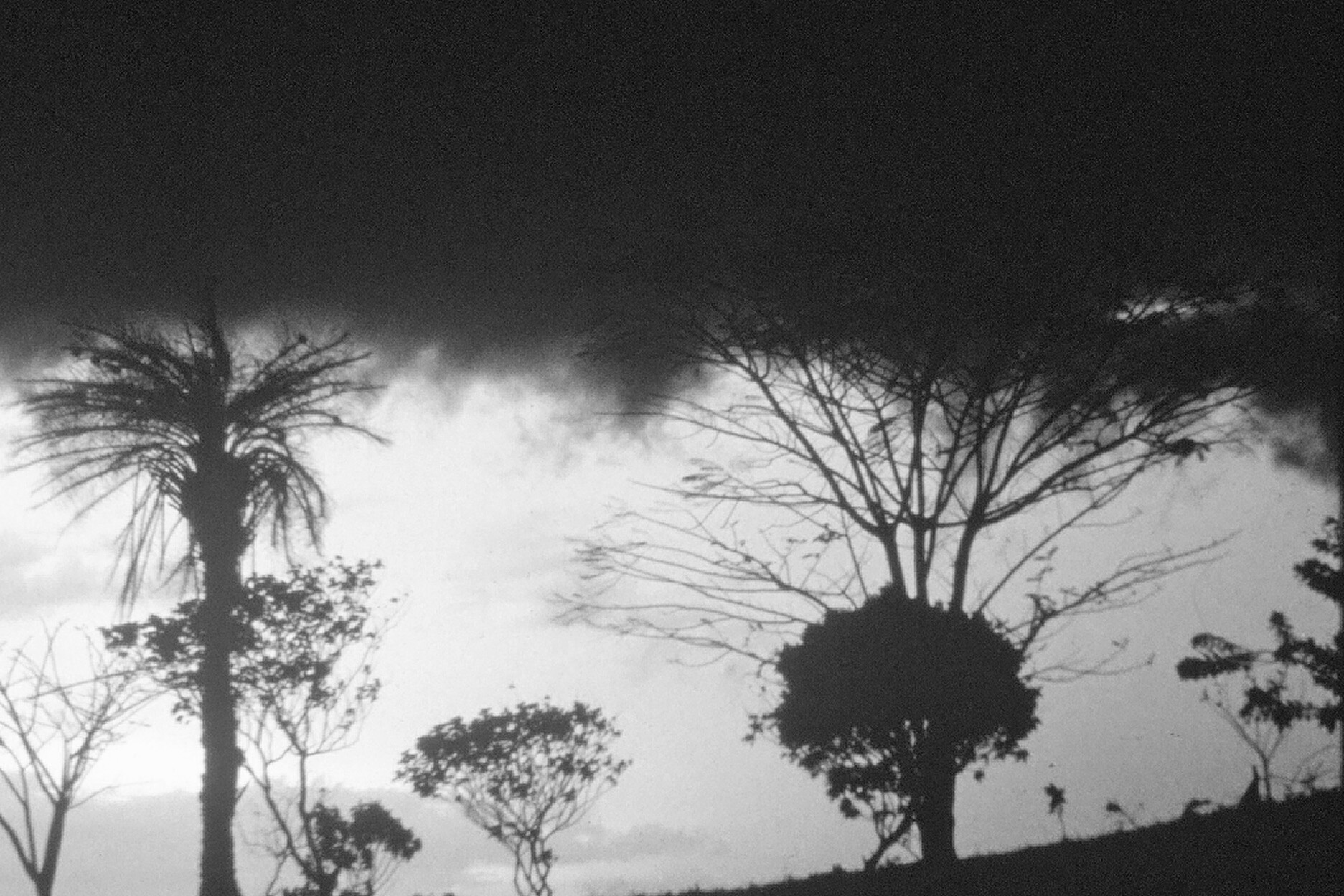
Gathering storm clouds over Liberia. I took this photo from my front porch in 1967. Looking back, it symbolizes for me the gathering political storm that would tear Liberia apart in the 70s, 80s and 90s.

Our job as teachers was to help bring Liberia’s tribal population into the twentieth century.

It was something of a first for the Country considering Americo-Liberians had worked hard for over a century to keep the tribal population in the darkest of the Dark Continent. Americo-Liberians were the descendents of freed slaves who had returned to Africa in the 1800s. They had promptly established themselves as the ruling elite.

It was a position they wished to maintain.

The times ‘they were a changing’ though. Independence was sweeping through Africa as one country after another threw off its colonial chains. Liberia’s tribal peoples were aware of what was happening in the world around them and the natives were getting restless.

The challenge to William Shadrach Tubman, who had been President since 1943, was to convince the tribal people they were getting a good deal, hold together a disparate people, make a show of it internationally, and still protect the privileges of the Americo-Liberians. Achieving the latter while moving forward on the first three was close to impossible.

It required an incredible balancing act at which Tubman was a master. The recipe for success involved one part substance, five parts fancy footwork and ten parts paranoia. The paranoia evolved from the fear that the tribal Liberians would take the process seriously and demand an equivalent portion or, God forbid, all of the goodies. Or possibly the nation would shatter apart.

As long as we behaved ourselves, we were part of the substance. The Liberian government made it quite clear that there would be grave consequences for anyone caught challenging the supremacy of the True Whig Party. For Liberians, the grave consequences could literally mean a hole in the ground. For us, it was a one-way ticket out of the country.

Don’t bother with stopping at Go or collecting $120 (our monthly salary).

Phil Weisberg in our back yard. Virgin tropical rainforest provides the backdrop.

One of our fellow Peace Corps Volunteers in Gbarnga, Phil Weisberg, actually tested the government’s resolve just prior to our arrival. Phil was a tall, gangly PCV who always looked like he had recently lost something of profound value.

He became upset whenever President Tubman or Vice President Tolbert came to Gbarnga and all of the school children in town were required to stand beside the road and cheer.

It didn’t matter if the luminary was one or two hours late, which he often was, or if it was pouring down rain, which it did half of the time, or if the sun was boiling hot, which it did the other half; the kids were expected to be there.

Teachers were required to go along. While most of the Volunteers managed to find something else to do, Phil’s personality was such that if his kids had to suffer he was going to be right out there suffering with them.

One day he found himself waiting an hour in the hot sun for the President’s wife and decided to protest. He did so by penning a sign that said in the best Liberian English, “MRS. TUBMAN, YOU ARE TOO LATE!”

Two hours later when her motorcade came tooling in to Gbarnga, Phil held up his sign and waved it about. Minutes later he found himself arrested and thrown into jail. This was not a piddling little kick your ass out of the country offense. One didn’t mess with the President’s wife.

Luckily Phil had the power of the American government behind him. Diplomatic maneuvering plus a personally written apology earned him a get out of jail free card. He was even allowed to stay in the country and finish up his term, provided of course he behaved.

I understood why Phil got in trouble. Waving a sign around criticizing the Presidents wife was not how to win friends and influence people among the Americo-Liberians. We all knew that the government was paranoid. Just how paranoid, I was to soon find out.

Peace Corps teachers were required to undertake a project during their first school vacation in Liberia. Given my experience at the elementary school, I decided do away with Dick, Jane and Spot and write a second grade reader. Why shouldn’t Liberian children have their own readers that reflected their own culture? Peace Corps agreed.

I jumped in. There were teaching guides to review, people to interview, folk tales to gather, and stories to write, rewrite and finish in one syllable English.

Eventually I finished the reader and shipped it off to Monrovia. Peace Corps was excited about the book and assigned an editor and illustrator to work with me. I would soon be a published author. Not. WAWA (a term coined by experienced African hands that stood for West Africa Wins Again) struck.

The book wouldn’t be published at all.

I had made the mistake of assuming the government would support a reader that featured Liberian children and African Folk Tales instead of Dick, Jane and Spot. What I had failed to understand was just how paranoid the Americo-Liberians were about maintaining power.

Apparently the book was a highly subversive tract and I was a dangerous radical. Liberian children would learn about their native heritage and rebel. Another misstep and I would be booted out of the country… or worse.

My next criminal activity was to organize a student government at Gboveh High School where I was taught African and World History. I decided the exercise would help our students prepare for the future and give them skills they would need in helping to govern their country.

Everyone, including students, teachers and Mr. Bonal, agreed. We pulled together interested students, worked through developing by-laws and set up elections.

Then the kids decided they would organize and run for office on party tickets. Why not? It sounded like fun. To provide identification for each ticket, they adopted names. It never entered my mind that this gesture would strike terror in the hearts of Americo-Liberians.

Within 24 hours we had been accused by the Superintendent (governor) of Bong County of setting up competing political parties to the Government’s True Whig Party. Student leaders were told to cease and desist or they would be arrested and thrown in jail.

I was told indirectly that I should start packing my bags.

So we eliminated the tickets and names. We were then allowed to proceed but I have no doubt we were closely monitored. I couldn’t help but wonder which of my students or fellow faculty members reported regularly to the Superintendent on my treasonable behavior.

The senior class. Yes, there were only five students in the class! Mamadee Wattee, standing on my right with a brown shirt and tie, was the student body president. He is also featured in my blog about the Lightning Man. Later he would move to the US and become an elementary school principal.