Chapter 24: Eat More Bugs… Cultural Challenges

Welcome to “The Dead Chicken Dance and Other Peace Corps Tales.” I am presently on a two month tour of the Mediterranean and other areas so I thought I would fill my blog space with one of the greatest adventures I have ever undertaken: a two-year tour as a Peace Corps Volunteer in Liberia, West Africa. Every two days I will post a new story.

When I have finished, I will publish the stories in digital and print book formats.


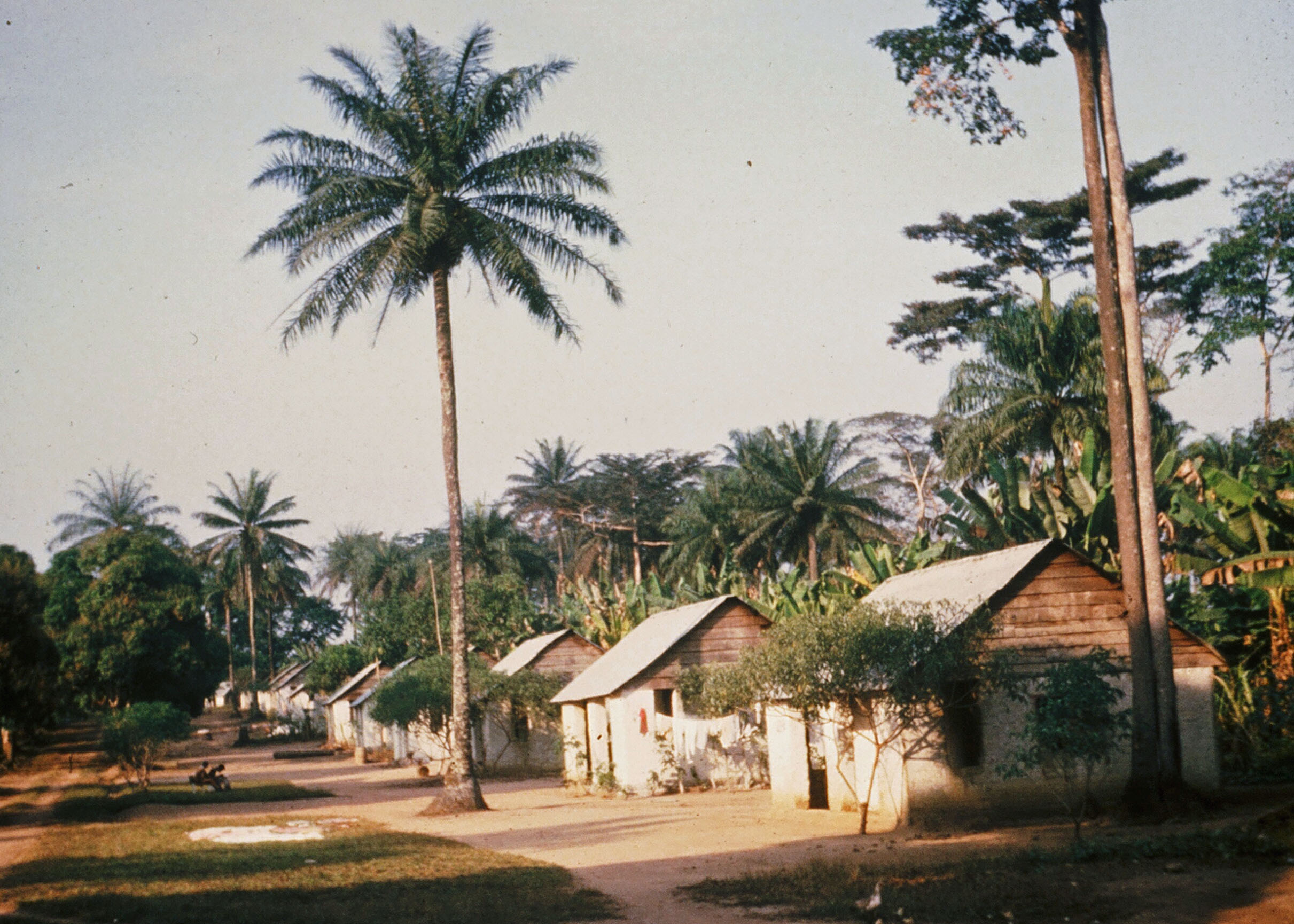
Local tribal people believed this tree hosted a spirit. Often I would find offerings left at its base.

Local tribal people believed this tree outside Gbarnga, Liberia hosted a spirit. Often I would find offerings left at its base.

Joining the Peace Corps should come with a label like they put on cigarette packs. It would read “Warning: This experience may change your concept of reality.

Our vision of the world is perceived through culturally tinted glasses. Not surprisingly, the reality of our parents and our society becomes our reality. It’s very hard to imagine life from any other perspective. Close encounters with other cultures can shake this vision but not easily. We wear our culture like bulletproof vests, rarely allowing a stray thought to penetrate. Or we focus so hard on extolling our own culture that we fail to learn valuable lessons another culture may teach us.

A key element of our Peace Corps training had been to instill cultural sensitivity. Eugene Burdick and William Lederer’s book, “The Ugly American,” came out in 1958 and was turned into a movie starring Marlon Brando in 1963. Both made a significant impression on me. US citizens were known for being pushy and acting superior in dealing with foreign cultures. It created enemies. Peace Corps’ job was to make friends and provide aid, not alienate people.

There was another important reason for the training. Risks are involved when you run headlong into another culture. Depression is one. The environment may be so totally different that it becomes disorienting. The common name for this is culture shock. Learning about Liberia and its tribes was a form of inoculation.

My transition from California to Liberia was relatively smooth. At first, Gbarnga didn’t seem all that different from my old hometown of Diamond Springs. A small rural town is a small rural town. I suffered more shock going from Sierra College to UC Berkeley than I did going from Berkeley to Liberia. My disorientation (and depression) would wait until I returned to the US.

A less common phenomenon is going native or bush as it was called in Liberia. In this instance, you become so enthralled with the new culture that you adopt it as your own. There was a joke that circulated among Peace Corps Volunteers on how to determine when you were teetering on the edge.

Phase One: You arrive in country and a fly lands in your coffee. You throw the coffee away, wash your cup and pour yourself a new cup.

Phase Two: You’ve been there a few months and a fly lands in your coffee. You carefully pick the fly out with your spoon and then drink the coffee.

Phase Three: It’s been over a year and you have become a grizzled veteran. A fly lands in your coffee. You yank it out with your fingers, squeeze any coffee it may have consumed back into the cup, add the fly to your fly collection, and then drink the coffee.

Phase Four: You’ve been there too long. A fly lands in your coffee cup. You yank the fly out of the cup, pop it into your mouth and throw the coffee away. It’s time to go home.

I never met a Liberian who ate flies but bug-a-bugs, aka termites, were considered a real delicacy.

If Peace Corps Volunteers had a tough time with culture shock and going bush, the tribal Liberians had a tougher one. Traditional cultures have normally found their confrontations with the western world a losing proposition. It isn’t that our culture is so great; it’s just that our technology is so glitzy. How do you keep Flumo down on the farm when he hears the taxi horn blowing? And there were lots of taxis and money busses in Gbarnga offering one-way trips to Monrovia.

Gbarnga was on the frontier of cultural change. On the surface, life could appear quite westernized. An occasional John Wayne movie even made it to town. My students would walk stiff-legged down Gbarnga’s main street and do a great imitation of the Duke. They dreamed some day of traveling to America where they would swagger down dusty streets and knock off bad guys with their trusty six shooters.

In town, loud speakers blared out music at decibel levels the Grateful Dead would have killed for while Lebanese shops pushed everything from Argentinean canned beef to London Dry Gin. The epitome of Americana, a Coca Cola sign, dominated the road as you left town on your way to Ganta.

William Tubman had been the first Americo-Liberian President to actively encourage tribal Liberians to shed their traditional cultures and become more Westernized, or at least more Liberian. His first push had been to encourage an increase in the number of missionaries working upcountry. They were welcome to proselytize whatever brand of Christianity they wished as long as they remembered, “to render unto Caesar that which was Caesar’s.”

We had enough US-based churches in Gbarnga to satisfy Pat Robertson. Missionaries were everywhere. Baptists and Catholics and Episcopalians and Presbyterians and God only knew how many other Christian groups worked the streets in unending competition to recruit African souls.

I was out on a bush walk several miles from town once when I spotted this man coming toward me dressed up in a coat and tie, wearing shiny black shoes, and carrying a brief case. My first reaction was to get off the trail. I was too slow.

“Wait, I have something to give you,” he called.

You can bet that reassured me. But I waited. Standing there in the middle of a muddy trail in the middle of the African jungle, the man very carefully opened his brief case and pulled out a magazine. The headline screamed, ‘The World Is Coming to an End’ and apparently I was too. The magazine was “Awake” and a Jehovah Witness had me in his clutches.

Sometimes, if I closed my eyes and pretended, I could almost believe I was home. Almost. Then Africa would whip around and bite me. Sure, the local villagers would dutifully file in to church on Sunday morning and pray for blessings like their western counterparts did. But Sunday afternoon might find them out sacrificing a chicken to make sure God got the message. And yes, there was a Coca Cola sign on the way to Ganta but next to it was a tall tree where you could usually find offerings to the spirit that lived in the tree.

During my stay in Liberia I was to encounter a number of situations where African reality differed substantially from American reality. In my next blog I will introduce one of the most powerful figures in Liberia’s tribal culture, The Bush Devil.
Chapter 21: Do Your Part, the Good Dog

Welcome to “The Dead Chicken Dance and Other Peace Corps Tales.” I am presently on a two month tour of the Mediterranean and other areas so I thought I would fill my blog space with one of the greatest adventures I have ever undertaken: a two-year tour as a Peace Corps Volunteer in Liberia, West Africa. Every two days I will post a new story.

When I have finished, I will publish the stories in digital and print book formats.


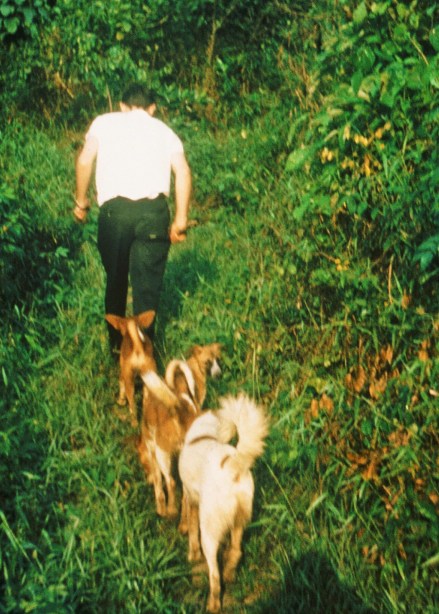
The usual assortment of dogs follows me up a jungle trail. Do Your Part, as always, is right on my heals.

The usual assortment of dogs follows me up a jungle trail. Do Your Part, as always, is right on my heals.

The conclusion of our other vacation project, the painting of our green, purple and orange house, was much more satisfying than my second grade reader. I started by buying a case of Club Beer. I didn’t know much about painting but I knew house painters found inspiration in hops.

While I was sipping a brew and pondering what paint best covered purple, Mr. Bonal came over and assured me there wasn’t anything that a bucket of white wash couldn’t cure. Jo and I dutifully trotted down to the Lebanese store and were soon applying white wash with our broom. We were quite pleased with the finished project and ourselves.

As our summer vacation drew to a close, we started preparing for our career as high school teachers where I would continue my efforts to get booted out of the country.

First, however, I am going to share stories about our everyday life in Liberia. I’ll talk about the animals that amused us, look into tribal culture, discuss the creepy, crawly things that exist in a tropical jungle, and escape to East Africa for a safari vacation in a VW Beetle.

As for the animals, you are about to meet Do Your Part the good dog, Boy the bad dog, Rasputin the terrorist cat, and Rooster, the foulest of fowls. Consider this the Alf Wight, aka James Harriot, section of my book.

John Bonal lived in a cement-block house that was the twin of ours. His brother’s family lived behind the house in an attached shed. Being successful in Liberia meant that your relatives came over and lived with you. It was the ultimate share-the-wealth-social-welfare program.

Part of John’s extended family included three dogs creatively named Puppy Doodle, Brownie Girl and Do Your Part. They came over to watch the white washing action and decided to stay. They became our extended family. We fed them. If I have my genealogy correct, Brownie Girl was Do your Part’s mom who in turn was Puppy Doodle’s mother.

This three-generation family dug foxholes around the outside of our house and quickly established that they were our pets. Other dogs need not apply. Mr. Bonal’s brother was more than happy to have us take over feeding responsibilities and Rasputin was pleased to have someone to terrorize. So everyone was happy.

Do Your Part took things a step further and became ‘my’ dog. She was a charming little Basenji with impeccable manners. Everywhere I went, she went, including school.  Normally this amused my students. I would walk into the class with DYP a respectful three feet behind. She would immediately arrange herself under my desk and quietly remain there until I left the classroom.

This worked fine until she had puppies. They started following her as soon as they could walk the 100 yards to the school. Then I would arrive in my class followed by DYP who in turn was followed by four puppies. It was quite the parade. Unfortunately, the puppies lacked Do Your Part’s decorum and considered the classroom a playpen. The students decided it was not an appropriate learning environment and I had to agree.

DYP and company had to go. It was not a happy parting.

“Take your puppies and go,” I ordered firmly. Do Your Part looked at me in disbelief.

“Out!” I said.

Sad eyes stared back accusingly. But I held firm. She didn’t let it get her down, however. As soon as the puppies had departed she was back in class. One time her insistence on following me had more drastic consequences.

Gbarnga had a sizeable population of Mandingoes, most of whom were Muslims. They had been gradually sifting into Liberia from across the Guinea border. Originally the Americo-Liberians had blocked their entrance to the country, fearing they might pose a threat to their power. American Missionary influence may also have played a role.

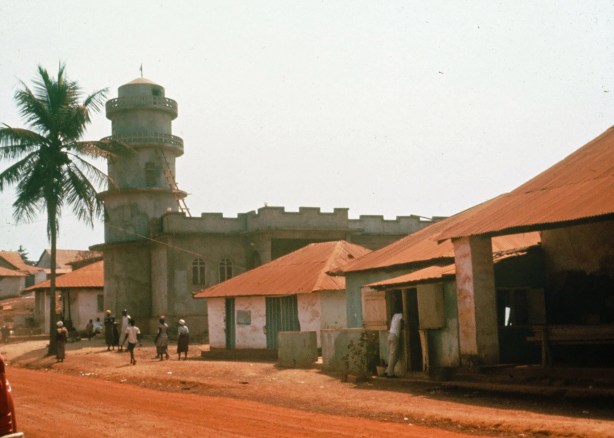
Tubman’s open door policy changed that and by the time we had arrived their numbers had reached the point where they decided to build a mosque in town. I’d wander over on occasion to check their progress. The mosque was an impressive building by Gbarnga standards, easily five times larger than any other structure on the main road.

The new mosque was much larger than other buildings on Gbarnga's main street. (1966)

The new mosque was much larger than other buildings on Gbarnga’s main street. (1966)

At last the day came for its grand opening. Having watched the mosque being built, I decided it would be interesting to attend the festivities. I put on my tie, grabbed our two cameras and headed out the door. Do Your Part was waiting and ready to go along.

This was not a Do Your Part type of celebration, however. Muslims aren’t particularly fond of dogs and consider them unclean. I figured this meant they didn’t want any dogs, even polite dogs, attending their holy ceremony. I suggested to Do Your Part she stay home. Fat chance. I walked 100 yards and glanced back over my shoulder. There was DYP, slinking along behind. I knew there was no way I would make it to the ceremony without a little brown dog lurking in the background.

Do Your Part would have to be left in our house. The action was drastic; the only time we let her in was to eat dead insects in the evening. She would come in just before we went to bed and wander around crunching down sausage bugs. It eliminated sweeping. She had never been locked inside.

Since Jo was reading to her blind friend and Sam was off for the day, I couldn’t even leave her with company. I reluctantly shoved her inside and marched off to the sounds of doggy protest.

It seemed to work. I reached the mosque just as the outside ceremonies were concluding and people were preparing to move inside. Dignitaries were everywhere. It was my intention to hang out on the periphery and remain inconspicuous. This is hard when you are the only white person in the crowd and you have two cameras hanging around your neck.

It took about thirty seconds for a tall, official looking man in a white robe to approach me and express in broken English how pleased he was that the international press from Monrovia had decided to cover the event. While I struggled to inform him that I was only a local Peace Corps Volunteer, he ushered me into the mosque to a seat of honor. I looked around nervously. The podium was about 10 feet away and I was in the front row.

A hush descended on the crowd as an obviously important dignitary approached the podium. Liberia’s top Muslim Cleric had come to town to officiate at the opening ceremony. He gave me his best media smile and I dutifully took his picture.

Unexpectedly, there was a disturbance at the back of the mosque. Several men were trying to capture a little brown dog that was deftly eluding them and was making a beeline for me. Do Your Part had managed to escape from the house. Now she was escaping from half of Islam. In seconds that seemed like hours she was in front of me, wagging her tail and prancing around like she hadn’t seen me in six months. Hot on her tail were three huge Mandingo men.

“Is this your dog?” their leader managed to stammer out in barely repressed fury as he gave DYP a tentative boot in the butt. Fortunately she figured out that the situation was hazardous and decided there were other parts of town she wanted to see. I was amazed at her ability to avoid lunging people. I dearly wished I could have escaped with her. It wasn’t to be. It was my job to stay behind and be glared at. I was so embarrassed I don’t remember a single part of the ceremony.

Later when I arrived home, Do Your Part was outside the house, all wiggles and waggles, obviously no worse for her adventure. Jo Ann greeted me.

“It was the strangest thing when I got home,” she said. “Do Your Part was inside and frantic to get out. When I let her loose she took off like our house was on fire. I wonder if Sam let her in by mistake.” The best laid plans of mice and men…

Chapter 19: How Brunhilda Became Rasputin the Cat… Peace Corps Tales

Welcome to “The Dead Chicken Dance and Other Peace Corps Tales.” I am presently on a two month tour of the Mediterranean and other areas so I thought I would fill my blog space with one of the greatest adventures I have ever undertaken: a two-year tour as a Peace Corps Volunteer in Liberia, West Africa. Every two days I will post a new story.

When I have finished, I will publish the stories in digital and print book formats.

With my career as a high school teacher looming, I found it hard to concentrate on the second grade. I did manage to wrap up my final few weeks without whipping anyone else.

A new house came with the new teaching position. It was located on the United States Agency for International Development (USAID) compound two hundred yards away from the high school and about the same distance from where the Peace Corps’ staff lived. Mr. Bonal was our neighbor.

Our new home was quite luxurious; it had electricity, running water and a real toilet. The days of cockroaches playing tag on our butts were past. I flushed the toilet over and over again just to watch the water go down.

The one thing the house needed desperately was a paint job; the previous occupants had felt that purple, green and yellow were quite attractive. Fortunately, we had time to paint. January was the Liberian School system’s summer vacation. This didn’t mean we were free to play like real teachers; Peace Corps expected first year Volunteers to take on a summer project.

Second year Volunteers, on the other hand, were allowed to treat their vacation as a vacation. Most of them flew off to East Africa and the big game parks. One couple, Dick and Sandy Robb, left their four little female kittens to live with us. We became substitute parents. Our pay was to have the pick of the litter. Whoopee.

I built our temporarily adopted cat family a three-story mansion out of cardboard. It was a maze of rooms, hanging toys, hallways and ramps. The kittens would disappear inside and play for long periods. We could hear them banging around as they stalked each other and attacked the hanging toys.

In a creative moment inspired by the evening cocktail hour, we decided to use the house as an intelligence test to determine which kitten we would keep. First we waited until the kittens were appropriately hungry and then brewed up their favorite meal, fish head stew. Here’s the recipe. Take several ripe fish heads and throw them in a pan of boiling water. When their eyes pop out, they’re done.

Next, we encouraged the kittens to sniff their gourmet dinner and showed them that the meal would be located just outside the ground floor door of their mansion. Now we were ready for the test. Each kitten would be placed inside the third story door and given a nudge. We would then close the door and time how long it took the kitten to reach the banquet.

Our theory was that the kitten with the quickest time through the maze of hallways and ramps would be the brightest.

Grey Kitten # 1 was a pudgy little character that never missed a meal. My money was riding on her. She breezed through the maze in three minutes sharp and set the time to beat. There was a chance that the sound of her munching away on fish heads might inspire the other kittens on to even greater glory, however.

Grey Kitten #2 was one of those ‘whatever it is you want me to do I am going to do the opposite’ type cats. Not surprisingly, she strolled out of the door seven minutes later and ignored the food altogether. (Afterwards, we were to speculate that she was the most intelligent cat and blew the race because she had no intention of living with someone who made her go through a maze for dinner.)

Grey Kitten #3 was the lean and mean version. Scrawny might be a better description. She obviously needed dinner the most and proved her mettle by blazing through the house in two minutes. The contest was all but over.

Kitten # 4 was what pollsters normally classify as ‘other.’ To start with, she was yellow instead of grey. She was also loud. In honor of her operatic qualities, Jo had nicknamed her Brunhilda. By the time her turn came up, she was impatiently scratching the hand that was about to feed her and growling in a demonic way. I gladly shoved the little monster in the third story door and closed it. We heard a scrabbling on the other side as tiny claws dug into the cardboard floor. Her race down the first hall was punctuated by a crash on the other end. Brake problems.

Then she was up and running again, but it sounded like toward us. Had her crash disoriented her? Suddenly the third story door burst open and one highly focused yellow kitty went flying through the air. She made a perfect four point landing and dashed to the dinner dish. Her time? Ten seconds.

And that is how Brunhilda came to be our cat. Our decision to keep her led us to turn her over and check out her brunhildahood a little more closely. Turns out she had a couple of furry little protuberances where there shouldn’t have been any. Like Dr. Gibbs’ cat, she was a he. In honor of Brunhilda’s demonic growl and generally obnoxious behavior, we renamed the kitten Rasputin after the nefarious Russian monk.

Chapter 17: Abijoudi Supermarket: Almost Heaven… Peace Corps Tales

Welcome to “The Dead Chicken Dance and Other Peace Corps Tales.” I am presently on a two month tour of the Mediterranean and other areas so I thought I would fill my blog space with one of the greatest adventures I have ever undertaken: a two-year tour as a Peace Corps Volunteer in Liberia, West Africa. Every two days I will post a new story.

When I have finished, I will publish the stories in digital and print book formats.

Our decision to visit Monrovia led us past the huge Firestone Rubber Tree Plantation. I am standing next to a rubber tree that has been slashed to release the white sappy substance that will be turned into tires.

Dinner popped into my mind on the taxi trip home from Ganta. After two months of eating Argentina’s finest canned beef, I found myself lusting after the neighbor’s chickens. My last instructions to Sam before leaving to visit Morris had been to buy us one for the stew pot. I had visions of arriving back home with the hen waiting for us in the refrigerator.

It was a pleasant, if short-lived, dream.

The chicken was roosting on our stove and appeared to like her new home. Generous piles of chicken poop decorated the kitchen. Sam and I had discussed my preferences before we left. Apparently the instructions had not been clear. I corrected the error.

“Here’s another dollar. Take this chicken out and have her killed, gutted and plucked.”

My chicken whacking days were over. Sam returned a couple of hours later with dinner and Jo Ann did her culinary thing. The final product met all of my mouth-watering expectations. When the bones had been picked clean I worked my way through the pile again. Chicken had never tasted better… before or since. But there was a close match.

The lyrics to a popular West African tune proclaimed, “Chicken and rice with palm butter is nice.” I agreed; it was my favorite chop. Palm butter has a unique sweet flavor and rich texture. Unfortunately, pounding palm nuts was clearly defined as women’s work, which Sam avoided at all costs. A stone wall divided male and female roles within the Kpelle culture. I threatened to trade Sam in on a house girl and he miraculously found a way to obtain the illusive product.

It was possible to eat well in Gbarnga, even on our $160 per month salaries. But there were times we longed for a convenient grocery store packed with rib eye steaks, fresh milk and ice cream. Or, even better, a restaurant where we could order such food.

The visit with Morris provided a break in our routine but Morris lived the same way we did. His chop was quite tasty, but it was still chop. Jo and I decided it was time for our first trip back to Monrovia. Once again we packed our bags and headed over to Gbarnga’s taxi stand.

This time the price was $15 for the two of us. The taxi was packed and I rode shotgun. My job was to put my thumb on the windshield whenever we met another vehicle. The theory was that this would keep the windshield from imploding if struck by a rock. Shatterproof glass hadn’t made it to Liberia.

Rainforest, villages and small towns whizzed by slowly. I felt like we were caught in a time warp. An occasional burned out hulk of a money bus or taxi decorated the roadside and reminded us of our mortality. We passed Phebe Hospital built and operated by Lutheran missionaries and then Cuttington College built and operated by Episcopal missionaries.

In the town of Suakoko, we dropped one passenger and picked up another. He was chewing on a dark, smoky leg of either dog or monkey meat. My stomach growled in appreciation. I was adjusting to Africa.

Tribal Liberians waited with Zen-like patience beside the road for their unscheduled money bus rides. Usually a faint trail led off into the bush to their villages. I wondered what they thought about while waiting. Did they ponder their reception in Monrovia as they descended on relatives who lived in tin shacks already overflowing with people?

At some point, the jungle gave way to rubber trees with bark slashed to drain the white sticky substance. We had entered the world’s largest rubber tree plantation. Owned by Firestone, it was known for the low wages it paid Liberian workers and the generous payoffs it made to government officials.

With Kakata came relief, a paved road. Several Americo-Liberians had large farms in the area. Their names were a who’s who of Liberia’s elite.

Morris had reveled in telling us a story about a scandalous murder that had happened in the town. The guy’s body had been dismembered. His head ended up in a toilet. The local Peace Corps Volunteer told anyone who would listen, “If you want to get a-head in life, come to Kakata.”

Eventually we made it to Monrovia and our taxi let us off at the Peace Corps hostel. I’d be bunking with the guys and Jo Ann would be bunking with the girls. I didn’t think much of sleeping with a group of snoring men but the price was right. Plus Abijoudi’s was waiting.

Abijoudi’s was a genuine supermarket; it was close to heaven. I am not sure what was more impressive: the air conditioning or the aisles crammed with goods.  We wandered awestruck up and down the rows staring at the canned and frozen foods from around the world. And then we splurged. Jo Ann bought a frozen duck from Holland. Morris was coming to Gbarnga for a return visit. It would be the first meal she ever cooked for a guest.

Abijoudi’s was only one of Monrovia’s many temptations. Going to a movie was next on our list. The first James Bond thriller, “Dr. No,” had finally made it to Liberia. Our friends were raving about the film. An effort had been made in the fifties to turn Fleming’s novels into a TV series. The producers recruited an American actor for the Bond role and named him Jimmie. Can you imagine the line, “My name’s Bond, Jimmy Bond?” The series flopped.

We also discovered Oscar’s, an excellent French restaurant that perched on the edge of the Atlantic in a beautiful setting. Oscar stood by our table and personally cooked flaming steak Diane with cognac. Later, a volunteer would catch amoebic dysentery at the restaurant and Oscar’s was put on Peace Corps’ ban list. Jo and I never ate the salad, never got dysentery and never obeyed the ban.  Oscar’s became a must do on our Monrovia trips.

Oscar’s was perched on the edge of the Atlantic. Beaches in Monrovia can be quite beautiful.

After dinner we found a cozy bar tended by a big-busted German woman and Jo ordered a grasshopper: a frothy drink made with Crème de Menthe, Crème de Cacao and cream.

“A grasshopper,” the woman shouted across the crowded room. “What’s a hopper?” Everyone turned and stared at us as Jo Ann and I struggled to remember the ingredients. After that, Jo ordered more simple drinks.

Satiated and exhausted, we returned to the PC hostel. The next morning we caught a taxi back to Gbarnga and the quiet life.

Chapter 16: Dirt Roads Don’t Have White Lines… Peace Corps Tales

Welcome to “The Dead Chicken Dance and Other Peace Corps Tales.” I am presently on a two month tour of the Mediterranean and other areas so I thought I would fill my blog space with one of the greatest adventures I have ever undertaken: a two-year tour as a Peace Corps Volunteer in Liberia, West Africa. Every two days I will post a new story.

When I have finished, I will publish the stories in digital and print book formats.

A ‘mini-mart’ was waiting for us when we arrived in Ganta. Included were these containers of monkey meat. Note the skulls in the blue basin and the tails behind the basins.

When we boarded the Pan Am jet at JFK, we abandoned the life we had known.  Three-inch cockroaches, a rickety outhouse, and a hole-in-the-ground well came with the territory, as did boiling our water, reading by lantern, and eating chop.

And so what? We had kids to teach, collard greens to eat, and a zinc roof to keep out the rain. Serving as a married couple, we also had each other… our own little society. Plus we had Sam. He was bright, funny, and provided an introduction to the Kpelle culture. He also did many of the chores.

Life was almost too easy, too routine. We were good at self-entertainment; it is a primary survival skill for Peace Corps Volunteers, but we had jumped from racing down a multi-lane freeway to walking on a dirt path. The tumultuous year at Berkeley, marriage, Peace Corps training and Africa had happened bang, bang, bang. Now life was more like drip, drip, drip.

After two months we were climbing the walls like bug-a-bug. We needed a break. Relief came in the form of an invitation from our friend Morris Carpenter. He had escaped from Yopea and landed a job teaching sixth-graders in Ganta, 30 miles upcountry from us. Wellington Sirleaf, the Peace Corps driver, dropped off the note. Since there was neither phone nor mail service, Wellington was our once a week contact with the outside world.

I found it ironic that Morris and I lived closer together in Liberia than we had in California. Getting from Gbarnga to Ganta, however, was more challenging than getting from Diamond Springs to Auburn. We had two options: money bus or taxi.

The money bus was the more colorful choice. Think of taking a giant cargo van, cutting out windows, attaching a roof rack, and cramming it full of people, pigs, chickens, goats, bags of rice, fresh produce, luggage boxes and anything else a Liberian might need to survive on or sell.

These workhorses of the Liberian transportation system disdained schedules and stopped frequently. Minimal shocks, uncovered wood benches and bumpy dirt roads guaranteed butts were begging for mercy inside of 30 minutes. Packed conditions denied wiggle room to relieve an aching tailbone but might provide a kid or rooster for your lap. And there was always a chance of a breakdown accompanied by the fervent hope your driver would fix the problem in less than three hours.

We decided our daily life provided enough cross-cultural adventure and opted for the taxi. We packed a bag, left Sam in charge of buying a chicken, and walked into town to where the taxis gathered.

A dirty, grey, battered Peugeot was leaving for Ganta “small,” in a short time. “Ten dolla,” the driver informed us. “Five dolla,” we countered. Seven was the agreed price for the two of us. Then it was time to “wait small.” The driver wanted more passengers. After about an hour he gave up.

Any thoughts of a civilized trip in to Ganta were dispelled in the first five minutes. The driver drove like he saw a green mamba in his rearview mirror and the snake was gaining. While the law required us to be on the right side, dirt roads don’t have white lines. I doubt it mattered. When a car-eating pothole was located on our side of the road, we were on the other, even on a blind curve. It wasn’t a game of chicken; it was Russian roulette. Occasionally the driver would honk his horn.

Fortunately, the ride was relatively short. Our introduction to Ganta was a barrier backed up by an armed soldier.

“You pay,” the driver informed us. He had neglected to tell us there was a fee for entering the town. Turns out it was a bribe, or a dash as they call it in Africa. “Five dolla,” the soldier demanded as he looked at us menacingly. It made me angry but I took out two dollars and handed them to the driver. “Five dolla,” the soldier repeated. I shook my head no. The soldier glared at me again and then took the proffered money. Ever so slowly he opened the gate.

Dashes were a way of life in Liberia as they are in much of the world. It was a game we had to play, but we didn’t have to like it. “Asshole,” I mumbled as we drove off.

Ganta’s taxi stand included a mini-mart. Tribal women were sitting on the ground and selling a variety of items. One woman wearing a black and white wrap around lappa featured five metal basins filled with what appeared to be smoked animal parts. I looked more closely. A small, shrunken-head sized skull glared up at me with vacant eyes. A dozen or so other skulls looked elsewhere. Another basin contained legs; another split rib cages, and another long, curved tails. It was monkey meat. I looked more closely at the skulls.

“You buy?” the woman asked. “No thank you,” I replied a bit to hastily. Monkey brains were not on my list of preferred foods. She laughed.

A small boy appeared in front of me and shoved a boiled egg in my face. “Ten Cents.”

“I will give you ten cents to take us to Teacha Carpenter’s house,” I countered.

“Twenty.” “Fifteen.” “Okay.” We had struck a bargain.

Teacha Carpenter was waiting for us with a cold beer and laughed at our stories. He was a veteran PCV at the end of his term. We were green Volunteers at the beginning. Our traumas were everyday life to him. He had his own tales. An army of mice lived in his attic.

“I hear them doing parade drills every night. Back and forth, back and forth with the sergeant barking orders.” He hired Metternich the Cat to solve the problem. Each morning Metternich deposited two or three dead rodents for inspection. He was making a significant reduction in the mouse population. Besides all the mice he could eat, Metternich took his pay in chop.

Morris had planned a tour of the local leper colony for us. In particular, he wanted us to meet Freddie, a wood-carver he had befriended. Leprosy, Morris explained as we walked over to the colony, is hard to catch.

We were glad to hear there was little danger but still wary. Most of what we knew about the disease related to the old horror stories, the ones that led communities to ban lepers to remote locations. Losing body parts is scary. While leprosy might not be highly contagious, it was still contagious.

A neat row of cabins surrounded by banana, avocado and palm trees announced our arrival. It seemed that the lepers were well cared for and well fed.

The leper village in Ganta, Liberia as it looked in 1965.

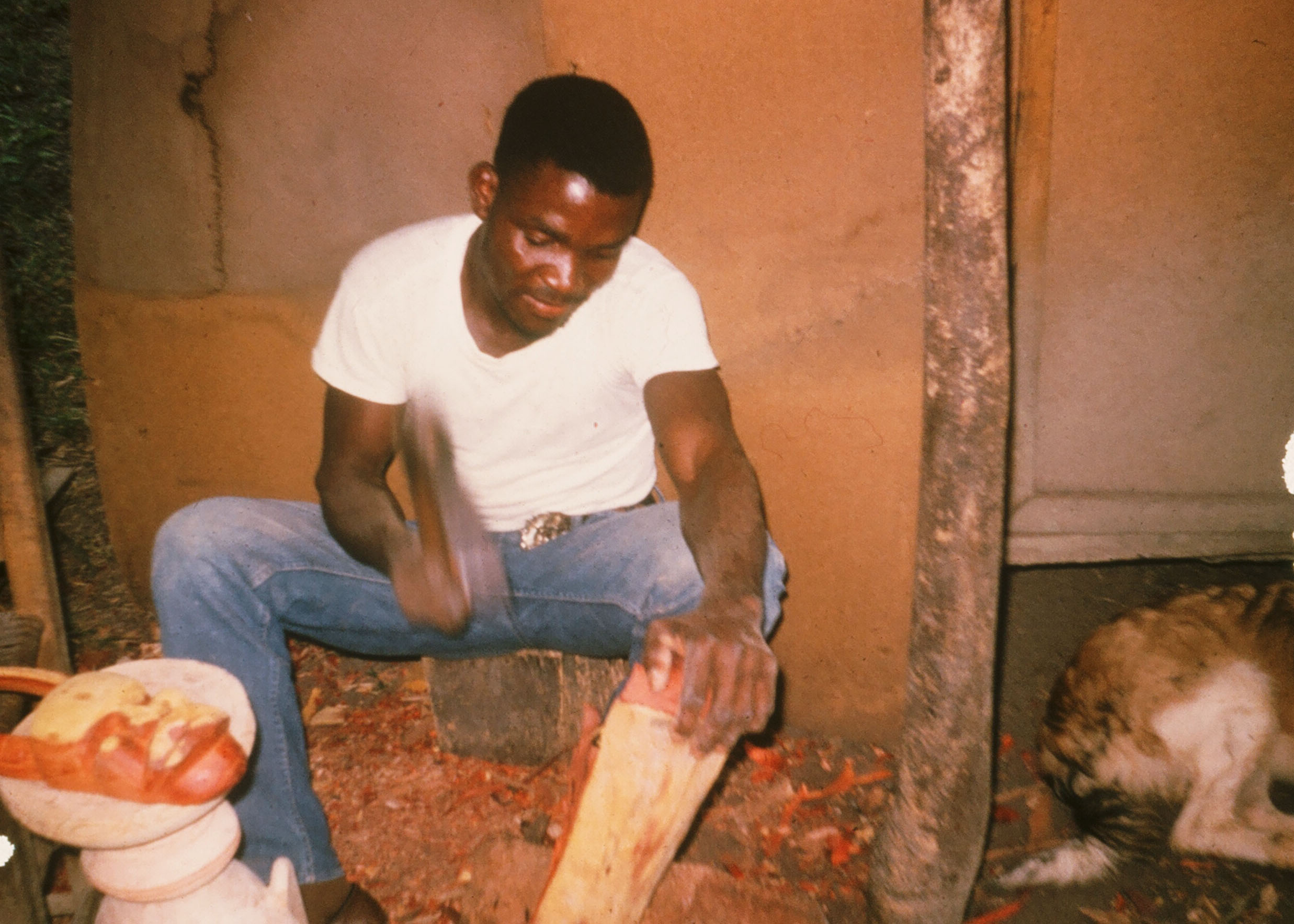
Freddie reinforced my opinion. He had a lean-to studio and was dressed in a clean white T-shirt, jeans, and polished brown shoes. Chips were flying as he chopped away on a block with a curved head adze. The smell of freshly cut wood permeated the air. A scroungy brown and white dog was lying off to the side. It opened an eye, gave a partial wag, and went back to sleep.

I couldn’t stop myself from checking to see if Freddie had lost any limbs. Except for grey blotches on his hands, he appeared intact. A devil mask was displayed beside him. Other carvings were stacked against the wall.

Freddie the Carver at work in his studio. A medicine mask with horns is on the left.

Freddie grinned as we admired his carvings. It was obvious that he took pride in his work, that he had found a way to soften the fright his disease must cause.

I was developing a taste for African art. Its primitive subject matter jumped past my rational mind and captured my subconscious. I found one piece particularly appealing. Two large feet were connected to stumpy legs that disappeared into a shapeless robe that flared downward from the neck. There were no arms. A gigantic head with a mouthful of 28 teeth and a large nose topped off the neck. It was like a circus clown, both scary and humorous.

“It’s a Bush Devil,” Morris explained. The Bush Devil, so named by disapproving missionaries, was a powerful force within the tribal society. I happily broke out five dollars and bought the piece.

Back at Morris’s we ate four-pepper chop, drank more beer, told more tales and went to sleep with mice marching back and forth in the attic.

Chapter 15: A Short Lesson on Cats and Guacamole… Peace Corps Tales

Welcome to “The Dead Chicken Dance and Other Peace Corps Tales.” I am presently on a two month tour of the Mediterranean and other areas so I thought I would fill my blog space with one of the greatest adventures I have ever undertaken: a two-year tour as a Peace Corps Volunteer in Liberia, West Africa. Every two days I will post a new story.

When I have finished, I will publish the stories in digital and print book formats.

James Gibbs is one of the world’s leading experts on the Kpelle people. In this photo, a Kpelle woman and her daughter take turns mashing palm nuts into palm butter… one of my all-time favorite foods.

Now is the time for a good guacamole story.

The anthropologist James Gibbs was living in Gbarnga while he was studying the Kpelle people. Sam worked for him as an informant about Kpelle customs. It was where he had learned the ‘taboo’ word he applied to the snails he didn’t want to eat.

One evening James and his wife Jewelle invited Jo Ann and me over for dinner. It was our first invitation out as Peace Corps Volunteers.  I should also note we were still at the point of being recent college graduates and somewhat awed by academicians. We dressed up in our best clothes and headed off down the road past Massaquoi School to where they lived.

The Gibbs had an impressive house for upcountry Liberia. They were sophisticated, nice folks who quickly put us at ease. Among the hors d’oeuvres they were serving was a concoction of mashed avocado, tomatoes and peppers that Jo and I found quite tasteful. We made the mistake of asking what it was.

“Why it’s guacamole of course,” Dr. Gibbs declared in an “I can’t believe you asked that question” tone of voice. We must have looked blank because he went on, “Surely anyone from California knows what guacamole is.”

Surely we didn’t. I felt like Barbara Streisand in Funny Girl when she learned that pate was mashed chicken liver. It was 1965 and Mexican food had yet to storm Northern California. Yes, we’d been to the UC Berkeley but dining out there on a survival budget meant beer and pizza at La Val’s or a greasy hamburger at Kip’s. To change the subject I called attention to their cat.

“Nice cat,” I noted.

Mrs. Gibbs gushed. “She’s in love.”

Dr. Gibbs jumped in, obviously glad to leave the subject of guacamole. “The boys are coming by every night to visit. We hear them yowl their affection up on the roof.”

The cat looked quite proud of her accomplishments. Having been properly introduced, she strolled over and rubbed up against my legs. I reached down and scratched her head, which served as an invitation to climb into my lap. While arranging herself she provided me with a tails-eye view. Staring back at me was the anatomy of the most impressive tomcat I’ve ever seen. She had the balls of a goat!

I could hardly contain myself. “Um, she isn’t a she,” I managed to get out while struggling to maintain a straight face.

“What do you mean?” Dr. Gibbs asked in his best professorial voice. Rather than respond verbally, I turned the cat around and aimed his tail at Dr. Gibbs. Understanding flitted across his face.

“We never thought to look,” he mumbled lamely. We were even. While the kids from the hills might not know their guacamole from mashed avocados, they did know basic anatomy.

Chapter 12: Good Morning Teacha… Peace Corps Tales

Welcome to “The Dead Chicken Dance and Other Peace Corps Tales.” I am presently on a two month tour of the Mediterranean and other areas so I thought I would fill my blog space with one of the greatest adventures I have ever undertaken: a two-year tour as a Peace Corps Volunteer in Liberia, West Africa. Every two days I will post a new story in book format.

When I have finished, I will publish the book digitally and in print.

Palm trees peek over the roof of NV Massaquoi Elementary School in Gbarnga, Liberia while storm clouds gather. Jo and students stand out front in this 1965 photo.

I put on my coat and tie and shined my shoes. Jo donned her best dress. Kids were streaming by our house and staring through the screens, hoping for a glance at the new teachers.

Jo and I smiled at each other, took a deep breath, and walked out the door.

The air was warm and thick with humidity. Towering cumulus clouds filled the sky. Distant thunder rumbled. Rain was coming. We turned left on the red dirt road and joined the parade of students who glanced shyly at us. NV Massaquoi Elementary School waited.

It wasn’t far, maybe a half of mile, just far enough to get sweaty. Lush growth lined the road… green, dense, impenetrable, alive with buzzing, biting insects. The school sat off to the right in a clearing that been hacked out of the jungle.

Four classrooms faced the road while two more faced inward forming an elongated U. Cement blocks painted blue sat on top of cement blocks painted brown. Palm trees peeked over the zinc roof. Shuttered windows and closed doors completed the simple structure. A flagpole with Liberia’s red, white and blue flag was planted exactly in the center of the yard.

Students and teachers milled about as we approached. All eyes were on us, two white people in a sea of black. A man broke free from the crowd and approached. It was the Principal. We smiled and shook hands and he pointed out our classrooms. The orientation was over. And so was the gathering.

Students and teachers moved toward their rooms. Jo Ann wished me good luck and stalked off to her first grade with a look of determination. I walked toward my second grade with a look of bemusement.

“Good Morning Teacha” thirty bright and shiny faces shouted in unison as I entered.

It was scary, scarier than the big burly policeman who had guarded the door to the Administration building at Berkeley. I was expected to entertain and actually teach these kids something over the next couple of years.

“How?” bounced around in my skull and jumped down to my stomach.

I had a total of two months training at San Francisco State on educational theory. I didn’t have a clue about managing a classroom of second graders or teaching reading and writing and arithmetic. The last time I had been in a second grade, I was seven years old. My brief stint at student teaching a third grade in was helpful. But ‘brief’ is the critical word here.

And how did a classroom full of middle class kids in South San Francisco relate to a classroom of tribal Africans in Gbarnga, Liberia?

My students came from another world: one where spirits lived in trees, ghosts were dangerous, lightning strikes could be controlled, birds were meat-flying, homes were made of mud, live termites were considered a delicacy, and tribal justice was determined with a red-hot machete.

“Good morning students” I replied and smiled. Look confidant, I urged myself. Take control. It became my mantra.

I walked up to the blackboard and wrote Mr. Mekemson. The silence of the room was broken by the squeakiness of the chalk. I introduced myself, pronounced my name and had them pronounce it… several times. They laughed.

“I am from California,” I explained and noticed a slight recognition. Hollywood was there. “It’s a long way off.” I sketched a map of North America, Africa and the Atlantic Ocean with X’s for California and Liberia. Then I drew a great circle route with Diamond Springs on one end and Gbarnga on the other. I added a large jet plane with me looking out the window.

It was my first geography lesson. Of course it was incomprehensible. The kids had never seen a map. The only distance they understood was one they could walk. Jet airplanes were rare tiny specks in the sky.

But they liked the picture of me looking out the airplane’s window.

“OK, it’s your turn. I want you to tell me your name, your age and what tribe you belong to.” I could sense Americo-Liberians in Monrovia frowning. We were supposed to be moving away from tribalism and toward national unity. My students weren’t there yet.  They were Kpelle or Mano or Bassa or one of several other ethnic groups first and Liberian second, a distant second.

The majority of my students were Kpelle. It was the largest tribe in Liberia and Gbarnga was in the heart of Kpelle country. But there were also several other ethnic groups. English was the common language that was supposed to bind them together. Tribal dialects were not allowed in the classroom.

I quickly learned English meant Pidgin English spoken with a deep Liberian accent. At first, it seemed like a foreign language.

For example, you might say to me, “I have to go down town for about twenty minutes. I promise I won’t be gone long. Please wait for me.” My students would say, “Wait small, I go come.” “Small,” I, might add, in Liberian time could mean a few hours.

One idiom I learned quickly was, “Teacha, I have to serve nature.”  That meant, “May I have your permission to use the restroom?” Actually it was permission to use the outhouse or just as likely the ‘bush’ or even the side of the building. One day I looked up and saw one of my male students standing outside and listening to me through the window. I saw a slight shake of his shoulder and realized he was peeing on the wall. I admired his dedication but discouraged the practice.

Another challenge I faced was age difference. My youngest student was a decent second grade age of seven. The oldest was 22, my age, and a heck of a lot tougher. Several were middle school age and had middle school attitudes.

Books created a different problem; for the most part, there weren’t any. What we did have for reading were vintage 1950 California readers complete with Dick, Jane and Spot. I suspect I should have been grateful for anything but it was difficult for tribal kids to identify with big white houses, white picket fences and little white kids.

As for Spot, he bore a striking resemblance to food. Later, when I had a cat, my students would tease me by pinching him and saying, “Oh, Mr. Mekemson, what fine meat.”

The room reflected the simplicity of the building. Shutters covered windows without glass and without screens. Open shutters provided air conditioning. Bugs were free to come and go. Closed shutters kept heat in and tropical deluges out. The only audio-visual aid available was my writing on the blackboard.

Eventually we got through introductions, seat assignments and the other chores inherent in the first day of class. It was time to teach. I broke out Spot.

Somehow I managed to struggle through that first day. There was a curriculum to follow. More importantly, Jo Ann I had taken over from the two Volunteers who had lived in our house. Unlike us, they were experienced teachers. The kids had benefitted from their expertise.

Back at home after school, Jo had a story to tell.

“I was reading the Owl and the Pussy Cat out loud when one of my first graders broke in and said, ‘Oh, Mrs. Mekemson, you shouldn’t say that!’ The whole class broke out in laughter.”

“I asked them what they were talking about. They clammed up. All I could get was nervous giggles.”

“After school I related the story to one of the Liberian teachers and asked if she had any idea what the kids were talking about. She clammed up as well but I pushed her.”

“You were reading about a pussy, Mrs. Mekemson.” The woman managed to stutter. “You know a woman’s down under.”

How in the world her first graders who could barely speak English had picked up this particular meaning of pussy, we didn’t have a clue.

Chapter 10: Crazy Flumo Shakes My Hand and Ankles… Peace Corps Tales

Welcome to “The Dead Chicken Dance and Other Peace Corps Tales.” I am presently on a two month tour of the Mediterranean and other areas so I thought I would fill my blog space with one of the greatest adventures I have ever undertaken: a two-year tour as a Peace Corps Volunteer in Liberia, West Africa. Every two days I will post a new story in book format.

When I have finished, I will publish the stories digitally and in print.

A typical Liberian shop on Gbarnga, Liberia’s main street circa 1965-66. Note the crocodile’s skin with its tail dragging in the dirt..

In my last post, we went to bed without food, water or light in our new home in Gbarnga, Liberia. Drums and screams filled the darkness with sound.

A new day did manage to happen, as they always do. Jo Ann and I promised to make it a good one. Her job was to mount a ferocious counter offensive on the bug-a-bugs and cockroaches. Sam was coming early with a broom.

My job was to walk the quarter-mile to town, buy five gallons of kerosene, find the most toxic bug spray known to humankind, and scavenge anything available that resembled food.

I added alcohol to the list.

But first I needed to replace the malarial pond residing in our front room. I grabbed the offending bucket and tossed the stagnant water onto a plant. “Waste not; want not,” my mother would have urged even though it was in the middle of Liberia’s rainy season and the plant had already received half of its annual 170 inches of rain.

Now I was ready to tackle the well.  My family had one when I was growing up. It came with a cover, a high-pitched whirring pump, and a holding tank. Except for power outages, we could depend on it to magically deliver water day in and day out.

Our well in Gbarnga was an unprotected hole in the ground waiting for someone to fall in. Next to it I found a frayed rope. I tied it to the bucket’s handle using a Boy Scout bowline. Then, making sure I had a firm hold on the end of the rope, I tossed the bucket into the dark hole. Kersplash! I gave it a shake so it would tip over and fill.

A five-gallon bucket of water weighs 43 pounds. By the time I yanked it over the edge, I had a new appreciation for modern technology… and for the Volunteer who had left the original bucket in our house.

I delivered my burden to Jo and started for town. Half of Gbarnga was standing along the road staring at me. I smiled and waved a lot, like a princess on parade. They smiled and waved back.

Soon I came to the town’s main street. Open-air shops lined the dirt road on both sides. At first, they looked the same: white washed walls, red tin roofs, dark interiors, and faces staring out from inside. Then I begin noticing differences.

Several were fronted with crumbling cement steps that had long since given up any hope of connecting to the eroded street. One featured a crocodile skin nailed to the front post, its tail dragging in the dirt. Another had brightly colored shirts and shorts strung up like Christmas ornaments. Two or three were obviously makeshift bars, no more than holes in the wall with planks doing the honors. An ancient Liberian ‘Ma’ came staggering out of one with a half-pint bottle of gin clutched in her hand. She noticed me, hoisted her bottle in a toast, and took a swig.

A few shops were larger and resembled country stores filled with the minutia of daily life. Pale-faced Lebanese leased the shops. Lebanese made up the majority of Liberia’s middle class but were not allowed to own property. I was headed for a shop that Sam had recommended.

A group of men stood idly in front of the store. Had folks known I was coming, I would have sworn it was a reception committee. It’s show time went reverberating around my skull. I put on my best Peace Corps smile. One of the men stepped forward to greet me. He was barefoot and wore a tattered shirt, tattered shorts and a big grin. His hand shot out.

This is it, I thought, my first official Liberian handshake. We had started practicing in San Francisco. The shake begins as a normal handshake but ends with you snapping each other’s fingers. An audible snap signifies success. It isn’t easy at first. If the person is really happy to see you, he may go through the process two or three times.

(About the time the snap becomes second nature, it’s time to go home. Then you have to unlearn the process. Your American friends look at you strangely when you snap their fingers. At least my conservative Republican father-in-law did. But back to Africa.)

We shook; our hands parted. Snap! It worked. All of the men beamed and I beamed back. Their official greeter grabbed my hand again. Snap! Another success and more beaming. And again. Then a fourth time.  Nobody had mentioned four times to me and this time the guy wouldn’t let go. The men were laughing out loud now.

My hundred-watt smile became a twenty-watt grimace as I politely tried to retrieve my hand. No luck. I steeled myself, gave up any pretense of being polite and yanked. My hand pulled free and I breathed a huge sigh of relief. It lasted as long as it took the guy to drop to the ground and wrap his arms around my ankles. By now the other men were all but rolling the street.

I had become prime time entertainment, the George Custer of Gbarnga.

I might still be there if the cavalry hadn’t arrived.

It came in the form of a handsome Liberian man in a well-tailored suit. He appeared on the scene and gave Flumo a healthy kick in the butt. Flumo let go.

“Hi, I am Daniel Goe, Vice Principal at Gboveh High School. Welcome to Gbarnga.” he introduced himself.

We shook hands in the old-fashioned way as Daniel explained that the man who had his arms wrapped around me was known throughout the Country as Crazy Flumo. I wasn’t the only person to receive his attention. Once, Daniel told me, Flumo had thrown himself down in front of Vice President Tolbert’s car and wouldn’t move until the VP climbed out and gave him five dollars.

I later learned that a tall Texan Peace Corps Volunteer had walked several yards down the main street of Gbarnga with Flumo tenaciously attached to one leg. I’d gotten off easy. Having met one of Gbarnga’s true characters, I was about to meet another.

Next post: Captain Die, our well digger, stops by and introduces himself… “My name is Captain Die because I am going to die someday.”

Chapter 9: The Levitating Squat Routine… Peace Corps Tales

Welcome to “The Dead Chicken Dance and Other Peace Corps Tales.” I am presently on a two month tour of the Mediterranean and other areas so I thought I would fill my blog space with one of the greatest adventures I have ever undertaken: a two-year tour as a Peace Corps Volunteer in Liberia, West Africa. Every two days I will post a new story in book format.

When I have finished, I will publish the book digitally and in print.

Termites, or bug-a-bugs as the Liberians called them, created large mounds such as this one throughout the rainforest.

In my last post, Jo Ann and I travelled upcountry to Gbarnga, Liberia and our Peace Corps assignment. Arriving after dark at our new home, we opened the door to find the house swarming with life.

“Lots of bug-a-bug and cockroaches,” Sam observed as we peered in at the chaos.

Sure enough, our flashlight revealed that the writhing floor was a multitude of three-inch African cockroaches scurrying every which way. The tunnels climbing the walls had been sculpted by termites, or bug-a-bug as the Liberians colorfully named them. The tomb-like odor was how a house normally smelled in the tropics when left vacant for a few weeks.

Bob’s proudly drawn bucket of water sat carefully placed in the middle of the living room. Warm thoughts of veteran Peace Corps Volunteers taking care of the new kids temporarily blocked our darker visions.

I directed the flashlight into the bucket. A thick layer of scum reflected the light as a complete ecosystem came to life. Somewhere in the house a malaria-bearing mommy mosquito was extremely proud of her progeny. Hundreds of little wigglers broke the surface, virtually guaranteeing the continuation of the family line for a thousand years.

“Can you imagine what this would have been like if the Volunteers hadn’t cleaned?” I chuckled nervously, making a weak attempt at humor. Jo Ann recognized it for what it was worth and ignored me. I had the uncharitable thought that cleaning our house out had meant removing the furniture.

“Let’s tour our new home.” Again silence, but at least Jo Ann followed me. I had the flashlight. The bedroom was first. A fist-sized crab like spider went scurrying sidewise across the wall. Splat! One problem was eliminated. I hoped that its aunts, uncles, brothers and sisters weren’t the vengeful type.

Our bed was a moldy mattress shoved into the corner. It smelled suspiciously like the house.

“Hey, our first furniture,” I noted, still trying to get a laugh. This time I was rewarded with a weak smile.

Next we came to the kitchen. There was no chance it would show up in Sunset Magazine.  A kerosene lantern, kerosene stove and kerosene refrigerator filled the space. But there was no kerosene.

My thoughts returned to the PCVs and what they might have done. I envisioned the refrigerator running and full of cold beer. Then I just envisioned the beer. It didn’t have to be cold, just plentiful. But there wasn’t any beer, there wasn’t any light, there wasn’t any drinkable water and there wasn’t any food. It promised to be a long night.

“I need to visit the outhouse,” Jo Ann announced. My bladder gave an empathetic twinge. Our last pee stop had been in Monrovia. The three of us trooped outside. Jo took the flashlight and disappeared into the rickety one holer.

“Curtis!” she yelled. I yanked open the door and prepared to be heroic. Jo Ann was standing inside with a wild look on her face. The flashlight was shining down into the hole. Thousands of little eyes stared back at us.

“Lots of cockroaches,” Sam noted. He was beginning to sound repetitious.

That was the night that Jo Ann mastered her famous levitating squat routine. Cockroaches used your butt as a runway when you sat on the toilet. Jo solved the problem by positioning herself about five inches up in the air. I am not sure how she managed this Yoga feat but her rear never touched an outhouse seat during the two years we were in Africa.

I used a different approach. A loud stomp on the floor sent the cockroaches scurrying downward. The trick was to escape before they came back up. My habit of reading in the bathroom was sacrificed to the cause.

There wasn’t much left to do but send Sam on his way and try to get some sleep. We retired to our bedroom and I scrutinized the walls to see if any new monster crab spiders had appeared. They hadn’t. Word of their truncated life span had gotten around.

I then beat the bed for several minutes with the sincere hope of persuading any other unwanted guests to hit the road.

I also leaned the rest of our furniture, three well-used Salvation Army type folding chairs, against each of the screened windows. Veteran Peace Corps Volunteers had warned us that rogues, i.e. burglars, loved to rob green Volunteers on their first few days in town. The chairs would serve as a primitive burglar alarm. My theory was that jiggling the window would knock over the chair and scare away the rogue. It was guaranteed to scare the hell out of us.

Finally it was time to crawl in. We left our clothes on. Jo Ann, by this point, had reached a high level of unhappiness. I was glad there were no handy airplanes around. There was a story about a Volunteer who had landed at Robert’s Field Airport, taken one look and climbed back on the plane. My perspective on the evening was that things had been bad enough they were bound to get better.

That’s when the drums and screaming started.

No one had told us that a Kpelle funeral was like an Irish wake.

Mourners stayed up all night pounding on drums, wailing and drinking lots of cane juice, a concoction similar in nature to moonshine. It was important that the dead be sent off properly. Otherwise the spirit of the dead person would become irritated, hang around and do all sorts of bad stuff.

Of course we knew nothing about any of this. All we knew was that people were beating on drums and screaming. It was time to circle the wagons. Eventually I went to sleep; I don’t think Jo ever did.

Next post: We wage war on the bug-a-bug and I have an encounter with Crazy Flumo.

Chapter 8: Armies of the Night… Peace Corps Tales

Welcome to “The Dead Chicken Dance and Other Peace Corps Tales.” I am presently on a two month tour of the Mediterranean and other areas so I thought I would fill my blog space with one of the greatest adventures I have ever undertaken: a two-year tour as a Peace Corps Volunteer in Liberia, West Africa. Every two days I will post a new story in book format.

When I have finished, I will publish the book digitally and in print.

A view of Monrovia from Bob and Gerry Branch’s apartment.

Bob and Gerry Branch, friends from training in San Francisco, generously agreed to host our stay in Monrovia. They lived in a second floor apartment that overlooked a busy Monrovia street. It provided a birds-eye view of life in the city.

Monrovia was bursting at the seams with young people escaping from rural areas. The poverty was intense. Tin shacks fought for space as extended families struggled to find shelter from tropical downpours. Taxi and money-bus drivers used their horns for brakes and competed with barking mongrels in creating unceasing noise. Evening air was tainted with the unique smell of cooked palm oil, smoke and moldering garbage.

On the plus side, Monrovia had several good restaurants, a modern movie theater, an air-conditioned supermarket and a large paperback bookstore, all of which we came to appreciate over the next two years.

Most Americo-Liberians did quite well and the top families lived in luxury. They owned mansions in Monrovia and large farms Upcountry. Many had second homes overseas. Their children went to college in Europe and America and dressed in the latest fashions. President Tubman’s official residence, located on the edge of town, cost the Liberian people $15 million. This was approximately half of Liberia’s total government budget the year it was built.

We were quite relieved to learn that our teaching jobs weren’t in Monrovia. Originally, we had been assigned to an elementary school down the coast in Buchanan. It was supposed to be a plum location complete with golden beaches and palm trees swaying in the breeze. The Director told us our top rating in training had earned us the assignment. The rating was news to us.

Naturally another couple grabbed it when we failed to turn up on time. We were left with their jobs; Jo would teach first grade and I would teach second in the upcountry town of Gbarnga. Apparently this was our punishment for partying too long in Auburn.

Gbarnga was a long 120 miles out of Monrovia on the nation’s primary dirt road. With a population approaching 5000, it was Liberia’s largest upcountry town and the center of government for Bong County.

We were eager to get there and escaped from Monrovia as soon as the Director said go. Wellington Sirleaf, the Peace Corps’ driver, carted our minimal belongings and us up to our new home. We arrived in Gbarnga just before dark… tired, hungry, and nervous.

Our feelings ran the gamut from “wow, we are finally here” to “what in the heck we have gotten ourselves into?”

What Gbarnga had that other upcountry sights lacked, however, was an official Peace Corps staff person, Bob Cohen, and an official Peace Corps doctor, Less Cohen (not related). I assumed this would make our life officially easier. Sirleaf took us straight to Bob’s trailer. It was located on a well-maintained USAID (United States for International Development) compound. Bob came out to greet us.

Bob Cohen and Les Cohen (not related). Bob was our upcountry Peace Corps Representative and Les was the Peace Corps Doctor.

“Welcome to Gbarnga,” he said. “Your house is located across town.”

Using mental telepathy, I beamed at him, “Invite us in for dinner. It’s the proper thing to do.”

“The Volunteers had a work party and cleaned your house last week,” he went on, oblivious to my sendings. I urged Jo Ann to look hungry. “And, they even drew you a bucket of water.”

This seemed to impress Bob, so I mumbled something like, “They shouldn’t have.”

“Wellington will drive you over so you can get settled in. Enjoy your evening.” And with that, Bob returned to his trailer. I pictured his filet mignon getting cold.

There was one more stop before we got there. This time it was to see Shirley Penchef, another Peace Corps Volunteer. She was waiting at her house with a young Liberian of the Kpelle tribe and a surprise. It wasn’t food.

“This is Sam,” she bubbled (Shirley always bubbled). “Sam is so excited you are here! He has been waiting weeks for you! He is going to be your houseboy!”

Jo and I were speechless. We had talked about the possibility; it was common practice among PCVs. A young Liberian would help with chores, earn spending money, and often eat with the volunteer. Both the Liberian and the PCV gained from the experience. We recognized the value of the arrangement but had decided that having a houseboy didn’t fit the Peace Corps image.

I mean how do you tell the folks back home you are roughing it out here in the jungle and doing ‘good’ while someone cooks your dinner, washes your clothes, and cuts your grass?

On the other hand, how do you tell a woman who talks in exclamation points and a 13-year old boy who is grinning from ear to ear that you don’t want what they are selling?

“Uh, gee, uh, well, why doesn’t Sam help us get settled in and then we’ll see,” we managed to stutter. It was one of the better decisions we were to make in Liberia.

“It’s time to go,” Wellington announced impatiently. I surmised that a delicious plate of hot Liberian food was waiting for him somewhere in Gbarnga as soon as he could lose us. Sam, Jo Ann and I climbed in the jeep, waved goodbye to Shirley, and went bouncing off down the road.

I don’t want to be melodramatic about the introduction to our new home but a little horror movie music might be appropriate. The sun had just set when we arrived. In the tropics, that’s like someone turned off the lights on a dark night. Twilight doesn’t exist.  Fortunately we had a flashlight.

Outward appearances weren’t bad. Our new home was a typical Liberian town house. Two sets of closed shutters and a door stared out at us. A zinc roof capped the whitewashed walls. Off to the left was a hole in the ground that Sam informed us was our well. Peeking out from behind on the right was the outhouse. All in all, it was pretty much what we expected.

A day time view of the house with me standing on the left.

Then we opened the door.

It was a full-scale Armies of the Night scene straight out of Hollywood: the type of scene Bella Lugosi drooled over. Our noses were assailed with the scent of something that had been entombed for a thousand years. The floor writhed with life. Hundreds of small tunnels etched their way up the walls. I jumped back a foot. Jo Ann qualified for the Olympics.

Sam laughed…

Next post: We learn about what lives in our house; Jo Ann masters the levitating squat routine; and drums and screams make for a restless night.