48 Years Later… The 1964 Free Speech Movement at UC Berkeley

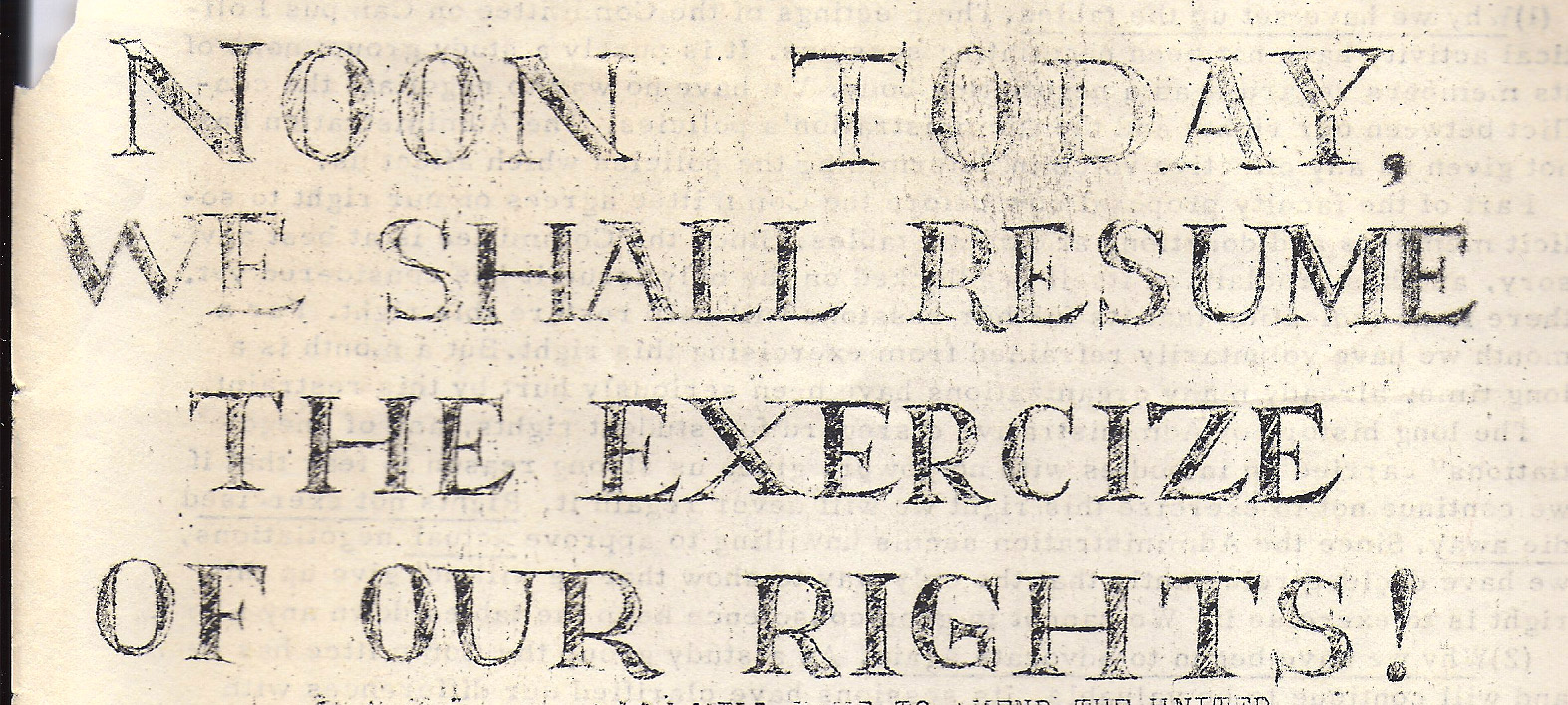
This is the original sign I carried in the Free Speech Movement during the December 1964 police occupation of UC Berkeley and arrest of 800 students participating in the Sproul Hall Sit-in.

I’ve been rooting thorough my old Free Speech Movement files, digging for treasure. Buried between aging, yellow copies of the Daily Cal and mimeographed handouts calling for action, I found the picket sign I carried when the police invaded UC Berkeley and arrested 800 students on December 3, 1964.

There are numerous sources covering FSM and its impact including an excellent book, “The Free Speech Movement,” edited by Robert Cohen and Reginald Zelnik. FSM even has its own website, fsm@a.org. I visited the site and found pictures of aging white-haired men and women looking remarkably like me. 1964 is now ancient history.

In preparation for this series of posts I also returned to UC Berkeley. Sitting on the edge of Ludwig’s fountain under a fine mist, I stared at the steps of Sproul Hall while searching my memory for ghostly reminders of past demonstrations.

I actually found one. A long-haired African American was distributing protest arm bands. His effort would have been illegal in the fall of 1964.

A stroll down Telegraph Avenue brought me to the Café Med, one of my favorite student hangouts. I stopped for an obligatory cup of cappuccino. I wrote notes in my journal and listened in on conversations. It seemed that neither the coffee house nor my behavior had changed much.

Back on campus I visited the Free Speech Café in the Moffitt Undergraduate Library. Every seat was full so I wandered around and looked at photos. Mario Savio, who died in 1996, was there in spirit. A picture captured him in a characteristic pose, haranguing a sea of upturned faces. It was a fitting memorial.

In hindsight, the Free Speech Movement has become an important part of Berkeley’s history, honored even by an Administration that once characterized it as a Communist inspired plot. And what about my hindsight; have the years blurred or substantially modified my vision of what took place?

I tried, in writing this series on UC Berkeley’s Free Speech Movement, to be faithful to what I felt and experienced at the time. I feel now, as I did then, that it didn’t have to happen. The attitude the Administration demonstrated in the 1963 student leadership meeting I attended and described in an earlier post went beyond naïve to dangerous.

If the more radical students found ground for ‘revolution,’ it was a ground fertilized and plowed by the Administration. The desire to protect the campus from outside influence became a willingness to limit the rights of students to participate in the critical issues of the day and, in so doing, take the side of powerful elites whose vested interest was in maintaining the status quo on civil and other human rights issues.

What changed as a result of the Free Speech Movement?

Certainly the concept of in locus parentis took a major hit. Students at Berkeley and other colleges across America would have much greater freedom in the future, on both a personal and political level. We had graduated from being older teenagers needing guidance to young adults capable of and responsible for our own decisions.

While we were still a part of the future so popular with Commencement speakers, we were also a part of the now, helping to shape that future. Human rights and equality including women and gay rights, the anti-Vietnam campaign, and the environmental movement would all benefit. Berkeley students had participated in one of America’s great transformations.

The New Left considers the Free Speech Movement as an important source of origin. A similar claim might be made for the New Right, the so-called Neo Cons.

The outer fringes of liberal and conservative politics are two cats of the same color, feeding off of the same plate and necessary to each other’s success. Each functions with the tunnel vision of being right and with the belief that the ends of their particular vision justify whatever means necessary to get there. Not surprisingly, both the Left and the Right saw the unrest on the Berkeley Campus as an opportunity waiting to happen.

The message was not lost on Ronald Reagan. Following the Free Speech Movement, he would exploit the student protests at Berkeley and other California colleges as a launching pad for his career in politics. One of his first moves as Governor was to fire Clark Kerr for being too soft on the students. There is a picture from the early 70s of Reagan turning around and flipping off student protestors at a U.C. Regent’s meeting. It was a clear message of intent.

It may be somewhat instructive that his future Attorney General, Edwin Meese, was the Deputy District Attorney in Oakland at the time of the Free Speech Movement. Meese’s role had been to oversee the Sproul Hall arrests and serve as liaison with the FBI.

There is a story, which may be apocryphal, that it was Meese who persuaded Governor Pat Brown to send in the troops on the night of the Sproul Hall sit-in by claiming students were tearing up the Dean’s office. If so, it was a deliberate lie or at least an exaggeration. The worst vandalism I witnessed was my standing on the Dean’s desk in my socks so I wouldn’t scratch the surface.

My speculation is that the forces on the right, like the forces on the left, wanted a confrontation. Kerr was planning to address the sit-in the next day in an effort to persuade the students to leave the building. A peaceful solution would not have served the agenda of Meese, Knowland, Hoover, etc. Serious head bashing leading to a full-scaled riot was called for. If it took lies to bring it about, so be it.

Or am I just being paranoid?

Later, when I chaired a committee for the Free Student Union, I witnessed a similar attitude on the part of the Left. A confrontation with students getting their heads bashed was good. It would radicalize moderates and lead to further violent confrontations.

While both the Left and Right worked to subvert what happened at Berkeley for their own objectives, I believe that the Free Speech Movement was what it claimed to be: a fight for free speech, the right to assemble, and the right to participate in the critical issues of the day. It was a fight that still rings true today.

On Being Labeled a Radical… The 1964 Free Speech Movement at UC Berkeley


The Press, Governor of California and UC Administration labeled participants in the Free Speech Movement as a small group of radical revolutionaries bent on destroying law and order. Were we?

I was curious about the background of the students who were arrested during the Sproul Hall sit-in, considering I had almost been one. A sociologist was doing a study on who was involved so I volunteered to take part.

We were given extensive questionnaires, trained and told to hit the streets. I seemed to inherit some of the more elusive, fringe types who always hang around Berkeley. Just finding them was an adventure.

When our data was analyzed, we found that a quarter or so of the participants were relatively hard core in terms of having been actively involved in the Civil Rights movement. Most of the participants resembled me: students and grad students who were somewhat on the idealistic side, angry at the Administration, in sympathy with the Civil Rights Movement, and committed to our right to participate in the political process.

Were there truly radical students on campus who saw the protests as a way to radicalize students and achieve objectives beyond retrieving the basic rights that had been taken away?

Yes. I met some when I decided to help create a Free Student Union. A union made sense to me. The student government, by its very nature, was tied closely to the Administration. A union would go beyond the temporary, nonrepresentational nature of the FSM and give us ongoing power and representation that we lacked as individuals.

I participated in two or three meetings including one I hosted at our apartment. Chaos was good, I quickly learned. Policemen dragging students down stairs and bashing an occasional head was to our advantage. It created solidarity among the ranks and radicalized the student body.

We needed to goad the Administration into further action, the more outrageous the better.

It did not reflect who I was or my goals. After sharing my opinion on what I thought about the chosen strategies, I parted ways with the Free Student Union. Apparently, most students shared my perspective. The union, to my knowledge, did not get off the ground.

The focus shifted temporarily in the spring and maybe this shift reflected a more radical strategy. We had our so-named Filthy Speech Movement. People would get up in the free speech area and see how many obscenities they could mouth in the name of free speech.

From my perspective it was inane and counterproductive, a non-issue designed to infuriate the Administration and garner media coverage.  Rather than serve a positive purpose, it degraded our efforts of the fall and was utilized by the Oakland Tribunes of the world and their allies as justification for their condemnation of the campus.

More typical was a return to what some would define as an accepted activity of college life. I was amused to read a Junior Class party announcement in the “Daily Californian” one Friday.

“Everyone is welcome at our TGIF party, especially the FSM: it will give them a chance to quench their thirst.” Dennis O’Shea, Junior Class Activities Chairman was quoted. “It promises to be the hell raiser of the year – lots of girls, a screaming rock and roll band that frequently plays for the Hell’s Angels, and 150 gallons of liquid refreshments.”

I can imagine that the Administration was praying for a return to the good old days when a ‘hell raiser’ was defined as an ocean of beer and a screaming rock and roll band.

Next Blog: Looking back at the FSM: What did we accomplish?

Occupy Sproul Hall… The 1964 Free Speech Movement at Berkeley


The release of the hostage Police Car did not bring peace to the UC Berkeley Campus. Each time a solution seemed imminent, the Administration would renege or the FSM would increase its demands.

In addition to the right to organize on campus, the disciplining leaders of the Free Speech Movement became a central issue.

Demonstrations took place almost daily and were blasted in the press. I learned a great deal about media sensationalism and biased reporting.

One day I would sit in on a democratic and spirited discussion of the pros and cons of a specific action and the next day I would read in the Oakland Tribune or San Francisco Examiner that I had participated in a major insurrection of left leaning radicals who were challenging the very basis of law and order. (It was documented later that the FBI was paying a reporter to write the Examiner stories.)

Older adults in suits taking photos looked suspiciously like plain-clothes policemen or FBI agents. It was easy to become paranoid.

If we signed a petition, demonstrated, made a speech or just stood by listening, would our pictures and names end up in some mysterious Washington file that proclaimed our disloyalty to the nation? These weren’t idle thoughts. A few years earlier people’s careers had been ended and live ruined because someone had implied they were soft on communism.

J. Edgar Hoover was known for tracking Civil Rights’ leaders and maintaining extensive files on every aspect of their lives. While we weren’t up against the KGB, caution was advisable. Hoover considered Berkeley a hotbed of Communism.

We looked warily at those who didn’t look like us. One day a small dog was making his way around the edge of the daily demonstration, sniffing people.

“See that Chihuahua,” a friend whispered in my ear. I nodded yes. “It’s a police dog in disguise. Any moment it is going to unzip its front and a German Shepherd will pop out.”

The wolf in sheep’s clothing was among us. It was a light moment to counter a serious time. And we were very serious. I sometimes wondered when the celebrated fun of being a college student would kick in.

One day I was faced with a test more serious than any I had ever faced in the classroom. On December 2, 1964, FSM leaders called for a massive sit in at Sproul Hall, Berkeley’s administration building. Once again communication had broken down and the Administration was back peddling, caught between students and faculty on one side and increasing pressure from the outside on the other.

I thought about the implications of the sit-it and decided to join. I needed to act. For three months I had listened to pros and cons and watched the press blatantly misrepresent what was happening on campus. I was angry, knowing that the public had little option but to believe that a small group of radicals was preaching anarchy.

It was not wrong to utilize an edge of campus for discussing the issues of the day, or for organizations to raise funds for supporting various causes, or even to recruit students for participating in efforts to change the community.

It didn’t disrupt my education. I was free to stop and listen, to join in, or pass on. What it did do was irritate powerful, established members of the community. And for that reason, our freedoms had been curtailed.

Maybe if enough students joined together, the Administration would listen and the press would dig deeper. I told my fiancé I was going inside and then joined the thousand or so students who had made similar decisions.

It was early in the afternoon and we were in high spirits. I believed it would be hard for the Administration to claim 1000 students were a small group of rabble-rousers bent on destroying the system. And I was right. It claimed we were a large group of rabble-rousers bent on destroying the system.

Inside I was treated to a unique experience. The sit-in was well organized. Mario Savio and other FSM leaders gave us directions on what to do if the police arrived. There were clear instructions that we were not to block doorways. The normal business of the University was not to be impeded and we were not to be destructive in any way.

Floors were organized for different purposes. The basement was set aside as the Free University where graduate students were teaching a variety of classes. These included normal topics such as physics and biology and more exotic subjects such as the nature of God. One floor was set aside as a study hall and was kept quiet. Another featured entertainment – including old Laurel and Hardy films, which seemed particularly appropriate.

After administrators left, a desk in the dean’s office became a podium for speech making. I felt compelled to add my dimes worth. Each speaker took off his or her shoes so the top of the desk would not be damaged.

The real treat though was an impromptu concert by Joan Baez. I joined a small group sitting around her in the hallway and sang protest songs. The hit of the night was “We Shall Overcome.” It provided us with a sense of identification with struggles taking place in the South. I felt like I belonged and was part of something much larger than myself.

Mainly I walked around and listened, taking extensive notes on what I saw and felt. Later I would sit in the Café Med on Telegraph Avenue and write them up. They would become the basis of talks I would give back home over the Christmas break. I also turned them over to Father Baskin, an Episcopal minister who wanted to use them for a sermon at his church in Placerville.

Along about midnight the un-radical part of my nature took over. I started thinking about my comfortable bed back in the apartment. The marble floors of Sproul Hall did not suggest a good night’s sleep and it appeared the police weren’t coming, at least in the immediate future. Yawning, I left the building and headed home.

I would come back in the morning to chaos and an occupied campus.

Next Blog: Berkeley on Strike. (See below for the story about Jack Weinberg and the police car.)

Holding a Police Car Hostage: UC Berkeley’s 1965 Free Speech Movement

Jack Weinberg, creator of the statement "Never trust anyone over 30," was arrested for raising funds to support Civil Rights efforts on the UC Berkeley Campus in the fall of 1965. Students surrounded the police car and held it hostage.

In the fall of 1965, the UC Berkeley Administration declared that the Bancroft-Telegraph Free Speech area was closed and that there would be no more organization of off-campus Civil Rights demonstrations at Berkeley. Student organizers of the various community efforts reacted immediately.

These were not young adults whose biggest challenge had been to organize pre-football game rallies. Some, like Mario Savio, had walked the streets of the South registering black voters and risking their lives to do so.

In the summer of 1964 three of their colleagues had been shot dead and buried under an earthen dam near Philadelphia, Mississippi. Many had cut their political eye teeth four years earlier in the anti-HUAC demonstrations in San Francisco and had participated in numerous protests against racial discrimination throughout the Bay Area since. (HUAC was the House Un-American Activities Committee, a hold over from the McCarthy era.)

The student organizers understood the value of demonstrations, media coverage and confrontation and had become masters at community organization. They were focused in their vision to the degree they were willing to face police and be arrested for their beliefs.

The Administration wasn’t nearly as focused. Liberal in nature and genuinely caring for its students, it utilized a 50’s mentality to address a 60’s reality. Its bungling attempts to control off campus political activity combined with its inability to recognize the legitimacy and depth of student feelings would unite factions as diverse as Young Republicans for Goldwater with the Young People’s Socialist League.

It eventually led to the massive protests that painted Berkeley as the nation’s center of student activism and the New Left.

Over the next three months I would spend a great deal of time listening, observing and participating in what would become known world-wide as the Free Speech Movement (FSM). As a political science major, I was to learn much more in the streets than I did in the classroom.

What evolved was a classic no win, up-against-the-wall confrontation. The Administration would move from “all of your freedoms are removed,” to “you can have some freedom,” to “let’s see how you like cops bashing in your heads.” The Free Speech leaders would be radicalized to the point where no compromise except total victory was acceptable.

Student government and faculty solutions urging moderation and cooperation would be lost in the shuffle. Ultimately, Governor Pat Brown would send in the National Guard troops and Berkeley would take on the atmosphere of a police state.

I found myself being radicalized in the process as well although I never reached the point of moving beyond issue to ideology. It was no more in my nature to be left-wing than it had been to be right-wing. However, I would move across the dividing line into civil disobedience.

Within hours of the time that Dean Katherine Towle sent out her ultimatum to campus organizations, the brother and sister team of Art and Jackie Goldberg had pulled together activist organizations ranging in orientation from the radical to conservative and a nascent FSM was born.

Shortly thereafter the mimeographs were humming and students were buried in an avalanche of leaflets as they walked on to campus. I read mine is disbelief. The clash I had predicted at the student leader meeting a year earlier had arrived. There was no joy in being right.

In an era before social networks and cell phones, FSM organizers relied on mimeographed fliers and word of mouth to build instant support. The above flier is one I saved in my files on the Free Speech Movement.

As soon as it became apparent that the Administration had no intention of backing off from its new rules, the FSM leadership determined to challenge the University. Organizations were encouraged to set up card tables in the Sather Gate area to solicit support for off campus causes.

I had stopped by a table to pick up some literature when a pair of Deans approached and started writing down names of the folks manning the tables. Our immediate reaction was to form a line so we could have our names taken as well. The Deans refused to accommodate us. The Administration’s objective was to pick off and separate the leadership of the FSM from the general student body.

A few days later I came out of class to find a police car parked in Sproul Plaza surrounded by students. The police, with encouragement from the Administration, had arrested Jack Weinberg, a non-student organizer for CORE (Congress of Racial Equality) who had been soliciting support for his organization.

Someone had found a bullhorn and people were making speeches from the top of the police car while Jack sat inside. I situated myself on the edge of the fountain next to the Student Union and idly scratched the head of a German Short Haired Pointer named Ludwig while I listened. (Ludwig visited campus daily and played in the fountain. Later, in Berkeley-like fashion, the fountain would be named for him.)

A scanned photo of Ludwig from Berkeley's student newspaper.

Eventually I stood up and joined those on the edge of the crowd thereby becoming a part of the blockade. It was my first ever participation in civil disobedience. It was a small step. There would be plenty of time for more critical thinking if the police showed up in force.

Being only semi-radical, I did duty between classes and took breaks for eating and sleep. Eventually, after a couple of days, the FSM negotiated a deal with the Administration. Jack was booked on campus and turned loose, as was the police car. A collection was taken up to pay for minor damages the police car had sustained in the line of duty while serving as a podium.

Next Blog: The Police and National Guard occupy Berkeley’s campus