This Guy Eats Rattlesnakes… And Other Facts about Who Eats Whom or What

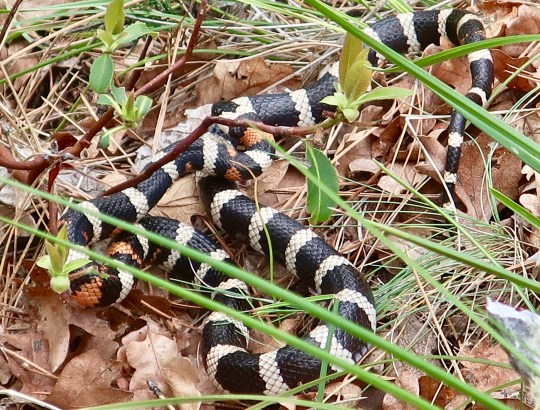
Peggy and I hiked up the mountain behind our house in search of cougars and bears, and came upon this colorful California kingsnake. It cooperated with a striking pose, so to speak. We had been following along behind it as it slithered along for about 20 feet. I think the pose was meant to say, “Go away!” When that didn’t work, it hid his head.

I’ve eaten rattlesnake but it has never been a part of my regular diet. Nor do I eat rattlesnakes whole or squeeze them to death. The California kingsnake regards this as normal behavior. They are said to have the strongest constriction power of any snake of similar size and can eat another snake almost as big as they are. (You wouldn’t want to meet one the size of a boa.) I assume they also use this ability on the other prey they like to eat including rodents, birds, lizards, and frogs. One valuable attribute that they have in relation to eating rattlesnakes is that they are more or less immune to the venom. A final tidbit I picked up in my research: The guys win their lady’s love by vibrating rapidly. I wonder if this leads to a shaky relationship.

The kingsnake stretched out to about 4 feet. They can grow up to six. Imagine this fellow swallowing a 2-3 foot rattlesnake! We followed along at a respectful distance.

We weren’t looking for the snake. Peggy and I had hiked up the mountain to check out some possible cougar scat (poop) and see if anyone was home at the bear cave. We were also looking for other signs of wildlife and anything else that caught our fancy— like the weird trees and pretty flowers I have already shared. I am sure that you are thinking now, “Oh joy, Curt is going the share poop with us.” And you are right.

But first the bear cave. It isn’t that we have ever found a bear in it. But it looks like a bear should live there and we found bear tracks in the snow heading toward the cave this past winter. As you may recall, Peggy refused to walk over with me to check it out. This time we found fresh bear scat on a trail up the mountain nearby and Peggy immediate burst into song, The bear went over the mountain. I told her it was wishful thinking, that maybe the bear had come down the mountain. None-the-less, we checked out the cave and no one was home. Peggy insisted that I throw rocks inside just to make sure. I’ve never quite understood the logic of this. If I were a bear and got awakened from a deep sleep by a rock, I’d be grumpy. I’d come roaring out of the cave wanting to bite someone.

The ‘bear’ cave looking dark and ominous. It’s actually an old gold mine. Our neighbor, Mooey, who is a part time gold miner, cut a trail up to the cave. “I always throw rocks into it.” he told us.”

And now for the scat. Our fascination with it may have you scratching your head why— especially if you have a dog or a baby. The fact is, if you are interested in what animals are visiting your neighborhood or live in the wild areas you visit, scat is an important clue, and sometimes the only clue. Many animals are nocturnal and others have figured out that the less people know about their presence, the better off they are. Cougars fit into the latter category.
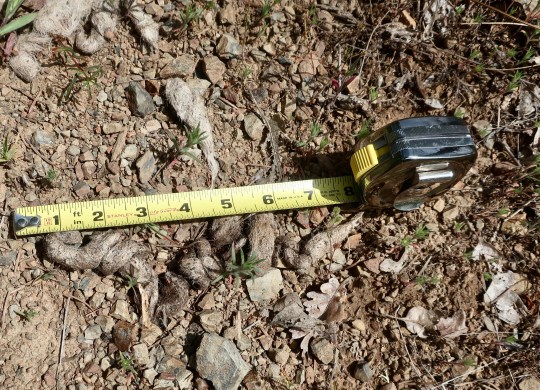
We were hiking up the hill when we came on this scat. Just looking at it we learned two things. One, it was a carnivore. Two, it was likely left by different animals at different times. The color suggests the different times. The scat on top is older. It also appears that the scat on the bottom was left by a larger animal.
Check out the fur? This was definitely a meat-eater. I think the fur is from a deer.
The lower scat was about 7 inches in length. The upper closer to 4. (And doesn’t everyone carry a tape in his pocket to measure scat?)

So what are we looking at. Given who lives in our area, I would say either a cougar, a coyote or a bob cat. The size, especially of the lower scat, suggests cougar. If it’s deer fur, as it appears to be, it is one more clue suggesting a cougar. On Wednesday we were hiking up another trail near our house, the Mule Mountain Trail, and definitely came across cougar scat.
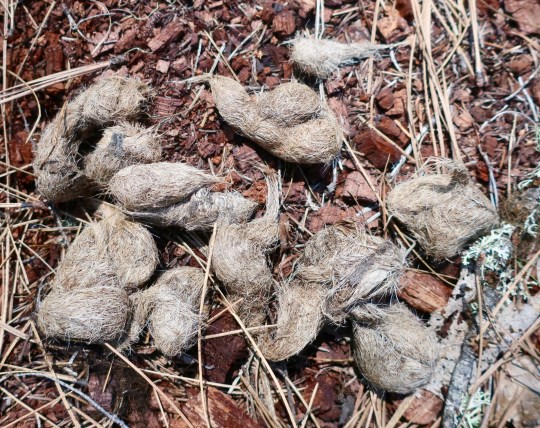
This scat was larger and chunkier— definitely cougar. Once more, the fur looks like deer.
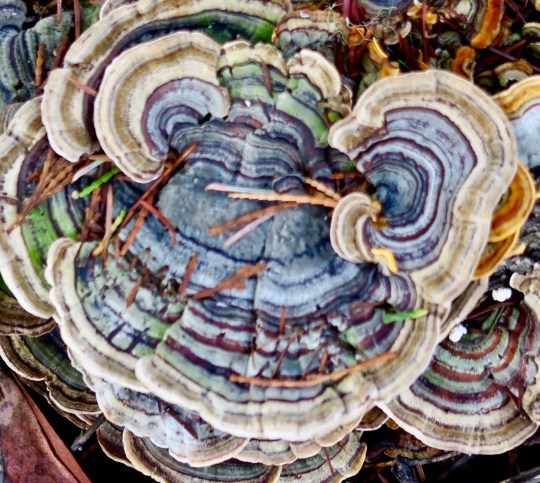
But enough on poop. This shelf fungus seems to have an opinion on the subject.
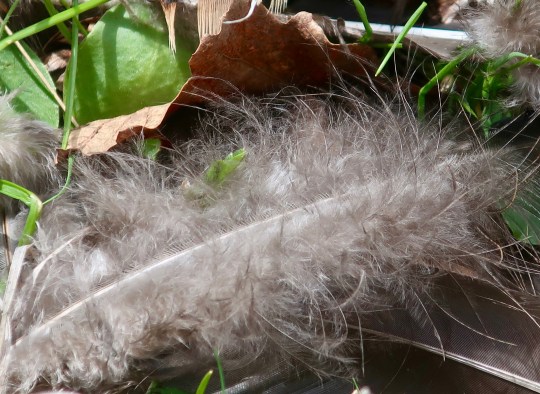
Turkey was also the menu out in the woods. The feathers suggest a real feast. There were enough for at least two turkeys. Once again, the cougar, the bob cat, or the coyote was at work. Or maybe two of them.
These are turkey tail feathers…
And this feather make me think of my down sleeping bag!
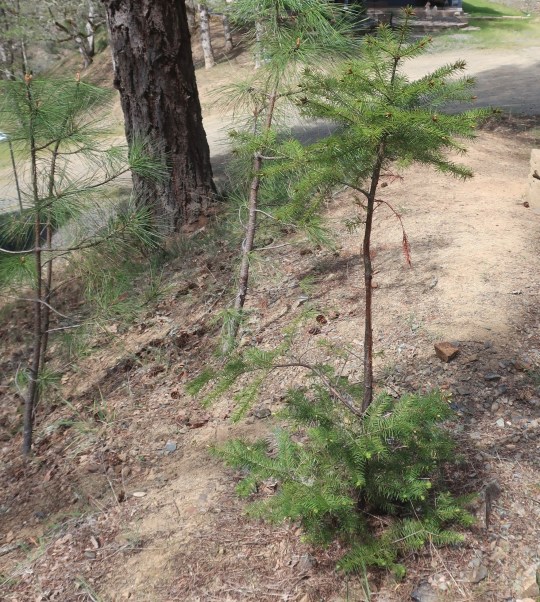
Let’s hear it for the herbivores. Someone stripped this poor little Douglas fir, leaving a top and a bottom and nothing in between.
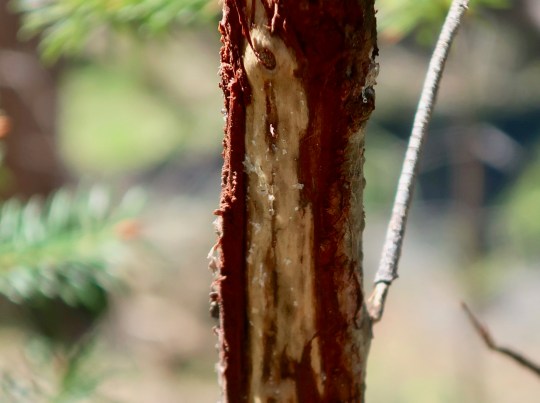
Ouch. Nothing like being flayed. I’d say a porcupine is the likely culprit. A buck might do this to remove velvet from his antlers, but it is still too early. Last year one of them did in our hammock. It is also possible that a deer did this for lunch, yanking off the tender young needles of the tree with the bark following— all down the hatch!
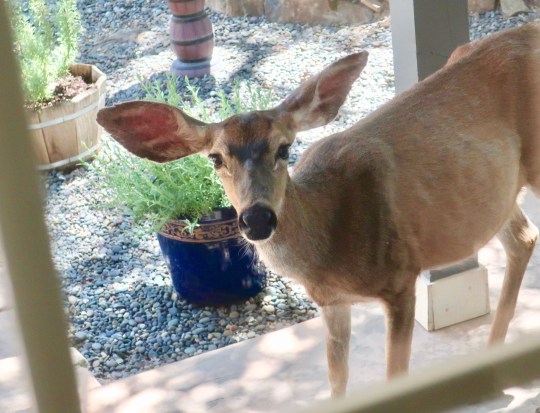
“You blame us for everything!” I had just written the caption for the photo above when Floppy appeared and stared accusingly at me through the window. It’s not true. I also blame the ground squirrels around here. As you will discover in my next post.
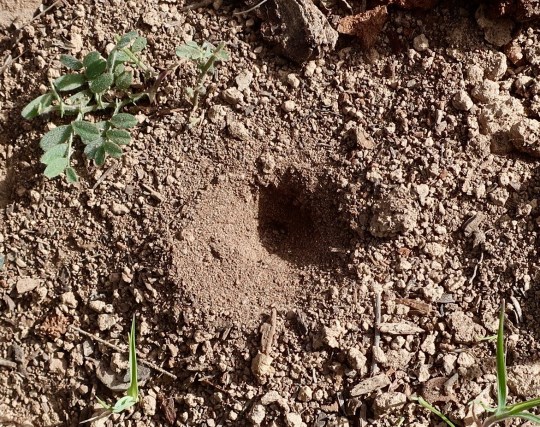
Here’s an interesting bit of nature. The insect that made this hole is an antlion, a ferocious little bug that digs the holes to trap ants. It sits in the bottom and waits for someone to fall in and then kicks up dirt on a potential victim to speed up the process. It’s a slippery slope, almost impossible to escape from. I am reminded of the monster in Star Wars that Jabba the Hut hoped would eat Luke, Hans and Chewy.
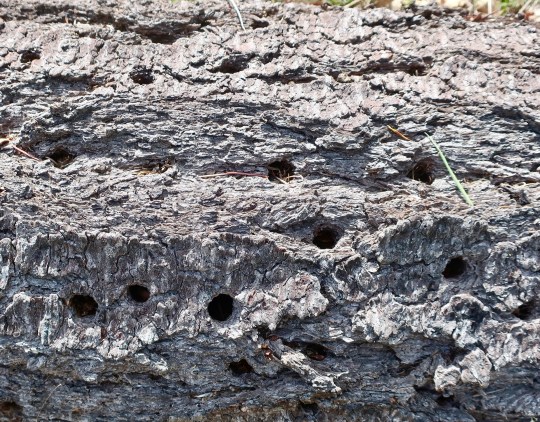
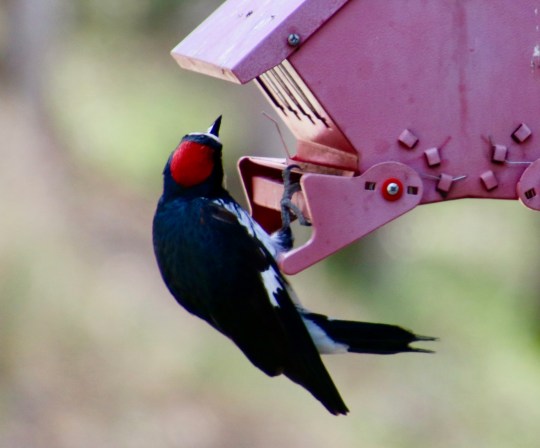
Any idea who did this? You are looking at an acorn tree. The birds that drilled these holes are acorn woodpeckers. There can be thousands of such hole in a single tree filled with acorns. Usually they all belong to the same commune of woodpeckers that live together as a family, interbreed, raise the kids jointly and maintain the tree. My commune friends from the 60s and 70s would consider them soulmates.
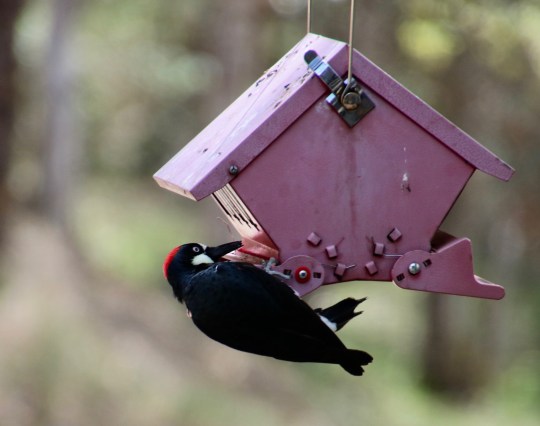
Acorn woodpeckers also like sunflowers! Check out the clown face on this one.
The red cap is definitive of the acorn woodpecker. This is a female. The red goes down to the white forehead on the male.
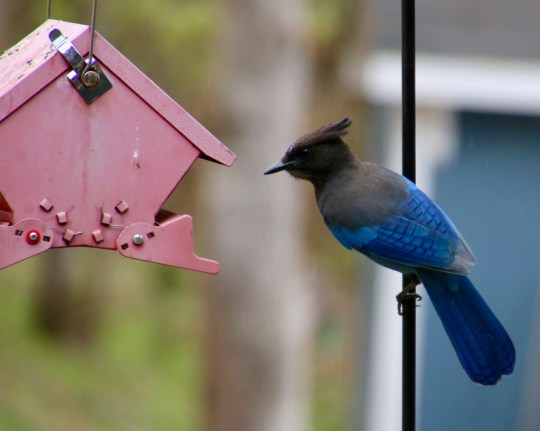
Steller jays also love sunflower seeds, but it’s a reach…
They flap their lower wing to maintain balance. They’d be ruler of the bird feeder if it wasn’t for the acorn woodpeckers. No one wants to get in a fight with someone who can peck holes in wood!
Over ten species of birds are regular visitors to the birdfeeder and provide endless entertainment. These are mainly goldfinches waiting for their turn.
I’ll close today with a final photo of the kingsnake. I looked down and its head was missing! At first I thought he was in the process of slithering off. But he remained still. Later, I read that kingsnakes sometimes hide their heads when in danger. It hardly seems like appropriate behavior for somebody who eats rattlesnakes!

NEXT POST: Other ways we’ve been amusing ourselves in the Age of Coronavirus

No-see-um Camp, a Sacred Grove, and Cougar Poop

No-see-um camp, which we expected to be bug infested, turned out to be nestled among trees that made me think of a sacred grove.

Part II of our hike up Cook and Green Creek to the Pacific Crest Trail through the Rogue River National Forest.

Our goal for the day was No-see-um Camp, which seems like a very poor place to set up your tent. If you have spent much time outdoors, you will recognize no-see-ums as particularly nasty little bugs. I first encountered them when backpacking on the Appalachian Trail in Maine. It had rained for a solid week and every biting bug in existence had considered us fair game. While mosquitoes had treated our bug repellant as an hors d’oeuvre, no-see-ums had come after us with knives and forks. Later, I watched a moose in Alaska dash wildly about and roll in a snow bank to escape the tiny, nefarious fiends. Fortunately, we didn’t find any no-see-ums in No-see-um camp. It was quite the opposite. I decided we had arrived in a sacred grove.

Sacred groves go almost as far back as humanity. Think of the Druids and their oaks. In West Africa, where I served in the Peace Corps, huge cottonwoods were thought to contain living spirits and I often found offerings at their bases. It’s important to keep the forest spirits happy.

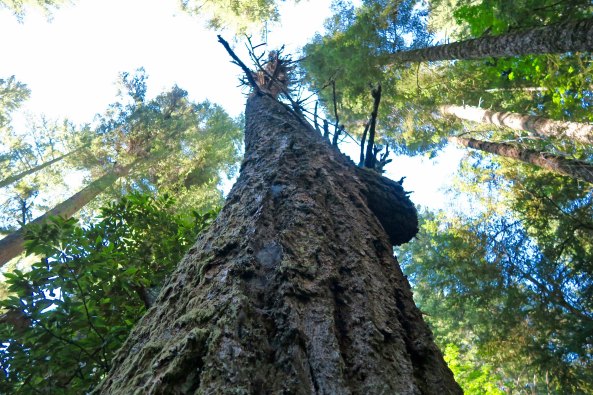
No-see-um camp had more species of trees than I have ever found in a single location, many of them were giants. From our camp, I could see Douglas fir, sugar pine, white fir, blue spruce, chinquapin, big leaf maple, and yew. Just up the trail I found a ponderosa pine. Cook and Green Creek with its cool, refreshing water bubbled and burbled and roared its way down the canyon just behind our tent. I figured it was an excellent place to commune with nature spirits and Peggy found a camp guardian up in the trees, which I thought was quite pagan of her.

Another view looking up from our campsite on Cook and Green Creek. This one features big leaf maples.

There is a reason for their name!

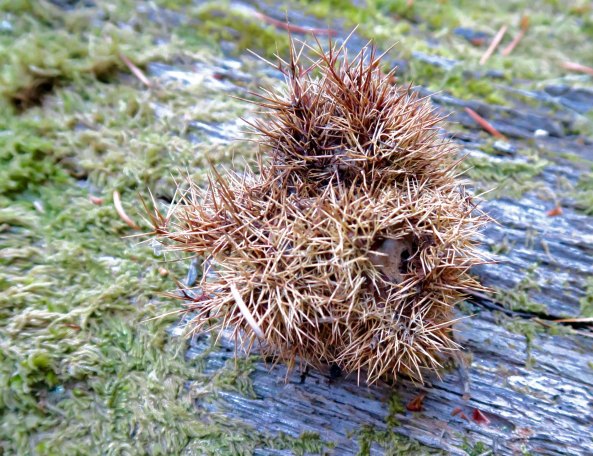
We also had chinquapin growing in the grove. This prickly thing covers the trees nuts, which are said to be tasty.

Giant sugar pines with their large cones and giant Douglas firs with their small cones surrounded us.

I found a large ponderosa pine near by. Do you know what made the line of holes? It was a sapsucker, a kind of woodpecker. It will return to eat any insects that have entered the holes.

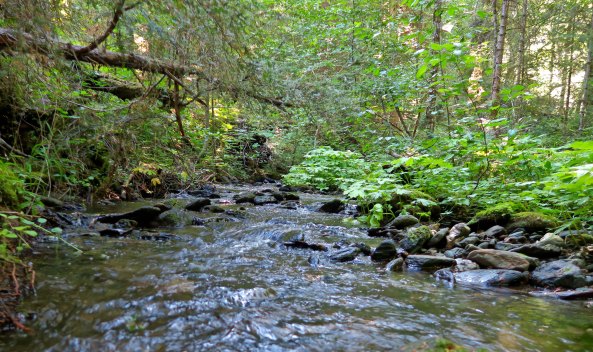
Cook and Green Creek flowed just behind our tent. It was burbling here.

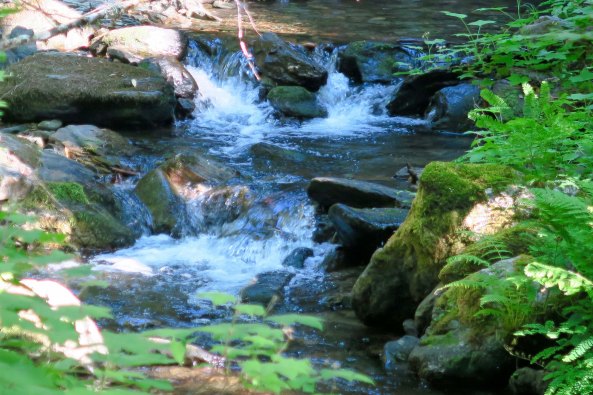
Small waterfalls added a slight roar.

And I found the way the water flowed over a rock to be intriguing.

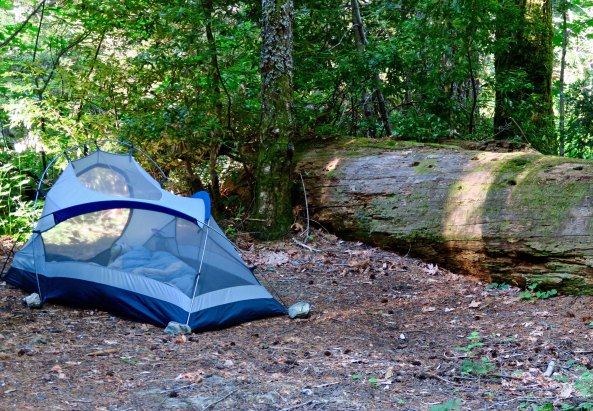
The downed tree next to our tent provided a good perspective on the size of the larger trees.

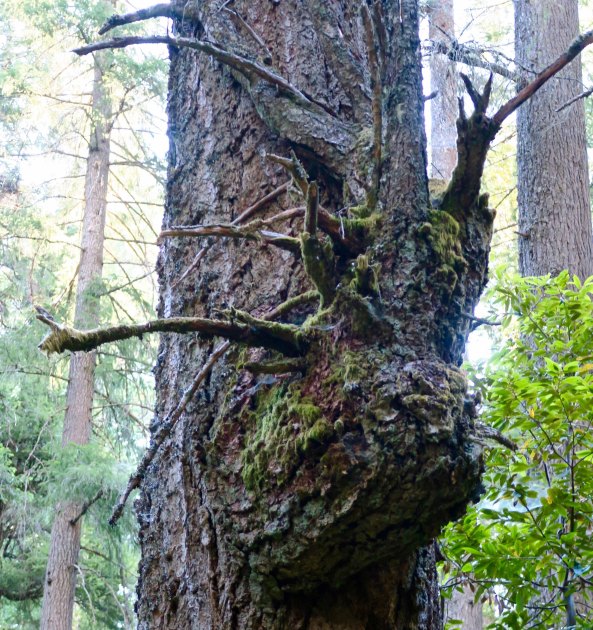
This odd tree growth just above our site served as Peggy’s camp guardian. (Photo by Peggy Mekemson.)

The Guardian’s tree was also impressive.

We used our layover day as an opportunity to do a nine mile hike up to the pass and back. Going up, we entertained ourselves by enjoying flowers and other plant life while looking for signs of wildlife. And yes, I have more animal poop, scat, to share with you. I’ll bet you’re excited.

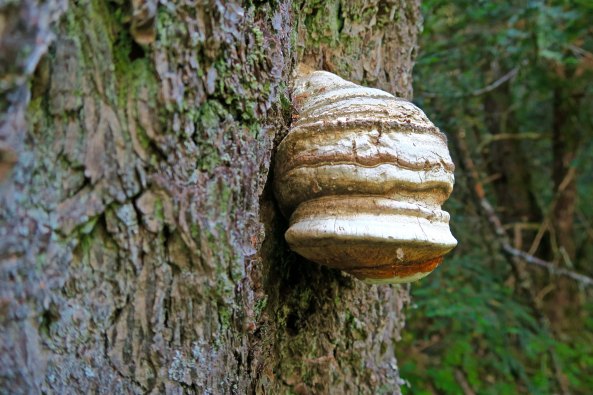
A shelf fungus.

Any idea what is happening here? Carpenter ants were making their nest. They are a fairly large ant that literally cut off small, sawdust-size chunks of wood and then bring it out to the edge where they dump it on to the sawdust pile at the bottom of the photo.

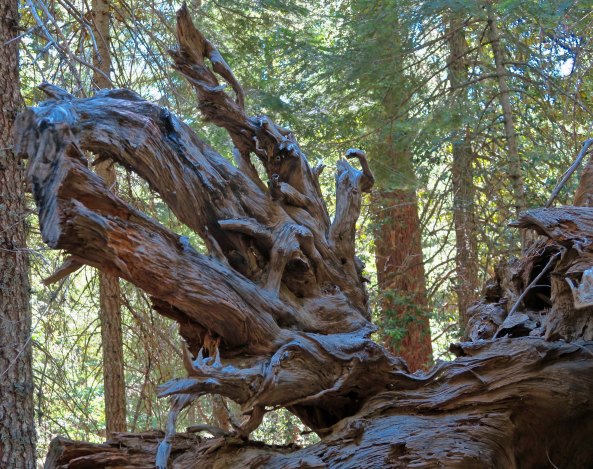
Peggy poses beside a fallen tree.

Which happened to feature another wood sculpture that Peggy determined was a dragon.

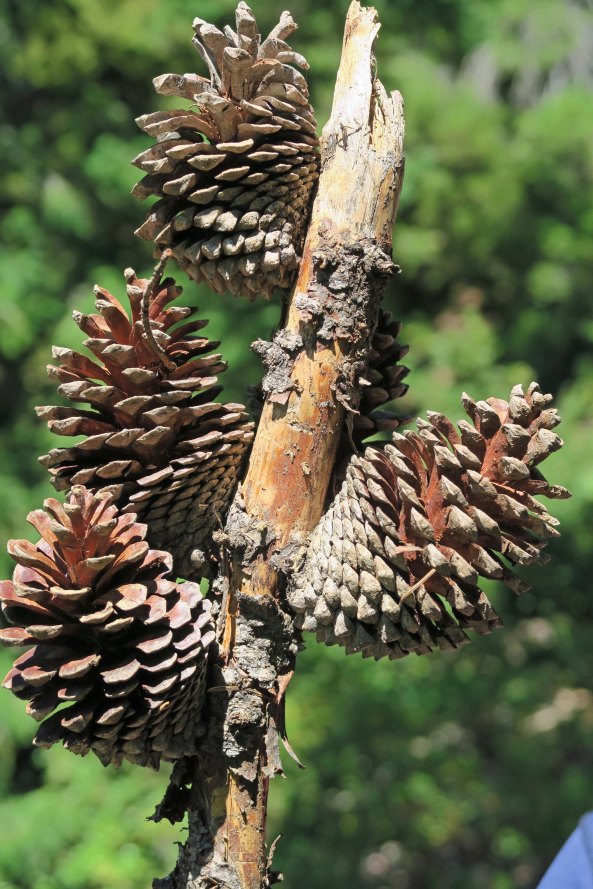
We found these unusual cones that actually grow directly on the limbs of the trunks and limbs of the knob cone pine.

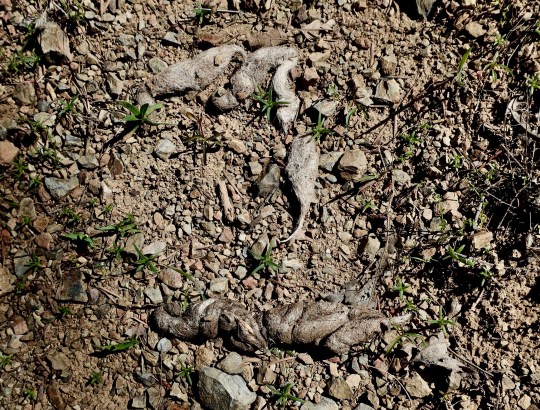
Okay, I put up pretty, or at least I hope interesting photos, and then I put up poop. Why? Half the fun of wilderness travel is knowing what you are seeing around you. Scat (poop) is one way of telling what animals are using the trail you are on. This happens to be cougar, or mountain lion scat. The twisted piece on the end is fairly definitive of the cat family. Size suggests cougar. It was dry, so we were in little danger of an immediate encounter.

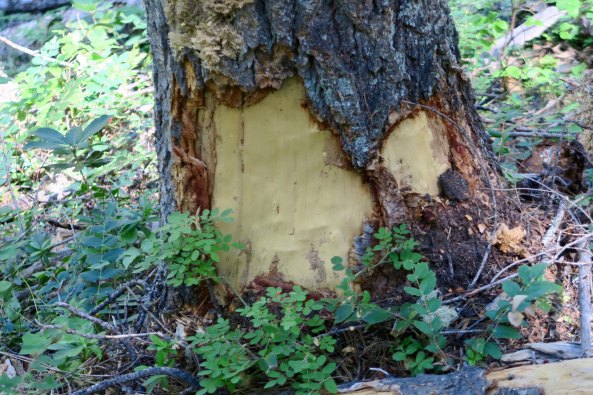
Since we are on animal signs, any idea of what made this? Odds are it was a porcupine. They chew off the outer bark to get to the nutritious, inner bark.

This attractive small waterfall, provided cool water to drink with our  lunch. (Photo by Peggy Mekemson.)

After lunch on our way up to the pass, we found this attractive Blue Spruce…

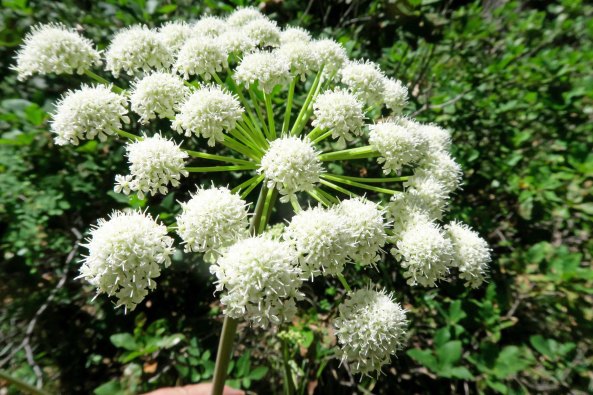
And a flower, which is known as Ranger’s buttons.

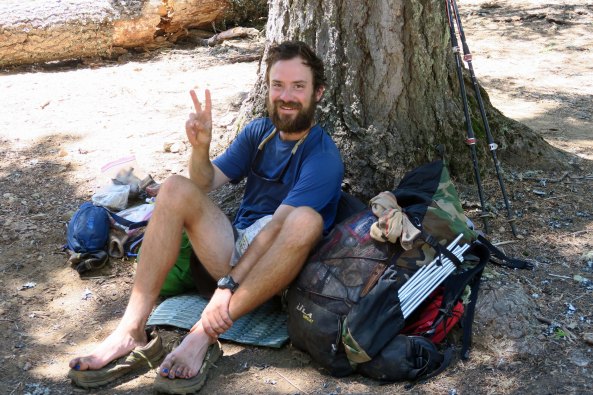
On top, we met Rambo, Dogondo, and Double D: three PCT through hikers. Their names are their trail names. They had started at the Mexican border and been backpacking since April, covering close to 1000 miles. They were skinny and ever so eager to reach Oregon, which was just up the trail. One of them told me that Sasquatch (Big Foot) had been rooting around outside his tent the night before.

Rambo, a PCT through hiker from Riverside, California.

Dogondo, a PCT through hiker from Chicago.

Double D, a PCT through hiker from Kansas City.

We raced on our way back down from the pass. I was careful to keep Peggy behind me. She thinks that she is a greyhound when she gets out in front going down a hill. I once sprained my ankle trying to keep up with her coming off of Muir Pass on the John Muir Trail and had to hobble another 80 miles before we finally climbed up and over Mt. Whitney and out. Taught me.

Peggy, all set to go, wearing one of her favorite T-shirts.