
A lone cyclist crosses the Playa at Burning Man while the sculpture named Tonglen by artist Ryan Mathern, looks on. Tonglen, it appears, is all head and heart.
For today’s post on Burning Man 2017, I have picked out a series of sculptures that reflect a variety of approaches by Black Rock City artists to the human form ranging from the abstract to the realistic while using materials including metal, wood, plastic and cement. Many of the pieces have a spiritual component and most of the artists have had work at Burning Man in previous years.
TONGLEN by Ryan Mathern from Atlanta, Georgia

A close look at the face of Tonglen shows his copper-colored eyes and the Tibetan scrip that appears on his forehead and encircles his face.
My wife, Peggy, picked this sculpture out from my photos as one of her favorites at Burning Man this year. Tonglen is a Buddhist meditation practice of receiving negative energy when breathing in and releasing positive energy when breathing out. You breathe in suffering; you breathe out compassion. It is a form of meditation practiced by the Dalai Lama.

The heart is actually a billows like a blacksmith might use. It forces air into the diamond-shaped fire chamber and then out the mouth. Most of Mathern’s works incorporate fire or some other form of light.
Mathern’s work incorporated this idea by including a diamond-shaped burning chamber with a heart-shaped bellows underneath. Fire would come out of the sculpture’s mouth and light up the Tibetan script that encircled the face. I didn’t see this piece lit up but found it quite striking in the day.
THE BRIDGE AND THE CAGE by Valerie Elizabeth Mallory from Oakland, California
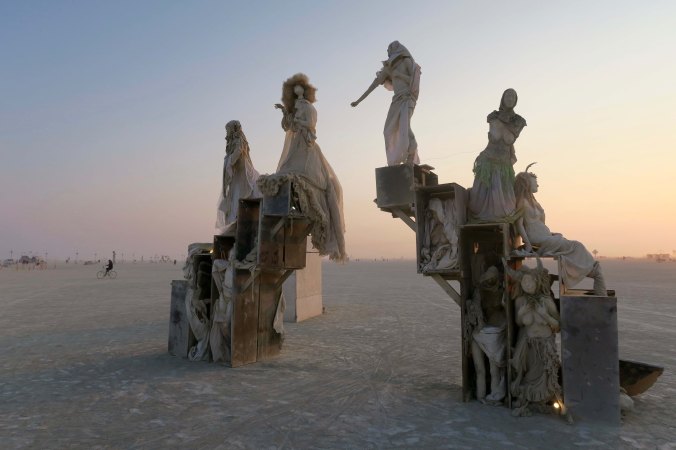
An early morning view of the sculpture by Mallory shows figures on various locations on the bridge. All of the figures are live cast from volunteers by the artist.
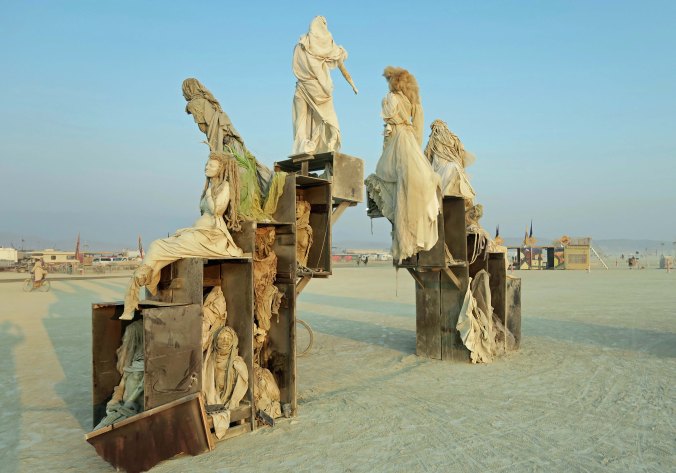
A back view of the sculpture was lit up by the sun.
This diorama by Elizabeth Mallory represents people crossing a bridge from one stage in life to another— responding to the human condition of wanting to improve their lives, to cross over to a better existence. The cage reflects a metaphor that people occasionally get stuck, are imprisoned on their odyssey toward a different life by ignorance and a tendency to see the world in black and white.
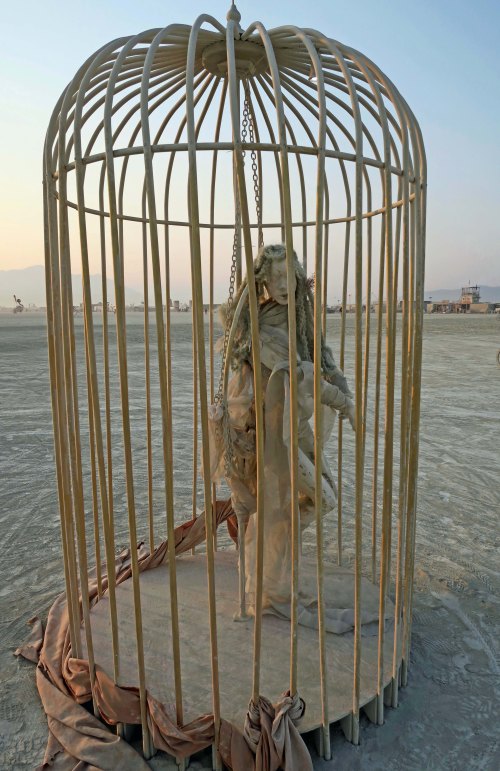
A bird in a gilded cage came to mind when I saw this part of Mallory’s sculpture.
The casts for this sculpture were made from volunteers by using cold cast resin and alginate. Each cast took 12-36 hours to complete. Art doesn’t get any more real.
MAYA’S MIND by Mischell Riley from Carson City, Nevada

The bust of Maya Angelo by Mischell Riley was placed on three books which served as steps up to the bust. The back of the sculpture provided a ‘look’ into Maya’s mind.

A close up of Maya’s head. The sculpture is made from cement. The birds are a reference to Maya’s autobiography, “I know why the Caged Bird Sings.”
I didn’t recognize the sculpture for what it was, a bust of Maya Angelo. I saw a tall, powerful figure done in classical style. Once I read about Riley’s work, I became even more impressed. Her intention is to capture a number of women who are making or have made a difference in the world. Her next piece will be Jane Goodall. She works out of the Generator, a large warehouse space in Reno where a number of art pieces for Burning Man have been created.
THUNDERBIRDS by James Tyler from Haverstraw, New York

I liked the simplicity of these Thunderbird sculptures by James Tyler. These are two of the three that he created for Burning Man.
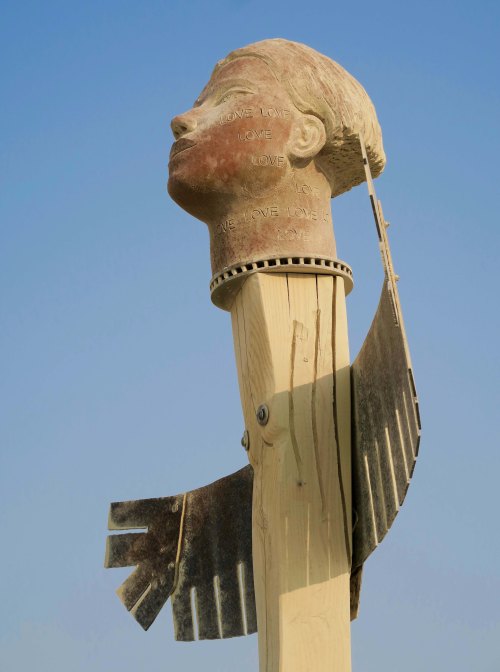
Each of the sculptures had words written on them. This one was “love.”
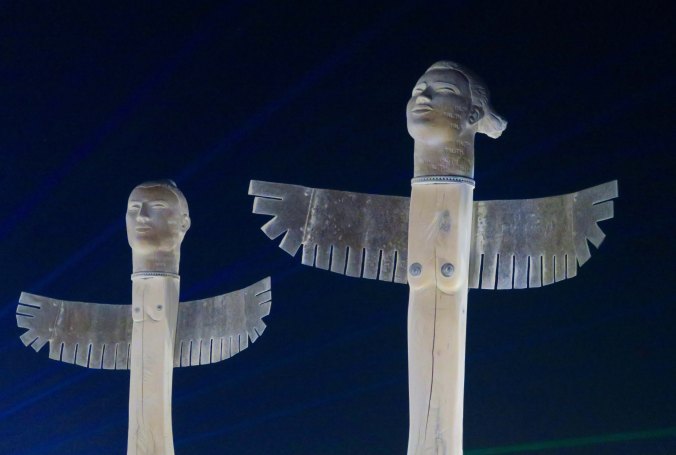
Basic lighting at night added to the impact of the sculptures.

Peggy and I found this First Nation totem pole Thunderbird on Vancouver Island, British Colombia. (Photo by Peggy Mekemson.)
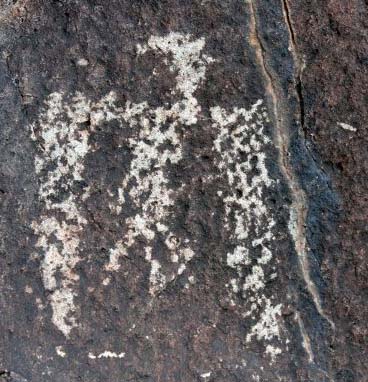
And this petroglyph Native American Thunderbird in New Mexico.
The Thunderbird is a common theme in both Native American and First Nation mythology. Peggy and I have found them represented in the Totem Poles of the Northwest and the petroglyphs of the Southwest. Tyler’s unique work provides another, more human perspective, but I felt that it was true to the spirit of the early natives who saw them as a powerful force in their lives.
SOLACII by Tigre Bailando and Anastazia Louise Aranaga from Oakland, California

The three faces of Solacii and her tattered garment, which is made up of numerous other pieces of clothing.
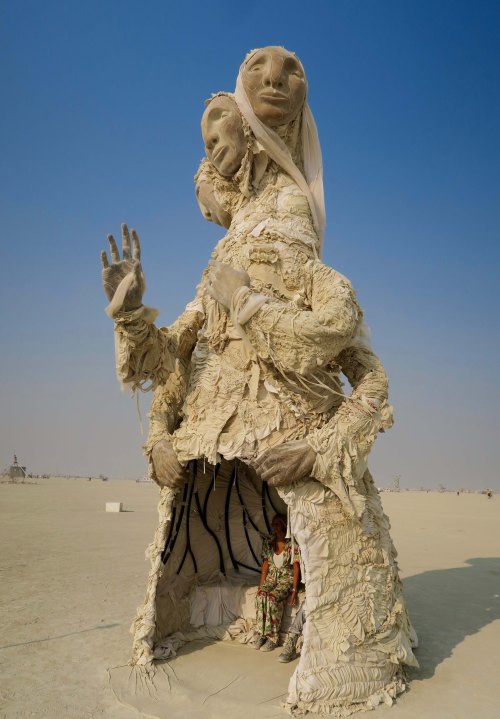
An open chamber at the base of Solacii served as a refuge and provided the sound of a heart beating and a person breathing.

A view of Solacii lit up at night. Lighting moved from face to face.
This 20-foot tall sculpture rising out of the desert pulled me to her. When I climbed off my bike, a woman who was sitting inside the sculpture said, “You have to come in here and listen.” I looked up at the three expressive faces, the four hands, and the tattered, pieced together garment and could only wonder what I would hear. It was like being inside a person’s body listening to her beating heart and breathing, very peaceful, a refuge— a womb with a view (sorry, I couldn’t help myself).
TARA MECHANI by Dana Albany from San Francisco, California

The sculpture of Tara mechani by Dana Albany was part female Buddha and part robot.

A view of Tara’s stomach and chest reflects the robot part.

A similar view at night.
I stopped off to see Tara mechani several times as I made my way out into the Playa. It seemed like there were always women standing there, staring up at the sculpture, and taking photos. The Tara part of the sculptures name comes from the female Buddha, Tara. The mechani came from the fact that her body was also robot like, fusing the past and the future.
ACTION FIGURE FAMILY by Jallen Rix from Palm Springs, California
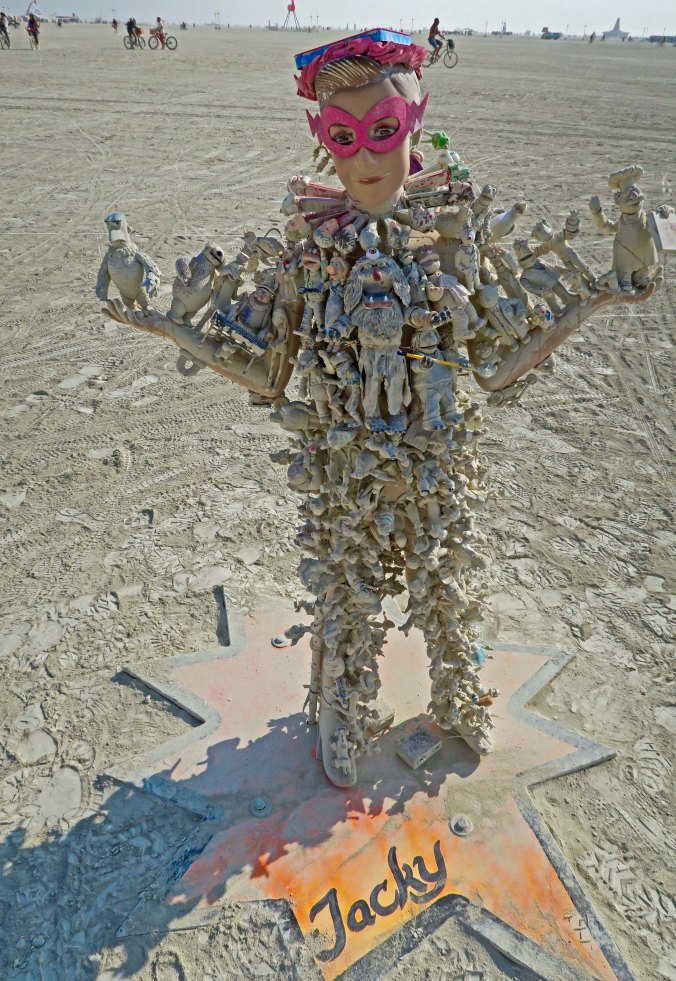
The Action Figure Family members by Jallen Rix turned out to be exactly as predicted. They were clothed in action figures.
“Imagine walking across the Playa and seeing a set of colorful shapes in the distance. As you are drawn closer, you see those shapes to be life-size statues, and the closer you get the more you begin to see that they are all covered in small toys. But not just any toys: hundreds of action-figures of all kinds of styles, backgrounds, comic books, and genres.”
I read this description from Burning Man’s review of 2017 art and knew that I had to go find Rix’s work. I’d missed it on my first ride through the Playa. I was not disappointed. Strange stuff.
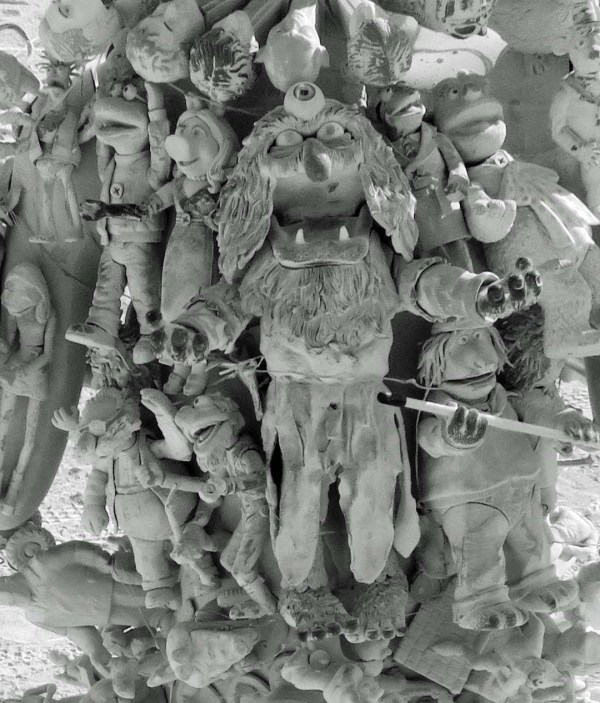
A close look at Jacky’s chest revealed members of the Muppet crew with a covering of Playa dust.

I wandered around seeing who else I could find. I found the Seven Dwarves hiking up the back of another sculpture.

The eye on this woman demanded a photo.

A final view of the action figures, topped off by a duck. Is it Daffy or Donald?
PROMETHEAN PASSION (The Fire Inside) by Matthew Welter of Carson City, Nevada

Promethean Passion by Matthew Welter included this Minute Man, which reflected Welter’s passion for freedom.

Another view.
The first time I became aware of Welter’s work was a Statue of Liberty he had carved for Burning Man. It was an impressive piece, reaching skyward with her torch proudly displayed. Liberty has been a consistent theme of Welter’s over the years. As has been fire. His sculptures are burned from the inside out, but are not allowed to burn completely. Thus creating a new piece of art. This year’s work, Promethean Passion, is named after the Greek legend Prometheus who stole fire from Zeus and gave it to humanity. Zeus was not happy. He chained Prometheus to a rock and had an eagle eat out his liver. Each night Prometheus would grow a new one and each day it would once again be eaten by an eagle. Not nice.
And, in conclusion for this post, four other sculptures.

Mirage by Michael Benisty of Brooklyn, New York.

Man Looking Over Shoulder by Michael Spraker of Capistrano Beach, California.

I think this is “Labor” by Viacheslav Gudenok of Kiev, Ukraine. If not, my apologies. It is a disturbing but powerful piece that reflects our close connection to nature. Our roots, so to speak.

And finally, and I might add, at last, a Burning Woman. It’s about time. I don’t know the artist.
NEXT BLOG: The mystical art of Mystic Camp.
 Wandering through Time and Place