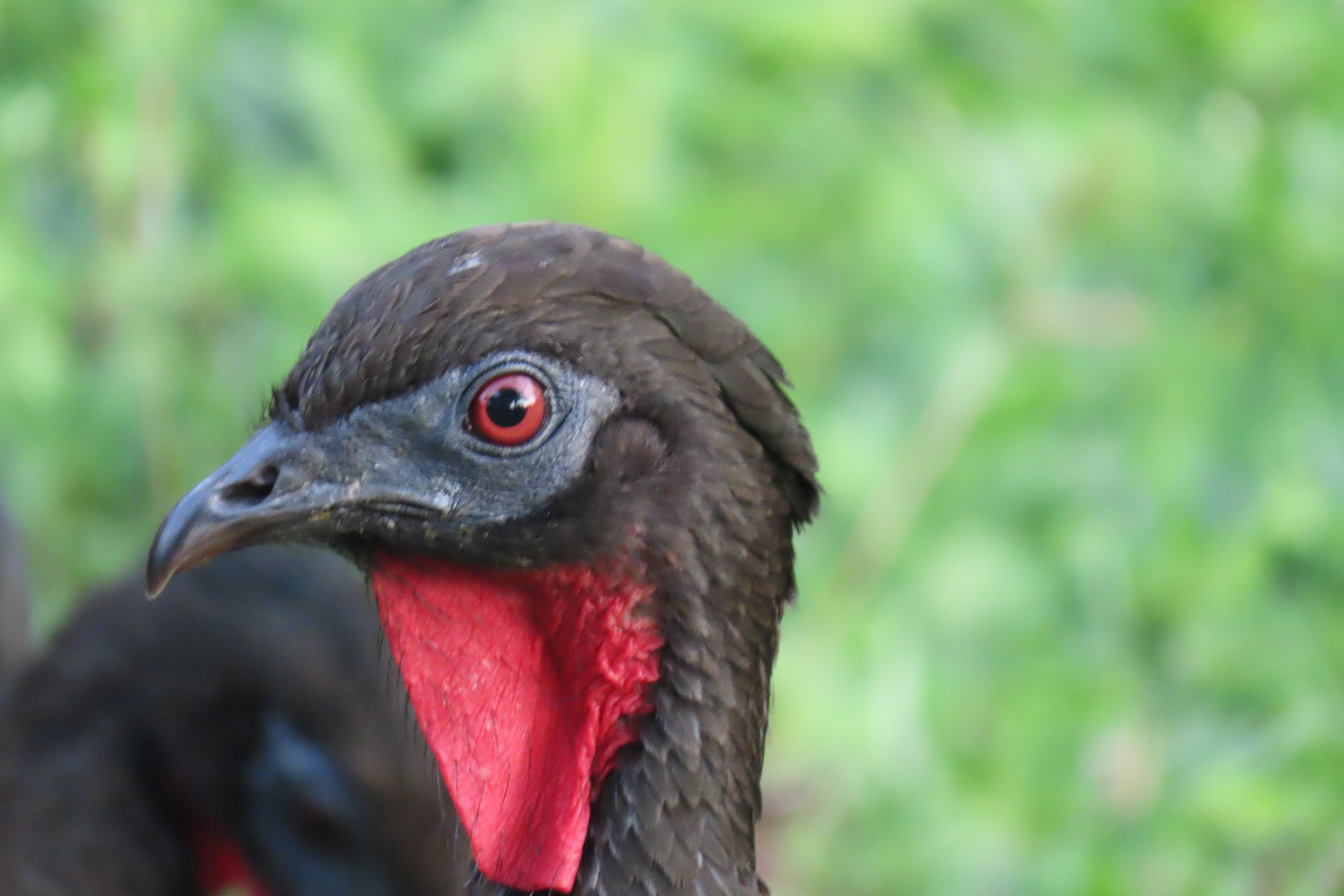
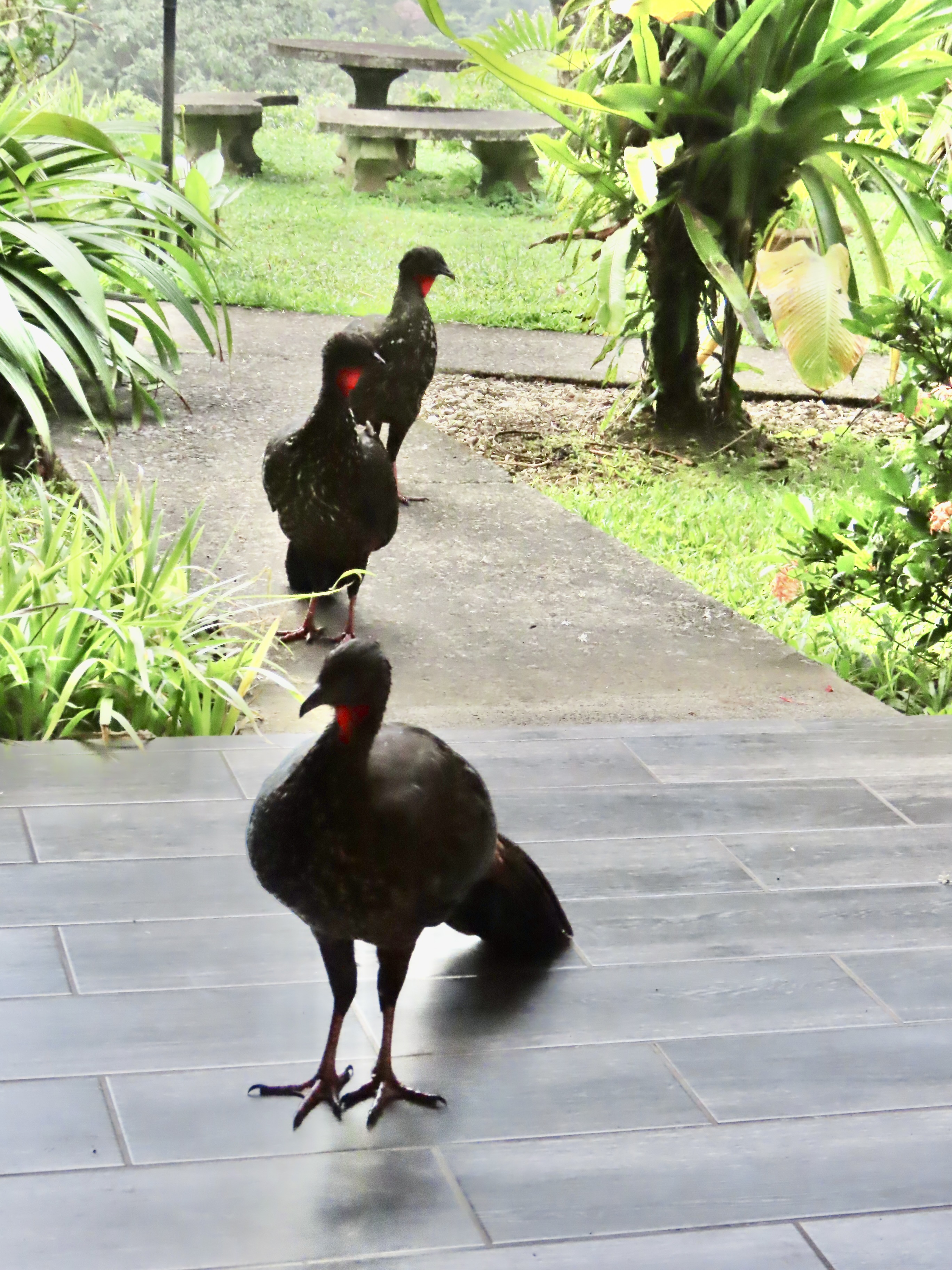
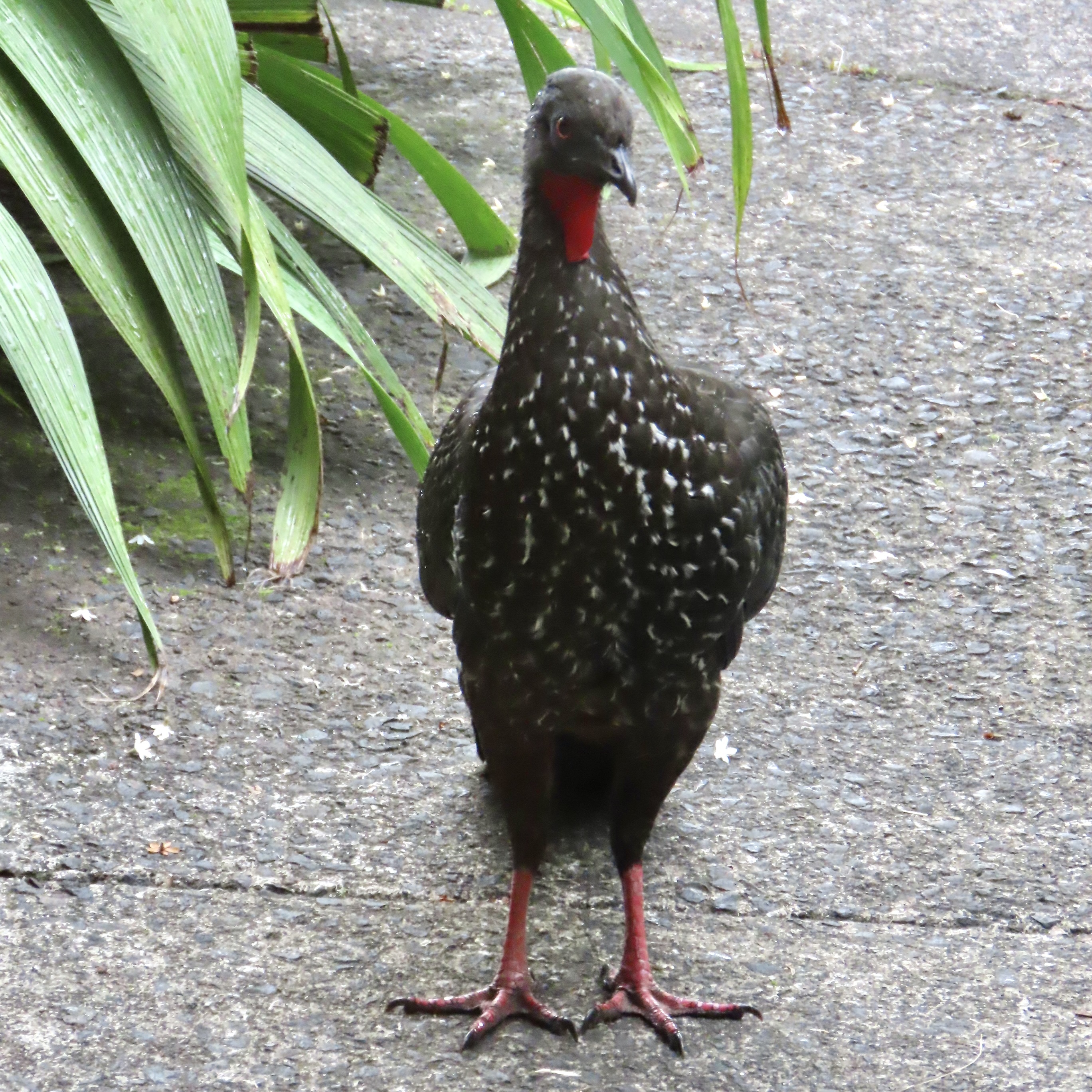
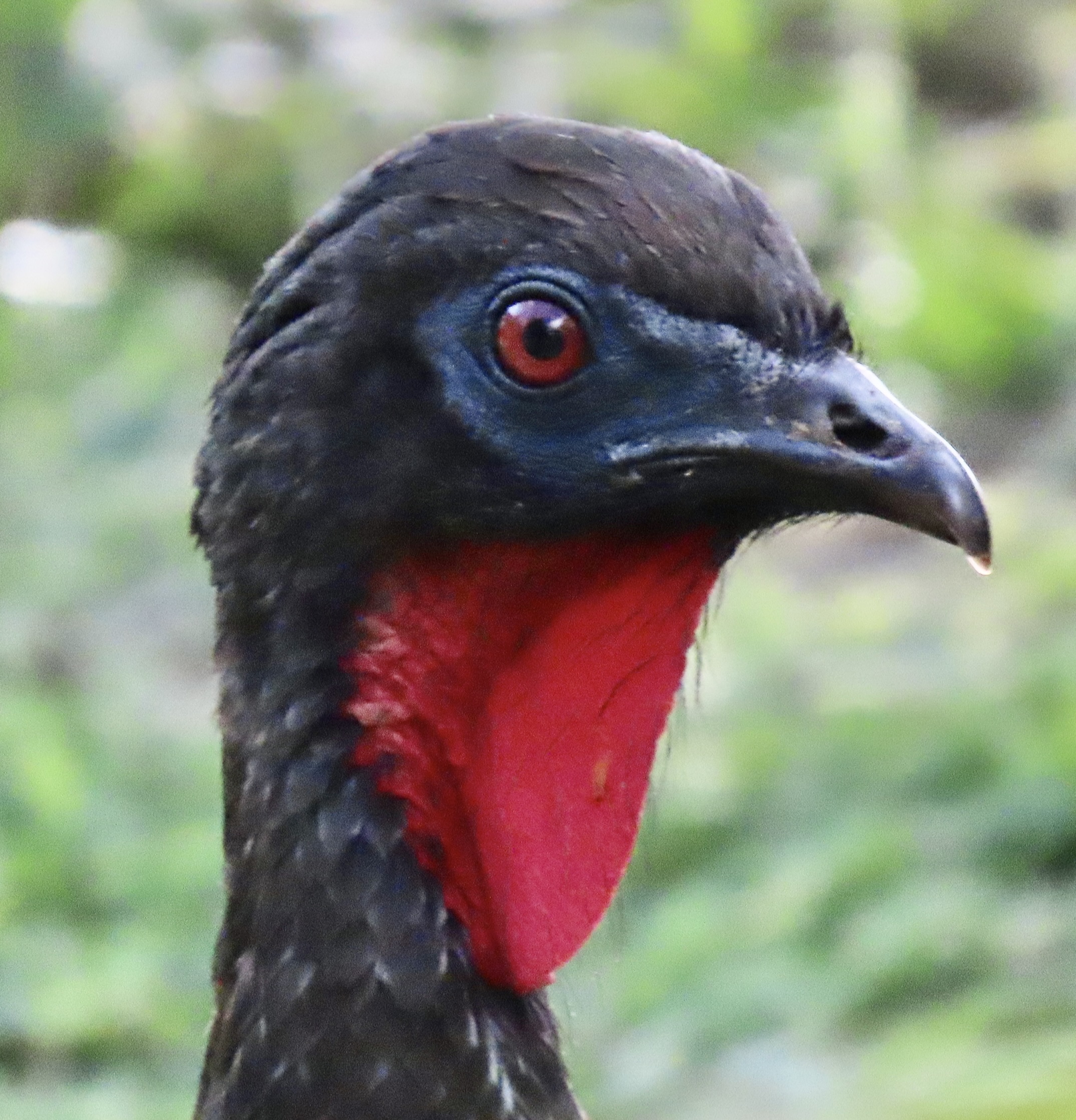
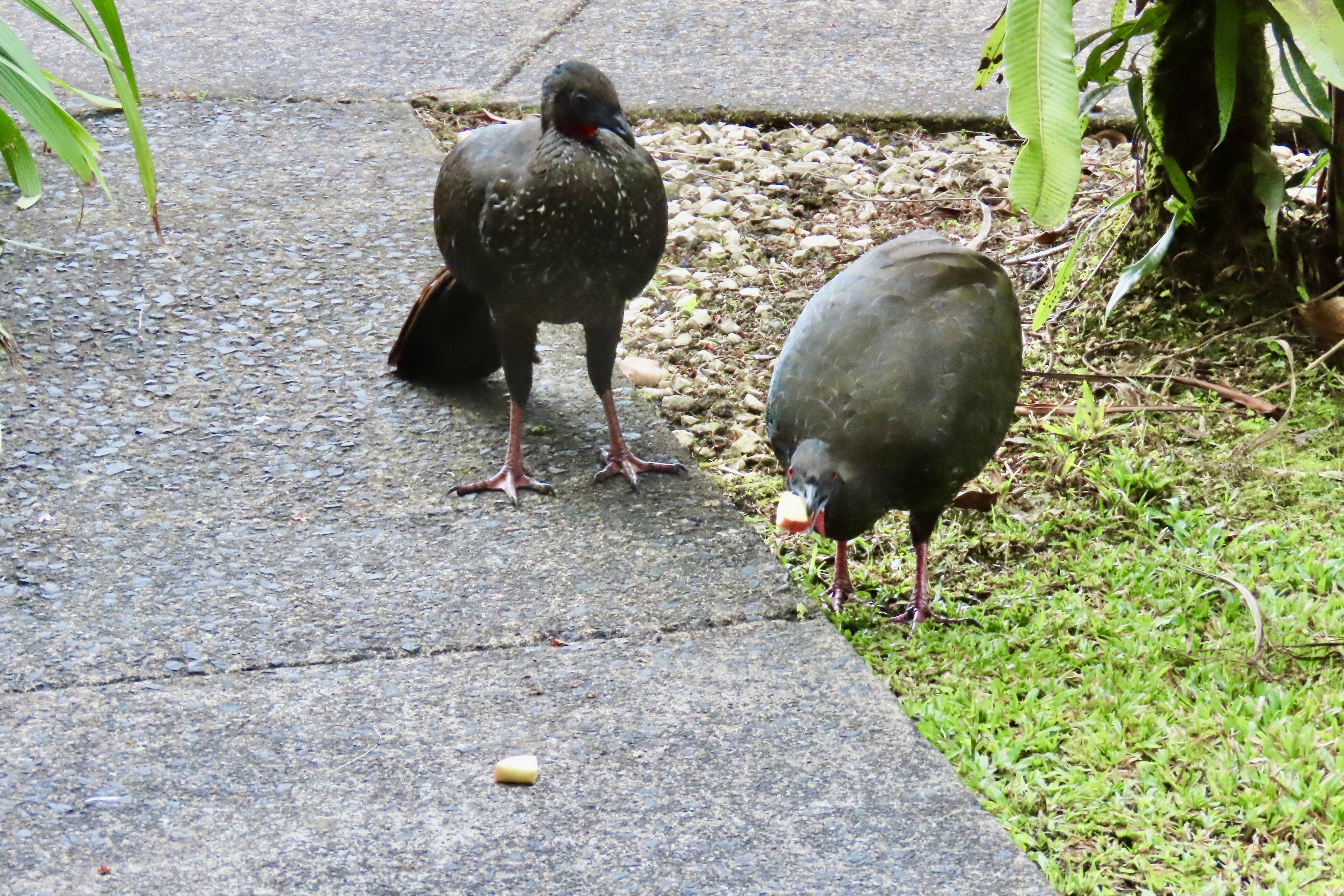
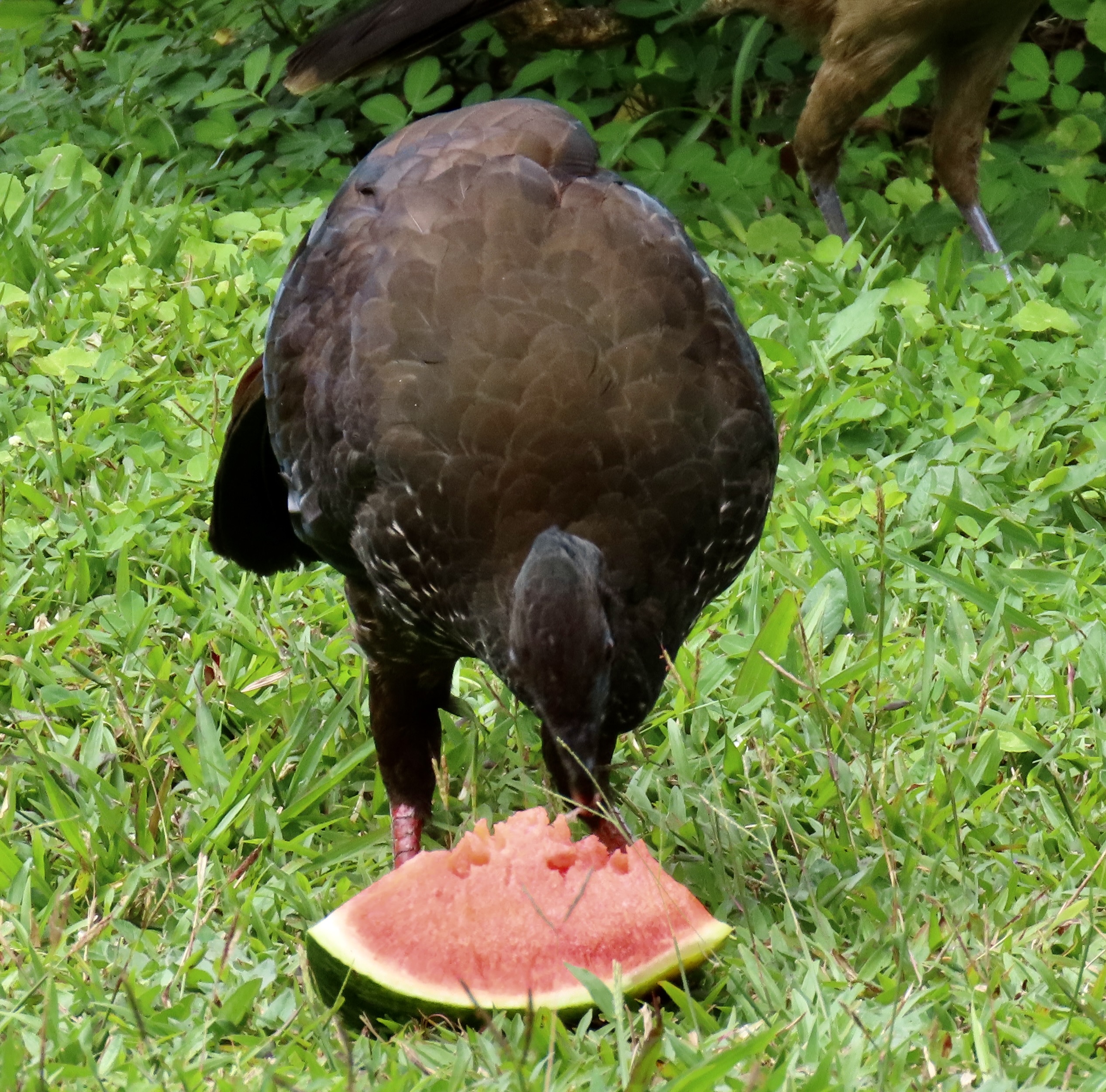
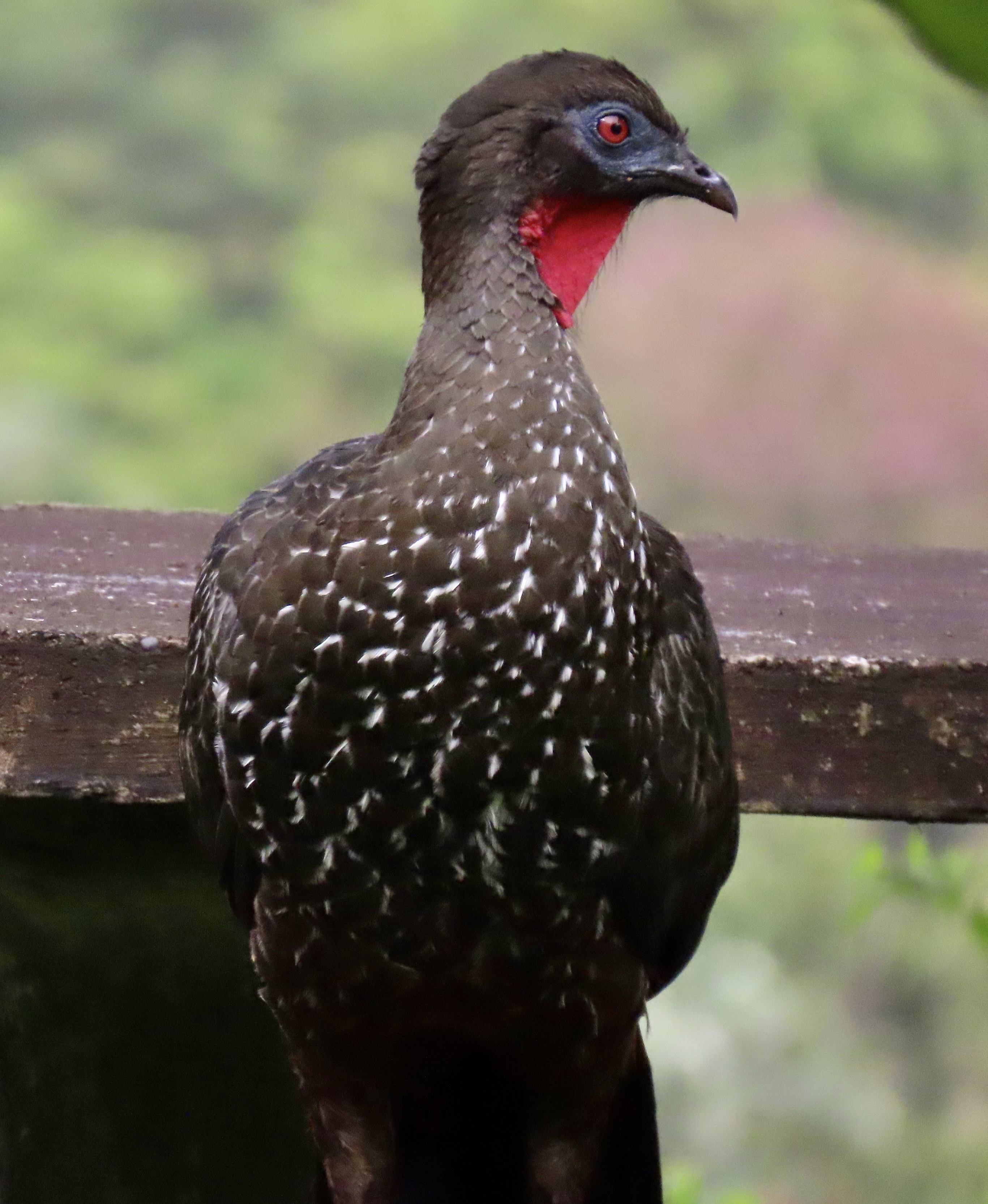
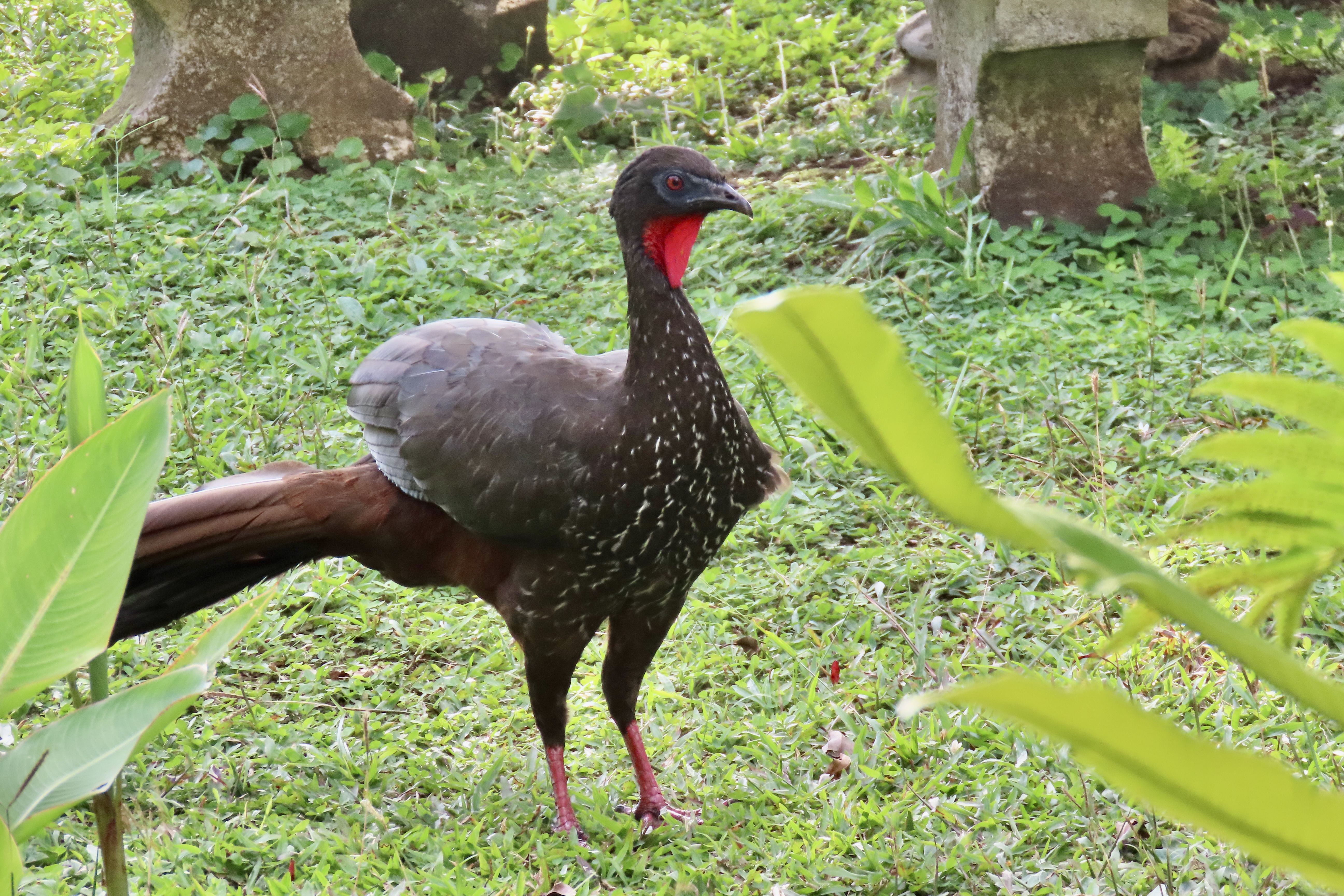
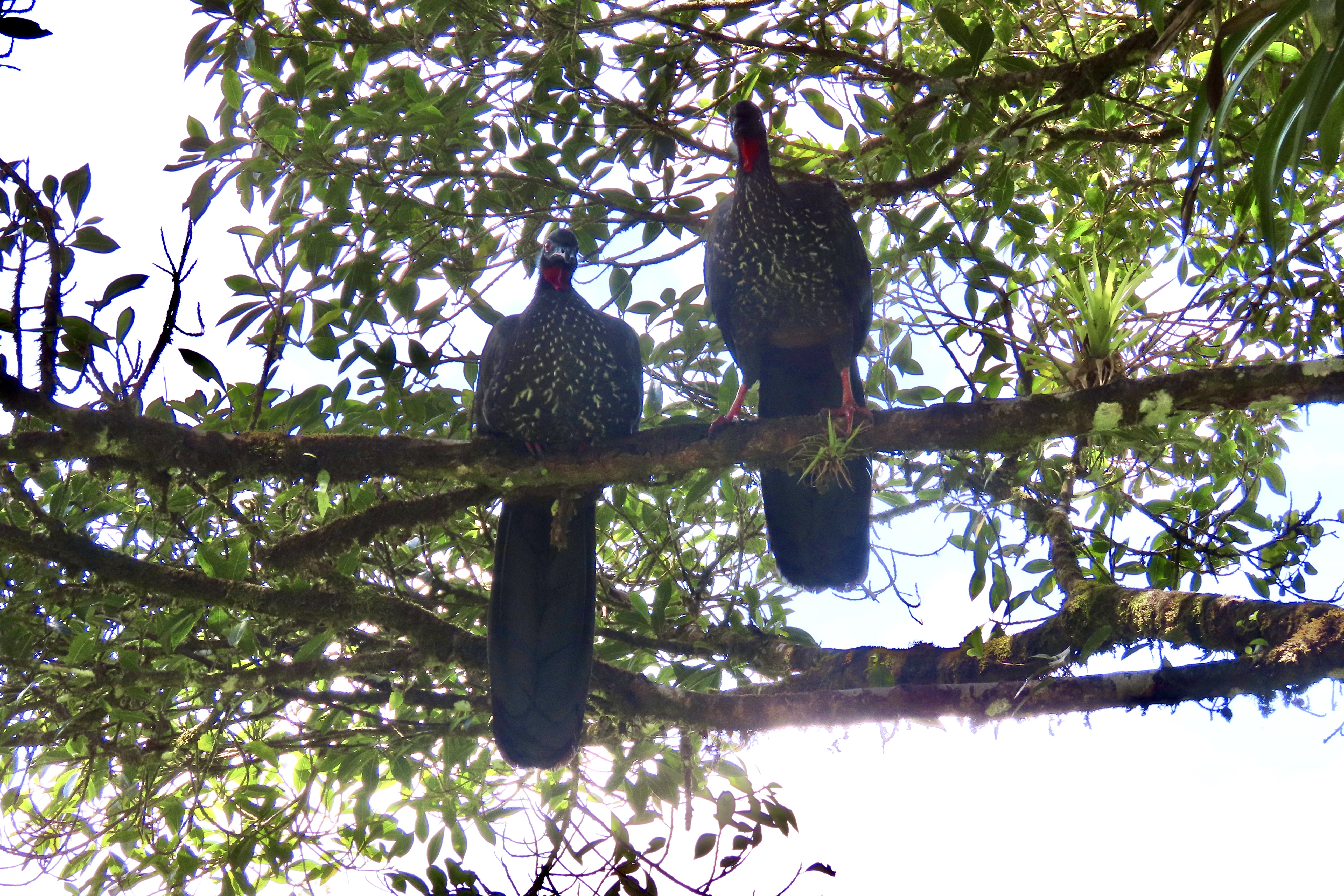
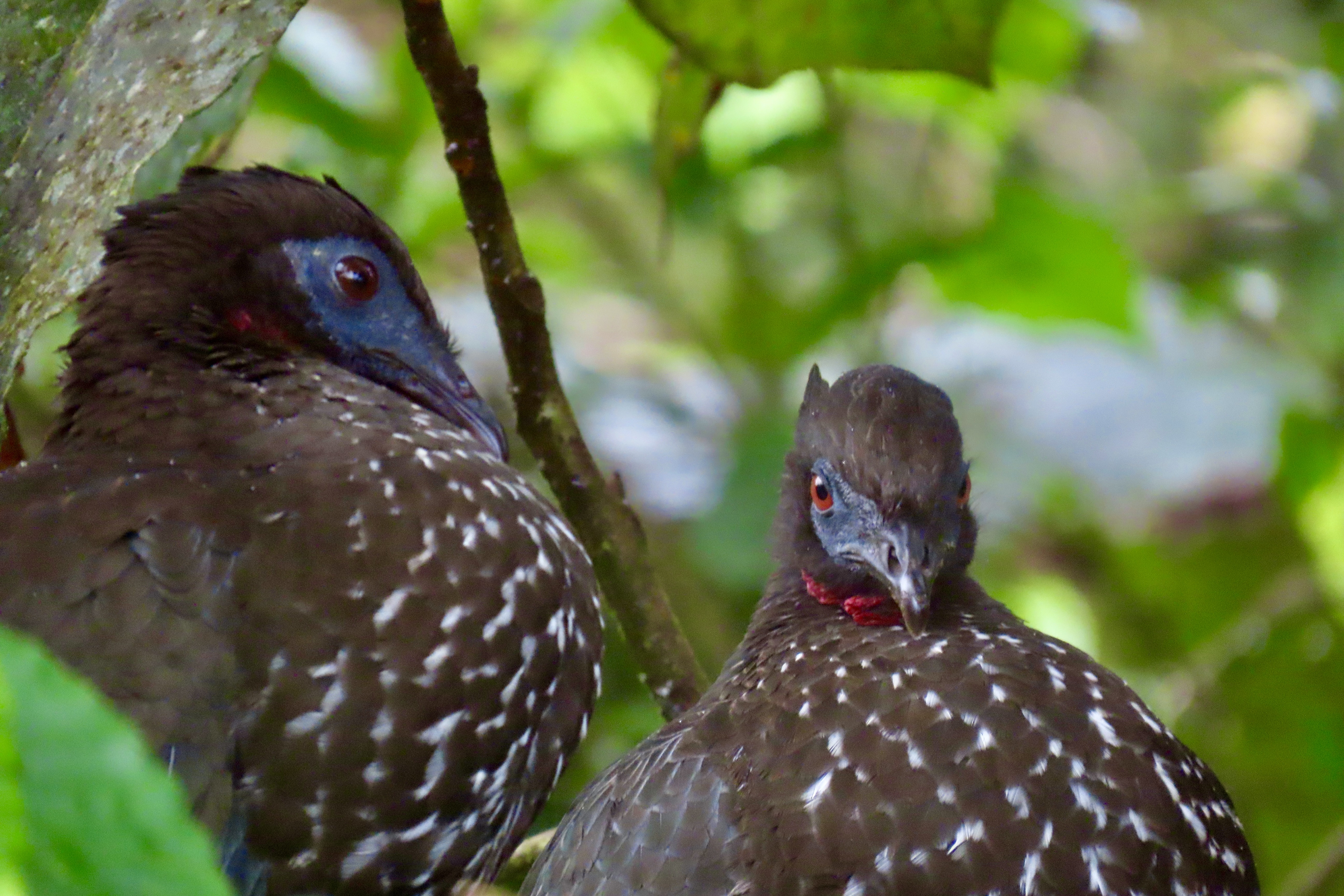
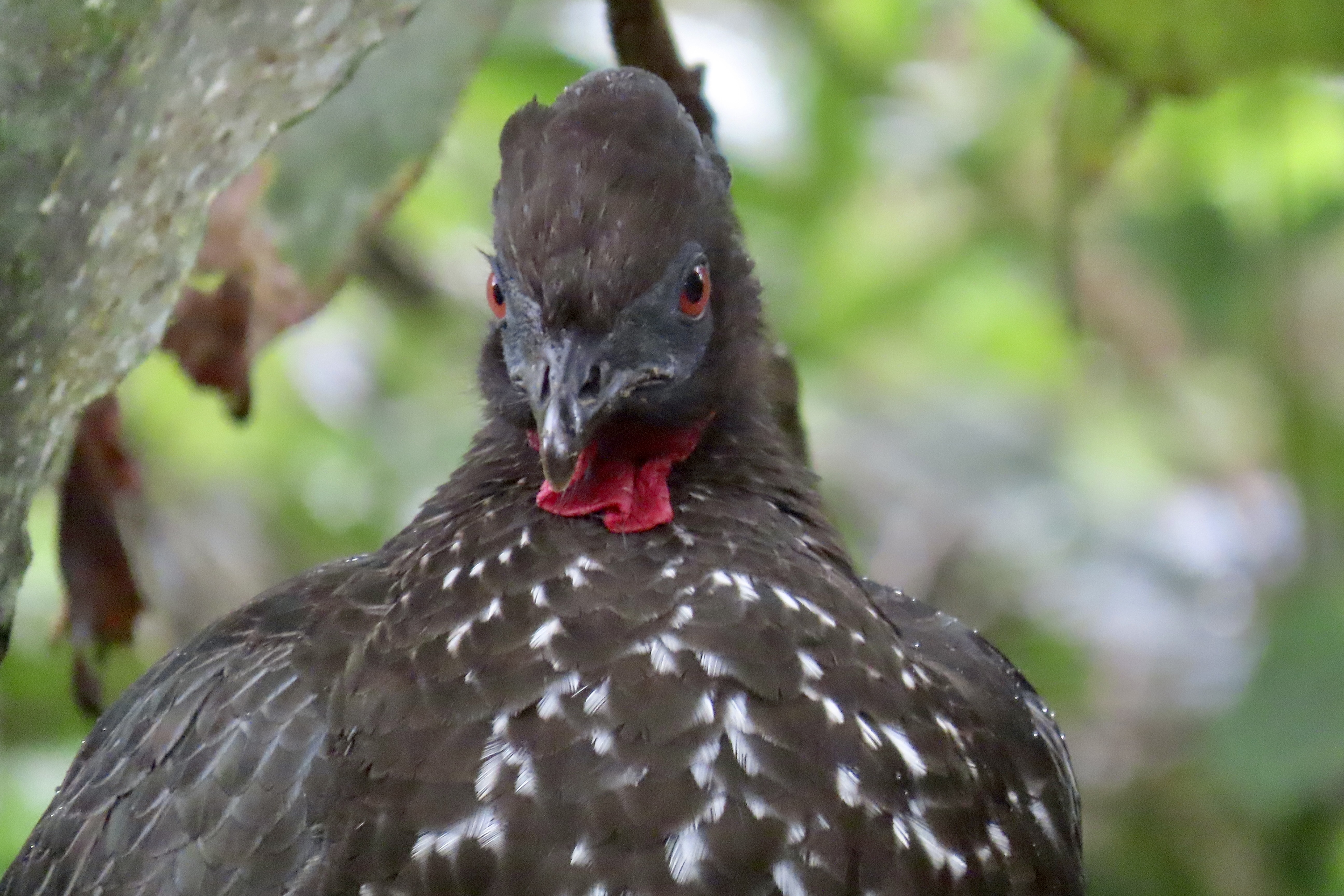
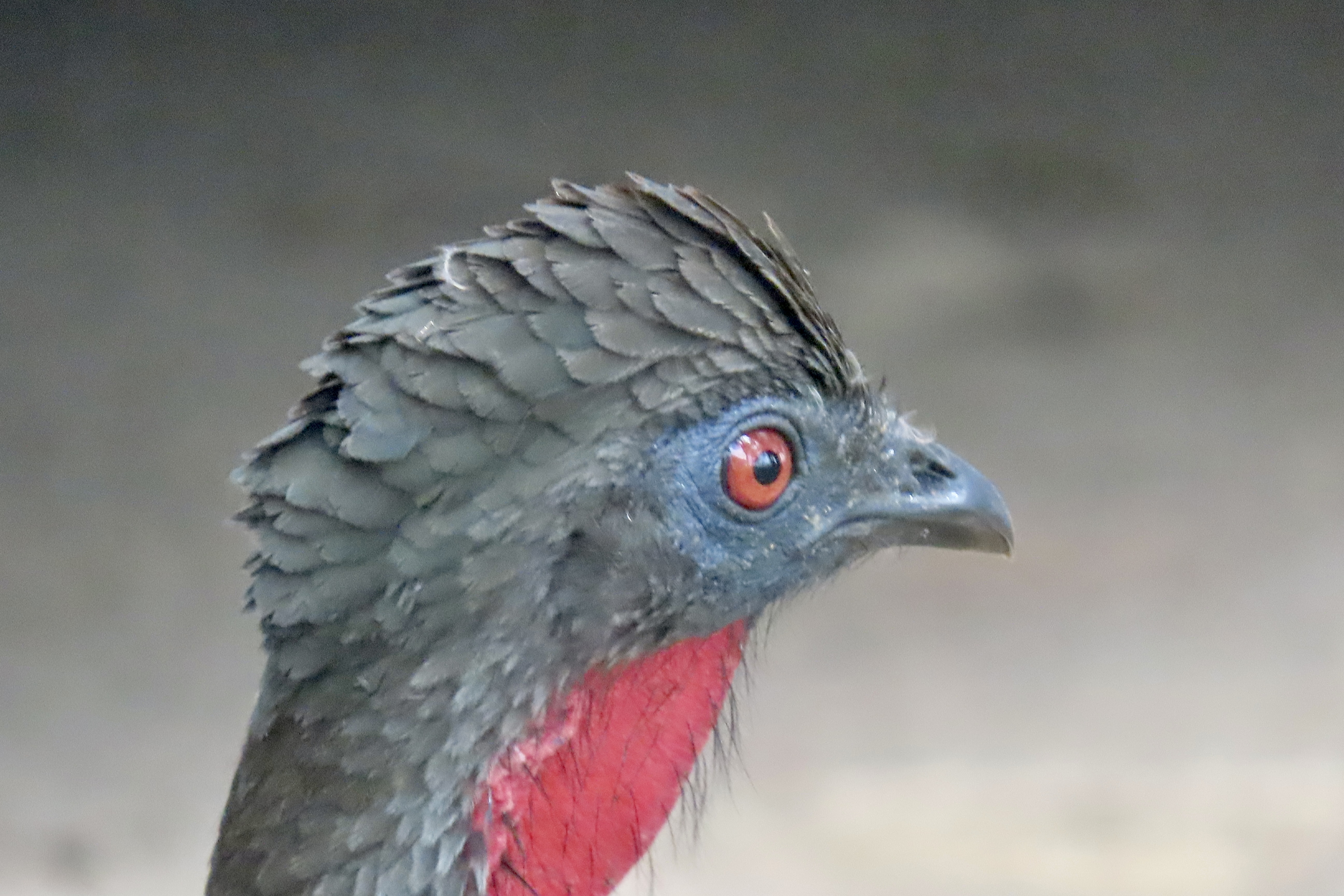
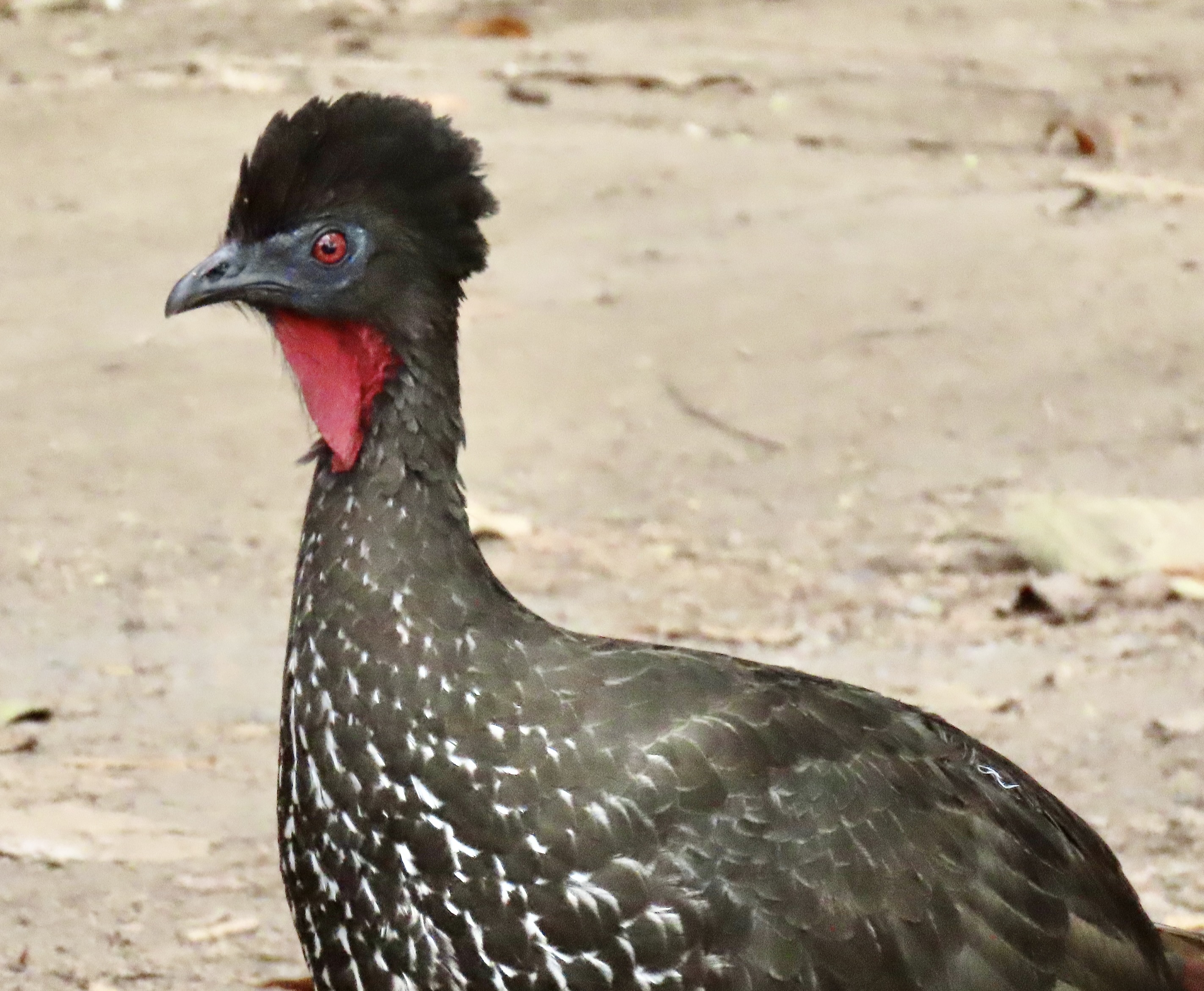
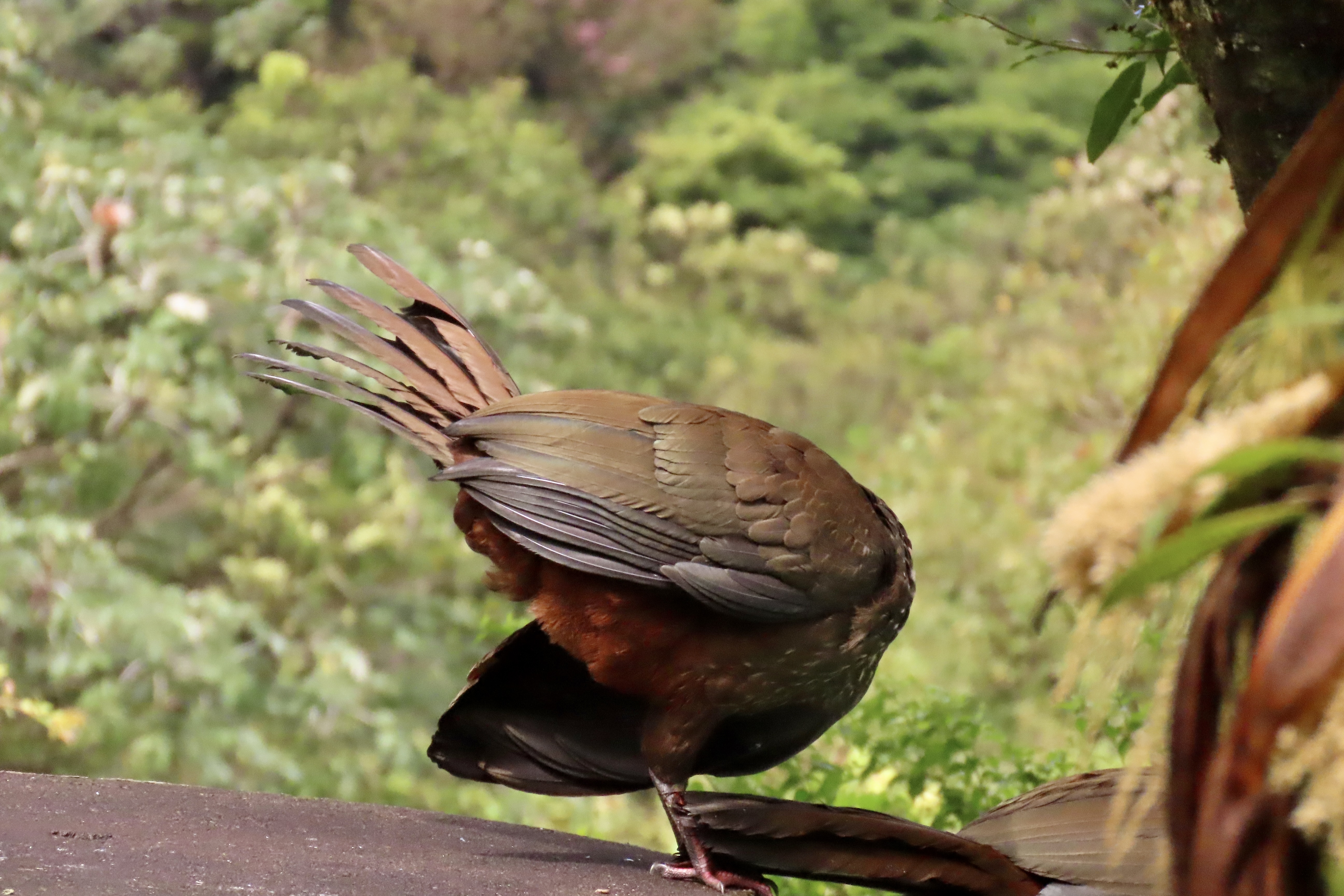
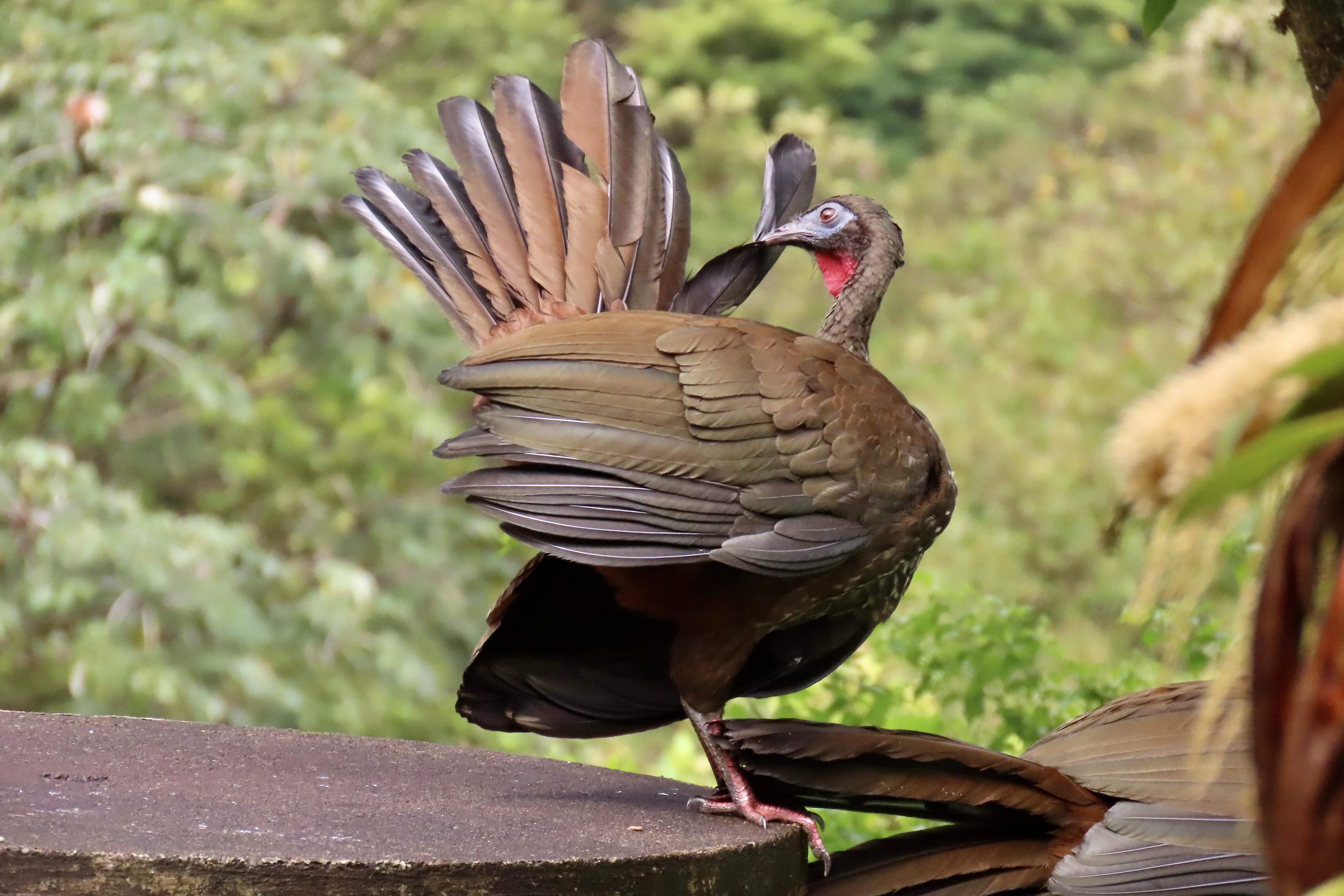
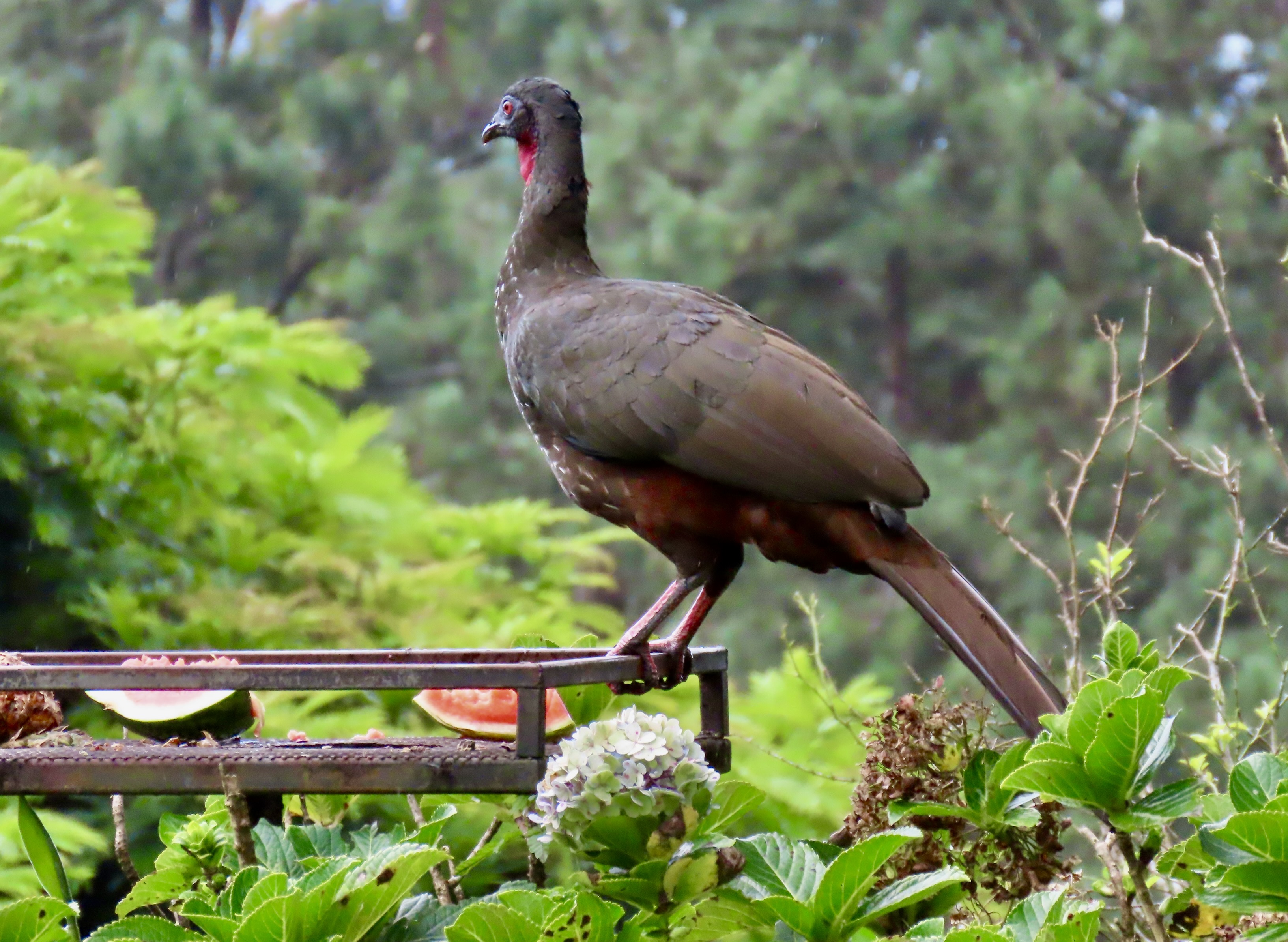
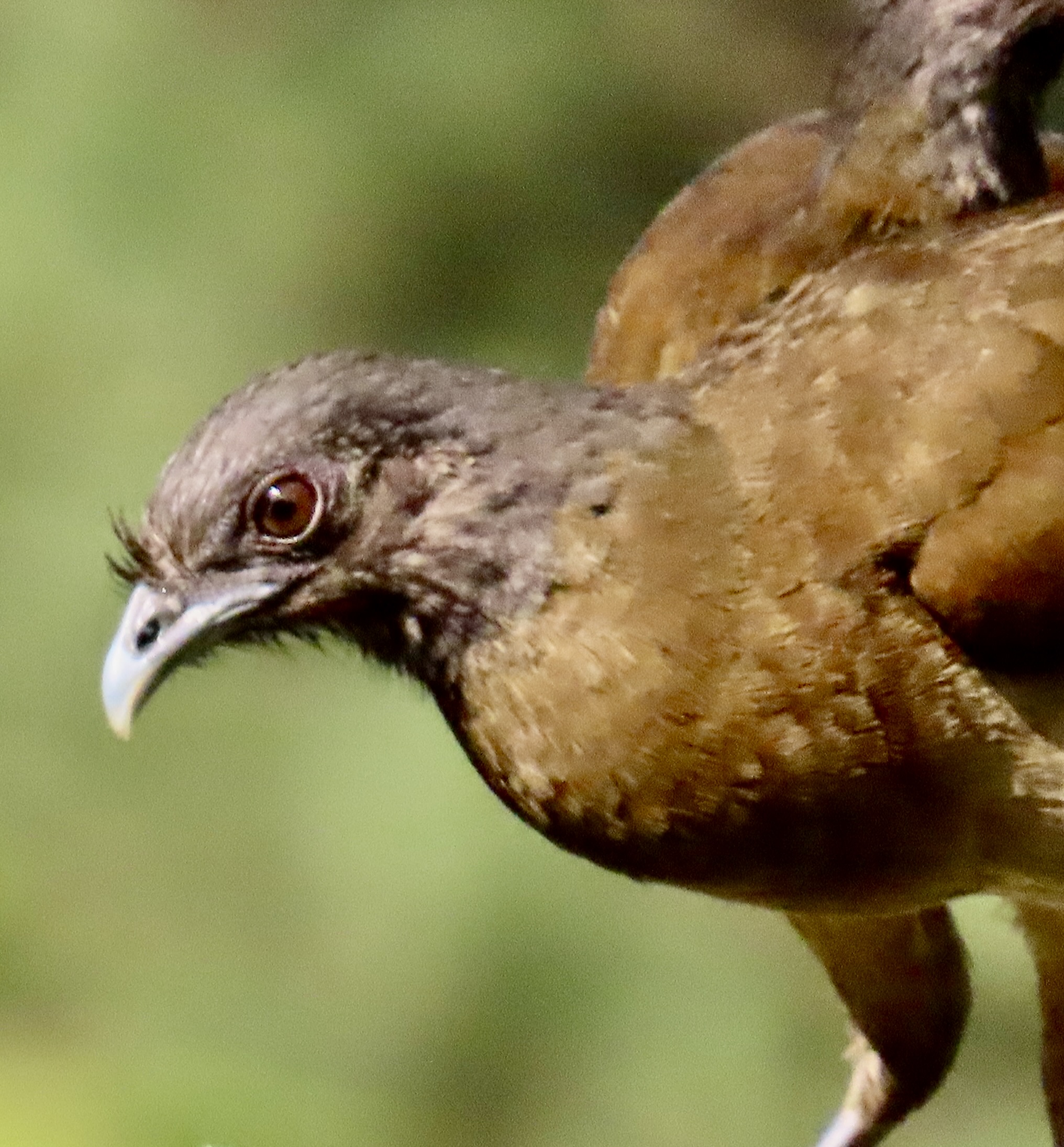
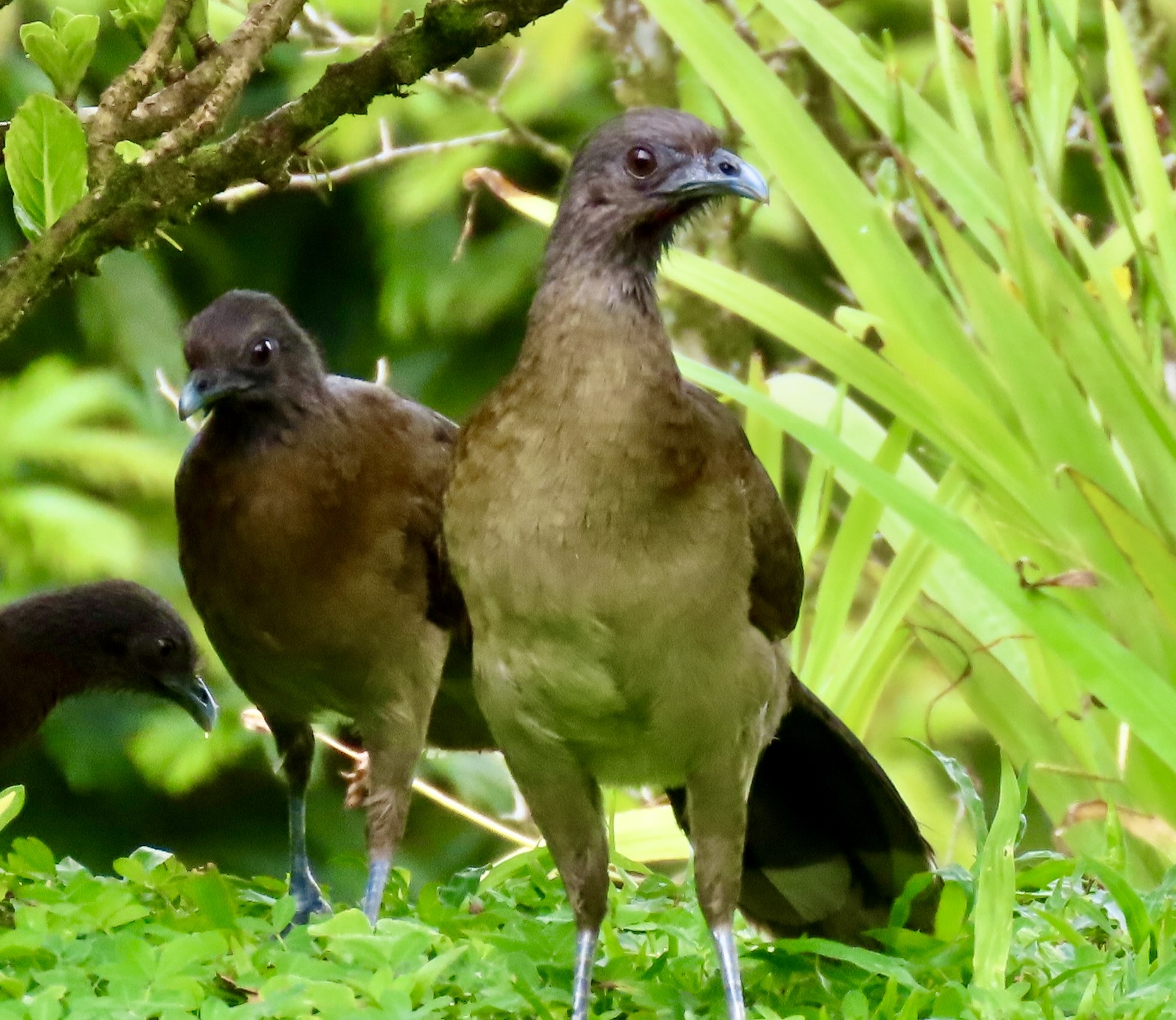
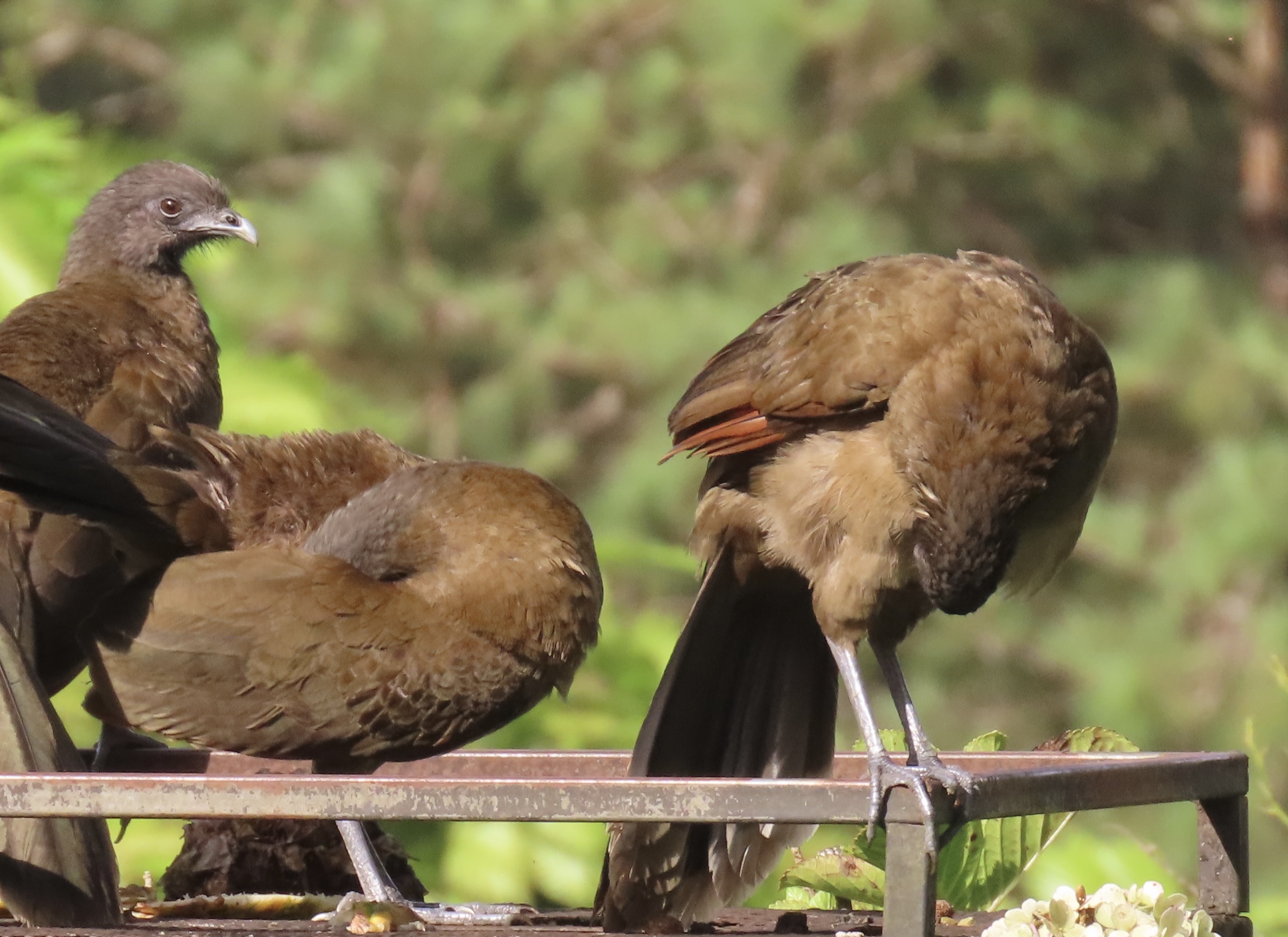
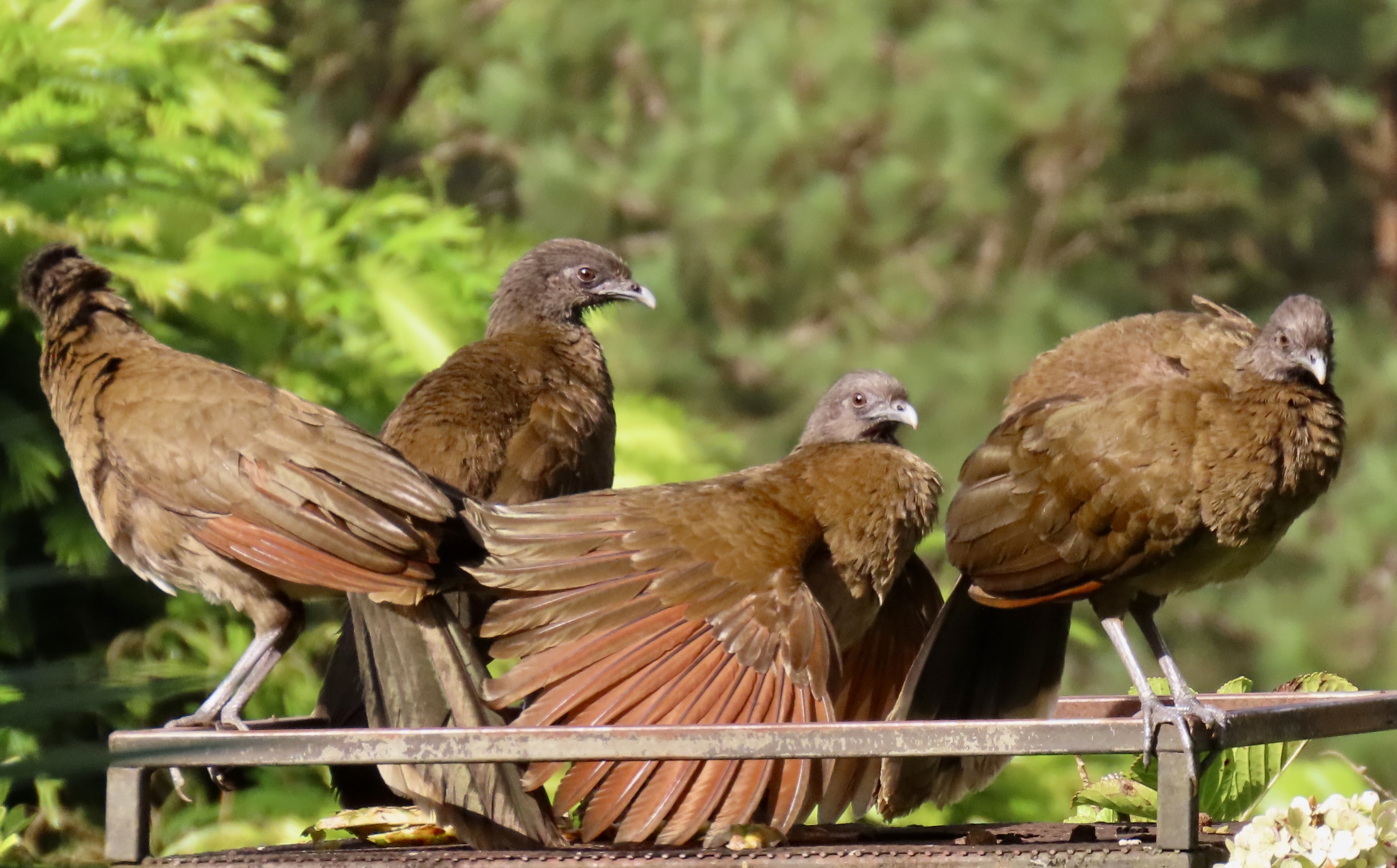
When Peggy opened the drapes on our first morning in Nuevo Arenal, Costa Rica a few weeks ago, this is what greeted her: A hungry Crested Guam demanding an apple, an orange, or a pineapple. We immediately noticed the Guam’s bright red wattle, eyes and long tails. The ‘laidback’ feathers on its head can stand straight up when the Guam is excited. Thus the description ‘crested.’Actually, there were three of them. (They hung out together the whole time we were in Nuevo Arena.) Peggy immediately grabbed her camera and caught this photo of them backlit by the sun. I must say, they were quite polite, just standing there, staring at us.But we couldn’t escape the hungry look. It’s sort of like ‘Feed me or else…’We were soon sharing apples, pineapple, oranges…And even watermelon with our new ‘companions.’Even when they weren’t on our walkway, the Guams monitored our behavior from the lawn and picnic table in front of our Villa.From the lawn. Note its raised wings. I think it was about to chase a Grey-headed Chachalaca that was chowing down on a bite of pineapple the Guam considered its lunch. (See the two videos at the end of today’s post.)They also watched us from the trees behind the villa. Note the long tails.They could see in our back window…A close up.We met this Guam on a hike by Lake Arenal. It was preparing to show off its crest.In full display! “Aren’t I beautiful/handsome.”Some grooming is required. For birds, it’s called primping and is used for feather maintenance.Even down to keeping them oiled! Is the other Guam massaging its legs with its tail feathers? It’s obvious that these big birds like each other, in fact they are monogamous. But I doubt that includes tail-feather leg massages. (Any Guam experts out there that would know?)The primary dining room for the Guams and all of the other fruit eating birds in our neighborhood was a bird feeding table that we and our neighbors kept supplied. Fortunately, it was right in front of our villa. We could sit inside or on our porch and take bird photos all day if we wanted to. You’ll be seeing a few…
Normally, the crested Guams (Penelope purpurascens) are not as tame as the ones that have found an endless supply of food at the Lakeview Villas where we were staying. Nor are they ground dwellers, preferring to live high up in the forest canopy and feed off of fruit they find up there, like the figs from the ficus trees we featured in our post last Monday. Similar to the Gray-headed Chachalacas (Ortalis cinereiceps) that you will meet next, they are members of the long-tailed family, Cracidae. Above them on the animal classification system they are also related to chickens, turkeys and other Galliformes, which is hardly surprising, given their body shape. They range from Mexico in the north to Ecuador and Venezuela in the south.
The smaller Chachalacas look a lot like the Guams minus the wattles and crests. At first we thought they might be their kids, especially given their obvious love of fruit. Closer inspection and a little research quickly defined them as a different species. Beyond looks, another defining characteristic is that they travel in groups ranging in size from 6 all the way up to 20. Ours was around 12. When these large birds make their way through trees, they sound like a herd of marauding elephants (slight exaggeration, but they are noisy.) It’s said that their name, Chachalacas, is derived from a sound they make early in the morning and late in the evening. We didn’t hear it in Nuevo Arenal, but I did one evening in Monteverde. I love the name.
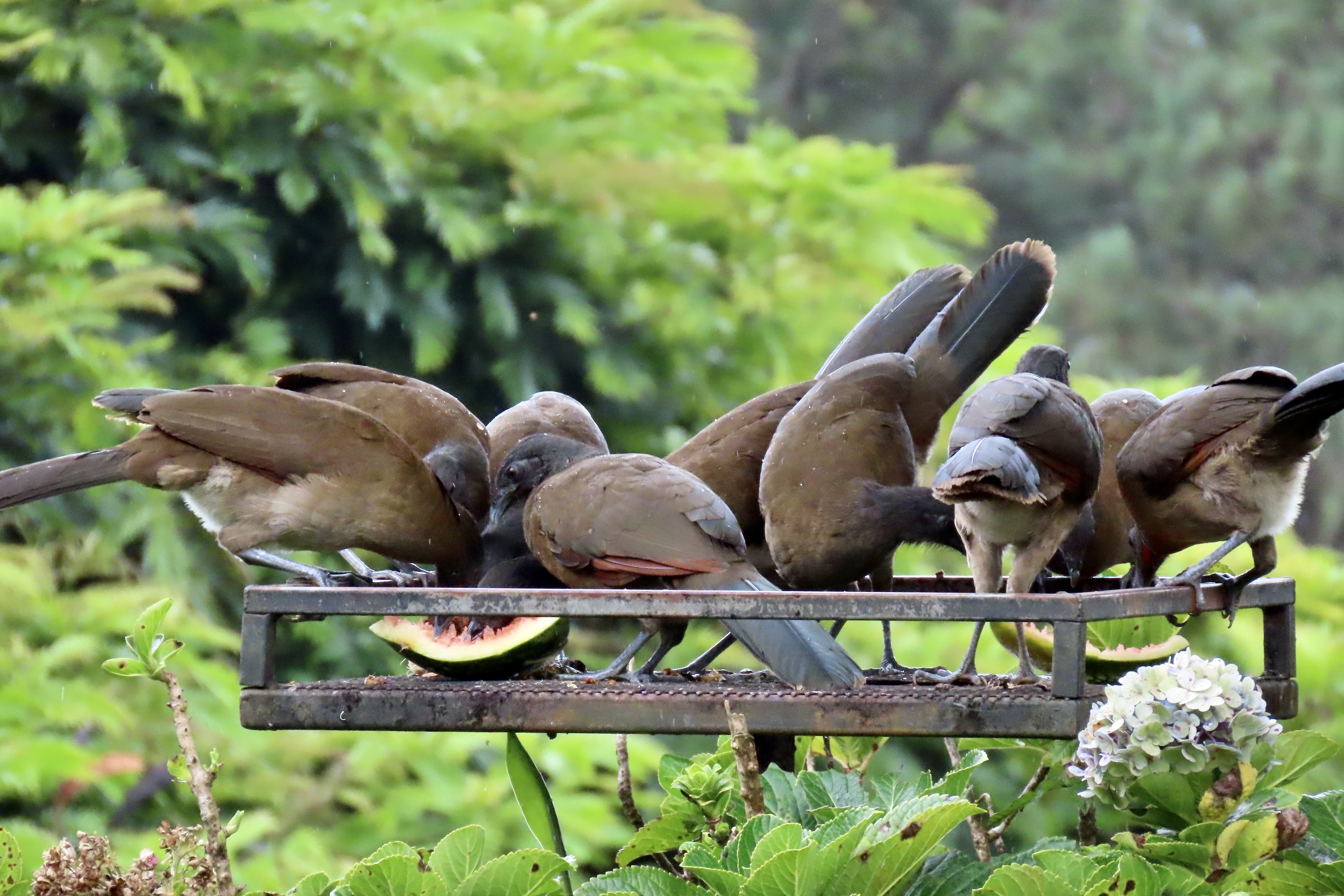
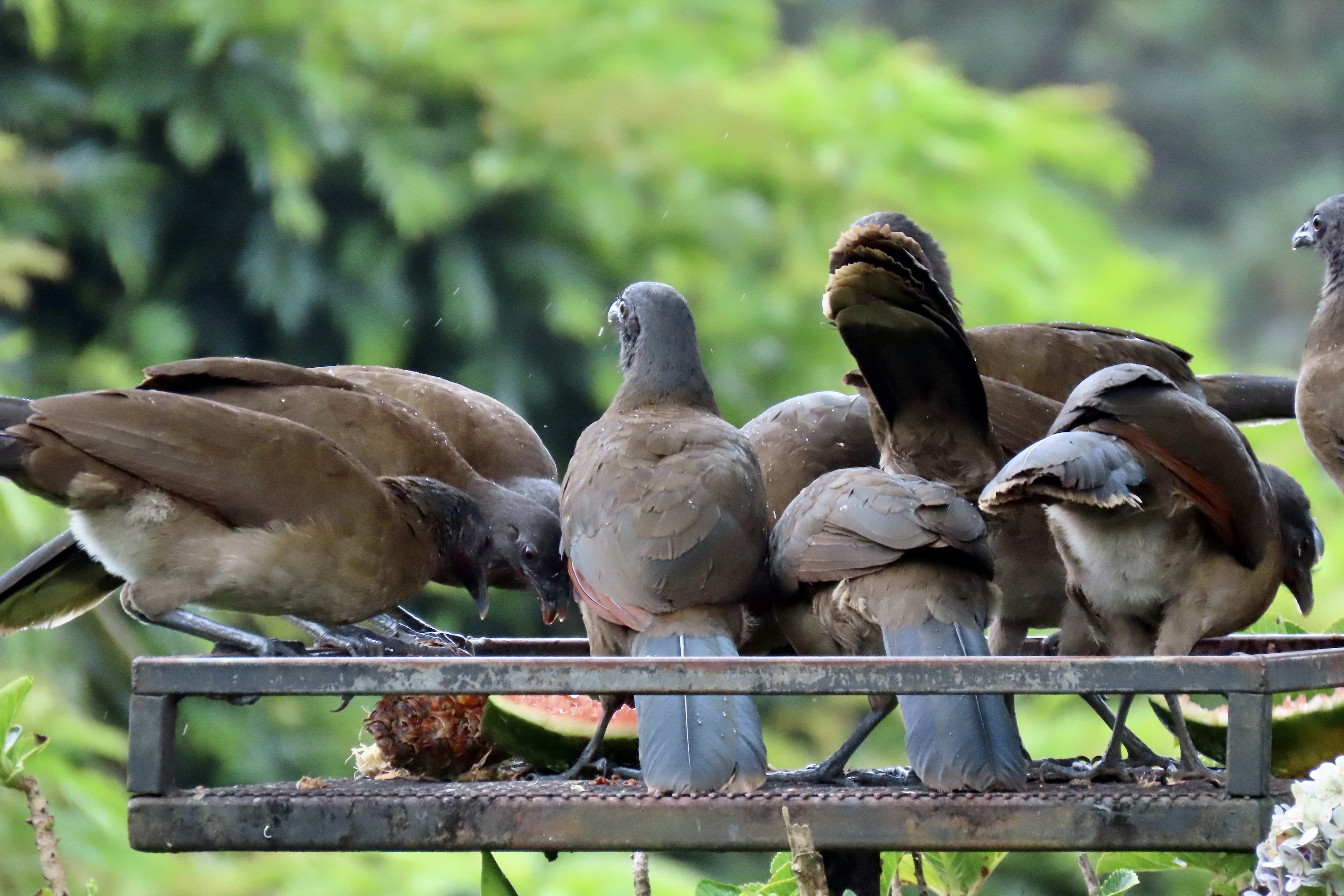
The ‘here’s looking at you’ pose of a Chachalaca. Impressive nose hairs.Another perspective.They would arrive at the food station en masse. Any fruit was quickly disposed of…Tails down and looking around, at half mast and breaking fast, fully up and having sup. (A little humor for my poet friends who follow this blog.)Grooming/primping Chachalaca style. Were they getting ready for a group photo?Maybe. Grin. You may wonder what the Crested Guams felt about the Chachalacas showing up and gulping down all of the fruit. The following videos will give you an idea. The first demonstrates the greed of the Chachalacas at the food table and the Guams’ response. The second shows what Peggy and I found to be a rather hilarious chase scene where the Guam kept losing track of the Chachalaca it was supposed to be chasing! (Click on the photos.)
BTW: Wednesday’s UT-OH! Post is on “first dates and squashed skunks!”
As you might have expected the Guams had little tolerance for the Chachalacas scarfing down the fruit!
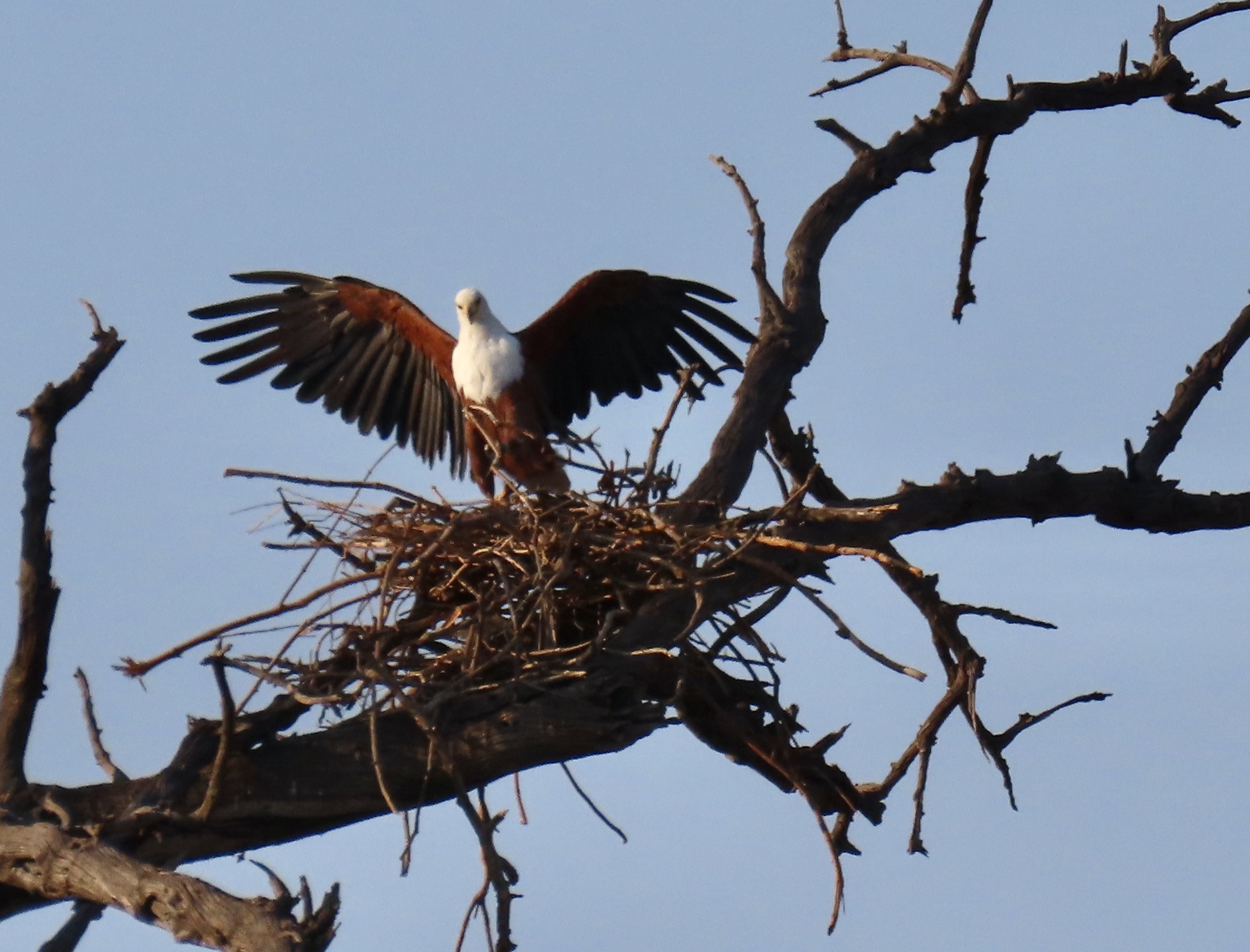
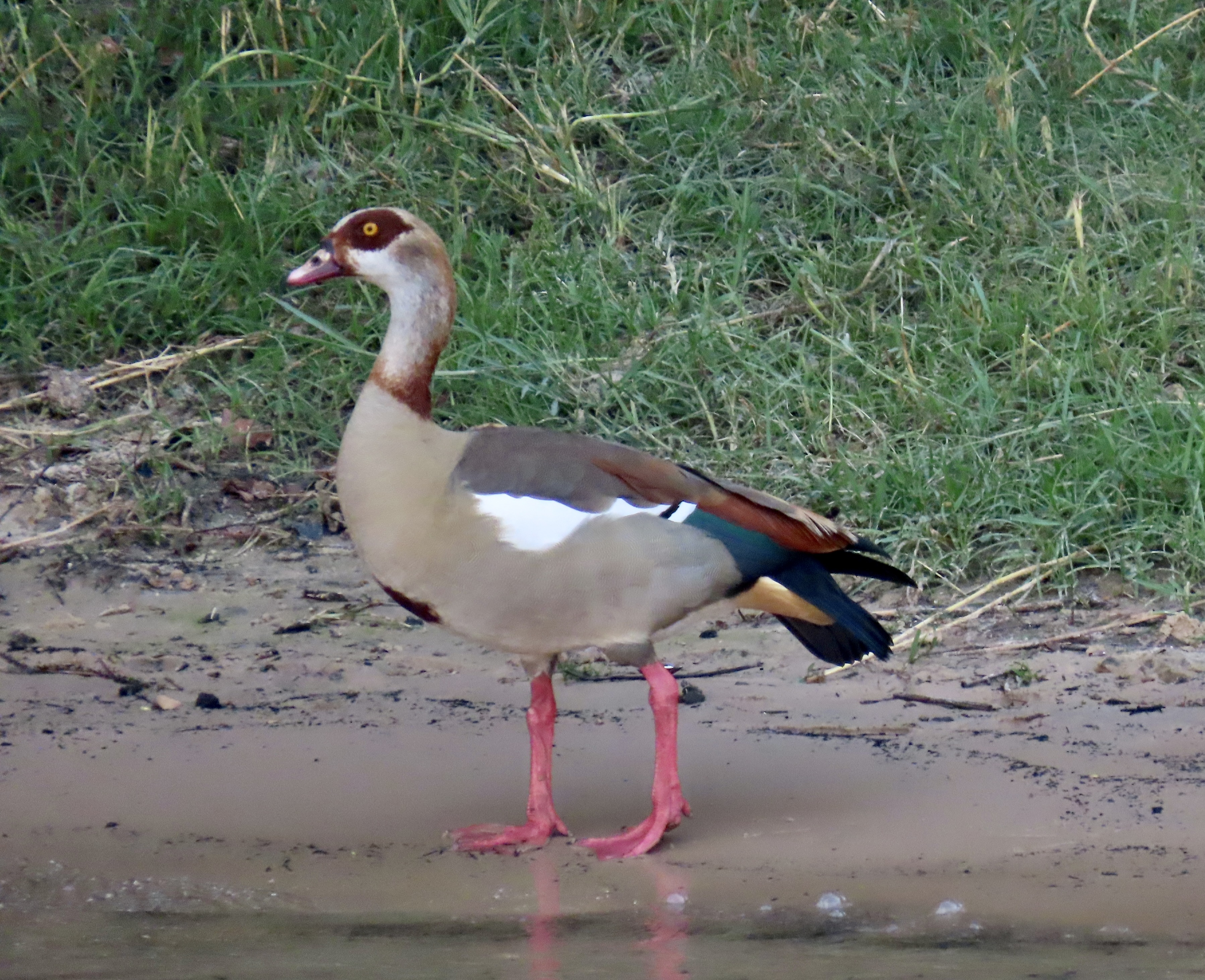
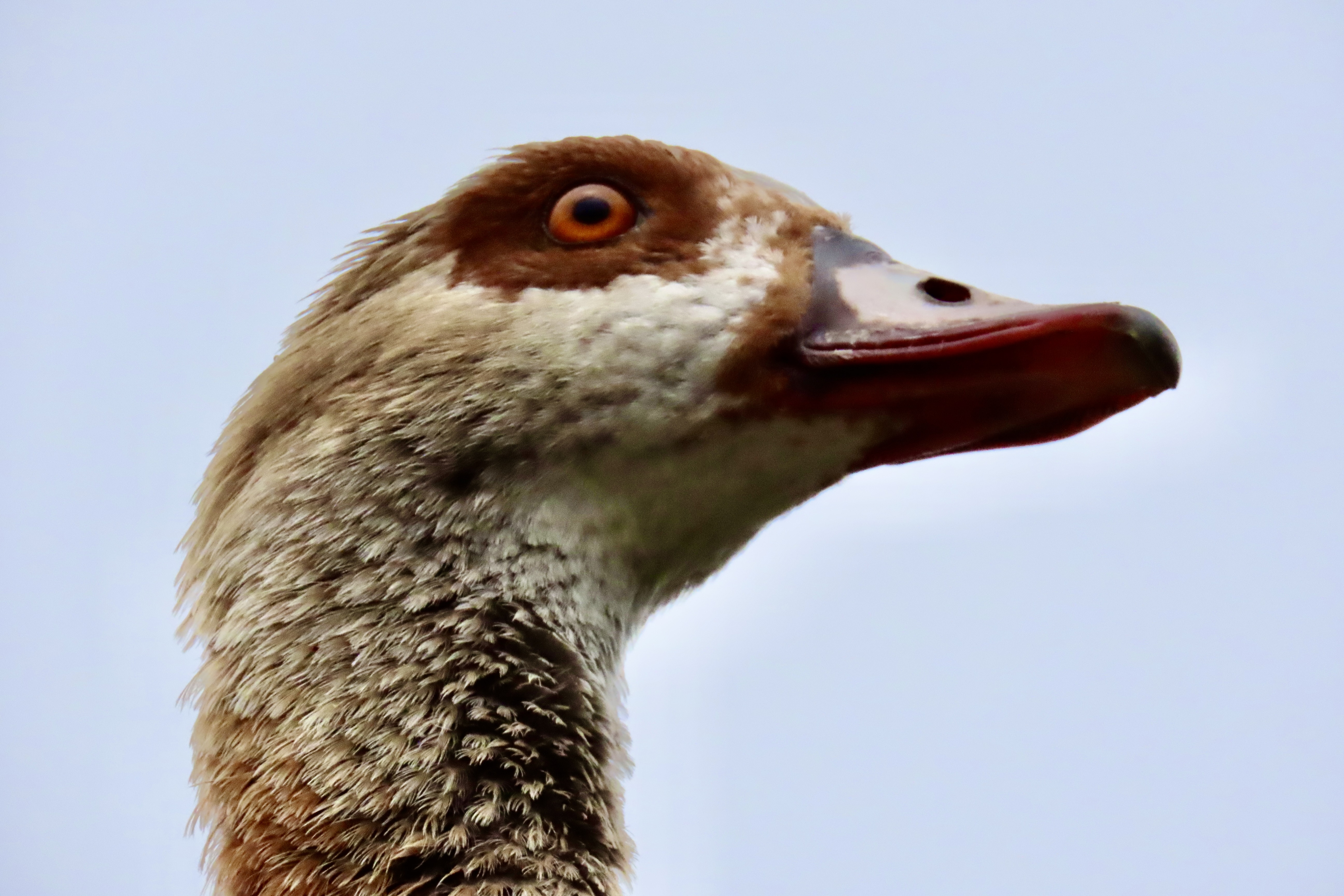
This stunning bird is an African sea eagle. Not surprisingly, it is the national bird of Malawi, Namibia, Zimbabwe and Zambia. Its national status, white head, and diet of fish immediately reminded us of America’s bald eagle. We had one that lived near our home in Oregon that flew by on occasion, looking for breakfast along the Applegate River. We watched it vary its diet one day, dive, and take a snake out of our yard, a very unhappy snake. The African fish eagle goes for reptiles on occasion as well. It has a taste for baby crocodiles. It also eats carrion like the bald eagle, but not with the same passion. When I lived in Alaska, I watched bald eagles tear into dead (very smelly) salmon with delight. I found it amusing that Ben Franklin felt that the eagle’s dining behavior gave it ‘bad character,’ and argued that the turkey should be the national bird of the fledgling nation.Another perspective on the African fish eagle. The chestnut color on its wings adds to its beauty.Sea eagles are thought to mate for life. We watched one in the distance as it added sticks to its nest. They tend to use the same nest year after year, adding on to it each time creating bigger and bigger homes that can reach over 6 feet in diameter.It then provided us with an opportunity for an iconic photo. We thanked it.We caught this photo of a juvenile fish eagle perched on a rock next to Lake Kariba in Zimbabwe.We have a copy of an Egyptian Goose painting on our wall that I brought back from our trip up the Nile a year ago. The original is in the Egyptian National Museum and came from a temple where it was painted over 4000 years ago. It was considered a sacred bird. I doubt this goose (which is actually a duck) is aware of its ancient history, but it does seem to be aware that it is a ‘pretty bird.’While the Egyptian Goose’s natural home is on the Nile and throughout sub-Saharan Africa, its striking good looks have led it to be imported into England and a number of other nations where it is now found in the wild.Egyptian Geese form strong bonds and mate for life. We saw a number of couples. These two on the edge of Lake Kariba seem to be marching in unison.We were in a park in Cape Town, South Africa when we came upon a gaggle Egyptian Geese.A lone goose was perched above the gaggle, possibly on guard duty.I snapped his photo. That’s it for today. On Wednesday we are going to feature the Naples’ Florida Botanical Gardens. On Friday, it will be all about crocodiles! We will be deep in the Everglades for the next few days and without an internet connection. I should be back online Thursday.