
When you choose to depart from familiar well-known roads, it helps to have some idea of what you might be facing, and be prepared. I loved this ‘fill in the blank’ sign I found in Northern Quebec.
Peggy and I stopped at the Information Center in Saguenay with a specific purpose in mind. We wanted to find out about the road conditions for our trip into Northern Quebec following Route 167. Was there still snow? Would the dirt sections of the highway be knee-deep in mud? What services existed along the road?
“The road is fine,” the young woman at the Information Center assured us, looking at me like I was a nervous-Nellie city slicker who rarely made it beyond the confines of his city and would freak out if he couldn’t find a ‘ within ten miles.

A sign not usually seen by your everyday city dweller in the US. It is the third ‘watch out for moose’ sign I’ve shown in this series. The first featured a moose, the second a moose and a car. This one on Route 167 in northern Quebec was a bit more graphic.
“My boyfriend lives in Chibougamau (the farthest north we would travel) and drives down to see me every week.” As if that was supposed to convince me. Love does strange things to us. Something in my look must have caught her attention. She changed her tack.
“Well the road may be much rougher than you are used to in the US,” she said solicitously in her best Information Center voice. She didn’t want a couple of grumpy tourists complaining that they had been misled. I laughed. It was a ploy I had used many times on the nine-day, 100-mile backpack treks I had led. Inexperienced backpackers invariably wanted to know how tough their day was going to be. It was always best to error on the side of difficulty. Otherwise, they blamed me if their day was harder than expected.
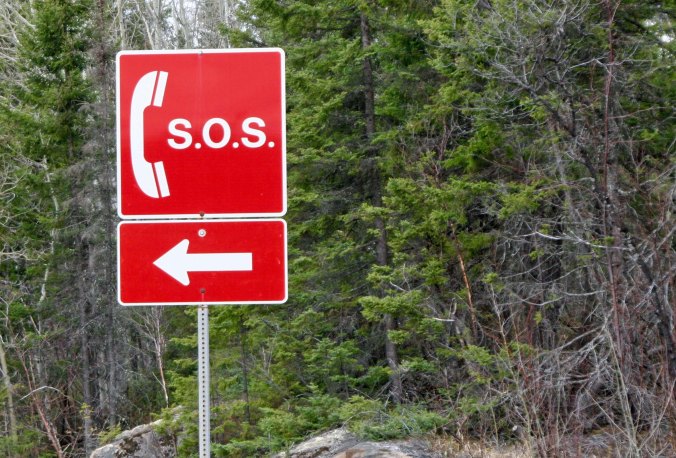
So maybe the road was paved, but how often do you see SOS signs along paved roads. Peggy and I saw several on 167 pointing toward lone phone booths. I don’t remember any when I biked the road.

An S.O.S. phone booth along the road.
But Peggy and I understood rough roads. We had already been over some rough roads in Canada, and rougher ones in the States. Plus Peggy and I had driven Quivera the Van and her predecessor Xanadu for over 200,000 miles on back roads in North America, including two trips to Alaska. It was unlikely that we were going to find something more difficult that we had already experienced.
We eventually got the information we wanted. There would be no deep mud; the whole road was paved. No snowstorms were predicted. Services were limited the first 100 miles (160 k), but after that, more frequent. Our only precaution: We should start with a full tank of gas.
The bottom line: It was not the road I remembered from 1989. Improvements had been made.
I left Lac Saint Jean with more concern than I normally felt. I had been over lonely roads, some with extremely limited services. But they were roads I knew something about. Naturally I had asked locals about what to expect on Quebec Routes 167 and 113. People had told me the area was isolated with few services. I should carry extra food and be prepared to handle any bike problems on my own. Bad weather was expected. The road was not skinny-tire friendly; portions were unpaved. And, oh, by the way, there were lots of logging trucks, really big logging trucks!

This sign along Route 167 suggested that the logging trucks were big. It was small in comparison to what I would experience.
I pictured myself riding through a horrendous rainstorm over a dirt road as logging trucks blasted by me at 100 kilometers per hour, burying me in mud.
None of the above happened on my first day. There was extreme isolation, yes. I rode miles without seeing a car, and the dark green forest of skinny trees went on and on. But the road was paved and there wasn’t any rain. The day was actually hot. Sweat kept trickling into my eyes. Thirst drove me to stop at slow streams twice to refill my water bottles. I was careful to use my water filter. Nasty things like giardia might be lurking in the dark water. The heat took its toll. After 90 miles, I called it a day and disappeared into the forest to set up camp. Why I didn’t select a creek or lake to camp next to, who knows. There were plenty about. But I chose a dry camp and that meant my water had to be rationed.

There were numerous lakes and streams along the road I could have camped next to.
That wasn’t a problem; I had two liters, which were plenty to cook with and drink. My challenge was I also wanted a bath. I had skipped one the night before at Lac Saint Jean and then biked through 90 miles of heat. I really didn’t want to sleep with me. Careful calculations suggested I had two cups of water for bathing: one for washing and one for rinsing. So that’s what I did. It was sponge on and then sponge off, quickly, trying to cover all 3, 168 square inches of my body with 16 ounces. Blood sucking mosquitoes guaranteed speed. Whether I smelled better and was cleaner really didn’t matter, I went to bed happier.
I found the rain, dirt roads, and speeding logging trucks the next day. But first I had found a service station and had done a happy dance. After a hundred miles of nothing, four gas pumps and a squat building seemed like the Taj Mahal. I’m pretty sure it was Nirvana, but it didn’t last. Shortly after leaving the gas station, the rain and the dirt road arrived as a one-two punch— a sort of karma for celebrating too much. Bicycling through 2-3 inches of mud on skinny tires in a deluge isn’t much fun.
But it’s more fun that bicycling through mud and rain with speeding logging trucks. I heard something humongous coming up behind me, fast. My head whipped around like Linda Blair’s. It was an ‘Oh shit!’ moment. I didn’t see your normal everyday large logging truck; I saw a freight train, a monster pulling three trailers barreling down on me. And the driver didn’t slow down. He blasted by me with all 30 tires throwing up mud. I became an instant mud man. Totally blind, I applied wet brakes to wet tires and stumbled off my bike. Standing there, cursing, wiping off mud from my glasses and face, I had fond thoughts of my office in Sacramento.
Sometimes I am a slow learner, or make that stubborn. Not this time. When I heard a logging truck coming, I would jump off my bike and make a mad dash through the mud for the side of the road. Then I would happily wave at the logger as he went by. I doubt they ever noticed my slightly extended middle finger. I only waved it at the guys doing at least a 100 kph.
Of course the section of dirt road ended. It couldn’t have been more than 20 or 30 miles long. And the majority of truck drivers slowed down, probably because they were amazed to see a bike tourist on their road. Anyway, you can see why I wanted a clear view of what Peggy and I might expect on my second trip over the road. The following photos relate our experience.
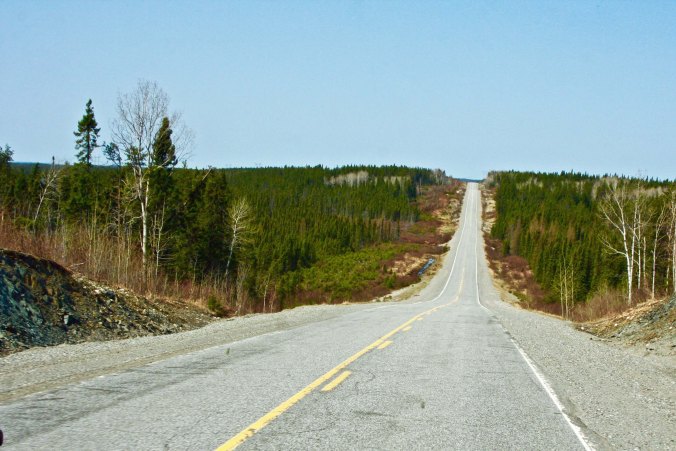
The road through the wilderness went on and on, for some 300 miles. The first hundred miles was as empty as this photo suggests, but Peggy and I did find the SOS phone booths and an emergency medical station that hadn’t been there during my trip.
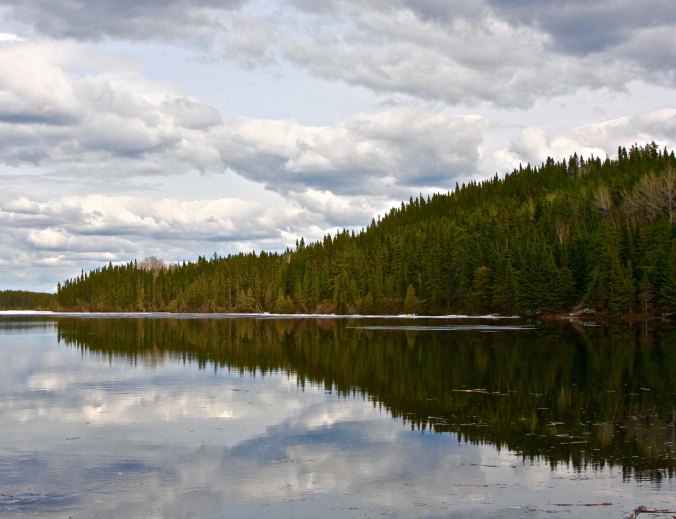
Numerous lakes, streams and rivers are found along the road. The first half seemed to have more lakes, the second half more rivers.

I took full advantage to capture reflection shots. This one seemed dark and foreboding.

And this one more cheerful.
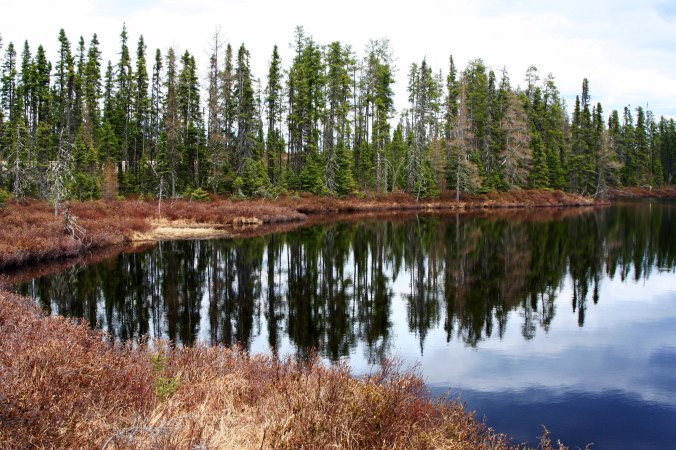
The small lake next to the emergency station provided this shot.

Quebec Route 167 ends its northern journey at Chibougamau, 8 miles from where Route 113 heads south. I skipped the extra 16 mile round trip and cut south, but Peggy and I stayed at the town’s hotel. Today, a motel is found at the cutoff. I can almost guarantee I would have been there taking a real shower instead of bathing in two cups of water had it been there in 1989!

Chibougamau may have been at the end of the road, but it had a McDs. And, judging from the size of the truck, they drank a lot of Budweiser.

The logging trucks apparently weren’t out and about yet. At least Peggy and I didn’t see any. But this pile of logs suggests the amount of timber harvesting done in the area. Large swaths had been clear-cut, leaving ugly scars.

We watched a huge claw pick up dozens of the skinny logs at a time. The logs that come out of the forests near our house in Southern Oregon are easily 3-4 times bigger in diameter.

Rivers captured our admiration as we drove south on Route 113.
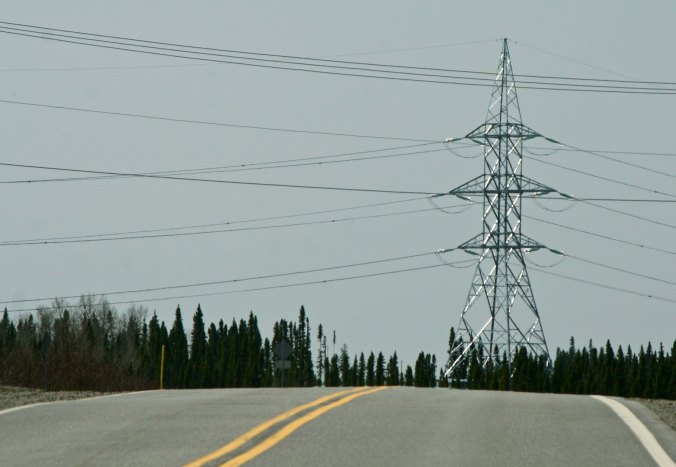
And they reminded us how much Quebec depends upon hydro-electric power. We crossed under high power lines several times.

Another example.
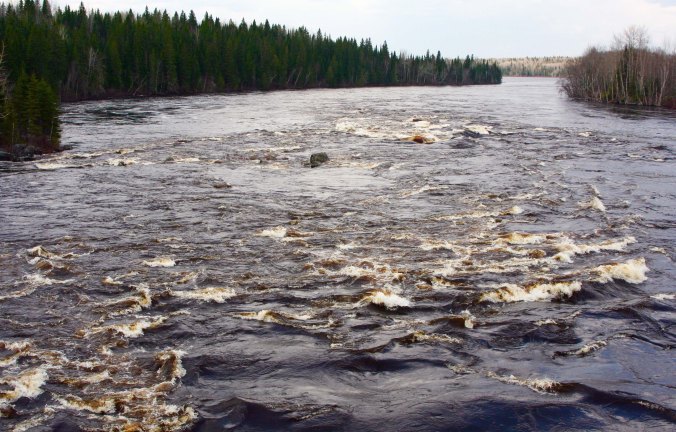
Rapids suggested this river might be fun to raft.

A close up of the same river. Looking at how shallow the water appears to be. I had second thoughts about rafting.

A lone bike tourist made his way south on Route 113. He was the only one we saw on the route. Apparently biking into northern Quebec has yet to take off and become popular!

A storm was waiting for him and reminded me of my own adventure. (Railroad tracks can be seen crossing the road mid-photo.)
NEXT BLOG: I return to civilization and bicycle across Ontario on my way to Minnesota.
 Wandering through Time and Place