An Intro to Africa’s Amazing Bird Life: The African Darter and the Yellow Billed Stork… On Safari: 7

We were boating up the Chobe River in Botswana when the captain pulled over to the shore so we could watch this yellow billed stork on a fishing expedition.

Peggy and I joined her brother John and his wife Frances on an African safari to see elephants and lions, and giraffes, and hippos, and crocodiles, and zebras, and baboons, and… the list goes on. And we did, in glorious profusion. What we weren’t expecting was the bird life. A serious birder would be in heaven. In fact, there are specific African bird safaris one can sign up for. While our passion doesn’t run that deep, we do enjoy bird watching and always have. Time and again on our trip, we found ourselves stopping to admire their beauty, character and antics in Botswana, Zimbabwe, and South Africa. We have the photos to prove it.

Altogether, we photographed over 20 species. You will be meeting up with many of them in my bird posts, including ostriches and penguins, but today, we are going on a fishing expedition with a yellow billed stork and an African Darter we met along the Chobe River in Chobe National Park, Botswana.

The yellow billed stork stands around three feet tall. It prefers fishing in shallow water where it shoves its large bill into the water and then stirs the water plants and mud with one of its feet to herd dinner toward its waiting bill. Small fish, frogs, and water insects are all welcome. It’s an open bill policy. It fishes by feel. When a suitable meal hits its bill, the stork captures it with a lightning fast reflex snap. But I’ll let the stork tell you the story.

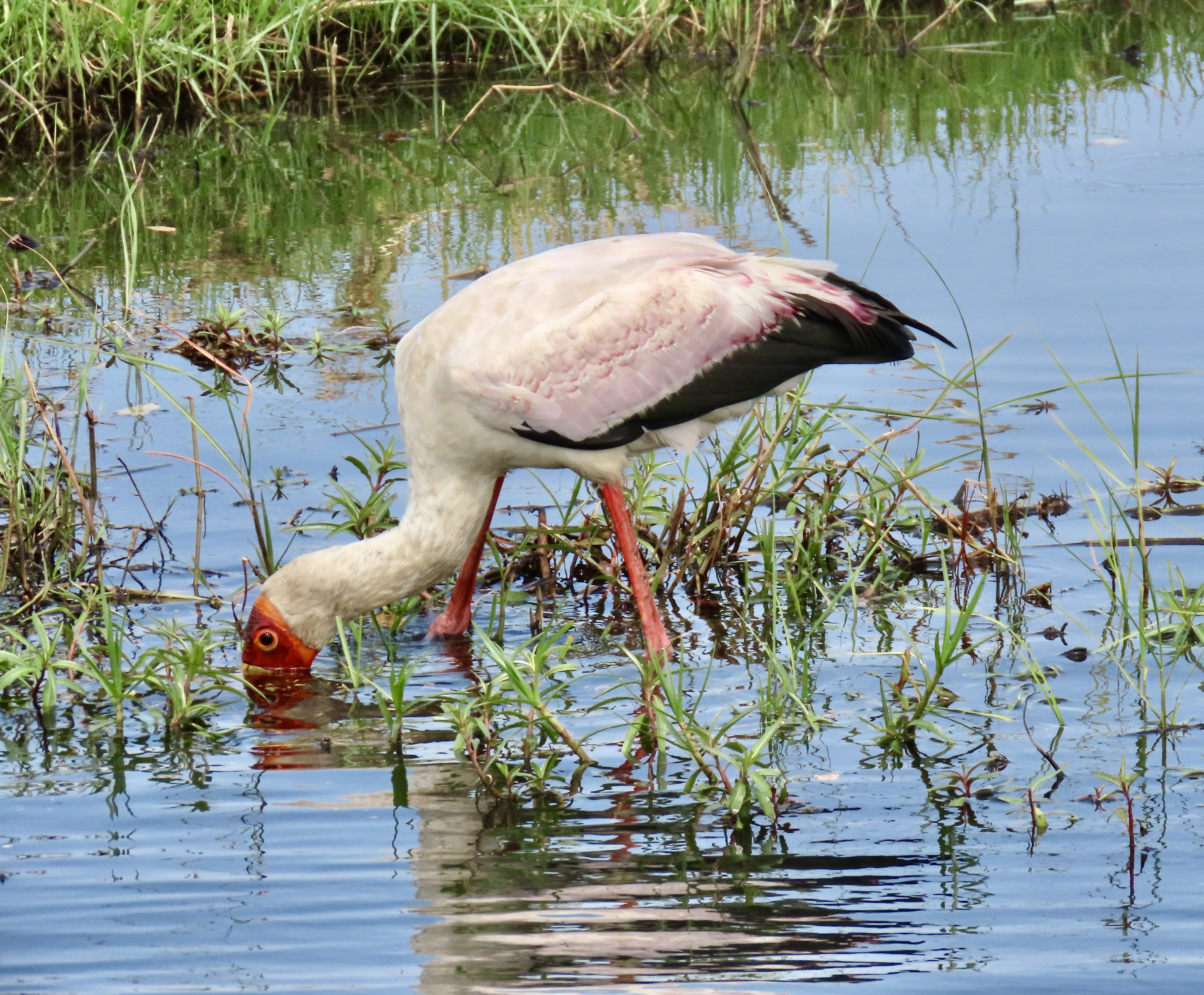
Hi, my name is Big Bill. Today I am taking you on a fishing expedition where I am going to catch a monster. This is one of my favorite fishing holes. All sorts of delectable treats like to hide out in the grass. I’m drooling in anticipation.
My fishing technique involves me dunking my bill into a likely spot. I’m using my left leg for balance while stirring the pot, so to speak, with my right foot to herd tasty morsels toward it. One never knows what might be hiding in the grass. I call it pot luck.
Here’s a head on view of me, up to my eyeballs in work. The waves you see are from my stirring efforts.
And here’s a rear view shot that I did not approve. Curt and Peggy will be held accountable.
What are you looking at…
Wait! Something just hit my bill! A monster!
I caught it! Woohoo! Woohoo!

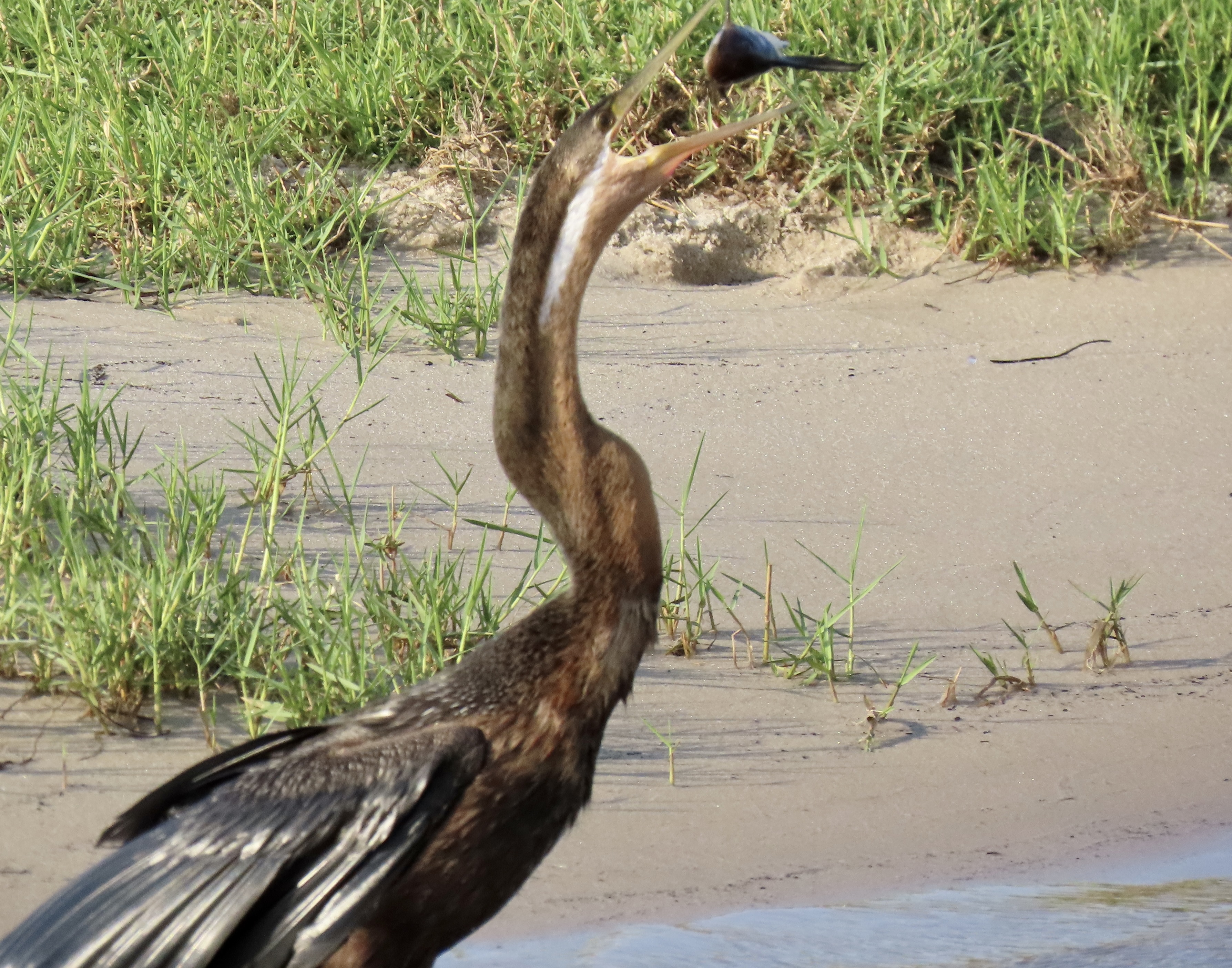
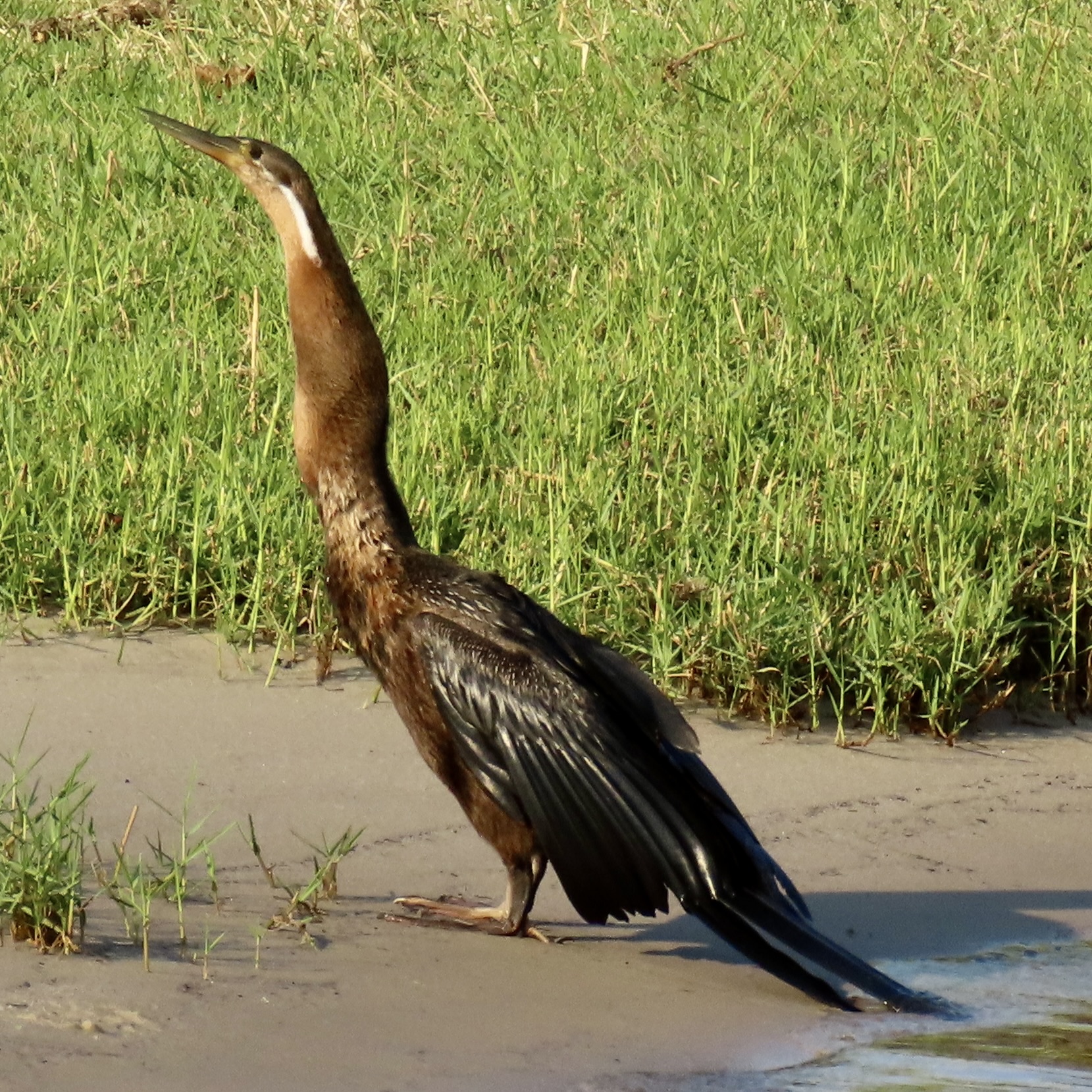
And now on to the African Darter or anhinga, also known as a snake bird. These birds are closely related to cormorants. The 36 species of cormorants and four of anhingas make up the family Phalacrocoracidae. The African Darter swims through the water in search of its prey, often with only its head showing. When it finds a fish, it literally spears it. ‘Darter’ refers to how fast. The alternative name, snake bird, derives from its sinuous neck. Now, in its own words:

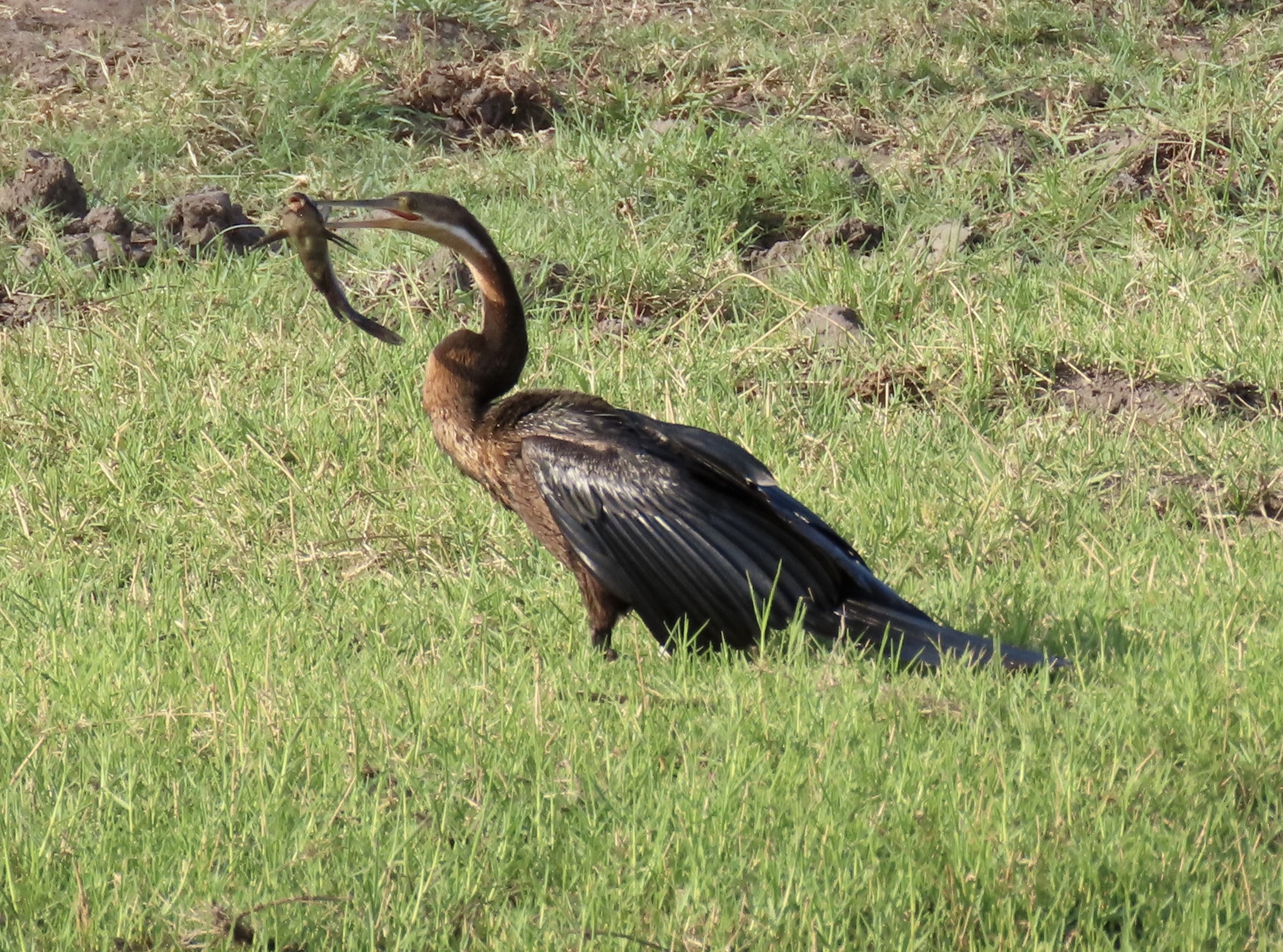
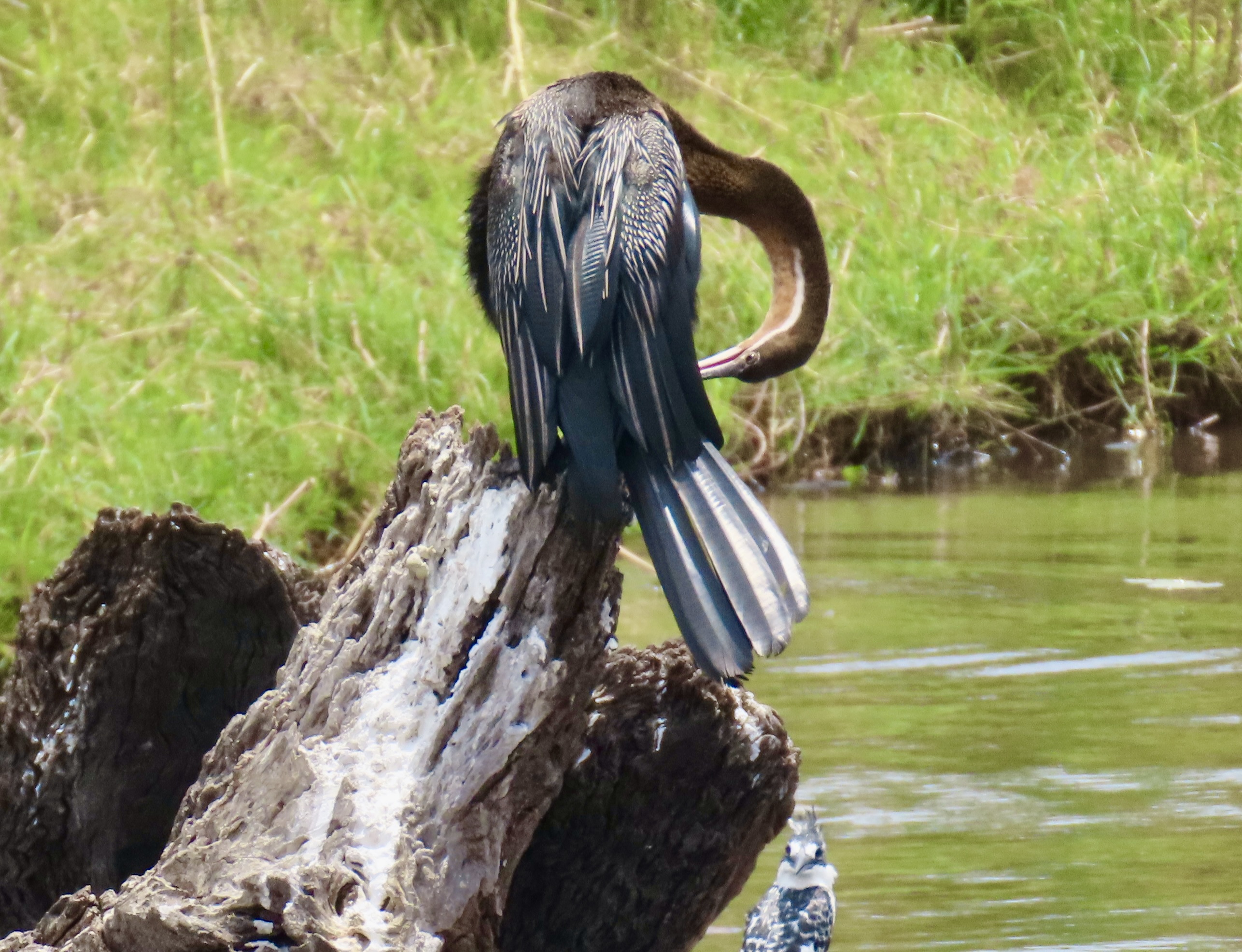
Hello, I’m Handsome, or, if you prefer, Pretty. Either way, I am much better looking than Big Bill. You might think I am posing for you. Well maybe, I am preening. But mainly I am drying off my wings. Unlike most water birds, we, and our cousin cormorants, don’t have oil in our feathers to repel the water.
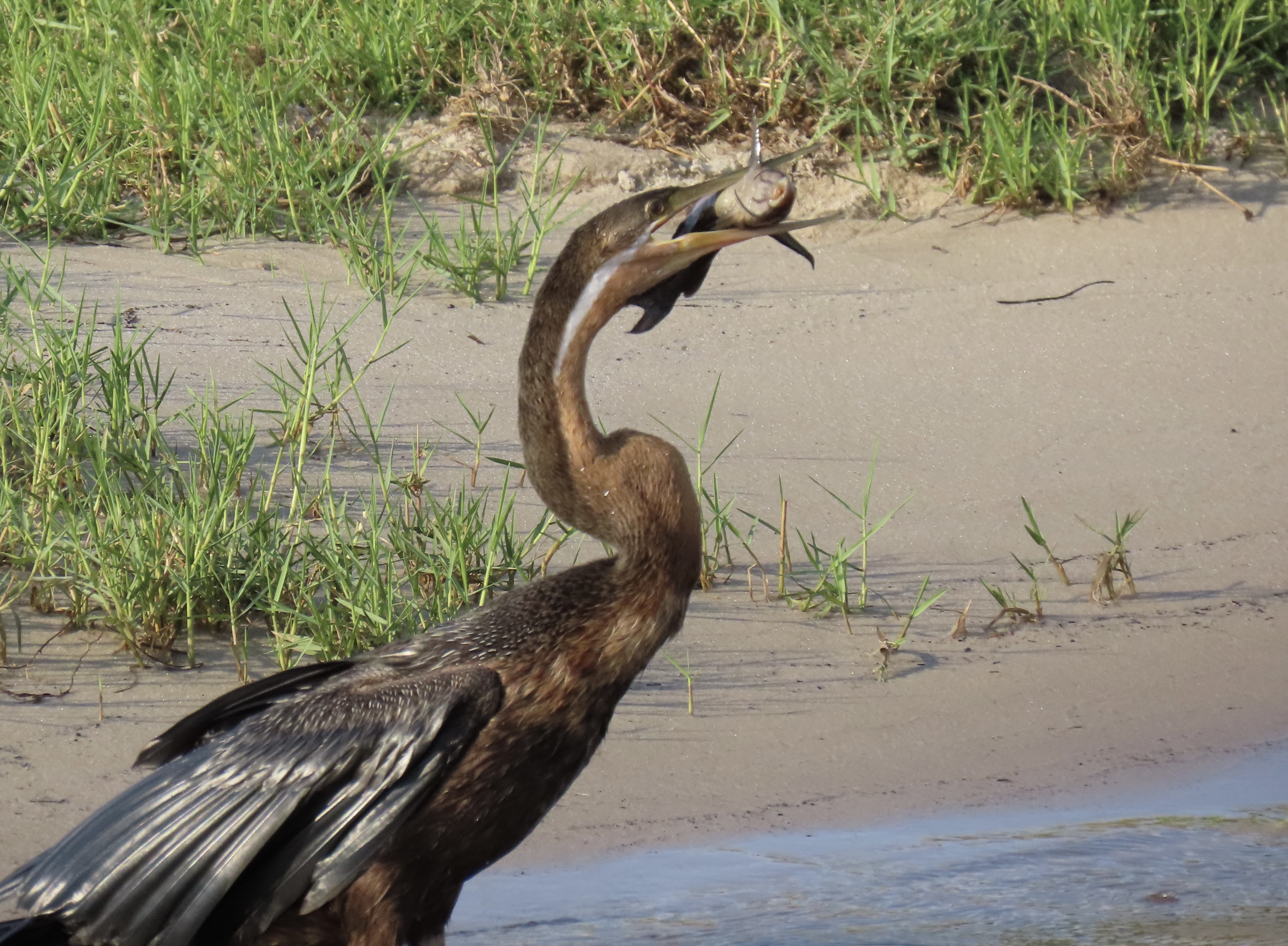
This is me with a freshly speared fish. Catching it was easy…
It’s swallowing it that creates the challenge.
It has to go down head first. Check out the wicked fins on this catfish. If I swallow it tail first, they get caught in my throat. Then it’s not just bye-bye fish, it’s bye-bye Handsome as well. That’s not a good ending.
I have to position the fish just right. So I take it back to the water and spear it again. Some fun. I wonder how many holes I can poke in it?
This seems about right.
Upsy-Daisy. Whoops, I mean upsy-fishy. Now don’t blink…
Did you catch that? Did you catch my great flip? I’m very good at flipping.
Hmmm. I don’t think I’ll be swallowing this.
Maybe if I use the sand this time. More holes. Think of it as tenderizing. Note my big feet! I’m surprised they didn’t name me Big-foot as opposed to Snake-bird. Oh, you say Bigfoot is already taken.
Wow, I think I’ve got it! Thereby hangs a tail. Heh. heh.
Down the hatch!
Gulp.
Ah, happy tummy, happy bird. Now I can go back to preening and being beautiful. (Don’t pay any attention to that skeptical pied kingfisher on the lower right. He’s just jealous.)

That’s it for today. Hope you enjoyed our talking birds. On Friday, we will be reaching for the sky and featuring giraffes.

The Everglades… A Photographic Exploration of America’s National Parks

Photo of a Black Buzzard in Everglades National Park. Photo by Curtis Mekemson.

I’ve blogged about Black Buzzards before, but these characters deserve a repeat visit.

Peggy, in her former life, which I refer to as BC, before Curt, bought some swampland in Port Charlotte, Florida with dreams of a handsome profit. Eventually, over a period of about 20 years, the land reached the value she and her ex-husband had paid for it. In the heady years of the early 2000s, the property shot up to triple the original investment. We were able to dump (oh, I mean sell) it before the 2006 housing crash to a land speculator. We split the profits between our kids, the realtor, and Uncle Sam.

I tell this story because the property provided an excuse to visit Florida. It was one of three. The second was that Peggy’s parents had retired to the state from Ohio, joining the relentless flood of people from the Midwest whose elderly bones had lost their sense of humor about freezing cold winters. My brother, Marshall, a homeless man with a bank account and a van, provided the third excuse. He included Florida on his migration route. Marshall, in fact, gave us advice on when to sell the property. In the days before he had decided being homeless was more fun, he had owned a successful real estate appraisal business.

Our regular trips to Florida gave us a chance to explore the state, which can be quite scenic if you can see around the billboards and like orange trees. It’s long sandy beaches are very attractive. Peggy loves them. As a general rule, the state is too flat for me. I can gain more elevation in the twenty-minute walk to our mailbox than I can from driving to the top of Florida’s highest hill.

The low elevation and flat land make for  extensive wetlands in Florida, however. And I find this quite attractive. The swamps are filled with fascinating wildlife such as Black Buzzards, Pink Flamingos and the lurking alligators. Everglades National Park provides an excellent opportunity to explore what Florida has to offer.

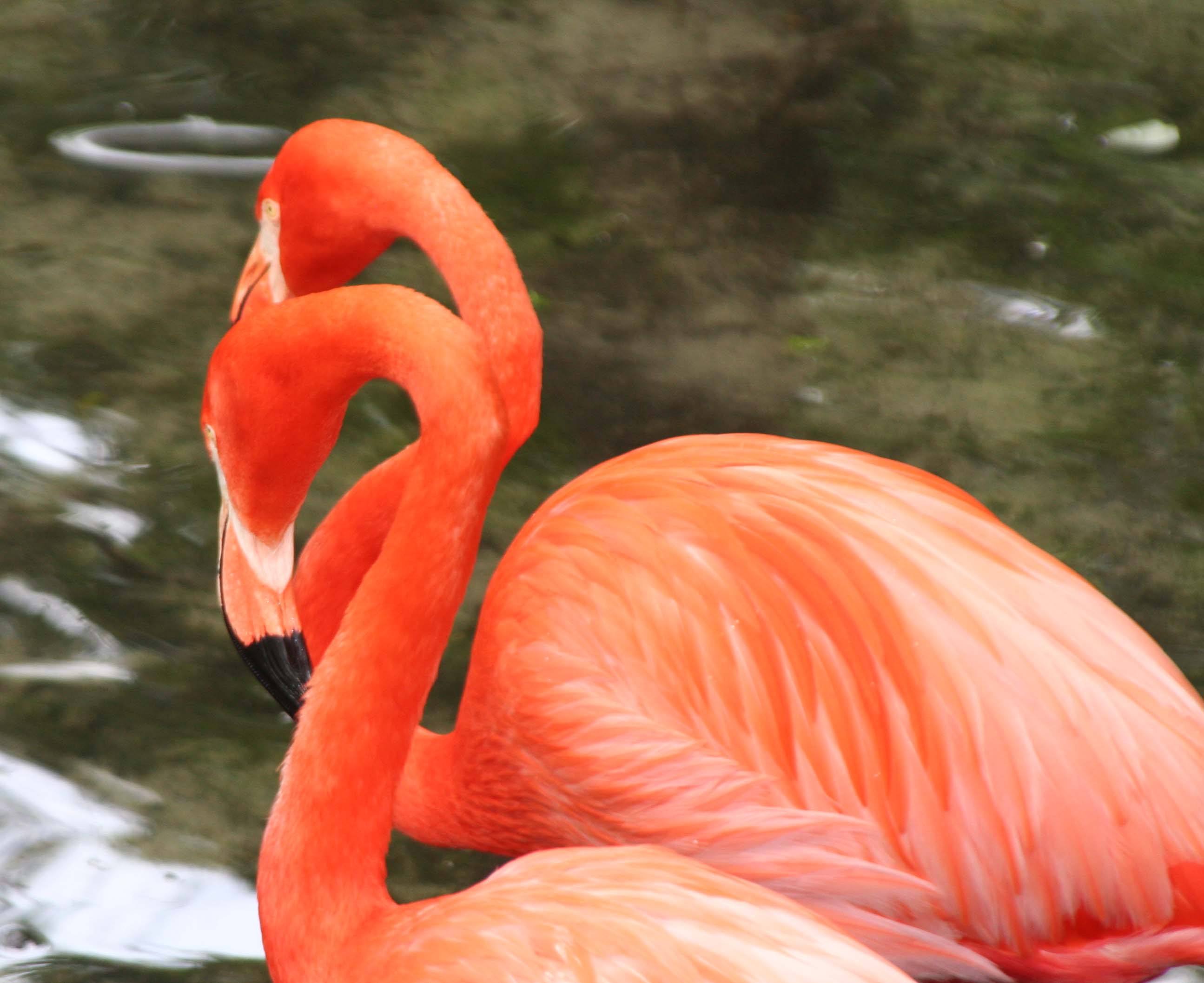
Photo of Flamingos by Curtis Mekemson.

You are much more likely to see photographs about Flamingos than Black Buzzards when reading about the Everglades. I suspect you have never seen a yard featuring plastic buzzards.

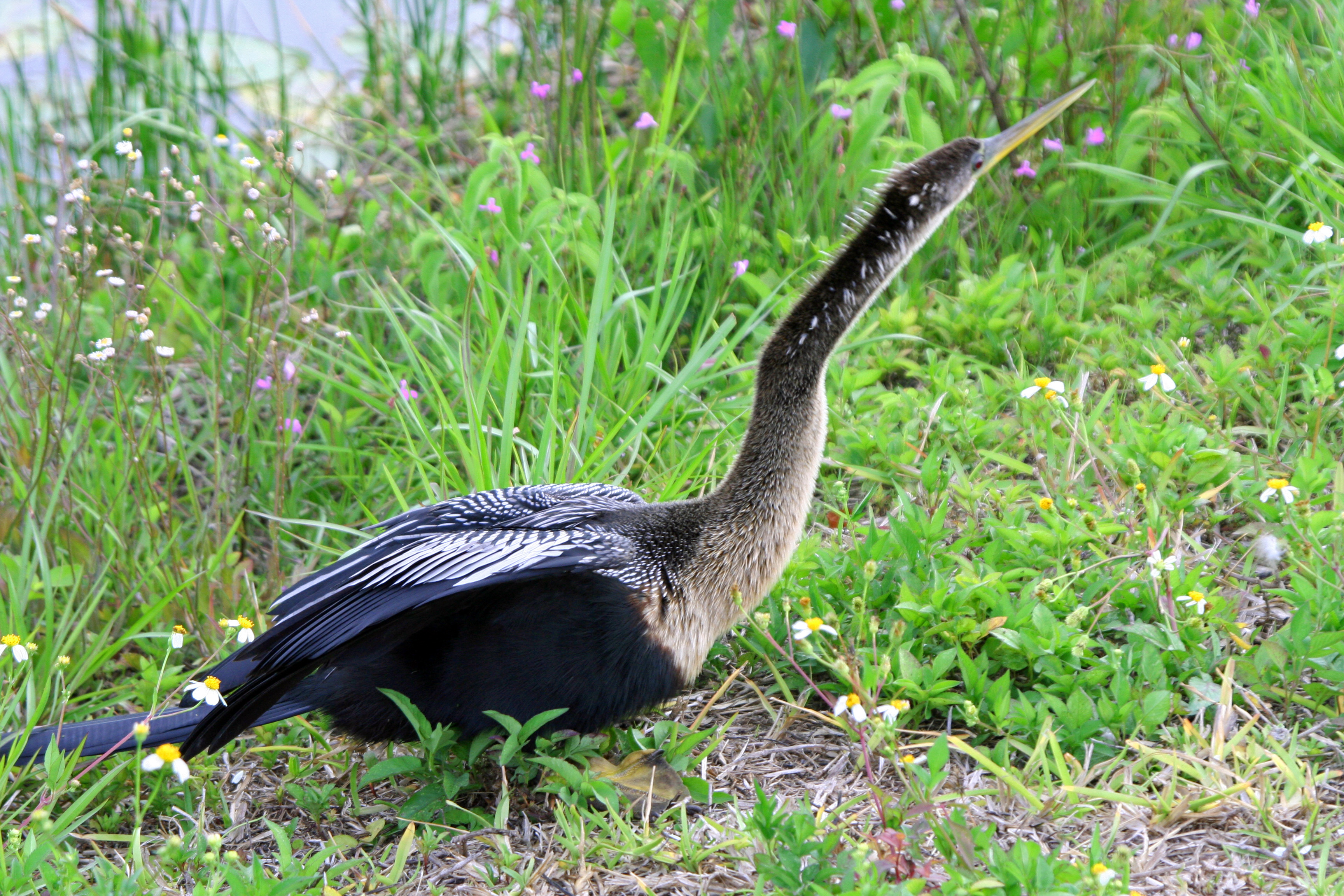
Anhinga in Everglades National Park.

This Anhinga was drying his feathers and presented another photo-op. (Photo by Peggy Mekemson.)

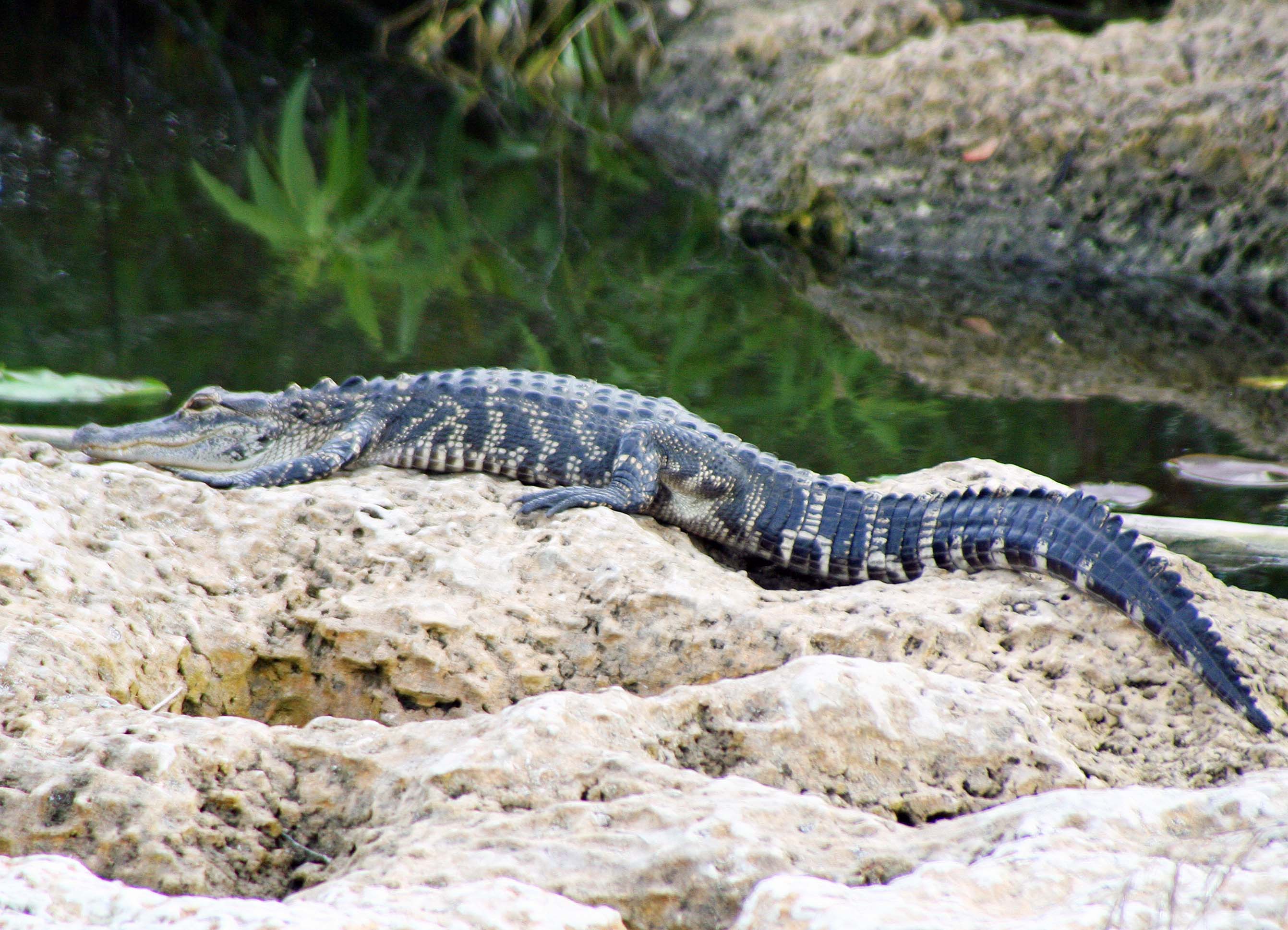
Alligator sunbathing in the Florida Everglades.

We came on this alligator sunbathing. It would be hard to appear more relaxed. (Photo by Peggy Mekemson.)

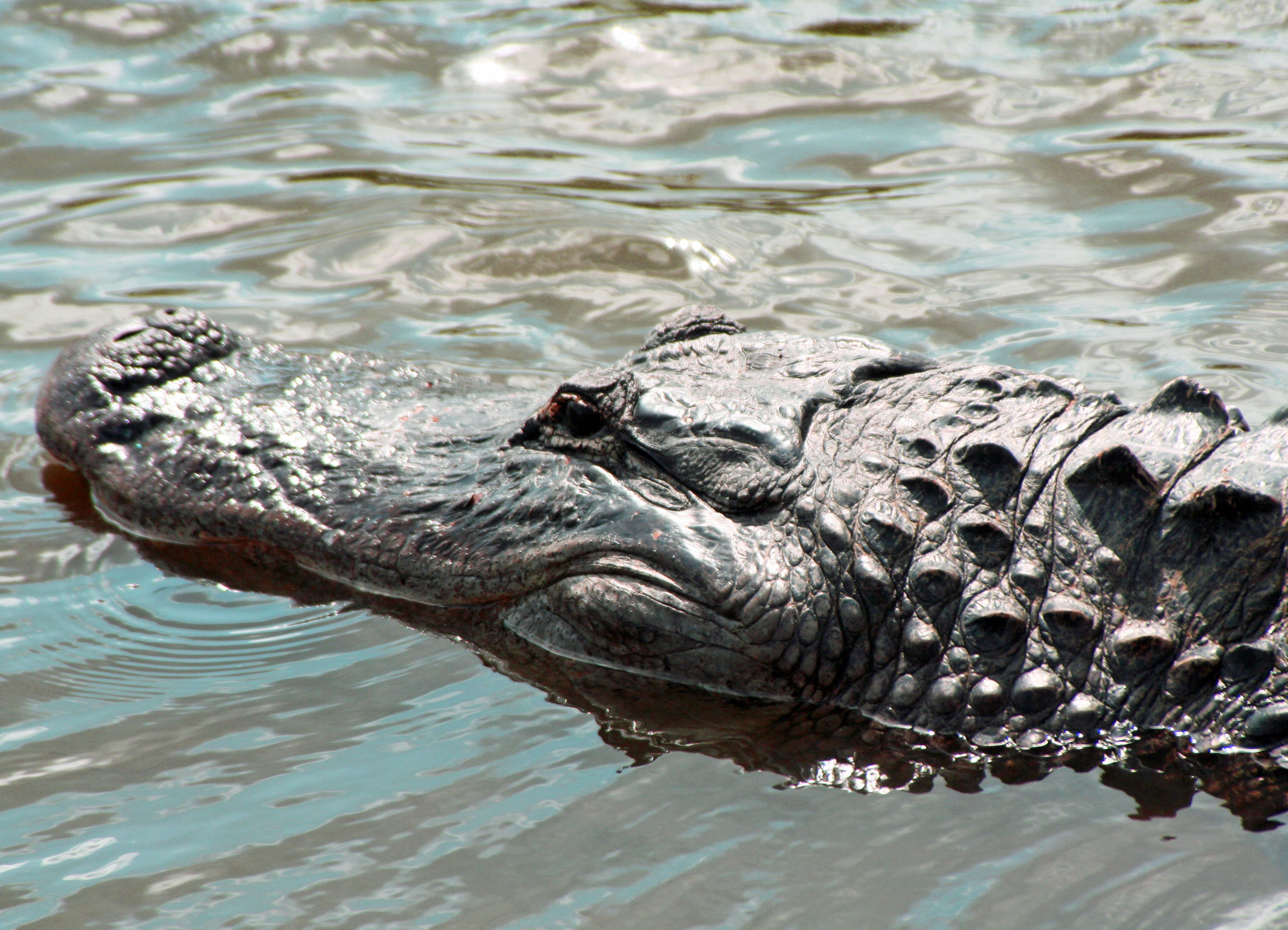
Alligator swimming through water in Florida Everglades. Photo by Curtis Mekemson.

I photographed this guy as he swam under a wooden bridge the park had built out above the wetlands.

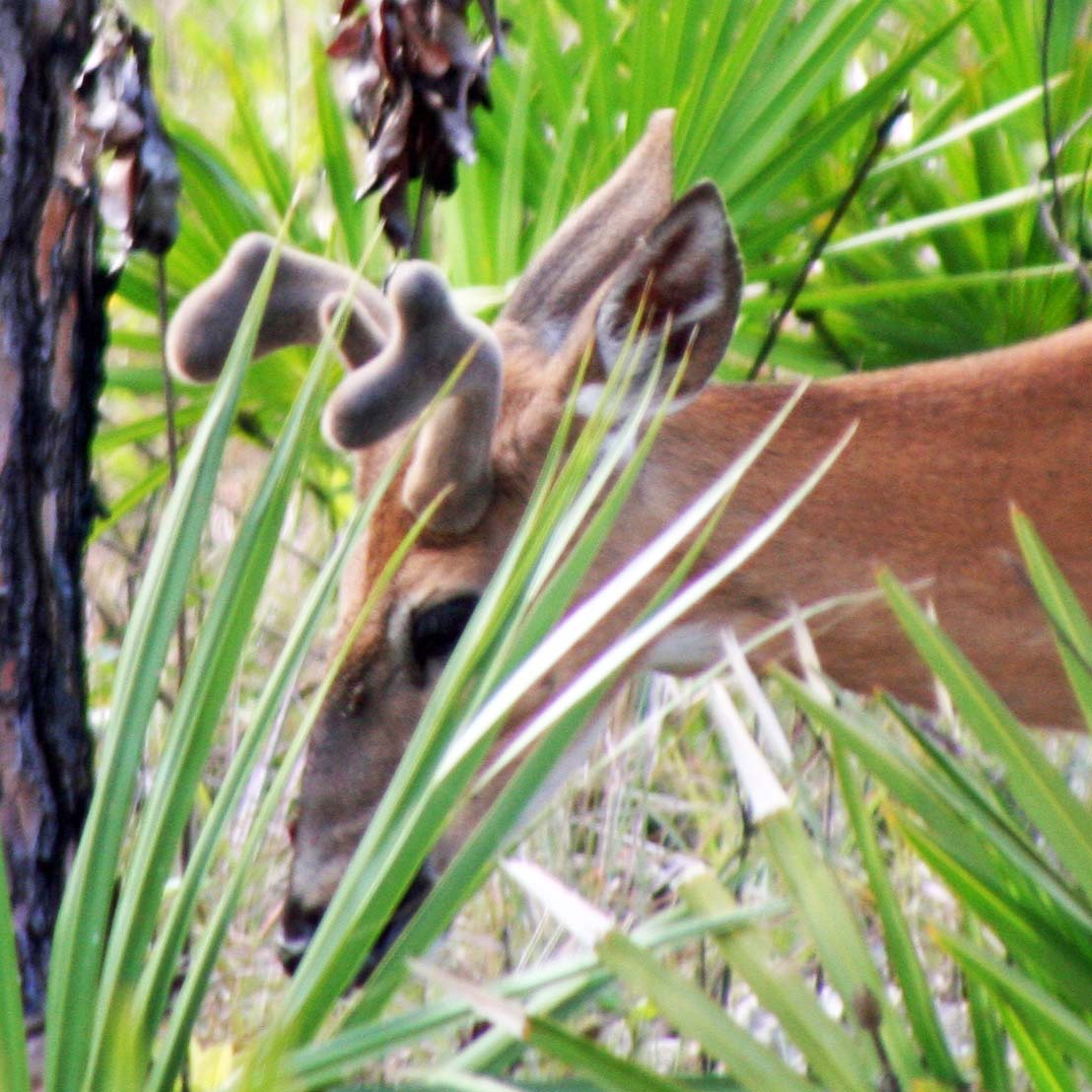
Everglade deer photographed by Curtis Mekemson.

This buck, whose antlers were still in velvet, came by to visit our campsite.

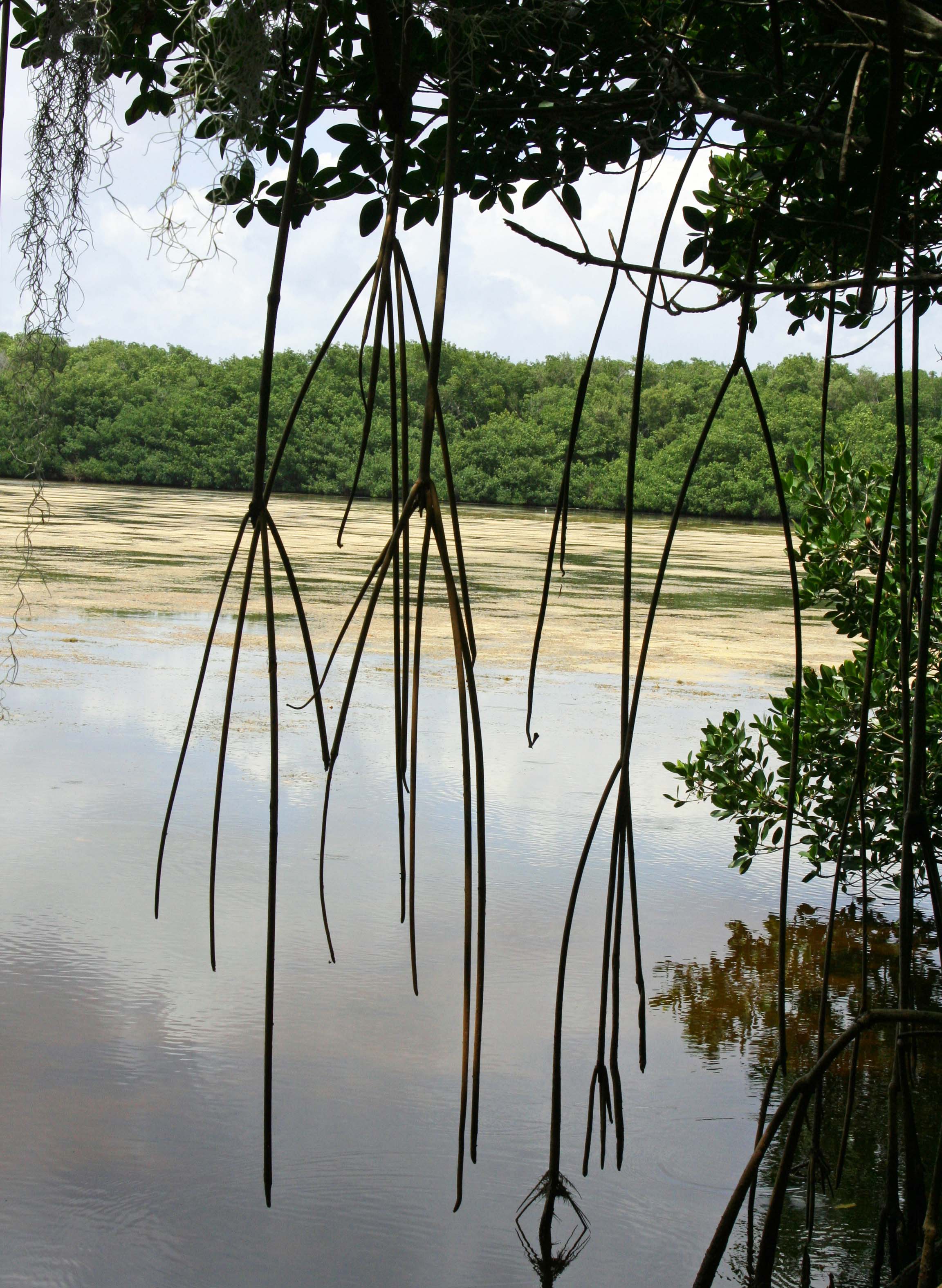
Everglades lake photo by Curtis Mekemson.

The Everglades teem with life. Our binoculars showed that the trees across the lake were filled with birds.

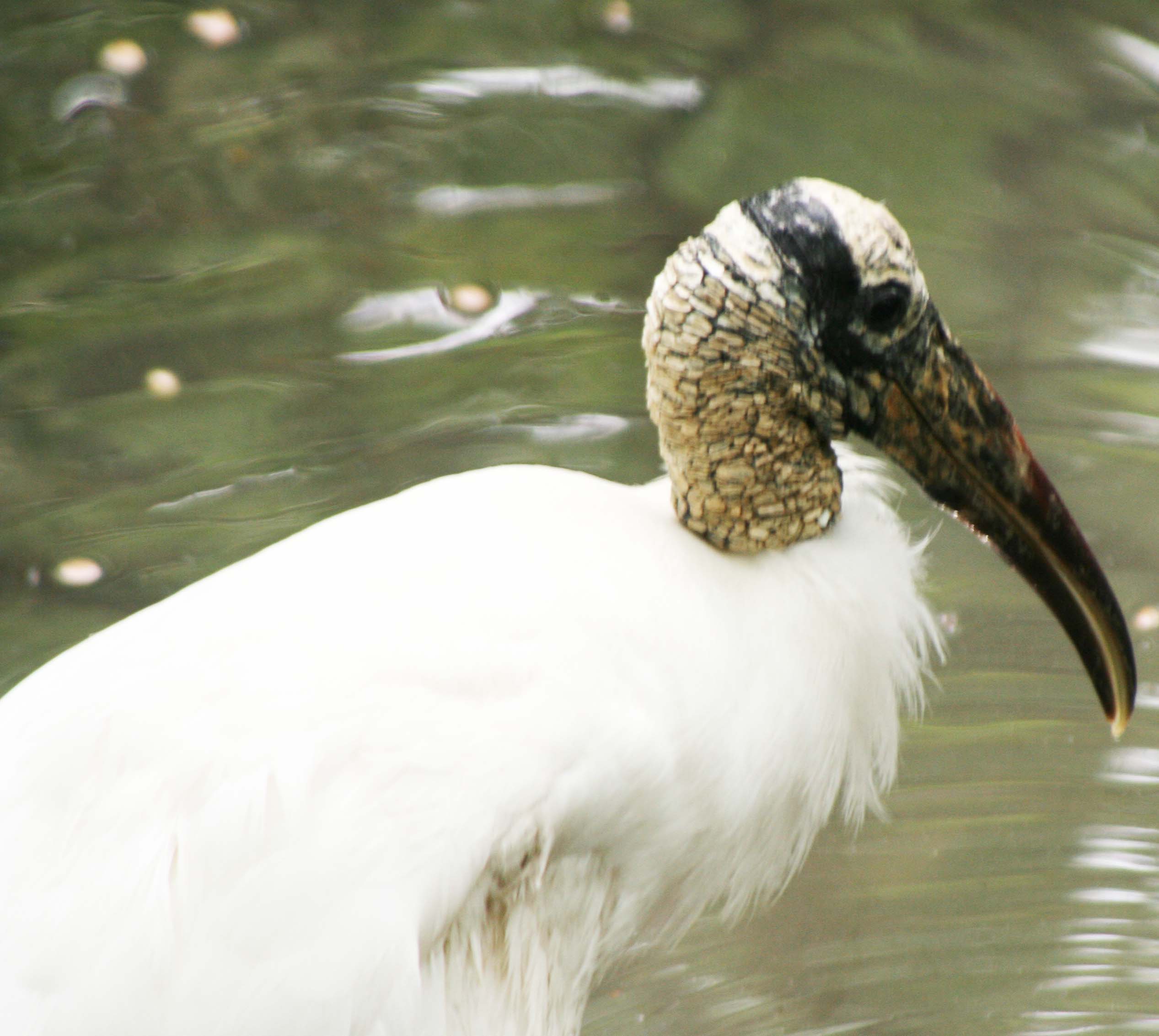
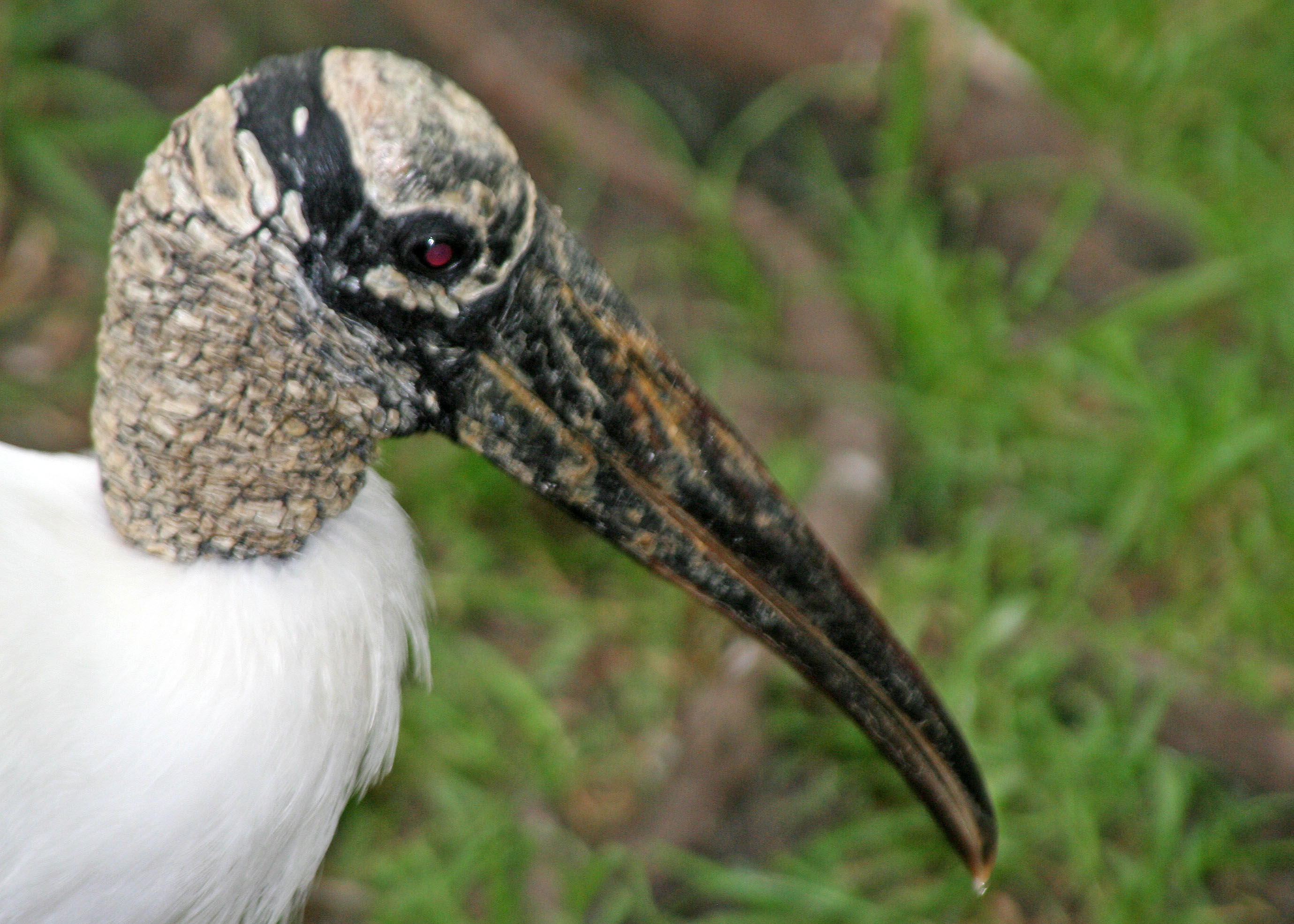
Photo of Wood Stork in Everglades by Curtis Mekemson.

This fellow, with his definitive neck and bill, is a Wood Stork.

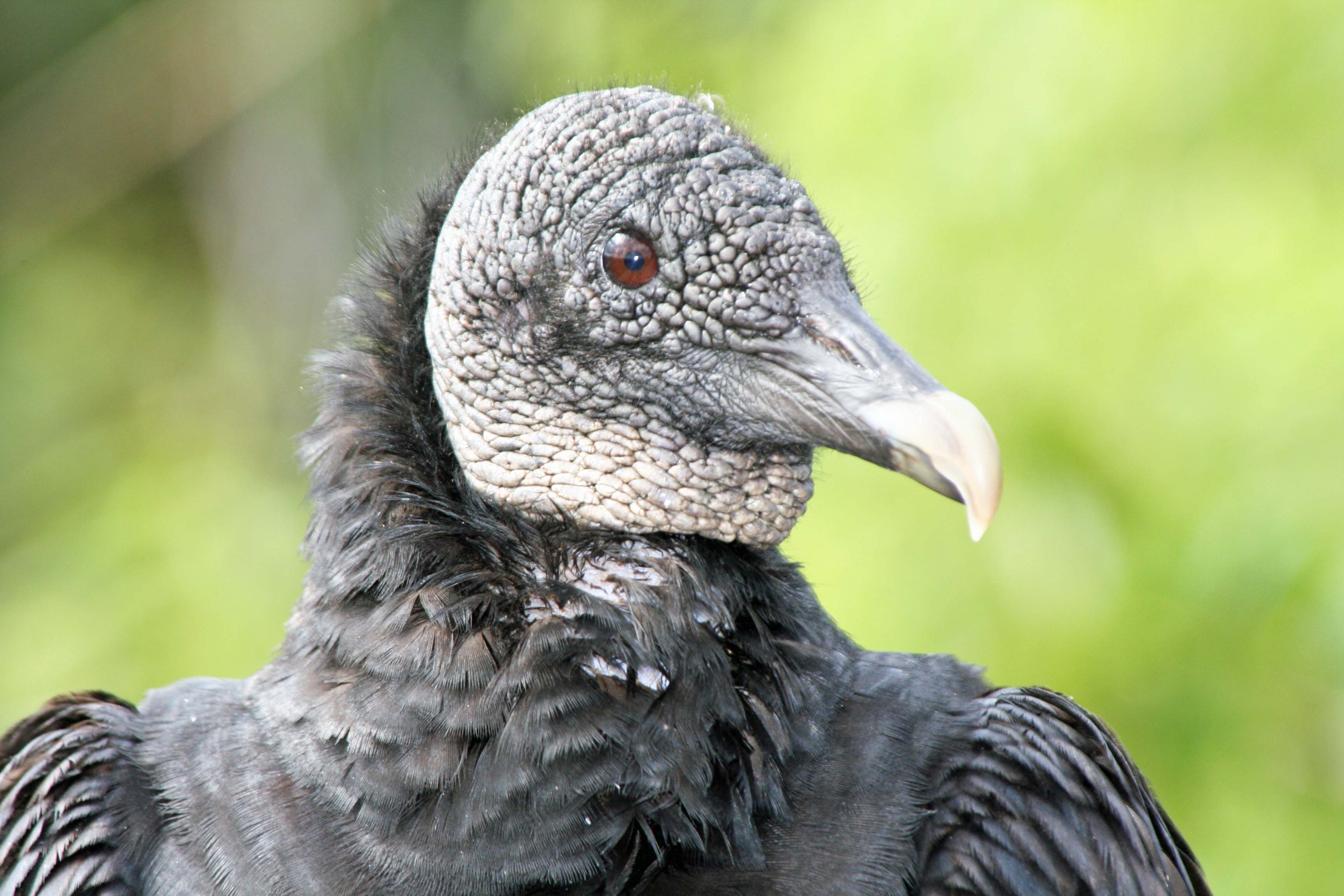
Everglades Black Buzzard. Photograph by Curtis Mekemson.

I’ll close this brief visit to the Everglades with two more photos of the Black Buzzards.

Florida Everglades Black Buzzard take a bow. Photo by Curtis Mekemson.

Taking a bow. The buzzard and I thank you for following this blog. (grin)

NEXT BLOG: Since we’ve been hanging out where it is really wet, let’s dry out and head for Organ Pipe Cactus National Monument in Southern Arizona next to the Mexican Border.

The Wonderful World of Birds’ Bills… On the Road

I love pelicans. They have that ‘put together by a committee’ look. Check out the sharp hook on his bill. I took this photo in Baja California near Cabo San Lucas.


A wonderful bird is the pelican, His bill will hold more than his belican.

Dixon Lanier Merritt

Whenever I see a pelican, Dixon Merritt’s poem pops into my mind unbidden. Birds’ beaks, or bills if you prefer, are wonderful adaptations to their environment.

As I write this blog from my home in southern Oregon, a Rufous Hummingbird has his beak buried deep in our feeder while a Black Headed Grosbeak worries sunflower seeds on the hill behind him. The hummingbird’s beak is long and delicate, designed to capture nectar in the hidden recesses of flowers. The grosbeak’s beak is short and stubby, perfect for cracking open seeds.

I photographed the Brown Pelican in Baja California near Cabo San Lucas. Peggy found the Snowy Egret there as well. The rest of the birds featured in this blog are from Florida except for my final picture of Brown Pelicans. Few places can match Everglades National Park when it comes to unique bird life with interesting bills.

Peggy captured this Snowy Egret on film on the same Baja trip we found the pelican. Both Egrets and Herons have spear like bills. I like the way the Egret’s shadow allows his feet to be seen.

Speaking of spear like bills, how would you like to be on the receiving end of this one? I took this photo of a Great Blue Heron in Florida. While we normally think of Great Blue Herons eating frogs, fish and baby alligators, they are also quite fond of small rodents. I have often watched them patiently stalk mice on the Bodega Bay Headlands of Northern California. Their strike is lightning fast.

This Anhinga in Everglades National Park is obviously eyeing something in the grass next to it. Like Cormorants, Anhinga are designed to catch their dinner while diving and are well designed to do so.

A more typical picture of an Anhinga, drying its wings after a dive.

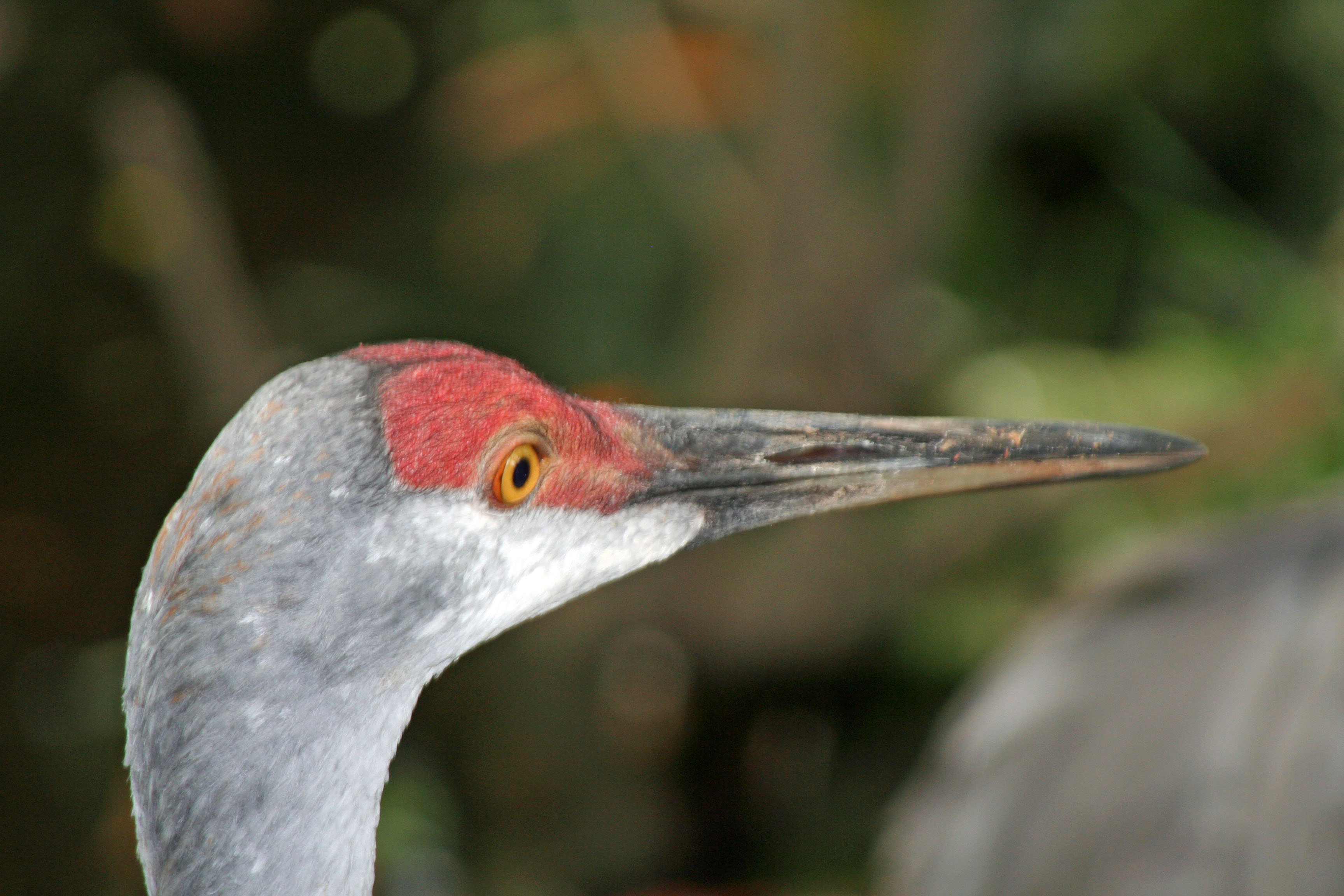
This Sand Hill Crane and four buddies came strolling into our camp in Central Florida.

When one thinks Florida and Everglades, it is natural to think of Flamingos. It’s hard to find more colorful beaks.

In my last blog I featured Black Vultures in Everglades National Park. This one looks pensive. Again, note the hooked bill designed for tearing flesh off of dead things.

White Ibis are common in the Everglades. They use their long curved bill to probe mud.

This guy is a little fuzzy but any collection of photos featuring birds beaks needs to include the Spoonbill, another resident of the Florida Everglades.

The mottled head and beak of a Wood Stork, also photographed in the Everglades.

I’ll close with my favorite bird. I took this shot of Brown Pelicans just south of Santa Barbara, California.