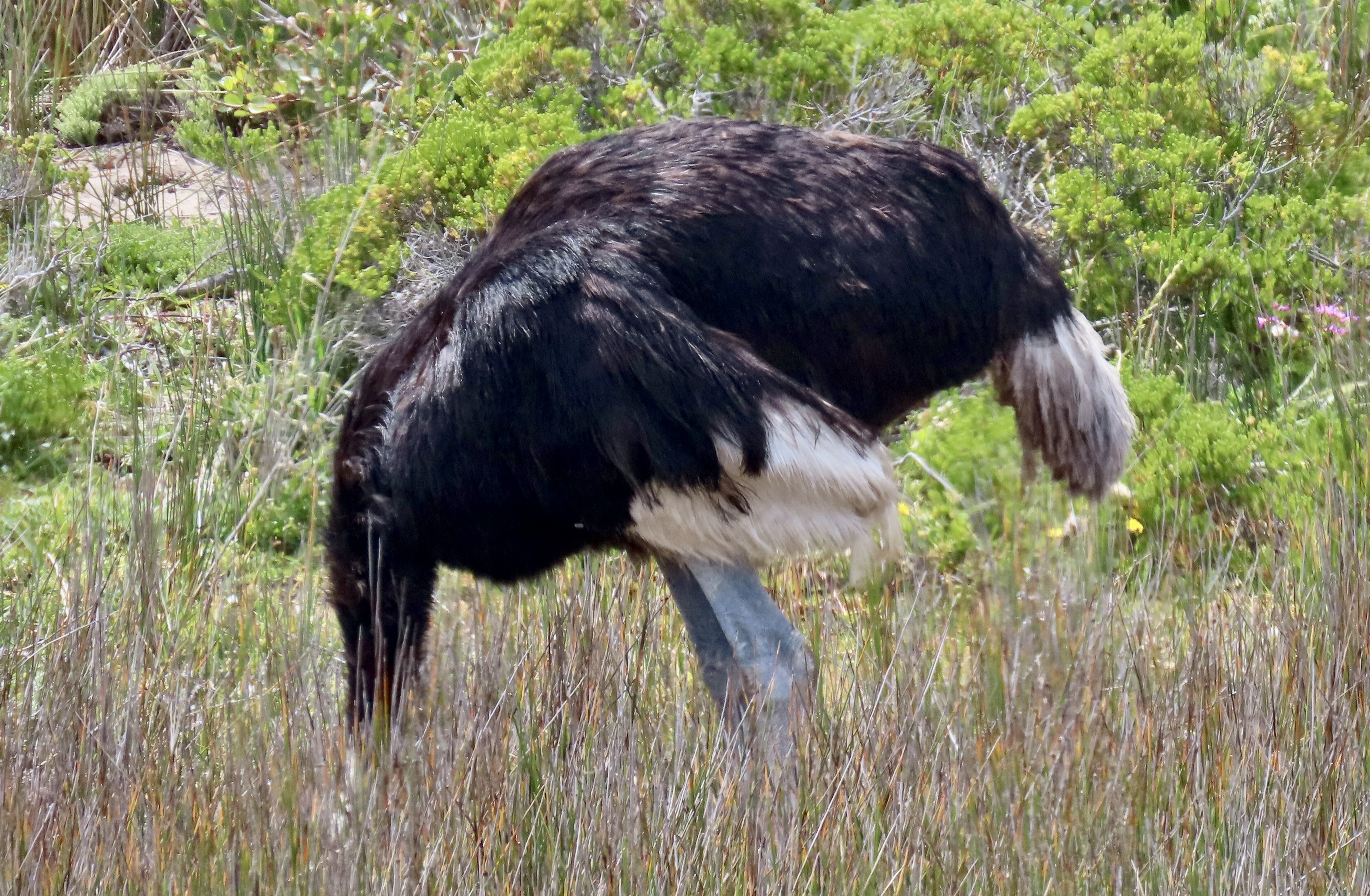
They say that ostriches burying their heads is a myth. But given today’s world??? We found this large male a mile or so away from the Cape of Good Hope, not looking particularly hopeful. (Actually, he was grazing, but burying his head makes a better story.)
Peggy and I are dropping into South Africa for today’s On Safari post where I will feature the world’s largest bird and one of its smallest penguins. We found both of these ‘superlative’ birds on a road trip to the Cape of Good Hope. As mentioned above, the ostrich was a mile or so away from the Cape. The penguins were 20 minutes away on South Africa’s False Bay.
The problem with ‘burying your head’ is that you never know where it might pop up. On the end of a long neck is a good bet. Check out the toothy grin and the big eyes. The teeth serve the ostrich in biting off its main diet of grass, leaves, and roots. The eyes provide excellent vision for spotting major predators such as lions, leopards and cheetahs. I read in a National Geographic article that the ostrich’s eyes are bigger than its brains! I not sure whether that says more about an ostrich’s eyes or brain.Just about everyone knows that the ostrich is a large, flightless bird. Large means upward to 350 pounds (150 kg) and 8 feet (2.7 m) tall. The beautiful feathers on this male also suggest why ostrich feathers have been so popular for centuries. Their collection during the Victorian Era came close to threatening the species with extinction. Today’s feathers are obtained from ostrich farms where the birds are raised for them plus meat and eggs.On our way back from the Cape, our friend was next to the ocean. The question we had was ‘why did the ostrich cross the road?’The answer may be that with legs like this, he can go where he wants.He was busy chomping down the brown grass and filling his gullet.He then had to raise his head so he could swallow it.Ostriches prefer not to fight. In fact they will lie down in the grass to lower their profile and camouflage themselves. Their long legs provide two other defenses. One, they can run very fast, up to 40 miles per hour (70k) with giant strides that can cover 16 feet (5 meters) in a single stride. They also have a powerful kick, if cornered, using their big feet and 4 inch (10 centimeter) sharp claws.
We left the large ostrich behind in search of one of the world’s smaller penguins near Simon’s Town, the appropriately named African penguin. If you live in the town, it’s not unusual to find them walking down the sidewalks, crossing the streets, or digging large holes in gardens to build nests. They pretty much rule the town. Before heading down to the beach where most of them hang out, we stopped in town for lunch. We were eating when Peggy spotted one of the two-foot-fellows walking up to the door. She jumped up and snapped a photo of the penguin. I think it wanted to know if we were eating fish.
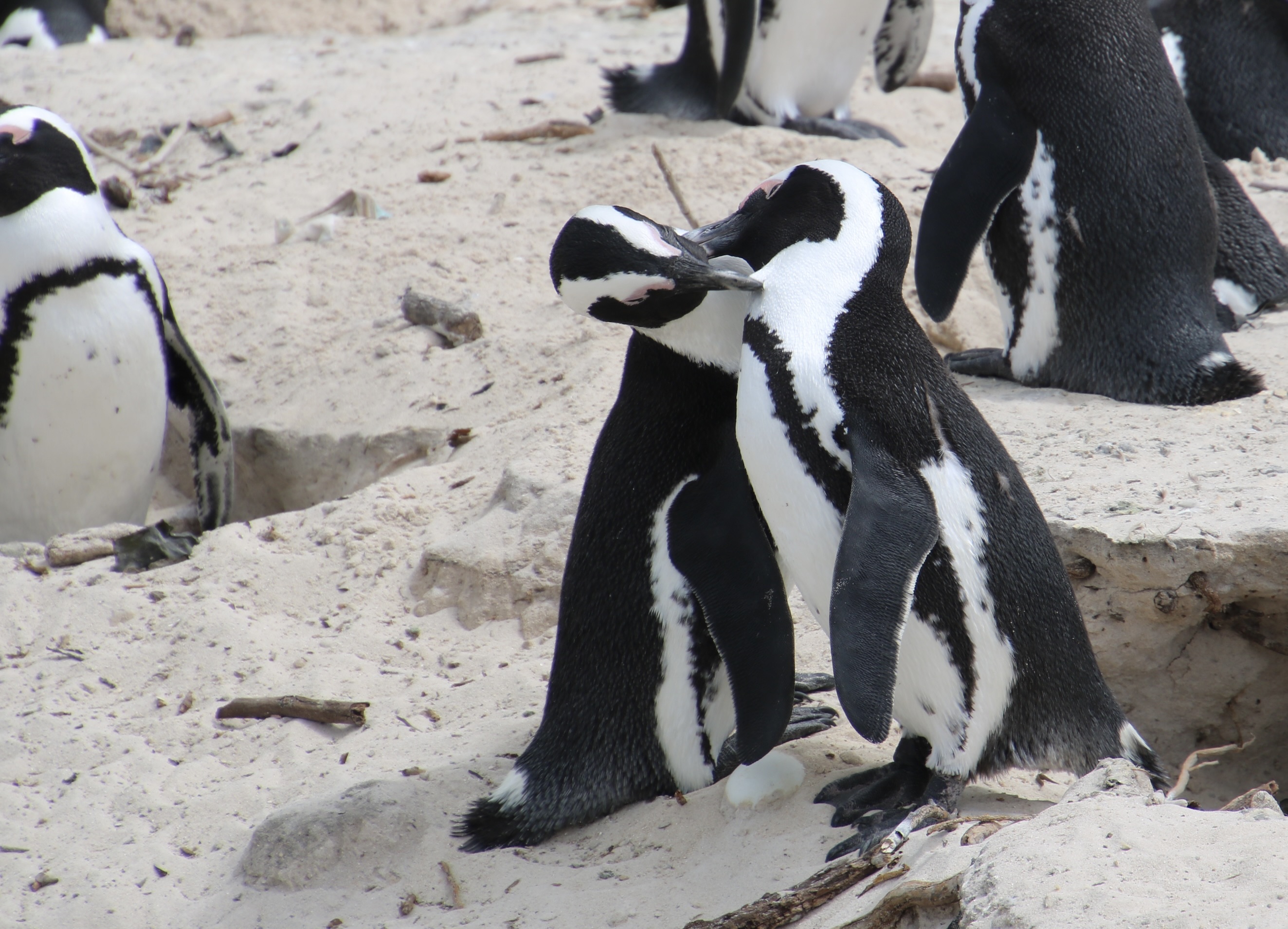
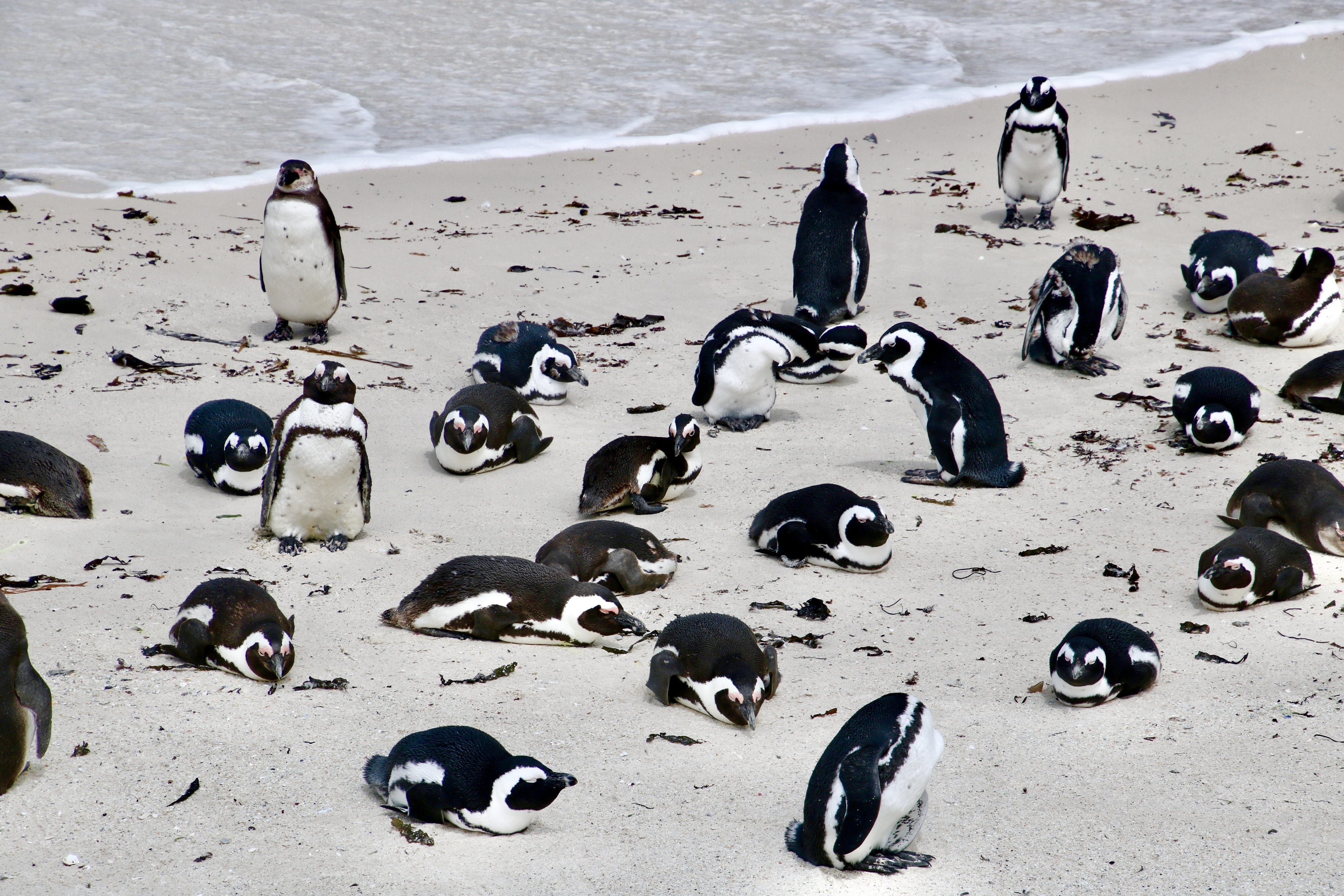
It was looking in the door with high hopes. I left lunch to photograph it from the inside of the door. Note the pink above its eyes. It actually serves a cooling function like the elephant’s ears, running blood through the pink area so it will be cooled down. The hotter it is the darker the pink, as more blood is forced through.I noticed that the feet looked like they belonged to a much bigger bird. It’s these large feet that enable the penguin to swim 12 miles per hour pursuing fish.Down at the beach, we watched a penguin walking. It was getting nowhere fast.Another penguin had said the ‘heck with it’ and was using its swimming mode! In water, BTW, they normally dive to around 100 feet. They have actually been found at over 400 feet.We saw a number of pairs. Penguins stick with their partners for years and seem quite affectionate.“If you scratch my neck, I’ll give you a stick.”True love.“Sorry I’m late, honey,”“Really sorry…”This is the type of nest you might find in your garden if you live in Simon’s Town. The penguins put guano (bird poop) on the bottom as a nesting material. There were several such holes on the beach as the penguins prepared to lay eggs and raise their chicks.A number of penguins were hanging out at the base of a huge granite boulder…While others preferred to sunbathe on the beach.While this fellow decided that scratching an itch was the best use of his time. He was using his non-flyable wings for balance. Note the spots on its chest. They are different on every penguin. A recent study has suggested that one way a penguin recognizes his/her mate when hundreds of are together is by the spots. “Excuse me but you look familiar. Can I check your spots?” That’s it for today.Peggy and I were driving out of the Everglades on Thursday when we saw a lake packed with over 200 white pelicans herding and harvesting fish. It was an amazing sight and will be the subject of our next post.






 Wandering through Time and Place