Seaside, Oregon… Caught between the Past and the Future


A fortune teller had a small shop on the main street in Seaside, Oregon. This dog rested under the table where fortunes were told.

A fortune-teller had a small shop on Broadway Street in Seaside, Oregon. This dog rested on a carpet under the table where futures were foretold. I suspect his future is that he will be well-loved.

There is a certain feel to coastal tourist towns that earned their glory in an earlier era. I’d define it as rundown charm. Shops are crammed full of made-in-China souvenirs. Taffy and ice cream tempt people off of the street. Occasionally, one can hear the unmistakable sound of carousel music as horses and lions and emus and giraffes go around and around to the echoing laughter of generations of children.

Coffee shops have a down-home, utilitarian atmosphere where you can buy a cup of steaming clam chowder, coffee and cherry pie for under ten dollars. The saltines are free. The waitress is likely to have a few thousand miles on her feet. She may even call you honey.

But I am being nostalgic. Such places are a dying breed on the edge of extinction. Boutique shops and upscale restaurants are now the rule. Yesterday’s $7.00 T-shirt has become today’s $200 blouse. Lunch for two can easily cost $50.00. And the ten percent tip (remember it?) is now twenty.

We can thank the yuppies of the 1980’s and 90’s for this. They rolled out of the major cities along the West Coast of America from San Diego to Seattle with money to burn. Sharp entrepreneurs quickly figured out ways to separate them from their cash. Ocean side property was scarfed up and prices skyrocketed. Old buildings were renovated and new buildings built. Everything was impacted. The closer a town was to a major city, the greater the impact.

I am not saying all of this is bad. Things change. I like my designer coffee and handcrafted beer as much as the next person. And I am glad that artists and artisans have profited by being able to sell their work in the upscale shops.

I found a bit of the old and a bit of the new when I visited Seaside, Oregon last fall. Seaside was one of the grand old resort towns, like Santa Cruz in California or Myrtle Beach in North Carolina. It was where you flocked to in the summer if you had money. You can still see the old buildings: now renovated, spruced up and repurposed— to use a modern term. For example, the old courthouse had morphed into a modern brewpub. The single jail cell that once housed Saturday night drunks, now houses kegs of beer. I ate my $12.00 hamburger there and washed it down with a decent porter.

Seaside Brewery in Seaside, Oregon.

The brick drunk tank in Seaside’s old jailhouse now serves as a cooling room for kegs of beer. The beer taps are built directly into the wall. I am not sure about the skulls. They may have been left over from Halloween.

After lunch I walked downtown. Midweek, clouds, and rain meant I had Broadway more or less to myself. A few tourists, locals, and I scurried between store entranceways, trying to stay dry. I admired the old buildings, checked out the local carousel, and stopped off to visit a dog that was lying under a table in a small shop where its owner sat and offered to read my palm. I opted out of fortune-telling but did buy a book on the future at the local bookstore. Watch out for robots.

I was pleased to find a carousel with its horses eager to be ridden. Peggy loves these things. Had she been along, I probably would have been forced to climb on.

I was pleased to find a carousel with its horses eager to be ridden. Peggy loves these things. Had she been along, I probably would have been forced to climb on and ride around with her and the little kids.

A touch of Seaside's glory days can be seen in these buildings along Broadway Street.

A touch of Seaside’s glory days can be seen in these renovated buildings along Broadway Street.

Had I walked downtown before stopping off at the Seaside Brewery, I probably would have eaten at the Pig and Pancake.

Had I walked downtown before stopping off at the Seaside Brewery, I may have eaten at the Pig ‘n Pancake.

This mural was as closes as I got to Seaside's famous beach. It was not a day for sunbathing.

This mural was as closes as I got to Seaside’s famous beach. It was not a day for sunbathing.

The sunshine was of the liquid type. Other tourists, locals and I went searching for awnings that protected us from the rain.

The sunshine was of the liquid type. Other tourists, locals and I went searching for awnings that protected us from the rain.

It was a good day for being inside, though and I always enjoy futzing around in antique shops.

It was a good day for being inside, though, and I always enjoy futzing around in antique shops, where I found this dead pig room divider.

And this Chinese foo dog statue.

And what I believe is  Chinese foo dog statue. (Or maybe it is a lion about to eat a horse).

Another shop that caught my attention featured preserved scorpions and tarantulas.

Another shop that caught my attention featured preserved scorpions and tarantulas. I once caught a scorpion like the fellow on the left outside of my house in Liberia and kept it in a jar for a while. Maybe that is when my former wife first contemplated divorce.

Another symbol of historic coastal resort towns was the Penny Arcade. Although the games and prices have changed, the purpose remains the same: capturing youth. It worked for me as a kid.

Another symbol of historic coastal resort towns was the Penny Arcade. Although the games and prices have changed, the purpose remains the same: capturing youth. It worked for me. I happily mis-spent many hours in such joints playing pinball machines.

Historic street lamps with attached starfish were found along Broadway and seemed an appropriate symbol for Seaside.

Historic street lamps with attached starfish were found all along Broadway. They seemed an appropriate symbol for Seaside and a fitting end for this post. NEXT BLOG: A photo essay on the pregnant deer that has apparently adopted us. Maybe by Wednesday she will have had her fawn, preferably not on our back porch.


Tarzan Shows Me the Light… The Friday Essay

The Episcopal Church in Placerville that played a significant role in my life for 16 years.

The Episcopal Church in Placerville played a significant role in my life for 16 years.

In my last Friday essay on Finding God in all the Wrong Places, I learned that some miracles are best witnessed with your eyes shut, and that the radio preacher my brother and I listened to on Wednesday nights believed the road to heaven was paved with gold— for him. It was not the best introduction to religion. My parents had a burgeoning seven-year-old skeptic on their hands.

But they weren’t giving up on introducing their children to church.

Next on their parental road map to religious enlightenment was the Episcopal Church of Our Savior in Placerville. This time they used a different tactic, bribery. After church, we stopped at Tom Raley’s grocery store and were allowed to buy a Pepsi and pick out a comic book. I would eagerly search the rack for the latest issue of Tarzan, and, on really lucky weekends, find one. It was like winning a gazillion dollars in the lottery. The mere thought of joining the ape-man on his romp through the jungle was more than I could resist. I became a devout Episcopalian.

Gradually, Tarzan was replaced by other rewards. Marshall and I were recruited to carry the California and American flags in the procession. They had great yellow tassels that we would wind up tightly and release during over-long sermons, anything beyond five minutes. The challenge was to see whose tassel would twirl the longest. When that became boring, we could always watch our parents frantically mouthing words to make us behave.

Then I was given an immense promotion. I was invited to sing in the six-person choir that consisted of five elderly white-haired ladies and me. We all had loud voices; singing on key was secondary. I often pictured Jesus wearing earplugs.

Eventually I was allowed to carry the cross and lead the whole parade. I became an acolyte and served the priest, lit candles, rang bells, carried incense and even served as a junior lay leader. I became seriously religious and entertained the thought of becoming a priest. Crosses that glowed in the dark and Brother Jones were in my distant past.

There were numerous side benefits as well. The first was having a Godmother who became my second grade teacher. She was willing to overlook my extensive first grade rap sheet. I still have my report cards where every subject was given a C and every behavior trait was checked below the line. Listens in class, no; comes to school on time, no; wears appropriate clothing, no— you get the point. I think the latter came about because I didn’t like to wear underwear. Once I got a rather delicate part of my anatomy caught in the zipper and the teacher had to help get me unstuck. That cured the underwear bit.

I quickly learned in the that being a teacher’s pet beat being spanked, which was still an option in those days. Both my grades and behavior improved.

Gainful employment was another benefit. At age 11, I obtained my first serious job of working for one of my fellow choir members, Mrs. McKenzie. She lived in a large house overlooking Placerville and had a yard full of weeds that I was paid $.75 an hour to pull. She also had a big German Shepherd named King who topped the scales at 100 pounds and had a serious attitude problem. His idea of fun was to run at me full speed, bark ferociously, and screech to a halt about six inches away, with his jaws snapping.

“He just wants to play,” Mrs. McKenzie would assure me.

Yeah, right. That dog wanted to eat me. He knew it and I knew it. My third time there he made an attempt. By the time Mrs. McKenzie responded to my yells, King had helped himself to a generous portion of my pants and was about to start on my leg. I went home with a few bruises, an extra five bucks, and the promise that King would henceforth be kept in the house. Of course he wasn’t. A month later King climbed over the fence and took a chunk out of a passerby. Mrs. McKenzie ended up with an $1100 dollar fine and a court order to keep the dog muzzled.

After that, King took a liking to me, unfortunately. I would enter the yard and he would come charging at me just like old times. He would slide to his six-inch screeching halt, pound his muzzle on my leg in a symbolic bite, and then roll over so I would rub his belly. It was a very one-sided friendship.

Along about 12, I was invited to be the church janitor. Each Saturday I would hitchhike the three miles to Placerville and earn my weekly paycheck of four dollars. While this may seem rather paltry in our present age of instant billionaires, it was a fortune to me in 1955. After cleaning the church, I would beeline it to the Hangtown Bowl, buy cherry cokes and play my favorite pinball machine. I was hot. With one thin dime I could coax enough free games to last all afternoon. My newfound wealth also meant I could peruse the Placerville Newsstand and spend $.50 a week on the latest Max Brand or Luke Short Western. I became hooked on cowboy books. Then I discovered the Gold Chain restaurant and its incredible coconut cream pie. Talk about addiction. One fourth of my weekly salary went to support my pie eating habit. After all of that, I still had a buck to get me through the week and a buck for savings.

I joined the church Boy Scout Group and the church Youth Group in addition to my roles as acolyte, choir member, janitor, etc. Had there been any more church groups, I would have joined them as well. The church became a central part of my life and got me through some tough times. I did a lot of growing up there. It even played a role in my ‘discovery’ of girls. Fortunately, confession wasn’t a requirement of the Episcopal Church given what I learned in the basement stairwell. Had I been a good Catholic, I would still be saying Hail Marys.

By my senior year in high school, I had given up my youthful thoughts of becoming a minister but still took my religion seriously and attended church regularly. College was coming, however. My faith and many other things I accepted as true were about to become maybes.

NEXT FRIDAY’S BLOG: My rock that was Peter relocates itself to an active fault zone.

Green Grass, Redbud, and the Sacramento River… Wednesday Photos

A warm day with just enough clouds to make in interesting, provided a perfect day for a walk on the Sacramento River.

A warm day with just enough clouds to make it interesting, provided a perfect day for a walk on the Sacramento River.

In my last blog, we visited the beautiful Sundial Bridge on the Sacramento River. Today I am travelling just a few miles north on the river to a bike trail just below the outlet of the Keswick Dam. This trail is part of a 50-mile system that connects Redding with Shasta Lake. Our journey consisted of a stroll down the trail to a bike bridge across the river and back. Although it was early March, spring had sprung. The grass was green, the redbud was red, and the sun was warm. A family of river otters entertained us along the way. My Wednesday Photo Essay:

It wasn't quite spring, but no one had told the redbud growing along the Sacramento River.

It wasn’t quite spring, but no one had told the redbud growing along the Sacramento River.

A close up of the redbud.

A close up of the redbud.

Redbud on Sacramento River.

And here it is decorating the river.

While the river was low because of the drought, I still thought it was quite scenic. This is looking north from the bike bridge.

While the river was low because of the California drought, I still thought it was quite scenic. This is looking north from the bike bridge.

Peggy, along with our friends, Ken and Leslie, are half way across the 13-foot-wide, 418-foot-long bike bridge.

Peggy, along with our friends, Ken and Leslie, are half way across the 13-foot-wide, 418-foot-long bike bridge.

The view south.

The view south.

We were looking south when we spotted a family of four river otters making their way up the river. My small camera didn't handle the distance well, but the otters were too interesting to leave out.

We were looking south when we spotted a family of four river otters making their way up the river. My small camera didn’t handle the distance well, but the otters were too interesting to leave out. Note the size of the tail.

The otters gathered on a rock to cheek us out.

The otters gathered on a rock to check us out. There wasn’t quite room for the fourth one.

On the way back, I found this interesting lichen growing on a rock.

On the way back, I found this interesting lichen growing on a rock…

And a waterfall on a creek flowing into the river.

And a waterfall on a creek flowing into the river.

A final shot of a small cove on the river. NEXT BLOG: Tarzan shows me the light.

A final shot of a small cove on the river. NEXT BLOG: Tarzan shows me the light.


What Do You Get When You Cross a Sundial with a Bridge? Beauty.

Built to accommodate walkers, runners and bicyclists, the Sundial Bridge in Redding, California was constructed primarily with private funds.

Having written about the beautiful bridges found on the Oregon Coast and built in the 1930s, I now turn to a modern bridge with equal but different beauty built in 2004: The Sundial Bridge across the Sacramento River in Redding, California.

It seems like I have been driving through Redding, California forever— traveling back and forth between Southern Oregon and Northern California, heading into the beautiful Trinity Alps on backpacking adventures, and once, even starting a seven-day canoe trek down the Sacramento River from the town. I often stop for food or gas, but I have never considered Redding a destination.

That has changed.

In March, Peggy and I met our friends Ken and Leslie there to begin a week of wandering. We didn’t have anywhere we needed to be, so we decided to spend a day exploring the town and area, which Ken knows well. Our explorations led us to Turtle Bay Park and the incredibly beautiful Sundial Bridge. In addition to its architectural beauty, the bridge happens to be exactly what its name suggests, a sundial. In fact it is one of the largest sundials in the world.

The bridge, completed in 2004, spans the Sacramento River with a 700-foot deck that is made up of 200 tons of granite and glass. Graceful cables connect the deck with the bridge’s 217-foot tall sundial/pylon and provide suspension. The renowned Spanish architect, Santiago Calatrava, designed the bridge. Known for his work on bridges in Europe and numerous other structures around the world, the project was his first freestanding bridge in the United States.

Walkers, bicyclists, runners and one very large group of children on a school field trip were crossing the bridge when we arrived. Peggy, Leslie, Ken and I joined the crowd. I took out my camera and went to work while the others waited patiently. I think you will agree with me on just how spectacular the bridge is.

The Sundial Bridge in Northern California was designed by Spanish Architect Santiago Calatrava.

4300 feet of cable connect the deck with a 217 foot pylon, the sundial, and create a freestanding bridge. The deck is composed of glass and granite.

I was particularly struck by the elegance of the pylon that forms the sundial.

I was particularly struck by the elegance of the pylon that forms the sundial and took several photos from different angles.

Sundial Bridge in Redding, California  photographed from beneath the deck.

I shot this photo of the pylon from under the bridge. It also captured the glass used in the deck.

From the base looking up.

From the base looking up.

Another perspective.

Another perspective.

View of Sacramento River from the Sundial Bridge in Redding California.

A view of the Sacramento River from the bridge. Coastal Ranges can be seen in the distance.

The Sacramento River is the main source of water for the Northern Sacramento Valley, one of the richest farmlands in the world. The river eventually flows into San Francisco Bay and out into the Pacific Ocean.

The Sacramento River is the main source of water for the Northern Sacramento Valley, one of the richest farmlands in the world. The river eventually flows into San Francisco Bay and out into the Pacific Ocean. The region is now suffering from a severe drought.

One of the reasons for the bridge is to connect the town of Redding with an extensive series of hiking and biking trails on the opposite side of the river, starting with the McConnell Arboretum.

One of the reasons for the bridge is to connect the town of Redding with an extensive series of hiking and biking trails on the opposite side of the river, starting with a trail through the McConnell Arboretum. Redbud can be seen on the left.

Manzanita was also in bloom with its sweet smelling flowers. This shrub also grows on our property in southern Oregon.

Manzanita was also in bloom with its sweet-smelling flowers. This shrub grows on our property in southern Oregon.

A final view of the pylon that captures its 'sundial' look. NEXT BLOG: Since we were in the area, we went for a hike along the Sacramento River. I'll feature photos.

A final view of the pylon that captures its ‘sundial’ look. NEXT BLOG: Since we were in the area, we went for a hike along the Sacramento River. I’ll feature photos.


Searching for God In All the Wrong Places

An early sketch of John Brown the Martyr of Priesthill Scotland being shot down by Bloody Clavers.

My family’s religious foundation runs deep. My father’s side traces its religious history back to John Brown the Martyr of Priesthill, Scotland. An early sketch shows Brown being shot down for his beliefs in front of his wife and children.

Note: Today marks the beginning of a series of Friday essays where I plan to explore issues that concern me. For the record, I tend to be liberal on social and environmental issues, a tad more conservative when it comes to economics, and a wee bit libertarian when it comes to personal matters. Does that make me confused?

I thought I would jump right into the fire, so to speak, and tackle religion. Let me make it clear from the beginning, I am not anti-religion. I believe it can be a powerful force for good. I know many people, including Internet friends, who have strong faith and are dedicated to making the world a better place to live. I like to think if Jesus, or Buddha, or Mohammed or any of the other the world’s great religious leaders were around, they would say, yes, these people get it. They understand the message.

But religions also have the power to do great harm. Look around. And this isn’t particular to any one religion. All of the world’s major religions have had violence in their past and have the potential for violence in their future. The same faith that gets people through the dark night, that can inspire great art and humanitarian efforts, can be twisted by ambitious people to obtain both wealth and power. 

I am planning a series of three Friday essays on this topic, primarily based on my own experience ranging from being a six-year-old skeptic, to a teen-age believer, to the agnostic I am today.


You Can’t Get Absolution from a Tree— Father Bill

My adult daughter Natasha visited me once after she had told her minister that I considered walking in the forest a spiritual experience.

“You can’t get absolution from a tree,” he had admonished her with implications that I was flirting with the devil and better get my butt into a real church before all was lost.

“Why not?” was my immediate, if admittedly flippant response. With a little more thought, I would have replied that I had never actually asked a tree for absolution. I did apologize to a tree once for breaking its limbs when I was picking pears, however, and maybe that’s the same thing. We can all use a touch of forgiveness for the injuries we cause as we stumble through life, whether they are to our fellow human beings, nature or ourselves.

But I don’t think that is what the good Father had in mind. He was referring to forgiveness of Original Sin, for the stain on our soul we supposedly inherited from Adam and Eve fooling around in the Garden with Snake. If so, he may be right. I have yet to meet a tree that seemed overly concerned with the issue. Nor, for that matter, am I. But I have been concerned with matters of the spirit all of my life.

At some point in my childhood, I developed a curiosity about God and Heaven. Perhaps it was natural for my age. Or maybe it came from all of the time I spent communing with dead people in the Graveyard next to our house. Certainly old Mr. Fitzgerald’s death left me pondering the Imponderable. But I suspect it was the hours I spent wandering alone in the woods. If you devote enough time to watching mud turtles sunbathe or jackrabbits graze, you can acquire a sense of wonder and even awe about the world and its mysteries. It doesn’t take much to turn this awe into a spiritual experience. Mystics have been doing so for thousands of years.

I am sitting with my mother and my dog Tickle in front of the overgrown graveyard that was just outside our back door.

I am sitting with my mother and my dog Tickle in front of the overgrown graveyard that was just outside our back door.

Most religions prefer a more structured approach to finding God. It’s called going to church and accepting the True Faith, whatever it happens to be. Left alone in the woods, people often come to the ‘wrong’ conclusions. Of course kids don’t think these thoughts. I was young, trusting and impressionable; I was ready for some Old Time Religion.

I Hear You Knocking Lord

My family’s religious foundation runs deep. The Mekemsons trace their heritage back to John Brown the Martyr of Priesthill, Scotland. Brown was a Covenanter in Scotland’s Killing Times from 1680-85. The Covenanters refused to accept the King of England as head of the Presbyterian Church and were paying in blood. When John Graham of Claverhouse (aka Bonnie Dundee or Bloody Clavers depending on your perspective) rode in to Brown’s farm on May 1, 1685, religious strife had reached a peak. Claverhouse gave Brown a choice, accept the King or die. Brown refused and Claverhouse shot him in the head before his wife and children. Legend has it that Claverhouse would see a bloody apparition of Brown the night before he was killed in battle. (Peggy and I had our own ‘ghostly experience’ when we went to visit the grave.)

The Mekemson side of the family arrived in America in the 1750s. By the Revolutionary War, they were living alongside Deer Creek in Maryland. (Shown above)

The Mekemson side of the family arrived in America in the 1750s. By the Revolutionary War, they were living alongside Deer Creek in Maryland. (Shown above)

The Marshall family also had difficulties with the King of England. They came to America as Puritans in the 1630s and gave their kids such names as Elijah, Sarah, Josiah, Noah, and Eliakim. These were folks who took their religion seriously and persecuted so-called witches. I will note, however, that my Great Grandfather times six had one of the first licenses in America to sell liquor. Later one of the Marshall’s would head off to the Georgia wilderness and help establish the Southern Baptist Church.

My mother's side of the family arrived in the 1630s as Puritans. This is the grave of an early Marshall in Windsor Connecticut where the family was settled by 1650.

My mother’s side of the family arrived in the 1630s as Puritans. This is the grave of an early Marshall in Windsor, Connecticut where the family was settled by 1650.

Pop, my father, inherited most of the religious fervor in our family. According to my mother, his mom was a hard-line Scotch Presbyterian with a sense of humor to match. One didn’t drink, cuss, smoke or perform any of the other nefarious deeds the devil so cunningly uses to capture wayward souls. Fortunately, Pop missed some of the thou-shall-nots his mother preached, but he did inherit a sense that church was “good for you,” and this meant it would be doubly good for his kids. While Mother had more doubts about religion, even she felt that a little God wouldn’t hurt us. Or, at least she recognized kid-free summer time when she saw it.

Eventually this led to the three Mekemson kids being spiffed up and marched off to Vacation Bible School. My brother, Marshall, and I got a rare midweek bath, clean clothes and the lecture: no shoving, shouting, fighting or farting. Our older sister, Nancy, bathed regularly and didn’t need the lecture. In those days, going to church in Diamond Springs meant going to the Community Church, a small, white, box-shaped building that came with a straight steeple and fundamentalist leanings.

Other than the fact that Bible School seriously interfered with my spending quality time with my dog Tickle, it wasn’t all that bad. At five, I was encouraged to color lots of sheep and no one seemed to mind that they were purple or that they ended up looking like pincushions. But the real fall-on-your-knees thing that grabbed my attention was all the stuff about miracles. I was fascinated to know how Noah got all of those animals on one boat, what he did with the poop, and how Christ walked on water. I had so many ‘hows and whys’ the Bible School teacher stopped calling on me. I went back to coloring sheep.

One day we were privileged to witness a true miracle in progress. Somehow we had escaped from Vacation Bible School only to be corralled into attending an actual kids’ service. I think it was a graduation ceremony meant to put the exclamation point on our lessons. It came complete with hymns, prayers, a sermon and lots of Amens. Then the big moment arrived.

“Would you like to hear the Lord knocking at your heart?” the Minister asked.

“Oh yeah!” “Wow!” “Really?” What little kid could resist? I hadn’t been so excited since the neighbor’s house had burned down. The minister instructed us to bow our heads and close our eyes. He was quite insistent on the eye part.

“None of you little kids open your eyes until I tell you to,” he ordered. Apparently you can’t witness miracles with your eyes open.

Twenty little children dutifully bowed their heads and screwed their eyes shut. Three didn’t. If there was to be a miracle, the Mekemson kids wanted to see it. So we watched the preacher with eagle-eyed attention. He glared back at us. Whoa, this was getting interesting. Next he tiptoed from the pulpit to the back of the church. What was he up to?

Bang, bang, bang. He was up to pounding on the back door. Yes indeed, the Lord does work in mysterious ways. We watched the minister tiptoe back to his pulpit.

“OK,” he said, “you can open your eyes now. Did you hear the Lord knocking?”

Twenty little sets of big round eyes popped open and twenty little mouths started gabbing all at once. The minister smiled smugly until his eyes fell on us. You could almost hear him thinking and I didn’t think ministers were supposed to think those kinds of thoughts.

“Vacation Bible School is over,” he announced abruptly. “I want you all to think about what you learned today. You can go home now.” We jumped up for a quick escape.

“Nancy, Marshall and Curt, I want you to stay.”

Uh-oh. We were about to learn that the devil had reserved a special place for us. The Mekemson kids were very bad and downright sinful. We had better change our ways or we were going to spend eternity in a very hot place. We were also being held hostage until the other kids left. It wouldn’t do to have us spread malicious rumors.

After being pummeled by twenty minutes of non-stop haranguing, we were finally turned loose. It was pushing 100 degrees outside and Mother was waiting impatiently in one of our ancient cars. She lit into us with an intensity that would have made the Minister cry “uncle.” I wondered if our punishment had already begun. But Nancy straightened things out quickly with all of the righteousness of a 12-year-old girl and forever became my hero. Not only was the minister a ‘lying, deceitful, old so and so,’ she was never coming back to that church again. Ditto.

Marshall, who was seven, sought his own peculiar form of revenge. Our friend, Lee Kinser, lived next to the church and had an old outhouse up behind his home. In-door plumbing had long since replaced its primary use and the daily deposits had turned to dust. The outhouse’s appeal to Marshall was that if he sat on the seat and left the door open, he had a straight shot at the church’s bell. All Marshall needed was his BB gun and a Sunday service. Actually, I think he enjoyed several services from his box seat. In my imagination, I can still hear the minister saying to his Sunday congregations, “Do you hear the Lord pinging?”

Brother Jones and a Glowing Jesus

And that was my introduction to religion. Almost. Another fine tutor was Brother B. Allen Jones, or some such name long since forgotten. He was a southern radio preacher par excellence in an era when radio still dominated the airwaves. At least it did in Diamond. There was only one TV in town and it certainly didn’t belong to us.

Normally, Marshall and I focused our radio listening time to standard kid fare like the Lone Ranger, Sergeant Preston of the Yukon and the Shadow. We would sit glued to the radio with all the concentration of later TV generations and listen to such immortal words as “Who was that masked man?” “I don’t know but he left a silver bullet behind.” And then an awed, “That was the Lone Ranger,” as off in the distance you heard “Hi O Silver away!” We knew that Sergeant Preston and his faithful dog King would always get their man, just like we knew the Shadow would open his program with the question, “Who knows what evil lurks in the heart of man?”

The Shadow knew. And so did Brother Jones. He also knew how to ream it out. On Wednesday nights, we belonged to him. I am sure the devil quaked in his hooves to know that he had such a ferocious opponent. Brother Jones was more than fire and brimstone, however. He could cure anything. After his show the lame would walk, the blind would see and the deaf would hear. Even hardened criminals would fall on their knees and start sobbing. It was at the conclusion of the show that Jones was at his finest, though. It was time to go for the gold.

“I can see you now. I can see you sitting in front of your radio.” The good Brother would start out in his most hypnotic voice, repeating himself so people would get the message right.

“I can see you reaching in your back pocket. I can see you reaching in your back pocket and taking out your wallet. Praise the Lord! I can see you opening your wallet. I can see you opening your wallet and taking out a ten-dollar bill. Hallelujah! Now you are taking your ten-dollar bill and laying it on the radio. I am blessing you and your ten-dollar bill. Lay your hand on the radio. Feel my blessing coming through. Do you feel it? Do you feel it? Hallelujah and Amen Brothers and Sisters! Now I can see you getting out an envelope and a pen. You are addressing the envelope to me, Brother B. Allen Jones. You are now taking the ten-dollar bill and placing it in the envelope. Thank the sweet Lord! You are closing the envelope and stamping it. The first thing you will do in the morning is mail it to me. Blessed are those who give! In return, I will mail you a fine gift, a genuine picture of Jesus Christ that glows in the dark.”

I always wanted the genuine picture of Jesus, but I was a little concerned about its glow in the dark qualities. Marshall and I had been given a cross that glowed in the dark at Vacation Bible School and Marshall kept it on our dresser. It scared me, like the tombstones in the Graveyard. I’d wake up in the middle of the night and there it would be, glowing at me. You couldn’t turn it off and Marshall wouldn’t let me shove it in a drawer. My only solution was to hide under the covers. Can you imagine the trauma of growing up with a glowing cross that forces you to hide under the covers? Who knows what damage a glowing Jesus might have caused.

As you might imagine, by this early point in my life I had already developed a somewhat warped view of religion, not to mention a frustrated pair of parents. But they weren’t about to give up. Their savage little beasts would be tamed. Join me next Friday when Tarzan shows me the light.

Children are taught their parent's religion from an early age and their parents beliefs become this beliefs. I've always thought I looked somewhat angelic in this photo. My mother would have been the first to note that looks can be deceiving.

Children are taught their parents’ religion from an early age and their parents’ beliefs become their beliefs. I’ve always thought I looked somewhat angelic in this photo. My mother would have been the first to note that looks can be deceiving.

Three blogs that relate to the above post that you might want to check out:

Peggy and I visit the Grave of John Brown the Martyr and encounter a ‘ghost’.

A story about the Graveyard next door to our house.

I wander back in time to the woods of my childhood.

Out of 20,000 Photos… Newspaper Rock— a petroglyph wonderland!

Newspaper Rock. I am standing beside the National Historic Site to provide perspective. (Photo by Peggy Mekemson.)

Newspaper Rock. I am standing beside the National Historic Site to provide perspective. (Photo by Peggy Mekemson.)

It’s Wednesday, so that means a quick photographic essay, selected from my 20,000 pictures. It would be ever so easy to spend a day selecting photos, which would seriously detract from my objective of freeing up time. So I decided to do random. I closed my eyes and scrolled down iPhoto. When I hit enter, I opened my eyes, and there was Newspaper Rock, staring at me.

Newspaper Rock National Historic Site in Utah.

Over 2000 years of Native American petroglyphs are found on Newspaper Rock.

Newspaper Rock sits on the edge of Canyonlands National Park up in the northeastern corner of Utah. It contains all of the news that’s fit to print, or at least all the news from the perspective of local Native Americans who have chipped  away at the rock for over  2,000-years. Who knows what it all means. As the information sign says, “We do not know if the figures represent story telling, doodling, hunting magic, clan symbols, ancient graffiti or something else.” That means the figures are open to interpretation, right? So interpret, I will.

Food has been sighted. What’s on today’s menu?

Two flying squirrels were seen leaping between Ponderosa Pines.

Two flying squirrels were seen leaping between Ponderosa Pines.

Buffalo at Nrewspaper Rock National Historic Site in Utah.

A large buffalo is down at the wallow.

Elk are up on the ridge.

Three elk are up on the ridge.

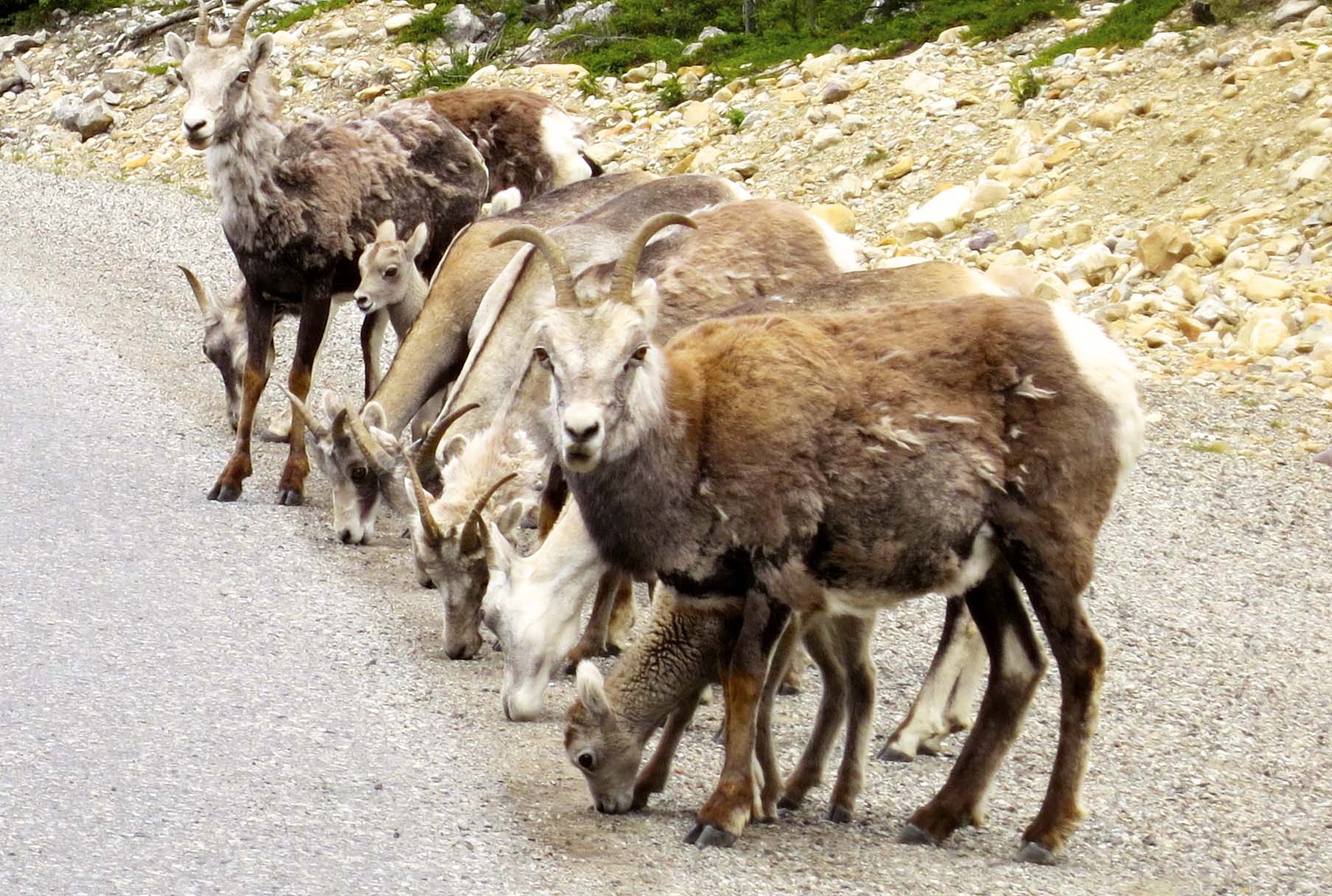
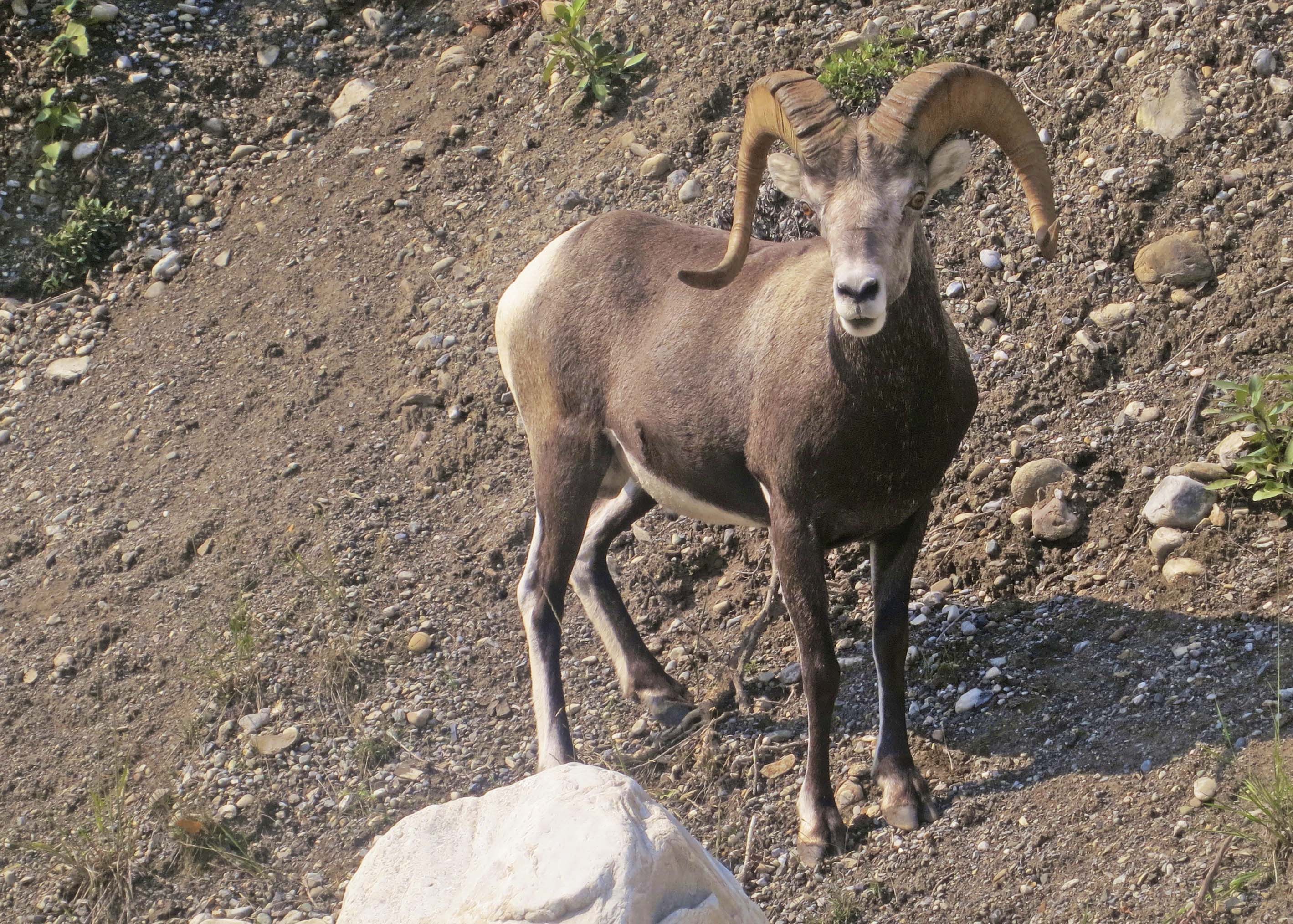
Big horned sheep are feeding up on the ridge.

A Big Horned Sheep with scrawny front legs is feeding up on the mountain.

And Big Bird is down at the pond.

And Big Bird is down at the pond. (Nothing scrawny about her legs.)

Newspaper Rock National Historic Site.

Stay out of the canyon. The tracks of Momma Bear and her cub have been sighted.

Hop on your horse and grab your bow and arrows. It’s time to get dinner.

Petroglyph of Native American with bow on horse at Newspaper Rock near Canyonlands National Park.

Ready for the hunt.

Whoops.

Whoops.

Having been warned, Walks on Feet went into the canyon anyway. Now he is being stalked by Momma Bear.

Having been warned, Walks on Feet hiked into the canyon anyway. Now he is being stalked by Momma Bear. The trail ends here.

Success! Always Gets His Buck shoots elk in butt.

Success! Always Gets His Buck shoots an elk in the butt.

It’s time for a feast. All the cool guys will be there.

Wild hat.

Scorpion Hat shakes a leg and Sheep joins in.

Woohoo!

Ladder Man shouts “Woo hoo!”

Man With Antlers practices flying leap.

And Horny Fellow practices a flying leap.

Stands On Horse will perform his amazing trick.

For after dinner entertainment, Stands On Horse will perform his amazing tricks.

Frisbee starts at four. NEXT BLOG: Looking for God in all the wrong places.

And Antenna Guy will display his recently captured flying saucer.  That’s it for today. NEXT BLOG: I start my essay series. First up: Looking for God in All the Wrong Places.


The Beautiful Bridges of the Oregon Coast… Part Two

One of many bridges designed by Conde McCullough in the 1930s Yaquina Bay Bridge is located next to Newport on the Oregon Coast.

Gorgeous skies provide a dramatic backdrop for the Yaquina Bay Bridge near Newport, Oregon.

Last Monday I posted a story and photos on the Cape Creek Bridge designed by Conde McCullough. Today I am going to feature two more of his bridges: the Yaquina Bay Bridge near Newport, and the Siuslaw Bridge near Florence. I first became aware of these two beauties when I used to visit my dad who managed a hotel on the coast for my brother in the late 70s. Marshall later sold the place, an action for which I have never quite forgiven him. Neither have I forgiven my cousins who had the luck of growing up in Newport.

The property my brother owned and my dad managed. Writers, artists, and professors from the University of Oregon stayed there for $10 a night in the 70s. Now it is an expensive Bed and Breakfast.

Gull Haven: The property my brother co-owned and my dad managed. Writers, artists, and professors from the University of Oregon stayed there for $10 a night in the 70s. Now it is an expensive Bed and Breakfast.

I was driving across the Yaquina Bay Bridge on my trip down the coast last fall when I thought, damn, I have to get a photo of this (above). Being by myself meant I was designated photographer. You know all the warnings about driving and using your cell phone, or driving and texting— they should add driving and taking photos. Enough said. Once I got across the bridge I found a side road where I was able to get out of the car and take Highway Patrol approved photos.

Yaquina Bay Bridge near Newport, Oregon.

A side view of the Yaquina Bay Bridge. The gull on the right added a little action.

The Yaquina Bay Bridge on the Oregon coast designed by Conde McCullough.

A close up of the spans with the historic Newport waterfront in the background.

I spent the night at a delightful campground next to the Florence Marina. This gave me the opportunity to walk over to the Siuslaw Bridge and spend time admiring it. The bridge was built under Franklin Roosevelt’s New Deal Public Works Administration during the Great Depression. It was one of hundreds of projects across the nation designed to put Americans back to work. Both Peggy’s dad in Pennsylvania and my dad in Iowa benefited from this program. Some 140 men worked on the Siuslaw Bridge. It was opened March 31, 1936.

The bridge under construction. (Photo from display next to the bridge.)

The bridge under construction. (Photo from display next to the bridge.)

Ever the artist, McCullough incorporated Art Deco, Moderne, Gothic and Egyptian themes into his bridge.

Suislaw Bridge on the Oregon coast designed by Condi McCullough.

A view of the bridge as it looks today.

Siuslaw Bridge near Florence, Oregon.

A view of the bridge from the other side rendered in black and white., giving it the ‘old time’ feel.

Suislaw Bridge in Florence Oregon across the Suislaw River

I walked along the sidewalk going across the bridge to get this photo.

The walkway across the bridge.

The walkway across the bridge.

Structure on Siuslaw Bridge near Florence designed by Cond McCullough in the 1930s.

An art deco look? Or are we talking Egyptian here?

Siuslaw Bridge on the Oregon coast.

Having seen the bridge from both sides and on top, I decided to take a look underneath for my final view.

A New Approach to Blogging… Off to a Rocky Start

City of Rocks State Park in southwestern New Mexico.

Way down in a remote corner of New Mexico, Peggy and I came upon the City of Rocks State Park where nature had carved volcanic rock into a world you might find in science fiction or fantasy.

To date, I have been blogging for close to five years. This is my 475th post. It’s time for a change. It won’t be radical, but my intention is to blog three slightly different posts each week. Intention is the key word here. It may or may not happen. Bloggers understand this. Sometimes life gets in the way— or the next book. (Grin) Blogging three times a week may prove to be too much. But if I do…

Mondays and Wednesdays will continue to focus on travel. Mondays will reflect my standard blogs with an equal mixture of writing and photography. Wednesdays will be more of a photographic essay, heavy on photos. This will enable me to bounce around the world a bit more plus free up some time. Since I have close to 20,000 photos in my photo bank, I don’t expect to run out any time soon.

Fridays will be more along the line of opinion pieces. I intend to write about things I am passionate about, things that concern me. Expect such topics as searching for God in all the wrong places; is technology dumbing down the world; and how 25 cents saved one million lives. I intend to have fun, dabble in a little controversy. I’ll probably get in trouble.

Today is a preview of what you can expect on Wednesdays. Enjoy the rocks.

Peggy and I had just finished backpacking for a week in the Gila Wilderness of southwestern New Mexico and were on our way to Deming via Silver City (Billy the Kid country). It was getting late when we came across a sign that pointed to the City of Rocks State Park. It sounded intriguing, we were tired, and the park had a campground. We turned left— and found ourselves in another world…

The City of Rocks State Park near Silver City New Mexico.

Private vehicle and tent camping spaces are spread out around the perimeter of the rocks.

This is an example of one of the campsites hidden among the rocks.

This is an example of one of the campsites hidden among the rocks.

City of Rocks State Park near Deming, New Mexico.

I would describe these rocks as having personality. Each one is unique.

Paths wander in and among the square mile park. Convenient rocks invite hikers, such as Peggy, to sit and enjoy the beauty and solitude.

Paths wander throughout the square mile park. Convenient rocks invite hikers, such as Peggy, to sit and enjoy the beauty and solitude.

What to expect when hiking through the rocks.

What to expect when hiking through the rocks.

City of Rocks State Park near Silver City, New Mexico is filled with uniquely carved rocks.

I felt this fellow might fit in on Easter Island.

Golden grass provides an interesting contrast to the rocks.

Golden grass provides an interesting contrast to the rocks.

Trees and rocks create interesting photos at City of Rocks State Park in southwestern New Mexico.

Trees also add visual interest in this final photo. If you find yourself in southwest New Mexico, the City of Rocks State Park is definitely worth a detour. NEXT BLOG: It’s back to the beautiful bridges of the Oregon Coast.


Thank You Bill and Hilary*… for Your Fine Words

Basenji dog in Liberia, West Africa.

Do You Part, the Liberian named Basenji that adopted me in the Peace Corps and that Bill Guerrant refers to in his book review below, is the small dog with the curly tail standing in the forefront. One of her many exploits was slipping behind me into the grand opening of a mosque in Gbarnga— almost causing a riot.

I am tickled that two of my favorite Word Press bloggers enabled me to create the above headline. Now, before you dash off a note to me that I have misspelled Hillary, the *Hilary I am talking about is not Hillary Clinton. It’s Hilary Custance Green, a writer and author living in England. Bill is Bill Guerrant, a one time attorney, now farmer, and soon to be author living in Virginia. Both have recently written unsolicited reviews of my book, a fact for which I am both grateful and somewhat humbled.

Writing a book is hard work. At least it was for me, and I am sure it is for most authors. Thousands of hours, even years, can be spent on the project. The page that takes a few minutes to read probably required several hours to write, or longer. Sometimes words flow; I have those minutes when my fingers dance over the keyboard. But more often than not, the process is painfully slow, like sitting in a dentist’s chair and waiting for the dentist to get his hand and drill out of your mouth.

As an aside, I was sitting in my dentist’s chair last week when my dental hygienist started giggling while she was reading my chart. “What?” I asked grumpily. My mouth is no giggling matter. Usually dentists start planning their next trip around the world when they look inside. “I see,” she said laughing, “that you have listed dentists under things you are allergic to.” Yep, that would have been me.

There is more to the book process than hard work. Call it an ego thing, if you must, but most writers are an insecure bunch, especially first time authors. We don’t have a clue how our book is going to be received. It is somewhat akin to having your child on stage for her first big solo performance. By the time I had finished The Bush Devil Ate Sam, I had put so much effort into writing the book, and so much of myself, that I was prepared to head for the cooking sherry at the slightest criticism. I am ever so thankful that I didn’t have to live with me. (Peggy nods in agreement.)

Fortunately people have been kind. It’s true that my book isn’t out there in the world where the professional critics are paid big bucks to be nasty, but people I care about and respect seem to genuinely enjoy the book. What I had hoped for— that it would introduce readers to Liberia and her people, that it would provide insight into what being a Peace Corps Volunteer is like, and that it would provide some laughs along the way, seem to be happening.

I reblogged Hilary’s post a week ago. Here’s what Bill has to say:

Just before starting Ben Falk’s book I read frequent-commenter Curt’s book The Bush Devil Ate Sam, a delightfully entertaining (and informative) memoir of his time in the Peace Corps in Liberia in the 1960s. The book is a page-turner, and I highly recommend it.  Curt enrolled at UC-Berkeley just in time for the beginnings of the student rebellion there, putting him on the frontlines at the beginning of one of the world’s greatest movements for social justice. Some of that story is told in his book, and a fascinating story it is. Most of the book tells the story of the time he and his wife spent in Liberia.  I laughed out loud and I learned a lot, which only happens with good books. The story of his dog Do Your Part crashing the grand opening of the community’s first mosque (Curt having been mistaken for “the international media”) is alone worth the price of the book.

The book closes with some insightful thoughts about Liberia’s tragic history of the past few decades.  It caused me to think of a Liberian woman who was a classmate of mine in seminary, a kind and gentle person who lived through the horrors of the civil war there.  Whenever she tried to talk about it, she cried. Something she said about Americans has stuck with me.  She said that here when we say grace before a meal (if we bother), it just seems perfunctory. In Liberia, she said, people are truly grateful for every meal and they offer thanks with joy at the miracle that food is.  I wish I could recall her exact words, because I’m not doing them justice.  Suffice it to say that Curt’s concern for Liberia and the Liberian people resonated with me, even though I’ve never been there.

By the way, Curt is also one of the rock-stars of the blogosphere. Go check out his blog. You can buy his book from Amazon, but I recommend you contact him directly for a copy.**

Hilary and Bill are both caring and highly productive people, contributing to and making a difference in the world. Hilary is a sculptor and the author of two books that are available on Amazon. Presently she is working on Letters from Relatives of Far East POWS—Writing to a Ghost, a book that explores an almost forgotten aspect of World War II involving Far East Japanese prisoners of war and their families. It is a story that deserves to be remembered. Her blog is the Green Writing Room.

Bill is a farmer who is a leader in the movement to reintroduce America to the natural and healthy foods being grown on small farms across the country. In his own words: “Our produce is grown naturally, without pesticides, herbicides, or synthetic fertilizers. Our animals are raised humanely.” His blog is Practicing Resurrection.

** For those of you that do your reading in EBooks, The Bush Devil Ate Sam is available on Amazon and a number of other sites around the world. Simply click on the cover of the book in the right hand column above. It will take you to my author’s page and the sites. If you prefer a written copy, the book will eventually be available on Amazon and several other sites as print on demand copies. In the mean time you can write me at cvmekemson@gmail.com and I will be glad to send you a copy while supplies last. Please include your address. I will send an invoice with the book. You pay when you receive the book. The cost is presently $13 plus mailing costs, normally $3.00 in the US.

Happy Earth Day 2015… A Walkabout in Southern Oregon

White oak woodland in Southern Oregon in the Applegate Valley. Photo by Curtis Mekemson.

A variety of trees exist on the five acres around our home in Southern Oregon. These are white oaks. It looks like the Sherwood Forest of Robin Hood, or at least like I imagined it as a child. The road leads down to our house.

It’s Earth Day 2015. To celebrate, I am writing this post from a small deck Peggy and I had built on the upper portion of our property. I took the photo of white oaks from where I am sitting.

An Acorn Woodpecker is hammering away at a dead pine. He just stopped to issue a staccato comment on the day, a Woody Woodpecker laugh. I can also hear a Robin’s distinctive chirp— they are migrating through, scratching around for juicy bugs. Flickers and Stellar Jays join the chorus. The jays are discussing the fact I haven’t put out their morning helping of sunflower seeds. They are loud and raucous, hoping I will hear them. How could I not? I was soundly scolded on my walk up here.

As for the Flicker, he has gone to pounding on our roof vents several times a day. Who knows why, but it sounds like a jack hammer. It gets Peggy quite excitable and she charges around whacking our ceiling to scare him away. I’ve checked the roof, so far no damage. I am not so sure about the ceiling.

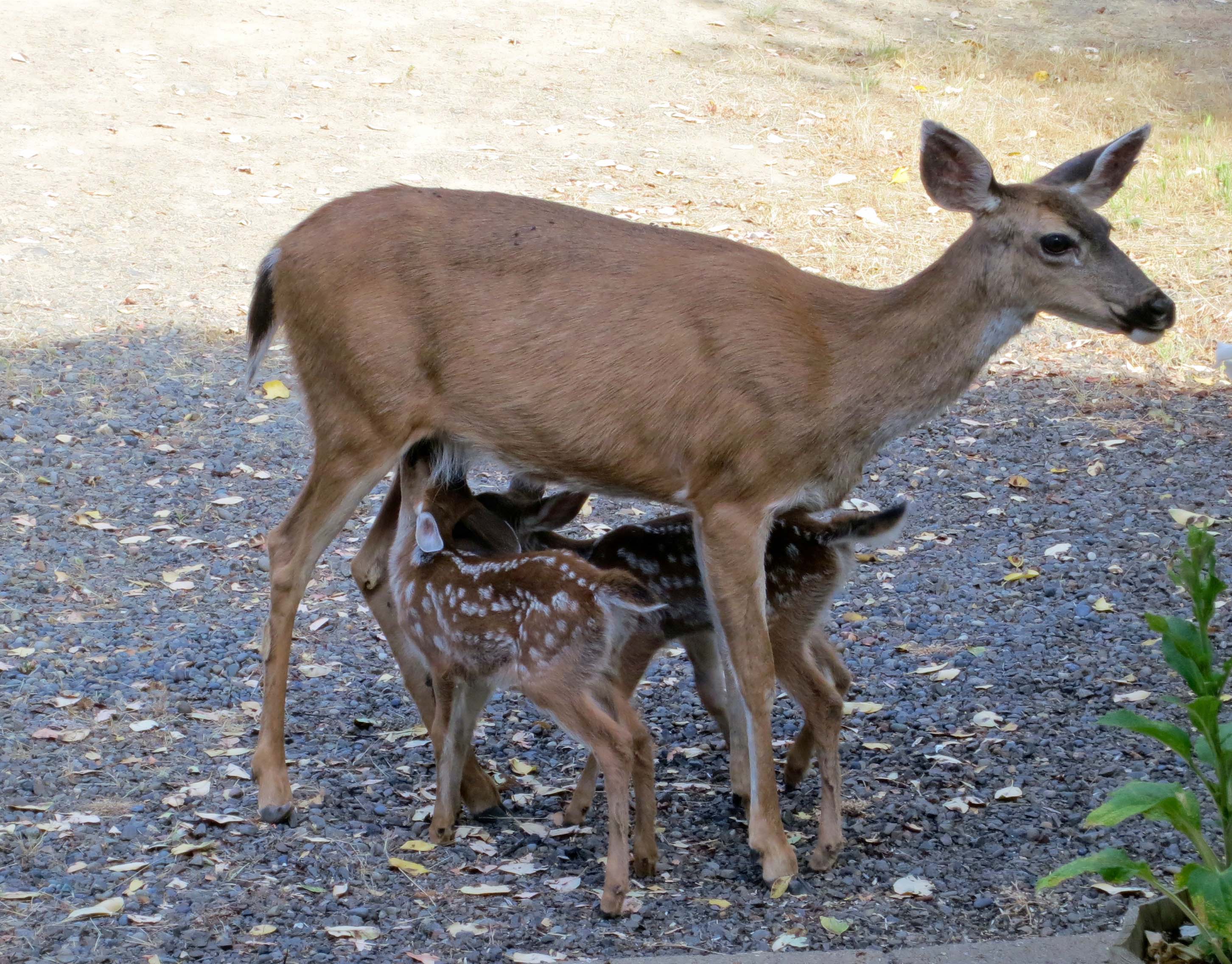
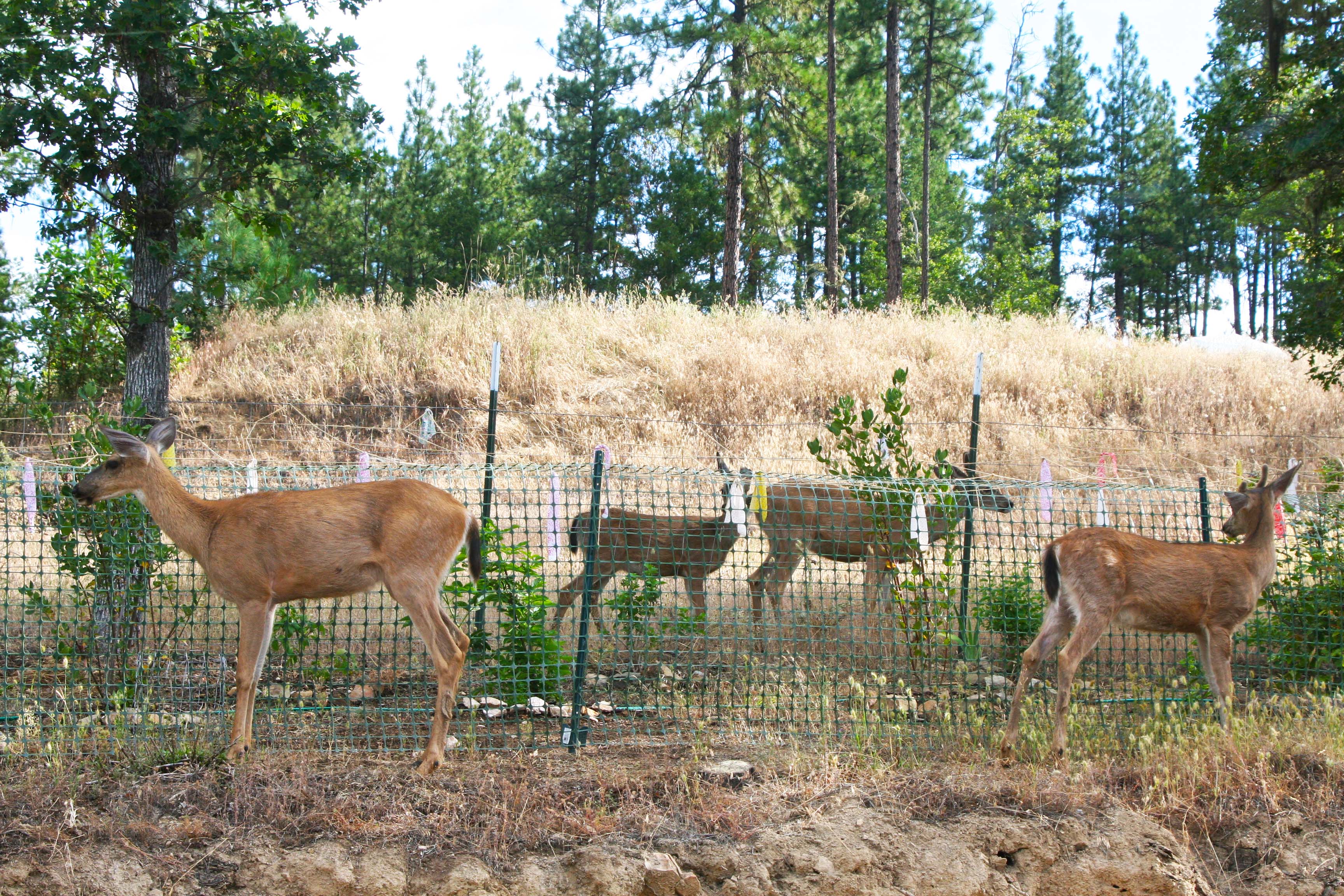
One very pregnant and obviously uncomfortable Black Tail doe walked by a few minutes ago. She’s restless. I watched her yesterday as she disappeared behind our pump house for a few minutes (it’s cool and shady), came out, munched on some grass, walked to our house, and plopped down against the side. She will be having her fawn soon, probably down in our blackberry filled canyon. We won’t see the baby for a week or two since does carefully hide their babies and insist that they remain hidden for several days.

Pregnant doe on Upper Applegate River in Southern Oregon. Photo by Curtis Mekemson.

The ballooning mom-to-be leans against our house and looks at me with her big brown eyes. It’s like she is saying, “Really, now what?” The deer are used to being lectured by Peggy about eating her flowers.

A cool, fresh breeze is blowing. Puffy clouds float by. The wind is welcome; it’s been hazy for the past few days. The weather people tell us that the haze is caused by smoke blowing in from Siberia. Apparently fires that Siberian farmers were using to clear their fields escaped. Our earth, this seemingly huge planet, is a small place after all. We are all neighbors. If people choose to pollute the air, discharge waste into water, cut down forests, and litter the landscape with the leftovers of modern civilization, it impacts all of us. We all suffer.

Haze from Siberia fills the valleys between our homes and the Red Butte Mountains.

Haze from Siberia fills the valleys between our home and the Red Butte Mountains.

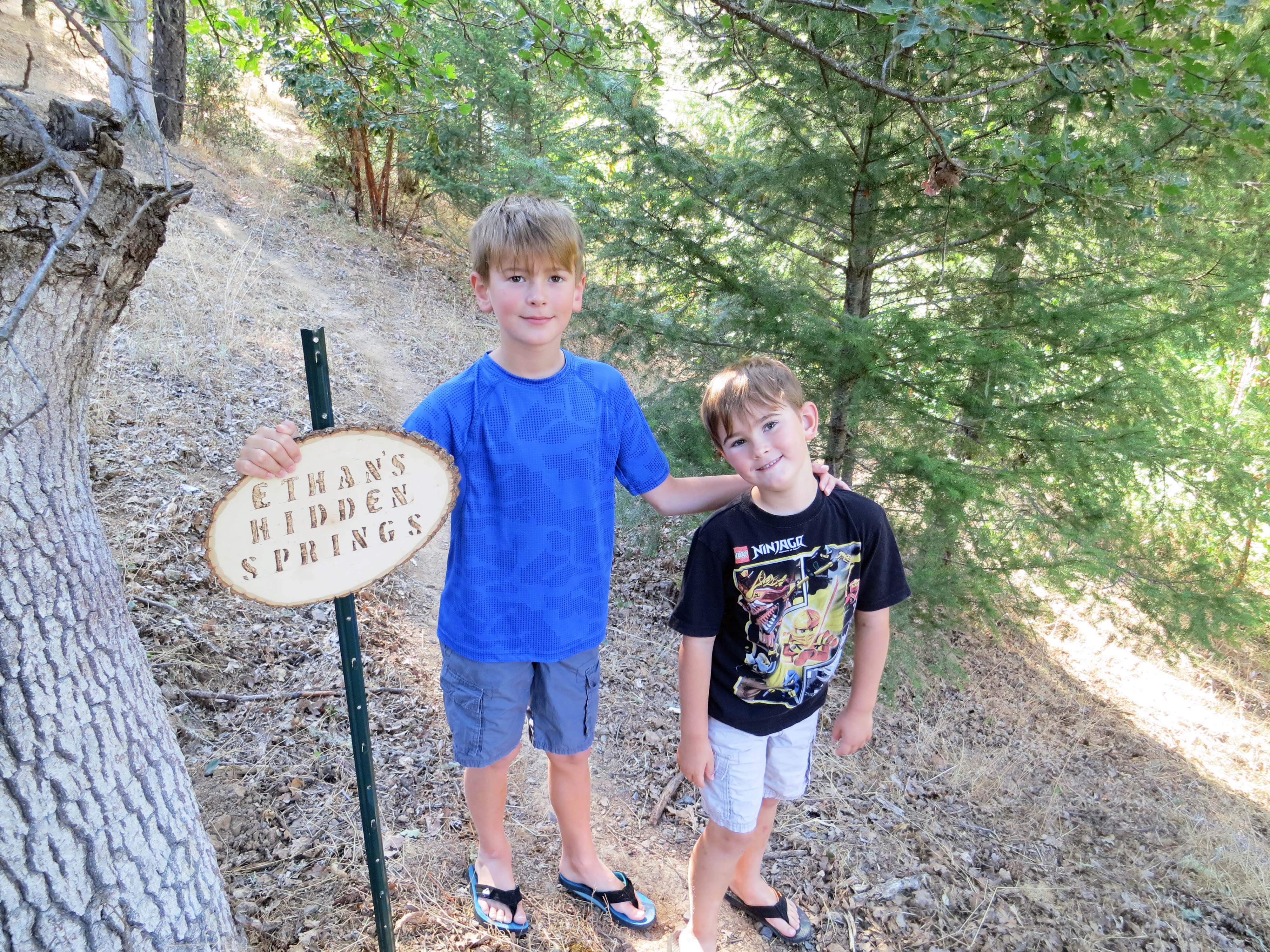
But enough doom and gloom—today is a day to celebrate the natural beauty of our earth. Let’s go for a walk. We will start at the Applegate River at the bottom of our property and move up the hill to the National Forest boundary marker. I’ve built signed trails throughout our property and named them after our grandkids (all boys). Ethan’s Hidden Springs Trail and Connor’s Jungle Trail are examples. The first thing the kids do when they arrive is run off to explore their trails. It is Peggy and my hope that we can instill in our grandchildren the same love of the natural world and desire to protect it that we have.

A Note: I wrote this piece and did our walk yesterday so this post could go up today.

This beautiful river flows out of the Siskiyou Mountains a few miles away from out home.

This beautiful river flows out of the Siskiyou Mountains a few miles away from our home.

Cold, pure water.

Looking down into the river.

I scrambled over and down these rocks to get to the river. Bureau of Land Management land is on the opposite shore.

I scrambled over and down these rocks to get to the river. Bureau of Land Management land is on the opposite shore.

This handsome guy is a mere shell of his former self, literally. I believe it was a dragonfly nymph before the dragonfly popped out of the shell and flew away.

This handsome guy is a mere shell of his former self, literally. I believe it was a dragonfly nymph before the dragonfly popped out and flew away in one of the miracles of nature.

Likely native American grinding rock on the Applegate River in Southern Oregon.

Located among the rocks is what Peggy and I suspect was a Native American grinding rock.

Lichen on river rock of the Applegate River in southern Oregon.

Lichens (from my perspective) always make interesting photos.

Here's a closeup.

Here’s a closeup.

Now it is time to hike up the hill. Our small 1500 foot with its sunroom is perched on the side. The tall tree on the right is a Douglas Fir.

Now it is time to hike up the hill. Our small 1500 square foot house with its sunroom is perched on the side. The tall tree on the right is a Douglas Fir.

Our fence is designed to fit into the local environment.

Our front fence is designed to fit into the local environment.

While oaks dominate the northern side of our property, Ponderosa Pines, Douglas Fir and Madrones dominate the south. I've created signed trails running through our property and named them after the grandkids such as Ethan's Hidden Spring's Trail and Connors Jungle Trail.

While oaks dominate the northern side of our property, Ponderosa Pines, Douglas Fir and Madrones dominate the south. This is Ethan’s Hidden Spring Trail.

Ponderosa Pines growing in the Upper Applegate Valley near Applegate Lake.

The trees, like these Ponderosa Pines, grow quite tall.

Ponderosa Pine growing at the 2000 foot elevation on the Upper Applegate River.

Check out this beauty.

Large Madrone growing near Applegate River in southern Oregon.

This large Madrone with its unique bark lives next to our house.

Madrones shed their leaves in summer. It is like having two falls. The shadow of a fly can be seen through the leaf. Shortly afterwards it flew down to bite me. Bad decision.

Madrones shed their leaves in summer. It is like having two falls. The shadow of a fly can be seen through the leaf. Shortly afterwards it flew down to bite me. Bad decision.

Signs of animal life are found throughout the property. This large hole was probably drilled by a Pileated Woodpecker.

Signs of animal life are found throughout the property. This large hole was probably drilled by a Pileated Woodpecker.

Cat eye flower grown in the Upper Applegate River Valley.

Flowers were few and far between on my walk but I did find this interesting cat eye.

One of the reasons we bought our property was this sign, a boundary marker for the Klamath National Forest that borders the back of our property.

One of the reasons we bought our property was this sign, a boundary marker for the Klamath National Forest that borders the back of our property. Between Klamath and other national forests, over a million acres of public lands are found out our back door.

While our front fence is a fairly serious fence, our back fence is strictly for aesthetics. It is an open invitation to the deer, cougars, bear and other wildlife that live in the forest to "come on down." We'd even welcome Bigfoot. (grin.)

While our front fence is a fairly serious fence, our back fence is strictly for aesthetics. It is an open invitation to the deer, cougars, bear and other wildlife that live in the national forest to “come on down.” We’d even welcome Bigfoot. (grin.) HAPPY EARTH DAY.