A Devilishly Hard Decision… The Title to My Peace Corps Africa Book

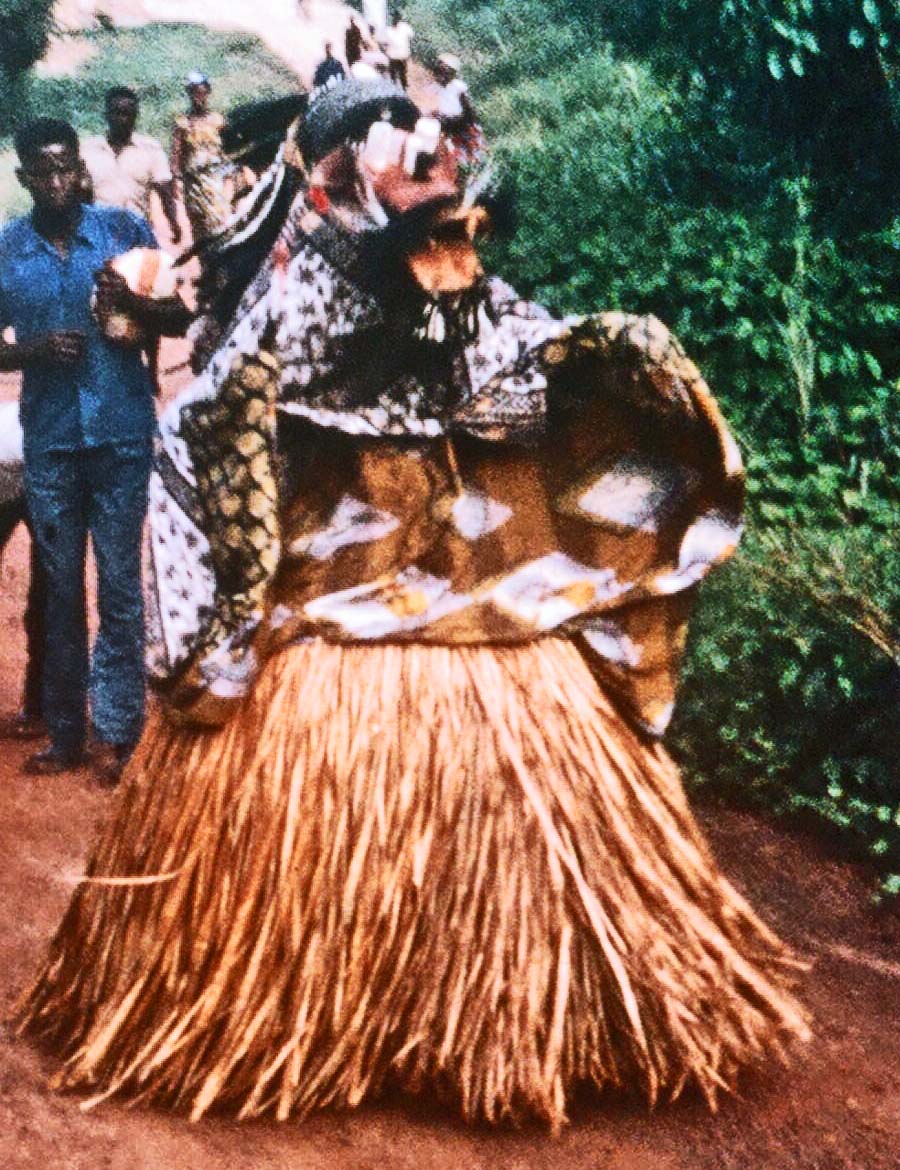
Pat hay stack and part voodoo nightmare, a Liberian Bush Devil shuffles through the dirt toward me.

A fading photo from 1967 captures a Liberian Bush Devil, part hay stack and part voodoo nightmare, as it shuffles toward me through the red laterite dirt.

So, I’ve been struggling with the title of the book about my experience as a Peace Corps Volunteer in Liberia, West Africa. As part of the process, I asked for help from my fellow bloggers and friends.

Step one included developing four options and providing backstories. Step two involved reviewing and summarizing the input.

Now it’s my turn.

I have two objectives for my title. First, it needs to be catchy. Unless people are familiar with an author or have recommendations from a trusted source (friend, author they enjoy, media), the first thing that leads them to choose a book is its title.

Second, the title needs to reflect my Peace Corps Africa experience.

For example, on the one level, The Dead Chicken Dance is about cutting the head off a chicken and watching it dance– slightly unusual and a little macabre. As such, the title might gain attention. But there was more. Early Peace Corps was struggling with how to prepare people to jump into another culture that was totally foreign to them. Killing, gutting, and plucking a chicken was guaranteed to provide trainees with a challenging experience that few of them had ever had but might face as a Volunteer. It’s a long ways between buying a pasty white, pre-packaged chicken in the grocery store and picking up a hatchet to cut the head off a feathered, clucking Henny Penny.

The Bush Devil Ate Sam and The Lightning Man Strikes Again reflected two aspects of African culture that were quite real to tribal Liberians. Both of these titles were designed to capture attention, but they also represented the dramatically dissimilar world that tribal Liberians existed in. Understanding Liberia, in fact understanding much of Africa, depends upon recognizing these differences.

How Boy the Bad Dog Ended Up in Soup represents a sharp break from our Western dog-centric world… of which I am very much a part. Dogs were a legitimate food source in Liberia. Students would tease me by coming by and pinching my cat, Rasputin. “Sweet meat, Mr. Mekemson” they would say while smacking their lips. They were cautious, however. Rasputin could take care of himself: “Pinch me once and I’ll squawk a warning. Pinch me twice and I’ll take off your finger.” As with each of my other titles,  there was more to the story with Boy than a gastronomical challenge.  It went beyond scary that soldiers would show up at my house in the middle of the night solely because the dog had eaten a guinea fowl.  It was strange with a strangeness that I would think of more than once when Liberia fell into the tragedy of its civil wars.

As I noted when I summarized the responses on titles, each title received strong support but Boy received the fewest ‘votes.’ Part of this may because we are so dog centric. As one blogger observed, the title might turn people off. I get that.

Support for the other three titles was evenly split. For me, it finally came down to either the Bush Devil or the Lightning Man. The Dead Chicken relayed an insight into early Peace Corps and cross-cultural challenges, but the other two did more to capture the Africa experience. Tossing a mental coin, I’m going with the Bush Devil. As my blogging friends James and Terri Gallivance, who have lived in Africa, noted: “We’re voting for The Bush Devil Ate Sam because we feel it embraces the mystery that is Africa.” The mystery that is Africa seems like a good place to start.

On a more prosaic level, I am adding “And Other Peace Corps Tales of West Africa” as a subtitle because it is important to have both Peace Corps and Africa included. Next up: the cover. As soon as I develop examples, I’ll post them.

NEXT BLOGs: Peggy and I will soon be heading into Nevada where I have several posts I am thinking about including 1) an art hotel in Reno created by Burners from Burning Man, 2) the remote town of Hawthorn with its history of being America’s primary ordnance depot (bunkers fill the desert), 3) the Extraterrestrial Highway and Area 51– subject of more conspiracy theories than there are people in Nevada, 4) Death Valley in the spring, 4) the Valley of Fire, 5) Red Rock Canyon, and 6) Las Vegas being Las Vegas. BUT, IN THE MEANTIME, I will post on another of my favorite petroglyph sites, Painted Rocks out of Yuma Arizona. I think I will also revisit the actual Big Foot trap about three miles from my home and see if Bigfoot is hanging out there. (It sort of goes along with the ET Highway.)

The Dead Chicken, the Bush Devil, the Lighting Man, and the Bad Dog

Gbarnga, Liberia where I served as a Peace Corps Volunteer from 1965-67. The photo was taken at that time.

Gbarnga, Liberia where I served as a Peace Corps Volunteer from 1965-67. The photo was taken at that time.

A dead chicken, a bush devil, a lightning man, and a bad dog walk into a bar… Just kidding.

Last week I asked for help from my blog followers, Facebook friends, and members of my book club to help choose a title for the book on my Africa Peace Corps experience. The choices were:

  • The Dead Chicken Dance
  • The Bush Devil Ate Sam
  • The Lightning Man Strikes Again
  • How Boy the Bad Dog Ended Up in Soup

Each title also included a subtitle connecting the book to Africa and the Peace Corps.

The input was great and there were many thoughtful comments on the various choices. There were also more general suggestions such as put the titles in the active voice and make them shorter. An example of the former is The Dead Chicken Dance might become The Dead Chicken Dances or Dead Chicken Dancing. In the latter, How Boy the Bad Dog Ended Up in Soup might be retitled Bad Dog Soup.

Here’s a pie chart that shows how people responded:

Book titles

What seems clear here is that the Bad Dog was not good. But let me note, Boy did have some strong support. Alison and Don felt the title had a “good hook to it.” And Kocart said, “Boy the Bad Dog. Of Course.” Naturally. Linda at Shoreacres, who lived in Liberia, made the interesting comment, “Boy the Bad Dog certainly evokes all of the collections of African folk tales that are out there.” On the con side, The Writing Waters Blog observed that the title might be “too much for this dog loving country.”

Pull Boy out of the pie and what we have left is close to a dead heat. The titles are running nose-to-nose. The dead chicken garnered 30% of the vote, the Bush Devil 33% and the Lightning Man 28%. It isn’t what I would call a clear mandate. (Grin) So how about the very thoughtful comments? Maybe they are too thoughtful! Strong arguments were made for each title. I found myself nodding, ‘that’s right’ over and over as first one title and then another worked its way to the top.

Some of the comments:

“The Dead Chicken Dance hands down. I would pick it up and look at it. That’s as good of a title as “Getting Stoned With Savages…” which was a damn good book!”

“The Dead Chicken Dance is my favorite…. A touch grisly plus touch of the familiar plus invitation to dance equals enigmatic… Strong short and sure of itself like The Ballad of the Sad Cafe, The Joy Luck Club, The Kite Runner.”

I would use the Dead Chicken Dance, but I’d change it from “The Dead Chicken Dance” to “Watching a Dead Chicken Dance.”

Personally, I like The Dead Chicken Dance best. They’re all catchy, but for some reason, this one jumped out at me most. My second choice would be The Bush Devil Ate Sam. In fact, now that I see them both side-by-side, I like them equally. Oh, boy, that wasn’t much of a help, was it? 🙂

“The Bush Devil Ate Sam” is definitely my favorite; short, catchy, intriguing, and feels more encompassing of a collection of African stories than the others…

“I am leaning toward the Bush Devil Ate Sam as I have met Sam, a doctor trained in the American University system, highly educated, yet “marked” by his right of passage to manhood.”

“ (The Bush Devil Ate Sam) is the most cogent, the most compelling.”

“Curt, these titles are all great and we love the stories behind them. We’re voting for The Bush Devil Ate Sam because we feel it embraces the mystery that is Africa…”

“Personally, the one that would make me pick up the book first would be “The Bush Devil Ate Sam.”  It has three things: something exotic (the bush devil), something familiar (the name Sam being a sedate, western-sounding name makes it more familiar and less threatening), and the mystery of how the two came together – you can be pretty sure something called a bush devil didn’t literally eat Sam, so what is this really about?  Of all of your proposed titles, it was the one that made me most want to find out the story behind it.”

“ …the one that was most immediately appealing was the Lightning Man Strikes Again and the most intriguing was The Bush Devil Ate Sam.”

“I read all of the stories to the boys and there was a unanimous vote for The Lightning Man Strikes Again. Very catchy and a fun story!” (The grandkids check in.)

“I loved all the stories but my favorite title is The Lightning Man Strikes Again. I usually choose books by the title and I’d pick that one up just because of the sound of it. Lightning is fascinating anyway and the title sounds interesting and humorous, which goes perfectly with those stories. I’ve always wanted to join the Peace Corps and can’t wait to read this now.”

“The Lightning Man Strikes Again: I like it because it has a double entendre..Is it about someone else or are you the lightning man helping to bring change to Africa… 
Can’t wait to read your follow up post!”

“Love The Lightning Man Strikes Again – can just feel the dread the Lightning Man induced. Do let us know when you make your choice.”

“The problem is that ALL the titles are intriguing; they all entice the reader to want to read the stories.  But, if forced to choose, I would go with the lightning man.  I’m not quite sure, maybe because it relates so directly with superstition and myth.”

Life's about choices, right. It may be about the title of a book or it may be about which piece of monkey meat you are going to buy.

Life’s about choices, right. It may be about the title of a book or it may be about which piece of monkey meat you are going to buy. The lady selling the meat held up a little head and said, “Very tasty.”

So… these are some of the thoughts you have shared. They represent views from people with widely varying backgrounds… including writers, the under ten crowd, and folks who have lived in Africa. Do you see my dilemma? Thanks so much for taking the time to participate. It means a lot.

NEXT BLOG: My choice and the reasons behind it. (Yes folks, I am going to drag this out for one more blog.)

Who I Am… A Brief Bio for the Book

Peace Corps recruitment poster from 1967.

An early poster I used as a Peace Corps Recruiter after I returned from West Africa.

Since I am still receiving input on the title of the book about my Africa Peace Corps experience, I decided to put together a brief bio for the end of the book. Following recommendations from the book industry, the bio is written in the third person. It will be shortened somewhat.

Curt was raised in the small foothill town of Diamond Springs, California. He grew up wandering through the woods and communing with nature. It was a great life. But he also learned a lot about transparency. Everybody knew everything about everybody else, which was more than he wanted to know. So he escaped the confines of his small universe in the mid-60s and headed off to UC Berkeley where he learned that integration was good, war was bad, and that young people who held such views should be bashed on the head and thrown in jail.

He was waiting for his turn with the Oakland police while sitting on the floor of the UC administration building and singing protest songs with Joan Baez when he had an epiphany: he should make America a better place and leave the country; he would join the Peace Corps. Eight months later he was chopping off the head of a chicken in the Sierra Nevada Mountains of California as part of his training to teach African history to high school students in Liberia, West Africa.

Berkeley and the Peace Corps ruined Curt for living the American Dream. He decided that obtaining an 8-5 job, moving to the suburbs, buying a big house, and driving a fancy car were not for him. “If you would only make babies, become a good Christian boy, and take up photography,” his father had grumbled.  Instead, Curt became an environmentalist and a health advocate, happily making war on polluters and the tobacco industry.

Wanting to get back to nature, he created the American Lung Association’s long distance backpack and bike trek program. The Lung Association needed a new fundraiser; Curt needed an excuse to play in the woods. He added wilderness guide to his ever-growing resume and spent two decades leading wilderness adventures.

Every three to five years Curt quits whatever he is doing and goes on an extended break. Travelling through the South Pacific and Asia, backpacking throughout the western United States, and going on a six-month, 10,000-mile, solo bicycle trip around North America are among the highlights. This lifestyle came to a temporary halt when he climbed off his bike in Sacramento, met the lovely Peggy, and decided to get married– in about one minute. It took a while longer to persuade Peggy and her two teenage kids.

Today Curt and Peggy live on five wooded acres in Southern Oregon where he pursues yet another career, this time in writing. Visit him at his blog wandering-through-time-and-place.me. He’d love to hear from you. Or you can Email him at cvmekemson@gmail.com.

Born in Ashland, Oregon, I moved with my parents, sister Nancy, and brother Marshall to the Bay Area. I'm the little one.

Born in Ashland, Oregon, I moved with my parents, sister Nancy, and brother Marshall to the Bay Area. I’m the little one.

Photo of Curt Mekemson as a child with pets.

I grew up wandering in the woods of the Sierra Nevada foothills of California, usually with an assortment of pets. There may be a rabbit between the dogs.

Free Speech Movement protest at UC Berkeley in 1964.

A protest at UC Berkeley in 1964 when police occupied campus. I am in the middle of the photo looking up at the camera.

My first house in Liberia when I was teaching second graders. Later I would teach high school students and move to another house.

My first house in Liberia when I was teaching second graders. Later I would teach high school students and move to another house.

A photo of my dad.

A photo of my dad in his 80s– a good man who read the bible daily, wanted grandkids, and loved to take photographs.

 In 1996, I put together an effort to increase California's tobacco tax, which would eventually lead to one of the most extensive privation campaigns in history. Today it is estimated that the effort has saved over one million lives and one hundred billion dollars in health care costs.

My focus on health and environmental issues took me from California to Alaska and back. In 1996, I put together an effort to increase California’s tobacco tax, which eventually led to one of the most extensive prevention campaigns in history. Today it is estimated that the effort has saved over one million lives and one hundred billion dollars in health care costs.

Wanting to spend more time in the woods, I set up the American Lung Association's Trek Program. The photo is of me leading a group in the Sierra Nevada Mountains of California.

Wanting to spend more time in the woods, I created the American Lung Association’s Trek Program. The photo on the front of ALA’s National Bulletin is of me leading a group in the Sierras of California.

Ever wonder what it takes to bicycle 10,000 miles? One of my friends has suggested strong legs and a weak mind. I was half way through my trip bicycling up a very steep hill in Nova Scotia when this photo was taken.

Ever wonder what it takes to bicycle 10,000 miles? One of my friends has suggested strong legs and a weak mind. I was half way through my trip and bicycling up a very steep hill in Nova Scotia when this photo was taken.

It took me two years to persuade Peggy to put on a wedding dress.

It took me two years to persuade Peggy to put on a wedding dress.

The view from our sunroom, which is one of my writing locations.

The view from our sunroom in Southern Oregon, which is one of my writing locations.


The Bush Devil Ate Sam… And Other Possible Book Titles: HELP!

Liberian bush devil photo by Curtis Mekemson.

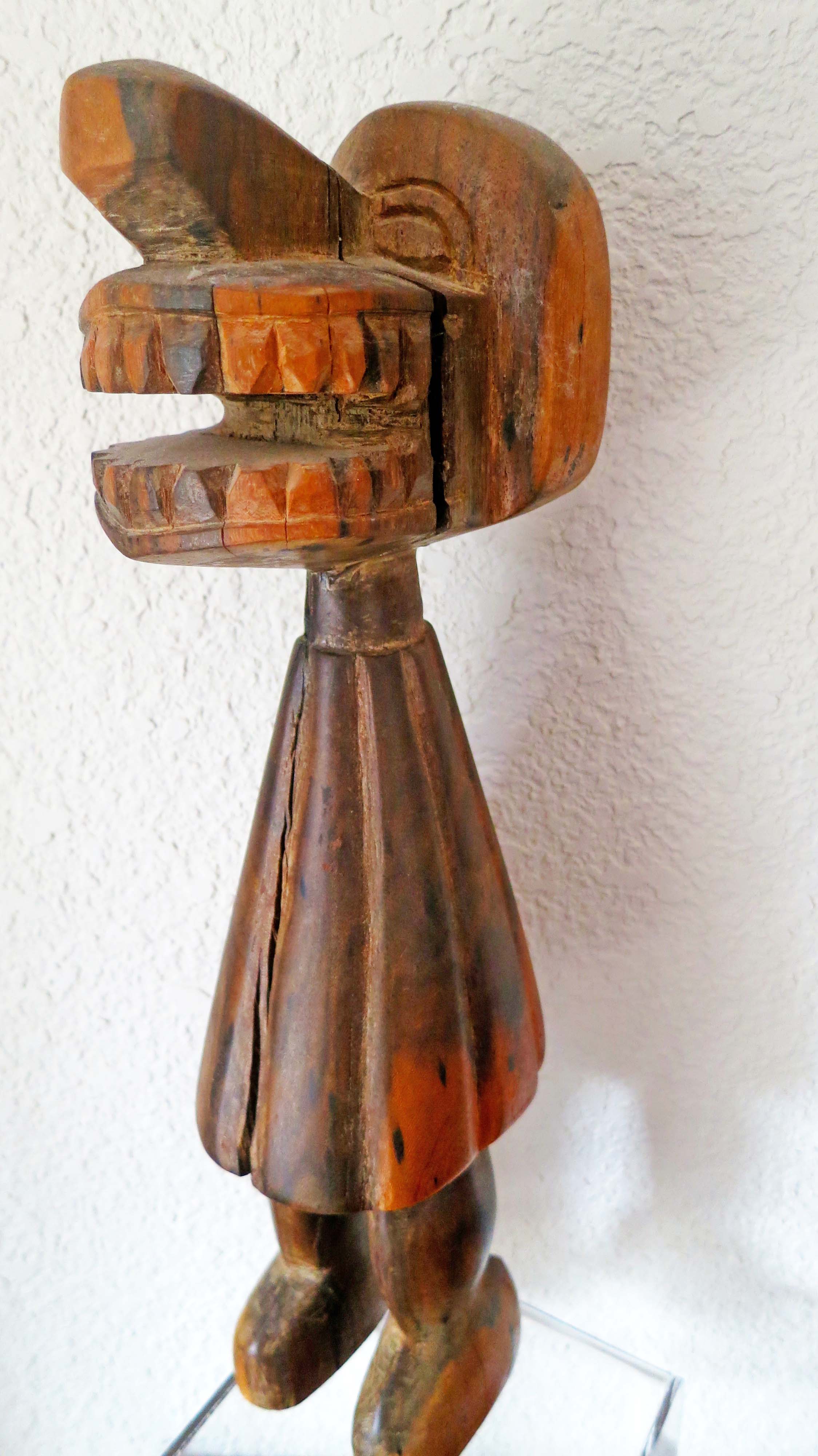
Freddie the carver, a leper who lived in the up-country Liberian town of Ganta, carved this replica of the Bush Devil for me in 1965. In the 70s similar carvings would become known as Jimmy Carter dolls.

What leads people to choose a particular book is a question every author, agent and publisher asks. If my name were Stephen King or J.K. Rowling and I was writing my umpteenth best seller, I wouldn’t have to worry about anything except writing the book and raking in the dough. But being Curt Mekemson… let’s just say I have a few more challenges (grin).

I am now in the final stages of self-publishing a book on my Peace Corps experience in Africa. Making money isn’t the objective; I’m happily retired. But I do hope people will read the book. I realize that success will ultimately depend upon whether people like what I have written and tell their friends. But first I have to capture their attention.

The Writer’s Guide to Self-Publishing (and every other book that purports to tell us go-it-alone writers how to) suggests that an enticing name, great cover, compelling back copy, and dynamite first few pages are what count. Of course, an endorsement by J.K. Rowling would help, but, as they say in the vernacular, that ain’t going to happen.

I’ve decided to ask for your advice. Several of the people who read this blog are authors and all of you are avid readers. So here’s the question. Which of the following titles would capture your eye and lead you to pick up the book? Why? (You can pick more than one.)

FYI, I’ve included the back-story behind each title. Depending on the title I choose, I will use a short, spiffed up version of the story in the introduction of the book.

Thanks for your participation!

Curt

1. The Dead Chicken Dance

And Other Peace Corps Africa Tales

Peace Corps training lacked its modern sophistication in the 1960s. Our group did its initial training at Cal State SF. We were then dropped off in the Sierra Nevada Mountains with paper sleeping bags for a wilderness camping experience. During the week, we faced a number of challenges such as rock climbing, bridge building, etc. A psychologist followed us around and took notes. It was serious business. Based on our responses, we could be sent home. One of the most memorable challenges was when our leader showed up the first night with a hatchet and a crate of live chickens. “Here’s dinner,” he announced with a laugh.  You can imagine how the kids from the big cities reacted. I was a country boy, however. I had killed, plucked, and gutted chickens. So I volunteered for the messy part. My chicken did a nice little dance when I cut off her head off. The city kids turned pale. They lost their appetites when I reached into Henny Penny and yanked out her still warm innards. It was a good thing; I got more to eat.

2. The Bush Devil Ate Sam

And Other Peace Africa Corps Tales

When my first wife, Jo Ann, and I arrived in Liberia we recruited a young man to help with our chores. In return, we provided meals and funds to cover school costs and other necessities. One day, Sam was working with me outside and took off his shirt. Jo noticed that he had a series of parallel scars marching down his chest. “How did you get those?” Jo had asked, partially out of concern but mainly out of curiosity. “I can’t tell you,” Sam had blurted out. “But,” he quickly added, “I can tell Mr. Mekemson.” Aha, I thought to myself, Sam and I belong to the same organization, the men’s club. Actually Sam belonged to a very exclusive men’s club, the highly secretive Poro Society that existed to keep tribal people in line and pass on tribal culture. The year before Sam had been to bush school where he had learned the Society’s secrets. At the end of the session, he had had a close encounter with the Bush Devil. It ate him. He was swallowed as a child and spit out as a man. The scarification marks represented the Devil’s teeth. The Bush Devil (so-named by Christian missionaries) is part politician, part cultural cop, part spiritual leader, and all secret.  Outsiders don’t get to see the Kpelle version. I was able to see one from another tribe, however. He looked like  someone had crossed a walking haystack with a voodoo nightmare.

Gbarnga photo of Curt Mekemson and Sam Kollie.

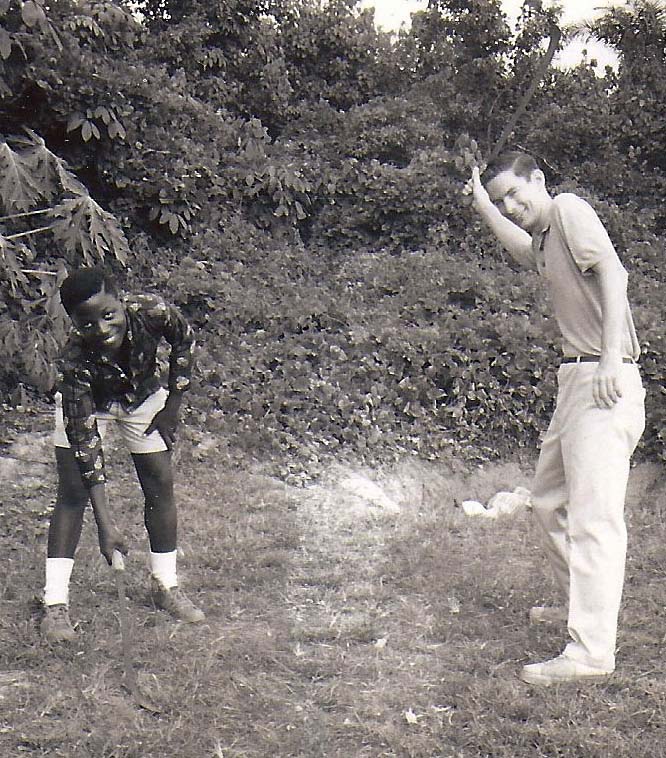
A photo of Sam and me cutting grass with machetes right around the time we noticed his scarification marks. Sam would later become a physician.

Liberian Bush Devil photo by Curtis Mekemson.

The Bush Devil I was allowed to see.

Another photo of the Liberian Bush Devil carved by Freddie.

Another photo of the Liberian Bush Devil carved by Freddie.

3. The Lightning Man Strikes Again

And Other Peace Corps Africa Tales

We left Mamadee with 50 dollars to buy a 50-gallon drum of kerosene while we went off to explore East Africa in a Volkswagen beetle. Mamadee was sitting on our doorstep when we returned but there was no kerosene and no 50 dollars. Someone had stolen the money. Mamadee’s father, who was a chief of the Kpelle tribe, wanted to assure us (and himself?) that Mamadee was innocent so he offered to subject Mamadee to a trial by lightning. The Lightning Man had a special power; he could make lighting strike people who had committed crimes. Somebody steals your cow or your spouse, ZAP! Even if Mamadee were guilty, we didn’t want him struck by lightning, or even singed for that matter. We passed on the offer. Another Volunteer took a different approach. He had spent half of his monthly income ($70) on buying a new radio. Somebody stole it the first day. He vowed that he would get his new toy back. So he had his students take him out in the jungle to hire the Lightning Man. That night there was a horrendous lightning storm. Ignoring for the moment that it was in the middle of the rainy season and there were always horrendous lightning storms, put yourself in the shoes of the person who had taken the radio and believed in the Lightning Man. Every lightning strike and every peal of thunder would have had his name on it. The next morning, the Volunteer went outside and there was his radio, sitting on the porch.

Dark clouds, roaring winds, crashing thunder and multiple lightning strikes are common during Liberia's rainy season. When ever someone was struck by lightning when we were there, the assumption was is that the Lightning Man had caused the strike and the person was obviously guilty of some wrong doing.

Dark clouds, roaring winds, crashing thunder and multiple lightning strikes are common during Liberia’s rainy season. When ever someone was struck by lightning, the assumption was is that the Lightning Man had caused the strike and the person was obviously guilty of some wrong doing.

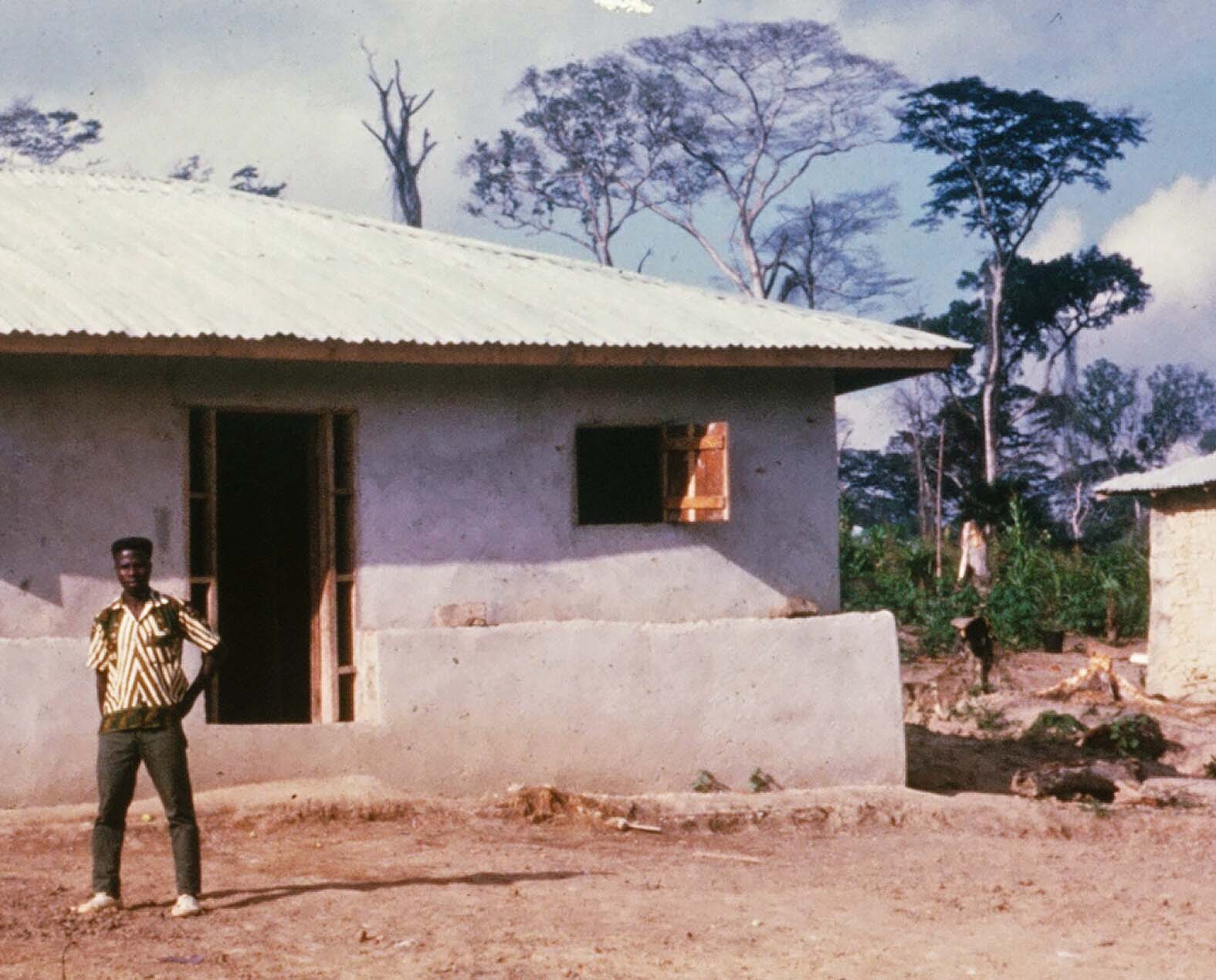
Mamadee standing in front of his house. Later Mamadee would become an elementary school principal in New Jersey.

Mamadee standing in front of his house. Later Mamadee would become an elementary school principal in New Jersey.

4. How Boy the Bad Dog Ended Up in Soup

And Other Peace Corps Africa Tales

Boy, the Bad Dog, lived at a Peace Corps Volunteer’s house across town with a female dog named Lolita. When Lolita had pups, she drove Boy off. He went looking for other Peace Corps Volunteers to live with and ended up at our house. Normally, this wouldn’t have bothered me. But Boy had a problem: he didn’t like black people. He also regarded our cat as dinner. I encouraged him to live elsewhere. One day I came home from teaching and found a number of soldiers occupying our yard. I approached nervously; Liberian soldiers were scary. “What’s the problem?” I asked the sergeant.  “Your dog ate one of the Superintendent’s guinea fowl,” he growled at me. The Superintendent was the boss of Bong County, the most powerful person in our neck of the jungle. “Which one?” I asked. “What does it matter which fowl the dog ate?” he snarled. “No, no,” I responded, “I meant which dog.” He pointed at Boy and I relaxed. “Why don’t you arrest him?” I suggested helpfully. “Not him!” the sergeant screamed. “You, you are coming with us.” The interview was not going the way he had expected. “The dog doesn’t belong to me and I am not going anywhere with you.” I replied and went into our house. The soldiers were not happy. They milled around in our yard for a half hour before marching off. It was a six-pack night for Jo and I.

At 4 AM the next morning we heard a loud bang, bang, bang. “What’s that,” Jo asked, frightened. “It sounds like someone pounding to get in,” I responded, grabbing our baseball bat and heading for the back door. I opened it just as the sergeant from the day before was preparing to strike it again with the butt of his weapon. “Your dog ate another one of the Superintendent’s guinea fowls,” he stated triumphantly. “This time you are coming with us.” The soldiers must have waited up all night for Boy. Maybe they threw the fowl over the fence. Here doggy. In addition to being scared, I was angry. “I told you yesterday that the dog belongs across town. Ask Mr. Bonal.” Mr. Bonal was the principal of the high school and lived next door. I slammed the door shut. It was like I had thrown a rock at a hornet’s nest. But Bonal was an important man in town and yanking a Peace Corps Volunteer out of his home was not something you did lightly. Eventually, the soldiers left. Jo and I waited nervously for strike three. Fortunately, the soldiers finally figured out that Boy belonged to a person who worked for the other Peace Corps Volunteer. The young man was hauled into court and fined. To pay the fine, he sold Boy to a village where the large dog became guest of honor at a tribal feast. Being a bad dog in Liberia can have serious consequences.

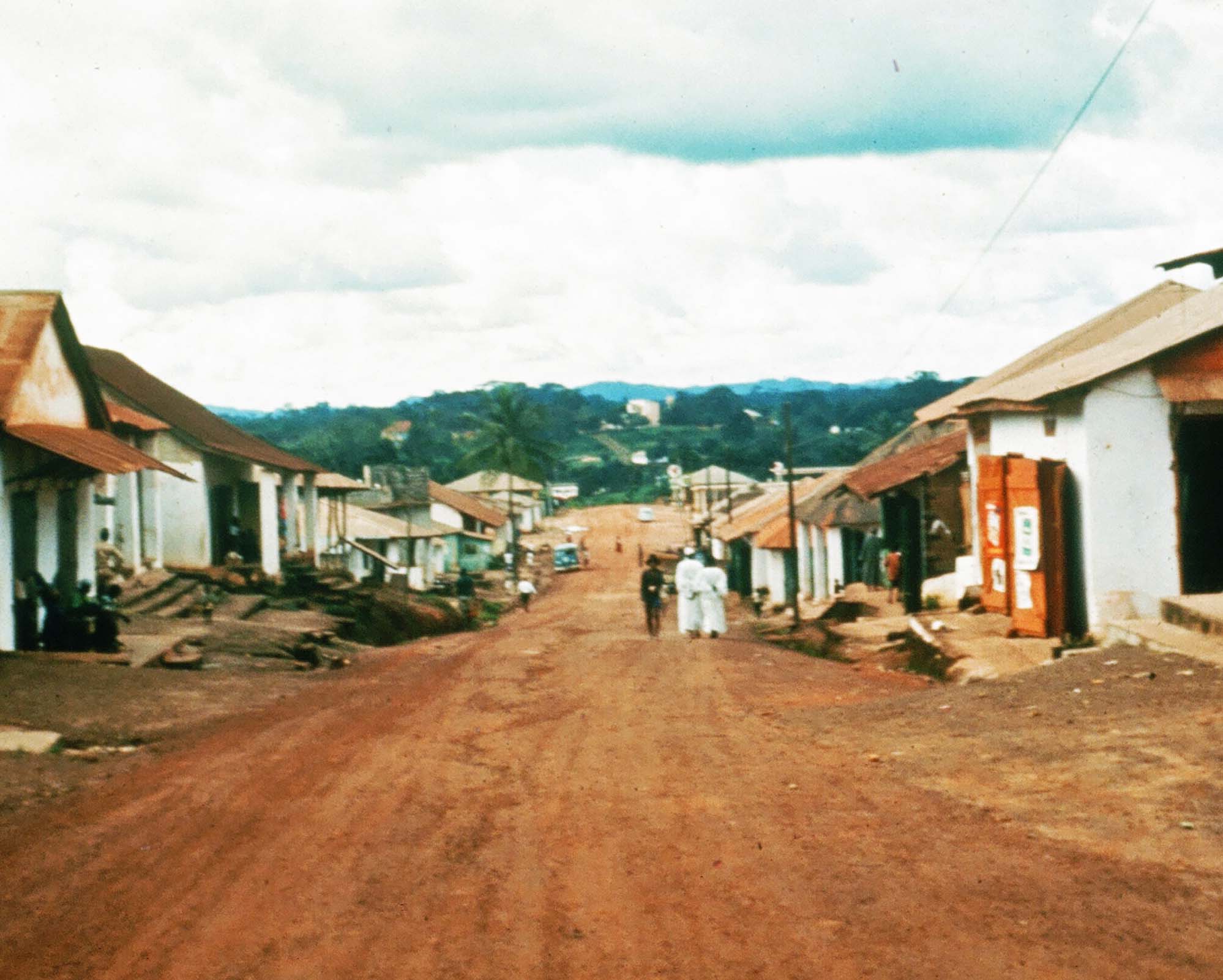
The main street of Gbarnga, Liberia where I served as a Volunteer in 1965-67. The large building you see in the distance was the Superintendent's compound. The high school and the house where I lived was off to the right.

The main street of Gbarnga, Liberia where I served as a Volunteer in 1965-67. The large building you see in the distance was the Superintendent’s headquarters. The high school and the house where I lived were off to the right of his compound.

The Tragedy of Liberia: Part IV… Peace Corps Returns

 Hopefully todays young people in Liberia  will not face the grim future my students shown here from 1967 faced.

Hopefully, today’s young people in Liberia will not have to face the grim future my students shown here from 1967 experienced.

Peace Corps exited Liberia in 1990 because of the danger to Volunteers created by the civil war. At the request of Ellen Sirleaf-Johnson, the organization returned in 2008.  Once again Volunteers are spreading throughout the country and joining with Liberian teachers in educating young people.  At this time, they are teaching math, science, and English– subjects the Liberian government has determined are critical to the development of the country. Of equal importance to their jobs is the sense of friendship and stability Peace Corps Volunteers bring to Liberia. They become part of their communities, live at the level of their peers, roll up their sleeves, and go to work. It’s how Peace Corps does business. It provides a powerful message.

As I follow blogs of Volunteers presently serving in Liberia, I am struck by the similarities of challenges we were faced with in the 60s, but I am struck even more by the differences. How could it be otherwise given the devastation the country has been through? We dealt with absenteeism, lack of supplies, corruption, and the daily challenges of living and functioning effectively in another culture. But our students and communities had never experienced the fear, psychotic behavior, and death the civil wars unleashed.  Neither were we overly concerned with our own security, as Volunteers must be now. (Although I must confess that when the soldiers came pounding on my door with their guns at 4 AM one morning in 1966, I was a wee bit concerned.)

Capacity building, helping people to help themselves, has always been a central goal of the Peace Corps. The Bosh Bosh project in Salala, Bong County provides an excellent example of what can happen when a talented and enthusiastic Peace Corps Volunteer is paired with a welcoming and supportive community. Charlene Espinoza from San Diego, California began her Peace Corps assignment in 2011. She has documented her experience on her blog. I highly recommend reading it for an insight into Peace Corps life.

Here’s the short version of the Bosh Bosh story. The community of Salala built a house for Peace Corps Volunteers– even though none had been assigned to the town. Dutifully impressed, Peace Corps posted Charlene, along with a roommate, Kristin Caspar, to teach junior high at the Martha Tubman Public School in Salala. The two were soon consumed with teaching, tutoring and building a library. A few months into their tour, they went on a brief vacation in Sierra Leone where Charlene came across a purse made out of brightly colored lappa scraps. (Lappa cloth is the fabric that West African women use as wrap around dresses and that tailors turn into shirts and other clothing.)

Inspiration struck! What if she went back to Salala and introduced the concept there. Young women could be taught how to sew and develop marketable products. In addition to learning valuable skills, the girls would also be increasing their self-confidence. The LapaScraps Project, later to become the Bosh Bosh Project, was born. Bosh Bosh is a Liberian word for different types of fabrics.

Charlene, working closely with her Liberian counterpart at school, reestablished a local but dormant Girl’s Club and recruited young women to sew lappa scrap bags.  The girls loved the work and the project soon acquired several sewing machines. A tailor was hired to come in and teach the girls more sophisticated sewing techniques. New market lines such as purses and E-reader covers were introduced. Regular seminars in everything from women’s rights to HIV Aids Awareness were also offered to the club members. As the products begin to sell, profits were put back into the project, providing the girls with full scholarships to meet their education costs.

What is most important about the Bosh Bosh Club is how it has changed the self-perception of the young women working on the project. They now believe they have a future; they have hope. And they are eager to make a difference in their country. Most have a perspective similar to Comfort Thomas who is 20 years old and has a six-year-old child:

“I decided to join the Salala Girls Club because I like the projects objective. I have learned a lot while being in the club. I have learned how to sew different things, and it has made me more aware of my own health through the workshops offered and has given me a better understanding of how to take care of myself and think about my future as well. When I graduate from high school, I want to attend the University of Liberia and major in Political Science so that I can work in the Ministry of Education, and help many indigent people in Liberia and around the world.”

You can go to the Bosh Bosh website and learn more about the organization, its products, and the participants.

Returned Peace Corps Volunteers from Liberia are also working to help the country. I recently received a call from Judy Reed of Madison, Wisconsin. Judy served in Liberia Group IV (1964-66) with my friend Morris Carpenter. In 2007 she and a friend, Jane Scharer, visited Liberia and reconnected with 15 of her former students who are now adults in their 50s and 60s. She describes the experience as “bittersweet.” Many had barely survived the war years and had lost family members to the conflict. Life continued to be hard. Their children had few opportunities for education.

Judy and Jane returned to the US determined to help. They created a small non-profit organization called the Liberian Assistance Program and went to work. Former Peace Corps Volunteers, friends and community organizations jumped in and offered support. Today, as a result, a new school stands in the town of Cow Field with over 200 students and 15 employees. The principal is a former student of Judy’s. My wife Peggy and I have signed up to sponsor a student at the school for three years.

The most extensive Return Peace Corps Volunteer effort is being carried out by Friends of Liberia (FOL). FOL was originally created as an alumni group for returned Volunteers in 1986. By 1989 the organization was centrally involved in raising awareness in the US about the plight of Liberians involved in the civil conflict, and in seeking solutions to end the horrendous war, a role it continued to play up until the close of the conflict in 2003.

Today FOL is focused on encouraging early childhood education/teacher training, improving the skills of health care workers, and in fostering entrepreneurship. The latter involves helping identify, educate and provide startup capital to motivated Liberians who would like to build small businesses. The ultimate goal here is to support the development of a middle class, a move that is essential to the long-term stability and prosperity of the nation.

Peace Corps is only one of numerous private and government agencies that are offering aid to Liberia and other African nations. One of the most ambitious programs is being pursued by the Obama administration: providing 7 billion dollars for electrification in Sub-Sahara Africa. Obviously this program has the potential of making a significant difference in the lives of Africans, assuming it lives up to its promise of building internal capacity, balancing urban and rural needs, and using both traditional and renewable energy sources.

Liberia is blessed with natural resources. Historically, these resources have been exploited by outside economic interests such as Firestone and have served to make a small minority of Liberia’s population wealthy. Used to benefit the nation, these resources can provide the base for rebuilding the country. Continued investment by outside corporations is critical. Obviously such investments require a stable government and a promise of profits, but they also need to be accompanied with decent salaries, training for the workforce, focus on local development, and protection of the environment. Balance between meeting the needs of the investors and meeting the needs of the country is critical.

The tragedy of Liberia is a tragedy shared by most other African nations. The past history of colonialism and outside exploitation combined with Africa’s own unique challenges such as tribalism, minimal education and lack of economic development, have left these nations easy prey to outside forces and internal abuse. From slavery, to ivory trade, to blood diamonds, to rare woods and even rarer minerals, Africa has been viewed as a way to instant, illicit wealth regardless of its cost in human life and suffering. It has also been viewed as a battleground between powerful, opposing forces. Colonial nations, various religious groups, and dominant political blocks have all seen Africa as a means to some outside objective.

Liberia is still very fragile and must have continued support from the United Nations, the European Union, the United States and other countries. What is desired, however, is independence, not dependence. The country, with help, has the potential of standing on its own and becoming a model for the rest of war-torn Africa, not simply another tragedy in a long line of tragedies.

My students at Gboveh High School in Gbarnga from 1965 to 67 were as bright, caring, and ambitious as any group of young people. They were excited about their future. They saw their dreams dashed by greed, corruption and civil war. It is my hope that today’s youth, given guidance, education and opportunity, can become the backbone of a more prosperous, democratic, and peaceful nation.

The Tragedy of Liberia: Part III… The Monumental Challenge of Rebuilding

AP photo of Leymah Gbowee

AP photo of Leymah Gbowee

Liberian women were centrally involved in Taylor’s downfall. Much of the credit goes to Leymah Gbowee. She provides a powerful example of what a committed individual can accomplish, even in the face of almost insurmountable odds. A deeply religious woman, Gbowee grew up and raised a family during the chaos of Liberia’s two civil wars. She first became involved by working with children soldiers who had been deeply traumatized. This in turn led her to become a peace activist with a strong belief that women needed to be involved in efforts to end the violence in Liberia.

By 2002, Gbowee had become a recognized leader of the peace movement and had organized thousands of Christian and Muslim women to gather in Monrovia for nonviolent demonstrations to end the war. She even organized a sex strike: No peace, no sex.

Finally, on April 23, 2003, Taylor granted a hearing for the women. Gbowee served as the spokesperson. Her words: “We are tired of war. We are tired of running. We are tired of begging for bulgur wheat. We are tired of our children being raped. We are now taking this stand, to secure the future of our children. Because we believe, as custodians of society, tomorrow our children will ask us, “Mama, what was your role during the crisis?”

When peace talks began in Accra, Ghana two months later, Gbowee was there with a group of Liberian women to pressure the various factions into signing a peace agreement. Her message was even more direct: “Butchers and murderers of the Liberian people — STOP!” On August 18, an agreement was finally signed between the warring factions.

United Nations photo of Ellen Sirleaf Johnson

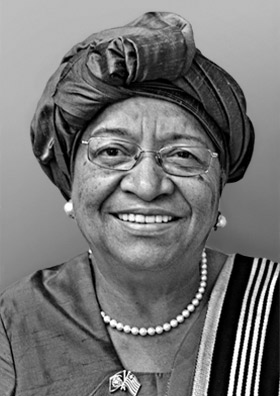
United Nations photo of Ellen Sirleaf Johnson

2006 marked the election of Ellen Johnson Sirleaf as President of Liberia and, hopefully, the beginning of a new chapter for the war-torn country. Sirleaf is the first female head of state in Sub-Saharan Africa. She has a long history of participating in and surviving Liberian politics that dates back to Tolbert’s government. She has spent months in jail and years in exile for her political activities. While she initially supported Taylor as an alternative to Doe, she ran against him for President in 1997 and became a vocal opponent of his policies. She has a strong background in finance and has worked for the United Nations. In 2011 Sirleaf was elected to a second term, and, along with Leymah Gbowee, received a Nobel Peace Prize for her efforts to restore peace in Liberia.

The challenge of rebuilding Liberia is monumental, however. The infrastructure of Monrovia and major communities throughout the country were left in ruins by the war. Today, ten years after Taylor was driven from power, less than ten percent of Monrovia’s population has access to clean water and much of the city remains off of the grid in terms of electricity. Sewer systems, medical care facilities and roads suffer from a similar level of development.

Sam, the young Kpelle man who had worked for us in Gbarnga, eventually went on to become a physician (Dr. Kylkon Mawkwi). When he was employed at Phoebe Hospital after the war, electricity was available for only a few hours per day; clean water was limited; and medical drugs were either nonexistent or in extreme short supply. When he left in 2012, little had changed.

Huge numbers of unemployed people are a challenge to the stability of any government and Liberia has tens of thousands unemployed people in Monrovia. Many are ex-soldiers. These soldiers have seen the worst that war has to offer. Imagine being forced into a war as a child, having to fight naked while being heavily drugged.

How do your repatriate these men into becoming productive, supportive members of a democratic society? How do you give them hope that life can be better? Lack of medical care and psychological support combined with unemployment is obviously not the answer. As it stands, these ex-soldiers provide a potential source of recruits for the next demagogue to rise out of Liberia’s troubled waters. And some of the old demagogues are still around.

It frightens me to realize that the supposedly reformed but unpunished General Butt Naked roams freely in Monrovia. And I am concerned that Prince Y. Johnson is now a Senator from Nimba County while Jewel Taylor, the ex-wife of Charles Taylor, is a Senator from Bong County. While both redemption and reform may be possible for individuals, these people have a dark history. Are they truly committed to what is best for Liberia or are they driven by ambition and greed? Will they and their compatriots serve as forces to pull the nation together or drive it apart?

Corruption, a legacy from the days of Americo-Liberian government, continues to haunt the country. In a world where bribery is seen as a way of life, low paid civil servants such as police officers see nothing wrong with supplementing their income by using their positions to demand bribes. Such actions undermine belief in government’s ability to provide fair and just treatment. As the corruption climbs up the ladder to teachers, judges and other government officials, the potential damage is multiplied.

So what are the answers? Nothing simple, that’s for sure. Two things seem clear to me. First, change has to come from within. Liberians have to perceive and want a different future from what they presently have. They need to believe that such a future is possible, and they have to work together to achieve it. Leymah Gbowee provided an excellent role model. She proved that Liberians could work together in a common cause regardless of tribal background or religious affiliation.

Second, much of what outside governments and non-government organizations have done to help has had minimum impact. For example, relief efforts may be necessary to solve an immediate crisis, but do little to prevent the reoccurrence of the crisis. Even programs designed to address underlying issues will fail unless those being helped take ownership. For this to happen, the recipients have to perceive a need for the program and participate in its development.

My friend, Kylkon Mawkwi, provided an example of what happens when recipients of programs aren’t stakeholders. Proper sanitation is an important step in improving people’s health. Simply washing hands after “serving nature,” as my Liberian students called it, can have a tremendous impact. Therefore, it isn’t surprising that an aid organization decided to build modern toilet facilities in a village where going to the bathroom meant walking out into the bush and squatting. A few months later the organization checked back in. The villagers were still heading out into the bush. The chief had decided that the best way to keep his shiny new restroom shiny and new was to lock the door. A lack of perceived need, combined with minimal community involvement in the design, development, and maintenance of the facility had doomed it to fail.

Beyond the desire to change and a commitment to make it happen, Liberia’s future depends upon maintaining peace and stability, reducing corruption, developing infrastructure and providing opportunities for individuals and families to improve their lives.  It’s a tall order, one that will require people from different tribes working together with the descendants of Americo-Liberians, and Christians working together beside Muslims. And it will require continuing support from outside.

NEXT BLOG: Peace Corps returns to Liberia

The Tragedy of Liberia: Part II… The Civil Wars

Kpelle footbridge near Gbarnga, Liberia circa 1965.

The devastation of the civil wars impacted the lives of everyone in Liberia. Those who could escaped. The luckiest made it out to the US or Europe. Tens of thousands ended up in refugee camps in the surrounding countries. Many simply disappeared into the Liberian rainforest, crossing over bridges like the one I am standing on, in desperate hope that the war wouldn’t follow.

At one a.m. on April 12, 1980– one year after the rice riots and ten days before the executions on the beach, Master Sergeant Samuel Doe, Liberia’s highest ranked non-commissioned officer and a member of the Krahn Tribe, led a group of 16 soldiers into the Executive Mansion in a coup d’état and assassinated Tolbert.

The majority of Liberians considered Doe’s rise to power positive. For the first time, tribal Liberians, along with the more liberal, change oriented Americo-Liberians, would have a chance at governing. While Doe’s military-based, People’s Redemption Council would rule temporarily, he promised a return to constitutional government. Open elections would be held by 1985. Doe also took an anti-communist stand and offered Liberia as a staging area for American troops if necessary. The US was pleased; aid to Liberia was doubled.

Ultimately, however, Doe was unwilling to relinquish power. He returned to using tactics that Americo-Liberians had used for decades.  Freedom of speech and freedom of the press were curtailed. Dissidents and opposition leaders were thrown in jail on trumped-up charges. Doe and his military junta began accumulating wealth. “Same taxi, new driver” became a common motto of the opposition by 1984. With the approach of the 1985 elections, Doe moved to solidify his power and emasculate or eliminate any challenges. When students and faculty at the University of Liberia protested, he sent in the troops. Open elections became a farce. Violence and intimidation became the rule. When elections were finally held in 1985, Doe had his own people count the ballots. Nobody was surprised that the final tally showed that he had won by 50.9%. The only surprise was that the percentage wasn’t higher.

The US, unfortunately, turned a blind eye toward the political corruption and intimidation. Ronald Reagan’s Assistant Secretary of State, Chester Cocker, reflected the administration’s position by declaring that the “election day went off very well… and was a rare achievement in Africa…” As was often the case during the Cold War, a leader’s position on Communism was much more important than his or her position on democracy.

To make matters worse, Doe surrounded himself with members of his own Krahn ethnic group and stirred up a toxic brew of tribal animosities. An armed invasion of Monrovia and assassination attempt by Thomas Quiwonkpa from Nimba County led to a brutal repression of the Mano and Gio ethnic groups by Doe’s Krahn led military. This, in turn, led to the next step of Liberia’s descent into dark chaos.

The perpetrator, Charles Taylor, was locked up in an American jail at the beginning of 1985. By the time Taylor’s reign of terror was over in Liberia in 2003, he would be the first sitting head of state since the Nuremberg trials to be charged with war crimes and crimes against humanity in an international court.

Charles Taylor’s father was Americo-Liberian and his mother a member of the Gola ethnic group. Like many Liberians, he obtained his college education in America. After attending Bentley College in Massachusetts, he returned to Liberia where he served as Director of the General Services Agency under Doe until he was accused of embezzling 900 thousand dollars in 1983 and fled to the US. Taylor was arrested and held in a Massachusetts jail at the request of the Liberian government. He managed to escape in 1985, probably with outside help. He would later claim that the CIA enabled his escape. Maybe, but the exile community of Americo-Liberians living in the US is another possibility. Many initially supported Taylor.

His escape led him to Libya where he received training and support under Muammar Gaddafi. By 1989 he was working out of the Cote d’Ivoire organizing a military force from Mano and Gio ethnic groups who were eager for revenge on Doe. Taylor’s objective was to exploit their tribal anger to attack and overthrow the government. One of his former commanders struck first.

In 1990, Prince Y. Johnson, a commander of Taylor’s from Nimba County, split off to pursue his own ambitions. Such disaffections of military commanders became common during Liberia’s long civil wars. These ‘warlords,’ operating on a regional basis, controlled subsections of Liberia. Johnson’s forces made it into Monrovia before Taylor. He seized Doe and then tortured him to death– an event that was captured on video and turned over to the press.

The twist and turns of what would happen between 1990 and 2003 are beyond the scope of this book, but what ensued was an almost constant, brutal civil war where various groups vied for power. The depth to which Liberia fell is best illustrated by the rise of General Butt Naked, Joshua Milton Blahyi. Blahyi earned his nickname in the early 90s by going into battle wearing nothing but shoes. Being naked, he believed, provided protection against bullets. He also believed that sacrificing children and practicing cannibalism were important to his success. Many of his soldiers were young boys who fought drugged and naked or wearing dresses. After he was “saved” and saw the light, Butt Naked claimed, “The Devil made me do it.” Today he is an evangelical minister in Monrovia.

With Prince Johnson occupying Monrovia, Charles Taylor used Gbarnga for his headquarters. A brokered peace by the United Nations in 1997 ended the first civil war and allowed Taylor to run for President of Liberia, which he won in a landslide. One of his more popular slogans was, “He killed my ma, he killed my pa, but I’ll vote for him.” As President, he mounted a PR campaign in the US to re-engineer his image. Among the stranger aspects of the campaign was providing the Baptist preacher, Pat Robertson, with gold mining rights in Liberia. Robertson went to bat for Taylor, but it wasn’t enough.

Taylor’s efforts at re-engineering failed. Liberia was soon engulfed in a second civil war. Taylor’s participation in another civil war, next door in Sierra Leone, and active involvement in the blood diamond trade eventually led to his being tried and convicted at The Hague.  In 2003 he was forced to resign and in 2006 was arrested. In 2012 he was found guilty or war crimes and crimes against humanity, and was sentenced to 50 years in prison. Among the charges were terrorism, murder, rape, conscription of children, and enslavement.

NEXT BLOG: The incredibly difficult challenges of recovery.

The Tragedy of Liberia… Part I

Liberian Peace Corps photo by Curtis Mekemson.

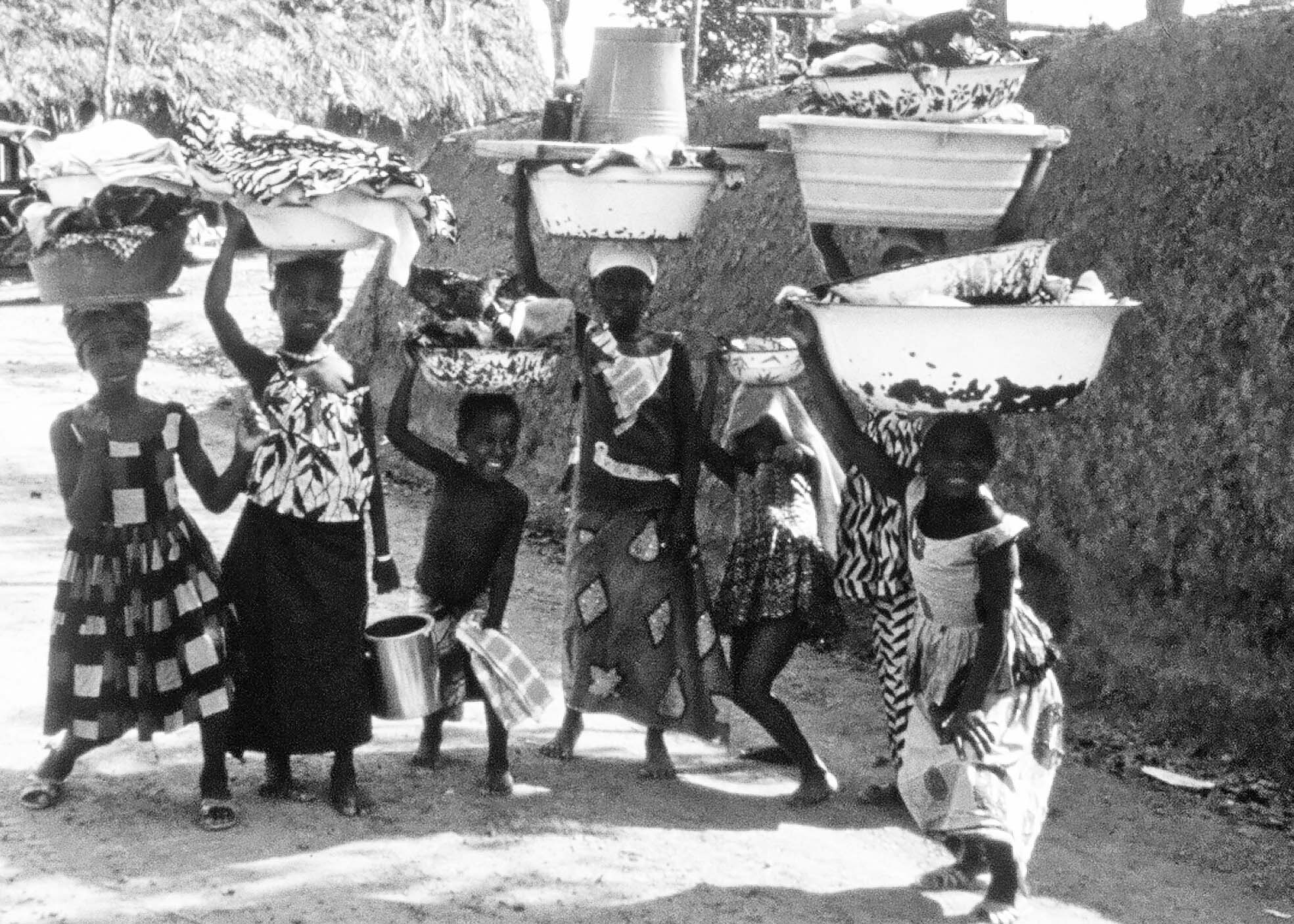
A fading black and white photo shows children in Gbarnga, Liberia mugging for my camera in 1965. Life wasn’t easy– check out the head loads. But as adults these children would be thrown into Liberia’s Civil Wars, and life would get much worse. Many would not survive.

Earlier, I blogged about my experience as a Peace Corps Volunteer in Liberia, West Africa during the 60s. While life for tribal Liberians was tough at the time, is was about to get worse, tragically so. You can read about my two years in Liberia by going here and scrolling forward. Presently, I am reworking the posts into book format. In addition to having my book professionally edited, I have added several chapters. Hopefully the final product will reflect what I believe were two of the most interesting years of my life.

The book ends with my leaving Liberia, but I decided to add an epilogue that reflects what has happened in the country since. The Tragedy of Liberia, after editing, will become the epilogue. There are four parts in this series.–Curt

On April 22, 1980, thirteen Americo-Liberians were driven down to Monrovia’s Barclay Beach in a VW van, tied to telephone poles, and shot without blindfolds. One soldier was so drunk he couldn’t hit the man he had been assigned to kill. Afterwards, the bodies were stacked in a pile and sprayed with bullets before being tumbled into a mass grave. It marked the beginning of a tragedy that would see the death of over 200, 000 Liberians.

The international press was invited to witness the event. The names of those executed were a who’s who of Liberia’s history. Their fathers, grandfathers and great grandfathers had ruled the country for period of time stretching back over 150 years.

The public executions were as savage as they were inexcusable. But they were also understandable, possibly even inevitable. Thirteen years earlier I had talked into the small hours of the morning at my home in Gbarnga with a representative from the US State Department about the future of Liberia. One of his first requests was that Sam, the young Kpelle man who worked for us, not be present.

Revolution of some kind, I had argued, was going to happen unless drastic changes were made in how Americo-Liberians ruled Liberia. Five percent of the population owned the majority of the nation’s wealth and controlled 100% of the political power. Tribal Liberians were widely exploited and treated as second-class citizens, or worse. Deep resentment was building; a time bomb was ticking. It would explode unless Americo-Liberians were willing to share economic and political power.

I was not optimistic. I related my experiences with setting up a student government at Gboveh High School and in writing a Liberian second grade reader. My goals had been moderate. I wanted my high school students to learn about democracy and my elementary students to increase their reading skills. I certainly was not involved in revolutionary activity. I was merely doing what Peace Corps Volunteers had been brought into the country to do: help educate and train Liberians for the future.

The drastic reaction of Americo-Liberians to my efforts reflected the deep paranoia that existed within the ruling class. The second grade reader, which featured folktales and stories about tribal children pursuing such common activities as playing soccer, was regarded as a revolutionary tract– not because it was anti-government, it wasn’t, but because it didn’t emphasize the Americo Liberian perspective. Even though Peace Corps staff had received initial approval from the Department of Education and arranged an editor, curriculum specialist and graphic artist to work with me, I was directed to abandon the project and never talk about it.

The response to the student government was even more dramatic. My students had decided it would be fun to create two parties to run against each other, like the Republicans and Democrats. Apparently this was a direct challenge to the True Whig Party, the foundation of Americo-Liberian power. Within days, word came down from Monrovia that my students were to be arrested and I was to be run out of the country unless the ‘political parties’ were eliminated immediately.

Americo-Liberians were not stupid, far from it. Many were highly educated and had attended some of the best universities in the world. They knew they were sitting on a powder keg. Change was coming and they could choose to embrace that change and help guide it, or they could resist and fight against it. They chose the latter course. Their power, their wealth, and their privilege were simply too much. They had controlled the tribal population since the inception of the country and believed they could continue to. People who challenged this assumption, even Americo-Liberians who believed that change was needed, were shut down, sometimes violently. Any change would be gradual, even glacial, and would only be allowed with acceptance of the status quo. It was a recipe for disaster.

Tribalism was another issue we discussed on that long ago night in July of 1967 as rain pounded down on our zinc roof, lightning lit up the sky, and thunder rolled across the jungle. When primary loyalty is to the tribe rather than the country, building a modern nation becomes much more difficult.  It may also have the impact of dehumanizing people, as I was to learn.

My wife and I were walking home from Massaquoi Elementary School at the beginning of our two-year stint when we found one of our students lying on the ground, obviously very sick. His classmates were walking around him, like he wasn’t there. Jo Ann was furious.

“Why aren’t you stopping to help?” she had demanded.

“He’s not from our tribe,” was the answer.  It was a matter-of-fact type statement. The point that he was a fellow human being was secondary.

The problems of tribalism are not insurmountable. I felt my high school students had moved beyond the deeper currents of tribalism. Or I hoped they had. They were proud to be Liberians. Tribal differences were noted with a sense of humor rather than passion. Education, it seemed, could overcome the harmful elements of tribalism.

I expressed one final concern with the State Department official; actually, it was more of a nagging worry. The dark side of juju, or tribal sorcery, lurked beneath the surface in Liberia. Newspapers occasionally included stories about people who had been killed and cut up for their body parts, which were then used in rituals to increase the power of the killer.  People were also made sick, or poisoned. When Mamadee Wattee, one of the candidates for student body president, came to my house late one night out of fear that the opposition had obtained juju to make him ill, I took his concern seriously. Every culture has its dark side. Think about the Salem witch trials. Kept in check, such practices have minimal impact. But what if the normal laws and customs of traditional and modern society break down?  Would the use of ‘magic’ become more prevalent? And what would be the result?

In 1971, four years after I left Liberia, William Shadrach Tubman, President of the country since 1944, died in a London Hospital. His Vice President, William Tolbert, assumed the reins of power. Tubman had been a master politician with strong connections to both the Americo-Liberians and tribal leadership. Tolbert lacked Tubman’s charisma and leadership abilities.

He did, however, move forward with Tubman’s unification program. Some of the more odious Americo-Liberian customs, such as the celebration of Matilda Newport’s birthday (her claim to fame was mowing down tribal Liberians with a canon), were downgraded or eliminated. The University of Liberia was expanded and improved to provide more tribal youth with an opportunity for higher education. Roads were added throughout the tribal areas. Tolbert also continued, Tubman’s open door economic policy. In a move that ruffled feathers in the United States, he even invited Communist countries to invest in Liberia. The US had long considered Liberia as its African beachhead in the fight against Communism.

In the end, Tolbert’s efforts benefitted the Americo-Liberians much more than they did the tribal population. Extra money invested in the country ended up in the pockets of Americo-Liberians. Roads to interior opened up vast new tracts of land for Americo-Liberian farms. They also provided a way for the government to more effectively tax tribal people.

No one profited more from Tolbert’s actions than his own family. Twenty-two of his relatives held high positions in the Liberian Government and/or on boards of major corporations doing business in Liberia. Wealth accumulated rapidly. The small Liberian community of Bensonville located outside of Monrovia was renamed Bentol in honor of Tolbert and became a family enclave complete with mansion-lined streets, a private zoo and a private lake. The town’s extreme wealth provided stark contrast to Monrovia’s hopeless poverty.

In April of 1979, Tolbert made a fatal error. He arbitrarily increased the price of rice by 50%. Rice was the primary staple of the Liberian diet. The increase meant that urban Liberians would now be spending over one-third of their average monthly income of $80 on rice. Students from the University of Liberia and other dissidents called for a major protest. Police ended up killing a number of the protesters and riots ensued. Tolbert restored order by bringing in troops from Guinea. He shut down the University, rounded up dissidents, and charged a number of them with treason. It was the beginning of the end for Tolbert, and for exclusive rule by Americo-Liberians.

NEXT BLOG: The story of Liberia’s civil wars.

An Introduction to The Bush Devil Ate Sam… and other Peace Corps Tales

Mandingo mosque in Gbarnga, Liberia circa 1965.

I watched as this mosque was built in Gbarnga, Liberia in 1966 and then showed up for the opening ceremony– the only non-African present. I was sitting up front with the dignitaries when Do Your Part the Dog came whipping through the door and made a beeline for me, almost causing a riot.

(I’ve been working hard on a book about my Peace Corps adventures in West Africa. It is actually getting close to being published as an Ebook– with close meaning some time in the next three months (grin). I’ve  posted a number of my draft chapters on this blog over the past year. They are listed under Africa Peace Corps Tales in the sidebar. Today I will post a draft featuring part of the book’s introduction. It is designed to give readers a taste of what is included in the book.)

The soldier pounding on our door with the butt of his rifle in the middle of an African night made me seriously question my decision to join the Peace Corps. When he demanded that I go off with him into the dark, my questioning became epic. People had been beaten and even killed under such circumstances. I told him to screw off.  The sergeant was not pleased.

My decision to become a Peace Corps Volunteer was one of the best decisions in my life, however. The way I was raised and educated, even my DNA, had pointed me in the direction of volunteering and striking off for parts unknown. But there was more.

I am very much a “child of the 60s.” Civil Rights, the Vietnam War, and student activism dramatically effected how I viewed the world. Being a student at UC Berkeley during the Free Speech Movement in 1965 intensified my involvement in these issues. Looking back, I can see how the Berkeley experience, my ‘wandering’ genes, and the influence of family, friends and teachers combined to encourage my decision to join the Peace Corps.

In 2007 I was working on my memoirs. I had retired from my career as an environmentalist and public health advocate, needed a new challenge, and loved to write. Conventional wisdom and a thousand books on writing dictated I should write about what I knew best. Having finished the first draft, I bravely decided to share the manuscript with the book club my wife Peggy and I had belonged to for 17 years, the BSBC out of Sacramento, California. We had a fun night and the book club was kind. It can be feisty.

At the end of the evening, John Robbins, an iconoclastic professor and physician with the University of California Medical School at Davis, suggested that I pull out the section I had written about my Peace Corps experience and turn it into a book on its own. His suggestion led me to consider the idea. The Fiftieth Anniversary of the Peace Corps in 2011 clinched the deal.
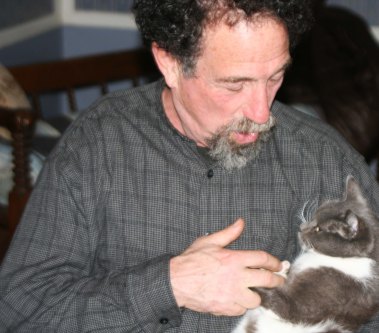
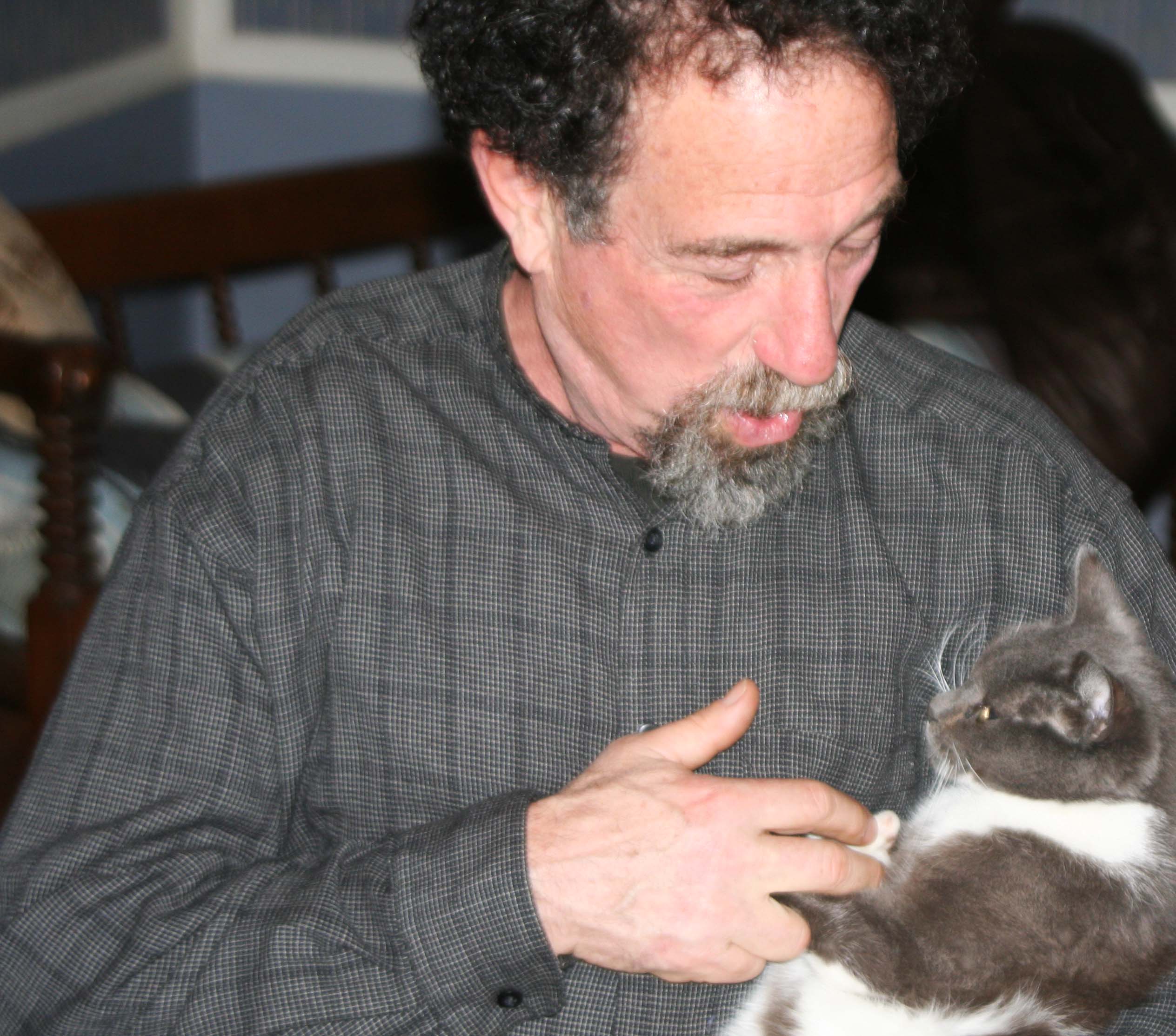
Dr. John Robbins of the University of California  Medical School of Davis.

John Robbins has a discussion with his cat at his home in Sacramento, California.

John Kennedy created the Peace Corps in 1961 as one of his first acts as President of the United States. His reasons were both idealistic and pragmatic. Yes, he wanted to help third world countries combat the terrible poverty, disease, hunger, illiteracy and conflict they faced, but he was also interested in winning hearts and minds for the West. The mindset of Kennedy, and most other leaders of his generation, was that we were in the midst of a worldwide conflict between capitalism and communism, totalitarianism and democracy, and Christianity and Atheism. The Cold War was raging and much of this war was being fought in third world countries.

While few Peace Corps Volunteers would list “making friends for America” as their reason for joining the organization, it more or less comes with the territory of being from the United States and working intensely in another country to help people improve their lives. In this sense, the Peace Corps is one of the most effective foreign aid programs ever created by the US. It is certainly one of the least expensive– especially when the work Volunteers do overseas and the skills and commitment they bring back home are considered. A recent Peace Corps budget justification noted that the total cost of running the Peace Corps for the past 50 years could be covered with what the US spends on the military every six days.

My assignment was to serve as a teacher in Liberia, West Africa.  The country has a unique history dating back to the early 19th Century when freed slaves from America were shipped back to Africa. Within 30 years, the freed slaves, or Americo Liberians as they came to be known, had established themselves as the rulers of Africa’s first black republic. When I arrived in 1965, their descendants still controlled the political, military, justice, education and economic systems of Liberia– i.e. almost everything. William Shadrach Tubman, President of the country since 1944, had invited Peace Corps into Liberia to help tribal Liberians, who made up 95% of the population, prepare for a larger role in the nation’s future. Not all Americo-Liberians agreed with this goal– as I would learn.

“The Bush Devil Ate Sam” is a the story of adventures that I, along my ex-wife, Jo Ann, had in Africa, but it also includes, background on my decision to join the Peace Corps and some thoughts on the tragic history of Liberia since the 60s.

I begin with a brief look at the influence of my family’s restless nature and discover that I was right to be worried about the soldier knocking on our door: wandering can be hazardous to your health. William Mekemson has his head chopped of by tomahawks during the Blackhawk War and George Marshall, my mother’s great grandfather, is killed for his gold after striking it rich during California’s gold rush.

Following in the footsteps of my ancestors, I wander off to UC Berkeley where police occupy the campus, liberally use nightsticks, and drag students down stairs. A roommate tells the FBI I am a Red, a Communist– and I not even pink. But this is a time when innuendo is more important than facts and J. Edgar Hoover believes there is a Russian agent hiding behind every tree on campus. I figure my chances of making it into the Peace Corps are ruined. Sargent Shriver, the first director of the Peace Corps, likes people who challenge the status quo, however, and I soon find myself in the Sierra Nevada Mountains decapitating a chicken as part of my training.

In Liberia I am thrown into a second grade class of 7-22 year olds where children who barely speak English are taught reading out of aging California textbooks featuring middle-class white kids and Spot, a pet that resembles dinner. Peace Corps encourages me to write a Liberian second grade reader using Liberian children and African folk tales, which I do. Americo-Liberians in the Department of Education determine the book is subversive. It’s torpedoed and I am told to never mention the project.

The high school principal recruits me to teach social studies to 10th, 11th and 12th graders and Jo Ann to teach French and English. Somewhat to my surprise, I discover I enjoy teaching and may even be good at it. Things run smoothly until the Liberian government determines that the student government I create to teach my students about democracy is a direct challenge to the country’s one party state. I am told to pack my bags. My students are told they will be arrested.
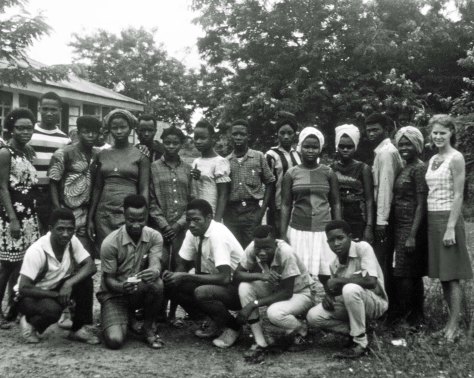
Our tenth and eleventh grade classes and Jo Ann at Gboveh High School in Gbarnga, Liberia (1967)

Our tenth and eleventh grade classes and Jo Ann at Gboveh High School in Gbarnga, Liberia (1967)

On the home front I repulse an invasion of army ants, breed rhinoceros beetles, and watch Jo Ann make mincemeat out of a Green Mamba, one of the world’s more deadly snakes. A menagerie of animals adopt us and provide both companionship and comic relief. They also create mischief. Rasputin the Cat collaborates with the Cockle Doodle Rooster to wake us at five every morning. Do Your Part the Good Dog crashes a solemn ceremony I am at attending at a mosque and causes a riot while Boy the Bad Dog develops a penchant for eating guinea fowl that belong to the Superintendent (governor) of Bong County. It’s the latter that brings the soldiers to our house in the middle of the night. Apparently, the illegal consumption of would-be chickens is a more serious crime than writing a subversive second grade reader or teaching high school kids they can be part of the government.

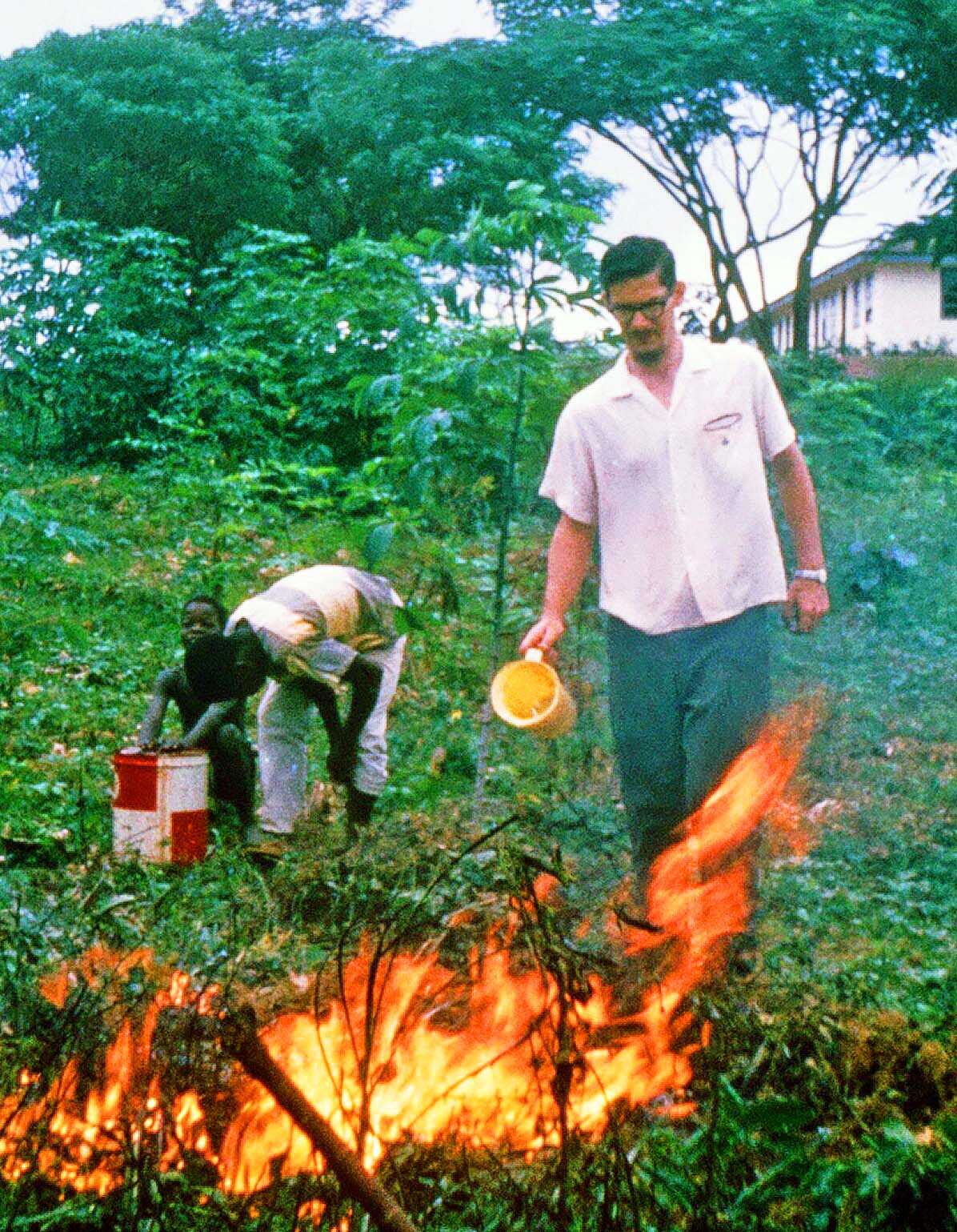
Burning out a nest of army ants in Gbarnga, Liberia circa 1966.

The army ants invaded our home. Here I burn out their nest in an effort to persuade them to move elsewhere.

I learn that the scarification marks marching up the chest on Sam, the young man who works for us, were ‘made’ by the Kpelle Bush Devil’s teeth, which leads to an interest in tribal culture. I discover the Lightning Man can make lightning strike people, sit in on a trial where justice is determined by a red-hot machete, and find myself involved in a situation where Juju, the dark magic of West Africa, is being used on one of my students.
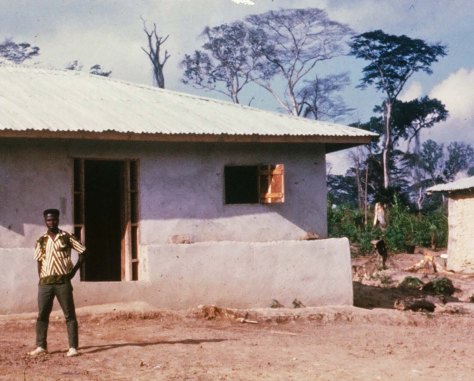
The use of Juju in West Africa.

Mamadee Wattee, shown here, appeared at our house on a dark, stormy night to tell us that juju, dark magic, was being used to make him sick.

A year and a half into our service, we are numbered among the veteran Peace Volunteers of Liberia, the people to go to for sage advice. Jo and I take a month off to tour the big game parks of East Africa in a rented VW Bug, my students receive top national honors in social studies, and we turn down a request from Peace Corps’ to spend our last six months touring Liberia and training teachers. Instead we spend our time with the students who have earned our allegiance and the animals that have won our hearts.

I snapped this photo of a baby zebra with a Kodak Instamatic camera on our trip through East Africa.

I snapped this photo of a baby zebra with a Kodak Instamatic camera on our trip through East Africa.

One of my final encounters is disturbing. A representative from the US Embassy in Monrovia requests that I meet with him at our house in Gbarnga. He wants my views on the future of Liberia. My experience with the paranoid reactions of the government leads me to suggest that the future is bleak unless drastic changes are made in how Liberia is governed. Unfortunately, as I share in the Epilogue, much of what I feared in 1967 comes to pass. Only today is Liberia recovering from the tragic results.
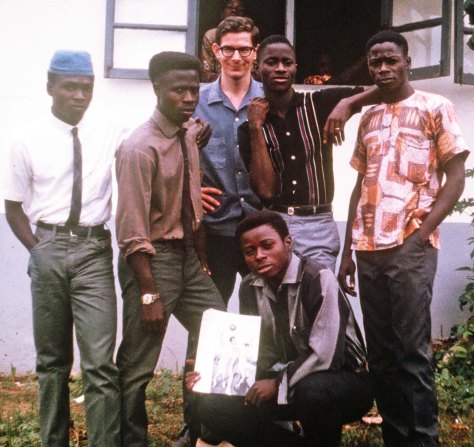
12th Grade Class of Gboveh High School, Gbanrga, Liberia (1967)

A photograph of my twelfth grade class along with me standing in front of Gboveh High School. (1967)

NEXT BLOG: I join the spirit of the season by re-blogging hair-raising stories of the ghosts that lived in the graveyard next to the house I grew up in.
Chapter 36: Goodbye Liberia…

My Senior Class from Gboveh High School, took top honors in the National Social Studies Test.

My Senior Class from Gboveh High School took top honors in Liberia’s National Social Studies Test.

When we returned from East Africa, a shift had taken place; Jo Ann and I had become grizzled, respected veterans. Peace Corps V had left the Country and Peace Corps VIII had come in. With a year and a half under our belts, we were the folks to go to for sage advice. We were even entitled to reminisce about the old days. I was, after all, 24 years old.

Cuttington College sent student teachers to learn from me while the fame of Jo’s choir continued to increase. My seniors took top honors in the national social studies test… competing against the best public and missionary high schools in the country.

What seemed most surprising to us was that Peace Corps requested we spend our last six months touring the country and working in different schools as master teachers. We quickly declined. Our skill level may have fooled Peace Corps but not us. We thought it best to keep our little secret. We also had several projects going at the school we wanted to complete.

Jo and I, along with other selected PCVs, were also asked to help develop a manual for future Volunteers coming into the country. I chaired the section on Liberian culture. According to staff, my experience in doing research for the second grade reader qualified me for the task. (Grin) I had my doubts but took the job seriously. I was fortunate to have several Volunteers working with me who came from different sections of the country and added depth about their regions and tribes.

Apparently our effort caught the attention of the American Embassy in Monrovia. A State Department official was sent to interview me about my views on tribal culture and Liberian politics. At least I hoped he was from the State Department. Embassies also housed CIA agents and a careful line was drawn between the Peace Corps and the CIA. Our mission was based upon trust and that trust could be severely damaged if it was found we worked with the CIA. Whatever my visitor’s affiliation, he came bearing a six-pack of Heineken. We talked way into the night drinking his Heineken and then doing serious damage to my supply of Club Beer.

I shared three concerns. The first was about tribalism. The government’s efforts to put the nation first and tribes second had barely scratched the surface. The influence of tribal identification had been dramatically driven home to Jo and me during our first months in the country. One day we were walking home from the elementary school and found a very sick child sprawled out on the road. Rather than stopping to help, our students were detouring around him. They hardly seemed to notice that he was there. Jo Ann ripped into them. I had never seen her so angry.

“Why aren’t you helping this sick child?” she demanded. The question seemed to confuse them.

“He’s not Kpelle,” was the response. Why should they help him? He was from another tribe. He was less than human. My sense was that the vast majority of tribal people put their tribe first, other tribes second, and the country a very distant third in terms of identity and loyalty. There was very little glue to hold the nation together.

Second, I had been deeply disturbed by the effort to make Mamadee Wattee sick during the student body election. Our students were highly educated from a tribal perspective and becoming president of the student body was hardly a great prize. And yet, here they were willing to use ‘dark magic’ with the potential of killing a friend. It was all out of proportion, a form of insanity that might cause great damage if not held in check.

Finally, I believed that Liberia was headed for a revolution unless dramatic changes were made in the relationship between Americo-Liberians and the tribal populations. President Tubman talked about bringing more tribal people into the government but it was a tortuously slow process. Americo-Liberians were clinging desperately to their power and prestige. The paranoia that I had personally experienced was a prime example of that desperation. On one level, I could understand the government’s reaction to the student body elections. But the reaction to the second grade reader I had written was ridiculously stupid. At some point tribal Liberians would run out of patience and all hell would break loose. I was not optimistic that Americo-Liberians would ever willingly share power.

But the future of Liberia was not in my hands. Jo and I had done what we could as Peace Corps Volunteers though our positions as teachers and efforts in the community. We had gained tremendously from our experience in Gbarnga and hoped our students had as well.

Time flew and the reality of going home could no longer be ignored. Our last days came and we said our goodbyes to friends, the school, our house and the countryside. We found a good Peace Corps Volunteer home for Rasputin and packed up our African treasures. Sam had already left to attend Liberia’s top boarding school and we were helping pay costs. A school assembly loaded us down with gifts and good wishes. It was sad to be leaving, but bearable. New adventures waited.

On the last morning I arose early to go outside and to have my last cup of coffee while sitting on our old jeep seat couch. A Doo-Doo bird plaintively issued his comment on the world, “doo, doo, doo” and I found myself agreeing. The sun hit the rain forest and then the school. The first students were making their way up the hill. They waved.

Do Your Part came trotting over. Do Your Part who was my dog but wasn’t. Do Your Part who followed me wherever I went. Do Your Part who had exquisite manners and never jumped up on me, climbed onto my lap and looked into my eyes. She was shivering; she knew I was leaving and her knowing made it real. It almost broke my heart. I said my final goodbye.

This ends my series of blogs on my time as a Peace Corps Volunteer in Liberia, West Africa. I hope you have enjoyed the stories. Presently I am working with an editor to get the blogs ready for self-publishing this spring. There will be both electronic and printed versions. I am also adding several chapters. After my experience as a Volunteer, I worked as Peace Corps staff in the Southern United States and the West for three years. There are many more stories to tell. I also want to address the devastating war that took place in Liberia. I will finish by looking at Liberia, and Peace Corps Liberia, today.

NEXT: Join me on Tuesday when I begin a photographic exploration of the Mediterranean Sea. Just prior to Christmas, my wife Peggy and I spent a month traveling from Turkey to Portugal while stopping off in such great places as Ephesus, Santorini, Mykonos, Athens, Corfu, Dubrovnik, Venice, Naples/Pompeii, Rome, Florence, Barcelona, Cannes, Lisbon and the Azores. I will begin with one of my top favorites: Santorini.