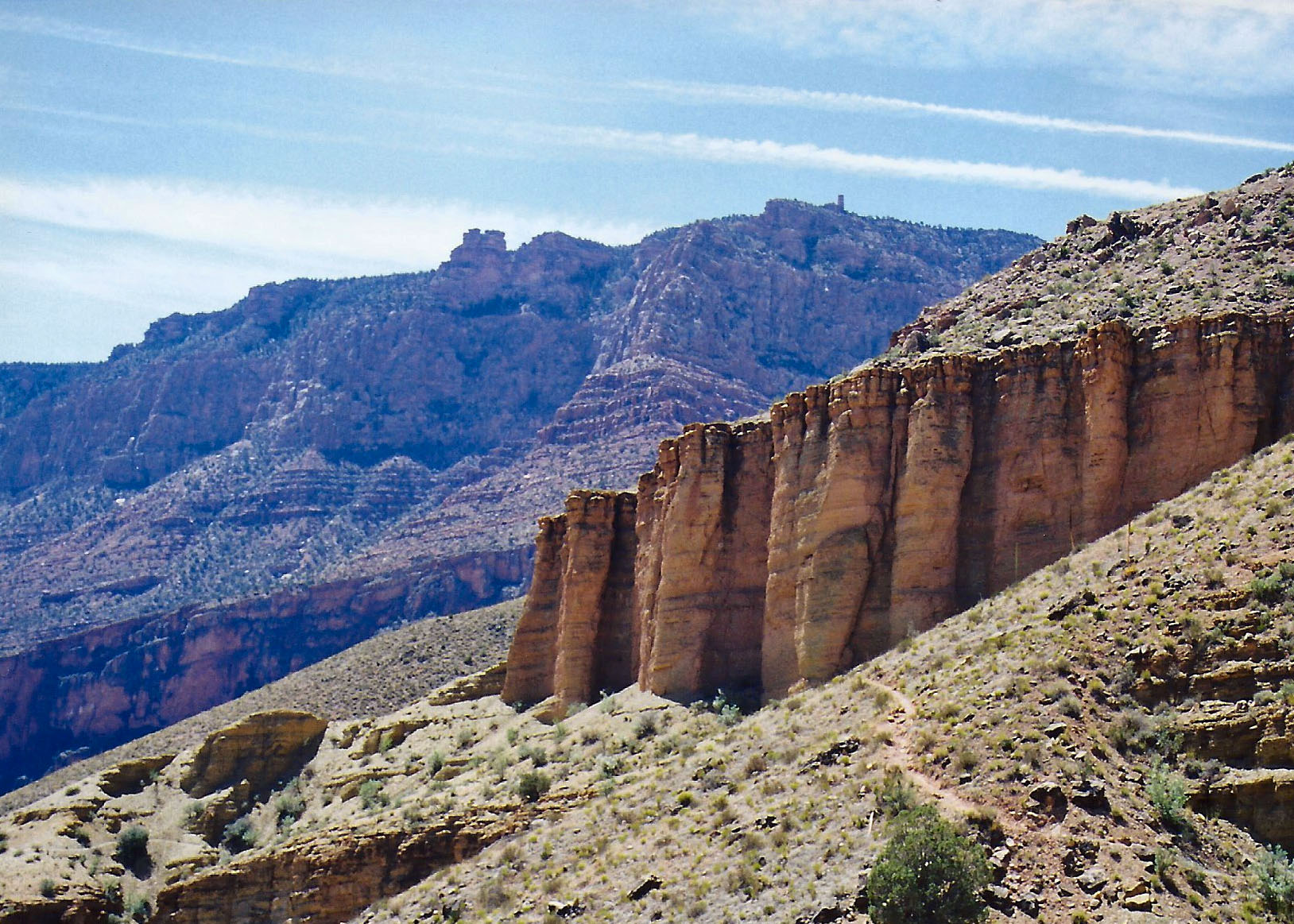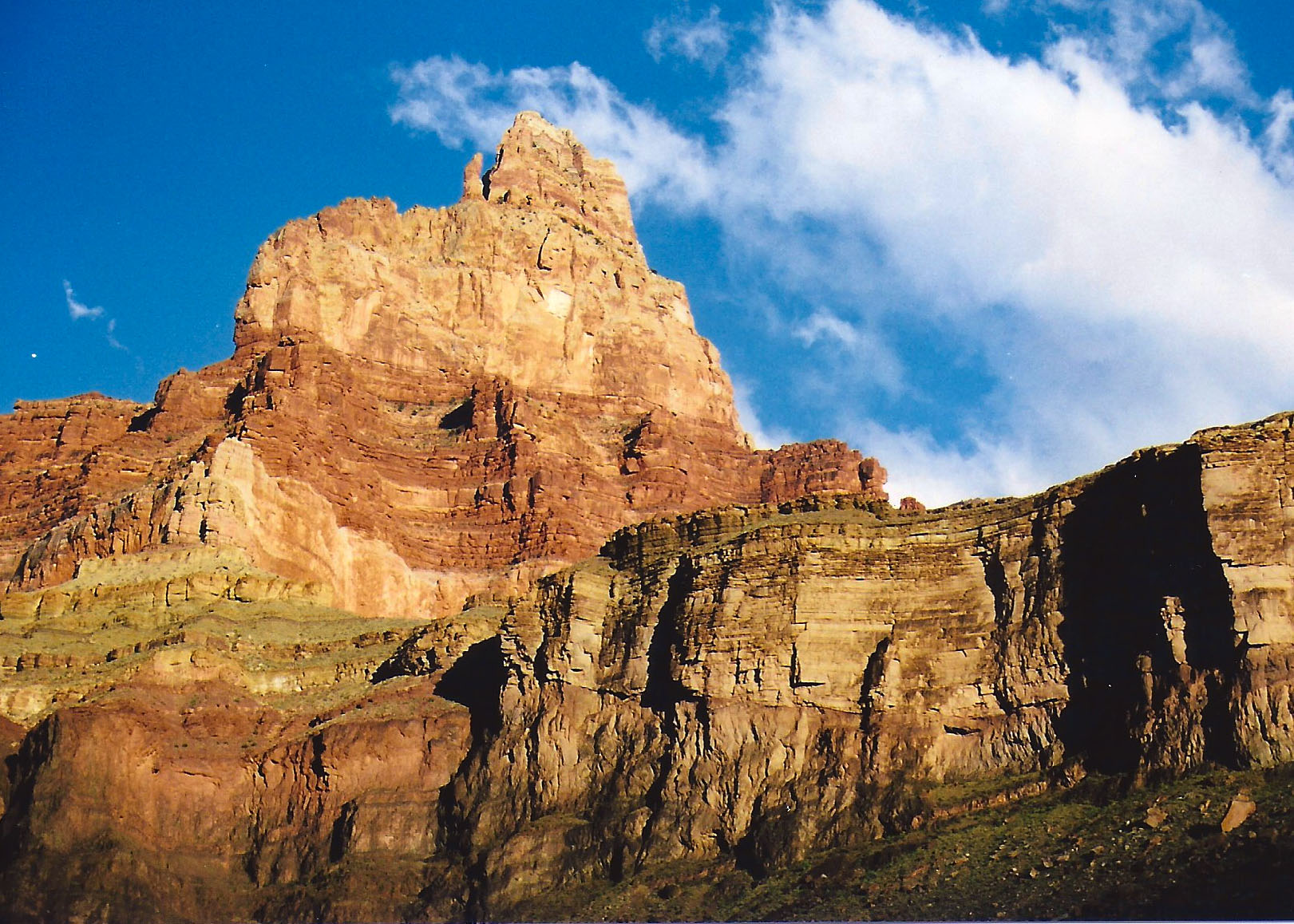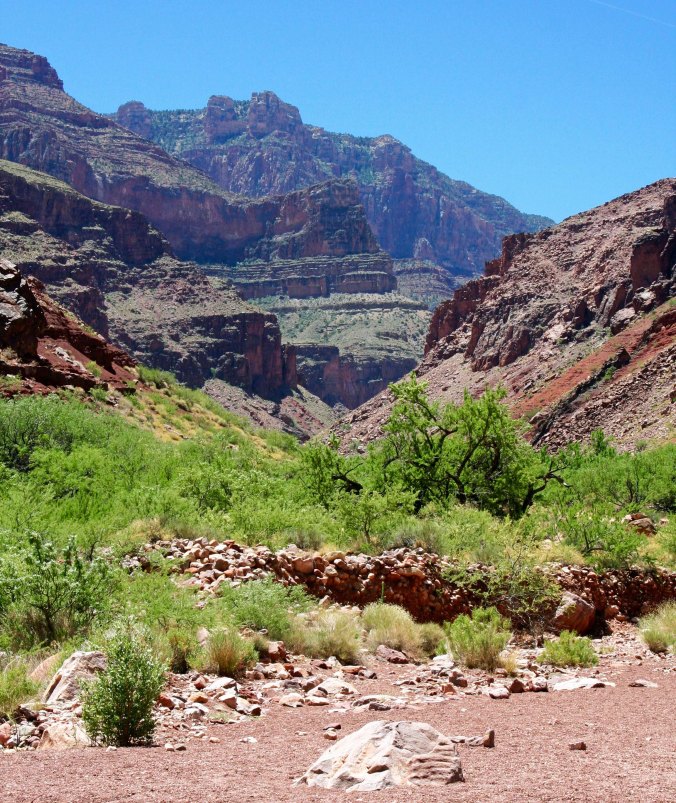
I took this photo just below the Tanner Rapids, which are seven miles below where we played in the Little Colorado River. While it looks similar to many other Grand Canyon photos included in this series, I was eager to get it. I had camped here once after backpacking down the Tanner Trail. My campsite was to the right of the small tree. Mousy had a nest under the tree…
I’ve just returned from playing for a week while celebrating my 75th birthday. So, I am a bit behind on writing posts and keeping up with comments and fellow bloggers. My apologies. It isn’t going to get much better. (grin) On Wednesday, Peggy and I fly back east to visit with our son and his family in Connecticut. We return from there just in time to fly to North Carolina and see our daughter and her family. After that, we will spend a month exploring several national parks in the southwest on foot.
Then it will be time for another Grand Adventure. I intend to walk out my backdoor in Southern Oregon and backpack 1000 miles to Mt. Whitney in California following the Pacific Crest and John Muir Trails. It’s a journey not many people make— especially 75-year-olds. “And what did you do this summer, Grandpa?” Going, of course, will depend on my doctor saying “Why not?” I hope to gain a book contract to write about the trip. Wish me luck on that one. I will be blogging much more about the trek in posts leading up to the adventure.
Since I played last week, I pulled up a previous post that is definitely relevant to the raft trip Peggy and I made down the Colorado with Tom and several other friends. When I left Alaska in 1986 and returned to California, I spent several months backpacking in the west. My first trip was into the Grand Canyon, a decision my body was not happy with! I had just spent the winter holed up in the Far North happily stuffing myself and drinking more beer than I should have…

Looking down into the Grand Canyon at the start of the Tanner Trail. The curve you can see in the Colorado River is the Tanner Rapids, which is where we will be on our next section of our raft trip down the Colorado. Years before I rafted the Canyon I backpacked into it several times. Two of my trips were by the Tanner Trail, once by myself and once with Peggy.
“It’s not too late to make another decision,” my body told my mind as I hoisted my 60-pound pack and eyed the distant Colorado River. “There is a fine lodge with great food and even better beer 30 minutes away. It provides a fantastic view of the Grand Canyon. Much better than anything you will see on the insane hike.” “Shut up and walk,” my mind replied.
Tanner Trail dropped away under my feet as I made my first steps down the steep, poorly maintained path and descended through millions of years of earth history. About a half of a mile down, the trail disappeared, having been washed away by winter rains. “I told you so,” my body whispered loudly as I mentally and physically hugged the side of the Canyon and tentatively made my way around the washout with its thousand foot drop.

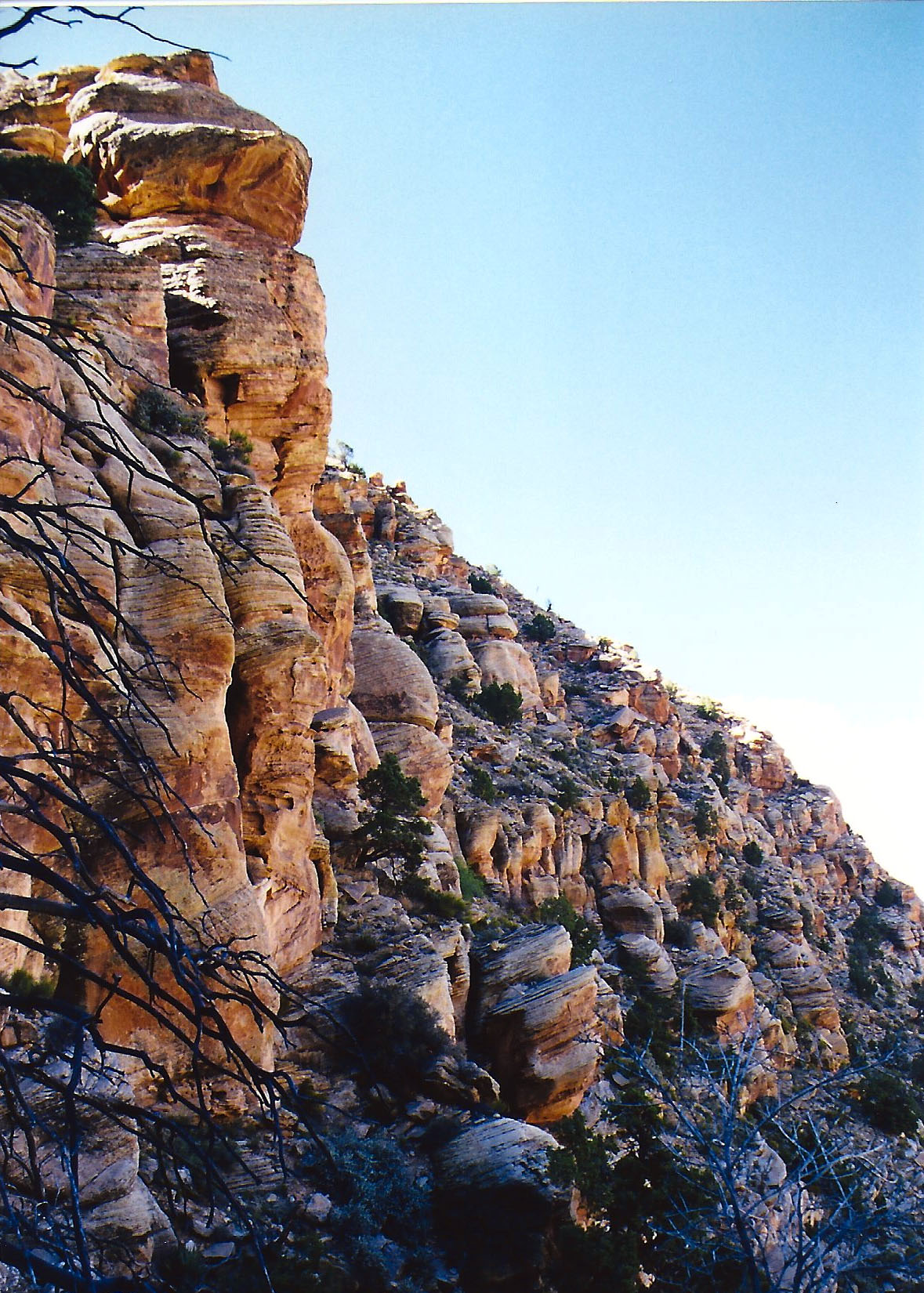
Although this photo is a little blurry and from another non-maintained Grand Canyon trail, I included it because it provides a perspective on the trails into the Canyon that receive minimal attention from the Park Service. Main tourist trails are like freeways in comparison.

Steep drop offs are a common factor with all trails leading into the Grand Canyon. The first trails were created by Native Americans. Later miners, rustlers, and companies interested in promoting tourism would enhance the original trails and create new ones.
I am not sure when my legs started shaking. Given the stair-step nature of the trail and the weight on my back, not to mention an extra 20 pounds of winter fat, my downhill muscles were not having a lot of fun. Fortunately, Mother Nature provided a reprieve. The erosive forces of wind and water that have sculpted the mesas and canyon lands of the Southwest are less challenged by some types of rocks than others.
Somewhere between two and three miles down I came upon the gentle lower slopes of the Escalante and Cardenas Buttes, which allowed me to lollygag along and enjoy the scenery. I escaped from the sun beneath the shadow of a large rock, drank some of my precious water, nibbled on trail food, and took a brief nap. It would have made a good place to camp. Others had obviously taken advantage of the shade and flat surface, but the Colorado River was calling.
Ignoring the screams of my disgruntled body parts, I headed on. At mile five or so my idyllic stroll came to a dramatic halt as the trail dropped out of sight down what is known as the Red Wall. (It received this imaginative name because it is red and looks like a wall.) Some fifty million years, or 625,000 Curtis life spans, of shallow seas had patiently worked to deposit the lime that makes up its 500-foot sheer cliff. It is one of the most distinctive features of the Grand Canyon.
My trail guide recommended I store water before heading down so I could retrieve it when I was dying of thirst on the way out. I could see where people had scratched out exposed campsites here as an excuse to stop for the night. The accommodations weren’t much but the view was spectacular.
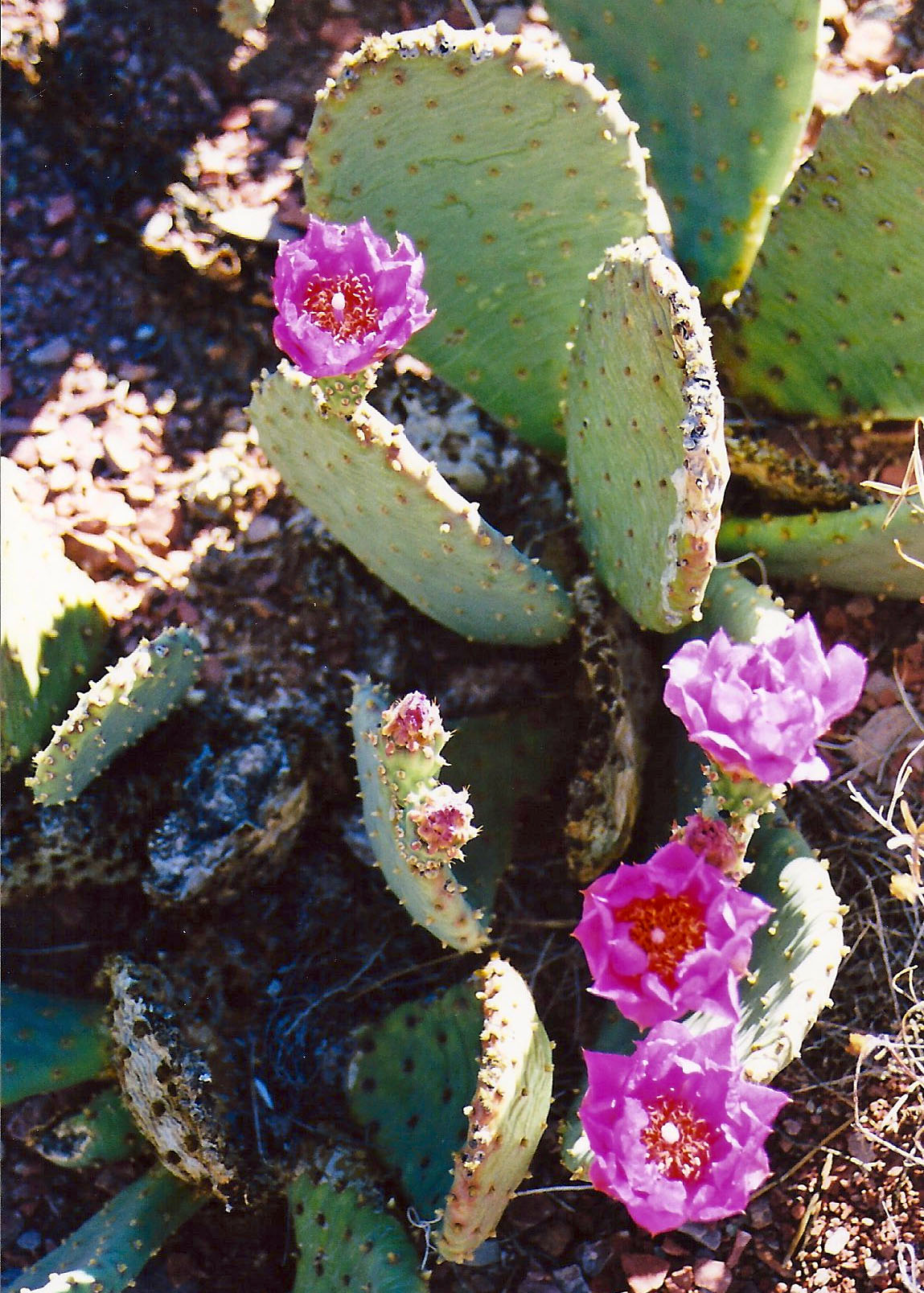
The rest of the five-mile/five month journey was something of a blur. (It was closer to five hours but time was moving very slowly.) I do remember a blooming prickly pear cactus. I grumbled at it for looking so cheerful. I also remember a long, gravelly slope toward the bottom. My downhill muscles had totally given out and the only way I could get down was to sidestep. I cackled insanely when I finally reached the bottom.

I was so tired, I could hardly enjoy the beauty of the inner Canyon. (These photos are from a later trip I took down with Peggy. I waited until after she said “I do” before introducing her to the Tanner Trail. Otherwise she might have said “I don’t.”)

I growled at a prickly pear for looking so cheerful.
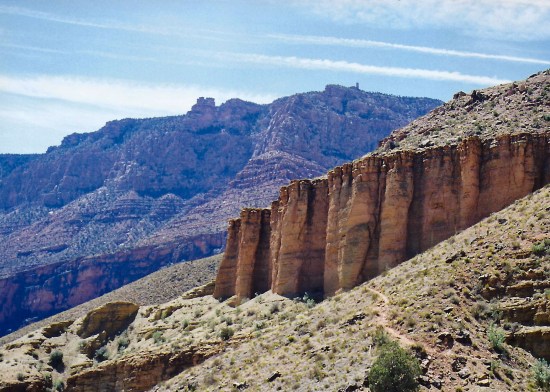
Looking back up the trail provided a perspective on how far I had come. The small, needle-like structure is Desert View Tower, about a mile away from the Tanner trailhead. You can see the trail on the right.
Setting up camp that night was simple. I threw out my ground cloth, Thermarest mattress, and sleeping bag on a sandy beach. Then I stumbled down to the river’s edge and retrieved a bucket of brown Colorado River water that appeared to be two parts liquid and one part mud. I could have waited for the mud to settle but used up a year of my water filter’s life to provide an instant two quarts of potable water.
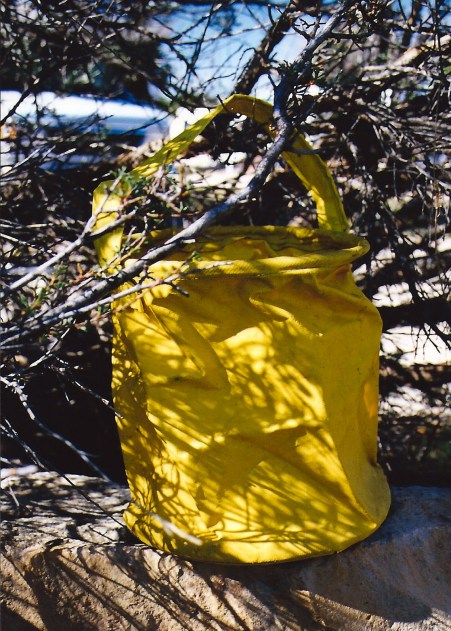
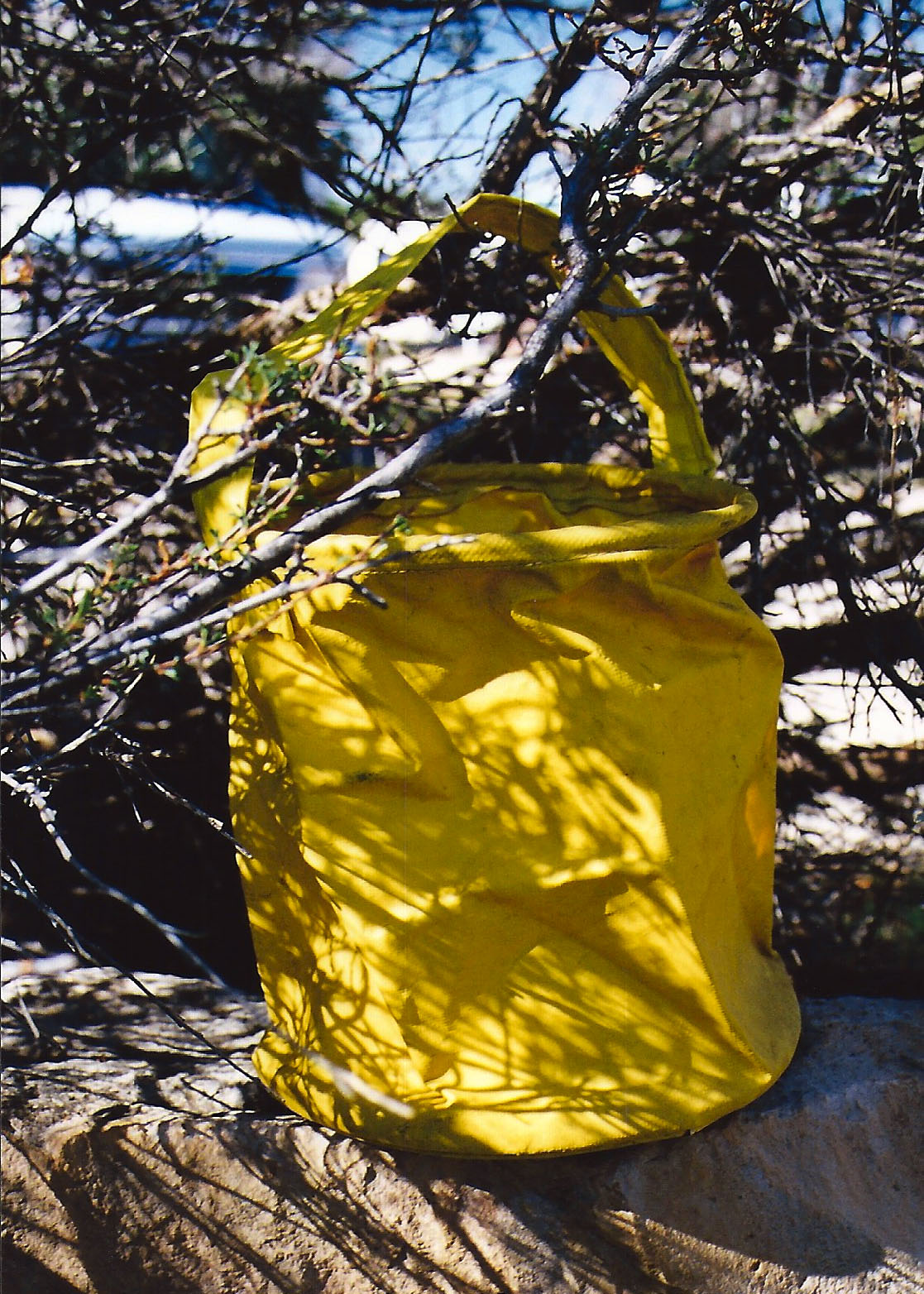
My old yellow bucket, a veteran of dozens of backpacking adventures, holding Colorado River water. It retired after my second trip down the Tanner Trail.
All I had left to do was take care of my food. Since people camped here frequently, four-legged critters looked on backpackers as a major source of meals. I could almost here them yelling, “Dinnertime!” when I stumbled into sight. Not seeing a convenient limb to hang my food from, i.e. something I wouldn’t have to move more than 10 feet to find, I buried my food bag in the sand next to me. Theoretically, anything digging it up would wake me. Just the top was peeking out so I could find it in the morning.
As the sun went down, so did I. Faster than I could fall asleep, I heard myself snoring. I was brought back to full consciousness by the pitter-patter of tiny feet crossing over the top of me. A mouse was worrying the top of my food bag and going for the peanuts I had placed there to cover my more serious food.
“Hey Mousy,” I yelled, “Get away from my food!” My small companion of the night dashed back over me as if I were no more than a noisy obstacle between dinner and home. I was drifting off again when I once more felt the little feet. “The hell with it,” I thought in my semi-comatose state. How many peanuts could the mouse eat anyway?
The river water I had consumed the night before pulled me from my sleep. Predawn light bathed the Canyon in a gentle glow. I lay in my sleeping bag for several minutes and admired the vastness and beauty of my temporary home. The Canyon rim, my truck and the hoards of tourists were far away, existing in another world. My thoughts turned to my visitor of the previous evening.

The early morning view from my camp site near Tanner Rapids on the Colorado River.
Out of curiosity, I reached over for my food and extracted the bag of peanuts. A neat little hole had been chewed through the plastic but it appeared that most of my peanuts were present and accounted for. My small contribution had been well worth my solid sleep. I then looked over to the right to see if I could spot where the mouse had carried its treasure. Something on the edge of my ground cloth caught my eye. It was three inches long, grey, round and fuzzy.
It was Mousy’s tail!
Something had sat on the edge of my sleeping bag during the night and dined on peanut stuffed mouse. Thoughts of a coyote, or worse, using my ground cloth as a dinner table sent a shiver down my spine. I ate a peanut in honor of Mousy’s memory and threw a few over near his house in case he had left behind a family to feed. I also figured that the peanuts would serve as an offering to whatever Canyon spirits had sent the night predator on its way.
Then it was time to find a bush, cook up my morning gruel, and plan my day’s backpack trip up to the Little Colorado River. But my legs had another idea. They refused to move. I backpacked for about a hundred feet, set up camp in a small cave, and spent my day recovering while watching rafters yell their way through Tanner Rapids. I wondered what it might be like to raft down the Canyon…
Next Monday’s Post: I return to our raft trip down the Colorado.
WEDNESDAY’S POST: Driving on the Alaska Highway through the Yukon!
FRIDAY’S POST: It’s back to MisAdventures. It was almost a mantra in Diamond Springs where I grew up: If there was mischief in the town, the Mekemson Kids Did It.
SaveSave
SaveSave
SaveSave
SaveSave
SaveSave