The Attack of the Graveyard Ghost… Happy Halloween


It's that time of the year when my sister and I get together with my wife Peggy and Nancy's husband Jim for our annual pumpkin carving contest.

It’s that time of the year when ghoul

I had lunch with my sister Nancy and her husband Jim yesterday. With Halloween a day away, my thoughts turned to the the Graveyard we grew up next to. While my brother Marshall and I had a healthy respect for its inhabitants, my sister Nancy Jo’s fear of dead people bordered on monumental. This tale relates to her encounter with the Graveyard Ghost as a teenage girl. I trot it out every couple of years for Halloween on my blog, so you may have read it before.

My sister was seven years older than I and lived on a different planet, the mysterious world of teenage girls. Her concern about ghosts makes this story a powerful testimony to teenage hormones. It begins with Nancy falling in ‘love’ with the ‘boy’ next door, Johnny.

Johnny’s parents were good folks from a kids’ perspective. Marshall and I raided their apple trees with impunity and Mama, a big Italian lady, made great spaghetti. I was fascinated with the way she yelled “Bullll Sheeeet” in a community-wide voice when she was whipping Papa into line. He was a skinny, Old Country type of guy who thought he should be in charge.

I use the terms love and boy somewhat loosely since Nancy at 15 was a little young for love and Johnny, a 22-year-old Korean War Veteran, was a little old for the boy designation, not to mention Nancy. Our parents were not happy, a fact that only seemed to encourage my sister.

Her teenage hormones aided by a healthy dose of rebellion overcame her good sense and she pursued the budding relationship. Johnny didn’t make it easy. His idea of a special date was to drive down the alley and honk. Otherwise, he avoided our place. If Nancy wanted to see him, she had to visit his home.

It should have been easy; his house was right behind ours. But there was a major obstacle, the dreaded Graveyard.

Nancy had to climb over the fence or walk up the alley past the Graveyard to visit. Given her feelings about dead people, the solution seemed easy… climb the fence. Marsh and I had been over many times in search of apples. Something about teenage girl dignity I didn’t understand eliminated fence climbing, however.

Nancy was left up the alley without an escort.

While she wasn’t above sneaking out of the house, Nancy asked permission to see Johnny the night of the Graveyard Ghost attack. She approached Mother around seven. It was one of those warm summer evenings where the sun is reluctant to go down and boys are granted special permission to stay up. Marshall and I listened intently.

“Mother, I think I’ll go visit Johnny,” Nancy stated and asked in the same sentence. Careful maneuvering was required. An outright statement would have triggered a parental prerogative no and an outright question may have solicited a parental concern no.

Silence. This communicated disapproval, a possible no, and a tad of punishment for raising the issue.

“Mother?” We were on the edge of an impending teenage tantrum. Nancy could throw a good one.

“OK” with weary resignation followed by, “but you have to be home by ten.”

What we heard was TEN. Translate after dark. Nancy would be coming down the alley past the Graveyard in the dark and she would be scared. Knowing Johnny’s desire to avoid my parents, we figured she would also be alone. A fiendish plot was hatched.

At 9:45 Marsh and I slipped outside and made our way up the alley to a point half way between our house and Johnny’s. Next we took a few steps into Graveyard where weed-like Heavenly Trees and deep Myrtle provided perfect cover. Hiding there at night was scary but Marshall and I were operating under inspiration.

Marsh stripped the limbs off of one of the young trees, bent it over like a catapult, and draped his white T-shirt on the trunk. We then scrunched down and waited.

At exactly ten, Nancy opened the back door and stepped outside with Johnny. Our hearts skipped a beat. Would he walk her home? No. After a perfunctory goodnight, Johnny dutifully went back inside and one very alone sister began her hesitant but fateful walk down the alley.

She approached slowly, desperately looking the other direction to avoid seeing tombstones and keeping as far from the Graveyard as the alley and fence allowed. At exactly the right moment, we struck. Marshall let go of the T-shirt and the supple Heavenly Tree whipped it into the air. It arched up over the alley and floated down in front of our already frightened sister. We started woooooing wildly.

Did Nancy streak down the alley to the safety of the House? No. Did she figure out her two little brothers were playing a trick and commit murder? No. Absolute hysteria ensued. She stood still and screamed. She was feet stuck to the ground petrified except for her lungs and mouth; they worked fine.

As her voice hit opera pitch, we realized that our prank was not going as planned. Nancy was not having fun. We leapt out to remedy the problem.

Bad idea.

Two bodies hurtling at you out of a graveyard in the dark of night is not a recommended solution for frayed nerves and intense fear of dead people. The three of us, Nancy bawling and Marshall and I worrying about consequences, proceeded to the house. As I recall, our parents were not impressed with our concept of evening entertainment. I suspect they laughed after we went to bed. Sixty years later, Nancy, Marshall and I still are.

One of many pumpkins we have carved over the years.

One of many pumpkins we have carved over the years.

NEXT BLOG: Beautiful fall colors are surrounding our home on the Upper Applegate River in Southern Oregon. I will take you on a tour.

Mr. Fitzgerald Is Dead, Very Dead… Ghostly Tales

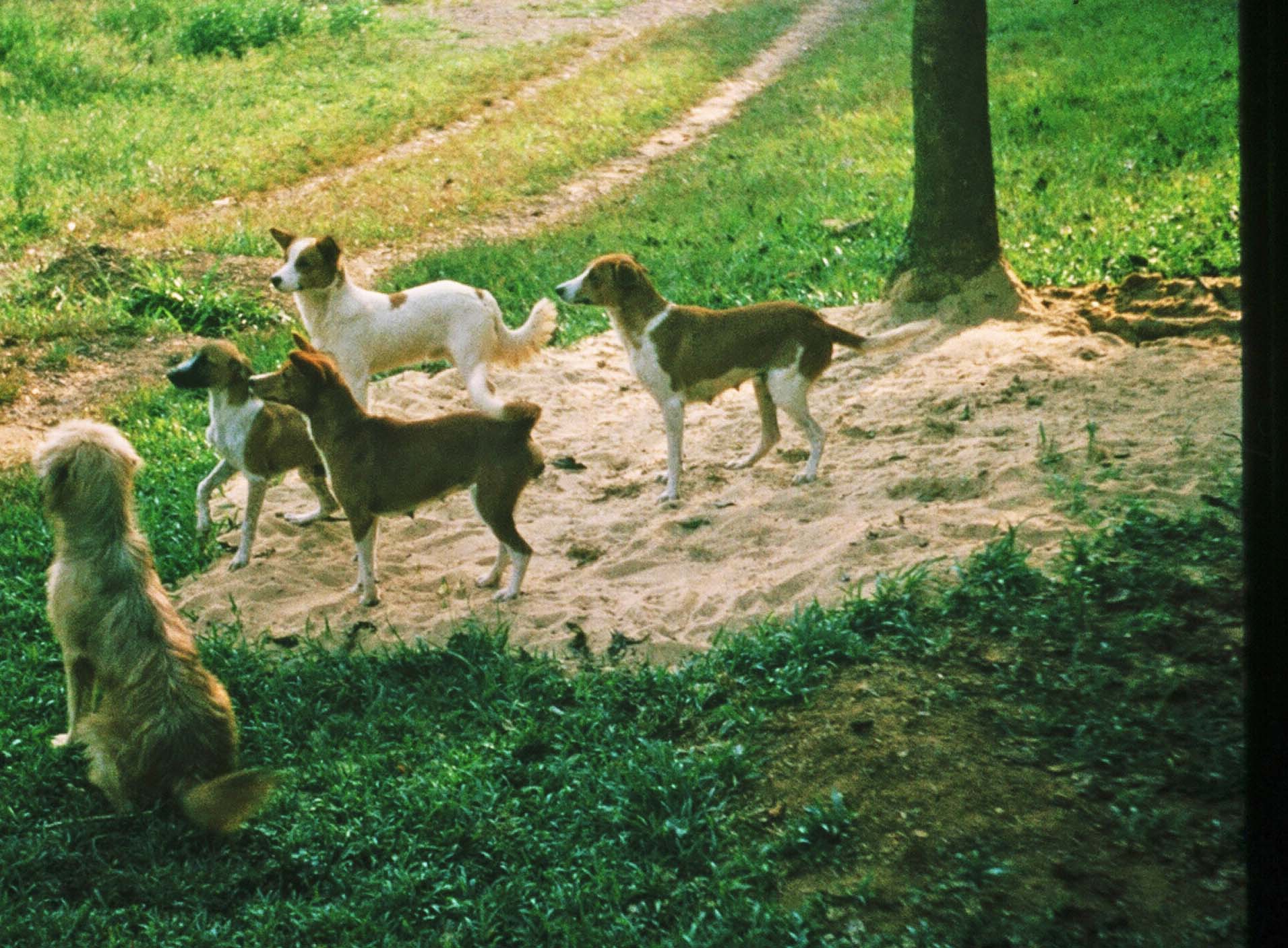
Marshall and I with the family dogs. I am on the left holding Happy. Marshall has Coalie.

Marshall and I with the family dogs in a photo taken about the time of our graveyard adventure. I am on the left holding Happy. Marshall has Coalie. The Graveyard starts about 30 feet away.

Ghosts  are out and about. I saw several today. And scary things they are with their booing and disappearing and haunting and tattered sheets. I thought I better get with the season and reblog some earlier ghostly tales from my youth.  Our family lived next to a graveyard. Many were the encounters we had with the creatures of the night. I would like to begin by reporting Mr. Fitzgerald is dead, very dead.

He has been for decades but I still have a clear memory of spying on him, trying to get my six-year-old mind around old age. I was perched in my favorite lookout, a Black Locust tree on the edge of the Graveyard. Dark clouds heavy with rain marched in from the Pacific while distant thunder announced the approaching storm. A stiff, cool breeze sent yellow leaves dancing across the ground.

Mr. Fitzgerald was a bent old man preparing for a future that might not arrive. He wore a heavy coat to fight off the chill. I watched him shuffle around in his backyard. He sharpened his axe on a foot operated grinding wheel and then chopped wood.

When he slowly bent over to pick up the scattered pieces and carry them into his shed, I scrambled down from the tree. I located a convenient knothole in the wall so I could continue to spy on him. He stopped stacking wood and stared intently at where I was, as though he could see through the weathered boards.

It frightened me.

I took off like a spooked rabbit. Mr. Fitzgerald was intriguing but his age and frailty spoke of death. I already knew too many dead people. They lived next door.

The Graveyard was out the backdoor and across the alley. We lived with its ghostly white reminders of our mortality day and night. Ancient tombstones with fading epitaphs whispered of those who had come to seek their fortune in California’s Gold Rush and stayed for eternity. Time had given their resting place a sense of permanence and even peace. But not all of the graves were old. Occasionally a fresh body was buried on the opposite side of the cemetery. I stayed far away; the newly dead are restless.

At some time in the past, Heavenly Trees from China had been planted to provide shade. They behaved like weeds. Cut them down and they sprang back up twice as thick. Since chopping them down provided Diamond Springs Boy Scout Troop 95 with a community project every few years, they retaliated by forming a visually impenetrable mass of green in summer and an army of sticks in winter. Trailing Myrtle, a cover plant with Jurassic aspirations, hid the ground in deep, leafy foliage.

During the day, it took little imagination to change the lush growth into a jungle playground populated with ferocious tigers, bone crushing boas and half-starved cannibals.

Night was different; the Graveyard became a place of mystery and danger. Dead people abandoned their underground chambers and slithered up through the ground.

A local test of boyhood bravery was to go into the Graveyard after dark and walk over myrtle-hidden graves, taunting the inhabitants. Slight depressions announced where they lived and tripped you up. My older brother Marshall persuaded me to accompany him there on a moonless night. I entered with foreboding: fearing the dark, fearing the tombstones and fearing the ghosts. Half way through I heard a muzzled sound. Someone, or thing, was stalking us.

“Hey Marsh, what was that?” I whispered urgently.

“Your imagination, Curt,” was the disdainful reply.

Crunch! Something was behind a tombstone and it was not my imagination. Marshall heard it too. We went crashing out of the Graveyard with the creature of the night in swift pursuit, wagging her tail.

“I knew it was the dog all of the time,” Marsh claimed. Yeah, sure you did.

NEXT BLOG: The Attack of the Graveyard Ghost. 

Things that Go Bump In the Night… Backpacking with Socrates in the Sierra’s

Socrates was not actually built for backpacking but he loved it. His grand daddy, so his papers claimed, had been the the American-Canadian champion for his class.

Socrates was not actually built for backpacking but he loved it. His grand daddy, so his papers claimed, had been the American-Canadian grand champion for his class. Check out his digging paws!

I’ve been following a fun blog called Animal Couriers where these folks travel around Europe delivering pets to people. They were just in Greece and that reminded me of a Basset Hound I once owned named Socrates. Or maybe he owned me. It was hard to tell at times. Anyway, Greece plus dog brought Socrates to mind.

About the time Socrates came into my life, I took up backpacking. Naturally I decided that Soc should go backpacking with me– you know, a guy and his dog. So off we went to my all-time favorite spot in the Sierra Nevada Mountains of California, a small lake basin that had been carved out by glaciers north of the I–80 Freeway half way between Sacramento and Reno.

The Five Lakes Basin north of Interstate 80 in the northern Sierra's of California.

This is one of five lakes snuggled down in a small glacier carved basin north of Interstate 80 in the northern Sierra-Nevada Mountains of California. This is the first area I ever backpacked and I have returned dozens of times over the years. The Black Buttes, which can be seen from I-80, are in the background.

Sharing the lake with Soc was close to being totally alone. His concept of a quality wilderness experience was disappearing into the woods and seeing how many holes he could dig. He never seemed to catch anything so I am not sure of his motivation. I’d get up in the morning and cover his handiwork. I almost felt like I needed to file an environmental impact report. Socrates would end up limping back to the car with sore feet.

On this particular journey, I packed the Carlos Castaneda book that features things that go bump in the night. Don Juan takes Carlos out into the middle of the Sonoran Desert on a pitch-black night and abandons him. Not long afterwards, the monsters come hunting. It wasn’t the best book for a solo night in the woods. As I read into the evening, I found myself paying more attention than usual to wilderness sounds.

I ingested a little medicinal herb to lighten things up. It was the 70s, after all. Bad idea; instant paranoia set in. Soon I could hear the wind stalking me through the treetops. An old snag turned into a ghoul. Off in the distance something big and ugly was digging and snorting. Socrates, I hoped.

This long dead pine turned into a ghoul in my imagination.

This long dead pine turned into a ghoul in my imagination. The mountains in the background are the Sierra Buttes.

“Here Soc,” I called. “Come here boy.”

The digging continued and grew more desperate.

“Come here!” I yelled. Still no response but now I could hear large claws scratching at granite.

“Does someone want a Milk Bone?” I added in a quiet, conversational voice.

The digging stopped. ‘Someone’ started coming through the brush toward me. Whatever it was, it was apparently interested in Milk Bones. Soc’s head, long body and wagging tail made their way into the firelight. He might love digging, but he loved food more. There was the reason why our low-slung pooch weighed 70 pounds.

“Good boy,” I said while digging out a Milk Bone. I knew I was buying companionship but it seemed like a good idea on this strange, dark night. Meanwhile, Socrates had started to drool in expectation. Soon he was shaking his head and shooting dog slobber off in a dozen directions. I ducked to avoid being slimed.

Unfortunately, my supply of Milk Bones was limited. I tied Soc up to assure his faithfulness. It was time for bed. I put the fire out and was greeted by a moonless, dark night. But hey, who needed the moon when I had my faithful companion and a million stars. I invited Socrates to snuggle up on my sleeping bag and laid my head down on the coat I was using for a pillow.

CRUNCH, CRUNCH, CRUNCH!

“Gads what’s that!” (A translation of what was actually said.)  I sat up straight and grabbed for my flashlight. Socrates joined in by barking at my sleeping bag.

“No, Soc, out there,” I urged and pointed the flashlight off into the woods. Soc glanced up at me with a curious ‘what are you talking about’ look and started barking at my pillow.

“Look Socrates,” I pleaded, “just pretend there is a garbage man out in the woods.” Soc had never met a garbage man he could resist barking at and I wanted his teeth pointed in the right direction.  What Soc did with my advice was make three dog circles and plop down on my bag. I gave up and reluctantly laid my head back down on my pillow.

CRUNCH, CRUNCH, CRUNCH!

I sat straight up again. Soc growled at me for disturbing his rest and started barking at my sleeping bag again.

“Fine watch dog you are,” I growled right back at him while straining my ears for the smallest of sounds. When Soc shut up, I was rewarded with a faint ‘crunch, crunch, crunch.’ It was coming from under the sleeping bag. I had a proverbial monster under my bed! Gradually it dawned on me that what I was hearing was a gopher tunneling his way through the ground, innocently on his way to some succulent root. I put my head down on my pillow. Sure enough, the ‘crunch’ became a ‘CRUNCH.’ The ground and the mystic weed were magnifying the sound. Soc had been right all along. I was lucky that he only barked at my sleeping bag and hadn’t started digging.

Don Juan would have appreciated how I had been tricked. Reality isn’t always what it seems. Following are a few photos I have taken of the Basin over the years. It’s an easy place to love.

Five Lakes Basin north of I-5 between Sacramento and Reno in Northern Sierra's.

The five lakes are small and intimate. This photo is from my campsite.

Five Lakes Basin in Northern Sierra mountains.

I camp out on a small peninsula. This reflection shot is also taken from my camp but looking in the opposite direction.

Juniper snag in Northern Sierra Nevada Mountains of California.

Junipers thrive in adverse conditions. And they make great snags.

I also liked this snag form what was probably a sugar pine tree. Granite rock forms the base of the Sierra's. Socrates considered the rock as freeways.

I also liked this snag from what was probably a sugar pine tree. Granite rock forms the base of the Sierra’s. Socrates considered the rock as freeways.

Mariposa Lilies are a common flower of the Sierra Nevada Mountains. Both Native Americans and early pioneers considered their bulbs as food.

Mariposa Lilies are a common flower of the Sierra Nevada Mountains. Both Native Americans and early pioneers considered their bulbs as food.

One of the first things I did when I met Peggy was introduce her to backpacking. (I took her on a 60 mile backpack trip.) Here she sits beside a small waterfall in the Five Lakes Basin.

One of the first things I did when I met Peggy was introduce her to backpacking. (I took her on a 60 mile backpack trip.) Here she sits beside a small waterfall in the Five Lakes Basin.

I liked this pine tree silhouette against the fluffy clouds.

I liked this pine tree silhouette against the fluffy clouds.

Sunset in the Northern Sierra Nevada Mountains.

A golden sunset lights up the Black Buttes.

Sunset north of I-80 in the Sierra Nevada Mountains of California

This dramatic sunset in the Five Lakes Basin was created by sun being filtered through smoke from a forest fire before lighting up the evening clouds.

NEXT BLOG: We return to Europe and Portugal.

The FBI Hears I Run a Communist Cell Block…

Next on my to-do list for joining the Peace Corps was the dreaded FBI security check.

I had been up to mischief at Berkeley, hung out with the wrong people, been seen in a few places where law-abiding people weren’t supposed to be, and had my name on a number of petitions.

“And where were you Mr. Mekemson the night the students took over the Administration Building?”

Maybe there was even a file somewhere; maybe it was labeled ‘Radical!’ J. Edgar Hoover saw Red whenever he looked at Berkeley.

Soon I started hearing from friends. The man with the badge had been by to see them. The background security check was underway. One day I came home to the apartment and found my roommate Jerry there, looking very nervous.

“I have to talk to you Curtis,” he blurted out. “The FBI was by today doing your Peace Corps background check and I told them you had been holding communist cell block meetings in our apartment.”

Jerry wasn’t joking; Jerry was deadly serious; Jerry was dead.

“What in the hell are you talking about?” I had yelled, seeing all of my hopes dashed. I knew that Jerry disagreed with me over my involvement in Berkeley’s Free Speech Movement and probably disagreed with me over the Vietnam War, but I didn’t have a clue on how deep the disagreement went. Or what he based his information on.

My degree in International Relations had included a close look at Communism. I found nothing attractive about the system.

The closest I had come to joining a leftist group had been the Free Student Union. Yes I had held a committee meeting at our apartment but I had also severed my relationship with the organization. The folks behind the Union were more interested in radicalizing the student body than serving it. That was not my interest.

I was not happy with Jerry that night or for some time after. I assumed the Peace Corps option was out and begin thinking of alternatives. They were bleak.

As it turned out, a few weeks later we received final notification from the Peace Corps. We were accepted. The people who said good things about me must have outweighed the people who said bad things. Either that or Jo Ann looked so good they didn’t want to throw the babe out with the bath water.

Or possibly the majority of other students signing up for the Peace Corps from Berkeley in 1965 had rap sheets similar to mine. I suspect that was the case.

Next Blog: If this is the Peace Corps, what am I doing in the naked man line at the Army Induction Center?

48 Years Later… The 1964 Free Speech Movement at UC Berkeley

This is the original sign I carried in the Free Speech Movement during the December 1964 police occupation of UC Berkeley and arrest of 800 students participating in the Sproul Hall Sit-in.

I’ve been rooting thorough my old Free Speech Movement files, digging for treasure. Buried between aging, yellow copies of the Daily Cal and mimeographed handouts calling for action, I found the picket sign I carried when the police invaded UC Berkeley and arrested 800 students on December 3, 1964.

There are numerous sources covering FSM and its impact including an excellent book, “The Free Speech Movement,” edited by Robert Cohen and Reginald Zelnik. FSM even has its own website, fsm@a.org. I visited the site and found pictures of aging white-haired men and women looking remarkably like me. 1964 is now ancient history.

In preparation for this series of posts I also returned to UC Berkeley. Sitting on the edge of Ludwig’s fountain under a fine mist, I stared at the steps of Sproul Hall while searching my memory for ghostly reminders of past demonstrations.

I actually found one. A long-haired African American was distributing protest arm bands. His effort would have been illegal in the fall of 1964.

A stroll down Telegraph Avenue brought me to the Café Med, one of my favorite student hangouts. I stopped for an obligatory cup of cappuccino. I wrote notes in my journal and listened in on conversations. It seemed that neither the coffee house nor my behavior had changed much.

Back on campus I visited the Free Speech Café in the Moffitt Undergraduate Library. Every seat was full so I wandered around and looked at photos. Mario Savio, who died in 1996, was there in spirit. A picture captured him in a characteristic pose, haranguing a sea of upturned faces. It was a fitting memorial.

In hindsight, the Free Speech Movement has become an important part of Berkeley’s history, honored even by an Administration that once characterized it as a Communist inspired plot. And what about my hindsight; have the years blurred or substantially modified my vision of what took place?

I tried, in writing this series on UC Berkeley’s Free Speech Movement, to be faithful to what I felt and experienced at the time. I feel now, as I did then, that it didn’t have to happen. The attitude the Administration demonstrated in the 1963 student leadership meeting I attended and described in an earlier post went beyond naïve to dangerous.

If the more radical students found ground for ‘revolution,’ it was a ground fertilized and plowed by the Administration. The desire to protect the campus from outside influence became a willingness to limit the rights of students to participate in the critical issues of the day and, in so doing, take the side of powerful elites whose vested interest was in maintaining the status quo on civil and other human rights issues.

What changed as a result of the Free Speech Movement?

Certainly the concept of in locus parentis took a major hit. Students at Berkeley and other colleges across America would have much greater freedom in the future, on both a personal and political level. We had graduated from being older teenagers needing guidance to young adults capable of and responsible for our own decisions.

While we were still a part of the future so popular with Commencement speakers, we were also a part of the now, helping to shape that future. Human rights and equality including women and gay rights, the anti-Vietnam campaign, and the environmental movement would all benefit. Berkeley students had participated in one of America’s great transformations.

The New Left considers the Free Speech Movement as an important source of origin. A similar claim might be made for the New Right, the so-called Neo Cons.

The outer fringes of liberal and conservative politics are two cats of the same color, feeding off of the same plate and necessary to each other’s success. Each functions with the tunnel vision of being right and with the belief that the ends of their particular vision justify whatever means necessary to get there. Not surprisingly, both the Left and the Right saw the unrest on the Berkeley Campus as an opportunity waiting to happen.

The message was not lost on Ronald Reagan. Following the Free Speech Movement, he would exploit the student protests at Berkeley and other California colleges as a launching pad for his career in politics. One of his first moves as Governor was to fire Clark Kerr for being too soft on the students. There is a picture from the early 70s of Reagan turning around and flipping off student protestors at a U.C. Regent’s meeting. It was a clear message of intent.

It may be somewhat instructive that his future Attorney General, Edwin Meese, was the Deputy District Attorney in Oakland at the time of the Free Speech Movement. Meese’s role had been to oversee the Sproul Hall arrests and serve as liaison with the FBI.

There is a story, which may be apocryphal, that it was Meese who persuaded Governor Pat Brown to send in the troops on the night of the Sproul Hall sit-in by claiming students were tearing up the Dean’s office. If so, it was a deliberate lie or at least an exaggeration. The worst vandalism I witnessed was my standing on the Dean’s desk in my socks so I wouldn’t scratch the surface.

My speculation is that the forces on the right, like the forces on the left, wanted a confrontation. Kerr was planning to address the sit-in the next day in an effort to persuade the students to leave the building. A peaceful solution would not have served the agenda of Meese, Knowland, Hoover, etc. Serious head bashing leading to a full-scaled riot was called for. If it took lies to bring it about, so be it.

Or am I just being paranoid?

Later, when I chaired a committee for the Free Student Union, I witnessed a similar attitude on the part of the Left. A confrontation with students getting their heads bashed was good. It would radicalize moderates and lead to further violent confrontations.

While both the Left and Right worked to subvert what happened at Berkeley for their own objectives, I believe that the Free Speech Movement was what it claimed to be: a fight for free speech, the right to assemble, and the right to participate in the critical issues of the day. It was a fight that still rings true today.

On Being Labeled a Radical… The 1964 Free Speech Movement at UC Berkeley


The Press, Governor of California and UC Administration labeled participants in the Free Speech Movement as a small group of radical revolutionaries bent on destroying law and order. Were we?

I was curious about the background of the students who were arrested during the Sproul Hall sit-in, considering I had almost been one. A sociologist was doing a study on who was involved so I volunteered to take part.

We were given extensive questionnaires, trained and told to hit the streets. I seemed to inherit some of the more elusive, fringe types who always hang around Berkeley. Just finding them was an adventure.

When our data was analyzed, we found that a quarter or so of the participants were relatively hard core in terms of having been actively involved in the Civil Rights movement. Most of the participants resembled me: students and grad students who were somewhat on the idealistic side, angry at the Administration, in sympathy with the Civil Rights Movement, and committed to our right to participate in the political process.

Were there truly radical students on campus who saw the protests as a way to radicalize students and achieve objectives beyond retrieving the basic rights that had been taken away?

Yes. I met some when I decided to help create a Free Student Union. A union made sense to me. The student government, by its very nature, was tied closely to the Administration. A union would go beyond the temporary, nonrepresentational nature of the FSM and give us ongoing power and representation that we lacked as individuals.

I participated in two or three meetings including one I hosted at our apartment. Chaos was good, I quickly learned. Policemen dragging students down stairs and bashing an occasional head was to our advantage. It created solidarity among the ranks and radicalized the student body.

We needed to goad the Administration into further action, the more outrageous the better.

It did not reflect who I was or my goals. After sharing my opinion on what I thought about the chosen strategies, I parted ways with the Free Student Union. Apparently, most students shared my perspective. The union, to my knowledge, did not get off the ground.

The focus shifted temporarily in the spring and maybe this shift reflected a more radical strategy. We had our so-named Filthy Speech Movement. People would get up in the free speech area and see how many obscenities they could mouth in the name of free speech.

From my perspective it was inane and counterproductive, a non-issue designed to infuriate the Administration and garner media coverage.  Rather than serve a positive purpose, it degraded our efforts of the fall and was utilized by the Oakland Tribunes of the world and their allies as justification for their condemnation of the campus.

More typical was a return to what some would define as an accepted activity of college life. I was amused to read a Junior Class party announcement in the “Daily Californian” one Friday.

“Everyone is welcome at our TGIF party, especially the FSM: it will give them a chance to quench their thirst.” Dennis O’Shea, Junior Class Activities Chairman was quoted. “It promises to be the hell raiser of the year – lots of girls, a screaming rock and roll band that frequently plays for the Hell’s Angels, and 150 gallons of liquid refreshments.”

I can imagine that the Administration was praying for a return to the good old days when a ‘hell raiser’ was defined as an ocean of beer and a screaming rock and roll band.

Next Blog: Looking back at the FSM: What did we accomplish?

UC Berkeley on Strike… The 1964 Free Speech Movement

When police occupied the UC Berkeley Campus in early December of 1964 and arrested the protestors in Sproul Hall, the University went on strike. I joined a picket line on the edge of Telegraph Avenue next to Sproul Plaza.

My bed was indeed much softer that the marble floors of Sproul Hall.

After a quick breakfast I hurried back to campus to rejoin the sit-in. I was too late.

Armed men in uniforms formed a cordon around the Administration Building where students were being dragged down the stairs and loaded into police vans. Windows had been taped over so neither protestors or media could not see what was transpiring inside.

We had an occupied campus.

The great liberal governor of California had acted to “end the anarchy and maintain law and order in California.”

Whereas Jack Kennedy had used troops to protect civil rights in the South, Pat Brown was using them to stifle civil rights in the West. Of course Brown didn’t see it that way; he was taking a courageous stand against anarchy, the anarchy I described in my last blog.

I am sure Laurel and Hardy would have seen something to laugh about. Dragging kids down stairs on their butts while their heads bounced along behind could easily have been a scene in one of the old Keystone Cop films. The Oakland police weren’t nearly as funny as the Keystone Cops, however.

As for Clark Kerr, President of the University, he felt we were getting what we deserved and argued that the FSM leaders and their followers “are now finding in their effort to escape the gentle discipline of the University, they have thrown themselves into the arms of the less understanding discipline of the community at large.”

The campus came to a grinding halt and a great deal of fence-sitting ended. Whole departments shut down in strike. Sproul Hall plaza filled with several thousand students in protest of the police presence. When the police made a flying wedge to grab a speaker system students were using, we were electrified and protected the system with our bodies.

It was the closest I have ever come to being in a riot; thousands of thinking, caring students teetered on the edge of becoming an infuriated, unthinking mob. Violence and bloodshed, egged on by police action, would have been the result. Kerr, Brown, Knowland and company would have had the anarchy they were claiming, after the fact.

A few days later we were to come close again.

Kerr, in a series of around the clock meetings with a select committee of Department Chairs, had arrived at a compromise he felt would provide for the extended freedom being demanded on campus while also diffusing the outside pressure to crack open student heads.

Sit-in participants arrested in the Sproul Hall would be left to the tender mercies of the outside legal system and not disciplined by the University. Rights to free speech and organization on campus would be restored as long as civil disobedience was not advocated.

Kerr and Robert Scalapino, Chair of the Political Science Department, presented the compromise to a hastily called all-campus meeting of 15,000 students and faculty at the Greek Theater. There was to be no discussion and no other speakers.

When Mario Savio approached the podium following the presentation, he was grabbed by police, thrown down, and dragged off the stage. Apparently he had wanted to announce a meeting in Sproul Plaza to discuss Kerr’s proposal. Once again, Berkeley teetered on the edge of a riot. We moved from silent, shocked disbelief to shouting our objections.

Mario, released from the room where he was held captive, urged us to stay calm and leave the area. We did, but Kerr’s compromise had become compromised.

A full meeting of the Academic Senate was to be held the next day and all of us waited in anticipation to hear what stand Berkeley’s faculty would take.  We knew that most faculty members deplored the presence of police on campus and the violent way they had responded to the nonviolent demonstrators. Dragging Mario off the stage had not helped the Administration’s case.

Some departments such as math, philosophy, anthropology and English were clearly on the side of FSM while others including business and engineering were in opposition.

My own department of political science was clearly divided. Some professors believed that nonviolent civil disobedience threatened the stability of government. Others recognized how critical it was for helping the powerless gain power. To them, having large blocks of disenfranchised, alienated people in America seemed to be a greater threat to democracy than civil disobedience.

The Senate met on December 8 in Wheeler Hall, ironically in the same auditorium where Peter Odegard had lectured on the meaning of democracy to my Poly Sci 1 class during my first day at Berkeley. Some 5000 of us gathered outside to wait for the results and listen to the proceedings over a loud-speaker.

To the students who had fought so hard and risked so much, and to those of us who had joined their cause, the results were close to euphoric. On a vote of 824-115 the faculty voted that all disciplinary actions prior to December 8 should be dropped, that students should have the right to organize on campus for off-campus political activity, and that the University should not regulate the content of speech or advocacy.

Two weeks later, the Regents confirmed our hard-won freedom. We had won the battle but not necessarily the war.

Next Blog: Looking back at the long-term results of the Free Speech Movement

Occupy Sproul Hall… The 1964 Free Speech Movement at Berkeley


The release of the hostage Police Car did not bring peace to the UC Berkeley Campus. Each time a solution seemed imminent, the Administration would renege or the FSM would increase its demands.

In addition to the right to organize on campus, the disciplining leaders of the Free Speech Movement became a central issue.

Demonstrations took place almost daily and were blasted in the press. I learned a great deal about media sensationalism and biased reporting.

One day I would sit in on a democratic and spirited discussion of the pros and cons of a specific action and the next day I would read in the Oakland Tribune or San Francisco Examiner that I had participated in a major insurrection of left leaning radicals who were challenging the very basis of law and order. (It was documented later that the FBI was paying a reporter to write the Examiner stories.)

Older adults in suits taking photos looked suspiciously like plain-clothes policemen or FBI agents. It was easy to become paranoid.

If we signed a petition, demonstrated, made a speech or just stood by listening, would our pictures and names end up in some mysterious Washington file that proclaimed our disloyalty to the nation? These weren’t idle thoughts. A few years earlier people’s careers had been ended and live ruined because someone had implied they were soft on communism.

J. Edgar Hoover was known for tracking Civil Rights’ leaders and maintaining extensive files on every aspect of their lives. While we weren’t up against the KGB, caution was advisable. Hoover considered Berkeley a hotbed of Communism.

We looked warily at those who didn’t look like us. One day a small dog was making his way around the edge of the daily demonstration, sniffing people.

“See that Chihuahua,” a friend whispered in my ear. I nodded yes. “It’s a police dog in disguise. Any moment it is going to unzip its front and a German Shepherd will pop out.”

The wolf in sheep’s clothing was among us. It was a light moment to counter a serious time. And we were very serious. I sometimes wondered when the celebrated fun of being a college student would kick in.

One day I was faced with a test more serious than any I had ever faced in the classroom. On December 2, 1964, FSM leaders called for a massive sit in at Sproul Hall, Berkeley’s administration building. Once again communication had broken down and the Administration was back peddling, caught between students and faculty on one side and increasing pressure from the outside on the other.

I thought about the implications of the sit-it and decided to join. I needed to act. For three months I had listened to pros and cons and watched the press blatantly misrepresent what was happening on campus. I was angry, knowing that the public had little option but to believe that a small group of radicals was preaching anarchy.

It was not wrong to utilize an edge of campus for discussing the issues of the day, or for organizations to raise funds for supporting various causes, or even to recruit students for participating in efforts to change the community.

It didn’t disrupt my education. I was free to stop and listen, to join in, or pass on. What it did do was irritate powerful, established members of the community. And for that reason, our freedoms had been curtailed.

Maybe if enough students joined together, the Administration would listen and the press would dig deeper. I told my fiancé I was going inside and then joined the thousand or so students who had made similar decisions.

It was early in the afternoon and we were in high spirits. I believed it would be hard for the Administration to claim 1000 students were a small group of rabble-rousers bent on destroying the system. And I was right. It claimed we were a large group of rabble-rousers bent on destroying the system.

Inside I was treated to a unique experience. The sit-in was well organized. Mario Savio and other FSM leaders gave us directions on what to do if the police arrived. There were clear instructions that we were not to block doorways. The normal business of the University was not to be impeded and we were not to be destructive in any way.

Floors were organized for different purposes. The basement was set aside as the Free University where graduate students were teaching a variety of classes. These included normal topics such as physics and biology and more exotic subjects such as the nature of God. One floor was set aside as a study hall and was kept quiet. Another featured entertainment – including old Laurel and Hardy films, which seemed particularly appropriate.

After administrators left, a desk in the dean’s office became a podium for speech making. I felt compelled to add my dimes worth. Each speaker took off his or her shoes so the top of the desk would not be damaged.

The real treat though was an impromptu concert by Joan Baez. I joined a small group sitting around her in the hallway and sang protest songs. The hit of the night was “We Shall Overcome.” It provided us with a sense of identification with struggles taking place in the South. I felt like I belonged and was part of something much larger than myself.

Mainly I walked around and listened, taking extensive notes on what I saw and felt. Later I would sit in the Café Med on Telegraph Avenue and write them up. They would become the basis of talks I would give back home over the Christmas break. I also turned them over to Father Baskin, an Episcopal minister who wanted to use them for a sermon at his church in Placerville.

Along about midnight the un-radical part of my nature took over. I started thinking about my comfortable bed back in the apartment. The marble floors of Sproul Hall did not suggest a good night’s sleep and it appeared the police weren’t coming, at least in the immediate future. Yawning, I left the building and headed home.

I would come back in the morning to chaos and an occupied campus.

Next Blog: Berkeley on Strike. (See below for the story about Jack Weinberg and the police car.)

Holding a Police Car Hostage: UC Berkeley’s 1965 Free Speech Movement

Jack Weinberg, creator of the statement "Never trust anyone over 30," was arrested for raising funds to support Civil Rights efforts on the UC Berkeley Campus in the fall of 1965. Students surrounded the police car and held it hostage.

In the fall of 1965, the UC Berkeley Administration declared that the Bancroft-Telegraph Free Speech area was closed and that there would be no more organization of off-campus Civil Rights demonstrations at Berkeley. Student organizers of the various community efforts reacted immediately.

These were not young adults whose biggest challenge had been to organize pre-football game rallies. Some, like Mario Savio, had walked the streets of the South registering black voters and risking their lives to do so.

In the summer of 1964 three of their colleagues had been shot dead and buried under an earthen dam near Philadelphia, Mississippi. Many had cut their political eye teeth four years earlier in the anti-HUAC demonstrations in San Francisco and had participated in numerous protests against racial discrimination throughout the Bay Area since. (HUAC was the House Un-American Activities Committee, a hold over from the McCarthy era.)

The student organizers understood the value of demonstrations, media coverage and confrontation and had become masters at community organization. They were focused in their vision to the degree they were willing to face police and be arrested for their beliefs.

The Administration wasn’t nearly as focused. Liberal in nature and genuinely caring for its students, it utilized a 50’s mentality to address a 60’s reality. Its bungling attempts to control off campus political activity combined with its inability to recognize the legitimacy and depth of student feelings would unite factions as diverse as Young Republicans for Goldwater with the Young People’s Socialist League.

It eventually led to the massive protests that painted Berkeley as the nation’s center of student activism and the New Left.

Over the next three months I would spend a great deal of time listening, observing and participating in what would become known world-wide as the Free Speech Movement (FSM). As a political science major, I was to learn much more in the streets than I did in the classroom.

What evolved was a classic no win, up-against-the-wall confrontation. The Administration would move from “all of your freedoms are removed,” to “you can have some freedom,” to “let’s see how you like cops bashing in your heads.” The Free Speech leaders would be radicalized to the point where no compromise except total victory was acceptable.

Student government and faculty solutions urging moderation and cooperation would be lost in the shuffle. Ultimately, Governor Pat Brown would send in the National Guard troops and Berkeley would take on the atmosphere of a police state.

I found myself being radicalized in the process as well although I never reached the point of moving beyond issue to ideology. It was no more in my nature to be left-wing than it had been to be right-wing. However, I would move across the dividing line into civil disobedience.

Within hours of the time that Dean Katherine Towle sent out her ultimatum to campus organizations, the brother and sister team of Art and Jackie Goldberg had pulled together activist organizations ranging in orientation from the radical to conservative and a nascent FSM was born.

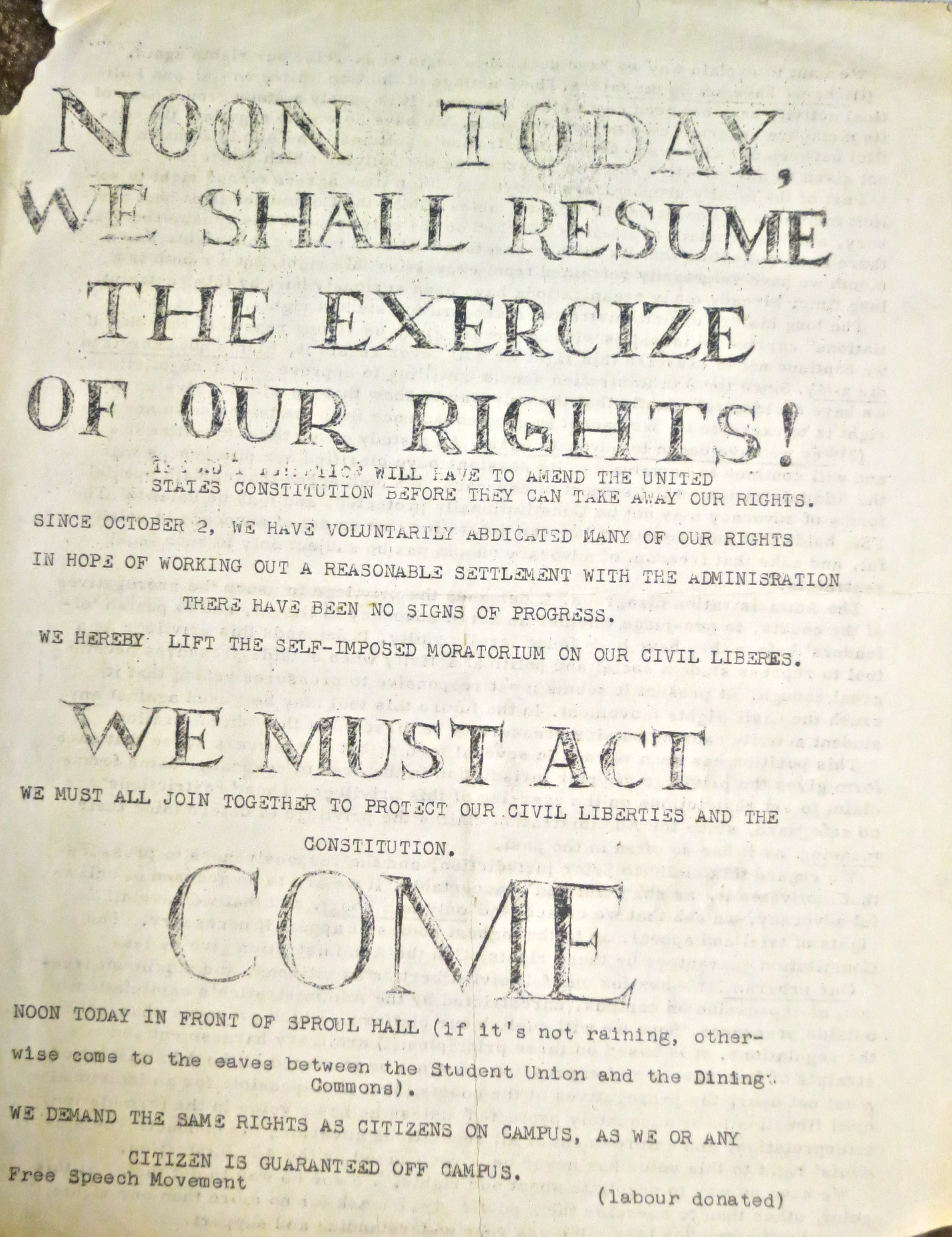
Shortly thereafter the mimeographs were humming and students were buried in an avalanche of leaflets as they walked on to campus. I read mine is disbelief. The clash I had predicted at the student leader meeting a year earlier had arrived. There was no joy in being right.
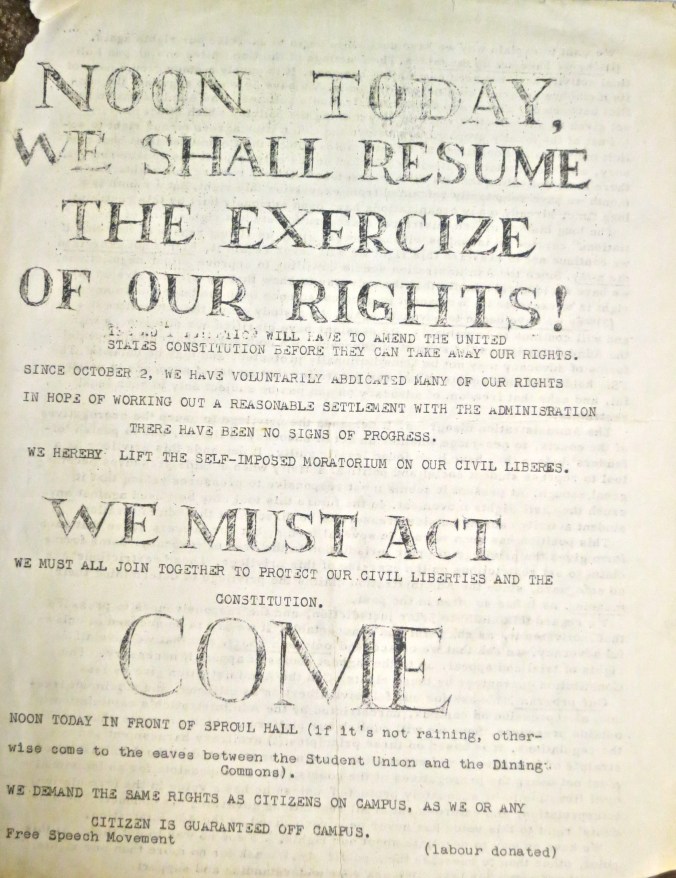
In an era before social networks and cell phones, FSM organizers relied on mimeographed fliers and word of mouth to build instant support. The above flier is one I saved in my files on the Free Speech Movement.

As soon as it became apparent that the Administration had no intention of backing off from its new rules, the FSM leadership determined to challenge the University. Organizations were encouraged to set up card tables in the Sather Gate area to solicit support for off campus causes.

I had stopped by a table to pick up some literature when a pair of Deans approached and started writing down names of the folks manning the tables. Our immediate reaction was to form a line so we could have our names taken as well. The Deans refused to accommodate us. The Administration’s objective was to pick off and separate the leadership of the FSM from the general student body.

A few days later I came out of class to find a police car parked in Sproul Plaza surrounded by students. The police, with encouragement from the Administration, had arrested Jack Weinberg, a non-student organizer for CORE (Congress of Racial Equality) who had been soliciting support for his organization.

Someone had found a bullhorn and people were making speeches from the top of the police car while Jack sat inside. I situated myself on the edge of the fountain next to the Student Union and idly scratched the head of a German Short Haired Pointer named Ludwig while I listened. (Ludwig visited campus daily and played in the fountain. Later, in Berkeley-like fashion, the fountain would be named for him.)

A scanned photo of Ludwig from Berkeley's student newspaper.

Eventually I stood up and joined those on the edge of the crowd thereby becoming a part of the blockade. It was my first ever participation in civil disobedience. It was a small step. There would be plenty of time for more critical thinking if the police showed up in force.

Being only semi-radical, I did duty between classes and took breaks for eating and sleep. Eventually, after a couple of days, the FSM negotiated a deal with the Administration. Jack was booked on campus and turned loose, as was the police car. A collection was taken up to pay for minor damages the police car had sustained in the line of duty while serving as a podium.

Next Blog: The Police and National Guard occupy Berkeley’s campus


On the Edge of Radicalism… Berkeley’s 1965 Free Speech Movement

A major confrontation erupted on the UC Berkeley Campus in 1965 known worldwide as the Free Speech Movement. At stake was the right of students to be actively involved in the Civil Rights movement and other political issues of the time.

While I was playing in Puerto Vallarta, my nephew, Wayne Cox, posted the video of a Campus Cop using pepper spray on students at UC Davis. The students were involved in a nonviolent protest supporting the Occupy Wall Street movement.

It was a strong indictment of the policeman, a bully using his power of position to intimidate and physically strike out at the protestors.

Those who oppose the Occupy Movement rushed to classify the incident as a random act of a disturbed individual. It was bad PR and the video had gone viral. But the use of violence to counter protest movements has a long history in America, dating all the way back to the Revolutionary War and the Boston Massacre.

I was to experience incidents similar to Davis during student protests at UC Berkeley in the mid 60s. I’ve already written a two blogs about the roots of the protest (see below).

I returned to UC in the fall of 1965 excited about my senior year. Two of my former dorm mates, Cliff Marks and Jerry Silverfield, had agreed to share an apartment. Prices were high. Landlords had a captive student population to exploit. We ended up with a small kitchen, bathroom, living room, and one bedroom. Things were so tight in the bedroom that Cliff and I had a bunk bed. I would later wonder why this was superior to dorm life.

Jerry (on the right), Cliff and I in our small apartment.

We christened the apartment by consuming a small barrel of tequila Cliff had brought back from his summer of sharpening Spanish skills in Mexico.

While we were recovering from our well-deserved headaches the next morning, UC’s Administration moved decisively to eliminate off campus political activities from being initiated on campus.

There would be no more organization of Civil Rights demonstrations and no more money collected to support political candidates or causes. Controversial speakers would not be allowed on campus without tight administrative control.

The Bancroft-Telegraph entrance free speech area was out of business, closed down, caput. That incredible babble of voices advocating a multitude of causes would be heard no more.

The Administration’s actions were a testament to the success of the 1960s Civil Rights struggle taking place in the Bay Area. It wasn’t that the activists wanted change; the problem was they were achieving it.

Non-violent civil disobedience is a powerful tool. Base your fight on legitimate moral and political issues; use the sit-in and the picket line to make your point. When the police come, don’t fight back; go limp. If they beat you over the head, you win. Sing songs of peace and justice; put a flower in the barrel of the weapon facing you.

It is incredibly hard to fight against these tactics. People tend to get upset when they see nonviolent protestors being beaten with nightsticks in national and international media. It gives power to the powerless.

Major businesses being targeted for their discriminatory practices in the Bay Area, the Sheraton Hotel, United Airlines and Safeway, blinked. Each would alter their practices.

One business that didn’t back down was the Oakland Tribune, owned by William Knowland, a conservative Republican, former Senator from California and leader of California’s Republican Party.

As the protests in the surrounding community became more successful, the power structure being attacked struck back. Calls were made to the Regents, the President of the University system and the Chancellor at Berkeley. ‘Control your students or else’ was the ominous message.

The Regents, President and Chancellor bowed to the pressure.

Some members of the Regents and Administration undoubtedly agreed with the businesses being challenged and saw the protesters as part of an anarchic left-wing plot. Others may have believed that the students’ effectiveness would bring the powers that be down on the university. Academic freedom could be lost. Some likely felt that the activities were disruptive to the education process and out-of-place on a college campus.

One thing was immediately clear; the Administration woefully underestimated the reaction of the leaders of the various organizations and large segments of the Campus population to its dictum. Possibly the administrators believed they were dealing with a small, unpopular minority, or maybe they just needed to believe: the outside pressure was so great it didn’t matter what the students believed or how they reacted.

Next blog: I become involved in ‘civil disobedience.’

Proud to be a UC Berkeley student, I display my sweatshirt.