Step Aside Cats, We Have Puppy Eyes: A Look at Dogs… The Focus Series

The focus series looked at cats last week. Dogs insisted it’s their turn this week.

Meet Leta. When our grandson Ethan’s friend, Annie, came to visit recently, she bought her Corgi pup with her. It was ‘cuteness’ personified.

Here are some fun facts about the puppy and other dogs as well. Leta’s nose print is unique to her. Just like your thumbprint is to you. No two dogs have the same one. What her nose does share with most other dogs are some 150 million olfactory receptors. Humans have around 6 million.  That’s why their sniffing ability far exceeds ours. Some dogs have a lot more. The blood hound is top dog with around 300 million. They can follow tracks several days old and can stay on a scent trail for over 100 miles. Their sense of smell is so well documented that it can be admitted as evidence in a court of law. “Sniff, sniff. Woof, woof, woof!” Translated: Number three in the lineup robbed the bank.

Basset Hounds are #2 in olfactory receptors and their capabilities for tracking. This is Socrates, my dog of the late 60s and 70s. He loved to go backpacking with me and wander off on his own— after who knows what. Gophers maybe. He specialized in trying to dig them up. I never worried about him, however. He always tracked me down later. He knew the source of his milk bones.

While we are dealing with a dog’s sense of smell, here’s a fact I didn’t know. They have a back up system for ‘smelling’ pheromones (chemicals) that contain a great deal of information. It’s called Jacobsons Organ and is found on the roof of their mouth. It has a direct line to the brain where the information on the pheromones is translated: Valuable information to Bowser: Such as whether Fifi is ready to breed. Information on health and mood can also be transmitted. Yours, as well as another dog’s.
Pee, poop, and even feet carry pheromones which are created by scent glands. Because pheromones are volatile, they are released to the air and can travel long distances. That’s why Bowser might get excited if Fifi is in heat, even if she lives three miles away. Given an opportunity, he will go roaming and show up on her doorstep. I found the information about feet interesting as well. You’ve likely seen a dog kicking backwards after it has done its business. I’d always thought it was making a half hearted attempt to cover its poop. Actually it’s using the scent glands on its feet to mark its territory. It’s kind of a “I pooped here,” message. The pheromone is the sentence; the poop the exclamation point.

Scent glands near the anus provide all kinds of information, which is why dogs are always sniffing each other’s butts. Each dog has its own unique pheromones that travel to the sniffing dog’s Jacobsons Organ and then their brain where they are stored and interpreted for immediate and future use. A dog can actually recognize a dog it has sniffed years before. And remember its mood. “When I was a puppy, you were grouchy and bit me. Now you are old and I’m twice as big. Guess what?”

Dogs have been hanging out with humans for over 20,000 years, longer than any other domesticated animal. I commented on puppy eyes in my headline. It is theorized that they are an evolutionary development caused by people picking out dogs they found appealing down through the ages. Lexi, a blue Australian Cattle Dog definitely had them as a puppy.
As did Chema, her sister, a brown Australian Cattle Dog. Both are by owned our daughter Tasha and her family. These were puppy pictures. They are both old dogs now but they still have the ‘look.’
While we are on Aussies, this is an adult Australian Sheperd that belonged to our niece, Christina. It certainly hadn’t lost her puppy eyes. The blue eyes also capture your attention. The puppy Leta has them as well.
As does Christina’s other Australian Shepherd, Zoe. This is a look that demands attention and includes a question. Likely, “Why are we stopped here, Mom.”
A couple more family dogs before moving on… This is Lila, a Goldendoodle that belongs to my son Tony, his wife Cammie and their kids. No puppy eyes here but lots of brains (not to mention long legs). Poodles are noted for their intelligence. Of the above dogs, Corgi’s and Australian Cattle Dogs are also near the top. Socrates? Not so much. I once met a fellow Basset owner in Canada and we started talking about our respective dogs, as Basset Hound owners always do. I mentioned how difficult it was to train Socrates. He laughed. “My basset hound was kicked out of a dog training class in Edmonton. He was a bad influence.” Yep.
I find the difference between our son’s family dog Lila and our daughter’s family dog, Rio, amusing. The milk bone provides perspective on Rio’s size. I asked Tasha what breed Rio was, assuming Chihuahua. And, yes, Tasha mentioned Chihuahua and then went on to list a few others. “Ah,” my response was, “Rio is a mutt.” Albeit a cute and loving mutt. “She sleeps on our bed with us,” Tasha admits. Actually, studies suggest around 50% of dogs sleep on their owner’s bed in the U.S. It might even be closer to 70%.
The mention of Chihuahuas led me to remember an encounter that Peggy and I had with one in Puerto Vallarta, Mexico. I thought he looked cool carrying his small stick along in his mouth.
This photo suggested that his ‘girlfriend’ had a different point of view. I imagined this to be the conversation. Her: “If I told you once, I’ve told you a hundred times, it’s stupid to walk around with a stick in your mouth. Odds are that you will stumble and drive it into your pea-sized brain.” Him: “Whatever.”
Have you ever watched dogs compete on an agility course. We came on a competition once in British Columbia. Dogs work their way through a number of challenges that range from poles that they have to weave their way through to see-saws and tunnels. The more advanced the dog, the more barriers they have to overcome. Owners run along beside the dogs encouraging them to do their best. It’s as much fun watching the owners as it is the dogs. The dog that completes all of the challenges in the shortest period of time for its class wins. This small papillon was almost flying!
Hurdles are another barrier the dogs have to leap over. The bigger the dog, the higher the hurdle.
I asked this fluffy pooch with a pink collar if she had ever thought of competing in one of the dog agility competitions.
Her response.
The most renown dog competition in the world is the Iditarod, Alaska’s thousand mile sled dog race from Anchorage to Nome. This photo is actually from Anchorage’s Fur Rendezvous where the dogs were running more like 100 yard sprints than 1000 miles. They can run up to 20 miles per hour. I lived in Alaska for three years in the 80s and watched the beginning of the Iditarod each year. In fact, I was in Alaska the year that Libby Riddles was the first woman to win the race. I was Executive Director of the Alaska Lung Association at the time and called her up immediately afterwards and asked if she would consider serving as our Christmas Seal Chair. Winning the Iditarod is a huge deal in Alaska. Her immediate response was yes. Could I pick her up at the airport in a week when she got back from a photoshoot in Chicago.
It was for Vogue Magazine.
Libby and I with a backdrop of Christmas Seal scarves. I spent a couple of days driving Libby around to various media interviews. In addition to getting great PR for the Association, I had a lot of fun— and learned a lot about sled dogs.
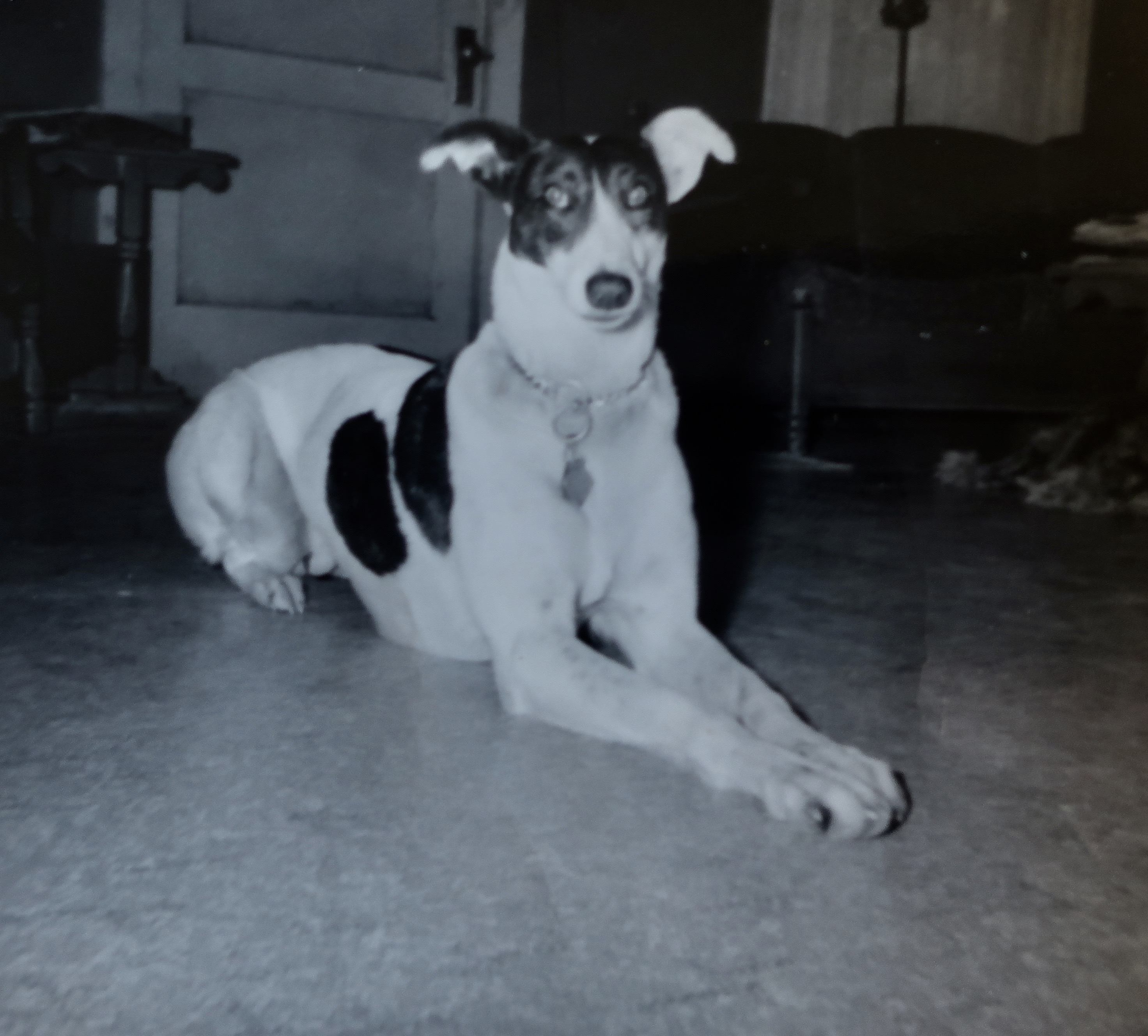
While sled dogs are fast and extremely tough, they aren’t the fastest dog in the world. That title goes to the greyhound. The fastest speed one was ever clocked at was 41.83 mph (67.32km/h). This is Pat, my greyhound, in our house in Diamond Springs CA. I named her after the local Greyhound bus driver I knew as a kid. Pat had been running wild, making a living off of jack rabbits and ground squirrels. She was getting skinnier by the day. One day, my mother stopped our car, opened the door and invited Pat to come home with her. Thereafter, she was my dog. What a great companion. I’d come home and she would be one big wiggle. Watching her run was poetry in motion.
As we do with cats, Peggy and I take photos of dogs when we travel. This one had found a convenient ledge to sleeping on the Greek Island of Santorini.
At a bus stop in Romania.
This puppy hoping for food next to the pyramids in Egypt.
A small village along the Amazon River.
On a bridge overlooking the Neckar River in Heidelberg, Germany.
Catching snowflakes on Vancouver Island, Canada. It took a second look to figure out what the dog was doing.
We also try to capture photos of dogs’ ancestors when we get a chance. We had a pair of foxes that lived on our property in Oregon. One night we were awakened by them howling down near the road. It was repeated the next night and the next. Finally I went down to see if I could find out what was making them excited. I found a dead fox killed by an automobile. What we were hearing was its partner mourning its loss! I gave the dead fox a decent burial and said a few words over the grave. The nightly howling stopped.
We caught this photo of a jackal when we were on our photo safari in southern Africa. In our post on cats, I mentioned how the cat was sacred to ancient Egyptians. So was the Jackal. Anubis, the god who guided souls into the afterlife and weighed people’s hearts during the final judgment had the head of a jackal.
This is an African Wild Dog that we photographed in Zimbabwe. It is also known as a Painted Dog for its unique color.
And finally, a coyote we found in Death Valley, obviously looking for a handout. Feeding them is a no-no in national parks.
I could go on and on with dogs, but I realize it is past time when I should wrap up this post. See the little dog standing in front. She was a Basenji  named Do-Your-Part by her Liberian owner. Basenjis are noted for not barking. Actually, they yodel. While she belonged to the principal of the high school where I taught in the Peace Corps, she adopted me. Everywhere I went, she went. Including my classroom. With zero training she was the best mannered dog I have ever known. And the sweetest. The day I had to leave, Do Your Part, who never climbed up on me, climbed up in my lap and shivered a goodbye. It broke my heart.
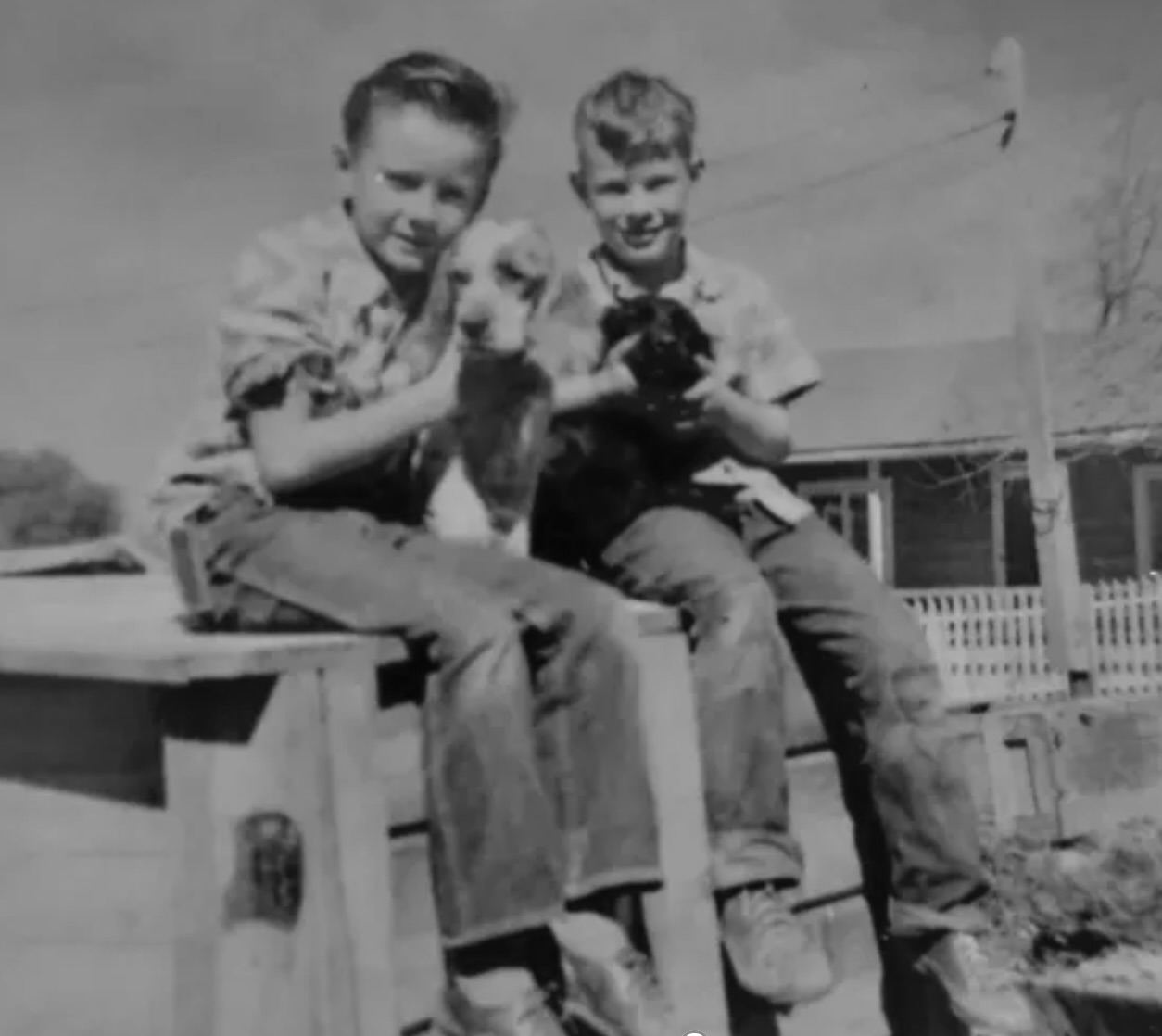
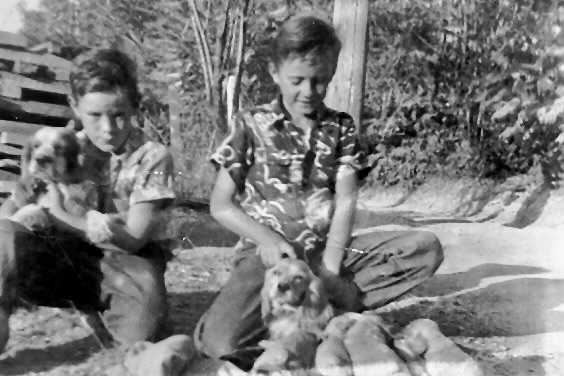
One last photo. As a kid I was in charge of all the family pets. My first dog, Tickle, a Cocker Spaniel, is on the right. Another Cocker, Happy, is on the left. Our pigeon is on my shoulder. Missing was our grey squirrel, Pugemite, and several cats. Tickle, like Do Your Part, followed me everywhere. Much to his disgust, and mine as well, however, he wasn’t allowed to go to school with me.

In my next post on UT-OH, I relate how listening to the Lone Ranger on our family radio almost led to my head being smashed by a train. Our next focus post will be on Hoofing It with Ungulates.

One of the many Ungulates you will meet.

UT-OH! Chapter 1: First Grade Flunkee

Unknown to me, I had grown two days older. But what did I know. I was only five years old.

I can still hear the clanking treads and feel the bite of the blade as my D-8 dug into the side of the steep hill. Dirt and rocks tumbled into the canyon below. I was working alone, cutting a logging road across mountainous terrain. A hot Indian-Summer sun was beating down on me. My body was drenched in sweat and covered in dirt. And then it happened. A portion of the cliff gave away— and the bulldozer went tumbling off the edge. 

“Fuck!” I yelled. 

It was a wonderful word, one that I had learned from my seven-year old brother, Marshall. I didn’t have a clue what it meant, but it was deliciously bad and not to be said around adults. Or my sister.

At five years of age, I was too young to be operating a bulldozer by myself in our backyard, even if it was only four-inches long and the road I was cutting was along the edge of our compost pit. But my mother wasn’t the hovering type; she drank a lot. Empty wine bottles had a way of mysteriously appearing under her bed and in the clothes’ hamper that hid out in the closet. I spent a lot of time outdoors. My mother’s alcoholism was my introduction to being alone with nature. Not necessarily a bad deal.

I wasn’t totally alone. Coaly, our black Cocker Spaniel, was assigned babysitting duty.  At “fuck!” she wagged her tail and barked into our compost pit where the toy had fallen. 

“Go get the bulldozer, girl,” I urged. She gave me a ‘go get it yourself’ look. She wasn’t the ideal faithful-dog. The gray hair around her nose and aching joints spoke to her advanced years.  She felt little need to please me and zero tolerance for my youthful pranks. Healing scars on my foot reflected how little. 

We fed Coaly and our cats canned Bonnie dog food. She got half, and each of our two cats got a quarter. She’d wolf down her food and then go after the cats’ portion. I had discovered that Coaly growled ferociously if I messed with her share. We fed our animals outside on the finest paper towels.  I always went barefoot in the summer and it was easy to reach over with my big toe and slide their food away. I quickly learned to leave the cats with their lightning fast claws alone. But Coaly was all bark and no bite. At least she was until she sunk her teeth into my foot. I ended up in the ER with a tetanus shot, stitches and zero sympathy. Coaly ended up gobbling her dinners and hassling the cats in peace.

At the time of the bulldozer incident, I had been granted a reprieve from school, or, to put it bluntly, I had been kicked out of the first grade— for a year. My mother was not happy. She had good reason to drink.

As her last child to enter school, she had been eager to get me out of the house. Make that desperate. The evidence is irrefutable. California had a rule then that five-year olds could go to the first grade if they turned six on or before March 1 of the following year. There was no such thing as kindergarten, at least in Diamond Springs in 1948. Since my birthday was on March 3, I missed the deadline by two days. Darn. 

Mother’s reaction was more colorful. She made a command decision. Forty-eight hours were not going to stand in the way of her little boy’s education, or her freedom. So, she changed my birth certificate.  March 3 was carefully erased with a typewriter eraser and March 1 typed in. I was bathed, dressed and shipped out, not the least bit aware that I had matured by two days. I think I recall hearing music and dancing in the house as my 12 year old sister walked me to school, a block away.

Things weren’t so rosy at school. The other kids were all older, bigger, and more coordinated. For example, Alan Green could draw a great horse. It came with four legs, a tail, a head and a flowing mane. Mine came with unrecognizable squiggles. It was hard to tell whether my objective was to draw a tarantula or a snake with legs, but the world’s wildest imagination on the world’s most potent drug wouldn’t have classified the picture as a horse. It was not refrigerator art. The whole exercise created big-time trauma.

This negative experience was compounded by the exercise of learning to print within lines. Forget that. If my letter came anywhere close to resembling a letter, any letter, I was happy. Mrs. Young, the teacher, was more critical.

“Curtis, I asked you to make Bs, and here you are printing Zs.”

“So what’s your point?” was not an acceptable response. Mrs. Young was suspicious and that suspicion increased each day I was in school. She was a tough old gal who had been teaching first grade for eons. She knew first graders, and I wasn’t one. As for the birth certificate, Mother’s forgery was in no danger of winning a blue ribbon at the county fair. After a few weeks, Mrs. Young sent off to Oregon for a copy. I remember her calling me up to her desk.

“Curtis” she explained, “you have a choice. You can either go home now or you can go home after school. But either way, you are going home and can’t come back until next year.” 

Just like that, I was a reject, a first grade flunkee. 

Mrs. Young couldn’t have made it any clearer: Mother was going to get her little boomerang back. This was okay by me, if not by her. Playing out in the backyard was infinitely more fun than competing in ‘Scribble the Horse.’ I did decide to stay for the day. Mrs. Young was reading about Goldilocks to us after lunch and I wanted to learn if the bears ate her.

It would have been interesting to listen in on the conversation that took place between Mother and Mrs. Young, or even more so between my mother and father, or Pop, as he was known to us. I’ve often wondered if he participated in the forgery or even knew about the March 1 rule. I doubt it. He was not the parent frantic to get me out of the house during the day.  (Had it been in the evening the jury might still be out, he laughingly reported to me years later.) But I wasn’t privy to those high-level discussions. My job, which I took quite seriously, was to enjoy the reprieve. I was about to begin my wandering ways. The Graveyard was waiting. Join me next Thursday as I learn how it served as a great playground during the day but became terrifying at night when the ghosts slithered out from their graves.

The change that made me two days older. I don’t know if this was the evidence that led to my being booted out of the first grade but the change is obvious. First, check out the the size of the ‘1′ in March 1 with the ‘1′ in 1943. While the type face is the same, the first 1 is much smaller. Second, but less obvious, there is a slight indentation and discoloration of the certificate where my mother used the typewriter eraser.

UT-OH! The Introduction to a New Series

A family portrait taken near Santa Jose, California in 1945. My father, Pop, and my mother, Mother, are in the back. My sister Nancy, brother Marshal and me, the giggling two-year-old, are in the front.

Years that end in three have a special significance to me. They mean another decade has passed. I was born on March 3, 1943. According to the March issue of Life Magazine that year, Americans and Australians were duking it out with the Japanese at the Battle of Bismarck Sea, Westinghouse was firing frozen chickens at airplane windows, and women were wearing bow ties as a fashion statement. None of these events registered on my mind. It was still devoted to getting milk, although, looking back, I would have loved to have witnessed the frozen chicken splat test.

The introduction to my new series is below, but first I want to share a few thoughts in general about UT-OH.

My objective is to relate stories from my past in a memoir format which incorporate— if you’ll pardon the expression— Oh Shit! moments. We all have them, right. My focus will be on such experiences that you laugh about later, not on those you find yourself asking yourself, “Why or why did I do that?” I can haunt myself on those. I don’t need to haunt you.

Second, let’s talk about the name: Ut-Oh. Some of you may look at it and say, “Curt doesn’t know that the proper spelling of Uh-Oh. Maybe I should tell him before he embarrasses himself further.” For the record, I know it’s Uh-Oh, but Ut-Oh is how I pronounced it as a kid and I have every intention of continuing to, no matter how embarrassing. It fits.

Third, a number of these stories I have told in the past in my 15 years of blogging. In fact I even started to organize them once before. I’m doing it again. My apologies to those of you who have already read them. A handful have been with me the whole 15 years. I love you, but a good story deserves to be told over. And there will be new tales!

Finally, there is the issue of accuracy. Peggy read an article recently that stated the older the story from your early childhood, and the more it has been told over the years, the more likely it is to change. Very slightly each time perhaps, but after 75 years? Who knows. Here’s a summary of what AI has to say about it: “Yes, memories from early childhood change over time… reflecting how our brain develops, making narratives richer or more fragmented.” I like richer. Having said that, I’ve tried to make my stories as accurate as possible given my memory and active imagination. Each one actually happened, even if my mind has modified the script, especially from my earliest years.

My intention, assuming I don’t get sidetracked, is to post UT-OH stories on Thursdays and my normal travel blog and focus stories on Mondays. 

UT-OH! AN INTRODUCTION

We all have Ut-Oh moments where things don’t go according to plan. Most are relatively minor, like spilling a bowl of spaghetti in your lap when you are having lunch with your future mother-in-law (first marriage). Minor, perhaps, but it’s better if she does the spilling. Either way, it’s an ut-oh in small letters unless your sense of humor (or hers) is out of whack. Even then, it has the potential for making a good story.

In this book, I am mainly talking about larger Ut-Ohs, even all cap UT-OHs— like the time a group of murderers, kidnappers, bank robbers, and Patty Hearst got stuck in a snowbank next to me on a remote mountain road in the Sierra Nevada Mountains. They were out practicing with their automatic weapons, apparently preparing to rob a Sacramento bank.

UT-OH is full of such tales. Most take place in the outdoors. How could it be otherwise given that I’ve spent over 77 years of my life wandering in the woods. I started when I was five by exploring the jungle-like graveyard next to my house. (I’d been kicked out of the first grade for a year.) At 75 I was backpacking 750 miles down the Pacific Crest Trail to celebrate my birthday. Now in my 80s, the adventures continue— as do the Ut-Ohs.

I know what it’s like to be stalked by a grizzly bear in Alaska, charged by a herd of elk in New Mexico, and attacked by army ants in Africa.  Once, a rattlesnake tried to bite me on the naked butt. I hadn’t seen it slither into a cat-hole I had dug for bathroom duty in the woods and I’d almost pooped on him. Fortunately for both of us, he had rattled his displeasure as my rear loomed above him.

There are lessons to be learned in this book. Checking your cat-hole for rattlesnakes is one of many. For example:

  • You should sleep with your shoes in the sleeping bag when you are snow camping in minus 30° F weather at Denali National Park. Toasty warm toes do not appreciate being shoved into solidly frozen shoes. 
  • Screaming loudly may dislodge a bear when you wake up at 4 AM with one standing on top of you.
  • It’s best to be in shape before venturing out on a solo 10,000 mile bicycle journey around North America. Boy did I pay for that. Did you know that having calluses in your crotch is an important part of preparing for a long distance bike trip?
  • And finally, I recommend you have more than a 20 mile backpacking trip behind you before you decide you are qualified to lead 60 people, aged 11-70, on a hundred mile backpack trip across California’s Sierra Nevada Mountain Range. The learning curve was straight up that time— for nine days in a row.

But hey, I’m a man who has been carrying a horse bone with him as a traveling companion for 48 years. What could possibly go wrong? Join me next Thursday as I get kicked out of the First Grade and learn that the graveyard next door is a very scary place at night.

Bone at Burning Man in 2023. He’s been there 10 times with me, starting in 2004. Here he is making a sacrificial offering to the Rain Gods: Not to make rain start. But to make it stop!
Everything had come to a dead halt, mired in mud. The porta-potties were overflowing and nobody was going anywhere. It was scary— a hair raising, nail biting experience. UT-OH!
We lucked out. A Ranger told me we could leave, given our powerful 4-wheel drive F150 complete with a special mud and ruts drive mode. Off we went, merrily fish tailing along while pulling our small Imagine trailer. Bone sat up on our dashboard, supposedly guiding us. He was covering his eyes instead. We were out in 20 minutes. A television camera caught us escaping and the video was shown nationally. When the Burners were finally released to leave the next day, it took up to 14 hours to get out.
Peggy found this photo of us escaping on an Imagine Trailer Facebook page.
I mentioned that you would learn things in this series. Here’s one way of keeping cool when you find yourself at Burning Man and the temperature has climbed over 100° F, dust storms are whipping across the Playa, and you don’t have air conditioning. Settle into your vehicle, take your clothes off, and cover your body in wet dish towels. In no time, you will be grinning like me. That’s it for today. Join me on Monday for our post on “Cats of the World.”
From a mural at the 2023 Burning Man.

On to 2023 and Turning 80… Yikes!

Years that end in three have a special significance to me. They mean another decade has rolled by. I was born on March 3rd, 1943. According to the issue of Life Magazine for that week, Americans and Australians were duking it out with the Japanese at the Battle of Bismarck Sea, Westinghouse was firing frozen chickens at airplane windows, and women were wearing bow ties as a fashion statement. None of these events registered on my young mind. Looking back however, I would have loved to have seen the frozen chicken splat test. World War II was winding down when this photo was taken. I’m the little tyke, age 2, on the right. Next to me is my brother Marshall and my sister Nancy. The tall guy is my father; the short woman my mother.

Ever since that fateful day in 1943 when chickens were being sacrificed for the cause, I’ve been doing what comes naturally: Aging. Mainly, I have refused to let that slow me down. None-the-less, there are certain aspects of the process that are impossible to avoid. Some of them, I have captured in the cards I create. Any hares I have misrepresented, I have totally done so on purpose.

You know you are growing older when:

Cartoon on aging by Curt Mekemson.
Grey hares start showing up in your bath tub…
Ugly grey hares insist on hanging out of your nose and ears…
Receding Hare line cartoon by Curt Mekemson.
You develop a receding hare line.

Other aspects of aging are more personal.

Your vision isn’t what it once was…
The trees you climb are smaller…
Parties that go on into the wee hours are a thing of the distant past. Unless, of course, we are at Burning Man.

“What?” is heard around here a lot. Flexibility, strength, and balance are also on the line. As the world renown Sci-Fi Fantasy author, Ursula K. Le Guin, noted in her book, No Time to Spare, “If I’m ninety and believe I am forty five, I’m headed for a very bad time getting out of the bathtub.” No doubt about it. I’d like to counter that, however. If you are forty five and behave like you are ninety, you are in much worse trouble. Admittedly, Peggy and I tend to push the envelope when it comes to ‘age-related’ activities. I didn’t encounter any other 75-year-olds on my 750 mile backpack trip down the Pacific Crest Trail. Peggy, who was 68 at the time, backpacked 300 of the miles with me. Our adventures continue. The two of us just completed a 12,000 mile trip around the US pulling a trailer and dodging things like buffalo and tornados. We tried to keep our speed at 65 or under. Iorek, our powerful F-150, would speed up to 70 if we didn’t pay attention. Once, when we were having a serious discussion about the sex lives of prairie dogs, I looked down and he was going 80.

I realize we are lucky health-wise. Part of the reason is we live an active life style and practice moderation in eating and other lifestyle choices. More importantly, from my perspective, is maintaining a ‘can do’ attitude and filling our time with things we have fun doing, look forward to, and contribute something back to the community, even if it’s nothing more than giving people a laugh when they are reading our blogs, or inspiring them to try something new.

I just spent the last week working on my plans for the year, as I do every New Year. To bring Le Guin back into the equation, there is no time to spare. This is certainly true for a soon-to-be 80 year old. But it is also true for anyone. Life’s short. Once again, we are planning lots of travel. We will be celebrating my birthday on a riverboat chugging up the Nile River in Egypt. It’s been on my bucket list forever. Trips to Mexico, the eastern Canadian Provinces, Hawaii and the big game parks in Africa are also on our agenda. Thinking of big game parks, I just thought of another card. A lion is staring out across the Serengeti Plains which is filled with really evil looking gnus. His comment: “Bad gnus, bad gnus— everywhere I look, bad gnus.” A sign of the times.

Writing, card development, and photography will continue to be central to what I do. As in the past, I will share much of it on our blog. It is my intention to get back to revising and writing my books: The Bush Devil Ate Sam, and Bear Tales. Both came to a halt with our move this past year. Peggy is helping with the blog, working on a quilt for her niece, and a word search book that will feature petroglyphs. Family and friends will also be a focus. G’ma and G’pa will be kept busy. With a little luck, I will also get into mischief. I usually do. Check with my lawyer. Our daughter Tasha, gave this to me for Christmas.

Victory— for Students and Civil Rights… Berkeley in the 60s

An aging copy of the Daily Cal, Berkeley’s student newspaper, announces the arrests at Sproul Hall on December 4, 1964. (From my FSM files)

The whole campus was holding its breath in the immediate aftermath of the arrests at Sproul Hall, waiting to see what would happen next. Thousands gathered in Sproul Hall Plaza while an army of law enforcement officers were held ready to return to campus. Most of my classes were cancelled and I didn’t attend those that weren’t. Instead, I joined a picket line.

I’m in this line, one of many protesters opposing Administration policy by picketing at Bancroft Way and Telegraph Avenue. (Photo by my friend, Frank Martin.)

UC President Clark Kerr held a series of around the clock meetings with a select committee of Department Chairs and arrived at a compromise he felt would provide for the extended freedom being demanded on campus while also diffusing the outside pressure to crack open student heads. Sit-in participants arrested in the Sproul Hall would be left to the ‘tender mercies’ of the outside legal system and not disciplined by the University. Rights to free speech and organization on campus would be restored as long as civil disobedience was not advocated. 

Kerr and Robert Scalapino, Chair of the Political Science Department, presented the compromise to a hastily called all-campus meeting of 15,000 students and faculty at the open-air Greek Theater. There was to be no discussion and no other speakers. When Mario Savio approached the podium following the presentation, he was grabbed by police, thrown down, and dragged off the stage. Apparently, he had wanted to announce a meeting in Sproul Plaza to discuss Kerr’s proposal. Once again, Berkeley teetered on the edge of a riot. We moved from silent, shocked disbelief to shouting our objections. Mario, released from the room where he was held captive, urged us to stay calm and leave the area. We did, but Kerr’s compromise was compromised.

The UC Faculty Senate met on December 8 in Wheeler Hall to render its opinion on what should be done. Ironically the meeting was held in the same auditorium where Peter Odegard had lectured on the meaning of democracy to my Poly Sci 1 class during my first day at Berkeley. Some 5000 of us gathered outside to wait for the results and listen to the proceedings over a loud speaker. 

Some departments such as math, philosophy, anthropology and English were clearly on the side of FSM while others including business and engineering were in opposition. My own department of political science was divided. Some professors believed that nonviolent civil disobedience threatened the stability of government. Others recognized how critical it was for helping the powerless gain power. To them, having large blocks of disenfranchised, alienated people in America seemed to be a greater threat to democracy than civil disobedience.

To the students who had fought so hard and risked so much, and to those of us who had joined their cause, the results were close to euphoric. On a vote of 824-115 the faculty resolved that all disciplinary actions prior to December 8 should be dropped, that students should have the right to organize on campus for off-campus political activity, and that the University should not regulate the content of speech or advocacy. Two weeks later, the Regents confirmed the faculty position.

We had won. Our freedom of speech, our freedom to organize, and our freedom to participate in the critical issue of the day were returned. While we were still a part of the future so popular with commencement speakers, we were also a part of the now, helping to shape that future. 

In next Wednesday’s post I explore the background of the students arrested and begin to consider the options for my future: one is a war in South East Asia, the other is the Peace Corps.

FRIDAY’S TRAVEL BLOG: I’ll take you on a visit to our home in Oregon where spring is in full force, a cougar comes by in the night, and eight pregnant does hang out on our property.

Nature Boy… Counting Skunks Is More Fun than Being Conked by a Baseball

Another fuzzy photo from the 1950s. My brother Marshall poses proudly in his Little League uniform. Even Tickle had to get into the act.

It isn’t surprising that I became known as Nature Boy by my classmates, given all the time I spent in the woods. I considered it a compliment. I did, however, realize that there was more to life. For example, I took an early interest in girls. And then there were sports.

I am not a jock when it comes to traditional sports. It isn’t so much physical as mental. You have to care to be good at sports and I find other things more interesting. Part of this evolved from a lack of enthusiasm on the home front. There was little vicarious parental pressure to see us excel on the playing field. Being as blind as a bat didn’t help, either. Like many young people, I was not excited about wearing glasses. When Mrs. Wells, the school nurse, came to class with her eye charts, I would memorize the lines and then breeze through the test. As for class work, I would sit close to the black board and squint a lot. While I got away with this in the classroom, it became a serious hazard on the Little League field.

I remember going out for the team. All of my friends played and social pressure suggested it was the thing to do. I showed up on opening day and faced the usual chaos of parents signing up their stars, balls flying everywhere, coaches yelling, and kids running in a dozen different directions.

“Okay, Curtis,” the Coach instructed, “let’s see how you handle this fly.”

Crack! I heard him hit the ball. Fine— but where was it? The ball had disappeared. Conk. It magically reappeared out of nowhere, bounced off my glove, and hit me on the head.

“What’s the matter? Can’t you see?” the Coach yelled helpfully. “Let’s try it again.” My Little League career was short lived. I went back to carrying out my inventory of the skunks that lived in the Woods. This came with its own hazards, however. Have you ever had a skunk stand up on its front legs, wave its tail at you, and prepare to let you have it with both barrels. If you are lucky, don’t move, and are very quiet, the skunk will return to all fours and waddle off. I’ve been in the situation twice and lucked out both times.

In the seventh grade, I finally obtained glasses and discovered the miracle of vision: trees had leaves, billboards were pushing drugs, and the kid waving at me across the street was flipping me off. I could even see baseballs. It was time to become a sports hero. That’s a story for another time but I’ll leave it with saying my sports career peaked in the eighth grade where I pitched for the softball team, was quarterback of the football team, and center for the basketball team. It was all downhill after that.

As I’ve mentioned earlier, I spent a substantial amount of time getting into mischief as a kid. Admittedly, I had a lot of help from my brother, but I was hardly innocent. The primary difference between Marshal and me was that l lacked his creativity. For example, it never would have crossed my mind to put a bullet down on a rock and then smash it with another rock to see what would happen. In my post next Monday, I’ll explore a Diamond Springs mantra of the time— The Mekemson kids did it.

WEDNESDAY’S BLOG-A-BOOK POST from my Peace Corps Memoir: UC Berkeley came to a grinding halt in the wake of the arrests at Sproul Hall and I joined a picket line. Thousands of students gathered in Sproul Plaza while an army of police hovered nearby…

I Join a Massive Sit-In and Sing Protest Songs with Joan Baez… Berkeley in the 60s

Joan Baez singing in front of Sproul Hall during an FSM rally. Later she would join the participants in the defining sit-in of the Free Speech Movement and I would sit down with her and sing protest songs.

One day I was faced with a test more serious than any I had ever faced in the classroom. On Friday, December 3, 1964, FSM leaders called for a massive sit in at Sproul Hall. Once again communication had broken down and the Administration was back peddling, caught between students and faculty on the one side and increasing pressure from the outside on the other.

I thought about the implications of the sit-it and decided to join. It was partly on whim, and partly because I felt compelled to act. For three months I had listened to pros and cons and watched the press misrepresent what was happening on campus as a violent resurrection egged on by Communists rather than peaceful protests with a legitimate cause. The public had little option but to believe we were being manipulated by a small group of radicals. 

It was not wrong to utilize an edge of campus for discussing the central issues of the day, or for organizations to raise funds for various causes, or even to recruit students to participate in efforts that ranged from supporting Civil Rights to electing Barry Goldwater. It didn’t disrupt my education. I was free to stop and listen, to join in, or pass on. What it did do was irritate powerful, established members of the community. And for that reason, our freedoms had been curtailed. 

Maybe if enough students joined together and the stakes were raised high enough, the Administration would listen, and the press would dig a little deeper. I told Jo Ann I was going inside and then joined the thousand or so students who had made a similar decisions. It was early in the afternoon and we were in high spirits. I believed it would be hard for the Administration to claim 1000 students were a small group of rabble-rousers bent on destroying the system. And I was right. They claimed we were a large group of rabble-rousers bent on destroying the system.

Inside I was treated to one of the more unique experiences of my life. The sit-in was well organized. Mario and other FSM leaders stood at the entrance and gave us directions on what to do if the police arrived. There were also clear instructions that we were not to block doorways. The normal business of the University was not to be impeded, and we were not to be destructive in any way. Floors were organized for different purposes. One was set aside as the Free University where graduate students were teaching a variety of classes. These included normal topics such as physics and biology and more exotic subjects such as the nature of God. Another was set aside as a study hall and was kept quiet. One featured entertainment— including old Laurel and Hardy films. 

After the administrators left, the Dean’s desk became a platform for expressing our viewpoints, much like the police car holding Jack Weinberg had been. I decided to participate. There was a long line of speakers. We were required to take off our shoes so the desk wouldn’t be damaged. The real treat though was an impromptu concert by Joan Baez. I joined a small group sitting around her in the hallway and sang protest songs. The hit of the night was “We Shall Overcome.” It provided us with a sense of identification with struggles taking place in the South. I felt like I belonged and was part of something much larger than myself. Mainly I walked around and listened, taking extensive notes on what I saw and felt. Later I would sit in the Café Med and write them up. They would become the basis of talks I would give back home over the Christmas break.  

Along about midnight I started thinking about my comfortable bed back in the apartment. The marble floors of Sproul Hall did not make for a good night’s sleep and it appeared the police weren’t coming, at least in the immediate future. Yawning, I left the building and headed home. I would come back in the morning.

I did, but I came back to an occupied campus. Armed men in uniforms formed a cordon around the Administration Building where students were being dragged down the stairs and loaded into police vans. Windows had been taped over so people or media could not see what was transpiring inside. The Governor of California, Pat Brown, had acted to “end the anarchy and maintain law and order in California.” 

I am sure Laurel and Hardy would have seen something to laugh about. Dragging kids down stairs on their butts while their heads bounced along behind could easily have been a scene in one of the old Keystone Cop films. The Oakland police weren’t nearly as funny as the Keystone Cops, however. As for Clark Kerr, President of the University, he felt the participants were getting what they deserved and argued that the FSM leaders and their followers “are now finding in their effort to escape the gentle discipline of the University, they have thrown themselves into the arms of the less understanding discipline of the community at large.”

Later, Kerr claimed he had an understanding with Governor Brown to let the students remain in Sproul Hall overnight. He would talk with the protesters in the morning in an effort to end the sit-in peacefully. But Brown reneged on the agreement. One report was that Edwin Meese, Ronald Reagan’s future Attorney General and, at the time, Oakland’s Deputy DA and FBI liaison, had called Brown in the middle of the night with the claim that students were destroying the Dean’s office. 

I had participated in the “destruction,” i.e. stood on the desk in my socks. Either the DA had received an erroneous report or he had deliberately lied to the Governor. My sense was the latter. The people who saw their interests threatened by the student protests had more to gain from arrests and violent confrontations than they did from negotiated settlements. 

A pair of speakers were set up in front of Sproul Hall for reporting on the arrests happening inside. When the police moved to grab the speakers, we formed a tight ring around them. (Photo from Archives.)

The campus came to a grinding halt and a great deal of fence sitting ended. Whole departments shut down in strike. Sproul Hall plaza filled with several thousand students in protest of the police presence. When the police made a flying wedge to grab a speaker system FSM was using, we were electrified and protected the system with our bodies. It was the closest I have ever come to being in a riot; thousands of thinking, caring students teetered on the edge of becoming an infuriated, unthinking mob. Violence and bloodshed would have been the result. Kerr, Brown, Knowland and company would have had the anarchy they were claiming, after the fact. A few days later we were to come close again. And that is the subject of next Wednesday’s post.

FRIDAY’S TRAVEL BLOG: I wrap up my Pt. Reyes series with a pleasant hike out to Abbot’s Lagoon and an exploration of the small but interesting town of Pt. Reyes Station where Peggy directs me to buy $200 worth of books at the bookstore for my birthday present. She knows me well…

The Skull with the Vacant Stare… The Woods

One of my greatest thrills as a boy exploring the woods near our home was watching a doe with her recently born fawn. I am still thrilled when does bring their babies by our home. This photo was from last year. We are expecting new fawns soon. There is a pregnant doe a few feet away from where I am writing right now. At least three others are scattered around our property.
I just fed mom an apple for Mother’s Day.

In my last blog-a-book post from my outdoor adventure book, It’s 4 AM and a Bear Is Standing on Top of Me, I wrote about the Pond, which was a major influence in my childhood leading me to a lifelong love of the outdoors and wilderness. Today, I will introduce another one, the Woods.

The Woods also earned a capital letter. To get there you walked out the back door, down the alley past the Graveyard and through a pasture Jimmy Pagonni rented for his cattle. Tackling the pasture involved crawling through a rusty barbed wire fence, avoiding fresh cow pies, climbing a hill and jumping an irrigation ditch. The journey was fraught with danger. Hungry barbed wire consumed several of my shirts and occasionally went for my back. 

Torn clothing and bleeding scratches were a minor irritation in comparison to stepping in fresh cow poop though. A thousand-pound, grass-eating machine produces acres of the stuff. Deep piles sneak up your foot and slosh over into your shoes. Toes hate this. Even more treacherous are the little piles that hide out in the grass. A well-placed patty can send you sliding faster than black ice. The real danger here is ending up with your butt in the pile. I did that, once. Happily, no one was around to witness my misfortune, or hear my language, except Tickle the dog. I swore him to secrecy.

You do not want to step in this. No, no, no. I took this photo on our recent Cow Walk at Pt. Reyes and got ‘the look’ from Peggy. Think of it as cow art, a Jackson Pollock type of painting, abstract expressionism at its best. Grin.

For all of its hazards, the total hike to the Woods took about 15 minutes. Digger pines with drunken windmill limbs guarded the borders while gnarly manzanita and spiked chaparral dared the casual visitor to venture off the trail. Poison oak proved more subtle but effective in discouraging exploration. 

I could count on raucous California jays to announce my presence, especially if I was stalking a band of notorious outlaws. Ground squirrels were also quick to whistle their displeasure. Less talkative jackrabbits merely ambled off upon spotting me, put on a little speed for a hyper Cocker, and became bounding blurs in the presence of a hungry greyhound. Flickers, California quail and acorn woodpeckers held discussions in distinctive voices I soon learned to recognize.

From the beginning, I felt at home in the Woods, like I belonged. I quickly learned that its hidden recesses contained a multitude of secrets. I was eager to learn what they had to teach me, but the process seemed glacial. It required patience and I hardly knew how to spell the word. I did know how to sit quietly, however. This was a skill I had picked up from the hours I spent with my nose buried in books. The woodland creatures prefer their people noisy. A Curt stomping down the trail, snapping dead twigs, and talking to himself was easy to avoid while a Curt being quiet might surprise them. 

One gray squirrel was particularly loud in his objections. He lived in the top branches of a digger pine beside the trail and maintained an observation post on an overhanging limb. When he heard me coming, he would adopt his ‘you can’t see me gray squirrel playing statue pose.’ But I knew where to look. I would find a comfortable seat and stare at him. It drove him crazy. Soon he would start to thump the limb madly with his foot and chirr loudly. He had pine nuts to gather, a stick home to remodel, and a bright-eyed, bushy-tailed lady to woo. I was blocking progress. Eventually, if I didn’t move, his irritation would bring him scrambling down the trunk for a much more up-close and personal scolding.

After about 15 minutes of continuous haranguing, he’d decide I was a harmless, if obnoxious aberration and go about his business. That’s when I begin to learn valuable secrets, like where he hid his pine nuts. It was also a sign for the rest of the wildlife to come out of hiding. A western fence lizard might work its way to the top of the dead log next to me and start doing push-ups. Why, I couldn’t imagine. Or perhaps a thrush would begin to scratch up the leaves under the manzanita in search of creepy tidbits. The first time I heard one, it sounded like a very large animal interested in little boy flesh. Occasionally there were special treats: A band of teenage gray squirrels playing tag and demonstrating their incredible acrobatics; a doe leading its shy, speckled fawn out to drink in the small stream that graced the Wood’s meadow; and a coyote sneaking up on a ground squirrel hole with an intensity I could almost feel.

I also began to play at stalking animals. Sometime during the time period between childhood and becoming a teenager, I read James Fennimore Cooper and began to think I was a reincarnation of Natty Bumppo. Looking back, I can’t say I was particularly skilled, but no one could have told me so at the time. At least I learned to avoid dry twigs, walk slowly, and stop frequently. Occasionally, I even managed to sneak up on some unsuspecting woodland creature. 

If the birds and the animals weren’t present, they left signs for me. There was always the helter-skelter pack rat nest to explore. Tickle liked to tear them apart, quickly sending twigs flying in all directions. There were also numerous tracks to figure out. Was it a dog or coyote that had stopped for a drink out of the stream the night before? Tickle knew instantly, but I had to piece it together. A sinuous trail left by a slithery serpent was guaranteed to catch my attention. This was rattlesnake country. Who’d been eating whom or what was another question? The dismantled pinecone was easy to figure out but who considered the bark on a young white fir a delicacy? And what about the quail feathers scattered haphazardly beside the trail?

Scat, I learned, was the tracker’s word for shit. It offered a multitude of clues for what animals had been ambling down the trail and what they had been eating. There were deer droppings and rabbit droppings and mouse droppings descending in size. Coyotes and foxes left their distinctive dog-like scat but the presence of fur and berries suggested that something other than dog food had been on the menu. Some scat was particularly fascinating, at least to me. Burped up owl pellets provided a treasure chest of bones— little feet, little legs and little skulls that grinned back with the vacant stare of slow mice.

While Tarzan hung out in the Graveyard and pirates infested the Pond, mountain men, cowboys, Indians, Robin Hood and various bad guys roamed the Woods. Each bush hid a potential enemy that I would indubitably vanquish. I had the fastest two fingers in the West and I could split a pine nut with an imaginary arrow at 50 yards.  I never lost. How could I? It was my fantasy. But daydreams were only a part of the picture. I fell in love with wandering in the Woods and playing on the Pond. There was an encyclopedia of knowledge available and a multitude of lessons about life. Learning wasn’t a conscious effort, though; it was more like absorption. The world shifted for me when I entered the Woods and time slowed down. A spider with an egg sack was worth ten minutes, a gopher pushing dirt out of its hole an hour, and a deer with a fawn a lifetime.

NEXT MONDAY’S POST: Not surprisingly, my classmates start calling me Nature Boy. It was a title I wore proudly.

A Police Car Is Held Hostage and Becomes a Speaker’s Podium… Berkeley in the 60s

Mimeographed sheet on Free Speech Movement from the files of Curtis Mekemson.
Hastily run off mimeograph sheets such as this one kept students up-to-date on what was happening with the Free Speech Movement. It seems terribly quaint in the age of the Internet and cellphones. (From my FSM files.)

Within hours of the time that Dean Katherine Towle sent out her ultimatum about the closure of the Free Speech area and the ban on organizing off-campus activities or raising funds for such activities, the brother and sister team of Art and Jackie Goldberg had pulled together activist organizations ranging in orientation from the radical to conservative, and a nascent FSM was born. Shortly thereafter, the mimeographs were humming and students were buried in an avalanche of leaflets as they walked on to campus. I read mine is disbelief. The clash I had warned the Administration of a year earlier had arrived. There was no joy in being right.

As soon as it became apparent that the Administration had no intention of backing off from its new rules, the FSM leadership determined to challenge the University. Organizations were encouraged to set up card tables in the Sather Gate area to solicit support for off campus causes. I had stopped by a table to pick up some literature when a pair of deans approached and started writing down names of the folks manning the tables. Our immediate reaction was to form a line so we could have our names taken as well. The deans refused to accommodate us. The Administration’s objective was to pick off and separate the leadership of the FSM from the general student body.

A few days later, I came out of class to find a police car parked in Sproul Plaza surrounded by students. The police, with encouragement from the Administration, had arrested Jack Weinberg, an organizer for CORE, the Congress of Racial Equality, who had been soliciting support for his organization. Someone had found a bullhorn and people were making speeches from the top of the police car while Jack sat inside. I situated myself on the edge of the fountain next to the Student Union and idly scratched the head of a German Short Haired Pointer named Ludwig while I listened. Ludwig visited campus daily and played in the water. He’d become a Berkeley regular.

Jack Weinberg, who would coin the 60s rallying cry of “Never trust anyone over 30,” being held in the police car on the Berkeley campus. (From my FSM files.)

Eventually I stood up and joined those on the edge of the crowd thereby becoming a part of the blockade. It was my first ever participation in civil disobedience. It was a small step. There would be plenty of time for more critical thinking if the police showed up in force. Being only semi-radical, I did duty between classes and took breaks for eating and sleeping. Eventually, after a couple of days, the FSM negotiated a deal with the Administration. Jack was booked on campus and turned loose, as was the police car. A collection was taken up to pay for minor damages the police car had sustained in the line of duty while serving as a podium. I threw in a dollar. Weinberg, by the way, was the one who coined the rallying cry of youth in the 60s: “Never trust anyone over 30.”

The situation did not improve. Each time a solution seemed imminent, the Administration would renege or the FSM would increase its demands. In addition to the right to organize on campus, the disciplining of FSM leaders became a central issue. Demonstrations took place almost daily and were blasted in the press, which wasn’t surprising considering the local press was the Oakland Tribune. I learned a great deal about media sensationalism and biased reporting. One day I would sit in on a very democratic and spirited discussion of the pros and cons of a specific action and the next day I would read in the Tribune or San Francisco Examiner that I had participated in a major insurrection of left leaning radicals who were challenging the very basis of law and order and civilized society. 

Older adults, looking suspiciously like plain-clothes policemen or FBI agents, became a common occurrence on Campus. It was easy to become paranoid. If we signed a petition, demonstrated, made a speech or just stood by listening, would our pictures and names end up in some mysterious Washington file that proclaimed our disloyalty to the nation? These weren’t idle thoughts. A few years earlier people’s careers had been ended and lives ruined because someone had implied they were soft on communism. J. Edgar Hoover was known for tracking Civil Rights’ leaders and maintaining extensive files on every aspect of their lives. While we weren’t up against the KGB, caution was advisable. We looked warily at those who didn’t look like us. One day a small dog was making his way around the edge of the daily demonstration, sniffing people.

“See that Chihuahua?” Jo whispered in my ear. I nodded yes. “It’s a police dog in disguise. Any moment it is going to unzip its front and a German Shepherd will pop out.” 

The wolf in sheep’s clothing was amongst us. It was a light moment to counter a serious time. And we were very serious. I sometimes wondered when the celebrated fun of being a college student would kick in. 

NEXT WEDNESDAY’S POST: I join an occupation of the Administration Building, give a speech from the Dean’s desk, and sit down with a small group of people to sing Civil Right’s protest songs with Joan Baez.

The Pond: Where I Learned How to Amputate Legs…

Here I am with Tickle and my mother, sitting on the edge of the Graveyard. Tickle was my constant companion when I wasn’t at school. In this story about the Pond, I learn to swim by copying his skill at dog paddling.

There came a time when the Graveyard no longer met my wandering needs. I started traveling farther and farther afield, 15 minutes at a time. That’s how far the Pond and the Woods were away. They were where I played and where I begin to learn about nature. As such, they earned a capital P and capital W— and are the subject of my next two Monday posts. First up is the Pond.

There were a number of ponds in the area. Oscar ‘Ot’ Jones had one on his ranch for cattle; Caldor had one where logs waited for their appointment with the buzz saw; Forni had one over the hill from his slaughterhouse, and Tony Pavy had one that was supposedly off-limits. But there was only one capital P Pond, the one next to the Community Hall. If I told Marshall, my parents or my friends I was going to the Pond, they knew immediately where I would be. 

It was a magical place filled with catfish, mud turtles, bullfrogs and pirates. Although the Pond was small, it had a peninsula, island, deep channel, cattails and shallows. In spring, redwing blackbirds nested in the cattails and filled the air with melodic sound. Mallards took advantage of the island’s safety to set up housekeeping. Catfish used holes in the bank of the peninsula to deposit hundreds of eggs that eventually turned into large schools of small black torpedoes dashing about in frenetic unison. Momma bullfrogs laid eggs in strings that grew into chubby pollywogs. When they reached walnut size, tiny legs sprouted in one of nature’s miracles of transformation. Water snakes slithered though the water with the sole purpose of thinning out the burgeoning frog population and I quickly learned to recognize the piteous cry of a frog being consumed whole. Turtles liked to hang out in the shallows where any log or board provided a convenient sunning spot. They always slid off at our appearance but a few quiet minutes would find them surfacing to reclaim lost territory.

By mid-summer the Pond would start to evaporate. The shallow areas surrendered first, sopped up by the burning sun. Life became concentrated in a few square yards of thick, tepid water, only inches deep and supported by a foot of squishy mud. All too soon the Pond was bone-dry with mud cracked and curled. Turtles, snakes and frogs crawled, slithered and hopped away to other nearby water. Catfish dug their way into the mud and entered a deep sleep, waiting for the princely kiss of winter rains. Ducks flew away quacking loudly, leaving only silence behind. Fall and winter rains found the pond refilling and then brimming. Cloudy, gray, wind-swept days rippled the water and created a sense of melancholy that even an eight-year-old could feel. 

But melancholy was a rare emotion for the Pond.  To us, it was a playground with more options than an amusement park. A few railroad ties borrowed from Caldor and nailed together with varying sized boards made great rafts for exploring the furthest, most secret corners of the Pond. Imagination turned the rafts into ferocious pirate ships that ravaged and pillaged the far shores or primitive bumper cars guaranteed to dunk someone, usually me. In late spring, the Pond became a swimming hole, inviting us to test still cold waters. One spring, thin ice required a double and then triple-dare before we plunged in. It was a short swim. Swimsuits were always optional and rarely worn. I took my first swimming lessons there and mastered dog paddling with my Cocker Spaniel, Tickle, providing instructions. More sophisticated strokes would wait for more sophisticated lakes.

Frogs and catfish were for catching and adding to the family larder. During the day, a long pole with fishing line attached to a three-pronged hook and decorated with red cloth became irresistible bait for bullfrogs. At night, a flashlight and a spear-like gig provided an even more primitive means of earning dinner. The deep chug-a-rums so prominent from a distance became silent as we approached. Both patience and stealth were required. A splash signified failure as our quarry decided that sitting on the bottom of the Pond was preferable to joining us for dinner. Victory meant a gourmet treat, frog legs. Preparation involved amputating the frog’s hind legs at the hips and then pealing the skin off like tights. It was a lesson I learned early: if you catch it, you clean it. We were required to chop off the big feet as well. Mother didn’t like being reminded that a happy frog had been attached hours earlier. She also insisted on delayed gratification. Cooking the frog legs on the same day they were caught encouraged them to jump around in the frying pan. “Too creepy!” she declared.

Catching catfish required nerves of steel. We caught them by hand as they lurked with heads protruding from their holes in the banks. Nerves were required because the catfish had serious weapons, needle sharp fins tipped with stingers that packed a wallop. They had to be caught exactly right and held firmly, which was not easy when dealing with a slimy fish trying to avoid the frying pan. But their taste was out of this world and had the slightly exotic quality of something that ate anything that couldn’t eat them.

The Woods were an equally magical place to go, and they are the subject of of next Monday’s post.

NEXT POST:

Wednesday’s Blog-A-Book Post from The Bush Devil Ate Sam: I join the 1964 Free Speech Movement at Berkeley and cross the border between concern over what was happening on campus to actively promoting change through civil disobedience.