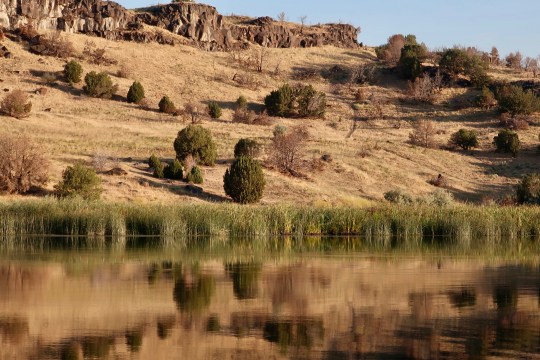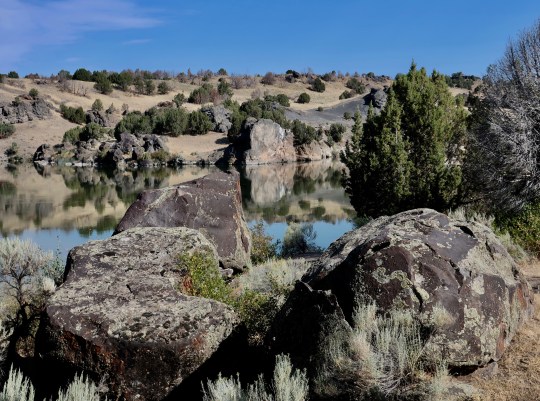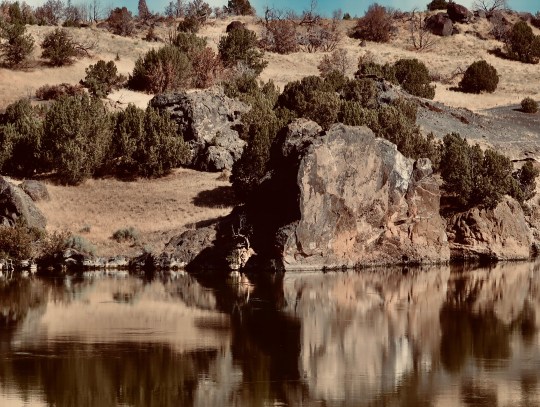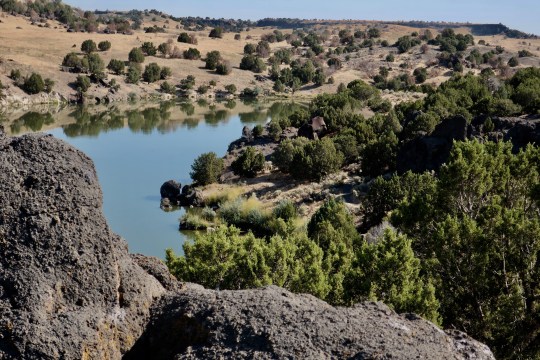
The Greatest Auto Race Ever… NYC to Paris in 1908: Part 1

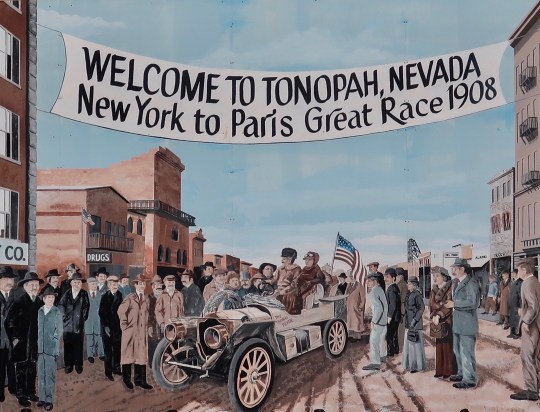
A mural in Tonopah, Nevada that features the town’s welcome of the Thomas Flyer, America’s entry in the New York City to Paris Automobile Race of 1908.

Peggy and I are now back at home in Oregon after our ten week 8,000 mile road trip around the US in our small RV. It was weird out there in the Age of Coronavirus— but interesting. As much as possible, we stayed off of freeways and traveled by backroads, many of them significant to America’s history. One such road we followed was a portion of US 30 across Nebraska following the South Platte River. The route was once a path for Native Americans and mountain men. Later, it became a section of the Oregon Trail that pioneers and gold seekers followed in the mid-1800s on their way west in search of wealth or a new life. In 1913, it became part of America’s first transcontinental road, the Lincoln Highway.

I was excited to learn that it was also a section of route that the 1908 Great Automobile Race from New York City to Paris followed through Nebraska. I had first developed an interest in the race when I learned about it in the remote Nevada towns of Tonopah and Goldfield where it had been the biggest thing to happen to them since the discovery of gold. My interest was peaked considerably last summer when I found America’s original entry, the Thomas Flyer, in the National Automobile Museum in Reno, Nevada. Since then I have read several articles on the race and discovered a treasure trove of photos from the Library of Congress. It’s a story that has been told many times but is worth retelling, which I will do over my next 3-4 posts. I figure it will serve as a kick-off for my posts on our road trip!
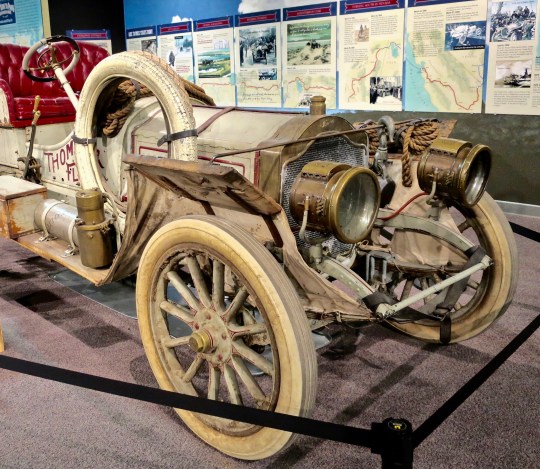
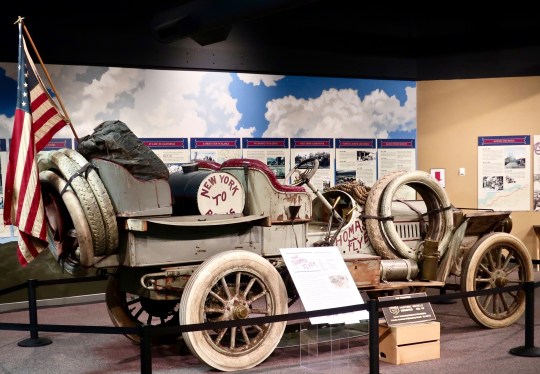
America’s entry in the Great Automobile Race from NYC to Paris in 1908, the Thomas Flyer, is on display at the National Automobile Museum in Reno, Nevada.

It was cold and windy in New York City on Lincoln’s Birthday, February 12, 1908. The quarter of a million people lined up along Broadway were bundled up in their warmest clothes as they waited anxiously for the starter’s gun that would kick off a 22,000-mile (35,405 kilometer) race over land and sea from New York to Paris. It was a challenge involving men and autos that had never been undertaken before— and still goes unmatched.
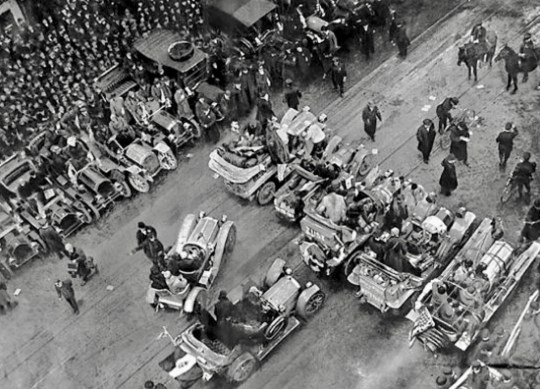
An estimated 250, 000 people (and their autos) were lined up along Broadway to watch the beginning of the Great Race.

The route, as planned, would take drivers across the US, through Canada into Alaska, across the Bering Strait, over Siberia and then through Russia and Europe to Paris. By starting in February, the organizers hoped that the rivers and dog sled trails in Alaska as well as the Bering Strait would still be frozen so the racers could use them as roads.
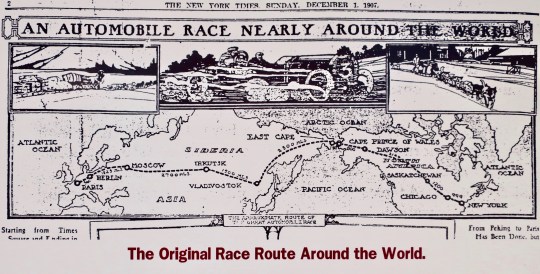
The original route as shown in a December 1, 1907 New York Time’s article. It would change substantially as the reality of driving through Alaska in winter or spring became apparent.

The New York Times and the Paris newspaper Le Matin were sponsoring the race. The winner was to receive a 1400-pound trophy (not quite something for your mantle), and undying fame. Thirteen cars had been entered but only six made it to the starting line: three from France, one from Germany, one from Italy and one from the US. The US had come close to not having an entry at all. The pioneers of America’s nascent automobile industry didn’t think the race was doable. Or possibly they didn’t want to compete against the better-known European car makers and risk defeat. I suspect the latter.

The ER Thomas Motor company out of Buffalo, NY came to the rescue a week before the event.  It diverted a deluxe $4,000 Thomas Flyer that was meant to be sold in Boston. It was a stock, 60-horsepower touring car. Modifications were minimal. Three extra gas tanks were added to give the Flyer a capacity of 125 gallons. There would be no convenient gas stations along the way. You went to a hardware store, filled a bucket up from a metal barrel and poured it into your tank— if you could find gas.
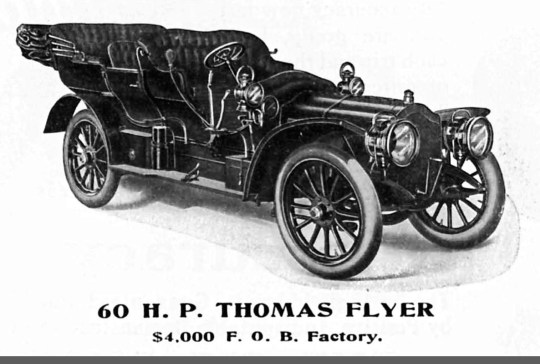
An ad for the original stock ER Thomas Flyer. BTW, the $4,000 would translate into over $100,000 in today’s dollars.
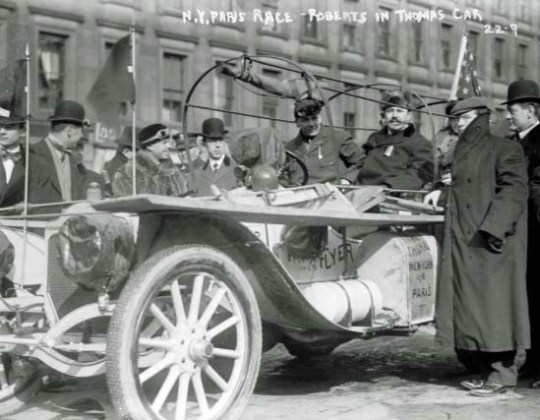
The Thomas Flyer at the beginning of the race with its extra boards and ‘wagon train’ top. Monty Roberts is behind the wheel. The vehicles lacked windshields since the glass was considered dangerous if it broke, a likely occurrence.

Holes were cut in the floorboards to allow heat from the engine to provide some warmth. Long boards were attached to the side to aid in getting the car out of snow and mud. A covered wagon-like top had been jury-rigged to fit over the top and provide protection from snow, hail and rain. It was soon abandoned— full speed ahead and damn the weather!  The Flyer, like all of the other vehicles was loaded down with chains, ropes, spare parts and tools. Each vehicle would travel with its own mechanic.

Thomas called his lead mechanic and road tester, George Schuster, the day before the race and asked him to go along. George knew how to handle adversity. He had been raised in a family with 21 kids. More to the point, he could fix almost anything on the spot, an early day Macgyver. Still, it’s hard to fathom being asked to participate in such an epic event less than 24-hours before it starts. It takes me that long to prepare for a weekend get-a-way!

Here’s how I imagine the phone call going:

“Um, Hi George, this is ER, can you spare a moment?”

“Sure Boss, what’s up?”

“I know this is short notice but could you show up in New York City tomorrow morning and go along on this 22,000-mile automobile race between New York and Paris? It shouldn’t take much more than six months but it’s going to be a tough trip. No one has ever driven across the US in winter. Heck, only 12 people have driven across it in summer. Who knows what the conditions will be like in Alaska and Siberia? You might want to carry a gun. One thing is for sure, there aren’t many paved roads and, in some areas, there won’t be any roads at all— or maps. You may have to drive down the railroad tracks or follow pioneer trails. I expect there will be lots of breakdowns for you to fix. We’ve even scheduled from eight p.m. to midnight each night for you to work on the Flyer and get it ready for the next day. It starts at five. Oh, and one more thing, I’ve asked Monty Roberts to drive. You know Monty, he’s something of a media hound and will take all of the credit but I am sure he will appreciate your ability to keep the car running. My love to your wife and kids. See you tomorrow.”

The European entries included a De Dion, Moto-Bloc, and Sizaire-Naudin from France. Germany was represented by a Protos and Italy by a Zust. If these names sound unfamiliar to you, it’s because none of them are around today, nor have they been for decades. Their builders had only been in the automobile business for a few years and horses were still considered a more reliable means of travel. The cars were assembled the old-fashioned way, by hand, piece by piece. Henry Ford had yet to invent the assembly line. 

Considerable national pride was involved in the race. For example, 600 workers had been pulled together to work on the German Protos under the encouragement of Kaiser Wilhelm II. There was nothing stock about the vehicle. The Kaiser wanted to win for the greater glory of Germany and to promote German industry. I read in one account that Teddy Roosevelt, who was President at the time, also pressured American automobile manufacturers to participate. It’s hard to imagine a race starting in New York and crossing the country without US participation. Given Roosevelt’s personality, he probably would have been ‘biting at the bit’ to drive had he not been President.
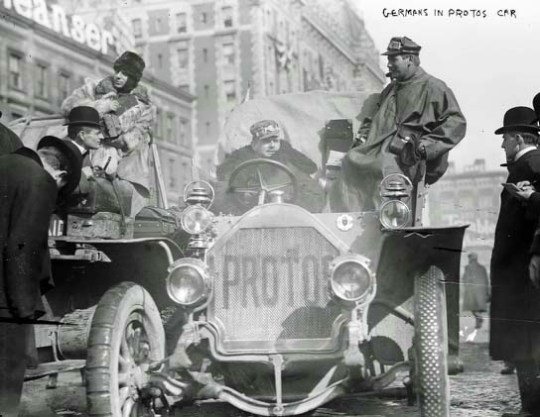
The German Protos with its driver Han Koeppen lined up for the start of the race.

As you might imagine, an international cast of characters and adventurers had assembled to drive and maintain the vehicles. I’ve already introduced Roberts who was in it for the fame. But he was also one of the few Americans who had actually trained for the 13-year-old sport of auto racing. The driver of the French Moto-Bloc, Charles Godard, had participated in the similar but considerably shorter Peking to Paris race the year before. It had been the first time he had ever driven a car. The driver of the German Protos seemed a bit more prosaic to me. Hans Koeppen was an aristocratic lieutenant in the German Army who hoped his participation would bag him a promotion to captain.
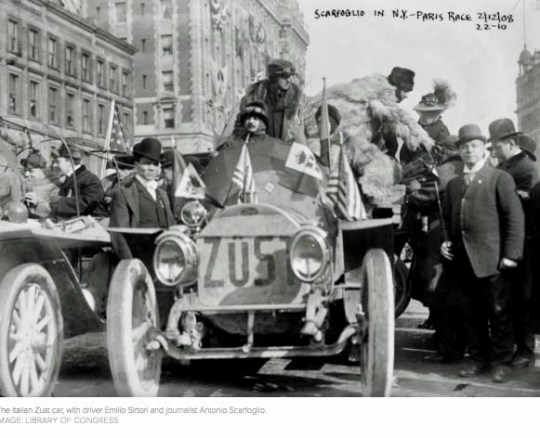
The Zust.

Antonio Scarfoglio, a 21-year-old Italian poet and journalist, was part of the Zust team. His father, a prominent Italian newspaper editor, had refused to let him go until Antonio had threatened to take a motorboat across the Atlantic, a much more dangerous adventure. The driver of the French De Dion, G. Bourcier de St. Chaffray, knew a bit about just how dangerous. He had once organized a motorboat race from Marseille to Algiers where every boat sank. The captain of his team, the Norwegian Hans Hendrick, had been more successful at sea. His claim to fame was having piloted a Viking boat to the North Pole. Solo. 
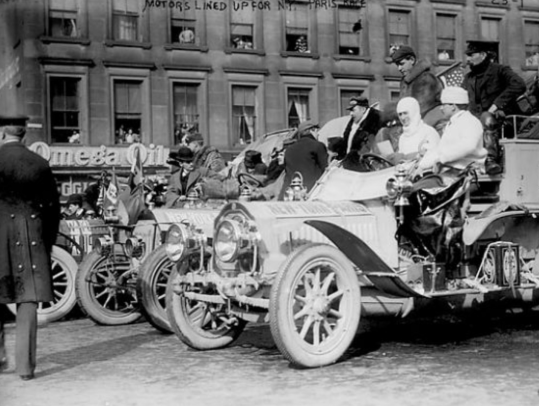
The vehicles were lined up and ready to go!

The drivers were lined up and eager to go at 11:00 AM. George B. McClellan Jr., son of the prominent Civil War general and then mayor of NYC had been given the honor of starting the race. But he was late. The Mayor was rarely on time. At 11:15, Colgate Hoyt, a railroad financier, grabbed the gold-plated gun and shot it into the air. The race was on!
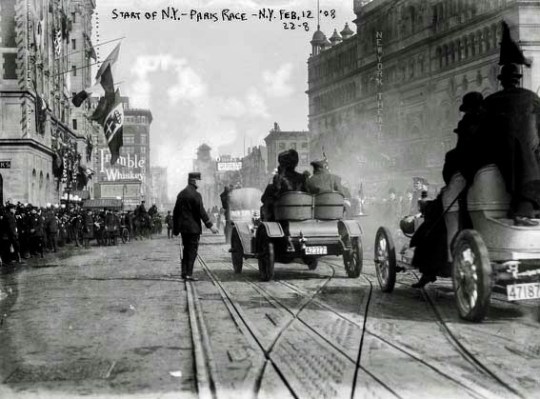
And the racers were off down Broadway!
I’ll close with a final photo of the Thomas Flyer on display at the National Automobile Museum in Reno, Nevada.

NEXT POST: The race across America.
While Dodging Covid 19, Harleys, Hurricanes, Derechos, and 130 Degree F Heat— Why Not Visit Massacre Rocks?

Peggy and I are wrapping up our travels around the US. This post features the hazards of our road trip and Massacre Rocks State Park along the Oregon Trail in Idaho.

We were greeted by this ferocious beast at Massacre Rocks SP. (Photo by Peggy Mekemson.)

Peggy and I have been on numerous road trips over the years, a quarter of million miles worth according to the odometers on our two small RVs. But nothing can match how strange this summer has been. Let me start by noting our 8,000 mile journey has taken us through 18 states (plus the Navajo Nation) that have had the not-so-coveted designation of being Covid-19 hot spots. I start each morning by feeling my forehead and breathing a sigh of relief when it is cool. If I were you, I wouldn’t come within 600 feet of us. Or 6 miles. Screw the 6-foot rule. When we get home we are going to self-quarantine for 6 months. Or at least 6 days.

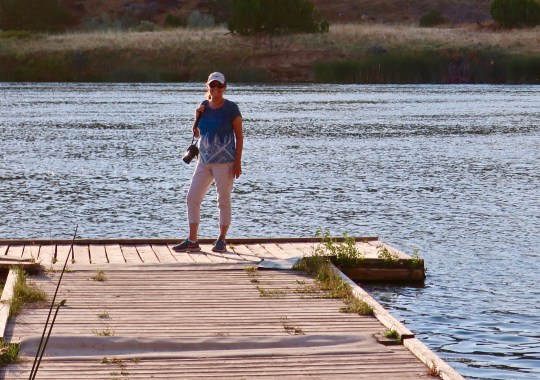
Peggy demonstrates just about the right amount of distance to stay away from us after our journey through 18 states noted for their Covid-19! She is standing out on a floating pier on the Snake River, enjoying the beauty of the area.

There were some potential Covid-19 hotspots we have avoided, however. Peggy and I crossed off South Dakota even though we wanted to visit the Bad Lands and I would have found the motorcycle rally in Sturgis interesting. It’s kind of a Biker’s Burning Man. Hanging out with 250,000 Harley fanatics who were reluctant to wear masks and liked to party in crowded bars didn’t seem particularly wise, however.

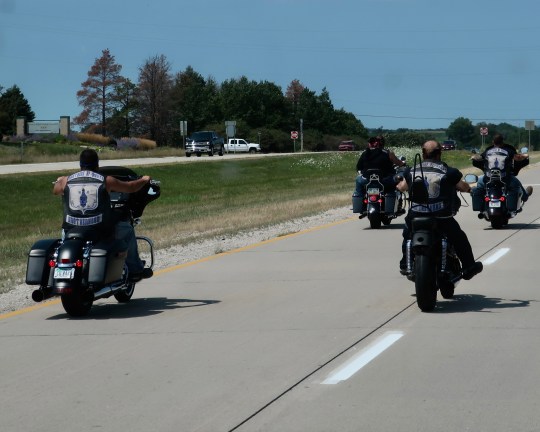
The Brothers of Morte (death), wearing leather jackets with an image of a skull with a candle burning out zoomed around us on their bikes heading for Sturgis. The message somehow seemed appropriate for the huge gathering during a highly contagious pandemic.

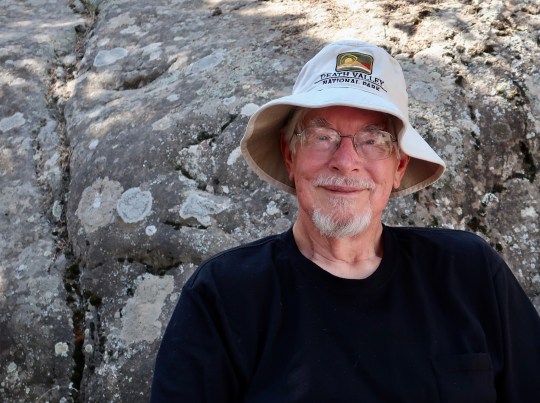
But Covid-19 has been only one of several potential disasters out here on the road this summer. For example, it’s 108° F outside now. That’s miserable, and it can be dangerous. But what if we were in Death Valley? It’s a go-to place for Peggy and me. We’ve been there many times. Earlier this week, it saw a whopping 130 degrees F (54.5 C)! It was the hottest place on earth at the time and was recorded as one of the four top temperatures ever documented. I put on my Death Valley hat in honor of the occasion. Why whine about 108?

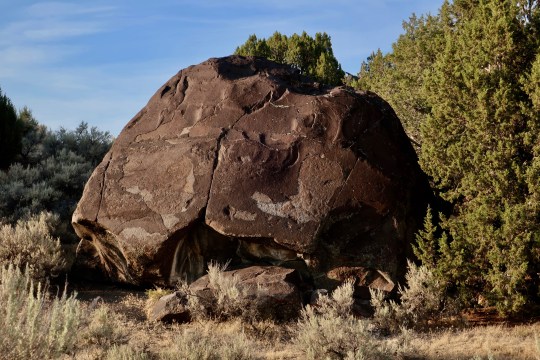
Here I am with my Death Valley hat on in front of a large granite rock that dominated our camp site at Massacre Rocks State Park. (Photo by Peggy Mekemson.)

Lightning storms and forest fires come with the excessive heat and are once again devastating the West. Two years ago I was dodging fires as I backpacked 750 miles down the PCT. They’re back with a vengeance now, roaring through Northern California and causing deadly fire tornadoes. I’m ever so glad I am not out on the trail. Fires are much easier to dodge in Quivera the Van than on foot. And we have air-conditioning.

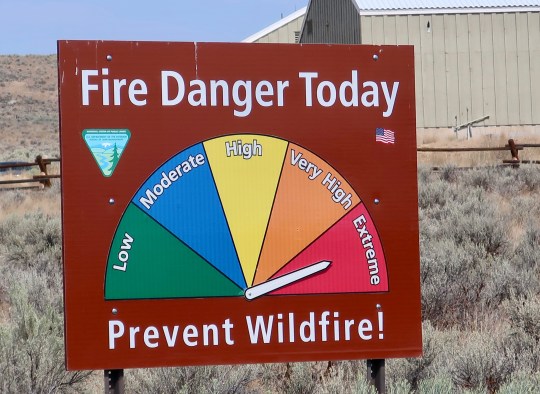
Peggy and I noted this sign as we drove up to the Oregon Trail Interpretive Center in Baker City, Oregon. We spotted a wild grass fire in the distance.

But how about dodging hurricanes? In mid-July, our kids rented a lovely house on the Outer Banks of North Carolina to celebrate Peggy’s 70th Birthday. It was the primary reason for our road trip and a fun way to bring our families together and make up for the family trip on the Rhine River Peggy had planned. Europe won’t let us near the continent.

Our grandkids were a little surprised, however, to see their 77 year old grandfather and 70 year old grandmother risking their necks out body surfing and riding boogie boards with them. “Older” people aren’t supposed to behave that way. It was the crowded beach that worried me, however. That and the dark clouds that hung on the horizon. A week later the Outer Banks had to be evacuated due to the threat from Hurricane Isaias. We dodged the bullet by a week.

The waves were fun and the beach was gorgeous on the Outer Banks but the crowds with their potential coronavirus and the dark clouds with their threat of severe weather were worrisome.

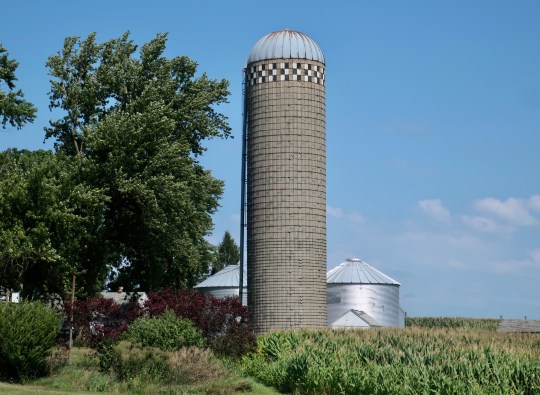
That was minor in comparison to the derecho that roared across Iowa. On August 8th, Peggy and I had driven across the state, laughing about how corn was the scenery. I’d stopped taking photos after 20 pictures. We were camping just across the border that night when a thunderstorm came through that rocked our van and lit up the night sky. We thought of it as entertainment without a clue about the massive storm that was brewing. When we pulled out in the morning, clear skies graced our road west. On the 10th, we were at Buffalo Bill’s Ranch enjoying a beautiful day on the North Platte when the derecho ripped across Iowa and wiped out 40% of the state’s corn crop.

I took this peaceful photo featuring a silo and corn two days before the derecho had devastated 40% of Iowa’s corn crop.
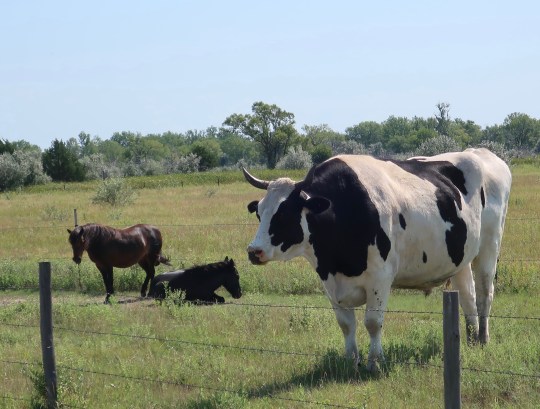
We were unaware of the derecho in Iowa as we wiled away the day at the Buffalo Bill Ranch on the North Platte River. Our only worry was the big bull nearby. (The horses were miniatures but the bull was still the biggest one I have ever seen!)

While dodging all of these potentials disasters, why visit a place known as Massacre Rocks? The answer is simple. How could we not? Peggy and I had been following the Oregon Trail since we left Nebraska and Massacre Rocks State Park on the Snake River in Idaho is a noted location along the way. As the name suggest, it is symbolic of one of the challenges faced by the pioneers, attacks by hostile natives. I suspect we would be hostile too if a stranger rode into town and wanted to steal our property.

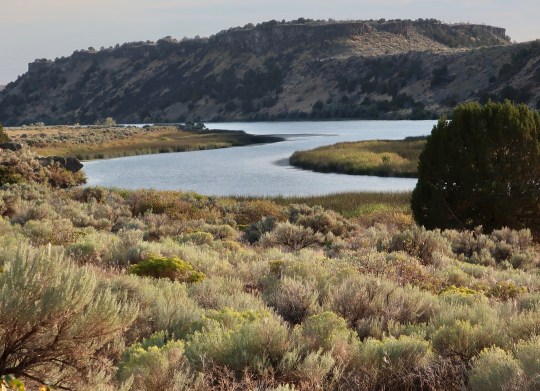
The name is something of a misnomer, since the attacks on wagon trains took place a few miles away. The pioneers were not happy with all of the large rocks in the area, however. They provided an ideal place to organize and ambush or to shoot arrows from behind. Peggy and I, on the other hand, were not worried about anyone shooting arrows at us and found the rocks and the river quite beautiful. I think you will agree…

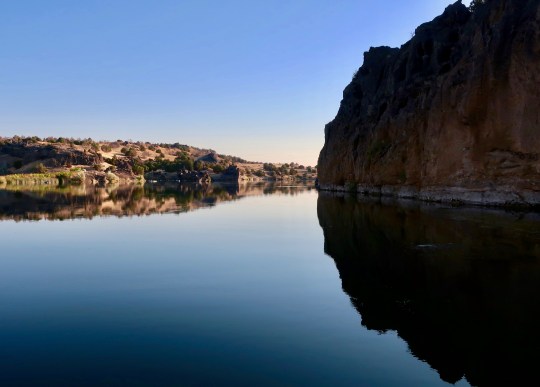
Peggy and I pulled into the park and checked out the river. We met the cottontail featured above and hiked out onto the small pier. These gorgeous cliffs were along the way.
Peggy captured this photo of the cliff as we walked down and the following three photos from the pier.
A different look at the cliff. (Photo by Peggy Mekemson.)
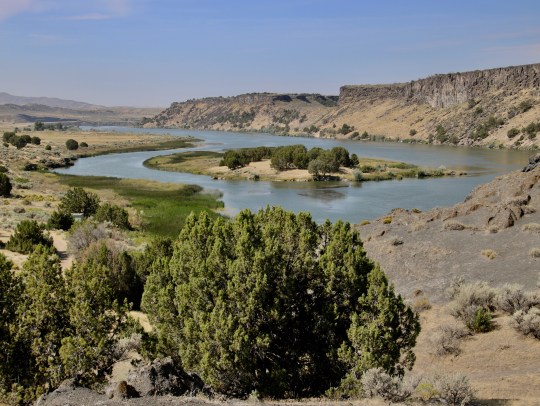
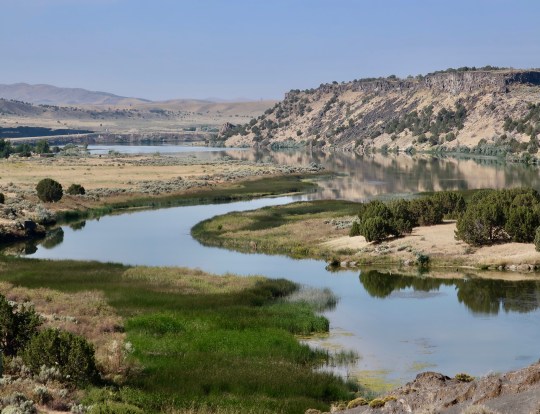
Looking down the river from the pier. (Photo by Peggy Mekemson.)
A view across the river. (Photo by Peggy Mekemson.)

While Peggy stayed in camp captured by a book she was reading, I went for a hike the next morning. Following are several photos I took.

Early morning view from the floating pier.
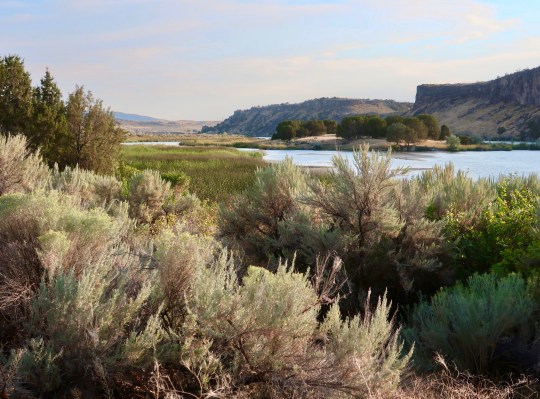
Downriver view across a field of sage.
And another view featuring silver sage.
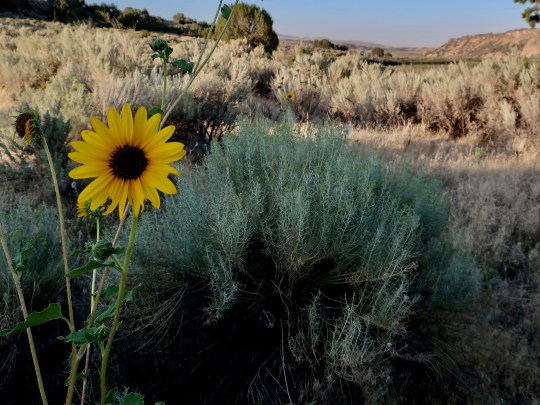
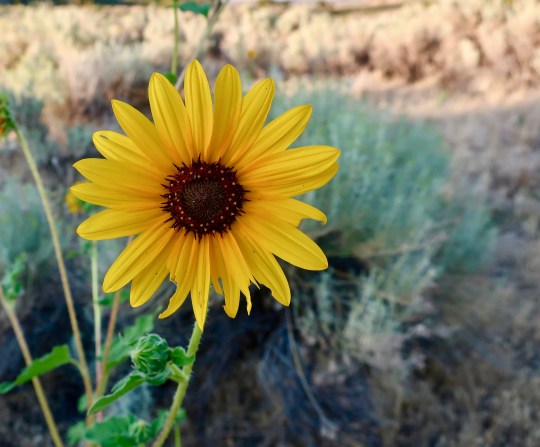
Like sage, telegraph weeds and their bright flowers are a common plant of the West.
This member of the sunflower family got its name because it grew in abundance along the disturbed ground created by building the first telegraph lines across America.
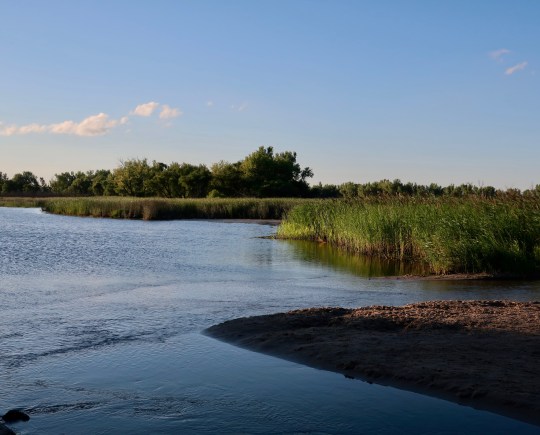
I was treated to a different view hiking up the river. Cattail reflections seemed impressionistic.
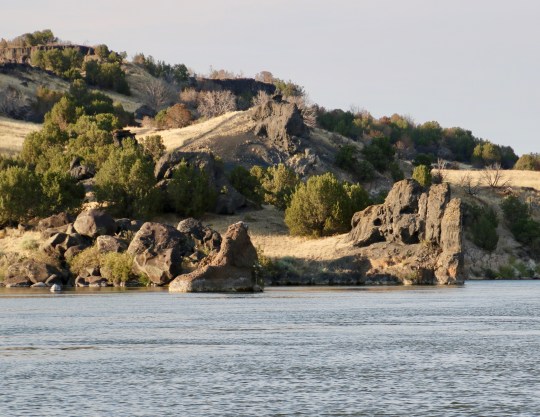
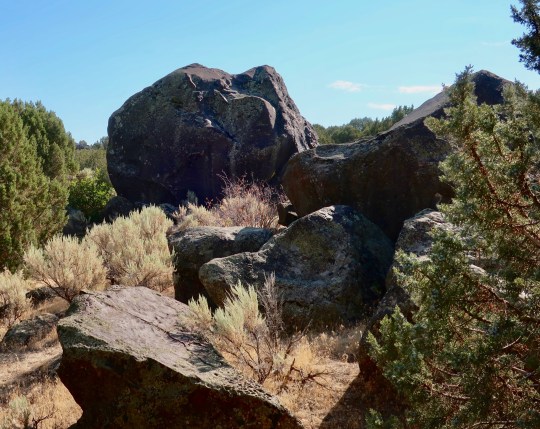
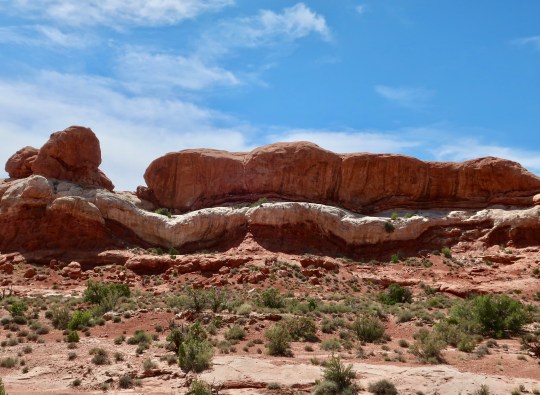
True to its name, the park was filled with impressive rocks.
I took advantage of Apple Photo to create this old-fashioned look.
Another upriver view.
A number of impressive rocks were also found away from the river.

That evening Peggy joined me as I repeated the walk I had done in the morning.

Peggy caught this interesting view of one of two islands in river at the park.
I took a side view that emphasized the cattails.
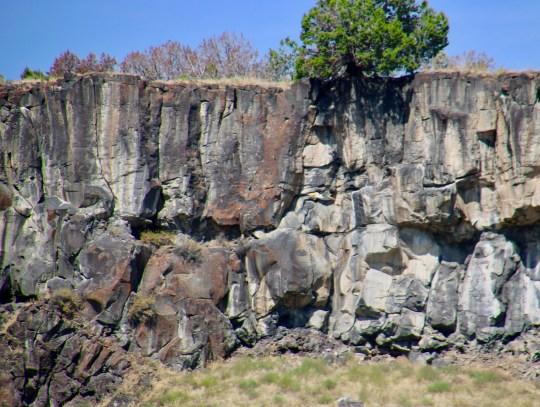
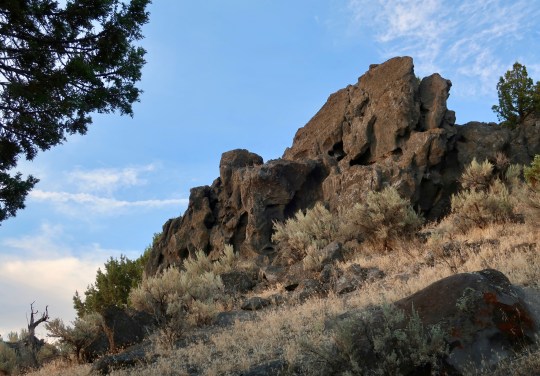
A cap rock made of lava dominated the heights on the opposite side of the river.
A close up. (Photo by Peggy Mekemson.)
The setting sun bathed the Snake River in light…
And, for my final photo, provided a soft look for the opposite side of the river.

NEXT POST: The Great 1908 Auto Race from New York to Paris.

Adios Arches… Hello Road Trip

I had originally intended to conclude my series on Arches National Park with photos of several of the more famous arches. But when Peggy and I were driving out, the late afternoon sun created photo-ops I just couldn’t resist. As Peggy drove, I snapped away.

Beneath Scotts Bluff, Nebraska: We are camped at the base of a towering bluff that once stood as a major landmark to pioneers traveling west in wagon trains. My great, great grandmother would have passed this way and stared up at it in awe with the welcome knowledge that she had left the Great Plains behind. And, indeed, we too are breathing a huge sigh of relief, glad to be back in our much loved west. The bluff was named after an employee of a fur trading company who had the misfortune to die not far from where we are camped. He likely would have been glad to live on and leave the bluff with someone else’s name. I, for one, prefer the Native American name, Me-a-pa-te, which translates ‘hill that is hard to go around.’

As I work on this post, Scotts Bluff looms in the near distance. This notable landmark once served to guide wagon trains on their way across America.
It has been an interesting couple of weeks as we have made our way west from Virginia. This past week we kept ahead of a major storm that whipped through the Midwest with winds up to 100 MPH. We also avoided numerous motorcyclists— most with a similar look and without helmets— as they dashed around us on their way to Sturgis, South Dakota and whatever fate awaited them.

One of many groups of motorcyclists that zipped past us on their way to Sturgis and a possible confrontation with Coronavirus. Those unfortunate enough to come in contact with the disease would carry it home.

Yesterday was particularly interesting. We started our day at Buffalo Bill’s historic ranch camped out on the North Platte River and then hopped on one of America’s most historic backroads, US 30, otherwise know as the Lincoln Highway. It was America’s first cross-country road. But that’s only a small part of its history. For thousands of years it served as a major route for Native Americans. In the 1850s it was part of the Oregon Trail. Pony Express riders used it on their two year ride to glory and the nation’s first transcontinental railroad was built beside it. In 1908 it became part of the greatest road trip/road race ever, the New York to Paris Road Race, which will be the subject of my next blog.

A view from our campsite on the North Fork of Platte River. Buffalo Bill’s historic home is less than a mile away.

But today, it’s time to say goodby to Arches National Park.

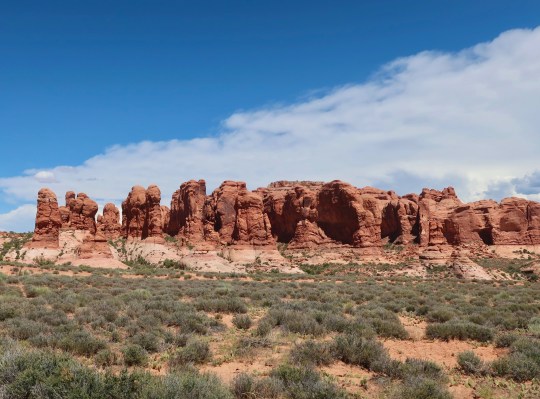
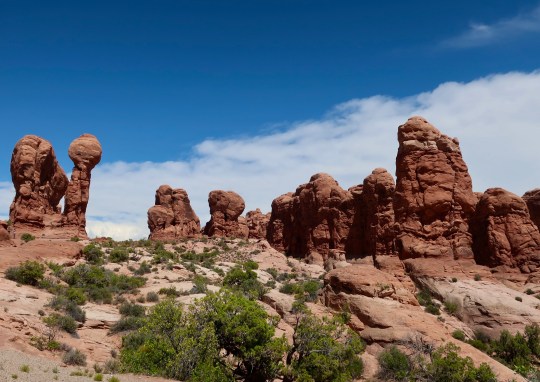
One of the many late afternoon views we had as we drove out of Arches National Park. I’ll share a few and let the photos speak for themselves.
A final view. Goodby Arches. Hello road trip.

NEXT POST: What better place to start posts from our present journey around the US than what I consider to be one of the greatest road trip/races of all-time: The 1908 race around the world from New York to Paris. I’ve been meaning to do this blog ever since I came across the winner of the race at the National Auto Museum this time last summer. It’s epic!

The Arches of Arches… Finally!

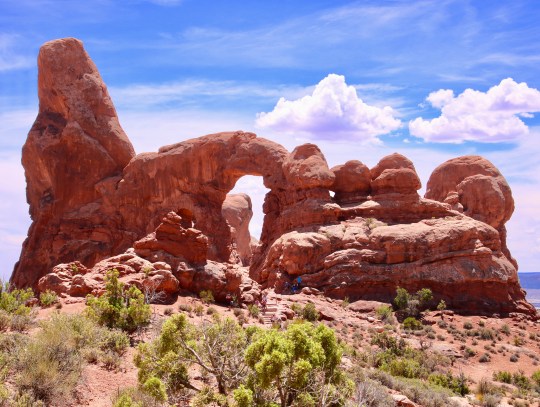
While every arch in Arches National Park shares a ‘see through look’, each arch is unique in the space created and in the surrounding rocks. One of my favorites is Turret Arch, shown here in a photo by Peggy.

“But where are the arches?” my brother-in-law John asked Peggy about my series on Arches National Park. “There is more to Arches than arches,” Peggy had responded. John readily agreed but there was still a plaintive ‘where are the arches’ tone to his voice. This post is for you, John— and for all of our other followers who have been wondering about how anyone could do a series on Arches National Park without arches.

They aren’t hard to find. There are over 2000 in the park, the highest concentration of any place in the world. Of course you would need a month to find them all plus put in a lot of miles hiking. We only had a day and the 100 degree F heat (37.7 C) discouraged much roaming in the time we had. Not to worry. The road plus a little walking took us to some of the most famous in the Park. So without further ado, I’ll start with the arch I featured at the top of the post, Turret Arch, named for its resemblance to turrets on castles.

This was my view of Turret Arch. The turret rises above the arch on the left.
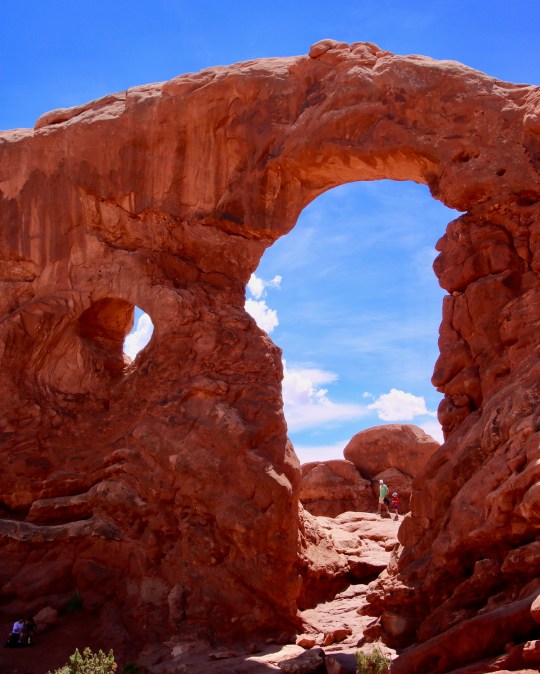
This shot facing the arch provides a view of a smaller arch forming to the left. The dad and child seen through the arch give perspective. (Photo by Peggy Mekemson.)
Here, Peggy captures the yin and the yang of the smaller arch.
We were fortunate that impressive clouds added depth and interest to our photos.
I couldn’t resist using the arch as a dark frame for the clouds.

A walk up to the Turret Arch easily includes two of the Park’s other Arches, North and South Windows.

This is the view of North and South Window Arches from Turret Arch. I won’t hold it against you if you see two eyes and a large nose instead of windows. (Photo by Peggy Mekemson.)
I took a close up.
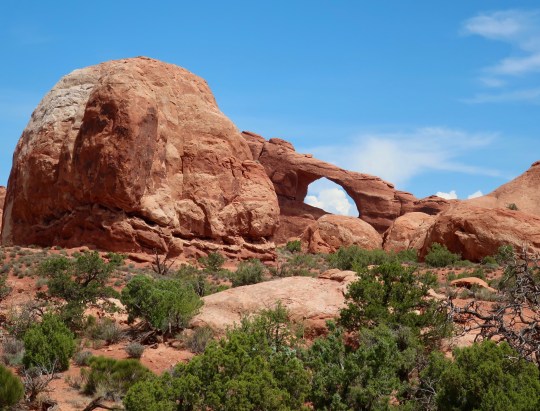
A view of the South Window Arch with the nose looking a lot more like a massive rock!
The North Window Arch is more popular with an easy trail leading right to it from the parking lot. (Photo by Peggy Mekemson.)
This photo by Peggy gives an idea of how massive the arch is. Note the person enjoying the shade! Also, check out the large crack, a reminder that these arches do come tumbling down.
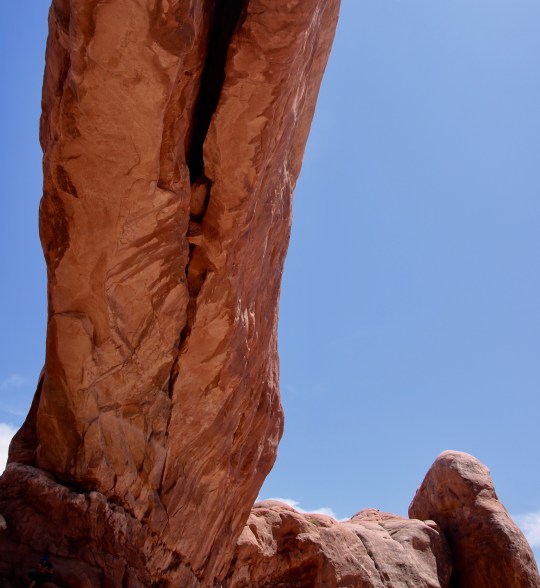
My shot looking up shows how thick the arch is. You can see the beginning of the crack.
Which Peggy caught.
We both had fun using the clouds as a backdrop. (Photo by Peggy Mekemson.)
My contribution.
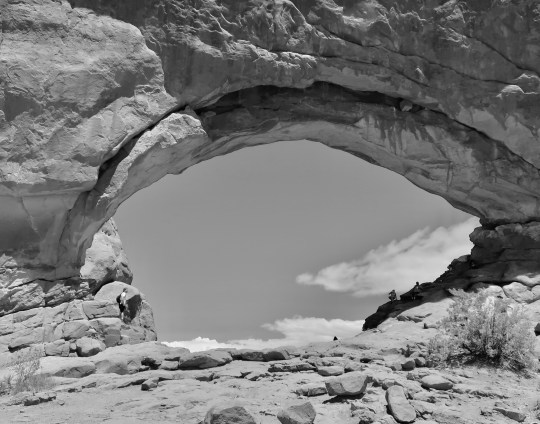
And finally, I thought a black and white rendition of the North Window Arch would be interesting.
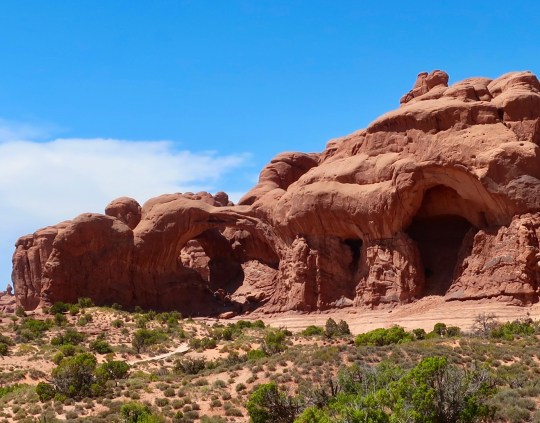
The famous Double Arch is just down the hill from the Windows and Turret Arches. New arches can be seen forming on the right.
You have undoubtedly seen photos of this Arch even if you haven’t visited the Park. Or perhaps you caught it at the beginning of the Indiana Jones’ movie “The Last Crusade.”
While we have hiked down to and around the Double Arch in the past, I took this photo from our air-conditioned van!

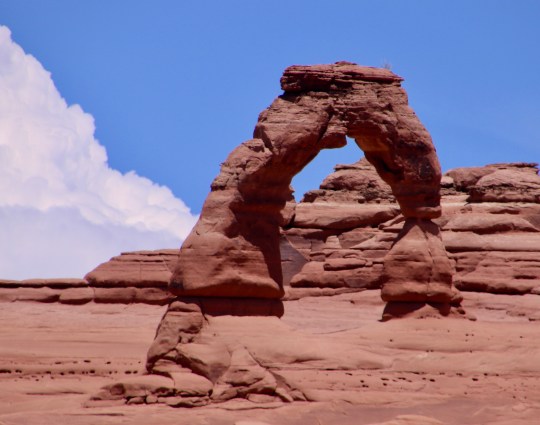
No trip to Arches is complete without a trip to see the Delicate Arch, which many consider to be the National Park’s most scenic arch. Rather than make the gentle three mile round trip at 3 P.M. when we were both hot and tired, we took an alternative one mile trip straight up a steep slope for an overlook. Hmmm.

Peggy’s telephoto worked best for capturing Delicate Arch.
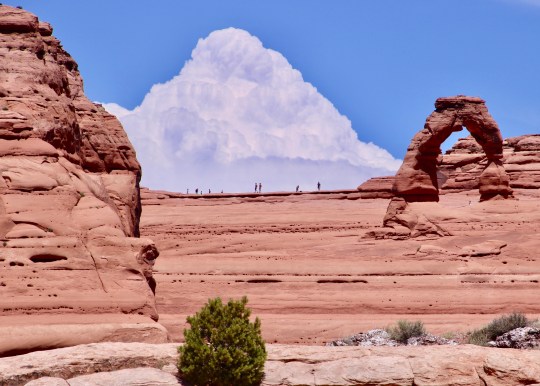
I’ll conclude my post today with this shot of a towering cumulous cloud and tiny people making their way to the arch. (Photo by Peggy Mekemson.)

NEXT POST: As we drove out of Arches, I took several photos from our van that will serve as a closure to this series.

Rocks, Trees, Early Inhabitants, and Towering Clouds… More of Arches NP

I am going to start at the end of the main road in Arches NP today. This is the trailhead to the Devil’s Garden.

Purcellville, Virginia— outside of Washington DC: We are at our daughter’s home where she lives with her husband, Clay and her kids, Ethan and Cody. They are renting an old home that was built in 1880. The main house next door once was part of the Underground Railway for slaves escaping from the South. I’ll do a post on the houses later.

Our visit to Arches National Park today takes us back to the end of the paved road and the beginning of the Devil’s Garden trail. We hiked a way on the trail but the 100 (37.7C) degree heat encouraged us to make it a short. We then doubled back where we checked out the historic Wolfe ranch and some interesting Ute petroglyphs.

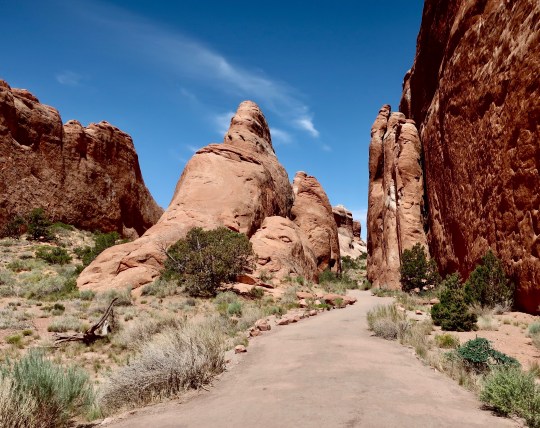
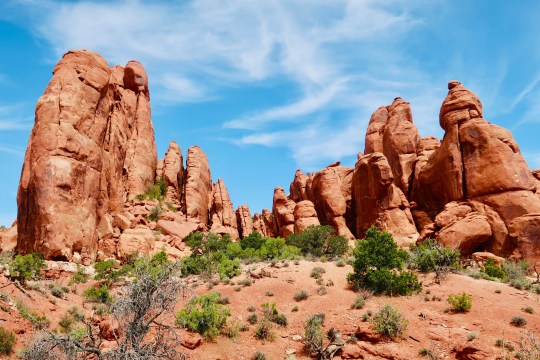
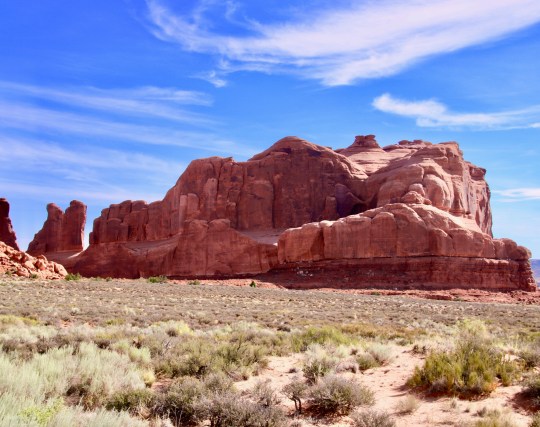
Like so much of Arches, impressive rock monuments filled the area.
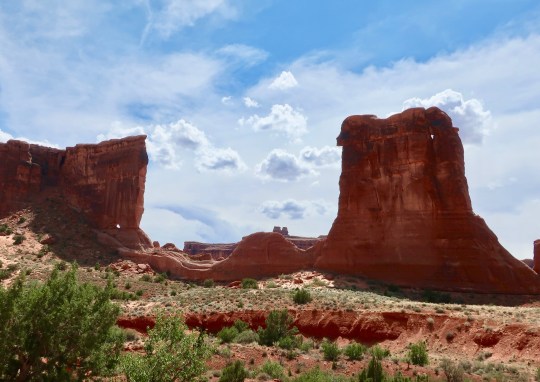
I was particularly impressed with this pinnacle.
And took a close up.
Gathering clouds added to the area’s scenic beauty.
And called for a black and white photo.
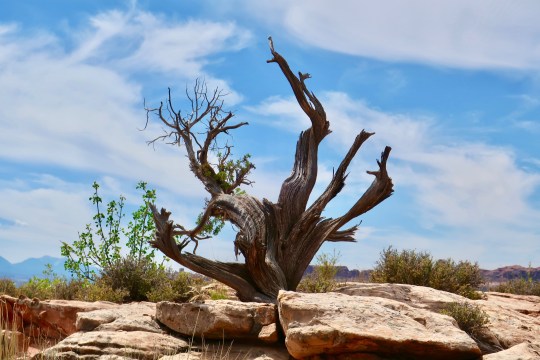
As always, I was drawn to trees. The red rocks provided a contrasting backdrop for this one we found along the Devil’s Garden Trail.
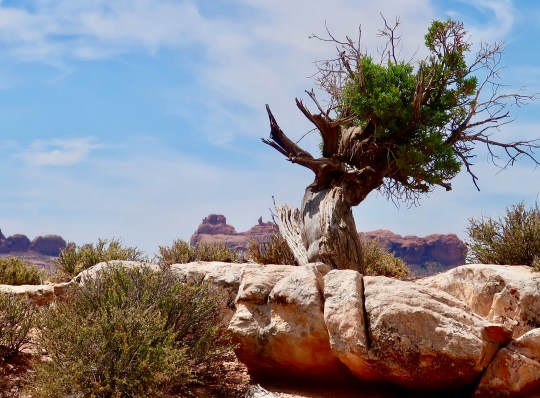
The sky provided the backdrop for this tree near the Wolfe Creek Ranch.
The rock foreground and the splash of green caught my attention here.
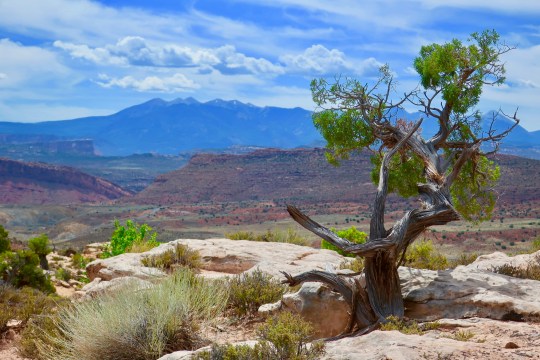
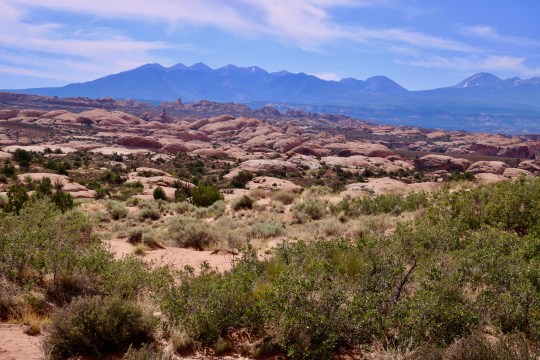
Here, it was the La Salle Mountains looming in the distance.
Wolfe Ranch provided a perspective on how the early pioneers in the area lived. This home was built in 1898 and occupied by his family for a decade. (Photo by Peggy Mekemson.)
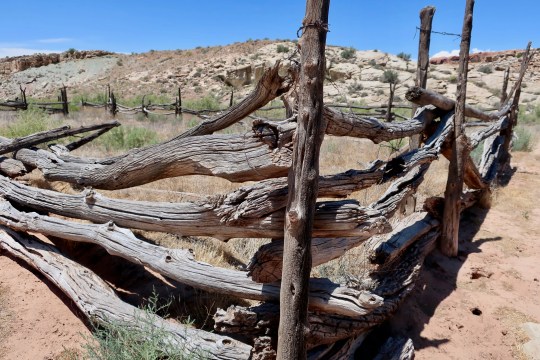
This old corral was part of the Wolfe Ranch.
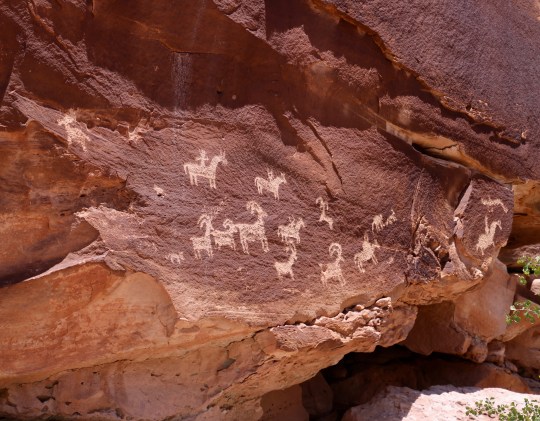
The Ute Indians occupied the area before the Europeans made their way into the area. They were quick to adapt to the horses that escaped from the early Spanish. These petroglyphs reflect the Utes hunting Big Horn Sheep with their dogs. The rock art would have been carved sometime after 1650 CE. (Photo by Peggy Mekemson.)
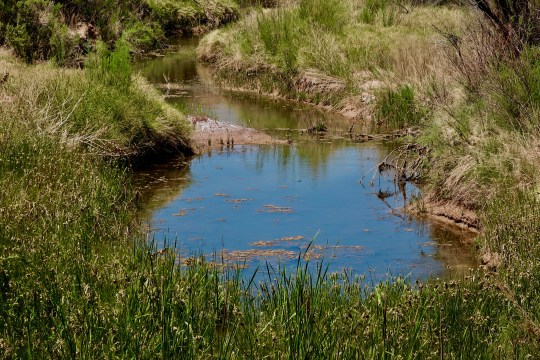
Water was and is the lifeblood of the desert Southwest. This small creek would have provided water for both the Utes and the Wolfes.
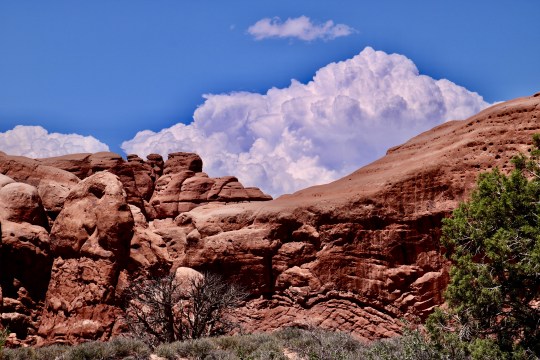
I’ll conclude today with a final photo of storm clouds gathering over Arches. (Photo by Peggy Mekemson.)

NEXT POST: The arches of Arches!

From the Garden Of Eden to the Fiery Furnace and Beyond… Arches NP

You can easily drive the road into Arches National Park and get a feel for the beauty and geology of the area. On a hundred degree plus day, it’s tempting to do just that! We didn’t, but I’ll confess that our walks were short.

Roanoke Rapids, North Carolina: Peggy and I have now moved on from our large beach house on the Outer Banks (OBX) of North Carolina where we were entertained by our kids and grandkids for a week. Peggy was treated royally in honor of her 70th Birthday. (Okay, I was spoiled too.) Eventually, I’ll do a post on OBX. Presently we are in an RV campground in Roanoke Rapids, not far from the Virginia border on an unexpected layover day.

When we arrived here yesterday, I noticed that we could get a mobile RV service to come by and fix the water line running to our pump from our fresh water tank. It hasn’t worked since shortly after we left home. Given that most RV repair shops are booked solid for weeks during the summer, we hadn’t had an opportunity to repair it.

Rufus and Cleve arrived at five in Rufus’s brand new ‘shop,’ a 2020 Hemi. It would be hard to find two guys more country— from their looks to their accents. But they were genuine, fun and knowledgeable. Eventually, they found the problem. The plastic water tube buried beneath the water pump in an extremely difficult place to get at was twisted and frayed. Cleve returned this morning with new tubing to finish the job.

The plastic tube delivering water to our pump was twisted and frayed with a pin-prick sized hole in it. The tube was buried down in the innards of our van.
Cleve had a rooster ringtone on his phone and a rooster tat on his arm. I asked him about it. “I just really like roosters,” he explained to me in his deep country drawl.

Today, I am continuing my series on Arches National Park. So far I have done posts on Balanced Rock and the road into Arches. In this post, I will start just beyond Balanced Rock at the Garden of Eden and follow the main road on to the the Fiery Furnace and beyond.

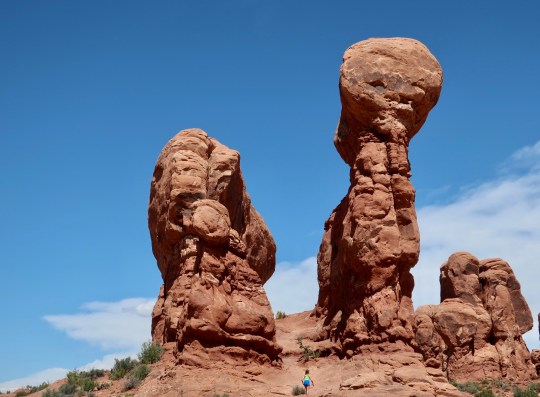
I am not sure why this section is called the Garden of Eden. I don’t think Adam and Eve would want to live here. Where would they find an apple tree? On the other hand, there are plenty of serpents. And lots of impressive rocks. The woman hiking up to the pinnacles provides a perspective on their size.
The big fellow on the right is known as Owl Rock.
Here is a close up of the giant pinnacle with its ‘owl head’ staring down at me.
The Garden of Eden also has some impressive cliffs.
Visitors are welcome to wander among the rocks in the Garden of Eden as long as they stay off of the easily damaged desert soil.

A final view before heading on to the Fiery Furnace.

We were amused to go from the Garden of Eden to the Fiery Furnace. Turns out it isn’t so fiery if you go walking along the rock and tree shaded trails. The trails were closed because of Covid-19, however. (Photo by Peggy Mekemson.)
This jumble of rocks was found nearby.
As were these colorful pinnacles. (Photo by Peggy Mekemson.)
I thought of the rock on the left as The Troll. (Photo by Peggy Mekemson.)
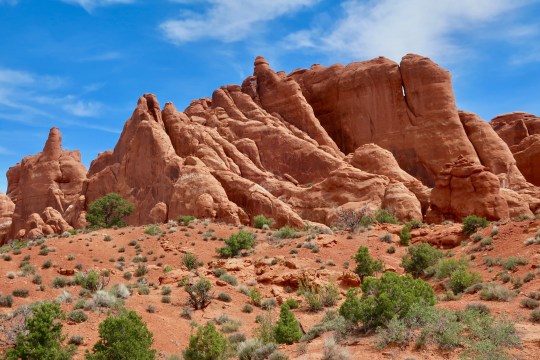
Continuing our drive into the park we came on these dramatic fins.
A more distant perspective.
There was a path that led back into the fins. Peggy posed for me. Because there were a number of people on the narrow trail, we used our masks.
As the day went on and the heat increased, clouds began to form and create a backdrop for our photos. (Photo by Peggy Mekemson.).
I’ll conclude today’s post with this scene from along the road.

NEXT POST: Peggy and I drive to the end of the road and go for a walk along the Devil’s Garden trail.

When Arches Isn’t About Arches— plus Strange Times

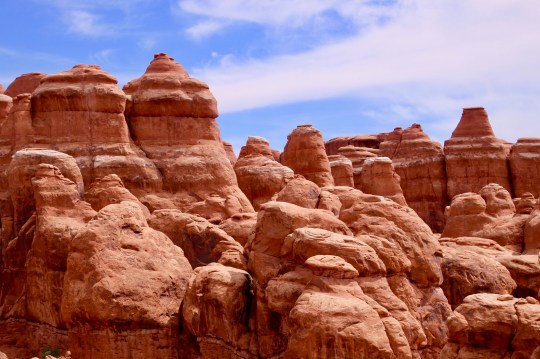
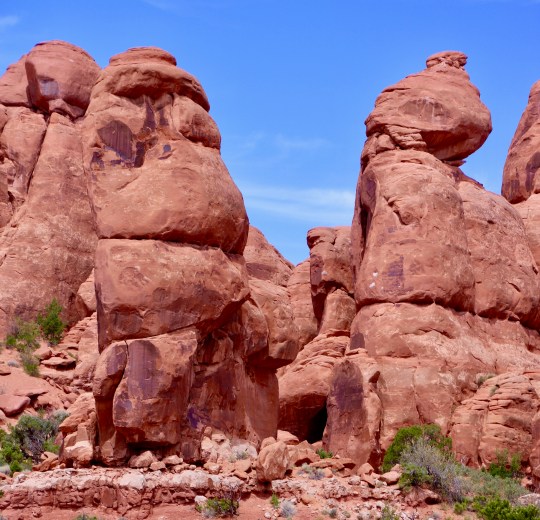
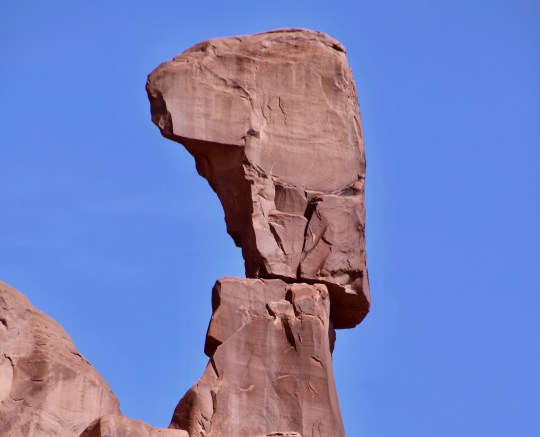
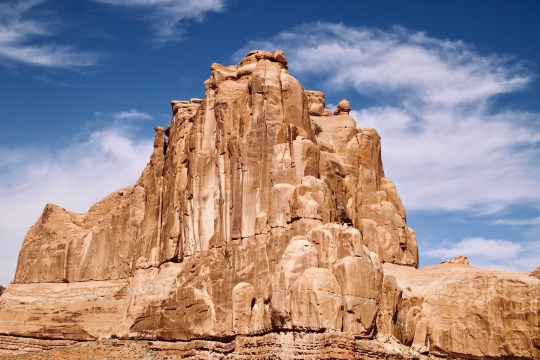
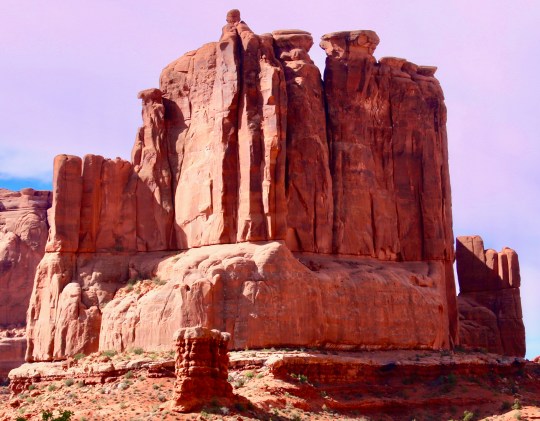
Impressive pinnacles with ‘unique’ personalities are found throughout Arches National Park.

Outer Banks, North Carolina: We have been on the road for a month now— zig zagging across the country— climbing over mountains, crossing rivers, traveling through deserts and forests, zipping through urban areas and moving more slowly through rural. We’ve traveled from the Pacific Ocean to the Atlantic and driven through 13 states so far.

Let me report: It’s strange out there when it comes to the pandemic. Some states are doing everything possible to reduce the the number of people catching Covid-19 and the resultant deaths. Others are like, whatever. Or they feel that restarting the economy takes precedence. Sadly, had they aggressively fought the pandemic to start with, we would now be in a much better position to get people back to work.

We drove through Atlanta a few days ago where the governor of the state was suing the mayor of the city because she wanted to implement a city-wide mask ordinance. Thankfully, more and more people are voluntarily wearing face coverings. Even the President is declaring it patriotic. My sense is if wearing a mask can save just one life, it’s worth it.

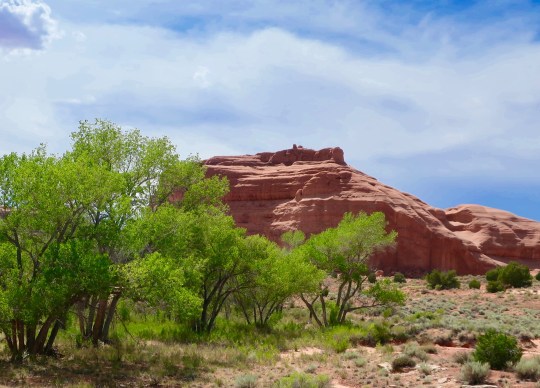
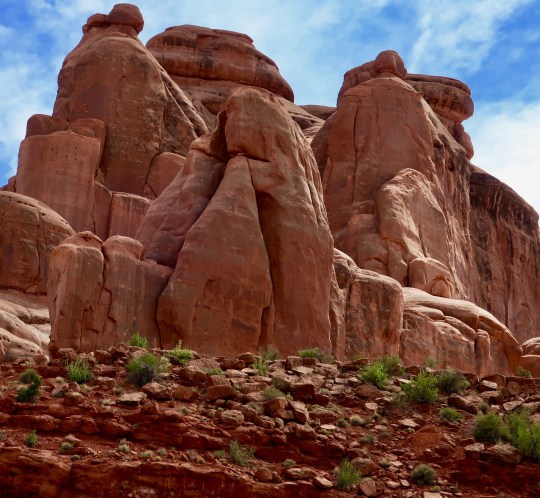
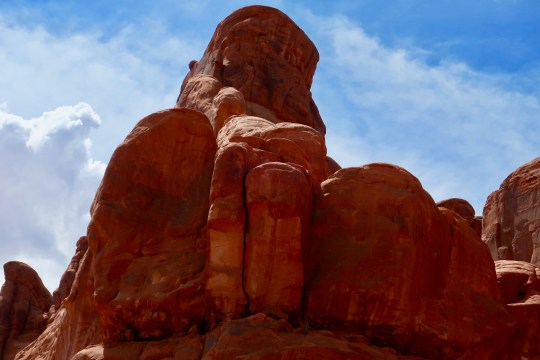
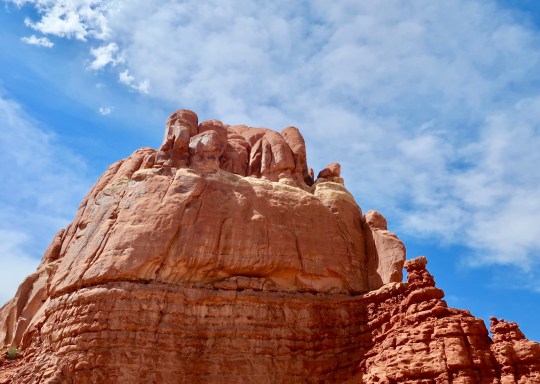
It isn’t strange, however, that Arches National Park has a lot more than arches to ooh and aww over. In fact, I find the fins and pinnacles located throughout the park equally awe-inspiring. I’ll provide some of my favorite examples over the next two to three posts. My last post on the park will be dedicated to arches.

This is a close up of the pinnacle I featured at the top of the post.
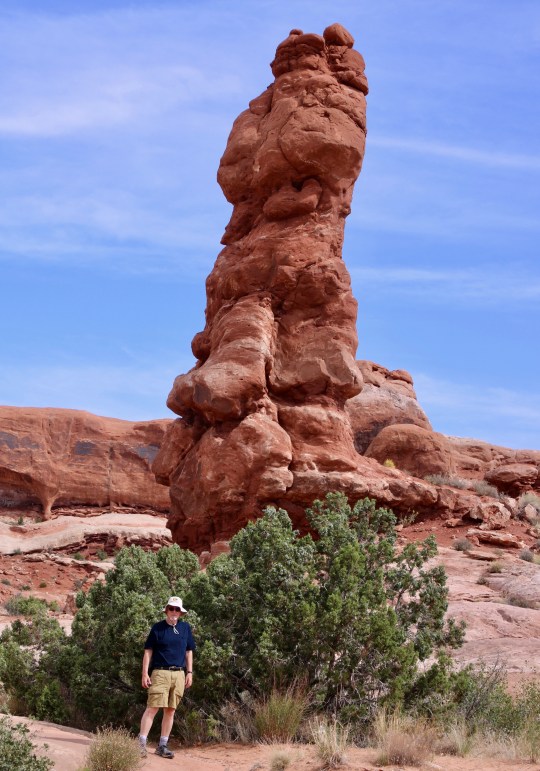
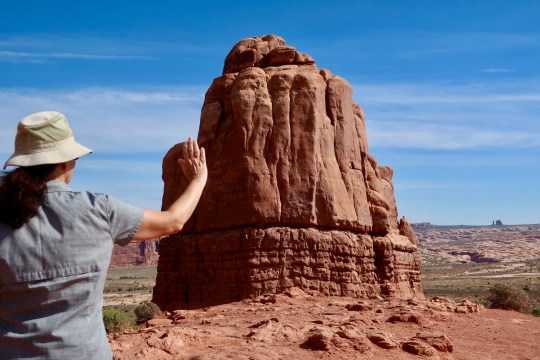
And this knobby guy— with my help— provides a perspective of just how large the pinnacles can get. (Photo by Peggy Mekemson.)
A different view.
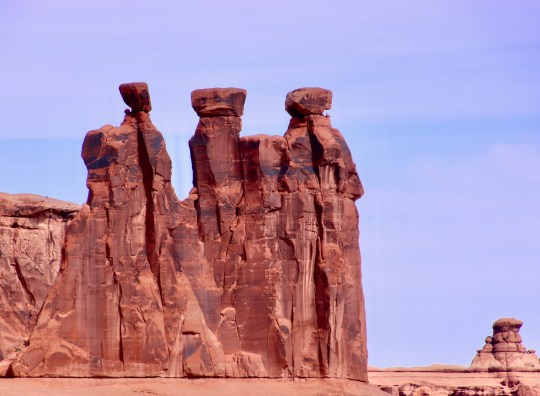
These would-be/will-be pinnacles are known as the Three Gossips.
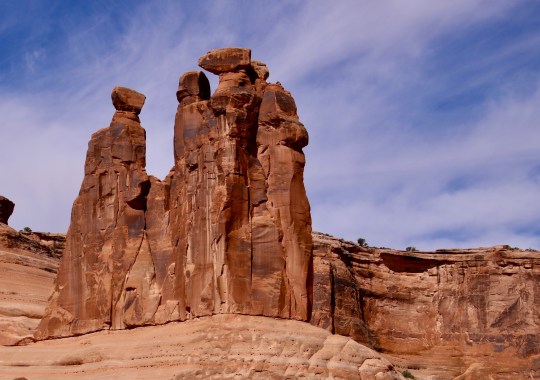
A different perspective suggests that one of the gossips might have dinosaur blood. Gossiping about it might lead to getting your head chomped off.
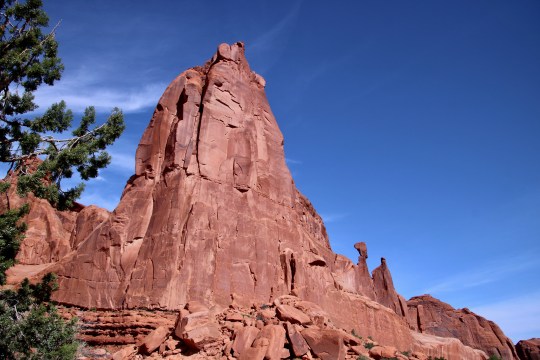
This is one of the views that greets you when you when you enter the park. If you look to the right, you can see a precariously balanced rock.
I think it is more impressive than Balanced Rock if only judged on its odds of teetering over. But who knows? Maybe it will hang out up there for another thousand years. (Photo by Peggy Mekemson.)
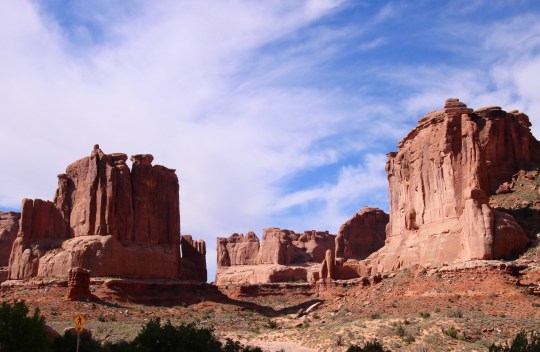
This is another view that welcomes visitors to the park.
This fin is known as Wall Street. In other words, some person at some time thought that these eroded rocks had a skyscraper look.
Here’s another view of Wall Street
Most of the major landmarks have names given to them over the years. I find it more fun to look at them for the impressive monuments to nature and geology that they are.
Or provide your own names. Peggy saw this as The Hand.
Here, she demonstrates why.
Here’s one I can easily see, the Sheep. Its nose was once part of an arch. (Photo by Peggy Mekemson.)
We found this interesting. “Petrified” sand dunes frozen through chemical reactions in ancient times. The La Sal Mountains serve as a colorful backdrop.
I’ll conclude with a couple of scenic views Peggy and I found at the beginning of the park.

NEXT POST: Peggy and I travel farther into Arches.

Ten Years and 1,001 Posts… Texas Hospitality

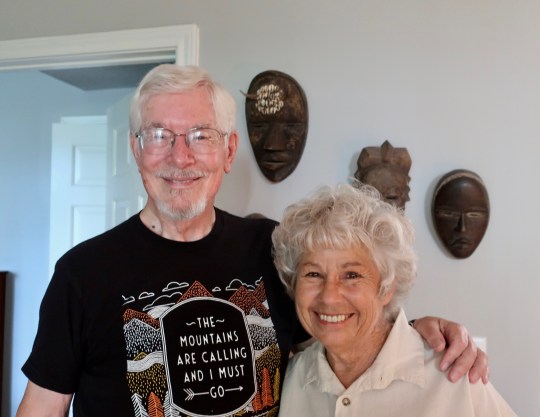
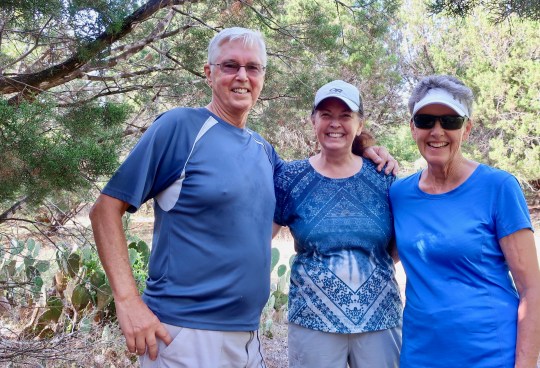
Linda Leinen from her Word Press blog, The Task at Hand, and I in front of her Liberian masks in League City, Texas.

Safety Harbor, Florida: I had intended to make a big deal out of my tenth year of blogging, which, surprisingly, coincided with my thousandth post. But both slipped right by. Post #1,000 was on Balanced Rock in Arches National Park. I was eager to get it up and totally missed my landmark occasion. We’ve covered a bit of ground since and are now in Florida with our son Tony, his wife Cammie and our grandsons Connor, Chris, and Cooper. There hasn’t been much time for blogging— or even backroads. So I am even further behind!

Given all of this, I decided that Texas hospitality would make an ideal blog for post #1001. It began with celebrating Peggy’s 70th birthday. We stopped off in Georgetown, Texas where Peggy’s brother John and his wife Frances live. They spoiled us rotten— feeding us salmon, ribs and steak. When we left, they loaded us down with chocolate cake, pumpkin bread (a true weakness of mine), and beautiful, large, garden tomatoes.

But our spoiling wasn’t over. We drove from Georgetown to League City just outside of Houston where Linda Leinen, a good blogging friend, had prepared another Texas feast for us. It came complete with brisket, potato salad and fruit salad finished off with Blue Bell ice cream topped with cherries. (Linda has been raving about Blue Bell for a long time.) She had also stocked in Texas beer and Texas wine. I’ll get back to Linda; but first, John and Frances.

John and Frances share a moment with Peggy on a hiking trail in Sun City.
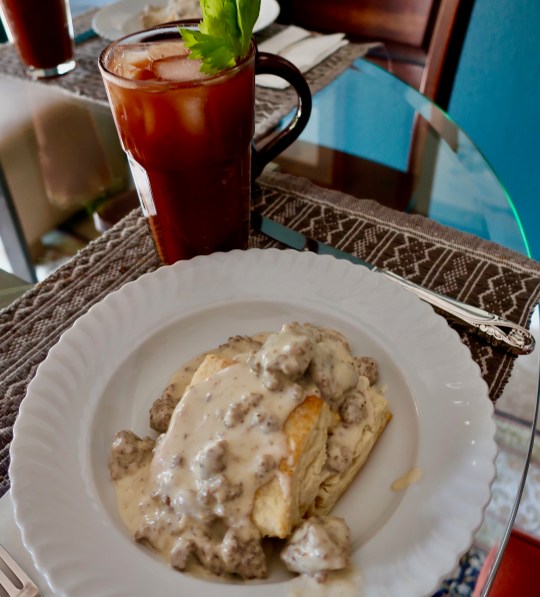
“You have to try my biscuits and sausage gravy,” Frances insisted on Peggy’s birthday morning. “It’s a true Texas dish.” And it was delicious. I gained a pound just looking at it. Frances is a great cook. Breakfast came with Bloody Marys that John made. “They are light on vodka,” he assured us. “Only 25%.” Hmmm, they were BIG Bloody Marys. Light probably meant a couple of shots. At least.
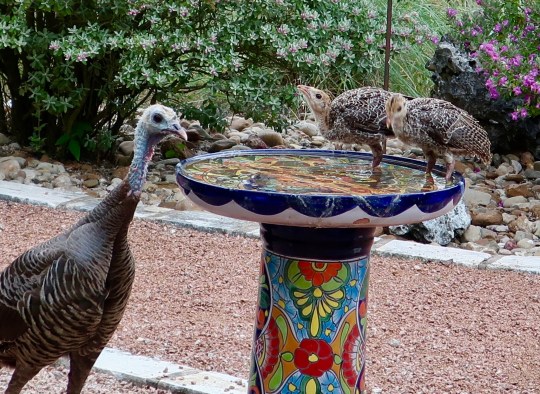
John and Francis live in a the developed senior community of Sun City near Georgetown. Its suburban nature does not discourage the wildlife. Peggy awoke on her birthday morning with four large, whitetail bucks parading by our bedroom window. John and Frances call them ‘The Boys’ Club.’ They are frequent visitors.
A turkey and her chicks also came by and drank out of the bird bath!
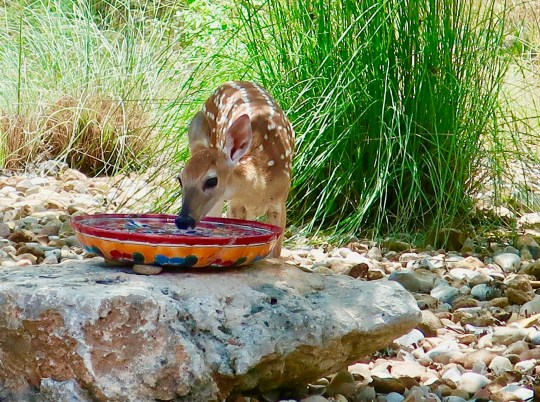
And a fawn stopped off to drink out of another bird bath strategically placed at fawn height. The wildlife made Peggy and me feel right at home!
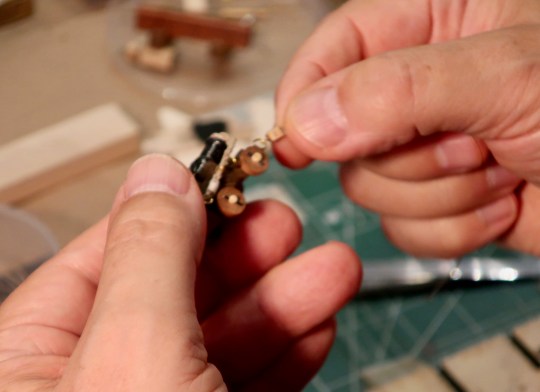
I love it when people have a passion for doing something. John’s is building magnificent sailing ships. It goes along with his passion for history, which we share.
The attention to detail is incredible.
John was working on putting together canons for his latest sailboat project. Everything from wheels to recoil ropes needed to be meticulously added. “How long does it take you to do a ship?” I asked. “2,000 hours,” was his response. Now, that’s passion!

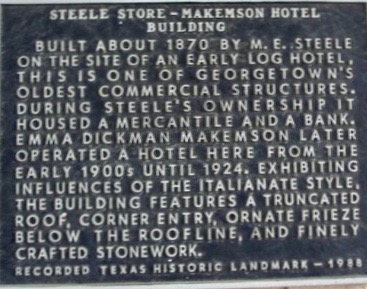
Georgetown has a bit of family history tied to it. The Mekemsons/Makemsons came down from Illinois prior to the Civil War and were among the early settlers of the area. William Makemson was sheriff of the town following the Clvil War and later served as editor of the town’s newspaper. He eventually ran for Governor of Texas on the Republican ticket but lost. It was a time when only Democrats won. Texans still blamed the Republicans for freeing the slaves and for the ‘Reconstruction’ period that followed the Civil War.

A Texas historical marker provides background information on the Steele-Makemson building in Georgetown.

While we were visiting John and Frances, I got a note from Karen at the WP blog, Philosopher Mouse of the Hedge. “I can’t believe you are in Georgetown,” she exclaimed. “My family had the original Spanish land-grant for the area!” Odds are that our families would have known each other. It’s possible that they even intermarried. Like Linda, Karen lives in the Houston area.

Visiting Linda had been on my agenda for several years. We had almost pulled it off four years ago when Peggy and I had re-driven the 10,000 mile route I had followed on my bike trek around North America in 1989. I had ridden my bike across Texas at the time. It’s a long way by car, so you can imagine what it is like on a bicycle! We had missed that connection with Linda on our road trip, but this time we succeeded.

In addition to enjoying blogging, photography, nature and wandering, we have another bond. We both lived in upcountry Liberia, West Africa. I was a Peace Corps Volunteer there from 1965-67. Linda was connected with a Lutheran Mission in Liberia starting in 1970. We often share tales of our experiences.
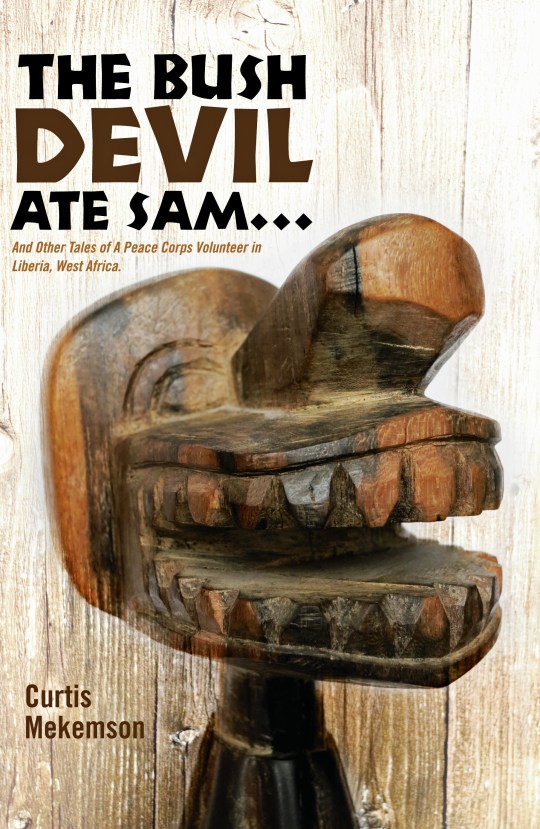
When Peggy and I walked into her house, I immediately noticed Liberian tribal masks on her wall and decided we had to have a photo with them as a backdrop. There was also Liberian country money on display. Even more significant to me, she had a wood-carved crucifix from the leper colony in Ganta. If you have read my book, The Bush Devil Ate Sam, the carving of the bush devil featured on the front also came from the colony. It’s possible that Freddy the Carver did both of our pieces. My friend Morris Carpenter, who served as a Peace Corps Volunteer in Ganta and introduced me to Freddy, had a crucifix from him that looked quite similar to Linda’s.
The bush devil was possibly carved by the same leper that carved Linda’s crucifix. Sam, BTW, who had worked for us as a 13 and 14 year old, would later become a physician and work at Phoebe Hospital where Linda had spent some of her time working while in Liberia.

We had a delightful evening with Linda. At 73 she is full of both energy and laughter and can still put in a full week sanding and varnishing sailboats in the harbor next to her condo, which is how she makes her living. She shared some of her fascinating history with us, which I will leave up to her to share other than to note the time she hitchhiked from Liberia up to London. If you have ever been in Africa, you have some idea of what a monumental task that would be! It speaks to what an adventuresome soul she is.

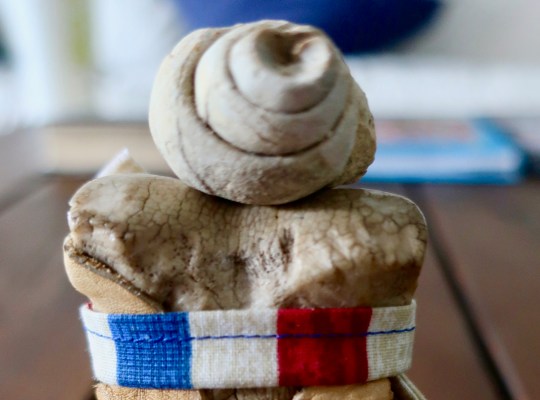
As we left, I noticed that Linda had a collection of rocks in a basket on the floor. I was going to comment on how they reminded me of the collections of rocks you find scattered around Georgia O’Keeffe’s house in New Mexico. Before I could get my observation out, Linda commented, “I collected the large rock from below Georgia O’Keefe’s house.” Forever generous, she reached down into her collection and came up with a fossilized snail from Texas and handed it to us as a memento of our visit.

Later that night, I thought “Darn. I meant to take Bone in to meet Linda.” Turns out she had her own bone that she wanted Bone to meet. “Next time,” she told me in an Email.

Bone, wearing his Covid-19 mask, took an immediately liking to the fossilized snail. I think that he decided that the snail would make an excellent Texas hat! I told him that it made him look jaunty.

Our thanks to John, Frances and Linda for showing us the true meaning of Texas Hospitality!

NEXT BLOG: Who knows. The good news is that I have plenty of new blog material. The bad news is that I don’t have any time to blog. From here we are heading up to North Carolina where our kids have rented a large home on the Outer Banks as another celebration of Peggy’s birthday! She isn’t suffering. This morning, our son Tony took her flying while I finished this post!

Off to a Rocky Start: Arches NP… The Backroads Series

It looked a bit like Snoopy at first glance, making a sarcastic comment to Woodstock. But it wasn’t Snoopy. It was the famous Balanced Rock of Arches National Park. Someday it will come tumbling down. (Photo by Peggy Mekemson.)

We’ve started our journey around America traveling over the country’s backroads while wearing masks like bandits. The beginning of the trip was in Fallon, Nevada, which might seem strange given that we live in Oregon. Getting to Fallon, however, involved traveling over I-5 and I-80, two of Americas busiest freeways. Freeways are to be avoided and ignored in this series— even though Peggy and I have to use them on occasion.

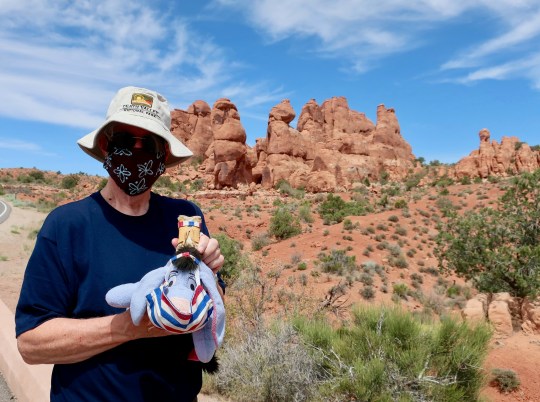
It’s scary out here in America’s hinterland as Covid-19 makes its way from state to state. The lack of a clear national policy is apparent. Peggy and I, as well as our traveling companions, Bone and Eeyore, are all wearing our masks. So far, we seem to be the exception. (Photo by Peggy Mekemson.)

In Fallon, we climbed on Highway 50. Its claim to being the ‘loneliest road in America,’ gives it genuine backroad credentials. I’ll get back to it. There is much to tell about the legendary highway I grew up near. But given Covid-19, our two to three month backroads exploration is off to a rocky start— and there are few places in America rockier than Arches National Park. Peggy and I know. We took 572 photos of rocks there. Peggy promises you won’t have to look at all of them. But there will be quite a few. Grin. I love red rock country.

Today, I am going to start with just one, the famous Balanced Rock. Its total height is 128 feet. The boulder on top makes up 55 feet of its height and weighs in at 3500 tons. If you have been to Arches, the odds are you have a photo. Millions of tourists have stood and stared up at it in awe.

It stands as a testament to the fact that there is much more to see in Arches than just arches. A lot more. Geology is the reason for the park’s unique look. The rocks that make up Arches have been layed down over hundreds of millions of years under a wide range of circumstances ranging from deserts to seas. Their different makeup impacts how fast they erode and that leads to the fantastic rock sculptures and monuments seen through the park. There will be more on the geology in coming posts.

In addition to its unique look and geology, the thing that fascinates me about Balanced Rock is how its look changes drastically from different angles as you walk around it. And that is the subject of today’s photos.

The mushroom look.
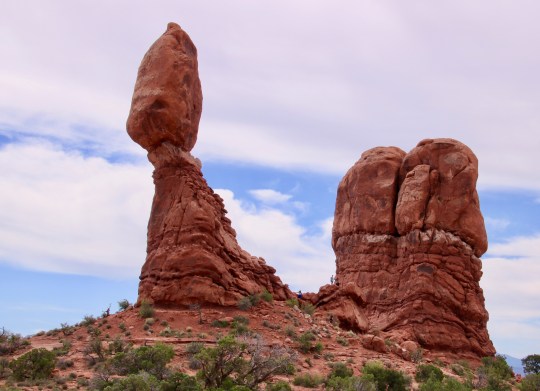
A more traditional look of Balanced Rock with a companion. (Photo by Peggy Mekemson.)
A modified ‘Snoopy’ look.
Side view.
A long view including Peggy. She’s safe, but is she balanced. (Grin) Another rock stands behind.
A more human look. Possibly a thumbs up with a thumb ring? (Photo by Peggy Mekemson.)
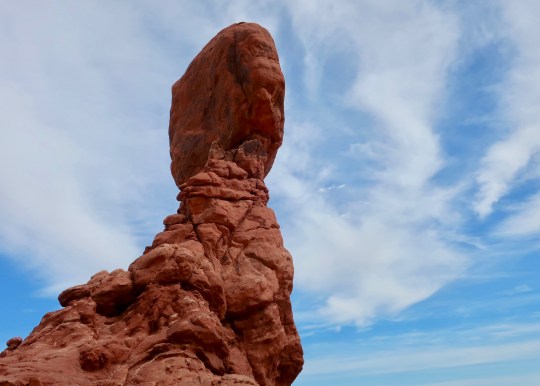
I’ll conclude with this view of looking up at Balanced Rock from its base. It gives a perspective on how massive the sculpture is.

NEXT POST: We’ll start at the beginning of the park with Wall Street, the Organ, and the Sheep.

We Rub the Nose of a Pig in Florence… Armchair Travel

Peggy eagerly rubs Little Pig’s Nose in Florence.
Kathy and I quickly join in the nose rubbing exercise.

So, here’s a serious question: With all of the beautiful art in Florence, why in the world would we spend our time rubbing the nose of a pig?

I’ll be brief. We were told if we rubbed the nose of the pig, or the snout of the boar if you prefer, we would come back to Florence.  Considering we had six hours to explore everything Florence had to offer, we looked on our nose polishing efforts as a guarantee of a return trip.

Il Porcellino, or Little Pig, as he is known, was sculpted way back in 1612 and was based on an original marble pig of Greek origin dating back to who knows when. The present pig is a copy of the copy. You can tell by his shiny nose that lots of people share our desire to come back to Florence. Apparently rubbing his snout for a return trip dates back to the 1700s.

Little Pig is housed in an attractive marketplace that was built by Cosimo de’ Medici between 1547-1551. Bad merchants, who had the misfortune of going bankrupt, were spanked here before being sent off to prison. I couldn’t find a description on what the spanking entailed.

The overflowing Mercato Nuovo or the Straw Market where bad merchants were once spanked. I doubt that they were ever spanked for cheating a customer.
It’s only right that I should close this post with a photo of Little Pig’s shiny snout.

NEXT POST: A teaser from our present journey around North America in Quivera, our 22-foot RV.