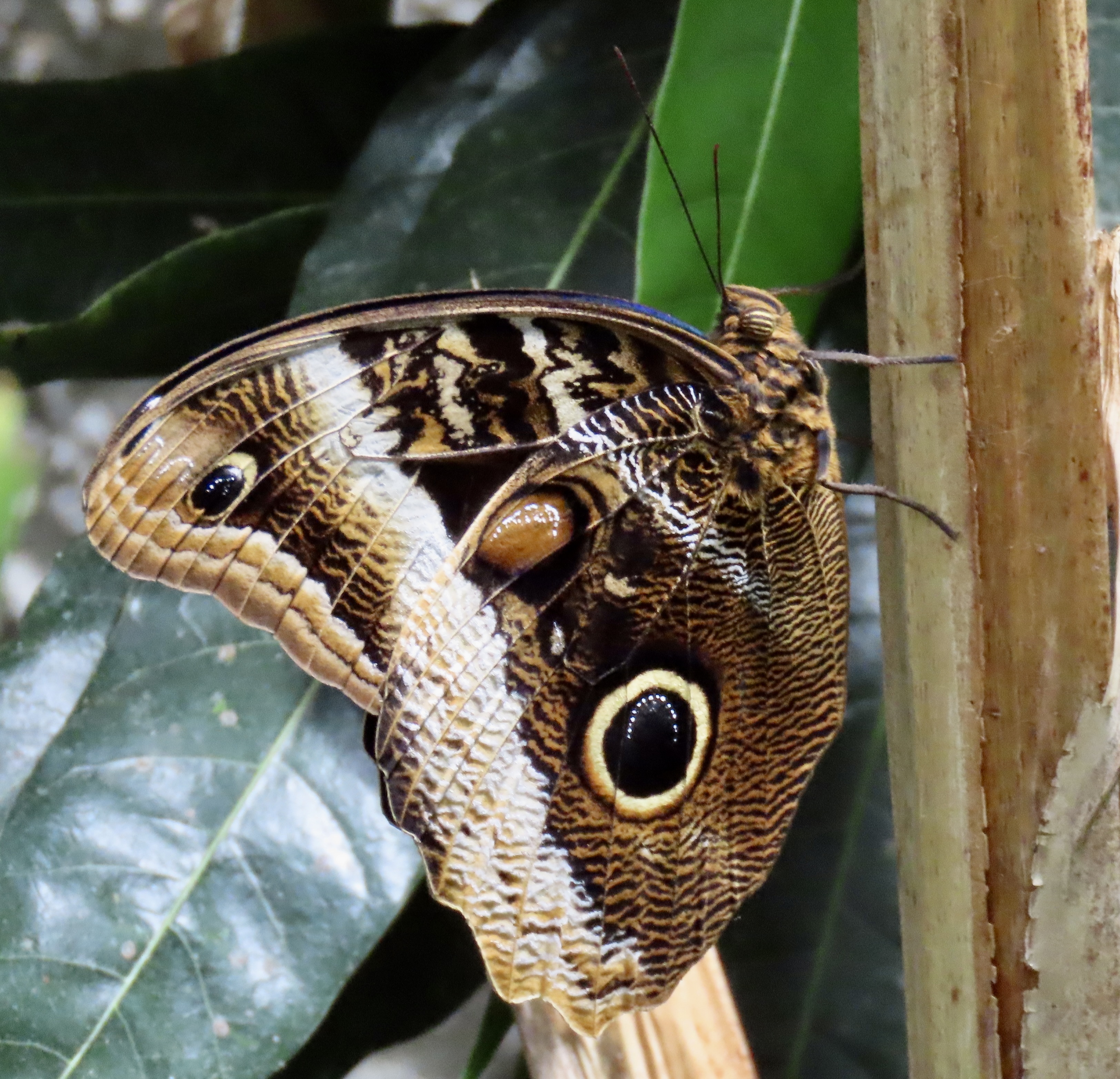
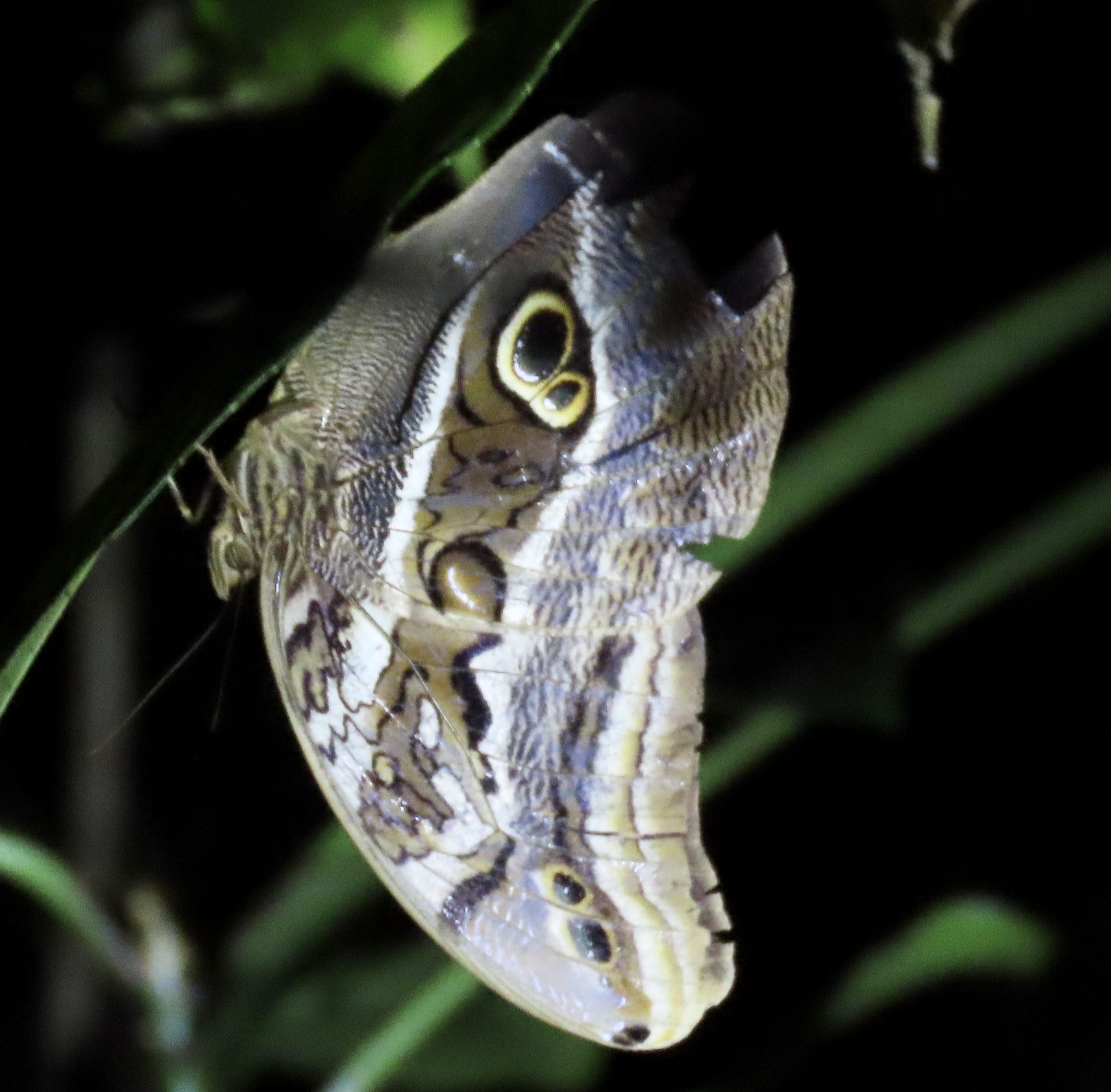
Our jungle night hike in Costa Rica introduced us to the Owl Butterfly in addition to the tarantula, pit vipers, and scorpions we featured on that post. Some fun, huh. This owl butterfly photo was taken during the day at the Monteverde Butterfly Gardens, where we visited to see it, and other butterflies of Costa Rica, up close.
The owl butterfly is so named because the large spot on the lower part of the wing. It has a matching spot on the other wing that resemble an owl’s eyes when the wings are open and seen from below. It’s called mimicry. One theory is that predators see the eyes and decide that fleeing is a better option than chomping lest they end up being the chompee. Another theory is that the predator sees the eyes and thinks that they represent the head of the butterfly, bites down, and get a mouthful of wing instead of the body. Given that the owl butterfly is one of the giants of the butterfly world with a 6-8 inch wing span, it has plenty of wing left to still fly. Either theory leaves the butterfly free to complete its goal in life, which is to breed and have babies, i.e. lay eggs.
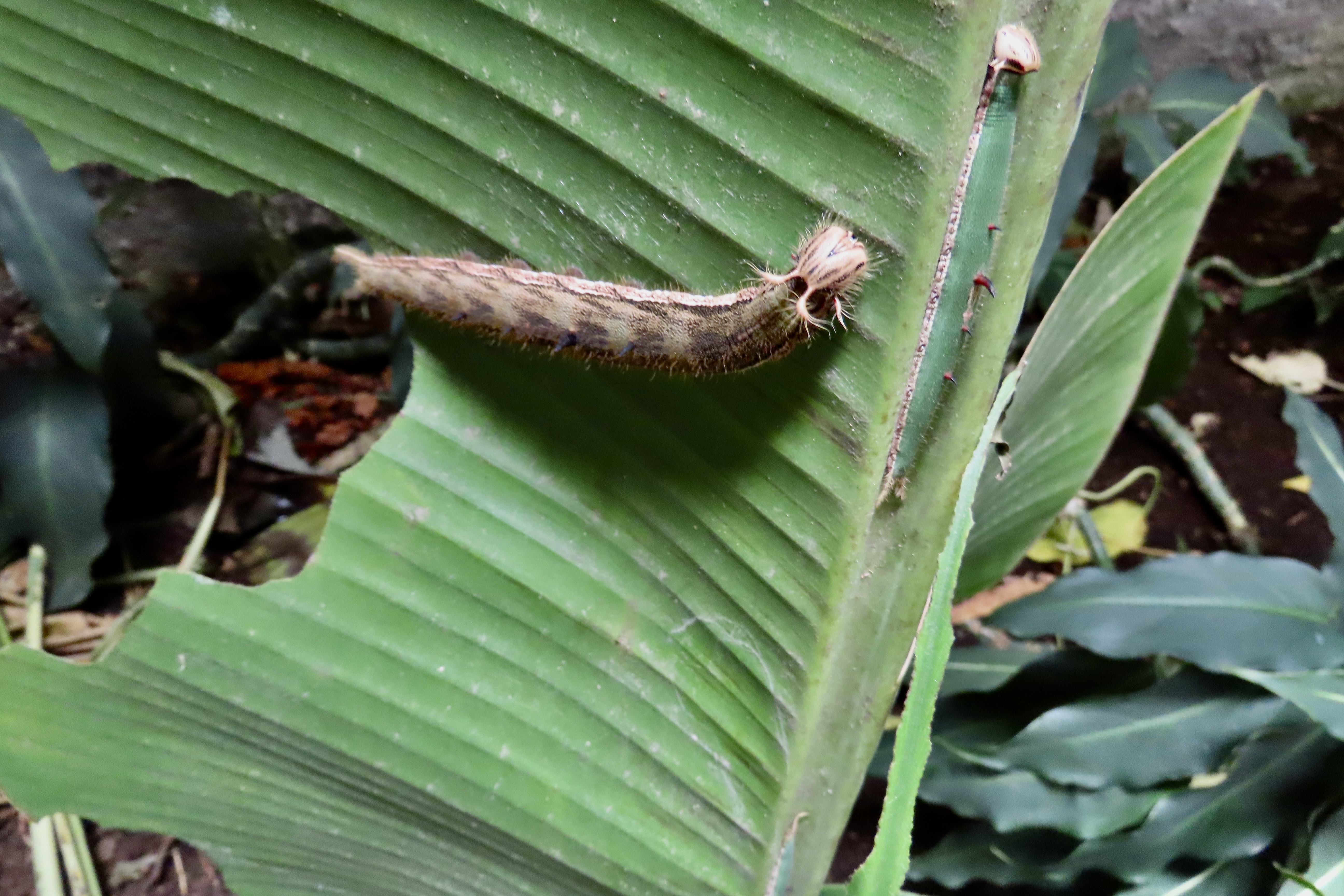
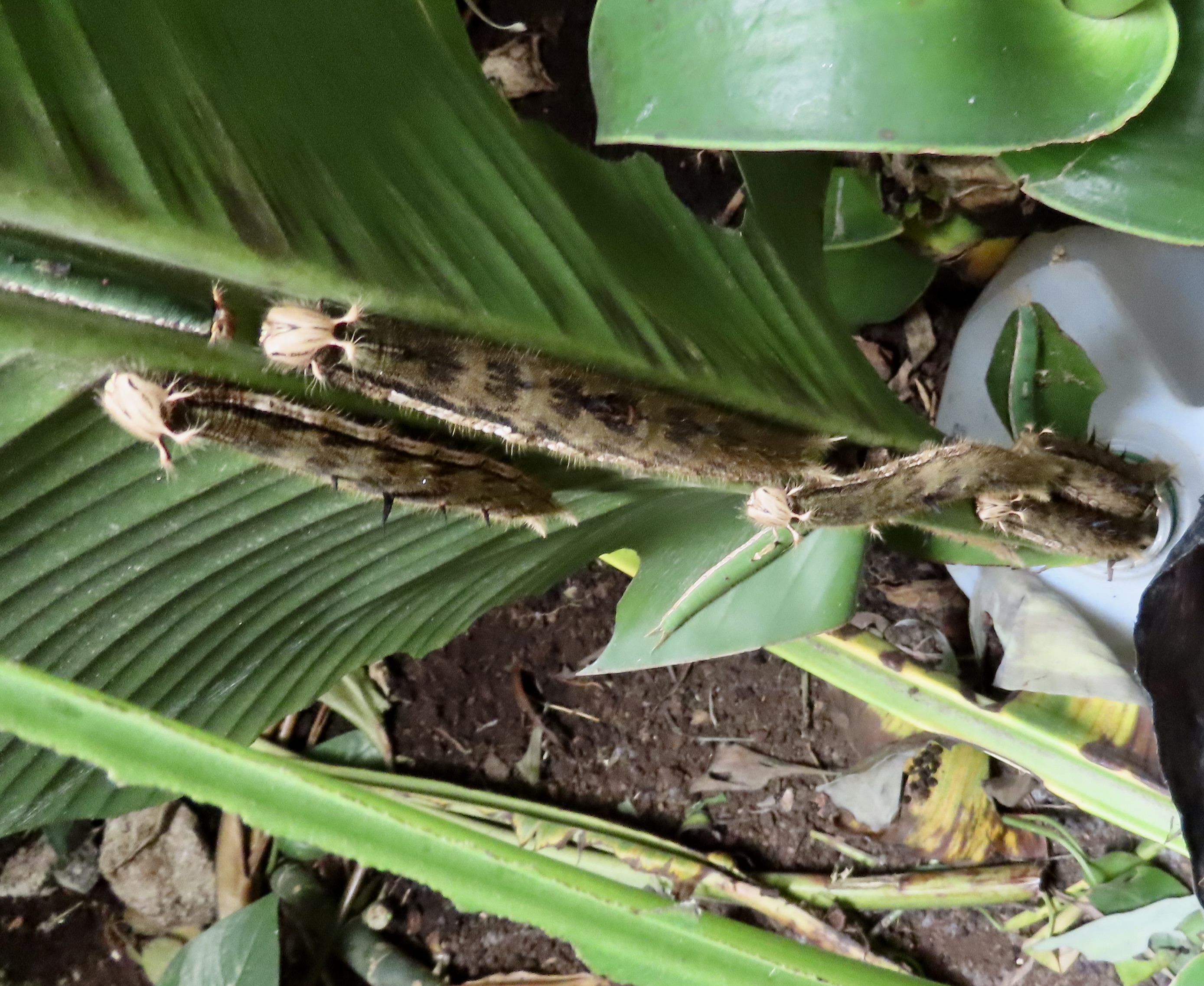
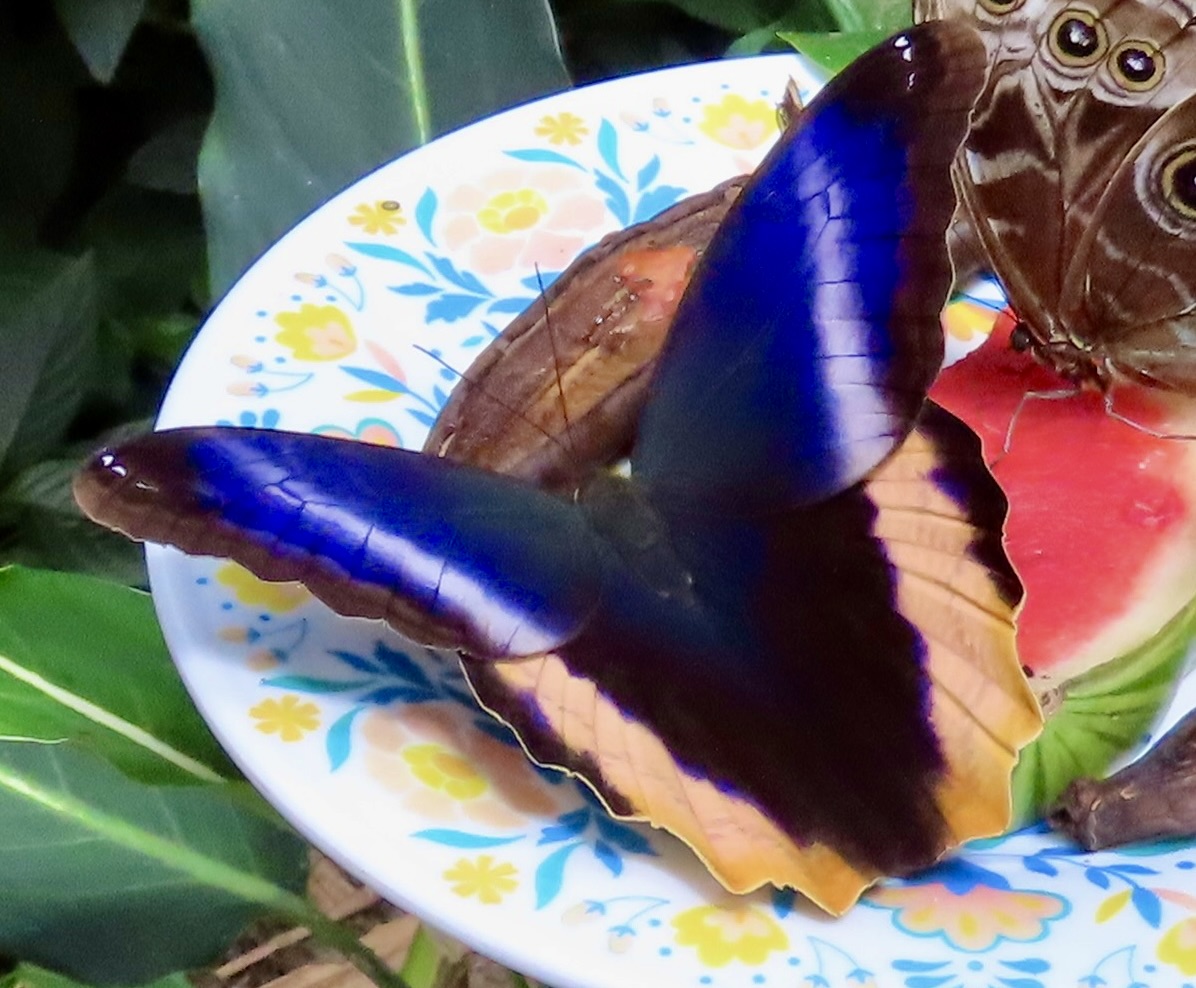
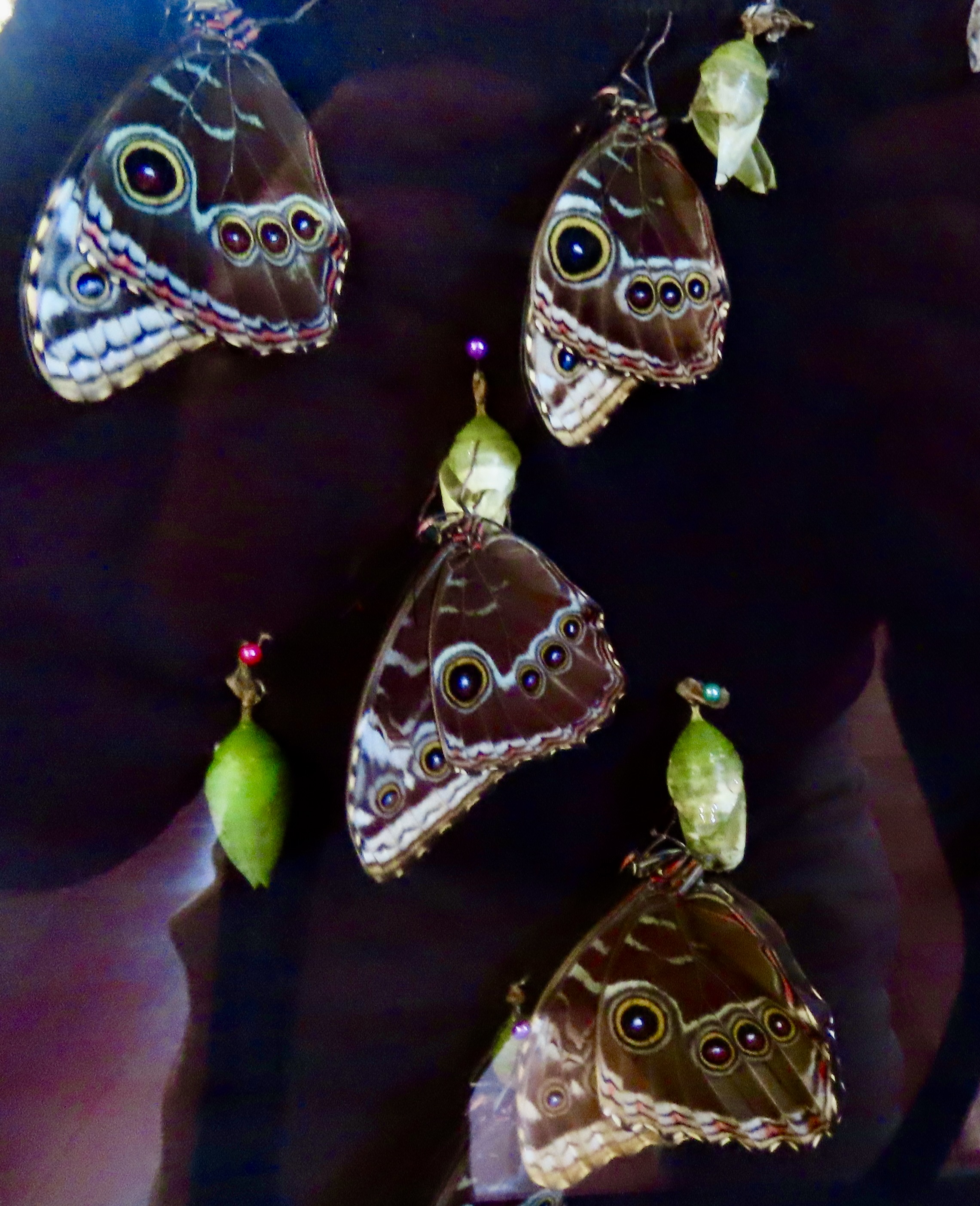
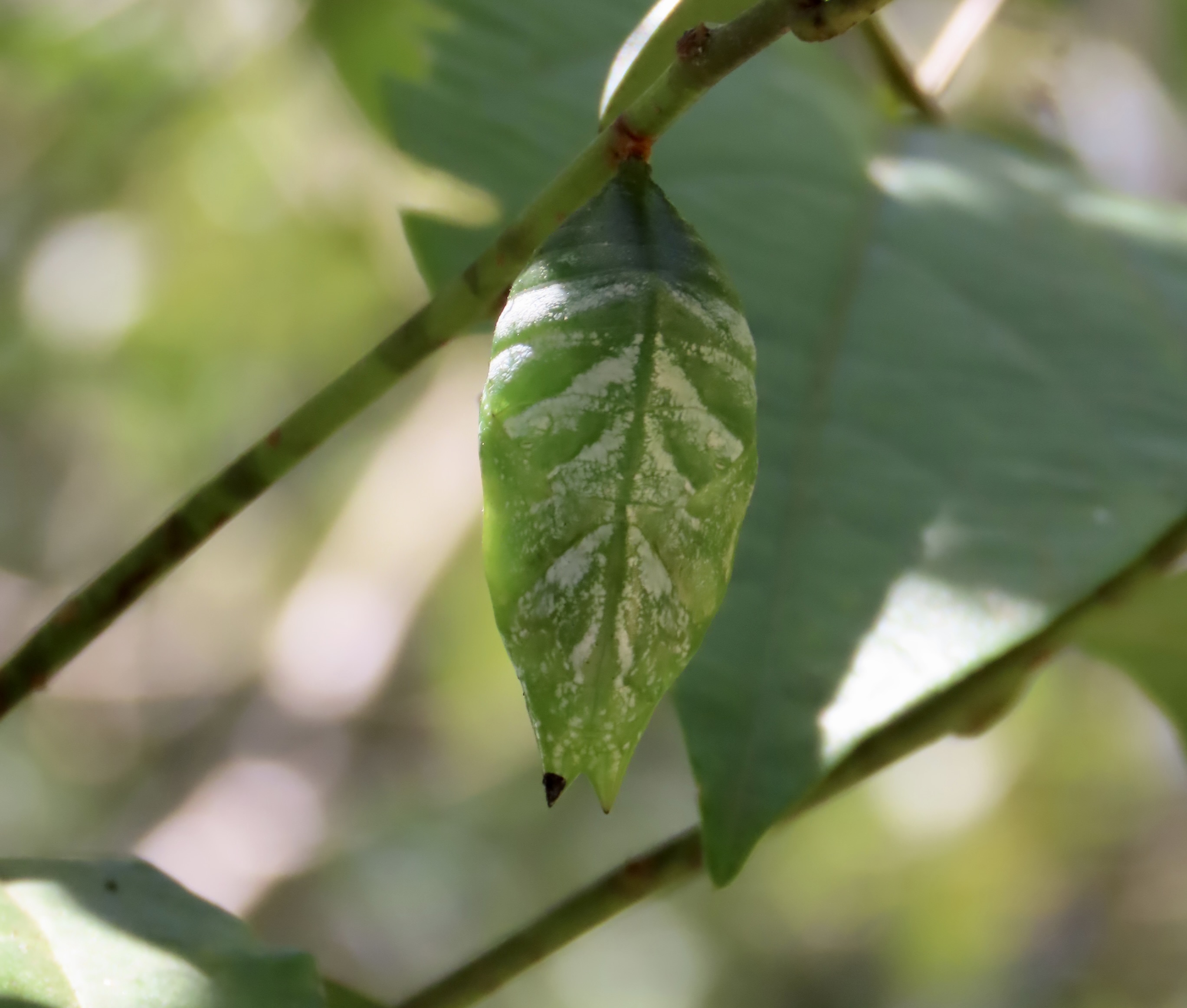
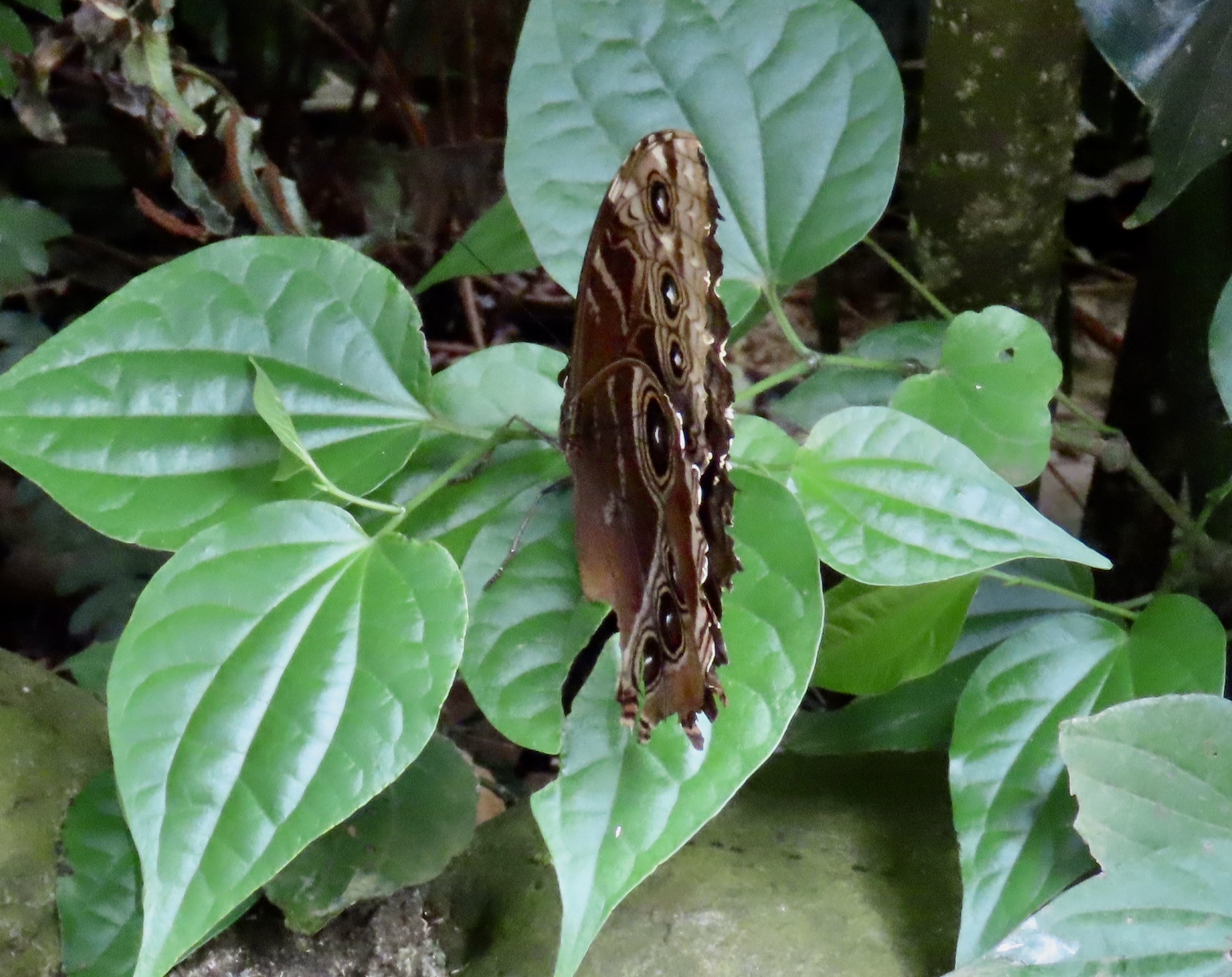
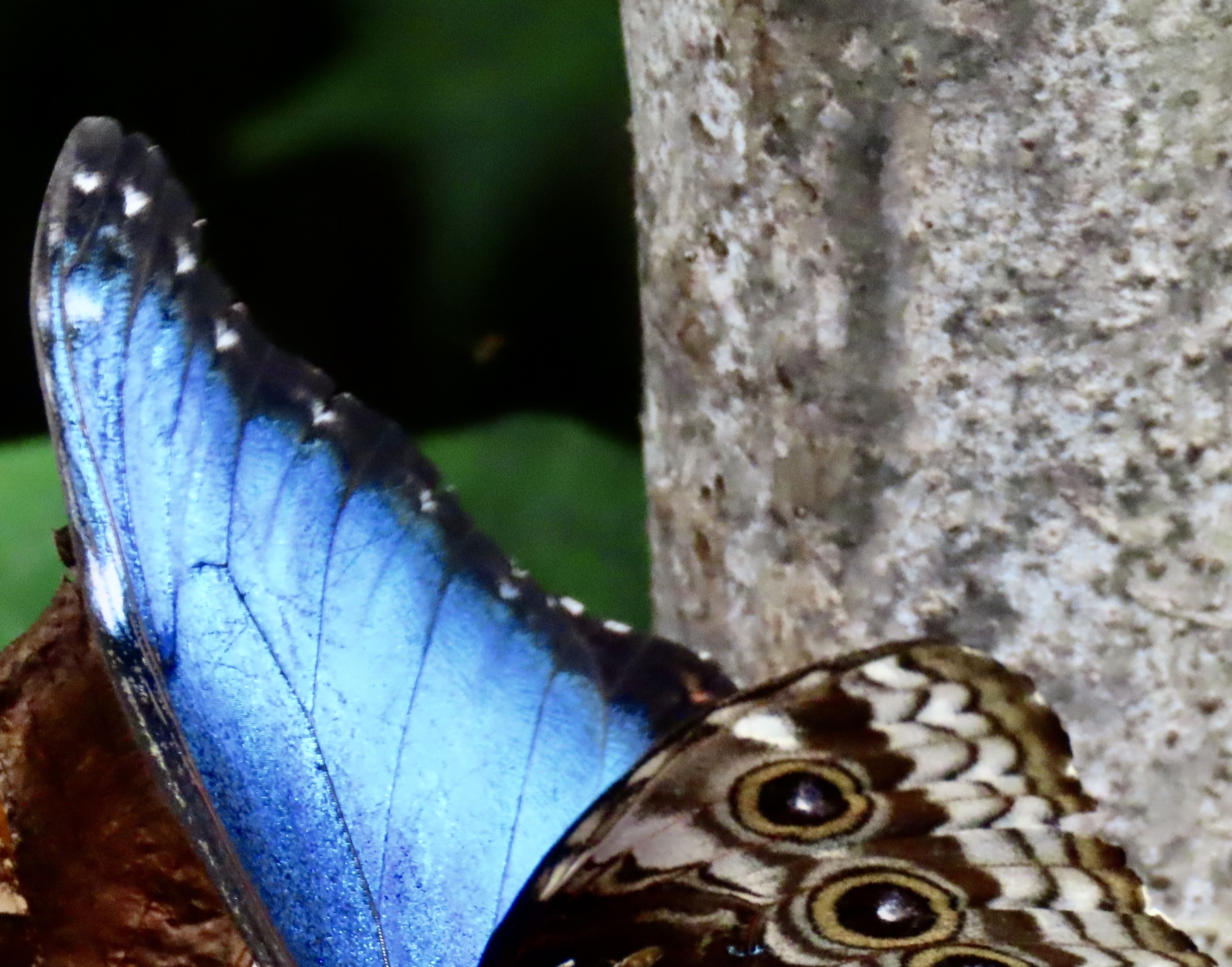
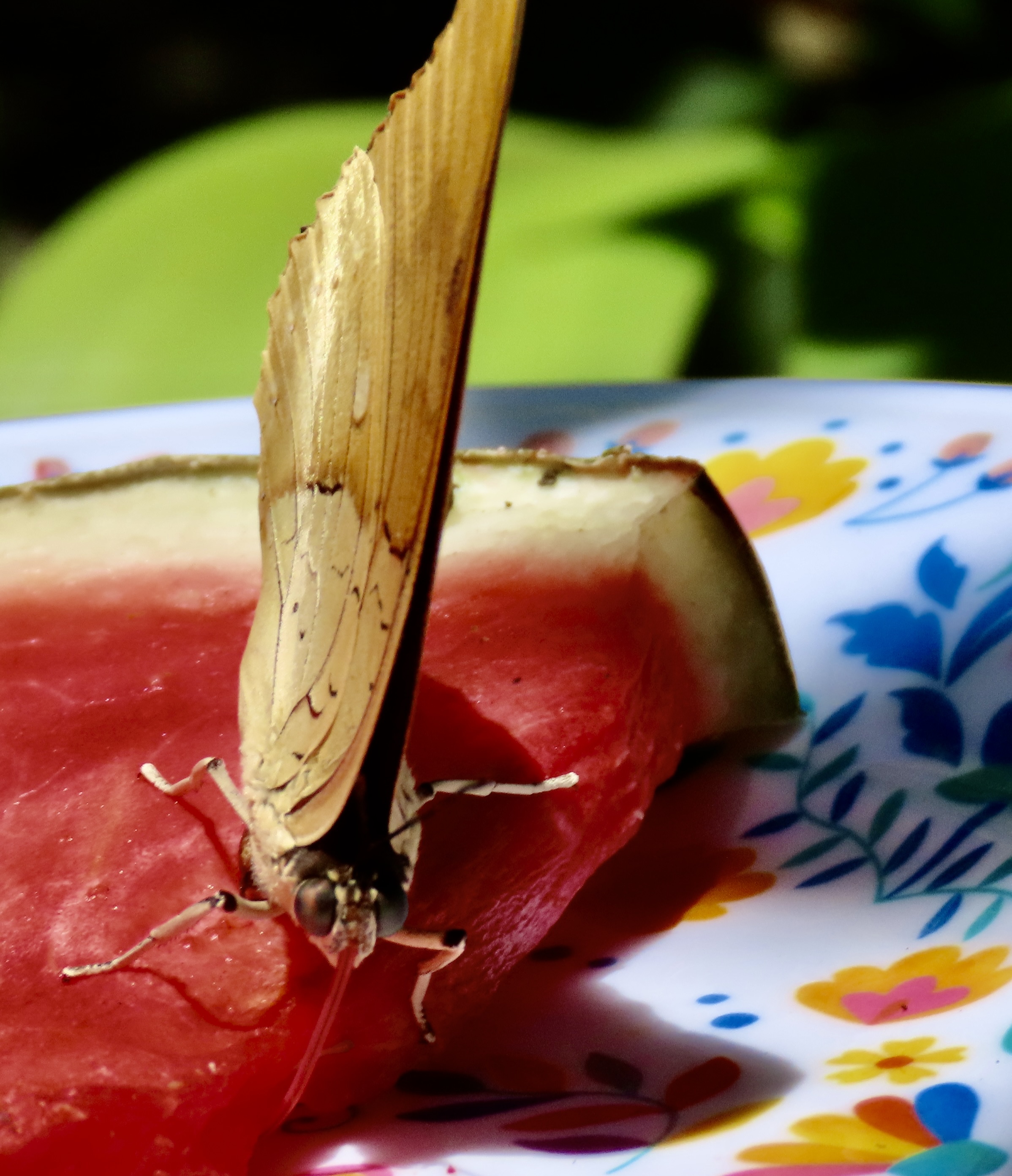
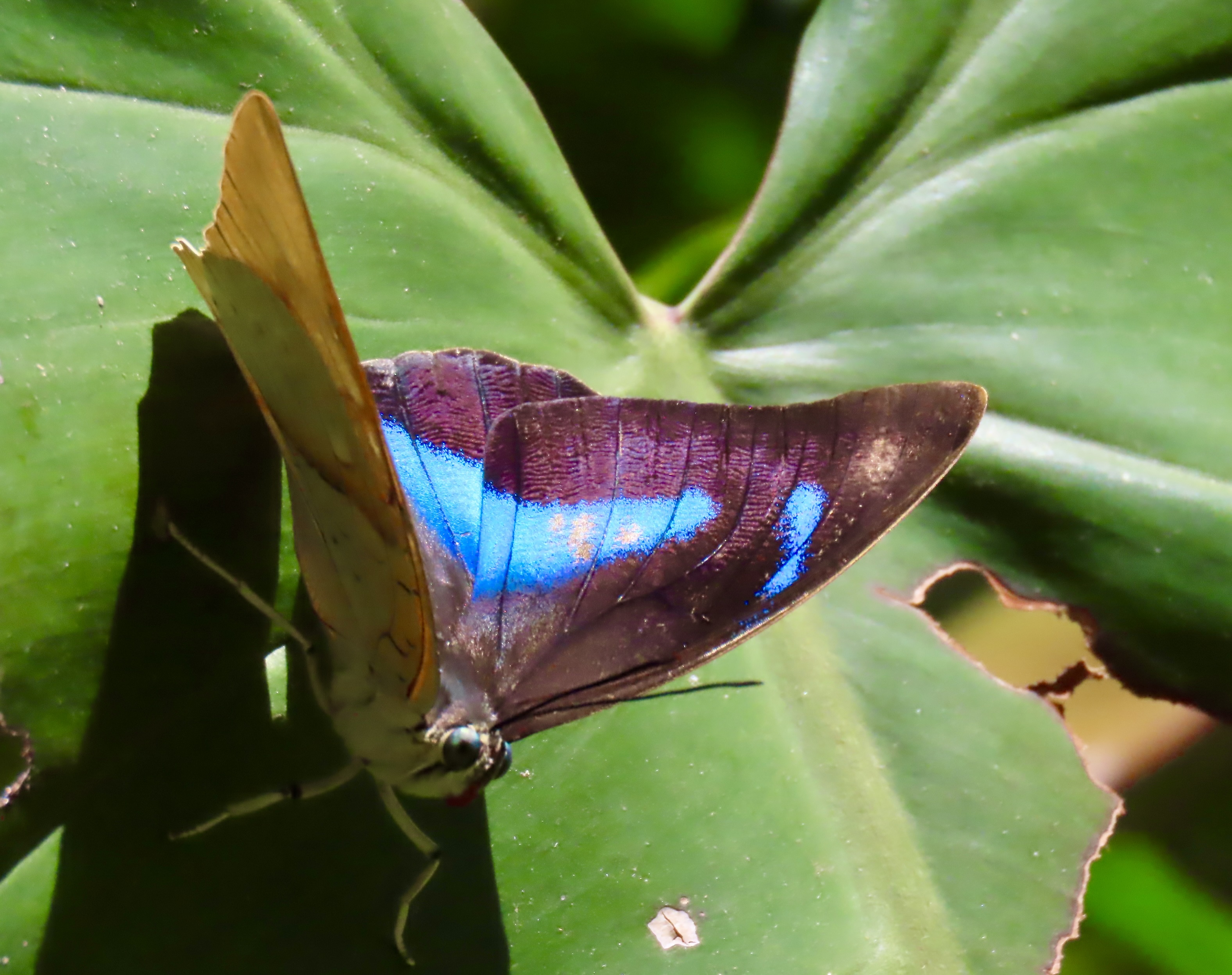
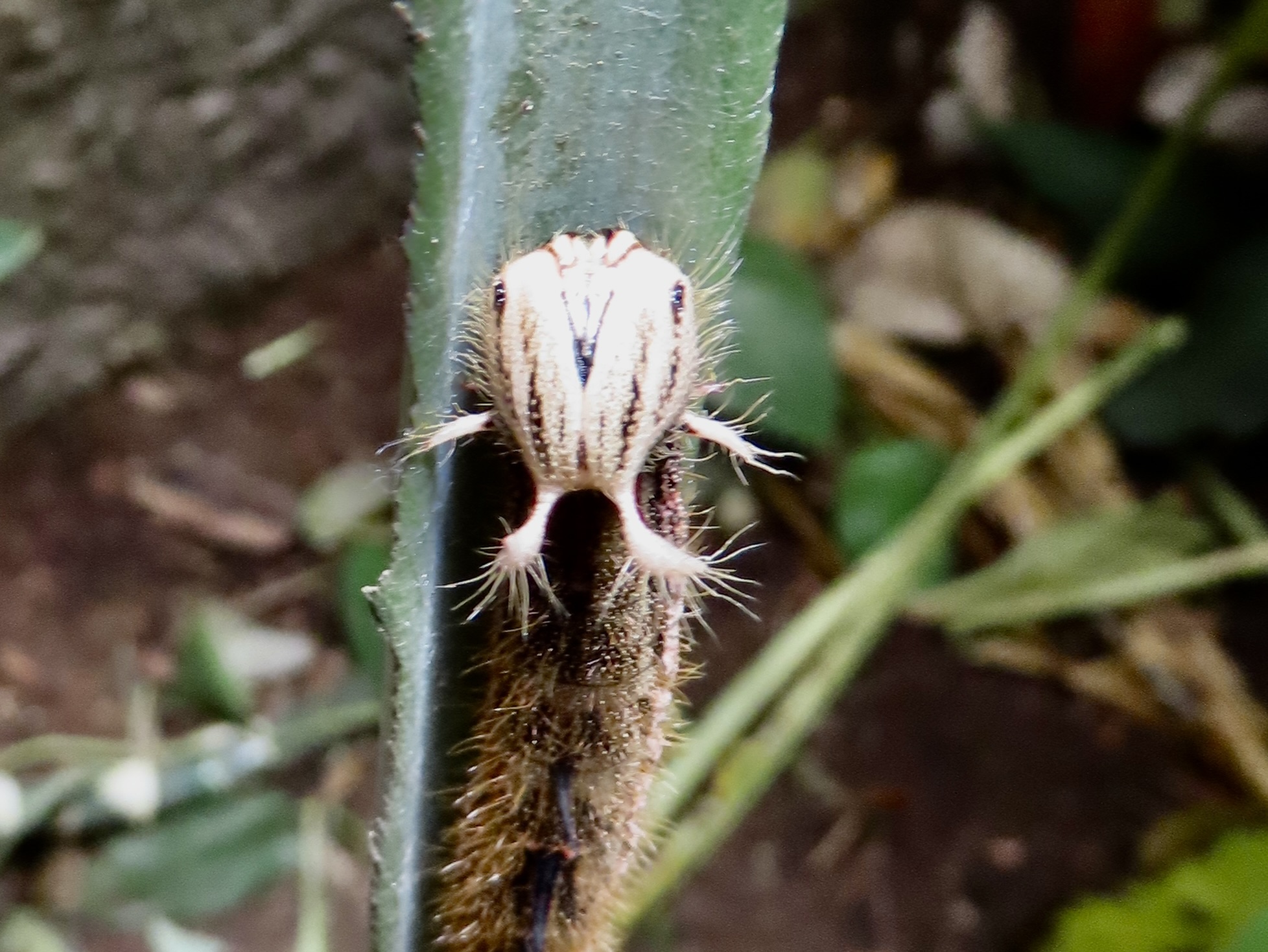
The eggs hatch into tiny caterpillars that come with a voracious appetite and quickly grow in size. Molting frequently, they change their looks each time. The caterpillar on the right is a younger version of the caterpillar on the left. The large hole in the banana leaf is why the big caterpillar is so big. It’s also the reason why banana farmers aren’t particularly fond of these insects that can grow 5 to 6 inches long off of devouring their plants before entering their chrysalis stage.From the perspective of the banana leaf, these owl caterpillars must look like one long gut approaching. The biggest one is about to enter the chrysalis stage of the metamorphous from caterpillar to butterfly. The first step is for to dissolve into a nutrient rich goop. Specialized cells that survive the melting process then utilize the nutrients to develop into the adult butterfly.The owl butterfly is quite beautiful when seen from above with its wings in open position. Here it was busy consuming watermelon that staff had left out for it. On the right is another one of Costa Rica’s best known butterflies, the blue morpho.Here a number of blue morpho are simultaneously hatching out of their chrysalis at a special hatching station that the Monteverde Butterfly Garden maintains for this purpose. Their wings have to dry and harden before they are ready to fly.Peggy found this blue morph chrysalis looking leaflike out in the Monteverde Butterfly Gardens. The chrysalis of the owl butterfly, btw, resembles the head of a viper. Both the leaf and the viper chrysalises are two more examples of evolutionary mimicry.A blue morph resting on leaves.A blue morpho gave us a brief glimpse of the vibrant blue color of its inner wing that gives the butterfly its name.
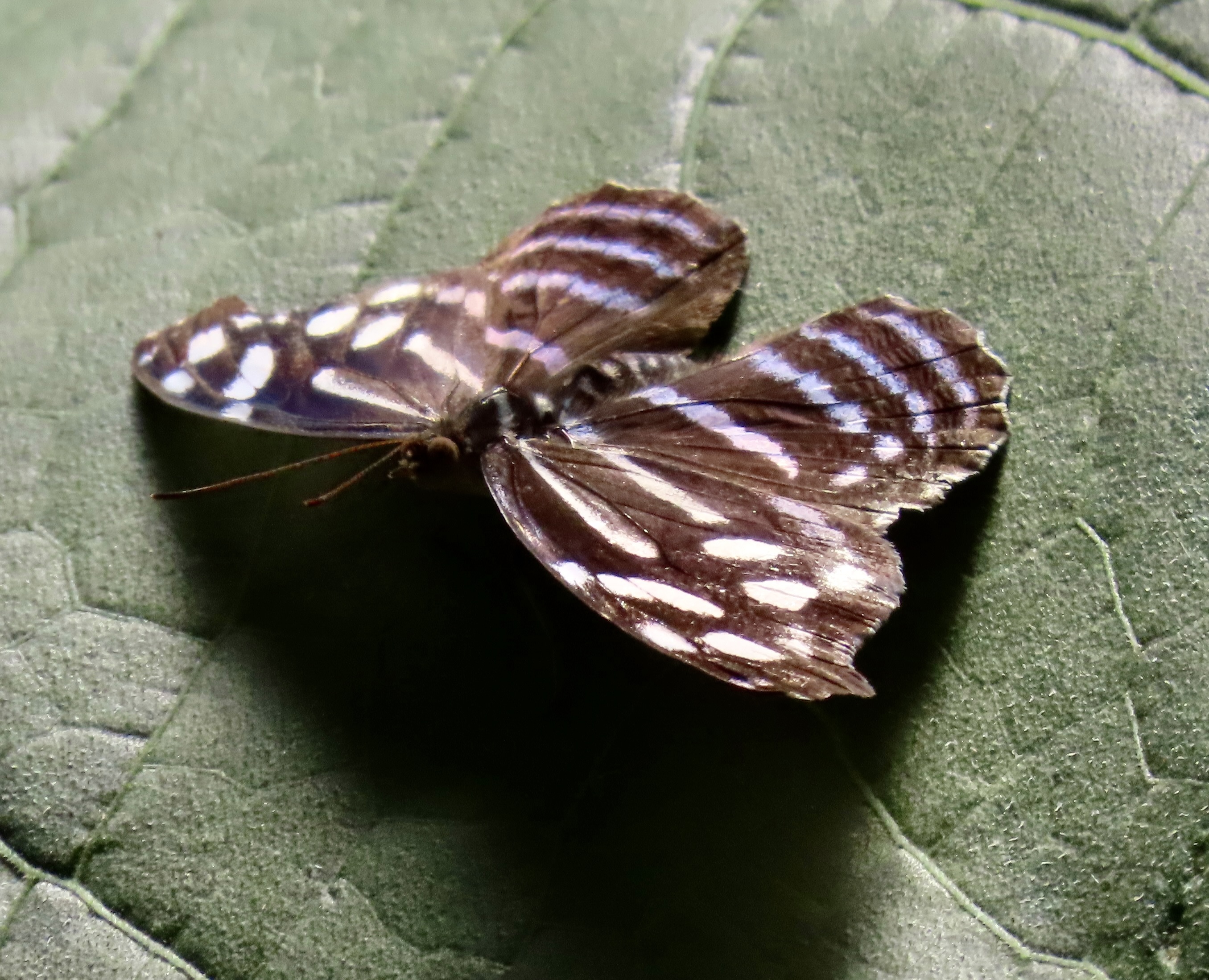
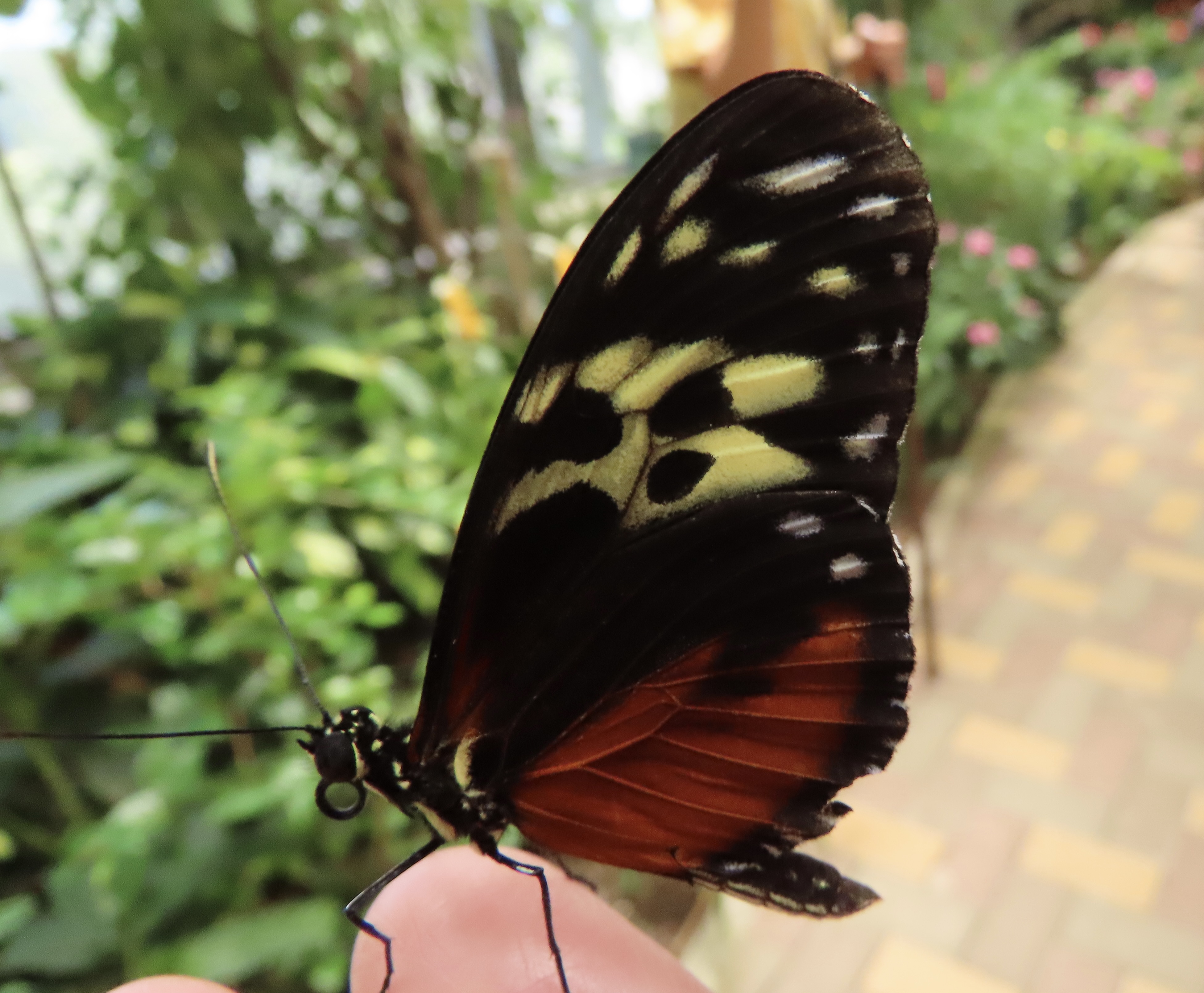
And now, for a quick look at some of the other beauties we photographed at the Monteverde Butterfly Gardens. Given that there are between 1200 and 1500 species of butterflies in Costa Rica, I’m late with this post, and my mind is on butterfly overload, I didn’t have time to pin down all the names.
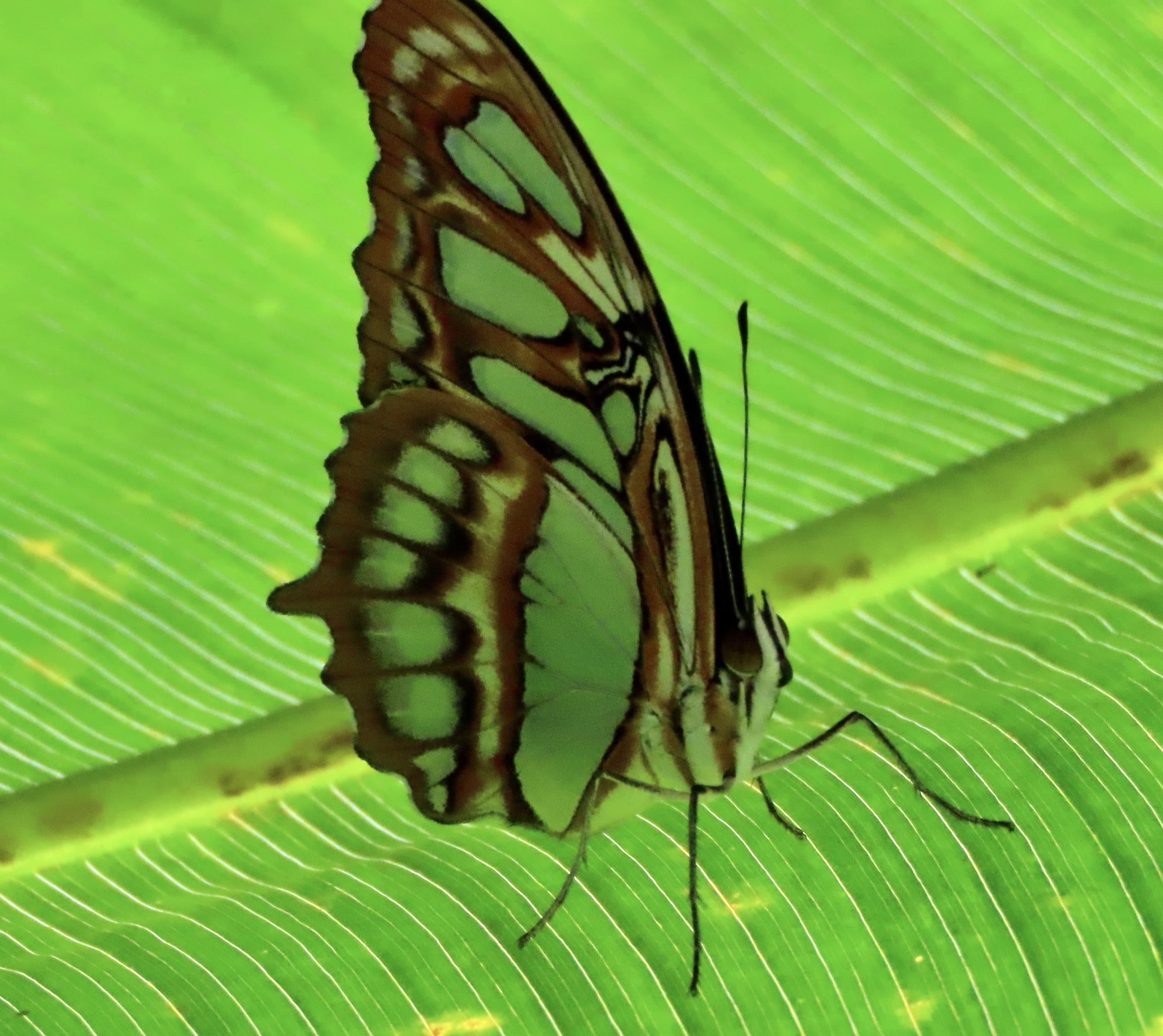
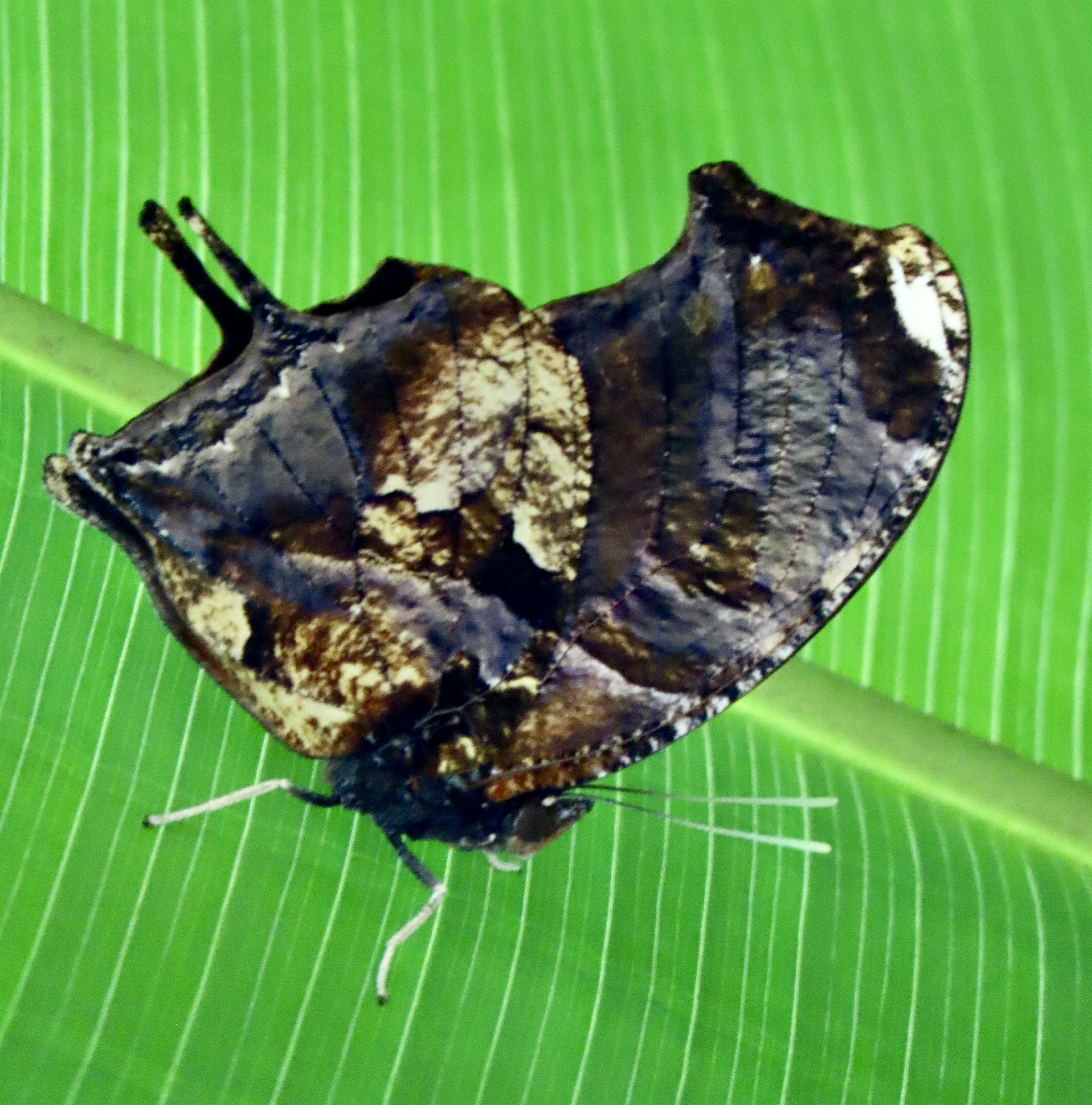
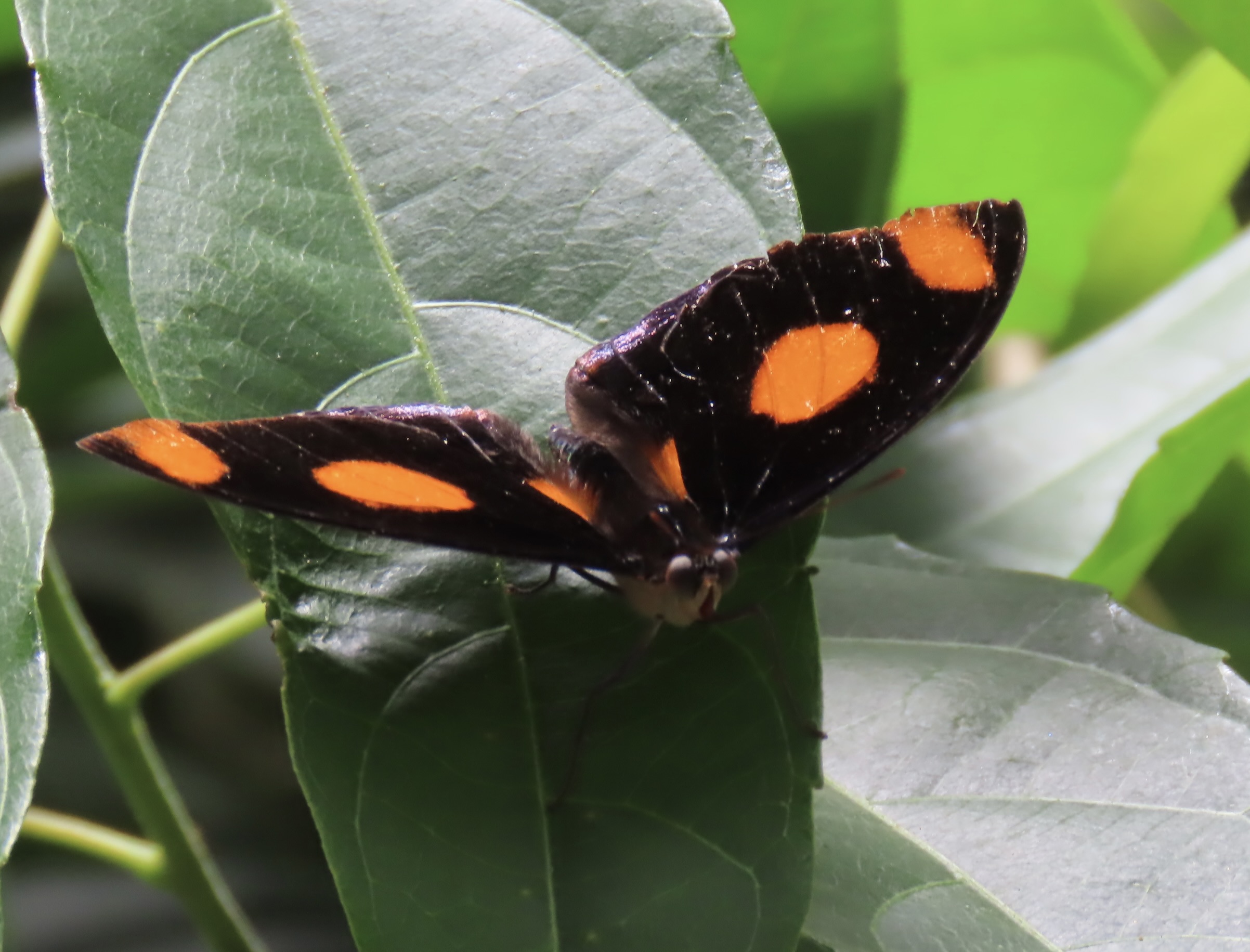
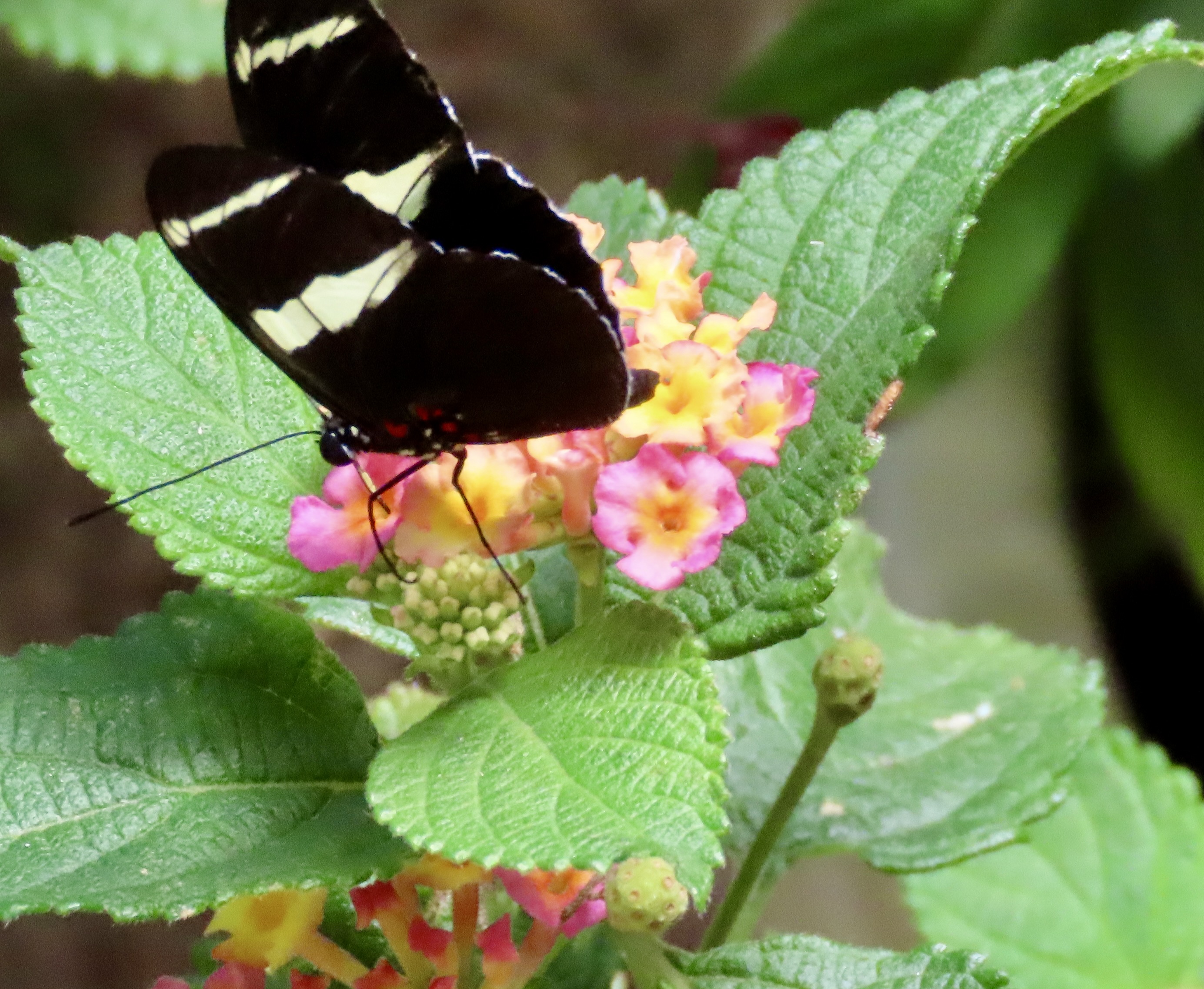
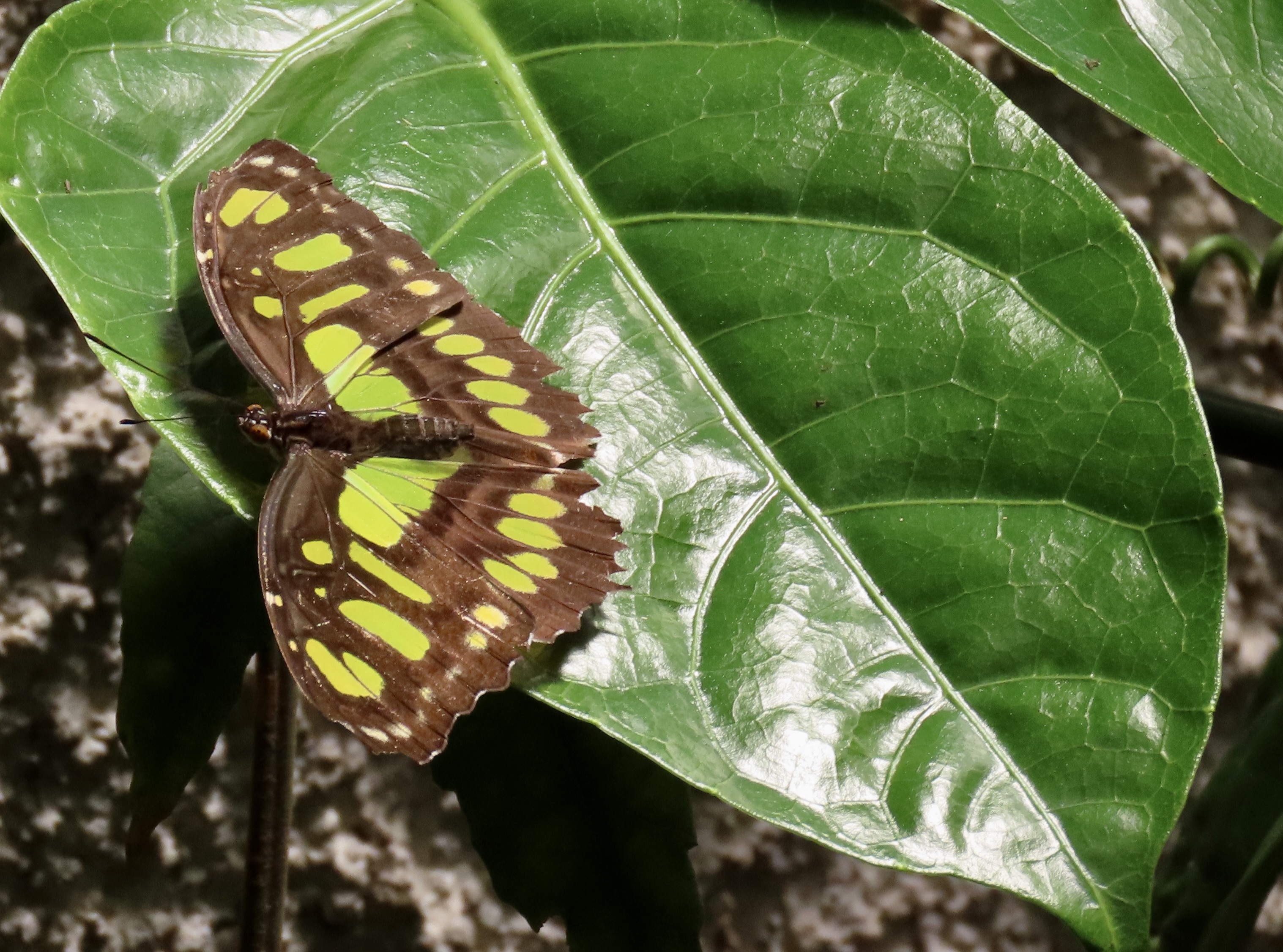
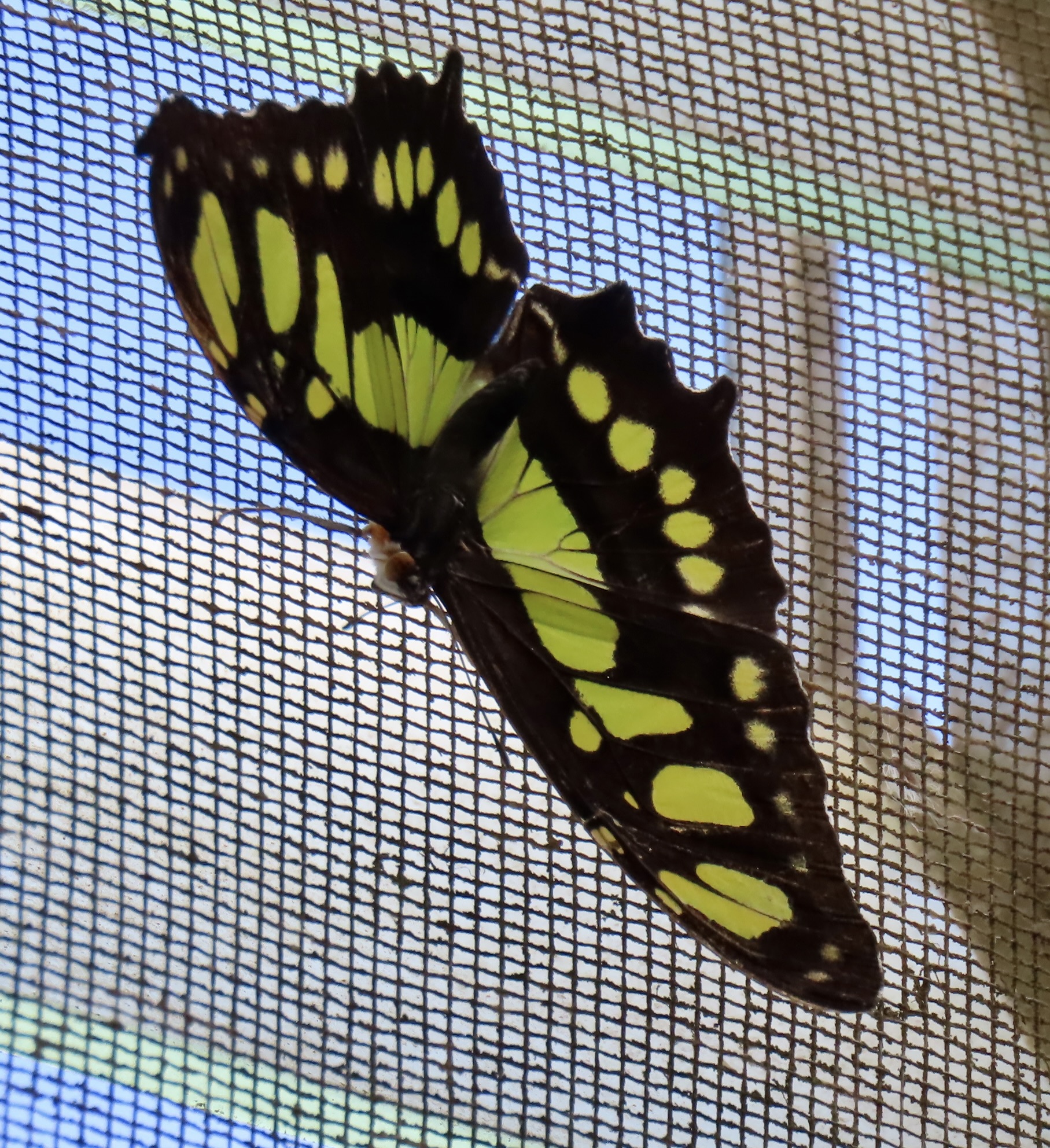
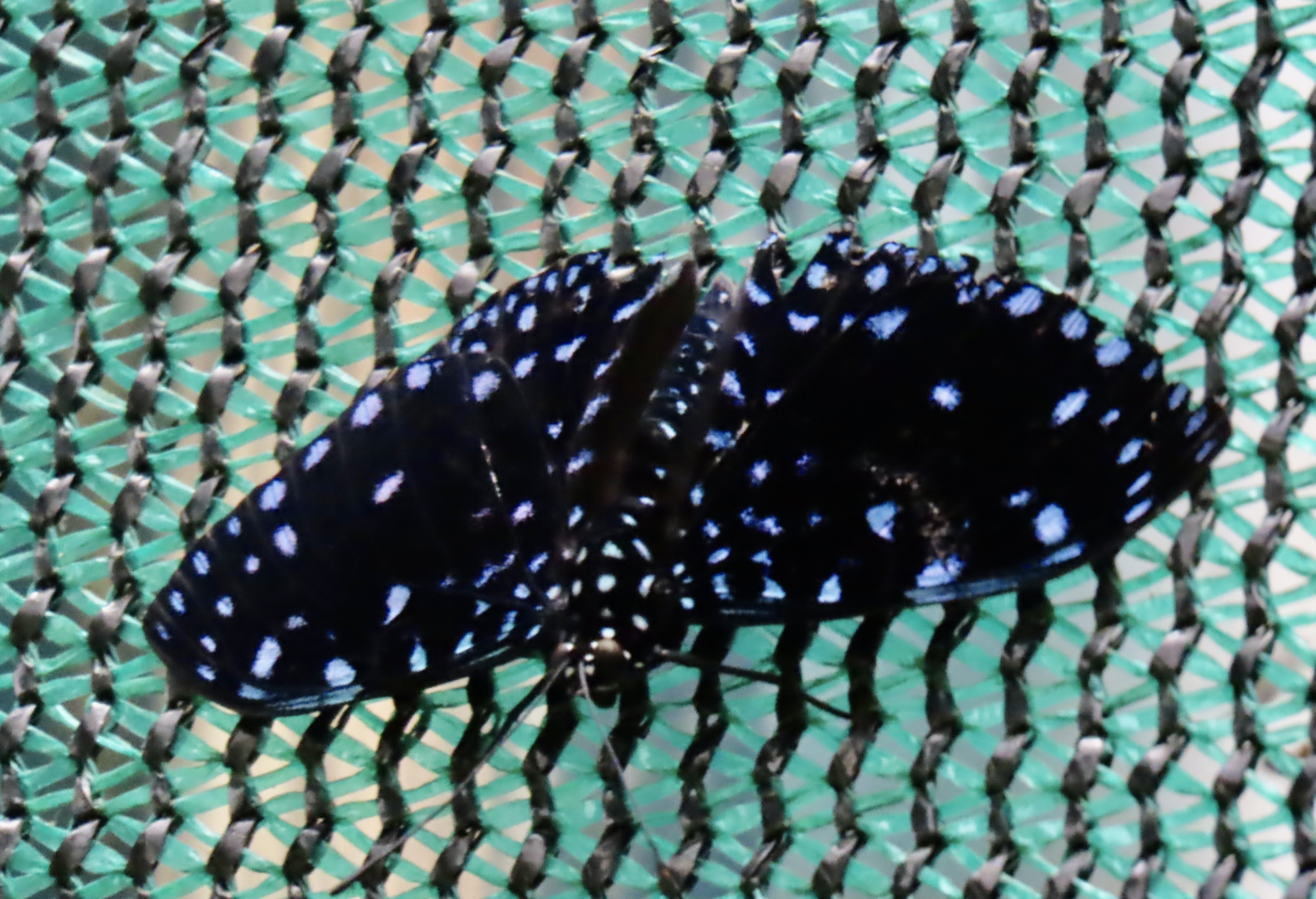
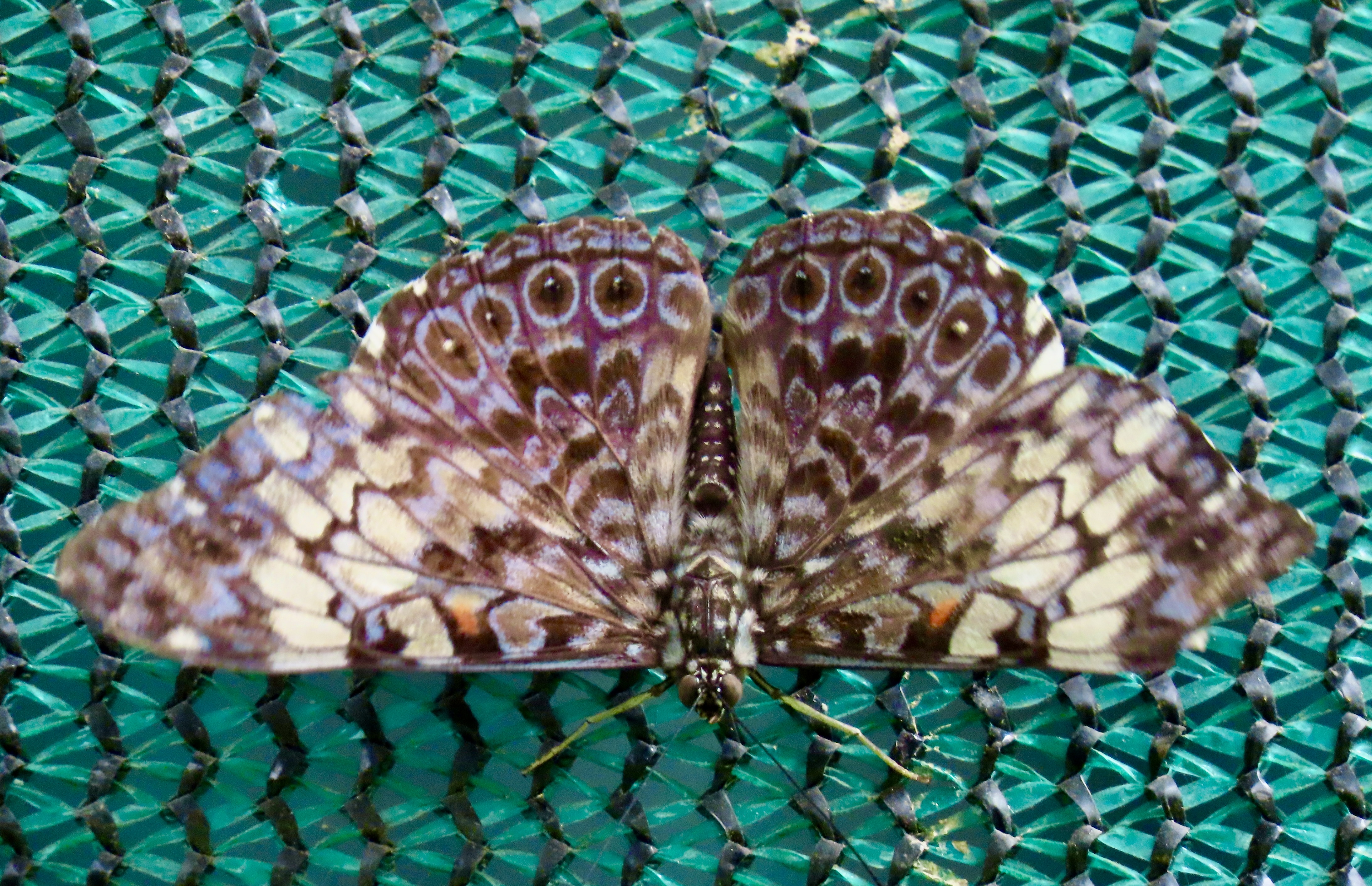
Set off by green, a Green Longwing Butterfly. Great camouflage. One of a number of butterflies that pretend to be dead leaves. This may be excellent camouflage on leaf litter covered forest floor. Not so good here.Red spots. This may be a ‘see me, see me’ look as opposed to camouflage. The caterpillars of some butterflies feast on plants that are poisonous to birds, lizards and other predators. The poison is transferred to the butterfly. Instead of hiding, the butterfly, announces its presence with bright colors that are designed to tell predators ‘You really don’t want to eat me.’ Other butterflies may adopt the same colorization in what is known as Batesian mimicry. They aren’t poisonous, but who’s to know the difference?Lunch. Butterflies, unlike caterpillars, sip nectar with their long proboscis instead of eating leaves. This is a HeliconiusSara (I think.)This sulfur colored butterfly is using its proboscis to sip watermelon juice. Note the color of the proboscis. Many Costa Rican butterflies take advantage of fallen, rotting (translate fermenting) fruit for food. They can actually become a little tipsy.This one looks like the same species as above with its wings open.Brown on green.I call this a finger butterfly since it landed on Peggy’s finger and refused to get off. It may be a Crimson Longwing.I’m going with a Malachite Butterfly on this one.And this one as well even through the colors are dramatically different. But note how close the pattern of their spots is. The butterflies often rested on the screens that kept them in the butterfly houses. Maybe they were longing to be free.Peggy’s favorite, a Starry Night Cracker Butterfly.And a final beauty. This is a Variable Cracker Butterfly. The unusual cracker name is said to come from the noise they make when they are flying.As for what noise that is, I lifted this: “The Cracker butterfly gets its name because the males are able to produce a crackling sound, reminiscent of bacon cooking in a frying pan. They make the sound when they take off, by twanging a pair of spiny rods on their abdomen against their anal claspers.” Not sure about the anal clasper but it brings a vision to mind.
Next Post: It’s back to UT-OH with two more final tales about the Mekemson Gang. There’s the issue of how I lived up to Bertha Brays expectations about my leading her son astray (although there’s an issue of who led who.) And there’s a question about why Tony Pavy wanted to shoot me. It had to do with his pig.
This is how I felt after being bonked on the head by a baseball! Just kidding. It’s actually here because I didn’t have a photo for Chapter 11. This one is an introduction to Friday’s post on Costa Rica Butterflies.
There came a time when I grew out of my mischief making phase. Other things took precedence: school, wandering in the woods, church, girls, and even sports. Few of these earned an Ut-Oh. There were a couple of incidents that earned inclusion in this book, however. The first had to do with a girl.
Starting as far back as the third grade, I had a girlfriend, or at least believed I did. The girls didn’t have to agree. My first heart throb was Carol. She was a younger woman: cute and smart. While I appreciated those qualities, what fascinated me about Carol was that she could run like the wind. I was in love with her legs. We both lived within a couple of blocks of school and would walk home for lunch.
The advantage of going home was we would arrive back at school before the other kids were let out for noon recess. This meant we could grab the best positions for whatever game was being played. My problem was that Carol could outrun me and this meant I was usually second in line. It seemed like a small price to pay for seeing those legs kicking up the dirt in front of me.
Next, I fell for an older woman, the fifth grade sister of one of my classmates in the fourth grade. She had quite a mouth on her and called her little brother pet names like shit-head and fuck-face. I was fascinated to hear a girl talk like that. One weekend, I found myself walking 2 ½ miles following the Southern Pacific railroad tracks to ‘visit her brother’ with my primary objective hearing her speak those ‘guy’ words. She didn’t disappoint…
The Ut-Oh, however, took place when I was in the fifth grade. Judy was a fourth grader with flaming red hair who had several boys in the fourth and fifth grade passionately pursuing her. The competition was fierce. Judy loved it. To encourage us, she cut off small locks of her hair and gave one to each of her admirers. I was surprised she had any hair left but I cherished my locket.
My main competitor for Judy was Eric. He was an up and coming fourth grader, small, but extremely athletic and an all-around nice kid. Judy let it be known that we were the chosen two.
We had our showdown at a school movie that provided instructions on what to do when the Russians bombed us. We spent a lot of time in the 50s worrying about that. People began building bomb shelters in their backyards. The teachers would make us crawl under our desks to prepare for the explosion. We were taught to cover our faces with our arms so glass shattering in from the windows wouldn’t blind us. It is not surprising that the traumatized children of the 50’s grew up to be the anti-war advocates of the 60s and 70s. I stayed up one night to watch atomic bomb testing in the Nevada desert over 200 miles away. It lit up the whole Eastern sky and added a touch of reality to our hide-under-the-desk practice.
In the lineup for the movie, Eric aced me out and managed to get next to Judy. A half dozen other fourth graders played honor guard and I couldn’t even get close, but my luck didn’t abandon me altogether. I grabbed the seat immediately in back of her where I could at least monitor Eric’s behavior. The lights went down and the movie started. I strained to keep an eye on Eric. He reached over and grabbed Judy’s hand and she let him hold it. Damn! I could have killed him.
But then, unbelievably, Judy slipped her other hand between the chairs and grabbed my knee. My knee! It was raw sex. The ut-oh bulge in my pants proved it.
Sports presented a totally different type of challenge. I am not a natural jock. It isn’t so much physical as mental. You have to care to be good at sports and I find other things more interesting. Part of this evolved from a lack of enthusiasm on the home front. There was little vicarious parental drive to see us excel on the playing field.
Being as blind as a bat didn’t help much either. Like most young people in the 50s, I was not excited about wearing glasses. When Mrs. Wells, the school nurse, came to class with her eye charts, I would memorize the lines while she was setting up and then breeze through the test. As for class work, I would sit close to the black board and squint a lot. While I got away with this more or less in the classroom, it became a serious hazard on the Little League field.
I remember going out for the team. All of my friends played and social pressure suggested it was the thing to do. Nervously, I showed up on opening day and faced the usual chaos of parents signing up their stars, balls flying everywhere, coaches yelling, and kids running in a dozen different directions at once.
“Okay, Curtis,” the Coach instructed, “let’s see how you handle this fly.”
Crack! I heard him hit the ball. Fine, except where was it? The ball had disappeared. Conk. It magically reappeared out of nowhere, bounced off my glove and hit me on the head.
“What’s the matter? Can’t you see?” the Coach yelled helpfully. “Let’s try it again.” My Little League Career was short lived. I went back to carrying out my inventory of the number of skunks that lived in the Woods. This didn’t mean I was hopeless at sports. In the seventh grade I finally obtained glasses and discovered the miracle of vision: Trees had leaves, billboards were pushing drugs, and the kid waving at me from across the street was flipping me off. I could even see baseballs. It was time to become a sports hero.
It says something about your future in sports when your career peaks in the eighth grade.
Thanks to Mrs. Young, I was slightly older than my classmate and, thanks to genetics plus an early growth spurt, slightly bigger. More importantly, I had mastered the art of leadership: Make noise, appear confident and charge the enemy. As a result I became quarterback and captain of the football team, center and captain of the basketball team and pitcher and captain of the softball team. I even went out for track and ran the 440, but they didn’t select me as captain. That honor went to a seventh grader. I was bummed.
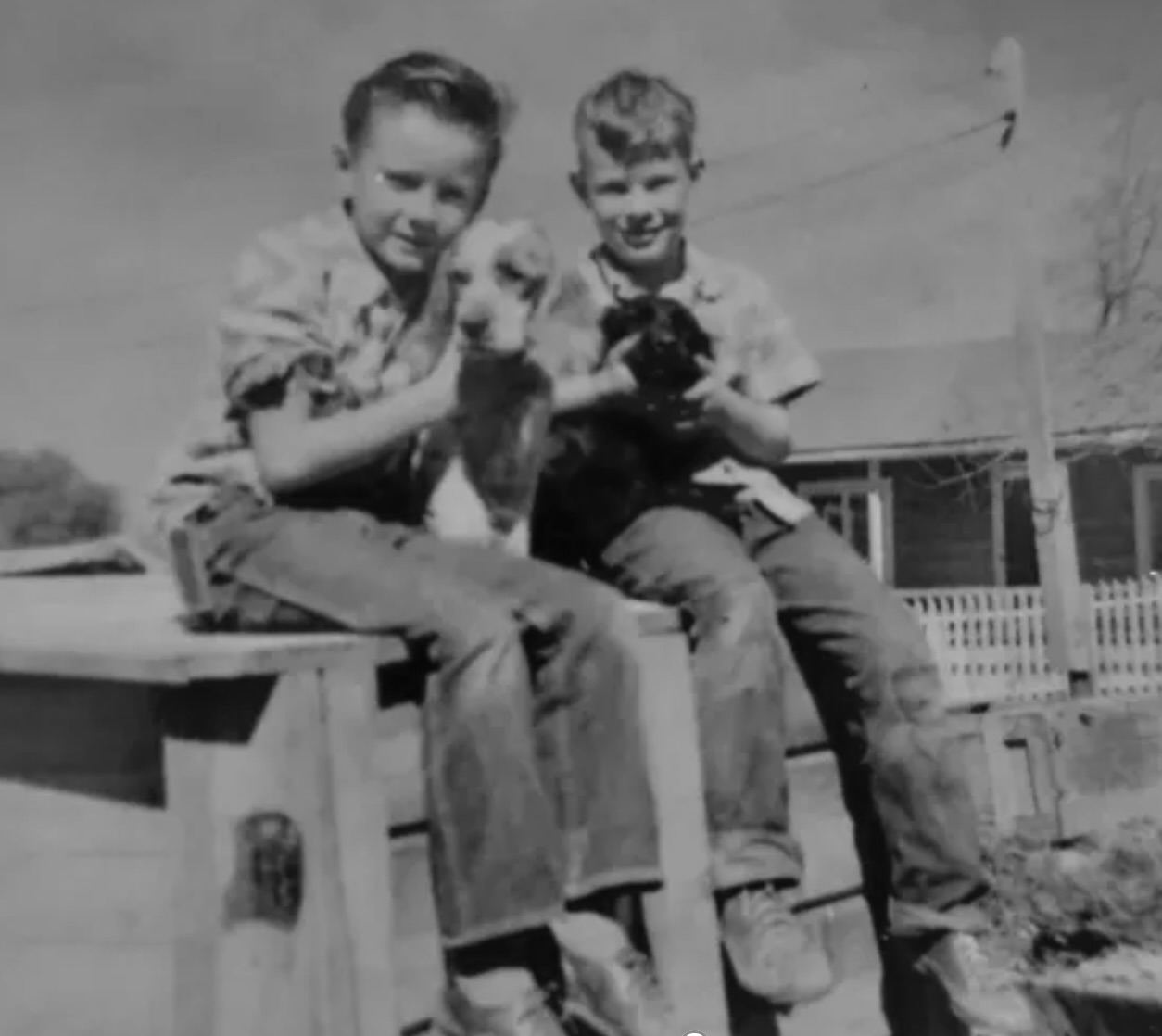
Do these kids, in any way, look like they would have a reputation as trouble makers? Marshall is on the left with Tickle. I’m on the right with one of Coaly’s offsprings. We are sitting on top of the shed our goats lived in. I was in charge of taking care of them. We also had rabbits and chickens. The Passerini’s home is behind us.
While the Pond and the Woods provided an innocent and often educational escape for me, some of my outdoor time was spent getting into mischief, especially in my younger years when I roamed around Diamond and the surrounding countryside with my brother. The primary difference between Marshal and me was that l lacked his creativity. For example, it never would have crossed my mind to put a bullet down on a rock and then smash it with another rock to see what would happen.
What I remember most about these great adventures was that we were skating on the thin edge of trouble. Gradually, we developed a reputation. I am convinced that a whole generation of little kids in Diamond blamed their misbehavior on us. “I didn’t do it Mama, the Mekemson kids did.” And Mama probably believed them. The mother of my life-long friend, Bob Bray, did. She refused to let him play with me. I was a bad influence, guaranteed to lead her son straight into the arms of the law.
Most of our mischief was relatively harmless. Like the gunslingers of the Old West, our reputations far exceeded the reality of our actions.
For example, Jimmy Pagonni lived across the street and had a zero-tolerance policy for us. We lusted after his cherries. He transformed them into wine and every drop was precious. He turned his dogs loose on us if we came anywhere near his orchard. Naturally his insistence on keeping us out only guaranteed our presence. Raids were carefully planned.
We would invite two or three friends over and make a party out of it. The cover was sleeping out in the backyard, but sleep was secondary. Somewhere around one o’clock in the morning we would slip out of our yard, cross a very lonely Highway 49, climb over Jimmy’s rickety gate, make our way up the low hill, and disappear into the trees. It was all very hush-hush and cherries have never tasted more delicious. We would stuff our little stomachs and then fill up bags for take-out. It was pure greed.
Jimmy’s dogs never caught us before we were able to scramble over the gate, but they did catch my cocker spaniel, Tickle, once, and almost kill him. Tickle had been out on the town visiting a lady friend and taken a shortcut across Pagonni’s property. We were infuriated. Marshall retaliated by shooting Jimmy’s bull in the balls with his BB gun. (If not fair to the bull, it was at least alliteration.) Jimmy never knew Marshall committed the heinous act, but I am sure he had his suspicions.
Possibly even more serious from Jimmy’s perspective, an older Marshall (eighth grade I think) helped himself to a sample of Jimmy’s wine one night. Pagonni stored the fermented cherry juice in an old Gold Rush era building that had once served as a jail. It was located right in the middle of his cherry orchard and featured a stout locked door and one barred window. I am sure Jimmy considered it impregnable, but he failed to consider just how skinny my brother was. With help from his friend Art, Marshall managed to slip through the bars one night and fill two of Mother’s empty wine bottles from one of Pagonni’s gallon jugs. Marsh then left the partially empty jug in an obvious place for Jimmy to ponder. It must have driven him crazy.
The next afternoon, Marshall and Art headed for our treehouse in the Graveyard to do some serious imbibing, each drinking a full bottle. Considering the potency of Italian Red, Marshall’s share of the booty, almost killed him, not to mention encouraging strange behavior. He described how Mrs. Ross, my 4th 5th and 6th grade teacher, came upon Art and him madly peddling their bikes. This wouldn’t have been strange except they were lying on their backs holding the bikes above them in the air! “She just shook her head and moved on,” Marsh said.
I remember him slipping in the back door that evening and trying to get to our bedroom before Mother and Pop noticed. It didn’t work. In addition to stumbling and mumbling and heaving, he smelled like a three-week gutter drunk. He was one sick kid. Both parents hurried to the bedroom out of concern and I moved back outside to sleep in the cool, but fresh fall air. It was one of those crimes that incorporates its own punishment.
We weren’t really bad kids, just adventuresome with our adventures occasionally bordering on juvenile delinquency. Caldor Lumber Company was a favorite target of ours since it provided a myriad of opportunities for weekend and after-school exploration. Twenty-foot high stacks of drying lumber were made for climbing and the truly bold might leap from one to another. The appropriately named Big Shed was filled with these stacks but I was much more fascinated by the number of owls that lived there and provided burped up scat for my natural history collection. The millpond featured floating logs that Marshall ventured out on lumberjack style, but I avoided. Not even a triple dare, or worse, older brother scorn, could tempt me into a possible dunking in the pond’s dark, murky waters.
All of these activities paled in comparison to joy riding on rail pushcarts. Caldor had narrow gauge rail lines snaking through its drying yards and used pushcarts for transporting heavy items. We quickly discovered that three or four of us could get a cart rolling. We would then jump on for a free ride. Small downhills added a thrill factor. Fortunately, hand brakes on the carts enabled us to stop the carts before running into the stacked railroad ties that marked the end of the line. Except once.
Our nemesis at Caldor was an old fellow who had been in some type of mill related accident and left with a limp. Caldor made him the night and weekend watchman so he could continue to make a living. We provided him with something to do in an otherwise uneventful job. Sneaking up on us seemed to be a true passion of his. We kept a wary eye out. It was inevitable that he would catch us on a pushcart ride and he caught us at the most exciting point, just as it was gaining speed going downhill.
“Hey you kids, get off of that pushcart!” he yelled as he hurried after us at a slow limp.
What were we to do? We jumped off of the pushcart and high-tailed it for the Woods, which were right next door. The pushcart, meanwhile, continued to gather speed, slammed into the ties and did a spectacular flip before sliding off down a small hill. We were duly impressed and so, apparently, was the watchman, who let out a string of obscenities as we disappeared into the pines. Pop mentioned the next day that the watchman had reported to him that the kids involved in the incident looked like us. We carefully explained that some kids from Placerville had been in town and were undoubtedly responsible.
A more serious threat arrived on our doorstep in the form of a Southern Pacific Railroad detective who claimed Marshall had been pulling spikes out of the railroad trestle over Webber Creek and throwing them into the stream. Marshall put on his ‘I’m outraged act.’ Yes, he had been throwing spikes off of the trestle into the creek below. But he would never dream of doing anything that would cause physical harm to anyone (unless they deserved it). The spikes came from piles of them left over from when Caldor had switched to logging trucks. Had the detective bothered to check to see if any spikes were missing from the trestle? No. Had he contemplated the possibility of a skinny 90-pound 12 year old kid being able to physically pull out the spikes? No. The case was closed.
While Marshall’s innocence was sustained for once, the experience had the unfortunate consequence of eliminating the trestle as a place to play. Walking across and staring down between the railroad ties at the 50-foot drop to Weber Creek was a sure cure for summer boredom, as was contemplating the arrival of a train when we were in the middle of the trestle. If that wasn’t exciting enough, we could always walk across on the narrow plank that ran under the tracks. There were no safety railings. I once stood on it as a train roared above me. That was interesting.
My next post: Raw Sex, the Nuclear Holocaust, and Being Bonked by a Baseball: UT-OH: Chapter 11
Night tours are big in Monteverde, Costa Rica. Every corner seems to advertise one. Take a dash of the exotic, throw in a pinch of danger, add a competent, knowledgeable guide— and how can one resist? No wonder there were at least 10 companies to choose from. There is big money to be made. We paid our $300 and off we went. We had an excellent guide, Marvin. He found us each of the big three, don’t mess with me, attractions, plus more.
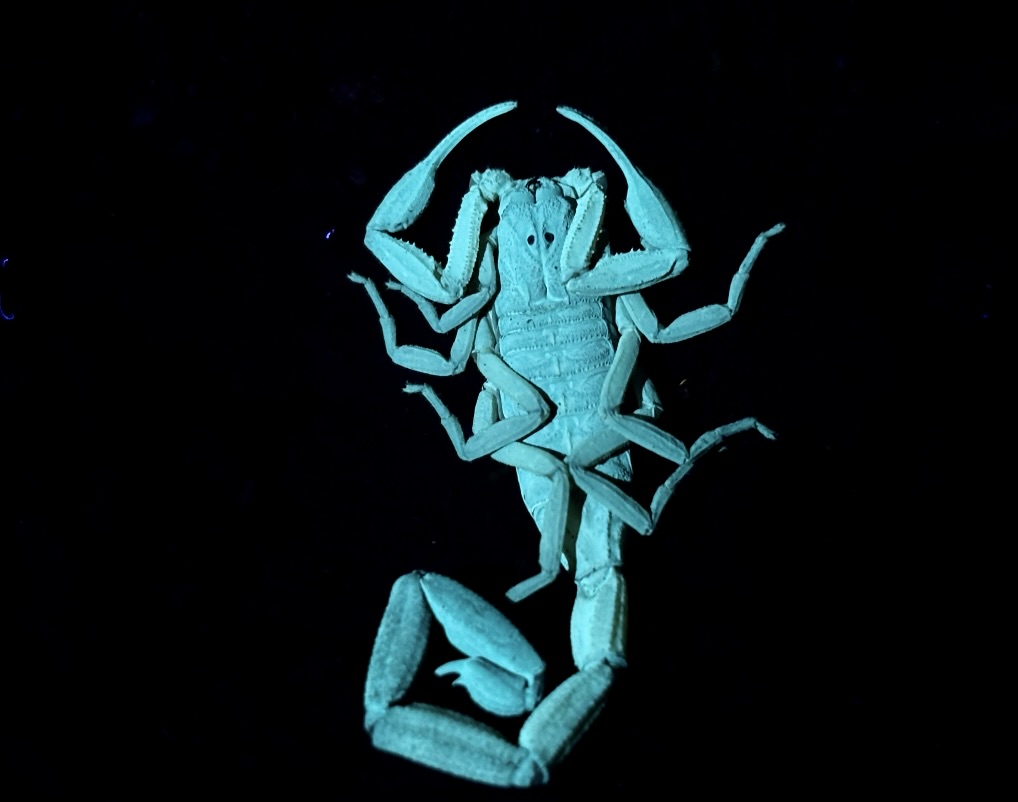
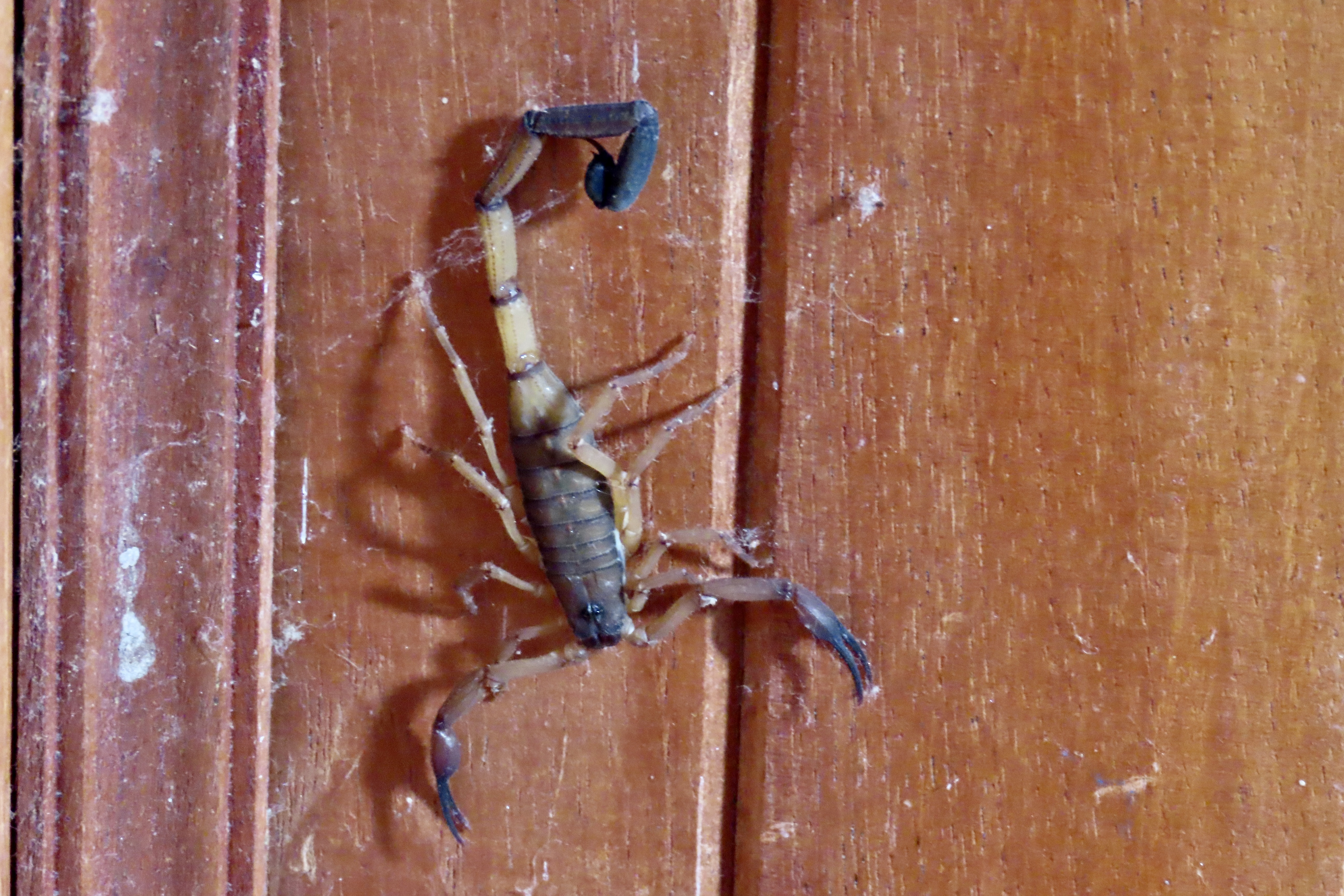
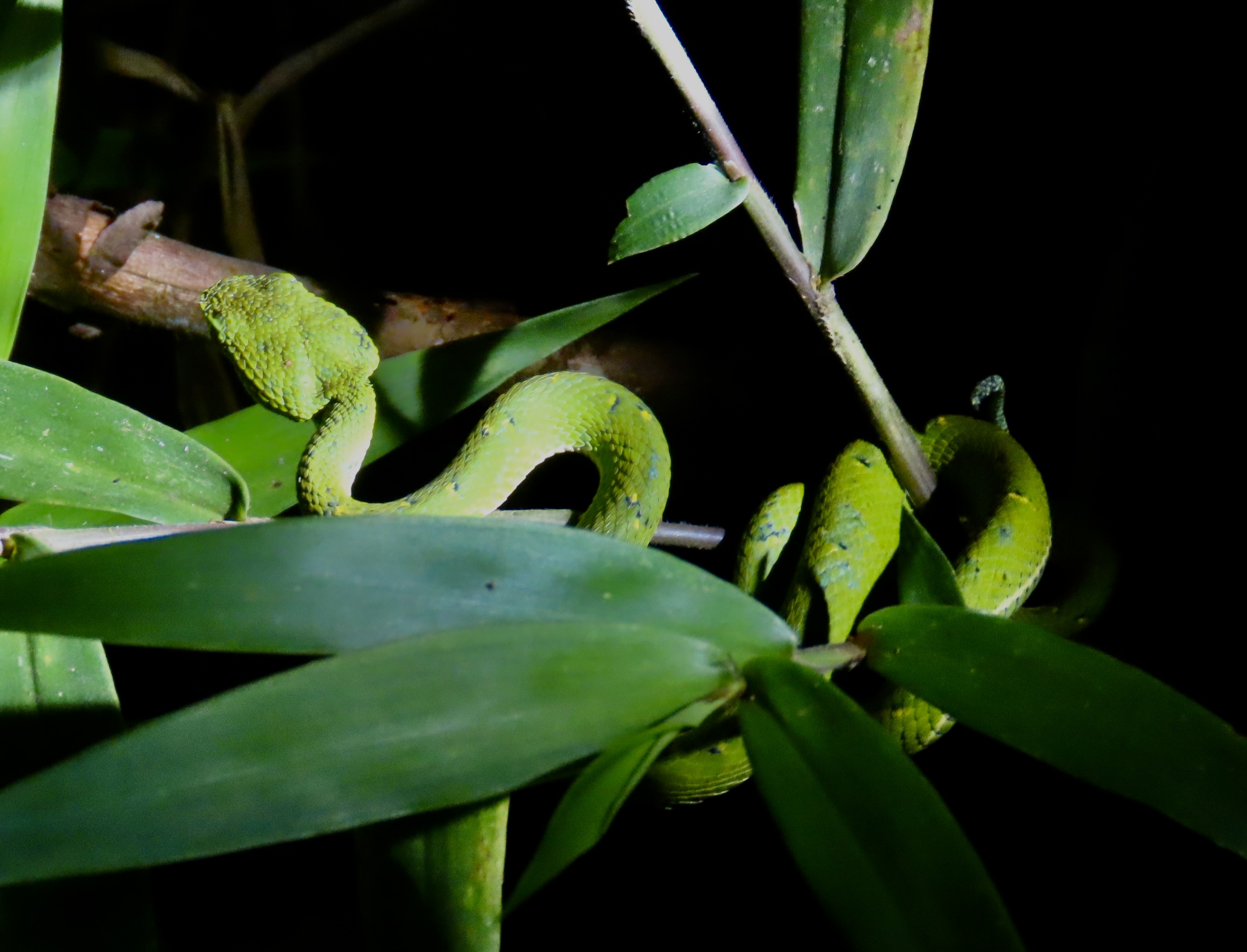
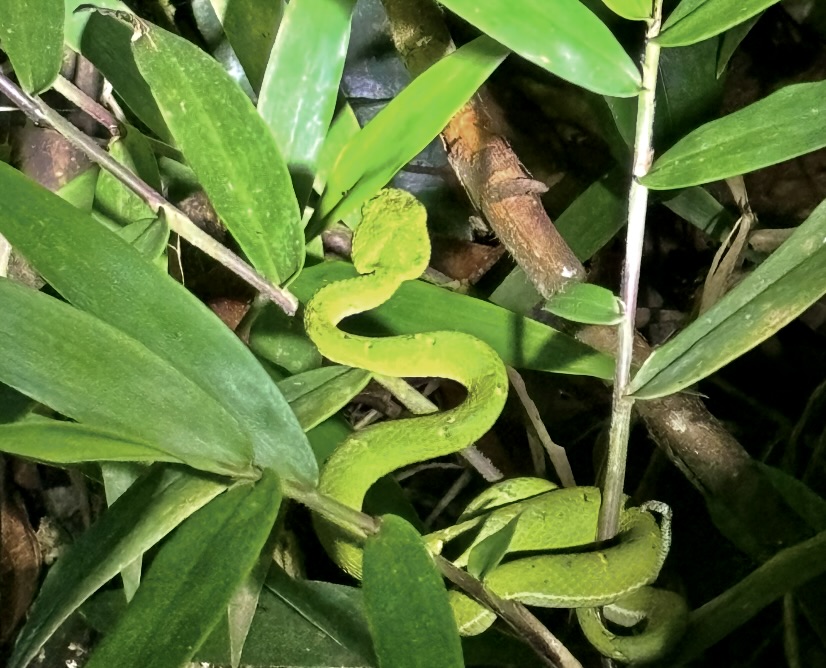
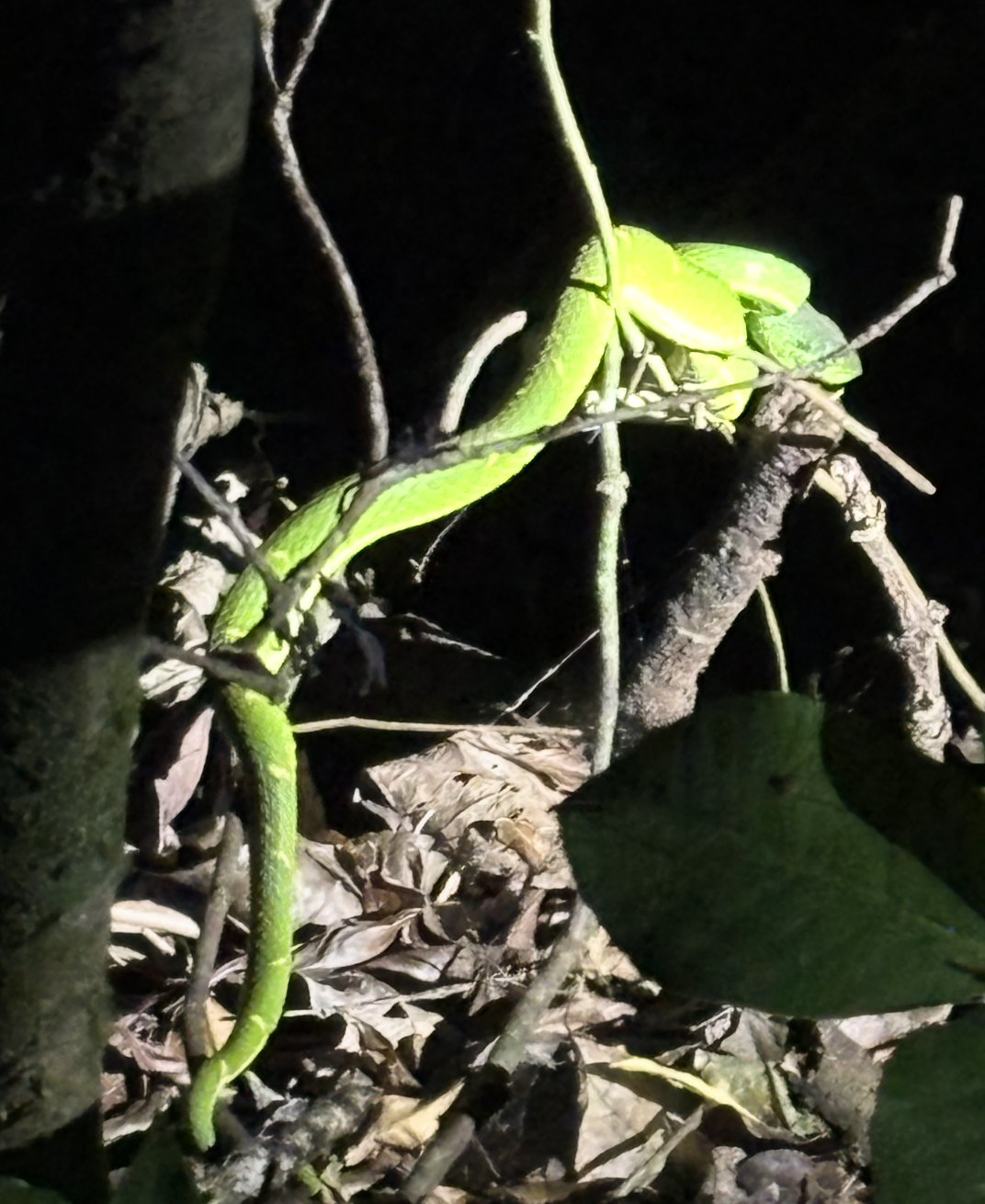
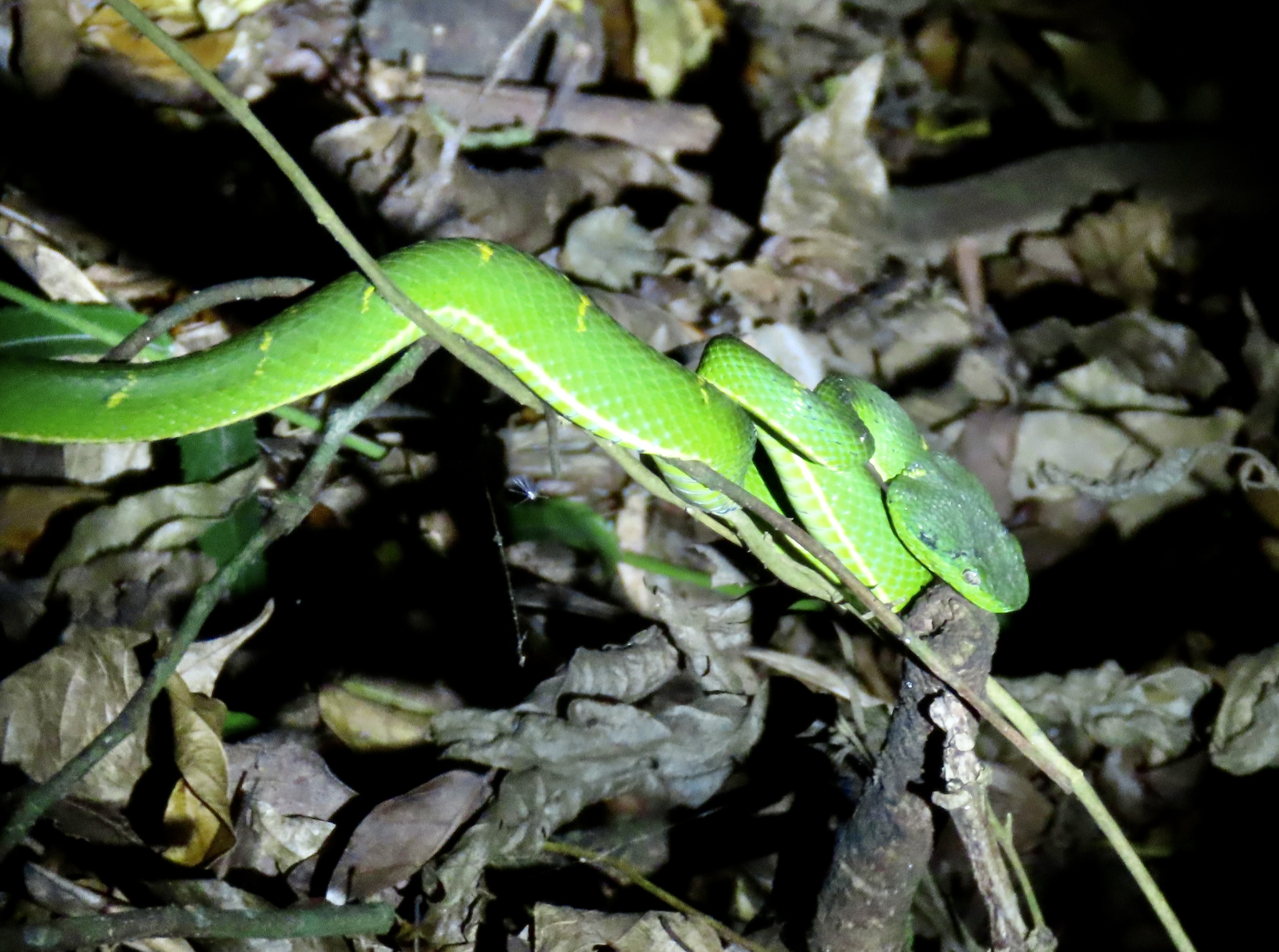
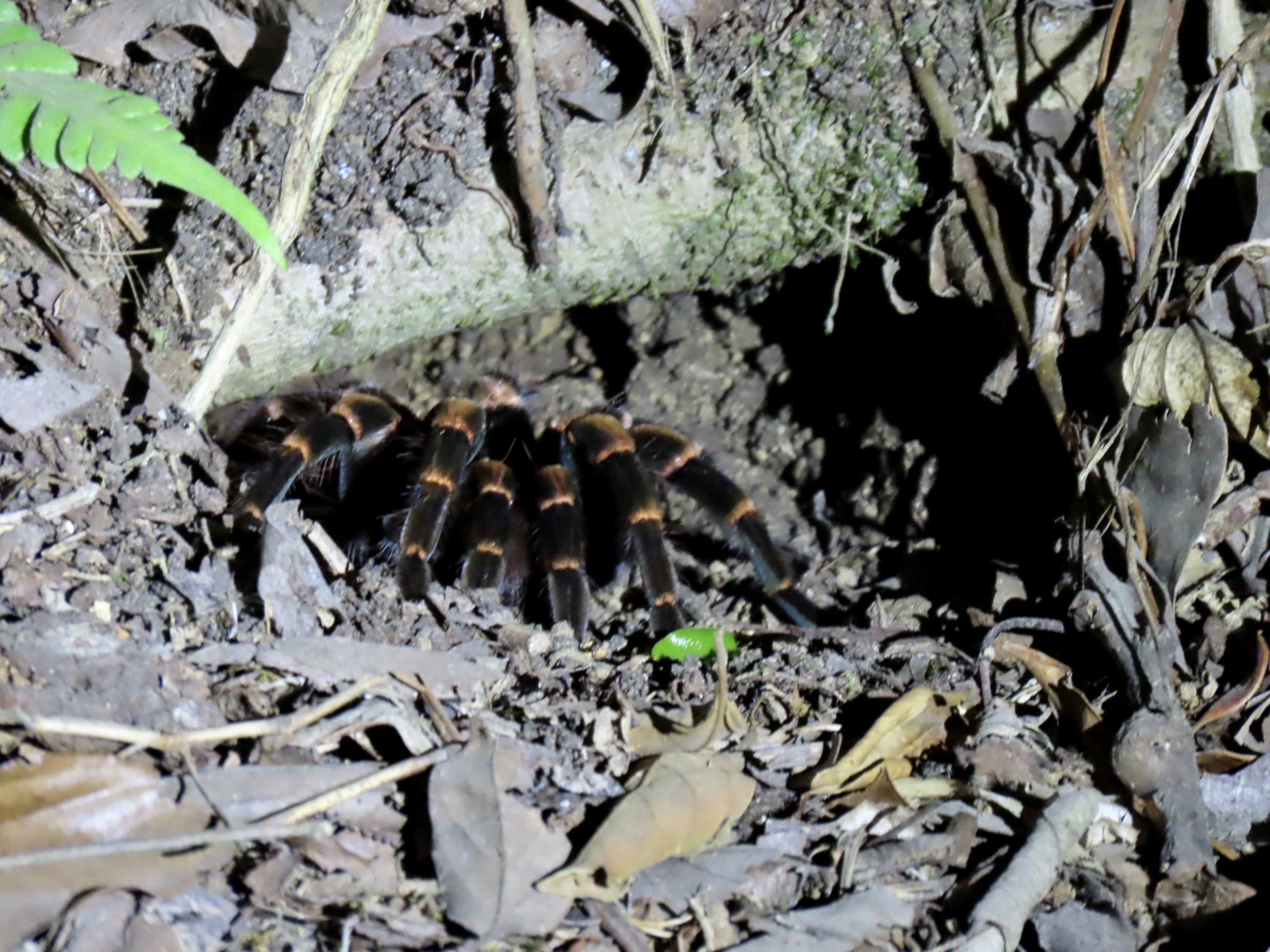
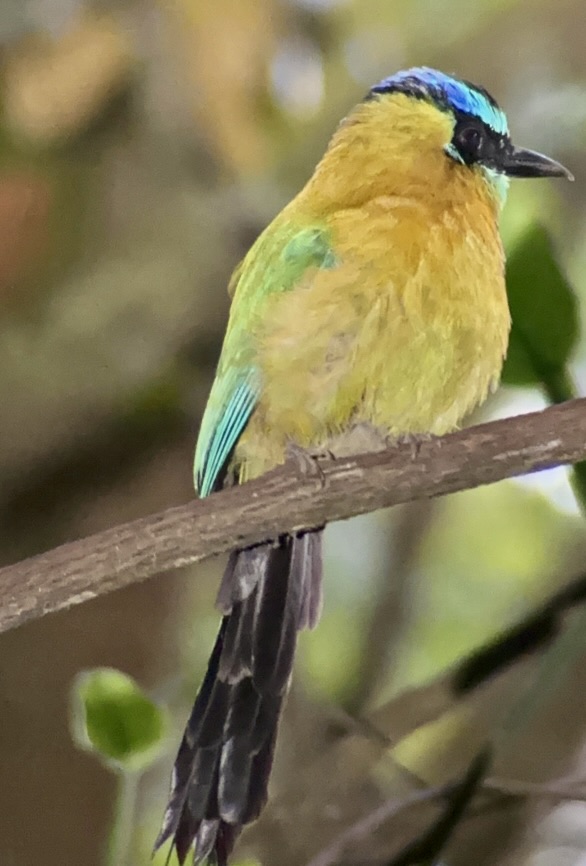
This iridescent, blue-green fellow was one of the creatures we came across. Actually, our youngest grandson, Cooper, spotted it first. Our son Tony claimed ‘That’s because Cooper is closest to the ground.” You will recognize this blue-green insect for what he is. A scorpion. I’ve seen many over the years. But never one of this striking color. They all pack a mean sting. Costa Rica claims that no one has ever died in the country from a scorpion. Well, except for that one girl…This one seemed almost tame in comparison. Our grandson, Chris, found it crawling up the wall behind him where he was watching TV at our VRBO. “Grandpa,” he yelled, “You have to see this.” “Well, hello,” I said, to the scorpion, and sent Chris scurrying for something to catch it with. He came back with a martini glass, i.e. large top, shallow bottom. Not ideal for catching something that packs a wallop in its tail, but great for a double martini if you get stung. Make it a triple. I slapped it over the top of scorpion but missed the offending appendage. It was swishing around trying to find me. I turned the glass right side up and he slid to the bottom, looking thoroughly peeved. “Just be glad it’s me,” I told him. “Anyone else and you’d be a grease spot on the wall.” It waved its tail at me in a single digit salute. I took him over to our balcony and tossed him out of the glass into the shrubs below. Chris, Peggy and I made a pact not to tell anyone else in our household. Mom might have had them packing.Next, on our pitch dark night, Marvin found a baby green pit viper known by the scientific name of Bothriechis lateralis, or if you prefer something you can pronounce, a side-striped palm pit viper. Apparently, they like to hang out in palms. Note its distinctive triangle shaped head: A sure sign you are dealing with a viper. Translate poisonous. There would be no trying to catch it! Least of all in a martini glass. I took this photo.Marvin, carried a spotting scope that gave us another view of the side-striped palm viper. He used Tony’s cell phone to take a photo through the scope. Here, you can see the stripe along its side. We each carried flashlights so we could see the trail plus light up whatever we wanted photos of. Not too far down the trail, we found an adult side-striped palm viper and Marvin took this photo through his spotting scope.I focused in on the upper part of its body. The viper, like New World monkeys, has a prehensile tail. It can use it to wrap around a limb while it dangles and relaxes. Or, he can whip it out to wrap around and retrieve dinner in the form of lizards and small rodents. While poisonous, few people die from its bite. Not so the lizards or a tasty mouse. The final member of our trio, a Costa Rican zebra tarantula, also known as the striped-knee tarantula. Peggy took this photo. These large spiders dig deep burrows into the ground which helps regulate temperatures. It’s reported that they often live together in large numbers. One was enough for us, but I must say, it was quite striking.Just so this post doesn’t give you nightmares, our night tour also produced less threatening species. This is Lesson’s Motmot seen through Marvin’s spotting scope. An owl butterfly. Marvin told us it was one of the largest butterflies in Costa Rica. It has large spots on the lower parts of its wings that resemble owl’s eyes when its wings are open.
Next up, the Mekemson Kids Did It: Something go wrong in Diamond Springs? Who do you blame? Like the gunslingers of the Old West, we developed a reputation that far exceeded our capacity for mischief.
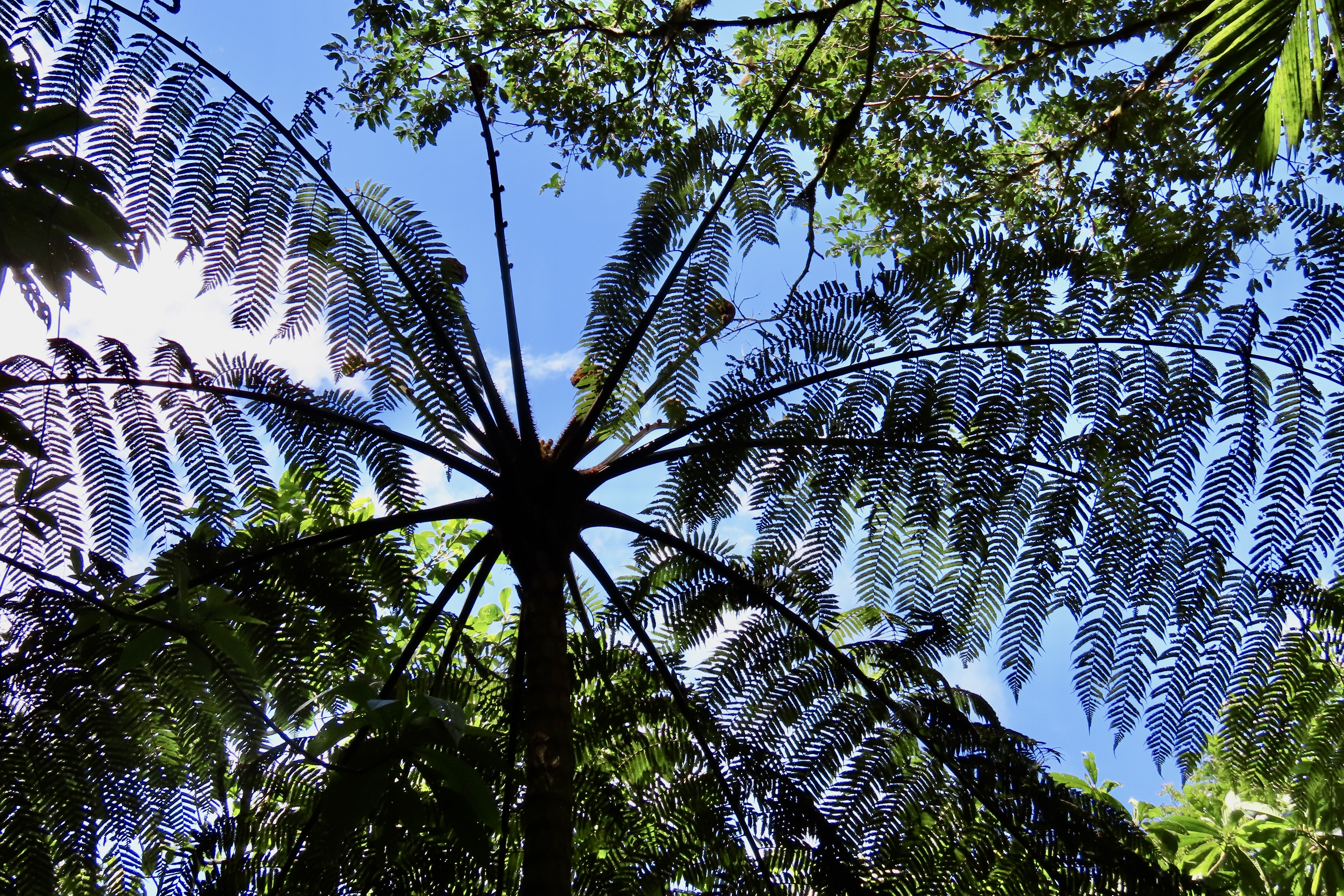
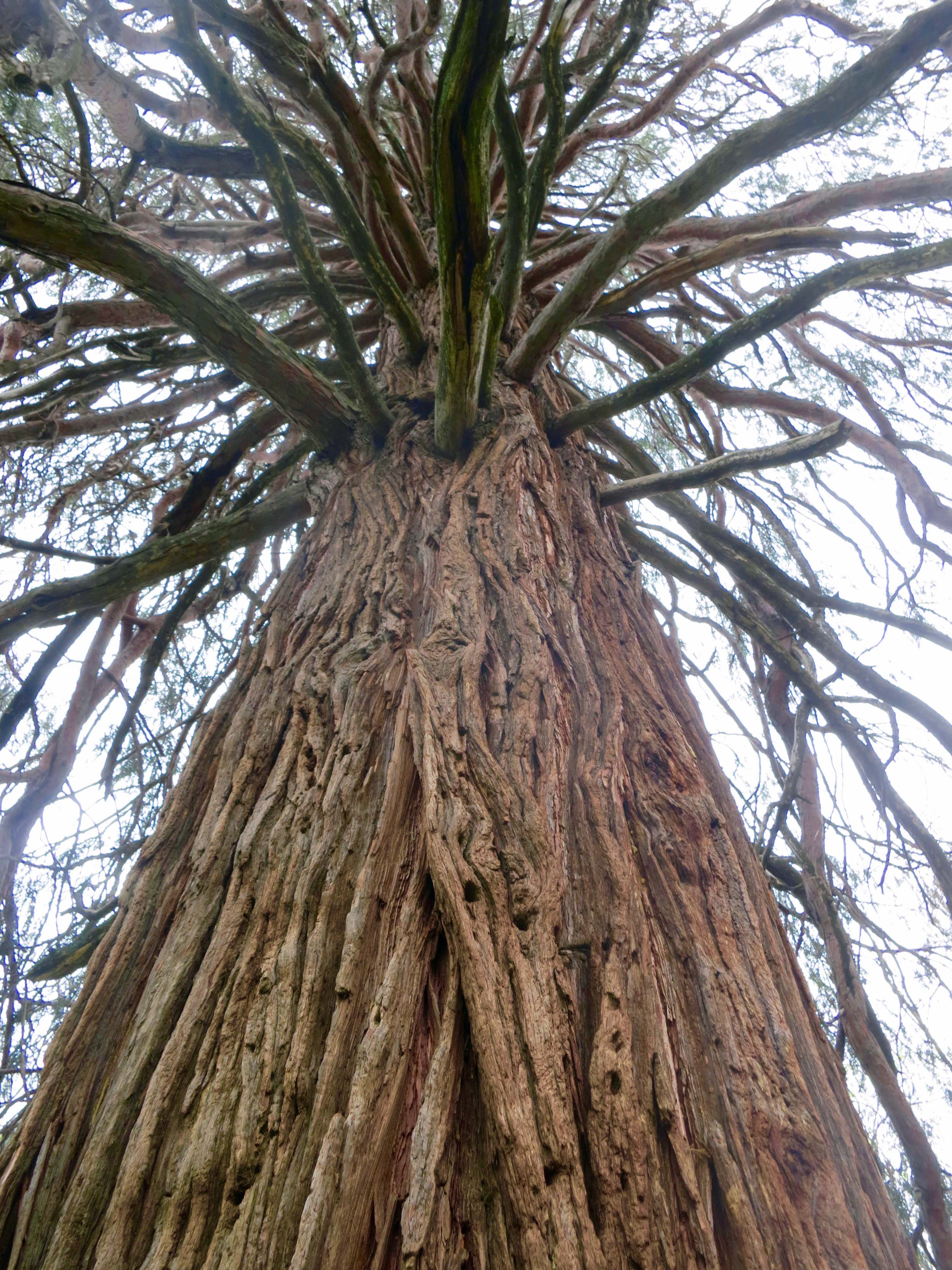
I mentioned in my last post that there were no photos of the Pond or the Woods. They were victims of the endless march of ‘civilization.’ Fortunately, and I should add, so far, there are still wild places on earth. Costa Rica has many. Some, such as Monteverde, are attracting hordes of tourists. There’s good and bad news here. Among the good is that the tourists provide Costa Rica with a welcome source of income and the opportunity for the tourists to enjoy the beauty and wildlife of Costa Rica. The bad news is the incredible commercialization that goes along with it and the impact. It’s similar to when the large cruise ships drop thousands of people onto the small Greek Island of Santorini, or our most popular National Parks in America turn into traffic jams in the summer. But enough on that. The tree above was a new one to me, a fern tree. There are more photos below after my UT-OH chapter on the Woods.
Part 2: The Woods
The Woods, like the Pond, earned a capital letter. To get there I walked out the back door, down the alley past the Graveyard, and through a pasture Jimmy Pagonni rented for his cattle. Tackling the pasture involved crawling through a rusty barbed wire fence, avoiding fresh cow pies, climbing a hill, and jumping an irrigation ditch. The journey was fraught with danger. Hungry barbed wire consumed several of my shirts and occasionally went for my back.
Torn clothing and bleeding scratches were a minor irritation in comparison to stepping in fresh cow poop, though. A thousand-pound, grass-eating machine produces acres of the stuff. Deep piles sneak up your foot and slosh over into your shoes. Toes hate this. Even more treacherous are the little piles that hide out in the grass. A well-placed patty can send you sliding faster than black ice. The real danger here is ending up with your butt in the pile. I did that, once. Happily, no one was around to witness my misfortune, or hear my language, except Tickle the Dog. I swore him to secrecy. He knew many of my secrets. It’s a damned good thing he couldn’t talk.
For all of its hazards, the total hike to the Woods took about 15 minutes. Digger pines with drunken windmill limbs guarded the borders while gnarly manzanita and spiked chaparral dared the casual visitor to venture off the trail. Poison oak proved more subtle but effective in discouraging exploration.
I could count on raucous California jays to announce my presence, especially if I was stalking a band of notorious outlaws. Ground squirrels were also quick to whistle their displeasure. Less talkative jackrabbits merely ambled off upon spotting me, put on a little speed for a hyper Cocker, and became bounding blurs in the presence of a hungry greyhound. Flickers, California quail and acorn woodpeckers held discussions in distinctive voices I soon learned to recognize.
From the beginning, I felt at home in the Woods, like I belonged. I quickly learned that its hidden recesses contained a multitude of secrets. I was eager to learn what they had to teach me, but the process seemed glacial. It required patience and I hardly knew how to spell the word. I did know how to sit quietly, however. This was a skill I had picked up from the hours I spent with my nose buried in books. The woodland creatures prefer their people noisy. A Curt stomping down the trail, snapping dead twigs, and talking to himself was easy to avoid, while a Curt being quiet might surprise them.
One gray squirrel was particularly loud in his objections. He lived in the top branches of a digger pine beside the trail and maintained an observation post on an overhanging limb. When he heard me coming, he would adopt his ‘you can’t see me gray squirrel playing statue pose.’ But I knew where to look. I would find a comfortable seat and stare at him. It drove him crazy. Soon he would start to thump the limb madly with his foot and chirr loudly. He had pine nuts to gather, a stick home to remodel, and a bright-eyed, bushy-tailed lady to woo. I was blocking progress. Eventually, if I didn’t move, his irritation would bring him scrambling down the trunk for an up-close and personal scolding.
After about 10 minutes of continuous haranguing, he’d decide I was a harmless, if obnoxious aberration and go about his business. That’s when I begin to learn valuable secrets, like where he hid his pine nuts. It was also a sign for the rest of the wildlife to come out of hiding. A western fence lizard might work its way to the top of the dead log next to me and start doing push-ups. Why, I couldn’t imagine. Or perhaps a thrush would begin to scratch up the leaves under the manzanita in search of creepy tidbits. The first time I heard one, it sounded like a very large animal interested in little boy flesh.
Occasionally there were special treats: A band of teenage gray squirrels playing tag and demonstrating their incredible acrobatics; a doe leading its shy, speckled fawn out to drink in the small stream that graced the Wood’s meadow; a coyote sneaking up on a ground squirrel hole with an intensity I could almost feel.
I also began to play at stalking animals. At some point in time between childhood and becoming a teenager, I read James Fennimore Cooper and began to think I was a reincarnation of Natty Bumppo. Looking back, I can’t say I was particularly skilled, but no one could have told me so at the time. At least I learned to avoid dry twigs, walk slowly, and stop frequently.
Occasionally, I even managed to sneak up on some unsuspecting woodland creature.
If the birds and the animals weren’t present, they left signs for me. There was always the helter-skelter pack rat nest to explore. Tickle liked to tear them apart, quickly sending twigs flying in all directions. There were also numerous tracks to figure out. Was it a dog or coyote that had stopped for a drink out of the stream the night before? Tickle knew instantly, but I had to piece it together. A sinuous trail left by a slithery serpent was guaranteed to catch my attention. This was rattlesnake country. Who’d been eating whom or what was another question? The dismantled pinecone was easy to figure out, but who considered the bark on a young white fir a delicacy? And what about the quail feathers scattered haphazardly beside the trail?
Scat, I learned, was the tracker’s word for shit. It offered a multitude of clues for what animals had been ambling down the trail and what they had been eating. There were deer droppings and rabbit droppings and mouse droppings descending in size. Coyotes left their distinctive dog-like scat but the presence of fur suggested that something other than dog food had been on the menu. Some scat was particularly fascinating, at least to me. Burped up owl pellets provided a treasure chest of bones— little feet, little legs and little skulls that grinned back with the vacant stare of slow mice.
While Tarzan hung out in the Graveyard and pirates infested the Pond, mountain men, cowboys, Indians, Robin Hood and various bad guys roamed the Woods. Each bush hid a potential enemy that I would indubitably vanquish. I had the fastest two fingers in the West and I could split a pine nut with an imaginary arrow at 50 yards. I never lost. How could I? It was my fantasy.
Daydreams were only a part of the picture. I fell in love with wandering in the Woods and playing on the Pond. There was an encyclopedia of knowledge available and a multitude of lessons about life. Learning wasn’t a conscious effort, however; it was more like absorption. The world shifted for me when I entered the Woods and time slowed down. A spider with an egg sack was worth five minutes, a gopher pushing dirt out of its hole, 20, and a deer with a fawn, a lifetime.
It isn’t surprising that I became known as Nature Boy by my classmates, given all the time I spent in the woods. I considered it a compliment.
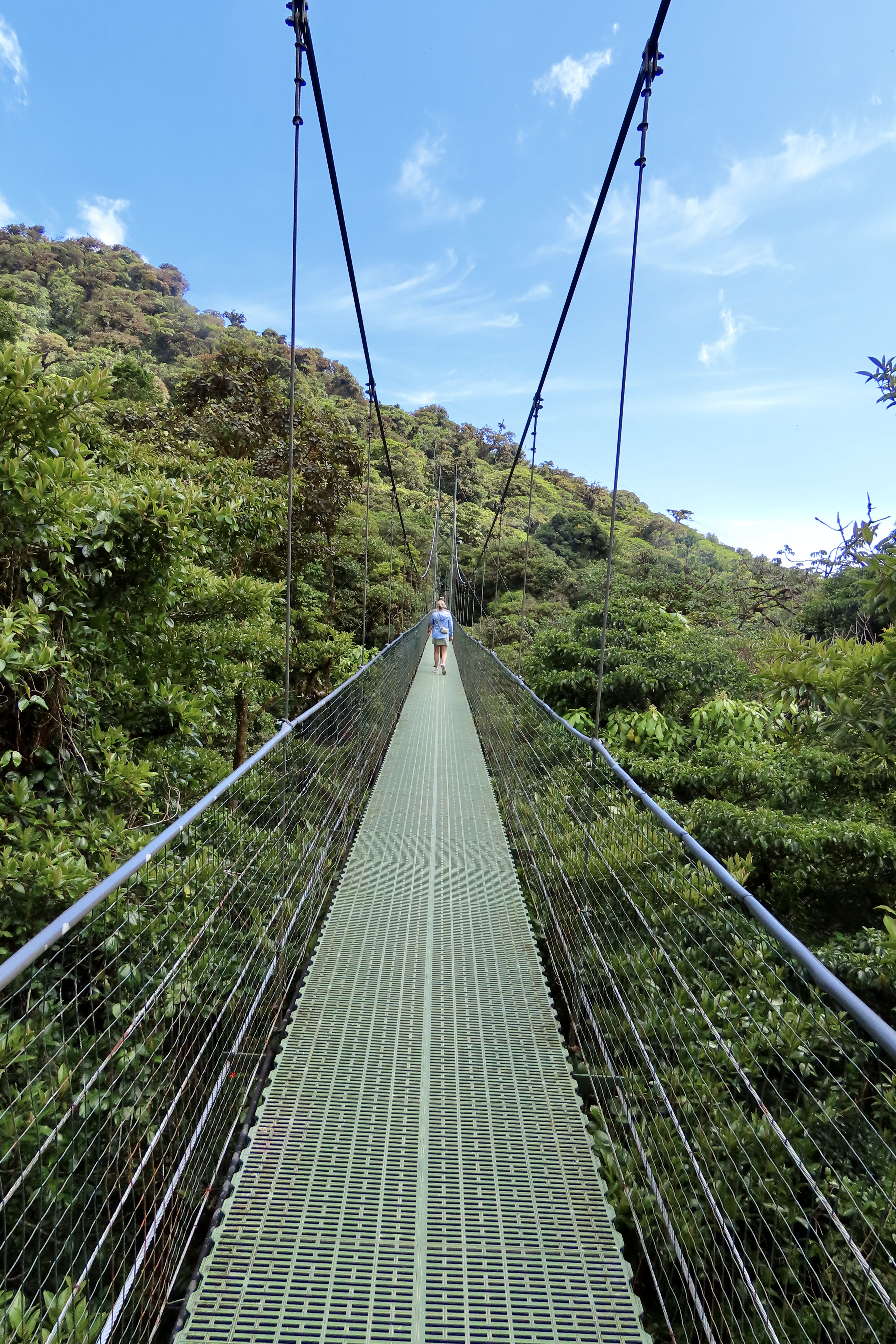
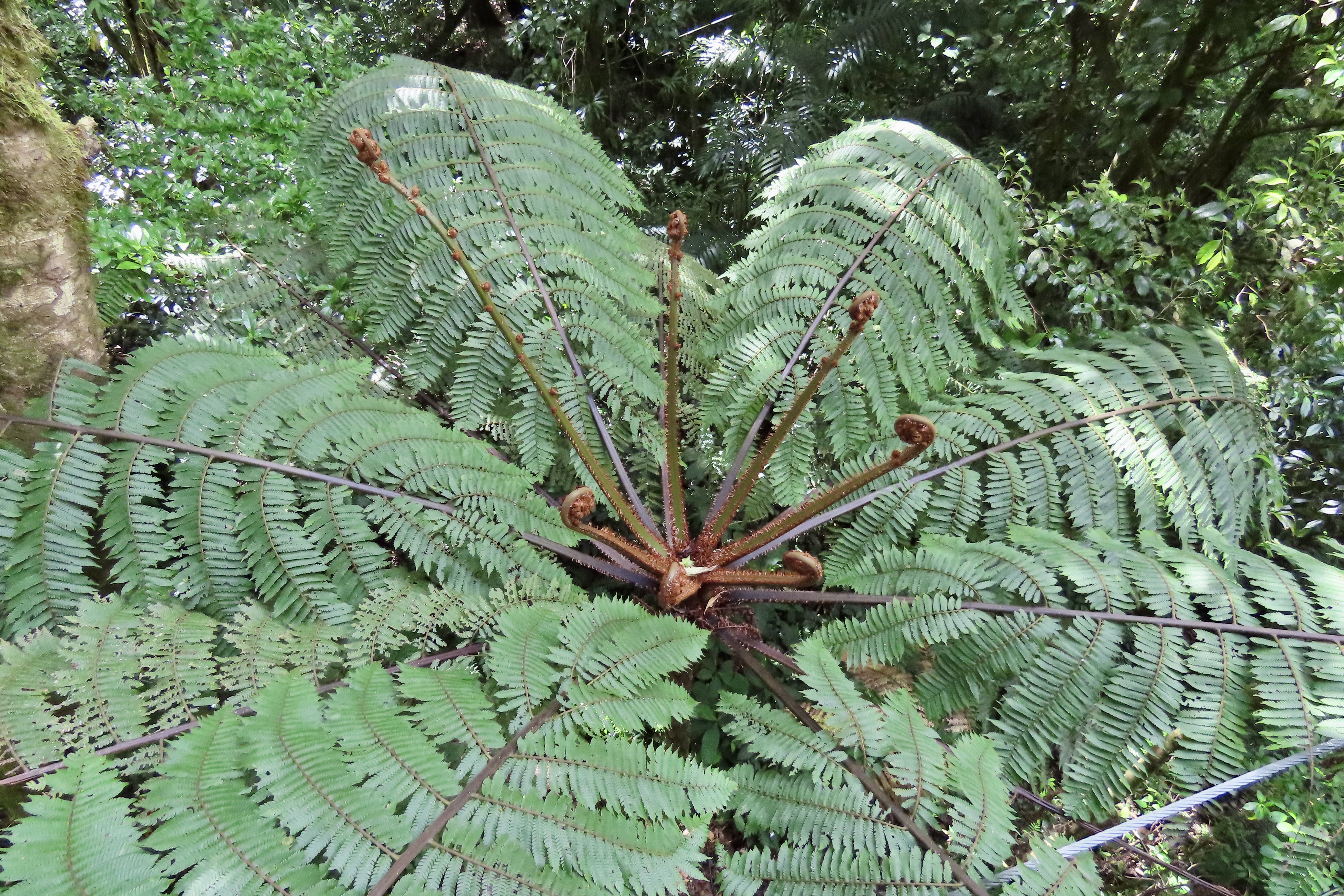
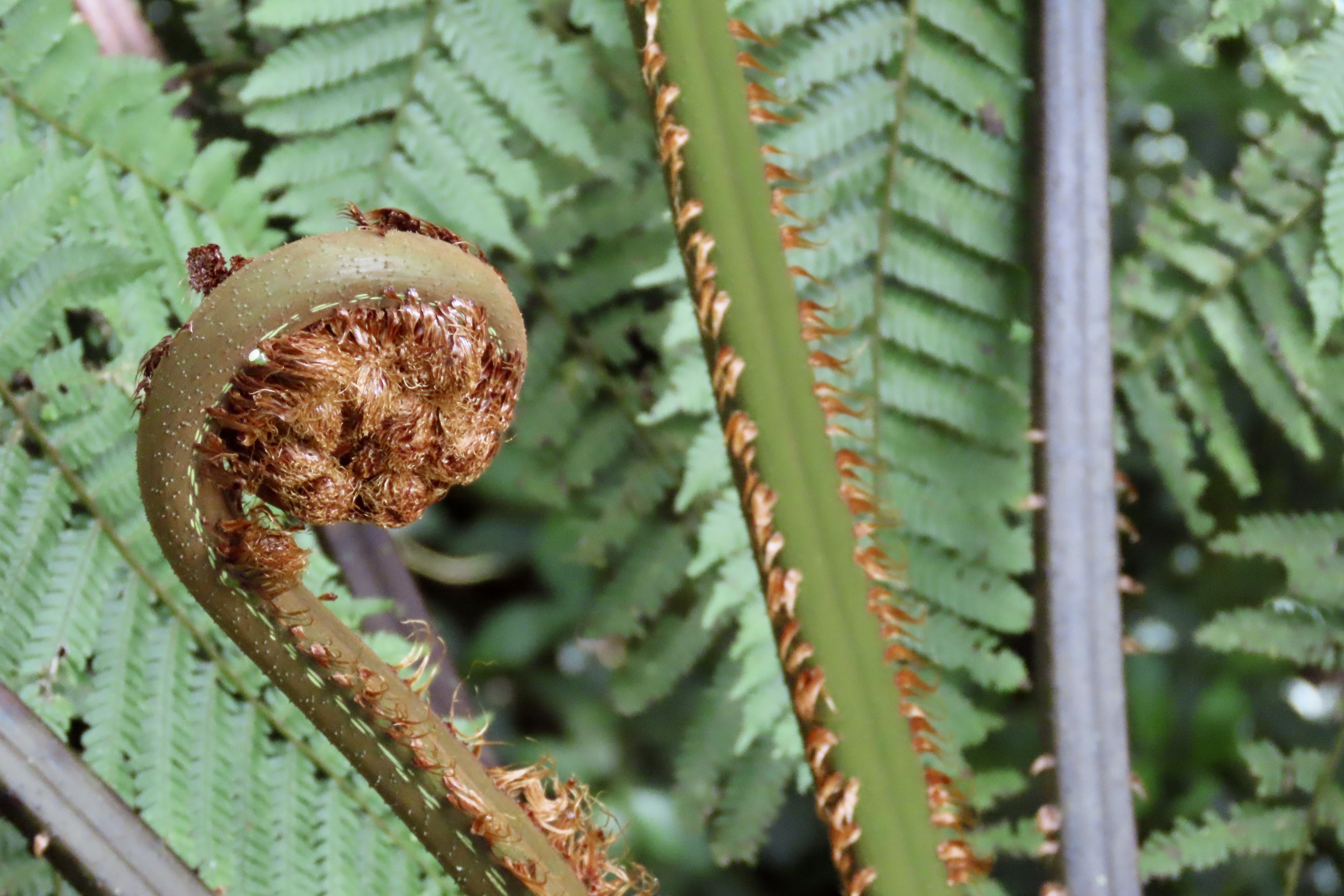
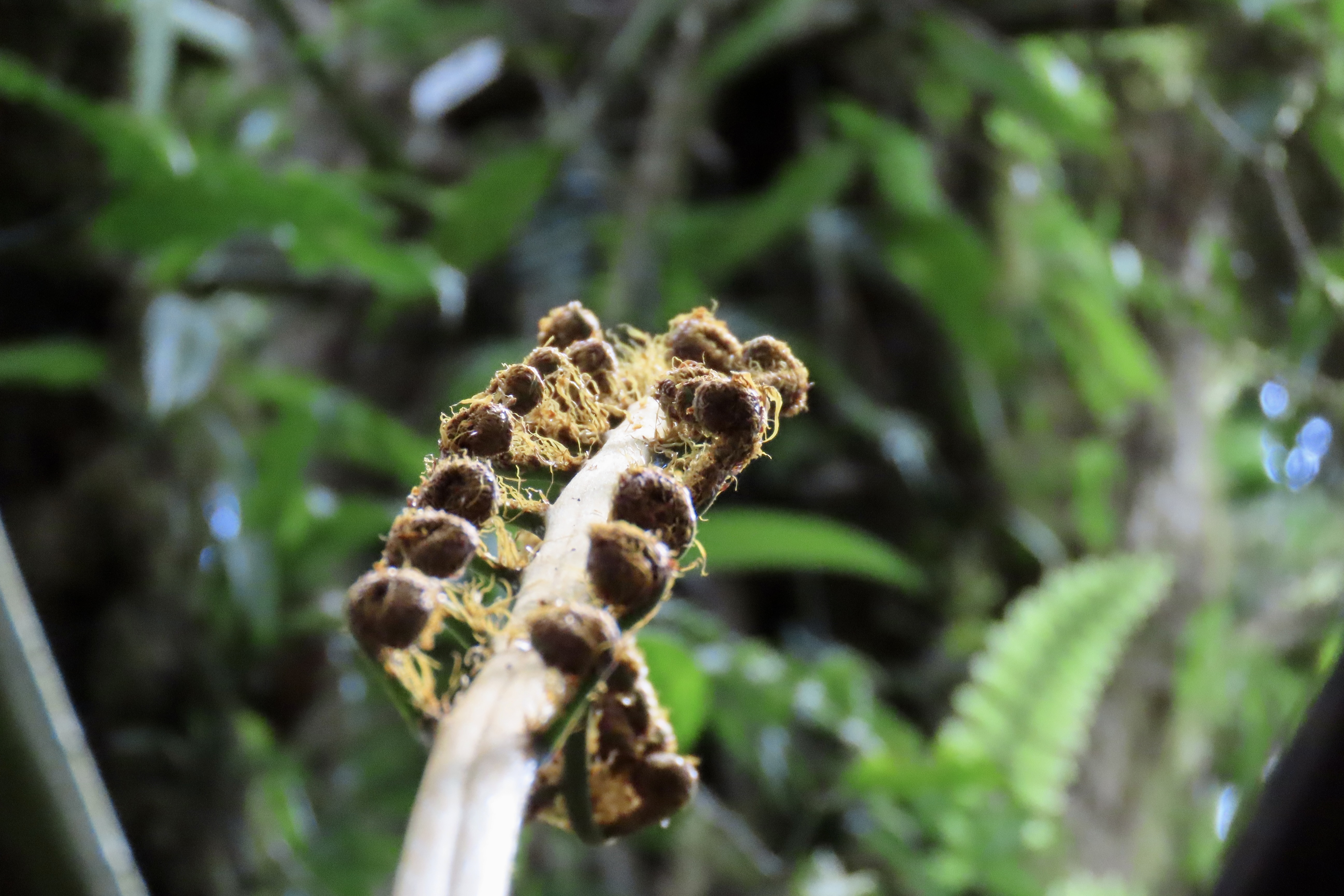
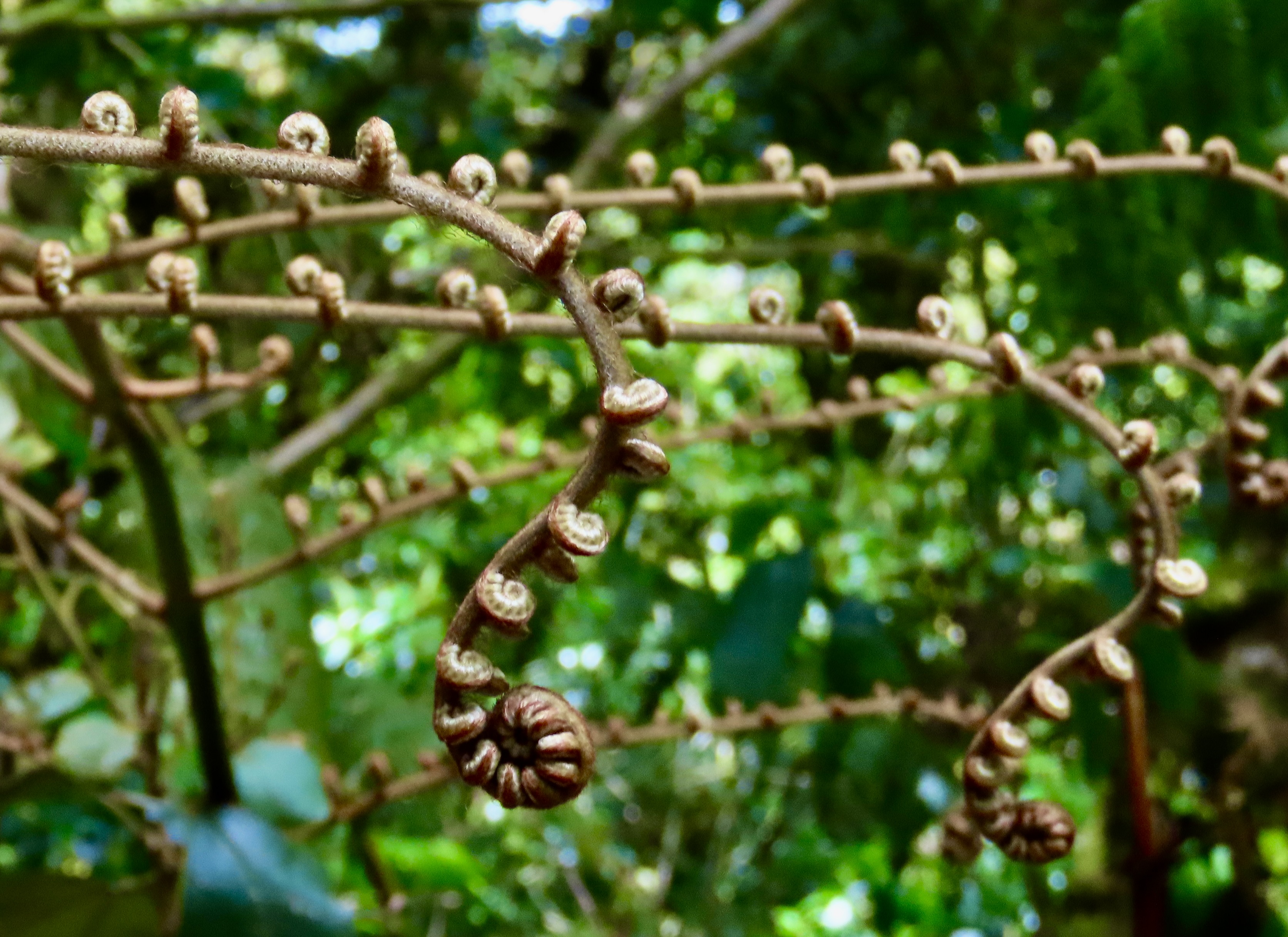
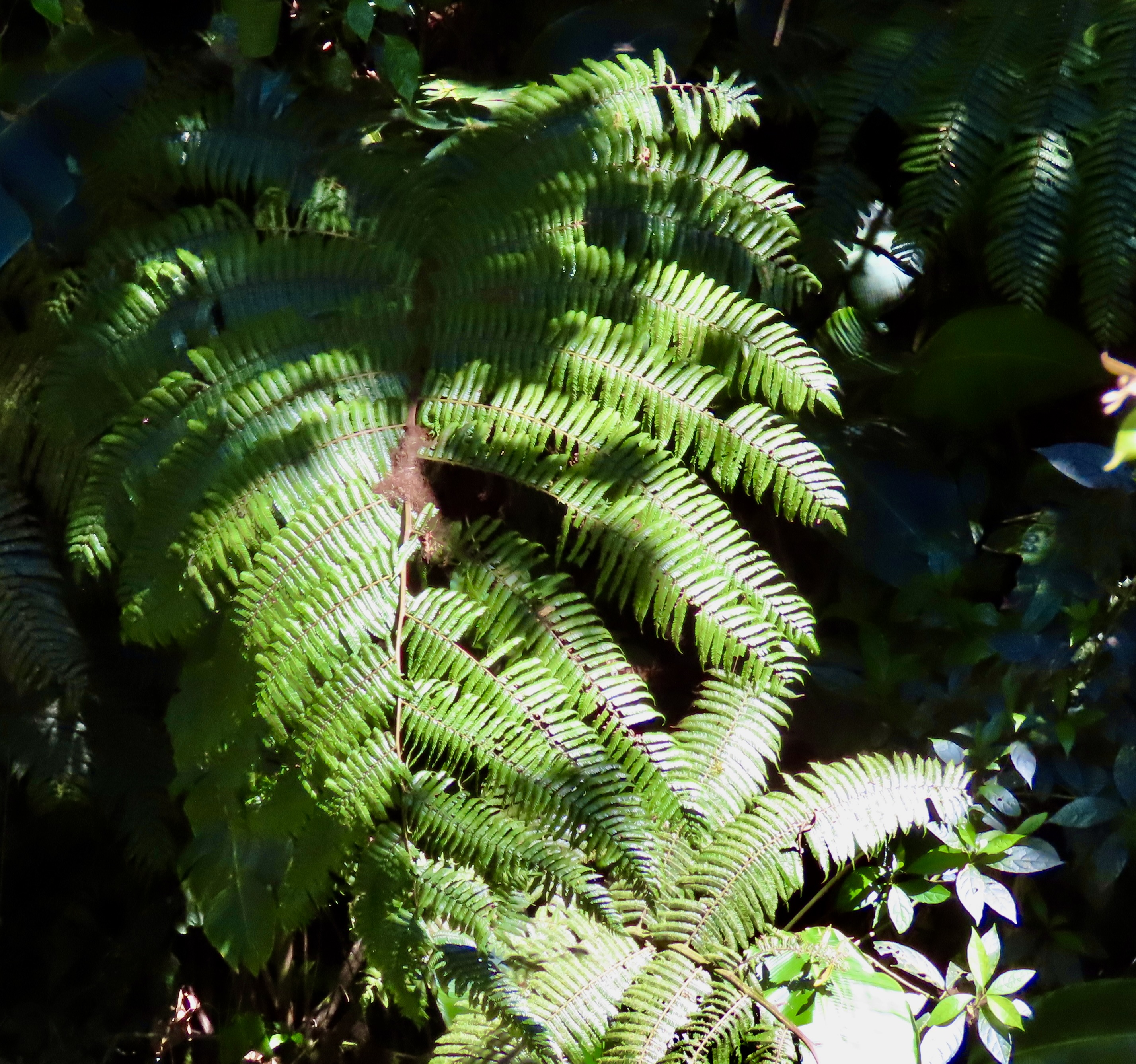
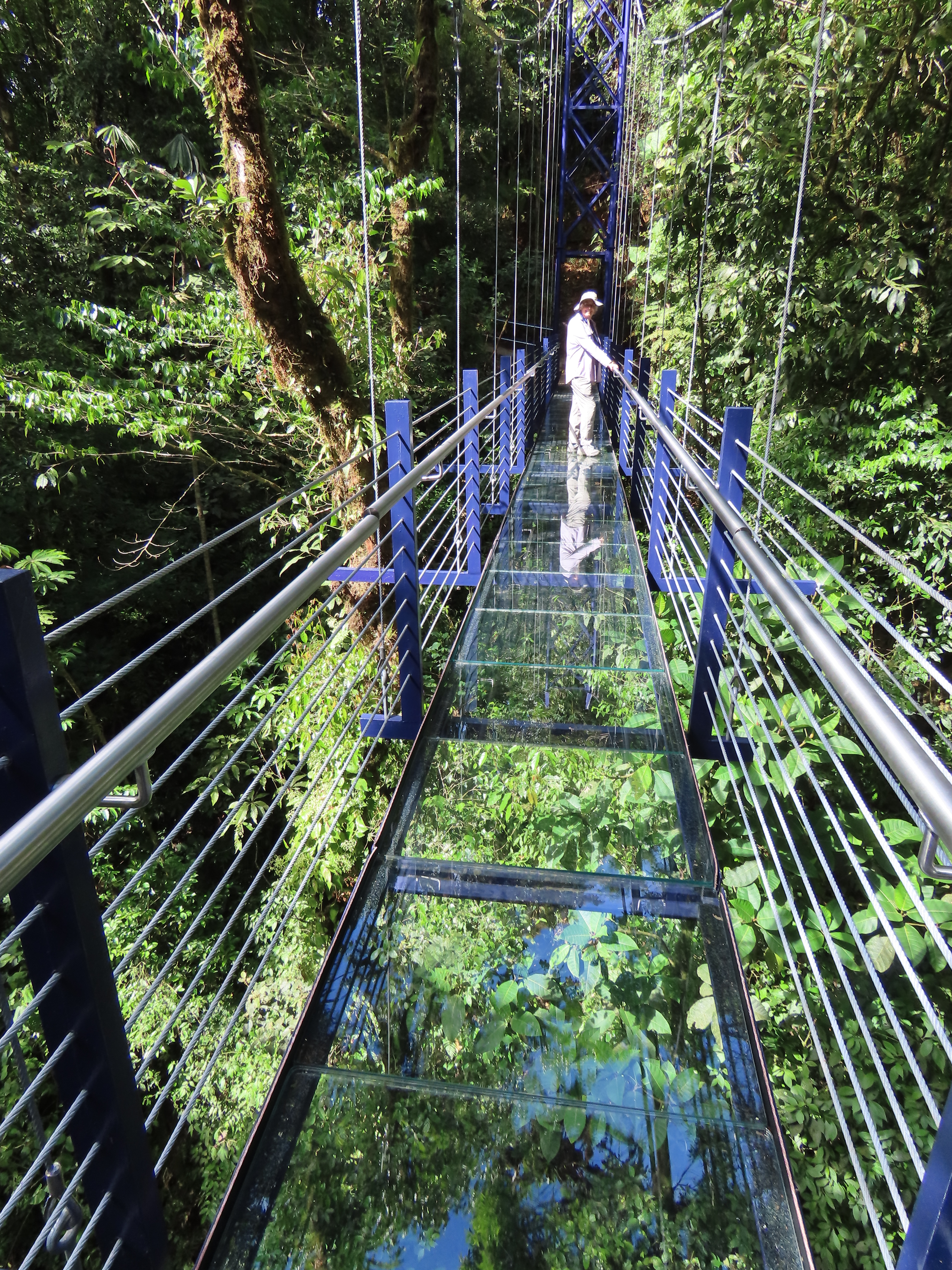
The hanging bridges of Monteverde gave us a unique opportunity to study both the canopy and the forest beneath. There were six bridges at Treetopia Park. At 774 feet, this was the longest. It was also more open. The canopy towered over most of the bridges.One bridge provided us with an opportunity look down on a fern tree. The leaves were a definite clue that we were looking at a fern.As did how the leaves unfold or unfurl known as Circinate vernation. This has always fascinated me about ferns. I have many photos of different species. But given that there are 10-12000 or more know species, I have a few to go…Here’s a different species at Treetopia.And another. Both tropical and temperate rainforests provide ideal conditions for ferns to grow. Some can be giants. We spotted these down on the ground from the hanging bridge. I wish I had a person down on the ground to provide perspective. They would have made my 5 feet 11 inches appear small.
I’d love to show you a photo of the Pond, or the Woods. Unfortunately I didn’t take any photos of either when I was young. I went back a few years ago to photograph the sites that were so important to my childhood— and life. The Pond had become a large gas station and the Woods had become a trailer park. It’s called progress. There was money to be made.
Instead you have a gorgeous sunset photo over Monteverde, Costa Rica taken by our grandson, Cooper, who is in the eighth grade. Our son, Tony, his wife, Cammie and their three boys, Connor, Chris, and Cooper have joined us this week. We are situated up on a high hill surrounded by rainforest. It even has vines that are safe to swing on and a view that looks all the way to the Pacific Ocean. We sent the boys out with our cameras to explore the surrounding woods and take photos of what they found most interesting. There are more pictures after today’s UT-OH tale.
Part 1: The Pond
There came a time when the Graveyard no longer met my wandering needs. I started traveling farther and farther afield, 15 minutes at a time. That’s how far the Pond and the Woods were away. They were where I played and, more importantly, where I developed a life-long love of the natural world. As such, they earned a capital P and capital W. First up: The Pond.
There were a number of ponds in the area. Oscar ‘Ot’ Jones had one on his ranch for cattle; Caldor had one where logs waited for their appointment with the buzz saw; Forni had one over the hill from his slaughterhouse, and Tony Pavy had one that was supposedly off-limits. But there was only one capital P Pond, the one next to the Community Hall. If I told Marshall, my parents or my friends I was going to the Pond, they knew immediately where I would be.
It was a magical place filled with catfish, mud turtles, bullfrogs and pirates. Although the Pond was small, it had a peninsula, island, deep channel, cattails and shallows. In the spring, redwing blackbirds nested in the cattails and filled the air with melodic sounds. Mallards took advantage of the island’s safety to set up housekeeping. Catfish used holes in the bank of the peninsula to deposit hundreds of eggs that eventually turned into large schools of small black torpedoes dashing about in frenetic unison. Momma bullfrogs laid eggs in strings that grew into chubby pollywogs. When they reached walnut size, tiny legs sprouted in one of nature’s miracles of transformation. Water snakes slithered through the water with the sole purpose of thinning out the burgeoning frog population. I quickly learned to recognize the piteous cry of a frog being consumed whole. Turtles liked to hang out in the shallows where any log or board provided a convenient sunning spot. They always slid off at our appearance but a few quiet minutes would find them surfacing to reclaim lost territory.
By mid-summer the Pond would start to evaporate. The shallow areas surrendered first, sopped up by the burning sun. Life became concentrated in a few square yards of thick, tepid water, only inches deep and supported by a foot of squishy mud. All too soon the Pond was bone-dry with mud cracked and curled. Turtles, snakes and frogs crawled, slithered and hopped away to other nearby water. Catfish dug their way into the mud and entered a deep sleep, waiting for the princely kiss of winter rains. Ducks flew away quacking loudly, leaving only silence behind.
Fall and winter rains found the Pond refilling and then brimming. Cloudy, gray, wind-swept days rippled the water and created a sense of melancholy that even an eight-year-old could feel.
But melancholy was a rare emotion for the Pond. To us, it was a playground with more options than an amusement park. A few railroad ties borrowed from Caldor and nailed together with varying sized boards made great rafts for exploring the furthest, most secret corners of the Pond. Imagination turned the rafts into ferocious pirate ships that ravaged and pillaged the far shores, or primitive bumper cars guaranteed to dunk someone, usually me.
In late spring, the Pond became a swimming hole, inviting us to test still cold waters. One spring, thin ice required a double and then triple-dare before we plunged in. It was a short swim. Swimsuits were always optional and rarely worn. I took my first swimming lessons there and mastered dog paddling with my cocker spaniel, Tickle, providing instructions. More sophisticated strokes would wait for more sophisticated lakes.
Frogs and catfish were for catching and adding to the family larder. During the day, a long pole with fishing line attached to a three-pronged hook and decorated with red cloth became irresistible bait for bullfrogs. At night, a flashlight and a spear-like gig provided an even more primitive means of earning dinner. The deep chug-a-rums so prominent from a distance became silent as we approached. Stealth was required. A splash signified failure as our quarry decided that sitting on the bottom of the Pond was preferable to joining us for dinner.
Victory meant a gourmet treat, frog legs. Preparation involved amputating the frog’s hind legs at the hips and then pealing the skin off like tights. It was a lesson I learned early: If you catch it, you clean it. We were required to chop off the big feet as well. Mother didn’t like being reminded that a happy frog had been attached hours earlier. She also insisted on delayed gratification. Cooking the frog legs on the same day they were caught encouraged them to jump around in the frying pan. “Too creepy!” she declared.
Catching catfish required nerves of steel. We caught them by hand as they lurked with heads protruding from their holes in the banks. Nerves were required because the catfish had serious weapons, needle sharp fins tipped with stingers that packed a wallop. They had to be caught exactly right and held firmly, which was not easy when dealing with a slimy fish trying to avoid the frying pan. But their taste was out of this world and had the slightly exotic quality of something that ate anything that couldn’t eat them.
Next up on Wednesday: The Woods. On Friday, we will focus on some of our Costa Rica adventures.
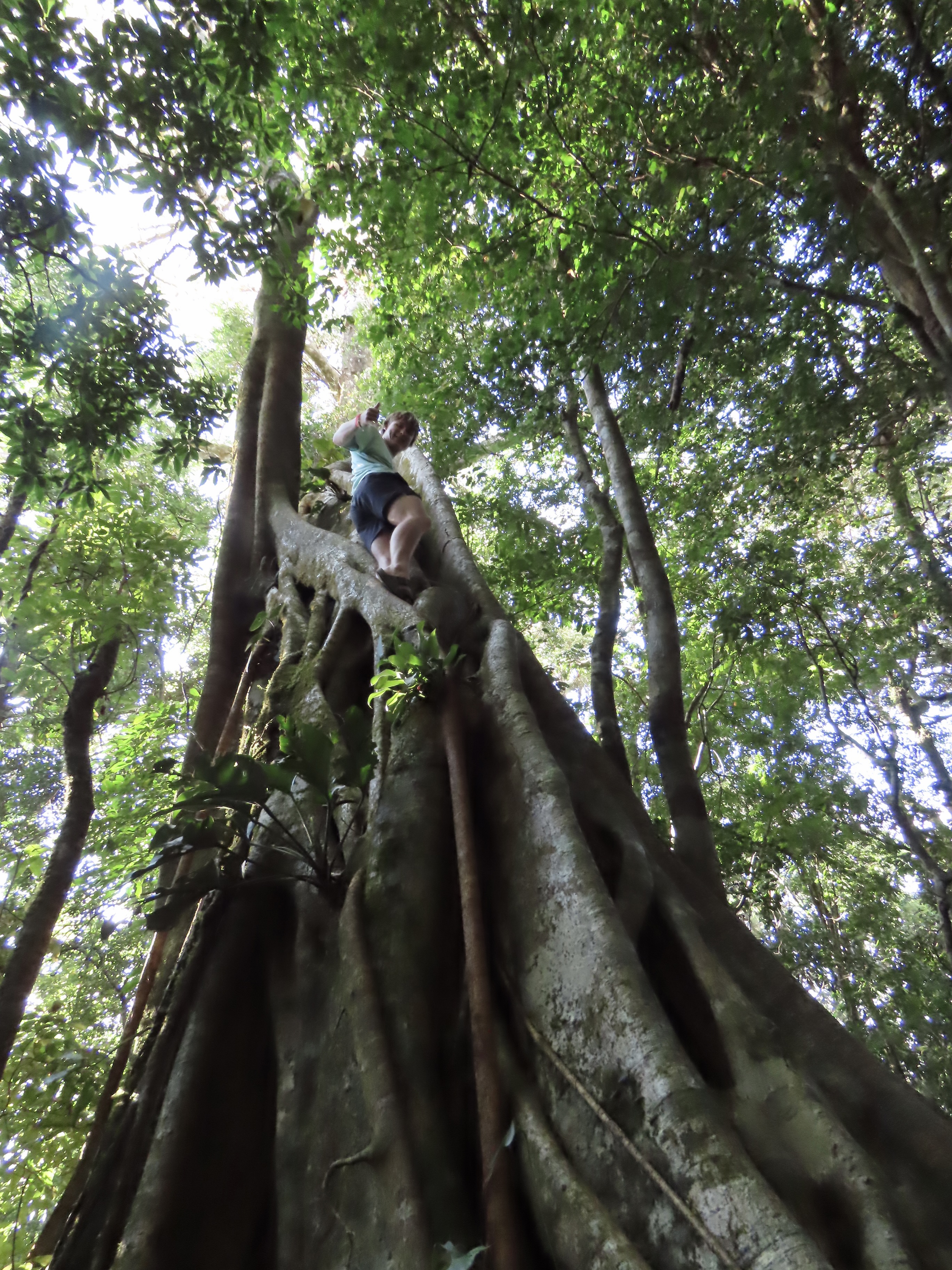
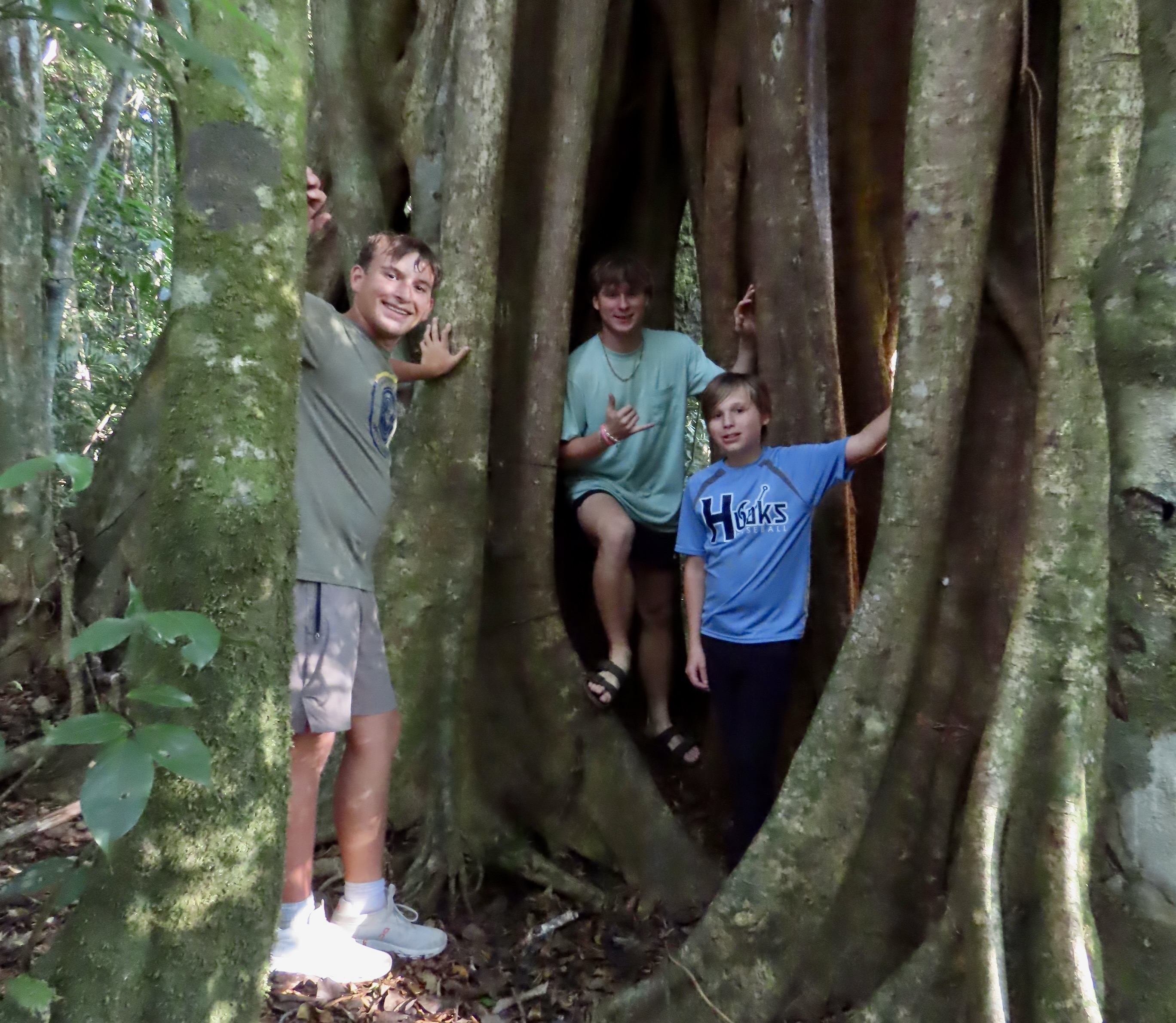
Chris, who is a sophomore in high school, had watched a capybara as it disappeared into the woods. Later when he was visiting a waterfall, one did him the courtesy of hanging out long enough for a photo.Connor, who is a junior, actually preferred to have a photo of himself taken up a banyan tree without a ladder. His passion for high places reminds us of his dad when he was his age. Here are the boys together at the base of the banyan tree: Chris on the left, Connor in the back, and Cooper on the right.Our other activity of the day was to explore the forest canopy on hanging bridges. There were 6 different bridges. This one had a glass bottom you could see the jungle below. That’s grandma, Peggy, down on the end. Next up on Wednesday, the Woods.
Have you ever climbed a tree? As kids growing up in Diamond Springs, California, there were dozens that called to us, each with a unique challenge. Maybe the fact that we share 98.8 of our genes with chimps played a role. Nothing spoke ‘challenge’ like the 80 foot tall tree in the Graveyard, however. Peggy thinks at 83, I should stick to smaller trees.A view of the tree today taken from near the house where we lived. Now, imagine 8-10 year olds racing up and down this tree as fast as they could go.
Two of these large incense cedar trees dominated the Graveyard. From an under five-foot perspective, they were gigantic, stretching some 75-80 feet skyward. The limbs of the largest started 20 feet up, providing scant hope for climbing. As usual, Marshall found a risky way around the problem.
Looking appropriately graveyard-spooky in its old age, the largest Incense Cedar still dominates the Graveyard. It was probably planted in the 1850s. The large lower limbs (center left) were where Pop built our tree house. It stretched half way around the tree.
Several of the huge limbs came tantalizingly close to the ground at their tips, and one could be reached by standing on the tombstone I used to spy on Demon the Cat when she hid her kittens. But only Marshall could reach it; I was frustratingly short by several inches. Marsh would make a leap, grab the limb, and shimmy up it hanging butt down until the limb became large enough for him to work his way around to the top. Then he would crawl up to the tree trunk, five Curt-lengths off the ground. After that, he would climb to wonderfully mysterious heights I could only dream about.
Eventually I grew tall enough to make my first triumphant journey up the limb. Then, very carefully, I climbed to the heart-stopping top, limb by limb. All of Diamond spread out before me. I could see our school, the mill where my father worked, the woods, and the hill with a Cross where I had shivered my way through at a cold Easter Sunrise Service. I could see the whole world. Except for a slight wind that made the tree top sway and stirred my imagination about the far away ground, I figured I was as close to Heaven as I would ever get.
I could see forever. A few years after my first ascent up the tree, I borrowed my father’s camera and climbed up the tree and took photographs of the surrounding country. This is looking across Diamond. The distant hill on the left was where the cross stood for years.
By the time I finally made it to the top, Marshall had more grandiose plans for the tree. We would build a tree house on the upper branches. Off we went to Caldor, the lumber mill where Pop worked, to liberate some two by fours. Then we raided Pop’s tool shed for a hammer, nails, and rope. My job was to be the ground man while Marshall climbed up close to the top. He would then lower the rope and I would tie on a board that he would hoist up and nail in. It was a good plan, or so we thought.
Along about the third board, Pop showed up. It wasn’t so much that we wanted to build a tree fort in the Graveyard that bothered him, or even that we had borrowed his tools and nails without asking. He even ignored the liberated lumber. His concern was that we were building our fort 60-feet up in the air on thin limbs that would easily break with nails that barely reached through the boards. After he graphically described the potential results, even Marshall had second thoughts.
Pop had a solution though. He would build us a proper tree house on the massive limbs that were only 20 feet off the ground. He would also add a ladder so we could avoid our tombstone-shimmy-up-the-limb route. And he did. It was a magnificent open tree house of Swiss Family Robinson proportions that easily accommodated our buddies and us with room to spare.
It was more like a pirate hideout than a Robinson family home, however. Hidden in the tree and hidden in the middle of the Graveyard, it became our special retreat where we could escape everything except the call to dinner. It also became my center for daydreaming and Marshall’s center for planning mischief. He, along with our friends Allen and Lee, would scope out our forays into Diamond and the surrounding countryside.
And finally, the treehouse became the starting point for the Great Tree Race. We would scramble to the top and back down in one-on-one competition as quickly as we could. Death-defying is an appropriate description. Or maybe, suicidal. Slips were a common hazard. Unfortunately, the other boys always beat me; they were one to three years older, and I was the one most susceptible to losing my grip. My steady diet of Tarzan comic books sustained me, though, and I refused to give up. Eventually, several years later, I would triumph.
Marshall was taking a teenage time-out with Mother’s parents who had moved to Watsonville, down on the Central Coast of California. Each day I went to the Graveyard and took several practice-runs up the tree. I became half monkey. Each limb was memorized and an optimum route chosen. Tree climbing muscles bulged; my grip became iron and my nerves steel.
Finally, the big day arrived and Marshall came home. He was every bit the big brother who had been away at high school while little brother stayed at home and finished the eighth grade. He talked of cars and girls and wild parties and of his friend Dwight who could knock people out with one punch. I casually mentioned the possibility of a race to the top of the tree. What a set up. As a two pack-a-day, sixteen-year-old, cigarette smoker he wasn’t into tree climbing, but how could he resist a challenge from his little brother.
Off we went. Marsh didn’t stand a chance. It was payback time for years of big brother hassles. I flew up and down the tree. I hardly touched the limbs. Slip? So what, I would catch the next one. Marsh was about half way up the tree when I passed him on my way down. I showed no mercy and greeted him with a grin when he arrived, huffing and puffing, at the tree house.
His sense of humor was minimal. Back on the ground, his bruised ego demanded that he challenge me to a wrestling match. I quickly pinned him to the ground. It was the end of the Great Tree Race, the end of big brother dominance, and a fitting end to my years of associating with dead people in the Graveyard.
And Now for the Coatisof Costa Rica
Yesterday, Peggy and I drove from Nuevo Arenal to the tourist oriented town of La Fortuna. It was pretty much what one would expect of a town that makes its living off of separating money from the visitors. There were a ton of things you could do for a price. I don’t have a problem with that. People would get their money’s worth and locals could put food on their tables. But I much preferred Nuevo Arenal.
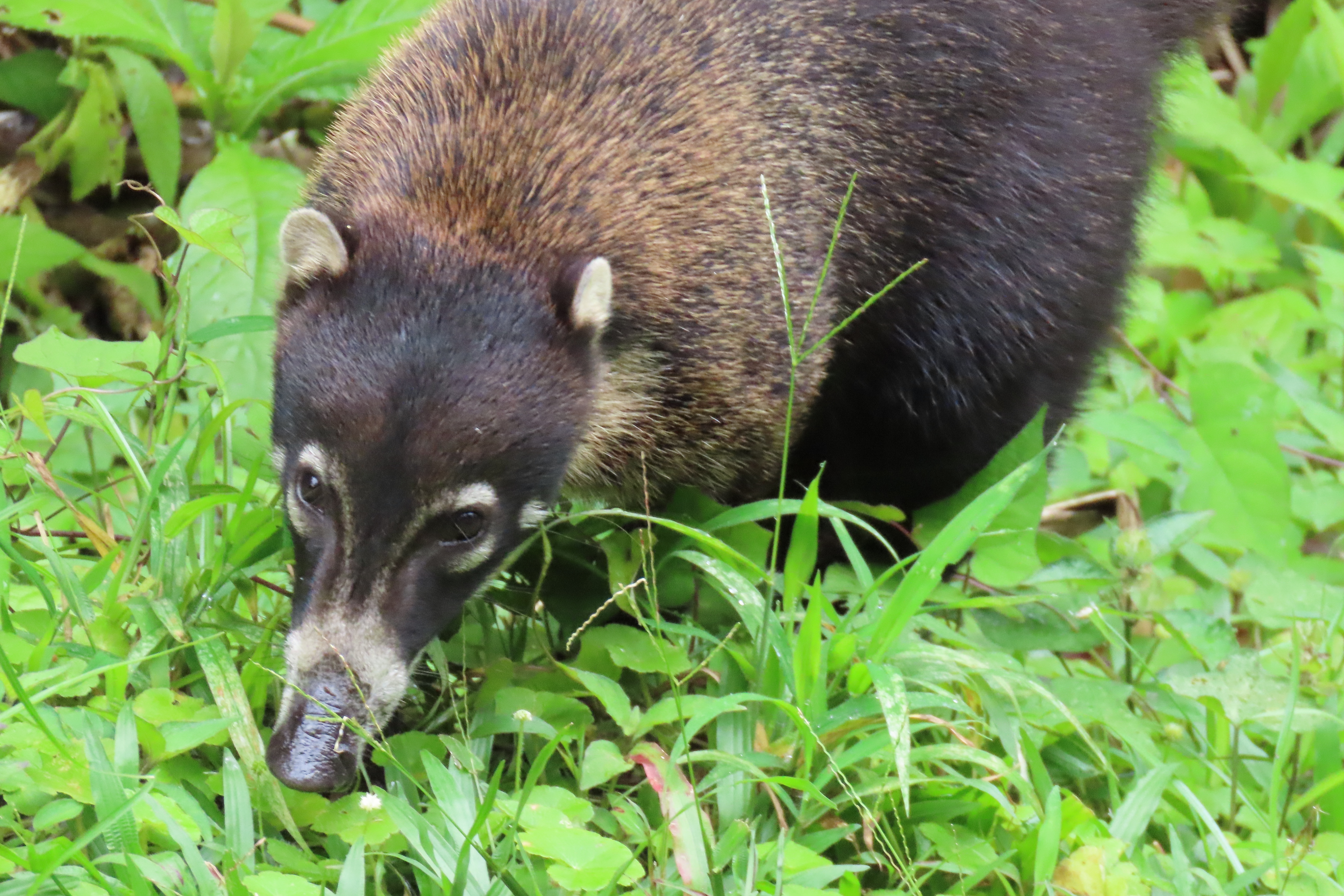
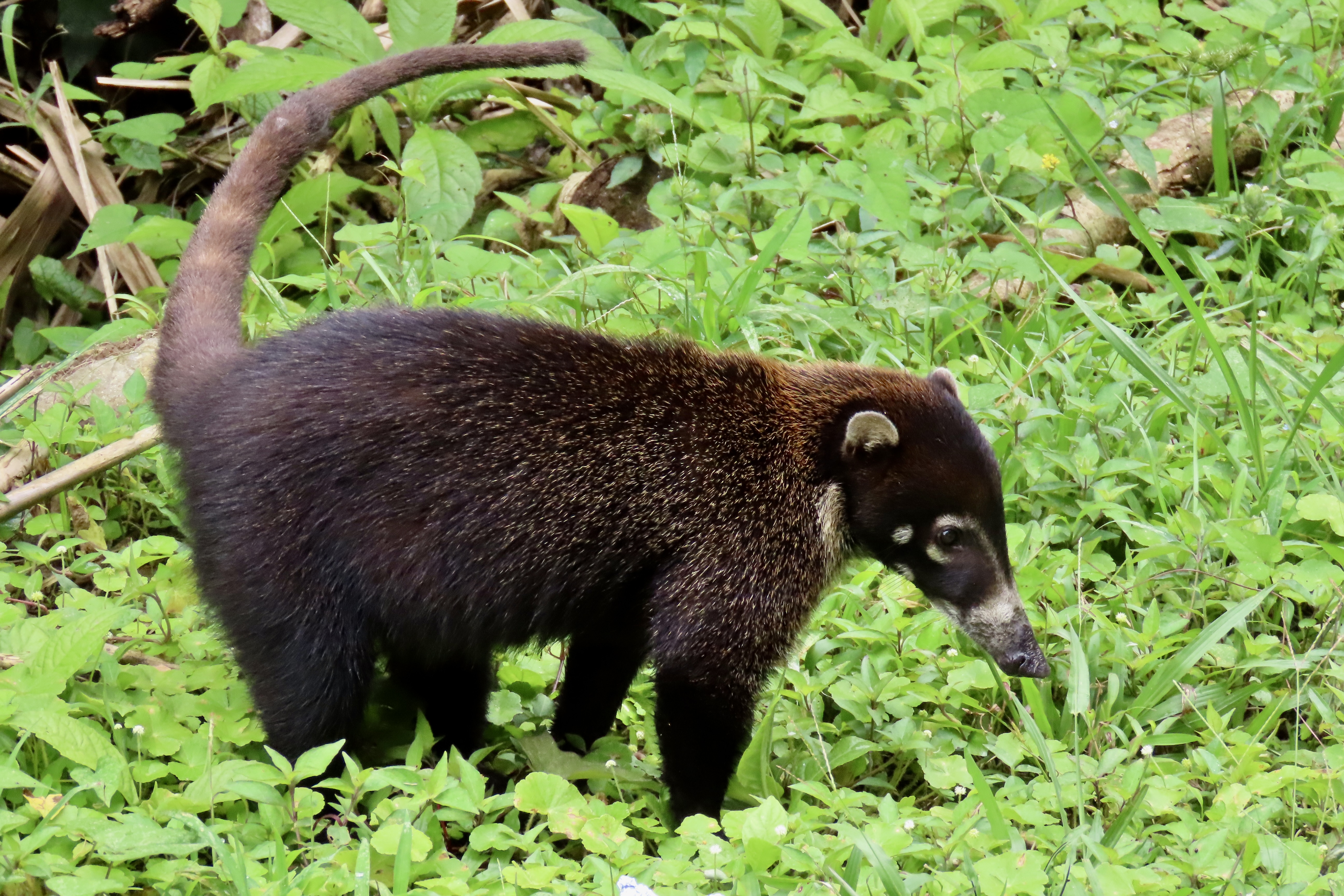
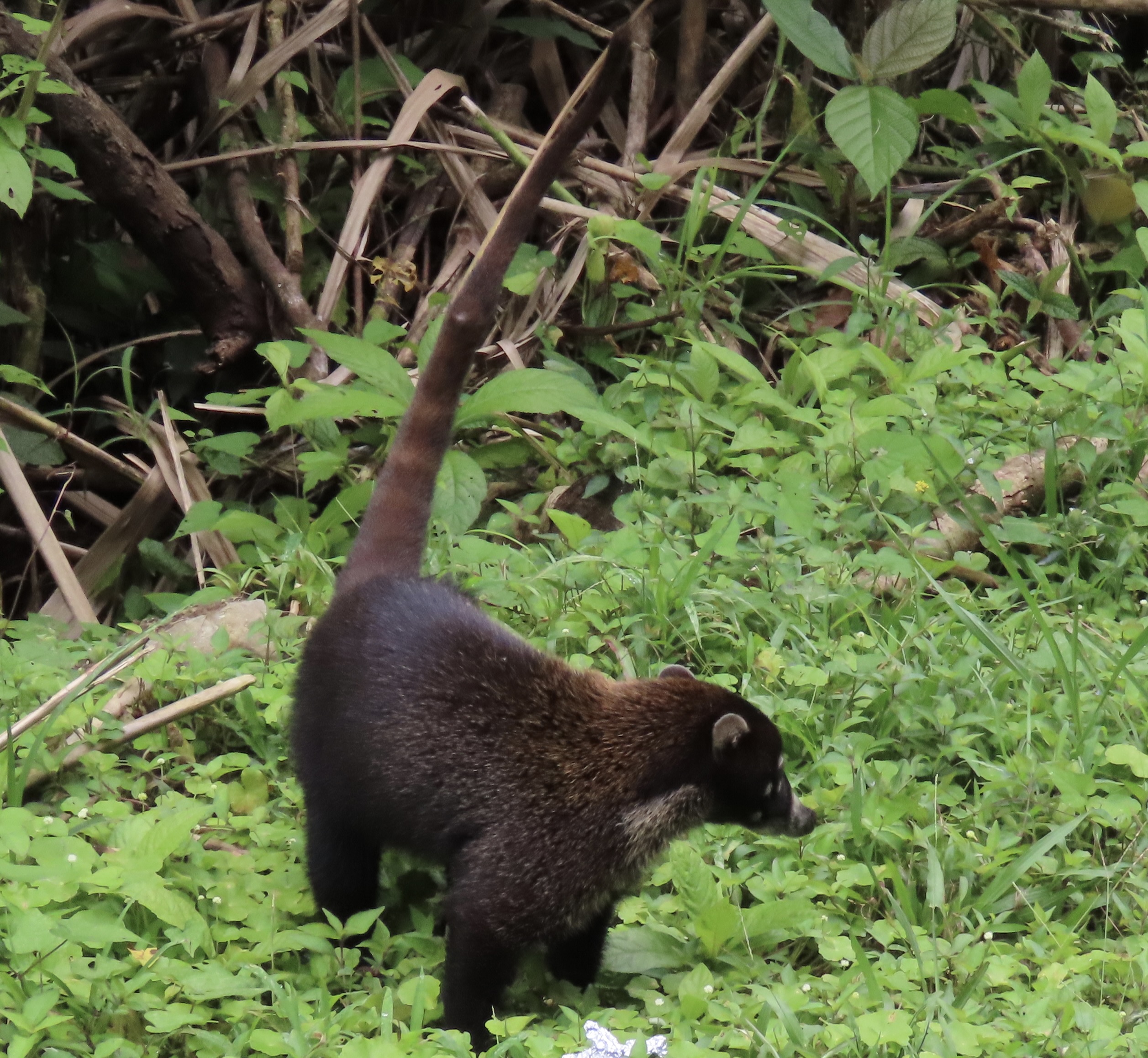
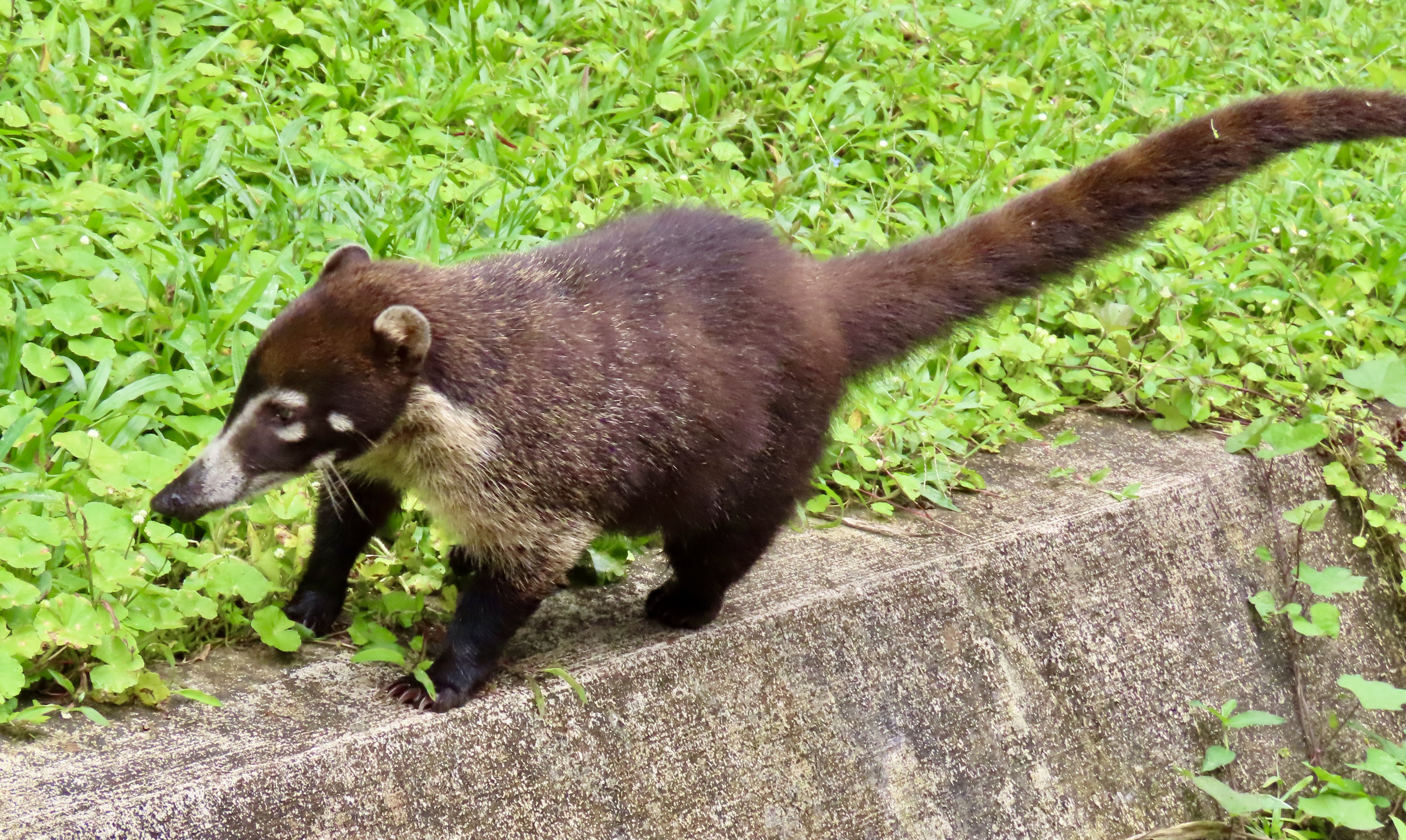
The highlight of the trip was the band of Coatis we came across on our drive over. There must have been a dozen or so. These diurnal, omnivorous animals are actually related to raccoons. They were spread out alongside the road doing their coati thing. They were easily outnumbered by the people who had stopped to admire them.
Who wouldn’t love a face like this?I found their tails quite interesting…Especially when they stuck them straight up in the air!Having had enough of people, they used the curb as a runway to escape.
And I’ll make my own escape here. Once again, I am going to make a slight change in my blog. I’ve decided to speed up UT-OH, my blog-a-book memoir, so I can indeed turn it into a book. I’ll be pulling out tales from my 15-years of blogging and putting them up in chapters on Mondays and Wednesdays. I’ll reserve Fridays for our travel blog covering our present journeys: Costa Rica now, Greece and the Greek Islands in May, and then Northern Scotland and Ireland in June and July.
In my posts on Monday and Wednesday next week, I am going to relate the two experiences that led to my lifelong love of the wilderness: The Pond and the Woods.
PLUS A Bonus: Costa Rica Is for the Birds… That’s a Good Thing
A change of plans today. I was going to do a post on unique Burning Man structures, but Peggy and I are down in Costa Rica happily settled into a villa above Lake Arenal. A warm tropical breeze is making me feel sleepy. My ‘get up and go has got up and went,’ as the song proclaimed, galloped off to the north. Pura Vida, the Costa Ricans would say. We are living the good life. Posting a tale I have already written plus throwing up some fun photos of birds that Peggy and I have taken is a lot easier than putting together a Burning Man post. Plus, over half the time I went to research a subject for the post, I found that Google had placed one of my blogs on the subject at the top or near the top of its research list and/or just opposite its AI answer. That’s great for SEO, but it also suggests how much I have already written on the subject.
So, my apologies to those who have tuned in to learn more about Burning Man, but hey, a ghost story makes a great substitute, right? So here it is as a chapter in my ongoing blog-a-book series: UT-OH. I’ll eventually get back to Burning Man. I always do.
Nancy Jo and the Graveyard Ghost
My sister was seven years older than I and lived on a different planet, the mysterious world of teenage girls. Her concern about ghosts makes this story a powerful testimony to teenage hormones. If Marshall and I had a healthy respect for the Graveyard at night, Nancy’s fear was monumental.
This story begins with Nancy falling in ‘love’ with the ‘boy’ next door, Johnny. His parents were good folks from a kids’ perspective. Marshall and I raided their apple trees with impunity, and Mama, a big Italian lady, made great spaghetti that included wild manzanita mushrooms. I was fascinated with the way she yelled “Bullll Sheeeet” in a stentorian voice when she was whipping Papa into line. He was a skinny, ‘Old Country type of guy’ who thought he should be in charge. Papa was the one who suggested the gunny sack method of castration for MC.
I use the terms love and boy somewhat loosely since Nancy at 16 was more in infatuation than love, and Johnny, a 22-year-old Korean War Veteran, was a little old for the boy designation, not to mention Nancy. Our parents were not happy, a fact that only seemed to encourage my sister.
Her teenage hormones aided by a healthy dose of rebellion overcame her good sense and she pursued the budding relationship. Johnny didn’t make it easy. His idea of a special date was to drive down the alley and honk. Otherwise, he avoided our place. If Nancy wanted to see him, she had to visit his home. It should have been easy; his house was right behind ours.
But there was a major obstacle, the dreaded Graveyard. To avoid it, Nancy had to climb over the fence that separated our houses. Her other option was walk up the alley that almost touched the tombstones. Given her feelings about dead people, the solution seemed easy— climb the fence. Marsh and I had been over it many times in search of apples. Something about teenage girl dignity I didn’t understand eliminated fence climbing, however. Nancy was left up the alley without an escort.
While she wasn’t above sneaking out her window, Nancy asked permission to see Johnny the night of the Graveyard Ghost attack. She approached Mother around seven. It was one of those warm summer evenings where the sun is reluctant to go down and boys are granted special permission to stay up. Marshall and I listened intently.
“Mother, I think I’ll go visit Johnny,” Nancy stated and asked in the same sentence. Careful maneuvering was required. An outright statement would have triggered a parental prerogative no and an outright question may have solicited a parental concern no.
Silence. This communicated disapproval, a possible no, and a tad of punishment for raising the issue.
“Mother?” We were on the edge of an impending teenage tantrum. Nancy could throw a good one.
“Okay” with weary resignation followed by, “but you have to be home by ten.”
What we heard was TEN. Translate after dark. Nancy would be coming down the alley past the Graveyard in the dark and she would be scared. Knowing Johnny’s desire to avoid my parents, we figured she would also be alone. A fiendish plot was hatched.
At 9:45, Marsh and I slipped outside and made our way up the alley to a point half way between our house and Johnny’s. Next, we took a few steps into Graveyard where weed-like Heavenly trees and deep Myrtle provided perfect cover. Hiding there at night was scary, but Marshall and I were operating under inspiration.
Marsh stripped the limbs off of one of the young trees, bent it over like a catapult, and draped his white T-shirt on the trunk. We then scrunched down and waited.
At exactly 10:00, Nancy opened the back door and stepped outside with Johnny. Our hearts skipped a beat. Would he walk her home? No. After a perfunctory goodnight, Johnny dutifully went back inside and one very alone sister began her hesitant but fateful walk down the alley.
She approached slowly, desperately looking the other direction to avoid seeing tombstones and keeping as far from the Graveyard as the alley and fence allowed.
At exactly the right moment, we struck. Marshall let go of the T-shirt and the supple Heavenly Tree whipped it into the air. It arched up over the alley and floated down in front of our already frightened sister. We started woooooing wildly like the eight and ten-year-old ghosts we were supposed to be.
Did Nancy streak down the alley to the safety of the House? No. Did she figure out her two little brothers were playing a trick and commit murder? No. Absolute hysteria ensued. She stood still and screamed. She was feet stuck to the ground petrified except for her lungs and mouth. They worked fine.
As her voice hit opera pitch, we realized that our prank was not going as planned. Nancy was not having fun. We leapt out to remedy the problem.
Bad idea.
Two bodies hurtling at you out of a graveyard in the dark of night is not a recommended solution for frayed nerves and an intense fear of dead people. The three of us, Nancy bawling and Marshall and I worrying about consequences, proceeded to the house. After a thorough scolding, we were sent to bed. I suspect our parents laughed afterwards. Many years later, even Nancy could see the humor in our prank— and laugh as well.
A fun note on The Bush Devil Ate Sam
I often get comments from people who have read my book including a number of my followers and fellow authors. They are always appreciated. I also hear from people outside our WordPress community. Here’s what I found on Gmail yesterday.
Loved The Bush Devil Ate Sam
Hi Curtis,
I just finished reading The Bush Devil Ate Sam, and I have to say, it was such a vivid, immersive experience! The way you bring Liberia to life, the chaos of students strolling in with termites for breakfast, the encounters with the army ants, and the tension of navigating the local authorities, had me laughing, gasping, and completely captivated. It’s clear how much heart and firsthand experience went into every story.
Reading it also got me thinking about my own writing journey. Each book I’ve worked on has taught me something new about patience, perspective, and letting a story evolve naturally, even when it takes unexpected turns. It’s always fascinating to reflect on the ways our experiences shape the stories we tell.
I’d love to hear about your own process with this book. Did you find it easy to translate your Peace Corps experiences into these stories, or was it more of a challenge to capture the humor, the tension, and the history all at once? Thank you for sharing such a memorable and honest perspective on life as a Peace Corps volunteer. Half the fun was getting to see Liberia through your eyes.
Warmly, Taylor Jenkins Reid
The thoughtfulness of this comment caught my attention. And how well it was written. Of course, I responded to Taylor. But there is more. Taylor is a best-selling author of the New York Times and has won a number of national awards for her writing. Among her books is The Seven Husbands of Evelyn Hugo, a book that the book club that Peggy and I belonged to for 36 years had picked to read. An Amazon Prime television series based on one of her books is now playing.
Taylor immediately responded to my comments and asked if I would share my body of work. Now I have to tell her she has it, the rest is tied up in 1500 WordPress blogs. Grin. I must say, I am now inspired to finish UT-OH! asap. You may be seeing a couple of chapters a week. I’d prefer that my body of work include two books.
Costa Rica Is for the Birds.It’s a good thing.
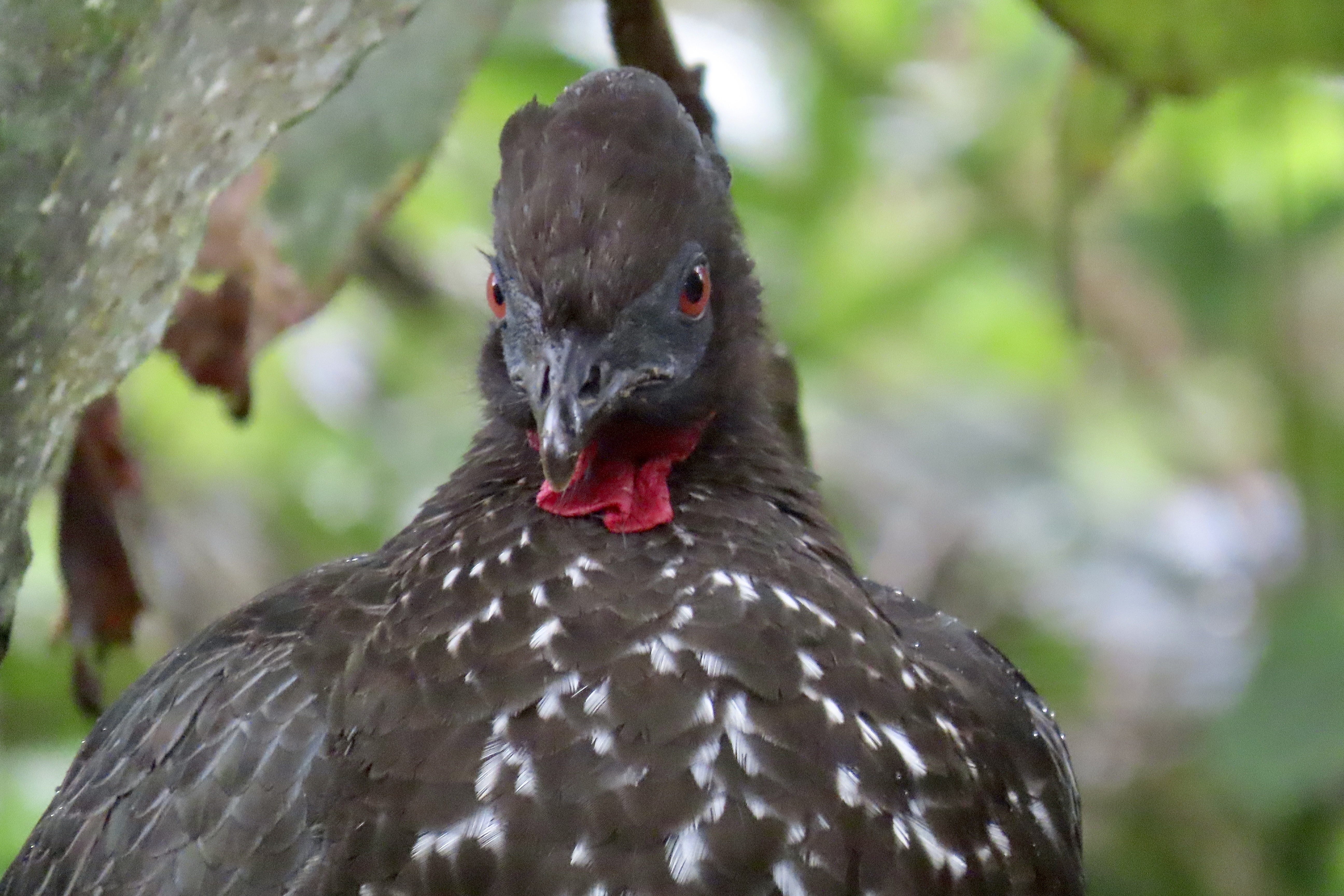
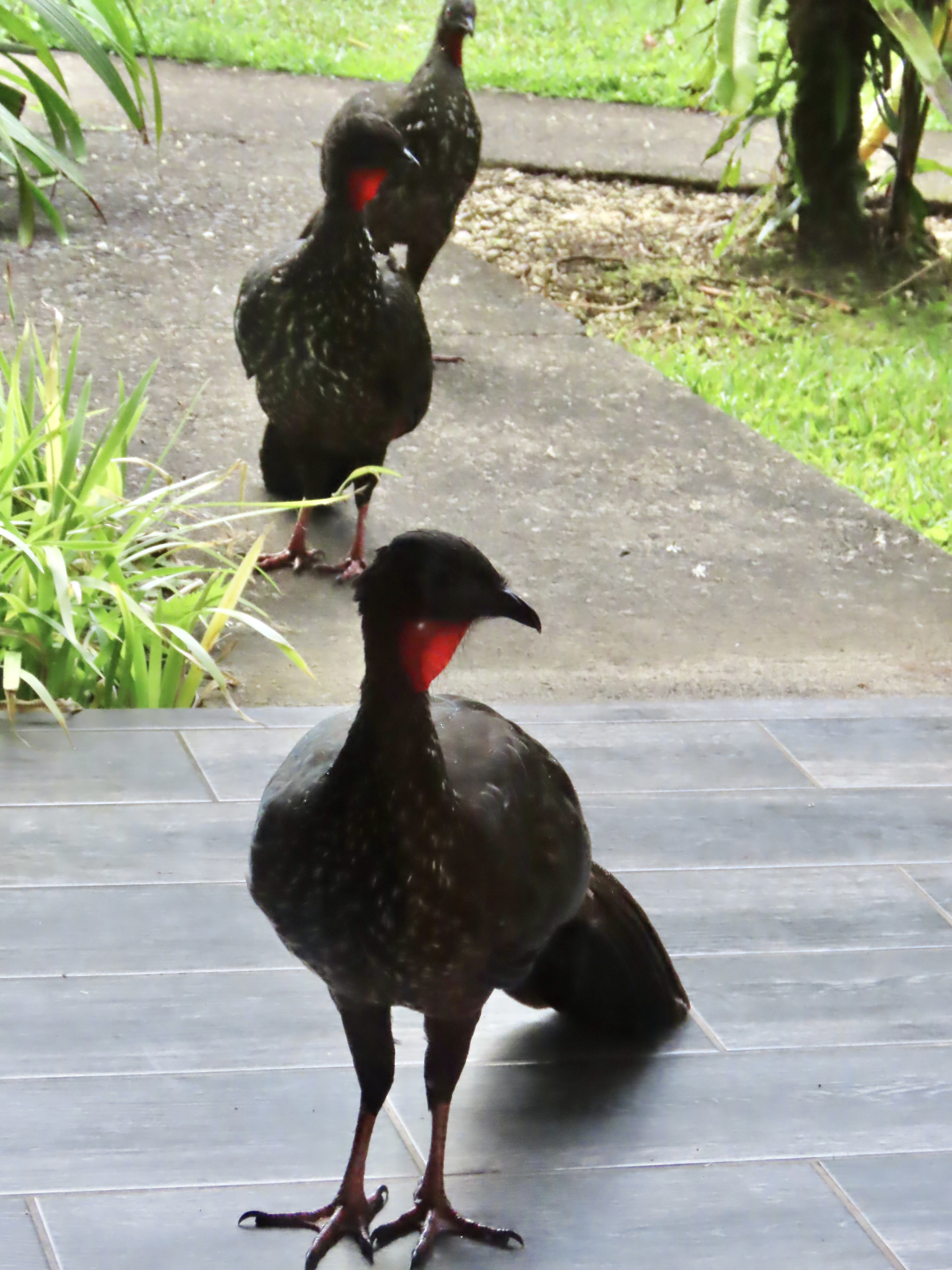
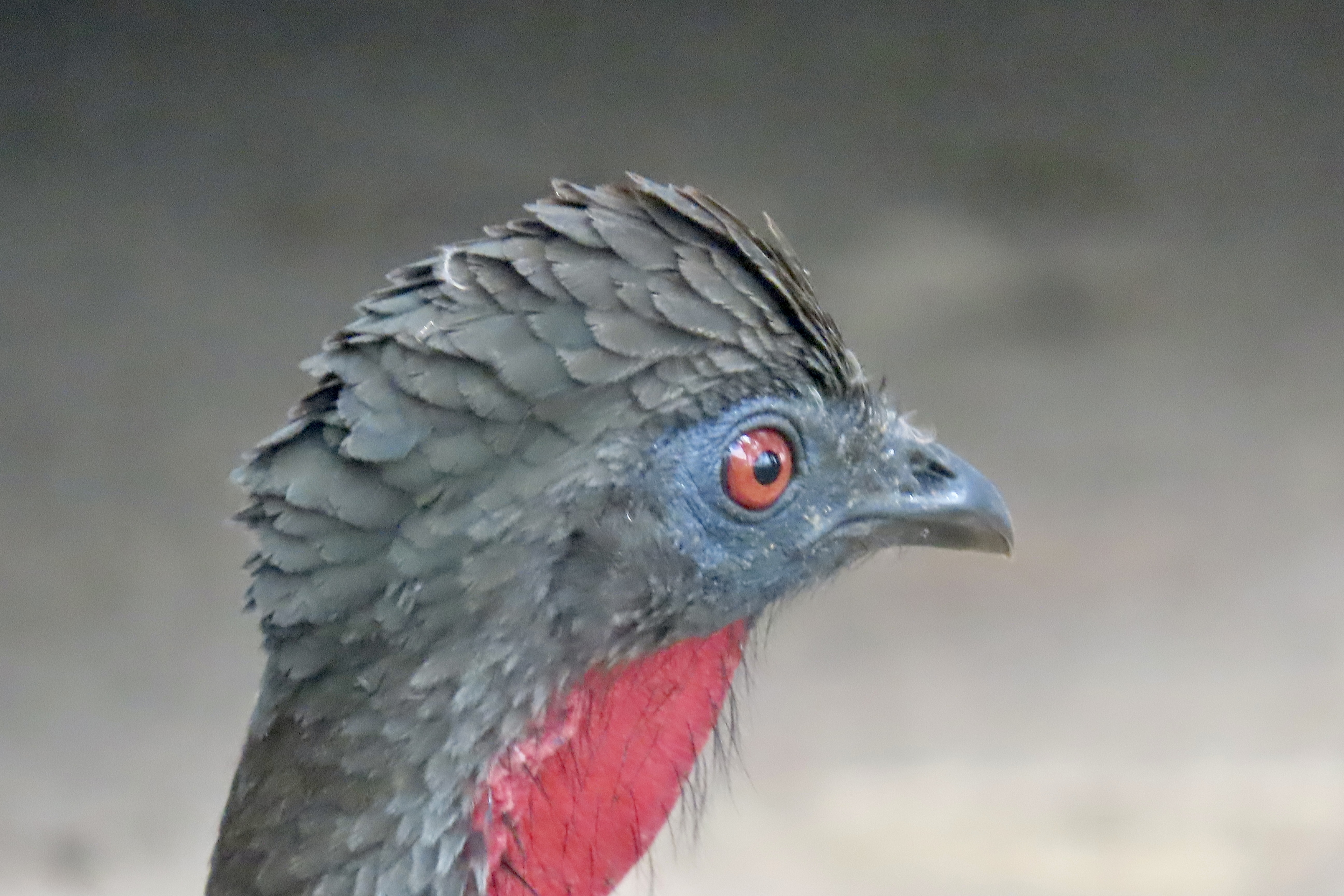
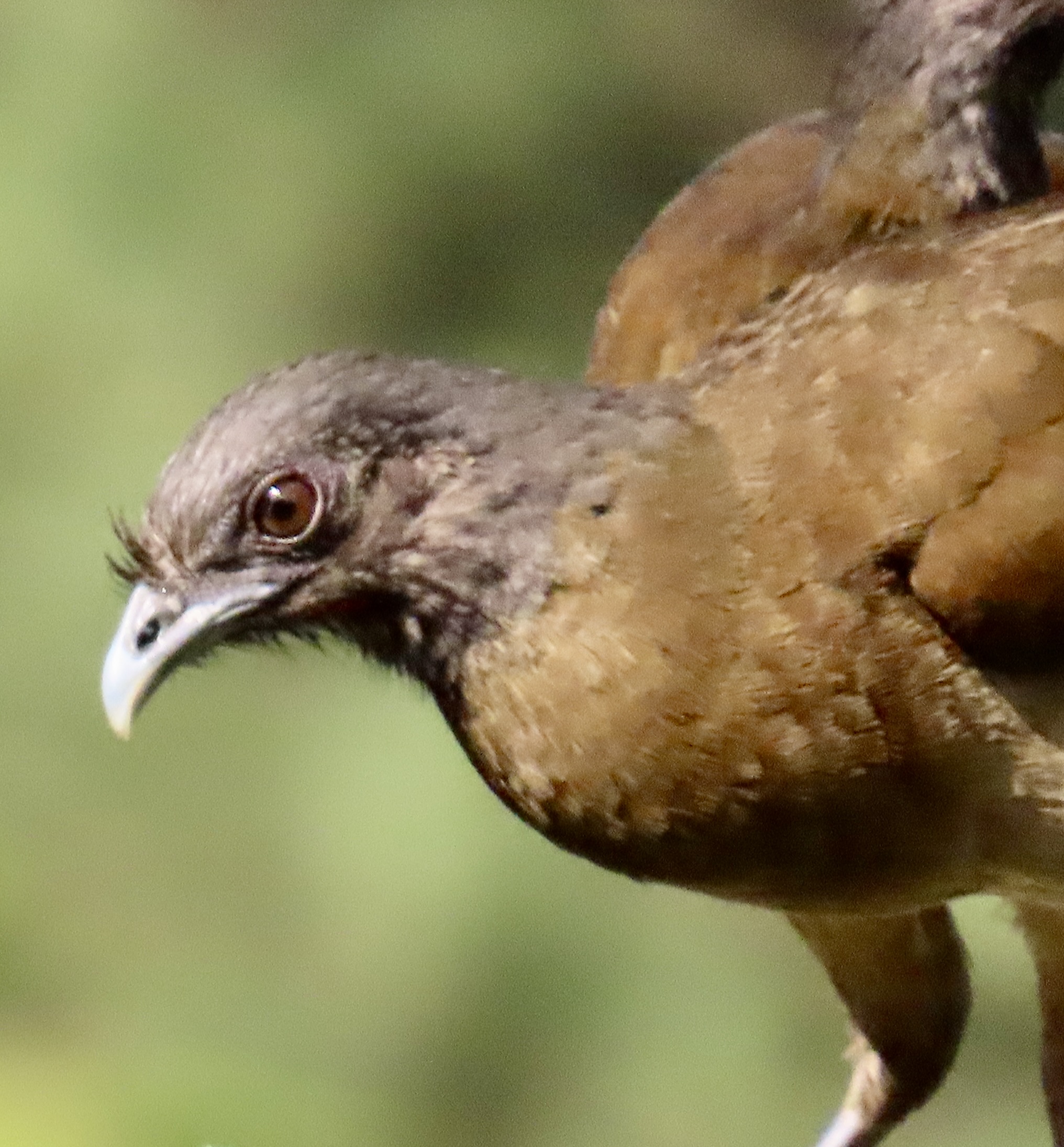
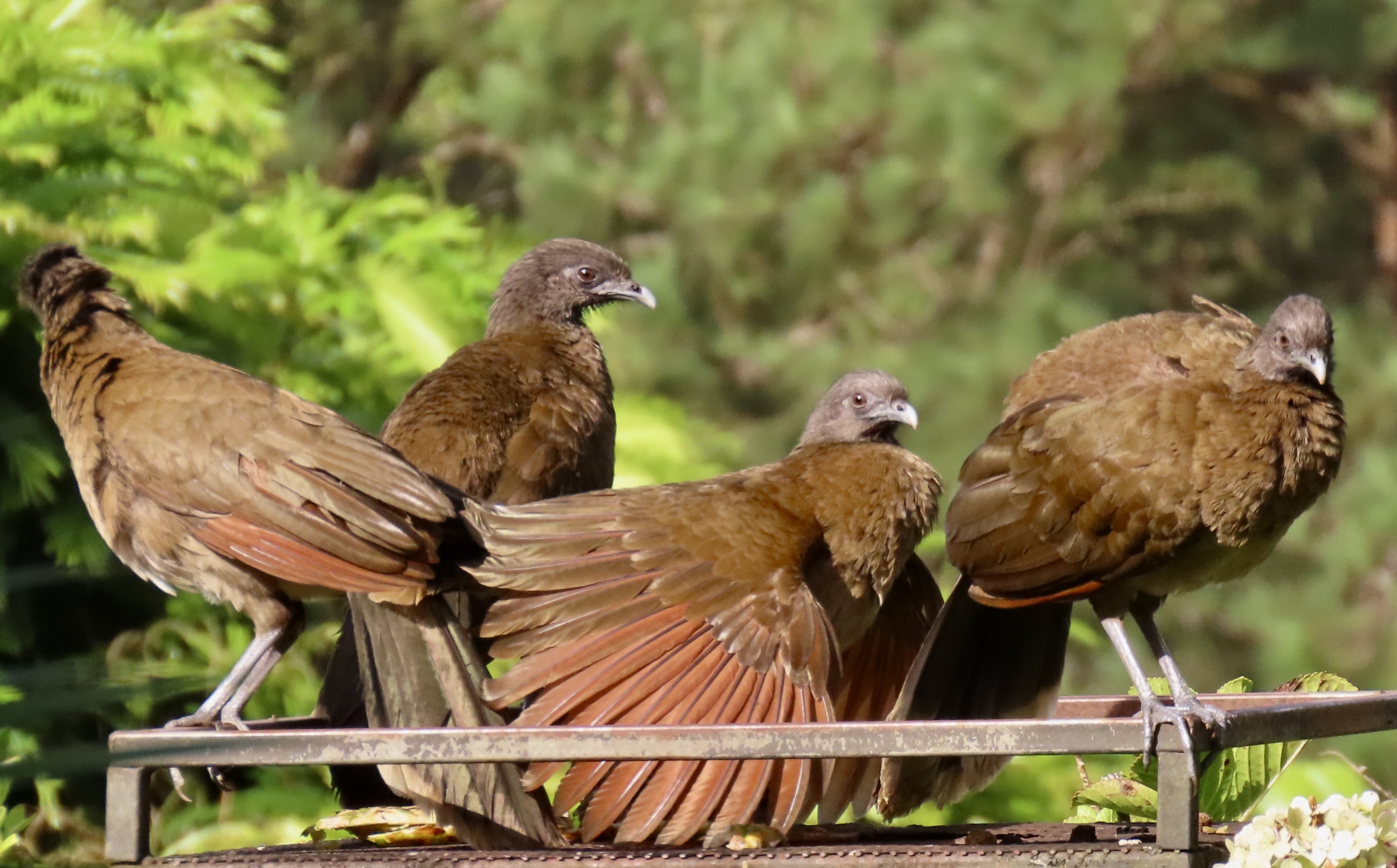
Our villa looks out on a large bird feeder that the staff and guests (including us) of Lake Gardens daily fill with a variety of fruits that the local population of birds love. I hate to confess this as a would-be birder, but I can sit on our couch and take photos of all the action. And action it is, constant drama of who gets to eat when, a veritable pecking order of turkey-size birds down to sparrow-size. A lot more photos will be coming of birds and hopefully other jungle life. This is a teaser.
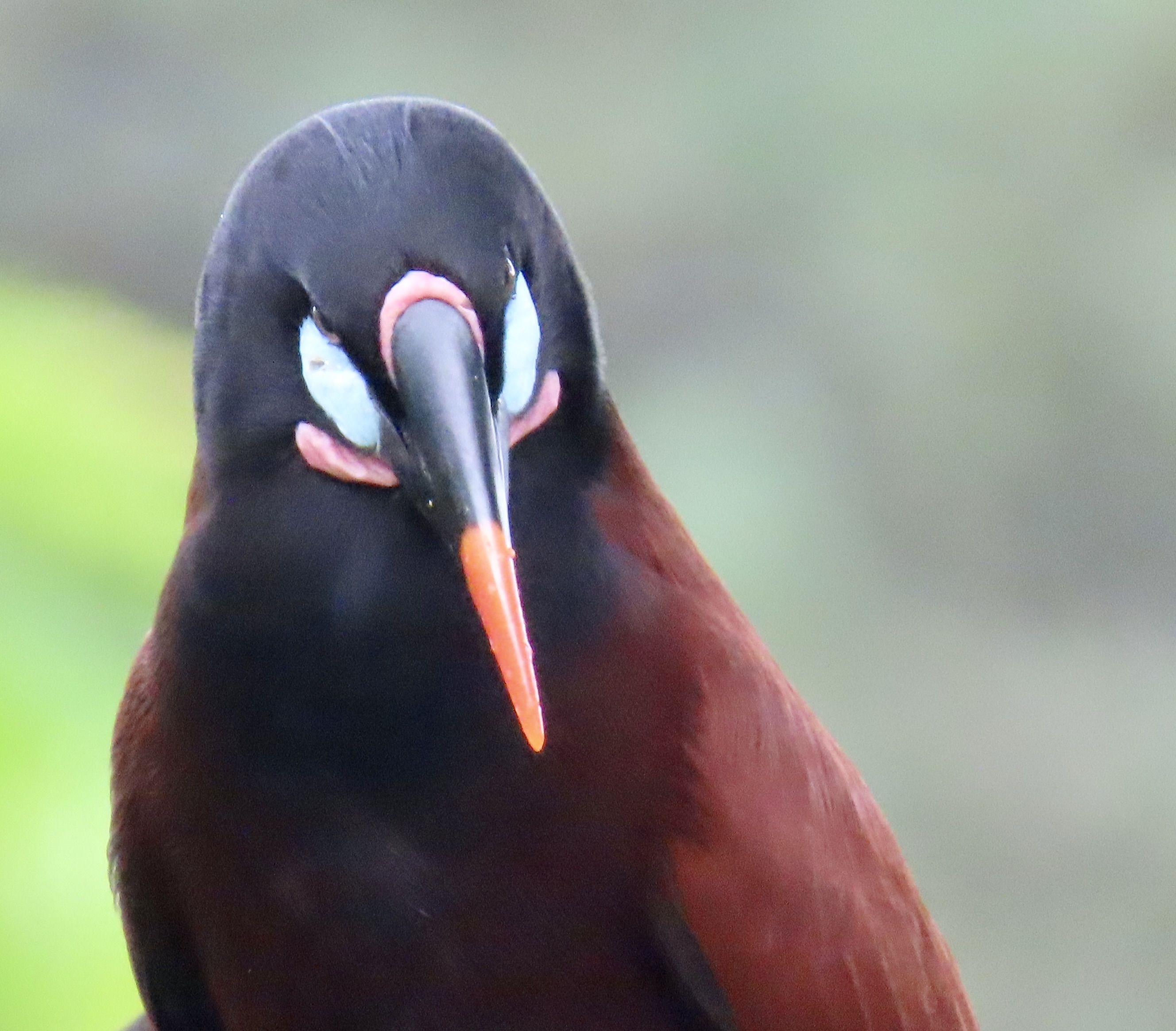
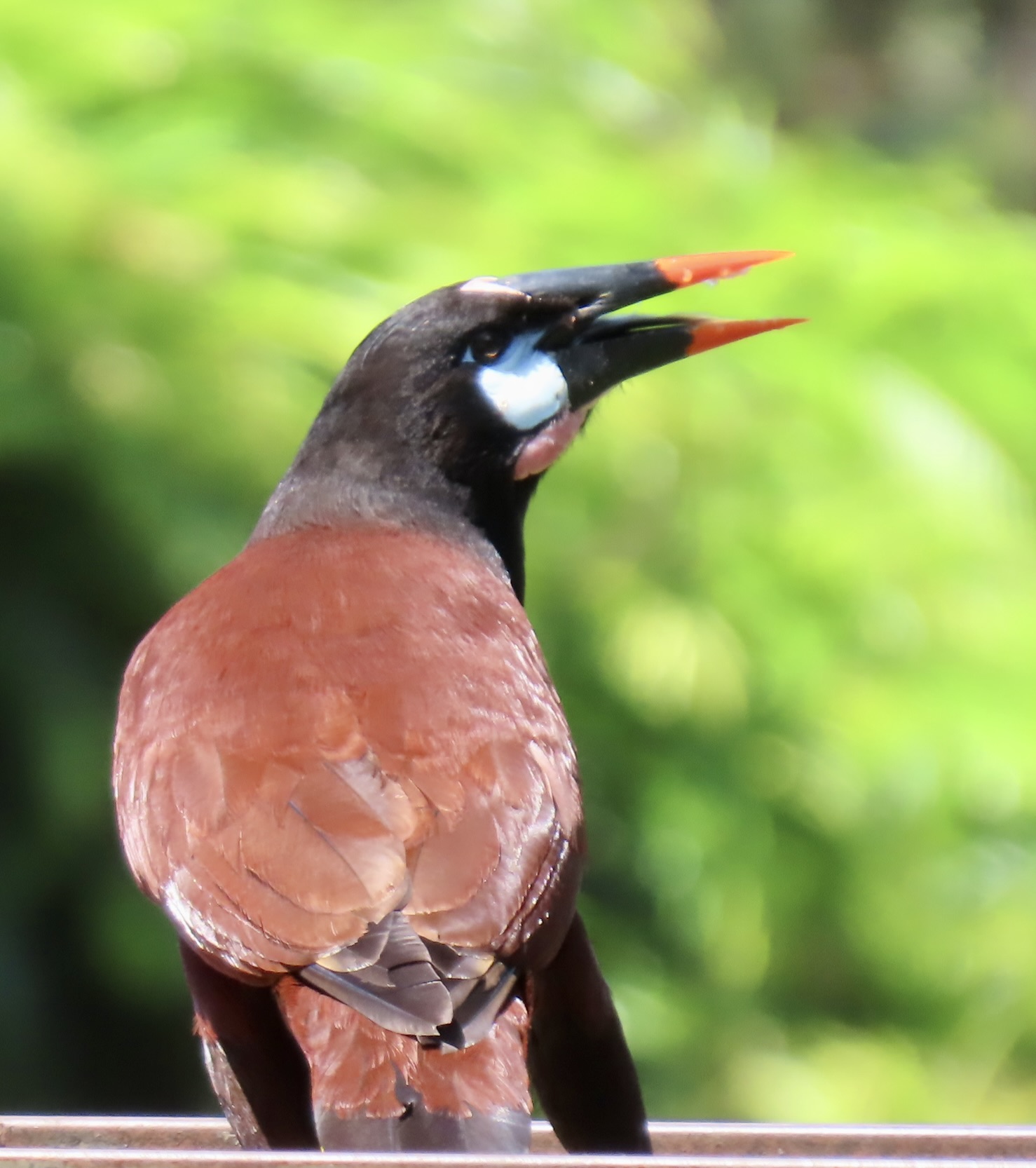
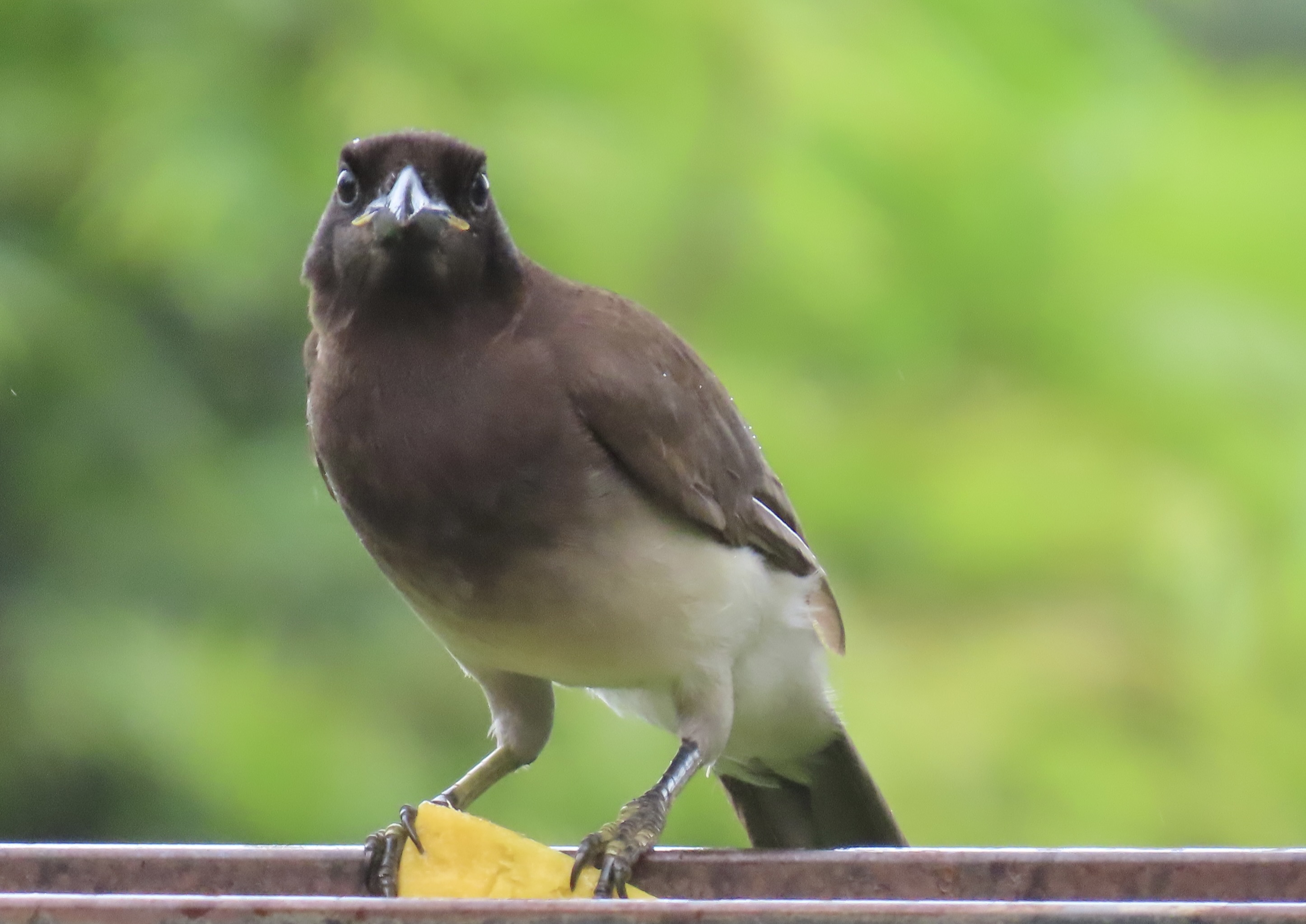
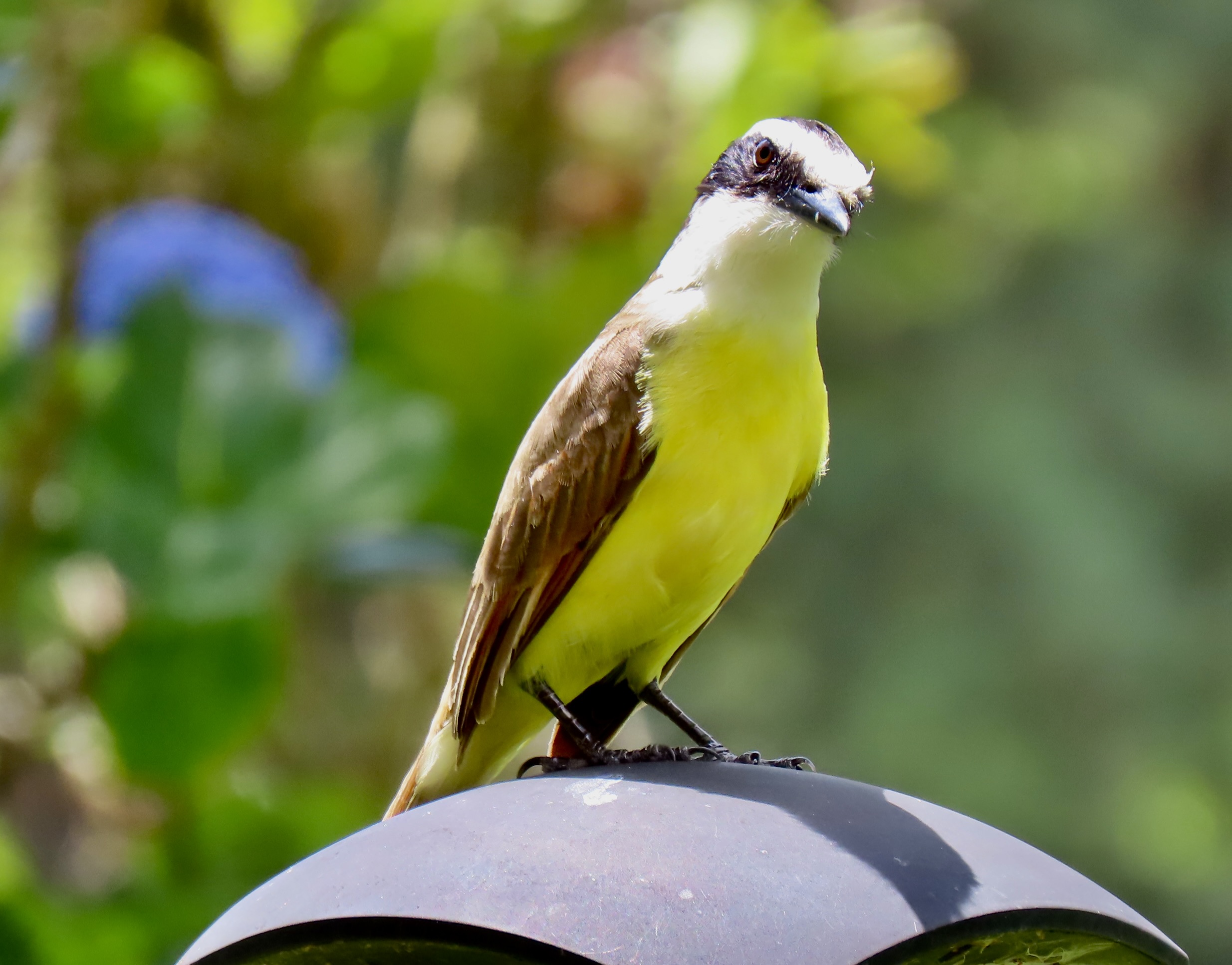
This is the king or queen of the feeder. A Crested Guan. All other birds are required to leave the platform when they are on it.When Peggy opened our curtains on our first morning, Peggy found this crew back-lit by the sun lined up for breakfast and snapped their photo.Up close and personal.Number 2 on the pecking order was this fellow. We aren’t sure what it was, but our assumption is a fledgling Guam. If so, their parents were not about to share food with them. A bush was just below the feeder that the adults would chase the kids around, and around. It was like the Keystone Cops.Here are the kids up on the bird feeder.Number three was a Montezuma oropendola.Peggy caught a photo of it looking the other direction.Number 4: A Brown Jay. We recognized this fellow immediately by its call. We’ve spent our lives with various members of the jay family, but never a brown one. I swear the pretty bird was posing for Peggy. He kept coming back to this lamp outsiide our villa and looking in the window. He didn’t eat fruit, however, He ate bugs. It’s a Social Flycatcher.
That’s it for today. On Thursday, I’ll write about a death defying tree race in UT-OH, one of our many adventures that makes me wonder how we ever lived through childhood. And, there will be more bird photos from Costa Rica.
This photo was taken 2-3 years after our parents sent the Mekemson kids off to Vacation Bible School, but here we are. I’m on the left, my dog Tickle is next, then my sister, Nancy and my brother, Marshall. Tickle got to stay home. He didn’t need religion; he was a good dog.
How to develop a warped view of religion…
I’m continuing with my blog-a-book/memoir/misadventure series today with my first two experiences of organized religion. It was a rocky start.
Pop inherited most of the religious fervor in our family. According to my mother, his mom was a hardline Scotch Presbyterian with a sense of humor to match. One didn’t drink, cuss, smoke or perform any of the other nefarious deeds the devil so cunningly uses to capture wayward souls. Fortunately, he missed some of the thou-shall-nots his mother preached. But he did inherit a sense that church is “good for you,” however, and this meant it would be doubly good for his kids. While Mother had more doubts about religion, even she felt that a little God wouldn’t hurt us. Or, at least she recognized kid-free summer time when she saw it.
Eventually this led to the three Mekemson kids being spiffed up and marched off to Vacation Bible School. My brother, Marshall, and I got a rare midweek bath, clean clothes, and the lecture: No shoving, shouting, fighting or farting. Our older sister, Nancy, bathed regularly and didn’t need the lecture.
In those days, going to church in Diamond Springs meant going to the Community Church, a small, white, box-shaped building that came with a straight steeple and fundamentalist leanings.
Other than the fact that Bible School seriously interfered with my play time, it wasn’t all that bad. I was encouraged to color lots of sheep and no one seemed to mind that they were purple. But the real fall-on-your-knees thing that grabbed my attention was all the stuff about miracles. I was fascinated to know how Noah got all of those animals on one boat, what he did with the poop, and how Christ walked on water. I had so many ‘hows and whys’ the Bible School teacher stopped calling on me. I went back to coloring sheep.
One day we were privileged to witness a true miracle in progress. Somehow, we had escaped from Vacation Bible School only to be corralled into attending an actual kids’ service. I think it was a graduation ceremony meant to put the exclamation point on our lessons. It came complete with hymns, prayers, a sermon and lots of Amens. Then the big moment arrived.
“Would you like to hear the Lord knocking at your heart?” the Minister asked.
“Oh yeah!” “Wow!” “Really?” What little kid could resist? The minister instructed us to bow our heads and close our eyes. He was quite insistent on the eye part.
“None of you little kids open your eyes until I tell you to,” he ordered. Apparently, you can’t witness miracles with your eyes open.
Twenty little children dutifully bowed their heads and screwed their eyes shut. Three didn’t. If there was to be a miracle, the Mekemson kids wanted to see it. So we watched the preacher with eagle-eyed attention. He glared back at us. Whoa, this was getting interesting. Next, he tiptoed from the pulpit to the back of the church. What was he up to?
Bang, bang, bang. He was up to pounding on the back door. Yes indeed, the Lord does work in mysterious ways. We watched the minister tiptoe back to his pulpit.
“OK,” he said, “you can open your eyes now. Did you hear the Lord knocking?”
Twenty little sets of big round eyes popped open and twenty little mouths started gabbing all at once. The minister smiled smugly until his eyes fell on us. You could almost hear what he was thinking and I didn’t think ministers were supposed to think those kinds of thoughts.
“Vacation Bible School is over,” he announced abruptly. “I want you all to think about what you learned today. You can go home now.” We jumped up for a quick escape.
“Nancy, Marshall and Curt, I want you to stay.”
Ut-Oh. We were about to learn that the devil had reserved a special place for us. The Mekemson kids were very bad and downright sinful. We had better change our ways or we were going to spend eternity in a very hot place. We were also being held hostage until the other kids left. It wouldn’t do to have us spread malicious rumors.
After being pummeled by twenty minutes of non-stop haranguing, we were finally turned loose. It was pushing 100 degrees outside and Mother was waiting impatiently in one of our ancient, non-air conditioned cars. She lit into us with an intensity that would have made the Minister cry “uncle.” I wondered if our punishment had already begun. But Nancy straightened things out quickly with all of the righteousness of a 12-year-old girl— and forever became my hero. Not only was the minister a ‘lying, deceitful, old so and so,’ she was never coming back to that church again. Ditto.
Marshall, who was seven, sought his own peculiar form of revenge. (He told me about it later out of fear I would tattle.) Our friend, Lee Kinser, lived next to the church and had an old outhouse up the hill behind his home. In-door plumbing had long since replaced its primary use and the daily deposits had turned to dust. The outhouse’s appeal to Marshall was that if he sat on the seat and left the door open, he had a straight shot at the church’s bell. All Marshall needed was his BB gun and a Sunday service. Actually, I think he enjoyed more than one service from his box seat. In my imagination, I can still hear the minister saying to his Sunday congregations, “Do you hear the Lord pinging?”
Brother Jones and a Glowing Jesus
And that was my introduction to religion. Almost. Another fine tutor was Brother James Allen Jones, or some such name long since forgotten. He was a southern radio preacher par excellence in an era when radio still dominated the airwaves. At least it did in Diamond. There was only one TV in town and it certainly didn’t belong to us.
Normally, Marshall and I focused our radio listening time to standard kid fare like the Lone Ranger, Sergeant Preston of the Yukon and the Shadow. We would sit glued to the radio with all the concentration of later TV/computer/phone screen generations and listen to such immortal words as “Who was that masked man?” “I don’t know but he left a silver bullet behind.” And then an awed, “That was the Lone Ranger,” as off in the distance you heard “Hi O Silver away!” We knew that Sergeant Preston and his faithful dog King would always get their man, just like we knew the Shadow would open his program with the question, “Who knows what evil lurks in the heart of man?”
The Shadow knew. And so did Brother Jones. He also knew how to ream it out. On Wednesday nights, we belonged to him. I am sure the devil quaked in his hooves to know that he had such a ferocious opponent. Brother Jones was more than fire and brimstone, however. He could cure anything. After his show the lame would walk, the blind would see and the deaf would hear. Even hardened criminals would fall on their knees and start sobbing. It was at the conclusion of the show that Jones was at his finest, though. It was time to go for the gold.
“I can see you now. I can see you sitting in front of your radio.” The good Brother would start out in his most hypnotic voice, repeating himself so people would get the message right.
“I can see you reaching in your back pocket. I can see you reaching in your back pocket and taking out your wallet. Praise the Lord! I can see you opening your wallet. I can see you opening your wallet and taking out a ten-dollar bill. Hallelujah! Now you are taking your ten-dollar bill and laying it on the radio. I am blessing you and your ten-dollar bill. Lay your hand on the radio. Feel my blessing coming through. Do you feel it? Do you feel it? Hallelujah and Amen Brothers and Sisters! Now I can see you getting out an envelope and a pen. You are addressing the envelope to me, Brother James Allen Jones. You are now taking the ten-dollar bill and placing it in the envelope. Thank the sweet Lord! You are closing the envelope and stamping it. The first thing you will do in the morning is mail it to me. Blessed are those who give! In return, I will mail you a fine gift, a genuine picture of Jesus Christ that glows in the dark.”
I always wanted the genuine picture of Jesus, but I was a little concerned about its glow in the dark qualities. Marshall and I had been given a cross that glowed in the dark at Vacation Bible School and Marshall kept it on our dresser. It scared me, like the tombstones in the Graveyard. I’d wake up in the middle of the night and there it would be, glowing at me. You couldn’t turn it off and Marshall wouldn’t let me shove it in a drawer. My only solution was to hide under the covers. Can you imagine the trauma of growing up with a glowing cross that forces you to hide under the covers? Who knows what damage a glowing Jesus might have caused.
As you might surmise, by this early point in my life I had already developed a somewhat warped view of religion, not to mention a frustrated pair of parents. But they weren’t about to give up. Their savage little beasts would be tamed. It took Tarzan to show me the light.
Next on my parent’s road map to religious enlightenment was the Episcopal Church of Our Savior in Placerville. This time they used a different tactic, bribery. After church, we stopped at Tom Raley’s grocery store and were allowed to buy a Pepsi and pick out a comic book. I would eagerly search the rack for the latest issue of Tarzan, and, on really lucky weekends, find one. It was like winning a gazillion dollars in the lottery. The mere thought of joining the ape-man on his romp through the jungle was more than I could resist. I became a devout Episcopalian.
Next on our Burning Man focus series, we will take a look at some unusual structures that are built at Burning Man.
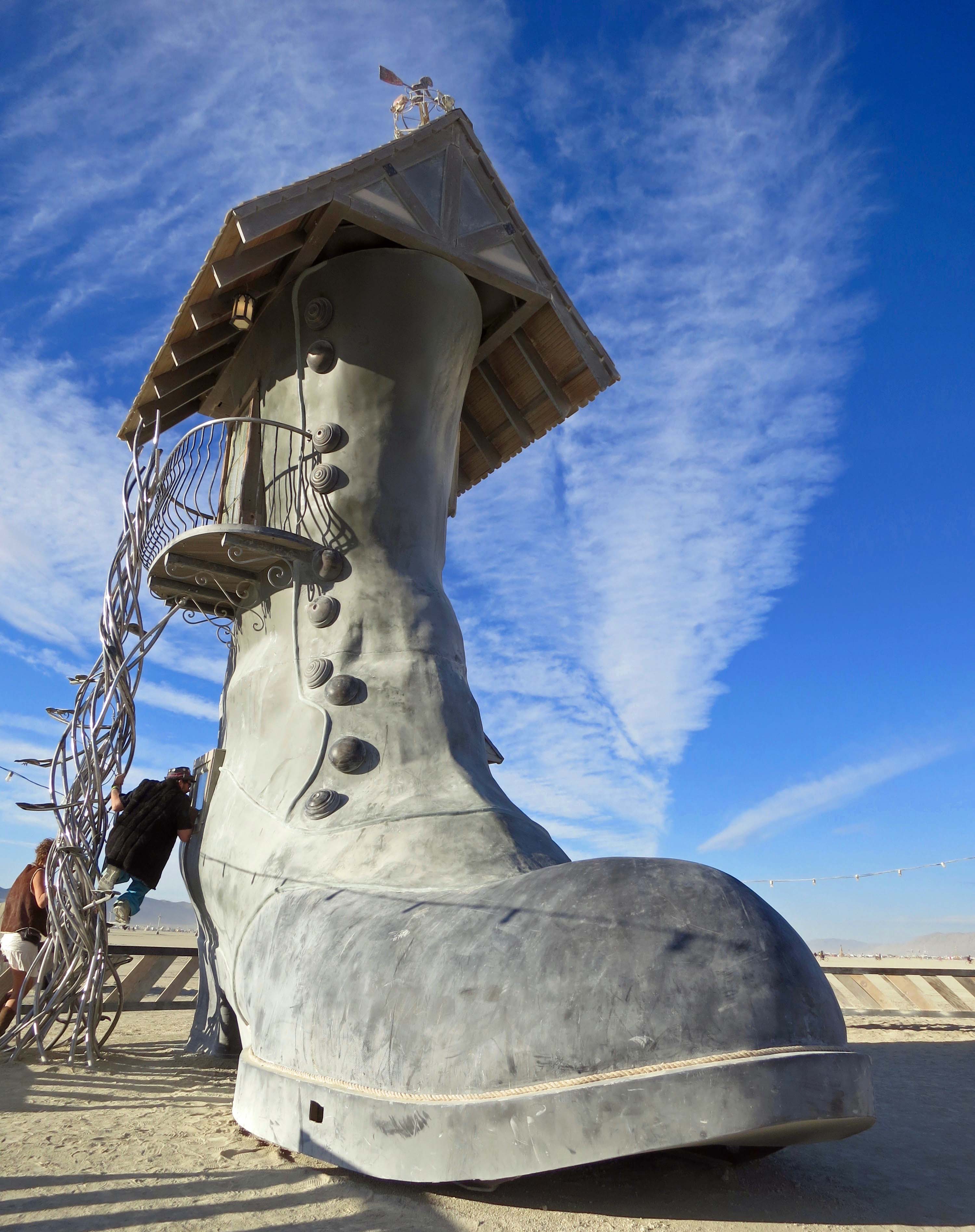
“There was an old woman who lived in a shoe. She had so many children, she didn’t know what to do.” Obviously.
Next on UT-OH: Nancy Jo and the Graveyard Ghost— a terrifying experience.
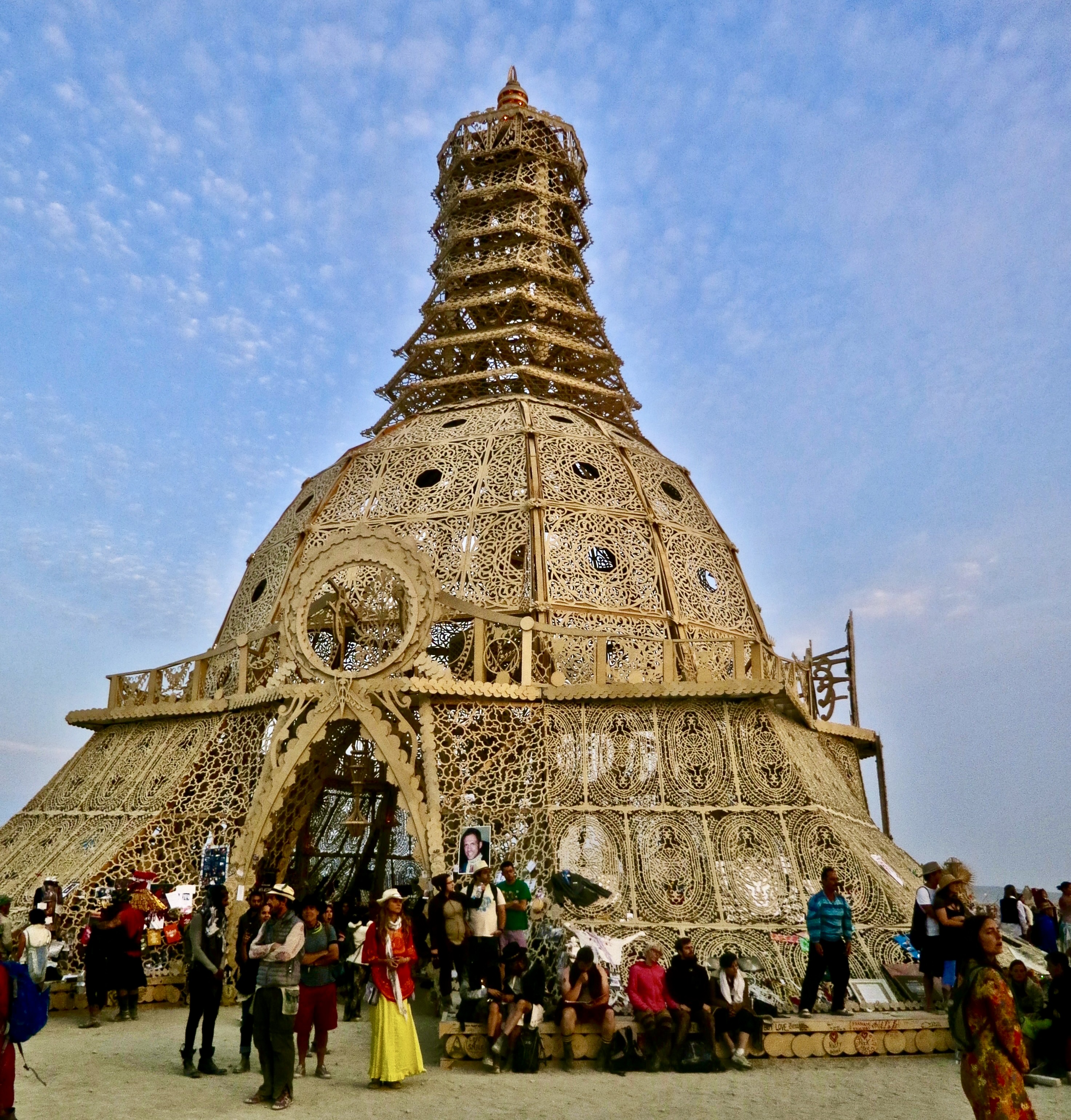
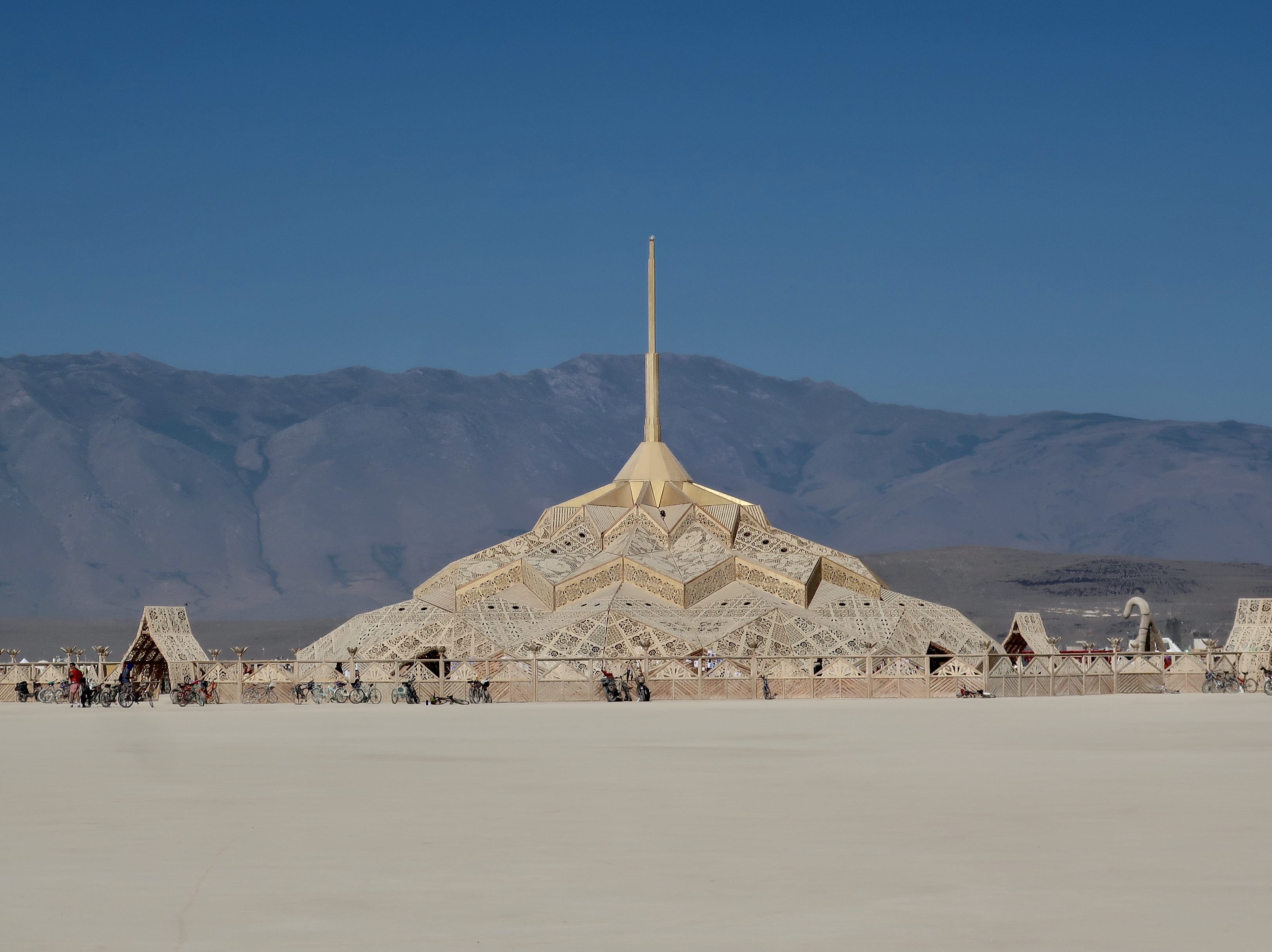
This is the fourth post in our focus series on Burning Man including one on mutant vehicles, one on sculptures, and an overview from our last trip to Burning Man in 2023. Today, I am going to feature the Temples of Burning Man, which are both beautiful and sacred— as suggested in the headline. A quick look at the Temple of Grace above speaks to the beauty of the structures. I will provide examples from seven more years below, plus an introduction to what Burners will see this year. Given that there have been 25 Temples so far, my objective is to simply provide a sample. In our 12 years of attending Burning Man, we have never seen a temple that we didn’t consider special.
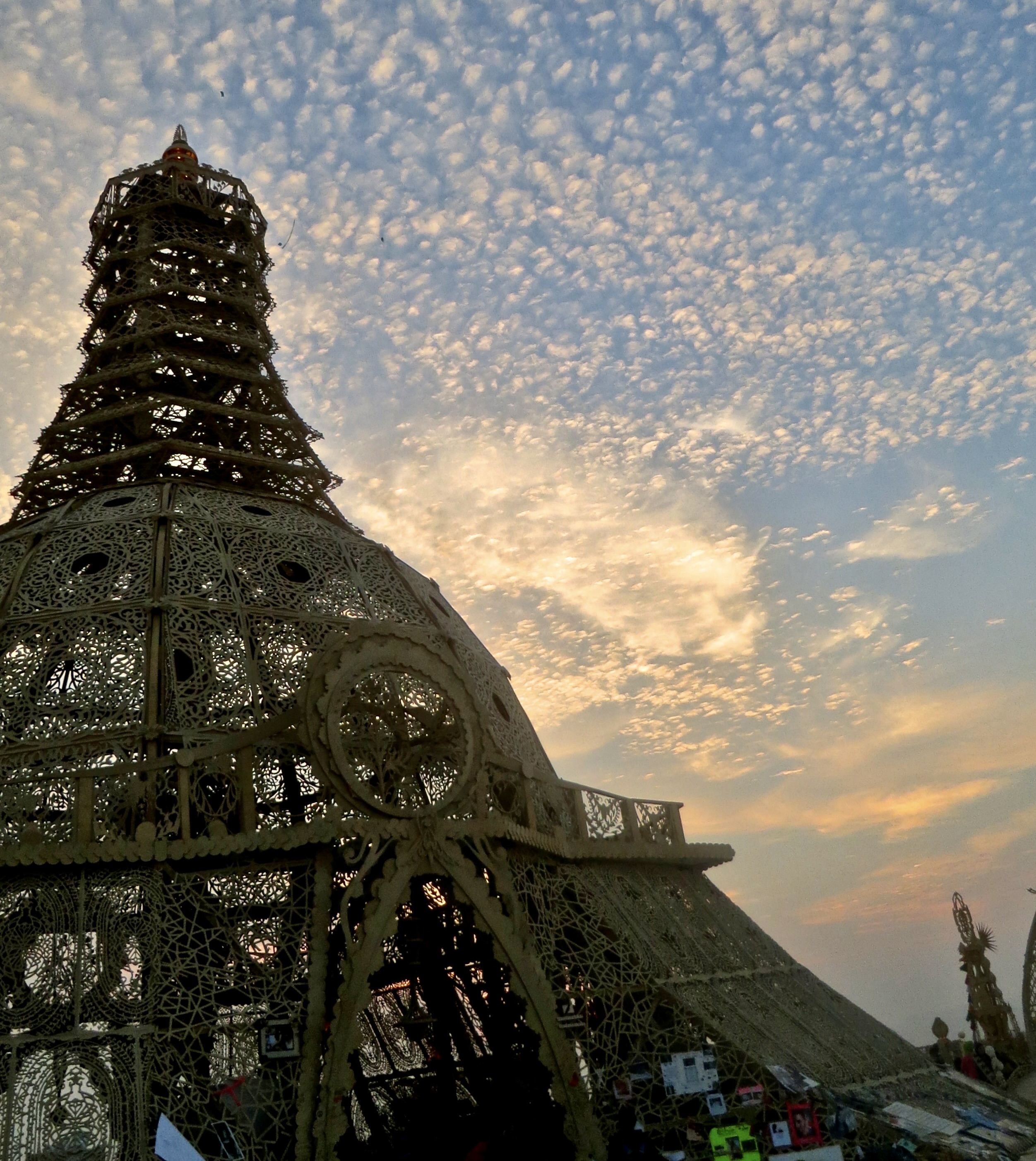
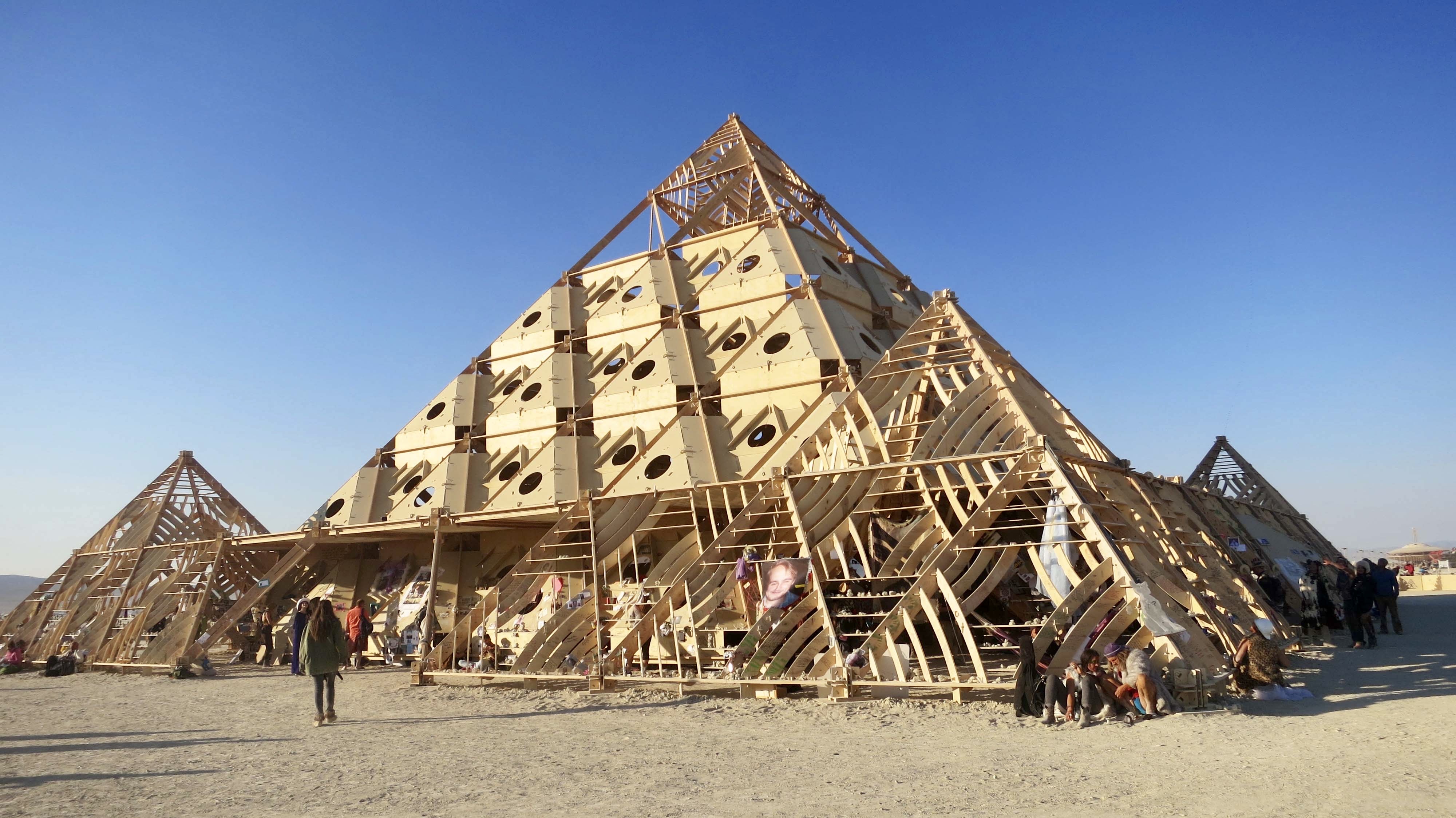
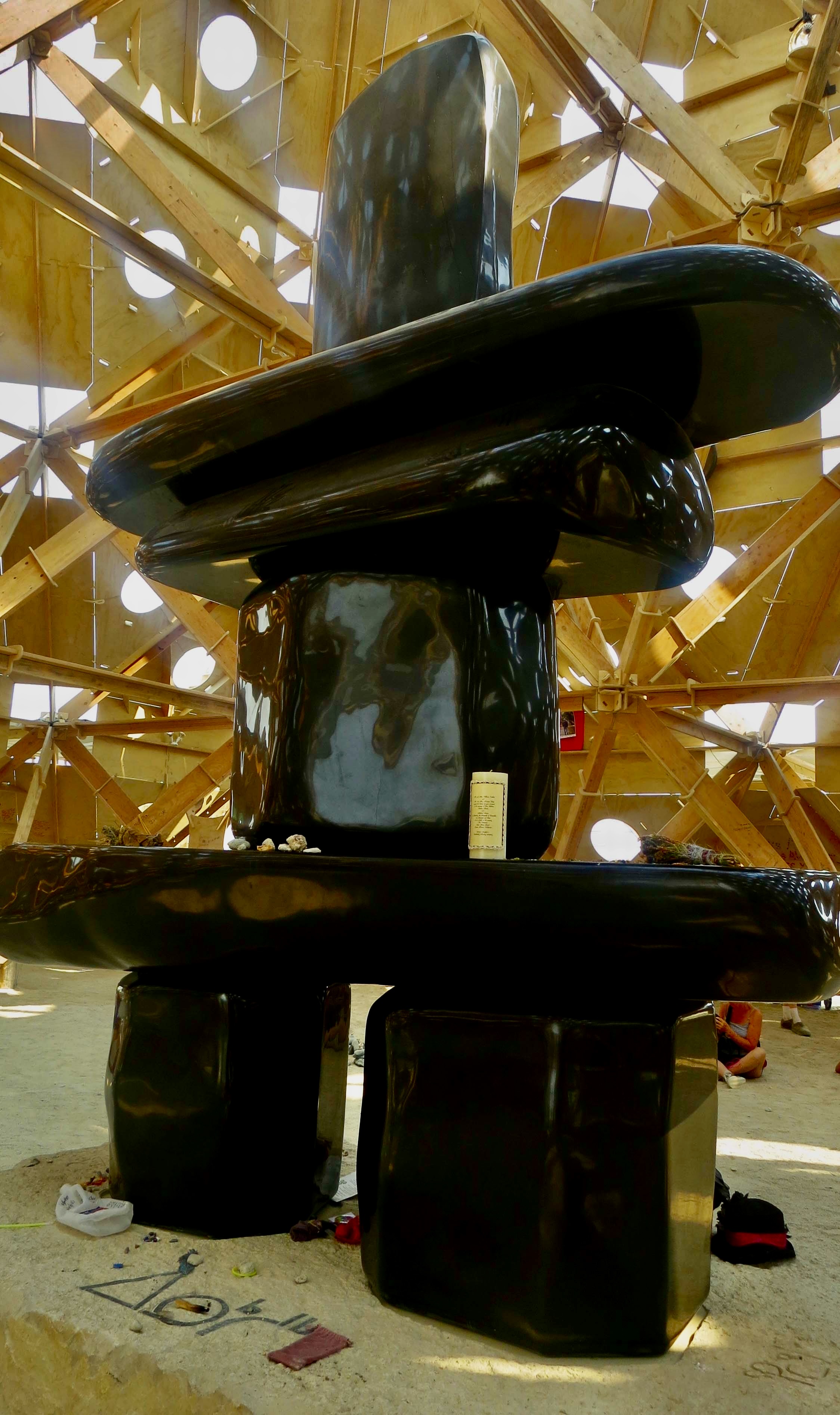
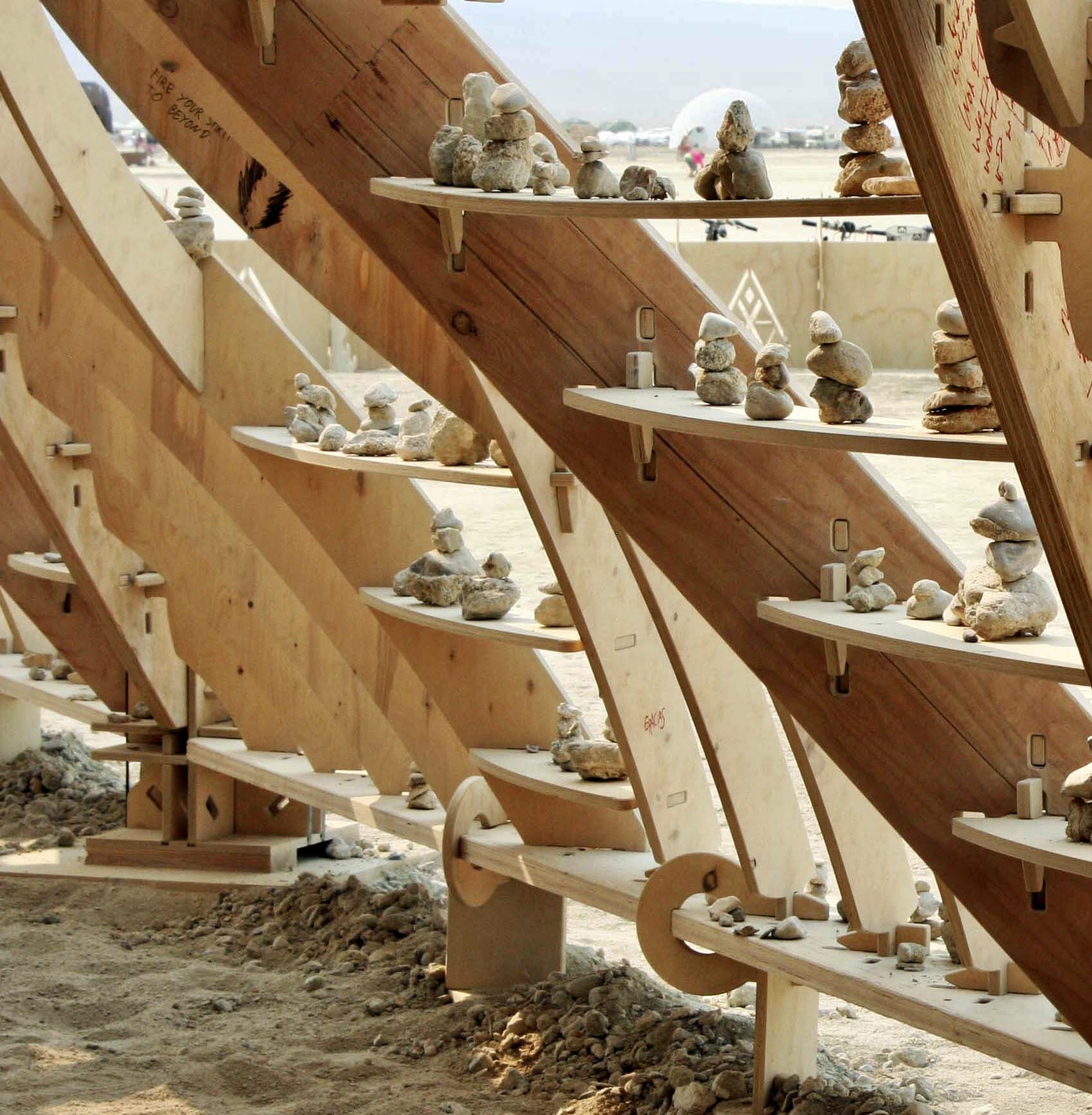
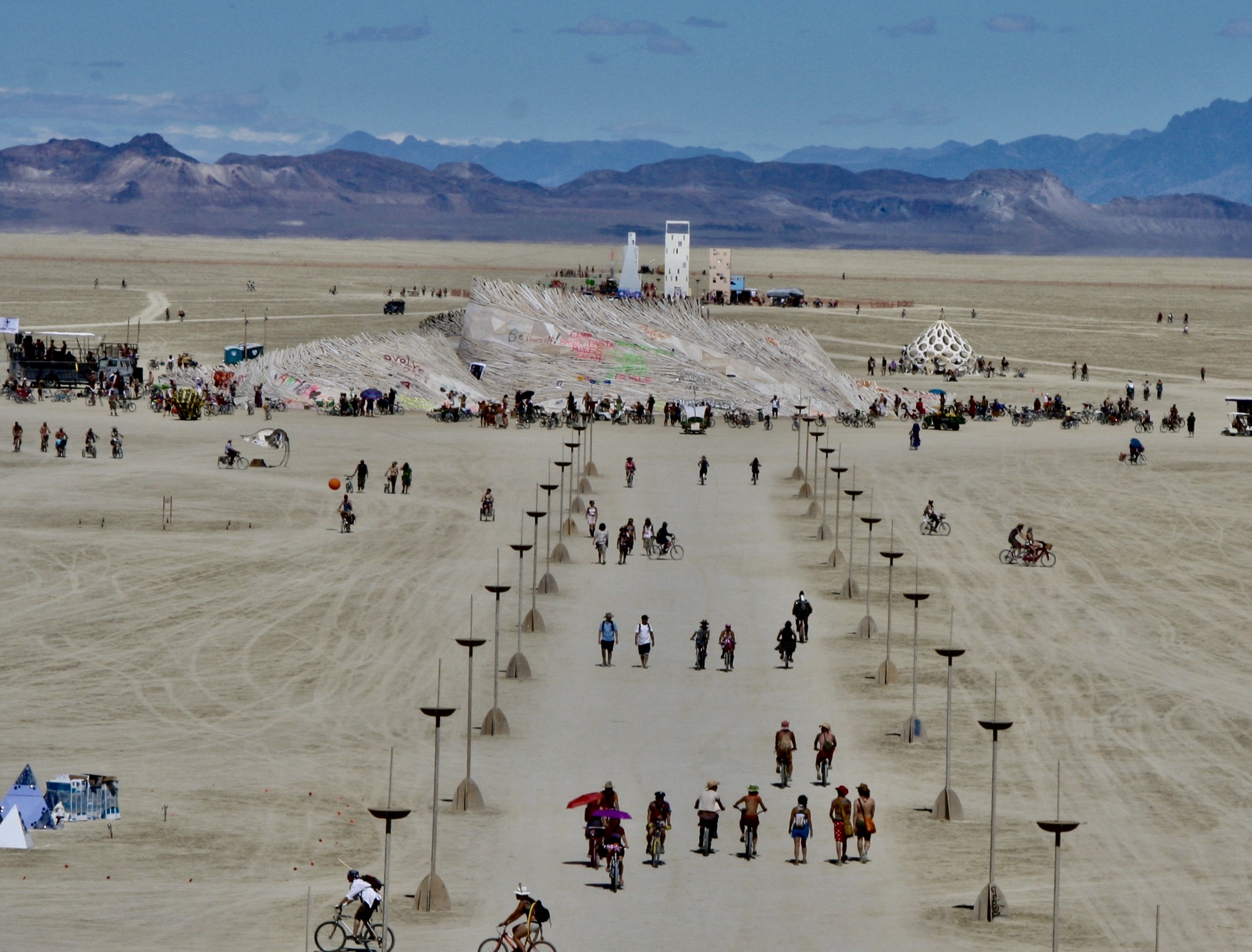
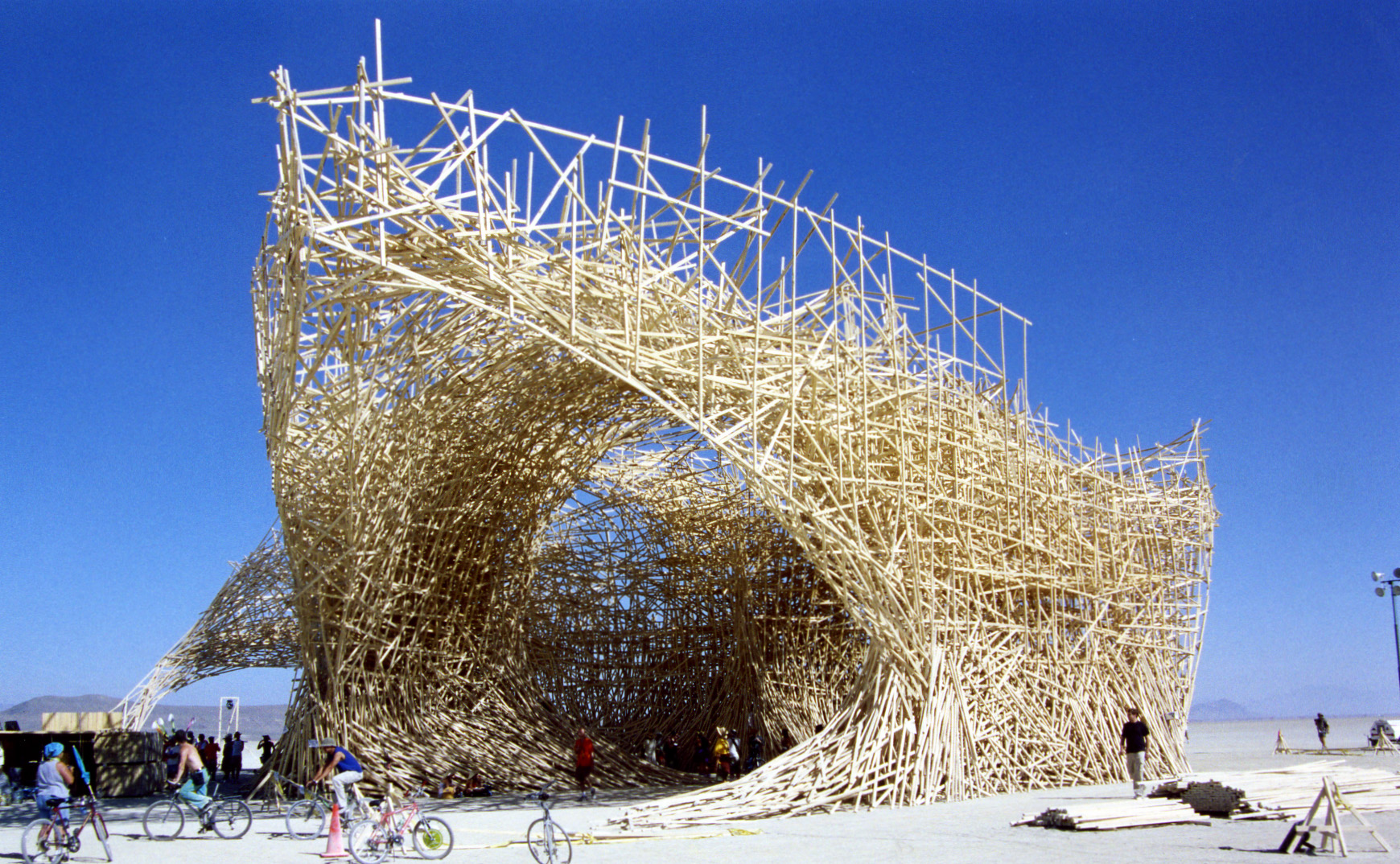
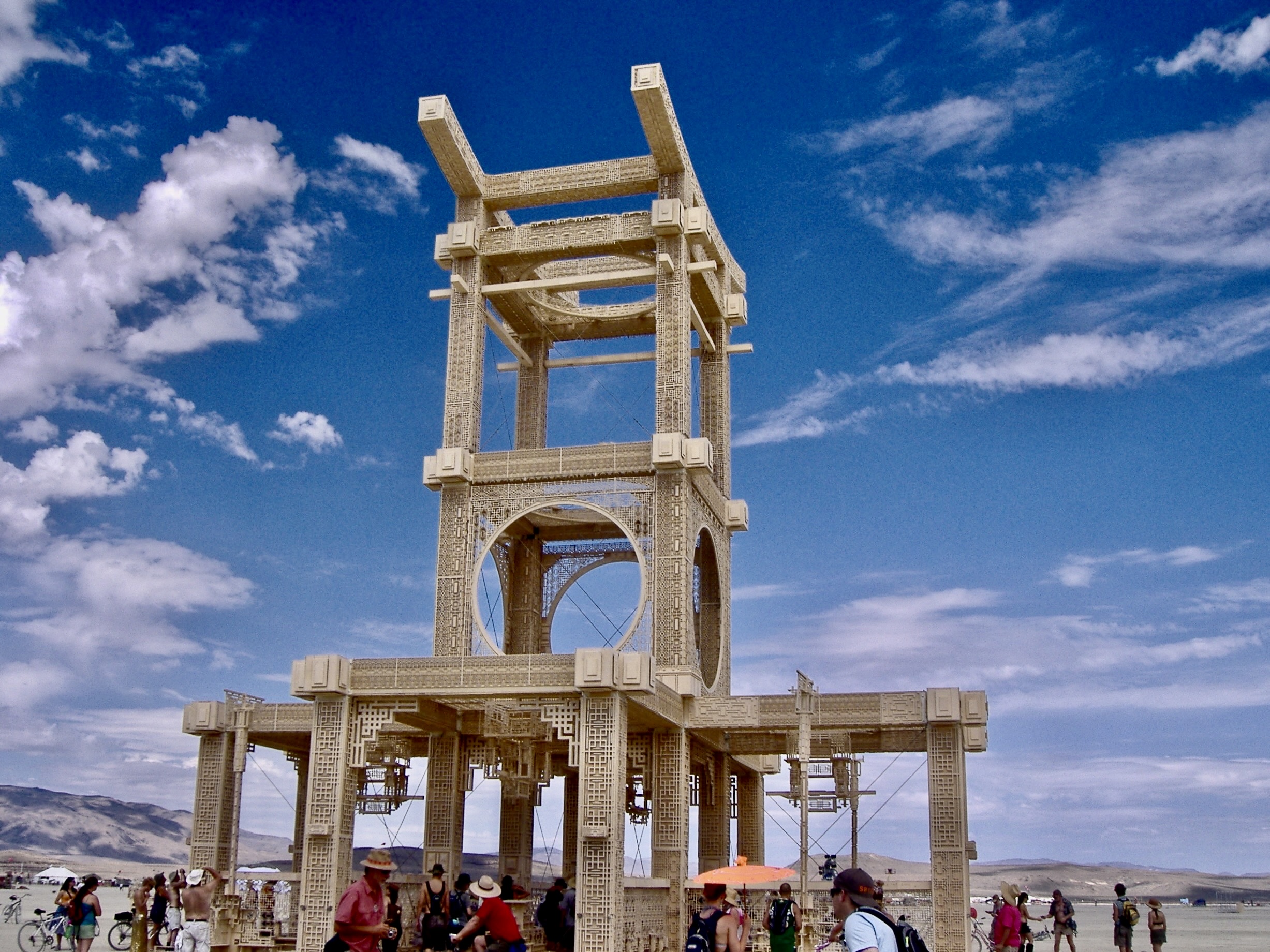
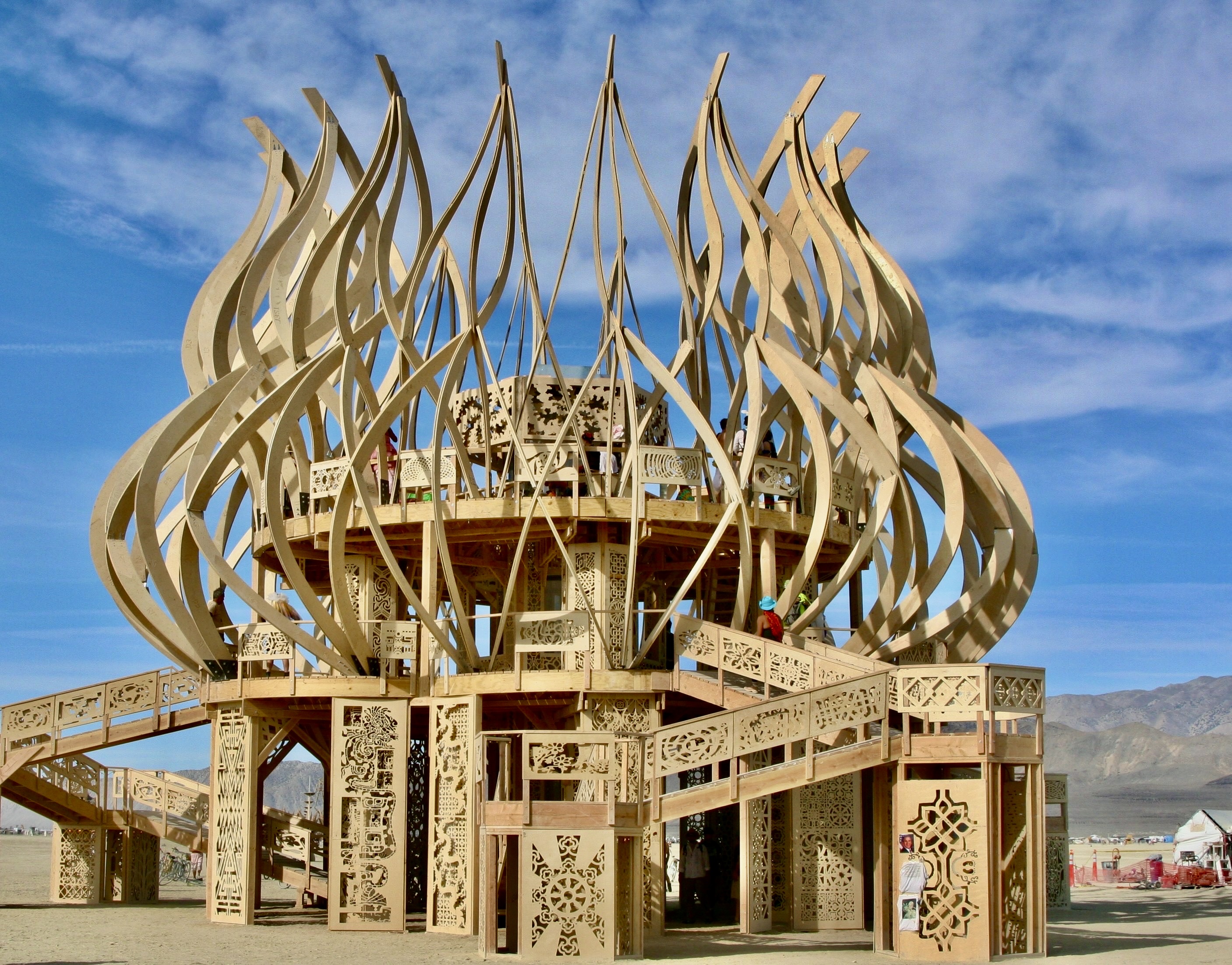
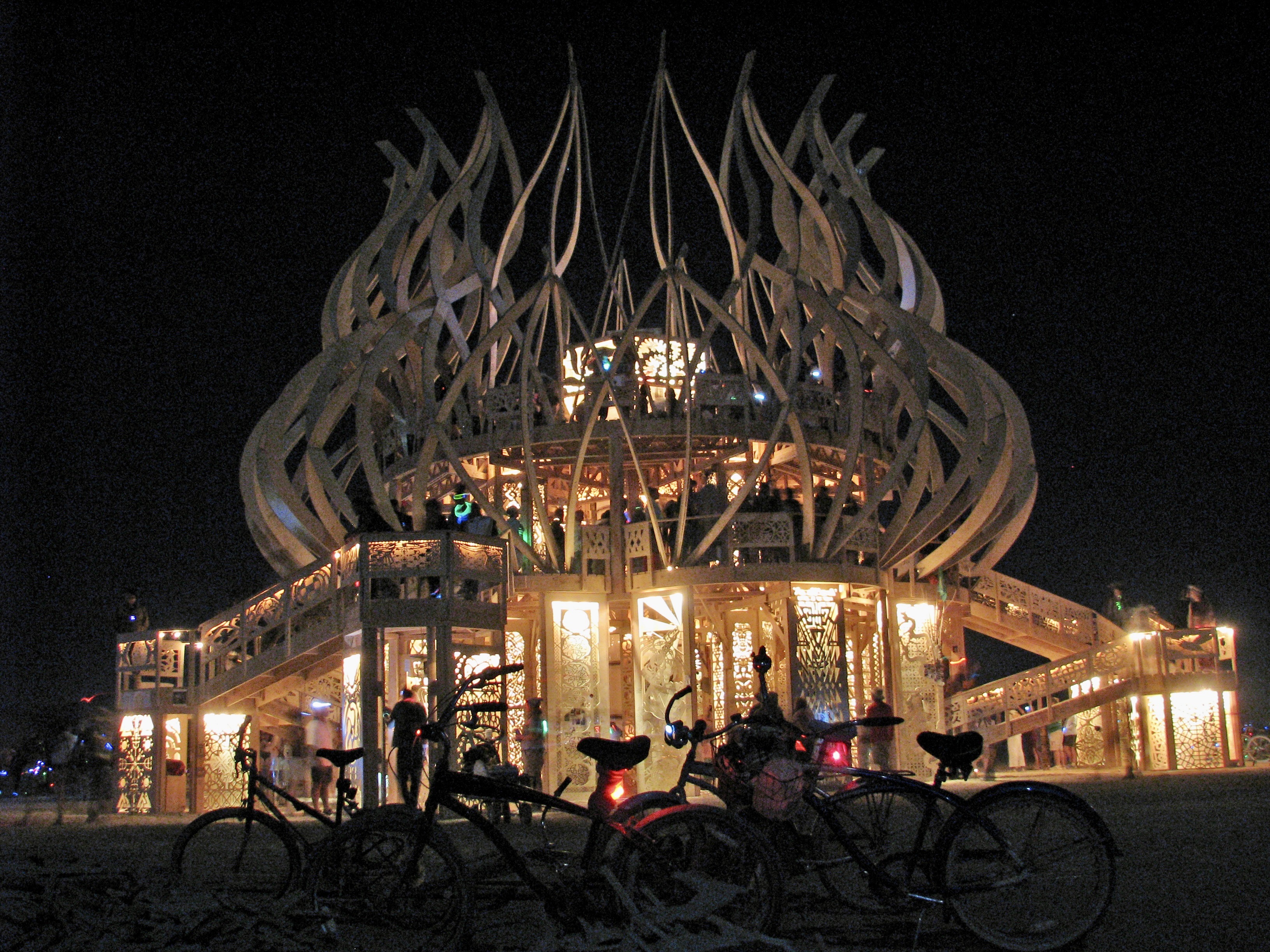
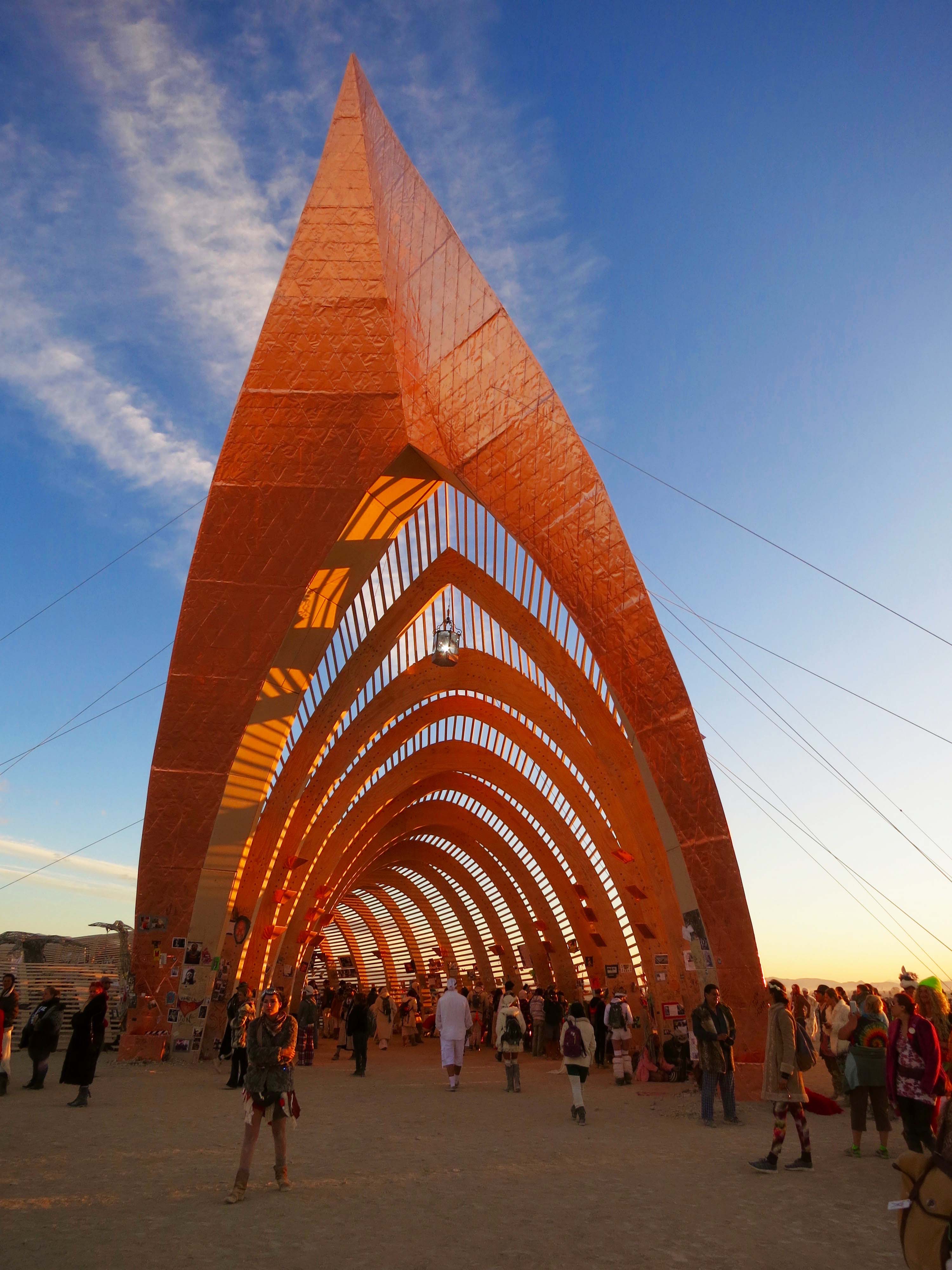
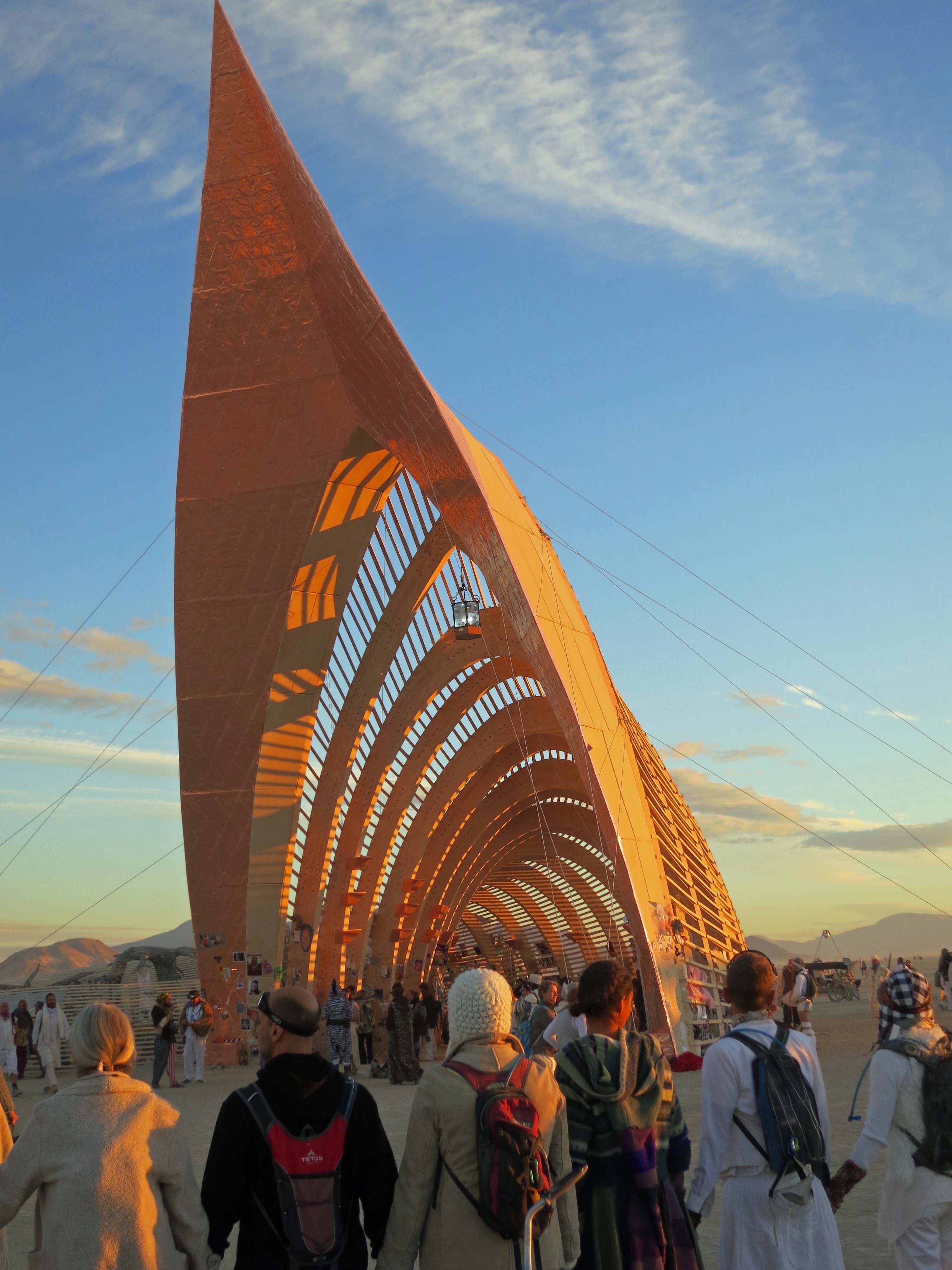
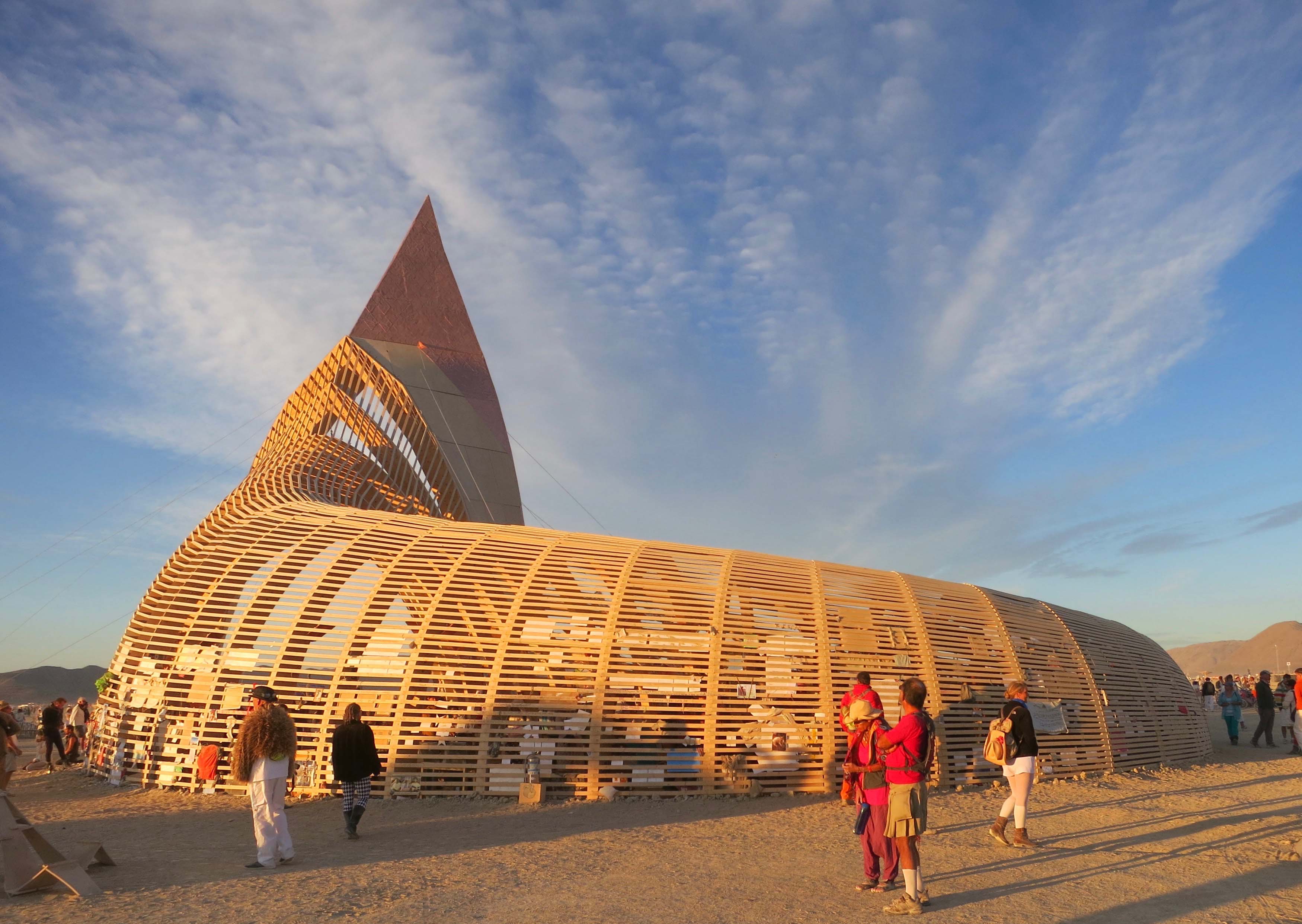
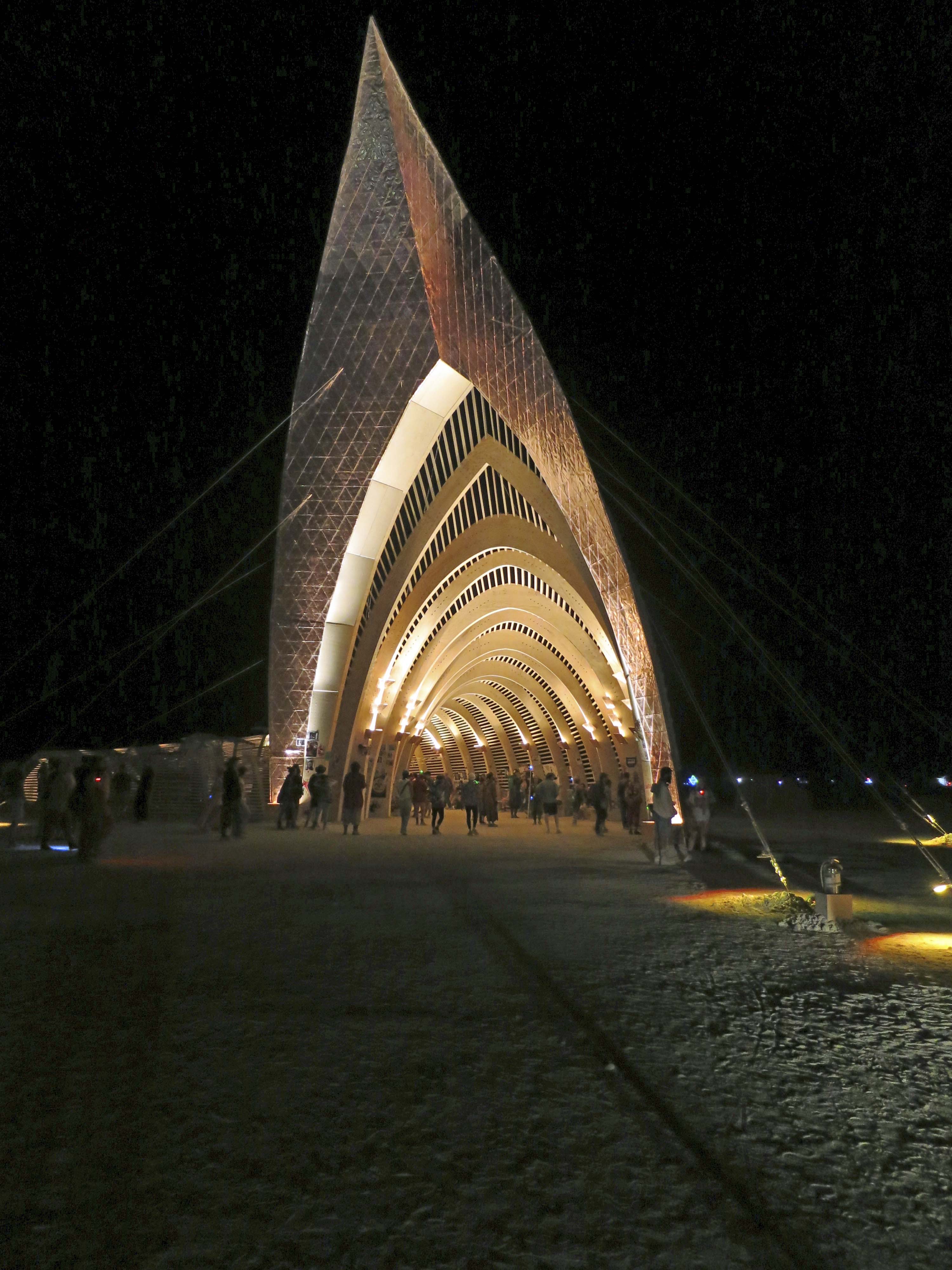
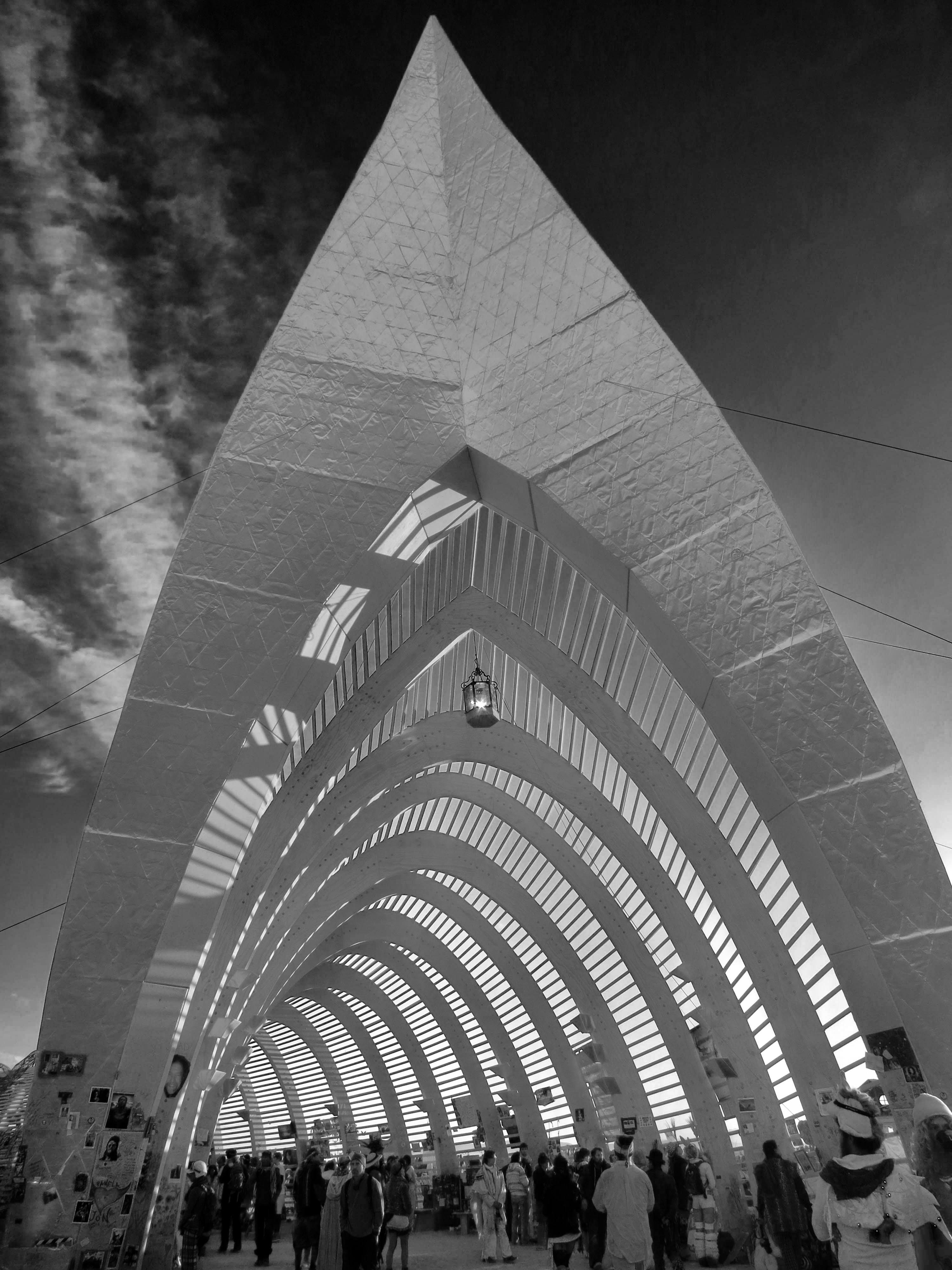
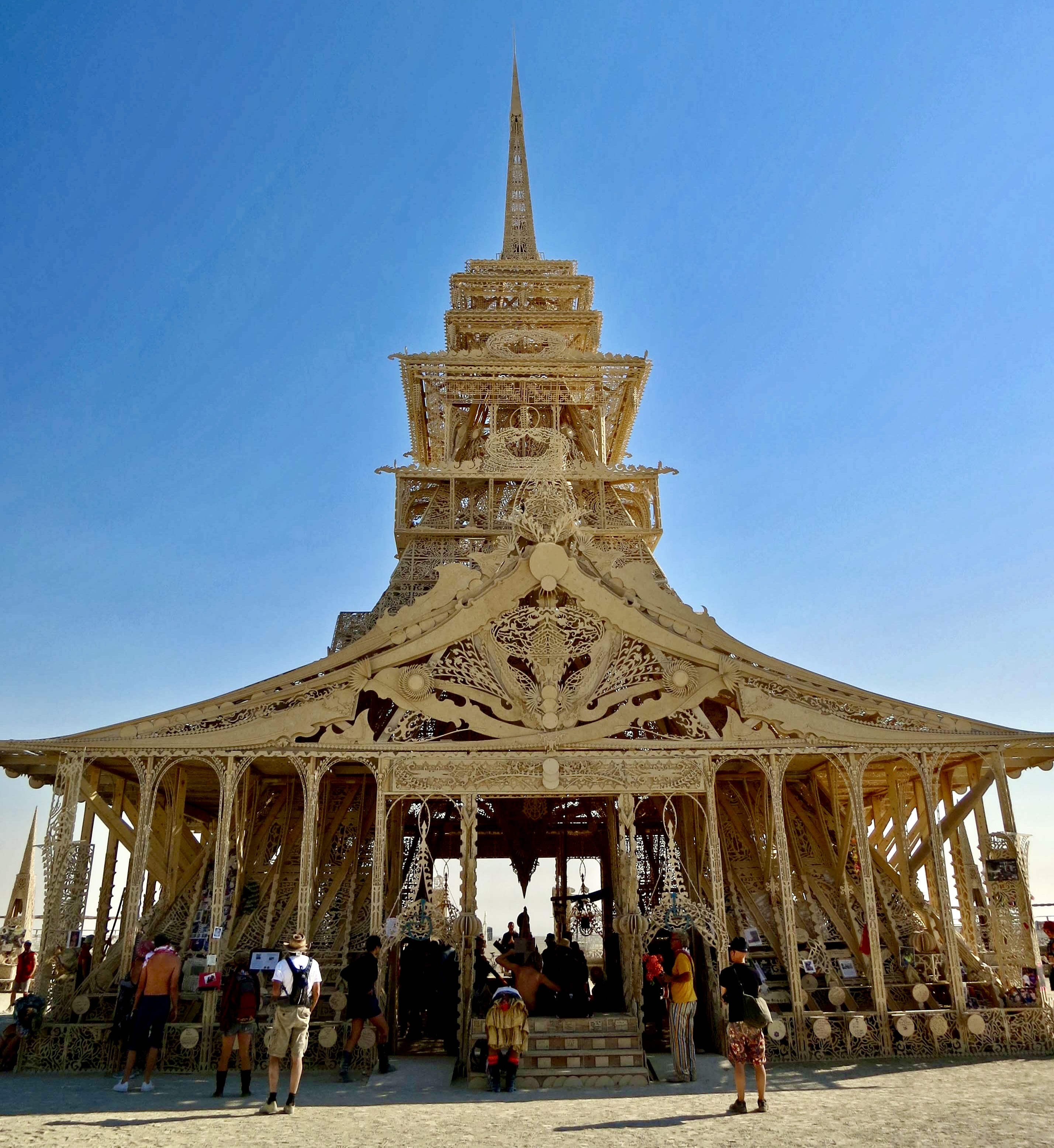
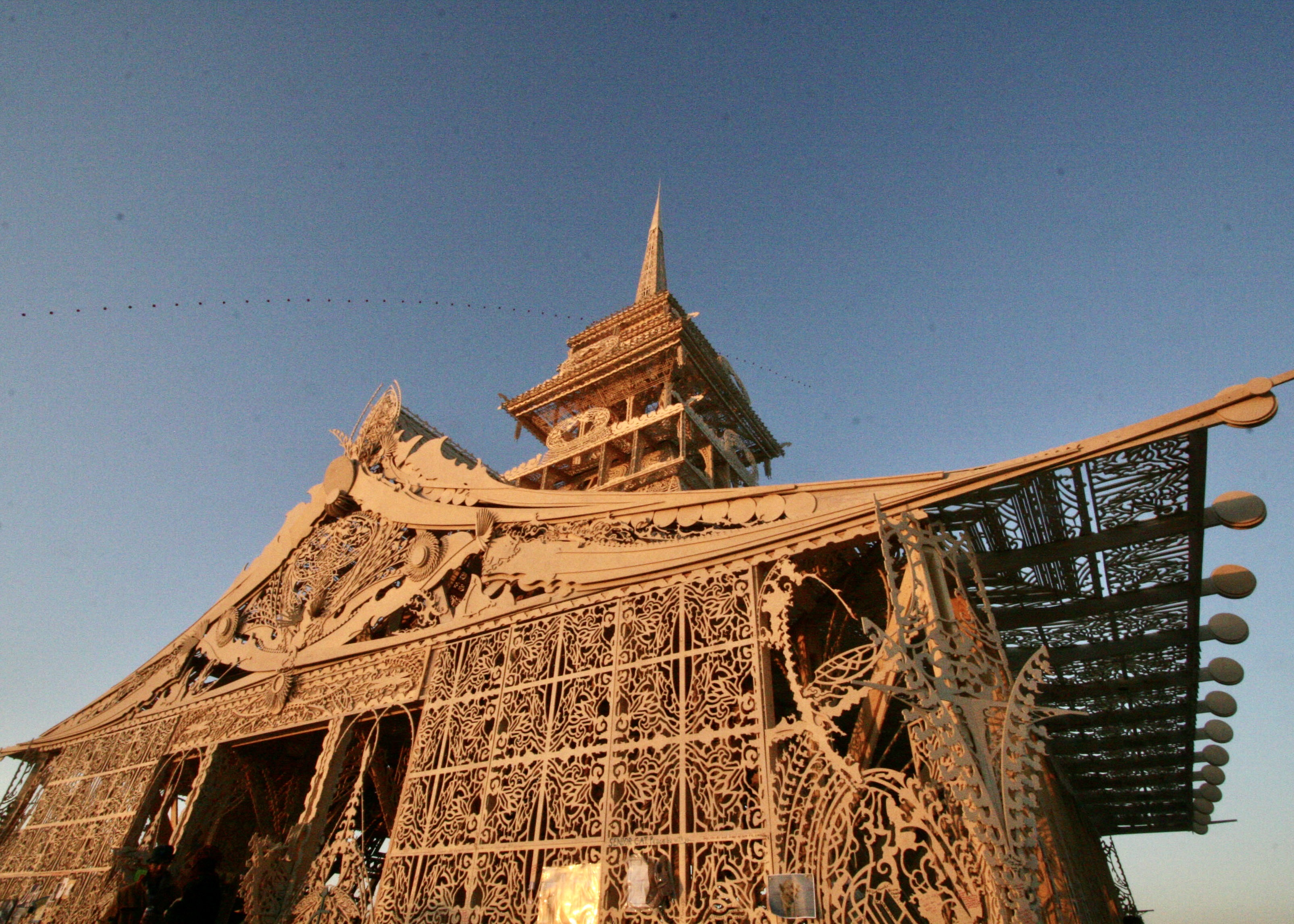
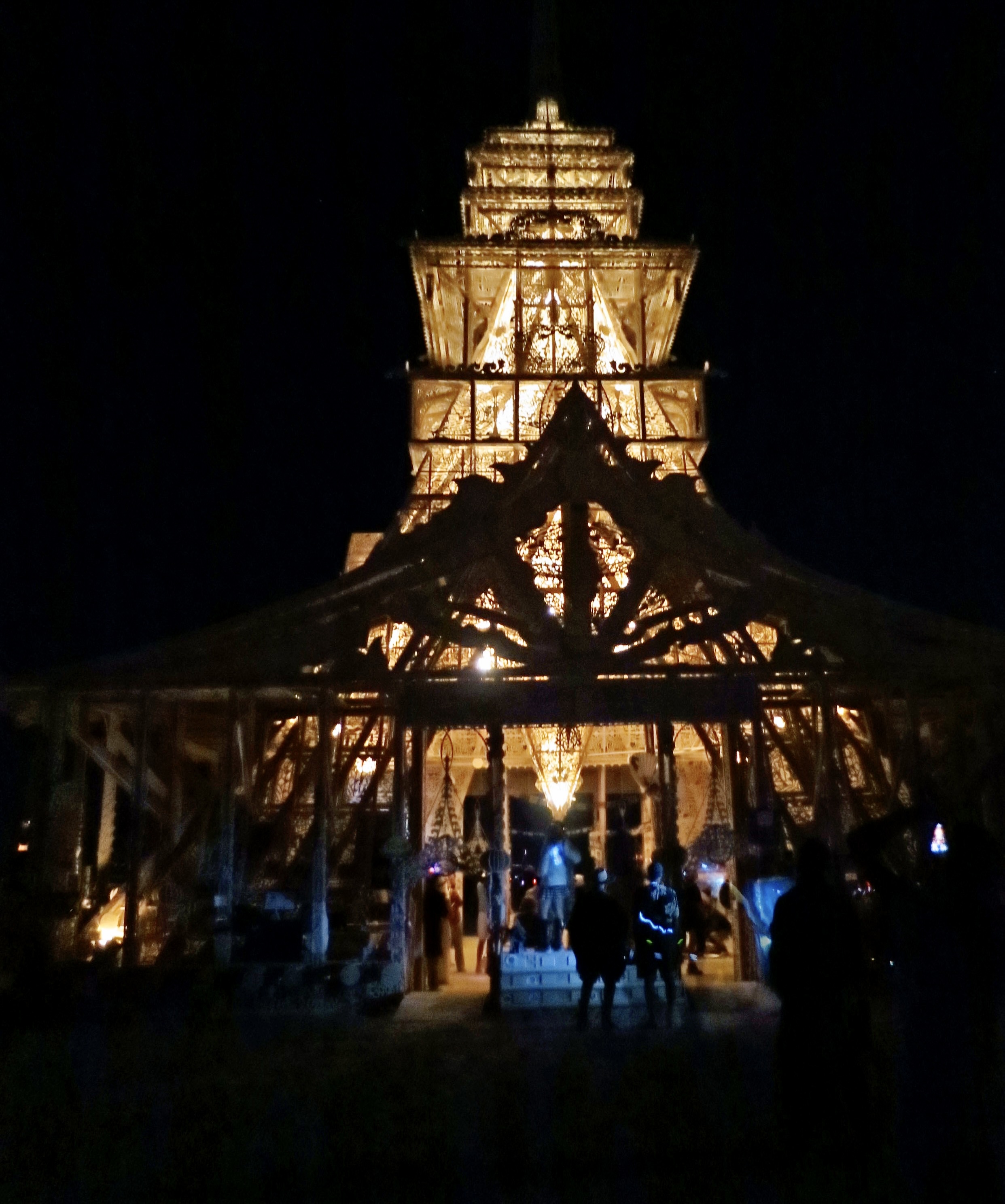
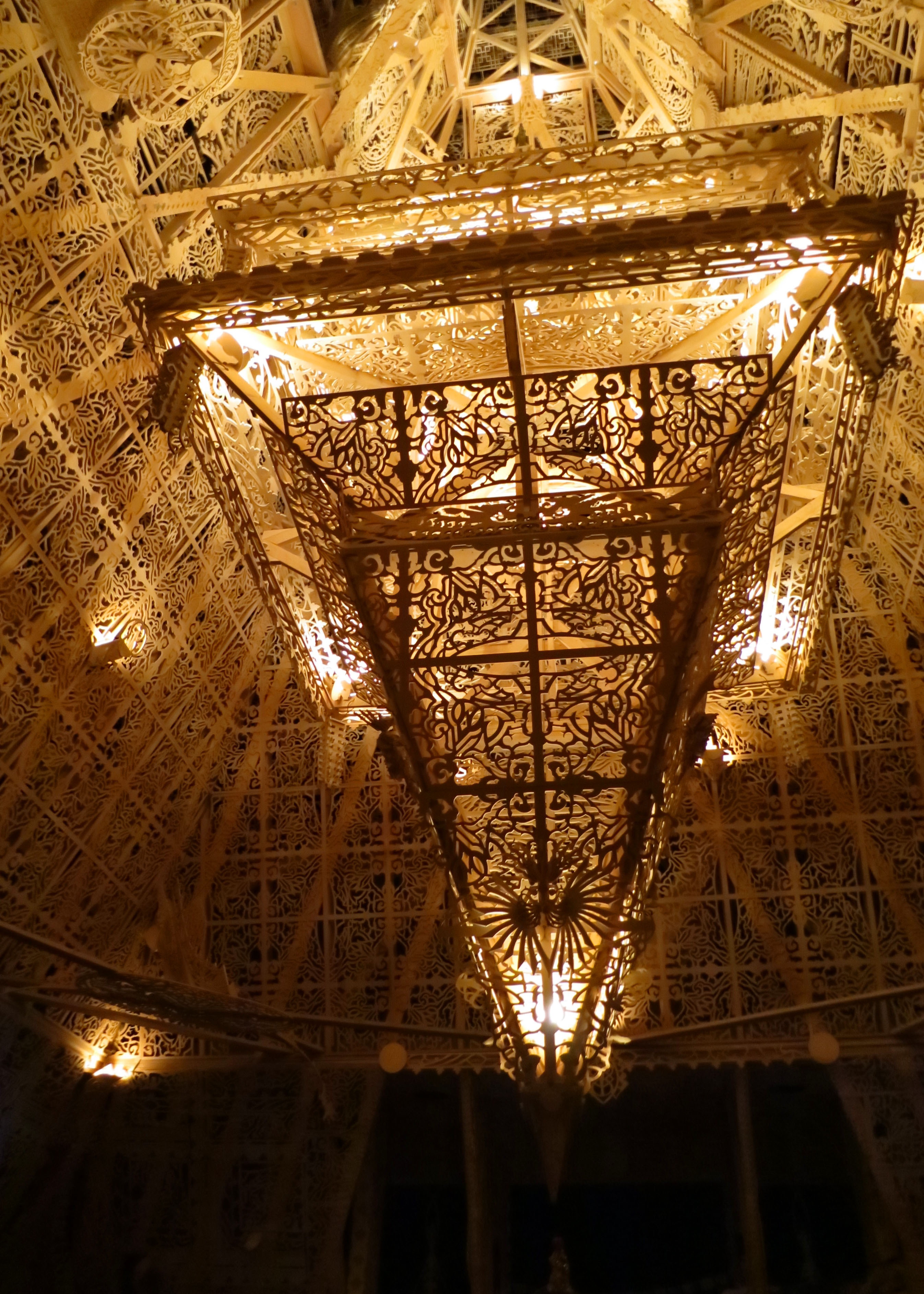
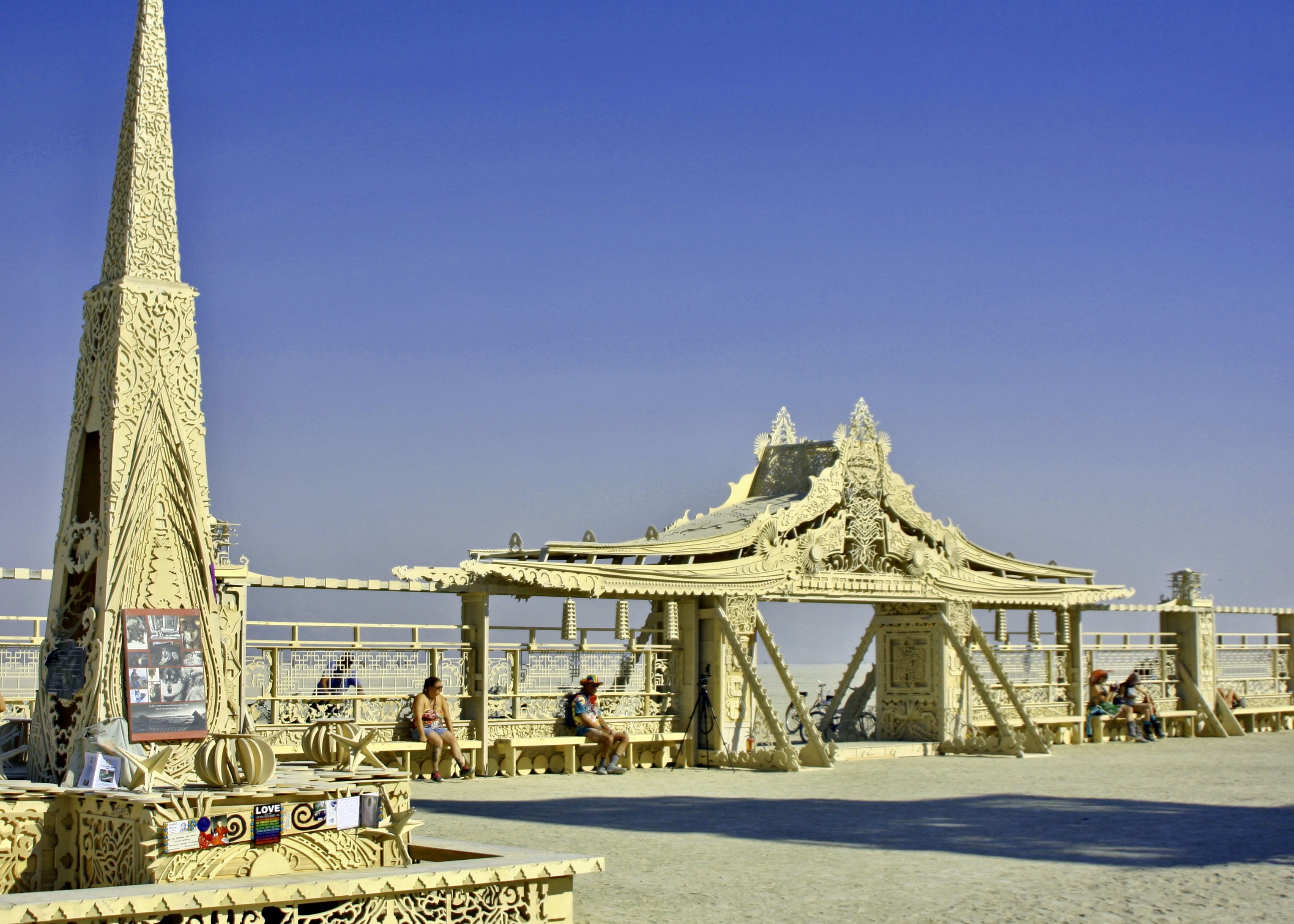
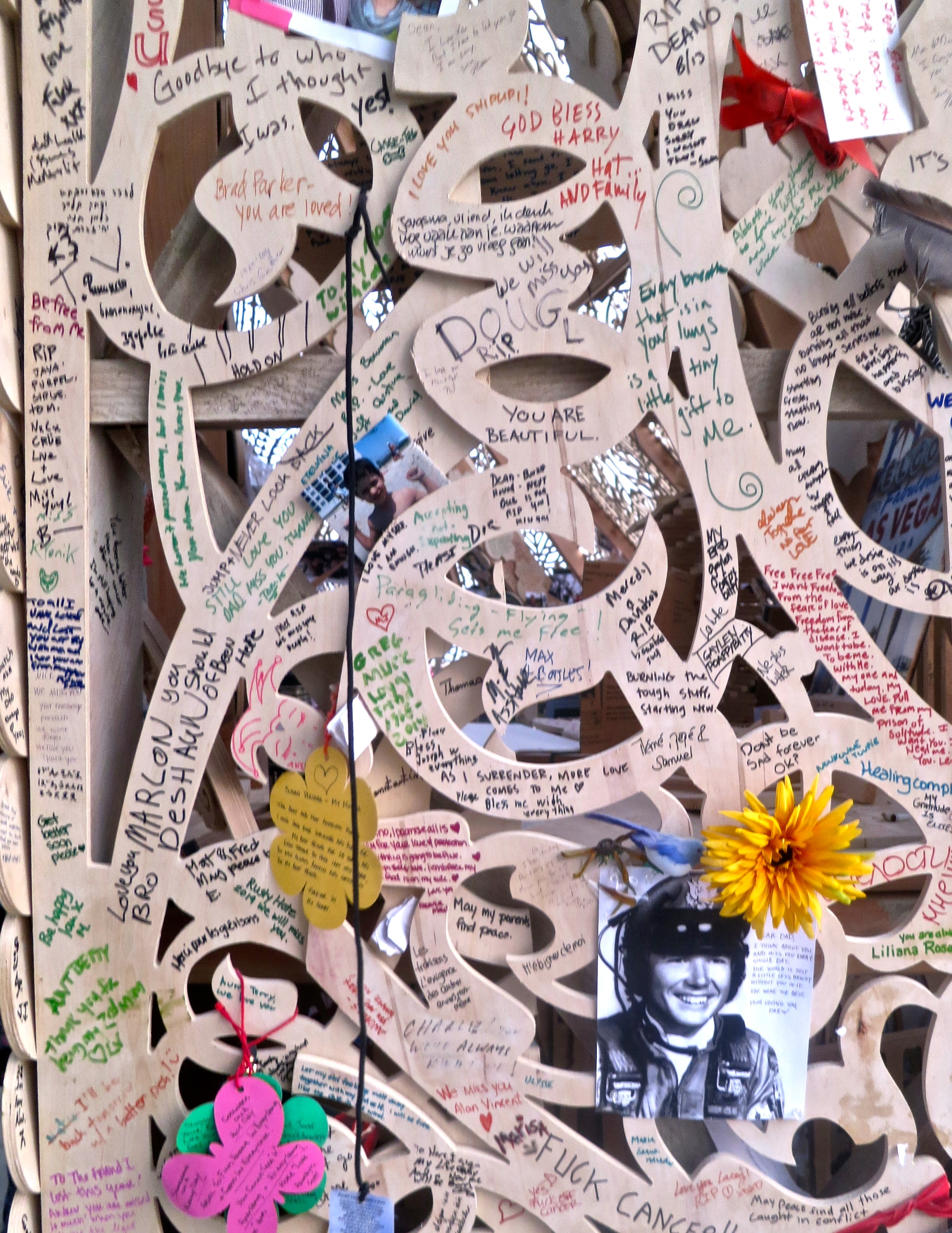
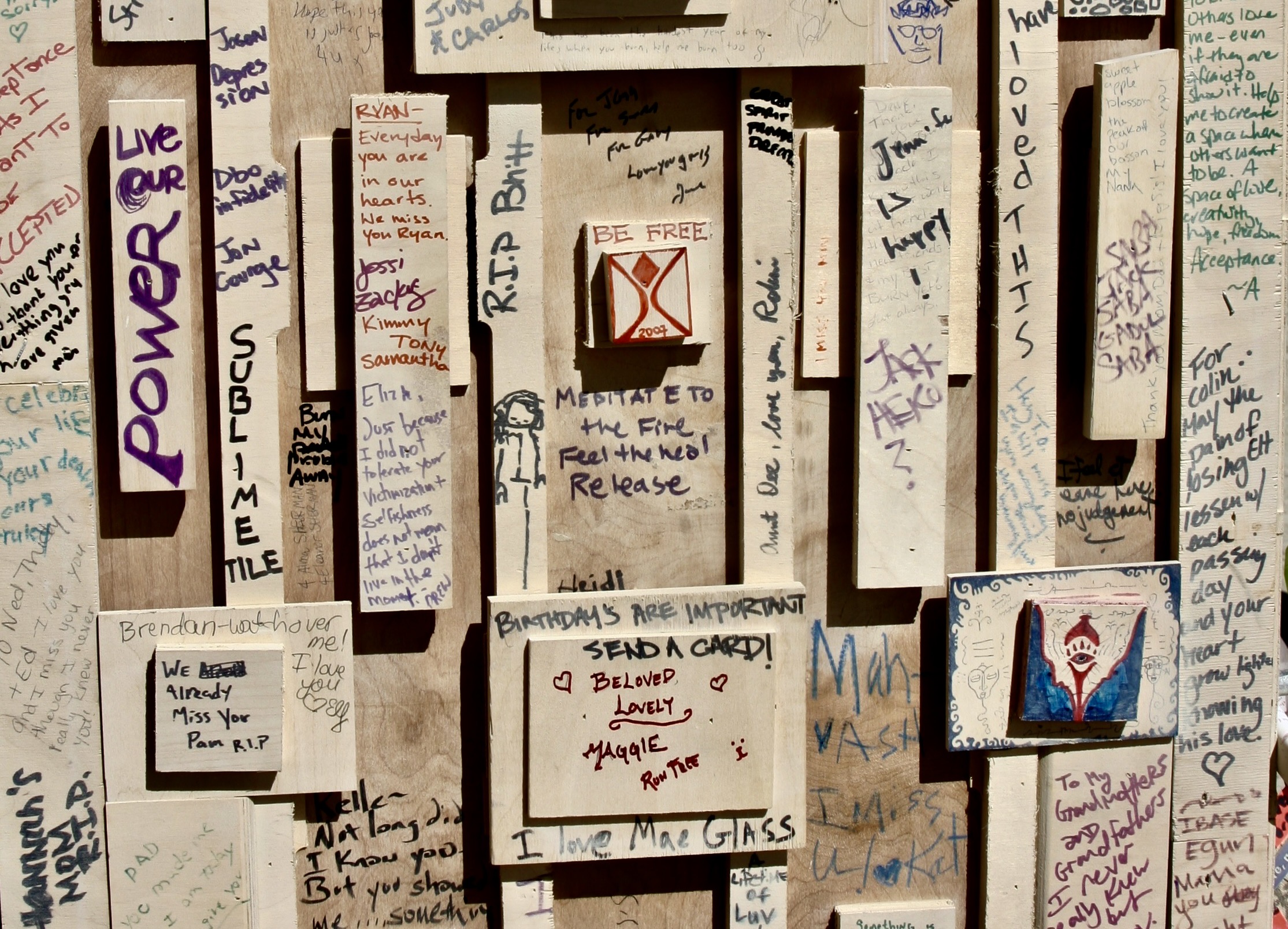
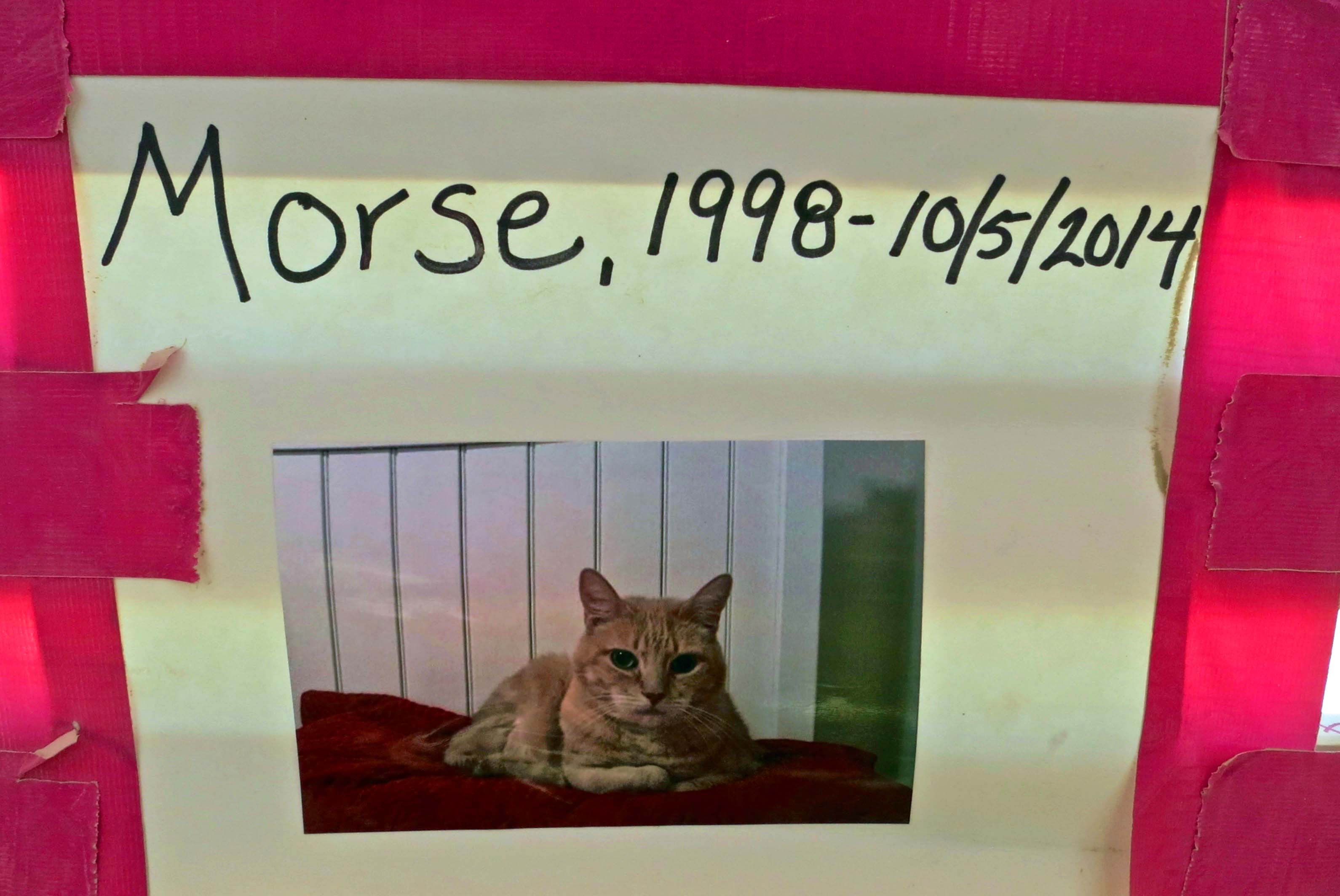
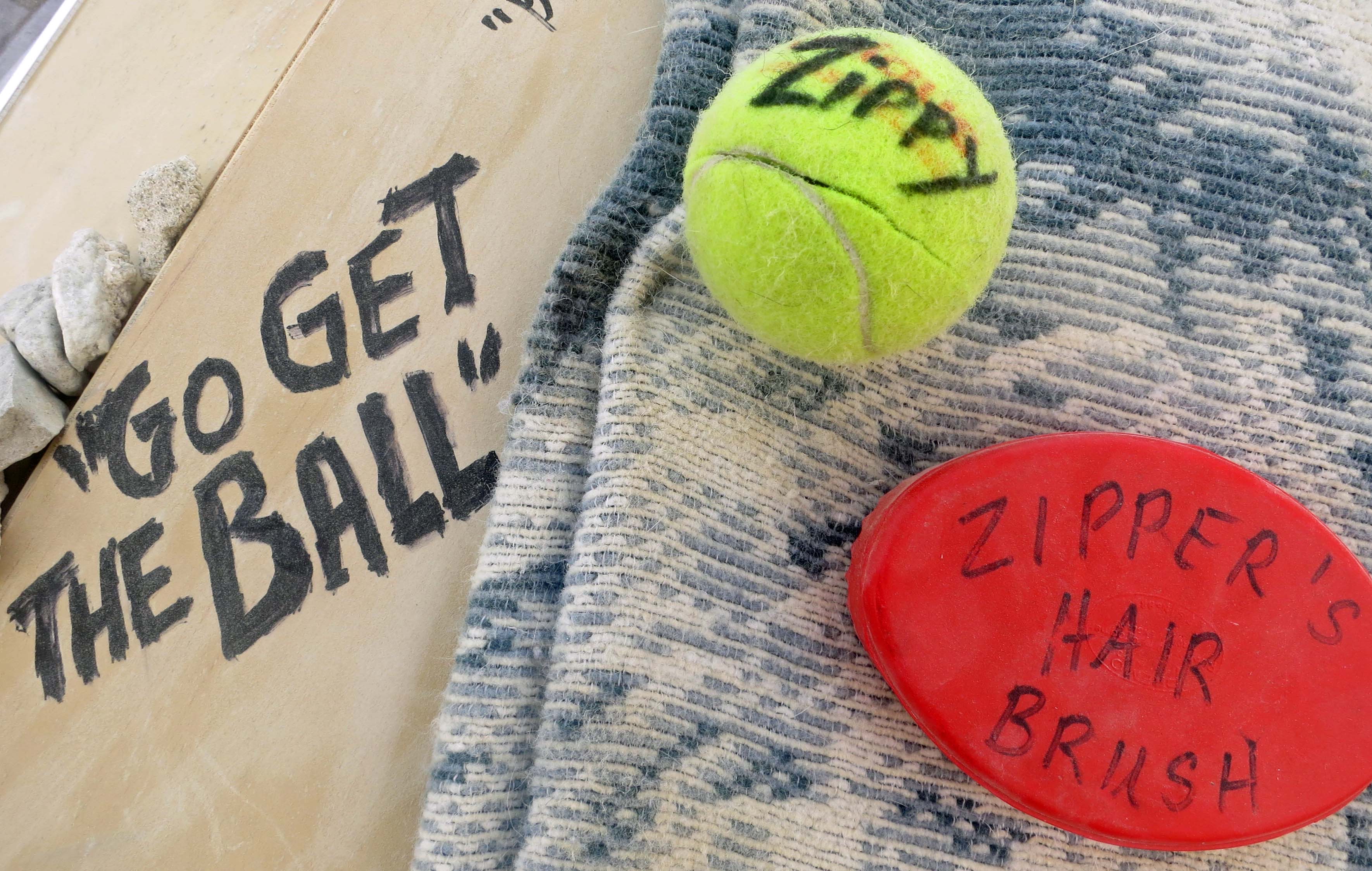
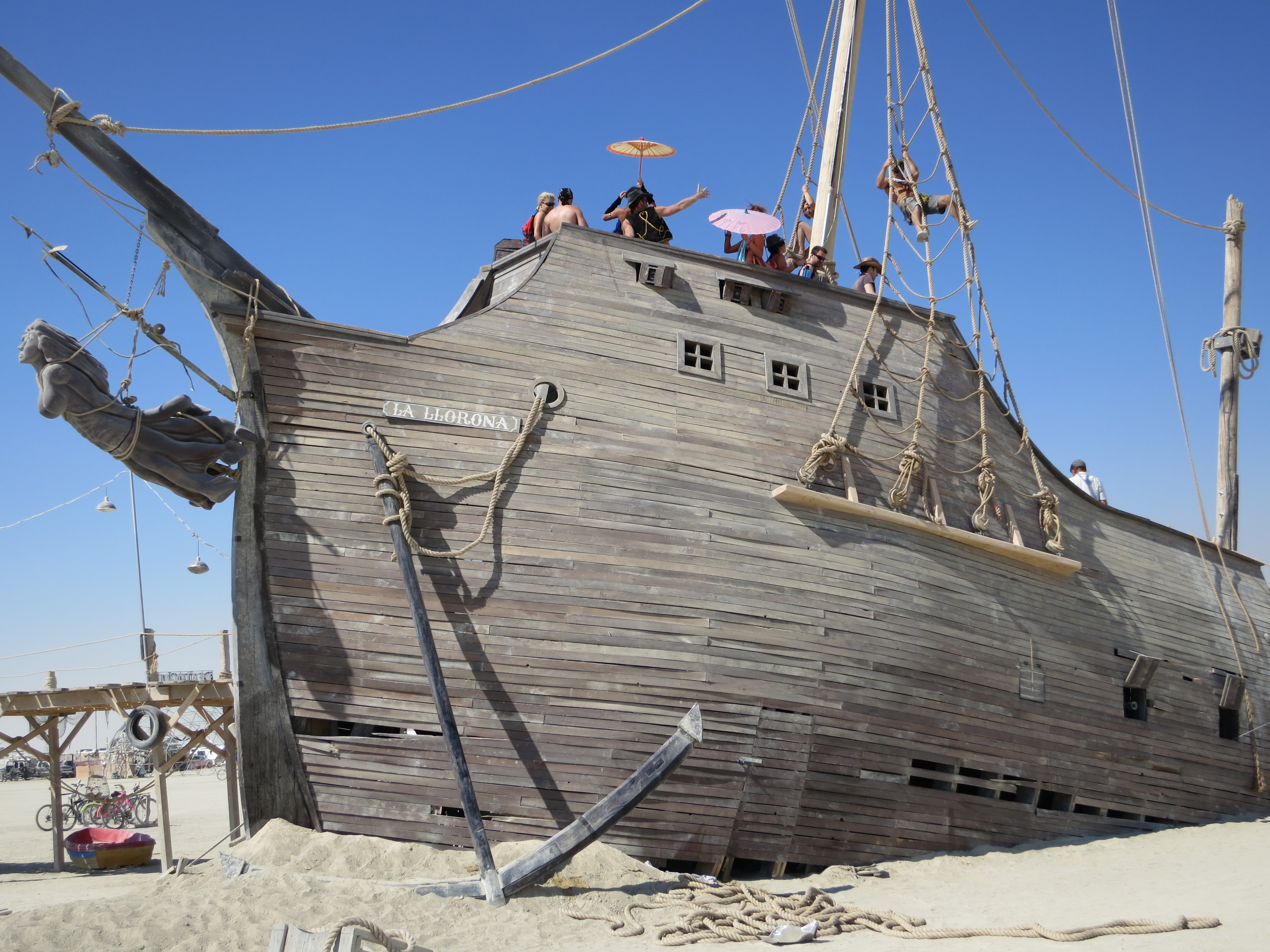
The process of selecting and building the Temple each year starts with various artists submitting proposals to Burning Man for different designs. This is an artistic rendering of the temple selected for 2026— James Gwertzman’s proposal for the Temple of the Moon. His inspiration was the Queen of the Night desert flower, a flower that blooms and dies in one night. The design rendering of the Temple above is by Gwertzman, and the dawn rendering is by artist Annie Locke Scherer. (Burning Man Journal)Artistic rendering of the 2026 Temple at night. (Burning Man Journal)Artistic rendering of the inside of the 2026 Temple. (Burning Man Journal)Early morning view of the 2014 Temple of Grace at Burning Man. Temples are funded by a major grant from Burning Man plus fundraising. A close look at the structure speaks to the amount of work that goes into building one of the temples. It is mainly done by volunteers. The work starts as soon as the project is chosen. Wood is cut prior to Burning Man and then brought to the site. Depending on the complexity of the project, a volunteer crew of 100-200 people arrives at Burning Man 2-3 weeks before the event to assemble the pieces.Looking up from inside the Temple of Grace.The 2013 Temple of Whollyness at Burning Man was a pyramid-shaped structure of interlocking wood that used no nails, glue, or metal fasteners. It was surrounded by four smaller pyramids.A large altar or ‘cairn’ constructed of black, igneous basalt was located inside the Temple. Cairns are normally large piles of rock arranged in a cone-like formation as a way to mark routes through wilderness areas. I’ve often followed them, or their smaller cousins, ducks, as I’ve hiked and backpacked through the wild regions of North America. In case you are wondering what a ‘duck’ looks like…The temple was filled with them. The symbolism was obvious: Helping people find their way. This photo also shows how some of the wooden, interlocking devices were use to build the Temple.The 2010 Temple of Flux at Burning Man stressed impermanence in life. This photo was taken from the Man looking out across the Playa to the mountains of the Black Rock Desert. While the creators of the Temple noted that their inspiration came from desert canyons carved by wind and water, I thought that the outer structure resembled a sand dune, a perfect example of impermanence. The people on the pathway are biking/hiking between the Man and the Temple. At night, the poles held lit lamps. The buildings in the back were an urban representation of Wall Street. It was located close to the fence that marks the boundary of Burning Man.One of the entrances to the Temple of Flux We included the Temple of Heart in the Post we did on our 2023 trip to Burning Man. Unfortunately the rains hit the day before we had planned to visit it. Everything we saw from the outside was beautiful, however. I read that it took 1000 volunteers to build the Temple.The 2007 Temple of Forgiveness at Burning Man. This Temple was created by David Best, who was responsible for the design and building of several Burning Man Temples. Looking up from inside the 2007 Temple of Forgiveness.The top of the 2009 Fire of Fires Temple was designed to look like flames, reflecting that temples are burned on the last day of Burning Man.The Fire of Fires Temple at night.Of the Burning Man Temples that Peggy and I have seen, the 2015 Temple of Promise was one of our favorite because of its beauty and design.Early one morning, we joined hands with a few hundred other Burners surrounding the Temple as the sun rose.This back view provides a perspective on its cornucopia-like structure.A daytime view inside the Temple of PromiseThe Temple of Promise at night.My rendering of the Temple of Promise in black and white. Note the single lamp.The theme for the 2012 Burning Man was fertility. The name of that year’s temple was Juno, a Roman goddess of fertility, motherhood, and childbirth.This is an early morning photo of the Temple of Juno by our friend Tom Lovering.The Temple of Juno at night.Looking up inside the Temple of Juno at night. Note the intricate carving.A large courtyard surrounding the Temple of Juno provided places for people to gather and relax. It also provided space for Burners to leave messages expressing love, grief, hope, fear and anger, as well as thanks for blessings received. Literally thousands of people leave messages annually, most inside of the Temple.Sometimes, it seems like every inch of available space is used. A quick glance gives an overview on the breadth of messages. I particularly liked the one in the upper left hand corner: “Goodbye to who I thought I was.” More than one person has left Burning Man with that perspective!Another example. Numerous pets are also memorized: a final opportunity to say goodbye.A loving tribute to Zippy: Zippy’s ball, hairbrush, and bed.Whatever the message, it burns along with the Temple on the last night of Burning Man each year. This is the Temple of Juno going up in flames, releasing the thousands of messages that Burners left in, on and around it— honoring those who have passed on, expressing love for those who still live, and letting go of anger, hate and other negative emotions. Our Burning Man focus next week will be on unique structures found out on the Playa such as La Llorona, the large ship seen above.
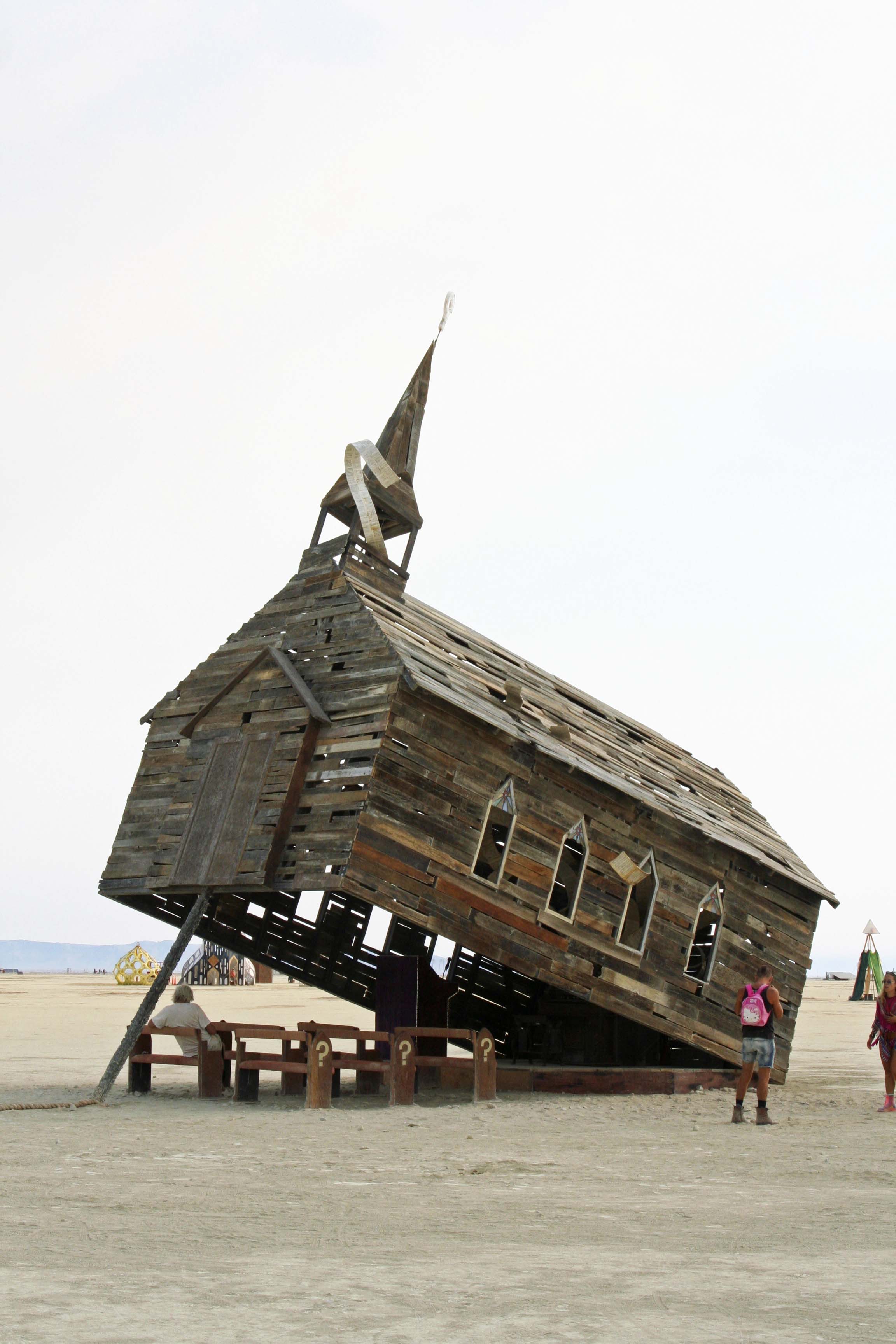
My next blog-a-book post this Thursday will be my childhood experiences of “looking for God in all the wrong places.” While I don’t have a photo, I thought that this picture I took at Burning Man below is relevant…













 Wandering through Time and Place